AB 1585: Wine labeling: “American” or “United States” appellation.
- Session Year: 2025-2026
- House: Assembly
- Latest Version Date: 2026-04-08
Current Status:
In Progress
(2026-06-23: In committee: Set, first hearing. Hearing canceled at the request of author.)
Introduced
In Committee
Awaiting First Chamber Vote
Passed First Chamber
In Committee
Awaiting Second Chamber Vote
Passed Second Chamber
Enacted
The Alcoholic Beverage Control Act, administered by the Department of Alcoholic Beverage Control, regulates the sale and distribution of alcoholic beverages and the granting of licenses for the manufacture, distribution, and sale of alcoholic beverages within the state. A violation of the act is generally a misdemeanor.
The act imposes specified labeling requirements for containers of alcoholic beverages sold within this state, including prescribed requirements for the use of appellations from specified geographic regions in California. The act generally provides that these labeling requirements do not preclude the use of a label containing a truthful, nonmisleading appellation of origin or geographic description that complies with federal appellation law, except as specified.
Existing federal law authorizes the use of the appellation American if at least 75% of the wine is derived from fruit or agricultural products grown in the United States, as specified.
This bill, notwithstanding the above-described provisions and for wine bottled on or after July 1, 2027, would prohibit the use of the appellation American or United States on wine produced, bottled, labeled, offered for sale, or sold in California unless 100% of the wine is derived from grapes or agricultural products grown in the United States, as specified. The bill would authorize the department to seize any wine in California that is labeled or packaged in violation of this prohibition and would make related findings and declarations. By expanding the scope of an existing crime, this bill would impose a state-mandated local program.
The California Constitution requires the state to reimburse local agencies and school districts for certain costs mandated by the state. Statutory provisions establish procedures for making that reimbursement.
This bill would provide that no reimbursement is required by this act for a specified reason.
The Legislature finds and declares all of the following:
(a)According to a 2024 survey by PricewaterhouseCoopers, more than 80 percent of respondents expressed concern about climate change in their purchasing decisions and 44 percent said they would pay more to support the land and environment.
(b)A 2023 Packer Fresh Trends survey found that 62 percent of consumers said that they make a conscious effort to buy locally grown or regional produce.
(c)Consumers have come to expect American wines to be produced under some of the strongest labor and environmental laws in the world. This is because 81 percent of American wine is from California, approximately 65 percent of California winegrape acres are certified sustainable, and more than 90 percent of Californias wine production comes from sustainable certified wineries. This makes California a global leader in sustainable winegrowing practices.
(d)When surveyed by the Alliance for American Manufacturing, 77 percent of Americans said they prefer to buy goods made in the United States.
(e)Senate Bill 1004 (Holmdahl), Chapter 676 of the Statutes of 1961, codified Californias Made in the U.S.A. law, making it unlawful for any person, firm, corporation, or association to sell or offer for sale any merchandise that is labeled as being made or manufactured in the United States when any article, unit, or part of the merchandise has been entirely or substantially made, manufactured, or produced outside of the United States.
(f)In January 2011, the California Supreme Court described the importance of truthful and accurate claims of domestic origin, stating, In particular, to some consumers, the Made in U.S.A. label matters. A range of motivations may fuel this preference, from the desire to support domestic jobs, to beliefs about quality, to concerns about overseas environmental or labor conditions, to simple patriotism. The Legislature has recognized the materiality of this representation by specifically outlawing deceptive and fraudulent Made in America representations. The object of Section 17533.7 is to protect consumers from being misled when they purchase products in the belief that they are advancing the interests of the United States and its industries and workers. (Sen. Holmdahl, sponsor ... letter to Governor Brown, May 23, 1961) [There are many Americans who feel that American-made articles are of higher quality, and who rely on the Made in U.S.A. label]. The Legislature evidently recognized some companies were using or might be tempted to use inaccurate Made in America labeling, that some consumers might be deceived by and rely on it, and that consumers and competitors who honestly made their wares in the United States and marketed them as such were being or would be harmed. (Kwikset Corp. v. Superior Court (2011) 51 Cal.4th 310, 329. Internal citations omitted.)
(g)In a 2015 challenge to Section 17533.7 of the Business and Professions Code, the United States District Court held that the California labeling law did not violate the dormant commerce clause. (Clark v. Citizens of Humanity, LLC (2015) 97 F.Supp.3d 1199.) 1199).
(h)California produces an average of 81 percent of total United States wine production. This makes California the dominant force in the American wine industry, even though other states also produce and consume wine. In hearing a case challenging Californias wine labeling law, the California Supreme Court ruled, ... We conclude that the states interest in protecting California wine consumers from misleading brand names and preserving and maintaining the reputation and integrity of its wine industry as a result of the use of such brand names in out-of-state and foreign market outweighs the indirect and temporary effect of [Section 25241 of the Business and Professions Code] on out-of-state wine consumers. Accordingly, we hold that [Section] 25241 does not violate the commerce clause. (Bronco Wine Co. v. Jolly (2005) 129 Cal.App.4th 988, 1028.) 1028).
(i)Under existing law, when a consumer purchases wine labeled as American or U.S.A., 25 percent of the grapes used to make that wine could actually have been grown in South America, Europe, New Zealand, Australia, or elsewhere. Based on the label, those consumers may believe the wine is produced domestically, and most likely in California, but the bulk wine in that bottle could have actually been shipped thousands of miles miles, creating a significant carbon footprint in putting that wine on California shelves and could have been produced in a country that has lesser labor or environmental laws than in California.
(j)While federal labeling laws for an American Viticultural Area (AVA) allow for 25 percent of the wine to come from outside that AVA, state law for use of California or a subregion in California require requires that the 25 percent must still be from California. For several decades, state law has required that any wine labeled as California or labeled with any AVA or county in California is made from 100 percent fruit grown in California. However, the American wine label has no national, continental, or even hemispheric restrictions as to the origin of the 25 percent that is not from the United States.
(k)This measure is intended to provide truth in labeling for American wine so that consumers are aware of the origin of the wine and can make an informed choice when determining whether to purchase domestic or imported wine.
SEC. 2.Section 25243 of the Business and Professions Code is amended to read:25243.Except as provided in Section 25243.5, this article does not preclude a wine from using, on any label, packaging material, or advertising, either (a) a truthful, nonmisleading appellation of origin that complies with Section 4.25(c) of Title 27 of the Code of Federal Regulations governing multicounty appellations, or (b) a truthful, nonmisleading statement as to the geographic location of the wines stated appellation or appellations of origin that is located in not more than two counties, for which the wine qualifies under applicable federal law, or both the appellation of origin and the statement of geographic location; provided that the label, packaging material, or advertising contains no other use of a name of viticultural significance, in a brand name or otherwise, that is prohibited by Section 25241 or 25242.
SEC. 3.Section 25243.5 is added to the Business and Professions Code, to read:25243.5.(a)Notwithstanding any other law, a wine produced, bottled, labeled, offered for sale, or sold in California shall not indicate an appellation of American or United States on any label, brand name, packaging material, or advertising unless 100 percent of the wine is derived from grapes or agricultural products containing natural or added sugar grown in the United States.
(b)(1)For purposes of this section, an indication of an appellation of American or United States includes, but is not limited to, use of the phrases American wine, USA wine, or United States wine.
(2)For purposes of this section, an indication of an appellation of American or United States does not include use of the phrases North American wine, Central American wine, or South American wine.
(c)The department may seize any wine located in California that is labeled or packaged in violation of this section and may dispose of the wine pursuant to Section 25355.
(d)This section applies only to wine that is bottled on or after July 1, 2027.
SEC. 4.No reimbursement is required by this act pursuant to Section 6 of Article XIIIB of the California Constitution because the only costs that may be incurred by a local agency or school district will be incurred because this act creates a new crime or infraction, eliminates a crime or infraction, or changes the penalty for a crime or infraction, within the meaning of Section 17556 of the Government Code, or changes the definition of a crime within the meaning of Section 6 of Article XIIIB of the California Constitution.
REVISIONS: HeadingLine 3.The Legislature finds and declares all of the following:
(a)According to a 2024 survey by PricewaterhouseCoopers, more than 80 percent of respondents expressed concern about climate change in their purchasing decisions and 44 percent said they would pay more to support the land and environment.
(b)A 2023 Packer Fresh Trends survey found that 62 percent of consumers said that they make a conscious effort to buy locally grown or regional produce.
(c)Consumers have come to expect American wines to be produced under some of the strongest labor and environmental laws in the world. This is because 81 percent of American wine is from California, approximately 65 percent of California winegrape acres are certified sustainable, and more than 90 percent of Californias wine production comes from sustainable certified wineries. This makes California a global leader in sustainable winegrowing practices.
(d)When surveyed by the Alliance for American Manufacturing, 77 percent of Americans said they prefer to buy goods made in the United States.
(e)Senate Bill 1004 (Holmdahl), Chapter 676 of the Statutes of 1961, codified Californias Made in the U.S.A. law, making it unlawful for any person, firm, corporation, or association to sell or offer for sale any merchandise that is labeled as being made or manufactured in the United States when any article, unit, or part of the merchandise has been entirely or substantially made, manufactured, or produced outside of the United States.
(f)In January 2011, the California Supreme Court described the importance of truthful and accurate claims of domestic origin, stating, In particular, to some consumers, the Made in U.S.A. label matters. A range of motivations may fuel this preference, from the desire to support domestic jobs, to beliefs about quality, to concerns about overseas environmental or labor conditions, to simple patriotism. The Legislature has recognized the materiality of this representation by specifically outlawing deceptive and fraudulent Made in America representations. The object of Section 17533.7 is to protect consumers from being misled when they purchase products in the belief that they are advancing the interests of the United States and its industries and workers. (Sen. Holmdahl, sponsor ... letter to Governor Brown, May 23, 1961) [There are many Americans who feel that American-made articles are of higher quality, and who rely on the Made in U.S.A. label]. The Legislature evidently recognized some companies were using or might be tempted to use inaccurate Made in America labeling, that some consumers might be deceived by and rely on it, and that consumers and competitors who honestly made their wares in the United States and marketed them as such were being or would be harmed. (Kwikset Corp. v. Superior Court (2011) 51 Cal.4th 310, 329. Internal citations omitted.)
(g)In a 2015 challenge to Section 17533.7 of the Business and Professions Code, the United States District Court held that the California labeling law did not violate the dormant commerce clause. (Clark v. Citizens of Humanity, LLC (2015) 97 F.Supp.3d 1199.)
(h)California produces an average of 81 percent of total United States wine production. This makes California the dominant force in the American wine industry, even though other states also produce and consume wine. In hearing a case challenging Californias wine labeling law, the California Supreme Court ruled, ... We conclude that the states interest in protecting California wine consumers from misleading brand names and preserving and maintaining the reputation and integrity of its wine industry as a result of the use of such brand names in out-of-state and foreign market outweighs the indirect and temporary effect of [Section 25241 of the Business and Professions Code] on out-of-state wine consumers. Accordingly, we hold that [Section] 25241 does not violate the commerce clause. (Bronco Wine Co. v. Jolly (2005) 129 Cal.App.4th 988, 1028.)
(i)Under existing law, when a consumer purchases wine labeled as American or U.S.A., 25 percent of the grapes used to make that wine could actually have been grown in South America, Europe, New Zealand, Australia, or elsewhere. Based on the label, those consumers may believe the wine is produced domestically, and most likely in California, but the bulk wine in that bottle could have actually been shipped thousands of miles creating a significant carbon footprint in putting that wine on California shelves and could have been produced in a country that has lesser labor or environmental laws than in California.
(j)While federal labeling laws for an American Viticultural Area (AVA) allow for 25 percent of the wine to come from outside that AVA, state law for use of California or a subregion in California require that the 25 percent must still be from California. However, the American wine label has no national, continental, or even hemispheric restrictions as to the origin of the 25 percent that is not from the United States.
(k)This measure is intended to provide truth in labeling for American wine so that consumers are aware of the origin of the wine and can make an informed choice when determining whether to purchase domestic or imported wine.
SEC. 2.Section 25243 of the Business and Professions Code is amended to read:25243.No provision of Except as provided in Section 25243.5, this article shall does not preclude a wine from using, on any label, packaging material, or advertising, either (a) a truthful, nonmisleading appellation of origin that complies with Section 4.25(c) of Title 27 of the Code of Federal Regulations governing multicounty appellations, or (b) a truthful, nonmisleading statement as to the geographic location of the wines stated appellation or appellations of origin which that is located in not more than two counties, for which the wine qualifies under applicable federal law, or both the appellation of origin and the statement of geographic location; provided that the label, packaging material, or advertising contains no other use of a name of viticultural significance, in a brand name or otherwise, that is prohibited by Section 25241 or 25242.
SEC. 3.Section 25243.5 is added to the Business and Professions Code, to read:25243.5.(a)Notwithstanding any other law, a wine produced, bottled, labeled, offered for sale, or sold in California shall not indicate an appellation of American or United States on any label, brand name, packaging material, or advertising unless 100 percent of the wine is derived from grapes or agricultural products containing natural or added sugar grown in the United States.
(b)(1)For purposes of this section, an indication of an appellation of American or United States includes, but is not limited to, use of the phrases American wine, USA wine, or United States wine.
(2)For purposes of this section, an indication of an appellation of American or United States does not include use of the phrases North American wine, Central American wine, or South American wine.
(c)The department may seize any wine located in California that is labeled or packaged in violation of this section and may dispose of the wine pursuant to Section 25355.
(d)This section applies only to wine that is bottled on or after July 1, 2027.
SEC. 4.No reimbursement is required by this act pursuant to Section 6 of Article XIIIB of the California Constitution because the only costs that may be incurred by a local agency or school district will be incurred because this act creates a new crime or infraction, eliminates a crime or infraction, or changes the penalty for a crime or infraction, within the meaning of Section 17556 of the Government Code, or changes the definition of a crime within the meaning of Section 6 of Article XIIIB of the California Constitution.
|
Date
|
Status
|
|---|---|
| Jun 23, 2026 | In committee: Set, first hearing. Hearing canceled at the request of author. |
| Jun 3, 2026 | Referred to Com. on G.O. |
| May 27, 2026 | In Senate. Read first time. To Com. on RLS. for assignment. |
| May 26, 2026 | Read third time. Passed. Ordered to the Senate. |
| May 26, 2026 | Read third time. Passed. Ordered to the Senate. (Ayes 67. Noes 0. Page 5393.) |
| May 26, 2026 | Read third time. Passed. Ordered to the Senate. (Ayes 67. Noes 0.) |
| May 18, 2026 | Read second time. Ordered to third reading. |
| May 14, 2026 | Coauthors revised. |
| May 14, 2026 | From committee: Do pass. (Ayes 15. Noes 0.) (May 14). |
| May 6, 2026 | In committee: Set, first hearing. Referred to APPR. suspense file. |
| Apr 23, 2026 | From committee: Do pass and re-refer to Com. on APPR. (Ayes 18. Noes 0.) (April 22). Re-referred to Com. on APPR. |
| Apr 9, 2026 | Re-referred to Com. on G.O. |
| Apr 8, 2026 | From committee chair, with author's amendments: Amend, and re-refer to Com. on G.O. Read second time and amended. |
| Feb 2, 2026 | Referred to Com. on G.O. |
| Jan 15, 2026 | From printer. May be heard in committee February 14. |
| Jan 14, 2026 | Read first time. To print. |
|
Date
|
Description
|
Location
|
Votes
|
|
|---|---|---|---|---|
| May 26, 2026 | AB 1585 Connolly Assembly Third Reading | Assembly Floor |
Passed |
|
| May 14, 2026 | Do pass. | Assembly Standing Committee on Appropriations |
Passed |
|
| Apr 22, 2026 | Do pass and be re-referred to the Committee on [Appropriations] | Assembly Standing Committee on Governmental Organization |
Passed |
This list shows positions taken on this bill by organizations on the date displayed, which is linked to the original source.
Positions by individuals are not included.
|
Organization
|
Position
|
Date
|
|---|---|---|
| Alexander Valley Winegrowers | ** Support | |
| Allied Grape Growers | ** Support | |
| Amador Wine Country | ** Support | |
| Anderson Valley Winegrowers Association | ** Support | |
| BERRYESSA GAP VINEYARDS | ** Support | |
| Blair Wines | ** Support | |
| California Association of Winegrape Growers (Co-source) | ** Support | |
| California Farm Bureau | ** Support | |
| California Women for Agriculture | ** Support | |
| CHATEAU MONTELENA | ** Support | |
| Clarksburg Winegrape Growers Association | ** Support | |
| County of San Joaquin | ** Support | |
| DK Wine Group | ** Support | |
| DOT Wines LLC | ** Support | |
| El Dorado Winery Association | ** Support | |
| Family Winemakers Of California | ** Support | |
| Family Winemakers of California (Co-Source) | ** Support | |
| Floyd Ridenhour | ** Support | |
| Foley Family Farms | ** Support | |
| Garden Creek Vineyards | ** Support | |
| Hafner Vineyards | ** Support | |
| Husch Vineyards | ** Support | |
| La Cienega Vineyard | ** Support | |
| Lake County Winegrape Commission | ** Support | |
| Lichen Estate | ** Support | |
| Lodi District Grape Growers Association | ** Support | |
| Lodi Winegrape Commission | ** Support | |
| Mendocino Winegrowers | ** Support | |
| Mercury Wine | ** Support | |
| Paso Robles Wine Country Alliance | ** Support | |
| Prestige Wine Company | ** Support | |
| Ramona Ranch Wines | ** Support | |
| REDWOOD EMPIRE VINEYARD MANAGEMENT | ** Support | |
| Reedy Vineyards | ** Support | |
| Robledo Winery | ** Support | |
| San Joaquin Board of Supervisors | ** Support | |
| San Joaquin Valley Winegrowers Association | ** Support | |
| San Luis Obispo Coast Wine Collective | ** Support | |
| Santa Barbara Vintners | ** Support | |
| SANTA CRUZ MOUNTAINS WINEGROWERS ASSOCIATION | ** Support | |
| Schramsberg Vineyards | ** Support | |
| Smith Story Wine Cellars | ** Support | |
| Sobon Wine Company | ** Support | |
| Sonoma Alliance for Vineyards and Environment | ** Support | |
| Suisun Valley Vintners & Growers Association | ** Support | |
| TEMECULA VALLEY WINEGROWERS ASSOCIATION | ** Support | |
| THE WINE GROUP | ** Against | |
| Wine & Spirits Wholesalers Of California Inc. | ** Against | |
| Wine Institute | ** Against | |
| Wineries of Santa Clara Valley Association | ** Support |
SENATE COMMITTEE ON GOVERNMENTAL ORGANIZATION
Senator Susan Rubio
Chair
2025 - 2026 Regular
Bill No: Hearing Date: 6/23/2026
Author: | , et al. | ||
Version: | Amended | ||
Urgency: | Fiscal: | ||
Consultant: | |||
SUBJECT:
DIGEST: This bill prohibits the use of the appellation “American” or “United States” on wine produced, bottled, labeled, or sold in California unless 100% of the wine is derived from grapes or agricultural products grown in the United States. Under Federal law, the use of the appellation “American” or “United States” is authorized if at least 75% of the wine is derived from fruit or agricultural products grown in the United States.
ANALYSIS:
Existing Federal law:
- Authorizes the use of the appellation “American” or “United States” if at least 75% of the wine is derived from fruit or agricultural products grown in the United States, as specified.
- Provides that a varietal designation and a vintage year can only be used if the wine is labeled with an appellation of origin.
- Prohibits, under the Federal Alcohol Administration (FAA) Act false or misleading labeling and regulates the use of claims, designations of origin, and varietal names.
Existing State law:
- Establishes the Department of Alcoholic Beverage Control (ABC) and grants it exclusive authority to administer the provisions of the ABC Act in accordance with laws enacted by the Legislature. This involves licensing individuals and businesses associated with the manufacture, importation, and sale of alcoholic beverages and the collection of license fees for this purpose.
- Imposes specified labeling requirements for containers of alcoholic beverages sold within this state, including prescribed requirements for the use of appellations from specified geographic regions in California. The Act generally provides that these labeling requirements do not preclude the use of a label containing a truthful, non-misleading appellation of origin or geographic description that complies with federal appellation law.
- Provides that wine labeled with "California" as the appellation of origin must be made from 100% California-grown grapes. This strict state-level requirement ensures that any wine bottled with a "California" designation is entirely produced from fruit grown within the state, unlike federal standards for other regions.
- Provides that the California Department of Food and Agriculture oversees vineyard registration, grape crush reporting, and the state's organic certification programs, which intersect with winery sustainability designations.
This bill:
- Prohibits a wine from being produced, bottled, labeled, or sold in California with an appellation of “American” or “United States” on any label, brand name, packaging material, or advertising unless 100% of the wine is derived from grapes or agricultural products containing natural or added sugar grown in the United States.
- Provides that an indication of an appellation of “American” and “United States” includes but is not limited to, use of the phrase “American wine,” or “United States wine.”
- Provides that an indication of an appellation of “American” or “United States” does not include use of the phrases “North American wine,” “Central American wine,” or “South American wine.”
- Authorizes the Department of ABC to seize and dispose of any wine located in California that is labeled or packaged in violation of this bill.
- Provides that the provisions of this bill only apply to wine that is bottled on or after July 1, 2027.
Background
Author Statement. According to the author’s office, “the heart of America’s wine industry is right here. California wines and grapes are known all over the world for their unique flavors and high quality, thanks to the hard work and dedication of our local winegrape growers and winemakers. The quality of America’s wine is undermined by labeling wine as ‘American’ but putting cheap imported bulk wine in the bottle. Folks deserve honesty and transparency when shopping for their preferred wine. AB 1585 will give consumers confidence that they are getting what they paid for.”
Economic Decline of the Wine Industry. The California wine industry is going through a period of major disruption and change. Wineries must compete on price, quality, value, and reputation against producers from other areas, other states, and countries around the world. That competitive landscape has grown increasingly difficult, highlighted by a 17% drop in production in 2024 to its lowest level since 1999. This downturn is being driven by a combination of oversupply, shifting consumer preferences, and rising costs that have outpaced market returns.
Put simply, consumer demand has fallen sharply. Younger consumers—Millennials and Generation Z—are drinking less alcohol overall, and Baby Boomers, who have historically anchored wine consumption, are also scaling back. The resulting market contraction has compounded an already severe supply glut, leaving large quantities of grapes unharvested across major growing regions including Napa, Lodi, Sonoma, and the Central Valley. Growers have responded by abandoning crops and removing vines at scale; industry reports indicate that approximately 40,000 acres of vineyards were removed in 2025, with comparably large removals anticipated in 2026. These reductions are expected to substantially decrease California's total vineyard acreage from its current level of roughly 600,000 acres.
The financial toll has been considerable. Production costs have risen above market returns in many segments, compressing or eliminating profit margins for growers and precipitating the closure of established operations, including Carneros Hill Winery and Ranch Winery. U.S. wine revenue has declined by more than one billion dollars, and analysts project that the total number of wineries and brands will contract by 25 to 30 percent as the industry consolidates around a long-anticipated market bottom.
However, not all observers view the current trajectory with alarm. Some experts caution that the pace of vineyard removal, if sustained, could generate a supply shortage once consumer demand stabilizes—potentially reversing today's oversupply conditions. In the near term, certain segments of the industry are demonstrating relative resilience: premium wine brands continue to perform comparatively well, and growth in wine tourism, including the expansion of tasting room operations, is providing a partial offset to broader market declines. The challenges confronting California’s wine industry are well established; however, it remains unclear how this bill’s provisions would address the demand-side pressures driving that decline.
What Problem Does this Bill Solve? Proponents contend that “AB 1585 ensures that wine labeled as ‘American’ accurately reflects grape origin, consistent with long-standing consumer expectations and existing geographic labeling standards,” and that the bill is about “truth in labeling, consumer transparency, and clarity.” While those are laudable goals, they do not accurately reflect the realities of alcohol labeling— at the federal or state level.
Federal law does not impose a 100% grape sourcing requirement for any appellation — not for states, counties, American Viticultural Areas (AVAs), grape varietals or even vintage year designation. California itself applies 100% sourcing for any wine labeled with a California designation, but county appellations require only 75%, and AVAs generally require 85%. A 100% sourcing threshold is clearly the exception, not the rule.
The lower thresholds that apply to the vast majority of appellations are not oversights or attempts to mislead consumers — they reflect deliberate policy choices grounded in the realities of how wine is grown and produced. The "American" appellation is no different in kind from county appellations such as Sonoma, Monterey, or Napa, all of which carry a 75% grape sourcing requirement. That threshold gives winemakers the flexibility to manage varietal shortages, refine a blend's flavor profile, and adapt to conditions beyond their control — including drought, disease, and supply disruptions that can affect grape availability at any given time.
This raises a significant question about the bill's internal consistency. If the goal is truth in labeling and consumer transparency, why does the bill target only the "American" appellation — one that, by most measures, commands far less market recognition than California's well-known county and AVA designations. If a 100% sourcing requirement is the appropriate standard for consumer protection, consistency would seem to demand applying that standard to every appellation and AVA. A consumer who purchases a bottle labeled "Napa County" or "Sonoma County" has an equally legitimate interest in knowing whether that wine meets a 100% sourcing standard — yet the bill imposes no such requirement on those designations.
The transparency argument, taken to its logical conclusion, raises further questions. If consumers deserve complete information about the geographic origin of their wine, do they not also deserve disclosure of caloric content or sugar levels — neither of which is currently required under alcohol labeling law? The bill's selective focus on a single appellation – an appellation that arguably most consumers are not even aware exists – while leaving these broader disclosure gaps unaddressed, undermines the consumer protection rationale it claims to solve.
Standards in Other Countries. While the Committee has not had the opportunity to do an in-depth study of every country’s appellation requirements, it appears that many wine-producing countries set sourcing thresholds for national or broad geographic appellations somewhere between 75% and 85%. For example, Australia requires 85% for any geographic indication, including its broadest national designation, “South Eastern Australia.” Argentina requires 80% and New Zealand 85%. Chilean wine requires that any wine listing a specific grape, vintage, or region must contain at least 75% of that stated grape, year, or origin. However, to meet European export requirements, many Chilean winemakers voluntarily use at least 85% to satisfy international export laws for markets like the European Union.
In France, “Vin de France” must be made from grapes grown entirely in France. Vin de France replaced the outdated Vin de Table category in 2010 and remains the most basic quality tier for French wine. In recent years, French wine labels have undergone significant change under the new European Union rules, including the addition of ingredients and nutritional information accessible via QR codes.
Overall, available information suggests that while certain countries require wine products to be sourced entirely from within their borders to use a geographic designation, many countries apply a lower sourcing threshold and often mirror the labeling standards established under federal law in the United States.
It is also worth noting that, as a general matter, sourcing standards for a country's appellation are properly set at the national level, not by individual states or sub-national appellations. There may well be merit to raising the sourcing threshold for the "American" or "United States" appellation to 100%. Even so, such a change would more appropriately originate at the federal level, given that "American" is a national designation. Were each state free to define what qualifies as "American" or “United States” wine, the result could be 50 divergent standards—undermining the very uniformity the appellation is meant to convey.
Impact on Varietal and Vintage Year. Under federal law, the Alcohol and Tobacco Tax and Trade Bureau’s (TTB) wine labeling regulations link varietal designations and vintage years to appellation of origin, such that neither may appear on a label without the other. Specifically, under 27 C.F.R § 4.23, a varietal designation – such as “Chardonnay” or “Pinot Grigio” – may only be used if the wine is labeled with an appellation of origin, and the wine must be composed of at least 75% of the named grape variety; another example of a threshold lower than 100%. Similarly, under 27 C.F.R § 4.27, a vintage year may only be shown on a label if the wine is entitled to, and labeled with, an appellation of origin, and at least 95% of the wine must be derived from grapes harvested in the stated calendar year; yet another example of a threshold lower than 100%. The practical effect of these interlocking rules is that a winery cannot claim a vintage year or a varietal name on its label without grounding that claim in a stated appellation, and the appellation in turn determines the applicable sourcing threshold.
A significant and perhaps unintended consequence of AB 1585 is that it may result in less consumer information on wine labels rather than more. Because the ability to display a varietal designation and vintage year on a wine label is tied under federal TTB regulations to the availability of an appellation of origin, a winery that loses access to the "American" appellation — and whose product does not qualify for an alternative recognized appellation — would also lose the ability to communicate that information to consumers.
A bottle that currently reaches consumers as a "2022 American Pinot Grigio" would instead be required to carry a generic designation such as "White Wine" or "Table Wine" — conveying substantially less information about the product's character and composition. To the extent the bill is premised on a consumer protection rationale, this outcome is directly contrary to that stated purpose, and the Committee should consider whether a measure that reduces label transparency for a segment of California's wine market is consistent with the interests it purports to advance.
Additional Prohibitions. While public attention has largely centered on AB 1585’s prohibition on the sale of wines labeled “American” or “United States” the bill’s reach extends considerably further. The bill clearly prohibits the production, bottling, labeling, and advertising of such products within California – conduct that is entirely lawful under federal law and current TTB regulations.
This distinction is critical. AB 1585 would not merely restrict what California retailers and distributors may offer for sale; it would prohibit California-based wineries from producing those bottles in the first place. A winery operating in this state could not lawfully bottle, label, or market a wine bearing an “American appellation – even if that product fully complies with all applicable federal requirements and is destined for sale in another state.
The practical consequences of this are significant. Wineries that currently bottle American-appellation wines in California – including large-volume producers for whom such products might represent a core component of their business – could be compelled to cease production activity within this state entirely. In effect, AB 1585 would not simply regulate what may be sold in California; it would regulate what may be made here, with direct consequences for California jobs, facilities, and the broader wine supply chain.
These burdens would be severe under any circumstances. They are made much more difficult to justify given the absence of a clear consumer protection rationale underlying the bill. The “American” appellation is not a brand that appears to carry meaningful recognition among wine consumers, nor is there an established record of consumer confusion, deception, or market harm attributable to its use. Before imposing sweeping restrictions on lawful production activity – restrictions that could displace workers, hurt bottling operations, and expose the state to significant constitutional risk – the Legislature should expect a clear and evidence-based answer to a fundamental question: what precisely, does this bill solve?
The Liberty Creek Example. Liberty Creek wines are produced in Modesto California and owned by E. & J. Gallo Winery, the largest family-owned winery in the world. According to their website, Liberty Creek Vineyards prides itself on “Proudly Serving America.” According to their website, over the past ten years, Liberty Creek has donated $1.5 million to “those that have served our country.” As an example of the types of wines that are using the term “American” the sponsors have submitted a sponsorship letter that specifically includes a picture of a bottle produced by Liberty Creek as “American Wine.”
As part of that letter, the sponsors include the following excerpt from Liberty Creek’s website with the highlighted sections seen below:
At Liberty Creek Vineyards, we have a simple winemaking philosophy. We believe that quality wines should be accessible for all. Each bottle of Liberty Creek honors this belief and celebrates our proud heritage rooted in the rich soils of the United States. Liberty Creek is inspired by the words of our nation’s founding fathers who proclaimed our right to Life, Liberty, and the pursuit of happiness. Through our smooth, easy-to-drink California wines, we honor and celebrate this right. Cheers to Life, Liberty, and Happiness!
The purpose of these highlighted sections seems to be to portray that Liberty Creek is using terms such as “United States,” and “Life, Liberty, and Happiness” as a way to promote their brands while somehow misleading consumers as the content of their wine. The letter includes a link to Liberty Creek's website, which lists eleven wines available from the company. Of those eleven, eight carry a California appellation of origin, meaning they are produced from 100% California-grown grapes. Two wines do not appear to be tied to any appellation and are listed simply as "Sweet Red" and "Rosé"; because no appellation is designated, the origin of the grapes used in those wines is unclear.
Only one wine is listed as an "American" wine — specifically, a label reading "Founders Red Blend / American Table Wine." Under federal regulations, that designation requires the wine to be derived from at least 75% grapes grown in the United States, with the remaining 25% permissibly sourced from anywhere, including California. The use of the “American” designation does not, by itself, establish that any portion of the grapes were sourced internationally. It is equally plausible that Liberty Creek selected the “American” appellation for marketing purposes, given its complementary fit with the “Founders Red Blend” branding. This example is offered to illustrate that even in the case cited by the bill's sponsors, the overwhelming majority of wines advertised by that winery are derived from California-grown grapes.
For a winery like Liberty Creek, this bill could create significant logistical complications given the two distinct standards it would establish. Much of Liberty Creek's website, for instance, emphasizes its "heritage rooted in the rich soils of the United States." If its one "American” designated wine is not derived entirely from domestically grown grapes, would any reference to "the United States" or "American" need to be removed from the company's website — even though the wine fully complies with standards established by the federal government? This question is not hypothetical: the bill expressly prohibits the advertising of wines that do not meet its requirements. Would Liberty Creek therefore be prohibited from advertising that wine on its own website?
Possible Conflict with Federal Law and Consequences. TTB regulations at 27 CFR § 4.25 already define what “American wine” means for labeling purposes – it requires that at least 75% of the wine be derived from fruit or agricultural products grown in the U.S. AB 1585 creates a direct contradiction: a product that lawfully bears an “American wine” label under federal TTB approval would be prohibited from sale in California under the state standard. This is the classic conflict preemption scenario – compliance with both laws is impossible, or at the least state law stands as an obstacle to the full purpose of federal law. TTB’s system is specifically designed to create a uniform, nationally applicable label approval. A state that effectively overrides a federally approved label by imposing stricter sourcing thresholds arguably undermines the federal scheme.
The implications of AB 1585 are not limited to California's wine market. If California may redefine the sourcing threshold for the federally designated "American” wine category, there is no principled basis for preventing every other state from doing the same. The result would be a fragmented national regulatory landscape in which a single, federally approved designation carries 50 different legal meanings depending on the state in which a bottle is produced and/or sold. For wineries engaged in national distribution, such a regime would impose substantial and potentially prohibitive compliance costs — requiring separate formulations, segregated supply chains, and distinct inventories for each state market. The TTB labeling system exists precisely to ensure consistent national standards. Allowing states to override those standards undermines that purpose and highlights why national designations should be governed federally, particularly with respect to a designation like “American” or “United States” wine, whose defining characteristics are national in character and cannot be reduced to the standards of any single state.
Dormant Commerce Clause. The Dormant Commerce Clause (DCC) prohibits state laws that discriminate against or unduly burden interstate commerce even absent federal legislation. Courts generally apply different analytical frameworks depending on whether the law discriminates against interstate commerce or if the law regulates evenhandedly with only incidental effects on out-of-state trade. If the practical consequence of raising the sourcing threshold is to advantage California growers, who are the dominant supply source for California wineries, while burdening wineries that source more heavily from other states or from bulk imports, AB 1585 would likely face significant legal issues.
That disparity is precisely the kind of practical discrimination the DCC targets, and if the legislative record reflects any intent to protect California grape growers from out-of-state competition, that argument could be more easily made. Unfortunately, in this case, letters submitted to the committee have made mention of the fact that “California produces more than 80% of all U.S. wine.” Furthermore, in the Assembly Governmental Organization Committee Hearing, proponents of the bill made such comments as “because California produces over 80% of American wine, we have a vested interest in ensuring that the truth in labeling is effective on American wine.” These types of comments certainly are not helpful in protecting against DCC issues. A finding of discrimination would trigger strict scrutiny, requiring California to show the law serves a legitimate purpose that cannot be achieved through nondiscriminatory means. That can be an exceptionally high bar, and states have in the past had difficulty clearing it.
Granholm v Heald, 544 U.S. 460 (2005). In the 2005 Granholm v Heald case, the Supreme Court of the United States ruled that laws in New York and Michigan that permitted in-state wineries to ship wine directly to consumers but prohibited out-of-state wineries from doing so were unconstitutional. The court case, which was a consolidation of two separate lawsuits against Michigan and New York, pitted the Dormant Commerce Clause against the 21st Amendment.
Michigan and New York alcohol laws allowed in-state wineries to directly ship alcohol to consumers but prohibited such activity from out-of-state wineries. Plaintiffs argued that these laws violated the U.S. Constitution’s Dormant Commerce Clause, which over the years has been interpreted to mean that states are prohibited from passing laws favoring in-state businesses over out-of-state businesses. On the other hand, the defendants argued that their laws were a valid exercise of state power under the 21st Amendment, which ended federal prohibition and allowed states to regulate alcohol importation. One of the state’s justifications was that by regulating out-of-state wineries, the state might be able to hinder the shipment of alcohol to underage minors, which they believe served a valid state purpose.
After making its way through the courts, the two separate cases were ultimately decided by the U.S. Supreme Court. In a 5-4 opinion delivered by Justice Anthony Kennedy, the Court opined that both states’ laws violated the commerce clause by favoring in-state wineries at the expense of out-of-state wineries. In essence, the case held that states have the burden to show that restrictions on out-of-state businesses that do not also apply to in-state businesses, need to be supported by a justifiable need to advance public health and safety, or for some other legitimate, non-discriminatory, reason. Prior to this decision, it was widely assumed that in-state manufacturers could be given more privileges compared to out-of-state manufacturers. Following the Granholm v Heald case, out-of-state manufacturers must generally be given the same privileges as in-state manufacturers.
AB 1585 presents a particular challenge in light of the Supreme Court's decision in Granholm v. Heald (2005). Were the bill to face legal challenges, California would inevitably invoke its 21st Amendment authority, which historically has been understood to grant states broad power to regulate alcohol within their borders. However, Granholm significantly curtailed that protection, holding that the 21st Amendment does not insulate state alcohol regulations from DCC scrutiny where the practical effect of the challenged law is to discriminate against out-of-state producers. That holding directly implicates AB 1585, whose practical effect — as discussed above — seems to advantage California grape growers at the expense of out-of-state competitors. Additionally, AB 1585 would make it illegal to sell wine that would be legal to sell in 49 other states, not to mention much of the rest of the world.
The most vulnerable point for AB 1585's proponents is the inability to articulate a consumer harm that the existing federal 75% threshold fails to address and that California's higher threshold would remedy through nondiscriminatory means. If the honest answer is that California wants more California grapes in California wine, that seems to be a straightforward protectionist purpose that the DCC exists to prohibit.
Bronco Wine Co. v. Jolly (2005). Bronco Wine Co. v Jolly (2005) was a challenge by Bronco Wine Company – the producer of “Two buck Chuck” and other high-volume wines – to a California law requiring that wines using a California county appellation on their label actually source a majority of their grapes from that county. Bronco argues that the law was preempted by the FAA Act and violated by the DCC.
The California Court of Appeal ruled against Bronco on both counts. On preemption, the court found that the FAA Act was intended to supplement, not supplant, existing state regulation of wine labeling, and that California's appellation rules did not directly conflict with federal TTB standards because the federal rules set a floor, not a ceiling, for geographic designation requirements. On the DCC, the court found the law was nondiscriminatory because it applied evenhandedly to all grapes regardless of their origin — a winery could comply by sourcing the required percentage from Napa, Sonoma, or any other California county, and the law imposed no preference for California grapes over out-of-state grapes per se. The burden on interstate commerce was found not to be clearly excessive relative to California's legitimate interest in protecting the integrity of its geographic appellations and preventing consumer deception.
The Bronco decision is the leading California precedent supporting state authority to impose stricter wine sourcing standards than federal TTB rules require. But there are important distinctions between the Bronco ruling and a possible lawsuit involving AB 1585. First, Bronco involved sub-state appellations — county-level geographic designations that are inherently California-specific and serve a genuine consumer interest in knowing whether a "Napa Valley" wine actually comes from Napa Valley. AB 1585, by contrast, concerns the "American wine" designation, which is a federally defined category that TTB has already comprehensively regulated. Second, the nondiscrimination finding in Bronco rested on the law's even-handed application across all geographic sources — the law didn't favor California grapes, it just required geographic accuracy. AB 1585's practical effect, by contrast, could be argued that it seems to advantage California growers specifically, which is a much harder case to make under the discrimination argument. Third, the conflict preemption analysis in Bronco turned on the absence of a direct conflict between state and federal standards in the appellation context — but as discussed, AB 1585 operates directly on a federally defined designation in a way that creates a more direct tension with the TTB scheme.
Taken together, AB 1585 faces substantial legal vulnerability under both federal statute and constitutional doctrine. While no court has addressed AB 1585 directly, laws of this character have consistently attracted litigation, and the state should anticipate that implementation would invite legal challenges. The Supreme Court's decision in Granholm made clear that the 21st Amendment does not shield state alcohol laws from DCC scrutiny when the practical effect is to discriminate against out-of-state economic interests, removing what had historically been the state's strongest defense in this area. At a minimum, the Department of ABC would likely face litigation requiring it to defend the law's validity in court — at considerable cost and with uncertain prospects for success.
Prior/Related Legislation
SB 869 (Weber Pierson) requires chain restaurants to include an icon next to beverage items on menus indicating that the beverage has added sugar content that is greater than one-half of the daily value for added sugar. The bill exempts beverage items that contain alcohol. (Pending in the Assembly Health Committee)
FISCAL EFFECT: Appropriation: Fiscal Com.: Local:
SUPPORT:
California Association of Winegrape Growers (Co-source)
Family Winemakers of California (Co-source)
Allied Grape Growers
Anderson Valley Winegrowers Association
Amador Wine Country
Alexander Valley Winegrowers
Blair Wines
Berryessa Gap Vineyards
California Farm Bureau
California Women for Agriculture
Chateau Montelena
Clarksburg Winegrape Growers Association
County of San Joaquin
DOT Wines LLC
DK Wine Group
El Dorado Winery Association
Floyd Ridenhour
Foley Family Farms
Husch Vineyards
Garden Creek Vineyards
La Cienega Vineyard
Lake County Winegrape Commission
Lichen Estate
Lodi District Grape Growers Association
Lodi Winegrape Commission
Mendocino Winegrowers
Mercury Wine
Paso Robles Wine Country Alliance
Prestige Wine Company
Ramona Ranch Wines
Redwood Empire Vineyard Management
Reedy Vineyards
Robledo Winery
San Joaquin Board of Supervisors
San Joaquin Valley Winegrowers Association
San Luis Obispo Coast Wine Collective
Santa Barbara Vintners
Santa Cruz Mountains Winegrowers Association
Schramsberg Vineyards
Smith Story Wine Cellars
Sobon Wine Company
Sonoma Alliance for Vineyards and Environment
Suisun Valley Vintners & Growers Association
Temecula Valley Winegrowers Association
Wineries of Santa Clara Valley Association
OPPOSITION:
The Wine Group
Wine Institute
Wine & Spirits Wholesalers of California Inc.
ARGUMENTS IN SUPPORT: According to the California Association of Winegrape Growers and the Family Winemakers of California, “as co-sponsors of this important legislation, our organizations believe the authenticity is key to California’s wine industry coming back from the crisis we are currently experiencing. AB 1585 builds on generations of trust by protecting and enhancing truth in labeling. Conversely, the status quo relies on consumers ‘who trust what is on the label and feel good about what is in the glass.’ They say this even if the consumer believes they are drinking American wine but 25% of that wine is from another country that is never disclosed to the wine consumer. Many leaders in the California wine industry have said that such an approach is deceiving. Furthermore, it puts California’s entire wine industry at risk of fostering consumer distrust.”
ARGUMENTS IN OPPOSITION: According to the Wine Institute, “some U.S. wineries intentionally source a portion of their grapes from specific international regions because those grapes fit a particular consumer preference or deliver a flavor profile that improves the wine. This is not deception. It is craft. The ‘American’ appellation already tells the consumer the wine is predominantly American-made. Implying that anything short of 100% is dishonest does not protect consumers. It misleads them about how winemaking actually works and about an industry that has been transparent about these standards for decades.
The TTB, the federal agency with direct authority over wine labeling, reviewed this exact issue in 2012. After careful deliberation, the TTB amended its rules to preserve flexibility for winemakers ‘while still ensuring that consumers are provided with adequate information as to the identity and quality of the wines they purchase.’ AB 1585 does not improve on that balance. It dismisses it.”
According to the Wine Group, “proponents argue that consumers are being misled, but federal law does not require 100% sourcing for any wine appellation. A wine labeled with an AVA such as Napa Valley may contain up to 15% grapes from other parts of California, and a wine labeled with a county name such as Sonoma County may contain up to 25% grapes from elsewhere in California. AB 1585 would create a stricter rule for the broadest geographic claim than exists for more specific California appellations. That inconsistency would undermine, rather than strengthen, confidence in wine labels and invite confusion, criticism, and litigation over a labeling system that already works under federal law. If the policy goal is appellation accuracy, the standard should be evaluated consistently and nationally—not selectively applied to one appellation through a California-only rule.”
According to the Wine & Spirits Wholesalers of California, “for our wineries and suppliers that our members represent as distributors in California, AB 1585 takes away the flexibility that California wineries rely on and adds new costs in an already challenging market for the distribution and sale of wine. The 75% requirement established under federal regulations, which would be overridden by this bill, provides necessary flexibility for California wineries to manage supply gaps caused by crop shortages and shifts in consumer demand and stabilize costs during tight harvest years and softer consumer demand. Losing this flexibility comes at a particularly difficult and demanding time for the California wine industry (and for our members as well), which is suffering from significantly reduced demand in wine consumption, inflation and rising compliance cost.”
ASSEMBLY THIRD READING
ATR Bill Id:AB 1585
Author:(Connolly and Ransom)
As Amended Ver:April 8, 2026
Majority vote
SUMMARY
This bill would provide for wine bottled on or after July 1, 2027, would prohibit the use of the appellation "American" or "United States" on wine produced, bottled, labeled, offered for sale, or sold in California unless 100% of the wine is derived from grapes or agricultural products grown in the United States, as specified. The bill would authorize the Department of Alcoholic Beverage Control (ABC) to seize any wine in California that is labeled or packaged in violation of this measure.
Major Provisions
1) Provides on or after July 1, 2027, a wine produced, bottled, labeled, offered for sale, or sold in California shall not indicate an appellation of "American" or "United States" on any label, brand name, packaging material, or advertising unless 100% of the wine is derived from grapes or agricultural products containing natural or added sugar grown in the United States.
2) Provides an indication of an appellation of "American" or "United States" includes, but is not limited to, use of the phrases "American wine," "USA wine," or "United States wine."
3) Provides an indication of an appellation of "American" or "United States" does not include use of the phrases "North American wine," "Central American wine," or "South American wine."
4) Provides ABC may seize any wine located in California that is labeled or packaged in violation of this measure and may dispose of the wine, as specified.
COMMENTS
Background: Wine labels in California must satisfy both federal and state rules. The Alcohol and Tobacco Tax and Trade Bureau (TTB) regulate labeling under the Federal Alcohol Administration Act (FAA Act) and its implementing regulations at 27 Code of Federal Regulations (CFR) Part 4. Every wine label must display the brand name, wine type, alcohol content, net contents of the bottle, and the government health warning. The TTB also regulates certain claims and prohibits misleading or deceptive labeling practices. While federal law sets uniform national standards, it does not expressly preempt states from adopting additional or more protective labeling requirements, so long as those requirements do not conflict with federal mandates or impede interstate commerce.
California operates under a regulatory system for wine labels designed to provide purchasers with a substantial amount of information about a wine label. Understanding these regulations allows consumers to gain insights that may not be immediately apparent from simply reading the label.
Wine names generally fall into three categories: varietal, which refers to the type of grape used (such as Cabernet Sauvignon, Merlot, and Chardonnay); generic, which refers to wine types that have developed a secondary meaning in California; and proprietary, which are unique names created by wineries for specific wines.
If a California wine is labeled as a varietal, at least 75% of the wine must be made from the named grape variety. In contrast, there are no specific restrictions on the types of grapes used in wines with generic or proprietary names. To display a vintage date (for example, "2020"), at least 95% of the grapes used must have been harvested in that year; the remaining 5% may come from other vintages, often used to top off barrels.
Geographic origin statements are also regulated. To be labeled as "California" wine, 100% of the grapes must be grown within the state. In order for a wine to be designated with an Appellation of Origin defined by a political boundary, such as a county name, federal law requires that 75% or more of grapes used to make the wine be from that appellation, and that the wine be fully finished within the state in which the county is located. If a wine is designated with the name of an American Viticultural Area (AVA), federal regulations require that 85% or more of the wine is derived from grapes grown within the boundaries of that TTB-established AVA.
Local American Viticultural Areas (AVAs) can enforce stricter labeling rules than federal standards if they are established as state laws or regional agreements. For instance, Sonoma County enforces mandatory conjunctive labeling, requiring the county name alongside the specific AVA name on all labels.
Finally, winery production and bottling designations can provide valuable information to informed consumers. Terms such as "Estate Bottled" and "Grown, Produced and Bottled by …" indicate that 100% of the grapes come from vineyards owned or controlled by the winery within the same viticultural area. When used by a respected winemaker, these designations often suggest a higher-quality wine, as the entire production process is managed by a single producer.[1]
Supporters note that AB 1585 is also consistent with laws in other leading wine-producing nations around the world that have enforced 100% country-of-origin standards for centuries. Wines labeled with a country of origin—such as France, Italy, or Spain—must be produced exclusively from grapes grown within that country and do not permit blending with wines from other countries.
California's wine industry is one of the largest and most influential in the world, and changes to labeling requirements can have significant operational and economic impacts. Recognizing this, AB 1585 includes a delayed implementation date—applying only to wine bottled on or after July 1, 2027—to provide producers with adequate time to adjust their practices, update labels, and avoid disruptions such as relabeling existing inventory or removing products from retail shelves.
Direct-to-consumer shipping. California's direct-to-consumer (DTC) market is one of the most permissive in the country. A winery holding a Type 02 Winegrower's License may ship an unlimited amount of wine directly to California residents. Out-of-state wineries, however, must obtain a Type 82 Wine Direct Shipper Permit from ABC to ship into the state. Because shipments to other states must comply with a wide variety of regulations, many wineries use third-party compliance services. Furthermore, all licensed winegrowers must file a Winegrower Tax Return with the California Department of Tax and Fee Administration by the 15th of each month, covering all transactions from the prior period.
California wine industry economic declines. Wineries face multifaceted competition based on price, quality, value, and reputation. Competition comes from wines produced in another county, another state, another country. The California wine industry is experiencing a significant correction, highlighted by a 17.1% drop in production in 2024, its lowest level since 1999. This downturn is being driven by a combination of oversupply, shifting consumer preferences, and rising operating costs. As a result, thousands of acres of vineyards are being removed, and total winery numbers are projected to decline by 25% to 30%.
Industry reports indicate that approximately 40,000 acres of vineyards were removed in 2025, with similarly large-scale removals expected in 2026. These reductions are projected to significantly decrease California's total vineyard acreage from roughly 600,000 acres. At the same time, U.S. wine revenue has declined by more than $1 billion.
While the winegrape market is currently oversupplied, some experts caution that aggressive vineyard removals could eventually create a supply shortage once demand stabilizes. Despite these broader challenges, certain segments of the industry are demonstrating resilience. Premium wine brands continue to perform relatively well, and growth in wine tourism—along with the expansion of new tasting rooms—is helping to offset some of the declines, even as the overall market contracts.
According to the Author
According to the author, "The heart of America's wine industry is right here. California wines and grapes are known all over the world for their unique flavors and high quality, thanks to the hard work and dedication of our local winegrape growers and winemakers. The quality of America's wine is undermined by labeling wine as 'American' but putting cheap imported bulk wine in the bottle. Folks deserve honesty and transparency when shopping for their preferred wine. AB 1585 will give consumers confidence that they are getting what they paid for."
Arguments in Support
The Family Winemakers of California and the California Association of Winegrape Growers write, "This straightforward 100% standard aligns the American designation with the state's long-standing commitment to clear, place-based wine labeling and builds on the requirement that wines labeled "California" contain 100% California-grown grapes. This California standard has been in place for decades and works well. Wineries support this bill because the integrity of the wine label affects the entire California wine industry. When consumers believe that wine labeled as "American" is produced with grapes grown in the U.S. (likely California), but 25% of the contents of that bottle is actually imported bulk wine, wine consumers no longer trust the label. That hurts California's entire wine industry.
Growers support AB 1585 because, in wine globally, and especially in California, there is a foundational value that wine is defined by where its grapes are grown. The origin of those grapes is central to the identity of the wine in the bottle and should be clearly reflected on the label.
This is because there is a great connection between the consumer who enjoys the wine and the grower who grows the grapes. The label fosters that connection by informing the consumer about where those grapes were grown.
At a time when the wine industry is already facing significant challenges, maintaining consumer trust in wine labels is paramount. This is crucially important now more than ever. As California's wine industry is trying to make a comeback, we must appreciate how California consumers make buying decisions."
Arguments in Opposition
The Wine Institute writes, "This bill seeks to create a California-only standard for the use of the American Appellation label on wine produced or sold into our state. The present standard, which has been in effect since the 1970s, is set by the federal government and requires that 75% of grapes used in wine labeled as "American Wine" be sourced from the United States. In the wine industry, it has long been standard that label indicators require less than 100% grape sourcing. For example, both varietal and county indications on a label signify that 75% of the grapes sourced for that wine are that varietal or come from that county.
This bill comes at an unfortunate time for the wine industry as wineries face reduced consumer demand. The flexibility inherent in current and long-standing labeling practices allows winemakers the ability to produce wines of desired styles and consumer price points. Additionally, this flexibility allows winemakers to cope with variations in grape harvests, a critical element when considering both the nature of agriculture and our evolving climate. This flexibility is also to the benefit of growers that have grapes to sell that would not otherwise be eligible due to the restrictive labeling requirements.
Moreover, the change contemplated by AB 1585 will most significantly impact the "value" wine segment – those wines produced with a focus on affordability. This segment is vital to the recovery of the wine industry, as these lower cost wines are most often where customers new to wine make their first purchase. Moreover, under AB 1585, were a winery to produce a wine using any grapes from outside of the United States, they would forego their ability to communicate the varietal and vintage of the wine on their label. Not only does this compromise the ability to sell the product, but it erodes the so-called transparency that this bill seeks when communicating with a customer. AB 1585 will further complicate an already difficult path to recovery for California's iconic wine industry."
FISCAL COMMENTS
According to the Assembly Committee on Appropriations analysis, "ABC anticipates minor and absorbable costs to enforce this bill's appellation of origin standard. However, this committee sees a wide array of bills that propose to modify the scope of alcohol laws. Generally, the majority of proposals do not generate significant new workload for ABC, but taken together, these proposals could lead to significant new costs and future budget requests. In this case, since the labeling requirement applies to both wine produced in California by ABC licensees and wine imported from out-of-state producers that may be unfamiliar with a state standard that deviates from the federal standard, the potential for a violation and related volume of complaints may be greater than usual. Thus, it is possible for ABC to incur enforcement costs in excess of $150,000 as a result of this bill (ABC Fund).
VOTES
ASM GOVERNMENTAL ORGANIZATION: 18-0-4
YES: Davies, Berman, Bryan, Carrillo, Dixon, Fong, Gabriel, Gallagher, Gipson, Macedo, McKinnor, Nguyen, Ramos, Solache, Soria, Ta, Valencia, Wallis
ABS, ABST OR NV: Blanca Rubio, Alvarez, Pacheco, Michelle Rodriguez
ASM APPROPRIATIONS: 15-0-0
YES: Wicks, Hoover, Aguiar-Curry, Calderon, Caloza, Dixon, Fong, Mark González, Krell, Pacheco, Pellerin, Sharp-Collins, Solache, Ta, Tangipa
UPDATED
VERSION: April 8, 2026
CONSULTANT: Eric Johnson / G.O. / (916) 319-2531 FN: 0002796
https://michaelfatelaw.com/articles/californias-wine-labeling-laws/ ↑
Date of Hearing: May 6, 2026
ASSEMBLY COMMITTEE ON APPROPRIATIONS
Buffy Wicks, Chair
ABPCA Bill Id:AB 1585
Author:(Connolly) – As Amended Ver:April 8, 2026
Policy Committee: | Governmental Organization | Vote: | 18 - 0 |
|
| ||
|
|
Urgency: No State Mandated Local Program: Yes Reimbursable: No
SUMMARY:
This bill prohibits use of the appellation of “American” or “United States” for wine produced or sold in California unless 100% of the wine is derived from grapes grown in the U.S.
Specifically, this bill:
- Prohibits, for wine bottled on or after July 1, 2027, the use of the “American” or “United States” appellation on wine produced, bottled, labeled, offered for sale, or sold in California unless 100% of the wine is derived from grapes or agricultural products grown in the U.S.
- Authorizes the Department of Alcohol Beverage Control (ABC) to seize any wine in California that is labeled or packaged in violation of this prohibition.
FISCAL EFFECT:
ABC anticipates minor and absorbable costs to enforce this bill’s appellation of origin standard.
However, this committee sees a wide array of bills that propose to modify the scope of alcohol laws. Generally, the majority of proposals do not generate significant new workload for ABC, but taken together, these proposals could lead to significant new costs and future budget requests. In this case, since the labeling requirement applies to both wine produced in California by ABC licensees and wine imported from out-of-state producers that may be unfamiliar with a state standard that deviates from the federal standard, the potential for a violation and related volume of complaints may be greater than usual. Thus, it is possible for ABC to incur enforcement costs in excess of $150,000 as a result of this bill (Alcohol Beverage Control Fund).
COMMENTS:
- Purpose. According to the author:
The heart of America’s wine industry is right here. California wines and grapes are known all over the world for their unique flavors and high quality, thanks to the hard work and dedication of our local winegrape growers and winemakers. The quality of America’s wine is undermined by labeling wine as “American” but putting cheap imported bulk wine in the bottle. Folks deserve honesty and transparency when shopping for their preferred wine. AB 1585 will give consumers confidence that they are getting what they paid for.
- Appellation of Origin. Wine labels in California must satisfy both federal and state rules. While federal law sets uniform national standards, federal law does not expressly preempt states from adopting additional or more protective labeling requirements, so long as those requirements do not conflict with federal mandates or impede interstate commerce. Under federal law, at least 75% of a bottle of wine must be derived from fruit grown in the U.S. to use “American” as an appellation. Additionally, wine designated with an appellation of origin defined by a political boundary, such as a county name, must be at least 75% derived from that appellation’s grapes and wine designated with an American Viticultural Area (AVA) must be at least 85% derived from that AVA’s grapes. However, under state law, a wine labeled with “California” as the appellation of origin must be made from 100% California-grown grapes. This bill prohibits use of the “American” or “United States” appellation for wine produced or sold in California unless 100% of the wine is derived from grapes grown in the U.S.
- Support and Opposition. This bill is co-sponsored by the Family Winemakers of California and California Association of Winegrape Growers, which argue, “for ‘American’ wine, most consumers have no knowledge whatsoever about what they are buying. When wine consumers cannot rely on the label to tell them what is actually in the bottle, this hurts the entire California wine industry.” This bill is also supported by other agriculture associations and many individual people and vineyards.
This bill is opposed by the Wine Institute and the Wine and Spirits Wholesalers of California, with the former arguing, “it has long been standard that label indicators require less than 100% grape sourcing” and this bill “will most significantly impact the ‘value’ wine segment – those wines produced with a focus on affordability. This segment is vital to the recovery of the wine industry, as these lower cost wines are most often where customers new to wine make their first purchase.”
Analysis Prepared by: Irene Ho / APPR. / (916) 319-2081
Date of Hearing: April 22, 2026
ASSEMBLY COMMITTEE ON GOVERNMENTAL ORGANIZATION
Blanca Rubio, Chair
ABPCA Bill Id:AB 1585 (
Author:Connolly) – As Introduced Ver:January 14, 2026
SUBJECT: Wine labeling: “American” or “United States” appellation
SUMMARY: This bill would provide for wine bottled on or after July 1, 2027, would prohibit the use of the appellation “American” or “United States” on wine produced, bottled, labeled, offered for sale, or sold in California unless 100% of the wine is derived from grapes or agricultural products grown in the United States, as specified. The bill would authorize the Department of Alcoholic Beverage Control (ABC) to seize any wine in California that is labeled or packaged in violation of this measure. Specifically, this bill:
1) Provides on or after July 1, 2027, a wine produced, bottled, labeled, offered for sale, or sold in California shall not indicate an appellation of “American” or “United States” on any label, brand name, packaging material, or advertising unless 100 percent of the wine is derived from grapes or agricultural products containing natural or added sugar grown in the United States.
2) Provides an indication of an appellation of “American” or “United States” includes, but is not limited to, use of the phrases “American wine,” “USA wine,” or “United States wine.”
3) Provides an indication of an appellation of “American” or “United States” does not include use of the phrases “North American wine,” “Central American wine,” or “South American wine.”
4) Provides ABC may seize any wine located in California that is labeled or packaged in violation of this measure and may dispose of the wine, as specified.
5) Makes technical and conforming changes.
6) Makes legislative findings and declarations.
EXISTING LAW:
1) Provides, the Alcoholic Beverage Control Act (Act), administered by the ABC, regulates the sale and distribution of alcoholic beverages and the granting of licenses for the manufacture, distribution, and sale of alcoholic beverages within the state.
2) Imposes specified labeling requirements for containers of alcoholic beverages sold within this state, including prescribed requirements for the use of appellations from specified geographic regions in California. The Act generally provides that these labeling requirements do not preclude the use of a label containing a truthful, non-misleading appellation of origin or geographic description that complies with federal appellation law, except as specified.
3) Provides that wine labeled with "California" as the appellation of origin must be made from 100% California-grown grapes. This strict state-level requirement ensures that any wine bottled with a "California" designation is entirely produced from fruit grown within the state, unlike federal standards for other regions.
4) Provides the California Department of Food and Agriculture oversees vineyard registration, grape crush reporting, and the state's organic certification programs, which intersect with winery sustainability designations.
FEDERAL LAW:
1) Authorizes the use of the appellation “The United States” or “American” if at least 75% of the wine is derived from fruit or agricultural products grown in the United States, as specified.
2) Federal law also prohibits false or misleading labeling and regulates the use of claims, designations of origin, and varietal names. While federal rules establish uniform national standards, the FAA Act does not preempt states from adopting additional or more stringent labeling requirements, provided they do not conflict with federal mandates or interfere with interstate commerce.
FISCAL EFFECT: This bill has been keyed fiscal by Legislative Counsel.
COMMENTS:
Purpose of the bill. According to the author, “The heart of America’s wine industry is right here. California wines and grapes are known all over the world for their unique flavors and high quality, thanks to the hard work and dedication of our local winegrape growers and winemakers. The quality of America’s wine is undermined by labeling wine as ‘American’ but putting cheap imported bulk wine in the bottle. Folks deserve honesty and transparency when shopping for their preferred wine. AB 1585 will give consumers confidence that they are getting what they paid for.”
What problem does this bill solve? According to information provided by the author’s office, “A foundational philosophy in the wine industry is “We grow wine.” Wine begins in the vineyard, where grape-growing decisions shape a wine’s character, quality, and identity long before it reaches a bottle. The bill does not regulate imports, pricing, sourcing decisions, or blending practices. It addresses only how wine is labeled, ensuring that country-of-origin claims are accurate and meaningful to consumers. Wine labels exist to provide consumers with accurate information about what they are purchasing, including grape variety, vintage year, and geographic origin. Country-of-origin designations, in particular, help consumers understand where the grapes used to make a wine were grown and allow them to make informed purchasing decisions. Today, consumers are purchasing wine labeled as “American Wine” with the reasonable expectation that the grapes used to make that wine were grown in the United States. Given that California produces more than 80% of all U.S. wine, consumers often associate American wine with U.S.-grown, frequently California-grown, winegrapes. Under current federal law, wine labeled as “American” must meet minimum requirements established by the Alcohol and Tobacco Tax and Trade Bureau (TTB), including that at least 75% of the wine be derived from agricultural products grown in the United States and that the wine be fully finished domestically. These rules permit the remaining portion of the wine to be sourced from outside the United States, and there is no requirement that labels disclose whether imported wine is included. California law does not currently establish a separate standard for the “American” designation. State law requires that wine labeled as “California” be made from 100% California-grown grapes, ensuring that consumers are not misled when a wine makes a state-of-origin claim. This standard operates alongside federal labeling rules and has long been upheld as a valid exercise of state authority to protect consumers from misleading origin claims. It should be noted that federal law does not preempt states from adopting more stringent labeling standards to protect consumers. AB 1585 applies only to wine bottled on or after July 1, 2027, giving winemakers sufficient time to adjust and preventing the need to pull existing products from shelves for relabeling.” |
Background.
Wine labels in California must satisfy both federal and state rules. The Alcohol and Tobacco Tax and Trade Bureau (TTB) regulate labeling under the Federal Alcohol Administration Act (FAA Act) and its implementing regulations at 27 CFR Part 4. Every wine label must display the brand name, wine type, alcohol content, net contents of the bottle, and the government health warning. The TTB also regulates certain claims and prohibits misleading or deceptive labeling practices. While federal law sets uniform national standards, it does not expressly preempt states from adopting additional or more protective labeling requirements, so long as those requirements do not conflict with federal mandates or impede interstate commerce.
California operates under a regulatory system for wine labels designed to provide purchasers with a substantial amount of information about a wine label. Understanding these regulations allows consumers to gain insights that may not be immediately apparent from simply reading the label.
Wine names generally fall into three categories: varietal, which refers to the type of grape used (such as Cabernet Sauvignon, Merlot, and Chardonnay); generic, which refers to wine types that have developed a secondary meaning in California; and proprietary, which are unique names created by wineries for specific wines.
If a California wine is labeled as a varietal, at least 75% of the wine must be made from the named grape variety. In contrast, there are no specific restrictions on the types of grapes used in wines with generic or proprietary names. To display a vintage date (for example, “2020”), at least 95% of the grapes used must have been harvested in that year; the remaining 5% may come from other vintages, often used to top off barrels.
Geographic origin statements are also regulated. To be labeled as “California” wine, 100% of the grapes must be grown within the state. In order for a wine to be designated with an Appellation of Origin defined by a political boundary, such as a county name, federal law requires that 75% or more of grapes used to make the wine be from that appellation, and that the wine be fully finished within the state in which the county is located. If a wine is designated with the name of an American Viticultural Area (AVA), federal regulations require that 85% or more of the wine is derived from grapes grown within the boundaries of that TTB-established AVA.
Local American Viticultural Areas (AVAs) can enforce stricter labeling rules than federal standards if they are established as state laws or regional agreements. For instance, Sonoma County enforces mandatory conjunctive labeling, requiring the county name alongside the specific AVA name on all labels.
Finally, winery production and bottling designations can provide valuable information to informed consumers. Terms such as “Estate Bottled” and “Grown, Produced and Bottled by …” indicate that 100% of the grapes come from vineyards owned or controlled by the winery within the same viticultural area. When used by a respected winemaker, these designations often suggest a higher-quality wine, as the entire production process is managed by a single producer.[1]
Supporters note that AB 1585 is also consistent with laws in other leading wine-producing nations around the world that have enforced 100% country-of-origin standards for centuries. Wines labeled with a country of origin—such as France, Italy, or Spain—must be produced exclusively from grapes grown within that country and do not permit blending with wines from other countries.
California’s wine industry is one of the largest and most influential in the world, and changes to labeling requirements can have significant operational and economic impacts. Recognizing this, AB 1585 includes a delayed implementation date—applying only to wine bottled on or after July 1, 2027—to provide producers with adequate time to adjust their practices, update labels, and avoid disruptions such as relabeling existing inventory or removing products from retail shelves.
Direct-to-consumer shipping. California’s direct-to-consumer (DTC) market is one of the most permissive in the country. A winery holding a Type 02 Winegrower’s License may ship an unlimited amount of wine directly to California residents. Out-of-state wineries, however, must obtain a Type 82 Wine Direct Shipper Permit from ABC to ship into the state. Because shipments to other states must comply with a wide variety of regulations, many wineries use third-party compliance services. Furthermore, all licensed winegrowers must file a Winegrower Tax Return with the California Department of Tax and Fee Administration by the 15th of each month, covering all transactions from the prior period.
California wine industry economic declines. Wineries face multifaceted competition based on price, quality, value, and reputation. Competition comes from wines produced in another county, another state, another country. The California wine industry is experiencing a significant correction, highlighted by a 17.1% drop in production in 2024, its lowest level since 1999. This downturn is being driven by a combination of oversupply, shifting consumer preferences, and rising operating costs. As a result, thousands of acres of vineyards are being removed, and total winery numbers are projected to decline by 25% to 30%.
Key factors contributing to this decline include:
- Reduced Demand: Younger consumers, particularly Millennials and Gen Z, are drinking less alcohol, while Baby Boomers are also scaling back wine consumption.
- Severe Oversupply: A persistent market glut has left large quantities of grapes unharvested. In major regions such as Napa, Sonoma, and the Central Valley, growers are abandoning crops and removing vines.
- Economic Pressures and Closures: Production costs have risen above market returns, leading to shrinking—or in some cases eliminated—profit margins for growers and the closure of well-known wineries, such as Carneros Hill Winery and Ranch Winery.
- Industry Restructuring: Analysts anticipate a 25% to 30% reduction in the total number of wineries and brands as the industry reaches a long-expected bottom and begins to consolidate.
Industry reports indicate that approximately 40,000 acres of vineyards were removed in 2025, with similarly large-scale removals expected in 2026. These reductions are projected to significantly decrease California’s total vineyard acreage from roughly 600,000 acres. At the same time, U.S. wine revenue has declined by more than $1 billion.
While the winegrape market is currently oversupplied, some experts caution that aggressive vineyard removals could eventually create a supply shortage once demand stabilizes. Despite these broader challenges, certain segments of the industry are demonstrating resilience. Premium wine brands continue to perform relatively well, and growth in wine tourism—along with the expansion of new tasting rooms—is helping to offset some of the declines, even as the overall market contracts.
Policy considerations. Members of the committee may wish to consider the following points regarding this measure:
- While the bill is intended to promote transparency and support United States‑grown grapes, it appears to leave a significant loophole. Wineries could continue using up to 25% imported grapes without disclosing that fact, provided they do not use the “American” or “United States” appellation on the label. One might argue that this exception may undercut the stated goal of ensuring “truth in labeling for American wine.”
- Could the bill establish a precedent for additional state‑specific labeling requirements, potentially creating uncertainty for long‑term planning and investment within the industry.
- Given the substantial revenue declines reported across California’s wine sector, it may be worth considering whether new regulatory requirements could introduce further instability at a time when many wineries and winegrape growers are already struggling to generate the capital needed to maintain or sustain operations (i.e., unintended consequences).
- Would this measure impose new regulatory burdens that increase production costs and create competitive disadvantages, particularly for small and mid‑sized wineries.
In support. The Family Winemakers of California and the California Association of Winegrape Growers write, “This straightforward 100% standard aligns the American designation with the state’s long-standing commitment to clear, place-based wine labeling and builds on the requirement that wines labeled “California” contain 100% California-grown grapes. This California standard has been in place for decades and works well. Wineries support this bill because the integrity of the wine label affects the entire California wine industry. When consumers believe that wine labeled as “American” is produced with grapes grown in the U.S. (likely California), but 25% of the contents of that bottle is actually imported bulk wine, wine consumers no longer trust the label. That hurts California’s entire wine industry.
Growers support AB 1585 because, in wine globally, and especially in California, there is a
foundational value that wine is defined by where its grapes are grown. The origin of those grapes is central to the identity of the wine in the bottle and should be clearly reflected on the label.
This is because there is a great connection between the consumer who enjoys the wine and the grower who grows the grapes. The label fosters that connection by informing the consumer about where those grapes were grown.
At a time when the wine industry is already facing significant challenges, maintaining consumer trust in wine labels is paramount. This is crucially important now more than ever. As California’s wine industry is trying to make a comeback, we must appreciate how California consumers make buying decisions.”
In opposition. The Wine Institute writes, “This bill seeks to create a California-only standard for the use of the American Appellation label on wine produced or sold into our state. The present standard, which has been in effect since the 1970s, is set by the federal government and requires that 75% of grapes used in wine labeled as “American Wine” be sourced from the United States. In the wine industry, it has long been standard that label indicators require less than 100% grape sourcing. For example, both varietal and county indications on a label signify that 75% of the grapes sourced for that wine are that varietal or come from that county.
This bill comes at an unfortunate time for the wine industry as wineries face reduced consumer demand. The flexibility inherent in current and long-standing labeling practices allows winemakers the ability to produce wines of desired styles and consumer price points. Additionally, this flexibility allows winemakers to cope with variations in grape harvests, a critical element when considering both the nature of agriculture and our evolving climate. This flexibility is also to the benefit of growers that have grapes to sell that would not otherwise be eligible due to the restrictive labeling requirements.
Moreover, the change contemplated by AB 1585 will most significantly impact the “value” wine segment – those wines produced with a focus on affordability. This segment is vital to the recovery of the wine industry, as these lower cost wines are most often where customers new to wine make their first purchase. Moreover, under AB 1585, were a winery to produce a wine using any grapes from outside of the United States, they would forego their ability to communicate the varietal and vintage of the wine on their label. Not only does this compromise the ability to sell the product, but it erodes the so-called transparency that this bill seeks when communicating with a customer. AB 1585 will further complicate an already difficult path to recovery for California’s iconic wine industry.”
REGISTERED SUPPORT / OPPOSITION:
Support
275 Individuals Submitted Letters of Support
Allied Grape Growers
CA Assn of Winegrape Growers
California Farm Bureau Federation
Chateau Montelena
County of San Joaquin
Family Winemakers of California
Hafner Vineyards
San Joaquin County Board of Supervisors
Opposition
Wine & Spirits Wholesalers of California INC.
Wine Institute
Analysis Prepared by: Eric Johnson / G.O. / (916) 319-2531
https://michaelfatelaw.com/articles/californias-wine-labeling-laws/ ↑
Discussed in Hearing
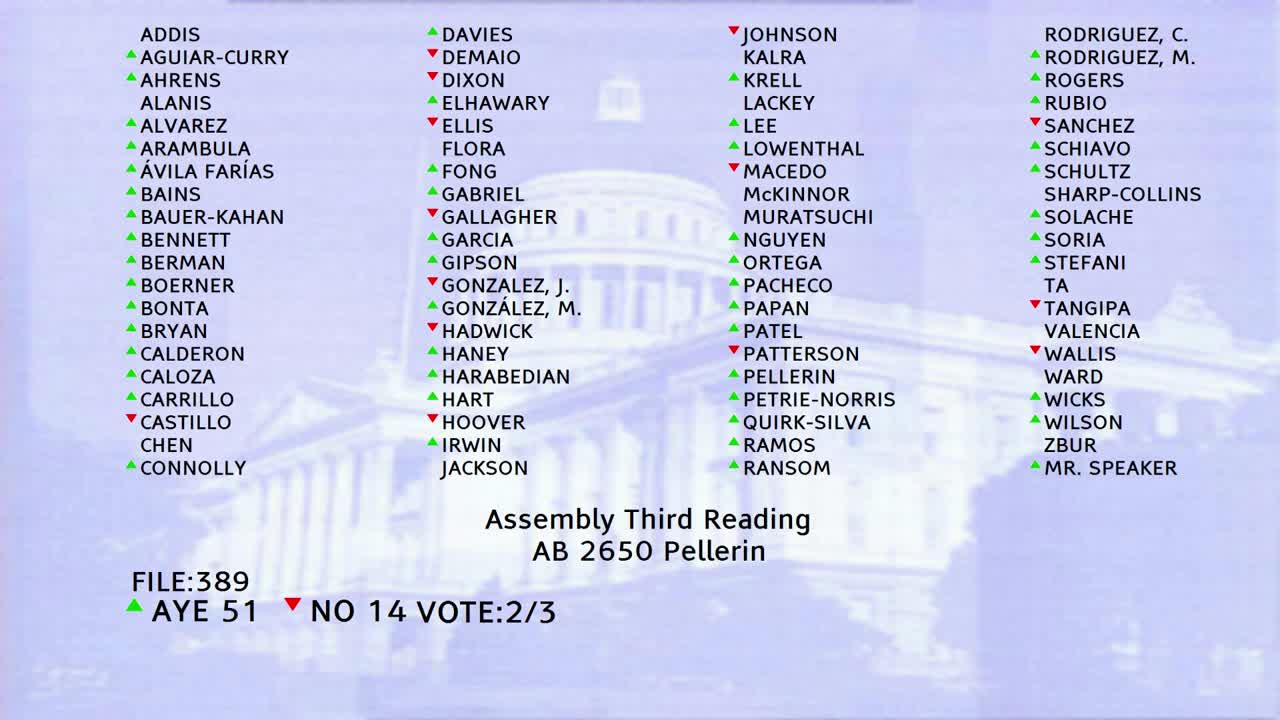 2MIN
Assembly Floor
 42MIN