AB 1603: Perfluoroalkyl and polyfluoroalkyl substances (PFAS): Department of Pesticide Regulation.
- Session Year: 2025-2026
- House: Assembly
- Latest Version Date: 2026-09-27
Current Status:
Passed
(2026-09-27: Chaptered by Secretary of State - Chapter 531, Statutes of 2026.)
Introduced
In Committee
Awaiting First Chamber Vote
Passed First Chamber
In Committee
Awaiting Second Chamber Vote
Passed Second Chamber
Enacted
Existing law generally regulates the use of pesticides, and requires every manufacturer of, importer of, or dealer in any pesticide, except as specified, to obtain a certificate of registration from the Department of Pesticide Regulation before the pesticide is offered for sale. Existing law requires a pesticide use report to be submitted to a county agricultural commissioner or the Director of Pesticide Regulation, as provided.
This bill would require the department, on or before January 1, 2028, or on or before the posting of the pesticide use reporting database containing 2026 data, whichever occurs first, and annually thereafter, to indicate if a pesticide contains perfluoroalkyl and polyfluoroalkyl substances (PFAS) pesticide ingredients, as defined, in the pesticide use reporting database on its internet website, include PFAS as a category of interest for purposes of that database, and include pesticide use trends of PFAS pesticide ingredients from the pesticide database in the pesticide use annual report and other relevant pesticide use reporting documents. The bill would also require the department to, on or before January 1, 2028, publish a list of all registered pesticides that contain PFAS pesticide ingredients and submit this list to the commissioner of each county, and to, within 60 calendar days of the registration of a new pesticide containing PFAS pesticide ingredients, update the list on its internet website and submit the updated list to the commissioner of each county.
Existing law generally regulates the use of pesticides, and requires every manufacturer of, importer of, or dealer in any pesticide, except as specified, to obtain a certificate of registration from the Department of Pesticide Regulation before the pesticide is offered for sale. Existing law requires a pesticide use report to be submitted to a county agricultural commissioner or the Director of Pesticide Regulation, as provided.
This bill would require the department department, on or before January 1, 2028, or on or before the posting of the pesticide use reporting database containing 2026 data, whichever occurs first, and annually thereafter, to indicate if a pesticide contains perfluoroalkyl and polyfluoroalkyl substances (PFAS) pesticide ingredients, as defined, in the pesticide use reporting database on its internet website, include PFAS as a category of interest for purposes of that database, and include pesticide use trends of PFAS pesticide ingredients from the pesticide database in the pesticide use annual report and other relevant pesticide use reporting documents. The bill would also require the department to to, on or before January 1, 2028, publish a list of all registered pesticides that contain PFAS pesticide ingredients, as specified. ingredients and submit this list to the commissioner of each county, and to, within 60 calendar days of the registration of a new pesticide containing PFAS pesticide ingredients, update the list on its internet website and submit the updated list to the commissioner of each county.
Existing law generally regulates the use of pesticides, and requires every manufacturer of, importer of, or dealer in any pesticide, except as specified, to obtain a certificate of registration from the Department of Pesticide Regulation before the pesticide is offered for sale. Existing law requires the Director of Pesticide Regulation to endeavor to eliminate from use in the state any pesticide that endangers the agricultural or nonagricultural environment, is not beneficial for the purposes for which it is sold, or is misrepresented. a pesticide use report to be submitted to a county agricultural commissioner or the Director of Pesticide Regulation, as provided.
This bill would prohibit the department from registering a pesticide that has not been previously registered by the department and contains perfluoroalkyl and polyfluoroalkyl substances (PFAS) pesticide ingredients, defined as PFAS that are intentionally added as active, adjuvant, or inert ingredients, unless an application for registration of that pesticide was submitted to the department before January 1, 2027. The bill would require the department to indicate if a pesticide contains PFAS perfluoroalkyl and polyfluoroalkyl substances (PFAS) pesticide ingredients ingredients, as defined, in the pesticide use reporting database on its internet website, include PFAS as a category of interest for purposes of that database, and include pesticide use trends of PFAS pesticide ingredients from the pesticide database in the pesticide use annual report and other relevant pesticide use reporting documents. The bill would also require the department to publish a list of all registered pesticides that contain PFAS pesticide ingredients, as specified.
Existing law generally regulates the use of pesticides, and requires every manufacturer of, importer of, or dealer in any pesticide, except as specified, to obtain a certificate of registration from the Department of Pesticide Regulation before the pesticide is offered for sale. Existing law requires the Director of Pesticide Regulation to endeavor to eliminate from use in the state any pesticide that endangers the agricultural or nonagricultural environment, is not beneficial for the purposes for which it is sold, or is misrepresented. Existing law prohibits, except as provided, a person from using or possessing a restricted material for any agricultural use except under a written permit of the county agricultural commissioner, as specified. Existing law provides that a violation of certain provisions relating to pesticides, or regulations issued pursuant to those provisions, is a misdemeanor.
This bill would prohibit the department from registering a pesticide that has not been previously registered by the department and contains perfluoroalkyl and polyfluoroalkyl substances (PFAS) pesticide ingredients, defined as PFAS that are intentionally added as active, adjuvant, or inert ingredients, unless an application for registration of that pesticide was submitted to the department before January 1, 2027. The bill would, commencing January 1, 2028, classify a pesticide registered for agricultural use that contains PFAS pesticide ingredients as a restricted material subject to the above-described permitting requirement, and would require specified statements to be included on the permit and in a public disclosure by the department of its use. would require the department to indicate if a pesticide contains PFAS pesticide ingredients in the pesticide use reporting database on its internet website, include PFAS as a category of interest for purposes of that database, and include pesticide use trends of PFAS pesticide ingredients from the pesticide database in the pesticide use annual report and other relevant pesticide use reporting documents. The bill would also require the department to publish a list of all registered pesticides that contain PFAS pesticide ingredients, as specified.
By expanding the scope of a crime, the bill would impose a state-mandated local program.The California Constitution requires the state to reimburse local agencies and school districts for certain costs mandated by the state. Statutory provisions establish procedures for making that reimbursement.This bill would provide that no reimbursement is required by this act for a specified reason.Existing law generally regulates the use of pesticides, and requires every manufacturer of, importer of, or dealer in any pesticide, except as specified, to obtain a certificate of registration from the Department of Pesticide Regulation before the pesticide is offered for sale. Existing law requires the Director of Pesticide Regulation to endeavor to eliminate from use in the state any pesticide that endangers the agricultural or nonagricultural environment, is not beneficial for the purposes for which it is sold, or is misrepresented. Existing law prohibits, except as provided, a person from using or possessing a restricted material for any agricultural use except under a written permit of the county agricultural commissioner, as specified. Existing law provides that a violation of certain provisions relating to pesticides, or regulations issued pursuant to those provisions, is a misdemeanor.
This bill would prohibit the department from registering a pesticide that has not been previously registered by the department and contains perfluoroalkyl and polyfluoroalkyl substances (PFAS) pesticide ingredients, defined as PFAS that are intentionally added as active, adjuvant, or inert ingredients. ingredients, unless an application for registration of that pesticide was submitted to the department before January 1, 2027. The bill would, commencing July January 1, 2028, classify a pesticide registered for agricultural use that contains PFAS pesticide ingredients as a restricted material subject to the above-described permitting requirement, and would require specified statements to be included on the permit and in a public disclosure by the department of its use.
This bill would, commencing January 1, 2030, prohibit a person from using or marketing for agricultural use a pesticide, and from manufacturing, selling, delivering, holding, or offering for sale in commerce a pesticide registered for agricultural use, that contains specified PFAS pesticide ingredients and prohibit the registration for agricultural use of any pesticides containing these specified PFAS pesticide ingredients. The bill would, commencing January 1, 2035, prohibit those actions for any pesticide that contains PFAS pesticide ingredients and would prohibit the registration of pesticides for agricultural use containing PFAS pesticide ingredients.Because a violation of these prohibitions would be a crime, the bill would impose a state-mandated local program.By expanding the scope of a crime, the bill would impose a state-mandated local program.
The California Constitution requires the state to reimburse local agencies and school districts for certain costs mandated by the state. Statutory provisions establish procedures for making that reimbursement.
This bill would provide that no reimbursement is required by this act for a specified reason.
Existing law generally regulates the use of pesticides, and requires every manufacturer of, importer of, or dealer in any pesticide, except as specified, to obtain a certificate of registration from the Department of Pesticide Regulation before the pesticide is offered for sale. Existing law requires the Director of Pesticide Regulation to endeavor to eliminate from use in the state any pesticide that endangers the agricultural or nonagricultural environment, is not beneficial for the purposes for which it is sold, or is misrepresented. Existing law prohibits, except as provided, a person from using or possessing a restricted material for any agricultural use except under a written permit of the county agricultural commissioner, as specified. Existing law provides that a violation of certain provisions relating to pesticides, or regulations issued pursuant to those provisions, is a misdemeanor.
This bill would prohibit the department from registering a pesticide that has not been previously registered by the department and contains perfluoroalkyl and polyfluoroalkyl substances (PFAS) pesticide ingredients, defined as PFAS that are intentionally added as active, adjuvant, or inert ingredients. The bill would, commencing July 1, 2028, classify a registered pesticide registered for agricultural use that contains PFAS pesticide ingredients as a restricted material subject to the above-described permitting requirement, and would require specified statements to be included on the permit and in a public disclosure by the department of its use.
This bill would, commencing January 1, 2030, prohibit a person from using or marketing, marketing for agricultural use a pesticide, and from manufacturing, selling, delivering, holding, or offering for sale in commerce, for agricultural use commerce a pesticide registered for agricultural use, that contains specified PFAS pesticide ingredients and prohibit the registration for agricultural use of any pesticides containing these specified PFAS pesticide ingredients. The bill would, commencing January 1, 2035, prohibit those actions for any pesticide for agricultural use that contains PFAS pesticide ingredients and would prohibit the registration of pesticides for agricultural use containing PFAS pesticide ingredients.
Because a violation of these prohibitions would be a crime, the bill would impose a state-mandated local program.
The California Constitution requires the state to reimburse local agencies and school districts for certain costs mandated by the state. Statutory provisions establish procedures for making that reimbursement.
This bill would provide that no reimbursement is required by this act for a specified reason.
Existing law generally regulates the use of pesticides, and requires every manufacturer of, importer of, or dealer in any pesticide, except as specified, to obtain a certificate of registration from the Department of Pesticide Regulation before the pesticide is offered for sale. Existing law requires the Director of Pesticide Regulation to endeavor to eliminate from use in the state any pesticide that endangers the agricultural or nonagricultural environment, is not beneficial for the purposes for which it is sold, or is misrepresented. Existing law prohibits, except as provided, a person from using or possessing a restricted material for any agricultural use except under a written permit of the county agricultural commissioner, as specified. Existing law provides that a violation of certain provisions relating to pesticides, or regulations issued pursuant to those provisions, is a misdemeanor.
This bill would prohibit the department from registering a pesticide that has not been previously registered by the department and contains perfluoroalkyl and polyfluoroalkyl substances (PFAS), as defined, that are intentionally added as active, adjuvant, or inert ingredients. (PFAS) pesticide ingredients, defined as PFAS that are intentionally added as active, adjuvant, or inert ingredients. The bill would, commencing July 1, 2028, classify a registered pesticide that contains PFAS that are intentionally added as active, adjuvant, or inert ingredients pesticide ingredients as a restricted material subject to the above-described permitting requirement, and would require specified statements to be included on the permit and a public disclosure by the department of its use.
This bill would, commencing January 1, 2030, prohibit a person from using a pesticide that contains, and a person or entity from manufacturing, selling, delivering, holding, or offering for sale in commerce any pesticide that contains, any of the specified PFAS that are intentionally added as active, adjuvant, or inert ingredients. using or marketing, and manufacturing, selling, delivering, holding, or offering for sale in commerce, for agricultural use a pesticide that contains specified PFAS pesticide ingredients and prohibit the registration for agricultural use of any pesticides containing these specified PFAS pesticide ingredients. The bill would, commencing January 1, 2035, prohibit those actions for any pesticide that contains PFAS that are intentionally added as active, adjuvant, or inert ingredients. for agricultural use that contains PFAS pesticide ingredients and would prohibit the registration of pesticides for agricultural use containing PFAS pesticide ingredients.
Because a violation of these prohibitions would be a crime, the bill would impose a state-mandated local program.
The California Constitution requires the state to reimburse local agencies and school districts for certain costs mandated by the state. Statutory provisions establish procedures for making that reimbursement.
This bill would provide that no reimbursement is required by this act for a specified reason.
Existing law generally regulates the use of pesticides, and requires every manufacturer of, importer of, or dealer in any pesticide, except as specified, to obtain a certificate of registration from the Department of Pesticide Regulation before the pesticide is offered for sale. Existing law requires the Director of Pesticide Regulation to endeavor to eliminate from use in the state any pesticide that endangers the agricultural or nonagricultural environment, is not beneficial for the purposes for which it is sold, or is misrepresented. Existing law prohibits, except as provided, a person from using or possessing a restricted material for any agricultural use except under a written permit of the county agricultural commissioner, as specified. Existing law provides that a violation of certain provisions relating to pesticides, or regulations issued pursuant to those provisions, is a misdemeanor.
This bill would prohibit the department from registering or reregistering a pesticide that has not been previously registered by the department and contains perfluoroalkyl and polyfluoroalkyl substances (PFAS), as defined, that are intentionally added as active active, adjuvant, or inert ingredients. The bill would, commencing January 1, 2028, prohibit a person from manufacturing, distributing, or selling those pesticides unless a specified statement is included on the label. The bill would commencing July 1, 2028, classify a registered pesticide that contains PFAS that are intentionally added as active active, adjuvant, or inert ingredients as a restricted material subject to the above-described permitting requirement, and would require specified statements to be included on the permit and a public disclosure by the department of its use. The bill would require the director, on or before January 1, 2028, to prescribe the time when, and the conditions under which, a PFAS-restricted material may be used or possessed in different areas of the state, and would authorize the director to prohibit the use or possession of a PFAS-restricted material in those areas.
This bill would, commencing January 1, 2030, prohibit a person from using a pesticide that contains, and a person or entity from manufacturing, selling, delivering, holding, or offering for sale in commerce any pesticide that contains, any of the specified PFAS that are intentionally added as active active, adjuvant, or inert ingredients. The bill would, commencing January 1, 2035, prohibit those actions for pesticides any pesticide that contain contains PFAS that are intentionally added as active active, adjuvant, or inert ingredients.
Because a violation of these prohibitions would be a crime, the bill would impose a state-mandated local program.
The California Constitution requires the state to reimburse local agencies and school districts for certain costs mandated by the state. Statutory provisions establish procedures for making that reimbursement.
This bill would provide that no reimbursement is required by this act for a specified reason.
Existing law generally regulates the use of pesticides, and requires every manufacturer of, importer of, or dealer in any pesticide, except as specified, to obtain a certificate of registration from the Department of Pesticide Regulation before the pesticide is offered for sale. Existing law requires the Director of Pesticide Regulation to endeavor to eliminate from use in the state any pesticide that endangers the agricultural or nonagricultural environment, is not beneficial for the purposes for which it is sold, or is misrepresented. Existing law prohibits, except as provided, a person from using or possessing a restricted material for any agricultural use except under a written permit of the county agricultural commissioner, as specified. Existing law provides that a violation of certain provisions relating to pesticides, or regulations issued pursuant to those provisions, is a misdemeanor.
This bill would prohibit the department from registering or reregistering a pesticide that contains perfluoroalkyl and polyfluoroalkyl substances (PFAS), as defined, that are intentionally added as active or inert ingredients. The bill would, commencing January 1, 2028, prohibit a person from manufacturing, distributing, or selling those pesticides unless a specified statement is included on the label. The bill would classify a registered pesticide that contains PFAS that are intentionally added as active or inert ingredients as a restricted material subject to the above-described permitting requirement, and would require specified statements to be included on the permit and a public disclosure by the department of its use. The bill would require the director, on or before January 1, 2028, to prescribe the time when, and the conditions under which, a PFAS-restricted material may be used or possessed in different areas of the state, and would authorize the director to prohibit the use or possession of a PFAS-restricted material in those areas.
This bill would, commencing January 1, 2030, prohibit a person from using a pesticide that contains, and a person or entity from manufacturing, selling, delivering, holding, or offering for sale in commerce any pesticide that contains, any of the specified PFAS that are intentionally added as active or inert ingredients. The bill would, commencing January 1, 2035, prohibit those actions for pesticides that contain PFAS that are intentionally added as active or inert ingredients.
Because a violation of these prohibitions would be a crime, the bill would impose a state-mandated local program.
The California Constitution requires the state to reimburse local agencies and school districts for certain costs mandated by the state. Statutory provisions establish procedures for making that reimbursement.
This bill would provide that no reimbursement is required by this act for a specified reason.
Existing law requires the Department of Pesticide Regulation to prepare and submit to specified Senate and Assembly committees and the Office of the Surgeon General quarterly reports containing information, as prescribed, regarding granular chlorpyrifos use, monitoring, and exposure during the quarter.This bill would require the department to post those quarterly reports on its internet website, as specified.Existing law requires the Department of Pesticide Regulation to prepare and submit to specified Senate and Assembly committees and the Office of the Surgeon General quarterly reports containing information, as prescribed, regarding granular chlorpyrifos use, monitoring, and exposure during the quarter.
This bill would require the department to post those quarterly reports on its internet website, as specified.
(a)The Legislature finds and declares all of the following:
(1)Perfluoroalkyl and polyfluoroalkyl substances (PFAS) are a class of persistent and highly toxic chemicals with widespread contamination across the United States, including California. The United States Geological Survey estimates that 45 percent of the United States tap water is contaminated with PFAS. It is also estimated that 98 percent of people living in the United States have PFAS in their blood. State water testing data indicates that PFAS have been detected in the drinking water of 25,000,000 Californians.
(2)Exposure to PFAS poses a significant threat to the environment and public health. Adverse health effects associated with PFAS include, but are not limited to, kidney and liver damage, decreased immune system function, including interference with vaccine response and increased risk of asthma and developmental and reproductive harm, and increased cholesterol levels, thyroid disorders and other hormone disruption, and incidences of testicular and kidney cancer.
(3)PFAS are increasingly intentionally added to pesticides. According to a recent report, the United States Environmental Protection Agency has approved 70 active ingredient PFAS pesticides, and the Department of Pesticide Regulation has allowed 53 of these PFAS pesticides to be used in the state. Twenty-three of the California-approved PFAS pesticides are not allowed to be used in the European Union.
(4)A 2025 analysis of the Department of Pesticide Regulations data found that approximately 2,500,000 pounds of active ingredient PFAS pesticides are applied to California crops each year. Between 2018 and 2023, nearly 15,000,000 pounds of PFAS pesticides were applied to farmland in 58 California counties.
(5)Thirty-seven percent, or 348 out of 930, of California-grown produce samples tested in 2023 by the Department of Pesticide Regulation contained traces of PFAS pesticides. Seventy-eight types of produce grown in California, including peaches, nectarines, lettuce, spinach, grapes, and strawberries, were represented in these samples, and, of the 78 produce types tested, 40 contained PFAS pesticides.
(b)It is the intent of the Legislature to do both of the following:
(1)Address the use of PFAS pesticides as a class and reduce the presence of all PFAS pesticides on California-grown produce and in Californias soil, air, and water.
(2)Begin phasing out the use of PFAS pesticides and take additional steps to address other PFAS in pesticides.
SEC. 2.Section 12500.3 is added to the Food and Agricultural Code, to read:12500.3.Perfluoroalkyl and polyfluoroalkyl substances or PFAS means a class of fluorinated organic chemicals containing at least one fully fluorinated carbon atom.
SEC. 3.Section 12500.4 is added to the Food and Agricultural Code, to read:12500.4.PFAS pesticide ingredients means PFAS that are intentionally added to a pesticide as active, adjuvant, or inert ingredients.
SEC. 4.Section 12500.5 of the Food and Agricultural Code is amended and renumbered to read:12500.2.Director means the Director of Pesticide Regulation.
SEC. 5.Article 19 (commencing with Section 13200) is added to Chapter 2 of Division 7 of the Food and Agricultural Code, to read:19.Perfluoroalkyl and Polyfluoroalkyl Substances (PFAS)13200.On or before January 1, 2028, or on or before the posting of the pesticide use reporting database containing 2026 data, whichever occurs first, and annually thereafter, the department shall do both of the following:
(a)The department shall indicate if a pesticide contains PFAS pesticide ingredients in the pesticide use reporting database on its internet website and shall include PFAS as a category of interest for purposes of the pesticide use reporting database.
(b)The department shall include any pesticide use trends of PFAS pesticide ingredients from the pesticide use reporting database in the pesticide use annual report and shall include these pesticide use trends in other relevant pesticide use reporting documents.
13201.(a)On or before January 1, 2028, the department shall publish a list of all registered pesticides that contain PFAS pesticide ingredients on its internet website and submit this list to the commissioner of each county.
(b)After the publication and submission of the list pursuant to subdivision (a), the department shall update the list of all registered pesticides that contain PFAS pesticide ingredients on its internet website, and shall submit the updated list to the commissioner of each county, within 60 calendar days of registration of a new pesticide containing PFAS pesticide ingredients.
13202.The provisions of this article are severable. If any provision of this article or its application is held invalid, that invalidity shall not affect other provisions or applications that can be given effect without the invalid provision or application.
(a)The Legislature finds and declares all of the following:
(1)Perfluoroalkyl and polyfluoroalkyl substances (PFAS) are a class of persistent and highly toxic chemicals with widespread contamination across the United States, including California. The United States Geological Survey estimates that 45 percent of the United States tap water is contaminated with PFAS. It is also estimated that 98 percent of people living in the United States have PFAS in their blood. State water testing data indicates that PFAS have been detected in the drinking water of 25,000,000 Californians.
(2)Exposure to PFAS poses a significant threat to the environment and public health. Adverse health effects associated with PFAS include, but are not limited to, kidney and liver damage, decreased immune system function, including interference with vaccine response and increased risk of asthma and developmental and reproductive harm, and increased cholesterol levels, thyroid disorders and other hormone disruption, and incidences of testicular and kidney cancer.
(3)PFAS are increasingly intentionally added to pesticides. According to a recent report, the United States Environmental Protection Agency has approved 70 active ingredient PFAS pesticides, and the Department of Pesticide Regulation has allowed 53 of these PFAS pesticides to be used in the state. Twenty-three of the California-approved PFAS pesticides are not allowed to be used in the European Union.
(4)A 2025 analysis of the Department of Pesticide Regulations data found that approximately 2,500,000 pounds of active ingredient PFAS pesticides are applied to California crops each year. Between 2018 and 2023, nearly 15,000,000 pounds of PFAS pesticides were applied to farmland in 58 California counties.
(5)Thirty-seven percent, or 348 out of 930, of California-grown produce samples tested in 2023 by the Department of Pesticide Regulation contained traces of PFAS pesticides. Seventy-eight types of produce grown in California, including peaches, nectarines, lettuce, spinach, grapes, and strawberries, were represented in these samples, and, of the 78 produce types tested, 40 contained PFAS pesticides.
(b)It is the intent of the Legislature to do both of the following:
(1)Address the use of PFAS pesticides as a class and reduce the presence of all PFAS pesticides on California-grown produce and in Californias soil, air, and water.
(2)Begin phasing out the use of PFAS pesticides and take additional steps to address other PFAS in pesticides.
SEC. 2.Section 12500.3 is added to the Food and Agricultural Code, to read:12500.3.Perfluoroalkyl and polyfluoroalkyl substances or PFAS means a class of fluorinated organic chemicals containing at least one fully fluorinated carbon atom.
SEC. 3.Section 12500.4 is added to the Food and Agricultural Code, to read:12500.4.PFAS pesticide ingredients means PFAS that are intentionally added to a pesticide as active, adjuvant, or inert ingredients.
SEC. 4.Section 12500.5 of the Food and Agricultural Code is amended and renumbered to read:12500.5.12500.2.Director means the Director of Pesticide Regulation.
SEC. 2.SEC. 5.Article 19 (commencing with Section 13200) is added to Chapter 2 of Division 7 of the Food and Agricultural Code, to read:19.Perfluoroalkyl and Polyfluoroalkyl Substances (PFAS)13200.For purposes of this article, both of the following definitions apply:(a)Perfluoroalkyl and polyfluoroalkyl substances or PFAS means a class of fluorinated organic chemicals containing at least one fully fluorinated carbon atom.(b)PFAS pesticide ingredients means PFAS that are intentionally added to a pesticide as active, adjuvant, or inert ingredients.13201.(a)13200.On or before January 1, 2028, or on or before the posting of the pesticide use reporting database containing 2026 data, whichever occurs first, and annually thereafter, the department shall do both of the following:
(a)The department shall indicate if a pesticide contains PFAS pesticide ingredients in the pesticide use reporting database on its internet website and shall include PFAS as a category of interest for purposes of the pesticide use reporting database.
(b)The department shall include any pesticide use trends of PFAS pesticide ingredients from the pesticide use reporting database in the pesticide use annual report and shall include these pesticide use trends in other relevant pesticide use reporting documents.
13202.The 13201.(a)On or before January 1, 2028, the department shall publish a list of all registered pesticides that contain PFAS pesticide ingredients on its internet website and submit this list to the commissioner of each county.
(b)After the publication and submission of the list pursuant to subdivision (a), the department shall update the list of all registered pesticides that contain PFAS pesticide ingredients on its internet website, and shall submit the updated list to the commissioner of each county, within 60 calendar days of registration of a new pesticide containing PFAS pesticide ingredients.
13203.13202.The provisions of this article are severable. If any provision of this article or its application is held invalid, that invalidity shall not affect other provisions or applications that can be given effect without the invalid provision or application.
(a)The Legislature finds and declares all of the following:
(1)Perfluoroalkyl and polyfluoroalkyl substances (PFAS) are a class of persistent and highly toxic chemicals with widespread contamination across the United States, including California. The United States Geological Survey estimates that 45 percent of the United States tap water is contaminated with PFAS. It is also estimated that 98 percent of people living in the United States have PFAS in their blood. State water testing data indicates that PFAS have been detected in the drinking water of 25,000,000 Californians.
(2)Exposure to PFAS poses a significant threat to the environment and public health. Adverse health effects associated with PFAS include, but are not limited to, kidney and liver damage, decreased immune system function, including interference with vaccine response and increased risk of asthma and developmental and reproductive harm, and increased cholesterol levels, thyroid disorders and other hormone disruption, and incidences of testicular and kidney cancer.
(3)PFAS are increasingly intentionally added to pesticides. According to a recent report, the United States Environmental Protection Agency has approved 70 active ingredient PFAS pesticides, and the Department of Pesticide Regulation has allowed 53 of these PFAS pesticides to be used in the state. Twenty-three of the California-approved PFAS pesticides are not allowed to be used in the European Union.
(4)A 2025 analysis of the Department of Pesticide Regulations data found that approximately 2,500,000 pounds of active ingredient PFAS pesticides are applied to California crops each year. Between 2018 and 2023, nearly 15,000,000 pounds of PFAS pesticides were applied to farmland in 58 California counties.
(5)Thirty-seven percent, or 348 out of 930, of California-grown produce samples tested in 2023 by the Department of Pesticide Regulation contained traces of PFAS pesticides. Seventy-eight types of produce grown in California, including peaches, nectarines, lettuce, spinach, grapes, and strawberries, were represented in these samples, and, of the 78 produce types tested, 40 contained PFAS pesticides.
(b)It is the intent of the Legislature to do both of the following:
(1)Address the use of PFAS pesticides as a class and reduce the presence of all PFAS pesticides on California-grown produce and in Californias soil, air, and water.
(2)Begin phasing out the use of PFAS pesticides and take additional steps to address other PFAS in pesticides.
SEC. 2.Article 19 (commencing with Section 13200) is added to Chapter 2 of Division 7 of the Food and Agricultural Code, to read:19.Perfluoroalkyl and Polyfluoroalkyl Substances (PFAS)13200.For purposes of this article, both of the following definitions apply:
(a)Perfluoroalkyl and polyfluoroalkyl substances or PFAS means a class of fluorinated organic chemicals containing at least one fully fluorinated carbon atom.
(b)PFAS pesticide ingredients means PFAS that are intentionally added to a pesticide as active, adjuvant, or inert ingredients.
13201.The department shall not register a pesticide that has not been previously registered by the department and contains PFAS pesticide ingredients, unless an application for registration of that pesticide was submitted to the department before January 1, 2027.13202.13201.(a)The department shall indicate if a pesticide contains PFAS pesticide ingredients in the pesticide use reporting database on its internet website and shall include PFAS as a category of interest for purposes of the pesticide use reporting database.
(b)The department shall include any pesticide use trends of PFAS pesticide ingredients from the pesticide use reporting database in the pesticide use annual report and other relevant pesticide use reporting documents.
13203.13202.The department shall publish a list of all registered pesticides that contain PFAS pesticide ingredients on its internet website and submit this list to the commissioner of each county.
13204.13203.The provisions of this article are severable. If any provision of this article or its application is held invalid, that invalidity shall not affect other provisions or applications that can be given effect without the invalid provision or application.
(a)The Legislature finds and declares all of the following:
(1)Perfluoroalkyl and polyfluoroalkyl substances (PFAS) are a class of persistent and highly toxic chemicals with widespread contamination across the United States, including California. The United States Geological Survey estimates that 45 percent of the United States tap water is contaminated with PFAS. It is also estimated that 98 percent of people living in the United States have PFAS in their blood. State water testing data indicates that PFAS have been detected in the drinking water of 25,000,000 Californians.
(2)Exposure to PFAS poses a significant threat to the environment and public health. Adverse health effects associated with PFAS include, but are not limited to, kidney and liver damage, decreased immune system function, including interference with vaccine response and increased risk of asthma and developmental and reproductive harm, and increased cholesterol levels, thyroid disorders and other hormone disruption, and incidences of testicular and kidney cancer.
(3)PFAS are increasingly intentionally added to pesticides. According to a recent report, the United States Environmental Protection Agency has approved 70 active ingredient PFAS pesticides, and the Department of Pesticide Regulation has allowed 53 of these PFAS pesticides to be used in the state. Twenty-three of the California-approved PFAS pesticides are not allowed to be used in the European Union.
(4)A 2025 analysis of the Department of Pesticide Regulations data found that approximately 2,500,000 pounds of active ingredient PFAS pesticides are applied to California crops each year. Between 2018 and 2023, nearly 15,000,000 pounds of PFAS pesticides were applied to farmland in 58 California counties.
(5)Thirty-seven percent, or 348 out of 930, of California-grown produce samples tested in 2023 by the Department of Pesticide Regulation contained traces of PFAS pesticides. Seventy-eight types of produce grown in California, including peaches, nectarines, lettuce, spinach, grapes, and strawberries, were represented in these samples, and and, of the 78 produce types tested, 40 contained PFAS pesticides.
(b)It is the intent of the Legislature to do both of the following:
(1)Address the use of PFAS pesticides as a class and reduce the presence of all PFAS pesticides on California-grown produce and in Californias soil, air, and water.
(2)Begin phasing out the use of PFAS pesticides and take additional steps to address other PFAS in pesticides.
SEC. 2.Article 6 (commencing with Section 14088) is added to Chapter 3 of Division 7 of the Food and Agricultural Code, to read:6.Perfluoroalkyl and Polyfluoroalkyl Substances (PFAS)SEC. 2.Article 19 (commencing with Section 13200) is added to Chapter 2 of Division 7 of the Food and Agricultural Code, to read:19.Perfluoroalkyl and Polyfluoroalkyl Substances (PFAS)14088.13200.For purposes of this article, all both of the following definitions apply:
(a)Agricultural use has the same meaning as defined in Section 11408. Agricultural use does not include the use of any pesticide or method or device to treat pets, livestock, and other animals to prevent, destroy, repel, or mitigate fleas, mites, ticks, heartworms, or other insects, parasites, or organisms.(b)(a)Perfluoroalkyl and polyfluoroalkyl substances or PFAS means a class of fluorinated organic chemicals containing at least one fully fluorinated carbon atom.
(c)Pesticide has the same meaning as defined in Section 12753.(d)(b)PFAS pesticide ingredients means PFAS that are intentionally added to a pesticide as active, adjuvant, or inert ingredients.
(e)PFAS-restricted material means a pesticide registered for agricultural use containing PFAS pesticide ingredients, as described in subdivision (a) of Section 14088.5.14088.3.13201.The department shall not register a pesticide that has not been previously registered by the department and contains PFAS pesticide ingredients, unless an application for registration of that pesticide was submitted to the department before January 1, 2027.
14088.5.(a)A pesticide registered for agricultural use containing PFAS pesticide ingredients is a restricted material.(b)(1)Use of a PFAS-restricted material shall be permitted only in accordance with Section 14006.5.(2)A permit issued pursuant to Section 14006.5 for use of a PFAS-restricted material shall state: This product contains perfluoroalkyl and polyfluoroalkyl substances, or PFAS, and can contaminate produce, groundwater, drinking water, soil, and the environment.(c)Any public disclosure by the department of the use of a PFAS-restricted material, including through the departments SprayDays California program, shall state: This product contains perfluoroalkyl and polyfluoroalkyl substances, or PFAS, and can contaminate produce, groundwater, drinking water, soil, and the environment.(d)This section shall become operative on January 1, 2028.13202.(a)The department shall indicate if a pesticide contains PFAS pesticide ingredients in the pesticide use reporting database on its internet website and shall include PFAS as a category of interest for purposes of the pesticide use reporting database.
(b)The department shall include any pesticide use trends of PFAS pesticide ingredients from the pesticide use reporting database in the pesticide use annual report and other relevant pesticide use reporting documents.
13203.The department shall publish a list of all registered pesticides that contain PFAS pesticide ingredients on its internet website and submit this list to the commissioner of each county.
14088.6.13204.The provisions of this article are severable. If any provision of this article or its application is held invalid, that invalidity shall not affect other provisions or applications that can be given effect without the invalid provision or application.
SEC. 3.No reimbursement is required by this act pursuant to Section 6 of Article XIIIB of the California Constitution because the only costs that may be incurred by a local agency or school district will be incurred because this act creates a new crime or infraction, eliminates a crime or infraction, or changes the penalty for a crime or infraction, within the meaning of Section 17556 of the Government Code, or changes the definition of a crime within the meaning of Section 6 of Article XIIIB of the California Constitution.(a)The Legislature finds and declares all of the following:
(1)Perfluoroalkyl and polyfluoroalkyl substances (PFAS) are a class of persistent and highly toxic chemicals with widespread contamination across the United States, including California. The United States Geological Survey estimates that 45 percent of the United States tap water is contaminated with PFAS. It is also estimated that 98 percent of people living in the United States have PFAS in their blood. State water testing data indicates that PFAS have been detected in the drinking water of 25,000,000 Californians.
(2)Exposure to PFAS poses a significant threat to the environment and public health. Adverse health effects associated with PFAS include, but are not limited to, kidney and liver damage, decreased immune system function, including interference with vaccine response and increased risk of asthma and developmental and reproductive harm, and increased cholesterol levels, thyroid disorders and other hormone disruption, and incidences of testicular and kidney cancer.
(3)PFAS are increasingly intentionally added to pesticides. According to a recent report, the United States Environmental Protection Agency has approved 70 active ingredient PFAS pesticides, and the Department of Pesticide Regulation has allowed 53 of these PFAS pesticides to be used in the state. Twenty-three of the California-approved PFAS pesticides are not allowed to be used in the European Union.
(4)A 2025 analysis of the Department of Pesticide Regulations data found that approximately 2,500,000 pounds of active ingredient PFAS pesticides are applied to California crops each year. Between 2018 and 2023, nearly 15,000,000 pounds of PFAS pesticides were applied to farmland in 58 California counties.
(5)Thirty-seven percent, or 348 out of 930, of California-grown produce samples tested in 2023 by the Department of Pesticide Regulation contained traces of PFAS pesticides. Seventy-eight types of produce grown in California, including peaches, nectarines, lettuce, spinach, grapes, and strawberries, were represented in these samples, and of the 78 produce types tested, 40 contained PFAS pesticides.
(b)It is the intent of the Legislature to do both of the following:
(1)Address the use of PFAS pesticides as a class and reduce the presence of all PFAS pesticides on California-grown produce and in Californias soil, air, and water.
(2)Begin phasing out the use of PFAS pesticides already phased out elsewhere and to take additional steps to address other PFAS in pesticides.
SEC. 2.Article 6 (commencing with Section 14088) is added to Chapter 3 of Division 7 of the Food and Agricultural Code, to read:6.Perfluoroalkyl and Polyfluoroalkyl Substances (PFAS)14088.For purposes of this article, all of the following definitions apply:
(a)Agricultural use has the same meaning as defined in Section 11408. Agricultural use does not include uses the use of any pesticide or method or device to treat pets, livestock, and other animals to prevent, destroy, repel, or mitigate fleas, mites, ticks, heartworms, or other insects, parasites, or organisms.
(b)Perfluoroalkyl and polyfluoroalkyl substances or PFAS means a class of fluorinated organic chemicals containing at least one fully fluorinated carbon atom.
(c)Pesticide has the same meaning as defined in Section 12753.
(d)PFAS pesticide ingredients means PFAS that are intentionally added to a pesticide as active, adjuvant, or inert ingredients.
(e)PFAS-restricted material means a pesticide registered for agricultural use containing PFAS pesticide ingredients, as described in subdivision (a) of Section 14088.5.
14088.1.(a)Commencing January 1, 2035, a person shall not do any of the following:(1)Use, or market, for agricultural use a pesticide that contains PFAS pesticide ingredients.(2)Manufacture, sell, deliver, hold, or offer for sale in commerce a pesticide registered for agricultural use that contains PFAS pesticide ingredients.(b)Commencing January 1, 2035, a pesticide containing a PFAS pesticide ingredient shall not be registered for agricultural use.14088.2.(a)Commencing January 1, 2030, a person shall not do any of the following:(1)Use, or market, for agricultural use a pesticide that contains any of the PFAS pesticide ingredients listed in subdivision (b).(2)Manufacture, sell, deliver, hold, or offer for sale in commerce, a pesticide registered for agricultural use that contains any of the PFAS pesticide ingredients listed in subdivision (b).(b)Commencing January 1, 2030, pesticides containing any of the following PFAS pesticide ingredients shall not be registered for agricultural use:(1)Triflusulfuron-methyl (CAS no. 126535-15-7). (2)Trifluralin (CAS no. 1582-09-8).(3)Triflumizole (CAS no. 68694-11-1).(4)Trifloxysulfuron-sodium (CAS nos. 199119-58-9, 290332-10-4, and 145099-21-4).(5)Saflufenacil (CAS no. 372137-35-4).(6)Pyroxasulfone (CAS no. 447399-55-5).(7)Pyridalyl (CAS no. 179101-81-6).(8)Picoxystrobin (CAS no. 117428-22-5).(9)Novaluron (CAS no. 116714-46-6).(10)Norflurazon (CAS no. 27314-13-2).(11)Metaflumizone (CAS no. 139968-49-3).(12)Indoxacarb (CAS no. 173584-44-6).(13)Hydramethylnon (CAS no. 67485-29-4).(14)Hexaflumuron (CAS no. 86479-06-3).(15)Gamma-Cyhalothrin (CAS no. 76703-62-3).(16)Flurprimidol (CAS no. 56425-91-3).(17)Fluridone (CAS no. 59756-60-4).(18)Fipronil (CAS no. 120068-37-3).(19)Ethalfluralin (CAS no. 55283-68-6).(20)Dithiopyr (CAS no. 97886-45-8).(21)Chlorfenapyr (CAS no. 122453-73-0). (22)Bromethalin (CAS no. 63333-35-7).(23)Bifenthrin (CAS no. 82657-04-3). 14088.3.The department shall not register a pesticide that has not been previously registered by the department and contains PFAS pesticide ingredients. ingredients, unless an application for registration of that pesticide was submitted to the department before January 1, 2027.
14088.5.(a)A pesticide registered for agricultural use containing PFAS pesticide ingredients is a restricted material.
(b)(1)Use of a PFAS-restricted material shall be permitted only in accordance with Section 14006.5.
(2)A permit issued pursuant to Section 14006.5 for use of a PFAS-restricted material shall state: This product contains perfluoroalkyl and polyfluoroalkyl substances, or PFAS, and can contaminate produce, groundwater, drinking water, soil, and the environment.
(c)Any public disclosure by the department of the use of a PFAS-restricted material, including through the departments SprayDays California program, shall state: This product contains perfluoroalkyl and polyfluoroalkyl substances, or PFAS, and can contaminate produce, groundwater, drinking water, soil, and the environment.
(d)This section shall become operative on July January 1, 2028.
14088.6.The provisions of this article are severable. If any provision of this article or its application is held invalid, that invalidity shall not affect other provisions or applications that can be given effect without the invalid provision or application.
SEC. 3.No reimbursement is required by this act pursuant to Section 6 of Article XIIIB of the California Constitution because the only costs that may be incurred by a local agency or school district will be incurred because this act creates a new crime or infraction, eliminates a crime or infraction, or changes the penalty for a crime or infraction, within the meaning of Section 17556 of the Government Code, or changes the definition of a crime within the meaning of Section 6 of Article XIIIB of the California Constitution.
(a)The Legislature finds and declares all of the following:
(1)Perfluoroalkyl and polyfluoroalkyl substances (PFAS) are a class of persistent and highly toxic chemicals with widespread contamination across the United States, including California. The United States Geological Survey estimates that 45 percent of the United States tap water is contaminated with PFAS. It is also estimated that 98 percent of people living in the United States have PFAS in their blood. State water testing data indicates that PFAS have been detected in the drinking water of 25,000,000 Californians.
(2)Exposure to PFAS poses a significant threat to the environment and public health. Adverse health effects associated with PFAS include, but are not limited to, kidney and liver damage, decreased immune system function, including interference with vaccine response and increased risk of asthma and developmental and reproductive harm, and increased cholesterol levels, thyroid disorders and other hormone disruption, and incidences of testicular and kidney cancer.
(3)PFAS are increasingly intentionally added to pesticides. According to a recent report, the United States Environmental Protection Agency has approved 70 active ingredient PFAS pesticides, and the Department of Pesticide Regulation has allowed 53 of these PFAS pesticides to be used in the state. Twenty-three of the California-approved PFAS pesticides are not allowed to be used in the European Union.
(4)A 2025 analysis of the Department of Pesticide Regulations data found that approximately 2,500,000 pounds of active ingredient PFAS pesticides are applied to California crops each year. Between 2018 and 2023, nearly 15,000,000 pounds of PFAS pesticides were applied to farmland in 58 California counties.
(5)Thirty-seven percent, or 348 out of 930, of California-grown produce samples tested in 2023 by the Department of Pesticide Regulation contained traces of PFAS pesticides. Seventy-eight types of produce grown in California, including peaches, nectarines, lettuce, spinach, grapes, and strawberries, were represented in these samples, and of the 78 produce types tested, 40 contained PFAS pesticides.
(b)It is the intent of the Legislature to do both of the following:
(1)Address the use of PFAS pesticides as a class and reduce the presence of all PFAS pesticides on California-grown produce and in Californias soil, air, and water.
(2)Begin phasing out the use of PFAS pesticides already phased out elsewhere and to take additional steps to address other PFAS in pesticides.
SEC. 2.Article 6 (commencing with Section 14088) is added to Chapter 3 of Division 7 of the Food and Agricultural Code, to read:6.Perfluoroalkyl and Polyfluoroalkyl Substances (PFAS)14088.For purposes of this article, all of the following definitions apply:
(a)Agricultural use has the same meaning as defined in Section 11408. Agricultural use does not include uses to treat pets, livestock, and other animals to prevent, destroy, repel, or mitigate fleas, mites, ticks, heartworms, or other insects, parasites, or organisms.
(b)Perfluoroalkyl and polyfluoroalkyl substances or PFAS means a class of fluorinated organic chemicals containing at least one fully fluorinated carbon atom.
(c)Pesticide has the same meaning as defined in Section 12753.
(d)PFAS pesticide ingredients means PFAS that are intentionally added to a pesticide as active, adjuvant, or inert ingredients.
(e)PFAS-restricted material means a registered pesticide registered for agricultural use containing PFAS pesticide ingredients, as described in subdivision (a) of Section 14088.5.
14088.1.(a)Commencing January 1, 2035, a person shall not do any of the following:
(1)Use, or market, for agricultural use a pesticide that contains PFAS pesticide ingredients.
(2)Manufacture, sell, deliver, hold, or offer for sale in commerce a pesticide registered for agricultural use that contains PFAS pesticide ingredients.
(b)Commencing January 1, 2035, a pesticide containing a PFAS pesticide ingredient shall not be registered for agricultural use.
14088.2.(a)Commencing January 1, 2030, a person shall not do any of the following:
(1)Use, or market, for agricultural use a pesticide that contains any of the PFAS pesticide ingredients listed in subdivision (b).
(2)Manufacture, sell, deliver, hold, or offer for sale in commerce, a pesticide registered for agricultural use that contains any of the PFAS pesticide ingredients listed in subdivision (b).
(b)Commencing January 1, 2030, pesticides containing any of the following PFAS pesticide ingredients shall not be registered for agricultural use:
(1)Triflusulfuron-methyl (CAS no. 126535-15-7).
(2)Trifluralin (CAS no. 1582-09-8).
(3)Triflumizole (CAS no. 68694-11-1).
(4)Trifloxysulfuron-sodium (CAS nos. 199119-58-9, 290332-10-4, and 145099-21-4.) 145099-21-4).
(5)Saflufenacil (CAS no. 372137-35-4).
(6)Pyroxasulfone (CAS no. 447399-55-5).
(7)Pyridalyl (CAS no. 179101-81-6).
(8)Picoxystrobin (CAS no. 117428-22-5).
(9)Novaluron (CAS no. 116714-46-6).
(10)Norflurazon (CAS no. 27314-13-2).
(11)Metaflumizone (CAS no. 139968-49-3).
(12)Indoxacarb (CAS no. 173584-44-6).
(13)Hydramethylnon (CAS no. 67485-29-4).
(14)Hexaflumuron (CAS no. 86479-06-3).
(15)Gamma-Cyhalothrin (CAS no. 76703-62-3).
(16)Flurprimidol (CAS no. 56425-91-3).
(17)Fluridone (CAS no. 59756-60-4).
(18)Fipronil (CAS no. 120068-37-3).
(19)Ethalfluralin (CAS no. 55283-68-6).
(20)Dithiopyr (CAS no. 97886-45-8).
(21)Chlorfenapyr (CAS no. 122453-73-0).
(22)Bromethalin (CAS no. 63333-35-7).
(23)Bifenthrin (CAS no. 82657-04-3).
14088.3.The department shall not register a pesticide that has not been previously registered by the department and contains PFAS pesticide ingredients.
14088.5.(a)A registered pesticide registered for agricultural use containing PFAS pesticide ingredients is a restricted material.
(b)(1)Use of a PFAS-restricted material shall be permitted only in accordance with Section 14006.5.
(2)A permit issued pursuant to Section 14006.5 for use of a PFAS-restricted material shall state: This product contains perfluoroalkyl and polyfluoroalkyl substances, or PFAS, and can contaminate produce, groundwater, drinking water, soil, and the environment.
(c)Any public disclosure by the department of the use of a PFAS-restricted material, including through the departments SprayDays California program, shall state: This product contains perfluoroalkyl and polyfluoroalkyl substances, or PFAS, and can contaminate produce, groundwater, drinking water, soil, and the environment.
(d)This section shall become operative on July 1, 2028.
14088.6.The provisions of this article are severable. If any provision of this article or its application is held invalid, that invalidity shall not affect other provisions or applications that can be given effect without the invalid provision or application.
SEC. 3.No reimbursement is required by this act pursuant to Section 6 of Article XIIIB of the California Constitution because the only costs that may be incurred by a local agency or school district will be incurred because this act creates a new crime or infraction, eliminates a crime or infraction, or changes the penalty for a crime or infraction, within the meaning of Section 17556 of the Government Code, or changes the definition of a crime within the meaning of Section 6 of Article XIIIB of the California Constitution.
(a)The Legislature finds and declares all of the following:
(1)Perfluoroalkyl and polyfluoroalkyl substances (PFAS) are a class of persistent and highly toxic chemicals with widespread contamination across the United States, including California. The United States Geological Survey estimates that 45 percent of the United States tap water is contaminated with PFAS. It is also estimated that 98 percent of people living in the United States have PFAS in their blood. State water testing data indicates that PFAS have been detected in the drinking water of 25,000,000 Californians.
(2)Exposure to PFAS poses a significant threat to the environment and public health. Adverse health effects associated with PFAS include, but are not limited to, kidney and liver damage, decreased immune system function, including interference with vaccine response and increased risk of asthma and developmental and reproductive harm, and increased cholesterol levels, thyroid disorders and other hormone disruption, and incidences of testicular and kidney cancer.
(3)PFAS are increasingly intentionally added to pesticides. According to a recent report, the United States Environmental Protection Agency has approved 70 active ingredient PFAS pesticides, and the Department of Pesticide Regulation has allowed 53 of these PFAS pesticides to be used in the state. Twenty-three of the California-approved PFAS pesticides are not allowed to be used in the European Union.
(4)A 2025 analysis of the Department of Pesticide Regulations data found that approximately 2,500,000 pounds of active ingredient PFAS pesticides are applied to California crops each year. Between 2018 and 2023, nearly 15,000,000 pounds of PFAS pesticides were applied to farmland in 58 California counties.
(5)Thirty-seven percent, or 348 out of 930, of California-grown produce samples tested in 2023 by the Department of Pesticide Regulation contained traces of PFAS pesticides. Seventy-eight types of produce grown in California, including peaches, nectarines, lettuce, spinach, grapes, and strawberries, were represented in these samples, and of the 78 produce types tested, 40 contained PFAS pesticides.
(b)It is the intent of the Legislature to do both of the following:
(1)Address the use of PFAS pesticides as a class and reduce the presence of all PFAS pesticides on California-grown produce and in Californias soil, air, and water.
(2)Begin phasing out the use of PFAS pesticides already phased out elsewhere and to take additional steps to address other PFAS in pesticides.
SEC. 2.Article 6 (commencing with Section 14088) is added to Chapter 3 of Division 7 of the Food and Agricultural Code, to read:6.Perfluoroalkyl and Polyfluoroalkyl Substances (PFAS)14088.For purposes of this article, all of the following definitions apply:
(a)Agricultural use has the same meaning as defined in Section 11408.
(a)(b)Perfluoroalkyl and polyfluoroalkyl substances or PFAS means a class of fluorinated organic chemicals containing at least one fully fluorinated carbon atom.
(b)(c)Pesticide has the same meaning as defined in Section 12753.
(d)PFAS pesticide ingredients means PFAS that are intentionally added to a pesticide as active, adjuvant, or inert ingredients.
(c)(e)PFAS-restricted material means a registered pesticide containing PFAS that are intentionally added as active, adjuvant, or inert ingredients, PFAS pesticide ingredients, as described in subdivision (a) of Section 14088.5.
14088.1.(a)Commencing January 1, 2035, a person shall not use do any of the following:
(1)Use, or market, for agricultural use a pesticide that contains, and a person or entity shall not manufacture, contains PFAS pesticide ingredients.
(2)Manufacture, sell, deliver, hold, or offer for sale in commerce any pesticide that contains, PFAS that are intentionally added as active, adjuvant, or inert ingredients. a pesticide for agricultural use that contains PFAS pesticide ingredients.
(b)Commencing January 1, 2035, a pesticide containing a PFAS pesticide ingredient shall not be registered for agricultural use.
14088.2.(a)Commencing January 1, 2030, a person shall not use, and a person or entity shall not manufacture, do any of the following:
(1)Use, or market, for agricultural use a pesticide that contains any of the PFAS pesticide ingredients listed in subdivision (b).
(2)Manufacture, sell, deliver, hold, or offer for sale in commerce, a pesticide that contains any of the following PFAS that are intentionally added as active, adjuvant, or inert ingredients: for agricultural use that contains any of the PFAS pesticide ingredients listed in subdivision (b).
(b)Commencing January 1, 2030, pesticides containing any of the following PFAS pesticide ingredients shall not be registered for agricultural use:
(a)(1)Triflusulfuron-methyl (CAS no. 126535-15-7).
(b)(2)Trifluralin (CAS no. 1582-09-08). 1582-09-8).
(c)(3)Triflumizole (CAS no. 68694-11-1).
(d)(4)Trifloxysulfuron-sodium (CAS no. 290332-10-4). nos. 199119-58-9, 290332-10-4, and 145099-21-4.)
(e)(5)Saflufenacil (CAS no. 372137-35-4).
(f)(6)Pyroxasulfone (CAS no. 447399-55-5).
(g)(7)Pyridalyl (CAS no. 179101-81-6).
(h)(8)Picoxystrobin (CAS no. 117428-22-5).
(i)(9)Novaluron (CAS no. 116714-46-6).
(j)(10)Norflurazon (CAS no. 27314-13-2).
(k)(11)Metaflumizone (CAS no. 139968-49-3).
(l)(12)Indoxacarb (CAS no. 173584-44-6).
(m)(13)Hydramethylnon (CAS no. 67485-29-4).
(n)(14)Hexaflumuron (CAS no. 86479-06-3).
(o)(15)Gamma-Cyhalothrin (CAS no. 76703-62-3).
(p)(16)Flurprimidol (CAS no. 56425-91-3).
(q)(17)Fluridone (CAS no. 59756-60-4).
(r)(18)Fipronil (CAS no. 120068-37-3).
(s)(19)Ethalfluralin (CAS no. 55283-68-6).
(t)(20)Dithiopyr (CAS no. 97886-45-8).
(u)(21)Chlorfenapyr (CAS no. 122453-73-0).
(v)(22)Bromethalin (CAS no. 63333-35-7).
(w)(23)Bifenthrin (CAS no. 82657-04-3).
14088.3.The department shall not register a pesticide that has not been previously registered by the department and contains PFAS that are intentionally added as active, adjuvant, or inert ingredients. pesticide ingredients.
14088.5.(a)A registered pesticide containing PFAS that are intentionally added as active, adjuvant, or inert ingredients pesticide ingredients is a restricted material.
(b)(1)Use of a PFAS-restricted material shall be permitted only in accordance with Section 14006.5.
(2)A permit issued pursuant to Section 14006.5 for use of a PFAS-restricted material shall state: This product contains perfluoroalkyl and polyfluoroalkyl substances, or PFAS, and can contaminate produce, groundwater, drinking water, soil, and the environment.
(c)Any public disclosure by the department of the use of a PFAS-restricted material, including through the departments SprayDays California program, shall state: This product contains perfluoroalkyl and polyfluoroalkyl substances, or PFAS, and can contaminate produce, groundwater, drinking water, soil, and the environment.
(d)This section shall become operative on July 1, 2028.
14088.6.The provisions of this article are severable. If any provision of this article or its application is held invalid, that invalidity shall not affect other provisions or applications that can be given effect without the invalid provision or application.
SEC. 3.No reimbursement is required by this act pursuant to Section 6 of Article XIIIB of the California Constitution because the only costs that may be incurred by a local agency or school district will be incurred because this act creates a new crime or infraction, eliminates a crime or infraction, or changes the penalty for a crime or infraction, within the meaning of Section 17556 of the Government Code, or changes the definition of a crime within the meaning of Section 6 of Article XIIIB of the California Constitution.
(a)The Legislature finds and declares all of the following:
(1)Perfluoroalkyl and polyfluoroalkyl substances (PFAS) are a class of persistent and highly toxic chemicals with widespread contamination across the United States, including California. The United States Geological Survey estimates that 45 percent of the United States tap water is contaminated with PFAS. It is also estimated that 98 percent of people living in the United States have PFAS in their blood. State water testing data indicates that PFAS have been detected in the drinking water of 25,000,000 Californians.
(2)Exposure to PFAS poses a significant threat to the environment and public health. Adverse health effects associated with PFAS include, but are not limited to, kidney and liver damage, decreased immune system function, including interference with vaccine response and increased risk of asthma and developmental and reproductive harm, and increased cholesterol levels, thyroid disorders and other hormone disruption, and incidences of testicular and kidney cancer.
(3)PFAS are increasingly intentionally added to pesticides. According to a recent report, the United States Environmental Protection Agency has approved 70 active ingredient PFAS pesticides, and the Department of Pesticide Regulation has allowed 53 of these PFAS pesticides to be used in the state. Twenty-three of the California-approved PFAS pesticides are not allowed to be used in the European Union.
(4)A 2025 analysis of the Department of Pesticide Regulations data found that approximately 2,500,000 pounds of active ingredient PFAS pesticides are applied to California crops each year. Between 2018 and 2023, nearly 15,000,000 pounds of PFAS pesticides were applied to farmland in 58 California counties.
(5)Thirty-seven percent, or 348 out of 930, of California-grown produce samples tested in 2023 by the Department of Pesticide Regulation contained traces of PFAS pesticides. Seventy-eight types of produce grown in California, including peaches, nectarines, lettuce, spinach, grapes, and strawberries, were represented in these samples, and of the 78 produce types tested, 40 contained PFAS pesticides.
(b)It is the intent of the Legislature to address do both of the following:
(1)Address the use of PFAS pesticides as a class and reduce the presence of all PFAS pesticides on California-grown produce and in Californias soil, air, and water.
(2)Begin phasing out the use of PFAS pesticides already phased out elsewhere and to take additional steps to address other PFAS in pesticides.
SEC. 2.Article 6 (commencing with Section 14088) is added to Chapter 3 of Division 7 of the Food and Agricultural Code, to read:6.Perfluoroalkyl and Polyfluoroalkyl Substances (PFAS)14088.For purposes of this article, all of the following definitions apply:
(a)Perfluoroalkyl and polyfluoroalkyl substances or PFAS means a class of fluorinated organic chemicals containing at least one fully fluorinated carbon atom.
(b)Pesticide has the same meaning as defined in Section 12753.
(c)PFAS-restricted material means a registered pesticide containing PFAS that are intentionally added as active active, adjuvant, or inert ingredients, as described in subdivision (a) of Section 14088.5.
14088.1.Commencing January 1, 2035, a person shall not use a pesticide that contains, and a person or entity shall not manufacture, sell, deliver, hold, or offer for sale in commerce any pesticide that contains, PFAS that are intentionally added as active active, adjuvant, or inert ingredients.
14088.2.Commencing January 1, 2030, a person shall not use, and a person or entity shall not manufacture, sell, deliver, hold, or offer for sale in commerce, a pesticide that contains any of the following PFAS that are intentionally added as active active, adjuvant, or inert ingredients:
(a)Triflusulfuron-methyl (CAS no. 126535-15-7).
(b)Trifluralin (CAS no. 1582-09-08).
(c)Triflumizole (CAS no. 68694-11-1).
(d)Trifloxysulfuron-sodium (CAS no. 290332-10-4).
(e)Saflufenacil (CAS no. 372137-35-4).
(f)Pyroxasulfone (CAS no. 447399-55-5).
(g)Pyridalyl (CAS no. 179101-81-6).
(h)Picoxystrobin (CAS no. 117428-22-5).
(i)Novaluron (CAS no. 116714-46-6).
(j)Norflurazon (CAS no. 27314-13-2).
(k)Metaflumizone (CAS no. 139968-49-3).
(l)Indoxacarb (CAS no. 173584-44-6).
(m)Hydramethylnon (CAS no. 67485-29-4).
(n)Hexaflumuron (CAS no. 86479-06-3).
(o)Gamma-Cyhalothrin (CAS no. 76703-62-3).
(p)Flurprimidol (CAS no. 56425-91-3).
(q)Fluridone (CAS no. 59756-60-4).
(r)Fipronil (CAS no. 120068-37-3).
(s)Ethalfluralin (CAS no. 55283-68-6).
(t)Dithiopyr (CAS no. 97886-45-8).
(u)Chlorfenapyr (CAS no. 122453-73-0).
(v)Bromethalin (CAS no. 63333-35-7).
(w)Bifenthrin (CAS no. 82657-04-3).
14088.3.The department shall not register or reregister a pesticide that has not been registered by the department and contains PFAS that are intentionally added as active active, adjuvant, or inert ingredients.
14088.4.Commencing January 1, 2028, a person shall not manufacture, distribute, or sell a pesticide that contains PFAS that are intentionally added as active or inert ingredients, unless the following statement in at least 16-point type is included on the pesticides label: This product contains perfluoroalkyl and polyfluoroalkyl substances, or PFAS, and can contaminate produce, groundwater, drinking water, soil, and the environment.14088.5.(a)A registered pesticide containing PFAS that are intentionally added as active active, adjuvant, or inert ingredients is a restricted material.
(b)(1)Use of a PFAS-restricted material shall be permitted only in accordance with Section 14006.5.
(2)A permit issued pursuant to Section 14006.5 for use of a PFAS-restricted material shall state: This product contains perfluoroalkyl and polyfluoroalkyl substances, or PFAS, and can contaminate produce, groundwater, drinking water, soil, and the environment.
(c)Any public disclosure by the department of the use of a PFAS-restricted material, including through the departments SprayDays California program, shall state: This product contains perfluoroalkyl and polyfluoroalkyl substances, or PFAS, and can contaminate produce, groundwater, drinking water, soil, and the environment.
(d)On or before January 1, 2028, the director shall prescribe the time when, and the conditions under which, a PFAS-restricted material may be used or possessed in different areas of the state, and may prohibit the restricted materials use or possession in those areas.(d)This section shall become operative on July 1, 2028.
SEC. 3.No reimbursement is required by this act pursuant to Section 6 of Article XIIIB of the California Constitution because the only costs that may be incurred by a local agency or school district will be incurred because this act creates a new crime or infraction, eliminates a crime or infraction, or changes the penalty for a crime or infraction, within the meaning of Section 17556 of the Government Code, or changes the definition of a crime within the meaning of Section 6 of Article XIIIB of the California Constitution.
(a)The Legislature finds and declares all of the following:
(1)Perfluoroalkyl and polyfluoroalkyl substances (PFAS) are a class of persistent and highly toxic chemicals with widespread contamination across the United States, including California. The United States Geological Survey estimates that 45 percent of the United States tap water is contaminated with PFAS. It is also estimated that 98 percent of people living in the United States have PFAS in their blood. State water testing data indicates that PFAS have been detected in the drinking water of 25,000,000 Californians.
(2)Exposure to PFAS poses a significant threat to the environment and public health. Adverse health effects associated with PFAS include, but are not limited to, kidney and liver damage, decreased immune system function, including interference with vaccine response and increased risk of asthma and developmental and reproductive harm, and increased cholesterol levels, thyroid disorders and other hormone disruption, and incidences of testicular and kidney cancer.
(3)PFAS are increasingly intentionally added to pesticides. According to a recent report, the United States Environmental Protection Agency has approved 70 active ingredient PFAS pesticides, and the Department of Pesticide Regulation has allowed 53 of these PFAS pesticides to be used in the state. Twenty-three of the California-approved PFAS pesticides are not allowed to be used in the European Union.
(4)A 2025 analysis of the Department of Pesticide Regulations data found that approximately 2,500,000 pounds of active ingredient PFAS pesticides are applied to California crops each year. Between 2018 and 2023, nearly 15,000,000 pounds of PFAS pesticides were applied to farmland in 58 California counties.
(5)Thirty-seven percent, or 348 out of 930, of California-grown produce samples tested in 2023 by the Department of Pesticide Regulation contained traces of PFAS pesticides. Seventy-eight types of produce grown in California, including peaches, nectarines, lettuce, spinach, grapes, and strawberries, were represented in these samples, and of the 78 produce types tested, 40 contained PFAS pesticides.
(b)It is the intent of the Legislature to address the use of PFAS pesticides as a class and reduce the presence of all PFAS pesticides on California-grown produce and in Californias soil, air, and water.
SEC. 2.Article 6 (commencing with Section 14088) is added to Chapter 3 of Division 7 of the Food and Agricultural Code, to read:6.Perfluoroalkyl and Polyfluoroalkyl Substances (PFAS)14088.For purposes of this article, all of the following definitions apply:
(a)Perfluoroalkyl and polyfluoroalkyl substances or PFAS means a class of fluorinated organic chemicals containing at least one fully fluorinated carbon atom.
(b)Pesticide has the same meaning as defined in Section 12753.
(c)PFAS-restricted material means a registered pesticide containing PFAS that are intentionally added as active or inert ingredients, as described in subdivision (a) of Section 14088.5.
14088.1.Commencing January 1, 2035, a person shall not use a pesticide that contains, and a person or entity shall not manufacture, sell, deliver, hold, or offer for sale in commerce any pesticide that contains, PFAS that are intentionally added as active or inert ingredients.
14088.2.Commencing January 1, 2030, a person shall not use, and a person or entity shall not manufacture, sell, deliver, hold, or offer for sale in commerce, a pesticide that contains any of the following PFAS that are intentionally added as active or inert ingredients:
(a)Triflusulfuron-methyl (CAS no. 126535-15-7).
(b)Trifluralin (CAS no. 1582-09-08).
(c)Triflumizole (CAS no. 68694-11-1).
(d)Trifloxysulfuron-sodium (CAS no. 290332-10-4).
(e)Saflufenacil (CAS no. 372137-35-4).
(f)Pyroxasulfone (CAS no. 447399-55-5).
(g)Pyridalyl (CAS no. 179101-81-6).
(h)Picoxystrobin (CAS no. 117428-22-5).
(i)Novaluron (CAS no. 116714-46-6).
(j)Norflurazon (CAS no. 27314-13-2).
(k)Metaflumizone (CAS no. 139968-49-3).
(l)Indoxacarb (CAS no. 173584-44-6).
(m)Hydramethylnon (CAS no. 67485-29-4).
(n)Hexaflumuron (CAS no. 86479-06-3).
(o)Gamma-Cyhalothrin (CAS no. 76703-62-3).
(p)Flurprimidol (CAS no. 56425-91-3).
(q)Fluridone (CAS no. 59756-60-4).
(r)Fipronil (CAS no. 120068-37-3).
(s)Ethalfluralin (CAS no. 55283-68-6).
(t)Dithiopyr (CAS no. 97886-45-8).
(u)Chlorfenapyr (CAS no. 122453-73-0).
(v)Bromethalin (CAS no. 63333-35-7).
(w)Bifenthrin (CAS no. 82657-04-3).
14088.3.The department shall not register or reregister a pesticide that contains PFAS that are intentionally added as active or inert ingredients.
14088.4.Commencing January 1, 2028, a person shall not manufacture, distribute, or sell a pesticide that contains PFAS that are intentionally added as active or inert ingredients, unless the following statement in at least 16-point type is included on the pesticides label: This product contains perfluoroalkyl and polyfluoroalkyl substances, or PFAS, and can contaminate produce, groundwater, drinking water, soil, and the environment.
14088.5.(a)A registered pesticide containing PFAS that are intentionally added as active or inert ingredients is a restricted material.
(b)(1)Use of a PFAS-restricted material shall be permitted only in accordance with Section 14006.5.
(2)A permit issued pursuant to Section 14006.5 for use of a PFAS-restricted material shall state: This product contains perfluoroalkyl and polyfluoroalkyl substances, or PFAS, and can contaminate produce, groundwater, drinking water, soil, and the environment.
(c)Any public disclosure by the department of the use of a PFAS-restricted material, including through the departments SprayDays California program, shall state: This product contains perfluoroalkyl and polyfluoroalkyl substances, or PFAS, and can contaminate produce, groundwater, drinking water, soil, and the environment.
(d)On or before January 1, 2028, the director shall prescribe the time when, and the conditions under which, a PFAS-restricted material may be used or possessed in different areas of the state, and may prohibit the restricted materials use or possession in those areas.
SEC. 3.No reimbursement is required by this act pursuant to Section 6 of Article XIIIB of the California Constitution because the only costs that may be incurred by a local agency or school district will be incurred because this act creates a new crime or infraction, eliminates a crime or infraction, or changes the penalty for a crime or infraction, within the meaning of Section 17556 of the Government Code, or changes the definition of a crime within the meaning of Section 6 of Article XIIIB of the California Constitution.
SECTION 1.Section 105240 of the Health and Safety Code is amended to read:105240.(a)Notwithstanding Section 10231.5 of the Government Code, beginning with the first quarter of 2021, the Department of Pesticide Regulation shall prepare and submit quarterly reports, due 60 days after the end of each quarter, to the Senate Committee on Health, the Senate Committee on Labor, Public Employment and Retirement, the Senate Committee on Environmental Quality, the Assembly Committee on Health, the Assembly Committee on Labor and Employment, the Assembly Committee on Environmental Safety and Toxic Materials, and the Office of the Surgeon General that provide all of the following information:(1)The amount of chlorpyrifos in granular form used in the quarter, reported in pounds and by location of use.(2)Potential reasons for any increase or decrease in the use of chlorpyrifos in granular form in the quarter as compared to the same quarter of the previous year.(3)A description of how the Department of Pesticide Regulation monitors exposure to the use of chlorpyrifos in granular form with a particular emphasis on dermal and inhalation exposure, and any information relating to that exposure during the quarter.(b)The department shall post the quarterly reports on its internet website to allow public access to the information.(a)Notwithstanding Section 10231.5 of the Government Code, beginning with the first quarter of 2021, the Department of Pesticide Regulation shall prepare and submit quarterly reports, due 60 days after the end of each quarter, to the Senate Committee on Health, the Senate Committee on Labor, Public Employment and Retirement, the Senate Committee on Environmental Quality, the Assembly Committee on Health, the Assembly Committee on Labor and Employment, the Assembly Committee on Environmental Safety and Toxic Materials, and the Office of the Surgeon General that provide all of the following information:
(a)(1)The amount of chlorpyrifos in granular form used in the quarter, reported in pounds and by location of use.
(b)(2)Potential reasons for any increase or decrease in the use of chlorpyrifos in granular form in the quarter as compared to the same quarter of the previous year.
(c)(3)A description of how the Department of Pesticide Regulation monitors exposure to the use of chlorpyrifos in granular form with a particular emphasis on dermal and inhalation exposure, and any information relating to that exposure during the quarter.
(b)The department shall post the quarterly reports on its internet website to allow public access to the information.
|
Date
|
Status
|
|---|---|
| Sep 27, 2026 | Chaptered by Secretary of State - Chapter 531, Statutes of 2026. |
| Sep 27, 2026 | Approved by the Governor. |
| Sep 3, 2026 | Enrolled and presented to the Governor at 4 p.m. |
| Aug 26, 2026 | Senate amendments concurred in. To Engrossing and Enrolling. (Ayes 63. Noes 9.). |
| Aug 26, 2026 | Senate amendments concurred in. To Engrossing and Enrolling. (Ayes 63. Noes 9. Page 6629.). |
| Aug 26, 2026 | In Assembly. Concurrence in Senate amendments pending. |
| Aug 26, 2026 | Read third time. Passed. Ordered to the Assembly. (Ayes 31. Noes 5.). |
| Aug 26, 2026 | Read third time. Passed. Ordered to the Assembly. (Ayes 31. Noes 5. Page 5839.). |
| Aug 20, 2026 | Read second time. Ordered to third reading. |
| Aug 19, 2026 | Read third time and amended. Ordered to second reading. |
| Aug 11, 2026 | Read second time. Ordered to third reading. |
| Aug 10, 2026 | From committee: Be ordered to second reading pursuant to Senate Rule 28.8. |
| Aug 3, 2026 | In committee: Hearing postponed by committee. |
| Jul 8, 2026 | Read second time and amended. Re-referred to Com. on APPR. |
| Jul 8, 2026 | From committee: Amend, and do pass as amended and re-refer to Com. on APPR. (Ayes 4. Noes 1.) (June 30). |
| Jun 29, 2026 | From committee chair, with author's amendments: Amend, and re-refer to committee. Read second time, amended, and re-referred to Com. on AGRI. |
| Jun 24, 2026 | From committee: Do pass and re-refer to Com. on AGRI. (Ayes 4. Noes 2.) (June 24). Re-referred to Com. on AGRI. |
| Jun 10, 2026 | From committee chair, with author's amendments: Amend, and re-refer to committee. Read second time, amended, and re-referred to Com. on E.Q. |
| Jun 10, 2026 | Referred to Coms. on E.Q. and AGRI. |
| May 28, 2026 | In Senate. Read first time. To Com. on RLS. for assignment. |
| May 27, 2026 | Read third time. Passed. Ordered to the Senate. (Ayes 42. Noes 21.) |
| May 27, 2026 | Read third time. Passed. Ordered to the Senate. (Ayes 42. Noes 21. Page 5497.) |
| May 27, 2026 | Read third time. Passed. Ordered to the Senate. |
| May 21, 2026 | Read third time and amended. Ordered to third reading. (Page 5241.) |
| May 21, 2026 | Read third time and amended. Ordered to third reading. |
| May 19, 2026 | Read second time. Ordered to third reading. |
| May 18, 2026 | Read second time and amended. Ordered returned to second reading. |
| May 14, 2026 | From committee: Amend, and do pass as amended. (Ayes 10. Noes 4.) (May 14). |
| May 6, 2026 | In committee: Set, first hearing. Referred to APPR. suspense file. |
| Apr 15, 2026 | From committee: Do pass and re-refer to Com. on APPR. (Ayes 5. Noes 2.) (April 14). Re-referred to Com. on APPR. |
| Apr 7, 2026 | Re-referred to Com. on E.S & T.M. |
| Apr 6, 2026 | From committee chair, with author's amendments: Amend, and re-refer to Com. on E.S & T.M. Read second time and amended. |
| Mar 23, 2026 | Re-referred to Com. on E.S & T.M. |
| Mar 19, 2026 | From committee chair, with author's amendments: Amend, and re-refer to Com. on E.S & T.M. Read second time and amended. |
| Feb 9, 2026 | Referred to Com. on E.S & T.M. |
| Jan 17, 2026 | From printer. May be heard in committee February 16. |
| Jan 16, 2026 | Read first time. To print. |
|
Date
|
Description
|
Location
|
Votes
|
|
|---|---|---|---|---|
| Aug 26, 2026 | AB 1603 Schultz Concurrence in Senate Amendments | Assembly Floor |
Passed |
|
| Aug 26, 2026 | Assembly 3rd Reading AB1603 Schultz By Gonzalez | Senate Floor |
Passed |
|
| Jun 30, 2026 | Do pass as amended, but first amend, and re-refer to the Committee on [Appropriations] | Senate Standing Committee on Agriculture |
Passed |
|
| Jun 24, 2026 | Do pass, but first be re-referred to the Committee on [Agriculture] | Senate Standing Committee on Environmental Quality |
Passed |
|
| May 27, 2026 | AB 1603 Schultz Assembly Third Reading | Assembly Floor |
Passed |
|
| May 14, 2026 | Do pass as amended. | Assembly Standing Committee on Appropriations |
Passed |
|
| Apr 14, 2026 | Do pass and be re-referred to the Committee on [Appropriations] | Assembly Standing Committee on Environmental Safety and Toxic Materials |
Passed |
This list shows positions taken on this bill by organizations on the date displayed, which is linked to the original source.
Positions by individuals are not included.
|
Organization
|
Position
|
Date
|
|---|---|---|
| 1000 Grandmothers for Future Generation | ** Support | |
| 2100 Iff Strategies | ** Support | |
| 350 Bay Area Action | ** Support | |
| Access to Thrive, INC | ** Support | |
| Acevedo Media LLC | ** Support | |
| Active San Gabriel Valley | ** Support | |
| African American Farmers of California | ** Against | |
| Agricultural Council Of California | ** Against | |
| Alliance of Nurses for Healthy Environments | ** Support | |
| Almond Alliance Of California | ** Against | |
| American Chemistry Council | ** Against | |
| American Nurses Association/California | ** Support | |
| Bay Area System Change Not Climate Change | ** Support | |
| Benicia Good Neighbor Steering Committee | ** Support | |
| Berkeley Center for Green Chemistry | ** Support | |
| Beyond Pesticides | ** Support | |
| Breast Cancer Prevention Partners | ** Support | |
| California Agricultural Aircraft Association | ** Against | |
| California Agricultural Commissioners & Sealers Association | ** Against | |
| California Association Of Pest Control Advisers | ** Against | |
| California Association Of Sanitation Agencies | ** Support | |
| California Association Of Wheat Growers | ** Against | |
| California Bean Shippers Association | ** Against | |
| California Chamber Of Commerce | ** Against | |
| California Coastkeeper Alliance | ** Support | |
| California Cotton Ginners and Growers Association | ** Against | |
| California Environmental Justice Coalition | ** Support | |
| California Environmental Voters | ** Support | |
| California Farm Bureau Federation | ** Against | |
| California Farmer Justice Collaborative | ** Support | |
| California Federation Of Teachers | ** Support | |
| California Food and Farming Network | ** Support | |
| California Fresh Fruit Association | ** Against | |
| California Grain & Feed Association | ** Against | |
| California Health Coalition Advocacy | ** Support | |
| California League of Food Producers | ** Against | |
| California Manufacturers & Technology Association | ** Against | |
| California Nurses Association | ** Support | |
| California Nurses for Environmental Health & Justice | ** Support | |
| California Pear Growers Association | ** Against | |
| California Pest Management Association | ** Against | |
| California Public Interest Research Group | ** Support | |
| California Rural Legal Assistance Foundation | ** Support | |
| California Safe Schools | ** Support | |
| California Seed Association | ** Against | |
| California Strawberry Commission | ** Against | |
| California Table Grape Commission | ** Against | |
| California Walnut Commission | ** Against | |
| California Warehouse Association | ** Against | |
| California Water Association | ** Support | |
| Californians for Pesticide Reform | ** Support | |
| Campaign for Organic and Regenerative Agriculture | ** Support | |
| Campesinas Unidas Del Valle De San Joaquin | ** Support | |
| Center For Biological Diversity | ** Support | |
| Center For Environmental Health | ** Support | |
| Center for Farmworker Families | ** Support | |
| Center For Food Safety | ** Support | |
| Center For Public Environmental Oversight | ** Support | |
| Center on Race, Poverty & the Environment | ** Support | |
| Central California Asthma Collaborative | ** Support | |
| Central California Asthma Collaborative (CCAC) | ** Support | |
| Central California Environmental Justic Network | ** Support | |
| Central California Environmental Justic Network (CCEJN) | ** Support | |
| Central California Environmental Justice Network | ** Support | |
| Ceres Community Project | ** Support | |
| CFT- a Union of Educators & Classified Professionals | ** Support | |
| Chemical Industry Council Of California | ** Against | |
| Children Now | ** Support | |
| City of Sacramento Department of Utilities | ** Support | |
| Clean Air Coalition of North Whittier and Avocado Heights | ** Support | |
| Clean Water Action | ** Support | |
| cleanearth4kids.org | ** Support | |
| Climate Action California | ** Support | |
| Climate Health Now Action Fund | ** Support | |
| Coalition Advocating for Pesticide Safety - Tulare | ** Support | |
| Coalition Advocating for Pesticide Safety 805 | ** Support | |
| Coalition Advocating for Pesticide Safety, Tulare | ** Support | |
| Comite Civico Del Valle | ** Support | |
| Communitiy Water Center | ** Support | |
| Consumer Attorneys Of California | ** Support | |
| Cool Petaluma | ** Support | |
| Croplife America | ** Against | |
| Earthjustice | ** Support | |
| Educational Protection Information Center | ** Support | |
| Encampment for Citizenship | ** Support | |
| Endangered Habitats League | ** Support | |
| Environmental Action Committee of West Marin | ** Support | |
| Environmental Protection Information Center | ** Support | |
| Environmental Working Group | ** Support | |
| Erin Brockovich Foundation | ** Support | |
| Erin Brockovich, Inc. | ** Support | |
| Facts Families Advocating for Chemical and Toxics Safety | ** Support | |
| Facts: Families Advocating for Chemical & Toxic Safety | ** Support | |
| Farm2people | ** Support | |
| Feather River Action! | ** Support | |
| Foodwise | ** Support | |
| Fresh Approach | ** Support | |
| Fresnans Against Fracking | ** Support | |
| Friends Committee On Legislation Of California | ** Support | |
| Friends Of The Earth | ** Support | |
| Global Alliance for Incinerator Alternatives | ** Support | |
| Global Alliance for Incinerator Alternatives (GAIA) | ** Support | |
| GMO Science | ** Support | |
| Go Green Initiative | ** Support | |
| Golf Course Superintendents Association of America | ** Against | |
| Green Science Policy Institute | ** Support | |
| Greenaction for Health and Environmental Justice | ** Support | |
| Household and Commercial Products Association | ** Against | |
| Indivisible: LA Honda and Coastal Communities | ** Support | |
| Integrated Resource Management | ** Support | |
| Jacobs Farm | ** Support | |
| Jacobs Farm Del Cabo | ** Support | |
| Klamath Forest Alliance | ** Support | |
| LA Waterkeeper | ** Support | |
| Leadership Council for Justice and Accountability | ** Support | |
| Lideres Campesinas | ** Support | |
| LIFT Economy | ** Support | |
| Los Angeles County Sanitation Districts | ** Support | |
| Lymphoma Foundation of America | ** Support | |
| Mamavation - Non-toxic Products for Healthy Families | ** Support | |
| Maryland Pesticide Education Network | ** Support | |
| Mixteco Indigena Community Organizing Project | ** Support | |
| Mixteco/Indígena Community Organizing Project | ** Support | |
| Mixteco/Indigena Community Organizing Project (MICOP) | ** Support | |
| Monterey Bay Central Labor Council, AFL-CIO | ** Support | |
| Mothers Out Front Silicon Valley | ** Support | |
| Natural Resources Defense Council | ** Support | |
| Natural Resources Defense Council (NRDC) | ** Support | |
| Nisei Farmers League | ** Against | |
| Non-toxic Neighborhoods | ** Support | |
| Northcoast Environmental Center | ** Support | |
| Organization Advocating for Pesticide Safety 805 | ** Support | |
| Parents Against Santa Susanna Field Laboratory | ** Support | |
| Parents Against SSFL | ** Support | |
| Pesticide Action & Agroecology Network | ** Support | |
| Pesticide Action and Agroecology Network | ** Support | |
| Physicians for Social Responsibility - Los Angeles | ** Support | |
| Physicians for Social Responsibility - Sacramento Chapter | ** Support | |
| Physicians for Social Responsibility/sacramento | ** Support | |
| Poison Free Malibu | ** Support | |
| Re:wild Your Campus | ** Support | |
| recolte energy | ** Support | |
| Resource Renewal Institute | ** Support | |
| Responsible Industry for A Sound Environment - Rise | ** Against | |
| Safe Ag Safe Schools | ** Support | |
| Safe Alternatives For Our Forest Environment | ** Support | |
| San Francisco Bay Physicians for Social Responsibility | ** Support | |
| San Francisco Baykeeper | ** Support | |
| SEIU 521 | ** Support | |
| Sierra Club California | ** Support | |
| Sierra Harvest | ** Support | |
| SoCal 350 Climate Action | ** Support | |
| Sonoma County Conservation Action | ** Support | |
| Sonoma County Youth Environmental Action Committee | ** Support | |
| South Yuba River Citizens League | ** Support | |
| Sunflower Alliance | ** Support | |
| Sustainable Agriculture Education | ** Support | |
| Sustainable Agriculture Education (SAGE) | ** Support | |
| Teamsters Local 856 | ** Support | |
| The 5 Gyres Institute | ** Support | |
| The Transformation Co. | ** Support | |
| Topanga Town Council | ** Support | |
| Toxic Free North Carolina | ** Support | |
| UFCW local 5 | ** Support | |
| Union Of Concerned Scientists | ** Support | |
| UNITE HERE Local 11 | ** Support | |
| Unite Here, Local 19 | ** Support | |
| united ag | ** Against | |
| University of California Statewide IPM Program | ** Support | |
| Valley Improvement Projects | ** Support | |
| Water Replenishment District | ** Support | |
| West Berkeley Alliance for Clean Air and Safe Jobs | ** Support | |
| Western Growers Association | ** Against | |
| Western Plant Health Association | ** Against | |
| Western Tree Nut Association | ** Against | |
| Wholly H20 | ** Support | |
| Wholly H2O | ** Support |
CONCURRENCE IN SENATE AMENDMENTS
CSA1 Bill Id:AB 1603
Author:(Schultz)
As Amended Ver:August 19, 2026
Majority vote
SUMMARY
Requires the Department of Pesticide Regulation (DPR) to indicate if a pesticide contains per- or polyfluoroalkyl substances (PFAS) in the pesticide use reporting database; include any use trends of PFAS pesticides in the pesticide use annual report; and publish on its website and submit to the County Agricultural Commissioners (CACs) a list of all registered pesticides that contain PFAS.
Senate Amendments
- Delete provisions that would have:
- Prohibited, commencing January 1, 2035, the marketing, use, manufacture, sale, delivery, holding, or offer for sale in commerce of any pesticide registered for agricultural use that contains PFAS pesticide ingredients, as specified; and, would have prohibited DPR from registering new pesticides that contain PFAS pesticide ingredients for agricultural use.
- Prohibited, commencing January 1, 2030, the marketing, use, manufacture, sale, delivery, holding, or offer for sale in commerce of any pesticide registered for agricultural use that contains one of 23 specified PFAS pesticide ingredients, as specified; and, would have prohibited DPR from registering pesticides that contain the 23 specified PFAS pesticide ingredients for agricultural use.
- Deemed, commencing July 1, 2028, a pesticide registered for agricultural use that contains PFAS pesticide ingredients to be a restricted material.
- Required, commencing July 1, 2028, the use permit for a PFAS-restricted material to state: "This product contains perfluoroalkyl and polyfluoroalkyl substances, or PFAS, and can contaminate produce, groundwater, drinking water, soil, and the environment."
- Required, commencing July 1, 2028, any public disclosure by DPR of the use of a PFAS-restricted material, including through DPR's SprayDays California program, to state: "This product contains perfluoroalkyl and polyfluoroalkyl substances, or PFAS, and can contaminate produce, groundwater, drinking water, soil, and the environment."
- Prohibited DPR from registering a pesticide that contains PFAS pesticide ingredients that had not been previously registered by DPR.
- Require, on or before January 1, 2028, or on or before the posting of the pesticide use reporting database containing 2026 data, whichever occurs first, and annually thereafter, DPR to do both of the following:
- Indicate if a pesticide contains PFAS pesticide ingredients, as defined, in the pesticide use reporting database on its internet website and include PFAS as a category of interest for purposes of the pesticide use reporting database.
- Include any pesticide use trends of PFAS pesticide ingredients from the pesticide use reporting database in the pesticide use annual report and include these pesticide use trends in other relevant pesticide use reporting documents.
- Require, on or before January 1, 2028, DPR to publish a list of all registered pesticides that contain PFAS pesticide ingredients on its internet website and submit this list to each CAC.
- Require DPR, after the publication and submission of the above list, to update the list of all registered pesticides that contain PFAS pesticide ingredients on its internet website, and submit the updated list to each CAC within 60 calendar days of registration of a new pesticide containing PFAS pesticide ingredients.
COMMENTS
Perfluoroalkyl and polyfluoroalkyl substances (PFAS): PFAS are synthetic, highly fluorinated substances that have been widely used in industrial and consumer applications for their heat, water, and lipid resistance properties for more than seven decades. During production, use, and disposal, PFAS can migrate into the soil, water, and air. Some PFAS are volatile, and can be carried long distances through the air, leading to contamination of soils and groundwater far from the emission source. Researchers have found PFAS in indoor and outdoor environments, plants, soil, food, drinking water, wildlife, companion animals, production animals, and humans at locations across the nation and around the globe. PFAS are extremely persistent and degrade very slowly over time, which has resulted in their accumulation in the environment since the onset of their production in the late 1940s. Currently, nearly 15,000 PFAS chemicals are included in the chemicals database CompTox, which is maintained by the United States Environmental Protection Agency (US EPA).
Hazard traits of PFAS: According to the Department of Toxic Substances Control (DTSC), all PFAS display at least one of the hazard traits identified in California's Safer Consumer Products Hazard Traits Regulations. An intrinsic property of PFAS is the extreme environmental persistence of the individual compounds, their degradation products, or both, resulting in their classification as "forever chemicals." Most PFAS are mobile in environmental media such as air and water, and thus are widespread in living organisms and the environment.
Scientific studies have shown that exposure to some PFAS can lead to adverse health outcomes in humans and animals. DTSC states that if humans are exposed to PFAS through diet, drinking water, or inhalation, some of these chemicals remain in the body for a long time. As people continue to be exposed to PFAS, the PFAS levels in their bodies may increase to the point that they suffer adverse health effects. According to the US EPA, current peer-reviewed scientific studies have shown that exposure to certain levels of PFAS may lead to: reproductive effects such as decreased fertility or increased high blood pressure in pregnant women; developmental effects or delays in children, including low birth weight, accelerated puberty, bone variations, or behavioral changes; increased risk of some cancers, including prostate, kidney, and testicular cancers; reduced ability of the body's immune system to fight infections, including reduced vaccine response; interference with the body's natural hormones; and, increased cholesterol levels and/or risk of obesity. In addition to direct human health impacts, some PFAS may have high global warming potential. Also, several PFAS bioaccumulate significantly in animals or plants and emerging evidence points to their phytotoxicity, aquatic toxicity, and terrestrial ecotoxicity.
The persistence and proliferation of PFAS chemicals makes it challenging to study and assess the cumulative potential human health and environmental risks of PFAS exposure.
PFAS in pesticides: The Environmental Health Perspective article, "Forever Pesticides: A Growing Source of PFAS Contamination in the Environment," reveals that of the 471 unique, conventional pesticide active ingredients (AIs) that were then registered in the U.S., 107 (23%) contained at least one carbon-fluorine bond and 66 (14%) are PFAS. The study also found that fluorination is a recent trend among new registrations of pesticide AIs. Of the 54 conventional AIs that had been approved from 2012 to 2021, the proportion of fluorination increased dramatically with 33 (61%) classified as organofluorines and 16 (30%) as PFAS. In addition to the AIs identified by the study as "intentional" PFAS pesticides, eight inert ingredients are PFAS registered for use in pesticides. Additionally, the authors of the study found that pesticides likely further accumulate PFAS contamination from leaching from fluorinated containers and other as-yet-undetermined sources.
DPR indicates there are 53 pesticides with at least one fully fluorinated carbon registered for use in California, and 1,153 products currently registered for use in California that contain at least one of the 53 pesticides. US EPA appears to have registered nearly 20 additional PFAS pesticides that have not yet been approved for use in California.
PFAS pesticide use in California: A 2025 analysis by the Environmental Working Group (EWG) found that California agricultural fields are treated with an average of 2.5 million pounds of PFAS pesticides every year, and that between 2018 and 2023, nearly 15 million pounds of PFAS pesticides were applied to California farmland, according to data from DPR. Through their analysis, EWG found that PFAS pesticides are being used most heavily on some of California's most iconic and lucrative crops, such as almonds, pistachios, wine grapes, alfalfa and tomatoes. The analysis further revealed that 85% of PFAS pesticides used in the state were used for crop production. The remaining 15% were used for various structural practices, such as insecticide for termite control, herbicide for landscape maintenance, and rodenticide. EWG reports that among the most frequently applied pesticides are bifenthrin and trifluralin, which it states have been banned in the European Union due to health and environmental concerns.
Potential impacts of PFAS in pesticides: The authors of the 2021 Environmental Health Perspective article state, "It is our view that PFAS in pesticides, particularly PFAS active ingredients, may be having unintended impacts on environmental and public health that must be mitigated or eliminated to prevent irreversible impacts… The long-term impacts of using mixtures of extremely persistent chemicals on potentially hundreds of millions of acres of US land every year is, to us, a cause for concern. Most, if not all, PFAS in pesticide products or their degradates are going to be chronic persistent pollutants for the foreseeable future of humanity, and their ultimate impact on human and environmental health are largely unknown." The authors identified examples of potential consequences of PFAS in pesticides such as immunotoxicity (studies of impacts on the immune system indicate that it is one of the most sensitive targets of PFAS exposure, and both the US EPA and the European Food Safety Authority have identified immunotoxicity as the most potent adverse effect to humans from exposure to certain PFAS); environmental fate (all PFAS contain perfluoroalkyl moieties that are highly stable in the environment); water contamination (PFAS have been found in US streams, lakes, and rivers, often at levels that exceed aquatic safety thresholds); and, total organic fluorine in the environment (new or unidentified PFAS are increasingly contributing to the overall organofluorine exposure to people and the environment).
Intentionally added chemicals in products: This bill largely focuses on PFAS pesticide ingredients that are intentionally added to a pesticide as active, adjuvant, or inert ingredients. Similarly, to protect human health and the environment, several provisions of state law prohibit or limit other substances in specific products. Some of these provisions restrict intentionally added substances, but establish different, potentially less stringent, requirements for unintentionally added substances. These statutes include limitations on, prohibitions of, or disclosure of specified chemicals in cosmetics and cleaning products; PFAS in textiles, juvenile products, and plant-based food packaging; and, Di(2-ethylhexyl) phthalate (DEHP) in intravenous tubing. To a large extent, legislators treated intentionally added and non-intentionally added substances differently to account for unavoidable environmental contamination of products, such as PFAS contamination from municipal water. However, recent discussions about this differential treatment of intentionally added versus non-intentionally added substances have raised critical policy questions, including whether these provisions are enforceable and truly capture the Legislature's intent to protect public health and the environment from harmful substances in products. Discussions should continue about how to ensure that concerning substances in products are restricted or prohibited, regardless of when in the manufacturing and distribution process the substances become present in the product.
According to the Author
"PFAS pesticides are being spread in large quantities across our most valuable agricultural land and on our most popular crops. These chemicals are highly persistent, take a very long time to break down, and can contaminate soil and ground water for years to come. In addition, PFAS are associated with a range of serious health harms. Very low doses of PFAS in drinking water have been linked to the suppression of the immune system and are associated with an elevated risk of cancer, increased cholesterol, and reproductive and developmental harms, among other serious health concerns. For most people, food and drinking water are the primary routes of exposure to PFAS. That makes the use of these chemicals in agriculture especially concerning; PFAS do not belong on our food or dinner tables. We should not eat them. We need to end the use of these very problematic pesticides now."
Arguments in Support
A coalition of over one hundred environmental, environmental justice, labor, public health, public interest, community, and other organizations, write in support of this bill,
"The widespread presence of PFAS pesticides on California-grown produce underscores a concerning and largely unaddressed gap in pesticide oversight and PFAS use reductions. The California Legislature has recognized the need to drastically curb the use of PFAS by enacting numerous laws prohibiting PFAS in various consumer products, food packaging and firefighting foam. However, widespread use of PFAS pesticides—which contaminate our food—has gone unfettered. Assembly Bill 1603 calls for greater transparency around PFAS pesticide usage in California and will set the stage for better oversight of the use of these forever pesticides.
While we were disappointed that in order to secure the necessary Assembly and Senate committee votes, Assemblymember Schultz had to commit to remove sections of AB 1603 that would have banned all agricultural uses of PFAS pesticides, and that would have required county agricultural commission oversight, we strongly believe this bill—with newly required transparency—remains critically important to protecting Californians’ health and environment."
Arguments in Opposition
None on file.
FISCAL COMMENTS
According to the Senate Appropriations Committee, this bill has minor, if any, costs, and therefore meets the criteria of Senate Rule 28.8.
VOTES:
ASM ENVIRONMENTAL SAFETY AND TOXIC MATERIALS: 5-2-0
YES: Connolly, Bauer-Kahan, Lee, McKinnor, Papan
NO: Ellis, Castillo
ASM APPROPRIATIONS: 10-4-1
YES: Wicks, Aguiar-Curry, Calderon, Caloza, Fong, Mark González, Krell, Pellerin, Sharp-Collins, Solache
NO: Hoover, Dixon, Ta, Tangipa
ABS, ABST OR NV: Pacheco
ASSEMBLY FLOOR: 42-21-17
YES: Addis, Ahrens, Alvarez, Arambula, Bauer-Kahan, Bennett, Berman, Boerner, Bonta, Bryan, Caloza, Connolly, Dixon, Elhawary, Fong, Gabriel, Garcia, Mark González, Haney, Harabedian, Hart, Jackson, Kalra, Lee, Lowenthal, McKinnor, Muratsuchi, Ortega, Papan, Patel, Pellerin, Ransom, Rogers, Sanchez, Schiavo, Schultz, Sharp-Collins, Stefani, Ward, Wicks, Zbur, Rivas
NO: Alanis, Ávila Farías, Castillo, Chen, Davies, DeMaio, Ellis, Flora, Gallagher, Jeff Gonzalez, Hadwick, Hoover, Johnson, Lackey, Macedo, Pacheco, Patterson, Soria, Ta, Tangipa, Wallis
ABS, ABST OR NV: Aguiar-Curry, Bains, Calderon, Carrillo, Gipson, Irwin, Krell, Nguyen, Petrie-Norris, Quirk-Silva, Ramos, Celeste Rodriguez, Michelle Rodriguez, Blanca Rubio, Solache, Valencia, Wilson
UPDATED
VERSION: August 19, 2026
CONSULTANT: Shannon McKinney / E.S. & T.M. / (916) 319-3965 FN: 0004207
SENATE RULES COMMITTEE Office of Senate Floor Analyses (916) 651-4171 | AB 1603 |
THIRD READING
Bill No: AB 1603
Author: Schultz (D)
Amended: 8/19/26 in Senate
Vote: 21
SENATE ENVIRONMENTAL QUALITY COMMITTEE: 4-2, 6/24/26
AYES: Blakespear, Allen, Gonzalez, Menjivar
NOES: Valladares, Dahle
NO VOTE RECORDED: Hurtado
SENATE AGRICULTURE COMMITTEE: 4-1, 6/30/26
AYES: Caballero, Ashby, McNerney, Padilla
NOES: Alvarado-Gil
SENATE APPROPRIATIONS COMMITTEE: Senate Rule 28.8
ASSEMBLY FLOOR: 42-21, 5/27/26 - See last page for vote
SUBJECT: Perfluoroalkyl and polyfluoroalkyl substances (PFAS): Department of Pesticide Regulation
SOURCE: Environmental Working Group
DIGEST:
This bill requires the Department of Pesticide Regulation (DPR) to indicate if a pesticide contains per- or polyfluoroalkyl substances (PFAS) pesticide ingredients in the pesticide use reporting database and submit a list of those pesticides to the County Agricultural Commissioners (CACs).
Senate Floor Amendments of 8/19/26 provide a deadline for the Department of Pesticide Regulation (DPR) to indicate if a pesticide contains PFAS in its reporting database, require updates to the published list upon registration of new pesticides containing PFAS, and move definitions to the appropriate chapter.
ANALYSIS:
Existing federal law:
- Provides for federal regulation of pesticide distribution, sale, and use under the Federal Insecticide, Fungicide, and Rodenticide Act (FIFRA); requires that all pesticides distributed or sold in the United States be registered (licensed) by the United States Environmental Protection Agency (U.S. EPA); and requires, before U.S. EPA registers a pesticide under FIFRA, the applicant to show that using the pesticide according to specifications will not generally cause unreasonable adverse effects on the environment. (Title 7 United States Code (USC) §§ 136 et seq.)
- Defines, under FIFRA, “unreasonable adverse effects on the environment” to mean the following:
- Any unreasonable risk to man or the environment, taking into account the economic, social, and environmental costs and benefits of the use of any pesticide; or
- A human dietary risk from residues that result from a use of a pesticide in or on any food, as defined. (Title 7 USC § 136(bb))
Existing state law:
- Authorizes the state’s pesticide regulatory program and mandates the Department of Pesticide Regulation (DPR) to provide for the proper, safe, and efficient use of pesticides essential for the production of food and fiber, for the protection of public health and safety, for the protection of the environment from environmentally harmful pesticides, and to assure agricultural and pest control workers safe working conditions where pesticides are present by prohibiting, regulating, or otherwise ensuring proper stewardship of those pesticides. (Food and Agriculture Code (FAC) §§ 11401 et seq.)
- Requires the Director of DPR to endeavor to eliminate from use in the state any pesticide that endangers the agricultural or nonagricultural environment, is not beneficial for the purposes for which it is sold or is misrepresented. (FAC § 12824)
- Authorizes the Director of DPR, after a hearing, to cancel the registration of, or refuse to register, any pesticide that fulfills these, among other, criteria:
- That has demonstrated serious uncontrollable adverse effects either within or outside the agricultural environment;
- The use of which is of less public value or greater detriment to the environment than the benefit received by its use;
- For which there is a reasonable, effective, and practicable alternate material or procedure that is demonstrably less destructive to the environment; or
- That, when properly used, is detrimental to vegetation, except weeds, to domestic animals, or to the public health and safety. (FAC § 12825)
- Requires a registrant to submit scientific evidence to DPR if during or after the registration of a pesticide the registrant has factual or scientific evidence of any adverse effect or risk of the pesticide to human health, livestock, crops, or the environment that has not been previously submitted. (FAC § 12825.5)
- Authorizes the director of DPR to, at any time, evaluate a registered pesticide to carry out specified statutory requirements; requires the director to investigate all reported episodes and information received by the director that indicate a pesticide may have caused, or is likely to cause, a significant adverse impact, or that indicate there is an alternative that may significantly reduce an adverse environmental impact; and requires, if the director finds from the investigation that a significant adverse impact has occurred or is likely to occur or that such an alternative is available, the pesticide involved to be reevaluated. (Title 3 California Code of Regulations (CCR) § 6220)
- Prohibits the use, sale, and manufacturing of PFAS in many consumer and industrial products, including menstrual products, juvenile products, textiles, food packaging, cosmetics, and firefighting foam. (Health and Safety Code (HSC) §§ 25258 et seq.; HSC §§ 108945 et seq.; HSC §§ 108970 et seq.; HSC §§ 109000 et seq.; HSC §§ 108980 et seq.; and HSC §§ 13061, 13062)
This bill:
- Requires, on or before January 1, 2028, or on or before the posting of the pesticide use reporting database containing 2026 data, whichever occurs first, and annually thereafter, DPR to do both of the following:
- Indicate if a pesticide contains PFAS pesticide ingredients in the pesticide use reporting (PUR) database and include PFAS as a category of interest.
- Include any pesticide use trends of PFAS pesticide ingredients from the PUR database in the pesticide use annual report and include these pesticide use trends in other relevant reporting documents.
- Requires, on or before January 1, 2028, DPR to publish a list of all registered pesticides that contain PFAS pesticide ingredients on its internet website and submit this list to the CACs.
- Requires DPR to update the list of all registered pesticides that contain PFAS pesticide ingredients on its internet website and submit the updated list to the CACs within 60 days of the registration of a new pesticide containing PFAS.
- Defines “Perfluoroalkyl and polyfluoroalkyl substances” or “PFAS” to mean a class of fluorinated organic chemicals containing at least one fully fluorinated carbon atom.
- Defines “PFAS pesticide ingredients” to mean PFAS that are intentionally added to a pesticide as active, adjuvant, or inert ingredients.
Background
The problem with PFAS. Per- and polyfluoroalkyl substances (PFAS) are a broad class of man-made chemicals consisting of chains with bonded carbon and fluorine atoms. Because of their physical and chemical nature, PFAS are very durable, making them extremely useful in many industrial and commercial applications. As a consequence of their durability, they are persistent, meaning that they do not degrade easily in the environment and can bioaccumulate in living things.[1],[2],[3] According to the U.S. Environmental Protection Agency (U.S. EPA), there are nearly 15,000 PFAS compounds.
PFAS compounds have been detected globally in soil, groundwater, and surface water. Plants can uptake PFAS and bioaccumulation can occur within their tissues and the animals that eat them. Primarily, human exposure occurs through consuming food and drinking water. Exposure to certain PFAS may lead to adverse health outcomes, including reproductive and developmental effects, increased risk of cancer, suppressed immune systems, and endocrine disruption.[4] It has been estimated that the cost associated with the contribution of PFAS exposure to disease and disability in the United States is at least $5.5 billion and upwards of $62 billion.[5]
Because of its hazard and prevalence, the Legislature has previously taken action to ban PFAS as a class from products that were more likely to release PFAS into the environment, come into close physical contact with the human body, were considered unnecessary for the products’ function, and led to higher potential exposures. The category of products ranged, including, but not limited to: a ban on PFAS in menstrual products (AB 2515, Papan, Chapter 1008, Statutes of 2024); textiles (AB 1817, Ting, Chapter 762, Statutes of 2022); cosmetic products (AB 2771, Friedman, Chapter 804, Statutes of 2022); food packaging (AB 1200, Ting, Chapter 503, Statutes of 2021); new juvenile products (AB 652, Friedman, Chapter 500, Statutes of 2021); and firefighting foam (SB 1044, Allen, Chapter 308, Statutes of 2020). PFAS is typically regulated as a class, because regulating a subset of PFAS tends to lead to their replacement with other chemistries within the class that have similar hazards, thus becoming regrettable substitutions.[6]
PFAS in pesticides. Pesticides are used to kill or suppress unwanted organisms in homes, on farmland, in the environment, and in other areas where people live and work. Although pesticides are often efficacious at exterminating or thwarting the growth of target organisms, they can also cause serious unintended harm to both humans and nontarget plants and animals. Over 1,000 types of pesticides are approved for use in California, and approximately 176 million pounds of pesticides were used in California in 2023 alone.
In pesticide products, there are active and “inert” ingredients and PFAS can be utilized for either purpose. Active ingredients are the primary ingredients that kill or suppress the targeted organism and are disclosed on a pesticide’s label. Inert ingredients are added to increase the efficacy of the active ingredient, and include emulsifiers, solvents, carriers, propellants, fragrances, and dyes.[7]
For active ingredients, the fluorination in PFAS is used to improve stability and increase residual activity in pesticides. Of the 471 unique conventional pesticide active ingredients that are registered in the United States, 23% contained at least one carbon-fluorine bond and 14% met the Organisation for Economic Cooperation and Development definition of PFAS.[8] DPR indicates that there are 53 active ingredients with at least one fully fluorinated carbon registered in California, and 1,153 products currently registered for use in California that contain at least one of those 53 pesticide active ingredients.
In contrast, PFAS ingredients that are inert can expedite the dispersal of sprayed pesticides and facilitate the penetration of the pesticide into the target pest.8 A 2022 public records request to the U.S. EPA revealed that there were 24 registered inert ingredients that were identified as PFAS or suspected to be PFAS.8
Pesticides are composed of a small fraction of the active ingredients, as those ingredients can be considered the most toxic, while inert ingredients make up the majority of a product.7 Inert ingredients can influence the toxicity or alter the bioavailability of the active ingredient. Inert ingredients can also increase mobility and persistence in the environment.7 These ingredients are not required to be disclosed on the label and minimal testing is conducted.8
A 2025 analysis found that California agricultural fields are treated with an average of 2.5 million pounds of PFAS pesticides every year, and that between 2018 and 2023, nearly 15 million pounds of PFAS pesticides were applied to California farmland.[9] The analysis further revealed that 85% of PFAS pesticides used in the state were used for crop production. The remaining 15% were used for various structural practices, such as insecticide for termite control, herbicide for landscape maintenance, and rodenticide.9
PFAS pollution through pesticides. PFAS contamination is ubiquitous in the environment, with various sources contributing to pollution of the air, water, and soils. The vast majority of pesticides containing PFAS have three fluorine molecules. It is possible that these pesticide ingredients could degrade into trifluoroacetic acid (TFA), which are part of a subclass of PFAS known as ultrashort-chain perfluoroalkyl acids (PFAAs).[10] TFAs are extremely persistent and mobile substances that can be found in the environment at concentrations that are orders of magnitude higher than that of other PFAS.[11] TFA has been found to be ubiquitous in drinking water sources and bioaccumulates most readily in plants. While some studies have concluded that the risk of TFA to humans and the environment is negligible, other studies have indicated that TFA could be toxic to the liver and reproductive systems in humans. It has been classified in the EU as harmful to aquatic life with long lasting effects.11 The toxicity of TFA is still being understood and it is possible that there are other unknown environmental health impacts uncovered by the current science.
This bill increases transparency of the use of pesticides with PFAS pesticide ingredients by requiring DPR to indicate whether a pesticide includes these ingredients and communicate to CACs the list of pesticides that contain these ingredients.
Comments
Purpose of Bill. According to the author, “PFAS pesticides are being spread in large quantities across our most valuable agricultural land and on our most popular crops. These chemicals are highly persistent, take a very long time to break down, and can contaminate soil and ground water for years to come. In addition, PFAS are associated with a range of serious health harms. Very low doses of PFAS in drinking water have been linked to the suppression of the immune system and are associated with an elevated risk of cancer, increased cholesterol, and reproductive and developmental harms, among other serious health concerns. For most people, food and drinking water are the primary routes of exposure to PFAS. That makes the use of these chemicals in agriculture especially concerning; PFAS do not belong on our food or dinner tables. We should not eat them. We need to end the use of these very problematic pesticides now.”
FISCAL EFFECT: Appropriation: No Fiscal Com.: Yes Local: No
SUPPORT: (Verified 8/19/2026)
Environmental Working Group (Source)
1000 Grandmothers for Future Generation
2100 Iff Strategies
350 Bay Area Action
Access to Thrive, INC
Acevedo Media LLC
Active San Gabriel Valley
Alliance of Nurses for Healthy Environments
American Nurses Association/california
Bay Area System Change Not Climate Change
Benicia Good Neighbor Steering Committee
Berkeley Center for Green Chemistry
Beyond Pesticides
Breast Cancer Prevention Partners
California Coastkeeper Alliance
California Environmental Justice Coalition
California Environmental Voters
California Farmer Justice Collaborative
California Federation of Teachers
California Food and Farming Network
California Health Coalition Advocacy
California Nurses Association
California Nurses for Environmental Health & Justice
California Rural Legal Assistance Foundation
California Water Association
Californians for Pesticide Reform
California Public Interest Research Group
Campaign for Organic and Regenerative Agriculture
Campesinas Unidas Del Valle De San Joaquin
Center for Biological Diversity
Center for Environmental Health
Center for Farmworker Families
Center for Food Safety
Center for Public Environmental Oversight
Center on Race, Poverty & the Environment
Central California Asthma Collaborative
Central California Environmental Justice Network
Ceres Community Project
Cft- a Union of Educators & Classified Professionals
Children Now
City of Sacramento Department of Utilities
Clean Air Coalition of North Whittier and Avocado Heights
Clean Water Action
Cleanearth4kids.org
Climate Action California
Climate Health Now Action Fund
Coalition Advocating for Pesticide Safety - Tulare
Coalition Advocating for Pesticide Safety 805
Comite Civico Del Valle
Communitiy Water Center
Consumer Attorneys of California
Cool Petaluma
Earthjustice
Encampment for Citizenship
Endangered Habitats League
Environmental Action Committee of West Marin
Environmental Protection Information Center
Erin Brockovich Foundation
Erin Brockovich, INC.
Facts Families Advocating for Chemical and Toxics Safety
Farm2people
Feather River Action!
Foodwise
Fresh Approach
Fresnans Against Fracking
Friends Committee on Legislation of California
Friends of the Earth
Global Alliance for Incinerator Alternatives
Gmo Science
Go Green Initiative
Green Science Policy Institute
Greenaction for Health and Environmental Justice
Indivisible: LA Honda and Coastal Communities
Integrated Resource Management
Jacobs Farm
Jacobs Farm Del Cabo
Klamath Forest Alliance
LA Waterkeeper
Leadership Council for Justice and Accountability
Lideres Campesinas
Lift Economy
Los Angeles County Sanitation Districts
Lymphoma Foundation of America
Mamavation - Non-toxic Products for Healthy Families
Maryland Pesticide Education Network
Mixteco Indigena Community Organizing Project
Mixteco/indigena Community Organizing Project
Monterey Bay Central Labor Council, Afl-cio
Mothers Out Front Silicon Valley
Natural Resources Defense Council
Non-toxic Neighborhoods
Northcoast Environmental Center
Parents Against Ssfl
Pesticide Action & Agroecology Network
Pesticide Action and Agroecology Network
Physicians for Social Responsibility - Los Angeles
Physicians for Social Responsibility - Sacramento Chapter
Physicians for Social Responsibility/sacramento
Poison Free Malibu
Re:wild Your Campus
Recolte Energy
Resource Renewal Institute
Safe Ag Safe Schools
Safe Alternatives for Our Forest Environment
San Francisco Bay Physicians for Social Responsibility
San Francisco Baykeeper
Seiu 521
Sierra Club California
Sierra Harvest
Socal 350 Climate Action
Sonoma County Conservation Action
Sonoma County Youth Environmental Action Committee
South Yuba River Citizens League
Sunflower Alliance
Sustainable Agriculture Education
Teamsters Local 856
The 5 Gyres Institute
The Transformation Co.
Topanga Town Council
Toxic Free North Carolina
Ufcw Local 5
Union of Concerned Scientists
Unite Here Local 11
Unite Here, Local 19
Valley Improvement Projects
Water Replenishment District
West Berkeley Alliance for Clean Air and Safe Jobs
Wholly H2o
OPPOSITION: (Verified 8/19/2026)
ASSEMBLY FLOOR: 42-21, 5/27/26
AYES: Addis, Ahrens, Alvarez, Arambula, Bauer-Kahan, Bennett, Berman, Boerner, Bonta, Bryan, Caloza, Connolly, Dixon, Elhawary, Fong, Gabriel, Garcia, Mark González, Haney, Harabedian, Hart, Jackson, Kalra, Lee, Lowenthal, McKinnor, Muratsuchi, Ortega, Papan, Patel, Pellerin, Ransom, Rogers, Sanchez, Schiavo, Schultz, Sharp-Collins, Stefani, Ward, Wicks, Zbur, Rivas
NOES: Alanis, Ávila Farías, Castillo, Chen, Davies, DeMaio, Ellis, Flora, Gallagher, Jeff Gonzalez, Hadwick, Hoover, Johnson, Lackey, Macedo, Pacheco, Patterson, Soria, Ta, Tangipa, Wallis
NO VOTE RECORDED: Aguiar-Curry, Bains, Calderon, Carrillo, Gipson, Irwin, Krell, Nguyen, Petrie-Norris, Quirk-Silva, Ramos, Celeste Rodriguez, Michelle Rodriguez, Blanca Rubio, Solache, Valencia, Wilson
Prepared by: Taylor McKie / E.Q. / (916) 651-4108
8/20/26 10:42:31
**** END ****
National Institute of Environmental Health Sciences. (2025). Perfluoroalkyl and Polyfluoroalkyl Substances. ↑
Henry, B. J., et. al. (2018). A critical review of the application of polymer of low concern. ↑
Jacobs, S. A., et. al. (2024). Assessment of Fluoropolymer Production and Use With Analysis of Alternative Replacement Materials. ↑
U.S. Environmental Protection Agency. (2026). Our Current Understanding of the Human Health and Environmental Risks of PFAS. ↑
Obsekov, V. (2023). Leveraging Systematic Reviews to Explore Disease Burden and Costs of Per- and Polyfluoroalkyl Substance Exposures in the United States. ↑
Balan, S.A., et. al. (2021). Regulating PFAS as a Chemical Class under the California Safer Consumer Products Program. ↑
Bruce A. B., et. al. (2023). Assessing the scientific support for U.S. EPA pesticide regulatory policy governing active and inert ingredients. ↑
Donley, N., et. al. (2024). Forever Pesticides: A Growing Source of PFAS Contamination in the Environment. ↑
Environmental Working Group. (2025). 2.5 million pounds of PFAS pesticides spread on California farmland annually. ↑
Joerss, H., et. al. (2024). Pesticides can be a substantial source of TFA to water resources. ↑
Arp, H. P. H., et. al. (2024). The Global Threat from the Irreversible Accumulation of Trifluoroacetic Acid. ↑
SENATE RULES COMMITTEE Office of Senate Floor Analyses (916) 651-4171 | AB 1603 |
THIRD READING
Bill No: AB 1603
Author: Schultz (D)
Amended: 7/8/26 in Senate
Vote: 21
SENATE ENVIRONMENTAL QUALITY COMMITTEE: 4-2, 6/24/26
AYES: Blakespear, Allen, Gonzalez, Menjivar
NOES: Valladares, Dahle
NO VOTE RECORDED: Hurtado
SENATE AGRICULTURE COMMITTEE: 4-1, 6/30/26
AYES: Caballero, Ashby, McNerney, Padilla
NOES: Alvarado-Gil
SENATE APPROPRIATIONS COMMITTEE: Senate Rule 28.8
ASSEMBLY FLOOR: 42-21, 5/27/26 - See last page for vote
SUBJECT: Perfluoroalkyl and polyfluoroalkyl substances (PFAS): Department of Pesticide Regulation
SOURCE: Environmental Working Group
DIGEST:
This bill requires the Department of Pesticide Regulation (DPR) to indicate if a pesticide contains per- or polyfluoroalkyl substances (PFAS) pesticide ingredients in the pesticide use reporting database and submit a list of those pesticides to the County Agricultural Commissioners (CACs).
ANALYSIS:
Existing federal law:
- Provides for federal regulation of pesticide distribution, sale, and use under the Federal Insecticide, Fungicide, and Rodenticide Act (FIFRA); requires that all pesticides distributed or sold in the United States be registered (licensed) by the United States Environmental Protection Agency (U.S. EPA); and requires, before U.S. EPA registers a pesticide under FIFRA, the applicant to show that using the pesticide according to specifications will not generally cause unreasonable adverse effects on the environment. (7 United States Code (USC) §§ 136 et seq.)
- Defines, under FIFRA, “unreasonable adverse effects on the environment” to mean the following:
- Any unreasonable risk to man or the environment, taking into account the economic, social, and environmental costs and benefits of the use of any pesticide; or
- A human dietary risk from residues that result from a use of a pesticide in or on any food, as defined. (7 USC § 136(bb))
Existing state law:
- Authorizes the state’s pesticide regulatory program and mandates the Department of Pesticide Regulation (DPR) to provide for the proper, safe, and efficient use of pesticides essential for the production of food and fiber, for the protection of public health and safety, for the protection of the environment from environmentally harmful pesticides, and to assure agricultural and pest control workers safe working conditions where pesticides are present by prohibiting, regulating, or otherwise ensuring proper stewardship of those pesticides. (Food and Agriculture Code (FAC) §§ 11401 et seq.)
- Requires the Director of DPR to endeavor to eliminate from use in the state any pesticide that endangers the agricultural or nonagricultural environment, is not beneficial for the purposes for which it is sold or is misrepresented. (FAC § 12824)
- Authorizes the Director of DPR, after a hearing, to cancel the registration of, or refuse to register, any pesticide that fulfills these, among other, criteria:
- That has demonstrated serious uncontrollable adverse effects either within or outside the agricultural environment;
- The use of which is of less public value or greater detriment to the environment than the benefit received by its use;
- For which there is a reasonable, effective, and practicable alternate material or procedure that is demonstrably less destructive to the environment; or
- That, when properly used, is detrimental to vegetation, except weeds, to domestic animals, or to the public health and safety. (FAC § 12825)
- Requires a registrant to submit scientific evidence to DPR if during or after the registration of a pesticide the registrant has factual or scientific evidence of any adverse effect or risk of the pesticide to human health, livestock, crops, or the environment that has not been previously submitted. (FAC § 12825.5)
- Authorizes the director of DPR to, at any time, evaluate a registered pesticide to carry out specified statutory requirements; requires the director to investigate all reported episodes and information received by the director that indicate a pesticide may have caused, or is likely to cause, a significant adverse impact, or that indicate there is an alternative that may significantly reduce an adverse environmental impact; and requires, if the director finds from the investigation that a significant adverse impact has occurred or is likely to occur or that such an alternative is available, the pesticide involved to be reevaluated. (3 California Code of Regulations (CCR) § 6220)
- Prohibits the use, sale, and manufacturing of PFAS in many consumer and industrial products, including menstrual products, juvenile products, textiles, food packaging, cosmetics, and firefighting foam. (Health and Safety Code (HSC) §§ 25258 et seq.; HSC §§ 108945 et seq.; HSC §§ 108970 et seq.; HSC §§ 109000 et seq.; HSC §§ 108980 et seq.; and HSC §§ 13061, 13062)
This bill:
- Requires DPR to indicate if a pesticide contains PFAS pesticide ingredients in the pesticide use reporting (PUR) database and include PFAS as a category of interest.
- Requires DPR to include any pesticide use trends of PFAS pesticide ingredients from the PUR database in the pesticide use annual report and other relevant reporting documents.
- Requires DPR to publish a list of all registered pesticides that contain PFAS pesticide ingredients on its internet website and submit this list to the CACs.
Background
- The problem with PFAS. Per- and polyfluoroalkyl substances (PFAS) are a broad class of man-made chemicals consisting of chains with bonded carbon and fluorine atoms. Because of their physical and chemical nature, PFAS are very durable making them extremely useful in many industrial and commercial applications. As a consequence of their durability, they are persistent, meaning that they do not degrade easily in the environment and can bioaccumulate in living things.[1],[2],[3] According to the U.S. Environmental Protection Agency (U.S. EPA), there are nearly 15,000 PFAS compounds.
PFAS compounds have been detected globally in soil, groundwater, and surface water. Plants can uptake PFAS and bioaccumulation can occur within their tissues and the animals that eat them. Primarily, human exposure occurs through consuming food and drinking water. Exposure to certain PFAS may lead to adverse health outcomes, including reproductive and developmental effects, increased risk of cancer, suppressed immune systems, and endocrine disruption.[4] It has been estimated that the cost associated with the contribution of PFAS exposure to disease and disability in the United States is at least $5.5 billion and upwards of $62 billion.[5]
Because of its hazard and prevalence, the Legislature has previously taken action to ban PFAS as a class from products that were more likely to release PFAS into the environment, come into close physical contact with the human body, were considered unnecessary for the products’ function, and led to higher potential exposures. The category of products ranged, including, but not limited to: a ban on PFAS in menstrual products (AB 2515, Papan, Chapter 1008, Statutes of 2024); textiles (AB 1817, Ting, Chapter 762, Statutes of 2022); cosmetic products (AB 2771, Friedman, Chapter 804, Statutes of 2022); food packaging (AB 1200, Ting, Chapter 503, Statutes of 2021); new juvenile products (AB 652, Friedman, Chapter 500, Statutes of 2021); and firefighting foam (SB 1044, Allen, Chapter 308, Statutes of 2020). PFAS is typically regulated as a class, because regulating a subset of PFAS tends to lead to their replacement with other chemistries within the class that have similar hazards, thus becoming regrettable substitutions.[6]
- PFAS in pesticides. Pesticides are used to kill or suppress unwanted organisms in homes, on farmland, in the environment, and in other areas where people live and work. Although pesticides are often efficacious at exterminating or thwarting the growth of target organisms, they can also cause serious unintended harm to both humans and nontarget plants and animals. Over 1,000 types of pesticides are approved for use in California, and approximately 176 million pounds of pesticides were used in California in 2023 alone.
In pesticide products, there are active and “inert” ingredients and PFAS can be utilized for either purpose. Active ingredients are the primary ingredients that kill or suppress the targeted organism and are disclosed on a pesticide’s label. Inert ingredients are added to increase the efficacy of the active ingredient, and include emulsifiers, solvents, carriers, propellants, fragrances, and dyes.[7]
For active ingredients, the fluorination in PFAS is used to improve stability and increase residual activity in pesticides. Of the 471 unique conventional pesticide active ingredients that are registered in the United States, 23% contained at least one carbon-fluorine bond and 14% met the Organisation for Economic Cooperation and Development definition of PFAS.[8] DPR indicates that there are 53 active ingredients with at least one fully fluorinated carbon registered in California, and 1,153 products currently registered for use in California that contain at least one of those 53 pesticide active ingredients.
In contrast, PFAS ingredients that are inert can expedite the dispersal of sprayed pesticides and facilitate the penetration of the pesticide into the target pest.8 A 2022 public records request to the U.S. EPA revealed that there were 24 registered inert ingredients that were identified as PFAS or suspected to be PFAS.8
Pesticides are composed of a small fraction of the active ingredients, as those ingredients can be considered the most toxic, while inert ingredients make up the majority of a product.7 Inert ingredients can influence the toxicity or alter the bioavailability of the active ingredient. Inert ingredients can also increase mobility and persistence in the environment.7 These ingredients are not required to be disclosed on the label and minimal testing is conducted.8
A 2025 analysis found that California agricultural fields are treated with an average of 2.5 million pounds of PFAS pesticides every year, and that between 2018 and 2023, nearly 15 million pounds of PFAS pesticides were applied to California farmland.[9] The analysis further revealed that 85% of PFAS pesticides used in the state were used for crop production. The remaining 15% were used for various structural practices, such as insecticide for termite control, herbicide for landscape maintenance, and rodenticide.9
- PFAS pollution through pesticides. PFAS contamination is ubiquitous in the environment, with various sources contributing to pollution of the air, water, and soils. The vast majority of pesticides containing PFAS have three fluorine molecules. It is possible that these pesticide ingredients could degrade into trifluoroacetic acid (TFA), which are part of a subclass of PFAS known as ultrashort-chain perfluoroalkyl acids (PFAAs).[10] TFAs are extremely persistent and mobile substances that can be found in the environment at concentrations that are orders of magnitude higher than that of other PFAS.[11] TFA has been found to be ubiquitous in drinking water sources and bioaccumulates most readily in plants. While some studies have concluded that the risk of TFA to humans and the environment is negligible, other studies have indicated that TFA could be toxic to the liver and reproductive systems in humans. It has been classified in the EU as harmful to aquatic life with long lasting effects.11 The toxicity of TFA is still being understood and it is possible that there are other unknown environmental health impacts uncovered by the current science.
This bill increases transparency of the use of pesticides with PFAS pesticide ingredients by requiring DPR to indicate whether a pesticide includes these ingredients and communicate to CACs the list of pesticides that contain these ingredients.
Comments
- Purpose of Bill. According to the author, “PFAS pesticides are being spread in large quantities across our most valuable agricultural land and on our most popular crops. These chemicals are highly persistent, take a very long time to break down, and can contaminate soil and ground water for years to come. In addition, PFAS are associated with a range of serious health harms. Very low doses of PFAS in drinking water have been linked to the suppression of the immune system and are associated with an elevated risk of cancer, increased cholesterol, and reproductive and developmental harms, among other serious health concerns. For most people, food and drinking water are the primary routes of exposure to PFAS. That makes the use of these chemicals in agriculture especially concerning; PFAS do not belong on our food or dinner tables. We should not eat them. We need to end the use of these very problematic pesticides now.”
FISCAL EFFECT: Appropriation: No Fiscal Com.: Yes Local: No
SUPPORT: (Verified 8/13/26)
Environmental Working Group (source)
1000 Grandmothers for Future Generation
2100 Iff Strategies
350 Bay Area Action
Access to Thrive, INC
Acevedo Media LLC
Active San Gabriel Valley
Alliance of Nurses for Healthy Environments
American Nurses Association/california
Bay Area System Change Not Climate Change
Bay Area-system Change Not Climate Change
Benicia Good Neighbor Steering Committee
Berkeley Center for Green Chemistry
Beyond Pesticides
Breast Cancer Prevention Partners
California Coastkeeper Alliance
California Environmental Justice Coalition
California Environmental Voters
California Farmer Justice Collaborative
California Federation of Teachers
California Food and Farming Network
California Health Coalition Advocacy
California Nurses Association
California Nurses for Environmental Health & Justice
California Nurses for Environmental Health and Justice
California Rural Legal Assistance Foundation
California Rural Legal Assistance Foundation (crla Foundation)
California Water Association
Californians for Pesticide Reform
Calpirg, California Public Interest Research Group
Campaign for Organic and Regenerative Agriculture
Campesinas Unidas Del Valle De San Joaquin
Center for Biological Diversity
Center for Environmental Health
Center for Farmworker Families
Center for Food Safety
Center for Public Environmental Oversight
Center on Race, Poverty & the Environment
Central California Asthma Collaborative
Central California Asthma Collaborative
Central California Environmental Justic Network
Central California Environmental Justice Network
Ceres Community Project
Cft
Cft- a Union of Educators & Classified Professionals
Children Now
City of Sacramento Department of Utilities
Clean Air Coalition of North Whittier and Avocado Heights
Clean Water Action
Cleanearth4kids.org
Climate Action California
Climate Health Now Action Fund
Coalition Advocating for Pesticide Safety - Tulare
Coalition Advocating for Pesticide Safety 805
Comite Civico Del Valle
Communitiy Water Center
Consumer Attorneys of California
Cool Petaluma
Earthjustice
Encampment for Citizenship
Endangered Habitats League
Environmental Action Committee of West Marin
Environmental Protection Information Center
Environmental Protection Information Center
Erin Brockovich Foundation
Erin Brockovich, INC.
Facts Families Advocating for Chemical and Toxics Safety
Facts: Families Advocating for Chemical & Toxics Safety
Farm2people
Feather River Action!
Foodwise
Fresh Approach
Fresnans Against Fracking
Friends Committee on Legislation of California
Friends of the Earth
Global Alliance for Incinerator Alternatives
Gmo Science
Go Green Initiative
Green Science Policy Institute
Greenaction for Health and Environmental Justice
Indivisible: LA Honda and Coastal Communities
Integrated Resource Management
Jacobs Farm
Jacobs Farm Del Cabo
Klamath Forest Alliance
LA Waterkeeper
Leadership Council for Justice and Accountability
Leadership Counsel for Justice and Accountability
Lideres Campesinas
Lift Economy
Los Angeles County Sanitation Districts
Lymphoma Foundation of America
Mamavation - Non-toxic Products for Healthy Families
Maryland Pesticide Education Network
Mixteco Indigena Community Organizing Project
Mixteco/indigena Community Organizing Project
Monterey Bay Central Labor Council, Afl-cio
Mothers Out Front Silicon Valley
Natural Resources Defense Council
Non-toxic Neighborhoods
Northcoast Environmental Center
Parents Against Ssfl
Pesticide Action & Agroecology Network
Pesticide Action and Agroecology Network
Physicians for Social Responsibility - Los Angeles
Physicians for Social Responsibility - Sacramento Chapter
Physicians for Social Responsibility/sacramento
Poison Free Malibu
Re:wild Your Campus
Recolte Energy
Resource Renewal Institute
Safe Ag Safe Schools
Safe Alternatives for Our Forest Environment
San Francisco Bay Physicians for Social Responsibility
San Francisco Baykeeper
Seiu 521
Sierra Club California
Sierra Harvest
Socal 350 Climate Action
Sonoma County Conservation Action
Sonoma County Youth Environmental Action Committee
South Yuba River Citizens League
Sunflower Alliance
Sustainable Agriculture Education
Sustainable Agriculture Education
Teamsters Local 856
The 5 Gyres Institute
The Transformation Co.
Topanga Town Council
Toxic Free North Carolina
Ufcw Local 5
Union of Concerned Scientists
Unite Here Local 11
Unite Here, Local 19
Valley Improvement Projects
Valley Improvement Projects
Water Replenishment District
West Berkeley Alliance for Clean Air and Safe Jobs
Wholly H2o
OPPOSITION: (Verified 8/13/26)
ASSEMBLY FLOOR: 42-21, 5/27/26
AYES: Addis, Ahrens, Alvarez, Arambula, Bauer-Kahan, Bennett, Berman, Boerner, Bonta, Bryan, Caloza, Connolly, Dixon, Elhawary, Fong, Gabriel, Garcia, Mark González, Haney, Harabedian, Hart, Jackson, Kalra, Lee, Lowenthal, McKinnor, Muratsuchi, Ortega, Papan, Patel, Pellerin, Ransom, Rogers, Sanchez, Schiavo, Schultz, Sharp-Collins, Stefani, Ward, Wicks, Zbur, Rivas
NOES: Alanis, Ávila Farías, Castillo, Chen, Davies, DeMaio, Ellis, Flora, Gallagher, Jeff Gonzalez, Hadwick, Hoover, Johnson, Lackey, Macedo, Pacheco, Patterson, Soria, Ta, Tangipa, Wallis
NO VOTE RECORDED: Aguiar-Curry, Bains, Calderon, Carrillo, Gipson, Irwin, Krell, Nguyen, Petrie-Norris, Quirk-Silva, Ramos, Celeste Rodriguez, Michelle Rodriguez, Blanca Rubio, Solache, Valencia, Wilson
Prepared by: Taylor McKie / E.Q. / (916) 651-4108
8/13/26 15:15:18
**** END ****
National Institute of Environmental Health Sciences. (2025). Perfluoroalkyl and Polyfluoroalkyl Substances. ↑
Henry, B. J., et. al. (2018). A critical review of the application of polymer of low concern. ↑
Jacobs, S. A., et. al. (2024). Assessment of Fluoropolymer Production and Use With Analysis of Alternative Replacement Materials. ↑
U.S. Environmental Protection Agency. (2026). Our Current Understanding of the Human Health and Environmental Risks of PFAS. ↑
Obsekov, V. (2023). Leveraging Systematic Reviews to Explore Disease Burden and Costs of Per- and Polyfluoroalkyl Substance Exposures in the United States. ↑
Balan, S.A., et. al. (2021). Regulating PFAS as a Chemical Class under the California Safer Consumer Products Program. ↑
Bruce A. B., et. al. (2023). Assessing the scientific support for U.S. EPA pesticide regulatory policy governing active and inert ingredients. ↑
Donley, N., et. al. (2024). Forever Pesticides: A Growing Source of PFAS Contamination in the Environment. ↑
Environmental Working Group. (2025). 2.5 million pounds of PFAS pesticides spread on California farmland annually. ↑
Joerss, H., et. al. (2024). Pesticides can be a substantial source of TFA to water resources. ↑
Arp, H. P. H., et. al. (2024). The Global Threat from the Irreversible Accumulation of Trifluoroacetic Acid. ↑
SENATE RULES COMMITTEE Office of Senate Floor Analyses (916) 651-4171 | AB 1603 |
THIRD READING
Bill No: AB 1603
Author: Schultz (D)
Amended: 7/8/26 in Senate
Vote: 21
SENATE ENVIRONMENTAL QUALITY COMMITTEE: 4-2, 6/24/26
AYES: Blakespear, Allen, Gonzalez, Menjivar
NOES: Valladares, Dahle
NO VOTE RECORDED: Hurtado
SENATE AGRICULTURE COMMITTEE: 4-1, 6/30/26
AYES: Caballero, Ashby, McNerney, Padilla
NOES: Alvarado-Gil
SENATE APPROPRIATIONS COMMITTEE: Senate Rule 28.8
ASSEMBLY FLOOR: 42-21, 5/27/26 - See last page for vote
SUBJECT: Perfluoroalkyl and polyfluoroalkyl substances (PFAS): Department of Pesticide Regulation
SOURCE: Environmental Working Group
DIGEST:
This bill requires the Department of Pesticide Regulation (DPR) to indicate if a pesticide contains per- or polyfluoroalkyl substances (PFAS) pesticide ingredients in the pesticide use reporting database and submit a list of those pesticides to the County Agricultural Commissioners (CACs).
ANALYSIS:
Existing federal law:
- Provides for federal regulation of pesticide distribution, sale, and use under the Federal Insecticide, Fungicide, and Rodenticide Act (FIFRA); requires that all pesticides distributed or sold in the United States be registered (licensed) by the United States Environmental Protection Agency (U.S. EPA); and requires, before U.S. EPA registers a pesticide under FIFRA, the applicant to show that using the pesticide according to specifications will not generally cause unreasonable adverse effects on the environment. (7 United States Code (USC) §§ 136 et seq.)
- Defines, under FIFRA, “unreasonable adverse effects on the environment” to mean the following:
- Any unreasonable risk to man or the environment, taking into account the economic, social, and environmental costs and benefits of the use of any pesticide; or
- A human dietary risk from residues that result from a use of a pesticide in or on any food, as defined. (7 USC § 136(bb))
Existing state law:
- Authorizes the state’s pesticide regulatory program and mandates the Department of Pesticide Regulation (DPR) to provide for the proper, safe, and efficient use of pesticides essential for the production of food and fiber, for the protection of public health and safety, for the protection of the environment from environmentally harmful pesticides, and to assure agricultural and pest control workers safe working conditions where pesticides are present by prohibiting, regulating, or otherwise ensuring proper stewardship of those pesticides. (Food and Agriculture Code (FAC) §§ 11401 et seq.)
- Requires the Director of DPR to endeavor to eliminate from use in the state any pesticide that endangers the agricultural or nonagricultural environment, is not beneficial for the purposes for which it is sold or is misrepresented. (FAC § 12824)
- Authorizes the Director of DPR, after a hearing, to cancel the registration of, or refuse to register, any pesticide that fulfills these, among other, criteria:
- That has demonstrated serious uncontrollable adverse effects either within or outside the agricultural environment;
- The use of which is of less public value or greater detriment to the environment than the benefit received by its use;
- For which there is a reasonable, effective, and practicable alternate material or procedure that is demonstrably less destructive to the environment; or
- That, when properly used, is detrimental to vegetation, except weeds, to domestic animals, or to the public health and safety. (FAC § 12825)
- Requires a registrant to submit scientific evidence to DPR if during or after the registration of a pesticide the registrant has factual or scientific evidence of any adverse effect or risk of the pesticide to human health, livestock, crops, or the environment that has not been previously submitted. (FAC § 12825.5)
- Authorizes the director of DPR to, at any time, evaluate a registered pesticide to carry out specified statutory requirements; requires the director to investigate all reported episodes and information received by the director that indicate a pesticide may have caused, or is likely to cause, a significant adverse impact, or that indicate there is an alternative that may significantly reduce an adverse environmental impact; and requires, if the director finds from the investigation that a significant adverse impact has occurred or is likely to occur or that such an alternative is available, the pesticide involved to be reevaluated. (3 California Code of Regulations (CCR) § 6220)
- Prohibits the use, sale, and manufacturing of PFAS in many consumer and industrial products, including menstrual products, juvenile products, textiles, food packaging, cosmetics, and firefighting foam. (Health and Safety Code (HSC) §§ 25258 et seq.; HSC §§ 108945 et seq.; HSC §§ 108970 et seq.; HSC §§ 109000 et seq.; HSC §§ 108980 et seq.; and HSC §§ 13061, 13062)
This bill:
- Requires DPR to indicate if a pesticide contains PFAS pesticide ingredients in the pesticide use reporting (PUR) database and include PFAS as a category of interest.
- Requires DPR to include any pesticide use trends of PFAS pesticide ingredients from the PUR database in the pesticide use annual report and other relevant reporting documents.
- Requires DPR to publish a list of all registered pesticides that contain PFAS pesticide ingredients on its internet website and submit this list to the CACs.
Background
- The problem with PFAS. Per- and polyfluoroalkyl substances (PFAS) are a broad class of man-made chemicals consisting of chains with bonded carbon and fluorine atoms. Because of their physical and chemical nature, PFAS are very durable making them extremely useful in many industrial and commercial applications. As a consequence of their durability, they are persistent, meaning that they do not degrade easily in the environment and can bioaccumulate in living things.[1],[2],[3] According to the U.S. Environmental Protection Agency (U.S. EPA), there are nearly 15,000 PFAS compounds.
PFAS compounds have been detected globally in soil, groundwater, and surface water. Plants can uptake PFAS and bioaccumulation can occur within their tissues and the animals that eat them. Primarily, human exposure occurs through consuming food and drinking water. Exposure to certain PFAS may lead to adverse health outcomes, including reproductive and developmental effects, increased risk of cancer, suppressed immune systems, and endocrine disruption.[4] It has been estimated that the cost associated with the contribution of PFAS exposure to disease and disability in the United States is at least $5.5 billion and upwards of $62 billion.[5]
Because of its hazard and prevalence, the Legislature has previously taken action to ban PFAS as a class from products that were more likely to release PFAS into the environment, come into close physical contact with the human body, were considered unnecessary for the products’ function, and led to higher potential exposures. The category of products ranged, including, but not limited to: a ban on PFAS in menstrual products (AB 2515, Papan, Chapter 1008, Statutes of 2024); textiles (AB 1817, Ting, Chapter 762, Statutes of 2022); cosmetic products (AB 2771, Friedman, Chapter 804, Statutes of 2022); food packaging (AB 1200, Ting, Chapter 503, Statutes of 2021); new juvenile products (AB 652, Friedman, Chapter 500, Statutes of 2021); and firefighting foam (SB 1044, Allen, Chapter 308, Statutes of 2020). PFAS is typically regulated as a class, because regulating a subset of PFAS tends to lead to their replacement with other chemistries within the class that have similar hazards, thus becoming regrettable substitutions.[6]
- PFAS in pesticides. Pesticides are used to kill or suppress unwanted organisms in homes, on farmland, in the environment, and in other areas where people live and work. Although pesticides are often efficacious at exterminating or thwarting the growth of target organisms, they can also cause serious unintended harm to both humans and nontarget plants and animals. Over 1,000 types of pesticides are approved for use in California, and approximately 176 million pounds of pesticides were used in California in 2023 alone.
In pesticide products, there are active and “inert” ingredients and PFAS can be utilized for either purpose. Active ingredients are the primary ingredients that kill or suppress the targeted organism and are disclosed on a pesticide’s label. Inert ingredients are added to increase the efficacy of the active ingredient, and include emulsifiers, solvents, carriers, propellants, fragrances, and dyes.[7]
For active ingredients, the fluorination in PFAS is used to improve stability and increase residual activity in pesticides. Of the 471 unique conventional pesticide active ingredients that are registered in the United States, 23% contained at least one carbon-fluorine bond and 14% met the Organisation for Economic Cooperation and Development definition of PFAS.[8] DPR indicates that there are 53 active ingredients with at least one fully fluorinated carbon registered in California, and 1,153 products currently registered for use in California that contain at least one of those 53 pesticide active ingredients.
In contrast, PFAS ingredients that are inert can expedite the dispersal of sprayed pesticides and facilitate the penetration of the pesticide into the target pest.8 A 2022 public records request to the U.S. EPA revealed that there were 24 registered inert ingredients that were identified as PFAS or suspected to be PFAS.8
Pesticides are composed of a small fraction of the active ingredients, as those ingredients can be considered the most toxic, while inert ingredients make up the majority of a product.7 Inert ingredients can influence the toxicity or alter the bioavailability of the active ingredient. Inert ingredients can also increase mobility and persistence in the environment.7 These ingredients are not required to be disclosed on the label and minimal testing is conducted.8
A 2025 analysis found that California agricultural fields are treated with an average of 2.5 million pounds of PFAS pesticides every year, and that between 2018 and 2023, nearly 15 million pounds of PFAS pesticides were applied to California farmland.[9] The analysis further revealed that 85% of PFAS pesticides used in the state were used for crop production. The remaining 15% were used for various structural practices, such as insecticide for termite control, herbicide for landscape maintenance, and rodenticide.9
- PFAS pollution through pesticides. PFAS contamination is ubiquitous in the environment, with various sources contributing to pollution of the air, water, and soils. The vast majority of pesticides containing PFAS have three fluorine molecules. It is possible that these pesticide ingredients could degrade into trifluoroacetic acid (TFA), which are part of a subclass of PFAS known as ultrashort-chain perfluoroalkyl acids (PFAAs).[10] TFAs are extremely persistent and mobile substances that can be found in the environment at concentrations that are orders of magnitude higher than that of other PFAS.[11] TFA has been found to be ubiquitous in drinking water sources and bioaccumulates most readily in plants. While some studies have concluded that the risk of TFA to humans and the environment is negligible, other studies have indicated that TFA could be toxic to the liver and reproductive systems in humans. It has been classified in the EU as harmful to aquatic life with long lasting effects.11 The toxicity of TFA is still being understood and it is possible that there are other unknown environmental health impacts uncovered by the current science.
This bill increases transparency of the use of pesticides with PFAS pesticide ingredients by requiring DPR to indicate whether a pesticide includes these ingredients and communicate to CACs the list of pesticides that contain these ingredients.
Comments
- Purpose of Bill. According to the author, “PFAS pesticides are being spread in large quantities across our most valuable agricultural land and on our most popular crops. These chemicals are highly persistent, take a very long time to break down, and can contaminate soil and ground water for years to come. In addition, PFAS are associated with a range of serious health harms. Very low doses of PFAS in drinking water have been linked to the suppression of the immune system and are associated with an elevated risk of cancer, increased cholesterol, and reproductive and developmental harms, among other serious health concerns. For most people, food and drinking water are the primary routes of exposure to PFAS. That makes the use of these chemicals in agriculture especially concerning; PFAS do not belong on our food or dinner tables. We should not eat them. We need to end the use of these very problematic pesticides now.”
FISCAL EFFECT: Appropriation: No Fiscal Com.: Yes Local: No
SUPPORT: (Verified 8/10/26)
Environmental Working Group (source)
1000 Grandmothers for Future Generation
2100 Iff Strategies
350 Bay Area Action
Access to Thrive, INC
Acevedo Media LLC
Active San Gabriel Valley
Alliance of Nurses for Healthy Environments
American Nurses Association/california
Bay Area System Change Not Climate Change
Bay Area-system Change Not Climate Change
Benicia Good Neighbor Steering Committee
Berkeley Center for Green Chemistry
Beyond Pesticides
Breast Cancer Prevention Partners
California Coastkeeper Alliance
California Environmental Justice Coalition
California Environmental Voters
California Farmer Justice Collaborative
California Federation of Teachers
California Food and Farming Network
California Health Coalition Advocacy
California Nurses Association
California Nurses for Environmental Health & Justice
California Nurses for Environmental Health and Justice
California Rural Legal Assistance Foundation
California Rural Legal Assistance Foundation (crla Foundation)
California Water Association
Californians for Pesticide Reform
Calpirg, California Public Interest Research Group
Campaign for Organic and Regenerative Agriculture
Campesinas Unidas Del Valle De San Joaquin
Center for Biological Diversity
Center for Environmental Health
Center for Farmworker Families
Center for Food Safety
Center for Public Environmental Oversight
Center on Race, Poverty & the Environment
Central California Asthma Collaborative
Central California Asthma Collaborative
Central California Environmental Justic Network
Central California Environmental Justice Network
Ceres Community Project
Cft
Cft- a Union of Educators & Classified Professionals
Children Now
City of Sacramento Department of Utilities
Clean Air Coalition of North Whittier and Avocado Heights
Clean Water Action
Cleanearth4kids.org
Climate Action California
Climate Health Now Action Fund
Coalition Advocating for Pesticide Safety - Tulare
Coalition Advocating for Pesticide Safety 805
Comite Civico Del Valle
Communitiy Water Center
Consumer Attorneys of California
Cool Petaluma
Earthjustice
Encampment for Citizenship
Endangered Habitats League
Environmental Action Committee of West Marin
Environmental Protection Information Center
Environmental Protection Information Center
Erin Brockovich Foundation
Erin Brockovich, INC.
Facts Families Advocating for Chemical and Toxics Safety
Facts: Families Advocating for Chemical & Toxics Safety
Farm2people
Feather River Action!
Foodwise
Fresh Approach
Fresnans Against Fracking
Friends Committee on Legislation of California
Friends of the Earth
Global Alliance for Incinerator Alternatives
Gmo Science
Go Green Initiative
Green Science Policy Institute
Greenaction for Health and Environmental Justice
Indivisible: LA Honda and Coastal Communities
Integrated Resource Management
Jacobs Farm
Jacobs Farm Del Cabo
Klamath Forest Alliance
LA Waterkeeper
Leadership Council for Justice and Accountability
Leadership Counsel for Justice and Accountability
Lideres Campesinas
Lift Economy
Los Angeles County Sanitation Districts
Lymphoma Foundation of America
Mamavation - Non-toxic Products for Healthy Families
Maryland Pesticide Education Network
Mixteco Indigena Community Organizing Project
Mixteco/indigena Community Organizing Project
Monterey Bay Central Labor Council, Afl-cio
Mothers Out Front Silicon Valley
Natural Resources Defense Council
Non-toxic Neighborhoods
Northcoast Environmental Center
Parents Against Ssfl
Pesticide Action & Agroecology Network
Pesticide Action and Agroecology Network
Physicians for Social Responsibility - Los Angeles
Physicians for Social Responsibility - Sacramento Chapter
Physicians for Social Responsibility/sacramento
Poison Free Malibu
Re:wild Your Campus
Recolte Energy
Resource Renewal Institute
Safe Ag Safe Schools
Safe Alternatives for Our Forest Environment
San Francisco Bay Physicians for Social Responsibility
San Francisco Baykeeper
Seiu 521
Sierra Club California
Sierra Harvest
Socal 350 Climate Action
Sonoma County Conservation Action
Sonoma County Youth Environmental Action Committee
South Yuba River Citizens League
Sunflower Alliance
Sustainable Agriculture Education
Sustainable Agriculture Education
Teamsters Local 856
The 5 Gyres Institute
The Transformation Co.
Topanga Town Council
Toxic Free North Carolina
Ufcw Local 5
Union of Concerned Scientists
Unite Here Local 11
Unite Here, Local 19
Valley Improvement Projects
Valley Improvement Projects
Water Replenishment District
West Berkeley Alliance for Clean Air and Safe Jobs
Wholly H2o
OPPOSITION: (Verified 8/10/26)
African American Farmers of California
Agricultural Council of California
Almond Alliance of California
American Chemistry Council
California Agricultural Aircraft Association
California Agricultural Commissioners & Sealers Association
California Association of Pest Control Advisers
California Association of Wheat Growers
California Bean Shippers Association
California Chamber of Commerce
California Cotton Ginners and Growers Association
California Farm Bureau Federation
California Fresh Fruit Association
California Grain & Feed Association
California League of Food Producers
California Manufacturers & Technology Association
California Pear Growers Association
California Seed Association
California Strawberry Commission
California Table Grape Commission
California Walnut Commission
California Warehouse Association
Chemical Industry Council of California
Croplife America
Golf Course Superintendents Association of America
Household and Commercial Products Association
Nisei Farmers League
Responsible Industry for a Sound Environment - Rise
United Ag
Western Growers Association
Western Plant Health Association
Western Tree Nut Association
ASSEMBLY FLOOR: 42-21, 5/27/26
AYES: Addis, Ahrens, Alvarez, Arambula, Bauer-Kahan, Bennett, Berman, Boerner, Bonta, Bryan, Caloza, Connolly, Dixon, Elhawary, Fong, Gabriel, Garcia, Mark González, Haney, Harabedian, Hart, Jackson, Kalra, Lee, Lowenthal, McKinnor, Muratsuchi, Ortega, Papan, Patel, Pellerin, Ransom, Rogers, Sanchez, Schiavo, Schultz, Sharp-Collins, Stefani, Ward, Wicks, Zbur, Rivas
NOES: Alanis, Ávila Farías, Castillo, Chen, Davies, DeMaio, Ellis, Flora, Gallagher, Jeff Gonzalez, Hadwick, Hoover, Johnson, Lackey, Macedo, Pacheco, Patterson, Soria, Ta, Tangipa, Wallis
NO VOTE RECORDED: Aguiar-Curry, Bains, Calderon, Carrillo, Gipson, Irwin, Krell, Nguyen, Petrie-Norris, Quirk-Silva, Ramos, Celeste Rodriguez, Michelle Rodriguez, Blanca Rubio, Solache, Valencia, Wilson
Prepared by: Taylor McKie / E.Q. / (916) 651-4108
8/12/26 16:18:49
**** END ****
National Institute of Environmental Health Sciences. (2025). Perfluoroalkyl and Polyfluoroalkyl Substances. ↑
Henry, B. J., et. al. (2018). A critical review of the application of polymer of low concern. ↑
Jacobs, S. A., et. al. (2024). Assessment of Fluoropolymer Production and Use With Analysis of Alternative Replacement Materials. ↑
U.S. Environmental Protection Agency. (2026). Our Current Understanding of the Human Health and Environmental Risks of PFAS. ↑
Obsekov, V. (2023). Leveraging Systematic Reviews to Explore Disease Burden and Costs of Per- and Polyfluoroalkyl Substance Exposures in the United States. ↑
Balan, S.A., et. al. (2021). Regulating PFAS as a Chemical Class under the California Safer Consumer Products Program. ↑
Bruce A. B., et. al. (2023). Assessing the scientific support for U.S. EPA pesticide regulatory policy governing active and inert ingredients. ↑
Donley, N., et. al. (2024). Forever Pesticides: A Growing Source of PFAS Contamination in the Environment. ↑
Environmental Working Group. (2025). 2.5 million pounds of PFAS pesticides spread on California farmland annually. ↑
Joerss, H., et. al. (2024). Pesticides can be a substantial source of TFA to water resources. ↑
Arp, H. P. H., et. al. (2024). The Global Threat from the Irreversible Accumulation of Trifluoroacetic Acid. ↑
SENATE COMMITTEE ON AGRICULTURE
Senator Anna Caballero, Chair
2025 - 2026 Regular
Bill No: AB 1603 Hearing Date: 6/30/26
Author: | Schultz | ||
Version: | 6/10/26 | ||
Urgency: | No | Fiscal: | Yes |
Consultant: | Reichel Everhart | ||
Subject: Perfluoroalkyl and polyfluoroalkyl substances (PFAS): Department of Pesticide Regulation
SUMMARY
:
This bill prohibits registration of new pesticides that contain perfluoroalkyl and polyfluoroalkyl substances (PFAS), beginning January 1, 2027. This bill also requires the California Department of Pesticide Regulation (DPR) to post and annually update on its website a list of all registered pesticides containing PFAS pesticide ingredients, distribute the list annually to the county agricultural commissioners, and identify them within the annual Pesticide Use Report (PUR).
BACKGROUND AND EXISTING LAW
:
Existing federal law:
- Provides for federal regulation of pesticide distribution, sale, and use under the Federal Insecticide, Fungicide, and Rodenticide Act (FIFRA); requires that all pesticides distributed or sold in the United States be registered (licensed) by the United States Environmental Protection Agency (U.S. EPA); and requires, before U.S. EPA registers a pesticide under FIFRA, the applicant to show that using the pesticide according to specifications will not generally cause unreasonable adverse effects on the environment (7 United States Code (USC) Sections 136 et seq.).
- Defines, under FIFRA, “unreasonable adverse effects on the environment” to mean the following:
- Any unreasonable risk to man or the environment, taking into account the economic, social, and environmental costs and benefits of the use of any pesticide; or
- A human dietary risk from residues that result from a use of a pesticide in or on any food, as defined (7 USC Section 136(bb)).
Existing state law:
- Authorizes the state’s pesticide regulatory program and mandates the Department of Pesticide Regulation (DPR) to provide for the proper, safe, and efficient use of pesticides essential for the production of food and fiber, for the protection of public health and safety, for the protection of the environment from environmentally harmful pesticides, and to assure agricultural and pest control workers safe working conditions where pesticides are present by prohibiting, regulating, or otherwise ensuring proper stewardship of those pesticides (Food and Agricultural Code Section 11401 et seq.).
- Requires the Director of DPR to endeavor to eliminate from use in the state any pesticide that endangers the agricultural or nonagricultural environment, is not beneficial for the purposes for which it is sold, or is misrepresented (Food and Agricultural Code, Section 12824).
- Authorizes the Director of DPR, after a hearing, to cancel the registration of, or refuse to register, any pesticide that fulfills these, among other, criteria:
- That has demonstrated serious uncontrollable adverse effects either within or outside the agricultural environment.
- The use of which is of less public value or greater detriment to the environment than the benefit received by its use.
- For which there is a reasonable, effective, and practicable alternate material or procedure that is demonstrably less destructive to the environment; or
- That, when properly used, is detrimental to vegetation, except weeds, to domestic animals, or to the public health and safety (Food and Agricultural Code Section 12825).
- Requires a registrant to submit scientific evidence to DPR if during or after the registration of a pesticide the registrant has factual or scientific evidence of any adverse effect or risk of the pesticide to human health, livestock, crops, or the environment that has not been previously submitted (Food and Agricultural Code Section 12825.5).
- Requires the director to develop an orderly program for the continuous evaluation of all pesticides registered (Food and Agricultural Code Section 12824).
- Prohibits a person from using or possessing a pesticide designated as a restricted material for any agricultural use except under a written permit of the County Agricultural Commissioner (CAC) (Food and Agricultural Code Section 14006.5).
- Authorizes the director of DPR to, at any time, evaluate a registered pesticide to carry out specified statutory requirements; requires the director to investigate all reported episodes and information received by the director that indicate a pesticide may have caused, or is likely to cause, a significant adverse impact, or that indicate there is an alternative that may significantly reduce an adverse environmental impact; and requires, if the director finds from the investigation that a significant adverse impact has occurred or is likely to occur or that such an alternative is available, the pesticide involved to be reevaluated (3 California Code of Regulations, Section 6220).
PROPOSED LAW
:
This bill, as amended on 6/24/26 in the Senate Committee on Environmental Quality:
- Would prohibit the registration of new pesticides that contain PFAS pesticide ingredients unless an application was received by the department no later than January 1, 2027.
- Would require DPR to identify and list pesticides that contain PFAS in the Pesticide Use Reporting database, list all pesticides that contain PFAS, provide the list to county agricultural commissioners, and publicly post the list on their website.
- Would define “perfluoroalkyl and polyfluoroalkyl substances” to mean a class of fluorinated organic chemicals containing at least one fully fluorinated carbon atom.
- Would define “PFAS pesticide ingredients” to mean PFAS that are intentionally added to a pesticides active, adjuvant, or inert ingredients.
ARGUMENTS IN SUPPORT: According to the author:
“PFAS are a large class of chemicals that are used in many consumer products and industries because they are long-lasting and waterproof. However, they are also associated with numerous serious human health effects and build up in water, soil, and our bodies – they don’t go away. Because of PFAS’ very problematic properties, the California legislature has acted in recent years to prohibit their use in many consumer products, such as textiles, food packaging, and cosmetics. And state officials have limited PFAS use in carpets and upholstery and are about to regulate PFAS in cleaners. All prior state legislation banning PFAS in products bans PFAS as a class. There are no “good” PFAS when it comes to impacts on human health and our environment.
PFAS pesticides are being spread in large quantities across our most valuable agricultural land and on our most popular crops. These chemicals are highly persistent, take a very long time to break down, and can contaminate soil and ground water for years to come. In addition, PFAS are associated with a range of serious health harms. Very low doses of PFAS in drinking water have been linked to the suppression of the immune system and are associated with an elevated risk of cancer, increased cholesterol, and reproductive and developmental harms, among other serious health concerns. For most people, food and drinking water are the primary routes of exposure to PFAS. That makes the use of these chemicals in agriculture especially concerning; PFAS do not belong on our food or dinner tables. We should not eat them. We need to end the use of these very problematic PFAS pesticides now.
To start, California should prohibit new PFAS pesticides from being registered for use in the state. There are PFAS pesticides not only being used for agriculture but in consumer goods used in our homes. By reducing PFAS at the source, we can begin to stop this pollution from entering our bodies, the soil and the state’s waterways.”
A coalition letter from various organizations wrote in support of the bill stating, among other things:
“…On behalf of our hundreds of thousands of members and supporters, the undersigned organizations write today to express strong support for AB 1603 (Schultz), a bill that would:
- Beginning January 1, 2027, prohibit registration of all new PFAS pesticides, except for any PFAS pesticide registration applications submitted to the California Department of Pesticide Regulation before January 1, 2027.
- Recognize PFAS pesticides by using the definition of PFAS that is consistent with the international scientific consensus, and is in line with California’s, the majority of other state’s, the California Department of Toxic Substances Control’s, and the Biomonitoring California’s definitions.
- Require the California Department of Pesticide Regulation indicate, in the Pesticide Use Reporting database, that a pesticide contains PFAS pesticide ingredients, and that DPR include, in its Pesticide Use Reports and other relevant pesticide use reporting documents, PFAS as a category of interest and any associated PFAS pesticide use trends…
…Assembly Bill 1603 calls for greater transparency around PFAS pesticide usage in California and halts new approvals of PFAS pesticides. The bill will begin the process of shielding Californians and people in other states from additional PFAS exposure, bioaccumulation and chronic, environmental persistence.
While we were disappointed that in order to secure the necessary Assembly votes, Assemblymember Schultz had to commit to remove sections of AB 1603 that would have banned all agricultural uses of PFAS pesticides, we strongly believe this bill—with a moratorium on new PFAS pesticides and increased transparency—remains critically important to protecting Californians’ health and environment.”
ARGUMENTS IN OPPOSITION:
A coalition letter from various organizations wrote in opposition to the bill, stating, among other things:
“On behalf of a coalition representing farm, commercial, residential and industrial users, pest management professionals, and manufacturers, we respectfully oppose AB 1603 (Schultz), which would broadly restrict pesticides containing per- and polyfluoroalkyl substances (PFAS) for use in agriculture, and prohibit the Department of Pesticide Regulation (DPR) from registering any new pesticides containing PFAS ingredients. We recognize the June 19th amendments taken by the author removes the ban on existing pesticides on the market, however, we still oppose the remaining provisions that will still have significant consequences for California agriculture, public health, and pest management.
California’s agricultural industry produces nearly $50 billion in revenue annually, and grows half of the country’s fruits and vegetables, including 400 commodity crops. However, growers in the state face significant and increasing challenges including competition from growers out of state and out of the country. AB 1603 would leave California growers unable to access new innovate products that will be available to growers in other states and countries, creating another significant obstacle to growing crops economically and with a high enough yield to remain profitable. The same will be said for commercial and industrial products that will not be accessible in a safe manner to California consumers. In short, AB 1603 will not change consumer exposure to PFAS on pesticides, which falls below federally established tolerance levels.”
COMMENTS
:
According to the United States Environmental Protection Agency (USEPA), under the Federal Insecticide, Fungicide, and Rodenticide Act (FIFRA), a pesticide cannot be registered unless USEPA determines its use will not pose unreasonable adverse effects on human health or the environment. The same standard applies to pesticides that contain a single fluorinated carbon. Regardless of whether a chemical meets a specific structural definition or is part of a category or class of chemicals, the Agency utilizes a comprehensive assessment process under FIFRA to evaluate the potential risks of pesticide use. This robust, chemical-specific process considers both hazard and exposure in determining whether the pesticide under review may pose risk to human health and the environment.
USEPA's rigorous evaluation process concludes no human health risks of concern when approved pesticides are used according to their approved labels. This assessment includes comprehensive toxicity studies across multiple species and life stages, specific evaluation of children's safety and developmental effects, assessment of reproductive and chronic health impacts and environmental fate and exposure analysis.
These pesticides undergo the same scientific evaluation required for all EPA pesticide registrations, including studies mandated by 40 CFR 158. Uses of single fluorinated carbon compounds can represent significantly reduced risks and greater benefits over older alternatives[1].
A February, 2026 study conducted by USGS[2] assessed pesticide application contributions of PFAS in agricultural streams. While the analysis of California surface-water monitoring data found PFAS contamination in waterways across multiple agricultural counties and pointed to PFAS pesticides as a likely contributor, it also noted that additional investigation of pesticide transformations into terminal and ultra-short-chain PFAS is needed to fully quantify pesticide contributions to environmental PFAS contamination.
What is the role of DPR? Pest management is critical to protecting Californians and the environment. DPR was established in 1991 to act as an independent department to manage the state’s pesticide regulatory programs, which were previously housed under CDFA. The purpose of DPR is to protect human health and the environment by regulating pesticide sales and use. They accomplish this by:
- Evaluating pesticides for potential risks, and impacts to people and the environment,
- Evaluating pesticides for efficacy, before they are registered for use in California.
- Continuously evaluating pesticide risks and impacts following registration.
- Mitigating risks to people and the environment.
- Protecting worker health and safety.
- Enforcing pesticide use laws and regulations.
- Advancing the availability and adoption of sustainable pest management.
All pesticides must be registered with the U.S. Environmental Protection Agency (USEPA) before they can be used in any state. DPR evaluates all pesticides before they can be used in California.
DPRs pesticide use report (PUR) data greatly increases the accuracy and efficiency of continuous evaluation of pesticides by providing details on each application, including date, location, site (e.g., crop), time, acres and units treated, and the
identity and quantity of each pesticide product applied. This data allows scientists and others to identify trends in pesticide use, compare use locations with other geographical information and data, and perform quantitative assessments and evaluations of risks that pesticides may pose to human health and the environment.
In 1990, DPR significantly expanded the quantity and quality of pesticide use data
collected across the state. Prior to this expansion, the regulatory program’s estimates of pesticide use frequently assumed pesticide use to be equivalent to the maximum rates and number of applications as listed on the label, which was
not always the case. Use of the PUR data allowed risk assessments and policy decisions to be based on the actual reported pesticide use rates from the PUR database, rather than the label rate assumptions previously used. Over the years, PUR data has been used by a variety of individuals and groups, including government officials, scientists, growers, policy makers, and public interest groups.
DPR uses the PUR data throughout its pesticide regulatory programs in ways that can be broadly grouped as temporal (time), geospatial (place), and quantitative (amount), often combining elements of each.
As amended by the Senate Committee on Environmental Quality on 6/24/26, the bill now focuses on two issues:
- Prohibiting DPR from registering a pesticide that has not been previously registered by the department and contains PFAS pesticide ingredients, defined as PFAS that are intentionally added as active, adjuvant, or inert ingredients, unless an application for registration of that pesticide was submitted to the department before January 1, 2027.
- Requiring DPR to make available to the public and shall post and annually update on its website a list of all registered pesticides containing PFAS pesticide ingredients, distribute the list annually to the county agricultural commissioners and identify them within the annual pesticide use report (PUR).
The bill is would place a ban on registering pesticides containing PFAS that have not been previously registered by DPR unless an application for registration of that pesticide was submitted before January 1, 2027.
DPR has currently registered 53 PFAS pesticides, used in approximately 1,200 products. PFAS pesticides are used in industrial agriculture, residential pest control, and landscape maintenance across the United States. These pesticides are used for their ability to kill or suppress pests in homes, on farmland, and in the environment. PFAS can be an active ingredient, or it can be an inert ingredient. When PFAS is an active ingredient, it is the primary ingredient that kills or suppresses the targeted organism. Inert ingredients are added to increase the efficacy of the active ingredient.
For example, for the tree nut industry in California, the following active ingredients are used as the safest product or needed for an emergent pest outbreak.
List of Pesticides that contain PFAS | |||
| |||
almonds | pecans | pistachios | walnuts |
Bifenthrin | Bifenthrin | Bifenthrin | Bifenthrin |
Flazasulfuron | Flonicamid | Flazasulfuron | Flazasulfuron |
Flonicamid | Oxyfluorfen | Flonicamid | Fluazifop-P butyl |
Fluazifop-P butyl | Penoxsulam | Indoxacarb | Fluopyram |
Fluopyram | Metaflumizone | Norflurazon | |
Hydramethylnon | Oxyfluorfen | Oxathiapiprolin | |
Indoxacarb | Penoxsulam | Oxyfluorfen | |
Mefentrifluconazole | Penthiopryad | Penoxsulam | |
Metaflumizone | Trifloxystrobin | Saflufenacil | |
Norflurazon | Trifloxystrobin | ||
Oxathiapiprolin | Trifluralin | ||
Oxyfluorfen | |||
Penoxsulam | |||
Penthiopryad | |||
Picoxystrobin | |||
Saflufenacil | |||
Sulfoxaflor | |||
Trifloxystrobin | |||
Trifluralin | |||
It is important to note that, unlike consumer products, agricultural pesticides are subject to a distinct regulatory framework. Because pesticides are intentionally designed to control pests, they undergo rigorous evaluation and are regulated through extensive requirements, restrictions, and safeguards to protect public health and the environment. This bill would remove the department’s ability to evaluate and register future pesticide products that may contain PFAS but are formulated with other active or inert ingredients that present a lower overall risk to human health or the environment.
Suggested Amendment: The author and the Committee may wish to consider removing the provision that prohibits the Department of Pesticide Regulation (DPR) from registering a pesticide containing PFAS ingredients unless the application for registration was submitted before January 1, 2027.
RELATED LEGISLATION
:
AB 2146 (Bauer-Kahan, 2022) would have prohibited, beginning January 1, 2024, a person from selling, possessing, or using a neonicotinoid pesticide, as defined, for application to outdoor ornamental plants, trees, or turf, except for use on, or for the protection of, an agricultural commodity. This bill was vetoed by Governor Gavin Newsom.
AB 567 (Bauer-Kahan, 2021) would have prohibited, on and after January 1, 2024, the use of a neonicotinoid on a seed. The bill was not heard in the Assembly Committee on Environmental Safety and Toxic Materials and the bill subsequently died on file.
SB 458 (Durazo, 2019) would have prohibited the use of pesticides that contain chlorpyrifos in California until DPR adopts specified control measures for chlorpyrifos. This bill was held in the Senate Appropriations Committee.
AB 1817 (Ting, Chapter 762, Statutes of 2022) prohibits, beginning January 1, 2024, a person from distributing, selling, or offering for sale in the state a textile article, as defined, that contains regulated PFAS, and requires a manufacturer to use the least toxic alternative when removing regulated PFAS in textile articles to comply with the provisions of the bill.
AB 2771 (Friedman, Chapter 804, Statutes of 2022) prohibits, commencing January 1, 2025, a person or entity from manufacturing, selling, delivering, holding, or offering for sale in commerce any cosmetic product that contains intentionally added PFAS.
AB 1200 (Ting, Chapter 503, Statutes of 2021) prohibits, among other requirements, commencing January 1, 2023, the sale of food packaging that contains PFAS.
AB 652 (Freidman, Chapter 500, Statutes of 2021) prohibits, on or after July 1, 2023, a person from selling or distributing in commerce any new juvenile products that contain PFAS.
SB 1044 (Allen, Chapter 308, Statutes of 2020) prohibits the manufacture, sale, distribution, and use of firefighting foam containing PFAS chemicals by January 1, 2022, with some exceptions, and requires notification of the presence of PFAS in the protective equipment of firefighters.
AB 841 (Ting, Chapter 372, Statutes of 2019) would have required the Office of Environmental Health Hazard Assessment (OEHHA) to assess PFAS substances, especially as they might be found in drinking water, to determine which might pose a potential risk to human health. The contents of this bill were deleted in the Senate and amended with unrelated content.
PRIOR ACTIONS
:
Assembly Floor: | 42 - 21 |
Assembly Appropriations Committee: | 10 - 4 |
Assembly Environmental Safety and Toxic Materials Committee: | 5 - 2 |
SUPPORT
:
1000 Grandmothers for Future Generation
2100 Iff Strategies
350 Bay Area Action
Access to Thrive, INC
Acevedo Media LLC
Active San Gabriel Valley
Alliance of Nurses for Healthy Environments
American Nurses Association/california
Bay Area-system Change Not Climate Change
Benicia Good Neighbor Steering Committee
Berkeley Center for Green Chemistry
Beyond Pesticides
Breast Cancer Prevention Partners
California Coastkeeper Alliance
California Environmental Justice Coalition
California Environmental Voters
California Farmer Justice Collaborative
California Federation of Teachers
California Food and Farming Network
California Nurses Association
California Nurses for Environmental Health & Justice
California Rural Legal Assistance Foundation
California Water Association
Californians for Pesticide Reform
Calpirg, California Public Interest Research Group
Campaign for Organic and Regenerative Agriculture
Campesinas Unidas Del Valle De San Joaquin
Center for Biological Diversity
Center for Environmental Health
Center for Farmworker Families
Center for Food Safety
Center for Public Environmental Oversight
Center on Race, Poverty & the Environment
Central California Asthma Collaborative
Central California Environmental Justic Network (CCEJN)
Ceres Community Project
Children Now
Clean Air Coalition of North Whittier and Avocado Heights
Clean Water Action
Cleanearth4kids.org
Climate Action California
Climate Health Now Action Fund
Coalition Advocating for Pesticide Safety - Tulare
Coalition Advocating for Pesticide Safety 805
Comite Civico Del Valle
Communitiy Water Center
Consumer Attorneys of California
Cool Petaluma
Earthjustice
Encampment for Citizenship
Endangered Habitats League
Environmental Action Committee of West Marin
Environmental Protection Information Center (EPIC)
Environmental Working Group
Erin Brockovich Foundation
Facts Families Advocating for Chemical and Toxics Safety
Farm2people
Feather River Action!
Foodwise
Fresh Approach
Fresnans Against Fracking
Friends Committee on Legislation of California
Friends of the Earth
Global Alliance for Incinerator Alternatives (GAIA)
Gmo Science
Go Green Initiative
Green Science Policy Institute
Greenaction for Health and Environmental Justice
Indivisible: LA Honda and Coastal Communities
Integrated Resource Management
Jacobs Farm
Klamath Forest Alliance
LA Waterkeeper
Leadership Council for Justice and Accountability
Lideres Campesinas
Lift Economy
Lymphoma Foundation of America
Maryland Pesticide Education Network
Mixteco/indigena Community Organizing Project (MICOP)
Monterey Bay Central Labor Council, Afl-cio
Mothers Out Front Silicon Valley
Non-toxic Neighborhoods
Northcoast Environmental Center
Parents Against Ssfl
Pesticide Action & Agroecology Network
Physicians for Social Responsibility - Los Angeles
Physicians for Social Responsibility - Sacramento Chapter
Poison Free Malibu
Re:wild Your Campus
Recolte Energy
Resource Renewal Institute
Safe Ag Safe Schools
Safe Alternatives for Our Forest Environment
San Francisco Bay Physicians for Social Responsibility
San Francisco Baykeeper
Sierra Club California
Sierra Harvest
Socal 350 Climate Action
Sonoma County Conservation Action
Sonoma County Youth Environmental Action Committee
South Yuba River Citizens League
Sunflower Alliance
Sustainable Agriculture Education
The 5 Gyres Institute
The Transformation Co.
Topanga Town Council
Toxic Free North Carolina
Union of Concerned Scientists
Valley Improvement Projects
Water Replenishment District
West Berkeley Alliance for Clean Air and Safe Jobs
Wholly H2o
OPPOSITION:
African American Farmers of California
Agricultural Council of California
Almond Alliance of California
American Chemistry Council
California Agricultural Aircraft Association
California Association of Pest Control Advisers
California Association of Wheat Growers
California Bean Shippers Association
California Chamber of Commerce
California Cotton Ginners and Growers Association
California Farm Bureau Federation
California Fresh Fruit Association
California Grain & Feed Association
California League of Food Producers
California Manufacturers & Technology Association
California Pear Growers Association
California Seed Association
California Strawberry Commission
California Table Grape Commission
California Walnut Commission
California Warehouse Association
Chemical Industry Council of California
Croplife America
Golf Course Superintendents Association of America
Household and Commercial Products Association
Nisei Farmers League
Responsible Industry for a Sound Environment - Rise
United Ag
Western Growers Association
Western Plant Health Association
Western Tree Nut Association
-- END --
SENATE COMMITTEE ON ENVIRONMENTAL QUALITY
Senator Blakespear, Chair
2025 - 2026 Regular
Bill No: AB 1603
Author: | Schultz | ||
Version: | 6/10/2026 | Hearing Date: | 6/24/2026 |
Urgency: | No | Fiscal: | Yes |
Consultant: | Taylor McKie | ||
SUBJECT: Perfluoroalkyl and polyfluoroalkyl substances (PFAS): Department of Pesticide Regulation
DIGEST: This bill prohibits registration of new pesticides that contain PFAS pesticide ingredients beginning January 1, 2027, and designates a registered product for agricultural use as a restricted material with specified disclosure requirements.
ANALYSIS:
Existing federal law:
- Provides for federal regulation of pesticide distribution, sale, and use under the Federal Insecticide, Fungicide, and Rodenticide Act (FIFRA); requires that all pesticides distributed or sold in the United States be registered (licensed) by the United States Environmental Protection Agency (U.S. EPA); and requires, before U.S. EPA registers a pesticide under FIFRA, the applicant to show that using the pesticide according to specifications will not generally cause unreasonable adverse effects on the environment. (7 United States Code (USC) §§ 136 et seq.)
- Defines, under FIFRA, “unreasonable adverse effects on the environment” to mean the following:
- Any unreasonable risk to man or the environment, taking into account the economic, social, and environmental costs and benefits of the use of any pesticide; or
- A human dietary risk from residues that result from a use of a pesticide in or on any food, as defined. (7 USC § 136(bb))
Existing state law:
- Authorizes the state’s pesticide regulatory program and mandates the Department of Pesticide Regulation (DPR) to provide for the proper, safe, and efficient use of pesticides essential for the production of food and fiber, for the protection of public health and safety, for the protection of the environment from environmentally harmful pesticides, and to assure agricultural and pest control workers safe working conditions where pesticides are present by prohibiting, regulating, or otherwise ensuring proper stewardship of those pesticides. (Food and Agriculture Code (FAC) §§ 11401 et seq.)
- Requires the Director of DPR to endeavor to eliminate from use in the state any pesticide that endangers the agricultural or nonagricultural environment, is not beneficial for the purposes for which it is sold or is misrepresented. (FAC § 12824)
- Authorizes the Director of DPR, after a hearing, to cancel the registration of, or refuse to register, any pesticide that fulfills these, among other, criteria:
- That has demonstrated serious uncontrollable adverse effects either within or outside the agricultural environment;
- The use of which is of less public value or greater detriment to the environment than the benefit received by its use;
- For which there is a reasonable, effective, and practicable alternate material or procedure that is demonstrably less destructive to the environment; or
- That, when properly used, is detrimental to vegetation, except weeds, to domestic animals, or to the public health and safety. (FAC § 12825)
- Requires a registrant to submit scientific evidence to DPR if during or after the registration of a pesticide the registrant has factual or scientific evidence of any adverse effect or risk of the pesticide to human health, livestock, crops, or the environment that has not been previously submitted. (FAC § 12825.5)
- Requires the director to develop an orderly program for the continuous evaluation of all pesticides actually registered. (FAC § 12824)
- Prohibits, except for specified health, safety, and agricultural activities, the use of the rodenticides brodifacoum, bromadiolone, difenacoum, diphacinone, and difethialone in the state until the director of DPR certifies that DPR has completed a reevaluation of those pesticides and has adopted restrictions to protect wildlife, as specified. (FAC § 12978.7)
- Prohibits a person from using or possessing a pesticide designated as a restricted material for any agricultural use except under a written permit of the County Agricultural Commissioner (CAC). (FAC § 14006.5)
- Authorizes the director of DPR to, at any time, evaluate a registered pesticide to carry out specified statutory requirements; requires the director to investigate all reported episodes and information received by the director that indicate a pesticide may have caused, or is likely to cause, a significant adverse impact, or that indicate there is an alternative that may significantly reduce an adverse environmental impact; and requires, if the director finds from the investigation that a significant adverse impact has occurred or is likely to occur or that such an alternative is available, the pesticide involved to be reevaluated. (3 California Code of Regulations (CCR) § 6220)
- Prohibits the use, sale, and manufacturing of PFAS in many consumer and industrial products, including menstrual products, juvenile products, textiles, food packaging, cosmetics, and firefighting foam. (Health and Safety Code (HSC) §§ 25258 et seq.; HSC §§ 108945 et seq.; HSC §§ 108970 et seq.; HSC §§ 109000 et seq.; HSC §§ 108980 et seq.; and HSC §§ 13061, 13062)
This bill:
- Prohibits DPR from registering a pesticide that contains PFAS pesticide ingredients that has not been previously registered by DPR, unless an application for registration was submitted to DPR before January 1, 2027.
- Makes a pesticide containing PFAS pesticide ingredients that is registered for agricultural use a restricted material beginning January 1, 2028.
- Permits the use of a PFAS-restricted material under specified conditions beginning January 1, 2028.
- Requires a permit issued to a PFAS-restricted material and any public disclosure by DPR of the use of a PFAS-restricted material to state, “This product contains perfluoroalkyl and polyfluoroalkyl substances, or PFAS, and can contaminate produce, groundwater, drinking water, soil, and the environment,” beginning January 1, 2028.
- Defines “agricultural use” to mean the use of any pesticide or method or device for the control of plant or animal pests, or the use of any pesticide for the regulation of plant growth or defoliation of plants, excluding specified intended uses and the use of any pesticide or method or device to treat pets, livestock, and other animals to prevent, destroy, repel, or mitigate fleas, mites, ticks, heartworms, or other insects, parasites, or organisms.
- Defines “PFAS pesticide ingredients” to mean PFAS that are intentionally added to a pesticide as active, adjuvant, or inert ingredients.
- Defines “PFAS-restricted material” to mean a pesticide registered for agricultural use containing PFAS pesticide ingredients, as described.
- Makes related findings and declarations.
Background
- The problem with PFAS. Per- and polyfluoroalkyl substances (PFAS) are a broad class of man-made chemicals consisting of chains with bonded carbon and fluorine atoms. Because of their physical and chemical nature, PFAS are very durable making them extremely useful in many industrial and commercial applications. As a consequence of their durability, they are persistent, meaning that they do not degrade easily in the environment and can bioaccumulate in living things.[1],[2],[3] According to the U.S. Environmental Protection Agency (U.S. EPA), there are nearly 15,000 PFAS compounds.
PFAS compounds have been detected globally in soil, groundwater, and surface water. Plants can uptake PFAS and bioaccumulation can occur within their tissues and the animals that eat them. Primarily, human exposure occurs through consuming food and drinking water. Exposure to certain PFAS may lead to adverse health outcomes, including reproductive and developmental effects, increased risk of cancer, suppressed immune systems, and endocrine disruption.[4] It has been estimated that the cost associated with the contribution of PFAS exposure to disease and disability in the United States is at least $5.5 billion and upwards of $62 billion.[5]
Because of its hazard and prevalence, the Legislature has previously taken action to ban PFAS as a class from products that were more likely to release PFAS into the environment, come into close physical contact with the human body, were considered unnecessary for the products’ function, and led to higher potential exposures. The category of products ranged, including, but not limited to: a ban on PFAS in menstrual products (AB 2515, Papan, Chapter 1008, Statutes of 2024); textiles (AB 1817, Ting, Chapter 762, Statutes of 2022); cosmetic products (AB 2771, Friedman, Chapter 804, Statutes of 2022); food packaging (AB 1200, Ting, Chapter 503, Statutes of 2021); new juvenile products (AB 652, Friedman, Chapter 500, Statutes of 2021); and firefighting foam (SB 1044, Allen, Chapter 308, Statutes of 2020). PFAS is typically regulated as a class, because regulating a subset of PFAS tends to lead to their replacement with other chemistries within the class that have similar hazards, thus becoming regrettable substitutions.[6]
Originally, this bill would have similarly banned PFAS from pesticides used in agricultural settings. Recently, author amendments have removed these bans, and the proposed provisions continue to prohibit DPR from registering any new pesticides with PFAS ingredients that have not been previously registered by the state after January 1, 2027.
- PFAS in pesticides. Pesticides are used to kill or suppress unwanted organisms in homes, on farmland, in the environment, and in other areas where people live and work. Although pesticides are often efficacious at exterminating or thwarting the growth of target organisms, they can also cause serious unintended harm to both humans and nontarget plants and animals. Over 1,000 types of pesticides are approved for use in California, and approximately 176 million pounds of pesticides were used in California in 2023 alone.
In pesticide products, there are active and “inert” ingredients and PFAS can be utilized for either purpose. Active ingredients are the primary ingredients that kill or suppress the targeted organism and are disclosed on a pesticide’s label. Inert ingredients are added to increase the efficacy of the active ingredient, and include emulsifiers, solvents, carriers, propellants, fragrances, and dyes.[7]
For active ingredients, the fluorination in PFAS is used to improve stability and increase residual activity in pesticides. Of the 471 unique conventional pesticide active ingredients that are registered in the United States, 23% contained at least one carbon-fluorine bond and 14% met the Organisation for Economic Cooperation and Development definition of PFAS.[8] DPR indicates that there are 53 active ingredients with at least one fully fluorinated carbon registered in California, and 1,153 products currently registered for use in California that contain at least one of those 53 pesticide active ingredients.
In contrast, PFAS ingredients that are inert can expedite the dispersal of sprayed pesticides and facilitate the penetration of the pesticide into the target pest.8 A 2022 public records request to the U.S. EPA revealed that there were 24 registered inert ingredients that were identified as PFAS or suspected to be PFAS.8
Pesticides are composed of a small fraction of the active ingredients, as those ingredients can be considered the most toxic, while inert ingredients make up the majority of a product.7 Inert ingredients can influence the toxicity or alter the bioavailability of the active ingredient. Inert ingredients can also increase mobility and persistence in the environment.7 These ingredients are not required to be disclosed on the label and minimal testing is conducted.8
A 2025 analysis found that California agricultural fields are treated with an average of 2.5 million pounds of PFAS pesticides every year, and that between 2018 and 2023, nearly 15 million pounds of PFAS pesticides were applied to California farmland.[9] The analysis further revealed that 85% of PFAS pesticides used in the state were used for crop production. The remaining 15% were used for various structural practices, such as insecticide for termite control, herbicide for landscape maintenance, and rodenticide.9
- PFAS pollution through pesticides. PFAS contamination is ubiquitous in the environment, with various sources contributing to pollution of the air, water, and soils. The vast majority of pesticides containing PFAS have three fluorine molecules. It is possible that these pesticide ingredients could degrade into trifluoroacetic acid (TFA), which are part of a subclass of PFAS known as ultrashort-chain perfluoroalkyl acids (PFAAs).[10] TFAs are extremely persistent and mobile substances that can be found in the environment at concentrations that are orders of magnitude higher than that of other PFAS.[11] TFA has been found to be ubiquitous in drinking water sources and bioaccumulates most readily in plants. While some studies have concluded that the risk of TFA to humans and the environment is negligible, other studies have indicated that TFA could be toxic to the liver and reproductive systems in humans. It has been classified in the EU as harmful to aquatic life with long lasting effects.11 The toxicity of TFA is still being understood and it is possible that there are other unknown environmental health impacts uncovered by the current science.
Since PFAS and its degradants, such as TFA, are released and detected in the environment, it is important to understand the potential exposure pathways and associated hazards. The following sections describe identified environmental impacts of PFAS that originate from pesticides and their implications:
- PFAS pollution in waters. PFAS compounds have been detected globally in groundwater and surface water. In California, PFAS ingredients from pesticides were detected in nearly half of all surface water samples and approximately half of all sediment samples collected by DPR and indicated by a 2026 analysis conducted by EWG.[12] Monitoring data from DPR is limited in size and scope, as not all PFAS ingredients have been sampled for, thus there is uncertainty around the extent of contamination from pesticide PFAS ingredients.
The most frequently detected PFAS ingredient, bifenthrin, was detected in almost half of all surface water samples between 2020 and 2023. DPR’s surface water database (SURF) indicates that samples of bifenthrin within that time range in certain areas of the state reached concentrations of over 1 ppb, which is 100 to 1000 times the regulatory thresholds established for different types of PFAS in the Safe Drinking Water Act (SDWA).
Generally, water contamination from PFAS pesticide ingredients can be very concerning, as the surface and ground water that may be contaminated can serve as sources for drinking water. Humans are primarily exposed to PFAS through both eating and drinking water.[13] California has multiple water systems that contain at least double the federal reporting concentration levels for certain types of PFAS.13
It should be noted that PFAS pesticide ingredients are not the same compounds that currently have federally established regulatory thresholds for drinking water, but they are within the broader class of PFAS. It is unclear to staff at this time whether all PFAS pesticide ingredients, active or inert, break down into the PFAS regulated under the SDWA or how PFAS ingredients may contribute to drinking water contamination across the state. The six PFASs that are federally regulated have at least 9 fluorine molecules in their structures, whereas most PFAS pesticide active ingredients registered in California only have 3 fluorine molecules. So, while it is unlikely that the PFAS pesticide active ingredients contribute to the regulatory pressures that water systems face, it is an open question whether inert ingredients or other types of PFAS may degrade (into substances like TFA) and contribute to water contamination generally. DPR does evaluate the hazard, risk and the most sensitive toxic endpoints of pesticide ingredients before registration, however it is unclear whether the evaluations take potential exposure through drinking water, specifically from PFAS and its degradants like TFA, into account.
Part of the burden in addressing PFAS contamination can fall on municipal drinking water systems, especially if the source of contamination is unknown. In 2019, 74 community water systems serving 7.5 million Californians with drinking water were found to have PFAS levels that exceeded levels considered safe by independent research, with at least 40% of systems far exceeding the federally established maximum contaminant levels (MCLs) under the SDWA.[14]
The U.S. EPA requires these public water systems to test and monitor their drinking water or wastewater effluents and take action if the contamination exceeds the MCLs. The six federally regulated PFAS have drinking water MCLs that water systems are required to comply with by 2029. In order to comply, many water systems will need to undergo expensive treatment infrastructure upgrades, which could cost on the order of tens of millions of dollars per water system. Without financial support, the cost of these upgrades will fall on the public through water rates, impacting affordability for the ratepayer.
Although it is unlikely that the PFAS in pesticides are responsible for exceedances of the six established MCLs, PFAS in pesticides could be responsible for future established MCLs with scientific advancement that may uncover additional health risks and an evolving global regulatory landscape. Outside of federally regulated PFAS, it is unclear the extent that PFAS from pesticides may pose a health risk through drinking water contamination. Given that the PFAS pesticide ingredients were detected in waters across the state at concentrations that are hundreds to thousands of times larger than the established MCLs for certain types of PFAS, further scrutiny is certainly warranted and attribution studies may be critical.
- PFAS pollution on (and in) produce. Pesticides may cling to crops during agricultural spraying, leading to residual contamination on produce. A 2026 analysis of data collected by DPR found that 37% of non-organic, or conventionally grown California produce samples on 40 different types of produce, including peaches, plums, strawberries, and grapes contained traces of 17 different pesticides containing PFAS.[15]
DPR argues that it conducts one of the nation’s most comprehensive produce residue monitoring programs by collecting and testing thousands of domestic and imported fruits and vegetables each year. The produce is tested for hundreds of pesticides to see if any are detected, and if there is a detection, determine whether it exceeds a tolerance level established by the U.S. EPA. Produce that has residue exceeding the tolerance level is pulled from the market.
The residue monitoring program has demonstrated that there are consistently very low levels of pesticide residues and DPR indicates that a detection alone does not indicate health concerns.[16] In 2023, of the 1,059 produce samples labeled as “grown in California,” 99% had residues below the U.S. EPA tolerance levels.[17] The majority (83%) of residues that exceeded the regulatory threshold were detected on imported produce.
Aside from surface residue, there are concerns about the persistence of PFAS and its ability to bioaccumulate through plants. Plants can absorb PFAS, and in particular TFA, through their root systems and the chemicals are then transferred to animals that eat them, presenting a potential dietary exposure pathway for PFAS pesticide ingredients.[18]
- The regulation of pesticides in California. The mission of DPR is to “protect human health and the environment by fostering sustainable pest management and regulating pesticides.” DPR oversees pesticides by registering products, performing evaluations and re-evaluations, regulating pest control businesses, conducting environmental monitoring, and testing for residue on fresh produce.
Prior to registration under DPR, pesticides must be registered and licensed for sale and use with the U.S. EPA. DPR will then conduct a comprehensive scientific evaluation of the product under California-specific standards that protect public health and the environment before registering them. The evaluation covers both the active ingredients and full product formulations. DPR evaluates each chemical in a pesticide individually, including PFAS ingredients, and at its most sensitive endpoint to understand its impact on human health and the environment.
DPR may propose registered pesticides for designation as restricted materials. Restricted materials are pesticides that are deemed by the State of California to have a higher potential to cause harm to public health, farm workers, domestic animals, honeybees, the environment, wildlife, or crops compared to other pesticides. The designation of restricted materials allow for greater local control to prevent harm.
The application of restricted materials can only occur by or under the direct supervision of a certified applicator and under a permit issued by the CAC, with certain exceptions. CACs are required to evaluate each proposed application before it occurs and determine whether the application poses an unacceptable risk or ensure that the permit includes mitigation measures through environmental review.[19] Pesticides designated as restricted materials may have regulatory use requirements in addition to permit conditions. This may include pesticide application limitations, methods, and location restrictions.[20] The application of restricted materials is also subject to additional levels of oversight by the CACs, including reviews of the notices of intent and pre-application inspections. The application of a restricted material will be made public through the SprayDays program, increasing the transparency of its use.
This bill designates a pesticide that is registered for agricultural use and contains PFAS pesticide ingredients as a restricted material. Further, the permit that is issued to the restricted pesticide containing PFAS and any public disclosure of its use would be required to indicate that the product contains PFAS and has the potential to contaminate the environment, as described.
Comments
- Purpose of Bill. According to the author, “PFAS pesticides are being spread in large quantities across our most valuable agricultural land and on our most popular crops. These chemicals are highly persistent, take a very long time to break down, and can contaminate soil and ground water for years to come. In addition, PFAS are associated with a range of serious health harms. Very low doses of PFAS in drinking water have been linked to the suppression of the immune system and are associated with an elevated risk of cancer, increased cholesterol, and reproductive and developmental harms, among other serious health concerns. For most people, food and drinking water are the primary routes of exposure to PFAS. That makes the use of these chemicals in agriculture especially concerning; PFAS do not belong on our food or dinner tables. We should not eat them. We need to end the use of these very problematic pesticides now.”
- Finding the right restrictions. There have been various bans and restrictions on PFAS and other harmful chemicals in consumer products to promote source reduction, but it is important to note that pesticides for agricultural use are not like consumer products— different regulatory frameworks apply. Consumer products can be largely unregulated or minimally regulated when it comes to environmental health and safety. Pesticides are not treated like the typical consumer product because they are intentionally harmful to pests, thus posing a higher risk to the health and safety of the public and environment. To minimize this risk, pesticides are integrated into a regulatory framework designed with various requirements, restrictions, and guardrails. Fitting well into that framework will be integral to addressing the problems posed by these particular products.
This bill prohibits the registration of any new pesticides containing PFAS ingredients and makes any currently registered pesticides with PFAS a restricted material. The aim of the bill is to reduce the release of PFAS pesticide ingredients into the environment, track the locations and extent to which it is used, and create transparency around its use. With new PFAS pesticides prohibited and registered PFAS pesticides designated as restricted materials, the use of these products and their associated pollution will decrease, but at what cost?
With the bill’s proposed 2027 ban on new pesticides containing PFAS ingredients, the benefits of prohibiting the registration of new harmful pesticides could also be offset by the risks that accompany new substitutions.[21] It is unclear whether the alternatives available for pesticides that contain PFAS ingredients are sufficient to address the challenges growers face, or if alternatives exist at all in certain circumstances. Often when newer alternatives are not available, growers tend to turn to older chemistries that may require higher application rates, possess different environmental or public health risks, or serve as less effective tools.
For PFAS pesticides that are already registered, restrictions on existing registered pesticides can limit the tools available to manage and prevent costly outbreaks. Limiting access to existing registered products has the potential to increase costs for growers, decrease yield, increase risk and production uncertainty, and decrease crop protection.21 For each restricted material, the workload associated increases for the CACs. Every use would require the submission of a permit application, environmental review, an alternatives analysis, physical site inspections, and other associated administrative tasks. This bill would designate nearly 1,200 products as restricted materials. Although the use of these products may decrease with the restricted materials designation, this bill would still lead to a significant increase of the workload associated with restricted materials policies without the relative compensation to conduct the work.
Typically, restricted materials designations are tied to identified risks and are used judiciously as a mitigation measure to reduce those risks. It is unclear how many of these PFAS pesticides pose such risks considered under this framework. The toxicity and persistence of the 53 PFAS pesticide ingredients vary widely, and it is not clear if the restricted materials designation is appropriate for all 53 pesticides. However, out of an abundance of caution and in light of potential hazards, the author and sponsors believe the regulation of PFAS should be approached as a class, thus all 53 pesticides should be subject to the same regulation.
If these PFAS pesticides were regulated as a class in this manner, a restricted materials designation would call for greater oversight and control of these pesticides, which could mitigate potential contamination into state waters. The use of pesticides that are designated as restricted material would need to undergo a permitting process with the CAC and would require a functional equivalent of an environmental impact report. A CAC would also need to consider feasible alternatives before issuing a permit for each site- and time-specific use. These guardrails could both drive down the use of these pesticides and mitigate any potential impacts. Additionally, use of these pesticides as restricted materials would be tracked at a higher granularity and public transparency of the use would increase. There are indeed aspects of the restricted materials designation that could support a transition away from the use of these pesticides and raise general awareness of their use.
Eliminating or restricting the use of PFAS is of monumental importance, but the typical policy frameworks used to regulate PFAS in other types of products do not involve the intricacies of pest management or crop production which come with additional trade-offs that have broader impacts. A policy approach to reduce PFAS in these products will need to be measured and consider the trade-offs of broadly eliminating new or restricting currently registered pesticides against the efficacy of source reduction in this approach. An understanding of the available alternative products and practices will be integral to a transition away from PFAS pesticides.
Imposing the full restricted materials framework to a broad range of pesticides may not be appropriate at this time given the current trade-offs and broader impacts, however DPR can still play a role in increasing awareness around the use of PFAS in pesticides and shedding light on its use patterns. In alignment with the author and sponsor’s goal of increasing transparency, the author and committee may wish to consider requiring DPR to flag pesticides that contain PFAS in the Pesticide Use Reporting database, list all registered pesticides that contain PFAS, submit this list to the CACs, and publicly post this list on their website.
Further dissemination of this information to growers and the public can be discussed in the next policy committee, the Senate Committee on Agriculture. In recognizing the additional trade-offs and broader impact that designating PFAS pesticides as restricted materials would have on the regulatory agencies and agricultural community, the author and committee may wish to consider striking the provisions that designate PFAS pesticides as restricted materials and all associated activities.
- Understanding continued use. If the Legislature should choose to continue the use of these pesticides, designated as restricted materials or not, it will be important to develop a comprehensive understanding of their use, contributions to exposures, and the associated exposure pathways. The primary PFAS exposure pathways for humans are through drinking water and food. The following sections highlight areas in need of further study and targeted interventions for each exposure pathways:
- Addressing drinking water contamination. Drinking water is a major source of PFAS exposure, and many water systems do not currently have the capability to treat PFAS contaminated waters. Although the PFAS in pesticides or their degradants are not the same as the PFAS that is federally regulated, all PFAS may still be difficult or incapable of being removed with the current treatment infrastructure of many water systems. Though it is suspected that pesticides contribute to water contamination that water systems are unable to treat, attribution studies have not been conducted. Attribution studies that link PFAS pesticide ingredients to drinking water contamination could support more targeted interventions. Understanding these correlations across the state and impacts to specific water systems may also create an opportunity to fund the infrastructure improvements needed, as described in comment 4 below.
In order to develop targeted interventions, further study would be needed. DPR and the State Water Board already coordinate in pesticides monitoring efforts and both agencies collect data on pesticide use and waste discharge from irrigated lands. The agencies could continue to collaborate, but with statutory direction to understand the impacts of PFAS pesticides on California’s drinking water.
- Addressing contamination in produce. Although the vast majority of produce residue DPR tests falls under the federal thresholds, it is unclear whether those thresholds consider the toxic endpoints associated with PFAS or are stringent enough to determine whether exposure is harmful. In many cases, state standards have been established to be more stringent and health-protective compared to federal standards. Committee staff is currently unaware of any state standards for produce residue. These questions warrant further investigation, which could also lead to a more targeted approach for interventions or the development of state-specific thresholds for certain constituents like PFAS.
- Polluters pay: PFAS pesticide edition. The bill in print would still allow the use of pesticides with PFAS ingredients, even though they may be designated as restricted materials. Even as restricted materials, the use of these pesticides would likely be guaranteed. Both approaches would still potentially lead to the contamination of water sourced for drinking with PFAS and its degradants like TFA, without mechanisms that limit the exposure pathway. Even though it is unlikely that the cost pressures water systems face are directly related to the pesticides containing PFAS, water systems are still tasked with treating water that may expose humans and the environment to TFA potentially originating from pesticides. Further, with evolving science, it is possible that degradants from pesticides containing PFAS could become regulated under the SDWA. Water systems and ratepayers would still be subjected to higher costs in reaching regulatory compliance while pesticide companies would continue to benefit from sales.
Creating a tax or fee on pesticides that contain PFAS or their chemical suppliers could disincentive the purchase of products while generating a source of funds that could support water systems reach compliance with the six PFAS MCLs and eliminate all PFAS contamination from drinking water. This could create a market shift towards alternatives and drive innovation, while ensuring that growers have access to essential tools when necessary.
It should be noted that the funding needed for water systems is not indefinite. Aside from ongoing operation and maintenance costs, there is a fixed capital investment for each water system to upgrade their systems with technologies, such as reverse osmosis or ion exchange resins, to treat PFAS contaminated waters. Such a tax or fee can be designed to effectively phase out PFAS in pesticides, encourage the development of alternatives, and supplement funds for the necessary treatment infrastructure for water systems.
Previous legislation has sought to create or highlight a pot of funding for the purpose of supporting infrastructure upgrades for water systems, but without a source of funds (SB 454, McNerney, 2025; SB 1313, McNerney, 2026). The recent findings that PFAS in pesticides may be a major contributor to drinking water contamination and may continue to be for the meantime, presents an opportunity to create a source of funding to address contamination and related affordability impacts. The author and sponsors are encouraged to consider such approaches in future legislation.
- Committee amendments. Staff recommends the committee adopt the bolded amendments contained in comment 2 above. Due to timing constraints, these changes must be amended into the bill as part of the actions taken by the next committee. Should the author commit to taking these amendments, the motion in this committee will be “do pass” with that understanding.
DOUBLE REFERRAL:
If this measure is approved by the Senate Environmental Quality Committee, the do pass motion must include the action to re-refer the bill to the Senate Committee on Agriculture.
Related/Prior Legislation
Related pesticide regulation legislation:
AB 2552 (Friedman, Chapter 581, Statutes of 2024) prohibits, as specified, the use of the rodenticides chlorophacinone and warfarin until DPR has completed a reevaluation and developed and adopted further restrictions on their use.
AB 1322 (Friedman, Chapter 836, Statutes of 2023) prohibits, as specified, the use of the rodenticide diphacinone until DPR has completed a reevaluation and developed and adopted further restrictions on its use.
AB 2146 (Bauer-Kahan, 2022) would have prohibited, beginning January 1, 2024, a person from selling, possessing, or using a neonicotinoid pesticide, as defined, for application to outdoor ornamental plants, trees, or turf, except for use on, or for the protection of, an agricultural commodity. This bill was vetoed by Governor Gavin Newsom.
AB 567 (Bauer-Kahan, 2021) would have prohibited, on and after January 1, 2024, the use of a neonicotinoid on a seed. The bill was not heard in the Assembly Committee on Environmental Safety and Toxic Materials and the bill subsequently died on file.
AB 1788 (Bloom, Chapter 250, Statutes of 2020) prohibits, as specified, the use of the rodenticides brodifacoum, bromadiolone, difenacoum, and difethialone until DPR has completed a reevaluation of those pesticides and developed and adopted further restrictions on their use.
SB 458 (Durazo, 2019) would have prohibited the use of pesticides that contain chlorpyrifos in California until DPR adopts specified control measures for chlorpyrifos. This bill was held in the Senate Appropriations Committee.
SB 1282 (Leno, 2016) would have prohibited the noncommercial use of neonicotinoids and would have required labeling, as specified, of all commercially available seeds and plants treated with a neonicotinoid pesticide. This bill failed passage on the Senate floor, was granted reconsideration, but subsequently died on file.
Related PFAS regulation legislation:
SB 682 (Allen, 2025) would have prohibited a person from distributing, selling, or offering for sale five covered products that contain intentionally-added PFAS beginning January 1, 2028, and cookware containing intentionally-added PFAS beginning January 1, 2030. This bill was vetoed by Governor Gavin Newsom.
SB 903 (Skinner, 2024) would have prohibited the distribution, sale, or offering for sale products that contain intentionally added PFAS unless the use of PFAS is currently unavoidable and would have authorized DTSC to establish regulations to administer the prohibition. This bill was held on the Senate Appropriations Committee’s suspense file.
AB 2515 (Papan, Chapter 1008, Statutes of 2024) prohibits, as specified, a person from manufacturing, distributing, selling, or offering for sale a menstrual product that contains regulated PFAS, as defined.
AB 1817 (Ting, Chapter 762, Statutes of 2022) prohibits, beginning January 1, 2024, a person from distributing, selling, or offering for sale in the state a textile article, as defined, that contains regulated PFAS, and requires a manufacturer to use the least toxic alternative when removing regulated PFAS in textile articles to comply with the provisions of the bill.
AB 2771 (Friedman, Chapter 804, Statutes of 2022) prohibits, commencing January 1, 2025, a person or entity from manufacturing, selling, delivering, holding, or offering for sale in commerce any cosmetic product that contains intentionally added PFAS.
AB 1200 (Ting, Chapter 503, Statutes of 2021) prohibits, among other requirements, commencing January 1, 2023, the sale of food packaging that contains PFAS.
AB 652 (Freidman, Chapter 500, Statutes of 2021) prohibits, on or after July 1, 2023, a person from selling or distributing in commerce any new juvenile products that contain PFAS.
SB 1044 (Allen, Chapter 308, Statutes of 2020) prohibits the manufacture, sale, distribution, and use of firefighting foam containing PFAS chemicals by January 1, 2022, with some exceptions, and requires notification of the presence of PFAS in the protective equipment of firefighters.
AB 841 (Ting, Chapter 372, Statutes of 2019) would have required OEHHA to assess PFAS substances, especially as they might be found in drinking water, to determine which might pose a potential risk to human health. The contents of this bill were deleted in the Senate and amended with unrelated content.
SOURCE:
Environmental Working Group
SUPPORT:
1000 Grandmothers for Future Generation
2100 Iff Strategies
350 Bay Area Action
Access to Thrive, INC
Acevedo Media LLC
Active San Gabriel Valley
Alliance of Nurses for Healthy Environments
American Nurses Association/california
Bay Area-system Change Not Climate Change
Benicia Good Neighbor Steering Committee
Berkeley Center for Green Chemistry
Beyond Pesticides
Breast Cancer Prevention Partners
California Coastkeeper Alliance
California Environmental Justice Coalition
California Environmental Voters
California Farmer Justice Collaborative
California Federation of Teachers
California Food and Farming Network
California Health Coalition Advocacy
California Nurses Association
California Nurses for Environmental Health & Justice
California Rural Legal Assistance Foundation (crla Foundation)
California Water Association
Californians for Pesticide Reform
Calpirg, California Public Interest Research Group
Campaign for Organic and Regenerative Agriculture
Campesinas Unidas Del Valle De San Joaquin
Center for Biological Diversity
Center for Environmental Health
Center for Farmworker Families
Center for Food Safety
Center for Public Environmental Oversight
Center on Race, Poverty & the Environment
Central California Asthma Collaborative (CCAC)
Central California Environmental Justice Network
Ceres Community Project
Cft
Children Now
City of Sacramento Department of Utilities
Clean Air Coalition of North Whittier and Avocado Heights
Clean Water Action
Cleanearth4kids.org
Climate Action California
Climate Health Now Action Fund
Coalition Advocating for Pesticide Safety - Tulare
Coalition Advocating for Pesticide Safety 805
Communitiy Water Center
Consumer Attorneys of California
Cool Petaluma
Earthjustice
Encampment for Citizenship
Endangered Habitats League
Environmental Action Committee of West Marin
Environmental Protection Information Center (EPIC)
Environmental Working Group
Erin Brockovich, INC.
Facts: Families Advocating for Chemical & Toxics Safety
Farm2people
Feather River Action!
Foodwise
Fresh Approach
Fresnans Against Fracking
Friends Committee on Legislation of California
Friends of the Earth
Global Alliance for Incinerator Alternatives (GAIA)
Gmo Science
Go Green Initiative
Green Science Policy Institute
Greenaction for Health and Environmental Justice
Indivisible: LA Honda and Coastal Communities
Integrated Resource Management
Jacobs Farm
Klamath Forest Alliance
LA Waterkeeper
Leadership Counsel for Justice and Accountability
Lift Economy
Lymphoma Foundation of America
Maryland Pesticide Education Network
Mixteco/indigena Community Organizing Project (MICOP)
Monterey Bay Central Labor Council, Afl-cio
Mothers Out Front Silicon Valley
Natural Resources Defense Council (NRDC)
Non-toxic Neighborhoods
Northcoast Environmental Center
Parents Against Ssfl
Pesticide Action and Agroecology Network
Physicians for Social Responsibility - Los Angeles
Physicians for Social Responsibility/sacramento
Poison Free Malibu
Re:wild Your Campus
Recolte Energy
Resource Renewal Institute
Safe Ag Safe Schools
Safe Alternatives for Our Forest Environment
San Francisco Bay Physicians for Social Responsibility
San Francisco Baykeeper
Seiu 521
Sierra Club California
Sierra Harvest
Socal 350 Climate Action
Sonoma County Conservation Action
Sonoma County Youth Environmental Action Committee
South Yuba River Citizens League
Sunflower Alliance
Sustainable Agriculture Education (SAGE)
Teamsters Local 856
The 5 Gyres Institute
The Transformation Co.
Topanga Town Council
Toxic Free North Carolina
Ufcw Local 5
Union of Concerned Scientists
Unite Here Local 11
Unite Here, Local 19
Valley Improvement Projects (VIP)
Water Replenishment District
West Berkeley Alliance for Clean Air and Safe Jobs
Wholly H2o
OPPOSITION:
African American Farmers of California
Agricultural Council of California
Almond Alliance of California
American Chemistry Council
California Agricultural Aircraft Association
California Agricultural Commissioners & Sealers Association
California Association of Pest Control Advisers
California Association of Wheat Growers
California Bean Shippers Association
California Chamber of Commerce
California Cotton Ginners and Growers Association
California Farm Bureau Federation
California Fresh Fruit Association
California Grain & Feed Association
California League of Food Producers
California Manufacturers & Technology Association
California Pear Growers Association
California Seed Association
California Strawberry Commission
California Table Grape Commission
California Walnut Commission
California Warehouse Association
Chemical Industry Council of California
Croplife America
Golf Course Superintendents Association of America
Household and Commercial Products Association
Nisei Farmers League
Responsible Industry for a Sound Environment - Rise
United Ag
Western Growers Association
Western Plant Health Association
Western Tree Nut Association
-- END --
National Institute of Environmental Health Sciences. (2025). Perfluoroalkyl and Polyfluoroalkyl Substances. ↑
Henry, B. J., et. al. (2018). A critical review of the application of polymer of low concern. ↑
Jacobs, S. A., et. al. (2024). Assessment of Fluoropolymer Production and Use With Analysis of Alternative Replacement Materials. ↑
U.S. Environmental Protection Agency. (2026). Our Current Understanding of the Human Health and Environmental Risks of PFAS. ↑
Obsekov, V. (2023). Leveraging Systematic Reviews to Explore Disease Burden and Costs of Per- and Polyfluoroalkyl Substance Exposures in the United States. ↑
Balan, S.A., et. al. (2021). Regulating PFAS as a Chemical Class under the California Safer Consumer Products Program. ↑
Bruce A. B., et. al. (2023). Assessing the scientific support for U.S. EPA pesticide regulatory policy governing active and inert ingredients. ↑
Donley, N., et. al. (2024). Forever Pesticides: A Growing Source of PFAS Contamination in the Environment. ↑
Environmental Working Group. (2025). 2.5 million pounds of PFAS pesticides spread on California farmland annually. ↑
Joerss, H., et. al. (2024). Pesticides can be a substantial source of TFA to water resources. ↑
Arp, H. P. H., et. al. (2024). The Global Threat from the Irreversible Accumulation of Trifluoroacetic Acid. ↑
Environmental Working Group. (2026). California’s surface water and sediment are often contaminated with PFAS pesticides. ↑
Kibuye, F. (2023). Understanding PFAS – What they are, their impact, and what we can do. ↑
Environmental Working Group. (2019). Toxic ‘Forever Chemicals’ Detected in Drinking Water Supplies Across California. ↑
Environmental Working Group. (2026). ‘Forever Chemicals’ contaminate nearly 40% of non-organic California-grown produce. ↑
Department of Pesticide Regulation. (2026). What You Need to Know About PFAS and Pesticides in California. ↑
Department of Pesticide Regulation. (2023). California Pesticide Residue Monitoring Annual Report. ↑
Jiao, X., et. al. (2020). Uptake, accumulation and metabolism of PFASs in plants and health perspectives: A critical review. ↑
Department of Pesticide Regulation. California’s Restricted Materials Permitting Program. ↑
Department of Pesticide Regulation. Restricted Use Pesticides and Restricted Materials. ↑
Hart, J., et. al. (2025). Pesticide Restrictions and Registration Delays: Implications of California’s Sustainable Pest Management for the Lettuce Industry. ↑
ASSEMBLY THIRD READING
ATR Bill Id:AB 1603
Author:(Schultz)
As Amended Ver:May 21, 2026
Majority vote
SUMMARY
Prohibits, commencing January 1, 2035, the marketing, use, manufacture, or sale of pesticides registered for agricultural use that contain perfluoroalkyl and polyfluoroalkyl (PFAS) pesticide ingredients, as defined; prohibits the Department of Pesticide Regulation (DPR) from registering for agricultural use any new pesticides that contain PFAS pesticide ingredients; and places other prohibitions and restrictions on the marketing, use, manufacture, and sale of pesticides that contain PFAS pesticide ingredients.
Major Provisions
- Prohibits, commencing January 1, 2035, the marketing, use, manufacture, sale, delivery, holding, or offer for sale in commerce of any pesticide registered for agricultural use that contains PFAS pesticide ingredients, as specified; and, prohibits DPR from registering new pesticides that contain PFAS pesticide ingredients for agricultural use.
- Prohibits, commencing January 1, 2030, the marketing, use, manufacture, sale, delivery, holding, or offer for sale in commerce of any pesticide registered for agricultural use that contains one of 23 specified PFAS pesticide ingredients, as specified; and, prohibits DPR from registering pesticides that contain the 23 specified PFAS pesticide ingredients for agricultural use.
- Deems, commencing July 1, 2028, a pesticide registered for agricultural use that contains PFAS pesticide ingredients to be a restricted material.
- Requires, commencing July 1, 2028, the use permit for a PFAS-restricted material to state: "This product contains perfluoroalkyl and polyfluoroalkyl substances, or PFAS, and can contaminate produce, groundwater, drinking water, soil, and the environment."
- Requires, commencing July 1, 2028, any public disclosure by DPR of the use of a PFAS-restricted material, including through DPR's SprayDays California program, to state: "This product contains perfluoroalkyl and polyfluoroalkyl substances, or PFAS, and can contaminate produce, groundwater, drinking water, soil, and the environment."
- Prohibits DPR from registering a pesticide that contains PFAS pesticide ingredients that has not been previously registered by DPR.
COMMENTS
Perfluoroalkyl and polyfluoroalkyl substances (PFAS): PFAS are synthetic, highly fluorinated substances that have been widely used in industrial and consumer applications for their heat, water, and lipid resistance properties for more than seven decades. During production, use, and disposal, PFAS can migrate into the soil, water, and air. Some PFAS are volatile, and can be carried long distances through the air, leading to contamination of soils and groundwater far from the emission source. Researchers have found PFAS in indoor and outdoor environments, plants, soil, food, drinking water, wildlife, companion animals, production animals, and humans at locations across the nation and around the globe. PFAS are extremely persistent and degrade very slowly over time, which has resulted in their accumulation in the environment since the onset of their production in the late 1940s. Currently, nearly 15,000 PFAS chemicals are included in the chemicals database CompTox, which is maintained by the United States Environmental Protection Agency (US EPA).
Exposure to PFAS: The main route of exposure to PFAS is through ingestion of contaminated food or liquid (accounting for up to half of total exposure), through contact with consumer products, and through inhalation and ingestion of contaminated indoor air and dust. Food can become contaminated with PFAS through soil and water used to grow the food, food packaging containing PFAS, and equipment that uses PFAS during processing. Some foods, such as fish, meat, eggs, and leafy vegetables, may contain PFAS due to bioaccumulation and crop uptake. Studies have shown that PFAS can transfer from pregnant mothers to their fetuses via the placenta during gestation, as well as transfer from nursing mothers to their infants via breastfeeding. Dermal exposure is also possible when people touch products treated with PFAS, such as carpets or clothing. Young children may be exposed to higher levels of PFAS than adults because they ingest more dust containing PFAS and mouth PFAS-treated consumer products. Workers, such as carpet installers, carpet cleaners, firefighters, and workers in furniture, furnishings, outdoor clothing, and carpet stores, may also experience above average PFAS exposure levels. Exposure to PFAS in drinking water is an escalating concern due to the persistence of PFAS chemicals in the environment and their tendency to accumulate in groundwater. In 2022, PFAS were detected in 79% of the 150 public water systems tested throughout California.
Hazard traits of PFAS: According to the Department of Toxic Substances Control (DTSC), all PFAS display at least one of the hazard traits identified in California's Safer Consumer Products Hazard Traits Regulations. An intrinsic property of PFAS is the extreme environmental persistence of the individual compounds, their degradation products, or both, resulting in their classification as "forever chemicals." Most PFAS are mobile in environmental media such as air and water, and thus are widespread in living organisms and the environment.
Scientific studies have shown that exposure to some PFAS can lead to adverse health outcomes in humans and animals. DTSC states that if humans are exposed to PFAS through diet, drinking water, or inhalation, some of these chemicals remain in the body for a long time. As people continue to be exposed to PFAS, the PFAS levels in their bodies may increase to the point that they suffer adverse health effects. According to the US EPA, current peer-reviewed scientific studies have shown that exposure to certain levels of PFAS may lead to: reproductive effects such as decreased fertility or increased high blood pressure in pregnant women; developmental effects or delays in children, including low birth weight, accelerated puberty, bone variations, or behavioral changes; increased risk of some cancers, including prostate, kidney, and testicular cancers; reduced ability of the body's immune system to fight infections, including reduced vaccine response; interference with the body's natural hormones; and, increased cholesterol levels and/or risk of obesity. In addition to direct human health impacts, some PFAS may have high global warming potential. Also, several PFAS bioaccumulate significantly in animals or plants and emerging evidence points to their phytotoxicity, aquatic toxicity, and terrestrial ecotoxicity.
The persistence and proliferation of PFAS chemicals makes it challenging to study and assess the cumulative potential human health and environmental risks of PFAS exposure.
PFAS in pesticides: The scientists that drafted the 2021 Environmental Health Perspective article, "Forever Pesticides: A Growing Source of PFAS Contamination in the Environment," found that of the 471 unique, conventional pesticide active ingredients (AIs) that are currently registered in the U.S., 107 (23%) contained at least one carbon-fluorine bond and 66 (14%) are PFAS. The study also found that fluorination is a recent trend among new registrations of pesticide AIs. Of the 54 conventional AIs that had been approved from 2012 to 2021, the proportion of fluorination increased dramatically with 33 (61%) classified as organofluorines and 16 (30%) as PFAS. In addition to the AIs identified by the study as "intentional" PFAS pesticides; eight inert ingredients are PFAS registered for use in pesticides. Additionally, the authors of the study found that pesticides likely further accumulate PFAS contamination from leaching from fluorinated containers and other as-yet-undetermined sources.
DPR indicates there are 53 pesticides with at least one fully fluorinated carbon registered in California, and 1,153 products currently registered for use in California that contain at least one of the 53 pesticides. US EPA appears to have registered nearly 20 additional PFAS pesticides that have not yet been approved for use in California.
PFAS pesticide use in California: A 2025 analysis by the Environmental Working Group (EWG) found that California agricultural fields are treated with an average of 2.5 million pounds of PFAS pesticides every year, and that between 2018 and 2023, nearly 15 million pounds of PFAS pesticides were applied to California farmland, according to data from DPR. Through their analysis, EWG found that PFAS pesticides are being used most heavily on some of California's most iconic and lucrative crops, such as almonds, pistachios, wine grapes, alfalfa and tomatoes. The analysis further revealed that 85% of PFAS pesticides used in the state were used for crop production. The remaining 15% were used for various structural practices, such as insecticide for termite control, herbicide for landscape maintenance, and rodenticide. EWG reports that among the most frequently applied pesticides are bifenthrin and trifluralin, which it states have been banned in the European Union due to health and environmental concerns.
Potential impacts of PFAS in pesticides: The authors of the 2021 Environmental Health Perspective article state, "It is our view that PFAS in pesticides, particularly PFAS active ingredients, may be having unintended impacts on environmental and public health that must be mitigated or eliminated to prevent irreversible impacts… The long-term impacts of using mixtures of extremely persistent chemicals on potentially hundreds of millions of acres of US land every year is, to us, a cause for concern. Most, if not all, PFAS in pesticide products or their degradates are going to be chronic persistent pollutants for the foreseeable future of humanity, and their ultimate impact on human and environmental health are largely unknown." The authors identified examples of potential consequences of PFAS in pesticides such as immunotoxicity (studies of impacts on the immune system indicate that it is one of the most sensitive targets of PFAS exposure, and both the US EPA and the European Food Safety Authority have identified immunotoxicity as the most potent adverse effect to humans from exposure to certain PFAS); environmental fate (all PFAS contain perfluoroalkyl moieties that are highly stable in the environment); water contamination (PFAS have been found in US streams, lakes, and rivers, often at levels that exceed aquatic safety thresholds); and, total organic fluorine in the environment (new or unidentified PFAS are increasingly contributing to the overall organofluorine exposure to people and the environment).
This bill: This bill prohibits, commencing January 1, 2035, the marketing, use, manufacture, or sale of pesticides that contain PFAS pesticide ingredients for agricultural use; prohibits, commencing January 1, 2030, the marketing, use, manufacture, or sale of 23 pesticides for agricultural use that contain PFAS pesticide ingredients that the author contends are prohibited or restricted in the European Union; prohibits DPR from registering new pesticides that contain PFAS pesticide ingredients; and, places other prohibitions and restrictions on the use, manufacture, and sale of pesticides that contain PFAS pesticide ingredients. This bill also deems, commencing July 1, 2028, a pesticide registered for agricultural use that contains PFAS pesticide ingredients as a restricted material that can only be used in accordance with current restricted material law. Additionally, the bill requires the use permit for a PFAS-restricted material to state: "This product contains perfluoroalkyl and polyfluoroalkyl substances, or PFAS, and can contaminate produce, groundwater, drinking water, soil, and the environment."
Alternatives to PFAS in pesticides. Should this bill be signed into law as drafted today, 53 PFAS pesticide AIs, which are currently registered for use in scores products in California, will be prohibited for agricultural use California by 2035. Additionally, no other PFAS pesticides will be registered for agricultural use in the state in the future.
Supporters of the bill point to integrated pest management (IPM) for potential solutions for many of the current pest problems addressed by PFAS pesticides. According to the University of California Statewide IPM Program, IPM is an ecosystem-based strategy that focuses on long-term prevention of pests or their damage through a combination of techniques such as biological control, habitat manipulation, modification of cultural practices, and use of resistant varieties. Pesticides are used only after monitoring indicates they are needed according to established guidelines, and treatments are made with the goal of removing only the target organism. Pest control materials are selected and applied in a manner that minimizes risks to human health, beneficial and nontarget organisms, and the environment. Supporters also point to other chemistries that may have less potential for harm as alternatives to pesticides that contain PFAS, such as some organic-approved pesticide alternatives or other conventional chemistries.
Opponents of the bill argue that PFAS in pesticides serve important, targeted functions, and that, due to their unique properties, less overall PFAS pesticide is often needed than pesticides without PFAS. They also argue that prohibiting PFAS pesticides could prompt a shift toward, "Older chemistries that may require higher application rates and carry different environmental or public health risks that must be mitigated; broader-spectrum pesticides that are less targeted and may have greater impacts on non-target organisms; and, less effective tools that increase the risk of pest resistance, damage or loss."
Should the prohibition on PFAS pesticides in this bill be enacted without corresponding requirements for, or support of, an integrated pest management approach to pests managed by the prohibited PFAS chemicals, it is possible that the use of higher risk alternatives could increase. Instituting stronger state support of, or requirements for, integrated pesticide management approaches to pest control would likely reduce the use of pesticides overall.
As this bill moves through the legislative process, special effort should be made to understand and address the potential for regrettable substitutions to PFAS in pesticides.
According to the Author
"PFAS pesticides are being spread in large quantities across our most valuable agricultural land and on our most popular crops. These chemicals are highly persistent, take a very long time to break down, and can contaminate soil and ground water for years to come. In addition, PFAS are associated with a range of serious health harms. Very low doses of PFAS in drinking water have been linked to the suppression of the immune system and are associated with an elevated risk of cancer, increased cholesterol, and reproductive and developmental harms, among other serious health concerns. For most people, food and drinking water are the primary routes of exposure to PFAS. That makes the use of these chemicals in agriculture especially concerning; PFAS do not belong on our food or dinner tables. We should not eat them. We need to end the use of these very problematic pesticides now."
Arguments in Support
A coalition of environmental, environmental justice, public health, consumer protection, and labor organizations write in support,
"… Since California grows over half of the nation's produce, …findings suggest that Californians and families across the United States are regularly exposed to PFAS pesticides in their food. These findings also raise serious concerns around environmental and health-related harms associated with such broad PFAS pesticide applications.
…Despite these risks, California's regulatory infrastructure does not accurately characterize or regulate PFAS pesticides and is not equipped to address the magnitude of potential widespread PFAS contamination of water and soil. Already, state monitoring indicates that PFAS pesticides are frequently detected in surface waters, sediment and wastewater influent and effluent.
… PFAS are highly persistent, move easily in the environment, and do not break down in the environment… Their environmental and human impacts can span decades to centuries, as they contaminate ground and surface water, soil, and air.
…PFAS can also harm wildlife, with research showing PFAS chemicals are linked to tumors in animals and lower reproductive rates in birds. Honeybee populations exposed to very low concentrations of Perfluorooctanesulfonic acid (PFOS), one type of PFAS, halted all brood-rearing in the colony, reduced or stopped resource gathering, impaired activity, and significantly decreased hive population size.
…PFAS chemicals are linked to a litany of adverse health effects, including elevated risks of cancer, high cholesterol, immune dysfunction, developmental delays, and reproductive harm. According to the US EPA, food ingestion is a major human exposure route. Given that 37% of California-grown non-organic produce is tainted with PFAS pesticides, PFAS pesticides are a significant source of our food-derived exposure. Agricultural runoff also serves as a major source of PFAS contamination in waterways, where these 'forever chemicals' bioaccumulate through the food chain, creating significant health risks for fish consumers. Further, the release of PFAS pesticides into the environment may contribute to the PFAS detected in drinking water systems serving 25.4 million Californians. Millions of Californians are cumulatively exposed to PFAS chemicals, warranting expedited measures to decrease PFAS-related exposures.
…Counties with the highest PFAS application rates also have high percentages of Latino farmworker populations, who are on the frontlines of PFAS pollution and live or work near fields that regularly apply PFAS pesticides. This is truly concerning, as these populations are already disproportionately exposed to toxic pesticides as well as other PFAS exposure routes, such as in-field crop residues and pesticide handling.
…The widespread presence of PFAS pesticides on California-grown produce underscores a concerning and largely unaddressed gap in pesticide oversight and PFAS use reductions..."
Arguments in Opposition
A coalition of farm, commercial, residential and industrial users, pest management professionals, and manufacturers writes in opposition,
"California's agricultural industry produces nearly $50 billion in revenue annually, and grows half of the country's fruits and vegetables, including 400 commodity crops. However, growers in the state face significant and increasing challenges including competition from growers out of state and out of the country, where pesticides containing PFAS would still be legal if AB 1603 passed, creating another significant obstacle to growing crops economically and with a high enough yield to remain profitable. If AB 1603 were to become law, produce with detectable levels of PFAS, below federally established tolerances, would still be legally sold to residents.
…Fluorinated chemistries in pesticides are designed to provide critical performance characteristics, including improved chemical stability, efficacy at low use rates, and highly targeted pest control... As a result, these products often enable more precise applications with lower overall use rates, helping to minimize environmental loading. Importantly, the fluorinated chemistries used in pesticide active ingredients, inert or adjuvants are structurally and functionally distinct from legacy PFAS compounds associated with widespread environmental persistence and bioaccumulation concerns. A blanket restriction fails to account for these important scientific distinctions and the role these chemistries play in enabling effective and efficient pest management.
… Pesticides are among the most rigorously reviewed products in commerce, including for the presence of PFAS. Before any active ingredient can be registered, [US EPA] conducts extensive evaluations of human health, environmental fate, and ecological risk. In California, [DPR] applies an additional layer of review that is widely recognized as the most stringent in the nation.
…Recent claims regarding PFAS pesticide residues, such as those advanced by the bill sponsor, lack important scientific context. These claims rely on DPR monitoring data but misinterpret what detection means in a regulatory framework. Detection of residues does not equate to risk… Failing to distinguish between presence and risk and ignoring context results in misleading conclusions and poor policymaking.
…The bill also asserts that the listed "twenty-three of the California-approved PFAS pesticides are not allowed to be used in the European Union." This assertion is inaccurate. In many cases, active ingredients are not approved in the European Union due to data gaps, lack of registrant support, or differing regulatory frameworks, not because of PFAS content...
…AB 1603 would effectively eliminate a broad range of pesticide products used across agriculture, structural pest control, and public health tools. The scale of impact would be substantial. California agriculture is under threat of climatic changes that foster pest cycles that are new and more difficult to manage as well as rapidly changing interstate and international commerce patterns that bring multiple opportunities for highly problematic agricultural pests and invasive species to enter food production regions."
FISCAL COMMENTS
According to the Assembly Appropriations Committee, enactment of a previous version of this bill would result in the following fiscal impacts, among others (please see the Assembly Appropriations Committee analysis for more detailed information):
- Ongoing annual workload costs to DPR of approximately $778,000 for four staff, operating expenses, and equipment to implement the requirements of the bill.
- Decreased revenue, likely in the tens of millions of dollars annually, to the DPR Fund, resulting from a decrease in pesticide product registrations and renewals and a decrease in collection of the mill assessment.
- An annual revenue loss of between $500,000 and $800,000, to the California Department of Food and Agriculture (CDFA).
- Costs of between $2 million and $3 million annually due to the loss of use of bifenthrin for spotted lanternfly management; and, costs of $2.4 million annually due to loss of the primary tool for CDFA's Hydrilla Eradication Program, per CDFA.
- Loss of about $1.5 million annually from a reduction in state-mandated assessment revenue, per CDFA.
- Increased workload and costs of an unknown but potentially significant amount to County Agricultural Commissioners to identify and take enforcement action on potential violations and to refer cases to DPR for investigation and enforcement.
- Costs of an unknown but potentially significant amount to Department of Justice (DOJ) to respond to increased referrals from DPR (its client agency) relating to client representation and litigation arising from this bill.
VOTES
ASM ENVIRONMENTAL SAFETY AND TOXIC MATERIALS: 5-2-0
YES: Connolly, Bauer-Kahan, Lee, McKinnor, Papan
NO: Ellis, Castillo
ASM APPROPRIATIONS: 10-4-1
YES: Wicks, Aguiar-Curry, Calderon, Caloza, Fong, Mark González, Krell, Pellerin, Sharp-Collins, Solache
NO: Hoover, Dixon, Ta, Tangipa
ABS, ABST OR NV: Pacheco
UPDATED
VERSION: May 21, 2026
CONSULTANT: Shannon McKinney / E.S. & T.M. / (916) 319-3965 FN: 0003102
ASSEMBLY THIRD READING
ATR Bill Id:AB 1603
Author:(Schultz)
As Amended Ver:May 18, 2026
Majority vote
SUMMARY
Prohibits, commencing January 1, 2035, the marketing, use, manufacture, or sale of pesticides that contain perfluoroalkyl and polyfluoroalkyl (PFAS) pesticide ingredients for agricultural use; prohibits the Department of Pesticide Regulation (DPR) from registering for agricultural use any new pesticides that contain PFAS pesticide ingredients; and places other prohibitions and restrictions on the marketing, use, manufacture, and sale of pesticides that contain PFAS pesticide ingredients.
Major Provisions
- Prohibits, commencing January 1, 2035, the marketing, use, manufacture, sale, delivery, holding, or offer for sale in commerce of any pesticide that contains PFAS pesticide ingredients for agricultural use; and, prohibits DPR from registering new pesticides that contain PFAS pesticide ingredients for agricultural use.
- Prohibits, commencing January 1, 2030, the marketing, use, manufacture, sale, delivery, holding, or offer for sale in commerce of any pesticide that contains one of 23 specified PFAS pesticide ingredients for agricultural use; and, prohibits DPR from registering pesticides that contain the 23 specified PFAS pesticide ingredients for agricultural use.
- Deems, commencing July 1, 2028, a registered pesticide containing PFAS pesticide ingredients to be a restricted material.
- Requires, commencing July 1, 2028, the use permit for a PFAS-restricted material to state: "This product contains perfluoroalkyl and polyfluoroalkyl substances, or PFAS, and can contaminate produce, groundwater, drinking water, soil, and the environment."
- Requires, commencing July 1, 2028, any public disclosure by DPR of the use of a PFAS-restricted material, including through DPR's SprayDays California program, to state: "This product contains perfluoroalkyl and polyfluoroalkyl substances, or PFAS, and can contaminate produce, groundwater, drinking water, soil, and the environment."
- Prohibits DPR from registering a pesticide that contains PFAS pesticide ingredients that has not been previously registered by DPR.
COMMENTS
Perfluoroalkyl and polyfluoroalkyl substances (PFAS): PFAS are synthetic, highly fluorinated substances that have been widely used in industrial and consumer applications for their heat, water, and lipid resistance properties for more than seven decades. During production, use, and disposal, PFAS can migrate into the soil, water, and air. Some PFAS are volatile, and can be carried long distances through the air, leading to contamination of soils and groundwater far from the emission source. Researchers have found PFAS in indoor and outdoor environments, plants, soil, food, drinking water, wildlife, companion animals, production animals, and humans at locations across the nation and around the globe. PFAS are extremely persistent and degrade very slowly over time, which has resulted in their accumulation in the environment since the onset of their production in the late 1940s. Currently, nearly 15,000 PFAS chemicals are included in the chemicals database CompTox, which is maintained by the United States Environmental Protection Agency (US EPA).
Exposure to PFAS: The main route of exposure to PFAS is through ingestion of contaminated food or liquid (accounting for up to half of total exposure), through contact with consumer products, and through inhalation and ingestion of contaminated indoor air and dust. Food can become contaminated with PFAS through soil and water used to grow the food, food packaging containing PFAS, and equipment that uses PFAS during processing. Some foods, such as fish, meat, eggs, and leafy vegetables, may contain PFAS due to bioaccumulation and crop uptake. Studies have shown that PFAS can transfer from pregnant mothers to their fetuses via the placenta during gestation, as well as transfer from nursing mothers to their infants via breastfeeding. Dermal exposure is also possible when people touch products treated with PFAS, such as carpets or clothing. Young children may be exposed to higher levels of PFAS than adults because they ingest more dust containing PFAS and mouth PFAS-treated consumer products. Workers, such as carpet installers, carpet cleaners, firefighters, and workers in furniture, furnishings, outdoor clothing, and carpet stores, may also experience above average PFAS exposure levels. Exposure to PFAS in drinking water is an escalating concern due to the persistence of PFAS chemicals in the environment and their tendency to accumulate in groundwater. In 2022, PFAS were detected in 79% of the 150 public water systems tested throughout California.
Hazard traits of PFAS: According to the Department of Toxic Substances Control (DTSC), all PFAS display at least one of the hazard traits identified in California's Safer Consumer Products Hazard Traits Regulations. An intrinsic property of PFAS is the extreme environmental persistence of the individual compounds, their degradation products, or both, resulting in their classification as "forever chemicals." Most PFAS are mobile in environmental media such as air and water, and thus are widespread in living organisms and the environment.
Scientific studies have shown that exposure to some PFAS can lead to adverse health outcomes in humans and animals. DTSC states that if humans are exposed to PFAS through diet, drinking water, or inhalation, some of these chemicals remain in the body for a long time. As people continue to be exposed to PFAS, the PFAS levels in their bodies may increase to the point that they suffer adverse health effects. According to the US EPA, current peer-reviewed scientific studies have shown that exposure to certain levels of PFAS may lead to: reproductive effects such as decreased fertility or increased high blood pressure in pregnant women; developmental effects or delays in children, including low birth weight, accelerated puberty, bone variations, or behavioral changes; increased risk of some cancers, including prostate, kidney, and testicular cancers; reduced ability of the body's immune system to fight infections, including reduced vaccine response; interference with the body's natural hormones; and, increased cholesterol levels and/or risk of obesity. In addition to direct human health impacts, some PFAS may have high global warming potential. Also, several PFAS bioaccumulate significantly in animals or plants and emerging evidence points to their phytotoxicity, aquatic toxicity, and terrestrial ecotoxicity.
The persistence and proliferation of PFAS chemicals makes it challenging to study and assess the cumulative potential human health and environmental risks of PFAS exposure.
PFAS in pesticides: The scientists that drafted the 2021 Environmental Health Perspective article, "Forever Pesticides: A Growing Source of PFAS Contamination in the Environment," found that of the 471 unique, conventional pesticide active ingredients (AIs) that are currently registered in the U.S., 107 (23%) contained at least one carbon-fluorine bond and 66 (14%) are PFAS. The study also found that fluorination is a recent trend among new registrations of pesticide AIs. Of the 54 conventional AIs that had been approved from 2012 to 2021, the proportion of fluorination increased dramatically with 33 (61%) classified as organofluorines and 16 (30%) as PFAS. In addition to the AIs identified by the study as "intentional" PFAS pesticides; eight inert ingredients are PFAS registered for use in pesticides. Additionally, the authors of the study found that pesticides likely further accumulate PFAS contamination from leaching from fluorinated containers and other as-yet-undetermined sources.
DPR indicates there are 53 pesticides with at least one fully fluorinated carbon registered in California, and 1,153 products currently registered for use in California that contain at least one of the 53 pesticides. US EPA appears to have registered nearly 20 additional PFAS pesticides that have not yet been approved for use in California.
PFAS pesticide use in California: A 2025 analysis by the Environmental Working Group (EWG) found that California agricultural fields are treated with an average of 2.5 million pounds of PFAS pesticides every year, and that between 2018 and 2023, nearly 15 million pounds of PFAS pesticides were applied to California farmland, according to data from DPR. Through their analysis, EWG found that PFAS pesticides are being used most heavily on some of California's most iconic and lucrative crops, such as almonds, pistachios, wine grapes, alfalfa and tomatoes. The analysis further revealed that 85% of PFAS pesticides used in the state were used for crop production. The remaining 15% were used for various structural practices, such as insecticide for termite control, herbicide for landscape maintenance, and rodenticide. EWG reports that among the most frequently applied pesticides are bifenthrin and trifluralin, which it states have been banned in the European Union due to health and environmental concerns.
Potential impacts of PFAS in pesticides: The authors of the 2021 Environmental Health Perspective article state, "It is our view that PFAS in pesticides, particularly PFAS active ingredients, may be having unintended impacts on environmental and public health that must be mitigated or eliminated to prevent irreversible impacts… The long-term impacts of using mixtures of extremely persistent chemicals on potentially hundreds of millions of acres of US land every year is, to us, a cause for concern. Most, if not all, PFAS in pesticide products or their degradates are going to be chronic persistent pollutants for the foreseeable future of humanity, and their ultimate impact on human and environmental health are largely unknown." The authors identified examples of potential consequences of PFAS in pesticides such as immunotoxicity (studies of impacts on the immune system indicate that it is one of the most sensitive targets of PFAS exposure, and both the US EPA and the European Food Safety Authority have identified immunotoxicity as the most potent adverse effect to humans from exposure to certain PFAS); environmental fate (all PFAS contain perfluoroalkyl moieties that are highly stable in the environment); water contamination (PFAS have been found in US streams, lakes, and rivers, often at levels that exceed aquatic safety thresholds); and, total organic fluorine in the environment (new or unidentified PFAS are increasingly contributing to the overall organofluorine exposure to people and the environment).
This bill: This bill prohibits, commencing January 1, 2035, the marketing, use, manufacture, or sale of pesticides that contain PFAS pesticide ingredients; prohibits, commencing January 1, 2030, the marketing, use, manufacture, or sale of 23 pesticides that contain PFAS pesticide ingredients that the author contends are prohibited or restricted in the European Union; prohibits DPR from registering new pesticides that contain PFAS pesticide ingredients; and, places other prohibitions and restrictions on the use, manufacture, and sale of pesticides that contain PFAS pesticide ingredients. This bill also deems, commencing July 1, 2028, a pesticide that contains PFAS pesticide ingredients as a restricted material that can only be used in accordance with current restricted material law. Additionally, the bill requires the use permit for a PFAS-restricted material to state: "This product contains perfluoroalkyl and polyfluoroalkyl substances, or PFAS, and can contaminate produce, groundwater, drinking water, soil, and the environment."
Alternatives to PFAS in pesticides. Should this bill be signed into law as drafted today, 53 PFAS pesticide AIs, which are currently registered for use in scores products in California, will be prohibited for agricultural use or for marketing, sale, or manufacture for agricultural use in California by 2035. Additionally, no other PFAS pesticides will be registered for sale or for agricultural use in the state in the future.
Supporters of the bill point to integrated pest management (IPM) for potential solutions for many of the current pest problems addressed by PFAS pesticides. According to the University of California Statewide IPM Program, IPM is an ecosystem-based strategy that focuses on long-term prevention of pests or their damage through a combination of techniques such as biological control, habitat manipulation, modification of cultural practices, and use of resistant varieties. Pesticides are used only after monitoring indicates they are needed according to established guidelines, and treatments are made with the goal of removing only the target organism. Pest control materials are selected and applied in a manner that minimizes risks to human health, beneficial and nontarget organisms, and the environment. Supporters also point to other chemistries that may have less potential for harm as alternatives to pesticides that contain PFAS, such as some organic-approved pesticide alternatives or other conventional chemistries.
Opponents of the bill argue that PFAS in pesticides serve important, targeted functions, and that, due to their unique properties, less overall PFAS pesticide is often needed than pesticides without PFAS. They also argue that prohibiting PFAS pesticides could prompt a shift toward, "Older chemistries that may require higher application rates and carry different environmental or public health risks that must be mitigated; broader-spectrum pesticides that are less targeted and may have greater impacts on non-target organisms; and, less effective tools that increase the risk of pest resistance, damage or loss."
Should the prohibition on PFAS pesticides in this bill be enacted without corresponding requirements for, or support of, an integrated pest management approach to pests managed by the prohibited PFAS chemicals, it is possible that the use of higher risk alternatives could increase. Instituting stronger state support of, or requirements for, integrated pesticide management approaches to pest control would likely reduce the use of pesticides overall.
As this bill moves through the legislative process, special effort should be made to understand and address the potential for regrettable substitutions to PFAS in pesticides.
According to the Author
"PFAS pesticides are being spread in large quantities across our most valuable agricultural land and on our most popular crops. These chemicals are highly persistent, take a very long time to break down, and can contaminate soil and ground water for years to come. In addition, PFAS are associated with a range of serious health harms. Very low doses of PFAS in drinking water have been linked to the suppression of the immune system and are associated with an elevated risk of cancer, increased cholesterol, and reproductive and developmental harms, among other serious health concerns. For most people, food and drinking water are the primary routes of exposure to PFAS. That makes the use of these chemicals in agriculture especially concerning; PFAS do not belong on our food or dinner tables. We should not eat them. We need to end the use of these very problematic pesticides now."
Arguments in Support
A coalition of environmental, environmental justice, public health, consumer protection, and labor organizations write in support,
"… Since California grows over half of the nation's produce, …findings suggest that Californians and families across the United States are regularly exposed to PFAS pesticides in their food. These findings also raise serious concerns around environmental and health-related harms associated with such broad PFAS pesticide applications.
…Despite these risks, California's regulatory infrastructure does not accurately characterize or regulate PFAS pesticides and is not equipped to address the magnitude of potential widespread PFAS contamination of water and soil. Already, state monitoring indicates that PFAS pesticides are frequently detected in surface waters, sediment and wastewater influent and effluent.
… PFAS are highly persistent, move easily in the environment, and do not break down in the environment… Their environmental and human impacts can span decades to centuries, as they contaminate ground and surface water, soil, and air.
…PFAS can also harm wildlife, with research showing PFAS chemicals are linked to tumors in animals and lower reproductive rates in birds. Honeybee populations exposed to very low concentrations of Perfluorooctanesulfonic acid (PFOS), one type of PFAS, halted all brood-rearing in the colony, reduced or stopped resource gathering, impaired activity, and significantly decreased hive population size.
…PFAS chemicals are linked to a litany of adverse health effects, including elevated risks of cancer, high cholesterol, immune dysfunction, developmental delays, and reproductive harm. According to the US EPA, food ingestion is a major human exposure route. Given that 37% of California-grown non-organic produce is tainted with PFAS pesticides, PFAS pesticides are a significant source of our food-derived exposure. Agricultural runoff also serves as a major source of PFAS contamination in waterways, where these 'forever chemicals' bioaccumulate through the food chain, creating significant health risks for fish consumers. Further, the release of PFAS pesticides into the environment may contribute to the PFAS detected in drinking water systems serving 25.4 million Californians. Millions of Californians are cumulatively exposed to PFAS chemicals, warranting expedited measures to decrease PFAS-related exposures.
…Counties with the highest PFAS application rates also have high percentages of Latino farmworker populations, who are on the frontlines of PFAS pollution and live or work near fields that regularly apply PFAS pesticides. This is truly concerning, as these populations are already disproportionately exposed to toxic pesticides as well as other PFAS exposure routes, such as in-field crop residues and pesticide handling.
…The widespread presence of PFAS pesticides on California-grown produce underscores a concerning and largely unaddressed gap in pesticide oversight and PFAS use reductions..."
Arguments in Opposition
A coalition of farm, commercial, residential and industrial users, pest management professionals, and manufacturers writes in opposition,
"California's agricultural industry produces nearly $50 billion in revenue annually, and grows half of the country's fruits and vegetables, including 400 commodity crops. However, growers in the state face significant and increasing challenges including competition from growers out of state and out of the country, where pesticides containing PFAS would still be legal if AB 1603 passed, creating another significant obstacle to growing crops economically and with a high enough yield to remain profitable. If AB 1603 were to become law, produce with detectable levels of PFAS, below federally established tolerances, would still be legally sold to residents.
…Fluorinated chemistries in pesticides are designed to provide critical performance characteristics, including improved chemical stability, efficacy at low use rates, and highly targeted pest control... As a result, these products often enable more precise applications with lower overall use rates, helping to minimize environmental loading. Importantly, the fluorinated chemistries used in pesticide active ingredients, inert or adjuvants are structurally and functionally distinct from legacy PFAS compounds associated with widespread environmental persistence and bioaccumulation concerns. A blanket restriction fails to account for these important scientific distinctions and the role these chemistries play in enabling effective and efficient pest management.
… Pesticides are among the most rigorously reviewed products in commerce, including for the presence of PFAS. Before any active ingredient can be registered, [US EPA] conducts extensive evaluations of human health, environmental fate, and ecological risk. In California, [DPR] applies an additional layer of review that is widely recognized as the most stringent in the nation.
…Recent claims regarding PFAS pesticide residues, such as those advanced by the bill sponsor, lack important scientific context. These claims rely on DPR monitoring data but misinterpret what detection means in a regulatory framework. Detection of residues does not equate to risk… Failing to distinguish between presence and risk and ignoring context results in misleading conclusions and poor policymaking.
…The bill also asserts that the listed "twenty-three of the California-approved PFAS pesticides are not allowed to be used in the European Union." This assertion is inaccurate. In many cases, active ingredients are not approved in the European Union due to data gaps, lack of registrant support, or differing regulatory frameworks, not because of PFAS content...
…AB 1603 would effectively eliminate a broad range of pesticide products used across agriculture, structural pest control, and public health tools. The scale of impact would be substantial. California agriculture is under threat of climatic changes that foster pest cycles that are new and more difficult to manage as well as rapidly changing interstate and international commerce patterns that bring multiple opportunities for highly problematic agricultural pests and invasive species to enter food production regions."
FISCAL COMMENTS
According to the Assembly Appropriations Committee, enactment of the previous version of this bill would result in the following fiscal impacts, among others (please see the Assembly Appropriations Committee analysis for more detailed information):
- Ongoing annual workload costs to DPR of approximately $778,000 for four staff, operating expenses, and equipment to implement the requirements of the bill.
- Decreased revenue, likely in the tens of millions of dollars annually, to the DPR Fund, resulting from a decrease in pesticide product registrations and renewals and a decrease in collection of the mill assessment.
- An annual revenue loss of between $500,000 and $800,000, to the California Department of Food and Agriculture (CDFA).
- Costs of between $2 million and $3 million annually due to the loss of use of bifenthrin for spotted lanternfly management; and, costs of $2.4 million annually due to loss of the primary tool for CDFA's Hydrilla Eradication Program, per CDFA.
- Loss of about $1.5 million annually from a reduction in state-mandated assessment revenue, per CDFA.
- Increased workload and costs of an unknown but potentially significant amount to County Agricultural Commissioners to identify and take enforcement action on potential violations and to refer cases to DPR for investigation and enforcement.
- Costs of an unknown but potentially significant amount to Department of Justice (DOJ) to respond to increased referrals from DPR (its client agency) relating to client representation and litigation arising from this bill.
VOTES
ASM ENVIRONMENTAL SAFETY AND TOXIC MATERIALS: 5-2-0
YES: Connolly, Bauer-Kahan, Lee, McKinnor, Papan
NO: Ellis, Castillo
ASM APPROPRIATIONS: 10-4-1
YES: Wicks, Aguiar-Curry, Calderon, Caloza, Fong, Mark González, Krell, Pellerin, Sharp-Collins, Solache
NO: Hoover, Dixon, Ta, Tangipa
ABS, ABST OR NV: Pacheco
UPDATED
VERSION: May 18, 2026
CONSULTANT: Shannon McKinney / E.S. & T.M. / (916) 319-3965 FN: 0003013
Date of Hearing: May 6, 2026
ASSEMBLY COMMITTEE ON APPROPRIATIONS
Buffy Wicks, Chair
ABPCA Bill Id:AB 1603
Author:(Schultz) – As Amended Ver:April 6, 2026
Policy Committee: | Environmental Safety and Toxic Materials | Vote: | 5 - 2 |
|
| ||
|
|
Urgency: No State Mandated Local Program: Yes Reimbursable: No
SUMMARY:
This bill prohibits, commencing January 1, 2035, the use, manufacture, or sale of pesticides that contain intentionally added perfluoroalkyl and polyfluoroalkyl (PFAS) substances, prohibits the Department of Pesticide Regulation (DPR) from registering new pesticides that contain intentionally added PFAS, and places other restrictions on the use, manufacture, and sale of pesticides that contain intentionally added PFAS.
Specifically, this bill, among other things:
1) Prohibits DPR from registering a pesticide that has not previously been registered by DPR and that contains PFAS that are intentionally added as active, adjuvant, or inert ingredients.
2) Commencing July 1, 2028:
a) Deems a registered pesticide containing PFAS that are intentionally added as active, adjuvant, or inert ingredients a “restricted material”.
b) Provides that use of a PFAS-restricted material shall be permitted only in accordance with current restricted material law that authorizes agricultural use only under a written permit of the county agricultural commissioner (CAC), as specified, and requires a permit issued for use of a PFAS-restricted material to state, “This product contains perfluoroalkyl and polyfluoroalkyl substances, or PFAS, and can contaminate produce, groundwater, drinking water, soil, and the environment.”
c) Requires any public disclosure by DPR of the use of a PFAS-restricted material, including through DPR's SprayDays California program, to include the above statement.
3) Prohibits, commencing January 1, 2030, a person from using and a person or entity from manufacturing, selling, delivering, holding, or offering for sale in commerce a pesticide that contains any of 23 specified PFAS chemicals that are intentionally added as active, adjuvant, or inert ingredients.
4) Prohibits, commencing January 1, 2035, a person from using and a person or entity from manufacturing, selling, delivering, holding, or offering for sale in commerce any pesticide that contains PFAS that are intentionally added as active, adjuvant, or inert ingredients.
FISCAL EFFECT:
1) DPR estimates ongoing annual workload costs of approximately $778,000 for four staff, operating expenses, and equipment to implement the requirements of the bill. Absent a General Fund appropriation, these costs will be borne by the DPR Fund, which is supported by mill, registration, and licensing fees. These staff will be housed under DPR’s enforcement division and will manage workload resulting from pesticides deemed restricted materials and subsequently banned; enforce the bill’s restrictions on the use, manufacture, and sale of PFAS-containing pesticides; conduct on-the-ground and online inspections; respond to complaints; manage CAC case referrals; and develop policies and procedures to implement and enforce the requirements of the bill.
2) Decreased revenue, likely in the tens of millions of dollars annually, to the DPR Fund, resulting from a decrease in pesticide product registrations and renewals and a decrease in collection of the mill assessment.
According to DPR, there are currently 1,153 products registered for use in California that contain at least one fully fluorinated chemical and 53 pesticides that are captured under this bill. Pursuant to the bill, by 2030, 23 of these pesticides would be banned (which translates to 790 products currently registered for use), and by 2035, the remaining 30 pesticides would be banned (which translates to an additional 363 products currently registered for use.)
Registration revenue loss: The product registration renewal fee is currently $2,300 (with a 2.3% credit card surcharge); assuming this rate remains the same in 2030, the annual revenue loss to the DPR Fund would be approximately be $1.8 million. For products banned in 2035, the annual revenue loss would be approximately $834,900 – resulting in a total annual registration renewal loss of about $2.7 million for all 1,153 products currently registered for use.
Mill assessment revenue loss: The largest revenue source for the DPR Fund is the mill assessment, a tax levied on pesticides when first sold into or within the state. The mill rate will be 30 mills ($0.03) per dollar of sales starting July 1, 2027. To calculate the mill assessment revenue loss, DPR made two assumptions – that the mill rate remains at 30 mills in 2030 and 2035 and average pesticide sales remain consistent with sale volumes over the last several years. Based on these assumptions, DPR estimates an annual mill assessment revenue loss of approximately $6.7 million in 2030 and an additional annual revenue loss of about $8 million in 2035 – totaling a revenue loss of about $15 million.
3) DPR provides the California Department of Food and Agriculture’s (CDFA) Office of Pesticide Consultation and Analysis around $2 million annually (through an additional mill assessment on agricultural use pesticides). If mill fee revenues decrease as fewer agricultural pesticides are sold in the state, CDFA estimates an annual revenue loss of between $500,000 and $800,000 (Food and Agriculture Fund), effectively eliminating CDFA’s annual Biologically Integrated Farming System grant program, which provides grants to growers to transition to biologically integrated plant-based farming systems that reduce chemical pesticide inputs.
CDFA's Plant Division has approval to use “bifenthrin” (which will be banned by 2030 under the bill) to control spotted lanternfly, a highly destructive invasive pest expected to arrive in California soon. Without bifenthrin, CDFA notes the management of this pest will require three years of quarantine, costing the state between $2 million and $3 million annually and potentially jeopardizing the state’s grape industries and commercial and native host plants. Relatedly, CDFA notes the restrictions in the bill may jeopardize the department’s primary tool used in its Hydrilla Eradication Program, a statewide effort to detect and mitigate a highly invasive aquatic weed, potentially costing the state $2.4 million annually. Finally, CDFA notes the bill bans pesticides integral to the state’s cotton industry, with an estimated loss of about $1.5 million annually from a reduction in state-mandated assessment revenue. There may be a similar reduction in revenue from other commodity-specific programs that support CDFA through industry-funded assessments.
CDFA notes these estimates are preliminary as it continues to analyze the bill and potential impacts on the department.
4) Increased workload and costs of an unknown but potentially significant amount to CACs to identify and take enforcement action on potential violations and to refer cases to DPR for investigation and enforcement. In California, local pesticide enforcement is carried out, in large part, by CACs in nearly all 58 counties. CACs have joint authority with DPR in the enforcement of pesticide laws and regulations. DPR annually allocates an amount equal to the revenue derived from 7.6 mills per dollar of sales to CACs as reimbursement for costs incurred by CACs in the local enforcement of pesticide laws and regulations. Aside from the mill, CACs also receive an Unclaimed Gas Tax subvention each year from CDFA. Outside of these funding sources, CACs generally rely on their county general funds for support. When the total amount of mill collected decreases, the amount of mill dollars apportioned to CACs also proportionally decreases. These local costs are potentially reimbursable by the state, subject to a determination by the Commission on State Mandates (General Fund).
5) Department of Justice (DOJ) anticipates costs of an unknown but potentially significant amount (Legal Services Revolving Fund) to its Natural Resources Law Section within the Public Rights Division to respond to increased referrals from DPR (its client agency) relating to client representation and litigation arising from this bill. Relatedly, DPR notes additional costs of an unknown but potentially significant amount to the department’s legal division due to an anticipated increase in litigation.
6) Potential costs of an unknown amount to state agencies that currently use pesticides subject to this bill’s restrictions, to the extent these agencies may be required to transition to costlier alternatives (if available) or find other methods of control.
For example, the Department of Parks and Recreation (State Parks) anticipates potentially significant General Fund cost pressures along with a decreased ability to adequately perform natural resources work if currently used pesticides become unavailable. The department uses some of the pesticides identified in this bill, some of which do not have current alternatives and others have alternatives that may be significantly more expensive. Of the pesticides identified in the bill, State Parks’ Division of Boating and Waterways (DBW) uses “fluridone” to control aquatic weeds. State Parks notes that while DBW is very tactical in its use of this pesticide, there are currently no other products available to control certain aquatic invasive weeds.
The Legislative Analyst’s Office recently warned of General Fund structural deficits of around $35 billion per year in the 2027-28 fiscal year and ongoing.
COMMENTS:
1) Purpose. According to the author:
PFAS pesticides are being spread in large quantities across our most valuable agricultural land and on our most popular crops…For most people, food and drinking water are the primary routes of exposure to PFAS. That makes the use of these chemicals in agriculture especially concerning; PFAS do not belong on our food or dinner tables. We should not eat them. We need to end the use of these very problematic pesticides now.
2) Background. PFAS, often referred to as “forever chemicals,” are a ubiquitous class of nearly 15,000 synthetic chemicals linked to a variety of health harms, such as cancer, endocrine disruption, developmental and reproductive toxicity, and immune dysregulation. These chemicals are harmful at extremely low doses; contaminate the air, soil, drinking water, plants, and wildlife during production, use and, disposal; and are extremely persistent in the environment. In 2022, PFAS were detected in 79% of the 150 public water systems tested throughout California.
A coalition of organizations in support of this bill cites research and analysis from the Environmental Working Group (EWG), which have found that 15 million pounds of PFAS pesticides were applied to California farmland between 2018 and 2023 and that 37% of non-organic California-grown produce contained PFAS pesticide residues. The coalition argues that since California grows over half of the nation’s produce, “these findings suggest that Californians and families across the United States are regularly exposed to PFAS pesticides in their food.” Counties with the highest PFAS application rates also have high percentages of Latino farmworker populations, who are on the frontlines of PFAS pollution and live or work near fields that regularly apply PFAS pesticides. The coalition writes:
The California Legislature has recognized the need to drastically curb the use of PFAS by enacting numerous laws prohibiting PFAS in consumer products and firefighting foam. However, widespread use of PFAS pesticides – which contaminate our food – has gone unfettered. Assembly Bill 1603 calls for greater transparency around PFAS pesticide usage in California, halts new approvals of PFAS pesticides, and protects all Californians and other states from additional PFAS bioaccumulation and chronic, environmental persistence by banning all PFAS pesticides by 2035.
Writing in opposition, a coalition of organizations argue the state’s $50 billion agricultural industry faces significant challenges including competition from growers in other states and countries, where pesticides containing PFAS would still be legal if this bill passed, creating “another significant obstacle to growing crops economically and with a high enough yield to remain profitable.” The coalition argues, among other things, that the U.S. Environmental Agency and DPR already provide comprehensive, rigorous, and science-based oversight of pesticides in the state; that detection of residues does not equate to risk; that this bill eliminates a broad range of pesticide products used across agriculture, structural pest control, and public health tools (forcing a shift to older chemistries and broader-spectrum pesticides that may require higher application rates and carry different environmental or public health risks); that the scope of and timelines in the bill pose significant implementation challenges for both the regulated community and DPR; and that this bill undermines recently enacted legislation (AB 2113 (Garica), Chapter 60, Statutes of 2024), which was intended to strengthen DPR’s ability to conduct science-based reviews and address emerging concerns, reducing the need for product-specific bans enacted through statute.
DPR Fund and Reevaluations. The fiscal year (FY) 2024-25 budget included $10.8 million from the DPR Fund and 47 new permanent positions in FY 2024‑25 (increasing to $35.1 million and 117 positions in FY 2027‑28 and ongoing) to support various programmatic expansions for the department. These enhancements were enabled by two significant policy and administrative changes that will increase the amount of annual revenues deposited into the DPR Fund. First, AB 2113 increased the mill assessment over a four-year period. Second, DPR will use its existing authority to increase both registration and licensing fees through regulations. In addition to supporting programmatic expansions, the additional revenues are intended to address the structural deficit the DPR Fund has experienced over the past several years.
On July 1, 2026, DPR will receive the last batch of the 117 newly authorized positions and is in the process of hiring new staff. Separately, the Governor’s budget includes the permanent elimination of certain vacant state positions in environmental departments to generate budgetary savings, initially proposed as part of the 2025-26 budget but delayed subject to further legislative review. As part of this effort, DPR is being asked to eliminate 19 of its positions. The Joint Legislative Budget Committee did not concur with the elimination of 15 of these 19 positions and conversations are ongoing as part of the budget process.
Analysis Prepared by: Nikita Koraddi / APPR. / (916) 319-2081
Date of Hearing: April 14, 2026
ASSEMBLY COMMITTEE ON ENVIRONMENTAL SAFETY AND TOXIC MATERIALS
Damon Connolly, Chair
ABPCA Bill Id:AB 1603 (
Author:Schultz) – As Amended Ver:April 6, 2026
SUBJECT: Perfluoroalkyl and polyfluoroalkyl substances (PFAS): Department of Pesticide Regulation
SUMMARY: Prohibits, commencing January 1, 2035, the use, manufacture, or sale of pesticides that contain intentionally added perfluoroalkyl and polyfluoroalkyl (PFAS) substances; prohibits the Department of Pesticide Regulation (DPR) from registering new pesticides that contain intentionally added PFAS; and places other prohibitions and restrictions on the use, manufacture, and sale of pesticides that contain intentionally added PFAS. Specifically, this bill:
- Makers legislative findings about PFAS and pesticides and declares that it is the intent of the Legislature to address the use of PFAS pesticides as a class; reduce the presence of all PFAS pesticides on California-grown produce and in California’s soil, air, and water; and, begin phasing out the use of PFAS pesticides already phased out elsewhere and to take additional steps to address other PFAS in pesticides.
- Defines "perfluoroalkyl and polyfluoroalkyl substances" or "PFAS" as a class of fluorinated organic chemicals containing at least one fully fluorinated carbon atom.
- Defines "PFAS-restricted material" as a registered pesticide containing PFAS that are intentionally added as active, adjuvant, or inert ingredients, as described.
- Prohibits, commencing January 1, 2035, the use, manufacture, sale, delivery, holding, or offer for sale in commerce of any pesticide that contains PFAS that are intentionally added as active, adjuvant, or inert ingredients.
- Prohibits, commencing January 1, 2030, the use, manufacture, sale, delivery, holding, or offer for sale in commerce of any pesticide that contains one of 23 specified PFAS chemicals that are intentionally added as active, adjuvant, or inert ingredients.
- Deems, commencing July 1, 2028, a registered pesticide containing PFAS that are intentionally added as active, adjuvant, or inert ingredients as a restricted material.
- Provides that use of a PFAS-restricted material shall be permitted only in accordance with current restricted material law that authorizes agricultural use only under a written permit of the county agricultural commissioner (CAC).
- Requires the use permit for a PFAS-restricted material to state: "This product contains perfluoroalkyl and polyfluoroalkyl substances, or PFAS, and can contaminate produce, groundwater, drinking water, soil, and the environment."
- Requires, commencing July 1, 2028, any public disclosure by DPR of the use of a PFAS-restricted material, including through DPR's SprayDays California program, to state: "This product contains perfluoroalkyl and polyfluoroalkyl substances, or PFAS, and can contaminate produce, groundwater, drinking water, soil, and the environment."
- Prohibits DPR from registering a pesticide that has not been previously registered by DPR and contains PFAS that are intentionally added as active, adjuvant, or inert ingredients.
EXISTING LAW:
- Provides, under the Federal Insecticide, Fungicide, and Rodenticide Act (FIFRA), for federal regulation of pesticide distribution, sale, and use. Requires that all pesticides distributed or sold in the United States be registered (licensed) by the United States Environmental Protection Agency (US EPA). Requires, before US EPA registers a pesticide under FIFRA, the applicant to show, among other things, that using the pesticide according to specifications will not generally cause unreasonable adverse effects on the environment. (7 United States Code (U.S.C.) §136 et seq)
- Defines, under FIFRA, ''unreasonable adverse effects on the environment'' to mean: (1) any unreasonable risk to man or the environment, taking into account the economic, social, and environmental costs and benefits of the use of any pesticide, or (2) a human dietary risk from residues that result from a use of a pesticide in or on any food, as defined. (7 U.S.C. §136 (bb))
- Authorizes the state’s pesticide regulatory program and mandates DPR to, among other things, provide for the proper, safe, and efficient use of pesticides essential for the production of food and fiber, for the protection of public health and safety, for the protection of the environment from environmentally harmful pesticides, and to assure agricultural and pest control workers safe working conditions where pesticides are present by prohibiting, regulating, or otherwise ensuring proper stewardship of those pesticides. (Food and Agriculture Code (FAC) § 11401, et seq.)
- Requires the director of DPR to endeavor to eliminate from use in the state any pesticide that endangers the agricultural or nonagricultural environment, is not beneficial for the purposes for which it is sold, or is misrepresented. (FAC § 12824)
- Authorizes the director of DPR, after a hearing, to cancel the registration of, or refuse to register, any pesticide that fulfills these, among other, criteria:
- That has demonstrated serious uncontrollable adverse effects either within or outside the agricultural environment;
- The use of which is of less public value or greater detriment to the environment than the benefit received by its use;
- For which there is a reasonable, effective, and practicable alternate material or procedure that is demonstrably less destructive to the environment; or,
- That, when properly used, is detrimental to vegetation, except weeds, to domestic animals, or to the public health and safety. (FAC § 12825)
- Requires, if during or after the registration of a pesticide the registrant has factual or scientific evidence of any adverse effect or risk of the pesticide to human health, livestock, crops, or the environment that has not been previously submitted to DPR, the registrant to submit the evidence to DPR. Authorizes the director of DPR to adopt regulations to carry out the reevaluation process. (FAC § 12825.5)
- Prohibits, except for specified health, safety, and agricultural activities, the use of the rodenticides brodifacoum, bromadiolone, difenacoum, diphacinone, and difethialone in the state until the director of DPR certifies that DPR has completed a reevaluation of those pesticides and has adopted restrictions to protect wildlife, as specified. (FAC § 12978.7)
- Prohibits a person from using or possessing a pesticide designated as a restricted material for any agricultural use except under a written permit of the CAC. (FAC § 14006.5)
- Authorizes the director of DPR to, at any time, evaluate a registered pesticide to carry out specified statutory requirements. Requires the director to investigate all reported episodes and information received by the director that indicate a pesticide may have caused, or is likely to cause, a significant adverse impact, or that indicate there is an alternative that may significantly reduce an adverse environmental impact. Requires, if the director finds from the investigation that a significant adverse impact has occurred or is likely to occur or that such an alternative is available, the pesticide involved to be reevaluated. (Title 3 of the California Code of Regulations (CCR) § 6220)
- Prohibits the use, sale, and manufacturing of PFAS in many consumer and industrial products, including menstrual products, juvenile products, textiles, food packaging, cosmetics, and firefighting foam. (Various Health and Safety Code Sections)
FISCAL EFFECT: Unknown.
COMMENTS:
Need for the bill: According to the author, "PFAS pesticides are being spread in large quantities across our most valuable agricultural land and on our most popular crops. These chemicals are highly persistent, take a very long time to break down, and can contaminate soil and ground water for years to come. In addition, PFAS are associated with a range of serious health harms. Very low doses of PFAS in drinking water have been linked to the suppression of the immune system and are associated with an elevated risk of cancer, increased cholesterol, and reproductive and developmental harms, among other serious health concerns. For most people, food and drinking water are the primary routes of exposure to PFAS. That makes the use of these chemicals in agriculture especially concerning; PFAS do not belong on our food or dinner tables. We should not eat them. We need to end the use of these very problematic pesticides now."
Perfluoroalkyl and polyfluoroalkyl substances (PFAS): PFAS are synthetic, highly fluorinated substances that have been widely used in industrial and consumer applications for their heat, water, and lipid resistance properties for more than seven decades. In consumer products, PFAS are used in carpets, furniture fabrics, apparel, food packaging, non-stick cookware, personal care products, and other products designed to be waterproof; grease, heat, water and stain resistant; or, non-stick. Commercial applications span many sectors of the economy, including aerospace, automotive, building and construction, pharmaceuticals, medical devices, paints, electronics, semiconductors, energy, oil and gas exploration, first responder safety, firefighting foams, and health care. During production, use, and disposal, PFAS can migrate into the soil, water, and air. Some PFAS are volatile, and can be carried long distances through the air, leading to contamination of soils and groundwater far from the emission source. Researchers have found PFAS in indoor and outdoor environments, plants, soil, food, drinking water, wildlife, companion animals, production animals, and humans at locations across the nation and around the globe. PFAS are extremely persistent and degrade very slowly over time, which has resulted in their accumulation in the environment since the onset of their production in the late 1940s. Currently, nearly 15,000 PFAS chemicals are included in the chemicals database CompTox, which is maintained by the US EPA.
Exposure to PFAS: The main route of exposure to PFAS is through ingestion of contaminated food or liquid (accounting for up to half of total exposure), through contact with consumer products, and through inhalation and ingestion of contaminated indoor air and dust. Food can become contaminated with PFAS through soil and water used to grow the food, food packaging containing PFAS, and equipment that uses PFAS during processing. Some foods, such as fish, meat, eggs, and leafy vegetables, may contain PFAS due to bioaccumulation and crop uptake. Studies have shown that PFAS can transfer from pregnant mothers to their fetuses via the placenta during gestation, as well as transfer from nursing mothers to their infants via breastfeeding. Dermal exposure is also possible when people touch products treated with PFAS, such as carpets or clothing. Young children may be exposed to higher levels of PFAS than adults because they ingest more dust containing PFAS and mouth PFAS-treated consumer products. Workers, such as carpet installers, carpet cleaners, firefighters, and workers in furniture, furnishings, outdoor clothing, and carpet stores, may also experience above average PFAS exposure levels. Exposure to PFAS in drinking water is an escalating concern due to the persistence of PFAS chemicals in the environment and their tendency to accumulate in groundwater. In 2022, PFAS were detected in 79 percent of the 150 public water systems tested throughout California.
Like humans, wildlife is exposed to PFAS by consuming contaminated water or food. Within aquatic food webs, PFAS are found to increase in concentration from ambient water to plankton and further up the food chain.
Hazard traits of PFAS: According to the Department of Toxic Substances Control (DTSC), all PFAS display at least one of the hazard traits identified in California's Safer Consumer Products (Green Chemistry) Hazard Traits Regulations (22 C.C.R § 69401, et seq.). An intrinsic property of PFAS is the extreme environmental persistence of the individual compounds, their degradation products, or both, resulting in their classification as "forever chemicals." Most PFAS are mobile in environmental media such as air and water, and thus are widespread in living organisms and the environment.
Scientific studies have shown that exposure to some PFAS can lead to adverse health outcomes in humans and animals. DTSC states that if humans are exposed to PFAS through diet, drinking water, or inhalation, some of these chemicals remain in the body for a long time. As people continue to be exposed to PFAS, the PFAS levels in their bodies may increase to the point that they suffer adverse health effects. According to the US EPA, current peer-reviewed scientific studies have shown that exposure to certain levels of PFAS may lead to: reproductive effects such as decreased fertility or increased high blood pressure in pregnant women; developmental effects or delays in children, including low birth weight, accelerated puberty, bone variations, or behavioral changes; increased risk of some cancers, including prostate, kidney, and testicular cancers; reduced ability of the body’s immune system to fight infections, including reduced vaccine response; interference with the body’s natural hormones; and, increased cholesterol levels and/or risk of obesity. In addition to direct human health impacts, some PFAS may have high global warming potential. Also, several PFAS bioaccumulate significantly in animals or plants and emerging evidence points to their phytotoxicity, aquatic toxicity, and terrestrial ecotoxicity.
The persistence and proliferation of PFAS chemicals makes it challenging to study and assess the cumulative potential human health and environmental risks of PFAS exposure.
Regulating PFAS as a class: DTSC adopted a rationale for regulating PFAS chemicals as a class, concluding, "it is both ineffective and impractical to regulate this complex class of chemicals with a piecemeal approach." This rationale was presented in the February, 2021, Environmental Health Perspectives article, "Regulating PFAS as a Chemical Class under the California Safer Consumer Products Program." The authors of the article, who define PFAS as "a group of manmade chemicals containing at least one fully fluorinated carbon atom," state,
"The widespread use, large number, and diverse chemical structures of PFAS pose challenges to any sufficiently protective regulation, emissions reduction, and remediation at contaminated sites. Regulating only a subset of PFAS has led to their replacement with other members of the class with similar hazards, that is, regrettable substitutions... We at the California DTSC propose regulating certain consumer products if they contain any member of the class of PFAS because: a) all PFAS, or their degradation, reaction, or metabolism products, display at least one common hazard trait according to the California Code of Regulations, namely environmental persistence; and b) certain key PFAS that are the degradation, reaction or metabolism products, or impurities of nearly all other PFAS display additional hazard traits, including toxicity; are widespread in the environment, humans, and biota; and will continue to cause adverse impacts for as long as any PFAS continue to be used. Regulating PFAS as a class is thus logical, necessary, and forward-thinking."
Other researchers have made the case for managing PFAS as a chemical class, including in "Scientific Basis for Managing PFAS as a Chemical Class" published in June 2020, in Environmental Science & Technology Letters, and "Strategies for grouping per- and polyfluoroalkyl substances (PFAS) to protect human and environmental health," also published in June, 2020, in Environmental Science: Processes & Impacts.
Pesticides and pesticide components: Pesticides are used in the United States and around the world to kill or suppress unwanted organisms in homes, on farmland, in the environment, and in other areas where people live and work. Although pesticides are often efficacious at exterminating or thwarting the growth of target organisms, they can also cause serious unintended harm to both humans and nontarget plants and animals. Over 1,000 pesticides are approved for use in California, and approximately 176 million pounds of pesticides were used in California in 2023 alone.
The immense potential for human exposure and environmental contamination from pesticides underscores the importance of understanding complete pesticide product compositions and their environmental fate and transport. The 2021 Environmental Health Perspective article, "Forever Pesticides: A Growing Source of PFAS Contamination in the Environment" describes that pesticide products generally contain two types of ingredients: active and "inert." Active ingredients (AIs) are the primary components in pesticide products that kill or suppress the targeted organism. AIs are disclosed on a pesticide’s label. "Inerts" are other ingredients added to the pesticide product, including emulsifiers, solvents, carriers, aerosol propellants, fragrances, and dyes. The article argues that despite the name, "inert" ingredients are far from being inert, many having chemical properties that can influence the toxicity or alter the bioavailability of the active ingredient or have unintended off-target effects themselves to people and wildlife. Unlike active ingredients, "inerts" are not required to be publicly disclosed on the pesticide label and toxicity testing is limited. The authors of the article argue that this lack of transparency and insufficient toxicity testing—in the pesticide context and many others—accomplishes two things from a public health perspective: It can a) hamper the ability of medical professionals to effectively treat patients who fall ill following pesticide exposure and b) shield companies from accountability regarding the harms from their products. In addition to active and inert ingredients, in agriculture, pesticide products are commonly applied with adjuvants, which are separate products that can reduce drift/volatilization, facilitate application, or enhance pesticidal effects of pesticide products. Adjuvant ingredients are widely used in U.S. agriculture.
PFAS in pesticides: The scientists that drafted the 2021 Environmental Health Perspective article, "Forever Pesticides: A Growing Source of PFAS Contamination in the Environment," analyzed US EPA data on PFAS pesticides used in the U.S to determine the prevalence of PFAS. They found that of the 471 unique, conventional pesticide AIs that are currently registered in the U.S., 107 (23%) contained at least one carbon-fluorine bond and 66 (14%) are PFAS. The study also found that fluorination is a recent trend among new registrations of pesticide AIs. Of the 54 conventional AIs that had been approved from 2012 to 2021, the proportion of fluorination increased dramatically with 33 (61%) classified as organofluorines and 16 (30%) as PFAS. In addition to the AIs identified by the study as "intentional" PFAS pesticides; eight inert ingredients are PFAS registered for use in pesticides. Additionally, the authors of the study found that pesticides likely further accumulate PFAS contamination from leaching from fluorinated containers and other as-yet-undetermined sources. DPR indicates there are 53 pesticides with at least one fully fluorinated carbon registered in California, and 1,153 products currently registered for use in California that contain at least one of the 53 pesticides. US EPA appears to have registered nearly 20 additional PFAS pesticides that have not yet been approved for use in California.
PFAS pesticide use in California: A 2025 analysis by the Environmental Working Group (EWG) found that California agricultural fields are treated with an average of 2.5 million pounds of PFAS pesticides every year, and that between 2018 and 2023, nearly 15 million pounds of PFAS pesticides were applied to California farmland, according to data from DPR. Counties with the largest amounts of PFAS pesticide use during this period were Fresno with 2.1 million pounds, Kern with 1.6 million pounds, San Joaquin with 923,000 pounds, and Imperial with 898,000 pounds. Other counties where PFAS pesticides were used include Monterey, Riverside, and Sonoma.
Through their analysis, EWG found that PFAS pesticides are being used most heavily on some of California’s most iconic and lucrative crops. The heaviest uses included almonds, pistachios, wine grapes, alfalfa and tomatoes. The analysis further revealed that 85% of PFAS pesticides used in the state were used for crop production. The remaining 15% were used for various structural practices, such as insecticide for termite control, herbicide for landscape maintenance, and rodenticide. In places like Imperial County, 98% of PFAS pesticides were used for crop production. EWG reports that among the most frequently applied pesticides are the herbicide oxyfluorfen, the insecticide bifenthrin, the herbicide trifluralin, the insecticide lambda-cyhalothrin and the fungicide penthiopyrad. The analysis states that two of these pesticides, bifenthrin and trifluralin, have been banned in the European Union due to health and environmental concerns.
Pesticides marketed and used by consumers for home and lawn purposes are typically not reported in California and therefore weren't considered in EWG's analysis. EWG asserts, however, that these PFAS pesticides may also be a significant source of PFAS in the everyday environment.
PFAS on California produce: EWG released an additional analysis in March 2026 that found that 37% of non-organic, or conventionally grown, California produce samples contained residues of PFAS pesticides. The analysis found that a total of 17 different PFAS pesticide residues were found on 40 produce types, including peaches, plums, strawberries and grapes. Out of 930 samples of 78 types of non-organic, California-grown fruits and vegetables tested, 348 samples, or 37%, had traces of PFAS pesticides, based on state testing data EWG reviewed. Within those 78 produce categories, 40 individual types of fruits and vegetables, or 51% of the different categories, had some residue of PFAS pesticides.
After EWG published the findings of their analysis, DPR posted, "DPR conducts one of the nation’s most comprehensive produce residue monitoring programs, collecting and testing thousands of domestic and imported fruits and vegetables each year – including those that may be categorized as PFAS under broader definitions. The produce is tested for hundreds of pesticides to see if there are detections of any pesticide and, if so, if those detections are above or below U.S. EPA tolerance levels… A detection alone does not indicate a health concern. Tolerance levels represent the scientifically established threshold for safety. California’s residue monitoring consistently shows very low levels of pesticide residues. In 2023, of the 1,059 produce samples labeled as "grown in California," 99% had residues below US EPA tolerance levels. Across all samples tested – including organic and conventionally grown produce – more than 97% of fruits and vegetables sold in California contained no detectable pesticide residues or residues below federal safety standards."
Why is PFAS in pesticides? The 2021 Environmental Health Perspective article describes that fluorination is used to modify chemical attributes, such as stability and lipophilicity, improve stereochemical specificity, and increase residual activity of pesticide ingredients. Pesticide active ingredients are commonly fluorinated, with insecticides and acaricides more likely to be highly fluorinated. Fluorination can contribute to the molecular stability of active ingredients and can influence lipophilicity, which can alter membrane permeability and binding to target proteins. Fluorinated inerts can expedite dispersal of the sprayed pesticide on targeted surfaces such as leaves, aid in surfactancy, and facilitate the penetration of the pesticide into living organisms. The fluorination of inert ingredients can help prevent the formation of foam in the pesticide formulation to ensure efficient spreading of the pesticide after spraying, and fluorinated inerts are also used as propellants in aerosol pesticide products. Given that many adjuvant and inert ingredients perform similar functions, it is assumed that at least some adjuvant ingredients are fluorinated. PFAS are one subset of fluorinated molecules.
Potential impacts of PFAS in pesticides: The authors of the 2021 Environmental Health Perspective article state, "It is our view that PFAS in pesticides, particularly PFAS active ingredients, may be having unintended impacts on environmental and public health that must be mitigated or eliminated to prevent irreversible impacts… The long-term impacts of using mixtures of extremely persistent chemicals on potentially hundreds of millions of acres of US land every year is, to us, a cause for concern. Most, if not all, PFAS in pesticide products or their degradates are going to be chronic persistent pollutants for the foreseeable future of humanity, and their ultimate impact on human and environmental health are largely unknown." The authors identified examples of potential consequences of PFAS in pesticides such as immunotoxicity (studies of impacts on the immune system indicate that it is one of the most sensitive targets of PFAS exposure, and both the US EPA and the European Food Safety Authority have identified immunotoxicity as the most potent adverse effect to humans from exposure to certain PFAS); environmental fate (all PFAS contain perfluoroalkyl moieties that are highly stable in the environment); water contamination (PFAS have been found in US streams, lakes, and rivers, often at levels that exceed aquatic safety thresholds); and, total organic fluorine in the environment (new or unidentified PFAS are increasingly contributing to the overall organofluorine exposure to people and the environment).
Regulation of pesticides in California: DPR’s mission is, "We protect human health and the environment by fostering sustainable pest management and regulating pesticides." DPR notes that its oversight of pesticide use begins with product evaluation and registration; and continues through continuous evaluation, reevaluation and enforcement; statewide licensing of commercial and private applicators and pest control businesses; environmental monitoring; and, residue testing of fresh produce. Pesticides are registered and licensed for sale and use with the US EPA prior to California registration. It is currently unclear exactly how US EPA or DPR evaluates and accounts for cumulative human health and environmental impacts of PFAS pesticides.
This bill: This bill prohibits, commencing January 1, 2035, the use, manufacture, or sale of pesticides that contain intentionally added PFAS substances; prohibits, commencing January 1, 2030, the sale or use of 23 pesticides that contain intentionally added PFAS substances that the author contends are prohibited or restricted in the European Union; prohibits DPR from registering new pesticides that contain intentionally added PFAS; and, places other prohibitions and restrictions on the use, manufacture, and sale of pesticides that contain intentionally added PFAS.
Restricted materials: Restricted materials are pesticides deemed to have a higher potential to cause harm to public health, farm workers, domestic animals, honeybees, the environment, wildlife, or crops compared to other pesticides. With certain exceptions, restricted materials may be purchased and used only by, or under the supervision of, a certified commercial or private applicator under a permit issued by the County Agricultural Commissioner.
This bill: This bill deems, commencing July 1, 2028, a registered pesticide containing PFAS that are intentionally added as active, adjuvant, or inert ingredients as a restricted material that can only be used in accordance with current restricted material law. Additionally, the bill requires the use permit for a PFAS-restricted material to state: "This product contains perfluoroalkyl and polyfluoroalkyl substances, or PFAS, and can contaminate produce, groundwater, drinking water, soil, and the environment."
Alternatives to PFAS in pesticides. Should this bill be signed into law as drafted today, 53 PFAS pesticide AIs, which are currently registered for use in 1,153 products in California, will be prohibited for use, sale, or manufacture in California by 2035. Additionally, no other PFAS pesticides will be registered for use or sale in the state in the future. These prohibitions impact a wide range of sectors and uses, and include herbicides, insecticides, rodenticides, and miticides, which are used on everything from food and feed crops to structural pests to pets and landscaping.
Supporters of the bill point to integrated pest management (IPM) for potential solutions for many of the current pest problems addressed by PFAS pesticides. According to the University of California Statewide IPM Program, IPM is an ecosystem-based strategy that focuses on long-term prevention of pests or their damage through a combination of techniques such as biological control, habitat manipulation, modification of cultural practices, and use of resistant varieties. Pesticides are used only after monitoring indicates they are needed according to established guidelines, and treatments are made with the goal of removing only the target organism. Pest control materials are selected and applied in a manner that minimizes risks to human health, beneficial and nontarget organisms, and the environment. Supporters also point to other chemistries that may have less potential for harm as alternatives to pesticides that contain PFAS, such as some organic-approved pesticide alternatives or other conventional chemistries.
Opponents of the bill argue that PFAS in pesticides serve important, targeted functions, and that, due to their unique properties, less overall PFAS pesticide is often needed than pesticides without PFAS. They also argue that prohibiting PFAS pesticides could prompt a shift toward, "Older chemistries that may require higher application rates and carry different environmental or public health risks that must be mitigated; broader-spectrum pesticides that are less targeted and may have greater impacts on non-target organisms; and, less effective tools that increase the risk of pest resistance, damage or loss."
Should the prohibition on PFAS pesticides in this bill be enacted without corresponding requirements for, or support of, an integrated pest management approach to pests managed by the prohibited PFAS chemicals, it is possible that the use of higher risk alternatives could increase. Instituting stronger state support of, or requirements for, integrated pesticide management approaches to pest control would likely reduce the use of pesticides overall.
As this bill moves through the legislative process, special effort should be taken to understand and address the potential for regrettable substitutions to PFAS in pesticides.
Arguments in support: A coalition of environmental, environmental justice, public health, consumer protection, and labor organizations write in support,
"… Since California grows over half of the nation’s produce, …findings suggest that Californians and families across the United States are regularly exposed to PFAS pesticides in their food. These findings also raise serious concerns around environmental and health-related harms associated with such broad PFAS pesticide applications.
…Despite these risks, California’s regulatory infrastructure does not accurately characterize or regulate PFAS pesticides and is not equipped to address the magnitude of potential widespread PFAS contamination of water and soil. Already, state monitoring indicates that PFAS pesticides are frequently detected in surface waters, sediment and wastewater influent and effluent.
… PFAS are highly persistent, move easily in the environment, and do not break down in the environment… Their environmental and human impacts can span decades to centuries, as they contaminate ground and surface water, soil, and air.
…PFAS can also harm wildlife, with research showing PFAS chemicals are linked to tumors in animals and lower reproductive rates in birds. Honeybee populations exposed to very low concentrations of Perfluorooctanesulfonic acid (PFOS), one type of PFAS, halted all brood-rearing in the colony, reduced or stopped resource gathering, impaired activity, and significantly decreased hive population size.
…PFAS chemicals are linked to a litany of adverse health effects, including elevated risks of cancer, high cholesterol, immune dysfunction, developmental delays, and reproductive harm. According to the US EPA, food ingestion is a major human exposure route. Given that 37% of California-grown non-organic produce is tainted with PFAS pesticides, PFAS pesticides are a significant source of our food-derived exposure. Agricultural runoff also serves as a major source of PFAS contamination in waterways, where these 'forever chemicals' bioaccumulate through the food chain, creating significant health risks for fish consumers. Further, the release of PFAS pesticides into the environment may contribute to the PFAS detected in drinking water systems serving 25.4 million Californians. Millions of Californians are cumulatively exposed to PFAS chemicals, warranting expedited measures to decrease PFAS-related exposures.
…Counties with the highest PFAS application rates also have high percentages of Latino farmworker populations, who are on the frontlines of PFAS pollution and live or work near fields that regularly apply PFAS pesticides. This is truly concerning, as these populations are already disproportionately exposed to toxic pesticides as well as other PFAS exposure routes, such as in-field crop residues and pesticide handling.
…California utilizes 53 of the 70 PFAS pesticides approved by the United States Environmental Protection Agency. Yet, no additional oversight or scrutiny has been added to this class of pesticides. DPR’s definition of PFAS does not correlate with the definition used by the Department of Toxic Substance Control, the California Biomonitoring Program, and multiple state statutes.
…Also, the evaluation of toxicity assessments for PFAS pesticides does not give special attention to breakdown products of PFAS pesticides, such as trifluoroacetic acid (TFA), which is a PFAS that degrades from other PFAS and is contaminating water sources. TFA is found at high rates in human blood, and is increasingly associated with reproductive toxicity and immunotoxicity.
…PFAS pesticides are not considered ‘restricted use materials’, even though they carry high and on-going risks to public health, workers, and the environment.
…The widespread presence of PFAS pesticides on California-grown produce underscores a concerning and largely unaddressed gap in pesticide oversight and PFAS use reductions. The California Legislature has recognized the need to drastically curb the use of PFAS by enacting numerous laws prohibiting PFAS in consumer products and firefighting foam. However, widespread use of PFAS pesticides – which contaminate our food – has gone unfettered."
Arguments in opposition: A coalition of farm, commercial, residential and industrial users, pest management professionals, and manufacturers writes in opposition,
"California’s agricultural industry produces nearly $50 billion in revenue annually, and grows half of the country’s fruits and vegetables, including 400 commodity crops. However, growers in the state face significant and increasing challenges including competition from growers out of state and out of the country, where pesticides containing PFAS would still be legal if AB 1603 passed, creating another significant obstacle to growing crops economically and with a high enough yield to remain profitable. If AB 1603 were to become law, produce with detectable levels of PFAS, below federally established tolerances, would still be legally sold to residents.
These same competitive and regulatory disparities would extend beyond agriculture, affecting other essential public health uses where comparable tools remain available outside of California, placing in-state operations at a disadvantage without corresponding public health or environmental benefit.
…Fluorinated chemistries in pesticides are designed to provide critical performance characteristics, including improved chemical stability, efficacy at low use rates, and highly targeted pest control... These properties can also enhance how a product adheres to plant surfaces and penetrates target pests, reducing off-target movement, drift, and wash-off into surrounding environments. As a result, these products often enable more precise applications with lower overall use rates, helping to minimize environmental loading. Importantly, the fluorinated chemistries used in pesticide active ingredients, inert or adjuvants are structurally and functionally distinct from legacy PFAS compounds associated with widespread environmental persistence and bioaccumulation concerns. A blanket restriction fails to account for these important scientific distinctions and the role these chemistries play in enabling effective and efficient pest management.
… Pesticides are among the most rigorously reviewed products in commerce, including for the presence of PFAS. Before any active ingredient can be registered, [US EPA] conducts extensive evaluations of human health, environmental fate, and ecological risk. In California, [DPR] applies an additional layer of review that is widely recognized as the most stringent in the nation. As DPR recently emphasized, California has “extensive, science-based processes in place to evaluate pesticides before they are allowed for use,” including analysis of environmental persistence and human health impacts…. Importantly, DPR also conducts post application monitoring to evaluate ongoing safety of employees, consumers and the environment.
…Recent claims regarding PFAS pesticide residues, such as those advanced by the bill sponsor, lack important scientific context. These claims rely on DPR monitoring data but misinterpret what detection means in a regulatory framework. Detection of residues does not equate to risk… Failing to distinguish between presence and risk and ignoring context results in misleading conclusions and poor policymaking.
…The bill also asserts that the listed “twenty-three of the California-approved PFAS pesticides are not allowed to be used in the European Union.” This assertion is inaccurate. In many cases, active ingredients are not approved in the European Union due to data gaps, lack of registrant support, or differing regulatory frameworks, not because of PFAS content. Additionally, the EU’s draft restriction on PFAS published in 2023, includes an exemption for active substances in biocidal products, which is our equivalent to active ingredients in pesticides.
…AB 1603 would effectively eliminate a broad range of pesticide products used across agriculture, structural pest control, and public health tools. The scale of impact would be substantial. California agriculture is under threat of climatic changes that foster pest cycles that are new and more difficult to manage as well as rapidly changing interstate and international commerce patterns that bring multiple opportunities for highly problematic agricultural pests and invasive species to enter food production regions. The bill itself acknowledges that dozens of PFAS pesticide active ingredients are registered and used in California. That could equate to hundreds of products, some uniquely designed to address a specific pest issue. Critically, eliminating these tools would not eliminate pest pressures. Instead, it would force a shift toward:
• Older chemistries that may require higher application rates and carry different environmental or public health risks that must be mitigated
• Broader-spectrum pesticides that are less targeted and may have greater impacts on non-target organisms
• Less effective tools that increase the risk of pest resistance, damage or loss
…The bill raises significant implementation and timing challenges. Much of California’s specialty crops are considered low volume or minor crops, coupled with a duplicate regulatory requirement at DPR, registrants inevitably see less business value in pursuing registration in California. The result is an exceptionally long timeframe for new chemistries to be available for these crops.
…After years of negotiation with various stakeholders, the Legislature and the Administration, the Legislature enacted AB 2113 (Garica, Chapter 60, Statutes of 2024), which significantly increased mill assessment revenues to support DPR’s work, including a mandate on achieving reevaluation targets of pesticide products of concern… AB 1603 undermines this framework by imposing broad legislative restrictions rather than allowing DPR to carry out its enhanced responsibilities."
Related pesticide regulation legislation:
- AB 2552 (Friedman, Chapter 581, Statutes of 2024). Prohibits, as specified, the use of the rodenticides chlorophacinone and warfarin until DPR has completed a reevaluation and developed and adopted further restrictions on their use.
- AB 1322 (Friedman, Chapter 836, Statutes of 2023). Prohibits, as specified, the use of the rodenticide diphacinone until DPR has completed a reevaluation and developed and adopted further restrictions on its use.
- AB 2146 (Bauer-Kahan, 2022). Would have prohibited, beginning January 1, 2024, a person from selling, possessing, or using a neonicotinoid pesticide, as defined, for application to outdoor ornamental plants, trees, or turf, except for use on, or for the protection of, an agricultural commodity. This bill was vetoed by Governor Gavin Newsom.
- AB 567 (Bauer-Kahan, 2021). Would have prohibited, on and after January 1, 2024, the use of a neonicotinoid on a seed. The bill was not heard in the Assembly Committee on Environmental Safety and Toxic Materials and the bill subsequently died on file.
- AB 1788 (Bloom, Chapter 250, Statutes of 2020). Prohibits, as specified, the use of the rodenticides brodifacoum, bromadiolone, difenacoum, and difethialone until DPR has completed a reevaluation of those pesticides and developed and adopted further restrictions on their use.
- SB 458 (Durazo, 2019). Would have prohibited the use of pesticides that contain chlorpyrifos in California until DPR adopts specified control measures for chlorpyrifos. This bill was held in the Senate Appropriations Committee.
- SB 1282 (Leno, 2016). Would have prohibited the noncommercial use of neonicotinoids and would have required labeling, as specified, of all commercially available seeds and plants treated with a neonicotinoid pesticide. This bill failed passage on the Senate floor, was granted reconsideration, but subsequently died on file.
Related PFAS regulation legislation:
- SB 682 (Allen, 2025). Would have prohibited a person from distributing, selling, or offering for sale five covered products that contain intentionally-added PFAS beginning January 1, 2028, and cookware containing intentionally-added PFAS beginning January 1, 2030. This bill was vetoed by Governor Gavin Newsom.
- SB 903 (Skinner, 2024). Would have prohibited the distribution, sale, or offering for sale products that contain intentionally added PFAS unless the use of PFAS is currently unavoidable and would have authorized DTSC to establish regulations to administer the prohibition. This bill was held on the Senate Appropriations Committee’s suspense file.
- AB 2515 (Papan, Chapter 1008, Statutes of 2024). Prohibits, as specified, a person from manufacturing, distributing, selling, or offering for sale a menstrual product that contains regulated PFAS, as defined.
- AB 1817 (Ting, Chapter 762, Statutes of 2022). Prohibits, beginning January 1, 2024, a person from distributing, selling, or offering for sale in the state a textile article, as defined, that contains regulated PFAS, and requires a manufacturer to use the least toxic alternative when removing regulated PFAS in textile articles to comply with the provisions of the bill.
- AB 2771 (Friedman, Chapter 804, Statutes of 2022). Prohibits, commencing January 1, 2025, a person or entity from manufacturing, selling, delivering, holding, or offering for sale in commerce any cosmetic product that contains intentionally added PFAS.
- AB 1200 (Ting, Chapter 503, Statutes of 2021). Prohibits, among other requirements, commencing January 1, 2023, the sale of food packaging that contains PFAS.
- AB 652 (Freidman, Chapter 500, Statutes of 2021). Prohibits, on or after July 1, 2023, a person from selling or distributing in commerce any new juvenile products that contain PFAS.
- SB 1044 (Allen, Chapter 308, Statutes of 2020). Prohibits the manufacture, sale, distribution, and use of firefighting foam containing PFAS chemicals by January 1, 2022, with some exceptions, and requires notification of the presence of PFAS in the protective equipment of firefighters.
- AB 841 (Ting, Chapter 372, Statutes of 2019). As heard by the Assembly, would have required OEHHA to assess PFAS substances, especially as they might be found in drinking water, to determine which might pose a potential risk to human health. The contents of this bill were deleted in the Senate and amended with unrelated content.
- AB 958 (Ting, 2018). Would have required a manufacturer of food packaging or cookware sold in the state to visibly disclose on an exterior location of the food packaging or cookware packaging a specified statement relating to the presence of PFAS in the product. This bill was held on the Senate Floor.
- SB 1313 (Corbett, 2008). Would have prohibited the manufacture, sale, or distribution of any food contact substance, as defined, which contains perfluorinated compounds, as defined, in any concentration exceeding 10 parts per billion. This bill was vetoed by Governor Arnold Schwarzenegger.
REGISTERED SUPPORT / OPPOSITION:
Support
Californians for Pesticide Reform (sponsor)
Center for Environmental Health (sponsor)
Environmental Working Group (sponsor)
Pesticide Action and Agroecology Network (sponsor)
350 Bay Area Action
Access to Thrive, INC
Acevedo Media LLC
Active San Gabriel Valley
Alliance of Nurses for Healthy Environments
American Nurses Association, California
Bay Area System Change Not Climate Change
Beyond Pesticides
Breast Cancer Prevention Partners
California Association of Sanitation Agencies
California Coastkeeper Alliance
California Environmental Justice Coalition
California Environmental Voters
California Nurses for Environmental Health and Justice
California Rural Legal Assistance Foundation
California Safe Schools
California Water Association
California Public Interest Research Group
Campaign for Organic and Regenerative Agriculture
Center for Biological Diversity
Center for Farmworker Families
Center for Food Safety
Center for Public Environmental Oversight
Center on Race, Poverty & the Environment
Central California Environmental Justice Network
Ceres Community Project
Children Now
Clean Water Action
Cleanearth4kids.org
Coalition Advocating for Pesticide Safety, Tulare
Community Water Center
Consumer Attorneys of California
Earthjustice
Encampment for Citizenship
Environmental Protection Information Center
Erin Brockovich Foundation
Facts: Families Advocating for Chemical & Toxics Safety
Farm2people
Foodwise
Fresh Approach
Friends Committee on Legislation of California
Go Green Initiative
Green Science Policy Institute
GreenAction for Health and Environmental Justice
Integrated Resource Management
Klamath Forest Alliance
Lift Economy
Los Angeles County Sanitation Districts
Lymphoma Foundation of America
Mixteco Indigena Community Organizing Project
Monterey Bay Central Labor Council, AFL-CIO
Non-toxic Neighborhoods
NorthCoast Environmental Center
Organization Advocating for Pesticide Safety 805
Parents Against Santa Susanna Field Laboratory
Physicians for Social Responsibility, Los Angeles
Resource Renewal Institute
Safe AG Safe Schools
Safe Alternatives for Our Forest Environment
San Francisco Bay Physicians for Social Responsibility
Sierra Club California
Sierra Harvest
Sonoma County Youth Environmental Action Committee
Sustainable Agriculture Education
The 5 Gyres Institute
Union of Concerned Scientists
Valley Improvement Project
West Berkeley Alliance for Clean Air and Safe Jobs
Wholly H20
Opposition
African American Farmers of California
Agricultural Council of California
Almond Alliance
Almond Alliance of California
American Chemistry Council
California Agricultural Aircraft Association
California Association of Pest Control Advisers
California Association of Wheat Growers
California Bean Shippers Association
California Chamber of Commerce
California Cotton Ginners and Growers Association
California Farm Bureau
California Fresh Fruit Association
California Grain & Feed Association
California Manufacturers & Technology Association
California Manufacturers and Technology Association
California Pear Growers Association
California Pest Management Association
California Seed Association
California Strawberry Commission
California Table Grape Commission
California Walnut Commission
California Warehouse Association
Chemical Industry Council of California
CropLife America
Golf Course Superintendents Association of America
Nisei Farmers League
Responsible Industry for a Sound Environment
United AG
Western Growers Association
Western Plant Health Association
Western Tree Nut Association
Analysis Prepared by: Shannon McKinney / E.S. & T.M. / (916) 319-3965
Date of Hearing: April 14, 2026
ASSEMBLY COMMITTEE ON ENVIRONMENTAL SAFETY AND TOXIC MATERIALS
Damon Connolly, Chair
ABPCA Bill Id:AB 1603 (
Author:Schultz) – As Amended Ver:April 6, 2026
SUBJECT: Perfluoroalkyl and polyfluoroalkyl substances (PFAS): Department of Pesticide Regulation
SUMMARY: Prohibits, commencing January 1, 2035, the use, manufacture, or sale of pesticides that contain intentionally added perfluoroalkyl and polyfluoroalkyl (PFAS) substances; prohibits the Department of Pesticide Regulation (DPR) from registering new pesticides that contain intentionally added PFAS; and places other prohibitions and restrictions on the use, manufacture, and sale of pesticides that contain intentionally added PFAS. Specifically, this bill:
- Makers legislative findings about PFAS and pesticides and declares that it is the intent of the Legislature to address the use of PFAS pesticides as a class; reduce the presence of all PFAS pesticides on California-grown produce and in California’s soil, air, and water; and, begin phasing out the use of PFAS pesticides already phased out elsewhere and to take additional steps to address other PFAS in pesticides.
- Defines "perfluoroalkyl and polyfluoroalkyl substances" or "PFAS" as a class of fluorinated organic chemicals containing at least one fully fluorinated carbon atom.
- Defines "PFAS-restricted material" as a registered pesticide containing PFAS that are intentionally added as active, adjuvant, or inert ingredients, as described.
- Prohibits, commencing January 1, 2035, the use, manufacture, sale, delivery, holding, or offer for sale in commerce of any pesticide that contains PFAS that are intentionally added as active, adjuvant, or inert ingredients.
- Prohibits, commencing January 1, 2030, the use, manufacture, sale, delivery, holding, or offer for sale in commerce of any pesticide that contains one of 23 specified PFAS chemicals that are intentionally added as active, adjuvant, or inert ingredients.
- Deems, commencing July 1, 2028, a registered pesticide containing PFAS that are intentionally added as active, adjuvant, or inert ingredients as a restricted material.
- Provides that use of a PFAS-restricted material shall be permitted only in accordance with current restricted material law that authorizes agricultural use only under a written permit of the county agricultural commissioner (CAC).
- Requires the use permit for a PFAS-restricted material to state: "This product contains perfluoroalkyl and polyfluoroalkyl substances, or PFAS, and can contaminate produce, groundwater, drinking water, soil, and the environment."
- Requires, commencing July 1, 2028, any public disclosure by DPR of the use of a PFAS-restricted material, including through DPR's SprayDays California program, to state: "This product contains perfluoroalkyl and polyfluoroalkyl substances, or PFAS, and can contaminate produce, groundwater, drinking water, soil, and the environment."
- Prohibits DPR from registering a pesticide that has not been previously registered by DPR and contains PFAS that are intentionally added as active, adjuvant, or inert ingredients.
EXISTING LAW:
- Provides, under the Federal Insecticide, Fungicide, and Rodenticide Act (FIFRA), for federal regulation of pesticide distribution, sale, and use. Requires that all pesticides distributed or sold in the United States be registered (licensed) by the United States Environmental Protection Agency (US EPA). Requires, before US EPA registers a pesticide under FIFRA, the applicant to show, among other things, that using the pesticide according to specifications will not generally cause unreasonable adverse effects on the environment. (7 United States Code (U.S.C.) §136 et seq)
- Defines, under FIFRA, ''unreasonable adverse effects on the environment'' to mean: (1) any unreasonable risk to man or the environment, taking into account the economic, social, and environmental costs and benefits of the use of any pesticide, or (2) a human dietary risk from residues that result from a use of a pesticide in or on any food, as defined. (7 U.S.C. §136 (bb))
- Authorizes the state’s pesticide regulatory program and mandates DPR to, among other things, provide for the proper, safe, and efficient use of pesticides essential for the production of food and fiber, for the protection of public health and safety, for the protection of the environment from environmentally harmful pesticides, and to assure agricultural and pest control workers safe working conditions where pesticides are present by prohibiting, regulating, or otherwise ensuring proper stewardship of those pesticides. (Food and Agriculture Code (FAC) § 11401, et seq.)
- Requires the director of DPR to endeavor to eliminate from use in the state any pesticide that endangers the agricultural or nonagricultural environment, is not beneficial for the purposes for which it is sold, or is misrepresented. (FAC § 12824)
- Authorizes the director of DPR, after a hearing, to cancel the registration of, or refuse to register, any pesticide that fulfills these, among other, criteria:
- That has demonstrated serious uncontrollable adverse effects either within or outside the agricultural environment;
- The use of which is of less public value or greater detriment to the environment than the benefit received by its use;
- For which there is a reasonable, effective, and practicable alternate material or procedure that is demonstrably less destructive to the environment; or,
- That, when properly used, is detrimental to vegetation, except weeds, to domestic animals, or to the public health and safety. (FAC § 12825)
- Requires, if during or after the registration of a pesticide the registrant has factual or scientific evidence of any adverse effect or risk of the pesticide to human health, livestock, crops, or the environment that has not been previously submitted to DPR, the registrant to submit the evidence to DPR. Authorizes the director of DPR to adopt regulations to carry out the reevaluation process. (FAC § 12825.5)
- Prohibits, except for specified health, safety, and agricultural activities, the use of the rodenticides brodifacoum, bromadiolone, difenacoum, diphacinone, and difethialone in the state until the director of DPR certifies that DPR has completed a reevaluation of those pesticides and has adopted restrictions to protect wildlife, as specified. (FAC § 12978.7)
- Prohibits a person from using or possessing a pesticide designated as a restricted material for any agricultural use except under a written permit of the CAC. (FAC § 14006.5)
- Authorizes the director of DPR to, at any time, evaluate a registered pesticide to carry out specified statutory requirements. Requires the director to investigate all reported episodes and information received by the director that indicate a pesticide may have caused, or is likely to cause, a significant adverse impact, or that indicate there is an alternative that may significantly reduce an adverse environmental impact. Requires, if the director finds from the investigation that a significant adverse impact has occurred or is likely to occur or that such an alternative is available, the pesticide involved to be reevaluated. (Title 3 of the California Code of Regulations (CCR) § 6220)
- Prohibits the use, sale, and manufacturing of PFAS in many consumer and industrial products, including menstrual products, juvenile products, textiles, food packaging, cosmetics, and firefighting foam. (Various Health and Safety Code Sections)
FISCAL EFFECT: Unknown.
COMMENTS:
Need for the bill: According to the author, "PFAS pesticides are being spread in large quantities across our most valuable agricultural land and on our most popular crops. These chemicals are highly persistent, take a very long time to break down, and can contaminate soil and ground water for years to come. In addition, PFAS are associated with a range of serious health harms. Very low doses of PFAS in drinking water have been linked to the suppression of the immune system and are associated with an elevated risk of cancer, increased cholesterol, and reproductive and developmental harms, among other serious health concerns. For most people, food and drinking water are the primary routes of exposure to PFAS. That makes the use of these chemicals in agriculture especially concerning; PFAS do not belong on our food or dinner tables. We should not eat them. We need to end the use of these very problematic pesticides now."
Perfluoroalkyl and polyfluoroalkyl substances (PFAS): PFAS are synthetic, highly fluorinated substances that have been widely used in industrial and consumer applications for their heat, water, and lipid resistance properties for more than seven decades. In consumer products, PFAS are used in carpets, furniture fabrics, apparel, food packaging, non-stick cookware, personal care products, and other products designed to be waterproof; grease, heat, water and stain resistant; or, non-stick. Commercial applications span many sectors of the economy, including aerospace, automotive, building and construction, pharmaceuticals, medical devices, paints, electronics, semiconductors, energy, oil and gas exploration, first responder safety, firefighting foams, and health care. During production, use, and disposal, PFAS can migrate into the soil, water, and air. Some PFAS are volatile, and can be carried long distances through the air, leading to contamination of soils and groundwater far from the emission source. Researchers have found PFAS in indoor and outdoor environments, plants, soil, food, drinking water, wildlife, companion animals, production animals, and humans at locations across the nation and around the globe. PFAS are extremely persistent and degrade very slowly over time, which has resulted in their accumulation in the environment since the onset of their production in the late 1940s. Currently, nearly 15,000 PFAS chemicals are included in the chemicals database CompTox, which is maintained by the US EPA.
Exposure to PFAS: The main route of exposure to PFAS is through ingestion of contaminated food or liquid (accounting for up to half of total exposure), through contact with consumer products, and through inhalation and ingestion of contaminated indoor air and dust. Food can become contaminated with PFAS through soil and water used to grow the food, food packaging containing PFAS, and equipment that uses PFAS during processing. Some foods, such as fish, meat, eggs, and leafy vegetables, may contain PFAS due to bioaccumulation and crop uptake. Studies have shown that PFAS can transfer from pregnant mothers to their fetuses via the placenta during gestation, as well as transfer from nursing mothers to their infants via breastfeeding. Dermal exposure is also possible when people touch products treated with PFAS, such as carpets or clothing. Young children may be exposed to higher levels of PFAS than adults because they ingest more dust containing PFAS and mouth PFAS-treated consumer products. Workers, such as carpet installers, carpet cleaners, firefighters, and workers in furniture, furnishings, outdoor clothing, and carpet stores, may also experience above average PFAS exposure levels. Exposure to PFAS in drinking water is an escalating concern due to the persistence of PFAS chemicals in the environment and their tendency to accumulate in groundwater. In 2022, PFAS were detected in 79 percent of the 150 public water systems tested throughout California.
Like humans, wildlife is exposed to PFAS by consuming contaminated water or food. Within aquatic food webs, PFAS are found to increase in concentration from ambient water to plankton and further up the food chain.
Hazard traits of PFAS: According to the Department of Toxic Substances Control (DTSC), all PFAS display at least one of the hazard traits identified in California's Safer Consumer Products (Green Chemistry) Hazard Traits Regulations (22 C.C.R § 69401, et seq.). An intrinsic property of PFAS is the extreme environmental persistence of the individual compounds, their degradation products, or both, resulting in their classification as "forever chemicals." Most PFAS are mobile in environmental media such as air and water, and thus are widespread in living organisms and the environment.
Scientific studies have shown that exposure to some PFAS can lead to adverse health outcomes in humans and animals. DTSC states that if humans are exposed to PFAS through diet, drinking water, or inhalation, some of these chemicals remain in the body for a long time. As people continue to be exposed to PFAS, the PFAS levels in their bodies may increase to the point that they suffer adverse health effects. According to the US EPA, current peer-reviewed scientific studies have shown that exposure to certain levels of PFAS may lead to: reproductive effects such as decreased fertility or increased high blood pressure in pregnant women; developmental effects or delays in children, including low birth weight, accelerated puberty, bone variations, or behavioral changes; increased risk of some cancers, including prostate, kidney, and testicular cancers; reduced ability of the body’s immune system to fight infections, including reduced vaccine response; interference with the body’s natural hormones; and, increased cholesterol levels and/or risk of obesity. In addition to direct human health impacts, some PFAS may have high global warming potential. Also, several PFAS bioaccumulate significantly in animals or plants and emerging evidence points to their phytotoxicity, aquatic toxicity, and terrestrial ecotoxicity.
The persistence and proliferation of PFAS chemicals makes it challenging to study and assess the cumulative potential human health and environmental risks of PFAS exposure.
Regulating PFAS as a class: DTSC adopted a rationale for regulating PFAS chemicals as a class, concluding, "it is both ineffective and impractical to regulate this complex class of chemicals with a piecemeal approach." This rationale was presented in the February, 2021, Environmental Health Perspectives article, "Regulating PFAS as a Chemical Class under the California Safer Consumer Products Program." The authors of the article, who define PFAS as "a group of manmade chemicals containing at least one fully fluorinated carbon atom," state,
"The widespread use, large number, and diverse chemical structures of PFAS pose challenges to any sufficiently protective regulation, emissions reduction, and remediation at contaminated sites. Regulating only a subset of PFAS has led to their replacement with other members of the class with similar hazards, that is, regrettable substitutions... We at the California DTSC propose regulating certain consumer products if they contain any member of the class of PFAS because: a) all PFAS, or their degradation, reaction, or metabolism products, display at least one common hazard trait according to the California Code of Regulations, namely environmental persistence; and b) certain key PFAS that are the degradation, reaction or metabolism products, or impurities of nearly all other PFAS display additional hazard traits, including toxicity; are widespread in the environment, humans, and biota; and will continue to cause adverse impacts for as long as any PFAS continue to be used. Regulating PFAS as a class is thus logical, necessary, and forward-thinking."
Other researchers have made the case for managing PFAS as a chemical class, including in "Scientific Basis for Managing PFAS as a Chemical Class" published in June 2020, in Environmental Science & Technology Letters, and "Strategies for grouping per- and polyfluoroalkyl substances (PFAS) to protect human and environmental health," also published in June, 2020, in Environmental Science: Processes & Impacts.
Pesticides and pesticide components: Pesticides are used in the United States and around the world to kill or suppress unwanted organisms in homes, on farmland, in the environment, and in other areas where people live and work. Although pesticides are often efficacious at exterminating or thwarting the growth of target organisms, they can also cause serious unintended harm to both humans and nontarget plants and animals. Over 1,000 pesticides are approved for use in California, and approximately 176 million pounds of pesticides were used in California in 2023 alone.
The immense potential for human exposure and environmental contamination from pesticides underscores the importance of understanding complete pesticide product compositions and their environmental fate and transport. The 2021 Environmental Health Perspective article, "Forever Pesticides: A Growing Source of PFAS Contamination in the Environment" describes that pesticide products generally contain two types of ingredients: active and "inert." Active ingredients (AIs) are the primary components in pesticide products that kill or suppress the targeted organism. AIs are disclosed on a pesticide’s label. "Inerts" are other ingredients added to the pesticide product, including emulsifiers, solvents, carriers, aerosol propellants, fragrances, and dyes. The article argues that despite the name, "inert" ingredients are far from being inert, many having chemical properties that can influence the toxicity or alter the bioavailability of the active ingredient or have unintended off-target effects themselves to people and wildlife. Unlike active ingredients, "inerts" are not required to be publicly disclosed on the pesticide label and toxicity testing is limited. The authors of the article argue that this lack of transparency and insufficient toxicity testing—in the pesticide context and many others—accomplishes two things from a public health perspective: It can a) hamper the ability of medical professionals to effectively treat patients who fall ill following pesticide exposure and b) shield companies from accountability regarding the harms from their products. In addition to active and inert ingredients, in agriculture, pesticide products are commonly applied with adjuvants, which are separate products that can reduce drift/volatilization, facilitate application, or enhance pesticidal effects of pesticide products. Adjuvant ingredients are widely used in U.S. agriculture.
PFAS in pesticides: The scientists that drafted the 2021 Environmental Health Perspective article, "Forever Pesticides: A Growing Source of PFAS Contamination in the Environment," analyzed US EPA data on PFAS pesticides used in the U.S to determine the prevalence of PFAS. They found that of the 471 unique, conventional pesticide AIs that are currently registered in the U.S., 107 (23%) contained at least one carbon-fluorine bond and 66 (14%) are PFAS. The study also found that fluorination is a recent trend among new registrations of pesticide AIs. Of the 54 conventional AIs that had been approved from 2012 to 2021, the proportion of fluorination increased dramatically with 33 (61%) classified as organofluorines and 16 (30%) as PFAS. In addition to the AIs identified by the study as "intentional" PFAS pesticides; eight inert ingredients are PFAS registered for use in pesticides. Additionally, the authors of the study found that pesticides likely further accumulate PFAS contamination from leaching from fluorinated containers and other as-yet-undetermined sources. DPR indicates there are 53 pesticides with at least one fully fluorinated carbon registered in California, and 1,153 products currently registered for use in California that contain at least one of the 53 pesticides. US EPA appears to have registered nearly 20 additional PFAS pesticides that have not yet been approved for use in California.
PFAS pesticide use in California: A 2025 analysis by the Environmental Working Group (EWG) found that California agricultural fields are treated with an average of 2.5 million pounds of PFAS pesticides every year, and that between 2018 and 2023, nearly 15 million pounds of PFAS pesticides were applied to California farmland, according to data from DPR. Counties with the largest amounts of PFAS pesticide use during this period were Fresno with 2.1 million pounds, Kern with 1.6 million pounds, San Joaquin with 923,000 pounds, and Imperial with 898,000 pounds. Other counties where PFAS pesticides were used include Monterey, Riverside, and Sonoma.
Through their analysis, EWG found that PFAS pesticides are being used most heavily on some of California’s most iconic and lucrative crops. The heaviest uses included almonds, pistachios, wine grapes, alfalfa and tomatoes. The analysis further revealed that 85% of PFAS pesticides used in the state were used for crop production. The remaining 15% were used for various structural practices, such as insecticide for termite control, herbicide for landscape maintenance, and rodenticide. In places like Imperial County, 98% of PFAS pesticides were used for crop production. EWG reports that among the most frequently applied pesticides are the herbicide oxyfluorfen, the insecticide bifenthrin, the herbicide trifluralin, the insecticide lambda-cyhalothrin and the fungicide penthiopyrad. The analysis states that two of these pesticides, bifenthrin and trifluralin, have been banned in the European Union due to health and environmental concerns.
Pesticides marketed and used by consumers for home and lawn purposes are typically not reported in California and therefore weren't considered in EWG's analysis. EWG asserts, however, that these PFAS pesticides may also be a significant source of PFAS in the everyday environment.
PFAS on California produce: EWG released an additional analysis in March 2026 that found that 37% of non-organic, or conventionally grown, California produce samples contained residues of PFAS pesticides. The analysis found that a total of 17 different PFAS pesticide residues were found on 40 produce types, including peaches, plums, strawberries and grapes. Out of 930 samples of 78 types of non-organic, California-grown fruits and vegetables tested, 348 samples, or 37%, had traces of PFAS pesticides, based on state testing data EWG reviewed. Within those 78 produce categories, 40 individual types of fruits and vegetables, or 51% of the different categories, had some residue of PFAS pesticides.
After EWG published the findings of their analysis, DPR posted, "DPR conducts one of the nation’s most comprehensive produce residue monitoring programs, collecting and testing thousands of domestic and imported fruits and vegetables each year – including those that may be categorized as PFAS under broader definitions. The produce is tested for hundreds of pesticides to see if there are detections of any pesticide and, if so, if those detections are above or below U.S. EPA tolerance levels… A detection alone does not indicate a health concern. Tolerance levels represent the scientifically established threshold for safety. California’s residue monitoring consistently shows very low levels of pesticide residues. In 2023, of the 1,059 produce samples labeled as "grown in California," 99% had residues below US EPA tolerance levels. Across all samples tested – including organic and conventionally grown produce – more than 97% of fruits and vegetables sold in California contained no detectable pesticide residues or residues below federal safety standards."
Why is PFAS in pesticides? The 2021 Environmental Health Perspective article describes that fluorination is used to modify chemical attributes, such as stability and lipophilicity, improve stereochemical specificity, and increase residual activity of pesticide ingredients. Pesticide active ingredients are commonly fluorinated, with insecticides and acaricides more likely to be highly fluorinated. Fluorination can contribute to the molecular stability of active ingredients and can influence lipophilicity, which can alter membrane permeability and binding to target proteins. Fluorinated inerts can expedite dispersal of the sprayed pesticide on targeted surfaces such as leaves, aid in surfactancy, and facilitate the penetration of the pesticide into living organisms. The fluorination of inert ingredients can help prevent the formation of foam in the pesticide formulation to ensure efficient spreading of the pesticide after spraying, and fluorinated inerts are also used as propellants in aerosol pesticide products. Given that many adjuvant and inert ingredients perform similar functions, it is assumed that at least some adjuvant ingredients are fluorinated. PFAS are one subset of fluorinated molecules.
Potential impacts of PFAS in pesticides: The authors of the 2021 Environmental Health Perspective article state, "It is our view that PFAS in pesticides, particularly PFAS active ingredients, may be having unintended impacts on environmental and public health that must be mitigated or eliminated to prevent irreversible impacts… The long-term impacts of using mixtures of extremely persistent chemicals on potentially hundreds of millions of acres of US land every year is, to us, a cause for concern. Most, if not all, PFAS in pesticide products or their degradates are going to be chronic persistent pollutants for the foreseeable future of humanity, and their ultimate impact on human and environmental health are largely unknown." The authors identified examples of potential consequences of PFAS in pesticides such as immunotoxicity (studies of impacts on the immune system indicate that it is one of the most sensitive targets of PFAS exposure, and both the US EPA and the European Food Safety Authority have identified immunotoxicity as the most potent adverse effect to humans from exposure to certain PFAS); environmental fate (all PFAS contain perfluoroalkyl moieties that are highly stable in the environment); water contamination (PFAS have been found in US streams, lakes, and rivers, often at levels that exceed aquatic safety thresholds); and, total organic fluorine in the environment (new or unidentified PFAS are increasingly contributing to the overall organofluorine exposure to people and the environment).
Regulation of pesticides in California: DPR’s mission is, "We protect human health and the environment by fostering sustainable pest management and regulating pesticides." DPR notes that its oversight of pesticide use begins with product evaluation and registration; and continues through continuous evaluation, reevaluation and enforcement; statewide licensing of commercial and private applicators and pest control businesses; environmental monitoring; and, residue testing of fresh produce. Pesticides are registered and licensed for sale and use with the US EPA prior to California registration. It is currently unclear exactly how US EPA or DPR evaluates and accounts for cumulative human health and environmental impacts of PFAS pesticides.
This bill: This bill prohibits, commencing January 1, 2035, the use, manufacture, or sale of pesticides that contain intentionally added PFAS substances; prohibits, commencing January 1, 2030, the sale or use of 23 pesticides that contain intentionally added PFAS substances that the author contends are prohibited or restricted in the European Union; prohibits DPR from registering new pesticides that contain intentionally added PFAS; and, places other prohibitions and restrictions on the use, manufacture, and sale of pesticides that contain intentionally added PFAS.
Restricted materials: Restricted materials are pesticides deemed to have a higher potential to cause harm to public health, farm workers, domestic animals, honeybees, the environment, wildlife, or crops compared to other pesticides. With certain exceptions, restricted materials may be purchased and used only by, or under the supervision of, a certified commercial or private applicator under a permit issued by the County Agricultural Commissioner.
This bill: This bill deems, commencing July 1, 2028, a registered pesticide containing PFAS that are intentionally added as active, adjuvant, or inert ingredients as a restricted material that can only be used in accordance with current restricted material law. Additionally, the bill requires the use permit for a PFAS-restricted material to state: "This product contains perfluoroalkyl and polyfluoroalkyl substances, or PFAS, and can contaminate produce, groundwater, drinking water, soil, and the environment."
Alternatives to PFAS in pesticides. Should this bill be signed into law as drafted today, 53 PFAS pesticide AIs, which are currently registered for use in 1,153 products in California, will be prohibited for use, sale, or manufacture in California by 2025. Additionally, no other PFAS pesticides will be registered for use or sale in the state in the future. These prohibitions impact a wide range of sectors and uses, and include herbicides, insecticides, rodenticides, and miticides, which are used on everything from food and feed crops to structural pests to pets and landscaping.
Supporters of the bill point to integrated pest management (IPM) for potential solutions for many of the current pest problems addressed by PFAS pesticides. According to the University of California Statewide IPM Program, IPM is an ecosystem-based strategy that focuses on long-term prevention of pests or their damage through a combination of techniques such as biological control, habitat manipulation, modification of cultural practices, and use of resistant varieties. Pesticides are used only after monitoring indicates they are needed according to established guidelines, and treatments are made with the goal of removing only the target organism. Pest control materials are selected and applied in a manner that minimizes risks to human health, beneficial and nontarget organisms, and the environment. Supporters also point to other chemistries that may have less potential for harm as alternatives to pesticides that contain PFAS, such as some organic-approved pesticide alternatives or other conventional chemistries.
Opponents of the bill argue that PFAS in pesticides serve important, targeted functions, and that, due to their unique properties, less overall PFAS pesticide is often needed than pesticides without PFAS. They also argue that prohibiting PFAS pesticides could prompt a shift toward, "Older chemistries that may require higher application rates and carry different environmental or public health risks that must be mitigated; broader-spectrum pesticides that are less targeted and may have greater impacts on non-target organisms; and, less effective tools that increase the risk of pest resistance, damage or loss."
Should the prohibition on PFAS pesticides in this bill be enacted without corresponding requirements for, or support of, an integrated pest management approach to pests managed by the prohibited PFAS chemicals, it is possible that the use of higher risk alternatives could increase. Instituting stronger state support of, or requirements for, integrated pesticide management approaches to pest control would likely reduce the use of pesticides overall.
As this bill moves through the legislative process, special effort should be taken to understand and address the potential for regrettable substitutions to PFAS in pesticides.
Arguments in support: A coalition of environmental, environmental justice, public health, consumer protection, and labor organizations write in support,
"… Since California grows over half of the nation’s produce, …findings suggest that Californians and families across the United States are regularly exposed to PFAS pesticides in their food. These findings also raise serious concerns around environmental and health-related harms associated with such broad PFAS pesticide applications.
…Despite these risks, California’s regulatory infrastructure does not accurately characterize or regulate PFAS pesticides and is not equipped to address the magnitude of potential widespread PFAS contamination of water and soil. Already, state monitoring indicates that PFAS pesticides are frequently detected in surface waters, sediment and wastewater influent and effluent.
… PFAS are highly persistent, move easily in the environment, and do not break down in the environment… Their environmental and human impacts can span decades to centuries, as they contaminate ground and surface water, soil, and air.
…PFAS can also harm wildlife, with research showing PFAS chemicals are linked to tumors in animals and lower reproductive rates in birds. Honeybee populations exposed to very low concentrations of Perfluorooctanesulfonic acid (PFOS), one type of PFAS, halted all brood-rearing in the colony, reduced or stopped resource gathering, impaired activity, and significantly decreased hive population size.
…PFAS chemicals are linked to a litany of adverse health effects, including elevated risks of cancer, high cholesterol, immune dysfunction, developmental delays, and reproductive harm. According to the US EPA, food ingestion is a major human exposure route. Given that 37% of California-grown non-organic produce is tainted with PFAS pesticides, PFAS pesticides are a significant source of our food-derived exposure. Agricultural runoff also serves as a major source of PFAS contamination in waterways, where these 'forever chemicals' bioaccumulate through the food chain, creating significant health risks for fish consumers. Further, the release of PFAS pesticides into the environment may contribute to the PFAS detected in drinking water systems serving 25.4 million Californians. Millions of Californians are cumulatively exposed to PFAS chemicals, warranting expedited measures to decrease PFAS-related exposures.
…Counties with the highest PFAS application rates also have high percentages of Latino farmworker populations, who are on the frontlines of PFAS pollution and live or work near fields that regularly apply PFAS pesticides. This is truly concerning, as these populations are already disproportionately exposed to toxic pesticides as well as other PFAS exposure routes, such as in-field crop residues and pesticide handling.
…California utilizes 53 of the 70 PFAS pesticides approved by the United States Environmental Protection Agency. Yet, no additional oversight or scrutiny has been added to this class of pesticides. DPR’s definition of PFAS does not correlate with the definition used by the Department of Toxic Substance Control, the California Biomonitoring Program, and multiple state statutes.
…Also, the evaluation of toxicity assessments for PFAS pesticides does not give special attention to breakdown products of PFAS pesticides, such as trifluoroacetic acid (TFA), which is a PFAS that degrades from other PFAS and is contaminating water sources. TFA is found at high rates in human blood, and is increasingly associated with reproductive toxicity and immunotoxicity.
…PFAS pesticides are not considered ‘restricted use materials’, even though they carry high and on-going risks to public health, workers, and the environment.
…The widespread presence of PFAS pesticides on California-grown produce underscores a concerning and largely unaddressed gap in pesticide oversight and PFAS use reductions. The California Legislature has recognized the need to drastically curb the use of PFAS by enacting numerous laws prohibiting PFAS in consumer products and firefighting foam. However, widespread use of PFAS pesticides – which contaminate our food – has gone unfettered."
Arguments in opposition: A coalition of farm, commercial, residential and industrial users, pest management professionals, and manufacturers writes in opposition,
"California’s agricultural industry produces nearly $50 billion in revenue annually, and grows half of the country’s fruits and vegetables, including 400 commodity crops. However, growers in the state face significant and increasing challenges including competition from growers out of state and out of the country, where pesticides containing PFAS would still be legal if AB 1603 passed, creating another significant obstacle to growing crops economically and with a high enough yield to remain profitable. If AB 1603 were to become law, produce with detectable levels of PFAS, below federally established tolerances, would still be legally sold to residents.
These same competitive and regulatory disparities would extend beyond agriculture, affecting other essential public health uses where comparable tools remain available outside of California, placing in-state operations at a disadvantage without corresponding public health or environmental benefit.
…Fluorinated chemistries in pesticides are designed to provide critical performance characteristics, including improved chemical stability, efficacy at low use rates, and highly targeted pest control... These properties can also enhance how a product adheres to plant surfaces and penetrates target pests, reducing off-target movement, drift, and wash-off into surrounding environments. As a result, these products often enable more precise applications with lower overall use rates, helping to minimize environmental loading. Importantly, the fluorinated chemistries used in pesticide active ingredients, inert or adjuvants are structurally and functionally distinct from legacy PFAS compounds associated with widespread environmental persistence and bioaccumulation concerns. A blanket restriction fails to account for these important scientific distinctions and the role these chemistries play in enabling effective and efficient pest management.
… Pesticides are among the most rigorously reviewed products in commerce, including for the presence of PFAS. Before any active ingredient can be registered, [US EPA] conducts extensive evaluations of human health, environmental fate, and ecological risk. In California, [DPR] applies an additional layer of review that is widely recognized as the most stringent in the nation. As DPR recently emphasized, California has “extensive, science-based processes in place to evaluate pesticides before they are allowed for use,” including analysis of environmental persistence and human health impacts…. Importantly, DPR also conducts post application monitoring to evaluate ongoing safety of employees, consumers and the environment.
…Recent claims regarding PFAS pesticide residues, such as those advanced by the bill sponsor, lack important scientific context. These claims rely on DPR monitoring data but misinterpret what detection means in a regulatory framework. Detection of residues does not equate to risk… Failing to distinguish between presence and risk and ignoring context results in misleading conclusions and poor policymaking.
…The bill also asserts that the listed “twenty-three of the California-approved PFAS pesticides are not allowed to be used in the European Union.” This assertion is inaccurate. In many cases, active ingredients are not approved in the European Union due to data gaps, lack of registrant support, or differing regulatory frameworks, not because of PFAS content. Additionally, the EU’s draft restriction on PFAS published in 2023, includes an exemption for active substances in biocidal products, which is our equivalent to active ingredients in pesticides.
…AB 1603 would effectively eliminate a broad range of pesticide products used across agriculture, structural pest control, and public health tools. The scale of impact would be substantial. California agriculture is under threat of climatic changes that foster pest cycles that are new and more difficult to manage as well as rapidly changing interstate and international commerce patterns that bring multiple opportunities for highly problematic agricultural pests and invasive species to enter food production regions. The bill itself acknowledges that dozens of PFAS pesticide active ingredients are registered and used in California. That could equate to hundreds of products, some uniquely designed to address a specific pest issue. Critically, eliminating these tools would not eliminate pest pressures. Instead, it would force a shift toward:
• Older chemistries that may require higher application rates and carry different environmental or public health risks that must be mitigated
• Broader-spectrum pesticides that are less targeted and may have greater impacts on non-target organisms
• Less effective tools that increase the risk of pest resistance, damage or loss
…The bill raises significant implementation and timing challenges. Much of California’s specialty crops are considered low volume or minor crops, coupled with a duplicate regulatory requirement at DPR, registrants inevitably see less business value in pursuing registration in California. The result is an exceptionally long timeframe for new chemistries to be available for these crops.
…After years of negotiation with various stakeholders, the Legislature and the Administration, the Legislature enacted AB 2113 (Garica, Chapter 60, Statutes of 2024), which significantly increased mill assessment revenues to support DPR’s work, including a mandate on achieving reevaluation targets of pesticide products of concern… AB 1603 undermines this framework by imposing broad legislative restrictions rather than allowing DPR to carry out its enhanced responsibilities."
Related pesticide regulation legislation:
- AB 2552 (Friedman, Chapter 581, Statutes of 2024). Prohibits, as specified, the use of the rodenticides chlorophacinone and warfarin until DPR has completed a reevaluation and developed and adopted further restrictions on their use.
- AB 1322 (Friedman, Chapter 836, Statutes of 2023). Prohibits, as specified, the use of the rodenticide diphacinone until DPR has completed a reevaluation and developed and adopted further restrictions on its use.
- AB 2146 (Bauer-Kahan, 2022). Would have prohibited, beginning January 1, 2024, a person from selling, possessing, or using a neonicotinoid pesticide, as defined, for application to outdoor ornamental plants, trees, or turf, except for use on, or for the protection of, an agricultural commodity. This bill was vetoed by Governor Gavin Newsom.
- AB 567 (Bauer-Kahan, 2021). Would have prohibited, on and after January 1, 2024, the use of a neonicotinoid on a seed. The bill was not heard in the Assembly Committee on Environmental Safety and Toxic Materials and the bill subsequently died on file.
- AB 1788 (Bloom, Chapter 250, Statutes of 2020). Prohibits, as specified, the use of the rodenticides brodifacoum, bromadiolone, difenacoum, and difethialone until DPR has completed a reevaluation of those pesticides and developed and adopted further restrictions on their use.
- SB 458 (Durazo, 2019). Would have prohibited the use of pesticides that contain chlorpyrifos in California until DPR adopts specified control measures for chlorpyrifos. This bill was held in the Senate Appropriations Committee.
- SB 1282 (Leno, 2016). Would have prohibited the noncommercial use of neonicotinoids and would have required labeling, as specified, of all commercially available seeds and plants treated with a neonicotinoid pesticide. This bill failed passage on the Senate floor, was granted reconsideration, but subsequently died on file.
Related PFAS regulation legislation:
- SB 682 (Allen, 2025). Would have prohibited a person from distributing, selling, or offering for sale five covered products that contain intentionally-added PFAS beginning January 1, 2028, and cookware containing intentionally-added PFAS beginning January 1, 2030. This bill was vetoed by Governor Gavin Newsom.
- SB 903 (Skinner, 2024). Would have prohibited the distribution, sale, or offering for sale products that contain intentionally added PFAS unless the use of PFAS is currently unavoidable and would have authorized DTSC to establish regulations to administer the prohibition. This bill was held on the Senate Appropriations Committee’s suspense file.
- AB 2515 (Papan, Chapter 1008, Statutes of 2024). Prohibits, as specified, a person from manufacturing, distributing, selling, or offering for sale a menstrual product that contains regulated PFAS, as defined.
- AB 1817 (Ting, Chapter 762, Statutes of 2022). Prohibits, beginning January 1, 2024, a person from distributing, selling, or offering for sale in the state a textile article, as defined, that contains regulated PFAS, and requires a manufacturer to use the least toxic alternative when removing regulated PFAS in textile articles to comply with the provisions of the bill.
- AB 2771 (Friedman, Chapter 804, Statutes of 2022). Prohibits, commencing January 1, 2025, a person or entity from manufacturing, selling, delivering, holding, or offering for sale in commerce any cosmetic product that contains intentionally added PFAS.
- AB 1200 (Ting, Chapter 503, Statutes of 2021). Prohibits, among other requirements, commencing January 1, 2023, the sale of food packaging that contains PFAS.
- AB 652 (Freidman, Chapter 500, Statutes of 2021). Prohibits, on or after July 1, 2023, a person from selling or distributing in commerce any new juvenile products that contain PFAS.
- SB 1044 (Allen, Chapter 308, Statutes of 2020). Prohibits the manufacture, sale, distribution, and use of firefighting foam containing PFAS chemicals by January 1, 2022, with some exceptions, and requires notification of the presence of PFAS in the protective equipment of firefighters.
- AB 841 (Ting, Chapter 372, Statutes of 2019). As heard by the Assembly, would have required OEHHA to assess PFAS substances, especially as they might be found in drinking water, to determine which might pose a potential risk to human health. The contents of this bill were deleted in the Senate and amended with unrelated content.
- AB 958 (Ting, 2018). Would have required a manufacturer of food packaging or cookware sold in the state to visibly disclose on an exterior location of the food packaging or cookware packaging a specified statement relating to the presence of PFAS in the product. This bill was held on the Senate Floor.
- SB 1313 (Corbett, 2008). Would have prohibited the manufacture, sale, or distribution of any food contact substance, as defined, which contains perfluorinated compounds, as defined, in any concentration exceeding 10 parts per billion. This bill was vetoed by Governor Arnold Schwarzenegger.
REGISTERED SUPPORT / OPPOSITION:
Support
Californians for Pesticide Reform (sponsor)
Center for Environmental Health (sponsor)
Environmental Working Group (sponsor)
Pesticide Action and Agroecology Network (sponsor)
350 Bay Area Action
Access to Thrive, INC
Acevedo Media LLC
Active San Gabriel Valley
Alliance of Nurses for Healthy Environments
American Nurses Association, California
Bay Area System Change Not Climate Change
Beyond Pesticides
Breast Cancer Prevention Partners
California Association of Sanitation Agencies
California Coastkeeper Alliance
California Environmental Justice Coalition
California Environmental Voters
California Nurses for Environmental Health and Justice
California Rural Legal Assistance Foundation
California Safe Schools
California Water Association
California Public Interest Research Group
Campaign for Organic and Regenerative Agriculture
Center for Biological Diversity
Center for Farmworker Families
Center for Food Safety
Center for Public Environmental Oversight
Center on Race, Poverty & the Environment
Central California Environmental Justice Network
Ceres Community Project
Children Now
Clean Water Action
Cleanearth4kids.org
Coalition Advocating for Pesticide Safety, Tulare
Community Water Center
Consumer Attorneys of California
Earthjustice
Encampment for Citizenship
Environmental Protection Information Center
Erin Brockovich Foundation
Facts: Families Advocating for Chemical & Toxics Safety
Farm2people
Foodwise
Fresh Approach
Friends Committee on Legislation of California
Go Green Initiative
Green Science Policy Institute
GreenAction for Health and Environmental Justice
Integrated Resource Management
Klamath Forest Alliance
Lift Economy
Los Angeles County Sanitation Districts
Lymphoma Foundation of America
Mixteco Indigena Community Organizing Project
Monterey Bay Central Labor Council, AFL-CIO
Non-toxic Neighborhoods
NorthCoast Environmental Center
Organization Advocating for Pesticide Safety 805
Parents Against Santa Susanna Field Laboratory
Physicians for Social Responsibility, Los Angeles
Resource Renewal Institute
Safe AG Safe Schools
Safe Alternatives for Our Forest Environment
San Francisco Bay Physicians for Social Responsibility
Sierra Club California
Sierra Harvest
Sonoma County Youth Environmental Action Committee
Sustainable Agriculture Education
The 5 Gyres Institute
Union of Concerned Scientists
Valley Improvement Project
West Berkeley Alliance for Clean Air and Safe Jobs
Wholly H20
Opposition
African American Farmers of California
Agricultural Council of California
Almond Alliance
Almond Alliance of California
American Chemistry Council
California Agricultural Aircraft Association
California Association of Pest Control Advisers
California Association of Wheat Growers
California Bean Shippers Association
California Chamber of Commerce
California Cotton Ginners and Growers Association
California Farm Bureau
California Fresh Fruit Association
California Grain & Feed Association
California Manufacturers & Technology Association
California Manufacturers and Technology Association
California Pear Growers Association
California Pest Management Association
California Seed Association
California Strawberry Commission
California Table Grape Commission
California Walnut Commission
California Warehouse Association
Chemical Industry Council of California
CropLife America
Golf Course Superintendents Association of America
Nisei Farmers League
Responsible Industry for a Sound Environment
United AG
Western Growers Association
Western Plant Health Association
Western Tree Nut Association
Analysis Prepared by: Shannon McKinney / E.S. & T.M. / (916) 319-3965
Discussed in Hearing
 1MIN
Assembly Floor
 3MIN
Senate Floor
 18MIN
Senate Standing Committee on Agriculture
 33MIN
Senate Standing Committee on Environmental Quality
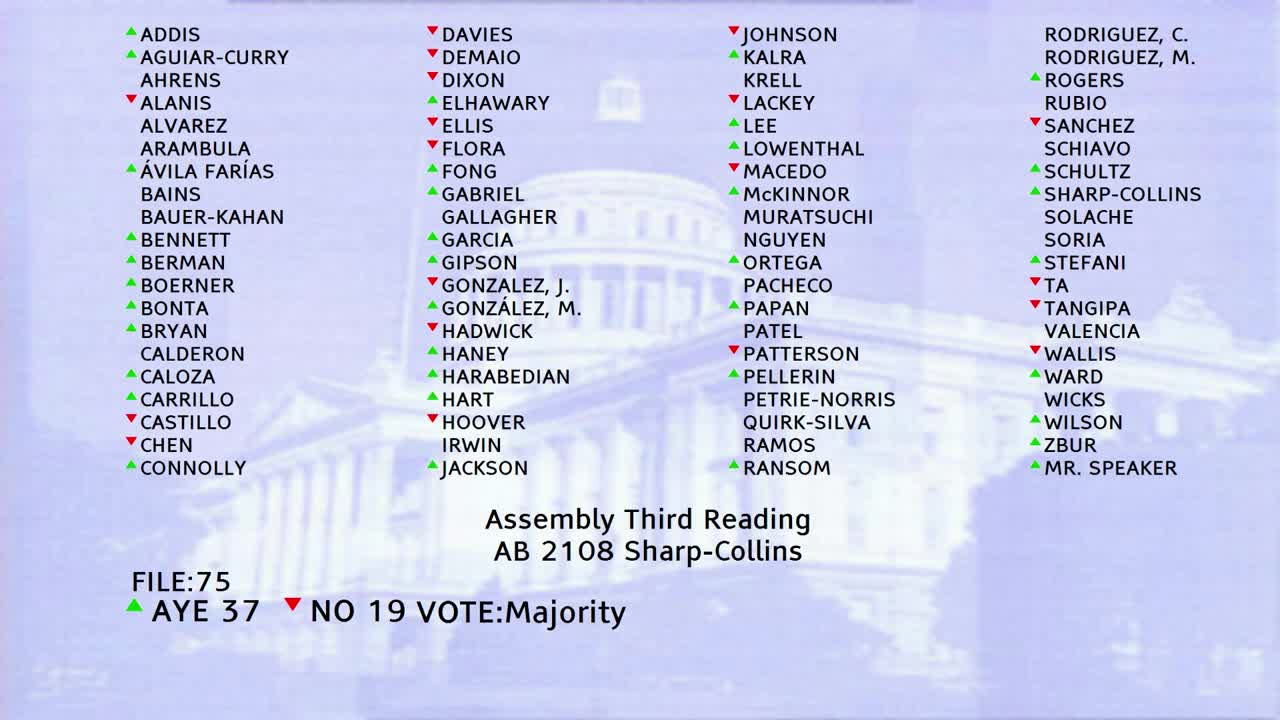 30MIN
Assembly Floor
 33MIN
Assembly Standing Committee on Environmental Safety and Toxic Materials
Bill Author

Bill Co-Author(s):