AB 1633: Taxation: private detention facilities.
- Session Year: 2025-2026
- House: Assembly
- Latest Version Date: 2026-09-29
Current Status:
Passed
(2026-09-29: Chaptered by Secretary of State - Chapter 740, Statutes of 2026.)
Introduced
In Committee
Awaiting First Chamber Vote
Passed First Chamber
In Committee
Awaiting Second Chamber Vote
Passed Second Chamber
Enacted
Existing law imposes taxes upon income and real property, and taxes upon certain transactions and excise taxes. The Fee Collection Procedures Law provides procedures for the collection of certain fees and surcharges and is administered by the California Department of Tax and Fee Administration (CDTFA). Under existing law, a violation of the Fee Collection Procedures Law is a crime.
This bill would, beginning July 1, 2028, establish the Private Detention Facility Tax Law, which would impose an annual tax on each private detention facility operator, as defined, equal to 25% of the operators gross income, as defined, for the prior fiscal year, as defined. The bill would establish the Due Process for All Fund in the State Treasury, except as provided, and would require all revenues collected, less refunds and reimbursement to the CDTFA, be deposited into the fund. In the event that Assembly Bill 2465 is enacted, the bill would instead require all revenues be deposited into the Due Process for All Fund as established by that bill. The bill would direct moneys in the fund, upon appropriation by the Legislature, be used for immigration-related services. The bill would require the CDTFA to administer and collect the tax pursuant to the Fee Collection Procedures Law. By expanding the application of the crimes associated with the Fee Collection Procedures Law, the bill would impose a state-mandated local program.
This bill would include a change in state statute that would result in a taxpayer paying a higher tax within the meaning of Section 3 of Article XIIIA of the California Constitution, and thus would require for passage the approval of 2/3 of the membership of each house of the Legislature.
The California Constitution requires the state to reimburse local agencies and school districts for certain costs mandated by the state. Statutory provisions establish procedures for making that reimbursement.
This bill would provide that no reimbursement is required by this act for a specified reason.
This bill would take effect immediately as a tax levy.
Existing law imposes taxes upon income and real property, and taxes upon certain transactions and excise taxes. The Fee Collection Procedures Law provides procedures for the collection of certain fees and surcharges and is administered by the California Department of Tax and Fee Administration (CDTFA). Under existing law, a violation of the Fee Collection Procedures Law is a crime.
This bill would, beginning July 1, 2028, establish the Private Detention Facility Tax Law, which would impose an annual tax on each private detention facility operator, as defined, equal to 25% of the operators gross income, as defined, for the prior fiscal year, as defined. The bill would establish the Due Process for All Fund in the State Treasury, except as provided, and would require all revenues collected, less refunds and reimbursement to the CDTFA, be deposited into the fund. In the event that Assembly Bill 2465 is enacted, the bill would instead require all revenues be deposited into the Due Process for All Fund as established by that bill. The bill would direct moneys in the fund, upon appropriation by the Legislature, be used for immigration-related services. The bill would require the CDTFA to administer and collect the tax pursuant to the Fee Collection Procedures Law. By expanding the application of the crimes associated with the Fee Collection Procedures Law, the bill would impose a state-mandated local program.
This bill would include a change in state statute that would result in a taxpayer paying a higher tax within the meaning of Section 3 of Article XIIIA of the California Constitution, and thus would require for passage the approval of 2/3 of the membership of each house of the Legislature.
The California Constitution requires the state to reimburse local agencies and school districts for certain costs mandated by the state. Statutory provisions establish procedures for making that reimbursement.
This bill would provide that no reimbursement is required by this act for a specified reason.
This bill would take effect immediately as a tax levy.
Existing law imposes taxes upon income and real property, and taxes upon certain transactions and excise taxes. The Fee Collection Procedures Law provides procedures for the collection of certain fees and surcharges and is administered by the California Department of Tax and Fee Administration (CDTFA). Under existing law, a violation of the Fee Collection Procedures Law is a crime.
This bill would, beginning January 1, 2027, July 1, 2028, establish the Private Detention Facility Tax Law, which would impose an annual tax on each private detention facility operator, as defined, equal to 50% 25% of the operators gross receipts, income, as defined. defined, for the prior fiscal year, as defined. The bill would establish the Due Process for All Fund in the State Treasury, except as provided, and would require all revenues collected, less refunds and reimbursement to the CDTFA, be deposited into the fund, and fund. In the event that Assembly Bill 2465 is enacted, the bill would instead require all revenues be deposited into the Due Process for All Fund as established by that bill. The bill would direct moneys in the fund, upon appropriation by the Legislature, be used for immigration-related services. The bill would require the CDTFA to administer and collect the tax pursuant to the Fee Collection Procedures Law. By expanding the application of the crimes associated with the Fee Collection Procedures Law, the bill would impose a state-mandated local program.
This bill would include a change in state statute that would result in a taxpayer paying a higher tax within the meaning of Section 3 of Article XIIIA of the California Constitution, and thus would require for passage the approval of 2/3 of the membership of each house of the Legislature.
The California Constitution requires the state to reimburse local agencies and school districts for certain costs mandated by the state. Statutory provisions establish procedures for making that reimbursement.
This bill would provide that no reimbursement is required by this act for a specified reason.
This bill would take effect immediately as a tax levy.
Existing law imposes taxes upon income and real property, and taxes upon certain transactions and excise taxes. The Fee Collection Procedures Law provides procedures for the collection of certain fees and surcharges and is administered by the California Department of Tax and Fee Administration (CDTFA). Under existing law, a violation of the Fee Collection Procedures Law is a crime.
This bill would, beginning January 1, 2027, establish the Private Detention Facility Tax Law, which would impose an annual tax on each private detention facility operator, as defined, equal to 50% of the operators gross receipts, as defined. The bill would establish the Due Process for All Fund in the State Treasury, would require all revenues collected, less refunds and reimbursement to the CDTFA, be deposited into the fund, and would direct moneys in the fund, upon appropriation by the Legislature, be used for immigration-related services. The bill would require the CDTFA to administer and collect the tax pursuant to the Fee Collection Procedures Law. By expanding the application of the crimes associated with the Fee Collection Procedures Law, the bill would impose a state-mandated local program.
This bill would include a change in state statute that would result in a taxpayer paying a higher tax within the meaning of Section 3 of Article XIIIA of the California Constitution, and thus would require for passage the approval of 2/3 of the membership of each house of the Legislature.
The California Constitution requires the state to reimburse local agencies and school districts for certain costs mandated by the state. Statutory provisions establish procedures for making that reimbursement.
This bill would provide that no reimbursement is required by this act for a specified reason.
This bill would take effect immediately as a tax levy.
Existing law imposes taxes upon income and real property, and taxes upon certain transactions and excise taxes. The Fee Collection Procedures Law provides procedures for the collection of certain fees and surcharges and is administered by the California Department of Tax and Fee Administration (CDTFA). Under existing law, a violation of the Fee Collection Procedures Law is a crime.
This bill would, beginning January 1, 2027, establish the Private Detention Facility Tax Law, which would impose an annual tax on each private detention facility operator, as defined, equal to 50% of the operators gross receipts, as defined. The bill would establish the Due Process for All Fund in the State Treasury, would require all revenues collected, less refunds and reimbursement to the CDTFA, be deposited into the fund, and would direct moneys in the fund, upon appropriation by the Legislature, be used for immigration-related services. The bill would require the CDTFA to administer and collect the tax pursuant to the Fee Collection Procedures Law. By expanding the application of the crimes associated with the Fee Collection Procedures Law, the bill would impose a state-mandated local program.
This bill would include a change in state statute that would result in a taxpayer paying a higher tax within the meaning of Section 3 of Article XIIIA of the California Constitution, and thus would require for passage the approval of 2/3 of the membership of each house of the Legislature.
The California Constitution requires the state to reimburse local agencies and school districts for certain costs mandated by the state. Statutory provisions establish procedures for making that reimbursement.
This bill would provide that no reimbursement is required by this act for a specified reason.
This bill would take effect immediately as a tax levy.
This part shall be known, and may be cited, as the Private Detention Facility Tax Law.
53001.For purposes of this part, the following definitions apply:
(a)Department means the California Department of Tax and Fee Administration.
(b)Fiscal year means the 12-month period beginning on July 1 and ending on the following June 30.
(c)Gross income means gross income, as that term is defined in Sections 17071 and 24271, derived from or attributable to this state.
(d)Private detention facility and private detention facility operator have the same meanings as those terms are defined in Section 7320 of the Government Code.
2.Private Detention Facility Tax53002.(a)Beginning July 1, 2028, and every July 1 thereafter, an annual tax is imposed upon all private detention facility operators equal to 25 percent of the operators gross income for that fiscal year.
(b)The tax imposed by this section shall apply regardless of whether the contracting agency is federal, state, or local.
3.Administration53003.The department shall administer and collect the taxes imposed by this part pursuant to the Fee Collection Procedures Law (Part 30 (commencing with Section 55001)). For purposes of this part, the references in the Fee Collection Procedures Law to fee shall include the taxes imposed by this part, and references to feepayer shall include a person required to pay the taxes imposed by this part.
53004.(a)The department may prescribe, adopt, and enforce regulations relating to the administration and enforcement of this part, including, but not limited to, provisions governing collections, reporting, refunds, and appeals.
(b)The department may prescribe, adopt, and enforce emergency regulations relating to the administration and enforcement of this part. Any emergency regulations prescribed, adopted, or enforced pursuant to this section shall be adopted in accordance with Chapter 3.5 (commencing with Section 11340) of Part 1 of Division 3 of Title 2 of the Government Code, and, for purposes of that chapter, including Section 11349.6 of the Government Code, the adoption of these regulations is an emergency and shall be considered by the Office of Administrative Law as necessary for the immediate preservation of the public peace, health and safety, and general welfare.
53005.(a)(1)Subject to paragraph (2), all revenues collected pursuant to this part, less refunds and reimbursement to the department for expenses incurred in the administration and collection of the taxes imposed by this part, shall be deposited into the Due Process for All Fund, which is hereby created in the State Treasury.
(2)In the event that Assembly Bill 2465 of the 202526 regular session is enacted, paragraph (1) shall not become operative, and instead all revenues collected pursuant to this part, less refunds and reimbursement to the department for expenses incurred in the administration and collection of the taxes imposed by this part, shall be deposited into the Due Process for All Fund, established pursuant to Section 7300.3 of the Government Code.
(b)Moneys in the fund shall, upon appropriation by the Legislature, be used for immigration-related services.
53006.(a)The taxes imposed by this part shall be due and payable annually on or before July 31 following the close of the prior fiscal year.
(b)The payments shall be accompanied by a return filed using electronic media on or before July 31 of each year for the preceding fiscal year. Returns shall be authenticated in a form or pursuant to methods as may be prescribed by the department.
53007.A private detention facility operator subject to this part shall register with the department in a form and manner prescribed by the department, including but not limited to electronic media, and shall set forth the name under which it transacts or intends to transact business and any other information as the department may require. An application for registration shall be authenticated in a form or pursuant to methods as may be prescribed by the department.
SEC. 2.No reimbursement is required by this act pursuant to Section 6 of Article XIIIB of the California Constitution because the only costs that may be incurred by a local agency or school district will be incurred because this act creates a new crime or infraction, eliminates a crime or infraction, or changes the penalty for a crime or infraction, within the meaning of Section 17556 of the Government Code, or changes the definition of a crime within the meaning of Section 6 of Article XIIIB of the California Constitution.
SEC. 3.This act provides for a tax levy within the meaning of Article IV of the California Constitution and shall go into immediate effect.
This part shall be known, and may be cited, as the Private Detention Facility Tax Law.
53001.For purposes of this part, the following definitions apply:
(a)Department means the California Department of Tax and Fee Administration.
(b)Fiscal year means the 12-month period beginning on July 1 and ending on the following June 30.
(c)Gross income means gross income, as that term is defined in Sections 17071 and 24271, derived from or attributable to this state.
(d)Private detention facility and private detention facility operator have the same meanings as those terms are defined in Section 7320 of the Government Code.
2.Private Detention Facility Tax53002.(a)Beginning July 1, 2028, and every July 1 thereafter, an annual tax is imposed upon all private detention facility operators equal to 25 percent of the operators gross income for that fiscal year.
(b)The tax imposed by this section shall apply regardless of whether the contracting agency is federal, state, or local.
3.Administration53003.The department shall administer and collect the taxes imposed by this part pursuant to the Fee Collection Procedures Law (Part 30 (commencing with Section 55001)). For purposes of this part, the references in the Fee Collection Procedures Law to fee shall include the taxes imposed by this part, and references to feepayer shall include a person required to pay the taxes imposed by this part.
53004.(a)The department may prescribe, adopt, and enforce regulations relating to the administration and enforcement of this part, including, but not limited to, provisions governing collections, reporting, refunds, and appeals.
(b)The department may prescribe, adopt, and enforce emergency regulations relating to the administration and enforcement of this part. Any emergency regulations prescribed, adopted, or enforced pursuant to this section shall be adopted in accordance with Chapter 3.5 (commencing with Section 11340) of Part 1 of Division 3 of Title 2 of the Government Code, and, for purposes of that chapter, including Section 11349.6 of the Government Code, the adoption of these regulations is an emergency and shall be considered by the Office of Administrative Law as necessary for the immediate preservation of the public peace, health and safety, and general welfare.
53005.(a)(1)Subject to paragraph (2), all revenues collected pursuant to this part, less refunds and reimbursement to the department for expenses incurred in the administration and collection of the taxes imposed by this part, shall be deposited into the Due Process for All Fund, which is hereby created in the State Treasury.
(2)In the event that Assembly Bill 2465 of the 202526 regular session is enacted, paragraph (1) shall not become operative, and instead all revenues collected pursuant to this part, less refunds and reimbursement to the department for expenses incurred in the administration and collection of the taxes imposed by this part, shall be deposited into the Due Process for All Fund, established pursuant to Section 7300.3 of the Government Code.
(b)Moneys in the fund shall, upon appropriation by the Legislature, be used for immigration-related services.
53006.(a)The taxes imposed by this part shall be due and payable annually on or before July 31 following the close of the prior fiscal year.
(b)The payments shall be accompanied by a return filed using electronic media on or before July 31 of each year for the preceding fiscal year. Returns shall be authenticated in a form or pursuant to methods as may be prescribed by the department.
53007.A private detention facility operator subject to this part shall register with the department in a form and manner prescribed by the department, including but not limited to electronic media, and shall set forth the name under which it transacts or intends to transact business and any other information as the department may require. An application for registration shall be authenticated in a form or pursuant to methods as may be prescribed by the department.
SEC. 2.No reimbursement is required by this act pursuant to Section 6 of Article XIIIB of the California Constitution because the only costs that may be incurred by a local agency or school district will be incurred because this act creates a new crime or infraction, eliminates a crime or infraction, or changes the penalty for a crime or infraction, within the meaning of Section 17556 of the Government Code, or changes the definition of a crime within the meaning of Section 6 of Article XIIIB of the California Constitution.
SEC. 3.This act provides for a tax levy within the meaning of Article IV of the California Constitution and shall go into immediate effect.
This part shall be known, and may be cited, as the Private Detention Facility Tax Law.
53001.For purposes of this part, the following definitions apply:
(a)Department means the California Department of Tax and Fee Administration.
(b)Fiscal year means the 12-month period beginning on July 1 and ending on the following June 30.
(b)(c)Gross receipts means all amounts received by a private detention facility operator pursuant to all contracts relating to the operation of private detention facilities located in California. income means gross income, as that term is defined in Sections 17071 and 24271, derived from or attributable to this state.
(c)(d)Private detention facility and private detention facility operator have the same meanings as those terms are defined in Section 7320 of the Government Code.
2.Private Detention Facility Tax53002.(a)Beginning January 1, 2027, July 1, 2028, and every July 1 thereafter, an annual tax is imposed upon all private detention facility operators equal to 50 25 percent of the operators gross receipts derived from the operation of each private detention facility in this state. income for that fiscal year.
(b)The tax imposed by this section shall apply regardless of whether the contracting agency is federal, state, or local.
3.Administration53003.The department shall administer and collect the taxes imposed by this part pursuant to the Fee Collection Procedures Law (Part 30 (commencing with Section 55001)). For purposes of this part, the references in the Fee Collection Procedures Law to fee shall include the taxes imposed by this part, and references to feepayer shall include a person required to pay the taxes imposed by this part.
53004.(a)The department may prescribe, adopt, and enforce regulations relating to the administration and enforcement of this part, including, but not limited to, provisions governing collections, reporting, refunds, and appeals.
(b)The department may prescribe, adopt, and enforce emergency regulations relating to the administration and enforcement of this part. Any emergency regulations prescribed, adopted, or enforced pursuant to this section shall be adopted in accordance with Chapter 3.5 (commencing with Section 11340) of Part 1 of Division 3 of Title 2 of the Government Code, and, for purposes of that chapter, including Section 11349.6 of the Government Code, the adoption of these regulations is an emergency and shall be considered by the Office of Administrative Law as necessary for the immediate preservation of the public peace, health and safety, and general welfare.
53005.(a)All (1)Subject to paragraph (2), all revenues collected pursuant to this part, less refunds and reimbursement to the department for expenses incurred in the administration and collection of the taxes imposed by this part, shall be deposited into the Due Process for All Fund, which is hereby created in the State Treasury.
(2)In the event that Assembly Bill 2465 of the 202526 regular session is enacted, paragraph (1) shall not become operative, and instead all revenues collected pursuant to this part, less refunds and reimbursement to the department for expenses incurred in the administration and collection of the taxes imposed by this part, shall be deposited into the Due Process for All Fund, established pursuant to Section 7300.3 of the Government Code.
(b)Moneys in the fund shall, upon appropriation by the Legislature, be used for immigration-related services.
53006.(a)The taxes imposed by this part shall be due and payable annually on or before July 31 following the close of the prior fiscal year.
(b)The payments shall be accompanied by a return filed using electronic media on or before July 31 of each year for the preceding fiscal year. Returns shall be authenticated in a form or pursuant to methods as may be prescribed by the department.
53007.A private detention facility operator subject to this part shall register with the department in a form and manner prescribed by the department, including but not limited to electronic media, and shall set forth the name under which it transacts or intends to transact business and any other information as the department may require. An application for registration shall be authenticated in a form or pursuant to methods as may be prescribed by the department.
SEC. 2.No reimbursement is required by this act pursuant to Section 6 of Article XIIIB of the California Constitution because the only costs that may be incurred by a local agency or school district will be incurred because this act creates a new crime or infraction, eliminates a crime or infraction, or changes the penalty for a crime or infraction, within the meaning of Section 17556 of the Government Code, or changes the definition of a crime within the meaning of Section 6 of Article XIIIB of the California Constitution.
SEC. 3.This act provides for a tax levy within the meaning of Article IV of the California Constitution and shall go into immediate effect.
This part shall be known, and may be cited, as the Private Detention Facility Tax Law.
53001.For purposes of this part, the following definitions shall apply:
(a)Department means the California Department of Tax and Fee Administration.
(b)Gross receipts means all amounts received by a private detention facility operator pursuant to all contracts relating to the operation of private detention facilities located in California.
(c)Private detention facility and private detention facility operator have the same meanings as those terms are defined in Section 7320 of the Government Code.
2.Private Detention Facility Tax53002.(a)Beginning January 1, 2027, an annual tax is imposed upon all private detention facility operators equal to 50 percent of the operators gross receipts derived from the operation of each private detention facility in this state.
(b)The tax imposed by this section shall apply regardless of whether the contracting agency is federal, state, or local.
3.Administration53003.The department shall administer and collect the taxes imposed by this part pursuant to the Fee Collection Procedures Law (Part 30 (commencing with Section 55001)). For purposes of this part, the references in the Fee Collection Procedures Law to fee shall include the taxes imposed by this part, and references to feepayer shall include a person required to pay the taxes imposed by this part.
53004.(a)The department may prescribe, adopt, and enforce regulations relating to the administration and enforcement of this part, including, but not limited to, provisions governing collections, reporting, refunds, and appeals.
(b)The department may prescribe, adopt, and enforce emergency regulations relating to the administration and enforcement of this part. Any emergency regulations prescribed, adopted, or enforced pursuant to this section shall be adopted in accordance with Chapter 3.5 (commencing with Section 11340) of Part 1 of Division 3 of Title 2 of the Government Code, and, for purposes of that chapter, including Section 11349.6 of the Government Code, the adoption of these regulations is an emergency and shall be considered by the Office of Administrative Law as necessary for the immediate preservation of the public peace, health and safety, and general welfare.
53005.(a)All revenues collected pursuant to this part, less refunds and reimbursement to the department for expenses incurred in the administration and collection of the taxes imposed by this part, shall be deposited into the Due Process for All Fund, which is hereby created in the State Treasury.
(b)Moneys in the fund shall, upon appropriation by the Legislature, be used for immigration-related services.
SEC. 2.No reimbursement is required by this act pursuant to Section 6 of Article XIIIB of the California Constitution because the only costs that may be incurred by a local agency or school district will be incurred because this act creates a new crime or infraction, eliminates a crime or infraction, or changes the penalty for a crime or infraction, within the meaning of Section 17556 of the Government Code, or changes the definition of a crime within the meaning of Section 6 of Article XIIIB of the California Constitution.
SEC. 3.This act provides for a tax levy within the meaning of Article IV of the California Constitution and shall go into immediate effect.
This part shall be known, and may be cited, as the Private Detention Facility Tax Law.
53001.For purposes of this part, the following definitions shall apply:
(a)Department means the California Department of Tax and Fee Administration.
(b)Gross receipts means all amounts received by a private detention facility operator pursuant to all contracts relating to the operation of private detention facilities located in California.
(c)Private detention facility and private detention facility operator have the same meanings as those terms are defined in Section 7320 of the Government Code.
2.Private Detention Facility Tax53002.(a)Beginning January 1, 2027, an annual tax is imposed upon all private detention facility operators equal to 50 percent of the operators gross receipts derived from the operation of each private detention facility in this state.
(b)The tax imposed by this section shall apply regardless of whether the contracting agency is federal, state, or local.
3.Administration53003.The department shall administer and collect the taxes imposed by this part pursuant to the Fee Collection Procedures Law (Part 30 (commencing with Section 55001)). For purposes of this part, the references in the Fee Collection Procedures Law to fee shall include the taxes imposed by this part, and references to feepayer shall include a person required to pay the taxes imposed by this part.
53004.(a)The department may prescribe, adopt, and enforce regulations relating to the administration and enforcement of this part, including, but not limited to, provisions governing collections, reporting, refunds, and appeals.
(b)The department may prescribe, adopt, and enforce emergency regulations relating to the administration and enforcement of this part. Any emergency regulations prescribed, adopted, or enforced pursuant to this section shall be adopted in accordance with Chapter 3.5 (commencing with Section 11340) of Part 1 of Division 3 of Title 2 of the Government Code, and, for purposes of that chapter, including Section 11349.6 of the Government Code, the adoption of these regulations is an emergency and shall be considered by the Office of Administrative Law as necessary for the immediate preservation of the public peace, health and safety, and general welfare.
53005.(a)All revenues collected pursuant to this part, less refunds and reimbursement to the department for expenses incurred in the administration and collection of the taxes imposed by this part, shall be deposited into the Due Process for All Fund, which is hereby created in the State Treasury.
(b)Moneys in the fund shall, upon appropriation by the Legislature, be used for immigration-related services.
SEC. 2.No reimbursement is required by this act pursuant to Section 6 of Article XIIIB of the California Constitution because the only costs that may be incurred by a local agency or school district will be incurred because this act creates a new crime or infraction, eliminates a crime or infraction, or changes the penalty for a crime or infraction, within the meaning of Section 17556 of the Government Code, or changes the definition of a crime within the meaning of Section 6 of Article XIIIB of the California Constitution.
SEC. 3.This act provides for a tax levy within the meaning of Article IV of the California Constitution and shall go into immediate effect.
|
Date
|
Status
|
|---|---|
| Sep 29, 2026 | Chaptered by Secretary of State - Chapter 740, Statutes of 2026. |
| Sep 29, 2026 | Approved by the Governor. |
| Sep 8, 2026 | Enrolled and presented to the Governor at 3:30 p.m. |
| Aug 28, 2026 | Senate amendments concurred in. To Engrossing and Enrolling. (Ayes 57. Noes 17.). |
| Aug 28, 2026 | Senate amendments concurred in. To Engrossing and Enrolling. (Ayes 57. Noes 17. Page 6790.). |
| Aug 27, 2026 | In Assembly. Concurrence in Senate amendments pending. |
| Aug 27, 2026 | Read third time. Passed. Ordered to the Assembly. (Ayes 29. Noes 10.). |
| Aug 24, 2026 | Read second time. Ordered to third reading. |
| Aug 21, 2026 | Read third time and amended. Ordered to second reading. |
| Aug 13, 2026 | Read second time. Ordered to third reading. |
| Aug 13, 2026 | From committee: Do pass. (Ayes 5. Noes 2.) (August 13). |
| Aug 3, 2026 | In committee: Referred to APPR. suspense file. |
| Jun 24, 2026 | From committee: Do pass and re-refer to Com. on APPR. (Ayes 4. Noes 0.) (June 24). Re-referred to Com. on APPR. |
| Jun 16, 2026 | From committee chair, with author's amendments: Amend, and re-refer to committee. Read second time, amended, and re-referred to Com. on REV. & TAX. |
| Jun 10, 2026 | Referred to Com. on REV. & TAX. |
| May 28, 2026 | In Senate. Read first time. To Com. on RLS. for assignment. |
| May 27, 2026 | Read third time. Passed. Ordered to the Senate. (Ayes 59. Noes 18.) |
| May 27, 2026 | Read third time. Passed. Ordered to the Senate. (Ayes 59. Noes 18. Page 5428.) |
| May 27, 2026 | Read third time. Passed. Ordered to the Senate. |
| May 18, 2026 | Read second time. Ordered to third reading. |
| May 14, 2026 | Joint Rule 62(a), file notice suspended. (Page 5030.) |
| May 14, 2026 | Joint Rule 62(a), file notice suspended. |
| May 14, 2026 | From committee: Do pass. (Ayes 11. Noes 4.) (May 14). |
| May 13, 2026 | In committee: Set, first hearing. Referred to APPR. suspense file. |
| Apr 28, 2026 | From committee: Do pass and re-refer to Com. on APPR. (Ayes 5. Noes 2.) (April 27). Re-referred to Com. on APPR. |
| Apr 20, 2026 | In committee: Set, first hearing. Referred to REV. & TAX. suspense file. |
| Mar 23, 2026 | Referred to Com. on REV. & TAX. |
| Jan 27, 2026 | From printer. May be heard in committee February 26. |
| Jan 26, 2026 | Read first time. To print. |
|
Date
|
Description
|
Location
|
Votes
|
|
|---|---|---|---|---|
| Aug 28, 2026 | AB 1633 Haney Concurrence in Senate Amendments | Assembly Floor |
Passed |
|
| Aug 27, 2026 | Assembly 3rd Reading AB1633 Haney et al. By Gonzalez | Senate Floor |
Passed |
|
| Aug 13, 2026 | Do pass | Senate Standing Committee on Appropriations |
Passed |
|
| Aug 3, 2026 | Placed on suspense file | Senate Standing Committee on Appropriations |
Passed |
|
| Jun 24, 2026 | Do pass, but first be re-referred to the Committee on [Appropriations] | Senate Standing Committee on Revenue and Taxation |
Passed |
|
| May 27, 2026 | AB 1633 Haney Assembly Third Reading | Assembly Floor |
Passed |
|
| May 14, 2026 | Do pass. | Assembly Standing Committee on Appropriations |
Passed |
|
| Apr 27, 2026 | Do pass and be re-referred to the Committee on [Appropriations] | Assembly Standing Committee on Revenue and Taxation |
Passed |
This list shows positions taken on this bill by organizations on the date displayed, which is linked to the original source.
Positions by individuals are not included.
|
Organization
|
Position
|
Date
|
|---|---|---|
| 805 UndocuFund | ** Support | |
| AAPIs for Civic Empowerment | ** Support | |
| ACCE Action | ** Support | |
| Access Reproductive Justice | ** Support | |
| Alianza Sacramento | ** Support | |
| Alliance for A Better Community | ** Support | |
| Alliance San Diego | ** Support | |
| Asian Americans Advancing Justice Southern California | ** Support | |
| Asian Law Caucus | ** Support | |
| Black LGBTQIA+ Migrant Project | ** Support | |
| Buen Vecino | ** Support | |
| Building Skills Partnership | ** Support | |
| California Alliance For Retired Americans | ** Support | |
| California Coalition for Women Prisoners | ** Support | |
| California Community Foundation | ** Support | |
| California Democratic Party | ** Support | |
| California Dignity not Detention Coalition | ** Support | |
| California Federation Of Teachers | ** Support | |
| California Food and Farming Network | ** Support | |
| California Immigrant Policy Center | ** Support | |
| California Immigrant Youth Justice Alliance | ** Support | |
| California Immigration Project | ** Support | |
| California Latinas for Reproductive Justice | ** Support | |
| California National Organization For Women | ** Support | |
| California Native Vote Project | ** Support | |
| California Partnership To End Domestic Violence | ** Support | |
| California School Employees Association | ** Support | |
| California Teachers Association | ** Support | |
| California Work & Family Coalition | ** Support | |
| Californians United for a Responsible Budget | ** Support | |
| Canal Alliance | ** Support | |
| Central Valley Immigrant Integration Collaborative | ** Support | |
| centro binacional para el desarrollo indigena oaxaqueno | ** Support | |
| Chicano Federation Of San Diego County | ** Support | |
| Chinese for Affirmative Action | ** Support | |
| CHISPA | ** Support | |
| City Of Los Angeles | ** Support | |
| Communities United for Restorative Youth Justice | ** Support | |
| Community Healers, Inc. | ** Support | |
| Congregations Organized for Prophetic Engagement | ** Support | |
| Congregations Organized for Prophetic Engagement (COPE) | ** Support | |
| Corecivic | ** Support | |
| Council on American-Islamic Relations, California | ** Support | |
| Courage California | ** Support | |
| Democrats of Rossmoor | ** Support | |
| Dignity Not detention Coalition | ** Support | |
| Drug Policy Alliance | ** Support | |
| East Bay Sanctuary Covenant | ** Support | |
| Empowering Marginalized Asian Communities | ** Support | |
| Ensuring Opportunity Contra Costa | ** Support | |
| Episcopal Diocese of San Joaquin | ** Support | |
| Equality California | ** Support | |
| Felony Murder Elimination Project | ** Support | |
| Freedom for Immigrants | ** Support | |
| Friends Committee On Legislation Of California | ** Support | |
| Future Leaders Of America | ** Support | |
| GEO GROUP | ** Support | |
| Health in Partnership | ** Support | |
| Healthy Contra Costa | ** Support | |
| Immigrant Justice in Action Coalition | ** Support | |
| Immigrant Legal Resource Center | ** Support | |
| Immigrants Rising | ** Support | |
| Imperial Valley Equity & Justice Coalition | ** Support | |
| Indivisible Alta-Pasadena | ** Support | |
| Indivisible California: Statestrong | ** Support | |
| Indivisible East Bay | ** Support | |
| Indivisible Euclid | ** Support | |
| Indivisible Fair Oaks-Carmichael | ** Support | |
| Indivisible Mid-Peninsula | ** Support | |
| Indivisible Palo Alto | ** Support | |
| Indivisible San Francisco | ** Support | |
| Indivisible Santa Cruz County | ** Support | |
| Inland Coalition for Immigrant Justice | ** Support | |
| Interfaith Movement for Human Integrity | ** Support | |
| Jewish Family Community Services East Bay | ** Support | |
| Justice2jobs Coalition | ** Support | |
| Kern Welcoming and Extending Solidarity to Immigrant | ** Support | |
| LA Defensa | ** Support | |
| LA Defesa | ** Support | |
| LA Voice | ** Support | |
| Latino Health Access | ** Support | |
| Legal Aid At Work | ** Support | |
| Lift up Contra Costa | ** Support | |
| Majdal Arab Community Center of San Diego | ** Support | |
| Mid-City Community Advocacy Network | ** Support | |
| Mixteco/Indígena Community Organizing Project | ** Support | |
| Multi-faith Action Coalition | ** Support | |
| New Light Wellness | ** Support | |
| NextGen California | ** Support | |
| Norcal Resist | ** Support | |
| Oasis Legal Services | ** Support | |
| One individual | ** Support | |
| Orale: Organizing Rooted in Abolition Liberation and Empowerment | ** Support | |
| Orange County Equality Coalition | ** Support | |
| Orange County Rapid Response Network | ** Support | |
| Oxnard Union High School District | ** Support | |
| pacifica social justice | ** Support | |
| Pangea Legal Services | ** Support | |
| Parent Voices California | ** Support | |
| PICO California | ** Support | |
| Pilipino Workers Center of Southern California | ** Support | |
| Public Counsel | ** Support | |
| Rad Jews of OC-LBC | ** Support | |
| Restoring Hope California | ** Support | |
| Rising Juntos | ** Support | |
| Riverside Sheriffs’ Association | ** Support | |
| Sacramento Immigration Committee | ** Support | |
| San Bernardino Community Service Center, Inc. | ** Support | |
| San Francisco Board of Supervisors | ** Support | |
| Santa Monica Democratic Club | ** Support | |
| Services, Immigrant Rights and Education Network | ** Support | |
| SFV Alliance | ** Against | |
| Social Justice Collaborative | ** Support | |
| South Asian Network | ** Support | |
| Southeast Asia Resource Action Center | ** Support | |
| State Superintendent of Public Instruction Tony Thurmond | ** Support | |
| Street Level Health Project | ** Support | |
| Thai Community Development Center | ** Support | |
| The California LGBTQ Health and Human Services Network | ** Support | |
| The Children’s Partnership | ** Support | |
| The Fund for Santa Barbara | ** Support | |
| The Translatin@ Coalition | ** Support | |
| Tony Thurmond | ** Support | |
| Tsuru for Solidarity | ** Support | |
| TWW/Indivisible Los Gatos | ** Support | |
| Uncommon Law | ** Support | |
| Unidos 805 | ** Support | |
| United Nations Association – UC Santa Barbara | ** Support | |
| Universidad Popular | ** Support | |
| western center on law & poverty | ** Support | |
| Working Partnerships USA | ** Support |
CONCURRENCE IN SENATE AMENDMENTS
CSA1 Bill Id:AB 1633
Author:(Haney)
As Amended Ver:August 27, 2026
2/3 vote. Tax Levy
SUMMARY
Enacts the Private Detention Facility Tax Law, which imposes, beginning January 1, 2027, an annual tax upon all "private detention facility operators" equal to 50% of the operator's gross receipts derived from the operation of each "private detention facility" in California.
Senate Amendments
- Add co-authors.
- Impose the tax on a private detention facility operator's gross income, as defined, instead of gross receipts.
- Decrease the rate of tax from 50% to 25%.
- Delay implementation from January 1, 2027, to July 1, 2028.
- Provide that the tax applies each July 1st on a fiscal year basis for the previous 12-month period ending June 30th.
- Set forth payment deadlines, return and registration requirements, and direct the California Department of Tax & Fee Administration (CDTFA) to authenticate returns and registration.
- Add chaptering-out language to ensure this bill and AB 2465 (Ortega) do not create duplicative Funds if both bills are signed into law.
COMMENTS
- Prior attempts to ban private prisons: Since Donald Trump first took office in 2017, the Legislature has responded to both Trump administrations' aggressive immigration tactics by enacting bills that prohibit state and local governments from contracting for immigration detention centers, require the Attorney General to develop and disseminate guidance for state and local agencies in their interactions with immigration enforcement agents, and require schools and daycares to restrict federal agents' access to their campuses, among numerous other efforts. While some of California's legislation in response to the Trump Administration's immigration enforcement has withstood legal scrutiny, California has not always been successful. In 2019, the Legislature enacted AB 32 (Bonta), Chapter 739, Statutes of 2019, which prohibited privately owned detention facilities from operating in California. The Trump Administration challenged the new statute and after a series of hearings and appeals, the state requested an en banc review of the case before the Ninth Circuit. In that review, the court held that the statute likely violated the Supremacy Clause of the United States Constitution. Geo Group, Inc. v. Newsom, 50 F.4th 745 (2022).
The Ninth Circuit held that AB 32 both improperly dictated who the federal government could contract with in order to carry out its obligations and frustrated the ability of their proxies to function in California so as to create an obstacle for the federal government to engage in immigration detention. Therefore, California's attempt to ban private detention facilities in the state amounted to unconstitutional control of the federal government and discrimination against those who contract with the federal government by the state in violation of the Supremacy Clause.
- Doctrine of intergovernmental immunity: The Supremacy Clause of the Constitution has also been interpreted to impose limits on the extent to which the state and federal governments can encroach on each other's sovereignty. Since 1819, the Supreme Court has held that states cannot directly tax the federal government or its instrumentalities. McCulloch v. Maryland, 17 U.S. 316 (1819). The Supreme Court has further interpreted the Supremacy Clause to, in part, prohibit the states from "interfering with or controlling the operations of the Federal Government" but a law that indirectly imposes a cost on the federal government may be constitutional "so long as the law imposes those costs in a neutral, nondiscriminatory way." United States v. Washington, 596 U.S. 832, 838-39 (2022). While otherwise generally applicable sales and property taxes paid by federal government contractors have survived judicial review, the targeted excise tax proposed by this bill may be challenged as discriminatory and, thus, unconstitutional.
Proponents argue that this bill is distinguishable from AB 32 because it does not prohibit private detention facilities in California, but instead taxes the revenues generated by their operation to partially offset the resulting negative impacts on California immigrant communities.
- Excise taxes: The first excise tax levied in the U.S. was on the manufacture of whiskey in 1791. The tax was unpopular, famously sparking insurrectionary activities among Western Pennsylvania farmers, and only survived until 1802. In the early years of the Republic, excise taxes served as a revenue tool related to wars and economic downturns. As late as 1934, during the Great Depression, excise tax revenues made up almost one-half of the federal government's total tax revenue and generated three times more than the individual income tax. Historically, excise taxes have been levied to raise general fund revenues because the categories of products subject to tax were easy to count, which made administration of the tax simple and cheap. Sales taxes, for example, are based on a retailer's gross receipts attributable to sales of tangible personal property (TPP).
More recently, however, excise taxes have been used to try to deter (or even to completely eliminate) certain types of consumption. These taxes are often referred to as a "Pigouvian tax" when the tax is imposed on activities that produce negative externalities. For example, this strategy is employed with taxes on tobacco-containing products. Although it would be difficult and potentially illegal to tax a product into nonexistence, there is no doubt that taxes influence behavior. The laws of supply and demand dictate that as prices go up, consumption goes down, even if this is a simplification. In fact, revenues from cigarette taxes in California have fallen in recent years and public health researchers attribute at least some of this decline to the high excise taxes imposed on each pack of cigarettes, as well as users switching to other forms of tobacco and nicotine products such as vaping subject to comparatively lower taxes.
In modern times, excise taxes have also been employed as user fees. This is best understood with the example of the motor fuel tax, where gasoline purchases serve as a proxy for a driver's contributions to traffic congestion, road wear-and-tear, and emissions, in effect setting a price on the use of public roads. Today, there are federal excise taxes on motor fuel, tobacco, and alcohol, among other goods, services, and activities, in addition to state excise taxes on electronic cigarettes, cannabis, firearms and ammunition sales, and more.
According to the Author
The author has provided the following statement in support of this bill:
Private corporations such as GEO Group and CoreCivic continue to profit from operating immigration detention facilities in California, despite longstanding concerns about unsafe conditions, inadequate medical care, and lack of accountability in civil detention settings. In 2026 alone, at least six individuals have died in ICE custody nationwide, underscoring the serious risks associated with this system. While California cannot dictate federal immigration policy, the state has a responsibility to ensure that corporations profiting from detention are held accountable. AB 1633 seeks to do so by imposing a gross receipts tax on private detention operators and directing the revenue toward immigrant legal services and due process protections.
Arguments in Support
This bill is co-sponsored by the California Immigrant Policy Center, which notes, in part:
Private detention facilities in California have a horrific track record of dangerous conditions, including inadequate access to medical care, physical and sexual abuse, unsafe food and water, and unsanitary conditions, threatening the health, safety and constitutional rights of individuals in California. The California Department of Justice conducted an inspection of a new private detention facility in Kern County and in December 2025, the Attorney General reported concerns of "dangerous living conditions" and "lack of adequate medical care." Additionally, the California Department of Justice conducted inspection of the private detention facility, the Adelanto Detention Facility, and in March 2026, the Attorney General reported "shockingly inadequate medical care, a failure to accommodate people with disabilities, disturbingly unsafe and unsanitary conditions, and a lack of basic necessities." The California Attorney General also stated, "Despite multiple complaints from Congress, detainees, community members, and my office, the federal government continues to allow this abuse, oppressive conditions, and clear violations of human rights to go unchecked."
Arguments in Opposition
This bill is opposed by the SFV Alliance, which notes, in part:
If this legislation passes, is signed in to tax code and withstands court challenges, it may result in these facilities leaving California. While I don't think the majority of the legislature will care about the increased tax revenue and local economic activity that will be lost from the closures, it might want to think about family members, loved ones, and legal representatives of those being detained and going through their due process hearings. Forcing detention centers out of state will make the detention center farther from loved ones to either visit and or check in on the person being detained. It will also make it harder and more expensive for California lawyers representatives to do in person representation, possibly forcing those lawyers to do remote representation.
FISCAL COMMENTS
According to the Senate Committee on Appropriations:
- The CDTFA estimates that this bill would result in a revenue gain of $177 million in 2027-28 (Due Process for All Fund). Annual revenue gains thereafter would likely be similar, to the extent such contracts continue in the State.
- The CDTFA indicates that it would incur administrative costs of $257,000 in 2026-27, $1.5 million in 2027-28, $131,000 in 2028-29, $115,000 in 2029-30, and $126,000 annually thereafter, to implement the provisions of the bill. Cost drivers would include identifying and notifying taxpayers, creating a new tax return, programming computer systems, revising publications, developing special notices and tax guides, developing regulations, preparing guidelines for staff, and answering numerous from operators and the public (Due Process for All Fund).
VOTES:
SENATE FLOOR: 37-0-3
YES: Allen, Alvarado-Gil, Archuleta, Arreguín, Ashby, Becker, Blakespear, Cabaldon, Caballero, Cervantes, Choi, Cortese, Dahle, Durazo, Gonzalez, Grayson, Grove, Hurtado, Jones, Laird, Limón, McGuire, McNerney, Menjivar, Niello, Padilla, Pérez, Richardson, Rubio, Seyarto, Smallwood-Cuevas, Stern, Strickland, Umberg, Valladares, Weber Pierson, Wiener
ABS, ABST OR NV: Ochoa Bogh, Reyes, Wahab
ASM EMERGENCY MANAGEMENT: 4-2-1
YES: Ransom, Arambula, Bennett, Calderon
NO: Hadwick, DeMaio
ABS, ABST OR NV: Bains
ASM ENVIRONMENTAL SAFETY AND TOXIC MATERIALS: 5-2-0
YES: Connolly, Bauer-Kahan, Lee, McKinnor, Papan
NO: Ellis, Castillo
ASM APPROPRIATIONS: 13-2-0
YES: Wicks, Arambula, Calderon, Caloza, Dixon, Fong, Mark González, Krell, Pacheco, Pellerin, Sharp-Collins, Solache, Ta
NO: Hoover, Tangipa
UPDATED
VERSION: August 71, 2026
CONSULTANT: Wesley Whitaker / REV. & TAX. / (916) 319-2098 FN: 0004306
SENATE RULES COMMITTEE Office of Senate Floor Analyses (916) 651-4171 | AB 1633 |
THIRD READING
Bill No: AB 1633
Author: Haney (D), et al.
Amended: 8/21/26 in Senate
Vote: 27
SENATE REVENUE AND TAXATION COMMITTEE: 4-0, 6/24/26
AYES: McNerney, Ashby, Becker, Grayson
NO VOTE RECORDED: Alvarado-Gil
SENATE APPROPRIATIONS COMMITTEE: 5-2, 8/13/26
AYES: Cervantes, Cabaldon, Grayson, Richardson, Wahab
NOES: Seyarto, Dahle
ASSEMBLY FLOOR: 59-18, 5/27/26 - See last page for vote
SUBJECT: Taxation: private detention facilities
SOURCE: State Superintendent of Public Instruction Tony Thurmond; California Immigrant Policy Center; Services, Immigrant Rights and Education Network
DIGEST:
This bill imposes an annual tax on “private detention facility operators” equal to 25% of the operator’s gross income derived from the operation of each “private detention facility” in California.
Senate Floor Amendments of 8/21/26 (1) Apply its tax to gross income, as defined, instead of gross receipts; (2) Lower the rate of tax from 50% to 25%; (3) Delay implementation from January 1, 2027, to July 1, 2028; (4) Provide that the tax applies each July 1st on a fiscal year basis for the previous 12-month period ending June 30th; (5) Set forth payment deadlines, return and registration requirements, and direct the California Department of Tax & Fee Administration (CDTFA) to authenticate returns and registration; (6) Ensure that this bill and AB 2465 (Ortega) do not create duplicative Funds.
ANALYSIS:
Existing law:
- Enacts the Corporation Tax Law, which among other provisions, taxes net apportioned business income and allocated net nonbusiness income of corporations doing business in California at a rate of 8.84%, or imposes the $800 minimum tax, whichever is greater.
- Applies the combined report method for corporate taxation, which requires a corporation computing its California tax liability to include the tax returns of each of its unitary subsidiaries and affiliates in one combined report.
- Allows taxpaying corporations to elect to exclude the income and expenses of their foreign subsidiaries from their combined reports, called the “water’s edge” election, with some exceptions.
- Imposes several excise taxes, including on cigarettes and tobacco products, alcoholic beverages, motor vehicle and diesel fuel, cannabis, and electronic cigarettes, among others, which can contain provisions governing administration of the excise tax, such as requirements to register with the California Department of Tax and Fee Administration (CDTFA), enforcement, collections, penalties, and appeals, among others.
- Enacts the Fee Collections Procedures Law (FCPL), which is the state’s general purpose statute for CDTFA to administer special taxes and fees.
- Requires the Department of Justice (DOJ) to report on immigration detention facilities operating in California.
- Prohibits the California Department of Corrections and Rehabilitation (CDCR) from entering into, or renewing contracts with, private for-profit prisons after January 1, 2020, and eliminates their use by January 1, 2028.
This bill:
- Imposes an annual tax upon all “private detention facility operators” equal to 25% of the operator’s gross income derived from or attributable to the state, defined by reference to the Personal Income and Corporation Taxes, derived from the operation of each “private detention facility” in California, commencing July 1, 2028. The tax applies each July 1st on gross income derived in the prior fiscal year, beginning on July 1 and ending June 30th.
- Provides that the tax applies regardless of whether the contracting agency is federal, state, or local.
- Directs CDTFA to administer and collect the tax imposed by this bill using the FCPL and authorizes CDTFA to issue regulations to implement this bill, including emergency regulations.
- Provides that the tax is due and payable annually on or before July 31st following the close of the prior fiscal year and must be accompanied by a return filed using electronic media.
- Requires private detention facility operators to register with CDTFA.
- Directs CDTFA to authenticate the return and the registration in a form and manner according to methods it prescribes, including electronic media.
- Requires CDTFA to deposit revenues from the tax into the Due Process for All Fund, which this bill creates in the State Treasury. However, the measure does not create the Fund if AB 2465 (Ortega) is also enacted.
- Provides that the Legislature can appropriate money from the Fund for immigration-related services.
- Defines “Private detention facility” by reference to the Government Code.
Background
Private prisons. The federal government contracts with private detention facilities throughout the country to house immigration detainees and federal criminal pretrial detainees. On May 15, 2026, Attorney General Rob Bonta released the Department of Justice (DOJ)’s fifth report on immigration detention facilities operating in California, where noncitizens are detained by Immigration and Customs Enforcement, pursuant to a requirement enacted by the Legislature.
The report found that conditions in these facilities had largely worsened as the Trump Administration’s mass deportation campaign led to overcrowding and strained resources, especially impacting access to medical care and conditions of confinement. Tragically, there were six deaths of detainees between September 2025 and March 2026 — the highest number since the DOJ started conducting reviews in 2017. These deaths, coupled with DOJ’s findings of substandard conditions that fail to meet ICE’s own detention standards, raise serious concerns about these facilities’ ability to safely detain a growing detainee population and underscore the need for greater accountability and oversight.
According to USA Spending, the federal government has paid out $604.9 million in contracts related to the operation of 12 California-based private detention facilities, operated by CoreCivic (five), GEO Group (six), and Management and Training Corporation (one). From 2023 to 2024, outlays rose from $116.0 million to $321.2 million, and in 2025, they increased further to $388.3 million. According to IBISWorld, revenue for California’s private detention facilities is projected to reach $600 million in the 2027-28 fiscal year, followed by a 2% decline in subsequent years.
Comment
Precedents. AB 1633 sets at least two important precedents. First, the measure takes one item of income that is included for the purpose of determining net income for California’s Corporation Tax – gross income derived from the operation of private detention facilities in California – and subjects it to a gross receipts tax where taxpayers can neither deduct expenses nor apply credits. As such, AB 1633 would treat one item of business income differently than all others. Additionally, because the measure does not exclude the gross income subject to its tax from the Personal Income and Corporation Taxes, the same items of income would be subject to tax twice. Second, proceeds of the state’s general taxes – Personal Income, Corporation, and Sales and Use – flow to the General Fund, from which the Legislature appropriates them in the Budget Act. Although similar to other excise taxes, AB 1633 directs its revenues outside the Budget Act to the Due Process for All Fund, only allowing the Legislature to then appropriate those funds for purposes of immigration-related services. The Legislature can appropriate any funds it wishes for those purposes by appropriation or the Budget Act. Lastly, the measure isn’t clear whether additional revenues are subject to Proposition 98’s K-14 educational guarantee or whether Proposition 2’s Budget reserve must be satisfied before the Controller transfers moneys from the General Fund to the Due Process for All Fund.
Related legislation.
AB 43 (Thurmond, 2017), AB 2303 (Thurmond, 2018), and AB 2560 (Thurmond, 2018) proposed taxes measured by the value of the contract between a person and the CDCR. None of these measures advanced from the Assembly Revenue & Taxation Committee.
AB 2465 (Ortega), which would make ineligible for any tax credit under the Personal Income Tax or Corporation Taxes specified business entities that are directly invested in, own, operate, or manage a private detention facility or that contract with a private detention facility or agency engaging in immigration enforcement for the purpose of aiding in or furthering immigration enforcement. AB 2465 directs the Franchise Tax Board (FTB) to estimate the amount of tax collected attributable to disqualified taxpayers being ineligible to claim credits, and report the estimate to the Controller. AB 2465 similarly creates the Due Process for All Fund in the State Treasury, and directs the Controller to transfer from the General Fund to the Fund an amount equal to FTB’s estimate.
FISCAL EFFECT: Appropriation: No Fiscal Com.: Yes Local: Yes
According to the Senate Appropriations Committee:
- CDTFA estimates that this bill would result in a revenue gain of $177 million in 2027-28 (Due Process for All Fund). Annual revenue gains thereafter would likely be similar, to the extent such contracts continue in the State.
- CDTFA indicates that it would incur administrative costs of $257,000 in 2026-27, $1.5 million in 2027-28, $131,000 in 2028-29, $115,000 in 2029-30, and $126,000 annually thereafter, to implement the provisions of the bill. Cost drivers would include identifying and notifying taxpayers, creating a new tax return, programming computer systems, revising publications, developing special notices and tax guides, developing regulations, preparing guidelines for staff, and answering numerous questions from operators and the public (Due Process for All Fund).
SUPPORT: (Verified 8/24/16)
State Superintendent of Public Instruction Tony Thurmond (co-Source)
California Immigrant Policy Center (co-Source)
Services, Immigrant Rights and Education Network (co-Source)
805 Undocufund
AAPIs for Civic Empowerment
ACCE Action
Access Reproductive Justice
Alianza Sacramento
Alliance for a Better Community
Alliance San Diego
Asian Americans Advancing Justice Southern California
Asian Law Caucus
Black LGBTQIA+ Migrant Project
Buen Vecino
Building Skills Partnership
California Alliance for Retired Americans
California Coalition for Women Prisoners
California Community Foundation
California Dignity not Detention Coalition
California Democratic Party
California Federation of Teachers
California Food and Farming Network
California Immigrant Youth Justice Alliance
California Immigration Project
California Latinas for Reproductive Justice
California National Organization for Women
California Native Vote Project
California Partnership to End Domestic Violence
California School Employees Association
California Teachers Association
California Work & Family Coalition
Californians United for a Responsible Budget
Canal Alliance
Central Valley Immigrant Integration Collaborative
Centro Binacional Para El Desarrollo Indígena Oaxaqueño
Chicano Federation of San Diego County
Chinese for Affirmative Action
Chispa
City of Los Angeles
Communities United for Restorative Youth Justice
Community Healers, Inc.
Congregations Organized for Prophetic Engagement
Council on American-Islamic Relations, California
Courage California
Democrats of Rossmoor
Dignity Not Detention Coalition
Drug Policy Alliance
East Bay Sanctuary Covenant
Empowering Marginalized Asian Communities
Ensuring Opportunity Contra Costa
Episcopal Diocese of San Joaquin
Equality California
Felony Murder Elimination Project
Freedom for Immigrants
Friends Committee on Legislation of California
Future Leaders of America
Health in Partnership
Healthy Contra Costa
Immigrant Justice in Action Coalition
Immigrant Legal Resource Center
Immigrants Rising
Imperial Valley Equity & Justice Coalition
Indivisible Alta-Pasadena
Indivisible California: StateStrong
Indivisible East Bay
Indivisible Euclid
Indivisible Fair Oaks-Carmichael
Indivisible Mid-Peninsula
Indivisible Palo Alto
Indivisible San Francisco
Indivisible Santa Cruz County
Inland Coalition for Immigrant Justice
Interfaith Movement for Human Integrity
Jewish Family Community Services East Bay
Justice2Jobs Coalition
Kern Welcoming and Extending Solidarity to Immigrant
LA Defensa
LA Voice
Latino Health Access
Legal Aid At Work
Lift Up Contra Costa
Majdal Arab Community Center of San Diego
Mid-City Community Advocacy Network
Mixteco/Indígena Community Organizing Project
Multi-Faith Action Coalition
New Light Wellness
NextGen California
NorCal Resist
Oasis Legal Services
ORALE: Organizing Rooted in Abolition Liberation and Empowerment
Orange County Equality Coalition
Orange County Rapid Response Network
Oxnard Union High School District
Pacifica Social Justice
Pangea Legal Services
Parent Voices California
PICO California
Pilipino Workers Center of Southern California
Public Counsel
Rad Jews of OC-LBC
Restoring Hope California
Rising Juntos
Riverside Sheriffs’ Association
Sacramento Immigration Committee
San Bernardino Community Service Center, Inc.
San Francisco Board of Supervisors
Santa Monica Democratic Club
Social Justice Collaborative
South Asian Network
Southeast Asia Resource Action Center
Street Level Health Project
Thai Community Development Center
The California LGBTQ Health and Human Services Network
The Children’s Partnership
The Fund for Santa Barbara
The TransLatin@ Coalition
Tsuru for Solidarity
TWW/Indivisible Los Gatos
Uncommon Law
Unidos 805
United Nations Association – UC Santa Barbara
Universidad Popular
Western Center on Law & Poverty
Working Partnerships USA
One Individual
OPPOSITION: (Verified 8/24/26)
San Fernando Valley Alliance
One Individual
ARGUMENTS IN SUPPORT: According to the author “Corporations such as GEO Group and CoreCivic continue to profit from operating private, for profit detention facilities in California, despite longstanding concerns about unsafe conditions, inadequate medical care, and lack of accountability in civil detention settings. In 2026 alone, at least six individuals have died in ICE custody nationwide, underscoring the serious risks associated with this system. California has a duty to protect the health and safety of its residents, and the state has a responsibility to ensure that corporations profiting from private detention are held accountable. AB 1633 seeks to do so by imposing a gross receipts tax on private detention operators and directing the revenue towards immigration services and due process protections.”
ARGUMENTS IN OPPOSITION: According to the San Fernando Valley Alliance, “this is an obvious punitive tax on contractors that are fulling federal enforcement of congressional approved legislation, congressional funded and signed off by the President of the United States currently, and Presidents prior. The congressional members that approved of the legislation and funding where majority elected representatives of their districts, as was the presidents elected by the people. It is also a punitive tax against those fulfilling the will of the majority of people of the United States who voted for this administration to aggressively enforce immigration codes of the United States. If this legislation passes, is signed in to tax code and withstands court challenges, it may results in these facilities leaving California. While I don't think the majority of the legislature will care about the increased tax revenue and local economic activity that will be lost from the closures, it might want to think about family members, loved ones, and legal representatives of those being detained and going through their due process hearings. Forcing detention centers out of state will make the detention center farther from love ones to either visit and or check in on the person being detained. It will also make it harder and more expensive for California lawyers representatives to do in person representation, possibly forcing those lawyers to do remote representation.”
ASSEMBLY FLOOR: 59-18, 5/27/26
AYES: Addis, Aguiar-Curry, Ahrens, Alanis, Alvarez, Arambula, Ávila Farías, Bains, Bauer-Kahan, Bennett, Berman, Boerner, Bonta, Bryan, Calderon, Caloza, Carrillo, Connolly, Elhawary, Fong, Gabriel, Garcia, Gipson, Mark González, Haney, Harabedian, Hart, Irwin, Jackson, Kalra, Krell, Lee, Lowenthal, McKinnor, Muratsuchi, Nguyen, Ortega, Pacheco, Papan, Pellerin, Petrie-Norris, Quirk-Silva, Ramos, Ransom, Michelle Rodriguez, Rogers, Blanca Rubio, Schiavo, Schultz, Sharp-Collins, Solache, Soria, Stefani, Valencia, Ward, Wicks, Wilson, Zbur, Rivas
NOES: Castillo, Chen, DeMaio, Dixon, Ellis, Flora, Gallagher, Jeff Gonzalez, Hadwick, Hoover, Johnson, Lackey, Macedo, Patterson, Sanchez, Ta, Tangipa, Wallis
NO VOTE RECORDED: Davies, Patel, Celeste Rodriguez
Prepared by: Colin Grinnell / REV. & TAX. / (916) 651-4117
8/24/26 12:19:03
**** END ****
SENATE RULES COMMITTEE Office of Senate Floor Analyses (916) 651-4171 | AB 1633 |
THIRD READING
Bill No: AB 1633
Author: Haney (D), et al.
Amended: 6/16/26 in Senate
Vote: 27
SENATE REVENUE AND TAXATION COMMITTEE: 4-0, 6/24/26
AYES: McNerney, Ashby, Becker, Grayson
NO VOTE RECORDED: Alvarado-Gil
SENATE APPROPRIATIONS COMMITTEE: 5-2, 8/13/26
AYES: Cervantes, Cabaldon, Grayson, Richardson, Wahab
NOES: Seyarto, Dahle
ASSEMBLY FLOOR: 59-18, 5/27/26 - See last page for vote
SUBJECT: Taxation: private detention facilities
SOURCE: State Superintendent of Public Instruction Tony Thurmond; California Immigrant Policy Center; Services, Immigrant Rights and Education Network.
DIGEST:
This bill imposes an annual tax on “private detention facility operators” equal to 50% of the operator’s gross receipts derived from the operation of each “private detention facility” in California.
ANALYSIS:
Existing law:
- Enacts the Corporation Tax Law, which among other provisions, taxes net apportioned business income and allocated net nonbusiness income of corporations doing business in California at a rate of 8.84%, or imposes the $800 minimum tax, whichever is greater.
- Applies the combined report method for corporate taxation, which requires a corporation computing its California tax liability to include the tax returns of each of its unitary subsidiaries and affiliates in one combined report.
- Allows taxpaying corporations to elect to exclude the income and expenses of its foreign subsidiaries from its combined report, called the “water’s edge” election, with some exceptions.
- Imposes several excise taxes, including on cigarettes and tobacco products, alcoholic beverages, motor vehicle and diesel fuel, cannabis, and electronic cigarettes, among others, which can contain provisions governing administration of the excise tax, such as requirements to register with the California Department of Tax and Fee Administration (CDTFA), enforcement, collections, penalties, and appeals, among others.
- Enacts the Fee Collections Procedures Law (FCPL), which is the state’s general purpose statute to administer special taxes and fees.
- Requires the Department of Justice (DOJ) to report on immigration detention facilities operating in California.
- Prohibits the California Department of Corrections and Rehabilitation (CDCR) from entering into, or renewing contracts with, private for-profit prisons after January 1, 2020, and eliminates their use by January 1, 2028.
This bill:
- Imposes an annual tax upon all “private detention facility operators” equal to 50% of the operator’s gross receipts derived from the operation of each “private detention facility” in California, commencing January 1, 2027.
- Provides that the tax applies regardless of whether the contracting agency is federal, state, or local.
- Directs CDTFA to administer and collect the tax imposed by this bill using the FCPL, and authorizes CDTFA to issue regulations to implement this bill, including emergency regulations.
- Directs CDTFA to deposit revenues from the tax into the Due Process for All Fund, which this bill creates in the State Treasury.
- Provides that the Legislature can appropriate money from the Fund for immigration-related services.
- Defines “gross receipts” as “all amounts received by a private detention facility operator pursuant to all contracts relating to the operation of private detention facilities located in California,” as well as other terms by reference to the Government Code.
Background
Private prisons. The federal government contracts with private detention facilities throughout the country to house immigration detainees and federal criminal pretrial detainees. On May 15, 2026, Attorney General Rob Bonta released DOJ’s fifth report on immigration detention facilities operating in California, where noncitizens are detained by Immigration and Customs Enforcement, pursuant to a requirement enacted by the Legislature.
The report found that conditions in these facilities had largely worsened as the Trump Administration’s mass deportation campaign led to overcrowding and strained resources, especially impacting access to medical care and conditions of confinement. Tragically, there were six deaths of detainees between September 2025 and March 2026 — the highest number since the DOJ started conducting reviews in 2017. These deaths, coupled with DOJ’s findings of substandard conditions that fail to meet ICE’s own detention standards, raise serious concerns about these facilities’ ability to safely detain a growing detainee population and underscore the need for greater accountability and oversight.
According to USA Spending, the federal government has paid out $604.9 million in contracts related to the operation of 12 California-based private detention facilities, operated by CoreCivic (five), GEO Group (six), and Management and Training Corporation (one). From 2023 to 2024, outlays rose from $116.0 million to $321.2 million, and in 2025, they increased further to $388.3 million. According to IBISWorld, revenue for California’s private detention facilities is projected to reach $600 million in the 2027-28 fiscal year, followed by a 2% decline in subsequent years.
Comment
Precedents. AB 1633 sets at least two important precedents. First, the measure takes one item of income that is included for the purpose of determining net income for California’s Corporation Tax – gross receipts derived from the operation of private detention facilities in California – and instead subjects it to a gross receipts tax where taxpayers can neither deduct expenses nor apply credits. As such, AB 1633 would treat one item of business income differently than all others. Additionally, because the measure does not exclude the gross receipts subject to its tax from the Personal Income and Corporation Taxes, the same items of income would be subject to tax twice. Second, proceeds of the state’s general taxes – Personal Income, Corporation, and Sales and Use – flow to the General Fund, from which the Legislature appropriates them in the Budget Act. Although similar to other excise taxes, AB 1633 directs its revenues outside the Budget Act to the Due Process for All Fund, only allowing the Legislature to then appropriate those funds for purposes of immigration-related services. The Legislature can appropriate any funds it wishes for those purposes by appropriation or the Budget Act. Lastly, the measure isn’t clear whether additional revenues are subject to Proposition 98’s K-14 educational guarantee or whether Proposition 2’s Budget reserve must be satisfied before the Controller transfers moneys from the General Fund to the Due Process for All Fund.
Implementation. AB 1633 would benefit from additional administrative measures:
- Delaying implementation. While the number of private prison operators in California is not large, CDTFA will have to design returns, publish guidance, and update technology necessary to process returns and payments. Implementing a tax by January 1, 2027, is likely infeasible.
- General Fund Loan. While the measure allows CDTFA to deduct its administrative costs from tax revenues before distributing funds, it will incur initial administrative costs to implement the tax before the measure generates any revenue.
- Reporting period. This bill should state when taxes are due and payable (either quarterly or annually) and be submitted by operators, accompanied by a return using electronic media, by a specific due date. CDTFA should also be able to authenticate returns in a form or pursuant to methods as it prescribes, as well as require the payment of the tax and the filing of returns for other than quarterly or annual periods.
- Definition of gross receipts. It’s unclear whether contracts with the federal government to provide services other than immigrant detention constitute gross receipts subject to tax, such as building and construction, or skip-tracing.
Related/Prior legislation.
AB 43 (Thurmond, 2017), AB 2303 (Thurmond, 2018), and AB 2560 (Thurmond, 2018) proposed taxes measured by the value of the contract between a person and the CDCR. None of these measures advanced from the Assembly Revenue & Taxation Committee.
AB 2465 (Ortega) of the current legislative session, would make ineligible for any tax credit under the Personal Income Tax or Corporation Taxes specified business entities that are directly invested in, own, operate, or manage a private detention facility or that contract with a private detention facility or agency engaging in immigration enforcement for the purpose of aiding in or furthering immigration enforcement.
FISCAL EFFECT: Appropriation: No Fiscal Com.: Yes Local: Yes
According to the Senate Appropriations Committee:
- CDTFA estimates that this bill would result in a revenue gain of $177 million in 2027-28 (Due Process for All Fund). Annual revenue gains thereafter would likely be similar, to the extent such contracts continue in the State.
- CDTFA indicates that it would incur administrative costs of $257,000 in 2026-27, $1.5 million in 2027-28, $131,000 in 2028-29, $115,000 in 2029-30, and $126,000 annually thereafter, to implement the provisions of the bill. Cost drivers would include identifying and notifying taxpayers, creating a new tax return, programming computer systems, revising publications, developing special notices and tax guides, developing regulations, preparing guidelines for staff, and answering numerous questions from operators and the public (Due Process for All Fund).
SUPPORT: (Verified 8/13/16)
State Superintendent of Public Instruction Tony Thurmond (Co-Source)
California Immigrant Policy Center (Co-Source)
Services, Immigrant Rights and Education Network (Co-Source)
805 Undocufund
AAPIs for Civic Empowerment
ACCE Action
Access Reproductive Justice
Alianza Sacramento
Alliance for a Better Community
Alliance San Diego
Asian Americans Advancing Justice Southern California
Asian Law Caucus
Black LGBTQIA+ Migrant Project
Buen Vecino
Building Skills Partnership
California Alliance for Retired Americans
California Coalition for Women Prisoners
California Community Foundation
California Democratic Party
California Dignity not Detention Coalition
California Federation of Teachers
California Food and Farming Network
California Immigrant Youth Justice Alliance
California Immigration Project
California Latinas for Reproductive Justice
California National Organization for Women
California Native Vote Project
California Partnership to End Domestic Violence
California School Employees Association
California Teachers Association
California Work & Family Coalition
Californians United for a Responsible Budget
Canal Alliance
Central Valley Immigrant Integration Collaborative
Centro Binacional Para El Desarrollo Indígena Oaxaqueño
Chicano Federation of San Diego County
Chinese for Affirmative Action
Chispa
City of Los Angeles
Communities United for Restorative Youth Justice
Community Healers, Inc.
Congregations Organized for Prophetic Engagement
Council on American-Islamic Relations, California
Courage California
Democrats of Rossmoor
Dignity Not Detention Coalition
Drug Policy Alliance
East Bay Sanctuary Covenant
Empowering Marginalized Asian Communities
Ensuring Opportunity Contra Costa
Episcopal Diocese of San Joaquin
Equality California
Felony Murder Elimination Project
Freedom for Immigrants
Friends Committee on Legislation of California
Future Leaders of America
Health in Partnership
Healthy Contra Costa
Immigrant Justice in Action Coalition
Immigrant Legal Resource Center
Immigrants Rising
Imperial Valley Equity & Justice Coalition
Indivisible Alta-Pasadena
Indivisible California: StateStrong
Indivisible East Bay
Indivisible Euclid
Indivisible Fair Oaks-Carmichael
Indivisible Mid-Peninsula
Indivisible Palo Alto
Indivisible San Francisco
Indivisible Santa Cruz County
Inland Coalition for Immigrant Justice
Interfaith Movement for Human Integrity
Jewish Family Community Services East Bay
Justice2Jobs Coalition
Kern Welcoming and Extending Solidarity to Immigrant
LA Defensa
LA Voice
Latino Health Access
Legal Aid At Work
Lift Up Contra Costa
Majdal Arab Community Center of San Diego
Mid-City Community Advocacy Network
Mixteco/Indígena Community Organizing Project
Multi-Faith Action Coalition
New Light Wellness
NextGen California
NorCal Resist
Oasis Legal Services
ORALE: Organizing Rooted in Abolition Liberation and Empowerment
Orange County Equality Coalition
Orange County Rapid Response Network
Oxnard Union High School District
Pacifica Social Justice
Pangea Legal Services
Parent Voices California
PICO California
Pilipino Workers Center of Southern California
Public Counsel
Rad Jews of OC-LBC
Restoring Hope California
Rising Juntos
Riverside Sheriffs’ Association
Sacramento Immigration Committee
San Bernardino Community Service Center, Inc.
San Francisco Board of Supervisors
Santa Monica Democratic Club
Social Justice Collaborative
South Asian Network
Southeast Asia Resource Action Center
Street Level Health Project
Thai Community Development Center
The California LGBTQ Health and Human Services Network
The Children’s Partnership
The Fund for Santa Barbara
The TransLatin@ Coalition
Tsuru for Solidarity
TWW/Indivisible Los Gatos
Uncommon Law
Unidos 805
United Nations Association – UC Santa Barbara
Universidad Popular
Western Center on Law & Poverty
Working Partnerships USA
One Individual
OPPOSITION: (Verified 8/13/26)
San Fernando Valley Alliance
ARGUMENTS IN SUPPORT: According to the author “Corporations such as GEO Group and CoreCivic continue to profit from operating private, for profit detention facilities in California, despite longstanding concerns about unsafe conditions, inadequate medical care, and lack of accountability in civil detention settings. In 2026 alone, at least six individuals have died in ICE custody nationwide, underscoring the serious risks associated with this system. California has a duty to protect the health and safety of its residents, and the state has a responsibility to ensure that corporations profiting from private detention are held accountable. AB 1633 seeks to do so by imposing a gross receipts tax on private detention operators and directing the revenue towards immigration services and due process protections.”
ARGUMENTS IN OPPOSITION: According to the San Fernando Valley Alliance, “this is an obvious punitive tax on contractors that are fulling federal enforcement of congressional approved legislation, congressional funded and signed off by the President of the United States currently, and Presidents prior. The congressional members that approved of the legislation and funding where majority elected representatives of their districts, as was the presidents elected by the people. It is also a punitive tax against those fulfilling the will of the majority of people of the United States who voted for this administration to aggressively enforce immigration codes of the United States. If this legislation passes, is signed in to tax code and withstands court challenges, it may results in these facilities leaving California. While I don't think the majority of the legislature will care about the increased tax revenue and local economic activity that will be lost from the closures, it might want to think about family members, loved ones, and legal representatives of those being detained and going through their due process hearings. Forcing detention centers out of state will make the detention center farther from love ones to either visit and or check in on the person being detained. It will also make it harder and more expensive for California lawyers representatives to do in person representation, possibly forcing those lawyers to do remote representation.”
ASSEMBLY FLOOR: 59-18, 5/27/26
AYES: Addis, Aguiar-Curry, Ahrens, Alanis, Alvarez, Arambula, Ávila Farías, Bains, Bauer-Kahan, Bennett, Berman, Boerner, Bonta, Bryan, Calderon, Caloza, Carrillo, Connolly, Elhawary, Fong, Gabriel, Garcia, Gipson, Mark González, Haney, Harabedian, Hart, Irwin, Jackson, Kalra, Krell, Lee, Lowenthal, McKinnor, Muratsuchi, Nguyen, Ortega, Pacheco, Papan, Pellerin, Petrie-Norris, Quirk-Silva, Ramos, Ransom, Michelle Rodriguez, Rogers, Blanca Rubio, Schiavo, Schultz, Sharp-Collins, Solache, Soria, Stefani, Valencia, Ward, Wicks, Wilson, Zbur, Rivas
NOES: Castillo, Chen, DeMaio, Dixon, Ellis, Flora, Gallagher, Jeff Gonzalez, Hadwick, Hoover, Johnson, Lackey, Macedo, Patterson, Sanchez, Ta, Tangipa, Wallis
NO VOTE RECORDED: Davies, Patel, Celeste Rodriguez
Prepared by: Colin Grinnell / REV. & TAX. / (916) 651-4117
8/21/26 17:38:17
SENATE RULES COMMITTEE Office of Senate Floor Analyses (916) 651-4171 | AB 1633 |
THIRD READING
Bill No: AB 1633
Author: Haney (D), et al.
Amended: 6/16/26 in Senate
Vote: 27
SENATE REVENUE AND TAXATION COMMITTEE: 4-0, 6/24/26
AYES: McNerney, Ashby, Becker, Grayson
NO VOTE RECORDED: Alvarado-Gil
SENATE APPROPRIATIONS COMMITTEE: 5-2, 8/13/26
AYES: Cervantes, Cabaldon, Grayson, Richardson, Wahab
NOES: Seyarto, Dahle
ASSEMBLY FLOOR: 59-18, 5/27/26 - See last page for vote
SUBJECT: Taxation: private detention facilities
SOURCE: State Superintendent of Public Instruction Tony Thurmond; California Immigrant Policy Center; Services, Immigrant Rights and Education Network.
DIGEST:
This bill imposes an annual tax on “private detention facility operators” equal to 50% of the operator’s gross receipts derived from the operation of each “private detention facility” in California.
ANALYSIS:
Existing law:
- Enacts the Corporation Tax Law, which among other provisions, taxes net apportioned business income and allocated net nonbusiness income of corporations doing business in California at a rate of 8.84%, or imposes the $800 minimum tax, whichever is greater.
- Applies the combined report method for corporate taxation, which requires a corporation computing its California tax liability to include the tax returns of each of its unitary subsidiaries and affiliates in one combined report.
- Allows taxpaying corporations to elect to exclude the income and expenses of its foreign subsidiaries from its combined report, called the “water’s edge” election, with some exceptions.
- Imposes several excise taxes, including on cigarettes and tobacco products, alcoholic beverages, motor vehicle and diesel fuel, cannabis, and electronic cigarettes, among others, which can contain provisions governing administration of the excise tax, such as requirements to register with the California Department of Tax and Fee Administration (CDTFA), enforcement, collections, penalties, and appeals, among others.
- Enacts the Fee Collections Procedures Law (FCPL), which is the state’s general purpose statute to administer special taxes and fees.
- Requires the Department of Justice (DOJ) to report on immigration detention facilities operating in California.
- Prohibits the California Department of Corrections and Rehabilitation (CDCR) from entering into, or renewing contracts with, private for-profit prisons after January 1, 2020, and eliminates their use by January 1, 2028.
This bill:
- Imposes an annual tax upon all “private detention facility operators” equal to 50% of the operator’s gross receipts derived from the operation of each “private detention facility” in California, commencing January 1, 2027.
- Provides that the tax applies regardless of whether the contracting agency is federal, state, or local.
- Directs CDTFA to administer and collect the tax imposed by this bill using the FCPL, and authorizes CDTFA to issue regulations to implement this bill, including emergency regulations.
- Directs CDTFA to deposit revenues from the tax into the Due Process for All Fund, which this bill creates in the State Treasury.
- Provides that the Legislature can appropriate money from the Fund for immigration-related services.
- Defines “gross receipts” as “all amounts received by a private detention facility operator pursuant to all contracts relating to the operation of private detention facilities located in California,” as well as other terms by reference to the Government Code.
Background
Private prisons. The federal government contracts with private detention facilities throughout the country to house immigration detainees and federal criminal pretrial detainees. On May 15, 2026, Attorney General Rob Bonta released DOJ’s fifth report on immigration detention facilities operating in California, where noncitizens are detained by Immigration and Customs Enforcement, pursuant to a requirement enacted by the Legislature.
The report found that conditions in these facilities had largely worsened as the Trump Administration’s mass deportation campaign led to overcrowding and strained resources, especially impacting access to medical care and conditions of confinement. Tragically, there were six deaths of detainees between September 2025 and March 2026 — the highest number since the DOJ started conducting reviews in 2017. These deaths, coupled with DOJ’s findings of substandard conditions that fail to meet ICE’s own detention standards, raise serious concerns about these facilities’ ability to safely detain a growing detainee population and underscore the need for greater accountability and oversight.
According to USA Spending, the federal government has paid out $604.9 million in contracts related to the operation of 12 California-based private detention facilities, operated by CoreCivic (five), GEO Group (six), and Management and Training Corporation (one). From 2023 to 2024, outlays rose from $116.0 million to $321.2 million, and in 2025, they increased further to $388.3 million. According to IBISWorld, revenue for California’s private detention facilities is projected to reach $600 million in the 2027-28 fiscal year, followed by a 2% decline in subsequent years.
Comment
Precedents. AB 1633 sets at least two important precedents. First, the measure takes one item of income that is included for the purpose of determining net income for California’s Corporation Tax – gross receipts derived from the operation of private detention facilities in California – and instead subjects it to a gross receipts tax where taxpayers can neither deduct expenses nor apply credits. As such, AB 1633 would treat one item of business income differently than all others. Additionally, because the measure does not exclude the gross receipts subject to its tax from the Personal Income and Corporation Taxes, the same items of income would be subject to tax twice. Second, proceeds of the state’s general taxes – Personal Income, Corporation, and Sales and Use – flow to the General Fund, from which the Legislature appropriates them in the Budget Act. Although similar to other excise taxes, AB 1633 directs its revenues outside the Budget Act to the Due Process for All Fund, only allowing the Legislature to then appropriate those funds for purposes of immigration-related services. The Legislature can appropriate any funds it wishes for those purposes by appropriation or the Budget Act. Lastly, the measure isn’t clear whether additional revenues are subject to Proposition 98’s K-14 educational guarantee or whether Proposition 2’s Budget reserve must be satisfied before the Controller transfers moneys from the General Fund to the Due Process for All Fund.
Implementation. AB 1633 would benefit from additional administrative measures:
- Delaying implementation. While the number of private prison operators in California is not large, CDTFA will have to design returns, publish guidance, and update technology necessary to process returns and payments. Implementing a tax by January 1, 2027, is likely infeasible.
- General Fund Loan. While the measure allows CDTFA to deduct its administrative costs from tax revenues before distributing funds, it will incur initial administrative costs to implement the tax before the measure generates any revenue.
- Reporting period. This bill should state when taxes are due and payable (either quarterly or annually) and be submitted by operators, accompanied by a return using electronic media, by a specific due date. CDTFA should also be able to authenticate returns in a form or pursuant to methods as it prescribes, as well as require the payment of the tax and the filing of returns for other than quarterly or annual periods.
- Definition of gross receipts. It’s unclear whether contracts with the federal government to provide services other than immigrant detention constitute gross receipts subject to tax, such as building and construction, or skip-tracing.
Related/Prior legislation.
AB 43 (Thurmond, 2017), AB 2303 (Thurmond, 2018), and AB 2560 (Thurmond, 2018) proposed taxes measured by the value of the contract between a person and the CDCR. None of these measures advanced from the Assembly Revenue & Taxation Committee.
AB 2465 (Ortega) of the current legislative session, would make ineligible for any tax credit under the Personal Income Tax or Corporation Taxes specified business entities that are directly invested in, own, operate, or manage a private detention facility or that contract with a private detention facility or agency engaging in immigration enforcement for the purpose of aiding in or furthering immigration enforcement.
FISCAL EFFECT: Appropriation: No Fiscal Com.: Yes Local: Yes
According to the Senate Appropriations Committee:
- CDTFA estimates that this bill would result in a revenue gain of $177 million in 2027-28 (Due Process for All Fund). Annual revenue gains thereafter would likely be similar, to the extent such contracts continue in the State.
- CDTFA indicates that it would incur administrative costs of $257,000 in 2026-27, $1.5 million in 2027-28, $131,000 in 2028-29, $115,000 in 2029-30, and $126,000 annually thereafter, to implement the provisions of the bill. Cost drivers would include identifying and notifying taxpayers, creating a new tax return, programming computer systems, revising publications, developing special notices and tax guides, developing regulations, preparing guidelines for staff, and answering numerous questions from operators and the public (Due Process for All Fund).
SUPPORT: (Verified 8/13/16)
State Superintendent of Public Instruction Tony Thurmond (Co-Source)
California Immigrant Policy Center (Co-Source)
Services, Immigrant Rights and Education Network (Co-Source)
805 Undocufund
AAPIs for Civic Empowerment
ACCE Action
Access Reproductive Justice
Alianza Sacramento
Alliance for a Better Community
Alliance San Diego
Asian Americans Advancing Justice Southern California
Asian Law Caucus
Black LGBTQIA+ Migrant Project
Buen Vecino
Building Skills Partnership
California Alliance for Retired Americans
California Coalition for Women Prisoners
California Community Foundation
California Dignity not Detention Coalition
California Federation of Teachers
California Food and Farming Network
California Immigrant Youth Justice Alliance
California Immigration Project
California Latinas for Reproductive Justice
California National Organization for Women
California Native Vote Project
California Partnership to End Domestic Violence
California School Employees Association
California Teachers Association
California Work & Family Coalition
Californians United for a Responsible Budget
Canal Alliance
Central Valley Immigrant Integration Collaborative
Centro Binacional Para El Desarrollo Indígena Oaxaqueño
Chicano Federation of San Diego County
Chinese for Affirmative Action
Chispa
City of Los Angeles
Communities United for Restorative Youth Justice
Community Healers, Inc.
Congregations Organized for Prophetic Engagement
Council on American-Islamic Relations, California
Courage California
Democrats of Rossmoor
Dignity Not Detention Coalition
Drug Policy Alliance
East Bay Sanctuary Covenant
Empowering Marginalized Asian Communities
Ensuring Opportunity Contra Costa
Episcopal Diocese of San Joaquin
Equality California
Felony Murder Elimination Project
Freedom for Immigrants
Friends Committee on Legislation of California
Future Leaders of America
Health in Partnership
Healthy Contra Costa
Immigrant Justice in Action Coalition
Immigrant Legal Resource Center
Immigrants Rising
Imperial Valley Equity & Justice Coalition
Indivisible Alta-Pasadena
Indivisible California: StateStrong
Indivisible East Bay
Indivisible Euclid
Indivisible Fair Oaks-Carmichael
Indivisible Mid-Peninsula
Indivisible Palo Alto
Indivisible San Francisco
Indivisible Santa Cruz County
Inland Coalition for Immigrant Justice
Interfaith Movement for Human Integrity
Jewish Family Community Services East Bay
Justice2Jobs Coalition
Kern Welcoming and Extending Solidarity to Immigrant
LA Defensa
LA Voice
Latino Health Access
Legal Aid At Work
Lift Up Contra Costa
Majdal Arab Community Center of San Diego
Mid-City Community Advocacy Network
Mixteco/Indígena Community Organizing Project
Multi-Faith Action Coalition
New Light Wellness
NextGen California
NorCal Resist
Oasis Legal Services
ORALE: Organizing Rooted in Abolition Liberation and Empowerment
Orange County Equality Coalition
Orange County Rapid Response Network
Oxnard Union High School District
Pacifica Social Justice
Pangea Legal Services
Parent Voices California
PICO California
Pilipino Workers Center of Southern California
Public Counsel
Rad Jews of OC-LBC
Restoring Hope California
Rising Juntos
Riverside Sheriffs’ Association
Sacramento Immigration Committee
San Bernardino Community Service Center, Inc.
San Francisco Board of Supervisors
Santa Monica Democratic Club
Social Justice Collaborative
South Asian Network
Southeast Asia Resource Action Center
Street Level Health Project
Thai Community Development Center
The California LGBTQ Health and Human Services Network
The Children’s Partnership
The Fund for Santa Barbara
The TransLatin@ Coalition
Tsuru for Solidarity
TWW/Indivisible Los Gatos
Uncommon Law
Unidos 805
United Nations Association – UC Santa Barbara
Universidad Popular
Western Center on Law & Poverty
Working Partnerships USA
One Individual
OPPOSITION: (Verified 8/13/26)
San Fernando Valley Alliance
ARGUMENTS IN SUPPORT: According to the author “Corporations such as GEO Group and CoreCivic continue to profit from operating private, for profit detention facilities in California, despite longstanding concerns about unsafe conditions, inadequate medical care, and lack of accountability in civil detention settings. In 2026 alone, at least six individuals have died in ICE custody nationwide, underscoring the serious risks associated with this system. California has a duty to protect the health and safety of its residents, and the state has a responsibility to ensure that corporations profiting from private detention are held accountable. AB 1633 seeks to do so by imposing a gross receipts tax on private detention operators and directing the revenue towards immigration services and due process protections.”
ARGUMENTS IN OPPOSITION: According to the San Fernando Valley Alliance, “this is an obvious punitive tax on contractors that are fulling federal enforcement of congressional approved legislation, congressional funded and signed off by the President of the United States currently, and Presidents prior. The congressional members that approved of the legislation and funding where majority elected representatives of their districts, as was the presidents elected by the people. It is also a punitive tax against those fulfilling the will of the majority of people of the United States who voted for this administration to aggressively enforce immigration codes of the United States. If this legislation passes, is signed in to tax code and withstands court challenges, it may results in these facilities leaving California. While I don't think the majority of the legislature will care about the increased tax revenue and local economic activity that will be lost from the closures, it might want to think about family members, loved ones, and legal representatives of those being detained and going through their due process hearings. Forcing detention centers out of state will make the detention center farther from love ones to either visit and or check in on the person being detained. It will also make it harder and more expensive for California lawyers representatives to do in person representation, possibly forcing those lawyers to do remote representation.”
ASSEMBLY FLOOR: 59-18, 5/27/26
AYES: Addis, Aguiar-Curry, Ahrens, Alanis, Alvarez, Arambula, Ávila Farías, Bains, Bauer-Kahan, Bennett, Berman, Boerner, Bonta, Bryan, Calderon, Caloza, Carrillo, Connolly, Elhawary, Fong, Gabriel, Garcia, Gipson, Mark González, Haney, Harabedian, Hart, Irwin, Jackson, Kalra, Krell, Lee, Lowenthal, McKinnor, Muratsuchi, Nguyen, Ortega, Pacheco, Papan, Pellerin, Petrie-Norris, Quirk-Silva, Ramos, Ransom, Michelle Rodriguez, Rogers, Blanca Rubio, Schiavo, Schultz, Sharp-Collins, Solache, Soria, Stefani, Valencia, Ward, Wicks, Wilson, Zbur, Rivas
NOES: Castillo, Chen, DeMaio, Dixon, Ellis, Flora, Gallagher, Jeff Gonzalez, Hadwick, Hoover, Johnson, Lackey, Macedo, Patterson, Sanchez, Ta, Tangipa, Wallis
NO VOTE RECORDED: Davies, Patel, Celeste Rodriguez
Prepared by: Colin Grinnell / REV. & TAX. / (916) 651-4117
8/14/26 12:12:54
SENATE COMMITTEE ON
Senator Sabrina Cervantes, Chair
2025 - 2026 Regular Session
AB 1633 (Haney) - Taxation: private detention facilities
Version: | Policy Vote: |
Urgency: | Mandate: |
Hearing Date: | Consultant: |
Bill Summary:
AB 1633 would impose an annual tax on “private detention facility operators” equal to 50 percent of the operator’s gross receipts derived from the operation of each “private detention facility” in California.
Fiscal Impact:
- The California Department of Tax and Fee Administration (CDTFA) estimates that this bill would result in a revenue gain of $177 million in 2027-28 (Due Process for All Fund). Annual revenue gains thereafter would likely be similar, to the extent such contracts continue in the State.
- CDTFA indicates that it would incur administrative costs of $257,000 in 2026-27, $1.5 million in 2027-28, $131,000 in 2028-29, $115,000 in 2029-30, and $126,000 annually thereafter, to implement the provisions of the bill. Cost drivers would include identifying and notifying taxpayers, creating a new tax return, programming computer systems, revising publications, developing special notices and tax guides, developing regulations, preparing guidelines for staff, and answering numerous from operators and the public (Due Process for All Fund).
Background:
California generally taxes corporations on their apportioned net business income, rather than on gross receipts, at a rate of 8.84 percent or the $800 minimum franchise tax, whichever is greater. Under the state's combined reporting system, unitary affiliated corporations generally file a single combined report that eliminates intercompany transactions, such as dividends between related entities, in determining taxable income. Corporations may elect to file on a "water's-edge" basis, which generally excludes the income and expenses of foreign affiliates from the combined report, subject to specified exceptions.
California imposes excise taxes on a variety of products and activities, including tobacco, alcoholic beverages, motor vehicle fuels, cannabis, and firearms and ammunition. These taxes are often enacted both to generate revenue and to discourage activities associated with public health or societal costs. Depending on the tax, administration is governed either by statutes specific to the tax or by the Fee Collection Procedures Law, which provides CDTFA with general authority for registration, collection, enforcement, penalties, and appeals.
The federal government contracts with private operators to house immigration detainees and certain federal criminal detainees in California. Pursuant to legislative reporting requirements, the Department of Justice (DOJ) periodically reviews these facilities and, in its May 2026 report, found that conditions had deteriorated as detention populations increased, citing overcrowding, reduced access to medical care, and six detainee deaths between September 2025 and March 2026—the highest number reported since reviews began in 2017. The DOJ concluded that these findings raised significant concerns regarding facility conditions and oversight.
Federal spending on California's privately operated detention facilities has increased substantially in recent years, reflecting expanded federal detention activity. According to federal spending data, the federal government contracts with 12 privately operated detention facilities in California, and annual expenditures have grown significantly since 2023. Industry projections indicate that revenues for California's private detention facilities are expected to remain elevated in the near term.
In 2019, the Legislature enacted AB 32 (Bonta) to phase out the state's use of privately operated prisons and detention facilities and prohibit the operation of most private detention facilities in California. However, the United States Court of Appeals for the Ninth Circuit subsequently held that the law could not be applied to federally operated immigration detention facilities because it impermissibly discriminated against the federal government in violation of the Supremacy Clause under the doctrine of intergovernmental immunity.
Proposed Law:
This bill, among other things, would do the following:
- Impose an annual tax upon all “private detention facility operators,” as specified, equal to 50 percent of the operator’s gross receipts (as defined) derived from the operation of each “private detention facility” in California, commencing January 1, 2027. The bill provides that the tax would apply regardless of whether the contracting agency is federal, state, or local.
- Direct CDTFA to administer and collect the tax imposed by this bill, as specified, and authorize CDTFA to issue regulations to implement the bill, including emergency regulations.
- Require CDTFA to deposit revenues from the tax into the Due Process for All Fund, which the bill creates in the State Treasury. The Legislature can appropriate money from the Fund for immigration-related services.
Related Legislation:
- AB 1675 (Lee) would enact the No Tax Breaks for ICE Contractors Act of 2026, which would make any corporation that provides goods or services pursuant to contracts with DHS, either directly or through subcontracts, ineligible for tax against the Corporation Tax. The bill is currently pending in the Senate Committee on Revenue and Taxation.
- AB 2465 (Ortega) would make ineligible for any tax credit under the Personal Income Tax or Corporation Taxes any business entity that is directly invested in, owns, manages, or profits from a private detention facility or contracts with a private detention facility or agency engaging in immigration enforcement for the purpose of aiding in or furthering immigration enforcement. The bill is currently pending in this Committee.
Staff Comments:
CDTFA’s administrative costs to implement the bill would begin in the fiscal year before the revenues are deposited into the Due Process for All Fund. Consequently, the department would likely need an initial loan, potentially from the General Fund.
Any local government costs resulting from the mandate in this measure are not state-reimbursable because the mandate only involves the definition of a crime or the penalty for conviction of a crime.
-- END --
SENATE COMMITTEE ON REVENUE AND TAXATION
Senator Jerry McNerney, Chair
2025 - 2026 Regular
Bill No: | AB 1633 | Hearing Date: | 6/24/26 |
Author: | Haney | Tax Levy: | Yes |
Version: | 6/16/26 Amended | Fiscal: | Yes |
Consultant: | Grinnell | ||
Taxation: private detention facilities
Imposes an annual tax on “private detention facility operators” equal to 50% of the operator’s gross receipts derived from the operation of each “private detention facility” in California.
Background
Corporate income tax. While some states apply taxes on a business’s gross receipts, California taxes net apportioned business income and allocated net nonbusiness income of corporations doing business in California at a rate of 8.84%, or imposes the $800 minimum tax, whichever is greater. California applies the combined report method for corporate taxation. This method requires a corporation computing its California tax liability to include the tax returns of each of its unitary subsidiaries and affiliates into one report. The combined report method generally allows for the cancellation of any intercompany transactions, such as dividends paid from a subsidiary to its corporate parent. However, taxpaying corporations can elect to exclude the income and expenses of its foreign subsidiaries from its combined report, called the “water’s edge” election, with some exceptions.
State excise taxes. State law imposes several excise taxes, including on cigarettes and tobacco products, alcoholic beverages, motor vehicle and diesel fuel, and cannabis, among others. Recently enacted state excise taxes include:
- SB 395 (Caballero, 2021), which, among other provisions, imposed a tax on consumers of electronic cigarettes collected by retailers, and continuously appropriated its proceeds to various health care purposes.
- AB 28 (Gabriel, 2021), which established an excise tax on licensed firearms dealers, firearms manufacturers, and ammunition vendors to fund programs that address the causes and harms of gun violence at a rate of 11% of the gross receipts from the retail sale of any firearm, firearm precursor part, or ammunition.
Excise taxes generally have a dual benefit when applied to vices or other social harms: first, they deter behavior with negative or damaging health or societal effects, such as consuming tobacco or cannabis, by increasing its cost, and second, they generate revenue to help pay for public services.
Most of the state’s excise taxes contain their own provisions governing administration of the excise tax, such as requirements to register with the California Department of Tax and Fee Administration (CDTFA), enforcement, collections, penalties, and appeals, among others. Others enact more basic provisions and instead link to the Fee Collections Procedures Law (FCPL), which is the state’s general statute that CDTFA uses to administer its special taxes and fees.
Private prisons. The federal government contracts with private detention facilities throughout the country to house immigration detainees and federal criminal pretrial detainees. On May 15, 2026, Attorney General Rob Bonta released the Department of Justice (DOJ)’s fifth report on immigration detention facilities operating in California, where noncitizens are detained by Immigration and Customs Enforcement, pursuant to a requirement enacted by the Legislature (AB 103, Committee on Budget, 2017).
The report found that conditions in these facilities had largely worsened as the Trump Administration’s mass deportation campaign led to overcrowding and strained resources, especially impacting access to medical care and conditions of confinement. Tragically, there were six deaths of detainees between September 2025 and March 2026 — the highest number since the DOJ started conducting reviews in 2017. These deaths, coupled with DOJ’s findings of substandard conditions that fail to meet ICE’s own detention standards, raise serious concerns about these facilities’ ability to safely detain a growing detainee population and underscore the need for greater accountability and oversight.
According to USA Spending, the federal government has paid out $604.9 million in contracts related to the operation of 12 California-based private detention facilities, operated by CoreCivic (five), GEO Group (six), and Management and Training Corporation (one). From 2023 to 2024, outlays rose from $116.0 million to $321.2 million, and in 2025, they increased further to $388.3 million. According to IBISWorld, revenue for California’s private detention facilities is projected to reach $600 million in the 2027-28 fiscal year, followed by a 2% decline in subsequent years.
AB 32 (Bonta, 2019) prohibited California Department of Corrections and Rehabilitation (CDCR) from entering into, or renewing contracts with private for-profit prisons after January 1, 2020, and eliminates their use by January 1, 2028. AB 32 also prohibits the operation of a private detention facility (including those housing immigration detainees) within the state, with some exceptions. However, the federal government challenged AB 32, and the United States Court of Appeals for the Ninth Circuit held that the statute violated the Supremacy Clause of the United States Constitution (Geo Group, Inc. v. Newsom, 50 F.4th 745 (2022)). A summary of the decision stated:[1]
The panel held that AB 32 discriminated against the federal government in violation of the intergovernmental immunity doctrine. A State violates the discriminatory aspect of intergovernmental immunity when it treats the state more favorably than the federal government without justification. Discrimination exists where the net effects of a state law discriminate against the federal government. The panel held that under this net effect analysis, AB 32 discriminated against the federal government where AB 32 required the federal government to close all its detention facilities, including its ICE facilities, and will not require California to close any of its private detention facilities until 2028.
According to the Assembly Revenue & Taxation Committee:
In sum, the Ninth Circuit held that AB 32 both improperly dictated who the federal government could contract with in order to carry out its obligations and frustrated the ability of their proxies to function in California so as to create an obstacle for the federal government to engage in immigration detention. Therefore, California's attempt to ban private detention facilities in the state amounted to unconstitutional control of the federal government and discrimination against those who contract with the federal government by the state in violation of the Supremacy Clause.
Seeking to reduce incentives for companies to profit from mass immigration detention, and help the state respond to the harm caused by immigration raids and mass arrests, the author wants to impose a gross receipts tax on private prison operators to fund immigration services.
Proposed Law
Assembly Bill 1633 imposes an annual tax upon all “private detention facility operators” equal to 50% of the operator’s gross receipts derived from the operation of each “private detention facility” in California, commencing January 1, 2027. AB 1633 provides that the tax applies regardless of whether the contracting agency is federal, state, or local.
The bill directs CDTFA to administer and collect the tax imposed by this bill using the FCPL, authorizes CDTFA to issue regulations to implement the bill, including emergency regulations. CDTFA must deposit revenues from the tax into the Due Process for All Fund, which the bill creates in the State Treasury. The Legislature can appropriate money from the Fund for immigration-related services.
The bill defines “gross receipts” as “all amounts received by a private detention facility operator pursuant to all contracts relating to the operation of private detention facilities located in California,” as well as other terms by reference to the Government Code.
State Revenue Impact
This bill would result in an estimated revenue gain of $177.4 million in FY 2027/28.
Comments
1. Purpose of the bill. According to the author “Corporations such as GEO Group and CoreCivic continue to profit from operating private, for profit detention facilities in California, despite longstanding concerns about unsafe conditions, inadequate medical care, and lack of accountability in civil detention settings. In 2026 alone, at least six individuals have died in ICE custody nationwide, underscoring the serious risks associated with this system. California has a duty to protect the health and safety of its residents, and the state has a responsibility to ensure that corporations profiting from private detention are held accountable. AB 1633 seeks to do so by imposing a gross receipts tax on private detention operators and directing the revenue towards immigration services and due process protections.”
2. Precedents. AB 1633 sets at least two important precedents. First, the measure takes one item of income that is included for the purpose of determining net income for California’s Corporation Tax – gross receipts derived from the operation of private detention facilities in California – and instead subjects it to a gross receipts tax where taxpayers can neither deduct expenses nor apply credits. AB 1633 would treat one item of business income differently than all others. Because the measure does not exclude the gross receipts subject to its tax from the Personal Income and Corporation Taxes, the same items of income would be subject to tax twice. Second, proceeds of the state’s general taxes – Personal Income, Corporation, and Sales and Use – flow to the General Fund, from which the Legislature appropriates them in the Budget Act. AB 1633 would instead allocate its revenues outside the Budget Act to the Due Process for All Fund, only allowing the Legislature to then appropriate those funds for purposes of immigration-related services. The Legislature can appropriate any funds it wishes for those purposes by appropriation or the Budget Act. Lastly, the measure isn’t clear whether additional revenues are subject to Proposition 98’s K-14 educational guarantee or whether Proposition 2’s Budget reserve must be satisfied before the Controller transfers moneys from the General Fund to the Due Process for All Fund.
3. Different means, same goal? The Legislature previously attempted to phase out the use of private prisons in AB 32. However, federal courts held that the statute violated the Supremacy Clause of the United States Constitution. By imposing a gross receipts tax equal to 50% of gross receipts received by a private detention facility operator pursuant to all contracts relating to the operation of private detention facilities, will courts view AB 1633’s goal any differently? As noted above, California does not currently impose any business taxes measured by gross receipts. Additionally, AB 1633’s tax rate is much higher relative to other taxes: if an operator received $50 million in annual gross receipts subject to the bill’s tax, its tax bill is $25 million, leaving $25 million to fund its operations and pay other taxes. As a result, an operator’s profit margin would have to be at least 50% to pay AB 1633’s tax. Proponents argue that this bill is distinguishable from AB 32 because it does not prohibit private detention facilities in California, but instead taxes the revenues generated by their operation to partially offset the resulting negative impacts on California immigrant communities. The measure also applies regardless of whether the contracting agency is federal, state, or local.
4. Right rate? The state’s current excise taxes are mostly volume-based (gasoline, tobacco, alcohol), but the ones measured by sales prices apply at much lower rates: Firearms and ammunition (11%) E-cigarettes (12.5%), Cannabis (15% to 19%). Those tax rates are generally part of the tax base of the Sales and Use Tax, where rates can be as high as 11.25%. The State’s Corporation Tax rate (8.84%) and highest Personal Income Tax rate (13.3%) are much lower as well.
5. Implementation. AB 1633 would benefit from additional administrative measures:
- Delaying implementation. While the universe of private prison operators is not high, CDTFA will have to design returns, publish guidance, and update technology necessary to process returns and payments. Implementing a tax by January 1, 2027, is likely infeasible.
- General Fund Loan. While the measure allows CDTFA to deduct its administrative costs from tax revenues before distributing funds, it will incur initial administrative costs before the measure generates any revenue.
- Reporting period. The bill should state when taxes are due and payable (either quarterly or annually) and be submitted by operators, accompanied by a return using electronic media, by a specific due date. CDTFA should also be able to authenticate returns in a form or pursuant to methods as it prescribes, as well as require the payment of the tax and the filing of returns for other than quarterly or annual periods.
- Registration. Directing operators to register for a permit with the department using electronic media, setting forth the name under which it transacts or intends to transact business, and any other information as CDTFA may require.
- Definition of gross receipts. It’s unclear whether contracts with the federal government to provide services other than immigrant deduction constitute gross receipts subject to tax, such as building and construction, or skip-tracing.
6. Related legislation, part one. AB 1633 follows other efforts to impose taxes on private prison operators:
- AB 43 (Thurmond, 2017), AB 2303 (Thurmond, 2018), and AB 2560 (Thurmond, 2018) proposed taxes measured by the value of the contract between a person and the CDCR. None of these measures advanced from the Assembly Revenue & Taxation Committee.
- While not related to private prisons, in 2024, the Senate approved SB 1327 (Glazer), which imposed a tax on the gross receipts derived from “data extraction transactions,” as defined. The measure allowed taxpayers to deduct its gross receipts tax from net income for Personal Income and Corporation Tax purposes.
7. Related legislation, part two. At its June 24th hearing, the Committee will also consider:
- AB 1675 (Lee), which would enact the No Tax Breaks for ICE Contractors Act of 2026, which would make any corporation that provides goods or services pursuant to contracts with DHS, either directly or through subcontracts, ineligible for tax against the Corporation Tax.
- AB 2465 (Ortega), which would make ineligible for any tax credit under the Personal Income Tax or Corporation Taxes any business entity that is directly invested in, owns, manages, or profits from a private detention facility or contracts with a private detention facility or agency engaging in immigration enforcement for the purpose of aiding in or furthering immigration enforcement.
8. 2/3. AB 1633 constitutes a change in state statute that would result in any taxpayer paying a higher tax, which requires a 2/3 vote by each house of the Legislature to be enacted under Section 3 of Article XIIIA of the California Constitution.
Assembly Actions
Assembly Revenue & Taxation Committee: 5-2
Assembly Appropriations Committee: 11-4
Assembly Floor: 59-18
Support and Opposition
(6/18/26)
Support: State Superintendent of Public Instruction Tony Thurmond (Sponsor)
805 Undocufund
AAPIs for Civic Empowerment
ACCE Action
Access Reproductive Justice
Alianza Sacramento
Alliance for a Better Community
Asian Law Caucus
Black LGBTQIA+ Migrant Project
Buen Vecino
Building Skills Partnership
California Alliance for Retired Americans
California Coalition for Women Prisoners
California Community Foundation
California Dignity not Detention Coalition
California Federation of Teachers
California Food and Farming Network
California Immigrant Policy Center
California Immigrant Youth Justice Alliance
California Immigration Project
California Latinas for Reproductive Justice
California National Organization for Women
California Native Vote Project
California Partnership to End Domestic Violence
California School Employees Association
California Teachers Association
California Work & Family Coalition
Californians United for a Responsible Budget
Central Valley Immigrant Integration Collaborative
Centro Binacional Para El Desarrollo Indigena Oaxaqueño
Chicano Federation of San Diego County
Chinese for Affirmative Action
Chispa
City of Los Angeles
Communities United for Restorative Youth Justice
Community Healers, Inc.
Congregations Organized for Prophetic Engagement (COPE)
Council on American-Islamic Relations, California
Courage California
Democrats of Rossmoor
Dignity Not Detention Coalition
Drug Policy Alliance
East Bay Sanctuary Covenant
Empowering Marginalized Asian Communities
Ensuring Opportunity Contra Costa
Episcopal Diocese of San Joaquin
Equality California
Felony Murder Elimination Project
Freedom for Immigrants
Friends Committee on Legislation of California
Future Leaders of America
Health in Partnership
Healthy Contra Costa
Immigrant Justice in Action Coalition
Immigrant Legal Resource Center
Immigrants Rising
Imperial Valley Equity & Justice Coalition
Indivisible Alta-Pasadena
Indivisible California: StateStrong
Indivisible Euclid
Indivisible Fair Oaks-Carmichael
Indivisible Mid-Peninsula
Indivisible San Francisco
Inland Coalition for Immigrant Justice
Interfaith Movement for Human Integrity
Jewish Family Community Services East Bay
Justice2Jobs Coalition
Kern Welcoming and Extending Solidarity to Immigrant
LA Defensa
LA Voice
Latino Health Access
Legal Aid At Work
Lift Up Contra Costa
Majdal Arab Community Center of San Diego
Mid-City Community Advocacy Network
Mixteco/Indigena Community Organizing Project
Multi-Faith Action Coalition
New Light Wellness
NextGen California
NorCal Resist
Oasis Legal Services
ORALE: Organizing Rooted in Abolition Liberation and Empowerment
Orange County Equality Coalition
Orange County Rapid Response Network
Oxnard Union High School District
Pacifica Social Justice
Pangea Legal Services
Parent Voices California
Pico California
Pilipino Workers Center of Southern California
Public Counsel
Rad Jews of OC-LBC
Restoring Hope California
Rising Juntos
Riverside Sheriffs’ Association
San Bernardino Community Service Center, Inc.
San Francisco Board of Supervisors
Santa Monica Democratic Club
Services, Immigrant Rights and Education Network
Social Justice Collaborative
South Asian Network
Southeast Asia Resource Action Center
Street Level Health Project
Thai Community Development Center
The California LGBTQ Health and Human Services Network
The Children’s Partnership
The Fund for Santa Barbara
The TransLatin@ Coalition
Tsuru for Solidarity
TWW/Indivisible Los Gatos
Uncommon Law
Unidos 805
United Nations Association – UC Santa Barbara
Universidad Popular
Western Center on Law & Poverty
Working Partnerships USA
Opposition: San Fernando Valley Alliance
-- END --
https://law.justia.com/cases/federal/appellate-courts/ca9/20-56172/20-56172-2021-10-05.html ↑
SENATE COMMITTEE ON REVENUE AND TAXATION
Senator Jerry McNerney, Chair
2025 - 2026 Regular
Bill No: | AB 1633 | Hearing Date: | 6/24/26 |
Author: | Haney | Tax Levy: | Yes |
Version: | 1/26/26 | Fiscal: | Yes |
Consultant: | Grinnell | ||
Taxation: private detention facilities
Imposes an annual tax on “private detention facility operators” equal to 50% of the operator’s gross receipts derived from the operation of each “private detention facility” in California.
Background
Corporate income tax. While some states apply taxes on a business’s gross receipts, California taxes net apportioned business income and allocated net nonbusiness income of corporations doing business in California at a rate of 8.84%, or imposes the $800 minimum tax, whichever is greater. California applies the combined report method for corporate taxation. This method requires a corporation computing its California tax liability to include the tax returns of each of its unitary subsidiaries and affiliates into one report. The combined report method generally allows for the cancellation of any intercompany transactions, such as dividends paid from a subsidiary to its corporate parent. However, taxpaying corporations can elect to exclude the income and expenses of its foreign subsidiaries from its combined report, called the “water’s edge” election, with some exceptions.
State excise taxes. State law imposes several excise taxes, including on cigarettes and tobacco products, alcoholic beverages, motor vehicle and diesel fuel, and cannabis, among others. Recently enacted state excise taxes include:
- SB 395 (Caballero, 2021), which, among other provisions, imposed a tax on consumers of electronic cigarettes collected by retailers, and continuously appropriated its proceeds to various health care purposes.
- AB 28 (Gabriel, 2021), which established an excise tax on licensed firearms dealers, firearms manufacturers, and ammunition vendors to fund programs that address the causes and harms of gun violence at a rate of 11% of the gross receipts from the retail sale of any firearm, firearm precursor part, or ammunition.
Excise taxes generally have a dual benefit when applied to vices or other social harms: first, they deter behavior with negative or damaging health or societal effects, such as consuming tobacco or cannabis, by increasing its cost, and second, they generate revenue to help pay for public services.
Most of the state’s excise taxes contain their own provisions governing administration of the excise tax, such as requirements to register with the California Department of Tax and Fee Administration (CDTFA), enforcement, collections, penalties, and appeals, among others. Others enact more basic provisions and instead link to the Fee Collections Procedures Law (FCPL), which is the state’s general statute that CDTFA uses to administer its special taxes and fees.
Private prisons. The federal government contracts with private detention facilities throughout the country to house immigration detainees and federal criminal pretrial detainees. On May 15, 2026, Attorney General Rob Bonta released the Department of Justice (DOJ)’s fifth report on immigration detention facilities operating in California, where noncitizens are detained by Immigration and Customs Enforcement, pursuant to a requirement enacted by the Legislature (AB 103, Committee on Budget, 2017).
The report found that conditions in these facilities had largely worsened as the Trump Administration’s mass deportation campaign led to overcrowding and strained resources, especially impacting access to medical care and conditions of confinement. Tragically, there were six deaths of detainees between September 2025 and March 2026 — the highest number since the DOJ started conducting reviews in 2017. These deaths, coupled with DOJ’s findings of substandard conditions that fail to meet ICE’s own detention standards, raise serious concerns about these facilities’ ability to safely detain a growing detainee population and underscore the need for greater accountability and oversight.
According to USA Spending, the federal government has paid out $604.9 million in contracts related to the operation of 12 California-based private detention facilities, operated by CoreCivic (five), GEO Group (six), and Management and Training Corporation (one). From 2023 to 2024, outlays rose from $116.0 million to $321.2 million, and in 2025, they increased further to $388.3 million. According to IBISWorld, revenue for California’s private detention facilities is projected to reach $600 million in the 2027-28 fiscal year, followed by a 2% decline in subsequent years.
AB 32 (Bonta, 2019) prohibited California Department of Corrections and Rehabilitation (CDCR) from entering into, or renewing contracts with private for-profit prisons after January 1, 2020, and eliminates their use by January 1, 2028. AB 32 also prohibits the operation of a private detention facility (including those housing immigration detainees) within the state, with some exceptions. However, the federal government challenged AB 32, and the United States Court of Appeals for the Ninth Circuit held that the statute violated the Supremacy Clause of the United States Constitution (Geo Group, Inc. v. Newsom, 50 F.4th 745 (2022)). A summary of the decision stated:[1]
The panel held that AB 32 discriminated against the federal government in violation of the intergovernmental immunity doctrine. A State violates the discriminatory aspect of intergovernmental immunity when it treats the state more favorably than the federal government without justification. Discrimination exists where the net effects of a state law discriminate against the federal government. The panel held that under this net effect analysis, AB 32 discriminated against the federal government where AB 32 required the federal government to close all its detention facilities, including its ICE facilities, and will not require California to close any of its private detention facilities until 2028.
According to the Assembly Revenue & Taxation Committee:
In sum, the Ninth Circuit held that AB 32 both improperly dictated who the federal government could contract with in order to carry out its obligations and frustrated the ability of their proxies to function in California so as to create an obstacle for the federal government to engage in immigration detention. Therefore, California's attempt to ban private detention facilities in the state amounted to unconstitutional control of the federal government and discrimination against those who contract with the federal government by the state in violation of the Supremacy Clause.
Seeking to reduce incentives for companies to profit from mass immigration detention, and help the state respond to the harm caused by immigration raids and mass arrests, the author wants to impose a gross receipts tax on private prison operators to fund immigration services.
Proposed Law
Assembly Bill 1633 imposes an annual tax upon all “private detention facility operators” equal to 50% of the operator’s gross receipts derived from the operation of each “private detention facility” in California, commencing January 1, 2027. AB 1633 provides that the tax applies regardless of whether the contracting agency is federal, state, or local.
The bill directs CDTFA to administer and collect the tax imposed by this bill using the FCPL, authorizes CDTFA to issue regulations to implement the bill, including emergency regulations. CDTFA must deposit revenues from the tax into the Due Process for All Fund, which the bill creates in the State Treasury. The Legislature can appropriate money from the Fund for immigration-related services.
The bill defines “gross receipts” as “all amounts received by a private detention facility operator pursuant to all contracts relating to the operation of private detention facilities located in California,” as well as other terms by reference to the Government Code.
State Revenue Impact
This bill would result in an estimated revenue gain of $177.4 million in FY 2027/28.
Comments
1. Purpose of the bill. According to the author “Corporations such as GEO Group and CoreCivic continue to profit from operating private, for profit detention facilities in California, despite longstanding concerns about unsafe conditions, inadequate medical care, and lack of accountability in civil detention settings. In 2026 alone, at least six individuals have died in ICE custody nationwide, underscoring the serious risks associated with this system. California has a duty to protect the health and safety of its residents, and the state has a responsibility to ensure that corporations profiting from private detention are held accountable. AB 1633 seeks to do so by imposing a gross receipts tax on private detention operators and directing the revenue towards immigration services and due process protections.”
2. Precedents. AB 1633 sets at least two important precedents. First, the measure takes one item of income that is included for the purpose of determining net income for California’s Corporation Tax – gross receipts derived from the operation of private detention facilities in California – and instead subjects it to a gross receipts tax where taxpayers can neither deduct expenses nor apply credits. AB 1633 would treat one item of business income differently than all others. Because the measure does not exclude the gross receipts subject to its tax from the Personal Income and Corporation Taxes, the same items of income would be subject to tax twice. Second, proceeds of the state’s general taxes – Personal Income, Corporation, and Sales and Use – flow to the General Fund, from which the Legislature appropriates them in the Budget Act. AB 1633 would instead allocate its revenues outside the Budget Act to the Due Process for All Fund, only allowing the Legislature to then appropriate those funds for purposes of immigration-related services. The Legislature can appropriate any funds it wishes for those purposes by appropriation or the Budget Act. Lastly, the measure isn’t clear whether additional revenues are subject to Proposition 98’s K-14 educational guarantee or whether Proposition 2’s Budget reserve must be satisfied before the Controller transfers moneys from the General Fund to the Due Process for All Fund.
3. Different means, same goal? The Legislature previously attempted to phase out the use of private prisons in AB 32. However, federal courts held that the statute violated the Supremacy Clause of the United States Constitution. By imposing a gross receipts tax equal to 50% of gross receipts received by a private detention facility operator pursuant to all contracts relating to the operation of private detention facilities, will courts view AB 1633’s goal any differently? As noted above, California does not currently impose any business taxes measured by gross receipts. Additionally, AB 1633’s tax rate is much higher relative to other taxes: if an operator received $50 million in annual gross receipts subject to the bill’s tax, its tax bill is $25 million, leaving $25 million to fund its operations and pay other taxes. As a result, an operator’s profit margin would have to be at least 50% to pay AB 1633’s tax. Proponents argue that this bill is distinguishable from AB 32 because it does not prohibit private detention facilities in California, but instead taxes the revenues generated by their operation to partially offset the resulting negative impacts on California immigrant communities. The measure also applies regardless of whether the contracting agency is federal, state, or local.
4. Right rate? The state’s current excise taxes are mostly volume-based (gasoline, tobacco, alcohol), but the ones measured by sales prices apply at much lower rates: Firearms and ammunition (11%) E-cigarettes (12.5%), Cannabis (15% to 19%). Those tax rates are generally part of the tax base of the Sales and Use Tax, where rates can be as high as 11.25%. The State’s Corporation Tax rate (8.84%) and highest Personal Income Tax rate (13.3%) are much lower as well.
5. Implementation. AB 1633 would benefit from additional administrative measures:
- Delaying implementation. While the universe of private prison operators is not high, CDTFA will have to design returns, publish guidance, and update technology necessary to process returns and payments. Implementing a tax by January 1, 2027, is likely infeasible.
- General Fund Loan. While the measure allows CDTFA to deduct its administrative costs from tax revenues before distributing funds, it will incur initial administrative costs before the measure generates any revenue.
- Reporting period. The bill should state when taxes are due and payable (either quarterly or annually) and be submitted by operators, accompanied by a return using electronic media, by a specific due date. CDTFA should also be able to authenticate returns in a form or pursuant to methods as it prescribes, as well as require the payment of the tax and the filing of returns for other than quarterly or annual periods.
- Registration. Directing operators to register for a permit with the department using electronic media, setting forth the name under which it transacts or intends to transact business, and any other information as CDTFA may require.
- Definition of gross receipts. It’s unclear whether contracts with the federal government to provide services other than immigrant deduction constitute gross receipts subject to tax, such as building and construction, or skip-tracing.
6. Related legislation, part one. AB 1633 follows other efforts to impose taxes on private prison operators:
- AB 43 (Thurmond, 2017), AB 2303 (Thurmond, 2018), and AB 2560 (Thurmond, 2018) proposed taxes measured by the value of the contract between a person and the CDCR. None of these measures advanced from the Assembly Revenue & Taxation Committee.
- While not related to private prisons, in 2024, the Senate approved SB 1327 (Glazer), which imposed a tax on the gross receipts derived from “data extraction transactions,” as defined. The measure allowed taxpayers to deduct its gross receipts tax from net income for Personal Income and Corporation Tax purposes.
7. Related legislation, part two. At its June 24th hearing, the Committee will also consider:
- AB 1675 (Lee), which would enact the No Tax Breaks for ICE Contractors Act of 2026, which would make any corporation that provides goods or services pursuant to contracts with DHS, either directly or through subcontracts, ineligible for tax against the Corporation Tax.
- AB 2465 (Ortega), which would make ineligible for any tax credit under the Personal Income Tax or Corporation Taxes any business entity that is directly invested in, owns, manages, or profits from a private detention facility or contracts with a private detention facility or agency engaging in immigration enforcement for the purpose of aiding in or furthering immigration enforcement.
8. 2/3. AB 1633 constitutes a change in state statute that would result in any taxpayer paying a higher tax, which requires a 2/3 vote by each house of the Legislature to be enacted under Section 3 of Article XIIIA of the California Constitution.
Assembly Actions
Assembly Revenue & Taxation Committee: 5-2
Assembly Appropriations Committee: 11-4
Assembly Floor: 59-18
Support and Opposition
(6/18/26)
Support: State Superintendent of Public Instruction Tony Thurmond (Sponsor)
805 Undocufund
AAPIs for Civic Empowerment
ACCE Action
Access Reproductive Justice
Alianza Sacramento
Alliance for a Better Community
Asian Law Caucus
Black LGBTQIA+ Migrant Project
Buen Vecino
Building Skills Partnership
California Alliance for Retired Americans
California Coalition for Women Prisoners
California Community Foundation
California Dignity not Detention Coalition
California Federation of Teachers
California Food and Farming Network
California Immigrant Policy Center
California Immigrant Youth Justice Alliance
California Immigration Project
California Latinas for Reproductive Justice
California National Organization for Women
California Native Vote Project
California Partnership to End Domestic Violence
California School Employees Association
California Teachers Association
California Work & Family Coalition
Californians United for a Responsible Budget
Central Valley Immigrant Integration Collaborative
Centro Binacional Para El Desarrollo Indigena Oaxaqueño
Chicano Federation of San Diego County
Chinese for Affirmative Action
Chispa
City of Los Angeles
Communities United for Restorative Youth Justice
Community Healers, Inc.
Congregations Organized for Prophetic Engagement (COPE)
Council on American-Islamic Relations, California
Courage California
Democrats of Rossmoor
Dignity Not Detention Coalition
Drug Policy Alliance
East Bay Sanctuary Covenant
Empowering Marginalized Asian Communities
Ensuring Opportunity Contra Costa
Episcopal Diocese of San Joaquin
Equality California
Felony Murder Elimination Project
Freedom for Immigrants
Friends Committee on Legislation of California
Future Leaders of America
Health in Partnership
Healthy Contra Costa
Immigrant Justice in Action Coalition
Immigrant Legal Resource Center
Immigrants Rising
Imperial Valley Equity & Justice Coalition
Indivisible Alta-Pasadena
Indivisible California: StateStrong
Indivisible Euclid
Indivisible Fair Oaks-Carmichael
Indivisible Mid-Peninsula
Indivisible San Francisco
Inland Coalition for Immigrant Justice
Interfaith Movement for Human Integrity
Jewish Family Community Services East Bay
Justice2Jobs Coalition
Kern Welcoming and Extending Solidarity to Immigrant
LA Defensa
LA Voice
Latino Health Access
Legal Aid At Work
Lift Up Contra Costa
Majdal Arab Community Center of San Diego
Mid-City Community Advocacy Network
Mixteco/Indigena Community Organizing Project
Multi-Faith Action Coalition
New Light Wellness
NextGen California
NorCal Resist
Oasis Legal Services
ORALE: Organizing Rooted in Abolition Liberation and Empowerment
Orange County Equality Coalition
Orange County Rapid Response Network
Oxnard Union High School District
Pacifica Social Justice
Pangea Legal Services
Parent Voices California
Pico California
Pilipino Workers Center of Southern California
Public Counsel
Rad Jews of OC-LBC
Restoring Hope California
Rising Juntos
Riverside Sheriffs’ Association
San Bernardino Community Service Center, Inc.
San Francisco Board of Supervisors
Santa Monica Democratic Club
Services, Immigrant Rights and Education Network
Social Justice Collaborative
South Asian Network
Southeast Asia Resource Action Center
Street Level Health Project
Thai Community Development Center
The California LGBTQ Health and Human Services Network
The Children’s Partnership
The Fund for Santa Barbara
The TransLatin@ Coalition
Tsuru for Solidarity
TWW/Indivisible Los Gatos
Uncommon Law
Unidos 805
United Nations Association – UC Santa Barbara
Universidad Popular
Western Center on Law & Poverty
Working Partnerships USA
Opposition: San Fernando Valley Alliance
-- END --
https://law.justia.com/cases/federal/appellate-courts/ca9/20-56172/20-56172-2021-10-05.html ↑
ASSEMBLY THIRD READING
ATR Bill Id:AB 1633
Author:(Haney)
As Introduced Ver:January 26, 2026
2/3 vote. Tax Levy
SUMMARY
Enacts the Private Detention Facility Tax Law, which imposes, beginning January 1, 2027, an annual tax upon all "private detention facility operators" equal to 50% of the operator's gross receipts derived from the operation of each "private detention facility" in California
Major Provisions
- Provides that this tax shall apply regardless of whether the contracting agency is federal, state, or local.
- Defines the following terms:
- "Department" is the California Department of Tax and Fee Administration (CDTFA).
- "Gross receipts" are all amounts received by a "private detention facility operator" pursuant to all contracts relating to the operation of "private detention facilities" located in California.
- "Private detention facility" and "private detention facility operator" are defined by cross-reference to Government Code Section 7320.
- Requires CDTFA to administer and collect the tax imposed by this bill pursuant to the Fee Collection Procedures Law (FCPL).
- Allows CDTFA to prescribe, adopt, and enforce regulations relating to the administration and enforcement of this bill, including, but not limited to, provisions governing collections, reporting, refunds, and appeals.
- Provides that the adoption of these regulations is an emergency and shall be considered by the Office of Administrative Law as necessary for the immediate preservation of the public peace, health and safety, and general welfare.
- Creates the Due Process for All Fund in the State Treasury, provides that all revenues collected pursuant to the Private Detention Facility Tax Law shall be deposited into that fund, and provides that moneys in the fund shall, upon appropriation, be used for immigration-related services.
COMMENTS
- Prior attempts to ban private prisons: Since Donald Trump first took office in 2017, the Legislature has responded to both Trump administrations' aggressive immigration tactics by enacting bills that prohibit state and local governments from contracting for immigration detention centers, require the Attorney General to develop and disseminate guidance for state and local agencies in their interactions with immigration enforcement agents, and require schools and daycares to restrict federal agents' access to their campuses, among numerous other efforts. While some of California's legislation in response to the Trump Administration's immigration enforcement has withstood legal scrutiny, the state has not always been successful. In 2019, the Legislature enacted AB 32 (Bonta), Chapter 739, Statutes of 2019, which prohibited privately owned detention facilities from operating in California. The Trump Administration challenged the new statute and after a series of hearings and appeals, the state requested an en banc review of the case before the Ninth Circuit. In that review, the court held that the statute likely violated the Supremacy Clause of the United States Constitution. Geo Group, Inc. v. Newsom, 50 F.4th 745 (2022).
The Ninth Circuit held that AB 32 both improperly dictated who the federal government could contract with in order to carry out its obligations and frustrated the ability of their proxies to function in California so as to create an obstacle for the federal government to engage in immigration detention. Therefore, California's attempt to ban private detention facilities in the state amounted to unconstitutional control of the federal government and discrimination against those who contract with the federal government by the state in violation of the Supremacy Clause.
- Doctrine of intergovernmental immunity: The Supremacy Clause of the Constitution has also been interpreted to impose limits on the extent to which the state and federal governments can encroach on each other's sovereignty. Since 1819, the Supreme Court has held that states cannot directly tax the federal government or its instrumentalities. McCulloch v. Maryland, 17 U.S. 316 (1819). The Supreme Court has further interpreted the Supremacy Clause to, in part, prohibit the states from "interfering with or controlling the operations of the Federal Government" but a law that indirectly imposes a cost on the federal government may be constitutional "so long as the law imposes those costs in a neutral, nondiscriminatory way." United States v. Washington, 596 U.S. 832, 838-39 (2022). While otherwise generally applicable sales and property taxes paid by federal government contractors have survived judicial review, the targeted excise tax proposed by this bill may be challenged as discriminatory and, thus, unconstitutional.
Proponents argue that this bill is distinguishable from AB 32 because it does not prohibit private detention facilities in California, but instead taxes the revenues generated by their operation to partially offset the resulting negative impacts on California immigrant communities.
- Excise taxes: The first excise tax levied in the U.S. was on the manufacture of whiskey in 1791. The tax was unpopular, famously sparking insurrectionary activities among Western Pennsylvania farmers, and only survived until 1802. In the early years of the Republic, excise taxes served as a revenue tool related to wars and economic downturns. As late as 1934, during the Great Depression, excise tax revenues made up almost one-half of the federal government's total tax revenue and generated three times more than the individual income tax. Historically, excise taxes have been levied to raise general fund revenues because the categories of products subject to tax were easy to count, which made administration of the tax simple and cheap. Sales taxes, for example, are based on a retailer's gross receipts attributable to sales of tangible personal property (TPP).
More recently, however, excise taxes have been used to try to deter (or even to completely eliminate) certain types of consumption. These taxes are often referred to as a "Pigouvian tax" when the tax is imposed on activities that produce negative externalities. For example, this strategy is employed with taxes on tobacco-containing products. Although it would be difficult and potentially illegal to tax a product into nonexistence, there is no doubt that taxes influence behavior. The laws of supply and demand dictate that as prices go up, consumption goes down, even if this is a simplification. In fact, revenues from cigarette taxes in California have fallen in recent years and public health researchers attribute at least some of this decline to the high excise taxes imposed on each pack of cigarettes, as well as users switching to other forms of tobacco and nicotine products such as vaping subject to comparatively lower taxes.
In modern times, excise taxes have also been employed as user fees. This is best understood with the example of the motor fuel tax, where gasoline purchases serve as a proxy for a driver's contributions to traffic congestion, road wear-and-tear, and emissions, in effect setting a price on the use of public roads. Today, there are federal excise taxes on motor fuel, tobacco, and alcohol, among other goods, services, and activities, in addition to state excise taxes on electronic cigarettes, cannabis, firearms and ammunition sales, and more.
According to the Author
The author has provided the following statement in support of this bill:
Private corporations such as GEO Group and CoreCivic continue to profit from operating immigration detention facilities in California, despite longstanding concerns about unsafe conditions, inadequate medical care, and lack of accountability in civil detention settings. In 2026 alone, at least six individuals have died in ICE custody nationwide, underscoring the serious risks associated with this system. While California cannot dictate federal immigration policy, the state has a responsibility to ensure that corporations profiting from detention are held accountable. AB 1633 seeks to do so by imposing a gross receipts tax on private detention operators and directing the revenue toward immigrant legal services and due process protections.
Arguments in Support
This bill is co-sponsored by the California Immigrant Policy Center, which notes, in part:
Private detention facilities in California have a horrific track record of dangerous conditions, including inadequate access to medical care, physical and sexual abuse, unsafe food and water, and unsanitary conditions, threatening the health, safety and constitutional rights of individuals in California. The California Department of Justice conducted an inspection of a new private detention facility in Kern County and in December 2025, the Attorney General reported concerns of "dangerous living conditions" and "lack of adequate medical care." Additionally, the California Department of Justice conducted inspection of the private detention facility, the Adelanto Detention Facility, and in March 2026, the Attorney General reported "shockingly inadequate medical care, a failure to accommodate people with disabilities, disturbingly unsafe and unsanitary conditions, and a lack of basic necessities." The California Attorney General also stated, "Despite multiple complaints from Congress, detainees, community members, and my office, the federal government continues to allow this abuse, oppressive conditions, and clear violations of human rights to go unchecked."
Arguments in Opposition
This bill is opposed by the SFV Alliance, which notes, in part:
If this legislation passes, is signed in to tax code and withstands court challenges,
it may result in these facilities leaving California. While I don't think the
majority of the legislature will care about the increased tax revenue and local
economic activity that will be lost from the closures, it might want to think about
family members, loved ones, and legal representatives of those being detained and
going through their due process hearings. Forcing detention centers out of state
will make the detention center farther from loved ones to either visit and or check in
on the person being detained. It will also make it harder and more expensive for
California lawyers representatives to do in person representation, possibly forcing those lawyers to do remote representation.
FISCAL COMMENTS
According to the Assembly Committee on Appropriations:
- Revenue gain of approximately $177.4 million in fiscal year 2027-28 by imposing a 50% gross receipts tax on private detention facility operators (Fund). Likely similar revenue gain annually thereafter to the extent such contracts continue in California.
- Initial costs of over $1 million to CDTFA to establish this new tax program for private detention facility operators, which includes identifying and notifying taxpayers, creating a new tax return, programming computer systems, revising publications, developing special notices and tax guides, developing regulations, preparing guidelines for staff, and answering numerous questions from operators and the public (Fund). Additionally, ongoing costs to CDTFA for continued administration, collection, and enforcement efforts.
VOTES
ASM REVENUE AND TAXATION: 5-2-0
YES: Gipson, Carrillo, McKinnor, Quirk-Silva, Michelle Rodriguez
NO: Sanchez, DeMaio
ASM APPROPRIATIONS: 11-4-0
YES: Wicks, Aguiar-Curry, Calderon, Caloza, Fong, Mark González, Krell, Pacheco, Pellerin, Sharp-Collins, Solache
NO: Hoover, Dixon, Ta, Tangipa
UPDATED
VERSION: January 26, 2026
CONSULTANT: Wesley Whitaker / REV. & TAX. / (916) 319-2098 FN: 0002754
Date of Hearing: May 13, 2026
ASSEMBLY COMMITTEE ON APPROPRIATIONS
Buffy Wicks, Chair
ABPCA Bill Id:AB 1633
Author:(Haney) – As Introduced Ver:January 26, 2026
Policy Committee: | Revenue and Taxation | Vote: | 5 - 2 |
|
| ||
|
|
Urgency: No State Mandated Local Program: Yes Reimbursable: No
SUMMARY:
This bill enacts the Private Detention Facility Tax Law.
Specifically, this bill:
- Imposes, beginning January 1, 2017, an annual tax on each private detention facility operator equal to 50% of the operator’s gross receipts, regardless of whether the facility contracts to provide detention services for a federal, state, or local entity.
- Requires the Department of Tax and Fee Administration (CDTFA) to administer and collect the tax pursuant to the Fee Collection Procedures Law and authorizes CDTFA to adopt emergency regulations for administration and enforcement.
- Establishes the Due Process for All Fund (Fund) in the State Treasury, requires all revenues collected, except for tax refunds and reimbursement of administrative costs to CDTFA, to be deposited in the Fund, and directs money in the Fund to be used, upon appropriation, for immigration-related services.
FISCAL EFFECT:
- Revenue gain of approximately $177.4 million in fiscal year 2027-28 by imposing a 50% gross receipts tax on private detention facility operators (Fund). Likely similar revenue gain annually thereafter to the extent such contracts continue in California.
- Initial costs of over $1 million to CDTFA to establish this new tax program for private detention facility operators, which includes identifying and notifying taxpayers, creating a new tax return, programming computer systems, revising publications, developing special notices and tax guides, developing regulations, preparing guidelines for staff, and answering numerous questions from operators and the public (Fund). Additionally, ongoing costs to CDTFA for continued administration, collection, and enforcement efforts.
COMMENTS:
- Purpose. According to the author:
Private corporations such as GEO Group and CoreCivic continue to profit from operating immigration detention facilities in California, despite longstanding concerns about unsafe conditions, inadequate medical care, and lack of accountability in civil detention settings…While California cannot dictate federal immigration policy, the state has a responsibility to ensure that corporations profiting from detention are held accountable. AB 1633 seeks to do so by imposing a gross receipts tax on private detention operators and directing the revenue toward immigrant legal services and due process protections.
- Restricting Federal Actions. The Legislature has made many attempts to confront the Trump administration’s aggressive immigration tactics. While some legislation has withstood legal scrutiny, the state has not always been successful – notably, the Ninth Circuit’s en banc decision in Geo Group, Inc. v. Newsom, 50 F.4th 745 (2022), which held that AB 32 (Bonta), Chapter 739, Statutes of 2019, prohibiting private detention facilities, likely violated the Supremacy Clause.
This bill does not prohibit private detention facilities from operating in California, but instead taxes the revenues generated by their operation to partially offset the impacts of such enforcement actions on California’s immigrant communities. However, to the extent this bill is challenged in court, any defense costs would be borne by the Department of Justice. Additionally, the Assembly Revenue and Taxation Committee’s analysis of this bill notes:
While the CDTFA estimates a potentially significant revenue gain resulting from the imposition of this tax, these estimates reflect both a high rate of 50% and the specific metric used to calculate the tax owed. Here, gross receipts would refer to the total income derived from the operation of a private detention facility before any deductions or expenses.
- Support and Opposition. This bill is sponsored by State Superintendent of Public Instruction Tony Thurmond, who asserts, “I have been deeply disturbed by some of the cruel immigration enforcement practices, including the deportation of a six-year-old Deaf student who has been enrolled in the Department of Education’s own California School for the Deaf in Fremont” and argues, “If California is serious about our values, they must show up in how our systems operate and what we allow.” This bill is co-sponsored by the California Immigrant Policy Center and Services, Immigrant Rights and Education Network and supported by a large coalition of social justice and community groups.
This bill is opposed by SFV Alliance, which argues this bill is “a punitive tax against those fulfilling the will of the majority of people of the United States who voted for this administration to aggressively enforce immigration codes of the United States.”
- Related Legislation. AB 1675 (Lee) enacts the No Tax Breaks for ICE Contractors Act of 2026 to prohibit tax credits for a corporation that contracts with the U.S. Department of Homeland Security. AB 1675 is pending hearing by this committee.
AB 2465 (Ortega) enacts the No Taxpayer Dollars for Family Separation Act to prohibit tax credits for a business entity that invests in or contracts with a private detention facility engaging in immigration enforcement on behalf of out-of-state or federal agencies. AB 2465 is pending on this committee’s suspense file.
Analysis Prepared by: Irene Ho / APPR. / (916) 319-2081
Date of Hearing: April 27, 2026
ASSEMBLY COMMITTEE ON REVENUE AND TAXATION
Mike Gipson, Chair
ABPCA Bill Id:AB 1633 (Author:Haney) – As Introduced Ver:January 26, 2026
SUSPENSE
2/3 vote. Tax levy. Fiscal committee.
SUBJECT: Taxation: private detention facilities
SUMMARY: Enacts the Private Detention Facility Tax Law. Specifically, this bill:
- Imposes, beginning January 1, 2027, an annual tax upon all "private detention facility operators" equal to 50% of the operator's gross receipts derived from the operation of each "private detention facility" in California.
- Provides that this tax shall apply regardless of whether the contracting agency is federal, state, or local.
- Defines the following terms:
- "Department" is the California Department of Tax and Fee Administration (CDTFA).
- "Gross receipts" are all amounts received by a "private detention facility operator" pursuant to all contracts relating to the operation of "private detention facilities" located in California.
- "Private detention facility" and "private detention facility operator" are defined by cross-reference to Government Code Section 7320.
- Requires CDTFA to administer and collect the tax imposed by this bill pursuant to the Fee Collection Procedures Law (FCPL).
- Allows CDTFA to prescribe, adopt, and enforce regulations relating to the administration and enforcement of this bill, including, but not limited to, provisions governing collections, reporting, refunds, and appeals.
- Provides that the adoption of these regulations is an emergency and shall be considered by the Office of Administrative Law as necessary for the immediate preservation of the public peace, health and safety, and general welfare.
- Creates the Due Process for All Fund in the State Treasury, provides that all revenues collected pursuant to the Private Detention Facility Tax Law shall be deposited into that fund, and provides that moneys in the fund shall, upon appropriation, be used for immigration-related services.
- Takes immediate effect as a tax levy.
EXISTING LAW:
- Defines "private detention facility" and "operator" among other terms, as follows:
- "Private detention facility" means a detention facility that is operated by a private, nongovernmental, for-profit entity pursuant to a contract or agreement with a governmental entity.
- "Private detention facility operator" means any private person, corporation, or business entity that operates a private detention facility. (Government Code Section 7320.)
- Prohibits any local government agency from entering into or renewing a contract with the federal government or a private corporation to house or detain noncitizens in a detention facility for purposes of civil immigration custody. (Civil Code Section 1670.9.)
- Imposes various excise taxes on sales of consumable goods, including motor vehicle fuel, tobacco, and alcohol. (Revenue and Taxation Code (R&TC) Sections 7301 et seq., 30121 et seq., and 32001 et seq.)
FISCAL EFFECT: The CDTFA estimates that this bill could result in annual revenue gains of approximately $177.4 million.
COMMENTS:
- The author has provided the following statement in support of this bill:
Private corporations such as GEO Group and CoreCivic continue to profit from operating immigration detention facilities in California, despite longstanding concerns about unsafe conditions, inadequate medical care, and lack of accountability in civil detention settings. In 2026 alone, at least six individuals have died in ICE custody nationwide, underscoring the serious risks associated with this system. While California cannot dictate federal immigration policy, the state has a responsibility to ensure that corporations profiting from detention are held accountable. AB 1633 seeks to do so by imposing a gross receipts tax on private detention operators and directing the revenue toward immigrant legal services and due process protections.
- This bill is co-sponsored by the California Immigrant Policy Center, which notes, in part:
Private detention facilities in California have a horrific track record of dangerous conditions, including inadequate access to medical care, physical and sexual abuse, unsafe food and water, and unsanitary conditions, threatening the health, safety and constitutional rights of individuals in California. The California Department of Justice conducted an inspection of a new private detention facility in Kern County and in December 2025, the Attorney General reported concerns of "dangerous living conditions" and "lack of adequate medical care." Additionally, the California Department of Justice conducted inspection of the private detention facility, the Adelanto Detention Facility, and in March 2026, the Attorney General reported "shockingly inadequate medical care, a failure to accommodate people with disabilities, disturbingly unsafe and unsanitary conditions, and a lack of basic necessities." The California Attorney General also stated, "Despite multiple complaints from Congress, detainees, community members, and my office, the federal government continues to allow this abuse, oppressive conditions, and clear violations of human rights to go unchecked.
Each year, private detention facilities detain tens of thousands of people across California in inhumane conditions with little to no accountability causing irreparable harm to communities in California including the tragic deaths of six people in California, including: Ismael Ayala-Uribe at the Adelanto Detention Facility on September 22, 2025; Huabing Xie at the Imperial Region Detention Facility on September 29, 2025; Gabriel Garcia-Aviles at the Adelanto Detention Facility on October 23, 2025; Luis Beltran Yanez-Cruz at the Imperial Regional Detention Facility on January 6, 2026; Alberto Gutierrez-Reyes at the Adelanto Detention Center on February 27, 2026; and Jose Guadalupe Ramos-Solano at the Adelanto Detention Center on March 25, 2026.
Californians who have been detained in these for-profit, private detention facilities have also reported barriers to visitation, inadequate living conditions, delays in receiving medical treatment, and being paid as little as $1 a day for their labor.
- This bill is supported by the Riverside Sheriffs' Association, which notes, in part:
The Riverside Sheriffs' Association has a lengthy history, going back at least 30 years, of supporting legislation intended to curtail the operations of private prisons and detention facilities and we are pleased to support AB 1633. For-profit prison corporations are a public safety nightmare. Numerous studies and audits have frequently found that these private facilities:
• Have higher rates of violence, escapes, riots and other safety incidents;
• Provide inadequate medical and mental health care; and,
• Employ fewer and less-trained staff.
If one simply googles "private prison problems" - endless horrors are revealed. Because they are privately operated, public oversight is significantly limited in comparison to public institutions, further complicating accountability. Private prison corporations owe a fiduciary obligation to maximize profits for their shareholders. They have a well-documented history of cutting corners and overcharging to meet their financial goals - without meaningful public oversight.
Public prisons are directly accountable to government agencies and voters. In contrast, private prisons and detention facilities operate under corporate confidentiality protections, resulting in:
• Public records access [being] extremely limited;
• Inspections by public officials are also extremely limited; and,
• Decision-making and operational control is much less transparent.
The result is reduced oversight of operational practices which is an especially serious concern given the deprivation of liberty involved. Private, for-profit prison/detention corporations tarnish the good work of dedicated correctional officers and their associations which seek to improve professional standards in custodial facilities.
- This bill is opposed by the SFV Alliance, which notes, in part:
This is an obvious punitive tax on contractors that are fulling federal enforcement
of congressional approved legislation, congressionally funded and signed off by the
President of the United States currently, and presidents prior. The congressional
members that approved of the legislation and funding where majority elected
representatives of their districts, as was the presidents elected by the people. It is
also a punitive tax against those fulfilling the will of the majority of people of the
United States who voted for this administration to aggressively enforce
immigration codes of the United States.
If this legislation passes, is signed in to tax code and withstands court challenges,
it may result in these facilities leaving California. While I don't think the
majority of the legislature will care about the increased tax revenue and local
economic activity that will be lost from the closures, it might want to think about
family members, loved ones, and legal representatives of those being detained and
going through their due process hearings. Forcing detention centers out of state
will make the detention center farther from loved ones to either visit and or check in
on the person being detained. It will also make it harder and more expensive for
California lawyers representatives to do in person representation, possibly forcing
those lawyers to do remote representation.
- Committee Staff Comments:
- Prior attempts to ban private prisons: Since Donald Trump first took office in 2017, the Legislature has responded to both Trump administrations' aggressive immigration tactics by enacting bills that prohibit state and local governments from contracting for immigration detention centers, require the Attorney General to develop and disseminate guidance for state and local agencies in their interactions with immigration enforcement agents, and require schools and daycares to restrict federal agents' access to their campuses, among numerous other efforts.
While some of California's legislation in response to the Trump Administration's immigration enforcement has withstood legal scrutiny, the state has not always been successful. In 2019, the Legislature enacted AB 32 (Bonta), Chapter 739, Statutes of 2019, which prohibited privately owned detention facilities from operating in California. Although the language captured any private detention facility, including private prisons, it functionally undermined the ability of the federal government to detain and house immigrants in California due to its outsized reliance on private detention facilities. The Trump Administration challenged the new statute and after a series of hearings and appeals, the state requested an en banc review of the case before the Ninth Circuit. In that review, the court held that the statute likely violated the Supremacy Clause of the United States Constitution. Geo Group, Inc. v. Newsom, 50 F.4th 745 (2022).
The Ninth Circuit acknowledged a distinction between federal contractors and federal instrumentalities, and that AB 32 potentially imposed a restriction on federal contractors. Whether AB 32 dictated the actions of the federal government then came down to whether the challenged statute interfered with or controlled the operations of the federal government by deciding who got federal work. The Ninth Circuit ultimately determined that "AB 32 would give California the power to control ICE's immigration detention operations in the state by preventing ICE from hiring the personnel of its choice. […] To comply with California law, ICE would have to cease its ongoing immigration detention operations in California and adopt an entirely new approach in the state." Id. at 757-58. Under the court's logic, by banning private detention centers in California, the state was functionally controlling who the federal government could contract with to carry out immigration detention operations.
The Ninth Circuit further held that AB 32 also violated the Supremacy Clause's doctrine of intergovernmental immunity by discriminating against the federal government via its contractors. In making this determination, the court reasoned that although AB 32's prohibitions applied to all private detention facilities, including those traditionally under the jurisdiction of the state to manage, in effect the statute heavily impacted federal immigration facilities that were not under the state's traditional control. The court reasoned that "Congress sought to delegate to the DHS Secretary the responsibility to 'arrange for appropriate places of detention[,]' [and] AB 32 frustrates that congressional intent [.] […] Such interference with the discretion that federal law delegates to federal officials goes to the heart of obstacle preemption." Id. at 762.
In sum, the Ninth Circuit held that AB 32 both improperly dictated who the federal government could contract with in order to carry out its obligations and frustrated the ability of their proxies to function in California so as to create an obstacle for the federal government to engage in immigration detention. Therefore, California's attempt to ban private detention facilities in the state amounted to unconstitutional control of the federal government and discrimination against those who contract with the federal government by the state in violation of the Supremacy Clause.
- Doctrine of intergovernmental immunity: The Supremacy Clause of the Constitution has also been interpreted to impose limits on the extent to which the state and federal governments can encroach on each other's sovereignty. Since 1819, the Supreme Court has held that states cannot directly tax the federal government or its instrumentalities. McCulloch v. Maryland, 17 U.S. 316 (1819). The Supreme Court has further interpreted the Supremacy Clause to, in part, prohibit the states from "interfering with or controlling the operations of the Federal Government" but a law that indirectly imposes a cost on the federal government may be constitutional "so long as the law imposes those costs in a neutral, nondiscriminatory way." United States v. Washington, 596 U.S. 832, 838-39 (2022). While otherwise generally applicable sales and property taxes paid by federal government contractors have survived judicial review, the targeted excise tax proposed by this bill may be challenged as discriminatory and, thus, unconstitutional.
Proponents argue that this bill is distinguishable from AB 32 because it does not prohibit private detention facilities in California, but instead taxes the revenues generated by their operation to partially offset the resulting negative impacts on California immigrant communities.
- Excise taxes: The first excise tax levied in the U.S. was on the manufacture of whiskey in 1791. The tax was unpopular, famously sparking insurrectionary activities among Western Pennsylvania farmers, and only survived until 1802. In the early years of the Republic, excise taxes served as a revenue tool related to wars and economic downturns. As late as 1934, during the Great Depression, excise tax revenues made up almost one-half of the federal government's total tax revenue and generated three times more than the individual income tax. Historically, excise taxes have been levied to raise general fund revenues because the categories of products subject to tax were easy to count, which made administration of the tax simple and cheap. Sales taxes, for example, are based on a retailer's gross receipts attributable to sales of tangible personal property (TPP).[1]
More recently, however, excise taxes have been used to try to deter (or even to completely eliminate) certain types of consumption. These taxes are often referred to as a "Pigouvian tax" when the tax is imposed on activities that produce negative externalities. For example, this strategy is employed with taxes on tobacco-containing products. Although it would be difficult and potentially illegal to tax a product into nonexistence, there is no doubt that taxes influence behavior. The laws of supply and demand dictate that as prices go up, consumption goes down, even if this is a simplification. In fact, revenues from cigarette taxes in California have fallen in recent years and public health researchers attribute at least some of this decline to the high excise taxes imposed on each pack of cigarettes, as well as users switching to other forms of tobacco and nicotine products such as vaping subject to comparatively lower taxes.
- Excise taxes: The first excise tax levied in the U.S. was on the manufacture of whiskey in 1791. The tax was unpopular, famously sparking insurrectionary activities among Western Pennsylvania farmers, and only survived until 1802. In the early years of the Republic, excise taxes served as a revenue tool related to wars and economic downturns. As late as 1934, during the Great Depression, excise tax revenues made up almost one-half of the federal government's total tax revenue and generated three times more than the individual income tax. Historically, excise taxes have been levied to raise general fund revenues because the categories of products subject to tax were easy to count, which made administration of the tax simple and cheap. Sales taxes, for example, are based on a retailer's gross receipts attributable to sales of tangible personal property (TPP).[1]
In modern times, excise taxes have also been employed as user fees. This is best understood with the example of the motor fuel tax, where gasoline purchases serve as a proxy for a driver's contributions to traffic congestion, road wear-and-tear, and emissions, in effect setting a price on the use of public roads. Today, there are federal excise taxes on motor fuel, tobacco, and alcohol, among other goods, services, and activities, in addition to state excise taxes on electronic cigarettes, cannabis, firearms and ammunition sales, and more.
- Implementation considerations:
- The right tool? While the CDTFA estimates a potentially significant revenue gain resulting from the imposition of this tax, these estimates reflect both a high rate of 50% and the specific metric used to calculate the tax owed. Here, gross receipts would refer to the total income derived from the operation of a private detention facility before any deductions or expenses.
For reference, the most common tax using a percentage of gross receipts, the Sales Tax, is based on a percentage of the gross receipts of a retailer's sales of all TPP sold at retail in California. The statewide sales tax rate is 7.25% and the highest rate combining all state and local increments is 11.25%. Corporations operating in California are already subject to the Corporation Tax Law, which is administered by the Franchise Tax Board (FTB) and is imposed at a rate of 8.84% of net income (i.e., income after deductions and other adjustments). - Administrative details: As currently drafted, this bill provides that the tax shall be administered pursuant to the FCPL but lacks key details necessary to implement the tax effectively. Additionally, the CDTFA would incur significant costs to create a new tax return, program computer systems, revise publications, develop special notices and tax guides, create regulations, prepare guidelines for staff, and answer numerous questions from retailers and the public.
- The right tool? While the CDTFA estimates a potentially significant revenue gain resulting from the imposition of this tax, these estimates reflect both a high rate of 50% and the specific metric used to calculate the tax owed. Here, gross receipts would refer to the total income derived from the operation of a private detention facility before any deductions or expenses.
- Related legislation:
- AB 1675 (Lee) would enact the No Tax Breaks for ICE Contractors Act of 2026, which would make any corporation that provides goods or services pursuant to contracts with DHS, either directly or through subcontracts, ineligible for any tax expenditure, as specified, under the Corporation Tax (CT) Law for taxable years beginning on or after January 1, 2027, and before January 1, 2032. AB 1675 is currently pending hearing by this Committee.
- AB 2465 (Ortega) would enact the No Taxpayer Dollars for Family Separation Act, which would make ineligible for any tax credit under the Personal Income Tax (PIT) Law or CT Law any business entity that is directly invested in, owns, manages, or profits from a private detention facility or contracts with a private detention facility or agency engaging in immigration enforcement for the purpose of aiding in or furthering immigration enforcement. AB 2465 was referred to the Assembly Committee on Judiciary, which passed the bill on April 14, 2026, by a vote of 9 to 3. AB 2645 will be heard by this Committee today.
- AB 1675 (Lee) would enact the No Tax Breaks for ICE Contractors Act of 2026, which would make any corporation that provides goods or services pursuant to contracts with DHS, either directly or through subcontracts, ineligible for any tax expenditure, as specified, under the Corporation Tax (CT) Law for taxable years beginning on or after January 1, 2027, and before January 1, 2032. AB 1675 is currently pending hearing by this Committee.
- Implementation considerations:
REGISTERED SUPPORT / OPPOSITION:
Support
AAPIs for Civic Empowerment
California Community Foundation
California Immigrant Policy Center
California Partnership to End Domestic Violence
California School Employees Association
California Teachers Association
California Work & Family Coalition
CFT – a Union of Educators & Classified Professionals, AFT, AFL-CIO
Chicano Federation of San Diego County
Chinese for Affirmative Action
Democrats of Rossmoor
Friends Committee on Legislation of California
Healthy Contra Costa
Imperial Valley Equity & Justice Coalition
Indivisible Mid-peninsula
Justice2Jobs Coalition
LA Defensa
Latino Health Access
Orange County Equality Coalition
Oxnard Union High School District
Pacifica Social Justice
Pangea Legal Services
Parent Voices California
Riverside Sheriffs' Association
San Francisco Board of Supervisors
Santa Monica Democratic Club
Services, Immigrant Rights and Education Network (SIREN)
State Superintendent of Public Instruction Tony Thurmond
Tsuru for Solidarity
Opposition
SFV Alliance
Analysis Prepared by: Wesley Whitaker / REV. & TAX. / (916) 319-2098
Ulrik Boesen, Excise Tax Application and Trends, Tax Foundation (March 16, 2021), https://taxfoundation.org/research/all/federal/excise-taxes-excise-tax-trends/. ↑
Date of Hearing: April 20, 2026
ASSEMBLY COMMITTEE ON REVENUE AND TAXATION
Mike Gipson, Chair
ABPCA Bill Id:AB 1633 (Author:Haney) – As Introduced Ver:January 26, 2026
2/3 vote. Tax levy. Fiscal committee.
SUBJECT: Taxation: private detention facilities
SUMMARY: Enacts the Private Detention Facility Tax Law. Specifically, this bill:
- Imposes, beginning January 1, 2027, an annual tax upon all "private detention facility operators" equal to 50% of the operator's gross receipts derived from the operation of each "private detention facility" in California.
- Provides that this tax shall apply regardless of whether the contracting agency is federal, state, or local.
- Defines the following terms:
- "Department" is the California Department of Tax and Fee Administration (CDTFA).
- "Gross receipts" are all amounts received by a "private detention facility operator" pursuant to all contracts relating to the operation of "private detention facilities" located in California.
- "Private detention facility" and "private detention facility operator" are defined by cross-reference to Government Code Section 7320.
- Requires CDTFA to administer and collect the tax imposed by this bill pursuant to the Fee Collection Procedures Law (FCPL).
- Allows CDTFA to prescribe, adopt, and enforce regulations relating to the administration and enforcement of this bill, including, but not limited to, provisions governing collections, reporting, refunds, and appeals.
- Provides that the adoption of these regulations is an emergency and shall be considered by the Office of Administrative Law as necessary for the immediate preservation of the public peace, health and safety, and general welfare.
- Creates the Due Process for All Fund in the State Treasury, provides that all revenues collected pursuant to the Private Detention Facility Tax Law shall be deposited into that fund, and provides that moneys in the fund shall, upon appropriation, be used for immigration-related services.
- Takes immediate effect as a tax levy.
EXISTING LAW:
- Defines "private detention facility" and "operator" among other terms, as follows:
- "Private detention facility" means a detention facility that is operated by a private, nongovernmental, for-profit entity pursuant to a contract or agreement with a governmental entity.
- "Private detention facility operator" means any private person, corporation, or business entity that operates a private detention facility. (Government Code Section 7320.)
- Prohibits any local government agency from entering into or renewing a contract with the federal government or a private corporation to house or detain noncitizens in a detention facility for purposes of civil immigration custody. (Civil Code Section 1670.9.)
- Imposes various excise taxes on sales of consumable goods, including motor vehicle fuel, tobacco, and alcohol. (Revenue and Taxation Code (R&TC) Sections 7301 et seq., 30121 et seq., and 32001 et seq.)
FISCAL EFFECT: The CDTFA estimates that this bill could result in annual revenue gains of approximately $177.4 million.
COMMENTS:
- The author has provided the following statement in support of this bill:
Private corporations such as GEO Group and CoreCivic continue to profit from operating immigration detention facilities in California, despite longstanding concerns about unsafe conditions, inadequate medical care, and lack of accountability in civil detention settings. In 2026 alone, at least six individuals have died in ICE custody nationwide, underscoring the serious risks associated with this system. While California cannot dictate federal immigration policy, the state has a responsibility to ensure that corporations profiting from detention are held accountable. AB 1633 seeks to do so by imposing a gross receipts tax on private detention operators and directing the revenue toward immigrant legal services and due process protections.
- This bill is co-sponsored by the California Immigrant Policy Center, which notes, in part:
Private detention facilities in California have a horrific track record of dangerous conditions, including inadequate access to medical care, physical and sexual abuse, unsafe food and water, and unsanitary conditions, threatening the health, safety and constitutional rights of individuals in California. The California Department of Justice conducted an inspection of a new private detention facility in Kern County and in December 2025, the Attorney General reported concerns of "dangerous living conditions" and "lack of adequate medical care." Additionally, the California Department of Justice conducted inspection of the private detention facility, the Adelanto Detention Facility, and in March 2026, the Attorney General reported "shockingly inadequate medical care, a failure to accommodate people with disabilities, disturbingly unsafe and unsanitary conditions, and a lack of basic necessities." The California Attorney General also stated, "Despite multiple complaints from Congress, detainees, community members, and my office, the federal government continues to allow this abuse, oppressive conditions, and clear violations of human rights to go unchecked.
Each year, private detention facilities detain tens of thousands of people across California in inhumane conditions with little to no accountability causing irreparable harm to communities in California including the tragic deaths of six people in California, including: Ismael Ayala-Uribe at the Adelanto Detention Facility on September 22, 2025; Huabing Xie at the Imperial Region Detention Facility on September 29, 2025; Gabriel Garcia-Aviles at the Adelanto Detention Facility on October 23, 2025; Luis Beltran Yanez-Cruz at the Imperial Regional Detention Facility on January 6, 2026; Alberto Gutierrez-Reyes at the Adelanto Detention Center on February 27, 2026; and Jose Guadalupe Ramos-Solano at the Adelanto Detention Center on March 25, 2026.
Californians who have been detained in these for-profit, private detention facilities have also reported barriers to visitation, inadequate living conditions, delays in receiving medical treatment, and being paid as little as $1 a day for their labor.
- This bill is supported by the Riverside Sheriffs' Association, which notes, in part:
The Riverside Sheriffs' Association has a lengthy history, going back at least 30 years, of supporting legislation intended to curtail the operations of private prisons and detention facilities and we are pleased to support AB 1633. For-profit prison corporations are a public safety nightmare. Numerous studies and audits have frequently found that these private facilities:
• Have higher rates of violence, escapes, riots and other safety incidents;
• Provide inadequate medical and mental health care; and,
• Employ fewer and less-trained staff.
If one simply googles "private prison problems" - endless horrors are revealed. Because they are privately operated, public oversight is significantly limited in comparison to public institutions, further complicating accountability. Private prison corporations owe a fiduciary obligation to maximize profits for their shareholders. They have a well-documented history of cutting corners and overcharging to meet their financial goals - without meaningful public oversight.
Public prisons are directly accountable to government agencies and voters. In contrast, private prisons and detention facilities operate under corporate confidentiality protections, resulting in:
• Public records access [being] extremely limited;
• Inspections by public officials are also extremely limited; and,
• Decision-making and operational control is much less transparent.
The result is reduced oversight of operational practices which is an especially serious concern given the deprivation of liberty involved. Private, for-profit prison/detention corporations tarnish the good work of dedicated correctional officers and their associations which seek to improve professional standards in custodial facilities.
- Committee Staff Comments:
- Prior attempts to ban private prisons: Since Donald Trump first took office in 2017, the Legislature has responded to both Trump administrations' aggressive immigration tactics by enacting bills that prohibit state and local governments from contracting for immigration detention centers, require the Attorney General to develop and disseminate guidance for state and local agencies in their interactions with immigration enforcement agents, and require schools and daycares to restrict federal agents' access to their campuses, among numerous other efforts.
While some of California's legislation in response to the Trump Administration's immigration enforcement has withstood legal scrutiny, the state has not always been successful. In 2019, the Legislature enacted AB 32 (Bonta), Chapter 739, Statutes of 2019, which prohibited privately owned detention facilities from operating in California. Although the language captured any private detention facility, including private prisons, it functionally undermined the ability of the federal government to detain and house immigrants in California due to its outsized reliance on private detention facilities. The Trump Administration challenged the new statute and after a series of hearings and appeals, the state requested an en banc review of the case before the Ninth Circuit. In that review, the court held that the statute likely violated the Supremacy Clause of the United States Constitution. Geo Group, Inc. v. Newsom, 50 F.4th 745 (2022).
The Ninth Circuit acknowledged a distinction between federal contractors and federal instrumentalities, and that AB 32 potentially imposed a restriction on federal contractors. Whether AB 32 dictated the actions of the federal government then came down to whether the challenged statute interfered with or controlled the operations of the federal government by deciding who got federal work. The Ninth Circuit ultimately determined that "AB 32 would give California the power to control ICE's immigration detention operations in the state by preventing ICE from hiring the personnel of its choice. […] To comply with California law, ICE would have to cease its ongoing immigration detention operations in California and adopt an entirely new approach in the state." Id. at 757-58. Under the court's logic, by banning private detention centers in California, the state was functionally controlling who the federal government could contract with to carry out immigration detention operations.
The Ninth Circuit further held that AB 32 also violated the Supremacy Clause's doctrine of intergovernmental immunity by discriminating against the federal government via its contractors. In making this determination, the court reasoned that although AB 32's prohibitions applied to all private detention facilities, including those traditionally under the jurisdiction of the state to manage, in effect the statute heavily impacted federal immigration facilities that were not under the state's traditional control. The court reasoned that "Congress sought to delegate to the DHS Secretary the responsibility to 'arrange for appropriate places of detention[,]' [and] AB 32 frustrates that congressional intent [.] […] Such interference with the discretion that federal law delegates to federal officials goes to the heart of obstacle preemption." Id. at 762.
In sum, the Ninth Circuit held that AB 32 both improperly dictated who the federal government could contract with in order to carry out its obligations and frustrated the ability of their proxies to function in California so as to create an obstacle for the federal government to engage in immigration detention. Therefore, California's attempt to ban private detention facilities in the state amounted to unconstitutional control of the federal government and discrimination against those who contract with the federal government by the state in violation of the Supremacy Clause.
- Doctrine of intergovernmental immunity: The Supremacy Clause of the Constitution has also been interpreted to impose limits on the extent to which the state and federal governments can encroach on each other's sovereignty. Since 1819, the Supreme Court has held that states cannot directly tax the federal government or its instrumentalities. McCulloch v. Maryland, 17 U.S. 316 (1819). The Supreme Court has further interpreted the Supremacy Clause to, in part, prohibit the states from "interfering with or controlling the operations of the Federal Government" but a law that indirectly imposes a cost on the federal government may be constitutional "so long as the law imposes those costs in a neutral, nondiscriminatory way." United States v. Washington, 596 U.S. 832, 838-39 (2022). While otherwise generally applicable sales and property taxes paid by federal government contractors have survived judicial review, the targeted excise tax proposed by this bill may be challenged as discriminatory and, thus, unconstitutional.
Proponents argue that this bill is distinguishable from AB 32 because it does not prohibit private detention facilities in California, but instead taxes the revenues generated by their operation to partially offset the resulting negative impacts on California immigrant communities.
- Excise taxes: The first excise tax levied in the U.S. was on the manufacture of whiskey in 1791. The tax was unpopular, famously sparking insurrectionary activities among Western Pennsylvania farmers, and only survived until 1802. In the early years of the Republic, excise taxes served as a revenue tool related to wars and economic downturns. As late as 1934, during the Great Depression, excise tax revenues made up almost one-half of the federal government's total tax revenue and generated three times more than the individual income tax. Historically, excise taxes have been levied to raise general fund revenues because the categories of products subject to tax were easy to count, which made administration of the tax simple and cheap. Sales taxes, for example, are based on a retailer's gross receipts attributable to sales of tangible personal property (TPP).[1]
More recently, however, excise taxes have been used to try to deter (or even to completely eliminate) certain types of consumption. These taxes are often referred to as a "Pigouvian tax" when the tax is imposed on activities that produce negative externalities. For example, this strategy is employed with taxes on tobacco-containing products. Although it would be difficult and potentially illegal to tax a product into nonexistence, there is no doubt that taxes influence behavior. The laws of supply and demand dictate that as prices go up, consumption goes down, even if this is a simplification. In fact, revenues from cigarette taxes in California have fallen in recent years and public health researchers attribute at least some of this decline to the high excise taxes imposed on each pack of cigarettes, as well as users switching to other forms of tobacco and nicotine products such as vaping subject to comparatively lower taxes.
- Excise taxes: The first excise tax levied in the U.S. was on the manufacture of whiskey in 1791. The tax was unpopular, famously sparking insurrectionary activities among Western Pennsylvania farmers, and only survived until 1802. In the early years of the Republic, excise taxes served as a revenue tool related to wars and economic downturns. As late as 1934, during the Great Depression, excise tax revenues made up almost one-half of the federal government's total tax revenue and generated three times more than the individual income tax. Historically, excise taxes have been levied to raise general fund revenues because the categories of products subject to tax were easy to count, which made administration of the tax simple and cheap. Sales taxes, for example, are based on a retailer's gross receipts attributable to sales of tangible personal property (TPP).[1]
In modern times, excise taxes have also been employed as user fees. This is best understood with the example of the motor fuel tax, where gasoline purchases serve as a proxy for a driver's contributions to traffic congestion, road wear-and-tear, and emissions, in effect setting a price on the use of public roads. Today, there are federal excise taxes on motor fuel, tobacco, and alcohol, among other goods, services, and activities, in addition to state excise taxes on electronic cigarettes, cannabis, firearms and ammunition sales, and more.
- Implementation considerations:
- The right tool? While the CDTFA estimates a potentially significant revenue gain resulting from the imposition of this tax, these estimates reflect both a high rate of 50% and the specific metric used to calculate the tax owed. Here, gross receipts would refer to the total income derived from the operation of a private detention facility before any deductions or expenses.
For reference, the most common tax using a percentage of gross receipts, the Sales Tax, is based on a percentage of the gross receipts of a retailer's sales of all TPP sold at retail in California. The statewide sales tax rate is 7.25% and the highest rate combining all state and local increments is 11.25%. Corporations operating in California are already subject to the Corporation Tax Law, which is administered by the Franchise Tax Board (FTB) and is imposed at a rate of 8.84% of net income (i.e., income after deductions and other adjustments). - Administrative details: As currently drafted, this bill provides that the tax shall be administered pursuant to the FCPL but lacks key details necessary to implement the tax effectively. Additionally, the CDTFA would incur significant costs to create a new tax return, program computer systems, revise publications, develop special notices and tax guides, create regulations, prepare guidelines for staff, and answer numerous questions from retailers and the public.
- The right tool? While the CDTFA estimates a potentially significant revenue gain resulting from the imposition of this tax, these estimates reflect both a high rate of 50% and the specific metric used to calculate the tax owed. Here, gross receipts would refer to the total income derived from the operation of a private detention facility before any deductions or expenses.
- Related legislation:
- AB 1675 (Lee) would enact the No Tax Breaks for ICE Contractors Act of 2026, which would make any corporation that provides goods or services pursuant to contracts with DHS, either directly or through subcontracts, ineligible for any tax expenditure, as specified, under the Corporation Tax (CT) Law for taxable years beginning on or after January 1, 2027, and before January 1, 2032. AB 1675 is currently pending hearing by this Committee.
- AB 2465 (Ortega) would enact the No Taxpayer Dollars for Family Separation Act, which would make ineligible for any tax credit under the Personal Income Tax (PIT) Law or CT Law any business entity that is directly invested in, owns, manages, or profits from a private detention facility or contracts with a private detention facility or agency engaging in immigration enforcement for the purpose of aiding in or furthering immigration enforcement. AB 2465 was referred to the Assembly Committee on Judiciary, which passed the bill on April 14, 2026, by a vote of 9 to 3. AB 2645 will be heard by this Committee today.
- AB 1675 (Lee) would enact the No Tax Breaks for ICE Contractors Act of 2026, which would make any corporation that provides goods or services pursuant to contracts with DHS, either directly or through subcontracts, ineligible for any tax expenditure, as specified, under the Corporation Tax (CT) Law for taxable years beginning on or after January 1, 2027, and before January 1, 2032. AB 1675 is currently pending hearing by this Committee.
- Implementation considerations:
REGISTERED SUPPORT / OPPOSITION:
Support
AAPIs for Civic Empowerment
California Community Foundation
California Immigrant Policy Center
California Partnership to End Domestic Violence
California Teachers Association
California Work & Family Coalition
Chicano Federation of San Diego County
Chinese for Affirmative Action
Democrats of Rossmoor
Friends Committee on Legislation of California
Healthy Contra Costa
Imperial Valley Equity & Justice Coalition
Indivisible Mid-peninsula
Justice2Jobs Coalition
LA Defensa
Latino Health Access
Orange County Equality Coalition
Oxnard Union High School District
Pacifica Social Justice
Pangea Legal Services
Parent Voices California
Riverside Sheriffs' Association
San Francisco Board of Supervisors
Santa Monica Democratic Club
Services, Immigrant Rights and Education Network (SIREN)
State Superintendent of Public Instruction Tony Thurmond
Tsuru for Solidarity
Opposition
None on file
Analysis Prepared by: Wesley Whitaker / REV. & TAX. / (916) 319-2098
Ulrik Boesen, Excise Tax Application and Trends, Tax Foundation (March 16, 2021), https://taxfoundation.org/research/all/federal/excise-taxes-excise-tax-trends/. ↑
Discussed in Hearing
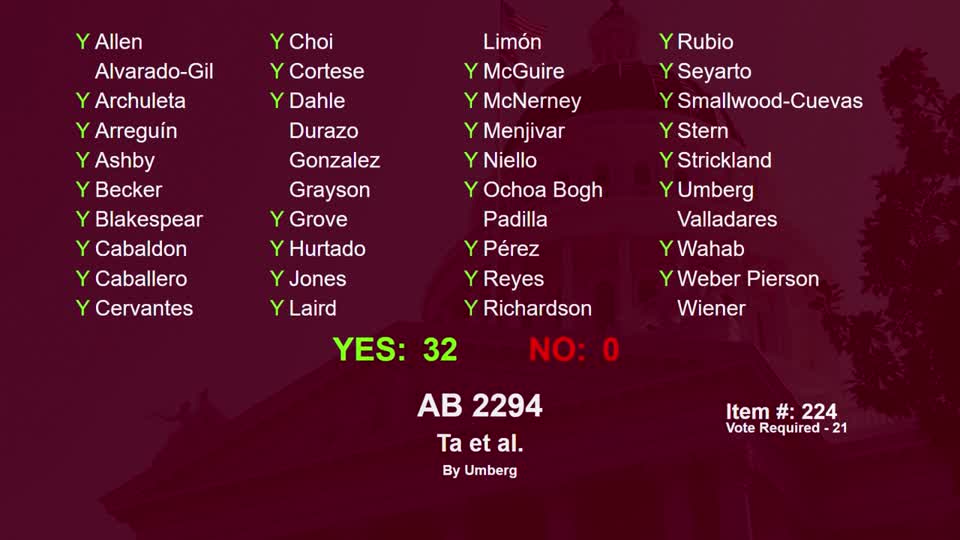 3MIN
Senate Floor
 1MIN
Senate Standing Committee on Appropriations
 12MIN
Senate Standing Committee on Revenue and Taxation
 17MIN
Assembly Floor
 25MIN