AB 1634: Child health and safety: “Have a Heart, Be a Star, Help Our Kids” license plate program.
- Session Year: 2025-2026
- House: Assembly
- Latest Version Date: 2026-04-09
Current Status:
Failed
(2026-05-20: From committee: Without further action pursuant to Joint Rule 62(a).)
Introduced
In Committee
Awaiting First Chamber Vote
Passed First Chamber
In Committee
Awaiting Second Chamber Vote
Passed Second Chamber
Enacted
Existing law requires the Department of Motor Vehicles to establish the California Legacy License Plate Program, and to create and issue a series of specialized license plates, consisting of one or more of 3 specified designs that replicate license plates from the states past. Existing law imposes additional fees for the issuance, renewal, replacement, and transfer of these license plates and requires that those additional fees be deposited in the California Environmental License Plate Fund.
Existing law requires the Department of Motor Vehicles to issue Have a Heart, Be a Star, Help our Kids special license plates that include specified shapes and imposes additional fees, as specified, for their issuance, renewal, replacement, and transfer. Existing law requires that those additional fees be deposited in the Child Health and Safety Fund, as specified.
This bill would authorize authorize, commencing July 1, 2027, an applicant for a California Legacy License Plate to apply to use a shape from the Have a Heart, Be a Star, Help our Kids special license plates for an additional fee. The bill fee, and would require that funds from the fees generated be deposited in the California Environmental License Plate Fund and the Child Health and Safety Fund, as specified. The bill would additionally increase the fees fees, commencing July 1, 2027, for the initial issuance and renewal of the Have a Heart, Be a Star, Help Our Kids license plates.
Existing law requires that 50% of the funds derived from the Have a Heart, Be a Star, Help Our Kids license plates be available, upon appropriation, to the State Department of Social Services for administering various provisions related to childcare licensing, as specified. Existing law requires that, upon appropriation by the Legislature, the remaining balance be available, as described, for programs that address other categories of potential childhood injury, as specified. Existing law requires counties to create local childcare resource and referral programs to identify childcare resources and establish a referral process for parents, among other things. Existing law also creates the California Children and Families Commission, to promote, support, and improve early childhood development. Existing law provides for funding to county commissions that develop, adopt, promote, and implement local early childhood development programs consistent with specified goals and objectives.
The bill would allocate, upon an appropriation by the Legislature, 50% of the fees collected before July 1, 2027, to state and local childcare provider licensure, oversight, recruitment, training, and development, and the remainder to childcare safety and health, as specified. Of the fees collected on or after July 1, 2027, the This bill would require moneys allocated to the Child Health and Safety Fund from the Have a Heart, Be a Star, Help Our Kids license plates and the California Legacy License Plates to be expended, upon appropriation by the Legislature, as specified, including allocating 25% to the State Department of Social Services for administering various provisions related to childcare licensing, as specified. The bill would allocate 50% the remaining for programs that address specified child health and safety concerns and the remainder of the funding would be allocated for specified child abuse prevention purposes. The bill would also include provisions that would permit a portion of these funds, allocated to the Emergency Medical Services Authority, to be expended for the preparation of a specified report to the Legislature required by AB 1639 of the 202526 Regular Session, and would make those provisions operative contingent upon the enactment of that bill, as specified.
Existing law requires the Department of Motor Vehicles to establish the California Legacy License Plate Program, and to create and issue a series of specialized license plates, consisting of one or more of 3 specified designs that replicate license plates from the states past. Existing law imposes additional fees for the issuance, renewal, replacement, and transfer of these license plates and requires that those additional fees be deposited in the California Environmental License Plate Fund.
Existing law requires the Department of Motor Vehicles to issue Have a Heart, Be a Star, Help our Kids special license plates that include specified shapes and imposes additional fees, as specified, for their issuance, renewal, replacement, and transfer. Existing law requires that those additional fees be deposited in the Child Health and Safety Fund, as specified.
This bill would authorize an applicant for a California Legacy License Plate to apply to use a shape from the Have a Heart, Be a Star, Help our Kids special license plates for an additional fee. The bill would require that funds from the fees generated be deposited in the California Environmental License Plate Fund and the Child Health and Safety Fund, as specified. The bill would additionally increase the fees for the initial issuance and renewal of the Have a Heart, Be a Star, Help Our Kids license plates.
Existing law requires that 50% of the funds derived from Have a Heart, Be a Star, Help Our Kids license plates be available, upon appropriation, to the State Department of Social Services for administering various provisions related to childcare licensing, as specified. Existing law requires that, upon appropriation by the Legislature, the balance be available, as described, for programs that address other categories of potential childhood injury, as specified. Existing law requires counties to create local childcare resource and referral programs to identify childcare resources and establish a referral process for parents, among other things. Existing law also creates the California Children and Families Commission, to promote, support, and improve early childhood development. Existing law provides for funding to county commissions that develop, adopt, promote, and implement local early childhood development programs consistent with specified goals and objectives.
The bill would allocate, upon an appropriation by the Legislature, 50% of the fees collected before July 1, 2027, to state and local childcare provider licensure, oversight, recruitment, training, and development, and the remainder to childcare safety and health, as specified. Of the fees collected on or after July 1, 2027, the bill would allocate 50% for programs that address specified child health and safety concerns and the remainder of the funding would be allocated for specified child abuse prevention purposes.
(a)Subject to subdivision (d), the department shall establish the California Legacy License Plate Program and create and issue a series of specialized license plates known as California Legacy License Plates that replicate the look of California license plates from the states past. The design of the plates shall be identical, to the extent the department determines it to be reasonably feasible under current manufacturing processes, to a regular license plate, except as provided in subdivision (b).
(b)The California Legacy License Plates shall consist of one or more of the following designs:
(1)Yellow background with black lettering per the appearance of California license plates issued by the department from 1956 to 1962, inclusive.
(2)Black background with yellow lettering per the appearance of California license plates issued by the department from 1965 to 1968, inclusive.
(3)Blue background with yellow lettering per the appearance of California license plates issued by the department from 1969 to 1986, inclusive.
(c)An applicant for the specialized license plates described in subdivision (a), who shall be the owner or lessee of the vehicle on which the plates will be displayed, may choose to either accept a license plate character sequence assigned by the department or request a combination of letters or numbers or both, subject to Section 5105.
(d)In addition to the regular fees for an original registration or renewal of registration, the following additional fees shall be paid for the issuance, renewal, retention, or transfer of the specialized license plates:
(1)Fifty dollars ($50) for the original issuance of the plates.
(2)Forty dollars ($40) for a renewal of registration with the plates.
(3)Fifteen dollars ($15) for transfer of the plates to another vehicle.
(4)Thirty-five dollars ($35) for each substitute replacement plate.
(5)Thirty-eight dollars ($38), when the payment of renewal fees is not required as specified in Section 4000 and the holder of the specialized license plates retains the plates. The fee shall be due at the expiration of the registration year of the vehicle to which the specialized license plates were assigned. This paragraph shall not apply when a plate character sequence is assigned by the department pursuant to subdivision (c).
(e)Sections 5106 and 5108 do not apply to the specialized license plates issued pursuant to this section.
(f)The department shall not issue California Legacy License Plates for a vehicle that is exempt from the payment of registration fees pursuant to Section 9101 or 9103.
(g)(1)The department shall not establish the California Legacy License Plate Program until the department has received not less than 7,500 paid applications for plates. The department shall collect and hold applications for the plates. The department shall not issue a specialized license plate until it has received not less than 7,500 paid applications for any one of the particular plates within the time period prescribed in this section.
(2)The department shall have until January 1, 2015, to receive the required number of applications. If, after that date, 7,500 paid applications have not been received for any one of the three plates described in subdivision (b), the department shall immediately refund to all applicants all fees or deposits that have been collected.
(h)(1)Upon a determination by the department that there are sufficient funds for the program, moneys shall be available, upon appropriation by the Legislature, to the department for the necessary administrative costs of establishing the California Legacy License Plate Program.
(2)After deducting its administrative costs under this subdivision, the department shall deposit any additional revenue derived from the issuance, renewal, transfer, retention, and substitution of the specialized license plates into the California Environmental License Plate Fund, for appropriation by the Legislature pursuant to existing law. For purposes of this paragraph, administrative costs includes the costs of including the California Legacy License Plates in materials that promote special license plates authorized by this chapter.
(i)This section shall remain in effect only until July 1, 2027, and as of that date is repealed.
SEC. 2.Section 5004.3 is added to the Vehicle Code, to read:5004.3.(a)Subject to subdivision (d), the department shall establish the California Legacy License Plate Program and create and issue a series of specialized license plates known as California Legacy License Plates that replicate the look of California license plates from the states past. The design of the plates shall be identical, to the extent the department determines it to be reasonably feasible under current manufacturing processes, to a regular license plate, except as provided in subdivision (b).
(b)The California Legacy License Plates shall consist of one or more of the following designs:
(1)Yellow background with black lettering per the appearance of California license plates issued by the department from 1956 to 1962, inclusive.
(2)Black background with yellow lettering per the appearance of California license plates issued by the department from 1965 to 1968, inclusive.
(3)Blue background with yellow lettering per the appearance of California license plates issued by the department from 1969 to 1986, inclusive.
(c)An applicant for the specialized license plates described in subdivision (a), who shall be the owner or lessee of the vehicle on which the plates will be displayed, may choose to either accept a license plate character sequence assigned by the department or request a combination of letters or numbers or both, subject to Section 5105.
(d)In addition to the regular fees for an original registration or renewal of registration, the following additional fees shall be paid for the issuance, renewal, retention, or transfer of the specialized license plates:
(1)Fifty dollars ($50) for the original issuance of the plates.
(2)Forty dollars ($40) for a renewal of registration with the plates.
(3)Fifteen dollars ($15) for transfer of the plates to another vehicle.
(4)Thirty-five dollars ($35) for each substitute replacement plate.
(5)Thirty-eight dollars ($38), when the payment of renewal fees is not required as specified in Section 4000 and the holder of the specialized license plates retains the plates. The fee shall be due at the expiration of the registration year of the vehicle to which the specialized license plates were assigned. This paragraph shall not apply when a plate character sequence is assigned by the department pursuant to subdivision (c).
(e)Sections 5106 and 5108 do not apply to the specialized license plates issued pursuant to this section.
(f)The department shall not issue California Legacy License Plates for a vehicle that is exempt from the payment of registration fees pursuant to Section 9101 or 9103.
(g)(1)The department shall not establish the California Legacy License Plate Program until the department has received not less than 7,500 paid applications for plates. The department shall collect and hold applications for the plates. The department shall not issue a specialized license plate until it has received not less than 7,500 paid applications for any one of the particular plates within the time period prescribed in this section.
(2)The department shall have until January 1, 2015, to receive the required number of applications. If, after that date, 7,500 paid applications have not been received for any one of the three plates described in subdivision (b), the department shall immediately refund to all applicants all fees or deposits that have been collected.
(h)(1)Upon a determination by the department that there are sufficient funds for the program, moneys shall be available, upon appropriation by the Legislature, to the department for the necessary administrative costs of establishing the California Legacy License Plate Program.
(2)After deducting its administrative costs under this subdivision, the department shall deposit any additional revenue derived from the issuance, renewal, transfer, retention, and substitution of the specialized license plates into the California Environmental License Plate Fund, for appropriation by the Legislature pursuant to existing law. For purposes of this paragraph, administrative costs includes the costs of including the California Legacy License Plates in materials that promote special license plates authorized by this chapter.
(i)(1)An applicant for a specialized license plate described in subdivision (a) may apply to use one of the four symbols allowed in the alphanumeric sequence from the Have a Heart, Be a Star, Help Our Kids license plate, pursuant to Section 5072, to personalize their legacy plate.
(2)The applicant shall pay a fifty dollar ($50) fee for the specialized license plate in addition to the fees described in subdivision (d).
(3)Fees generated pursuant to paragraph (2) shall be deposited equally into the Child Health and Safety Fund created pursuant to Chapter 4.6 (commencing with Section 18285) of Part 6 of Division 9 of the Welfare and Institutions Code and the California Environmental License Plate Fund.
(4)It is the intent of the Legislature that the specialized license plate pursuant to this subdivision be considered a specialized license plate within the California Legacy License Plate Program pursuant to this section. The specialized license plate pursuant to this subdivision does not constitute the creation of a new type of specialized license plate.
(j)This section shall become operative on July 1, 2027.
SEC. 3.Section 5072 of the Vehicle Code is amended to read:5072.(a)Any person described in Section 5101 may also apply for a set of Have a Heart, Be a Star, Help Our Kids license plates, and the department shall issue those special license plates in lieu of the regular license plates. The Have a Heart, Be a Star, Help Our Kids plates shall be distinct from other existing license plates by the inclusion of a well within the portion of the license plate that has the alpha-numeric sequence. The well may be placed in any position within that portion of the license plate. A heart shape, a five-pointed star, a hand shape, a plus-sign shape, shall be imprinted within the well itself. However, for purposes of processing the alpha-numeric sequence, the symbol within the well shall be read as a blank within the alpha-numeric sequence. The Department of Motor Vehicles shall cooperate with representatives of the California Highway Patrol and the California Correctional Training and Rehabilitation Authority to design the final shape and dimension of the symbols for these license plates.
(b)An applicant for a license plate described in subdivision (a) may choose to either accept a license plate character sequence assigned by the department that includes one of the four symbols or request a specialized license plate character sequence determined by the applicant that includes one of the four symbols, in accordance with instructions which shall be provided by the department.
(c)In addition to the regular fees for an original registration, a renewal of registration, or a transfer of registration, the following Have a Heart, Be a Star, Help Our Kids license plate fees shall be paid:
(1)Notwithstanding Section 5106, for those specialized license plates whose character sequence is determined by the license owner or applicant:
(A)Fifty dollars ($50) for the initial issuance of the plates. These plates shall be permanent and shall not be required to be replaced.
(B)Forty dollars ($40) for each renewal of registration which includes the continued display of the plates.
(C)Fifteen dollars ($15) for transfer of the plates to another vehicle.
(D)Thirty-five dollars ($35) for replacement plates, if the plates become damaged or unserviceable.
(2)For those specialized license plates whose character sequence is assigned by the department:
(A)Twenty dollars ($20) for the initial issuance of the plates. These plates shall be permanent and shall not be required to be replaced.
(B)The legally allowed fee for renewal plus fifteen dollars ($15) for each renewal of registration, which includes the continued display of the plates.
(C)Fifteen dollars ($15) for transfer of the plates to another vehicle.
(D)Twenty dollars ($20) for replacement plates, if the plates become damaged or unserviceable.
(d)When payment of renewal fees is not required as specified in Section 4000, or when the person determines to retain the Have a Heart, Be a Star, Help Our Kids license plates upon sale, trade, or other release of the vehicle upon which the plates have been displayed, the person shall notify the department and the person may retain the plates.
(e)The revenue derived from the additional special fees provided in this section, less costs incurred by the department, the Department of the California Highway Patrol, and local law enforcement for developing and administering this license plate program pursuant to this section, shall be deposited in the Child Health and Safety Fund, created pursuant to Chapter 4.6 (commencing with Section 18285) of Part 6 of Division 9 of the Welfare and Institutions Code, and, when appropriated by the Legislature shall be available for the purposes specified in that chapter.
(f)It is the intent of the Legislature that the additional special fees specified in subdivision (e) are not used to replace existing appropriation levels in the 199192 Budget Act.
(g)This section shall remain in effect only until July 1, 2027, and as of that date is repealed.
SEC. 4.Section 5072 is added to the Vehicle Code, to read:5072.(a)Any person described in Section 5101 may also apply for a set of Have a Heart, Be a Star, Help Our Kids license plates, and the department shall issue those special license plates in lieu of the regular license plates. The Have a Heart, Be a Star, Help Our Kids plates shall be distinct from other existing license plates by the inclusion of a well within the portion of the license plate that has the alpha-numeric sequence. The well may be placed in any position within that portion of the license plate. A heart shape, a five-pointed star, a hand shape, a plus-sign shape, shall be imprinted within the well itself. However, for purposes of processing the alpha-numeric sequence, the symbol within the well shall be read as a blank within the alpha-numeric sequence. The Department of Motor Vehicles shall cooperate with representatives of the California Highway Patrol and the California Correctional Training and Rehabilitation Authority to design the final shape and dimension of the symbols for these license plates.
(b)An applicant for a license plate described in subdivision (a) may choose to either accept a license plate character sequence assigned by the department that includes one of the four symbols or request a specialized license plate character sequence determined by the applicant that includes one of the four symbols, in accordance with instructions which shall be provided by the department.
(c)In addition to the regular fees for an original registration, a renewal of registration, or a transfer of registration, the following Have a Heart, Be a Star, Help Our Kids license plate fees shall be paid:
(1)Notwithstanding Section 5106, for those specialized license plates whose character sequence is determined by the license owner or applicant:
(A)Ninety dollars ($90) for the initial issuance of the plates. These plates shall be permanent and shall not be required to be replaced.
(B)Eighty dollars ($80) for each renewal of registration which includes the continued display of the plates.
(C)Fifteen dollars ($15) for transfer of the plates to another vehicle.
(D)Thirty-five dollars ($35) for replacement plates, if the plates become damaged or unserviceable.
(2)For those specialized license plates whose character sequence is assigned by the department:
(A)Forty dollars ($40) for the initial issuance of the plates. These plates shall be permanent and shall not be required to be replaced.
(B)The legally allowed fee for renewal plus thirty dollars ($30) for each renewal of registration, which includes the continued display of the plates.
(C)Fifteen dollars ($15) for transfer of the plates to another vehicle.
(D)Twenty dollars ($20) for replacement plates, if the plates become damaged or unserviceable.
(d)When payment of renewal fees is not required as specified in Section 4000, or when the person determines to retain the Have a Heart, Be a Star, Help Our Kids license plates upon sale, trade, or other release of the vehicle upon which the plates have been displayed, the person shall notify the department and the person may retain the plates.
(e)The revenue derived from the additional special fees provided in this section, less costs incurred by the department, the Department of the California Highway Patrol, and local law enforcement for developing and administering this license plate program pursuant to this section, shall be deposited in the Child Health and Safety Fund, created pursuant to Chapter 4.6 (commencing with Section 18285) of Part 6 of Division 9 of the Welfare and Institutions Code, and, when appropriated by the Legislature shall be available for the purposes specified in that chapter.
(f)It is the intent of the Legislature that the additional special fees specified in subdivision (e) are not used to replace existing appropriation levels in the 199192 Budget Act.
(g)This section shall become operative on July 1, 2027.
SEC. 5.Section 18285 of the Welfare and Institutions Code is amended to read:18285.(a)There is hereby created in the State Treasury the Child Health and Safety Fund for the purposes specified in this section.
(b)Moneys for this fund shall be derived from the license plate program provided for pursuant to Section 5072 of the Vehicle Code and from civil penalties on child daycare facility providers.
(c)Moneys in the fund shall be expended, upon appropriation by the Legislature, for the purposes specified in subdivisions (d), (e), and (f).
(d)Fifty percent of moneys derived from the license plate program pursuant to Section 5072 of the Vehicle Code shall be available, upon appropriation, to the State Department of Social Services for the purpose of administering provisions of Sections 1596.816, 1596.87, 1596.872b, 1596.893b 1596.895, 1596.95, 1597.091, 1597.54, 1597.541, 1597.542, 1597.55b and 1597.62 of the Health and Safety Code. Upon appropriation by the Legislature, an additional five hundred one thousand dollars ($501,000), in excess of the 50 percent derived from the license plate program, also shall be made available for these purposes. The State Department of Social Services shall allocate these special funds according to the following priorities:
(1)Site visits performed pursuant to Sections 1597.091 and 1597.55b of the Health and Safety Code.
(2)The monitoring responsibility of the childcare advocate program.
(3)Training for investigative and licensing field staff.
(4)Other aspects of the childcare advocate program performed pursuant to Section 1596.872b of the Health and Safety Code.
(5)The salary of the chief of the childcare licensing branch.
In order to implement the list of priorities set forth in this subdivision, and to complete implementation of subdivision (a) of Section 1596.816 of the Health and Safety Code, the State Department of Social Services may, as necessary, fund appropriate administrative support costs.
(e)The balance of funds remaining after the appropriations specified in subdivision (d) derived from the license plate program pursuant to Section 5072 of the Vehicle Code shall be available, upon appropriation, for programs that address any of the following child health and safety concerns and that are either to be carried out within a two-year period or whose implementation is dependent upon one-time initial funding:
(1)Child abuse prevention, except that not more than 25 percent of the moneys in this fund shall be used for this purpose. Ninety percent of the 25 percent shall be deposited in the county childrens trust fund, established pursuant to Section 18966 of the Welfare and Institutions Code, for the support of child abuse prevention services in the community, and 10 percent of the 25 percent shall be deposited in the State Childrens Trust Fund, established pursuant to Section 18969, for public education, training, and technical assistance.
(2)Vehicular safety, including restraint, warnings, and education programs.
(3)Drowning prevention.
(4)Playground safety standards.
(5)Pedestrian Safety.
(6)Bicycle safety.
(7)Gun safety.
(8)Fire safety.
(9)Poison control and safety.
(10)In-home safety.
(11)Childhood poisoning, including from prescription medications, lead, and other toxic substances.
(12)Sleep suffocation and sudden infant death syndrome.
(13)Children left in parked cars and children run over by cars moving forward or backward.
(14)Sports-related concussions, heat stroke, and spinal injury safety.
(f)Moneys derived from civil penalties imposed on daycare facility providers shall be made available, upon appropriation, to the State Department of Social Services exclusively for the technical assistance, orientation, training, and education of child daycare facility providers.
(g)This section shall remain in effect only until July 1, 2027, and as of that date is repealed.
SEC. 6.Section 18285 is added to the Welfare and Institutions Code, to read:18285.(a)There is hereby created in the State Treasury the Child Health and Safety Fund for the purposes specified in this section.
(b)Moneys for this fund shall be derived from both of the following:
(1)The specialty license plate program pursuant to Sections 5004.3 and 5072 of the Vehicle Code.
(2)Civil penalties on child daycare facility providers.
(c)(1)Moneys allocated to the Child Health and Safety Fund from the specialty license plate program pursuant to Sections 5004.3 and 5072 of the Vehicle Code shall be expended, upon appropriation by the Legislature, for the purposes specified in subdivision (d).
(2)Moneys derived from civil penalties imposed on child daycare facility providers shall be made available, upon appropriation by the Legislature, to the State Department of Social Services exclusively for the technical assistance, orientation, training, and education of child daycare facility providers.
(d)Moneys described in paragraph (1) of subdivision (c) shall be allocated as follows:
(1)Twenty-five percent of the funds shall be available for the State Department of Social Services childcare licensing branch for the administration and salary of the chief of the childcare licensing branch as laid out in this section, but not less than the allocation appropriated by the Legislature during the 202425 fiscal year and every fiscal year thereafter as appropriated by the Legislature, including any cost of living adjustments allocated by the Legislature, to support the administrative provisions in this section allocated to the State Department of Social Services for the purpose of administering Sections 1596.816, 1596.87, 1596.872b, 1596.893b, 1596.895, 1596.95, 1597.091, 1597.54, 1597.541, 1597.542, 1597.55b, and 1597.62 of the Health and Safety Code. Upon appropriation by the Legislature, an additional five hundred one thousand dollars ($501,000), in excess of the moneys allocated to the State Department of Social Services childcare licensing administration derived from the specialty license plate program shall be made available for these purposes. The State Department of Social Services shall allocate these special funds according to the following priorities:
(A)Site visits performed pursuant to Sections 1597.091 and 1597.55b of the Health and Safety Code.
(B)The monitoring responsibility of the childcare advocate program.
(C)Training for investigative and licensing field staff.
(D)Other aspects of the childcare advocate program performed pursuant to Section 1596.872b of the Health and Safety Code.
(E)The salary of the chief of the childcare licensing branch. In order to implement the list of priorities set forth in this paragraph, and to complete implementation of subdivision (a) of Section 1596.816 of the Health and Safety Code, the State Department of Social Services may, as necessary, fund appropriate administrative support costs.
(2)Twenty-two and one-half percent of the funds shall be allocated to the 58 First 5 county commissions on a per capita basis, as follows:
(A)One-half of the funds shall be distributed to the 58 First 5 county commissions in counties with a population greater than 500,000, who shall receive equal amounts of the funds.
(B)The other one-half of the funds shall be distributed to the 58 First 5 county commissions in counties with a population less than or equal to 500,000, who shall receive equal amounts of the funds.
(C)Funds allocated pursuant to this paragraph shall be used for one or both of the following:
(i)Recruiting new childcare providers.
(ii)Supporting education and training for new childcare providers or continuing education for existing childcare providers, including licensed and exempt providers.
(3)Two and one-half percent of the funds shall be allocated to the Emergency Medical Services Authority having oversight of new and continuing childcare provider health and safety education and training program curriculum and first responder programs. The funds shall be used for the following purposes:
(A)New childcare provider health and safety education and training programs, including all of the following:
(i)Review and approval of childcare provider health and safety education and training as established in Chapter 1.1 (commencing with Section 100000.01) of Division 9 of Title 22 of the California Code of Regulations.
(ii)Onsite reviews of approved education and training programs to ensure approved curriculum is adhered to and to observe the quality of the education and training program delivery.
(iii)Coordination with relevant bodies involved in improving access, quality, and affordability of childcare, including, but not limited to, childcare provider recruitment and planning agencies, academic institutions, and childcare and child development councils.
(B)Support of the California Emergency Medical Services for Children Act of 1996, pursuant to Chapter 12 (commencing with Section 1799.202) of Division 2.5 of the Health and Safety Code.
(4)Twenty percent of the funds shall be distributed as follows to each of the states county First 5 county commissions created pursuant to Section 130140.1 of the Health and Safety Code that elect to receive the funds based on the following allocation formula. The choice to elect to receive the funds is based on an annual survey of all 58 county commissions conducted by the nonprofit staffing the California Unintentional Injury Prevention Strategic Plan Project, known as the Safer California Project, and reported to the appropriate state agency charged with the actual allocation of the funds to the First 5 county commissions.
(A)County commissions in counties with populations over 100,000 shall receive equal shares of 16 percent of the total funds described in this subdivision for distribution to county commissions opting into receiving these funds based on the survey completed pursuant to this paragraph.
(B)County commissions in counties with populations equal to or under 100,000 shall receive equal shares of the 4 percent of the total funds described in this subdivision for distribution to county commissions opting into receiving these funds based on the survey completed pursuant to this paragraph.
(C)The county commissions receiving these funds shall only utilize the funds for programs that address the categories described in subparagraph (E) that are either to be carried out within a two-year period or whose implementation is dependent upon one-time initial funding.
(D)Each county commission electing to receive this funding shall use the funds for any of the following:
(i)To support local programs that further unintentional injury prevention in one or any of the unintentional injury categories described in subparagraph (E).
(ii)To supplement and not supplant existing funding supporting programs furthering child health and safety and aligned with childhood unintentional injury prevention.
(iii)To promote and practice those evidence-based best prevention practices addressing childhood unintentional injury provided or recommended by the California Unintentional Injury Prevention Strategic Plan Project.
(iv)At the county commissions discretion, to participate with the California Unintentional Injury Prevention Strategic Plan Project pursuant to the projects responsibilities in paragraph (5).
(v)Where appropriate, to collaborate with regional or local childhood unintentional injury prevention coalitions or programs, including childhood unintentional injury prevention coalitions or programs in tribal lands.
(vi)The commissions may use the funds described in this paragraph to participate at the annual California Children and Families Commission conference but only if that conference has programs or tracks of activities focused on childhood unintentional injury prevention and participate in the biennial Safer California Unintentional Injury Prevention conference.
(E)The funds allocated pursuant to this paragraph shall only be used to address the following childhood unintentional injury issues:
(i)Vehicular safety, including restraint, warnings, and education programs.
(ii)Drowning prevention.
(iii)Playground safety standards.
(iv)Pedestrian safety.
(v)Bicycle safety.
(vi)Gun safety.
(vii)Home fire and burn safety and family disaster planning.
(viii)Poison control safety.
(ix)In-home safety.
(x)Childhood poisoning, including from prescription medications, lead, and other toxic substances.
(xi)Sleep suffocation and sudden infant death syndrome.
(xii)Children left in parked cars and children run over by cars moving forward or backward.
(xiii)Sports-related concussions, heat stroke, cardiac arrest, and spinal injury safety.
(xiv)Unintentional injuries associated with mental health.
(5)Two and one-half percent of the funds shall be distributed to the State Department of Public Healths branch responsible for childhood injury prevention for three purposes:
(A)Provide technical assistance and distribution of evidence-based prevention practices information to childhood injury prevention programs engaged in childhood injury prevention issue categories described in subparagraph (E) of paragraph (4).
(B)Provide oversight and accountability of programs conducted pursuant to paragraph (6) as reported annually to the State Department of Public Health by the organization providing administration and staffing for the California Unintentional Injury Prevention Strategic Plan Project pursuant to paragraph (6).
(C)Provide planning, financial, and attendance support to the biennial Safer California Unintentional Injury Prevention conference.
(6)Two and one-half percent of the funds shall be allocated to the nonprofit organization providing administration and staffing to the California Unintentional Injury Prevention Strategic Plan Project, known as the Safer California Project, with responsibility to do all of the following:
(A)Support statewide networking of local childhood unintentional injury prevention coalitions and programs.
(B)Support evidence-based best practice technical assistance and training programs for childhood unintentional injury prevention, including sharing successful local models of unintentional injury prevention, for local prevention coalitions, programs, and county commissions as described in subparagraph (D) of paragraph (4).
(C)Support the updating of childhood unintentional injury prevention strategic planning identification of the top 10 action priorities necessary to support the state ending unintentional injury as the leading cause of death and hospitalizations of Californias children and youth through 19 years of age.
(D)Plan activities, administration, and staff support for the biennial Safer California Unintentional Injury Prevention conference.
(E)Support public policy to prevent childhood unintentional injury.
(F)Conduct an annual survey of the county commissions created through Section 130140.1 of the Health and Safety Code to determine which of the county commissions elect to receive this funding, and to transmit that survey result to the state for distribution of the funding to the county commissions.
(G)Provide the State Department of Public Health childhood injury prevention branch with an annual report on actions carried out pursuant to this subparagraph.
(7)Twenty-two and one-half percent for child abuse prevention shall be deposited in the 58 county childrens trust fund, established pursuant to Section 18966 of the Welfare and Institutions Code, for the support of child abuse prevention services in the community.
(8)Two and one-half percent of the funds shall be deposited in the State Childrens Trust Fund, established pursuant to Section 18969, for public education, training, and technical assistance.
(e)This section shall become operative on July 1, 2027.
SEC. 6.5.Section 18285 is added to the Welfare and Institutions Code, to read:18285.(a)There is hereby created in the State Treasury the Child Health and Safety Fund for the purposes specified in this section.
(b)Moneys for this fund shall be derived from both of the following:
(1)The specialty license plate program pursuant to Sections 5004.3 and 5072 of the Vehicle Code.
(2)Civil penalties on child daycare facility providers.
(c)(1)Moneys allocated to the Child Health and Safety Fund from the specialty license plate program pursuant to Sections 5004.3 and 5072 of the Vehicle Code shall be expended, upon appropriation by the Legislature, for the purposes specified in subdivision (d).
(2)Moneys derived from civil penalties imposed on child daycare facility providers shall be made available, upon appropriation by the Legislature, to the State Department of Social Services exclusively for the technical assistance, orientation, training, and education of child daycare facility providers.
(d)Moneys described in paragraph (1) of subdivision (c) shall be allocated as follows:
(1)Twenty-five percent of the funds shall be available for the State Department of Social Services childcare licensing branch for the administration and salary of the chief of the childcare licensing branch as laid out in this section, but not less than the allocation appropriated by the Legislature during the 202425 fiscal year and every fiscal year thereafter as appropriated by the Legislature, including any cost of living adjustments allocated by the Legislature, to support the administrative provisions in this section allocated to the State Department of Social Services for the purpose of administering Sections 1596.816, 1596.87, 1596.872b, 1596.893b, 1596.895, 1596.95, 1597.091, 1597.54, 1597.541, 1597.542, 1597.55b, and 1597.62 of the Health and Safety Code. Upon appropriation by the Legislature, an additional five hundred one thousand dollars ($501,000), in excess of the moneys allocated to the State Department of Social Services childcare licensing administration derived from the specialty license plate program shall be made available for these purposes. The State Department of Social Services shall allocate these special funds according to the following priorities:
(A)Site visits performed pursuant to Sections 1597.091 and 1597.55b of the Health and Safety Code.
(B)The monitoring responsibility of the childcare advocate program.
(C)Training for investigative and licensing field staff.
(D)Other aspects of the childcare advocate program performed pursuant to Section 1596.872b of the Health and Safety Code.
(E)The salary of the chief of the childcare licensing branch. In order to implement the list of priorities set forth in this paragraph, and to complete implementation of subdivision (a) of Section 1596.816 of the Health and Safety Code, the State Department of Social Services may, as necessary, fund appropriate administrative support costs.
(2)Twenty-two and one-half percent of the funds shall be allocated to the 58 First 5 county commissions on a per capita basis, as follows:
(A)One-half of the funds shall be distributed to the 58 First 5 county commissions in counties with a population greater than 500,000, who shall receive equal amounts of the funds.
(B)The other one-half of the funds shall be distributed to the 58 First 5 county commissions in counties with a population less than or equal to 500,000, who shall receive equal amounts of the funds.
(C)Funds allocated pursuant to this paragraph shall be used for one or both of the following:
(i)Recruiting new childcare providers.
(ii)Supporting education and training for new childcare providers or continuing education for existing childcare providers, including licensed and exempt providers.
(3)Two and one-half percent of the funds shall be allocated to the Emergency Medical Services Authority having oversight of new and continuing childcare provider health and safety education and training program curriculum and first responder programs. The funds shall be used for the following purposes:
(A)New childcare provider health and safety education and training programs, including all of the following:
(i)Review and approval of childcare provider health and safety education and training as established in Chapter 1.1 (commencing with Section 100000.01) of Division 9 of Title 22 of the California Code of Regulations.
(ii)Onsite reviews of approved education and training programs to ensure approved curriculum is adhered to and to observe the quality of the education and training program delivery.
(iii)Coordination with relevant bodies involved in improving access, quality, and affordability of childcare, including, but not limited to, childcare provider recruitment and planning agencies, academic institutions, and childcare and child development councils.
(B)Support of the California Emergency Medical Services for Children Act of 1996, pursuant to Chapter 12 (commencing with Section 1799.202) of Division 2.5 of the Health and Safety Code.
(C)Gathering and reporting data relating to the lifeguard workforce pursuant to Section 1797.162 of the Health and Safety Code.
(4)Twenty percent of the funds shall be distributed as follows to each of the states county First 5 county commissions created pursuant to Section 130140.1 of the Health and Safety Code that elect to receive the funds based on the following allocation formula. The choice to elect to receive the funds is based on an annual survey of all 58 county commissions conducted by the nonprofit staffing the Safer California Project and reported to the appropriate state agency charged with the actual allocation of the funds to the First 5 county commissions.
(A)County commissions in counties with populations over 100,000 shall receive equal shares of 16 percent of the total funds described in this subdivision for distribution to county commissions opting into receiving these funds based on the survey completed pursuant to this paragraph.
(B)County commissions in counties with populations equal to or under 100,000 shall receive equal shares of the 4 percent of the total funds described in this subdivision for distribution to county commissions opting into receiving these funds based on the survey completed pursuant to this paragraph.
(C)The county commissions receiving these funds shall only utilize the funds for programs that address the categories described in subparagraph (E) that are either to be carried out within a two-year period or whose implementation is dependent upon one-time initial funding.
(D)Each county commission electing to receive this funding shall use the funds for any of the following:
(i)To support local programs that further unintentional injury prevention in one or any of the unintentional injury categories described in subparagraph (E).
(ii)To supplement and not supplant existing funding supporting programs furthering child health and safety and aligned with childhood unintentional injury prevention.
(iii)To promote and practice those evidence-based best prevention practices addressing childhood unintentional injury provided or recommended by the California Unintentional Injury Prevention Strategic Plan Project.
(iv)At the county commissions discretion, to participate with the California Unintentional Injury Prevention Strategic Plan Project pursuant to the projects responsibilities in paragraph (5).
(v)Where appropriate, to collaborate with regional or local childhood unintentional injury prevention coalitions or programs, including childhood unintentional injury prevention coalitions or programs in tribal lands.
(vi)The commissions may use the funds described in this paragraph to participate at the annual California Children and Families Commission conference but only if that conference has programs or tracks of activities focused on childhood unintentional injury prevention and participate in the biennial Safer California Unintentional Injury Prevention conference.
(E)The funds allocated pursuant to this paragraph shall only be used to address the following childhood unintentional injury issues:
(i)Vehicular safety, including restraint, warnings, and education programs.
(ii)Drowning prevention.
(iii)Playground safety standards.
(iv)Pedestrian safety.
(v)Bicycle safety.
(vi)Gun safety.
(vii)Home fire and burn safety and family disaster planning.
(viii)Poison control safety.
(ix)In-home safety.
(x)Childhood poisoning, including from prescription medications, lead, and other toxic substances.
(xi)Sleep suffocation and sudden infant death syndrome.
(xii)Children left in parked cars and children run over by cars moving forward or backward.
(xiii)Sports-related concussions, heat stroke, cardiac arrest, and spinal injury safety.
(xiv)Unintentional injuries associated with mental health.
(5)Two and one-half percent of the funds shall be distributed to the State Department of Public Healths branch responsible for childhood injury prevention for three purposes:
(A)Provide technical assistance and distribution of evidence-based prevention practices information to childhood injury prevention programs engaged in childhood injury prevention issue categories described in subparagraph (E) of paragraph (4).
(B)Provide oversight and accountability of programs conducted pursuant to paragraph (6) as reported annually to the State Department of Public Health by the organization providing administration and staffing for the California Unintentional Injury Prevention Strategic Plan Project pursuant to paragraph (6).
(C)Provide planning, financial, and attendance support to the biennial Safer California Unintentional Injury Prevention conference.
(6)Two and one-half percent of the funds shall be allocated to the nonprofit organization providing administration and staffing to the California Unintentional Injury Prevention Strategic Plan Project, known as the Safer California Project, with responsibility to do all of the following:
(A)Support statewide networking of local childhood unintentional injury prevention coalitions and programs.
(B)Support evidence-based, best practice technical assistance and training programs for childhood unintentional injury prevention, including sharing successful local models of unintentional injury prevention, for local prevention coalitions, programs, and county commissions as described in subparagraph (D) of paragraph (4).
(C)Support the updating of childhood unintentional injury prevention strategic planning identification of the top 10 action priorities necessary to support the state ending unintentional injury as the leading cause of death and hospitalizations of Californias children and youth through 19 years of age.
(D)Planning activities, administration, and staff support for the biennial Safer California Unintentional Injury Prevention conference.
(E)Support public policy to prevent childhood unintentional injury.
(F)Conduct an annual survey of the county commissions created through Section 130140.1 of the Health and Safety Code to determine which of the county commissions elect to receive this funding, and to transmit that survey result to the state for distribution of the funding to the county commissions.
(G)Provide the State Department of Public Health childhood injury prevention branch with an annual report on actions carried out pursuant to this subparagraph.
(7)Twenty-two and one-half percent for child abuse prevention shall be deposited in the 58 county childrens trust fund, established pursuant to Section 18966 of the Welfare and Institutions Code, for the support of child abuse prevention services in the community.
(8)Two and one-half percent of the funds shall be deposited in the State Childrens Trust Fund, established pursuant to Section 18969, for public education, training, and technical assistance.
(e)This section shall become operative on July 1, 2027.
SEC. 7.Section 6.5 of this bill, adding Section 18285 to the Welfare and Institutions Code, shall only become operative if Assembly Bill 1639 of the 202526 Regular Session is enacted and becomes effective on or before January 1, 2027, and adds Section 1797.162 to the Health and Safety Code, in which case Section 6 of this bill shall not become operative.
SECTION 1.Section 5004.3 of the Vehicle Code is amended to read:5004.3.(a)Subject to subdivision (d), the department shall establish the California Legacy License Plate Program and create and issue a series of specialized license plates known as California Legacy License Plates that replicate the look of California license plates from the states past. The design of the plates shall be identical, to the extent the department determines it to be reasonably feasible under current manufacturing processes, to a regular license plate, except as provided in subdivision (b).(b)The California Legacy License Plates shall consist of one or more of the following designs:(1)Yellow background with black lettering per the appearance of California license plates issued by the department from 1956 to 1962, inclusive.(2)Black background with yellow lettering per the appearance of California license plates issued by the department from 1965 to 1968, inclusive.(3)Blue background with yellow lettering per the appearance of California license plates issued by the department from 1969 to 1986, inclusive.(c)An applicant for the specialized license plates described in subdivision (a), who shall be the owner or lessee of the vehicle on which the plates will be displayed, may choose to either accept a license plate character sequence assigned by the department or request a combination of letters or numbers or both, subject to Section 5105.(d)In addition to the regular fees for an original registration or renewal of registration, the following additional fees shall be paid for the issuance, renewal, retention, or transfer of the specialized license plates:(1)Fifty dollars ($50) for the original issuance of the plates.(2)Forty dollars ($40) for a renewal of registration with the plates.(3)Fifteen dollars ($15) for transfer of the plates to another vehicle.(4)Thirty-five dollars ($35) for each substitute replacement plate.(5)Thirty-eight dollars ($38), when the payment of renewal fees is not required as specified in Section 4000 and the holder of the specialized license plates retains the plates. The fee shall be due at the expiration of the registration year of the vehicle to which the specialized license plates were assigned. This paragraph shall not apply when a plate character sequence is assigned by the department pursuant to subdivision (c).(e)Sections 5106 and 5108 do not apply to the specialized license plates issued pursuant to this section.(f)The department shall not issue California Legacy License Plates for a vehicle that is exempt from the payment of registration fees pursuant to Section 9101 or 9103.(g)(1)The department shall not establish the California Legacy License Plate Program until the department has received not less than 7,500 paid applications for plates. The department shall collect and hold applications for the plates. The department shall not issue a specialized license plate until it has received not less than 7,500 paid applications for any one of the particular plates within the time period prescribed in this section.(2)The department shall have until January 1, 2015, to receive the required number of applications. If, after that date, 7,500 paid applications have not been received for any one of the three plates described in subdivision (b), the department shall immediately refund to all applicants all fees or deposits that have been collected.(h)(1)Upon a determination by the department that there are sufficient funds for the program, moneys shall be available, upon appropriation by the Legislature, to the department for the necessary administrative costs of establishing the California Legacy License Plate Program.(2)After deducting its administrative costs under this subdivision, the department shall deposit any additional revenue derived from the issuance, renewal, transfer, retention, and substitution of the specialized license plates into the California Environmental License Plate Fund, for appropriation by the Legislature pursuant to existing law. For purposes of this paragraph, administrative costs includes the costs of including the California Legacy License Plates in materials that promote special license plates authorized by this chapter.(i)(1)An applicant for a specialized license plate described in subdivision (a) may apply to use one of the four symbols allowed in the alphanumeric sequence from the Have a Heart, Be a Star, Help Our Kids plate, pursuant to Section 5072, to personalize their legacy plate.(2)The applicant shall pay a fifty dollar ($50) fee for the specialized license plate in addition to the fees described in subdivision (d).(3)Fees generated pursuant to paragraph (2) shall be deposited equally into the Child Health and Safety Fund created pursuant to Chapter 4.6 (commencing with Section 18285) of Part 6 of Division 9 of the Welfare and Institutions Code and the California Environmental License Plate Fund.SEC. 2.Section 5072 of the Vehicle Code is amended to read:5072.(a)Any person described in Section 5101 may also apply for a set of Have a Heart, Be a Star, Help Our Kids license plates, and the department shall issue those special license plates in lieu of the regular license plates. The Have a Heart, Be a Star, Help Our Kids plates shall be distinct from other existing license plates by the inclusion of a well within the portion of the license plate that has the alpha-numeric sequence. The well may be placed in any position within that portion of the license plate. A heart shape, a five-pointed star, a hand shape, a plus-sign shape, shall be imprinted within the well itself. However, for purposes of processing the alpha-numeric sequence, the symbol within the well shall be read as a blank within the alpha-numeric sequence. The Department of Motor Vehicles shall cooperate with representatives of the California Highway Patrol and the California Correctional Training and Rehabilitation Authority to design the final shape and dimension of the symbols for these license plates.(b)An applicant for a license plate described in subdivision (a) may choose to either accept a license plate character sequence assigned by the department that includes one of the four symbols or request a specialized license plate character sequence determined by the applicant that includes one of the four symbols, in accordance with instructions which shall be provided by the department.(c)In addition to the regular fees for an original registration, a renewal of registration, or a transfer of registration, the following Have a Heart, Be a Star, Help Our Kids license plate fees shall be paid:(1)Notwithstanding Section 5106, for those specialized license plates whose character sequence is determined by the license owner or applicant:(A) Ninety dollars ($90) for the initial issuance of the plates. These plates shall be permanent and shall not be required to be replaced.(B) Eighty dollars ($80) for each renewal of registration which includes the continued display of the plates.(C)Fifteen dollars ($15) for transfer of the plates to another vehicle.(D)Thirty-five dollars ($35) for replacement plates, if the plates become damaged or unserviceable.(2)For those specialized license plates whose character sequence is assigned by the department:(A) Forty dollars ($40) for the initial issuance of the plates. These plates shall be permanent and shall not be required to be replaced.(B)The legally allowed fee for renewal plus thirty dollars ($30) for each renewal of registration, which includes the continued display of the plates.(C)Fifteen dollars ($15) for transfer of the plates to another vehicle.(D)Twenty dollars ($20) for replacement plates, if the plates become damaged or unserviceable.(d)When payment of renewal fees is not required as specified in Section 4000, or when the person determines to retain the Have a Heart, Be a Star, Help Our Kids license plates upon sale, trade, or other release of the vehicle upon which the plates have been displayed, the person shall notify the department and the person may retain the plates.(e)The revenue derived from the additional special fees provided in this section, less costs incurred by the department, the Department of the California Highway Patrol, and local law enforcement for developing and administering this license plate program pursuant to this section, shall be deposited in the Child Health and Safety Fund, created pursuant to Chapter 4.6 (commencing with Section 18285) of Part 6 of Division 9 of the Welfare and Institutions Code, and, when appropriated by the Legislature shall be available for the purposes specified in that chapter.(f)It is the intent of the Legislature that the additional special fees specified in subdivision (e) are not used to replace existing appropriation levels in the 199192 Budget Act.SEC. 3.Section 18285 of the Welfare and Institutions Code is amended to read:18285.(a)There is hereby created in the State Treasury the Child Health and Safety Fund for the purposes specified in this section.(b)Moneys for this fund shall be derived from the license plate program provided for pursuant to Section 5072 of the Vehicle Code and from civil penalties on child daycare facility providers.(c)Moneys allocated to the Child Health and Safety Fund from the specialty vehicle license plate program pursuant to Section 5072 of the Vehicle Code shall be expended, upon appropriation, for the purposes specified in subdivisions (d) and (e).(d)(1)Fifty percent of the moneys derived from the license plate program pursuant to Section 5072 of the Vehicle Code before July 1, 2027, shall be available, upon appropriation by the Legislature, to state and local childcare provider licensure, oversight, recruitment, training, and development.(2)Up to 50 percent of the allocation pursuant to paragraph (1), but not less than the allocation appropriated by the Legislature during the 202425 fiscal year and every fiscal year thereafter as appropriated by the Legislature, including any cost of living adjustments (COLA) allocated by the Legislature, to support the administrative provisions in paragraph (1) shall be allocated to the State Department of Social Services for the purpose of administering Sections 1596.816, 1596.87, 1596.872b, 1596.893b, 1596.895, 1596.95, 1597.091, 1597.54, 1597.541, 1597.542, 1597.55b, and 1597.62 of the Health and Safety Code. Upon appropriation by the Legislature, an additional five hundred one thousand dollars ($501,000), in excess of the 50 percent derived from the license plate program, shall be made available for these purposes. The State Department of Social Services shall allocate these special funds according to the following priorities:(A)Site visits performed pursuant to Sections 1597.091 and 1597.55b of the Health and Safety Code.(B)The monitoring responsibility of the childcare advocate program.(C)Training for investigative and licensing field staff.(D)Other aspects of the childcare advocate program performed pursuant to Section 1596.872b of the Health and Safety Code.(E)The salary of the chief of the childcare licensing branch. In order to implement the list of priorities set forth in this paragraph, and to complete implementation of subdivision (a) of Section 1596.816 of the Health and Safety Code, the State Department of Social Services may, as necessary, fund appropriate administrative support costs.(3)The remainder of the funds derived from the license plate program, following allocation pursuant to paragraph (2), shall be allocated to childcare safety and health as follows:(A)Ninety percent of the funds or an adjusted amount based on the initial distribution in paragraph (2) shall be allocated to the 58 First 5 county commissions on a per-capita basis, as follows:(i)Fifty percent of the funds described in subparagraph (A) shall be distributed to the 58 First 5 county commissions in counties with a population greater than 500,000 shall receive equal amounts of the funds.(ii)Fifty percent of the funds described in subparagraph (A) shall be distributed to the 58 First 5 county commissions in counties with a population less than or equal to 500,000, who shall receive equal amounts of the funds.(B)Funds allocated pursuant to subparagraph (A) shall be used for one or both of the following:(i)Recruiting new childcare providers.(ii)Supporting education and training for new childcare providers or continuing education for existing childcare providers, including licensed and exempt providers.(C)Ten percent of the funds described in this paragraph shall be allocated to the state agency having oversight of new and continuing childcare provider health and safety education and training program curriculum and shall be used for the following purposes:(i)Review and approval of childcare provider health and safety education and training as established in Chapter 1.1 (commencing with Section 100000.1) of Division 9 of Title 22 of the California Code of Regulations.(ii)Onsite reviews of approved education and training programs to ensure approved curriculum is adhered to and to observe the quality of the education and training program delivery.(iii)Coordination with relevant bodies involved in improving access, quality, and affordability of childcare, including, but not limited to, childcare provider recruitment and planning agencies, academic institutions, and childcare and child development councils.(e)Fifty percent of the moneys derived from the license plate program pursuant to Section 5072 of the Vehicle Code on or after July 1, 2027, shall be available, upon appropriation, for programs that address any of the following child health and safety concerns and that are either to be carried out within a two-year period or whose implementation is dependent upon one-time initial funding:(1)Fifty percent of the moneys identified in subdivision (e) shall be distributed in the following three ways to support childhood injury prevention:(A)Eighty percent of the funds shall be distributed to each of the states county First 5 county commissions created pursuant to Section 130140.1 of the Health and Safety Code that elect to receive the funds based on the following allocation formula. The choice to elect to receive the funds is based on an annual survey of all 58 county commissions conducted by the nonprofit staffing the Safer California Project and reported to the appropriate state agency charged with the actual allocation of the funds to the First 5 county commissions.(i)County commissions in counties with populations over 100,000 shall receive equal shares of 80 percent of the available funds for distribution to county commissions opting into receiving these funds based on the survey completed pursuant to this subparagraph.(ii)County commissions in counties with populations equal to or under 100,000 shall receive equal shares of 20 percent of the available funds for distribution to county commissions opting into receiving these funds based on the survey completed pursuant to this subparagraph.(iii)The county commissions receiving these funds shall only utilize the funds for programs that address the categories described in clause (v) that are either to be carried out within a two-year period or whose implementation is dependent upon one-time initial funding.(iv)Each county commission electing to receive this funding shall use the funds for any of the following:(I)To support local programs that further unintentional injury prevention in one or any of the unintentional injury categories described in clause (v).(II)To supplement and not supplant existing funding supporting programs furthering child health and safety and aligned with childhood unintentional injury prevention.(III)To promote and practice those evidence-based best prevention practices addressing childhood unintentional injury provided or recommended by the California Unintentional Injury Prevention Strategic Plan.(IV)At the county commissions discretion, to participate with the California Unintentional Injury Prevention Strategic Plan Project pursuant to the projects responsibilities in subparagraph (C).(V)Where appropriate, to collaborate with regional or local childhood unintentional injury prevention coalitions or programs, including childhood unintentional injury prevention coalitions or programs in tribal lands.(VI)The commissions may use the funds described in this paragraph to participate at the annual California Children and Families Commission conference but only if that conference has programs or tracks of activities focused on childhood unintentional injury prevention and participate in the biennial Safer California Unintentional Injury Prevention conference.(v)The funds allocated pursuant to this subparagraph shall only be used to address the following childhood unintentional injury issues:(I)Vehicular safety, including restraint, warnings, and education programs.(II)Drowning prevention.(III)Playground safety standards.(IV)Pedestrian safety.(V)Bicycle safety.(VI)Gun safety.(VII)Home fire and burn safety and family disaster planning.(VIII)Poison control safety.(IX)In-home safety.(X)Childhood poisoning, including from prescription medications, lead, and other toxic substances.(XI)Sleep suffocation and sudden infant death syndrome.(XII)Children left in parked cars and children run over by cars moving forward or backward.(XIII)Sports-related concussions, heat stroke, cardiac arrest, and spinal injury safety.(XIV)Unintentional injuries associated with mental health.(B)Ten percent of the funds identified in paragraph (1) shall be distributed to the State Department of Public Healths branch responsible for childhood injury prevention for three purposes:(i)Provide technical assistance and distribution of evidence-based prevention practices information to childhood injury prevention programs engaged in childhood injury prevention issue categories described in clause (v) of subparagraph (A).(ii)Provide oversight and accountability of programs conducted pursuant to subparagraph (C) as reported annually to the State Department of Public Health by the organization providing administration and staffing for the California Unintentional Injury Prevention Strategic Plan Project pursuant to subparagraph (C).(iii)Provide planning, financial, and attendance support to the biennial Safer California Unintentional Injury Prevention conference.(C)Ten percent of the funds identified in paragraph (1) shall be allocated to the nonprofit organization providing administration and staffing to the California Unintentional Injury Prevention Strategic Plan Project, known as the Safer California Project, with responsibility to:(i)Support statewide networking of local childhood unintentional injury prevention coalitions and programs.(ii)Support evidence-based, best practice technical assistance and training programs for childhood unintentional injury prevention, including sharing successful local models of unintentional injury prevention, for local prevention coalitions, programs, and county commissions as described in clause (v) of subparagraph (A).(iii)Support the updating of childhood unintentional injury prevention strategic planning identification of the top 10 action priorities necessary to support the state ending unintentional injury as the leading cause of death and hospitalizations of Californias children and youth through 19 years of age.(iv)Planning activities, administration, and staff support for the biennial Safer California Unintentional Injury Prevention conference.(v)Support public policy to prevent childhood unintentional injury.(vi)Conduct an annual survey of the county commissions created through Section 130140.1 of the Health and Safety Code to determine which of the county commissions elect to receive this funding, and to transmit that survey result to the state for distribution of the funding to the county commissions.(vii)Provide the State Department of Public Health childhood injury prevention branch with an annual report on actions carried out pursuant to this subparagraph.(2)The remaining 50 percent of the funds identified in this subdivision shall be used for child abuse prevention as follows:(A)Ninety percent of the moneys described in this paragraph shall be deposited in the county childrens trust fund, established pursuant to Section 18966 of the Welfare and Institutions Code, for the support of child abuse prevention services in the community.(B)Ten percent of the moneys described in this paragraph shall be deposited in the State Childrens Trust Fund, established pursuant to Section 18969, for public education, training, and technical assistance.(f)Moneys derived from civil penalties imposed on daycare facility providers shall be made available, upon appropriation, to the State Department of Social Services exclusively for the technical assistance, orientation, training, and education of child daycare facility providers.(a)Subject to subdivision (d), the department shall establish the California Legacy License Plate Program and create and issue a series of specialized license plates known as California Legacy License Plates that replicate the look of California license plates from the states past. The design of the plates shall be identical, to the extent the department determines it to be reasonably feasible under current manufacturing processes, to a regular license plate, except as provided in subdivision (b).
(b)The California Legacy License Plates shall consist of one or more of the following designs:
(1)Yellow background with black lettering per the appearance of California license plates issued by the department from 1956 to 1962, inclusive.
(2)Black background with yellow lettering per the appearance of California license plates issued by the department from 1965 to 1968, inclusive.
(3)Blue background with yellow lettering per the appearance of California license plates issued by the department from 1969 to 1986, inclusive.
(c)An applicant for the specialized license plates described in subdivision (a), who shall be the owner or lessee of the vehicle on which the plates will be displayed, may choose to either accept a license plate character sequence assigned by the department or request a combination of letters or numbers or both, subject to Section 5105.
(d)In addition to the regular fees for an original registration or renewal of registration, the following additional fees shall be paid for the issuance, renewal, retention, or transfer of the specialized license plates:
(1)Fifty dollars ($50) for the original issuance of the plates.
(2)Forty dollars ($40) for a renewal of registration with the plates.
(3)Fifteen dollars ($15) for transfer of the plates to another vehicle.
(4)Thirty-five dollars ($35) for each substitute replacement plate.
(5)Thirty-eight dollars ($38), when the payment of renewal fees is not required as specified in Section 4000 and the holder of the specialized license plates retains the plates. The fee shall be due at the expiration of the registration year of the vehicle to which the specialized license plates were assigned. This paragraph shall not apply when a plate character sequence is assigned by the department pursuant to subdivision (c).
(e)Sections 5106 and 5108 do not apply to the specialized license plates issued pursuant to this section.
(f)The department shall not issue California Legacy License Plates for a vehicle that is exempt from the payment of registration fees pursuant to Section 9101 or 9103.
(g)(1)The department shall not establish the California Legacy License Plate Program until the department has received not less than 7,500 paid applications for plates. The department shall collect and hold applications for the plates. The department shall not issue a specialized license plate until it has received not less than 7,500 paid applications for any one of the particular plates within the time period prescribed in this section.
(2)The department shall have until January 1, 2015, to receive the required number of applications. If, after that date, 7,500 paid applications have not been received for any one of the three plates described in subdivision (b), the department shall immediately refund to all applicants all fees or deposits that have been collected.
(h)(1)Upon a determination by the department that there are sufficient funds for the program, moneys shall be available, upon appropriation by the Legislature, to the department for the necessary administrative costs of establishing the California Legacy License Plate Program.
(2)After deducting its administrative costs under this subdivision, the department shall deposit any additional revenue derived from the issuance, renewal, transfer, retention, and substitution of the specialized license plates into the California Environmental License Plate Fund, for appropriation by the Legislature pursuant to existing law. For purposes of this paragraph, administrative costs includes the costs of including the California Legacy License Plates in materials that promote special license plates authorized by this chapter.
(i)(1)An applicant for a specialized license plate described in subdivision (a) may apply to use one of the four symbols allowed in the alphanumeric sequence from the Have a Heart, Be a Star, Help Our Kids plate, pursuant to Section 5072, to personalize their legacy plate.
(2)The applicant shall pay a fifty dollar ($50) fee for the specialized license plate in addition to the fees described in subdivision (d).
(3)Fees generated pursuant to paragraph (2) shall be deposited equally into the Child Health and Safety Fund created pursuant to Chapter 4.6 (commencing with Section 18285) of Part 6 of Division 9 of the Welfare and Institutions Code and the California Environmental License Plate Fund.
SEC. 2.Section 5072 of the Vehicle Code is amended to read:5072.(a)Any person described in Section 5101 may also apply for a set of Have a Heart, Be a Star, Help Our Kids license plates, and the department shall issue those special license plates in lieu of the regular license plates. The Have a Heart, Be a Star, Help Our Kids plates shall be distinct from other existing license plates by the inclusion of a well within the portion of the license plate that has the alpha-numeric sequence. The well may be placed in any position within that portion of the license plate. A heart shape, a five-pointed star, a hand shape, a plus-sign shape, shall be imprinted within the well itself. However, for purposes of processing the alpha-numeric sequence, the symbol within the well shall be read as a blank within the alpha-numeric sequence. The Department of Motor Vehicles shall cooperate with representatives of the California Highway Patrol and the California Correctional Training and Rehabilitation Authority to design the final shape and dimension of the symbols for these license plates.
(b)An applicant for a license plate described in subdivision (a) may choose to either accept a license plate character sequence assigned by the department that includes one of the four symbols or request a specialized license plate character sequence determined by the applicant that includes one of the four symbols, in accordance with instructions which shall be provided by the department.
(c)In addition to the regular fees for an original registration, a renewal of registration, or a transfer of registration, the following Have a Heart, Be a Star, Help Our Kids license plate fees shall be paid:
(1)Notwithstanding Section 5106, for those specialized license plates whose character sequence is determined by the license owner or applicant:
(A)Fifty dollars ($50) Ninety dollars ($90) for the initial issuance of the plates. These plates shall be permanent and shall not be required to be replaced.
(B)Forty dollars ($40) Eighty dollars ($80) for each renewal of registration which includes the continued display of the plates.
(C)Fifteen dollars ($15) for transfer of the plates to another vehicle.
(D)Thirty-five dollars ($35) for replacement plates, if the plates become damaged or unserviceable.
(2)For those specialized license plates whose character sequence is assigned by the department:
(A)Twenty dollars ($20) Forty dollars ($40) for the initial issuance of the plates. These plates shall be permanent and shall not be required to be replaced.
(B)The legally allowed fee for renewal plus fifteen dollars ($15) thirty dollars ($30) for each renewal of registration, which includes the continued display of the plates.
(C)Fifteen dollars ($15) for transfer of the plates to another vehicle.
(D)Twenty dollars ($20) for replacement plates, if the plates become damaged or unserviceable.
(d)When payment of renewal fees is not required as specified in Section 4000, or when the person determines to retain the Have a Heart, Be a Star, Help Our Kids license plates upon sale, trade, or other release of the vehicle upon which the plates have been displayed, the person shall notify the department and the person may retain the plates.
(e)The revenue derived from the additional special fees provided in this section, less costs incurred by the department, the Department of the California Highway Patrol, and local law enforcement for developing and administering this license plate program pursuant to this section, shall be deposited in the Child Health and Safety Fund, created pursuant to Chapter 4.6 (commencing with Section 18285) of Part 6 of Division 9 of the Welfare and Institutions Code, and, when appropriated by the Legislature shall be available for the purposes specified in that chapter.
(f)It is the intent of the Legislature that the additional special fees specified in subdivision (e) are not used to replace existing appropriation levels in the 199192 Budget Act.
SEC. 3.Section 18285 of the Welfare and Institutions Code is amended to read:18285.(a)There is hereby created in the State Treasury the Child Health and Safety Fund for the purposes specified in this section.
(b)Moneys for this fund shall be derived from the license plate program provided for pursuant to Section 5072 of the Vehicle Code and from civil penalties on child daycare facility providers.
(c)Moneys in the fund shall be expended, upon appropriation by the Legislature, for the purposes specified in subdivisions (d), (e), and (f).(c)Moneys allocated to the Child Health and Safety Fund from the specialty vehicle license plate program pursuant to Section 5072 of the Vehicle Code shall be expended, upon appropriation, for the purposes specified in subdivisions (d) and (e).
(d)(1)Fifty percent of the moneys derived from the license plate program pursuant to Section 5072 of the Vehicle Code shall be available, upon appropriation, to the State Department of Social Services for the purpose of administering provisions of Sections 1596.816, 1596.87, 1596.872b, 1596.893b 1596.895, 1596.95, 1597.091, 1597.54, 1597.541, 1597.542, 1597.55b and 1597.62 of the Health and Safety Code. Upon appropriation by the Legislature, an additional five hundred one thousand dollars ($501,000), in excess of the 50 percent derived from the license plate program, also shall be made available for these purposes. The State Department of Social Services shall allocate these special funds according to the following priorities: before July 1, 2027, shall be available, upon appropriation by the Legislature, to state and local childcare provider licensure, oversight, recruitment, training, and development.
(2)Up to 50 percent of the allocation pursuant to paragraph (1), but not less than the allocation appropriated by the Legislature during the 202425 fiscal year and every fiscal year thereafter as appropriated by the Legislature, including any cost of living adjustments (COLA) allocated by the Legislature, to support the administrative provisions in paragraph (1) shall be allocated to the State Department of Social Services for the purpose of administering Sections 1596.816, 1596.87, 1596.872b, 1596.893b, 1596.895, 1596.95, 1597.091, 1597.54, 1597.541, 1597.542, 1597.55b, and 1597.62 of the Health and Safety Code. Upon appropriation by the Legislature, an additional five hundred one thousand dollars ($501,000), in excess of the 50 percent derived from the license plate program, shall be made available for these purposes. The State Department of Social Services shall allocate these special funds according to the following priorities:
(1)(A)Site visits performed pursuant to Sections 1597.091 and 1597.55b of the Health and Safety Code.
(2)(B)The monitoring responsibility of the childcare advocate program.
(3)(C)Training for investigative and licensing field staff.
(4)(D)Other aspects of the childcare advocate program performed pursuant to Section 1596.872b of the Health and Safety Code.
(5)(E)The salary of the chief of the childcare licensing branch. In order to implement the list of priorities set forth in this subdivision, and to complete implementation of subdivision (a) of Section 1596.816 of the Health and Safety Code, the State Department of Social Services may, as necessary, fund appropriate administrative support costs. In order to implement the list of priorities set forth in this paragraph, and to complete implementation of subdivision (a) of Section 1596.816 of the Health and Safety Code, the State Department of Social Services may, as necessary, fund appropriate administrative support costs.
(e)The balance of funds remaining after the appropriations specified in subdivision (d) derived from the license plate program pursuant to Section 5072 of the Vehicle Code shall be available, upon appropriation, for programs that address any of the following child health and safety concerns and that are either to be carried out within a two-year period or whose implementation is dependent upon one-time initial funding:(1)Child abuse prevention, except that not more than 25 percent of the moneys in this fund shall be used for this purpose. Ninety percent of the 25 percent shall be deposited in the county childrens trust fund, established pursuant to Section 18966 of the Welfare and Institutions Code, for the support of child abuse prevention services in the community, and 10 percent of the 25 percent shall be deposited in the State Childrens Trust Fund, established pursuant to Section 18969, for public education, training, and technical assistance.(3)The remainder of the funds derived from the license plate program, following allocation pursuant to paragraph (2), shall be allocated to childcare safety and health as follows:
(A)Ninety percent of the funds or an adjusted amount based on the initial distribution in paragraph (2) shall be allocated to the 58 First 5 county commissions on a per-capita basis, as follows:
(i)Fifty percent of the funds described in subparagraph (A) shall be distributed to the 58 First 5 county commissions in counties with a population greater than 500,000 shall receive equal amounts of the funds.
(ii)Fifty percent of the funds described in subparagraph (A) shall be distributed to the 58 First 5 county commissions in counties with a population less than or equal to 500,000, who shall receive equal amounts of the funds.
(B)Funds allocated pursuant to subparagraph (A) shall be used for one or both of the following:
(i)Recruiting new childcare providers.
(ii)Supporting education and training for new childcare providers or continuing education for existing childcare providers, including licensed and exempt providers.
(C)Ten percent of the funds described in this paragraph shall be allocated to the state agency having oversight of new and continuing childcare provider health and safety education and training program curriculum and shall be used for the following purposes:
(i)Review and approval of childcare provider health and safety education and training as established in Chapter 1.1 (commencing with Section 100000.1) of Division 9 of Title 22 of the California Code of Regulations.
(ii)Onsite reviews of approved education and training programs to ensure approved curriculum is adhered to and to observe the quality of the education and training program delivery.
(iii)Coordination with relevant bodies involved in improving access, quality, and affordability of childcare, including, but not limited to, childcare provider recruitment and planning agencies, academic institutions, and childcare and child development councils.
(e)Fifty percent of the moneys derived from the license plate program pursuant to Section 5072 of the Vehicle Code on or after July 1, 2027, shall be available, upon appropriation, for programs that address any of the following child health and safety concerns and that are either to be carried out within a two-year period or whose implementation is dependent upon one-time initial funding:
(1)Fifty percent of the moneys identified in subdivision (e) shall be distributed in the following three ways to support childhood injury prevention:
(A)Eighty percent of the funds shall be distributed to each of the states county First 5 county commissions created pursuant to Section 130140.1 of the Health and Safety Code that elect to receive the funds based on the following allocation formula. The choice to elect to receive the funds is based on an annual survey of all 58 county commissions conducted by the nonprofit staffing the Safer California Project and reported to the appropriate state agency charged with the actual allocation of the funds to the First 5 county commissions.
(i)County commissions in counties with populations over 100,000 shall receive equal shares of 80 percent of the available funds for distribution to county commissions opting into receiving these funds based on the survey completed pursuant to this subparagraph.
(ii)County commissions in counties with populations equal to or under 100,000 shall receive equal shares of 20 percent of the available funds for distribution to county commissions opting into receiving these funds based on the survey completed pursuant to this subparagraph.
(iii)The county commissions receiving these funds shall only utilize the funds for programs that address the categories described in clause (v) that are either to be carried out within a two-year period or whose implementation is dependent upon one-time initial funding.
(iv)Each county commission electing to receive this funding shall use the funds for any of the following:
(I)To support local programs that further unintentional injury prevention in one or any of the unintentional injury categories described in clause (v).
(II)To supplement and not supplant existing funding supporting programs furthering child health and safety and aligned with childhood unintentional injury prevention.
(III)To promote and practice those evidence-based best prevention practices addressing childhood unintentional injury provided or recommended by the California Unintentional Injury Prevention Strategic Plan.
(IV)At the county commissions discretion, to participate with the California Unintentional Injury Prevention Strategic Plan Project pursuant to the projects responsibilities in subparagraph (C).
(V)Where appropriate, to collaborate with regional or local childhood unintentional injury prevention coalitions or programs, including childhood unintentional injury prevention coalitions or programs in tribal lands.
(VI)The commissions may use the funds described in this paragraph to participate at the annual California Children and Families Commission conference but only if that conference has programs or tracks of activities focused on childhood unintentional injury prevention and participate in the biennial Safer California Unintentional Injury Prevention conference.
(v) The funds allocated pursuant to this subparagraph shall only be used to address the following childhood unintentional injury issues:
(2)(I)Vehicular safety, including restraint, warnings, and education programs.
(3)(II)Drowning prevention.
(4)(III)Playground safety standards.
(5)(IV)Pedestrian Safety. safety.
(6)(V)Bicycle safety.
(7)(VI)Gun safety.
(8)Fire safety.(VII)Home fire and burn safety and family disaster planning.
(9)(VIII)Poison control and safety.
(10)(IX)In-home safety.
(11)(X)Childhood poisoning, including from prescription medications, lead, and other toxic substances.
(12)(XI)Sleep suffocation and sudden infant death syndrome.
(13)(XII)Children left in parked cars and children run over by cars moving forward or backward.
(14)(XIII)Sports-related concussions, heat stroke, cardiac arrest, and spinal injury safety.
(f)Moneys derived from civil penalties imposed on daycare facility providers shall be made available, upon appropriation, to the State Department of Social Services exclusively for the technical assistance, orientation, training, and education of child daycare facility providers.(XIV)Unintentional injuries associated with mental health.
(B)Ten percent of the funds identified in paragraph (1) shall be distributed to the State Department of Public Healths branch responsible for childhood injury prevention for three purposes:
(i)Provide technical assistance and distribution of evidence-based prevention practices information to childhood injury prevention programs engaged in childhood injury prevention issue categories described in clause (v) of subparagraph (A).
(ii)Provide oversight and accountability of programs conducted pursuant to subparagraph (C) as reported annually to the State Department of Public Health by the organization providing administration and staffing for the California Unintentional Injury Prevention Strategic Plan Project pursuant to subparagraph (C).
(iii)Provide planning, financial, and attendance support to the biennial Safer California Unintentional Injury Prevention conference.
(C)Ten percent of the funds identified in paragraph (1) shall be allocated to the nonprofit organization providing administration and staffing to the California Unintentional Injury Prevention Strategic Plan Project, known as the Safer California Project, with responsibility to:
(i)Support statewide networking of local childhood unintentional injury prevention coalitions and programs.
(ii)Support evidence-based, best practice technical assistance and training programs for childhood unintentional injury prevention, including sharing successful local models of unintentional injury prevention, for local prevention coalitions, programs, and county commissions as described in clause (v) of subparagraph (A).
(iii)Support the updating of childhood unintentional injury prevention strategic planning identification of the top 10 action priorities necessary to support the state ending unintentional injury as the leading cause of death and hospitalizations of Californias children and youth through 19 years of age.
(iv)Planning activities, administration, and staff support for the biennial Safer California Unintentional Injury Prevention conference.
(v)Support public policy to prevent childhood unintentional injury.
(vi)Conduct an annual survey of the county commissions created through Section 130140.1 of the Health and Safety Code to determine which of the county commissions elect to receive this funding, and to transmit that survey result to the state for distribution of the funding to the county commissions.
(vii)Provide the State Department of Public Health childhood injury prevention branch with an annual report on actions carried out pursuant to this subparagraph.
(2)The remaining 50 percent of the funds identified in this subdivision shall be used for child abuse prevention as follows:
(A)Ninety percent of the moneys described in this paragraph shall be deposited in the county childrens trust fund, established pursuant to Section 18966 of the Welfare and Institutions Code, for the support of child abuse prevention services in the community.
(B)Ten percent of the moneys described in this paragraph shall be deposited in the State Childrens Trust Fund, established pursuant to Section 18969, for public education, training, and technical assistance.
(f)Moneys derived from civil penalties imposed on daycare facility providers shall be made available, upon appropriation, to the State Department of Social Services exclusively for the technical assistance, orientation, training, and education of child daycare facility providers.
|
Date
|
Status
|
|---|---|
| May 20, 2026 | From committee: Without further action pursuant to Joint Rule 62(a). |
| Apr 23, 2026 | In committee: Set, second hearing. Failed passage. |
| Apr 14, 2026 | In committee: Hearing postponed by committee. |
| Apr 13, 2026 | Re-referred to Com. on HUM. S. |
| Apr 9, 2026 | From committee chair, with author's amendments: Amend, and re-refer to Com. on HUM. S. Read second time and amended. |
| Mar 24, 2026 | In committee: Hearing postponed by committee. |
| Mar 10, 2026 | In committee: Set, first hearing. Hearing canceled at the request of author. |
| Feb 9, 2026 | Referred to Coms. on HUM. S. and TRANS. |
| Jan 27, 2026 | From printer. May be heard in committee February 26. |
| Jan 26, 2026 | Read first time. To print. |
|
Date
|
Description
|
Location
|
Votes
|
|
|---|---|---|---|---|
| Apr 23, 2026 | Do pass and be re-referred to the Committee on [Transportation] | Assembly Standing Committee on Human Services |
Failed |
This list shows positions taken on this bill by organizations on the date displayed, which is linked to the original source.
Positions by individuals are not included.
|
Organization
|
Position
|
Date
|
|---|---|---|
| California Coalition for Children's Safety and Health | ** Support | |
| Center for Public Interest Law | ** Support | |
| Children's Advocacy Institute | ** Support | |
| First 5 Association Of California | ** Support | |
| University of San Diego | ** Support |
Date of Hearing: April 23, 2026
ASSEMBLY COMMITTEE ON HUMAN SERVICES
Alex Lee, Chair
ABPCA Bill Id:AB 1634 (
Author:Davies) – As Amended Ver:April 9, 2026
SUBJECT: Child health and safety: “Have a Heart, Be a Star, Help Our Kids” license plate program
SUMMARY: Makes updates to the Have a Heart, Be a Star, Help Our Kids (Kids’ Plate) specialty license plate program by increasing initial and renewal fees and by revising the allocation of funds derived from that program for childhood injury prevention and child abuse prevention, as well as childcare provider licensing, training, and recruitment. Authorizes Legacy License Plate applicants to include one of the four Kids’ Plate symbols on their plate for an additional $50 fee, requires those fees to be split equally between the Child Health and Safety Fund and the California Environmental License Plate Fund, and specifies that adding the symbols does not create a new specialty license plate. Specifically, this bill:
- Repeals existing law regarding the California Legacy License Plate Program, which authorizes the issuance of historical-style plates, establishes associated fees, and directs revenues to the California Environmental License Plate Fund on July 1, 2027, and instead reestablishes the Legacy Plate program operative July 1, 2027, while retaining its core structure and associated fees, but adding authorization for applicants to include Kids’ Plate symbols for an additional $50 fee, with those new revenues split equally between the Child Health and Safety Fund and the California Environmental License Plate Fund.
- Makes legislative intent that the specialized license plate that allows applicants to include Kids’ Plate symbols to their Legacy Plate be considered a specialized license plate within the Legacy Plate and that the specialized license plate does not constitute the creation of a new type of specialized license plate.
- Repeals existing law regarding the Kids’ Plate program, which authorizes issuance of specialized plates with symbol options, establishes associated fees and revenue allocations to the Child Health and Safety Fund on July 1, 2027, and instead reestablishes the Kids’ Plate program operative July 1, 2027, while retaining its core structure and revenue deposit into the Child Health and Safety Fund, but increasing fees from:
- $50 to $90 for initial plate issuance of personalized plates;
- $40 to $80 for each renewal of registration for personalized plates;
- $20 to $40 for initial plate issuance for assigned plates;
- $15 to $30 for each renewal of registration for assigned plates; and,
- With all other fees, including the $15 transfer fee for assigned and personalized plates and replacement fees, if the plates become damaged or unserviceable, remaining unchanged—$20 for assigned and $35 for personalized plates.
- Repeals existing law regarding the Child Health and Safety Fund, which allocates 50% of Kids’ Plate revenues to the California Department of Social Service (CDSS) for childcare licensing and administration plus an additional $501,000; 25% to child abuse prevention programs, including 22.5% to county Children’s Trust Funds and 2.5% to the State Children’s Trust Fund; and, 25% to various child health and safety programs on July 1, 2027, and instead reestablishes the Child Health and Safety Fund operative July 1, 2027, to allocate 100% of combined Kids’ Plate and Legacy Plate revenues, upon appropriation by the Legislature, restructured as follows:
- Expands revenue base to include both Kids’ Plate and Legacy Plates, rather than only Kids’ Plate revenues, while retaining revenues from civil penalties on child daycare facility providers to be made available, upon appropriation by the Legislature, to CDSS exclusively for the technical assistance, orientation, training and education of child daycare facility providers;
- Revises the 50% childcare allocations of Kids’ Plate revenue as follows:
- Reduces CDSS’ share from 50% of Kids Plate revenues to 25% of total revenues for the childcare licensing branch for the administration and salary of the childcare licensing branch chief, but not less than the allocation appropriated by the Legislature during the 2024-25 fiscal year and every fiscal year thereafter, including any cost of living adjustments, to support administering the California Child Day Care Act, while maintaining the additional $501,000 set-aside and minimum funding floor for site visits, monitoring responsibility of the childcare advocate program, training for investigative and licensing field staff, and the salary of the childcare licensing branch chief;
- Creates a new dedicated 22.5% allocation of total revenues to First 5 county commissions for childcare workforce recruitment, education and training for licensed and license-exempt providers, distributed as follows:
- Half of these funds are to be distributed equally to the First 5 county commissions in counties with a population greater than 500,000; and,
- The other half of these funds are to be distributed equally to the First 5 county commissions in counties with a population less than or equal to 500,000; and,
- Creates a new dedicated 2.5% allocation of total revenues to the Emergency Medical Services Authority (EMSA) to support:
- New childcare provider health and safety education and training programs, including review and approval of training, onsite reviews to ensure curriculum adherence and quality, and coordination with relevant bodies to improve access, quality, and affordability of childcare, including childcare provider recruitment and planning agencies, academic institutions, and childcare and child development councils; and,
- The California Emergency Medical Services for Children Act of 1996;
- Revises the 25% childhood injury prevention allocation of Kids’ Plate revenue as follows:
- Creates a new dedicated 20% allocation of total revenues to each of the First 5 county commissions that elect to receive the funds based on an annual survey of all 58 county commissions conducted by the nonprofit staffing the Safer California Project (California Coalition for Children’s Safety and Health), and reported to the appropriate state agency charged with the actual allocation of the funds to the First 5 county commissions (State Controller), distributed as follows:
- County commissions in counties with populations over 100,000 shall receive equal shares of 16% of total revenues for distribution to county commissions opting into receiving these funds based on the survey completed; and,
- County commissions in counites with populations equal to or under 100,000 shall receive equal shares of 4% of total revenues for distribution to county commissions opting into receiving these funds based on the survey completed.
- Requires the county commissions receiving these funds to only utilize these funds for programs that address specified categories that are either to be carried out within a two-year period or whose implementation is dependent upon one-time initial funding;
- Requires each county commission electing to receive these funds to use funds for any of the following:
- To support local programs that further unintentional injury prevention in one or any of the specified unintentional injury categories;
- To supplement and not supplant existing funding supporting programs furthering child health and safety and aligned with childhood unintentional injury prevention;
- To promote and practice those evidence-based best prevention practices addressing childhood unintentional injury provided or recommended by the California Unintentional Injury Prevention Strategic Plan;
- At the county commission’s discretion, to participate with the California Unintentional Injury Prevention Strategic Plan Project;
- Where appropriate, to collaborate with regional or local childhood unintentional injury prevention coalitions or programs, including childhood unintentional injury prevention coalitions or programs in tribal lands; or,
- To participate at the annual California Children and Families Commission conference but only if that conference has programs or tracks of activities focused on childhood unintentional injury prevention and participate in the biennial Safer California Unintentional Injury Prevention conference;
- Revises the categories of childhood unintentional injury issues that allocated funds can be used for by replacing fire safety with home fire and burn safety and family disaster planning, adding cardiac arrest to sports-related issues, and adding unintentional injuries associated with mental health;
- Reduces the California Department of Public Health’s (CDPH’s) share from 25% of Kids’ Plate revenue to 2.5% of total revenue for:
- Technical assistance and distribution of evidence-based prevention practices information to childhood injury prevention programs;
- Oversight and accountability of these programs, as reported annually to CDPH by the organization providing administration and staffing for the California Unintentional Injury Prevention Strategic Plan Project (California Coalition for Children’s Safety and Health); and,
- Provide planning, financial, and attendance support to the biennial Safer California Unintentional Injury Prevention conference;
- Creates a new dedicated 2.5% allocation of total revenue to the nonprofit organization providing administration and staffing the Safer California Project (California Coalition for Children’s Safety and Health) with the responsibility to do all of the following:
- Support statewide networking of local childhood unintentional injury prevention coalitions and programs;
- Support evidence-based, best practice technical assistance and training programs for childhood unintentional injury prevention, including sharing successful local models of unintentional injury prevention, for local prevention coalitions, programs, and county commissions;
- Support the updating of childhood unintentional injury prevention strategic planning identification of the top 10 action priorities necessary to support the state ending unintentional injury as the leading cause of death and hospitalizations of California’s children and youth through 19 years of age;
- Planning activities, administration, and staff support for the biennial Safer California Unintentional Injury Prevention conference;
- Support public policy to prevent childhood unintentional injury;
- Conduct an annual survey of the county commissions to determine which of the county commissions elect to receive this funding, and to transmit that survey result to the state for distribution of the funding to the county commission; and,
- Provide the CDPH childhood injury prevention branch with an annual report on actions carried out; and,
- Creates a new dedicated 20% allocation of total revenues to each of the First 5 county commissions that elect to receive the funds based on an annual survey of all 58 county commissions conducted by the nonprofit staffing the Safer California Project (California Coalition for Children’s Safety and Health), and reported to the appropriate state agency charged with the actual allocation of the funds to the First 5 county commissions (State Controller), distributed as follows:
- Maintains the child abuse prevention 25% allocation, but explicitly codifies:
- 22.5% of total revenues to county Children’s Trust Fund; and,
- 2.5% of total revenues to the state’s Children’s Trust Fund.
- Provides that the EMSA’s use of funds related to lifeguard workforce data collection and reporting is contingent on the enactment of AB 1639 (Davies) of 2026, making those provisions operative on July 1, 2027, only if AB 1639 is passed and becomes law.
EXISTING LAW:
- Requires California Department of Motor Vehicles (DMV) to establish the California Legacy License Plate Program and create and issue a series of specialized license plates as California Legacy License Plates that replicate the look of California license plates from the state’s past. (Vehicle Code [VEH] § 5004.3)
- Establishes the Have a Heart, Be a Star, Help Our Kids license plate program and sets fees for the initial, renewal, transfer, and replacement of the plates. (VEH § 5072)
- Creates within the State Treasury the Child Health and Safety Fund and requires moneys for the fund to be derived from the Kids’ Plates program and that civil penalties on child daycare facility providers be deposited into this fund. Requires revenue to be allocated as follows: 50%, plus $501,000, to CDSS for childcare licensing and administration; 25% to CDSS for child abuse prevention (90% of which is deposited into the county’s Children’s Trust Fund and 10% of which is deposited in the State Children’s Trust Fund); and, 25% to CDPH to support child health and safety programs that address any of the specified list of childhood unintentional injury areas. (Welfare and Institutions Code [WIC] § 18285)
- Requires the Community Care Licensing Division (CCLD) of CDSS to regulate childcare licensees through an organizational unit separate from that used to regulate all other licensing programs. Requires CDSS to notify the appropriate legislative committees whenever actual staffing levels of licensing program analysts within the childcare licensing branch drops more than 10% below authorized positions, and for the budget for the childcare licensing branch to be included as a separate entry within CDSS department budget. (Health and Safety Code [HSC] § 1596.816)
- Establishes requirements related to the licensing and administrative provisions of the California Child Day Care Act. (HSC §§ 1596.70-1597.21 et seq.)
- Authorizes the county, in the event a county elects to participate in the California Children and Families Program, and satisfies the specified requirements set forth in existing law, to establish a county commission that is either a legal public entity separate from the county or an agency of the county with independent authority over the strategic plan. (HSC § 130140.1)
- Declares legislative intent that specified priorities and programs be funded and implemented in the order they are listed, and that each priority and program may be funded and implemented independently of the other priorities and programs. Requires the Directors of the DMV and CDSS to annually make a determination whether the total annual receipts for the Kids’ Plate program are sufficient to cover these priorities and programs and, if so, for CDSS to implement that priority or program. (WIC § 18285.5)
- Requires that a county board of supervisors establish a county Children’s Trust Fund. Requires that money in the county Children’s Trust Fund be used to fund child abuse and neglect prevention and intervention programs operated by private nonprofit organizations or public institutions of higher education with recognized expertise in fields related to child welfare. (WIC §§ 18965 et seq.)
- Creates in the State Treasury, the State Children’s Trust Fund, and requires money from the fund to be allocated to CDSS for the purpose of funding child abuse and neglect prevention and intervention programs, as specified. (WIC § 18969)
FISCAL EFFECT: Unknown, this bill has not been analyzed by a fiscal committee.
COMMENTS: This analysis only discusses policy issues germane to the jurisdiction of the Assembly Committee on Human Services.
Background: Kids Plate & the Child Health and Safety Fund. The Kids’ Plate program allows vehicle owners to select a specialty license plate featuring a hand, heart, star, or plus symbol. Fees from these specialty plates are deposited in the Child Health and Safety Fund within the State Treasury. This fund is supported by revenues generated through the Kids’ Plate program as well as civil penalties assessed against childcare providers.
Under existing law, revenues deposited into the Child Health and Safety Fund are allocated as follows:
- 50%, plus $501,000 annually, to CDSS for childcare licensing and administration;
- 25% to CDSS for child abuse prevention:
- 90% to county Children’s Trust Funds; and,
- 10% to the State Children’s Trust Fund.
- 25% to CDPH for statewide childhood injury prevention education, training, and technical assistance.
There are two major provisions to this bill:
- Increasing Kids’ Plate fees to align more closely with current DMV specialty license plate pricing; and,
- Restructuring the distribution of license plate revenues by allocating 100% of revenues from both the Kids’ Plate and a portion of Legacy Plate revenues deposited into the Child Health and Safety Fund across specified purposes, including childcare licensing, childcare workforce development, childcare health and safety training, childhood injury prevention programs, and child abuse prevention programs, while establishing new allocations for First 5 county commissions, the EMSA, and the California Coalition for Children’s Safety and Health, and reducing the share allocated to childcare licensing.
According to last year’s Assembly Transportation Committee analysis, the Kids’ Plate program generated $2.9 million in revenue in 2023-24 but has experienced a decline of more than $1.5 million in annual revenue since the introduction of the Legacy License Plate.

Proposed Distribution Structure. As proposed by this bill, the new structure would be as follows: 100% of total revenues from the Kids’ Plate program and a portion of Legacy Plate revenues deposited into the Child Health and Safety Fund would be available, upon appropriation, for the following issue areas: childcare licensing, childcare workforce development, child health and safety, and child abuse prevention programs, allocated as follows:
Childcare Licensing and Administration:
- 25% of total revenues would be allocated to CDSS for childcare licensing administration, including licensing inspections and site visits; monitoring responsibilities of the childcare advocate program; training for licensing and investigative staff; administration of licensing programs; and the salary of the Childcare Licensing Branch Chief. In addition, $501,000 annually would continue to be provided outside of the percentage allocation.
Childcare Workforce Recruitment, Training, and Safety:
- 22.5% of total revenues would be allocated to the 58 First 5 county commissions on a per-capita basis to support childcare workforce recruitment, training, and education for new and existing providers, distributed as follows:
- 11.25% of total revenues distributed equally among First 5 commissions in counties with populations greater than 500,000; and,
- 11.25% of total revenues distributed equally among First 5 commissions in counties with populations of 500,000 or fewer.
- 2.5% of total revenues would be allocated to the EMSA for childcare health and safety training oversight, including: review and approval of childcare health and safety training programs; onsite monitoring of training program delivery; coordination with workforce and training entities; and, support for EMS for Children programs.
Childhood Injury Prevention Programs:
- 20% of total revenues would be allocated to First 5 county commissions that elect to receive funding for childhood injury prevention programs, distributed as follows:
- 16% of total revenues distributed equally among participating counties with populations greater than 100,000; and,
- 4% of total revenues distributed equally among participating counties with populations of 100,000 or fewer.
Funds must be used for programs addressing childhood injury prevention, including but not limited to vehicular safety, drowning prevention, playground safety, pedestrian and bicycle safety, gun safety, fire safety, poisoning prevention, and other unintentional injury categories.
- 2.5% of total revenues would be allocated to CDPH for statewide technical assistance; oversight and accountability of injury prevention programs; and, coordination and support of statewide prevention efforts and conferences.
- 2.5% of total revenues would be allocated to the California Coalition for Children’s Safety and Health to support statewide networking of local childhood unintentional injury prevention programs; training and technical assistance; updating of childhood unintentional injury prevention strategic planning and policy development; administration of the biennial Safer California Unintentional Injury Prevention conference; providing CDPH with an annual report on actions carried out; and, conducting the annual survey of First 5 participation.
Child Abuse Prevention:
- 22.5% of total revenues would be deposited into county Children’s Trust Funds to support community-based child abuse prevention services.
- 2.5% of total revenues would be deposited into the State Children’s Trust Fund for statewide public education, training, and technical assistance.
See below for the summary table detailing the entity-to-entity percentage changes of total revenues under existing law and this bill:
Existing Law | After July 1, 2027 (this bill) | |
50% of total | 25% of total revenues + $501,000 annually | |
First 5 County Commissions (Total) | 0% | 42.5% of total revenues 22.5% childcare workforce + 20% childhood injury prevention |
First 5 commissions in counties with: >500,000 population; >100,000 population | 0% | 11.25% childcare workforce; 16% childhood injury prevention |
First 5 commissions in counties with: ≤ 500,000 population; ≤100,000 population | 0% | 11.25% childcare workforce; 4% childhood injury prevention |
EMSA – Childcare Health & Safety Training Oversight | 0% | 2.5% of total revenues |
CDPH – Childhood Injury Prevention Programs | 25% of total | 2.5% of total revenues |
California Coalition for Children’s Safety and Health (Safer California Project administrator) | 0% | 2.5% of total revenues |
Children’s Trust Funds – Child Abuse Prevention (Total) | 25% of total Kids’ Plate revenues | 25% of total revenues |
County Children’s Trust Fund | 22.5% of total Kids’ Plate revenues | 22.5% of total revenues |
State Children’s Trust Fund | 2.5% of total Kids’ Plate revenues | 2.5% of total revenues |
Total: | 100% | 100% |
Overall, this bill would significantly change the long-term purpose of the Kids’ Plate program by expanding and restructuring the use of revenues across childcare, workforce, and child health and safety programs. Under existing law, the largest share of revenues supports childcare licensing and oversight administered by CDSS, with the remainder split between child abuse prevention through county and state children’s trust funds and childhood injury prevention programs administered by CDPH.
This bill would replace that structure with a new ongoing allocation that distributes 100% of revenues from the Kid’s Plate program and a portion of Legacy Plate revenues deposited into the Child Health and Safety Fund across specified purposes. This bill would reduce CDSS’ share from 50% to 25%, create new dedicated funding streams for childcare workforce recruitment and training through First 5 county commissions (22.5%) and childcare health and safety training oversight through EMSA (2.5%).
Moreover, an additional 20% of total revenues would be allocated to First 5 county commissions for childhood injury prevention programs, 2.5% to CDPH for statewide oversight and coordination, and 2.5% to the nonprofit administering the Safer California Project, the California Coalition for Children’s Safety and Health, for statewide planning and support activities. This bill maintains the overall 25% allocation for child abuse prevention (22.5% to county Children’s Trust Fund and 2.5% to the State’s Children’s Trust Fund).
Licensed Child Care. The California Child Day Care Facilities Act governs the licensure, maintenance, and operation of child daycare centers and family daycare homes in California. This Act, along with regulations in Title 22 of the California Code of Regulations, establishes essential standards for health and safety, staff-to-child ratios, and provider training requirements. CDSS is responsible for licensing and monitoring childcare facilities to ensure compliance with health and safety requirements.
California Department of Social Services’ Community Care Licensing Division. As of June 2025, CCLD, within CDSS, oversees the licensing of approximately 68,000 community care facilities statewide, including childcare, children’s residential, and adult and senior care facilities. Within CCLD, the Child Care Licensing Program (CCLP) ensures licensed childcare facilities meet health and safety standards through facility monitoring, technical assistance, and collaboration with providers, parents, and community organizations.
CCLP conducts pre-licensure inspections for new facilities and unannounced visits to licensed providers within statutorily required timeframes. The program operates through more than 20 regional offices responsible for monitoring 43,569 licensed childcare facilities that collectively serve more than one million children. The program relies on multiple funding sources, including revenues from the Kids’ Plate program. These funds support key licensing activities such as facility inspections, the Child Care Advocate Program, training for licensing staff, and administrative functions including the salary of the Chief of the Child Care Licensing Branch.
The Child Care Advocate Program, administered through CDSS’ CCLP, serves as a bridge between childcare licensing offices and communities. Established in statute and supported in part by Kids’ Plate revenues, the program allows CDSS to place childcare advocates in regional licensing offices to assist providers, parents, and community partners.
Childcare advocates provide information about licensing requirements, support community outreach, and collaborate with childcare resource and referral agencies, local governments, and community organizations. Advocates also help coordinate responses to complaints and concerns related to childcare providers and promote access to safe, high-quality childcare.
This bill would reduce allocations for childcare licensing, potentially affecting the resources available to CDSS to support inspections, licensing oversight, and training activities. According to the Fund Condition Statement, CDSS received approximately $2.7 million from the Child Health and Safety Fund through the Kids’ Plate program in 2025-26.[1] According to the sponsors, because total revenues would now include a portion of Legacy Plate revenues, the reduction in CDSS’ allocation from 50% to 25% would be offset by the increased revenue base, resulting in a minimal net impact. However, it is unclear whether this assumption is supported by available data.
California Department of Public Health is responsible for protecting and improving the health of Californians through public health programs, policy development, data analysis, and community partnerships. CDPH leads statewide initiatives to reduce preventable injuries among children and adolescents through its Injury and Violence Prevention Branch. The branch conducts surveillance and research on injury trends, develops prevention strategies, provides training and technical assistance to local programs, and supports public education campaigns aimed at reducing preventable injuries.
Through the Kids’ Plate program, CDPH provides funding and support to local organizations implementing evidence-based injury prevention strategies. These efforts address a wide range of risks, including vehicular safety, drowning, poisoning, pedestrian safety, and sleep-related deaths. The program also supports the distribution of safety equipment to communities. For example, in recent years, dozens of nonprofit organizations have received funding, resulting in the distribution of thousands of safety items such as child safety seats, helmets, and smoke alarms.
This bill would reduce the share of revenues administered by CDPH for statewide injury prevention activities, and instead, direct a larger portion to First 5 county commissions and a smaller portion to EMSA and a nonprofit-administered initiative, the Coalition for Children’s Safety and Health.
First 5 California was established by Proposition 10 in 1998 through a tobacco tax intended to support programs improving the health, education, and well-being of children from birth to five years of age. First 5 California distributes funds to all 58 counties, each of which operates an independent First 5 county commission. Funding is allocated based on county birth rates, allowing counties to design programs that address local needs. First 5 programs commonly support early learning, health services, family support programs, and community-based initiatives for young children and their families.
This bill would establish new ongoing funding streams to First 5 county commissions for childcare provider recruitment and training (22.5% of total revenues) and for childhood injury prevention programs (20%), including the option to use funds to participate in related conferences and statewide coordination activities.
California Coalition for Children’s Safety and Health (CCCSH) is a nonprofit organization created in 1991 that works to prevent unintentional childhood injuries through statewide coordination, technical assistance, and policy development. Since 2013, CCCSH has been leading the California Unintentional Injury Prevention Strategic Plan Project, also known as the Safer California Project, which supports implementation of the biennial Safer California Unintentional Injury Prevention Conference. Through the Safer California Project, CCCSH facilitates collaboration among local injury prevention programs, supporting training and technical assistance for local coalitions, and promotes best practices for injury prevention across the state.
This bill would establish a dedicated allocation of total revenues to CCCSH to support administration of the Safer California Project, including statewide coordination, training, and planning activities.
County and State Children’s Trust Funds were established in 1983 and are dedicated funding mechanisms used to support child abuse and neglect prevention efforts in California. Revenues from the Kids’ Plate program are deposited into these funds to support prevention programs at both the local and statewide levels.
County Children’s Trust Funds operate at the local level, through a commission, board, or council established by the county board of supervisors to coordinate child abuse and neglect prevention and intervention activities. These activities often focus on strengthening families, preventing child maltreatment, and connecting families to supportive services before abuse or neglect occurs. The funds also support local child abuse prevention coordinating councils, which bring together community stakeholders to coordinate prevention efforts and resources.
The State’s Children’s Trust Fund, administered by CDSS through the Office of Child Abuse Prevention, supports statewide prevention activities such as public education campaigns, dissemination and research, and technical assistance for local prevention programs. The SCTF derives money from state income tax voluntary donations, a percentage of birth certificate fees from state vital statistics, and a portion of the Kids’ Plate revenue.
This bill maintains the current allocation of revenues dedicated to child abuse prevention, continuing the distribution of funds between the county Children’s Trust Fund (22.5%) and the State Children’s Trust Fund (2.5%).
Author’s Statement: According to the Author, “[This bill] strengthens California’s commitment to child abuse prevention, childhood injury prevention, and childcare by modernizing and improving the Kids Plates specialty license plate program. The bill updates DMV pricing for Kids Plates which has not been adjusted since 1992 to bring it in line with other specialty plates, significantly increasing revenue for the Child Health and Safety Fund. It also allows Legacy (Black, Blue, and Yellow) license plate owners to add the Kids Plates symbols such as the heart, plus sign, handprint, and star to their plates, generating new funding for children’s safety and the environmental programs supported by Legacy plates. In addition, [this bill] addresses longstanding inequities in how Kids Plates funds are distributed. The bill ensures all 58 counties receive a fair share by utilizing the existing First 5 county commissions to help distribute funding for childhood injury prevention and childcare provider recruitment and training at the community level. At the same time, it protects dedicated funding for the Department of Social Services’ Child Care Licensing Division and the Department of Public Health’s Injury Prevention Branch so they can continue carrying out their critical work to keep children safe.”
Equity Implications: By reducing the share of total revenues allocated to childcare licensing administered by CDSS from 50% to 25%, while simultaneously expanding the revenue base to include a portion of Legacy Plate revenues, this bill may affect a key funding stream that supports inspections and enforcement intended to protect children in licensed childcare settings, though the extent of any impact, particularly for low-income families and working parents who rely on these services, is unclear. This bill also substantially reduces the share of funding administered by CDPH for statewide childhood injury prevention activities from 25% to 2.5%, potentially affecting programs designed to reach children across California, including communities with higher rates of preventable injuries.
At the same time, this bill redirects a substantial share of revenues to local entities, including allocating 22.5% for childcare workforce activities and 20% of injury prevention programs through First 5 county commissions, which may allow programs to better target community-specific needs. However, relying more heavily on local implementation could result in variation in program availability and capacity across counties, potentially leading to uneven access to childcare supports and injury prevention resources depending on local participation and infrastructure.
Policy Considerations: Under existing law, a significant share of Kids’ Plate revenues supports childcare licensing and oversight administered by CDSS and statewide childhood injury prevention activities administered by CDPH. This bill would reduce the share of funds directed to CDSS and significantly decrease the portion administered by CDPH, instead redirecting a substantial share of total revenues to First 5 county commissions and a smaller portion to a non-profit organization, resulting in funds that currently support state agencies being shifted to local commissions and a nonprofit affiliated with the bill’s sponsors.
While First 5 county commissions are public entities subject to state and local accountability frameworks, directing funds in statute to a specific nonprofit raises additional oversight considerations. Unlike state agencies, which are subject to established budgetary controls, procurement requirements, and legislative oversight, a nonprofit designated in statute may not be subject to the same level of transparency, competitive selection, or ongoing performance evaluation. While the bill includes a requirement to report annually to CDPH on its activities, it does not appear to establish broader requirements related to contracting standards, auditing, or measurable outcomes tied to the nonprofit’s use of funds.
As a result, the proposed structure may raise questions regarding accountability for public dollars, including how funds would be monitored, what safeguards would be in place to prevent misuse, and how the Legislature would evaluate program effectiveness over time. In the absence of clearly defined oversight mechanisms, there may be an increased risk of inconsistent implementation or challenges in ensuring that funds are used efficiently and for their intended purposes.
Should this bill move forward, the Author may wish to consider whether redirecting funds in this manner aligns with the intended purpose of the Kid’ Plate program and the state’s broader approach to administering child health and safety programs.
Double referral: Should this bill pass out of this committee, it will be referred to the Assembly Committee on Transportation.
Arguments in Support: CCCSH and co-sponsor of the bill writes, “The bill creates no new costs to the state’s general fund but instead injects new contribution funding to strategically help - in all 58 counties - support childcare new provider recruitment and training, childhood injury prevention, and child abuse prevention programs. Kids Plates pricing is still stuck at the 1992 level and far below the 2026 pricing in place for the other similar DMV specialty license plate programs. By updating the Department of Motor Vehicles’ pricing of Kids Plates, to be closer to the pricing of other DMV similar specialty vehicle license plates such as Save the Whale, Yosemite Park, Arts Council plates, the Kids Plates updated pricing will greatly increase the amount of funding for children’s safety programs.
“The changes made in [this bill] will open new marketing opportunities for vehicle owners in all 58 counties and give vehicle owners an increased reason to donate to children’s safety by purchasing a Kids Plate or a Legacy plate using one of the four symbols for their vehicle. Currently the Kids Plates funding distribution for childhood injury prevention is not distributed to all 58 counties. Over the last decade less than 25 counties have received Kids Plates childhood injury prevention funding. The new funding distribution reforms in [this bill] will ensure all 58 counties will get their fair share of the Kids Plates funding.”
Arguments in Opposition: An individual writes, “[This bill] would fundamentally alter that framework. Without statistical justification or demonstrated program failure, the bill redirects a portion of Kids’ Plates revenue to First 5, which would in turn transfer funds to CCCSH to support its “California Unintentional Injury Prevention Strategic Plan” and related activities in this bill. CCCSH is a nongovernmental entity not subject to the same accountability, procurement safeguards, or oversight as CDPH, and it lacks CDPH’s demonstrated capacity to administer statewide prevention programming. Additional concerns warrant opposition:
- Equity Claims Unsupported by Evidence. Assertions that CDPH fails to distribute funds equitably are opinions, not facts. The current program operates through an open, competitive “Request for Application” process accessible to any qualified county or nonprofit entity.
- Mission Misalignment. First 5 focuses on children ages 0–5, while the Kids’ Plates program addresses unintentional injuries among all children ages 0–18. [This bill] would expand First 5 beyond its core mission and expertise, while reducing available funding for existing beneficiaries serving older children.
- Ineffective Funding Formula. Based on projected revenues, the proposed formula could result in awards as small as $3,000–$5,000 per county—amounts unlikely to support meaningful, sustainable injury-prevention initiatives.
- Revenue Uncertainty. The bill lacks analysis regarding whether changes to the license plate fee structure would increase or decrease participation and overall revenue, creating unnecessary fiscal risk.
“In summary, [this bill] undermines a longstanding, trusted program, redirects funds without competitive safeguards, and introduces mission drift and fiscal uncertainty.”
PRIOR AND RELATED LEGISLATION:
AB 997 (Stefani) of 2025, was substantially similar to this bill. AB 997 was held on the Assembly Appropriations Committee suspense file.
AB 2828 (Bains) of 2024, was substantially similar to this bill. AB 2828 was held on the Assembly Appropriations Committee suspense file.
SB 608 (Becker) of 2023, was substantially similar to this bill. SB 608 was held on the Senate Appropriations Committee suspense file.
AB 2602 (Salas) of 2022, was substantially similar to this bill. AB 2602 was referred to the Assembly Committee on Human Services but was not set for a hearing.
AB 1336 (Smith), Chapter 47, Statutes of 2019, added to the list of child health and safety concerns for which funds deposited into the Child Health and Safety Fund may be expended to include: pedestrian safety, childhood poisoning, including from prescription medications, lead, and other toxic substances, sleep suffocation and sudden infant death syndrome, children left in parked cars and children run over by cars moving forward or backward; and sports-related concussions, heat stroke, and spinal injury safety.
SB 1158 (McGuire) of 2018, was substantially similar to this bill. SB 1158 was held on the Senate Appropriations Committee suspense file.
AB 3087 (Speier), Chapter 136, Statutes of 1992, created the California Kids’ Plate program, as well as the Children’s Health and Safety Special Fund to capture and expend the revenues from the Kids’ Plate license sales and renewals.
REGISTERED SUPPORT / OPPOSITION:
Support
California Coalition for Children's Safety and Health (Co-Sponsor)
Center for Public Interest Law/Children's Advocacy Institute/University of San Diego (Co-Sponsor)
First 5 Association of California
Opposition
One private citizen
Analysis Prepared by: Bri-Ann Hernández-Mengual / HUM. S. / (916) 319-2089
https://ebudget.ca.gov/2025-26/pdf/Enacted/GovernorsBudget/4000/5180FCS.pdf ↑
Discussed in Hearing
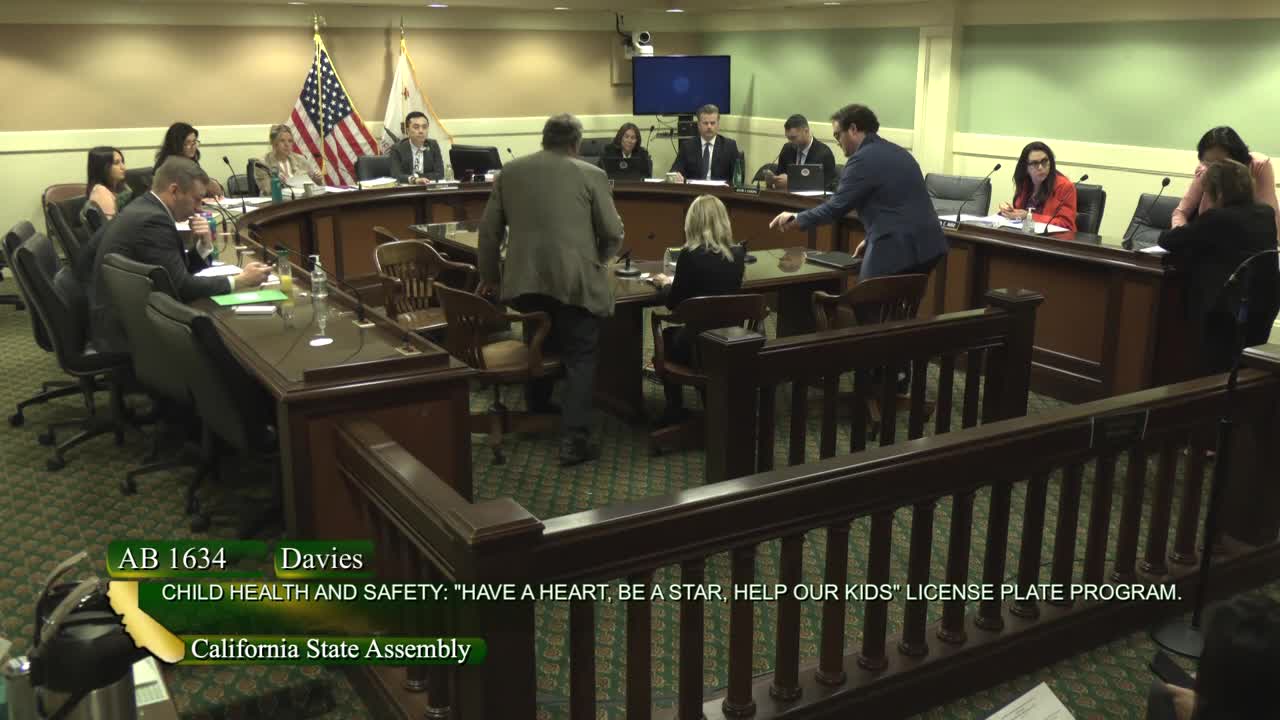 17MIN
Assembly Standing Committee on Human Services
Bill Author

Bill Co-Author(s):