AB 1657: Domestic violence: restraining orders.
- Session Year: 2025-2026
- House: Assembly
- Latest Version Date: 2026-09-20
Current Status:
Passed
(2026-09-20: Chaptered by Secretary of State - Chapter 368, Statutes of 2026.)
Introduced
In Committee
Awaiting First Chamber Vote
Passed First Chamber
In Committee
Awaiting Second Chamber Vote
Passed Second Chamber
Enacted
What does this bill do?
The bill prevents courts from requiring that the person to be restrained be given advance notice before a short-term emergency (ex parte) domestic violence restraining order is filed or decided, and it bars courts from demanding an explanation or declaration for not giving notice or denying the order just because the other person was not told. It also forbids any court rule, form, or practice that conflicts with this and requires clerks to accept properly completed mandatory forms for ex parte protective orders.
The summary is provided by generative AI which can make mistakes. For original language, please view the details in the table below.
Existing law authorizes a court to issue an ex parte restraining order to prevent abuse based on reasonable proof of a past act or acts of abuse. Existing law authorizes the order to be issued solely on the affidavit or testimony of the person requesting the ex parte restraining order. Existing law requires the ex parte order to be issued or denied on the same day the application is submitted to the court, except as specified. Existing law prohibits an ex parte restraining order from being denied solely because the other party was not provided with notice.
This bill would instead prohibit a court from requiring that notice be provided to the party to be restrained in advance of accepting a filing for, or deciding, an application for an ex parte restraining order. The bill would also prohibit a court from requiring an explanation or declaration for not providing notice in advance of accepting a filing for, or deciding, an application for an ex parte restraining order. The bill would prohibit a court from adopting or maintaining any rule, form, or practice that is inconsistent with these provisions.
Existing law authorizes a court to issue an ex parte restraining order to prevent abuse based on reasonable proof of a past act or acts of abuse. Existing law authorizes the order to be issued solely on the affidavit or testimony of the person requesting the ex parte restraining order. Existing law requires the ex parte order to be issued or denied on the same day the application is submitted to the court, except as specified. Existing law prohibits an ex parte restraining order from being denied solely because the other party was not provided with notice.
This bill would instead prohibit a court from requiring that notice be provided to the party to be restrained in advance of accepting a filing for, or deciding, an application for an ex parte restraining order. The bill would also prohibit a court from requiring an explanation or declaration to substantiate a partys decision not to provide for not providing notice in advance of filing. accepting a filing for, or deciding, an application for an ex parte restraining order. The bill would prohibit a court from adopting or maintaining any rule, form, or practice that is inconsistent with these provisions.
Existing law authorizes a court to issue an ex parte restraining order to prevent abuse based on reasonable proof of a past act or acts of abuse. Existing law authorizes the order to be issued solely on the affidavit or testimony of the person requesting the ex parte restraining order. Existing law requires the ex parte order to be issued or denied on the same day the application is submitted to the court, except as specified. Existing law prohibits an ex parte restraining order from being denied solely because the other party was not provided with notice.
This bill would instead prohibit a court from requiring that notice be provided to the party to be restrained in advance of filing an application for an ex parte restraining order. The bill would also prohibit a court from requiring an explanation or declaration to substantiate a partys decision not to provide notice in advance of filing. The bill would prohibit a court from adopting or maintaining any rule, form, or practice that is inconsistent with these provisions.
Existing law authorizes a court to issue an ex parte restraining order to prevent abuse based on reasonable proof of a past act or acts of abuse. Existing law authorizes the order to be issued solely on the affidavit or testimony of the person requesting the ex parte restraining order. Existing law requires the ex parte order to be issued or denied on the same day the application is submitted to the court, except as specified. Existing law prohibits an ex parte restraining order from being denied solely because the other party was not provided with notice.
This bill would instead prohibit a court from requiring that notice be provided to the party to be restrained in advance of filing an application for an ex parte restraining order.
(a)An order may be issued under this part to restrain a person for the purpose specified in Section 6220 if an affidavit or testimony and any additional information provided to the court pursuant to Section 6306 shows, to the satisfaction of the court, reasonable proof of a past act or acts of abuse. The court may issue an order under this part based solely on the affidavit or testimony of the person requesting the restraining order.
(b)The court shall not require notice to be provided to the party to be restrained in advance of accepting a filing for, or deciding, an application for an ex parte restraining order pursuant to Article 1 (commencing with Section 6320) of Chapter 2. The court shall not require an explanation or declaration for not providing notice in advance of accepting a filing for, or deciding, an application for an ex parte restraining order. An ex parte restraining order shall not be denied, in whole or in part, because the other party was not provided with notice. A court shall not adopt or maintain any rule, form, or practice that is inconsistent with this subdivision.
(c)An ex parte request for a protective order, as defined in Section 6218, shall not be rejected for filing by the court clerk if it is submitted on mandatory Judicial Council forms, includes all of the forms required to issue an order, and identifies the party submitting the request and the party who is the subject of the requested order.
SEC. 2.Section 6326 of the Family Code is amended to read:6326.(a)An ex parte order under this article shall be issued or denied on the same day that the application is submitted to the court, unless the application is filed too late in the day to permit effective review, in which case the order shall be issued or denied on the next day of judicial business in sufficient time for the order to be filed that day with the clerk of the court.
(b)The court shall not require notice to be provided to the party to be restrained in advance of accepting a filing for, or deciding, an application for an ex parte restraining order. The court shall not require an explanation or declaration for not providing notice in advance of accepting a filing for, or deciding, an application for an ex parte restraining order. An ex parte restraining order shall not be denied, in whole or in part, because the other party was not provided with notice. A court shall not adopt or maintain any rule, form, or practice that is inconsistent with this subdivision.
(a)An order may be issued under this part to restrain a person for the purpose specified in Section 6220 if an affidavit or testimony and any additional information provided to the court pursuant to Section 6306 shows, to the satisfaction of the court, reasonable proof of a past act or acts of abuse. The court may issue an order under this part based solely on the affidavit or testimony of the person requesting the restraining order.
(b)The court shall not require notice to be provided to the party to be restrained in advance of accepting a filing for, or deciding, an application for an ex parte restraining order pursuant to Article 1 (commencing with Section 6320) of Chapter 2. The court shall not require an explanation or declaration to substantiate a partys decision to not provide for not providing notice in advance of filing. accepting a filing for, or deciding, an application for an ex parte restraining order. An ex parte restraining order shall not be denied, in whole or in part, because the other party was not provided with notice. A court shall not adopt or maintain any rule, form, or practice that is inconsistent with this subdivision.
(c)An ex parte request for a protective order, as defined in Section 6218, shall not be rejected for filing by the court clerk if it is submitted on mandatory Judicial Council forms, includes all of the forms required to issue an order, and identifies the party submitting the request and the party who is the subject of the requested order.
SEC. 2.Section 6326 of the Family Code is amended to read:6326.(a)An ex parte order under this article shall be issued or denied on the same day that the application is submitted to the court, unless the application is filed too late in the day to permit effective review, in which case the order shall be issued or denied on the next day of judicial business in sufficient time for the order to be filed that day with the clerk of the court.
(b)The court shall not require notice to be provided to the party to be restrained in advance of accepting a filing for, or deciding, an application for an ex parte restraining order. The court shall not require an explanation or declaration to substantiate a partys decision to not provide for not providing notice in advance of filing. accepting a filing for, or deciding, an application for an ex parte restraining order. An ex parte restraining order shall not be denied, in whole or in part, because the other party was not provided with notice. A court shall not adopt or maintain any rule, form, or practice that is inconsistent with this subdivision.
(a)An order may be issued under this part to restrain a person for the purpose specified in Section 6220 if an affidavit or testimony and any additional information provided to the court pursuant to Section 6306 shows, to the satisfaction of the court, reasonable proof of a past act or acts of abuse. The court may issue an order under this part based solely on the affidavit or testimony of the person requesting the restraining order.
(b)The court shall not require notice to be provided to the party to be restrained in advance of filing an application for an ex parte restraining order pursuant to Article 1 (commencing with Section 6320) of Chapter 2. The court shall not require an explanation or declaration to substantiate a partys decision to not provide notice in advance of filing. An ex parte restraining order shall not be denied, in whole or in part, because the other party was not provided with notice. A court shall not adopt or maintain any rule, form, or practice that is inconsistent with this subdivision.
(c)An ex parte request for a protective order, as defined in Section 6218, shall not be rejected for filing by the court clerk if it is submitted on mandatory Judicial Council forms, includes all of the forms required to issue an order, and identifies the party submitting the request and the party who is the subject of the requested order.
SEC. 2.Section 6326 of the Family Code is amended to read:6326.(a)An ex parte order under this article shall be issued or denied on the same day that the application is submitted to the court, unless the application is filed too late in the day to permit effective review, in which case the order shall be issued or denied on the next day of judicial business in sufficient time for the order to be filed that day with the clerk of the court. The
(b)The court shall not require notice to be provided to the party to be restrained in advance of filing an application for an ex parte restraining order. The court shall not require an explanation or declaration to substantiate a partys decision to not provide notice in advance of filing. An ex parte restraining order shall not be denied, in whole or in part, because the other party was not provided with notice. A court shall not adopt or maintain any rule, form, or practice that is inconsistent with this subdivision.
(a)An order may be issued under this part to restrain any a person for the purpose specified in Section 6220, 6220 if an affidavit or testimony and any additional information provided to the court pursuant to Section 6306, 6306 shows, to the satisfaction of the court, reasonable proof of a past act or acts of abuse. The court may issue an order under this part based solely on the affidavit or testimony of the person requesting the restraining order.
(b)An The court shall not require notice to be provided to the party to be restrained in advance of filing an application for an ex parte restraining order issued pursuant to Article 1 (commencing with Section 6320) shall not be denied solely because the other party was not provided with notice. of Chapter 2.
(c)An ex parte request for a protective order, as defined in Section 6218, shall not be rejected for filing by the court clerk if it is submitted on mandatory Judicial Council forms, includes all of the forms required to issue an order, and identifies the party submitting the request and the party who is the subject of the requested order.
SEC. 2.Section 6326 of the Family Code is amended to read:6326.An ex parte order under this article shall be issued or denied on the same day that the application is submitted to the court, unless the application is filed too late in the day to permit effective review, in which case the order shall be issued or denied on the next day of judicial business in sufficient time for the order to be filed that day with the clerk of the court. A petition for an ex parte order pursuant to this article shall not be denied solely because the other party was not provided with notice. The court shall not require notice to be provided to the party to be restrained in advance of filing an application for an ex parte restraining order.
|
Date
|
Status
|
|---|---|
| Sep 20, 2026 | Chaptered by Secretary of State - Chapter 368, Statutes of 2026. |
| Sep 20, 2026 | Approved by the Governor. |
| Aug 24, 2026 | Enrolled and presented to the Governor at 4:30 p.m. |
| Aug 17, 2026 | In Assembly. Ordered to Engrossing and Enrolling. |
| Aug 17, 2026 | Read third time. Passed. Ordered to the Assembly. (Ayes 39. Noes 0.). |
| Aug 17, 2026 | Read third time. Passed. Ordered to the Assembly. (Ayes 39. Noes 0. Page 5489.). |
| Jun 11, 2026 | Read second time. Ordered to third reading. |
| Jun 10, 2026 | From committee: Do pass. (Ayes 12. Noes 0.) (June 9). |
| May 13, 2026 | Referred to Com. on JUD. |
| May 5, 2026 | In Senate. Read first time. To Com. on RLS. for assignment. |
| May 4, 2026 | Read third time. Passed. Ordered to the Senate. (Ayes 76. Noes 0.) |
| May 4, 2026 | Read third time. Passed. Ordered to the Senate. (Ayes 76. Noes 0. Page 4899.) |
| May 4, 2026 | Read third time. Passed. Ordered to the Senate. |
| Apr 28, 2026 | Read third time and amended. Ordered to third reading. (Page 4857.) |
| Apr 28, 2026 | Read third time and amended. Ordered to third reading. |
| Mar 12, 2026 | Read second time. Ordered to third reading. |
| Mar 11, 2026 | Read second time and amended. Ordered returned to second reading. |
| Mar 10, 2026 | From committee: Amend, and do pass as amended. (Ayes 12. Noes 0.) (March 10). |
| Feb 17, 2026 | Referred to Com. on JUD. |
| Jan 30, 2026 | From printer. May be heard in committee March 1. |
| Jan 29, 2026 | Read first time. To print. |
|
Date
|
Description
|
Location
|
Votes
|
|
|---|---|---|---|---|
| Aug 17, 2026 | Assembly 3rd Reading AB1657 Rogers et al. By Grove | Senate Floor |
Passed |
|
| Jun 9, 2026 | Do pass | Senate Standing Committee on Judiciary |
Passed |
|
| May 4, 2026 | AB 1657 Rogers Assembly Third Reading | Assembly Floor |
Passed |
|
| Mar 10, 2026 | Do pass as amended. | Assembly Standing Committee on Judiciary |
Passed |
This list shows positions taken on this bill by organizations on the date displayed, which is linked to the original source.
Positions by individuals are not included.
|
Organization
|
Position
|
Date
|
|---|---|---|
| California Behavioral Health Association | ** Support | |
| California Civil Liberties Advocacy | ** Support | |
| California Commission on the Status of Women and Girls | ** Support | |
| California Family Justice Network | ** Support | |
| Family Law Section of the Los Angeles County Bar Association | ** Against | |
| League Of California Cities | ** Support | |
| Los Angeles County Bar Association Family Law Section | ** Against | |
| Los Angeles Unified School District | ** Support | |
| PORAC | ** Support | |
| The California Family Justice Network | ** Support |
SENATE RULES COMMITTEE Office of Senate Floor Analyses (916) 651-4171 | AB 1657 |
THIRD READING
Bill No: AB 1657
Author: Rogers (D), et al.
Amended: 4/28/26 in Assembly
Vote: 21
SENATE JUDICIARY COMMITTEE: 12-0, 6/9/26
AYES: Umberg, Niello, Allen, Ashby, Caballero, Durazo, Laird, Reyes, Valladares, Wahab, Weber Pierson, Wiener
NO VOTE RECORDED: Stern
ASSEMBLY FLOOR: 76-0, 5/4/26 - See last page for vote
SUBJECT: Domestic violence: restraining orders
SOURCE: Author
DIGEST:
This bill prohibits a court from requiring a petitioner seeking an ex parte temporary restraining order under the Domestic Violence Prevention Act (DVPA) to provide notice to the party to be restrained before accepting the application for filing or issuing a decision on the application.
ANALYSIS:
Existing law:
- Establishes the DVPA, which sets forth procedural and substantive requirements for the issuance of a temporary restraining order or a protective order to, among other things, enjoin specific acts of abuse or prohibit the abuser from coming within a specified distance of the abused person. (Family (Fam.) Code, §§ 6200 et seq.)
- “Domestic violence,” for purposes of the DVPA, is defined as abuse perpetrated against a spouse or former spouse; a cohabitant or former cohabitant; a person with whom the respondent is having or has had a dating or engagement relationship; a person with whom the respondent has had a child, as specified; a child of a party or a child who is the subject of an action under the Uniform Parentage Act, as specified; or any other person related by consanguinity or affinity within the second degree. (Fam. Code, § 6211.)
- The purpose of a DVPA order is to prevent acts of domestic violence, abuse, and sexual abuse and to provide for a separation of the persons involved in the domestic violence for a period sufficient to enable these persons to seek a resolution of the causes of the violence. (Fam. Code, § 6220.)
- Authorizes a court to issue an ex parte temporary restraining order (TRO) under the DVPA without a noticed hearing to prevent the restrained party from engaging in abusive or harassing behavior, as specified. (Fam. Code, §§ 6320-6327.)
- Provides that a TRO issued pursuant to 2) shall not be denied solely because the other party was not provided with notice. (Fam. Code, § 6300(b).)
- Requires a TRO to be issued or denied on the same day the application is submitted to the court or the next judicial day, as specified, and that the application shall not be denied solely because the other party was not provided with notice. (Fam. Code, § 6326.)
- Authorizes a court to issue DVPO under the DVPA after a noticed hearing at which the alleged abuser may appear. (Fam. Code, §§ 6340-6347.)
- Provides that a court may issue a TRO or DVPO if an affidavit or testimony and any additional information provided to the court shows, to the satisfaction of the court, reasonable proof of a past act or acts of abuse, and that the court may do so based solely on the affidavit or testimony of the person requesting the order. (Fam. Code, § 6300(a).)
- Establishes a general rule that a temporary restraining order may not be issued pursuant to the Family Code without notice to the respondent unless it appears from the facts shown by the declaration in support of the petition for the order, or in the petition for the order, that great or irreparable injury would result to the petitioner before the matter can be heard on notice; and exempts orders issued under the DVPA from this general rule. (Fam. Code, § 241.)
- Provides that a temporary restraining order issued under the Family Code, including the DVPA, shall last for 21 days, or 25 days with good cause, from the date that the application was granted, by which time the court must hold a noticed hearing on the application for a protective order. (Fam. Code, § 242.)
- Provides, notwithstanding 8), that a temporary restraining order may be extended in certain circumstances, including the respondent’s right to ask for one continuance for a reasonable period to respond to the petition or if either party shows good cause for a continuance; in such cases, the temporary restraining order shall remain in effect until the end of the continued hearing. (Fam. Code, § 245.)
This bill prohibits a court from doing any of the following in connection with an ex parte application for a TRO under the DVPA:
- Requiring notice to the party against whom the TRO is sought in advance of accepting a filing for, or deciding, the application for an ex parte TRO.
- Requiring an explanation or declaration for not providing notice to the party against whom the TRO is sought in advance of accepting the filing for, or deciding, an application for an ex parte TRO.
- Adopting or maintaining any rule, form, or practice that is inconsistent with 1)(a) and (b).
Comments
Existing law, the DVPA, seeks to prevent acts of domestic violence, abuse, and sexual abuse and to provide for a separation of persons involved in the domestic violence for a period sufficient to enable these persons to try to resolve the causes of the violence. Existing law thus enables a party to seek a restraining order or a protective order to enjoin specific acts of abuse, exclude a person from a dwelling, or enjoin other specified behavior. The DVPA allows a victim of domestic violence to obtain a short-term TRO on an ex parte basis and a longer-term protective order after a noticed hearing; these orders are generally sought in a single application that seeks the immediate issuance of a TRO and a hearing on the application for the protective order.
Current law states that a petition for a TRO may not be denied solely because the petitioner failed to provide notice of the application to the other party. According to the author, there is disagreement among the courts as to whether this language exempts DVPA petitioners from providing notice of a TRO application to the respondent in advance, or whether a court may, at its discretion, determine that notice to the respondent is required before filing or granting a TRO application.
This bill amends the Family Code to unambiguously prohibit a court from requiring notice to the respondent before filing or granting a TRO application under the DVPA. This bill also prohibits a court from requiring a petitioner to state their reasons for not providing notice, and from adopting any rule of court that is inconsistent with these prohibitions.
FISCAL EFFECT: Appropriation: No Fiscal Com.: No Local: No
SUPPORT: (Verified 6/11/26)
California Behavioral Health Association
California Commission on the Status of Women and Girls
League of California Cities
Los Angeles Unified School District
PORAC
OPPOSITION: (Verified 6/11/26)
Family Law Section of the Los Angeles County Bar Association
ARGUMENTS IN SUPPORT:
According to the California Behavioral Health Association
AB 1657 makes changes that a court would not be allowed to require notice to the party to be restrained before accepting or deciding an exp parte restraining order application. The court would also not be allowed to require the applicant to explain why notice was not provided. Finaly this bill provides that an ex parte restraining order shall not be denied, in whole or in part, because the other party was not provided notice. These changes are important because the time between seeking protection and receiving an enforceable order is often one of the most dangerous periods for survivors. Requiring a survivor to notify an abusive partner before protection is in place creates a gap that increased the risk of retaliation, intimidation, and further harm.
This bill seeks to provide greater clarity and uniformity across counties as some courts are interpreting their local rules to deny applications solely due to the failure to provide notice or failure to provide an adequate explanation for not doing so. Finally, AB 1657 applies to temporary ex parte restraining orders designed to address urgent safety needs. Respondents still receive notice after an order is issued and retain the opportunity to appear, respond, and contest the order at the required hearing before a long term order is granted.
ARGUMENTS IN OPPOSITION: According to the Family Law Section of the Los Angeles County Bar Association:
While prior notice for ex parte retraining orders may be inappropriate in most cases (due to violence in response to such notice), there are certainly cases in which such notice is appropriate. As practitioners, it is our position that it is the judicial officer ruling on the application for the restraining order who must be entrusted with the decision as to whether notice would or would not be appropriate in any given case.
Given that our current statute already allows a Court to grant a restraining order without prior notice, the proposed amendment to FC6300 infringes on the Constitutional due process rights of a Defendant unnecessarily by mandating to the Court that notice shall never be required. The current statute protects the rights of both the accuser and the accused, by allowing the Court to dispense with the notice requirement in a particular case. There is no need to amend the statute given the current wording of Family Code Section 6300.
ASSEMBLY FLOOR: 76-0, 5/4/26
AYES: Addis, Aguiar-Curry, Ahrens, Alanis, Alvarez, Ávila Farías, Bains, Bauer-Kahan, Berman, Boerner, Bonta, Bryan, Calderon, Carrillo, Castillo, Connolly, Davies, DeMaio, Dixon, Elhawary, Ellis, Flora, Fong, Gabriel, Gallagher, Garcia, Gipson, Jeff Gonzalez, Mark González, Hadwick, Haney, Harabedian, Hart, Hoover, Irwin, Jackson, Johnson, Kalra, Krell, Lackey, Lee, Lowenthal, Macedo, McKinnor, Muratsuchi, Nguyen, Ortega, Pacheco, Papan, Patel, Patterson, Pellerin, Petrie-Norris, Quirk-Silva, Ramos, Ransom, Celeste Rodriguez, Michelle Rodriguez, Rogers, Blanca Rubio, Sanchez, Schiavo, Schultz, Sharp-Collins, Solache, Soria, Stefani, Ta, Tangipa, Valencia, Wallis, Ward, Wicks, Wilson, Zbur, Rivas
NO VOTE RECORDED: Arambula, Bennett, Caloza, Chen
Prepared by: Allison Whitt Meredith / JUD. / (916) 651-4113
6/12/26 12:50:01
**** END ****
Senator Thomas Umberg, Chair
2025-2026 Regular Session
Bill No: AB 1657 (Author:Rogers)
Version: April 28, 2026
Hearing Date: June 9, 2026
Fiscal: No
Urgency: No
Consultant: AWM
SUBJECT
Domestic violence: restraining orders
DIGEST
This bill prohibits a court from requiring a petitioner seeking an ex parte temporary restraining order under the Domestic Violence Prevention Act (DVPA) to provide notice to the party to be restrained before accepting the application for filing or issuing a decision on the application.
EXECUTIVE SUMMARY
Existing law, the DVPA, seeks to prevent acts of domestic violence, abuse, and sexual abuse and to provide for a separation of persons involved in the domestic violence for a period sufficient to enable these persons to try to resolve the causes of the violence. Existing law thus enables a party to seek a restraining order or a protective order to enjoin specific acts of abuse, exclude a person from a dwelling, or enjoin other specified behavior. The DVPA allows a victim of domestic violence to obtain a short-term temporary restraining order (TRO) on an ex parte basis and a longer-term protective order after a noticed hearing; these orders are generally sought in a single application that seeks the immediate issuance of a TRO and a hearing on the application for the protective order.
Current law states that a petition for a TRO may not be denied solely because the petitioner failed to provide notice of the application to the other party. According to the author, there is disagreement among the courts as to whether this language exempts DVPA petitioners from providing notice of a TRO application to the respondent in advance, or whether a court may, at its discretion, determine that notice to the respondent is required before filing or granting a TRO application.
This bill amends the Family Code to unambiguously prohibit a court from requiring notice to the respondent before filing or granting a TRO application under the DVPA. The bill also prohibits a court from requiring a petitioner to state their reasons for not providing notice, and from adopting any rule of court that is inconsistent with these prohibitions.
This bill is sponsored by the California Behavioral Health Association, the California Family Justice Network and is supported by the California Commission on the Status of Women and Girls, the League of California Cities, the Los Angeles Unified School District, and the Police Officers’ Research Association of California (PORAC) The Committee has not received timely opposition to this bill.
PROPOSED CHANGES TO THE LAW
Existing law:
- Establishes the DVPA, which sets forth procedural and substantive requirements for the issuance of a temporary restraining order or a protective order to, among other things, enjoin specific acts of abuse or prohibit the abuser from coming within a specified distance of the abused person. (Fam. Code, §§ 6200 et seq.)
- “Domestic violence,” for purposes of the DVPA, is defined as abuse perpetrated against a spouse or former spouse; a cohabitant or former cohabitant; a person with whom the respondent is having or has had a dating or engagement relationship; a person with whom the respondent has had a child, as specified; a child of a party or a child who is the subject of an action under the Uniform Parentage Act, as specified; or any other person related by consanguinity or affinity within the second degree. (Fam. Code, § 6211.)
- The purpose of a DVPA order is to prevent acts of domestic violence, abuse, and sexual abuse and to provide for a separation of the persons involved in the domestic violence for a period sufficient to enable these persons to seek a resolution of the causes of the violence. (Fam. Code, § 6220.)
- Authorizes a court to issue an ex parte temporary restraining order (TRO) under the DVPA without a noticed hearing to prevent the restrained party from engaging in abusive or harassing behavior, as specified. (Fam. Code, §§ 6320-6327.)
- Provides that a TRO issued pursuant to 2) shall not be denied solely because the other party was not provided with notice. (Fam. Code, § 6300(b).)
- Requires a TRO to be issued or denied on the same day the application is submitted to the court or the next judicial day, as specified, and that the application shall not be denied solely because the other party was not provided with notice. (Fam. Code, § 6326.)
- Authorizes a court to issue DVPO under the DVPA after a noticed hearing at which the alleged abuser may appear. (Fam. Code, §§ 6340-6347.)
- Provides that a court may issue a TRO or DVPO if an affidavit or testimony and any additional information provided to the court shows, to the satisfaction of the court, reasonable proof of a past act or acts of abuse, and that the court may do so based solely on the affidavit or testimony of the person requesting the order. (Fam. Code, § 6300(a).)
- Establishes a general rule that a temporary restraining order may not be issued pursuant to the Family Code without notice to the respondent unless it appears from the facts shown by the declaration in support of the petition for the order, or in the petition for the order, that great or irreparable injury would result to the petitioner before the matter can be heard on notice; and exempts orders issued under the DVPA from this general rule. (Fam. Code, § 241.)
- Provides that a temporary restraining order issued under the Family Code, including the DVPA, shall last for 21 days, or 25 days with good cause, from the date that the application was granted, by which time the court must hold a noticed hearing on the application for a protective order. (Fam. Code, § 242.)
- Provides, notwithstanding 8), that a temporary restraining order may be extended in certain circumstances, including the respondent’s right to ask for one continuance for a reasonable period to respond to the petition or if either party shows good cause for a continuance; in such cases, the temporary restraining order shall remain in effect until the end of the continued hearing. (Fam. Code, § 245.)
This bill prohibits a court from doing any of the following in connection with an ex parte application for a TRO under the DVPA:
- Requiring notice to the party against whom the TRO is sought in advance of accepting a filing for, or deciding, the application for an ex parte TRO.
- Requiring an explanation or declaration for not providing notice to the party against whom the TRO is sought in advance of accepting the filing for, or deciding, an application for an ex parte TRO.
- Adopting or maintaining any rule, form, or practice that is inconsistent with 1)(a) and (b).
COMMENTS
- Author’s comment
According to the author:
AB 1657 ends this loophole in local rules by removing the notice requirement before filing an ex parte restraining order in Family Code sections 6300 and 6326. Several counties currently still use this loophole to require a notice requirement that must be presented before a Temporary Restraining Order is received, and requiring the victim to do so puts them at unnecessary risk of facing their abuser and increases stress due to having to find a replacement to send the notice requirement.
This will allow victims to face less risk when seeking justice from their abuser, as well as minimize the stress of determining who, if not them, should deliver the notice to the opposing party. Additionally, it will make the judicial system easier to navigate by removing a step that increases processing time for the judge’s review of an application for a TRO.
2. Background on the DVPA
The DVPA seeks to prevent acts of domestic violence, abuse, and sexual abuse, and to provide for a separation of persons involved in domestic violence for a period sufficient to enable them to seek a resolution. The DVPA’s “protective purpose is broad both in its stated intent and its breadth of persons protected” and courts are required to construe it broadly in order to accomplish the statute’s purpose.[1]
The DVPA allows a victim of domestic violence to obtain a short-term TRO on an ex parte basis and a DVPO after a noticed hearing;[2] these orders are generally sought in a single application that seeks the immediate issuance of a TRO and a hearing on the application for the DVPO. A TRO or a DVPO can enjoin a range of conduct, including attacking, threatening, harassing, telephoning, contacting, and coming within a specified distance of the protected person.[3] Both a TRO and a DVPO can be issued solely on the basis of the affidavit or testimony presented by the petitioner.[4] A TRO generally lasts for 21 days, by which point the court must hold a noticed hearing on the issuance of a DVPO; however, the TRO may be extended if there is good cause for continuing the noticed hearing.[5] If the court grants the application for a DVPO, the DVPO can last for up to five years and can be extended by the court so long as the risk of abuse remains.[6]
A court may not reject an application for a TRO under the DVPA solely because the petitioner did not provide notice to the respondent.[7] This is an exception to the Family Code’s general rule that a petitioner must notify the respondent of the ex parte application unless the petitioner sets forth facts showing that the petitioner would experience great or irreparable injury if they had to give notice in advance.[8] The California Rules of Court relating to DVPA TROs require the petitioner to set forth one of three statements relating to the provision of notice: a statement that the petitioner gave notice to the respondent and specified details about the notice; a statement that the petitioner made a good faith attempt to give notice but was unable to do so, with details about the attempt; or a statement that, for reasons specified, the petitioner should not be required to inform the opposing party.[9] While there is not a significant legislative history relating to the provisions prohibiting a TRO from being denied solely due to lack of notice, this Committee’s most recent analysis on the subject appears to take the position that notice to the respondent is not necessarily required for the filing or issuance of a TRO.[10] While there is no case law directly analyzing whether the DVPA can eliminate the pre-filing notice requirement for a TRO, there is case law indicating that the short-term nature of the TRO permits the issuance of a TRO without notice to the respondent.[11]
3. This bill prohibits a court from requiring notice to the other party in advance of filing or granting a request for a TRO under the DVPA
This bill prohibits a court from (1) requiring notice to be provided to the party to be restrained under a DVPA TRO in advance of accepting or granting the request, and (2) requiring an explanation for the failure to provide such pre-filing or pre-grant service. The bill also prohibits a court from adopting or maintaining a rule of court that is inconsistent with these restrictions.
According to the author, this bill is intended to close a loophole in the DVPA which courts are erroneously relying on to reject TRO requests on the basis that the petitioner did not provide notice of the petition to the respondent. The author and sponsors take the position that the DVPA already does not require notice to the respondent prior to the filing or issuance of a TRO, and therefore that this bill’s express statement that no notice to the respondent is required for a TRO is a clarification of existing law.
4. Arguments in support
According to the California Behavioral Health Association
AB 1657 makes changes that a court would not be allowed to require notice to the party to be restrained before accepting or deciding an exp parte restraining order application. The court would also not be allowed to require the applicant to explain why notice was not provided. Finaly this bill provides that an ex parte restraining order shall not be denied, in whole or in part, because the other party was not provided notice. These changes are important because the time between seeking protection and receiving an enforceable order is often one of the most dangerous periods for survivors. Requiring a survivor to notify an abusive partner before protection is in place creates a gap that increased the risk of retaliation, intimidation, and further harm.
This bill seeks to provide greater clarity and uniformity across counties as some courts are interpreting their local rules to deny applications solely due to the failure to provide notice or failure to provide an adequate explanation for not doing so. Finally, AB 1657 applies to temporary ex parte restraining orders designed to address urgent safety needs. Respondents still receive notice after an order is issued and retain the opportunity to appear, respond, and contest the order at the required hearing before a long term order is granted.
SUPPORT
California Behavioral Health Association
California Commission on the Status of Women and Girls
League of California Cities
Los Angeles Unified School District
PORAC
OPPOSITION
None received
RELATED LEGISLATION
Pending legislation: AB 1753 (Stefani, 2026) among other things, provides that a DVPA petitioner shall not be uniformly required to provide prior notice to the subject of a proposed TRO or required to establish exceptional circumstances for failure to do so, but that the petitioner shall be required to provide prior notice only on a case-by-case basis, as specified. AB 1753 is pending before the Senate Public Safety Committee.
Prior legislation: AB 2694 (Rubio, Ch. 219, Stats. 2018) provided that a petition for a DVPA TRO shall not be denied solely because the petitioner failed to provide notice to the other party and permitted a petitioner, after the issuance of a TRO, to provide alternative service to a respondent if, after diligent effort, the petitioner establishes that there is reason to believe the respondent is evading service.
PRIOR VOTES
Assembly Floor (Ayes 76, Noes 0)
Assembly Judiciary Committee (Ayes 12, Noes 0)
**************
Caldwell v. Coppola (1990) 219 Cal.App.3d 859, 863; In re Marriage of Nadkarni (2009) 173 Cal.App.4th 1483, 1498. ↑
Fam. Code, §§ 6320, 6340. ↑
Id., §§ 6320, 6340. ↑
Id., § 6300(a). ↑
Id., §§ 242, 245. ↑
Id., § 6345. ↑
Id., §§ 6300(b), 6326. ↑
See id., § 241. ↑
Cal. Rules of Court, rule 5.151(e). ↑
See Sen. Com. on Judiciary, Analysis of Assem. Bill No. 2694 (2017-2018 Reg. Sess.) as amended Apr. 25, 2018, pp. 2, 5-6. ↑
See Isidora M. v. Silvino M. (2015) 239 Cal.App.4th 11, 18. ↑
ASSEMBLY THIRD READING
ATR Bill Id:AB 1657
Author:(Rogers)
As Amended Ver:April 28, 2026
Majority vote
SUMMARY
Prohibits a court from requiring notice to be provided to the party to be restrained in advance of filing an application for an ex parte domestic violence restraining order (DVRO), or from requiring the applicant to explain why notice has not been provided.
Major Provisions
- Prohibits a court from requiring notice to be provided to a party to be restrained, or requiring an explanation or declaration for not providing notice, in advance of accepting a filing for, or deciding, an application for an ex parte DVRO. Specifies that an ex parte DVRO shall not be denied solely, in whole or in part, because the other party was not provided with notice.
- Prohibits a court from adopting or maintaining any rule, form, or practice that is inconsistent with 1), above.
COMMENTS
To prevent harm before it occurs, existing law permits a victim or potential victim of domestic violence to seek a domestic violence restraining order (DVRO) under the Family Code. These orders take the form of emergency protective orders (sought by law enforcement) or DVROs (sought by the victim). Like most restraining orders, DVROs usually take the form of "stay away" orders that ensure separation of the parties, at least for as long as it takes to appear in court or eliminate the threat of violence. Emergency protective orders and temporary restraining orders are issued ex parte – that is, based only upon the affidavit or testimony of the party seeking relief. A permanent restraining order, on the other hand, may be issued only after a hearing at which the respondent is free to attend and testify. Because of their inherently time-sensitive manner, requests are reviewed and, if approved, issued on the same day as requested, or the next business day at the latest. Once a restraining order has been issued, it is immediately entered into a law enforcement database and may be enforced.
Existing law already recognizes that, in many situations, it may be difficult, or even dangerous, for a victim of domestic violence to provide advance notice to an abuser before filing an application for an ex parte restraining order. As a rule, the filing of a legal action requires "serving notice" on the defendant or respondent who is the target of the legal action. However, DVROs do not always require advance notice before the application is filed, or the order is issued. State law expressly states that a court may not deny an application for a DVRO based "solely" on failure to provide notice. (Family Code Section 6300(a).)
In addition, California Rule of Court 1.151 treats DVROs as a special case. This rule provides that an application for emergency restraining orders – though not necessarily DVROs – must be accompanied by a written statement that declares one of the following: (1) that notice has been provided to the other party; (2) that the applicant made a good faith effort to provide notice but failed to do so, specifying the efforts made to inform the other party; or (3) that, for reasons specified, the applicant should not be required to inform the opposing party. (California Rule of Court 1.151 (e)(2)(C).) However, while this rule applies to emergency orders generally, it exempts DVROs unless specifically included. (California Rule of Court 1.151 (a).)
Some local courts, according to the author and sponsor, have adopted local rules that require an applicant to either (1) provide notice in advance of filing the application or, (2) alternatively, explain why notice should not be required. According to the author and sponsor, some courts are interpreting their local rules to deny applications solely due to the failure to provide notice or failure to provide an adequate explanation for not doing so. To the extent that courts are denying relief solely because of lack of notice, they would clearly be acting contrary to Family Code Section 6300(b). Whether local rules that give an applicant the alternative of providing notice or an explanation is contrary to existing Section 6300(b) is less clear.
This bill seeks to provide greater clarity and effectively overrides those local rules by affirmatively prohibiting a court from requiring notice in advance of filing for, or deciding, an application for an ex parte DVRO. The bill also prohibits the court from requiring an explanation or declaration for not providing notice. Finally, the bill expressly prohibits courts from adopting contrary rules.
The rationale for notice requirements and exceptions for DVROs. Serving notice upon a defendant in any legal action serves important principles of due process by ensuring that a person knows that legal charges have been brought against them, understands the nature of the accusations, and can respond to those accusations in the manner provided by law. However, there are certain emergency situations where a court may issue ex parte orders, based solely on the declarations of the person seeking relief, and prior to other party's opportunity to be heard. DVROs, which seek to prevent violence, certainly represent such a situation. However, it is one thing to provide relief before giving the restrained party an opportunity to be heard; it is quite another to provide relief without even notifying the other person that an action has been taken against them.
The Legislature has already determined, however, that victims of domestic violence cannot always safely provide notice to an abuser in advance of seeking a restraining order, and certainly not before the protective order has been issued and is enforceable. This is precisely why existing law specifies that a court shall not deny an order solely because of lack of notice, and it is presumably why even local rules allow the applicant, in lieu of serving notice, to provide an explanation as to why doing so could put the applicant at risk. According to the author and sponsor, however, some courts have denied a victim's request to waive notice, and many victims (especially non-English speakers) might not understand that such explanations are required or what particular words constitute a sufficient explanation. The author and sponsor believe that prohibiting a court from requiring notice or an explanation will ensure that these orders are issued with urgency and without unnecessary delay. The defendant, after all, will have notice once the order is in effect and will have an opportunity to be heard and contest the order before a permanent order may be granted. Existing law requires a hearing within 21 days of the date that the temporary order is issued.
In sum, this bill implicates the tension between the need to protect victims (and potential victims) from domestic violence, on the one hand, and the due process rights of the alleged perpetrator, on the other hand. According to the author and sponsor, requiring the petitioner to either provide notice or complete additional paperwork puts the petitioner at risk during the critical period between the filing of the application and the issuance of an enforceable protective order. The initial DVRO is a temporary order meant to address an emergency, and the respondent will have an opportunity for due process at a hearing that must be held within 21 days of the issuance of the temporary order.
According to the Author
According to the author, AB 1657 will eliminate "a loophole in local rules by removing the notice requirement before filing an ex parte [domestic violence] restraining order" under the Family Code. The author contends that requiring a victim of domestic violence to provide notice before receiving a temporary restraining order "puts [the victim] at unnecessary risk of facing their abuser and increases stress due to having to find a replacement to send the notice requirement." The author believes that this bill will better protect victims by expressly prohibiting a court from requiring notice to the respondent in advance of filing an application for an ex parte domestic violence restraining order.
Arguments in Support
The California Family Justice Network, the bill's sponsor, writes in support:
From our experience working directly with survivors, it is essential that the legal framework governing DVROs protects survivors during the critical period after filing but before a judicial ruling is issued. Expectations around notice can create significant safety risks.
AB 1657 will close existing loopholes in the law that allow local courts to require a petitioner to provide notice to the restrained party prior to judicial review, or to complete additional paperwork demonstrating why providing notice would place them at risk. These practices place an undue burden on survivors seeking immediate protection.
These requirements can significantly increase risk. It is well documented that the time of separation from an abusive partner, and the first several months that follow, is the most dangerous period for victims of domestic violence (DV). Requiring a survivor to notify an abusive partner of their intent to seek a restraining order before protection is granted creates a dangerous gap between notification and protection. The concern is not who provides notice on behalf of the survivor, but rather the period between notifying the perpetrator and the moment a restraining order affords such protection. During that window, survivors may face heightened danger and retaliation.
Clarifying that courts may not impose notice requirements or additional procedural burdens prior to judicial review will help ensure that survivors across California can access emergency protection safely and consistently. AB 1657 is common-sense legislation to better protect survivors of domestic violence as they seek safety for themselves and their families.
The Peace Officers Research Association of California (PORAC) supports this bill because it will clarify "that a court may not require advance notice to the restrained party before an application for an ex parte restraining order is filed." PORAC notes that "ex parte restraining orders are designed to provide immediate protection for individuals facing credible threats" but that requiring "advance notice could undermine the purpose of these orders and potentially place victims at greater risk." PORAC believes that "this measure reinforces the intent of existing law — to allow swift judicial action based on reasonable proof of abuse while maintaining due process protections through subsequent hearings."
Arguments in Opposition
The Los Angeles County Bar Association Family Law Section writes in opposition:
Unlike the current statute, the proposed legislation would automatically dispense with the notice requirement for all applications, whether or not notice may actually have been proper and appropriate in a given case. The discretion currently held by the Courts would be eliminated by the legislature, as the legislature has decided that the "Court shall not require notice".
While prior notice for ex parte retraining orders may be inappropriate in most cases (due to violence in response to such notice), there are certainly cases in which such notice is appropriate. As practitioners, it is our position that it is the judicial officer ruling on the application for the restraining order who must be entrusted with the decision as to whether notice would or would not be appropriate in any given case.
Given that our current statute already allows a Court to grant a restraining order without prior notice, the proposed amendment to FC6300 infringes on the Constitutional due process rights of a Defendant unnecessarily by mandating to the Court that notice shall never be required. The current statute protects the rights of both the accuser and the accused, by allowing the Court to dispense with the notice requirement in a particular case. There is no need to amend the statute given the current wording of Family Code Section 6300.
FISCAL COMMENTS
None
VOTES
ASM JUDICIARY: 12-0-0
YES: Kalra, Macedo, Bauer-Kahan, Bryan, Connolly, Dixon, Harabedian, Pacheco, Papan, Sanchez, Stefani, Zbur
UPDATED
VERSION: April 28, 2026
CONSULTANT: Tom Clark / JUD. / (916) 319-2334 FN: 0002430
ASSEMBLY THIRD READING
ATR Bill Id:AB 1657
Author:(Rogers)
As Amended Ver:March 11, 2026
Majority vote
SUMMARY
Prohibits a court from requiring notice to be provided to the party to be restrained in advance of filing an application for an ex parte domestic violence restraining order (DVRO), or from requiring the applicant to explain why notice has not been provided.
Major Provisions
- Prohibits a court from requiring notice to be provided to a party to be restrained, or requiring an explanation for not providing notice, in advance of filing or deciding an application for an ex parte DVRO. Specifies that an ex parte DVRO shall not be denied solely, in whole or in part, because the other party was not provided with notice.
- Prohibits a court from adopting or maintaining any rule, form, or practice that is inconsistent with 1), above.
COMMENTS
To prevent harm before it occurs, existing law permits a victim or potential victim of domestic violence to seek a domestic violence restraining order (DVRO) under the Family Code. These orders take the form of emergency protective orders (sought by law enforcement) or DVROs (sought by the victim). Like most restraining orders, DVROs usually take the form of "stay away" orders that ensure separation of the parties, at least for as long as it takes to appear in court or eliminate the threat of violence. Emergency protective orders and temporary restraining orders are issued ex parte – that is, based only upon the affidavit or testimony of the party seeking relief. A permanent restraining order, on the other hand, may be issued only after a hearing at which the respondent is free to attend and testify. Because of their inherently time-sensitive manner, requests are reviewed and, if approved, issued on the same day as requested, or the next business day at the latest. Once a restraining order has been issued, it is immediately entered into a law enforcement database and may be enforced.
Existing law already recognizes that, in many situations, it may be difficult, or even dangerous, for a victim of domestic violence to provide advance notice to an abuser before filing an application for an ex parte restraining order. As a rule, the filing of a legal action requires "serving notice" on the defendant or respondent who is the target of the legal action. However, DVROs do not always require advance notice before the application is filed, or the order is issued. State law expressly states that a court may not deny an application for a DVRO based "solely" on failure to provide notice. (Family Code Section 6300(a).)
In addition, California Rule of Court 1.151 treats DVROs as a special case. This rule provides that an application for emergency restraining orders – though not necessarily DVROs – must be accompanied by a written statement that declares one of the following: (1) that notice has been provided to the other party; (2) that the applicant made a good faith effort to provide notice but failed to do so, specifying the efforts made to inform the other party; or (3) that, for reasons specified, the applicant should not be required to inform the opposing party. (California Rule of Court 1.151 (e)(2)(C).) However, while this rule applies to emergency orders generally, it exempts DVROs unless specifically included. (California Rule of Court 1.151 (a).)
Some local courts, according to the author and sponsor, have adopted local rules that require an applicant to either (1) provide notice in advance of filing the application or, (2) alternatively, explain why notice should not be required. According to the author and sponsor, some courts are interpreting their local rules to deny applications solely due to the failure to provide notice or failure to provide an adequate explanation for not doing so. To the extent that courts are denying relief solely because of lack of notice, they would clearly be acting contrary to Family Code Section 6300(b). Whether local rules that give an applicant the alternative of providing notice or an explanation is contrary to existing Section 6300(b) is less clear.
This bill seeks to provide greater clarity and effectively overrides those local rules by affirmatively prohibiting a court from requiring notice in advance of filing an application for an ex parte DVRO. The bill also prohibits the court from requiring an explanation for not providing notice. Finally, the bill expressly prohibits courts from adopting contrary rules.
The rationale for notice requirements and exceptions for DVROs. Serving notice upon a defendant in any legal action serves important principles of due process by ensuring that a person knows that legal charges have been brought against them, understands the nature of the accusations, and can respond to those accusations in the manner provided by law. However, there are certain emergency situations where a court may issue ex parte orders, based solely on the declarations of the person seeking relief, and prior to other party's opportunity to be heard. DVROs, which seek to prevent violence, certainly represent such a situation. However, it is one thing to provide relief before giving the restrained party an opportunity to be heard; it is quite another to provide relief without even notifying the other person that an action has been taken against them.
The Legislature has already determined, however, that victims of domestic violence cannot always safely provide notice to an abuser in advance of seeking a restraining order, and certainly not before the protective order has been issued and is enforceable. This is precisely why existing law specifies that a court shall not deny an order solely because of lack of notice, and it is presumably why even local rules allow the applicant, in lieu of serving notice, to provide an explanation as to why doing so could put the applicant at risk. According to the author and sponsor, however, some courts have denied a victim's request to waive notice, and many victims (especially non-English speakers) might not understand that such explanations are required or what particular words constitute a sufficient explanation. The author and sponsor believe that prohibiting a court from requiring notice or an explanation will ensure that these orders are issued with urgency and without unnecessary delay. The defendant, after all, will have notice once the order is in effect and will have an opportunity to be heard and contest the order before a permanent order may be granted. Existing law requires a hearing within 21 days of the date that the temporary order is issued.
In sum, this bill implicates the tension between the need to protect victims (and potential victims) from domestic violence, on the one hand, and the due process rights of the alleged perpetrator, on the other hand. According to the author and sponsor, requiring the petitioner to either provide notice or complete additional paperwork puts the petitioner at risk during the critical period between the filing of the application and the issuance of an enforceable protective order. The initial DVRO is a temporary order meant to address an emergency, and the respondent will have an opportunity for due process at a hearing that must be held within 21 days of the issuance of the temporary order.
According to the Author
According to the author, AB 1657 will eliminate "a loophole in local rules by removing the notice requirement before filing an ex parte [domestic violence] restraining order" under the Family Code. The author contends that requiring a victim of domestic violence to provide notice before receiving a temporary restraining order "puts [the victim] at unnecessary risk of facing their abuser and increases stress due to having to find a replacement to send the notice requirement." The author believes that this bill will better protect victims by expressly prohibiting a court from requiring notice to the respondent in advance of filing an application for an ex parte domestic violence restraining order.
Arguments in Support
The California Family Justice Network, the bill's sponsor, writes in support:
From our experience working directly with survivors, it is essential that the legal framework governing DVROs protects survivors during the critical period after filing but before a judicial ruling is issued. Expectations around notice can create significant safety risks.
AB 1657 will close existing loopholes in the law that allow local courts to require a petitioner to provide notice to the restrained party prior to judicial review, or to complete additional paperwork demonstrating why providing notice would place them at risk. These practices place an undue burden on survivors seeking immediate protection.
These requirements can significantly increase risk. It is well documented that the time of separation from an abusive partner, and the first several months that follow, is the most dangerous period for victims of DV. Requiring a survivor to notify an abusive partner of their intent to seek a restraining order before protection is granted creates a dangerous gap between notification and protection. The concern is not who provides notice on behalf of the survivor, but rather the period between notifying the perpetrator and the moment a restraining order affords such protection. During that window, survivors may face heightened danger and retaliation.
Clarifying that courts may not impose notice requirements or additional procedural burdens prior to judicial review will help ensure that survivors across California can access emergency protection safely and consistently. AB 1657 is common-sense legislation to better protect survivors of domestic violence as they seek safety for themselves and their families.
The Peace Officers Research Association of California (PORAC) supports this bill because it will clarify "that a court may not require advance notice to the restrained party before an application for an ex parte restraining order is filed." PORAC notes that "ex parte restraining orders are designed to provide immediate protection for individuals facing credible threats" but that requiring "advance notice could undermine the purpose of these orders and potentially place victims at greater risk." PORAC believes that "this measure reinforces the intent of existing law — to allow swift judicial action based on reasonable proof of abuse while maintaining due process protections through subsequent hearings."
Arguments in Opposition
None on file
FISCAL COMMENTS
None
VOTES
ASM JUDICIARY: 12-0-0
YES: Kalra, Macedo, Bauer-Kahan, Bryan, Connolly, Dixon, Harabedian, Pacheco, Papan, Sanchez, Stefani, Zbur
UPDATED
VERSION: March 11, 2026
CONSULTANT: Tom Clark / JUD. / (916) 319-2334 FN: 0002305
Date of Hearing: March 10, 2026
ASSEMBLY COMMITTEE ON JUDICIARY
Ash Kalra, Chair
ABPCA Bill Id:AB 1657
Author:(Rogers) – As Introduced Ver:January 29, 2026
As Proposed to be Amended
SUBJECT: Domestic violence: restraining orders
KEY ISSUE: Should a court be prohibited from requiring an applicant for a domestic violence restraining order to either provide notice to the restrained party, or to provide an explanation for why notice was not provided?
SYNOPSIS
To prevent harm before it occurs, existing law permits a victim or potential victim of domestic violence to seek a domestic violence restraining order (DVRO). These orders take the form of emergency protective orders (sought by law enforcement) or DVROs (sought by the victim). Like most restraining orders, a DVROs usually constitutes a “stay away” order that ensures separation of the parties, at least for as long as it takes to appear in court or eliminate the threat of violence. Emergency protective orders and temporary restraining orders are issued ex parte – that is, based only upon the affidavit or testimony of the party seeking relief. A permanent restraining order, on the other hand, may be issued only after a hearing at which the respondent attends. Because of their inherently time-sensitive manner, requests are reviewed and, if approved, issued on the same day as requested, or the next business day at the latest.
Existing law already recognizes that, in many situations, it may be difficult, or even dangerous, for a victim of domestic violence to provide advance notice to an abuser before filing an application for a restraining order. While notice is generally required in such actions, state law prohibits a court from denying an application for a DVRO based “solely” on failure to provide notice. However, some local courts have adopted rules that require the applicant to provide notice or, alternatively, to explain why it would be unsafe to provide prior notice. In some cases, according to the author, these local rules have led some courts to deny orders, even though requiring notice may place victims and potential victims of domestic violence at greater risk.
This bill would effectively override those local rules by prohibiting a court from requiring notice, or requiring an explanation for not providing notice, in advance of filing an application for an ex parte DVRO.
The bill is sponsored by the California Family Justice Network. It is supported by California Civil Liberties Advocacy and the Peace Officers Research Association of California (PORAC). There is no registered opposition to this bill. The author will take amendments in this Committee. Those amendments are included in the bill summary and discussed in the analysis.
SUMMARY: Prohibits a court from requiring notice to be provided to the party to be restrained in advance of filing an application for an ex parte domestic violence restraining order, or from requiring the applicant to explain why notice has not been provided. Specifically, this bill:
- Prohibits a court from requiring notice to be provided to a party to be restrained, or requiring an explanation for not providing notice, in advance of filing or deciding an application for an ex parte DVRO. Specifies that an ex parte DVRO shall not be denied solely, in whole or in part, because the other party was not provided with notice.
- Prohibits a court from adopting or maintaining any rule, form, or practice that is inconsistent with 1) above.
EXISTING LAW:
- Establishes the Domestic Violence Protection Act (DVPA) setting forth procedural and substantive requirements for the issuance of a “protective order,” whether issued ex parte, after notice and hearing, or in a judgment, that enjoins specified acts of abuse, excluding a person from a dwelling, or enjoining other specified behavior. (Family Code Section 6200 et seq. All further statutory references are to the Family Code.)
- Provides that a domestic violence restraining order (DVRO) may be issued to restrain a person, as specified, based on an affidavit or testimony and any additional information provided to the court that shows, to the satisfaction of the court, reasonable proof of a past act or acts of abuse. Specifies that a court may issue an order under this part based solely on the affidavit or testimony of the person requesting the restraining order. (Section 6300 (a).)
- Provides that an ex parte DVRO shall not be denied solely because the other party was not provided notice. (Section 6300 (b).)
- Provides that an ex parte DVRO may not be rejected for filing by the county clerk if it is submitted on mandatory Judicial Council forms, includes any other required forms, and identifies the party submitting the request and the party who is the subject of the order. (Section 6300 (c).)
- Requires an ex parte DVRO to be issued or denied on the same day that the application is submitted to the court, unless the application is filed too late in the day to permit effective review, in which case the order shall be issued or denied on the next day of judicial business, as specified. Provides the ex parte order shall not be denied because the other party was not provided with notice. (Section 6326.)
FISCAL EFFECT: As currently in print this bill is keyed non-fiscal.
COMMENTS: According to the author, AB 1657 will eliminate “a loophole in local rules by removing the notice requirement before filing an ex parte [domestic violence] restraining order” under the Family Code. The author contends that requiring a victim of domestic violence to provide notice before receiving a temporary restraining order “puts [the victim] at unnecessary risk of facing their abuser and increases stress due to having to find a replacement to send the notice requirement.” The author believes that this bill will better protect victims by expressly prohibiting a court from requiring notice to the respondent in advance of filing an application for an ex parte domestic violence restraining order.
Existing state law requirements for DVROs and local court rules. To prevent harm before it occurs, existing law permits a victim or potential victim of domestic violence to seek a domestic violence restraining order (DVRO) under the Family Code. These orders take the form of emergency protective orders (sought by law enforcement) or DVROs (sought by the victim). Like most restraining orders, DVROs usually take the form of “stay away” orders that ensure separation of the parties, at least for as long as it takes to appear in court or eliminate the threat of violence. Emergency protective orders and temporary restraining orders are issued ex parte – that is, based only upon the affidavit or testimony of the party seeking relief. A permanent restraining order, on the other hand, may be issued only after a hearing at which the respondent is free to attend and testify. Because of their inherently time-sensitive manner, requests are reviewed and, if approved, issued on the same day as requested, or the next business day at the latest. Once a restraining order has been issued, it is immediately entered into a law enforcement database and may be enforced.
Existing law already recognizes that, in many situations, it may be difficult, or even dangerous, for a victim of domestic violence to provide advance notice to an abuser before filing an application for an ex parte restraining order. As a rule, the filing of a legal action requires “serving notice” on the defendant or respondent who is the target of the legal action. However, DVROs do not always require advance notice before the application is filed, or the order is issued. State law expressly states that a court may not deny an application for a DVRO based “solely” on failure to provide notice. (Family Code Section 6300 (a).)
In addition, California Rule of Court 1.151 treats DVROs as a special case. This rule provides that an application for emergency restraining orders – though not necessarily DVROs – must be accompanied by a written statement that declares one of the following: (1) that notice has been provided to the other party; (2) that the applicant made a good faith effort to provide notice but failed to do so, specifying the efforts made to inform the other party; or (3) that, for reasons specified, the applicant should not be required to inform the opposing party. (California Rule of Court 1.151 (e)(2)(C).) However, while this rule applies to emergency orders generally, it exempts DVROs unless specifically included. (California Rule of Court 1.151 (a).)
Some local courts, according to the author and sponsor, have adopted local rules that require an applicant to either (1) provide notice in advance of filing the application or, (2) alternatively, explain why notice should not be required. According to the author and sponsor, some courts are interpreting their local rules to deny applications solely due to the failure to provide notice or failure to provide an adequate explanation for not doing so. To the extent that courts are denying relief solely because of lack of notice, they would clearly be acting contrary to Family Code Section 6300 (b). Whether local rules that give an applicant the alternative of providing notice or an explanation is contrary to existing Section 6300 (b) is less clear.
This bill seeks to provide greater clarity and effectively overrides those local rules by affirmatively prohibiting a court from requiring notice in advance of filing an application for an ex parte DVRO. As proposed to be amended in this Committee, the bill would also expressly prohibit the court from requiring an explanation for not providing notice. Finally, the bill expressly prohibits courts from adopting contrary rules.
The rationale for notice requirements and exceptions for DVROs. Serving notice upon a defendant in any legal action serves important principles of due process by ensuring that a person knows that legal charges have been brought against them, understands the nature of the accusations, and can respond to those accusations in the manner provided by law. However, there are certain emergency situations where a court may issue ex parte orders, based solely on the declarations of the person seeking relief, and prior to other party’s opportunity to be heard. DVROs, which seek to prevent violence, certainly represent such a situation. However, it is one thing to provide relief before giving the restrained party an opportunity to be heard; it is quite another to provide relief without even notifying the other person that an action has been taken against them.
The Legislature has already determined, however, that victims of domestic violence cannot always safely provide notice to an abuser in advance of seeking a restraining order, and certainly not before the protective order has been issued and is enforceable. This is precisely why existing law specifies that a court shall not deny an order solely because of lack of notice, and it is presumably why even local rules allow the applicant, in lieu of serving notice, to provide an explanation as to why doing so could put the applicant at risk. According to the author and sponsor, however, some courts have denied a victim’s request to waive notice, and many victims (especially non-English speakers) might not understand that such explanations are required or what particular words constitute a sufficient explanation. The author and sponsor believe that prohibiting a court from requiring notice or an explanation will ensure that these orders are issued with urgency and without unnecessary delay. The defendant, after all, will have notice once the order is in effect and will have an opportunity to be heard and contest the order before a permanent order may be granted. Existing law requires a hearing within 21 days of the date that the temporary order is issued.
In sum, this bill implicates the tension between the need to protect victims (and potential victims) from domestic violence, on the one hand, and the due process rights of the alleged perpetrator, on the other hand. According to the author and sponsor, requiring the petitioner to either provide notice or complete additional paperwork puts the petitioner at risk during the critical period between the filing of the application and the issuance of an enforceable protective order. The initial DVRO is a temporary order meant to address an emergency, and the respondent will have an opportunity for due process at a hearing that must be held within 21 days of the issuance of the temporary order.
Proposed Author Amendments. The author wishes to take the following amendments in this Committee. These amendments make it clearer that the purpose of the bill is to override and prohibit local rules that require applicants to either provide notice in advance of filing or provide a written explanation as to why notice was not provided. The proposed amendments change the bill in print as follows:
- On page 2, line 9, after “restrained” insert: nor shall any court require an explanation or declaration for not providing notice
- On page 2, line 12 after “Chapter 2” insert: An ex parte restraining order shall not be denied solely, in whole or in part, because the other party was not provided with notice. A court shall not adopt or maintain any rule, form or practice that is inconsistent with this division.
- On page 2, beginning at line 20 amend Section 6326 as follows:
6326. (a) An ex parte order under this article shall be issued or denied on the same day that the application is submitted to the court, unless the application is filed too late in the day to permit effective review, in which case the order shall be issued or denied on the next day of judicial business in sufficient time for the order to be filed that day with the clerk of the court.
(b) The court shall not require notice to be provided to the party to be restrained, nor shall any court require an explanation or declaration for not providing notice in advance of filing or deciding an application for an ex parte restraining order issued pursuant to Article 1 (commencing with Section 6320) of Chapter 2. An ex parte restraining order shall not be denied solely, in whole or in part, because the other party was not provided with notice. A court shall not adopt or maintain any rule, form or practice that is inconsistent with this division.
ARGUMENTS IN SUPPORT: The California Family Justice Network, the bill’s sponsor, writes in support:
From our experience working directly with survivors, it is essential that the legal framework governing DVROs protects survivors during the critical period after filing but before a judicial ruling is issued. Expectations around notice can create significant safety risks.
AB 1657 will close existing loopholes in the law that allow local courts to require a petitioner to provide notice to the restrained party prior to judicial review, or to complete additional paperwork demonstrating why providing notice would place them at risk. These practices place an undue burden on survivors seeking immediate protection.
These requirements can significantly increase risk. It is well documented that the time of separation from an abusive partner, and the first several months that follow, is the most dangerous period for victims of DV. Requiring a survivor to notify an abusive partner of their intent to seek a restraining order before protection is granted creates a dangerous gap between notification and protection. The concern is not who provides notice on behalf of the survivor, but rather the period between notifying the perpetrator and the moment a restraining order affords such protection. During that window, survivors may face heightened danger and retaliation.
Clarifying that courts may not impose notice requirements or additional procedural burdens prior to judicial review will help ensure that survivors across California can access emergency protection safely and consistently. AB 1657 is common-sense legislation to better protect survivors of domestic violence as they seek safety for themselves and their families.
The Peace Officers Research Association of California (PORAC) supports this bill because it will clarify “that a court may not require advance notice to the restrained party before an application for an ex parte restraining order is filed.” PORAC notes that “ex parte restraining orders are designed to provide immediate protection for individuals facing credible threats” but that requiring “advance notice could undermine the purpose of these orders and potentially place victims at greater risk.” PORAC believes that “this measure reinforces the intent of existing law — to allow swift judicial action based on reasonable proof of abuse while maintaining due process protections through subsequent hearings.”
REGISTERED SUPPORT / OPPOSITION:
Support
California Family Justice Network (sponsor)
California Civil Liberties Advocacy
Peace Officers Research Association of California
Opposition
None on file
Analysis Prepared by: Tom Clark / JUD. / (916) 319-2334
Discussed in Hearing
 1MIN
Senate Floor
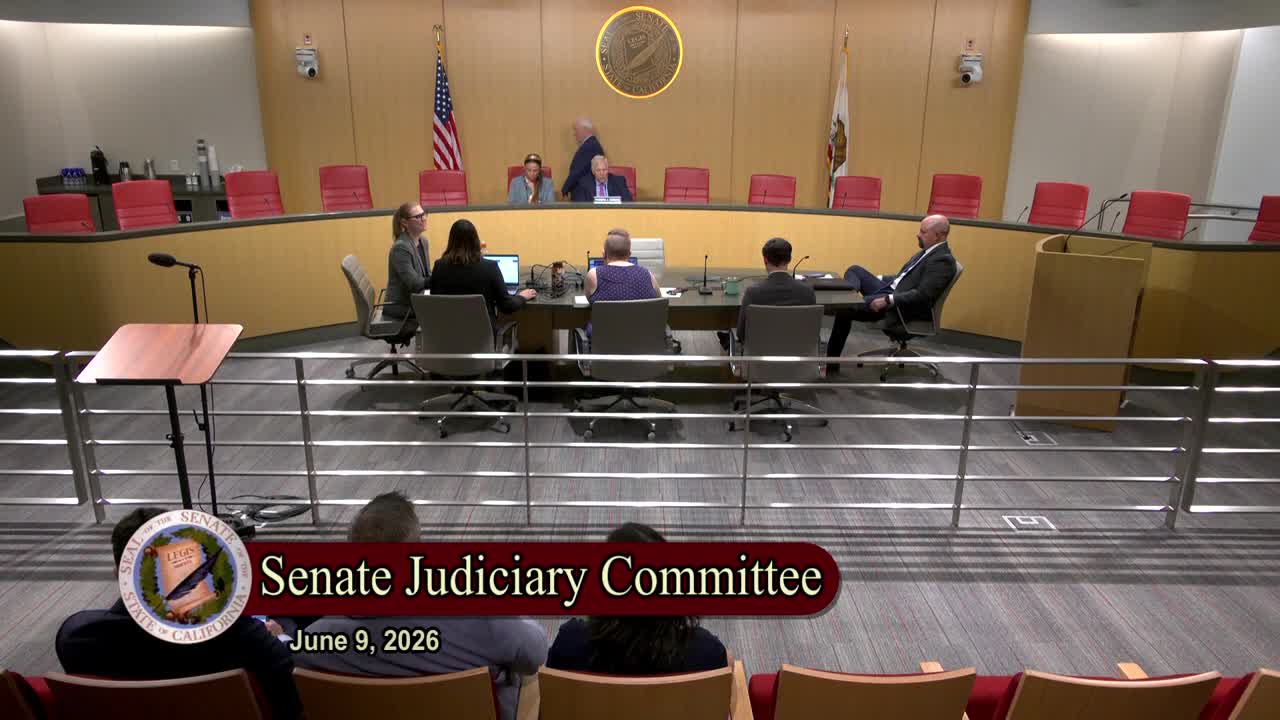 3MIN
Senate Standing Committee on Judiciary
 1MIN
Assembly Floor
 8MIN
Assembly Standing Committee on Judiciary
Bill Author

Bill Co-Author(s):