AB 1663: Western Joshua Tree Conservation Act: removal: trimming.
- Session Year: 2025-2026
- House: Assembly
- Latest Version Date: 2026-09-29
Current Status:
Passed
(2026-09-29: Chaptered by Secretary of State - Chapter 813, Statutes of 2026.)
Introduced
In Committee
Awaiting First Chamber Vote
Passed First Chamber
In Committee
Awaiting Second Chamber Vote
Passed Second Chamber
Enacted
The Western Joshua Tree Conservation Act prohibits any person or public agency from importing into the state, exporting out of the state, or taking, possessing, purchasing, or selling within the state, a western Joshua tree or any part or product of the tree, except as specified. The act authorizes the Department of Fish and Wildlife to permit the taking of a western Joshua tree if specified conditions are met, including, but not limited to, that the permittee mitigates all impacts to, and taking of, the western Joshua tree through measures that are roughly proportional in extent to the authorized taking of the western Joshua tree. The act authorizes, in lieu of completing the mitigation measures, a permittee to elect to satisfy the mitigation obligation by paying fees pursuant to a specified fee schedule, as provided. The act authorizes the department to permit the removal or trimming of a dead western Joshua tree or trimming of a live western Joshua tree, without payment of fees or other mitigation, provided that the dead western Joshua tree or any limb to be removed satisfies a specified condition. The act requires a property owner seeking a permit to submit a permit request to the department with specified information, including a signed attestation or certification, as provided.
This bill would alternatively allow the agent of a property owner to submit the permit request and to satisfy other related requirements imposed on a property owner. The bill would delete the requirement for the permit request to include a signed attestation or certification.
The act authorizes the department to enter into memoranda of understanding with California Native American tribes to provide for the taking and possession of western Joshua trees for tribal cultural purposes.
This bill would instead authorize the memoranda to include the taking, possession, purchase, or sale of western Joshua trees for tribal cultural purposes.
The Western Joshua Tree Conservation Act prohibits any person or public agency from importing into the state, exporting out of the state, or taking, possessing, purchasing, or selling within the state, a western Joshua tree or any part or product of the tree, except as specified. The act authorizes the Department of Fish and Wildlife to permit the taking of a western Joshua tree if specified conditions are met, including, but not limited to, that the permittee mitigates all impacts to, and taking of, the western Joshua tree through measures that are roughly proportional in extent to the authorized taking of the western Joshua tree. The act authorizes, in lieu of completing the mitigation measures, a permittee to elect to satisfy the mitigation obligation by paying fees pursuant to a specified fee schedule, as provided. The act authorizes the department to permit the removal or trimming of a dead western Joshua tree or trimming of a live western Joshua tree, without payment of fees or other mitigation, provided that the dead western Joshua tree or any limb to be removed satisfies a specified condition, including that the tree is leaning against an existing structure. condition. The act requires a property owner seeking a permit to submit a permit request to the department with specified information, including a signed attestation or certification, as provided.
This bill would additionally authorize the department to issue a permit, without payment of fees or other mitigation, for the removal or trimming of any western Joshua tree that meets certain criteria, including that the western Joshua tree is located on a parcel that contains an existing single-family residence that is occupied by a person who maintains a specified homeowners property tax exemption and that the removal or trimming of the western Joshua tree is necessary to maintain, repair, or replace existing infrastructure or utilities, as specified. The bill would require an applicant for a permit to demonstrate to the department that the western Joshua tree meets the criteria required for the permit, as specified. alternatively allow the agent of a property owner to submit the permit request and to satisfy other related requirements imposed on a property owner. The bill would delete the requirement for the permit request to include a signed attestation or certification.
The act authorizes the department to enter into memoranda of understanding with California Native American tribes to provide for the taking and possession of western Joshua trees for tribal cultural purposes.
This bill would instead authorize the memoranda to include the taking, possession, purchase, or sale of western Joshua trees for tribal cultural purposes.
The Western Joshua Tree Conservation Act prohibits any person or public agency from importing into the state, exporting out of the state, or taking, possessing, purchasing, or selling within the state, a western Joshua tree or any part or product of the tree, except as specified. The act authorizes the Department of Fish and Wildlife to permit the taking of a western Joshua tree if specified conditions are met, including, but not limited to, that the permittee mitigates all impacts to, and taking of, the western Joshua tree through measures that are roughly proportional in extent to the authorized taking of the western Joshua tree. The act authorizes, in lieu of completing the mitigation measures, a permittee to elect to satisfy the mitigation obligation by paying fees pursuant to a specified fee schedule, as provided. The act authorizes the department to permit the removal or trimming of a dead western Joshua tree or trimming of a live western Joshua tree, without payment of fees or other mitigation, provided that the dead western Joshua tree or any limb to be removed satisfies a specified condition, including that the tree is leaning against an existing structure.
This bill would additionally authorize the department to issue a permit, without payment of fees or other mitigation, for the removal or trimming of any western Joshua tree that meets certain criteria, including that the western Joshua tree is located on a parcel that contains an existing single-family residence that is occupied by a person who maintains a specified homeowners property tax exemption and that the removal or trimming of the western Joshua tree is necessary to maintain, repair, or replace existing infrastructure or utilities, as specified. The bill would require an applicant for a permit to demonstrate to the department that the western Joshua tree meets the criteria required for the permit, as specified.
The act authorizes the department to enter into memoranda of understanding with California Native American tribes to provide for the taking and possession of western Joshua trees for tribal cultural purposes.
This bill would instead authorize the memoranda to include the taking, possession, purchase, or sale of western Joshua trees for tribal cultural purposes.
The Western Joshua Tree Conservation Act prohibits any person or public agency from importing into the state, exporting out of the state, or taking, possessing, purchasing, or selling within the state, a western Joshua tree or any part or product of the tree, except as specified. The act authorizes the Department of Fish and Wildlife to permit the taking of a western Joshua tree if specified conditions are met, including, but not limited to, that the permittee mitigates all impacts to, and taking of, the western Joshua tree through measures that are roughly proportional in extent to the authorized taking of the western Joshua tree. The act authorizes, in lieu of completing the mitigation measures, a permittee to elect to satisfy the mitigation obligation by paying fees pursuant to a specified fee schedule, as provided. The act authorizes the department to permit the removal or trimming of a dead western Joshua tree or trimming of a live western Joshua tree, without payment of fees or other mitigation, provided that the dead western Joshua tree or any limb to be removed satisfies a specified condition, including that the tree is leaning against an existing structure.
This bill would exempt from the act a project or activity located within a parcel that contains, or will contain, a single-family residence that has been continuously owned by the same person, as specified, on or before July 10, 2023, and the parcel owner complies with applicable local ordinances regarding western Joshua trees as those local ordinances read on July 10, 2023.This bill would additionally authorize the department to issue a permit, without payment of fees or other mitigation, for the removal or trimming of any western Joshua tree that meets certain criteria, including that the western Joshua tree is located on a parcel that contains an existing single-family residence that is occupied by a person who maintains a specified homeowners property tax exemption and that the removal or trimming of the western Joshua tree is necessary to maintain, repair, or replace existing infrastructure or utilities, as specified. The bill would require an applicant for a permit to demonstrate to the department that the western Joshua tree meets the criteria required for the permit, as specified.
The Western Joshua Tree Conservation Act prohibits any person or public agency from importing into the state, exporting out of the state, or taking, possessing, purchasing, or selling within the state, a western Joshua tree or any part or product of the tree, except as specified. The act authorizes the Department of Fish and Wildlife to permit the taking of a western Joshua tree if specified conditions are met, including, but not limited to, that the permittee mitigates all impacts to, and taking of, the western Joshua tree through measures that are roughly proportional in extent to the authorized taking of the western Joshua tree. The act authorizes, in lieu of completing the mitigation measures, a permittee to elect to satisfy the mitigation obligation by paying fees pursuant to a specified fee schedule, as provided.
This bill would exempt from the act a project or activity located within a parcel that contains, or will contain, a single-family residence that has been continuously owned by the same person, as specified, on or before July 10, 2023, and the parcel owner complies with applicable local ordinances regarding western Joshua trees as those local ordinances read on July 10, 2023.
This bill would make a nonsubstantive change to the provision naming the act.The Western Joshua Tree Conservation Act prohibits any person or public agency from importing into the state, exporting out of the state, or taking, possessing, purchasing, or selling within the state, a western Joshua tree or any part or product of the tree, except as specified.
This bill would make a nonsubstantive change to the provision naming the act.
For purposes of this chapter, the following definitions apply:
(a)Accessory structure means a subordinate structure, the use of which is incidental to an existing or contemporaneously constructed single-family residence, including, an accessory dwelling unit, addition to an existing single-family residence, garage, carport, swimming pool, patio, greenhouse, storage shed, gazebo, septic tank, sewer connection, solar panels, fence, or gravel or paved driveway.
(b)California Endangered Species Act means the act established pursuant to Chapter 1.5 (commencing with Section 2050) of Division 3.
(c)Conserve or conservation means to use, and the use of, methods and procedures that are necessary to bring species listed pursuant to Chapter 1.5 (commencing with Section 2050) of Division 3 to the point at which the measures provided pursuant to Chapter 1.5 (commencing with Section 2050) of Division 3 are no longer necessary, and for species that are not listed to maintain or enhance the condition of the species so that listing will not become necessary.
(d)Dead western Joshua tree means a western Joshua tree that meets at least one of the following criteria:
(1)Has not burned and has no green leaves, no new growth on the main stem, and no basal sprouts.
(2)Has partially or fully burned at least 18 months prior and otherwise satisfies paragraph (1).
(3)Has fallen and is completely detached from its roots or has fallen and its roots are no longer in contact with the soil.
(e)Desert native plant specialist means an arborist certified by the International Society of Arboriculture, or an individual with at least five years of professional experience with relocation or restoration of native California desert vegetation.
(f)Fee means the elective fee described in subdivisions (d) and (e) of Section 1927.3, which is to be deposited into the fund.
(g)Fund means the Western Joshua Tree Conservation Fund as described in Section 1927.5.
(h)Multifamily residence means an apartment building, rowhouse, town house, condominium, or manufactured building that consists of two or more attached dwelling units designed for occupancy by two or more families living independently of one another.
(i)Public works project means a project involving the erection, construction, alteration, repair, or improvement of any public structure, building, road, or other public improvement of any kind.
(j)Relocated or relocation means the removal of a living western Joshua tree and a sufficient portion of its root mass from the ground and transplanting it.
(k)Single-family residence means a single detached building that has been, or will be, constructed and used as living facilities, including provisions for sleeping, eating, cooking, and sanitation, as required by the California Building Standards Code, for not more than one household.
(l)Western Joshua tree means Yucca brevifolia, an evergreen, tree-like plant that has been treated as a member of the asparagus family (Asparagaceae).
SEC. 2.Section 1927.2 of the Fish and Game Code is amended to read:1927.2.(a)No person or public agency shall import into this state, export out of this state, or take, possess, purchase, or sell within this state, a western Joshua tree or any part or product of the tree, except as authorized pursuant to any of the following, as applicable:
(1)This chapter.
(2)The California Endangered Species Act.
(3)The Natural Community Conservation Planning Act (Chapter 10 (commencing with Section 2800) of Division 3).
(b)During any period in which the western Joshua tree has been designated by the commission as a candidate for listing under the California Endangered Species Act, any person or public agency seeking a take authorization for the western Joshua tree may obtain a take authorization as provided by the California Endangered Species Act or by electing to pay the fees set forth in Section 1927.3.
(c)(1)This chapter is a change in state law, within the meaning of paragraph (1) of subdivision (c) of Section 2075.5, that has a direct and significant impact on the commissions determination as to whether the petitioned action is warranted. Pursuant to subdivision (c) of Section 2075.5, the commission shall reopen the administrative record for the commissions determination for the purpose of assessing the impact of the conservation program established by this chapter.
(2)In making the assessment described in paragraph (1), the commission shall consider all of the following:
(A)The effectiveness of any conservation measures funded through expenditures of fees by the department pursuant to Section 1927.5.
(B)The conservation plan developed by the department and approved by the commission pursuant to Section 1927.6.
(C)Any annual reports submitted to the commission by the department pursuant to Section 1927.7.
(D)Any recommendations submitted to the commission by the department pursuant to subdivision (a) of Section 1927.8.
(E)The fee adjustments, if any, adopted by the department pursuant to subdivision (b) of Section 1927.8.
(F)An updated status review to be submitted to the commission by the department no later than January 1, 2033, unless the commission directs the department to submit the updated status review sooner.
(d)If the commission determines that listing the western Joshua tree as endangered or threatened pursuant to the California Endangered Species Act is not warranted, this chapter shall remain operative and the authorization of take of a western Joshua tree shall be pursuant to this chapter.
(e)If the commission determines that listing the western Joshua tree as endangered or threatened pursuant to the California Endangered Species Act is warranted, this chapter shall become inoperative and the authorization of take of a western Joshua tree shall only be pursuant to Chapter 1.5 (commencing with Section 2050) of Division 3 or pursuant to the Natural Community Conservation Planning Act (Chapter 10 (commencing with Section 2800) of Division 3).
(f)Upon the approval of a natural community conservation plan that provides for the conservation of the western Joshua tree as a covered species, the authorization of take of a western Joshua tree for any project or activity covered by the plan shall only be pursuant to Chapter 10 (commencing with Section 2800) of Division 3.
(g)The provisions of the Native Plant Protection Act (Chapter 10 (commencing with Section 1900)), and the California Desert Native Plants Act (Division 23 (commencing with Section 80001) of the Food and Agricultural Code), shall not apply to the western Joshua tree.
(h)The department may authorize, by permit or memorandum of understanding, the taking, possession, purchase, or sale within the state of a western Joshua tree to aid the conservation and recovery of the western Joshua tree, and may enter into memoranda of understanding with California Native American tribes to provide for the taking, possession, purchase, or sale of western Joshua trees for tribal cultural purposes.
(i)Any authorization issued by the department pursuant to Section 2081 or 2084, before the enactment of this chapter, to import, export, take, possess, purchase, or sell a western Joshua tree shall be valid and remain in effect after the enactment of this chapter pursuant to the terms of the authorization.
SEC. 3.Section 1927.4 of the Fish and Game Code is amended to read:1927.4.(a)The department may issue a permit to authorize either the removal or trimming of dead western Joshua trees or the trimming of live western Joshua trees.
(1)Upon receipt of a permit and payment of any applicable administrative fees, a property owner or their agent may remove a detached dead western Joshua tree or the detached limb of a western Joshua tree. All other removals and all trimming of western Joshua trees authorized by permits issued pursuant to this subdivision shall be completed by a desert native plant specialist.
(2)The department may issue permits pursuant to this section, without payment of fees or other mitigation, provided that the dead western Joshua trees or any limbs to be removed meet one of the following:
(A)Have fallen over and are within 30 feet of a structure.
(B)Are leaning against an existing structure.
(C)Create an imminent threat to public health or safety.
(3)A property owner or their agent seeking a permit pursuant to this subdivision shall submit a permit request to the department on a form to be provided by the department that requires all of the following information:
(A)The name, telephone number, mailing address, and email address of the property owner or their agent seeking the permit.
(B)The street address of the property on which the western Joshua trees to be removed or trimmed are located. If no street address is available, the property owner or their agent shall include the assessors parcel number.
(C)Photographs of the western Joshua trees that visually depict the dead trees or the trees to be trimmed and that demonstrate that the western Joshua tree meets one or more of the requirements of paragraph (2).
(4)(A)Within 30 days of receipt of a request for a permit pursuant to subparagraph (A) or subparagraph (B) of paragraph (2), the department shall either issue a permit allowing for the removal or trimming, or deny the request if the request does not demonstrate a permit can be issued pursuant to this section.
(B)Within 10 days of receipt of a request for a permit pursuant to subparagraph (C) of paragraph (2), the department shall either issue a permit allowing for the removal or trimming, or deny the request if the request does not demonstrate a permit can be issued pursuant to this section.
(C)If the department issues a permit, it shall provide the property owner or their agent 60 days in which to complete the removal or trimming. The department may extend this 60-day period in writing at its discretion.
(D)If the department denies the permit request, the property owner or their agent may resubmit the request with additional information and photographs. Resubmissions pursuant to this subdivision shall be processed as new permit requests.
(5)Within 30 days of completing the removal or trimming of one or more western Joshua trees in accordance with a permit issued pursuant to this section, the property owner or their agent shall submit, by mail or email, photographs of the site at which the western Joshua trees were removed or trimmed pursuant to the permit.
(b)The department may enter into an agreement with any county or city to delegate to the county or city the ability to authorize the removal or trimming of dead western Joshua trees or the trimming of live western Joshua trees, provided that the county or city ensures that all permits issued satisfy the requirements of subdivision (a). The county or city shall be required to submit to the department quarterly reports documenting the number of permits issued, the number and size class of western Joshua trees authorized to be removed or trimmed, and any other information specified in the agreement with the department. A county or city entering into an agreement pursuant to this subdivision may impose a reasonable fee to cover the administrative costs of issuing the permit.
(c)(1)The department retains express authority to suspend or revoke an agreement with any county or city to delegate to the county or city the ability to authorize the removal or trimming of dead western Joshua trees or the trimming of live western Joshua trees in the event the department determines the county or city has violated the terms of the agreement or this chapter, the county or city fails to implement or enforce the terms of the agreement or this chapter, or the local population of western Joshua trees within, or in the vicinity of, that county or city needs further protection. A county or city that has entered into an agreement with the department shall conduct an annual assessment of the status of the local population of western Joshua trees within the county or city and submit the assessment to the department. The department shall determine if the population needs further protection to provide for the conservation of the species.
(2)The department shall adopt standardized survey and assessment methods for the annual assessment required pursuant to paragraph (1), including requiring that a desert native plant specialist conduct the assessment. Chapter 3.5 (commencing with Section 11340) of Part 1 of Division 3 of Title 2 of the Government Code shall not apply to the development, adoption, or amendment of standardized survey and assessment methods pursuant to this paragraph.
For purposes of this chapter, the following definitions apply:
(a)Accessory structure means a subordinate structure, the use of which is incidental to an existing or contemporaneously constructed single-family residence, including, an accessory dwelling unit, addition to an existing single-family residence, garage, carport, swimming pool, patio, greenhouse, storage shed, gazebo, septic tank, sewer connection, solar panels, fence, or gravel or paved driveway.
(b)California Endangered Species Act means the act established pursuant to Chapter 1.5 (commencing with Section 2050) of Division 3.
(c)Conserve or conservation means to use, and the use of, methods and procedures that are necessary to bring species listed pursuant to Chapter 1.5 (commencing with Section 2050) of Division 3 to the point at which the measures provided pursuant to Chapter 1.5 (commencing with Section 2050) of Division 3 are no longer necessary, and for species that are not listed to maintain or enhance the condition of the species so that listing will not become necessary.
(d)Dead western Joshua tree means a western Joshua tree that meets at least one of the following criteria:
(1)Has not burned and has no green leaves, no new growth on the main stem, and no basal sprouts.
(2)Has partially or fully burned at least 18 months prior and otherwise satisfies paragraph (1).
(3)Has fallen and is completely detached from its roots or has fallen and its roots are no longer in contact with the soil.
(e)Desert native plant specialist means an arborist certified by the International Society of Arboriculture, or an individual with at least five years of professional experience with relocation or restoration of native California desert vegetation.
(f)Fee means the elective fee described in subdivisions (d) and (e) of Section 1927.3, which is to be deposited into the fund.
(g)Fund means the Western Joshua Tree Conservation Fund as described in Section 1927.5.
(h)Multifamily residence means an apartment building, rowhouse, town house, condominium, or manufactured building that consists of two or more attached dwelling units designed for occupancy by two or more families living independently of one another.
(i)Public works project means a project involving the erection, construction, alteration, repair, or improvement of any public structure, building, road, or other public improvement of any kind.
(j)Relocated or relocation means the removal of a living western Joshua tree and a sufficient portion of its root mass from the ground and transplanting it.
(k)Single-family residence means a single detached building that has been, or will be, constructed and used as living facilities, including provisions for sleeping, eating, cooking, and sanitation, as required by the California Building Standards Code, for not more than one household.
(l)Western Joshua tree means Yucca brevifolia, an evergreen, tree-like plant that has been treated as a member of the asparagus family (Asparagaceae).
SEC. 2.Section 1927.2 of the Fish and Game Code is amended to read:1927.2.(a)No person or public agency shall import into this state, export out of this state, or take, possess, purchase, or sell within this state, a western Joshua tree or any part or product of the tree, except as authorized pursuant to any of the following, as applicable:
(1)This chapter.
(2)The California Endangered Species Act.
(3)The Natural Community Conservation Planning Act (Chapter 10 (commencing with Section 2800) of Division 3).
(b)During any period in which the western Joshua tree has been designated by the commission as a candidate for listing under the California Endangered Species Act, any person or public agency seeking a take authorization for the western Joshua tree may obtain a take authorization as provided by the California Endangered Species Act or by electing to pay the fees set forth in Section 1927.3.
(c)(1)This chapter is a change in state law, within the meaning of paragraph (1) of subdivision (c) of Section 2075.5, that has a direct and significant impact on the commissions determination as to whether the petitioned action is warranted. Pursuant to subdivision (c) of Section 2075.5, the commission shall reopen the administrative record for the commissions determination for the purpose of assessing the impact of the conservation program established by this chapter.
(2)In making the assessment described in paragraph (1), the commission shall consider all of the following:
(A)The effectiveness of any conservation measures funded through expenditures of fees by the department pursuant to Section 1927.5.
(B)The conservation plan developed by the department and approved by the commission pursuant to Section 1927.6.
(C)Any annual reports submitted to the commission by the department pursuant to Section 1927.7.
(D)Any recommendations submitted to the commission by the department pursuant to subdivision (a) of Section 1927.8.
(E)The fee adjustments, if any, adopted by the department pursuant to subdivision (b) of Section 1927.8.
(F)An updated status review to be submitted to the commission by the department no later than January 1, 2033, unless the commission directs the department to submit the updated status review sooner.
(d)If the commission determines that listing the western Joshua tree as endangered or threatened pursuant to the California Endangered Species Act is not warranted, this chapter shall remain operative and the authorization of take of a western Joshua tree shall be pursuant to this chapter.
(e)If the commission determines that listing the western Joshua tree as endangered or threatened pursuant to the California Endangered Species Act is warranted, this chapter shall become inoperative and the authorization of take of a western Joshua tree shall only be pursuant to Chapter 1.5 (commencing with Section 2050) of Division 3 or pursuant to the Natural Community Conservation Planning Act (Chapter 10 (commencing with Section 2800) of Division 3).
(f)Upon the approval of a natural community conservation plan that provides for the conservation of the western Joshua tree as a covered species, the authorization of take of a western Joshua tree for any project or activity covered by the plan shall only be pursuant to Chapter 10 (commencing with Section 2800) of Division 3.
(g)The provisions of the Native Plant Protection Act (Chapter 10 (commencing with Section 1900)), and the California Desert Native Plants Act (Division 23 (commencing with Section 80001) of the Food and Agricultural Code), shall not apply to the western Joshua tree.
(h)The department may authorize, by permit or memorandum of understanding, the taking, possession, purchase, or sale within the state of a western Joshua tree to aid the conservation and recovery of the western Joshua tree, and may enter into memoranda of understanding with California Native American tribes to provide for the taking, possession, purchase, or sale of western Joshua trees for tribal cultural purposes.
(i)Any authorization issued by the department pursuant to Section 2081 or 2084, before the enactment of this chapter, to import, export, take, possess, purchase, or sell a western Joshua tree shall be valid and remain in effect after the enactment of this chapter pursuant to the terms of the authorization.
SEC. 3.Section 1927.4 of the Fish and Game Code is amended to read:1927.4.(a)The department may issue a permit to authorize either the removal or trimming of a western Joshua tree.(1)Upon receipt of a permit and payment of any applicable administrative fees, a property owner or its agent may remove a detached dead western Joshua tree or the detached limb of a western Joshua tree. All other removals and all trimming of western Joshua trees authorized by permits issued pursuant to this subdivision shall be completed by a desert native plant specialist.(2)The department may issue permits pursuant to this section, without payment of fees or other mitigation, provided that either of the following apply:(A)A dead western Joshua tree or any limb to be removed meets one of the following conditions:(i)Has fallen over and are within 30 feet of a structure.(ii)Is leaning against an existing structure.(iii)Creates an imminent threat to public health or safety.(B)A western Joshua tree meets all of the following criteria:(i)The western Joshua tree is located on a parcel that contains an existing single-family residence that is occupied by a person who maintains a homeowners property tax exemption on the residence pursuant to Section 218 of the Revenue and Taxation Code.(ii)The removal or trimming of the western Joshua tree is necessary to maintain, repair, or replace existing infrastructure or utilities serving the residence or to comply with any applicable state or local law, ordinance, or regulation governing fire, health, or safety.(3)(A)The department shall develop and maintain guidance for property owners of activities eligible for a permit pursuant to clause (ii) of subparagraph (B) of paragraph (2).(B)(i)No more than 10 individual western Joshua trees may be removed or trimmed for each permit issued pursuant to subparagraph (B) of paragraph (2).(ii)No more than one permit may be issued pursuant to subparagraph (B) of paragraph (2) for each incident related to existing infrastructure or utilities.(4)A property owner or their agent seeking a permit pursuant to this subdivision shall submit a permit request to the department on a form to be provided by the department that requires the following information:(A)The name, telephone number, mailing address, and email address of the property owner or their agent seeking the permit.(B)The street address of the property on which the western Joshua tree to be removed or trimmed is located. If no street address is available, the property owner or their agent shall include the assessors parcel number.(C)For a request for a permit pursuant to subparagraph (A) of paragraph (2), photographs are required of the western Joshua trees that visually depict the dead trees or the trees to be trimmed and that demonstrate that the western Joshua tree meets one or more of the requirements of subparagraph (A) of paragraph (2).(D)For a request for a permit pursuant to subparagraph (B) of paragraph (2), all of the following are required:(i)Proof of the maintenance of a property tax exemption required by clause (i) of subparagraph (B) of paragraph (2).(ii)A description of how the removal of a tree is necessary pursuant to clause (ii) of subparagraph (B) of paragraph (2).(iii)Photographs of the western Joshua trees that visually depict the western Joshua trees to be removed or trimmed.(5)(A)Within 30 days of receipt of a request for a permit pursuant to clause (i) or (ii) of subparagraph (A) or subparagraph (B) of paragraph (2), the department shall either issue a permit allowing for the removal or trimming, or deny the request if the request does not demonstrate a permit can be issued pursuant to this section.(B)Within 10 days of receipt of a request for a permit pursuant to clause (iii) of subparagraph (A) of paragraph (2), the department shall either issue a permit allowing for the removal or trimming, or deny the request if the request does not demonstrate a permit can be issued pursuant to this section.(C)If the department issues a permit, it shall provide the property owner or their agent 60 days in which to complete the removal or trimming. The department may extend this 60-day period in writing at its discretion.(D)If the department denies the permit request, the property owner or their agent may resubmit the request with additional information and photographs. Resubmissions pursuant to this subdivision shall be processed as new permit requests.(6)Within 30 days of completing the removal or trimming of one or more western Joshua trees in accordance with a permit issued pursuant to this section, the property owner or their agent shall submit, by mail or email, photographs of the site at which each western Joshua tree was removed or trimmed pursuant to the permit.(b)The department may enter into an agreement with any county or city to delegate to the county or city the ability to authorize the removal or trimming of a western Joshua tree provided that the county or city ensures that all permits issued satisfy the requirements of subdivision (a). The county or city shall be required to submit to the department quarterly reports documenting the number of permits issued, the number and size class of western Joshua trees authorized to be removed or trimmed, and any other information specified in the agreement with the department. A county or city entering into an agreement pursuant to this subdivision may impose a reasonable fee to cover the administrative costs of issuing the permit.(c)(1)The department retains express authority to suspend or revoke an agreement with any county or city to delegate to the county or city the ability to authorize the removal or trimming of a western Joshua tree in the event the department determines the county or city has violated the terms of the agreement or this chapter, the county or city fails to implement or enforce the terms of the agreement or this chapter, or the local population of western Joshua trees within, or in the vicinity of, that county or city needs further protection. A county or city that has entered into an agreement with the department shall conduct an annual assessment of the status of the local population of western Joshua trees within the county or city and submit the assessment to the department. The department shall determine if the population needs further protection to provide for the conservation of the species.(2)The department shall adopt standardized survey and assessment methods for the annual assessment required pursuant to paragraph (1), including requiring that a desert native plant specialist conduct the assessment. Chapter 3.5 (commencing with Section 11340) of Part 1 of Division 3 of Title 2 of the Government Code shall not apply to the development, adoption, or amendment of standardized survey and assessment methods pursuant to this paragraph.SEC. 3.Section 1927.4 of the Fish and Game Code is amended to read:1927.4.(a)The department may issue a permit to authorize either the removal or trimming of dead western Joshua trees or the trimming of live western Joshua trees.
(1)Upon receipt of a permit and payment of any applicable administrative fees, a property owner or its their agent may remove a detached dead western Joshua tree or the detached limb of a western Joshua tree. All other removals and all trimming of western Joshua trees authorized by permits issued pursuant to this subdivision shall be completed by a desert native plant specialist.
(2)The department may issue permits pursuant to this section, without payment of fees or other mitigation, provided that the dead western Joshua trees or any limbs to be removed meet one of the following:
(A)Have fallen over and are within 30 feet of a structure.
(B)Are leaning against an existing structure.
(C)Create an imminent threat to public health or safety.
(3)A property owner or their agent seeking a permit pursuant to this subdivision shall submit a permit request to the department on a form to be provided by the department that requires the following information:
(A)The name, telephone number, mailing address, and email address of the property owner or their agent seeking the permit.
(B)The street address of the property on which the western Joshua trees to be removed or trimmed are located. If no street address is available, the property owner or their agent shall include the assessors parcel number.
(C)Photographs of the western Joshua trees that visually depict the dead trees or the trees to be trimmed and that demonstrate that the western Joshua tree meets one or more of the requirements of paragraph (2).
(D)A signed attestation from the property owner or signed certification by a desert native plant specialist that the tree meets the definition of a dead western Joshua tree.(4)(A)Within 30 days of receipt of a request for a permit pursuant to subparagraph (A) or subparagraph (B) of paragraph (2), the department shall either issue a permit allowing for the removal or trimming, or deny the request if the request does not demonstrate a permit can be issued pursuant to this section.
(B)Within 10 days of receipt of a request for a permit pursuant to subparagraph (C) of paragraph (2), the department shall either issue a permit allowing for the removal or trimming, or deny the request if the request does not demonstrate a permit can be issued pursuant to this section.
(C)If the department issues a permit, it shall provide the property owner or their agent 60 days in which to complete the removal or trimming. The department may extend this 60-day period in writing at its discretion.
(D)If the department denies the permit request, the property owner or their agent may resubmit the request with additional information and photographs. Resubmissions pursuant to this subdivision shall be processed as new permit requests.
(5)Within 30 days of completing the removal or trimming of one or more western Joshua trees in accordance with a permit issued pursuant to this section, the property owner or their agent shall submit, by mail or email, photographs of the site at which the western Joshua trees were removed or trimmed pursuant to the permit.
(b)The department may enter into an agreement with any county or city to delegate to the county or city the ability to authorize the removal or trimming of dead western Joshua trees or the trimming of live western Joshua trees, provided that the county or city ensures that all permits issued satisfy the requirements of subdivision (a). The county or city shall be required to submit to the department quarterly reports documenting the number of permits issued, the number and size class of western Joshua trees authorized to be removed or trimmed, and any other information specified in the agreement with the department. A county or city entering into an agreement pursuant to this subdivision may impose a reasonable fee to cover the administrative costs of issuing the permit.
(c)(1)The department retains express authority to suspend or revoke an agreement with any county or city to delegate to the county or city the ability to authorize the removal or trimming of dead western Joshua trees or the trimming of live western Joshua trees in the event the department determines the county or city has violated the terms of the agreement or this chapter, the county or city fails to implement or enforce the terms of the agreement or this chapter, or the local population of western Joshua trees within, or in the vicinity of, that county or city needs further protection. A county or city that has entered into an agreement with the department shall conduct an annual assessment of the status of the local population of western Joshua trees within the county or city and submit the assessment to the department. The department shall determine if the population needs further protection to provide for the conservation of the species.
(2)The department shall adopt standardized survey and assessment methods for the annual assessment required pursuant to paragraph (1), including requiring that a desert native plant specialist conduct the assessment. Chapter 3.5 (commencing with Section 11340) of Part 1 of Division 3 of Title 2 of the Government Code shall not apply to the development, adoption, or amendment of standardized survey and assessment methods pursuant to this paragraph.
For purposes of this chapter, the following definitions apply:
(a)Accessory structure means a subordinate structure, the use of which is incidental to an existing or contemporaneously constructed single-family residence, including, an accessory dwelling unit, addition to an existing single-family residence, garage, carport, swimming pool, patio, greenhouse, storage shed, gazebo, septic tank, sewer connection, solar panels, fence, or gravel or paved driveway.
(b)California Endangered Species Act means the act established pursuant to Chapter 1.5 (commencing with Section 2050) of Division 3.
(c)Conserve or conservation means to use, and the use of, methods and procedures that are necessary to bring species listed pursuant to Chapter 1.5 (commencing with Section 2050) of Division 3 to the point at which the measures provided pursuant to Chapter 1.5 (commencing with Section 2050) of Division 3 are no longer necessary, and for species that are not listed to maintain or enhance the condition of the species so that listing will not become necessary.
(d)Dead western Joshua tree means a western Joshua tree that meets at least one of the following criteria:
(1)Has not burned and has no green leaves, no new growth on the main stem, and no basal sprouts.
(2)Has partially or fully burned at least 18 months prior and otherwise satisfies paragraph (1).
(3)Has fallen and is completely detached from its roots or has fallen and its roots are no longer in contact with the soil.
(e)Desert native plant specialist means an arborist certified by the International Society of Arborists, Arboriculture, or an individual with at least five years of professional experience with relocation or restoration of native California desert vegetation.
(f)Fee means the elective fee described in subdivisions (d) and (e) of Section 1927.3, which is to be deposited into the fund.
(g)Fund means the Western Joshua Tree Conservation Fund as described in Section 1927.5.
(h)Multifamily residence means an apartment building, rowhouse, town house, condominium, or manufactured building that consists of two or more attached dwelling units designed for occupancy by two or more families living independently of one another.
(i)Public works project means a project involving the erection, construction, alteration, repair, or improvement of any public structure, building, road, or other public improvement of any kind.
(j)Relocated or relocation means the removal of a living western Joshua tree and a sufficient portion of its root mass from the ground and transplanting it.
(k)Single-family residence means a single detached building that has been, or will be, constructed and used as living facilities, including provisions for sleeping, eating, cooking, and sanitation, as required by the California Building Standards Code, for not more than one household.
(l)Western Joshua tree means Yucca brevifolia, an evergreen, tree-like plant that has been treated as a member of the asparagus family (Asparagaceae).
SEC. 2.Section 1927.2 of the Fish and Game Code is amended to read:1927.2.(a)No person or public agency shall import into this state, export out of this state, or take, possess, purchase, or sell within this state, a western Joshua tree or any part or product of the tree, except as authorized pursuant to any of the following, as applicable:
(1)This chapter.
(2)The California Endangered Species Act.
(3)The Natural Community Conservation Planning Act (Chapter 10 (commencing with Section 2800) of Division 3).
(b)During any period in which the western Joshua tree has been designated by the commission as a candidate for listing under the California Endangered Species Act, any person or public agency seeking a take authorization for the western Joshua tree may obtain a take authorization as provided by the California Endangered Species Act or by electing to pay the fees set forth in Section 1927.3.
(c)(1)This chapter is a change in state law, within the meaning of paragraph (1) of subdivision (c) of Section 2075.5, that has a direct and significant impact on the commissions determination as to whether the petitioned action is warranted. Pursuant to subdivision (c) of Section 2075.5, the commission shall reopen the administrative record for the commissions determination for the purpose of assessing the impact of the conservation program established by this chapter.
(2)In making the assessment described in paragraph (1), the commission shall consider all of the following:
(A)The effectiveness of any conservation measures funded through expenditures of fees by the department pursuant to Section 1927.5.
(B)The conservation plan developed by the department and approved by the commission pursuant to Section 1927.6.
(C)Any annual reports submitted to the commission by the department pursuant to Section 1927.7.
(D)Any recommendations submitted to the commission by the department pursuant to subdivision (a) of Section 1927.8.
(E)The fee adjustments, if any, adopted by the department pursuant to subdivision (b) of Section 1927.8.
(F)An updated status review to be submitted to the commission by the department no later than January 1, 2033, unless the commission directs the department to submit the updated status review sooner.
(d)If the commission determines that listing the western Joshua tree as endangered or threatened pursuant to the California Endangered Species Act is not warranted, this chapter shall remain operative and the authorization of take of a western Joshua tree shall be pursuant to this chapter.
(e)If the commission determines that listing the western Joshua tree as endangered or threatened pursuant to the California Endangered Species Act is warranted, this chapter shall become inoperative and the authorization of take of a western Joshua tree shall only be pursuant to Chapter 1.5 (commencing with Section 2050) of Division 3 or pursuant to the Natural Community Conservation Planning Act (Chapter 10 (commencing with Section 2800) of Division 3).
(f)Upon the approval of a natural community conservation plan that provides for the conservation of the western Joshua tree as a covered species, the authorization of take of a western Joshua tree for any project or activity covered by the plan shall only be pursuant to Chapter 10 (commencing with Section 2800) of Division 3.
(g)The provisions of the Native Plant Protection Act (Chapter 10 (commencing with Section 1900)), and the California Desert Native Plants Act (Division 23 (commencing with Section 80001) of the Food and Agricultural Code), shall not apply to the western Joshua tree.
(h)This section shall not preclude the department from authorizing, The department may authorize, by permit or memorandum of understanding, the taking, possession, purchase, or sale within the state of a western Joshua tree to aid the conservation and recovery of the western Joshua tree, or entering and may enter into memoranda of understanding with California Native American tribes to provide for the taking and possession taking, possession, purchase, or sale of western Joshua trees for tribal cultural purposes, or as otherwise required by applicable law. purposes.
(i)Any authorization issued by the department pursuant to Section 2081 or 2084, before the enactment of this chapter, to import, export, take, possess, purchase, or sell a western Joshua tree shall be valid and remain in effect after the enactment of this chapter pursuant to the terms of the authorization.
SECTION 1.SEC. 3.Section 1927.4 of the Fish and Game Code is amended to read:1927.4.(a)The department may issue a permit to authorize either the removal or trimming of a western Joshua tree.
(1)Upon receipt of a permit and payment of any applicable administrative fees, a property owner or its agent may remove a detached dead western Joshua tree or the detached limb of a western Joshua tree. All other removals and all trimming of western Joshua trees authorized by permits issued pursuant to this subdivision shall be completed by a desert native plant specialist.
(2)The department may issue permits pursuant to this section, without payment of fees or other mitigation, provided that either of the following apply:
(A)A dead western Joshua tree or any limb to be removed meets one of the following conditions:
(i)Has fallen over and are within 30 feet of a structure.
(ii)Is leaning against an existing structure.
(iii)Creates an imminent threat to public health or safety.
(B)A western Joshua tree meets all of the following criteria:
(i)The western Joshua tree is located on a parcel that contains an existing single-family residence that is occupied by a person who maintains a homeowners property tax exemption on the residence pursuant to Section 218 of the Revenue and Taxation Code.
(ii)The removal or trimming of the western Joshua tree is necessary to maintain, repair, or replace existing infrastructure or utilities serving the residence or to comply with department approved fire, health, or safety requirements, including defensible space requirements. any applicable state or local law, ordinance, or regulation governing fire, health, or safety.
(C)No more than 10 individual western Joshua trees or any limbs may be removed for each permit issued pursuant to subparagraph (B).(3)(A)The department shall develop and maintain guidance for property owners of activities eligible for a permit pursuant to clause (ii) of subparagraph (B) of paragraph (2).
(B)(i)No more than 10 individual western Joshua trees may be removed or trimmed for each permit issued pursuant to subparagraph (B) of paragraph (2).
(ii)No more than one permit may be issued pursuant to subparagraph (B) of paragraph (2) for each incident related to existing infrastructure or utilities.
(3)(4)A property owner or their agent seeking a permit pursuant to this subdivision shall submit a permit request to the department on a form to be provided by the department that requires the following information:
(A)The name, telephone number, mailing address, and email address of the property owner or their agent seeking the permit.
(B)The street address of the property on which the western Joshua tree to be removed or trimmed is located. If no street address is available, the property owner or their agent shall include the assessors parcel number.
(C)For a request for a permit pursuant to subparagraph (A) of paragraph (2), both of the following are required:
(i)Photographs photographs are required of the western Joshua trees that visually depict the dead trees or the trees to be trimmed and that demonstrate that the western Joshua tree meets one or more of the requirements of subparagraph (A) of paragraph (2).
(ii)A signed attestation from the property owner or signed certification by a desert native plant specialist that the tree meets the definition of a dead western Joshua tree.(D)For a request for a permit pursuant to subparagraph (B) of paragraph (2), all of the following are required:
(i)Proof of the maintenance of a property tax exemption required by clause (i) of subparagraph (B) of paragraph (2).
(ii)A description of how the removal of a tree is necessary pursuant to clause (ii) of subparagraph (B) of paragraph (2).
(iii)Photographs of the western Joshua trees that visually depict the western Joshua trees to be removed or trimmed.
(4)(5)(A)Within 30 days of receipt of a request for a permit pursuant to clause (i) or (ii) of subparagraph (A) or subparagraph (B) of paragraph (2), the department shall either issue a permit allowing for the removal or trimming, or deny the request if the request does not demonstrate a permit can be issued pursuant to this section.
(B)Within 10 days of receipt of a request for a permit pursuant to clause (iii) of subparagraph (A) of paragraph (2), the department shall either issue a permit allowing for the removal or trimming, or deny the request if the request does not demonstrate a permit can be issued pursuant to this section.
(C)If the department issues a permit, it shall provide the property owner or their agent 60 days in which to complete the removal or trimming. The department may extend this 60-day period in writing at its discretion.
(D)If the department denies the permit request, the property owner or their agent may resubmit the request with additional information and photographs. Resubmissions pursuant to this subdivision shall be processed as new permit requests.
(5)(6)Within 30 days of completing the removal or trimming of one or more western Joshua trees in accordance with a permit issued pursuant to this section, the property owner or their agent shall submit, by mail or email, photographs of the site at which each western Joshua tree was removed or trimmed pursuant to the permit.
(b)The department may enter into an agreement with any county or city to delegate to the county or city the ability to authorize the removal or trimming of a western Joshua tree provided that the county or city ensures that all permits issued satisfy the requirements of subdivision (a). The county or city shall be required to submit to the department quarterly reports documenting the number of permits issued, the number and size class of western Joshua trees authorized to be removed or trimmed, and any other information specified in the agreement with the department. A county or city entering into an agreement pursuant to this subdivision may impose a reasonable fee to cover the administrative costs of issuing the permit.
(c)(1)The department retains express authority to suspend or revoke an agreement with any county or city to delegate to the county or city the ability to authorize the removal or trimming of a western Joshua tree in the event the department determines the county or city has violated the terms of the agreement or this chapter, the county or city fails to implement or enforce the terms of the agreement or this chapter, or the local population of western Joshua trees within, or in the vicinity of, that county or city needs further protection. A county or city that has entered into an agreement with the department shall conduct an annual assessment of the status of the local population of western Joshua trees within the county or city and submit the assessment to the department. The department shall determine if the population needs further protection to provide for the conservation of the species.
(2)The department shall adopt standardized survey and assessment methods for the annual assessment required pursuant to paragraph (1), including requiring that a desert native plant specialist conduct the assessment. Chapter 3.5 (commencing with Section 11340) of Part 1 of Division 3 of Title 2 of the Government Code shall not apply to the development, adoption, or amendment of standardized survey and assessment methods pursuant to this paragraph.
(a)The department may issue a permit to authorize either the removal or trimming of dead western Joshua trees or the trimming of live western Joshua trees. a western Joshua tree.
(1)Upon receipt of a permit and payment of any applicable administrative fees, a property owner or its agent may remove a detached dead western Joshua tree or the detached limb of a western Joshua tree. All other removals and all trimming of western Joshua trees authorized by permits issued pursuant to this subdivision shall be completed by a desert native plant specialist.
(2)The department may issue permits pursuant to this section, without payment of fees or other mitigation, provided that the dead western Joshua trees or any limbs to be removed meet one of the following: either of the following apply:
(A)A dead western Joshua tree or any limb to be removed meets one of the following conditions:
(A)Have(i)Has fallen over and are within 30 feet of a structure.
(B)Are(ii)Is leaning against an existing structure.
(C)Create(iii)Creates an imminent threat to public health or safety.
(B)A western Joshua tree meets all of the following criteria:
(i)The western Joshua tree is located on a parcel that contains an existing single-family residence that is occupied by a person who maintains a homeowners property tax exemption on the residence pursuant to Section 218 of the Revenue and Taxation Code.
(ii)The removal or trimming of the western Joshua tree is necessary to maintain, repair, or replace existing infrastructure or utilities serving the residence or to comply with department approved fire, health, or safety requirements, including defensible space requirements.
(C)No more than 10 individual western Joshua trees or any limbs may be removed for each permit issued pursuant to subparagraph (B).
(3)A property owner seeking a permit pursuant to this subdivision shall submit a permit request to the department on a form to be provided by the department that requires the following information:
(A)The name, telephone number, mailing address, and email address of the property owner seeking the permit.
(B)The street address of the property on which the western Joshua trees tree to be removed or trimmed are is located. If no street address is available, the property owner shall include the assessors parcel number.
(C)For a request for a permit pursuant to subparagraph (A) of paragraph (2), both of the following are required:
(C)(i)Photographs of the western Joshua trees that visually depict the dead trees or the trees to be trimmed and that demonstrate that the western Joshua tree meets one or more of the requirements of paragraph (2). subparagraph (A) of paragraph (2).
(D)(ii)A signed attestation from the property owner or signed certification by a desert native plant specialist that the tree meets the definition of a dead western Joshua tree.
(D)For a request for a permit pursuant to subparagraph (B) of paragraph (2), all of the following are required:
(i)Proof of the maintenance of a property tax exemption required by clause (i) of subparagraph (B) of paragraph (2).
(ii)A description of how the removal of a tree is necessary pursuant to clause (ii) of subparagraph (B) of paragraph (2).
(iii)Photographs of the western Joshua trees that visually depict the western Joshua trees to be removed or trimmed.
(4)(A)Within 30 days of receipt of a request for a permit pursuant to subparagraph (A) or (B) of paragraph (2), clause (i) or (ii) of subparagraph (A) of paragraph (2), the department shall either issue a permit allowing for the removal or trimming, or deny the request if the request does not demonstrate a permit can be issued pursuant to this section.
(B)Within 10 days of receipt of a request for a permit pursuant to subparagraph (C) of paragraph (2), clause (iii) of subparagraph (A) of paragraph (2), the department shall either issue a permit allowing for the removal or trimming, or deny the request if the request does not demonstrate a permit can be issued pursuant to this section.
(C)If the department issues a permit, it shall provide the property owner 60 days in which to complete the removal or trimming. The department may extend this 60-day period in writing at its discretion.
(D)If the department denies the permit request, the property owner may resubmit the request with additional information and photographs. Resubmissions pursuant to this subdivision shall be processed as new permit requests.
(5)Within 30 days of completing the removal or trimming of one or more western Joshua trees in accordance with a permit issued pursuant to this section, the property owner shall submit, by mail or email, photographs of the site at which the western Joshua trees were each western Joshua tree was removed or trimmed pursuant to the permit.
(b)The department may enter into an agreement with any county or city to delegate to the county or city the ability to authorize the removal or trimming of dead western Joshua trees or the trimming of live western Joshua trees, a western Joshua tree provided that the county or city ensures that all permits issued satisfy the requirements of subdivision (a). The county or city shall be required to submit to the department quarterly reports documenting the number of permits issued, the number and size class of western Joshua trees authorized to be removed or trimmed, and any other information specified in the agreement with the department. A county or city entering into an agreement pursuant to this subdivision may impose a reasonable fee to cover the administrative costs of issuing the permit.
(c)(1)The department retains express authority to suspend or revoke an agreement with any county or city to delegate to the county or city the ability to authorize the removal or trimming of dead western Joshua trees or the trimming of live western Joshua trees a western Joshua tree in the event the department determines the county or city has violated the terms of the agreement or this chapter, the county or city fails to implement or enforce the terms of the agreement or this chapter, or the local population of western Joshua trees within, or in the vicinity of, that county or city needs further protection. A county or city that has entered into an agreement with the department shall conduct an annual assessment of the status of the local population of western Joshua trees within the county or city and submit the assessment to the department. The department shall determine if the population needs further protection to provide for the conservation of the species.
(2)The department shall adopt standardized survey and assessment methods for the annual assessment required pursuant to paragraph (1), including requiring that a desert native plant specialist conduct the assessment. Chapter 3.5 (commencing with Section 11340) of Part 1 of Division 3 of Title 2 of the Government Code shall not apply to the development, adoption, or amendment of standardized survey and assessment methods pursuant to this paragraph.
SECTION 1.Section 1928 is added to the Fish and Game Code, to read:1928.This chapter does not apply to a project or activity located within a parcel that contains, or will contain, a single-family residence that meets all of the following criteria:(a)(1)The parcel has been continuously owned by the same person on or before July 10, 2023.(2)For the purpose of this subdivision, continuously owned by the same person shall include all subsequent owners that obtained the property by gift or inheritance and no consideration was provided for transfer of ownership of the parcel.(b)The parcel owner complies with applicable local ordinances regarding western Joshua trees as those local ordinances read on July 10, 2023.This chapter does not apply to a project or activity located within a parcel that contains, or will contain, a single-family residence that meets all of the following criteria:
(a)(1)The parcel has been continuously owned by the same person on or before July 10, 2023.
(2)For the purpose of this subdivision, continuously owned by the same person shall include all subsequent owners that obtained the property by gift or inheritance and no consideration was provided for transfer of ownership of the parcel.
(b)The parcel owner complies with applicable local ordinances regarding western Joshua trees as those local ordinances read on July 10, 2023.
SECTION 1.Section 1927 of the Fish and Game Code is amended to read:1927.This chapter shall be known, and may be cited, as the Western Joshua Tree Conservation Act.This chapter shall be known, and may be cited as, cited, as the Western Joshua Tree Conservation Act.
|
Date
|
Status
|
|---|---|
| Sep 29, 2026 | Chaptered by Secretary of State - Chapter 813, Statutes of 2026. |
| Sep 29, 2026 | Approved by the Governor. |
| Sep 9, 2026 | Enrolled and presented to the Governor at 1 p.m. |
| Aug 30, 2026 | Senate amendments concurred in. To Engrossing and Enrolling. (Ayes 77. Noes 0.). |
| Aug 30, 2026 | Senate amendments concurred in. To Engrossing and Enrolling. (Ayes 77. Noes 0. Page 6848.). |
| Aug 30, 2026 | Senate amendments concurred in. To Engrossing and Enrolling. |
| Aug 27, 2026 | In Assembly. Concurrence in Senate amendments pending. |
| Aug 26, 2026 | Read third time. Passed. Ordered to the Assembly. (Ayes 39. Noes 0.). |
| Aug 24, 2026 | Read second time. Ordered to third reading. |
| Aug 21, 2026 | Read third time and amended. Ordered to second reading. |
| Aug 17, 2026 | Read second time. Ordered to third reading. |
| Aug 13, 2026 | Read second time and amended. Ordered returned to second reading. |
| Aug 13, 2026 | From committee: Amend, and do pass as amended. (Ayes 7. Noes 0.) (August 13). |
| Aug 3, 2026 | In committee: Referred to APPR. suspense file. |
| Jun 25, 2026 | Read second time and amended. Re-referred to Com. on APPR. |
| Jun 24, 2026 | From committee: Amend, and do pass as amended and re-refer to Com. on APPR. with recommendation: To Consent Calendar. (Ayes 7. Noes 0.) (June 23). |
| Jun 3, 2026 | Referred to Com. on N.R. & W. |
| May 21, 2026 | In Senate. Read first time. To Com. on RLS. for assignment. |
| May 21, 2026 | Read third time. Passed. Ordered to the Senate. (Ayes 72. Noes 0.) |
| May 21, 2026 | Read third time. Passed. Ordered to the Senate. (Ayes 72. Noes 0. Page 5191.) |
| May 18, 2026 | Read second time. Ordered to third reading. |
| May 14, 2026 | From committee: Do pass. (Ayes 15. Noes 0.) (May 14). |
| May 6, 2026 | In committee: Set, first hearing. Referred to APPR. suspense file. |
| Apr 28, 2026 | Re-referred to Com. on APPR. |
| Apr 27, 2026 | Read second time and amended. |
| Apr 23, 2026 | From committee: Amend, and do pass as amended and re-refer to Com. on APPR. (Ayes 12. Noes 0.) (April 23). |
| Mar 17, 2026 | Re-referred to Com. on W., P., & W. |
| Mar 16, 2026 | Referred to Com. on W., P., & W. |
| Mar 16, 2026 | From committee chair, with author's amendments: Amend, and re-refer to Com. on W., P., & W. Read second time and amended. |
| Jan 30, 2026 | From printer. May be heard in committee March 1. |
| Jan 29, 2026 | Read first time. To print. |
|
Date
|
Description
|
Location
|
Votes
|
|
|---|---|---|---|---|
| Aug 30, 2026 | AB 1663 Wallis Concurrence in Senate Amendments | Assembly Floor |
Passed |
|
| Aug 26, 2026 | Assembly 3rd Reading AB1663 Wallis et al. By Valladares | Senate Floor |
Passed |
|
| Aug 13, 2026 | Do pass as amended | Senate Standing Committee on Appropriations |
Passed |
|
| Aug 3, 2026 | Placed on suspense file | Senate Standing Committee on Appropriations |
Passed |
|
| Jun 23, 2026 | Do pass as amended, but first amend, and re-refer to the Committee on [Appropriations] with the recommendation: To Consent Calendar | Senate Standing Committee on Natural Resources and Water |
Passed |
|
| May 21, 2026 | AB 1663 Wallis Assembly Third Reading | Assembly Floor |
Passed |
|
| May 14, 2026 | Do pass. | Assembly Standing Committee on Appropriations |
Passed |
|
| Apr 23, 2026 | Do pass as amended and be re-referred to the Committee on [Appropriations] | Assembly Standing Committee on Water, Parks, and Wildlife |
Passed |
This list shows positions taken on this bill by organizations on the date displayed, which is linked to the original source.
Positions by individuals are not included.
|
Organization
|
Position
|
Date
|
|---|---|---|
| 13-37 Design | ** Support | |
| Blu Haus | ** Support | |
| California Association Of Realtors | ** Support | |
| California Department of Finance | ** Against | |
| Clint Edwards Counseling | ** Support | |
| Community Water Systems Alliance | ** Support | |
| Compass Consulting Enterprises, Inc. | ** Support | |
| County of San Bernardino | ** Support | |
| Hi-Desert Water District | ** Support | |
| Inland Action | ** Support | |
| Inspire Real Estate | ** Support | |
| Joshua Tree Gateway Association of Realtors | ** Support | |
| Mission Springs Water District | ** Support | |
| Morongo Basin Residents for Reasonable Joshua Tree Regulations | ** Support | |
| San Bernardino County, Third District | ** Support | |
| San Gorgonio Pass Water Agency | ** Support | |
| The Honorable Dawn Rowe, Supervisor – 3rd District, San Bernardino County | ** Support | |
| The Lux Properties | ** Support |
CONCURRENCE IN SENATE AMENDMENTS
CSA1 Bill Id:AB 1663
Author:(Wallis)
As Amended Ver:August 21, 2026
Majority vote
SUMMARY
Authorizes the agent of a property owner to seek a permit under the Western Joshua Tree Conservation Act (WJTCA) and removes the permit application requirement that requires a signed attestation or certification of dead western Joshua trees.
Senate Amendments
- Strike the provisions that authorize the California Department of Fish and Wildlife (CDFW) to permit, without payment of fees or other mitigation, the removal or trimming of a western Joshua tree by the owner of a single-family residence.
- Authorize the agent of a property owner to seek a permit under WJTCA.
- Remove the permit application requirement for a signed attestation or certification of dead western Joshua trees.
COMMENTS
The western Joshua tree, Yucca brevifolia, is a member of the Agave family. The Joshua tree is a monocot in the subgroup of flowering plants that also includes grasses and orchids. Many birds, mammals, reptiles, and insects depend on the Joshua tree for food and shelter. Populations of western Joshua trees within California have declined following European settlement of the Mojave Desert region, primarily due to habitat loss and degradation related to agricultural conversion and development. CDFW estimates that approximately 30% of the habitat occupied by western Joshua trees in California may have been modified between European settlement and the present.
To provide protections to western Joshua trees and hopefully prevent an official listing as a threatened or endangered species, while enabling development, the WJTCA was enacted in 2023. WJTCA prohibits the importation, export, take, possession, purchase, or sale of any western Joshua tree in California unless authorized by CDFW. WJTCA authorizes CDFW to issue permits for the incidental take of one or more western Joshua trees if the permittee meets certain conditions. Permittees may pay specified fees in lieu of conducting mitigation activities. WJTCA also authorizes CDFW to issue permits for the removal of dead western Joshua trees and the trimming of live western Joshua trees under certain circumstances.
According to the Author
″Implementation of [WJTCA] hasn′t been easy for the people who deal with it day to day, tribes, homeowners, and CDFW alike. [This bill] makes two minor, yet key changes to address that, giving the department more room to work with tribes on the full range of ways they use western Joshua trees for cultural purposes, and simplifying the existing hazard tree permit process for homeowners. These fixes will make it easier for all of us to work together to protect the western Joshua tree.″
Arguments in Support
The County of San Bernardino writes that this bill ″would make [WJTCA] permitting process more convenient and user-friendly by allowing property owners to use an authorized agent and simplifying permit application requirements.″
Arguments in Opposition
None on file.
FISCAL COMMENTS
According to the Senate Appropriations Committee, this bill would have the following fiscal impact:
Unknown ongoing costs, likely less than a few hundred thousand dollars annually (General Fund), for CDFW to review and respond to permit requests within specified timeframes
VOTES:
ASM WATER, PARKS, AND WILDLIFE: 12-0-1
YES: Papan, Jeff Gonzalez, Alanis, Alvarez, Ávila Farías, Bains, Bennett, Boerner, Caloza, Gallagher, Hart, Rogers
ABS, ABST OR NV: Celeste Rodriguez
ASM APPROPRIATIONS: 15-0-0
YES: Wicks, Hoover, Aguiar-Curry, Calderon, Caloza, Dixon, Fong, Mark González, Krell, Pacheco, Pellerin, Sharp-Collins, Solache, Ta, Tangipa
ASSEMBLY FLOOR: 72-0-8
YES: Addis, Aguiar-Curry, Ahrens, Alanis, Alvarez, Ávila Farías, Bains, Bauer-Kahan, Bennett, Berman, Boerner, Bonta, Bryan, Calderon, Caloza, Carrillo, Castillo, Connolly, Davies, DeMaio, Dixon, Elhawary, Ellis, Flora, Fong, Gabriel, Gallagher, Gipson, Jeff Gonzalez, Mark González, Hadwick, Haney, Harabedian, Hart, Hoover, Irwin, Johnson, Kalra, Krell, Lowenthal, Macedo, McKinnor, Muratsuchi, Nguyen, Ortega, Pacheco, Papan, Patel, Patterson, Pellerin, Petrie-Norris, Quirk-Silva, Ransom, Michelle Rodriguez, Rogers, Blanca Rubio, Sanchez, Schiavo, Schultz, Sharp-Collins, Solache, Soria, Stefani, Ta, Tangipa, Valencia, Wallis, Ward, Wicks, Wilson, Zbur, Rivas
ABS, ABST OR NV: Arambula, Chen, Garcia, Jackson, Lackey, Lee, Ramos, Celeste Rodriguez
UPDATED
VERSION: August 21, 2026
CONSULTANT: Stephanie Mitchell / W., P., & W. / (916) 319-2096 FN: 0004317
SENATE RULES COMMITTEE Office of Senate Floor Analyses (916) 651-4171 | AB 1663 |
THIRD READING
Bill No: AB 1663
Author: Wallis (R)
Amended: 8/21/26 in Senate
Vote: 21
SENATE NATURAL RES. & WATER COMMITTEE: 7-0, 6/23/26
AYES: Becker, Seyarto, Allen, Cabaldon, Grove, Laird, Stern
SENATE APPROPRIATIONS COMMITTEE: 7-0, 8/13/26
AYES: Cervantes, Seyarto, Cabaldon, Dahle, Grayson, Richardson, Wahab
ASSEMBLY FLOOR: 72-0, 5/21/26 - See last page for vote
SUBJECT: Western Joshua Tree Conservation Act: removal: trimming
SOURCE: Author
DIGEST:
This bill authorizes the agent of a property owner to seek a permit under the Western Joshua Tree Conservation Act (WJTCA), and removes the permit application requirement that a signed attestation or certification of dead western Joshua trees be submitted, among other provisions, as provided.
Senate Floor Amendments of 8/21/26 add a coauthor and make an additional technical change.
ANALYSIS:
Existing law:
- Establishes the California Department of Fish and Wildlife (CDFW) and the California Fish and Game Commission (commission) in the California Natural Resources Agency. In general, CDFW implements and enforces the regulations set by the commission and provides data and expertise to inform the commission’s decision making.
- Specifies that CDFW has jurisdiction over the conservation, protection, and management of fish, wildlife, native plants, and habitat necessary for biologically sustainable populations of those species. (Fish and Game Code (FGC) §1802).
- Defines “take” as hunt, pursue, catch, capture, or kill, or attempt to hunt, pursue, catch, capture, or kill. (FGC §86).
- Prohibits the taking of an endangered or threatened species, except in certain situations. Provides that a candidate species receives California Endangered Species Act (CESA) protections while its status is pending. (FGC §§2070 et seq.).
- Allows CDFW to authorize the taking of listed species pursuant to an incidental take permit (ITP) if the taking is incidental to an otherwise lawful activity, the impacts are minimized and fully mitigated, and the issuance of the permit would not jeopardize the continued existence of the species. (FGC §§2081; 2084).
- Establishes the WJTCA that enacts the following (FGC §§1927 et seq.):
- Prohibits any person or public agency from importing into the state, exporting out of the state, or taking, possessing, purchasing, or selling within the state, a WJT or any part or product of the WJT, except pursuant to the WJTCA, CESA, or the Natural Community Conservation Planning Act (NCCP Act).
- Authorizes WJT take under CESA or by paying certain in-lieu fees specified by the WJTCA when the WJT is a candidate species under CESA.
- Requires the WJTCA to remain operative if the commission determines that listing the WJT under CESA is not warranted. Requires WJT take permitting under CESA or pursuant to the NCCP Act if the commission determines that listing the WJT under CESA is warranted, which would render the WJTCA inoperative.
- Authorizes CDFW to issue a permit for the taking of a WJT if specified conditions are met, including, that the permittee mitigates all impacts to, and taking of, the WJT. Authorizes CDFW to include in its permit conditions the requirement that the permittee relocate one or more WJTs. Requires permittees to bear responsibility for implementing measures to assist the survival of relocated WJTs.
- Authorizes a permittee, in lieu of completing the mitigation measures on its own, to elect to satisfy the mitigation obligation by paying a fee pursuant to a specified fee schedule.
- Requires CDFW to annually adjust the fees for inflation, and to review the fees by December 31, 2026, and every three years thereafter, to ensure the conservation of WJT.
- Requires all fees remitted to CDFW to be deposited into the Conservation Fund, as provided, and requires the moneys in the Conservation Fund, upon appropriation by the Legislature, to be used solely for the purposes of acquiring, conserving, and managing WJT conservation lands and completing other activities to conserve the WJT.
- Authorizes CDFW to enter into an agreement with any county or city to delegate to the county or city the ability to authorize the taking of a WJT associated with developing single-family residences, accessory structures, and public works projects, as defined, concurrent with the city’s or county’s approval of the project. Limits the number of WJTs taken associated with single-family residences, multifamily residences, or accessory structures projects to 10 under this delegation.
- Authorizes CDFW or its designee to issue a permit to authorize the removal or trimming of a dead WJT or the trimming of a live WJT, as provided.
- Requires CDFW to develop and implement a WJT conservation plan, as provided. Specifies that CDFW shall present the final conservation plan at a public meeting of the commission, for its review and approval, by December 31, 2024, and requires the commission to take final action on the plan by June 30, 2025.
- Requires CDFW to submit an annual report to the commission and the Legislature addressing the conservation status of the WJT, as provided.
- Requires the commission, beginning in 2026, and at least every two years thereafter, to, at a public meeting, review the status of the WJT and the effectiveness of the conservation plan, as specified.
- Requires CDFW to submit to the commission an update of the status review required under CESA that incorporates any new scientific information and includes an evaluation of conservation efforts under the WJTCA by January 1, 2033.
This bill:
- Authorizes the agent of a property owners to seek and receive a permit under the WJTCA, as provided.
- Makes additional minor and technical changes, including recasting CDFW’s authority to authorize the taking, possession, purchase, or sale within the state of WJT to aid the conservation and recovery of the WJT, among others, as provided.
Background
The WJT is currently a candidate species under CESA.
[NOTE: For additional information regarding this bill, see the Senate Natural Resources and Water Committee’s analysis.]
FISCAL EFFECT: Appropriation: No Fiscal Com.: Yes Local: No
According to the Senate Appropriations Committee:
- Unknown ongoing costs, likely less than a few hundred thousand dollars annually (General Fund), for the California Department of Fish and Wildlife (CDFW) to review and respond to permit requests within specified timeframes.
SUPPORT: (Verified 8/13/26)
13-37 Design
Blu Haus
California Association of Realtors
Clint Edwards Counseling
Compass Consulting Enterprises, Inc.
Community Water Systems Alliance
Hi-Desert Water District
Inland Action
Inspire Real Estate
Joshua Tree Gateway Association of Realtors
Mission Springs Water District
Morongo Basin Residents for Reasonable Joshua Tree Regulations
San Gorgonio Pass Water Agency
The Honorable Dawn Rowe, Supervisor – 3rd District, San Bernardino County
The Lux Properties
OPPOSITION: (Verified 8/13/26)
California Department of Finance
ARGUMENTS IN SUPPORT: According to the author, “Implementation of the Western Joshua Tree Conservation Act hasn't been easy for the people who deal with it day to day, tribes, homeowners, and the Department of Fish and Wildlife alike. AB 1663 makes two minor, yet key changes to address that, giving the department more room to work with tribes on the full range of ways they use western Joshua trees for cultural purposes, and simplifying the existing hazard tree permit process for homeowners. These fixes will make it easier for all of us to work together to protect the western Joshua tree.”
ARGUMENTS IN OPPOSITION: The California Department of Finance (DoF) wrote in opposition to a previous version of this bill which included a new permitting system that was subsequently removed from the bill.
The DoF expressed repeated concern about the costs of the proposed permit, including that broadening permitting into non-hazard purposes requires CDFW to “act outside of its authority and expertise” and “puts an inadequate timeline on processing complex permits, and increases CDFW’s workload.” The DoF further noted that an “increasing number of permit applications will exceed CDFW’s existing staff capacity.”
ASSEMBLY FLOOR: 72-0, 5/21/26
AYES: Addis, Aguiar-Curry, Ahrens, Alanis, Alvarez, Ávila Farías, Bains, Bauer-Kahan, Bennett, Berman, Boerner, Bonta, Bryan, Calderon, Caloza, Carrillo, Castillo, Connolly, Davies, DeMaio, Dixon, Elhawary, Ellis, Flora, Fong, Gabriel, Gallagher, Gipson, Jeff Gonzalez, Mark González, Hadwick, Haney, Harabedian, Hart, Hoover, Irwin, Johnson, Kalra, Krell, Lowenthal, Macedo, McKinnor, Muratsuchi, Nguyen, Ortega, Pacheco, Papan, Patel, Patterson, Pellerin, Petrie-Norris, Quirk-Silva, Ransom, Michelle Rodriguez, Rogers, Blanca Rubio, Sanchez, Schiavo, Schultz, Sharp-Collins, Solache, Soria, Stefani, Ta, Tangipa, Valencia, Wallis, Ward, Wicks, Wilson, Zbur, Rivas
NO VOTE RECORDED: Arambula, Chen, Garcia, Jackson, Lackey, Lee, Ramos, Celeste Rodriguez
Prepared by: Katharine Moore / N.R. & W. / (916) 651-4116
8/24/26 11:14:44
SENATE RULES COMMITTEE Office of Senate Floor Analyses (916) 651-4171 | AB 1663 |
THIRD READING
Bill No: AB 1663
Author: Wallis (R)
Amended: 8/13/26 in Senate
Vote: 21
SENATE NATURAL RES. & WATER COMMITTEE: 7-0, 6/23/26
AYES: Becker, Seyarto, Allen, Cabaldon, Grove, Laird, Stern
SENATE APPROPRIATIONS COMMITTEE: 7-0, 8/13/26
AYES: Cervantes, Seyarto, Cabaldon, Dahle, Grayson, Richardson, Wahab
ASSEMBLY FLOOR: 72-0, 5/21/26 - See last page for vote
SUBJECT: Western Joshua Tree Conservation Act: removal: trimming
SOURCE: Author
DIGEST:
This bill authorizes the agent of a property owner to seek a permit under the Western Joshua Tree Conservation Act (WJTCA), and removes the permit application requirement that a signed attestation or certification of dead western Joshua trees be submitted, among other provisions, as provided.
ANALYSIS:
Existing law:
- Establishes the California Department of Fish and Wildlife (CDFW) and the California Fish and Game Commission (commission) in the California Natural Resources Agency. In general, CDFW implements and enforces the regulations set by the commission and provides data and expertise to inform the commission’s decision making.
- Specifies that CDFW has jurisdiction over the conservation, protection, and management of fish, wildlife, native plants, and habitat necessary for biologically sustainable populations of those species. (Fish and Game Code (FGC) §1802).
- Defines “take” as hunt, pursue, catch, capture, or kill, or attempt to hunt, pursue, catch, capture, or kill. (FGC §86).
- Prohibits the taking of an endangered or threatened species, except in certain situations. Provides that a candidate species receives California Endangered Species Act (CESA) protections while its status is pending. (FGC §§2070 et seq.).
- Allows CDFW to authorize the taking of listed species pursuant to an incidental take permit (ITP) if the taking is incidental to an otherwise lawful activity, the impacts are minimized and fully mitigated, and the issuance of the permit would not jeopardize the continued existence of the species. (FGC §§2081; 2084).
- Establishes the WJTCA that enacts the following (FGC §§1927 et seq.):
- Prohibits any person or public agency from importing into the state, exporting out of the state, or taking, possessing, purchasing, or selling within the state, a WJT or any part or product of the WJT, except pursuant to the WJTCA, CESA, or the Natural Community Conservation Planning Act (NCCP Act).
- Authorizes WJT take under CESA or by paying certain in-lieu fees specified by the WJTCA when the WJT is a candidate species under CESA.
- Requires the WJTCA to remain operative if the commission determines that listing the WJT under CESA is not warranted. Requires WJT take permitting under CESA or pursuant to the NCCP Act if the commission determines that listing the WJT under CESA is warranted, which would render the WJTCA inoperative.
- Authorizes CDFW to issue a permit for the taking of a WJT if specified conditions are met, including, that the permittee mitigates all impacts to, and taking of, the WJT. Authorizes CDFW to include in its permit conditions the requirement that the permittee relocate one or more WJTs. Requires permittees to bear responsibility for implementing measures to assist the survival of relocated WJTs.
- Authorizes a permittee, in lieu of completing the mitigation measures on its own, to elect to satisfy the mitigation obligation by paying a fee pursuant to a specified fee schedule.
- Requires CDFW to annually adjust the fees for inflation, and to review the fees by December 31, 2026, and every three years thereafter, to ensure the conservation of WJT.
- Requires all fees remitted to CDFW to be deposited into the Conservation Fund, as provided, and requires the moneys in the Conservation Fund, upon appropriation by the Legislature, to be used solely for the purposes of acquiring, conserving, and managing WJT conservation lands and completing other activities to conserve the WJT.
- Authorizes CDFW to enter into an agreement with any county or city to delegate to the county or city the ability to authorize the taking of a WJT associated with developing single-family residences, accessory structures, and public works projects, as defined, concurrent with the city’s or county’s approval of the project. Limits the number of WJTs taken associated with single-family residences, multifamily residences, or accessory structures projects to 10 under this delegation.
- Authorizes CDFW or its designee to issue a permit to authorize the removal or trimming of a dead WJT or the trimming of a live WJT, as provided.
- Requires CDFW to develop and implement a WJT conservation plan, as provided. Specifies that CDFW shall present the final conservation plan at a public meeting of the commission, for its review and approval, by December 31, 2024, and requires the commission to take final action on the plan by June 30, 2025.
- Requires CDFW to submit an annual report to the commission and the Legislature addressing the conservation status of the WJT, as provided.
- Requires the commission, beginning in 2026, and at least every two years thereafter, to, at a public meeting, review the status of the WJT and the effectiveness of the conservation plan, as specified.
- Requires CDFW to submit to the commission an update of the status review required under CESA that incorporates any new scientific information and includes an evaluation of conservation efforts under the WJTCA by January 1, 2033.
This bill:
- Authorizes the agent of a property owners to seek and receive a permit under the WJTCA, as provided.
- Makes additional minor and technical changes, including recasting CDFW’s authority to authorize the taking, possession, purchase, or sale within the state of WJT to aid the conservation and recovery of the WJT, among others, as provided.
Background
The WJT is currently a candidate species under CESA.
[NOTE: For additional information regarding this bill, see the Senate Natural Resources and Water Committee’s analysis.]
FISCAL EFFECT: Appropriation: No Fiscal Com.: Yes Local: No
According to the Senate Appropriations Committee:
- Unknown ongoing costs, likely less than a few hundred thousand dollars annually (General Fund), for the California Department of Fish and Wildlife (CDFW) to review and respond to permit requests within specified timeframes.
SUPPORT: (Verified 8/13/26)
13-37 Design
Blu Haus
California Association of Realtors
Clint Edwards Counseling
Compass Consulting Enterprises, Inc.
Community Water Systems Alliance
Hi-Desert Water District
Inland Action
Inspire Real Estate
Joshua Tree Gateway Association of Realtors
Mission Springs Water District
Morongo Basin Residents for Reasonable Joshua Tree Regulations
San Gorgonio Pass Water Agency
The Honorable Dawn Rowe, Supervisor – 3rd District, San Bernardino County
The Lux Properties
OPPOSITION: (Verified 8/13/26)
California Department of Finance
ARGUMENTS IN SUPPORT: According to the author, “The Western Joshua Tree Conservation Act treats a commercial developer clearing acreage and a homeowner managing their own property, the same. A homeowner who needs to trim a Joshua tree to maintain a water line, or remove one to meet defensible space requirements, faces the same permit process and the same fees as a large-scale project. The California Department of Fish and Wildlife has acknowledged in its own conservation plan that those fees fall disproportionately on low-income residents and single-family homeowners.”
“AB 1663 creates a fee-free permit pathway for owner-occupied single-family residences. A qualifying homeowner may apply to remove or trim up to 10 western Joshua trees to maintain, repair, or replace existing infrastructure or utilities, or to comply with fire, health, or safety requirements including defensible space.”
“People who live among western Joshua trees have a long-term stake in the health of that landscape. The routine maintenance activities this bill covers, trimming a tree to reach a water line or clearing one for defensible space, do not threaten the survival of the species. Applying the full weight of the Act to those activities was not the point of the law. AB 1663 addresses that overburden narrowly, without disturbing the Act’s conservation framework.”
ARGUMENTS IN OPPOSITION: The California Department of Finance (DoF) wrote in opposition to a previous version of this bill which included a new permitting system that was subsequently removed from the bill.
The DoF expressed repeated concern about the costs of the proposed permit, including that broadening permitting into non-hazard purposes requires CDFW to “act outside of its authority and expertise” and “puts an inadequate timeline on processing complex permits, and increases CDFW’s workload.” The DoF further noted that an “increasing number of permit applications will exceed CDFW’s existing staff capacity.”
ASSEMBLY FLOOR: 72-0, 5/21/26
AYES: Addis, Aguiar-Curry, Ahrens, Alanis, Alvarez, Ávila Farías, Bains, Bauer-Kahan, Bennett, Berman, Boerner, Bonta, Bryan, Calderon, Caloza, Carrillo, Castillo, Connolly, Davies, DeMaio, Dixon, Elhawary, Ellis, Flora, Fong, Gabriel, Gallagher, Gipson, Jeff Gonzalez, Mark González, Hadwick, Haney, Harabedian, Hart, Hoover, Irwin, Johnson, Kalra, Krell, Lowenthal, Macedo, McKinnor, Muratsuchi, Nguyen, Ortega, Pacheco, Papan, Patel, Patterson, Pellerin, Petrie-Norris, Quirk-Silva, Ransom, Michelle Rodriguez, Rogers, Blanca Rubio, Sanchez, Schiavo, Schultz, Sharp-Collins, Solache, Soria, Stefani, Ta, Tangipa, Valencia, Wallis, Ward, Wicks, Wilson, Zbur, Rivas
NO VOTE RECORDED: Arambula, Chen, Garcia, Jackson, Lackey, Lee, Ramos, Celeste Rodriguez
Prepared by: Katharine Moore / N.R. & W. / (916) 651-4116
8/17/26 10:38:07
**** END ****
SENATE COMMITTEE ON
Senator Sabrina Cervantes, Chair
2025 - 2026 Regular Session
AB 1663 (Wallis) - Western Joshua Tree Conservation Act: removal: trimming
Version: | Policy Vote: |
Urgency: | Mandate: |
Hearing Date: | Consultant: |
Bill Summary:
This bill would allow a property owner's agent to submit a permit application, and satisfy other requirements imposed on a property owner, for the removal or trimming of dead western Joshua trees or the trimming of live western Joshua trees under the Western Joshua Tree Conservation Act (WJTCA); delete the requirement that the permit request include a signed attestation or certification that the tree meets the definition of a dead western Joshua tree; and authorize memoranda of understanding with California Native American tribes to include the purchase or sale of western Joshua trees for tribal cultural purposes, as provided.
*********** ANALYSIS ADDENDUM – SUSPENSE FILE ***********
The following information is revised to reflect amendments
adopted by the committee on August 13, 2026
Fiscal Impact:
- Unknown ongoing costs, likely less than a few hundred thousand dollars annually (General Fund), for the California Department of Fish and Wildlife (CDFW) to review and respond to permit requests within specified timeframes.
Committee Amendments:
Committee amendments would delete the provisions authorizing CDFW to issue permits, without payment of fees or other mitigation, for the removal or trimming of western Joshua trees on parcels containing owner-occupied single-family residences, and to instead allow a property owner's agent to submit the permit request and satisfy related requirements, among other changes.
-- END --
SENATE COMMITTEE ON
Senator Sabrina Cervantes, Chair
2025 - 2026 Regular Session
AB 1663 (Wallis) - Western Joshua Tree Conservation Act: removal: trimming
Version: | Policy Vote: |
Urgency: | Mandate: |
Hearing Date: | Consultant: |
Bill Summary:
This bill would add a new no fee permit under the Western Joshua Tree Conservation Act (WJTCA) for an existing single-family residence where the removal or trimming of up to 10 western Joshua trees is necessary to maintain, repair, or replace existing infrastructure or utilities serving the residence or to comply with certain fire, health, or safety requirements, as provided.
Fiscal Impact:
- The California Department of Fish and Wildlife (CDFW) estimates ongoing costs of $1.6 million in fiscal year 2027-28 and $1.5 million annually thereafter (General Fund) to create, administer, and enforce a new permit.
- By authorizing CDFW to allow for the removal of WJTs, without fees or mitigation by a single-family residence owner, this bill would result in annual and ongoing foregone in-lieu fee revenue of an unknown amount, potentially in the hundreds of thousands of dollars (Western Joshua Tree Conservation Fund).
Background:
The western Joshua tree (Yucca brevifolia) is a slow-growing member of the agave family native to California's Mojave Desert region, culturally and ecologically significant and relied on for food and shelter by many birds, mammals, reptiles, and insects. Seeds rarely germinate, growth slows sharply after the first five years to roughly 0.5 to 3 inches annually, the tallest specimens exceed forty feet, and average lifespan is estimated at about 150 years, with the largest trees possibly older. CDFW's status review indicates current abundance is relatively high, though population estimates carry considerable uncertainty.
Populations declined after European settlement of the Mojave, chiefly through habitat loss and degradation from agricultural conversion and development; CDFW estimates roughly 30% of occupied habitat may have been modified since then, and over 7% of the range has been developed. Habitat loss, wildfire, aridification, and other climate effects are the major threats — the 2020 Dome Fire alone destroyed 1.3 million trees on the Cima Dome in the Mojave National Preserve — and CDFW anticipates that rising temperatures and declining local water availability could render much of the species' existing range unviable by 2100, making climate change a potentially existential, if less immediate, threat.
The species was proposed for threatened listing under the California Endangered Species Act in late 2019, accepted as a candidate by the Fish and Game Commission in 2020, and remains a candidate today, which affords it protections similar to a listed species, including take prohibitions and permit-based take authorization. Take permits have been issued under Fish and Game Code §2081 and §2084 and, where applicable, under the Western Joshua Tree Conservation Act. The commission is expected to defer final action on the listing petition until CDFW submits an updated status review, due no later than January 1, 2033.
The WJTCA was enacted to conserve the tree and its habitat while creating permitting pathways for development, including in-lieu mitigation fees. It bars import, export, take, possession, purchase, or sale of any western Joshua tree without CDFW authorization, and allows CDFW to issue incidental take permits where the applicant mitigates all impacts and avoids and minimizes take to the maximum extent practicable, with fees payable in lieu of conducting mitigation. A separate Hazard Management Permit covers removal of dead trees and trimming of live ones. CDFW may delegate limited permitting authority to cities and counties for residential, accessory, and public works projects and for dead-tree removal and trimming, with take caps by project type, though no delegation agreements have been executed to committee staff's knowledge. In-lieu fees go to the WJT Conservation Fund, appropriated to CDFW solely for acquiring, conserving, and managing conservation lands and other conservation activities; CDFW must implement a conservation plan, which the commission approved in June 2025, and report annually to the commission and Legislature.
Through the end of FY 2023-24, CDFW had issued 9 incidental take permits and 249 Hazard Management permits authorizing take of 3,175 trees, most of it under the ITPs, which allowed development of 2,888 acres of habitat. In-lieu fees of $3.1 million funded acquisition of 283 acres of "ecologically core" land across three parcels, and only 5 trees were relocated that year because relocation guidelines had not yet been issued. Two required processes are underway: the commission must review the species' status and the conservation plan's effectiveness by August 31, 2026 and biennially thereafter, and CDFW — following a January 2026 public meeting — announced at the recent quarterly meeting that it will recommend no changes; and CDFW, newly authorized this year to adjust in-lieu fees by regulation beyond existing indexing, is drafting an Initial Statement of Reasons expected later this year, with adjustments accounting for restoration, monitoring, land acquisition, conservation easements, and stewardship endowments but not staffing costs, and with CDFW noting it seeks fees more proportionate to impacts and expecting revenues will likely need to rise.
Separately, and not required by the WJTCA, CDFW is preparing a programmatic environmental impact report for WJTCA permitting. Because permitting triggers CEQA compliance that applicants normally fund themselves — a disproportionate burden on homeowners and small projects — the PEIR is intended to cut compliance time and cost for qualifying projects, including residences and accessory structures; commercial, industrial, institutional, and religious buildings; utilities, infrastructure, and facilities; and defensible space and on-site safety work, potentially subject to limits on habitat acreage and tree removal. Land development such as subdivisions, utility-scale energy generation, transmission, or storage, and mining operations would not qualify. Certification is anticipated in mid-2027. State-mandated conservation and permitting for the species, whether under CESA candidacy or the WJTCA, has been controversial.
Proposed Law:
The WJTCA prohibits any person or public agency from importing into the state, exporting out of the state, or taking, possessing, purchasing, or selling within the state, a western Joshua tree or any part or product of the tree, except as specified. The act authorizes CDFW to permit the taking of a western Joshua tree if certain conditions are met, including, but not limited to, that the permittee mitigates all impacts to, and taking of, the western Joshua tree through measures that are roughly proportional in extent to the authorized taking. It also authorizes, in lieu of completing the mitigation measures, a permittee to elect to satisfy this obligation by paying fees. Existing law allows for CDFW to permit the removal or trimming of trees without payment of fees or other mitigation provided that certain conditions are met.
This bill would:
- Additionally authorize CDFW to issue a permit, without payment of fees or other mitigation, for the removal or trimming of any western Joshua tree that meets certain criteria, including that the western Joshua tree is located on a parcel that contains an existing single-family residence that is occupied by a person who maintains a specified homeowner’s property tax exemption and that the removal or trimming of the western Joshua tree is necessary to maintain, repair, or replace existing infrastructure or utilities, as specified.
- Require an applicant for a permit to demonstrate to the department that the western Joshua tree meets the criteria required for the permit, as specified.
- Authorize CDFW to enter into memoranda of understanding with California Native American tribes as specified, including for the taking, possession, purchase, or sale of western Joshua trees for tribal cultural purposes.
Related Legislation:
SB 1061 (Ochoa Bogh, 2026) would exempt from WJTCA the relocation of up to 10 WJT from one parcel to another, as provided. (This bill is pending before the Assembly, Water, Parks, and Wildlife Committee.)
SB 1062 (Ochoa Bogh, 2026) would authorize CDFW to develop a tiered fee structure for the WJTCA, as provided.
SB 1063 (Ochoa Bogh, 2026) would authorize CDFW to permit the taking of a WJT without payment of fees or other mitigation upon demonstration to CDFW that the taking of a WJT is related to the maintenance, operation, or construction of a life-sustaining service, as defined, including through a service connection to a single-family residence or multifamily residence, including distribution infrastructure, as specified. The bill would also require CDFW to grant or deny that permit within 30 days of a request, or within 10 days of a request to address a threat to health or safety, among other provisions. (This bill failed passage in policy committee.)
AB 1808 (Carillo, 2026) would authorize CDFW to enter into an agreement with any city to delegate to the city the taking of a WJT associated with commercial and industrial projects, and would authorize CDFW to permit, without payment of fees or other mitigation, the removal or trimming of a WJT by the owner of an existing single-family residence or by the developer of a public works project, under certain circumstances, as provided.
AB 1089 (Carillo, 2025) would have authorized CDFW to enter into an agreement with any city to delegate to the city the taking of a WJT associated with commercial and industrial projects in certain conditions, and would have revised CDFW’s authority to issue a permit for the removal of WJT, including to meet defensible space requirements, among other provisions, as specified. (This bill was vetoed by Governor Newsom.)
AB 2443 (Carillo, 2024) would have addressed commercial and industrial projects under the WJTCA in a similar fashion to this bill. (This bill was subsequently amended into a bill about transaction and use tax.)
SB 122 (Committee on Budget and Fiscal Review, Chapter 51, Statutes of 2023), a public resources budget trailer bill, establishes the WJTCA.
Staff Comments:
CDFW workload. According to CDFW, the creation of a new permit would require development and maintenance of application materials including paper and online forms, instructions and guidance materials, website updates, permit templates, education and outreach materials, and updated tracking metrics. Compliance with this bill would also require CDFW to track and interpret state and local laws, ordinances, and regulations governing fire, health, and safety in all jurisdictions where western Joshua trees may be found and update public guidance in response to any changes. CDFW would need staff to (1) consult with applicants, review applications, evaluate properties in cooperation with other agencies and departments that are authorities on fire, health, and safety requirements, track changes in relevant fire, health, and safety statutes, update public guidance, and issue permits; (2) provide statewide coordination, develop and maintain permit templates and guidance material, and track permitting metrics for annual legislative reporting; and (3) provide legal guidance and review of issued permits, permit templates, guidance material, education and outreach materials, and additional support in order to promote consistent application of the new statute across regions
The AB 1089 veto message. Opponents make a fair point that the WJTCA represented a heavily negotiated balance between competing interests, and changes to the WJTCA have the potential to either delay further implementation or upset the perceived balance between interests.
Last year, Governor Newsom in his veto message for AB 1089 (Carillo, 2025) which would have added no fee WJT take for defensible space to the WJTCA, among other provisions, stated:
I am returning Assembly Bill 1089 without my signature.
This bill authorizes the Department of Fish and Wildlife (CDFW) to enter into an agreement with any city to delegate to the city the taking of a Western Joshua Tree associated with commercial and industrial projects. In addition, this bill revises CDFW's authority to issue a permit for the removal of a Western Joshua Tree around single-family homes.
The Western Joshua Tree Conservation Act (Act) of 2023 was carefully crafted to balance the need to develop housing and clean energy projects in the Mojave Desert region, while creating a robust but practical permitting process aimed at protecting one of California's most iconic species. The Act currently authorizes CDFW to enter into an agreement with any county or city and delegate limited authority to permit the taking of a Western Joshua Tree associated with developing single-family residences, multifamily residences, accessory structures, and public works projects.
While I recognize the desire to expand this delegated authority to include the taking of these trees where commercial and industrial projects are sited, this bill goes too far in authorizing the blanket removal of these trees near single-family homes that will ultimately undermine Western Joshua Tree protections and conservation requirements under the Act. Furthermore, this bill would increase the complexity and time required to manage the permitting process as modified by this measure.
For these reasons, I cannot sign this bill.
While AB 1089 (Carillo, 2025) is a different WJTCA bill than this one, the veto message highlights the reticence of the Newsom Administration to make substantive changes to the WJTCA when it is still in the beginning phases of implementation.
-- END --
SENATE COMMITTEE ON NATURAL RESOURCES AND WATER
Senator Josh Becker, Chair
2025 - 2026 Regular
Bill No: AB Hearing Date: June 23, 2026
Author: | |||
Version: | Amended | ||
Urgency: | Fiscal: | ||
Consultant: | |||
Subject: Western Joshua Tree Conservation Act: removal: trimming
SUMMARY
This bill would add a new no fee permit under the Western Joshua Tree Conservation Act for an existing single-family residence where the removal or trimming of up to 10 western Joshua trees is necessary to maintain, repair, or replace existing infrastructure or utilities serving the residence or to comply with certain fire, health, or safety requirements, as provided.
BACKGROUND AND EXISTING LAW
The western Joshua tree (Yucca brevifolia)[1]
The western Joshua tree (WJT) is a member of the agave family. The WJT is a monocot in the subgroup of flowering plants that also includes grasses and orchids. Many birds, mammals, reptiles, and insects depend on the WJT for food and shelter, and it is both culturally and ecologically important.
WJT seeds germinate rarely, and young WJTs may grow quickly in the first five years, then slow down considerably thereafter. WJT grow at rates between 0.5 – 3 inches annually, and the tallest WJT can be more than forty feet high. Some researchers think an average lifespan for a WJT is about 150 years, but some of the largest trees may be older.
WJTs are widely distributed in the Mojave Desert region of California. According to California Department of Fish and Wildlife’s (CDFW’s) Status Review of the species, estimates indicate that the abundance of the WJT is currently relatively high, but there is considerable uncertainty in population size estimates.
Threats to the WJT
WJT populations within the state declined following European settlement of the Mojave Desert region, primarily due to habitat loss and degradation related to agricultural conversion and development. CDFW estimates that approximately 30% of the habitat occupied by WJT in California may have been modified between European settlement and the present. Habitat loss, wildfires, aridification, and other climate change effects are major threats to the WJT. For example, in 2020, the Dome Fire incinerated 1.3 million WJTs in a part of the Mojave National Preserve called the Cima Dome.
While potentially less immediate than other threats, climate change could represent an existential threat to the WJT. CDFW anticipates that some of the impacts of climate change (e.g., increased temperatures and decreased total water availability locally) is likely to render much of the WJT’s existing range to no longer be viable habitat by 2100. In addition, CDFW estimates that over 7% of the WJT range has been developed for other uses.[2]
Proposed WJT listing under the California Endangered Species Act (CESA)
In response to these threats, the WJT was proposed for listing as threatened under CESA at the Fish and Game Commission (commission) in late 2019. The commission accepted the WJT as a candidate species in 2020, and the WJT remains a candidate species today. While a candidate for listing, the WJT has similar protections to those of a listed species. This includes take prohibitions and take authorization through permits obtained from CDFW. Since becoming a candidate, take permits for WJTs were issued under Fish and Game Code (FGC) §2081 and §2084, and, as applicable, via permits under the Western Joshua Tree Conservation Act. The commission is expected to postpone final consideration of the petition to list the WJT until CDFW submits an updated status review to the commission no later than January 1, 2033, as required by the WJTCA.
The Western Joshua Tree Conservation Act (WJTCA)
The WJTCA was enacted to conserve the WJT and its habitat while providing pathways for development with appropriate permitting and mitigation, including in-lieu fees for the take of the WJT. The WJTCA provides a carefully circumscribed additional and alternative permitting mechanism for “take” of the species. The WJTCA prohibits the import, export, take, possession, purchase, or sale of any WJT in California unless authorized by CDFW. WJTCA authorizes CDFW to issue permits for the incidental take of one or more WJTs if the permittee meets certain conditions. These include that the permittee mitigates all impacts to, and taking of, the WJT, and avoids and minimizes impacts to, and the taking of, the WJT to the maximum extent practicable. Permittees may pay specified fees in lieu of conducting mitigation activities.[3] WJTCA also authorizes CDFW to issue permits for the removal of dead WJTs and the trimming of live WJTs under certain circumstances. These two permits are the WJTCA incidental take permit (ITP), and the Hazard Management Permit, respectively.
Pursuant to the WJTCA, CDFW may enter into an agreement with any county or city to delegate limited authority to permit WJT take associated with developing single-family residences, multifamily residences, accessory structures, and public works projects. These so-called delegation agreements limit the number of WJTs that may be taken depending on the type of project. CDFW may similarly enter into delegation agreements with any county or city to permit the removal of dead WJTs and the trimming of live WJTs. The goal of the delegation agreements was to provide a single permitting process for project applicants. No delegation agreements have yet been executed to Committee staff knowledge.
Under WJTCA, all in-lieu fees collected will be deposited into the WJT Conservation Fund (Conservation Fund) for appropriation to CDFW solely for the purposes of acquiring, conserving, and managing WJT conservation lands and completing other activities to conserve the WJT. Additionally, WJTCA requires CDFW to develop and implement a WJT conservation plan, as provided. The final conservation plan was approved by the commission in June 2025. CDFW must also compile annual reports assessing WJT conservation status and submit them to the commission and Legislature annually.
WJTCA implementation status
As of the end of Fiscal Year (FY) 2023-2024, CDFW had issued 9 ITPs under the WJTCA and 249 Hazard Management permits authorizing the take of 3,175 WJTs. Most of the authorized take was under the ITPs which provided for the development of 2,888 acres of WJT habitat. In-lieu mitigation fees totaling $3,075,570 were collected which funded the acquisition of 283 acres of “ecologically core” lands for conservation over 3 parcels. Only 5 WJTs were relocated during FY 2023-2024 as the relocation guidelines had not yet been released.
In addition, as required by the WJTCA, two processes are currently underway:
- The commission is required to review the status of the WJT and the effectiveness of the WJT conservation plan by August 31, 2026 and every two years thereafter. CDFW is required to make recommendations to amend the conservation plan, if needed. A public meeting was held in January 2026, At the recent WJTCA Quarterly Meeting, CDFW announced that it would recommend no changes.
- In addition to authorized indexing, CDFW is authorized, beginning this year, to adopt regulations to adjust the in-lieu mitigation fees to ensure WJT conservation. An informational public forum was held in January and CDFW is currently drafting the Initial Statement of Reasons for a regulatory change which is anticipated to be released later this year. The fee adjustment costs will consider restoration, monitoring, land acquisition, conservation easements, and endowments for stewardship of land acquisitions or conservation easements, and do not include CDFW staffing costs. According to its presentation, “CDFW is looking for opportunities to make fees more proportionate to impacts,” and notes that revenues will likely need to increase to ensure WJT conservation.
Additionally, although not required by the WJTCA, CDFW has begun the preparation of a WJTCA Permitting Programmatic Environmental Impact Report (PEIR). WJTCA permitting requires compliance with the California Environmental Quality Act (CEQA), and applicants are generally responsible for CEQA documentation which can cause a disproportionately high financial strain and time delays on homeowners and small projects. The goal of the PEIR preparation is to reduce the time and cost of CEQA compliance for applicants with qualifying projects. Types of qualifying projects include single- and multi-family residences and accessory structures; commercial, industrial, institutional or religious structures; utilities, infrastructure, facilities and buildings; and defensible space and on-site safety actions. Qualifying projects may include a limitation on habitat acreage involved and the number of WJTs to be removed. Non-qualifying projects include land development including subdivisions, utility-scale energy generation, transmission or storage projects; or mining operations. Certification of the PEIR is anticipated in mid-2027.
State-mandated conservation and permitting for WJT – either as a candidate species under CESA or through the WJTCA – has been controversial.
Existing law:
- Establishes CDFW and the commission in the California Natural Resources Agency. In general, CDFW implements and enforces the regulations set by the commission and provides data and expertise to inform the commission’s decision making.
- Specifies that CDFW has jurisdiction over the conservation, protection, and management of fish, wildlife, native plants, and habitat necessary for biologically sustainable populations of those species. (Fish and Game Code (FGC) §1802).
- Defines “take” as hunt, pursue, catch, capture, or kill, or attempt to hunt, pursue, catch, capture, or kill. (FGC §86).
- Prohibits the taking of an endangered or threatened species, except in certain situations. Provides that a candidate species receives CESA protections while its status is pending. (FGC §§2070 et seq.).
- Allows CDFW to authorize the taking of listed species pursuant to an ITP if the taking is incidental to an otherwise lawful activity, the impacts are minimized and fully mitigated, and the issuance of the permit would not jeopardize the continued existence of the species. (FGC §§2081; 2084).
- Establishes the WJTCA that enacts the following (FGC §§1927 et seq.):
- Prohibits any person or public agency from importing into the state, exporting out of the state, or taking, possessing, purchasing, or selling within the state, a WJT or any part or product of the WJT, except pursuant to the WJTCA, CESA, or the Natural Community Conservation Planning Act (NCCP Act).
- Authorizes WJT take under CESA or by paying certain in-lieu fees specified by the WJTCA when the WJT is a candidate species under CESA.
- Requires the WJTCA to remain operative if the commission determines that listing the WJT under CESA is not warranted. Requires WJT take permitting under CESA or pursuant to the NCCP Act if the commission determines that listing the WJT under CESA is warranted, which would render the WJTCA inoperative.
- Authorizes CDFW to issue a permit for the taking of a WJT if specified conditions are met, including, that the permittee mitigates all impacts to, and taking of, the WJT. Authorizes CDFW to include in its permit conditions the requirement that the permittee relocate one or more WJTs. Requires permittees to bear responsibility for implementing measures to assist the survival of relocated WJTs.
- Authorizes a permittee, in lieu of completing the mitigation measures on its own, to elect to satisfy the mitigation obligation by paying a fee pursuant to a specified fee schedule.
- Requires CDFW to annually adjust the fees for inflation, and to review the fees by December 31, 2026, and every three years thereafter, to ensure the conservation of WJT.
- Requires all fees remitted to CDFW to be deposited into the Conservation Fund, as provided, and requires the moneys in the Conservation Fund, upon appropriation by the Legislature, to be used solely for the purposes of acquiring, conserving, and managing WJT conservation lands and completing other activities to conserve the WJT.
- Authorizes CDFW to enter into an agreement with any county or city to delegate to the county or city the ability to authorize the taking of a WJT associated with developing single-family residences, accessory structures, and public works projects, as defined, concurrent with the city’s or county’s approval of the project. Limits the number of WJTs taken associated with single-family residences, multifamily residences, or accessory structures projects to 10 under this delegation.
- Authorizes CDFW or its designee to issue a permit to authorize the removal or trimming of a dead WJT or the trimming of a live WJT, as provided.
- Requires CDFW to develop and implement a WJT conservation plan, as provided. Specifies that CDFW shall present the final conservation plan at a public meeting of the commission, for its review and approval, by December 31, 2024, and requires the commission to take final action on the plan by June 30, 2025.
- Requires CDFW to submit an annual report to the commission and the Legislature addressing the conservation status of the WJT, as provided.
- Requires the commission, beginning in 2026, and at least every two years thereafter, to, at a public meeting, review the status of the WJT and the effectiveness of the conservation plan, as specified.
- Requires CDFW to submit to the commission an update of the status review required under CESA that incorporates any new scientific information and includes an evaluation of conservation efforts under the WJTCA by January 1, 2033.
PROPOSED LAW
This bill would:
- Expand CDFW’s authority to issue a permit to authorize the removal or trimming of a WJT, not just the removal or trimming of a dead WJT or trimming of a live WJT.
- Authorize CDFW to issue permits without payment of fees or other mitigation if either:
- A dead WJT or any limb to be removed has fallen over and is within 30 feet of a structure, is leaning against an existing structure, or creates an imminent threat to public health or safety.
- A WJT is located on a parcel that contains an existing single-family residence that is occupied by a person who maintains a homeowner’s property tax exemption, as provided; and the removal or trimming of the WJT is necessary to maintain, repair, or replace existing infrastructure or utilities serving the residence or to comply with department-approved fire, health, or safety requirements, including defensible space requirements.
- No more than 10 individual WJTs or any limbs may be removed for each permit under b).
- Require photographs and a signed attestation from a desert native plant specialist that the WJT meets the definition of dead for a permit request for dead WJT under 2a) above.
- Require proof of maintenance of a property tax exemption, a description of how removal of the WJT is necessary and photographs of WJT that visually depict the WJTs to be removed or trimmed for a permit request for a WJT under 2b) above.
- Require CDFW to approve or deny a permit request within 30 days for a dead WJT or any limb that has fallen over and is within 30 feet of a structure or is leaning against an existing structure. Require CDFW to approve or deny a permit request within 10 days of receipt for a dead WJT that creates an imminent threat to public health or safety.
- Expand CDFW’s authorization to delegate to any county or city to delegate to the county or city the ability to authorize the removal or trimming of a WJT, not just the removal or trimming of a dead WJT or the trimming of a live WJT. Similarly, expand CDFW’s authority to suspend or revoke an agreement with a county or city to delegate to the county or city the ability to authorize the removal of a WJT, as provided.
ARGUMENTS IN SUPPORT
According to the author, “The Western Joshua Tree Conservation Act treats a commercial developer clearing acreage and a homeowner managing their own property, the same. A homeowner who needs to trim a Joshua tree to maintain a water line, or remove one to meet defensible space requirements, faces the same permit process and the same fees as a large-scale project. The California Department of Fish and Wildlife has acknowledged in its own conservation plan that those fees fall disproportionately on low-income residents and single-family homeowners.”
“AB 1663 creates a fee-free permit pathway for owner-occupied single-family residences. A qualifying homeowner may apply to remove or trim up to 10 western Joshua trees to maintain, repair, or replace existing infrastructure or utilities, or to comply with fire, health, or safety requirements including defensible space.”
“People who live among western Joshua trees have a long-term stake in the health of that landscape. The routine maintenance activities this bill covers, trimming a tree to reach a water line or clearing one for defensible space, do not threaten the survival of the species. Applying the full weight of the Act to those activities was not the point of the law. AB 1663 addresses that overburden narrowly, without disturbing the Act’s conservation framework.”
ARGUMENTS IN OPPOSITION
None received
COMMENTS
Largely technical amendments. While the overall structure of the bill’s proposed new no fee permitting pathway for single-family homeowners is clear, there are multiple details that might usefully be clarified. As follows:
- There is no permit review timeline provided for the new permitting pathway. The existing Hazard Management Permit provides for 10 and 30 day permit review timelines.
- The new no fee permit refers to CDFW approved fire, health, or safety requirements. CDFW does not approve the standards for fire, health, or safety, although it may agree that standards for fire, health, or safety set by other agencies qualify for the new no fee permit.
- It is not clear how the limit of 10 applies to trimmed limbs. Additionally, it is not clear why a limit of 10 is designated per permit as an unlimited number of permits could be applied for.
In view of this, the Committee may wish to amend the bill to add a 30 day review timeline for the new no fee permit, revise the applicable laws and regulations that CDFW has to identify as qualifying for fire, health or safety purposes to use the new no fee permit and require CDFW to develop and maintain guidance for homeowners on the applicable fire, health, and safety requirements, clarify that the limbs trimmed are on 10 WJT, and that for each incident involving infrastructure and utilities, one new no fee permit is available, as specified. [Amendments #1 and #2]
Additional technical amendments. CDFW has proposed various minor technical amendments to the WJTCA to the author which the author has accepted. These include correcting the name of an organization, deleting the requirement for a signed attestation that a WJT is dead when photos are provided for a permit, and authorizing a property owner’s agent to submit WJT permitting requests.
The Committee may wish to amend the bill to incorporate those minor changes. [Amendments #3 and #4]
The AB 1089 veto message. Opponents make a fair point that the WJTCA represented a heavily negotiated balance between competing interests, and changes to the WJTCA have the potential to either delay further implementation or upset the perceived balance between interests.
Last year, Governor Newsom in his veto message for AB 1089 (Carillo, 2025) which would have added no fee WJT take for defensible space to the WJTCA, among other provisions, stated:
I am returning Assembly Bill 1089 without my signature.
This bill authorizes the Department of Fish and Wildlife (CDFW) to enter into an agreement with any city to delegate to the city the taking of a Western Joshua Tree associated with commercial and industrial projects. In addition, this bill revises CDFW's authority to issue a permit for the removal of a Western Joshua Tree around single-family homes.
The Western Joshua Tree Conservation Act (Act) of 2023 was carefully crafted to balance the need to develop housing and clean energy projects in the Mojave Desert region, while creating a robust but practical permitting process aimed at protecting one of California's most iconic species. The Act currently authorizes CDFW to enter into an agreement with any county or city and delegate limited authority to permit the taking of a Western Joshua Tree associated with developing single-family residences, multifamily residences, accessory structures, and public works projects.
While I recognize the desire to expand this delegated authority to include the taking of these trees where commercial and industrial projects are sited, this bill goes too far in authorizing the blanket removal of these trees near single-family homes that will ultimately undermine Western Joshua Tree protections and conservation requirements under the Act. Furthermore, this bill would increase the complexity and time required to manage the permitting process as modified by this measure.
For these reasons, I cannot sign this bill.
While AB 1089 (Carillo, 2025) is a different WJTCA bill than this one, the veto message highlights the reticence of the Newsom Administration to make substantive changes to the WJTCA when it is still in the beginning phases of implementation.
The author may wish to continue working closely with CDFW on this bill’s scope.
Recent related legislation
SB 1061 (Ochoa Bogh, 2026) would exempt from WJTCA the relocation of up to 10 WJT from one parcel to another, as provided. (This bill is pending before the Assembly, Water, Parks, and Wildlife Committee.)
SB 1062 (Ochoa Bogh, 2026) would authorize CDFW to develop a tiered fee structure for the WJTCA, as provided. (This bill is pending before the Assembly Water, Parks, and Wildlife Committee.)
SB 1063 (Ochoa Bogh, 2026) would authorize CDFW to permit the taking of a WJT without payment of fees or other mitigation upon demonstration to CDFW that the taking of a WJT is related to the maintenance, operation, or construction of a life-sustaining service, as defined, including through a service connection to a single-family residence or multifamily residence, including distribution infrastructure, as specified. The bill would also require CDFW to grant or deny that permit within 30 days of a request, or within 10 days of a request to address a threat to health or safety, among other provisions. (This bill failed in this Committee.)
AB 1808 (Carillo, 2026) would authorize CDFW to enter into an agreement with any city to delegate to the city the taking of a WJT associated with commercial and industrial projects, and would authorize CDFW to permit, without payment of fees or other mitigation, the removal or trimming of a WJT by the owner of an existing single-family residence or by the developer of a public works project, under certain circumstances, as provided. (This bill is pending before this Committee.)
AB 1089 (Carillo, 2025) would have authorized CDFW to enter into an agreement with any city to delegate to the city the taking of a WJT associated with commercial and industrial projects in certain conditions, and would have revised CDFW’s authority to issue a permit for the removal of WJT, including to meet defensible space requirements, among other provisions, as specified. (This bill was vetoed by Governor Newsom.)
AB 2443 (Carillo, 2024) would have addressed commercial and industrial projects under the WJTCA in a similar fashion to this bill. (This bill was subsequently amended into a bill about transaction and use tax.)
SB 122 (Committee on Budget and Fiscal Review, Chapter 51, Statutes of 2023), a public resources budget trailer bill, establishes the WJTCA.
SUGGESTED AMENDMENTS
AMENDMENT 1
Revise FGC §1927.4 (a)(2)(B)(ii) and (C) as follows:
(ii) The removal or trimming of the western Joshua tree is necessary to maintain, repair, or replace existing infrastructure or utilities serving the residence or to comply with department approved fire, health, or safety requirements, including defensible space requirement Section 4291 of the Public Resources Code, Section 51182 of the Government Code, Section 17920.3 of the Health and Safety Code, or any other applicable state or local law, ordinance, or regulation governing fire, health, or safety. The department shall develop and maintain guidance for property owners of eligible activities.
(C) No more than 10 individual western Joshua trees or any limbs may be removed or trimmed for each permit issued pursuant to subparagraph (B). One permit may be issued pursuant to subparagraph (B) per incident related to existing infrastructure or utilities.
AMENDMENT 2
Amend FGC §1927.4 (a)(4)(A) as follows:
(4) (A) Within 30 days of receipt of a request for a permit pursuant to clause (i) or (ii) of subparagraph (A) or subparagraph (B) of…
AMENDMENT 3
Add and amend FGC §1927.2 (h) to read:
(h) This section shall not preclude the The department may authorize from authorizing, by permit or memorandum of understanding, the taking, possession, purchase, or sale within the state of a western Joshua tree to aid the conservation and recovery of the western Joshua tree, or entering and may enter into memoranda of understanding with California Native American tribes to provide for the taking, and possession, purchase or sale of western Joshua trees for tribal cultural purposes, or as otherwise required by applicable law.
AMENDMENT 4
Add and amend FGC §1927.1 (e): replace “Arborists” with “Arboriculture”
In FGC §1927.4 (a)(3)(C)(ii): delete clause (ii)
In FGC §1927.4 (a)(3), FGC §1927.4 (a)(3)(A), FGC §1927.4 (a)(3)(B), FGC §1927.4 (a)(4)(C), FGC §1927.4 (a)(4)(D), FGC §1927.4 (a)(5): add “or its agent” after “property owner”
SUPPORT
13-37 Design
Blu Haus
California Association of Realtors
Clint Edwards Counseling
Compass Consulting Enterprises, Inc.
Hi-Desert Water District
Inspire Real Estate
Joshua Tree Gateway Association of Realtors
Mission Springs Water District
Morongo Basin Residents for Reasonable Joshua Tree Regulations
The Honorable Dawn Rowe, Supervisor – 3rd District, San Bernardino County
The Lux Properties
Five individuals
OPPOSITION
None received
-- END --
The eastern Joshua tree (Yucca jaegeriana) is a distinct variety of Joshua tree found mostly in the eastern Mojave Desert. It is not considered in this bill analysis. ↑
California Department of Fish and Wildlife (CDFW). 2025. Western Joshua Tree Conservation Plan. Presented to the California Fish and Game Commission, June 12, 2025. ↑
The in-lieu fees in the “standard” fee area are currently $2,609 for a WJT taller than 5 meters, $521.75 for a WJT between 1 and 5 meters in height, and $354.75 for WJTs shorter than 1 meter in height. The in-lieu fees for each WJT in the reduced fee area are $1,043.50, $208.75, and $156.50, respectively, for the same size classes. The total in-lieu fee would be the number of WJTs in each size class to be taken multiplied by the fee for that size class summed over all applicable size classes. ↑
ASSEMBLY THIRD READING
ATR Bill Id:AB 1663
Author:(Wallis)
As Amended Ver:April 27, 2026
Majority vote
SUMMARY
This bill authorizes the California Department of Fish and Wildlife (CDFW) to permit, without payment of fees or other mitigation, the removal or trimming of a western Joshua tree by the owner of a single-family residence, provided the western Joshua tree meets certain conditions.
Major Provisions
- Authorizes CDFW to issue a permit pursuant to the process outlined in the Western Joshua Tree Conservation Act (WJTCA) to authorize either the removal or trimming of a tree, without payment of fees or other mitigation, provided that the tree meets the following criteria:
- The tree is located on a parcel that contains an existing single-family residence occupied by a person who maintains a homeowner’s property tax exemption on the residence, as specified;
- The removal or trimming of the tree is necessary to maintain, repair, or replace existing infrastructure or utilities serving the residence or to comply with CDFW-approved fire, health, or safety requirements, including defensible space requirements; and
- No more than ten individual trees or any limbs may be removed for each permit issued.
- Requires an applicant for the permit described above to provide:
- Proof of the maintenance of the property tax exemption;
- A description of how the removal of a tree is necessary; and
- Photographs of the trees to be removed or trimmed.
COMMENTS
The western Joshua tree, Yucca brevifolia, is a member of the Agave family. The Joshua tree is a monocot in the subgroup of flowering plants that also includes grasses and orchids. Many birds, mammals, reptiles, and insects depend on the Joshua tree for food and shelter. Populations of western Joshua trees within California have declined following European settlement of the Mojave Desert region, primarily due to habitat loss and degradation related to agricultural conversion and development. CDFW estimates that approximately 30% of the habitat occupied by western Joshua trees in California may have been modified between European settlement and the present.
To provide protections to western Joshua trees and hopefully prevent an official listing as a threatened or endangered species, while enabling development, the WJTCA was enacted in 2023. WJTCA prohibits the importation, export, take, possession, purchase, or sale of any western Joshua tree in California unless authorized by CDFW. WJTCA authorizes CDFW to issue permits for the incidental take of one or more western Joshua trees if the permittee meets certain conditions. Permittees may pay specified fees in lieu of conducting mitigation activities. WJTCA also authorizes CDFW to issue permits for the removal of dead western Joshua trees and the trimming of live western Joshua trees under certain circumstances.
Under WJTCA, all in-lieu fees collected will be deposited into the Western Joshua Tree Conservation Fund (Conservation Fund) for appropriation to CDFW solely for the purposes of acquiring, conserving, and managing western Joshua tree conservation lands and completing other activities to conserve the western Joshua tree. Additionally, WJTCA requires CDFW to develop and implement a western Joshua tree conservation plan in collaboration with governmental agencies, California Native American tribes, and the public. CDFW must also develop annual reports assessing the conservation status of the western Joshua tree and submit them to the Commission and the State Legislature no later than January 1 of each year, starting in 2025. The Commission is expected to postpone final consideration of the petition to list the western Joshua tree until CDFW submits an updated status review to the Commission by no later than January 1, 2033.
CDFW also implemented two permitting systems: as of March 2026, 106 WJTCA incidental take permits and 742 hazardous management permits have been issued. Through 2023–2025, 23,854 trees have been authorized for lethal removal. Each permit type takes on average the following number of trees: single-family residence (41), multi-family residence (133), accessory structures (7), public works projects (246), commercial projects (176), and industrial projects (306). As of March 2026, $14.4 million has been collected from permits, with 283 acres being conserved but with more acquisitions planned for this year now that CDFW has contracted with consultants to pursue new conservation opportunities.
The WJTCA included various triggers to evaluate the effectiveness of the act. Beginning in 2026, and at least every two years thereafter, the Commission shall review the status of the western Joshua tree and the effectiveness of the Conservation Plan in conserving the species. Concurrent with each review, CDFW will make recommendations to the Commission, as necessary, for amendments to the Conservation Plan to ensure the conservation of the western Joshua tree. CDFW has recently concluded public comments on the Conservation Plan and expects to present recommendations to the Commission at the August meeting.
By December 31, 2026, and every three years afterward, CDFW is required to adjust fees as necessary to ensure the conservation of the western Joshua tree using "total cost accounting when determining the adequacy of the fees for ensuring conservation of the species, including ensuring sufficient funds for land acquisition or conservation easement costs, monitoring costs, restoration costs, transaction costs, and the amount of endowments for land management or easement stewardship costs." Initial review by CDFW indicates that fees are currently insufficient to satisfy the standards of the WJTCA and will be evaluating alternative fee schedules. Notably, in public meetings, CDFW staff have indicated that they intend to seriously explore reducing the fee burden on small impact projects, such as those for single-family residences, which are a small portion of fee revenues. CDFW is currently drafting an initial statement of reasons for the regulation change, which is expected to be released this May and will be followed by a public comment period and public meeting in the summer.
According to the Author
"Residents who once took pride in the Joshua trees on their land are beginning to see them differently. Not as part of the beauty of the desert, but as a source of cost and uncertainty. A tree that was a point of pride now feels like a liability. That is not what [the WJTCA] was meant to do.
[This bill] … is a targeted fix for people who made their investment in good faith, under a different set of rules. These residents have always been the stewards of this landscape. This bill treats them that way."
Arguments in Support
Supporters write that homeowners and property owners are struggling under WJTCA and that the permits are unaffordable. They write that "[This bill] is the first step in addressing an urgent emergency in high desert communities where homeowners and property owners are facing unexpectedly high CDFW permitting fees and are unable to use or maintain their home or property due to draconian CDFW permitting requirements."
Arguments in Opposition
None on file.
FISCAL COMMENTS
According to the Assembly Appropriations Committee, this bill has the following fiscal impact:
Ongoing annual General Fund costs to CDFW in the hundreds of thousands to low millions of dollars for new staff (in CDFW's headquarters as well as regions four, five, and six) to develop and implement the new permitting pathway; prepare new application materials, education and guidance documents, and permit templates; update its website and tracking metrics; consult with applicants; review applications; conduct site visits and determine qualifications for projects; and issue permits.
By authorizing CDFW to allow for the removal of western Joshua trees, without fees or mitigation, by a single-family residence owner, this bill results in annual and ongoing foregone in-lieu fee revenue of an unknown amount, potentially in the hundreds of thousands of dollars (Conservation Fund).
The Legislative Analyst's Office recently warned of General Fund structural deficits of around $35 billion per year in the 2027-28 FY and ongoing.
VOTES
ASM WATER, PARKS, AND WILDLIFE: 12-0-1
YES: Papan, Jeff Gonzalez, Alanis, Alvarez, Ávila Farías, Bains, Bennett, Boerner, Caloza, Gallagher, Hart, Rogers
ABS, ABST OR NV: Celeste Rodriguez
ASM APPROPRIATIONS: 15-0-0
YES: Wicks, Hoover, Aguiar-Curry, Calderon, Caloza, Dixon, Fong, Mark González, Krell, Pacheco, Pellerin, Sharp-Collins, Solache, Ta, Tangipa
UPDATED
VERSION: April 27, 2026
CONSULTANT: Stephanie Mitchell / W., P., & W. / (916) 319-2096 FN: 0002704
Date of Hearing: May 6, 2026
ASSEMBLY COMMITTEE ON APPROPRIATIONS
Buffy Wicks, Chair
ABPCA Bill Id:AB 1663
Author:(Wallis) – As Amended Ver:April 27, 2026
Policy Committee: | Water, Parks and Wildlife | Vote: | 12 - 0 |
|
| ||
|
|
Urgency: No State Mandated Local Program: No Reimbursable: No
SUMMARY:
This bill authorizes the California Department of Fish and Wildlife (CDFW) to permit, without payment of fees or other mitigation, the removal or trimming of a Western Joshua Tree (WJT) by the owner of a single-family residence, provided the WJT meets certain conditions.
Specifically, this bill:
1) Authorizes CDFW to issue a permit pursuant to the process outlined in the Western Joshua Tree Conservation Act (WJTCA) to authorize either the removal or trimming of a WJT, without payment of fees or other mitigation, provided that the WJT meets the following criteria:
a) The WJT is located on a parcel that contains an existing single-family residence occupied by a person who maintains a homeowner’s property tax exemption on the residence, as specified.
b) The removal or trimming of the WJT is necessary to maintain, repair, or replace existing infrastructure or utilities serving the residence or to comply with CDFW-approved fire, health, or safety requirements, including defensible space requirements.
c) No more than 10 individual WJTs or any limbs may be removed for each permit issued.
2) Requires an applicant for the permit described above to provide:
a) Proof of the maintenance of the property tax exemption required by item 1(a), above.
b) A description of how the removal of a tree is necessary pursuant to item 1(b), above.
c) Photographs of the WJTs that visually depict the WJTs to be removed or trimmed.
FISCAL EFFECT:
While CDFW did not have a fiscal estimate available at the time of the writing of this analysis, based on information provided by the department for a similar bill (see related legislation), the committee estimates ongoing annual General Fund costs to CDFW in the hundreds of thousands to low millions of dollars for new staff (in CDFW’s headquarters as well as regions four, five, and six) to develop and implement the new permitting pathway; prepare new application materials, education and guidance documents, and permit templates; update its website and tracking metrics; consult with applicants; review applications; conduct site visits and determine qualifications for projects; and issue permits.
By authorizing CDFW to allow for the removal of WJTs, without fees or mitigation, by a single-family residence owner, this bill results in annual and ongoing foregone in-lieu fee revenue of an unknown amount, potentially in the hundreds of thousands of dollars (Western Joshua Tree Conservation Fund (Fund)).
The Legislative Analyst’s Office recently warned of General Fund structural deficits of around $35 billion per year in the 2027-28 FY and ongoing.
COMMENTS:
1) Purpose. According to the author:
Residents who once took pride in the Joshua trees on their land are beginning to see them differently. Not as part of the beauty of the desert, but as a source of cost and uncertainty. A tree that was a point of pride now feels like a liability. That is not what [the WJTCA] was meant to do. [This bill]…is a targeted fix for people who made their investment in good faith, under a different set of rules.
2) Background. Enacted in 2023, the WJTCA prohibits the importation, export, take, possession, purchase, or sale of any WJT in California unless authorized by CDFW. The WJTCA authorizes CDFW to issue permits for the incidental take (a take that is incidental to otherwise lawful activities) of one or more WJTs if the permittee meets certain conditions. Permittees may pay specified fees in lieu of conducting mitigation activities. The WJTCA also authorizes CDFW to issue permits for the removal of dead WJTs and the trimming of live WJTs under certain circumstances.
Under the WJTCA, all in-lieu fees collected are deposited into the Fund for appropriation to CDFW solely for the purposes of acquiring, conserving, and managing WJT conservation lands and completing other activities to conserve the WJT. As of March 2026, CDFW had collected $14.4 million in permit fees, with 283 acres being conserved and more acquisitions planned for this year. As of March 2026, CDFW had either expended or allocated $2.7 million from the Fund and another $3.2 million is earmarked for expenditure, including for land management and acquisition.
CDFW has implemented two permitting systems under the act, and as of March 2026, the department had issued 106 incidental take permits or ITPs (which require mitigation fees) and 742 hazardous management permits (which is a free permit). Between 2023 and 2025, almost 24,000 trees had been authorized for lethal removal.
CDFW is in the process of developing regulations specific to adjusting the mitigation fees to ensure they are adequate for the conservation of the WJT species. The department held a public meeting in January 2026 to receive initial feedback on its fees and expects to complete this process in late 2026. According to the San Bernardino Board of Supervisors, public agencies and residents have faced challenges navigating the act’s mitigation and fee requirements. This bill allows CDFW to authorize the removal or trimming of WJTs for single-family residences – subject to specified conditions – without requiring mitigation or fees.
3) Related Legislation. AB 1808 (Carrillo) of the current legislative session, among other things, authorizes CDFW to permit, without payment of fees or other mitigation, the removal or trimming of a WJT by the owner of an existing single-family residence or by the proponent of a public works project, as specified. AB 1808 is pending in this committee.
For a more comprehensive summary of current and prior legislation related to the WJTCA, please see the Assembly Water, Parks, and Wildlife Committee’s analysis of this bill.
Analysis Prepared by: Nikita Koraddi / APPR. / (916) 319-2081
Date of Hearing: April 23, 2026
ASSEMBLY COMMITTEE ON WATER, PARKS, AND WILDLIFE
Diane Papan, Chair
ABPCA Bill Id:AB 1663 (
Author:Wallis) – As Amended Ver:March 16, 2026
SUBJECT: Western Joshua Tree Conservation Act: single-family residence: exemption
SUMMARY: Exempts any project or activity within a parcel that contains, or will contain, a single-family residence from the Western Joshua Tree Conservation Act (WJTCA), under certain conditions. Specifically, this bill:
- Exempts projects or activities within a parcel that contains, or will contain, a single-family residence from WJTCA, if the following criteria are met:
- The parcel has been continuously owned by the same person on or before July 10, 2023; and
- The parcel owner complies with applicable local ordinances regarding western Joshua trees as those local ordinances read on July 10, 2023.
- Clarifies that “continuously owned by the same person” shall include all subsequent owners that obtained the property by gift or inheritance and no consideration was provided for transfer of ownership of the parcel.
EXISTING LAW:
- Specifies that the Department of Fish and Wildlife (CDFW) has jurisdiction over the conservation, protection, and management of fish, wildlife, native plants, and habitat necessary for biologically sustainable populations of those species [Fish and Game Code (FGC) § 1802].
- Defines “take” as hunt, pursue, catch, capture, or kill, or attempt to hunt, pursue, catch, capture, or kill (FGC § 86).
- Prohibits the taking of an endangered or threatened species, except in certain situations (FGC § 2070 et seq.).
- Allows CDFW to authorize the taking of listed species pursuant to an incidental take permit if the taking is incidental to an otherwise lawful activity, the impacts are minimized and fully mitigated, and the issuance of the permit would not jeopardize the continued existence of the species (FGC § 2081 and § 2084).
- Establishes the WJTCA that enacts the following (FGC § 1927 et seq.):
- Prohibits any person or public agency from importing into the state, exporting out of the state, or taking, possessing, purchasing, or selling within the state, a western Joshua tree or any part or product of the tree, except as provided pursuant to existing law or by paying a specified fee;
- Specifies that certain take authorizations apply during any period in which the western Joshua tree has been designated by the Fish and Game Commission (Commission) as a candidate for listing under the California Endangered Species Act (CESA), if the Commission lists the western Joshua tree as endangered or threatened pursuant to CESA, and upon the approval of a natural community conservation plan in which the western Joshua tree is a covered species;
- Authorizes CDFW to issue a permit for the taking of a western Joshua tree if specified conditions are met, including, that the permittee avoids, minimizes, and mitigates all impacts to, and taking of, the western Joshua tree. Specifies that minimization includes trimming, encroachment of root systems, relocation, and other actions that result in detrimental impacts to the tree;
- Authorizes CDFW to enter into an agreement with any county or city to delegate to the county or city the ability to authorize the taking of a western Joshua tree associated with developing single-family residences, accessory structures, and public works projects, as defined, concurrent with the city’s or county’s approval of the project;
- Authorizes CDFW or its designee to issue a permit to authorize the removal or trimming of a dead western Joshua tree or the trimming of a live western Joshua tree, upon receipt of permit and payment of applicable administrative fees;
- Authorizes CDFW or its designee to issue a permit, without payment of fees or other mitigation if a dead tree or limbs of a dead or live tree:
- Have fallen over and are within 30 feet of a structure;
- Are leaning against an existing structure; or
- Create an imminent threat to public health or safety;
- Authorizes a permittee, in lieu of completing the mitigation measures on its own, to elect to satisfy the mitigation obligation by paying a fee pursuant to a specified fee schedule;
- Requires CDFW to annually adjust the fees for inflation, and to review the fees by December 31, 2026, and every four years thereafter, to ensure the conservation of the western Joshua tree;
- Requires all fees remitted to CDFW to be deposited into the Western Joshua Tree Conservation Fund (Conservation Fund), as provided, and requires the moneys in the Conservation Fund, upon appropriation by the Legislature, to be used solely for the purposes of acquiring, conserving, and managing western Joshua tree conservation lands and completing other activities to conserve the western Joshua tree;
- Requires CDFW to develop and implement a western Joshua tree conservation plan in collaboration with governmental agencies, California Native American tribes, and the public. Specifies that CDFW shall present the final conservation plan at a public meeting of the Commission, for its review and approval, by December 31, 2024, and requires the Commission to take final action on the plan by June 30, 2025;
- Requires CDFW to submit an annual report to the Commission and the Legislature addressing the conservation status of the western Joshua tree, as provided; and
- Requires the Commission, beginning in 2026, and at least every four years thereafter, to, at a public meeting, review the status of the western Joshua tree and the effectiveness of the conservation plan, as specified.
FISCAL EFFECT: Unknown. This bill is keyed fiscal.
COMMENTS:
- Purpose of this bill. “Residents who once took pride in the Joshua trees on their land are beginning to see them differently. Not as part of the beauty of the desert, but as a source of cost and uncertainty. A tree that was a point of pride now feels like a liability. That is not what [the WJTCA] was meant to do.
[This bill] exempts homeowners who owned their property before the law took effect on July 10, 2023, and who continue to comply with local ordinances. It is a targeted fix for people who made their investment in good faith, under a different set of rules. These residents have always been the stewards of this landscape. This bill treats them that way.”
- Background. The western Joshua tree, Yucca brevifolia, is a member of the Agave family. The Joshua tree is a monocot in the subgroup of flowering plants that also includes grasses and orchids. Many birds, mammals, reptiles, and insects depend on the Joshua tree for food and shelter.
The tree’s life cycle begins with the rare germination of a seed—its survival dependent upon well-timed rains. Young sprouts may grow quickly in the first five years, then slow down considerably thereafter. The tallest Joshua trees can be more than forty feet (12.2 meters) high. Determining the age of a Joshua tree is difficult, and rough estimates are often based on height—Joshua trees grow at rates of one-half inch to three inches per year. Some researchers think an average lifespan for a Joshua tree is about 150 years, but some of the largest trees may be older than that. Research suggests that the tree may require approximately 50–70 years to reach reproductive maturity. The federal government owns 63% of the western Joshua tree range, the state 2%, and private, local, and non-governmental entities own the remaining 35%. San Bernardino County has 13% of the range, Kern County 8% of the range, and Los Angeles County has 8% of the range.
Western Joshua trees are widely distributed in the Mojave Desert region of California. According to CDFW’s Status Review of the species, estimates indicate that the abundance of the western Joshua tree is currently relatively high, but there is high uncertainty in estimates of population size due to both the uncertainty of density estimates, and uncertainty regarding how much area is occupied by the species. The eastern Joshua tree is also present in California, but is not considered in this bill or this analysis.
Threats to western Joshua trees. Populations of western Joshua trees within California have declined following European settlement of the Mojave Desert region, primarily due to habitat loss and degradation related to agricultural conversion and development. CDFW estimates that approximately 30% of the habitat occupied by western Joshua trees in California may have been modified between European settlement and the present. Habitat loss, wildfires, aridification, and other climate change effects are major threats to the western Joshua tree. For example, in 2020, the Dome Fire incinerated 1.3 million Joshua trees in a part of the Mojave National Preserve called the Cima Dome. While potentially less immediate than other threats, climate change could represent an existential threat to the western Joshua tree. CDFW expects that some of the effects of climate change (e.g., increased temperatures and decreased total water availability locally) will likely contribute to a decline in populations of western Joshua trees within California through the end of the 21st century. CDFW estimates that 7.2% of the western Joshua tree range has been converted.
Proposed CESA listing. In response to this threat, the western Joshua tree was proposed for listing as threatened under CESA at the Commission in late 2019. The Commission accepted the western Joshua tree as a candidate species in 2020 and has not made a final decision on the listing yet. While a candidate for listing, the western Joshua tree has similar protections to those of a listed species. This includes take prohibitions and take authorization through permits obtained from CDFW. Since becoming a candidate, take permits were issued under FGC § 2081 and § 2084.
The Western Joshua Tree Conservation Act. To provide protections to western Joshua trees and hopefully prevent an official listing while enabling development, WJTCA was enacted in 2023 (see Related Legislation and Existing Law). WJTCA prohibits the importation, export, take, possession, purchase, or sale of any western Joshua tree in California unless authorized by CDFW. WJTCA authorizes CDFW to issue permits for the incidental take of one or more western Joshua trees if the permittee meets certain conditions. Permittees may pay specified fees in lieu of conducting mitigation activities. WJTCA also authorizes CDFW to issue permits for the removal of dead western Joshua trees and the trimming of live western Joshua trees under certain circumstances.
Pursuant to the WJTCA, CDFW may enter into an agreement with any county or city to delegate limited authority to permit the take of a western Joshua tree associated with developing single-family residences, multifamily residences, accessory structures, and public works projects (Delegation Agreements). Delegation Agreements for this purpose limit the number of trees that may be taken depending on the type of project. CDFW may similarly enter into Delegation Agreements with any county or city to permit the removal of dead western Joshua trees and the trimming of live western Joshua trees. Delegation Agreements became available as of February 28, 2024. To date, no Delegation Agreements have been approved.
Under WJTCA, all in-lieu fees collected will be deposited into the Conservation Fund for appropriation to CDFW solely for the purposes of acquiring, conserving, and managing western Joshua tree conservation lands and completing other activities to conserve the western Joshua tree. Additionally, WJTCA requires CDFW to develop and implement a western Joshua tree conservation plan in collaboration with governmental agencies, California Native American tribes, and the public. CDFW must also develop annual reports assessing the conservation status of the western Joshua tree and submit them to the Commission and the State Legislature no later than January 1 of each year, starting in 2025. The Commission is expected to postpone final consideration of the petition to list the western Joshua tree until CDFW submits an updated status review to the Commission by no later than January 1, 2033.
WJTCA Conservation Plan. The Conservation Plan establishes conservation management actions necessary to conserve the western Joshua tree and objective, measurable criteria to assess the effectiveness of such actions. These include:
- Avoidance and minimization of impact— retain healthy trees, implement avoidance buffers, tree relocation, collect and store seeds, and minimize impacts from fire.
- Land conservation and management— identify, protect, and manage priority conservation lands, restore and enhance habitat, and develop and implement a seed conservation strategy.
- Tribal co-management— establish co-management principles.
- Research to inform long-term conservation— assess genetic variation, study yucca moth, and study salvage and relocation methods.
- Education and awareness.
WJTCA by the numbers. CDFW also implemented two permitting systems: as of March 2026, 106 WJTCA ITPs and 742 hazardous management permits have been issued. Through 2023–2025, 23,854 trees have been authorized for lethal removal. Each permit type takes on average the following number of trees: single-family residence (41), multi-family residence (133), accessory structures (7), public works projects (246), commercial projects (176), and industrial projects (306). As of March 2026, $14.4 million has been collected from permits, with 283 acres being conserved but with more acquisitions planned for this year now that CDFW has contracted with consultants to pursue new conservation opportunities.
Recent WJTCA implementation updates. The WJTCA included various triggers to evaluate the effectiveness of the act [see Existing Law #5 (h) and (l)]. Beginning in 2026, and at least every two years thereafter, the Commission shall review the status of the western Joshua tree and the effectiveness of the Conservation Plan in conserving the species. Concurrent with each review, CDFW will make recommendations to the Commission, as necessary, for amendments to the Conservation Plan to ensure the conservation of the western Joshua tree. CDFW has recently concluded public comments on the Conservation Plan and expects to present recommendations to the Commission at the August meeting.
By December 31, 2026, and every three years afterward, CDFW is required to adjust fees as necessary to ensure the conservation of the western Joshua tree using “total cost accounting when determining the adequacy of the fees for ensuring conservation of the species, including ensuring sufficient funds for land acquisition or conservation easement costs, monitoring costs, restoration costs, transaction costs, and the amount of endowments for land management or easement stewardship costs.” Initial review by CDFW indicates that fees are currently insufficient to satisfy the standards of the WJTCA and will be evaluating alternative fee schedules. Notably, in public meetings, CDFW staff have indicated that they intend to seriously explore reducing the fee burden on small impact projects, such as those for single-family residences, which are a small portion of fee revenues. CDFW is currently drafting an initial statement of reasons for the regulation change, which is expected to be released this May and will be followed by a public comment period and public meeting in the summer.
- Proposed committee amendments. To further elucidate the author’s intent in providing relief for owner occupied residents, the author may wish to take the following amendments:
Strike the contents of bill
Amend FGC § 1927.4 as follows:
(a) The department may issue a permit to authorize either the removal or trimming of dead western Joshua trees or the trimming of live western Joshua trees. a western Joshua tree.
(1) Upon receipt of a permit and payment of any applicable administrative fees, a property owner or its agent may remove a detached dead western Joshua tree or the detached limb of a western Joshua tree. All other removals and all trimming of western Joshua trees authorized by permits issued pursuant to this subdivision shall be completed by a desert native plant specialist.
(2) The department may issue permits pursuant to this section, without payment of fees or other mitigation, provided that the dead western Joshua trees or any limbs to be removed meet one of the following: either of the following apply:
(A) A dead western Joshua tree or any limb to be removed meets one of the following conditions:
(A)(i) HaveHas fallen over and are within 30 feet of a structure.
(B)(ii) AreIs leaning against an existing structure.
(C)(iii) CreateCreates an imminent threat to public health or safety.
(B) A western Joshua tree meets all of the following criteria:
(i) The western Joshua tree is located on a parcel that contains an existing single-family residence that is occupied by a person who maintains a homeowner’s property tax exemption on the residence pursuant to Section 218 of the Revenue and Taxation Code.
(ii) The removal or trimming of the western Joshua tree is necessary to maintain, repair, or replace existing infrastructure or utilities serving the residence or to comply with department approved fire, health, or safety requirements, including defensible space requirements.
(C) No more than 10 individual western Joshua trees or any limbs may be removed for each permit issued pursuant to subparagraph (B).
(3) A property owner seeking a permit pursuant to this subdivision shall submit a permit request to the department on a form to be provided by the department that requires the following information:
(A) The name, telephone number, mailing address, and email address of the property owner seeking the permit.
(B) The street address of the property on which the western Joshua trees tree to be removed or trimmed are is located. If no street address is available, the property owner shall include the assessor’s parcel number.
(C) For a request for a permit pursuant to subparagraph (A) of paragraph (2), both of the following are required:
(C)(i) Photographs of the western Joshua trees that visually depict the dead trees or the trees to be trimmed and that demonstrate that the western Joshua tree meets one or more of the requirements of paragraph (2). subparagraph (A) of paragraph (2).
(D)(ii) A signed attestation from the property owner or signed certification by a desert native plant specialist that the tree meets the definition of a dead western Joshua tree.
(D) For a request for a permit pursuant to subparagraph (B) of paragraph (2), each of the following is required:
(i) Proof of the maintenance of a property tax exemption required by clause (i) of subparagraph (B) of paragraph (2).
(ii) A description of how the removal of a tree is necessary pursuant to clause (ii) of subparagraph (B) of paragraph (2).
(iii) Photographs of the western Joshua trees that visually depict the western Joshua trees to be removed or trimmed.
(4) (A) Within 30 days of receipt of a request for a permit pursuant to subparagraph (A) or (B) of paragraph (2), clause (i) or (ii) of subparagraph (A) of paragraph (2), the department shall either issue a permit allowing for the removal or trimming, or deny the request if the request does not demonstrate a permit can be issued pursuant to this section.
(B) Within 10 days of receipt of a request for a permit pursuant to subparagraph (C) of paragraph (2), clause (iii) of subparagraph (A) of paragraph (2), the department shall either issue a permit allowing for the removal or trimming, or deny the request if the request does not demonstrate a permit can be issued pursuant to this section.
(C) If the department issues a permit, it shall provide the property owner 60 days in which to complete the removal or trimming. The department may extend this 60-day period in writing at its discretion.
(D) If the department denies the permit request, the property owner may resubmit the request with additional information and photographs. Resubmissions pursuant to this subdivision shall be processed as new permit requests.
(5) Within 30 days of completing the removal or trimming of one or more western Joshua trees in accordance with a permit issued pursuant to this section, the property owner shall submit, by mail or email, photographs of the site at which the western Joshua trees were each western Joshua tree was removed or trimmed pursuant to the permit.
(b) The department may enter into an agreement with any county or city to delegate to the county or city the ability to authorize the removal or trimming of dead western Joshua trees or the trimming of live western Joshua trees, a western Joshua tree provided that the county or city ensures that all permits issued satisfy the requirements of subdivision (a). The county or city shall be required to submit to the department quarterly reports documenting the number of permits issued, the number and size class of western Joshua trees authorized to be removed or trimmed, and any other information specified in the agreement with the department. A county or city entering into an agreement pursuant to this subdivision may impose a reasonable fee to cover the administrative costs of issuing the permit.
(c) (1) The department retains express authority to suspend or revoke an agreement with any county or city to delegate to the county or city the ability to authorize the removal or trimming of dead western Joshua trees or the trimming of live western Joshua trees a western Joshua tree in the event the department determines the county or city has violated the terms of the agreement or this chapter, the county or city fails to implement or enforce the terms of the agreement or this chapter, or the local population of western Joshua trees within, or in the vicinity of, that county or city needs further protection. A county or city that has entered into an agreement with the department shall conduct an annual assessment of the status of the local population of western Joshua trees within the county or city and submit the assessment to the department. The department shall determine if the population needs further protection to provide for the conservation of the species.
(2) The department shall adopt standardized survey and assessment methods for the annual assessment required pursuant to paragraph (1), including requiring that a desert native plant specialist conduct the assessment. Chapter 3.5 (commencing with Section 11340) of Part 1 of Division 3 of Title 2 of the Government Code shall not apply to the development, adoption, or amendment of standardized survey and assessment methods pursuant to this paragraph.
- Arguments in support. Supporters write that homeowners and property owners are struggling under WJTCA and that the permits are unaffordable. They write that “[This bill] is the first step in addressing an urgent emergency in high desert communities where homeowners and property owners are facing unexpectedly high CDFW permitting fees and are unable to use or maintain their home or property due to draconian CDFW permitting requirements.”
- Related legislation. AB 1808 (Carrillo) of the current legislative session, authorizes CDFW to enter into an agreement with any city to delegate to the city the taking of a western Joshua tree associated with commercial and industrial projects. Authorizes CDFW to permit, without payment of fees or other mitigation, the removal or trimming of a western Joshua tree by the owner of an existing single-family residence or by the developer of a public works project, under certain circumstances. Exempts from California Environmental Quality Act permits for single-family residents. AB 1808 is pending in the Assembly Appropriations Committee.
SB 1061 (Ochoa Bogh) of the current legislative session would define “take” in the WJTCA to not include unintentionally or accidentally causing the death of a western Joshua tree. Further, would exempt from the WJTCA any western Joshua tree relocation within the same parcel or relocation to a contiguous parcel that is owned by the same person. SB 1061 is set for hearing in the Senate Natural Resources and Water Committee.
SB 1062 (Ochoa Bogh) of the current legislative session would grant CDFW authority to establish a project-specific conditions under the WJTCA for a project related to life-sustaining services, as defined, which may include project-wide standards for avoidance, minimization, or mitigation measures; a reduction or waiver of in-lieu mitigation fees, or other compliance flexibility that CDFW deems appropriate. SB 1062 is set for hearing in the Senate Natural Resources and Water Committee.
SB 1063 (Ochoa Bogh) of the current legislative session would grant CDFW authority to issue WJTCA permits, without payment of fees or other mitigation, for the take of western Joshua trees for the maintenance, operation, or construction of a life-sustaining service, as defined, connection to a single-family or multifamily residence, including distribution infrastructure, as defined. SB 1063 is set for hearing in the Senate Natural Resources and Water Committee.
AB 1089 (Carrillo) of 2025 would have authorized CDFW to enter into an agreement with any city to delegate to the city the taking of a western Joshua tree associated with commercial and industrial projects. Would have included a mechanism to permit the removal or trimming of a western Joshua tree within 100 feet of an existing single-family home and associated structures. AB 1089 was vetoed by the Governor:
“While I recognize the desire to expand this delegated authority to include the taking of these trees where commercial and industrial projects are sited, this bill goes too far in authorizing the blanket removal of these trees near single-family homes that will ultimately undermine Western Joshua Tree protections and conservation requirements under the Act. Furthermore, this bill would increase the complexity and time required to manage the permitting process as modified by this measure.
For these reasons, I cannot sign this bill.”
AB 2443 (Carrillo) of 2024 was substantially similar to AB 1089, but was amended into a bill about transaction and use tax (Chapter 961, Statutes of 2024).
SB 122 (Committee on Budget and Fiscal Review), Chapter 51, Statutes of 2023 enacted the WJTCA.
AB 1008 (Bauer-Kahan) of 2023 was the policy bill that established the WJTCA and enabled negotiation. AB 1008 was amended to address an issue related to consumer privacy.
AB 1183 (Ramos), Chapter 380, Statutes of 2021, establishes the California Desert Conservation Program at the Wildlife Conservation Board to acquire, preserve, restore, and enhance desert habitat within the California deserts region.
SR 116 (Allen, Hertzberg, Hill, Leyva, and Stern) of 2018 declares the California Desert an ecological treasure, and proclaims that we should secure for the American people of this and future generations an enduring heritage of biodiversity, wilderness, national parks, and public land values in the California Desert.
REGISTERED SUPPORT / OPPOSITION:
Support
Joshua Tree Gateway Association of Realtors
Morongo Basin Residents for Reasonable Joshua Tree Regulations
San Bernardino County, Third District
Opposition
None on file
Analysis Prepared by: Stephanie Mitchell / W., P., & W. / (916) 319-2096
Discussed in Hearing
 1MIN
Assembly Floor
 5MIN
Assembly Floor
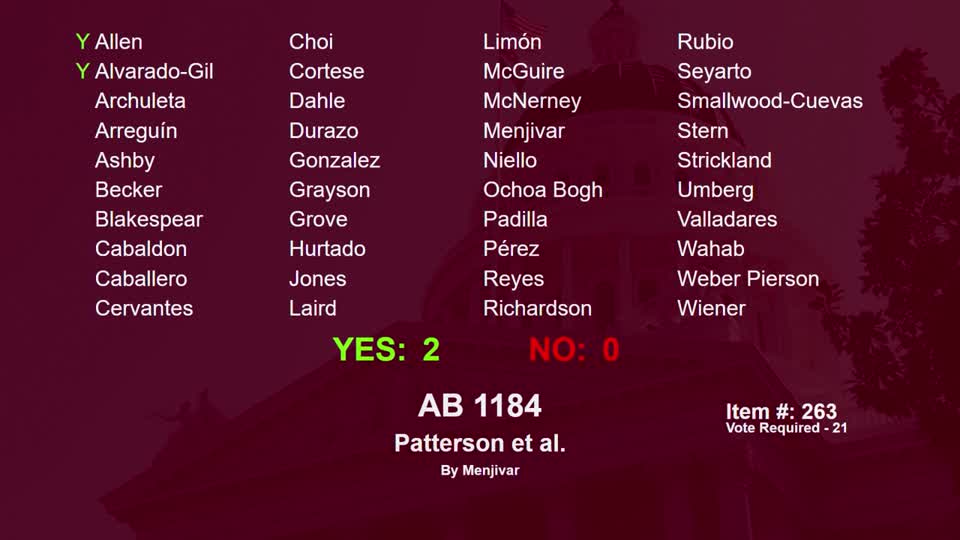 2MIN
Senate Floor
 1MIN
Senate Standing Committee on Appropriations
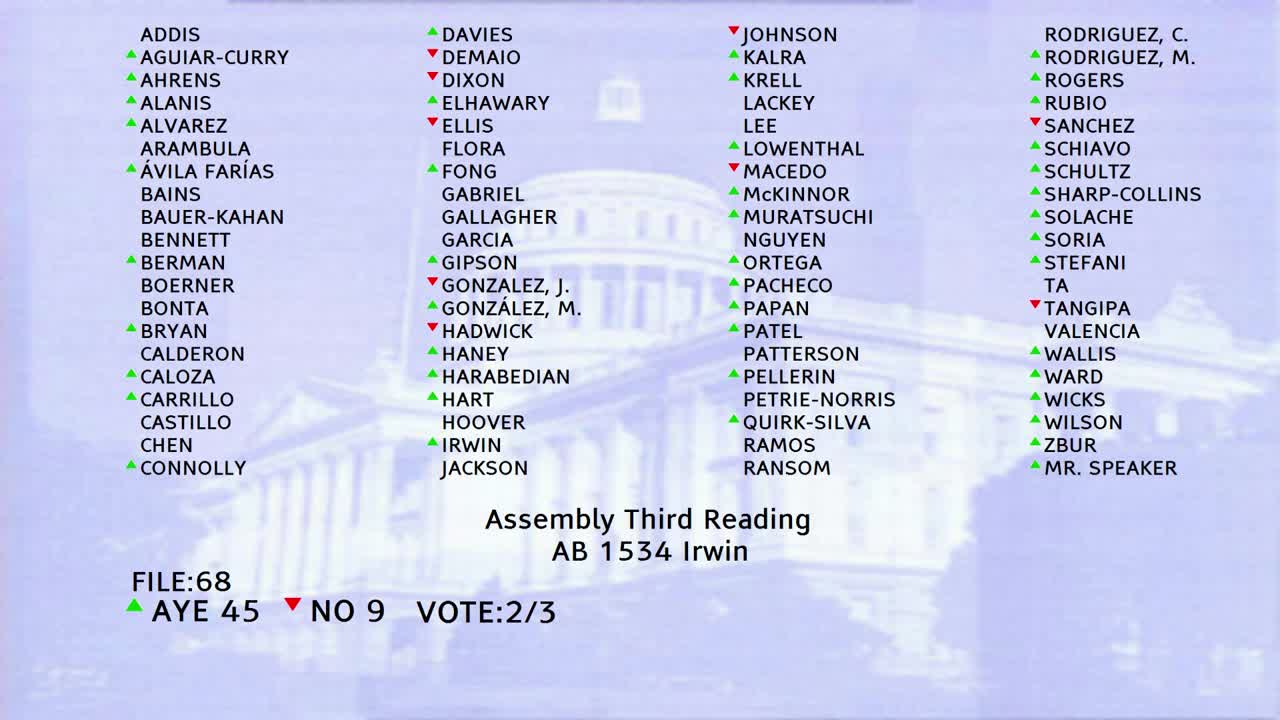 1MIN
Assembly Floor
 6MIN
Assembly Standing Committee on Water, Parks, and Wildlife
Bill Author

Bill Co-Author(s):