AB 1740: Coastal resources: local coastal program: coastal development permits: City of Santa Monica.
- Session Year: 2025-2026
- House: Assembly
- Latest Version Date: 2026-09-30
Current Status:
Passed
(2026-09-30: Chaptered by Secretary of State - Chapter 892, Statutes of 2026.)
Introduced
In Committee
Awaiting First Chamber Vote
Passed First Chamber
In Committee
Awaiting Second Chamber Vote
Passed Second Chamber
Enacted
(1)The California Coastal Act of 1976, among other things, establishes the California Coastal Commission and provides for the planning and regulation of development in the coastal zone, as defined. The act generally requires each local government, as specified, to prepare a local coastal program for certification by the commission, however, the act authorizes any local government to request the commission to prepare the local coastal program for the local government, as provided. The act generally prohibits, after certification of a local coastal program and all implementing actions within the affected area, the commission from exercising its coastal development permit review authority over any new development within the area to which the certified local coastal program, or any portion thereof, applies.
This bill would require, on or before January 1, 2029, the City of Santa Monica to submit to the commission a proposed, complete local coastal program for the citys portion of the coastal zone. By creating a new duty for the City of Santa Monica, the bill would impose a state-mandated local program. The bill would require the commission to act within 6 months of receipt of the proposed, complete local coastal program, unless an extension is requested by the city. The bill would also require the commission, within 45 days of receipt of the proposed, complete local coastal program, to provide the city, in writing, a list of identified issues, if any, that require further refinement through suggested modifications for the local coastal program, as provided, and would require the city and the commission to coordinate expeditiously and in good faith to reach agreement on any suggested modifications within 6 months of receipt of the submitted complete proposal. If the commission fails to act on the citys complete, proposed local coastal program within 6 months of receipt of a submitted complete proposal, as provided, the bill would require the commission to provide quarterly, written updates to the Legislature describing, among other things, the reason for the delay.
(2)Existing law prohibits an application by a local government to convert an existing motorized vehicle lane into a dedicated bicycle lane, dedicated transit lane, or a pedestrian walkway from being required to include a traffic study for the processing of either a coastal development permit or an amendment to a local coastal program. Existing law requires, if a proposal to convert an existing motorized vehicle travel lane into a dedicated bicycle lane, dedicated transit lane, or a pedestrian walkway within the developed portion of an existing road right-of-way requires an amendment to a local coastal program, that the amendment be processed in accordance with the procedures applicable to de minimus local coastal program amendments if the executive director of the commission makes specified determinations.
This bill would require, if a proposal to convert part or all of a developed portion of an existing road right-of-way into a bicycle right-of-way, transit right-of-way, pedestrian walkway, or combination thereof requires an amendment to a local coastal program, that the amendment be processed in accordance with the procedures applicable to de minimus local coastal program amendments if the executive director determines that, on balance, the project will provide commensurate or enhanced public access to the coast. For an application for a coastal development permit to convert part or all of the developed portion of an existing road right-of-way that is not a state highway into a bicycle right-of-way, transit right-of-way, pedestrian walkway, or combination thereof, the bill would require the permit requirement be waived if the executive director determines that, on balance, the project will provide commensurate or enhanced public access to the coast. The bill would, until December 31, 2032, require, on or before January 31 of each year, the commission to post on its internet website and transmit to the Legislature a report that includes, among other things, the total number of applications received for a coastal development permit to convert part or all of the developed portion of an existing road right-of-way that is not a state highway into a bicycle right-of-way, transit right-of-way, pedestrian walkway, or combination thereof, as provided.
This bill would make legislative findings and declarations as to the necessity of a special statute for the City of Santa Monica.
The California Constitution requires the state to reimburse local agencies and school districts for certain costs mandated by the state. Statutory provisions establish procedures for making that reimbursement.
This bill would provide that, if the Commission on State Mandates determines that the bill contains costs mandated by the state, reimbursement for those costs shall be made pursuant to the statutory provisions noted above.
(1)The California Coastal Act of 1976, among other things, establishes the California Coastal Commission and provides for the planning and regulation of development in the coastal zone, as defined. The act generally requires each local government, as specified, to prepare a local coastal program for certification by the commission, however, the act authorizes any local government to request the commission to prepare the local coastal program for the local government, as provided. The act generally prohibits, after certification of a local coastal program and all implementing actions within the affected area, the commission from exercising its coastal development permit review authority over any new development within the area to which the certified local coastal program, or any portion thereof, applies. The act requires, among other things, anyone wishing to perform or undertake any development in the coastal zone, except as specified, in addition to obtaining any other permit required by law from any local government or from any state, regional, or local agency, to obtain a coastal development permit from the commission or a local government, as provided. The act provides that a coastal development permit is not required for specified types of development in specified areas, as provided.
This bill would require, on or before January 1, 2029, the City of Santa Monica to submit to the commission a proposed, complete local coastal program for the citys portion of the coastal zone. By creating a new duty for the City of Santa Monica, the bill would impose a state-mandated local program. The bill would require the commission to act within 6 months of receipt of the proposed, complete local coastal program, unless an extension is requested by the city. The bill would also require the commission, within 45 days of receipt of the proposed, complete local coastal program, to provide the city, in writing, a list of identified issues, if any, that require further refinement through suggested modifications for the local coastal program, as provided, and would require the city and the commission to coordinate expeditiously and in good faith to reach agreement on any suggested modifications within 6 months of receipt of the submitted complete proposal. If the commission fails to act on the citys complete, proposed local coastal program within 6 months of receipt of a submitted complete proposal, as provided, the bill would require the commission to provide quarterly, written updates to the Legislature describing, among other things, the reason for the delay.
This bill would, until the commission certifies a local coastal program for the City of Santa Monica, provide that a coastal development permit is not required for certain activities and types of development within the City of Santa Monica, as specified.(2)Existing law prohibits an application by a local government to convert an existing motorized vehicle lane into a dedicated bicycle lane, dedicated transit lane, or a pedestrian walkway from being required to include a traffic study for the processing of either a coastal development permit or an amendment to a local coastal program. Existing law requires, if a proposal to convert an existing motorized vehicle travel lane into a dedicated bicycle lane, dedicated transit lane, or a pedestrian walkway within the developed portion of an existing road right-of-way requires an amendment to a local coastal program, that the amendment be processed in accordance with the procedures applicable to de minimus local coastal program amendments if the executive director of the commission makes specified determinations.
This bill would require, if a proposal to convert part or all of a developed portion of an existing road right-of-way into a bicycle right-of-way, transit right-of-way, pedestrian walkway, or combination thereof requires an amendment to a local coastal program, that the amendment be processed in accordance with the procedures applicable to de minimus local coastal program amendments if the executive director determines that, on balance, the project will provide commensurate or enhanced public access to the coast. For an application for a coastal development permit to convert part or all of the developed portion of an existing road right-of-way that is not a state highway into a bicycle right-of-way, transit right-of-way, pedestrian walkway, or combination thereof, the bill would require the permit requirement be waived if the executive director determines that, on balance, the project will provide commensurate or enhanced public access to the coast. The bill would would, until December 31, 2032, require, on or before January 31 of each year, the commission to post on its internet website and transmit to the Legislature a report that includes, among other things, the total number of applications received pursuant to the above-described provisions, for a coastal development permit to convert part or all of the developed portion of an existing road right-of-way that is not a state highway into a bicycle right-of-way, transit right-of-way, pedestrian walkway, or combination thereof, as provided.
This bill would make legislative findings and declarations as to the necessity of a special statute for the City of Santa Monica.
The California Constitution requires the state to reimburse local agencies and school districts for certain costs mandated by the state. Statutory provisions establish procedures for making that reimbursement.
This bill would provide that, if the Commission on State Mandates determines that the bill contains costs mandated by the state, reimbursement for those costs shall be made pursuant to the statutory provisions noted above.
(1)The California Coastal Act of 1976 1976, among other things, establishes the California Coastal Commission and provides for the planning and regulation of development in the coastal zone, as defined. The act generally requires each local government, as specified, to prepare a local coastal program for certification by the commission, however, the act authorizes any local government to request the commission to prepare the local coastal program for the local government, as provided. The act generally prohibits, after certification of a local coastal program and all implementing actions within the affected area, the commission from exercising its coastal development permit review authority over any new development within the area to which the certified local coastal program, or any portion thereof, applies. The act requires, among other things, anyone wishing to perform or undertake any development in the coastal zone, except as specified, in addition to obtaining any other permit required by law from any local government or from any state, regional, or local agency, to obtain a coastal development permit from the California Coastal Commission commission or a local government, as provided. The act provides that a coastal development permit is not required for specified types of development in specified areas, as provided.
This bill would require, on or before January 1, 2029, the City of Santa Monica to submit to the commission a proposed, complete local coastal program for the citys portion of the coastal zone. By creating a new duty for the City of Santa Monica, the bill would impose a state-mandated local program. The bill would require the commission to act within 6 months of receipt of the proposed, complete local coastal program, unless an extension is requested by the city.
This bill would would, until the commission certifies a local coastal program for the City of Santa Monica, provide that a coastal development permit is not required for certain activities and types of development within the City of Santa Monica, as specified. The bill would repeal these permit exemptions on January 1, 2029.
(2)Existing law prohibits an application by a local government to convert an existing motorized vehicle lane into a dedicated bicycle lane, dedicated transit lane, or a pedestrian walkway from being required to include a traffic study for the processing of either a coastal development permit or an amendment to a local coastal program. Existing law requires, if a proposal to convert an existing motorized vehicle travel lane into a dedicated bicycle lane, dedicated transit lane, or a pedestrian walkway within the developed portion of an existing road right-of-way requires an amendment to a local coastal program, that the amendment be processed in accordance with the procedures applicable to de minimus local coastal program amendments if the executive director of the commission makes specified determinations.
This bill would require, if a proposal to convert part or all of a developed portion of an existing road right-of-way into a bicycle right-of-way, transit right-of-way, pedestrian walkway, or combination thereof requires an amendment to a local coastal program, that the amendment be processed in accordance with the procedures applicable to de minimus local coastal program amendments if the executive director determines that, on balance, the project will provide commensurate or enhanced public access to the coast. For an application for a coastal development permit to convert part or all of the developed portion of an existing road right-of-way that is not a state highway into a bicycle right-of-way, transit right-of-way, pedestrian walkway, or combination thereof, the bill would require the permit requirement be waived if the executive director determines that, on balance, the project will provide commensurate or enhanced public access to the coast. The bill would require, on or before January 31 of each year, the commission to post on its internet website and transmit to the Legislature a report that includes, among other things, the total number of applications received pursuant to the above-described provisions, as provided.
This bill would make legislative findings and declarations as to the necessity of a special statute for the City of Santa Monica.
The California Constitution requires the state to reimburse local agencies and school districts for certain costs mandated by the state. Statutory provisions establish procedures for making that reimbursement.
This bill would provide that, if the Commission on State Mandates determines that the bill contains costs mandated by the state, reimbursement for those costs shall be made pursuant to the statutory provisions noted above.
The California Coastal Act of 1976 requires, among other things, anyone wishing to perform or undertake any development in the coastal zone, except as specified, in addition to obtaining any other permit required by law from any local government or from any state, regional, or local agency, to obtain a coastal development permit from the California Coastal Commission or a local government, as provided. The act provides that a coastal development permit is not required for specified types of development in specified areas, as provided.
This bill would provide that a coastal development permit is not required for certain activities and types of development within the city City of Santa Monica, as specified. The bill would repeal these permit exemptions on January 1, 2037. 2029.
This bill would make legislative findings and declarations as to the necessity of a special statute for the City of Santa Monica.
The California Coastal Act of 1976 requires, among other things, anyone wishing to perform or undertake any development in the coastal zone, except as specified, in addition to obtaining any other permit required by law from any local government or from any state, regional, or local agency, to obtain a coastal development permit from the California Coastal Commission or a local government, as provided. The act provides that a coastal development permit is not required for specified types of development in specified areas, as provided.
This bill would provide that a coastal development permit is not required for certain activities and types of development within the city of Santa Monica, as specified. The bill would repeal these permit exemptions on January 1, 2037.
This bill would make legislative findings and declarations as to the necessity of a special statute for Santa Monica.
The California Coastal Act of 1976 requires, among other things, anyone wishing to perform or undertake any development in the coastal zone, except as specified, in addition to obtaining any other permit required by law from any local government or from any state, regional, or local agency, to obtain a coastal development permit from the California Coastal Commission or a local government, as provided. The act provides that a coastal development permit is not required for specified types of development in specified areas, as provided.
This bill would authorize a city to designate itself as an urban multimodal community if the city has (1) at least one high-quality transit corridor or transit priority area in the city, (2) adopted plans that include targets to reduce greenhouse gas emissions and fatal and severe injury crashes, and (3) Class I, Class II, or Class IV bicycle facilities, as defined. If a city meets the criteria to designate itself as an urban multimodal community, the bill would require documentation be submitted to the Office of Land Use and Climate Innovation for review and would require the documentation to be posted on the citys internet website and the city to notify the commission of their submission. The bill would authorize a county to designate an individual local coastal program segment, as defined, as an urban multimodal community so long as the county, among other things, meets the same criteria and process requirements as a city. The bill would provide that a coastal development permit is not required for certain activities and types of development within an urban multimodal community, the city of Santa Monica, as specified. The bill would repeal these permit exemptions on January 1, 2037.
This bill would make legislative findings and declarations as to the necessity of a special statute for Santa Monica.
This bill would also provide that a coastal development permit is not required for the installation of Class I, Class II, or Class IV bicycle facilities, as defined, within the right-of-way of a state highway if the project does not eliminate existing public coastal accessways.The California Coastal Act of 1976 requires, among other things, anyone wishing to perform or undertake any development in the coastal zone, except as specified, in addition to obtaining any other permit required by law from any local government or from any state, regional, or local agency, to obtain a coastal development permit from the California Coastal Commission or a local government, as provided. The act provides that a coastal development permit is not required for specified types of development in specified areas, as provided.
This bill would authorize a city to designate itself as an urban multimodal community if the city has (1) at least one high-quality transit corridor or transit priority area in the city, (2) adopted plans that include targets to reduce greenhouse gas emissions and fatal and severe injury crashes, and (3) Class I, Class II, or Class IV bicycle facilities, as defined. If a city meets the criteria to designate itself as an urban multimodal community, the bill would require documentation be submitted to the Office of Land Use and Climate Innovation for review and would require the documentation to be posted on the citys internet website. website and the city to notify the commission of their submission. The bill would authorize a county to designate an individual local coastal program segment, as defined, as an urban multimodal community so long as the county, among other things, meets the same criteria and process requirements as a city. The bill would provide that a coastal development permit is not required for certain activities and types of development within an urban multimodal community, as specified.
This bill would also provide that a coastal development permit is not required for the installation of Class I, Class II, or Class IV bicycle facilities, as defined, within the right-of-way of a state highway if the project does not eliminate existing public coastal accessways.
The California Coastal Act of 1976 requires, among other things, anyone wishing to perform or undertake any development in the coastal zone, except as specified, in addition to obtaining any other permit required by law from any local government or from any state, regional, or local agency, to obtain a coastal development permit from the California Coastal Commission or a local government, as provided. The act provides that a coastal development permit is not required for specified types of development in specified areas, as provided.
This bill would authorize a city to designate itself as an urban multimodal community if the city has (1) at least one high-quality transit corridor or transit priority area in the city, (2) adopted plans that include targets to reduce greenhouse gas emissions and fatal and severe injury crashes, and (3) Class I, Class II, or Class IV bicycle facilities, as defined. If a city meets the criteria to designate itself as an urban multimodal community, the bill would require documentation be submitted to the Office of Land Use and Climate Innovation for review and would require the documentation to be posted on the citys internet website. The bill would provide that a coastal development permit is not required for certain activities and types of development within an urban multimodal community, as specified.
This bill would also provide that a coastal development permit is not required for the installation of Class I, Class II, or Class IV bicycle facilities, as defined, within the right-of-way of a state highway if the project does not eliminate existing public coastal accessways.
(a)On or before January 1, 2029, the City of Santa Monica shall submit to the commission a complete, proposed local coastal program for the citys portion of the coastal zone. The citys proposed local coastal program shall be processed in accordance with this article and the commission shall act within six months of receipt of a submitted complete proposal, unless an extension is requested by the city.
(b)(1)If the city submits to the commission a complete, proposed local coastal program, as required by subdivision (a), the commission shall, within 45 days of receipt, provide the city, in writing, a list of identified issues, if any, that require further refinement through suggested modifications for the local coastal program to be found consistent with this division.
(2)Following the citys receipt of the list of issues, if any, the commission and the city shall coordinate expeditiously and in good faith to reach agreement on any suggested modifications within six months of receipt of the submitted complete proposal. If the commission fails to act on the citys submitted complete local coastal program within six months of receipt, the commission shall, upon appropriation by the Legislature for these purposes, reimburse the city for reasonable costs associated with the time spent coordinating on the suggested modifications.
(c)If the commission fails to act on the citys complete, proposed local coastal program within six months of receipt, unless an extension is requested by the city pursuant to subdivision (a), the commission shall provide quarterly, written updates to the Legislature, consistent with Section 9795 of the Government Code, describing the reasons for the delay, a summary of the remaining steps necessary to place the local coastal program on the commissions meeting agenda, and an estimated timeline for approval and certification of the citys local coastal program.
(d)Subsequent to the effective certification of the citys local coastal program, and acceptance of the program by the city, the city shall immediately assume coastal development permitting authority, consistent with this division.
(e)For purposes of this section, city means the City of Santa Monica.
SEC. 2.Section 30610.91 of the Public Resources Code is amended to read:30610.91.(a)(1)The Legislature finds and declares that designing and building complete streets that safely accommodate the needs of nonmotorized vehicles, pedestrians, and motorized vehicles in the coastal zone is preferred and encouraged.
(2)It is the intent of the Legislature that this section expedites the provision of safe, multimodal travel within urbanized areas of the coastal zone for the purpose of increasing public access to the coast for residents and visitors, limiting vehicle miles traveled, and reducing greenhouse gas emissions.
(b)An application for a coastal development permit or local coastal program amendment to convert an existing motorized vehicle travel lane into a dedicated bicycle lane, dedicated transit lane, or a pedestrian walkway, shall not be required to include a traffic study.
(c)(1)If a proposal to convert part or all of the developed portion of an existing road right-of-way into a bicycle right-of-way, transit right-of-way, pedestrian walkway, or a combination thereof requires an amendment to a local coastal program, the amendment shall be processed pursuant to subdivision (d) of Section 30514, if the executive director determines that, on balance, the project will provide commensurate or enhanced public access to the coast.
(2)In making the determination pursuant to paragraph (1), the executive director shall consider the public access benefits of enhanced transit infrastructure, and bicycle and pedestrian access. Projects that include the removal of public parking shall not be precluded from being eligible for processing pursuant to subdivision (d) of Section 30514.
(d)(1)For an application for a coastal development permit to convert part or all of the developed portion of an existing road right-of-way that is not a state highway into a bicycle right-of-way, transit right-of-way, pedestrian walkway, or a combination thereof, the executive director shall waive the coastal development permit requirement pursuant to Section 30624.7 if the executive director determines that, on balance, the project will provide commensurate or enhanced public access to the coast.
(2)In making the determination pursuant to paragraph (1), the executive director shall consider the public access benefits of enhanced transit infrastructure, and bicycle and pedestrian access. Projects that include the removal of public parking shall not be precluded from being eligible for a waiver pursuant to Section 30624.7.
(e)(1)The executive director shall maintain and make available for public review, in a single location, records of all applications submitted pursuant to subdivision (d).
(2)On or before January 31 of each year, the commission shall post on its internet website and transmit to the Legislature, consistent with Section 9795 of the Government Code, a report covering the preceding calendar year that includes, at a minimum, all of the following:
(A)The total number of applications received pursuant to subdivision (d) and the relevant application numbers.
(B)The number of applications for which the coastal development permit requirement was waived pursuant to Section 30624.7, including a brief description of each project and the basis for the executive directors determination that the project would provide commensurate or enhanced public access to the coast.
(C)The number of applications denied a waiver, including the stated reason for each denial.
(D)The number of applications pending review as of December 31 of the reporting year.
(E)Any geographic or jurisdictional patterns identified by the executive director in the distribution of applications, waivers, or denials.
(3)All records required by this subdivision shall be made available to the public in a searchable, machine-readable format and shall be retained for no fewer than 10 years from the date an application is submitted pursuant to subdivision (d).
(4)Nothing in this subdivision shall be construed to delay or otherwise affect the timeline for processing an individual application under subdivision (d).
(5)Except as provided in paragraph (3), this subdivision shall remain in effect only until December 31, 2032.
SEC. 3.The Legislature finds and declares that a special statute is necessary and that a general statute cannot be made applicable within the meaning of Section 16 of Article IV of the California Constitution because of the need to accelerate housing to meet the City of Santa Monicas housing needs and to reduce greenhouse gas emissions from transportation in the city.
SEC. 4.If the Commission on State Mandates determines that this act contains costs mandated by the state, reimbursement to local agencies and school districts for those costs shall be made pursuant to Part 7 (commencing with Section 17500) of Division 4 of Title 2 of the Government Code.
(a)On or before January 1, 2029, the City of Santa Monica shall submit to the commission a complete, proposed local coastal program for the citys portion of the coastal zone. The citys proposed local coastal program shall be processed in accordance with this article and the commission shall act within six months of receipt of a submitted complete proposal, unless an extension is requested by the city.
(b)If the city submits to the commission a complete, proposed local coastal program, as required by subdivision (a), on or before December 31, 2027, the city shall be prioritized for funding made available to local governments by the Active Transportation Program pursuant to Chapter 8 (commencing with Section 2380) of Division 3 of the Streets and Highways Code for projects consistent with the citys certified local coastal program to the extent not in conflict with federal law. (c)(b)(1)If the city submits to the commission a complete, proposed local coastal program, as required by subdivision (a), the commission shall, within 45 days of receipt, provide the city, in writing, a list of identified issues, if any, that require further refinement through suggested modifications for the local coastal program to be found consistent with this division.
(2)Following the citys receipt of the list of issues, if any, the commission and the city shall coordinate expeditiously and in good faith to reach agreement on any suggested modifications within six months of receipt of the submitted complete proposal. If the commission fails to act on the citys submitted complete local coastal program within six months of receipt, the commission shall, upon appropriation by the Legislature for these purposes, reimburse the city for reasonable costs associated with the time spent coordinating on the suggested modifications.
(d)(c)If the commission fails to act on the citys complete, proposed local coastal program within six months of receipt, unless an extension is requested by the city pursuant to subdivision (a), the commission shall provide quarterly, written updates to the Legislature, consistent with Section 9795 of the Government Code, describing the reasons for the delay, a summary of the remaining steps necessary to place the local coastal program on the commissions meeting agenda, and an estimated timeline for approval and certification of the citys local coastal program.
(e)(d)Subsequent to the effective certification of the citys local coastal program, and acceptance of the program by the city, the city shall immediately assume coastal development permitting authority, consistent with this division.
(f)(e)For purposes of this section, city means the City of Santa Monica.
SEC. 2.Section 30610.91 of the Public Resources Code is amended to read:30610.91.(a)(1)The Legislature finds and declares that designing and building complete streets that safely accommodate the needs of nonmotorized vehicles, pedestrians, and motorized vehicles in the coastal zone is preferred and encouraged.
(2)It is the intent of the Legislature that this section expedites the provision of safe, multimodal travel within urbanized areas of the coastal zone for the purpose of increasing public access to the coast for residents and visitors, limiting vehicle miles traveled, and reducing greenhouse gas emissions.
(b)An application for a coastal development permit or local coastal program amendment to convert an existing motorized vehicle travel lane into a dedicated bicycle lane, dedicated transit lane, or a pedestrian walkway, shall not be required to include a traffic study.
(c)(1)If a proposal to convert part or all of the developed portion of an existing road right-of-way into a bicycle right-of-way, transit right-of-way, pedestrian walkway, or a combination thereof requires an amendment to a local coastal program, the amendment shall be processed pursuant to subdivision (d) of Section 30514, if the executive director determines that, on balance, the project will provide commensurate or enhanced public access to the coast.
(2)In making the determination pursuant to paragraph (1), the executive director shall consider the public access benefits of enhanced transit infrastructure, and bicycle and pedestrian access. Projects that include the removal of public parking shall not be precluded from being eligible for processing pursuant to subdivision (d) of Section 30514.
(d)(1)For an application for a coastal development permit to convert part or all of the developed portion of an existing road right-of-way that is not a state highway into a bicycle right-of-way, transit right-of-way, pedestrian walkway, or a combination thereof, the executive director shall waive the coastal development permit requirement pursuant to Section 30624.7 if the executive director determines that, on balance, the project will provide commensurate or enhanced public access to the coast.
(2)In making the determination pursuant to paragraph (1), the executive director shall consider the public access benefits of enhanced transit infrastructure, and bicycle and pedestrian access. Projects that include the removal of public parking shall not be precluded from being eligible for a waiver pursuant to Section 30624.7.
(e)(1)The executive director shall maintain and make available for public review, in a single location, records of all applications submitted pursuant to subdivision (d).
(2)On or before January 31 of each year, the commission shall post on its internet website and transmit to the Legislature, consistent with Section 9795 of the Government Code, a report covering the preceding calendar year that includes, at a minimum, all of the following:
(A)The total number of applications received pursuant to subdivision (d) and the relevant application numbers.
(B)The number of applications for which the coastal development permit requirement was waived pursuant to Section 30624.7, including a brief description of each project and the basis for the executive directors determination that the project would provide commensurate or enhanced public access to the coast.
(C)The number of applications denied a waiver, including the stated reason for each denial.
(D)The number of applications pending review as of December 31 of the reporting year.
(E)Any geographic or jurisdictional patterns identified by the executive director in the distribution of applications, waivers, or denials.
(3)All records required by this subdivision shall be made available to the public in a searchable, machine-readable format and shall be retained for no fewer than 10 years. years from the date an application is submitted pursuant to subdivision (d).
(4)Nothing in this subdivision shall be construed to delay or otherwise affect the timeline for processing an individual application under subdivision (d).
(5)This Except as provided in paragraph (3), this subdivision shall remain in effect only until December 31, 2032.
SEC. 3.The Legislature finds and declares that a special statute is necessary and that a general statute cannot be made applicable within the meaning of Section 16 of Article IV of the California Constitution because of the need to accelerate housing to meet the City of Santa Monicas housing needs and to reduce greenhouse gas emissions from transportation in the city.
SEC. 4.If the Commission on State Mandates determines that this act contains costs mandated by the state, reimbursement to local agencies and school districts for those costs shall be made pursuant to Part 7 (commencing with Section 17500) of Division 4 of Title 2 of the Government Code.
(a)On or before January 1, 2029, the City of Santa Monica shall submit to the commission a complete, proposed local coastal program for the citys portion of the coastal zone. The citys proposed local coastal program shall be processed in accordance with this article and the commission shall act within six months of receipt of a submitted complete proposal, unless an extension is requested by the city.
(b)If the city submits to the commission a complete, proposed local coastal program, as required by subdivision (a), on or before December 31, 2027, the city shall be prioritized for funding made available to local governments by the Active Transportation Program pursuant to Chapter 8 (commencing with Section 2380) of Division 3 of the Streets and Highways Code for projects consistent with the citys certified local coastal program to the extent not in conflict with federal law.
(c)(1)If the city submits to the commission a complete, proposed local coastal program, as required by subdivision (a), the commission shall, within 45 days of receipt, provide the city, in writing, a list of identified issues, if any, that require further refinement through suggested modifications for the local coastal program to be found consistent with this division.
(2)Following the citys receipt of the list of issues, if any, the commission and the city shall coordinate expeditiously and in good faith to reach agreement on any suggested modifications within six months of receipt of the submitted complete proposal. If the commission fails to act on the citys submitted complete local coastal program within six months of receipt, the commission shall, upon appropriation by the Legislature for these purposes, reimburse the city for reasonable costs associated with the time spent coordinating on the suggested modifications.
(d)If the commission fails to act on the citys complete, proposed local coastal program within six months of receipt, unless an extension is requested by the city pursuant to subdivision (a), the commission shall provide quarterly, written updates to the Legislature, consistent with Section 9795 of the Government Code, describing the reasons for the delay, a summary of the remaining steps necessary to place the local coastal program on the commissions meeting agenda, and an estimated timeline for approval and certification of the citys local coastal program.
(b)(e)Subsequent to the effective certification of the citys local coastal program, and acceptance of the program by the city, the city shall immediately assume coastal development permitting authority, consistent with this division.
(c)(f)For purposes of this section, city means the City of Santa Monica.
SEC. 3.Section 30610.55 is added to the Public Resources Code, to read:30610.55.(a)Before the certification of a local coastal program for the City of Santa Monica as described in subdivision (b) of Section 30512.5, the following activities and types of development within the city shall be exempt from the permit requirements of this chapter:(1)(A)(i)Interior or exterior renovations of existing buildings that do not exceed the floor area, height, or bulk of the existing structure by more than 10 percent.(ii)Changes of use of existing buildings, provided that any change in use does not diminish or eliminate current visitor-serving accommodations and the new use is retail, recreation, or other visitor-serving uses.(B)Subparagraph (A) shall only apply to existing buildings that are 10,000 square feet floor area or less, and are not located in any of the following:(i)Between the sea and the first public road paralleling the sea or within 300 feet of the inland extent of any beach or of the mean high tideline of the sea where there is no beach, whichever is the greatest distance.(ii)On or within 100 feet of a wetland, or on or within 100 feet of an environmentally sensitive habitat area.(2)Improvements to public facilities to achieve compliance with the requirements under the federal Americans with Disabilities Act (42 U.S.C. Sec. 12101 et seq.).(3)The installation of electric vehicle charging stations in existing paved areas provided that, for existing publicly owned parking located between the sea and the first public road paralleling the sea, the installation would not result in conversion of existing publicly owned parking to private, commercial operations.(b)On and after July 1, 2029, if the commission has not certified a local coastal program for the city that was submitted consistent with Section 30512.5, any aspect of a housing development project, as defined in Section 65589.5 of the Government Code, allowable under state and local law, including any permits, approvals, or public improvements required for the housing development project, shall be exempt from the permit requirements of this chapter, if the housing development project meets all of the following conditions:(1)The project site abuts Wilshire Boulevard or Pico Boulevard or the project site is located in the area between Wilshire Boulevard and Pico Boulevard.(2)The project site is located within an area where multiunit housing is an allowed use in the citys general plan, specific plan, or zoning ordinance.(3)The project is a housing development project, as defined in paragraph (2) of subdivision (h) of Section 65589.5 of the Government Code, excluding a single family dwelling with an accessory dwelling unit.(4)The project is not located in any of the following areas:(A)Between the sea and the first public road paralleling the sea or within 300 feet of the inland extent of any beach or of the mean high tideline of the sea where there is no beach, whichever is the greater distance.(B)On, or within a 100-foot radius of, a wetland.(C)On, or within 100 feet of, an environmentally sensitive area.(5)This subdivision shall remain in effect only until July 1, 2031.(c)This section shall remain in effect until the commission certifies a local coastal program for the city consistent with subdivision (a) of Section 30512.5, after which this section shall be inoperative.(d)For purposes of this section, city means the City of Santa Monica.SEC. 4.SEC. 2.Section 30610.91 of the Public Resources Code is amended to read:30610.91.(a)(1)The Legislature finds and declares that designing and building complete streets that safely accommodate the needs of nonmotorized vehicles, pedestrians, and motorized vehicles in the coastal zone is preferred and encouraged.
(2)It is the intent of the Legislature that this section expedites the provision of safe, multimodal travel within urbanized areas of the coastal zone for the purpose of increasing public access to the coast for residents and visitors, limiting vehicle miles traveled, and reducing greenhouse gas emissions.
(b)An application for a coastal development permit or local coastal program amendment to convert an existing motorized vehicle travel lane into a dedicated bicycle lane, dedicated transit lane, or a pedestrian walkway, shall not be required to include a traffic study.
(c)(1)If a proposal to convert part or all of the developed portion of an existing road right-of-way into a bicycle right-of-way, transit right-of-way, pedestrian walkway, or a combination thereof requires an amendment to a local coastal program, the amendment shall be processed pursuant to subdivision (d) of Section 30514, if the executive director determines that, on balance, the project will provide commensurate or enhanced public access to the coast.
(2)In making the determination pursuant to paragraph (1), the executive director shall consider the public access benefits of enhanced transit infrastructure, and bicycle access and shall not require replacement parking when there are existing areas dedicated to public parking within one-half mile of any removed parking removed by the project. and pedestrian access. Projects that include the removal of public parking shall not be precluded from being eligible for processing pursuant to subdivision (d) of Section 30514.
(d)(1)For an application for a coastal development permit to convert part or all of the developed portion of an existing road right-of-way that is not a state highway into a bicycle right-of-way, transit right-of-way, pedestrian walkway, or a combination thereof, the executive director shall waive the coastal development permit requirement pursuant to Section 30624.7 if the executive director determines that, on balance, the project will provide commensurate or enhanced public access to the coast.
(2)In making the determination pursuant to paragraph (1), the executive director shall consider the public access benefits of enhanced transit infrastructure, and bicycle access and shall not require replacement parking when there are existing areas dedicated to public parking within one-half mile of any removed parking removed by the project. and pedestrian access. Projects that include the removal of public parking shall not be precluded from being eligible for a waiver pursuant to Section 30624.7.
(e)(1)The executive director shall maintain and make available for public review, in a single location, records of all applications submitted pursuant to subdivisions (c) and subdivision (d).
(2)On or before January 31 of each year, the commission shall post on its internet website and transmit to the Legislature, consistent with Section 9795 of the Government Code, a report covering the preceding calendar year that includes, at a minimum, all of the following:
(A)The total number of applications received pursuant to subdivisions (c) and subdivision (d) and the relevant application numbers.
(B)The number of applications for which the coastal development permit requirement was waived pursuant to Section 30624.7, including a brief description of each project and the basis for the executive directors determination that the project would provide commensurate or enhanced public access to the coast.
(C)The number of applications denied a waiver, including the stated reason for each denial.
(D)The number of applications pending review as of December 31 of the reporting year.
(E)Any geographic or jurisdictional patterns identified by the executive director in the distribution of applications, waivers, or denials.
(3)All records required by this subdivision shall be made available to the public in a searchable, machine-readable format and shall be retained for no fewer than 10 years.
(4)Nothing in this subdivision shall be construed to delay or otherwise affect the timeline for processing an individual application under subdivision (d).
(5)This subdivision shall remain in effect only until December 31, 2032.
SEC. 5.SEC. 3.The Legislature finds and declares that a special statute is necessary and that a general statute cannot be made applicable within the meaning of Section 16 of Article IV of the California Constitution because of the need to accelerate housing to meet the City of Santa Monicas housing needs and to reduce greenhouse gas emissions from transportation in the city.
SEC. 6.SEC. 4.If the Commission on State Mandates determines that this act contains costs mandated by the state, reimbursement to local agencies and school districts for those costs shall be made pursuant to Part 7 (commencing with Section 17500) of Division 4 of Title 2 of the Government Code.
(a)The Legislature finds and declares all of the following:
(1)The California Coastal Act of 1976 (Division 20 (commencing with Section 30000) of the Public Resources Code; (coastal act)) was enacted to protect the states coastal resources while maximizing public access to and recreational use of the coast, consistent with public safety and environmental protection.
(2)At the time of the Coastal Acts enactment, automobile travel and parking availability were the dominant factors determining coastal access in most parts of the state, and the coastal acts implementation framework reflected those prevailing conditions.
(3)In the decades since, some coastal cities have evolved into dense, urbanized communities with extensive multimodal transportation networks, including fixed-route transit, rail service, protected bicycle infrastructure, pedestrian facilities, micromobility services, and shared transportation options that collectively provide substantial and equitable access to the coast without reliance on private automobiles.
(4)These urbanized coastal jurisdictions have invested significant public resources to meet and exceed the coastal acts mandate to maximize public access to the shoreline by facilitating nonautomobile circulation, consistent with Sections 30210 and 30252 of the Public Resources Code.
(5)Despite these advancements, current permitting practices of the California Coastal Commission frequently require coastal development permits for routine operational and management activities and minor improvement projects that do not result in the reduction of public coastal access or in significant land use intensification. These activities include, but are not limited to, parking rate adjustments, parking time limits, residential preferential parking programs, installation of accessibility improvements, minor improvements to existing buildings, temporary community events, and transportation safety upgrades within the public right-of-way.
(6)Applying full coastal development permit (CDP) requirements to these operational activities and minor improvement projects imposes substantial administrative delays and costs on local governments without producing commensurate environmental, access, or resource-protection benefits. While there are numerous existing Coastal Act exemptions to CDP requirements, these have been construed and applied far too narrowly. Furthermore, even in the case that a project may appear clearly exempt, the process of receiving that exemption from the California Coastal Commission is often time consuming.
(7)These delays and costs undermine the coastal acts stated intent that state and local agencies cooperate to implement coordinated planning and development for mutually beneficial uses, as set forth in Section 30001.5 of the Public Resources Code.
(8)California law has increasingly prioritized the reduction of vehicle miles traveled, greenhouse gas emissions, and automobile dependency to protect public health, advance climate resilience, and reduce adverse environmental impacts associated with transportation.
(9)Rigid, parking-centric access assumptions embedded in legacy coastal permitting practices can impede statewide climate, transportation, and land use policies and discourage the use of transit, walking, and bicycling as primary or significant modes of coastal access. These assumptions are not true to either the letter or spirit of the Coastal Act. Section 30252 of the Public Resources Code specifically emphasizes nonautomobile circulation and expressly allows that the provision of transit may substitute for the provision of parking. However, the Coastal Commission has been reluctant to do that.
(10)The provision of housing within urbanized, transit-oriented coastal communities that have made substantial investments in public transit and active transportation, and that have adopted and are actively implementing sustainability, climate action, or mobility strategies, supports statewide goals related to housing affordability, climate resilience, reduced vehicle miles traveled, and equitable access to coastal resources. This is reflected in the Coastal Act which calls for concentrating development in urbanized areas, as reflected in Sections 30007.5 and 30250 of the Public Resources Code.
(11)Section 30253 of the Public Resources Code expressly requires that new development minimize energy consumption and vehicle miles traveled, recognizing that transportation-related emissions pose a significant threat to coastal resources, public health, and climate resilience. This principle is also reflected in Sections 30007.5, 30250, and 30252 of the Public Resources Code.
(12)Many coastal cities are simultaneously confronting economic recovery challenges, including prolonged commercial vacancies, fiscal strain on public parking and infrastructure systems, and the need for timely tenant improvements and temporary activations to revitalize coastal business districts.
(13)California is preparing to host globally significant events, including the 2026 FIFA World Cup and the 2028 Olympic and Paralympic Games, which will require flexible, multimodal, and efficiently managed coastal access systems capable of accommodating large visitor volumes without exacerbating congestion or environmental impacts.
(14)Certain urbanized coastal jurisdictions have made significant progress toward achieving the Coastal Acts access objectives through comprehensive multimodal transportation networks, have adopted climate action plans and transportation safety strategies, and are well positioned to manage routine coastal operations at the local level.
(b)It is the intent of the Legislature to do both of the following:
(1)Modernize coastal zone governance by recognizing and empowering these urbanized, transit-oriented communities to administer specified operational and management activities and minor improvement projects without the need for individual coastal development permits, while otherwise preserving the California Coastal Commissions authority over activities that constitute physical development and pose potential impacts to coastal resources.
(2)Advance the purposes of the coastal act by aligning its implementation with contemporary transportation systems, climate imperatives, housing needs, and economic realities, ensuring that Californias coast remains accessible, resilient, and equitably enjoyed by all residents and visitors. It is not the intent of the Legislature that the act adding this section diminish environmental protections, reduce public access to the coast, or limit the California Coastal Commissions jurisdiction over development that would adversely affect coastal resources.
SEC. 2.Section 30610.55 is added to the Public Resources Code, to read:30610.55.(a)Notwithstanding any provision of an existing certified local coastal program or certified land use plan, the following activities and types of development within the City of Santa Monica shall be exempt from the permit requirements of this chapter and shall not require an amendment to a certified local coastal program or certified land use plan:(1)(A)The city establishing, altering, eliminating, or otherwise managing regulations and requirements related to parking, including, but not limited to, all of the following:(i)Addition or removal of parking spaces by public or private entities.(ii)Establishing maximum and minimum parking ratios.(iii)Determination of onstreet and offstreet parking rates.(iv)Management of pricing structures, payment methods, payment access and revenue control systems, parking meters, time limits, and residential preferential parking zones.(B)Subparagraph (A) shall not apply to the city establishing, altering, eliminating, or otherwise managing regulations and requirements related to parking occurring between the sea and the first public road paralleling the sea within 300 feet of the inland extent of any beach or of the mean high tideline of the sea where there is no beach, whichever is the greater distance.(2)(A)Notwithstanding subparagraph (B) of paragraph (1), the city making roadway or public right-of-way improvements that support pedestrians, bicyclists, or public transit, including, but not limited to, altering the use of portions of the roadway or public right-of-way, and adding bicycle lanes, bus lanes, day lighting zones, curb extensions, sidewalk expansions and improvements, pedestrian signals, transit priority infrastructure, and vision-zero focused improvements. The improvements made pursuant to this subparagraph may result in the removal of parking spaces.(B)The city shall not approve a project described in subparagraph (A) unless the city makes a written finding based on substantial evidence that the improvement will not reduce public access to the shoreline.(3)Notwithstanding subparagraph (B) of paragraph (1), the city installing accessible walkways consistent with requirements under the federal Americans with Disabilities Act (42 U.S.C. Sec. 12101 et seq.), pay stations, signage, and electric vehicle chargers in public facilities.(4)(A)Notwithstanding subparagraph (B) of paragraph (1), the city increasing parking rates without limitation until rates reach ten dollars ($10) per day, adjusted annually for inflation based on the California Consumer Price Index from the effective date of this section.(B)If and when parking rates exceed ten dollars ($10) per day, as adjusted pursuant to subparagraph (A), the city may increase parking rates pursuant to this paragraph by not more than the annual change in the California Consumer Price Index. (5)(A)A person hosting short-term or recurring community events that do not permanently alter land use or access, including the addition of structures for temporary events that promote visitor-serving commercial, cultural, or recreational activities, and are not located on, or within a 100-foot radius of, a wetland, or on, or within 100 feet of, an environmentally sensitive habitat area.(B)The city shall not approve an event described in subparagraph (A) unless the city makes a written finding based on substantial evidence that the temporary event will not unduly obstruct public access to the shoreline within the vicinity of the event, and that the event does not prevent the traversing of the shoreline.(C)A temporary event shall only be permitted for a maximum of 10 days if the event occurs between the sea and the first public road paralleling the sea or within 300 feet of the inland extent of the beach or of the mean high tideline of the sea where there is no beach, whichever is the greater distance.(D)The city shall only permit temporary events constituting a total of 10 days per month in the area described in subparagraph (C). (6)A person making interior or exterior renovations, changes of use, or intensifications of use of existing buildings, subject to all of the following:(A)If located between the sea and the first public road paralleling the sea or within 300 feet of the inland extent of any beach or of the mean high tideline of the sea where there is no beach, whichever is the greatest distance, the project shall not expand the existing building footprint.(B)If located outside the area described in subparagraph (A), the project may expand the building footprint by up to an additional 50 percent of the existing footprint.(C)A project shall not be located on or within 100 feet of a wetland, or on, or within 100 feet of, an environmentally sensitive habitat area. (7)Any aspect of a housing development project, as defined in Section 65589.5 of the Government Code, allowable under state and local law, including any permits, approvals, or public improvements required for the housing development project, if the housing development project meets all of the following conditions:(A)The project site is located within an area where multiunit housing is an allowed use in the citys general plan, specific plan, or zoning ordinance.(B)The project is a housing development project, as defined in paragraph (2) of subdivision (h) of Section 65589.5 of the Government Code, excluding a single family dwelling with an accessory dwelling unit. (C)The project is not located in the following areas:(i)Between the sea and the first public road paralleling the sea or within 300 feet of the inland extent of any beach or of the mean high tideline of the sea where there is no beach, whichever is the greater distance.(ii)On, or within a 100-foot radius of, a wetland.(iii)On, or within 100 feet of, an environmentally sensitive habitat area.(8)Outdoor dining that is otherwise permitted.(9)A person installing Class I, Class II, or Class IV bicycle facilities, as described in Chapter 1000 of the 7th edition of the Highway Design Manual by the Department of Transportation, including associated roadway reconfiguration and relocation of onstreet parking, within the right-of-way of a state highway, if the project does not eliminate existing public coastal accessways. (b)Activities described in subdivision (a) shall be subject to approval and regulation by the city in accordance with applicable state and local laws, and shall not require review or approval by the commission.(c)The provisions of this section shall not limit the applicability of other exemptions from the permitting requirements of this chapter. (d)For purposes of this section, the following definitions apply:(1)City means the City of Santa Monica. (2)Outdoor dining means the service or consumption of food or beverages by patrons in any area that is outside the fully enclosed interior of a building, including, but not limited to, patios, courtyards, decks, terraces, sidewalks, curbside parking lanes, parklets, and similar open-air outdoor seating areas.(3)Temporary events means events lasting 12 months or less, and includes motion picture productions as defined in subdivision (h) of Section 9151 of the Labor Code.(e)This section shall remain in effect only until January 1, 2029, and as of that date is repealed.SEC. 2.Section 30512.5 is added to the Public Resources Code, to read:30512.5.(a)On or before January 1, 2029, the City of Santa Monica shall submit to the commission a complete, proposed local coastal program for the citys portion of the coastal zone. The citys proposed local coastal program shall be processed in accordance with this article and the commission shall act within six months of receipt of a submitted complete proposal, unless an extension is requested by the city.
(b)Subsequent to the effective certification of the citys local coastal program, and acceptance of the program by the city, the city shall immediately assume coastal development permitting authority, consistent with this division.
(c)For purposes of this section, city means the City of Santa Monica.
SEC. 3.Section 30610.55 is added to the Public Resources Code, to read:30610.55.(a)Before the certification of a local coastal program for the City of Santa Monica as described in subdivision (b) of Section 30512.5, the following activities and types of development within the city shall be exempt from the permit requirements of this chapter:
(1)(A)(i)Interior or exterior renovations of existing buildings that do not exceed the floor area, height, or bulk of the existing structure by more than 10 percent.
(ii)Changes of use of existing buildings, provided that any change in use does not diminish or eliminate current visitor-serving accommodations and the new use is retail, recreation, or other visitor-serving uses.
(B)Subparagraph (A) shall only apply to existing buildings that are 10,000 square feet floor area or less, and are not located in any of the following:
(i)Between the sea and the first public road paralleling the sea or within 300 feet of the inland extent of any beach or of the mean high tideline of the sea where there is no beach, whichever is the greatest distance.
(ii)On or within 100 feet of a wetland, or on or within 100 feet of an environmentally sensitive habitat area.
(2)Improvements to public facilities to achieve compliance with the requirements under the federal Americans with Disabilities Act (42 U.S.C. Sec. 12101 et seq.).
(3)The installation of electric vehicle charging stations in existing paved areas provided that, for existing publicly owned parking located between the sea and the first public road paralleling the sea, the installation would not result in conversion of existing publicly owned parking to private, commercial operations.
(b)On and after July 1, 2029, if the commission has not certified a local coastal program for the city that was submitted consistent with Section 30512.5, any aspect of a housing development project, as defined in Section 65589.5 of the Government Code, allowable under state and local law, including any permits, approvals, or public improvements required for the housing development project, shall be exempt from the permit requirements of this chapter, if the housing development project meets all of the following conditions:
(1)The project site abuts Wilshire Boulevard or Pico Boulevard or the project site is located in the area between Wilshire Boulevard and Pico Boulevard.
(2)The project site is located within an area where multiunit housing is an allowed use in the citys general plan, specific plan, or zoning ordinance.
(3)The project is a housing development project, as defined in paragraph (2) of subdivision (h) of Section 65589.5 of the Government Code, excluding a single family dwelling with an accessory dwelling unit.
(4)The project is not located in any of the following areas:
(A)Between the sea and the first public road paralleling the sea or within 300 feet of the inland extent of any beach or of the mean high tideline of the sea where there is no beach, whichever is the greater distance.
(B)On, or within a 100-foot radius of, a wetland.
(C)On, or within 100 feet of, an environmentally sensitive area.
(5)This subdivision shall remain in effect only until July 1, 2031.
(c)This section shall remain in effect until the commission certifies a local coastal program for the city consistent with subdivision (a) of Section 30512.5, after which this section shall be inoperative.
(d)For purposes of this section, city means the City of Santa Monica.
SEC. 4.Section 30610.91 of the Public Resources Code is amended to read:30610.91.(a)(1)The Legislature finds and declares that designing and building complete streets that safely accommodate the needs of nonmotorized vehicles, pedestrians, and motorized vehicles in the coastal zone is preferred and encouraged.
(2)It is the intent of the Legislature that this section expedites the provision of safe, multimodal travel within urbanized areas of the coastal zone for the purpose of increasing public access to the coast for residents and visitors, limiting vehicle miles traveled, and reducing greenhouse gas emissions.
(b)In order to expedite the provision of safe, nonvehicular travel within urbanized areas for the purpose of increasing recreational public access to the coast, limiting vehicle miles traveled, and reducing greenhouse gas emissions, an An application by a local government for a coastal development permit or local coastal program amendment to convert an existing motorized vehicle travel lane into a dedicated bicycle lane, dedicated transit lane, or a pedestrian walkway, shall not require be required to include a traffic study for the processing of either a coastal development permit or an amendment to a local coastal program. study.
(c)(1)If a proposal to convert an existing motorized vehicle travel lane into a dedicated bicycle lane, dedicated transit lane, or a pedestrian walkway within the developed portion of an existing road right-of-way part or all of the developed portion of an existing road right-of-way into a bicycle right-of-way, transit right-of-way, pedestrian walkway, or a combination thereof requires an amendment to a local coastal program, the amendment shall be processed pursuant to subdivision (d) of Section 30514, if the executive director determines that, on balance, the project will provide additional public access benefits without significantly reducing existing public access opportunities. commensurate or enhanced public access to the coast.
(2)In making the determination pursuant to paragraph (1), the executive director shall consider the public access benefits of enhanced bicycle access and shall not require replacement parking when there are existing areas dedicated to public parking within one-half mile of any removed parking removed by the project.
(d)(1)For an application for a coastal development permit to convert part or all of the developed portion of an existing road right-of-way that is not a state highway into a bicycle right-of-way, transit right-of-way, pedestrian walkway, or a combination thereof, the executive director shall waive the coastal development permit requirement pursuant to Section 30624.7 if the executive director determines that, on balance, the project will provide commensurate or enhanced public access to the coast.
(2)In making the determination pursuant to paragraph (1), the executive director shall consider the public access benefits of enhanced bicycle access and shall not require replacement parking when there are existing areas dedicated to public parking within one-half mile of any removed parking removed by the project.
(e)(1)The executive director shall maintain and make available for public review, in a single location, records of all applications submitted pursuant to subdivisions (c) and (d).
(2)On or before January 31 of each year, the commission shall post on its internet website and transmit to the Legislature, consistent with Section 9795 of the Government Code, a report covering the preceding calendar year that includes, at a minimum, all of the following:
(A)The total number of applications received pursuant to subdivisions (c) and (d) and the relevant application numbers.
(B)The number of applications for which the coastal development permit requirement was waived pursuant to Section 30624.7, including a brief description of each project and the basis for the executive directors determination that the project would provide commensurate or enhanced public access to the coast.
(C)The number of applications denied a waiver, including the stated reason for each denial.
(D)The number of applications pending review as of December 31 of the reporting year.
(E)Any geographic or jurisdictional patterns identified by the executive director in the distribution of applications, waivers, or denials.
(3)All records required by this subdivision shall be made available to the public in a searchable, machine-readable format and shall be retained for no fewer than 10 years.
(4)Nothing in this subdivision shall be construed to delay or otherwise affect the timeline for processing an individual application under subdivision (d).
SEC. 3.SEC. 5.The Legislature finds and declares that a special statute is necessary and that a general statute cannot be made applicable within the meaning of Section 16 of Article IV of the California Constitution because of the need to accelerate housing to meet the City of Santa Monicas housing needs and to reduce greenhouse gas emissions from transportation in the city.
SEC. 6.If the Commission on State Mandates determines that this act contains costs mandated by the state, reimbursement to local agencies and school districts for those costs shall be made pursuant to Part 7 (commencing with Section 17500) of Division 4 of Title 2 of the Government Code.
(a)The Legislature finds and declares all of the following:
(1)The California Coastal Act of 1976 (Division 20 (commencing with Section 30000) of the Public Resources Code; (coastal act)) was enacted to protect the states coastal resources while maximizing public access to and recreational use of the coast, consistent with public safety and environmental protection.
(2)At the time of the Coastal Acts enactment, automobile travel and parking availability were the dominant factors determining coastal access in most parts of the state, and the coastal acts implementation framework reflected those prevailing conditions.
(3)In the decades since, some coastal cities have evolved into dense, urbanized communities with extensive multimodal transportation networks, including fixed-route transit, rail service, protected bicycle infrastructure, pedestrian facilities, micromobility services, and shared transportation options that collectively provide substantial and equitable access to the coast without reliance on private automobiles.
(4)These urbanized coastal jurisdictions have invested significant public resources to meet and exceed the coastal acts mandate to maximize public access to the shoreline by facilitating nonautomobile circulation, consistent with Sections 30210 and 30252 of the Public Resources Code.
(5)Despite these advancements, current permitting practices of the California Coastal Commission frequently require coastal development permits for routine operational and management activities and minor improvement projects that do not result in the reduction of public coastal access or in significant land use intensification. These activities include, but are not limited to, parking rate adjustments, parking time limits, residential preferential parking programs, installation of accessibility improvements, minor improvements to existing buildings, temporary community events, and transportation safety upgrades within the public right-of-way.
(6)Applying full coastal development permit (CDP) requirements to these operational activities and minor improvement projects imposes substantial administrative delays and costs on local governments without producing commensurate environmental, access, or resource-protection benefits. While there are numerous existing Coastal Act exemptions to CDP requirements, these have been construed and applied far too narrowly. Furthermore, even in the case that a project may appear clearly exempt, the process of receiving that exemption from the California Coastal Commission is often time consuming.
(7)These delays and costs undermine the coastal acts stated intent that state and local agencies cooperate to implement coordinated planning and development for mutually beneficial uses, as set forth in Section 30001.5 of the Public Resources Code.
(8)California law has increasingly prioritized the reduction of vehicle miles traveled, greenhouse gas emissions, and automobile dependency to protect public health, advance climate resilience, and reduce adverse environmental impacts associated with transportation.
(9)Rigid, parking-centric access assumptions embedded in legacy coastal permitting practices can impede statewide climate, transportation, and land use policies and discourage the use of transit, walking, and bicycling as primary or significant modes of coastal access. These assumptions are not true to either the letter or spirit of the Coastal Act. Section 30252 of the Public Resources Code specifically emphasizes nonautomobile circulation and expressly allows that the provision of transit may substitute for the provision of parking. However, the Coastal Commission has been reluctant to do that.
(10)The provision of housing within urbanized, transit-oriented coastal communities that have made substantial investments in public transit and active transportation, and that have adopted and are actively implementing sustainability, climate action, or mobility strategies, supports statewide goals related to housing affordability, climate resilience, reduced vehicle miles traveled, and equitable access to coastal resources. This is reflected in the Coastal Act which calls for concentrating development in urbanized areas, as reflected in Sections 30007.5 and 30250 of the Public Resources Code.
(11)Section 30253 of the Public Resources Code expressly requires that new development minimize energy consumption and vehicle miles traveled, recognizing that transportation-related emissions pose a significant threat to coastal resources, public health, and climate resilience. This principle is also reflected in Sections 30007.5, 30250, and 30252 of the Public Resources Code.
(12)Many coastal cities are simultaneously confronting economic recovery challenges, including prolonged commercial vacancies, fiscal strain on public parking and infrastructure systems, and the need for timely tenant improvements and temporary activations to revitalize coastal business districts.
(13)California is preparing to host globally significant events, including the 2026 FIFA World Cup and the 2028 Olympic and Paralympic Games, which will require flexible, multimodal, and efficiently managed coastal access systems capable of accommodating large visitor volumes without exacerbating congestion or environmental impacts.
(14)Certain urbanized coastal jurisdictions have made significant progress toward achieving the Coastal Acts access objectives through comprehensive multimodal transportation networks, have adopted climate action plans and transportation safety strategies, and are well positioned to manage routine coastal operations at the local level.
(b)It is the intent of the Legislature to do both of the following:
(1)Modernize coastal zone governance by recognizing and empowering these urbanized, transit-oriented communities to administer specified operational and management activities and minor improvement projects without the need for individual coastal development permits, while otherwise preserving the California Coastal Commissions authority over activities that constitute physical development and pose potential impacts to coastal resources.
(2)Advance the purposes of the coastal act by aligning its implementation with contemporary transportation systems, climate imperatives, housing needs, and economic realities, ensuring that Californias coast remains accessible, resilient, and equitably enjoyed by all residents and visitors. It is not the intent of the Legislature that the act adding this section diminish environmental protections, reduce public access to the coast, or limit the California Coastal Commissions jurisdiction over development that would adversely affect coastal resources.
SEC. 2.Section 30610.55 is added to the Public Resources Code, to read:30610.55.(a)Notwithstanding any provision of an existing certified local coastal program or certified land use plan, the following activities and types of development within the City of Santa Monica shall be exempt from the permit requirements of this chapter and shall not require an amendment to a certified local coastal program or certified land use plan:
(1)(A)The city establishing, altering, eliminating, or otherwise managing regulations and requirements related to parking, including, but not limited to, all of the following:
(i)Addition or removal of parking spaces by public or private entities.
(ii)Establishing maximum and minimum parking ratios.
(iii)Determination of onstreet and offstreet parking rates.
(iv)Management of pricing structures, payment methods, payment access and revenue control systems, parking meters, time limits, and residential preferential parking zones.
(B)Subparagraph (A) shall not apply to the city establishing, altering, eliminating, or otherwise managing regulations and requirements related to parking occurring between the sea and the first public road paralleling the sea within 300 feet of the inland extent of any beach or of the mean high tideline of the sea where there is no beach, whichever is the greater distance.
(2)(A)Notwithstanding subparagraph (B) of paragraph (1), the city making roadway or public right-of-way improvements that support pedestrians, bicyclists, or public transit, including, but not limited to, altering the use of portions of the roadway or public right-of-way, and adding bicycle lanes, bus lanes, day lighting zones, curb extensions, sidewalk expansions and improvements, pedestrian signals, transit priority infrastructure, and vision-zero focused improvements. The improvements made pursuant to this subparagraph may result in the removal of parking spaces.
(B)The city shall not approve a project described in paragraph subparagraph (A) unless the city makes a written finding based on substantial evidence that the improvement will not reduce public access to the shoreline.
(3)Notwithstanding subparagraph (B) of paragraph (1), the city installing accessible walkways consistent with requirements under the federal Americans with Disabilities Act (42 U.S.C. Sec. 12101 et seq.), pay stations, signage, and electric vehicle chargers in public facilities.
(4)(A)Notwithstanding subparagraph (B) of paragraph (1), the city increasing parking rates without limitation until rates reach ten dollars ($10) per day, adjusted annually for inflation based on the California Consumer Price Index from the effective date of this section.
(B)If and when parking rates exceed ten dollars ($10) per day, as adjusted pursuant to subparagraph (A), the city may increase parking rates pursuant to this paragraph by not more than the annual change in the California Consumer Price Index.
(5)(A)A person hosting short-term or recurring community events that do not permanently alter land use or access, including the addition of structures for temporary events that promote visitor-serving commercial, cultural, or recreational activities, and are not located on, or within a 100-foot radius of, a wetland, or on, or within 100 feet of, an environmentally sensitive habitat area.
(B)The city shall not approve an event described in subparagraph (A) unless the city makes a written finding based on substantial evidence that the temporary event will not unduly obstruct public access to the shoreline within the vicinity of the event, and that the event does not prevent the traversing of the shoreline.
(C)A temporary event shall only be permitted for a maximum of 10 days if the event occurs between the sea and the first public road paralleling the sea or within 300 feet of the inland extent of the beach or of the mean high tideline of the sea where there is no beach, whichever is the greater distance.
(D)The city shall only permit temporary events constituting a total of 10 days per month in the area described in subparagraph (C).
(6)A person making interior or exterior renovations, changes of use, or intensifications of use of existing buildings, subject to all of the following:
(A)If located between the sea and the first public road paralleling the sea or within 300 feet of the inland extent of any beach or of the mean high tideline of the sea where there is no beach, whichever is the greatest distance, the project shall not expand the existing building footprint.
(B)If located outside the area described in subparagraph (A), the project may expand the building footprint by up to an additional 50 percent of the existing footprint.
(C)A project shall not be located on or within 100 feet of a wetland, or on, or within 100 feet of, an environmentally sensitive habitat area.
(7)Any aspect of a housing development project, as defined in Section 65589.5 of the Government Code, allowable under state and local law, including any permits, approvals, or public improvements required for the housing development project, if the housing development project meets all of the following conditions:
(A)The project site is located within an area where multiunit housing is an allowed use in the citys general plan, specific plan, or zoning ordinance.
(B)The project is a housing development project, as defined in paragraph (2) of subdivision (h) of Section 65589.5 of the Government Code, excluding a single family dwelling with an accessory dwelling unit.
(C)The project is not located in the following areas:
(i)Between the sea and the first public road paralleling the sea or within 300 feet of the inland extent of any beach or of the mean high tideline of the sea where there is no beach, whichever is the greater distance.
(ii)On, or within a 100-foot radius of, a wetland.
(iii)On, or within 100 feet of, an environmentally sensitive habitat area.
(8)Outdoor dining that is otherwise permitted.
(9)A person installing Class I, Class II, or Class IV bicycle facilities, as described in Chapter 1000 of the 7th edition of the Highway Design Manual by the Department of Transportation, including associated roadway reconfiguration and relocation of onstreet parking, within the right-of-way of a state highway, if the project does not eliminate existing public coastal accessways.
(b)Activities described in subdivision (a) shall be subject to approval and regulation by the city in accordance with applicable state and local laws, and shall not require review or approval by the commission.
(c)The provisions of this section shall not limit the applicability of other exemptions from the permitting requirements of this chapter.
(d)For purposes of this section, the following definitions apply:
(1)City means the City of Santa Monica.
(2)Outdoor dining means the service or consumption of food or beverages by patrons in any area that is outside the fully enclosed interior of a building, including, but not limited to, patios, courtyards, decks, terraces, sidewalks, curbside parking lanes, parklets, and similar open-air outdoor seating areas.
(3)Temporary events means events lasting 12 months or less, and includes motion picture productions as defined in subdivision (h) of Section 9151 of the Labor Code.
(e)This section shall remain in effect only until January 1, 2037, 2029, and as of that date is repealed.
SEC. 3.The Legislature finds and declares that a special statute is necessary and that a general statute cannot be made applicable within the meaning of Section 16 of Article IV of the California Constitution because of the need to accelerate housing to meet the City of Santa Monicas housing needs and to reduce greenhouse gas emissions from transportation in the city.
(a)The Legislature finds and declares all of the following:
(1)The California Coastal Act of 1976 (Division 20 (commencing with Section 30000) of the Public Resources Code; (coastal act)) was enacted to protect the states coastal resources while maximizing public access to and recreational use of the coast, consistent with public safety and environmental protection.
(2)At the time of the Coastal Acts enactment, automobile travel and parking availability were the dominant factors determining coastal access in most parts of the state, and the coastal acts implementation framework reflected those prevailing conditions.
(3)In the decades since, some coastal cities have evolved into dense, urbanized communities with extensive multimodal transportation networks, including fixed-route transit, rail service, protected bicycle infrastructure, pedestrian facilities, micromobility services, and shared transportation options that collectively provide substantial and equitable access to the coast without reliance on private automobiles.
(4)These urbanized coastal jurisdictions have invested significant public resources to meet and exceed the coastal acts mandate to maximize public access to the shoreline by facilitating nonautomobile circulation, consistent with Sections 30210 and 30252 of the Public Resources Code.
(5)Despite these advancements, current permitting practices of the California Coastal Commission frequently require coastal development permits for routine operational and management activities and minor improvement projects that do not result in the reduction of public coastal access or in significant land use intensification. These activities include, but are not limited to, parking rate adjustments, parking time limits, residential preferential parking programs, installation of accessibility improvements, minor improvements to existing buildings, temporary community events, and transportation safety upgrades within the public right-of-way.
(6)Applying full coastal development permit (CDP) requirements to these operational activities and minor improvement projects imposes substantial administrative delays and costs on local governments without producing commensurate environmental, access, or resource-protection benefits. While there are numerous existing Coastal Act exemptions to CDP requirements, these have been construed and applied far too narrowly. Furthermore, even in the case that a project may appear clearly exempt, the process of receiving that exemption from the California Coastal Commission is often time consuming.
(7)These delays and costs undermine the coastal acts stated intent that state and local agencies cooperate to implement coordinated planning and development for mutually beneficial uses, as set forth in Section 30001.5 of the Public Resources Code.
(8)California law has increasingly prioritized the reduction of vehicle miles traveled, greenhouse gas emissions, and automobile dependency to protect public health, advance climate resilience, and reduce adverse environmental impacts associated with transportation.
(9)Rigid, parking-centric access assumptions embedded in legacy coastal permitting practices can impede statewide climate, transportation, and land use policies and discourage the use of transit, walking, and bicycling as primary or significant modes of coastal access. These assumptions are not true to either the letter or spirit of the Coastal Act. Section 30252 of the Public Resources Code specifically emphasizes nonautomobile circulation and expressly allows that the provision of transit may substitute for the provision of parking. However, the Coastal Commission has been reluctant to do that.
(10)The provision of housing within urbanized, transit-oriented coastal communities that have made substantial investments in public transit and active transportation, and that have adopted and are actively implementing sustainability, climate action, or mobility strategies, supports statewide goals related to housing affordability, climate resilience, reduced vehicle miles traveled, and equitable access to coastal resources. This is reflected in the Coastal Act which calls for concentrating development in urbanized areas, as reflected in Sections 30007.5 and 30250 of the Public Resources Code.
(11)Section 30253 of the Public Resources Code expressly requires that new development minimize energy consumption and vehicle miles traveled, recognizing that transportation-related emissions pose a significant threat to coastal resources, public health, and climate resilience. This principle is also reflected in Sections 30007.5, 30250, and 30252 of the Public Resources Code.
(12)Many coastal cities are simultaneously confronting economic recovery challenges, including prolonged commercial vacancies, fiscal strain on public parking and infrastructure systems, and the need for timely tenant improvements and temporary activations to revitalize coastal business districts.
(13)California is preparing to host globally significant events, including the 2026 FIFA World Cup and the 2028 Olympic and Paralympic Games, which will require flexible, multimodal, and efficiently managed coastal access systems capable of accommodating large visitor volumes without exacerbating congestion or environmental impacts.
(14)Certain urbanized coastal jurisdictions have made significant progress toward achieving the Coastal Acts access objectives through comprehensive multimodal transportation networks, have adopted climate action plans and transportation safety strategies, and are well positioned to manage routine coastal operations at the local level.
(b)It is the intent of the Legislature to do both of the following:
(1)Modernize coastal zone governance by recognizing and empowering these urbanized, transit-oriented communities to administer specified operational and management activities and minor improvement projects without the need for individual coastal development permits, while otherwise preserving the California Coastal Commissions authority over activities that constitute physical development and pose potential impacts to coastal resources.
(2)Advance the purposes of the coastal act by aligning its implementation with contemporary transportation systems, climate imperatives, housing needs, and economic realities, ensuring that Californias coast remains accessible, resilient, and equitably enjoyed by all residents and visitors. It is not the intent of the Legislature that the act adding this section diminish environmental protections, reduce public access to the coast, or limit the California Coastal Commissions jurisdiction over development that would adversely affect coastal resources.
SEC. 2.Section 30610.55 is added to the Public Resources Code, to read:30610.55.(a)Notwithstanding any provision of an existing certified local coastal program or certified land use plan, the following activities and types of development within the City of Santa Monica shall be exempt from the permit requirements of this chapter and shall not require an amendment to a certified local coastal program or certified land use plan:
(1)(A)The city establishing, altering, eliminating, or otherwise managing regulations and requirements related to parking, including, but not limited to, all of the following:
(i)Addition or removal of parking spaces by public or private entities.
(ii)Establishing maximum and minimum parking ratios.
(iii)Determination of onstreet and offstreet parking rates.
(iv)Management of pricing structures, payment methods, payment access and revenue control systems, parking meters, time limits, and residential preferential parking zones.
(B)Subparagraph (A) shall not apply to the city establishing, altering, eliminating, or otherwise managing regulations and requirements related to parking occurring between the sea and the first public road paralleling the sea within 300 feet of the inland extent of any beach or of the mean high tideline of the sea where there is no beach, whichever is the greater distance.
(2)(A)Notwithstanding subparagraph (B) of paragraph (1), the city making roadway or public right-of-way improvements that support pedestrians, bicyclists, or public transit, including, but not limited to, altering the use of portions of the roadway or public right-of-way, and adding bicycle lanes, bus lanes, day lighting zones, curb extensions, sidewalk expansions and improvements, pedestrian signals, transit priority infrastructure, and vision-zero focused improvements. The improvements made pursuant to this subparagraph may result in the removal of parking spaces.
(B)The city shall not approve a project described in paragraph (A) unless the city makes a written finding based on substantial evidence that the improvement will not reduce public access to the shoreline.
(3)Notwithstanding subparagraph (B) of paragraph (1), the city installing accessible walkways consistent with requirements under the federal Americans with Disabilities Act (42 U.S.C. Sec. 12101 et seq.), pay stations, signage, and electric vehicle chargers in public facilities.
(4)(A)Notwithstanding subparagraph (B) of paragraph (1), the city increasing parking rates without limitation until rates reach ten dollars ($10) per day, adjusted annually for inflation based on the California Consumer Price Index from the effective date of this section.
(B)If and when parking rates exceed ten dollars ($10) per day, as adjusted pursuant to subparagraph (A), the city may increase parking rates pursuant to this paragraph by not more than the annual change in the California Consumer Price Index.
(5)(A)A person hosting short-term or recurring community events that do not permanently alter land use or access, including the addition of structures for temporary events that promote visitor-serving commercial, cultural, or recreational activities, and are not located on, or within a 100-foot radius of, a wetland, or on, or within 100 feet of, an environmentally sensitive habitat area.
(B)The city shall not approve an event described in subparagraph (A) unless the city makes a written finding based on substantial evidence that the temporary event will not unduly obstruct public access to the shoreline within the vicinity of the event, and that the event does not prevent the traversing of the shoreline.
(C)A temporary event shall only be permitted for a maximum of 10 days if the event occurs between the sea and the first public road paralleling the sea or within 300 feet of the inland extent of the beach or of the mean high tideline of the sea where there is no beach, whichever is the greater distance.
(D)The city shall only permit temporary events constituting a total 10 days per month in the area described in subparagraph (C).
(6)A person making interior or exterior renovations, changes of use, or intensifications of use of existing buildings, subject to all of the following:
(A)If located between the sea and the first public road paralleling the sea or within 300 feet of the inland extent of any beach or of the mean high tideline of the sea where there is no beach, whichever is the greatest distance, the project shall not expand the existing building footprint.
(B)If located outside the area described in subparagraph (A), the project may expand the building footprint by up to an additional 50 percent of the existing footprint.
(C)A project shall not be located on or within 100 feet of a wetland, or on, or within 100 feet of, an environmentally sensitive habitat area.
(7)Any aspect of a housing development project, as defined in Section 65589.5 of the Government Code, allowable under state and local law, including any permits, approvals, or public improvements required for the housing development project, if the housing development project meets all of the following conditions:
(A)The project site is located within an area where multiunit housing is an allowed use in the citys general plan land use element, plan, specific plan, or zoning ordinance.
(B)The project is a housing development project, as defined in paragraph (2) of subdivision (h) of Section 65589.5 of the Government Code, excluding a single family dwelling with an accessory dwelling unit.
(C)The project is not located in the following areas:
(i)Between the sea and the first public road paralleling the sea or within 300 feet of the inland extent of any beach or of the mean high tideline of the sea where there is no beach, whichever is the greater distance.
(ii)On, or within a 100-foot radius of, a wetland.
(iii)On, or within 100 feet of, an environmentally sensitive habitat area.
(8)Outdoor dining that is otherwise permitted.
(9)A person installing Class I, Class II, or Class IV bicycle facilities, as described in Chapter 1000 of the 7th edition of the Highway Design Manual by the Department of Transportation, including associated roadway reconfiguration and relocation of onstreet parking, within the right-of-way of a state highway, if the project does not eliminate existing public coastal accessways.
(b)Activities described in subdivision (a) shall be subject to approval and regulation by the city in accordance with applicable state and local laws, and shall not require review or approval by the commission.
(c)The provisions of this section shall not limit the applicability of other exemptions from the permitting requirements of this chapter.
(d)For purposes of this section, the following definitions apply:
(1)City means the City of Santa Monica.
(2)Outdoor dining means the service or consumption of food or beverages by patrons in any area that is outside the fully enclosed interior of a building, including, but not limited to, patios, courtyards, decks, terraces, sidewalks, curbside parking lanes, parklets, and similar open-air outdoor seating areas.
(3)Temporary events means events lasting 12 months or less, and includes motion picture productions as defined in subdivision (h) of Section 9151 of the Labor Code.
(e)This section shall remain in effect only until January 1, 2037, and as of that date is repealed.
SEC. 3.The Legislature finds and declares that a special statute is necessary and that a general statute cannot be made applicable within the meaning of Section 16 of Article IV of the California Constitution because of the need to accelerate housing to meet Santa Monicas housing needs and to reduce greenhouse gas emissions from transportation in the city.
(a)The Legislature finds and declares all of the following:
(1)The California Coastal Act of 1976 (Division 20 (commencing with Section 30000) of the Public Resources Code; (coastal act)) was enacted to protect the states coastal resources while maximizing public access to and recreational use of the coast, consistent with public safety and environmental protection.
(2)At the time of the Coastal Acts enactment, automobile travel and parking availability were the dominant factors determining coastal access in most parts of the state, and the coastal acts implementation framework reflected those prevailing conditions.
(3)In the decades since, some coastal cities have evolved into dense, urbanized communities with extensive multimodal transportation networks, including fixed-route transit, rail service, protected bicycle infrastructure, pedestrian facilities, micromobility services, and shared transportation options that collectively provide substantial and equitable access to the coast without reliance on private automobiles.
(4)These urbanized coastal jurisdictions have invested significant public resources to meet and exceed the coastal acts mandate to maximize public access to the shoreline by facilitating nonautomobile circulation, consistent with Sections 30210 and 30252 of the Public Resources Code.
(5)Despite these advancements, current permitting practices of the California Coastal Commission frequently require coastal development permits for routine operational and management activities and minor improvement projects that do not result in the reduction of public coastal access or in significant land use intensification. These activities include, but are not limited to, parking rate adjustments, parking time limits, residential preferential parking programs, installation of accessibility improvements, minor improvements to existing buildings, temporary community events, and transportation safety upgrades within the public right-of-way.
(6)Applying full coastal development permit (CDP) requirements to these operational activities and minor improvement projects imposes substantial administrative delays and costs on local governments without producing commensurate environmental, access, or resource-protection benefits. While there are numerous existing Coastal Act exemptions to CDP requirements, these have been construed and applied far too narrowly. Furthermore, even in the case that a project may appear clearly exempt, the process of receiving that exemption from the California Coastal Commission is often time consuming.
(7)These delays and costs undermine the coastal acts stated intent that state and local agencies cooperate to implement coordinated planning and development for mutually beneficial uses, as set forth in Section 30001.5 of the Public Resources Code.
(8)California law has increasingly prioritized the reduction of vehicle miles traveled, greenhouse gas emissions, and automobile dependency to protect public health, advance climate resilience, and reduce adverse environmental impacts associated with transportation.
(9)Rigid, parking-centric access assumptions embedded in legacy coastal permitting practices can impede statewide climate, transportation, and land use policies and discourage the use of transit, walking, and bicycling as primary or significant modes of coastal access. These assumptions are not true to either the letter or spirit of the Coastal Act. Section 30252 of the Public Resources Code specifically emphasizes nonautomobile circulation and expressly allows that the provision of transit may substitute for the provision of parking. However, the Coastal Commission has been reluctant to do that.
(10)The provision of housing within urbanized, transit-oriented coastal communities that have made substantial investments in public transit and active transportation, and that have adopted and are actively implementing sustainability, climate action, or mobility strategies, supports statewide goals related to housing affordability, climate resilience, reduced vehicle miles traveled, and equitable access to coastal resources. This is reflected in the Coastal Act which calls for concentrating development in urbanized areas, as reflected in Sections 30007.5 and 30250 of the Public Resources Code.
(11)Section 30253 of the Public Resources Code expressly requires that new development minimize energy consumption and vehicle miles traveled, recognizing that transportation-related emissions pose a significant threat to coastal resources, public health, and climate resilience. This principle is also reflected in Sections 30007.5, 30250, and 30252 of the Public Resources Code.
(12)Many coastal cities are simultaneously confronting economic recovery challenges, including prolonged commercial vacancies, fiscal strain on public parking and infrastructure systems, and the need for timely tenant improvements and temporary activations to revitalize coastal business districts.
(13)California is preparing to host globally significant events, including the 2026 FIFA World Cup and the 2028 Olympic and Paralympic Games, which will require flexible, multimodal, and efficiently managed coastal access systems capable of accommodating large visitor volumes without exacerbating congestion or environmental impacts.
(14)Certain urbanized coastal jurisdictions have made significant progress toward achieving the Coastal Acts access objectives through comprehensive multimodal transportation networks, have adopted climate action plans and transportation safety strategies, and are well positioned to manage routine coastal operations at the local level.
(b)It is the intent of the Legislature to do both of the following:
(1)Modernize coastal zone governance by recognizing and empowering these urbanized, transit-oriented communities to administer specified operational and management activities and minor improvement projects without the need for individual coastal development permits, while otherwise preserving the California Coastal Commissions authority over activities that constitute physical development and pose potential impacts to coastal resources.
(2)Advance the purposes of the coastal act by aligning its implementation with contemporary transportation systems, climate imperatives, housing needs, and economic realities, ensuring that Californias coast remains accessible, resilient, and equitably enjoyed by all residents and visitors. It is not the intent of the Legislature that the act adding this section diminish environmental protections, reduce public access to the coast, or limit the California Coastal Commissions jurisdiction over development that would adversely affect coastal resources.
SEC. 2.Section 30610.55 is added to the Public Resources Code, to read:30610.55.(a)(1)For purposes of this section, a city qualifies as an urban multimodal community if it meets all of the following:(A)Has at least one high-quality transit corridor or transit priority area in the city that has stops or stations located within the coastal access zone.(B)Has adopted plans that include targets to reduce greenhouse gas emissions, and fatal and severe injury crashes, including a climate action and local road safety plan.(C)Maintains Class I, Class II, or Class IV bicycle facilities, as described in Chapter 1000 of the 7th edition of the Highway Design Manual by the Department of Transportation, in the coastal access zone.(2)(A)A city that meets the criteria of paragraph (1) may designate itself as an urban multimodal community by submitting documentation demonstrating compliance with the criteria of paragraph (1) to the Office of Land Use and Climate Innovation. The city shall post that documentation on the citys internet website and shall notify the commission of the citys submission.(B)Within 30 days of submission, the Office of Land Use and Climate Innovation may review the submitted documentation solely for completeness and consistency with the criteria of paragraph (1).(C)If the Office of Land Use and Climate Innovation determines that the submitted documentation is incomplete or does not demonstrate compliance with paragraph (1), it shall notify both the city and the commission within the 30-day review period and identify the specific deficiencies.(D)If the Office of Land Use and Climate Innovation determines that the submitted documentation demonstrates compliance with paragraph (1), it shall notify the city within the 30-day review period of the approval of the citys designation as an urban multimodal community.(E)If the Office of Land Use and Climate Innovation does not provide written notice of approval or deficiencies within the 30-day review period, the citys designation as an urban multimodal community shall be deemed approved.(3)To maintain a citys designation as an urban multimodal community, a city shall recertify itself as an urban multimodal community every five years from the date of approval pursuant to subparagraph (D) or (E) of paragraph (2) by updating and resubmitting the documentation required pursuant to paragraph (2).(4)A citys status as an urban multimodal community shall be considered one of the citys ordinances, policies, and standards for purposes of subdivision (o) of Section 65589.5 of the Government Code. (b)30610.55.(a)Notwithstanding any provision of an existing certified local coastal program or certified land use plan, the following activities and types of development within an urban multimodal community, as qualified pursuant to subdivision (a), the City of Santa Monica shall be exempt from the permit requirements of this chapter and shall not require an amendment to a certified local coastal program or certified land use plan:
(1)(A)A local government and public agency The city establishing, altering, eliminating, or otherwise managing regulations and requirements related to parking, including, but not limited to, all of the following:
(i)Addition or removal of parking spaces by public or private entities.
(ii)Establishing maximum and minimum parking ratios.
(iii)Determination of onstreet and offstreet parking rates.
(iv)Management of pricing structures, payment methods, payment access and revenue control systems, parking meters, time limits, and residential preferential parking zones.
(B)Subparagraph (A) shall not apply to a local government or public agency the city establishing, altering, eliminating, or otherwise managing regulations and requirements related to parking occurring between the sea and the first public road paralleling the sea within 300 feet of the inland extent of any beach or of the mean high tideline of the sea where there is no beach, whichever is the greater distance.
(2)(A)Notwithstanding subparagraph (B) of paragraph (1), a local government or public agency the city making roadway or public right-of-way improvements that support pedestrians, bicyclists, or public transit, including, but not limited to, altering the use of portions of the roadway or public right-of-way, and adding bicycle lanes, bus lanes, day lighting zones, curb extensions, sidewalk expansions and improvements, pedestrian signals, transit priority infrastructure, and vision-zero focused improvements. The improvements made pursuant to this subparagraph may result in the removal of parking spaces.
(B)A local government The city shall not approve a project described in paragraph (A) unless the local government city makes a written finding based on substantial evidence that the improvement will not reduce public access to the shoreline.
(3)Notwithstanding subparagraph (B) of paragraph (1), a local government or public agency the city installing accessible walkways consistent with requirements under the federal Americans with Disabilities Act (42 U.S.C. Sec. 12101 et seq.), pay stations, signage, and electric vehicle chargers in public facilities.
(4)(A)Notwithstanding subparagraph (B) of paragraph (1), a local government may increase the city increasing parking rates without limitation until rates reach ten dollars ($10) per day, adjusted annually for inflation based on the California Consumer Price Index from the effective date of this section.
(B)If and when parking rates exceed ten dollars ($10) per day, as adjusted pursuant to subparagraph (A), a local government the city may increase parking rates pursuant to this paragraph by not more than the annual change in the California Consumer Price Index.
(5)(A)A person hosting short-term or recurring community events that do not permanently alter land use or access, including the addition of structures for temporary events that promote visitor-serving commercial, cultural, or recreational activities, and are not located on, or within a 100-foot radius of, a wetland, or on, or within 100 feet of, an environmentally sensitive habitat area.
(B)A local government The city shall not approve an event described in subparagraph (A) unless the local government city makes a written finding based on substantial evidence that the temporary event will not unduly obstruct public access to the shoreline within the vicinity of the event, and that the event does not prevent the traversing of the shoreline.
(C)A temporary event shall only be permitted for a maximum of 10 days if the event occurs between the sea and the first public road paralleling the sea or within 300 feet of the inland extent of the beach or of the mean high tideline of the sea where there is no beach, whichever is the greater distance.
(D)A local government The city shall only permit temporary events constituting a total 10 days per month in the area described in subparagraph (C).
(6)A person making interior or exterior renovations, changes of use, or intensifications of use of existing buildings, subject to all of the following:
(A)If located between the sea and the first public road paralleling the sea or within 300 feet of the inland extent of any beach or of the mean high tideline of the sea where there is no beach, whichever is the greatest distance, the project shall not expand the existing building footprint.
(B)If located outside the area described in subparagraph (A), the project may expand the building footprint by up to an additional 50 percent of the existing footprint.
(C)A project shall not be located on or within 100 feet of a wetland, or on, or within 100 feet of, an environmentally sensitive habitat area.
(7)Any aspect of a housing development project, as defined in Section 65589.5 of the Government Code, allowable under state and local law, including any permits, approvals, or public improvements required for the housing development project, if the housing development project meets all of the following conditions:
(A)The project site is located within an area where multiunit housing is an allowed use in the local governments citys general plan land use element, specific plan, or zoning ordinance.
(B)The project is a housing development project, as defined in paragraph (2) of subdivision (h) of Section 65589.5 of the Government Code, excluding a single family dwelling with an accessory dwelling unit.
(C)The project is not located in the following areas:
(i)Between the sea and the first public road paralleling the sea or within 300 feet of the inland extent of any beach or of the mean high tideline of the sea where there is no beach, whichever is the greater distance.
(ii)On, or within a 100-foot radius of, a wetland.
(iii)On, or within 100 feet of, an environmentally sensitive habitat area.
(8)Outdoor dining that is otherwise permitted.
(c)(1)In a city, or an unincorporated area of a county, with multiple certified local coastal programs, each local coastal program segment shall separately and independently meet the urban multimodal community criteria under paragraph (1) of subdivision (a).(2)In a city with multiple local coastal program segments, an individual local coastal program may individually qualify and be certified as an urban multimodal community pursuant to this section if the individual local coastal program meets the criteria set forth in paragraph (1) of subdivision (a), provided that the activities exempted pursuant to subdivision (b) occur only within the geographic areas that satisfy those criteria.(3)A county may designate an individual local coastal program segment as an urban multimodal community if all of the following are met:(A)The individual local coastal program segment is located in an unincorporated area of the county that is an urbanized area or an urban cluster, as designated by the United States Census Bureau.(B)The individual local coastal program segment meets the criteria set forth in paragraph (1) of subdivision (a), and the activities exempted pursuant to subdivision (b) occur only within the segment that meets those criteria.(C)The county follows the process set forth in paragraph (2) of subdivision (a) when designating the individual local coastal program segment as an urban multimodal community.(4)For purposes of this subdivision, a city or countys adopted climate action plan and local road safety plan shall be deemed to satisfy the requirements of subparagraph (B) of paragraph (1) of subdivision (a) if those plans apply to the local coastal program segment.(d)Notwithstanding any other provision in this division, a coastal development permit shall not be required pursuant to this chapter for the installation of(9)A person installing Class I, Class II, or Class IV bicycle facilities, as described in Chapter 1000 of the 7th edition of the Highway Design Manual by the Department of Transportation, including associated roadway reconfiguration and relocation of onstreet parking, within the right-of-way of a state highway, if the project does not eliminate existing public coastal accessways.
(e)(b)Activities described in subdivisions (b) and (d) subdivision (a) shall be subject to approval and regulation by the local government city in accordance with applicable state and local laws, and shall not require review or approval by the commission.
(f)(c)The provisions of this section shall not limit the applicability of other exemptions from the permitting requirements of this chapter.
(g)(d)For purposes of this section, the following definitions apply:
(1)Coastal access zone means the Coastal zone as defined by Section 30103 and the area within one-quarter mile of the coastal zone.(2)High-quality transit corridor has the same meaning as defined in subdivision (b) of Section 21155.(3)Local coastal program segment means a discrete geographic area within a local governments coastal zone jurisdiction that has been designated by the commission as a local coastal program segment pursuant to Section 30511, as identified on the commissions official local coastal program status maps or charts as those maps or charts exist on the effective date of this section, whether or not the local coastal program for that segment has been certified.(1)City means the City of Santa Monica.
(4)(2)Outdoor dining means the service or consumption of food or beverages by patrons in any area that is outside the fully enclosed interior of a building, including, but not limited to, patios, courtyards, decks, terraces, sidewalks, curbside parking lanes, parklets, and similar open-air outdoor seating areas.
(5)(3)Temporary events means events lasting 12 months or less, and includes motion picture productions as defined in subdivision (h) of Section 9151 of the Labor Code.
(6)Transit priority area has the same meaning as defined in Section 21099.(e)This section shall remain in effect only until January 1, 2037, and as of that date is repealed.
SEC. 3.The Legislature finds and declares that a special statute is necessary and that a general statute cannot be made applicable within the meaning of Section 16 of Article IV of the California Constitution because of the need to accelerate housing to meet Santa Monicas housing needs and to reduce greenhouse gas emissions from transportation in the city.
(a)The Legislature finds and declares all of the following:
(1)The California Coastal Act of 1976 (Division 20 (commencing with Section 30000) of the Public Resources Code; (coastal act)) was enacted to protect the states coastal resources while maximizing public access to and recreational use of the coast, consistent with public safety and environmental protection.
(2)At the time of the coastal acts Coastal Acts enactment, automobile travel and parking availability were the dominant factors determining coastal access in most parts of the state, and the coastal acts implementation framework reflected those prevailing conditions.
(3)In the decades since, some coastal cities have evolved into dense, urbanized communities with extensive multimodal transportation networks, including fixed-route transit, rail service, protected bicycle infrastructure, pedestrian facilities, micromobility services, and shared transportation options that collectively provide substantial and equitable access to the coast without reliance on private automobiles.
(4)These urbanized coastal jurisdictions have invested significant public resources to meet and exceed the coastal acts mandate to maximize public access to the shoreline by facilitating nonautomobile circulation, consistent with Sections 30210 and 30252 of the Public Resources Code.
(5)Despite these advancements, current permitting practices of the California Coastal Commission frequently require coastal development permits for routine operational and management activities and minor improvement projects that do not result in the reduction of public coastal access or in significant land use intensification. These activities include, but are not limited to, parking rate adjustments, parking time limits, residential preferential parking programs, installation of accessibility improvements, minor improvements to existing buildings, temporary community events, and transportation safety upgrades within the public right-of-way.
(6)Applying full coastal development permit (CDP) requirements to these operational activities and minor improvement projects imposes substantial administrative delays and costs on local governments without producing commensurate environmental, access, or resource-protection benefits. While there are numerous existing Coastal Act exemptions to CDP requirements, these have been construed and applied far too narrowly. Furthermore, even in the case that a project may appear clearly exempt, the process of receiving that exemption from the California Coastal Commission is often time consuming.
(7)These delays and costs undermine the coastal acts stated intent that state and local agencies cooperate to implement coordinated planning and development for mutually beneficial uses, as set forth in Section 30001.5 of the Public Resources Code.
(8)California law has increasingly prioritized the reduction of vehicle miles traveled, greenhouse gas emissions, and automobile dependency to protect public health, advance climate resilience, and reduce adverse environmental impacts associated with transportation.
(9)Rigid, parking-centric access assumptions embedded in legacy coastal permitting practices can impede statewide climate, transportation, and land use policies and discourage the use of transit, walking, and bicycling as primary or significant modes of coastal access. These assumptions are not true to either the letter or spirit of the Coastal Act. Section 30252 of the Public Resources Code specifically emphasizes nonautomobile circulation and expressly allows that the provision of transit may substitute for the provision of parking. However, the Coastal Commission has been reluctant to do that.
(10)The provision of housing within urbanized, transit-oriented coastal communities that have made substantial investments in public transit and active transportation, and that have adopted and are actively implementing sustainability, climate action, or mobility strategies, supports statewide goals related to housing affordability, climate resilience, reduced vehicle miles traveled, and equitable access to coastal resources. This is reflected in the Coastal Act which calls for concentrating development in urbanized areas, as reflected in Sections 30007.5 and 30250 of the Public Resources Code.
(11)Section 30253 of the Public Resources Code expressly requires that new development minimize energy consumption and vehicle miles traveled, recognizing that transportation-related emissions pose a significant threat to coastal resources, public health, and climate resilience. This principle is also reflected in Sections 30007.5, 30250, and 30252 of the Public Resources Code.
(12)Many coastal cities are simultaneously confronting economic recovery challenges, including prolonged commercial vacancies, fiscal strain on public parking and infrastructure systems, and the need for timely tenant improvements and temporary activations to revitalize coastal business districts.
(13)California is preparing to host globally significant events, including the 2026 FIFA World Cup and the 2028 Olympic and Paralympic Games, which will require flexible, multimodal, and efficiently managed coastal access systems capable of accommodating large visitor volumes without exacerbating congestion or environmental impacts.
(14)Certain urbanized coastal jurisdictions have already achieved the coastal acts made significant progress toward achieving the Coastal Acts access objectives through comprehensive multimodal transportation networks, have adopted climate action plans and transportation safety strategies, and are well positioned to manage routine coastal operations at the local level.
(b)It is the intent of the Legislature to do both of the following:
(1)Modernize coastal zone governance by recognizing and empowering these urbanized, transit-oriented communities to administer specified operational and management activities and minor improvement projects without the need for individual coastal development permits, while otherwise preserving the California Coastal Commissions authority over activities that constitute physical development and pose potential impacts to coastal resources.
(2)Advance the purposes of the coastal act by aligning its implementation with contemporary transportation systems, climate imperatives, housing needs, and economic realities, ensuring that Californias coast remains accessible, resilient, and equitably enjoyed by all residents and visitors. It is not the intent of the Legislature that the act adding this section diminish environmental protections, reduce public access to the coast, or limit the California Coastal Commissions jurisdiction over development that would adversely affect coastal resources.
SEC. 2.Section 30610.55 is added to the Public Resources Code, to read:30610.55.(a)(1)For purposes of this section, a city qualifies as an urban multimodal community if it meets all of the following:
(A)There is Has at least one high-quality transit corridor or transit priority area in the city that has stops or stations located within the coastal access zone.
(B)Has adopted plans that include targets to reduce greenhouse gas emissions, and fatal and severe injury crashes, including a climate action and local road safety plan.
(C)Maintains Class I, Class II, or Class IV bicycle facilities, as described in Chapter 1000 of the 7th edition of the Highway Design Manual by the Department of Transportation, in the coastal access zone.
(2)(A)A city that meets the criteria of paragraph (1) may designate itself as an urban multimodal community by submitting documentation demonstrating compliance with the criteria of paragraph (1) to the Office of Land Use and Climate Innovation and Innovation. The city shall post that documentation on the citys internet website. website and shall notify the commission of the citys submission.
(B)Documentation submitted pursuant to this paragraph shall be presumed valid and sufficient upon submission. (C)(B)Within 30 days of submission, the Office of Land Use and Climate Innovation may review the submitted documentation solely for completeness and consistency with the criteria of paragraph (1).
(D)(C)If the Office of Land Use and Climate Innovation determines that the submitted documentation is incomplete or does not demonstrate compliance with paragraph (1), it shall notify both the city in writing and the commission within the 30-day review period and identify the specific deficiencies.
(E)(D)If the Office of Land Use and Climate Innovation determines that the submitted documentation demonstrates compliance with paragraph (1), it shall notify the city within the 30-day review period of the approval of the citys designation as an urban multimodal community.
(F)(E)If the Office of Land Use and Climate Innovation does not provide written notice of approval or deficiencies within the 30-day review period, the citys designation as an urban multimodal community shall be deemed approved.
(3)A To maintain a citys designation as an urban multimodal community, a city shall recertify itself as an urban multimodal community every three five years from the date of approval pursuant to subparagraphs (E) or (F) subparagraph (D) or (E) of paragraph (2) by updating and resubmitting the documentation required pursuant to paragraph (2).
(4)A citys status as an urban multimodal community shall be considered one of the citys ordinances, policies, and standards for purposes of subdivision (o) of Section 65589.5 of the Government Code.
(b)The Notwithstanding any provision of an existing certified local coastal program or certified land use plan, the following activities and types of development within an urban multimodal community, as qualified pursuant to subdivision (a), shall be exempt from the permit requirements of this chapter: chapter and shall not require an amendment to a certified local coastal program or certified land use plan:
(1)(A)A local government and public agency establishing, altering, eliminating, or otherwise managing regulations and requirements related to parking, including, but not limited to, all of the following:
(A)(i)Addition or removal of parking spaces by public or private entities.
(B)(ii)Establishing maximum and minimum parking ratios.
(C)(iii)Determination of onstreet and offstreet parking rates.
(D)(iv)Management of pricing structures, payment methods, payment access and revenue control systems, parking meters, time limits, and residential preferential parking zones.
(B)Subparagraph (A) shall not apply to a local government or public agency establishing, altering, eliminating, or otherwise managing regulations and requirements related to parking occurring between the sea and the first public road paralleling the sea within 300 feet of the inland extent of any beach or of the mean high tideline of the sea where there is no beach, whichever is the greater distance.
(E)Installation of accessible walkways consistent with requirements under the federal Americans with Disabilities Act (42 U.S.C. Sec. 12101 et seq.), pay stations, signage, and electric vehicle chargers in public facilities.(2)A (A)Notwithstanding subparagraph (B) of paragraph (1), a local government or public agency making roadway or public right-of-way improvements that support multimodal transportation, pedestrians, bicyclists, or public transit, including, but not limited to, altering the use of portions of the roadway or public right-of-way, and adding bicycle lanes, bus lanes, day lighting zones, curb extensions, sidewalk expansions and improvements, pedestrian signals, transit priority infrastructure, and vision-zero focused improvements. The improvements made pursuant to this subparagraph may result in the removal of parking spaces.
(B)A local government shall not approve a project described in paragraph (A) unless the local government makes a written finding based on substantial evidence that the improvement will not reduce public access to the shoreline.
(3)Notwithstanding subparagraph (B) of paragraph (1), a local government or public agency installing accessible walkways consistent with requirements under the federal Americans with Disabilities Act (42 U.S.C. Sec. 12101 et seq.), pay stations, signage, and electric vehicle chargers in public facilities.
(4)(A)Notwithstanding subparagraph (B) of paragraph (1), a local government may increase parking rates without limitation until rates reach ten dollars ($10) per day, adjusted annually for inflation based on the California Consumer Price Index from the effective date of this section.
(B)If and when parking rates exceed ten dollars ($10) per day, as adjusted pursuant to subparagraph (A), a local government may increase parking rates pursuant to this paragraph by not more than the annual change in the California Consumer Price Index.
(3)(5)(A)A person hosting short-term or recurring community events that do not permanently alter land use or access, including the addition of structures for temporary events that promote visitor-serving commercial, cultural, or recreational activities, and are not located on, or within a 100-foot radius of, a wetland, or on, or within, within 100 feet of, an environmentally sensitive habitat area.
(B)A local government shall not approve an event described in subparagraph (A) unless the local government makes a written finding based on substantial evidence that the temporary event will not unduly obstruct public access to the shoreline within the vicinity of the event, and that the event does not prevent the traversing of the shoreline.
(C)A temporary event shall only be permitted for a maximum of 10 days if the event occurs between the sea and the first public road paralleling the sea or within 300 feet of the inland extent of the beach or of the mean high tideline of the sea where there is no beach, whichever is the greater distance.
(D)A local government shall only permit temporary events constituting a total 10 days per month in the area described in subparagraph (C).
(4)(6)A person making interior or exterior renovations and renovations, changes of use use, or intensifications of use of existing buildings that do not expand the footprint more than 150 percent of the existing footprint. Interior or exterior renovations and changes of use includes combining existing buildings and dividing existing buildings. buildings, subject to all of the following:
(A)If located between the sea and the first public road paralleling the sea or within 300 feet of the inland extent of any beach or of the mean high tideline of the sea where there is no beach, whichever is the greatest distance, the project shall not expand the existing building footprint.
(B)If located outside the area described in subparagraph (A), the project may expand the building footprint by up to an additional 50 percent of the existing footprint.
(C)A project shall not be located on or within 100 feet of a wetland, or on, or within 100 feet of, an environmentally sensitive habitat area.
(5)(7)Any aspect of a housing development project, as defined in Section 65589.5 of the Government Code, allowable under state and local law, including any permits, approvals, or public improvements required for the housing development project, if the housing development project meets all of the following conditions:
(A)The project site is located within an area designated for where multiunit housing is an allowed use in the local governments general plan land use element, specific plan, or zoning ordinance.
(B)The project is a housing development project, as defined in paragraph (2) of subdivision (h) of Section 65589.5 of the Government Code, excluding a single family dwelling with an accessory dwelling unit.
(B)(C)The project is not located in the following areas:
(i)Between the sea and the first public road paralleling the sea or within 300 feet of the inland extent of any beach or of the mean high tideline of the sea where there is no beach, whichever is the greater distance.
(ii)On, or within a 100-foot radius of, a wetland.
(iii)On, or within, within 100 feet of, an environmentally sensitive habitat area.
(8)Outdoor dining that is otherwise permitted.
(6)A person engaging in outdoor dining that meets all other relevant local and state requirements.(c)(1)In a city city, or an unincorporated area of a county, with multiple certified local coastal programs, each local coastal program segment shall separately and independently meet the urban multimodal community criteria under paragraph (1) of subdivision (a).
(2)A city may qualify as an urban multimodal community pursuant to this subdivision even if only portions of the city meet In a city with multiple local coastal program segments, an individual local coastal program may individually qualify and be certified as an urban multimodal community pursuant to this section if the individual local coastal program meets the criteria set forth in this subdivision, paragraph (1) of subdivision (a), provided that the activities exempted pursuant to subdivision (b) occur only within the geographic areas that satisfy those criteria.
(3)A county may designate an individual local coastal program segment as an urban multimodal community if all of the following are met:
(A)The individual local coastal program segment is located in an unincorporated area of the county that is an urbanized area or an urban cluster, as designated by the United States Census Bureau.
(B)The individual local coastal program segment meets the criteria set forth in paragraph (1) of subdivision (a), and the activities exempted pursuant to subdivision (b) occur only within the segment that meets those criteria.
(C)The county follows the process set forth in paragraph (2) of subdivision (a) when designating the individual local coastal program segment as an urban multimodal community.
(4)For purposes of this subdivision, a city or countys adopted climate action plan and local road safety plan shall be deemed to satisfy the requirements of subparagraph (B) of paragraph (1) of subdivision (a) if those plans apply to the local coastal program segment.
(d) Notwithstanding any other provision in this division, a coastal development permit shall not be required pursuant to this chapter for the installation of Class I, Class II, or Class IV bicycle facilities, as described in Chapter 1000 of the 7th edition of the Highway Design Manual by the Department of Transportation, including associated roadway reconfiguration and the removal or relocation of onstreet parking, within the right-of-way of a state highway, if the project does not eliminate existing public coastal accessways.
(e)Activities described in subdivision subdivisions (b) and (d) shall be subject to approval and regulation by the local government in accordance with applicable state and local laws, and shall not require review or approval by the commission.
(f)The provisions of this section shall not limit the applicability of other exemptions from the permitting requirements of this chapter.
(f)(g)For purposes of this section, the following definitions apply:
(1)Coastal access zone means the Coastal zone as defined by Section 30103 and the area within one-quarter mile of the coastal zone.
(2)High-quality transit corridor has the same meaning as defined in subdivision (b) of Section 21155.
(3)Local coastal program segment means a discrete geographic area within a local governments coastal zone jurisdiction that has been designated by the commission as a local coastal program segment pursuant to Section 30511, as identified on the commissions official local coastal program status maps or charts as those maps or charts exist on the effective date of this section, whether or not the local coastal program for that segment has been certified.
(3)(4)Outdoor dining means the service or consumption of food or beverages by patrons in any area that is outside the fully enclosed interior of a building, including, but not limited to, patios, courtyards, decks, terraces, sidewalks, curbside parking lanes, parklets, and similar open-air outdoor seating areas.
(4)Person has the same meaning as defined in Section 30111.(5)Temporary events means events lasting 12 months or less. less, and includes motion picture productions as defined in subdivision (h) of Section 9151 of the Labor Code.
(6)Transit priority area has the same meaning as defined in Section 21099.
(a)The Legislature finds and declares all of the following:
(1)The California Coastal Act of 1976 (Division 20 (commencing with Section 30000) of the Public Resources Code; (coastal act)) was enacted to protect the states coastal resources while maximizing public access to and recreational use of the coast, consistent with public safety and environmental protection.
(2)At the time of the coastal acts enactment, automobile travel and parking availability were the dominant factors determining coastal access in most parts of the state, and the coastal acts implementation framework reflected those prevailing conditions.
(3)In the decades since, some coastal cities have evolved into dense, urbanized communities with extensive multimodal transportation networks, including fixed-route transit, rail service, protected bicycle infrastructure, pedestrian facilities, micromobility services, and shared transportation options that collectively provide substantial and equitable access to the coast without reliance on private automobiles.
(4)These urbanized coastal jurisdictions have invested significant public resources to meet and exceed the coastal acts mandate to maximize public access to the shoreline by facilitating nonautomobile circulation, consistent with Sections 30210 and 30252 of the Public Resources Code.
(5)Despite these advancements, current permitting practices of the California Coastal Commission frequently require coastal development permits for routine operational and management activities and minor improvement projects that do not result in the reduction of public coastal access or in significant land use intensification. These activities include, but are not limited to, parking rate adjustments, parking time limits, residential preferential parking programs, installation of accessibility improvements, minor improvements to existing buildings, temporary community events, and transportation safety upgrades within the public right-of-way.
(6)Applying full coastal development permit requirements to these operational activities and minor improvement projects imposes substantial administrative delays and costs on local governments without producing commensurate environmental, access, or resource-protection benefits.
(7)These delays and costs undermine the coastal acts stated intent that state and local agencies cooperate to implement coordinated planning and development for mutually beneficial uses, as set forth in Section 30001.5 of the Public Resources Code.
(8)California law has increasingly prioritized the reduction of vehicle miles traveled, greenhouse gas emissions, and automobile dependency to protect public health, advance climate resilience, and reduce adverse environmental impacts associated with transportation.
(9)Rigid, parking-centric access assumptions embedded in legacy coastal permitting practices can impede statewide climate, transportation, and land use policies and discourage the use of transit, walking, and bicycling as primary or significant modes of coastal access.
(10)The provision of housing within urbanized, transit-oriented coastal communities that have made substantial investments in public transit and active transportation, and that have adopted and are actively implementing sustainability, climate action, or mobility strategies, supports statewide goals related to housing affordability, climate resilience, reduced vehicle miles traveled, and equitable access to coastal resources.
(11)Section 30253 of the Public Resources Code expressly requires that new development minimize energy consumption and vehicle miles traveled, recognizing that transportation-related emissions pose a significant threat to coastal resources, public health, and climate resilience.
(12)Many coastal cities are simultaneously confronting economic recovery challenges, including prolonged commercial vacancies, fiscal strain on public parking and infrastructure systems, and the need for timely tenant improvements and temporary activations to revitalize coastal business districts.
(13)California is preparing to host globally significant events, including the 2026 FIFA World Cup and the 2028 Olympic and Paralympic Games, which will require flexible, multimodal, and efficiently managed coastal access systems capable of accommodating large visitor volumes without exacerbating congestion or environmental impacts.
(14)Certain urbanized coastal jurisdictions have already achieved the coastal acts access objectives through comprehensive multimodal transportation networks, have adopted climate action plans and transportation safety strategies, and are well positioned to manage routine coastal operations at the local level.
(b)It is the intent of the Legislature to do both of the following:
(1)Modernize coastal zone governance by recognizing and empowering these urbanized, transit-oriented communities to administer specified operational and management activities and minor improvement projects without the need for individual coastal development permits, while otherwise preserving the California Coastal Commissions authority over activities that constitute physical development and pose potential impacts to coastal resources.
(2)Advance the purposes of the coastal act by aligning its implementation with contemporary transportation systems, climate imperatives, housing needs, and economic realities, ensuring that Californias coast remains accessible, resilient, and equitably enjoyed by all residents and visitors. It is not the intent of the Legislature that the act adding this section diminish environmental protections, reduce public access to the coast, or limit the California Coastal Commissions jurisdiction over development that would adversely affect coastal resources.
SEC. 2.Section 30610.55 is added to the Public Resources Code, to read:30610.55.(a)(1)For purposes of this section, a city qualifies as an urban multimodal community if it meets all of the following:
(A)There is at least one high-quality transit corridor or transit priority area in the city that has stops or stations located within the coastal access zone.
(B)Has adopted plans that include targets to reduce greenhouse gas emissions, and fatal and severe injury crashes, including a climate action and local road safety plan.
(C)Maintains Class I, Class II, or Class IV bicycle facilities, as described in Chapter 1000 of the 7th edition of the Highway Design Manual by the Department of Transportation, in the coastal access zone.
(2)(A)A city that meets the criteria of paragraph (1) may designate itself as an urban multimodal community by submitting documentation demonstrating compliance with the criteria of paragraph (1) to the Office of Land Use and Climate Innovation and shall post that documentation on the citys internet website.
(B)Documentation submitted pursuant to this paragraph shall be presumed valid and sufficient upon submission.
(C)Within 30 days of submission, the Office of Land Use and Climate Innovation may review the submitted documentation solely for completeness and consistency with the criteria of paragraph (1).
(D)If the Office of Land Use and Climate Innovation determines that the submitted documentation is incomplete or does not demonstrate compliance with paragraph (1), it shall notify the city in writing within the 30-day review period and identify the specific deficiencies.
(E)If the Office of Land Use and Climate Innovation determines that the submitted documentation demonstrates compliance with paragraph (1), it shall notify the city within the 30-day review period of the approval of the citys designation as an urban multimodal community.
(F)If the Office of Land Use and Climate Innovation does not provide written notice of approval or deficiencies within the 30-day review period, the citys designation as an urban multimodal community shall be deemed approved.
(3)A city shall recertify itself as an urban multimodal community every three years from the date of approval pursuant to subparagraphs (E) or (F) by updating and resubmitting the documentation required pursuant to paragraph (2).
(4)A citys status as an urban multimodal community shall be considered one of the citys ordinances, policies, and standards for purposes of subdivision (o) of Section 65589.5 of the Government Code.
(b)The following activities and types of development within an urban multimodal community, as qualified pursuant to subdivision (a), shall be exempt from the permit requirements of this chapter:
(1)A local government and public agency establishing, altering, eliminating, or otherwise managing regulations and requirements related to parking, including, but not limited to, all of the following:
(A)Addition or removal of parking spaces by public or private entities.
(B)Establishing maximum and minimum parking ratios.
(C)Determination of onstreet and offstreet parking rates.
(D)Management of pricing structures, payment methods, payment access and revenue control systems, parking meters, time limits, and residential preferential parking zones.
(E)Installation of accessible walkways consistent with requirements under the federal Americans with Disabilities Act (42 U.S.C. Sec. 12101 et seq.), pay stations, signage, and electric vehicle chargers in public facilities.
(2)A local government or public agency making roadway or public right-of-way improvements that support multimodal transportation, including, but not limited to, altering the use of portions of the roadway or public right-of-way, and adding bicycle lanes, bus lanes, day lighting zones, curb extensions, sidewalk expansions and improvements, pedestrian signals, transit priority infrastructure, and vision-zero focused improvements.
(3)A person hosting short-term or recurring community events that do not permanently alter land use or access, including the addition of structures for temporary events that promote visitor-serving commercial, cultural, or recreational activities, and are not located on, or within a 100-foot radius of, a wetland, or on, or within, an environmentally sensitive habitat area.
(4)A person making interior or exterior renovations and changes of use of existing buildings that do not expand the footprint more than 150 percent of the existing footprint. Interior or exterior renovations and changes of use includes combining existing buildings and dividing existing buildings.
(5)Any aspect of a housing development project, as defined in Section 65589.5 of the Government Code, allowable under state and local law, including any permits, approvals, or public improvements required for the housing development project, if the housing development project meets all of the following conditions:
(A)The project site is located within an area designated for multiunit housing in the local governments general plan land use element, specific plan, or zoning ordinance.
(B)The project is not located in the following areas:
(i)Between the sea and the first public road paralleling the sea or within 300 feet of the inland extent of any beach or of the mean high tideline of the sea where there is no beach, whichever is the greater distance.
(ii)On, or within a 100-foot radius of, a wetland.
(iii)On, or within, an environmentally sensitive habitat area.
(6)A person engaging in outdoor dining that meets all other relevant local and state requirements.
(c)(1)In a city with multiple certified local coastal programs, each local coastal program shall separately and independently meet the urban multimodal community criteria under paragraph (1) of subdivision (a).
(2)A city may qualify as an urban multimodal community pursuant to this subdivision even if only portions of the city meet the criteria set forth in this subdivision, provided that the activities exempted pursuant to subdivision (b) occur only within the geographic areas that satisfy those criteria.
(d)Notwithstanding any other provision in this division, a coastal development permit shall not be required pursuant to this chapter for the installation of Class I, Class II, or Class IV bicycle facilities, as described in Chapter 1000 of the 7th edition of the Highway Design Manual by the Department of Transportation, including associated roadway reconfiguration and the removal or relocation of onstreet parking, within the right-of-way of a state highway, if the project does not eliminate existing public coastal accessways.
(e)Activities described in subdivision (b) and (d) shall be subject to approval and regulation by the local government in accordance with applicable state and local laws, and shall not require review or approval by the commission.
(f)For purposes of this section, the following definitions apply:
(1)Coastal access zone means the Coastal zone as defined by Section 30103 and the area within one-quarter mile of the coastal zone.
(2)High-quality transit corridor has the same meaning as defined in subdivision (b) of Section 21155.
(3)Outdoor dining means the service or consumption of food or beverages by patrons in any area that is outside the fully enclosed interior of a building, including, but not limited to, patios, courtyards, decks, terraces, sidewalks, curbside parking lanes, parklets, and similar open-air outdoor seating areas.
(4)Person has the same meaning as defined in Section 30111.
(5)Temporary events means events lasting 12 months or less.
(6)Transit priority area has the same meaning as defined in Section 21099.
|
Date
|
Status
|
|---|---|
| Sep 30, 2026 | Chaptered by Secretary of State - Chapter 892, Statutes of 2026. |
| Sep 30, 2026 | Approved by the Governor. |
| Aug 31, 2026 | Enrolled and presented to the Governor at 4 p.m. |
| Aug 25, 2026 | Senate amendments concurred in. To Engrossing and Enrolling. (Ayes 76. Noes 0.). |
| Aug 25, 2026 | Senate amendments concurred in. To Engrossing and Enrolling. (Ayes 76. Noes 0. Page 6462.). |
| Aug 24, 2026 | In Assembly. Concurrence in Senate amendments pending. |
| Aug 24, 2026 | Read third time. Passed. Ordered to the Assembly. (Ayes 39. Noes 0.). |
| Aug 24, 2026 | Read third time. Passed. Ordered to the Assembly. (Ayes 39. Noes 0. Page 5697.). |
| Aug 13, 2026 | Read second time. Ordered to third reading. |
| Aug 13, 2026 | From committee: Do pass. (Ayes 7. Noes 0.) (August 13). |
| Aug 3, 2026 | In committee: Referred to APPR. suspense file. |
| Jul 2, 2026 | Read second time and amended. Re-referred to Com. on APPR. |
| Jul 2, 2026 | From committee: Amend, and do pass as amended and re-refer to Com. on APPR. (Ayes 7. Noes 0.) (July 1). |
| Jun 24, 2026 | From committee: Do pass and re-refer to Com. on L. GOV. (Ayes 7. Noes 0.) (June 23). Re-referred to Com. on L. GOV. |
| Jun 15, 2026 | From committee chair, with author's amendments: Amend, and re-refer to committee. Read second time, amended, and re-referred to Com. on N.R. & W. |
| Jun 10, 2026 | Referred to Coms. on N.R. & W. and L. GOV. |
| May 28, 2026 | In Senate. Read first time. To Com. on RLS. for assignment. |
| May 27, 2026 | Read third time. Passed. Ordered to the Senate. (Ayes 66. Noes 0. Page 5472.) |
| May 27, 2026 | Read third time. Passed. Ordered to the Senate. (Ayes 66. Noes 0.) |
| May 27, 2026 | Read third time. Passed. Ordered to the Senate. |
| May 22, 2026 | Read third time and amended. Ordered to third reading. (Page 5271.) |
| May 22, 2026 | Read third time and amended. Ordered to third reading. |
| May 19, 2026 | Read second time. Ordered to third reading. |
| May 18, 2026 | Read second time and amended. Ordered returned to second reading. |
| May 14, 2026 | From committee: Amend, and do pass as amended. (Ayes 10. Noes 0.) (May 14). |
| May 6, 2026 | In committee: Set, first hearing. Referred to APPR. suspense file. |
| Apr 28, 2026 | Re-referred to Com. on APPR. |
| Apr 27, 2026 | Read second time and amended. |
| Apr 23, 2026 | From committee: Amend, and do pass as amended and re-refer to Com. on APPR. (Ayes 12. Noes 0.) (April 22). |
| Apr 16, 2026 | Re-referred to Com. on H. & C.D. |
| Apr 15, 2026 | Read second time and amended. |
| Apr 14, 2026 | From committee: Amend, and do pass as amended and re-refer to Com. on H. & C.D. (Ayes 10. Noes 0.) (April 13). |
| Apr 7, 2026 | Re-referred to Com. on NAT. RES. |
| Apr 6, 2026 | From committee chair, with author's amendments: Amend, and re-refer to Com. on NAT. RES. Read second time and amended. |
| Feb 23, 2026 | Referred to Coms. on NAT. RES. and H. & C.D. |
| Feb 6, 2026 | From printer. May be heard in committee March 8. |
| Feb 5, 2026 | Read first time. To print. |
|
Date
|
Description
|
Location
|
Votes
|
|
|---|---|---|---|---|
| Aug 25, 2026 | AB 1740 Zbur Concurrence in Senate Amendments | Assembly Floor |
Passed |
|
| Aug 24, 2026 | Assembly 3rd Reading AB1740 Zbur et al. By Allen | Senate Floor |
Passed |
|
| Aug 13, 2026 | Do pass | Senate Standing Committee on Appropriations |
Passed |
|
| Aug 3, 2026 | Placed on suspense file | Senate Standing Committee on Appropriations |
Passed |
|
| Jul 1, 2026 | Do pass as amended, but first amend, and re-refer to the Committee on [Appropriations] | Senate Standing Committee on Local Government |
Passed |
|
| Jun 23, 2026 | Do pass, but first be re-referred to the Committee on [Local Government] | Senate Standing Committee on Natural Resources and Water |
Passed |
|
| May 27, 2026 | AB 1740 Zbur Assembly Third Reading | Assembly Floor |
Passed |
|
| May 14, 2026 | Do pass as amended. | Assembly Standing Committee on Appropriations |
Passed |
|
| Apr 22, 2026 | Do pass as amended and be re-referred to the Committee on [Appropriations] | Assembly Standing Committee on Housing and Community Development |
Passed |
|
| Apr 13, 2026 | Do pass as amended and be re-referred to the Committee on [Housing and Community Development] | Assembly Standing Committee on Natural Resources |
Passed |
This list shows positions taken on this bill by organizations on the date displayed, which is linked to the original source.
Positions by individuals are not included.
|
Organization
|
Position
|
Date
|
|---|---|---|
| AARP California | ** Support | |
| Abundant Housing LA | ** Support | |
| Abundant Housing Pasadena | ** Support | |
| Abundant Housing Sunset | ** Support | |
| Ahla Koreatown | ** Support | |
| Alhambra Urbanists | ** Support | |
| American Gonzo Food Corporation | ** Support | |
| Amigos de Bolsa Chica | ** Against | |
| Audubon California | ** Against | |
| Audubon California (unless amended) | ** Against | |
| Azul | ** Against | |
| Ballona Wetlands Institute | ** Against | |
| Bay Area Council | ** Support | |
| Black Surfers Collective | ** Against | |
| Black.surfers | ** Against | |
| Burbank Abundant Housing | ** Support | |
| California Apartment Association | ** Support | |
| California Attractions And Parks Association | ** Support | |
| California Building Industry Association | ** Support | |
| California Chamber Of Commerce | ** Support | |
| California Coastal Commission | ** Support | |
| California Coastal Protection Network | ** Against | |
| California Coastkeeper Alliance | ** Against | |
| California Council For Affordable Housing | ** Support | |
| California Downtown Association | ** Support | |
| California Mobility and Parking Association | ** Support | |
| California Restaurant Association | ** Support | |
| California Travel Association | ** Support | |
| California YIMBY | ** Support | |
| Central Valley Urban Institute | ** Support | |
| Chulita Restaurant Group | ** Support | |
| Circulate San Diego | ** Support | |
| Citizens Preserving Venice | ** Against | |
| Citizens Preserving Venice (unless amended) | ** Against | |
| City of Culver City | ** Support | |
| City of Long Beach | ** Support | |
| City Of San Diego | ** Support | |
| City of Santa Monica | ** Support | |
| City of Santa Monica (co-sponsor) | ** Support | |
| City Surf Project | ** Against | |
| CleanEarth4Kids.org (unless amended) | ** Against | |
| Climate Resolve | ** Support | |
| Coachella Valley Association of Governments (CVAG) | ** Against | |
| Coalition for a Beautiful Los Angeles | ** Against | |
| Coalition for a Beautiful Los Angeles (unless amended) | ** Against | |
| Coastal Alliance | ** Against | |
| Coastal Corridor Alliance | ** Against | |
| Coastal Corridor Alliance (unless amended) | ** Against | |
| Coastal Lands Action Network | ** Against | |
| Coastal San Pedro Neighborhood Council | ** Against | |
| County Of Los Angeles | ** Support | |
| Defend Ballona Wetlands | ** Against | |
| Downtown Los Angeles for All | ** Support | |
| Downtown Santa Monica | ** Support | |
| Downtown Santa Monica, Inc. | ** Support | |
| DTLA 4 All | ** Support | |
| Eastside Housing for All | ** Support | |
| Endangered Habitats League | ** Against | |
| Environment California | ** Support | |
| Environmental Action Committee of West Marin | ** Against | |
| Environmental Center of San Diego | ** Against | |
| Environmental Defense Center | ** Against | |
| Escondido Neighbors United | ** Against | |
| Escondido Neighbors United (unless amended) | ** Against | |
| Fieldstead & Company | ** Support | |
| Friends of Harbors, Beaches and Parks | ** Against | |
| Friends of Harbors, Beaches and Parks (unless amended) | ** Against | |
| Friends of Los Penasquitos Canyon Preserve (unless amended) | ** Against | |
| Friends of Penasquitos Canyon Preserve | ** Against | |
| Friends of Sunset Park | ** Against | |
| Generations at Virginia Avenue | ** Against | |
| Glendale Yimby | ** Support | |
| Green Foothills | ** Against | |
| Green Foothills (unless amended) | ** Against | |
| Greenbelt Alliance | ** Support | |
| Heal The Bay | ** Against | |
| Housing Action Coalition | ** Support | |
| Humboldt Waterkeeper | ** Against | |
| Independent Hospitality Coalition | ** Support | |
| Inland Empire Waterkeeper | ** Against | |
| League Of California Cities | ** Support | |
| Lisc San Diego | ** Support | |
| Los Angeles Cleantech Incubator | ** Support | |
| Los Angeles County Business Federation | ** Support | |
| Mayor Todd Gloria, City of San Diego | ** Support | |
| MidPen Housing | ** Support | |
| Move LA | ** Support | |
| National Parks Conservation Association | ** Against | |
| National Parks Conservation Association (unless amended) | ** Against | |
| Natural Resources Defense Council (unless amended) | ** Against | |
| New Way Homes | ** Support | |
| NEWPORT MOORING ASSOCIATION | ** Against | |
| North of Montana Association | ** Against | |
| Northeast Neighbors | ** Against | |
| Ocean Defenders Alliance | ** Against | |
| Ocean Defenders Alliance (unless amended) | ** Against | |
| Office of City Councilwoman Traci Park, Council District 11, City of Los Angeles | ** Support | |
| Orange County Coastkeeper | ** Against | |
| Outdoor Outreach | ** Against | |
| Outdoor Outreach (unless amended) | ** Against | |
| Paddle for Peace | ** Against | |
| Planning And Conservation League | ** Against | |
| Queer Surf | ** Against | |
| Resource Renewal Institute | ** Against | |
| Riverside County Transportation Commission (RCTC) | ** Against | |
| Salted Roots | ** Against | |
| Santa Monica Architects for a Responsible Tomorrow (SMa.r.t.) | ** Against | |
| Santa Monica Chamber of Commerce | ** Support | |
| Santa Monica Coalition for a Livable City | ** Against | |
| Santa Monica Democratic Club | ** Against | |
| Santa Monica Forward | ** Support | |
| Santa Monica Helping Hub | ** Against | |
| Santa Monica Neighbors | ** Against | |
| Santa Monica Wilshire Montana Neighborhood Coalition | ** Against | |
| Santa Monicans United | ** Against | |
| Save Our Shores | ** Against | |
| Sea And Sage Audubon Society | ** Against | |
| Sea and Sage Audubon Society (unless amended) | ** Against | |
| Sierra Club | ** Against | |
| SoCal 350 Climate Action (unless amended) | ** Against | |
| SPUR | ** Support | |
| Streets are for Everyone (SAFE) | ** Support | |
| Streets for All | ** Support | |
| Surf Justice Collective | ** Against | |
| Surf Justice Collective (unless amended) | ** Against | |
| Surfers Who Serve | ** Against | |
| Surfrider Foundation, Los Angeles Chapter (unless amended) | ** Against | |
| The Brig | ** Support | |
| The Brig Bar and Restaurant | ** Support | |
| The City of Santa Monica | ** Support | |
| The Honorable Rex Richardson, Mayor, City of Long Beach | ** Support | |
| The Honorable Traci Park, Councilmember, 11th District, City of Los Angeles | ** Support | |
| The Wish You Were Here Group | ** Support | |
| Tubb Canyon Desert Conservancy | ** Against | |
| Tubb Canyon Desert Conservancy (unless amended) | ** Against | |
| Urban Environmentalists Los Angeles | ** Support | |
| Urban Environmentalists, Los Angeles | ** Support | |
| VENICE ALE HOUSE | ** Support | |
| Venice Chamber of Commerce | ** Support | |
| Venice Neighborhood Council | ** Against | |
| Westside Council Of Chambers Of Commerce | ** Support | |
| Westside for Everyone | ** Support | |
| Wildcoast | ** Against | |
| WILDCOAST (unless amended) | ** Against |
CONCURRENCE IN SENATE AMENDMENTS
CSA1 Bill Id:AB 1740
Author:(Zbur)
As Amended Ver:July 2, 2026
Majority vote
SUMMARY
Requires the City of Santa Monica (City) to submit a complete proposed local coastal program (LCP) to the California Coastal Commission (Commission) by January 1, 2029, and requires the Commission to act on the proposal within six months, as provided. Further requires accelerated permitting for the conversion of certain roadways to active transportation uses, among other things.
Senate Amendments
- Strike the findings and declarations.
- Strike proposed Coastal Act exemptions for the City until the City′s LCP is certified.
- Establish a process under which the City′s LCP shall be reviewed by the Commission and under which the City shall make any necessary modifications.
- Requires the executive director of the Commission, when making a determination on a proposal by a local jurisdiction to convert part or all of the developed portion of an existing road right-of-way into a bicycle right-of-way, transit right-of-way, pedestrian walkway, or a combination thereof requires an amendment to a LCP, to consider the public access benefits of enhanced transit infrastructure, and bicycle and pedestrian access. Provides that projects that include the removal of public parking are not be precluded from being eligible for processing.
- Provides that a sunset date does not apply to the requirement that all records required by the bill be made available to the public in a searchable, machine-readable format and retained for no fewer than 10 years.
COMMENTS
The Commission administers the Coastal Act and regulates proposed development along the coast and in nearby areas in the coastal zone. Generally, any development activity in the coastal zone requires a coastal development permit (CDP) from the Commission or local government with a certified LCP. In the jurisdictions with certified LCPs, local governments issue CDPs with detailed planning and design standards. About 88% of the coastal zone is governed by a certified LCP. There are 14 jurisdictions without LCPs – also known as ″uncertified″ jurisdictions – which currently includes the City of Santa Monica.
Permitting decisions made by a local government with an approved LCP can be appealed directly to the Commission under specified circumstances. In reviewing the permit, the Commission generally must defer to those standards outlined in the LCP. This bill establishes a deadline by which the City shall submit a complete LCP to the Commission to review, and establishes a cooperative process for the City and the Commission to work together to fine-tune any needed modifications. All in all, the bill seeks to facilitate certification of the City′s LCP so it can be the approver for CDPs in its jurisdiction.
Further, the bill makes changes to the Coastal Act to expedite the provision of safe, multimodal travel within urbanized areas of the coastal zone for the purpose of increasing public access to the coast for residents and visitors, limiting vehicle miles traveled, and reducing greenhouse gas emissions.
According to the Author
[This] bill embraces smart climate strategies by incentivizing and supporting investments in transit, bike lanes and pedestrian transportation, rather than imposing unnecessary parking and road improvements. It does this by recognizing and empowering an urbanized, transit-rich community to have the ability to approve housing, bike and pedestrian improvements, outdoor dining and certain building renovations and certain other minor projects without the need for individual coastal development permits. The bill would only apply to areas in Santa Monica without protected coastal resources, such as wetlands, environmentally sensitive habitat areas or coastal bluffs.
Arguments in Support
The City sponsored AB 1740 to address longstanding permitting challenges in urban coastal communities while preserving strong environmental protections and public access. Through collaboration among Assemblymember Zbur, the California Coastal Commission, the City of Santa Monica, Streets for All, and other stakeholders, the bill has evolved into a consensus-based framework that creates a clear-path toward certification of its LCP.
Arguments in Opposition
None on file
FISCAL COMMENTS
According to the Senate Appropriations Committee, the Commission estimates annual costs of about $98,000 (General Fund) for a period of five years to implement the annual reporting requirement in the bill.
To the extent the Commission on State Mandates determines that the provisions of this bill create a new program or impose a higher level of service on local agencies, local agencies could claim reimbursement of those costs, which could have a General Fund impact. The bill would create a new duty for the City.
VOTES:
ASM NATURAL RESOURCES: 10-0-4
YES: Bryan, Ellis, Alanis, Garcia, Haney, Hoover, Kalra, Macedo, Schultz, Zbur
ABS, ABST OR NV: Connolly, Muratsuchi, Pellerin, Hart
ASM HOUSING AND COMMUNITY DEVELOPMENT: 12-0-0
YES: Haney, Patterson, Ávila Farías, Caloza, Garcia, Kalra, Lee, Quirk-Silva, Ta, Tangipa, Wicks, Wilson
ASM APPROPRIATIONS: 10-0-5
YES: Wicks, Aguiar-Curry, Calderon, Caloza, Fong, Mark González, Krell, Pacheco, Sharp-Collins, Solache
ABS, ABST OR NV: Hoover, Dixon, Pellerin, Ta, Tangipa
ASSEMBLY FLOOR: 66-0-14
YES: Aguiar-Curry, Ahrens, Alanis, Alvarez, Arambula, Ávila Farías, Bains, Bennett, Bonta, Bryan, Calderon, Caloza, Carrillo, Castillo, Chen, Davies, DeMaio, Dixon, Elhawary, Ellis, Flora, Fong, Gabriel, Gallagher, Garcia, Gipson, Jeff Gonzalez, Mark González, Hadwick, Haney, Harabedian, Hoover, Jackson, Johnson, Kalra, Krell, Lackey, Lee, Lowenthal, Macedo, McKinnor, Nguyen, Ortega, Pacheco, Papan, Patterson, Quirk-Silva, Ramos, Ransom, Michelle Rodriguez, Blanca Rubio, Sanchez, Schiavo, Schultz, Solache, Soria, Stefani, Ta, Tangipa, Valencia, Wallis, Ward, Wicks, Wilson, Zbur, Rivas
ABS, ABST OR NV: Addis, Bauer-Kahan, Berman, Boerner, Connolly, Hart, Irwin, Muratsuchi, Patel, Pellerin, Petrie-Norris, Celeste Rodriguez, Rogers, Sharp-Collins
SENATE FLOOR: 40-0-0
YES: Allen, Alvarado-Gil, Archuleta, Arreguín, Ashby, Becker, Blakespear, Cabaldon, Caballero, Cervantes, Choi, Cortese, Dahle, Durazo, Gonzalez, Grayson, Grove, Hurtado, Jones, Laird, Limón, McGuire, McNerney, Menjivar, Niello, Ochoa Bogh, Padilla, Pérez, Reyes, Richardson, Rubio, Seyarto, Smallwood-Cuevas, Stern, Strickland, Umberg, Valladares, Wahab, Weber Pierson, Wiener
UPDATED
VERSION: July 2, 2026
CONSULTANT: Paige Brokaw / NAT. RES. / (916)319-2092 FN: 0004051
CONCURRENCE IN SENATE AMENDMENTS
CSA1 Bill Id:AB 1740
Author:(Zbur)
As Amended Ver:July 2, 2026
Majority vote
SUMMARY
Requires the City of Santa Monica (City) to submit a complete proposed local coastal program (LCP) to the California Coastal Commission (Commission) by January 1, 2029, and requires the Commission to act on the proposal within six months, as provided. Further requires accelerated permitting for the conversion of certain roadways to active transportation uses, among other things.
Senate Amendments
- Strike the findings and declarations.
- Strike proposed Coastal Act exemptions for the City until the City′s LCP is certified.
- Establish a process under which the City′s LCP shall be reviewed by the Commission and under which the City shall make any necessary modifications.
- Requires the executive director of the Commission, when making a determination on a proposal by a local jurisdiction to convert part or all of the developed portion of an existing road right-of-way into a bicycle right-of-way, transit right-of-way, pedestrian walkway, or a combination thereof requires an amendment to a LCP, to consider the public access benefits of enhanced transit infrastructure, and bicycle and pedestrian access. Provides that projects that include the removal of public parking are not be precluded from being eligible for processing.
- Provides that a sunset date does not apply to the requirement that all records required by the bill be made available to the public in a searchable, machine-readable format and retained for no fewer than 10 years.
COMMENTS
The Commission administers the Coastal Act and regulates proposed development along the coast and in nearby areas in the coastal zone. Generally, any development activity in the coastal zone requires a coastal development permit (CDP) from the Commission or local government with a certified LCP. In the jurisdictions with certified LCPs, local governments issue CDPs with detailed planning and design standards. About 88% of the coastal zone is governed by a certified LCP. There are 14 jurisdictions without LCPs – also known as ″uncertified″ jurisdictions – which currently includes the City of Santa Monica.
Permitting decisions made by a local government with an approved LCP can be appealed directly to the Commission under specified circumstances. In reviewing the permit, the Commission generally must defer to those standards outlined in the LCP. This bill establishes a deadline by which the City shall submit a complete LCP to the Commission to review, and establishes a cooperative process for the City and the Commission to work together to fine-tune any needed modifications. All in all, the bill seeks to facilitate certification of the City′s LCP so it can be the approver for CDPs in its jurisdiction.
Further, the bill makes changes to the Coastal Act to expedite the provision of safe, multimodal travel within urbanized areas of the coastal zone for the purpose of increasing public access to the coast for residents and visitors, limiting vehicle miles traveled, and reducing greenhouse gas emissions.
According to the Author
[This] bill embraces smart climate strategies by incentivizing and supporting investments in transit, bike lanes and pedestrian transportation, rather than imposing unnecessary parking and road improvements. It does this by recognizing and empowering an urbanized, transit-rich community to have the ability to approve housing, bike and pedestrian improvements, outdoor dining and certain building renovations and certain other minor projects without the need for individual coastal development permits. The bill would only apply to areas in Santa Monica without protected coastal resources, such as wetlands, environmentally sensitive habitat areas or coastal bluffs.
Arguments in Support
The City sponsored AB 1740 to address longstanding permitting challenges in urban coastal communities while preserving strong environmental protections and public access. Through collaboration among Assemblymember Zbur, the California Coastal Commission, the City of Santa Monica, Streets for All, and other stakeholders, the bill has evolved into a consensus-based framework that creates a clear-path toward certification of its LCP.
Arguments in Opposition
None on file
FISCAL COMMENTS
According to the Senate Appropriations Committee, the Commission estimates annual costs of about $98,000 (General Fund) for a period of five years to implement the annual reporting requirement in the bill.
To the extent the Commission on State Mandates determines that the provisions of this bill create a new program or impose a higher level of service on local agencies, local agencies could claim reimbursement of those costs, which could have a General Fund impact. The bill would create a new duty for the City.
VOTES:
ASM NATURAL RESOURCES: 10-0-4
YES: Bryan, Ellis, Alanis, Garcia, Haney, Hoover, Kalra, Macedo, Schultz, Zbur
ABS, ABST OR NV: Connolly, Muratsuchi, Pellerin, Hart
ASM HOUSING AND COMMUNITY DEVELOPMENT: 12-0-0
YES: Haney, Patterson, Ávila Farías, Caloza, Garcia, Kalra, Lee, Quirk-Silva, Ta, Tangipa, Wicks, Wilson
ASM APPROPRIATIONS: 10-0-5
YES: Wicks, Aguiar-Curry, Calderon, Caloza, Fong, Mark González, Krell, Pacheco, Sharp-Collins, Solache
ABS, ABST OR NV: Hoover, Dixon, Pellerin, Ta, Tangipa
ASSEMBLY FLOOR: 66-0-14
YES: Aguiar-Curry, Ahrens, Alanis, Alvarez, Arambula, Ávila Farías, Bains, Bennett, Bonta, Bryan, Calderon, Caloza, Carrillo, Castillo, Chen, Davies, DeMaio, Dixon, Elhawary, Ellis, Flora, Fong, Gabriel, Gallagher, Garcia, Gipson, Jeff Gonzalez, Mark González, Hadwick, Haney, Harabedian, Hoover, Jackson, Johnson, Kalra, Krell, Lackey, Lee, Lowenthal, Macedo, McKinnor, Nguyen, Ortega, Pacheco, Papan, Patterson, Quirk-Silva, Ramos, Ransom, Michelle Rodriguez, Blanca Rubio, Sanchez, Schiavo, Schultz, Solache, Soria, Stefani, Ta, Tangipa, Valencia, Wallis, Ward, Wicks, Wilson, Zbur, Rivas
ABS, ABST OR NV: Addis, Bauer-Kahan, Berman, Boerner, Connolly, Hart, Irwin, Muratsuchi, Patel, Pellerin, Petrie-Norris, Celeste Rodriguez, Rogers, Sharp-Collins
UPDATED
VERSION: July 2, 2026
CONSULTANT: Paige Brokaw / NAT. RES. / (916)319-2092 FN: 0004051
SENATE RULES COMMITTEE Office of Senate Floor Analyses (916) 651-4171 | AB 1740 |
THIRD READING
Bill No: AB 1740
Author: Zbur (D), et al.
Amended: 7/2/26 in Senate
Vote: 21
SENATE NATURAL RES. & WATER COMMITTEE: 7-0, 6/23/26
AYES: Becker, Seyarto, Allen, Cabaldon, Grove, Laird, Stern
SENATE LOCAL GOVERNMENT COMMITTEE: 7-0, 7/1/26
AYES: Durazo, Choi, Arreguín, Ashby, Cervantes, Laird, Seyarto
SENATE APPROPRIATIONS COMMITTEE: 7-0, 8/13/26
AYES: Cervantes, Seyarto, Cabaldon, Dahle, Grayson, Richardson, Wahab
ASSEMBLY FLOOR: 66-0, 5/27/26 - See last page for vote
SUBJECT: Coastal resources: local coastal program: coastal development permits: City of Santa Monica
SOURCE: City of Santa Monica
Streets for All
DIGEST:
This bill requires the City of Santa Monica (City) to submit a complete proposed local coastal program (LCP) to the California Coastal Commission (commission) by January 1, 2029, and requires the commission to act on the proposal within six months, as provided. The bill would further require accelerated permitting for the conversion of certain roadways to active transportation uses in the coastal zone, as specified.
ANALYSIS:
Existing law:
- Establishes, pursuant to the California Coastal Act of 1976 (Coastal Act), the commission in the California Natural Resources Agency.
- Includes legislative findings and declarations that the goals of the state for the coastal zone are to:
- Protect, maintain, enhance, and restore the overall quality of the coastal zone environment and its natural and artificial resources;
- Ensure orderly, balanced utilization and conservation of coastal zone resources;
- Maximize public access to and public recreational opportunities in the coastal zone consistent with resources conservation principles and rights of private property owners;
- Ensure priority for coastal-dependent and coastal-related development over other development on the coast;
- Encourage state and local initiatives and cooperation to implement coordinated planning and development for mutually beneficial uses; and
- Anticipate, assess, plan for, and minimize or mitigate adverse environmental and economic effects of sea level rise. (Public Resources Code (PRC) §30001.5)
- Requires each local government in the coastal zone to prepare a LCP for that portion of the coastal zone within its jurisdiction, as provided. Requires the precise content of each LCP to be determined by the local government in full consultation with the commission and full public participation. (PRC §30500)
- Establishes a process through which a LCP may be amended by a local government including mechanisms by which amendments may be determined as minor or requiring rapid action and thereby not subject to normal review. (PRC §30501, 30514)
- Authorizes the executive director of the commission to determine that an LCP amendment is de minimis if the director determines the amendment:
- Would have no impact on coastal resources;
- Is consistent with the Coastal Act’s resources planning and management policies;
- Does not propose any change in land use, water use, or the allowable use of property; and
- The local government has provided public notice at least 21 days prior to submission of the amendment to accept public comments on the proposed amendments.
- Requires that de minimis amendments must be noticed in the agenda of the next regularly scheduled meeting of the commission, and, if three or more members of the commission do not object to the determination, the amendment shall become part of the LCP ten days after the meeting. (PRC §30514)
- Requires a person planning to perform or undertake any development in the coastal zone to obtain a coastal development permit (CDP) from the commission or local government enforcing a certified LCP. (PRC §30600)
- Prohibits the commission from exercising its review authority over any new development within the area to which the certified LCP, or any portion thereof, applies. (PRC §30519)
- Provides that an application by a local government to convert an existing motorized vehicle traffic lane into a dedicated bicycle lane, dedicated transit lane, or a pedestrian walkway shall not require a traffic study for the processing of either a CDP or an amendment to a LCP, as provided. (PRC §30610.91)
- Provides that an amendment to a LCP to authorize the conversion of an existing motorized vehicle travel lane into a dedicated bicycle lane, dedicated transit lane, or a pedestrian walkway within the developed portion of an existing road right-of-way shall be processed through a de minimis review if the commission’s executive director determines that the project will provide additional public access benefits, as provided. (PRC §30610.91)
This bill:
- On or before January 1, 2029, requires the City to submit to the commission a complete, proposed LCP for the portion of the City in the coastal zone.
- Requires the commission to act within six months of the receipt of a submitted complete proposal, unless the City requests an extension. Require the proposed LCP to be processed as provided.
- Requires the commission, within 45 days of receipt of a complete, proposed LCP from the City, to provide the City, in writing, a list of identified issues, if any, that require further refinement through suggested modifications for the LCP to be found consistent with the Coastal Act.
- Requires the City and the commission, following receipt of the commission’s list of issues, to coordinate expeditiously and in good faith to reach agreement on any suggested modifications within six months of receipt of the submitted complete proposal.
- Requires the commission, upon appropriation by the Legislature, to reimburse the City for reasonable costs associated with the time spent coordinating on the suggested modifications, if the commission fails to act on the city’s submitted complete LCP within six months of receipt.
- Requires the commission to provide quarterly written updates to the Legislature describing the reasons for the delay, a summary of the remaining steps necessary to place the LCP on the commission’s meeting agenda, and an estimated timeline for approval and certification of the City’s LCP if the commission fails to act on the City’s complete, proposed LCP within six months of receipt unless the City asks for an extension.
- Requires the City to immediately assume CDP issuance authority subsequent to the effective certification of the City’s LCP and acceptance of the LCP by the City, as provided.
- States legislative intent to expedite the provision of safe, multimodal travel within urbanized areas of the coastal zone for the purpose of increasing public access, limiting vehicle miles traveled, and reducing greenhouse gas emissions, as specified.
- Recasts the requirement that a traffic study not be included in an application for a CDP or LCP amendment to convert an existing motorized vehicle travel lane into a dedicated bicycle lane, dedicated transit land, or a pedestrian walkway.
- Modifies the requirement that a LCP amendment be processed as de minimis by the commission executive director for a proposal to convert the developed portion of an existing road right-of-way into a bicycle right-of-way, transit right-of-way, or pedestrian walkway to include both part or all of the developed portion and a combination of the new uses, as specified, and that the proposal will provide commensurate or enhanced public access to the coast.
- Requires the commission executive director in making the de minimis determination to consider the public access benefits of enhanced transit infrastructure, and bicycle and pedestrian access. Require that projects removing public parking are not precluded from being eligible for de minimis processing.
- Requires the commission executive director to waive the CDP requirement for an application for a CDP to convert part or all of the developed portion of an existing road right-of-way that is not a state highway into a bicycle right-of-way, transit right-of-way, pedestrian walkway or a combination thereof, if the executive director determines that, on balance, the project will provide commensurate or enhanced public access to the coast.
- Requires the commission executive director in making the determination to waive the CDP requirement to consider the public access benefits of enhanced transit infrastructure, and bicycle and pedestrian access. Require that projects removing public parking are not precluded from being eligible for de minimis processing.
- Requires the commission executive director to maintain and make available for public review records of all applications submitted pursuant to 7) and 8).
- On or before January 31 or each year, requires the commission to post on its internet website and transmit a legislative report for the preceding calendar year that includes, at a minimum, all of the following:
- The total number of applications received pursuant to 7) and 8) and the relevant application numbers.
- The number of applications where a CDP was waived, including a brief project description and the basis for the determination, as provided.
- The number of applications denied a CDP waiver and the reason for the denial.
- The number of applications pending review as of December 31 of the reporting year.
- Any geographic or jurisdictional patterns identified in the distribution of applications, waivers, or denials.
- Requires the records to be retained for no fewer than 10 years from the date the application is submitted, and to be made available to the public in a machine-readable format. Requires nothing to be construed to delay or otherwise affect the timeline for processing an individual application under 7) and 8).
- Sunsets 9) on December 31, 2032, as provided.
- On or before January 31 or each year, requires the commission to post on its internet website and transmit a legislative report for the preceding calendar year that includes, at a minimum, all of the following:
- Provides that a special statute is necessary, as provided. Requires reimbursement for certain state-mandated costs to local agencies and school districts, as specified.
Comment
Possibly outdated opposition letters. Opposition letters were submitted for an earlier version of this bill, and amendments taken in Senate Committees appear to address concerns raised. No letters were received indicating a change in position following the amendments by these organizations.
[NOTE: For additional information regarding this bill, see the Senate Natural Resources and Water, and Local Government Committees’ analyses.]
FISCAL EFFECT: Appropriation: No Fiscal Com.: Yes Local: Yes
According to the Senate Appropriations Committee:
- The Coastal Commission estimates annual costs of about $98,000 (General Fund) for a period of five years to implement the annual reporting requirement in the bill.
- To the extent the Commission on State Mandates determines that the provisions of this bill create a new program or impose a higher level of service on local agencies, local agencies could claim reimbursement of those costs, which could have a General Fund impact. The bill would create a new duty for the City of Santa Monica.
City of Santa Monica (co-source)
Streets For All (co-source)
AARP California
Abundant Housing LA
Abundant Housing Pasadena
Abundant Housing Sunset
Alhambra Urbanists
Bay Area Council
Burbank Abundant Housing
California Apartment Association
California Attractions and Parks Association
California Building Industry Association
California Chamber of Commerce
California Coastal Commission
California Council for Affordable Housing
California Downtown Association
California Mobility and Parking Association
California Restaurant Association
California Travel Association
California YIMBY
Central Valley Urban Institute
Circulate San Diego
City of Culver City
City of Long Beach
City of San Diego
Climate Resolve
County of Los Angeles
Downtown Los Angeles for All
Downtown Santa Monica, Inc.
Eastside Housing for All
Environment California
Fieldstead & Company
Glendale YIMBY
Greenbelt Alliance
Housing Action Coalition
Independent Hospitality Coalition
LISC San Diego
Los Angeles Cleantech Incubator
Los Angeles County Business Federation
MidPen Housing
Move LA
New Way Homes
Santa Monica Chamber of Commerce
Santa Monica Forward
SPUR
Streets Are For Everyone (SAFE)
The Brig Bar and Restaurant
The Honorable Rex Richardson, Mayor, City of Long Beach
The Honorable Traci Park, Councilmember, 11th District, City of Los Angeles
The Wish You Were Here Group
Urban Environmentalists Los Angeles
Venice Chamber of Commerce
Westside Council of Chambers of Commerce
Westside for Everyone
OPPOSITION: (Verified 8/14/26)
Coastal San Pedro Neighborhood Council
Generations at Virginia Avenue
North of Montana Association
Northeast Neighbors
Santa Monica Architects for a Responsible Tomorrow (SMa.r.t.)
Santa Monica Coalition for a Livable City
Santa Monica Democratic Club
Santa Monica Helping Hub
Santa Monica Neighbors
Santa Monica Wilshire Montana Neighborhood Coalition
Santa Monicans United
Surfers Who Serve
Venice Neighborhood Council
ARGUMENTS IN SUPPORT: According to the author, “AB 1740 provides the City of Santa Monica, in coordination with the California Coastal Commission, clear timelines, accountability measures, and reporting requirements designed to ensure the LCP for Santa Monica is completed and implemented. In addition to part of the bill specific to the Santa Monica LCP, the revised bill also establishes a statewide, streamlined process for approving bike, pedestrian, and transit improvements that enhance public access to and within the coastal zone. The bill also requires the Coastal Commission to collect and report data on approvals, denials, and pending applications for the new expedited process. That transparency will give the public and the Legislature the information needed to evaluate whether good bike, transit, and pedestrian projects are being approved under the streamlined authority.”
“This agreement reflects the countless conversations by the many stakeholders who came to the table in good faith, and demonstrates that ambitious legislation can create the momentum needed to solve problems that go unresolved for years.”
ARGUMENTS IN OPPOSITION: Opposition letters were submitted for an earlier version of this bill, and amendments taken in Senate Committees appear to address concerns raised. No letters were received indicating a change in position following the amendments by these organizations.
The Generations at Virginia Avenue writing in opposition notes that “the California coast belongs to everyone. […] AB 1740 would exempt numerous projects from Coastal Development Permit requirements within the City of Santa Monica. While some projects may seem limited in scope, their cumulative impacts can affect public access, visitor-serving amenities, transportation, neighborhood character, and the overall experience of the coast. The Coastal Development Permit process exists to evaluate these impacts and provide transparency before changes occur.”
ASSEMBLY FLOOR: 66-0, 5/27/26
AYES: Aguiar-Curry, Ahrens, Alanis, Alvarez, Arambula, Ávila Farías, Bains, Bennett, Bonta, Bryan, Calderon, Caloza, Carrillo, Castillo, Chen, Davies, DeMaio, Dixon, Elhawary, Ellis, Flora, Fong, Gabriel, Gallagher, Garcia, Gipson, Jeff Gonzalez, Mark González, Hadwick, Haney, Harabedian, Hoover, Jackson, Johnson, Kalra, Krell, Lackey, Lee, Lowenthal, Macedo, McKinnor, Nguyen, Ortega, Pacheco, Papan, Patterson, Quirk-Silva, Ramos, Ransom, Michelle Rodriguez, Blanca Rubio, Sanchez, Schiavo, Schultz, Solache, Soria, Stefani, Ta, Tangipa, Valencia, Wallis, Ward, Wicks, Wilson, Zbur, Rivas
NO VOTE RECORDED: Addis, Bauer-Kahan, Berman, Boerner, Connolly, Hart, Irwin, Muratsuchi, Patel, Pellerin, Petrie-Norris, Celeste Rodriguez, Rogers, Sharp-Collins
Prepared by: Katharine Moore / N.R. & W. / (916) 651-4116
8/15/26 11:52:46
**** END ****
SENATE COMMITTEE ON
Senator Sabrina Cervantes, Chair
2025 - 2026 Regular Session
AB 1740 (Zbur) - Coastal resources: local coastal program: coastal development permits: City of Santa Monica
Version: | Policy Vote: |
Urgency: | Mandate: |
Hearing Date: | Consultant: |
Bill Summary:
This bill would require the City of Santa Monica to submit a complete proposed local coastal program to the California Coastal Commission by January 1, 2029, and require the California Coastal Commission to act on the proposal within six months, as provided. The bill would further require accelerated permitting for the conversion of certain roadways to active transportation uses, among other things.
Fiscal Impact:
- The Coastal Commission estimates annual costs of about $98,000 (General Fund) for a period of five years to implement the annual reporting requirement in the bill.
- To the extent the Commission on State Mandates determines that the provisions of this bill create a new program or impose a higher level of service on local agencies, local agencies could claim reimbursement of those costs, which could have a General Fund impact. The bill would create a new duty for the City of Santa Monica.
Background:
The California Coastal Commission was created by voter initiative in 1972 and made permanent by the California Coastal Act of 1976 (PRC §§30000 et seq.). It plans for and regulates land and water use in the coastal zone, which excludes San Francisco Bay. An independent, quasi-judicial state agency, its stated mission is protecting and enhancing California's coast and ocean for present and future generations through careful planning and regulation of environmentally sustainable development, rigorous use of science, strong public participation, education, and effective intergovernmental coordination.
Development in the coastal zone generally requires a coastal development permit (CDP) issued either by the commission or by a local government whose local coastal program (LCP) the commission has certified, with Coastal Act policies serving as the standards for judging proposals within commission jurisdiction. LCPs are land use planning documents establishing a framework for development and coastal resource protection in a jurisdiction's coastal zone, specifying appropriate kinds, locations, and intensities of land and water uses. Each consists of a Land Use Plan containing policies and an Implementation Plan containing the measures that carry them out, such as zoning ordinances, zoning district maps, and other implementing actions.
Santa Monica lacks an updated certified LCP, having last completed a draft Land Use Plan in 2018, so coastal zone development there requires commission approval of a CDP after the City approves the project locally. On May 26, 2026, the City Council approved a memorandum of understanding with the commission creating a collaborative framework to complete and certify a comprehensive LCP with both a LUP and IP. Per the Council staff report, the MOU aims to improve coordination, establish clear communication protocols, and identify ways to streamline coastal permitting while preserving Coastal Act protections for coastal resources and public access. It identifies priority areas for LCP policies and processes intended to streamline permitting, allow programmatic management, and support sustainable, economically vibrant development in already urbanized parts of the City's coastal zone — among them temporary events, outdoor dining, City management tools for on-street and off-street parking, and certain commercial conversions — along with potential accelerated pathways such as CDP exemptions and administrative CDPs. Both parties committed to beginning LCP development in July 2026 and targeting certification by December 31, 2027, while acknowledging the process may take longer.
Expanding bicycling, walking, and other active transportation modes is central to California's greenhouse gas and vehicle miles traveled reduction goals. Caltrans published the state's first statewide active modes plan in 2017, Toward an Active California – State Bicycle and Pedestrian Plan, envisioning that by 2040 Californians of all ages, abilities, and incomes can safely, conveniently, and comfortably walk and bicycle for their transportation needs, and each Caltrans District has completed or is completing a districtwide bicycle and pedestrian plan. SB 689 (Blakespear, Chapter 445, Statutes of 2024) sought to speed development of bicycle lanes, pedestrian walkways, and other active transportation facilities in the coastal zone by clarifying requirements for converting existing traffic lanes to active transportation uses and providing streamlined CDP approvals for such conversions where certain conditions are met, including that coastal public access is on balance enhanced. Not all coastal zone bicycle lane projects had required a CDP or LCP amendment, but some local governments had faced delays where an outdated LCP slowed conversions.
Proposed Law:
Existing law requires each local government in the coastal zone to prepare an LCP in full consultation with the Coastal Commission and with full public participation (PRC §30500), and creates amendment processes, including expedited tracks for minor or urgent changes (PRC §§30501, 30514). The executive director may deem an amendment de minimis if it would not affect coastal resources, is consistent with Coastal Act policies, proposes no change in land, water, or allowable property use, and followed at least 21 days' public notice; it then becomes part of the LCP ten days after appearing on the commission's next agenda unless three or more commissioners object (PRC §30514). Development in the coastal zone requires a coastal development permit from the Coastal Commission or a local government with a certified LCP (PRC §30600), and the commission may not review new development in areas covered by a certified LCP (PRC §30519). Existing law also exempts applications to convert a motorized traffic lane into a dedicated bicycle lane, transit lane, or pedestrian walkway from traffic study requirements, directs that LCP amendments for such conversions within an existing road right-of-way be processed as de minimis if the executive director finds added public access benefits, and declares complete streets in the coastal zone preferred and encouraged (PRC §30610.91).
This bill would:
- Require the City of Santa Monica to submit a complete proposed LCP for its portion of the coastal zone to the Coastal Commission by January 1, 2029 — a new duty that would create a state-mandated local program.
- Require the Coastal Commission to act on that complete proposal within six months of receiving it, unless the City requests an extension.
- Require the Coastal Commission, within 45 days of receiving the complete proposal, to give the City a written list of any issues needing further refinement through suggested modifications, and require the City and Coastal Commission to work together promptly and in good faith to agree on any suggested modifications within six months of submission.
- Require the Coastal Commission, if it fails to act within that six-month window, to post quarterly written updates to the Legislature explaining, among other things, why it is delayed.
- Require that where converting all or part of a developed existing road right-of-way into a bicycle right-of-way, transit right-of-way, pedestrian walkway, or some combination needs an LCP amendment, the amendment be processed under the de minimis procedures if the executive director finds the project would, on balance, provide comparable or better public access to the coast.
- Waive the coastal development permit requirement altogether for such a conversion on a road right-of-way that is not a state highway, again if the executive director finds the project would, on balance, provide comparable or better coastal access.
- Require the Coastal Commission, until December 31, 2032, to post on its website and send to the Legislature an annual report by January 31 covering, among other things, the total number of coastal development permit applications received for these non-state-highway conversions.
- Make legislative findings and declarations justifying a special statute applying only to the City of Santa Monica.
Related Legislation:
SB 689 (Blakespear, Chapter 445, Statutes of 2024) accelerates the development of bicycle lanes, pedestrian walkways and other active transportation methods in the coastal zone, as provided.
-- END --
SENATE COMMITTEE ON LOCAL GOVERNMENT
Senator María Elena Durazo, Chair
2025 - 2026 Regular
Bill No: | AB 1740 | Hearing Date: | 7/1/26 |
Author: | Zbur | Fiscal: | Yes |
Version: | 6/15/26 | Consultant: | Favorini-Csorba |
Coastal resources: local coastal program: coastal development permits: City of Santa Monica
Requires the City of Santa Monica to submit a complete local coastal program to the Coastal Commission and streamlines active transportation measures in the Coastal Zone.
Background
Local land use planning. The California Constitution allows cities and counties to “make and enforce within its limits, all local, police, sanitary and other ordinances and regulations not in conflict with general laws.” It is from this fundamental power (commonly called the police power) that cities and counties derive their authority to regulate behavior to preserve the health, safety, and welfare of the public—including land use authority.
State law provides additional powers and duties for cities and counties regarding land use. The Planning and Zoning Law requires every county and city to adopt a general plan that sets out planned uses for all of the area covered by the plan. A general plan must include specified mandatory “elements,” including a housing element that establishes the locations and densities of housing, among other requirements. Cities’ and counties’ major land use decisions—including zoning ordinances and other aspects of development permitting—must be consistent with their general plans.
Local governments use their police power to enact zoning ordinances that shape development, such as setting maximum heights and densities for housing units, minimum numbers of required parking spaces, setbacks to preserve privacy, lot coverage ratios to increase open space, and others. These ordinances can also include conditions on development to address aesthetics, community impacts, or other particular site-specific considerations.
Coastal Act of 1972. The California Coastal Commission (Coastal Commission) was established by voter initiative in 1972 (Proposition 20). The Legislature later made the Coastal Commission permanent through the adoption of the California Coastal Act of 1976 (Coastal Act). The Coastal Commission plans for and regulates the use of land and water in the Coastal Zone. The Coastal Zone encompasses the land and water area along the entire California coast extending seaward to the state's outer limit of jurisdiction, including all offshore islands, and extending inland generally 1,000 yards from the mean high tide line of the sea. In areas with significant coastal resources, the Coastal Zone extends inland to the first major ridgeline paralleling the sea or five miles from the mean high tide line of the sea, whichever is less. However, the Coastal Zone excludes the San Francisco Bay and certain related bodies of water. In developed urban areas, the Coastal Zone generally extends inland by less than 1,000 yards.
The Coastal Commission is an independent, quasi-judicial state agency, and is composed of 12 voting members appointed by the Governor, the Senate Rules Committee, and the Speaker of the Assembly (four each). Six members are public members, and six are locally elected officials from specified coastal areas. There are also three ex officio, non-voting members of the Coastal Commission.
The Coastal Act gives the state a unique role in planning and regulating the use of land and water along the coast. Specifically, within the coastal zone—unlike most other areas of California—the state possesses the authority to regulate development, which is broadly defined to include the construction of structures, divisions of land, and activities that change the intensity of use of land or public access to coastal waters, among other projects.
Permitting in the Coastal Zone. The basic goals of the Coastal Act are to balance development along the coast with protecting the environment and public access. The Coastal Act includes specific policies that address issues such as shoreline public access and recreation, habitat protection, landform alteration, industrial uses, water quality, transportation, development design, ports, and public works. The Coastal Act tasks the Coastal Commission with implementing these laws and protecting coastal resources. As such, entities seeking to undertake development activities within the coastal zone must first attain a coastal development permit (CDP) from the Coastal Commission.
The Coastal Commission can delegate some permitting authority to the 76 cities and counties along the coast if they develop plans—known as Local Coastal Programs (LCPs)—to guide development in the coastal zone. Each LCP includes a land use plan (LUP), which contains policies, and an implementation plan, which includes accompanying measures to implement the land use plan, like zoning ordinances, zoning district maps, and other implementing actions. The LCPs specify the appropriate location, type, and scale of new or changed uses of land and water, as well as measures to implement land use policies (such as zoning ordinances). The Coastal Commission reviews and approves (“certifies”) these plans to ensure they protect coastal resources in ways that are consistent with the goals and policies of the Coastal Act.
Local governments have incentives to complete certified LCPs, as they can then handle development decisions themselves, although stakeholders can appeal such decisions to the Coastal Commission. In contrast, any project undertaken in the coastal zone in communities without certified LCPs must obtain a permit from the Coastal Commission, in addition to approval from the local government.
Modifications to LUPs and implementation plans. When a local government proposes an amendment to an LUP or an implementation plan, it must submit the amendment to the Coastal Commission for approval. The Coastal Commission must hold a public hearing on it and then can certify the LUP or implementation plan as drafted, or suggest modifications to the local government that would result in certification. The Coastal Act allows the director of the Coastal Commission to certify a “de minimis” LCP amendment through a streamlined process if the proposed amendment would have no impact on coastal resources and certain criteria are met. The director can also waive the requirement for a CDP for a project that is de minimis.
Because the Planning and Zoning Law requires land use changes to be adopted in a public hearing after the provision of sufficient notice, any modified LUP or implementation plan must be approved by the legislative body of the city or county (the city council or board of supervisors), following all of the procedures in the Planning and Zoning Law.
Active transportation in the coastal zone. Increasing the use of multimodal travel—bicycling, walking, and other modes of transportation—is an important part of meeting California’s goals for greenhouse gas emissions and vehicle miles traveled reductions. SB 689 (Blakespear, 2024) sought to accelerate the development of bicycle lanes, pedestrian walkways, and other active transportation methods in the coastal zone by clarifying the requirements for the conversion of existing traffic lanes to active transportation uses. SB 689 provides for streamlined approvals of CDPs for these conversions if certain conditions were met, including that public access to the coast was, on balance, enhanced. Previously, while not all bicycle lane projects in the coastal zone required a CDP or LCP amendment, some local governments had experienced delays where an outdated LCP had hindered rapid conversion. Specifically, SB 689:
- Prohibits the Coastal Commission from requiring a traffic study when a local government applies for a CDP or LCP amendment that seeks to convert an existing motorized vehicle travel lane into a dedicated bicycle lane, dedicated transit lane, or a pedestrian walkway; and
- Requires the Coastal Commission to process an LCP amendment as a de minimis amendment if the director of the commission determines that, on balance, the project will provide additional public access benefits without significantly reducing existing public access opportunities.
City of Santa Monica. The City of Santa Monica has a certified LUP, but it does not have a certified implementation plan, which means it does not have a certified LCP. Thus, the Coastal Commission retains authority for issuing CDPs in Santa Monica.
On May 26, 2026, the Santa Monica City Council approved a Memorandum of Understanding (MOU) between the City and the Coastal Commission that establishes a collaborative framework between the City and Coastal Commission staff to facilitate timely completion and certification of a comprehensive LCP including both a LUP and implementation plan. The MOU identifies multiple elements where the City and the Coastal Commission will seek to prioritize the development of LCP policies and processes to “streamline permitting, provide for programmatic management, and facilitate sustainable and economically vibrant development within existing urbanized areas of the City’s coastal zone.” These elements include:
- Commercial tenant improvement projects and changes of use/adaptive reuse;
- Temporary events;
- Outdoor dining;
- Multimodal transportation facilities/roadway improvements;
- Residential projects;
- The City’s Home-sharing and Vacation Rental Ordinance;
- Tools for City management of on-street and off-street parking resources, including pricing, establishing, altering, eliminating, or otherwise managing regulations and requirements; and
- Tools for preferential parking zones.
Both the City and commission committed to starting the LCP development process in July 2026 with a goal of LCP certification by the end of 2027, while also acknowledging that the complexity of the LCP development may take additional time.
The author wants to encourage the City and the Coastal Commission to develop and certify an LCP, and make it easier to complete infrastructure to support multimodal travel.
Proposed Law
Assembly Bill 1740 requires the City of Santa Monica to submit a complete LCP to the Coastal Commission and streamlines active transportation measures in the Coastal Zone.
Santa Monica LCP. AB 1740 requires the City of Santa Monica, by January 1, 2029, to submit to the Coastal Commission a complete LCP for the City’s portion of the coastal zone. The Coastal Commission must act on the LCP within six months of receipt of a submitted complete proposal, unless the city requests an extension.
If the City submits a complete LCP, the Coastal Commission must, within 45 days of receipt, provide the City, in writing, a list of identified issues that require further refinement through suggested modifications. Following the City’s receipt of the list of issues, the Coastal Commission and the City must try to reach agreement on any suggested modifications within six months of receipt of the submitted complete proposal. If the Coastal Commission fails to act on the LCP within six months of receipt, the Coastal Commission must:
- Upon appropriation by the Legislature for these purposes, reimburse the City for reasonable costs associated with the time spent coordinating on the suggested modifications; and
- Provide quarterly, written updates to the Legislature describing the reasons for the delay, a summary of the remaining steps necessary to place the LCP on the commission’s meeting agenda, and an estimated timeline for approval and certification of the City’s LCP.
AB 1740 also provides that if the City submits the LCP before January 1, 2028, the City receives priority for projects consistent with the City’s certified LCP from the state’s Active Transportation Program.
Active transportation streamlining. AB 1740 revises and expands SB 689’s streamlining for active transportation projects in the Coastal Zone. Specifically, AB 1740 requires a LCP amendment or a project that converts an all or part of an existing motor vehicle right of way into a right-of-way for bicycles, transit, or pedestrians to be processed de minimis if the director finds that the project will, on balance, provide commensurate or enhanced access to the coast, even if it significantly reduces existing public coastal access opportunities. It also prohibits the Coastal Commission from precluding projects that remove public parking from the de minimis process.
AB 1740 also requires, until December 31, 2032, the director of the Coastal Commission to:
- Maintain and make available for public review, in a single location and on its website, records of all applications submitted pursuant to the above process, report to the Legislature annually on applications received and their disposition, as specified; and
- Retain and make available the records for no fewer than 10 years.
The bill provides that nothing in the reporting requirements shall be construed to delay or otherwise affect the timeline for processing an individual application for a de minimis conversion of a road to a bicycle, transit, or pedestrian right-of-way.
Comments
1. Purpose of the bill. According to the author, “AB 1740 provides the City of Santa Monica, in coordination with the California Coastal Commission, clear timelines, accountability measures, and reporting requirements designed to ensure the LCP for Santa Monica is completed and implemented. In addition to part of the bill specific to the Santa Monica LCP, the revised bill also establishes a statewide, streamlined process for approving bike, pedestrian, and transit improvements that enhance public access to and within the coastal zone. The bill also requires the Coastal Commission to collect and report data on approvals, denials, and pending applications for the new expedited process. That transparency will give the public and the Legislature the information needed to evaluate whether good bike, transit, and pedestrian projects are being approved under the streamlined authority.”
“AB 1740 started an important conversation about how we protect California’s coastline while ensuring our coastal communities can thrive. I’m proud that what began as a proposal to address permitting challenges evolved into a collaborative agreement that preserves California’s gold-standard coastal protections while creating a clear path for Santa Monica to regain local permitting authority, and for communities in the coastal zone to be able to add bike, pedestrian, and transit infrastructure. That means a more predictable process for the kinds of projects that make places like the Third Street Promenade vibrant – from outdoor dining and mobility improvements to public spaces and local business investments.”
“This agreement reflects the countless conversations by the many stakeholders who came to the table in good faith, and demonstrates that ambitious legislation can create the momentum needed to solve problems that go unresolved for years.”
2. Something for nothing? The City of Santa Monica and the Coastal Commission entered into an MOU earlier this year indicating their intent to work collaboratively to develop and certify an LCP for Santa Monica by the end of December 2027. AB 1740 imposes a deadline of one year later—January 1, 2029—for the City to submit an LCP to the Coastal Commission. However, the bill provides an incentive for early submission: if the City submits the LCP in accordance with the timeline that it agreed to under the MOU, the bill gives the City priority for Active Transportation Program funding. This program is oversubscribed, so not all requests are funded. Other local governments may lose out in the event that the City completes its LCP as it already has agreed to in the MOU. The Committee may wish to consider whether the City should receive this priority for funding over other local governments.
3. Timing is everything. AB 1740 requires the Coastal Commission to report on the use of the de minimis process for bicycle, transit, and pedestrian improvements, and to retain records pertaining to the use of these provisions for 10 years. However, the bill repeals the report and the retention requirement after five years, even though the retention requirement is intended to extend for 10 years. The Committee may wish to consider amending AB 1740 to ensure that the retention requirement extends beyond the five year sunset for the reporting requirement.
4. Special legislation. Section 16 of Article IV of the California Constitution prohibits special legislation when a general law can apply. AB 1740 contains findings and declarations explaining the need for legislation that applies only to the City of Santa Monica because of the need to accelerate housing to meet the City’s housing needs and to reduce greenhouse gas emissions from transportation in the City.
5. Mandate. The California Constitution requires the state to reimburse local governments for the costs of new or expanded state mandated local programs. Because AB 1740 imposes new duties on the City of Santa Monica, Legislative Counsel says it imposes a new state mandate. The measure states that if the Commission on State Mandates determines that the bill imposes a reimbursable mandate, then reimbursement must be made pursuant to existing statutory provisions.
6. Incoming! The Senate Rules Committee has ordered a double referral of AB 1740: first to the Committee on Natural Resources and Water, which approved AB 1740 at its June 23rd hearing by a vote of 7 to 0, and second to the Committee on Local Government.
Assembly Actions
Assembly Natural Resources Committee: 10-0
Assembly Housing and Community Development Committee: 12-0
Assembly Appropriations Committee: 10-0
Assembly Floor: 66-0
Support and Opposition
(6/26/26)
Support: Environment California
Housing Action Coalition
Opposition: Coachella Valley Association of Governments (CVAG)
Riverside County Transportation Commission (RCTC)
-- END --
SENATE COMMITTEE ON NATURAL RESOURCES AND WATER
Senator Josh Becker, Chair
2025 - 2026 Regular
Bill No: AB Hearing Date: June 23, 2026
Author: | |||
Version: | June 15 Amended | ||
Urgency: | Fiscal: | ||
Consultant: | |||
Subject: Coastal resources: local coastal program: coastal development permits: City of Santa Monica
SUMMARY
This bill would require the City of Santa Monica to submit a complete proposed local coastal program to the California Coastal Commission by January 1, 2029, and require the California Coastal Commission to act on the proposal within six months, as provided. The bill would further require accelerated permitting for the conversion of certain roadways to active transportation uses, as specified.
BACKGROUND AND EXISTING LAW
The California Coastal Commission
The California Coastal Commission (commission) was established by voter initiative in 1972. The Legislature later made the commission permanent through the adoption of the California Coastal Act of 1976 (Coastal Act) (Public Resources Code (PRC) §§30000 et seq.). The commission plans for and regulates the use of land and water in the coastal zone (which excludes the San Francisco Bay).
The commission is an independent, quasi-judicial state agency, and its mission statement states that it “is committed to protecting and enhancing California’s coast and ocean for present and future generations.” The commission does so “through careful planning and regulation of environmentally sustainable development, rigorous use of science, strong public participation, education, and effective intergovernmental coordination.”
Development activities in the coastal zone generally require a coastal development permit (CDP) issued by the commission or by a local government with a local coastal program (LCP) certified by the commission. Coastal Act policies are the standards the commission uses to determine the permissibility of proposed developments subject to its jurisdiction.
According to the commission, LCPs are land use planning documents that lay out a framework for development and coastal resource protection within a local jurisdiction’s coastal zone area. LCPs specify the appropriate kinds, location, and intensity of uses of land and water in the coastal zone portion of a local government’s jurisdiction. Each LCP includes a Land Use Plan (LUP) which contains policies, and an Implementation Plan (IP) which includes accompanying measures to implement the plan (such as zoning ordinances, zoning district maps, and other implementing actions).
Recent Memorandum of Understanding between the City of Santa Monica and the commission
The City of Santa Monica (City) does not have an updated certified LCP. The City most recently completed a draft LUP in 2018. Coastal zone development therefore requires commission approval of a CDP following the City’s local approval of the development.
On May 26, 2026, the Santa Monica City Council approved a Memorandum of Understanding (MOU) between the City and the commission that establishes a collaborative framework between the City and commission staff to facilitate timely completion and certification of a comprehensive LCP including both a LUP and IP. According to the City Council staff report, “[t]he proposed MOU is intended to improve coordination, establish clear communication protocols, and identify opportunities to streamline coastal permitting processes while maintaining protections for coastal resources and public access consistent with the [Coastal Act].”
The MOU identifies multiple elements where the City and commission will seek to prioritize the development of LCP policies and processes to “streamline permitting, provide for programmatic management, and facilitate sustainable and economically vibrant development within existing urbanized areas of the City’s coastal zone.” These include, but are not limited to, temporary events, outdoor dining, tools for City management of on-street and off-street parking, and certain commercial conversions, among others, and potential accelerated permitting pathways such as CDP exemptions, and administrative CDPs.
Both the City and commission committed to starting the LCP development process in July 2026 with a goal of LCP certification by December 31, 2027, while also acknowledging that the complexity of the LCP development may take additional time.
Active transportation in the coastal zone
Increasing the use of bicycling, walking, and other modes of transportation is an essential part of California’s path to meeting its goals for greenhouse gas emissions and vehicle miles traveled reductions. California has taken several steps in order to encourage the development of active transportation infrastructure as part of maintaining and improving the highway system. In 2017, the California Department of Transportation (Caltrans) published the first-ever statewide plan for active modes of transportation, the Toward an Active California - State Bicycle and Pedestrian Plan, with the following vision statement, “By 2040, people in California of all ages, abilities, and incomes can safely, conveniently, and comfortably walk and bicycle for their transportation needs.” Each Caltrans District is in the process of completing or has completed a districtwide bicycle and pedestrian plan, in order to address active transportation needs along and across California.
SB 689 (Blakespear, Chapter 445, Statutes of 2024) sought to accelerate the development of bicycle lanes, pedestrian walkways, and other active transportation methods in the coastal zone by clarifying the requirements for the conversion of existing traffic lanes to active transportation uses. SB 689 also provided for streamlined approvals of CDPs for these conversions if certain conditions were met, including that public access to the coast was, on balance, enhanced. Previously, while not all bicycle lane projects in the coastal zone required a CDP or LCP amendment, some local governments had experienced delays where an outdated LCP had hindered rapid conversion.
Existing law:
- Establishes, pursuant to the Coastal Act, the commission in the California Natural Resources Agency.
- Includes legislative findings and declarations that the goals of the state for the coastal zone are to:
- Protect, maintain, enhance, and restore the overall quality of the coastal zone environment and its natural and artificial resources;
- Ensure orderly, balanced utilization and conservation of coastal zone resources;
- Maximize public access to and public recreational opportunities in the coastal zone consistent with resources conservation principles and rights of private property owners;
- Ensure priority for coastal-dependent and coastal-related development over other development on the coast;
- Encourage state and local initiatives and cooperation to implement coordinated planning and development for mutually beneficial uses; and
- Anticipate, assess, plan for, and minimize or mitigate adverse environmental and economic effects of sea level rise. (PRC §30001.5)
- Requires each local government in the coastal zone to prepare a local coastal program (LCP) for that portion of the coastal zone within its jurisdiction, as provided. Requires the precise content of each LCP to be determined by the local government in full consultation with the commission and full public participation. (PRC §30500)
- Establishes a process through which a LCP may be amended by a local government including mechanisms by which amendments may be determined as minor or requiring rapid action and thereby not subject to normal review. (PRC §30501, 30514)
- Authorizes the executive director of the commission to determine that an LCP amendment is de minimis if the director determines the amendment:
- Would have no impact on coastal resources;
- Is consistent with the Coastal Act’s resources planning and management policies;
- Does not propose any change in land use, water use, or the allowable use of property; and
- The local government has provided public notice at least 21 days prior to submission of the amendment to accept public comments on the proposed amendments.
- Requires that de minimis amendments must be noticed in the agenda of the next regularly scheduled meeting of the commission, and, if three or more members of the commission do not object to the determination, the amendment shall become part of the LCP ten days after the meeting. (PRC §30514)
- Requires a person planning to perform or undertake any development in the coastal zone to obtain a CDP from the commission or local government enforcing a certified LCP. (PRC §30600)
- Prohibits the commission from exercising its review authority over any new development within the area to which the certified LCP, or any portion thereof, applies. (PRC §30519)
- Provides that an application by a local government to convert an existing motorized vehicle traffic lane into a dedicated bicycle lane, dedicated transit lane, or a pedestrian walkway shall not require a traffic study for the processing of either a CDP or an amendment to a LCP, as provided. (PRC §30610.91)
- Provides that an amendment to a LCP to authorize the conversion of an existing motorized vehicle travel lane into a dedicated bicycle lane, dedicated transit lane, or a pedestrian walkway within the developed portion of an existing road right-of-way shall be processed through a de minimis review if the commission’s executive director determines that the project will provide additional public access benefits, as provided. (PRC §30610.91)
- Makes legislative findings and declarations that designing and building complete streets that safely accommodate nonmotorized vehicles, pedestrians, and motorized vehicles in the coastal zone is preferred and encouraged. (PRC §30610.91)
PROPOSED LAW
This bill would:
- On or before January 1, 2029, require the City to submit to the commission a complete, proposed LCP for the portion of the City in the coastal zone.
- Require the commission to act within six months of the receipt of a submitted complete proposal, unless the City requests an extension. Require the proposed LCP to be processed as provided.
- Prioritize the City for funding available to local governments by the California Department of Transportation’s Active Transportation Program for projects consistent with the city’s certified LCP if the City submits a complete, proposed LCP to the commission on or before December 31, 2027, as provided.
- Require the commission, within 45 days of receipt of a complete, proposed LCP from the City, to provide the City, in writing, a list of identified issues, if any, that require further refinement through suggested modifications for the LCP to be found consistent with the Coastal Act.
- Require the City and the commission, following receipt of the commission’s list of issues, to coordinate expeditiously and in good faith to reach agreement on any suggested modifications within six months of receipt of the submitted complete proposal.
- Require the commission, upon appropriation by the Legislature, to reimburse the City for reasonable costs associated with the time spent coordinating on the suggested modifications, if the commission fails to act on the city’s submitted complete LCP within six months of receipt.
- Require the commission to provide quarterly written updates to the Legislature describing the reasons for the delay, a summary of the remaining steps necessary to place the LCP on the commission’s meeting agenda, and an estimated timeline for approval and certification of the City’s LCP if the commission fails to act on the City’s complete, proposed LCP within six months of receipt unless the City asks for an extension.
- Require the City to immediately assume CDP issuance authority subsequent to the effective certification of the City’s LCP and acceptance of the LCP by the City, as provided.
- State legislative intent to expedite the provision of safe, multimodal travel within urbanized areas of the coastal zone for the purpose of increasing public access, limiting vehicle miles traveled, and reducing greenhouse gas emissions, as specified.
- Recast the requirement that a traffic study not be included in an application for a CDP or LCP amendment to convert an existing motorized vehicle travel lane into a dedicated bicycle lane, dedicated transit land, or a pedestrian walkway.
- Modify the requirement that a LCP amendment be processed as de minimis by the commission executive director for a proposal to convert the developed portion of an existing road right-of-way into a bicycle right-of-way, transit right-of-way, or pedestrian walkway to include both part or all of the developed portion and a combination of the new uses, as specified, and that the proposal will provide commensurate or enhanced public access to the coast.
- Require the commission executive director in making the de minimis determination to consider the public access benefits of enhanced transit infrastructure, and bicycle and pedestrian access. Require that projects removing public parking are not precluded from being eligible for de minimis processing.
- Require the commission executive director to waive the CDP requirement for an application for a CDP to convert part or all of the developed portion of an existing road right-of-way that is not a state highway into a bicycle right-of-way, transit right-of-way, pedestrian walkway or a combination thereof, if the executive director determines that, on balance, the project will provide commensurate or enhanced public access to the coast.
- Require the commission executive director in making the determination to waive the CDP requirement to consider the public access benefits of enhanced transit infrastructure, and bicycle and pedestrian access. Require that projects removing public parking are not precluded from being eligible for de minimis processing.
- Require the commission executive director to maintain and make available for public review records of all applications submitted pursuant to 8) and 9).
- On or before January 31 or each year, require the commission to post on its internet website and transmit a legislative report for the preceding calendar year that includes, at a minimum, all of the following:
- The total number of applications received pursuant to 8) and 9) and the relevant application numbers.
- The number of applications where a CDP was waived, including a brief project description and the basis for the determination, as provided.
- The number of applications denied a CDP waiver and the reason for the denial.
- The number of applications pending review as of December 31 of the reporting year.
- Any geographic or jurisdictional patterns identified in the distribution of applications, waivers, or denials.
- Require the records to be retained for 10 years and to be made available to the public in a machine-readable format. Require nothing to be construed to delay or otherwise affect the timeline for processing an individual application under 8) and 9).
- Sunset 10) on December 31, 2032.
- On or before January 31 or each year, require the commission to post on its internet website and transmit a legislative report for the preceding calendar year that includes, at a minimum, all of the following:
- Provide that a special statute is necessary because of the need to accelerate housing in the City and to reduce greenhouse gas emissions for transportation in the City. Require reimbursement for certain state-mandated costs to local agencies and school districts, as specified.
ARGUMENTS IN SUPPORT
According to the author, “AB 1740 provides the City of Santa Monica, in coordination with the California Coastal Commission, clear timelines, accountability measures, and reporting requirements designed to ensure the LCP for Santa Monica is completed and implemented. In addition to part of the bill specific to the Santa Monica LCP, the revised bill also establishes a statewide, streamlined process for approving bike, pedestrian, and transit improvements that enhance public access to and within the coastal zone. The bill also requires the Coastal Commission to collect and report data on approvals, denials, and pending applications for the new expedited process. That transparency will give the public and the Legislature the information needed to evaluate whether good bike, transit, and pedestrian projects are being approved under the streamlined authority.”
“AB 1740 started an important conversation about how we protect California’s coastline while ensuring our coastal communities can thrive. I’m proud that what began as a proposal to address permitting challenges evolved into a collaborative agreement that preserves California’s gold-standard coastal protections while creating a clear path for Santa Monica to regain local permitting authority, and for communities in the coastal zone to be able to add bike, pedestrian, and transit infrastructure. That means a more predictable process for the kinds of projects that make places like the Third Street Promenade vibrant – from outdoor dining and mobility improvements to public spaces and local business investments.”
“This agreement reflects the countless conversations by the many stakeholders who came to the table in good faith, and demonstrates that ambitious legislation can create the momentum needed to solve problems that go unresolved for years.”
ARGUMENTS IN OPPOSITION
As noted below, recent author amendments after the Committee letter submittal deadline may affect existing opposition as the amendments appear to address concerns raised by the opposition.
Taking an “oppose unless amended” position in a joint sign-on letter to a previous version of the bill, the Surfrider Foundation objected to exemptions from Coastal Act for various development activities in the City, while supporting the active transportation conversion and commitment to LCP development.
The Generations at Virginia Avenue writing in opposition notes that “the California coast belongs to everyone. […] AB 1740 would exempt numerous projects from Coastal Development Permit requirements within the City of Santa Monica. While some projects may seem limited in scope, their cumulative impacts can affect public access, visitor-serving amenities, transportation, neighborhood character, and the overall experience of the coast. The Coastal Development Permit process exists to evaluate these impacts and provide transparency before changes occur.”
COMMENTS
This bill is double-referred. This bill is referred to both this Committee and the Senate Local Government Committee. This Committee is the committee of first referral. Elements of this bill under the Senate Local Government Committee’s jurisdiction are included here for completeness and context and will be discussed before that Committee.
Codifies and incentivizes recent MOU. As described above, the City and the commission signed a MOU making certain commitments for the submittal of a LCP for certification by the commission. This bill both codifies that commitment to an effort to certify a LCP for the City of Santa Monica in the near future, and provides incentives for its achievement.
Accelerated coastal development permitting. When the City’s LCP is certified, the City would be able to approve the CDP pursuant to the certified LCP at the same time as the City’s local permit. The additional provisions concerning the conversion of certain designated roadway lanes to active transportation lanes should also result in accelerated or waived coastal development permitting statewide.
Recent amendments and stakeholder positions. Recent author amendments substantially revised the bill after the letter submittal deadline. The author amendments appear to address at least some of the concerns raised by the opposition. These amendments have resulted in previously-expressed opposition positions on the bill changing. The commission is neutral. In view of this, while support and opposition are listed below, it is important to note that these positions, except as noted, are based upon an earlier version of this bill.
Recent related legislation
SB 689 (Blakespear, Chapter 445, Statutes of 2024) accelerates the development of bicycle lanes, pedestrian walkways and other active transportation methods in the coastal zone, as provided.
SUGGESTED AMENDMENTS: none
SUPPORT
City of Santa Monica (co-sponsor)
Streets For All (co-sponsor)
AARP California
Abundant Housing LA
Abundant Housing Pasadena
Abundant Housing Sunset
Alhambra Urbanists
Bay Area Council
Burbank Abundant Housing
California Apartment Association
California Attractions and Parks Association
California Building Industry Association
California Chamber of Commerce
California Council for Affordable Housing
California Downtown Association
California Mobility and Parking Association
California Restaurant Association
California Travel Association
California YIMBY
Central Valley Urban Institute
Circulate San Diego
City of Culver City
City of San Diego
Climate Resolve
County of Los Angeles
Downtown Los Angeles for All
Downtown Santa Monica, Inc.
Eastside Housing for All
Environment California
Fieldstead & Company
Glendale YIMBY
Greenbelt Alliance
Housing Action Coalition
Independent Hospitality Coalition
LISC San Diego
Los Angeles Cleantech Incubator
Los Angeles County Business Federation
MidPen Housing
Move LA
New Way Homes
Santa Monica Chamber of Commerce
Santa Monica Forward
SPUR
Streets Are For Everyone (SAFE)
The Brig Bar and Restaurant
The Honorable Rex Richardson, Mayor, City of Long Beach
The Honorable Traci Park, Councilmember, 11th District, City of Los Angeles
The Wish You Were Here Group
Urban Environmentalists Los Angeles
Venice Chamber of Commerce
Westside Council of Chambers of Commerce
Westside for Everyone
OPPOSITION
Audubon California (unless amended)
CleanEarth4Kids.org (unless amended)
Coalition for a Beautiful Los Angeles (unless amended)
Coastal Alliance
Coastal Corridor Alliance (unless amended)
Coastal San Pedro Neighborhood Council
Citizens Preserving Venice (unless amended)
Environmental Defense Center
Escondido Neighbors United (unless amended)
Friends of Harbors, Beaches and Parks (unless amended)
Friends of Los Penasquitos Canyon Preserve (unless amended)
Friends of Sunset Park
Generations at Virginia Avenue
Green Foothills (unless amended)
National Parks Conservation Association (unless amended)
Natural Resources Defense Council (unless amended)
North of Montana Association
Northeast Neighbors
Ocean Defenders Alliance (unless amended)
Outdoor Outreach (unless amended)
Santa Monica Architects for a Responsible Tomorrow (SMa.r.t.)
Santa Monica Coalition for a Livable City
Santa Monica Democratic Club
Santa Monica Helping Hub
Santa Monica Neighbors
Santa Monica Wilshire Montana Neighborhood Coalition
Santa Monicans United
Sea and Sage Audubon Society (unless amended)
SoCal 350 Climate Action (unless amended)
Surf Justice Collective (unless amended)
Surfers Who Serve
Surfrider Foundation, Los Angeles Chapter (unless amended)
Tubb Canyon Desert Conservancy (unless amended)
Venice Neighborhood Council
WILDCOAST (unless amended)
Numerous individuals
-- END --
ASSEMBLY THIRD READING
ATR Bill Id:AB 1740
Author:(Zbur)
As Amended Ver:May 22, 2026
Majority vote
SUMMARY
Establishes timeframes for the City of Santa Monica (City) to submit and the Coastal Commission (Commission) to act on the City's local coastal plan (LCP) and provides Coastal Act exemptions for specified projects in the City until the LCP is certified. Streamlines permit requirements statewide for specified bike lane improvements.
Major Provisions
- Requires, on or before January 1, 2029, the City to submit to the Commission a complete, proposed LCP for the City's portion of the coastal zone. Requires the Commission to act within six months of receipt of a submitted complete LCP proposal, unless an extension is requested by the City.
- Exempts, until the City's LCP is certified, the City from coastal development permit (CDP) requirements for the following projects:
- Renovations of existing buildings that do not exceed 10,000 square feet. Renovations can exceed up to10% of the building's existing footprint. Allows for changes in use of the building;
- Facilities improvements to facilitate compliance with the federal American Disabilities Act (ADA); and,
- Installation of electrical vehicle (EV) charging stations.
- Allows, on and after July 1, 2029, until July 1, 2031, if the Commission has not certified the City's submitted LCP, any aspect of a housing development project, as defined in Section 65589.5 of the Government Code and that meet specified geographic limitations, to be exempt from CDP requirements.
- Streamlines CDP requirements for development of dedicated bike lanes.
- Requires new reporting for the Commission.
COMMENTS
The Commission administers the Coastal Act and regulates proposed development along the coast and in nearby areas in the coastal zone. Generally, any development activity in the coastal zone requires a CDP from the Commission or local government with a certified LCP. In the jurisdictions with certified LCPs, local governments issue CDPs with detailed planning and design standards. About 88% of the coastal zone is governed by a certified LCP. There are 14 jurisdictions (out of 15 counties and 61 cities) without LCPs – also known as "uncertified" jurisdictions – where the Commission is still the permitting authority for CDPs. Additionally, permitting decisions made by a local government with an approved LCP can be appealed directly to the Commission under specified circumstances. In reviewing the permit, the Commission generally must defer to those standards outlined in the LCP.
Jurisdictions with LCPs are empowered to control what to permit and how to permit coastal development. Some, but not all, CDPs approved by local governments are appealable to the Commission. Generally, projects can be appealed only if they are located between the ocean and the nearest public road, within 300 feet of a coastal bluff or within 100 feet of a wetland. Only a small fraction of appealable projects are actually appealed.
Despite receiving three grants totaling $375,000 to complete its LCP, the City has not yet certified its LCP.
This bill requires the City to submit a complete LCP proposal to the Commission within 2 years, and requires the Commission to take action to certify the LCP within 6 months of receiving the proposal. The bill provides exemptions from the Coastal Act for CDP requirements for the City for various projects until the LCP is certified, including EV parking infrastructure, ADA improvements, building renovations, and housing projects, including residential units, mixed-use developments consisting of residential and nonresidential uses that meet specified conditions, transitional housing or supportive housing, and farmworker housing.
According to the Author
This bill provides for a specified timeline for the development and certification of a Local Coastal Plan for the City of Santa Monica while concurrently providing for smart climate strategies by incentivizing and supporting investments in transit, bike lanes and pedestrian transportation across the state.
This bill allows, for the City of Santa Monica, changes of use and interior and exterior renovations of small buildings, and other minor projects that improve ADA compliance and EV charging station deployment without the need for individual coastal development permits for an interim period of time while an LCP is being developed. The bill only would apply to areas in Santa Monica without protected coastal resources, such as wetlands, environmentally sensitive habitat areas or coastal bluffs.
This bill would also provide expedited consideration by the Coastal Commission of bike lanes and pedestrian and minor transit improvements, in urbanized coastal areas statewide, and authorizes the Commission to expedite projects without parking mitigation if the projects are near existing parking and increase public access to the coast for residents and visitors.
Arguments in Support
The City of Santa Monica writes, "AB 1740 provides a balanced solution by allowing Santa Monica to locally approve only a narrow set of activities while maintaining full Coastal Commission authority over sensitive habitat areas, wetlands, shoreline access, and projects that could impact coastal resources. The amendments limiting the bill to Santa Monica and establishing a sunset ensure that the Legislature can evaluate the effectiveness of this approach before considering any broader application. By reducing unnecessary procedural barriers, AB 1740 will help accelerate housing production, support local businesses, improve pedestrian and bicycle safety, and allow the Coastal Commission to focus its resources where they are most needed—protecting California's sensitive coastal habitats and ensuring meaningful public coastal access."
Arguments in Opposition
A coalition of environmental organizations, including California Coastal Protection Network and Surfrider Foundation, among many others, write, "AB 1740 creates a sweeping new exemption from California Coastal Act requirements within the City of Santa Monica for a broad category of housing, transportation, parking, building renovation, temporary events (up to 1 year), and operational projects. While framed as a streamlining measure, the bill would remove projects from the California Coastal Commission's existing permit review structure while leaving the state with continuing oversight, enforcement, and litigation responsibilities … Finally, the exemption for Santa Monica will reward this city's failure to complete its Local Coastal Plan despite the fact that the state has already invest $375,000 in grants to the city for its completion."
FISCAL COMMENTS
Unknown
VOTES
ASM NATURAL RESOURCES: 10-0-4
YES: Bryan, Ellis, Alanis, Garcia, Haney, Hoover, Kalra, Macedo, Schultz, Zbur
ABS, ABST OR NV: Connolly, Muratsuchi, Pellerin, Hart
ASM HOUSING AND COMMUNITY DEVELOPMENT: 12-0-0
YES: Haney, Patterson, Ávila Farías, Caloza, Garcia, Kalra, Lee, Quirk-Silva, Ta, Tangipa, Wicks, Wilson
ASM APPROPRIATIONS: 10-0-5
YES: Wicks, Aguiar-Curry, Calderon, Caloza, Fong, Mark González, Krell, Pacheco, Sharp-Collins, Solache
ABS, ABST OR NV: Hoover, Dixon, Pellerin, Ta, Tangipa
UPDATED
VERSION: May 22, 2026
CONSULTANT: Paige Brokaw / NAT. RES. / (916) 319-2092 FN: 0003137
ASSEMBLY THIRD READING
ATR Bill Id:AB 1740
Author:(Zbur)
As Amended Ver:May 18, 2026
Majority vote
SUMMARY
Exempts the City of Santa Monica from coastal development permit (CDP) requirements under the Coastal Act for parking modifications, bike lanes, mass transit, housing, outdoor dining, and temporary events, as specified.
Major Provisions
- Exempts the City of Santa Monica from requiring a CDP for the following projects:
- Addition or removal of parking spaces by public or private entities; establishment of maximum and minimum parking ratios; determination of onstreet and offstreet parking rates; and, management of pricing structures, payment methods, payment access and revenue control systems, parking meters, time limits, and residential preferential parking zones.
- Roadway or public right-of-way improvements that support pedestrians, bicyclists, or public transit, including, but not limited to, altering the use of portions of the roadway or public right-of-way, and adding bicycle lanes, bus lanes, day lighting zones, curb extensions, sidewalk expansions and improvements, pedestrian signals, transit priority infrastructure, and vision-zero focused improvements.
- Installation of accessible walkways consistent with requirements under the federal Americans with Disabilities Act, pay stations, signage, and electric vehicle chargers in public facilities.
- Increasing parking rates without limitation until rates reach ten dollars ($10) per day, adjusted annually for inflation.
- A person hosting short-term or recurring community events that do not permanently alter land use or access, including the addition of structures for temporary events that promote visitor-serving commercial, cultural, or recreational activities, and are not located on, or within a 100-foot radius of, a wetland, or on, or within 100 feet of, an environmentally sensitive habitat area.
- A person making interior or exterior renovations, changes of use, or intensifications of use of existing buildings, as specified.
- Any aspect of a housing development project, as defined in Section 65589.5 of the Government Code, if the housing development project meets specified conditions.
- Outdoor dining that is otherwise permitted.
- Installation of Class I, Class II, or Class IV bicycle facilities.
- Sunsets the provisions of this bill on January 1, 2029.
COMMENTS
The Coastal Commission administers the Coastal Act and regulates proposed development along the coast and in nearby areas in the coastal zone. Generally, any development activity in the coastal zone requires a CDP from the Commission or local government with a certified local coastal plan (LCP). In the jurisdictions with certified LCPs, local governments issue CDPs with detailed planning and design standards. About 88% of the coastal zone is governed by a certified LCP. There are 14 jurisdictions (out of 15 counties and 61 cities) without LCPs – also known as "uncertified" jurisdictions – where the Commission is still the permitting authority for CDPs. Additionally, permitting decisions made by a local government with an approved LCP can be appealed directly to the Commission under specified circumstances. In reviewing the permit, the Commission generally must defer to those standards outlined in the LCP.
Jurisdictions with LCPs are empowered to control what to permit and how to permit coastal development. Some, but not all, CDPs approved by local governments are appealable to the Commission. Generally, projects can be appealed only if they are located between the ocean and the nearest public road, within 300 feet of a coastal bluff or within 100 feet of a wetland. Only a small fraction of appealable projects are actually appealed.
Despite receiving three grants totaling $375,000 to complete its LCP, the City of Santa Monica has not yet certified its LCP.
AB 1740 provides exemptions from the Coastal Act for CDP requirements for the City of Santa Monica for various projects, including parking modifications, bike lanes, mass transit, housing, outdoor dining, and temporary events, as specified.
According to the Author
"[This] bill embraces smart climate strategies by incentivizing and supporting investments in transit, bike lanes and pedestrian transportation, rather than imposing unnecessary parking and road improvements. It does this by recognizing and empowering an urbanized, transit-rich community to have the ability to approve housing, bike and pedestrian improvements, outdoor dining and certain building renovations and certain other minor projects without the need for individual coastal development permits. The bill would only apply to areas in Santa Monica without protected coastal resources, such as wetlands, environmentally sensitive habitat areas or coastal bluffs."
Arguments in Support
The City of Santa Monica argues the Coastal Act's "one-size-fits-all permitting framework can create unintended barriers to housing production in highly urbanized coastal communities." The city argues that even housing projects that are already consistent with state law, local zoning, and Regional Housing Needs Allocation obligations "can face duplicative [Coastal Commission] review. This can delay infill housing, increase costs, and create uncertainty – particularly for projects that include affordable units or rely on time-sensitive financing." The city argues it is actively working to meet its Regional Housing Needs Assessments (RHNA) targets through infill development, adaptive reuse, and housing located near high-quality transit, and that this bill provides a balanced and targeted solution by allowing Santa Monica – given its established multimodal transportation network and adopted climate and safety policies – to "locally approve a limited set of activities that do not impact coastal resources or reduce public access."
Arguments in Opposition
A coalition of environmental organizations write, "AB 1740 creates a sweeping new exemption from California Coastal Act requirements within the City of Santa Monica for a broad category of housing, transportation, parking, building renovation, temporary events (up to one year), and operational projects. While framed as a streamlining measure, the bill would remove projects from the California Coastal Commission's existing permit review structure while leaving the state with continuing oversight, enforcement, and litigation responsibilities … Finally, the exemption for Santa Monica will reward this city's failure to complete its Local Coastal Plan despite the fact that the state has already invest $375,000 in grants to the city for its completion."
FISCAL COMMENTS
According to the Assembly Appropriations Committee, this bill would result in annual General Fund costs of an unknown amount, potentially in excess of $150,000, up to two years, for the Commission to comply with this bill. For its part, the Commission notes that while the exemptions in the bill may result in potential cost savings to the Commission from not having to process CDPs for exempt projects, these savings would be offset by the need to coordinate with the City of Santa Monica, which does not have experience implementing the Coastal Act, to make the findings necessary to determine whether individual projects meet the bill's criteria for exemption from the Coastal Act. Unlike the 64 coastal cities and counties that have complied with the statutory mandate to develop a local coastal plan (LCP), the City of Santa Monica does not have a certified LCP.
VOTES
ASM NATURAL RESOURCES: 10-0-4
YES: Bryan, Ellis, Alanis, Garcia, Haney, Hoover, Kalra, Macedo, Schultz, Zbur
ABS, ABST OR NV: Connolly, Muratsuchi, Pellerin, Hart
ASM HOUSING AND COMMUNITY DEVELOPMENT: 12-0-0
YES: Haney, Patterson, Ávila Farías, Caloza, Garcia, Kalra, Lee, Quirk-Silva, Ta, Tangipa, Wicks, Wilson
ASM APPROPRIATIONS: 10-0-5
YES: Wicks, Aguiar-Curry, Calderon, Caloza, Fong, Mark González, Krell, Pacheco, Sharp-Collins, Solache
ABS, ABST OR NV: Hoover, Dixon, Pellerin, Ta, Tangipa
UPDATED
VERSION: May 18, 2026
CONSULTANT: Paige Brokaw / NAT. RES. / FN: 0002756
Date of Hearing: May 6, 2026
ASSEMBLY COMMITTEE ON APPROPRIATIONS
Buffy Wicks, Chair
ABPCA Bill Id:AB 1740
Author:(Zbur) – As Amended Ver:April 27, 2026
Policy Committee: | Natural Resources | Vote: | 10 - 0 |
Housing and Community Development | 12 - 0 | ||
|
|
Urgency: No State Mandated Local Program: No Reimbursable: No
SUMMARY:
This bill, until January 1, 2037, exempts numerous specified activities and types of development, subject to specified conditions, within the City of Santa Monica, from the coastal development permit (CDP) requirements of the California Coastal Act and provides that these activities and types of development do not require an amendment to a certified local coastal program (LCP) or certified land use plan (LUP).
Examples of the activities and types of development enumerated in the bill include, with certain conditions and restrictions, certain parking regulations and requirements, short-term or recurring community events that do not permanently alter land use or access, housing development projects, and outdoor dining, among others.
Provides that (a) the activities described in the bill are subject to approval and regulation by the City of Santa Monica in accordance with applicable state and local laws and do not require review or approval by the California Coastal Commission (Commission) and (b) the provisions of this bill do not limit the applicability of other exemptions from the permitting requirements of the “development controls” chapter of the Coastal Act.
FISCAL EFFECT:
Ongoing annual General Fund costs of an unknown amount, potentially in excess of $150,000, for the Commission to comply with this bill. For its part, the Commission notes that while the exemptions in the bill may result in potential cost savings to the Commission from not having to process CDPs for exempt projects, these savings would be offset by the need to coordinate with the City of Santa Monica, which does not have experience implementing the Coastal Act, to make the findings necessary to determine whether individual projects meet the bill’s criteria for exemption from the Coastal Act. Unlike the 64 coastal cities and counties that have complied with the statutory mandate to develop an LCP, the City of Santa Monica does not have a certified LCP.
The Legislative Analyst’s Office recently warned of General Fund structural deficits of around $35 billion per year in the 2027-28 fiscal year and ongoing.
COMMENTS:
1) Purpose. According to the author:
[This] bill embraces smart climate strategies by incentivizing and supporting investments in transit, bike lanes and pedestrian transportation, rather than imposing unnecessary parking and road improvements. It does this by recognizing and empowering an urbanized, transit-rich community to have the ability to approve housing, bike and pedestrian improvements, outdoor dining and certain building renovations and certain other minor projects without the need for individual coastal development permits. The bill would only apply to areas in Santa Monica without protected coastal resources, such as wetlands, environmentally sensitive habitat areas or coastal bluffs.
2) Background. The Commission administers the Coastal Act and regulates proposed development along the coast and in nearby areas in the coastal zone. The Coastal Act requires local governments to develop LCPs consistent with policies of the Coastal Act. LCPs are land use planning documents that lay out a framework for development and coastal resource protection within a city or county’s coastal zone area. Generally, any development activity in the coastal zone requires a CDP from the CCC or local government with a certified LCP.
In a jurisdiction with a certified LCP, the local government issues the CDP with detailed planning and design standards. However, even when the local government grants a permit, CDP decisions are appealable to the CCC if the development falls within certain defined zones. For a jurisdiction without an LCP, also known as an “uncertified” jurisdiction, the CCC is the permitting authority for CDPs. 90% of the coastal zone is operating under a certified LCP. Each LCP includes an LUP, which contains policies, and an implementation plan, which includes accompanying measures to implement the plan (such as zoning ordinances, zoning district maps, and other implementing actions).
Among others in support, the City of Santa Monica argues the Coastal Act’s “one-size-fits-all permitting framework can create unintended barriers to housing production in highly urbanized coastal communities.” The city argues that even housing projects that are already consistent with state law, local zoning, and Regional Housing Needs Allocation obligations “can face duplicative [Commission] review. This can delay infill housing, increase costs, and create uncertainty – particularly for projects that include affordable units or rely on time-sensitive financing.” The city argues it is actively working to meet its RHNA targets through infill development, adaptive reuse, and housing located near high-quality transit, and that this bill provides a balanced and targeted solution by allowing Santa Monica – given its established multimodal transportation network and adopted climate and safety policies – to “locally approve a limited set of activities that do not impact coastal resources or reduce public access.”
Among others in opposition, the Commission (writing in an oppose-unless-amended position) argues, among other things, that the Coastal Act “ensures that sustainable development in urban communities can proceed while also protecting the resources that make those communities world-class destinations to live in, work in, and visit,” and that this bill “remove[s] these protections, freely allowing various new or expanded developments to damage or destroy coastal resources.” The Commission notes that one of the highest priorities of the Coastal Act is to protect public access to California’s coastal lands and waters, and that this bill allows for the “unconsidered elimination of public parking without ensuring commensurate public coastal access benefit,” which “inequitably prioritize[s] coastal access for local residents and those visitors wealthy enough to afford high-priced parking options, at the exclusion of inland Californians.” The Commission further argues that this bill disincentivizes the city from complying with a recently enacted law requiring all coastal local governments to incorporate sea level rise adaptation policies in their LCPs by 2034. Finally, the Commission notes that despite awarding three grants totaling $375,000 to the city to complete its LCP, the city has not done so; therefore, the Commission argues, it would be “inappropriate to upend California’s coastal management framework, including all of the important policy priorities described above, in a Coastal Act end-run to accommodate Santa Monica’s development aspirations.”
Analysis Prepared by: Nikita Koraddi / APPR. / (916) 319-2081
Date of Hearing: April 22, 2026
ASSEMBLY COMMITTEE ON HOUSING AND COMMUNITY DEVELOPMENT
Matt Haney, Chair
ABPCA Bill Id:AB 1740 (
Author:Zbur) – As Amended Ver:April 15, 2026
SUBJECT: Coastal resources: coastal development permits: Santa Monica
SUMMARY: Exempts certain activities and developments in the City of Santa Monica from the requirement to obtain a Coastal Development Permit (CDP) under the California Coastal Act (Act). Specifically, this bill:
- Exempts, notwithstanding any provision of an existing certified Local Coastal Program (LCP) or certified land use plan, the following activities and types of developments in Santa Monica (the City) from CDP requirements, and provides that they shall not require an amendment to a certified LCP or certified land use plan, with limited exceptions:
- Establishing, altering, eliminating, or otherwise managing parking regulations and requirements, including the addition or removal of parking spaces, establishing parking minimums and maximums, determining parking rates, and parking pricing management;
- Making roadway or public right-of-way (ROW) improvements to support pedestrians, bicyclists, or public transit;
- Installing accessible walkways compliant with the Americans with Disabilities Act (ADA), pay stations, signage, and electric vehicle (EV) chargers in public facilities;
- Increasing parking rates without limitation until the rate reaches $10 per day, adjusted annually for inflation;
- Approving a person hosting short-term community events that do not permanently alter land use;
- Making interior or exterior renovations, changes of use, or intensifications of existing buildings;
- Any aspects of a housing development project, including permits, approvals, or public improvements required for the project, if the housing development meets the following requirements:
- The site is located within an area that allows for multifamily housing in the city’s general plan land use element, specific plan, or zoning ordinance;
- The housing development is a multiunit development, excluding a single-family home with an accessory dwelling unit (ADU), that is at least 2/3 residential;
- The project is not located on or within a 100-foot radius of a wetland or an environmentally sensitive habitat area; or
- Between the sea and the first public road paralleling the sea or within 300 feet of the inland extent of any beach or of the mean high tideline of the sea where there is no beach, whichever is the greater distance;
- Outdoor dining; and
- Installing bicycle facilities.
- Provides that the activities described in 1) are subject to approval and regulation by the City in accordance with state and local laws, and do not require review or approval by the California Coastal Commission (Commission).
- Provides that this bill does not limit the applicability of other exemptions from CDP requirements.
- Includes a sunset date of January 1, 2037.
EXISTING LAW:
- Establishes the Commission in the Natural Resources Agency and requires the Commission to consist of 15 members (3 non-voting and 12 voting). (Public Resources Code (PRC) Section 31004)
- Requires each local government within the Coastal Zone to prepare an LCP for that portion of the Coastal Zone within its jurisdiction. Authorizes any local government to request, in writing, the Commission to prepare an LCP or a portion thereof, for the local government. Prohibits amendments to an LCP for the purpose of developing a certified LCP from constituting an amendment of a general plan. (PRC 30500)
- Provides the following for the planning and regulation of development within the Coastal Zone, generally:
- A person planning to perform or undertake any development in the Coastal Zone is required to obtain a CDP from the Commission or local government enforcing an LCP that is certified by the Commission; (PRC 30600)
- An LCP cannot be required to include housing programs and policies; (PRC 30500.1)
- The Coastal Zone means the coastal land and waters of California, and includes the lands that extend inland generally 1,000 yards from the mean high tide line, as specified, with various exceptions including the San Francisco Bay; and (PRC 30103)
- Development means, among other things, the placement or construction of any solid material or structure on land or in water. (PRC 30106)
- Pursuant to the Act (PRC 30000 et seq.):
- Declares that it is a basic goal of the state to maximize public access to and along the coast and to maximize public recreational opportunities in the Coastal Zone consistent with sound resource conservation principles and constitutionally protected rights of private property owners. (PRC 30001.5)
- Requires, consistent with the California Constitution, maximum access to be conspicuously posted, and recreational opportunities to be provided for all the people consistent with public safety needs and the need to protect public rights, rights of private property owners, and natural resource areas from overuse. (PRC 30210)
- Provides that lower cost visitor and recreational facilities shall be protected, encouraged, and, where feasible, provided. (PRC 30213)
- Provides that the location and amount of new development should maintain and enhance public access to the coast by (1) facilitating the provision or extension of transit service, (2) providing commercial facilities within or adjoining residential development or in other areas that will minimize the use of coastal access roads, (3) providing nonautomobile circulation within the development, (4) providing adequate parking facilities or providing substitute means of serving the development with public transportation, (5) assuring the potential for public transit for high intensity uses such as high-rise office buildings, and (6) assuring that the recreational needs of new residents will not overload nearby coastal recreation areas by correlating the amount of development with local park acquisition and development plans with the provision of onsite recreational facilities to serve the new development. (PRC 30252)
- Requires all new development to, among other things, minimize energy consumption and vehicle miles traveled (VMT). (PRC 30253)
- Requires, by July 1, 2026, the Commission, in coordination with the Department of Housing and Community Development (HCD), to develop and provide guidance for local governments to facilitate the preparation of amendments to an LCP to clarify and simplify the permitting process for accessory dwelling units (ADUs) and junior accessory dwelling units (JADUs) within the Coastal Zone. (PRC 30500.5)
- Requires by July 1, 2027, the Commission, in consultation with HCD, to identify infill areas within at least three local jurisdictions that currently do not have a certified LCP, wherein development of a residential housing project comprised entirely of units, excluding managers’ units, that are deed-restricted for persons of very low-, low-, or moderate-income shall be categorically excluded from the requirement to obtain a CDP. (PRC 30610.05)
FISCAL EFFECT: Unknown.
COMMENTS:
Author’s Statement: According to the author, “AB 1740 modernizes the coastal act to support local jurisdictions’ climate action, transit and housing strategies by reforming the way the Coastal Act advances public access to the coast in a highly urbanized transit-rich community. In particular, the bill embraces smart climate strategies by incentivizing and supporting investments in transit, bike lanes and pedestrian transportation, rather than imposing unnecessary parking and road improvements. It does this by recognizing and empowering an urbanized, transit-rich community to have the ability to approve housing, bike and pedestrian improvements, outdoor dining and certain building renovations and certain other minor projects without the need for individual coastal development permits. The bill would only apply to areas in Santa Monica without protected coastal resources, such as wetlands, environmentally sensitive habitat areas or coastal bluffs.
This bill now only applies to the City of Santa Monica. However, at the bill’s inception, it only applied to a small, narrow portion of the California coast- mainly urban built-out areas with transit service. This proposal will preserve the California Coastal Commission’s authority and ability to protect beaches and coastal resources from activities that threaten sensitive habitats. By returning control over a limited but important set of permitting activities to local government, this bill will alleviate an unnecessary regulatory burden, improve local flexibility, and reduce costs and uncertainty for city government, individuals, and businesses. In an area that is urbanized, intensively developed, and void of sensitive ecological resources and habitats, Coastal Commission oversight merely adds cost and significant delay- and diverts Commission staff resources from their crucial role of protecting our beaches and sensitive habitats.”
California’s Coastal Zone: In 1976, the Legislature enacted the California Coastal Act, which mandates that coastal counties manage the conservation and development of coastal resources through a comprehensive planning and regulatory framework. The boundaries of the Coastal Zone are defined in the Public Resources Code. In ecologically significant areas, such as estuaries, habitats, and recreational zones, the Coastal Zone can extend inland to the first major ridgeline paralleling the sea or up to five miles from the mean high tide line, whichever is less. In more developed urban areas, the Coastal Zone typically extends inland less than 1,000 yards. The Coastal Zone explicitly excludes the jurisdiction of the San Francisco Bay Conservation and Development Commission and any areas contiguous to it, including rivers, streams, tributaries, and flood control channels.
California’s coast is a vital natural and social resource. However, not all of the Coastal Zone is composed of environmentally sensitive areas. Much of it includes developed urban neighborhoods, including affluent, high-opportunity communities, where housing scarcity is especially acute.
Development in the Coastal Zone: The process of securing approvals for new housing throughout California is often lengthy, unpredictable, and costly. A 2025 study found that California is the most expensive state in the nation for multifamily housing production, in part due to prolonged timelines between application submittal and project approval.[1] This report found that longer production timelines are strongly associated with higher costs, and the time to bring a project to completion in California is more than 22 months longer than the average time required in Texas.[2]
HCD identifies lengthy permit processing timelines and procedures as a governmental constraint to housing development. In its San Francisco Housing Policy and Practice Review, HCD found that complex entitlement and permitting processes not only discourage new developers from entering the market, but can also cause existing developers to exit high-barrier jurisdictions in favor of those with simpler procedures. [3] Bureaucratic delays can result in project abandonment, further constraining the state’s housing supply.
Housing development projects in the Coastal Zone face additional layers of review and uncertainty. Each coastal jurisdiction must develop its own LCP, which must be certified by the Commission. Once certified, the LCP governs land use within the Coastal Zone, including whether a CDP is required. Most development in the Coastal Zone must obtain a CDP in addition to any required local land use entitlements. These CDPs often add time and cost to the process. In areas with a certified LCP, the local government conducts the CDP review. However, even when the local government grants the permit, CDP decisions are appealable to the Commission if the development falls within certain defined zones. In areas without a certified LCP, the Commission retains approval authority for CDPs.
Recent Legislative Efforts: In recent years, the Legislature has passed legislation aimed at addressing barriers to coastal development. Notably, AB 462 (Lowenthal), Chapter 491, Statutes of 2025 streamlines the approval of ADUs within the Coastal Zone by requiring local governments or the Commission to approve or deny a CDP application for an ADU within 60 days of a complete application, with concurrent processing alongside the underlying ADU permit, and a “deemed approved” provision if timelines are not met. AB 462 further removed the ability to appeal CDPs for ADUs approved by a local government. AB 462 also creates a limited exception to allow certificates of occupancy for certain detached ADUs in disaster-affected areas prior to reconstruction of the primary dwelling.
Similarly, SB 484 (Laird), Chapter 416, Statutes of 2025, directed the Commission, in consultation with HCD, to identify infill areas within specified jurisdictions where certain development may be categorically excluded from CDP requirements, based on findings that such development would not result in significant adverse impacts to coastal resources or access.
This Bill: This bill establishes a broad set of exemptions from Coastal Act CDP requirements within the City of Santa Monica for specified categories of development and activities, including parking management, multimodal transportation improvements, accessibility upgrades, temporary events, building renovations, outdoor dining, bicycle infrastructure, and housing development. By removing CDP requirements for these activities, this bill shifts primary oversight to the City and is intended to reduce administrative delays associated with coastal permitting.
While the bill is not exclusively focused on housing, its inclusion of a broad exemption for qualifying housing development projects represents a potentially significant change to how housing is approved in the Coastal Zone. Specifically, this bill exempts multifamily housing developments that are already permitted under local zoning, along with all associated permits and public improvements, from CDP requirements, provided the projects are located outside environmentally sensitive areas and not in close proximity to the shoreline. In practice, this removes an additional layer of discretionary review that can introduce delay, cost, and appeal risk, even for projects that are otherwise consistent with local land use plans.
This bill also meaningfully alters the role of the Local Coastal Program (LCP) in governing development within the Coastal Zone. Under existing law, a certified LCP serves as the primary mechanism through which local governments implement the Coastal Act, and CDP requirements are typically embedded within and enforced through the LCP framework. If a local government does not have a certified LCP, then the Coastal Commission is the issuing body for CDPs. This bill, however, provides that the specified exemptions apply notwithstanding any provision of a certified LCP or land use plan and without requiring an LCP amendment, effectively superseding locally adopted coastal policies for these categories of development. As a result, projects that would otherwise be subject to LCP-based CDP review, including those consistent with zoning, but still requiring CDPs, would instead be processed solely under local land use authority.
Because LCPs often include additional coastal-specific standards, discretionary review processes, and appeal pathways, they can function as an additional layer of regulation beyond local zoning. By bypassing CDP requirements and, by extension, key components of LCP implementation for qualifying projects, this bill may streamline infill housing production in a high-opportunity coastal jurisdiction and reduce permitting timelines. At the same time, this approach shifts the balance between state-directed streamlining and the Coastal Act’s long-standing reliance on locally tailored coastal planning through certified LCPs. This bill maintains geographic and environmental guardrails and sunsets on January 1, 2037, allowing the Legislature to evaluate how these changes affect housing production, coastal access, and resource protection over time.
Arguments in Support: The California Home Building Alliance (HBA) writes in support: “AB 1740 recognizes the critical role played by the Coastal Commission’s while also acknowledging that urban communities with high quality transit are burdened by the need to seek Coastal Commission approval for activities ranging from removing a parking space and installing outdoor dining to building housing or changing the use of an existing, already constructed building.”
Arguments in Opposition: The California Coastal Protection Network, Environmental Action Committee of West Marin, Azul, and Surfrider Foundation write in an oppose unless amended position: “Unfortunately, the author of AB 1740 continues to pursue a Coastal Act exemption-based approach. The core of the bill - which guts essential Coastal Act provisions for the protection of the environment, public access, environmental justice and sea level rise planning - remains intact. For this reason, we remain opposed until ALL of the Coastal Act Exemptions are removed from AB 1740.”
Committee Amendment: The Committee may wish to consider the following amendment, so that sites identified for housing in the housing element, not just the land use element, are eligible:
(A) The project site is located within an area where multiunit housing is an allowed use in the city’s general plan land use element, specific plan, or zoning ordinance.
Related Legislation:
AB 462 (Lowenthal), Chapter 491, Statutes of 2025, streamlines the approval of ADUs within the Coastal Zone by requiring local governments or the Commission to approve or deny a CDP application for an ADU within 60 days of a complete application.
SB 484 (Laird), Chapter 416, Statutes of 2025, directed the Commission, in consultation with HCD, to identify infill areas within specified jurisdictions where certain development may be categorically excluded from CDP requirements, based on findings that such development would not result in significant adverse impacts to coastal resources or access.
Double-Referred: This bill was also referred to the Committee on Natural Resources, where it passed with a 10-0 vote on April 13, 2026.
REGISTERED SUPPORT / OPPOSITION:
Support
Abundant Housing LA (Co-Sponsor)
City of Santa Monica (Co-Sponsor)
Streets for All (Co-Sponsor)
AARP
Abundant Housing Los Angeles
Abundant Housing Pasadena
Abundant Housing Sunset
Ahla Koreatown
Alhambra Urbanists
American Gonzo Food Corporation
Bay Area Council
Burbank Abundant Housing
Cal Chamber
California Attractions and Parks Association
California Council for Affordable Housing
California Downtown Association
California Mobility and Parking Association
California Restaurant Association
California Travel Association
California YIMBY
CBIA
Chulita Restaurant Group
Circulate San Diego
City of Long Beach
Climate Resolve
Downtown Santa Monica
DTLA 4 All
Eastside Housing for All
Fieldstead and Company
Glendale YIMBY
Housing Action Coalition
Independent Hospitality Coalition
League of California Cities
LISC San Diego
Los Angeles Cleantech Incubator
Los Angeles County
Los Angeles County Business Federation
Mayor Todd Gloria, City of San Diego
MidPen Housing Corporation
Move LA
New Way Homes
Office of City Councilwoman Traci Park, Council District 11, City of Los Angeles
Santa Monica Chamber of Commerce
Santa Monica Forward
SPUR
Streets are for Everyone
The Brig
The Wish You Were Here Group
Urban Environmentalists, Los Angeles
Venice Ale House
Venice Chamber of Commerce
Westside Council of Chambers of Commerce
Westside for Everyone
Opposition
Coastal San Pedro Neighborhood Council
Environmental Defense Center
Sierra Club
Venice Neighborhood Council
Oppose Unless Amended
350 Bay Area Action
Amigos De Bolsa Chica
Audubon California
Azul
Ballona Wetlands Institute
California Coastal Protection Network
California Coastkeeper Alliance
Citizens Preserving Venice
Cleanearth4kids.org
Coalition for a Beautiful Los Angeles
Coastal Corridor Alliance
Coastal Lands Action Network
Defend Ballona Wetlands
Endangered Habitats League
Environmental Action Committee of West Marin
Environmental Action Committee of West Marin
Environmental Center of San Diego
Escondido Neighbors United
Friends of Harbors, Beaches and Parks
Friends of Los Penasquitos Canyon Preserve
Green Foothills
Heal the Bay
Humboldt Waterkeeper
Inland Empire Waterkeeper
National Parks Conservation Association
Newport Mooring Association
Ocean Defenders Alliance
Orange County Coastkeeper
Outdoor Outreach
Planning and Conservation League
Resource Renewal Institute
Save Our Shores
Sea and Sage Audubon Society
SoCal 350 Climate Action
Surfrider Foundation
Surfrider Foundation Los Angeles Chapter
Tubb Canyon Desert Conservancy
WILDCOAST
Analysis Prepared by: Dori Ganetsos / H. & C.D. / (916) 319-2085
Date of Hearing: April 13, 2026
ASSEMBLY COMMITTEE ON NATURAL RESOURCES
Isaac G. Bryan, Chair
ABPCA Bill Id:AB 1740 (
Author:Zbur) – As Amended Ver:April 6, 2026
SUBJECT: Coastal resources: coastal development permits: urban multimodal communities: bicycle facilities
SUMMARY: Authorizes cities to self-designate as urban multimodal communities, and provides urban multimodal communities broad exemptions from coastal development permit (CDP) requirements under the Coastal Act, including parking modifications, bike lanes, mass transit, housing, outdoor dining, and temporary events, as specified.
EXISTING LAW:
- Pursuant to the California Coastal Act (Public Resources Code (PRC) 30000 et seq.):
- Declares that it is a basic goal of the state to maximize public access to and along the coast and to maximize public recreational opportunities in the coastal zone consistent with sound resource conservation principles and constitutionally protected rights of private property owners. (PRC 30001.5 (c))
- Requires, consistent with the California Constitution, maximum access to be conspicuously posted, and recreational opportunities to be provided for all the people consistent with public safety needs and the need to protect public rights, rights of private property owners, and natural resource areas from overuse. (PRC 30210)
- Provides that lower cost visitor and recreational facilities shall be protected, encouraged, and, where feasible, provided. (PRC 30213)
- Requires any person wishing to perform or undertake any development in the coastal zone, in addition to obtaining any other permit required by law from any local government or from any state, regional, or local agency, to obtain a CDP. (PRC 30600)
- Requires all temporary development associated with holding the 2028 Olympic Games and Paralympic Games to be considered temporary events that are exempt from the requirement for a CDP. (PRC 30612 (b)(1))
- Requires each local government lying, in whole or in part, within the coastal zone to prepare a local coastal plan (LCP) for that portion of the coastal zone within its jurisdiction. (PRC 30500)
- Defines “development” to mean, among other things, the placement or erection of any solid material or structure on land or in water. “Structure” includes, but is not limited to, any building, road, pipe, flume, conduit, siphon, aqueduct, telephone line, and electrical power transmission and distribution line. (PRC 30106)
- Provides that the location and amount of new development should maintain and enhance public access to the coast by (1) facilitating the provision or extension of transit service, (2) providing commercial facilities within or adjoining residential development or in other areas that will minimize the use of coastal access roads, (3) providing nonautomobile circulation within the development, (4) providing adequate parking facilities or providing substitute means of serving the development with public transportation, (5) assuring the potential for public transit for high intensity uses such as high-rise office buildings, and (6) assuring that the recreational needs of new residents will not overload nearby coastal recreation areas by correlating the amount of development with local park acquisition and development plans with the provision of onsite recreational facilities to serve the new development. (PRC 30252)
- Requires all new development to, among other things, minimize energy consumption and vehicle miles traveled (VMT). (PRC 30253 (e))
- Provides for LCPs to be amended by the local government and that the amendment does not take effect until certified by the Coastal Commission (Commission). Authorizes the executive director of the Commission to determine that a proposed LCP amendment is de minimis if the executive director determines that a proposed amendment would have no impact, either individually or cumulatively, on coastal resources, is consistent with specified policies of the Coastal Act, and meets the specified criteria. (PRC 30514)
- Requires, by July 1, 2026, the Commission, in coordination with the Department of Housing and Community Development (HCD), to develop and provide guidance for local governments to facilitate the preparation of amendments to a LCP to clarify and simplify the permitting process for accessory dwelling units and junior accessory dwelling units within the coastal zone. (PRC 30500.5)
- Requires by July 1, 2027, the Commission, in consultation with HCD, to identify infill areas within at least three local jurisdictions that currently do not have a certified LCP, wherein development of a residential housing project comprised entirely of units, excluding managers’ units, that are deed-restricted for persons of very low-, low-, or moderate-income shall be categorically excluded from the requirement to obtain a CDP. (PRC 30610.05)
- Exempts specified emergency work projects from CDP requirements. (PRC 30600 (e))
- Further provides that the following projects do not require a CDP, among others (PRC 30610):
- Improvements to existing single-family residences, as provided;
- Improvements to any structure other than a single-family residence or a public works facility, as provided;
- Repair or maintenance activities that do not result in an addition to, or enlargement or expansion of, the object of those repair or maintenance activities, as provided;
- The replacement of any structure, other than a public works facility, destroyed by a disaster up to 110% of the structure’s footprint;
- A temporary event which does not have any significant adverse impact upon coastal resources within the meaning of guidelines adopted by the Commission.
- Requires each transportation planning agency to prepare and adopt a regional transportation plan directed at achieving a coordinated and balanced regional transportation system, including, but not limited to, mass transportation, highway, railroad, maritime, bicycle, pedestrian, goods movement, and aviation facilities and services. Requires each transportation planning agency to consider and incorporate, as appropriate, the transportation plans of cities, counties, districts, private organizations, and state and federal agencies. (Government Code (GC) 65080 (a))
- Finds that it is necessary to have one agency at the state level that is responsible for developing state land use policies, coordinating planning of all state agencies, and assisting and monitoring local and regional planning. Recognizes the Office of Land Use and Climate Innovation (LUCI), in the office of the Governor, as the most appropriate state agency to carry out this statewide land use planning function. (GC 65035)
- Pursuant to the Housing Accountability Act (GC 65589.5):
- Defines “housing development project” as residential units, mixed-use developments consisting of residential and nonresidential uses that meet specified conditions, transitional housing or supportive housing, and farmworker housing. (GC 65589.5 (h)(2))
- Requires a housing development project to be subject only to the ordinances, policies, and standards adopted and in effect when a preliminary application including all of the required information was submitted. Provides that this does not prohibit a housing development project from being subject to ordinances, policies, and standards adopted after the preliminary application was submitted pursuant to Section 65941.1 in the specified circumstances. Staes that “ordinances, policies, and standards” includes general plan, community plan, specific plan, zoning, design review standards and criteria, subdivision standards and criteria, and any other rules, regulations, requirements, and policies of a local agency, including those relating to development impact fees, capacity or connection fees or charges, permit or processing fees, and other exactions. (GC 65589.5 (o))
THIS BILL:
- States the intent of the Legislature to modernize coastal zone governance by recognizing and empowering these urbanized, transit-oriented communities to administer specified operational and management activities and minor improvement projects without the need for individual coastal development permits, while otherwise preserving the California Coastal Commission’s authority over activities that constitute physical development and pose potential impacts to coastal resources.
- States the intent of the Legislature to advance the purposes of the Coastal Act by aligning its implementation with contemporary transportation systems, climate imperatives, housing needs, and economic realities, ensuring that California’s coast remains accessible, resilient, and equitably enjoyed by all residents and visitors. State it is not the intent of the Legislature that the act adding this section diminish environmental protections, reduce public access to the coast, or limit the California Coastal Commission’s jurisdiction over development that would adversely affect coastal resources.
- For purposes of this bill, specifies that a city qualifies as an urban multimodal community if it meets all of the following:
- Has at least one high-quality transit corridor or transit priority area in the city that has stops or stations located within the coastal access zone;
- Has adopted plans that include targets to reduce greenhouse gas emissions, and fatal and severe injury crashes, including a climate action and local road safety plan; and,
- Maintains Class I, Class II, or Class IV bicycle facilities, as described in Chapter 1000 of the 7th edition of the Highway Design Manual by the Department of Transportation, in the coastal access zone.
- Authorizes a city that meets the aforementioned criteria to designate itself as an urban multimodal community by submitting documentation demonstrating compliance with the criteria to the LUCI. Requires the city to post that documentation on the city’s internet website and notify the Commission of the city’s submission.
- Authorizes, within 30 days of submission, LUCI to review the submitted documentation solely for completeness and consistency with the criteria.
- Requires, if LUCI determines that the submitted documentation is incomplete or does not demonstrate compliance, LUCI to notify both the city and the Commission within the 30-day review period and identify the specific deficiencies.
- Requires, if LUCI determines that the submitted documentation demonstrates compliance, LUCI to notify the city within the 30-day review period of the approval of the city’s designation as an urban multimodal community.
- Provides that if LUCI does not provide written notice of approval or deficiencies within the 30-day review period, the city’s designation as an urban multimodal community is deemed approved.
- Requires, to maintain a city’s designation as an urban multimodal community, a city to recertify itself as an urban multimodal community every five years from the date of approval by updating and resubmitting the requisite documentation.
- Requires a city’s status as an urban multimodal community to be considered one of the city’s ordinances, policies, and standards for purposes of GC 65589.5 (o).
- Notwithstanding any provision of an existing certified LCP or certified land use plan, exempts the following activities and types of development within an urban multimodal community from the permit requirements of the Coastal Act and does not require an amendment to a certified LCP or LUP:
- A local government and public agency establishing, altering, eliminating, or otherwise managing regulations and requirements related to parking, including, but not limited to, all of the following:
- Addition or removal of parking spaces by public or private entities;
- Establishing maximum and minimum parking ratios;
- Determination of onstreet and offstreet parking rates; and,
- Management of pricing structures, payment methods, payment access and revenue control systems, parking meters, time limits, and residential preferential parking zones.
- Provides that projects in (i)-(iv) do not apply to a local government or public agency establishing, altering, eliminating, or otherwise managing regulations and requirements related to parking occurring between the sea and the first public road paralleling the sea within 300 feet of the inland extent of any beach or of the mean high tideline of the sea where there is no beach, whichever is the greater distance.
- Notwithstanding subparagraph (v), provides that a local government or public agency making roadway or public right-of-way improvements that support pedestrians, bicyclists, or public transit, including, but not limited to, altering the use of portions of the roadway or public right-of-way, and adding bicycle lanes, bus lanes, day lighting zones, curb extensions, sidewalk expansions and improvements, pedestrian signals, transit priority infrastructure, and vision-zero focused improvements. Provides that the improvements made pursuant projects listed under (a) may result in the removal of parking spaces.
- Prohibits a local government from approving a project in (i)-(iv) unless the local government makes a written finding based on substantial evidence that the improvement will not reduce public access to the shoreline.
- Notwithstanding subparagraph (v), a local government or public agency installing accessible walkways consistent with requirements under the federal Americans with Disabilities Act, pay stations, signage, and electric vehicle chargers in public facilities.
- Notwithstanding subparagraph (v), a local government may increase parking rates without limitation until rates reach $10 per day, adjusted annually for inflation based on the California Consumer Price Index (CPI) from the effective date of this bill. Authorizes, when parking rates exceed $10 per day, as adjusted pursuant to the CPI, a local government to increase parking rates pursuant to this paragraph by not more than the annual change in the CPI.
- A person hosting short-term or recurring community events that do not permanently alter land use or access, including the addition of structures for temporary events that promote visitor-serving commercial, cultural, or recreational activities, and are not located on, or within a 100-foot radius of, a wetland, or on, or within 100 feet of, an environmentally sensitive habitat area.
- Prohibits a local government from approving an event unless the local government makes a written finding based on substantial evidence that the temporary event will not unduly obstruct public access to the shoreline within the vicinity of the event, and that the event does not prevent the traversing of the shoreline.
- Allows a temporary event to only be permitted for a maximum of 10 days if the event occurs between the sea and the first public road paralleling the sea or within 300 feet of the inland extent of the beach or of the mean high tideline of the sea where there is no beach, whichever is the greater distance.
- Allows a local government to only permit temporary events constituting a total 10 days per month in the area described in (ii).
- A person making interior or exterior renovations, changes of use, or intensifications of use of existing buildings, subject to all of the following:
- If located between the sea and the first public road paralleling the sea or within 300 feet of the inland extent of any beach or of the mean high tideline of the sea where there is no beach, whichever is the greatest distance, the project shall not expand the existing building footprint.
- If located outside the area, the project may expand the building footprint by up to an additional 50 percent of the existing footprint.
- A project shall not be located on or within 100 feet of a wetland, or on, or within 100 feet of, an environmentally sensitive habitat area.
- Any aspect of a housing development project, as defined in Section 65589.5 of the Government Code, allowable under state and local law, including any permits, approvals, or public improvements required for the housing development project, if the housing development project meets all of the following conditions:
- The project site is located within an area where multiunit housing is an allowed use in the local government’s general plan land use element, specific plan, or zoning ordinance;
- The project is a housing development project, as defined in GC 65589.5 (h), excluding a single family dwelling with an accessory dwelling unit; and,
- The project is not located in the following areas:
- Between the sea and the first public road paralleling the sea or within 300 feet of the inland extent of any beach or of the mean high tideline of the sea where there is no beach, whichever is the greater distance;
- On, or within a 100-foot radius of, a wetland; and,
- On, or within 100 feet of, an environmentally sensitive habitat area.
- Outdoor dining that is otherwise permitted.
- A local government and public agency establishing, altering, eliminating, or otherwise managing regulations and requirements related to parking, including, but not limited to, all of the following:
- Requires, in a city, or an unincorporated area of a county, with multiple certified LCPs, each LCP segment to separately and independently meet the urban multimodal community criteria.
- Authorizes, in a city with multiple LCP segments, an individual LCP to individually qualify and be certified as an urban multimodal community if the individual LCP meets the criteria, provided that the activities exempted occur only within the geographic areas that satisfy those criteria.
- Authorizes a county to designate an individual LCP segment as an urban multimodal community if all of the following are met:
- The individual LCP segment is located in an unincorporated area of the county that is an urbanized area or an urban cluster, as designated by the United States Census Bureau;
- The individual LCP segment meets the urban multimodal community criteria, and the activities exempted occur only within the segment that meets those criteria; and,
- The county follows the designated process when designating the individual LCP segment as an urban multimodal community.
- Provides that a city or county’s adopted climate action plan and local road safety plan is be deemed to satisfy the designated requirements if those plans apply to the LCP segment.
- Notwithstanding any other provision in the Coastal Act, exempts the installation of Class I, Class II, or Class IV bicycle facilities, as described in Chapter 1000 of the 7th edition of the Highway Design Manual by the Department of Transportation, including associated roadway reconfiguration and relocation of onstreet parking, within the right-of-way of a state highway, if the project does not eliminate existing public coastal accessways, from CDP requirements.
- Provides that specified projects are subject to approval and regulation by the local government in accordance with applicable state and local laws and do not require review or approval by the Commission.
- Provides that the provisions of this bill do not limit the applicability of other exemptions from the permitting requirements of the Coastal Act.
- Defines the following terms:
- “Coastal access zone” as the “Coastal zone” as defined by Section 30103 and the area within one-quarter mile of the coastal zone.
- “High-quality transit corridor” has the same meaning as defined in subdivision (b) of Section 21155.
- “Local coastal program segment” as a discrete geographic area within a local government’s coastal zone jurisdiction that has been designated by the Commission as a LCP segment pursuant to PRC 30511, as identified on the Commission’s official local coastal program status maps or charts as those maps or charts exist on the effective date of this bill, whether or not the LCP for that segment has been certified.
- “Outdoor dining” as the service or consumption of food or beverages by patrons in any area that is outside the fully enclosed interior of a building, including, but not limited to, patios, courtyards, decks, terraces, sidewalks, curbside parking lanes, parklets, and similar open-air outdoor seating areas.
- “Temporary events” means events lasting 12 months or less, and includes “motion picture productions” as defined in Labor Code 9151 (h).
- “Transit priority area” has the same meaning as defined in PRC 21099.
FISCAL EFFECT: Unknown
COMMENTS:
- Author’s statement:
AB 1740 modernizes the coastal act to support local jurisdictions’ climate action, transit and housing strategies by reforming the way the Coastal Act advances public access to the coast in highly urbanized transit-rich communities. In particular, the bill embraces smart climate strategies by incentivizing and supporting investments in transit, bike lanes and pedestrian transportation, rather than imposing unnecessary parking and road improvements. It does this by recognizing and empowering certain urbanized transit-rich communities to have the ability to approve housing, bike and pedestrian improvements, outdoor dining and certain building renovations and certain other minor projects without the need for individual coastal development permits. The bill would only apply to areas without protected coastal resources, such as wetlands, environmentally sensitive habitat areas or coastal bluffs.
This bill only applies to a small fraction of the coastal zone, mainly urban built-out areas with transit service, and will preserve the California Coastal Commission’s authority and ability to protect beaches and coastal resources from activities that threaten sensitive habitats. By returning control over a limited but important set of permitting activities to local governments, this bill will alleviate an unnecessary regulatory burden, improve local flexibility, and reduce costs and uncertainty for city government, individuals, and businesses. In areas that are urbanized, intensively developed, and void of sensitive ecological resources and habitats, Coastal Commission oversight merely adds cost and significant delay- and diverts Commission staff resources from their crucial role of protecting our beaches and sensitive habitats.
- Active transportation. Active transportation is the use of non-vehicular modes of transportation, including bicycling, walking, skateboarding, etc. Providing greater access to safe modes of active transit improve local air quality through reduced VMT, give greater opportunities for physical activity, enhance public health benefits, and provide a broad spectrum opportunities for greater transit options. In 2017, the Department of Transportation (Caltrans) published the first-ever statewide plan for active modes of transportation, Toward an Active California - State Bicycle and Pedestrian Plan, with the following vision statement, “By 2040, people in California of all ages, abilities, and incomes can safely, conveniently, and comfortably walk and bicycle for their transportation needs.” All California cities and counties are required to include complete streets policies as part of any substantial revision to the circulation element of their general plans. The complete streets policy requires that roadways are planned, designed, and operated for the safety of all people, including people biking and walking.
- Smart growth in the coastal zone. The Coastal Commission’s Smart Growth Planning and Permitting in the Coastal Zone[1] (April 2024) memorandum is intended to provide an overview of what smart growth means in the Coastal Act context and discuss how Commission and local government staff can apply smart growth principles to meet land use planning and coastal resource protection requirements in the Coastal Act.
Under the Coastal Act, new development (with the exception of hazardous industrial development) is required to be located within or in close proximity to existing developed areas with adequate public services to accommodate the new development or, if that is not feasible, in other areas with adequate public services and where it will not have significant adverse effects on coastal resources. Further, the Coastal Act specifically states that new development should maintain and enhance public access to the coast by facilitating public transit services, providing commercial facilities in residential and other areas, providing non-automobile circulation options, providing adequate parking or access via public transit, assuring the potential for public transit with new high-density uses, and providing sufficient recreational facilities to not overload nearby coastal recreation areas.
- Urban Multimodal Communities. The bill provides that a city can be designated an urban multimodal community if it meets three criteria: 1) it has at least one high-quality transit corridor or transit priority area in the city that has stops or stations located within the coastal access zone; 2) it has adopted plans that include targets to reduce GHGs, and fatal and severe injury crashes, including a climate action and local road safety plan; and, 3) it maintains Class I, Class II, or Class IV bicycle facilities, as defined, in the coastal zone.
The bill authorizes – but does not require – LUCI to review the submitted documentation for designation as an urban multimodal community and provides that if LUCI does not provide written notice of approval or deficiencies within the 30-day review period, the city’s designation as UMC is deemed approved.
Without any backstop for review, this bill allows a city to self-certify its designation and afford Coastal Act exemptions for a multitude of transportation-related projects, housing and redevelopment projects, temporary events, and more.
- Coastal Act jurisdiction. The Commission administers the Coastal Act and regulates proposed development along the coast and in nearby areas in the coastal zone. Generally, any development activity in the coastal zone requires a CDP from the Commission or local government with a certified LCP. In the jurisdictions with certified LCPs, local governments issue CDPs with detailed planning and design standards. About 88% of the coastal zone is governed by a certified LCP. There are 14 jurisdictions (out of 15 counties and 61 cities) without LCPs – also known as “uncertified” jurisdictions – where the Commission is still the permitting authority for CDPs. Additionally, permitting decisions made by a local government with an approved LCP can be appealed directly to the Commission under specified circumstances. In reviewing the permit, the Commission generally must defer to those standards outlined in the LCP.
Jurisdictions with LCPs are empowered to control what to permit and how to permit coastal development. Some, but not all, CDPs approved by local governments are appealable to the Commission. Generally, projects can be appealed only if they are located between the ocean and the nearest public road, within 300 feet of a coastal bluff or within 100 feet of a wetland. Only a small fraction of appealable projects are actually appealed, as noted below.
- Permit timelines. Like all other public agencies, the Commission and local governments with LCPs are subject to the Permit Streamlining Act (GC 65957). Once it receives an initial application, the Commission/local government has 30 days to notify the applicant of any additional materials needed to complete the application. There is no timeline for when the applicant must respond or provide the requested information, but when the Commission does, it has another 30 days to review it to determine whether it is complete. If not, the 30-day cycle starts again. Once the application is complete, the Commission is required to take a final action within 180 days. That time limit may be extended one time for up to 90 days upon the mutual consent of the agency and the applicant. If an agency fails to approve or disapprove the permit within the time limits specified, the permit is subject to being deemed approved.
According to the California Coastal Commission Key Metrics Report 2025, the average turnaround time for completed application to final hearing was 47 days. Last year, the Commission denied only one project, which involved a proposal to reconfigure public boat moorings for small vessels in Newport Beach Harbor. Of the 1,290 locally issued CDPs, ~3.5% were appealed to the Commission. Of those 44 appeals, 29 were dismissed for raising no substantial issue, and the remaining 15 were approved with conditions.

Self-designation for the CDP exemptions offered under the bill undermines the work that went into and the value of existing jurisdiction’s approved LCPs. Additionally, requiring local jurisdictions to submit documentation to LUCI to be approved as urban multimodal communities is misplaced state jurisdiction. The Commission should be the arbiter of any new designation under the Coastal Act.
- Proposed CDP exemptions. This bill would exempt designated urban multimodal communities from CDP requirements for projects related to parking infrastructure, active transportation improvements, structure renovations, community events, qualified housing developments, and bike lanes.
- Bike lanes. Encroachments into the Pacific Coast Highway 1 (PCH) in Malibu could support both bike lanes (and parking) if they were removed, according the CalTrans Pacific Coast Highway Master Plan Feasibility Study, State Route 1, City of Malibu (June 2025).
In eastern Malibu, PCH is a 4-lane highway with two lanes in each direction. For example, shoulder parking is present along the southern (ocean-facing) side of PCH, which is frequently used by visitors accessing the beach. Parking is free, which contributes to a high turnover rate and significant demand for these spaces. The shoulder width on the mountain side varies and is sometimes obstructed by residential encroachments, limiting the continuous availability of the shoulder for emergency stop or bicyclists. In more residential areas, shoulder width becomes narrower and is frequently obstructed by adjacent property improvements, reducing the space available for continuous public parking.
Bike and bus lanes can be more creatively accommodated by better analyzing current land use over exempting critical coastal zone to development without Coastal Act oversight.
It is also worth noting that the Legislature has recently taken action to streamline bike lane development in the coastal zone. SB 689 (Blakespear), Chapter 445, Statutes of 2024, provides that an application by a local government to convert an existing motorized vehicle travel lane into a dedicated bicycle lane, dedicated transit lane, or a pedestrian walkway does not require a traffic study for the processing of either a CDP or an amendment to an LCP.
- Parking. One of the main tenets of the Coastal Act is to protect coastal access to all Californians, and the Coastal Act has been interpreted to consider parking costs and parking restrictions (including paid parking/parking meters) as relevant to coastal access.
Further, parking fees and meters can be treated as “development” because they affect access. Under the Coastal Act, “development” includes not just physical structures but also changes that affect public access to coastal waters. PRC 30211 expressly states that “Development shall not interfere with the public's right of access to the sea where acquired through use or legislative authorization....” This has been interpreted to include user access fees or restrictions such as parking fees and regulations near the coast (e.g., user fees, timing restrictions, or parking-only zones) because they can influence the intensity or ease of access to the shoreline. Charging for parking — and steadily increasing costs — can make it harder for some groups (especially lower-income visitors) to access the coast, and that these impacts are considered as part of Coastal Act public access policies.
This bill exempts an urban multimodal community from CDP requirements for establishing, altering, eliminating parking requirements, including the addition or removal of parking spaces, establishment of maximum and minimum parking ratios, determination of onstreet and offstreet parking rates, and management of pricing structures, payment methods, payment access and revenue control systems, parking meters, time limits, and residential preferential parking zones.
California Coastal Protection Network argues that the bill would allow for immediate, statewide removal of thousands of public parking spaces with no mandatory replacement, representing a significant loss of coastal access used by thousands if not millions of visitors annually. In many areas, such as Malibu and Sonoma, this is the only available parking for visitors from inland areas.
Without consideration of the public access requirements under the Coastal Act, or consideration of the needs of visitors who may have no other option but to drive, these provisions can be seen as a violation of the Coastal Act.
- Structure renovations. Under current law, a CDP is not required for the replacement of any structure destroyed by a disaster up to 110% of its existing footprint. (PRC 30610) The demolition and reconstruction of a single-family residence is not considered “new development” for providing public access from the nearest public roadway to the shoreline and along the coast shall be provided in new development projects provided, that the reconstructed residence shall not exceed either the floor area, height or bulk of the former structure by more than 10%. (PRC 30212)
The Commission generally considers a remodel as “redevelopment” requiring approval under the Coastal Act if it would result in replacement of 50% or more of major structural components (exterior walls, floor, roof structure or foundation) as they existed when the Coastal Act was enacted (January 1, 1977). This means that a single remodel that replaces 50% of the 1977-era major structure components would be “redevelopment” requiring a permit. Likewise, if a property owner replaced 25% of the 1977-era major structural components, and then later proposed to replace another 25% of the major structural components, then that second proposal would reach the 50% threshold and require approval under the Coastal Act. Local jurisdictions generally carry forward this standard into their LCPs, and may include additional nuances.
This bill proposes to exempt interior or exterior renovations up to 50% if not within specified geographic proximity to the beach, and prohibits exemptions for renovations located on or within 100 feet of a wetland or environmentally sensitive habitat area.
- Community events. A person hosting short-term or recurring community events that do not permanently alter land use or access, including the addition of structures for temporary events that promote visitor-serving commercial, cultural, or recreational activities, and are not located on, or within a 100-foot radius of, a wetland, or on, or within, an environmentally sensitive habitat area.
According to the author, this is intended to accommodate events for the 2026 Olympics. AB 149 (Committee on Budget), Chapter 160, Statutes of 2025, provides all temporary development for 2028 Olympic and Paralympic Games an exemption from the requirements to obtain a CDP until December 31, 2028. (PRC 30612.5)
Further, the Coastal Act provides that a temporary event which does not have any significant adverse impact upon coastal resources does not need a CDP. The Commission’s 1998 guidelines[2] are still used by the Commission, and because they are not regulations or statute, afford ongoing flexibility. The challenge with the exemption under this bill is that it covers reoccurring seasonal events (e.g., exclusive summertime surf camps) that, while not permanent, could significantly limit access for the public non-profit groups during the most popular season for visiting the coast.
- Outdoor dining. This bill exempts outdoor dining that is otherwise permitted. This exemption would be irrespective of size or location, or restrictions to coastal access (e.g., blocking a sidewalk, limiting a coastal access path, replacing parking spots).
During the COVID-19 pandemic, the Commission issued numerous CDP waivers for pandemic relief activities including for outdoor dining programs in existing coastal zone parking areas. Projects approved via CDP waiver included the use of public and private parking spaces or certain parklets for outdoor dining purposes so long as certain conditions – such as sidewalks remaining open – were met. The waivers are due to expire on July 1, 2026.
It is unclear what the nexus of outdoor dining is to multimodality.
- Housing. Any aspect of a residential housing project, mixed-use housing development that meets specified conditions, transitional housing or supportive housing, and farmworker housing would be exempt.
The Coastal Act continues to require the Commission to encourage housing opportunities for persons of low and moderate income. It further prohibits, in reviewing residential development applications for low- and moderate-income housing, the issuing local agency, or the Commission on appeal, from requiring measures that reduce residential densities below the density sought by an applicant if the density sought is within the permitted density or range of density established by local zoning plus the additional permitted density. As of 2019, the Commission had approved more than 90% of all development applications, and has never denied a single affordable housing project in its history.
Last year, the Legislature approved SB 484 (Laird), Chapter 416, Statutes of 2025, to require the Commission, in consultation with HCD, by July 1, 2027, to identify infill areas within at least three local jurisdictions that do not have a certified LCPs for a categorical exclusion from CDP requirements. Before exempting more housing from the Coastal Act, the author may wish to see how that novel approach advances in the coastal jurisdictions for which infill projects are identified and developed.
- Value of the Coastal Act. The Coastal Act, through CDPs, provides unique protections to the coastal zone that are separate and distinct from the California Environmental Quality Act or other environmental regulations. The Coastal Act includes consideration of the prevention of sprawling development, protection of views to and along the ocean and scenic coastal areas, and maintenance and enhancement of public access to the coast. Further, all new development is required to minimize risk to life and property in areas of high geologic, flood, and fire hazard; assure geologic stability; minimize energy consumption and vehicle miles travelled; and, where appropriate, protect special communities and neighborhoods that, because of their unique characteristics, are popular visitor destination points for recreational uses.
This year marks the 50th anniversary of the Coastal Act. In that time, the Coastal Act has been responsible for creating more than 2,500 public accessways to and along the coast; protecting 12,000 acres of open space and habitat; providing $30 million to local governments to plan for sea level rise; and, many more things.
Finally, it’s worth noting that the National Park Service is currently conducting a congressionally mandated study[3] to designate coastal areas from Will Rogers State Beach south to Torrance Beach along the Santa Monica Bay coastline as part of the national park system. While only Congress or the president has authority to designate new units of the national park system, about one in four studies result in an actual park. If designated, lands directly managed by the Park Service would be ‘protected in perpetuity.’ This study sends a strong signal from the current presidential administration how special this area of the coastal zone is to protect.
- Double referral. This bill is also referred to the Assembly Housing and Community Development Committee.
- Committee amendments. The committee may wish to consider amending the bill to limit it to author’s district by providing the proposed exemptions exclusively for the City of Santa Monica, and sunset the exemptions in 2034.
- Related legislation.
AB 1470 (Haney, 2025) proposed exempting all outdoor dining of undetermined size and location to be from CDP permitting requirements. The bill was ultimately amended to remove the Coastal Act exemption for outdoor dining and held on the Senate Appropriations suspense file.
SB 484 (Laird), Chapter 416, Statutes of 2025, requires the Commission, in consultation with HCD, by July 1, 2027, to identify infill areas within at least three local jurisdictions that do not have a certified LCP a categorical exclusion from the CDP requirement
REGISTERED SUPPORT / OPPOSITION:
Support
AARP
Abundant Housing LA
Abundant Housing Pasadena
Abundant Housing Sunset
Ahla Koreatown
Alhambra Urbanists
Bay Area Council
Burbank Abundant Housing
Cal Chamber
California Attractions and Parks Association
California Building Industry Association California Council for Affordable Housing
California Downtown Association
California Mobility and Parking Association
California Restaurant Association
California Travel Association
California Yimby
Circulate San Diego
City of Santa Monica
City of Culver City
City of Long Beach
Climate Resolve
Downtown Santa Monica
Dtla 4 All
Eastside Housing for All
Fieldstead and Company, INC.
Glendale Yimby
Greenbelt Alliance
Housing Action Coalition
Independent Hospitality Coalition
Los Angeles Cleantech Incubator
Los Angeles County
Los Angeles County Business Federation
Mayor Todd Gloria, City of San Diego
Midpen Housing Corporation
Move LA
Office of City Councilwoman Traci Park, Council District 11, City of Los Angeles
Santa Monica Chamber of Commerce
Santa Monica Forward
Spur
Streets for All
Urban Environmentalists, Los Angeles
Venice Chamber of Commerce
Westside Council of Chambers of Commerce
Westside for Everyone
Opposition
Amigos De Bolsa Chica
Audubon California
Azul
Ballona Wetlands Institute
Black Surfers Collective
Black.surfers
California Coastal Protection Network
California Coastkeeper Alliance
Citizens Preserving Venice
City Surf Project
Cleanearth4kids.org
Coalition for a Beautiful Los Angeles
Coastal Lands Action Network
Defend Ballona Wetlands
Endangered Habitats League
Environmental Action Committee of West Marin
Environmental Center of San Diego
Escondido Neighbors United
Friends of Harbors, Beaches and Parks
Friends of Los Penasquitos Canyon Preserve
Friends of Sunset Park
Green Foothills
Humboldt Waterkeeper
Inland Empire Waterkeeper
National Parks Conservation Association
Newport Mooring Association
Ocean Defenders Alliance
Orange County Coastkeeper
Outdoor Outreach
Paddle for Peace
Planning and Conservation League
Queer Surf
Resource Renewal Institute
Salted Roots
Save Our Shores
Sea and Sage Audubon Society
Socal 350 Climate Action
Surf Justice Collective
Surfrider Foundation
Surfrider Foundation Los Angeles Chapter
Tubb Canyon Desert Conservancy
Wildcoast
Analysis Prepared by: Paige Brokaw / NAT. RES. /
Discussed in Hearing
 1MIN
Assembly Floor
 2MIN
Senate Floor
 1MIN
Senate Standing Committee on Appropriations
 13MIN
Senate Standing Committee on Local Government
 14MIN
Senate Standing Committee on Natural Resources and Water
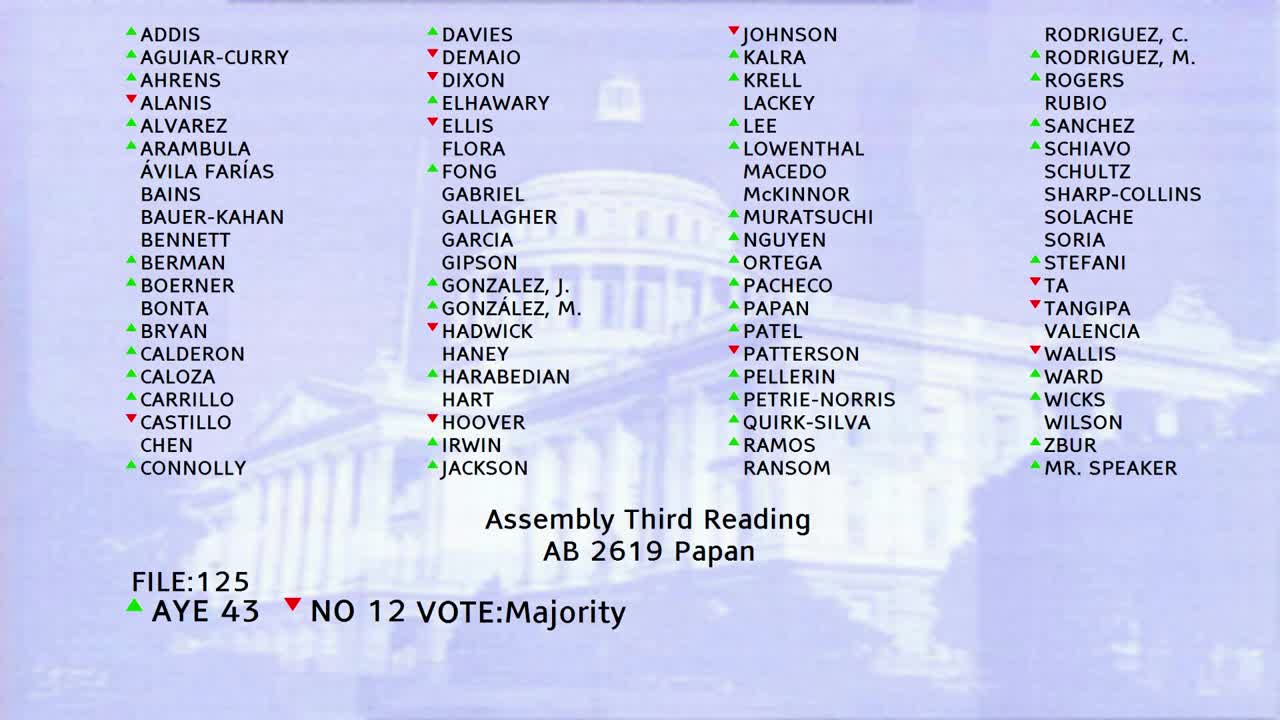 9MIN
Assembly Floor
 27MIN
Assembly Standing Committee on Housing and Community Development
 40MIN
Assembly Standing Committee on Natural Resources
Bill Author

Bill Co-Author(s):
