AB 1789: Political Reform Act of 1974: candidate trainings.
- Session Year: 2025-2026
- House: Assembly
- Latest Version Date: 2026-09-27
Current Status:
Passed
(2026-09-27: Chaptered by Secretary of State - Chapter 477, Statutes of 2026.)
Introduced
In Committee
Awaiting First Chamber Vote
Passed First Chamber
In Committee
Awaiting Second Chamber Vote
Passed Second Chamber
Enacted
What does this bill do?
The bill requires candidates who control a campaign committee and the treasurers of those committees to complete a state commission training on California campaign finance rules tailored to the office or committee. If the candidate or treasurer hasn’t finished the training, the campaign committee may not accept contributions until the training is completed, and similar local ethics trainings can satisfy the requirement.
The summary is provided by generative AI which can make mistakes. For original language, please view the details in the table below.
The Political Reform Act of 1974 provides for the comprehensive regulation of campaign financing, including requiring the reporting of campaign contributions and expenditures and imposing other reporting and recordkeeping requirements on campaign committees.
This bill would, commencing January 1, 2029, require a candidate for elective office with a candidate controlled committee to complete a training course on the requirements of the Political Reform Act of 1974 with respect to campaigns for the office for which they intend to be a candidate. For a candidate who does not complete the training, the bill would prohibit the candidate controlled committee from receiving contributions until the candidate completes the training. The bill would, commencing January 1, 2029, also require the treasurer for a candidate controlled committee to complete a training course on the requirements of the act that apply to the committee. The bill would prohibit a committee whose treasurer does not complete the training course from accepting contributions until the training course is completed. The bill would exempt from these requirements an individual who is required to complete, and has completed, a similar training offered by a local government ethics agency.
By prohibiting a committees receipt of contributions if specified conditions are not satisfied, as set forth above, the bill would create a new crime and thereby establish a state-mandated local program.
The California Constitution requires the state to reimburse local agencies and school districts for certain costs mandated by the state. Statutory provisions establish procedures for making that reimbursement.
This bill would provide that no reimbursement is required by this act for a specified reason.
The Political Reform Act of 1974, an initiative measure, provides that the Legislature may amend the act to further the acts purposes upon a 2/3 vote of each house of the Legislature and compliance with specified procedural requirements.
This bill would declare that it furthers the purposes of the act.
The Political Reform Act of 1974 provides for the comprehensive regulation of campaign financing, including requiring the reporting of campaign contributions and expenditures and imposing other reporting and recordkeeping requirements on campaign committees.
This bill would, commencing January 1, 2029, require an individual who files a statement of intention to be a a candidate for elective office with a candidate controlled committee to complete a training course on the requirements of the Political Reform Act of 1974 with respect to campaigns for the office for which they intend to be a candidate. For a candidate who does not complete the training, the bill would prohibit any committee they control, as specified, the candidate controlled committee from receiving contributions until the candidate completes the training. The bill would, commencing January 1, 2029, also require the treasurer for a candidate controlled committee to complete a training course on the requirements of the act that apply to the committee. The bill would prohibit a committee whose treasurer does not complete the training course from accepting contributions until the training course is completed. The bill would exempt from these requirements an individual who is required to complete, and has completed, a similar training offered by a local government ethics agency. The bill would also exempt from these requirements a candidate who indicates on their statement of intention that they do not intend to qualify as a committee that receives campaign contributions in excess of $2,000, as specified.
By prohibiting a committees receipt of contributions if specified conditions are not satisfied, as set forth above, the bill would create a new crime and thereby establish a state-mandated local program.
The California Constitution requires the state to reimburse local agencies and school districts for certain costs mandated by the state. Statutory provisions establish procedures for making that reimbursement.
This bill would provide that no reimbursement is required by this act for a specified reason.
The Political Reform Act of 1974, an initiative measure, provides that the Legislature may amend the act to further the acts purposes upon a 2/3 vote of each house of the Legislature and compliance with specified procedural requirements.
This bill would declare that it furthers the purposes of the act.
The Political Reform Act of 1974 provides for the comprehensive regulation of campaign financing, including requiring the reporting of campaign contributions and expenditures and imposing other reporting and recordkeeping requirements on campaign committees.
This bill would, commencing January 1, 2029, require an individual who files a statement of intention to be a candidate for elective office, other than statewide elective office, office to complete a training course on the requirements of the Political Reform Act of 1974 with respect to campaigns for the office for which they intend to be a candidate. For a candidate who does not complete the training, the bill would prohibit any committee they control, as specified, from receiving contributions until the candidate completes the training. The bill would, commencing January 1, 2029, also require the treasurer for a candidate controlled committee, other than a committee controlled by a candidate for statewide elective office, committee to complete a training course on the requirements of the act that apply to the committee. The bill would prohibit a committee whose treasurer does not complete the training course from accepting contributions until the training course is completed. The bill would exempt from these requirements an individual who is required to complete, and has completed, a similar training offered by a local government ethics agency. The bill would also exempt from these requirements a candidate who indicates on their statement of intention that they do not intend to qualify as a committee that receives campaign contributions in excess of $2,000, as specified.
The Political Reform Act of 1974 requires elected officers, candidates, and committees to file campaign reports containing specified information regarding, among other items, contributions and expenditures received or provided during the period covered by the report. The act also requires slate mailer organizations to file campaign reports regarding disbursements to candidates, committees, and other persons during the period covered by the report. Generally, the act requires this information to be provided for contributions, expenditures, and disbursements, as applicable, according to whether the amount is more or less than a threshold amount of $100.This bill would increase this threshold amount to $200.By prohibiting a committees receipt of contributions if specified conditions are not satisfied, as set forth above, the bill would create a new crime and thereby establish a state-mandated local program.
The California Constitution requires the state to reimburse local agencies and school districts for certain costs mandated by the state. Statutory provisions establish procedures for making that reimbursement.
This bill would provide that no reimbursement is required by this act for a specified reason.
The Political Reform Act of 1974, an initiative measure, provides that the Legislature may amend the act to further the acts purposes upon a 2/3 vote of each house of the Legislature and compliance with specified procedural requirements.
This bill would declare that it furthers the purposes of the act.
The Political Reform Act of 1974 provides for the comprehensive regulation of campaign financing, including requiring the reporting of campaign contributions and expenditures and imposing other reporting and recordkeeping requirements on campaign committees.
This bill would, commencing January 1, 2029, require an individual who files a statement of intention to be a candidate for elective office, other than statewide elective office, to complete a training course on the requirements of the Political Reform Act of 1974 with respect to campaigns for the office for which they intend to be a candidate. The bill would prohibit the name of a candidate who does not complete the training course from being printed on the ballot. For a candidate who does not complete the training, the bill would prohibit any committee they control, as specified, from receiving contributions until the candidate completes the training. The bill would, commencing January 1, 2029, also require the treasurer for a candidate controlled committee, other than a committee controlled by a candidate for statewide elective office, to complete a training course on the requirements of the act that apply to the committee. The bill would prohibit a committee whose treasurer does not complete the training course from accepting contributions until the training course is completed. The bill would exempt from these requirements an individual who is required to complete, and has completed, a similar training offered by a local government ethics agency. The bill would also exempt from these requirements a candidate who indicates on their statement of intention that they do not intend to qualify as a committee that receives campaign contributions in excess of $2,000, as specified.
The Political Reform Act of 1974 requires elected officers, candidates, and committees to file campaign reports containing specified information regarding, among other items, contributions and expenditures received or provided during the period covered by the report. The act also requires slate mailer organizations to file campaign reports regarding disbursements to candidates, committees, and other persons during the period covered by the report. Generally, the act requires this information to be provided for contributions, expenditures, and disbursements, as applicable, according to whether the amount is more or less than a threshold amount of $100.
This bill would increase this threshold amount to $200.
By prohibiting a committees receipt of contributions if specified conditions are not satisfied, as set forth above, the bill would create a new crime and thereby establish a state-mandated local program.
The California Constitution requires the state to reimburse local agencies and school districts for certain costs mandated by the state. Statutory provisions establish procedures for making that reimbursement.
This bill would provide that no reimbursement is required by this act for a specified reason.
The Political Reform Act of 1974, an initiative measure, provides that the Legislature may amend the act to further the acts purposes upon a 2/3 vote of each house of the Legislature and compliance with specified procedural requirements.
This bill would declare that it furthers the purposes of the act.
The Political Reform Act of 1974 provides for the comprehensive regulation of campaign financing, including requiring the reporting of campaign contributions and expenditures and imposing other reporting and recordkeeping requirements on campaign committees.
This bill would, commencing January 1, 2029, require an individual who files a statement of intention to be a candidate for elective office, other than statewide elective office, to complete a training course on the requirements of the Political Reform Act of 1974 with respect to campaigns for the office for which they intend to be a candidate. The bill would prohibit the name of a candidate who does not complete the training course from being printed on the ballot. The bill would, commencing January 1, 2029, also require the treasurer for a candidate controlled committee, other than a committee controlled by a candidate for statewide elective office, to complete a training course on the requirements of the act that apply to the committee. The bill would prohibit a committee whose treasurer does not complete the training course from accepting contributions until the training course is completed. The bill would exempt from these requirements an individual who is required to complete, and has completed, a similar training offered by a local government ethics agency.
The Political Reform Act of 1974 requires elected officers, candidates, and committees to file campaign reports containing specified information regarding, among other items, contributions and expenditures received or provided during the period covered by the report. The act also requires slate mailer organizations to file campaign reports regarding disbursements to candidates, committees, and other persons during the period covered by the report. Generally, the act requires this information to be provided for contributions, expenditures, and disbursements, as applicable, according to whether the amount is more or less than a threshold amount of $100.
This bill would increase this threshold amount to $200.
By prohibiting a committees receipt of contributions if specified conditions are not satisfied, as set forth above, the bill would create a new crime and thereby establish a state-mandated local program.
The California Constitution requires the state to reimburse local agencies and school districts for certain costs mandated by the state. Statutory provisions establish procedures for making that reimbursement.
This bill would provide that no reimbursement is required by this act for a specified reason.
The Political Reform Act of 1974, an initiative measure, provides that the Legislature may amend the act to further the acts purposes upon a 2/3 vote of each house of the Legislature and compliance with specified procedural requirements.
This bill would declare that it furthers the purposes of the act.
The Political Reform Act of 1974 provides for the comprehensive regulation of campaign financing, including requiring the reporting of campaign contributions and expenditures and imposing other reporting and recordkeeping requirements on campaign committees. The act requires specified committees to file a statement of organization online or electronically with the Secretary of State and a copy of the statement of organization with the local filing officer, if any.This bill would make a nonsubstantive change to these provisions.The Political Reform Act of 1974 provides for the comprehensive regulation of campaign financing, including requiring the reporting of campaign contributions and expenditures and imposing other reporting and recordkeeping requirements on campaign committees. The act requires specified committees to file a statement of organization online or electronically with the Secretary of State and a copy of the statement of organization with the local filing officer, if any.
This bill would make a nonsubstantive change to these provisions.
(a)(1)Commencing January 1, 2029, except as provided in subdivision (d), a candidate for elective office with a candidate controlled committee registered pursuant to Section 84101 shall complete a training course on the requirements of this title for campaigns for the office identified on the registration, as provided in paragraph (2).
(2)(A)If the candidate controlled committee registers pursuant to Section 84101 before January 1, 2029, and the candidate still intends to be a candidate in an election occurring after January 1, 2029, the candidate shall complete the training course by or before February 28, 2029.
(B)If the candidate controlled committee registers pursuant to Section 84101 on or after January 1, 2029, and the candidate has never completed the training course for the office identified on the registration, the candidate shall complete the training course no later than 30 days after the candidate controlled committee registers pursuant to Section 84101.
(3)If a candidate does not complete the training course by the applicable deadline provided in paragraph (2), the candidate controlled committee shall be prohibited from accepting a contribution until the date the candidate completes the training course.
(b)(1)Commencing January 1, 2029, except as provided in subdivision (d), the treasurer for a candidate controlled committee shall complete a training course on the requirements of this title that apply to the committee, as provided in paragraph (2).
(2)(A)For a committee that registers pursuant to Section 84101 before January 1, 2029, and has not terminated as of February 28, 2029, if the individual identified as the treasurer on the committees registration has not completed a training course developed by the commission, the individual shall complete the training course by February 28, 2029.
(B)For a committee that registers pursuant to Section 84101 on or after January 1, 2029, if the individual identified as the treasurer on the committees registration has not completed a training course developed by the commission within four years before the date the registration was submitted, the individual shall complete the training course within 30 days after the candidate controlled committee registers pursuant to Section 84101.
(3)If a treasurer does not complete the training course by the applicable deadline provided in paragraph (2), the committee shall be prohibited from accepting a contribution until the date the treasurer completes the training course.
(c)The commission shall develop, maintain, and offer the training courses required by subdivisions (a) and (b). The courses shall be available through an online platform, internet webpage, or application and may be completed at the convenience of the individual, subject to the deadlines provided in this section. The training course for candidates shall not exceed 90 minutes in length, and the training course for treasurers shall not exceed 120 minutes in length.
(d)This section does not apply to an individual who is required to complete, and has completed, similar trainings required by a local government ethics agency by the applicable deadlines specified in subdivisions (a) and (b). The commission shall have discretion to determine whether another training is similar to a training developed by the commission.
(e)For purposes of this section, candidate controlled committee means the candidate controlled committee established for the elective office of the controlling candidate.
SEC. 2.No reimbursement is required by this act pursuant to Section 6 of Article XIIIB of the California Constitution because the only costs that may be incurred by a local agency or school district will be incurred because this act creates a new crime or infraction, eliminates a crime or infraction, or changes the penalty for a crime or infraction, within the meaning of Section 17556 of the Government Code, or changes the definition of a crime within the meaning of Section 6 of Article XIIIB of the California Constitution.
SEC. 3.The Legislature finds and declares that this bill furthers the purposes of the Political Reform Act of 1974 within the meaning of subdivision (a) of Section 81012 of the Government Code.
(a)(1)Commencing January 1, 2029, except as provided in subdivision (d), a candidate for elective office, or an individual who intends to be a candidate for elective office, office with a candidate controlled committee registered pursuant to Section 84101 shall complete a training course on the requirements of this title for campaigns for the office for which they intend to be a candidate, identified on the registration, as provided in paragraph (2).
(2)(A)If an individual files a statement of intention to be a candidate the candidate controlled committee registers pursuant to Section 84101 before January 1, 2029, and the individual is a candidate or still intends to be a candidate as of in an election occurring after January 1, 2029, the individual candidate shall complete the training course by or before February 28, 2029.
(B)If the individual files a statement of intention to be a candidate candidate controlled committee registers pursuant to Section 84101 on or after January 1, 2029, and the individual candidate has never completed the training course for the office identified on the statement of intention, registration, the individual candidate shall complete the training course no later than 30 days after filing the statement of intention. the candidate controlled committee registers pursuant to Section 84101.
(3)If a candidate does not complete the training course by the applicable deadline provided in paragraph (2), any the candidate controlled committee controlled by the candidate for purposes of the office for which they intend to be a candidate shall be prohibited from accepting a contribution until the date the candidate completes the training course.
(b)(1)Commencing January 1, 2029, except as provided in subdivision (d), the treasurer for a candidate candidate controlled committee shall complete a training course on the requirements of this title that apply to the committee, as provided in paragraph (2).
(2)(A)For a committee that submits its registration registers pursuant to Section 84101 before January 1, 2029, and has not terminated as of February 28, 2029, if the individual identified as the treasurer on the committees registration has not completed a training course developed by the commission, the individual shall complete the training course by February 28, 2029.
(B)For a committee that submits its registration registers pursuant to Section 84101 on or after January 1, 2029, if the individual identified as the treasurer on the committees registration has not completed a training course developed by the commission within four years before the date the registration was submitted, the individual shall complete the training course within 30 days of the date the registration was submitted. after the candidate controlled committee registers pursuant to Section 84101.
(3)If a treasurer does not complete the training course by the applicable deadline provided in paragraph (2), the committee shall be prohibited from accepting a contribution until the date the treasurer completes the training course.
(c)The commission shall develop, maintain, and offer the training courses required by subdivisions (a) and (b). The courses shall be available on demand through an online platform, internet webpage, or application. application and may be completed at the convenience of the individual, subject to the deadlines provided in this section. The training course for candidates shall not exceed 90 minutes in length, and the training course for treasurers shall not exceed 120 minutes in length.
(d)This section does not apply to either of the following:
(1)An an individual who is required to complete, and has completed, similar trainings required by a local government ethics agency by the applicable deadlines specified in subdivisions (a) and (b). The commission shall have discretion to determine whether another training is similar to a training developed by the commission.
(2)A candidate who indicates on their statement of intention that the candidate does not intend to qualify as a committee pursuant to subdivision (a) of Section 82013, except that if the candidate thereafter qualifies as a committee, the candidate shall complete the training course no later than 30 days after they qualify.(e)For purposes of this section, candidate controlled committee means the candidate controlled committee established for the elective office of the controlling candidate.
SEC. 2.No reimbursement is required by this act pursuant to Section 6 of Article XIIIB of the California Constitution because the only costs that may be incurred by a local agency or school district will be incurred because this act creates a new crime or infraction, eliminates a crime or infraction, or changes the penalty for a crime or infraction, within the meaning of Section 17556 of the Government Code, or changes the definition of a crime within the meaning of Section 6 of Article XIIIB of the California Constitution.
SEC. 3.The Legislature finds and declares that this bill furthers the purposes of the Political Reform Act of 1974 within the meaning of subdivision (a) of Section 81012 of the Government Code.
(a)(1)Commencing January 1, 2029, except as provided in subdivision (d), a candidate for elective office, or an individual who intends to be a candidate for elective office, shall complete a training course on the requirements of this title for campaigns for the office for which they intend to be a candidate, as provided in paragraph (2).
(2)(A)If an individual files a statement of intention to be a candidate before January 1, 2029, and the individual is a candidate or still intends to be a candidate as of January 1, 2029, the individual shall complete the training course by or before February 28, 2029.
(B)If the individual files a statement of intention to be a candidate on or after January 1, 2029, and the individual has never completed the training course for the office identified on the statement of intention, the individual shall complete the training course no later than 30 days after filing the statement of intention.
(3)If a candidate does not complete the training course by the applicable deadline provided in paragraph (2), any committee controlled by the candidate for purposes of the office for which they intend to be a candidate shall be prohibited from accepting a contribution until the date the candidate completes the training course.
(b)(1)Commencing January 1, 2029, except as provided in subdivision (d), the treasurer for a candidate controlled committee shall complete a training course on the requirements of this title that apply to the committee, as provided in paragraph (2).
(2)(A)For a committee that submits its registration before January 1, 2029, and has not terminated as of February 28, 2029, if the individual identified as the treasurer on the committees registration has not completed a training course developed by the commission, the individual shall complete the training course by February 28, 2029.
(B)For a committee that submits its registration on or after January 1, 2029, if the individual identified as the treasurer on the committees registration has not completed a training course developed by the commission within four years before the date the registration was submitted, the individual shall complete the training course within 30 days of the date the registration was submitted.
(3)If a treasurer does not complete the training course by the applicable deadline provided in paragraph (2), the committee shall be prohibited from accepting a contribution until the date the treasurer completes the training course.
(c)The commission shall develop, maintain, and offer the training courses required by subdivisions (a) and (b). The courses shall be available on demand through an online platform, internet webpage, or application. The training course for candidates shall not exceed 90 minutes in length, and the training course for treasurers shall not exceed 120 minutes in length.
(d)This section does not apply to any either of the following:
(1)An individual who is required to complete, and has completed, similar trainings required by a local government ethics agency by the applicable deadlines specified in subdivisions (a) and (b). The commission shall have discretion to determine whether another training is similar to a training developed by the commission.
(2)An individual who files a statement of intention to be a candidate for statewide elective office or a treasurer for a committee controlled by a candidate for statewide elective office.(3)(2)A candidate who indicates on their statement of intention that the candidate does not intend to qualify as a committee pursuant to subdivision (a) of Section 82013, except that if the candidate thereafter qualifies as a committee, the candidate shall complete the training course no later than 30 days after they qualify.
SEC. 6.Sections 2 and 4 of this act shall not become operative until the Secretary of State certifies an online filing and disclosure system pursuant to paragraph (7) of subdivision (b) of Section 84602 of the Government Code.SEC. 7.SEC. 2.No reimbursement is required by this act pursuant to Section 6 of Article XIIIB of the California Constitution because the only costs that may be incurred by a local agency or school district will be incurred because this act creates a new crime or infraction, eliminates a crime or infraction, or changes the penalty for a crime or infraction, within the meaning of Section 17556 of the Government Code, or changes the definition of a crime within the meaning of Section 6 of Article XIIIB of the California Constitution.
SEC. 8.SEC. 3.The Legislature finds and declares that this bill furthers the purposes of the Political Reform Act of 1974 within the meaning of subdivision (a) of Section 81012 of the Government Code.
Each campaign statement required by this article shall contain all of the following information:
(a)The total amount of contributions received during the period covered by the campaign statement and the total cumulative amount of contributions received.
(b)The total amount of expenditures made during the period covered by the campaign statement and the total cumulative amount of expenditures made.
(c)The total amount of contributions received during the period covered by the campaign statement from persons who have given a cumulative amount of two hundred dollars ($200) or more.
(d)The total amount of contributions received during the period covered by the campaign statement from persons who have given a cumulative amount of less than two hundred dollars ($200).
(e)The balance of cash and cash equivalents on hand at the beginning and the end of the period covered by the campaign statement.
(f)If the cumulative amount of contributions (including loans) received from a person is two hundred dollars ($200) or more and a contribution or loan has been received from that person during the period covered by the campaign statement, all of the following:
(1)That persons full name.
(2)That persons street address.
(3)That persons occupation.
(4)The name of that persons employer, or, if self-employed, the name of the business.
(5)The date and amount received for each contribution received during the period covered by the campaign statement and, if the contribution is a loan, the interest rate for the loan.
(6)The cumulative amount of contributions.
(g)If the cumulative amount of loans received from or made to a person is two hundred dollars ($200) or more, and a loan has been received from or made to a person during the period covered by the campaign statement, or is outstanding during the period covered by the campaign statement, all of the following:
(1)That persons full name.
(2)That persons street address.
(3)That persons occupation.
(4)The name of that persons employer, or, if self-employed, the name of the business.
(5)The original date and amount of each loan.
(6)The due date and interest rate of the loan.
(7)The cumulative payment made or received to date at the end of the reporting period.
(8)The balance outstanding at the end of the reporting period.
(9)The cumulative amount of contributions.
(h)For each person, other than the filer, who is directly, indirectly, or contingently liable for repayment of a loan received or outstanding during the period covered by the campaign statement, all of the following:
(1)That persons full name.
(2)That persons street address.
(3)That persons occupation.
(4)The name of that persons employer, or, if self-employed, the name of the business.
(5)The amount of that persons maximum liability outstanding.
(i)The total amount of expenditures made during the period covered by the campaign statement to persons who have received two hundred dollars ($200) or more.
(j)The total amount of expenditures made during the period covered by the campaign statement to persons who have received less than two hundred dollars ($200).
(k)For each person to whom an expenditure of two hundred dollars ($200) or more has been made during the period covered by the campaign statement, all of the following:
(1)That persons full name.
(2)That persons street address.
(3)The amount of each expenditure.
(4)A brief description of the consideration for which each expenditure was made.
(5)In the case of an expenditure which is a contribution to a candidate, elected officer, or committee or an independent expenditure to support or oppose a candidate or measure, in addition to the information required in paragraphs (1) to (4) above, the date of the contribution or independent expenditure, the cumulative amount of contributions made to a candidate, elected officer, or committee, or the cumulative amount of independent expenditures made relative to a candidate or measure; the full name of the candidate, and the office and district for which the candidate seeks nomination or election, or the number or letter of the measure; and the jurisdiction in which the measure or candidate is voted upon.
(6)The information required in paragraphs (1) to (4), inclusive, for each person, if different from the payee, who has provided consideration for an expenditure of five hundred dollars ($500) or more during the period covered by the campaign statement.
For purposes of subdivisions (i), (j), and (k) only, the terms expenditure or expenditures mean any individual payment or accrued expense, unless it is clear from surrounding circumstances that a series of payments or accrued expenses are for a single service or product.
(l)In the case of a controlled committee, an official committee of a political party, or an organization formed or existing primarily for political purposes, the amount and source of any miscellaneous receipt.
(m)If a committee is listed pursuant to subdivision (f), (g), (h), (k), (l), or (q), the number assigned to the committee by the Secretary of State shall be listed, or, if no number has been assigned, the full name and street address of the treasurer of the committee.
(n)In a campaign statement filed by a candidate who is a candidate in both a state primary and general election, such a candidates controlled committee, or a committee primarily formed to support or oppose such a candidate, the total amount of contributions received and the total amount of expenditures made for the period January 1 through June 30 and the total amount of contributions received and expenditures made for the period July 1 through December 31.
(o)The full name, residential or business address, and telephone number of the filer, or in the case of a campaign statement filed by a committee defined by subdivision (a) of Section 82013, the name, street address, and telephone number of the committee and of the committee treasurer. In the case of a committee defined by subdivision (b) or (c) of Section 82013, the name that the filer uses on campaign statements shall be the name by which the filer is identified for other legal purposes or any name by which the filer is commonly known to the public.
(p)If the campaign statement is filed by a candidate, the name, street address, and treasurer of any committee of which that candidate has knowledge which has received contributions or made expenditures on behalf of the candidates candidacy and whether the committee is controlled by the candidate.
(q)A contribution need not be reported nor shall it be deemed accepted if it is not cashed, negotiated, or deposited and is returned to the contributor before the closing date of the campaign statement on which the contribution would otherwise be reported.
(r)If a committee primarily formed for the qualification or support of, or opposition to, an initiative or ballot measure is required to report an expenditure to a business entity pursuant to subdivision (k) and 50 percent or more of the business entity is owned by a candidate or person controlling the committee, by an officer or employee of the committee, or by a spouse of any of these individuals, the committees campaign statement shall also contain, in addition to the information required by subdivision (k), that persons name, the relationship of that person to the committee, and a description of that persons ownership interest or position with the business entity.
(s)If a committee primarily formed for the qualification or support of, or opposition to, an initiative or ballot measure is required to report an expenditure to a business entity pursuant to subdivision (k), and a candidate or person controlling the committee, an officer or employee of the committee, or a spouse of any of these individuals is an officer, partner, consultant, or employee of the business entity, the committees campaign statement shall also contain, in addition to the information required by subdivision (k), that persons name, the relationship of that person to the committee, and a description of that persons ownership interest or position with the business entity.
(t)If the campaign statement is filed by a committee, as defined in subdivision (b) or (c) of Section 82013, information sufficient to identify the nature and interests of the filer, including:
(1)If the filer is an individual, the name and address of the filers employer, if any, or the filers principal place of business if the filer is self-employed, and a description of the business activity in which the filer or the filers employer is engaged.
(2)If the filer is a business entity, a description of the business activity in which it is engaged.
(3)If the filer is an industry, trade, or professional association, a description of the industry, trade, or profession which it represents, including a specific description of any portion or faction of the industry, trade, or profession which the association exclusively or primarily represents.
(4)If the filer is not an individual, business entity, or industry, trade, or professional association, a statement of the persons nature and purposes, including a description of any industry, trade, profession, or other group with a common economic interest which the person principally represents or from which its membership or financial support is principally derived.
SEC. 3.SEC. 2.Section 84211 of the Government Code, as amended by Section 33 of Chapter 278 of the Statutes of 2025, is amended to read:84211.Each campaign report required by Sections 84200 and 84200.5 shall contain all of the following information:
(a)The total amount of contributions received during the period covered by the campaign report and the total cumulative amount of contributions received.
(b)The total amount of expenditures made during the period covered by the campaign report and the total cumulative amount of expenditures made.
(c)The total amount of contributions received during the period covered by the campaign report from persons who have given a cumulative amount of two hundred dollars ($200) or more.
(d)The total amount of contributions received during the period covered by the campaign report from persons who have given a cumulative amount of less than two hundred dollars ($200).
(e)The balance of cash and cash equivalents on hand at the beginning and the end of the period covered by the campaign report.
(f)If the cumulative amount of contributions (including loans) received from a person is two hundred dollars ($200) or more and a contribution or loan has been received from that person during the period covered by the campaign report, all of the following:
(1)That persons full name.
(2)That persons street address.
(3)That persons occupation.
(4)The name of that persons employer, or, if self-employed, the name of the business.
(5)The date and amount received for each contribution received during the period covered by the campaign report and whether the contribution was made in the form of a monetary contribution, in-kind contribution of goods or services, or a loan.
(6)The cumulative amount of contributions.
(g)If the cumulative amount of loans received from or made to a person is two hundred dollars ($200) or more, and a loan has been received from or made to a person during the period covered by the campaign report, or is outstanding during the period covered by the campaign report, all of the following:
(1)That persons full name.
(2)That persons street address.
(3)That persons occupation.
(4)The name of that persons employer, or, if self-employed, the name of the business.
(5)The original date and amount of each loan.
(6)The due date and interest rate of the loan.
(7)The cumulative payment made or received to date at the end of the reporting period.
(8)The balance outstanding at the end of the reporting period.
(9)The cumulative amount of contributions.
(h)For each person, other than the filer, who is directly, indirectly, or contingently liable for repayment of a loan received or outstanding during the period covered by the campaign report, all of the following:
(1)That persons full name.
(2)That persons street address.
(3)That persons occupation.
(4)The name of that persons employer, or, if self-employed, the name of the business.
(5)The amount that persons maximum liability outstanding.
(i)The total amount of expenditures made during the period covered by the campaign report to persons who have received two hundred dollars ($200) or more.
(j)The total amount of expenditures made during the period covered by the campaign report to persons who have received less than two hundred dollars ($200).
(k)For each person to whom an expenditure of two hundred dollars ($200) or more has been made during the period covered by the campaign report, all of the following:
(1)That persons full name.
(2)That persons street address.
(3)The date and amount of each expenditure.
(4)A brief description of the consideration for which each expenditure was made.
(5)In the case of an expenditure which is a contribution to a candidate, elected officer, or committee or an independent expenditure to support or oppose a candidate or measure, in addition to the information required in paragraphs (1) to (4), inclusive, the date of the contribution or independent expenditure, the cumulative amount of contributions made to a candidate, elected officer, or committee, or the cumulative amount of independent expenditures made relative to a candidate or measure; the full name of the candidate, and the office and district for which the candidate seeks nomination or election, or the number or letter of the measure; and the jurisdiction in which the measure or candidate is voted upon.
(6)The information required in paragraphs (1) to (4), inclusive, for each person, if different from the payee, who has provided consideration for an expenditure of five hundred dollars ($500) or more during the period covered by the campaign report.
For purposes of subdivisions (i), (j), and (k) only, the terms expenditure or expenditures mean any individual payment or accrued expense, unless it is clear from surrounding circumstances that a series of payments or accrued expenses are for a single service or product.
(l)In the case of a controlled committee, an official committee of a political party, or an organization formed or existing primarily for political purposes, the amount and source of any miscellaneous receipt.
(m)If a committee is listed pursuant to subdivision (f), (g), (h), (k), (l), or (p), the number assigned to the committee by the Secretary of State shall be listed, or, if a number has not been assigned, the full name and street address of the treasurer of the committee.
(n)In a campaign report filed by a candidate who is a candidate in both a state primary and general election, such a candidates controlled committee, or a committee primarily formed to support or oppose such a candidate, the total amount of contributions received and the total amount of expenditures made for the period of January 1 through June 30 and the total amount of contributions received and expenditures made for the period of July 1 through December 31.
(o)The full name, residential or business address, email address, and telephone number of the filer, or, in the case of a campaign report filed by a committee defined by subdivision (a) of Section 82013, the name, street address, email address, and telephone number of the committee and of the committee treasurer. In the case of a committee defined by subdivision (b) or (c) of Section 82013, the name that the filer uses on campaign reports shall be the name by which the filer is identified for other legal purposes or any name by which the filer is commonly known to the public.
(p)A contribution need not be reported nor shall it be deemed accepted if it is not cashed, negotiated, or deposited and is returned to the contributor before the closing date of the campaign report on which the contribution would otherwise be reported.
(q)If a committee primarily formed for the qualification or support of, or opposition to, an initiative or ballot measure is required to report an expenditure to a business entity pursuant to subdivision (k) and 50 percent or more of the business entity is owned by a candidate or person controlling the committee, by an officer or employee of the committee, or by a spouse of any of these individuals, the committees campaign report shall also contain, in addition to the information required by subdivision (k), that persons name, the relationship of that person to the committee, and a description of that persons ownership interest or position with the business entity.
(r)If a committee primarily formed for the qualification or support of, or opposition to, an initiative or ballot measure is required to report an expenditure to a business entity pursuant to subdivision (k), and a candidate or person controlling the committee, an officer or employee of the committee, or a spouse of any of these individuals is an officer, partner, consultant, or employee of the business entity, the committees campaign report shall also contain, in addition to the information required by subdivision (k), that persons name, the relationship of that person to the committee, and a description of that persons ownership interest or position with the business entity.
(s)If the campaign report is filed by a committee, as defined in subdivision (b) or (c) of Section 82013, information sufficient to identify the nature and interests of the filer, including:
(1)If the filer is an individual, the name and address of the filers employer, if any, or the filers principal place of business if the filer is self-employed, and a description of the business activity in which the filer or the filers employer is engaged.
(2)If the filer is a business entity, a description of the business activity in which it is engaged.
(3)If the filer is an industry, trade, or professional association, a description of the industry, trade, or profession which it represents, including a specific description of any portion or faction of the industry, trade, or profession which the association exclusively or primarily represents.
(4)If the filer is not an individual, business entity, or industry, trade, or professional association, a statement of the persons nature and purposes, including a description of any industry, trade, profession, or other group with a common economic interest which the person principally represents or from which its membership or financial support is principally derived.
SEC. 4.SEC. 3.Section 84219 of the Government Code, as amended by Section 166 of Chapter 50 of the Statutes of 2021, is amended to read:84219.Whenever a slate mailer organization is required to file campaign reports pursuant to Section 84218, the campaign report shall include the following information:
(a)The total amount of receipts during the period covered by the campaign statement and the total cumulative amount of receipts. For purposes of this section only, receipts means payments received by a slate mailer organization for production and distribution of slate mailers.
(b)The total amount of disbursements made during the period covered by the campaign statement and the total cumulative amount of disbursements. For purposes of this section only, disbursements means payment made by a slate mailer organization for the production or distribution of slate mailers.
(c)For each candidate or committee that is a source of receipts totaling two hundred dollars ($200) or more during the period covered by the campaign statement:
(1)The name of the candidate or committee, identification of the jurisdiction and the office sought or ballot measure number or letter, and, if the source is a committee, the committees identification number, street address, and the name of the candidate or measure on whose behalf or in opposition to which the payment is made.
(2)The date and amount received for each receipt totaling two hundred dollars ($200) or more during the period covered by the campaign statement.
(3)The cumulative amount of receipts on behalf of or in opposition to the candidate or measure.
(d)For each person other than a candidate or committee who is a source of receipts totaling two hundred dollars ($200) or more during the period covered by the campaign statement:
(1)Identification of the jurisdiction, office or ballot measure, and name of the candidate or measure on whose behalf or in opposition to which the payment was made.
(2)Full name, street address, name of employer, or, if self-employed, name of business of the source of receipts.
(3)The date and amount received for each receipt totaling two hundred dollars ($200) or more during the period covered by the campaign statement.
(4)The cumulative amount of receipts on behalf of or in opposition to the candidate or measure.
(e)For each candidate or ballot measure not reported pursuant to subdivision (c) or (d), but who was supported or opposed in a slate mailer sent by the slate mailer organization during the period covered by the report, identification of jurisdiction, office or ballot measure, and name of the candidate or measure who was supported or opposed.
(f)The total amount of disbursements made during the period covered by the campaign statement to persons who have received two hundred dollars ($200) or more.
(g)The total amount of disbursements made during the period covered by the campaign statement to persons who have received less than two hundred dollars ($200).
(h)For each person to whom a disbursement of two hundred dollars ($200) or more has been made during the period covered by the campaign statement:
(1)That persons full name.
(2)That persons street address.
(3)The amount of each disbursement.
(4)A brief description of the consideration for which each disbursement was made.
(5)The information required in paragraphs (1) to (4), inclusive, for each person, if different from the payee, who has provided consideration for a disbursement of five hundred dollars ($500) or more during the period covered by the campaign statement.
(i)Cumulative disbursements, totaling one thousand dollars ($1,000) or more, made directly or indirectly to any person listed in the slate mailer organizations statement of organization. For purposes of this subdivision, a disbursement is made indirectly to a person if it is intended for the benefit of or use by that person or a member of the persons immediate family, or if it is made to a business entity in which the person or member of the persons immediate family is a partner, shareholder, owner, director, trustee, officer, employee, consultant, or holds any position of management or in which the person or member of the persons immediate family has an investment of one thousand dollars ($1,000) or more. This subdivision does not apply to any disbursement made to a business entity whose securities are publicly traded.
(j)The full name, street address, and telephone number of the slate mailer organization and of the treasurer.
(k)Whenever a slate mailer organization also qualifies as a general purpose committee pursuant to Section 82027.5, the campaign report shall include, in addition to the information required by this section, the information required by Section 84211.
SEC. 5.SEC. 4.Section 84219 of the Government Code, as amended by Section 39 of Chapter 278 of the Statutes of 2025, is amended to read:84219.Whenever a slate mailer organization is required to file campaign reports pursuant to Section 84218, the campaign report shall include the following information:
(a)The total amount of receipts during the period covered by the campaign report and the total cumulative amount of receipts. For purposes of this section only, receipts means payments received by a slate mailer organization for production and distribution of slate mailers.
(b)The total amount of disbursements made during the period covered by the campaign report and the total cumulative amount of disbursements. For purposes of this section only, disbursements means payment made by a slate mailer organization for the production or distribution of slate mailers.
(c)For each candidate or committee that is a source of receipts totaling two hundred dollars ($200) or more during the period covered by the campaign report:
(1)The name of the candidate or committee, identification of the jurisdiction and the office sought or ballot measure number or letter, and, if the source is a committee, the committees identification number, street address, and the name of the candidate or measure on whose behalf or in opposition to which the payment is made.
(2)The date and amount received for each receipt totaling two hundred dollars ($200) or more during the period covered by the campaign report.
(3)The cumulative amount of receipts on behalf of or in opposition to the candidate or measure.
(d)For each person other than a candidate or committee who is a source of receipts totaling two hundred dollars ($200) or more during the period covered by the campaign report:
(1)Identification of the jurisdiction, office or ballot measure, and name of the candidate or measure on whose behalf or in opposition to which the payment was made.
(2)Full name, street address, name of employer, or, if self-employed, name of business of the source of receipts.
(3)The date and amount received for each receipt totaling two hundred dollars ($200) or more during the period covered by the campaign report.
(4)The cumulative amount of receipts on behalf of or in opposition to the candidate or measure.
(e)For each candidate or ballot measure not reported pursuant to subdivision (c) or (d), but who was supported or opposed in a slate mailer sent by the slate mailer organization during the period covered by the report, identification of jurisdiction, office or ballot measure, and name of the candidate or measure who was supported or opposed.
(f)The total amount of disbursements made during the period covered by the campaign report to persons who have received two hundred dollars ($200) or more.
(g)The total amount of disbursements made during the period covered by the campaign report to persons who have received less than two hundred dollars ($200).
(h)For each person to whom a disbursement of two hundred dollars ($200) or more has been made during the period covered by the campaign report:
(1)That persons full name.
(2)That persons street address.
(3)The date and amount of each disbursement.
(4)A brief description of the consideration for which each disbursement was made.
(5)The information required in paragraphs (1) to (4), inclusive, for each person, if different from the payee, who has provided consideration for a disbursement of five hundred dollars ($500) or more during the period covered by the campaign report.
(i)Cumulative disbursements, totaling one thousand dollars ($1,000) or more, made directly or indirectly to any person listed in the slate mailer organizations registration. For purposes of this subdivision, a disbursement is made indirectly to a person if it is intended for the benefit of or use by that person or a member of the persons immediate family, or if it is made to a business entity in which the person or member of the persons immediate family is a partner, shareholder, owner, director, trustee, officer, employee, consultant, or holds any position of management or in which the person or member of the persons immediate family has an investment of one thousand dollars ($1,000) or more. This subdivision does not apply to any disbursement made to a business entity whose securities are publicly traded.
(j)The full name, street address, email address, and telephone number of the slate mailer organization and of the treasurer.
(k)Whenever a slate mailer organization also qualifies as a general purpose committee pursuant to Section 82027.5, the campaign report shall include, in addition to the information required by this section, the information required by Section 84211.
SEC. 6.SEC. 5.Section 85201.5 is added to the Government Code, to read:85201.5.(a)(1)Commencing January 1, 2029, except as provided in subdivision (d), a candidate for elective office, or an individual who intends to be a candidate for elective office, shall complete a training course on the requirements of this title for campaigns for the office for which they intend to be a candidate, as provided in paragraph (2).
(2)(A)If an individual files a statement of intention to be a candidate before January 1, 2029, and the individual is a candidate or still intends to be a candidate as of January 1, 2029, the individual shall complete the training course by or before February 28, 2029.
(B)If the individual files a statement of intention to be a candidate on or after January 1, 2029, and the individual has never completed the training course for the office identified on the statement of intention, the individual shall complete the training course no later than 30 days after filing the statement of intention, or no later than 88 days before the election, whichever is earlier. intention.
(3)Notwithstanding any other law, an individual who violates this subdivision is not subject to an enforcement action under this title.If a candidate does not complete the training course by the applicable deadline provided in paragraph (2), any committee controlled by the candidate for purposes of the office for which they intend to be a candidate shall be prohibited from accepting a contribution until the date the candidate completes the training course.
(b)(1)Commencing January 1, 2029, except as provided in subdivision (d), the treasurer for a candidate controlled committee shall complete a training course on the requirements of this title that apply to the committee, as provided in paragraph (2).
(2)(A)For a committee that submits its registration before January 1, 2029, and has not terminated as of February 28, 2029, if the individual identified as the treasurer on the committees registration has not completed a training course developed by the commission, the individual shall complete the training course by February 28, 2029.
(B)For a committee that submits its registration on or after January 1, 2029, if the individual identified as the treasurer on the committees registration has not completed a training course developed by the commission within four years before the date the registration was submitted, the individual shall complete the training course within 30 days of the date the registration was submitted.
(3)If a treasurer does not complete the training course by the applicable deadline provided in paragraph (2), the committee shall be prohibited from accepting a contribution until the date the treasurer completes the training course.
(c)The commission shall develop, maintain, and offer the training courses required by subdivisions (a) and (b). The courses shall be available on demand through an online platform, internet webpage, or application. The training course for candidates shall not exceed 90 minutes in length, and the training course for treasurers shall not exceed 120 minutes in length.
(d)This section does not apply to either any of the following:
(1)An individual who is required to complete, and has completed, similar trainings required by a local government ethics agency by the applicable deadlines specified in subdivisions (a) and (b). The commission shall have discretion to determine whether another training is similar to a training developed by the commission.
(2)An individual who files a statement of intention to be a candidate for statewide elective office or a treasurer for a committee controlled by a candidate for statewide elective office.
(3)A candidate who indicates on their statement of intention that the candidate does not intend to qualify as a committee pursuant to subdivision (a) of Section 82013, except that if the candidate thereafter qualifies as a committee, the candidate shall complete the training course no later than 30 days after they qualify.
SEC. 7.SEC. 6.Sections 3 and 5 2 and 4 of this act shall not become operative until the Secretary of State certifies an online filing and disclosure system pursuant to paragraph (7) of subdivision (b) of Section 84602 of the Government Code.
SEC. 8.SEC. 7.No reimbursement is required by this act pursuant to Section 6 of Article XIIIB of the California Constitution because the only costs that may be incurred by a local agency or school district will be incurred because this act creates a new crime or infraction, eliminates a crime or infraction, or changes the penalty for a crime or infraction, within the meaning of Section 17556 of the Government Code, or changes the definition of a crime within the meaning of Section 6 of Article XIIIB of the California Constitution.
SEC. 9.SEC. 8.The Legislature finds and declares that this bill furthers the purposes of the Political Reform Act of 1974 within the meaning of subdivision (a) of Section 81012 of the Government Code.
Notwithstanding any other law, the name of a candidate who is required to comply with the training requirements of Section 85201.5 of the Government Code, and who has not complied with those requirements, shall not be printed on the ballot.
SEC. 2.Section 84211 of the Government Code, as amended by Section 162 of Chapter 50 of the Statutes of 2021, is amended to read:84211.Each campaign statement required by this article shall contain all of the following information:
(a)The total amount of contributions received during the period covered by the campaign statement and the total cumulative amount of contributions received.
(b)The total amount of expenditures made during the period covered by the campaign statement and the total cumulative amount of expenditures made.
(c)The total amount of contributions received during the period covered by the campaign statement from persons who have given a cumulative amount of one hundred dollars ($100) two hundred dollars ($200) or more.
(d)The total amount of contributions received during the period covered by the campaign statement from persons who have given a cumulative amount of less than one hundred dollars ($100). two hundred dollars ($200).
(e)The balance of cash and cash equivalents on hand at the beginning and the end of the period covered by the campaign statement.
(f)If the cumulative amount of contributions (including loans) received from a person is one hundred dollars ($100) two hundred dollars ($200) or more and a contribution or loan has been received from that person during the period covered by the campaign statement, all of the following:
(1)That persons full name.
(2)That persons street address.
(3)That persons occupation.
(4)The name of that persons employer, or, if self-employed, the name of the business.
(5)The date and amount received for each contribution received during the period covered by the campaign statement and, if the contribution is a loan, the interest rate for the loan.
(6)The cumulative amount of contributions.
(g)If the cumulative amount of loans received from or made to a person is one hundred dollars ($100) two hundred dollars ($200) or more, and a loan has been received from or made to a person during the period covered by the campaign statement, or is outstanding during the period covered by the campaign statement, all of the following:
(1)That persons full name.
(2)That persons street address.
(3)That persons occupation.
(4)The name of that persons employer, or, if self-employed, the name of the business.
(5)The original date and amount of each loan.
(6)The due date and interest rate of the loan.
(7)The cumulative payment made or received to date at the end of the reporting period.
(8)The balance outstanding at the end of the reporting period.
(9)The cumulative amount of contributions.
(h)For each person, other than the filer, who is directly, indirectly, or contingently liable for repayment of a loan received or outstanding during the period covered by the campaign statement, all of the following:
(1)That persons full name.
(2)That persons street address.
(3)That persons occupation.
(4)The name of that persons employer, or, if self-employed, the name of the business.
(5)The amount of that persons maximum liability outstanding.
(i)The total amount of expenditures made during the period covered by the campaign statement to persons who have received one hundred dollars ($100) two hundred dollars ($200) or more.
(j)The total amount of expenditures made during the period covered by the campaign statement to persons who have received less than one hundred dollars ($100). two hundred dollars ($200).
(k)For each person to whom an expenditure of one hundred dollars ($100) two hundred dollars ($200) or more has been made during the period covered by the campaign statement, all of the following:
(1)That persons full name.
(2)That persons street address.
(3)The amount of each expenditure.
(4)A brief description of the consideration for which each expenditure was made.
(5)In the case of an expenditure which is a contribution to a candidate, elected officer, or committee or an independent expenditure to support or oppose a candidate or measure, in addition to the information required in paragraphs (1) to (4) above, the date of the contribution or independent expenditure, the cumulative amount of contributions made to a candidate, elected officer, or committee, or the cumulative amount of independent expenditures made relative to a candidate or measure; the full name of the candidate, and the office and district for which the candidate seeks nomination or election, or the number or letter of the measure; and the jurisdiction in which the measure or candidate is voted upon.
(6)The information required in paragraphs (1) to (4), inclusive, for each person, if different from the payee, who has provided consideration for an expenditure of five hundred dollars ($500) or more during the period covered by the campaign statement.
For purposes of subdivisions (i), (j), and (k) only, the terms expenditure or expenditures mean any individual payment or accrued expense, unless it is clear from surrounding circumstances that a series of payments or accrued expenses are for a single service or product.
(l)In the case of a controlled committee, an official committee of a political party, or an organization formed or existing primarily for political purposes, the amount and source of any miscellaneous receipt.
(m)If a committee is listed pursuant to subdivision (f), (g), (h), (k), (l), or (q), the number assigned to the committee by the Secretary of State shall be listed, or, if no number has been assigned, the full name and street address of the treasurer of the committee.
(n)In a campaign statement filed by a candidate who is a candidate in both a state primary and general election, such a candidates controlled committee, or a committee primarily formed to support or oppose such a candidate, the total amount of contributions received and the total amount of expenditures made for the period January 1 through June 30 and the total amount of contributions received and expenditures made for the period July 1 through December 31.
(o)The full name, residential or business address, and telephone number of the filer, or in the case of a campaign statement filed by a committee defined by subdivision (a) of Section 82013, the name, street address, and telephone number of the committee and of the committee treasurer. In the case of a committee defined by subdivision (b) or (c) of Section 82013, the name that the filer uses on campaign statements shall be the name by which the filer is identified for other legal purposes or any name by which the filer is commonly known to the public.
(p)If the campaign statement is filed by a candidate, the name, street address, and treasurer of any committee of which that candidate has knowledge which has received contributions or made expenditures on behalf of the candidates candidacy and whether the committee is controlled by the candidate.
(q)A contribution need not be reported nor shall it be deemed accepted if it is not cashed, negotiated, or deposited and is returned to the contributor before the closing date of the campaign statement on which the contribution would otherwise be reported.
(r)If a committee primarily formed for the qualification or support of, or opposition to, an initiative or ballot measure is required to report an expenditure to a business entity pursuant to subdivision (k) and 50 percent or more of the business entity is owned by a candidate or person controlling the committee, by an officer or employee of the committee, or by a spouse of any of these individuals, the committees campaign statement shall also contain, in addition to the information required by subdivision (k), that persons name, the relationship of that person to the committee, and a description of that persons ownership interest or position with the business entity.
(s)If a committee primarily formed for the qualification or support of, or opposition to, an initiative or ballot measure is required to report an expenditure to a business entity pursuant to subdivision (k), and a candidate or person controlling the committee, an officer or employee of the committee, or a spouse of any of these individuals is an officer, partner, consultant, or employee of the business entity, the committees campaign statement shall also contain, in addition to the information required by subdivision (k), that persons name, the relationship of that person to the committee, and a description of that persons ownership interest or position with the business entity.
(t)If the campaign statement is filed by a committee, as defined in subdivision (b) or (c) of Section 82013, information sufficient to identify the nature and interests of the filer, including:
(1)If the filer is an individual, the name and address of the filers employer, if any, or the filers principal place of business if the filer is self-employed, and a description of the business activity in which the filer or the filers employer is engaged.
(2)If the filer is a business entity, a description of the business activity in which it is engaged.
(3)If the filer is an industry, trade, or professional association, a description of the industry, trade, or profession which it represents, including a specific description of any portion or faction of the industry, trade, or profession which the association exclusively or primarily represents.
(4)If the filer is not an individual, business entity, or industry, trade, or professional association, a statement of the persons nature and purposes, including a description of any industry, trade, profession, or other group with a common economic interest which the person principally represents or from which its membership or financial support is principally derived.
SEC. 3.Section 84211 of the Government Code, as amended by Section 33 of Chapter 278 of the Statutes of 2025, is amended to read:84211.Each campaign report required by Sections 84200 and 84200.5 shall contain all of the following information:
(a)The total amount of contributions received during the period covered by the campaign report and the total cumulative amount of contributions received.
(b)The total amount of expenditures made during the period covered by the campaign report and the total cumulative amount of expenditures made.
(c)The total amount of contributions received during the period covered by the campaign report from persons who have given a cumulative amount of one hundred dollars ($100) two hundred dollars ($200) or more.
(d)The total amount of contributions received during the period covered by the campaign report from persons who have given a cumulative amount of less than one hundred dollars ($100). two hundred dollars ($200).
(e)The balance of cash and cash equivalents on hand at the beginning and the end of the period covered by the campaign report.
(f)If the cumulative amount of contributions (including loans) received from a person is one hundred dollars ($100) two hundred dollars ($200) or more and a contribution or loan has been received from that person during the period covered by the campaign report, all of the following:
(1)That persons full name.
(2)That persons street address.
(3)That persons occupation.
(4)The name of that persons employer, or, if self-employed, the name of the business.
(5)The date and amount received for each contribution received during the period covered by the campaign report and whether the contribution was made in the form of a monetary contribution, in-kind contribution of goods or services, or a loan.
(6)The cumulative amount of contributions.
(g)If the cumulative amount of loans received from or made to a person is one hundred dollars ($100) two hundred dollars ($200) or more, and a loan has been received from or made to a person during the period covered by the campaign report, or is outstanding during the period covered by the campaign report, all of the following:
(1)That persons full name.
(2)That persons street address.
(3)That persons occupation.
(4)The name of that persons employer, or, if self-employed, the name of the business.
(5)The original date and amount of each loan.
(6)The due date and interest rate of the loan.
(7)The cumulative payment made or received to date at the end of the reporting period.
(8)The balance outstanding at the end of the reporting period.
(9)The cumulative amount of contributions.
(h)For each person, other than the filer, who is directly, indirectly, or contingently liable for repayment of a loan received or outstanding during the period covered by the campaign report, all of the following:
(1)That persons full name.
(2)That persons street address.
(3)That persons occupation.
(4)The name of that persons employer, or, if self-employed, the name of the business.
(5)The amount that persons maximum liability outstanding.
(i)The total amount of expenditures made during the period covered by the campaign report to persons who have received one hundred dollars ($100) two hundred dollars ($200) or more.
(j)The total amount of expenditures made during the period covered by the campaign report to persons who have received less than one hundred dollars ($100). two hundred dollars ($200).
(k)For each person to whom an expenditure of one hundred dollars ($100) two hundred dollars ($200) or more has been made during the period covered by the campaign report, all of the following:
(1)That persons full name.
(2)That persons street address.
(3)The date and amount of each expenditure.
(4)A brief description of the consideration for which each expenditure was made.
(5)In the case of an expenditure which is a contribution to a candidate, elected officer, or committee or an independent expenditure to support or oppose a candidate or measure, in addition to the information required in paragraphs (1) to (4), inclusive, the date of the contribution or independent expenditure, the cumulative amount of contributions made to a candidate, elected officer, or committee, or the cumulative amount of independent expenditures made relative to a candidate or measure; the full name of the candidate, and the office and district for which the candidate seeks nomination or election, or the number or letter of the measure; and the jurisdiction in which the measure or candidate is voted upon.
(6)The information required in paragraphs (1) to (4), inclusive, for each person, if different from the payee, who has provided consideration for an expenditure of five hundred dollars ($500) or more during the period covered by the campaign report.
For purposes of subdivisions (i), (j), and (k) only, the terms expenditure or expenditures mean any individual payment or accrued expense, unless it is clear from surrounding circumstances that a series of payments or accrued expenses are for a single service or product.
(l)In the case of a controlled committee, an official committee of a political party, or an organization formed or existing primarily for political purposes, the amount and source of any miscellaneous receipt.
(m)If a committee is listed pursuant to subdivision (f), (g), (h), (k), (l), or (p), the number assigned to the committee by the Secretary of State shall be listed, or, if a number has not been assigned, the full name and street address of the treasurer of the committee.
(n)In a campaign report filed by a candidate who is a candidate in both a state primary and general election, such a candidates controlled committee, or a committee primarily formed to support or oppose such a candidate, the total amount of contributions received and the total amount of expenditures made for the period of January 1 through June 30 and the total amount of contributions received and expenditures made for the period of July 1 through December 31.
(o)The full name, residential or business address, email address, and telephone number of the filer, or, in the case of a campaign report filed by a committee defined by subdivision (a) of Section 82013, the name, street address, email address, and telephone number of the committee and of the committee treasurer. In the case of a committee defined by subdivision (b) or (c) of Section 82013, the name that the filer uses on campaign reports shall be the name by which the filer is identified for other legal purposes or any name by which the filer is commonly known to the public.
(p)A contribution need not be reported nor shall it be deemed accepted if it is not cashed, negotiated, or deposited and is returned to the contributor before the closing date of the campaign report on which the contribution would otherwise be reported.
(q)If a committee primarily formed for the qualification or support of, or opposition to, an initiative or ballot measure is required to report an expenditure to a business entity pursuant to subdivision (k) and 50 percent or more of the business entity is owned by a candidate or person controlling the committee, by an officer or employee of the committee, or by a spouse of any of these individuals, the committees campaign report shall also contain, in addition to the information required by subdivision (k), that persons name, the relationship of that person to the committee, and a description of that persons ownership interest or position with the business entity.
(r)If a committee primarily formed for the qualification or support of, or opposition to, an initiative or ballot measure is required to report an expenditure to a business entity pursuant to subdivision (k), and a candidate or person controlling the committee, an officer or employee of the committee, or a spouse of any of these individuals is an officer, partner, consultant, or employee of the business entity, the committees campaign report shall also contain, in addition to the information required by subdivision (k), that persons name, the relationship of that person to the committee, and a description of that persons ownership interest or position with the business entity.
(s)If the campaign report is filed by a committee, as defined in subdivision (b) or (c) of Section 82013, information sufficient to identify the nature and interests of the filer, including:
(1)If the filer is an individual, the name and address of the filers employer, if any, or the filers principal place of business if the filer is self-employed, and a description of the business activity in which the filer or the filers employer is engaged.
(2)If the filer is a business entity, a description of the business activity in which it is engaged.
(3)If the filer is an industry, trade, or professional association, a description of the industry, trade, or profession which it represents, including a specific description of any portion or faction of the industry, trade, or profession which the association exclusively or primarily represents.
(4)If the filer is not an individual, business entity, or industry, trade, or professional association, a statement of the persons nature and purposes, including a description of any industry, trade, profession, or other group with a common economic interest which the person principally represents or from which its membership or financial support is principally derived.
SEC. 4.Section 84219 of the Government Code, as amended by Section 166 of Chapter 50 of the Statutes of 2021, is amended to read:84219.Whenever a slate mailer organization is required to file campaign reports pursuant to Section 84218, the campaign report shall include the following information:
(a)The total amount of receipts during the period covered by the campaign statement and the total cumulative amount of receipts. For purposes of this section only, receipts means payments received by a slate mailer organization for production and distribution of slate mailers.
(b)The total amount of disbursements made during the period covered by the campaign statement and the total cumulative amount of disbursements. For purposes of this section only, disbursements means payment made by a slate mailer organization for the production or distribution of slate mailers.
(c)For each candidate or committee that is a source of receipts totaling one hundred dollars ($100) two hundred dollars ($200) or more during the period covered by the campaign statement:
(1)The name of the candidate or committee, identification of the jurisdiction and the office sought or ballot measure number or letter, and, if the source is a committee, the committees identification number, street address, and the name of the candidate or measure on whose behalf or in opposition to which the payment is made.
(2)The date and amount received for each receipt totaling one hundred dollars ($100) two hundred dollars ($200) or more during the period covered by the campaign statement.
(3)The cumulative amount of receipts on behalf of or in opposition to the candidate or measure.
(d)For each person other than a candidate or committee who is a source of receipts totaling one hundred dollars ($100) two hundred dollars ($200) or more during the period covered by the campaign statement:
(1)Identification of the jurisdiction, office or ballot measure, and name of the candidate or measure on whose behalf or in opposition to which the payment was made.
(2)Full name, street address, name of employer, or, if self-employed, name of business of the source of receipts.
(3)The date and amount received for each receipt totaling one hundred dollars ($100) two hundred dollars ($200) or more during the period covered by the campaign statement.
(4)The cumulative amount of receipts on behalf of or in opposition to the candidate or measure.
(e)For each candidate or ballot measure not reported pursuant to subdivision (c) or (d), but who was supported or opposed in a slate mailer sent by the slate mailer organization during the period covered by the report, identification of jurisdiction, office or ballot measure, and name of the candidate or measure who was supported or opposed.
(f)The total amount of disbursements made during the period covered by the campaign statement to persons who have received one hundred dollars ($100) two hundred dollars ($200) or more.
(g)The total amount of disbursements made during the period covered by the campaign statement to persons who have received less than one hundred dollars ($100). two hundred dollars ($200).
(h)For each person to whom a disbursement of one hundred dollars ($100) two hundred dollars ($200) or more has been made during the period covered by the campaign statement:
(1)That persons full name.
(2)That persons street address.
(3)The amount of each disbursement.
(4)A brief description of the consideration for which each disbursement was made.
(5)The information required in paragraphs (1) to (4), inclusive, for each person, if different from the payee, who has provided consideration for a disbursement of five hundred dollars ($500) or more during the period covered by the campaign statement.
(i)Cumulative disbursements, totaling one thousand dollars ($1,000) or more, made directly or indirectly to any person listed in the slate mailer organizations statement of organization. For purposes of this subdivision, a disbursement is made indirectly to a person if it is intended for the benefit of or use by that person or a member of the persons immediate family, or if it is made to a business entity in which the person or member of the persons immediate family is a partner, shareholder, owner, director, trustee, officer, employee, consultant, or holds any position of management or in which the person or member of the persons immediate family has an investment of one thousand dollars ($1,000) or more. This subdivision does not apply to any disbursement made to a business entity whose securities are publicly traded.
(j)The full name, street address, and telephone number of the slate mailer organization and of the treasurer.
(k)Whenever a slate mailer organization also qualifies as a general purpose committee pursuant to Section 82027.5, the campaign report shall include, in addition to the information required by this section, the information required by Section 84211.
SEC. 5.Section 84219 of the Government Code, as amended by Section 39 of Chapter 278 of the Statutes of 2025, is amended to read:84219.Whenever a slate mailer organization is required to file campaign reports pursuant to Section 84218, the campaign report shall include the following information:
(a)The total amount of receipts during the period covered by the campaign report and the total cumulative amount of receipts. For purposes of this section only, receipts means payments received by a slate mailer organization for production and distribution of slate mailers.
(b)The total amount of disbursements made during the period covered by the campaign report and the total cumulative amount of disbursements. For purposes of this section only, disbursements means payment made by a slate mailer organization for the production or distribution of slate mailers.
(c)For each candidate or committee that is a source of receipts totaling one hundred dollars ($100) two hundred dollars ($200) or more during the period covered by the campaign report:
(1)The name of the candidate or committee, identification of the jurisdiction and the office sought or ballot measure number or letter, and, if the source is a committee, the committees identification number, street address, and the name of the candidate or measure on whose behalf or in opposition to which the payment is made.
(2)The date and amount received for each receipt totaling one hundred dollars ($100) two hundred dollars ($200) or more during the period covered by the campaign report.
(3)The cumulative amount of receipts on behalf of or in opposition to the candidate or measure.
(d)For each person other than a candidate or committee who is a source of receipts totaling one hundred dollars ($100) two hundred dollars ($200) or more during the period covered by the campaign report:
(1)Identification of the jurisdiction, office or ballot measure, and name of the candidate or measure on whose behalf or in opposition to which the payment was made.
(2)Full name, street address, name of employer, or, if self-employed, name of business of the source of receipts.
(3)The date and amount received for each receipt totaling one hundred dollars ($100) two hundred dollars ($200) or more during the period covered by the campaign report.
(4)The cumulative amount of receipts on behalf of or in opposition to the candidate or measure.
(e)For each candidate or ballot measure not reported pursuant to subdivision (c) or (d), but who was supported or opposed in a slate mailer sent by the slate mailer organization during the period covered by the report, identification of jurisdiction, office or ballot measure, and name of the candidate or measure who was supported or opposed.
(f)The total amount of disbursements made during the period covered by the campaign report to persons who have received one hundred dollars ($100) two hundred dollars ($200) or more.
(g)The total amount of disbursements made during the period covered by the campaign report to persons who have received less than one hundred dollars ($100). two hundred dollars ($200).
(h)For each person to whom a disbursement of one hundred dollars ($100) two hundred dollars ($200) or more has been made during the period covered by the campaign report:
(1)That persons full name.
(2)That persons street address.
(3)The date and amount of each disbursement.
(4)A brief description of the consideration for which each disbursement was made.
(5)The information required in paragraphs (1) to (4), inclusive, for each person, if different from the payee, who has provided consideration for a disbursement of five hundred dollars ($500) or more during the period covered by the campaign report.
(i)Cumulative disbursements, totaling one thousand dollars ($1,000) or more, made directly or indirectly to any person listed in the slate mailer organizations registration. For purposes of this subdivision, a disbursement is made indirectly to a person if it is intended for the benefit of or use by that person or a member of the persons immediate family, or if it is made to a business entity in which the person or member of the persons immediate family is a partner, shareholder, owner, director, trustee, officer, employee, consultant, or holds any position of management or in which the person or member of the persons immediate family has an investment of one thousand dollars ($1,000) or more. This subdivision does not apply to any disbursement made to a business entity whose securities are publicly traded.
(j)The full name, street address, email address, and telephone number of the slate mailer organization and of the treasurer.
(k)Whenever a slate mailer organization also qualifies as a general purpose committee pursuant to Section 82027.5, the campaign report shall include, in addition to the information required by this section, the information required by Section 84211.
SEC. 6.Section 85201.5 is added to the Government Code, to read:85201.5.(a)(1)Commencing January 1, 2029, except as provided in subdivision (d), a candidate for elective office, or an individual who intends to be a candidate for elective office, shall complete a training course on the requirements of this title for campaigns for the office for which they intend to be a candidate, as provided in paragraph (2).
(2)(A)If an individual files a statement of intention to be a candidate before January 1, 2029, and the individual is a candidate or still intends to be a candidate as of January 1, 2029, the individual shall complete the training course by or before February 28, 2029.
(B)If the individual files a statement of intention to be a candidate on or after January 1, 2029, and the individual has never completed the training course for the office identified on the statement of intention, the individual shall complete the training course no later than 30 days after filing the statement of intention, or no later than 88 days before the election, whichever is earlier.
(3)Notwithstanding any other law, an individual who violates this subdivision is not subject to an enforcement action under this title.
(b)(1)Commencing January 1, 2029, except as provided in subdivision (d), the treasurer for a candidate controlled committee shall complete a training course on the requirements of this title that apply to the committee, as provided in paragraph (2).
(2)(A)For a committee that submits its registration before January 1, 2029, and has not terminated as of February 28, 2029, if the individual identified as the treasurer on the committees registration has not completed a training course developed by the commission, the individual shall complete the training course by February 28, 2029.
(B)For a committee that submits its registration on or after January 1, 2029, if the individual identified as the treasurer on the committees registration has not completed a training course developed by the commission within four years before the date the registration was submitted, the individual shall complete the training course within 30 days of the date the registration was submitted.
(3)If a treasurer does not complete the training course by the applicable deadline provided in paragraph (2), the committee shall be prohibited from accepting a contribution until the date the treasurer completes the training course.
(c)The commission shall develop, maintain, and offer the training courses required by subdivisions (a) and (b).
(d)This section does not apply to either of the following:
(1)An individual who is required to complete, and has completed, similar trainings required by a local government ethics agency by the applicable deadlines specified in subdivisions (a) and (b). The commission shall have discretion to determine whether another training is similar to a training developed by the commission.
(2)An individual who files a statement of intention to be a candidate for statewide elective office or a treasurer for a committee controlled by a candidate for statewide elective office.
SEC. 7.Sections 3 and 5 of this act shall not become operative until the Secretary of State certifies an online filing and disclosure system pursuant to paragraph (7) of subdivision (b) of Section 84602 of the Government Code.
SEC. 8.No reimbursement is required by this act pursuant to Section 6 of Article XIIIB of the California Constitution because the only costs that may be incurred by a local agency or school district will be incurred because this act creates a new crime or infraction, eliminates a crime or infraction, or changes the penalty for a crime or infraction, within the meaning of Section 17556 of the Government Code, or changes the definition of a crime within the meaning of Section 6 of Article XIIIB of the California Constitution.
SEC. 9.The Legislature finds and declares that this bill furthers the purposes of the Political Reform Act of 1974 within the meaning of subdivision (a) of Section 81012 of the Government Code.
SECTION 1.Section 84101 of the Government Code, as amended by Section 2 of Chapter 180 of the Statutes of 2024, is amended to read:84101.(a)A committee that is a committee by virtue of subdivision (a) of Section 82013 shall file a statement of organization. The committee shall file the original of the statement of organization online or electronically with the Secretary of State and a copy of the statement of organization with the local filing officer, if any, with whom the committee is required to file an original campaign statement pursuant to Section 84215. The original and copy of the statement of organization shall be filed within 10 days after the committee has qualified as a committee. The Secretary of State shall assign a number to each committee that files a statement of organization and shall notify the committee of the number. The Secretary of State shall email or send a copy of statements filed pursuant to this section, with the information specified in paragraph (3) of subdivision (e) redacted, to the county elections official of each county that the Secretary of State deems appropriate. A county elections official who receives a copy of a statement of organization from the Secretary of State pursuant to this section shall email or send a copy of the statement to the clerk of each city in the county that the county elections official deems appropriate.(b)In addition to filing the statement of organization as required by subdivision (a), if a committee qualifies as a committee under subdivision (a) of Section 82013 within 16 days before the date of an election in connection with which the committee is required to file preelection statements, the committee shall file, within 24 hours of qualifying as a committee, an original statement of organization online or electronically with the Secretary of State, and a copy with the local filing officer, if any, with whom the committee is required to file an original campaign statement pursuant to Section 84215 by email, fax, online transmission, guaranteed overnight delivery, or personal delivery.(c)If an independent expenditure committee qualifies as a committee pursuant to subdivision (a) of Section 82013 during the time period described in Section 82036.5 and makes independent expenditures of one thousand dollars ($1,000) or more to support or oppose a candidate or candidates for office, the committee shall file, within 24 hours of qualifying as a committee, the original of its statement of organization online or electronically with the Secretary of State. The committee shall also file a copy of the statement of organization with the local filing officer with whom the committee is required to file an original campaign statement pursuant to Section 84215, and at all locations required for the candidate or candidates supported or opposed by the independent expenditures, by email, facsimile transmission, guaranteed overnight delivery, or personal delivery. The filings required by this section are in addition to filings that may be required by Section 84204.(d)For purposes of this section, in calculating whether two thousand dollars ($2,000) in contributions has been received, payments for a filing fee or for a statement of qualifications to appear in a sample ballot shall not be included if these payments have been made from the candidates personal funds.(e)(1)For purposes of this subdivision, authorized person means a person, other than the treasurer, who is authorized to obtain the bank records of the committee from the financial institution where the campaign bank account is maintained.(2)A committee may redact, or otherwise omit, a bank account number and the name of an authorized person included on the copy of the statement of organization filed with the local filing officer pursuant to subdivision (a). A local filing officer shall not require a committee to disclose a bank account number or the name of an authorized person on the copy of the statement of organization filed with the local filing officer as a condition of accepting that filing.(3)Notwithstanding Section 81008 or the California Public Records Act (Division 10 (commencing with Section 7920.000) of Title 1 of the Government Code), the Secretary of State shall redact the bank account number and the name of an authorized person on a statement of organization filed with the Secretary of State before making the statement available to the public in any form.(a)A committee that is a committee by virtue of subdivision (a) of Section 82013 shall file a statement of organization. The committee shall file the original of the statement of organization online or electronically with the Secretary of State and shall also file a copy of the statement of organization with the local filing officer, if any, with whom the committee is required to file an original campaign statement pursuant to Section 84215. The original and copy of the statement of organization shall be filed within 10 days after the committee has qualified as a committee. The Secretary of State shall assign a number to each committee that files a statement of organization and shall notify the committee of the number. The Secretary of State shall email or send a copy of statements filed pursuant to this section, with the information specified in paragraph (3) of subdivision (e) redacted, to the county elections official of each county that the Secretary of State deems appropriate. A county elections official who receives a copy of a statement of organization from the Secretary of State pursuant to this section shall email or send a copy of the statement to the clerk of each city in the county that the county elections official deems appropriate.
(b)In addition to filing the statement of organization as required by subdivision (a), if a committee qualifies as a committee under subdivision (a) of Section 82013 within 16 days before the date of an election in connection with which the committee is required to file preelection statements, the committee shall file, within 24 hours of qualifying as a committee, an original statement of organization online or electronically with the Secretary of State, and a copy with the local filing officer, if any, with whom the committee is required to file an original campaign statement pursuant to Section 84215 by email, fax, online transmission, guaranteed overnight delivery, or personal delivery.
(c)If an independent expenditure committee qualifies as a committee pursuant to subdivision (a) of Section 82013 during the time period described in Section 82036.5 and makes independent expenditures of one thousand dollars ($1,000) or more to support or oppose a candidate or candidates for office, the committee shall file, within 24 hours of qualifying as a committee, the original of its statement of organization online or electronically with the Secretary of State. The committee shall also file a copy of the statement of organization with the local filing officer with whom the committee is required to file an original campaign statement pursuant to Section 84215, and at all locations required for the candidate or candidates supported or opposed by the independent expenditures, by email, facsimile transmission, guaranteed overnight delivery, or personal delivery. The filings required by this section are in addition to filings that may be required by Section 84204.
(d)For purposes of this section, in calculating whether two thousand dollars ($2,000) in contributions has been received, payments for a filing fee or for a statement of qualifications to appear in a sample ballot shall not be included if these payments have been made from the candidates personal funds.
(e)(1)For purposes of this subdivision, authorized person means a person, other than the treasurer, who is authorized to obtain the bank records of the committee from the financial institution where the campaign bank account is maintained.
(2)A committee may redact, or otherwise omit, a bank account number and the name of an authorized person included on the copy of the statement of organization filed with the local filing officer pursuant to subdivision (a). A local filing officer shall not require a committee to disclose a bank account number or the name of an authorized person on the copy of the statement of organization filed with the local filing officer as a condition of accepting that filing.
(3)Notwithstanding Section 81008 or the California Public Records Act (Division 10 (commencing with Section 7920.000) of Title 1 of the Government Code), the Secretary of State shall redact the bank account number and the name of an authorized person on a statement of organization filed with the Secretary of State before making the statement available to the public in any form.
|
Date
|
Status
|
|---|---|
| Sep 27, 2026 | Chaptered by Secretary of State - Chapter 477, Statutes of 2026. |
| Sep 27, 2026 | Approved by the Governor. |
| Aug 28, 2026 | Enrolled and presented to the Governor at 3:30 p.m. |
| Aug 24, 2026 | Senate amendments concurred in. To Engrossing and Enrolling. (Ayes 76. Noes 1.). |
| Aug 24, 2026 | Senate amendments concurred in. To Engrossing and Enrolling. (Ayes 76. Noes 1. Page 6403.). |
| Aug 24, 2026 | Senate amendments concurred in. To Engrossing and Enrolling. |
| Aug 20, 2026 | In Assembly. Concurrence in Senate amendments pending. |
| Aug 20, 2026 | Read third time. Passed. Ordered to the Assembly. (Ayes 39. Noes 0.). |
| Aug 20, 2026 | Read third time. Passed. Ordered to the Assembly. (Ayes 39. Noes 0. Page 5590.). |
| Aug 18, 2026 | Ordered to special consent calendar. |
| Aug 13, 2026 | Read second time. Ordered to third reading. |
| Aug 13, 2026 | From committee: Do pass. (Ayes 7. Noes 0.) (August 13). |
| Jun 29, 2026 | In committee: Referred to APPR. suspense file. |
| Jun 16, 2026 | From committee: Do pass and re-refer to Com. on APPR. with recommendation: To Consent Calendar. (Ayes 5. Noes 0.) (June 16). Re-referred to Com. on APPR. |
| Jun 8, 2026 | From committee chair, with author's amendments: Amend, and re-refer to committee. Read second time, amended, and re-referred to Com. on E. & C.A. |
| Jun 3, 2026 | Referred to Com. on E. & C.A. |
| May 27, 2026 | In Senate. Read first time. To Com. on RLS. for assignment. |
| May 26, 2026 | Read third time. Passed. Ordered to the Senate. (Ayes 78. Noes 0.) |
| May 26, 2026 | Read third time. Passed. Ordered to the Senate. (Ayes 78. Noes 0. Page 5362.) |
| May 26, 2026 | Read third time. Passed. Ordered to the Senate. |
| May 19, 2026 | Read second time. Ordered to third reading. |
| May 18, 2026 | Read second time and amended. Ordered returned to second reading. |
| May 14, 2026 | From committee: Amend, and do pass as amended. (Ayes 11. Noes 0.) (May 14). |
| May 6, 2026 | In committee: Set, first hearing. Referred to APPR. suspense file. |
| Apr 21, 2026 | Re-referred to Com. on APPR. |
| Apr 20, 2026 | Read second time and amended. |
| Apr 16, 2026 | From committee: Amend, and do pass as amended and re-refer to Com. on APPR. (Ayes 8. Noes 0.) (April 15). |
| Mar 23, 2026 | Re-referred to Com. on ELECTIONS. |
| Mar 19, 2026 | Referred to Com. on ELECTIONS. |
| Mar 19, 2026 | From committee chair, with author's amendments: Amend, and re-refer to Com. on ELECTIONS. Read second time and amended. |
| Feb 11, 2026 | From printer. May be heard in committee March 13. |
| Feb 10, 2026 | Read first time. To print. |
|
Date
|
Description
|
Location
|
Votes
|
|
|---|---|---|---|---|
| Aug 24, 2026 | AB 1789 Boerner Concurrence in Senate Amendments | Assembly Floor |
Passed |
|
| Aug 20, 2026 | Special Consent AB1789 Boerner By Cervantes | Senate Floor |
Passed |
|
| Aug 13, 2026 | Do pass | Senate Standing Committee on Appropriations |
Passed |
|
| Jun 29, 2026 | Placed on suspense file | Senate Standing Committee on Appropriations |
Passed |
|
| Jun 16, 2026 | Do pass, but first be re-referred to the Committee on [Appropriations] with the recommendation: To Consent Calendar | Senate Standing Committee on Elections and Constitutional Amendments |
Passed |
|
| May 26, 2026 | AB 1789 Boerner Assembly Third Reading | Assembly Floor |
Passed |
|
| May 14, 2026 | Do pass as amended. | Assembly Standing Committee on Appropriations |
Passed |
|
| Apr 15, 2026 | Do pass as amended and be re-referred to the Committee on [Appropriations] | Assembly Standing Committee on Elections |
Passed |
This list shows positions taken on this bill by organizations on the date displayed, which is linked to the original source.
Positions by individuals are not included.
|
Organization
|
Position
|
Date
|
|---|---|---|
| California Common Cause | ** Support | |
| California Municipal Clerks Association | ** Support | |
| Fair Political Practices Commission | ** Support |
CONCURRENCE IN SENATE AMENDMENTS
CSA1 Bill Id:AB 1789
Author:(Boerner)
As Amended Ver:June 8, 2026
2/3 vote
SUMMARY
Requires candidates and committee treasurers to take training classes related to their obligations under the Political Reform Act (PRA), beginning in 2029.
Senate Amendments
Provide that this bill's training requirement for candidates applies once the candidate has registered a candidate-controlled committee.
COMMENTS
Although existing law does not require candidates or committee treasurers to complete any training, the Fair Political Practices Commission (FPPC) has prepared many informational and educational resources, including campaign manuals, fact sheets, and online webinars, to help educate the regulated community about their obligations under the PRA. Among other online videos, the FPPC's YouTube channel includes a Tutorial for Candidates and Treasurers that is approximately 34 minutes long and has been available since late 2018. According to the YouTube page for that video, it has been viewed approximately 11,500 times. The FPPC's YouTube channel also includes a 32-minute-long training video for campaign filing officers that has been viewed approximately 3,000 times since being uploaded in 2016.
While the use of these publicly available resources seems to suggest that the FPPC's training resources have been well received, the total number of views on these videos represents a small fraction of the number of candidates for public office that have appeared on the ballot in California over that time. Requiring candidates and committee treasurers to complete training could considerably expand awareness of the FPPC's informational materials and of those individuals' obligations under the PRA.
According to information provided by the author and sponsor of the bill, over the last three years, the FPPC has prosecuted approximately 90 cases involving campaign violations by candidate-controlled committees (not including cases resolved without fines or penalties). The author argues that because candidates are the most visible actors in the electoral process, campaign violations by candidates are particularly harmful to public trust, even when those violations are unintentional. Requiring candidates and treasurers to complete training about their obligations under the PRA may help reduce the number of violations caused by lack of knowledge or understanding of relevant legal requirements.
As approved by the Assembly, this bill required any individual who filed a statement of intention to be a candidate for elective office to complete the required training unless that statement indicated that the candidate did not intend to qualify a campaign committee. The Senate amendments instead make the training requirement apply once a candidate has registered a candidate-controlled committee. This bill, as amended in the Senate, is generally consistent with prior Assembly actions.
California voters passed an initiative, Proposition 9, in 1974 that created the FPPC and codified significant restrictions and prohibitions on candidates, officeholders, and lobbyists. That initiative is commonly known as the PRA. Amendments to the PRA that are not submitted to the voters, such as those contained in this bill, must further the purposes of the initiative and require a two-thirds vote of both houses of the Legislature.
According to the Author
"Government transparency is important to maintain the public's trust. AB 1789 would require candidates and treasurers to take a training course with the California Fair Political Practices Commission to ensure that they understand and are prepared to comply with the Political Reform Act."
Arguments in Support
The sponsor of this bill, the FPPC, wrote in support of a prior version of the bill, "AB 1789 would, starting January 1, 2029, require candidates and treasurers to complete a training course on their duties under the PRA, subject to specific deadlines. The consequences for failure to complete the training are designed to compel timely compliance, to ensure that candidates and treasurers receive this training when it is most pertinent and beneficial. Devoting time to education will not only assist candidates but also improve compliance and timely transparency."
Arguments in Opposition
None received.
FISCAL COMMENTS
According to the Senate Appropriations Committee, FPPC indicates that it would incur first-year costs of $405,000, and $391,000 annually thereafter, to implement the provisions of the bill (General Fund). FPPC would require two positions to perform the workload (developing the new training courses and providing enforcement for non-compliance) required by the bill. The resulting personnel costs would total $311,000 annually. Additionally, FPPC would incur an annual cost of $80,000 annually for a software license for the training programs.
Any local government costs resulting from the mandate in this measure are not state-reimbursable because the mandate only involves the definition of a crime or the penalty for conviction of a crime.
VOTES:
ASM ELECTIONS: 8-0-0
YES: Pellerin, Gallagher, Bennett, Berman, Elhawary, Johnson, Solache, Stefani
ASM APPROPRIATIONS: 11-0-4
YES: Wicks, Aguiar-Curry, Calderon, Caloza, Fong, Mark González, Krell, Pacheco, Pellerin, Sharp-Collins, Solache
ABS, ABST OR NV: Hoover, Dixon, Ta, Tangipa
ASSEMBLY FLOOR: 78-0-2
YES: Addis, Aguiar-Curry, Ahrens, Alanis, Alvarez, Arambula, Ávila Farías, Bains, Bauer-Kahan, Bennett, Berman, Boerner, Bonta, Bryan, Calderon, Caloza, Carrillo, Castillo, Chen, Connolly, Davies, DeMaio, Dixon, Elhawary, Ellis, Flora, Fong, Gabriel, Gallagher, Garcia, Gipson, Jeff Gonzalez, Mark González, Hadwick, Haney, Harabedian, Hart, Hoover, Irwin, Jackson, Johnson, Kalra, Krell, Lackey, Lee, Lowenthal, Macedo, McKinnor, Nguyen, Ortega, Pacheco, Papan, Patel, Patterson, Pellerin, Petrie-Norris, Quirk-Silva, Ramos, Ransom, Michelle Rodriguez, Rogers, Blanca Rubio, Sanchez, Schiavo, Schultz, Sharp-Collins, Solache, Soria, Stefani, Ta, Tangipa, Valencia, Wallis, Ward, Wicks, Wilson, Zbur, Rivas
ABS, ABST OR NV: Muratsuchi, Celeste Rodriguez
SENATE FLOOR: 39-0-1
YES: Allen, Alvarado-Gil, Archuleta, Arreguín, Ashby, Becker, Blakespear, Cabaldon, Caballero, Cervantes, Choi, Cortese, Dahle, Durazo, Gonzalez, Grayson, Grove, Hurtado, Jones, Laird, Limón, McGuire, McNerney, Menjivar, Niello, Ochoa Bogh, Padilla, Pérez, Richardson, Rubio, Seyarto, Smallwood-Cuevas, Stern, Strickland, Umberg, Valladares, Wahab, Weber Pierson, Wiener
ABS, ABST OR NV: Reyes
UPDATED
VERSION: June 8, 2026
CONSULTANT: Ethan Jones / ELECTIONS / (916) 319-2094 FN: 0003690
SENATE RULES COMMITTEE Office of Senate Floor Analyses (916) 651-4171 | AB 1789 |
THIRD READING
Bill No: AB 1789
Author: Boerner (D)
Amended: 6/8/26 in Senate
Vote: 27
SENATE ELECTIONS & C.A. COMMITTEE: 5-0, 6/16/26
AYES: Wiener, Choi, Allen, Cervantes, Umberg
SENATE APPROPRIATIONS COMMITTEE: 7-0, 8/13/26
AYES: Cervantes, Seyarto, Cabaldon, Dahle, Grayson, Richardson, Wahab
ASSEMBLY FLOOR: 78-0, 5/26/26 - See last page for vote
SUBJECT: Political Reform Act of 1974: candidate trainings
SOURCE: California Fair Political Practices Commission
DIGEST:
This bill requires candidates and campaign treasurers beginning in 2029 to take a training course on the requirements of the Political Reform Act (PRA) provided by the Fair Political Practices Commission (FPPC).
ANALYSIS:
Existing law contained in the PRA:
- Deems someone a candidate when:
- The person is listed on the ballot or qualified as a write in for nomination or election to any elective office; or
- The person receives a contribution, makes an expenditure, or allows someone else to do that for them to bring about their nomination or election to elective office.
- Defines a “committee” as a person or persons who in a calendar year receives $2,000 or more; makes independent expenditures of $1,000 or more; or makes specified payments of $10,000 or more. Within 10 days of becoming a committee, the committee shall register with the Secretary of State (SOS), who shares the registration with the relevant local filing officer.
- Requires every committee that receives campaign contributions to have a treasurer, who shall authorize all expenditures the committee makes. If a committee does not have a treasurer, it may not receive contributions.
- Requires candidates for elective office and committees formed to support or oppose candidates for public office, among others, to file periodic and activity-based campaign reports disclosing contributions, expenditures, and other related matters.
This bill:
- Requires, starting in 2029, a candidate with a candidate controlled committee to complete a training course on the requirements of the PRA for campaigns for the office for which they are running. The bill further:
- Requires a candidate to complete this training within 30 days of the committee registering with the SOS, unless the candidate has previously received the training for the same office. The bill provides a longer period of two months for those who must take the training because their committee registered before the training requirement takes effect on January 1, 2029.
- Penalizes candidates who do not complete the training by making their campaign committees ineligible to receive campaign contributions until the candidate completes the training.
- Requires, starting in 2029, a treasurer for a candidate controlled committee to complete a training course on the requirements of the PRA that apply to that committee. The bill further:
- Requires a treasurer to complete this training within 30 days of the committee filing its registration with the SOS, unless the treasurer has received the training in the previous four years. This bill provides a longer period of two months for those who must take the training because the relevant committee registered before the training requirement takes effect on January 1, 2029.
- Penalizes a committee whose treasurer does not complete the training by making the committee ineligible to receive campaign contributions until the treasurer completes the training.
- Directs the FPPC to develop, maintain, and offer the training courses, which shall be available via an online platform, the internet, or an application. The candidate training may not exceed 90 minutes, and the treasurer training may not exceed two hours.
- Exempts from the requirements of this bill anyone who has had to take a similar local government training, as determined by the FPPC.
Background
Proposition 9, which appeared on the June 1974 ballot, created the PRA and established California’s campaign finance and disclosure laws for state and local campaigns, candidates, officeholders, and ballot measures. Proposition 9 also created the FPPC to implement, administer, and enforce the PRA.
The PRA requires candidates for elective office, committees formed to support or oppose candidates for public office or ballot measures, slate mailer organizations, and other specified entities, to file periodic and activity-based campaign statements and reports disclosing contributions, expenditures, and other related matters.
Violations of the PRA generally are subject to administrative, civil, and criminal penalties. Civil and criminal enforcement actions are rare, however, and enforcement actions for violations of the PRA typically are brought through the FPPC’s administrative enforcement process.
Comments
Author’s Statement. Government transparency is important to maintain the public’s trust. This bill would require candidates and treasurers to take a training course with the FPPC to ensure that they understand and are prepared to comply with the PRA.
Related/Prior Legislation
AB 2592 (Pacheco) of the current legislative session directs the FPPC, rather than the Legislature’s ethics committees, to provide training required of lobbyists. The bill is pending on the Senate Floor.
FISCAL EFFECT: Appropriation: No Fiscal Com.: Yes Local: Yes
According to the Senate Committee on Appropriations:
FPPC indicates that it would incur first-year costs of $405,000, and $391,000 annually thereafter, to implement the provisions of this bill (General Fund, see Staff Comments).
SUPPORT: (Verified 8/14/26)
California Fair Political Practices Commission (source)
California Common Cause
California Municipal Clerks Association
OPPOSITION: (Verified 8/14/26)
None received
ARGUMENTS IN SUPPORT: The FPPC, this bill’s sponsor, noting this bill’s requirement for candidates and treasurers to complete a training course on their duties under the PRA, writes in support:
The [PRA] includes requirements and restrictions that govern the conduct of campaigns in the state. Many of these provisions are triggered quickly upon becoming a candidate and raising funds, including rules on initial paperwork and registration, opening a campaign bank account, contribution limits and restrictions, permissible expenditures, reporting, and others. It is of great importance that candidates and treasurers are aware of their duties under the PRA and all associated deadlines.
Common Cause explains this bill “represents a practical and balanced approach to improving compliance with California’s campaign finance laws while maintaining strong transparency protections. By preserving disclosure requirements and strengthening education and training, the bill advances the PRA’s core goals of transparency, accountability, and public trust.”
ASSEMBLY FLOOR: 78-0, 5/26/26
AYES: Addis, Aguiar-Curry, Ahrens, Alanis, Alvarez, Arambula, Ávila Farías, Bains, Bauer-Kahan, Bennett, Berman, Boerner, Bonta, Bryan, Calderon, Caloza, Carrillo, Castillo, Chen, Connolly, Davies, DeMaio, Dixon, Elhawary, Ellis, Flora, Fong, Gabriel, Gallagher, Garcia, Gipson, Jeff Gonzalez, Mark González, Hadwick, Haney, Harabedian, Hart, Hoover, Irwin, Jackson, Johnson, Kalra, Krell, Lackey, Lee, Lowenthal, Macedo, McKinnor, Nguyen, Ortega, Pacheco, Papan, Patel, Patterson, Pellerin, Petrie-Norris, Quirk-Silva, Ramos, Ransom, Michelle Rodriguez, Rogers, Blanca Rubio, Sanchez, Schiavo, Schultz, Sharp-Collins, Solache, Soria, Stefani, Ta, Tangipa, Valencia, Wallis, Ward, Wicks, Wilson, Zbur, Rivas
NO VOTE RECORDED: Muratsuchi, Celeste Rodriguez
Prepared by: Carrie Cornwell / E. & C.A. / (916) 651-4106
8/14/26 16:02:35
**** END ****
SENATE COMMITTEE ON
Senator Sabrina Cervantes, Chair
2025 - 2026 Regular Session
AB 1789 (Boerner) - Political Reform Act of 1974: candidate trainings
Version: | Policy Vote: |
Urgency: | Mandate: |
Hearing Date: | Consultant: |
Bill Summary:
AB 1789 would require candidates and campaign treasurers, beginning in 2029, to take a training course on the requirements of the Political Reform Act provided by the Fair Political Practices Commission (FPPC).
Fiscal Impact:
FPPC indicates that it would incur first-year costs of $405,000, and $391,000 annually thereafter, to implement the provisions of the bill (General Fund, see Staff Comments).
Background:
The Political Reform Act (PRA), approved by voters in 1974 through Proposition 9, established California’s framework for campaign finance disclosure and political transparency. The Act governs campaign activities involving candidates, elected officials, ballot measures, and political committees, and created FPPC to administer and enforce its provisions.
The Act requires candidates, political committees, slate mailer organizations, and other specified entities to periodically disclose campaign contributions, expenditures, and other financial activities. While current law does not require candidates or committee treasurers to complete formal training, FPPC provides a variety of educational resources and guidance materials to assist regulated entities in complying with campaign finance requirements.
Violations of the PRA may be subject to administrative, civil, or criminal penalties. In practice, however, enforcement is primarily carried out through the FPPC’s administrative enforcement process, with civil and criminal actions occurring less frequently.
Proposed Law:
This bill, among other things, would do the following:
- Require, starting in 2029, a candidate with a candidate-controlled committee to complete a training course on the requirements of the PRA for campaigns for the office for which they are running, as specified.
- Require, starting in 2029, a treasurer for a candidate controlled committee to complete a training course on the requirements of the PRA that apply to that committee, as specified.
- Direct the FPPC to develop, maintain, and offer the training courses, which shall be available via an online platform, the internet, or an application. The candidate training may not exceed 90 minutes, and the treasurer training may not exceed two hours.
- Exempt from the requirements of the bill anyone who has had to take a similar local government training, as determined by FPPC.
Related Legislation:
AB 2592 (Pacheco) would direct FPPC, rather than the Legislature’s ethics committees, to provide training required of lobbyists. The bill is currently pending in this Committee.
Staff Comments: FPPC would require two positions to perform the workload (developing the new training courses and providing enforcement for non-compliance) required by the bill. The resulting personnel costs would total $311,000 annually. Additionally, FPPC would incur an annual cost of $80,000 annually for a software license for the training programs.
Any local government costs resulting from the mandate in this measure are not state-reimbursable because the mandate only involves the definition of a crime or the penalty for conviction of a crime.
-- END --
SENATE COMMITTEE ON
ELECTIONS AND CONSTITUTIONAL AMENDMENTS
Senator Scott Wiener, Chair
2025 - 2026 Regular
Bill No: Hearing Date: 6/16/26
Author: | |||
Version: | Amended | ||
Urgency: | Fiscal: | ||
Consultant: | |||
Subject:
DIGEST
This bill requires candidates and campaign treasurers beginning in 2029 to take a training course on the requirements of the Political Reform Act (PRA) provided by the Fair Political Practices Commission (FPPC).
ANALYSIS
Existing law contained in the PRA:
- Deems someone a candidate when:
- The person is listed on the ballot or qualified as a write in for nomination or election to any elective office; or
- The person receives a contribution, makes an expenditure, or allows someone else to do that for them to bring about their nomination or election to elective office.
- Defines a “committee” as a person or persons who in a calendar year receives $2,000 or more; makes independent expenditures of $1,000 or more; or makes specified payments of $10,000 or more. Within 10 days of becoming a committee, the committee shall register with the Secretary of State (SOS), who shares the registration with the relevant local filing officer.
- Requires every committee that receives campaign contributions to have a treasurer, who shall authorize all expenditures the committee makes. If a committee does not have a treasurer, it may not receive contributions.
- Requires candidates for elective office and committees formed to support or oppose candidates for public office, among others, to file periodic and activity-based campaign reports disclosing contributions, expenditures, and other related matters.
This bill:
- Requires, starting in 2029, a candidate with a candidate controlled committee to complete a training course on the requirements of the PRA for campaigns for the office for which they are running. The bill further:
- Requires a candidate to complete this training within 30 days of registering with the SOS, unless they have previously received the training for the same office. The bill provides a longer period of two months for those who must take the training because they registered before the training requirement takes effect on January 1, 2029.
- Penalizes candidates who do not complete the training by making their campaign committees ineligible to receive campaign contributions until the candidate completes the training.
- Requires, starting in 2029, a treasurer for a candidate controlled committee to complete a training course on the requirements of the PRA that apply to that committee. The bill further:
- Requires a treasurer to complete this training within 30 days of the committee filing its registration, unless the treasurer has received the training in the previous four years. The bill provides a longer period of two months for those who must take the training because they registered before the training requirement takes effect on January 1, 2029.
- Penalizes a committee whose treasurer does not complete the training by making the committee ineligible to receive campaign contributions until the treasurer completes the training.
- Directs the FPPC to develop, maintain, and offer the training courses, which shall be available via an online platform, the internet, or an application. The candidate training may not exceed 90 minutes, and the treasurer training may not exceed two hours.
- Exempts from the requirements of the bill anyone who has had to take a similar local government training, as determined by the FPPC.
BACKGROUND
Proposition 9, which appeared on the June 1974 ballot, created the PRA and established California’s campaign finance and disclosure laws for state and local campaigns, candidates, officeholders, and ballot measures. Proposition 9 also created the FPPC to implement, administer, and enforce the PRA.
The PRA requires candidates for elective office, committees formed to support or oppose candidates for public office or ballot measures, slate mailer organizations, and other specified entities, to file periodic and activity-based campaign statements and reports disclosing contributions, expenditures, and other related matters.
Violations of the PRA generally are subject to administrative, civil, and criminal penalties. Civil and criminal enforcement actions are rare, however, and enforcement actions for violations of the PRA typically are brought through the FPPC’s administrative enforcement process.
COMMENTS
- Author’s Statement. Government transparency is important to maintain the public’s trust. This bill would require candidates and treasurers to take a training course with the FPPC to ensure that they understand and are prepared to comply with the PRA.
- Arguments in Support. The FPPC, the bill’s sponsor, noting the bill’s requirement for candidates and treasurers to complete a training course on their duties under the PRA, writes in support:
The [PRA] includes requirements and restrictions that govern the conduct of campaigns in the state. Many of these provisions are triggered quickly upon becoming a candidate and raising funds, including rules on initial paperwork and registration, opening a campaign bank account, contribution limits and restrictions, permissible expenditures, reporting, and others. It is of great importance that candidates and treasurers are aware of their duties under the PRA and all associated deadlines.
Common Cause explains the bill “represents a practical and balanced approach to improving compliance with California’s campaign finance laws while maintaining strong transparency protections. By preserving disclosure requirements and strengthening education and training, the bill advances the PRA’s core goals of transparency, accountability, and public trust.”
RELATED/PRIOR LEGISLATION
AB 2592 (Pacheco), also on today’s agenda, directs the FPPC, rather than the Legislature’s ethics committees, to provide training required of lobbyists.
PRIOR ACTION
Assembly Floor: | 78 - 0 |
Assembly Appropriations Committee: |
|
Assembly Committee: |
|
POSITIONS
Sponsor: California Fair Political Practices Commission
Support: California Common Cause
Oppose: None received
-- END --
ASSEMBLY THIRD READING
ATR Bill Id:AB 1789
Author:(Boerner)
As Amended Ver:May 18, 2026
2/3 vote
SUMMARY
Requires candidates and committee treasurers to take training classes related to their obligations under the Political Reform Act (PRA), beginning in 2029.
Major Provisions
- Requires a candidate for elective office, beginning in 2029, to complete a training course on the PRA's requirements for campaigns for that office.
- Requires the candidate to complete the training no later than 30 days after the candidate files a statement of intention (SOI) to be a candidate. Requires an individual who filed a SOI before January 1, 2029, to complete the course by February 28, 2029.
- Prohibits a candidate's own controlled committee from accepting a campaign contribution if the candidate has not completed the training by the deadline, until such time that the candidate completes the training.
- Requires the campaign treasurer for a candidate-controlled committee, beginning in 2029, to complete a training course on the PRA's requirements that apply to the committee.
- Requires the treasurer to complete the training within 30 days of the date that the committee submits its registration, if the treasurer has not completed the training in the last four years. Requires a treasurer of a committee that registers before January 1, 2029, to complete the course by February 28, 2029, if the committee has not terminated by that date.
- Prohibits a committee from accepting a campaign contribution if the committee's treasurer has not completed the training by the deadline, until such time that the treasurer completes the training.
- Requires the Fair Political Practices Commission (FPPC) to develop, maintain, and offer the required training courses. Requires the courses to be available on demand, and prohibits the courses from exceeding 90 minutes in length for candidates or 120 minutes in length for treasurers.
- Provides that the training requirements do not apply to either of the following:
- An individual who completed similar training required by a local government ethics agency, as specified. Gives the FPPC discretion to determine whether another training is similar to the FPPC's training.
- A candidate who indicates that they do not intend to receive sufficient campaign contributions to qualify as a campaign committee, as specified.
COMMENTS
Although existing law does not require candidates or committee treasurers to complete any training, the FPPC has prepared many informational and educational resources, including campaign manuals, fact sheets, and online webinars, to help educate the regulated community about their obligations under the PRA. Among other online videos, the FPPC's YouTube channel includes a Tutorial for Candidates and Treasurers that is approximately 34 minutes long and has been available since late 2018. According to the YouTube page for that video, it has been viewed approximately 11,500 times. The FPPC's YouTube channel also includes a 32-minute long training video for campaign filing officers that has been viewed approximately 3,000 times since being uploaded in 2016.
While the use of these publicly-available resources seems to suggest that the FPPC's training resources have been well received, the total number of views on these videos represents a small fraction of the number of candidates for public office that have appeared on the ballot in California over that time. Requiring candidates and committee treasurers to complete training could considerably expand awareness of the FPPC's informational materials and of those individuals' obligations under the PRA.
According to information provided by the author and sponsor of the bill, over the last three years, the FPPC has prosecuted approximately 90 cases involving campaign violations by candidate-controlled committees (not including cases resolved without fines or penalties). The author argues that because candidates are the most visible actors in the electoral process, campaign violations by candidates are particularly harmful to public trust, even when those violations are unintentional. Requiring candidates and treasurers to complete training about their obligations under the PRA may help reduce the number of violations caused by lack of knowledge or understanding of relevant legal requirements.
California voters passed an initiative, Proposition 9, in 1974 that created the FPPC and codified significant restrictions and prohibitions on candidates, officeholders, and lobbyists. That initiative is commonly known as the PRA. Amendments to the PRA that are not submitted to the voters, such as those contained in this bill, must further the purposes of the initiative and require a two-thirds vote of both houses of the Legislature.
According to the Author
"Government transparency is important to maintain the public's trust. AB 1789 would require candidates and treasurers to take a training course with the California Fair Political Practices Commission to ensure that they understand and are prepared to comply with the Political Reform Act."
Arguments in Support
The sponsor of this bill, the FPPC, wrote in support of a prior version of the bill, "AB 1789 would, starting January 1, 2029, require candidates and treasurers to complete a training course on their duties under the PRA, subject to specific deadlines. The consequences for failure to complete the training are designed to compel timely compliance, to ensure that candidates and treasurers receive this training when it is most pertinent and beneficial. Devoting time to education will not only assist candidates but also improve compliance and timely transparency."
Arguments in Opposition
None received that are relevant to the current version of the bill.
FISCAL COMMENTS
According to the Assembly Appropriations Committee, costs of approximately $325,000 in the first year and $311,000 annually thereafter to the FPPC for two additional positions to develop the new training courses and provide enforcement for non-compliance by candidates and treasurers (General Fund (GF)). Additionally, costs of approximately $80,000 annually to the FPPC for a software license for the training programs (GF).
The Legislative Analyst's Office recently warned of GF structural deficits of around $35 billion per year in the 2027-28 fiscal year and ongoing.
VOTES
ASM ELECTIONS: 8-0-0
YES: Pellerin, Gallagher, Bennett, Berman, Elhawary, Johnson, Solache, Stefani
ASM APPROPRIATIONS: 11-0-4
YES: Wicks, Aguiar-Curry, Calderon, Caloza, Fong, Mark González, Krell, Pacheco, Pellerin, Sharp-Collins, Solache
ABS, ABST OR NV: Hoover, Dixon, Ta, Tangipa
UPDATED
VERSION: May 18, 2026
CONSULTANT: Ethan Jones / ELECTIONS / (916) 319-2094 FN: 0002927
Date of Hearing: May 6, 2026
ASSEMBLY COMMITTEE ON APPROPRIATIONS
Buffy Wicks, Chair
ABPCA Bill Id:AB 1789
Author:(Boerner) – As Amended Ver:April 20, 2026
Policy Committee: | Elections | Vote: | 8 - 0 |
|
| ||
|
|
Urgency: No State Mandated Local Program: Yes Reimbursable: No
SUMMARY:
This bill requires candidates for elective office and treasurers for candidate-controlled committees to take a training class about the Political Reform Act (PRA) and doubles the threshold amount at which certain campaign contributions and expenditures must be itemized on campaign disclosure statements.
Specifically, this bill:
- Requires, beginning January 1, 2029, an individual who files a statement of intention to be a candidate for elective office to complete a training course on candidate requirements under the PRA within 30 days of filing a statement of intention if the candidate has never completed the training course for that office, and prohibits a committee controlled by the candidate from receiving contributions until the candidate completes the training.
- Requires, beginning January 1, 2029, a treasurer for a candidate-controlled committee to complete a training course on applicable requirements under the PRA within 30 days of the committee’s submission of registration if the treasurer has not completed the course within four years, and prohibits a committee whose treasurer does not complete the training from receiving contributions until the training is complete.
- Requires the Fair Political Practices Commission (FPPC) to develop, maintain, and offer the training courses on demand through an online platform.
- Exempts certain candidates and treasurers from the training requirement, including a candidate for statewide elective office.
- Increases, from $100 to $200, the threshold at which certain campaign contributions and expenditures (including slate mailer organization payments and disbursements) must be itemized on a campaign disclosure statement, but provides that the threshold increase is not operative until the Secretary of State certifies a new online filing and disclosure system (Cal-Access Replacement System).
FISCAL EFFECT:
Costs of approximately $325,000 in the first year and $311,000 annually thereafter to the FPPC for two additional positions to develop the new training courses and provide enforcement for non-compliance by candidates and treasurers (General Fund (GF)). Additionally, costs of approximately $80,000 annually to the FPPC for a software license for the training programs (GF).
The Legislative Analyst’s Office recently warned of GF structural deficits of around $35 billion per year in the 2027-28 fiscal year and ongoing.
COMMENTS:
- Purpose. According to the author, “Government transparency is important to maintain the public’s trust.” The author contends the training required by this bill will ensure that candidates and treasurers “understand and are prepared to comply with the [PRA].”
- Background. Training Program. Although existing law does not require a candidate or committee treasurer to complete any training, the FPPC has prepared many informational and educational resources, including campaign manuals, fact sheets, and online webinars, to help educate the regulated community about their obligations under the PRA.
This bill requires, beginning January 1, 2029, certain candidates and treasurers to take such a training course developed by the FPPC. A candidate must complete the course within 30 days of filing a statement of intention if the candidate has never completed the course for the office for which the candidate files. Thus, for example, an individual who is a repeat candidate for State Assembly would only need to take the course one time, but if that individual becomes a candidate for local office, the individual must retake the course. It is unclear whether the FPPC will create different courses for different types of candidates. A treasurer must complete the course within 30 days of submission of registration for a candidate-controlled committee if the treasurer has not taken the course in the past four years. Notably, this bill exempts candidates for statewide office and their treasurers from the training requirement. According to the Assembly Elections Committee’s analysis of this bill:
According to the sponsor of this bill, that limitation was included due to the fact that candidates for statewide office often are more experienced in dealing with the PRA, and thus are less likely to benefit from the training required by this bill…that is not universally true. For example, the primary election ballot for this year’s race for Governor includes 61 candidates, many of whom appear to have little or no history of having held or run for elective federal, state, or local office.
Itemization Threshold. The reporting of campaign donations and spending allows enforcement agencies, including the FPPC and local prosecutors, to enforce contribution limits and other regulations, at times detecting instances of bribery, contribution laundering, and other violations. The PRA requires public disclosure of the name and street address of a campaign contributor who makes a contribution to a committee of $100 or more and of a recipient to whom an expenditure of $100 or more is made. The $100 threshold was set in 1978, which is approximately the equivalent of $522 today. This bill increases the reporting threshold to $200, which will result in less campaign activity visible to the public. However, the higher threshold also allows a contributor to donate more money to a campaign without fear of retaliation over the contributor’s public position on a candidate or ballot measure.
- Support and Opposition. This bill is sponsored by the FPPC, which argues that the training program “will not only assist candidates but also improve compliance and timely transparency” and increasing the itemization threshold “adjustment reflects a very modest cost of living adjustment that is less than half of the actual CPI inflation amount.”
This bill is opposed by California Common Cause, unless amended to “remove the proposed increase in the disclosure threshold.” The organization argues, “Even modest reductions in disclosure can undermine public trust and weaken oversight.”
Analysis Prepared by: Irene Ho / APPR. / (916) 319-2081
Date of Hearing: April 15, 2026
ASSEMBLY COMMITTEE ON ELECTIONS
Gail Pellerin, Chair
ABPCA Bill Id:AB 1789 (
Author:Boerner) – As Amended Ver:March 19, 2026
SUBJECT: Political Reform Act of 1974: candidate trainings and campaign reports.
SUMMARY: Requires candidates and committee treasurers to take training classes related to their obligations under the Political Reform Act (PRA), beginning in 2029. Doubles the size of a campaign contribution or expenditure, from $100 to $200, that triggers itemized reporting on campaign disclosures. Specifically, this bill:
- Requires a candidate for elective office, beginning in 2029, to complete a training course on the PRA’s requirements for campaigns for that office.
- Requires the candidate to complete the training by the earlier of 30 days after the candidate files a statement of intention (SOI) to be a candidate or the 88th day before the election. Requires an individual who filed a SOI before January 1, 2029, to complete the course by February 28, 2029.
- Prohibits a candidate from appearing on the ballot if the candidate has not completed the training requirement but provides that a failure to complete the training requirement is not subject to enforcement action under the PRA.
- Requires the candidate to complete the training by the earlier of 30 days after the candidate files a statement of intention (SOI) to be a candidate or the 88th day before the election. Requires an individual who filed a SOI before January 1, 2029, to complete the course by February 28, 2029.
- Requires the campaign treasurer for a candidate-controlled committee, beginning in 2029, to complete a training course on the PRA’s requirements that apply to the committee.
- Requires the treasurer to complete the training within 30 days of the date that the committee submits its registration, if the treasurer has not completed the training in the last four years. Requires a treasurer of a committee that registers before January 1, 2029, to complete the course by February 28, 2029, if the committee has not terminated by that date.
- Prohibits a committee from accepting a campaign contribution if the committee’s treasurer has not completed the training by the deadline, until such time that the treasurer completes the training.
- Requires the treasurer to complete the training within 30 days of the date that the committee submits its registration, if the treasurer has not completed the training in the last four years. Requires a treasurer of a committee that registers before January 1, 2029, to complete the course by February 28, 2029, if the committee has not terminated by that date.
- Requires the Fair Political Practices Commission (FPPC) to develop, maintain, and offer the required training courses.
- Provides that the training requirements do not apply to either of the following:
- An individual who completed similar training required by a local government ethics agency, as specified. Gives the FPPC discretion to determine whether another training is similar to the FPPC’s training.
- A candidate for statewide elective office or a treasurer for a committee controlled by a candidate for statewide elective office.
- Increases, from $100 to $200, the threshold at which the following activities must be itemized on campaign disclosure statements:
- Campaign contributions received, including information about the names, addresses, occupations, and employers of contributors.
- Campaign expenditures made, including information about the name and address of the payee, the amount of the expenditure, and a brief description of the consideration for which the expenditure was made.
- In the case of a disclosure statement filed by a slate mailer organization, the source (including name and address) of each payment received, the candidate or ballot measure that the payment supports or opposes, and the date and amount received.
- In the case of a disclosure statement filed by a slate mailer organization, the recipient (including name and address) of each disbursement made, the amount of the disbursement, and a brief description of the consideration for which the disbursement was made.
EXISTING LAW:
- Creates the FPPC, and makes it responsible for the impartial, effective administration and implementation of the PRA. (Government Code §§83100, 83111)
- Requires state and local elected officers, candidates, and committees to file periodic campaign statements disclosing specific information including, but not limited to, all of the following:
- The name, street address, occupation, and name of employer for each person from whom a cumulative contribution or loan of $100 or more was received during the period covered.
- The name and street address for each person to whom an expenditure of $100 or more was made during the period covered as well as the amount and purpose of the expenditure.
- The total amount of contributions received during the period covered from persons who gave a cumulative amount of $100 or more.
- The total amount of contributions received during the period covered from persons who gave a cumulative amount of less than $100.
- The total amount of expenditures made during the period covered to persons who received $100 or more.
- The total amount of expenditures made during the period covered to persons who received less than $100. (Government Code §84211)
- Requires slate mailer organizations to file periodic campaign statements disclosing specific information including, but not limited to, all of the following:
- The name and address of each entity from which the organization received a payment of $100 or more during the period covered, along with the candidate or ballot measure that the payment supports or opposes, the amount received, and the date on which the payment was received.
- The total amount of disbursements made during the period covered to people who received $100 or more.
- The total amount of disbursements made during the period covered to people who received less than $100.
- For each recipient of a disbursement of $100 or more, the recipient’s name and address, the amount of each disbursement, and a brief description of the consideration for which each disbursement was made. (Government Code §84219)
- The name and address of each entity from which the organization received a payment of $100 or more during the period covered, along with the candidate or ballot measure that the payment supports or opposes, the amount received, and the date on which the payment was received.
- Makes violations of the PRA subject to administrative, civil, and criminal penalties. (Government Code §§83116, 91000-91005.5)
FISCAL EFFECT: Unknown. State-mandated local program; contains a crimes and infractions disclaimer.
COMMENTS:
- Purpose of the Bill: According to the author, “Government transparency is important to maintain the public’s trust. AB 1789 would require candidates and treasurers to take a training course with the California Fair Political Practices Commission to ensure that they understand and are prepared to comply with the Political Reform Act.”
- Campaign Disclosure: Disclosure of campaign contributions and expenditures serves as an integral part of efforts to prevent corruption, and the appearance thereof, that may occur through the campaign finance system. Reporting of donations and spending allows enforcement agencies, including the FPPC and local prosecutors, to enforce contribution limits and other regulations and, at times, to detect instances of bribery, contribution laundering, and other violations of the PRA.
Disclosure in campaign finance activity is consistent with the widely held belief that government transparency is essential for public accountability. Knowing who gave how much to a political campaign is viewed as a means of deterring potentially corrupting practices. With the passage of the PRA, California voters embraced the notion that receipts and expenditures in election campaigns should be fully and truthfully disclosed in order that the voters may be fully informed and improper activities may be inhibited. This bill proposes to increase the reporting threshold on specific campaign finance activity, which will limit the amount of information available to the public.
On the other hand, because contributions of $100 or more need to be reported with specific detailed information about the contributor, some individual donors may be hesitant to donate higher amounts of money for fear of their information being made public and possible retaliation due to their public support or opposition to a candidate or ballot measure. This bill will allow individual donors to contribute higher amounts of money to political campaigns without having to disclose personal information.
- Contribution and Expenditure Disclosure Threshold: When originally enacted, the PRA required the public disclosure of the names and street addresses of all campaign contributors who made contributions to a committee of $50 or more and required an itemized disclosure of all campaign expenditures of $50 or more. Subsequent legislation in 1978 (AB 3155 (W. Thomas), Chapter 650, Statutes of 1978) raised these disclosure thresholds to $100. Adjusting those thresholds for inflation, $50 in 1974 is approximately the equivalent of $333 today, while $100 in 1978 is approximately the equivalent of $522 today.
- Disclosure Thresholds at the Federal Level and in Other States: Federal law requires campaign reports for political committees of federal election campaigns to disclose detailed information for contributions of $200 or more. This federal limit is higher than California’s current $100 reporting threshold. According to information from the National Conference of State Legislatures (as supplemented by research by committee staff), six states have a reporting threshold of $200 or more while 43 states and the District of Columbia have a reporting threshold of $100 or less (as described in the list below).
No Threshold (information about all contributions are reported regardless of amount): Alaska, Louisiana, Maryland, Michigan, New Mexico, West Virginia, and Wisconsin.
$20 Threshold: Colorado.
$25 Threshold: Iowa, Missouri, Ohio, and Washington.
$50 Threshold: Arkansas, Connecticut, District of Columbia, Idaho, Kansas, Maine, Massachusetts, Montana, New Hampshire, North Carolina, Oklahoma, Pennsylvania, and Utah.
$90 Threshold: Texas
$100 Threshold: Alabama, Arizona, California, Delaware, Florida, Georgia, Hawaii, Indiana, Kentucky, Nevada, New York, Oregon, South Carolina, South Dakota, Tennessee, Vermont, Virginia, and Wyoming.
$150 Threshold: Illinois.
$200 Threshold: Minnesota, Mississippi, North Dakota, and Rhode Island.
$250 Threshold: Nebraska.
$300 Threshold: New Jersey.
- Candidate and Treasurer Training: Although existing law does not require candidates or committee treasurers to complete any training, the FPPC has prepared many informational and educational resources, including campaign manuals, fact sheets, and online webinars, to help educate the regulated community about their obligations under the PRA. Among other online videos, the FPPC’s YouTube channel includes a Tutorial for Candidates and Treasurers that is approximately 34 minutes long and has been available since late 2018. According to the YouTube page for that video, it has been viewed approximately 11,500 times. The FPPC’s YouTube channel also includes a 32-minute long training video for campaign filing officers that has been viewed approximately 3,000 times since being uploaded in 2016.
While the use of these publicly-available resources seems to suggest that the FPPC’s training resources have been well received, the total number of views on these videos represents a small fraction of the number of candidates for public office that have appeared on the ballot in California over that time. Requiring candidates and committee treasurers to complete training could considerably expand awareness of the FPPC’s informational materials and of those individuals’ obligations under the PRA.
According to information provided by the author and sponsor of the bill, over the last three years, the FPPC has prosecuted approximately 90 cases involving campaign violations by candidate-controlled committees (not including cases resolved without fines or penalties). The author argues that because candidates are the most visible actors in the electoral process, campaign violations by candidates are particularly harmful to public trust, even when those violations are unintentional. Requiring candidates and treasurers to complete training about their obligations under the PRA may help reduce the number of violations caused by lack of knowledge or understanding of relevant legal requirements. - Ballot Access and Suggested Amendments: Under this bill, a candidate would not be eligible to appear on the ballot if the candidate had not completed the training requirement. Tying ballot access to the completion of training presents a number of policy and logistical concerns. For example, it is unclear how elections officials—who are responsible for certifying the candidates who have qualified for the ballot and printing ballots—will know whether candidates have completed the required training. Even if that problem were solved, requiring candidates to complete training in order to file for office could create an additional barrier for candidates who decide to run for office shortly before the candidate filing deadline. Furthermore, while the deadline for filing as a candidate generally falls on the 88th before the election, that is not always the case, including situations where the filing deadline is extended because an eligible incumbent did not file for reelection, and in special elections where filing deadlines often fall much closer to the election.
To avoid these challenges, committee staff recommends that this bill be amended to delete the provisions of the bill that tie a candidate’s ballot access to completion of the candidate training. Instead, the committee may wish to adopt an incentive for completing training like the one this bill proposes for situations where a campaign treasurer did not complete the training by the required time: namely, prohibiting the committee from accepting campaign contributions until the required training has been completed. - Training Requirements and Suggested Amendments: To ensure that the training required of candidates and treasurers by this bill is not unduly burdensome, and does not create a significant new barrier for candidates running for office, committee staff recommends several amendments. First, committee staff recommends that this bill be amended to specify that the required training be available on-demand through an online platform, internet webpage, or application, similar to a requirement that is found in AB 2592 (Pacheco), which is also being heard in this committee today, and which would transfer responsibility for lobbyist ethics training from the legislative ethics committees in the Assembly and Senate to the FPPC, beginning in 2029. Such an amendment will ensure flexibility for candidates and treasurers who are seeking to complete their training obligations.
Second, committee staff recommends that this bill be amended to specify that candidate training is not required of candidates who indicate on their SOI that they do not intend to qualify as a recipient committee. Such an amendment would ensure that candidates who do not raise any campaign funds, or who raise very little (less than $2,000 total), are not required to complete candidate training.
Third, committee staff recommends that the bill be amended to specify a limit on the length of the required training. Staff recommends that candidate training be limited to no longer than 90 minutes total, and that campaign treasurer training be limited to no more than 120 minutes.
These amendments should help ensure that the training envisioned by this bill provides candidates and treasurers with a useful overview of their obligations under the PRA without being an unreasonable burden on political participation.
Finally, committee staff notes that this bill does not authorize the FPPC to charge a fee for the training required by this bill. Furthermore, existing law generally does not give the FPPC the authority to impose fees in the absence of express statutory authorization. If this bill subsequently is amended to allow for fees to be imposed for candidate and committee treasurer training, those fees could present similar policy concerns about the potential that the training requirement could unreasonably burden participation in the electoral process. - Statewide Candidates and Their Treasurers: This bill excludes candidates for statewide office and their treasurers from the requirement to complete the bill’s required training. According to the sponsor of this bill, that limitation was included due to the fact that candidates for statewide office often are more experienced in dealing with the PRA, and thus are less likely to benefit from the training required by this bill.
While it is true that many candidates for statewide office have a history of serving in elective office and with complying with the PRA, that is not universally true. For example, the primary election ballot for this year’s race for Governor includes 61 candidates, many of whom appear to have little or no history of having held or run for elective federal, state, or local office. In light of that fact, the author and sponsor of this bill may wish to consider whether the exclusion of statewide candidates and their treasurers from this bill’s training requirements is appropriate. - Arguments in Support: The sponsor of this bill, the FPPC, writes in support:
AB 1789 would, starting January 1, 2029, require candidates and treasurers to complete a training course on their duties under the PRA, subject to specific deadlines. The consequences for failure to complete the training are designed to compel timely compliance, to ensure that candidates and treasurers receive this training when it is most pertinent and beneficial. Devoting time to education will not only assist candidates but also improve compliance and timely transparency.
AB 1789 would also raise the itemization threshold from $100 to $200 dollars, for purposes of reporting contributions and expenditures on campaign reports. The $100 threshold was set by legislation more than 45 years ago, and this adjustment reflects a very modest cost of living adjustment that is less than half of the actual [Consumer Price Index] inflation amount.
- Related Legislation: AB 2592 (Pacheco), which is also being heard in this committee today, transfers responsibility for lobbyist ethics training from the legislative ethics committees in the Assembly and Senate to the FPPC, beginning in 2029.
- Political Reform Act of 1974: California voters passed an initiative, Proposition 9, in 1974 that created the FPPC and codified significant restrictions and prohibitions on candidates, officeholders, and lobbyists. That initiative is commonly known as the PRA. Amendments to the PRA that are not submitted to the voters, such as those contained in this bill, must further the purposes of the initiative and require a two-thirds vote of both houses of the Legislature.
REGISTERED SUPPORT / OPPOSITION:
Support
Fair Political Practices Commission (Sponsor)
Opposition
None on file.
Analysis Prepared by: Ethan Jones / ELECTIONS / (916) 319-2094
Discussed in Hearing
 1MIN
Assembly Floor
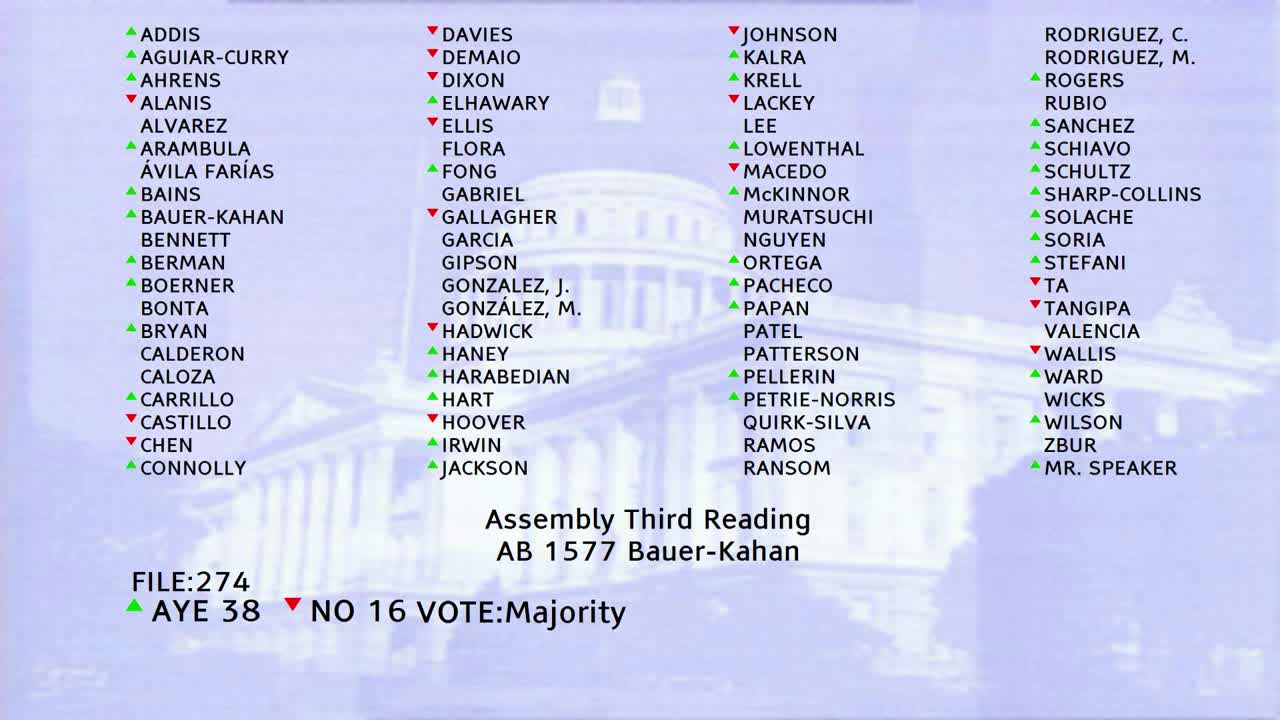 1MIN
Assembly Floor
 6MIN
Assembly Standing Committee on Elections
Bill Author

Bill Co-Author(s):