AB 1808: Western Joshua Tree Conservation Act: industrial projects and commercial projects: single-family residences: public works projects.
- Session Year: 2025-2026
- House: Assembly
- Latest Version Date: 2026-09-29
Current Status:
Passed
(2026-09-29: Chaptered by Secretary of State - Chapter 816, Statutes of 2026.)
Introduced
In Committee
Awaiting First Chamber Vote
Passed First Chamber
In Committee
Awaiting Second Chamber Vote
Passed Second Chamber
Enacted
What does this bill do?
The bill lets the Department of Fish and Wildlife delegate to cities (in addition to counties) the authority to approve removal or trimming of western Joshua trees for commercial and industrial projects, and allows local agencies to permit homeowners to remove or trim up to 10 trees (within 30 feet of a home or 15 feet of an accessory structure) and public works projects to remove or trim up to 40 trees near a construction footprint in exchange for paying set fees instead of doing habitat mitigation. Applicants must provide basic information and photos, local agencies may charge an administrative fee, and small residential permits are temporarily exempt from the California Environmental Quality Act until a programmatic review is completed or January 1, 2032.
The summary is provided by generative AI which can make mistakes. For original language, please view the details in the table below.
Existing law, the Western Joshua Tree Conservation Act, prohibits a person or public agency from importing into the state, exporting out of the state, or taking, possessing, purchasing, or selling within the state, a western Joshua tree or any part or product of the tree, except as provided. Under existing law, the Department of Fish and Wildlife may authorize, by permit, the taking of a western Joshua tree if certain conditions are met, including, among other conditions, that the permittee mitigates all impacts to, and the taking of, the western Joshua tree. Existing law authorizes the department to enter into an agreement with a county or city to delegate to the county or city the ability to authorize the taking of a western Joshua tree associated with developing single-family residences, multifamily residences, accessory structures, and public works projects concurrent with its approval of the project if certain conditions are met. Existing law authorizes a person or public agency receiving a take authorization for a project to pay specified fees in lieu of satisfying the mitigation obligation on several bases, including if the project receives a permit issued by a county or city. Existing law requires the department to annually adjust those fees and, by December 31, 2026, and every 3 years thereafter, to adopt and subsequently amend specified regulations adjusting the fees.
This bill would additionally authorize the department to enter into an agreement with a city to delegate to the city the ability to authorize the taking of a western Joshua tree associated with developing commercial and industrial projects.
This bill would additionally authorize a person or public agency receiving a take authorization from the department to pay specified fees in lieu of satisfying the mitigation obligation for (1) the removal of no more than 10, or the trimming of, western Joshua trees by an owner-occupant of an existing single-family residence if the western Joshua trees are within 30 feet of the existing single-family residence or 15 feet of an existing accessory structure, or within the construction footprint, or 15 feet of the construction footprint, of a new accessory structure that is proposed to be constructed for the existing single-family residence or (2) the removal of no more than 40, or the trimming of, western Joshua trees by the proponent of a public works project if the western Joshua trees are within the construction footprint, or 15 feet of the construction footprint, of a public works project to repair, rehabilitate, replace, or maintain an existing structure. The bill would authorize a county or city operating under an agreement with the department to authorize, by permit, without mitigation and subject to a fee to cover the administrative costs of issuing the permit, a project described above in (1) or (2). The bill would require a property owner or proponent of a public works project seeking a permit to submit a request to the county or city, as applicable, that includes specified information. The bill would require, within 60 days of receipt of a request for a permit, the county or city, as applicable, to either notify the property owner or proponent of the public works project that the county or city will issue the permit or to deny the request if it does not meet the above-described requirements. The bill would, until the department certifies a certain programmatic environmental impact report, as specified, or until January 1, 2032, whichever occurs first, exempt from the California Environmental Quality Act the issuance of a permit by the department, a county, or a city for a project described above in (1).
This bill would delay from December 31, 2026, to June 30, 2027, the date by which the department is required to adopt regulations adjusting the fees for the taking of a western Joshua tree paid in lieu of mitigation.
This bill would incorporate additional changes to Section 1927.8 of the Fish and Game Code proposed by SB 1062 to be operative only if this bill and SB 1062 are enacted and this bill is enacted last.
This bill would declare that it is to take effect immediately as an urgency statute.
Existing law, the Western Joshua Tree Conservation Act, prohibits a person or public agency from importing into the state, exporting out of the state, or taking, possessing, purchasing, or selling within the state, a western Joshua tree or any part or product of the tree, except as provided. Under existing law, the Department of Fish and Wildlife may authorize, by permit, the taking of a western Joshua tree if certain conditions are met, including, among other conditions, that the permittee mitigates all impacts to, and the taking of, the western Joshua tree. Existing law authorizes the department to enter into an agreement with a county or city to delegate to the county or city the ability to authorize the taking of a western Joshua tree associated with developing single-family residences, multifamily residences, accessory structures, and public works projects concurrent with its approval of the project if certain conditions are met. Existing law authorizes a person or public agency receiving a take authorization for a project to pay specified fees in lieu of satisfying the mitigation obligation on several bases, including if the project receives a permit issued by a county or city. Existing law requires the department to annually adjust those fees and, by December 31, 2026, and every 3 years thereafter, to adopt and subsequently amend specified regulations adjusting the fees.
This bill would additionally authorize the department to enter into an agreement with a city to delegate to the city the ability to authorize the taking of a western Joshua tree associated with developing commercial and industrial projects.
This bill would additionally authorize a person or public agency receiving a take authorization from the department to authorize, by permit, without payment of fees or other mitigation, pay specified fees in lieu of satisfying the mitigation obligation for (1) the removal of no more than 10, or the trimming of, western Joshua trees by certain owners an owner-occupant of an existing occupied single-family residence if the western Joshua trees are within 30 feet of the existing single-family residence or 15 feet of an existing accessory structure, or within the construction footprint, or 15 feet of the construction footprint, of a new accessory structure that is proposed to be constructed for the existing single-family residence or (2) the removal of no more than 40, or the trimming of, western Joshua trees by the proponent of a public works project if the western Joshua trees are within the construction footprint, or 15 feet of the construction footprint, of a public works project to repair, rehabilitate, replace, or maintain an existing structure. The bill would authorize a county or city operating under an agreement with the department to authorize, by permit, without mitigation and subject to a fee to cover the administrative costs of issuing the permit, a project described above in (1) or (2). The bill would require a property owner or proponent of a public works project seeking a permit to submit a request to the department county or city, as applicable, that includes specified information. The bill would require, within 60 days of receipt of a request for a permit, the department county or city, as applicable, to either notify the property owner or proponent of the public works project that the department county or city will issue the permit or to deny the request if it does not meet the above-described requirements. The bill would, until the department certifies a certain programmatic environmental impact report, as specified, or until January 1, 2032, whichever occurs first, exempt from the California Environmental Quality Act the issuance of a permit by the department department, a county, or a city for a project described above in (1).
This bill would delay from December 31, 2026, to June 30, 2027, the date by which the department is required to adopt regulations adjusting the fees for the taking of a western Joshua tree paid in lieu of mitigation.
This bill would declare that it is to take effect immediately as an urgency statute.
Existing law, the Western Joshua Tree Conservation Act, prohibits a person or public agency from importing into the state, exporting out of the state, or taking, possessing, purchasing, or selling within the state, a western Joshua tree or any part or product of the tree, except as provided. Under existing law, the Department of Fish and Wildlife may authorize, by permit, the taking of a western Joshua tree if certain conditions are met, including, among other conditions, that the permittee mitigates all impacts to, and the taking of, the western Joshua tree. Existing law authorizes the department to enter into an agreement with a county or city to delegate to the county or city the ability to authorize the taking of a western Joshua tree associated with developing single-family residences, multifamily residences, accessory structures, and public works projects concurrent with its approval of the project if certain conditions are met. Existing law authorizes a person or public agency receiving a take authorization for a project to pay specified fees in lieu of satisfying the mitigation obligation on several bases, including if the project receives a permit issued by a county or city.
This bill would additionally authorize the department to enter into an agreement with a city to delegate to the city the ability to authorize the taking of a western Joshua tree associated with developing commercial and industrial projects.
This bill would authorize the department to authorize, by permit, without payment of fees or other mitigation, (1) the removal of no more than 10, or the trimming of, western Joshua trees by an owner certain owners of an existing occupied single-family residence if the western Joshua trees are within 30 feet of the existing single-family residence or 15 feet of an existing accessory structure, or within the construction footprint, or 15 feet of the construction footprint, of a new accessory structure that is proposed to be constructed for the existing single-family residence or (2) the removal of no more than 40, or the trimming of, western Joshua trees by the proponent of a public works project if the western Joshua trees are within the construction footprint, or 15 feet of the construction footprint, of a public works project to repair, rehabilitate, replace, or maintain an existing structure. The bill would require a property owner or proponent of a public works project seeking a permit to submit a request to the department that includes specified information. The bill would require, within 60 days of receipt of a request for a permit, the department to either notify the property owner or proponent of the public works project that the department will issue the permit or to deny the request if it does not meet the above-described requirements. The bill would, until the department certifies a certain programmatic environmental impact report, as specified, or until January 1, 2032, whichever occurs first, exempt from the California Environmental Quality Act the issuance of a permit by the department for a project described above in (1).
Existing law, the Western Joshua Tree Conservation Act, prohibits a person or public agency from importing into the state, exporting out of the state, or taking, possessing, purchasing, or selling within the state, a western Joshua tree or any part or product of the tree, except as provided. Under existing law, the Department of Fish and Wildlife may authorize, by permit, the taking of a western Joshua tree if certain conditions are met, including, among other conditions, that the permittee mitigates all impacts to, and the taking of, the western Joshua tree. Existing law authorizes the department to enter into an agreement with a county or city to delegate to the county or city the ability to authorize the taking of a western Joshua tree associated with developing single-family residences, multifamily residences, accessory structures, and public works projects concurrent with its approval of the project if certain conditions are met. Existing law authorizes a person or public agency receiving a take authorization for a project to pay specified fees in lieu of satisfying the mitigation obligation on several bases, including if the project receives a permit issued by a county or city.
This bill would additionally authorize the department to enter into an agreement with a city to delegate to the city the ability to authorize the taking of a western Joshua tree associated with developing commercial and industrial projects.
This bill would authorize the department to authorize, by permit, without payment of fees or other mitigation, (1) the removal of no more than 10, or the trimming of, western Joshua trees by an owner of an existing single-family residence if the western Joshua trees are within 30 feet of the existing single-family residence or 15 feet of an existing accessory structure, or within the construction footprint, or 15 feet of the construction footprint, of a new accessory structure that is proposed to be constructed for the existing single-family residence or (2) the removal of no more than 40, or the trimming of, western Joshua trees by the proponent of a public works project if the western Joshua trees are within the construction footprint, or 15 feet of the construction footprint, of a public works project to repair, rehabilitate, replace, or maintain an existing structure. The bill would require a property owner or proponent of a public works project seeking a permit to submit a request to the department that includes specified information. The bill would require, within 60 days of receipt of a request for a permit, the department to either notify the property owner or proponent of the public works project that the department will issue the permit or to deny the request if it does not meet the above-described requirements. The bill would would, until the department certifies a certain programmatic environmental impact report, as specified, exempt from the California Environmental Quality Act the issuance of a permit by the department for a project described above in (1).
Existing law, the Western Joshua Tree Conservation Act, prohibits a person or public agency from importing into the state, exporting out of the state, or taking, possessing, purchasing, or selling within the state, a western Joshua tree or any part or product of the tree, except as provided. Under existing law, the Department of Fish and Wildlife may authorize, by permit, the taking of a western Joshua tree if certain conditions are met, including, among other conditions, that the permittee mitigates all impacts to, and the taking of, the western Joshua tree. Existing law authorizes the department to enter into an agreement with a county or city to delegate to the county or city the ability to authorize the taking of a western Joshua tree associated with developing single-family residences, multifamily residences, accessory structures, and public works projects concurrent with its approval of the project if certain conditions are met. Existing law authorizes a person or public agency receiving a take authorization for a project to pay specified fees in lieu of satisfying the mitigation obligation on several bases, including if the project receives a permit issued by a county or city.
This bill would additionally authorize the department to enter into an agreement with a city to delegate to the city the ability to authorize the taking of a western Joshua tree associated with developing commercial and industrial projects.
This bill would authorize the department to authorize, by permit, without payment of fees or other mitigation, (1) the removal or trimming of no more than 10, or the trimming of, western Joshua trees by an owner of an existing single-family residence of a if the western Joshua tree that is trees are within 30 feet of the existing single-family residence or 15 feet of an existing accessory structure, or within the construction footprint, or 15 feet of the construction footprint, of a new accessory structure that is proposed to be constructed for the existing single-family residence or (2) the removal or trimming of no more than 40, or the trimming of, western Joshua trees by a developer the proponent of a public works project of a if the western Joshua tree that is trees are within the construction footprint, or 15 feet of the construction footprint, of the a public works project. project to repair, rehabilitate, replace, or maintain an existing structure. The bill would require a property owner or proponent of a public works project developer seeking a permit to submit a request to the department that includes specified information. The bill would require, within 60 days of receipt of a request for a permit, the department to either notify the property owner or proponent of the public works project developer that the department will issue the permit or to deny the request if it does not meet the above-described requirements. The bill would exempt from the California Environmental Quality Act the issuance of a permit by the department for a project described above in (1).
Existing law, the Western Joshua Tree Conservation Act, prohibits any a person or public agency from importing into the state, exporting out of the state, or taking, possessing, purchasing, or selling within the state, a western Joshua tree or any part or product of the tree, except as provided. Under existing law, the Department of Fish and Wildlife may authorize, by permit, the taking of a western Joshua tree if certain conditions are met, including, among other conditions, that the permittee mitigates all impacts to, and the taking of, the western Joshua tree. Existing law authorizes the department to enter into an agreement with any a county or city to delegate to the county or city the ability to authorize the taking of a western Joshua tree associated with developing single-family residences, multifamily residences, accessory structures, and public works projects concurrent with its approval of the project if certain conditions are met. Existing law authorizes any a person or public agency receiving a take authorization for a project to pay specified fees in lieu of satisfying the mitigation obligation on several bases, including if the project receives a permit issued by a county or city.
This bill would additionally authorize the department to enter into an agreement with any a city to delegate to the city the ability to authorize the taking of a western Joshua trees tree associated with developing commercial and industrial projects.
This bill would authorize the department to authorize, by permit, without payment of fees or other mitigation, (1) the removal or trimming by an owner of an existing single-family residence of a western Joshua tree that is within 30 feet of the single-family residence or 15 feet of an existing accessory structure, or within the construction footprint, or 15 feet of the construction footprint, of a new accessory structure that is proposed to be constructed for the single-family residence or (2) the removal or trimming by a developer of a public works project of a western Joshua tree that is within the construction footprint, or 15 feet of the construction footprint, of the public works project. The bill would require a property owner or public works project developer seeking a permit to submit a request to the department that includes specified information. The bill would require, within 60 days of receipt of a request for a permit, the department to either notify the property owner or public works project developer that the department will issue the permit or to deny the request if it does not meet the above-described requirements. The bill would exempt from the California Environmental Quality Act the issuance of a permit by the department for a project described above in (1).
Existing law, the Western Joshua Tree Conservation Act, prohibits any person or public agency from importing into the state, exporting out of the state, or taking, possessing, purchasing, or selling within the state, a western Joshua tree or any part or product of the tree, except as provided. Under existing law, the Department of Fish and Wildlife may authorize, by permit, the taking of a western Joshua tree if certain conditions are met, including, among other conditions, that the permittee mitigates all impacts to, and the taking of, the western Joshua tree. Existing law authorizes the department to enter into an agreement with any county or city to delegate to the county or city the ability to authorize the taking of a western Joshua tree associated with developing single-family residences, multifamily residences, accessory structures, and public works projects concurrent with its approval of the project if certain conditions are met. Existing law authorizes any person or public agency receiving a take authorization for a project to pay specified fees in lieu of satisfying the mitigation obligation on several bases, including if the project receives a permit issued by a county or city.
This bill would additionally authorize the department to enter into an agreement with any city to delegate to the city the ability to authorize the taking of western Joshua trees associated with developing commercial and industrial projects.
This bill would authorize the department to authorize, by permit, without payment of fees or other mitigation, (1) the removal by an owner of an existing single-family residence of a western Joshua tree that is within 30 feet of the single-family residence or 15 feet of an existing accessory structure, or within the construction footprint, or 15 feet of the construction footprint, of a new accessory structure that is proposed to be constructed for the single-family residence or (2) the removal by a developer of a public works project of a western Joshua tree that is within the construction footprint, or 15 feet of the construction footprint, of the public works project. The bill would require a property owner or public works project developer seeking a permit to submit a request to the department that includes specified information. The bill would require, within 60 days of receipt of a request for a permit, the department to either notify the property owner or public works project developer that the department will issue the permit or to deny the request if it does not meet the above-described requirements.
(a)The department may authorize, by permit, the taking of a western Joshua tree if all of the following conditions are met:
(1)The permittee submits to the department for its approval a census of all western Joshua trees on the project site, including size information and photographs, that categorize the western Joshua trees according to the following size classes:
(A)Less than one meter in height.
(B)One meter or greater but less than five meters in height.
(C)Five meters or greater in height.
(2)The permittee avoids and minimizes impacts to, and the taking of, the western Joshua tree to the maximum extent practicable. Minimization may include trimming, encroachment on root systems, relocation, or other actions that result in detrimental but nonlethal impacts to a western Joshua tree.
(3)The permittee mitigates all impacts to, and taking of, the western Joshua tree. The measures required to meet this obligation shall be roughly proportional in extent to the impact of the authorized taking of the species. When various measures are available to meet this obligation, the measures required shall maintain the permittees objectives to the greatest extent possible. All required measures shall be capable of successful implementation. The permittee shall ensure adequate funding to implement the mitigation measures. In lieu of completing the mitigation obligation on its own, the permittee may elect to satisfy this mitigation obligation by paying fees, pursuant to the fee schedule in subdivision (d), (e), or (g), for deposit into the fund.
(4)(A)The department may include permit conditions that require the permittee to relocate one or more of the western Joshua trees. If relocation is required, the permittee shall implement measures to assist the survival of relocated trees, and to comply with any other reasonable measures required by the department to facilitate the successful relocation and survival of the western Joshua trees. These relocation measures shall include, but are not limited to, all of the following:
(i)A requirement that the relocated western Joshua tree is placed in a location and with proper orientation to improve its survival.
(ii)A requirement that western Joshua trees are relocated at a time that maximizes their survival when feasible.
(iii)A requirement that a desert native plant specialist be onsite to oversee relocation.
(B)The department may limit relocation to certain size classes of trees.
(C)By July 1, 2024, the department shall adopt guidelines and relocation protocols, based on the best available science, to relocate western Joshua trees successfully. The department shall consult with desert native plant specialists as part of the development of these guidelines and relocation protocols. Chapter 3.5 (commencing with Section 11340) of Part 1 of Division 3 of Title 2 of the Government Code shall not apply to the development, adoption, or amendment of guidelines and relocation protocols pursuant to this subparagraph.
(b)For purposes of this section, each western Joshua tree stem or trunk arising from the ground shall be considered an individual tree requiring mitigation, regardless of its proximity to any other western Joshua tree stem or trunk.
(c)(1)If all of the conditions of paragraph (3) are met, the department may enter into an agreement with any county to delegate to the county the ability to authorize the taking of a western Joshua tree associated with developing any one or more of the following projects concurrent with the countys approval of the project:
(A)Single-family residences.
(B)Multifamily residences.
(C)Accessory structures.
(D)Public works projects.
(2)If all of the conditions of paragraph (3) are met, the department may enter into an agreement with any city to delegate to the city the ability to authorize the taking of a western Joshua tree associated with developing any one or more of the following projects concurrent with the citys approval of the project:
(A)Single-family residences.
(B)Multifamily residences.
(C)Accessory structures.
(D)Public works projects.
(E)Commercial projects.
(F)Industrial projects.
(3)The delegation of authority pursuant to paragraphs (1) and (2) shall be subject to all of the following conditions:
(A)The county or city adopts an ordinance that requires as a condition of any approval or permit issued under the authority of an agreement entered into pursuant to this subdivision satisfaction of the requirements of this chapter.
(B)Except as provided otherwise in this subdivision, the county or city ensures that the permittee satisfies all of the requirements of subdivision (a) of this section.
(C)The project will take no more than 10 individual western Joshua trees on the project site where the project proponent proposes to construct a single-family residence, multifamily residence, or accessory structure, or no more than 40 individual western Joshua trees on the project site on which a project proponent proposes to construct a commercial or industrial project or a public agency proposes to undertake a public works project. Before authorizing the take of more than 20, but no more than 40, individual western Joshua trees for a commercial or industrial project or a public works project, the county or city shall obtain the departments written concurrence that the project has avoided and minimized the take of western Joshua trees to the maximum extent practicable.
(D)The county or city shall collect any fees for permits issued and remit them quarterly to the fund as directed by the department.
(E)The county or city entering into an agreement pursuant to this subdivision may impose a reasonable fee to cover the administrative costs of issuing the permit.
(F)(i)The department retains express authority to suspend or revoke the county or citys take authorization in the event the department determines the county or city has violated the terms of the agreement, or this chapter, the county or city fails to implement or enforce the terms of the agreement or this chapter, or the department determines that the local population of western Joshua trees within, or in the vicinity of, that county or city needs further protection. The county or city shall conduct an annual assessment of the status of the local population within the county or city and submit the assessment to the department. The department shall determine if the population needs further protection to provide for the conservation of the species.
(ii)The department shall adopt standardized survey and assessment methods for the annual assessment required pursuant to clause (i), including requiring that a desert native plant specialist conduct the assessment. Chapter 3.5 (commencing with Section 11340) of Part 1 of Division 3 of Title 2 of the Government Code shall not apply to the development, adoption, or amendment of standardized survey and assessment methods pursuant to this subparagraph.
(G)The county or city shall be required to submit to the department quarterly reports documenting the number of permits issued, photographs and other evidence demonstrating that take and other impacts were avoided and minimized to the maximum extent practicable, the number and size class of western Joshua trees authorized to be taken, the number of western Joshua trees encroached upon, the number of western Joshua trees lethally removed, the number and location of western Joshua trees relocated, the amount of fees collected, and other information required by the department in the agreement.
(d)Any person or public agency receiving a take authorization pursuant to this chapter for a project that meets the criteria of either subparagraph (A) or (B) of paragraph (1) may elect, in lieu of satisfying the mitigation obligation provided for in paragraph (3) of subdivision (a), to pay fees in the amounts provided in paragraph (2) for deposit into the fund.
(1)(A)Any project in the area bounded by the intersection of Highway 99 and Highway 58, then east along Highway 58 to the intersection of Interstate 15, then north along Interstate 15 to the intersection of Highway 247, then south along Highway 247 to the intersection of Highway 18, then west along Highway 18 to the intersection of Highway 138, then west and north along Highway 138 to the intersection of Interstate 5, then north along Interstate 5 to the intersection of Highway 99, then north along Highway 99 to Highway 58.
(B)Any single-family residence, multifamily residence, accessory structure, or public works project receiving a permit issued by a county or city pursuant to an agreement with the department pursuant to subdivision (c), regardless of location.
(2)(A)One thousand dollars ($1,000) for each western Joshua tree five meters or greater in height.
(B)Two hundred dollars ($200) for each western Joshua tree one meter or greater but less than five meters in height.
(C)One hundred fifty dollars ($150) for each western Joshua tree less than one meter in height.
(e)Any person or public agency receiving a take authorization pursuant to this chapter for a project that meets the criteria set forth in paragraph (1) may elect, in lieu of satisfying the mitigation obligation provided for in paragraph (3) of subdivision (a), to pay fees in the amounts provided in paragraph (2) for deposit into the fund.
(1)(A)Notwithstanding paragraph (1) of subdivision (d), any project within two miles of Joshua Tree National Park, or any unit of the state park system.
(B)Any project that does not meet the criteria set forth in paragraph (1) of subdivision (d).
(2)(A)Two thousand five hundred dollars ($2,500) for each western Joshua tree five meters or greater in height.
(B)Five hundred dollars ($500) for each western Joshua tree one meter or greater but less than five meters in height.
(C)Three hundred forty dollars ($340) for each western Joshua tree less than one meter in height.
(f)Upon request, the department may authorize a reduction in the amount of the fees prescribed by subdivisions (d) and (e) for any western Joshua tree conserved by a project proponent through the acquisition of compensatory habitat mitigation land otherwise required by law for the project.
(g)Notwithstanding subdivisions (d) and (e), a person or public agency receiving a take authorization from the department pursuant to this chapter for a project that meets the criteria set forth in either subparagraph (A) or (B) of paragraph (1) may elect to, in lieu of satisfying the mitigation obligation provided for in paragraph (3) of subdivision (a), pay fees in the amounts provided in paragraph (2) for deposit into the fund.
(1)(A)The removal of no more than 10 western Joshua trees or trimming of western Joshua trees by an owner-occupant of an existing single-family residence if the western Joshua trees are either of the following:
(i)Within 30 feet of the existing single-family residence or within 15 feet of an existing accessory structure.
(ii)Within the construction footprint, or within 15 feet of the construction footprint, of a new accessory structure that is proposed to be constructed for the existing single-family residence.
(B)The removal of no more than 40 western Joshua trees or trimming of western Joshua trees by the proponent of a public works project if the western Joshua trees are within the construction footprint, or within 15 feet of the construction footprint, of a public works project to repair, rehabilitate, replace, or maintain an existing structure.
(2)(A)Two hundred fifty dollars ($250) for each western Joshua tree five meters or greater in height.
(B)Fifty dollars ($50) for each western Joshua tree one meter or greater but less than five meters in height.
(C)Thirty-seven dollars and fifty cents ($37.50) for each western Joshua tree less than one meter in height.
(h)(1)The permittee shall bear responsibility for implementing measures to assist the survival of western Joshua trees relocated pursuant to paragraph (4) of subdivision (a).
(2)Unless specifically required by written agreement, a landowner that agrees in writing to allow western Joshua trees to be relocated onto land it owns shall not be liable for the continued survival of the western Joshua trees, shall not be required to manage or maintain the translocated western Joshua trees, and shall not be required to change existing land use practices, provided that the land use practices do not result in the taking, possession, sale, or further translocation of the western Joshua trees.
(i)Until the department certifies a programmatic environmental impact report that addresses actions with the potential to result in limited take of western Joshua trees from single-family residences and accessory structures, and there is a final, unappealable judgment in litigation, if any, challenging the programmatic environmental impact report, or until January 1, 2032, whichever occurs first, Division 13 (commencing with Section 21000) of the Public Resources Code shall not apply to the issuance of a permit pursuant to subparagraph (A) of paragraph (1) of subdivision (g).
SEC. 2.Section 1927.3.5 is added to the Fish and Game Code, to read:1927.3.5.(a)Notwithstanding Sections 1927.3 and 1927.4, a county or city operating under an approved delegation agreement pursuant to subdivision (c) of Section 1927.3 or subdivision (b) of Section 1927.4 may authorize, by permit, without mitigation, both of the following:
(1)The removal of no more than 10 western Joshua trees or trimming of western Joshua trees by an owner-occupant of an existing single-family residence if the western Joshua trees are either of the following:
(A)Within 30 feet of the existing single-family residence or within 15 feet of an existing accessory structure.
(B)Within the construction footprint, or within 15 feet of the construction footprint, of a new accessory structure that is proposed to be constructed for the existing single-family residence.
(2)The removal of no more than 40 western Joshua trees or trimming of western Joshua trees by the proponent of a public works project if the western Joshua trees are within the construction footprint, or within 15 feet of the construction footprint, of a public works project to repair, rehabilitate, replace, or maintain an existing structure.
(b)A county or city issuing a permit under subdivision (a) may impose a reasonable fee to cover the administrative costs of issuing the permit.
(c)A property owner or proponent of a public works project seeking a permit under subdivision (a) shall submit a request to the county or city, as applicable, on a form to be provided by the county or city that requires the following information:
(1)The name, telephone number, mailing address, and email address of the property owner or proponent of the public works project seeking the permit.
(2)The street address of the single-family residence or public works project on which each western Joshua tree requested to be removed or trimmed is located. If a street address is not available, the property owner or proponent of the public works project shall include the assessors parcel number.
(3)A statement as to whether each western Joshua tree requested to be removed or trimmed meets the conditions described in subparagraph (A) or (B) of paragraph (1), or paragraph (2), of subdivision (a).
(4)The size class of each western Joshua tree requested to be removed or trimmed, in accordance with paragraph (1) of subdivision (a) of Section 1927.3.
(5)The distance of each western Joshua tree requested to be removed or trimmed from the single-family residence, existing accessory structure, or construction footprint of a new accessory structure that is proposed to be constructed or of the public works project.
(6)Photographs of each western Joshua tree requested to be removed or trimmed that depict its location relative to the single-family residence, existing accessory structure, or construction footprint of a new accessory structure that is proposed to be constructed or of the public works project.
(d)Within 60 days of receipt of a request for a permit pursuant to subdivision (c), the county or city, as applicable, shall do either of the following:
(1)Notify the property owner or proponent of the public works project that the county or city, as applicable, will issue a permit for the removal or trimming of a western Joshua tree.
(2)Deny the request if the request does not demonstrate a permit can be issued pursuant to this section. A denial shall include a brief description explaining why a permit cannot be issued.
(e)Until the department certifies a programmatic environmental impact report that addresses actions with the potential to result in limited take of western Joshua trees from single-family residences and accessory structures, and there is a final, unappealable judgment in litigation, if any, challenging the programmatic environmental impact report, or until January 1, 2032, whichever occurs first, Division 13 (commencing with Section 21000) of the Public Resources Code shall not apply to the issuance of a permit pursuant to paragraph (1) of subdivision (a).
SEC. 3.Section 1927.8 of the Fish and Game Code is amended to read:1927.8.(a)Beginning in 2026, and at least every two years thereafter, the commission shall review the status of the western Joshua tree and the effectiveness of the conservation plan in conserving the species at a public meeting to be held before August 31. Concurrent with each review conducted pursuant to this section, the department shall make recommendations to the commission, as necessary, for amendments to the conservation plan to ensure the conservation of the western Joshua tree.
(b)The department shall annually adjust the fees provided for in Section 1927.3 pursuant to Section 713. By June 30, 2027, and every three years thereafter, the department shall adopt and subsequently amend regulations pursuant to Section 702 adjusting the fees as necessary to ensure the conservation of the species. The department shall use total cost accounting when determining the adequacy of the fees for ensuring conservation of the species, including ensuring sufficient funds for land acquisition or conservation easement costs, monitoring costs, restoration costs, transaction costs, and the amount of endowments for land management or easement stewardship costs consistent with Chapter 4.6 (commencing with Section 65965) of Division 1 of Title 7 of the Government Code and Part 7 (commencing with Section 18501) of Division 9 of the Probate Code.
SEC. 3.5.Section 1927.8 of the Fish and Game Code is amended to read:1927.8.(a)Beginning in 2026, and at least every two years thereafter, the commission shall review the status of the western Joshua tree and the effectiveness of the conservation plan in conserving the species at a public meeting to be held before August 31. Concurrent with each review conducted pursuant to this section, the department shall make recommendations to the commission, as necessary, for amendments to the conservation plan to ensure the conservation of the western Joshua tree.
(b)The department shall annually adjust the fees provided for in Section 1927.3 pursuant to Section 713. By June 30, 2027, and every three years thereafter, the department shall adopt and subsequently amend regulations pursuant to Section 702 adjusting the fees as necessary to ensure the conservation of the species. The department shall consider making the fees proportionate to the impact of a project and the use of tiered fees by project type, size, or other criteria. The department shall use total cost accounting when determining the adequacy of the fees for ensuring conservation of the species, including ensuring sufficient funds for land acquisition or conservation easement costs, monitoring costs, restoration costs, transaction costs, and the amount of endowments for land management or easement stewardship costs consistent with Chapter 4.6 (commencing with Section 65965) of Division 1 of Title 7 of the Government Code and Part 7 (commencing with Section 18501) of Division 9 of the Probate Code.
SEC. 4.Section 3.5 of this bill incorporates amendments to Section 1927.8 of the Fish and Game Code proposed by both this bill and Senate Bill 1062. That section of this bill shall only become operative if (1) both bills are enacted and become effective on or before January 1, 2027, but this bill becomes operative first, (2) each bill amends Section 1927.8 of the Fish and Game Code, and (3) this bill is enacted after Senate Bill 1062, in which case Section 1927.8 of the Fish and Game Code, as amended by Section 3 of this bill, shall remain operative only until the operative date of Senate Bill 1062, at which time Section 3.5 of this bill shall become operative.
SEC. 5.This act is an urgency statute necessary for the immediate preservation of the public peace, health, or safety within the meaning of Article IV of the California Constitution and shall go into immediate effect. The facts constituting the necessity are:
In order to make the existing costs of removing western Joshua trees more manageable for single-family residences and to allow cities and counties to move forward with critical infrastructure projects, it is necessary that this act take effect immediately.
(a)The department may authorize, by permit, the taking of a western Joshua tree if all of the following conditions are met:
(1)The permittee submits to the department for its approval a census of all western Joshua trees on the project site, including size information and photographs, that categorize the western Joshua trees according to the following size classes:
(A)Less than one meter in height.
(B)One meter or greater but less than five meters in height.
(C)Five meters or greater in height.
(2)The permittee avoids and minimizes impacts to, and the taking of, the western Joshua tree to the maximum extent practicable. Minimization may include trimming, encroachment on root systems, relocation, or other actions that result in detrimental but nonlethal impacts to a western Joshua tree.
(3)The permittee mitigates all impacts to, and taking of, the western Joshua tree. The measures required to meet this obligation shall be roughly proportional in extent to the impact of the authorized taking of the species. When various measures are available to meet this obligation, the measures required shall maintain the permittees objectives to the greatest extent possible. All required measures shall be capable of successful implementation. The permittee shall ensure adequate funding to implement the mitigation measures. In lieu of completing the mitigation obligation on its own, the permittee may elect to satisfy this mitigation obligation by paying fees, pursuant to the fee schedule in subdivision (d), (e), or (g), for deposit into the fund.
(4)(A)The department may include permit conditions that require the permittee to relocate one or more of the western Joshua trees. If relocation is required, the permittee shall implement measures to assist the survival of relocated trees, and to comply with any other reasonable measures required by the department to facilitate the successful relocation and survival of the western Joshua trees. These relocation measures shall include, but are not limited to, all of the following:
(i)A requirement that the relocated western Joshua tree is placed in a location and with proper orientation to improve its survival.
(ii)A requirement that western Joshua trees are relocated at a time that maximizes their survival when feasible.
(iii)A requirement that a desert native plant specialist be onsite to oversee relocation.
(B)The department may limit relocation to certain size classes of trees.
(C)By July 1, 2024, the department shall adopt guidelines and relocation protocols, based on the best available science, to relocate western Joshua trees successfully. The department shall consult with desert native plant specialists as part of the development of these guidelines and relocation protocols. Chapter 3.5 (commencing with Section 11340) of Part 1 of Division 3 of Title 2 of the Government Code shall not apply to the development, adoption, or amendment of guidelines and relocation protocols pursuant to this subparagraph.
(b)For purposes of this section, each western Joshua tree stem or trunk arising from the ground shall be considered an individual tree requiring mitigation, regardless of its proximity to any other western Joshua tree stem or trunk.
(c)(1)If all of the conditions of paragraph (3) are met, the department may enter into an agreement with any county to delegate to the county the ability to authorize the taking of a western Joshua tree associated with developing any one or more of the following projects concurrent with the countys approval of the project:
(A)Single-family residences.
(B)Multifamily residences.
(C)Accessory structures.
(D)Public works projects.
(2)If all of the conditions of paragraph (3) are met, the department may enter into an agreement with any city to delegate to the city the ability to authorize the taking of a western Joshua tree associated with developing any one or more of the following projects concurrent with the citys approval of the project:
(A)Single-family residences.
(B)Multifamily residences.
(C)Accessory structures.
(D)Public works projects.
(E)Commercial projects.
(F)Industrial projects.
(3)The delegation of authority pursuant to paragraphs (1) and (2) shall be subject to all of the following conditions:
(A)The county or city adopts an ordinance that requires as a condition of any approval or permit issued under the authority of an agreement entered into pursuant to this subdivision satisfaction of the requirements of this chapter.
(B)Except as provided otherwise in this subdivision, the county or city ensures that the permittee satisfies all of the requirements of subdivision (a) of this section.
(C)The project will take no more than 10 individual western Joshua trees on the project site where the project proponent proposes to construct a single-family residence, multifamily residence, or accessory structure, or no more than 40 individual western Joshua trees on the project site on which a project proponent proposes to construct a commercial or industrial project or a public agency proposes to undertake a public works project. Before authorizing the take of more than 20, but no more than 40, individual western Joshua trees for a commercial or industrial project or a public works project, the county or city shall obtain the departments written concurrence that the project has avoided and minimized the take of western Joshua trees to the maximum extent practicable.
(D)The county or city shall collect any fees for permits issued and remit them quarterly to the fund as directed by the department.
(E)The county or city entering into an agreement pursuant to this subdivision may impose a reasonable fee to cover the administrative costs of issuing the permit.
(F)(i)The department retains express authority to suspend or revoke the county or citys take authorization in the event the department determines the county or city has violated the terms of the agreement, or this chapter, the county or city fails to implement or enforce the terms of the agreement or this chapter, or the department determines that the local population of western Joshua trees within, or in the vicinity of, that county or city needs further protection. The county or city shall conduct an annual assessment of the status of the local population within the county or city and submit the assessment to the department. The department shall determine if the population needs further protection to provide for the conservation of the species.
(ii)The department shall adopt standardized survey and assessment methods for the annual assessment required pursuant to clause (i), including requiring that a desert native plant specialist conduct the assessment. Chapter 3.5 (commencing with Section 11340) of Part 1 of Division 3 of Title 2 of the Government Code shall not apply to the development, adoption, or amendment of standardized survey and assessment methods pursuant to this subparagraph.
(G)The county or city shall be required to submit to the department quarterly reports documenting the number of permits issued, photographs and other evidence demonstrating that take and other impacts were avoided and minimized to the maximum extent practicable, the number and size class of western Joshua trees authorized to be taken, the number of western Joshua trees encroached upon, the number of western Joshua trees lethally removed, the number and location of western Joshua trees relocated, the amount of fees collected, and other information required by the department in the agreement.
(d)Any person or public agency receiving a take authorization pursuant to this chapter for a project that meets the criteria of either subparagraph (A) or (B) of paragraph (1) may elect, in lieu of satisfying the mitigation obligation provided for in paragraph (3) of subdivision (a), to pay fees in the amounts provided in paragraph (2) for deposit into the fund.
(1)(A)Any project in the area bounded by the intersection of Highway 99 and Highway 58, then east along Highway 58 to the intersection of Interstate 15, then north along Interstate 15 to the intersection of Highway 247, then south along Highway 247 to the intersection of Highway 18, then west along Highway 18 to the intersection of Highway 138, then west and north along Highway 138 to the intersection of Interstate 5, then north along Interstate 5 to the intersection of Highway 99, then north along Highway 99 to Highway 58.
(B)Any single-family residence, multifamily residence, accessory structure, or public works project receiving a permit issued by a county or city pursuant to an agreement with the department pursuant to subdivision (c), regardless of location.
(2)(A)One thousand dollars ($1,000) for each western Joshua tree five meters or greater in height.
(B)Two hundred dollars ($200) for each western Joshua tree one meter or greater but less than five meters in height.
(C)One hundred fifty dollars ($150) for each western Joshua tree less than one meter in height.
(e)Any person or public agency receiving a take authorization pursuant to this chapter for a project that meets the criteria set forth in paragraph (1) may elect, in lieu of satisfying the mitigation obligation provided for in paragraph (3) of subdivision (a), to pay fees in the amounts provided in paragraph (2) for deposit into the fund.
(1)(A)Notwithstanding paragraph (1) of subdivision (d), any project within two miles of Joshua Tree National Park, or any unit of the state park system.
(B)Any project that does not meet the criteria set forth in paragraph (1) of subdivision (d).
(2)(A)Two thousand five hundred dollars ($2,500) for each western Joshua tree five meters or greater in height.
(B)Five hundred dollars ($500) for each western Joshua tree one meter or greater but less than five meters in height.
(C)Three hundred forty dollars ($340) for each western Joshua tree less than one meter in height.
(f)Upon request, the department may authorize a reduction in the amount of the fees prescribed by subdivisions (d) and (e) for any western Joshua tree conserved by a project proponent through the acquisition of compensatory habitat mitigation land otherwise required by law for the project.
(g)Notwithstanding subdivisions (d) and (e), a person or public agency receiving a take authorization from the department pursuant to this chapter for a project that meets the criteria set forth in either subparagraph (A) or (B) of paragraph (1) may elect to, in lieu of satisfying the mitigation obligation provided for in paragraph (3) of subdivision (a), pay fees in the amounts provided in paragraph (2) for deposit into the fund.
(1)(A)The removal of no more than 10 western Joshua trees or trimming of western Joshua trees by an owner-occupant of an existing single-family residence if the western Joshua trees are either of the following:
(i)Within 30 feet of the existing single-family residence or within 15 feet of an existing accessory structure.
(ii)Within the construction footprint, or within 15 feet of the construction footprint, of a new accessory structure that is proposed to be constructed for the existing single-family residence.
(B)The removal of no more than 40 western Joshua trees or trimming of western Joshua trees by the proponent of a public works project if the western Joshua trees are within the construction footprint, or within 15 feet of the construction footprint, of a public works project to repair, rehabilitate, replace, or maintain an existing structure.
(2)(A)Two hundred fifty dollars ($250) for each western Joshua tree five meters or greater in height.
(B)Fifty dollars ($50) for each western Joshua tree one meter or greater but less than five meters in height.
(C)Thirty-seven dollars and fifty cents ($37.50) for each western Joshua tree less than one meter in height.
(h)(1)The permittee shall bear responsibility for implementing measures to assist the survival of western Joshua trees relocated pursuant to paragraph (4) of subdivision (a).
(2)Unless specifically required by written agreement, a landowner that agrees in writing to allow western Joshua trees to be relocated onto land it owns shall not be liable for the continued survival of the western Joshua trees, shall not be required to manage or maintain the translocated western Joshua trees, and shall not be required to change existing land use practices, provided that the land use practices do not result in the taking, possession, sale, or further translocation of the western Joshua trees.
(i)Until the department certifies a programmatic environmental impact report that addresses actions with the potential to result in limited take of western Joshua trees from single-family residences and accessory structures, and there is a final, unappealable judgment in litigation, if any, challenging the programmatic environmental impact report, or until January 1, 2032, whichever occurs first, Division 13 (commencing with Section 21000) of the Public Resources Code shall not apply to the issuance of a permit pursuant to subparagraph (A) of paragraph (1) of subdivision (g).
SEC. 2.Section 1927.3.5 is added to the Fish and Game Code, to read:1927.3.5.(a)Notwithstanding Sections 1927.3 and 1927.4, a county or city operating under an approved delegation agreement pursuant to subdivision (c) of Section 1927.3 or subdivision (b) of Section 1927.4 may authorize, by permit, without mitigation, both of the following:
(1)The removal of no more than 10 western Joshua trees or trimming of western Joshua trees by an owner-occupant of an existing single-family residence if the western Joshua trees are either of the following:
(A)Within 30 feet of the existing single-family residence or within 15 feet of an existing accessory structure.
(B)Within the construction footprint, or within 15 feet of the construction footprint, of a new accessory structure that is proposed to be constructed for the existing single-family residence.
(2)The removal of no more than 40 western Joshua trees or trimming of western Joshua trees by the proponent of a public works project if the western Joshua trees are within the construction footprint, or within 15 feet of the construction footprint, of a public works project to repair, rehabilitate, replace, or maintain an existing structure.
(b)A county or city issuing a permit under subdivision (a) may impose a reasonable fee to cover the administrative costs of issuing the permit.
(c)A property owner or proponent of a public works project seeking a permit under subdivision (a) shall submit a request to the county or city, as applicable, on a form to be provided by the county or city that requires the following information:
(1)The name, telephone number, mailing address, and email address of the property owner or proponent of the public works project seeking the permit.
(2)The street address of the single-family residence or public works project on which each western Joshua tree requested to be removed or trimmed is located. If a street address is not available, the property owner or proponent of the public works project shall include the assessors parcel number.
(3)A statement as to whether each western Joshua tree requested to be removed or trimmed meets the conditions described in subparagraph (A) or (B) of paragraph (1), or paragraph (2), of subdivision (a).
(4)The size class of each western Joshua tree requested to be removed or trimmed, in accordance with paragraph (1) of subdivision (a) of Section 1927.3.
(5)The distance of each western Joshua tree requested to be removed or trimmed from the single-family residence, existing accessory structure, or construction footprint of a new accessory structure that is proposed to be constructed or of the public works project.
(6)Photographs of each western Joshua tree requested to be removed or trimmed that depict its location relative to the single-family residence, existing accessory structure, or construction footprint of a new accessory structure that is proposed to be constructed or of the public works project.
(d)Within 60 days of receipt of a request for a permit pursuant to subdivision (c), the county or city, as applicable, shall do either of the following:
(1)Notify the property owner or proponent of the public works project that the county or city, as applicable, will issue a permit for the removal or trimming of a western Joshua tree.
(2)Deny the request if the request does not demonstrate a permit can be issued pursuant to this section. A denial shall include a brief description explaining why a permit cannot be issued.
(e)Until the department certifies a programmatic environmental impact report that addresses actions with the potential to result in limited take of western Joshua trees from single-family residences and accessory structures, and there is a final, unappealable judgment in litigation, if any, challenging the programmatic environmental impact report, or until January 1, 2032, whichever occurs first, Division 13 (commencing with Section 21000) of the Public Resources Code shall not apply to the issuance of a permit pursuant to paragraph (1) of subdivision (a).
SEC. 3.Section 1927.8 of the Fish and Game Code is amended to read:1927.8.(a)Beginning in 2026, and at least every two years thereafter, the commission shall review the status of the western Joshua tree and the effectiveness of the conservation plan in conserving the species at a public meeting to be held before August 31. Concurrent with each review conducted pursuant to this section, the department shall make recommendations to the commission, as necessary, for amendments to the conservation plan to ensure the conservation of the western Joshua tree.
(b)The department shall annually adjust the fees provided for in Section 1927.3 pursuant to Section 713. By June 30, 2027, and every three years thereafter, the department shall adopt and subsequently amend regulations pursuant to Section 702 adjusting the fees as necessary to ensure the conservation of the species. The department shall use total cost accounting when determining the adequacy of the fees for ensuring conservation of the species, including ensuring sufficient funds for land acquisition or conservation easement costs, monitoring costs, restoration costs, transaction costs, and the amount of endowments for land management or easement stewardship costs consistent with Chapter 4.6 (commencing with Section 65965) of Division 1 of Title 7 of the Government Code and Part 7 (commencing with Section 18501) of Division 9 of the Probate Code.
SEC. 3.5.Section 1927.8 of the Fish and Game Code is amended to read:1927.8.(a)Beginning in 2026, and at least every two years thereafter, the commission shall review the status of the western Joshua tree and the effectiveness of the conservation plan in conserving the species at a public meeting to be held prior to before August 31. Concurrent with each review conducted pursuant to this section, the department shall make recommendations to the commission, as necessary, for amendments to the conservation plan to ensure the conservation of the western Joshua tree.
(b)The department shall annually adjust the fees provided for in Section 1927.3 pursuant to Section 713. By December 31, 2026, June 30, 2027, and every three years thereafter, the department shall adopt and subsequently amend regulations pursuant to Section 702 adjusting the fees as necessary to ensure the conservation of the species. The department shall consider making the fees proportionate to the impact of a project and the use of tiered fees by project type, size, or other criteria. The department shall utilize use total cost accounting when determining the adequacy of the fees for ensuring conservation of the species, including ensuring sufficient funds for land acquisition or conservation easement costs, monitoring costs, restoration costs, transaction costs, and the amount of endowments for land management or easement stewardship costs consistent with Chapter 4.6 (commencing with Section 65965) of Division 1 of Title 7 of the Government Code and Part 7 (commencing with Section 18501) of Division 9 of the Probate Code.
SEC. 4.Section 3.5 of this bill incorporates amendments to Section 1927.8 of the Fish and Game Code proposed by both this bill and Senate Bill 1062. That section of this bill shall only become operative if (1) both bills are enacted and become effective on or before January 1, 2027, but this bill becomes operative first, (2) each bill amends Section 1927.8 of the Fish and Game Code, and (3) this bill is enacted after Senate Bill 1062, in which case Section 1927.8 of the Fish and Game Code, as amended by Section 3 of this bill, shall remain operative only until the operative date of Senate Bill 1062, at which time Section 3.5 of this bill shall become operative.
SEC. 4.SEC. 5.This act is an urgency statute necessary for the immediate preservation of the public peace, health, or safety within the meaning of Article IV of the California Constitution and shall go into immediate effect. The facts constituting the necessity are:
In order to make the existing costs of removing western Joshua trees more manageable for single-family residences and to allow cities and counties to move forward with critical infrastructure projects, it is necessary that this act take effect immediately.
(a)The department may authorize, by permit, the taking of a western Joshua tree if all of the following conditions are met:
(1)The permittee submits to the department for its approval a census of all western Joshua trees on the project site, including size information and photographs, that categorize the western Joshua trees according to the following size classes:
(A)Less than one meter in height.
(B)One meter or greater but less than five meters in height.
(C)Five meters or greater in height.
(2)The permittee avoids and minimizes impacts to, and the taking of, the western Joshua tree to the maximum extent practicable. Minimization may include trimming, encroachment on root systems, relocation, or other actions that result in detrimental but nonlethal impacts to a western Joshua tree.
(3)The permittee mitigates all impacts to, and taking of, the western Joshua tree. The measures required to meet this obligation shall be roughly proportional in extent to the impact of the authorized taking of the species. When various measures are available to meet this obligation, the measures required shall maintain the permittees objectives to the greatest extent possible. All required measures shall be capable of successful implementation. The permittee shall ensure adequate funding to implement the mitigation measures. In lieu of completing the mitigation obligation on its own, the permittee may elect to satisfy this mitigation obligation by paying fees, pursuant to the fee schedule in subdivision (d) or (d), (e), or (g), for deposit into the fund.
(4)(A)The department may include permit conditions that require the permittee to relocate one or more of the western Joshua trees. If relocation is required, the permittee shall implement measures to assist the survival of relocated trees, and to comply with any other reasonable measures required by the department to facilitate the successful relocation and survival of the western Joshua trees. These relocation measures shall include, but are not limited to, all of the following:
(i)A requirement that the relocated western Joshua tree is placed in a location and with proper orientation to improve its survival.
(ii)A requirement that western Joshua trees are relocated at a time that maximizes their survival when feasible.
(iii)A requirement that a desert native plant specialist be onsite to oversee relocation.
(B)The department may limit relocation to certain size classes of trees.
(C)By July 1, 2024, the department shall adopt guidelines and relocation protocols, based on the best available science, to relocate western Joshua trees successfully. The department shall consult with desert native plant specialists as part of the development of these guidelines and relocation protocols. Chapter 3.5 (commencing with Section 11340) of Part 1 of Division 3 of Title 2 of the Government Code shall not apply to the development, adoption, or amendment of guidelines and relocation protocols pursuant to this subparagraph.
(b)For purposes of this section, each western Joshua tree stem or trunk arising from the ground shall be considered an individual tree requiring mitigation, regardless of its proximity to any other western Joshua tree stem or trunk.
(c)(1)If all of the conditions of paragraph (3) are met, the department may enter into an agreement with any county to delegate to the county the ability to authorize the taking of a western Joshua tree associated with developing any one or more of the following projects concurrent with the countys approval of the project:
(A)Single-family residences.
(B)Multifamily residences.
(C)Accessory structures.
(D)Public works projects.
(2)If all of the conditions of paragraph (3) are met, the department may enter into an agreement with any city to delegate to the city the ability to authorize the taking of a western Joshua tree associated with developing any one or more of the following projects concurrent with the citys approval of the project:
(A)Single-family residences.
(B)Multifamily residences.
(C)Accessory structures.
(D)Public works projects.
(E)Commercial projects.
(F)Industrial projects.
(3)The delegation of authority pursuant to paragraphs (1) and (2) shall be subject to all of the following conditions:
(A)The county or city adopts an ordinance that requires as a condition of any approval or permit issued under the authority of an agreement entered into pursuant to this subdivision satisfaction of the requirements of this chapter.
(B)Except as provided otherwise in this subdivision, the county or city ensures that the permittee satisfies all of the requirements of subdivision (a) of this section.
(C)The project will take no more than 10 individual western Joshua trees on the project site where the project proponent proposes to construct a single-family residence, multifamily residence, or accessory structure, or no more than 40 individual western Joshua trees on the project site on which a project proponent proposes to construct a commercial or industrial project or a public agency proposes to undertake a public works project. Before authorizing the take of more than 20, but no more than 40, individual western Joshua trees for a commercial or industrial project or a public works project, the county or city shall obtain the departments written concurrence that the project has avoided and minimized the take of western Joshua trees to the maximum extent practicable.
(D)The county or city shall collect any fees for permits issued and remit them quarterly to the fund as directed by the department.
(E)The county or city entering into an agreement pursuant to this subdivision may impose a reasonable fee to cover the administrative costs of issuing the permit.
(F)(i)The department retains express authority to suspend or revoke the county or citys take authorization in the event the department determines the county or city has violated the terms of the agreement, or this chapter, the county or city fails to implement or enforce the terms of the agreement or this chapter, or the department determines that the local population of western Joshua trees within, or in the vicinity of, that county or city needs further protection. The county or city shall conduct an annual assessment of the status of the local population within the county or city and submit the assessment to the department. The department shall determine if the population needs further protection to provide for the conservation of the species.
(ii)The department shall adopt standardized survey and assessment methods for the annual assessment required pursuant to clause (i), including requiring that a desert native plant specialist conduct the assessment. Chapter 3.5 (commencing with Section 11340) of Part 1 of Division 3 of Title 2 of the Government Code shall not apply to the development, adoption, or amendment of standardized survey and assessment methods pursuant to this subparagraph.
(G)The county or city shall be required to submit to the department quarterly reports documenting the number of permits issued, photographs and other evidence demonstrating that take and other impacts were avoided and minimized to the maximum extent practicable, the number and size class of western Joshua trees authorized to be taken, the number of western Joshua trees encroached upon, the number of western Joshua trees lethally removed, the number and location of western Joshua trees relocated, the amount of fees collected, and other information required by the department in the agreement.
(d)Any person or public agency receiving a take authorization pursuant to this chapter for a project that meets the criteria of either subparagraph (A) or (B) of paragraph (1) may elect, in lieu of satisfying the mitigation obligation provided for in paragraph (3) of subdivision (a), to pay fees in the amounts provided in paragraph (2) for deposit into the fund.
(1)(A)Any project in the area bounded by the intersection of Highway 99 and Highway 58, then east along Highway 58 to the intersection of Interstate 15, then north along Interstate 15 to the intersection of Highway 247, then south along Highway 247 to the intersection of Highway 18, then west along Highway 18 to the intersection of Highway 138, then west and north along Highway 138 to the intersection of Interstate 5, then north along Interstate 5 to the intersection of Highway 99, then north along Highway 99 to Highway 58.
(B)Any single-family residence, multifamily residence, accessory structure, or public works project receiving a permit issued by a county or city pursuant to an agreement with the department pursuant to subdivision (c), regardless of location.
(2)(A)One thousand dollars ($1,000) for each western Joshua tree five meters or greater in height.
(B)Two hundred dollars ($200) for each western Joshua tree one meter or greater but less than five meters in height.
(C)One hundred fifty dollars ($150) for each western Joshua tree less than one meter in height.
(e)Any person or public agency receiving a take authorization pursuant to this chapter for a project that meets the criteria set forth in paragraph (1) may elect, in lieu of satisfying the mitigation obligation provided for in paragraph (3) of subdivision (a), to pay fees in the amounts provided in paragraph (2) for deposit into the fund.
(1)(A)Notwithstanding paragraph (1) of subdivision (d), any project within two miles of Joshua Tree National Park, or any unit of the state park system.
(B)Any project that does not meet the criteria set forth in paragraph (1) of subdivision (d).
(2)(A)Two thousand five hundred dollars ($2,500) for each western Joshua tree five meters or greater in height.
(B)Five hundred dollars ($500) for each western Joshua tree one meter or greater but less than five meters in height.
(C)Three hundred forty dollars ($340) for each western Joshua tree less than one meter in height.
(f)Upon request, the department may authorize a reduction in the amount of the fees prescribed by subdivisions (d) and (e) for any western Joshua tree conserved by a project proponent through the acquisition of compensatory habitat mitigation land otherwise required by law for the project.
(g)Notwithstanding subdivisions (d) and (e), a person or public agency receiving a take authorization from the department pursuant to this chapter for a project that meets the criteria set forth in either subparagraph (A) or (B) of paragraph (1) may elect to, in lieu of satisfying the mitigation obligation provided for in paragraph (3) of subdivision (a), pay fees in the amounts provided in paragraph (2) for deposit into the fund.
(1)(A)The removal of no more than 10 western Joshua trees or trimming of western Joshua trees by an owner-occupant of an existing single-family residence if the western Joshua trees are either of the following:
(i)Within 30 feet of the existing single-family residence or within 15 feet of an existing accessory structure.
(ii)Within the construction footprint, or within 15 feet of the construction footprint, of a new accessory structure that is proposed to be constructed for the existing single-family residence.
(B)The removal of no more than 40 western Joshua trees or trimming of western Joshua trees by the proponent of a public works project if the western Joshua trees are within the construction footprint, or within 15 feet of the construction footprint, of a public works project to repair, rehabilitate, replace, or maintain an existing structure.
(2)(A)Two hundred fifty dollars ($250) for each western Joshua tree five meters or greater in height.
(B)Fifty dollars ($50) for each western Joshua tree one meter or greater but less than five meters in height.
(C)Thirty-seven dollars and fifty cents ($37.50) for each western Joshua tree less than one meter in height.
(g)(h)(1)The permittee shall bear responsibility for implementing measures to assist the survival of western Joshua trees relocated pursuant to paragraph (4) of subdivision (a).
(2)Unless specifically required by written agreement, a landowner that agrees in writing to allow western Joshua trees to be relocated onto land it owns shall not be liable for the continued survival of the western Joshua trees, shall not be required to manage or maintain the translocated western Joshua trees, and shall not be required to change existing land use practices, provided that the land use practices do not result in the taking, possession, sale, or further translocation of the western Joshua trees.
(i)Until the department certifies a programmatic environmental impact report that addresses actions with the potential to result in limited take of western Joshua trees from single-family residences and accessory structures, and there is a final, unappealable judgment in litigation, if any, challenging the programmatic environmental impact report, or until January 1, 2032, whichever occurs first, Division 13 (commencing with Section 21000) of the Public Resources Code shall not apply to the issuance of a permit pursuant to subparagraph (A) of paragraph (1) of subdivision (g).
SEC. 2.Section 1927.3.5 is added to the Fish and Game Code, to read:1927.3.5.(a)Notwithstanding Sections 1927.3 and 1927.4, the department a county or city operating under an approved delegation agreement pursuant to subdivision (c) of Section 1927.3 or subdivision (b) of Section 1927.4 may authorize, by permit, without payment of fees or other mitigation, both of the following:
(1)The removal of no more than 10 western Joshua trees or trimming of western Joshua trees by an owner owner-occupant of an existing single-family residence, which is occupied by a person who maintains a homeowners property tax exemption on the residence pursuant to Section 218 of the Revenue and Taxation Code, residence if the western Joshua trees are either of the following:
(A)Within 30 feet of the existing single-family residence or within 15 feet of an existing accessory structure.
(B)Within the construction footprint, or within 15 feet of the construction footprint, of a new accessory structure that is proposed to be constructed for the existing single-family residence.
(2)The removal of no more than 40 western Joshua trees or trimming of western Joshua trees by the proponent of a public works project if the western Joshua trees are within the construction footprint, or within 15 feet of the construction footprint, of a public works project to repair, rehabilitate, replace, or maintain an existing structure.
(b)A property owner or proponent of a public works project seeking a permit under this section shall avoid and minimize impacts to, and the taking of, the western Joshua tree to the maximum extent practicable.(b)A county or city issuing a permit under subdivision (a) may impose a reasonable fee to cover the administrative costs of issuing the permit.
(c)A property owner or proponent of a public works project seeking a permit under subdivision (a) shall submit a request to the department county or city, as applicable, on a form to be provided by the department county or city that requires the following information:
(1)The name, telephone number, mailing address, and email address of the property owner or proponent of the public works project seeking the permit.
(2)The street address of the single-family residence or public works project on which each western Joshua tree requested to be removed or trimmed is located. If a street address is not available, the property owner or proponent of the public works project shall include the assessors parcel number.
(3)A statement as to whether each western Joshua tree requested to be removed or trimmed meets the conditions described in subparagraph (A) or (B) of paragraph (1), or paragraph (2), of subdivision (a).
(4)The size class of each western Joshua tree requested to be removed or trimmed, in accordance with paragraph (1) of subdivision (a) of Section 1927.3.
(5)The distance of each western Joshua tree requested to be removed or trimmed from the single-family residence, existing accessory structure, or construction footprint of a new accessory structure that is proposed to be constructed or of the public works project.
(6)Photographs of each western Joshua tree requested to be removed or trimmed that depict its location relative to the single-family residence, existing accessory structure, or construction footprint of a new accessory structure that is proposed to be constructed or of the public works project.
(d)Within 60 days of receipt of a request for a permit pursuant to subdivision (c), the department county or city, as applicable, shall do either of the following:
(1)Notify the property owner or proponent of the public works project that the department county or city, as applicable, will issue a permit for the removal or trimming of a western Joshua tree.
(2)Deny the request if the request does not demonstrate a permit can be issued pursuant to this section. A denial shall include a brief description explaining why a permit cannot be issued.
(e)Until the department certifies a programmatic environmental impact report that addresses actions with the potential to result in limited take of western Joshua trees from single-family residences and accessory structures, and there is a final, unappealable judgment in litigation, if any, challenging the programmatic environmental impact report, or until January 1, 2032, whichever occurs first, Division 13 (commencing with Section 21000) of the Public Resources Code shall not apply to the issuance of a permit pursuant to paragraph (1) of subdivision (a).
SEC. 3.Section 1927.8 of the Fish and Game Code is amended to read:1927.8.(a)Beginning in 2026, and at least every two years thereafter, the commission shall review the status of the western Joshua tree and the effectiveness of the conservation plan in conserving the species at a public meeting to be held prior to before August 31. Concurrent with each review conducted pursuant to this section, the department shall make recommendations to the commission, as necessary, for amendments to the conservation plan to ensure the conservation of the western Joshua tree.
(b)The department shall annually adjust the fees provided for in Section 1927.3 pursuant to Section 713. By December 31, 2026, June 30, 2027, and every three years thereafter, the department shall adopt and subsequently amend regulations pursuant to Section 702 adjusting the fees as necessary to ensure the conservation of the species. The department shall utilize use total cost accounting when determining the adequacy of the fees for ensuring conservation of the species, including ensuring sufficient funds for land acquisition or conservation easement costs, monitoring costs, restoration costs, transaction costs, and the amount of endowments for land management or easement stewardship costs consistent with Chapter 4.6 (commencing with Section 65965) of Division 1 of Title 7 of the Government Code and Part 7 (commencing with Section 18501) of Division 9 of the Probate Code.
SEC. 4.This act is an urgency statute necessary for the immediate preservation of the public peace, health, or safety within the meaning of Article IV of the California Constitution and shall go into immediate effect. The facts constituting the necessity are:
In order to make the existing costs of removing western Joshua trees more manageable for single-family residences and to allow cities and counties to move forward with critical infrastructure projects, it is necessary that this act take effect immediately.
(a)The department may authorize, by permit, the taking of a western Joshua tree if all of the following conditions are met:
(1)The permittee submits to the department for its approval a census of all western Joshua trees on the project site, including size information and photographs, that categorize the western Joshua trees according to the following size classes:
(A)Less than one meter in height.
(B)One meter or greater but less than five meters in height.
(C)Five meters or greater in height.
(2)The permittee avoids and minimizes impacts to, and the taking of, the western Joshua tree to the maximum extent practicable. Minimization may include trimming, encroachment on root systems, relocation, or other actions that result in detrimental but nonlethal impacts to a western Joshua tree.
(3)The permittee mitigates all impacts to, and taking of, the western Joshua tree. The measures required to meet this obligation shall be roughly proportional in extent to the impact of the authorized taking of the species. When various measures are available to meet this obligation, the measures required shall maintain the permittees objectives to the greatest extent possible. All required measures shall be capable of successful implementation. The permittee shall ensure adequate funding to implement the mitigation measures. In lieu of completing the mitigation obligation on its own, the permittee may elect to satisfy this mitigation obligation by paying fees, pursuant to the fee schedule in subdivision (d) or (e), for deposit into the fund.
(4)(A)The department may include permit conditions that require the permittee to relocate one or more of the western Joshua trees. If relocation is required, the permittee shall implement measures to assist the survival of relocated trees, and to comply with any other reasonable measures required by the department to facilitate the successful relocation and survival of the western Joshua trees. These relocation measures shall include, but are not limited to, all of the following:
(i)A requirement that the relocated western Joshua tree is placed in a location and with proper orientation to improve its survival.
(ii)A requirement that western Joshua trees are relocated at a time that maximizes their survival when feasible.
(iii)A requirement that a desert native plant specialist be onsite to oversee relocation.
(B)The department may limit relocation to certain size classes of trees.
(C)By July 1, 2024, the department shall adopt guidelines and relocation protocols, based on the best available science, to relocate western Joshua trees successfully. The department shall consult with desert native plant specialists as part of the development of these guidelines and relocation protocols. Chapter 3.5 (commencing with Section 11340) of Part 1 of Division 3 of Title 2 of the Government Code shall not apply to the development, adoption, or amendment of guidelines and relocation protocols pursuant to this subparagraph.
(b)For purposes of this section, each western Joshua tree stem or trunk arising from the ground shall be considered an individual tree requiring mitigation, regardless of its proximity to any other western Joshua tree stem or trunk.
(c)(1)If all of the conditions of paragraph (3) are met, the department may enter into an agreement with any county to delegate to the county the ability to authorize the taking of a western Joshua tree associated with developing any one or more of the following projects concurrent with the countys approval of the project:
(A)Single-family residences.
(B)Multifamily residences.
(C)Accessory structures.
(D)Public works projects.
(2)If all of the conditions of paragraph (3) are met, the department may enter into an agreement with any city to delegate to the city the ability to authorize the taking of a western Joshua tree associated with developing any one or more of the following projects concurrent with the citys approval of the project:
(A)Single-family residences.
(B)Multifamily residences.
(C)Accessory structures.
(D)Public works projects.
(E)Commercial projects.
(F)Industrial projects.
(3)The delegation of authority pursuant to paragraphs (1) and (2) shall be subject to all of the following conditions:
(A)The county or city adopts an ordinance that requires as a condition of any approval or permit issued under the authority of an agreement entered into pursuant to this subdivision satisfaction of the requirements of this chapter.
(B)Except as provided otherwise in this subdivision, the county or city ensures that the permittee satisfies all of the requirements of subdivision (a) of this section.
(C)The project will take no more than 10 individual western Joshua trees on the project site where the project proponent proposes to construct a single-family residence, multifamily residence, or accessory structure, or no more than 40 individual western Joshua trees on the project site on which a project proponent proposes to construct a commercial or industrial project or a public agency proposes to undertake a public works project. Before authorizing the take of more than 20, but no more than 40, individual western Joshua trees for a commercial or industrial project or a public works project, the county or city shall obtain the departments written concurrence that the project has avoided and minimized the take of western Joshua trees to the maximum extent practicable.
(D)The county or city shall collect any fees for permits issued and remit them quarterly to the fund as directed by the department.
(E)The county or city entering into an agreement pursuant to this subdivision may impose a reasonable fee to cover the administrative costs of issuing the permit.
(F)(i)The department retains express authority to suspend or revoke the county or citys take authorization in the event the department determines the county or city has violated the terms of the agreement, or this chapter, the county or city fails to implement or enforce the terms of the agreement or this chapter, or the department determines that the local population of western Joshua trees within, or in the vicinity of, that county or city needs further protection. The county or city shall conduct an annual assessment of the status of the local population within the county or city and submit the assessment to the department. The department shall determine if the population needs further protection to provide for the conservation of the species.
(ii)The department shall adopt standardized survey and assessment methods for the annual assessment required pursuant to clause (i), including requiring that a desert native plant specialist conduct the assessment. Chapter 3.5 (commencing with Section 11340) of Part 1 of Division 3 of Title 2 of the Government Code shall not apply to the development, adoption, or amendment of standardized survey and assessment methods pursuant to this subparagraph.
(G)The county or city shall be required to submit to the department quarterly reports documenting the number of permits issued, photographs and other evidence demonstrating that take and other impacts were avoided and minimized to the maximum extent practicable, the number and size class of western Joshua trees authorized to be taken, the number of western Joshua trees encroached upon, the number of western Joshua trees lethally removed, the number and location of western Joshua trees relocated, the amount of fees collected, and other information required by the department in the agreement.
(d)Any person or public agency receiving a take authorization pursuant to this chapter for a project that meets the criteria of either subparagraph (A) or (B) of paragraph (1) may elect, in lieu of satisfying the mitigation obligation provided for in paragraph (3) of subdivision (a), to pay fees in the amounts provided in paragraph (2) for deposit into the fund.
(1)(A)Any project in the area bounded by the intersection of Highway 99 and Highway 58, then east along Highway 58 to the intersection of Interstate 15, then north along Interstate 15 to the intersection of Highway 247, then south along Highway 247 to the intersection of Highway 18, then west along Highway 18 to the intersection of Highway 138, then west and north along Highway 138 to the intersection of Interstate 5, then north along Interstate 5 to the intersection of Highway 99, then north along Highway 99 to Highway 58.
(B)Any single-family residence, multifamily residence, accessory structure, or public works project receiving a permit issued by a county or city pursuant to an agreement with the department pursuant to subdivision (c), regardless of location.
(2)(A)One thousand dollars ($1,000) for each western Joshua tree five meters or greater in height.
(B)Two hundred dollars ($200) for each western Joshua tree one meter or greater but less than five meters in height.
(C)One hundred fifty dollars ($150) for each western Joshua tree less than one meter in height.
(e)Any person or public agency receiving a take authorization pursuant to this chapter for a project that meets the criteria set forth in paragraph (1) may elect, in lieu of satisfying the mitigation obligation provided for in paragraph (3) of subdivision (a), to pay fees in the amounts provided in paragraph (2) for deposit into the fund.
(1)(A)Notwithstanding paragraph (1) of subdivision (d), any project within two miles of Joshua Tree National Park, or any unit of the state park system.
(B)Any project that does not meet the criteria set forth in paragraph (1) of subdivision (d).
(2)(A)Two thousand five hundred dollars ($2,500) for each western Joshua tree five meters or greater in height.
(B)Five hundred dollars ($500) for each western Joshua tree one meter or greater but less than five meters in height.
(C)Three hundred forty dollars ($340) for each western Joshua tree less than one meter in height.
(f)Upon request, the department may authorize a reduction in the amount of the fees prescribed by subdivisions (d) and (e) for any western Joshua tree conserved by a project proponent through the acquisition of compensatory habitat mitigation land otherwise required by law for the project.
(g)(1)The permittee shall bear responsibility for implementing measures to assist the survival of western Joshua trees relocated pursuant to paragraph (4) of subdivision (a).
(2)Unless specifically required by written agreement, a landowner that agrees in writing to allow western Joshua trees to be relocated onto land it owns shall not be liable for the continued survival of the western Joshua trees, shall not be required to manage or maintain the translocated western Joshua trees, and shall not be required to change existing land use practices, provided that the land use practices do not result in the taking, possession, sale, or further translocation of the western Joshua trees.
SEC. 2.Section 1927.3.5 is added to the Fish and Game Code, to read:1927.3.5.(a)Notwithstanding Sections 1927.3 and 1927.4, the department may authorize, by permit, without payment of fees or other mitigation, both of the following:
(1)The removal of no more than 10 western Joshua trees or trimming of western Joshua trees by an owner of an existing single-family residence residence, which is occupied by a person who maintains a homeowners property tax exemption on the residence pursuant to Section 218 of the Revenue and Taxation Code, if the western Joshua trees are either of the following:
(A)Within 30 feet of the existing single-family residence or within 15 feet of an existing accessory structure.
(B)Within the construction footprint, or within 15 feet of the construction footprint, of a new accessory structure that is proposed to be constructed for the existing single-family residence.
(2)The removal of no more than 40 western Joshua trees or trimming of western Joshua trees by the proponent of a public works project if the western Joshua trees are within the construction footprint, or within 15 feet of the construction footprint, of a public works project to repair, rehabilitate, replace, or maintain an existing structure.
(b)A property owner or proponent of a public works project seeking a permit under this section shall avoid and minimize impacts to, and the taking of, the western Joshua tree to the maximum extent practicable.
(b)(c)A property owner or proponent of a public works project seeking a permit shall submit a request to the department on a form to be provided by the department that requires the following information:
(1)The name, telephone number, mailing address, and email address of the property owner or proponent of the public works project seeking the permit.
(2)The street address of the single-family residence or public works project on which each western Joshua tree requested to be removed or trimmed is located. If a street address is not available, the property owner or proponent of the public works project shall include the assessors parcel number.
(3)A statement as to whether each western Joshua tree requested to be removed or trimmed meets the conditions described in subparagraph (A) or (B) of paragraph (1), or paragraph (2), of subdivision (a).
(4)The size class of each western Joshua tree requested to be removed or trimmed, in accordance with paragraph (1) of subdivision (a) of Section 1927.3.
(5)The distance of each western Joshua tree requested to be removed or trimmed from the single-family residence, existing accessory structure, or construction footprint of a new accessory structure that is proposed to be constructed or of the public works project.
(6)Photographs of each western Joshua tree requested to be removed or trimmed that depict its location relative to the single-family residence, existing accessory structure, or construction footprint of a new accessory structure that is proposed to be constructed or of the public works project.
(c)(d)Within 60 days of receipt of a request for a permit pursuant to subdivision (b), (c), the department shall do either of the following:
(1)Notify the property owner or proponent of the public works project that the department will issue a permit for the removal or trimming of the a western Joshua tree.
(2)Deny the request if the request does not demonstrate a permit can be issued pursuant to this section. A denial shall include a brief description explaining why a permit cannot be issued.
(d)(e)Until the department certifies a programmatic environmental impact report that addresses actions with the potential to result in limited take of western Joshua trees from single-family residences and accessory structures, and there is a final, unappealable judgment in litigation, if any, challenging the programmatic environmental impact report, or until January 1, 2032, whichever occurs first, Division 13 (commencing with Section 21000) of the Public Resources Code shall not apply to the issuance of a permit pursuant to paragraph (1) of subdivision (a).
(a)The department may authorize, by permit, the taking of a western Joshua tree if all of the following conditions are met:
(1)The permittee submits to the department for its approval a census of all western Joshua trees on the project site, including size information and photographs, that categorize the western Joshua trees according to the following size classes:
(A)Less than one meter in height.
(B)One meter or greater but less than five meters in height.
(C)Five meters or greater in height.
(2)The permittee avoids and minimizes impacts to, and the taking of, the western Joshua tree to the maximum extent practicable. Minimization may include trimming, encroachment on root systems, relocation, or other actions that result in detrimental but nonlethal impacts to a western Joshua tree.
(3)The permittee mitigates all impacts to, and taking of, the western Joshua tree. The measures required to meet this obligation shall be roughly proportional in extent to the impact of the authorized taking of the species. When various measures are available to meet this obligation, the measures required shall maintain the permittees objectives to the greatest extent possible. All required measures shall be capable of successful implementation. The permittee shall ensure adequate funding to implement the mitigation measures. In lieu of completing the mitigation obligation on its own, the permittee may elect to satisfy this mitigation obligation by paying fees, pursuant to the fee schedule in subdivision (d) or (e), for deposit into the fund.
(4)(A)The department may include permit conditions that require the permittee to relocate one or more of the western Joshua trees. If relocation is required, the permittee shall implement measures to assist the survival of relocated trees, and to comply with any other reasonable measures required by the department to facilitate the successful relocation and survival of the western Joshua trees. These relocation measures shall include, but are not limited to, all of the following:
(i)A requirement that the relocated western Joshua tree is placed in a location and with proper orientation to improve its survival.
(ii)A requirement that western Joshua trees are relocated at a time that maximizes their survival when feasible.
(iii)A requirement that a desert native plant specialist be onsite to oversee relocation.
(B)The department may limit relocation to certain size classes of trees.
(C)By July 1, 2024, the department shall adopt guidelines and relocation protocols, based on the best available science, to relocate western Joshua trees successfully. The department shall consult with desert native plant specialists as part of the development of these guidelines and relocation protocols. Chapter 3.5 (commencing with Section 11340) of Part 1 of Division 3 of Title 2 of the Government Code shall not apply to the development, adoption, or amendment of guidelines and relocation protocols pursuant to this subparagraph.
(b)For purposes of this section, each western Joshua tree stem or trunk arising from the ground shall be considered an individual tree requiring mitigation, regardless of its proximity to any other western Joshua tree stem or trunk.
(c)(1)If all of the conditions of paragraph (3) are met, the department may enter into an agreement with any county to delegate to the county the ability to authorize the taking of a western Joshua tree associated with developing any one or more of the following projects concurrent with the countys approval of the project:
(A)Single-family residences.
(B)Multifamily residences.
(C)Accessory structures.
(D)Public works projects.
(2)If all of the conditions of paragraph (3) are met, the department may enter into an agreement with any city to delegate to the city the ability to authorize the taking of a western Joshua tree associated with developing any one or more of the following projects concurrent with the citys approval of the project:
(A)Single-family residences.
(B)Multifamily residences.
(C)Accessory structures.
(D)Public works projects.
(E)Commercial projects.
(F)Industrial projects.
(3)The delegation of authority pursuant to paragraphs (1) and (2) shall be subject to all of the following conditions:
(A)The county or city adopts an ordinance that requires as a condition of any approval or permit issued under the authority of an agreement entered into pursuant to this subdivision satisfaction of the requirements of this chapter.
(B)Except as provided otherwise in this subdivision, the county or city ensures that the permittee satisfies all of the requirements of subdivision (a) of this section.
(C)The project will take no more than 10 individual western Joshua trees on the project site where the project proponent proposes to construct a single-family residence, multifamily residence, or accessory structure, or no more than 40 individual western Joshua trees on the project site on which a project proponent proposes to construct a commercial or industrial project or a public agency proposes to undertake a public works project. Before authorizing the take of more than 20, but no more than 40, individual western Joshua trees for a commercial or industrial project or a public works project, the county or city shall obtain the departments written concurrence that the project has avoided and minimized the take of western Joshua trees to the maximum extent practicable.
(D)The county or city shall collect any fees for permits issued and remit them quarterly to the fund as directed by the department.
(E)The county or city entering into an agreement pursuant to this subdivision may impose a reasonable fee to cover the administrative costs of issuing the permit.
(F)(i)The department retains express authority to suspend or revoke the county or citys take authorization in the event the department determines the county or city has violated the terms of the agreement, or this chapter, the county or city fails to implement or enforce the terms of the agreement or this chapter, or the department determines that the local population of western Joshua trees within, or in the vicinity of, that county or city needs further protection. The county or city shall conduct an annual assessment of the status of the local population within the county or city and submit the assessment to the department. The department shall determine if the population needs further protection to provide for the conservation of the species.
(ii)The department shall adopt standardized survey and assessment methods for the annual assessment required pursuant to clause (i), including requiring that a desert native plant specialist conduct the assessment. Chapter 3.5 (commencing with Section 11340) of Part 1 of Division 3 of Title 2 of the Government Code shall not apply to the development, adoption, or amendment of standardized survey and assessment methods pursuant to this subparagraph.
(G)The county or city shall be required to submit to the department quarterly reports documenting the number of permits issued, photographs and other evidence demonstrating that take and other impacts were avoided and minimized to the maximum extent practicable, the number and size class of western Joshua trees authorized to be taken, the number of western Joshua trees encroached upon, the number of western Joshua trees lethally removed, the number and location of western Joshua trees relocated, the amount of fees collected, and other information required by the department in the agreement.
(d)Any person or public agency receiving a take authorization pursuant to this chapter for a project that meets the criteria of either subparagraph (A) or (B) of paragraph (1) may elect, in lieu of satisfying the mitigation obligation provided for in paragraph (3) of subdivision (a), to pay fees in the amounts provided in paragraph (2) for deposit into the fund.
(1)(A)Any project in the area bounded by the intersection of Highway 99 and Highway 58, then east along Highway 58 to the intersection of Interstate 15, then north along Interstate 15 to the intersection of Highway 247, then south along Highway 247 to the intersection of Highway 18, then west along Highway 18 to the intersection of Highway 138, then west and north along Highway 138 to the intersection of Interstate 5, then north along Interstate 5 to the intersection of Highway 99, then north along Highway 99 to Highway 58.
(B)Any single-family residence, multifamily residence, accessory structure, or public works project receiving a permit issued by a county or city pursuant to an agreement with the department pursuant to subdivision (c), regardless of location.
(2)(A)One thousand dollars ($1,000) for each western Joshua tree five meters or greater in height.
(B)Two hundred dollars ($200) for each western Joshua tree one meter or greater but less than five meters in height.
(C)One hundred fifty dollars ($150) for each western Joshua tree less than one meter in height.
(e)Any person or public agency receiving a take authorization pursuant to this chapter for a project that meets the criteria set forth in paragraph (1) may elect, in lieu of satisfying the mitigation obligation provided for in paragraph (3) of subdivision (a), to pay fees in the amounts provided in paragraph (2) for deposit into the fund.
(1)(A)Notwithstanding paragraph (1) of subdivision (d), any project within two miles of Joshua Tree National Park, or any unit of the state park system.
(B)Any project that does not meet the criteria set forth in paragraph (1) of subdivision (d).
(2)(A)Two thousand five hundred dollars ($2,500) for each western Joshua tree five meters or greater in height.
(B)Five hundred dollars ($500) for each western Joshua tree one meter or greater but less than five meters in height.
(C)Three hundred forty dollars ($340) for each western Joshua tree less than one meter in height.
(f)Upon request, the department may authorize a reduction in the amount of the fees prescribed by subdivisions (d) and (e) for any western Joshua tree conserved by a project proponent through the acquisition of compensatory habitat mitigation land otherwise required by law for the project.
(g)(1)The permittee shall bear responsibility for implementing measures to assist the survival of western Joshua trees relocated pursuant to paragraph (4) of subdivision (a).
(2)Unless specifically required by written agreement, a landowner that agrees in writing to allow western Joshua trees to be relocated onto land it owns shall not be liable for the continued survival of the western Joshua trees, shall not be required to manage or maintain the translocated western Joshua trees, and shall not be required to change existing land use practices, provided that the land use practices do not result in the taking, possession, sale, or further translocation of the western Joshua trees.
SEC. 2.Section 1927.3.5 is added to the Fish and Game Code, to read:1927.3.5.(a)Notwithstanding Sections 1927.3 and 1927.4, the department may authorize, by permit, without payment of fees or other mitigation, both of the following:
(1)The removal of no more than 10 western Joshua trees or trimming of western Joshua trees by an owner of an existing single-family residence if the western Joshua trees are either of the following:
(A)Within 30 feet of the existing single-family residence or within 15 feet of an existing accessory structure.
(B)Within the construction footprint, or within 15 feet of the construction footprint, of a new accessory structure that is proposed to be constructed for the existing single-family residence.
(2)The removal of no more than 40 western Joshua trees or trimming of western Joshua trees by the proponent of a public works project if the western Joshua trees are within the construction footprint, or within 15 feet of the construction footprint, of a public works project to repair, rehabilitate, replace, or maintain an existing structure.
(b)A property owner or proponent of a public works project seeking a permit shall submit a request to the department on a form to be provided by the department that requires the following information:
(1)The name, telephone number, mailing address, and email address of the property owner or proponent of the public works project seeking the permit.
(2)The street address of the single-family residence or public works project on which each western Joshua tree requested to be removed or trimmed is located. If a street address is not available, the property owner or proponent of the public works project shall include the assessors parcel number.
(3)A statement as to whether each western Joshua tree requested to be removed or trimmed meets the conditions described in subparagraph (A) or (B) of paragraph (1), or paragraph (2), of subdivision (a).
(4)The size class of each western Joshua tree requested to be removed or trimmed, in accordance with paragraph (1) of subdivision (a) of Section 1927.3.
(5)The distance of each western Joshua tree requested to be removed or trimmed from the single-family residence, existing accessory structure, or construction footprint of a new accessory structure that is proposed to be constructed or of the public works project.
(6)Photographs of each western Joshua tree requested to be removed or trimmed that depict its location relative to the single-family residence, existing accessory structure, or construction footprint of a new accessory structure that is proposed to be constructed or of the public works project.
(c)Within 60 days of receipt of a request for a permit pursuant to subdivision (b), the department shall do either of the following:
(1)Notify the property owner or proponent of the public works project that the department will issue a permit for the removal or trimming of the western Joshua tree.
(2)Deny the request if the request does not demonstrate a permit can be issued pursuant to this section. A denial shall include a brief description explaining why a permit cannot be issued.
(d)Until the department certifies a programmatic environmental impact report that addresses actions with the potential to result in limited take of western Joshua trees from single-family residences and accessory structures, and there is a final, unappealable judgment in litigation, if any, challenging the programmatic environmental impact report, Division 13 (commencing with Section 21000) of the Public Resources Code shall not apply to the issuance of a permit pursuant to paragraph (1) of subdivision (a).
(a)The department may authorize, by permit, the taking of a western Joshua tree if all of the following conditions are met:
(1)The permittee submits to the department for its approval a census of all western Joshua trees on the project site, including size information and photographs, that categorize the western Joshua trees according to the following size classes:
(A)Less than one meter in height.
(B)One meter or greater but less than five meters in height.
(C)Five meters or greater in height.
(2)The permittee avoids and minimizes impacts to, and the taking of, the western Joshua tree to the maximum extent practicable. Minimization may include trimming, encroachment on root systems, relocation, or other actions that result in detrimental but nonlethal impacts to a western Joshua tree.
(3)The permittee mitigates all impacts to, and taking of, the western Joshua tree. The measures required to meet this obligation shall be roughly proportional in extent to the impact of the authorized taking of the species. When various measures are available to meet this obligation, the measures required shall maintain the permittees objectives to the greatest extent possible. All required measures shall be capable of successful implementation. The permittee shall ensure adequate funding to implement the mitigation measures. In lieu of completing the mitigation obligation on its own, the permittee may elect to satisfy this mitigation obligation by paying fees, pursuant to the fee schedule in subdivision (d) or (e), for deposit into the fund.
(4)(A)The department may include permit conditions that require the permittee to relocate one or more of the western Joshua trees. If relocation is required, the permittee shall implement measures to assist the survival of relocated trees, and to comply with any other reasonable measures required by the department to facilitate the successful relocation and survival of the western Joshua trees. These relocation measures shall include, but are not limited to, all of the following:
(i)A requirement that the relocated western Joshua tree is placed in a location and with proper orientation to improve its survival.
(ii)A requirement that western Joshua trees are relocated at a time that maximizes their survival when feasible.
(iii)A requirement that a desert native plant specialist be onsite to oversee relocation.
(B)The department may limit relocation to certain size classes of trees.
(C)By July 1, 2024, the department shall adopt guidelines and relocation protocols, based on the best available science, to relocate western Joshua trees successfully. The department shall consult with desert native plant specialists as part of the development of these guidelines and relocation protocols. Chapter 3.5 (commencing with Section 11340) of Part 1 of Division 3 of Title 2 of the Government Code shall not apply to the development, adoption, or amendment of guidelines and relocation protocols pursuant to this subparagraph.
(b)For purposes of this section, each western Joshua tree stem or trunk arising from the ground shall be considered an individual tree requiring mitigation, regardless of its proximity to any other western Joshua tree stem or trunk.
(c)(1)If all of the conditions of paragraph (3) are met, the department may enter into an agreement with any county to delegate to the county the ability to authorize the taking of a western Joshua tree associated with developing any one or more of the following projects concurrent with the countys approval of the project:
(A)Single-family residences.
(B)Multifamily residences.
(C)Accessory structures.
(D)Public works projects.
(2)If all of the conditions of paragraph (3) are met, the department may enter into an agreement with any city to delegate to the city the ability to authorize the taking of a western Joshua tree associated with developing any one or more of the following projects concurrent with the citys approval of the project:
(A)Single-family residences.
(B)Multifamily residences.
(C)Accessory structures.
(D)Public works projects.
(E)Commercial projects.
(F)Industrial projects.
(3)The delegation of authority pursuant to paragraphs (1) and (2) shall be subject to all of the following conditions:
(A)The county or city adopts an ordinance that requires as a condition of any approval or permit issued under the authority of an agreement entered into pursuant to this subdivision satisfaction of the requirements of this chapter.
(B)Except as provided otherwise in this subdivision, the county or city ensures that the permittee satisfies all of the requirements of subdivision (a) of this section.
(C)The project will take no more than 10 individual western Joshua trees on the project site where the project proponent proposes to construct a single-family residence, multifamily residence, or accessory structure, commercial project, or industrial project, or no more than 40 individual western Joshua trees on the project site on which a project proponent proposes to construct a commercial or industrial project or a public agency proposes to undertake a public works project. Before authorizing the take of more than 20, but no more than 40, individual western Joshua trees for a commercial or industrial project or a public works project, the county or city shall obtain the departments written concurrence that the project has avoided and minimized the take of western Joshua trees to the maximum extent practicable.
(D)The county or city shall collect any fees for permits issued and remit them quarterly to the fund as directed by the department.
(E)The county or city entering into an agreement pursuant to this subdivision may impose a reasonable fee to cover the administrative costs of issuing the permit.
(F)(i)The department retains express authority to suspend or revoke the county or citys take authorization in the event the department determines the county or city has violated the terms of the agreement, or this chapter, the county or city fails to implement or enforce the terms of the agreement or this chapter, or the department determines that the local population of western Joshua trees within, or in the vicinity of, that county or city needs further protection. The county or city shall conduct an annual assessment of the status of the local population within the county or city and submit the assessment to the department. The department shall determine if the population needs further protection to provide for the conservation of the species.
(ii)The department shall adopt standardized survey and assessment methods for the annual assessment required pursuant to clause (i), including requiring that a desert native plant specialist conduct the assessment. Chapter 3.5 (commencing with Section 11340) of Part 1 of Division 3 of Title 2 of the Government Code shall not apply to the development, adoption, or amendment of standardized survey and assessment methods pursuant to this subparagraph.
(G)The county or city shall be required to submit to the department quarterly reports documenting the number of permits issued, photographs and other evidence demonstrating that take and other impacts were avoided and minimized to the maximum extent practicable, the number and size class of western Joshua trees authorized to be taken, the number of western Joshua trees encroached upon, the number of western Joshua trees lethally removed, the number and location of western Joshua trees relocated, the amount of fees collected, and other information required by the department in the agreement.
(d)Any person or public agency receiving a take authorization pursuant to this chapter for a project that meets the criteria set forth in paragraph (1) of either subparagraph (A) or (B) of paragraph (1) may elect, in lieu of satisfying the mitigation obligation provided for in paragraph (3) of subdivision (a), to pay fees in the amounts provided in paragraph (2) for deposit into the fund.
(1)(A)Any project in the area bounded by the intersection of Highway 99 and Highway 58, then east along Highway 58 to the intersection of Interstate 15, then north along Interstate 15 to the intersection of Highway 247, then south along Highway 247 to the intersection of Highway 18, then west along Highway 18 to the intersection of Highway 138, then west and north along Highway 138 to the intersection of Interstate 5, then north along Interstate 5 to the intersection of Highway 99, then north along Highway 99 to Highway 58.
(B)Any single-family residence, multifamily residence, accessory structure, or public works project receiving a permit issued by a county or city pursuant to an agreement with the department pursuant to subdivision (c), regardless of location.
(2)(A)One thousand dollars ($1,000) for each western Joshua tree five meters or greater in height.
(B)Two hundred dollars ($200) for each western Joshua tree one meter or greater but less than five meters in height.
(C)One hundred fifty dollars ($150) for each western Joshua tree less than one meter in height.
(e)Any person or public agency receiving a take authorization pursuant to this chapter for a project that meets the criteria set forth in paragraph (1) may elect, in lieu of satisfying the mitigation obligation provided for in paragraph (3) of subdivision (a), to pay fees in the amounts provided in paragraph (2) for deposit into the fund.
(1)(A)Notwithstanding paragraph (1) of subdivision (d), any project within two miles of Joshua Tree National Park, or any unit of the state park system.
(B)Any project that does not meet the criteria set forth in paragraph (1) of subdivision (d).
(2)(A)Two thousand five hundred dollars ($2,500) for each western Joshua tree five meters or greater in height.
(B)Five hundred dollars ($500) for each western Joshua tree one meter or greater but less than five meters in height.
(C)Three hundred forty dollars ($340) for each western Joshua tree less than one meter in height.
(f)Upon request, the department may authorize a reduction in the amount of the fees prescribed by subdivisions (d) and (e) for any western Joshua tree conserved by a project proponent through the acquisition of compensatory habitat mitigation land otherwise required by law for the project.
(g)(1)The permittee shall bear responsibility for implementing measures to assist the survival of western Joshua trees relocated pursuant to paragraph (4) of subdivision (a).
(2)Unless specifically required by written agreement, a landowner that agrees in writing to allow western Joshua trees to be relocated onto land it owns shall not be liable for the continued survival of the western Joshua trees, shall not be required to manage or maintain the translocated western Joshua trees, and shall not be required to change existing land use practices, provided that the land use practices do not result in the taking, possession, sale, or further translocation of the western Joshua trees.
SEC. 2.Section 1927.3.5 is added to the Fish and Game Code, to read:1927.3.5.(a)Notwithstanding Section 1927.3, Sections 1927.3 and 1927.4, the department may authorize, by permit, without payment of fees or other mitigation, both of the following:
(1)The removal of no more than 10 western Joshua trees or trimming of western Joshua trees by an owner of an existing single-family residence of a if the western Joshua tree that is trees are either of the following:
(A)Within 30 feet of the existing single-family residence or within 15 feet of an existing accessory structure.
(B)Within the construction footprint, or within 15 feet of the construction footprint, of a new accessory structure that is proposed to be constructed for the existing single-family residence.
(2)The removal of no more than 40 western Joshua trees or trimming of western Joshua trees by a developer the proponent of a public works project of a if the western Joshua tree that is trees are within the construction footprint, or within 15 feet of the construction footprint, of the a public works project. project to repair, rehabilitate, replace, or maintain an existing structure.
(b)A property owner or proponent of a public works project developer seeking a permit shall submit a request to the department on a form to be provided by the department that requires the following information:
(1)The name, telephone number, mailing address, and email address of the property owner or proponent of the public works project developer seeking the permit.
(2)The street address of the single-family residence or public works project on which each western Joshua tree requested to be removed or trimmed is located. If a street address is not available, the property owner or proponent of the public works project developer shall include the assessors parcel number.
(3)A statement as to whether each western Joshua tree requested to be removed or trimmed meets the conditions described in subparagraph (A) or (B) of paragraph (1), or paragraph (2), of subdivision (a).
(4)The size class of each western Joshua tree requested to be removed or trimmed, in accordance with paragraph (1) of subdivision (a) of Section 1927.3.
(5)The distance of each western Joshua tree requested to be removed or trimmed from the single-family residence, existing accessory structure, or construction footprint of a new accessory structure that is proposed to be constructed or of the public works project.
(6)Photographs of each western Joshua tree requested to be removed or trimmed that depict its location relative to the single-family residence, existing accessory structure, or construction footprint of a new accessory structure that is proposed to be constructed or of the public works project.
(c)Within 60 days of receipt of a request for a permit pursuant to subdivision (b), the department shall do either of the following:
(1)Notify the property owner or proponent of the public works project developer that the department will issue a permit for the removal or trimming of the western Joshua tree.
(2)Deny the request if the request does not demonstrate a permit can be issued pursuant to this section. A denial shall include a brief description explaining why a permit cannot be issued.
(d)Division 13 (commencing with Section 21000) of the Public Resources Code shall not apply to the issuance of a permit pursuant to paragraph (1) of subdivision (a).
(a)The department may authorize, by permit, the taking of a western Joshua tree if all of the following conditions are met:
(1)The permittee submits to the department for its approval a census of all western Joshua trees on the project site, including size information and photographs, that categorize the western Joshua trees according to the following size classes:
(A)Less than one meter in height.
(B)One meter or greater but less than five meters in height.
(C)Five meters or greater in height.
(2)The permittee avoids and minimizes impacts to, and the taking of, the western Joshua tree to the maximum extent practicable. Minimization may include trimming, encroachment on root systems, relocation, or other actions that result in detrimental but nonlethal impacts to a western Joshua tree.
(3)The permittee mitigates all impacts to, and taking of, the western Joshua tree. The measures required to meet this obligation shall be roughly proportional in extent to the impact of the authorized taking of the species. When various measures are available to meet this obligation, the measures required shall maintain the permittees objectives to the greatest extent possible. All required measures shall be capable of successful implementation. The permittee shall ensure adequate funding to implement the mitigation measures. In lieu of completing the mitigation obligation on its own, the permittee may elect to satisfy this mitigation obligation by paying fees, pursuant to the fee schedule in subdivision (d) or (e), for deposit into the fund.
(4)(A)The department may include permit conditions that require the permittee to relocate one or more of the western Joshua trees. If relocation is required, the permittee shall implement measures to assist the survival of relocated trees, and to comply with any other reasonable measures required by the department to facilitate the successful relocation and survival of the western Joshua trees. These relocation measures shall include, but are not limited to, all of the following:
(i)A requirement that the relocated western Joshua tree is placed in a location and with proper orientation to improve its survival.
(ii)A requirement that western Joshua trees are relocated at a time that maximizes their survival when feasible.
(iii)A requirement that a desert native plant specialist be onsite to oversee relocation.
(B)The department may limit relocation to certain size classes of trees.
(C)By July 1, 2024, the department shall adopt guidelines and relocation protocols, based on the best available science, to relocate western Joshua trees successfully. The department shall consult with desert native plant specialists as part of the development of these guidelines and relocation protocols. Chapter 3.5 (commencing with Section 11340) of Part 1 of Division 3 of Title 2 of the Government Code shall not apply to the development, adoption, or amendment of guidelines and relocation protocols pursuant to this subparagraph.
(b)For purposes of this section, each western Joshua tree stem or trunk arising from the ground shall be considered an individual tree requiring mitigation, regardless of its proximity to any other western Joshua tree stem or trunk.
(c)(1)If all of the conditions of paragraph (3) are met, the department may enter into an agreement with any county to delegate to the county the ability to authorize the taking of a western Joshua tree associated with developing any one or more of the following projects concurrent with the countys approval of the project:
(A)Single-family residences.
(B)Multifamily residences.
(C)Accessory structures.
(D)Public works projects.
(2)If all of the conditions of paragraph (3) are met, the department may enter into an agreement with any city to delegate to the city the ability to authorize the taking of a western Joshua tree associated with developing any one or more of the following projects concurrent with the citys approval of the project:
(A)Single-family residences.
(B)Multifamily residences.
(C)Accessory structures.
(D)Public works projects.
(E)Commercial projects.
(F)Industrial projects.
(3)The delegation of authority pursuant to paragraphs (1) and (2) shall be subject to all of the following conditions:
(A)The county or city adopts an ordinance that requires as a condition of any approval or permit issued under the authority of an agreement entered into pursuant to this subdivision satisfaction of the requirements of this chapter.
(B)Except as provided otherwise in this subdivision, the county or city ensures that the permittee satisfies all of the requirements of subdivision (a) of this section.
(C)The project will take no more than 10 individual western Joshua trees on the project site where the project proponent proposes to construct a single-family residence, multifamily residence, accessory structure, commercial project, or industrial project, or no more than 40 individual western Joshua trees on the project site on which a public agency proposes to undertake a public works project. Before authorizing the take of more than 20, but no more than 40, individual western Joshua trees for a public works project, the county or city shall obtain the departments written concurrence that the project has avoided and minimized the take of western Joshua trees to the maximum extent practicable.
(D)The county or city shall collect any fees for permits issued and remit them quarterly to the fund as directed by the department.
(E)The county or city entering into an agreement pursuant to this subdivision may impose a reasonable fee to cover the administrative costs of issuing the permit.
(F)(i)The department retains express authority to suspend or revoke the county or citys take authorization in the event the department determines the county or city has violated the terms of the agreement, or this chapter, the county or city fails to implement or enforce the terms of the agreement or this chapter, or the department determines that the local population of western Joshua trees within, or in the vicinity of, that county or city needs further protection. The county or city shall conduct an annual assessment of the status of the local population within the county or city and submit the assessment to the department. The department shall determine if the population needs further protection to provide for the conservation of the species.
(ii)The department shall adopt standardized survey and assessment methods for the annual assessment required pursuant to clause (i) (i), including requiring that a desert native plant specialist conduct the assessment. Chapter 3.5 (commencing with Section 11340) of Part 1 of Division 3 of Title 2 of the Government Code shall not apply to the development, adoption, or amendment of standardized survey and assessment methods pursuant to this subparagraph.
(G)The county or city shall be required to submit to the department quarterly reports documenting the number of permits issued, photographs and other evidence demonstrating that take and other impacts were avoided and minimized to the maximum extent practicable, the number and size class of western Joshua trees authorized to be taken, the number of western Joshua trees encroached upon, the number of western Joshua trees lethally removed, the number and location of western Joshua trees relocated, the amount of fees collected, and other information required by the department in the agreement.
(d)Any person or public agency receiving a take authorization pursuant to this chapter for a project that meets the criteria set forth in paragraph (1) may elect, in lieu of satisfying the mitigation obligation provided for in paragraph (3) of subdivision (a), to pay fees in the amounts provided in paragraph (2) for deposit into the fund.
(1)(A)Any project in the area bounded by the intersection of Highway 99 and Highway 58, then east along Highway 58 to the intersection of Interstate 15, then north along Interstate 15 to the intersection of Highway 247, then south along Highway 247 to the intersection of Highway 18, then west along Highway 18 to the intersection of Highway 138, then west and north along Highway 138 to the intersection of Interstate 5, then north along Interstate 5 to the intersection of Highway 99, then north along Highway 99 to Highway 58.
(B)Any project receiving a permit issued by a county or city pursuant to an agreement with the department pursuant to subdivision (c), regardless of location.
(2)(A)One thousand dollars ($1,000) for each western Joshua tree five meters or greater in height.
(B)Two hundred dollars ($200) for each western Joshua tree one meter or greater but less than five meters in height.
(C)One hundred fifty dollars ($150) for each western Joshua tree less than one meter in height.
(e)Any person or public agency receiving a take authorization pursuant to this chapter for a project that meets the criteria set forth in paragraph (1) may elect, in lieu of satisfying the mitigation obligation provided for in paragraph (3) of subdivision (a), to pay fees in the amounts provided in paragraph (2) for deposit into the fund.
(1)(A)Notwithstanding paragraph (1) of subdivision (d), any project within two miles of Joshua Tree National Park, or any unit of the state park system.
(B)Any project that does not meet the criteria set forth in paragraph (1) of subdivision (d).
(2)(A)Two thousand five hundred dollars ($2,500) for each western Joshua tree five meters or greater in height.
(B)Five hundred dollars ($500) for each western Joshua tree one meter or greater but less than five meters in height.
(C)Three hundred forty dollars ($340) for each western Joshua tree less than one meter in height.
(f)Upon request, the department may authorize a reduction in the amount of the fees prescribed by subdivisions (d) and (e) for any western Joshua tree conserved by a project proponent through the acquisition of compensatory habitat mitigation land otherwise required by law for the project.
(g)(1)The permittee shall bear responsibility for implementing measures to assist the survival of western Joshua trees relocated pursuant to paragraph (4) of subdivision (a).
(2)Unless specifically required by written agreement, a landowner that agrees in writing to allow western Joshua trees to be relocated onto land it owns shall not be liable for the continued survival of the western Joshua trees, shall not be required to manage or maintain the translocated western Joshua trees, and shall not be required to change existing land use practices, provided that the land use practices do not result in the taking, possession, sale, or further translocation of the western Joshua trees.
SEC. 2.Section 1927.3.5 is added to the Fish and Game Code, to read:1927.3.5.(a)Notwithstanding Section 1927.3, the department may authorize, by permit, without payment of fees or other mitigation, both of the following:
(1)The removal or trimming by an owner of an existing single-family residence of a western Joshua tree that is either of the following:
(A)Within 30 feet of the single-family residence or within 15 feet of an existing accessory structure.
(B)Within the construction footprint, or within 15 feet of the construction footprint, of a new accessory structure that is proposed to be constructed for the single-family residence.
(2)The removal or trimming by a developer of a public works project of a western Joshua tree that is within the construction footprint, or within 15 feet of the construction footprint, of the public works project.
(b)A property owner or public works project developer seeking a permit shall submit a request to the department on a form to be provided by the department that requires the following information:
(1)The name, telephone number, mailing address, and email address of the property owner or public works project developer seeking the permit.
(2)The street address of the single-family residence or public works project on which each western Joshua tree requested to be removed or trimmed is located. If a street address is not available, the property owner or public works project developer shall include the assessors parcel number.
(3)A statement as to whether each western Joshua tree requested to be removed or trimmed meets the conditions described in subparagraph (A) or (B) of paragraph (1), or paragraph (2), of subdivision (a).
(4)The size class of each western Joshua tree requested to be removed, removed or trimmed, in accordance with paragraph (1) of subdivision (a) of Section 1927.3.
(5)The distance of each western Joshua tree requested to be removed or trimmed from the single-family residence, existing accessory structure, or construction footprint of a new accessory structure that is proposed to be constructed or of the public works project.
(6)Photographs of each western Joshua tree requested to be removed or trimmed that depict its location relative to the single-family residence, existing accessory structure, or construction footprint of a new accessory structure that is proposed to be constructed or of the public works project.
(c)Within 60 days of receipt of a request for a permit pursuant to subdivision (b), the department shall do either of the following:
(1)Notify the property owner or public works project developer that the department will issue a permit for the removal or trimming of the western Joshua tree.
(2)Deny the request if the request does not demonstrate a permit can be issued pursuant to this section. A denial shall include a brief description explaining why a permit cannot be issued.
(d)Division 13 (commencing with Section 21000) of the Public Resources Code shall not apply to the issuance of a permit pursuant to this section. paragraph (1) of subdivision (a).
(a)The department may authorize, by permit, the taking of a western Joshua tree if all of the following conditions are met:
(1)The permittee submits to the department for its approval a census of all western Joshua trees on the project site, including size information and photographs, that categorize the western Joshua trees according to the following size classes:
(A)Less than one meter in height.
(B)One meter or greater but less than five meters in height.
(C)Five meters or greater in height.
(2)The permittee avoids and minimizes impacts to, and the taking of, the western Joshua tree to the maximum extent practicable. Minimization may include trimming, encroachment on root systems, relocation, or other actions that result in detrimental but nonlethal impacts to a western Joshua tree.
(3)The permittee mitigates all impacts to, and taking of, the western Joshua tree. The measures required to meet this obligation shall be roughly proportional in extent to the impact of the authorized taking of the species. When various measures are available to meet this obligation, the measures required shall maintain the permittees objectives to the greatest extent possible. All required measures shall be capable of successful implementation. The permittee shall ensure adequate funding to implement the mitigation measures. In lieu of completing the mitigation obligation on its own, the permittee may elect to satisfy this mitigation obligation by paying fees, pursuant to the fee schedule in subdivision (d) or (e), for deposit into the fund.
(4)(A)The department may include permit conditions that require the permittee to relocate one or more of the western Joshua trees. If relocation is required, the permittee shall implement measures to assist the survival of relocated trees, and to comply with any other reasonable measures required by the department to facilitate the successful relocation and survival of the western Joshua trees. These relocation measures shall include, but are not limited to, all of the following:
(i)A requirement that the relocated western Joshua tree is placed in a location and with proper orientation to improve its survival.
(ii)A requirement that western Joshua trees are relocated at a time that maximizes their survival when feasible.
(iii)A requirement that a desert native plant specialist be onsite to oversee relocation.
(B)The department may limit relocation to certain size classes of trees.
(C)By July 1, 2024, the department shall adopt guidelines and relocation protocols, based on the best available science, to relocate western Joshua trees successfully. The department shall consult with desert native plant specialists as part of the development of these guidelines and relocation protocols. Chapter 3.5 (commencing with Section 11340) of Part 1 of Division 3 of Title 2 of the Government Code shall not apply to the development, adoption, or amendment of guidelines and relocation protocols pursuant to this subparagraph.
(b)For purposes of this section, each western Joshua tree stem or trunk arising from the ground shall be considered an individual tree requiring mitigation, regardless of its proximity to any other western Joshua tree stem or trunk.
(c)The (1)If all of the conditions of paragraph (3) are met, the department may enter into an agreement with any county or city to delegate to the county or city the ability to authorize the taking of a western Joshua tree associated with developing single-family residences, multifamily residences, accessory structures, and public works any one or more of the following projects concurrent with its the countys approval of the project, if all of the following conditions are met: project:
(A)Single-family residences.
(B)Multifamily residences.
(C)Accessory structures.
(D)Public works projects.
(2)If all of the conditions of paragraph (3) are met, the department may enter into an agreement with any city to delegate to the city the ability to authorize the taking of a western Joshua tree associated with developing any one or more of the following projects concurrent with the citys approval of the project:
(A)Single-family residences.
(B)Multifamily residences.
(C)Accessory structures.
(D)Public works projects.
(E)Commercial projects.
(F)Industrial projects.
(3)The delegation of authority pursuant to paragraphs (1) and (2) shall be subject to all of the following conditions:
(1)(A)The county or city adopts an ordinance that requires as a condition of any approval or permit issued under the authority of an agreement entered into pursuant to this subdivision satisfaction of the requirements of this chapter.
(2)(B)Except as provided otherwise in this subdivision, the county or city ensures that the permittee satisfies all of the requirements of subdivision (a) of this section.
(3)(C)The project will take no more than 10 individual western Joshua trees on the project site where the project proponent proposes to construct a single-family residence, multifamily residence, or accessory structure, commercial project, or industrial project, or no more than 40 individual western Joshua trees on the project site on which a public agency proposes to undertake a public works project. Before authorizing the take of more than 20, but no more than 40, individual western Joshua trees for a public works project, the county or city shall obtain the departments written concurrence that the project has avoided and minimized the take of western Joshua trees to the maximum extent practicable.
(4)(D)The county or city shall collect any fees for permits issued and remit them quarterly to the fund as directed by the department.
(5)(E)The county or city entering into an agreement pursuant to this subdivision may impose a reasonable fee to cover the administrative costs of issuing the permit.
(6)(A) The(F)(i)The department retains express authority to suspend or revoke the county or citys take authorization in the event the department determines the county or city has violated the terms of the agreement, or this chapter, the county or city fails to implement or enforce the terms of the agreement or this chapter, or the department determines that the local population of western Joshua trees within, or in the vicinity of, that county or city needs further protection. The county or city shall conduct an annual assessment of the status of the local population within the county or city and submit the assessment to the department. The department shall determine if the population needs further protection to provide for the conservation of the species.
(B)(ii)The department shall adopt standardized survey and assessment methods for the annual assessment required pursuant to subparagraph (A), clause (i) including requiring that a desert native plant specialist conduct the assessment. Chapter 3.5 (commencing with Section 11340) of Part 1 of Division 3 of Title 2 of the Government Code shall not apply to the development, adoption, or amendment of standardized survey and assessment methods pursuant to this subparagraph.
(7)(G)The county or city shall be required to submit to the department quarterly reports documenting the number of permits issued, photographs and other evidence demonstrating that take and other impacts were avoided and minimized to the maximum extent practicable, the number and size class of western Joshua trees authorized to be taken, the number of western Joshua trees encroached upon, the number of western Joshua trees lethally removed, the number and location of western Joshua trees relocated, the amount of fees collected, and other information required by the department in the agreement.
(d)Any person or public agency receiving a take authorization pursuant to this chapter for a project that meets the criteria set forth in paragraph (1) may elect, in lieu of satisfying the mitigation obligation provided for in paragraph (3) of subdivision (a), to pay fees in the amounts provided in paragraph (2) for deposit into the fund.
(1)(A)Any project in the area bounded by the intersection of Highway 99 and Highway 58, then east along Highway 58 to the intersection of Interstate 15, then north along Interstate 15 to the intersection of Highway 247, then south along Highway 247 to the intersection of Highway 18, then west along Highway 18 to the intersection of Highway 138, then west and north along Highway 138 to the intersection of Interstate 5, then north along Interstate 5 to the intersection of Highway 99, then north along Highway 99 to Highway 58.
(B)Any project receiving a permit issued by a county or city pursuant to an agreement with the department pursuant to subdivision (c), regardless of location.
(2)(A)One thousand dollars ($1,000) for each western Joshua tree five meters or greater in height.
(B)Two hundred dollars ($200) for each western Joshua tree one meter or greater but less than five meters in height.
(C)One hundred fifty dollars ($150) for each western Joshua tree less than one meter in height.
(e)Any person or public agency receiving a take authorization pursuant to this chapter for a project that meets the criteria set forth in paragraph (1) may elect, in lieu of satisfying the mitigation obligation provided for in paragraph (3) of subdivision (a), to pay fees in the amounts provided in paragraph (2) for deposit into the fund.
(1)(A)Notwithstanding paragraph (1) of subdivision (d), any project within two miles of Joshua Tree National Park, or any unit of the state park system.
(B)Any project that does not meet the criteria set forth in paragraph (1) of subdivision (d).
(2)(A)Two thousand five hundred dollars ($2,500) for each western Joshua tree five meters or greater in height.
(B)Five hundred dollars ($500) for each western Joshua tree one meter or greater but less than five meters in height.
(C)Three hundred forty dollars ($340) for each western Joshua tree less than one meter in height.
(f)Upon request, the department may authorize a reduction in the amount of the fees prescribed by subdivisions (d) and (e) for any western Joshua tree conserved by a project proponent through the acquisition of compensatory habitat mitigation land otherwise required by law for the project.
(g)(1)The permittee shall bear responsibility for implementing measures to assist the survival of western Joshua trees relocated pursuant to paragraph (4) of subdivision (a).
(2)Unless specifically required by written agreement, a landowner that agrees in writing to allow western Joshua trees to be relocated onto land it owns shall not be liable for the continued survival of the western Joshua trees, shall not be required to manage or maintain the translocated western Joshua trees, and shall not be required to change existing land use practices, provided that the land use practices do not result in the taking, possession, sale, or further translocation of the western Joshua trees.
SEC. 2.Section 1927.3.5 is added to the Fish and Game Code, to read:1927.3.5.(a)Notwithstanding Section 1927.3, the department may authorize, by permit, without payment of fees or other mitigation, both of the following:
(1)The removal by an owner of an existing single-family residence of a western Joshua tree that is either of the following:
(A)Within 30 feet of the single-family residence or within 15 feet of an existing accessory structure.
(B)Within the construction footprint, or within 15 feet of the construction footprint, of a new accessory structure that is proposed to be constructed for the single-family residence.
(2)The removal by a developer of a public works project of a western Joshua tree that is within the construction footprint, or within 15 feet of the construction footprint, of the public works project.
(b)A property owner or public works project developer seeking a permit shall submit a request to the department on a form to be provided by the department that requires the following information:
(1)The name, telephone number, mailing address, and email address of the property owner or public works project developer seeking the permit.
(2)The street address of the single-family residence or public works project on which each western Joshua tree requested to be removed is located. If a street address is not available, the property owner or public works project developer shall include the assessors parcel number.
(3)A statement as to whether each western Joshua tree requested to be removed meets the conditions described in subparagraph (A) or (B) of paragraph (1), or paragraph (2), of subdivision (a).
(4)The size class of each western Joshua tree requested to be removed, in accordance with paragraph (1) of subdivision (a) of Section 1927.3.
(5)The distance of each western Joshua tree requested to be removed from the single-family residence, existing accessory structure, or construction footprint of a new accessory structure that is proposed to be constructed or of the public works project.
(6)Photographs of each western Joshua tree requested to be removed that depict its location relative to the single-family residence, existing accessory structure, or construction footprint of a new accessory structure that is proposed to be constructed or of the public works project.
(c)Within 60 days of receipt of a request for a permit pursuant to subdivision (b), the department shall do either of the following:
(1)Notify the property owner or public works project developer that the department will issue a permit for the removal of the western Joshua tree.
(2)Deny the request if the request does not demonstrate a permit can be issued pursuant to this section. A denial shall include a brief description explaining why a permit cannot be issued.
(d)Division 13 (commencing with Section 21000) of the Public Resources Code shall not apply to the issuance of a permit pursuant to this section.
|
Date
|
Status
|
|---|---|
| Sep 29, 2026 | Chaptered by Secretary of State - Chapter 816, Statutes of 2026. |
| Sep 29, 2026 | Approved by the Governor. |
| Sep 10, 2026 | Enrolled and presented to the Governor at 3 p.m. |
| Aug 30, 2026 | Urgency clause adopted. Senate amendments concurred in. To Engrossing and Enrolling. (Ayes 75. Noes 0.). |
| Aug 30, 2026 | Urgency clause adopted. Senate amendments concurred in. To Engrossing and Enrolling. (Ayes 75. Noes 0. Page 6931.). |
| Aug 30, 2026 | Urgency clause adopted. Senate amendments concurred in. To Engrossing and Enrolling. |
| Aug 30, 2026 | In Assembly. Concurrence in Senate amendments pending. |
| Aug 30, 2026 | Read third time. Urgency clause adopted. Passed. Ordered to the Assembly. |
| Aug 30, 2026 | Ordered to special consent calendar. |
| Aug 20, 2026 | Read second time. Ordered to third reading. |
| Aug 19, 2026 | Read third time and amended. Ordered to second reading. |
| Aug 17, 2026 | Read second time. Ordered to third reading. |
| Aug 13, 2026 | Read second time and amended. Ordered returned to second reading. |
| Aug 13, 2026 | From committee: Amend, and do pass as amended. (Ayes 7. Noes 0.) (August 13). |
| Aug 3, 2026 | In committee: Referred to APPR. suspense file. |
| Jul 2, 2026 | Read second time and amended. Re-referred to Com. on APPR. |
| Jul 2, 2026 | From committee: Amend, and do pass as amended and re-refer to Com. on APPR. (Ayes 6. Noes 0.) (July 1). |
| Jun 24, 2026 | From committee: Do pass and re-refer to Com. on E.Q. (Ayes 7. Noes 0.) (June 23). Re-referred to Com. on E.Q. |
| Jun 3, 2026 | Referred to Coms. on N.R. & W. and E.Q. |
| May 22, 2026 | In Senate. Read first time. To Com. on RLS. for assignment. |
| May 22, 2026 | Read third time. Passed. Ordered to the Senate. (Ayes 67. Noes 0.) |
| May 22, 2026 | Read third time. Passed. Ordered to the Senate. (Ayes 67. Noes 0. Page 5258.) |
| May 18, 2026 | Read second time. Ordered to third reading. |
| May 14, 2026 | From committee: Do pass. (Ayes 15. Noes 0.) (May 14). |
| May 6, 2026 | In committee: Set, first hearing. Referred to APPR. suspense file. |
| Apr 23, 2026 | Re-referred to Com. on APPR. |
| Apr 22, 2026 | Read second time and amended. |
| Apr 21, 2026 | From committee: Amend, and do pass as amended and re-refer to Com. on APPR. (Ayes 12. Noes 0.) (April 20). |
| Apr 20, 2026 | Re-referred to Com. on NAT. RES. |
| Apr 16, 2026 | Read second time and amended. |
| Apr 15, 2026 | From committee: Amend, and do pass as amended and re-refer to Com. on NAT. RES. (Ayes 12. Noes 0.) (April 14). |
| Apr 13, 2026 | Assembly Rule 56 suspended. (Page 4581.) |
| Apr 13, 2026 | Assembly Rule 56 suspended. |
| Apr 13, 2026 | (Pending re-refer to Com. on NAT. RES.) |
| Mar 23, 2026 | Re-referred to Com. on W., P., & W. |
| Mar 19, 2026 | From committee chair, with author's amendments: Amend, and re-refer to Com. on W., P., & W. Read second time and amended. |
| Mar 16, 2026 | Referred to Coms. on W., P., & W. and NAT. RES. |
| Feb 11, 2026 | From printer. May be heard in committee March 13. |
| Feb 10, 2026 | Read first time. To print. |
|
Date
|
Description
|
Location
|
Votes
|
|
|---|---|---|---|---|
| Aug 30, 2026 | AB 1808 Carrillo Concurrence - Urgency Added | Assembly Floor |
Passed |
|
| Aug 30, 2026 | Assembly 3rd Reading AB1808 Carrillo et al. By Valladares Urgency Clause | Senate Floor |
Passed |
|
| Aug 13, 2026 | Do pass as amended | Senate Standing Committee on Appropriations |
Passed |
|
| Aug 3, 2026 | Placed on suspense file | Senate Standing Committee on Appropriations |
Passed |
|
| Jul 1, 2026 | Do pass as amended, but first amend, and re-refer to the Committee on [Appropriations] | Senate Standing Committee on Environmental Quality |
Passed |
|
| Jun 23, 2026 | Do pass, but first be re-referred to the Committee on [Environmental Quality] | Senate Standing Committee on Natural Resources and Water |
Passed |
|
| May 22, 2026 | AB 1808 Carrillo Assembly Third Reading | Assembly Floor |
Passed |
|
| May 14, 2026 | Do pass. | Assembly Standing Committee on Appropriations |
Passed |
|
| Apr 20, 2026 | Do pass as amended and be re-referred to the Committee on [Appropriations] | Assembly Standing Committee on Natural Resources |
Passed |
|
| Apr 14, 2026 | Do pass as amended and be re-referred to the Committee on [Natural Resources] | Assembly Standing Committee on Water, Parks, and Wildlife |
Passed |
This list shows positions taken on this bill by organizations on the date displayed, which is linked to the original source.
Positions by individuals are not included.
|
Organization
|
Position
|
Date
|
|---|---|---|
| Associated General Contractors Of California | ** Support | |
| Bighorn-Desert View Water Agency | ** Support | |
| California Association Of Realtors | ** Support | |
| California Building Industry Association | ** Support | |
| California Construction And Industrial Materials Association | ** Support | |
| California Desert Land Conservancy Dba Mojave Desert Land Trust | ** Against | |
| California Farm Bureau | ** Support | |
| California Native Plant Society | ** Against | |
| California Native Plant Society (unless amended) | ** Against | |
| Center For Biological Diversity | ** Against | |
| Community Water Systems Alliance | ** Support | |
| County of San Bernardino | ** Support | |
| Defenders Of Wildlife | ** Against | |
| Governor Gavin Newsom | ** Against | |
| Hi-Desert Water District | ** Support | |
| Inland Action | ** Support | |
| Mojave Desert Land Trust (unless amended) | ** Against | |
| Morongo Basin Residents for Reasonably Joshua Tree Regulation | ** Support | |
| native american land conservancy | ** Against | |
| Native American Land Conservancy (unless amended) | ** Against | |
| One individual | ** Support | |
| Palmdale Water District | ** Support | |
| San Bernardino County | ** Support | |
| Sierra Club California | ** Against | |
| The Mojave Desert Land Trust | ** Against |
CONCURRENCE IN SENATE AMENDMENTS
CSA1 Bill Id:AB 1808
Author:(Carrillo)
As Amended Ver:August 19, 2026
2/3 vote. Urgency
SUMMARY
Authorizes the Department of Fish and Wildlife (CDFW) to enter into an agreement with any city to permit the take of up to 40 western Joshua trees associated with commercial and industrial projects; authorizes CDFW, or a county or city through a delegated agreement, to permit, without mitigation, the removal or trimming of up to ten western Joshua trees by the owner of an existing single-family residence or up to 40 western Joshua trees by the proponent of a public works project; and exempts single-family home projects from the California Environmental Quality Act (CEQA) until a programmatic environmental impact report (PEIR) is certified.
Senate Amendments
- Authorize a county or city with an approved delegated agreement to permit, without mitigation, the removal or trimming of up to ten western Joshua trees by the owner of an existing single-family residence or up to 40 western Joshua trees by the proponent of a public works project, under certain circumstances. Allows the county or city to impose reasonable administrative fees.
- Allow the CEQA exemption only through January 1, 2032, in the event the PEIR is not certified.
- Extend the deadline for CDFW to adjust Western Joshua Tree Conservation Act (WJTCA) fees from December 31, 2026 to June 30, 2027.
- Double-joint this bill with SB 1062 (Ochoa Bogh), of the current legislative session, to solve chaptering conflicts should both bills be enacted.
- Establish the urgency of this bill and require the bill to go into effect immediately.
COMMENTS
The western Joshua tree, Yucca brevifolia, is a member of the Agave family. The Joshua tree is a monocot in the subgroup of flowering plants that also includes grasses and orchids. Many birds, mammals, reptiles, and insects depend on the Joshua tree for food and shelter. Populations of western Joshua trees within California have declined following European settlement of the Mojave Desert region, primarily due to habitat loss and degradation related to agricultural conversion and development. CDFW estimates that approximately 30% of the habitat occupied by western Joshua trees in California may have been modified between European settlement and the present.
To provide protections to western Joshua trees and hopefully prevent an official listing under the California Endangered Species Act (CESA), while enabling development, WJTCA was enacted in 2023. WJTCA prohibits the importation, export, take, possession, purchase, or sale of any western Joshua tree in California unless authorized by CDFW. WJTCA authorizes CDFW to issue permits for the incidental take of one or more western Joshua trees if the permittee meets certain conditions. Permittees may pay specified fees in lieu of conducting mitigation activities. WJTCA also authorizes CDFW to issue permits for the removal of dead western Joshua trees and the trimming of live western Joshua trees under certain circumstances.
Pursuant to the WJTCA, CDFW may enter into an agreement with any county or city to delegate limited authority to permit the take of a western Joshua tree associated with developing single-family residences, multifamily residences, accessory structures, and public works projects (Delegation Agreements). Delegation Agreements for this purpose limit the number of trees that may be taken depending on the type of project. CDFW may similarly enter into Delegation Agreements with any county or city to permit the removal of dead western Joshua trees and the trimming of live western Joshua trees. Delegation Agreements became available as of February 28, 2024. To date, no delegation agreements have been approved.
Under WJTCA, all in-lieu fees collected will be deposited into the Western Joshua Tree Conservation Fund (Conservation Fund) for appropriation to CDFW solely for the purposes of acquiring, conserving, and managing western Joshua tree conservation lands and completing other activities to conserve the western Joshua tree. Additionally, WJTCA requires CDFW to develop and implement a western Joshua tree conservation plan in collaboration with governmental agencies, California Native American tribes, and the public. CDFW must also develop annual reports assessing the conservation status of the western Joshua tree and submit them to the Commission and the State Legislature no later than January 1 of each year, starting in 2025. The Commission is expected to postpone final consideration of the petition to list the western Joshua tree until CDFW submits an updated status review to the Commission no later than January 1, 2033.
CDFW also implemented two permitting systems: as of March 2026, 106 WJTCA incidental take permits (ITPs) and 742 hazardous management permits have been issued. Through 2023–2025, 23,854 trees have been authorized for lethal removal. Each permit type takes on average the following number of trees: single-family residence (41), multi-family residence (133), accessory structures (7), public works projects (246), commercial projects (176), and industrial projects (306). As of March 2026, $14.4 million has been collected from permits, with 283 acres being conserved and more acquisitions planned for this year now that CDFW has contracted with consultants to pursue new conservation opportunities.
The WJTCA included various triggers to evaluate the effectiveness of the act. Beginning in 2026, and at least every two years thereafter, the Commission shall review the status of the western Joshua tree and the effectiveness of the Conservation Plan in conserving the species. Concurrent with each review, CDFW will make recommendations to the Commission, as necessary, for amendments to the Conservation Plan to ensure the conservation of the western Joshua tree. CDFW has recently concluded public comments on the Conservation Plan and expects to present recommendations to the Commission at the August meeting.
By December 31, 2026, and every three years afterward, CDFW is required to adjust fees as necessary to ensure the conservation of the western Joshua tree using "total cost accounting when determining the adequacy of the fees for ensuring conservation of the species, including ensuring sufficient funds for land acquisition or conservation easement costs, monitoring costs, restoration costs, transaction costs, and the amount of endowments for land management or easement stewardship costs." Initial review by CDFW indicates that fees are currently insufficient to satisfy the standards of the WJTCA and will be evaluating alternative fee schedules. Notably, in public meetings, CDFW staff have indicated that they intend to seriously explore reducing the fee burden on small impact projects, such as those for single-family residences, which are a small portion of fee revenues. This bill extends the deadline for CDFW to adjust fees to June 30, 2027 to give CDFW additional time to incorporate changes made by this bill in the fee schedule.
CDFW permits the take of a species listed under CESA through ITPs. ITPs enable the take of a CESA-listed species during an otherwise lawful activity. CDFW's issuance of an ITP is considered a discretionary action under CEQA, so before CDFW can issue an ITP, the applicant must have completed the necessary steps under CEQA.
CDFW must also comply with CEQA to issue a take authorization under the WJTCA. CDFW acknowledges that these new regulatory requirements and associated costs can be particularly burdensome on project proponents and property owners seeking individual ITPs for small-scale projects with limited impacts to western Joshua trees. CDFW is currently drafting a PEIR that is intended to provide a streamlined mechanism of CEQA compliance for property owners or land managers engaging in actions that have potential to result in limited take of western Joshua tree, as authorized under the WJTCA. The PEIR also includes coverage of actions by CDFW on its own properties. On November 18, 2025, CDFW noticed its preparation of the PEIR and expects to release the document by fall with certification by early 2027.
According to the Author
"Single-family homeowners who love the western Joshua tree struggle as they are expected to spend tens of thousands of dollars on fees to upgrade from a septic tank or build a shed. Local governments that represent historically disenfranchised areas are expected to spend millions of additional dollars on upgrading infrastructure, some of which haven't been upgraded since the 19th century. All the while these same governments are unable to permit vital economic development projects, as their constituency grows rapidly due to lack of space and affordability in the LA Metropolitan area. We must strike a balance between conservation and the needs of an increase in population."
Arguments in Support
Several entities write in support of this bill sharing the sentiment that this bill provides practical relief from WJTCA for construction needs and for home-owners. They note that this bill will help keep essential projects on schedule, increase the predictability for project managers, and reduce fee burden for home-owners.
Arguments in Opposition
None on file.
FISCAL COMMENTS
According to the Senate Appropriations Committee, this bill has the following fiscal impact:
Ongoing costs of an unknown amount, likely around or less than $1 million annually (General Fund), for CDFW to support the new permitting pathway that would be created by this bill, including development of new application materials and forms, instructions and guidance materials, website updates, permit templates, education and outreach materials, and updated tracking metrics.
VOTES:
ASM WATER, PARKS, AND WILDLIFE: 12-0-1
YES: Papan, Jeff Gonzalez, Alanis, Alvarez, Ávila Farías, Bains, Bennett, Caloza, Gallagher, Hart, Muratsuchi, Rogers
ABS, ABST OR NV: Boerner
ASM NATURAL RESOURCES: 12-0-2
YES: Bryan, Ellis, Alanis, Connolly, Garcia, Haney, Hoover, Kalra, Macedo, Pellerin, Schultz, Wicks
ABS, ABST OR NV: Muratsuchi, Zbur
ASM APPROPRIATIONS: 15-0-0
YES: Wicks, Hoover, Aguiar-Curry, Calderon, Caloza, Dixon, Fong, Mark González, Krell, Pacheco, Pellerin, Sharp-Collins, Solache, Ta, Tangipa
ASSEMBLY FLOOR: 67-0-13
YES: Aguiar-Curry, Ahrens, Alanis, Alvarez, Ávila Farías, Bains, Bauer-Kahan, Bennett, Berman, Bonta, Bryan, Calderon, Caloza, Carrillo, Castillo, Connolly, Davies, DeMaio, Dixon, Ellis, Flora, Fong, Gallagher, Garcia, Gipson, Jeff Gonzalez, Mark González, Hadwick, Haney, Harabedian, Hoover, Irwin, Jackson, Johnson, Kalra, Krell, Lackey, Lee, Lowenthal, Macedo, McKinnor, Nguyen, Ortega, Pacheco, Papan, Patel, Patterson, Pellerin, Petrie-Norris, Quirk-Silva, Ransom, Michelle Rodriguez, Rogers, Blanca Rubio, Sanchez, Schiavo, Schultz, Sharp-Collins, Solache, Soria, Stefani, Tangipa, Valencia, Wallis, Ward, Wilson, Rivas
ABS, ABST OR NV: Addis, Arambula, Boerner, Chen, Elhawary, Gabriel, Hart, Muratsuchi, Ramos, Celeste Rodriguez, Ta, Wicks, Zbur
UPDATED
VERSION: August 19, 2026
CONSULTANT: Stephanie Mitchell / W., P., & W. / (916) 319-2096 FN: 0004504
SENATE RULES COMMITTEE Office of Senate Floor Analyses (916) 651-4171 | AB 1808 |
THIRD READING
Bill No: AB 1808
Author: Carrillo (D)
Amended: 8/19/26 in Senate
Vote: 27 - Urgency
SENATE NATURAL RES. & WATER COMMITTEE: 7-0, 6/23/26
AYES: Becker, Seyarto, Allen, Cabaldon, Grove, Laird, Stern
SENATE ENVIRONMENTAL QUALITY COMMITTEE: 6-0, 7/1/26
AYES: Blakespear, Valladares, Dahle, Gonzalez, Hurtado, Menjivar
NO VOTE RECORDED: Allen
SENATE APPROPRIATIONS COMMITTEE: 7-0, 8/13/26
AYES: Cervantes, Seyarto, Cabaldon, Dahle, Grayson, Richardson, Wahab
ASSEMBLY FLOOR: 67-0, 5/22/26 - See last page for vote
SUBJECT: Western Joshua Tree Conservation Act: industrial projects and commercial projects: single-family residences: public works projects
SOURCE: Author
DIGEST:
This bill 1) authorizes the California Department of Fish and Wildlife (CDFW) to delegate to a city permitting authority under the Western Joshua Tree Conservation Act (WJTCA) for commercial and industrial projects to take up to 40 western Joshua trees; 2 )further authorizes CDFW to authorize, without fees or other mitigation the removal or trimming of up to 10 western Joshua trees by the owner of a single family residence or up to 40 western Joshua trees for a public works project where certain criteria are met; and 3) waives the California Environmental Quality Act (CEQA) for these single-family home projects until CDFW certifies a programmatic environmental impact report; among other provisions, as provided.
Senate Floor Amendments of 8/19/26 add chaptering out amendments with SB 1062 (Ochoa Bogh, 2026).
ANALYSIS:
Existing law:
- Establishes CDFW and the California Fish and Game Commission (commission) in the California Natural Resources Agency. In general, CDFW implements and enforces the regulations set by the commission and provides data and expertise to inform the commission’s decision making.
- Specifies that CDFW has jurisdiction over the conservation, protection, and management of fish, wildlife, native plants, and habitat necessary for biologically sustainable populations of those species. (Fish & Game Code (FGC) §1802).
- Defines “take” as hunt, pursue, catch, capture, or kill, or attempt to hunt, pursue, catch, capture, or kill. (FGC §86).
- Prohibits the taking of an endangered or threatened species, except in certain situations. Provides that a candidate species receives protections under the California Endangered Species Act (CESA) while its status is pending. (FGC §§2070 et seq.).
- Allows CDFW to authorize the taking of listed species pursuant to an incidental take permit (ITP) if the taking is incidental to an otherwise lawful activity, the impacts are minimized and fully mitigated, and the issuance of the permit would not jeopardize the continued existence of the species. (FGC §§2081; 2084).
- Establishes the WJTCA that enacts the following (FGC §§1927 et seq.):
- Prohibits any person or public agency from importing into the state, exporting out of the state, or taking, possessing, purchasing, or selling within the state, a WJT or any part or product of the WJT, except pursuant to the WJTCA, CESA, or the Natural Community Conservation Planning Act (NCCP Act).
- Authorizes WJT take under CESA or by paying certain in-lieu fees specified by the WJTCA when the WJT is a candidate species under CESA.
- Requires the WJTCA to remain operative if the commission determines that listing the WJT under CESA is not warranted. Requires WJT take permitting under CESA or pursuant to the NCCP Act if the commission determines that listing the WJT under CESA is warranted, which would render the WJTCA inoperative.
- Authorizes CDFW to issue a permit for the taking of a WJT if specified conditions are met, including, that the permittee mitigates all impacts to, and taking of, the WJT.
- Authorizes a permittee, in lieu of completing the mitigation measures on its own, to elect to satisfy the mitigation obligation by paying a fee pursuant to a specified fee schedule.
- Requires CDFW to annually adjust the fees for inflation, and to review the fees by December 31, 2026, and every three years thereafter, to ensure the conservation of WJT.
- Requires all fees remitted to CDFW to be deposited into the Conservation Fund, as provided, and requires the moneys in the Conservation Fund, upon appropriation by the Legislature, to be used solely for the purposes of acquiring, conserving, and managing WJT conservation lands and completing other activities to conserve the WJT.
- Authorizes CDFW to enter into an agreement with any county or city to delegate to the county or city the ability to authorize the taking of a WJT associated with developing single-family residences, accessory structures, and public works projects, as defined, concurrent with the city’s or county’s approval of the project. Limits the number of WJTs taken associated with single-family residences, multifamily residences, or accessory structures projects to 10 under this delegation.
- Authorizes CDFW or its designee to issue a permit to authorize the removal or trimming of a dead WJT or the trimming of a live WJT, as provided.
- Requires CDFW to develop and implement a WJT conservation plan, as provided. Specifies that CDFW shall present the final conservation plan at a public meeting of the commission, for its review and approval, by December 31, 2024, and requires the commission to take final action on the plan by June 30, 2025.
- Requires CDFW to submit an annual report to the commission and the Legislature addressing the conservation status of the WJT, as provided.
- Requires the commission, beginning in 2026, and at least every two years thereafter, to, at a public meeting, review the status of the WJT and the effectiveness of the conservation plan, as specified.
- Requires CDFW to submit to the commission an update of the status review required under CESA that incorporates any new scientific information and includes an evaluation of conservation efforts under the WJTCA by January 1, 2033.
This bill:
- Authorizes CDFW to enter into an agreement with a city to delegate to the city the ability to authorize the take of a WJT associated with developing commercial and industrial projects concurrent with the city’s approval of a project, as provided.
- Limits the city’s delegated take authorization to no more than 40 individual WJT.
- Requires the city to obtain CDFW’s written concurrence that a commercial or industrial project has avoided and minimized the take of WJT for projects that take more than 20 individual WJT.
- Authorizes only commercial and industrial projects in certain locations to pay in-lieu fees to satisfy the project’s mitigation requirements.
- Authorizes CDFW to authorize by permit both a) and b) below with reduced mitigation fees of $250 for each WJT equal to or greater than 5 meters in height, $50 for each WJT between 1 and up to 5 meters in height, and $37.50 for each WJT less than 1 meter in height:
- The removal of no more than 10 WJTs or trimming of WJTs by an owner-occupant of an existing single-family residence (SFR) if the WJTs are:
- Within 30 feet of an existing SFR or within 15 feet of an existing accessory structure, or
- Within the construction footprint or within 15 feet of the construction footprint of a new accessory structure proposed for an existing SFR.
- The removal of no more than 40 WJTs or trimming of WJTs by the proponent of a public works project if the WJTs are within the construction footprint, or within 15 feet of the construction footprint, of a public works project to repair, rehabilitate, replace, or maintain an existing structure.
- The removal of no more than 10 WJTs or trimming of WJTs by an owner-occupant of an existing single-family residence (SFR) if the WJTs are:
- Authorizes a county or city operating under an approved delegation agreement to authorize by permit without mitigation both a) and b) below:
- The removal of no more than 10 WJTs or trimming of WJTs by an owner-occupant of an existing SFR if the WJTS are:
- Within 30 feet of an existing SFR or within 15 feet of an existing accessory structure, or
- Within the construction footprint or within 15 feet of the construction footprint of a new accessory structure proposed for an existing SFR.
- The removal of no more than 40 WJTs or trimming of WJTs by the proponent of a public works project if the WJTs are within the construction footprint, or within 15 feet of the construction footprint, of a public works project to repair, rehabilitate, replace, or maintain an existing structure.
- Authorizes a county or city issuing a permit under a) or b) above to impose a reasonable fee to cover the administrative costs of issuing the permit.
- Requires a property owner or proponent of a public works project seeking a permit under a) or b) above to submit a request to the county or city on a form provided by the county or city that requires the following information:
- Name, telephone number, mailing and email address of the property owner or public works project proponent.
- The street address of the SFR or public works project on which each WJT requested to be removed or trimmed is located, or alternative location information, as provided.
- A statement on how each WJT requested to be trimmed or removed meets the conditions of (a) or (b) above.
- The size class of each WJT requested to be trimmed or removed.
- The distance of each WJT requested to be trimmed or removed from the SFR, existing accessory structure or construction footprint of a new accessory structure that is proposed or of the public works project.
- Photographs of each WJT requested to be removed or trimmed that depict its location relative to the SFR, existing accessory structure, or construction footprint of a new accessory structure that is proposed to be constructed or of the public works project.
- Requires the county or city, within 60 days of receipt of a request for a permit, to either notify the property owner or public works project proponent that the county or city will issue the permit or deny the request, as provided.
- The removal of no more than 10 WJTs or trimming of WJTs by an owner-occupant of an existing SFR if the WJTS are:
- Provides that CEQA does not apply to issuing a permit pursuant to 2) until CDFW certifies a PEIR that addresses actions with the potential to result in limited take of WJTs for SFRs and accessory structures and there is a final unappealable judgment in litigation, if any, challenging the PEIR, or until January 1, 2032, whichever occurs first.
- Postpones by six months to June 30, 2027 when the first revision of the fees by CDFW is due.
- Adds an urgency provision for specified reasons, adds chaptering out amendments with SB 1062 (Ochoa Bogh, 2026), and makes various conforming changes to statute.
Background
The WJT is a candidate species for listing under CESA.
[NOTE: For additional information about this bill, see the Senate Natural Resources and Water, and Environmental Quality Committees’ analyses.]
FISCAL EFFECT: Appropriation: No Fiscal Com.: Yes Local: No
According to the Senate Appropriations Committee:
- Ongoing costs of an unknown amount, likely around or less than $1 million annually (General Fund), for CDFW to support the new permitting pathway that would be created by this bill, including development of new application materials and forms, instructions and guidance materials, website updates, permit templates, education and outreach materials, and updated tracking metrics.
SUPPORT: (Verified 8/19/26)
Associated General Contractors of California
Bighorn-Desert View Water Agency
California Association of Realtors
California Building Industry Association
California Construction and Industrial Materials Association
California Farm Bureau
Community Water Systems Alliance
County of San Bernardino
Hi-Desert Water District
Inland Action
Morongo Basin Residents for Reasonably Joshua Tree Regulation
Palmdale Water District
OPPOSITION: (Verified 8/19/26)
None received
ARGUMENTS IN SUPPORT: According to the author, “The Western Joshua Tree is an iconic symbol of the High Desert region, and I support the preservation of this species. Although the state has been moving in the right direction to protect this iconic species while meeting our state’s goals, we need to address the burden on single family homeowners and public works, as well as the need to streamline permitting for projects vital to economic development. Single family homeowners who love the Western Joshua Tree struggle as they are expected to spend tens of thousands of dollars on fees to upgrade from a septic tank or build a shed. Local governments that represent historically disenfranchised areas are expected to spend millions of additional dollars on upgrading infrastructure, some of which haven’t been upgraded since the 19th century. All the while these same governments are unable to permit vital economic development projects, as their constituency grows rapidly due to lack of space and affordability in the LA Metropolitan area. We must strike a balance between conservation and the needs of an increase in population.”
ASSEMBLY FLOOR: 67-0, 5/22/26
AYES: Aguiar-Curry, Ahrens, Alanis, Alvarez, Ávila Farías, Bains, Bauer-Kahan, Bennett, Berman, Bonta, Bryan, Calderon, Caloza, Carrillo, Castillo, Connolly, Davies, DeMaio, Dixon, Ellis, Flora, Fong, Gallagher, Garcia, Gipson, Jeff Gonzalez, Mark González, Hadwick, Haney, Harabedian, Hoover, Irwin, Jackson, Johnson, Kalra, Krell, Lackey, Lee, Lowenthal, Macedo, McKinnor, Nguyen, Ortega, Pacheco, Papan, Patel, Patterson, Pellerin, Petrie-Norris, Quirk-Silva, Ransom, Michelle Rodriguez, Rogers, Blanca Rubio, Sanchez, Schiavo, Schultz, Sharp-Collins, Solache, Soria, Stefani, Tangipa, Valencia, Wallis, Ward, Wilson, Rivas
NO VOTE RECORDED: Addis, Arambula, Boerner, Chen, Elhawary, Gabriel, Hart, Muratsuchi, Ramos, Celeste Rodriguez, Ta, Wicks, Zbur
Prepared by: Katharine Moore / N.R. & W. / (916) 651-4116
8/20/26 10:35:58
**** END ****
SENATE RULES COMMITTEE Office of Senate Floor Analyses (916) 651-4171 | AB 1808 |
THIRD READING
Bill No: AB 1808
Author: Carrillo (D)
Amended: 8/13/26 in Senate
Vote: 27- Urgency
SENATE NATURAL RES. & WATER COMMITTEE: 7-0, 6/23/26
AYES: Becker, Seyarto, Allen, Cabaldon, Grove, Laird, Stern
SENATE ENVIRONMENTAL QUALITY COMMITTEE: 6-0, 7/1/26
AYES: Blakespear, Valladares, Dahle, Gonzalez, Hurtado, Menjivar
NO VOTE RECORDED: Allen
SENATE APPROPRIATIONS COMMITTEE: 7-0, 8/13/26
AYES: Cervantes, Seyarto, Cabaldon, Dahle, Grayson, Richardson, Wahab
ASSEMBLY FLOOR: 67-0, 5/22/26 - See last page for vote
SUBJECT: Western Joshua Tree Conservation Act: industrial projects and commercial projects: single-family residences: public works projects
SOURCE: Author
DIGEST:
This bill authorizes the California Department of Fish and Wildlife (CDFW) to delegate to a city permitting authority under the Western Joshua Tree Conservation Act (WJTCA) for commercial and industrial projects to take up to 40 western Joshua trees; further authorizes CDFW to authorize, without fees or other mitigation the removal or trimming of up to 10 western Joshua trees by the owner of a single family residence or up to 40 western Joshua trees for a public works project where certain criteria are met; and waive the California Environmental Quality Act (CEQA) for these single-family home projects until CDFW certifies a programmatic environmental impact report; among other provisions, as provided.
ANALYSIS:
Existing law:
- Establishes CDFW and the California Fish and Game Commission (commission) in the California Natural Resources Agency. In general, CDFW implements and enforces the regulations set by the commission and provides data and expertise to inform the commission’s decision making.
- Specifies that CDFW has jurisdiction over the conservation, protection, and management of fish, wildlife, native plants, and habitat necessary for biologically sustainable populations of those species. (Fish & Game Code (FGC) §1802).
- Defines “take” as hunt, pursue, catch, capture, or kill, or attempt to hunt, pursue, catch, capture, or kill. (FGC §86).
- Prohibits the taking of an endangered or threatened species, except in certain situations. Provides that a candidate species receives protections under the California Endangered Species Act (CESA) while its status is pending. (FGC §§2070 et seq.).
- Allows CDFW to authorize the taking of listed species pursuant to an incidental take permit (ITP) if the taking is incidental to an otherwise lawful activity, the impacts are minimized and fully mitigated, and the issuance of the permit would not jeopardize the continued existence of the species. (FGC §§2081; 2084).
- Establishes the WJTCA that enacts the following (FGC §§1927 et seq.):
- Prohibits any person or public agency from importing into the state, exporting out of the state, or taking, possessing, purchasing, or selling within the state, a WJT or any part or product of the WJT, except pursuant to the WJTCA, CESA, or the Natural Community Conservation Planning Act (NCCP Act).
- Authorizes WJT take under CESA or by paying certain in-lieu fees specified by the WJTCA when the WJT is a candidate species under CESA.
- Requires the WJTCA to remain operative if the commission determines that listing the WJT under CESA is not warranted. Requires WJT take permitting under CESA or pursuant to the NCCP Act if the commission determines that listing the WJT under CESA is warranted, which would render the WJTCA inoperative.
- Authorizes CDFW to issue a permit for the taking of a WJT if specified conditions are met, including, that the permittee mitigates all impacts to, and taking of, the WJT.
- Authorizes a permittee, in lieu of completing the mitigation measures on its own, to elect to satisfy the mitigation obligation by paying a fee pursuant to a specified fee schedule.
- Requires CDFW to annually adjust the fees for inflation, and to review the fees by December 31, 2026, and every three years thereafter, to ensure the conservation of WJT.
- Requires all fees remitted to CDFW to be deposited into the Conservation Fund, as provided, and requires the moneys in the Conservation Fund, upon appropriation by the Legislature, to be used solely for the purposes of acquiring, conserving, and managing WJT conservation lands and completing other activities to conserve the WJT.
- Authorizes CDFW to enter into an agreement with any county or city to delegate to the county or city the ability to authorize the taking of a WJT associated with developing single-family residences, accessory structures, and public works projects, as defined, concurrent with the city’s or county’s approval of the project. Limits the number of WJTs taken associated with single-family residences, multifamily residences, or accessory structures projects to 10 under this delegation.
- Authorizes CDFW or its designee to issue a permit to authorize the removal or trimming of a dead WJT or the trimming of a live WJT, as provided.
- Requires CDFW to develop and implement a WJT conservation plan, as provided. Specifies that CDFW shall present the final conservation plan at a public meeting of the commission, for its review and approval, by December 31, 2024, and requires the commission to take final action on the plan by June 30, 2025.
- Requires CDFW to submit an annual report to the commission and the Legislature addressing the conservation status of the WJT, as provided.
- Requires the commission, beginning in 2026, and at least every two years thereafter, to, at a public meeting, review the status of the WJT and the effectiveness of the conservation plan, as specified.
- Requires CDFW to submit to the commission an update of the status review required under CESA that incorporates any new scientific information and includes an evaluation of conservation efforts under the WJTCA by January 1, 2033.
This bill:
- Authorizes CDFW to enter into an agreement with a city to delegate to the city the ability to authorize the take of a WJT associated with developing commercial and industrial projects concurrent with the city’s approval of a project, as provided.
- Limits the city’s delegated take authorization to no more than 40 individual WJT.
- Requires the city to obtain CDFW’s written concurrence that a commercial or industrial project has avoided and minimized the take of WJT for projects that take more than 20 individual WJT.
- Authorizes only commercial and industrial projects in certain locations to pay in-lieu fees to satisfy the project’s mitigation requirements.
- Authorizes CDFW to authorize by permit both a) and b) below with reduced mitigation fees of $250 for each WJT equal to or greater than 5 meters in height, $50 for each WJT between 1 and up to 5 meters in height, and $37.50 for each WJT less than 1 meter in height:
- The removal of no more than 10 WJTs or trimming of WJTs by an owner-occupant of an existing single-family residence (SFR) if the WJTs are:
- Within 30 feet of an existing SFR or within 15 feet of an existing accessory structure, or
- Within the construction footprint or within 15 feet of the construction footprint of a new accessory structure proposed for an existing SFR.
- The removal of no more than 40 WJTs or trimming of WJTs by the proponent of a public works project if the WJTs are within the construction footprint, or within 15 feet of the construction footprint, of a public works project to repair, rehabilitate, replace, or maintain an existing structure.
- The removal of no more than 10 WJTs or trimming of WJTs by an owner-occupant of an existing single-family residence (SFR) if the WJTs are:
- Authorizes a county or city operating under an approved delegation agreement to authorize by permit without mitigation both a) and b) below:
- The removal of no more than 10 WJTs or trimming of WJTs by an owner-occupant of an existing SFR if the WJTS are:
- Within 30 feet of an existing SFR or within 15 feet of an existing accessory structure, or
- Within the construction footprint or within 15 feet of the construction footprint of a new accessory structure proposed for an existing SFR.
- The removal of no more than 40 WJTs or trimming of WJTs by the proponent of a public works project if the WJTs are within the construction footprint, or within 15 feet of the construction footprint, of a public works project to repair, rehabilitate, replace, or maintain an existing structure.
- Authorizes a county or city issuing a permit under a) or b) above to impose a reasonable fee to cover the administrative costs of issuing the permit.
- Requires a property owner or proponent of a public works project seeking a permit under a) or b) above to submit a request to the county or city on a form provided by the county or city that requires the following information:
- Name, telephone number, mailing and email address of the property owner or public works project proponent.
- The street address of the SFR or public works project on which each WJT requested to be removed or trimmed is located, or alternative location information, as provided.
- A statement on how each WJT requested to be trimmed or removed meets the conditions of (a) or (b) above.
- The size class of each WJT requested to be trimmed or removed.
- The distance of each WJT requested to be trimmed or removed from the SFR, existing accessory structure or construction footprint of a new accessory structure that is proposed or of the public works project.
- Photographs of each WJT requested to be removed or trimmed that depict its location relative to the SFR, existing accessory structure, or construction footprint of a new accessory structure that is proposed to be constructed or of the public works project.
- Requires the county or city, within 60 days of receipt of a request for a permit, to either notify the property owner or public works project proponent that the county or city will issue the permit or deny the request, as provided.
- The removal of no more than 10 WJTs or trimming of WJTs by an owner-occupant of an existing SFR if the WJTS are:
- Provides that CEQA does not apply to issuing a permit pursuant to 2) until CDFW certifies a PEIR that addresses actions with the potential to result in limited take of WJTs for SFRs and accessory structures and there is a final unappealable judgment in litigation, if any, challenging the PEIR, or until January 1, 2032, whichever occurs first.
- Postpones by six months to June 30, 2027 when the first revision of the fees by CDFW is due.
- Adds an urgency provision for specified reasons, and makes various conforming changes to statute.
Background
The WJT is a candidate species for listing under CESA.
[NOTE: For additional information about this bill, see the Senate Natural Resources and Water, and Environmental Quality Committees’ analyses.]
FISCAL EFFECT: Appropriation: No Fiscal Com.: Yes Local: No
According to the Senate Appropriations Committee:
- Ongoing costs of an unknown amount, likely around or less than $1 million annually (General Fund), for CDFW to support the new permitting pathway that would be created by this bill, including development of new application materials and forms, instructions and guidance materials, website updates, permit templates, education and outreach materials, and updated tracking metrics.
SUPPORT: (Verified 8/13/26)
Associated General Contractors of California
Bighorn-Desert View Water Agency
California Association of Realtors
California Building Industry Association
California Construction and Industrial Materials Association
California Farm Bureau
Community Water Systems Alliance
County of San Bernardino
Hi-Desert Water District
Inland Action
Morongo Basin Residents for Reasonably Joshua Tree Regulation
Palmdale Water District
OPPOSITION: (Verified 8/13/26)
None received
ARGUMENTS IN SUPPORT: According to the author, “The Western Joshua Tree is an iconic symbol of the High Desert region, and I support the preservation of this species. Although the state has been moving in the right direction to protect this iconic species while meeting our state’s goals, we need to address the burden on single family homeowners and public works, as well as the need to streamline permitting for projects vital to economic development. Single family homeowners who love the Western Joshua Tree struggle as they are expected to spend tens of thousands of dollars on fees to upgrade from a septic tank or build a shed. Local governments that represent historically disenfranchised areas are expected to spend millions of additional dollars on upgrading infrastructure, some of which haven’t been upgraded since the 19th century. All the while these same governments are unable to permit vital economic development projects, as their constituency grows rapidly due to lack of space and affordability in the LA Metropolitan area. We must strike a balance between conservation and the needs of an increase in population.”
ASSEMBLY FLOOR: 67-0, 5/22/26
AYES: Aguiar-Curry, Ahrens, Alanis, Alvarez, Ávila Farías, Bains, Bauer-Kahan, Bennett, Berman, Bonta, Bryan, Calderon, Caloza, Carrillo, Castillo, Connolly, Davies, DeMaio, Dixon, Ellis, Flora, Fong, Gallagher, Garcia, Gipson, Jeff Gonzalez, Mark González, Hadwick, Haney, Harabedian, Hoover, Irwin, Jackson, Johnson, Kalra, Krell, Lackey, Lee, Lowenthal, Macedo, McKinnor, Nguyen, Ortega, Pacheco, Papan, Patel, Patterson, Pellerin, Petrie-Norris, Quirk-Silva, Ransom, Michelle Rodriguez, Rogers, Blanca Rubio, Sanchez, Schiavo, Schultz, Sharp-Collins, Solache, Soria, Stefani, Tangipa, Valencia, Wallis, Ward, Wilson, Rivas
NO VOTE RECORDED: Addis, Arambula, Boerner, Chen, Elhawary, Gabriel, Hart, Muratsuchi, Ramos, Celeste Rodriguez, Ta, Wicks, Zbur
Prepared by: Katharine Moore / N.R. & W. / (916) 651-4116
8/17/26 10:42:52
**** END ****
SENATE COMMITTEE ON
Senator Sabrina Cervantes, Chair
2025 - 2026 Regular Session
AB 1808 (Carrillo) - Western Joshua Tree Conservation Act: industrial projects and commercial projects: single-family residences: public works projects
Version: | Policy Vote: |
Urgency: | Mandate: |
Hearing Date: | Consultant: |
Bill Summary:
This bill would authorize the California Department of Fish and Wildlife (CDFW) to delegate to a city permitting authority under the Western Joshua Tree Conservation Act (WJTCA) for commercial and industrial projects to take up to 40 western Joshua trees (WJTs); further authorize CDFW to authorize, without fees or other mitigation the removal or trimming of up to 10 WJTs by the owner of a single family residence or up to 40 WJTs for a public works project where certain criteria are met; and waive the California Environmental Quality Act (CEQA) for these single-family home projects until CDFW certifies a programmatic environmental impact report; among other provisions, as provided.
*********** ANALYSIS ADDENDUM – SUSPENSE FILE ***********
The following information is revised to reflect amendments
adopted by the committee on August 13, 2026
Fiscal Impact:
- Ongoing costs of an unknown amount, likely around or less than $1 million annually (General Fund), for CDFW to support the new permitting pathway that would be created by this bill, including development of new application materials and forms, instructions and guidance materials, website updates, permit templates, education and outreach materials, and updated tracking metrics.
Author Amendments:
Author amendments would expand the types of projects for which a city or county operating under an agreement with CDFW would be able to authorize takes. These amendments would also require CDFW to adopt regulations adjusting the fees for the taking of a western Joshua tree paid in lieu of mitigation, and add an urgency clause.
With regard to these amendments, CDFW notes with these changes the department may not need a whole new permitting process, which would decrease the necessary staff and lower costs relative to the committee’s prior fiscal estimate. However, CDFW adds that some additional staff would still be needed due to the complexity of the fee changes, regulation updates, and management/coordination needs.
-- END --
SENATE COMMITTEE ON
Senator Sabrina Cervantes, Chair
2025 - 2026 Regular Session
AB 1808 (Carrillo) - Western Joshua Tree Conservation Act: industrial projects and commercial projects: single-family residences: public works projects
Version: | Policy Vote: |
Urgency: | Mandate: |
Hearing Date: | Consultant: |
Bill Summary:
This bill would authorize the California Department of Fish and Wildlife (CDFW) to delegate to a city permitting authority under the Western Joshua Tree Conservation Act (WJTCA) for commercial and industrial projects to take up to 40 western Joshua trees (WJTs); further authorize CDFW to authorize, without fees or other mitigation the removal or trimming of up to 10 WJTs by the owner of a single family residence or up to 40 WJTs for a public works project where certain criteria are met; and waive the California Environmental Quality Act (CEQA) for these single-family home projects until CDFW certifies a programmatic environmental impact report; among other provisions, as provided.
Fiscal Impact:
- CDFW estimates ongoing costs of about $2.1 million in fiscal year 2027-28 and $2.0 million annually thereafter (General Fund) to support the new permitting pathway that would be created by this bill, including development of new application materials and forms, instructions and guidance materials, website updates, permit templates, education and outreach materials, and updated tracking metrics.
Background:
The WJT is a slow-growing Mojave Desert species — seeds rarely germinate, growth slows to a few inches a year after age five, and trees may live around 150 years. CDFW status review finds current abundance relatively high, though population estimates are uncertain. Habitat loss from agricultural conversion and development has modified roughly 30% of the tree's occupied California habitat since European settlement, and over 7% of its range is now developed. Wildfire, aridification, and other climate effects compound the pressure: the 2020 Dome Fire alone killed 1.3 million WJTs, and CDFW anticipates much of the current range may be unviable habitat by 2100.
The WJT was proposed for threatened listing under the California Endangered Species Act (CESA) in late 2019 and accepted as a candidate species in 2020. It remains a candidate, which gives it protections similar to a listed species, including take prohibitions and permit requirements. The Fish and Game Commission (commission) is expected to hold off on a final listing decision until CDFW submits an updated status review, due no later than January 1, 2033.
The Western Joshua Tree Conservation Act (WJTCA) governs the species in the meantime. It prohibits taking, possessing, or selling the WJT without CDFW authorization, but creates permitting pathways for development: an incidental take permit (ITP) requiring the applicant to mitigate all impacts and minimize take as much as practicable, with in-lieu fees available instead of doing the mitigation directly, and a separate permit for removing dead trees and trimming live ones. CDFW may delegate limited permitting authority to cities and counties for housing and public works projects, though no such agreements have been executed. In-lieu fees go into the WJT Conservation Fund, which CDFW may use only for acquiring, conserving, and managing conservation lands. A required conservation plan was approved in June 2025, and CDFW reports annually to the commission and Legislature.
Through the end of FY 2023-24, CDFW had issued 9 ITPs and 249 hazard management permits authorizing take of 3,175 WJTs and development of 2,888 acres of habitat. In-lieu fees totaling about $3.1 million funded acquisition of 283 acres of high-value conservation land. Only 5 WJTs were relocated that year because relocation guidelines had not yet been released.
Two things are in motion. The commission must review the species' status and the conservation plan's effectiveness by August 31, 2026 and every two years after; CDFW has said it will recommend no changes. Separately, CDFW gained authority this year to adjust in-lieu fees by regulation and is drafting that rulemaking now, with the department noting it wants fees more proportionate to impacts and expecting revenues will need to rise. CDFW is also preparing a programmatic environmental impact report (PEIR) — not required by the WJTCA — intended to reduce CEQA compliance costs and delays for smaller applicants such as homeowners, with certification expected in mid-2027. Larger projects like subdivisions, utility-scale energy, and mining would not qualify. Conservation and permitting requirements for the WJT have been controversial throughout.
Proposed Law:
This bill would:
- Restructure the delegation provision to address counties and cities separately, and authorize CDFW to enter into an agreement with a city to delegate the ability to authorize take of a WJT associated with developing commercial projects and industrial projects, concurrent with the city's approval of the project, in addition to the single-family residences, multifamily residences, accessory structures, and public works projects for which delegation is authorized under existing law. Retain the existing county delegation categories without change.
- Extend the existing 40-tree take limit for delegated permitting, which applies to public works projects under existing law, to commercial and industrial projects.
- Extend the existing requirement that a county or city obtain CDFW's written concurrence before authorizing take of more than 20 but no more than 40 individual WJTs, which applies to public works projects under existing law, to commercial and industrial projects.
- Add public works projects permitted by a county or city under a delegation agreement to the category of projects eligible for the lower in-lieu mitigation fee schedule regardless of location, which under existing law covers single-family residences, multifamily residences, and accessory structures.
- Authorize CDFW to issue a permit, without payment of fees or other mitigation, for:
- Removal of no more than 10 WJTs, or trimming of WJTs, by the owner of an existing single-family residence occupied by a person who maintains a homeowner's property tax exemption on the residence under Revenue and Taxation Code §218, where the trees are within 30 feet of the residence, within 15 feet of an existing accessory structure, or within or within 15 feet of the construction footprint of a new accessory structure proposed for the existing residence.
- Removal of no more than 40 WJTs, or trimming of WJTs, by the proponent of a public works project to repair, rehabilitate, replace, or maintain an existing structure, where the trees are within or within 15 feet of that construction footprint.
- Require a property owner or public works proponent seeking a permit under these provisions to avoid and minimize impacts to, and the taking of, WJTs to the maximum extent practicable.
- Require an applicant to submit a request on a CDFW-provided form containing:
- The applicant's name, telephone number, mailing address, and email address.
- The street address of the residence or public works project, or the assessor's parcel number if no street address is available.
- A statement as to whether each tree meets the applicable proximity conditions.
- The size class of each tree, in accordance with the size classes in Section 1927.3.
- The distance of each tree from the residence, existing accessory structure, or construction footprint.
- Photographs of each tree depicting its location relative to the residence, existing accessory structure, or construction footprint.
- Require CDFW, within 60 days of receiving a request, either to notify the applicant that it will issue a permit or to deny the request with a brief description explaining why a permit cannot be issued.
- Exempt issuance of a permit under the single-family residence provision from CEQA until CDFW certifies a PEIR addressing actions with the potential to result in limited take of WJTs from single-family residences and accessory structures and there is a final, unappealable judgment in any litigation challenging that PEIR, or until January 1, 2032, whichever occurs first.
Related Legislation:
SB 1061 (Ochoa Bogh, 2026) would exempt from WJTCA the relocation of up to 10 WJT from one parcel to another, as provided.
SB 1062 (Ochoa Bogh, 2026) would authorize CDFW to develop a tiered fee structure for the WJTCA, as provided.
SB 1063 (Ochoa Bogh, 2026) would authorize CDFW to permit the taking of a WJT without payment of fees or other mitigation upon demonstration to CDFW that the taking of a WJT is related to the maintenance, operation, or construction of a life-sustaining service, as defined, including through a service connection to a single-family residence or multifamily residence, including distribution infrastructure, as specified. The bill would also require CDFW to grant or deny that permit within 30 days of a request, or within 10 days of a request to address a threat to health or safety, among other provisions. (This bill failed passage in policy committee.)
AB 1663 (Wallis, 2026) would provide an additional no-fee permitting pathway under the WJTCA for single family homes that are a primary residence for repair, maintenance, and replacement of existing infrastructure and utilities and for meeting certain wildfire prevention, health, and safety requirements, as provided.
AB 1089 (Carillo, 2025) would have authorized CDFW to enter into an agreement with any city to delegate to the city the taking of a WJT associated with commercial and industrial projects in certain conditions, and would have revised CDFW’s authority to issue a permit for the removal of WJT, including to meet defensible space requirements, among other provisions, as specified. (This bill was vetoed by Governor Newsom.)
AB 2443 (Carillo, 2024) would have addressed commercial and industrial projects under the WJTCA in a similar fashion to this bill. (This bill was subsequently amended into a bill about transaction and use tax.)
SB 122 (Committee on Budget and Fiscal Review, Chapter 51, Statutes of 2023), a public resources budget trailer bill, establishes the WJTCA.
-- END --
SENATE COMMITTEE ON ENVIRONMENTAL QUALITY
Senator Blakespear, Chair
2025 - 2026 Regular
Bill No: AB 1808
Author: | Carrillo | ||
Version: | 4/22/2026 | Hearing Date: | 7/1/2026 |
Urgency: | No | Fiscal: | Yes |
Consultant: | Brynn Cook | ||
SUBJECT: Western Joshua Tree Conservation Act: industrial projects and commercial projects: single-family residences: public works projects
DIGEST: This bill would authorize the California Department of Fish and Wildlife (CDFW) to delegate to a city permitting authority under the Western Joshua Tree Conservation Act (WJTCA)for commercial and industrial projects to take up to 40 western Joshua trees; further authorize the CDFW to authorize, without fees or other mitigation the removal or trimming of up to 10 western Joshua trees by the owner of a single family residence or up to 40 western Joshua trees for a public works project where certain criteria are met; and waive the California Environmental Quality Act (CEQA) for these single-family home projects until CDFW finishes a programmatic environmental impact report; among other provisions.
ANALYSIS:
Existing law:
- Requires under CEQA that a lead agency determines whether a project is exempt from CEQA, or if it must do an initial study to determine if a project will have significant effects on the environment. If a project has no effect on the environment or effects that can be mitigated, the lead agency prepares a negative declaration (ND) or mitigated ND (MND). If the project will have significant impacts, the lead agency prepares an environmental impact report (EIR) to evaluate and propose mitigation measures for any effects on the environment, including impacts or likely impacts to land, air, water, minerals, flora, fauna, ambient noise, and historic or aesthetic significance. (Public Resources Code (PRC) §§21000 et seq.)
- Establishes and defines a PEIR in the CEQA guidelines as an EIR which may be prepared for a series of actions that can be characterized as one large project and are related either:
- Geographically;
- As logical parts in the chain of contemplated actions;
- In connection with issuance of rules, regulations, plans, or other general criteria to govern the conduct of a continuing program; or
- As individual activities carried out under the same authorizing statutory or regulatory authority and having generally similar environmental effects which can be mitigated in similar ways. (C.C.R. CEQA Guidelines § 15168)
- Pursuant to the Western Joshua Tree Conservation Act (Act) (Fish and Game Code 1927.3):
- Authorizes CDFW to authorize, by permit, the taking of a WJT if all of the specified conditions are met.
- Requires, by July 1, 2024, CDFW to adopt guidelines and relocation protocols, based on the best available science, to relocate WJTs successfully.
- Provides that each WJT stem or trunk arising from the ground is considered an individual tree requiring mitigation, regardless of its proximity to any other WJT stem or trunk.
- Provides that CEQA does not apply to CDFW’s use of fees deposited into the Western Joshua Tree Conservation Fund (Fund) for the purpose of addressing threats to the WJT, including, but not limited to, acquiring, conserving, and managing WJT conservation lands.
This bill:
- Enables CDFW to authorize, without fees or other mitigation, both of the following:
- A single-family homeowner’s removal or trimming of up to ten WJTs that are either:
- Within 30 feet of the existing single-family residence or within 15 feet of an existing accessory structure; or
- Within 15 feet of the construction footprint of a new accessory structure for the existing single-family residence.
- A public works project’s removal or trimming of up to 40 WJTs within the construction footprint, or within 15 feet of the construction footprint, of the public works project to repair, rehabilitate, replace, or maintain an existing structure.
- A single-family homeowner’s removal or trimming of up to ten WJTs that are either:
- Requires the property owner or public works project developer seeking a permit to submit a request to CDFW on a form that includes specified information on the property and WJTs affected.
- Requires CDFW to approve or deny projects within 60 days of receipt of a request for a permit, and to provide an explanation if the permit is denied.
- Exempts from CEQA permits for single-family homeowner’s removal or trimming of up to ten WJTs meeting the criteria in (1)(a) above, until CDFW certifies a Programmatic Environmental Impact Report (PEIR) that addresses actions with the potential to result in limited take of WJTs from single-family residences and accessory structures, and there is a final, unappealable judgment in litigation, if any, challenging the PEIR.
- Authorizes CDFW to enter into an agreement with any city to delegate take of a WJT associated with commercial and industrial projects.
- Prohibits the taking of more than 40 WJT’s for commercial or industrial projects that are permitted through the delegated authority to cities and prevents commercial and industrial projects from using the lower fee schedule.
- Prohibits the taking of more than 40 WJT’s for commercial or industrial projects that are permitted through the delegated authority to cities and prevents commercial and industrial projects from using the lower fee schedule.
Background
- Western Joshua Tree. The WJT (Yucca brevifolia) is an iconic species that lives across a large portion of California’s desert region. These slow-growing (about ½ inch to 3 inches per year) plants are currently a candidate for listing as threatened or endangered under the California Endangered Species Act (CESA). As a candidate, it is afforded all the protections of a listed species under CESA while awaiting a final listing decision by the California Fish and Game Commission. CDFW estimates that approximately 30% of the habitat occupied by WJT in California may have been modified between European settlement and the present. Species distribution models suggest that by the end of the 21st century, much of the species’ range may no longer be viable habitat.
- WJTs Conservation Act. The Act, adopted pursuant to SB 122 (Committee on Budget) Chapter 51, Statutes of 2023, conserves WJTs and its habitat while providing pathways for development with appropriate permitting and mitigation, including payment of fees for take of WJTs. The Act prohibits the importation, export, take, possession, purchase, or sale of any WJT in California unless authorized by CDFW.
The Act authorizes CDFW to issue permits for the incidental take of one or more WJTs if the permittee meets certain conditions. Permittees may pay specified fees in lieu of conducting mitigation activities. The Act also authorizes CDFW to issue permits for the removal of dead WJTs and the trimming of live WJTs under certain circumstances. Further, CDFW may enter into an agreement with any county or city to delegate limited authority to permit the taking of WJT associated with developing single-family residences, multifamily residences, accessory structures and public works projects.
Over fiscal year 2023-24, CDFW developed two permitting programs and issued 258 permits pursuant to the Act[1]. CDFW authorized the lethal removal of 2,188 living WJT during that same time period. This number does not include dead removed WJT, relocated WJT, or encroached upon WJT that are not removed, which are considered toward total ‘take’ projects authorized under these permits and resulted in the development of 2,888.3 acres of WJT woodland.
- CEQA 101. CEQA is designed to (a) make government agencies and the public aware of the environmental impacts of a proposed project, (b) ensure the public can take part in the review process, and (c) identify and implement measures to mitigate or eliminate any negative impact the project may have on the environment. CEQA is enforced by civil lawsuits that can challenge any project’s environmental review.
Under CEQA, projects (unless they have a specific exemption) must undergo environmental analysis. This process starts with an initial study which determines what level of further environmental review is needed for a given project. If a project has no significant effects on the environment, or if those effects can be fully mitigated, the project can move forward with a negative declaration (ND) or mitigated negative declaration (MND). If the initial study finds the project has potential significant effects on the environment, then a full EIR is conducted.
Some projects may be eligible for CEQA exemptions. If a project is exempt from CEQA, the lead agency simply identifies which exemption the project is eligible for, and no further environmental review or public engagement is required.
There are two types of CEQA exemptions— statutory and categorical. Statutory exemptions are created by the Legislature and apply even if a project has the potential to significantly affect the environment. In contrast, categorical exemptions, which are developed by the Office of Planning and Research and approved by the Secretary of the Natural Resources Agency as part of the CEQA guidelines, generally do not apply if there are significant environmental impacts associated with the project. More specifically, categorical exemptions do not apply if (1) there is a reasonable possibility of a significant effect on the environment due to unusual circumstances; (2) significant cumulative impacts from projects of the same type will result; or (3) the project will have impacts on a uniquely sensitive environment.
There are over 124 statutory CEQA exemptions in the Public Resources Code, Water Code, Government Code, Health and Safety Code. There are also 33 categorical CEQA exemptions listed in the CEQA guidelines.
- What is a Programmatic EIR? Some projects that are similar or constitute a sequence of events may be grouped together under an umbrella EIR called a Program EIR (PEIR). The CEQA guidelines specify that a Program EIR may be useful and appropriate for projects that are related geographically, as logical parts in a chain of actions, are connected to a set of rules, regulations, are plans related to a single program, or are a set of activities.
Program EIRs can be used in two ways. A PEIR can be so comprehensive and detailed that it covers every environmental consideration that could come up for all the projects nested under the program: for these types of PEIRs, no further project-specific EIRs are needed. However, even if a PEIR cannot cover all environmental considerations for the projects that fall under its purview, the PEIR can still be used to cover environmental review for some aspects of those projects. In this case, the PEIR will be used in conjunction with a project-specific EIR that provides additional, site specific analysis that was not included in the PEIR.
Comments
- Purpose of Bill. According to the author, “The WJT is an iconic symbol of the High Desert region, and I support the preservation of this species. Although the state has been moving in the right direction to protect this iconic species while meeting our state’s goals, we need to address the burden on single family homeowners and public works, as well as the need to streamline permitting for projects vital to economic development. Single family homeowners who love the WJT struggle as they are expected to spend tens of thousands of dollars on fees to upgrade from a septic tank or build a shed. Local governments that represent historically disenfranchised areas are expected to spend millions of additional dollars on upgrading infrastructure, some of which haven’t been upgraded since the 19th century. All the while these same governments are unable to permit vital economic development projects, as their constituency grows rapidly due to lack of space and affordability in the LA Metropolitan area. We must strike a balance between conservation and the needs of an increase in population”
- WJT Act updates take II. In 2025, the Legislature passed AB 1089 (Carillo), which would have authorized CDFW to enter into an agreement with any city to delegate to the city the ability to authorize the taking of WJTs associated with developing commercial and industrial projects. AB 1089 was vetoed with the following message:
“[the Act] of 2023 was carefully crafted to balance the need to develop housing and clean energy projects in the Mojave Desert region, while creating a robust but practical permitting process aimed at protecting one of California's most iconic species. The Act currently authorizes CDFW to enter into an agreement with any county or city and delegate limited authority to permit the taking of a WJT associated with developing single-family residences, multifamily residences, accessory structures, and public works projects.”
AB 1808 builds off of the framework in AB 1089, requiring specified conditions be met before, CDFW can enter into an agreement with any county to delegate the ability to authorize the taking of a WJT associated with developing single-family, multifamily, accessory project, or public works projects, and delegate to cities through an agreement for those same projects plus commercial and industrial projects. It also expands off AB 1089 to create a CEQA exemption for CDFW permits for single-family residences to remove or trim WJT under the provisions of AB 1808.
- Waiting on PEIR. AB 1808 creates a CEQA exemption for CDFW permit for the removal or trimming of a WJT by an owner of an existing single-family residence from CEQA, until a until CDFW certifies and there is no ongoing litigation on a PEIR that addresses actions with the potential to result in limited take of western Joshua trees from single-family residences and accessory structures. CDFW held a scooping meeting on WJTCA Permitting Program Environmental Impact Report (PEIR) Scoping Meeting in December , 2025. At the June 2026 WJTCA quarterly meeting, CDFW indicated that the certification of the PEIR is likely not to occur by the end of 2026, but is instead delayed until mid-2027.
As described in the background section, PEIRs can be a useful tool to consolidate environmental review more efficient and provide serious time-savings. However, PEIRs can take a significant amount of time to develop. For example, the Board of Forestry and Fire Protection (Board) developed a Vegetation Treatment Program (VTP) PEIR which took over a decade to complete). The VTP PEIR, which was not created at the direction of the Legislature, was eventually finished following legislation in 2019 which required the Board to complete and certify the final VTP PEIR by February 1, 2020.
To ensure that the CEQA exemption for CDFW’s permit process for WJT removal or trimming by an owner of an existing single-family residence does not extend in perpetuity due to delays in the PEIR, the author and committee may wish to specify that the CEQA exemption shall apply until the PEIR and its legislation is finalized, or until the WJTCA itself expires.
- Amendments incoming. The Senate Natural Resources and Water Committee took amendments on this bill, which, due to timing constraints, will be adopted in this committee.
DOUBLE REFERRAL:
This measure was heard in Senate Natural Resources and Water Committee on, June 24th, 2026, and passed out of committee with a vote of 7-0.
Related/Prior Legislation
AB 1089 (Carillo, 2025) would have authorized CDFW to enter into an agreement with any city to delegate to the city the taking of a WJT associated with commercial and industrial projects in certain conditions, and would have revised CDFW’s authority to issue a permit for the removal of WJT, including to meet defensible space requirements, among other provisions, as specified. (This bill was vetoed by Governor Newsom.)
AB 2443 (Carillo, 2024) would have addressed commercial and industrial projects under the WJTCA in a similar fashion to this bill. (This bill was subsequently amended into a bill about transaction and use tax.)
SB 122 (Committee on Budget and Fiscal Review, Chapter 51, Statutes of 2023), a public resources budget trailer bill, establishes the WJTCA.
SOURCE:
Author
SUPPORT:
Community Water Systems Alliance
Inland Action
Palmdale Water District
San Bernardino County
OPPOSITION:
California Desert Land Conservancy Dba Mojave Desert Land Trust; the
California Native Plant Society
Center for Biological Diversity
Defenders of Wildlife
Native American Land Conservancy
-- END --
SENATE COMMITTEE ON NATURAL RESOURCES AND WATER
Senator Josh Becker, Chair
2025 - 2026 Regular
Bill No: AB Hearing Date: June 23, 2026
Author: | |||
Version: | Amended | ||
Urgency: | Fiscal: | ||
Consultant: | |||
Subject: Western Joshua Tree Conservation Act: industrial projects and commercial projects: single-family residences: public works projects
SUMMARY
This bill would authorize the California Department of Fish and Wildlife to delegate to a city permitting authority under the Western Joshua Tree Conservation Act for commercial and industrial projects to take up to 40 western Joshua trees; further authorize the California Department of Fish and Wildlife to authorize, without fees or other mitigation the removal or trimming of up to 10 western Joshua trees by the owner of a single family residence or up to 40 western Joshua trees for a public works project where certain criteria are met; and waive the California Environmental Quality Act for these single-family home projects until the California Department of Fish and Wildlife certifies a programmatic environmental impact report; among other provisions, as provided.
BACKGROUND AND EXISTING LAW
The western Joshua tree (Yucca brevifolia)[1]
The western Joshua tree (WJT) is a member of the agave family. The WJT is a monocot in the subgroup of flowering plants that also includes grasses and orchids. Many birds, mammals, reptiles, and insects depend on the WJT for food and shelter, and it is both culturally and ecologically important.
WJT seeds germinate rarely, and young WJTs may grow quickly in the first five years, then slow down considerably thereafter. WJT grow at rates between 0.5 – 3 inches annually, and the tallest WJT can be more than forty feet high. Some researchers think an average lifespan for a WJT is about 150 years, but some of the largest trees may be older.
WJTs are widely distributed in the Mojave Desert region of California. According to the California Department of Fish and Wildlife’s (CDFW’s) Status Review of the species, estimates indicate that the abundance of the WJT is currently relatively high, but there is considerable uncertainty in population size estimates.
Threats to the WJT
WJT populations within the state declined following European settlement of the Mojave Desert region, primarily due to habitat loss and degradation related to agricultural conversion and development. CDFW estimates that approximately 30% of the habitat occupied by WJT in California may have been modified between European settlement and the present. Habitat loss, wildfires, aridification, and other climate change effects are major threats to the WJT. For example, in 2020, the Dome Fire incinerated 1.3 million Joshua trees in a part of the Mojave National Preserve called the Cima Dome.
While potentially less immediate than other threats, climate change could represent an existential threat to the WJT. CDFW anticipates that some of the impacts of climate change (e.g., increased temperatures and decreased total water availability locally) is likely to render much of the WJT’s existing range to no longer be viable habitat by 2100. In addition, CDFW estimates that over 7% of the WJT range has been developed for other uses.[2]
Proposed WJT listing under the California Endangered Species Act (CESA)
In response to these threats, the WJT was proposed for listing as threatened under CESA at the California Fish and Game Commission (commission) in late 2019. The commission accepted the WJT as a candidate species in 2020, and the WJT remains a candidate species today. While a candidate for listing, the WJT has similar protections to those of a listed species. This includes take prohibitions and take authorization through permits obtained from CDFW. Since becoming a candidate, take permits for WJTs were issued under Fish and Game Code (FGC) §2081 and §2084, and, as applicable, via permits under the WJTCA. The commission is expected to postpone final consideration of the petition to list the WJT until CDFW submits an updated status review to the commission no later than January 1, 2033, as required by the WJTCA.
The Western Joshua Tree Conservation Act (WJTCA)
The WJTCA was enacted to conserve WJT and its habitat while providing pathways for development with appropriate permitting and mitigation, including in-lieu fees for the take of WJT. The WJTCA provides a carefully circumscribed additional and alternative permitting mechanism for “take” of the species. The WJTCA prohibits the import, export, take, possession, purchase, or sale of any WJT in California unless authorized by CDFW. WJTCA authorizes CDFW to issue permits for the incidental take of one or more WJTs if the permittee meets certain conditions. These include that the permittee mitigates all impacts to, and taking of, the WJT, and avoids and minimizes impacts to, and the taking of, the WJT to the maximum extent practicable. Permittees may pay specified fees in lieu of conducting mitigation activities.[3] WJTCA also authorizes CDFW to issue permits for the removal of dead WJTs and the trimming of live WJTs under certain circumstances. These two permits are the WJTCA incidental take permit (ITP), and the Hazard Management Permit, respectively.
Pursuant to the WJTCA, CDFW may enter into an agreement with any county or city to delegate limited authority to permit WJT take associated with developing single-family residences, multifamily residences, accessory structures, and public works projects. These so-called delegation agreements limit the number of WJTs that may be taken depending on the type of project. CDFW may similarly enter into delegation agreements with any county or city to permit the removal of dead WJTs and the trimming of live WJTs. The goal of the delegation agreements was to provide a single permitting process for project applicants. No delegation agreements have yet been executed to Committee staff knowledge.
Under WJTCA, all in-lieu fees collected will be deposited into the WJT Conservation Fund (Conservation Fund) for appropriation to CDFW solely for the purposes of acquiring, conserving, and managing WJT conservation lands and completing other activities to conserve the WJT. Additionally, WJTCA requires CDFW to develop and implement a WJT conservation plan, as provided. The final conservation plan was approved by the commission in June 2025. CDFW must also compile annual reports assessing WJT conservation status and submit them to the commission and Legislature annually.
WJTCA implementation status
As of the end of Fiscal Year (FY) 2023-2024, CDFW had issued 9 ITPs under the WJTCA and 249 Hazard Management permits authorizing the take of 3,175 WJTs. Most of the authorized take was under the ITPs which provided for the development of 2,888 acres of WJT habitat. In-lieu mitigation fees totaling $3,075,570 were collected. These fees funded the acquisition of 283 acres of “ecologically core” lands for conservation over 3 parcels. Only 5 WJTs were relocated during FY 2023-2024 as the relocation guidelines had not yet been released.
In addition, as required by the WJTCA, two processes are currently underway:
- The commission is required to review the status of the WJT and the effectiveness of the WJT conservation plan by August 31, 2026, and every two years thereafter. CDFW is required to make recommendations to amend the conservation plan, if needed. A public meeting was held in January 2026. At the recent June 2026 WJTCA Quarterly Meeting, CDFW announced that it would recommend no changes.
- In addition to authorized indexing, CDFW is authorized, beginning this year, to adopt regulations to adjust the in-lieu mitigation fees to ensure WJT conservation. An informational public forum was held in January and CDFW is currently drafting the Initial Statement of Reasons for a regulatory change which is anticipated to be released later this year. The fee adjustment costs will consider restoration, monitoring, land acquisition, conservation easements, and endowments for stewardship of land acquisitions or conservation easements, and do not include CDFW staffing costs. According to its presentation, “CDFW is looking for opportunities to make fees more proportionate to impacts,” and notes that revenues will likely need to increase to ensure WJT conservation.
Additionally, although not required by the WJTCA, CDFW has begun the preparation of a WJTCA Permitting Programmatic Environmental Impact Report (PEIR). WJTCA permitting requires compliance with the California Environmental Quality Act (CEQA), and applicants are generally responsible for CEQA documentation, which can cause a disproportionately high financial strain and time delays on homeowners and small projects. The goal of the PEIR preparation is to reduce the time and cost of CEQA compliance for applicants with qualifying projects. Types of qualifying projects include single- and multi-family residences and accessory structures; commercial, industrial, institutional or religious structures; utilities, infrastructure, facilities and buildings; and defensible space and on-site safety actions. Qualifying projects may include a limitation on habitat acreage involved and the number of WJTs to be removed. Non-qualifying projects include land development such as subdivisions, utility-scale energy generation, transmission or storage projects, or mining operations. Certification of the PEIR is anticipated in mid-2027.
State-mandated conservation and permitting for WJT – either as a candidate species under CESA or through the WJTCA – has been controversial. Certain long-planned public works projects incurred additional costs in the millions of dollars.
Existing law:
- Establishes CDFW and the commission in the California Natural Resources Agency. In general, CDFW implements and enforces the regulations set by the commission and provides data and expertise to inform the commission’s decision making.
- Specifies that CDFW has jurisdiction over the conservation, protection, and management of fish, wildlife, native plants, and habitat necessary for biologically sustainable populations of those species. (FGC §1802).
- Defines “take” as hunt, pursue, catch, capture, or kill, or attempt to hunt, pursue, catch, capture, or kill. (FGC §86).
- Prohibits the taking of an endangered or threatened species, except in certain situations. Provides that a candidate species receives CESA protections while its status is pending. (FGC §§2070 et seq.).
- Allows CDFW to authorize the taking of listed species pursuant to an ITP if the taking is incidental to an otherwise lawful activity, the impacts are minimized and fully mitigated, and the issuance of the permit would not jeopardize the continued existence of the species. (FGC §§2081; 2084).
- Establishes the WJTCA that enacts the following (FGC §§1927 et seq.):
- Prohibits any person or public agency from importing into the state, exporting out of the state, or taking, possessing, purchasing, or selling within the state, a WJT or any part or product of the WJT, except pursuant to the WJTCA, CESA, or the Natural Community Conservation Planning Act (NCCP Act).
- Authorizes WJT take under CESA or by paying certain in-lieu fees specified by the WJTCA when the WJT is a candidate species under CESA.
- Requires the WJTCA to remain operative if the commission determines that listing the WJT under CESA is not warranted. Requires WJT take permitting under CESA or pursuant to the NCCP Act if the commission determines that listing the WJT under CESA is warranted, which would render the WJTCA inoperative.
- Authorizes CDFW to issue a permit for the taking of a WJT if specified conditions are met, including, that the permittee mitigates all impacts to, and taking of, the WJT. Authorizes CDFW to include in its permit conditions the requirement that the permittee relocate one or more WJTs. Requires permittees to bear responsibility for implementing measures to assist the survival of relocated WJTs.
- Authorizes a permittee, in lieu of completing the mitigation measures on its own, to elect to satisfy the mitigation obligation by paying a fee pursuant to a specified fee schedule.
- Requires CDFW to annually adjust the fees for inflation, and to review the fees by December 31, 2026, and every three years thereafter, to ensure the conservation of WJT.
- Requires all fees remitted to CDFW to be deposited into the Conservation Fund, as provided, and requires the moneys in the Conservation Fund, upon appropriation by the Legislature, to be used solely for the purposes of acquiring, conserving, and managing WJT conservation lands and completing other activities to conserve the WJT.
- Authorizes CDFW to enter into an agreement with any county or city to delegate to the county or city the ability to authorize the taking of a WJT associated with developing single-family residences, accessory structures, and public works projects, as defined, concurrent with the city’s or county’s approval of the project. Limits the number of WJTs taken associated with single-family residences, multifamily residences, or accessory structures projects to 10 under this delegation.
- Authorizes CDFW or its designee to issue a permit to authorize the removal or trimming of a dead WJT or the trimming of a live WJT, as provided.
- Requires CDFW to develop and implement a WJT conservation plan, as provided. Specifies that CDFW shall present the final conservation plan at a public meeting of the commission, for its review and approval, by December 31, 2024, and requires the commission to take final action on the plan by June 30, 2025.
- Requires CDFW to submit an annual report to the commission and the Legislature addressing the conservation status of the WJT, as provided.
- Requires the commission, beginning in 2026, and at least every two years thereafter, to, at a public meeting, review the status of the WJT and the effectiveness of the conservation plan, as specified.
- Requires CDFW to submit to the commission an update of the status review required under CESA that incorporates any new scientific information and includes an evaluation of conservation efforts under the WJTCA by January 1, 2033.
PROPOSED LAW
This bill would:
- Authorize CDFW to enter into an agreement with a city to delegate to the city the ability to authorize the take of a WJT associated with developing commercial and industrial projects concurrent with the city’s approval of a project, as provided.
- Limit the city’s delegated take authorization to no more than 40 individual WJT.
- Require the city to obtain CDFW’s written concurrence that a commercial or industrial project has avoided and minimized the take of WJT for projects that take more than 20 individual WJT.
- Authorize only commercial and industrial projects in certain locations to pay in-lieu fees to satisfy the project’s mitigation requirements.
- Authorize CDFW to authorize by permit – without payment of fees or other mitigation – both of the following:
- Removing no more than 10 WJTs or trimming of WJTs by an owner of an existing single-family residence (SFR) if the WJTs are:
- Within 30 feet of an existing SFR or within 15 feet of an existing accessory structure, or
- Within the construction footprint or within 15 feet of the construction footprint of a new accessory structure proposed for an existing SFR.
- Removing no more than 40 WJTs or trimming of WJTs by the proponent of a public works project if the WJTs are within the construction footprint, or within 15 feet of the construction footprint, of a public works project to repair, rehabilitate, replace, or maintain an existing structure.
- Require a property owner or proponent of a public works project seeking a permit to submit a request to CDFW on a form provided by CDFW that requires the following information:
- Name, telephone number, mailing and email address of the property owner or public works project proponent.
- The street address of the SFR or public works project on which each WJT requested to be removed or trimmed is located, or alternative location information, as provided.
- A statement on how each WJT requested to be trimmed or removed meets the conditions of (a) or (b) above.
- The size class of each WJT requested to be trimmed or removed.
- The distance of each WJT requested to be trimmed or removed from the SFR, existing accessory structure or construction footprint of a new accessory structure that is proposed or of the public works project.
- Photographs of each WJT requested to be removed or trimmed that depict its location relative to the SFR, existing accessory structure, or construction footprint of a new accessory structure that is proposed to be constructed or of the public works project.
- Require the department, within 60 days of receipt of a request for a permit, to either:
- Notify the property owner or public works project proponent that the department will issue the permit, as provided.
- Deny the request if the request does not demonstrate a permit can be issued. Require the denial to include a brief description explaining why a permit cannot be issued.
- Removing no more than 10 WJTs or trimming of WJTs by an owner of an existing single-family residence (SFR) if the WJTs are:
- Provide that CEQA does not apply to issuing a permit pursuant to 2) until the department certifies a PEIR that addresses actions with the potential to result in limited take of WJTs for SFRs and accessory structures and there is a final unappealable judgment in litigation, if any, challenging the PEIR.
- Make various conforming changes to statute.
ARGUMENTS IN SUPPORT
According to the author, “The Western Joshua Tree is an iconic symbol of the High Desert region, and I support the preservation of this species. Although the state has been moving in the right direction to protect this iconic species while meeting our state’s goals, we need to address the burden on single family homeowners and public works, as well as the need to streamline permitting for projects vital to economic development. Single family homeowners who love the Western Joshua Tree struggle as they are expected to spend tens of thousands of dollars on fees to upgrade from a septic tank or build a shed. Local governments that represent historically disenfranchised areas are expected to spend millions of additional dollars on upgrading infrastructure, some of which haven’t been upgraded since the 19th century. All the while these same governments are unable to permit vital economic development projects, as their constituency grows rapidly due to lack of space and affordability in the LA Metropolitan area. We must strike a balance between conservation and the needs of an increase in population.”
ARGUMENTS IN OPPOSITION
Taking an “oppose unless amended” position, the Center for Biological Diversity in a joint sign-on letter writes that amendments to the bill have resolved some concerns, but that others remain. They write, however, that other amendmen taken in the assembly “put some additional sideboards in the bill such as a limit on the number of trees to be removed. Unfortunately, those limitations are inadequate, overbroad and duplicative.”
“Existing law already allows for permitting flexibility for the project covered by Section 2 [of the bill]. […] CDFW has indicated that it plans to reduce fees to single family residences. It is duplicative and inefficient to enact legislation regarding fees while CDFW is going through a fee adjustment process. If this bill became law in January 2027, CDFW would likely have to redo its fee setting process.”
“[In] the spirit of collaboration” the Center requests amendments to limit the new permit to primary homeowners in single family residences and that “before CDFW allows the specified projects to proceed without mitigation that the permittee must first avoid and minimize the impacts to Joshua trees before removing them without mitigation or payment of fees.”
COMMENTS
This bill is double-referred. This bill has been referred to both this Committee and the Senate Environmental Quality Committee. Elements of this bill under the Senate Environmental Quality Committee’s jurisdiction are included here for context and completeness only and will be discussed before that Committee.
Negotiations underway. The author is in discussions with CDFW regarding potential modifications to the bill in print.
The author completed negotiation with the opposition and other stakeholders to address their concerns including in the proposed new permit to clarify the “avoid and minimize” language applies to public works mitigation, and the single-family home permit applies to primary homes only.
In view of this, the Committee may wish to take author’s amendments reflecting the negotiated outcome as Committee amendments. [Amendments #1, #2]
Further, the Committee may wish to direct staff to continue working with the author’s office and stakeholders as negotiations continue. In the event that the bill’s language changes substantially, the Committee may wish to re-hear the bill.
Minor technical amendment. The Committee may wish to amend the bill to fix a minor drafting error. [Amendment #3]
PEIR delayed. At the June 2026 WJTCA quarterly meeting, CDFW indicated that the certification of the PEIR is likely not to occur by the end of 2026, but is instead delayed until mid-2027.
The AB 1089 veto message. Opponents make a fair point that the WJTCA represented a heavily negotiated balance between competing interests, and changes to the WJTCA have the potential to either delay further implementation or upset the perceived balance between interests.
Last year, Governor Newsom in his veto message for AB 1089 (Carillo, 2025) which would have added no fee WJT take for defensible space to the WJTCA, among other provisions, stated:
I am returning Assembly Bill 1089 without my signature.
This bill authorizes the Department of Fish and Wildlife (CDFW) to enter into an agreement with any city to delegate to the city the taking of a Western Joshua Tree associated with commercial and industrial projects. In addition, this bill revises CDFW's authority to issue a permit for the removal of a Western Joshua Tree around single-family homes.
The Western Joshua Tree Conservation Act (Act) of 2023 was carefully crafted to balance the need to develop housing and clean energy projects in the Mojave Desert region, while creating a robust but practical permitting process aimed at protecting one of California's most iconic species. The Act currently authorizes CDFW to enter into an agreement with any county or city and delegate limited authority to permit the taking of a Western Joshua Tree associated with developing single-family residences, multifamily residences, accessory structures, and public works projects.
While I recognize the desire to expand this delegated authority to include the taking of these trees where commercial and industrial projects are sited, this bill goes too far in authorizing the blanket removal of these trees near single-family homes that will ultimately undermine Western Joshua Tree protections and conservation requirements under the Act. Furthermore, this bill would increase the complexity and time required to manage the permitting process as modified by this measure.
For these reasons, I cannot sign this bill.
While AB 1089 (Carillo, 2025) is a different WJTCA bill than this one, the veto message highlights the reticence of the Newsom Administration to make substantive changes to the WJTCA when it is still in the beginning phases of implementation.
The author may wish to continue working closely with CDFW on this bill’s scope.
Recent related legislation
SB 1061 (Ochoa Bogh, 2026) would exempt from WJTCA the relocation of up to 10 WJT from one parcel to another, as provided. (This bill is pending before the Assembly, Water, Parks, and Wildlife Committee.)
SB 1062 (Ochoa Bogh, 2026) would authorize CDFW to develop a tiered fee structure for the WJTCA, as provided. (This bill is pending before the Assembly Water, Parks, and Wildlife Committee.)
SB 1063 (Ochoa Bogh, 2026) would authorize CDFW to permit the taking of a WJT without payment of fees or other mitigation upon demonstration to CDFW that the taking of a WJT is related to the maintenance, operation, or construction of a life-sustaining service, as defined, including through a service connection to a single-family residence or multifamily residence, including distribution infrastructure, as specified. The bill would also require CDFW to grant or deny that permit within 30 days of a request, or within 10 days of a request to address a threat to health or safety, among other provisions. (This bill failed in this Committee.)
AB 1663 (Wallis, 2026) would provide an additional no-fee permitting pathway under the WJTCA for single family homes that are a primary residence for repair, maintenance, and replacement of existing infrastructure and utilities and for meeting certain wildfire prevention, health, and safety requirements, as provided. (This bill is pending before this Committee.)
AB 1089 (Carillo, 2025) would have authorized CDFW to enter into an agreement with any city to delegate to the city the taking of a WJT associated with commercial and industrial projects in certain conditions, and would have revised CDFW’s authority to issue a permit for the removal of WJT, including to meet defensible space requirements, among other provisions, as specified. (This bill was vetoed by Governor Newsom.)
AB 2443 (Carillo, 2024) would have addressed commercial and industrial projects under the WJTCA in a similar fashion to this bill. (This bill was subsequently amended into a bill about transaction and use tax.)
SB 122 (Committee on Budget and Fiscal Review, Chapter 51, Statutes of 2023), a public resources budget trailer bill, establishes the WJTCA.
Legislative Deadlines and Committee Amendments. Due to the time needed to process bill amendments and Legislative deadlines, the amendments committed to by the author in this Committee will be taken in the Senate Environmental Quality Committee.
SUGGESTED AMENDMENTS
AMENDMENT 1
In proposed FGC §1927.3.5 amend (a)(1) to read:
(1) The removal of no more than 10 western Joshua trees or trimming of western Joshua trees by an owner of an existing single-family residence, that is occupied by a person who maintains a homeowner’s property tax exemption on the residence pursuant to Section 218 of the Revenue and Taxation Code, if the western Joshua trees are either of the following:
AMENDMENT 2
In proposed FGC §1927.3.5 insert a new subdivision (b) and renumber the section accordingly:
(b) A property owner or proponent of a public works project seeking a permit under this subdivision shall avoid and minimize impacts to, and the taking of, the western Joshua tree to the maximum extent practicable.
AMENDMENT 3
In proposed FGC §1927.3.5 (c)(1): revise “the western Joshua tree.” to “a western Joshua tree.”
SUPPORT
Associated General Contractors of California
Bighorn-Desert View Water Agency
California Association of Realtors
California Building Industry Association
California Construction and Industrial Materials Association
California Farm Bureau
Community Water Systems Alliance
County of San Bernardino
Hi-Desert Water District
Morongo Basin Residents for Reasonably Joshua Tree Regulation
Palmdale Water District
One individual
OPPOSITION
California Native Plant Society (unless amended)
Center for Biological Diversity (unless amended)
Defenders of Wildlife (unless amended)
Mojave Desert Land Trust (unless amended)
Native American Land Conservancy (unless amended)
Sierra Club California
-- END --
The eastern Joshua tree (Yucca jaegeriana) is a distinct variety of Joshua tree found mostly in the eastern Mojave Desert. It is not considered in this bill analysis. ↑
California Department of Fish and Wildlife (CDFW). 2025. Western Joshua Tree Conservation Plan. Presented to the California Fish and Game Commission, June 12, 2025. ↑
The in-lieu fees in the “standard” fee area are currently $2,609 for a WJT taller than 5 meters, $521.75 for a WJT between 1 and 5 meters in height, and $354.75 for WJTs shorter than 1 meter in height. The in-lieu fees for each WJT in the reduced fee area are $1,043.50, $208.75, and $156.50, respectively, for the same size classes. The total in-lieu fee would be the number of WJTs in each size class to be taken multiplied by the fee for that size class summed over all applicable size classes. ↑
ASSEMBLY THIRD READING
ATR Bill Id:AB 1808
Author:(Carrillo)
As Amended Ver:April 22, 2026
Majority vote
SUMMARY
Authorizes the Department of Fish and Wildlife (CDFW) to enter into an agreement with any city to delegate to the city the taking of a western Joshua tree associated with commercial and industrial projects and authorizes CDFW to permit, without payment of fees or other mitigation, the removal or trimming of a western Joshua tree by the owner of an existing single-family residence or by the proponent of a public works project, under certain circumstances.
Major Provisions
- Authorizes CDFW to enter into an agreement with any city to delegate to the city the taking of a western Joshua tree associated with commercial and industrial projects.
- Prohibits the taking of more than 40 individual trees for commercial or industrial projects that are permitted through the delegated authority to cities and prevents commercial and industrial projects from using the lower fee schedule.
- Enables CDFW to authorize by permit, without payment of fees or other mitigation, both of the following:
- The removal of no more than ten western Joshua trees or trimming of western Joshua trees by a single-family homeowner of a western Joshua tree that is either of the following:
- Within 30 feet of the existing single-family residence or within 15 feet of an existing accessory structure; or
- Within the construction footprint, or within 15 feet of the construction footprint, of a new accessory structure that is proposed to be constructed for the existing single-family residence.
- The removal of no more than 40 western Joshua trees or trimming of western Joshua trees by the proponent of a public works project of a western Joshua tree that is within the construction footprint, or within 15 feet of the construction footprint, of the public works project to repair, rehabilitate, replace, or maintain an existing structure.
- The removal of no more than ten western Joshua trees or trimming of western Joshua trees by a single-family homeowner of a western Joshua tree that is either of the following:
- Requires the property owner or public works project developer seeking a permit to submit a request to CDFW on a form, provided by CDFW, that requires the following information:
- The name, telephone number, mailing address, and email address of the property owner or public works project developer seeking the permit;
- The street address or assessor’s parcel number of the single-family residence or public works project on which each western Joshua tree requested to be removed or trimmed is located;
- A statement as to whether each western Joshua tree requested to be removed or trimmed meets the conditions described in 3, above;
- The size class of each western Joshua tree requested to be removed or trimmed;
- The distance of each western Joshua tree requested to be removed or trimmed from the single-family residence, existing accessory structure, or construction footprint of a new accessory structure that is proposed to be constructed or of the public works project; and
- Photographs of each western Joshua tree requested to be removed or trimmed that depict its location relative to the single-family residence, existing accessory structure, or construction footprint of a new accessory structure that is proposed to be constructed or of the public works project.
- Within 60 days of receipt of a request for a permit, requires CDFW to do either of the following:
- Notify the property owner or public works project developer that CDFW will issue a permit for the removal or trimming of the western Joshua tree; or
- Deny the request and include a brief description explaining why a permit cannot be issued.
- Exempts permits issued pursuant to 3a, above, from the California Environmental Quality Act (CEQA), until CDFW certifies a Programmatic Environmental Impact Report (PEIR) that addresses actions with the potential to result in limited take of western Joshua trees from single-family residences and accessory structures, and there is a final, unappealable judgment in litigation, if any, challenging the PEIR.
COMMENTS
The western Joshua tree, Yucca brevifolia, is a member of the Agave family. The Joshua tree is a monocot in the subgroup of flowering plants that also includes grasses and orchids. Many birds, mammals, reptiles, and insects depend on the Joshua tree for food and shelter. Populations of western Joshua trees within California have declined following European settlement of the Mojave Desert region, primarily due to habitat loss and degradation related to agricultural conversion and development. CDFW estimates that approximately 30% of the habitat occupied by western Joshua trees in California may have been modified between European settlement and the present.
To provide protections to western Joshua trees and hopefully prevent an official listing under the California Endangered Species Act (CESA), while enabling development, the Western Joshua Tree Conservation Act (WJTCA) was enacted in 2023. WJTCA prohibits the importation, export, take, possession, purchase, or sale of any western Joshua tree in California unless authorized by CDFW. WJTCA authorizes CDFW to issue permits for the incidental take of one or more western Joshua trees if the permittee meets certain conditions. Permittees may pay specified fees in lieu of conducting mitigation activities. WJTCA also authorizes CDFW to issue permits for the removal of dead western Joshua trees and the trimming of live western Joshua trees under certain circumstances.
Pursuant to the WJTCA, CDFW may enter into an agreement with any county or city to delegate limited authority to permit the take of a western Joshua tree associated with developing single-family residences, multifamily residences, accessory structures, and public works projects (Delegation Agreements). Delegation Agreements for this purpose limit the number of trees that may be taken depending on the type of project. CDFW may similarly enter into Delegation Agreements with any county or city to permit the removal of dead western Joshua trees and the trimming of live western Joshua trees. Delegation Agreements became available as of February 28, 2024. To date, no delegation agreements have been approved.
Under WJTCA, all in-lieu fees collected will be deposited into the Western Joshua Tree Conservation Fund (Conservation Fund) for appropriation to CDFW solely for the purposes of acquiring, conserving, and managing western Joshua tree conservation lands and completing other activities to conserve the western Joshua tree. Additionally, WJTCA requires CDFW to develop and implement a western Joshua tree conservation plan in collaboration with governmental agencies, California Native American tribes, and the public. CDFW must also develop annual reports assessing the conservation status of the western Joshua tree and submit them to the Commission and the State Legislature no later than January 1 of each year, starting in 2025. The Commission is expected to postpone final consideration of the petition to list the western Joshua tree until CDFW submits an updated status review to the Commission no later than January 1, 2033.
CDFW also implemented two permitting systems: as of March 2026, 106 WJTCA incidental take permits (ITPs) and 742 hazardous management permits have been issued. Through 2023–2025, 23,854 trees have been authorized for lethal removal. Each permit type takes on average the following number of trees: single-family residence (41), multi-family residence (133), accessory structures (7), public works projects (246), commercial projects (176), and industrial projects (306). As of March 2026, $14.4 million has been collected from permits, with 283 acres being conserved and more acquisitions planned for this year now that CDFW has contracted with consultants to pursue new conservation opportunities.
The WJTCA included various triggers to evaluate the effectiveness of the act. Beginning in 2026, and at least every two years thereafter, the Commission shall review the status of the western Joshua tree and the effectiveness of the Conservation Plan in conserving the species. Concurrent with each review, CDFW will make recommendations to the Commission, as necessary, for amendments to the Conservation Plan to ensure the conservation of the western Joshua tree. CDFW has recently concluded public comments on the Conservation Plan and expects to present recommendations to the Commission at the August meeting.
By December 31, 2026, and every three years afterward, CDFW is required to adjust fees as necessary to ensure the conservation of the western Joshua tree using "total cost accounting when determining the adequacy of the fees for ensuring conservation of the species, including ensuring sufficient funds for land acquisition or conservation easement costs, monitoring costs, restoration costs, transaction costs, and the amount of endowments for land management or easement stewardship costs." Initial review by CDFW indicates that fees are currently insufficient to satisfy the standards of the WJTCA and will be evaluating alternative fee schedules. Notably, in public meetings, CDFW staff have indicated that they intend to seriously explore reducing the fee burden on small impact projects, such as those for single-family residences, which are a small portion of fee revenues. CDFW is currently drafting an initial statement of reasons for the regulation change, which is expected to be released this May and will be followed by a public comment period and public meeting in the summer.
CDFW permits the take of a species listed under CESA through ITPs. ITPs enable the take of a CESA-listed species during an otherwise lawful activity. CDFW’s issuance of an ITP is considered a discretionary action under CEQA, so before CDFW can issue an ITP, the applicant must have completed the necessary steps under CEQA.
CDFW must also comply with CEQA to issue a take authorization under the WJTCA. CDFW acknowledges that these new regulatory requirements and associated costs can be particularly burdensome on project proponents and property owners seeking individual ITPs for small-scale projects with limited impacts to western Joshua trees. CDFW is currently drafting a PEIR that is intended to provide a streamlined mechanism of CEQA compliance for property owners or land managers engaging in actions that have potential to result in limited take of western Joshua tree, as authorized under the WJTCA. The PEIR also includes coverage of actions by CDFW on its own properties. On November 18, 2025, CDFW noticed its preparation of the PEIR and expects to release the document by fall with certification by early 2027.
According to the Author
"Single-family homeowners who love the western Joshua tree struggle as they are expected to spend tens of thousands of dollars on fees to upgrade from a septic tank or build a shed. Local governments that represent historically disenfranchised areas are expected to spend millions of additional dollars on upgrading infrastructure, some of which haven't been upgraded since the 19th century. All the while these same governments are unable to permit vital economic development projects, as their constituency grows rapidly due to lack of space and affordability in the LA Metropolitan area. We must strike a balance between conservation and the needs of an increase in population."
Arguments in Support
Several entities write in support of this bill sharing the sentiment that this bill provides practical relief from WJTCA for construction needs and for home-owners. They note that this bill will help keep essential projects on schedule, increase the predictability for project managers, and reduce fee burden for home-owners.
Arguments in Opposition
Environmental groups write in with oppose and oppose unless amended positions. They believe that this bill will erode the safeguards of WJTCA. They also indicate that many of the provisions of this bill will impact ongoing efforts at CDFW to ease fees and regulatory burden on smaller projects, such as those that may occur near a single-family property. These groups note that no local government has availed itself of permit delegation authority and request the cap on the number of trees taken for commercial and industrial projects be reduced to ten trees instead of 40 trees. These groups also address the ongoing work at CDFW to respond to some of the issues the author seeking to address in section 2 of this bill. These groups believe section 2 to be duplicative and unproductive and urge that it be deleted.
FISCAL COMMENTS
According to the Assembly Appropriations Committee, this bill has the following fiscal impact:
1) For section one of the bill (related to delegated agreements), CDFW anticipates minor and absorbable costs. This bill could reduce CDFW's workload by an indeterminate amount by delegating the permitting of some commercial and industrial projects to cities. A person or public agency receiving a take authorization for a commercial or industrial project would pay the required in-lieu fees regardless of whether the project proponent received the take authorization from CDFW or from a city (Conservation Fund).
2) For section two of the bill (related to permitting without fees or mitigation), CDFW estimates costs of approximately $2.4 million in fiscal year (FY) 2027-28 and $2.1 million in FY 2028-29 and ongoing (General Fund) for nine positions (in CDFW's headquarters as well as regions four, five, and six) to develop and implement the new permitting pathway; prepare new application materials, education and guidance documents, and permit templates; update its website and tracking metrics; consult with applicants; review applications; conduct site visits and determine qualifications for projects; notify applicants within 60 days if CDFW will be able to issue a permit or provide an explanation for denial; and issue permits.
By allowing CDFW to allow for the removal of western Joshua trees, without fees or mitigation, by a single-family residence owner or public works project proponent (subject to the conditions enumerated in the bill), this bill results in annual and ongoing foregone in-lieu fee revenue of an unknown amount, potentially in the hundreds of thousands to low millions of dollars, from these project categories (Conservation Fund).
The Legislative Analyst's Office recently warned of General Fund structural deficits of around $35 billion per year in the 2027-28 FY and ongoing.
VOTES
ASM WATER, PARKS, AND WILDLIFE: 12-0-1
YES: Papan, Jeff Gonzalez, Alanis, Alvarez, Ávila Farías, Bains, Bennett, Caloza, Gallagher, Hart, Muratsuchi, Rogers
ABS, ABST OR NV: Boerner
ASM NATURAL RESOURCES: 12-0-2
YES: Bryan, Ellis, Alanis, Connolly, Garcia, Haney, Hoover, Kalra, Macedo, Pellerin, Schultz, Wicks
ABS, ABST OR NV: Muratsuchi, Zbur
ASM APPROPRIATIONS: 15-0-0
YES: Wicks, Hoover, Aguiar-Curry, Calderon, Caloza, Dixon, Fong, Mark González, Krell, Pacheco, Pellerin, Sharp-Collins, Solache, Ta, Tangipa
UPDATED
VERSION: April 22, 2026
CONSULTANT: Stephanie Mitchell / W., P., & W. / (916) 319-2096 FN: 0002695
Date of Hearing: May 6, 2026
ASSEMBLY COMMITTEE ON APPROPRIATIONS
Buffy Wicks, Chair
ABPCA Bill Id:AB 1808
Author:(Carrillo) – As Amended Ver:April 22, 2026
Policy Committee: | Water, Parks and Wildlife | Vote: | 12 - 0 |
Natural Resources | 12 - 0 | ||
|
|
Urgency: No State Mandated Local Program: No Reimbursable: No
SUMMARY:
This bill authorizes the California Department of Fish and Wildlife (CDFW) to enter into an agreement with any city to delegate to the city the “taking” of a western Joshua tree (WJT) associated with commercial and industrial projects; authorizes CDFW to permit, without payment of fees or other mitigation, the removal or trimming of a WJT by the owner of an existing single-family residence or by the proponent of a public works project, as specified; and exempts the removal or trimming of WJTs by an owner of an existing single-family residence from the California Environmental Quality Act (CEQA), as specified.
Specifically, this bill, among other things:
- Authorizes CDFW to enter into an agreement with any city to delegate to the city the taking of a WJT associated with commercial and industrial projects and prohibits the taking of more than 40 individual WJTs for commercial or industrial projects permitted through the delegated authority to cities, as specified.
- Allows CDFW to authorize, by permit, without payment of fees or other mitigation, both of the following if various specified conditions are met: (a) the removal of no more than 10 WJTs or trimming of WJTs by an owner of an existing single-family residence and (b) the removal of up to 40 WJTs or trimming of WJTs by the proponent of a public works project.
- Requires a property owner or public works project proponent seeking a permit to submit a request to CDFW on a form to be provided by the department that requires specified information.
- Requires CDFW, within 60 days of receipt of a request for a permit, to (a) notify the property owner or public works project proponent that the department will issue a permit for the removal or trimming of the WJT or (b) deny the request if it does not demonstrate a permit may be issued pursuant to the requirements of this bill and provide an explanation about why a permit cannot be issued.
- Exempts from CEQA a permit for the removal or trimming of a WJT by an owner of an existing single-family residence until CDFW certifies a programmatic environmental impact report (PEIR) that addresses actions with the potential to result in limited take of WJTs from single-family residences and accessory structures and there is a final, unappealable judgment in litigation, if any, challenging the PEIR.
FISCAL EFFECT:
1) For section one of the bill (related to delegated agreements), CDFW anticipates minor and absorbable costs. This bill could reduce CDFW’s workload by an indeterminate amount by delegating the permitting of some commercial and industrial projects to cities. A person or public agency receiving a take authorization for a commercial or industrial project would pay the required in-lieu fees regardless of whether the project proponent received the take authorization from CDFW or from a city (Western Joshua Tree Conservation Fund (Fund)).
2) For section two of the bill (related to permitting without fees or mitigation), CDFW estimates costs of approximately $2.4 million in fiscal year (FY) 2027-28 and $2.1 million in FY 2028-29 and ongoing (General Fund) for nine positions (in CDFW’s headquarters as well as regions four, five, and six) to develop and implement the new permitting pathway; prepare new application materials, education and guidance documents, and permit templates; update its website and tracking metrics; consult with applicants; review applications; conduct site visits and determine qualifications for projects; notify applicants within 60 days if CDFW will be able to issue a permit or provide an explanation for denial; and issue permits.
By allowing CDFW to allow for the removal of WJTs, without fees or mitigation, by a single-family residence owner or public works project proponent (subject to the conditions enumerated in the bill), this bill results in annual and ongoing foregone in-lieu fee revenue of an unknown amount, potentially in the hundreds of thousands to low millions of dollars, from these project categories (Fund).
The Legislative Analyst’s Office recently warned of General Fund structural deficits of around $35 billion per year in the 2027-28 FY and ongoing.
COMMENTS:
1) Purpose. According to the author:
The WJT is an iconic symbol of the High Desert region, and I support the preservation of this species. Although the state has been moving in the right direction to protect this iconic species while meeting our state’s goals, we need to address the burden on single family homeowners and public works, as well as the need to streamline permitting for projects vital to economic development.
Single family homeowners who love the WJT struggle as they are expected to spend tens of thousands of dollars on fees to upgrade from a septic tank or build a shed. Local governments that represent historically disenfranchised areas are expected to spend millions of additional dollars on upgrading infrastructure, some of which haven’t been upgraded since the 19th century. All the while these same governments are unable to permit vital economic development projects, as their constituency grows rapidly due to lack of space and affordability in the LA Metropolitan area. We must strike a balance between conservation and the needs of an increase in population.
2) Background. Enacted in 2023, the Western Joshua Tree Conservation Act prohibits the importation, export, take, possession, purchase, or sale of any WJT in California unless authorized by CDFW. The act authorizes CDFW to issue permits for the incidental take (a take that is incidental to otherwise lawful activities) of one or more WJTs if the permittee meets certain conditions. Permittees may pay specified fees in lieu of conducting mitigation activities. The act also authorizes CDFW to issue permits for the removal of dead WJTs and the trimming of live WJTs under certain circumstances.
Under the act, all in-lieu fees collected are deposited into the Fund for appropriation to CDFW solely for the purposes of acquiring, conserving, and managing WJT conservation lands and completing other activities to conserve the WJT. As of March 2026, CDFW had collected $14.4 million in permit fees, with 283 acres being conserved and more acquisitions planned for this year. As of March 2026, CDFW had either expended or allocated $2.7 million from the Fund and another $3.2 million is earmarked for expenditure, including for land management and acquisition.
Pursuant to the act, CDFW may enter into an agreement with any county or city to delegate limited authority to permit the taking of a WJT associated with developing single-family residences, multifamily residences, accessory structures, and public works projects. CDFW may similarly enter into an agreement with any county or city to delegate limited authority to permit the removal of dead WJTs and the trimming of live WJTs. Delegation agreements became available in February 2024, but to date, no delegation agreements have been approved by DFW.
CDFW has implemented two permitting systems under the act, and as of March 2026, the department had issued 106 incidental take permits or ITPs (which require mitigation fees) and 742 hazardous management permits (which is a free permit). Between 2023 and 2025, almost 24,000 trees had been authorized for lethal removal.
CDFW is in the process of developing regulations specific to adjusting the mitigation fees to ensure they are adequate for the conservation of the WJT species. The department held a public meeting in January 2026 to receive initial feedback on its fees and expects to complete this process in late 2026. According to the San Bernardino Board of Supervisors, public agencies and residents have faced challenges navigating the act’s mitigation and fee requirements. For public works projects in particular, the board of supervisors writes, these requirements have led to increased costs and project delays. This bill allows CDFW to authorize the removal or trimming of specified numbers of trees for single-family residences and for public works improvement projects without requiring mitigation or fees.
CDFW must comply with CEQA to issue a take authorization under the act. According to the Assembly Water, Parks, and Wildlife Committee, CDFW acknowledges these regulatory requirements and associated costs can be particularly burdensome on project proponents and property owners seeking individual ITPs for small-scale projects with limited impacts to WJTs. CDFW is currently drafting a PEIR to provide a streamlined mechanism of CEQA compliance for property owners or land managers engaging in actions with the potential to result in limited take of WJTs (such as modification of single-family residences and accessory structures). The PEIR also includes coverage of actions by CDFW on its own properties. CDFW expects to adopt the PEIR by the end of the year. This bill exempts from CEQA a permit for the removal or trimming of a WJT by an owner of an existing single-family residence until CDFW certifies its PEIR.
3) Related Legislation. AB 1089 (Carrillo) of the current legislative session authorizes CDFW to enter into an agreement with any city to delegate to the city the taking of a WJT associated with commercial and industrial projects and revises CDFW's authority to issue a permit for the removal of WJT around single-family homes. AB 1089 was vetoed with the following message from the Governor:
The Western Joshua Tree Conservation Act (Act) of 2023 was carefully crafted to balance the need to develop housing and clean energy projects in the Mojave Desert region, while creating a robust but practical permitting process aimed at protecting one of California's most iconic species…While I recognize the desire to expand this delegated authority to include the taking of these trees where commercial and industrial projects are sited, this bill goes too far in authorizing the blanket removal of these trees near single-family homes that will ultimately undermine Western Joshua Tree protections and conservation requirements under the Act. Furthermore, this bill would increase the complexity and time required to manage the permitting process as modified by this measure.
Analysis Prepared by: Nikita Koraddi / APPR. / (916) 319-2081
Date of Hearing: April 14, 2026
ASSEMBLY COMMITTEE ON WATER, PARKS, AND WILDLIFE
Diane Papan, Chair
ABPCA Bill Id:AB 1808 (
Author:Carrillo) – As Amended Ver:March 19, 2026
SUBJECT: Western Joshua Tree Conservation Act: industrial projects and commercial projects: single-family residences: public works projects
SUMMARY: Authorizes the Department of Fish and Wildlife (CDFW) to enter into an agreement with any city to delegate to the city the taking of a western Joshua tree associated with commercial and industrial projects and authorizes CDFW to permit, without payment of fees or other mitigation, the removal or trimming of a western Joshua tree by the owner of an existing single-family residence or by the developer of a public works project, under certain circumstances. Specifically, this bill:
- Authorizes CDFW to enter into an agreement with any city to delegate to the city the taking of a western Joshua tree associated with commercial and industrial projects.
- Prohibits the taking of more than ten individual trees for commercial or industrial projects that are permitted through the delegated authority to cities.
- Enables CDFW to authorize by permit, without payment of fees or other mitigation, both of the following:
- The removal or trimming by a single-family homeowner of a western Joshua tree that is either of the following:
- Within 30 feet of the single-family residence or within 15 feet of an existing accessory structure; or
- Within the construction footprint, or within 15 feet of the construction footprint, of a new accessory structure that is proposed to be constructed for the single-family residence.
- The removal or trimming by a developer of a public works project of a western Joshua tree that is within the construction footprint, or within 15 feet of the construction footprint, of the public works project.
- The removal or trimming by a single-family homeowner of a western Joshua tree that is either of the following:
- Requires the property owner or public works project developer seeking a permit to submit a request to CDFW on a form to be provided by CDFW that requires the following information:
- The name, telephone number, mailing address, and email address of the property owner or public works project developer seeking the permit;
- The street address or assessor’s parcel number of the single-family residence or public works project on which each western Joshua tree requested to be removed or trimmed is located;
- A statement as to whether each western Joshua tree requested to be removed or trimmed meets the conditions described in #3, above;
- The size class of each western Joshua tree requested to be removed or trimmed;
- The distance of each western Joshua tree requested to be removed or trimmed from the single-family residence, existing accessory structure, or construction footprint of a new accessory structure that is proposed to be constructed or of the public works project; and
- Photographs of each western Joshua tree requested to be removed or trimmed that depict its location relative to the single-family residence, existing accessory structure, or construction footprint of a new accessory structure that is proposed to be constructed or of the public works project.
- Within 60 days of receipt of a request for a permit, requires CDFW to do either of the following:
- Notify the property owner or public works project developer that CDFW will issue a permit for the removal or trimming of the western Joshua tree; or
- Deny the request and include a brief description explaining why a permit cannot be issued.
- Exempts permits issued pursuant to #3a from the California Environmental Quality Act (CEQA).
EXISTING LAW:
- Specifies that CDFW has jurisdiction over the conservation, protection, and management of fish, wildlife, native plants, and habitat necessary for biologically sustainable populations of those species [Fish and Game Code (FGC) § 1802].
- Defines “take” as hunt, pursue, catch, capture, or kill, or attempt to hunt, pursue, catch, capture, or kill (FGC § 86).
- Prohibits the taking of an endangered or threatened species, except in certain situations (FGC § 2070 et seq.).
- Allows CDFW to authorize the taking of listed species pursuant to an incidental take permit (ITP) if the taking is incidental to an otherwise lawful activity, the impacts are minimized and fully mitigated, and the issuance of the permit would not jeopardize the continued existence of the species (FGC § 2081 and § 2084).
- Establishes the Western Joshua Tree Conservation Act (WJTCA) that enacts the following (FGC § 1927 et seq.):
- Prohibits any person or public agency from importing into the state, exporting out of the state, or taking, possessing, purchasing, or selling within the state, a western Joshua tree or any part or product of the tree, except as provided pursuant to existing law or by paying a specified fee;
- Specifies that certain take authorizations apply during any period in which the western Joshua tree has been designated by the Fish and Game Commission (Commission) as a candidate for listing under the California Endangered Species Act (CESA), if the Commission lists the western Joshua tree as endangered or threatened pursuant to the CESA, and upon the approval of a natural community conservation plan in which the western Joshua tree is a covered species;
- Authorizes CDFW to issue a permit for the taking of a western Joshua tree if specified conditions are met, including that the permittee avoids, minimizes, and mitigates all impacts to, and taking of, the western Joshua tree. Specifies that minimization includes trimming, encroachment of root systems, relocation, and other actions that result in detrimental impacts to the tree;
- Authorizes CDFW to enter into an agreement with any county or city to delegate to the county or city the ability to authorize the taking of a western Joshua tree associated with developing single-family residences, accessory structures, and public works projects, as defined, concurrent with the city’s or county’s approval of the project;
- Authorizes CDFW or its designee to issue a permit to authorize the removal or trimming of a dead western Joshua tree or the trimming of a live western Joshua tree, upon receipt of permit and payment of applicable administrative fees;
- Authorizes CDFW or its designee to issue a permit, without payment of fees or other mitigation of a dead tree or limbs of a dead or live tree
- Have fallen over and are within 30 feet of a structure;
- Are leaning against an existing structure; or
- Create an imminent threat to public health or safety;
- Authorizes a permittee, in lieu of completing the mitigation measures on its own, to elect to satisfy the mitigation obligation by paying a fee pursuant to a specified fee schedule;
- Requires CDFW to annually adjust the fees for inflation, and to review the fees by December 31, 2026, and every four years thereafter, to ensure the conservation of the western Joshua tree;
- Requires all fees remitted to CDFW to be deposited into the Western Joshua Tree Conservation Fund (Conservation Fund), as provided, and requires the moneys in the Conservation Fund, upon appropriation by the Legislature, to be used solely for the purposes of acquiring, conserving, and managing western Joshua tree conservation lands and completing other activities to conserve the western Joshua tree.
- Requires CDFW to develop and implement a western Joshua tree conservation plan in collaboration with governmental agencies, California Native American tribes, and the public. Specifies that CDFW shall present the final conservation plan at a public meeting of the Commission, for its review and approval, by December 31, 2024, and requires the Commission to take final action on the plan by June 30, 2025;
- Requires CDFW to submit an annual report to the Commission and the Legislature addressing the conservation status of the western Joshua tree, as provided; and
- Requires the Commission, beginning in 2026, and at least every four years thereafter, to, at a public meeting, review the status of the western Joshua tree and the effectiveness of the conservation plan, as specified.
FISCAL EFFECT: Unknown. This bill is keyed fiscal.
COMMENTS:
- Purpose of this bill. The author notes that the western Joshua tree is an iconic symbol of the High Desert region and supports the preservation of the species, but notes that the WJTCA has put a burden on single-family homeowners and public works. According to the author, “Single-family homeowners who love the western Joshua tree struggle as they are expected to spend tens of thousands of dollars on fees to upgrade from a septic tank or build a shed. Local governments that represent historically disenfranchised areas are expected to spend millions of additional dollars on upgrading infrastructure, some of which haven’t been upgraded since the 19th century. All the while these same governments are unable to permit vital economic development projects, as their constituency grows rapidly due to lack of space and affordability in the LA Metropolitan area. We must strike a balance between conservation and the needs of an increase in population.”
- Background. The western Joshua tree, Yucca brevifolia, is a member of the Agave family. The Joshua tree is a monocot in the subgroup of flowering plants that also includes grasses and orchids. Many birds, mammals, reptiles, and insects depend on the Joshua tree for food and shelter.
The tree’s life cycle begins with the rare germination of a seed—its survival dependent upon well-timed rains. Young sprouts may grow quickly in the first five years, then slow down considerably thereafter. The tallest Joshua trees can be more than forty feet (12.2 meters) high. Determining the age of a Joshua tree is difficult, and rough estimates are often based on height—Joshua trees grow at rates of one-half inch to three inches per year. Some researchers think an average lifespan for a Joshua tree is about 150 years, but some of the largest trees may be older than that. Research suggests that the tree may require approximately 50–70 years to reach reproductive maturity. The federal government owns 63% of the western Joshua tree range, the state 2%, and private, local, and non-governmental entities own the remaining 35%. San Bernardino County has 13% of the range, Kern County 8% of the range, and Los Angeles County has 8% of the range.
Western Joshua trees are widely distributed in the Mojave Desert region of California. According to CDFW’s Status Review of the species, estimates indicate that the abundance of the western Joshua tree is currently relatively high, but there is high uncertainty in estimates of population size due to both the uncertainty of density estimates, and uncertainty regarding how much area is occupied by the species. The eastern Joshua tree is also present in California, but is not considered in this bill or this analysis.
Threats to western Joshua trees. Populations of western Joshua trees within California have declined following European settlement of the Mojave Desert region, primarily due to habitat loss and degradation related to agricultural conversion and development. CDFW estimates that approximately 30% of the habitat occupied by western Joshua trees in California may have been modified between European settlement and the present. Habitat loss, wildfires, aridification, and other climate change effects are major threats to the western Joshua tree. For example, in 2020, the Dome Fire incinerated 1.3 million Joshua trees in a part of the Mojave National Preserve called the Cima Dome. While potentially less immediate than other threats, climate change could represent an existential threat to the western Joshua tree. CDFW expects that some of the effects of climate change (e.g., increased temperatures and decreased total water availability locally) will likely contribute to a decline in populations of western Joshua trees within California through the end of the 21st century. CDFW estimated that 7.2% of the western Joshua tree range has been converted.
Proposed CESA listing. In response to this threat, the western Joshua tree was proposed for listing as threatened under CESA at the Commission in late 2019. The Commission accepted the western Joshua tree as a candidate species in 2020 and has not made a final decision on the listing yet. While a candidate for listing, the western Joshua tree has similar protections to those of a listed species. This includes take prohibitions and take authorization through permits obtained from CDFW. Since becoming a candidate, take permits were issued under FGC § 2081 and § 2084.
The Western Joshua Tree Conservation Act. To provide protections to western Joshua trees and hopefully prevent an official listing while enabling development, WJTCA was enacted in 2023 (see Related Legislation and Existing Law). WJTCA prohibits the importation, export, take, possession, purchase, or sale of any western Joshua tree in California unless authorized by CDFW. WJTCA authorizes CDFW to issue permits for the incidental take of one or more western Joshua trees if the permittee meets certain conditions. Permittees may pay specified fees in lieu of conducting mitigation activities. WJTCA also authorizes CDFW to issue permits for the removal of dead western Joshua trees and the trimming of live western Joshua trees under certain circumstances.
Pursuant to the WJTCA, CDFW may enter into an agreement with any county or city to delegate limited authority to permit the take of a western Joshua tree associated with developing single-family residences, multifamily residences, accessory structures, and public works projects (Delegation Agreements). Delegation Agreements for this purpose limit the number of trees that may be taken depending on the type of project. CDFW may similarly enter into Delegation Agreements with any county or city to permit the removal of dead western Joshua trees and the trimming of live western Joshua trees. Delegation Agreements became available as of February 28, 2024. To date, no delegation agreements have been approved.
Under WJTCA, all in-lieu fees collected will be deposited into the Conservation Fund for appropriation to CDFW solely for the purposes of acquiring, conserving, and managing western Joshua tree conservation lands and completing other activities to conserve the western Joshua tree. Additionally, WJTCA requires CDFW to develop and implement a western Joshua tree conservation plan in collaboration with governmental agencies, California Native American tribes, and the public. CDFW must also develop annual reports assessing the conservation status of the western Joshua tree and submit them to the Commission and the State Legislature no later than January 1 of each year, starting in 2025. The Commission is expected to postpone final consideration of the petition to list the western Joshua tree until CDFW submits an updated status review to the Commission by no later than January 1, 2033.
WJTCA Conservation Plan. The Conservation Plan establishes conservation management actions necessary to conserve the western Joshua tree and objective, measurable criteria to assess the effectiveness of such actions. These include:
- Avoidance and minimization of impact— retain healthy trees, implement avoidance buffers, tree relocation, collect and store seeds, and minimize impacts from fire.
- Land conservation and management— identify, protect, and manage priority conservation lands, restore and enhance habitat, and develop and implement a seed conservation strategy.
- Tribal co-management— establish co-management principles.
- Research to inform long-term conservation— assess genetic variation, study yucca moth, and study salvage and relocation methods.
- Education and awareness.
WJTCA by the numbers. CDFW also implemented two permitting systems: as of March 2026, 106 WJTCA ITPs and 742 hazardous management permits have been issued. Through 2023–2025, 23,854 trees have been authorized for lethal removal. Each permit type takes on average the following number of trees: single-family residence (41), multi-family residence (133), accessory structures (7), public works projects (246), commercial projects (176), and industrial projects (306). As of March 2026, $14.4 million has been collected from permits, with 283 acres being conserved but with more acquisitions planned for this year now that CDFW has contracted with consultants to pursue new conservation opportunities.
Recent WJTCA implementation updates. The WJTCA included various triggers to evaluate the effectiveness of the act [see Existing Law #5 (h) and (l)]. Beginning in 2026, and at least every two years thereafter, the Commission shall review the status of the western Joshua tree and the effectiveness of the Conservation Plan in conserving the species. Concurrent with each review, CDFW will make recommendations to the Commission, as necessary, for amendments to the Conservation Plan to ensure the conservation of the western Joshua tree. CDFW has recently concluded public comments on the Conservation Plan and expects to present recommendations to the Commission at the August meeting.
By December 31, 2026, and every three years afterward, CDFW is required to adjust fees as necessary to ensure the conservation of the western Joshua tree using “total cost accounting when determining the adequacy of the fees for ensuring conservation of the species, including ensuring sufficient funds for land acquisition or conservation easement costs, monitoring costs, restoration costs, transaction costs, and the amount of endowments for land management or easement stewardship costs.” Initial review by CDFW indicates that fees are currently insufficient to satisfy the standards of the WJTCA and will be evaluating alternative fee schedules. Notably, in public meetings, CDFW staff have indicated that they intend to seriously explore reducing the fee burden on small impact projects, such as those for single-family residences, which are a small portion of fee revenues. CDFW is currently drafting an initial statement of reasons for the regulation change, which is expected to be released this May and will be followed by a public comment period and public meeting in the summer.
WJTCA and CEQA. CDFW permits the take of a species listed under CESA through ITPs. ITPs enable the take of a CESA-listed species during an otherwise lawful activity. CDFW’s issuance of an ITP is considered a discretionary action under CEQA, so before CDFW can issue an ITP, the applicant must have completed the necessary steps under CEQA.
CDFW must also comply with CEQA to issue a take authorization under the WJTCA. CDFW acknowledges that these new regulatory requirements and associated costs can be particularly burdensome on project proponents and property owners seeking individual ITPs for small-scale projects with limited impacts to western Joshua trees. CDFW is currently drafting a Programmatic Environmental Impact Report (PEIR) that is intended to provide a streamlined mechanism of CEQA compliance for property owners or land managers engaging in actions that have potential to result in limited take of western Joshua tree, as authorized under the WJTCA. The PEIR also includes coverage of actions by CDFW on its own properties. On November 18, 2025, CDFW noticed its preparation of the PEIR and expects to release the document by fall with certification by early 2027.
- Proposed committee amendments. To better align this bill with existing thresholds and protections for western Joshua trees under WTCA, the Committee may wish the author to take the following amendments:
Amendments to Section 1, regarding delegated agreements:
(c) (3) (C) The project will take no more than 10 individual western Joshua trees on the project site where the project proponent proposes to construct a single-family residence, multifamily residence, accessory structure, commercial project, or industrial project, or no more than 40 individual western Joshua trees on the project site on which a project proponent proposes to construct a commercial or industrial project or public agency proposes to undertake a public works project. Before authorizing the take of more than 20, but no more than 40, individual western Joshua trees for a public works project, the county or city shall obtain the department’s written concurrence that the project has avoided and minimized the take of western Joshua trees to the maximum extent practicable.
(d) Any person or public agency receiving a take authorization pursuant to this chapter for a project that meets the criteria set forth in paragraph (1) of either subparagraph (A) or subparagraph (B) of paragraph (1) may elect, in lieu of satisfying the mitigation obligation provided for in paragraph (3) of subdivision (a), to pay fees in the amounts provided in paragraph (2) for deposit into the fund.
(d) (1) (B) Any single-family residence, multifamily residence, accessory structure, or public works project receiving a permit issued by a county or city pursuant to an agreement with the department pursuant to subdivision (c), regardless of location.
Amendments to Section 2, regarding new permit authority:
1927.3.5. (a) Notwithstanding Section 1927.3 and 1927.4, the department may authorize by permit, without payment of fees or other mitigation, both of the following:
(1) The removal of no more than 10 trees or trimming of western Joshua trees by an owner of an existing single-family residence of a if the western Joshua tree that is either of the following:
(A) Within 30 feet of the existing single-family residence or within 15 feet of an existing accessory structure.
(B) Within the construction footprint, or within 15 feet of the construction footprint, of a new accessory structure that is proposed to be constructed for the existing single-family residence.
(2) The removal of no more than 40 trees or trimming of western Joshua trees by a developer owner of a public works project of a if the western Joshua tree that is within the construction footprint, or within 15 feet of the construction footprint, of the a public works project to repair, rehabilitate, replace, or maintain an existing structure.
(b) A property owner or public works project developer owner of a public works project seeking a permit shall submit a request to the department on a form to be provided by the department that requires the following information:
(1) The name, telephone number, mailing address, and email address of the property owner or public works project developer owner of a public works project seeking the permit.
(2) The street address of the single-family residence or public works project on which each western Joshua tree requested to be removed or trimmed is located. If a street address is not available, the property owner or owner of a public works project developer shall include the assessor’s parcel number.
(3) A statement as to whether each western Joshua tree requested to be removed or trimmed meets the conditions described in subparagraph (A) or (B) of paragraph (1), or paragraph (2), of subdivision (a).
(4) The size class of each western Joshua tree requested to be removed or trimmed, in accordance with paragraph (1) of subdivision (a) of Section 1927.3.
(5) The distance of each western Joshua tree requested to be removed or trimmed from the single-family residence, existing accessory structure, or construction footprint of a new accessory structure that is proposed to be constructed or of the public works project.
(6) Photographs of each western Joshua tree requested to be removed or trimmed that depict its location relative to the single-family residence, existing accessory structure, or construction footprint of a new accessory structure that is proposed to be constructed or of the public works project.
(c) Within 60 days of receipt of a request for a permit pursuant to subdivision (b), the department shall do either of the following:
(1) Notify the property owner or owner of public works project developer that the department will issue a permit for the removal or trimming of the western Joshua tree.
(2) Deny the request if the request does not demonstrate a permit can be issued pursuant to this section. A denial shall include a brief description explaining why a permit cannot be issued.
(d) Division 13 (commencing with Section 21000) of the Public Resources Code shall not apply to the issuance of a permit pursuant to paragraph (1) of subdivision (a).
- Arguments in support. Several entities write in support of this bill sharing the sentiment that this bill provides practical relief from WTCA for construction needs and for home-owners. They note that this bill will help keep essential projects on schedule, increase the predictability for project managers, and reduce fee burden for home-owners.
- Arguments in opposition. Environmental groups write in with oppose and oppose unless amended positions. They believe that this bill will erode the safeguards of WJTCA. They also indicate that many of the provisions of this bill touch on ongoing efforts at CDFW to ease fees and regulatory burden on smaller projects, such as those that may occur near a single-family property. They worry that the weakening of mitigation requirements and fee reduction in this bill would “jeopardize the long-term effectiveness of [WJTCA], which may result in the need to finalize the listing of the western Joshua tree under the [CESA].”
- Double referral. This bill is also referred to the Assembly Natural Resources Committee.
- Related legislation. AB 1663 (Wallis) of the current legislative session exempts from the WJTCA any project or activity located within a parcel that contains, or will contain, a single-family residence that meets certain requirements. AB 1663 has been referred to this Committee.
SB 1061 (Ochoa Bogh) of the current legislative session would define “take” in the WJTCA to not include unintentionally or accidentally causing the death of a western Joshua tree. Further, would exempt from the WJTCA any western Joshua tree relocation within the same parcel or relocation to a contiguous parcel that is owned by the same person. SB 1061 is set for hearing in the Senate Natural Resources and Water Committee.
SB 1062 (Ochoa Bogh) of the current legislative session would grant CDFW authority to establish a project-specific conditions under the WJTCA for a project related to life-sustaining services, as defined, which may include project-wide standards for avoidance, minimization, or mitigation measures; a reduction or waiver of in-lieu mitigation fees, or other compliance flexibility that CDFW deems appropriate. SB 1062 is set for hearing in the Senate Natural Resources and Water Committee.
SB 1063 (Ochoa Bogh) of the current legislative session would grant CDFW authority to issue WJTCA permits, without payment of fees or other mitigation, for the take of western Joshua trees for the maintenance, operation, or construction of a life-sustaining service, as defined, connection to a single-family or multifamily residence, including distribution infrastructure, as defined. SB 1062 is set for hearing in the Senate Natural Resources and Water Committee.
AB 1089 (Carillo) of 2025 would have authorized CDFW to enter into an agreement with any city to delegate to the city the taking of a western Joshua tree associated with commercial and industrial projects. Would have included a mechanism to permit the removal or trimming of a western Joshua tree within 100 feet of an existing single-family home and associated structures. AB 1089 was vetoed by the Governor:
“While I recognize the desire to expand this delegated authority to include the taking of these trees where commercial and industrial projects are sited, this bill goes too far in authorizing the blanket removal of these trees near single-family homes that will ultimately undermine Western Joshua Tree protections and conservation requirements under the Act. Furthermore, this bill would increase the complexity and time required to manage the permitting process as modified by this measure.
For these reasons, I cannot sign this bill.”
AB 2443 (Carillo) of 2024 was substantially similar to AB 1089, but was amended into a bill about transaction and use tax (Chapter 961, Statutes of 2024).
SB 122 (Committee on Budget and Fiscal Review), Chapter 51, Statutes of 2023 enacted the WJTCA.
AB 1008 (Bauer-Kahan) of 2023 was the policy bill that established the WJTCA and enabled negotiation. AB 1008 was amended to address an issue related to consumer privacy.
AB 1183 (Ramos), Chapter 380, Statutes of 2021, establishes the California Desert Conservation Program at the Wildlife Conservation Board to acquire, preserve, restore, and enhance desert habitat within the California deserts region.
SR 116 (Allen, Hertzberg, Hill, Leyva, and Stern) of 2018 declares the California Desert an ecological treasure, and proclaims that we should secure for the American people of this and future generations an enduring heritage of biodiversity, wilderness, national parks, and public land values in the California Desert.
REGISTERED SUPPORT / OPPOSITION:
Support
Associated General Contractors, California Chapters
California Association of Realtors
California Building Industry Association
Community Water Systems Alliance
Palmdale Water District
Opposition
Sierra Club
Oppose Unless Amended
California Native Plant Society
Center for Biological Diversity
Defenders of Wildlife
Native American Land Conservancy
The Mojave Desert Land Trust
Analysis Prepared by: Stephanie Mitchell / W., P., & W. / (916) 319-2096
Discussed in Hearing
 1MIN
Assembly Floor
 4MIN
Senate Standing Committee on Environmental Quality
 8MIN
Senate Standing Committee on Natural Resources and Water
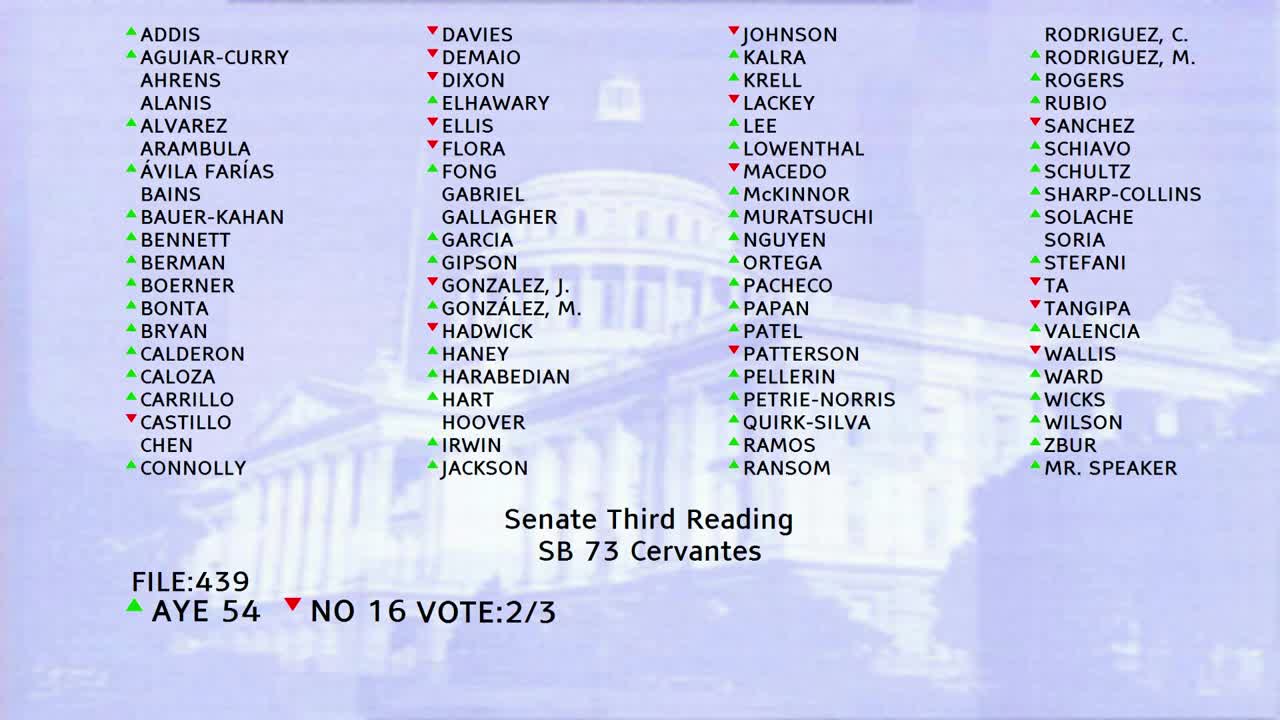 55SEC
Assembly Floor
 15MIN
Assembly Standing Committee on Natural Resources
 12MIN
Assembly Standing Committee on Water, Parks, and Wildlife
Bill Author
Bill Co-Author(s):
