AB 1810: Firearms: dealer centralized list.
- Session Year: 2025-2026
- House: Assembly
- Latest Version Date: 2026-06-25
Current Status:
In Progress
(2026-08-13: In committee: Held under submission.)
Introduced
In Committee
Awaiting First Chamber Vote
Passed First Chamber
In Committee
Awaiting Second Chamber Vote
Passed Second Chamber
Enacted
Existing law requires the Department of Justice to keep a centralized list of all persons who are licensed firearms dealers and satisfy certain requirements, including having a valid federal firearms license and a regulatory or business license required by local government. Existing law requires the department to remove a person from the list if the persons federal license has expired or been revoked. Existing law, beginning on January 1, 2024, requires the department to conduct inspections of firearms dealers at least every 3 years, except as provided, to ensure compliance with specified requirements. As part of the departments inspections of firearms dealers, existing law requires the department to audit a dealers records that includes a sampling of at least 25% but no more than 50% of each record type. Existing law requires the department to assess annual fees not to exceed specified amounts to cover the reasonable costs of inspecting and maintaining this list and other similar centralized lists.
This bill would require the department to remove from the list a person who fails to comply with the requirements to be on the list and authorize the department to remove a person from the list who fails to remedy specified violations discovered as a result of the above-described inspections. The bill would subject a person removed from the list for failure to remedy specified violations to a fine and make that person would authorize that person to be ineligible to be placed on the list for a period of 2 years. The bill would require the department to conduct a yearly inspection of the 10 firearm dealer locations with the highest percentage of firearms that were recovered by law enforcement and found to be illegally possessed, used in a crime, or suspected to have been used in a crime, as specified, pursuant to a certain yearly report. The bill would, for the fees charged for inspecting and maintaining the above-described lists, instead require the department to assess a reasonable annual fee. The bill would prohibit a fee adjustment from exceeding 15% over the previous year and exceeding the amount necessary to cover the costs described above.
Existing law requires the Department of Justice to keep a centralized list of all persons who are licensed firearms dealers and satisfy certain requirements, including having a valid federal firearms license and a regulatory or business license required by local government. Existing law requires the department to remove a person from the list if the persons federal license has expired or been revoked. Existing law, beginning on January 1, 2024, requires the department to conduct inspections of firearms dealers at least every 3 years, except as provided, to ensure compliance with specified requirements. As part of the departments inspections of firearms dealers, existing law requires the department to audit a dealers records that includes a sampling of at least 25% but no more than 50% of each record type. Existing law requires the department to assess annual fees not to exceed specified amounts to cover the reasonable costs of inspecting and maintaining this list and other similar centralized lists.
This bill would require the department to remove from the list a person who fails to comply with the requirements to be on the list and authorize the department to remove a person from the list who fails to remedy specified violations discovered as a result of the above-described inspections. The bill would subject a person removed from the list for these 2 reasons for failure to remedy specified violations to a fine and make that person ineligible to be placed on the list for a period of 2 years. The bill would require the department to conduct a yearly inspection of the 10 firearm dealer locations with the highest percentage of total sales of firearms that were recovered by law enforcement and found to be illegally possessed, used in a crime, or suspected to have been used in a crime, as specified, pursuant to a certain yearly report. The bill would, for the fees charged for inspecting and maintaining the above-described lists, instead require the department to assess a reasonable annual fee. The bill would prohibit a fee adjustment from exceeding 15% over the previous year and exceeding the amount necessary to cover the costs described above.
Existing law requires the Department of Justice to keep a centralized list of all persons who are licensed firearms dealers and satisfy certain requirements, including having a valid federal firearms license and a regulatory or business license required by local government. Existing law requires the department to remove a person from the list if the persons federal license has expired or been revoked. Existing law, beginning on January 1, 2024, requires the department to conduct inspections of firearms dealers at least every 3 years, except as provided, to ensure compliance with specified requirements. As part of the departments inspections of firearms dealers, existing law requires the department to audit a dealers records that includes a sampling of at least 25% but no more than 50% of each record type. Existing law requires the department to assess annual fees not to exceed specified amounts to cover the reasonable costs of inspecting and maintaining this list and other similar centralized lists.
This bill would require the department to remove from the list a person who fails to comply with the requirements to be on the list and authorize the department to remove a person from the list who fails to remedy specified violations discovered as a result of the above-described inspections. The bill would subject a person removed from the list for these 2 reasons to a fine and make that person ineligible to be placed on the list for a period of 2 years. The bill would require the department to conduct a yearly inspection of the 10 firearm dealer locations with the highest percentage of total sales of firearms that were recovered by law enforcement and found to be illegally possessed, used in a crime, or suspected to have been used in a crime, as specified, pursuant to a certain yearly report. The bill would, for the fees charged for inspecting and maintaining the above-described lists, instead require the department to assess a reasonable annual fee. The bill would prohibit a fee adjustment from exceeding 15% over the previous year and exceeding the amount necessary to cover the costs described above.
Existing law requires the Department of Justice to keep a centralized list of all persons licensed to sell firearms. Existing law authorizes the department to remove from the centralized list a person who knowingly or with gross negligence violates specified provisions of law. Upon removal of a dealer from the centralized list, existing law requires notification to be provided to local law enforcement and licensing authorities in the jurisdiction where the dealers business is located.This bill would make technical, nonsubstantive changes to those provisions.Existing law requires the Department of Justice to keep a centralized list of all persons licensed to sell firearms. Existing law authorizes the department to remove from the centralized list a person who knowingly or with gross negligence violates specified provisions of law. Upon removal of a dealer from the centralized list, existing law requires notification to be provided to local law enforcement and licensing authorities in the jurisdiction where the dealers business is located.
This bill would make technical, nonsubstantive changes to those provisions.
(a)Except as otherwise provided in paragraphs (1) and (3) of subdivision (b), the Department of Justice shall keep a centralized list of all persons licensed pursuant to subdivisions (a) to (e), inclusive, of Section 26700.
(b)(1)The department may remove from this list any person who knowingly or with gross negligence violates a provision listed in Section 16575.
(2)The department shall remove from the centralized list any person whose federal firearms license has expired or has been revoked.
(3)The department shall remove from the centralized list any person or entity who has failed to provide certification of compliance with Section 26806 pursuant to subdivision (d) of Section 26806.
(4)The department shall remove from this list a person who fails to comply with the requirements for licensure listed in subdivisions (a) to (e), inclusive, of Section 26700.
(5)The department may remove from this list a person who fails to remedy violations discovered as a result of an inspection, within 90 days of the inspection, as provided in paragraph (5) of subdivision (a) of Section 26720.
(6)Upon removal of a dealer from this list, notification shall be provided to local law enforcement and licensing authorities in the jurisdiction where the dealers business is located.
(7)(A)A person removed from the centralized list pursuant to paragraph (5) shall be subject to a fine and shall may be ineligible to be placed on the centralized list for a period of two years from the date of removal.
(B)A person who has been removed from the centralized list pursuant to paragraph (5) is ineligible to own or operate a business selling firearms or ammunition, or be employed by a firearms dealer or ammunition vendor for a period of two years.
(C)Dealers shall provide the certificate of eligibility for all employees, who are required to have a certificate of eligibility, upon request of any peace officer, authorized law enforcement employee, or Department of Justice employee designated by the Attorney General, upon the presentation of proper identification during the course of an inspection.
(c)Information compiled from the list shall be made available, upon request, for the following purposes only:
(1)For law enforcement purposes.
(2)When the information is requested by a person licensed pursuant to Chapter 44 (commencing with Section 921) of Title 18 of the United States Code for determining the validity of the license for firearm shipments.
(3)When information is requested by a person promoting, sponsoring, operating, or otherwise organizing a show or event as defined in Section 478.100 of Title 27 of the Code of Federal Regulations, or its successor, who possesses a valid certificate of eligibility issued pursuant to Article 1 (commencing with Section 27200) of Chapter 3, if that information is requested by the person to determine the eligibility of a prospective participant in a gun show or event to conduct transactions as a firearms dealer pursuant to subdivision (b) of Section 26805.
(d)Information provided pursuant to subdivision (c) shall be limited to information necessary to corroborate an individuals current license status as being one of the following:
(1)A person licensed pursuant to subdivisions (a) to (e), inclusive, of Section 26700.
(2)A person who is licensed pursuant to Chapter 44 (commencing with Section 921) of Title 18 of the United States Code, and who is not subject to the requirement of being licensed pursuant to subdivisions (a) to (e), inclusive, of Section 26700.
SEC. 2.Section 26720 of the Penal Code is amended to read:26720.(a)The Department of Justice may conduct inspections of dealers at least every three years to ensure compliance with the requirements of this title, including any regulations promulgated to implement this title, Sections 21628.2, 21636, and 21640 of the Business and Professions Code, and any other applicable state law.
(1)Commencing on January 1, 2024, the department shall conduct inspections of all dealers, except a dealer specified in paragraph (2) or subdivision (c), at least once every three years, to ensure compliance with the requirements of this title, including any regulations promulgated to implement this title, Sections 21628.2, 21636, and 21640 of the Business and Professions Code, and any other applicable state law.
(2)Each year, the department shall conduct an inspection of the 10 firearm dealer locations with the highest percentage of firearms that were recovered by law enforcement and found to be illegally possessed, used in a crime, or suspected to have been used in a crime that have a time to crime of less than one year for the most recent calendar year reported, as described in the report specified in subdivision (e) of Section 11108.3. A firearm dealer location shall only be inspected pursuant to this paragraph if it is reported to be the source of no fewer than 20 firearms that were illegally possessed, used in a crime, or suspected to have been used in a crime.
(3)The inspections pursuant to paragraph (2) shall occur within 12 months after the release of the report required by Section 11108.3. The department may forgo an inspection of a location as described in paragraph (2) if the location has been inspected within six months prior to the release of the report.
(4)Inspections of dealers pursuant to this subdivision shall include an audit of dealer records that includes a sampling of at least 25 percent of each record type.
(5)A dealer found to have committed a violation of the requirements specified in paragraph (1) shall remedy the violation within 90 days of the inspection and submit proof of that remedy to the department.
(6)For the purposes of this section, time to crime means the length of time between when a firearm was last in the possession of, or reported stolen by, the dealer, as applicable, and the date the weapon was recovered by law enforcement and found to be illegally possessed, used in a crime, or suspected to have been used in a crime.
(b)The department may assess an annual fee to cover the reasonable cost of maintaining the list described in Section 26715, including the cost of inspections. A fee adjustment shall not exceed 15 percent over the previous year and shall not exceed the amount necessary to cover the costs described in this subdivision.
(c)A dealer whose place of business is located in a jurisdiction that has adopted an inspection program to ensure compliance with firearms law is exempt from that portion of the departments fee that relates to the cost of inspections. The applicant is responsible for providing evidence to the department that the jurisdiction in which the business is located has the inspection program. The department may inspect a dealer who is exempt from mandatory inspections under subdivision (b) to ensure compliance with the requirements of this title, including any regulations promulgated to implement this title, Sections 21628.2, 21636, and 21640 of the Business and Professions Code, and any other applicable state law.
SEC. 3.Section 28460 of the Penal Code is amended to read:28460.(a)The department shall assess a reasonable annual fee to cover its costs of maintaining the centralized list of exempted federal firearms licensees prescribed by Section 28450, conducting inspections in accordance with this article, and for the cost of maintaining the firearm shipment verification number system described in Section 27555. A fee adjustment shall not exceed 15 percent over the previous year and shall not exceed the amount necessary to cover the costs described in this section.
(b)The fees collected shall be deposited in the Dealers Record of Sale Special Account.
(c)A person who satisfies all of the following conditions shall not be charged a fee:
(1)The person is not licensed pursuant to Sections 26700 to 26915, inclusive.
(2)The person has been issued a permit pursuant to Section 31005, 32650, or 33300, or pursuant to Article 3 (commencing with Section 18900) of Chapter 1 of Division 5 of Title 2.
(3)The person is placed on the centralized list of exempted federal firearms licensees.
SEC. 4.Section 29055 of the Penal Code is amended to read:29055.(a)The department shall adopt regulations to administer this chapter and Chapter 1 (commencing with Section 29010).
(b)The department shall recover the full costs of administering the program by collecting reasonable fees from license applicants. Recoverable costs shall include, but not be limited to, the costs of inspections and maintaining a centralized list of licensed firearm manufacturers.
(c)The reasonable fee for licensed manufacturers who produce fewer than 500 firearms in a calendar year within this state shall not exceed the actual costs of inspections and maintaining a centralized list of firearm manufacturers and any other duties of the department required pursuant to this chapter and Chapter 1 (commencing with Section 29010), whichever is less.
(a)Except as otherwise provided in paragraphs (1) and (3) of subdivision (b), the Department of Justice shall keep a centralized list of all persons licensed pursuant to subdivisions (a) to (e), inclusive, of Section 26700.
(b)(1)The department may remove from this list any person who knowingly or with gross negligence violates a provision listed in Section 16575.
(2)The department shall remove from the centralized list any person whose federal firearms license has expired or has been revoked.
(3)The department shall remove from the centralized list any person or entity who has failed to provide certification of compliance with Section 26806 pursuant to subdivision (d) of Section 26806.
(4)The department shall remove from this list a person who fails to comply with the requirements for licensure listed in subdivisions (a) to (e), inclusive, of Section 26700.
(5)The department may remove from this list a person who fails to remedy violations discovered as a result of an inspection, within 90 days of the inspection, as provided in paragraph (5) of subdivision (a) of Section 26720.
(6)Upon removal of a dealer from this list, notification shall be provided to local law enforcement and licensing authorities in the jurisdiction where the dealers business is located.
(7)(A)A person removed from the centralized list pursuant to paragraph (4) or (5) shall be subject to a fine and shall be ineligible to be placed on the centralized list for a period of two years from the date of removal.
(B)A person who has been removed from the centralized list is ineligible to own or operate a business selling firearms or ammunition, or be employed by a firearms dealer or ammunition vendor for a period of two years.
(C)Dealers shall provide the certificate of eligibility for all employees, who are required to have a certificate of eligibility, upon request of any peace officer, authorized law enforcement employee, or Department of Justice employee designated by the Attorney General, upon the presentation of proper identification during the course of an inspection.
(c)Information compiled from the list shall be made available, upon request, for the following purposes only:
(1)For law enforcement purposes.
(2)When the information is requested by a person licensed pursuant to Chapter 44 (commencing with Section 921) of Title 18 of the United States Code for determining the validity of the license for firearm shipments.
(3)When information is requested by a person promoting, sponsoring, operating, or otherwise organizing a show or event as defined in Section 478.100 of Title 27 of the Code of Federal Regulations, or its successor, who possesses a valid certificate of eligibility issued pursuant to Article 1 (commencing with Section 27200) of Chapter 3, if that information is requested by the person to determine the eligibility of a prospective participant in a gun show or event to conduct transactions as a firearms dealer pursuant to subdivision (b) of Section 26805.
(d)Information provided pursuant to subdivision (c) shall be limited to information necessary to corroborate an individuals current license status as being one of the following:
(1)A person licensed pursuant to subdivisions (a) to (e), inclusive, of Section 26700.
(2)A person who is licensed pursuant to Chapter 44 (commencing with Section 921) of Title 18 of the United States Code, and who is not subject to the requirement of being licensed pursuant to subdivisions (a) to (e), inclusive, of Section 26700.
SEC. 2.Section 26720 of the Penal Code is amended to read:26720.(a)The Department of Justice may conduct inspections of dealers at least every three years to ensure compliance with the requirements of this title, including any regulations promulgated to implement this title, Sections 21628.2, 21636, and 21640 of the Business and Professions Code, and any other applicable state law.
(1)Commencing on January 1, 2024, the department shall conduct inspections of all dealers, except a dealer specified in paragraph (2) or subdivision (c), at least once every three years, to ensure compliance with the requirements of this title, including any regulations promulgated to implement this title, Sections 21628.2, 21636, and 21640 of the Business and Professions Code, and any other applicable state law.
(2)Each year, the department shall conduct an inspection of the 10 firearm dealer locations with the highest percentage of total sales of firearms that were recovered by law enforcement and found to be illegally possessed, used in a crime, or suspected to have been used in a crime, crime that have a time to crime of less than one year for the most recent calendar year reported, as described in the report specified in subdivision (e) of Section 11108.3. A firearm dealer location shall only be inspected pursuant to this paragraph if it is reported to be the source of no fewer than 20 firearms that were illegally possessed, used in a crime, or suspected to have been used in a crime.
(3)The inspections pursuant to paragraph (2) shall occur within 12 months after the release of the report required by Section 11108.3. The department may forgo an inspection of a location as described in paragraph (2) if the location has been inspected within six months prior to the release of the report.
(4)Inspections of dealers pursuant to this subdivision shall include an audit of dealer records that includes a sampling of at least 25 percent of each record type.
(5)A dealer found to have committed a violation of the requirements specified in paragraph (1) shall remedy the violation within 90 days of the inspection and submit proof of that remedy to the department.
(6)For the purposes of this section, time to crime means the length of time between when a firearm was last in the possession of, or reported stolen by, the dealer, as applicable, and the date the weapon was recovered by law enforcement and found to be illegally possessed, used in a crime, or suspected to have been used in a crime.
(b)The department may assess an annual fee to cover the reasonable cost of maintaining the list described in Section 26715, including the cost of inspections. A fee adjustment shall not exceed 15 percent over the previous year and shall not exceed the amount necessary to cover the costs described in this subdivision.
(c)A dealer whose place of business is located in a jurisdiction that has adopted an inspection program to ensure compliance with firearms law is exempt from that portion of the departments fee that relates to the cost of inspections. The applicant is responsible for providing evidence to the department that the jurisdiction in which the business is located has the inspection program. The department may inspect a dealer who is exempt from mandatory inspections under subdivision (b) to ensure compliance with the requirements of this title, including any regulations promulgated to implement this title, Sections 21628.2, 21636, and 21640 of the Business and Professions Code, and any other applicable state law.
SEC. 3.Section 28460 of the Penal Code is amended to read:28460.(a)The department shall assess a reasonable annual fee to cover its costs of maintaining the centralized list of exempted federal firearms licensees prescribed by Section 28450, conducting inspections in accordance with this article, and for the cost of maintaining the firearm shipment verification number system described in Section 27555. A fee adjustment shall not exceed 15 percent over the previous year and shall not exceed the amount necessary to cover the costs described in this section.
(b)The fees collected shall be deposited in the Dealers Record of Sale Special Account.
(c)A person who satisfies all of the following conditions shall not be charged a fee:
(1)The person is not licensed pursuant to Sections 26700 to 26915, inclusive.
(2)The person has been issued a permit pursuant to Section 31005, 32650, or 33300, or pursuant to Article 3 (commencing with Section 18900) of Chapter 1 of Division 5 of Title 2.
(3)The person is placed on the centralized list of exempted federal firearms licensees.
SEC. 4.Section 29055 of the Penal Code is amended to read:29055.(a)The department shall adopt regulations to administer this chapter and Chapter 1 (commencing with Section 29010).
(b)The department shall recover the full costs of administering the program by collecting reasonable fees from license applicants. Recoverable costs shall include, but not be limited to, the costs of inspections and maintaining a centralized list of licensed firearm manufacturers.
(c)The reasonable fee for licensed manufacturers who produce fewer than 500 firearms in a calendar year within this state shall not exceed the actual costs of inspections and maintaining a centralized list of firearm manufacturers and any other duties of the department required pursuant to this chapter and Chapter 1 (commencing with Section 29010), whichever is less.
(a)Except as otherwise provided in paragraphs (1) and (3) of subdivision (b), the Department of Justice shall keep a centralized list of all persons licensed pursuant to subdivisions (a) to (e), inclusive, of Section 26700.
(b)(1)The department may remove from this list any person who knowingly or with gross negligence violates a provision listed in Section 16575.
(2)The department shall remove from the centralized list any person whose federal firearms license has expired or has been revoked.
(3)The department shall remove from the centralized list any person or entity who has failed to provide certification of compliance with Section 26806 pursuant to subdivision (d) of Section 26806.
(4)The department shall remove from this list a person who fails to comply with the requirements for licensure listed in subdivisions (a) to (e), inclusive, of Section 26700.
(5)The department may remove from this list a person who fails to remedy violations discovered as a result of an inspection, within 90 days of the inspection, as provided in paragraph (5) of subdivision (a) of Section 26720.
(4)(6)Upon removal of a dealer from this list, notification shall be provided to local law enforcement and licensing authorities in the jurisdiction where the dealers business is located.
(7)(A)A person removed from the centralized list pursuant to paragraph (4) or (5) shall be subject to a fine and shall be ineligible to be placed on the centralized list for a period of two years from the date of removal.
(B)A person who has been removed from the centralized list is ineligible to own or operate a business selling firearms or ammunition, or be employed by a firearms dealer or ammunition vendor for a period of two years.
(C)Dealers shall provide the certificate of eligibility for all employees, who are required to have a certificate of eligibility, upon request of any peace officer, authorized law enforcement employee, or Department of Justice employee designated by the Attorney General, upon the presentation of proper identification during the course of an inspection.
(c)Information compiled from the list shall be made available, upon request, for the following purposes only:
(1)For law enforcement purposes.
(2)When the information is requested by a person licensed pursuant to Chapter 44 (commencing with Section 921) of Title 18 of the United States Code for determining the validity of the license for firearm shipments.
(3)When information is requested by a person promoting, sponsoring, operating, or otherwise organizing a show or event as defined in Section 478.100 of Title 27 of the Code of Federal Regulations, or its successor, who possesses a valid certificate of eligibility issued pursuant to Article 1 (commencing with Section 27200) of Chapter 3, if that information is requested by the person to determine the eligibility of a prospective participant in a gun show or event to conduct transactions as a firearms dealer pursuant to subdivision (b) of Section 26805.
(d)Information provided pursuant to subdivision (c) shall be limited to information necessary to corroborate an individuals current license status as being one of the following:
(1)A person licensed pursuant to subdivisions (a) to (e), inclusive, of Section 26700.
(2)A person who is licensed pursuant to Chapter 44 (commencing with Section 921) of Title 18 of the United States Code, and who is not subject to the requirement of being licensed pursuant to subdivisions (a) to (e), inclusive, of Section 26700.
SEC. 2.Section 26720 of the Penal Code is amended to read:26720.(a)The Department of Justice may conduct inspections of dealers at least every three years to ensure compliance with the requirements of this title, including any regulations promulgated to implement this title, Sections 21628.2, 21636, and 21640 of the Business and Professions Code, and any other applicable state law.
(1)Commencing on January 1, 2024, the department shall conduct inspections of all dealers, except a dealer specified in paragraph (2) or subdivision (c), at least once every three years, to ensure compliance with the requirements of this title, including any regulations promulgated to implement this title, Sections 21628.2, 21636, and 21640 of the Business and Professions Code, and any other applicable state law.
(2)Each year, the department shall conduct an inspection of the 10 firearm dealer locations with the highest percentage of total sales of firearms that were recovered by law enforcement and found to be illegally possessed, used in a crime, or suspected to have been used in a crime, as described in the report specified in subdivision (e) of Section 11108.3. A firearm dealer location shall only be inspected pursuant to this paragraph if it is reported to be the source of no fewer than 20 firearms that were illegally possessed, used in a crime, or suspected to have been used in a crime.
(3)The inspections pursuant to paragraph (2) shall occur within 12 months after the release of the report required by Section 11108.3. The department may forgo an inspection of a location as described in paragraph (2) if the location has been inspected within six months prior to the release of the report.
(2)(4)Inspections of dealers pursuant to this subdivision shall include an audit of dealer records that includes a sampling of at least 25 percent but no more than 50 percent of each record type.
(5)A dealer found to have committed a violation of the requirements specified in paragraph (1) shall remedy the violation within 90 days of the inspection and submit proof of that remedy to the department.
(b)The department may assess an annual fee, not fee to exceed one hundred fifteen dollars ($115), to cover the reasonable cost of maintaining the list described in Section 26715, including the cost of inspections. A fee adjustment shall not exceed 15 percent over the previous year and shall not exceed the amount necessary to cover the costs described in this subdivision.
(c)A dealer whose place of business is located in a jurisdiction that has adopted an inspection program to ensure compliance with firearms law is exempt from that portion of the departments fee that relates to the cost of inspections. The applicant is responsible for providing evidence to the department that the jurisdiction in which the business is located has the inspection program. The department may inspect a dealer who is exempt from mandatory inspections under subdivision (b) to ensure compliance with the requirements of this title, including any regulations promulgated to implement this title, Sections 21628.2, 21636, and 21640 of the Business and Professions Code, and any other applicable state law.
SEC. 3.Section 28460 of the Penal Code is amended to read:28460.(a)Commencing January 1, 2008, the The department shall assess an a reasonable annual fee of one hundred fifteen dollars ($115) to cover its costs of maintaining the centralized list of exempted federal firearms licensees prescribed by Section 28450, conducting inspections in accordance with this article, and for the cost of maintaining the firearm shipment verification number system described in Section 27555. A fee adjustment shall not exceed 15 percent over the previous year and shall not exceed the amount necessary to cover the costs described in this section.
(b)The department may increase the fee at a rate not to exceed the increase in the California Consumer Price Index as compiled and reported by the Department of Industrial Relations.(c)(b)The fees collected shall be deposited in the Dealers Record of Sale Special Account.
(d)(c)A person who satisfies all of the following conditions shall not be charged a fee:
(1)The person is not licensed pursuant to Sections 26700 to 26915, inclusive.
(2)The person has been issued a permit pursuant to Section 31005, 32650, or 33300, or pursuant to Article 3 (commencing with Section 18900) of Chapter 1 of Division 5 of Title 2.
(3)The person is placed on the centralized list of exempted federal firearms licensees.
SEC. 4.Section 29055 of the Penal Code is amended to read:29055.(a)The department shall adopt regulations to administer this chapter and Chapter 1 (commencing with Section 29010).
(b)The department shall recover the full costs of administering the program by collecting reasonable fees from license applicants. Recoverable costs shall include, but not be limited to, the costs of inspections and maintaining a centralized list of licensed firearm manufacturers.
(c)The reasonable fee for licensed manufacturers who produce fewer than 500 firearms in a calendar year within this state shall not exceed two hundred fifty dollars ($250) per year or the actual costs of inspections and maintaining a centralized list of firearm manufacturers and any other duties of the department required pursuant to this chapter and Chapter 1 (commencing with Section 29010), whichever is less.
SECTION 1.Section 26715 of the Penal Code is amended to read:26715.(a)Except as otherwise provided in paragraphs (1) and (3) of subdivision (b), the Department of Justice shall keep a centralized list of all persons licensed pursuant to subdivisions (a) to (e), inclusive, of Section 26700.(b)(1)The department may remove from the centralized list any person who knowingly or with gross negligence violates a provision listed in Section 16575.(2)The department shall remove from the centralized list any person whose federal firearms license has expired or has been revoked.(3)The department shall remove from the centralized list any person or entity who has failed to provide certification of compliance with Section 26806 pursuant to subdivision (d) of Section 26806.(4)Upon removal of a dealer from the centralized list, notification shall be provided to local law enforcement and licensing authorities in the jurisdiction where the dealers business is located.(c)Information compiled from the centralized list shall be made available, upon request, for the following purposes only:(1)For law enforcement purposes.(2)When the information is requested by a person licensed pursuant to Chapter 44 (commencing with Section 921) of Title 18 of the United States Code for determining the validity of the license for firearm shipments.(3)When information is requested by a person promoting, sponsoring, operating, or otherwise organizing a show or event as defined in Section 478.100 of Title 27 of the Code of Federal Regulations, or its successor, who possesses a valid certificate of eligibility issued pursuant to Article 1 (commencing with Section 27200) of Chapter 3, if that information is requested by the person to determine the eligibility of a prospective participant in a gun show or event to conduct transactions as a firearms dealer pursuant to subdivision (b) of Section 26805.(d)Information provided pursuant to subdivision (c) shall be limited to information necessary to corroborate an individuals current license status as being one of the following:(1)A person licensed pursuant to subdivisions (a) to (e), inclusive, of Section 26700.(2)A person who is licensed pursuant to Chapter 44 (commencing with Section 921) of Title 18 of the United States Code, and who is not subject to the requirement of being licensed pursuant to subdivisions (a) to (e), inclusive, of Section 26700.(a)Except as otherwise provided in paragraphs (1) and (3) of subdivision (b), the Department of Justice shall keep a centralized list of all persons licensed pursuant to subdivisions (a) to (e), inclusive, of Section 26700.
(b)(1)The department may remove from this the centralized list any person who knowingly or with gross negligence violates a provision listed in Section 16575.
(2)The department shall remove from the centralized list any person whose federal firearms license has expired or has been revoked.
(3)The department shall remove from the centralized list any person or entity who has failed to provide certification of compliance with Section 26806 pursuant to subdivision (d) of Section 26806.
(4)Upon removal of a dealer from this the centralized list, notification shall be provided to local law enforcement and licensing authorities in the jurisdiction where the dealers business is located.
(c)Information compiled from the centralized list shall be made available, upon request, for the following purposes only:
(1)For law enforcement purposes.
(2)When the information is requested by a person licensed pursuant to Chapter 44 (commencing with Section 921) of Title 18 of the United States Code for determining the validity of the license for firearm shipments.
(3)When information is requested by a person promoting, sponsoring, operating, or otherwise organizing a show or event as defined in Section 478.100 of Title 27 of the Code of Federal Regulations, or its successor, who possesses a valid certificate of eligibility issued pursuant to Article 1 (commencing with Section 27200) of Chapter 3, if that information is requested by the person to determine the eligibility of a prospective participant in a gun show or event to conduct transactions as a firearms dealer pursuant to subdivision (b) of Section 26805.
(d)Information provided pursuant to subdivision (c) shall be limited to information necessary to corroborate an individuals current license status as being one of the following:
(1)A person licensed pursuant to subdivisions (a) to (e), inclusive, of Section 26700.
(2)A person who is licensed pursuant to Chapter 44 (commencing with Section 921) of Title 18 of the United States Code, and who is not subject to the requirement of being licensed pursuant to subdivisions (a) to (e), inclusive, of Section 26700.
|
Date
|
Status
|
|---|---|
| Aug 13, 2026 | In committee: Held under submission. |
| Aug 3, 2026 | In committee: Referred to APPR. suspense file. |
| Jun 25, 2026 | Read second time and amended. Re-referred to Com. on APPR. |
| Jun 24, 2026 | From committee: Amend, and do pass as amended and re-refer to Com. on APPR. (Ayes 4. Noes 2.) (June 23). |
| Jun 16, 2026 | In committee: Hearing postponed by committee. |
| Jun 3, 2026 | Referred to Com. on PUB. S. |
| May 27, 2026 | In Senate. Read first time. To Com. on RLS. for assignment. |
| May 26, 2026 | Read third time. Passed. Ordered to the Senate. (Ayes 58. Noes 20.) |
| May 26, 2026 | Read third time. Passed. Ordered to the Senate. (Ayes 58. Noes 20. Page 5362.) |
| May 26, 2026 | Read third time. Passed. Ordered to the Senate. |
| May 19, 2026 | Read second time. Ordered to third reading. |
| May 18, 2026 | Read second time and amended. Ordered returned to second reading. |
| May 14, 2026 | Joint Rule 62(a), file notice suspended. (Page 5030.) |
| May 14, 2026 | Joint Rule 62(a), file notice suspended. |
| May 14, 2026 | From committee: Amend, and do pass as amended. (Ayes 11. Noes 4.) (May 14). |
| May 13, 2026 | In committee: Set, first hearing. Referred to APPR. suspense file. |
| Apr 15, 2026 | From committee: Do pass and re-refer to Com. on APPR. (Ayes 7. Noes 2.) (April 14). Re-referred to Com. on APPR. |
| Mar 17, 2026 | Re-referred to Com. on PUB. S. |
| Mar 16, 2026 | Referred to Com. on PUB. S. |
| Mar 16, 2026 | From committee chair, with author's amendments: Amend, and re-refer to Com. on PUB. S. Read second time and amended. |
| Feb 11, 2026 | From printer. May be heard in committee March 13. |
| Feb 10, 2026 | Read first time. To print. |
|
Date
|
Description
|
Location
|
Votes
|
|
|---|---|---|---|---|
| Aug 3, 2026 | Placed on suspense file | Senate Standing Committee on Appropriations |
Passed |
|
| Jun 23, 2026 | Do pass as amended, but first amend, and re-refer to the Committee on [Appropriations] | Senate Standing Committee on Public Safety |
Passed |
|
| May 26, 2026 | AB 1810 Berman Assembly Third Reading | Assembly Floor |
Passed |
|
| May 14, 2026 | Do pass as amended. | Assembly Standing Committee on Appropriations |
Passed |
|
| Apr 14, 2026 | Do pass and be re-referred to the Committee on [Appropriations] | Assembly Standing Committee on Public Safety |
Passed |
This list shows positions taken on this bill by organizations on the date displayed, which is linked to the original source.
Positions by individuals are not included.
|
Organization
|
Position
|
Date
|
|---|---|---|
| Brady California | ** Support | |
| Brady United Against Gun Violence | ** Support | |
| California Rifle and Pistol Association | ** Against | |
| Everytown for Gun Safety Action Fund | ** Support | |
| Giffords | ** Support | |
| Giffords Gun Owners for Safety, California | ** Support | |
| Moms Demand Action for Gun Sense in America | ** Support | |
| National Rifle Association – Institute for Legislative Action | ** Against | |
| Students Demand Action for Gun Sense in America | ** Support |
SENATE COMMITTEE ON
Senator Sabrina Cervantes, Chair
2025 - 2026 Regular Session
AB 1810 (Berman) - Firearms: dealer centralized list
Version: | Policy Vote: |
Urgency: | Mandate: |
Hearing Date: | Consultant: |
Bill Summary:
AB 1810 would require the Department of Justice to conduct a yearly inspection of the ten firearm dealer locations with the highest percentage of firearms that were recovered by law enforcement and found to be illegally possessed or used in a crime. The bill would require DOJ to delist non-compliant firearms dealers and would adjust the federal firearms license fee by removing a statutory cap and authorizing a percentage adjusted fee.
Fiscal Impact:
Estimated $280,000 in FY 2026-27, $400,000 in FY 2027-28, $370,000 in FY 2028-29 annually, ongoing to conduct firearm dealer inspections and maintain records. (Dealer’ Record of Sale Special Account, General Fund)
Background:
Federal law requires firearms dealers to obtain a license (FFL) through the Bureau of Alcohol, Tobacco, Firearms and Explosives. To obtain a state firearms dealer license in California, in addition to obtaining a federal FFL, other requirements include obtaining any required local licenses, a certificate of eligibility issued by the DOJ verifying that a background check has taken place and being recorded on the DOJ’s centralized list of firearms dealers. In California, only individuals that have obtained a valid license through the DOJ may lawfully sell, lease or transfer firearms within the state, subject to limited exceptions.
The DOJ is required to maintain a centralized list of all active, licensed firearm dealers, and is authorized to remove dealers from that list for a number of specified reasons, including for having their FFL revoked, failing to provide certification of a working video surveillance system, or violating any of a number of dealer requirements.
Existing law requires the DOJ to conduct inspections of licensed firearms dealers at least once every three years to ensure compliance with any and all existing requirements to which they are subject. Moreover, dealer inspections must include an audit of dealer records that includes a sampling of at least 25% but no more than 50% of each record type.
DOJ is authorized to collect fees from both firearm dealers and purchasers to recover costs associated with the implementation and management of California’s firearms laws. With regard to dealers, the DOJ may collect fees for the issuance ($71) and renewal ($22) of certificates of eligibility, for the maintenance of the centralized list ($20), and to cover the costs of conducting inspections ($90). Existing law provides that the total amount that may be charged to a dealer recover costs related to maintaining the centralized list and conducting inspections is $115. Existing law also authorizes DOJ to charge certain FFLs an additional fee for being in a specialized category of licensees, such as an annual fee of $115 for FFLs that qualify for an exemption from specified dealer requirements, and an annual fee not to exceed $250 for licensed firearm manufacturers that produce fewer than 500 firearms in a calendar year. These fees provide cost recovery for the management of centralized lists exclusive to these specialized classes of licensee
Proposed Law:
This bill would do the following:
- Authorize DOJ to remove from the centralized list of firearms licensees a person who fails to comply with the prerequisite conditions for obtaining a firearms dealer license.
- Authorize DOJ to remove from the centralized list of firearms licensees a person who fails to remedy violations discovered as a result of an inspection within 90 days of the inspection.
- Provide that a person removed from the centralized list pursuant to its provisions shall be subject to a fine and shall be ineligible to be placed on the centralized list for a period of two years from the date of removal.
- Prohibit a person who has been removed from the centralized list from owning, operating, or being employed by a firearms dealer or ammunition vendor for a period of two years.
- Require DOJ to conduct an inspection of the 10 firearm dealer locations with the highest percentage of total sales that were recovered by law enforcement that have a “time to crime” of less than one year for the most recent year reported although a firearm dealer location shall only be inspected if it is reported to be the source of no fewer than 20 crime guns.
- Defines “time to crime” as the length of time between when a firearm was last in possession of, or reported stolen by, the dealer, and the date the weapon was recovered by law enforcement and found to be illegally possessed, used in a crime, or suspected to have been used in a crime.
- Provide that the inspections shall occur within 12 months after the release of DOJ’s annual crime guns report, though DOJ may forgo an inspection of a location if it had been inspected within 6 months prior to the release of the report.
- Provide that a dealer found to have committed a violation of specified firearm dealer requirements shall remedy the violation within 90 days of the inspection and submit proof of that remedy to DOJ.
- Strike existing law capping the annual fee that may be charged to licensees to cover the costs of maintaining the centralized list and conducting inspections at $115 and authorize the DOJ to instead impose a fee adjustment of no more than 15 percent over the previous year, provided that the fee does not exceed the amount necessary to cover costs.
- Strike existing law capping the annual fee that may be charged to cover costs of maintaining the centralized list of exempted FFLs, conducting inspections, and maintaining the firearm shipment verification number system at $115, and authorize the DOJ to impose a fee adjustment of no more than 15 percent over the previous year, provided that the fee does not exceed the amount necessary to cover specified costs.
- Provide that the fees collected by DOJ cover the costs of the program granting licenses for the manufacture of firearms shall be reasonable.
- Strike the language capping the fee for licensed manufacturers who produce fewer than 500 firearms in a calendar year at $250 and provides that the fee shall be reasonable.
Related Legislation:
SB 15 (Blakespear) 2025, would have required DOJ to annually inspect the 10 firearm dealer locations with the highest percentage of total sales that were recovered by law enforcement. The bill proposed modifying DOJ’s fee authority with regard to dealers. That bill was held under submission in this committee.
SB 1038 (Blakespear), 2024, would have, among other things, required the DOJ to inspect the 25 firearm dealer locations that are the source of the highest gross number of crime guns in the previous year. That bill was held under submission in this committee.
SENATE COMMITTEE ON PUBLIC SAFETY
Senator Jesse Arreguín, Chair
2025 - 2026 Regular
Bill No: AB 1810 Hearing Date: June 23, 2026
Author: | Berman | ||
Version: | May 18, 2026 | ||
Urgency: | No | Fiscal: | Yes |
Consultant: | AB | ||
Subject: Firearms: dealer centralized list
HISTORY
Source: Giffords Law Center to Prevent Gun Violence
Prior Legislation: SB 15 (Blakespear), held in Senate Appropriations, 2025
SB 965 (Min), Ch. 546, Stats. of 2024
SB 1038 (Blakespear), held in Senate Appropriations, 2024
AB 725 (Lowenthal), Ch. 239, Stats. of 2023
AB 1420 (Berman), Ch. 45, Stats. of 2023
SB 1384 (Min), Ch. 995, Stats. of 2022
AB 228 (Rodriguez), Ch. 138, Stats. of 2022
AB 1191 (McCarty), Ch. 683, Stats. of 2021
Support: Brady California; Brady United Against Gun Violence; Everytown for Gun Safety Action Fund; Giffords Gun Owners for Safety, California; Moms Demand Action for Gun Sense in America; Students Demand Action for Gun Sense in America
Opposition: California Rifle and Pistol Association; National Rifle Association – Institute for Legislative Action
Assembly Floor Vote: 58 - 20
PURPOSE
The purpose of this bill is to require the Department of Justice (DOJ) to annually inspect the 10 firearm dealer locations with the highest percentage of total sales that were recovered by law enforcement, as specified; to grant DOJ de-licensure authority for dealers who fail to comply with inspection-related requirements; and to modify DOJ’s fee authority with regard to dealers.
Existing law generally prohibits the sale, lease or transfer of firearms unless the person has been issued a license by the DOJ, and establishes various exceptions to this prohibition. (Pen. Code, §§ 26500-26625.)
Existing law provides that a license to sell firearms is subject to forfeiture for any violation of a number of specified prohibitions and requirements, with limited exceptions. (Pen. Code, § 26800(a).)
Existing law requires a firearms dealer or licensee to meet all the following requirements:
- Have a valid federal firearms license;
- Have any regulatory or business license, or licenses, required by local government;
- Have a valid seller’s permit issued by the California Department of Tax and Fee Administration;
- Have a certificate of eligibility issued by the DOJ, as specified;
- Have a license issued in a specified format; and,
- Be recorded in the DOJ’s centralized list of licensees. (Pen. Code, § 26700.)
Existing law prescribes the process for requesting a certificate of eligibility to deal firearms from the DOJ, as provided. (Pen. Code, § 26710).
Existing law requires DOJ to keep a centralized list of all persons licensed to sell, lease or transfer firearms at retail. (Pen. Code, § 26715, subd. (a).)
Existing law authorizes the DOJ to remove a person from the centralized list when the person knowingly or with gross negligence violates one of several specified provisions. (Pen. Code, § 26715, subd. (b)(1).)
Existing law requires the DOJ to remove a person from the centralized list under the following circumstances:
- When the person’s federal firearms license has expired or been revoked.
- When the person has failed to certify that they operate a video surveillance system at their business premises pursuant to existing law. (Pen. Code, § 26715, subd. (b)(2), (3).)
Existing law provides that upon removal of a dealer from the centralized list, notification shall be provided to local law enforcement and licensing authorities in the jurisdiction where the dealer’s business is located. (Pen. Code, § 26715, subd. (b)(4).)
Existing law specifies that information compiled from the centralized list of licensees shall be made available, upon request, only for specified purposes, and shall be limited to information necessary to corroborate an individual’s current license status, as specified. (Pen. Code, §26715, subds. (c), (d).)
Existing law requires the DOJ to conduct inspections of all firearms dealers at least once every three years, except as specified, to ensure compliance with certain specified statutes and any other applicable state law, and authorizes DOJ to assess an annual fee not to exceed $115 to cover the cost of maintaining the centralized list of licensees. (Pen. Code, § 26720, subd. (a)(1).)
Existing law provides that inspections of dealers pursuant to the above shall include an audit of dealer records that includes a sampling of at least 25 percent but no more than 50 percent of each record type. (Pen. Code, §26720, subd. (a)(2).)
Existing law requires law enforcement agencies to enter into the DOJ Automated Firearms System (AFS) each firearm that has been reported stolen, lost, found, recovered, held for safekeeping, surrendered or relinquished, as specified. (Pen. Code, §§ 11108.2, 25260.)
Existing law provides that law enforcement agencies subject to the above requirement shall, and other specified agencies may, report to the DOJ in a manner determined by the Attorney General in consultation with the Bureau of Alcohol, Tobacco, Firearms and Explosives (ATF) all available information necessary to identify and trace the history of all recovered firearms that are illegally possessed, have been used in a crime, or are suspected of having been used in a crime (hereinafter, “crime guns”), within 7 calendar days of obtaining the information. (Pen. Code, § 11108.3, subd. (a).)
Existing law provides that information collected pursuant to the above provision shall be maintained by the DOJ for academic and policy purposes, as specified, and requires the DOJ, on an ongoing basis, to analyze the information collected for patterns and trends relating to crime guns, as specified, including the leading sources and origins of those firearms. (Pen. Code, § 11108.3, subds. (d), (e).)
Existing law requires the DOJ to prepare and submit a report to the Legislature summarizing the analysis above, and including specified information regarding the quantity of certain firearms recovered by law enforcement, disaggregated as specified. (Pen. Code, § 11108.3, subd. (f).)
Existing law provides that, on the date of receipt, a licensee shall report to the DOJ the acquisition by the licensee of any firearm, subject to the following exceptions:
- Specified transactions between dealers when the firearm is not intended as merchandise in the receiving dealer’s business.
- Acquisition of firearms by a dealer from a wholesaler.
- Acquisitions by a dealer from a person licensed as a manufacturer or importer to engage in those activities pursuant to federal law.
- Acquisitions by a dealer from a person who resides outside the state who is licensed as a “federal firearms licensee” (FFL) pursuant to federal law.
- Acquisition of a firearm by a dealer who is also licensed as a secondhand dealer under existing law, as specified. (Pen. Code, § 26905.)
Existing law requires the DOJ to keep a centralized list of people who identify themselves as being federally licensed firearm dealers, importers or manufacturers (FFLs), who licensed premises are within this state and who declare to the DOJ an exemption from state firearm dealer licensing laws. (Pen. Code, § 28450.)
Existing law requires the DOJ to assess an annual fee of $115 to cover its costs of maintaining the centralized list of exempted FFLs, conducting licensee inspections, and for the cost of maintaining the firearm shipment verification number system described in existing law, as specified. (Pen. Code, § 28460, subd. (a).)
Existing law authorizes the DOJ to increase the fee at a rate not to exceed the increase in the California Consumer Price Index as compiled and reported by the Department of Industrial Relations. (Pen. Code, § 28460, subd. (b).)
Existing law provides that an FFL may not sell, deliver, or transfer a firearm to another FFL unless prior to delivery the person intending to sell, deliver or transfer the firearm obtains a verification number from the DOJ, as specified. (Pen. Code, § 27555.)
Existing law requires the DOJ to recover the full cost of administering a program granting licenses permitting the manufacture of firearms by collecting fees from applicants, but limits the fee for licensed manufacturers who produce fewer than 500 firearms in a calendar year to $250 per year or the actual costs of inspections and maintaining a centralized list of manufacturers and any other related duties, whichever is less. (Pen. Code, § 29055, subds. (b), (c).)
This bill authorizes the DOJ to remove from the centralized list of firearms licensees a person who fails to comply with the prerequisite conditions for obtaining a firearms dealer license.
This bill authorizes the DOJ to remove from the centralized list of firearms licensees a person who fails to remedy violations discovered as a result of an inspection within 90 days of the inspection, as required by the bill.
This provides that a person removed from the centralized list for failing to remedy an inspection-related violation shall be subject to a fine and shall be ineligible to be placed on the centralized list for a period of two years from the date of removal.
This bill provides that a person who has been removed from the centralized list is ineligible to own or operate a business selling firearms or ammunition, or to be employed by a firearms dealer or ammunition vendor for a period of two years.
This bill requires licensed firearm dealers to provide the certificate of eligibility for all employees who are required to have such a certificate upon the request of any peace officer, authorized law enforcement employee, or DOJ employee designated by the Attorney General, upon the presentation of proper identification during the course of an inspection.
This bill requires the DOJ to conduct an inspection of the 10 firearm dealer locations with the highest percentage of crime guns recovered by law enforcement that have a “time to crime” of less than one year for the most recent calendar year reported, as specified, although a firearm dealer location shall only be inspected pursuant to this provision if it is reported to be the source of no fewer than 20 crime guns.
This bill defines “time to crime” for the purposes of the above provision as the length of time between when a firearm was last in the possession of, or reported stolen by, the dealer, as applicable, and the date the weapon was recovered by law enforcement and found to be illegally possessed, used in a crime, or suspected to have been used in a crime.
This bill specifies that the inspections of the 10 firearm dealers with the highest percentage of crime guns recovered shall occur within 12 months after the release of the DOJ’s annual crime guns report, though the DOJ may forego an inspection if the location has been inspected within 6 months prior to the release of the report.
This bill requires a dealer found to have committed a violation of specified firearm dealer requirements to remedy the violation within 90 days of the inspection and submit proof of that remedy to the DOJ.
This bill strikes the provision of existing law capping the annual fee that may be charged to licensees to cover the costs of maintaining the centralized list and conducting inspections at $115, and authorizes the DOJ to instead impose a fee adjustment of no more than 15 percent over the previous year, provided that the fee does not exceed the amount necessary to cover specified costs.
This bill strikes the provision of existing law capping the annual fee that may be charged to cover costs of maintaining the centralized list of exempted FFLs, conducting inspections, and maintaining the firearm shipment verification number system at $115, and authorizes the DOJ to impose a fee adjustment of no more than 15 percent over the previous year, provided that the fee does not exceed the amount necessary to cover specified costs.
This bill provides that the fees collected by DOJ to cover the costs of the program granting licenses for the manufacture of firearms shall be reasonable.
This bill strikes the language capping the fee for licensed manufacturers who produce fewer than 500 firearms in a calendar year at $250 and provides that the fee shall be reasonable.
COMMENTS
- Need for This Bill
According to the author:
Where the federal government falls short, California is ready to step up and take the lead, especially when it comes to preventing gun violence. California’s firearm laws lead the nation, and when firearm dealers break these laws, they must take the proper steps to remedy violations, or risk losing their authorization. AB 1810 will ensure the firearm industry in California is following our gun safety laws and clarify the California Department of Justice’s authority to shut down irresponsible dealers who are endangering the lives of Californians by breaking the law. In addition, AB 1810 addresses the crime gun epidemic by requiring the California Department of Justice to annually inspect the 10 firearm dealer locations with the highest percentage of crime guns that have a time-to-crime of less than one year.
- Firearm Dealer Licensing and Inspection by the Department of Justice
Federal law requires firearms dealers to obtain a license (also known as a “federal firearms license,” or “FFL”) through the Bureau of Alcohol, Tobacco, Firearms and Explosives (ATF). The ATF issues various types of FFLs depending on the primary activity engaged in by the licensee: there are separate licenses for firearms dealers, pawnbrokers, collectors, manufacturers, and importers. According to the ATF, as of January 2626, there were 1,326 FFLs issued for firearms dealers and pawnbrokers in California, and a total of 12,067 FFLs in the state.[1] An FFL is necessary but not sufficient for obtaining a firearms dealer license in California. Additional requirements include any business license required by local government, a seller’s permit issued by the California Department of Tax and Fee Administration, a seller’s license issued by the local licensing authority of a local government (and any other license required by that jurisdiction), a certificate of eligibility (COE) issued by the DOJ (verifying that a background check has taken place), and being recorded on the DOJ’s centralized list of firearms dealers.[2] In California, only individuals that have obtained a valid license through the DOJ may lawfully sell, lease or transfer firearms within the state, subject to limited exceptions.[3]
Firearm dealers in California are subject to numerous state and federal laws that they must abide by in order to remain in operation. Such laws specify the manner in which firearm dealers must keep their records, deliver a firearm, secure and store their inventory, obtain security measures, and impose numerous other requirements. Firearm dealers who do not comply with such laws have been linked to a greater likelihood that firearms from their inventory will be recovered in a crime. A 2022 report released by Brady United Against Gun Violence cites data from the ATF highlighting that when ATF inspected the 1% of gun dealers that supplied almost 60% of crime guns (defined as a gun nationwide, it found that 75% of these dealers had violated federal law, including significant recordkeeping violations and participation in sales to potential gun traffickers and prohibited persons. In comparison, when ATF inspected a random sample of dealers, the number that were found to be noncompliant dropped to 37%.[4] A more recent report using more recent data collected from ATF also found a correlation between a dealer’s business practices and the number of crime guns traced back to them.[5]
In 2021, the Legislature passed AB 1191 (McCarty), Chapter 683, Statutes of 2021, which required the DOJ to analyze patterns and trends relating to crime guns, including the sources and origins of those firearms, and report its findings to the Legislature. In its latest report, published in July 2025, DOJ found that in 2024, just over one-third (16,321) of crime guns recovered had a prior sale or transaction record confirmed in the DOJ’s Automated Firearms System (AFS), and over a quarter could be traced to a specific dealer in California.[6] Moreover, between 2022 and 2024, 36,372 recovered crime guns with an identifiable serial number could be traced to 1,641 California dealers. It is worth noting that while this data is significant, its inverse – that the vast majority of crime guns reported to the DOJ have no record of sale in AFS – is equally troubling. These include firearms that were acquired to illegal sales, imported illegally, manufactured in California as unserialized “ghost guns,” or not subject to transaction reports. The latest DOJ crime gun report also found that 81 dealers in California were associated with roughly half of all traceable crime guns in 2024, and the highest number of crime guns associated with one dealer in 2024 was 280, which could be traced to Turner’s Outdoorsmans in San Bernardino.[7]
De-Listing Provisions
Under existing law, the DOJ is required to maintain a centralized list of all active, licensed firearm dealers, and is either authorized or required to remove dealers from that list for a number of specified reasons, including for having their FFL revoked, failing to provide certification of a working video surveillance system, or violating any of a number of dealer requirements.[8] This bill requires the DOJ to additionally de-list a dealer who is out of compliance with the prerequisites for obtaining a dealer license as described in the first paragraph of this comment. Further, the bill authorizes the DOJ to de-list a dealer who fails to remedy a violation that was discovered as a result of an inspection (a set of requirements discussed in greater detail below) within 90 days of the inspection, as required under this bill. If a dealer is de-listed pursuant to these provisions, the bill permits DOJ to impose a fine and suspension of the de-listed party from the centralized list for 2 years. In addition, the bill specifies that the de-listed party is prohibited, for a period of 2 years, from owning or operating a business selling firearms or ammo, and from being employed by such a business. Effectively, this means that a dealer who violates a single dealer requirement specified above will have to shutter their business for two years and may not work in the firearm industry for that duration. The Committee may wish to consider whether the severity of this penalty is commensurate with the severity of the violation.
Dealer Inspection Provisions
Existing law requires DOJ to conduct inspections of licensed firearms dealers at least once every three years to ensure compliance with any and all existing requirements to which they are subject. Moreover, dealer inspections must include an audit of dealer records that includes a sampling of at least 25% but no more than 50% of each record type.[9] This bill requires the DOJ to additionally inspect the 10 firearm dealer locations with the highest percentage of crime guns that have a “time to crime” of less than one year for the most recent calendar year reported, but specifies that a dealer shall only be inspected under this provision if it is reported to be the source of no fewer than 20 crime guns. Moreover, for the purposes of this provision, the bill defines “time to crime” as the length of time between when a firearm was last in possession of or reported stolen by the dealer and the date the weapon was recovered by law enforcement and deemed a crime gun. The bill also specifies that inspections of dealers with a high percentage of associated crime guns must occur within 12 months after the release of the latest DOJ crime gun report, although the DOJ may forgo an inspection if the dealer was already inspected in the 6 months leading up to the release of the report. Finally, this provision requires a dealer found to have committed a violation during an inspection to remedy the violation within 90 days and submit proof of the remedy to the DOJ.
- Firearm License Fees Collected by DOJ
Under existing law, the DOJ is authorized to collect fees from both firearm dealers and purchasers to recover costs associated with the implementation and management of California’s firearms laws. With regard to dealers, the DOJ may collect fees for the issuance ($71) and renewal ($22) of certificates of eligibility, for the maintenance of the centralized list ($20), and to cover the costs of conducting inspections ($90). Existing law provides that the total amount that may be charged to a dealer recover costs related to maintaining the centralized list and conducting inspections is $115 (hereinafter, “the list fee”).[10] Existing law also authorizes DOJ to charge certain FFLs an additional fee for being in a specialized category of licensees, such as an annual fee of $115 for FFLs that qualify for an exemption from specified dealer requirements, and an annual fee not to exceed $250 for licensed firearm manufacturers that produce fewer than 500 firearms in a calendar year.[11] These fees provide cost recovery for the management of centralized lists exclusive to these specialized classes of licensee.
This bill removes the specified dollar limits on the fees described above, striking language limiting the fees to $115 and $250, respectively. Regarding the list fee, the bill does not specify a new maximum, and regarding the exempted FFL fee, the bill provides that the fee be “reasonable,” mirroring other existing statutes that prescribe firearm-related fees. Additionally, for both of these fees the bill authorizes DOJ to impose an adjustment not to exceed 15% over the previous year but limits the adjustment to the amount necessary to cover costs related to the maintenance of the respective lists. With regard to fees imposed on low-volume manufactures, the specifies that the fees must be “reasonable.”
- Prior Legislation
This bill is substantially similar to last year’s SB 15 (Blakespear), which passed out of this committee on a vote of 4-1 but was held in Senate Appropriations Committee. SB 15 would have additionally required firearm dealers to annually submit a certification of their firearm inventory to the DOJ, a provision absent from this bill. The only other major distinction between the two bills is that SB 15 did not include the “time to crime” limitation present in this bill.
- Argument in Support
According to Brady California:
This legislation addresses a critical gap in firearm industry oversight by ensuring that California can effectively hold firearms dealers accountable for violations of state law and focus resources on the small percentage of dealers associated with the highest rates of crime gun recoveries.
While California has some of the nation’s strongest gun safety laws, gun trafficking remains a significant challenge. Research from UC Davis indicates that the number of crime guns recovered per capita in our state has grown by nearly 70% over the last decade.[12] Furthermore, the data suggest that these recoveries are highly concentrated:
- A Small Minority of Dealers: Data shows that a select group of dealers account for the vast majority of crime guns recovered in the state.
- Declining Federal Oversight: The federal Bureau of Alcohol, Tobacco, Firearms, and Explosives (ATF) has recently stepped back from its firearm industry oversight responsibilities with agents directed into immigration enforcement and has faced potential budget cuts.
- A "Time-to-Crime" Crisis: The median time between a handgun’s purchase and its recovery in a violent crime has dropped significantly, highlighting the need for immediate intervention.
AB 1810 addresses these issues through two common-sense provisions:
- Strengthening DOJ Enforcement: It explicitly authorizes the California Department of Justice to temporarily remove dealers from the state's approved list if they fail to remedy serious legal violations within 90 days.
- Data-Driven Inspections: It requires annual inspections for the ten dealer locations with the highest percentage of sales that end up as crime guns, ensuring state resources are used where they are most needed.
- Argument in Opposition
According to the California Rifle and Pistol Association:
AB 1810 expands the Department of Justice’s authority over the centralized list of licensed firearms dealers. It mandates removal from the list for failure to maintain required licenses and authorizes removal for failure to remedy “specified violations” discovered during inspections within 90 days. Removed dealers face fines and a two-year ban not only from the centralized list, but also from owning, operating, or even being employed in the firearms or ammunition industry. The bill further requires annual inspections of the ten dealer locations with the highest percentage of firearms later recovered in crimes (based on trace data with a short “time to crime”), while changing inspection and list-maintenance fees to a vague “reasonable annual fee” subject to a 15% annual cap.
While CRPA supports legitimate oversight to ensure dealers comply with existing laws, AB 1810 grants the DOJ overly broad and discretionary power that threatens responsible, law-abiding small businesses.
Key Concerns with the Amended Bill:
- Extreme Collateral Consequences: The two-year ban on employment or operating a firearms-related business is disproportionately punitive. It risks putting compliant dealers out of business — or driving skilled employees out of the industry — over paperwork issues, minor record-keeping technicalities, or good-faith disputes during audits.
- Unfair Targeting via Crime Trace Data: Mandating inspections of the “top 10” dealers by crime gun trace statistics unfairly penalizes retailers located in high-crime areas or those serving lawful customers whose firearms may later be stolen or diverted by criminals. There is no requirement that the dealer itself engaged in wrongdoing.
- Vague Standards and DOJ Discretion: Terms like “specified violations” and “reasonable annual fee” invite arbitrary enforcement. Combined with mandatory 90-day remediation deadlines and automatic removal provisions, this creates an environment of regulatory uncertainty for small businesses already operating under some of the nation’s strictest firearms regulations.
- Impact on Law-Abiding Consumers: Reducing the number of compliant dealers will limit access to lawfully owned firearms for self-defense, hunting, and sport shooting, while doing little to address criminal firearm trafficking.
-- END --
“Complete Federal Firearms Listings.” Bureau of Alcohol, Tobacco, Firearms and Explosives (ATF). https://www.atf.gov/firearms/tools-and-services-firearms-industry/federal-firearms-listings?report_start_year=6&report_start_month=1 ↑
Pen. Code, § 26700. ↑
Pen. Code, § 26500; see Pen. Code, §§ 27850 et. seq. for exceptions related to private party transfer. ↑
“A California Case Study: Government Agencies Should Screen Firearms Vendors.” Brady United Against Gun Violence. <https://s3.amazonaws.com/brady-static/Procurement-CA-v5.pdf; it should be noted that although the report was released in 2022, the data used was somewhat stale, having been collected in 2000. ↑
“The Suppliers of America’s Gun Violence Epidemic,” Brady United Against Gun Violence. https://assets.bradyunited.org/production/files/Demand-Letter-2-Report_031324.pdf?dm=1716461297 ↑
“Crime Guns, Inspections, and Handguns in California. Department of Justice. July 1, 2025, at p.6 https://oag.ca.gov/system/files/media/ab1191-crime-gun-report-2025.pdf ↑
Ibid. see also, “Turner’s Outdoorsman Sold the Largest Share of Guns Traced to Crimes in California.” The Trace. 4 May 2026. https://www.thetrace.org/2026/05/turners-outdoorsman-california-crime-guns/ ↑
Pen. Code, §§ 26700-26920. ↑
Pen. Code, § 26720. ↑
Pen. Code, § 26720, subd. (b). ↑
Pen. Code, § 29055, subds. (b), (c).) ↑
Hannah S. Lacqueur et al., Trends and Sources of Crime Guns in California: 2010–2021, Journal of Urban Health, Sept. 11, 2023, https://www.ncbi.nlm.nih.gov/pmc/articles/pmid/37695444/ ↑
SENATE COMMITTEE ON PUBLIC SAFETY
Senator Jesse Arreguín, Chair
2025 - 2026 Regular
Bill No: AB 1810 Hearing Date: June 16, 2026
Author: | Berman | ||
Version: | May 18, 2026 | ||
Urgency: | No | Fiscal: | Yes |
Consultant: | AB | ||
Subject: Firearms: dealer centralized list
HISTORY
Source: Giffords Law Center to Prevent Gun Violence
Prior Legislation: SB 15 (Blakespear), held in Senate Appropriations, 2025
SB 965 (Min), Ch. 546, Stats. of 2024
SB 1038 (Blakespear), held in Senate Appropriations, 2024
AB 725 (Lowenthal), Ch. 239, Stats. of 2023
AB 1420 (Berman), Ch. 45, Stats. of 2023
SB 1384 (Min), Ch. 995, Stats. of 2022
AB 228 (Rodriguez), Ch. 138, Stats. of 2022
AB 1191 (McCarty), Ch. 683, Stats. of 2021
Support: Brady California; Brady United Against Gun Violence; Everytown for Gun Safety Action Fund; Giffords Gun Owners for Safety, California; Moms Demand Action for Gun Sense in America; Students Demand Action for Gun Sense in America
Opposition: California Rifle and Pistol Association; National Rifle Association – Institute for Legislative Action
Assembly Floor Vote: 58 - 20
PURPOSE
The purpose of this bill is to require the Department of Justice (DOJ) to annually inspect the 10 firearm dealer locations with the highest percentage of total sales that were recovered by law enforcement, as specified; to grant DOJ de-licensure authority for dealers who fail to comply with inspection-related requirements; and to modify DOJ’s fee authority with regard to dealers.
Existing law generally prohibits the sale, lease or transfer of firearms unless the person has been issued a license by the DOJ, and establishes various exceptions to this prohibition. (Pen. Code, §§ 26500-26625.)
Existing law provides that a license to sell firearms is subject to forfeiture for any violation of a number of specified prohibitions and requirements, with limited exceptions. (Pen. Code, § 26800(a).)
Existing law requires a firearms dealer or licensee to meet all the following requirements:
- Have a valid federal firearms license;
- Have any regulatory or business license, or licenses, required by local government;
- Have a valid seller’s permit issued by the California Department of Tax and Fee Administration;
- Have a certificate of eligibility issued by the DOJ, as specified;
- Have a license issued in a specified format; and,
- Be recorded in the DOJ’s centralized list of licensees. (Pen. Code, § 26700.)
Existing law prescribes the process for requesting a certificate of eligibility to deal firearms from the DOJ, as provided. (Pen. Code, § 26710).
Existing law requires DOJ to keep a centralized list of all persons licensed to sell, lease or transfer firearms at retail. (Pen. Code, § 26715, subd. (a).)
Existing law authorizes the DOJ to remove a person from the centralized list when the person knowingly or with gross negligence violates one of several specified provisions. (Pen. Code, § 26715, subd. (b)(1).)
Existing law requires the DOJ to remove a person from the centralized list under the following circumstances:
- When the person’s federal firearms license has expired or been revoked.
- When the person has failed to certify that they operate a video surveillance system at their business premises pursuant to existing law. (Pen. Code, § 26715, subd. (b)(2), (3).)
Existing law provides that upon removal of a dealer from the centralized list, notification shall be provided to local law enforcement and licensing authorities in the jurisdiction where the dealer’s business is located. (Pen. Code, § 26715, subd. (b)(4).)
Existing law specifies that information compiled from the centralized list of licensees shall be made available, upon request, only for specified purposes, and shall be limited to information necessary to corroborate an individual’s current license status, as specified. (Pen. Code, §26715, subds. (c), (d).)
Existing law requires the DOJ to conduct inspections of all firearms dealers at least once every three years, except as specified, to ensure compliance with certain specified statutes and any other applicable state law, and authorizes DOJ to assess an annual fee not to exceed $115 to cover the cost of maintaining the centralized list of licensees. (Pen. Code, § 26720, subd. (a)(1).)
Existing law provides that inspections of dealers pursuant to the above shall include an audit of dealer records that includes a sampling of at least 25 percent but no more than 50 percent of each record type. (Pen. Code, §26720, subd. (a)(2).)
Existing law requires law enforcement agencies to enter into the DOJ Automated Firearms System (AFS) each firearm that has been reported stolen, lost, found, recovered, held for safekeeping, surrendered or relinquished, as specified. (Pen. Code, §§ 11108.2, 25260.)
Existing law provides that law enforcement agencies subject to the above requirement shall, and other specified agencies may, report to the DOJ in a manner determined by the Attorney General in consultation with the Bureau of Alcohol, Tobacco, Firearms and Explosives (ATF) all available information necessary to identify and trace the history of all recovered firearms that are illegally possessed, have been used in a crime, or are suspected of having been used in a crime (hereinafter, “crime guns”), within 7 calendar days of obtaining the information. (Pen. Code, § 11108.3, subd. (a).)
Existing law provides that information collected pursuant to the above provision shall be maintained by the DOJ for academic and policy purposes, as specified, and requires the DOJ, on an ongoing basis, to analyze the information collected for patterns and trends relating to crime guns, as specified, including the leading sources and origins of those firearms. (Pen. Code, § 11108.3, subds. (d), (e).)
Existing law requires the DOJ to prepare and submit a report to the Legislature summarizing the analysis above, and including specified information regarding the quantity of certain firearms recovered by law enforcement, disaggregated as specified. (Pen. Code, § 11108.3, subd. (f).)
Existing law provides that, on the date of receipt, a licensee shall report to the DOJ the acquisition by the licensee of any firearm, subject to the following exceptions:
- Specified transactions between dealers when the firearm is not intended as merchandise in the receiving dealer’s business.
- Acquisition of firearms by a dealer from a wholesaler.
- Acquisitions by a dealer from a person licensed as a manufacturer or importer to engage in those activities pursuant to federal law.
- Acquisitions by a dealer from a person who resides outside the state who is licensed as a “federal firearms licensee” (FFL) pursuant to federal law.
- Acquisition of a firearm by a dealer who is also licensed as a secondhand dealer under existing law, as specified. (Pen. Code, § 26905.)
Existing law requires the DOJ to keep a centralized list of people who identify themselves as being federally licensed firearm dealers, importers or manufacturers (FFLs), who licensed premises are within this state and who declare to the DOJ an exemption from state firearm dealer licensing laws. (Pen. Code, § 28450.)
Existing law requires the DOJ to assess an annual fee of $115 to cover its costs of maintaining the centralized list of exempted FFLs, conducting licensee inspections, and for the cost of maintaining the firearm shipment verification number system described in existing law, as specified. (Pen. Code, § 28460, subd. (a).)
Existing law authorizes the DOJ to increase the fee at a rate not to exceed the increase in the California Consumer Price Index as compiled and reported by the Department of Industrial Relations. (Pen. Code, § 28460, subd. (b).)
Existing law provides that an FFL may not sell, deliver, or transfer a firearm to another FFL unless prior to delivery the person intending to sell, deliver or transfer the firearm obtains a verification number from the DOJ, as specified. (Pen. Code, § 27555.)
Existing law requires the DOJ to recover the full cost of administering a program granting licenses permitting the manufacture of firearms by collecting fees from applicants, but limits the fee for licensed manufacturers who produce fewer than 500 firearms in a calendar year to $250 per year or the actual costs of inspections and maintaining a centralized list of manufacturers and any other related duties, whichever is less. (Pen. Code, § 29055, subds. (b), (c).)
This bill authorizes the DOJ to remove from the centralized list of firearms licensees a person who fails to comply with the prerequisite conditions for obtaining a firearms dealer license.
This bill authorizes the DOJ to remove from the centralized list of firearms licensees a person who fails to remedy violations discovered as a result of an inspection within 90 days of the inspection, as required by the bill.
This provides that a person removed from the centralized list for failing to remedy an inspection-related violation shall be subject to a fine and shall be ineligible to be placed on the centralized list for a period of two years from the date of removal.
This bill provides that a person who has been removed from the centralized list is ineligible to own or operate a business selling firearms or ammunition, or to be employed by a firearms dealer or ammunition vendor for a period of two years.
This bill requires licensed firearm dealers to provide the certificate of eligibility for all employees who are required to have such a certificate upon the request of any peace officer, authorized law enforcement employee, or DOJ employee designated by the Attorney General, upon the presentation of proper identification during the course of an inspection.
This bill requires the DOJ to conduct an inspection of the 10 firearm dealer locations with the highest percentage of crime guns recovered by law enforcement that have a “time to crime” of less than one year for the most recent calendar year reported, as specified, although a firearm dealer location shall only be inspected pursuant to this provision if it is reported to be the source of no fewer than 20 crime guns.
This bill defines “time to crime” for the purposes of the above provision as the length of time between when a firearm was last in the possession of, or reported stolen by, the dealer, as applicable, and the date the weapon was recovered by law enforcement and found to be illegally possessed, used in a crime, or suspected to have been used in a crime.
This bill specifies that the inspections of the 10 firearm dealers with the highest percentage of crime guns recovered shall occur within 12 months after the release of the DOJ’s annual crime guns report, though the DOJ may forego an inspection if the location has been inspected within 6 months prior to the release of the report.
This bill requires a dealer found to have committed a violation of specified firearm dealer requirements to remedy the violation within 90 days of the inspection and submit proof of that remedy to the DOJ.
This bill strikes the provision of existing law capping the annual fee that may be charged to licensees to cover the costs of maintaining the centralized list and conducting inspections at $115, and authorizes the DOJ to instead impose a fee adjustment of no more than 15 percent over the previous year, provided that the fee does not exceed the amount necessary to cover specified costs.
This bill strikes the provision of existing law capping the annual fee that may be charged to cover costs of maintaining the centralized list of exempted FFLs, conducting inspections, and maintaining the firearm shipment verification number system at $115, and authorizes the DOJ to impose a fee adjustment of no more than 15 percent over the previous year, provided that the fee does not exceed the amount necessary to cover specified costs.
This bill provides that the fees collected by DOJ to cover the costs of the program granting licenses for the manufacture of firearms shall be reasonable.
This bill strikes the language capping the fee for licensed manufacturers who produce fewer than 500 firearms in a calendar year at $250 and provides that the fee shall be reasonable.
COMMENTS
- Need for This Bill
According to the author:
Where the federal government falls short, California is ready to step up and take the lead, especially when it comes to preventing gun violence. California’s firearm laws lead the nation, and when firearm dealers break these laws, they must take the proper steps to remedy violations, or risk losing their authorization. AB 1810 will ensure the firearm industry in California is following our gun safety laws and clarify the California Department of Justice’s authority to shut down irresponsible dealers who are endangering the lives of Californians by breaking the law. In addition, AB 1810 addresses the crime gun epidemic by requiring the California Department of Justice to annually inspect the 10 firearm dealer locations with the highest percentage of crime guns that have a time-to-crime of less than one year.
- Firearm Dealer Licensing and Inspection by the Department of Justice
Federal law requires firearms dealers to obtain a license (also known as a “federal firearms license,” or “FFL”) through the Bureau of Alcohol, Tobacco, Firearms and Explosives (ATF). The ATF issues various types of FFLs depending on the primary activity engaged in by the licensee: there are separate licenses for firearms dealers, pawnbrokers, collectors, manufacturers, and importers. According to the ATF, as of January 2626, there were 1,326 FFLs issued for firearms dealers and pawnbrokers in California, and a total of 12,067 FFLs in the state.[1] An FFL is necessary but not sufficient for obtaining a firearms dealer license in California. Additional requirements include any business license required by local government, a seller’s permit issued by the California Department of Tax and Fee Administration, a seller’s license issued by the local licensing authority of a local government (and any other license required by that jurisdiction), a certificate of eligibility (COE) issued by the DOJ (verifying that a background check has taken place), and being recorded on the DOJ’s centralized list of firearms dealers.[2] In California, only individuals that have obtained a valid license through the DOJ may lawfully sell, lease or transfer firearms within the state, subject to limited exceptions.[3]
Firearm dealers in California are subject to numerous state and federal laws that they must abide by in order to remain in operation. Such laws specify the manner in which firearm dealers must keep their records, deliver a firearm, secure and store their inventory, obtain security measures, and impose numerous other requirements. Firearm dealers who do not comply with such laws have been linked to a greater likelihood that firearms from their inventory will be recovered in a crime. A 2022 report released by Brady United Against Gun Violence cites data from the ATF highlighting that when ATF inspected the 1% of gun dealers that supplied almost 60% of crime guns (defined as a gun nationwide, it found that 75% of these dealers had violated federal law, including significant recordkeeping violations and participation in sales to potential gun traffickers and prohibited persons. In comparison, when ATF inspected a random sample of dealers, the number that were found to be noncompliant dropped to 37%.[4] A more recent report using more recent data collected from ATF also found a correlation between a dealer’s business practices and the number of crime guns traced back to them.[5]
In 2021, the Legislature passed AB 1191 (McCarty), Chapter 683, Statutes of 2021, which required the DOJ to analyze patterns and trends relating to crime guns, including the sources and origins of those firearms, and report its findings to the Legislature. In its latest report, published in July 2025, DOJ found that in 2024, just over one-third (16,321) of crime guns recovered had a prior sale or transaction record confirmed in the DOJ’s Automated Firearms System (AFS), and over a quarter could be traced to a specific dealer in California.[6] Moreover, between 2022 and 2024, 36,372 recovered crime guns with an identifiable serial number could be traced to 1,641 California dealers. It is worth noting that while this data is significant, its inverse – that the vast majority of crime guns reported to the DOJ have no record of sale in AFS – is equally troubling. These include firearms that were acquired to illegal sales, imported illegally, manufactured in California as unserialized “ghost guns,” or not subject to transaction reports. The latest DOJ crime gun report also found that 81 dealers in California were associated with roughly half of all traceable crime guns in 2024, and the highest number of crime guns associated with one dealer in 2024 was 280, which could be traced to Turner’s Outdoorsmans in San Bernardino.[7]
De-Listing Provisions
Under existing law, the DOJ is required to maintain a centralized list of all active, licensed firearm dealers, and is either authorized or required to remove dealers from that list for a number of specified reasons, including for having their FFL revoked, failing to provide certification of a working video surveillance system, or violating any of a number of dealer requirements.[8] This bill requires the DOJ to additionally de-list a dealer who is out of compliance with the prerequisites for obtaining a dealer license as described in the first paragraph of this comment. Further, the bill authorizes the DOJ to de-list a dealer who fails to remedy a violation that was discovered as a result of an inspection (a set of requirements discussed in greater detail below) within 90 days of the inspection, as required under this bill. If a dealer is de-listed pursuant to these provisions, the bill permits DOJ to impose a fine and suspension of the de-listed party from the centralized list for 2 years. In addition, the bill specifies that the de-listed party is prohibited, for a period of 2 years, from owning or operating a business selling firearms or ammo, and from being employed by such a business. Effectively, this means that a dealer who violates a single dealer requirement specified above will have to shutter their business for two years and may not work in the firearm industry for that duration. The Committee may wish to consider whether the severity of this penalty is commensurate with the severity of the violation.
Dealer Inspection Provisions
Existing law requires DOJ to conduct inspections of licensed firearms dealers at least once every three years to ensure compliance with any and all existing requirements to which they are subject. Moreover, dealer inspections must include an audit of dealer records that includes a sampling of at least 25% but no more than 50% of each record type.[9] This bill requires the DOJ to additionally inspect the 10 firearm dealer locations with the highest percentage of crime guns that have a “time to crime” of less than one year for the most recent calendar year reported, but specifies that a dealer shall only be inspected under this provision if it is reported to be the source of no fewer than 20 crime guns. Moreover, for the purposes of this provision, the bill defines “time to crime” as the length of time between when a firearm was last in possession of or reported stolen by the dealer and the date the weapon was recovered by law enforcement and deemed a crime gun. The bill also specifies that inspections of dealers with a high percentage of associated crime guns must occur within 12 months after the release of the latest DOJ crime gun report, although the DOJ may forgo an inspection if the dealer was already inspected in the 6 months leading up to the release of the report. Finally, this provision requires a dealer found to have committed a violation during an inspection to remedy the violation within 90 days and submit proof of the remedy to the DOJ.
- Firearm License Fees Collected by DOJ
Under existing law, the DOJ is authorized to collect fees from both firearm dealers and purchasers to recover costs associated with the implementation and management of California’s firearms laws. With regard to dealers, the DOJ may collect fees for the issuance ($71) and renewal ($22) of certificates of eligibility, for the maintenance of the centralized list ($20), and to cover the costs of conducting inspections ($90). Existing law provides that the total amount that may be charged to a dealer recover costs related to maintaining the centralized list and conducting inspections is $115 (hereinafter, “the list fee”).[10] Existing law also authorizes DOJ to charge certain FFLs an additional fee for being in a specialized category of licensees, such as an annual fee of $115 for FFLs that qualify for an exemption from specified dealer requirements, and an annual fee not to exceed $250 for licensed firearm manufacturers that produce fewer than 500 firearms in a calendar year.[11] These fees provide cost recovery for the management of centralized lists exclusive to these specialized classes of licensee.
This bill removes the specified dollar limits on the fees described above, striking language limiting the fees to $115 and $250, respectively. Regarding the list fee, the bill does not specify a new maximum, and regarding the exempted FFL fee, the bill provides that the fee be “reasonable,” mirroring other existing statutes that prescribe firearm-related fees. Additionally, for both of these fees the bill authorizes DOJ to impose an adjustment not to exceed 15% over the previous year but limits the adjustment to the amount necessary to cover costs related to the maintenance of the respective lists. With regard to fees imposed on low-volume manufactures, the specifies that the fees must be “reasonable.”
- Prior Legislation
This bill is substantially similar to last year’s SB 15 (Blakespear), which passed out of this committee on a vote of 4-1 but was held in Senate Appropriations Committee. SB 15 would have additionally required firearm dealers to annually submit a certification of their firearm inventory to the DOJ, a provision absent from this bill. The only other major distinction between the two bills is that SB 15 did not include the “time to crime” limitation present in this bill.
- Argument in Support
According to Brady California:
This legislation addresses a critical gap in firearm industry oversight by ensuring that California can effectively hold firearms dealers accountable for violations of state law and focus resources on the small percentage of dealers associated with the highest rates of crime gun recoveries.
While California has some of the nation’s strongest gun safety laws, gun trafficking remains a significant challenge. Research from UC Davis indicates that the number of crime guns recovered per capita in our state has grown by nearly 70% over the last decade.[12] Furthermore, the data suggest that these recoveries are highly concentrated:
- A Small Minority of Dealers: Data shows that a select group of dealers account for the vast majority of crime guns recovered in the state.
- Declining Federal Oversight: The federal Bureau of Alcohol, Tobacco, Firearms, and Explosives (ATF) has recently stepped back from its firearm industry oversight responsibilities with agents directed into immigration enforcement and has faced potential budget cuts.
- A "Time-to-Crime" Crisis: The median time between a handgun’s purchase and its recovery in a violent crime has dropped significantly, highlighting the need for immediate intervention.
AB 1810 addresses these issues through two common-sense provisions:
- Strengthening DOJ Enforcement: It explicitly authorizes the California Department of Justice to temporarily remove dealers from the state's approved list if they fail to remedy serious legal violations within 90 days.
- Data-Driven Inspections: It requires annual inspections for the ten dealer locations with the highest percentage of sales that end up as crime guns, ensuring state resources are used where they are most needed.
- Argument in Opposition
According to the California Rifle and Pistol Association:
AB 1810 expands the Department of Justice’s authority over the centralized list of licensed firearms dealers. It mandates removal from the list for failure to maintain required licenses and authorizes removal for failure to remedy “specified violations” discovered during inspections within 90 days. Removed dealers face fines and a two-year ban not only from the centralized list, but also from owning, operating, or even being employed in the firearms or ammunition industry. The bill further requires annual inspections of the ten dealer locations with the highest percentage of firearms later recovered in crimes (based on trace data with a short “time to crime”), while changing inspection and list-maintenance fees to a vague “reasonable annual fee” subject to a 15% annual cap.
While CRPA supports legitimate oversight to ensure dealers comply with existing laws, AB 1810 grants the DOJ overly broad and discretionary power that threatens responsible, law-abiding small businesses.
Key Concerns with the Amended Bill:
- Extreme Collateral Consequences: The two-year ban on employment or operating a firearms-related business is disproportionately punitive. It risks putting compliant dealers out of business — or driving skilled employees out of the industry — over paperwork issues, minor record-keeping technicalities, or good-faith disputes during audits.
- Unfair Targeting via Crime Trace Data: Mandating inspections of the “top 10” dealers by crime gun trace statistics unfairly penalizes retailers located in high-crime areas or those serving lawful customers whose firearms may later be stolen or diverted by criminals. There is no requirement that the dealer itself engaged in wrongdoing.
- Vague Standards and DOJ Discretion: Terms like “specified violations” and “reasonable annual fee” invite arbitrary enforcement. Combined with mandatory 90-day remediation deadlines and automatic removal provisions, this creates an environment of regulatory uncertainty for small businesses already operating under some of the nation’s strictest firearms regulations.
- Impact on Law-Abiding Consumers: Reducing the number of compliant dealers will limit access to lawfully owned firearms for self-defense, hunting, and sport shooting, while doing little to address criminal firearm trafficking.
-- END --
“Complete Federal Firearms Listings.” Bureau of Alcohol, Tobacco, Firearms and Explosives (ATF). https://www.atf.gov/firearms/tools-and-services-firearms-industry/federal-firearms-listings?report_start_year=6&report_start_month=1 ↑
Pen. Code, § 26700. ↑
Pen. Code, § 26500; see Pen. Code, §§ 27850 et. seq. for exceptions related to private party transfer. ↑
“A California Case Study: Government Agencies Should Screen Firearms Vendors.” Brady United Against Gun Violence. <https://s3.amazonaws.com/brady-static/Procurement-CA-v5.pdf; it should be noted that although the report was released in 2022, the data used was somewhat stale, having been collected in 2000. ↑
“The Suppliers of America’s Gun Violence Epidemic,” Brady United Against Gun Violence. https://assets.bradyunited.org/production/files/Demand-Letter-2-Report_031324.pdf?dm=1716461297 ↑
“Crime Guns, Inspections, and Handguns in California. Department of Justice. July 1, 2025, at p.6 https://oag.ca.gov/system/files/media/ab1191-crime-gun-report-2025.pdf ↑
Ibid. see also, “Turner’s Outdoorsman Sold the Largest Share of Guns Traced to Crimes in California.” The Trace. 4 May 2026. https://www.thetrace.org/2026/05/turners-outdoorsman-california-crime-guns/ ↑
Pen. Code, §§ 26700-26920. ↑
Pen. Code, § 26720. ↑
Pen. Code, § 26720, subd. (b). ↑
Pen. Code, § 29055, subds. (b), (c).) ↑
Hannah S. Lacqueur et al., Trends and Sources of Crime Guns in California: 2010–2021, Journal of Urban Health, Sept. 11, 2023, https://www.ncbi.nlm.nih.gov/pmc/articles/pmid/37695444/ ↑
ASSEMBLY THIRD READING
ATR Bill Id:AB 1810
Author:(Berman)
As Amended Ver:May 18, 2026
Majority vote
SUMMARY
Requires the Department of Justice (DOJ) to delist a licensed firearms dealer who fails to comply with the requirements to be on the approved dealers list and to conduct a yearly inspection of the 10 firearm dealer locations with the highest percentage of firearms that were found by law enforcement to be illegally possessed, used in a crime, or suspected to have been used in a crime, as specified.
Major Provisions
- Requires DOJ to inspect the 10 dealer locations with the highest percentage of firearms discovered by law enforcement to have been involved in criminal conduct, as defined, where the firearms have a time to crime of less than a year for the most recently reported calendar year.
- States that DOJ shall remove from their centralized list of approved firearms dealers a person who fails to remedy violations discovered as a result of an inspection, within 90 days of the inspection, as provided.
- Establishes that a person removed from the centralized list, as defined, shall be subject to a fine and shall be ineligible to be placed on the centralized list for a period of two years from the date of removal.
- Makes ineligible for two years a person who has been removed from the centralized list to own or operate a business selling firearms or ammunition, or be employed by a firearms dealer or ammunition vendor.
- Provides that dealers shall provide a certificate of eligibility for all employees, who are required to have a certificate of eligibility, upon request of any peace officer, authorized law enforcement employee, or DOJ employee designated by the Attorney General, upon the presentation of proper identification during the course of an inspection.
- Requires DOJ to conduct an inspection of the 10 firearm dealer locations with the highest percentage of total sales of firearms that were recovered by law enforcement and found to be illegally possessed, used in a crime, or suspected to have been used in a crime, as described.
- States that a firearm dealer location shall only be inspected, as specified, if it is reported to be the source of no fewer than 20 firearms that were illegally possessed, used in a crime, or suspected to have been used in a crime.
- Requires firearms dealer inspections to occur within 12 months after the release of a specified report. DOJ may forego an otherwise required inspection if the location has been inspected within six months prior to the release of the report.
- States that a dealer found to have committed a violation of the defined requirements shall remedy the violation within 90 days of the inspection and submit proof of that remedy to DOJ.
- Establishes that a fee adjustment, used to cover the cost of maintaining the centralized dealer list, shall not exceed 15% over the previous year and shall not exceed the amount necessary to cover costs.
- Requires DOJ to assess a "reasonable" annual fee to maintain the centralized dealer list, including that the fee adjustment shall not exceed 15% over the previous year and shall not exceed the amount necessary to cover costs.
- Defines "time to crime" as the length of time between when a firearm was last in the possession of, or reported stolen by, the dealer, as applicable, and the date the weapon was recovered by law enforcement and found to be illegally possessed, used in crime, or suspected to have been used in crime.
- Removes provision that would have required delisting for minor licensing violations.
- Makes other conforming changes.
COMMENTS
According to the Author
"Where the federal government falls short, California is ready to step up and take the lead, especially when it comes to preventing gun violence. California's firearm laws lead the nation, and when firearm dealers break these laws, they must take the proper steps to remedy violations, or risk losing their authorization. AB 1810 will ensure the firearm industry in California is following our gun safety laws and clarify the California Department of Justice's authority to shut down irresponsible dealers who are endangering the lives of Californians by breaking the law. In addition, AB 1810 addresses the crime gun epidemic by requiring the California Department of Justice to annually inspect the top 10 dealer locations where the highest percentage of firearms that were illegally possessed or used in a crime are being sold."
Arguments in Support
According to one of bill’s sponsors, Giffords, "The bill seeks to ensure firearms dealers are held accountable by increasing scrutiny of dealers with the highest percentage of sales that end up being used in crimes and explicitly authorizing the Department of Justice to temporarily remove from its centralized list of approved dealers those who fail to remedy violations of California’s laws.
"While California overall has the strongest gun safety laws in the nation, it nonetheless still faces a big problem with gun trafficking. Recently, researchers at the University of California at Davis conducted a study ("the UC Davis study") of the records for over 380,000 crime guns recovered by law enforcement. They documented a dramatic increase over the decade from 2010 to 2021 in both firearm purchasing and recoveries of crime guns. According to these researchers, the number of crime guns recovered in the state per capita has grown by close to 70% over the last decade.
"According to the UC Davis study, the number of firearms recovered shortly after purchase–a significant indicator that a gun has been trafficked–has also grown significantly. In particular, the percentage of handguns recovered in a violent crime within one year of purchase has tripled, and the median “time-to-crime” (time between the gun's last purchase and its recovery) for handguns recovered in violent crime dropped from 15 years to 4 years. The reduction in time to crime has continued. Between 2021 and 2023, over half of the firearms recovered in crimes traced back to a dealer were recovered in less than three years. These statistics show that, despite the state’s overall strong gun laws, gun trafficking is still a significant problem that endangers California communities.
"AB 1810's Main Provisions
"DOJ Authority to Remove Dealers From Centralized List: Effective oversight of the gun industry is a cornerstone of preventing gun violence—including regulating gun dealers and holding the industry accountable for irresponsible practices. AB 1810 clarifies that the California Department of Justice has the authority to temporarily remove dealers who violate state firearms dealer licensing laws or fail to remedy violations discovered through DOJ inspections within 90 days. The explicit authority to remove dealers gives the Department of Justice a critical enforcement tool that will help ensure that dealers who violate California's laws, and do nothing to correct problems, cannot operate in our state for 2 years. This allows California to squarely step into the void left by the ATF's repeated failure to revoke licenses, despite recommendations from its own agents to do so.
"Importantly, the vast majority of dealers follow the law and when they have violations, they correct them. From 2020 to 2024, Department of Justice field representatives inspecting California licensed dealers recorded 41,602 violations. As of Department of Justice crime gun report released in July of 2025, at least 35,382 (85%) of those violations were resolved. The policy goal is to push the small percentage of dealers who do not take corrective action toward compliance.
"Repeat Inspections for Dealers with Higher Rates Sales that are used in Crimes: Inspections of gun dealers are crucial to ensuring compliance with the law. The bill would require the DOJ to inspect the 10 firearm dealer locations with the highest percentage of sales that end up as crime guns annually. By requiring the DOJ to inspect the dealers who supply the highest percentages of crime guns, this bill will ensure that the DOJ is effectively using the resources it has available for gun store inspections.
"In its landmark report on crime guns in 2023, the Department of Justice found that although 344 licensed gun dealers were associated with only one crime gun, 82 dealers were associated with roughly half of all crime guns (38,230 firearms). The highest number of crime guns associated with one dealer was 1,652. That trend continued in the DOJ's most recent report on crime guns, with 87 dealers accounting for roughly half of crime guns. The UC Davis study agrees. It found that 10% of federal firearms licensees (FFLs) account for 95% of crime guns, and 15% of FFLs account for 98% of crime guns.
"Moreover, from 2020 to 2024, the DOJ conducted 870 inspections of 802 firearms dealers and ammunitions venders. The DOJ found that during the one-year prior to their inspection of the 802 dealers, 612 had zero crime gun association.16 In addition, of the 736 inspected dealers by the DOJ's Bureau of Firearms, only 66 had recorded violations due to missing/unaccounted firearms.
"When crime guns are recovered and traced back to an identified dealer, is concentrated among a select group of dealers. In a tight budget environment, it makes sense to focus resource use on inspecting dealers who are the source of the greatest number of traced firearms. These inspections will ensure that dealers comply with the law and improve their business practices to reduce the number of firearms used in crimes." (Citations Omitted)
Arguments in Opposition
According to the California Rifle and Pistol Association, "This bill amends Penal Code Sections 26715, 26720, 28460, and 29055 to expand the Department of Justice's authority over the centralized list of licensed firearms dealers. It would require the DOJ to remove dealers from the list not only for failing to maintain required state and federal licenses, but also for failing to remedy unspecified violations discovered during inspections within 90 days. Removed dealers would face fines and a two-year ban on being relisted, owning or operating a firearms business, or even being employed in the firearms industry. The bill further mandates annual inspections of the ten dealer locations with the highest percentage of firearms later recovered in crimes (based on trace data), while adjusting inspection and list-maintenance fees to a vague "reasonable annual fee" with a 15% annual cap.
"While CRPA supports legitimate oversight of firearms dealers to ensure compliance with existing law, AB 1810 grants the DOJ overly broad, discretionary power to shut down or disqualify dealers based on subjective or minor compliance issues. The two-year employment and business ban is an extreme collateral consequence that goes far beyond what is necessary for public safety and risks putting responsible, law-abiding dealers out of business over paperwork errors, record-keeping technicalities, or good-faith disputes during audits. Targeting dealers based on crime-gun trace statistics unfairly penalizes retailers in high-crime areas or those serving lawful customers whose firearms may later be stolen or misused by criminals—without any requirement that the dealer itself engaged in illegal activity.
"California already maintains one of the most heavily regulated firearms industries in the nation, with strict licensing, record-keeping, background check, and inspection requirements. Adding layers of bureaucratic punishment and expanded DOJ discretion will reduce the number of compliant dealers, drive up costs for consumers, and limit access to lawfully owned firearms for self-defense, hunting, and sport shooting. This does little to address actual criminal firearm trafficking while burdening the rights of law-abiding citizens and small businesses.
"CRPA urges the Committee to reject AB 1810. We stand ready to provide additional information or testimony from our members who rely on licensed dealers at the hearing."
FISCAL COMMENTS
According to the Assembly Appropriations Committee:
- Ongoing costs to DOJ’s Bureau of Firearms (Dealer Record of Sale Special Account) to conduct the 10 mandatory annual inspections of high-volume crime-gun dealer locations, monitor 90-day compliance remedies, and administer the delisting process. The bill’s removal of the $115 statutory fee cap and authorization of fee adjustments up to 15% annually is intended to enable cost recovery through dealer fees, which, if fully implemented, would minimize General Fund exposure. To the extent that fee increases are constrained by the 15% annual cap or that actual costs exceed fee revenue, DOJ may require General Fund backfill or absorption within existing resources. The DOJ was unable to provide a cost estimate at the time this analysis was written, but costs will likely exceed $150,000.
- Likely minor, absorbable workload costs to the trial courts (Trial Court Trust Fund, General Fund) for actions by delisted dealers challenging DOJ removal decisions or the two-year ineligibility period.
The Legislative Analyst's Office recently warned of General Fund structural deficits of around $35 billion per year beginning in the 2027-28 fiscal year.
VOTES
ASM PUBLIC SAFETY: 7-2-0
YES: Schultz, Mark González, Haney, Harabedian, Nguyen, Ramos, Sharp-Collins
NO: Alanis, Lackey
ASM APPROPRIATIONS: 11-4-0
YES: Wicks, Aguiar-Curry, Calderon, Caloza, Fong, Mark González, Krell, Pacheco, Pellerin, Sharp-Collins, Solache
NO: Hoover, Dixon, Ta, Tangipa
UPDATED
VERSION: May 18, 2026
CONSULTANT: Dustin Weber / PUB. S. / (916) 319-3744 FN: 0003060
Date of Hearing: May 13, 2026
ASSEMBLY COMMITTEE ON APPROPRIATIONS
Buffy Wicks, Chair
ABPCA Bill Id:AB 1810
Author:(Berman) – As Amended Ver:March 16, 2026
Policy Committee: | Public Safety | Vote: | 7 - 2 |
|
| ||
|
|
Urgency: No State Mandated Local Program: No Reimbursable: No
SUMMARY:
This bill requires the Department of Justice (DOJ) to remove from the centralized list of approved firearms dealers any dealer who fails to comply with licensure requirements or to remedy inspection violations within 90 days, and requires DOJ to annually inspect the 10 firearm dealer locations with the highest percentage of sales of firearms recovered by law enforcement.
Specifically, this bill:
- Converts DOJ’s existing discretionary authority to delist non-compliant dealers into a mandatory duty.
- Requires delisting of dealers who fail to remedy inspection violations within 90 days and establishes a two-year ineligibility period for delisted persons to own, operate, or be employed by a firearms or ammunition business.
- Requires annual DOJ inspections of the 10 dealer locations with the highest percentage of firearms recovered by law enforcement as illegally possessed, used in a crime, or suspected of being used in a crime, provided each location is the source of at least 20 such firearms.
- Requires DOJ to assess a reasonable annual fee to cover the cost of maintaining the centralized dealer list, with annual fee adjustments not to exceed 15 percent year-over-year and not to exceed actual costs.
FISCAL EFFECT:
- Ongoing costs to DOJ’s Bureau of Firearms (Dealer Record of Sale Special Account) to conduct the 10 mandatory annual inspections of high-volume crime-gun dealer locations, monitor 90-day compliance remedies, and administer the delisting process. The bill’s removal of the $115 statutory fee cap and authorization of fee adjustments up to 15% annually is intended to enable cost recovery through dealer fees, which, if fully implemented, would minimize General Fund exposure. To the extent that fee increases are constrained by the 15% annual cap or that actual costs exceed fee revenue, DOJ may require General Fund backfill or absorption within existing resources. The DOJ was unable to provide a cost estimate at the time this analysis was written, but costs will likely exceed $150,000.
- Likely minor, absorbable workload costs to the trial courts (Trial Court Trust Fund, General Fund) for actions by delisted dealers challenging DOJ removal decisions or the two-year ineligibility period.
The Legislative Analyst’s Office recently warned of General Fund structural deficits of around $35 billion per year beginning in the 2027-28 fiscal year.
COMMENTS:
- Purpose. According to the author:
California’s firearm laws lead the nation, and when firearm dealers break these laws, they must take the proper steps to remedy violations, or risk losing their authorization. AB 1810 will ensure the firearm industry in California is following our gun safety laws and clarify the California Department of Justice’s authority to shut down irresponsible dealers who are endangering the lives of Californians by breaking the law. In addition, AB 1810 addresses the crime gun epidemic by requiring the California Department of Justice to annually inspect the top 10 dealer locations where the highest percentage of firearms that were illegally possessed or used in a crime are being sold.
- Background. Under existing law, DOJ maintains a centralized list of persons licensed to sell firearms and has discretionary authority to remove from the list any person who knowingly or with gross negligence violates specified requirements. DOJ conducts inspections of all dealers at least once every three years. Existing law authorizes DOJ to assess an annual fee not to exceed $115 per dealer to cover the cost of maintaining the list and conducting inspections. The Assembly Public Safety Committee analysis cites DOJ data indicating that crime guns are concentrated among a small subset of dealers. According to the analysis, a DOJ report identified 82 dealers associated with roughly half of all crime guns traced in California, and a UC Davis study of crime gun data from 2010 to 2021 found that 10% of federal firearms licensees account for 95% of crime guns recovered and traced. From 2020 to 2024, DOJ field representatives recorded 41,602 inspection violations, of which approximately 85% were resolved.
This bill makes DOJ’s delisting authority mandatory rather than discretionary in specified circumstances, requires DOJ to conduct annual targeted inspections of the 10 highest-volume crime-gun dealer locations within 12 months of the DOJ crime gun report, and adjusts the fee structure to allow cost-recovery increases capped at 15% annually.
- Related Legislation. SB 15 (Blakespear), of the current legislative session, requires DOJ’s sampling of dealer records to include at least 25% of each record type and would also have authorized DOJ to periodically increase the inspection fee, as specified. SB 15 was held in the Senate Appropriations Committee.
- Prior Legislation. AB 1420 (Berman), Chapter 245, Statutes of 2023, authorized the DOJ to conduct inspections and assess a fine for any violation of provisions relating to regulation of those licenses, for violations of specified provisions regulating the sale of secondhand firearms.
Analysis Prepared by: Shiran Zohar / APPR. / (916) 319-2081
Date of Hearing:
Counsel: Dustin Weber
ASSEMBLY COMMITTEE ON
Nick Schultz, Chair
ABPCA Bill Id:
Author:() – As Ver:
SUMMARY:
Requires the Department of Justice (DOJ) to delist a licensed firearms dealer who fails to comply with the requirements to be on the list and to conduct a yearly inspection of the 10 firearm dealer locations with the highest percentage of total sales of firearms that were used in a crime, or suspected to have been used in a crime, as specified. Specifically, this bill:
- States that DOJ shall remove from their centralized list of approved firearms dealers a person who fails to comply with specified requirements for licensure.
- States that DOJ shall remove from their centralized list of approved firearms dealers a person who fails to remedy violations discovered as a result of an inspection, within 90 days of the inspection, as provided.
- Establishes that a person removed from the centralized list, as defined, shall be subject to a fine and shall be ineligible to be placed on the centralized list for a period of two years from the date of removal.
- Makes ineligible for two years a person who has been removed from the centralized list to own or operate a business selling firearms or ammunition, or be employed by a firearms dealer or ammunition vendor.
- Provides that dealers shall provide a certificate of eligibility for all employees, who are required to have a certificate of eligibility, upon request of any peace officer, authorized law enforcement employee, or DOJ employee designated by the Attorney General, upon the presentation of proper identification during the course of an inspection.
- Requires DOJ to conduct an inspection of the 10 firearm dealer locations with the highest percentage of total sales of firearms that were recovered by law enforcement and found to be illegally possessed, used in a crime, or suspected to have been used in a crime, as described.
- States that a firearm dealer location shall only be inspected, as specified, if it is reported to be the source of no fewer than 20 firearms that were illegally possessed, used in a crime, or suspected to have been used in a crime.
- Requires firearms dealer inspections to occur within 12 months after the release of a specified report. DOJ may forego an otherwise required inspection if the location has been inspected within six months prior to the release of the report.
- States that a dealer found to have committed a violation of the defined requirements shall remedy the violation within 90 days of the inspection and submit proof of that remedy to DOJ.
- Establishes that a fee adjustment, used to cover the cost of maintaining the centralized dealer list, shall not exceed 15 percent over the previous year and shall not exceed the amount necessary to cover costs.
- Requires DOJ to assess a “reasonable” annual fee to maintain the centralized dealer list, including that the fee adjustment shall not exceed 15 percent over the previous year and shall not exceed the amount necessary to cover costs.
- Makes other conforming changes.
EXISTING LAW:
- Except as otherwise provided in paragraphs (1) and (3) of subdivision (b), States that DOJ shall keep a centralized list of all persons licensed to sell firearms. (Pen. Code, § 26715, subd. (a).)
- Authorizes DOJ to remove from the centralized dealers list any person who knowingly or with gross negligence violates a specified provision. (Pen. Code, § 26715, subd. (b)(1).)
- Requires DOJ to remove from the centralized list any person whose federal firearms license has expired or has been revoked. (Pen. Code, § 26715, subd. (b)(2).)
- Requires DOJ to remove from the centralized list any person or entity who has failed to provide certification of compliance, as defined. (Pen. Code, § 26715, subd. (b)(3).)
- States that upon removal of a dealer from this list, notification shall be provided to local law enforcement and licensing authorities in the jurisdiction where the dealer’s business is located. (Pen. Code, § 26715, subd. (b)(4).)
- Provides that information from the list shall be limited to that information necessary to corroborate an individual’s current license status, as specified. (Pen. Code, § 26715, subd. (d).)
- Authorizes DOJ to conduct inspections of dealers at least every three years to ensure compliance with the listing requirements and any other applicable state law. (Pen. Code, § 26720, subd. (a).)
- States that DOJ shall conduct inspections of all dealers, except as specified, at least once every three years, to ensure compliance with the listing requirements and any other applicable state law. (Pen. Code, § 26720, subd. (a)(1).)
- Provides that inspections of dealers shall include an audit of dealer records that includes a sampling of at least 25 percent, but not more than 50 percent, of each record type. (Pen. Code, § 26720, subd. (a)(2).)
- Establishes that a dealer whose place of business is located in a jurisdiction that has adopted an inspection program to ensure compliance with firearms law is exempt from the portion of the fee that relates to the cost of inspections. DOJ may inspect a dealer who is exempt from mandatory inspections to ensure compliance with all relevant laws and regulations. (Pen. Code, § 26720, subd. (c).)
- Permits DOJ to assess an annual fee not to exceed one hundred fifteen dollars ($115), to cover the reasonable cost of maintaining the dealer list, including the cost of inspections. (Pen. Code, § 26720, subd. (b).)
- Authorizes DOJ to assess an annual fee not to exceed one hundred fifteen dollars ($115), to cover the reasonable cost of maintaining the list of exempted federal firearms licensees, conducting inspections, and for the cost of maintaining the firearm shipment verification number system. (Pen. Code, § 28460, subd. (a).)
- Specifies individuals who shall not be charged a fee. (Pen. Code, § 28460, subd. (d).)
- States that DOJ may increase the fee at a rate not to exceed the increase in the California Consumer Price Index as compiled and reported by the Department of Industrial Relations. (Pen. Code, § 28460, subd. (b).)
- Provides that DOJ shall recover the full costs of administering the program by collecting fees from license applicants. Recoverable costs shall include, but not be limited to, the costs of inspections and maintaining a centralized list of licensed firearm manufacturers. (Pen. Code, § 29055, subd. (b).)
- States that the fee for licensed manufacturers who produce fewer than 500 firearms in a calendar year within this state shall not exceed two hundred fifty dollars ($250) per year or the actual costs of inspections and maintaining a centralized list of firearm manufacturers and any other duties of DOJ, whichever is less. (Pen. Code, § 28460, subd. (c).)
FISCAL EFFECT:
Unknown
COMMENTS:
- Author's Statement: According to the author, “Where the federal government falls short, California is ready to step up and take the lead, especially when it comes to preventing gun violence. California’s firearm laws lead the nation, and when firearm dealers break these laws, they must take the proper steps to remedy violations, or risk losing their authorization. AB 1810 will ensure the firearm industry in California is following our gun safety laws and clarify the California Department of Justice’s authority to shut down irresponsible dealers who are endangering the lives of Californians by breaking the law. In addition, AB 1810 addresses the crime gun epidemic by requiring the California Department of Justice to annually inspect the top 10 dealer locations where the highest percentage of firearms that were illegally possessed or used in a crime are being sold.”
- Effect of the Bill: AB 1810 generally would authorize delisting firearms dealers that fail to comply with myriad requirements under the bill, and other state law or regulation, including failures to remedy identified violations during an inspection.
Ensuring firearms dealers continue complying with laws intended to reduce the number of guns used in crime is an important public safety consideration. A recent report noted that certain dealers can become a common point of sale for disproportionate numbers of firearms used in crime or suspected to have been used in crime.[1] One seller of multiple firearms found associated with crime was cited for multiple document control violations of federal regulations and unlawfully possessing banned firearms.[2] The report suggests that companies with a history of noncompliance with federal firearms laws increase the likelihood that firearms from that dealer’s inventory will be found during a criminal investigation.[3] “When ATF inspected the 1% of gun dealers that supplied almost 60% of crime guns nationwide, it found that 75% of these dealers had violated federal law, including significant recordkeeping violations and participation in sales to potential gun traffickers and prohibited persons.[4] In comparison, when ATF inspected a random sample of dealers, the number that were found to be noncompliant dropped to 37%.”[5]
There are some concerns with elements of this report. The ATF study cited in the report was published in November 2000, which makes the data somewhat stale.[6] Other parts of the report, however, create a somewhat clearer picture for how better screening of firearms vendors can positively impact public safety. The report details the results from a New York City lawsuit against regional firearms dealers that had an unusually high number of guns sold recovered at crime scenes.[7] After implementation of better compliance procedures, a follow up study found an 84% decrease in the likelihood of those same dealers’ guns being found at crime scenes.[8] There appears to be some link between more compliant firearms dealers being connected with a lower likelihood of that dealer’s firearms being found at a crime scene or during a criminal investigation.[9]
There could be concern with AB 1810, particularly related to the potentially larger swath of compliance failures that could delist a dealer and keep that dealer out of business for two years. Failures to comply that are noted from inspections can encompass a broad range of conduct, where some failures could be extremely serious and in need of immediate correction, while others may be relatively minor. Permitting delisting for two years for failure to remedy an inspection violation within 90 days in some cases could be unnecessarily punitive. Because firearms businesses potentially present unique public safety concerns, there is an argument that enforcement of regulatory compliance is uniquely essential. Sometimes 90 days is not very long to address certain compliance violations, especially when remedying the violation may require sourcing goods or services that are hard to access, in high demand, or requires an unusual degree of specialization. It is likely, however, that for most violations 90 days is a sufficient time period to remedy violations.
It is unclear whether AB 1810, through enhanced compliance requirements for dealers, will contribute to a reduction in firearms use in crime.
- The Bruen Analysis: AB 1810 largely does not impact individuals’ Second Amendment rights under Bruen, though certain provisions could generate constitutional scrutiny. To be subject to Second Amendment scrutiny, a law must first infringe on plain text Second Amendment conduct. (New York State Rifle & Pistol Association, Inc. v. Bruen (2022) 597 U.S. 1, 17.) Justifying a law or regulation that purports to place restrictions on protected Second Amendment conduct requires the government to demonstrate the law is “consistent with the nation’s historical tradition of firearms regulation.” (Id. at p. 24.) A firearms regulation is constitutional if the government establishes the proposed law is “relevantly similar” to historical laws, regulations, and traditions. (Id. at p. 29.)
AB 1810 ultimately may not infringe on plain text Second Amendment conduct. The Court has provided meaningful room to continue regulating the commercial sale of arms since Heller. (See, e.g., District of Columbia v. Heller (2008) 554 U.S. 626-27, McDonald v. City of Chicago (2010) 561 U.S. 742, 787.) This bill seems to be primarily aimed at regulating commercial conduct. AB 1810 does subject individual entrepreneurs to punishments like delisting, which makes them unable to continue doing business in California. The bill would even prohibit a delisted dealer from working in a facility that sells firearms or ammunition. There does not appear to be clear precedent, however, that treats an individual’s Second Amendment right to possess or own firearms with the same protection as selling or employed selling firearms or ammunition. Even if we assume, as many courts have done in cases involving a Second Amendment challenge, that an individual has a plain text Second Amendment right to sell firearms and that right is impacted by AB 1810, it seems unlikely such a law would be struck down under Bruen.
The United States Supreme Court, pursuant to the Privileges and Immunities Clause, has identified as a fundamental right of a person “to ply their trade, practice their occupation, or pursue a common calling,” but this right exists in the context of one state discriminating against nonresidents who may want to work in the state creating legal preferences for its residents. (U.S. Const., art. IV, § 2; see also Hicklin v. Orbeck (1978) 437 U.S. 518, 524.) AB 1810 does not appear to be discriminating against nonresidents who want substantially similar opportunities for employment in California. Rather, this bill appears to establish restrictions on in-state dealers, which would apply equally to an out-of-state dealer who wants to do business in California.
- Argument in Support: According to one of bill’s sponsors, Giffords, “The bill seeks to ensure firearms dealers are held accountable by increasing scrutiny of dealers with the highest percentage of sales that end up being used in crimes and explicitly authorizing the Department of Justice to temporarily remove from its centralized list of approved dealers those who fail to remedy violations of California’s laws.
“While California overall has the strongest gun safety laws in the nation, it nonetheless still faces a big problem with gun trafficking. Recently, researchers at the University of California at Davis conducted a study (“the UC Davis study”) of the records for over 380,000 crime guns recovered by law enforcement.1 They documented a dramatic increase over the decade from 2010 to 2021 in both firearm purchasing and recoveries of crime guns. According to these researchers, the number of crime guns recovered in the state per capita has grown by close to 70% over the last decade.
“According to the UC Davis study, the number of firearms recovered shortly after purchase–a significant indicator that a gun has been trafficked–has also grown significantly. In particular, the percentage of handguns recovered in a violent crime within one year of purchase has tripled, and the median “time-to-crime” (time between the gun’s last purchase and its recovery) for handguns recovered in violent crime dropped from 15 years to 4 years. The reduction in time to crime has continued. Between 2021 and 2023, over half of the firearms recovered in crimes traced back to a dealer were recovered in less than three years.2 These statistics show that, despite the state’s overall strong gun laws, gun trafficking is still a significant problem that endangers California communities.
“AB 1810’s Main Provisions
“DOJ Authority to Remove Dealers From Centralized List:: Effective oversight of the gun industry is a cornerstone of preventing gun violence—including regulating gun dealers and holding the industry accountable for irresponsible practices.12 AB 1810 clarifies that the California Department of Justice has the authority to temporarily remove dealers who violate state firearms dealer licensing laws or fail to remedy violations discovered through DOJ inspections within 90 days. The explicit authority to remove dealers gives the Department of Justice a critical enforcement tool that will help ensure that dealers who violate California’s laws, and do nothing to correct problems, cannot operate in our state for 2 years. This allows California to squarely step into the void left by the ATF's repeated failure to revoke licenses, despite recommendations from its own agents to do so.
“Importantly, the vast majority of dealers follow the law and when they have violations, they correct them. From 2020 to 2024, Department of Justice field representatives inspecting California licensed dealers recorded 41,602 violations. As of Department of Justice crime gun report released in July of 2025, at least 35,382 (85%) of those violations were resolved.13 The policy goal is to push the small percentage of dealers who do not take corrective action toward compliance.
“Repeat Inspections for Dealers with Higher Rates Sales that are used in Crimes: Inspections of gun dealers are crucial to ensuring compliance with the law. The bill would require the DOJ to inspect the 10 firearm dealer locations with the highest percentage of sales that end up as crime guns annually. By requiring the DOJ to inspect the dealers who supply the highest percentages of crime guns, this bill will ensure that the DOJ is effectively using the resources it has available for gun store inspections.
“In its landmark report on crime guns in 2023, the Department of Justice found that although 344 licensed gun dealers were associated with only one crime gun, 82 dealers were associated with roughly half of all crime guns (38,230 firearms). The highest number of crime guns associated with one dealer was 1,652.14 That trend continued in the DOJ’s most recent report on crime guns, with 87 dealers accounting for roughly half of crime guns.15 The UC Davis study agrees. It found that 10% of federal firearms licensees (FFLs) account for 95% of crime guns, and 15% of FFLs account for 98% of crime guns.
“Moreover, from 2020 to 2024, the DOJ conducted 870 inspections of 802 firearms dealers and ammunitions venders. The DOJ found that during the one-year prior to their inspection of the 802 dealers, 612 had zero crime gun association.16 In addition, of the 736 inspected dealers by the DOJ’s Bureau of Firearms, only 66 had recorded violations due to missing/unaccounted firearms.
“When crime guns are recovered and traced back to an identified dealer, is concentrated among a select group of dealers. In a tight budget environment, it makes sense to focus resource use on inspecting dealers who are the source of the greatest number of traced firearms. These inspections will ensure that dealers comply with the law and improve their business practices to reduce the number of firearms used in crimes.”
- Argument in Opposition: According to the California Rifle and Pistol Association, “This bill amends Penal Code Sections 26715, 26720, 28460, and 29055 to expand the Department of Justice’s authority over the centralized list of licensed firearms dealers. It would require the DOJ to remove dealers from the list not only for failing to maintain required state and federal licenses, but also for failing to remedy unspecified violations discovered during inspections within 90 days. Removed dealers would face fines and a two-year ban on being relisted, owning or operating a firearms business, or even being employed in the firearms industry. The bill further mandates annual inspections of the ten dealer locations with the highest percentage of firearms later recovered in crimes (based on trace data), while adjusting inspection and list-maintenance fees to a vague “reasonable annual fee” with a 15% annual cap.
“While CRPA supports legitimate oversight of firearms dealers to ensure compliance with existing law, AB 1810 grants the DOJ overly broad, discretionary power to shut down or disqualify dealers based on subjective or minor compliance issues. The two-year employment and business ban is an extreme collateral consequence that goes far beyond what is necessary for public safety and risks putting responsible, law-abiding dealers out of business over paperwork errors, record-keeping technicalities, or good-faith disputes during audits. Targeting dealers based on crime-gun trace statistics unfairly penalizes retailers in high-crime areas or those serving lawful customers whose firearms may later be stolen or misused by criminals—without any requirement that the dealer itself engaged in illegal activity.
“California already maintains one of the most heavily regulated firearms industries in the nation, with strict licensing, record-keeping, background check, and inspection requirements. Adding layers of bureaucratic punishment and expanded DOJ discretion will reduce the number of compliant dealers, drive up costs for consumers, and limit access to lawfully owned firearms for self-defense, hunting, and sport shooting. This does little to address actual criminal firearm trafficking while burdening the rights of law-abiding citizens and small businesses.
“CRPA urges the Committee to reject AB 1810. We stand ready to provide additional information or testimony from our members who rely on licensed dealers at the hearing.”
- Related Legislation:
- AB 1589 (Chen) would exempt from the prohibition on possessing silencers specified level I reserve peace officers. AB 1589 is pending hearing in the Assembly Appropriations Committee.
- AB 1615 (Nguyen) would authorize a peace officer employed by a county probation department and using an unsafe handgun as a service weapon to satisfy the above-described training requirement by completion of the firearm portion of a training course prescribed by POST and who qualifies with the handgun, as specified, at least every 3 months. AB 1615 is pending hearing in the Assembly Appropriations Committee.
- SB 1220 (Hurtado) would prohibit a person who is convicted on or after January 1, 2027, of defined laws, from owning, purchasing, receiving, or having in their possession or under their custody or control any firearm within 10 years of the conviction. SB 1220 is pending hearing in the Senate Public Safety Committee.
- Prior Legislation:
- SB 15 (Blakespear), of the 2025-2026 Legislative Session, would have required DOJ’s sampling of dealer records to include at least 25% of each record type and would also have authorized DOJ to periodically increase the inspection fee, as specified. SB 15 was held in the Senate Appropriations Committee.
- AB 1420 (Berman), Chapter 245, Statutes of 2023, authorized the DOJ to conduct inspections and assess a fine for any violation of provisions relating to regulation of those licenses, for violations of specified provisions regulating the sale of secondhand firearms.
- SB 1384 (Min), Chapter 995, Statutes of 2022, requires a licensed firearm dealer to have a digital video surveillance system on their business premises, and requires dealers to carry a policy of general liability insurance, as specified.
- SB 1354 (Knight), of the 2013-2014 Legislative Session, would have required DOJ to notify each firearms license applicant in writing within 30 calendar days from the date an application is received by DOJ if DOJ deems the application to be incomplete. SB 1354 would have also required a determination by DOJ denying an application to set forth the specific reasons for the department’s denial of the application, and provide the applicant with a form for appealing the department’s determination. SB 1354 was held in the Senate Appropriations Committee.
- SB 15 (Blakespear), of the 2025-2026 Legislative Session, would have required DOJ’s sampling of dealer records to include at least 25% of each record type and would also have authorized DOJ to periodically increase the inspection fee, as specified. SB 15 was held in the Senate Appropriations Committee.
REGISTERED SUPPORT / OPPOSITION:
Support
Giffords
Giffords Gun Owners for Safety, California
Opposition
California Rifle and Pistol Association, INC.
Analysis Prepared by:
Discussed in Hearing
 27MIN
Senate Standing Committee on Public Safety
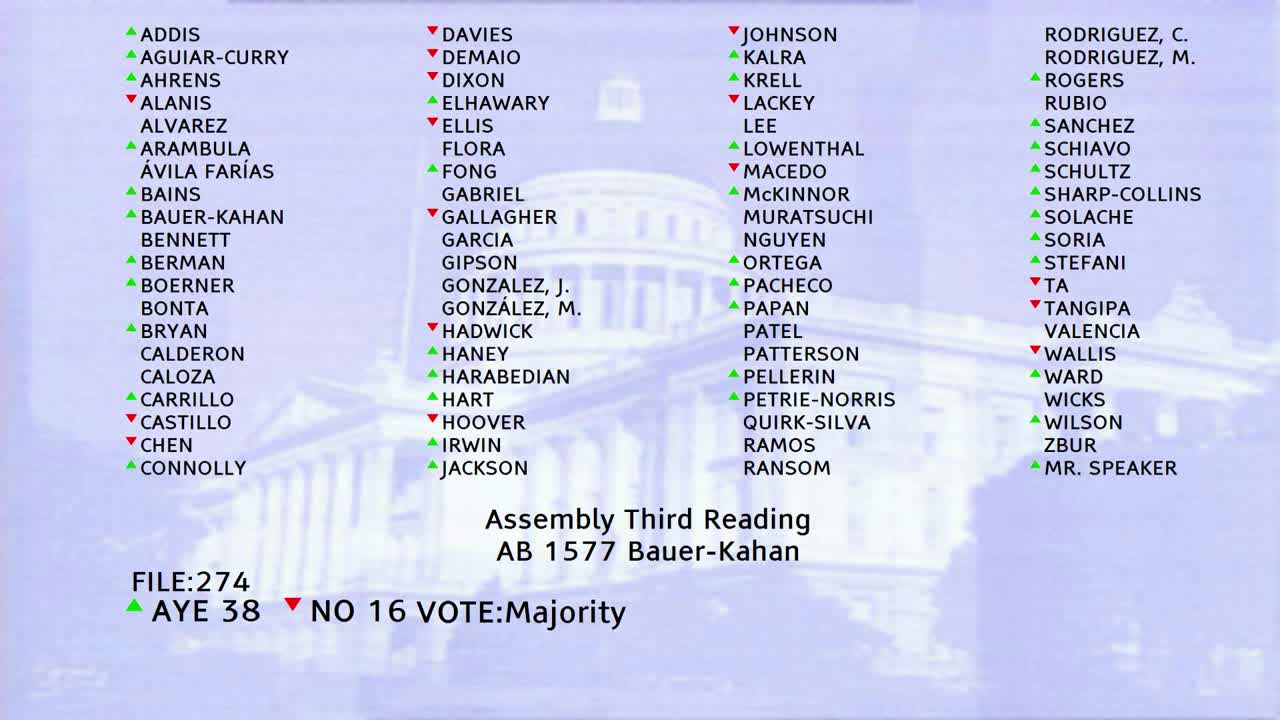 1MIN
Assembly Floor
 10MIN
Assembly Standing Committee on Public Safety
Bill Author

Bill Co-Author(s):