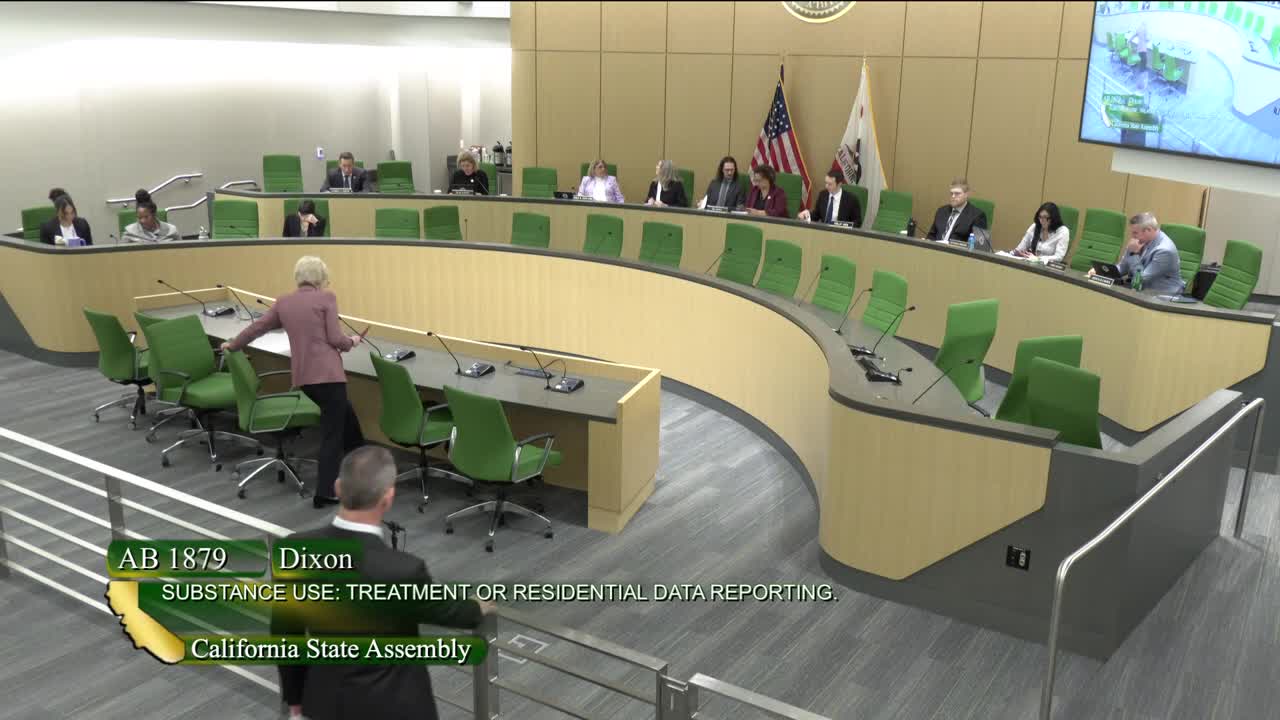
AB 1879: Substance use: treatment or residential data reporting.
- Session Year: 2025-2026
- House: Assembly
- Latest Version Date: 2026-04-23
Current Status:
In Progress
(2026-05-14: In committee: Held under submission.)
Introduced
In Committee
Awaiting First Chamber Vote
Passed First Chamber
In Committee
Awaiting Second Chamber Vote
Passed Second Chamber
Enacted
Existing law provides for the licensure of alcohol or other drug recovery or treatment facilities, and the certification of alcohol or other drug programs, by the State Department of Health Care Services. Existing law requires these treatment providers to maintain records of referrals made to or from recovery residences, which include, but are not limited to, sober living homes. Existing law requires the department to develop and maintain a centralized indicator data collection system that gathers and obtains information on the status of alcohol and other drug problems in the state, and requires the information to include, among other things, the number and characteristics of persons receiving recovery or treatment services from alcohol and other drug programs providing publicly funded services or services licensed by the state. Existing data collection systems developed by the department, known as the California Outcomes Measurement System Treatment and Drug and the Alcohol Treatment Access Report, collect data for substance use disorder (SUD) treatment services and SUD treatment capacity from specified treatment providers.
This bill would require the above-described facilities, programs, and residences, facilities and programs, commencing on January 1, 2028, to annually submit to the department certain data, including, among other information, the number of individuals receiving treatment services from, or residing in, the respective entity, and the duration of the treatment or residential period. treatment and outcome information and treatment availability information consistent with the requirements of the California Outcomes Measurement System Treatment and the Drug and the Alcohol Treatment Access Report. The bill would not apply to an entity that is contracted to provide Medi-Cal treatment services or contracted with the department, among others, and would clarify that these provisions do not impose additional or new reporting requirements on an entity that reports data to the department through the California Outcomes Measurement System Treatment and the Drug and Alcohol Treatment Access Report.
The bill would require the department to collect the data and publish an annual report about the data on its internet website. The bill would require that the data exclude any personally identifiable information about the individuals, as specified.Existing law provides for the licensure of alcohol or other drug recovery or treatment facilities, and the certification of alcohol or other drug programs, by the State Department of Health Care Services. Existing law requires these treatment providers to maintain records of referrals made to or from recovery residences, which include, but are not limited to, sober living homes.
This bill would require the above-described facilities, programs, and residences, commencing on January 1, 2028, to annually submit to the department certain data, including, among other information, the number of individuals receiving treatment services from, or residing in, the respective entity, and the duration of the treatment or residential period.
The bill would require the department to collect the data and publish an annual report about the data on its internet website. The bill would require that the data exclude any personally identifiable information about the individuals, as specified.
(a)This section applies to all both of the following entities:
(1)An alcohol or other drug recovery or treatment facility, licensed by the department pursuant to Chapter 7.5 (commencing with Section 11834.01).
(2)An alcohol or other drug program, certified by the department pursuant to Chapter 7.1 (commencing with Section 11832).
(3)A recovery residence, as defined in Section 11833.05.(b)Commencing on January 1, 2028, an entity listed in subdivision (a) shall annually submit to the department all of the following data for the corresponding year: treatment and outcome information and treatment availability information consistent with the requirements of the California Outcomes Measurement System Treatment system and the Drug and Alcohol Treatment Access Report.
(1)Number of individuals receiving treatment services from, or residing in, the respective entity.(2)Whether an individual had previously received treatment services from, or resided in, an entity of that category.(3)Duration of treatment or residential period for each individual within the respective entity.(c)The department shall collect the data submitted pursuant to subdivision (b) and shall publish an annual report about the data for the corresponding year on the departments internet website.(d)Data submitted pursuant to subdivision (b) shall be in individualized form, whereas data published pursuant to subdivision (c) shall be in aggregated form.(e)(1)Data submitted pursuant to subdivision (b) and data published pursuant to subdivision (c) shall exclude any personally identifiable information about the individuals described in this section.(2)This section shall be implemented in a manner not in conflict with federal or state privacy laws.(c)Data submitted pursuant to subdivision (b) shall be provided in a form and manner and in accordance with timelines prescribed by the department.
(d)(1)This section does not apply to an entity listed in subdivision (a) that is contracted to provide Medi-Cal treatment services or contracted with the department, a county behavioral health department, a county substance use disorder division for the provision of substance use disorder services, or that is otherwise required to submit data to a county through the California Outcome Measurement System Treatment system.
(2)This section does not impose additional or new reporting requirements on an entity listed in subdivision (a) that reports data to the department pursuant to the California Outcomes Measurement System Treatment system and the Drug and Alcohol Treatment Access Report.
(a)This section applies to all of the following entities:
(1)An alcohol or other drug recovery or treatment facility, licensed by the department pursuant to Chapter 7.5 (commencing with Section 11834.01).
(2)An alcohol or other drug program, certified by the department pursuant to Chapter 7.1 (commencing with Section 11832).
(3)A recovery residence, as defined in Section 11833.05.
(b)Commencing on January 1, 2028, an entity listed in subdivision (a) shall annually submit to the department all of the following data for the corresponding year:
(1)Number of individuals receiving treatment services from, or residing in, the respective entity.
(2)Whether an individual had previously received treatment services from, or resided in, an entity of that category.
(3)Duration of treatment or residential period for each individual within the respective entity.
(c)The department shall collect the data submitted pursuant to subdivision (b) and shall publish an annual report about the data for the corresponding year on the departments internet website.
(d)Data submitted pursuant to subdivision (b) shall be in individualized form, whereas data published pursuant to subdivision (c) shall be in aggregated form.
(e)(1)Data submitted pursuant to subdivision (b) and data published pursuant to subdivision (c) shall exclude any personally identifiable information about the individuals described in this section.
(2)This section shall be implemented in a manner not in conflict with federal or state privacy laws.
|
Date
|
Status
|
|---|---|
| May 14, 2026 | In committee: Held under submission. |
| May 6, 2026 | In committee: Set, first hearing. Referred to APPR. suspense file. |
| Apr 27, 2026 | Re-referred to Com. on APPR. |
| Apr 23, 2026 | Read second time and amended. |
| Apr 22, 2026 | From committee: Amend, and do pass as amended and re-refer to Com. on APPR. (Ayes 16. Noes 0.) (April 21). |
| Mar 2, 2026 | Referred to Com. on HEALTH. |
| Feb 13, 2026 | From printer. May be heard in committee March 15. |
| Feb 12, 2026 | Read first time. To print. |
|
Date
|
Description
|
Location
|
Votes
|
|
|---|---|---|---|---|
| Apr 21, 2026 | Do pass as amended and be re-referred to the Committee on [Appropriations] | Assembly Standing Committee on Health |
Passed |
This list shows positions taken on this bill by organizations on the date displayed, which is linked to the original source.
Positions by individuals are not included.
Date of Hearing: May 6, 2026
ASSEMBLY COMMITTEE ON APPROPRIATIONS
Buffy Wicks, Chair
ABPCA Bill Id:AB 1879
Author:(Dixon) – As Amended Ver:April 23, 2026
Policy Committee: | Health | Vote: | 16 - 0 |
|
| ||
|
|
Urgency: No State Mandated Local Program: No Reimbursable: No
SUMMARY:
This bill requires licensed alcohol and other drug (AOD) recovery or treatment facilities (RTFs) and certified AOD programs to report to the Department of Health Care Services (DHCS) data on clients, outcomes, and treatment availability through two existing systems: the California Outcomes Measurement System Treatment (CalOMS Tx) and the Drug and Alcohol Treatment Access Report (DATAR).
Specifically, this bill:
- Requires, beginning January 1, 2028, licensed AOD RTFs and certified AOD programs to submit to DHCS treatment and outcome information and treatment availability information consistent with the requirements of CalOMS TX and DATAR.
- Requires data submitted to be in a form and manner and in accordance with timelines prescribed by DHCS.
- States that this bill does not apply to an AOD RTF or AOD program that is contracted to provide Medi-Cal treatment services or contracted with DHCS, a county behavioral health department, or a county substance use disorder division for the provision of substance use disorder services, or that is otherwise required to submit data to a county through the CalOMS Tx system.
- States that this bill does not impose additional or new reporting requirements on an AOD RTF or AOD program that reports data to DHCS pursuant to the CalOMS TX system and DATAR.
FISCAL EFFECT:
Costs to DHCS of an unknown amount, potentially over $150,000, to provide guidance on the data collection requirements in this bill (Residential and Outpatient Program Licensing Fund).
COMMENTS:
- Purpose. According to the author:
AB 1879 builds upon and codifies existing Department regulations by requiring recovery residences, licensed alcohol or other drug recovery or treatment facilities, and certified alcohol or other drug programs to annually provide data on those receiving services. Currently there is a significant gap within existing law about what data is provided to DHCS, and as such this data gap significantly hinders the ability of the legislature to develop effective policies and ensure patients are receiving the care, support and treatment they need.
- Background. CalOMS Tx is California's data collection and reporting system for substance use disorder (SUD) treatment services. Participating treatment providers that receive SUD treatment funding from DHCS are required to report treatment outcomes data. Counties submit their monthly CalOMS Tx data to DHCS. Counties must collect treatment data for all service recipients, by all providers that receive funding from DHCS, regardless of the source of funds used for the service recipient. For example, if a provider receives any amount of DHCS funding but provides services to a person using only county funds, or provides services to a private-pay client, the provider must still collect and submit CalOMS Tx data for that individual. CalOMS Tx data facilitates improvements in treatment services and is key to ensuring quality improvements that help SUD service recipients, their families, communities, and public health and social systems.
The Drug and Alcohol Treatment Access Report (DATAR) is a DHCS system to collect data on SUD treatment capacity and waiting lists and is considered a supplement to CalOMS Tx. All county contracted SUD treatment providers that receive any SUD treatment funding from DHCS are required to submit the one-page DATAR form to DHCS each month. In addition, certified and county contracted Drug Medi-Cal providers and licensed narcotic treatment programs must report, regardless of whether they receive public funding.
This bill additionally requires providers that do not receive any DHCS funding also report to CalOMS Tx and submit DATAR forms to DHCS.
Analysis Prepared by: Allegra Kim / APPR. / (916) 319-2081
Date of Hearing: April 21, 2026
ASSEMBLY COMMITTEE ON HEALTH
Mia Bonta, Chair
ABPCA Bill Id:AB 1879
Author:(Dixon) – As Introduced Ver:February 12, 2026
SUBJECT: Substance use: treatment or residential data reporting.
SUMMARY: Requires licensed alcohol or other drug (AOD) recovery or treatment facilities (RTF), certified AOD programs, and recovery residences (RR) to annually submit a report to the Department of Health Care Servies (DHCS) with specific data on services provided, beginning January 1, 2028, and would require DHCS to publish the data in an annual report in its website. Specifically, this bill:
- Beginning January 1, 2028, requires licensed AOD RTFs, certified AOD programs, and RRs to annually submit a report to DHCS containing the following information:
- The number of individuals receiving treatment services from, or residing in, the respective entity;
- Whether an individual had previously received treatment services from, or resided in, an entity of that category; and,
- The duration of treatment or residential period for each individual within the respective entity.
- Requires DHCS to collect the data submitted and publish an annual report about the data for the corresponding year on its internet website.
- Requires data submitted to DHCS to be in individualized form and data published in the report by DHCS to be in aggregated form.
- Requires any data submitted or published to exclude any personally identifiable information about the individuals and requires this bill to be implemented in a manner not in conflict with federal or state privacy laws.
EXISTING LAW:
- Grants sole authority in the state to DHCS to certify AOD programs and to license RTFs. [Health and Safety Code (HSC) §§ 11832 and 11834.01]
- Requires a certified AOD program to keep all policies and procedures in an operation manual, and to include, at a minimum: Admission and Discharge, Client Rights, Services, Medications, and Staff and client code of conduct. [HSC § 11832.8]
- Requires DHCS to conduct onsite program compliance visits for AOD programs and RTFs at least once during the certification or licensure period. Permits DHCS to conduct announced or unannounced site visits to review for compliance. [HSC §§ 11832.12 and 11834.01]
- Requires all programs certified or RTFs licensed by DHCS to disclose if any of its agents, partners, directors, officers, or owners, including a sole proprietor and member, has either ownership or control of, or financial interest in, an RR or any contractual relationship with an entity that regularly provides professional services or substance use disorder (SUD) treatment or recovery services to clients of programs certified or facilities licensed by DHCS, if the entity is not part of the program certified or facility licensed. [HSC § 11833.05(a)]
- Requires DHCS to adopt the American Society of Addiction Medicine (ASAM) treatment criteria, or an equivalent evidence-based standard, as the minimum standard of care for licensed RTFs and requires a licensee to maintain those standards with respect to the level of care to be provided by the licensee. [HSC § 11834.015]
- Defines RTF to mean a premises, place, or building that provides residential nonmedical services to adults who are recovering from problems related to alcohol, drug, or alcohol and drug misuse or addiction, and who need alcohol, drug, or alcohol and drug recovery, treatment, or detoxification services. [HSC § 11834.02]
- Requires a licensed RTF to take specified actions, including to develop a plan to address when a resident relapses, maintain naloxone hydrochloride on site, and others. [HSC § 11834.26]
- Requires the operator of a licensed AOD RTF or certified AOD program to include on its website and intake form paperwork a disclosure that an individual may check the website of DHCS to confirm whether the RTF’s license or program’s certification has been placed in probationary status, been subject to a temporary suspension order, been revoked, or the operator has been given a notice of operation in violation of law. Requires the disclosure to include a link to DHCS’s website that contains the Probationary Status, Temporary Suspension Order, Revoked and Notice of Operation in Violation of Law Program List. [HSC § 11831.5]
- Defines RR as a residential dwelling that provides primary housing for individuals who seek a cooperative living arrangement that supports personal recovery from an SUD and that does not require DHCS licensure or does not provide RTF licensable services. Permits an RR to include, but not be limited to, residential dwellings commonly referred to as “sober living homes (SLHs),” “sober living environments,” or “unlicensed alcohol and drug free residences.” [HSC § 11833.05(f)]
- Permits DHCS to establish reasonable criteria to evaluate the performance of programs and services that are described in the county contract for SUD services by doing the following:
- Reviewing and conducting evaluation studies of service delivery to clients in programs receiving state allocated funds;
- Conducting investigative reporting;
- Disseminating evaluation studies, reports, articles, and other reference documents; and,
- Evaluating the administration of county SUD programs to determine whether the county provides for adequate administration of the county SUD program. [HSC § 11825 and § 11826]
- States that the Legislature recognizes local program effectiveness may be evaluated in a variety of ways, but should reflect the needs and priorities of the local community and attempt to measure the achievement of objectives determined through a planning process. States that the Legislature further recognizes the conducting of these evaluations is essential to holding county SUD programs accountable for their use of funds and increasing program effectiveness. States that the Legislature recognizes the beneficial results of the local evaluation process to those participating in this process. States the Legislature’s desire to encourage experimentation and diversity in the methods utilized by counties to evaluate the SUD programs’ achievement of their objectives, including, but not limited to, evaluations of individuals’ progress, changes in utilization rates, changes in community attitudes, and measurement of specific programmatic goals in order to advance knowledge about the effectiveness of programs in alleviating SUD problems. [HSC § 11827]
- Requires each county to ensure the evaluation of all funded programs to determine whether they have achieved their objectives as determined in the planning process. Permits DHCS, recognizing the difficulty and expense of conducting effective county SUD program evaluation, to assist counties in developing evaluation designs to measure progress of those who use substances, changes in community attitudes toward inappropriate alcohol use and other drug problems, changes in the incidence and prevalence of alcohol and other drug problems within the county, or other objectives identified in the planning process. Permits DHCS, in cooperation with counties that choose to participate, to assist and fund counties to implement the evaluation designs developed. Permits counties to contract with public or private agencies and utilize allocated funds for purposes of conducting the evaluations. [HSC § 11828]
FISCAL EFFECT: Unknown. This bill has not been analyzed by a fiscal committee.
COMMENTS:
- PURPOSE OF THIS BILL. According to the author, this bill builds upon and codifies existing DHCS regulations by requiring recovery residences, licensed alcohol or other drug recovery or treatment facilities, and certified alcohol or other drug programs to annually provide data on those receiving services. The author argues that currently there is a significant gap in existing law about what data is provided to DHCS, and as such this data gap significantly hinders the ability of the legislature to develop effective policies and ensure patients are receiving the care, support and treatment they need.
- BACKGROUND.
- Prevalence of SUD in California. A 2024 publication from Health Management Associates and the California Health Care Foundation titled, “Substance Use Disorder in California — a Focused Landscape Analysis” reported that approximately 9% of Californians ages 12 years and older met the criteria for SUD in 2022. According to the report, the prevalence of SUD among individuals 12 years of age and older increased to 8.8% in 2022 from 8.1% in 2015. While the health care system is moving toward acknowledging SUD as a chronic illness, only 6% of Americans and 10% of Californians ages 12 and older with an SUD received treatment for their condition in 2021. More than 19,335 Californians ages 12 years and older died from the effects of alcohol from 2020 to 2021, and the total annual number of alcohol-related deaths increased by approximately 18% in the state from 2020 to 2021. Overdose deaths from both opioids and psychostimulants (such as amphetamines), are soaring. This issue, compounded by the increased availability of fentanyl, has resulted in a 10-fold increase in fentanyl related deaths between 2015 and 2019. According to the Overdose Prevention Initiative, 7,847 opioid-related overdose deaths occurred in California in 2023, and preliminary data shows 5,030 opioid-related overdose deaths in 2025.
- Alcohol and Drug Treatment Facility Licensing. DHCS has sole authority to license RTFs in the state. Licensure is required when at least one of the following services is provided: detoxification; group sessions; individual sessions; educational sessions; or, alcoholism or other drug abuse recovery or treatment planning. Additionally, facilities may be subject to other types of permits, clearances, business taxes, or local fees that may be required by the cities or counties in which the facilities are located.
As part of their licensing function, DHCS conducts reviews of RTF operations every two years, or as necessary. DHCS's Substance Use Disorder Compliance Division checks for compliance with statute and regulations (Title 9, Chapter 5, California Code of Regulations) to ensure the health and safety of RTF residents and investigates all complaints related to RTFs, including deaths, complaints against staff, and allegations of operating without a license. DHCS has the authority to suspend or revoke a license for conduct in the operation of an RTF that is contrary to the health, morals, welfare, or safety of either an individual in, or receiving services from, the facility or to the people of the State of California.
- AOD Program Certification. Prior to January 1, 2025, programs were permitted to seek certification from DHCS. Under AB 118 (Committee on Budget), Chapter 42, Statutes of 2023, certification is now a requirement for many AOD programs, with exceptions for various licensed facility types, schools, jails, and prisons. Programs were required to apply for certification no later than January 1, 2024. If DHCS finds evidence that a program is providing treatment, recovery, detoxification, or medication-assisted treatment services without a certification, DHCS must issue a written notice to the program stating that it is operating in violation of the law, and any person or entity found to be operating without certification may be subject to an assessment of civil penalties of two thousand ($2,000) dollars per day and will be barred from applying for initial certification for a period of five years from the date of the violation notice.
- Recovery housing. An RR is a residence for people in recovery from SUDs. It may serve as support for individuals undergoing treatment but it does not provide treatment or care, whether medical or non-medical. The state licensing requirements that govern treatment and care facilities do not currently include RRs. An RR may be completely self-governed or have formal onsite management. When there is onsite management, the manager’s duties relate to the administration of the house rather than the tenants or their recovery. The tenants of an RR pay rent and abide by house rules, which include maintenance of sobriety and participation in a self-help program. In 2016 the California Research Bureau estimated that there were at least 12,000 sober living beds, like those offered in RRs, in the state to serve an eligible population of between 25,000 and 35,000 individuals. A 2021 article “Estimating the Number of Substance Use Disorder Recovery Homes in the United States” estimates 2,432 recovery homes in California. If an RR is providing any licensable services then it must obtain a valid RTF license from DHCS, and DHCS can investigate RRs alleged to be providing services without a license. This is the only investigative authority DHCS has over RRs.
- Current data reporting. There are currently several reporting mechanisms related to the provisions of SUD services. The California Outcomes Measurement System Treatment (CalOMS Tx) is California's data collection and reporting system for SUD treatment services. Data collected facilitates improvements in treatment services delivered to those in need. This data collection is key to ensuring quality improvements that positively affect the lives of SUD service recipients, their families, communities, and public health and social systems. Participating treatment providers that receive SUD treatment funding from DHCS are required to report treatment outcomes data. Counties submit their monthly CalOMS Tx data to DHCS. Counties must collect treatment data for all service recipients, by all providers that receive funding from DHCS, regardless of the source of funds used for the service recipient. For example, if a provider receives any amount of DHCS funding but provides services to a person using only county funds, or provides services to a private-pay client, the provider must still collect and submit CalOMS Tx data for that individual.
The Drug and Alcohol Treatment Access Report (DATAR) is a DHCS system to collect data on SUD treatment capacity and waiting lists and is considered a supplement to CalOMS Tx. All county contracted SUD treatment providers that receive any SUD treatment funding from DHCS are required to submit the one-page DATAR form to DHCS each month. In addition, certified and county contracted Drug Medi-Cal providers and Licensed Narcotic Treatment Programs must report whether or not they receive public funding.
DHCS publishes public facing reports and dashboards related to SUD treatment and services. Key public resources include the SUD Drug Medi Cal and Drug Medi Cal Organized Delivery System Penetration Rate Dashboard, which provides county and statewide penetration rate metrics for SUD services and Behavioral Health | Medi Cal Transformation materials, which include publicly available dashboards, data summaries, and reports that highlight behavioral health reforms and program performance under Medi Cal. These resources offer the public aggregated, transparent data about access to and utilization of SUD services in California.
DHCS also publishes the Statewide Needs Assessment and Planning Report biennially as required by the Code of Federal Regulations, Title 45 § 96.133 governing recipients of the federal Substance Use Prevention, Treatment, and Recovery Services Block Grant. Under SB 326 (Eggman), Chapter 790, Statutes of 2023, known as the Behavioral Health Services Act (BHSA), counties will be required beginning in 2028, to annually prepare and submit to DHCS a Behavioral Health Outcomes, Accountability, and Transparency Report (BHOATR). The BHOATR will provide greater transparency about county behavioral health (including SUD) spending and administration of behavioral health care, and will include funds received and spent on behavioral health, administrative and planning costs, service utilization, and data related to statewide goals.
- RELATED LEGISLATION. AB 2343 (Patel) would require licensed AOD RTFs and certified AOD programs to participate in a public consumer protection platform designated or designed by DHCS in order to be licensed or certified. Would authorize DHCS to charge a reasonable fee to AOD RTFs and programs required to enroll in the platform, as specified, and would prohibit the administrator of the public quality rating system from accepting payment from the entities participating under AB 2343. AB 2343 is pending in the Assembly Appropriations Committee.
- PREVIOUS LEGISLATION.
- SB 326 (Eggman) enacts the BHSA to, among other things, require counties and Medi-Cal behavioral health delivery systems to annually submit a BHOATR to DHCS, containing information about county expenditure of behavioral health funds and services provided.
- SB 929 (Eggman), Chapter 539, Statutes of 2022, expands DHCS’ responsibility to collect and publish information about involuntary detentions to include additional information, as specified.
- POLICY COMMENT. Current CalOMS Tx and DATAR reporting requirements are largely built around compliance with federal funding requirements. Moving forward the author may wish to consider which specific data elements are relevant to all facilities, and how data reported to DHCS can be incorporated into current statewide reports.
- COMMITTEE AMENDMENTS. As currently drafted, this bill requires data elements that may not provide the state or public with much insight into how services are being provided. Additionally, the bill requires DHCS to collect data on participants in RRs, which are not currently licensed or certified by DHCS. To address these issues, the committee may wish to amend the bill as follows:
- Strike the requirement for DHCS to collect information from RRs.
- Strike the current data collection requirements and recast the bill to require certified AOD programs and licensed AOD RTFs that currently are not reporting through the CalOMS Tx or DATAR systems to begin reporting, in a manner prescribed by DHCS, beginning January 1, 2028.
REGISTERED SUPPORT / OPPOSITION:
Support
None on file
Opposition
None on file
Analysis Prepared by: Logan Hess / HEALTH / (916) 319-2097
Bill Author

Bill Co-Author(s):
