AB 1885: Public contracts: retention proceeds.
- Session Year: 2025-2026
- House: Assembly
- Latest Version Date: 2026-04-28
Current Status:
In Progress
(2026-05-14: In committee: Held under submission.)
Introduced
In Committee
Awaiting First Chamber Vote
Passed First Chamber
In Committee
Awaiting Second Chamber Vote
Passed Second Chamber
Enacted
Existing law, with respect to a contract relating to the construction of any public work of improvement, prohibits the retention proceeds withheld from any payment by a public entity from the original contractor, by the original contractor from any subcontractor, and by a subcontractor from any subcontractor from exceeding 5% of the payment, except as specified.
This bill, with respect to those contracts, would further limit specified state agencies, including the Department of Water Resources, the Department of Parks and Recreation, and the Department of Corrections and Rehabilitation, from withholding retention proceeds from a progress payment to a contractor in excess of 3.5% of the payment. The bill would require a state agency those state agencies to promptly notify the appropriate policy committees of the Legislature if the state agencys best interests are compromised because retention was not withheld on a state agency public works contract. of the 3.5% retention limitation imposed by the bill.
Existing law, except as specified, prohibits the percentage of the retention proceeds withheld in a contract between the original contractor and a subcontractor, and in a contract between a subcontractor and any subcontractor thereunder, from exceeding the percentage specified in the contract between the public entity and the original contractor.
This bill would provide that nothing in the bill alters, amends, or impairs the rights, duties, and obligations of an original contractor, its subcontractors, and all subcontractors thereunder relating to the construction of any public work of improvement pursuant to the above-described provision.
This bill would repeal its provisions on January 1, 2032.
Existing law requires state agencies to include a provision in solicitations and contracts, if the estimated amount to be retained exceeds $10,000 and the retention continues for a period of 60 days beyond the completion of phased services, to permit, upon written request and the expense of the contractor, the payment of retentions earned directly to a state- or federally chartered bank in this state, as the escrow agent. Existing law also provides an escrow agreement form that for a contractor and state agency shall to use for security deposits, and defines a state agency for purposes of these provisions.
This bill would make a nonsubstantive change to that definition. repeal those provisions, including the escrow agreement form, and instead prohibit a state agency, as defined, from withholding retention proceeds when making progress payments to a contractor, as defined, for work performed on a public works contract. The bill would require a state agency to promptly notify the appropriate policy committees of the Legislature if the state agencys best interests are compromised because retention was not withheld on a state agency public works contract.
Existing law, except as specified, prohibits the percentage of the retention proceeds withheld in a contract between the original contractor and a subcontractor, and in a contract between a subcontractor and any subcontractor thereunder, from exceeding the percentage specified in the contract between the public entity and the original contractor.
This bill would provide that nothing in the bill alters, amends, or impairs the rights, duties, and obligations of an original contractor, its subcontractors, and all subcontractors thereunder relating to the construction of any public work of improvement pursuant to the above-described provision.
Existing law requires state agencies to include a provision in solicitations and contracts, if the estimated amount to be retained exceeds $10,000 and the retention continues for a period of 60 days beyond the completion of phased services, to permit, upon written request and the expense of the contractor, the payment of retentions earned directly to a state- or federally chartered bank in this state, as the escrow agent. Existing law also provides an escrow agreement form that a contractor and state agency shall use for security deposits, and defines a state agency for purposes of these provisions.
This bill would make a nonsubstantive change to that definition.
(a)State agency, as used in this section, means those departments defined in Section 10106, except for the Department of Transportation, which is governed by Section 7202.
(b)Contractor, as used in this section, means firm, architectural, landscape architectural, engineering, environmental, and land surveying services, construction project management, and environmental services as defined in Section 4525 of the Government Code.
(c)A state agency shall not withhold retention proceeds Notwithstanding Section 7201, retention proceeds withheld from a payment by a state agency when making progress payments to a contractor for work performed on a public works contract. contract shall not exceed 3.5 percent of the payment.
(d)Nothing in this section shall alter, amend, or impair the rights, duties, and obligations of an original contractor, its subcontractors, and all subcontractors thereunder relating to the construction of any public work of improvement as set forth in Section 7200.
(e)A state agency shall promptly notify the appropriate policy committees of the Legislature if the state agencys best interests are compromised because retention was not withheld on a state agency public works contract. of the 3.5-percent limitation on retention proceeds imposed by subdivision (c).
(f)This section applies to all public works contracts awarded by a state agency after January 1, 2027.
(g)This section shall remain in effect only until January 1, 2032, and as of that date is repealed.
(a)State agency, as used in this section, means those departments defined in Section 10106, except for the Department of Transportation, which is governed by Section 7202.
(b)Contractor, as used in this section, means firm, architectural, landscape architectural, engineering, environmental, and land surveying services, construction project management, and environmental services as defined in Section 4525 of the Government Code.
(c)A state agency shall not withhold retention proceeds when making progress payments to a contractor for work performed on a public works contract.
(d)Nothing in this section shall alter, amend, or impair the rights, duties, and obligations of an original contractor, its subcontractors, and all subcontractors thereunder relating to the construction of any public work of improvement as set forth in Section 7200.
(e)A state agency shall promptly notify the appropriate policy committees of the Legislature if the state agencys best interests are compromised because retention was not withheld on a state agency public works contract.
(f)This section applies to all public works contracts awarded by a state agency after January 1, 2027.
SECTION 1.Section 6106.5 of the Public Contract Code is amended to read:6106.5.(a)State agency, as used in this section, means those departments defined in Section 10106.(b)Contractor, as used in this section, means firm, architectural, landscape architectural, engineering, environmental, and land surveying services, construction project management, and environmental services as defined in Section 4525 of the Government Code.(c)State agencies shall include a provision in solicitations and in contracts, if the estimated amount to be retained exceeds ten thousand dollars ($10,000), and the retention continues for a period of 60 days beyond the completion of phased services, to permit, upon written request and the expense of the contractor, the payment of retentions earned directly to a state- or federally chartered bank in this state, as the escrow agent. The contractor may direct the investment of the payments into securities, pursuant to subdivision (d), and the contractor shall receive the interest earned on the investments. Upon satisfactory completion of the contract, the contractor shall receive from the escrow agent all securities, interest, and payments received by the escrow agent from the owner, pursuant to the terms of this section. State agencies, relative to contracts entered into prior to the enactment of this section, upon written request of the contractor, and subject to the approval of the state agency, may utilize the provisions of this section.(d)Securities eligible for investment under this section shall include those listed in Section 16430 of the Government Code, interest-bearing demand deposit accounts, or any other investment mutually agreed to by the contractor and the state agency.(e)(1)Any contractor who elects to receive interest on moneys withheld in retention by a state agency shall, at the request of any subcontractor, make that option available to the subcontractor regarding any moneys withheld in retention by the contractor from the subcontractor. If the contractor elects to receive interest on any moneys withheld in retention by a state agency, then the subcontractor shall receive the identical rate of interest received by the contractor on any retention moneys withheld from the subcontractor by the contractor, less any actual pro rata costs associated with administering and calculating that interest. In the event that the interest rate is a fluctuating rate, the rate for the subcontractor shall be determined by calculating the interest rate paid during the time that retentions were withheld from the subcontractor. If the contractor elects to substitute securities in lieu of retention, then, by mutual consent of the contractor and subcontractor, the subcontractor may substitute securities in exchange for the release of moneys held in retention by the contractor.(2)This subdivision shall apply only to those subcontractors performing more than 5 percent of the contractors total fee.(3)No contractor shall require any subcontractor to waive any provision of this section.(f)An escrow agreement used pursuant to this section shall be null, void, and unenforceable unless it is substantially similar to the following form:ESCROW AGREEMENT FOR SECURITY DEPOSITSThis Escrow Agreement is made and entered into by and betweenwhose address ishereinafter called owner,whose address ishereinafter called contractor, andwhose address ishereinafter called escrow agent.(1)Pursuant to Section 6106.5 of the Public Contract Code of the State of California, upon written request of the contractor, the owner shall make payments of retention earnings required to be withheld by the owner pursuant to the professional consulting services agreement entered into between the owner and contractor for ____ in the amount of ____ dated ____ hereafter referred to as the contract.(2)When the owner makes payment of retentions earned directly to the escrow agent, the escrow agent shall hold them for the benefit of the contractor until such time as the escrow created under this contract is terminated. The contractor may direct the investment of the payments into securities pursuant to Section 6106.5(d) of the Public Contract Code. All terms and conditions of this agreement and the rights and responsibilities of the parties shall be equally applicable and binding when the owner pays the escrow agent directly.(3)The contractor shall be responsible for paying all fees for the expenses incurred by the escrow agent in administering the escrow account. These expenses and payment terms shall be determined by the contractor and escrow agent.(4)The contractor shall have the right to withdraw all or any part of the principal or interest in the escrow account only by written notice to the escrow agent accompanied by written authorization from the owner to the escrow agent that the owner consents to the withdrawal of the amount sought to be withdrawn by contractor.(5)The owner shall have a right to draw upon the escrow account in the event of default by the contractor. Upon seven days written notice to the escrow agent from the owner of the default, the escrow agent shall immediately distribute the cash as instructed by the owner.(6)Upon receipt of written notification from the owner certifying that the contract is final and complete, and that the contractor has complied with all requirements and procedures applicable to the contract, the escrow agent shall release to the contractor all deposits and interest on deposits less escrow fees and charges of the escrow account. The escrow shall be closed immediately upon disbursement of all moneys on deposit and payments of fees and charges.(7)The escrow agent shall rely on the written notifications from the owner and the contractor pursuant to Sections (1) to (6), inclusive, of this agreement and the owner and contractor shall hold the escrow agent harmless from the escrow agents release, conversion, and disbursement of the securities and interest as set forth above.(8)The names of the persons who are authorized to give written notice or to receive written notice on behalf of the owner and on behalf of the contractor in connection with the foregoing, and exemplars of their respective signatures are as follows:On behalf of the owner:On behalf of the contractor:TitleTitleNameNameAddressAddressOn behalf of the escrow agent:TitleNameSignatureAddressAt the time the escrow account is opened, the owner and contractor shall deliver to the escrow agent a fully executed counterpart of this Agreement.IN WITNESS WHEREOF, the parties have executed this Agreement by their proper officers on the date first set forth above.OwnerContractorTitleTitleNameNameSignatureSignature(a)State agency, as used in this section, means those departments defined in Section 10106 of the Public Contract Code. 10106.
(b)Contractor, as used in this section, means firm, architectural, landscape architectural, engineering, environmental, and land surveying services, construction project management, and environmental services as defined in Section 4525 of the Government Code.
(c)State agencies shall include a provision in solicitations and in contracts, if the estimated amount to be retained exceeds ten thousand dollars ($10,000), and the retention continues for a period of 60 days beyond the completion of phased services, to permit, upon written request and the expense of the contractor, the payment of retentions earned directly to a state- or federally chartered bank in this state, as the escrow agent. The contractor may direct the investment of the payments into securities, pursuant to subdivision (d), and the contractor shall receive the interest earned on the investments. Upon satisfactory completion of the contract, the contractor shall receive from the escrow agent all securities, interest, and payments received by the escrow agent from the owner, pursuant to the terms of this section. State agencies, relative to contracts entered into prior to the enactment of this section, upon written request of the contractor, and subject to the approval of the state agency, may utilize the provisions of this section.
(d)Securities eligible for investment under this section shall include those listed in Section 16430 of the Government Code, interest-bearing demand deposit accounts, or any other investment mutually agreed to by the contractor and the state agency.
(e)(1)Any contractor who elects to receive interest on moneys withheld in retention by a state agency shall, at the request of any subcontractor, make that option available to the subcontractor regarding any moneys withheld in retention by the contractor from the subcontractor. If the contractor elects to receive interest on any moneys withheld in retention by a state agency, then the subcontractor shall receive the identical rate of interest received by the contractor on any retention moneys withheld from the subcontractor by the contractor, less any actual pro rata costs associated with administering and calculating that interest. In the event that the interest rate is a fluctuating rate, the rate for the subcontractor shall be determined by calculating the interest rate paid during the time that retentions were withheld from the subcontractor. If the contractor elects to substitute securities in lieu of retention, then, by mutual consent of the contractor and subcontractor, the subcontractor may substitute securities in exchange for the release of moneys held in retention by the contractor.
(2)This subdivision shall apply only to those subcontractors performing more than 5 percent of the contractors total fee.
(3)No contractor shall require any subcontractor to waive any provision of this section.
(f)An escrow agreement used pursuant to this section shall be null, void, and unenforceable unless it is substantially similar to the following form:
ESCROW AGREEMENT FOR SECURITY DEPOSITS | |
This Escrow Agreement is made and entered into by and between | |
whose address is | |
hereinafter called owner, | |
whose address is | |
hereinafter called contractor, and | |
whose address is | |
hereinafter called escrow agent. |
(1)Pursuant to Section 6106.5 of the Public Contract Code of the State of California, upon written request of the contractor, the owner shall make payments of retention earnings required to be withheld by the owner pursuant to the professional consulting services agreement entered into between the owner and contractor for ____ in the amount of ____ dated ____ hereafter referred to as the contract.
(2)When the owner makes payment of retentions earned directly to the escrow agent, the escrow agent shall hold them for the benefit of the contractor until such time as the escrow created under this contract is terminated. The contractor may direct the investment of the payments into securities pursuant to Section 6106.5(d) of the Public Contract Code. All terms and conditions of this agreement and the rights and responsibilities of the parties shall be equally applicable and binding when the owner pays the escrow agent directly.
(3)The contractor shall be responsible for paying all fees for the expenses incurred by the escrow agent in administering the escrow account. These expenses and payment terms shall be determined by the contractor and escrow agent.
(4)The contractor shall have the right to withdraw all or any part of the principal or interest in the escrow account only by written notice to the escrow agent accompanied by written authorization from the owner to the escrow agent that the owner consents to the withdrawal of the amount sought to be withdrawn by contractor.
(5)The owner shall have a right to draw upon the escrow account in the event of default by the contractor. Upon seven days written notice to the escrow agent from the owner of the default, the escrow agent shall immediately distribute the cash as instructed by the owner.
(6)Upon receipt of written notification from the owner certifying that the contract is final and complete, and that the contractor has complied with all requirements and procedures applicable to the contract, the escrow agent shall release to the contractor all deposits and interest on deposits less escrow fees and charges of the escrow account. The escrow shall be closed immediately upon disbursement of all moneys on deposit and payments of fees and charges.
(7)The escrow agent shall rely on the written notifications from the owner and the contractor pursuant to Sections (1) to (6), inclusive, of this agreement and the owner and contractor shall hold the escrow agent harmless from the escrow agents release, conversion, and disbursement of the securities and interest as set forth above.
(8)The names of the persons who are authorized to give written notice or to receive written notice on behalf of the owner and on behalf of the contractor in connection with the foregoing, and exemplars of their respective signatures are as follows:
On behalf of the owner: | On behalf of the contractor: |
Title | Title |
Name | Name |
Address | Address |
On behalf of the escrow agent: | |
Title | |
Name | |
Signature | |
Address | |
At the time the escrow account is opened, the owner and contractor shall deliver to the escrow agent a fully executed counterpart of this Agreement.
IN WITNESS WHEREOF, the parties have executed this Agreement by their proper officers on the date first set forth above.
Owner | Contractor |
Title | Title |
Name | Name |
Signature | Signature |
|
Date
|
Status
|
|---|---|
| May 14, 2026 | In committee: Held under submission. |
| May 6, 2026 | In committee: Set, first hearing. Referred to APPR. suspense file. |
| Apr 29, 2026 | Re-referred to Com. on APPR. |
| Apr 28, 2026 | Read second time and amended. |
| Apr 27, 2026 | From committee: Amend, and do pass as amended and re-refer to Com. on APPR. (Ayes 16. Noes 0.) (April 22). |
| Apr 8, 2026 | In committee: Set, first hearing. Hearing canceled at the request of author. |
| Mar 17, 2026 | Re-referred to Com. on G.O. |
| Mar 16, 2026 | From committee chair, with author's amendments: Amend, and re-refer to Com. on G.O. Read second time and amended. |
| Mar 16, 2026 | Referred to Com. on G.O. |
| Feb 13, 2026 | From printer. May be heard in committee March 15. |
| Feb 12, 2026 | Read first time. To print. |
|
Date
|
Description
|
Location
|
Votes
|
|
|---|---|---|---|---|
| Apr 22, 2026 | Do pass as amended and be re-referred to the Committee on [Appropriations] | Assembly Standing Committee on Governmental Organization |
Passed |
This list shows positions taken on this bill by organizations on the date displayed, which is linked to the original source.
Positions by individuals are not included.
|
Organization
|
Position
|
Date
|
|---|---|---|
| American Subcontractors Association-California | ** Support | |
| Associated General Contractors, California Chapters | ** Support | |
| California Legislative Conference Of Plumbing, Heating & Piping Industry | ** Support | |
| California State Association Of Electrical Workers | ** Support | |
| California State Pipe Trades Council | ** Support | |
| Finishing Contractors Association Of Southern California | ** Support | |
| National Electrical Contractors Association (NECA) | ** Support | |
| Northern California Allied Trades | ** Support | |
| Northern California Floor Covering Association | ** Support | |
| Southern California Association of Scaffold Contractors | ** Support | |
| Southern California Contractors Association | ** Support | |
| SOUTHERN CALIFORNIA GLASS MANAGEMENT ASSOCIATION (SCGMA) | ** Support | |
| United Contractors (UCON) | ** Support | |
| Wall and Ceiling Alliance | ** Support | |
| Western Electrical Contractors Association | ** Support | |
| Western Painting and Coating Contractors Association | ** Support | |
| Western States Council Sheet Metal, Air, Rail And Transportation | ** Support | |
| WESTERN WALL AND CEILING CONTRACTORS ASSOCIATION (WWCCA) | ** Support |
Date of Hearing: May 6, 2026
ASSEMBLY COMMITTEE ON APPROPRIATIONS
Buffy Wicks, Chair
ABPCA Bill Id:AB 1885
Author:(Carrillo) – As Amended Ver:April 28, 2026
Policy Committee: | Governmental Organization | Vote: | 16 - 0 |
|
| ||
|
|
Urgency: No State Mandated Local Program: No Reimbursable: No
SUMMARY:
This bill reduces the amount of retention proceeds certain state agencies may withhold, from 5% to 3.5%, from a progress payment to certain contractors on a public works project.
Specifically, this bill:
- Provides, for certain public works contracts awarded by certain state agencies after January 1, 2027, that retention proceeds withheld from a progress payment must not exceed 3.5% of the payment made by the Department of Water Resources, Department of Parks and Recreation, Department of Corrections and Rehabilitation (CDCR), Military Department, High-Speed Rail Authority, and Department of General Services (DGS) to a contractor that is an architectural, engineering, environmental, land surveying, or construction project management firm.
- Requires the state agency to promptly notify the Legislature if the state agency’s best interests are compromised because of the 3.5% retention proceeds limitation.
- Repeals these provisions on January 1, 2032.
FISCAL EFFECT:
- Likely absorbable costs to impacted state agencies to adjust payment practices.
- Costs of an unknown, but potentially significant amount, in excess of $150,000, across impacted state agencies to the extent limiting retention proceeds increases the risk of construction delays, disputes, litigation, or the need for additional administrative oversight over public works projects (General Fund (GF) or special fund). Contracting agencies may need updated guidance from DGS and additional staffing resources for contract monitoring, documentation, and compliance. For example, CDCR has hundreds of millions of dollars in active capital outlay projects that rely on retention practices to ensure timely and satisfactory completion of work, and estimates additional staffing needs could reach the high hundreds of thousands to millions of dollars annually to effectively oversee project requirements and contracts.
The Legislative Analyst’s Office recently warned of GF structural deficits of around $35 billion per year in the 2027-28 fiscal year and ongoing.
COMMENTS:
- Purpose. According to the author:
AB 1885 modernizes California’s public contracting laws by eliminating an outdated retention escrow system to ensure that state agencies pay contractors timely for the work already completed. Retention was created decades ago as a performance safeguard, but today it functions primarily as an unnecessary cash flow burden while offering little real protection to the state. Performance and payment bonds requirements on every public work project fully protect taxpayers if a contractor fails to perform or pay subcontractors. This bill reflects a practical, commonsense update to state contracting practices and supports a healthier, more competitive construction industry while maintaining full protections for the state.
This bill is supported by a large coalition of union-signatory contractors.
- Retention Proceeds. Retention proceeds are monies a contractor has already earned, but does not receive, until final completion of a project after all work is accepted. Existing law limits the allowable retention proceeds that certain state agencies may withhold on a public works project to 5% of a progress payment, with the exception of the Department of Transportation, which is prohibited from withholding retention proceeds when making progress payments to a contractor for work performed on a transportation project. Lower or no retention rates benefit contractors, as increased payments improve cash flow and financial flexibility, but diminish the ability of the contracting agency to use retention as leverage to incentivize completion of difficult projects or remedy defective or non-conforming work, potentially affecting the agency’s ability to complete the project in a timely manner. This bill reduces the amount of retention proceeds certain state agencies may withhold to 3.5%.
Analysis Prepared by: Irene Ho / APPR. / (916) 319-2081
Date of Hearing: April 22, 2026
ASSEMBLY COMMITTEE ON GOVERNMENTAL ORGANIZATION
Blanca Rubio, Chair
ABPCA Bill Id:AB 1885 (
Author:Carrillo) – As Amended Ver:March 16, 2026
SUBJECT: Public contracts: retention proceeds
SUMMARY: This bill would prohibit a state agency, as defined, from withholding retention proceeds when making progress payments to a contractor, as defined, for work performed on a public works contract. Specifically, this bill:
1) Provides a state agency, as defined, shall not withhold retention proceeds when making progress payments to a contractor for work performed on a public works contract.
2) Provides that nothing in this measure shall alter, amend, or impair the rights, duties, and obligations of an original contractor, its subcontractors, and all subcontractors thereunder relating to the construction of any public work of improvement as set forth in Public Contract Code § 7200.
3) Provides a state agency shall promptly notify the appropriate policy committees of the Legislature if the state agency’s best interests are compromised because retention was not withheld on a state agency public works contract.
4) Provides this measure applies to all public works contracts awarded by a state agency after January 1, 2027.
5) Defines “State agency,” as used in this measure, to mean those departments defined in Section 10106, except for the Department of Transportation, which is governed by current law that prohibits retention. For purposes of this bill, department” means any of the following:
- The Department of Water Resources as to any project under the jurisdiction of that department.
- The Department of Transportation as to any project under the jurisdiction of that department.
- The Department of Parks and Recreation as to any project under the jurisdiction of that department.
- The Department of Corrections and Rehabilitation with respect to any project under its jurisdiction pursuant to Chapter 11 (commencing with Section 7000) of Title 7 of Part 3 of the Penal Code.
- The Military Department as to any project under the jurisdiction of that department.
- The High-Speed Rail Authority as to any project under the jurisdiction of that authority.
- The Department of General Services as to all other projects.
6) Defines “Contractor,” as used in this measure, to mean “firm,” “architectural, landscape architectural, engineering, environmental, and land surveying services,” “construction project management,” and “environmental services” as defined in the Government Code.
7) Repeals Section 6106.5 of the Public Contract Code.
EXISTING LAW:
1) Provides under the State Contract Act a contracting process by state agencies for public improvement works pursuant to a competitive bidding process, under which bids are awarded to the lowest responsible bidder, with specified alternative procurement procedures authorized in certain cases.
2) Prohibits the retention proceeds withheld from any payment by a public entity from the original contractor, by the original contractor from any subcontractor, and by a subcontractor from any subcontractor, from exceeding 5% of the payment for all contracts between a public agency and a contractor relating to the construction of any public works project. (Public Contract Code § 7201)
3) Defines “Public works contract” to mean a contract awarded through competitive bids by the state or any of its political subdivisions or public agencies for the erection, construction, alteration, repair, or improvement of any structure, building, road, or other improvement of any kind. (Public Contract Code § 1101)
4) Requires state agencies to include a provision in solicitations and contracts, if the estimated amount to be retained exceeds $10,000 and the retention continues for a period of 60 days beyond the completion of phased services, to permit, upon written request and the expense of the contractor, the payment of retentions earned directly to a state- or federally chartered bank in this state, as the escrow agent. In essence, it allows contractors to substitute securities for retention money held by state agencies on projects where retention exceeds $10,000 and lasts over 60 days. It ensures contractors receive interest on withheld funds, with equivalent terms for subcontractors. (Public Contract Code § 6106.5)
5) Provides an escrow agreement form for a contractor and state agency to use for security deposits, and defines a “state agency” for purposes of these provisions.
FISCAL EFFECT: This bill is keyed fiscal by Legislative Counsel.
COMMENTS:
Purpose of the bill. According to the author, this bill “AB 1885 modernizes California’s public contracting laws by eliminating an outdated retention escrow system to ensure that state agencies pay contractors timely for the work already completed. Retention was created decades ago as a performance safeguard, but today it functions primarily as an unnecessary cash flow burden while offering little real protection to the state. Performance and payment bonds requirements on every public work project fully protect taxpayers if a contractor fails to perform or pay subcontractors. This bill reflects a practical, commonsense update to state contracting practices and supports a healthier, more competitive construction industry while maintaining full protections for the state.”
What problem does this bill solve? According to information provided by the author’s office, this bill would eliminate outdated provisions in public works contracting that require state agencies to withhold retention on state-awarded public works projects. Under current law, the California Public Contract Code establishes several mechanisms intended to protect a public agency or owner and ensure that a contractor completes the project. These mechanisms include:
- Retention (PCC § 6106.5) is a portion of a construction payment, typically 5%, that a public agency withholds from a contractor until the very end of a project. Retained funds must be released within 60 days of project completion, and subcontractors must receive their share within 7 days of the prime contractor receiving payment.
- Performance Bonds (Public Contract Code § 10221): Requires contractors to have a performance bond on state agency projects. The bond must be in a form and amount satisfactory to the awarding authority, which generally means 100 percent of the contract value.
- Payment Bonds (Public Contract Code § 7103): Requires every original contractor that is awarded a contract by a state entity, as defined, in excess of $25,000 for any public work shall, before entering upon the performance of the work, file a payment bond, as specified. The bond shall be in a sum not less than 100 percent of the total amount payable by the terms of the contract.
California’s Public Contract Code provides multiple layers of protection to ensure that contractors on public works projects are qualified, financially capable, and contractually obligated to complete the work. These protections begin before bidding, continue through contract award, and extend through project completion. Competitive bidding ensures that only legitimate, qualified contractors can win public contracts (PCC §10100 and related sections). This process filters out unqualified or unreliable contractors before work even begins. A contractor must hold the proper and active California license classification to submit a valid bid. This ensures the contractor has the minimum competency required for the work.
California PCC and standard public works practice require: 1) Performance bonds to guarantee completion of the project; and 2) Payment bonds to ensure subcontractors and suppliers are paid. These are among the strongest protections for public agencies, ensuring the project is completed even if the contractor defaults. Bonding is a statutory requirement under PCC §10220 et seq.
The author’s office further states that “as performance and payment bonds requirements have come in effect on public works projects, retention is not a needed tool anymore for public agencies. A performance bond is a guarantee issued by a surety company that the contractor will complete a public works project according to the contract’s terms, plans, and specifications. If the contractor defaults, the surety must step in and either finish the work or pay the state to do so. Performance bonds already provide full financial protection for the state, making retention unnecessary and redundant. Retention withholds a small percentage of payment; a performance bond guarantees the entire project.
A payment bond is a guarantee issued by a surety company that ensures all subcontractors, workers, and suppliers on a public works project get paid, even if the prime contractor fails to pay them. It protects the people who provide labor and materials, not the state.
Retention is money the contractor has already earned but does not receive until final completion, after all work is accepted. Depending on the size of the project (some state contracts are valued in hundreds of millions or even over one billion dollars), contractors do not have access to that portion that is retained. Further, that is money that is being held in escrow by the state agency owner requiring administrative oversight and time to manage the escrow account and the release of funds. For the larger projects, it could take years for a construction project to be completed, thereby causing a contractor to lose access to its capital funds to further invest and build projects in California. For example, a large general contractor in California has over $60 million in retention withhold, which restricts the company’s ability to invest more in its workforce and in California’s economy. Smaller contractors will not be able to cover some of the cash flow issues and would have to borrow money to cover the gap.
The sponsor notes that for subcontractors, under AB 1885, nothing will change regarding retention requirements. If a subcontractor does not provide a bond for their portion of the project, the prime contractor is still permitted to withhold retention.
The sponsor states, “retention does not improve project performance when bonding is already in place. Instead, it often delays project closeout because payment becomes tied to administrative paperwork rather than the actual quality or completion of the work.
Background.
In 2012, California made sweeping changes to its retention laws on public works projects. These changes (Public Contract Code sections 7200, et. seq.) have impacted how contractors are able to deal with retention and when retention is to be paid. Previously, public agency owners and original (i.e., general) contractors had discretion as to the amount of retention they could withhold on a public works project. Under most situations, the parties negotiated to withhold ten percent (10%) in retention of the contract amount until completion. Withholding of ten percent from progress payments was commonly viewed as reasonable and a necessary incentive for the original contractors and subcontractors to complete their respective scopes of work on time. However, under California’s current retention laws, these parties no longer have such discretion.
SB 293 (Padilla), Chapter 700, Statutes of 2011, limited the allowable withholding percentage to 5%. The bill included a five‑year sunset provision, which was later extended through subsequent legislation. Specifically, for public works contracts entered into on or after January 1, 2012, public agency owners, original contractors and subcontractors were required to withhold no more than 5% retention. With respect to subcontracts, the amount of withheld retention cannot exceed the amount specified in the contract between the original contractor and the owner.[1]
Many original contractors and subcontractors welcome reduced retentions, as a lower retention percentage improves cash flow and enhances financial flexibility. Increased cash flow can be especially beneficial when contract margins are thin or when there are unpaid claims for extra work.
However, the benefits payees associated with changes in retention laws can create challenges for payors. For owners and original contractors, the ability to use a 5% retention as leverage to incentivize completion of difficult projects or to remedy defective or nonconforming work has been diminished. This loss of leverage—particularly on problematic projects—may affect the owner’s and original contractor’s ability to complete the project in a timely manner.
AB 2173 (Petrie‑Norris), Statutes of 2022, removed the prior legislative sunset date and made permanent the statute that limited the amount of retention that a public entity may withhold on public works projects from construction contractors to no more than 5% of the public works contract, unless the director of the applicable department has made, or the governing body of the public entity or designated official of the public entity makes a finding prior to bidding that the project is "substantially complex" and requires the withholding of more than 5%. This was accomplished by amending Section 7201 and Section 10261 of the PCC.
It should be noted that the federal government and Caltrans follow “zero percent” retention (SB 197 (Beall), Statutes of 2019) policies and pay one hundred cents on the dollar for work completed and accepted, knowing they have a performance bond and can withhold the necessary amounts for any work in dispute from the appropriate progress payment. The Federal Acquisition Regulation (FAR) 32.103 states; "retainage should not be used as a substitute for good contract management, and the contracting officers should not withhold funds without cause." The prohibition on Caltrans holding retainage can be found in PPC § 7202. In addition, cities and counties using design-build and other alternative construction delivery methods are allowed to hold no more than 5% retention on contractors.
What does PCC § 6106.5 do? This section of law outlines the provisions regarding retention earnings and escrow agreements for contractors. Contractors can elect to receive interest on moneys withheld in retention by state agencies, and this option must be made available to subcontractors upon request. If a contractor opts to receive interest, the subcontractor will receive the identical rate of interest received by the contractor, minus any actual pro rata costs associated with administering that interest. An escrow agreement must be in place, and it is null and void unless it is substantially similar to a specified form. The contractor is responsible for paying all fees incurred by the escrow agent in administering the escrow account.
PCC § 7200 is part of regulations overseeing public project payments, with related laws like PCC § 7201 capping entity retention at 5%, and PCC § 7202 that states the Department of Transportation is prohibited from withholding retention proceeds when making progress payments to a contractor for work performed on a transportation project.
Policy consideration. To achieve the bill’s stated goal while preserving existing legal accountability safeguards, the author should consider amending the bill to limit retention on public works projects to no more than 3.5%. This approach creates a fair and balanced policy that lowers the overall cost of public construction, frees up additional capital for job creation, and supports small, emerging construction businesses across California. Adopting this amendment enables the state to advance its economic objectives while ensuring responsible stewardship of public funds.
Additionally, the bill should be amended to reinstate the existing Section 6106.5 of the PCC in current law. Doing so would require the newly created Section 6106.5 added by the bill to be reassigned to a new, undetermined Code Section in the PCC by Legislative Counsel.
Furthermore, a five-year sunset clause should be included to allow for appropriate legislative review.
In support. As the sponsor of this measure, the Associated General Contractors of California writes, “This bill modernizes state contracting practices by eliminating the outdated and unnecessary practice of withholding retention on state public works projects. Retention was originally intended as a performance safeguard, but in today’s construction environment—where state agencies already require 100% performance and payment bonds—it functions primarily as a cash-flow burden rather than a meaningful protection. Contractors must continue paying workers, subcontractors, and suppliers while a portion of their earned payment is withheld for months or even years, and often long after the work has been completed. This reform is especially critical for small and mid-sized contractors, who are disproportionately impacted by withheld funds and limited access to capital. Retention restricts working capital, reduces bidding capacity, and creates barriers for emerging firms seeking to participate in state construction. By removing this financial strain, AB 1885 expands opportunities for small businesses, strengthens competition, and supports a more diverse and resilient construction industry.”
Related legislation. SB 1205 (Valladares) of 2026. This bill would prohibit any retention payments for contracts under design bid-build directly between a public entity and an individual or legal entity permitted by law to practice the profession of architecture or engineering from
exceeding 5% of the payment. (Senate Committee on Appropriations)
Prior legislation. SB 61 (Cortese), Chapter 49, Statutes of 2025. Imposed limits on the amount an owner can withhold from a direct contractor, or a contractor from a subcontractor, for a private construction projects of improvement to 5% or less. This cap was designed to protect contractors and subcontractors by improving cash flow during the project.
AB 2173 (Petrie-Norris), Chapter 121, Statutes of 2022. Removed the sunset clause on the 5% retention cap policy related to public works projects, thereby permanently establishing it.
SB 1192 (Ochoa Bogh), Chapter 93, Statutes of 2022. Clarified that the term “contractor” includes design professionals for the purposes of authorizing the substitution of alternative securities in lieu of retention payments withheld when contracting with a state agency on a public works project, as specified.
SB 197 (Beall), Chapter 842, Statutes of 2019. Eliminated the sunset date related to existing law prohibiting Caltrans from withholding retention proceeds to its contractors when making progress payments for work performed on a public works project.
AB 92 (Bonta), Chapter 37, Statutes of 2017. Extended from January 1, 2018, to January 1, 2023, the sunset date on existing statutes governing the amount of money a public agency can retain (5%) from a contractor or subcontractor prior to completion of a public works project.
AB 1705 (Williams), Statutes of 2014. Limited the circumstances under which public agencies may withhold more than 5% of total payment amounts for time and materials on substantially complex public works projects and extended the repeal date of the provisions governing retention proceeds from January 1, 2016, to January 1, 2018.
SB 293 (Padilla), Chapter 700, Statutes of 2011. Capped the amount of money that public agencies can withhold from a contractor prior to completion of a public works project at 5% of the total contract, with specified exceptions, with a sunset clause of January 1, 2016.
AB 2230 (Wiggins), Chapter 758, Statutes of 2000. Allowed contractors providing architectural, engineering and land surveying services to state agencies to earn interest on the portion of their fees retained by the state, provided the retention amount is in excess of $10,000 and is held for a period of at least 60 days.
REGISTERED SUPPORT / OPPOSITION:
Support
American Subcontractors Association-California
Associated General Contractors, California Chapters
California Legislative Conference of Plumbing, Heating & Piping Industry
California State Association of Electrical Workers
California State Pipe Trades Council
Finishing Contractors Association of Southern California
National Electrical Contractors Association (NECA)
Northern California Allied Trades
Northern California Floor Covering Association
Southern California Association of Scaffold Contractors
Southern California Contractors Association
Southern California Glass Management Association (SCGMA)
United Contractors (UCON)
Wall and Ceiling Alliance
Western Electrical Contractors Association
Western Painting and Coating Contractors Association
Western States Council Sheet Metal, Air, Rail and Transportation
Western Wall and Ceiling Contractors Association (WWCCA)
Opposition
None on file
Analysis Prepared by: Eric Johnson / G.O. / (916) 319-2531
https://www.smtdlaw.com/how-californias-retention-laws-on-public-works-projects-impact-project-completion/ ↑
Discussed in Hearing
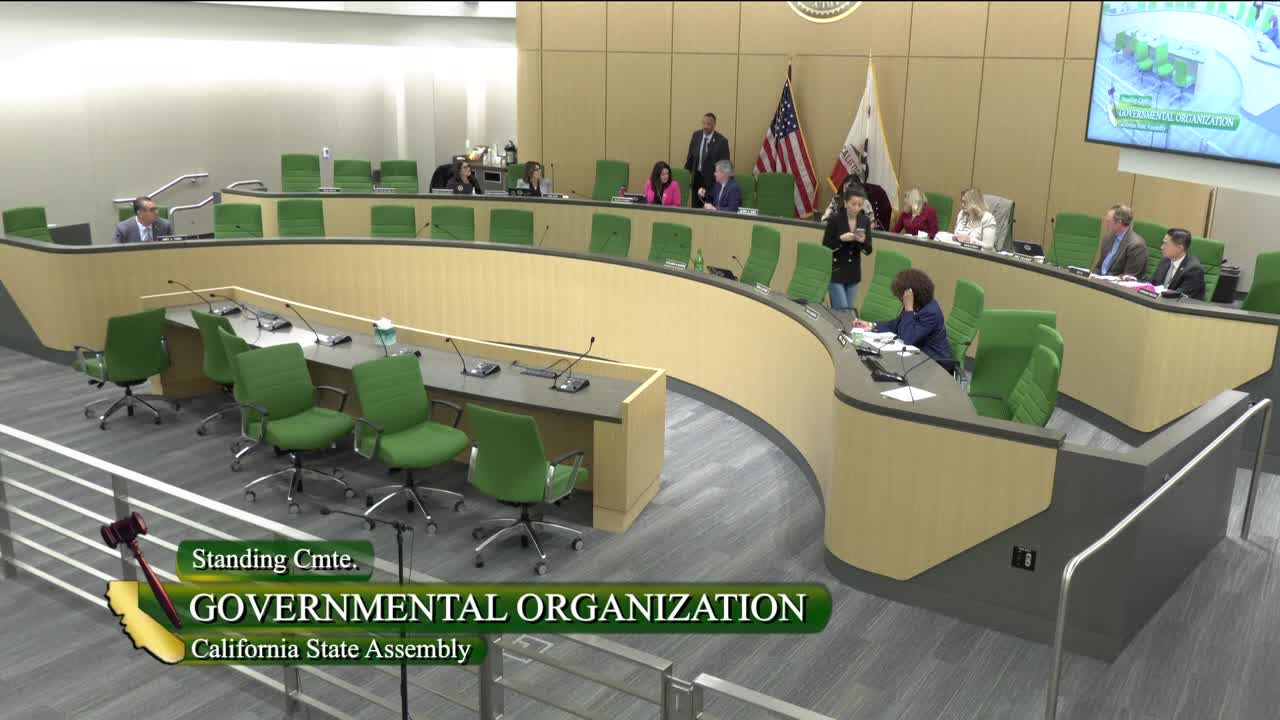 10MIN
Assembly Standing Committee on Governmental Organization
Bill Author

Bill Co-Author(s):