AB 1961: Civil actions: protective orders: workplace violence.
- Session Year: 2025-2026
- House: Assembly
- Latest Version Date: 2026-09-30
Current Status:
Passed
(2026-09-30: Chaptered by Secretary of State - Chapter 910, Statutes of 2026.)
Introduced
In Committee
Awaiting First Chamber Vote
Passed First Chamber
In Committee
Awaiting Second Chamber Vote
Passed Second Chamber
Enacted
Existing law authorizes an employer or collective bargaining representative of an employee who has suffered harassment, unlawful violence, or a credible threat of violence from any individual, to seek a workplace violence restraining order on behalf of the employee and, at the discretion of the court, any number of other employees at the workplace or at other workplaces of the employer. Existing law authorizes one or more representative parties to bring suit for the benefit of a class of parties if the question is one of a common or general interest, of many persons, or when the parties are numerous, and it is impracticable to bring them all before the court.
This bill would authorize an employer to seek a workplace violence restraining order on behalf of all employees at the employers workplace or a location at which a group of employees perform their primary job duties if harassment, unlawful violence or a credible threat of violence is directed at that workplace or location. The bill would not require an employer to name any individual employee as a protected party if the employer seeks a workplace violence restraining order on behalf of all employees at the employers workplace or a location at which a group of employees perform their primary job duties. This bill would require the Judicial Council, on or before January 1, 2028, to adopt or modify its forms, as specified.
This bill would incorporate additional changes to Section 527.8 of the Code of Civil Procedure proposed by AB 2179 to be operative only if this bill and AB 2179 are enacted and this bill is enacted last.
This bill would incorporate additional changes to Section 527.8 of the Code of Civil Procedure proposed by AB 1753 to be operative only if (1) this bill and AB 1753 are both enacted, (2) AB 2179 is not enacted or as enacted does not amend Section 527.8 of the Code of Civil Procedure, and (3) this bill is enacted last.
Existing law authorizes an employer or collective bargaining representative of an employee who has suffered harassment, unlawful violence, or a credible threat of violence from any individual, to seek a workplace violence restraining order on behalf of the employee and, at the discretion of the court, any number of other employees at the workplace or at other workplaces of the employer. Existing law authorizes one or more representative parties to bring suit for the benefit of a class of parties if the question is one of a common or general interest, of many persons, or when the parties are numerous, and it is impracticable to bring them all before the court.
This bill would authorize an employer to seek a workplace violence restraining order on behalf of all employees at the employers workplace or a location at which a group of employees perform their primary job duties if harassment, unlawful violence or a credible threat of violence is directed at that workplace or location. The bill would not require an employer to name any individual employee as a protected party if the employer seeks a workplace violence restraining order on behalf of all employees at the employers workplace or a location at which a group of employees perform their primary job duties. This bill would require the Judicial Council, on or before January 1, 2028, to adopt or modify its forms, as specified.
Existing law authorizes an employer or collective bargaining representative of an employee who has suffered harassment, unlawful violence, or a credible threat of violence from any individual, to seek a workplace violence restraining order on behalf of the employee and, at the discretion of the court, any number of other employees at the workplace or at other workplaces of the employer. Existing law authorizes one or more representative parties to bring suit for the benefit of a class of parties if the question is one of a common or general interest, of many persons, or when the parties are numerous, and it is impracticable to bring them all before the court.
Beginning on July 1, 2027, this This bill would authorize an employer to seek a workplace violence restraining order on behalf of a reasonably identifiable group of employees all employees at the employers workplace or a location at which a group of employees perform their primary job duties if harassment, unlawful violence or a credible threat of violence is generally directed at the employers workplace or at a group of the employers employees, as specified. that workplace or location. The bill would not require an employer to name any individual employee as a protected party if the employer seeks a workplace violence restraining order on behalf of a group of employees. all employees at the employers workplace or a location at which a group of employees perform their primary job duties. This bill would require the Judicial Council Council, on or before January 1, 2028, to update adopt or modify its forms, as specified.
Existing law authorizes an employer or collective bargaining representative of an employee who has suffered harassment, unlawful violence, or a credible threat of violence from any individual, to seek a workplace violence restraining order on behalf of the employee and, at the discretion of the court, any number of other employees at the workplace or at other workplaces of the employer. Existing law authorizes one or more representative parties to bring suit for the benefit of a class of parties if the question is one of a common or general interest, of many persons, or when the parties are numerous, and it is impracticable to bring them all before the court.
ThisBeginning on July 1, 2027, this bill would authorize an employer to seek a workplace violence restraining order on behalf of a reasonably identifiable group or class of employees if a credible threat of violence is generally directed at the employers workplace or at the a group of the employers employees. employees, as specified. The bill would not require an employer to name any individual employee as a protected party if the employer seeks a workplace violence restraining order on behalf of a group or class of employees. This bill would require the Judicial Council to update its forms, as specified.
Existing law authorizes an employer or collective bargaining representative of an employee who has suffered harassment, unlawful violence, or a credible threat of violence from any individual, to seek a workplace violence restraining order on behalf of the employee and, at the discretion of the court, any number of other employees at the workplace or at other workplaces of the employer. Existing law authorizes one or more representative parties to bring suit for the benefit of a class of parties if the question is one of a common or general interest, of many persons, or when the parties are numerous, and it is impracticable to bring them all before the court.
This bill would authorize an employer to seek a workplace violence restraining order on behalf of a reasonably identifiable group or class of employees if a credible threat of violence is generally directed at the employers workplace or at the employers employees. The bill would not require an employer to name any individual employee as a protected party if the employer seeks a workplace violence restraining order on behalf of a group or class of employees.
(a)(1)Any employer or collective bargaining representative of an employee who has suffered harassment, unlawful violence, or a credible threat of violence from any individual, that can reasonably be construed to be carried out or to have been carried out at the workplace, may seek a temporary restraining order and an order after hearing on behalf of the employee and, at the discretion of the court, any number of other employees at the workplace, and, if appropriate, other employees at other workplaces of the employer. For purposes of this section only, a person may bring a petition for a temporary restraining order and an order after hearing on behalf of an employee as their collective bargaining representative only if the person serves as a collective bargaining representative for that employee in employment or labor matters at the employees workplace.
(2)If harassment, unlawful violence, or a credible threat of violence is directed at an employers workplace or a location where a group of employees perform their primary job duties, rather than at any specific employee, the employer may, without naming a specific employee in the petition, seek a temporary restraining order and an order after hearing, as described in subparagraph (B) of paragraph (7) of subdivision (b), on behalf of all employees at that workplace or location.
(3)On or before January 1, 2028, the Judicial Council shall adopt or modify forms, as needed, to implement this subdivision.
(4)Notwithstanding any other law, contracts entered into or amended, or changes to existing information technology systems made pursuant to paragraph (2) shall be exempt from Chapter 6 (commencing with Section 14825) of Part 5.5 of Division 3 of Title 2 of the Government Code, Article 4 (commencing with Section 19130) of Chapter 5 Part 2 of Division 5 of Title 2 of the Government Code, Chapter 3 (commencing with Section 12100) of Part 2 of Division 2 of the Public Contract Code, the Statewide Information Management Manual, and the State Administrative Manual, and shall be exempt from the review or approval of any division of the Department of General Services or the Department of Technology.
(b)For purposes of this section:
(1)Course of conduct is a pattern of conduct composed of a series of acts over a period of time, however short, evidencing a continuity of purpose, including following or stalking an employee to or from the place of work; entering the workplace; following an employee during hours of employment; making telephone calls to an employee; or sending correspondence to an employee by any means, including, but not limited to, the use of the public or private mails, interoffice mail, facsimile, or computer email.
(2)Credible threat of violence is a knowing and willful statement or course of conduct that would place a reasonable person in fear for their safety, or the safety of their immediate family, and that serves no legitimate purpose.
(3)Employer and employee mean persons defined in Section 350 of the Labor Code. Employer also includes a federal agency, the state, a state agency, a city, county, or district, a joint powers authority, or a public transit operator, whether operated directly by a public entity or through a contract or subcontract, and a private, public, or quasi-public corporation, or any public agency thereof or therein. Employee also includes the members of boards of directors of private, public, and quasi-public corporations and elected and appointed public officers. For purposes of this section only, employee also includes a volunteer or independent contractor who performs services for the employer at the employers worksite. The changes made to this paragraph during the 202526 Regular Session are declaratory of existing law.
(4)Harassment is a knowing and willful course of conduct directed at a specific person that seriously alarms, annoys, or harasses the person, and that serves no legitimate purpose. The course of conduct must be that which would cause a reasonable person to suffer substantial emotional distress, and must actually cause substantial emotional distress.
(5)Petitioner means the employer or collective bargaining representative that petitions under subdivision (a) for a temporary restraining order and order after hearing.
(6)Respondent means the person against whom the temporary restraining order and order after hearing are sought and, if the petition is granted, the restrained person.
(7)Temporary restraining order and order after hearing mean orders that include any of the following restraining orders, whether issued ex parte or after notice and hearing:
(A)An order enjoining a party from harassing, intimidating, molesting, attacking, striking, stalking, threatening, sexually assaulting, battering, abusing, telephoning, including, but not limited to, making annoying telephone calls as described in Section 653m of the Penal Code, destroying personal property, contacting, either directly or indirectly, by mail or otherwise, or coming within a specified distance of, or disturbing the peace of, the employee.
(B)In response to a petition made on behalf of all employees at the employers workplace or a location where a group of employees performs their primary job duties, an order enjoining a party from telephoning, including, but not limited to, making annoying telephone calls as described in Section 653m of the Penal Code, contacting, either directly or indirectly, by mail or otherwise, or coming within a specified distance of that workplace or location.
(C)An order enjoining a party from specified behavior that the court determines is necessary to effectuate orders described in subparagraph (A) or (B).
(8)Unlawful violence is any assault or battery, or stalking as prohibited in Section 646.9 of the Penal Code, or any violation of Section 243.3 of the Penal Code, but shall not include lawful acts of self-defense or defense of others. The changes made to this paragraph during the 202526 Regular Session are declaratory of existing law.
(c)This section does not permit a court to issue a temporary restraining order or order after hearing prohibiting speech or other activities that are constitutionally protected, protected by the National Labor Relations Act (29 U.S.C. Sec. 151 et seq.), protected by Chapter 11.5 (commencing with Section 3555) of Division 4 of Title 1 of the Government Code, or otherwise protected by Section 527.3 or any other provision of law.
(d)In the discretion of the court, on a showing of good cause, a temporary restraining order or order after hearing issued under this section may include other named family or household members, or other persons employed at the employees workplace or workplaces.
(e)Before filing a petition under this section, an employer or collective bargaining representative of an employee shall provide the employee who has suffered harassment, unlawful violence, or a credible threat of violence from any individual, an opportunity to decline to be named in the temporary restraining order. An employees request to not be named in the temporary restraining order shall not prohibit an employer or collective bargaining representative from seeking a temporary restraining order on behalf of other employees at the workplace, and, if appropriate, other employees at other workplaces of the employer.
(f)(1)Upon filing a petition under this section, the petitioner may obtain a temporary restraining order in accordance with subdivision (a) of Section 527, if the petitioner also files a declaration that, to the satisfaction of the court, shows one of the following:
(A)Reasonable proof that an employee has suffered unlawful violence or a credible threat of violence by the respondent, and that great or irreparable harm would result to an employee.
(B)Clear and convincing evidence of all of the following:
(i)That an employee has suffered harassment by the respondent.
(ii)That great or irreparable harm would result to an employee.
(iii)That the course of conduct at issue served no legitimate purpose.
(iv)That the issuance of the order is not prohibited by subdivision (c).
(2)The temporary restraining order may include any of the protective orders described in paragraph (7) of subdivision (b).
(g)A request for the issuance of a temporary restraining order without notice under this section shall be granted or denied on the same day that the petition is submitted to the court, unless the petition is filed too late in the day to permit effective review, in which case the order shall be granted or denied on the next day of judicial business in sufficient time for the order to be filed that day with the clerk of the court.
(h)A temporary restraining order granted under this section shall remain in effect, at the courts discretion, for a period not to exceed 21 days, or if the court extends the time for hearing under subdivision (i), not to exceed 25 days, unless otherwise modified or terminated by the court.
(i)Within 21 days, or if good cause appears to the court, 25 days from the date that a petition for a temporary order is granted or denied, a hearing shall be held on the petition. If no request for temporary orders is made, the hearing shall be held within 21 days, or, if good cause appears to the court, 25 days, from the date that the petition is filed.
(j)The respondent may file a response that explains, excuses, justifies, or denies the alleged harassment, unlawful violence, or credible threats of violence.
(k)At the hearing, the judge shall receive any testimony that is relevant and may make an independent inquiry. Moreover, if the respondent is currently employed by the employer of the employee, as described in subdivision (a), the judge shall receive evidence concerning the employers decision to retain, terminate, or otherwise discipline the respondent. If the judge finds by clear and convincing evidence that the respondent engaged in harassment, engaged in unlawful violence, or made a credible threat of violence, an order shall issue prohibiting further harassment, unlawful violence, or threats of violence.
(l)(1)In the discretion of the court, an order issued after notice and hearing under this section may have a duration of not more than three years, subject to termination or modification by further order of the court either on written stipulation filed with the court or on the motion of a party. These orders may be renewed, upon the request of a party, for a duration of not more than three years, without a showing of any further harassment, unlawful violence, or credible threats of violence since the issuance of the original order, subject to termination or modification by further order of the court either on written stipulation filed with the court or on the motion of a party. The request for renewal may be brought at any time within the three months before the expiration of the order.
(2)The failure to state the expiration date on the face of the form creates an order with a duration of three years from the date of issuance.
(3)If an action is filed for the purpose of terminating or modifying a protective order prior to the expiration date specified in the order by a party other than the protected party, the party who is protected by the order shall be given notice, pursuant to subdivision (b) of Section 1005, of the proceeding by personal service or, if the protected party has satisfied the requirements of Chapter 3.1 (commencing with Section 6205) of Division 7 of Title 1 of the Government Code, by service on the Secretary of State. If the party who is protected by the order cannot be notified prior to the hearing for modification or termination of the protective order, the court shall deny the motion to modify or terminate the order without prejudice or continue the hearing until the party who is protected can be properly noticed and may, upon a showing of good cause, specify another method for service of process that is reasonably designed to afford actual notice to the protected party. The protected party may waive their right to notice if they are physically present in court and does not challenge the sufficiency of the notice.
(m)This section does not preclude any party from representation by private counsel or from appearing on the partys own behalf.
(n)Upon filing of a petition under this section, the respondent shall be personally served with a copy of the petition, temporary restraining order, if any, and notice of hearing of the petition. Service shall be made at least five days before the hearing. The court may, for good cause, on motion of the petitioner or on its own motion, shorten the time for service on the respondent.
(o)A notice of hearing under this section shall notify the respondent that, if they do not attend the hearing, the court may make orders against them that could last up to three years.
(p)The respondent shall be entitled, as a matter of course, to one continuance, for a reasonable period, to respond to the petition.
(q)(1)Any party may request a continuance of the hearing, which the court shall grant on a showing of good cause. The request may be made in writing before or at the hearing or orally at the hearing. The court may also grant a continuance on its own motion.
(2)If the court grants a continuance, any temporary restraining order that has been granted shall remain in effect until the end of the continued hearing, unless otherwise ordered by the court. In granting a continuance, the court may modify or terminate a temporary restraining order.
(r)(1)If a respondent, named in a restraining order issued under this section after a hearing, has not been served personally with the order but has received actual notice of the existence and substance of the order through personal appearance in court to hear the terms of the order from the court, no additional proof of service is required for enforcement of the order.
(2)If the respondent named in a temporary restraining order is personally served with the order and notice of hearing with respect to a restraining order or protective order based on the temporary restraining order, but the person does not appear at the hearing, either personally or by an attorney, and the terms and conditions of the restraining order or protective order issued at the hearing are identical to the temporary restraining order, except for the duration of the order, then the restraining order or protective order issued at the hearing may be served on the person by first-class mail sent to that person at the most current address for the person available to the court.
(3)The Judicial Council form for temporary orders issued pursuant to this subdivision shall contain a statement in substantially the following form:
If you have been personally served with this temporary restraining order and notice of hearing, but you do not appear at the hearing either in person or by a lawyer, and a restraining order that is the same as this restraining order except for the expiration date is issued at the hearing, a copy of the order will be served on you by mail at the following address: ____.
If that address is not correct or you wish to verify that the temporary restraining order was converted to a restraining order at the hearing without substantive change and to find out the duration of that order, contact the clerk of the court.
(s)(1)Information on a temporary restraining order or order after hearing relating to workplace violence issued by a court pursuant to this section shall be transmitted to the Department of Justice in accordance with either paragraph (2) or (3).
(2)The court shall order the petitioner or the attorney for the petitioner to deliver a copy of any order issued under this section, or a reissuance, extension, modification, or termination of the order, and any subsequent proof of service, by the close of the business day on which the order, reissuance, extension, modification, or termination was made, to each law enforcement agency having jurisdiction over the residence of the petitioner and to any additional law enforcement agencies within the courts discretion as are requested by the petitioner.
(3)Alternatively, the court or its designee shall transmit, within one business day, to law enforcement personnel all information required under subdivision (b) of Section 6380 of the Family Code regarding any order issued under this section, or a reissuance, extension, modification, or termination of the order, and any subsequent proof of service, by either one of the following methods:
(A)Transmitting a physical copy of the order or proof of service to a local law enforcement agency authorized by the Department of Justice to enter orders into the California Law Enforcement Telecommunications System (CLETS).
(B)With the approval of the Department of Justice, entering the order or proof of service into CLETS directly.
(4)Each appropriate law enforcement agency shall make available information as to the existence and current status of these orders to law enforcement officers responding to the scene of reported harassment, unlawful violence, or a credible threat of violence.
(5)At the request of the petitioner, an order issued under this section shall be served on the respondent, regardless of whether the respondent has been taken into custody, by any law enforcement officer who is present at the scene of reported harassment, unlawful violence, or a credible threat of violence involving the parties to the proceedings. The petitioner shall provide the officer with an endorsed copy of the order and proof of service that the officer shall complete and send to the issuing court.
(6)Upon receiving information at the scene of an incident of harassment, unlawful violence, or a credible threat of violence that a protective order has been issued under this section, or that a person who has been taken into custody is the subject of an order, if the petitioner or the protected person cannot produce an endorsed copy of the order, a law enforcement officer shall immediately attempt to verify the existence of the order.
(7)If the law enforcement officer determines that a protective order has been issued but not served, the officer shall immediately notify the respondent of the terms of the order and obtain the respondents address. The law enforcement officer shall at that time also enforce the order, but may not arrest or take the respondent into custody for acts in violation of the order that were committed prior to the verbal notice of the terms and conditions of the order. The law enforcement officers verbal notice of the terms of the order shall constitute service of the order and constitutes sufficient notice for the purposes of this section and for the purposes of Section 29825 of the Penal Code. The petitioner shall mail an endorsed copy of the order to the respondents mailing address provided to the law enforcement officer within one business day of the reported incident of harassment, unlawful violence, or a credible threat of violence at which a verbal notice of the terms of the order was provided by a law enforcement officer.
(t)(1)A person subject to a protective order issued under this section shall not own, possess, purchase, receive, or attempt to purchase or receive a firearm or ammunition while the protective order is in effect.
(2)The court shall order a person subject to a protective order issued under this section to relinquish any firearms they own or possess pursuant to Section 527.9.
(3)Every person who owns, possesses, purchases or receives, or attempts to purchase or receive a firearm or ammunition while the protective order is in effect is punishable pursuant to Section 29825 of the Penal Code.
(u)Any intentional disobedience of any temporary restraining order or order after hearing granted under this section is punishable pursuant to Section 273.6 of the Penal Code.
(v)This section shall not be construed as expanding, diminishing, altering, or modifying the duty, if any, of an employer to provide a safe workplace for employees and other persons.
(w)(1)The Judicial Council shall develop forms, instructions, and rules for relating to matters governed by this section. The forms for the petition and response shall be simple and concise, and their use by parties in actions brought pursuant to this section shall be mandatory.
(2)A temporary restraining order or order after hearing relating to harassment, unlawful violence, or a credible threat of violence issued by a court pursuant to this section shall be issued on forms adopted by the Judicial Council and that have been approved by the Department of Justice pursuant to subdivision (i) of Section 6380 of the Family Code. However, the fact that an order issued by a court pursuant to this section was not issued on forms adopted by the Judicial Council and approved by the Department of Justice shall not, in and of itself, make the order unenforceable.
(x)There is no filing fee for a petition that alleges that a person has inflicted or threatened violence against an employee employed or represented by the petitioner, or stalked the employee, or acted or spoken in any other manner that has placed the employee in reasonable fear of violence, and that seeks a protective or restraining order restraining stalking or future violence or threats of violence, in any action brought pursuant to this section. A fee shall not be paid for a subpoena filed in connection with a petition alleging these acts. A fee shall not be paid for filing a response to a petition alleging these acts.
(y)(1)Subject to paragraph (4) of subdivision (b) of Section 6103.2 of the Government Code, there shall be no fee for the service of process by a sheriff or marshal of a temporary restraining order or order after hearing to be issued pursuant to this section if either of the following conditions applies:
(A)The temporary restraining order or order after hearing issued pursuant to this section is based upon stalking, as prohibited by Section 646.9 of the Penal Code.
(B)The temporary restraining order or order after hearing issued pursuant to this section is based on unlawful violence or a credible threat of violence.
(2)The Judicial Council shall prepare and develop forms for persons who wish to avail themselves of the services described in this subdivision.
(z)This section shall become operative on January 1, 2025.
SEC. 1.3.Section 527.8 of the Code of Civil Procedure is amended to read:527.8.(a)(1)Any employer or collective bargaining representative of an employee who has suffered harassment, unlawful violence, or a credible threat of violence from any individual, that can reasonably be construed to be carried out or to have been carried out at the workplace, may seek a temporary restraining order and an order after hearing on behalf of the employee and, at the discretion of the court, any number of other employees at the workplace, and, if appropriate, other employees at other workplaces of the employer. For purposes of this section only, a person may bring a petition for a temporary restraining order and an order after hearing on behalf of an employee as their collective bargaining representative only if the person serves as a collective bargaining representative for that employee in employment or labor matters at the employees workplace.
(2)If harassment, unlawful violence, or a credible threat of violence is directed at an employers workplace or a location where a group of employees perform their primary job duties, rather than at any specific employee, the employer may, without naming a specific employee in the petition, seek a temporary restraining order and an order after hearing, as described in subparagraph (B) of paragraph (7) of subdivision (b), on behalf of all employees at that workplace or location.
(3)On or before January 1, 2028, the Judicial Council shall adopt or modify forms, as needed, to implement this subdivision.
(4)Notwithstanding any other law, contracts entered into or amended, or changes to existing information technology systems made pursuant to paragraph (2) shall be exempt from Chapter 6 (commencing with Section 14825) of Part 5.5 of Division 3 of Title 2 of the Government Code, Article 4 (commencing with Section 19130) of Chapter 5 Part 2 of Division 5 of Title 2 of the Government Code, Chapter 3 (commencing with Section 12100) of Part 2 of Division 2 of the Public Contract Code, the Statewide Information Management Manual, and the State Administrative Manual, and shall be exempt from the review or approval of any division of the Department of General Services or the Department of Technology.
(b)For purposes of this section:
(1)Course of conduct is a pattern of conduct composed of a series of acts over a period of time, however short, evidencing a continuity of purpose, including following or stalking an employee to or from the place of work; entering the workplace; following an employee during hours of employment; making telephone calls to an employee; or sending correspondence to an employee by any means, including, but not limited to, the use of the public or private mails, interoffice mail, facsimile, or computer email.
(2)Credible threat of violence is a knowing and willful statement or course of conduct that would place a reasonable person in fear for their safety, or the safety of their immediate family, and that serves no legitimate purpose.
(3)Employer and employee mean persons defined in Section 350 of the Labor Code. Employer also includes a federal agency, the state, a state agency, a city, county, or district, a joint powers authority, or a public transit operator, whether operated directly by a public entity or through a contract or subcontract, and a private, public, or quasi-public corporation, or any public agency thereof or therein. Employee also includes the members of boards of directors of private, public, and quasi-public corporations and elected and appointed public officers. For purposes of this section only, employee also includes a volunteer or independent contractor who performs services for the employer at the employers worksite. The changes made to this paragraph during the 202526 Regular Session are declaratory of existing law.
(4)Harassment is a knowing and willful course of conduct directed at a specific person that seriously alarms, annoys, or harasses the person, and that serves no legitimate purpose. The course of conduct must be that which would cause a reasonable person to suffer substantial emotional distress, and must actually cause substantial emotional distress.
(5)Petitioner means the employer or collective bargaining representative that petitions under subdivision (a) for a temporary restraining order and order after hearing.
(6)Respondent means the person against whom the temporary restraining order and order after hearing are sought and, if the petition is granted, the restrained person.
(7)Temporary restraining order and order after hearing mean orders that include any of the following restraining orders, whether issued ex parte or after notice and hearing:
(A)An order enjoining a party from harassing, intimidating, molesting, attacking, striking, stalking, threatening, sexually assaulting, battering, abusing, telephoning, including, but not limited to, making annoying telephone calls as described in Section 653m of the Penal Code, destroying personal property, contacting, either directly or indirectly, by mail or otherwise, or coming within a specified distance of, or disturbing the peace of, the employee.
(B)In response to a petition made on behalf of all employees at the employers workplace or a location where a group of employees performs their primary job duties, an order enjoining a party from telephoning, including, but not limited to, making annoying telephone calls as described in Section 653m of the Penal Code, contacting, either directly or indirectly, by mail or otherwise, or coming within a specified distance of that workplace or location.
(C)An order enjoining a party from specified behavior that the court determines is necessary to effectuate orders described in subparagraph (A) or (B).
(8)Unlawful violence is any assault or battery, or stalking as prohibited in Section 646.9 of the Penal Code, or any violation of Section 243.3 of the Penal Code, but shall not include lawful acts of self-defense or defense of others. The changes made to this paragraph during the 202526 Regular Session are declaratory of existing law.
(c)This section does not permit a court to issue a temporary restraining order or order after hearing prohibiting speech or other activities that are constitutionally protected, protected by the National Labor Relations Act (29 U.S.C. Sec. 151 et seq.), protected by Chapter 11.5 (commencing with Section 3555) of Division 4 of Title 1 of the Government Code, or otherwise protected by Section 527.3 or any other provision of law.
(d)In the discretion of the court, on a showing of good cause, a temporary restraining order or order after hearing issued under this section may include other named family or household members, or other persons employed at the employees workplace or workplaces.
(e)Before filing a petition under this section, an employer or collective bargaining representative of an employee shall provide the employee who has suffered harassment, unlawful violence, or a credible threat of violence from any individual, an opportunity to decline to be named in the temporary restraining order. An employees request to not be named in the temporary restraining order shall not prohibit an employer or collective bargaining representative from seeking a temporary restraining order on behalf of other employees at the workplace, and, if appropriate, other employees at other workplaces of the employer.
(f)(1)Upon filing a petition under this section, the petitioner may obtain a temporary restraining order in accordance with subdivision (a) of Section 527, if the petitioner also files a declaration that, to the satisfaction of the court, shows one of the following:
(A)Reasonable proof that an employee has suffered unlawful violence or a credible threat of violence by the respondent, and that great or irreparable harm would result to an employee.
(B)Clear and convincing evidence of all of the following:
(i)That an employee has suffered harassment by the respondent.
(ii)That great or irreparable harm would result to an employee.
(iii)That the course of conduct at issue served no legitimate purpose.
(iv)That the issuance of the order is not prohibited by subdivision (c).
(2)The temporary restraining order may include any of the protective orders described in paragraph (7) of subdivision (b).
(g)A request for the issuance of a temporary restraining order without notice under this section shall be granted or denied on the same day that the petition is submitted to the court, unless the petition is filed too late in the day to permit effective review, in which case the order shall be granted or denied on the next day of judicial business in sufficient time for the order to be filed that day with the clerk of the court.
(h)A temporary restraining order granted under this section shall remain in effect, at the courts discretion, for a period not to exceed 21 days, or if the court extends the time for hearing under subdivision (i), not to exceed 25 days, unless otherwise modified or terminated by the court.
(i)Within 21 days, or if good cause appears to the court, 25 days from the date that a petition for a temporary order is granted or denied, a hearing shall be held on the petition. If no request for temporary orders is made, the hearing shall be held within 21 days, or, if good cause appears to the court, 25 days, from the date that the petition is filed.
(j)The respondent may file a response that explains, excuses, justifies, or denies the alleged harassment, unlawful violence, or credible threats of violence.
(k)(1)At the hearing, the judge shall receive any testimony that is relevant and may make an independent inquiry. Moreover, if the respondent is currently employed by the employer of the employee, as described in subdivision (a), the judge shall receive evidence concerning the employers decision to retain, terminate, or otherwise discipline the respondent. If the judge finds by clear and convincing evidence that the respondent engaged in harassment, engaged in unlawful violence, or made a credible threat of violence, an order shall issue prohibiting further harassment, unlawful violence, or threats of violence.
(2)Commencing January 1, 2028, a party or witness may appear remotely at the hearing on a petition for an order under this section. The superior court of each county shall not charge a fee for a party to appear remotely at the hearing and shall develop local rules and instructions for remote appearances permitted under this paragraph, which shall be posted on the courts internet website.
(3)The Judicial Council shall, on or before January 1, 2028, develop the necessary forms and rules to implement paragraph (2).
(l)(1)In the discretion of the court, an order issued after notice and hearing under this section may have a duration of not more than three years, subject to termination or modification by further order of the court either on written stipulation filed with the court or on the motion of a party. These orders may be renewed, upon the request of a party, for a duration of not more than three years, without a showing of any further harassment, unlawful violence, or credible threats of violence since the issuance of the original order, subject to termination or modification by further order of the court either on written stipulation filed with the court or on the motion of a party. The request for renewal may be brought at any time within the three months before the expiration of the order.
(2)The failure to state the expiration date on the face of the form creates an order with a duration of three years from the date of issuance.
(3)If an action is filed for the purpose of terminating or modifying a protective order prior to the expiration date specified in the order by a party other than the protected party, the party who is protected by the order shall be given notice, pursuant to subdivision (b) of Section 1005, of the proceeding by personal service or, if the protected party has satisfied the requirements of Chapter 3.1 (commencing with Section 6205) of Division 7 of Title 1 of the Government Code, by service on the Secretary of State. If the party who is protected by the order cannot be notified prior to the hearing for modification or termination of the protective order, the court shall deny the motion to modify or terminate the order without prejudice or continue the hearing until the party who is protected can be properly noticed and may, upon a showing of good cause, specify another method for service of process that is reasonably designed to afford actual notice to the protected party. The protected party may waive their right to notice if they are physically present in court and does not challenge the sufficiency of the notice.
(m)This section does not preclude any party from representation by private counsel or from appearing on the partys own behalf.
(n)Upon filing of a petition under this section, the respondent shall be personally served with a copy of the petition, temporary restraining order, if any, and notice of hearing of the petition. Service shall be made at least five days before the hearing. The court may, for good cause, on motion of the petitioner or on its own motion, shorten the time for service on the respondent.
(o)A notice of hearing under this section shall notify the respondent that, if they do not attend the hearing, the court may make orders against them that could last up to three years.
(p)The respondent shall be entitled, as a matter of course, to one continuance, for a reasonable period, to respond to the petition.
(q)(1)Any party may request a continuance of the hearing, which the court shall grant on a showing of good cause. The request may be made in writing before or at the hearing or orally at the hearing. The court may also grant a continuance on its own motion.
(2)If the court grants a continuance, any temporary restraining order that has been granted shall remain in effect until the end of the continued hearing, unless otherwise ordered by the court. In granting a continuance, the court may modify or terminate a temporary restraining order.
(r)(1)If a respondent, named in a restraining order issued under this section after a hearing, has not been served personally with the order but has received actual notice of the existence and substance of the order through personal appearance in court to hear the terms of the order from the court, no additional proof of service is required for enforcement of the order.
(2)If the respondent named in a temporary restraining order is personally served with the order and notice of hearing with respect to a restraining order or protective order based on the temporary restraining order, but the person does not appear at the hearing, either personally or by an attorney, and the terms and conditions of the restraining order or protective order issued at the hearing are identical to the temporary restraining order, except for the duration of the order, then the restraining order or protective order issued at the hearing may be served on the person by first-class mail sent to that person at the most current address for the person available to the court.
(3)The Judicial Council form for temporary orders issued pursuant to this subdivision shall contain a statement in substantially the following form:
If you have been personally served with this temporary restraining order and notice of hearing, but you do not appear at the hearing either in person or by a lawyer, and a restraining order that is the same as this restraining order except for the expiration date is issued at the hearing, a copy of the order will be served on you by mail at the following address: ____.
If that address is not correct or you wish to verify that the temporary restraining order was converted to a restraining order at the hearing without substantive change and to find out the duration of that order, contact the clerk of the court.
(s)(1)Information on a temporary restraining order or order after hearing relating to workplace violence issued by a court pursuant to this section shall be transmitted to the Department of Justice in accordance with either paragraph (2) or (3).
(2)The court shall order the petitioner or the attorney for the petitioner to deliver a copy of any order issued under this section, or a reissuance, extension, modification, or termination of the order, and any subsequent proof of service, by the close of the business day on which the order, reissuance, extension, modification, or termination was made, to each law enforcement agency having jurisdiction over the residence of the petitioner and to any additional law enforcement agencies within the courts discretion as are requested by the petitioner.
(3)Alternatively, the court or its designee shall transmit, within one business day, to law enforcement personnel all information required under subdivision (b) of Section 6380 of the Family Code regarding any order issued under this section, or a reissuance, extension, modification, or termination of the order, and any subsequent proof of service, by either one of the following methods:
(A)Transmitting a physical copy of the order or proof of service to a local law enforcement agency authorized by the Department of Justice to enter orders into the California Law Enforcement Telecommunications System (CLETS).
(B)With the approval of the Department of Justice, entering the order or proof of service into CLETS directly.
(4)Each appropriate law enforcement agency shall make available information as to the existence and current status of these orders to law enforcement officers responding to the scene of reported harassment, unlawful violence, or a credible threat of violence.
(5)At the request of the petitioner, an order issued under this section shall be served on the respondent, regardless of whether the respondent has been taken into custody, by any law enforcement officer who is present at the scene of reported harassment, unlawful violence, or a credible threat of violence involving the parties to the proceedings. The petitioner shall provide the officer with an endorsed copy of the order and proof of service that the officer shall complete and send to the issuing court.
(6)Upon receiving information at the scene of an incident of harassment, unlawful violence, or a credible threat of violence that a protective order has been issued under this section, or that a person who has been taken into custody is the subject of an order, if the petitioner or the protected person cannot produce an endorsed copy of the order, a law enforcement officer shall immediately attempt to verify the existence of the order.
(7)If the law enforcement officer determines that a protective order has been issued but not served, the officer shall immediately notify the respondent of the terms of the order and obtain the respondents address. The law enforcement officer shall at that time also enforce the order, but may not arrest or take the respondent into custody for acts in violation of the order that were committed prior to the verbal notice of the terms and conditions of the order. The law enforcement officers verbal notice of the terms of the order shall constitute service of the order and constitutes sufficient notice for the purposes of this section and for the purposes of Section 29825 of the Penal Code. The petitioner shall mail an endorsed copy of the order to the respondents mailing address provided to the law enforcement officer within one business day of the reported incident of harassment, unlawful violence, or a credible threat of violence at which a verbal notice of the terms of the order was provided by a law enforcement officer.
(t)(1)A person subject to a protective order issued under this section shall not own, possess, purchase, receive, or attempt to purchase or receive a firearm or ammunition while the protective order is in effect.
(2)The court shall order a person subject to a protective order issued under this section to relinquish any firearms they own or possess pursuant to Section 527.9.
(3)Every person who owns, possesses, purchases or receives, or attempts to purchase or receive a firearm or ammunition while the protective order is in effect is punishable pursuant to Section 29825 of the Penal Code.
(u)Any intentional disobedience of any temporary restraining order or order after hearing granted under this section is punishable pursuant to Section 273.6 of the Penal Code.
(v)This section shall not be construed as expanding, diminishing, altering, or modifying the duty, if any, of an employer to provide a safe workplace for employees and other persons.
(w)(1)The Judicial Council shall develop forms, instructions, and rules for relating to matters governed by this section. The forms for the petition and response shall be simple and concise, and their use by parties in actions brought pursuant to this section shall be mandatory.
(2)A temporary restraining order or order after hearing relating to harassment, unlawful violence, or a credible threat of violence issued by a court pursuant to this section shall be issued on forms adopted by the Judicial Council and that have been approved by the Department of Justice pursuant to subdivision (i) of Section 6380 of the Family Code. However, the fact that an order issued by a court pursuant to this section was not issued on forms adopted by the Judicial Council and approved by the Department of Justice shall not, in and of itself, make the order unenforceable.
(x)(1)(A)Commencing January 1, 2028, a court that receives petitions for protective orders under this section shall permit those petitions and any filings related to those petitions to be submitted electronically. The court shall, based on the time of receipt, act on those filings consistent with subdivision (g).
(B)The request, notice of the court date, copies of the request to serve on the respondent, and the temporary restraining order, if granted, shall be electronically provided to a petitioner who electronically filed the petition, unless the petitioner notes, at the time of electronic filing, that those documents will be physically obtained from the court.
(C)The Judicial Council shall, on or before January 1, 2028, develop the necessary forms and rules to implement this paragraph.
(2)(A)There is no filing fee for a petition that alleges that a person has inflicted or threatened violence against an employee employed or represented by the petitioner, or stalked the employee, or acted or spoken in any other manner that has placed the employee in reasonable fear of violence, and that seeks a protective or restraining order restraining stalking or future violence or threats of violence, in any action brought pursuant to this section.
(B)A fee shall not be paid for a subpoena filed in connection with a petition alleging these acts.
(C)A fee shall not be paid for filing a response to a petition alleging these acts.
(y)(1)Subject to paragraph (4) of subdivision (b) of Section 6103.2 of the Government Code, there shall be no fee for the service of process by a sheriff or marshal of a temporary restraining order or order after hearing to be issued pursuant to this section if either of the following conditions applies:
(A)The temporary restraining order or order after hearing issued pursuant to this section is based upon stalking, as prohibited by Section 646.9 of the Penal Code.
(B)The temporary restraining order or order after hearing issued pursuant to this section is based on unlawful violence or a credible threat of violence.
(2)The Judicial Council shall prepare and develop forms for persons who wish to avail themselves of the services described in this subdivision.
(z)This section shall become operative on January 1, 2025.
SEC. 1.5.Section 527.8 of the Code of Civil Procedure is amended to read:527.8.(a)(1)Any employer or collective bargaining representative of an employee who has suffered harassment, unlawful violence, or a credible threat of violence from any individual, that can reasonably be construed to be carried out or to have been carried out at the workplace, may seek a temporary restraining order and an order after hearing on behalf of the employee and, at the discretion of the court, any number of other employees at the workplace, and, if appropriate, other employees at other workplaces of the employer. For purposes of this section only, a person may bring a petition for a temporary restraining order and an order after hearing on behalf of an employee as their collective bargaining representative only if the person serves as a collective bargaining representative for that employee in employment or labor matters at the employees workplace.
(2)If harassment, unlawful violence, or a credible threat of violence is directed at an employers workplace or a location where a group of employees perform their primary job duties, rather than at any specific employee, the employer may, without naming a specific employee in the petition, seek a temporary restraining order and an order after hearing, as described in subparagraph (B) of paragraph (7) of subdivision (b), on behalf of all employees at that workplace or location.
(3)On or before January 1, 2028, the Judicial Council shall adopt or modify forms, as needed, to implement this subdivision.
(4)Notwithstanding any other law, contracts entered into or amended, or changes to existing information technology systems made pursuant to paragraph (2) shall be exempt from Chapter 6 (commencing with Section 14825) of Part 5.5 of Division 3 of Title 2 of the Government Code, Article 4 (commencing with Section 19130) of Chapter 5 Part 2 of Division 5 of Title 2 of the Government Code, Chapter 3 (commencing with Section 12100) of Part 2 of Division 2 of the Public Contract Code, the Statewide Information Management Manual, and the State Administrative Manual, and shall be exempt from the review or approval of any division of the Department of General Services or the Department of Technology.
(b)For purposes of this section:
(1)Course of conduct is a pattern of conduct composed of a series of acts over a period of time, however short, evidencing a continuity of purpose, including following or stalking an employee to or from the place of work; entering the workplace; following an employee during hours of employment; making telephone calls to an employee; or sending correspondence to an employee by any means, including, but not limited to, the use of the public or private mails, interoffice mail, facsimile, or computer email.
(2)Credible threat of violence is a knowing and willful statement or course of conduct that would place a reasonable person in fear for their safety, or the safety of their immediate family, and that serves no legitimate purpose.
(3)Employer and employee mean persons defined in Section 350 of the Labor Code. Employer also includes a federal agency, the state, a state agency, a city, county, or district, a joint powers authority, or a public transit operator, whether operated directly by a public entity or through a contract or subcontract, and a private, public, or quasi-public corporation, or any public agency thereof or therein. Employee also includes the members of boards of directors of private, public, and quasi-public corporations and elected and appointed public officers. For purposes of this section only, employee also includes a volunteer or independent contractor who performs services for the employer at the employers worksite. The changes made to this paragraph during the 202526 Regular Session are declaratory of existing law.
(4)Harassment is a knowing and willful course of conduct directed at a specific person that seriously alarms, annoys, or harasses the person, and that serves no legitimate purpose. The course of conduct must be that which would cause a reasonable person to suffer substantial emotional distress, and must actually cause substantial emotional distress.
(5)Petitioner means the employer or collective bargaining representative that petitions under subdivision (a) for a temporary restraining order and order after hearing.
(6)Respondent means the person against whom the temporary restraining order and order after hearing are sought and, if the petition is granted, the restrained person.
(7)Temporary restraining order and order after hearing mean orders that include any of the following restraining orders, whether issued ex parte or after notice and hearing:
(A)An order enjoining a party from harassing, intimidating, molesting, attacking, striking, stalking, threatening, sexually assaulting, battering, abusing, telephoning, including, but not limited to, making annoying telephone calls as described in Section 653m of the Penal Code, destroying personal property, contacting, either directly or indirectly, by mail or otherwise, or coming within a specified distance of, or disturbing the peace of, the employee.
(B)In response to a petition made on behalf of all employees at the employers workplace or a location where a group of employees performs their primary job duties, an order enjoining a party from telephoning, including, but not limited to, making annoying telephone calls as described in Section 653m of the Penal Code, contacting, either directly or indirectly, by mail or otherwise, or coming within a specified distance of that workplace or location.
(C)An order enjoining a party from specified behavior that the court determines is necessary to effectuate orders described in subparagraph (A) or (B).
(8)Unlawful violence is any assault or battery, or stalking as prohibited in Section 646.9 of the Penal Code, or any violation of Section 243.3 of the Penal Code, but shall not include lawful acts of self-defense or defense of others. The changes made to this paragraph during the 202526 Regular Session are declaratory of existing law.
(c)This section does not permit a court to issue a temporary restraining order or order after hearing prohibiting speech or other activities that are constitutionally protected, protected by the National Labor Relations Act (29 U.S.C. Sec. 151 et seq.), protected by Chapter 11.5 (commencing with Section 3555) of Division 4 of Title 1 of the Government Code, or otherwise protected by Section 527.3 or any other provision of law.
(d)In the discretion of the court, on a showing of good cause, a temporary restraining order or order after hearing issued under this section may include other named family or household members, or other persons employed at the employees workplace or workplaces.
(e)Before filing a petition under this section, an employer or collective bargaining representative of an employee shall provide the employee who has suffered harassment, unlawful violence, or a credible threat of violence from any individual, an opportunity to decline to be named in the temporary restraining order. An employees request to not be named in the temporary restraining order shall not prohibit an employer or collective bargaining representative from seeking a temporary restraining order on behalf of other employees at the workplace, and, if appropriate, other employees at other workplaces of the employer.
(f)(1)Upon filing a petition under this section, the petitioner may obtain a temporary restraining order in accordance with Section 527, if the petitioner also files a declaration that, to the satisfaction of the court, shows one of the following:
(A)Reasonable proof that an employee has suffered unlawful violence or a credible threat of violence by the respondent, and that great or irreparable harm would result to an employee.
(B)Clear and convincing evidence of all of the following:
(i)That an employee has suffered harassment by the respondent.
(ii)That great or irreparable harm would result to an employee.
(iii)That the course of conduct at issue served no legitimate purpose.
(iv)That the issuance of the order is not prohibited by subdivision (c).
(2)The temporary restraining order may include any of the protective orders described in paragraph (7) of subdivision (b).
(g)A request for the issuance of a temporary restraining order without notice under this section shall be granted or denied on the same day that the petition is submitted to the court, unless the petition is filed too late in the day to permit effective review, in which case the order shall be granted or denied on the next day of judicial business in sufficient time for the order to be filed that day with the clerk of the court.
(h)A temporary restraining order granted under this section shall remain in effect, at the courts discretion, for a period not to exceed 21 days, or if the court extends the time for hearing under subdivision (i), not to exceed 25 days, unless otherwise modified or terminated by the court.
(i)Within 21 days, or if good cause appears to the court, 25 days from the date that a petition for a temporary order is granted or denied, a hearing shall be held on the petition. If no request for temporary orders is made, the hearing shall be held within 21 days, or, if good cause appears to the court, 25 days, from the date that the petition is filed.
(j)The respondent may file a response that explains, excuses, justifies, or denies the alleged harassment, unlawful violence, or credible threats of violence.
(k)At the hearing, the judge shall receive any testimony that is relevant and may make an independent inquiry. Moreover, if the respondent is currently employed by the employer of the employee, as described in subdivision (a), the judge shall receive evidence concerning the employers decision to retain, terminate, or otherwise discipline the respondent. If the judge finds by clear and convincing evidence that the respondent engaged in harassment, engaged in unlawful violence, or made a credible threat of violence, an order shall issue prohibiting further harassment, unlawful violence, or threats of violence.
(l)(1)In the discretion of the court, an order issued after notice and hearing under this section may have a duration of not more than three years, subject to termination or modification by further order of the court either on written stipulation filed with the court or on the motion of a party. These orders may be renewed, upon the request of a party, for a duration of not more than three years, without a showing of any further harassment, unlawful violence, or credible threats of violence since the issuance of the original order, subject to termination or modification by further order of the court either on written stipulation filed with the court or on the motion of a party. The request for renewal may be brought at any time within the three months before the expiration of the order.
(2)The failure to state the expiration date on the face of the form creates an order with a duration of three years from the date of issuance.
(3)If an action is filed for the purpose of terminating or modifying a protective order prior to the expiration date specified in the order by a party other than the protected party, the party who is protected by the order shall be given notice, pursuant to subdivision (b) of Section 1005, of the proceeding by personal service or, if the protected party has satisfied the requirements of Chapter 3.1 (commencing with Section 6205) of Division 7 of Title 1 of the Government Code, by service on the Secretary of State. If the party who is protected by the order cannot be notified prior to the hearing for modification or termination of the protective order, the court shall deny the motion to modify or terminate the order without prejudice or continue the hearing until the party who is protected can be properly noticed and may, upon a showing of good cause, specify another method for service of process that is reasonably designed to afford actual notice to the protected party. The protected party may waive their right to notice if they are physically present in court and does not challenge the sufficiency of the notice.
(m)This section does not preclude any party from representation by private counsel or from appearing on the partys own behalf.
(n)Upon filing of a petition under this section, the respondent shall be personally served with a copy of the petition, temporary restraining order, if any, and notice of hearing of the petition. Service shall be made at least five days before the hearing. The court may, for good cause, on motion of the petitioner or on its own motion, shorten the time for service on the respondent.
(o)A notice of hearing under this section shall notify the respondent that, if they do not attend the hearing, the court may make orders against them that could last up to three years.
(p)The respondent shall be entitled, as a matter of course, to one continuance, for a reasonable period, to respond to the petition.
(q)(1)Any party may request a continuance of the hearing, which the court shall grant on a showing of good cause. The request may be made in writing before or at the hearing or orally at the hearing. The court may also grant a continuance on its own motion.
(2)If the court grants a continuance, any temporary restraining order that has been granted shall remain in effect until the end of the continued hearing, unless otherwise ordered by the court. In granting a continuance, the court may modify or terminate a temporary restraining order.
(r)(1)If a respondent, named in a restraining order issued under this section after a hearing, has not been served personally with the order but has received actual notice of the existence and substance of the order through personal appearance in court to hear the terms of the order from the court, no additional proof of service is required for enforcement of the order.
(2)If the respondent named in a temporary restraining order is personally served with the order and notice of hearing with respect to a restraining order or protective order based on the temporary restraining order, but the person does not appear at the hearing, either personally or by an attorney, and the terms and conditions of the restraining order or protective order issued at the hearing are identical to the temporary restraining order, except for the duration of the order, then the restraining order or protective order issued at the hearing may be served on the person by first-class mail sent to that person at the most current address for the person available to the court.
(3)The Judicial Council form for temporary orders issued pursuant to this subdivision shall contain a statement in substantially the following form:
If you have been personally served with this temporary restraining order and notice of hearing, but you do not appear at the hearing either in person or by a lawyer, and a restraining order that is the same as this restraining order except for the expiration date is issued at the hearing, a copy of the order will be served on you by mail at the following address: ____.
If that address is not correct or you wish to verify that the temporary restraining order was converted to a restraining order at the hearing without substantive change and to find out the duration of that order, contact the clerk of the court.
(s)(1)Information on a temporary restraining order or order after hearing relating to workplace violence issued by a court pursuant to this section shall be transmitted to the Department of Justice in accordance with either paragraph (2) or (3).
(2)The court shall order the petitioner or the attorney for the petitioner to deliver a copy of any order issued under this section, or a reissuance, extension, modification, or termination of the order, and any subsequent proof of service, by the close of the business day on which the order, reissuance, extension, modification, or termination was made, to each law enforcement agency having jurisdiction over the residence of the petitioner and to any additional law enforcement agencies within the courts discretion as are requested by the petitioner.
(3)Alternatively, the court or its designee shall transmit, within one business day, to law enforcement personnel all information required under subdivision (b) of Section 6380 of the Family Code regarding any order issued under this section, or a reissuance, extension, modification, or termination of the order, and any subsequent proof of service, by either one of the following methods:
(A)Transmitting a physical copy of the order or proof of service to a local law enforcement agency authorized by the Department of Justice to enter orders into the California Law Enforcement Telecommunications System (CLETS).
(B)With the approval of the Department of Justice, entering the order or proof of service into CLETS directly.
(4)Each appropriate law enforcement agency shall make available information as to the existence and current status of these orders to law enforcement officers responding to the scene of reported harassment, unlawful violence, or a credible threat of violence.
(5)At the request of the petitioner, an order issued under this section shall be served on the respondent, regardless of whether the respondent has been taken into custody, by any law enforcement officer who is present at the scene of reported harassment, unlawful violence, or a credible threat of violence involving the parties to the proceedings. The petitioner shall provide the officer with an endorsed copy of the order and proof of service that the officer shall complete and send to the issuing court.
(6)Upon receiving information at the scene of an incident of harassment, unlawful violence, or a credible threat of violence that a protective order has been issued under this section, or that a person who has been taken into custody is the subject of an order, if the petitioner or the protected person cannot produce an endorsed copy of the order, a law enforcement officer shall immediately attempt to verify the existence of the order.
(7)If the law enforcement officer determines that a protective order has been issued but not served, the officer shall immediately notify the respondent of the terms of the order and obtain the respondents address. The law enforcement officer shall at that time also enforce the order, but may not arrest or take the respondent into custody for acts in violation of the order that were committed prior to the verbal notice of the terms and conditions of the order. The law enforcement officers verbal notice of the terms of the order shall constitute service of the order and constitutes sufficient notice for the purposes of this section and for the purposes of Section 29825 of the Penal Code. The petitioner shall mail an endorsed copy of the order to the respondents mailing address provided to the law enforcement officer within one business day of the reported incident of harassment, unlawful violence, or a credible threat of violence at which a verbal notice of the terms of the order was provided by a law enforcement officer.
(t)(1)A person subject to a protective order issued under this section shall not own, possess, purchase, receive, or attempt to purchase or receive a firearm or ammunition while the protective order is in effect.
(2)The court shall order a person subject to a protective order issued under this section to relinquish any firearms they own or possess pursuant to Section 527.9.
(3)Every person who owns, possesses, purchases or receives, or attempts to purchase or receive a firearm or ammunition while the protective order is in effect is punishable pursuant to Section 29825 of the Penal Code.
(u)Any intentional disobedience of any temporary restraining order or order after hearing granted under this section is punishable pursuant to Section 273.6 of the Penal Code.
(v)This section shall not be construed as expanding, diminishing, altering, or modifying the duty, if any, of an employer to provide a safe workplace for employees and other persons.
(w)(1)The Judicial Council shall develop forms, instructions, and rules for relating to matters governed by this section. The forms for the petition and response shall be simple and concise, and their use by parties in actions brought pursuant to this section shall be mandatory.
(2)A temporary restraining order or order after hearing relating to harassment, unlawful violence, or a credible threat of violence issued by a court pursuant to this section shall be issued on forms adopted by the Judicial Council and that have been approved by the Department of Justice pursuant to subdivision (i) of Section 6380 of the Family Code. However, the fact that an order issued by a court pursuant to this section was not issued on forms adopted by the Judicial Council and approved by the Department of Justice shall not, in and of itself, make the order unenforceable.
(x)(1)(A)Commencing January 1, 2028, a court that receives petitions for protective orders under this section shall permit those petitions and any filings related to those petitions to be submitted electronically. The court shall, based on the time of receipt, act on those filings consistent with subdivision (g).
(B)The request, notice of the court date, copies of the request to serve on the respondent, and the temporary restraining order, if granted, shall be electronically provided to a petitioner who electronically filed the petition, unless the petitioner notes, at the time of electronic filing, that those documents will be physically obtained from the court.
(2)There is no filing fee for a petition that alleges that a person has inflicted or threatened violence against an employee employed or represented by the petitioner, or stalked the employee, or acted or spoken in any other manner that has placed the employee in reasonable fear of violence, and that seeks a protective or restraining order restraining stalking or future violence or threats of violence, in any action brought pursuant to this section. A fee shall not be paid for a subpoena filed in connection with a petition alleging these acts. A fee shall not be paid for filing a response to a petition alleging these acts.
(y)(1)Subject to paragraph (4) of subdivision (b) of Section 6103.2 of the Government Code, there shall be no fee for the service of process by a sheriff or marshal of a temporary restraining order or order after hearing to be issued pursuant to this section if either of the following conditions applies:
(A)The temporary restraining order or order after hearing issued pursuant to this section is based upon stalking, as prohibited by Section 646.9 of the Penal Code.
(B)The temporary restraining order or order after hearing issued pursuant to this section is based on unlawful violence or a credible threat of violence.
(2)The Judicial Council shall prepare and develop forms for persons who wish to avail themselves of the services described in this subdivision.
(z)Commencing January 1, 2028, a party or witness may appear remotely at the hearing on a petition for an order under this section. The superior court of each county shall not charge a fee for a party to appear remotely at the hearing. The superior court of each county shall develop local rules and instructions for remote appearances permitted under this subdivision and shall post them on its internet website.
(aa)This section shall become operative on January 1, 2025.
SEC. 2.(a)Section 1.3 of this bill incorporates amendments to Section 527.8 of the Code of Civil Procedure proposed by both this bill and Assembly Bill 2179. That section of this bill shall only become operative if (1) both bills are enacted and become effective on or before January 1, 2027, (2) each bill amends Section 527.8 of the Code of Civil Procedure, and (3) this bill is enacted after Assembly Bill 2179, in which case Sections 1 and 1.5 of this bill shall not become operative.
(b)Section 1.5 of this bill incorporates amendments to Section 527.8 of the Code of Civil Procedure proposed by both this bill and Assembly Bill 1753. That section of this bill shall only become operative if (1) both bills are enacted and become effective on or before January 1, 2027, (2) each bill amends Section 527.8 of the Code of Civil Procedure, (3) Assembly Bill 2179 is not enacted or as enacted does not amend that section, and (4) this bill is enacted after Assembly Bill 1753, in which case Sections 1 and 1.3 of this bill shall not become operative.
(a)(1)Any employer or collective bargaining representative of an employee who has suffered harassment, unlawful violence, or a credible threat of violence from any individual, that can reasonably be construed to be carried out or to have been carried out at the workplace, may seek a temporary restraining order and an order after hearing on behalf of the employee and, at the discretion of the court, any number of other employees at the workplace, and, if appropriate, other employees at other workplaces of the employer. For purposes of this section only, a person may bring a petition for a temporary restraining order and an order after hearing on behalf of an employee as their collective bargaining representative only if the person serves as a collective bargaining representative for that employee in employment or labor matters at the employees workplace.
(2)If harassment, unlawful violence, or a credible threat of violence is directed at an employers workplace or a location where a group of employees perform their primary job duties, rather than at any specific employee, the employer may, without naming a specific employee in the petition, seek a temporary restraining order and an order after hearing, as described in subparagraph (B) of paragraph (7) of subdivision (b), on behalf of all employees at that workplace or location.
(3)On or before January 1, 2028, the Judicial Council shall adopt or modify forms, as needed, to implement this subdivision.
(4)Notwithstanding any other law, contracts entered into or amended, or changes to existing information technology systems made pursuant to paragraph (2) shall be exempt from Chapter 6 (commencing with Section 14825) of Part 5.5 of Division 3 of Title 2 of the Government Code, Article 4 (commencing with Section 19130) of Chapter 5 Part 2 of Division 5 of Title 2 of the Government Code, Chapter 3 (commencing with Section 12100) of Part 2 of Division 2 of the Public Contract Code, the Statewide Information Management Manual, and the State Administrative Manual, and shall be exempt from the review or approval of any division of the Department of General Services or the Department of Technology.
(b)For purposes of this section:
(1)Course of conduct is a pattern of conduct composed of a series of acts over a period of time, however short, evidencing a continuity of purpose, including following or stalking an employee to or from the place of work; entering the workplace; following an employee during hours of employment; making telephone calls to an employee; or sending correspondence to an employee by any means, including, but not limited to, the use of the public or private mails, interoffice mail, facsimile, or computer email.
(2)Credible threat of violence is a knowing and willful statement or course of conduct that would place a reasonable person in fear for their safety, or the safety of their immediate family, and that serves no legitimate purpose.
(3)Employer and employee mean persons defined in Section 350 of the Labor Code. Employer also includes a federal agency, the state, a state agency, a city, county, or district, a joint powers authority, or a public transit operator, whether operated directly by a public entity or through a contract or subcontract, and a private, public, or quasi-public corporation, or any public agency thereof or therein. Employee also includes the members of boards of directors of private, public, and quasi-public corporations and elected and appointed public officers. For purposes of this section only, employee also includes a volunteer or independent contractor who performs services for the employer at the employers worksite. The changes made to this subparagraph paragraph during the 202526 Regular Session are declaratory of existing law.
(4)Harassment is a knowing and willful course of conduct directed at a specific person that seriously alarms, annoys, or harasses the person, and that serves no legitimate purpose. The course of conduct must be that which would cause a reasonable person to suffer substantial emotional distress, and must actually cause substantial emotional distress.
(5)Petitioner means the employer or collective bargaining representative that petitions under subdivision (a) for a temporary restraining order and order after hearing.
(6)Respondent means the person against whom the temporary restraining order and order after hearing are sought and, if the petition is granted, the restrained person.
(7)Temporary restraining order and order after hearing mean orders that include any of the following restraining orders, whether issued ex parte or after notice and hearing:
(A)An order enjoining a party from harassing, intimidating, molesting, attacking, striking, stalking, threatening, sexually assaulting, battering, abusing, telephoning, including, but not limited to, making annoying telephone calls as described in Section 653m of the Penal Code, destroying personal property, contacting, either directly or indirectly, by mail or otherwise, or coming within a specified distance of, or disturbing the peace of, the employee.
(B)In response to a petition made on behalf of all employees at the employers workplace or a location where a group of employees performs their primary job duties, an order enjoining a party from telephoning, including, but not limited to, making annoying telephone calls as described in Section 653m of the Penal Code, contacting, either directly or indirectly, by mail or otherwise, or coming within a specified distance of that workplace or location.
(C)An order enjoining a party from specified behavior that the court determines is necessary to effectuate orders described in subparagraph (A) or (B).
(8)Unlawful violence is any assault or battery, or stalking as prohibited in Section 646.9 of the Penal Code, or any violation of Section 243.3 of the Penal Code, but shall not include lawful acts of self-defense or defense of others. The changes made to this paragraph during the 202526 Regular Session are declaratory of existing law.
(c)This section does not permit a court to issue a temporary restraining order or order after hearing prohibiting speech or other activities that are constitutionally protected, protected by the National Labor Relations Act (29 U.S.C. Sec. 151 et seq.), protected by Chapter 11.5 (commencing with Section 3555) of Division 4 of Title 1 of the Government Code, or otherwise protected by Section 527.3 or any other provision of law.
(d)In the discretion of the court, on a showing of good cause, a temporary restraining order or order after hearing issued under this section may include other named family or household members, or other persons employed at the employees workplace or workplaces.
(e)Before filing a petition under this section, an employer or collective bargaining representative of an employee shall provide the employee who has suffered harassment, unlawful violence, or a credible threat of violence from any individual, an opportunity to decline to be named in the temporary restraining order. An employees request to not be named in the temporary restraining order shall not prohibit an employer or collective bargaining representative from seeking a temporary restraining order on behalf of other employees at the workplace, and, if appropriate, other employees at other workplaces of the employer.
(f)(1)Upon filing a petition under this section, the petitioner may obtain a temporary restraining order in accordance with subdivision (a) of Section 527, if the petitioner also files a declaration that, to the satisfaction of the court, shows one of the following:
(A)Reasonable proof that an employee has suffered unlawful violence or a credible threat of violence by the respondent, and that great or irreparable harm would result to an employee.
(B)Clear and convincing evidence of all of the following:
(i)That an employee has suffered harassment by the respondent.
(ii)That great or irreparable harm would result to an employee.
(iii)That the course of conduct at issue served no legitimate purpose.
(iv)That the issuance of the order is not prohibited by subdivision (c).
(2)The temporary restraining order may include any of the protective orders described in paragraph (7) of subdivision (b).
(g)A request for the issuance of a temporary restraining order without notice under this section shall be granted or denied on the same day that the petition is submitted to the court, unless the petition is filed too late in the day to permit effective review, in which case the order shall be granted or denied on the next day of judicial business in sufficient time for the order to be filed that day with the clerk of the court.
(h)A temporary restraining order granted under this section shall remain in effect, at the courts discretion, for a period not to exceed 21 days, or if the court extends the time for hearing under subdivision (i), not to exceed 25 days, unless otherwise modified or terminated by the court.
(i)Within 21 days, or if good cause appears to the court, 25 days from the date that a petition for a temporary order is granted or denied, a hearing shall be held on the petition. If no request for temporary orders is made, the hearing shall be held within 21 days, or, if good cause appears to the court, 25 days, from the date that the petition is filed.
(j)The respondent may file a response that explains, excuses, justifies, or denies the alleged harassment, unlawful violence, or credible threats of violence.
(k)At the hearing, the judge shall receive any testimony that is relevant and may make an independent inquiry. Moreover, if the respondent is currently employed by the employer of the employee, as described in subdivision (a), the judge shall receive evidence concerning the employers decision to retain, terminate, or otherwise discipline the respondent. If the judge finds by clear and convincing evidence that the respondent engaged in harassment, engaged in unlawful violence, or made a credible threat of violence, an order shall issue prohibiting further harassment, unlawful violence, or threats of violence.
(l)(1)In the discretion of the court, an order issued after notice and hearing under this section may have a duration of not more than three years, subject to termination or modification by further order of the court either on written stipulation filed with the court or on the motion of a party. These orders may be renewed, upon the request of a party, for a duration of not more than three years, without a showing of any further harassment, unlawful violence, or credible threats of violence since the issuance of the original order, subject to termination or modification by further order of the court either on written stipulation filed with the court or on the motion of a party. The request for renewal may be brought at any time within the three months before the expiration of the order.
(2)The failure to state the expiration date on the face of the form creates an order with a duration of three years from the date of issuance.
(3)If an action is filed for the purpose of terminating or modifying a protective order prior to the expiration date specified in the order by a party other than the protected party, the party who is protected by the order shall be given notice, pursuant to subdivision (b) of Section 1005, of the proceeding by personal service or, if the protected party has satisfied the requirements of Chapter 3.1 (commencing with Section 6205) of Division 7 of Title 1 of the Government Code, by service on the Secretary of State. If the party who is protected by the order cannot be notified prior to the hearing for modification or termination of the protective order, the court shall deny the motion to modify or terminate the order without prejudice or continue the hearing until the party who is protected can be properly noticed and may, upon a showing of good cause, specify another method for service of process that is reasonably designed to afford actual notice to the protected party. The protected party may waive their right to notice if they are physically present in court and does not challenge the sufficiency of the notice.
(m)This section does not preclude any party from representation by private counsel or from appearing on the partys own behalf.
(n)Upon filing of a petition under this section, the respondent shall be personally served with a copy of the petition, temporary restraining order, if any, and notice of hearing of the petition. Service shall be made at least five days before the hearing. The court may, for good cause, on motion of the petitioner or on its own motion, shorten the time for service on the respondent.
(o)A notice of hearing under this section shall notify the respondent that, if they do not attend the hearing, the court may make orders against them that could last up to three years.
(p)The respondent shall be entitled, as a matter of course, to one continuance, for a reasonable period, to respond to the petition.
(q)(1)Any party may request a continuance of the hearing, which the court shall grant on a showing of good cause. The request may be made in writing before or at the hearing or orally at the hearing. The court may also grant a continuance on its own motion.
(2)If the court grants a continuance, any temporary restraining order that has been granted shall remain in effect until the end of the continued hearing, unless otherwise ordered by the court. In granting a continuance, the court may modify or terminate a temporary restraining order.
(r)(1)If a respondent, named in a restraining order issued under this section after a hearing, has not been served personally with the order but has received actual notice of the existence and substance of the order through personal appearance in court to hear the terms of the order from the court, no additional proof of service is required for enforcement of the order.
(2)If the respondent named in a temporary restraining order is personally served with the order and notice of hearing with respect to a restraining order or protective order based on the temporary restraining order, but the person does not appear at the hearing, either personally or by an attorney, and the terms and conditions of the restraining order or protective order issued at the hearing are identical to the temporary restraining order, except for the duration of the order, then the restraining order or protective order issued at the hearing may be served on the person by first-class mail sent to that person at the most current address for the person available to the court.
(3)The Judicial Council form for temporary orders issued pursuant to this subdivision shall contain a statement in substantially the following form:
If you have been personally served with this temporary restraining order and notice of hearing, but you do not appear at the hearing either in person or by a lawyer, and a restraining order that is the same as this restraining order except for the expiration date is issued at the hearing, a copy of the order will be served on you by mail at the following address: ____.
If that address is not correct or you wish to verify that the temporary restraining order was converted to a restraining order at the hearing without substantive change and to find out the duration of that order, contact the clerk of the court.
(s)(1)Information on a temporary restraining order or order after hearing relating to workplace violence issued by a court pursuant to this section shall be transmitted to the Department of Justice in accordance with either paragraph (2) or (3).
(2)The court shall order the petitioner or the attorney for the petitioner to deliver a copy of any order issued under this section, or a reissuance, extension, modification, or termination of the order, and any subsequent proof of service, by the close of the business day on which the order, reissuance, extension, modification, or termination was made, to each law enforcement agency having jurisdiction over the residence of the petitioner and to any additional law enforcement agencies within the courts discretion as are requested by the petitioner.
(3)Alternatively, the court or its designee shall transmit, within one business day, to law enforcement personnel all information required under subdivision (b) of Section 6380 of the Family Code regarding any order issued under this section, or a reissuance, extension, modification, or termination of the order, and any subsequent proof of service, by either one of the following methods:
(A)Transmitting a physical copy of the order or proof of service to a local law enforcement agency authorized by the Department of Justice to enter orders into the California Law Enforcement Telecommunications System (CLETS).
(B)With the approval of the Department of Justice, entering the order or proof of service into CLETS directly.
(4)Each appropriate law enforcement agency shall make available information as to the existence and current status of these orders to law enforcement officers responding to the scene of reported harassment, unlawful violence, or a credible threat of violence.
(5)At the request of the petitioner, an order issued under this section shall be served on the respondent, regardless of whether the respondent has been taken into custody, by any law enforcement officer who is present at the scene of reported harassment, unlawful violence, or a credible threat of violence involving the parties to the proceedings. The petitioner shall provide the officer with an endorsed copy of the order and proof of service that the officer shall complete and send to the issuing court.
(6)Upon receiving information at the scene of an incident of harassment, unlawful violence, or a credible threat of violence that a protective order has been issued under this section, or that a person who has been taken into custody is the subject of an order, if the petitioner or the protected person cannot produce an endorsed copy of the order, a law enforcement officer shall immediately attempt to verify the existence of the order.
(7)If the law enforcement officer determines that a protective order has been issued but not served, the officer shall immediately notify the respondent of the terms of the order and obtain the respondents address. The law enforcement officer shall at that time also enforce the order, but may not arrest or take the respondent into custody for acts in violation of the order that were committed prior to the verbal notice of the terms and conditions of the order. The law enforcement officers verbal notice of the terms of the order shall constitute service of the order and constitutes sufficient notice for the purposes of this section and for the purposes of Section 29825 of the Penal Code. The petitioner shall mail an endorsed copy of the order to the respondents mailing address provided to the law enforcement officer within one business day of the reported incident of harassment, unlawful violence, or a credible threat of violence at which a verbal notice of the terms of the order was provided by a law enforcement officer.
(t)(1)A person subject to a protective order issued under this section shall not own, possess, purchase, receive, or attempt to purchase or receive a firearm or ammunition while the protective order is in effect.
(2)The court shall order a person subject to a protective order issued under this section to relinquish any firearms they own or possess pursuant to Section 527.9.
(3)Every person who owns, possesses, purchases or receives, or attempts to purchase or receive a firearm or ammunition while the protective order is in effect is punishable pursuant to Section 29825 of the Penal Code.
(u)Any intentional disobedience of any temporary restraining order or order after hearing granted under this section is punishable pursuant to Section 273.6 of the Penal Code.
(v)This section shall not be construed as expanding, diminishing, altering, or modifying the duty, if any, of an employer to provide a safe workplace for employees and other persons.
(w)(1)The Judicial Council shall develop forms, instructions, and rules for relating to matters governed by this section. The forms for the petition and response shall be simple and concise, and their use by parties in actions brought pursuant to this section shall be mandatory.
(2)A temporary restraining order or order after hearing relating to harassment, unlawful violence, or a credible threat of violence issued by a court pursuant to this section shall be issued on forms adopted by the Judicial Council and that have been approved by the Department of Justice pursuant to subdivision (i) of Section 6380 of the Family Code. However, the fact that an order issued by a court pursuant to this section was not issued on forms adopted by the Judicial Council and approved by the Department of Justice shall not, in and of itself, make the order unenforceable.
(x)There is no filing fee for a petition that alleges that a person has inflicted or threatened violence against an employee employed or represented by the petitioner, or stalked the employee, or acted or spoken in any other manner that has placed the employee in reasonable fear of violence, and that seeks a protective or restraining order restraining stalking or future violence or threats of violence, in any action brought pursuant to this section. A fee shall not be paid for a subpoena filed in connection with a petition alleging these acts. A fee shall not be paid for filing a response to a petition alleging these acts.
(y)(1)Subject to paragraph (4) of subdivision (b) of Section 6103.2 of the Government Code, there shall be no fee for the service of process by a sheriff or marshal of a temporary restraining order or order after hearing to be issued pursuant to this section if either of the following conditions applies:
(A)The temporary restraining order or order after hearing issued pursuant to this section is based upon stalking, as prohibited by Section 646.9 of the Penal Code.
(B)The temporary restraining order or order after hearing issued pursuant to this section is based on unlawful violence or a credible threat of violence.
(2)The Judicial Council shall prepare and develop forms for persons who wish to avail themselves of the services described in this subdivision.
(z)This section shall become operative on January 1, 2025.
SEC. 1.3.Section 527.8 of the Code of Civil Procedure is amended to read:527.8.(a)(1)Any employer or collective bargaining representative of an employee who has suffered harassment, unlawful violence, or a credible threat of violence from any individual, that can reasonably be construed to be carried out or to have been carried out at the workplace, may seek a temporary restraining order and an order after hearing on behalf of the employee and, at the discretion of the court, any number of other employees at the workplace, and, if appropriate, other employees at other workplaces of the employer. For purposes of this section only, a person may bring a petition for a temporary restraining order and an order after hearing on behalf of an employee as their collective bargaining representative only if the person serves as a collective bargaining representative for that employee in employment or labor matters at the employees workplace.
(2)If harassment, unlawful violence, or a credible threat of violence is directed at an employers workplace or a location where a group of employees perform their primary job duties, rather than at any specific employee, the employer may, without naming a specific employee in the petition, seek a temporary restraining order and an order after hearing, as described in subparagraph (B) of paragraph (7) of subdivision (b), on behalf of all employees at that workplace or location.
(3)On or before January 1, 2028, the Judicial Council shall adopt or modify forms, as needed, to implement this subdivision.
(4)Notwithstanding any other law, contracts entered into or amended, or changes to existing information technology systems made pursuant to paragraph (2) shall be exempt from Chapter 6 (commencing with Section 14825) of Part 5.5 of Division 3 of Title 2 of the Government Code, Article 4 (commencing with Section 19130) of Chapter 5 Part 2 of Division 5 of Title 2 of the Government Code, Chapter 3 (commencing with Section 12100) of Part 2 of Division 2 of the Public Contract Code, the Statewide Information Management Manual, and the State Administrative Manual, and shall be exempt from the review or approval of any division of the Department of General Services or the Department of Technology.
(b)For purposes of this section:
(1)Course of conduct is a pattern of conduct composed of a series of acts over a period of time, however short, evidencing a continuity of purpose, including following or stalking an employee to or from the place of work; entering the workplace; following an employee during hours of employment; making telephone calls to an employee; or sending correspondence to an employee by any means, including, but not limited to, the use of the public or private mails, interoffice mail, facsimile, or computer email.
(2)Credible threat of violence is a knowing and willful statement or course of conduct that would place a reasonable person in fear for their safety, or the safety of their immediate family, and that serves no legitimate purpose.
(3)Employer and employee mean persons defined in Section 350 of the Labor Code. Employer also includes a federal agency, the state, a state agency, a city, county, or district, a joint powers authority, or a public transit operator, whether operated directly by a public entity or through a contract or subcontract, and a private, public, or quasi-public corporation, or any public agency thereof or therein. Employee also includes the members of boards of directors of private, public, and quasi-public corporations and elected and appointed public officers. For purposes of this section only, employee also includes a volunteer or independent contractor who performs services for the employer at the employers worksite. The changes made to this paragraph during the 202526 Regular Session are declaratory of existing law.
(4)Harassment is a knowing and willful course of conduct directed at a specific person that seriously alarms, annoys, or harasses the person, and that serves no legitimate purpose. The course of conduct must be that which would cause a reasonable person to suffer substantial emotional distress, and must actually cause substantial emotional distress.
(5)Petitioner means the employer or collective bargaining representative that petitions under subdivision (a) for a temporary restraining order and order after hearing.
(6)Respondent means the person against whom the temporary restraining order and order after hearing are sought and, if the petition is granted, the restrained person.
(7)Temporary restraining order and order after hearing mean orders that include any of the following restraining orders, whether issued ex parte or after notice and hearing:
(A)An order enjoining a party from harassing, intimidating, molesting, attacking, striking, stalking, threatening, sexually assaulting, battering, abusing, telephoning, including, but not limited to, making annoying telephone calls as described in Section 653m of the Penal Code, destroying personal property, contacting, either directly or indirectly, by mail or otherwise, or coming within a specified distance of, or disturbing the peace of, the employee.
(B)In response to a petition made on behalf of all employees at the employers workplace or a location where a group of employees performs their primary job duties, an order enjoining a party from telephoning, including, but not limited to, making annoying telephone calls as described in Section 653m of the Penal Code, contacting, either directly or indirectly, by mail or otherwise, or coming within a specified distance of that workplace or location.
(B)(C)An order enjoining a party from specified behavior that the court determines is necessary to effectuate orders described in subparagraph (A). (A) or (B).
(8)Unlawful violence is any assault or battery, or stalking as prohibited in Section 646.9 of the Penal Code, or any violation of Section 243.3 of the Penal Code, but shall not include lawful acts of self-defense or defense of others. The changes made to this paragraph during the 202526 Regular Session are declaratory of existing law.
(c)This section does not permit a court to issue a temporary restraining order or order after hearing prohibiting speech or other activities that are constitutionally protected, protected by the National Labor Relations Act (29 U.S.C. Sec. 151 et seq.), protected by Chapter 11.5 (commencing with Section 3555) of Division 4 of Title 1 of the Government Code, or otherwise protected by Section 527.3 or any other provision of law.
(d)In the discretion of the court, on a showing of good cause, a temporary restraining order or order after hearing issued under this section may include other named family or household members, or other persons employed at the employees workplace or workplaces.
(e)Before filing a petition under this section, an employer or collective bargaining representative of an employee shall provide the employee who has suffered harassment, unlawful violence, or a credible threat of violence from any individual, an opportunity to decline to be named in the temporary restraining order. An employees request to not be named in the temporary restraining order shall not prohibit an employer or collective bargaining representative from seeking a temporary restraining order on behalf of other employees at the workplace, and, if appropriate, other employees at other workplaces of the employer.
(f)(1)Upon filing a petition under this section, the petitioner may obtain a temporary restraining order in accordance with subdivision (a) of Section 527, if the petitioner also files a declaration that, to the satisfaction of the court, shows one of the following:
(A)Reasonable proof that an employee has suffered unlawful violence or a credible threat of violence by the respondent, and that great or irreparable harm would result to an employee.
(B)Clear and convincing evidence of all of the following:
(i)That an employee has suffered harassment by the respondent.
(ii)That great or irreparable harm would result to an employee.
(iii)That the course of conduct at issue served no legitimate purpose.
(iv)That the issuance of the order is not prohibited by subdivision (c).
(2)The temporary restraining order may include any of the protective orders described in paragraph (7) of subdivision (b).
(g)A request for the issuance of a temporary restraining order without notice under this section shall be granted or denied on the same day that the petition is submitted to the court, unless the petition is filed too late in the day to permit effective review, in which case the order shall be granted or denied on the next day of judicial business in sufficient time for the order to be filed that day with the clerk of the court.
(h)A temporary restraining order granted under this section shall remain in effect, at the courts discretion, for a period not to exceed 21 days, or if the court extends the time for hearing under subdivision (i), not to exceed 25 days, unless otherwise modified or terminated by the court.
(i)Within 21 days, or if good cause appears to the court, 25 days from the date that a petition for a temporary order is granted or denied, a hearing shall be held on the petition. If no request for temporary orders is made, the hearing shall be held within 21 days, or, if good cause appears to the court, 25 days, from the date that the petition is filed.
(j)The respondent may file a response that explains, excuses, justifies, or denies the alleged harassment, unlawful violence, or credible threats of violence.
(k)(1)At the hearing, the judge shall receive any testimony that is relevant and may make an independent inquiry. Moreover, if the respondent is currently employed by the employer of the employee, as described in subdivision (a), the judge shall receive evidence concerning the employers decision to retain, terminate, or otherwise discipline the respondent. If the judge finds by clear and convincing evidence that the respondent engaged in harassment, engaged in unlawful violence, or made a credible threat of violence, an order shall issue prohibiting further harassment, unlawful violence, or threats of violence.
(2)Commencing January 1, 2028, a party or witness may appear remotely at the hearing on a petition for an order under this section. The superior court of each county shall not charge a fee for a party to appear remotely at the hearing and shall develop local rules and instructions for remote appearances permitted under this paragraph, which shall be posted on the courts internet website.
(3)The Judicial Council shall, on or before January 1, 2028, develop the necessary forms and rules to implement paragraph (2).
(l)(1)In the discretion of the court, an order issued after notice and hearing under this section may have a duration of not more than three years, subject to termination or modification by further order of the court either on written stipulation filed with the court or on the motion of a party. These orders may be renewed, upon the request of a party, for a duration of not more than three years, without a showing of any further harassment, unlawful violence, or credible threats of violence since the issuance of the original order, subject to termination or modification by further order of the court either on written stipulation filed with the court or on the motion of a party. The request for renewal may be brought at any time within the three months before the expiration of the order.
(2)The failure to state the expiration date on the face of the form creates an order with a duration of three years from the date of issuance.
(3)If an action is filed for the purpose of terminating or modifying a protective order prior to the expiration date specified in the order by a party other than the protected party, the party who is protected by the order shall be given notice, pursuant to subdivision (b) of Section 1005, of the proceeding by personal service or, if the protected party has satisfied the requirements of Chapter 3.1 (commencing with Section 6205) of Division 7 of Title 1 of the Government Code, by service on the Secretary of State. If the party who is protected by the order cannot be notified prior to the hearing for modification or termination of the protective order, the court shall deny the motion to modify or terminate the order without prejudice or continue the hearing until the party who is protected can be properly noticed and may, upon a showing of good cause, specify another method for service of process that is reasonably designed to afford actual notice to the protected party. The protected party may waive their right to notice if they are physically present in court and does not challenge the sufficiency of the notice.
(m)This section does not preclude any party from representation by private counsel or from appearing on the partys own behalf.
(n)Upon filing of a petition under this section, the respondent shall be personally served with a copy of the petition, temporary restraining order, if any, and notice of hearing of the petition. Service shall be made at least five days before the hearing. The court may, for good cause, on motion of the petitioner or on its own motion, shorten the time for service on the respondent.
(o)A notice of hearing under this section shall notify the respondent that, if they do not attend the hearing, the court may make orders against them that could last up to three years.
(p)The respondent shall be entitled, as a matter of course, to one continuance, for a reasonable period, to respond to the petition.
(q)(1)Any party may request a continuance of the hearing, which the court shall grant on a showing of good cause. The request may be made in writing before or at the hearing or orally at the hearing. The court may also grant a continuance on its own motion.
(2)If the court grants a continuance, any temporary restraining order that has been granted shall remain in effect until the end of the continued hearing, unless otherwise ordered by the court. In granting a continuance, the court may modify or terminate a temporary restraining order.
(r)(1)If a respondent, named in a restraining order issued under this section after a hearing, has not been served personally with the order but has received actual notice of the existence and substance of the order through personal appearance in court to hear the terms of the order from the court, no additional proof of service is required for enforcement of the order.
(2)If the respondent named in a temporary restraining order is personally served with the order and notice of hearing with respect to a restraining order or protective order based on the temporary restraining order, but the person does not appear at the hearing, either personally or by an attorney, and the terms and conditions of the restraining order or protective order issued at the hearing are identical to the temporary restraining order, except for the duration of the order, then the restraining order or protective order issued at the hearing may be served on the person by first-class mail sent to that person at the most current address for the person available to the court.
(3)The Judicial Council form for temporary orders issued pursuant to this subdivision shall contain a statement in substantially the following form:
If you have been personally served with this temporary restraining order and notice of hearing, but you do not appear at the hearing either in person or by a lawyer, and a restraining order that is the same as this restraining order except for the expiration date is issued at the hearing, a copy of the order will be served on you by mail at the following address: ____.
If that address is not correct or you wish to verify that the temporary restraining order was converted to a restraining order at the hearing without substantive change and to find out the duration of that order, contact the clerk of the court.
(s)(1)Information on a temporary restraining order or order after hearing relating to workplace violence issued by a court pursuant to this section shall be transmitted to the Department of Justice in accordance with either paragraph (2) or (3).
(2)The court shall order the petitioner or the attorney for the petitioner to deliver a copy of any order issued under this section, or a reissuance, extension, modification, or termination of the order, and any subsequent proof of service, by the close of the business day on which the order, reissuance, extension, modification, or termination was made, to each law enforcement agency having jurisdiction over the residence of the petitioner and to any additional law enforcement agencies within the courts discretion as are requested by the petitioner.
(3)Alternatively, the court or its designee shall transmit, within one business day, to law enforcement personnel all information required under subdivision (b) of Section 6380 of the Family Code regarding any order issued under this section, or a reissuance, extension, modification, or termination of the order, and any subsequent proof of service, by either one of the following methods:
(A)Transmitting a physical copy of the order or proof of service to a local law enforcement agency authorized by the Department of Justice to enter orders into the California Law Enforcement Telecommunications System (CLETS).
(B)With the approval of the Department of Justice, entering the order or proof of service into CLETS directly.
(4)Each appropriate law enforcement agency shall make available information as to the existence and current status of these orders to law enforcement officers responding to the scene of reported harassment, unlawful violence, or a credible threat of violence.
(5)At the request of the petitioner, an order issued under this section shall be served on the respondent, regardless of whether the respondent has been taken into custody, by any law enforcement officer who is present at the scene of reported harassment, unlawful violence, or a credible threat of violence involving the parties to the proceedings. The petitioner shall provide the officer with an endorsed copy of the order and proof of service that the officer shall complete and send to the issuing court.
(6)Upon receiving information at the scene of an incident of harassment, unlawful violence, or a credible threat of violence that a protective order has been issued under this section, or that a person who has been taken into custody is the subject of an order, if the petitioner or the protected person cannot produce an endorsed copy of the order, a law enforcement officer shall immediately attempt to verify the existence of the order.
(7)If the law enforcement officer determines that a protective order has been issued but not served, the officer shall immediately notify the respondent of the terms of the order and obtain the respondents address. The law enforcement officer shall at that time also enforce the order, but may not arrest or take the respondent into custody for acts in violation of the order that were committed prior to the verbal notice of the terms and conditions of the order. The law enforcement officers verbal notice of the terms of the order shall constitute service of the order and constitutes sufficient notice for the purposes of this section and for the purposes of Section 29825 of the Penal Code. The petitioner shall mail an endorsed copy of the order to the respondents mailing address provided to the law enforcement officer within one business day of the reported incident of harassment, unlawful violence, or a credible threat of violence at which a verbal notice of the terms of the order was provided by a law enforcement officer.
(t)(1)A person subject to a protective order issued under this section shall not own, possess, purchase, receive, or attempt to purchase or receive a firearm or ammunition while the protective order is in effect.
(2)The court shall order a person subject to a protective order issued under this section to relinquish any firearms they own or possess pursuant to Section 527.9.
(3)Every person who owns, possesses, purchases or receives, or attempts to purchase or receive a firearm or ammunition while the protective order is in effect is punishable pursuant to Section 29825 of the Penal Code.
(u)Any intentional disobedience of any temporary restraining order or order after hearing granted under this section is punishable pursuant to Section 273.6 of the Penal Code.
(v)This section shall not be construed as expanding, diminishing, altering, or modifying the duty, if any, of an employer to provide a safe workplace for employees and other persons.
(w)(1)The Judicial Council shall develop forms, instructions, and rules for relating to matters governed by this section. The forms for the petition and response shall be simple and concise, and their use by parties in actions brought pursuant to this section shall be mandatory.
(2)A temporary restraining order or order after hearing relating to harassment, unlawful violence, or a credible threat of violence issued by a court pursuant to this section shall be issued on forms adopted by the Judicial Council and that have been approved by the Department of Justice pursuant to subdivision (i) of Section 6380 of the Family Code. However, the fact that an order issued by a court pursuant to this section was not issued on forms adopted by the Judicial Council and approved by the Department of Justice shall not, in and of itself, make the order unenforceable.
(x)(1)(A)Commencing January 1, 2028, a court that receives petitions for protective orders under this section shall permit those petitions and any filings related to those petitions to be submitted electronically. The court shall, based on the time of receipt, act on those filings consistent with subdivision (g).
(B)The request, notice of the court date, copies of the request to serve on the respondent, and the temporary restraining order, if granted, shall be electronically provided to a petitioner who electronically filed the petition, unless the petitioner notes, at the time of electronic filing, that those documents will be physically obtained from the court.
(C)The Judicial Council shall, on or before January 1, 2028, develop the necessary forms and rules to implement this paragraph.
(x)(2)(A)There is no filing fee for a petition that alleges that a person has inflicted or threatened violence against an employee employed or represented by the petitioner, or stalked the employee, or acted or spoken in any other manner that has placed the employee in reasonable fear of violence, and that seeks a protective or restraining order restraining stalking or future violence or threats of violence, in any action brought pursuant to this section. A fee shall not be paid for a subpoena filed in connection with a petition alleging these acts. A fee shall not be paid for filing a response to a petition alleging these acts.
(B)A fee shall not be paid for a subpoena filed in connection with a petition alleging these acts.
(C)A fee shall not be paid for filing a response to a petition alleging these acts.
(y)(1)Subject to paragraph (4) of subdivision (b) of Section 6103.2 of the Government Code, there shall be no fee for the service of process by a sheriff or marshal of a temporary restraining order or order after hearing to be issued pursuant to this section if either of the following conditions applies:
(A)The temporary restraining order or order after hearing issued pursuant to this section is based upon stalking, as prohibited by Section 646.9 of the Penal Code.
(B)The temporary restraining order or order after hearing issued pursuant to this section is based on unlawful violence or a credible threat of violence.
(2)The Judicial Council shall prepare and develop forms for persons who wish to avail themselves of the services described in this subdivision.
(z)This section shall become operative on January 1, 2025.
SEC. 1.5.Section 527.8 of the Code of Civil Procedure is amended to read:527.8.(a)(1)Any employer or collective bargaining representative of an employee who has suffered harassment, unlawful violence, or a credible threat of violence from any individual, that can reasonably be construed to be carried out or to have been carried out at the workplace, may seek a temporary restraining order and an order after hearing on behalf of the employee and, at the discretion of the court, any number of other employees at the workplace, and, if appropriate, other employees at other workplaces of the employer. For purposes of this section only, a person may bring a petition for a temporary restraining order and an order after hearing on behalf of an employee as their collective bargaining representative only if the person serves as a collective bargaining representative for that employee in employment or labor matters at the employees workplace.
(2)If harassment, unlawful violence, or a credible threat of violence is directed at an employers workplace or a location where a group of employees perform their primary job duties, rather than at any specific employee, the employer may, without naming a specific employee in the petition, seek a temporary restraining order and an order after hearing, as described in subparagraph (B) of paragraph (7) of subdivision (b), on behalf of all employees at that workplace or location.
(3)On or before January 1, 2028, the Judicial Council shall adopt or modify forms, as needed, to implement this subdivision.
(4)Notwithstanding any other law, contracts entered into or amended, or changes to existing information technology systems made pursuant to paragraph (2) shall be exempt from Chapter 6 (commencing with Section 14825) of Part 5.5 of Division 3 of Title 2 of the Government Code, Article 4 (commencing with Section 19130) of Chapter 5 Part 2 of Division 5 of Title 2 of the Government Code, Chapter 3 (commencing with Section 12100) of Part 2 of Division 2 of the Public Contract Code, the Statewide Information Management Manual, and the State Administrative Manual, and shall be exempt from the review or approval of any division of the Department of General Services or the Department of Technology.
(b)For purposes of this section:
(1)Course of conduct is a pattern of conduct composed of a series of acts over a period of time, however short, evidencing a continuity of purpose, including following or stalking an employee to or from the place of work; entering the workplace; following an employee during hours of employment; making telephone calls to an employee; or sending correspondence to an employee by any means, including, but not limited to, the use of the public or private mails, interoffice mail, facsimile, or computer email.
(2)Credible threat of violence is a knowing and willful statement or course of conduct that would place a reasonable person in fear for their safety, or the safety of their immediate family, and that serves no legitimate purpose.
(3)Employer and employee mean persons defined in Section 350 of the Labor Code. Employer also includes a federal agency, the state, a state agency, a city, county, or district, a joint powers authority, or a public transit operator, whether operated directly by a public entity or through a contract or subcontract, and a private, public, or quasi-public corporation, or any public agency thereof or therein. Employee also includes the members of boards of directors of private, public, and quasi-public corporations and elected and appointed public officers. For purposes of this section only, employee also includes a volunteer or independent contractor who performs services for the employer at the employers worksite. The changes made to this paragraph during the 202526 Regular Session are declaratory of existing law.
(4)Harassment is a knowing and willful course of conduct directed at a specific person that seriously alarms, annoys, or harasses the person, and that serves no legitimate purpose. The course of conduct must be that which would cause a reasonable person to suffer substantial emotional distress, and must actually cause substantial emotional distress.
(5)Petitioner means the employer or collective bargaining representative that petitions under subdivision (a) for a temporary restraining order and order after hearing.
(6)Respondent means the person against whom the temporary restraining order and order after hearing are sought and, if the petition is granted, the restrained person.
(7)Temporary restraining order and order after hearing mean orders that include any of the following restraining orders, whether issued ex parte or after notice and hearing:
(A)An order enjoining a party from harassing, intimidating, molesting, attacking, striking, stalking, threatening, sexually assaulting, battering, abusing, telephoning, including, but not limited to, making annoying telephone calls as described in Section 653m of the Penal Code, destroying personal property, contacting, either directly or indirectly, by mail or otherwise, or coming within a specified distance of, or disturbing the peace of, the employee.
(B)In response to a petition made on behalf of all employees at the employers workplace or a location where a group of employees performs their primary job duties, an order enjoining a party from telephoning, including, but not limited to, making annoying telephone calls as described in Section 653m of the Penal Code, contacting, either directly or indirectly, by mail or otherwise, or coming within a specified distance of that workplace or location.
(B)(C)An order enjoining a party from specified behavior that the court determines is necessary to effectuate orders described in subparagraph (A). (A) or (B).
(8)Unlawful violence is any assault or battery, or stalking as prohibited in Section 646.9 of the Penal Code, or any violation of Section 243.3 of the Penal Code, but shall not include lawful acts of self-defense or defense of others. The changes made to this paragraph during the 202526 Regular Session are declaratory of existing law.
(c)This section does not permit a court to issue a temporary restraining order or order after hearing prohibiting speech or other activities that are constitutionally protected, protected by the National Labor Relations Act (29 U.S.C. Sec. 151 et seq.), protected by Chapter 11.5 (commencing with Section 3555) of Division 4 of Title 1 of the Government Code, or otherwise protected by Section 527.3 or any other provision of law.
(d)In the discretion of the court, on a showing of good cause, a temporary restraining order or order after hearing issued under this section may include other named family or household members, or other persons employed at the employees workplace or workplaces.
(e)Before filing a petition under this section, an employer or collective bargaining representative of an employee shall provide the employee who has suffered harassment, unlawful violence, or a credible threat of violence from any individual, an opportunity to decline to be named in the temporary restraining order. An employees request to not be named in the temporary restraining order shall not prohibit an employer or collective bargaining representative from seeking a temporary restraining order on behalf of other employees at the workplace, and, if appropriate, other employees at other workplaces of the employer.
(f)(1)Upon filing a petition under this section, the petitioner may obtain a temporary restraining order in accordance with subdivision (a) of Section 527, if the petitioner also files a declaration that, to the satisfaction of the court, shows one of the following:
(A)Reasonable proof that an employee has suffered unlawful violence or a credible threat of violence by the respondent, and that great or irreparable harm would result to an employee.
(B)Clear and convincing evidence of all of the following:
(i)That an employee has suffered harassment by the respondent.
(ii)That great or irreparable harm would result to an employee.
(iii)That the course of conduct at issue served no legitimate purpose.
(iv)That the issuance of the order is not prohibited by subdivision (c).
(2)The temporary restraining order may include any of the protective orders described in paragraph (7) of subdivision (b).
(g)A request for the issuance of a temporary restraining order without notice under this section shall be granted or denied on the same day that the petition is submitted to the court, unless the petition is filed too late in the day to permit effective review, in which case the order shall be granted or denied on the next day of judicial business in sufficient time for the order to be filed that day with the clerk of the court.
(h)A temporary restraining order granted under this section shall remain in effect, at the courts discretion, for a period not to exceed 21 days, or if the court extends the time for hearing under subdivision (i), not to exceed 25 days, unless otherwise modified or terminated by the court.
(i)Within 21 days, or if good cause appears to the court, 25 days from the date that a petition for a temporary order is granted or denied, a hearing shall be held on the petition. If no request for temporary orders is made, the hearing shall be held within 21 days, or, if good cause appears to the court, 25 days, from the date that the petition is filed.
(j)The respondent may file a response that explains, excuses, justifies, or denies the alleged harassment, unlawful violence, or credible threats of violence.
(k)At the hearing, the judge shall receive any testimony that is relevant and may make an independent inquiry. Moreover, if the respondent is currently employed by the employer of the employee, as described in subdivision (a), the judge shall receive evidence concerning the employers decision to retain, terminate, or otherwise discipline the respondent. If the judge finds by clear and convincing evidence that the respondent engaged in harassment, engaged in unlawful violence, or made a credible threat of violence, an order shall issue prohibiting further harassment, unlawful violence, or threats of violence.
(l)(1)In the discretion of the court, an order issued after notice and hearing under this section may have a duration of not more than three years, subject to termination or modification by further order of the court either on written stipulation filed with the court or on the motion of a party. These orders may be renewed, upon the request of a party, for a duration of not more than three years, without a showing of any further harassment, unlawful violence, or credible threats of violence since the issuance of the original order, subject to termination or modification by further order of the court either on written stipulation filed with the court or on the motion of a party. The request for renewal may be brought at any time within the three months before the expiration of the order.
(2)The failure to state the expiration date on the face of the form creates an order with a duration of three years from the date of issuance.
(3)If an action is filed for the purpose of terminating or modifying a protective order prior to the expiration date specified in the order by a party other than the protected party, the party who is protected by the order shall be given notice, pursuant to subdivision (b) of Section 1005, of the proceeding by personal service or, if the protected party has satisfied the requirements of Chapter 3.1 (commencing with Section 6205) of Division 7 of Title 1 of the Government Code, by service on the Secretary of State. If the party who is protected by the order cannot be notified prior to the hearing for modification or termination of the protective order, the court shall deny the motion to modify or terminate the order without prejudice or continue the hearing until the party who is protected can be properly noticed and may, upon a showing of good cause, specify another method for service of process that is reasonably designed to afford actual notice to the protected party. The protected party may waive their right to notice if they are physically present in court and does not challenge the sufficiency of the notice.
(m)This section does not preclude any party from representation by private counsel or from appearing on the partys own behalf.
(n)Upon filing of a petition under this section, the respondent shall be personally served with a copy of the petition, temporary restraining order, if any, and notice of hearing of the petition. Service shall be made at least five days before the hearing. The court may, for good cause, on motion of the petitioner or on its own motion, shorten the time for service on the respondent.
(o)A notice of hearing under this section shall notify the respondent that, if they do not attend the hearing, the court may make orders against them that could last up to three years.
(p)The respondent shall be entitled, as a matter of course, to one continuance, for a reasonable period, to respond to the petition.
(q)(1)Any party may request a continuance of the hearing, which the court shall grant on a showing of good cause. The request may be made in writing before or at the hearing or orally at the hearing. The court may also grant a continuance on its own motion.
(2)If the court grants a continuance, any temporary restraining order that has been granted shall remain in effect until the end of the continued hearing, unless otherwise ordered by the court. In granting a continuance, the court may modify or terminate a temporary restraining order.
(r)(1)If a respondent, named in a restraining order issued under this section after a hearing, has not been served personally with the order but has received actual notice of the existence and substance of the order through personal appearance in court to hear the terms of the order from the court, no additional proof of service is required for enforcement of the order.
(2)If the respondent named in a temporary restraining order is personally served with the order and notice of hearing with respect to a restraining order or protective order based on the temporary restraining order, but the person does not appear at the hearing, either personally or by an attorney, and the terms and conditions of the restraining order or protective order issued at the hearing are identical to the temporary restraining order, except for the duration of the order, then the restraining order or protective order issued at the hearing may be served on the person by first-class mail sent to that person at the most current address for the person available to the court.
(3)The Judicial Council form for temporary orders issued pursuant to this subdivision shall contain a statement in substantially the following form:
If you have been personally served with this temporary restraining order and notice of hearing, but you do not appear at the hearing either in person or by a lawyer, and a restraining order that is the same as this restraining order except for the expiration date is issued at the hearing, a copy of the order will be served on you by mail at the following address: ____.
If that address is not correct or you wish to verify that the temporary restraining order was converted to a restraining order at the hearing without substantive change and to find out the duration of that order, contact the clerk of the court.
(s)(1)Information on a temporary restraining order or order after hearing relating to workplace violence issued by a court pursuant to this section shall be transmitted to the Department of Justice in accordance with either paragraph (2) or (3).
(2)The court shall order the petitioner or the attorney for the petitioner to deliver a copy of any order issued under this section, or a reissuance, extension, modification, or termination of the order, and any subsequent proof of service, by the close of the business day on which the order, reissuance, extension, modification, or termination was made, to each law enforcement agency having jurisdiction over the residence of the petitioner and to any additional law enforcement agencies within the courts discretion as are requested by the petitioner.
(3)Alternatively, the court or its designee shall transmit, within one business day, to law enforcement personnel all information required under subdivision (b) of Section 6380 of the Family Code regarding any order issued under this section, or a reissuance, extension, modification, or termination of the order, and any subsequent proof of service, by either one of the following methods:
(A)Transmitting a physical copy of the order or proof of service to a local law enforcement agency authorized by the Department of Justice to enter orders into the California Law Enforcement Telecommunications System (CLETS).
(B)With the approval of the Department of Justice, entering the order or proof of service into CLETS directly.
(4)Each appropriate law enforcement agency shall make available information as to the existence and current status of these orders to law enforcement officers responding to the scene of reported harassment, unlawful violence, or a credible threat of violence.
(5)At the request of the petitioner, an order issued under this section shall be served on the respondent, regardless of whether the respondent has been taken into custody, by any law enforcement officer who is present at the scene of reported harassment, unlawful violence, or a credible threat of violence involving the parties to the proceedings. The petitioner shall provide the officer with an endorsed copy of the order and proof of service that the officer shall complete and send to the issuing court.
(6)Upon receiving information at the scene of an incident of harassment, unlawful violence, or a credible threat of violence that a protective order has been issued under this section, or that a person who has been taken into custody is the subject of an order, if the petitioner or the protected person cannot produce an endorsed copy of the order, a law enforcement officer shall immediately attempt to verify the existence of the order.
(7)If the law enforcement officer determines that a protective order has been issued but not served, the officer shall immediately notify the respondent of the terms of the order and obtain the respondents address. The law enforcement officer shall at that time also enforce the order, but may not arrest or take the respondent into custody for acts in violation of the order that were committed prior to the verbal notice of the terms and conditions of the order. The law enforcement officers verbal notice of the terms of the order shall constitute service of the order and constitutes sufficient notice for the purposes of this section and for the purposes of Section 29825 of the Penal Code. The petitioner shall mail an endorsed copy of the order to the respondents mailing address provided to the law enforcement officer within one business day of the reported incident of harassment, unlawful violence, or a credible threat of violence at which a verbal notice of the terms of the order was provided by a law enforcement officer.
(t)(1)A person subject to a protective order issued under this section shall not own, possess, purchase, receive, or attempt to purchase or receive a firearm or ammunition while the protective order is in effect.
(2)The court shall order a person subject to a protective order issued under this section to relinquish any firearms they own or possess pursuant to Section 527.9.
(3)Every person who owns, possesses, purchases or receives, or attempts to purchase or receive a firearm or ammunition while the protective order is in effect is punishable pursuant to Section 29825 of the Penal Code.
(u)Any intentional disobedience of any temporary restraining order or order after hearing granted under this section is punishable pursuant to Section 273.6 of the Penal Code.
(v)This section shall not be construed as expanding, diminishing, altering, or modifying the duty, if any, of an employer to provide a safe workplace for employees and other persons.
(w)(1)The Judicial Council shall develop forms, instructions, and rules for relating to matters governed by this section. The forms for the petition and response shall be simple and concise, and their use by parties in actions brought pursuant to this section shall be mandatory.
(2)A temporary restraining order or order after hearing relating to harassment, unlawful violence, or a credible threat of violence issued by a court pursuant to this section shall be issued on forms adopted by the Judicial Council and that have been approved by the Department of Justice pursuant to subdivision (i) of Section 6380 of the Family Code. However, the fact that an order issued by a court pursuant to this section was not issued on forms adopted by the Judicial Council and approved by the Department of Justice shall not, in and of itself, make the order unenforceable.
(x)(1)(A)Commencing January 1, 2028, a court that receives petitions for protective orders under this section shall permit those petitions and any filings related to those petitions to be submitted electronically. The court shall, based on the time of receipt, act on those filings consistent with subdivision (g).
(B)The request, notice of the court date, copies of the request to serve on the respondent, and the temporary restraining order, if granted, shall be electronically provided to a petitioner who electronically filed the petition, unless the petitioner notes, at the time of electronic filing, that those documents will be physically obtained from the court.
(x)(2)There is no filing fee for a petition that alleges that a person has inflicted or threatened violence against an employee employed or represented by the petitioner, or stalked the employee, or acted or spoken in any other manner that has placed the employee in reasonable fear of violence, and that seeks a protective or restraining order restraining stalking or future violence or threats of violence, in any action brought pursuant to this section. A fee shall not be paid for a subpoena filed in connection with a petition alleging these acts. A fee shall not be paid for filing a response to a petition alleging these acts.
(y)(1)Subject to paragraph (4) of subdivision (b) of Section 6103.2 of the Government Code, there shall be no fee for the service of process by a sheriff or marshal of a temporary restraining order or order after hearing to be issued pursuant to this section if either of the following conditions applies:
(A)The temporary restraining order or order after hearing issued pursuant to this section is based upon stalking, as prohibited by Section 646.9 of the Penal Code.
(B)The temporary restraining order or order after hearing issued pursuant to this section is based on unlawful violence or a credible threat of violence.
(2)The Judicial Council shall prepare and develop forms for persons who wish to avail themselves of the services described in this subdivision.
(z)Commencing January 1, 2028, a party or witness may appear remotely at the hearing on a petition for an order under this section. The superior court of each county shall not charge a fee for a party to appear remotely at the hearing. The superior court of each county shall develop local rules and instructions for remote appearances permitted under this subdivision and shall post them on its internet website.
(z)(aa)This section shall become operative on January 1, 2025.
SEC. 2.(a)Section 1.3 of this bill incorporates amendments to Section 527.8 of the Code of Civil Procedure proposed by both this bill and Assembly Bill 2179. That section of this bill shall only become operative if (1) both bills are enacted and become effective on or before January 1, 2027, (2) each bill amends Section 527.8 of the Code of Civil Procedure, and (3) this bill is enacted after Assembly Bill 2179, in which case Sections 1 and 1.5 of this bill shall not become operative.
(b)Section 1.5 of this bill incorporates amendments to Section 527.8 of the Code of Civil Procedure proposed by both this bill and Assembly Bill 1753. That section of this bill shall only become operative if (1) both bills are enacted and become effective on or before January 1, 2027, (2) each bill amends Section 527.8 of the Code of Civil Procedure, (3) Assembly Bill 2179 is not enacted or as enacted does not amend that section, and (4) this bill is enacted after Assembly Bill 1753, in which case Sections 1 and 1.3 of this bill shall not become operative.
(a)(1)Any employer or collective bargaining representative of an employee who has suffered harassment, unlawful violence, or a credible threat of violence from any individual, that can reasonably be construed to be carried out or to have been carried out at the workplace, may seek a temporary restraining order and an order after hearing on behalf of the employee and, at the discretion of the court, any number of other employees at the workplace, and, if appropriate, other employees at other workplaces of the employer. For purposes of this section only, a person may bring a petition for a temporary restraining order and an order after hearing on behalf of an employee as their collective bargaining representative only if the person serves as a collective bargaining representative for that employee in employment or labor matters at the employees workplace.
(2)If harassment, unlawful violence, or a credible threat of violence is directed at an employers workplace or a location where a group of employees perform their primary job duties, rather than at any specific employee, the employer may, without naming a specific employee in the petition, seek a temporary restraining order and an order after hearing, as described in subparagraph (B) of paragraph (7) of subdivision (b), on behalf of all employees at that workplace or location.
(3)On or before January 1, 2028, the Judicial Council shall adopt or modify forms, as needed, to implement this subdivision.
(b)For purposes of this section:
(1)Course of conduct is a pattern of conduct composed of a series of acts over a period of time, however short, evidencing a continuity of purpose, including following or stalking an employee to or from the place of work; entering the workplace; following an employee during hours of employment; making telephone calls to an employee; or sending correspondence to an employee by any means, including, but not limited to, the use of the public or private mails, interoffice mail, facsimile, or computer email.
(2)Credible threat of violence is a knowing and willful statement or course of conduct that would place a reasonable person in fear for their safety, or the safety of their immediate family, and that serves no legitimate purpose.
(3)Employer and employee mean persons defined in Section 350 of the Labor Code. Employer also includes a federal agency, the state, a state agency, a city, county, or district, a joint powers authority, or a public transit operator, whether operated directly by a public entity or through a contract or subcontract, and a private, public, or quasi-public corporation, or any public agency thereof or therein. Employee also includes the members of boards of directors of private, public, and quasi-public corporations and elected and appointed public officers. For purposes of this section only, employee also includes a volunteer or independent contractor who performs services for the employer at the employers worksite. The changes made to this subparagraph during the 202526 Regular Session are declaratory of existing law.
(4)Harassment is a knowing and willful course of conduct directed at a specific person that seriously alarms, annoys, or harasses the person, and that serves no legitimate purpose. The course of conduct must be that which would cause a reasonable person to suffer substantial emotional distress, and must actually cause substantial emotional distress.
(5)Petitioner means the employer or collective bargaining representative that petitions under subdivision (a) for a temporary restraining order and order after hearing.
(6)Respondent means the person against whom the temporary restraining order and order after hearing are sought and, if the petition is granted, the restrained person.
(7)Temporary restraining order and order after hearing mean orders that include any of the following restraining orders, whether issued ex parte or after notice and hearing:
(A)An order enjoining a party from harassing, intimidating, molesting, attacking, striking, stalking, threatening, sexually assaulting, battering, abusing, telephoning, including, but not limited to, making annoying telephone calls as described in Section 653m of the Penal Code, destroying personal property, contacting, either directly or indirectly, by mail or otherwise, or coming within a specified distance of, or disturbing the peace of, the employee.
(B)(i)In response to a petition made on behalf of all employees at the employers workplace or a location where a group of employees performs their primary job duties, an order enjoining a party from telephoning, including, but not limited to, making annoying telephone calls as described in Section 653m of the Penal Code, contacting, either directly or indirectly, by mail or otherwise, or coming within a specified distance of that workplace or location.
(ii)On or before January 1, 2028, the Judicial Council shall adopt or modify forms, as needed, on which the court shall issue the orders described in paragraph (1).(C)An order enjoining a party from specified behavior that the court determines is necessary to effectuate orders described in subparagraph (A) or (B).
(8)Unlawful violence is any assault or battery, or stalking as prohibited in Section 646.9 of the Penal Code, or any violation of Section 243.3 of the Penal Code, but shall not include lawful acts of self-defense or defense of others. The changes made to this paragraph during the 202526 Regular Session are declaratory of existing law.
(c)This section does not permit a court to issue a temporary restraining order or order after hearing prohibiting speech or other activities that are constitutionally protected, protected by the National Labor Relations Act (29 U.S.C. Sec. 151 et seq.), protected by Chapter 11.5 (commencing with Section 3555) of Division 4 of Title 1 of the Government Code, or otherwise protected by Section 527.3 or any other provision of law.
(d)In the discretion of the court, on a showing of good cause, a temporary restraining order or order after hearing issued under this section may include other named family or household members, or other persons employed at the employees workplace or workplaces.
(e)Before filing a petition under this section, an employer or collective bargaining representative of an employee shall provide the employee who has suffered harassment, unlawful violence, or a credible threat of violence from any individual, an opportunity to decline to be named in the temporary restraining order. An employees request to not be named in the temporary restraining order shall not prohibit an employer or collective bargaining representative from seeking a temporary restraining order on behalf of other employees at the workplace, and, if appropriate, other employees at other workplaces of the employer.
(f)(1)Upon filing a petition under this section, the petitioner may obtain a temporary restraining order in accordance with subdivision (a) of Section 527, if the petitioner also files a declaration that, to the satisfaction of the court, shows one of the following:
(A)Reasonable proof that an employee has suffered unlawful violence or a credible threat of violence by the respondent, and that great or irreparable harm would result to an employee.
(B)Clear and convincing evidence of all of the following:
(i)That an employee has suffered harassment by the respondent.
(ii)That great or irreparable harm would result to an employee.
(iii)That the course of conduct at issue served no legitimate purpose.
(iv)That the issuance of the order is not prohibited by subdivision (c).
(2)The temporary restraining order may include any of the protective orders described in paragraph (7) of subdivision (b).
(g)A request for the issuance of a temporary restraining order without notice under this section shall be granted or denied on the same day that the petition is submitted to the court, unless the petition is filed too late in the day to permit effective review, in which case the order shall be granted or denied on the next day of judicial business in sufficient time for the order to be filed that day with the clerk of the court.
(h)A temporary restraining order granted under this section shall remain in effect, at the courts discretion, for a period not to exceed 21 days, or if the court extends the time for hearing under subdivision (i), not to exceed 25 days, unless otherwise modified or terminated by the court.
(i)Within 21 days, or if good cause appears to the court, 25 days from the date that a petition for a temporary order is granted or denied, a hearing shall be held on the petition. If no request for temporary orders is made, the hearing shall be held within 21 days, or, if good cause appears to the court, 25 days, from the date that the petition is filed.
(j)The respondent may file a response that explains, excuses, justifies, or denies the alleged harassment, unlawful violence, or credible threats of violence.
(k)At the hearing, the judge shall receive any testimony that is relevant and may make an independent inquiry. Moreover, if the respondent is currently employed by the employer of the employee, as described in subdivision (a), the judge shall receive evidence concerning the employers decision to retain, terminate, or otherwise discipline the respondent. If the judge finds by clear and convincing evidence that the respondent engaged in harassment, engaged in unlawful violence, or made a credible threat of violence, an order shall issue prohibiting further harassment, unlawful violence, or threats of violence.
(l)(1)In the discretion of the court, an order issued after notice and hearing under this section may have a duration of not more than three years, subject to termination or modification by further order of the court either on written stipulation filed with the court or on the motion of a party. These orders may be renewed, upon the request of a party, for a duration of not more than three years, without a showing of any further harassment, unlawful violence, or credible threats of violence since the issuance of the original order, subject to termination or modification by further order of the court either on written stipulation filed with the court or on the motion of a party. The request for renewal may be brought at any time within the three months before the expiration of the order.
(2)The failure to state the expiration date on the face of the form creates an order with a duration of three years from the date of issuance.
(3)If an action is filed for the purpose of terminating or modifying a protective order prior to the expiration date specified in the order by a party other than the protected party, the party who is protected by the order shall be given notice, pursuant to subdivision (b) of Section 1005, of the proceeding by personal service or, if the protected party has satisfied the requirements of Chapter 3.1 (commencing with Section 6205) of Division 7 of Title 1 of the Government Code, by service on the Secretary of State. If the party who is protected by the order cannot be notified prior to the hearing for modification or termination of the protective order, the court shall deny the motion to modify or terminate the order without prejudice or continue the hearing until the party who is protected can be properly noticed and may, upon a showing of good cause, specify another method for service of process that is reasonably designed to afford actual notice to the protected party. The protected party may waive their right to notice if they are physically present in court and does not challenge the sufficiency of the notice.
(m)This section does not preclude any party from representation by private counsel or from appearing on the partys own behalf.
(n)Upon filing of a petition under this section, the respondent shall be personally served with a copy of the petition, temporary restraining order, if any, and notice of hearing of the petition. Service shall be made at least five days before the hearing. The court may, for good cause, on motion of the petitioner or on its own motion, shorten the time for service on the respondent.
(o)A notice of hearing under this section shall notify the respondent that, if they do not attend the hearing, the court may make orders against them that could last up to three years.
(p)The respondent shall be entitled, as a matter of course, to one continuance, for a reasonable period, to respond to the petition.
(q)(1)Any party may request a continuance of the hearing, which the court shall grant on a showing of good cause. The request may be made in writing before or at the hearing or orally at the hearing. The court may also grant a continuance on its own motion.
(2)If the court grants a continuance, any temporary restraining order that has been granted shall remain in effect until the end of the continued hearing, unless otherwise ordered by the court. In granting a continuance, the court may modify or terminate a temporary restraining order.
(r)(1)If a respondent, named in a restraining order issued under this section after a hearing, has not been served personally with the order but has received actual notice of the existence and substance of the order through personal appearance in court to hear the terms of the order from the court, no additional proof of service is required for enforcement of the order.
(2)If the respondent named in a temporary restraining order is personally served with the order and notice of hearing with respect to a restraining order or protective order based on the temporary restraining order, but the person does not appear at the hearing, either personally or by an attorney, and the terms and conditions of the restraining order or protective order issued at the hearing are identical to the temporary restraining order, except for the duration of the order, then the restraining order or protective order issued at the hearing may be served on the person by first-class mail sent to that person at the most current address for the person available to the court.
(3)The Judicial Council form for temporary orders issued pursuant to this subdivision shall contain a statement in substantially the following form:
If you have been personally served with this temporary restraining order and notice of hearing, but you do not appear at the hearing either in person or by a lawyer, and a restraining order that is the same as this restraining order except for the expiration date is issued at the hearing, a copy of the order will be served on you by mail at the following address: ____.
If that address is not correct or you wish to verify that the temporary restraining order was converted to a restraining order at the hearing without substantive change and to find out the duration of that order, contact the clerk of the court.
(s)(1)Information on a temporary restraining order or order after hearing relating to workplace violence issued by a court pursuant to this section shall be transmitted to the Department of Justice in accordance with either paragraph (2) or (3).
(2)The court shall order the petitioner or the attorney for the petitioner to deliver a copy of any order issued under this section, or a reissuance, extension, modification, or termination of the order, and any subsequent proof of service, by the close of the business day on which the order, reissuance, extension, modification, or termination was made, to each law enforcement agency having jurisdiction over the residence of the petitioner and to any additional law enforcement agencies within the courts discretion as are requested by the petitioner.
(3)Alternatively, the court or its designee shall transmit, within one business day, to law enforcement personnel all information required under subdivision (b) of Section 6380 of the Family Code regarding any order issued under this section, or a reissuance, extension, modification, or termination of the order, and any subsequent proof of service, by either one of the following methods:
(A)Transmitting a physical copy of the order or proof of service to a local law enforcement agency authorized by the Department of Justice to enter orders into the California Law Enforcement Telecommunications System (CLETS).
(B)With the approval of the Department of Justice, entering the order or proof of service into CLETS directly.
(4)Each appropriate law enforcement agency shall make available information as to the existence and current status of these orders to law enforcement officers responding to the scene of reported harassment, unlawful violence, or a credible threat of violence.
(5)At the request of the petitioner, an order issued under this section shall be served on the respondent, regardless of whether the respondent has been taken into custody, by any law enforcement officer who is present at the scene of reported harassment, unlawful violence, or a credible threat of violence involving the parties to the proceedings. The petitioner shall provide the officer with an endorsed copy of the order and proof of service that the officer shall complete and send to the issuing court.
(6)Upon receiving information at the scene of an incident of harassment, unlawful violence, or a credible threat of violence that a protective order has been issued under this section, or that a person who has been taken into custody is the subject of an order, if the petitioner or the protected person cannot produce an endorsed copy of the order, a law enforcement officer shall immediately attempt to verify the existence of the order.
(7)If the law enforcement officer determines that a protective order has been issued but not served, the officer shall immediately notify the respondent of the terms of the order and obtain the respondents address. The law enforcement officer shall at that time also enforce the order, but may not arrest or take the respondent into custody for acts in violation of the order that were committed prior to the verbal notice of the terms and conditions of the order. The law enforcement officers verbal notice of the terms of the order shall constitute service of the order and constitutes sufficient notice for the purposes of this section and for the purposes of Section 29825 of the Penal Code. The petitioner shall mail an endorsed copy of the order to the respondents mailing address provided to the law enforcement officer within one business day of the reported incident of harassment, unlawful violence, or a credible threat of violence at which a verbal notice of the terms of the order was provided by a law enforcement officer.
(t)(1)A person subject to a protective order issued under this section shall not own, possess, purchase, receive, or attempt to purchase or receive a firearm or ammunition while the protective order is in effect.
(2)The court shall order a person subject to a protective order issued under this section to relinquish any firearms they own or possess pursuant to Section 527.9.
(3)Every person who owns, possesses, purchases or receives, or attempts to purchase or receive a firearm or ammunition while the protective order is in effect is punishable pursuant to Section 29825 of the Penal Code.
(u)Any intentional disobedience of any temporary restraining order or order after hearing granted under this section is punishable pursuant to Section 273.6 of the Penal Code.
(v)This section shall not be construed as expanding, diminishing, altering, or modifying the duty, if any, of an employer to provide a safe workplace for employees and other persons.
(w)(1)The Judicial Council shall develop forms, instructions, and rules for relating to matters governed by this section. The forms for the petition and response shall be simple and concise, and their use by parties in actions brought pursuant to this section shall be mandatory.
(2)A temporary restraining order or order after hearing relating to harassment, unlawful violence, or a credible threat of violence issued by a court pursuant to this section shall be issued on forms adopted by the Judicial Council and that have been approved by the Department of Justice pursuant to subdivision (i) of Section 6380 of the Family Code. However, the fact that an order issued by a court pursuant to this section was not issued on forms adopted by the Judicial Council and approved by the Department of Justice shall not, in and of itself, make the order unenforceable.
(x)There is no filing fee for a petition that alleges that a person has inflicted or threatened violence against an employee employed or represented by the petitioner, or stalked the employee, or acted or spoken in any other manner that has placed the employee in reasonable fear of violence, and that seeks a protective or restraining order restraining stalking or future violence or threats of violence, in any action brought pursuant to this section. A fee shall not be paid for a subpoena filed in connection with a petition alleging these acts. A fee shall not be paid for filing a response to a petition alleging these acts.
(y)(1)Subject to paragraph (4) of subdivision (b) of Section 6103.2 of the Government Code, there shall be no fee for the service of process by a sheriff or marshal of a temporary restraining order or order after hearing to be issued pursuant to this section if either of the following conditions applies:
(A)The temporary restraining order or order after hearing issued pursuant to this section is based upon stalking, as prohibited by Section 646.9 of the Penal Code.
(B)The temporary restraining order or order after hearing issued pursuant to this section is based on unlawful violence or a credible threat of violence.
(2)The Judicial Council shall prepare and develop forms for persons who wish to avail themselves of the services described in this subdivision.
(z)This section shall become operative on January 1, 2025.
(a)(1)Any employer or collective bargaining representative of an employee who has suffered harassment, unlawful violence, or a credible threat of violence from any individual, that can reasonably be construed to be carried out or to have been carried out at the workplace, may seek a temporary restraining order and an order after hearing on behalf of the employee and, at the discretion of the court, any number of other employees at the workplace, and, if appropriate, other employees at other workplaces of the employer. For purposes of this section only, a person may bring a petition for a temporary restraining order and an order after hearing on behalf of an employee as their collective bargaining representative only if the person serves as a collective bargaining representative for that employee in employment or labor matters at the employees workplace.
(2)If harassment, unlawful violence, or a credible threat of violence is directed at an employers workplace or a location where a group of employees perform their primary job duties, rather than at any specific employee, the employer may, without naming a specific employee in the petition, seek a temporary restraining order and an order after hearing, as described in subparagraph (B) of paragraph (7) of subdivision (b), on behalf of all employees at that workplace or location.
(b)For purposes of this section:
(1)Course of conduct is a pattern of conduct composed of a series of acts over a period of time, however short, evidencing a continuity of purpose, including following or stalking an employee to or from the place of work; entering the workplace; following an employee during hours of employment; making telephone calls to an employee; or sending correspondence to an employee by any means, including, but not limited to, the use of the public or private mails, interoffice mail, facsimile, or computer email.
(2)Credible threat of violence is a knowing and willful statement or course of conduct that would place a reasonable person in fear for their safety, or the safety of their immediate family, and that serves no legitimate purpose.
(3)(A)Employer and employee mean persons defined in Section 350 of the Labor Code. Employer also includes a federal agency, the state, a state agency, a city, county, or district, a joint powers authority, or a public transit operator, whether operated directly by a public entity or through a contract or subcontract, and a private, public, or quasi-public corporation, or any public agency thereof or therein. Employee also includes the members of boards of directors of private, public, and quasi-public corporations and elected and appointed public officers. For purposes of this section only, employee also includes a volunteer or independent contractor who performs services for the employer at the employers worksite. The changes made to this subparagraph during the 202526 Regular Session are declaratory of existing law.
(B)For purposes of this section, if a credible threat of violence is directed at the employers workplace or a location where a group of employees performs their primary job duties, employee also includes a group of employees identified by their workplace or location where their primary job duties are performed.(4)Harassment is a knowing and willful course of conduct directed at a specific person that seriously alarms, annoys, or harasses the person, and that serves no legitimate purpose. The course of conduct must be that which would cause a reasonable person to suffer substantial emotional distress, and must actually cause substantial emotional distress.
(5)Petitioner means the employer or collective bargaining representative that petitions under subdivision (a) for a temporary restraining order and order after hearing.
(6)Respondent means the person against whom the temporary restraining order and order after hearing are sought and, if the petition is granted, the restrained person.
(7)Temporary restraining order and order after hearing mean orders that include any of the following restraining orders, whether issued ex parte or after notice and hearing:
(A)An order enjoining a party from harassing, intimidating, molesting, attacking, striking, stalking, threatening, sexually assaulting, battering, abusing, telephoning, including, but not limited to, making annoying telephone calls as described in Section 653m of the Penal Code, destroying personal property, contacting, either directly or indirectly, by mail or otherwise, or coming within a specified distance of, or disturbing the peace of, the employee.
(B)(i)In response to a petition made on behalf of all employees at the employers workplace or a location where a group of employees performs their primary job duties, an order enjoining a party from telephoning, including, but not limited to, making annoying telephone calls as described in Section 653m of the Penal Code, contacting, either directly or indirectly, by mail or otherwise, or coming within a specified distance of that workplace or location.
(ii)On or before January 1, 2028, the Judicial Council shall adopt or modify forms, as needed, on which the court shall issue the orders described in paragraph (1).
(B)(C)An order enjoining a party from specified behavior that the court determines is necessary to effectuate orders described in subparagraph (A). (A) or (B).
(8)Unlawful violence is any assault or battery, or stalking as prohibited in Section 646.9 of the Penal Code, or any violation of Section 243.3 of the Penal Code, but shall not include lawful acts of self-defense or defense of others. The changes made to this paragraph during the 202526 Regular Session are declaratory of existing law.
(c)This section does not permit a court to issue a temporary restraining order or order after hearing prohibiting speech or other activities that are constitutionally protected, protected by the National Labor Relations Act (29 U.S.C. Sec. 151 et seq.), protected by Chapter 11.5 (commencing with Section 3555) of Division 4 of Title 1 of the Government Code, or otherwise protected by Section 527.3 or any other provision of law.
(d)In the discretion of the court, on a showing of good cause, a temporary restraining order or order after hearing issued under this section may include other named family or household members, or other persons employed at the employees workplace or workplaces.
(e)(1)Before filing a petition under this section, an employer or collective bargaining representative of an employee shall provide the employee who has suffered harassment, unlawful violence, or a credible threat of violence from any individual, an opportunity to decline to be named in the temporary restraining order. An employees request to not be named in the temporary restraining order shall not prohibit an employer or collective bargaining representative from seeking a temporary restraining order on behalf of other employees at the workplace, and, if appropriate, other employees at other workplaces of the employer.
(2)For purposes of this section, an employer may, beginning on July 1, 2027, seek a temporary restraining order and an order after hearing on behalf of a reasonably identifiable group of employees if a credible threat of violence is directed at the employers workplace or at the employers employees generally. If an employer seeks relief under this section on behalf of a group of employees, the employer shall not be required to name any individual employee as a protected party.(3)The Judicial Council shall update its forms related to actions taken pursuant to paragraph (2) by July 1, 2027.(f)(1)Upon filing a petition under this section, the petitioner may obtain a temporary restraining order in accordance with subdivision (a) of Section 527, if the petitioner also files a declaration that, to the satisfaction of the court, shows one of the following:
(A)Reasonable proof that an employee has suffered unlawful violence or a credible threat of violence by the respondent, and that great or irreparable harm would result to an employee.
(B)Clear and convincing evidence of all of the following:
(i)That an employee has suffered harassment by the respondent.
(ii)That great or irreparable harm would result to an employee.
(iii)That the course of conduct at issue served no legitimate purpose.
(iv)That the issuance of the order is not prohibited by subdivision (c).
(2)The temporary restraining order may include any of the protective orders described in paragraph (7) of subdivision (b).
(g)A request for the issuance of a temporary restraining order without notice under this section shall be granted or denied on the same day that the petition is submitted to the court, unless the petition is filed too late in the day to permit effective review, in which case the order shall be granted or denied on the next day of judicial business in sufficient time for the order to be filed that day with the clerk of the court.
(h)A temporary restraining order granted under this section shall remain in effect, at the courts discretion, for a period not to exceed 21 days, or if the court extends the time for hearing under subdivision (i), not to exceed 25 days, unless otherwise modified or terminated by the court.
(i)Within 21 days, or if good cause appears to the court, 25 days from the date that a petition for a temporary order is granted or denied, a hearing shall be held on the petition. If no request for temporary orders is made, the hearing shall be held within 21 days, or, if good cause appears to the court, 25 days, from the date that the petition is filed.
(j)The respondent may file a response that explains, excuses, justifies, or denies the alleged harassment, unlawful violence, or credible threats of violence.
(k)At the hearing, the judge shall receive any testimony that is relevant and may make an independent inquiry. Moreover, if the respondent is currently employed by the employer of the employee, as described in subdivision (a), the judge shall receive evidence concerning the employers decision to retain, terminate, or otherwise discipline the respondent. If the judge finds by clear and convincing evidence that the respondent engaged in harassment, engaged in unlawful violence, or made a credible threat of violence, an order shall issue prohibiting further harassment, unlawful violence, or threats of violence.
(l)(1)In the discretion of the court, an order issued after notice and hearing under this section may have a duration of not more than three years, subject to termination or modification by further order of the court either on written stipulation filed with the court or on the motion of a party. These orders may be renewed, upon the request of a party, for a duration of not more than three years, without a showing of any further harassment, unlawful violence, or credible threats of violence since the issuance of the original order, subject to termination or modification by further order of the court either on written stipulation filed with the court or on the motion of a party. The request for renewal may be brought at any time within the three months before the expiration of the order.
(2)The failure to state the expiration date on the face of the form creates an order with a duration of three years from the date of issuance.
(3)If an action is filed for the purpose of terminating or modifying a protective order prior to the expiration date specified in the order by a party other than the protected party, the party who is protected by the order shall be given notice, pursuant to subdivision (b) of Section 1005, of the proceeding by personal service or, if the protected party has satisfied the requirements of Chapter 3.1 (commencing with Section 6205) of Division 7 of Title 1 of the Government Code, by service on the Secretary of State. If the party who is protected by the order cannot be notified prior to the hearing for modification or termination of the protective order, the court shall deny the motion to modify or terminate the order without prejudice or continue the hearing until the party who is protected can be properly noticed and may, upon a showing of good cause, specify another method for service of process that is reasonably designed to afford actual notice to the protected party. The protected party may waive their right to notice if they are physically present in court and does not challenge the sufficiency of the notice.
(m)This section does not preclude any party from representation by private counsel or from appearing on the partys own behalf.
(n)Upon filing of a petition under this section, the respondent shall be personally served with a copy of the petition, temporary restraining order, if any, and notice of hearing of the petition. Service shall be made at least five days before the hearing. The court may, for good cause, on motion of the petitioner or on its own motion, shorten the time for service on the respondent.
(o)A notice of hearing under this section shall notify the respondent that, if they do not attend the hearing, the court may make orders against them that could last up to three years.
(p)The respondent shall be entitled, as a matter of course, to one continuance, for a reasonable period, to respond to the petition.
(q)(1)Any party may request a continuance of the hearing, which the court shall grant on a showing of good cause. The request may be made in writing before or at the hearing or orally at the hearing. The court may also grant a continuance on its own motion.
(2)If the court grants a continuance, any temporary restraining order that has been granted shall remain in effect until the end of the continued hearing, unless otherwise ordered by the court. In granting a continuance, the court may modify or terminate a temporary restraining order.
(r)(1)If a respondent, named in a restraining order issued under this section after a hearing, has not been served personally with the order but has received actual notice of the existence and substance of the order through personal appearance in court to hear the terms of the order from the court, no additional proof of service is required for enforcement of the order.
(2)If the respondent named in a temporary restraining order is personally served with the order and notice of hearing with respect to a restraining order or protective order based on the temporary restraining order, but the person does not appear at the hearing, either personally or by an attorney, and the terms and conditions of the restraining order or protective order issued at the hearing are identical to the temporary restraining order, except for the duration of the order, then the restraining order or protective order issued at the hearing may be served on the person by first-class mail sent to that person at the most current address for the person available to the court.
(3)The Judicial Council form for temporary orders issued pursuant to this subdivision shall contain a statement in substantially the following form:
If you have been personally served with this temporary restraining order and notice of hearing, but you do not appear at the hearing either in person or by a lawyer, and a restraining order that is the same as this restraining order except for the expiration date is issued at the hearing, a copy of the order will be served on you by mail at the following address: ____.
If that address is not correct or you wish to verify that the temporary restraining order was converted to a restraining order at the hearing without substantive change and to find out the duration of that order, contact the clerk of the court.
(s)(1)Information on a temporary restraining order or order after hearing relating to workplace violence issued by a court pursuant to this section shall be transmitted to the Department of Justice in accordance with either paragraph (2) or (3).
(2)The court shall order the petitioner or the attorney for the petitioner to deliver a copy of any order issued under this section, or a reissuance, extension, modification, or termination of the order, and any subsequent proof of service, by the close of the business day on which the order, reissuance, extension, modification, or termination was made, to each law enforcement agency having jurisdiction over the residence of the petitioner and to any additional law enforcement agencies within the courts discretion as are requested by the petitioner.
(3)Alternatively, the court or its designee shall transmit, within one business day, to law enforcement personnel all information required under subdivision (b) of Section 6380 of the Family Code regarding any order issued under this section, or a reissuance, extension, modification, or termination of the order, and any subsequent proof of service, by either one of the following methods:
(A)Transmitting a physical copy of the order or proof of service to a local law enforcement agency authorized by the Department of Justice to enter orders into the California Law Enforcement Telecommunications System (CLETS).
(B)With the approval of the Department of Justice, entering the order or proof of service into CLETS directly.
(4)Each appropriate law enforcement agency shall make available information as to the existence and current status of these orders to law enforcement officers responding to the scene of reported harassment, unlawful violence, or a credible threat of violence.
(5)At the request of the petitioner, an order issued under this section shall be served on the respondent, regardless of whether the respondent has been taken into custody, by any law enforcement officer who is present at the scene of reported harassment, unlawful violence, or a credible threat of violence involving the parties to the proceedings. The petitioner shall provide the officer with an endorsed copy of the order and proof of service that the officer shall complete and send to the issuing court.
(6)Upon receiving information at the scene of an incident of harassment, unlawful violence, or a credible threat of violence that a protective order has been issued under this section, or that a person who has been taken into custody is the subject of an order, if the petitioner or the protected person cannot produce an endorsed copy of the order, a law enforcement officer shall immediately attempt to verify the existence of the order.
(7)If the law enforcement officer determines that a protective order has been issued but not served, the officer shall immediately notify the respondent of the terms of the order and obtain the respondents address. The law enforcement officer shall at that time also enforce the order, but may not arrest or take the respondent into custody for acts in violation of the order that were committed prior to the verbal notice of the terms and conditions of the order. The law enforcement officers verbal notice of the terms of the order shall constitute service of the order and constitutes sufficient notice for the purposes of this section and for the purposes of Section 29825 of the Penal Code. The petitioner shall mail an endorsed copy of the order to the respondents mailing address provided to the law enforcement officer within one business day of the reported incident of harassment, unlawful violence, or a credible threat of violence at which a verbal notice of the terms of the order was provided by a law enforcement officer.
(t)(1)A person subject to a protective order issued under this section shall not own, possess, purchase, receive, or attempt to purchase or receive a firearm or ammunition while the protective order is in effect.
(2)The court shall order a person subject to a protective order issued under this section to relinquish any firearms they own or possess pursuant to Section 527.9.
(3)Every person who owns, possesses, purchases or receives, or attempts to purchase or receive a firearm or ammunition while the protective order is in effect is punishable pursuant to Section 29825 of the Penal Code.
(u)Any intentional disobedience of any temporary restraining order or order after hearing granted under this section is punishable pursuant to Section 273.6 of the Penal Code.
(v)This section shall not be construed as expanding, diminishing, altering, or modifying the duty, if any, of an employer to provide a safe workplace for employees and other persons.
(w)(1)The Judicial Council shall develop forms, instructions, and rules for relating to matters governed by this section. The forms for the petition and response shall be simple and concise, and their use by parties in actions brought pursuant to this section shall be mandatory.
(2)A temporary restraining order or order after hearing relating to harassment, unlawful violence, or a credible threat of violence issued by a court pursuant to this section shall be issued on forms adopted by the Judicial Council and that have been approved by the Department of Justice pursuant to subdivision (i) of Section 6380 of the Family Code. However, the fact that an order issued by a court pursuant to this section was not issued on forms adopted by the Judicial Council and approved by the Department of Justice shall not, in and of itself, make the order unenforceable.
(x)There is no filing fee for a petition that alleges that a person has inflicted or threatened violence against an employee employed or represented by the petitioner, or stalked the employee, or acted or spoken in any other manner that has placed the employee in reasonable fear of violence, and that seeks a protective or restraining order restraining stalking or future violence or threats of violence, in any action brought pursuant to this section. A fee shall not be paid for a subpoena filed in connection with a petition alleging these acts. A fee shall not be paid for filing a response to a petition alleging these acts.
(y)(1)Subject to paragraph (4) of subdivision (b) of Section 6103.2 of the Government Code, there shall be no fee for the service of process by a sheriff or marshal of a temporary restraining order or order after hearing to be issued pursuant to this section if either of the following conditions applies:
(A)The temporary restraining order or order after hearing issued pursuant to this section is based upon stalking, as prohibited by Section 646.9 of the Penal Code.
(B)The temporary restraining order or order after hearing issued pursuant to this section is based on unlawful violence or a credible threat of violence.
(2)The Judicial Council shall prepare and develop forms for persons who wish to avail themselves of the services described in this subdivision.
(z)This section shall become operative on January 1, 2025.
(a)Any employer or collective bargaining representative of an employee who has suffered harassment, unlawful violence, or a credible threat of violence from any individual, that can reasonably be construed to be carried out or to have been carried out at the workplace, may seek a temporary restraining order and an order after hearing on behalf of the employee and, at the discretion of the court, any number of other employees at the workplace, and, if appropriate, other employees at other workplaces of the employer. For purposes of this section only, a person may bring a petition for a temporary restraining order and an order after hearing on behalf of an employee as their collective bargaining representative only if the person serves as a collective bargaining representative for that employee in employment or labor matters at the employees workplace.
(b)For purposes of this section:
(1)Course of conduct is a pattern of conduct composed of a series of acts over a period of time, however short, evidencing a continuity of purpose, including following or stalking an employee to or from the place of work; entering the workplace; following an employee during hours of employment; making telephone calls to an employee; or sending correspondence to an employee by any means, including, but not limited to, the use of the public or private mails, interoffice mail, facsimile, or computer email.
(2)Credible threat of violence is a knowing and willful statement or course of conduct that would place a reasonable person in fear for their safety, or the safety of their immediate family, and that serves no legitimate purpose.
(3)(A)Employer and employee mean persons defined in Section 350 of the Labor Code. Employer also includes a federal agency, the state, a state agency, a city, county, or district, a joint powers authority, or a public transit operator, whether operated directly by a public entity or through a contract or subcontract, and a private, public, or quasi-public corporation, or any public agency thereof or therein. Employee also includes the members of boards of directors of private, public, and quasi-public corporations and elected and appointed public officers. For purposes of this section only, employee also includes a volunteer or independent contractor who performs services for the employer at the employers worksite. The changes made to this subparagraph during the 202526 Regular Session are declaratory of existing law.
(B)For purposes of this section, if a credible threat of violence is directed at the employers workplace or at the employers employees generally, a location where a group of employees performs their primary job duties, employee also includes a reasonably identifiable group or class of employees. group of employees identified by their workplace or location where their primary job duties are performed.
(4)Harassment is a knowing and willful course of conduct directed at a specific person that seriously alarms, annoys, or harasses the person, and that serves no legitimate purpose. The course of conduct must be that which would cause a reasonable person to suffer substantial emotional distress, and must actually cause substantial emotional distress.
(5)Petitioner means the employer or collective bargaining representative that petitions under subdivision (a) for a temporary restraining order and order after hearing.
(6)Respondent means the person against whom the temporary restraining order and order after hearing are sought and, if the petition is granted, the restrained person.
(7)Temporary restraining order and order after hearing mean orders that include any of the following restraining orders, whether issued ex parte or after notice and hearing:
(A)An order enjoining a party from harassing, intimidating, molesting, attacking, striking, stalking, threatening, sexually assaulting, battering, abusing, telephoning, including, but not limited to, making annoying telephone calls as described in Section 653m of the Penal Code, destroying personal property, contacting, either directly or indirectly, by mail or otherwise, or coming within a specified distance of, or disturbing the peace of, the employee.
(B)An order enjoining a party from specified behavior that the court determines is necessary to effectuate orders described in subparagraph (A).
(8)Unlawful violence is any assault or battery, or stalking as prohibited in Section 646.9 of the Penal Code, or any violation of Section 243.3 of the Penal Code, but shall not include lawful acts of self-defense or defense of others. The changes made to this paragraph during the 202526 Regular Session are declaratory of existing law.
(c)This section does not permit a court to issue a temporary restraining order or order after hearing prohibiting speech or other activities that are constitutionally protected, protected by the National Labor Relations Act (29 U.S.C. Sec. 151 et seq.), protected by Chapter 11.5 (commencing with Section 3555) of Division 4 of Title 1 of the Government Code, or otherwise protected by Section 527.3 or any other provision of law.
(d)In the discretion of the court, on a showing of good cause, a temporary restraining order or order after hearing issued under this section may include other named family or household members, or other persons employed at the employees workplace or workplaces.
(e)(1)Before filing a petition under this section, an employer or collective bargaining representative of an employee shall provide the employee who has suffered harassment, unlawful violence, or a credible threat of violence from any individual, an opportunity to decline to be named in the temporary restraining order. An employees request to not be named in the temporary restraining order shall not prohibit an employer or collective bargaining representative from seeking a temporary restraining order on behalf of other employees at the workplace, and, if appropriate, other employees at other workplaces of the employer.
(2)For purposes of this section, an employer may may, beginning on July 1, 2027, seek a temporary restraining order and an order after hearing on behalf of a reasonably identifiable group or class of employees if a credible threat of violence is directed at the employers workplace or at the employers employees generally. If an employer seeks relief under this section on behalf of a group or class of employees, the employer shall not be required to name any individual employee as a protected party.
(3)The Judicial Council shall update its forms related to actions taken pursuant to paragraph (2) by July 1, 2027.
(f)(1)Upon filing a petition under this section, the petitioner may obtain a temporary restraining order in accordance with subdivision (a) of Section 527, if the petitioner also files a declaration that, to the satisfaction of the court, shows one of the following:
(A)Reasonable proof that an employee has suffered unlawful violence or a credible threat of violence by the respondent, and that great or irreparable harm would result to an employee.
(B)Clear and convincing evidence of all of the following:
(i)That an employee has suffered harassment by the respondent.
(ii)That great or irreparable harm would result to an employee.
(iii)That the course of conduct at issue served no legitimate purpose.
(iv)That the issuance of the order is not prohibited by subdivision (c).
(2)The temporary restraining order may include any of the protective orders described in paragraph (7) of subdivision (b).
(g)A request for the issuance of a temporary restraining order without notice under this section shall be granted or denied on the same day that the petition is submitted to the court, unless the petition is filed too late in the day to permit effective review, in which case the order shall be granted or denied on the next day of judicial business in sufficient time for the order to be filed that day with the clerk of the court.
(h)A temporary restraining order granted under this section shall remain in effect, at the courts discretion, for a period not to exceed 21 days, or if the court extends the time for hearing under subdivision (i), not to exceed 25 days, unless otherwise modified or terminated by the court.
(i)Within 21 days, or if good cause appears to the court, 25 days from the date that a petition for a temporary order is granted or denied, a hearing shall be held on the petition. If no request for temporary orders is made, the hearing shall be held within 21 days, or, if good cause appears to the court, 25 days, from the date that the petition is filed.
(j)The respondent may file a response that explains, excuses, justifies, or denies the alleged harassment, unlawful violence, or credible threats of violence.
(k)At the hearing, the judge shall receive any testimony that is relevant and may make an independent inquiry. Moreover, if the respondent is currently employed by the employer of the employee, as described in subdivision (a), the judge shall receive evidence concerning the employers decision to retain, terminate, or otherwise discipline the respondent. If the judge finds by clear and convincing evidence that the respondent engaged in harassment, engaged in unlawful violence, or made a credible threat of violence, an order shall issue prohibiting further harassment, unlawful violence, or threats of violence.
(l)(1)In the discretion of the court, an order issued after notice and hearing under this section may have a duration of not more than three years, subject to termination or modification by further order of the court either on written stipulation filed with the court or on the motion of a party. These orders may be renewed, upon the request of a party, for a duration of not more than three years, without a showing of any further harassment, unlawful violence, or credible threats of violence since the issuance of the original order, subject to termination or modification by further order of the court either on written stipulation filed with the court or on the motion of a party. The request for renewal may be brought at any time within the three months before the expiration of the order.
(2)The failure to state the expiration date on the face of the form creates an order with a duration of three years from the date of issuance.
(3)If an action is filed for the purpose of terminating or modifying a protective order prior to the expiration date specified in the order by a party other than the protected party, the party who is protected by the order shall be given notice, pursuant to subdivision (b) of Section 1005, of the proceeding by personal service or, if the protected party has satisfied the requirements of Chapter 3.1 (commencing with Section 6205) of Division 7 of Title 1 of the Government Code, by service on the Secretary of State. If the party who is protected by the order cannot be notified prior to the hearing for modification or termination of the protective order, the court shall deny the motion to modify or terminate the order without prejudice or continue the hearing until the party who is protected can be properly noticed and may, upon a showing of good cause, specify another method for service of process that is reasonably designed to afford actual notice to the protected party. The protected party may waive their right to notice if they are physically present in court and does not challenge the sufficiency of the notice.
(m)This section does not preclude any party from representation by private counsel or from appearing on the partys own behalf.
(n)Upon filing of a petition under this section, the respondent shall be personally served with a copy of the petition, temporary restraining order, if any, and notice of hearing of the petition. Service shall be made at least five days before the hearing. The court may, for good cause, on motion of the petitioner or on its own motion, shorten the time for service on the respondent.
(o)A notice of hearing under this section shall notify the respondent that, if they do not attend the hearing, the court may make orders against them that could last up to three years.
(p)The respondent shall be entitled, as a matter of course, to one continuance, for a reasonable period, to respond to the petition.
(q)(1)Any party may request a continuance of the hearing, which the court shall grant on a showing of good cause. The request may be made in writing before or at the hearing or orally at the hearing. The court may also grant a continuance on its own motion.
(2)If the court grants a continuance, any temporary restraining order that has been granted shall remain in effect until the end of the continued hearing, unless otherwise ordered by the court. In granting a continuance, the court may modify or terminate a temporary restraining order.
(r)(1)If a respondent, named in a restraining order issued under this section after a hearing, has not been served personally with the order but has received actual notice of the existence and substance of the order through personal appearance in court to hear the terms of the order from the court, no additional proof of service is required for enforcement of the order.
(2)If the respondent named in a temporary restraining order is personally served with the order and notice of hearing with respect to a restraining order or protective order based on the temporary restraining order, but the person does not appear at the hearing, either personally or by an attorney, and the terms and conditions of the restraining order or protective order issued at the hearing are identical to the temporary restraining order, except for the duration of the order, then the restraining order or protective order issued at the hearing may be served on the person by first-class mail sent to that person at the most current address for the person available to the court.
(3)The Judicial Council form for temporary orders issued pursuant to this subdivision shall contain a statement in substantially the following form:
If you have been personally served with this temporary restraining order and notice of hearing, but you do not appear at the hearing either in person or by a lawyer, and a restraining order that is the same as this restraining order except for the expiration date is issued at the hearing, a copy of the order will be served on you by mail at the following address: ____.
If that address is not correct or you wish to verify that the temporary restraining order was converted to a restraining order at the hearing without substantive change and to find out the duration of that order, contact the clerk of the court.
(s)(1)Information on a temporary restraining order or order after hearing relating to workplace violence issued by a court pursuant to this section shall be transmitted to the Department of Justice in accordance with either paragraph (2) or (3).
(2)The court shall order the petitioner or the attorney for the petitioner to deliver a copy of any order issued under this section, or a reissuance, extension, modification, or termination of the order, and any subsequent proof of service, by the close of the business day on which the order, reissuance, extension, modification, or termination was made, to each law enforcement agency having jurisdiction over the residence of the petitioner and to any additional law enforcement agencies within the courts discretion as are requested by the petitioner.
(3)Alternatively, the court or its designee shall transmit, within one business day, to law enforcement personnel all information required under subdivision (b) of Section 6380 of the Family Code regarding any order issued under this section, or a reissuance, extension, modification, or termination of the order, and any subsequent proof of service, by either one of the following methods:
(A)Transmitting a physical copy of the order or proof of service to a local law enforcement agency authorized by the Department of Justice to enter orders into the California Law Enforcement Telecommunications System (CLETS).
(B)With the approval of the Department of Justice, entering the order or proof of service into CLETS directly.
(4)Each appropriate law enforcement agency shall make available information as to the existence and current status of these orders to law enforcement officers responding to the scene of reported harassment, unlawful violence, or a credible threat of violence.
(5)At the request of the petitioner, an order issued under this section shall be served on the respondent, regardless of whether the respondent has been taken into custody, by any law enforcement officer who is present at the scene of reported harassment, unlawful violence, or a credible threat of violence involving the parties to the proceedings. The petitioner shall provide the officer with an endorsed copy of the order and proof of service that the officer shall complete and send to the issuing court.
(6)Upon receiving information at the scene of an incident of harassment, unlawful violence, or a credible threat of violence that a protective order has been issued under this section, or that a person who has been taken into custody is the subject of an order, if the petitioner or the protected person cannot produce an endorsed copy of the order, a law enforcement officer shall immediately attempt to verify the existence of the order.
(7)If the law enforcement officer determines that a protective order has been issued but not served, the officer shall immediately notify the respondent of the terms of the order and obtain the respondents address. The law enforcement officer shall at that time also enforce the order, but may not arrest or take the respondent into custody for acts in violation of the order that were committed prior to the verbal notice of the terms and conditions of the order. The law enforcement officers verbal notice of the terms of the order shall constitute service of the order and constitutes sufficient notice for the purposes of this section and for the purposes of Section 29825 of the Penal Code. The petitioner shall mail an endorsed copy of the order to the respondents mailing address provided to the law enforcement officer within one business day of the reported incident of harassment, unlawful violence, or a credible threat of violence at which a verbal notice of the terms of the order was provided by a law enforcement officer.
(t)(1)A person subject to a protective order issued under this section shall not own, possess, purchase, receive, or attempt to purchase or receive a firearm or ammunition while the protective order is in effect.
(2)The court shall order a person subject to a protective order issued under this section to relinquish any firearms they own or possess pursuant to Section 527.9.
(3)Every person who owns, possesses, purchases or receives, or attempts to purchase or receive a firearm or ammunition while the protective order is in effect is punishable pursuant to Section 29825 of the Penal Code.
(u)Any intentional disobedience of any temporary restraining order or order after hearing granted under this section is punishable pursuant to Section 273.6 of the Penal Code.
(v)This section shall not be construed as expanding, diminishing, altering, or modifying the duty, if any, of an employer to provide a safe workplace for employees and other persons.
(w)(1)The Judicial Council shall develop forms, instructions, and rules for relating to matters governed by this section. The forms for the petition and response shall be simple and concise, and their use by parties in actions brought pursuant to this section shall be mandatory.
(2)A temporary restraining order or order after hearing relating to harassment, unlawful violence, or a credible threat of violence issued by a court pursuant to this section shall be issued on forms adopted by the Judicial Council and that have been approved by the Department of Justice pursuant to subdivision (i) of Section 6380 of the Family Code. However, the fact that an order issued by a court pursuant to this section was not issued on forms adopted by the Judicial Council and approved by the Department of Justice shall not, in and of itself, make the order unenforceable.
(x)There is no filing fee for a petition that alleges that a person has inflicted or threatened violence against an employee employed or represented by the petitioner, or stalked the employee, or acted or spoken in any other manner that has placed the employee in reasonable fear of violence, and that seeks a protective or restraining order restraining stalking or future violence or threats of violence, in any action brought pursuant to this section. A fee shall not be paid for a subpoena filed in connection with a petition alleging these acts. A fee shall not be paid for filing a response to a petition alleging these acts.
(y)(1)Subject to paragraph (4) of subdivision (b) of Section 6103.2 of the Government Code, there shall be no fee for the service of process by a sheriff or marshal of a temporary restraining order or order after hearing to be issued pursuant to this section if either of the following conditions applies:
(A)The temporary restraining order or order after hearing issued pursuant to this section is based upon stalking, as prohibited by Section 646.9 of the Penal Code.
(B)The temporary restraining order or order after hearing issued pursuant to this section is based on unlawful violence or a credible threat of violence.
(2)The Judicial Council shall prepare and develop forms for persons who wish to avail themselves of the services described in this subdivision.
(z)This section shall become operative on January 1, 2025.
(a)Any employer or collective bargaining representative of an employee who has suffered harassment, unlawful violence, or a credible threat of violence from any individual, that can reasonably be construed to be carried out or to have been carried out at the workplace, may seek a temporary restraining order and an order after hearing on behalf of the employee and, at the discretion of the court, any number of other employees at the workplace, and, if appropriate, other employees at other workplaces of the employer. For purposes of this section only, a person may bring a petition for a temporary restraining order and an order after hearing on behalf of an employee as their collective bargaining representative only if the person serves as a collective bargaining representative for that employee in employment or labor matters at the employees workplace.
(b)For purposes of this section:
(1)Course of conduct is a pattern of conduct composed of a series of acts over a period of time, however short, evidencing a continuity of purpose, including following or stalking an employee to or from the place of work; entering the workplace; following an employee during hours of employment; making telephone calls to an employee; or sending correspondence to an employee by any means, including, but not limited to, the use of the public or private mails, interoffice mail, facsimile, or computer email.
(2)Credible threat of violence is a knowing and willful statement or course of conduct that would place a reasonable person in fear for their safety, or the safety of their immediate family, and that serves no legitimate purpose.
(3)(A)Employer and employee mean persons defined in Section 350 of the Labor Code. Employer also includes a federal agency, the state, a state agency, a city, county, or district, a joint powers authority, or a public transit operator, whether operated directly by a public entity or through a contract or subcontract, and a private, public, or quasi-public corporation, or any public agency thereof or therein. Employee also includes the members of boards of directors of private, public, and quasi-public corporations and elected and appointed public officers. For purposes of this section only, employee also includes a volunteer or independent contractor who performs services for the employer at the employers worksite. The changes made to this paragraph subparagraph during the 202526 Regular Session are declaratory of existing law.
(B)For purposes of this section, if a credible threat of violence is directed at the employers workplace or at the employers employees generally, employee also includes a reasonably identifiable group or class of employees.
(4)Harassment is a knowing and willful course of conduct directed at a specific person that seriously alarms, annoys, or harasses the person, and that serves no legitimate purpose. The course of conduct must be that which would cause a reasonable person to suffer substantial emotional distress, and must actually cause substantial emotional distress.
(5)Petitioner means the employer or collective bargaining representative that petitions under subdivision (a) for a temporary restraining order and order after hearing.
(6)Respondent means the person against whom the temporary restraining order and order after hearing are sought and, if the petition is granted, the restrained person.
(7)Temporary restraining order and order after hearing mean orders that include any of the following restraining orders, whether issued ex parte or after notice and hearing:
(A)An order enjoining a party from harassing, intimidating, molesting, attacking, striking, stalking, threatening, sexually assaulting, battering, abusing, telephoning, including, but not limited to, making annoying telephone calls as described in Section 653m of the Penal Code, destroying personal property, contacting, either directly or indirectly, by mail or otherwise, or coming within a specified distance of, or disturbing the peace of, the employee.
(B)An order enjoining a party from specified behavior that the court determines is necessary to effectuate orders described in subparagraph (A).
(8)Unlawful violence is any assault or battery, or stalking as prohibited in Section 646.9 of the Penal Code, or any violation of Section 243.3 of the Penal Code, but shall not include lawful acts of self-defense or defense of others. The changes made to this paragraph during the 202526 Regular Session are declaratory of existing law.
(c)This section does not permit a court to issue a temporary restraining order or order after hearing prohibiting speech or other activities that are constitutionally protected, protected by the National Labor Relations Act (29 U.S.C. Sec. 151 et seq.), protected by Chapter 11.5 (commencing with Section 3555) of Division 4 of Title 1 of the Government Code, or otherwise protected by Section 527.3 or any other provision of law.
(d)In the discretion of the court, on a showing of good cause, a temporary restraining order or order after hearing issued under this section may include other named family or household members, or other persons employed at the employees workplace or workplaces.
(e)(1)Before filing a petition under this section, an employer or collective bargaining representative of an employee shall provide the employee who has suffered harassment, unlawful violence, or a credible threat of violence from any individual, an opportunity to decline to be named in the temporary restraining order. An employees request to not be named in the temporary restraining order shall not prohibit an employer or collective bargaining representative from seeking a temporary restraining order on behalf of other employees at the workplace, and, if appropriate, other employees at other workplaces of the employer.
(2)For purposes of this section, an employer may seek a temporary restraining order and an order after hearing on behalf of a reasonably identifiable group or class of employees if a credible threat of violence is directed at the employers workplace or at the employers employees generally. If an employer seeks relief under this section on behalf of a group or class of employees, the employer shall not be required to name any individual employee as a protected party.
(f)(1)Upon filing a petition under this section, the petitioner may obtain a temporary restraining order in accordance with subdivision (a) of Section 527, if the petitioner also files a declaration that, to the satisfaction of the court, shows one of the following:
(A)Reasonable proof that an employee has suffered unlawful violence or a credible threat of violence by the respondent, and that great or irreparable harm would result to an employee.
(B)Clear and convincing evidence of all of the following:
(i)That an employee has suffered harassment by the respondent.
(ii)That great or irreparable harm would result to an employee.
(iii)That the course of conduct at issue served no legitimate purpose.
(iv)That the issuance of the order is not prohibited by subdivision (c).
(2)The temporary restraining order may include any of the protective orders described in paragraph (7) of subdivision (b).
(g)A request for the issuance of a temporary restraining order without notice under this section shall be granted or denied on the same day that the petition is submitted to the court, unless the petition is filed too late in the day to permit effective review, in which case the order shall be granted or denied on the next day of judicial business in sufficient time for the order to be filed that day with the clerk of the court.
(h)A temporary restraining order granted under this section shall remain in effect, at the courts discretion, for a period not to exceed 21 days, or if the court extends the time for hearing under subdivision (i), not to exceed 25 days, unless otherwise modified or terminated by the court.
(i)Within 21 days, or if good cause appears to the court, 25 days from the date that a petition for a temporary order is granted or denied, a hearing shall be held on the petition. If no request for temporary orders is made, the hearing shall be held within 21 days, or, if good cause appears to the court, 25 days, from the date that the petition is filed.
(j)The respondent may file a response that explains, excuses, justifies, or denies the alleged harassment, unlawful violence, or credible threats of violence.
(k)At the hearing, the judge shall receive any testimony that is relevant and may make an independent inquiry. Moreover, if the respondent is currently employed by the employer of the employee, as described in subdivision (a), the judge shall receive evidence concerning the employers decision to retain, terminate, or otherwise discipline the respondent. If the judge finds by clear and convincing evidence that the respondent engaged in harassment, engaged in unlawful violence, or made a credible threat of violence, an order shall issue prohibiting further harassment, unlawful violence, or threats of violence.
(l)(1)In the discretion of the court, an order issued after notice and hearing under this section may have a duration of not more than three years, subject to termination or modification by further order of the court either on written stipulation filed with the court or on the motion of a party. These orders may be renewed, upon the request of a party, for a duration of not more than three years, without a showing of any further harassment, unlawful violence, or credible threats of violence since the issuance of the original order, subject to termination or modification by further order of the court either on written stipulation filed with the court or on the motion of a party. The request for renewal may be brought at any time within the three months before the expiration of the order.
(2)The failure to state the expiration date on the face of the form creates an order with a duration of three years from the date of issuance.
(3)If an action is filed for the purpose of terminating or modifying a protective order prior to the expiration date specified in the order by a party other than the protected party, the party who is protected by the order shall be given notice, pursuant to subdivision (b) of Section 1005, of the proceeding by personal service or, if the protected party has satisfied the requirements of Chapter 3.1 (commencing with Section 6205) of Division 7 of Title 1 of the Government Code, by service on the Secretary of State. If the party who is protected by the order cannot be notified prior to the hearing for modification or termination of the protective order, the court shall deny the motion to modify or terminate the order without prejudice or continue the hearing until the party who is protected can be properly noticed and may, upon a showing of good cause, specify another method for service of process that is reasonably designed to afford actual notice to the protected party. The protected party may waive their right to notice if they are physically present in court and does not challenge the sufficiency of the notice.
(m)This section does not preclude any party from representation by private counsel or from appearing on the partys own behalf.
(n)Upon filing of a petition under this section, the respondent shall be personally served with a copy of the petition, temporary restraining order, if any, and notice of hearing of the petition. Service shall be made at least five days before the hearing. The court may, for good cause, on motion of the petitioner or on its own motion, shorten the time for service on the respondent.
(o)A notice of hearing under this section shall notify the respondent that, if they do not attend the hearing, the court may make orders against them that could last up to three years.
(p)The respondent shall be entitled, as a matter of course, to one continuance, for a reasonable period, to respond to the petition.
(q)(1)Any party may request a continuance of the hearing, which the court shall grant on a showing of good cause. The request may be made in writing before or at the hearing or orally at the hearing. The court may also grant a continuance on its own motion.
(2)If the court grants a continuance, any temporary restraining order that has been granted shall remain in effect until the end of the continued hearing, unless otherwise ordered by the court. In granting a continuance, the court may modify or terminate a temporary restraining order.
(r)(1)If a respondent, named in a restraining order issued under this section after a hearing, has not been served personally with the order but has received actual notice of the existence and substance of the order through personal appearance in court to hear the terms of the order from the court, no additional proof of service is required for enforcement of the order.
(2)If the respondent named in a temporary restraining order is personally served with the order and notice of hearing with respect to a restraining order or protective order based on the temporary restraining order, but the person does not appear at the hearing, either personally or by an attorney, and the terms and conditions of the restraining order or protective order issued at the hearing are identical to the temporary restraining order, except for the duration of the order, then the restraining order or protective order issued at the hearing may be served on the person by first-class mail sent to that person at the most current address for the person available to the court.
(3)The Judicial Council form for temporary orders issued pursuant to this subdivision shall contain a statement in substantially the following form:
If you have been personally served with this temporary restraining order and notice of hearing, but you do not appear at the hearing either in person or by a lawyer, and a restraining order that is the same as this restraining order except for the expiration date is issued at the hearing, a copy of the order will be served on you by mail at the following address: ____.
If that address is not correct or you wish to verify that the temporary restraining order was converted to a restraining order at the hearing without substantive change and to find out the duration of that order, contact the clerk of the court.
(s)(1)Information on a temporary restraining order or order after hearing relating to workplace violence issued by a court pursuant to this section shall be transmitted to the Department of Justice in accordance with either paragraph (2) or (3).
(2)The court shall order the petitioner or the attorney for the petitioner to deliver a copy of any order issued under this section, or a reissuance, extension, modification, or termination of the order, and any subsequent proof of service, by the close of the business day on which the order, reissuance, extension, modification, or termination was made, to each law enforcement agency having jurisdiction over the residence of the petitioner and to any additional law enforcement agencies within the courts discretion as are requested by the petitioner.
(3)Alternatively, the court or its designee shall transmit, within one business day, to law enforcement personnel all information required under subdivision (b) of Section 6380 of the Family Code regarding any order issued under this section, or a reissuance, extension, modification, or termination of the order, and any subsequent proof of service, by either one of the following methods:
(A)Transmitting a physical copy of the order or proof of service to a local law enforcement agency authorized by the Department of Justice to enter orders into the California Law Enforcement Telecommunications System (CLETS).
(B)With the approval of the Department of Justice, entering the order or proof of service into CLETS directly.
(4)Each appropriate law enforcement agency shall make available information as to the existence and current status of these orders to law enforcement officers responding to the scene of reported harassment, unlawful violence, or a credible threat of violence.
(5)At the request of the petitioner, an order issued under this section shall be served on the respondent, regardless of whether the respondent has been taken into custody, by any law enforcement officer who is present at the scene of reported harassment, unlawful violence, or a credible threat of violence involving the parties to the proceedings. The petitioner shall provide the officer with an endorsed copy of the order and proof of service that the officer shall complete and send to the issuing court.
(6)Upon receiving information at the scene of an incident of harassment, unlawful violence, or a credible threat of violence that a protective order has been issued under this section, or that a person who has been taken into custody is the subject of an order, if the petitioner or the protected person cannot produce an endorsed copy of the order, a law enforcement officer shall immediately attempt to verify the existence of the order.
(7)If the law enforcement officer determines that a protective order has been issued but not served, the officer shall immediately notify the respondent of the terms of the order and obtain the respondents address. The law enforcement officer shall at that time also enforce the order, but may not arrest or take the respondent into custody for acts in violation of the order that were committed prior to the verbal notice of the terms and conditions of the order. The law enforcement officers verbal notice of the terms of the order shall constitute service of the order and constitutes sufficient notice for the purposes of this section and for the purposes of Section 29825 of the Penal Code. The petitioner shall mail an endorsed copy of the order to the respondents mailing address provided to the law enforcement officer within one business day of the reported incident of harassment, unlawful violence, or a credible threat of violence at which a verbal notice of the terms of the order was provided by a law enforcement officer.
(t)(1)A person subject to a protective order issued under this section shall not own, possess, purchase, receive, or attempt to purchase or receive a firearm or ammunition while the protective order is in effect.
(2)The court shall order a person subject to a protective order issued under this section to relinquish any firearms they own or possess pursuant to Section 527.9.
(3)Every person who owns, possesses, purchases or receives, or attempts to purchase or receive a firearm or ammunition while the protective order is in effect is punishable pursuant to Section 29825 of the Penal Code.
(u)Any intentional disobedience of any temporary restraining order or order after hearing granted under this section is punishable pursuant to Section 273.6 of the Penal Code.
(v)This section shall not be construed as expanding, diminishing, altering, or modifying the duty, if any, of an employer to provide a safe workplace for employees and other persons.
(w)(1)The Judicial Council shall develop forms, instructions, and rules for relating to matters governed by this section. The forms for the petition and response shall be simple and concise, and their use by parties in actions brought pursuant to this section shall be mandatory.
(2)A temporary restraining order or order after hearing relating to harassment, unlawful violence, or a credible threat of violence issued by a court pursuant to this section shall be issued on forms adopted by the Judicial Council and that have been approved by the Department of Justice pursuant to subdivision (i) of Section 6380 of the Family Code. However, the fact that an order issued by a court pursuant to this section was not issued on forms adopted by the Judicial Council and approved by the Department of Justice shall not, in and of itself, make the order unenforceable.
(x)There is no filing fee for a petition that alleges that a person has inflicted or threatened violence against an employee employed or represented by the petitioner, or stalked the employee, or acted or spoken in any other manner that has placed the employee in reasonable fear of violence, and that seeks a protective or restraining order restraining stalking or future violence or threats of violence, in any action brought pursuant to this section. A fee shall not be paid for a subpoena filed in connection with a petition alleging these acts. A fee shall not be paid for filing a response to a petition alleging these acts.
(y)(1)Subject to paragraph (4) of subdivision (b) of Section 6103.2 of the Government Code, there shall be no fee for the service of process by a sheriff or marshal of a temporary restraining order or order after hearing to be issued pursuant to this section if either of the following conditions applies:
(A)The temporary restraining order or order after hearing issued pursuant to this section is based upon stalking, as prohibited by Section 646.9 of the Penal Code.
(B)The temporary restraining order or order after hearing issued pursuant to this section is based on unlawful violence or a credible threat of violence.
(2)The Judicial Council shall prepare and develop forms for persons who wish to avail themselves of the services described in this subdivision.
(z)This section shall become operative on January 1, 2025.
|
Date
|
Status
|
|---|---|
| Sep 30, 2026 | Chaptered by Secretary of State - Chapter 910, Statutes of 2026. |
| Sep 30, 2026 | Approved by the Governor. |
| Sep 3, 2026 | Enrolled and presented to the Governor at 4 p.m. |
| Aug 26, 2026 | Senate amendments concurred in. To Engrossing and Enrolling. (Ayes 79. Noes 0.). |
| Aug 26, 2026 | Senate amendments concurred in. To Engrossing and Enrolling. (Ayes 79. Noes 0. Page 6574.). |
| Aug 25, 2026 | In Assembly. Concurrence in Senate amendments pending. |
| Aug 25, 2026 | Read third time. Passed. Ordered to the Assembly. (Ayes 40. Noes 0. Page 5783.). |
| Aug 25, 2026 | Read third time. Passed. Ordered to the Assembly. (Ayes 38. Noes 0.). |
| Aug 24, 2026 | Read second time. Ordered to third reading. |
| Aug 21, 2026 | Read third time and amended. Ordered to second reading. |
| Aug 13, 2026 | Read second time. Ordered to third reading. |
| Aug 13, 2026 | From committee: Do pass. (Ayes 7. Noes 0.) (August 13). |
| Jun 29, 2026 | In committee: Referred to APPR. suspense file. |
| Jun 18, 2026 | Read second time and amended. Re-referred to Com. on APPR. |
| Jun 17, 2026 | From committee: Amend, and do pass as amended and re-refer to Com. on APPR. with recommendation: To Consent Calendar. (Ayes 11. Noes 0.) (June 16). |
| Jun 3, 2026 | Referred to Com. on JUD. |
| May 21, 2026 | In Senate. Read first time. To Com. on RLS. for assignment. |
| May 21, 2026 | Read third time. Passed. Ordered to the Senate. (Ayes 73. Noes 0.) |
| May 21, 2026 | Read third time. Passed. Ordered to the Senate. (Ayes 73. Noes 0. Page 5210.) |
| May 18, 2026 | Read second time. Ordered to third reading. |
| May 14, 2026 | From committee: Do pass. (Ayes 15. Noes 0.) (May 14). |
| Apr 29, 2026 | In committee: Set, first hearing. Referred to APPR. suspense file. |
| Apr 20, 2026 | Re-referred to Com. on APPR. |
| Apr 16, 2026 | Read second time and amended. |
| Apr 15, 2026 | From committee: Amend, and do pass as amended and re-refer to Com. on APPR. with recommendation: To Consent Calendar. (Ayes 12. Noes 0.) (April 14). |
| Apr 9, 2026 | From committee: Do pass and re-refer to Com. on JUD. with recommendation: To Consent Calendar. (Ayes 7. Noes 0.) (April 8). Re-referred to Com. on JUD. |
| Apr 6, 2026 | Re-referred to Com. on L. & E. |
| Mar 27, 2026 | From committee chair, with author's amendments: Amend, and re-refer to Com. on L. & E. Read second time and amended. |
| Mar 16, 2026 | Referred to Coms. on L. & E. and JUD. |
| Feb 14, 2026 | From printer. May be heard in committee March 16. |
| Feb 13, 2026 | Read first time. To print. |
|
Date
|
Description
|
Location
|
Votes
|
|
|---|---|---|---|---|
| Aug 26, 2026 | AB 1961 Ahrens Concurrence in Senate Amendments | Assembly Floor |
Passed |
|
| Aug 25, 2026 | Assembly 3rd Reading AB1961 Ahrens By Umberg | Senate Floor |
Passed |
|
| Aug 13, 2026 | Do pass | Senate Standing Committee on Appropriations |
Passed |
|
| Jun 29, 2026 | Placed on suspense file | Senate Standing Committee on Appropriations |
Passed |
|
| Jun 16, 2026 | Do pass as amended, but first amend, and re-refer to the Committee on [Appropriations] with the recommendation: To Consent Calendar | Senate Standing Committee on Judiciary |
Passed |
|
| May 21, 2026 | AB 1961 Ahrens Assembly Third Reading | Assembly Floor |
Passed |
|
| May 14, 2026 | Do pass. | Assembly Standing Committee on Appropriations |
Passed |
|
| Apr 14, 2026 | Do pass as amended, and be re-referred to the Committee on [Appropriations] with recommendation: To Consent Calendar | Assembly Standing Committee on Judiciary |
Passed |
|
| Apr 8, 2026 | Do pass and be re-referred to the Committee on [Judiciary] with recommendation: To Consent Calendar | Assembly Standing Committee on Labor and Employment |
Passed |
This list shows positions taken on this bill by organizations on the date displayed, which is linked to the original source.
Positions by individuals are not included.
|
Organization
|
Position
|
Date
|
|---|---|---|
| Alameda County Office Of Education | ** Support | |
| Association Of California School Administrators | ** Support | |
| Association of Joint Powers Authorities | ** Support | |
| California Ambulance Association | ** Support | |
| California Association of Joint Powers Authorities (CAJPA) | ** Support | |
| California Association Of School Business Officials | ** Support | |
| California Chamber Of Commerce | ** Support | |
| California Hospital Association | ** Support | |
| California State Association Of Counties | ** Support | |
| CFT – a Union of Educators & Classified Professionals, AFT, AFL-CIO | ** Support | |
| County of Riverside | ** Support | |
| County of Santa Clara | ** Support | |
| Engineers and Scientists of California, IFPTE Local 20, AFL-CIO | ** Support | |
| League Of California Cities | ** Support | |
| Los Angeles Unified School District | ** Support | |
| Public Risk, Innovation, Solutions, and Management | ** Support | |
| Riverside County Superintendent of Schools | ** Support | |
| Rural County Representatives of California | ** Support | |
| School Employees Association of California | ** Support | |
| School Employers Association Of California | ** Support | |
| Schools Excess Liability Fund | ** Support | |
| Small School Districts Association | ** Support | |
| Small School Districts’ Association | ** Support | |
| The School Employers Association of California | ** Support | |
| Urban Counties of California | ** Support | |
| Utility Workers Union of America | ** Support |
CONCURRENCE IN SENATE AMENDMENTS
CSA1 Bill Id:AB 1961
Author:(Ahrens)
As Amended Ver:August 21, 2026
Majority vote
SUMMARY
Authorizes an employer to seek a temporary restraining order (TRO) and an order after hearing if harassment, unlawful violence, or a credible threat of violence is directed at an employer's workplace or a location where a group of employees perform their primary job duties. The employer need not name a specific employee in the petition for such orders.
Senate Amendments
- Make clarifying changes.
- Exempt from the review and approval process of the Department of General Services and the Department of Technology and certain state contracting reporting requirements, information technology contracts entered into or amended due to the Judicial Council adopting or modifying forms in order to implement the bill.
COMMENTS
Threats that target school sites are not always directed at a specific individual. Current law requires that an individual be listed when an employer, such as a local education agency, seeks a TRO on behalf of a group of employees. In an attempt to comply with this requirement, schools will list a school principal or superintendent on the required Judicial Council forms. Courts may deny these TRO requests on the grounds that the individual listed was neither personally present during the incident nor did they personally fear for their safety. Some examples from the sponsor of threats to group of employees in the educational context:
- A Bay Area urban elementary district where a parent claimed to have a concealed firearm and threatened to "shoot up the school."
- A Bay Area suburban elementary district where a student posted written threats online to kill teachers and classmates, including threats targeting students of color.
- A Bay Area suburban district where a community member repeatedly loitered on campus without legitimate business, claiming to be looking for a "girlfriend" who did not exist, prompting safety concerns among families.
- A Central Valley County Office of Education where a former employee drove recklessly through a parking lot in an apparent attempt to intimidate staff.
According to the Author
"AB 1961 addresses a critical gap in our workplace safety laws. Currently, employers can obtain workplace violence restraining orders when a specific employee is targeted. However, there has been a rise in threats directed at entire workplaces, especially schools, without naming any individual. In these cases, courts may deny protection, leaving workers and students at risk.
This bill enables restraining orders to be issued when threats are aimed at groups of employees at a workplace, rather than targeting individuals. It is a sensible solution that equips employers with the necessary tools to act swiftly, protect their workforce, and prevent violence before it occurs."
Arguments in Support
The School Employers Association of California is in support and states, "Under current law, employers may seek workplace violence restraining orders on behalf of employees who face harassment, unlawful violence, or credible threats of violence, so long as the threat is reasonably connected to the workplace. However, this requires the naming of a specific individual or individuals who have been threatened. This approach works effectively when the circumstances match the requirements set forth in the filing process. However, school campuses and employees are often subject to threats aimed at groups or a worksite location and not a named individual. These incidents have a real impact on employees’ sense of safety and security even when an individual is not named.
AB 1961 addresses this problem by changing the definition of "employee" in the Civil Code of Procedure to encompass a group of employees based on their employer’s worksite or where their primary job duties are performed. This change aims to reflect the real circumstances of the threats’ intended audience or target."
Arguments in Opposition
None on file.
FISCAL COMMENTS
According to the Senate Appropriations Committee,
Unknown cost pressure to the courts to hear and adjudicate new WVRO requests and misdemeanor offenses for violations of any orders. Although courts are not funded on the basis of workload, increased cost pressure on the Trial Court Trust Fund may increase demand for additional funding. The FY 2026-27 Budget contains $70 million to backfill the Trial Court Trust Fund (Trial Court Trust Fund, General Fund).
Minor, absorbable costs to the Judicial Council to modify WVRO forms (General Fund).
VOTES:
ASM LABOR AND EMPLOYMENT: 7-0-0
YES: Ortega, Lackey, Chen, Elhawary, Kalra, Lee, Ward
ASM JUDICIARY: 12-0-0
YES: Kalra, Macedo, Bauer-Kahan, Bryan, Connolly, Dixon, Harabedian, Pacheco, Papan, Sanchez, Stefani, Zbur
ASM APPROPRIATIONS: 15-0-0
YES: Wicks, Hoover, Aguiar-Curry, Calderon, Caloza, Dixon, Fong, Mark González, Krell, Pacheco, Pellerin, Sharp-Collins, Solache, Ta, Tangipa
ASSEMBLY FLOOR: 73-0-7
YES: Addis, Aguiar-Curry, Ahrens, Alanis, Alvarez, Ávila Farías, Bains, Bauer-Kahan, Bennett, Berman, Boerner, Bonta, Bryan, Calderon, Caloza, Carrillo, Castillo, Connolly, Davies, DeMaio, Dixon, Elhawary, Ellis, Flora, Fong, Gabriel, Gallagher, Gipson, Jeff Gonzalez, Mark González, Hadwick, Haney, Harabedian, Hart, Irwin, Jackson, Johnson, Kalra, Krell, Lee, Lowenthal, Macedo, McKinnor, Muratsuchi, Nguyen, Ortega, Pacheco, Papan, Patel, Patterson, Pellerin, Petrie-Norris, Quirk-Silva, Ransom, Michelle Rodriguez, Rogers, Blanca Rubio, Sanchez, Schiavo, Schultz, Sharp-Collins, Solache, Soria, Stefani, Ta, Tangipa, Valencia, Wallis, Ward, Wicks, Wilson, Zbur, Rivas
ABS, ABST OR NV: Arambula, Chen, Garcia, Hoover, Lackey, Ramos, Celeste Rodriguez
UPDATED
VERSION: August 21, 2026
CONSULTANT: Megan Lane / L. & E. / (916) 319-2091 FN: 0004193
SENATE RULES COMMITTEE Office of Senate Floor Analyses (916) 651-4171 | AB 1961 |
THIRD READING
Bill No: AB 1961
Author: Ahrens (D)
Amended: 8/21/26 in Senate
Vote: 21
SENATE JUDICIARY COMMITTEE: 11-0, 6/16/26
AYES: Umberg, Niello, Allen, Caballero, Durazo, Laird, Reyes, Stern, Valladares, Wahab, Wiener
NO VOTE RECORDED: Ashby, Weber Pierson
SENATE APPROPRIATIONS COMMITTEE: 7-0, 8/13/26
AYES: Cervantes, Seyarto, Cabaldon, Dahle, Grayson, Richardson, Wahab
ASSEMBLY FLOOR: 73-0, 5/21/26 - See last page for vote
SUBJECT: Civil actions: protective orders: workplace violence
SOURCE: Association of California School Administrators
DIGEST:
This bill permits an employer to seek a workplace violence restraining order on behalf of all employees at a workplace or location if harassment, unlawful violence, or a credible threat of violence is directed at that workplace or location; and requires the Judicial Council of California, on or before January 1, 2028, to adopt or modify the necessary forms, as needed for the courts to implement these provisions.
Senate Floor Amendments of 8/21/26 add language to permit the Department of Justice to enter into contracts to modify its restraining order database without going through specified contracting processes, and add language to prevent chaptering-out conflicts.
ANALYSIS:
Existing law:
- Defines the following relevant terms:
- “Course of conduct” is a pattern of conduct composed of a series of acts over a period of time, however short, evidencing a continuity of purpose, including following or stalking an employee to or from the place of work; entering the workplace; following an employee during hours of employment; making telephone calls to an employee; or sending correspondence to an employee by any means.
- “Credible threat of violence” is a knowing and willful statement or course of conduct that would place a reasonable person in fear for their safety, or the safety of their immediate family, and that serves no legitimate purpose.
- “Employer” and “employee” have the same meaning as in Section 350 of the Labor Code”; “employer” also includes government entities; and “employee” also includes members of boards, appointed public officers, volunteers, and independent contractors performing services for the employer at the employer’s worksite.
- “Harassment” is a knowing and willful course of conduct directed at a specific person that seriously alarms, annoys, or harasses the person, and that serves no legitimate purpose. The course of conduct must be that which would cause a reasonable person to suffer emotional distress and must actually cause substantial emotional distress.
- “Unlawful violence” is assault or battery, as defined, but does not include lawful acts of self-defense or defense of others. (Code of Civil Procedure (Code Civ. Proc.), § 527.8(b).)
- Permits an employer or collective bargaining unit of an employee who has suffered harassment, unlawful violence, or a credible threat of violence from any individual, that can reasonably be construed to be carried out or to have been carried out at the workplace, to seek a temporary restraining order (TRO) or order after hearing on behalf of the employee and, at the discretion of the court, any number of other employees at the workplace and, if appropriate, other employees at other workplaces of the employer.
- A TRO or order after hearing may not be issued to prohibit speech or other activities that are constitutionally protected or otherwise protected by law.
- The TRO or order after hearing may, on a showing of good cause, include other named family or household members, or other persons employed at the employee’s workplace or workplaces. (Code Civ. Proc., § 527.8(a), (c), (d).)
- Permits a petitioner to obtain a TRO under 2) if the petitioner files a declaration that establishes, to the satisfaction of the court, one of the following:
- Reasonable proof that an employee has suffered unlawful violence or a credible threat of violence by the respondent, and that great or irreparable harm would result to an employee.
- Clear and convincing evidence that: (1) the employee has suffered harassment by the respondent; (2) that great or irreparable harm would result to an employee; (3) that the course of conduct at issue serves no legitimate purpose; and (4) that the issuance of the order is not prohibited by 2)(a). (Code Civ. Proc., § 527.8(f).)
- Requires a request for a TRO under 2) to be granted or denied on the same day that the petition is submitted to the court, unless the petition is filed too late to permit effective review, in which case the order shall be granted or denied on the next day of judicial business in sufficient time for the order to be filed that day with the clerk of the court. (Code Civ. Proc., § 527.8(g).)
- Requires the respondent to be personally served with a copy of the petition, TRO, if any, and notice of hearing on the petition, at least five days before the hearing in 7), below. If, however, the respondent has not been served personally but has received actual notice of the existence and substance of the order through personal appearance, no additional proof of service is required. (Code Civ. Proc., § 527.8(n), (r).)
- Provides that a TRO granted under 2) shall remain in effect, at the court’s discretion, for a period not to exceed 21 days, and that the court must hold a hearing on the petition before the expiration of the TRO.
- The court may, for good cause, extend the time for hearing to 25 days.
- The respondent may file a response to the petition prior to the hearing.
- The respondent is entitled, as a matter of course, to one continuance, for a reasonable period, to respond to the petition.
- Either party may request a continuance of the hearing, which the court shall grant on a showing of good cause; the TRO shall be extended for the duration of the continuance.
- At the hearing, the judge shall receive any testimony that is relevant and may make an independent inquiry. (Code Civ. Proc., § 527.8(h)-(k), (p), (q).)
- Requires the court, if the hearing under 7) establishes clear and convincing evidence that the respondent engaged in harassment, engaged in unlawful violence, or made a credible threat of violence, to issue an order prohibiting further harassment, unlawful violence, or threats of violence.
- The order may have a duration of not more than three years, subject to termination or modification by the court either on written stipulation or on the motion of a party.
- The order may be renewed for a duration of not more than three years, without a showing of further harassment, unlawful, or credible threats of violence since the issuance of the order. (Code Civ. Proc., § 528.7(k), (l).)
- Prohibits the subject of a protective order issued under 2) from owning, possessing, purchasing, receiving, or attempting to purchase or receive a firearm or ammunition while the order is in effect, as specified. (Code Civ. Proc., § 528.7(t).)
This bill:
- Permits an employer to seek a workplace violence restraining order on behalf of all employees at a workplace or location if harassment, unlawful violence, or a credible threat of violence is directed at an employer’ workplace or location where a group of employees perform their primary job duties.
- Provides that a workplace violence restraining order entered on behalf of all employees at a specific location or workplace under 1) may enjoin the restrained party from telephoning, contacting, or coming within a specified distance of that workplace or location.
- Requires the Judicial Council of California, on or before January 1, 2028, to adopt or modify forms, as needed, for the court to implementation of 1).
- Provides that, notwithstanding any other law, contracts entered into or amended, or changes made to existing technology systems made pursuant to 2), are exempt from specified contracting, review, and approval statutes.
- Adds contingent enactment language to avoid chaptering conflicts with AB 1753 (Stefani, 2026) and AB 2179 (Patel, 2026).
Comments
Current law authorizes an employer or collective bargaining representative to petition for a civil restraining order from a court for an employee who has suffered harassment, violence, or a credible threat of violence at the workplace. The court can issue a TRO on an ex parte basis, and then may enter a longer-term restraining order after the respondent has been given notice and an opportunity to be heard. To enter a restraining order after hearing, the court must find, by clear and convincing evidence, that the respondent engaged in harassment or unlawful violence, or made credible threats of violence; upon making this finding, the court has significant discretion to apply the order broadly, including to cover other employees at the same workplace or workplaces as the affected employee, and family members of the threatened employees. The initial order can last for up to three years, and can be renewed for up to three additional years.
Current law does not expressly authorize an employer or collective bargaining representative to seek a workplace violence restraining order on behalf of an entire workplace, or group of employees, when the threats or violence are directed at a group of employees or location rather than an individual employee. According to the author and stakeholders, this prevents employers from obtaining restraining orders when an entire workplace or group of employees are at risk or have experienced unlawful violence, e.g., when a threat is made to an entire school.
FISCAL EFFECT: Appropriation: No Fiscal Com.: Yes Local: No
According to the Senate Appropriations Committee, the fiscal effect is as follows:
Unknown cost pressure to the courts to hear and adjudicate new WVRO requests and misdemeanor offenses for violations of any orders. Although courts are not funded on the basis of workload, increased cost pressure on the Trial Court Trust Fund may increase demand for additional funding. The FY 2026-27 Budget contains $70 million to backfill the Trial Court Trust Fund (Trial Court Trust Fund, General Fund).
Minor, absorbable costs to the Judicial Council to modify WVRO forms (General Fund).
SUPPORT: (Verified 8/20/26)
Association of California School Administrators (source)
Alameda County Office of Education
Association of Joint Powers Authorities
California Chamber of Commerce
California Association of School Business Officials
California State Association of Counties
County of Riverside
County of Santa Clara
League of California Cities
Los Angeles Unified School District
Public Risk, Innovation, Solutions, and Management
Riverside County Superintendent of Schools
Rural County Representatives of California
School Employees Association of California
Schools Excess Liability Fund
Small School Districts’ Association
Urban Counties of California
OPPOSITION: (Verified 8/20/26)
One individual
ARGUMENTS IN SUPPORT: According to the Association of California School Administrators:
Regrettably, school employees throughout California are the target of credible threats of violence through verbal exchanges, physical interactions, and written communication including emails and online postings. This may come from parents, students, other employees or members of the community who are not associated with the school. Under current law, employers may petition for a temporary restraining order, but a specific individual must be named in that process. This creates a challenge when the threat speaks to a location (such as a school campus or district office) where groups of employees are present and not an individual.
Local educational agencies have tried alternative methods in their petitions to the courts to match their circumstances to the existing forms, but those are not always successful, leaving the presence of potential danger unchecked. AB 1961 would address this problem by allowing employers to seek a temporary restraining order for employees identified by their worksite or location where primary job duties are performed. It also directs the Judicial Council to update the associated forms required to seek a temporary restraining order with a delayed implementation date of January 1, 2028, to provide time for those changes to be made.
Recent state laws have acknowledged the need for intervention when threats target not an individual but rather groups of employees based on the location, types of programs offered, services provided, standards of practice, or mission and values of the worksite, be it actual or simply perceived by the source of the threat. AB 1961 offers an additional tool to mitigate additional or advanced threats, and in doing so, help prevent the scenario when threats of violence turn into actions.
ASSEMBLY FLOOR: 73-0, 5/21/26
AYES: Addis, Aguiar-Curry, Ahrens, Alanis, Alvarez, Ávila Farías, Bains, Bauer-Kahan, Bennett, Berman, Boerner, Bonta, Bryan, Calderon, Caloza, Carrillo, Castillo, Connolly, Davies, DeMaio, Dixon, Elhawary, Ellis, Flora, Fong, Gabriel, Gallagher, Gipson, Jeff Gonzalez, Mark González, Hadwick, Haney, Harabedian, Hart, Irwin, Jackson, Johnson, Kalra, Krell, Lee, Lowenthal, Macedo, McKinnor, Muratsuchi, Nguyen, Ortega, Pacheco, Papan, Patel, Patterson, Pellerin, Petrie-Norris, Quirk-Silva, Ransom, Michelle Rodriguez, Rogers, Blanca Rubio, Sanchez, Schiavo, Schultz, Sharp-Collins, Solache, Soria, Stefani, Ta, Tangipa, Valencia, Wallis, Ward, Wicks, Wilson, Zbur, Rivas
NO VOTE RECORDED: Arambula, Chen, Garcia, Hoover, Lackey, Ramos, Celeste Rodriguez
Prepared by: Allison Whitt Meredith / JUD. / (916) 651-4113
8/24/26 11:57:40
**** END ****
SENATE RULES COMMITTEE Office of Senate Floor Analyses (916) 651-4171 | AB 1961 |
THIRD READING
Bill No: AB 1961
Author: Ahrens (D)
Amended: 6/18/26 in Senate
Vote: 21
SENATE JUDICIARY COMMITTEE: 11-0, 6/16/26
AYES: Umberg, Niello, Allen, Caballero, Durazo, Laird, Reyes, Stern, Valladares, Wahab, Wiener
NO VOTE RECORDED: Ashby, Weber Pierson
SENATE APPROPRIATIONS COMMITTEE: 7-0, 8/13/26
AYES: Cervantes, Seyarto, Cabaldon, Dahle, Grayson, Richardson, Wahab
ASSEMBLY FLOOR: 73-0, 5/21/26 - See last page for vote
SUBJECT: Civil actions: protective orders: workplace violence
SOURCE: Association of California School Administrators
DIGEST:
This bill permits an employer to seek a workplace violence restraining order on behalf of all employees at a workplace or location if harassment, unlawful violence, or a credible threat of violence is directed at that workplace or location; and requires the Judicial Council of California, on or before January 1, 2028, to adopt or modify the necessary forms, as needed for the courts to implement these provisions.
ANALYSIS:
Existing law:
- Defines the following relevant terms:
- “Course of conduct” is a pattern of conduct composed of a series of acts over a period of time, however short, evidencing a continuity of purpose, including following or stalking an employee to or from the place of work; entering the workplace; following an employee during hours of employment; making telephone calls to an employee; or sending correspondence to an employee by any means.
- “Credible threat of violence” is a knowing and willful statement or course of conduct that would place a reasonable person in fear for their safety, or the safety of their immediate family, and that serves no legitimate purpose.
- “Employer” and “employee” have the same meaning as in Section 350 of the Labor Code”; “employer” also includes government entities; and “employee” also includes members of boards, appointed public officers, volunteers, and independent contractors performing services for the employer at the employer’s worksite.
- “Harassment” is a knowing and willful course of conduct directed at a specific person that seriously alarms, annoys, or harasses the person, and that serves no legitimate purpose. The course of conduct must be that which would cause a reasonable person to suffer emotional distress and must actually cause substantial emotional distress.
- “Unlawful violence” is assault or battery, as defined, but does not include lawful acts of self-defense or defense of others. (Code of Civil Procedure (Code Civ. Proc.), § 527.8(b).)
- Permits an employer or collective bargaining unit of an employee who has suffered harassment, unlawful violence, or a credible threat of violence from any individual, that can reasonably be construed to be carried out or to have been carried out at the workplace, to seek a temporary restraining order (TRO) or order after hearing on behalf of the employee and, at the discretion of the court, any number of other employees at the workplace and, if appropriate, other employees at other workplaces of the employer.
- A TRO or order after hearing may not be issued to prohibit speech or other activities that are constitutionally protected or otherwise protected by law.
- The TRO or order after hearing may, on a showing of good cause, include other named family or household members, or other persons employed at the employee’s workplace or workplaces. (Code Civ. Proc., § 527.8(a), (c), (d).)
- Permits a petitioner to obtain a TRO under 2) if the petitioner files a declaration that establishes, to the satisfaction of the court, one of the following:
- Reasonable proof that an employee has suffered unlawful violence or a credible threat of violence by the respondent, and that great or irreparable harm would result to an employee.
- Clear and convincing evidence that: (1) the employee has suffered harassment by the respondent; (2) that great or irreparable harm would result to an employee; (3) that the course of conduct at issue serves no legitimate purpose; and (4) that the issuance of the order is not prohibited by 2)(a). (Code Civ. Proc., § 527.8(f).)
- Requires a request for a TRO under 2) to be granted or denied on the same day that the petition is submitted to the court, unless the petition is filed too late to permit effective review, in which case the order shall be granted or denied on the next day of judicial business in sufficient time for the order to be filed that day with the clerk of the court. (Code Civ. Proc., § 527.8(g).)
- Requires the respondent to be personally served with a copy of the petition, TRO, if any, and notice of hearing on the petition, at least five days before the hearing in 7), below. If, however, the respondent has not been served personally but has received actual notice of the existence and substance of the order through personal appearance, no additional proof of service is required. (Code Civ. Proc., § 527.8(n), (r).)
- Provides that a TRO granted under 2) shall remain in effect, at the court’s discretion, for a period not to exceed 21 days, and that the court must hold a hearing on the petition before the expiration of the TRO.
- The court may, for good cause, extend the time for hearing to 25 days.
- The respondent may file a response to the petition prior to the hearing.
- The respondent is entitled, as a matter of course, to one continuance, for a reasonable period, to respond to the petition.
- Either party may request a continuance of the hearing, which the court shall grant on a showing of good cause; the TRO shall be extended for the duration of the continuance.
- At the hearing, the judge shall receive any testimony that is relevant and may make an independent inquiry. (Code Civ. Proc., § 527.8(h)-(k), (p), (q).)
- Requires the court, if the hearing under 7) establishes clear and convincing evidence that the respondent engaged in harassment, engaged in unlawful violence, or made a credible threat of violence, to issue an order prohibiting further harassment, unlawful violence, or threats of violence.
- The order may have a duration of not more than three years, subject to termination or modification by the court either on written stipulation or on the motion of a party.
- The order may be renewed for a duration of not more than three years, without a showing of further harassment, unlawful, or credible threats of violence since the issuance of the order. (Code Civ. Proc., § 528.7(k), (l).)
- Prohibits the subject of a protective order issued under 2) from owning, possessing, purchasing, receiving, or attempting to purchase or receive a firearm or ammunition while the order is in effect, as specified. (Code Civ. Proc., § 528.7(t).)
This bill:
- Permits an employer to seek a workplace violence restraining order on behalf of all employees at a workplace or location if harassment, unlawful violence, or a credible threat of violence is directed at an employer’ workplace or location where a group of employees perform their primary job duties.
- Provides that a workplace violence restraining order entered on behalf of all employees at a specific location or workplace under 1) may enjoin the restrained party from telephoning, contacting, or coming within a specified distance of that workplace or location.
- Requires the Judicial Council of California, on or before January 1, 2028, to adopt or modify forms, as needed, for the court to implementation of 1).
Comments
Current law authorizes an employer or collective bargaining representative to petition for a civil restraining order from a court for an employee who has suffered harassment, violence, or a credible threat of violence at the workplace. The court can issue a TRO on an ex parte basis, and then may enter a longer-term restraining order after the respondent has been given notice and an opportunity to be heard. To enter a restraining order after hearing, the court must find, by clear and convincing evidence, that the respondent engaged in harassment or unlawful violence, or made credible threats of violence; upon making this finding, the court has significant discretion to apply the order broadly, including to cover other employees at the same workplace or workplaces as the affected employee, and family members of the threatened employees. The initial order can last for up to three years, and can be renewed for up to three additional years.
Current law does not expressly authorize an employer or collective bargaining representative to seek a workplace violence restraining order on behalf of an entire workplace, or group of employees, when the threats or violence are directed at a group of employees or location rather than an individual employee. According to the author and stakeholders, this prevents employers from obtaining restraining orders when an entire workplace or group of employees are at risk or have experienced unlawful violence, e.g., when a threat is made to an entire school.
FISCAL EFFECT: Appropriation: No Fiscal Com.: Yes Local: No
According to the Senate Appropriations Committee, the fiscal effect is as follows:
Unknown cost pressure to the courts to hear and adjudicate new WVRO requests and misdemeanor offenses for violations of any orders. Although courts are not funded on the basis of workload, increased cost pressure on the Trial Court Trust Fund may increase demand for additional funding. The FY 2026-27 Budget contains $70 million to backfill the Trial Court Trust Fund (Trial Court Trust Fund, General Fund).
Minor, absorbable costs to the Judicial Council to modify WVRO forms (General Fund).
SUPPORT: (Verified 8/13/26)
Association of California School Administrators (source)
Alameda County Office of Education
Association of Joint Powers Authorities
California Chamber of Commerce
California Association of School Business Officials
California State Association of Counties
County of Riverside
County of Santa Clara
League of California Cities
Los Angeles Unified School District
Public Risk, Innovation, Solutions, and Management
Riverside County Superintendent of Schools
Rural County Representatives of California
School Employees Association of California
Schools Excess Liability Fund
Small School Districts’ Association
Urban Counties of California
OPPOSITION: (Verified 8/13/26)
One individual
ARGUMENTS IN SUPPORT: According to the Association of California School Administrators:
Regrettably, school employees throughout California are the target of credible threats of violence through verbal exchanges, physical interactions, and written communication including emails and online postings. This may come from parents, students, other employees or members of the community who are not associated with the school. Under current law, employers may petition for a temporary restraining order, but a specific individual must be named in that process. This creates a challenge when the threat speaks to a location (such as a school campus or district office) where groups of employees are present and not an individual.
Local educational agencies have tried alternative methods in their petitions to the courts to match their circumstances to the existing forms, but those are not always successful, leaving the presence of potential danger unchecked. AB 1961 would address this problem by allowing employers to seek a temporary restraining order for employees identified by their worksite or location where primary job duties are performed. It also directs the Judicial Council to update the associated forms required to seek a temporary restraining order with a delayed implementation date of January 1, 2028, to provide time for those changes to be made.
Recent state laws have acknowledged the need for intervention when threats target not an individual but rather groups of employees based on the location, types of programs offered, services provided, standards of practice, or mission and values of the worksite, be it actual or simply perceived by the source of the threat. AB 1961 offers an additional tool to mitigate additional or advanced threats, and in doing so, help prevent the scenario when threats of violence turn into actions.
ASSEMBLY FLOOR: 73-0, 5/21/26
AYES: Addis, Aguiar-Curry, Ahrens, Alanis, Alvarez, Ávila Farías, Bains, Bauer-Kahan, Bennett, Berman, Boerner, Bonta, Bryan, Calderon, Caloza, Carrillo, Castillo, Connolly, Davies, DeMaio, Dixon, Elhawary, Ellis, Flora, Fong, Gabriel, Gallagher, Gipson, Jeff Gonzalez, Mark González, Hadwick, Haney, Harabedian, Hart, Irwin, Jackson, Johnson, Kalra, Krell, Lee, Lowenthal, Macedo, McKinnor, Muratsuchi, Nguyen, Ortega, Pacheco, Papan, Patel, Patterson, Pellerin, Petrie-Norris, Quirk-Silva, Ransom, Michelle Rodriguez, Rogers, Blanca Rubio, Sanchez, Schiavo, Schultz, Sharp-Collins, Solache, Soria, Stefani, Ta, Tangipa, Valencia, Wallis, Ward, Wicks, Wilson, Zbur, Rivas
NO VOTE RECORDED: Arambula, Chen, Garcia, Hoover, Lackey, Ramos, Celeste Rodriguez
Prepared by: Allison Whitt Meredith / JUD. / (916) 651-4113
8/14/26 13:36:47
**** END ****
SENATE COMMITTEE ON
Senator Sabrina Cervantes, Chair
2025 - 2026 Regular Session
AB 1961 (Ahrens) - Civil actions: protective orders: workplace violence
Version: | Policy Vote: |
Urgency: | Mandate: |
Hearing Date: | Consultant: |
Bill Summary:
AB 1961 would authorize an employer to seek a workplace violence restraining order (WVRO) on behalf of all employees at the workplace or location if harassment, unlawful violence or a credible threat of violence is directed at that workplace or location.
Fiscal Impact:
Unknown cost pressure to the courts to hear and adjudicate new WVRO requests and misdemeanor offenses for violations of any orders. Although courts are not funded on the basis of workload, increased cost pressure on the Trial Court Trust Fund may increase demand for additional funding. The FY 2026-27 Budget contains $70 million to backfill the Trial Court Trust Fund (Trial Court Trust Fund, General Fund).
Minor, absorbable costs to the Judicial Council to modify WVRO forms (General Fund).
Background:
Current law authorizes an employer to petition for a civil restraining order for an employee who has suffered harassment, violence or a credible threat of violence at the workplace.
Current law does not authorize an employer to seek a workplace violence restraining order on behalf of an entire workplace or group of employees when the threats or violence are directed at the group of employees or location rather than an individual employee.
Related Legislation:
AB 2179 (Patel), 2026 requires a court, beginning July 1, 2027, to permit electronic filings and remote appearances in proceedings for a workplace violence restraining order, and requires the Judicial Council to develop the necessary forms and rules to implement those requirements on or before January 1, 2028. AB 2179 was reported to Third Reading by this committee.
AB 1753 (Stefani), 2026, provides that a party, support person, or witness may appear remotely at a hearing on a petition for a workplace violence restraining order; that no fee may be charged for a remote appearance; and that the superior court of each county must develop local rules and instructions for such remote appearances. AB 1753 is pending hearing in Senate Judiciary Committee.
AB 824 (Stefani), 2025, relating to protective orders and ammunition, also proposed similar changes to the workplace violence restraining order statute as AB 1753 (Stefani) above. AB 824 was held in this committee.
AB 394 (Wilson), Chapter 147/2025 clarified that a court, when issuing a workplace violence restraining order to protect a public transit system employee from violence in the workplace, may make the order enforceable across the entirety of the public transit system where the underlying act of violence occurred, as specified.
SB 553 (Cortese), Chapter 289/2023 authorized collective bargaining representatives to seek workplace violence restraining orders on behalf of employees.
Senator Thomas Umberg, Chair
2025-2026 Regular Session
Bill No: AB 1961 (Author:Ahrens)
Version: April 16, 2026
Hearing Date: June 16, 2026
Fiscal: Yes
Urgency: No
Consultant: AWM
SUBJECT
Civil actions: protective orders: workplace violence
DIGEST
This bill permits an employer to seek a workplace violence restraining order on behalf of all employees at a workplace or location if harassment, unlawful violence, or a credible threat of violence is directed at that workplace or location; and requires the Judicial Council of California, on or before January 1, 2028, to adopt or modify the necessary forms, as needed for the courts to implement these provisions.
EXECUTIVE SUMMARY
Current law authorizes an employer or collective bargaining representative to petition for a civil restraining order from a court for an employee who has suffered harassment, violence, or a credible threat of violence at the workplace. The court can issue a temporary restraining order (TRO) on an ex parte basis, and then may enter a longer-term restraining order after the respondent has been given notice and an opportunity to be heard. To enter a restraining order after hearing, the court must find, by clear and convincing evidence, that the respondent engaged in harassment or unlawful violence, or made credible threats of violence; upon making this finding, the court has significant discretion to apply the order broadly, including to cover other employees at the same workplace or workplaces as the affected employee, and family members of the threatened employees. The initial order can last for up to three years, and can be renewed for up to three additional years.
Current law does not expressly authorize an employer or collective bargaining representative to seek a workplace violence restraining order on behalf of an entire workplace, or group of employees, when the threats or violence are directed at a group of employees or location rather than an individual employee. According to the author and stakeholders, this prevents employers from obtaining restraining orders when an entire workplace or group of employees are at risk or have experienced unlawful violence, e.g., when a threat is made to an entire school.
This bill permits an employer to seek a workplace violence restraining order on behalf of all employees at a workplace when harassment, unlawful violence, or a credible threat of violence is directed at the workplace or location where a group of employees perform their jobs; and specifies that an order issued in response to such a petition may enjoin the restrained party from contacting or coming within a specified distance of that workplace or location. The bill also requires the Judicial Council of California, on or before January 1, 2028, to adopt or modify forms, as necessary, to implement these provisions. The author has agreed to a minor amendment to clarify the Judicial Council’s obligations.
This bill is sponsored by the Association of California School Administrators and is supported by a number of educational entities and associations, municipal entities, and other organizations. The Committee has not received timely opposition to this bill.
PROPOSED CHANGES TO THE LAW
Existing law:
- Defines the following relevant terms:
- “Course of conduct” is a pattern of conduct composed of a series of acts over a period of time, however short, evidencing a continuity of purpose, including following or stalking an employee to or from the place of work; entering the workplace; following an employee during hours of employment; making telephone calls to an employee; or sending correspondence to an employee by any means.
- “Credible threat of violence” is a knowing and willful statement or course of conduct that would place a reasonable person in fear for their safety, or the safety of their immediate family, and that serves no legitimate purpose.
- “Employer” and “employee” have the same meaning as in Section 350 of the Labor Code”; “employer” also includes government entities; and “employee” also includes members of boards, appointed public officers, volunteers, and independent contractors performing services for the employer at the employer’s worksite.
- “Harassment” is a knowing and willful course of conduct directed at a specific person that seriously alarms, annoys, or harasses the person, and that serves no legitimate purpose. The course of conduct must be that which would cause a reasonable person to suffer emotional distress and must actually cause substantial emotional distress.
- “Unlawful violence” is assault or battery, as defined, but does not include lawful acts of self-defense or defense of others. (Code Civ. Proc., § 527.8(b).)
- Permits an employer or collective bargaining unit of an employee who has suffered harassment, unlawful violence, or a credible threat of violence from any individual, that can reasonably be construed to be carried out or to have been carried out at the workplace, to seek a TRO or order after hearing on behalf of the employee and, at the discretion of the court, any number of other employees at the workplace and, if appropriate, other employees at other workplaces of the employer.
- A TRO or order after hearing may not be issued to prohibit speech or other activities that are constitutionally protected or otherwise protected by law.
- The TRO or order after hearing may, on a showing of good cause, include other named family or household members, or other persons employed at the employee’s workplace or workplaces. (Code Civ. Proc., § 527.8(a), (c), (d).)
- Permits a petitioner to obtain a TRO under 2) if the petitioner files a declaration that establishes, to the satisfaction of the court, one of the following:
- Reasonable proof that an employee has suffered unlawful violence or a credible threat of violence by the respondent, and that great or irreparable harm would result to an employee.
- Clear and convincing evidence that: (1) the employee has suffered harassment by the respondent; (2) that great or irreparable harm would result to an employee; (3) that the course of conduct at issue serves no legitimate purpose; and (4) that the issuance of the order is not prohibited by 2)(a). (Code Civ. Proc., § 527.8(f).)
- Requires a request for a TRO under 2) to be granted or denied on the same day that the petition is submitted to the court, unless the petition is filed too late to permit effective review, in which case the order shall be granted or denied on the next day of judicial business in sufficient time for the order to be filed that day with the clerk of the court. (Code Civ. Proc., § 527.8(g).)
- Requires the respondent to be personally served with a copy of the petition, TRO, if any, and notice of hearing on the petition, at least five days before the hearing in 7), below. If, however, the respondent has not been served personally but has received actual notice of the existence and substance of the order through personal appearance, no additional proof of service is required. (Code Civ. Proc., § 527.8(n), (r).)
- Provides that a TRO granted under 2) shall remain in effect, at the court’s discretion, for a period not to exceed 21 days, and that the court must hold a hearing on the petition before the expiration of the TRO.
- The court may, for good cause, extend the time for hearing to 25 days.
- The respondent may file a response to the petition prior to the hearing.
- The respondent is entitled, as a matter of course, to one continuance, for a reasonable period, to respond to the petition.
- Either party may request a continuance of the hearing, which the court shall grant on a showing of good cause; the TRO shall be extended for the duration of the continuance.
- At the hearing, the judge shall receive any testimony that is relevant and may make an independent inquiry. (Code Civ. Proc., § 527.8(h)-(k), (p), (q).)
- Requires the court, if the hearing under 7) establishes clear and convincing evidence that the respondent engaged in harassment, engaged in unlawful violence, or made a credible threat of violence, to issue an order prohibiting further harassment, unlawful violence, or threats of violence.
- The order may have a duration of not more than three years, subject to termination or modification by the court either on written stipulation or on the motion of a party.
- The order may be renewed for a duration of not more than three years, without a showing of further harassment, unlawful, or credible threats of violence since the issuance of the order. (Code Civ. Proc., § 528.7(k), (l).)
- Prohibits the subject of a protective order issued under 2) from owning, possessing, purchasing, receiving, or attempting to purchase or receive a firearm or ammunition while the order is in effect, as specified. (Code Civ. Proc., § 528.7(t).)
This bill:
- Permits an employer to seek a workplace violence restraining order on behalf of all employees at a workplace or location if harassment, unlawful violence, or a credible threat of violence is directed at an employer’ workplace or location where a group of employees perform their primary job duties.
- Provides that a workplace violence restraining order entered on behalf of all employees at a specific location or workplace under 1) may enjoin the restrained party from telephoning, contacting, or coming within a specified distance of that workplace or location.
- Requires the Judicial Council of California, on or before January 1, 2028, to adopt or modify forms, as needed, for the court to implementation of 1).
COMMENTS
- Author’s comment
According to the author:
AB 1961 addresses a critical gap in our workplace safety laws. Currently, employers can obtain workplace violence restraining orders when a specific employee is targeted. However, there has been a rise in threats directed at entire workplaces, especially schools, without naming any individual. In these cases, courts may deny protection, leaving workers and students at risk.
This bill enables restraining orders to be issued when threats are aimed at groups of employees at the workplace, rather than targeting individuals. It is a sensible solution that equips employers with the necessary tools to act swiftly, protect their workforce, and prevent violence before it occurs.
2. Background on workplace violence restraining orders
California permits a person’s employer, or their collective bargaining representative, to seek a restraining order against a person who has committed violence against, threatened, or harassed an employee at the workplace.[1] A TRO may be issued on an ex parte basis following the filing of a petition, and an order after hearing may be issued after the respondent has been given a notice or opportunity to be heard.[2] The standard of proof is generally high: a TRO may issue on “reasonable proof” that an employee has suffered unlawful violence or a credible threat of violence at the hands of the respondent, but clear and convincing evidence is required if the petition is based on harassment; for an order issued after hearing, the violence, threat of violence, or harassment must be established by clear and convincing evidence.[3]
A workplace violence TRO or order after hearing bars the respondent from the location where the targeted employee works.[4] At the discretion of the court, upon a showing of good cause, the order can also protect additional employees at the work site and/or employees at other of the employer’s workplaces, and a TRO may also protect other named family or household members of the targeted employee.[5] A TRO generally lasts for up to 21 days, by which point the court must hold the hearing on the petition.[6] An order issued after hearing can last for up to three years and can be extended, modified, or terminated through the stipulation of the parties or by motion of either party.[7]
3. This bill permits an employer to seek a workplace violence restraining order on behalf of an entire location or workplace
As noted above, current law permits an employer or collective bargaining representative to obtain a workplace violence restraining order when there has been harassment, unlawful violence, or credible threats targeted at a specific employee. As the author and stakeholders explain, this requirement leaves workplaces without an option when a threat is targeted at a specific workplace—an occurrence which is, unfortunately, all too common. For example, the California State Association of Counties, Rural County Representatives of California, Urban Counties of California, Association of Joint Powers Authorities, and League of California Cities write:
Public agencies have seen an unfortunate rise in hostility and threats from the public. In recent years, county registrars have faced bomb threats and mailing of substances that are either harmful or designed to appear harmful. These incidents have a real impact on employees’ sense of safety and security even when an individual is not named.
This bill closes that gap by permitting an employer to seek a workplace violence restraining order on behalf of all employees at a workplace when the harassment, unlawful violence, or credible threat of violence is directed at the workplace or location where a group of employees perform their jobs. An order issued in response to such a location may enjoin the restrained party from contacting or coming within a specified distance of that workplace or location. The bill also requires the Judicial Council of California to adopt or modify forms, as necessary, on which the court shall issue location- or worksite-specific orders by January 1, 2028. The author has agreed to minor amendments to clarify the Judicial Council’s obligations.
4. Arguments in support
According to the Association of California School Administrators:
Regrettably, school employees throughout California are the target of credible threats of violence through verbal exchanges, physical interactions, and written communication including emails and online postings. This may come from parents, students, other employees or members of the community who are not associated with the school. Under current law, employers may petition for a temporary restraining order, but a specific individual must be named in that process. This creates a challenge when the threat speaks to a location (such as a school campus or district office) where groups of employees are present and not an individual.
Local educational agencies have tried alternative methods in their petitions to the courts to match their circumstances to the existing forms, but those are not always successful, leaving the presence of potential danger unchecked. AB 1961 would address this problem by allowing employers to seek a temporary restraining order for employees identified by their worksite or location where primary job duties are performed. It also directs the Judicial Council to update the associated forms required to seek a temporary restraining order with a delayed implementation date of January 1, 2028, to provide time for those changes to be made.
Recent state laws have acknowledged the need for intervention when threats target not an individual but rather groups of employees based on the location, types of programs offered, services provided, standards of practice, or mission and values of the worksite, be it actual or simply perceived by the source of the threat. AB 1961 offers an additional tool to mitigate additional or advanced threats, and in doing so, help prevent the scenario when threats of violence turn into actions.
SUPPORT
Association of California School Administrators (sponsor)
Alameda County Office of Education
Association of Joint Powers Authorities
California Chamber of Commerce
California Association of School Business Officials
California State Association of Counties
County of Santa Clara
League of California Cities
Los Angeles Unified School District
Public Risk, Innovation, Solutions, and Management
Riverside County Superintendent of Schools
Rural County Representatives of California
School Employees Association of California
Small School Districts’ Association
Urban Counties of California
OPPOSITION
None received
RELATED LEGISLATION
Pending legislation:
AB 2179 (Patel, 2026) requires a court, beginning July 1, 2027, to permit electronic filings and remote appearances in proceedings for a workplace violence restraining order, and requires the Judicial Council of California to develop the necessary forms and rules to implement those requirements on or before January 1, 2028. AB 2179 is pending before the Senate Appropriations Committee.
AB 1753 (Stefani, 2026) among other things, provides that a party, support person, or witness may appear remotely at a hearing on a petition for a workplace violence restraining order; that no fee may be charged for a remote appearance; and that the superior court of each county must develop local rules and instructions for such remote appearances. AB 1753 is pending before the Public Safety Committee.
AB 824 (Stefani, 2025) among other things, makes the same changes to the workplace violence restraining order statute as AB 1753 (Stefani, 2026). AB 824 is pending before the Senate Appropriations Committee.
Prior legislation:
AB 394 (Wilson, Ch. 147, Stats. 2025) clarified that a court, when issuing a workplace violence restraining order to protect a public transit system employee from violence in the workplace, may make the order enforceable across the entirety of the public transit system where the underlying act of violence occurred, as specified.
SB 553 (Cortese, Ch. 289, Stats. 2023) authorized collective bargaining representatives to seek workplace violence restraining orders on behalf of employees.
PRIOR VOTES:
Assembly Floor (Ayes 73, Noes 0)
Assembly Appropriations Committee (Ayes 15, Noes 0)
Assembly Judiciary Committee (Ayes 12, Noes 0)
Assembly Labor and Employment Committee (Ayes 7, Noes 0)
**************
Code Civ. Proc., § 527.8. The statute also applies to members of certain boards, volunteers, and independent contractors, as specified; this analysis uses “employee” to cover all of these categories. (See id., § 527.8(b)(3).) ↑
Id., § 527.8. ↑
Ibid. ↑
Id., § 527.8(a). ↑
Id., § 527.8(a), (d). ↑
Id., § 527.8(h). The time period for the hearing may be continued, including granting the respondent one continuance as a matter of right if they request more time to respond to the petition, during which period the TRO will also be extended. (Id., §§ (h), (i).) ↑
Id., § 527.8(l). ↑
ASSEMBLY THIRD READING
ATR Bill Id:AB 1961
Author:(Ahrens)
As Amended Ver:April 16, 2026
Majority vote
SUMMARY
Authorizes an employer to seek a temporary restraining order (TRO) and an order after hearing if harassment, unlawful violence, or a credible threat of violence is directed at an employer′s workplace or a location where a group of employees perform their primary job duties. The employer need not name a specific employee in the petition for such orders.
Major Provisions
- States that if harassment, unlawful violence, or a credible threat of violence is directed at an employer′s workplace or a location where a group of employees perform their primary job duties, the employer may, without naming a specific employee in the petition, seek a TRO and an order after hearing on behalf of all employees at that workplace or location.
- States that ″TRO″ and ″order after hearing″ includes orders that are in response to the situation described in 1) above and that are enjoining a party from telephoning, including, but not limited to, making annoying telephone calls, as described, contacting, either directly or indirectly, by mail or otherwise, or coming within a specified distance of that workplace or location.
- Requires, on or before January 1, 2028, the Judicial Council to adopt or modify forms, as needed, on which the court shall issue the orders described in 1) above.
COMMENTS
As mentioned in the author′s background materials, threats that target school sites are not always directed at a specific individual. Current law requires that an individual be listed when an employer, such as a local education agency, seeks a TRO on behalf of a group of employees. In an attempt to comply with this requirement, schools will list a school principal or superintendent on the required Judicial Council forms. Courts may deny these TRO requests on the grounds that the individual listed was neither personally present during the incident nor did they personally fear for their safety. Some examples from the sponsor of threats to group of employees in the educational context:
- A Bay Area urban elementary district where a parent claimed to have a concealed firearm and threatened to ″shoot up the school.″
- A Bay Area suburban elementary district where a student posted written threats online to kill teachers and classmates, including threats targeting students of color.
- A Bay Area suburban district where a community member repeatedly loitered on campus without legitimate business, claiming to be looking for a ″girlfriend″ who did not exist, prompting safety concerns among families.
- A Central Valley County Office of Education where a former employee drove recklessly through a parking lot in an apparent attempt to intimidate staff.
According to the Author
″AB 1961 addresses a critical gap in our workplace safety laws. Currently, employers can obtain workplace violence restraining orders when a specific employee is targeted. However, there has been a rise in threats directed at entire workplaces, especially schools, without naming any individual. In these cases, courts may deny protection, leaving workers and students at risk.
This bill enables restraining orders to be issued when threats are aimed at groups of employees at a workplace, rather than targeting individuals. It is a sensible solution that equips employers with the necessary tools to act swiftly, protect their workforce, and prevent violence before it occurs.″
Arguments in Support
The Association of California School Administrators, sponsor of the bill, states, ″Regrettably, school employees throughout California are the target of credible threats of violence through verbal exchanges, physical interactions, and written communication including emails and online postings. This may come from parents, students, other employees or members of the community who are not associated with the school. Under current law, employers may petition for a temporary restraining order, but a specific individual must be named in that process. This creates a challenge when the threat speaks to a location (such as a school campus or district office) or a group of employees (coaches) and not an individual.
Local educational agencies have tried alternative methods in their petitions to the courts to match their circumstances to the existing forms but those are not always successful, leaving the presence of potential danger unchecked. AB 1961 would address this problem by adding to the definition of ″employee″ under Code of Civil Procedure Section 527.8 ″reasonable identifiable groups or class of employees″ who are the subject of a credible threat of violence.
Recent state laws have acknowledged the need for intervention when threats target not an individual but rather groups of employees based on the location, types of programs offered, services provided, standards of practice, or mission and values of the worksite, be it actual or perceived by the source of the threat. AB 1961 offers an additional tool to address a threat and mitigate additional or advanced threats, or even worse, when those threats of violence turn into acts.″
Arguments in Opposition
None on file.
FISCAL COMMENTS
According to the Assembly Appropriations Committee,
- Ongoing cost pressures of an unknown amount, potentially in excess of $150,000, to the courts in additional workload to hear and adjudicate additional WVRO requests and misdemeanor offenses for violations of such orders (General Fund (GF) or Trial Court Trust Fund (TCTF)). It is unclear how many additional WVROs may be filed and violated statewide and how much court time may be needed to adjudicate each related case, but it generally costs approximately $1,000 to operate a courtroom for one hour. Although courts are not funded on the basis of workload, increased pressure on staff and the TCTF may create a demand for increased court funding from the GF. The state budget provides annual GF backfills to the TCTF to offset revenue reductions, totaling approximately $117.3 million in fiscal year 2025-26.
- Minor and absorbable costs to the Judicial Council to modify related WVRO forms over the course of one year.
VOTES
ASM LABOR AND EMPLOYMENT: 7-0-0
YES: Ortega, Lackey, Chen, Elhawary, Kalra, Lee, Ward
ASM JUDICIARY: 12-0-0
YES: Kalra, Macedo, Bauer-Kahan, Bryan, Connolly, Dixon, Harabedian, Pacheco, Papan, Sanchez, Stefani, Zbur
ASM APPROPRIATIONS: 15-0-0
YES: Wicks, Hoover, Aguiar-Curry, Calderon, Caloza, Dixon, Fong, Mark González, Krell, Pacheco, Pellerin, Sharp-Collins, Solache, Ta, Tangipa
UPDATED
VERSION: April 16, 2026
CONSULTANT: Megan Lane / L. & E. / (916) 319-2091 FN: 0002842
Date of Hearing: April 29, 2026
ASSEMBLY COMMITTEE ON APPROPRIATIONS
Buffy Wicks, Chair
ABPCA Bill Id:AB 1961
Author:(Ahrens) – As Amended Ver:April 16, 2026
Policy Committee: | Labor and Employment | Vote: | 7 - 0 |
Judiciary | 12 - 0 | ||
|
|
Urgency: No State Mandated Local Program: No Reimbursable: No
SUMMARY:
This bill authorizes an employer to seek a workplace violence restraining order (WVRO) on behalf of all employees at the employer’s workplace under certain conditions.
Specifically, this bill:
- Authorizes an employer to seek a WVRO on behalf of all employees, without naming a specific employee, at the employer’s workplace or a location where a group of employees perform their primary job duties if harassment, unlawful violence, or a credible threat of violence is directed at that workplace or location, rather than a specific employee.
- Requires the Judicial Council to adopt or modify related WVRO forms by January 1, 2028.
FISCAL EFFECT:
- Ongoing cost pressures of an unknown amount, potentially in excess of $150,000, to the courts in additional workload to hear and adjudicate additional WVRO requests and misdemeanor offenses for violations of such orders (General Fund (GF) or Trial Court Trust Fund (TCTF)). It is unclear how many additional WVROs may be filed and violated statewide and how much court time may be needed to adjudicate each related case, but it generally costs approximately $1,000 to operate a courtroom for one hour. Although courts are not funded on the basis of workload, increased pressure on staff and the TCTF may create a demand for increased court funding from the GF. The state budget provides annual GF backfills to the TCTF to offset revenue reductions, totaling approximately $117.3 million in fiscal year 2025-26.
- Minor and absorbable costs to the Judicial Council to modify related WVRO forms over the course of one year.
The Legislative Analyst’s Office recently warned of GF structural deficits of around $35 billion per year in the 2027-28 fiscal year and ongoing.
COMMENTS:
- Purpose. The author contends that this bill “enables restraining orders to be issued when threats are aimed at groups of employees at the workplace, rather than targeting individuals.” The author explains:
AB 1961 addresses a critical gap in our workplace safety laws. Currently, employers can obtain workplace violence restraining orders when a specific employee is targeted. However, there has been a rise in threats directed at entire workplaces, especially schools, without naming any individual. In these cases, courts may deny protection, leaving workers and students at risk.
This bill is sponsored by the Association of California School Administrators and supported by other employer associations and labor organizations.
- Workplace Violence Restraining Order. Existing law authorizes an employer or union representative to seek a WVRO protecting one or more employees who have suffered harassment, violence, or threats in the workplace. However, the sponsor of this bill cites the anecdotal experiences of employers being unable to obtain WVROs in circumstances involving threats to a workplace generally, as the threats were not made against an individual employee. This bill specifies that an employer may seek a WVRO on behalf of all employees, without naming a specific employee, if harassment, unlawful violence, or a credible threat of violence is directed at the workplace or location where a group of employees perform their primary job duties.
Analysis Prepared by: Irene Ho / APPR. / (916) 319-2081
Date of Hearing: April 14, 2026
ASSEMBLY COMMITTEE ON JUDICIARY
Ash Kalra, Chair
ABPCA Bill Id:AB 1961
Author:(Ahrens) – As Amended Ver:March 27, 2026
PROPOSED CONSENT (As Proposed to be Amended)
SUBJECT: Civil actions: protective orders: workplace violence
KEY ISSUE: SHOULD EMPLOYERS BE AUTHORIZED TO SEEK TEMPORARY WORKPLACE VIOLENCE RESTRAINING ORDERS AND ORDERS AFTER HEARING WITHOUT REQUIRING THE EMPLOYER TO NAME A SPECIFIC EMPLOYEE ENJOINING AN INDIVIDUAL FROM CONTACTING OR COMING WITHIN A CERTAIN DISTANCE OF A WORKSITE?
SYNOPSIS
Workplace violence is an unfortunately common experience in California and the United States generally. Existing California law authorizes an employer or union representative to seek a workplace violence restraining order protecting one or more employees who have suffered harassment, violence, or threats in the workplace. However, the sponsors of this measure relay anecdotal experience detailing how some employers have been unable to obtain such restraining orders in circumstances involving threats to a workplace generally because the threats have not been made against an individual employee. In these cases, the employers’ petitions have been dismissed for failure to name a specific person to be protected. Acknowledging the devastating reality that a whole workplace may benefit from a protective order, this bill seeks to clearly authorize judges to issue temporary restraining orders and orders after hearing when the person to be restrained has threatened or engaged in harassing behavior towards the worksite, without requiring the petitioner to name a specific employee. As currently in print, the bill would amend the definition of “employee” to include a group of employees identified by their workplace or location where their primary job duties are performed and further authorizes an employer to seek protective orders on behalf of this new set of employees. While an understandable approach, this new definition raises a potential concern regarding the ability to provide the restrained party adequate notice as to who they may or may not contact under a valid restraining order. In order to address these concerns, the author is proposing to amend the measure to instead explicitly authorize a court to obtain a temporary restraining order and order after hearing enjoining a respondent from contacting or coming within a specific distance of a given workplace or location without requiring the petitioning employer to name any individual employee. These amendments are incorporated into the SUMMARY and discussed in the body of this analysis.
This bill is sponsored by the Association of California School Administrators, and enjoys support from local government advocates, various school districts, labor unions, and other industry-specific worker advocates. There is no known opposition. This bill was previously heard by the Committee on Labor and Employment where it was approved on consent.
SUMMARY: Authorizes an employer to seek a temporary restraining order and order after hearing on behalf of all employees at that workplace or location without naming a specific employee that prohibits the restrained party from contacting or coming within a specific distance of the worksite. Specifically, this bill:
- Authorizes an employer to seek a temporary restraining order and an order after hearing on behalf of all employees at that workplace or location described in 2) without naming specific employees in the petition if the harassment, unlawful violence, or credible threat of violence is directed at the employer’s workplace or location where a group of employees performs their primary job duties, rather than at specific employees.
- Expands the definition of “temporary restraining order” and “order after hearing” to include an order enjoining a party from telephoning, including, but not limited to, making annoying telephone calls as described in Section 653m of the Penal Code, contacting, either directly or indirectly, by mail or otherwise, or coming within a specified distance of that workplace or location, in response to a petition made on behalf of all employees at the employer’s workplace or a location where a group of employees performs their primary job duties, as well as any order enjoining a party from specified behavior that the court determines is necessary to effectuate the temporary restraining order or order after hearing.
- Requires the Judicial Council to adopt or modify forms, as needed, to implement these changes by January 1, 2028.
EXISTING LAW:
- Sets forth standards and procedures under which an employer or collective bargaining representative of an employee may seek a civil restraining order on behalf of an employee who has suffered harassment, unlawful violence, or a credible threat of violence that can reasonably be construed to be carried out or to have been carried out at the workplace. (Code of Civil Procedure Section 527.8.)
- Defines “employer” and “employee” as persons defined in Section 350 of the Labor Code. “Employer” also includes a federal agency, the state, a state agency, a city, county, or district, a joint powers authority, or a public transit operator, whether operated directly by a public entity or through a contract or subcontract, and a private, public, or quasi-public corporation, or any public agency thereof or therein. “Employee” also includes the members of boards of directors of private, public, and quasi-public corporations and elected and appointed public officers. For purposes of this section only, “employee” also includes a volunteer or independent contractor who performs services for the employer at the employer’s worksite. (Code of Civil Procedure Section 527.8 (b)(3).)
- Makes every person who, with intent to annoy, telephones or makes contact by means of an electronic communication device with another and address to or about the other person any obscene language or addresses to the other person any threat to inflict injury to the person or property of the person addressed or any member of his or her family, guilty of a misdemeanor. Makes every person who, with intent to annoy or harass, makes repeated telephone calls or makes repeated contact by means of an electronic communication device, or makes any combination of calls or contact, to another person, whether or not conversation ensues from making the telephone call or contact by means of an electronic communication device, guilty of a misdemeanor. (Penal Code Section 653m (a) – (b).)
- Defines “employer” as every person engaged in any business or enterprise in this state that has one or more persons in service under any appointment, contract of hire, or apprenticeship, express or implied, oral or written, irrespective of whether the person is the owner of the business or is operating on a concessionaire or other basis. (Labor Code Section 350 (a).)
- Defines “employee” as every person, including minors and persons who are not citizens or nationals of the United States, rendering actual service in any business for an employer, whether gratuitously or for wages or pay, whether the wages or pay are measured by the standard of time, piece, task, commission, or other method of calculation, and whether the service is rendered on a commission, concessionaire, or other basis. (Labor Code Section 350 (b).)
FISCAL EFFECT: As currently in print this bill is keyed fiscal.
COMMENTS: Workplace violence, or the threat of workplace violence, is an unfortunately common element of life throughout the United States. According to a report from the Bureau of Labor Statistics, between 2021 – 2022, there were 57,610 nonfatal cases of workplace violence across the United States. (https://www.bls.gov/iif/factsheets/workplace-violence-2021-2022.htm.) The United States is also devastatingly unique in the prevalence of violence at schools and places of learning. According to the American Academy of Pediatrics, as of 2024, the United States has experienced 57 times as many school shootings as all other major industrialized nations combined. (Luke J. Rapa School Shootings in the United States: 1997 – 2022 (March 4, 2024) American Academy of Pediatrics available at: https://publications.aap.org/pediatrics/article/153/4/e2023064311/196816/School-Shootings-in-the-United-States-1997-2022?autologincheck=redirected.)
Recognizing the extreme risk workplace violence poses, existing law authorizes an employer or union representative to file a petition for a restraining order on behalf of an employee who has been the target of harassment, unlawful violence, or a credible threat of violence at the worksite by the person the petition seeks to restrain. In order to obtain an order, the petitioner has to name at least one impacted employee. However, in cases where a threat is leveled at a workplace generally, such as a call made to a campus threatening violence against the entire school population, it is less clear how an employer should identify the impacted employees. According to the author:
AB 1961 addresses a critical gap in our workplace safety laws. Currently, employers can obtain workplace violence restraining orders when a specific employee is targeted. However, there has been a rise in threats directed at entire workplaces, especially schools, without naming any individual. In these cases, courts may deny protection, leaving workers and students at risk.
This bill enables restraining orders to be issued when threats are aimed at groups of employees at the workplace, rather than targeting individuals. It is a sensible solution that equips employers with the necessary tools to act swiftly, protect their workforce, and prevent violence before it occurs.
This bill seeks to clarify that a petitioner for a workplace violence restraining order need not name an individual employee in order to obtain a workplace violence restraining order in certain circumstances. As currently in print the bill would modify the definition of “employee” to include “a reasonably identifiable group or class of employees” when “a credible threat of violence is directed at the employer’s workplace or a location where a group of employees performs their primary job duties.” It would also authorize an employer, beginning on July 1, 2027, to seek a temporary restraining order and an order after hearing on behalf of a reasonably identifiable group of employees if a credible threat of violence is directed at the employer’s workplace or at the employer’s employees generally. The bill in print also specifies that an employer seeking this new form of restraining order would not be required to name any individual employee as the protected party and directs the Judicial Council to update its forms to reflect these changes.
Proposed amendments seek to eliminate implementation issues. While certainly addressing an important goal, the current version of the bill raises a potential implementation concern regarding the issuance of orders restraining an individual from contacting or coming within a certain distance of a “reasonably identifiable group or class of employees.” Typically, a restraining order identifies a protected party, and the respondent (or person to be restrained) is provided with notice of the petition and therefore notice of who they are prohibited from contacting. AB 1961 seeks to authorize employers to not name any individual person. In doing so, the bill potentially creates a problem where the restrained individual does not know who makes up that “reasonably identifiable group or class of employees,” and thus cannot know who they are court-ordered to stay away from.
The sponsors identify circumstances that appear to involve patterns of threatening behaviors levied at a worksite rather than an individual worker. It therefore appears that the ultimate goal of the bill is to clearly authorize courts to issue temporary restraining orders and orders after hearing prohibiting the restrained person from contacting or coming within a certain distance of a worksite without having to name a specific employee. While it may be challenging to ensure that respondents receive notice sufficient to justify a restraining order protecting a “class” of employees, it seems more feasible to authorize courts to issue orders prohibiting contact with a discrete workplace. In order to address this concern and still achieve the bill’s intent, the author proposes to strike the existing language of the bill and replace it with the following:
527.8. (a) Any employer or collective bargaining representative of an employee who has suffered harassment, unlawful violence, or a credible threat of violence from any individual, that can reasonably be construed to be carried out or to have been carried out at the workplace, may seek a temporary restraining order and an order after hearing on behalf of the employee and, at the discretion of the court, any number of other employees at the workplace, and, if appropriate, other employees at other workplaces of the employer. For purposes of this section only, a person may bring a petition for a temporary restraining order and an order after hearing on behalf of an employee as their collective bargaining representative only if the person serves as a collective bargaining representative for that employee in employment or labor matters at the employee’s workplace.
(1) If the harassment, unlawful violence, or credible threat of violence is directed at the employer’s workplace or location where a group of employees performs their primary job duties, rather than at specific employees, the employer may seek a temporary restraining order and an order after hearing described in subparagraph (B) of paragraph (7) of subdivision (b) on behalf of all employees at that workplace or location without naming specific employees in the petition.
[…]
(A) An order enjoining a party from harassing, intimidating, molesting, attacking, striking, stalking, threatening, sexually assaulting, battering, abusing, telephoning, including, but not limited to, making annoying telephone calls as described in Section 653m of the Penal Code, destroying personal property, contacting, either directly or indirectly, by mail or otherwise, or coming within a specified distance of, or disturbing the peace of, the employee.
(B) In response to a petition made on behalf of all employees at the employer’s workplace or a location where a group of employees performs their primary job duties, an order enjoining a party from telephoning, including, but not limited to, making annoying telephone calls as described in Section 653m of the Penal Code, contacting, either directly or indirectly, by mail or otherwise, or coming within a specified distance of that workplace or location.
(B C) An order enjoining a party from specified behavior that the court determines is necessary to effectuate orders described in subparagraph (A) or (B).
Additionally, the author proposes the following amendment to give the Judicial Council additional time to appropriately modify their existing forms to reflect the bill’s changes:
(D) By January 1, 2028, the Judicial Council shall adopt or modify forms, as needed, to implement subparagraph (B).
ARGUMENTS IN SUPPORT: This bill is sponsored by the Association of California School Administrators (ACSA). It is supported by local government advocates, various school districts, labor unions, and other industry-specific worker advocates. In support of the measure the sponsors submit:
Regrettably, school employees throughout California are the target of credible threats of violence through verbal exchanges, physical interactions, and written communication including emails and online postings. This may come from parents, students, other employees or members of the community who are not associated with the school. Under current law, employers may petition for a temporary restraining order, but a specific individual must be named in that process. This creates a challenge when the threat speaks to a location (such as a school campus or district office) where groups of employees are present and not an individual.
Local educational agencies have tried alternative methods in their petitions to the courts to match their circumstances to the existing forms, but those are not always successful, leaving the presence of potential danger unchecked. AB 1961 would address this problem by allowing employers to seek a temporary restraining order for groups of employees identified by their worksite or location where job duties are performed. It also directs the Judicial Council to update the associated forms required to seek a temporary restraining order with a delayed implementation date of July 1, 2027, to provide time for those changes to be made.
Recent state laws have acknowledged the need for intervention when threats target not an individual but rather groups of employees based on the location, types of programs offered, services provided, standards of practice, or mission and values of the worksite, be it actual or perceived by the source of the threat. AB 1961 offers an additional tool to mitigate additional or advanced threats, and in doing so, help prevent the scenario when threats of violence turn into actions. For these reasons, ACSA is pleased to support AB 1961 as its sponsor.
REGISTERED SUPPORT / OPPOSITION:
Support
Association of California School Administrators (sponsor)
Alameda County Office of Education
California Ambulance Association
California Association of Joint Powers Authorities (CAJPA)
California Hospital Association
California State Association of Counties (CSAC)
CFT – a Union of Educators & Classified Professionals, AFT, AFL-CIO
Engineers and Scientists of California, IFPTE Local 20, AFL-CIO
League of California Cities
Los Angeles Unified School District
Rural County Representatives of California (RCRC)
School Employers Association of California
Schools Excess Liability Fund (SELF)
Small School Districts Association
Urban Counties of California (UCC)
Utility Workers Union of America
Opposition
None on file
Analysis Prepared by: Manuela Boucher-de la Cadena / JUD. / (916) 319-2334
Date of Hearing: April 8. 2026
ASSEMBLY COMMITTEE ON LABOR AND EMPLOYMENT
Liz Ortega, Chair
ABPCA Bill Id:AB 1961 (
Author:Ahrens) – As Introduced Ver:February 13, 2026
SUBJECT: Civil actions: protective orders: workplace violence
SUMMARY: Authorizes an employer, beginning on July 1, 2027, to seek a temporary restraining order (TRO) and an order after hearing on behalf of a reasonably identifiable group of employees if a credible threat of violence is directed at the employer’s workplace or at the employer’s employees generally. If an employer seeks relief on behalf of a group of employees, the employer shall not be required to name any individual employee as a protected party. Specifically, this bill:
- States that if a credible threat of violence is directed at the employer’s workplace or a location where a group of employees performs their primary job duties, “employee” also includes a group of employees identified by their workplace or location where their primary job duties are performed.
- Authorizes an employer, beginning on July 1, 2027, to seek a TRO and an order after hearing on behalf of a reasonably identifiable group of employees if a credible threat of violence is directed at the employer’s workplace or at the employer’s employees generally. If an employer seeks relief on behalf of a group of employees, the employer shall not be required to name any individual employee as a protected party.
- Requires the Judicial Council to update its forms related to actions taken pursuant to 2) above by July 1, 2027.
EXISTING LAW:
- Authorizes any employer or collective bargaining representative of an employee who has suffered harassment, unlawful violence, or a credible threat of violence from any individual, that can reasonably be construed to be carried out or to have been carried out at the workplace, to seek a TRO and an order after hearing on behalf of the employee and, at the discretion of the court, any number of other employees at the workplace, and, if appropriate, other employees at other workplaces of the employer. Code of Civil Procedure §527.8(a).
- States that, for purposes of filing a TRO at a workplace, the terms “employer” and “employee” mean persons as defined in Section 350 of the Labor Code. “Employer” also includes a federal agency, the state, a state agency, a city, county, or district, a joint powers authority, or a public transit operator, whether operated directly by a public entity or through a contract or subcontract, and a private, public, or quasi-public corporation, or any public agency thereof or therein. “Employee” also includes the members of boards of directors of private, public, and quasi-public corporations and elected and appointed public officers. “Employee” also includes a volunteer or independent contractor who performs services for the employer at the employer’s worksite. Code of Civil Procedure §527.8(b)(3).
- Defines “credible threat of violence” to mean a knowing and willful statement or course of conduct that would place a reasonable person in fear for their safety, or the safety of their immediate family, and that serves no legitimate purpose. Code of Civil Procedure §527.8(b)(2).
- Defines “harassment” to mean a knowing and willful course of conduct directed at a specific person that seriously alarms, annoys, or harasses the person, and that serves no legitimate purpose. The course of conduct must be that which would cause a reasonable person to suffer substantial emotional distress and must actually cause substantial emotional distress. Code of Civil Procedure §527.8(b)(4).
- Defines “unlawful violence” to mean any assault or battery, or stalking as prohibited in the Penal Code, or any violation of Section 243.3 of the Penal Code but shall not include lawful acts of self-defense or defense of others. Code of Civil Procedure §527.8(b)(8).
FISCAL EFFECT: Unknown.
COMMENTS: This bill is double-referred to the Assembly Judiciary Committee upon passage from this Committee.
As mentioned in the author’s background materials, threats that target school sites are not always directed at a specific individual. Current law requires that an individual be listed when an employer, such as a local education agency, seeks a TRO on behalf of a group of employees. In an attempt to comply with this requirement, schools will list a school principal or superintendent on the required Judicial Council forms. Courts may deny these TRO requests on the grounds that the individual listed was neither personally present during the incident nor did they personally fear for their safety.
Some examples from the sponsor of threats to group of employees in the educational context:
- A Bay Area urban elementary district where a parent claimed to have a concealed firearm and threatened to “shoot up the school.”
- A Bay Area suburban elementary district where a student posted written threats online to kill teachers and classmates, including threats targeting students of color.
- A Bay Area suburban district where a community member repeatedly loitered on campus without legitimate business, claiming to be looking for a “girlfriend” who did not exist, prompting safety concerns among families.
- A Central Valley County Office of Education where a former employee drove recklessly through a parking lot in an apparent attempt to intimidate staff.
According to the author, “AB 1961 addresses a critical gap in our workplace safety laws.
Currently, employers can obtain workplace violence restraining orders when a specific employee is targeted. However, there has been a rise in threats directed at entire workplaces, especially schools, without naming any individual. In these cases, courts may deny protection, leaving workers and students at risk.
This bill enables restraining orders to be issued when threats are aimed at groups of employees at a workplace, rather than targeting individuals. It is a sensible solution that equips employers with the necessary tools to act swiftly, protect their workforce, and prevent violence before it occurs.”
Committee Comments
Committee staff recommends the author consider amending the bill subsequent to this committee to align the language of proposed CCP Section 527.8(b)(3)(B): “…a credible threat of violence is directed at the employer’s workplace or a location where a group of employees performs their primary job duties…” with proposed CCP Section 527.8(e)(2) “….a credible threat of violence is directed at the employer’s workplace or at the employer’s employees generally.”
Arguments in Support
The Association of California School Administrators, sponsor of the bill, states, “Regrettably, school employees throughout California are the target of credible threats of violence through verbal exchanges, physical interactions, and written communication including emails and online postings. This may come from parents, students, other employees or members of the community who are not associated with the school. Under current law, employers may petition for a temporary restraining order, but a specific individual must be named in that process. This creates a challenge when the threat speaks to a location (such as a school campus or district office) or a group of employees (coaches) and not an individual.
Local educational agencies have tried alternative methods in their petitions to the courts to match their circumstances to the existing forms but those are not always successful, leaving the presence of potential danger unchecked. AB 1961 would address this problem by adding to the definition of “employee” under Code of Civil Procedure Section 527.8 “reasonable identifiable groups or class of employees” who are the subject of a credible threat of violence.
Recent state laws have acknowledged the need for intervention when threats target not an individual but rather groups of employees based on the location, types of programs offered, services provided, standards of practice, or mission and values of the worksite, be it actual or perceived by the source of the threat. AB 1961 offers an additional tool to address a threat and mitigate additional or advanced threats, or even worse, when those threats of violence turn into acts.”
Arguments in Opposition
None on file.
Prior Legislation
SB 1374 (Niello) of 2026 would allow a public post-secondary education agency chief administrative officer to seek a TRO and injunction following a credible threat of violence against a campus or facility. This bill is pending a hearing in the Senate Judiciary Committee.
AB 2096 (Petrie-Norris) Statutes of 2024, Chapter 947 authorizes the administrator of a public postsecondary educational institution to seek a temporary restraining order and an injunction on behalf of a student who has suffered unlawful violence or a credible threat of violence to protect them on the school campus.
SB 553 (Cortese) Statutes of 2023, Chapter 289, expanded the authority of collective bargaining representatives to also seek a TRO on behalf of employees.
SB 428 (Blakespear) Statutes of 2023, Chapter 286, made various changes to the TRO process when sought by an employer on behalf of an employee, including allowing the employee to decline being named in the TRO.
REGISTERED SUPPORT / OPPOSITION:
Support
Association of California School Administrators (Sponsor)
Alameda County Office of Education
California Hospital Association
Engineers and Scientists of California, IFPTE Local 20, AFL-CIO
Los Angeles Unified School District
School Employers Association of California
Schools Excess Liability Fund
Small School Districts Association
Utility Workers Union of America
Opposition
None on File.
Analysis Prepared by: Megan Lane / L. & E. /
Discussed in Hearing
View Older Hearings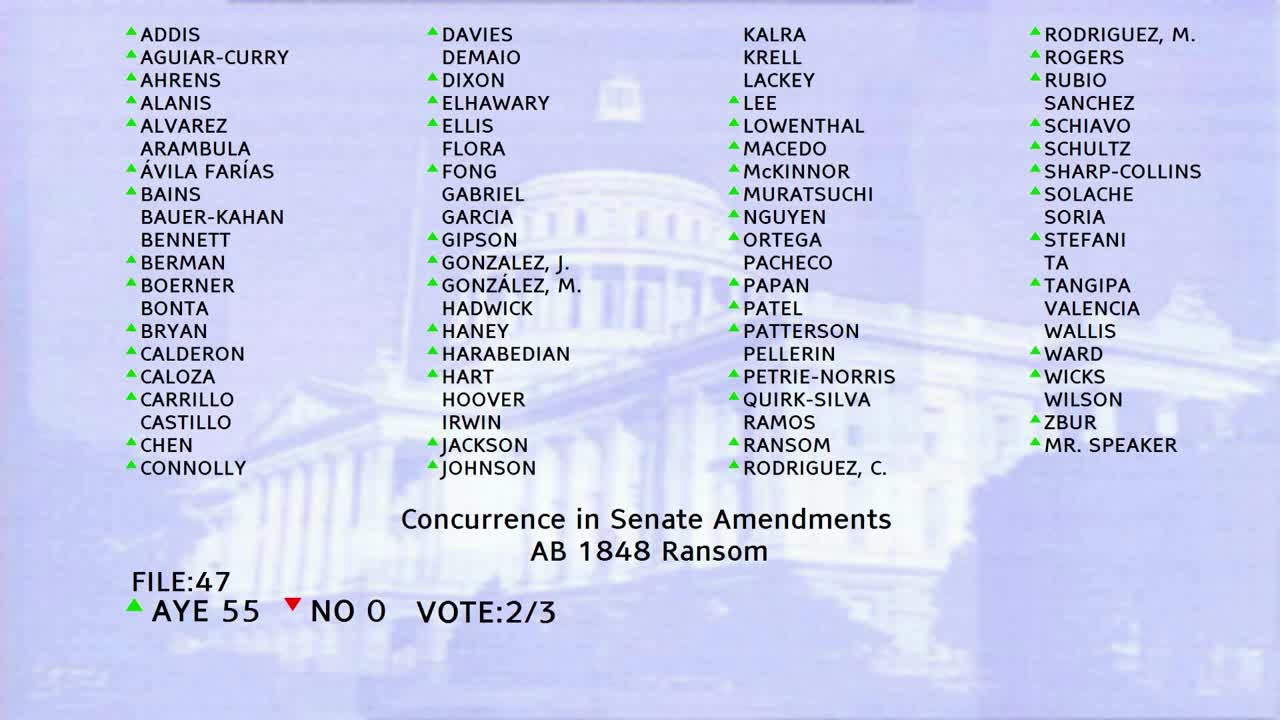
Bill Author

Bill Co-Author(s):