AB 1994: Defending Immigrant Victims Act.
- Session Year: 2025-2026
- House: Assembly
- Latest Version Date: 2026-09-29
Current Status:
Passed
(2026-09-29: Chaptered by Secretary of State - Chapter 746, Statutes of 2026.)
Introduced
In Committee
Awaiting First Chamber Vote
Passed First Chamber
In Committee
Awaiting Second Chamber Vote
Passed Second Chamber
Enacted
Existing law, as added by Proposition 9, the Victims Bill of Rights Act of 2008: Marsys Law (Marsys Law), at the November 4, 2008, statewide general election, requires a law enforcement agency investigating a criminal act and an agency prosecuting a criminal act to, at the time of initial contact with a crime victim, during followup investigation, or as soon thereafter as deemed appropriate, provide or make available to the victim a Marsy Rights card that contains the constitutional rights of crime victims without charge or cost to the victim. Marsys Law provides that its provisions shall not be amended by the Legislature except by a statute passed in each house by rollcall vote entered in the journal, 3/4 of the membership of each house concurring. Marsys Law also provides that the Legislature may amend its provisions to expand the scope of its application, to recognize additional rights of victims of crime, or to further the rights of victims of crime by a statute passed by a majority vote of the membership of each house.
Existing law requires a law enforcement agency investigating a criminal act and an agency prosecuting a criminal act to, at the time of initial contact with a crime victim, during followup investigation, or as soon thereafter as deemed appropriate by investigating officers or prosecuting attorneys, inform each victim of the rights they have under applicable law relating to the victimization and provide each victim without charge or cost a Victim Protections and Resources card. Existing law requires the Attorney General to design and make available in PDF or other imaging format this card with specified information on the card, including information about federal immigration relief available to certain victims of crime.
Commencing no later than January 1, 2028, this bill, the Defending Immigrant Victims Act, would require a law enforcement agency investigating a criminal act and an agency prosecuting a criminal act, at the time of initial contact with a crime victim, during followup investigation, or as soon thereafter as deemed appropriate by investigating officers or prosecuting attorneys, to inform each victim, the victims next of kin if the victim is deceased, or the victims parent or guardian if the victim is a minor of the rights they may have under applicable law relating to immigration relief. The bill would require a law enforcement agency and a prosecuting agency to provide a victim an Immigrant Victims Rights and Resources card that would provide specified information pertaining to the victims rights, including a statement explaining how to consult an immigration attorney to help determine eligibility for immigration relief. The bill would require the Attorney General, by January 1, 2028, to design the card and make it available in English, Spanish, and any other language in which the Marsy Rights card is currently translated, and in a PDF or other imaging format, to law enforcement agencies and agencies prosecuting crimes, as specified.
Because this bill would result in additional duties on local law enforcement and prosecuting agencies in informing victims, this bill would impose a state-mandated local program.
This bill would make a conforming change.
The California Constitution requires the state to reimburse local agencies and school districts for certain costs mandated by the state. Statutory provisions establish procedures for making that reimbursement.
This bill would provide that, if the Commission on State Mandates determines that the bill contains costs mandated by the state, reimbursement for those costs shall be made pursuant to the statutory provisions noted above.
Existing law, as added by Proposition 9, the Victims Bill of Rights Act of 2008: Marsys Law (Marsys Law), at the November 4, 2008, statewide general election, requires a law enforcement agency investigating a criminal act and an agency prosecuting a criminal act to, at the time of initial contact with a crime victim, during followup investigation, or as soon thereafter as deemed appropriate, provide or make available to the victim a Marsy Rights card that contains the constitutional rights of crime victims without charge or cost to the victim. Marsys Law provides that its provisions shall not be amended by the Legislature except by a statute passed in each house by rollcall vote entered in the journal, 3/4 of the membership of each house concurring. Marsys Law also provides that the Legislature may amend its provisions to expand the scope of its application, to recognize additional rights of victims of crime, or to further the rights of victims of crime by a statute passed by a majority vote of the membership of each house.
Existing law requires a law enforcement agency investigating a criminal act and an agency prosecuting a criminal act to, at the time of initial contact with a crime victim, during followup investigation, or as soon thereafter as deemed appropriate by investigating officers or prosecuting attorneys, inform each victim of the rights they have under applicable law relating to the victimization and provide each victim without charge or cost a Victim Protections and Resources card. Existing law requires the Attorney General to design and make available in PDF or other imaging format this card with specified information on the card, including information about federal immigration relief available to certain victims of crime.
ThisCommencing no later than January 1, 2028, this bill, the Defending Immigrant Victims Act, would require a law enforcement agency investigating a criminal act and an agency prosecuting a criminal act, at the time of initial contact with a crime victim, during followup investigation, or as soon thereafter as deemed appropriate by investigating officers or prosecuting attorneys, to inform each victim, the victims next of kin if the victim is deceased, or the victims parent or guardian if the victim is a minor of the rights they may have under applicable law relating to immigration relief. The bill would require a law enforcement agency and a prosecuting agency to provide a victim an Immigrant Victims Rights and Resources card that would provide specified information pertaining to the victims rights, including a statement explaining how to consult an immigration attorney to help determine eligibility for immigration relief. The bill would require the Attorney General, by January 1, 2028, to design the card and make it available in English, Spanish, and any other language in which the Marsy Rights card is currently translated, and in a PDF or other imaging format, to law enforcement agencies and agencies prosecuting crimes, as specified.
Because this bill would result in additional duties on local law enforcement and prosecuting agencies in informing victims, this bill would impose a state-mandated local program.
This bill would make a conforming change.
The California Constitution requires the state to reimburse local agencies and school districts for certain costs mandated by the state. Statutory provisions establish procedures for making that reimbursement.
This bill would provide that, if the Commission on State Mandates determines that the bill contains costs mandated by the state, reimbursement for those costs shall be made pursuant to the statutory provisions noted above.
Existing law, as added by Proposition 9, the Victims Bill of Rights Act of 2008: Marsys Law (Marsys Law), at the November 4, 2008, statewide general election, requires a law enforcement agency investigating a criminal act and an agency prosecuting a criminal act to, at the time of initial contact with a crime victim, during followup investigation, or as soon thereafter as deemed appropriate, provide or make available to the victim a Marsy Rights card that contains the constitutional rights of crime victims without charge or cost to the victim. Marsys Law provides that its provisions shall not be amended by the Legislature except by a statute passed in each house by rollcall vote entered in the journal, 3/4 of the membership of each house concurring. Marsys Law also provides that the Legislature may amend its provisions to expand the scope of its application, to recognize additional rights of victims of crime, or to further the rights of victims of crime by a statute passed by a majority vote of the membership of each house.
Existing law requires a law enforcement agency investigating a criminal act and an agency prosecuting a criminal act to, at the time of initial contact with a crime victim, during followup investigation, or as soon thereafter as deemed appropriate by investigating officers or prosecuting attorneys, inform each victim of the rights they have under applicable law relating to the victimization and provide each victim without charge or cost a Victim Protections and Resources card. Existing law requires the Attorney General to design and make available in PDF or other imaging format this card with specified information on the card, including information about federal immigration relief available to certain victims of crime.
This bill, the Defending Immigrant Victims Act, would require a law enforcement agency investigating a criminal act and an agency prosecuting a criminal act, at the time of initial contact with a crime victim, during followup investigation, or as soon thereafter as deemed appropriate by investigating officers or prosecuting attorneys, to inform each victim, the victims next of kin if the victim is deceased, or the victims parent or guardian if the victim is a minor of the rights they may have under applicable law relating to immigration relief. The bill would require a law enforcement agency and a prosecuting agency to provide a victim an Immigrant Victims Rights and Resources card that would provide specified information pertaining to the victims rights, including a statement explaining how to consult an immigration attorney to help determine eligibility for immigration relief. The bill would require the Attorney General, by January 1, 2028, to design the card and make it available in English, Spanish, and any other language in which the Marsy Rights card is currently translated, and in a PDF or other imaging format, to law enforcement agencies and agencies prosecuting crimes, as specified.
Because this bill would result in additional duties on local law enforcement and prosecuting agencies in informing victims, this bill would impose a state-mandated local program.
This bill would make a conforming change.
The California Constitution requires the state to reimburse local agencies and school districts for certain costs mandated by the state. Statutory provisions establish procedures for making that reimbursement.
This bill would provide that, if the Commission on State Mandates determines that the bill contains costs mandated by the state, reimbursement for those costs shall be made pursuant to the statutory provisions noted above.
Existing law, as added by Proposition 9, the Victims Bill of Rights Act of 2008: Marsys Law (Marsys Law), at the November 4, 2008, statewide general election, requires a law enforcement agency investigating a criminal act and an agency prosecuting a criminal act to, at the time of initial contact with a crime victim, during followup investigation, or as soon thereafter as deemed appropriate, provide or make available to the victim a Marsy Rights card that contains the constitutional rights of crime victims without charge or cost to the victim. Marsys Law provides that its provisions shall not be amended by the Legislature except by a statute passed in each house by rollcall vote entered in the journal, 3/4 of the membership of each house concurring. Marsys Law also provides that the Legislature may amend its provisions to expand the scope of its application, to recognize additional rights of victims of crime, or to further the rights of victims of crime by a statute passed by a majority vote of the membership of each house.
Existing law requires a law enforcement agency investigating a criminal act and an agency prosecuting a criminal act to, at the time of initial contact with a crime victim, during followup investigation, or as soon thereafter as deemed appropriate by investigating officers or prosecuting attorneys, inform each victim of the rights they have under applicable law relating to the victimization and provide each victim without charge or cost a Victim Protections and Resources card. Existing law requires the Attorney General to design and make available in PDF or other imaging format this card with specified information on the card, including information about federal immigration relief available to certain victims of crime.
This bill, the Defending Immigrant Victims Act, would require a law enforcement agency investigating a criminal act and an agency prosecuting a criminal act, at the time of initial contact with a crime victim, during followup investigation, or as soon thereafter as deemed appropriate by investigating officers or prosecuting attorneys, to inform each victim, the victims next of kin if the victim is deceased, or the victims parent or guardian if the victim is a minor of the rights they may have under applicable law relating to immigration relief. The bill would require a law enforcement agency and a prosecuting agency to provide a victim an Immigrant Victims Rights and Resources card that would provide specified information pertaining to the victims rights, including a statement about undocumented immigrants rights under the Fourth and Fifth Amendments to the United States Constitution. explaining how to consult an immigration attorney to help determine eligibility for immigration relief. The bill would, by June 1, 2027, would require the Attorney General General, by January 1, 2028, to design the card and make it available in English and Spanish English, Spanish, and any other language in which the Marsy Rights card is currently translated, and in a PDF or other imaging format format, to law enforcement agencies and agencies prosecuting crimes, as specified.
Because this bill would result in additional duties on local law enforcement and prosecuting agencies in informing victims, this bill would impose a state-mandated local program.
This bill would make a conforming change.
The California Constitution requires the state to reimburse local agencies and school districts for certain costs mandated by the state. Statutory provisions establish procedures for making that reimbursement.
This bill would provide that, if the Commission on State Mandates determines that the bill contains costs mandated by the state, reimbursement for those costs shall be made pursuant to the statutory provisions noted above.
Existing law, as added by Proposition 9, the Victims Bill of Rights Act of 2008: Marsys Law (Marsys Law), at the November 4, 2008, statewide general election, requires a law enforcement agency investigating a criminal act and an agency prosecuting a criminal act to, at the time of initial contact with a crime victim, during followup investigation, or as soon thereafter as deemed appropriate, provide or make available to the victim a Marsy Rights card that contains the constitutional rights of crime victims without charge or cost to the victim. Marsys Law provides that its provisions shall not be amended by the Legislature except by a statute passed in each house by rollcall vote entered in the journal, 3/4 of the membership of each house concurring. Marsys Law also provides that the Legislature may amend its provisions to expand the scope of its application, to recognize additional rights of victims of crime, or to further the rights of victims of crime by a statute passed by a majority vote of the membership of each house.
Existing law requires a law enforcement agency investigating a criminal act and an agency prosecuting a criminal act to, at the time of initial contact with a crime victim, during followup investigation, or as soon thereafter as deemed appropriate by investigating officers or prosecuting attorneys, inform each victim of the rights they have under applicable law relating to the victimization and provide each victim without charge or cost a Victim Protections and Resources card. Existing law requires the Attorney General to design and make available in PDF or other imaging format this card with specified information on the card, including information about federal immigration relief available to certain victims of crime.
This bill, the Defending Immigrant Victims Act, would require a law enforcement agency investigating a criminal act and an agency prosecuting a criminal act, at the time of initial contact with a crime victim, during followup investigation, or within 14 days of the crime being reported, as soon thereafter as deemed appropriate by investigating officers or prosecuting attorneys, to inform each victim, the victims next of kin if the victim is deceased, or the victims parent or guardian if the victim is a minor, or any key witness minor of the rights they may have under applicable law relating to immigration relief, including verbal notification of potential eligibility for immigration relief options such as the U nonimmigrant statute (U visa), T nonimmigrant status (T visa), or under the federal Violence Against Women Act, and verbal notification that they may consult an immigration attorney to help determine their eligibility. relief. The bill would require a law enforcement agency and a prosecuting agency to provide a victim an Immigrant Victims Rights and Resources card that would provide specified information pertaining to the victims rights, including a statement about undocumented immigrants rights under the Fourth and Fifth Amendments to the United States Constitution. The bill would, by June 1, 2027, require the Attorney General to design the card and make it available in English and Spanish in a PDF or other imaging format to law enforcement agencies and agencies prosecuting crimes, as specified.
Because this bill would result in additional duties on local law enforcement and prosecuting agencies in informing victims, this bill would impose a state-mandated local program.
This bill would make a conforming change.
The California Constitution requires the state to reimburse local agencies and school districts for certain costs mandated by the state. Statutory provisions establish procedures for making that reimbursement.
This bill would provide that, if the Commission on State Mandates determines that the bill contains costs mandated by the state, reimbursement for those costs shall be made pursuant to the statutory provisions noted above.
Existing law, as added by Proposition 9, the Victims Bill of Rights Act of 2008: Marsys Law (Marsys Law), at the November 4, 2008, statewide general election, requires a law enforcement agency investigating a criminal act and an agency prosecuting a criminal act to, at the time of initial contact with a crime victim, during followup investigation, or as soon thereafter as deemed appropriate, provide or make available to the victim a Marsy Rights card that contains the constitutional rights of crime victims without charge or cost to the victim. Marsys Law provides that its provisions shall not be amended by the Legislature except by a statute passed in each house by rollcall vote entered in the journal, 3/4 of the membership of each house concurring. Marsys Law also provides that the Legislature may amend its provisions to expand the scope of its application, to recognize additional rights of victims of crime, or to further the rights of victims of crime by a statute passed by a majority vote of the membership of each house.
Existing law requires a law enforcement agency investigating a criminal act and an agency prosecuting a criminal act to, at the time of initial contact with a crime victim, during followup investigation, or as soon thereafter as deemed appropriate by investigating officers or prosecuting attorneys, inform each victim of the rights they have under applicable law relating to the victimization and provide each victim without charge or cost a Victim Protections and Resources card. Existing law requires the Attorney General to design and make available in PDF or other imaging format this card with specified information on the card, including information about federal immigration relief available to certain victims of crime.
This bill, the Defending Immigrant Victims Act, would require a law enforcement agency investigating a criminal act and an agency prosecuting a criminal act, at the time of initial contact with a crime victim, during followup investigation, or within 14 days of the crime being reported, to inform each victim, the victims next of kin if the victim is deceased, the victims parent or guardian if the victim is a minor, or any key witness of the rights they may have under applicable law relating to immigration relief, including verbal notification of potential eligibility for immigration relief options such as the U nonimmigrant statute (U visa), T nonimmigrant status (T visa), or under the federal Violence Against Women Act, and verbal notification that they may consult an immigration attorney to help determine their eligibility. The bill would require a law enforcement agency and a prosecuting agency to provide a victim an Immigrant Victims Rights and Resources card that would provide specified information pertaining to the victims rights, including a statement about undocumented immigrants rights under the Fourth and Fifth Amendments to the United States Constitution. The bill would, by June 1, 2027, require the Attorney General to design the card and make it available in English and Spanish in a PDF or other imaging format to law enforcement agencies and agencies prosecuting crimes, as specified.
Because this bill would result in additional duties on local law enforcement and prosecuting agencies in informing victims, this bill would impose a state-mandated local program.
This bill would make a conforming change.
The California Constitution requires the state to reimburse local agencies and school districts for certain costs mandated by the state. Statutory provisions establish procedures for making that reimbursement.
This bill would provide that, if the Commission on State Mandates determines that the bill contains costs mandated by the state, reimbursement for those costs shall be made pursuant to the statutory provisions noted above.
This act shall be known, and may be cited, as the Defending Immigrant Victims Act.
SEC. 2.(a)The Legislature finds and declares all of the following:
(1)California is home to 10,600,000 immigrants.
(2)About 1,800,000 Californians are undocumented immigrants.
(3)The Victims of Trafficking and Violence Protection Act was enacted by Congress in 2000 (Public Law 106-386) to encourage immigrants to report crimes to law enforcement by offering them legal pathways to temporary and eventually permanent legal status in the United States for victims of certain crimes who cooperate with law enforcement.
(4)Since the first U nonimmigrant status (U visa) was issued in 2009, applications have steadily increased. In 2024, there were 246,137 pending U visa applications. U visas serve as an important immigration relief option for immigrant victims who have suffered substantial harm from serious crimes.
(5)Immigrant families are facing increasing threats of deportation.
(b)It is the intent of the Legislature to do all of the following:
(1)Ensure undocumented immigrant victims of serious crimes in California are informed of the U visa program established by the Victims of Trafficking and Violence Protection Act in addition to other potential immigration relief options.
(2)Reaffirm Californias commitment to supporting immigrant victims on their journey to recovery.
(3)Improve public safety by rebuilding the relationship between local law enforcement and the public by clarifying to immigrant communities that local law enforcement does not enforce federal immigration laws in California.
(4)Encourage immigrant victims to report crimes to local law enforcement and aid law enforcement throughout their investigation to prosecute perpetrators and serve justice.
(5)Protect immigrant victims, who are seeking justice.
(6)Connect immigrant victims of crimes with low-cost, accredited, local immigration legal service providers.
SEC. 3.Section 679.027 of the Penal Code is amended to read:679.027.(a)Every law enforcement agency investigating a criminal act and every agency prosecuting a criminal act shall, as provided herein, at the time of initial contact with a crime victim, during followup investigation, or as soon thereafter as deemed appropriate by investigating officers or prosecuting attorneys, inform each victim, or the victims next of kin if the victim is deceased, of the rights they may have under applicable law relating to the victimization, including rights relating to housing, employment, compensation, and immigration relief.
(b)(1)Every law enforcement agency investigating a criminal act and every agency prosecuting a criminal act shall, as provided herein, at the time of initial contact with a crime victim, during followup investigation, or as soon thereafter as deemed appropriate by investigating officers or prosecuting attorneys, provide or make available to each victim of the criminal act without charge or cost a Victim Protections and Resources card described in paragraph (3).
(2)The Victim Protections and Resources card may be designed as part of, and included with, the Marsy Rights card described by Section 679.026.
(3)By June 1, 2025, the Attorney General shall design and make available in PDF or other imaging format to every agency listed in paragraph (1) a Victim Protections and Resources card, which shall contain information in lay terms about victim rights and resources, including, but not limited to, the following:
(A)Information about the rights provided by Section 12945.8 of the Government Code.
(B)Information about the rights provided by Section 1946.7 of the Civil Code.
(C)Information about the rights provided by Section 1161.3 of the Code of Civil Procedure, including information in lay terms about which crimes and tenants are eligible and under what circumstances.
(D)Information about the program established by Chapter 5 (commencing with Section 13950) of Part 4 of Division 3 of Title 2 of the Government Code, including information about the types of expenses the program may reimburse, eligibility, and how to apply.
(E)Information about the program established by Chapter 3.1 (commencing with Section 6205) of Division 7 of Title 1 of the Government Code.
(F)Information about eligibility for filing a restraining or protective order.
(G)Contact information for the Victims Legal Resource Center established by Chapter 11 (commencing with Section 13897) of Title 6 of Part 4.
(H)A list of trauma recovery centers funded by the state pursuant to Section 13963.1 of the Government Code, with their contact information, which shall be updated annually.
(I)The availability of community-based restorative justice programs and processes available to them, including programs serving their community, county, county jails, juvenile detention facilities, and the Department of Corrections and Rehabilitation.
(c)This section shall become operative on July 1, 2024, only if General Fund moneys over the multiyear forecasts beginning in the 202425 fiscal year are available to support ongoing augmentations and actions, and if an appropriation is made to backfill the Restitution Fund to support the actions in this section.
SEC. 4.Section 679.028 is added to the Penal Code, to read:679.028.(a)Commencing no later than January 1, 2028, every law enforcement agency investigating a criminal act and every agency prosecuting a criminal act shall, as provided in this section, at the time of initial contact with a crime victim, during followup investigation, or as soon thereafter as deemed appropriate by investigating officers or prosecuting attorneys, inform each victim, the victims next of kin if the victim is deceased, or the victims parent or guardian if the victim is a minor of the rights they may have under applicable law relating to immigration relief.
(b)Every law enforcement agency investigating a criminal act and every agency prosecuting a criminal act shall, as provided in this section, at the time of initial contact with a crime victim, during followup investigation, or as soon thereafter as deemed appropriate by investigating officers or prosecuting attorneys, provide or make available to each victim, the victims next of kin if the victim is deceased, or the victims parent or guardian if the victim is a minor, without charge or cost, an Immigrant Victims Rights and Resources card, as described in subdivision (d).
(c)The Immigrant Victims Rights and Resources card may be designed as part of, and included with, the Marsy Rights card described by Section 679.026.
(d)By January 1, 2028, the Attorney General shall design and make available in English, Spanish, and any other language in which the Marsy Rights card is currently translated, a PDF or other imaging format to every agency described in subdivision (b) an Immigrant Victims Rights and Resources card, which shall contain information in lay terms about immigrant victims rights and resources, including, but not limited to, all of the following:
(1)A statement about undocumented immigrants potential eligibility for immigration relief options such as a U visa, T visa, relief under VAWA, or other immigration relief as a potential victim of a qualifying crime.
(2)Notification that in order to remain eligible for a T visa or U visa, qualifying victims must remain cooperative throughout the investigation or prosecution of the perpetrator.
(3)A statement about how they can consult an immigration attorney to help determine their eligibility for immigration relief.
(4)The internet website address of the list of immigration legal services providers maintained by the State Department of Social Services.
SEC. 5.If the Commission on State Mandates determines that this act contains costs mandated by the state, reimbursement to local agencies and school districts for those costs shall be made pursuant to Part 7 (commencing with Section 17500) of Division 4 of Title 2 of the Government Code.
This act shall be known, and may be cited, as the Defending Immigrant Victims Act.
SEC. 2.(a)The Legislature finds and declares all of the following:
(1)California is home to 10,600,000 immigrants.
(2)About 1,800,000 Californians are undocumented immigrants.
(3)The Victims of Trafficking and Violence Protection Act was enacted by Congress in 2000 (Public Law 106-386) to encourage immigrants to report crimes to law enforcement by offering them legal pathways to temporary and eventually permanent legal status in the United States for victims of certain crimes who cooperate with law enforcement.
(4)Since the first U nonimmigrant status (U visa) was issued in 2009, applications have steadily increased. In 2024, there were 246,137 pending U visa applications. U visas serve as an important immigration relief option for immigrant victims who have suffered substantial harm from serious crimes.
(5)Immigrant families are facing increasing threats of deportation.
(b)It is the intent of the Legislature to do all of the following:
(1)Ensure undocumented immigrant victims of serious crimes in California are informed of the U visa program established by the Victims of Trafficking and Violence Protection Act in addition to other potential immigration relief options.
(2)Reaffirm Californias commitment to supporting immigrant victims on their journey to recovery.
(3)Improve public safety by rebuilding the relationship between local law enforcement and the public by clarifying to immigrant communities that local law enforcement does not enforce federal immigration laws in California.
(4)Encourage immigrant victims to report crimes to local law enforcement and aid law enforcement throughout their investigation to prosecute perpetrators and serve justice.
(5)Protect immigrant victims, who are seeking justice.
(6)Connect immigrant victims of crimes with low-cost, accredited, local immigration legal service providers.
SEC. 3.Section 679.027 of the Penal Code is amended to read:679.027.(a)Every law enforcement agency investigating a criminal act and every agency prosecuting a criminal act shall, as provided herein, at the time of initial contact with a crime victim, during followup investigation, or as soon thereafter as deemed appropriate by investigating officers or prosecuting attorneys, inform each victim, or the victims next of kin if the victim is deceased, of the rights they may have under applicable law relating to the victimization, including rights relating to housing, employment, compensation, and immigration relief.
(b)(1)Every law enforcement agency investigating a criminal act and every agency prosecuting a criminal act shall, as provided herein, at the time of initial contact with a crime victim, during followup investigation, or as soon thereafter as deemed appropriate by investigating officers or prosecuting attorneys, provide or make available to each victim of the criminal act without charge or cost a Victim Protections and Resources card described in paragraph (3).
(2)The Victim Protections and Resources card may be designed as part of, and included with, the Marsy Rights card described by Section 679.026.
(3)By June 1, 2025, the Attorney General shall design and make available in PDF or other imaging format to every agency listed in paragraph (1) a Victim Protections and Resources card, which shall contain information in lay terms about victim rights and resources, including, but not limited to, the following:
(A)Information about the rights provided by Section 12945.8 of the Government Code.
(B)Information about the rights provided by Section 1946.7 of the Civil Code.
(C)Information about the rights provided by Section 1161.3 of the Code of Civil Procedure, including information in lay terms about which crimes and tenants are eligible and under what circumstances.
(D)Information about the program established by Chapter 5 (commencing with Section 13950) of Part 4 of Division 3 of Title 2 of the Government Code, including information about the types of expenses the program may reimburse, eligibility, and how to apply.
(E)Information about the program established by Chapter 3.1 (commencing with Section 6205) of Division 7 of Title 1 of the Government Code.
(F)Information about eligibility for filing a restraining or protective order.
(G)Contact information for the Victims Legal Resource Center established by Chapter 11 (commencing with Section 13897) of Title 6 of Part 4.
(H)A list of trauma recovery centers funded by the state pursuant to Section 13963.1 of the Government Code, with their contact information, which shall be updated annually.
(I)The availability of community-based restorative justice programs and processes available to them, including programs serving their community, county, county jails, juvenile detention facilities, and the Department of Corrections and Rehabilitation.
(c)This section shall become operative on July 1, 2024, only if General Fund moneys over the multiyear forecasts beginning in the 202425 fiscal year are available to support ongoing augmentations and actions, and if an appropriation is made to backfill the Restitution Fund to support the actions in this section.
SEC. 4.Section 679.028 is added to the Penal Code, to read:679.028.(a)Every Commencing no later than January 1, 2028, every law enforcement agency investigating a criminal act and every agency prosecuting a criminal act shall, as provided in this section, at the time of initial contact with a crime victim, during followup investigation, or as soon thereafter as deemed appropriate by investigating officers or prosecuting attorneys, inform each victim, the victims next of kin if the victim is deceased, or the victims parent or guardian if the victim is a minor of the rights they may have under applicable law relating to immigration relief.
(b)Every law enforcement agency investigating a criminal act and every agency prosecuting a criminal act shall, as provided in this section, at the time of initial contact with a crime victim, during followup investigation, or as soon thereafter as deemed appropriate by investigating officers or prosecuting attorneys, provide or make available to each victim, the victims next of kin if the victim is deceased, or the victims parent or guardian if the victim is a minor, without charge or cost, an Immigrant Victims Rights and Resources card, as described in subdivision (d).
(c)The Immigrant Victims Rights and Resources card may be designed as part of, and included with, the Marsy Rights card described by Section 679.026.
(d)By January 1, 2028, the Attorney General shall design and make available in English, Spanish, and any other language in which the Marsy Rights card is currently translated, a PDF or other imaging format to every agency described in subdivision (b) an Immigrant Victims Rights and Resources card, which shall contain information in lay terms about immigrant victims rights and resources, including, but not limited to, all of the following:
(1)A statement about undocumented immigrants potential eligibility for immigration relief options such as a U visa, T visa, relief under VAWA, or other immigration relief as a potential victim of a qualifying crime.
(2)Notification that in order to remain eligible for a T visa or U visa, qualifying victims must remain cooperative throughout the investigation or prosecution of the perpetrator.
(3)A statement about how they can consult an immigration attorney to help determine their eligibility for immigration relief.
(4)The internet website address of the list of immigration legal services providers maintained by the State Department of Social Services.
SEC. 5.If the Commission on State Mandates determines that this act contains costs mandated by the state, reimbursement to local agencies and school districts for those costs shall be made pursuant to Part 7 (commencing with Section 17500) of Division 4 of Title 2 of the Government Code.
This act shall be known, and may be cited, as the Defending Immigrant Victims Act.
SEC. 2.(a)The Legislature finds and declares all of the following:
(1)California is home to 10,600,000 immigrants.
(2)About 1,800,000 Californians are undocumented immigrants.
(3)The Victims of Trafficking and Violence Protection Act was enacted by Congress in 2000 (Public Law 106-386) to encourage immigrants to report crimes to law enforcement by offering them legal pathways to temporary and eventually permanent legal status in the United States for victims of certain crimes who cooperate with law enforcement.
(4)Since the first U nonimmigrant status (U visa) was issued in 2009, applications have steadily increased. In 2024, there were 246,137 pending U visa applications. U visas serve as an important immigration relief option for immigrant victims who have suffered substantial harm from serious crimes.
(5)Immigrant families are facing increasing threats of deportation.
(b)It is the intent of the Legislature to do all of the following:
(1)Ensure undocumented immigrant victims of serious crimes in California are informed of the U visa program established by the Victims of Trafficking and Violence Protection Act in addition to other potential immigration relief options.
(2)Reaffirm Californias commitment to supporting immigrant victims on their journey to recovery.
(3)Improve public safety by rebuilding the relationship between local law enforcement and the public by clarifying to immigrant communities that local law enforcement does not enforce federal immigration laws in California.
(4)Encourage immigrant victims to report crimes to local law enforcement and aid law enforcement throughout their investigation to prosecute perpetrators and serve justice.
(5)Protect immigrant victims, who are seeking justice.
(6)Connect immigrant victims of crimes with low-cost, accredited, local immigration legal service providers.
SEC. 3.Section 679.027 of the Penal Code is amended to read:679.027.(a)Every law enforcement agency investigating a criminal act and every agency prosecuting a criminal act shall, as provided herein, at the time of initial contact with a crime victim, during followup investigation, or as soon thereafter as deemed appropriate by investigating officers or prosecuting attorneys, inform each victim, or the victims next of kin if the victim is deceased, of the rights they may have under applicable law relating to the victimization, including rights relating to housing, employment, compensation, and immigration relief.
(b)(1)Every law enforcement agency investigating a criminal act and every agency prosecuting a criminal act shall, as provided herein, at the time of initial contact with a crime victim, during followup investigation, or as soon thereafter as deemed appropriate by investigating officers or prosecuting attorneys, provide or make available to each victim of the criminal act without charge or cost a Victim Protections and Resources card described in paragraph (3).
(2)The Victim Protections and Resources card may be designed as part of of, and included with with, the Marsy Rights card described by Section 679.026.
(3)By June 1, 2025, the Attorney General shall design and make available in PDF or other imaging format to every agency listed in paragraph (1) a Victim Protections and Resources card, which shall contain information in lay terms about victim rights and resources, including, but not limited to, the following:
(A)Information about the rights provided by Section 12945.8 of the Government Code.
(B)Information about the rights provided by Section 1946.7 of the Civil Code.
(C)Information about the rights provided by Section 1161.3 of the Code of Civil Procedure, including information in lay terms about which crimes and tenants are eligible and under what circumstances.
(D)Information about the program established by Chapter 5 (commencing with Section 13950) of Part 4 of Division 3 of Title 2 of the Government Code, including information about the types of expenses the program may reimburse, eligibility, and how to apply.
(E)Information about the program established by Chapter 3.1 (commencing with Section 6205) of Division 7 of Title 1 of the Government Code.
(F)Information about eligibility for filing a restraining or protective order.
(G)Contact information for the Victims Legal Resource Center established by Chapter 11 (commencing with Section 13897) of Title 6 of Part 4.
(H)A list of trauma recovery centers funded by the state pursuant to Section 13963.1 of the Government Code, with their contact information, which shall be updated annually.
(I)The availability of community-based restorative justice programs and processes available to them, including programs serving their community, county, county jails, juvenile detention facilities, and the Department of Corrections and Rehabilitation.
(c)This section shall become operative on July 1, 2024, only if General Fund moneys over the multiyear forecasts beginning in the 202425 fiscal year are available to support ongoing augmentations and actions, and if an appropriation is made to backfill the Restitution Fund to support the actions in this section.
SEC. 4.Section 679.028 is added to the Penal Code, to read:679.028.(a)Every law enforcement agency investigating a criminal act and every agency prosecuting a criminal act shall, as provided in this section, at the time of initial contact with a crime victim, during followup investigation, or as soon thereafter as deemed appropriate by investigating officers or prosecuting attorneys, inform each victim, the victims next of kin if the victim is deceased, or the victims parent or guardian if the victim is a minor of the rights they may have under applicable law relating to immigration relief.
(b)Every law enforcement agency investigating a criminal act and every agency prosecuting a criminal act shall, as provided in this section, at the time of initial contact with a crime victim, during followup investigation, or as soon thereafter as deemed appropriate by investigating officers or prosecuting attorneys, provide or make available to each victim, the victims next of kin if the victim is deceased, or the victims parent or guardian if the victim is a minor, without charge or cost, an Immigrant Victims Rights and Resources card, as described in subdivision (d).
(c)The Immigrant Victims Rights and Resources card may be designed as part of, and included with, the Marsy Rights card described by Section 679.026.
(d)By January 1, 2028, the Attorney General shall design and make available in English, Spanish, and any other language in which the Marsy Rights card is currently translated, a PDF or other imaging format to every agency described in subdivision (b) an Immigrant Victims Rights and Resources card, which shall contain information in lay terms about immigrant victims rights and resources, including, but not limited to, all of the following:
(1)A statement about undocumented immigrants potential eligibility for immigration relief options such as a U visa, T visa, relief under VAWA, or other immigration relief as a potential victim of a qualifying crime.
(2)Notification that in order to remain eligible for a U visa, qualifying victims must remain cooperative throughout the investigation or prosecution of the perpetrator.
(3)A statement about how they can consult an immigration attorney to help determine their eligibility for immigration relief.
(4)The internet website address of the list of immigration legal services providers maintained by the State Department of Social Services.
SEC. 5.If the Commission on State Mandates determines that this act contains costs mandated by the state, reimbursement to local agencies and school districts for those costs shall be made pursuant to Part 7 (commencing with Section 17500) of Division 4 of Title 2 of the Government Code.
This act shall be known, and may be cited, as the Defending Immigrant Victims Act.
SEC. 2.(a)The Legislature finds and declares all of the following:
(1)California is home to 10,600,000 immigrants.
(2)About 1,800,000 Californians are undocumented immigrants.
(3)The Victims of Trafficking and Violence Protection Act was enacted by Congress in 2000 (Public Law 106-386) to encourage immigrants to report crimes to law enforcement by offering them legal pathways to temporary and eventually permanent legal status in the United States for victims of certain crimes who cooperate with law enforcement.
(4)Since the first U nonimmigrant status (U visa) was issued in 2009, applications have steadily increased. In 2024, there were 246,137 pending U visa applications. U visas serve as an important immigration relief option for immigrant victims who have suffered substantial harm from serious crimes.
(5)Immigrant families are facing increasing threats of deportation.
(b)It is the intent of the Legislature to do all of the following:
(1)Ensure undocumented immigrant victims of serious crimes in California are informed of the U visa program established by the Victims of Trafficking and Violence Protection Act in addition to other potential immigration relief options.
(2)Reaffirm Californias commitment to supporting immigrant victims on their journey to recovery.
(3)Improve public safety by rebuilding the relationship between local law enforcement and the public by clarifying to immigrant communities that local law enforcement does not enforce federal immigration laws in California.
(4)Encourage immigrant victims to report crimes to local law enforcement and aid law enforcement throughout their investigation to prosecute perpetrators and serve justice.
(5)Protect immigrant victims, who are seeking justice.
(6)Connect immigrant victims of crimes with low-cost, accredited, local immigration legal service providers.
SEC. 3.Section 679.027 of the Penal Code is amended to read:679.027.(a)Every law enforcement agency investigating a criminal act and every agency prosecuting a criminal act shall, as provided herein, at the time of initial contact with a crime victim, during followup investigation, or as soon thereafter as deemed appropriate by investigating officers or prosecuting attorneys, inform each victim, or the victims next of kin if the victim is deceased, of the rights they may have under applicable law relating to the victimization, including rights relating to housing, employment, compensation, and immigration relief.
(b)(1)Every law enforcement agency investigating a criminal act and every agency prosecuting a criminal act shall, as provided herein, at the time of initial contact with a crime victim, during followup investigation, or as soon thereafter as deemed appropriate by investigating officers or prosecuting attorneys, provide or make available to each victim of the criminal act without charge or cost a Victim Protections and Resources card described in paragraph (3).
(2)The Victim Protections and Resources Victim Protections and Resources card may be designed as part of and included with the Marsy Rights card described by Section 679.026.
(3)By June 1, 2025, the Attorney General shall design and make available in PDF or other imaging format to every agency listed in paragraph (1) a Victim Protections and Resources card, which shall contain information in lay terms about victim rights and resources, including, but not limited to, the following:
(A)Information about the rights provided by Section 12945.8 of the Government Code.
(B)Information about the rights provided by Section 1946.7 of the Civil Code.
(C)Information about the rights provided by Section 1161.3 of the Code of Civil Procedure, including information in lay terms about which crimes and tenants are eligible and under what circumstances.
(D)Information about the program established by Chapter 5 (commencing with Section 13950) of Part 4 of Division 3 of Title 2 of the Government Code, including information about the types of expenses the program may reimburse, eligibility, and how to apply.
(E)Information about the program established by Chapter 3.1 (commencing with Section 6205) of Division 7 of Title 1 of the Government Code.
(F)Information about eligibility for filing a restraining or protective order.
(G)Contact information for the Victims Legal Resource Center established by Chapter 11 (commencing with Section 13897) of Title 6 of Part 4.
(H)A list of trauma recovery centers funded by the state pursuant to Section 13963.1 of the Government Code, with their contact information, which shall be updated annually.
(I)The availability of community-based restorative justice programs and processes available to them, including programs serving their community, county, county jails, juvenile detention facilities, and the Department of Corrections and Rehabilitation.
(c)This section shall become operative on July 1, 2024, only if General Fund moneys over the multiyear forecasts beginning in the 202425 fiscal year are available to support ongoing augmentations and actions, and if an appropriation is made to backfill the Restitution Fund to support the actions in this section.
SEC. 4.Section 679.028 is added to the Penal Code, to read:679.028.(a)Every law enforcement agency investigating a criminal act and every agency prosecuting a criminal act shall, as provided in this section, at the time of initial contact with a crime victim, during followup investigation, or as soon thereafter as deemed appropriate by investigating officers or prosecuting attorneys, inform each victim, the victims next of kin if the victim is deceased, or the victims parent or guardian if the victim is a minor of the rights they may have under applicable law relating to immigration relief.
(b)Every law enforcement agency investigating a criminal act and every agency prosecuting a criminal act shall, as provided in this section, at the time of initial contact with a crime victim, during followup investigation, or as soon thereafter as deemed appropriate by investigating officers or prosecuting attorneys, provide or make available to each victim, the victims next of kin if the victim is deceased, or the victims parent or guardian if the victim is a minor, without charge or cost, an Immigrant Victims Rights and Resources card, as described in subdivision (d).
(c)The Immigrant Victims Rights and Resources card may be designed as part of, and included with, the Marsy Rights card described by Section 679.026.
(d)By June 1, 2027, January 1, 2028, the Attorney General shall design and make available in both English and Spanish English, Spanish, and any other language in which the Marsy Rights card is currently translated, a PDF or other imaging format to every agency described in subdivision (b) an Immigrant Victims Rights and Resources card, which shall contain information in lay terms about immigrant victims rights and resources, including, but not limited to, all of the following:
(1)A statement about undocumented immigrants potential eligibility for immigration relief options such as a U visa, T visa, relief under VAWA, or other immigration relief as a potential victim of a qualifying crime.
(2)Notification that in order to remain eligible for a U visa, qualifying victims must remain cooperative throughout the investigation or prosecution of the perpetrator.
(3)A statement about how they can consult an immigration attorney to help determine their eligibility for immigration relief.
(4)The internet website address of the list of immigration legal services providers maintained by the State Department of Social Services.
(4)A list of local organizations recognized by the United States Department of Justice Executive Office for Immigration Review as part of the Recognition and Accreditation program, along with the organizations contact information, including, but not limited to, the organizations address, main phone number, and contact email.(5)Notification that the list of organizations described in paragraph (4) offer free or low-cost services.(6)A statement about undocumented immigrants rights under the Fourth Amendment to the United States Constitution in the event of an encounter with immigration agents, including, but not limited to, the right to deny entry to their homes unless presented with a signed judicial warrant naming the individual or a person living at the same household, and the right to deny a search of their belongings unless presented with a signed judicial warrant.(7)A statement about undocumented immigrants rights under the Fifth Amendment to the United States Constitution, including, but not limited to, the right to remain silent and the right to refuse signing any documents in the event of an encounter with immigration agents.(8)A statement about undocumented immigrants rights to speak to an attorney.SEC. 5.If the Commission on State Mandates determines that this act contains costs mandated by the state, reimbursement to local agencies and school districts for those costs shall be made pursuant to Part 7 (commencing with Section 17500) of Division 4 of Title 2 of the Government Code.
This act shall be known, and may be cited, as the Defending Immigrant Victims Act.
SEC. 2.(a)The Legislature finds and declares all of the following:
(1)California is home to 10,600,000 immigrants.
(2)About 1,800,000 Californians are undocumented immigrants.
(3)The Victims of Trafficking and Violence Protection Act was enacted by Congress in 2000 (Public Law 106-386) to encourage immigrants to report crimes to law enforcement by offering them legal pathways to temporary and eventually permanent legal status in the United States for victims of certain crimes who cooperate with law enforcement.
(4)Since the first U nonimmigrant status (U visa) was issued in 2009, applications have steadily increased. In 2024, there were 246,137 pending U visa applications. U visas serve as an important immigration relief option for immigrant victims who have suffered substantial harm from serious crimes.
(5)Immigrant families are facing increasing threats of deportation.
(b)It is the intent of the Legislature to do all of the following:
(1)Ensure undocumented immigrant victims of serious crimes in California are informed of the U visa program established by the Victims of Trafficking and Violence Protection Act in addition to other potential immigration relief options.
(2)Reaffirm Californias commitment to supporting immigrant victims on their journey to recovery.
(3)Improve public safety by rebuilding the relationship between local law enforcement and the public by clarifying to immigrant communities that local law enforcement does not enforce federal immigration laws in California.
(4)Encourage immigrant victims to report crimes to local law enforcement and aid law enforcement throughout their investigation to prosecute perpetrators and serve justice.
(5)Protect immigrant victims, who are seeking justice.
(6)Connect immigrant victims of crimes with low-cost, accredited, local immigration legal service providers.
SEC. 3.Section 679.027 of the Penal Code is amended to read:679.027.(a)Every law enforcement agency investigating a criminal act and every agency prosecuting a criminal act shall, as provided herein, at the time of initial contact with a crime victim, during followup investigation, or as soon thereafter as deemed appropriate by investigating officers or prosecuting attorneys, inform each victim, or the victims next of kin if the victim is deceased, of the rights they may have under applicable law relating to the victimization, including rights relating to housing, employment, compensation, and immigration relief.
(b)(1)Every law enforcement agency investigating a criminal act and every agency prosecuting a criminal act shall, as provided herein, at the time of initial contact with a crime victim, during followup investigation, or as soon thereafter as deemed appropriate by investigating officers or prosecuting attorneys, provide or make available to each victim of the criminal act without charge or cost a Victim Protections and Resources card described in paragraph (3).
(2)The Victim Protections and Resources card may be designed as part of and included with the Marsy Rights card described by Section 679.026.
(3)By June 1, 2025, the Attorney General shall design and make available in PDF or other imaging format to every agency listed in paragraph (1) a Victim Protections and Resources card, which shall contain information in lay terms about victim rights and resources, including, but not limited to, the following:
(A)Information about the rights provided by Section 12945.8 of the Government Code.
(B)Information about the rights provided by Section 1946.7 of the Civil Code.
(C)Information about the rights provided by Section 1161.3 of the Code of Civil Procedure, including information in lay terms about which crimes and tenants are eligible and under what circumstances.
(D)Information about the program established by Chapter 5 (commencing with Section 13950) of Part 4 of Division 3 of Title 2 of the Government Code, including information about the types of expenses the program may reimburse, eligibility, and how to apply.
(E)Information about the program established by Chapter 3.1 (commencing with Section 6205) of Division 7 of Title 1 of the Government Code.
(F)Information about eligibility for filing a restraining or protective order.
(G)Contact information for the Victims Legal Resource Center established by Chapter 11 (commencing with Section 13897) of Title 6 of Part 4.
(H)A list of trauma recovery centers funded by the state pursuant to Section 13963.1 of the Government Code, with their contact information, which shall be updated annually.
(I)The availability of community-based restorative justice programs and processes available to them, including programs serving their community, county, county jails, juvenile detention facilities, and the Department of Corrections and Rehabilitation.
(c)This section shall become operative on July 1, 2024, only if General Fund moneys over the multiyear forecasts beginning in the 202425 fiscal year are available to support ongoing augmentations and actions, and if an appropriation is made to backfill the Restitution Fund to support the actions in this section.
SEC. 4.Section 679.028 is added to the Penal Code, to read:679.028.(a)Every law enforcement agency investigating a criminal act and every agency prosecuting a criminal act shall, as provided in this section, at the time of initial contact with a crime victim, during followup investigation, or within 14 days of the crime being reported, as soon thereafter as deemed appropriate by investigating officers or prosecuting attorneys, inform each victim, the victims next of kin if the victim is deceased, or the victims parent or guardian if the victim is a minor, or any key witness minor of the rights they may have under applicable law relating to immigration relief. This information shall include, but is not limited to, all of the following:
(1)Verbal notification of potential eligibility for immigration relief options such as the U nonimmigrant status (U visa), T nonimmigrant status (T visa), options under the federal Violence Against Women Act (Title IV of Public Law 103-322 and any subsequent amendments thereto) (VAWA), or other immigration relief options as a potential victim of a qualifying crime.(2)Verbal notification that they may consult an immigration attorney to help them determine their eligibility.(3)Verbal notification that in order to remain eligible for a U visa, qualifying victims must remain cooperative throughout the investigation or prosecution of the perpetrator.(4)Verbal notification that the Immigrant Victims Rights and Resources card described in subdivision (d) includes a list of local nonprofit organizations that offer free or low-cost immigration legal services and information about immigrant victims rights and resources.(b)Every law enforcement agency investigating a criminal act and every agency prosecuting a criminal act shall, as provided in this section, at the time of initial contact with a crime victim, during followup investigation, or within 14 days of the crime being reported, as soon thereafter as deemed appropriate by investigating officers or prosecuting attorneys, provide or make available to each victim, the victims next of kin if the victim is deceased, or the victims parent or guardian if the victim is a minor, or any key witness of the criminal act, minor, without charge or cost, an Immigrant Victims Rights and Resources card, as described in subdivision (d).
(c)The Immigrant Victims Rights and Resources card may be designed as part of, and included with, the Marsy Rights card described by Section 679.026.
(d)By June 1, 2027, the Attorney General shall design and make available in both English and Spanish a PDF or other imaging format to every agency described in subdivision (b) an Immigrant Victims Rights and Resources card, which shall contain information in lay terms about immigrant victims rights and resources, including, but not limited to, all of the following:
(1)A statement about undocumented immigrants potential eligibility for immigration relief options such as a U visa, T visa, relief under VAWA, or other immigration relief as a potential victim of a qualifying crime.
(2)Notification that in order to remain eligible for a U visa, qualifying victims must remain cooperative throughout the investigation or prosecution of the perpetrator.
(3)A statement about how they can consult an immigration attorney to help determine their eligibility for immigration relief.
(4)A list of local organizations recognized by the United States Department of Justice Executive Office for Immigration Review as part of the Recognition and Accreditation program, along with the organizations contact information, including, but not limited to, the organizations address, main phone number, and contact email.
(5)Notification that the list of organizations described in paragraph (4) offer free or low-cost services.
(6)A statement about undocumented immigrants rights under the Fourth Amendment to the United States Constitution in the event of an encounter with immigration agents, including, but not limited to, the right to deny entry to their homes unless presented with a signed judicial warrant naming the individual or a person living at the same household, and the right to deny a search of their belongings unless presented with a signed judicial warrant.
(7)A statement about undocumented immigrants rights under the Fifth Amendment to the United States Constitution, including, but not limited to, the right to remain silent and the right to refuse signing any documents in the event of an encounter with immigration agents.
(8)A statement about undocumented immigrants rights to speak to an attorney.
SEC. 5.If the Commission on State Mandates determines that this act contains costs mandated by the state, reimbursement to local agencies and school districts for those costs shall be made pursuant to Part 7 (commencing with Section 17500) of Division 4 of Title 2 of the Government Code.
REVISIONS: HeadingLines 2, 3, and 4.This act shall be known, and may be cited, as the Defending Immigrant Victims Act.
SEC. 2.(a)The Legislature finds and declares all of the following:
(1)California is home to 10,600,000 immigrants.
(2)About 1,800,000 Californians are undocumented immigrants.
(3)The Victims of Trafficking and Violence Protection Act was enacted by Congress in 2000 (Public Law 106-386) to encourage immigrants to report crimes to law enforcement by offering them legal pathways to temporary and eventually permanent legal status in the United States for victims of certain crimes who cooperate with law enforcement.
(4)Since the first U nonimmigrant status (U visa) was issued in 2009, applications have steadily increased. In 2024, there were 246,137 pending U visa applications. U visas serve as an important immigration relief option for immigrant victims who have suffered substantial harm from serious crimes.
(5)Immigrant families are facing increasing threats of deportation.
(b)It is the intent of the Legislature to do all of the following:
(1)Ensure undocumented immigrant victims of serious crimes in California are informed of the U visa program established by the Victims of Trafficking and Violence Protection Act in addition to other potential immigration relief options.
(2)Reaffirm Californias commitment to supporting immigrant victims on their journey to recovery.
(3)Improve public safety by rebuilding the relationship between local law enforcement and the public by clarifying to immigrant communities that local law enforcement does not enforce federal immigration laws in California.
(4)Encourage immigrant victims to report crimes to local law enforcement and aid law enforcement throughout their investigation to prosecute perpetrators and serve justice.
(5)Protect immigrant victims, who are seeking justice.
(6)Connect immigrant victims of crimes with low-cost, accredited, local immigration legal service providers.
SEC. 3.Section 679.027 of the Penal Code is amended to read:679.027.(a)Every law enforcement agency investigating a criminal act and every agency prosecuting a criminal act shall, as provided herein, at the time of initial contact with a crime victim, during followup investigation, or as soon thereafter as deemed appropriate by investigating officers or prosecuting attorneys, inform each victim, or the victims next of kin if the victim is deceased, of the rights they may have under applicable law relating to the victimization, including rights relating to housing, employment, compensation, and immigration relief.
(b)(1)Every law enforcement agency investigating a criminal act and every agency prosecuting a criminal act shall, as provided herein, at the time of initial contact with a crime victim, during followup investigation, or as soon thereafter as deemed appropriate by investigating officers or prosecuting attorneys, provide or make available to each victim of the criminal act without charge or cost a Victim Protections and Resources card described in paragraph (3).
(2)The Victim Protections and Resources card may be designed as part of and included with the Marsy Rights card described by Section 679.026.
(3)By June 1, 2025, the Attorney General shall design and make available in PDF or other imaging format to every agency listed in paragraph (1) a Victim Protections and Resources card, which shall contain information in lay terms about victim rights and resources, including, but not limited to, the following:
(A)Information about the rights provided by Section 12945.8 of the Government Code.
(B)Information about the rights provided by Section 1946.7 of the Civil Code.
(C)Information about the rights provided by Section 1161.3 of the Code of Civil Procedure, including information in lay terms about which crimes and tenants are eligible and under what circumstances.
(D)Information about federal immigration relief available to certain victims of crime.(E)(D)Information about the program established by Chapter 5 (commencing with Section 13950) of Part 4 of Division 3 of Title 2 of the Government Code, including information about the types of expenses the program may reimburse, eligibility, and how to apply.
(F)(E)Information about the program established by Chapter 3.1 (commencing with Section 6205) of Division 7 of Title 1 of the Government Code.
(G)(F)Information about eligibility for filing a restraining or protective order.
(H)(G)Contact information for the Victims Legal Resource Center established by Chapter 11 (commencing with Section 13897) of Title 6 of Part 4.
(I)(H)A list of trauma recovery centers funded by the state pursuant to Section 13963.1 of the Government Code, with their contact information, which shall be updated annually.
(J)(I)The availability of community-based restorative justice programs and processes available to them, including programs serving their community, county, county jails, juvenile detention facilities, and the Department of Corrections and Rehabilitation.
(c)This section shall become operative on July 1, 2024, only if General Fund moneys over the multiyear forecasts beginning in the 202425 fiscal year are available to support ongoing augmentations and actions, and if an appropriation is made to backfill the Restitution Fund to support the actions in this section.
SEC. 4.Section 679.028 is added to the Penal Code, to read:679.028.(a)Every law enforcement agency investigating a criminal act and every agency prosecuting a criminal act shall, as provided in this section, at the time of initial contact with a crime victim, during followup investigation, or within 14 days of the crime being reported, inform each victim, the victims next of kin if the victim is deceased, the victims parent or guardian if the victim is a minor, or any key witness of the rights they may have under applicable law relating to immigration relief. This information shall include, but is not limited to, all of the following:
(1)Verbal notification of potential eligibility for immigration relief options such as the U nonimmigrant status (U visa), T nonimmigrant status (T visa), options under the federal Violence Against Women Act (Title IV of Public Law 103-322 and any subsequent amendments thereto) (VAWA), or other immigration relief options as a potential victim of a qualifying crime.
(2)Verbal notification that they may consult an immigration attorney to help them determine their eligibility.
(3)Verbal notification that in order to remain eligible for a U visa, qualifying victims must remain cooperative throughout the investigation or prosecution of the perpetrator.
(4)Verbal notification that the Immigrant Victims Rights and Resources card described in subdivision (d) includes a list of local nonprofit organizations that offer free or low-cost immigration legal services and information about immigrant victims rights and resources.
(b)Every law enforcement agency investigating a criminal act and every agency prosecuting a criminal act shall, as provided in this section, at the time of initial contact with a crime victim, during followup investigation, or within 14 days of the crime being reported, provide or make available to each victim, the victims next of kin if the victim is deceased, the victims parent or guardian if the victim is a minor, or any key witness of the criminal act, without charge or cost, an Immigrant Victims Rights and Resources card, as described in subdivision (d).
(c)The Immigrant Victims Rights and Resources card may be designed as part of, and included with, the Marsy Rights card described by Section 679.026.
(d)By June 1, 2027, the Attorney General shall design and make available in both English and Spanish a PDF or other imaging format to every agency described in subdivision (b) an Immigrant Victims Rights and Resources card, which shall contain information in lay terms about immigrant victims rights and resources, including, but not limited to, all of the following:
(1)A statement about undocumented immigrants potential eligibility for immigration relief options such as a U visa, T visa, relief under VAWA, or other immigration relief as a potential victim of a qualifying crime.
(2)Notification that in order to remain eligible for a U visa, qualifying victims must remain cooperative throughout the investigation or prosecution of the perpetrator.
(3)A statement about how they can consult an immigration attorney to help determine their eligibility for immigration relief.
(4)A list of local organizations recognized by the United States Department of Justice Executive Office for Immigration Review as part of the Recognition and Accreditation program, along with the organizations contact information, including, but not limited to, the organizations address, main phone number, and contact email.
(5)Notification that the list of organizations described in paragraph (4) offer free or low-cost services.
(6)A statement about undocumented immigrants rights under the Fourth Amendment to the United States Constitution in the event of an encounter with immigration agents, including, but not limited to, the right to deny entry to their homes unless presented with a signed judicial warrant naming the individual or a person living at the same household, and the right to deny a search of their belongings unless presented with a signed judicial warrant.
(7)A statement about undocumented immigrants rights under the Fifth Amendment to the United States Constitution, including, but not limited to, the right to remain silent and the right to refuse signing any documents in the event of an encounter with immigration agents.
(8)A statement about undocumented immigrants rights to speak to an attorney.
SEC. 5.If the Commission on State Mandates determines that this act contains costs mandated by the state, reimbursement to local agencies and school districts for those costs shall be made pursuant to Part 7 (commencing with Section 17500) of Division 4 of Title 2 of the Government Code.
|
Date
|
Status
|
|---|---|
| Sep 29, 2026 | Chaptered by Secretary of State - Chapter 746, Statutes of 2026. |
| Sep 29, 2026 | Approved by the Governor. |
| Sep 3, 2026 | Enrolled and presented to the Governor at 4 p.m. |
| Aug 26, 2026 | Senate amendments concurred in. To Engrossing and Enrolling. (Ayes 78. Noes 0.). |
| Aug 26, 2026 | Senate amendments concurred in. To Engrossing and Enrolling. (Ayes 78. Noes 0. Page 6575.). |
| Aug 25, 2026 | In Assembly. Concurrence in Senate amendments pending. |
| Aug 25, 2026 | Read third time. Passed. Ordered to the Assembly. (Ayes 40. Noes 0. Page 5764.). |
| Aug 25, 2026 | Read third time. Passed. Ordered to the Assembly. (Ayes 39. Noes 0.). |
| Aug 17, 2026 | Read second time. Ordered to third reading. |
| Aug 13, 2026 | Read second time and amended. Ordered returned to second reading. |
| Aug 13, 2026 | From committee: Amend, and do pass as amended. (Ayes 7. Noes 0.) (August 13). |
| Aug 3, 2026 | In committee: Referred to APPR. suspense file. |
| Jun 25, 2026 | Read second time and amended. Re-referred to Com. on APPR. |
| Jun 24, 2026 | From committee: Amend, and do pass as amended and re-refer to Com. on APPR. with recommendation: To Consent Calendar. (Ayes 6. Noes 0.) (June 23). |
| Jun 10, 2026 | Referred to Com. on PUB. S. |
| May 28, 2026 | In Senate. Read first time. To Com. on RLS. for assignment. |
| May 27, 2026 | Read third time. Passed. Ordered to the Senate. (Ayes 77. Noes 0.) |
| May 27, 2026 | Read third time. Passed. Ordered to the Senate. (Ayes 77. Noes 0. Page 5427.) |
| May 27, 2026 | Read third time. Passed. Ordered to the Senate. |
| May 19, 2026 | Read third time and amended. Ordered to third reading. (Page 5153.) |
| May 19, 2026 | Read third time and amended. Ordered to third reading. |
| Apr 30, 2026 | Read second time. Ordered to third reading. |
| Apr 29, 2026 | From committee: Do pass. (Ayes 14. Noes 0.) (April 29). |
| Apr 29, 2026 | Coauthors revised. |
| Apr 13, 2026 | Re-referred to Com. on APPR. |
| Apr 9, 2026 | Read second time and amended. |
| Apr 8, 2026 | From committee: Amend, and do pass as amended and re-refer to Com. on APPR. with recommendation: To Consent Calendar. (Ayes 9. Noes 0.) (April 7). |
| Mar 23, 2026 | Referred to Com. on PUB. S. |
| Feb 18, 2026 | From printer. May be heard in committee March 20. |
| Feb 17, 2026 | Read first time. To print. |
|
Date
|
Description
|
Location
|
Votes
|
|
|---|---|---|---|---|
| Aug 26, 2026 | AB 1994 Alvarez Concurrence in Senate Amendments | Assembly Floor |
Passed |
|
| Aug 25, 2026 | Assembly 3rd Reading AB1994 Alvarez et al. By Arreguín | Senate Floor |
Passed |
|
| Aug 13, 2026 | Do pass as amended | Senate Standing Committee on Appropriations |
Passed |
|
| Aug 3, 2026 | Placed on suspense file | Senate Standing Committee on Appropriations |
Passed |
|
| Jun 23, 2026 | Do pass as amended, but first amend, and re-refer to the Committee on [Appropriations] with the recommendation: To Consent Calendar | Senate Standing Committee on Public Safety |
Passed |
|
| May 27, 2026 | AB 1994 Alvarez Assembly Third Reading | Assembly Floor |
Passed |
|
| Apr 29, 2026 | Do pass. | Assembly Standing Committee on Appropriations |
Passed |
|
| Apr 7, 2026 | Do pass as amended, and be re-referred to the Committee on [Appropriations] with recommendation: To Consent Calendar | Assembly Standing Committee on Public Safety |
Passed |
This list shows positions taken on this bill by organizations on the date displayed, which is linked to the original source.
Positions by individuals are not included.
|
Organization
|
Position
|
Date
|
|---|---|---|
| 2 Private Individuals | ** Support | |
| Aclu California Action | ** Support | |
| American Association Of University Women - California | ** Support | |
| California Federation Of Teachers | ** Support | |
| California Partnership To End Domestic Violence | ** Support | |
| Californians for Safety and Justice | ** Support | |
| Californians for Safety and Justice (CSJ) | ** Support | |
| Chicano Federation Of San Diego County | ** Support | |
| County of San Diego, Board of Supervisors - District 1 | ** Support | |
| County of San Diego, District 1 | ** Support | |
| Immigrant Justice Law, Llp | ** Support | |
| Immigration Center for Women and Children | ** Support |
CONCURRENCE IN SENATE AMENDMENTS
CSA1 Bill Id:AB 1994
Author:(Alvarez)
As Amended Ver:August 13, 2026
Majority vote
SUMMARY
Requires every law enforcement agency (LEA) investigating a criminal act and every agency prosecuting a criminal act to, at the time of initial contact with a crime victim, during follow-up investigation, or as soon thereafter, provide or make available to each victim an "Immigrant Victims Rights and Resources" card.
Senate Amendments
- Delay the requirement that an LEA inform crime victims of the rights they may have relating to immigration relief, as specified, until January 1, 2028.
- Require the "Immigrant Victims Rights and Resources Card" to include a notification that, to remain eligible for a T visa, qualifying victims must remain cooperative, as specified.
COMMENTS
As Passed by the Assembly:
Required every law enforcement agency (LEA) investigating a criminal act and every agency prosecuting a criminal act to, at the time of initial contact with a crime victim, during follow-up investigation, or as soon thereafter, provide or make available to each victim an "Immigrant Victims Rights and Resources" card.
Major Provisions
- Required every LEA investigating a criminal act and every agency prosecuting a criminal act to, at the time of initial contact with a crime victim, during follow-up investigation, or as soon thereafter as deemed appropriate by investigating officers or prosecuting attorneys, inform each victim, the victim's next of kin if the victim is deceased, or the victim's parent or guardian if the victim is a minor, of the rights they may have under applicable laws relating to immigration relief.
- Required every LEA investigating a criminal act and every agency prosecuting a criminal act to, at the time of initial contact with a crime victim, during follow-up investigation, or as soon thereafter as deemed appropriate by investigating officers or prosecuting attorneys, provide or make available to each victim, the victim's next of kin if the victim is deceased, or the victim's parent or guardian if the victim is a minor, of the criminal act, without charge or cost, an "Immigrant Victims Rights and Resources" card.
- Authorized the Immigrant Victims Rights and Resources card to be designed as part of, and included with, the Marsy Rights card, as specified.
- Required the Attorney General (AG), by January 1, 2028, to design and make available in English, Spanish, and any other language in which the "Marsy Rights" card is currently translated, a PDF or other imaging format to every LEA investigating a criminal act and every agency prosecuting a criminal act an Immigrant Victims Rights and Resources card, which shall contain information in lay terms about immigrant victims rights and resources, including, but not limited to, all of the following:
- A statement about undocumented immigrants' potential eligibility for immigration relief options such as a U-visa, T-visa, relief under the Violence Against Women Act (VAWA), or other immigration relief as a potential victim of a qualifying crime.
- Notification that in order to remain eligible for a U-visa, qualifying victims must remain cooperative throughout the investigation or prosecution of the perpetrator.
- A statement about how they can consult an immigration attorney to help determine their eligibility for immigration relief.
- The internet website address of the list of immigration legal services providers maintained by the State Department of Social Services.
Removed the requirement that the AG include information about federal immigration relief available to certain victims of crime on the "Victim Protections and Resources" card the AG makes available to specified LEAs.
According to the Author
"Victims of crime should never be afraid to contact law enforcement. This legislation encourages undocumented victims to report crimes and share information that supports law enforcement investigations, and ensures they receive guidance about the protections available through the U visa, T visa, or under VAWA."
Arguments in Support
"According to the County of San Diego, District 1, AB 1994 "seeks to require local law enforcement to provide an Immigrant Victims Rights and Resources card to crime victims, in addition to the Marsy Rights card. This would ensure that all victims receive information about relief options, such as the U Nonimmigrant Status (U Visa), T Nonimmigrant Status (T Visa), or under the federal Violence Against Women Act (VAWA), a list of local accredited immigration legal service providers, and Know Your Rights Information."
"In 1982, California passed Proposition 8, known as the "Victims' Bill of Rights," to establish the right of victims to obtain restitution from any person who caused them to suffer a loss. It centered on the victims and ensured that their voices were heard as they made their path to recovery. Then, in 2008, California approved Proposition 9, the "Victims' Bill of Rights Act of 2008: Marsy's Law." This law requires local law enforcement to provide victims with a card that outlines information regarding their rights and helpful resources. Marsy's Law established a foundation for protections that are available to victims but currently does not include information about relief options. Many undocumented immigrant victims are unaware of the U Visa, T Visa, VAWA, and the protections that they provide."
"Undocumented immigrants are often vulnerable to serious crimes that undermine public safety. The fear of not knowing who to trust leaves them unprotected and susceptible to crime. Perpetrators take advantage of undocumented immigrants and their instability to prevent them from reporting crimes to law enforcement. According to the Human Rights Watch, abusers threaten undocumented victims with deportation, taking children away, and murder, to silence them. Informing crime victims about immigration relief options and connecting them to legal service providers would help rebuild the trust between local law enforcement and the communities they serve."
"AB 1994 would require local law enforcement to provide an Immigrant Victims Rights and Resources card to all crime victims. They would receive this card in addition to the Marsy Rights card at the time of initial contact, during a follow-up investigation, or within 14 days of a crime being reported. California would strengthen its commitment to protect all crime victims and support efforts to deter future criminal activity by informing victims of the U Visa, T Visa, and VAWA."
Arguments in Opposition
None submitted.
FISCAL COMMENTS
According to the Senate Committee on Appropriations, "Minor costs to the Department of Justice to design the Immigrant Victims' Rights and Resources card.
Minor to moderate costs to state law enforcement agencies to produce and distribute the Immigrant Victims' Rights and Resources card, as specified.
Potentially significant cost to local law enforcement agencies to produce and distribute Immigrant Victims' Rights and Resources cards. Actual reimbursement would be determined by the Commission on State Mandates claims process (General Fund)."
VOTES:
ASM PUBLIC SAFETY: 9-0-0
YES: Schultz, Alanis, Mark González, Haney, Harabedian, Lackey, Nguyen, Ramos, Sharp-Collins
ASM APPROPRIATIONS: 14-0-1
YES: Wicks, Hoover, Arambula, Calderon, Caloza, Dixon, Fong, Mark González, Krell, Pacheco, Pellerin, Solache, Ta, Tangipa
ABS, ABST OR NV: Muratsuchi
ASSEMBLY FLOOR: 77-0-3
YES: Addis, Aguiar-Curry, Ahrens, Alanis, Alvarez, Arambula, Ávila Farías, Bains, Bauer-Kahan, Bennett, Berman, Boerner, Bonta, Bryan, Calderon, Caloza, Carrillo, Castillo, Chen, Connolly, Davies, Dixon, Elhawary, Ellis, Flora, Fong, Gabriel, Garcia, Gipson, Jeff Gonzalez, Mark González, Hadwick, Haney, Harabedian, Hart, Hoover, Irwin, Jackson, Johnson, Kalra, Krell, Lackey, Lee, Lowenthal, Macedo, McKinnor, Muratsuchi, Nguyen, Ortega, Pacheco, Papan, Patel, Patterson, Pellerin, Petrie-Norris, Quirk-Silva, Ramos, Ransom, Michelle Rodriguez, Rogers, Blanca Rubio, Sanchez, Schiavo, Schultz, Sharp-Collins, Solache, Soria, Stefani, Ta, Tangipa, Valencia, Wallis, Ward, Wicks, Wilson, Zbur, Rivas
ABS, ABST OR NV: DeMaio, Gallagher, Celeste Rodriguez
UPDATED
VERSION: August 13, 2026
CONSULTANT: Ilan Zur / PUB. S. / (916) 319-3744 FN: 0004155
SENATE RULES COMMITTEE Office of Senate Floor Analyses (916) 651-4171 | AB 1994 |
THIRD READING
Bill No: AB 1994
Author: Alvarez (D), et al.
Amended: 8/13/26 in Senate
Vote: 21
SENATE PUBLIC SAFETY COMMITTEE: 6-0, 6/23/26
AYES: Arreguín, Seyarto, Caballero, Cortese, Pérez, Wiener
SENATE APPROPRIATIONS COMMITTEE: 7-0, 8/13/26
AYES: Cervantes, Seyarto, Cabaldon, Dahle, Grayson, Richardson, Wahab
ASSEMBLY FLOOR: 77-0, 5/27/26 - See last page for vote
SUBJECT: Defending Immigrant Victims Act
SOURCE: Author
DIGEST:
This bill requires every law enforcement agency investigating a criminal act and every agency prosecuting a criminal act to, at the time of initial contact with a crime victim, during follow-up investigation, or as soon thereafter, inform each victim, or the victim’s surviving relative, as specified, that they may have rights under applicable law related to immigration relief, and to provide or make available to each victim an “Immigrant Victims Rights and Resources” card.
ANALYSIS:
Existing federal law:
- Provides for the U-Visa process which allows immigrant victims of certain crimes who have been helpful in a criminal investigation to qualify for a visa that can lead to a green card. (8 U.S.C, § 1101, subd. (a)(15)(U).)
- Provides for the T-Visa process which allows certain human trafficking victims who assist law enforcement authorities in the investigation and prosecution of trafficking crimes. (8 U.S.C. § 1101, subd. (a)(15)(T)(i).)
Existing state law:
- Establishes the Victim’s Bill of Rights – also known as “Marsy’s Law” – in the California Constitution, which sets forth various provisions regarding the rights of victims and their families in criminal cases. (Cal. Const., art.1, § 28.)
- For the purposes of Marsy’s Law, defines “victim” to include the spouse, parents, children, siblings or guardian of the person directly injured by a criminal act. (Cal. Const., art.1, § 28, subd. (e).)
- Declares that criminal activity has a serious impact on the citizens of California and that the rights of victims and their families in criminal prosecutions are a subject of grave statewide concern. (Cal. Const., art.1, § 28, subd. (a)(1).)
- Provides that a victim is entitled to be involved and updated, upon request, at various phases of their criminal case. (Cal. Const., art.1, § 28, subd. (b).)
- Provides that whenever an individual who is a victim of or witness to a crime, or who otherwise can give evidence in a criminal investigation, is not charged with or convicted of committing any crime under state law, a peace officer may not detain the individual exclusively for any actual or suspected immigration violation or turn the individual over to federal immigration authorities absent a judicial warrant. (Pen. Code, § 679.015, subd. (b).)
- Establishes specified statutory rights of victims and witnesses of crimes, including to be notified as soon as feasible that a court proceeding to which a victim or witness has been subpoenaed as a witness will not proceed as scheduled, as specified, and upon request, to be informed by the prosecutor of the final disposition of the case, as specified. (Pen. Code, § 679.02, subd. (a)(1)-(2).)
- Establishes the right of the victim, the victim’s parents or guardian if the victim is a minor, or the next of kin of the victim if the victim has died, to be notified of specified proceedings and to receive other case-related updates. (Pen. Code, § 679.02, subd. (a)(3)-(6), (11)-(15).)
- Requires state and local agencies, as specified, to certify the “helpfulness” for the purposes of eligibility for a U-Visa, as specified. (Pen. Code, § 679.10)
- Requires every law enforcement agency investigating a criminal act and every agency prosecuting a criminal act to, at the time of initial contact with a crime victim, during follow-up investigation, or as soon thereafter as deemed appropriate by investigating officers or prosecuting attorneys, provide or make available to each victim of the criminal act without charge or cost a “Marsy Rights” card. (Pen. Code, § 679.026, subd. (c)(1).)
- Requires the Attorney General (AG) to design and make available to an agency investigating or prosecuting a criminal act a Marsy Rights card, which shall contain the constitutional rights of crime victims, information on the means by which a crime victim can access Marsy’s Page, and a toll-free telephone number to enable a crime victim to contact a local victim’s assistance office. (Pen. Code, § 679.026, subd. (c)(3).)
- Requires every law enforcement agency that investigates criminal activity to, if provided without cost to the agency by a specified non-profit organization, make available and provide to every crime victim a Victims’ Survival and Resource Guide pamphlet and/or video that has been approved by the AG, and requires the Victims’ Survival and Resource Guide and video to include an approved Marsy Rights card, a list of government agencies, nonprofit victims’ rights groups, support groups, and local resources that assist crime victims, and any other information which the AG determines might be helpful to victims of crime. (Pen. Code, § 679.026, subd. (c)(4).)
- Requires every law enforcement agency investigating a criminal act and every agency prosecuting a criminal act, at the time of initial contact with a crime victim, during follow-up investigation, or as soon thereafter as deemed appropriate by investigating officers or prosecuting attorneys, to inform each victim, or the victim’s next of kin if the victim is deceased, of the rights they may have under applicable law relating to the victimization, including rights relating to housing, employment, compensation, and immigration relief. (Pen. Code, § 679.027, subd. (a).)
- Requires every law enforcement agency investigating a criminal act and every agency prosecuting a criminal act to, at the time of initial contact with a crime victim, during follow-up investigation, or as soon thereafter as deemed appropriate by investigating officers or prosecuting attorneys, provide or make available to each victim of the criminal act without charge or cost a “Victim Protections and Resources” card, as specified. (Pen. Code, § 679.027, subd. (b)(1).)
- Authorizes the Victim Protections and Resources card to be designed as part of and included with the Marsy Rights card, as specified. (Pen. Code, § 679.027, subd. (b)(2).)
- Requires, by June 1, 2025, the AG to design and make available to an agency investigating or prosecuting a criminal cat a Victim Protections and Resources card, which shall contain information in lay terms about specified victim rights and resources, including, among others types, information about federal immigration relief available to certain victims of crime. (Pen. Code, § 679.027, subd. (b)(2).)
This bill:
- Strikes the provision of existing law requiring that the Victim Protections and Resources Card include information about federal immigration relief available to certain victims of crime.
- Provides that no later than January 1, 2028, every enforcement agency investigating a criminal act and every agency prosecuting a criminal act, at the time of initial contact with a crime victim, during follow-up investigation, or as soon thereafter as deemed appropriate by investigating officers or prosecuting attorneys, must inform each victim, the victim’s next of kin if the victim is deceased, or the victim’s parent or guardian if the victim is a minor of the rights they may have under applicable law relating to immigration relief.
- Requires every law enforcement agency investigating a criminal act and every agency prosecuting a criminal act, at the time of initial contact with a crime victim, during follow-up investigation, or as soon thereafter as deemed appropriate by investigating officers or prosecuting attorneys, to provide or make available to each victim, the victim’s next of kin if the victim is deceased, or the victim’s parent or guardian if the victim is a minor, without charge or cost, an “Immigrant Victims Rights and Resources” card.
- Provides that the Immigrant Victims Rights and Resources” card may be designed as part of, and included with, the “Marsy Rights” card described above.
- Requires the AG, by January 1, 2028, to design and make available in English, Spanish, and any other language in which the “Marsy Rights” card is currently translated, a PDF or other imaging format to every applicable agency an “Immigrant Victims Rights and Resources” card, which shall contain information in lay terms about immigrant victims rights and resources, including, but not limited to, all of the following:
- A statement about undocumented immigrants’ potential eligibility for immigration relief options such as a U visa, T visa, relief under the Violence Against Women Act (VAWA), or other immigration relief as a potential victim of a qualifying crime.
- Notification that in order to remain eligible for a U visa or T Visa, qualifying victims must remain cooperative throughout the investigation or prosecution of the perpetrator.
- A statement about how they can consult an immigration attorney to help determine their eligibility for immigration relief.
- The internet website address of the list of immigration legal services providers maintained by the State Department of Social Services.
Comments
In the November 2008 election, California voters approved Proposition 9, also known as the Victim’s Bill of Rights Act of 2008, or, more simply, “Marsy’s Law.” Prop 9 amended the California Constitution to provide additional rights to victims of crime, where a “victim” is defined as “a person who suffers direct or threatened physical, psychological, or financial harm as a result of the commission or attempted commission of a crime or delinquent act. The term ‘victim’ also includes the person’s spouse, parents, children, siblings, or guardian, and includes a lawful representative of a crime victim who is deceased, a minor, or physically or psychologically incapacitated. The term ‘victim’ does not include a person in custody for an offense, the accused, or a person whom the court finds would not act in the best interests of a minor victim.” Generally, Marsy’s law guarantees crime victims the rights to be treated with dignity and respect, to be notified of and participate in court proceedings, to be heard at key stages, and to receive restitution and protection from the accused.
Many Marsy’s Law provisions were also codified in statute, including a requirement that every law enforcement agency investigating a criminal act and every agency prosecuting a criminal act must, at the time of initial contact with a crime victim, during follow-up investigation, or as soon thereafter as deemed appropriate by investigating officers or prosecuting attorneys, provide or make available to each victim of the criminal act without charge or cost a “Marsy Rights” card. The Marsy Rights card enumerates the constitutional rights of crime victims, provides information to access Marsy’s Page, and provides a toll-free telephone number to enable a crime victim to contact a local victim assistance office. In 2022, the Legislature enacted AB 160 (Committee on Budget, Chapter 771, Statutes of 2022), which similarly required an agency investigation or prosecuting a crime to provide crime victims with a Victim Protections and Resources card. This card is required to contain additional information about victim-related rights, including rights relating to housing, employment, compensation, as well as “information about federal immigration relief available to certain victims of crime.” AB 160 authorized this card to be designed as part of, and included with the Marsy’s Law card. However, AB 160 ultimately never received funding.
Consequently, this bill seeks to ensure that undocumented victims get the information they need regarding any federal immigration relief available by requiring the production and distribution of a card modeled after the Victim Protection and Resources card referenced above. Specifically, this bill requires every law enforcement agency investigating or prosecuting a criminal act to inform each victim of the rights they may have under applicable law relating to immigration relief. This bill specifies that such information must be provided at the time of initial contact with a crime victim, during follow-up investigation, or as soon thereafter as is appropriate, and must be provided to the victim’s next of kin if the victim is deceased or to the victim’s parent or guardian if the victim is a minor. Within the same time constraints, investigators or prosecutors must provide or make available an “Immigrant Rights and Resources” (IRR) card, which may be designed as part of, or included with the Marsy Rights card.
Another provision of this bill requires the Attorney General to design and distribute the IRR card to all relevant agencies by January 1, 2028, and include the following information therein: 1) a statement about undocumented immigrants’ potential eligibility for immigration relief options such as a U visa, T visa, relief under VAWA, or other immigration relief as a potential victim of a qualifying crime, 2) notification that in order to remain eligible for a U visa, qualifying victims must remain cooperative throughout the investigation or prosecution of the perpetrator, 3) a statement about how they can consult an immigration attorney to help determine their eligibility for immigration relief, and 4) the internet website address of the list of immigration legal services providers maintained by the State Department of Social Services.
FISCAL EFFECT: Appropriation: No Fiscal Com.: Yes Local: Yes
According to the Senate Appropriations Committee:
Minor costs to the Department of Justice to design the Immigrant Victims’ Rights and Resources card.
Minor to moderate costs to state law enforcement agencies to produce and distribute the Immigrant Victims’ Rights and Resources card, as specified.
Potentially significant cost to local law enforcement agencies to produce and distribute Immigrant Victims’ Rights and Resources cards. Actual reimbursement would be determined by the Commission on State
SUPPORT: (Verified 8/13/26)
American Association of University Women - California
California Partnership to End Domestic Violence
Californians for Safety and Justice (CSJ)
California Federation of Teachers
OPPOSITION: (Verified 8/13/26)
None received
ASSEMBLY FLOOR: 77-0, 5/27/26
AYES: Addis, Aguiar-Curry, Ahrens, Alanis, Alvarez, Arambula, Ávila Farías, Bains, Bauer-Kahan, Bennett, Berman, Boerner, Bonta, Bryan, Calderon, Caloza, Carrillo, Castillo, Chen, Connolly, Davies, Dixon, Elhawary, Ellis, Flora, Fong, Gabriel, Garcia, Gipson, Jeff Gonzalez, Mark González, Hadwick, Haney, Harabedian, Hart, Hoover, Irwin, Jackson, Johnson, Kalra, Krell, Lackey, Lee, Lowenthal, Macedo, McKinnor, Muratsuchi, Nguyen, Ortega, Pacheco, Papan, Patel, Patterson, Pellerin, Petrie-Norris, Quirk-Silva, Ramos, Ransom, Michelle Rodriguez, Rogers, Blanca Rubio, Sanchez, Schiavo, Schultz, Sharp-Collins, Solache, Soria, Stefani, Ta, Tangipa, Valencia, Wallis, Ward, Wicks, Wilson, Zbur, Rivas
NO VOTE RECORDED: DeMaio, Gallagher, Celeste Rodriguez
Prepared by: Alex Barnett / PUB. S. /
8/17/26 10:47:33
**** END ****
SENATE COMMITTEE ON
Senator Sabrina Cervantes, Chair
2025 - 2026 Regular Session
AB 1994 (Alvarez) - Defending Immigrant Victims Act
Version: | Policy Vote: |
Urgency: | Mandate: |
Hearing Date: | Consultant: |
Bill Summary:
AB 1994, the Defending Immigrant Victims Act, would require law enforcement agencies to provide a resources card containing information about federal immigration relief to crime victims. Because this bill would result in additional duties on local law enforcement and prosecuting agencies in informing victims, this bill would impose a state mandated local program.
*********** ANALYSIS ADDENDUM – SUSPENSE FILE ***********
The following information is revised to reflect amendments
adopted by the committee on August 13, 2026
Fiscal Impact:
Minor costs to the Department of Justice to design the Immigrant Victims’ Rights and Resources card.
Minor to moderate costs to state law enforcement agencies to produce and distribute the Immigrant Victims’ Rights and Resources card, as specified.
Potentially significant cost to local law enforcement agencies to produce and distribute Immigrant Victims’ Rights and Resources cards. Actual reimbursement would be determined by the Commission on State Mandates claims process (General Fund).
Author Amendments:
Provide that the requirements of this bill shall commence no later than January 1, 2028.
-- END --
SENATE COMMITTEE ON
Senator Sabrina Cervantes, Chair
2025 - 2026 Regular Session
AB 1994 (Alvarez) - Defending Immigrant Victims Act
Version: | Policy Vote: |
Urgency: | Mandate: |
Hearing Date: | Consultant: |
Bill Summary:
AB 1994, the Defending Immigrant Victims Act, would require law enforcement agencies to provide a resources card containing information about federal immigration relief to crime victims. Because this bill would result in additional duties on local law enforcement and prosecuting agencies in informing victims, this bill would impose a state mandated local program.
Fiscal Impact:
Minor costs to the Department of Justice to design the Immigrant Victims’ Rights and Resources card.
Minor to moderate costs to state law enforcement agencies to produce and distribute the Immigrant Victims’ Rights and Resources card, as specified.
Potentially significant cost to local law enforcement agencies to produce and distribute Immigrant Victims’ Rights and Resources cards. Actual reimbursement would be determined by the Commission on State Mandates claims process (General Fund).
There are 90,000 peace officers in California.
Background:
Existing law, as added by Proposition 9, the Victims’ Bill of Rights Act of 2008: Marsy’s Law (Marsy’s Law) requires a law enforcement agency investigating a criminal act and an agency prosecuting a criminal act to, at the time of initial contact with a crime victim, during followup investigation, or as soon thereafter as deemed appropriate, provide or make available to the victim a “Marsy’s Rights” card, also referred to as the “Victim Protection and Resources” card, that contains the constitutional rights of crime victims without charge or cost to the victim.
Proposition 9 provides that the Legislature may amend its provisions to expand the scope of its application, to recognize additional rights of victims of crime, or to further the rights of victims of crime by a statute passed by a majority vote of the membership of each house.
Proposed Law:
This bill, the Defending Immigrant Victims Act, would mirror the Marsy Law by requiring a law enforcement agency and a prosecuting agency to provide a victim an “Immigrant Victims’ Rights and Resources” card that would provide specified information pertaining to the victim’s rights, including a statement explaining how to consult an immigration attorney to help determine eligibility for immigration relief.
The bill would require the Attorney General, by January 1, 2028, to design the card and make it available in English, Spanish, and any other language in which the “Marsy Rights” card is currently translated to law enforcement agencies and agencies prosecuting crimes. The AG would make the card available in a PDF or other imaging format only, with the cost to produce and distribute the card to be borne by law enforcement agencies.
Staff Comments:
Law enforcement costs associated with the Marsy’s Law card are not readily available as costs to local agencies that may be imposed by a proposition approved by the voters are not reimbursable and thus, are not tracked the way a reimbursable mandate might be tracked.
Proposed Author Amendments:
The author has suspense file amendments which would (1) specify January 1, 2028 as the date when law enforcement agencies shall begin informing each victim, next of kin, parent or guardian of a minor of the rights they may have under applicable laws relating to immigration relief and (2) add notification of a T visa eligibility to the “Marsy Rights” card.
SENATE COMMITTEE ON PUBLIC SAFETY
Senator Jesse Arreguín, Chair
2025 - 2026 Regular
Bill No: AB 1994 Hearing Date: June 23, 2026
Author: | Alvarez | ||
Version: | May 19, 2026 | ||
Urgency: | No | Fiscal: | Yes |
Consultant: | AB | ||
Subject: Defending Immigrant Victims Act
HISTORY
Source: Author
Prior Legislation: AB 15 (Gipson), vetoed, 2025
AB 60 (Bryan), Ch. 513, Stats. of 2023
AB 325 (Reyes), held in Senate Appropriations, 2023
AB 160 (Committee on Budget), Ch. 771, Stats. of 2022
SB 993 (Skinner), held in Assembly Appropriations, 2022
SB 674 (De Leon), Ch. 721, Stats. of 2015
Support: California Partnership to End Domestic Violence; Californians for Safety and Justice
Opposition: None known
Assembly Floor Vote: 77 - 0
PURPOSE
The purpose of this bill is to require every law enforcement agency investigating a criminal act and every agency prosecuting a criminal act to, at the time of initial contact with a crime victim, during follow-up investigation, or as soon thereafter, inform each victim, or the victim’s surviving relative, as specified, that they may have rights under applicable law related to immigration relief, and to provide or make available to each victim an “Immigrant Victims Rights and Resources” card.
Existing federal law provides for the U-Visa process which allows immigrant victims of certain crimes who have been helpful in a criminal investigation to qualify for a visa that can lead to a green card. (8 U.S.C, § 1101, subd. (a)(15)(U).)
Existing federal law provides for the T-Visa process which allows certain human trafficking victims who assist law enforcement authorities in the investigation and prosecution of trafficking crimes. (8 U.S.C. § 1101, subd. (a)(15)(T)(i).)
Existing California law establishes the Victim’s Bill of Rights – also known as “Marsy’s Law” – in the California Constitution, which sets forth various provisions regarding the rights of victims and their families in criminal cases. (Cal. Const., art.1, § 28.)
Existing law, for the purposes of Marsy’s Law, defines “victim” to include the spouse, parents, children, siblings or guardian of the person directly injured by a criminal act. (Cal. Const., art.1, § 28, subd. (e).)
Existing law declares that criminal activity has a serious impact on the citizens of California and that the rights of victims and their families in criminal prosecutions are a subject of grave statewide concern. (Cal. Const., art.1, § 28, subd. (a)(1).)
Existing law provides that a victim is entitled to be involved and updated, upon request, at various phases of their criminal case. (Cal. Const., art.1, § 28, subd. (b).)
Existing law provides that whenever an individual who is a victim of or witness to a crime, or who otherwise can give evidence in a criminal investigation, is not charged with or convicted of committing any crime under state law, a peace officer may not detain the individual exclusively for any actual or suspected immigration violation or turn the individual over to federal immigration authorities absent a judicial warrant. (Pen. Code, § 679.015, subd. (b).)
Existing law establishes specified statutory rights of victims and witnesses of crimes, including to be notified as soon as feasible that a court proceeding to which a victim or witness has been subpoenaed as a witness will not proceed as scheduled, as specified, and upon request, to be informed by the prosecutor of the final disposition of the case, as specified. (Pen. Code, § 679.02, subd. (a)(1)-(2).)
Existing law establishes the right of the victim, the victim’s parents or guardian if the victim is a minor, or the next of kin of the victim if the victim has died, to be notified of specified proceedings and to receive other case-related updates. (Pen. Code, § 679.02, subd. (a)(3)-(6), (11)-(15).)
Existing law requires state and local agencies, as specified, to certify the “helpfulness” for the purposes of eligibility for a U-Visa, as specified. (Pen. Code, § 679.10)
Existing law requires every law enforcement agency investigating a criminal act and every agency prosecuting a criminal act to, at the time of initial contact with a crime victim, during follow-up investigation, or as soon thereafter as deemed appropriate by investigating officers or prosecuting attorneys, provide or make available to each victim of the criminal act without charge or cost a “Marsy Rights” card. (Pen. Code, § 679.026, subd. (c)(1).)
Existing law requires the Attorney General (AG) to design and make available to an agency investigating or prosecuting a criminal act a Marsy Rights card, which shall contain the constitutional rights of crime victims, information on the means by which a crime victim can access Marsy’s Page, and a toll-free telephone number to enable a crime victim to contact a local victim’s assistance office. (Pen. Code, § 679.026, subd. (c)(3).)
Existing law requires every law enforcement agency that investigates criminal activity to, if provided without cost to the agency by a specified non-profit organization, make available and provide to every crime victim a Victims’ Survival and Resource Guide pamphlet and/or video that has been approved by the AG, and requires the Victims’ Survival and Resource Guide and video to include an approved Marsy Rights card, a list of government agencies, nonprofit victims’ rights groups, support groups, and local resources that assist crime victims, and any other information which the AG determines might be helpful to victims of crime. (Pen. Code, § 679.026, subd. (c)(4).)
Existing law requires every law enforcement agency investigating a criminal act and every agency prosecuting a criminal act, at the time of initial contact with a crime victim, during follow-up investigation, or as soon thereafter as deemed appropriate by investigating officers or prosecuting attorneys, to inform each victim, or the victim’s next of kin if the victim is deceased, of the rights they may have under applicable law relating to the victimization, including rights relating to housing, employment, compensation, and immigration relief. (Pen. Code, § 679.027, subd. (a).)
Existing law requires every law enforcement agency investigating a criminal act and every agency prosecuting a criminal act to, at the time of initial contact with a crime victim, during follow-up investigation, or as soon thereafter as deemed appropriate by investigating officers or prosecuting attorneys, provide or make available to each victim of the criminal act without charge or cost a “Victim Protections and Resources” card, as specified. (Pen. Code, § 679.027, subd. (b)(1).)
Existing law authorizes the Victim Protections and Resources card to be designed as part of and included with the Marsy Rights card, as specified. (Pen. Code, § 679.027, subd. (b)(2).)
Existing law requires, by June 1, 2025, the AG to design and make available to an agency investigating or prosecuting a criminal cat a Victim Protections and Resources card, which shall contain information in lay terms about specified victim rights and resources, including, among others types, information about federal immigration relief available to certain victims of crime. (Pen. Code, § 679.027, subd. (b)(2).)
This bill strikes the provision of existing law requiring that the Victim Protections and Resources Card include information about federal immigration relief available to certain victims of crime.
This bill provides that every enforcement agency investigating a criminal act and every agency prosecuting a criminal act, at the time of initial contact with a crime victim, during follow-up investigation, or as soon thereafter as deemed appropriate by investigating officers or prosecuting attorneys, must inform each victim, the victim’s next of kin if the victim is deceased, or the victim’s parent or guardian if the victim is a minor of the rights they may have under applicable law relating to immigration relief.
This bill requires every law enforcement agency investigating a criminal act and every agency prosecuting a criminal act, at the time of initial contact with a crime victim, during follow-up investigation, or as soon thereafter as deemed appropriate by investigating officers or prosecuting attorneys, to provide or make available to each victim, the victim’s next of kin if the victim is deceased, or the victim’s parent or guardian if the victim is a minor, without charge or cost, an “Immigrant Victims Rights and Resources” card.
This bill provides that the Immigrant Victims Rights and Resources” card may be designed as part of, and included with, the “Marsy Rights” card described above.
This bill, requires the AG, by January 1, 2028, to design and make available in English, Spanish, and any other language in which the “Marsy Rights” card is currently translated, a PDF or other imaging format to every applicable agency an “Immigrant Victims Rights and Resources” card, which shall contain information in lay terms about immigrant victims rights and resources, including, but not limited to, all of the following:
- A statement about undocumented immigrants’ potential eligibility for immigration relief options such as a U visa, T visa, relief under the Violence Against Women Act (VAWA), or other immigration relief as a potential victim of a qualifying crime.
- Notification that in order to remain eligible for a U visa, qualifying victims must remain cooperative throughout the investigation or prosecution of the perpetrator.
- A statement about how they can consult an immigration attorney to help determine their eligibility for immigration relief.
- The internet website address of the list of immigration legal services providers maintained by the State Department of Social Services.
COMMENTS
- Need for This Bill
According to the author:
Victims of crime should never be afraid to contact law enforcement. This legislation encourages undocumented victims to report crimes and share information that supports law enforcement investigations, and ensures they receive guidance about the protections available through the U visa, T visa, or under VAWA.
- Relevant Federal Law Regarding Immigrant Victims
Federal law provides various pathways for undocumented victims to obtain temporary legal status, work authorization, and a potential path to lawful permanent residency (LPR), most of which were originally enacted in the Victims of Trafficking and Violence Protection Act of 2000, which has since been reauthorized several times.[1] One such avenue is known as a T-Visa, for which undocumented individuals are generally eligible if they have been a victim of a severe form of human trafficking, are physically present in the U.S. on account of such trafficking, have complied with reasonable requests for assistance in investigating or prosecuting such acts of trafficking, and would suffer extreme hardship involving unusual and severe harm upon removal from the United States.[2] T-Visas, which may also be available to certain family members of the victim, enable persons to remain in the country for an initial period of up to 4 years, and provides a pathway to LPR, also known as a green card.[3] Relatedly, individuals who have suffered substantial physical or mental abuse as a result of being a victim of certain violent crimes that violated the laws of the United States or occurred within the United States may be eligible for a U-Visa.[4] To be eligible for a U-Visa, applicants must possess information regarding the underlying crimes and be certified by a state or local law enforcement agency as having been helpful (or likely to be helpful) in the investigation and prosecution of the crime. As with the T-Visa, certain family members of the victim may also be eligible for the U-Visa, such as the spouse and children of that person.[5] Finally, VAWA provides a pathway to lawful immigration status for victims of domestic abuse that are the spouse or child of a U.S. citizen or LPR, or the abused parent of a U.S. citizen, who would otherwise have to rely on their abusers to file a petition for status for them.[6]
- Marsy’s Law and Victim Resource Requirements
In the November 2008 election, California voters approved Proposition 9, also known as the Victim’s Bill of Rights Act of 2008, or, more simply, “Marsy’s Law.” Prop 9 amended the California Constitution to provide additional rights to victims of crime, where a “victim” is defined as “a person who suffers direct or threatened physical, psychological, or financial harm as a result of the commission or attempted commission of a crime or delinquent act. The term ‘victim’ also includes the person’s spouse, parents, children, siblings, or guardian, and includes a lawful representative of a crime victim who is deceased, a minor, or physically or psychologically incapacitated. The term ‘victim’ does not include a person in custody for an offense, the accused, or a person whom the court finds would not act in the best interests of a minor victim.”[7] Generally, Marsy’s law guarantees crime victims the rights to be treated with dignity and respect, to be notified of and participate in court proceedings, to be heard at key stages, and to receive restitution and protection from the accused.[8]
Many Marsy’s Law provisions were also codified in statute, including a requirement that every law enforcement agency investigating a criminal act and every agency prosecuting a criminal act must, at the time of initial contact with a crime victim, during follow-up investigation, or as soon thereafter as deemed appropriate by investigating officers or prosecuting attorneys, provide or make available to each victim of the criminal act without charge or cost a “Marsy Rights” card. The Marsy Rights card enumerates the constitutional rights of crime victims, provides information to access Marsy’s Page, and provides a toll-free telephone number to enable a crime victim to contact a local victim assistance office.[9] In 2022, the Legislature enacted AB 160 (Committee on Budget), Chapter 771, Statutes of 2022, which similarly required an agency investigation or prosecuting a crime to provide crime victims with a Victim Protections and Resources card. This card is required to contain additional information about victim-related rights, including rights relating to housing, employment, compensation, as well as “information about federal immigration relief available to certain victims of crime.” AB 160 authorized this card to be designed as part of, and included with the Marsy’s Law card.[10] However, AB 160 ultimately never received funding.
Consequently, this bill seeks to ensure that undocumented victims get the information they need regarding any federal immigration relief available by requiring the production and distribution of a card modeled after the Victim Protection and Resources card referenced above. Specifically, the bill requires every law enforcement agency investigating or prosecuting a criminal act to inform each victim of the rights they may have under applicable law relating to immigration relief. The bill specifies that such information must be provided at the time of initial contact with a crime victim, during follow-up investigation, or as soon thereafter as is appropriate, and must be provided to the victim’s next of kin if the victim is deceased or to the victim’s parent or guardian if the victim is a minor. Within the same time constraints, investigators or prosecutors must provide or make available an “Immigrant Rights and Resources” (IRR) card, which may be designed as part of, or included with the Marsy Rights card.
Another provision of the bill requires the Attorney General to design and distribute the IRR card to all relevant agencies by January 1, 2028, and include the following information therein: 1) a statement about undocumented immigrants’ potential eligibility for immigration relief options such as a U visa, T visa, relief under VAWA, or other immigration relief as a potential victim of a qualifying crime, 2) notification that in order to remain eligible for a U visa, qualifying victims must remain cooperative throughout the investigation or prosecution of the perpetrator, 3) a statement about how they can consult an immigration attorney to help determine their eligibility for immigration relief, and 4) the internet website address of the list of immigration legal services providers maintained by the State Department of Social Services.
- Argument in Support
According to Californians for Safety and Justice:
In 1982, California passed Proposition 8, known as the “Victims’ Bill of Rights,” to establish the right of victims to obtain restitution from any person who caused them to suffer a loss. It centered on the victims and ensured that their voices were heard as they made their path to recovery. Then, in 2008, California approved Proposition 9, the “Victims’ Bill of Rights Act of 2008: Marsy’s Law.” This law requires local law enforcement to provide victims with a card that outlines information regarding their rights and helpful resources. Marsy’s Law established a foundation for protections that are available to victims but currently does not include information about relief options. Many undocumented immigrant victims are unaware of the U visa, T visa, VAWA, and the protections that they provide.
Undocumented immigrants are often vulnerable to serious crimes that undermine public safety. The fear of not knowing who to trust leaves them unprotected and susceptible to crime. Perpetrators take advantage of undocumented immigrants and their instability to prevent them from reporting crimes to law enforcement. According to the Human Rights Watch, abusers threaten undocumented victims with deportation, taking children away, and murder, to silence them. Informing crime victims about immigration relief options and connecting them to legal
service providers would help rebuild the trust between local law enforcement and the communities they serve.
AB 1994 would require investigating officers and prosecuting attorneys to provide an Immigrant Victims Rights and Resources card to all crime victims. They would receive this card, which would be designed as part of the Marsy Rights card, at the time of initial contact, during a follow-up investigation, or as soon thereafter as deemed appropriate by investigating officers o prosecuting attorneys. California would strengthen its commitment to protect all crime victims and support efforts to deter future criminal activity by informing victims of the U visa, T visa, and VAWA.
-- END --
The VTVPA is generally codified at 22 U.S.C. §§ 7101 et. seq, although visa-related provisions are in 8 U.S.C. 1101. ↑
8 U.S.C. § 1101, subd. (a)(15)(T)(i) ↑
Ibid. See also, “Victims of Human Trafficking: T Nonimmigrant Status.” United States Citizenship and Immigration Services. https://www.uscis.gov/humanitarian/victims-of-human-trafficking-t-nonimmigrant-status ↑
8 U.S.C. § 1101, subd. (a)(15)(U). ↑
8 U.S.C. § 1101, subd. (a)(15)(U)(ii). See also, “Victims of Criminal Activity: U Nonimmigrant Status.” United States Citizenship and Immigration Services. https://www.uscis.gov/humanitarian/victims-of-criminal-activity-u-nonimmigrant-status ↑
8 U.S.C. § 1154; see also, “Abused Spouses, Children and Parents.” United States Citizenship and Immigration Services. https://www.uscis.gov/humanitarian/abused-spouses-children-and-parents ↑
Cal. Const., art. I, § 28, subd. (e). ↑
Cal. Const., art. I, § 28, subd. (b). ↑
Pen. Code, § 679.026, subd. (c). ↑
Pen. Code, § 679.027, subd. (b)(1)-(3). ↑
ASSEMBLY THIRD READING
ATR Bill Id:AB 1994
Author:(Alvarez)
As Amended Ver:May 19, 2026
Majority vote
SUMMARY
Requires every law enforcement agency (LEA) investigating a criminal act and every agency prosecuting a criminal act to, at the time of initial contact with a crime victim, during follow-up investigation, or as soon thereafter, provide or make available to each victim an "Immigrant Victims Rights and Resources" card.
Major Provisions
- Requires every LEA investigating a criminal act and every agency prosecuting a criminal act to, at the time of initial contact with a crime victim, during follow-up investigation, or as soon thereafter as deemed appropriate by investigating officers or prosecuting attorneys, inform each victim, the victim's next of kin if the victim is deceased, or the victim's parent or guardian if the victim is a minor, of the rights they may have under applicable laws relating to immigration relief.
- Requires every LEA investigating a criminal act and every agency prosecuting a criminal act to, at the time of initial contact with a crime victim, during follow-up investigation, or as soon thereafter as deemed appropriate by investigating officers or prosecuting attorneys, provide or make available to each victim, the victim's next of kin if the victim is deceased, or the victim's parent or guardian if the victim is a minor, of the criminal act, without charge or cost, an "Immigrant Victims Rights and Resources" card.
- Authorizes the Immigrant Victims Rights and Resources card to be designed as part of, and included with, the Marsy Rights card, as specified.
- Requires, the Attorney General (AG), by January 1, 2028, to design and make available in English, Spanish, and any other language in which the "Marsy Rights" card is currently translated, a PDF or other imaging format to every LEA investigating a criminal act and every agency prosecuting a criminal act an Immigrant Victims Rights and Resources card, which shall contain information in lay terms about immigrant victims rights and resources, including, but not limited to, all of the following:
- A statement about undocumented immigrants' potential eligibility for immigration relief options such as a U Nonimmigrant Status (U-visa), T Nonimmigrant Status (T-visa), relief under the Violence Against Women Act (VAWA), or other immigration relief as a potential victim of a qualifying crime.
- Notification that in order to remain eligible for a U-visa, qualifying victims must remain cooperative throughout the investigation or prosecution of the perpetrator.
- A statement about how they can consult an immigration attorney to help determine their eligibility for immigration relief.
- The internet website address of the list of immigration legal services providers maintained by the State Department of Social Services.
- Removes the requirement that the AG include information about federal immigration relief available to certain victims of crime on the "Victim Protections and Resources" card the AG makes available to specified LEAs.
COMMENTS
According to the Author
"Victims of crime should never be afraid to contact law enforcement. This legislation encourages undocumented victims to report crimes and share information that supports law enforcement investigations, and ensures they receive guidance about the protections available through the U visa, T visa, or under VAWA."
Arguments in Support
"According to the County of San Diego, District 1, AB 1994 "seeks to require local law enforcement to provide an Immigrant Victims Rights and Resources card to crime victims, in addition to the Marsy Rights card. This would ensure that all victims receive information about relief options, such as the U Nonimmigrant Status (U Visa), T Nonimmigrant Status (T Visa), or under the federal Violence Against Women Act (VAWA), a list of local accredited immigration legal service providers, and Know Your Rights Information."
"In 1982, California passed Proposition 8, known as the "Victims' Bill of Rights," to establish the right of victims to obtain restitution from any person who caused them to suffer a loss. It centered on the victims and ensured that their voices were heard as they made their path to recovery. Then, in 2008, California approved Proposition 9, the "Victims' Bill of Rights Act of 2008: Marsy's Law." This law requires local law enforcement to provide victims with a card that outlines information regarding their rights and helpful resources. Marsy's Law established a foundation for protections that are available to victims but currently does not include information about relief options. Many undocumented immigrant victims are unaware of the U Visa, T Visa, VAWA, and the protections that they provide."
"Undocumented immigrants are often vulnerable to serious crimes that undermine public safety. The fear of not knowing who to trust leaves them unprotected and susceptible to crime. Perpetrators take advantage of undocumented immigrants and their instability to prevent them from reporting crimes to law enforcement. According to the Human Rights Watch, abusers threaten undocumented victims with deportation, taking children away, and murder, to silence them. Informing crime victims about immigration relief options and connecting them to legal service providers would help rebuild the trust between local law enforcement and the communities they serve."
"AB 1994 would require local law enforcement to provide an Immigrant Victims Rights and Resources card to all crime victims. They would receive this card in addition to the Marsy Rights card at the time of initial contact, during a follow-up investigation, or within 14 days of a crime being reported. California would strengthen its commitment to protect all crime victims and support efforts to deter future criminal activity by informing victims of the U Visa, T Visa, and VAWA."
Arguments in Opposition
None submitted.
FISCAL COMMENTS
According to the Assembly Committee on Appropriations:
- Potentially reimbursable state-mandated local program costs (General Fund), likely minor and ongoing, for local law enforcement agencies and county prosecutors to print, distribute, and make available the Immigrant Victims Rights and Resources card. Because the Attorney General will provide the card in PDF or imaging format rather than as printed stock, production costs fall on distributing agencies. Actual reimbursement contingent on Commission on State Mandates determination.
- Minor ongoing costs to the Department of Justice (DOJ) (General Fund) to design the card in English and Spanish and make it available to agencies, and to maintain the card content, including keeping current the required list of local organizations. The DOJ reports that its existing Victims' Services Unit (VSU) would need to perform regular upkeep as immigration resources may change due to staffing and change of services. The DOJ notes that although the bill only mandates that the cards be in English and Spanish, the existing Marsy's card is currently translated into 23 languages, so DOJ would need to update the card and also update the 23 translations, creating an additional one-time cost on VSU. The DOJ estimates costs of $150,000 or less on an ongoing basis. The DOJ also notes that implementation of this bill will be dependent upon the appropriation of funds; the DOJ will be unable to absorb the costs to comply with or implement the requirements of the bill within existing budgeted resources.
- Likely costs to state agencies investigating or prosecuting criminal acts of an unknown, but likely minor, amount (General Fund, special fund) — including the Department of Justice, CHP, and other state-level investigative and prosecutorial entities — to distribute the card.
VOTES
ASM PUBLIC SAFETY: 9-0-0
YES: Schultz, Alanis, Mark González, Haney, Harabedian, Lackey, Nguyen, Ramos, Sharp-Collins
ASM APPROPRIATIONS: 14-0-1
YES: Wicks, Hoover, Arambula, Calderon, Caloza, Dixon, Fong, Mark González, Krell, Pacheco, Pellerin, Solache, Ta, Tangipa
ABS, ABST OR NV: Muratsuchi
UPDATED
VERSION: May 19, 2026
CONSULTANT: Ilan Zur / PUB. S. / (916) 319-3744 FN: 0003071
ASSEMBLY THIRD READING
ATR Bill Id:AB 1994
Author:(Alvarez)
As Amended Ver:April 9, 2026
Majority vote
SUMMARY
Requires every law enforcement agency (LEA) investigating a criminal act and every agency prosecuting a criminal act to, at the time of initial contact with a crime victim, during follow-up investigation, or as soon thereafter, provide or make available to each victim an "Immigrant Victims Rights and Resources" card.
Major Provisions
- Requires every LEA investigating a criminal act and every agency prosecuting a criminal act to, at the time of initial contact with a crime victim, during follow-up investigation, or as soon thereafter as deemed appropriate by investigating officers or prosecuting attorneys, inform each victim, the victim's next of kin if the victim is deceased, or the victim's parent or guardian if the victim is a minor, of the rights they may have under applicable laws relating to immigration relief.
- Requires every LEA investigating a criminal act and every agency prosecuting a criminal act to, at the time of initial contact with a crime victim, during follow-up investigation, or as soon thereafter as deemed appropriate by investigating officers or prosecuting attorneys, provide or make available to each victim, the victim's next of kin if the victim is deceased, or the victim's parent or guardian if the victim is a minor, of the criminal act, without charge or cost, an "Immigrant Victims Rights and Resources" card.
- Authorizes the Immigrant Victims Rights and Resources card to be designed as part of, and included with, the Marsy Rights card, as specified.
- Requires, the Attorney General (AG), by June 1, 2027, to design and make available in both English and Spanish a PDF or other imaging format to every LEA investigating a criminal act and every agency prosecuting a criminal act an Immigrant Victims Rights and Resources card, which shall contain information in lay terms about immigrant victims rights and resources, including, but not limited to, all of the following:
- A statement about undocumented immigrants' potential eligibility for immigration relief options such as a U-visa, T-visa, relief under the Violence Against Women Act (VAWA), or other immigration relief as a potential victim of a qualifying crime.
- Notification that in order to remain eligible for a U-visa, qualifying victims must remain cooperative throughout the investigation or prosecution of the perpetrator.
- A statement about how they can consult an immigration attorney to help determine their eligibility for immigration relief.
- A list of local organizations recognized by the U.S. Department of Justice Executive Office for Immigration Review as part of the Recognition and Accreditation program, along with the organization's contact information, as specified.
- Notification that the list of organizations described above offers free or low-cost services.
- A statement about undocumented immigrants' rights under the Fourth Amendment to the U.S. Constitution in the event of an encounter with immigration agents, including, but not limited to, the right to deny entry to their homes unless presented with a signed judicial warrant naming the individual or a person living at the same household, and the right to deny a search of their belongings unless presented with a signed judicial warrant.
- A statement about undocumented immigrants' rights under the Fifth Amendment to the U.S. Constitution, including, but not limited to, the right to remain silent and the right to refuse to sign any documents in the event of an encounter with immigration agents.
- A statement about undocumented immigrants' rights to speak to an attorney.
- Removes the requirement that the AG provide information about federal immigration relief available to certain victims of crime from a provision of existing law, which is contingent on funding, which requires the AG to design and make available a "Victim Protections and Resources" card to specified LEAs that contains information about victim rights and resources.
COMMENTS
According to the Author
"Victims of crime should never be afraid to contact law enforcement. This legislation encourages undocumented victims to report crimes and share information that supports law enforcement investigations, and ensures they receive guidance about the protections available through the U visa, T visa, or under VAWA."
Arguments in Support
According to the County of San Diego, District 1, AB 1994 "seeks to require local law enforcement to provide an Immigrant Victims Rights and Resources card to crime victims, in addition to the Marsy Rights card. This would ensure that all victims receive information about relief options, such as the U Nonimmigrant Status (U Visa), T Nonimmigrant Status (T Visa), or under the federal Violence Against Women Act (VAWA), a list of local accredited immigration legal service providers, and Know Your Rights Information."
"In 1982, California passed Proposition 8, known as the "Victims' Bill of Rights," to establish the right of victims to obtain restitution from any person who caused them to suffer a loss. It centered on the victims and ensured that their voices were heard as they made their path to recovery. Then, in 2008, California approved Proposition 9, the "Victims' Bill of Rights Act of 2008: Marsy's Law." This law requires local law enforcement to provide victims with a card that outlines information regarding their rights and helpful resources. Marsy's Law established a foundation for protections that are available to victims but currently does not include information about relief options. Many undocumented immigrant victims are unaware of the U Visa, T Visa, VAWA, and the protections that they provide."
"Undocumented immigrants are often vulnerable to serious crimes that undermine public safety. The fear of not knowing who to trust leaves them unprotected and susceptible to crime. Perpetrators take advantage of undocumented immigrants and their instability to prevent them from reporting crimes to law enforcement. According to the Human Rights Watch, abusers threaten undocumented victims with deportation, taking children away, and murder, to silence them. Informing crime victims about immigration relief options and connecting them to legal service providers would help rebuild the trust between local law enforcement and the communities they serve."
"AB 1994 would require local law enforcement to provide an Immigrant Victims Rights and Resources card to all crime victims. They would receive this card in addition to the Marsy Rights card at the time of initial contact, during a follow-up investigation, or within 14 days of a crime being reported. California would strengthen its commitment to protect all crime victims and support efforts to deter future criminal activity by informing victims of the U Visa, T Visa, and VAWA."
Arguments in Opposition
None submitted.
FISCAL COMMENTS
According to the Assembly Committee on Appropriations:
- Potentially reimbursable state-mandated local program costs (General Fund), likely minor and ongoing, for local law enforcement agencies and county prosecutors to print, distribute, and make available the Immigrant Victims Rights and Resources card. Because the Attorney General will provide the card in PDF or imaging format rather than as printed stock, production costs fall on distributing agencies. Actual reimbursement contingent on Commission on State Mandates determination.
- Minor ongoing costs to the Department of Justice (DOJ) (General Fund) to design the card in English and Spanish and make it available to agencies, and to maintain the card content, including keeping current the required list of local organizations. The DOJ reports that its existing Victims' Services Unit (VSU) would need to perform regular upkeep as immigration resources may change due to staffing and change of services. The DOJ notes that although the bill only mandates that the cards be in English and Spanish, the existing Marsy's card is currently translated into 23 languages, so DOJ would need to update the card and also update the 23 translations, creating an additional one-time cost on VSU. The DOJ estimates costs of $150,000 or less on an ongoing basis. The DOJ also notes that implementation of this bill will be dependent upon the appropriation of funds; the DOJ will be unable to absorb the costs to comply with or implement the requirements of the bill within existing budgeted resources.
- Likely costs to state agencies investigating or prosecuting criminal acts of an unknown, but likely minor, amount (General Fund, special fund) — including the Department of Justice, CHP, and other state-level investigative and prosecutorial entities — to distribute the card.
VOTES
ASM PUBLIC SAFETY: 9-0-0
YES: Schultz, Alanis, Mark González, Haney, Harabedian, Lackey, Nguyen, Ramos, Sharp-Collins
ASM APPROPRIATIONS: 14-0-1
YES: Wicks, Hoover, Arambula, Calderon, Caloza, Dixon, Fong, Mark González, Krell, Pacheco, Pellerin, Solache, Ta, Tangipa
ABS, ABST OR NV: Muratsuchi
UPDATED
VERSION: April 9, 2026
CONSULTANT: Ilan Zur / PUB. S. / (916) 319-3744 FN: 0002447
Date of Hearing: April 29, 2026
ASSEMBLY COMMITTEE ON APPROPRIATIONS
Buffy Wicks, Chair
ABPCA Bill Id:AB 1994
Author:(Alvarez) – As Amended Ver:April 9, 2026
Policy Committee: | Public Safety | Vote: | 9 - 0 |
|
| ||
|
|
Urgency: No State Mandated Local Program: Yes Reimbursable: Yes
SUMMARY:
This bill requires every law enforcement agency investigating a criminal act and every agency prosecuting a criminal act to inform crime victims of their rights under applicable immigration relief laws and to provide an “Immigrant Victims Rights and Resources” card designed by the Attorney General.
Specifically, this bill:
- Requires the Attorney General, by June 1, 2027, to design and make available in English and Spanish a card containing specified information on federal immigration relief options (including U-visa, T-visa, and VAWA), Fourth and Fifth Amendment rights in encounters with immigration agents, the right to speak to an attorney, and a list of local legal services organizations recognized under the U.S. Department of Justice Executive Office for Immigration Review Recognition and Accreditation program.
- Authorizes the Immigrant Victims Rights and Resources card to be designed as part of, and included with, the existing Marsy Rights card.
- Removes the requirement that the Attorney General’s “Victim Protections and Resources” card include information about federal immigration relief, avoiding a duplicative statutory obligation on that topic.
FISCAL EFFECT:
- Potentially reimbursable state-mandated local program costs (General Fund), likely minor and ongoing, for local law enforcement agencies and county prosecutors to print, distribute, and make available the Immigrant Victims Rights and Resources card. Because the Attorney General will provide the card in PDF or imaging format rather than as printed stock, production costs fall on distributing agencies. Actual reimbursement contingent on Commission on State Mandates determination.
- Minor ongoing costs to the Department of Justice (DOJ) (General Fund) to design the card in English and Spanish and make it available to agencies, and to maintain the card content, including keeping current the required list of local organizations. The DOJ reports that its existing Victims’ Services Unit (VSU) would need to perform regular upkeep as immigration resources may change due to staffing and change of services. The DOJ notes that although the bill only mandates that the cards be in English and Spanish, the existing Marsy’s card is currently translated into 23 languages, so DOJ would need to update the card and also update the 23 translations, creating an additional one-time cost on VSU. The DOJ estimates costs of $150,000 or less on an ongoing basis. The DOJ also notes that implementation of this bill will be dependent upon the appropriation of funds; the DOJ will be unable to absorb the costs to comply with or implement the requirements of the bill within existing budgeted resources.
- Likely costs to state agencies investigating or prosecuting criminal acts of an unknown, but likely minor, amount (General Fund, special fund) — including the Department of Justice, CHP, and other state-level investigative and prosecutorial entities — to distribute the card.
COMMENTS:
- Purpose. According to the author:
Victims of crime should never be afraid to contact law enforcement. This legislation encourages undocumented victims to report crimes and share information that supports law enforcement investigations, and ensures they receive guidance about the protections available through the U visa, T visa, or under VAWA.
- Background. Existing law requires law enforcement and prosecuting agencies to provide crime victims with a Marsy Rights card summarizing constitutional victim rights. Under federal law, undocumented individuals who are victims of certain crimes may be eligible for specified forms of immigration relief. A T-visa is available to victims of severe forms of human trafficking who are physically present in the U.S. on account of such trafficking, comply with reasonable requests for assistance in investigating or prosecuting those acts, and would suffer extreme hardship upon removal. A U-visa is available to individuals who have suffered substantial physical or mental abuse as a result of being the victim of certain qualifying crimes — including rape, trafficking, domestic violence, sexual assault, and others — and who have been, are being, or are likely to be helpful to the investigation or prosecution of the crime. The Violence Against Women Act (VAWA) provides a separate pathway to lawful immigration status for victims of domestic abuse.
In 2022, AB 160 (Committee on Budget, Chapter 771, Statutes 2022) added a second, broader victim information card — the Victim Protections and Resources card — covering housing, employment, tenants’ rights, victim compensation, and federal immigration relief. Because of the Restitution Fund's structural solvency challenges, AB 160 made the entire requirement contingent on (1) General Fund availability over the multiyear forecast and (2) an appropriation to backfill the Restitution Fund. Neither condition has been met, so it has remained inoperative since enactment.
This bill takes the federal-immigration-relief piece out of that inoperative statute and re-enacts it as a standalone requirement — with no contingency clause. As a result, the new card becomes operative on June 1, 2027, regardless of General Fund conditions or Restitution Fund backfill. The remaining components of the Victim Protections and Resources card (housing, employment, victim compensation, and related topics) stay inoperative pending appropriation. The DOJ reports that it needs a delayed implementation date of January 1, 2028 to implement AB 1994.
Analysis Prepared by: Shiran Zohar / APPR. / (916) 319-2081
Date of Hearing:
Counsel: Ilan Zur
ASSEMBLY COMMITTEE ON
Nick Schultz, Chair
ABPCA Bill Id:
Author:() – As Ver:
As Proposed to be Amended in Committee
SUMMARY:
- Requires every law enforcement agency (LEA) investigating a criminal act and every agency prosecuting a criminal act to, at the time of initial contact with a crime victim, during follow-up investigation, or as soon thereafter, provide or make available to each victim an “Immigrant Victims Rights and Resources” card. Specifically, this bill:
- Requires every LEA investigating a criminal act and every agency prosecuting a criminal act to, at the time of initial contact with a crime victim, during follow-up investigation, or as soon thereafter as deemed appropriate by investigating officers or prosecuting attorneys, inform each victim, the victim’s next of kin if the victim is deceased, or the victim’s parent or guardian if the victim is a minor, of the rights they may have under applicable laws relating to immigration relief.
- Requires every LEA investigating a criminal act and every agency prosecuting a criminal act to, at the time of initial contact with a crime victim, during follow-up investigation, or as soon thereafter as deemed appropriate by investigating officers or prosecuting attorneys, provide or make available to each victim, the victim’s next of kin if the victim is deceased, or the victim’s parent or guardian if the victim is a minor, of the criminal act, without charge or cost, an “Immigrant Victims Rights and Resources” card.
- Authorizes the Immigrant Victims Rights and Resources card to be designed as part of, and included with, the Marsy Rights card, as specified.
- Requires, the Attorney General (AG), by June 1, 2027, to design and make available in both English and Spanish a PDF or other imaging format to every LEA investigating a criminal act and every agency prosecuting a criminal act an Immigrant Victims Rights and Resources card, which shall contain information in lay terms about immigrant victims rights and resources, including, but not limited to, all of the following:
- A statement about undocumented immigrants’ potential eligibility for immigration relief options such as a U-visa, T-visa, relief under the Violence Against Women Act (VAWA), or other immigration relief as a potential victim of a qualifying crime.
- Notification that in order to remain eligible for a U-visa, qualifying victims must remain cooperative throughout the investigation or prosecution of the perpetrator.
- A statement about how they can consult an immigration attorney to help determine their eligibility for immigration relief.
- A list of local organizations recognized by the U.S. Department of Justice Executive Office for Immigration Review as part of the Recognition and Accreditation program, along with the organization’s contact information, as specified.
- Notification that the list of organizations described above offers free or low-cost services.
- A statement about undocumented immigrants’ rights under the Fourth Amendment to the U.S. Constitution in the event of an encounter with immigration agents, including, but not limited to, the right to deny entry to their homes unless presented with a signed judicial warrant naming the individual or a person living at the same household, and the right to deny a search of their belongings unless presented with a signed judicial warrant.
- A statement about undocumented immigrants’ rights under the Fifth Amendment to the U.S. Constitution, including, but not limited to, the right to remain silent and the right to refuse to sign any documents in the event of an encounter with immigration agents.
- A statement about undocumented immigrants’ rights to speak to an attorney.
- Removes the requirement that the AG provide information about federal immigration relief available to certain victims of crime from a provision of existing law, which is contingent on funding, which requires the AG to design and make available a “Victim Protections and Resources” card to specified LEAs that contains information about victim rights and resources.
EXISTING LAW:
- Establishes the Victims’ Bill of Rights in the California Constitution, which enumerates the rights of victims of crime, as specified. (Cal Const, Art. I § 28.)
- Establishes specified statutory rights of victims and witnesses of crimes, including to be notified as soon as feasible that a court proceeding to which a victim or witness has been subpoenaed as a witness will not proceed as scheduled, as specified, and upon request, to be informed by the prosecutor of the final disposition of the case, as specified. (Pen. Code, § 679.02, subd. (a)(1)-(2).)
- Provides that whenever an individual who is a victim of or witness to a crime, or who otherwise can give evidence in a criminal investigation, is not charged with or convicted of committing any crime under state law, a peace officer may not detain the individual exclusively for any actual or suspected immigration violation or turn the individual over to federal immigration authorities absent a judicial warrant. (Pen. Code, § 679.015, subd. (b).)
- Gives every victim of crime the right to receive, without cost or charge, a list of the rights of victims of crime recognized in the California Constitution. (Pen. Code, § 679.026, subd. (b).)
- Requires every LEA investigating a criminal act and every agency prosecuting a criminal act to, at the time of initial contact with a crime victim, during follow-up investigation, or as soon thereafter as deemed appropriate by investigating officers or prosecuting attorneys, provide or make available to each victim of the criminal act without charge or cost a “Marsy Rights” card. (Pen. Code, § 679.026, subd. (c)(1).)
- Requires the AG to design and make available to an agency investigating or prosecuting a criminal act a Marsy Rights card, which shall contain the constitutional rights of crime victims, information on the means by which a crime victim can access Marsy’s Page, and a toll-free telephone number to enable a crime victim to contact a local victim’s assistance office. (Pen. Code, § 679.026, subd. (c)(3).)
- Requires every LEA that investigates criminal activity to, if provided without cost to the agency by a specified non-profit organization, make available and provide to every crime victim a Victims’ Survival and Resource Guide pamphlet and/or video that has been approved by the AG, and requires the Victims’ Survival and Resource Guide and video to include an approved Marsy Rights card, a list of government agencies, nonprofit victims’ rights groups, support groups, and local resources that assist crime victims, and any other information which the AG determines might be helpful to victims of crime. (Pen. Code, § 679.026, subd. (c)(4).)
- Authorizes an LEA investigating a criminal act or an agency prosecuting a criminal act to, in its discretion, design and distribute to each victim of a criminal act its own Victims’ Survival and Resource Guide and video, the contents of which have been approved by the AG, in addition to or in lieu of, the materials described above. (Pen. Code, § 679.026, subd. (c)(5).)
- Requires, commencing July 1, 2024, LEAs to provide crime victims with information about immigration relief, among other information, as follows, contingent on the availability of general fund moneys and if an appropriation is made to backfill the Restitution Fund.
- Requires every LEA investigating a criminal act and every agency prosecuting a criminal act to, at the time of initial contact with a crime victim, during follow-up investigation, or as soon thereafter as deemed appropriate by investigating officers or prosecuting attorneys, inform each victim, or the victim’s next of kin if the victim is deceased, of the rights they may have under applicable law relating to the victimization, including rights relating to housing, employment, compensation, and immigration relief. (Pen. Code, § 679.027, subd. (a).)
- Requires every LEA investigating a criminal act and every agency prosecuting a criminal act to, at the time of initial contact with a crime victim, during follow-up investigation, or as soon thereafter as deemed appropriate by investigating officers or prosecuting attorneys, provide or make available to each victim of the criminal act without charge or cost a “Victim Protections and Resources” card, as specified. (Pen. Code, § 679.027, subd. (b)(1).)
- Authorizes the Victim Protections and Resources card to be designed as part of and included with the Marsy Rights card, as specified. (Pen. Code, § 679.027, subd. (b)(2).)
- Requires, by June 1, 2025, the AG to design and make available to an agency investigating or prosecuting a criminal cat a Victim Protections and Resources card, which shall contain information in lay terms about victim rights and resources, including, but not limited to, the following:
- Information about specified labor rights relating to employees and their family members who were victims of a crime. (Pen. Code, § 679.027, subd. (b)(3)(A).)
- Information about specified tenants' rights relating to tenants and their family members who were victims of certain crimes. (Pen. Code, § 679.027, subd. (b)(3)(B).)
- Information about specified tenants’ rights relating to tenants and their family who experienced an act of abuse or violence, including information in lay terms about which crimes and tenants are eligible and under what circumstances. (Pen. Code, § 679.027, subd. (b)(3)(C).)
- Information about federal immigration relief available to certain victims of crime. (Pen. Code, § 679.027, subd. (b)(3)(D).)
- Information about victim compensation, as specified, including information about the types of expenses the program may reimburse, eligibility, and how to apply. (Pen. Code, § 679.027, subd. (b)(3)(E).)
- Information about the program providing name and address confidentiality to victims of domestic violence, sexual assault, stalking, human trafficking, child abduction, or elder or dependent adult abuse, as specified. (Pen. Code, § 679.027, subd. (b)(3)(F).)
- Information about eligibility for filing a restraining or protective order.
- Contact information for the Victims’ Legal Resource Center, as specified.
- A list of trauma recovery centers funded by the state, as specified, with their contact information, which shall be updated annually.
- The availability of community-based restorative justice programs and processes available to them, including programs serving their community, county, county jails, juvenile detention facilities, and the Department of Corrections and Rehabilitation (CDCR).
FISCAL EFFECT:
Unknown
COMMENTS:
- Author's Statement: According to the author, “Victims of crime should never be afraid to contact law enforcement. This legislation encourages undocumented victims to report crimes and share information that supports law enforcement investigations, and ensures they receive guidance about the protections available through the U visa, T visa, or under VAWA.”
- Immigration Relief Options For Crime Victims. Under federal law, undocumented individuals who are victims of certain crimes may be eligible for specified visas. An undocumented individual who has been a victim of a severe form of human trafficking, is physically present in the U.S. on account of such trafficking, has complied with reasonable requests for assistance in investigating or prosecuting such acts of trafficking, and would suffer extreme hardship involving unusual and severe harm upon removal, is generally eligible for a T-visa. (8 U.S.C. § 1101, subd. (a)(15)(T)(i).) A T-visa can also be provided to eligible family members of trafficking victims. (8 U.S.C. § 1101, subd. (a)(15)(T)(ii).) Among other benefits, a T-visa enables such persons to remain in the U.S. for an initial period of up to four years, as specified.[1] Similarly, an individual who has suffered substantial physical or mental abuse as a result of being a victim of certain crimes, including rape, trafficking, domestic violence, sexual assault, prostitution, murder, and manslaughter, possesses information concerning such criminal activity, has been helpful, is being helpful, or is likely to be helpful to the investigation and prosecution of the crime, and the criminal activity violated the laws of the U.S. or occurred in the U.S., is generally eligible for a U-visa. (8 U.S.C. § 1101, subd. (a)(15)(U).) Like the T-visa, this also encompasses certain eligible family members, such as the spouse and children of that person, as specified. (8 U.S.C. § 1101, subd. (a)(15)(U)(ii).) The Violence Against Women Act (VAWA) also provides a pathway to lawful immigration status for victims of domestic abuse, as specified. (8 U.S.C. § 1154.)
- Information For Crime Victims: Existing law provides statutory rights to victims of crimes, including, among other things, the right to be informed of the final disposition; the right to be notified of any pretrial disposition in the case; the right to receive notice that the defendant has been convicted; and the right to receive information about civil recovery and the opportunity to be compensated from the Restitution Fund. (Pen. Code, § 679.02.) Every crime victim has the right to receive, without cost or charge, a list of the rights of victims of crime. (Pen. Code, § 679.026, subd. (b).) Further, every LEA investigating a criminal act and every agency prosecuting a criminal act must, at the time of initial contact with a crime victim, during follow-up investigation, or as soon thereafter as deemed appropriate by investigating officers or prosecuting attorneys, provide or make available to each victim of the criminal act without charge or cost a Marsy Rights card. (Pen. Code, § 679.026, subd. (c)(1).). The Marsy Rights Card enumerates the constitutional rights of crime victims, provides information to access Marsy’s Page, and provides a toll-free telephone number to enable a crime victim to contact a local victim assistance office. (Pen. Code, § 679.026, subd. (c)(3).)
In 2022, the Legislature enacted AB 160 (Committee on Budget), Chapter 771, Statutes of 2022, which, modeled after the Marsy Rights Card, similarly required an agency investigation or prosecuting a crime to give crime victims a Victim Protections and Resources card. (Pen. Code, § 679.027, subd. (b)(1).) This card is required to contain additional information about victim-related rights, including rights relating to housing, employment, compensation, as well as “information about federal immigration relief available to certain victims of crime.” (Pen. Code, § 679.027, subd. (b)(3)(D).) The Victims and Protections Resources Card was permitted to be designed as part of, and included with, the Marsy Rights card. (Pen. Code, § 679.027, subd. (b)(2).) However, these provisions, to become operative on July 1, 2024, were made contingent on the availability of General Fund moneys and upon an appropriation to backfill the Restitution Fund. (Pen. Code, § 679.027, subd. (c).) This Committee has been informed that the requirements of this statute have not been funded. - Effect of this Bill: This bill is modeled after the other types of victim-information cards that must be distributed to crime victims. It requires every LEA investigating a criminal act and every agency prosecuting a criminal act to, at the time of initial contact with a crime victim, during follow-up investigation, or as soon thereafter as deemed appropriate by investigating officers or prosecuting attorneys, provide or make available to each victim, the victim’s next of kin if the victim is deceased, or the victim’s parent or guardian if the victim is a minor, without charge or cost, an Immigrant Victims Rights and Resources card. Similar to the Victim Protections and Resources card created by AB 160 (Committee on Budget), Chapter 771, Statutes of 2022, this bill permits this card to be designed as part of, and included with, the Marsy Rights card. It requires the AG, by June 1, 2027, to design and make the card available in both English and Spanish for distribution to LEAs that investigate criminal acts or agencies that prosecute criminal acts.
This card must contain the following information in lay terms: 1) a statement about undocumented immigrants’ potential eligibility for immigration relief options such as a U-visa, T-visa, relief under VAWA, or other immigration relief as a potential victim of a qualifying crime; 2) notification that to remain eligible for a U visa, qualifying victims must remain cooperative throughout the investigation or prosecution; 3) a statement about how they can consult an immigration attorney to help determine their eligibility for immigration relief; 4) a list of local organizations recognized by the U.S. Department of Justice Executive Office for Immigration Review as part of the Recognition and Accreditation program, along with the organization’s contact information; 5) notification that the list of organizations described above offers free or low-cost services; 6) a statement about undocumented immigrants’ rights under the Fourth Amendment in the event of an encounter with immigration agents, as specified; 6) a statement about undocumented immigrants’ rights under the Fifth Amendment, as specified; and 7) a statement about undocumented immigrants’ rights to speak to an attorney.
Additionally, this bill removes the requirement that the AG provide information about federal immigration relief available to certain victims of crime from the provision of law that requires the AG to design and make available a Victim Protections and Resources card to specified LEAs that contains information about victim rights and resources. As previously noted, this provision of law was conditioned on funding that was never appropriated. Removing this provision may help avoid duplicative provisions of law pertaining to providing victims with information relating to immigration relief.
This bill may lead to improved awareness of the avenues to secure lawful status that are available to certain crime victims, which could increase the number of undocumented persons who successfully secure T and U visas. For example, the card required to be distributed by this bill could prompt a human trafficking victim, who may not be aware of the federal immigration relief options associated with being a victim of this type of crime, to pursue a T-visa.
Notably, one of the categories of information that must be included in the Immigrant Victims Rights and Resources Card is “[n]otification that in order to remain eligible for a U visa, qualifying victims must remain cooperative throughout the investigation or prosecution of the perpetrator.” However, a certain degree of cooperation is also an eligibility element of the T-visa. T-visa eligibility generally requires that the individual comply with reasonable requests for assistance in investigating or prosecuting such acts of trafficking, unless they are otherwise exempt. (8 U.S.C. § 1101, subd. (a)(15)(T)(i).) The author may wish to clarify that this cooperation requirement is not entirely limited to U-visas.
- Argument in Support: According to the County of San Diego, District 1, AB 1994 “seeks to require local law enforcement to provide an Immigrant Victims Rights and Resources card to crime victims, in addition to the Marsy Rights card. This would ensure that all victims receive information about relief options, such as the U Nonimmigrant Status (U Visa), T Nonimmigrant Status (T Visa), or under the federal Violence Against Women Act (VAWA), a list of local accredited immigration legal service providers, and Know Your Rights Information.
“In 1982, California passed Proposition 8, known as the “Victims’ Bill of Rights,” to establish the right of victims to obtain restitution from any person who caused them to suffer a loss. It centered on the victims and ensured that their voices were heard as they made their path to recovery. Then, in 2008, California approved Proposition 9, the “Victims’ Bill of Rights Act of 2008: Marsy’s Law.” This law requires local law enforcement to provide victims with a card that outlines information regarding their rights and helpful resources. Marsy’s Law established a foundation for protections that are available to victims but currently does not include information about relief options. Many undocumented immigrant victims are unaware of the U Visa, T Visa, VAWA, and the protections that they provide.
“Undocumented immigrants are often vulnerable to serious crimes that undermine public safety. The fear of not knowing who to trust leaves them unprotected and susceptible to crime. Perpetrators take advantage of undocumented immigrants and their instability to prevent them from reporting crimes to law enforcement. According to the Human Rights Watch, abusers threaten undocumented victims with deportation, taking children away, and murder, to silence them. Informing crime victims about immigration relief options and connecting them to legal service providers would help rebuild the trust between local law enforcement and the communities they serve.
“AB 1994 would require local law enforcement to provide an Immigrant Victims Rights and Resources card to all crime victims. They would receive this card in addition to the Marsy Rights card at the time of initial contact, during a follow-up investigation, or within 14 days of a crime being reported. California would strengthen its commitment to protect all crime victims and support efforts to deter future criminal activity by informing victims of the U Visa, T Visa, and VAWA.”
- Argument in Opposition: None submitted
- Prior Legislation:
- AB 60 (Bryan), Chapter 513, Statutes of 2023, adds the availability of community-based restorative justice programs and processes to the type of information that must be included in the Victim Protections and Resources card that LEAs must give to crime victims.
- AB 160 (Committee on Budget), Chapter 771, Statutes of 2022, requires, contingent on funding, agencies investigating or prosecuting a criminal act to inform each victim, or the victim’s next of kin if the victim is deceased, of the rights they may have under applicable law relating to the victimization, including rights relating to housing, employment, compensation, and immigration relief.
- SB 141 (Committee on Budget), of the 2021-2022 Legislative Session, was substantially similar to AB 160. SB 141 was never heard in the Assembly.
- SB 993 (Skinner), of the 2021-2022 Legislative Session, was substantially similar to AB 160. SB 993 was held in the Assembly Appropriations Committee.
REGISTERED SUPPORT / OPPOSITION:
Support
ACLU California Action
American Association of University Women - California
Chicano Federation of San Diego County
County of San Diego, Board of Supervisors - District 1
Immigrant Justice Law, Llp
Immigration Center for Women and Children
2 Private Individuals
Opposition
None submitted
Analysis Prepared by:
U.S. Citizenship and Immigration Services, Victims of Human Trafficking: T Nonimmigrant Status (accessed March 29, 2026), available at: https://www.uscis.gov/humanitarian/victims-of-human-trafficking-t-nonimmigrant-status ↑
Discussed in Hearing
View Older Hearings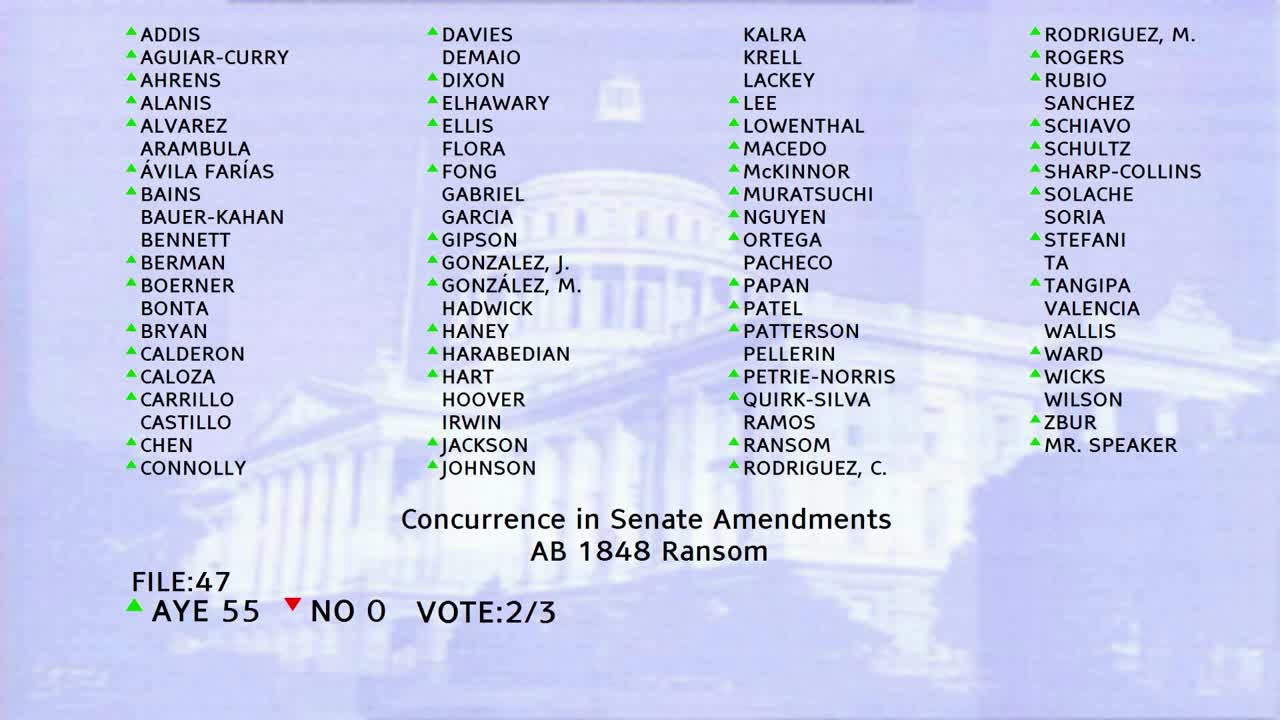
Bill Author