AB 2013: High and very high fire risk areas: community water systems: preparedness and resiliency.
- Session Year: 2025-2026
- House: Assembly
- Latest Version Date: 2026-04-06
Current Status:
Failed
(2026-05-07: From committee: Without further action pursuant to Joint Rule 62(a).)
Introduced
In Committee
Awaiting First Chamber Vote
Passed First Chamber
In Committee
Awaiting Second Chamber Vote
Passed Second Chamber
Enacted
Existing law requires the State Fire Marshal to identify areas in the state as moderate, high, and very high fire hazard severity zones based on consistent statewide criteria and based on the severity of fire hazard that is expected to prevail in those areas. Existing law requires a local agency to designate, by ordinance, moderate, high, and very high fire hazard severity zones in its jurisdiction within 120 days of receiving recommendations from the State Fire Marshal, as provided.
This bill would require a water supplier community water system that services more than 100 customers that are located in a moderate, high, high or very high fire hazard severity zone, as specified, to establish an emergency preparedness plan for response to red flag warnings, extreme weather events, and other major power outages or emergencies that pose a potential threat to providing adequate water service. risk area, as defined, to include an annex to its disaster preparedness plans, as provided, that includes information regarding system preparedness and resiliency during a wildfire. The bill would require the plan annex to contain several things, including, among others, an assessment that identifies the minimum number of and type of water pumps that are necessary to maintain water service for customers while providing an adequate water supply for fire fighting activities. average daily capacity, including, but not limited to, the operation of fire hydrant systems at the rated capacity. The bill would require the community water system, beginning January 1, 2028, to review the annex at least once every 3 years and to update the annex as necessary.
The bill would prohibit anything contained in the annex from enlarging or diminishing any existing liability and would prohibit information provided in the annex from, on its own, demonstrating a substantial cause of any damages resulting from a wildfire.
Existing law requires the State Fire Marshal to identify areas in the state as moderate, high, and very high fire hazard severity zones based on consistent statewide criteria and based on the severity of fire hazard that is expected to prevail in those areas. Existing law requires a local agency to designate, by ordinance, moderate, high, and very high fire hazard severity zones in its jurisdiction within 120 days of receiving recommendations from the State Fire Marshal, as provided.
This bill would require a water supplier that services more than 100 customers that are located in a moderate, high, or very high fire hazard severity zone, as specified, to establish an emergency preparedness plan for response to red flag warnings, extreme weather events, and other major power outages or emergencies that pose a potential threat to providing adequate water service. The bill would require the plan to contain several things, including, among others, an assessment that identifies the minimum number of and type of water pumps that are necessary to maintain water service for customers while providing an adequate water supply for fire fighting activities.
(a)For purposes of this part, plan means an emergency preparedness plan developed pursuant to subdivision (b). the following definitions apply:
(1)Annex means the annex required by subdivision (b).
(2)Community water system has the same meaning as in Section 116275 of the Health and Safety Code.
(3)High or very high fire risk area means a high or very high fire hazard severity zone as designated by the State Fire Marshal pursuant to Section 51178 of the Government Code.
(b)A water supplier community water system that services more than 100 customers that are located in a moderate, high, or very high fire hazard severity zone as designated by the State Fire Marshal pursuant to Section 51178 of the Government Code, or a local agency pursuant to Section 51179 of the Government Code, shall establish an emergency preparedness plan for response to red flag warnings, extreme weather events, and other major power outages or emergencies that pose a potential threat to providing adequate water service to the moderate, high, or very high fire hazard severity zone. high or very high fire risk area shall include an annex to its disaster preparedness plans with information regarding system preparedness and resiliency during a wildfire, including any applicable emergency response plan required by Section 1433(b) of the federal Safe Drinking Water Act (42 U.S.C. Sec. 300i-2).
(c)A water supplier community water system is encouraged to develop a plan the annex in coordination with the county board of supervisors, or a county agency or department if one is designated an authority to coordinate with the water supplier by the county board of supervisors. any local office of emergency services and fire department with jurisdiction in the area served by the community water system.
(d)A plan The annex shall be submitted to the county board of supervisors or a county agency or department designated by the county board of supervisors pursuant to subdivision (c). supervisors.
(e)(1)A water supplier Beginning January 1, 2028, a community water system shall review the plan annex at least once every three years and shall update the plan annex as necessary.
(2)Updates to the plan annex shall be submitted to the county board of supervisors or a county agency or department designated by the county board of supervisors pursuant to subdivision (c). supervisors.
10556.(a)The plan annex shall include, but not be limited to, all of the following:
(a)(1)(1)(A)An assessment of the minimum water tank levels necessary to maintain water service for customers while providing an adequate water supply for fire fighting activities during an extreme weather event or red flag warning. average daily system capacity during a fire.
(2)(B)The assessment shall take into consideration water quality standards and actions necessary to maintain water quality.
(b)(1)(2)(A)An assessment that identifies the minimum number of and type of water pumps that are necessary to maintain water service for customers while providing an adequate water supply for fire fighting activities. average daily capacity, including, but not limited to, the operation of fire hydrant systems at the rated capacity.
(2)(B)The assessment shall identify the number of water pumps servicing the high or very high fire risk area that are equipped with emergency backup energy sources and identify the number of water pumps servicing the high or very high fire risk area that require the installation of do not have emergency backup energy sources. sources or other redundancy measures to maintain average daily capacity.
(c)(3)An identification of alternative water sources that can be used during an extreme weather event or loss of power, if any. assessment of system resiliency in the event of a loss of power, including, but not limited to, an accounting of backup energy generation, alternative water sources, or any other method that maintains average daily capacity.
(d)A detailed accounting of the pipelines, water pumps, water tanks, backup power generation facilities, and related infrastructure needs that are necessary to maintain water service for customers and provide adequate water supply for fire fighting activities during an extreme weather event and a designation for which of these pipelines, water pumps, water tanks, and backup power generation facilities are, or are required to be, fire hardened.(4)(A)An assessment of the fire risk status and fire hardening measures for each water pump, any backup electrical generation equipment, applicable pipelines, and any other infrastructure elements that the community water system deems to be a critical point of failure, located in a high or very high fire risk area.
(B)This section does not change the confidentiality level for any information provided pursuant to paragraph (1).
(b)No information provided in the annex shall enlarge or diminish any existing liability, nor demonstrate, on its own, a substantial cause of any damages resulting from a wildfire.
10557.A water supplier or community water system that is required to prepare and submit an emergency response plan to the Public Utilities Commission shall include the emergency preparedness plan annex required by this part in that submission.
(a)For purposes of this part, plan means an emergency preparedness plan developed pursuant to subdivision (b).
(b)A water supplier that services more than 100 customers that are located in a moderate, high, or very high fire hazard severity zone as designated by the State Fire Marshal pursuant to Section 51178 of the Government Code, or a local agency pursuant to Section 51179 of the Government Code, shall establish an emergency preparedness plan for response to red flag warnings, extreme weather events, and other major power outages or emergencies that pose a potential threat to providing adequate water service to the moderate, high, or very high fire hazard severity zone.
(c)A water supplier is encouraged to develop a plan in coordination with the county board of supervisors, or a county agency or department if one is designated an authority to coordinate with the water supplier by the county board of supervisors.
(d)A plan shall be submitted to the county board of supervisors or a county agency or department designated by the county board of supervisors pursuant to subdivision (c).
(e)(1)A water supplier shall review the plan at least once every three years and shall update the plan as necessary.
(2)Updates to the plan shall be submitted to the county board of supervisors or a county agency or department designated by the county board of supervisors pursuant to subdivision (c).
10556.The plan shall include, but not be limited to, all of the following:
(a)(1)An assessment of the minimum water tank levels necessary to maintain water service for customers while providing an adequate water supply for fire fighting activities during an extreme weather event or red flag warning.
(2)The assessment shall take into consideration water quality standards and actions necessary to maintain water quality.
(b)(1)An assessment that identifies the minimum number of and type of water pumps that are necessary to maintain water service for customers while providing an adequate water supply for fire fighting activities.
(2)The assessment shall identify water pumps that are equipped with emergency backup energy sources and identify water pumps that require the installation of emergency backup energy sources.
(c)An identification of alternative water sources that can be used during an extreme weather event or loss of power, if any.
(d)A detailed accounting of the pipelines, water pumps, water tanks, backup power generation facilities, and related infrastructure needs that are necessary to maintain water service for customers and provide adequate water supply for fire fighting activities during an extreme weather event and a designation for which of these pipelines, water pumps, water tanks, and backup power generation facilities are, or are required to be, fire hardened.
10557.A water supplier or water system that is required to prepare and submit an emergency response plan to the Public Utilities Commission shall include the emergency preparedness plan required by this part in that submission.
|
Date
|
Status
|
|---|---|
| May 7, 2026 | From committee: Without further action pursuant to Joint Rule 62(a). |
| Apr 13, 2026 | In committee: Set, first hearing. Failed passage. |
| Apr 7, 2026 | Re-referred to Com. on E.M. |
| Apr 6, 2026 | From committee chair, with author's amendments: Amend, and re-refer to Com. on E.M. Read second time and amended. |
| Mar 26, 2026 | (Pending re-refer to Com. on E.S. & T.M.) |
| Mar 26, 2026 | Assembly Rule 56 suspended. |
| Mar 26, 2026 | Assembly Rule 56 suspended. (Page 4433.) |
| Mar 16, 2026 | Referred to Coms. on E.M and E.S & T.M. |
| Feb 18, 2026 | From printer. May be heard in committee March 20. |
| Feb 17, 2026 | Read first time. To print. |
|
Date
|
Description
|
Location
|
Votes
|
|
|---|---|---|---|---|
| Apr 13, 2026 | Do pass and be re-referred to the Committee on [Environmental Safety and Toxic Materials] | Assembly Standing Committee on Emergency Management |
Failed |
This list shows positions taken on this bill by organizations on the date displayed, which is linked to the original source.
Positions by individuals are not included.
|
Organization
|
Position
|
Date
|
|---|---|---|
| Association Of California Water Agencies | ** Against | |
| Bella Vista Water District | ** Against | |
| BURBANK/BURBANK REDEVELOPMENT AGENCY; CITY OF | ** Against | |
| California Association Of Mutual Water Companies | ** Against | |
| California Chamber Of Commerce | ** Against | |
| California Municipal Utilities Association | ** Against | |
| California Special Districts Association | ** Against | |
| California Water Association | ** Against | |
| Camrosa Water District | ** Against | |
| City of Burbank Redevelopment Agency | ** Against | |
| Crestline-Lake Arrowhead Water Agency | ** Against | |
| East Valley Water District | ** Against | |
| Eastern Municipal Water District | ** Against | |
| El Dorado Irrigation District | ** Against | |
| El Dorado Water Agency | ** Against | |
| Elsinore Valley Municipal Water District | ** Against | |
| Georgetown Divide Public Utility District | ** Against | |
| Hidden Valley Lake Community Services District | ** Against | |
| Las Virgenes - Triunfo Joint Powers Authority | ** Against | |
| Las Virgenes Municipal Water District | ** Against | |
| Mesa Water District | ** Against | |
| Mid-Peninsula Water District | ** Against | |
| North Marin Water District | ** Against | |
| Olivenhain Municipal Water District | ** Against | |
| Orange County Fire Authority | ** Support | |
| Palmdale Water District | ** Against | |
| Paradise Irrigation District | ** Against | |
| Public Water Agencies Group | ** Against | |
| Rancho California Water District | ** Against | |
| Regional Water Authority | ** Against | |
| San Diego County Water Authority | ** Against | |
| San Juan Water District | ** Against | |
| Tahoe City Public Utility District | ** Against | |
| Three Valleys Municipal Water District | ** Against | |
| Union Public Utility District | ** Against | |
| United Water Conservation District | ** Against | |
| Valley Center Municipal Water District | ** Against | |
| Walnut Valley Water District | ** Against | |
| West Valley Water District | ** Against | |
| Western Municipal Water District | ** Against |
Date of Hearing: April 14, 2026
ASSEMBLY COMMITTEE ON ENVIRONMENTAL SAFETY AND TOXIC MATERIALS
Damon Connolly, Chair
ABPCA Bill Id:AB 2013 (
Author:Bennett) – As Amended Ver:April 6, 2026
SUBJECT: Fire risk areas: water suppliers: emergency preparedness plan
SUMMARY: Requires specified community water systems located in high or very high fire risk areas to provide an annex to their disaster preparedness plans that includes specified information relating to system preparedness and resiliency during a wildfire. Specifically, this bill:
- Requires a community water system that services more than 100 customers that are located in a high or very high fire risk area to include an annex, described below, to its disaster preparedness plans with information regarding system preparedness and resiliency during a wildfire, including any applicable emergency response plan required by the federal Safe Drinking Water Act (SDWA).
- Encourages a community water system to develop the annex in coordination with any local office of emergency services and fire department with jurisdiction in the area served by the community water system.
- Requires the annex to be submitted to the county board of supervisors.
- Requires, beginning January 1, 2028, a community water system to review the annex at least once every three years and to update the annex as necessary.
- Requires updates to the annex to be submitted to the county board of supervisors or a county agency or department designated by the county board of supervisors.
- Requires the annex to include, but not be limited to, all of the following:
- An assessment of the minimum water tank levels necessary to maintain average daily system capacity during a fire. Requires the assessment to take into consideration water quality standards and actions necessary to maintain water quality.
- An assessment that identifies the minimum number of and type of water pumps that are necessary to maintain average daily capacity, including, but not limited to, the operation of fire hydrant systems at the rated capacity. Requires the assessment to identify the number of water pumps servicing the high or very high fire risk area that are equipped with emergency backup energy sources and identify the number of water pumps servicing the high or very high fire risk area that do not have emergency backup energy sources or other redundancy measures to maintain average daily capacity.
- An assessment of system resiliency in the event of a loss of power, including, but not limited to, an accounting of backup energy generation, alternative water sources, or any other method that maintains average daily capacity.
- An assessment of the fire risk status and fire hardening measures for each water pump, any backup electrical generation equipment, applicable pipelines, and any other infrastructure elements that the community water system deems to be a critical point of failure, located in a high or very high fire risk area.
- Provides that the provisions of this bill do not change the confidentiality level for any information provided pursuant to this bill about minimum water tank levels necessary to maintain average daily system capacity during a fire.
- Provides that no information provided in the annex shall enlarge or diminish any existing liability, nor demonstrate, on its own, a substantial cause of any damages resulting from a wildfire.
- Requires a community water system that is required to prepare and submit an emergency response plan to the Public Utilities Commission to include the annex required by this bill in that submission.
EXISTING LAW:
- Establishes the Office of Emergency Services (Cal OES) within the Governor’s Office under the supervision of the Director of Emergency Services. Vests CAL OES with responsibility for the state’s emergency and disaster response services for natural, technological, or man-made disasters and emergencies, including responsibility for activities necessary to prevent, respond to, recover from, and mitigate the effects of emergencies and disasters to people and property. (Government Code (GC) § 8585 et seq.))
- Requires all public water systems with 10,000 or more service connections to review and revise their disaster preparedness plans in conjunction with related agencies, including, but not limited to, local fire departments and Cal OES to ensure that the plans are sufficient to address possible disaster scenarios. These plans should examine and review pumping station and distribution facility operations during an emergency, water pressure at both pumping stations and hydrants, and whether there is sufficient water reserve levels and alternative emergency power, including, but not limited to, onsite backup generators and portable generators. (GC § 8607.2 (a))
- Requires all public water systems with 10,000 or more service connections, following a declared state of emergency, to furnish an assessment of their emergency response and recommendations to the Legislature within six months after each disaster, as well as implement the recommendations in a timely manner. (GC § 8607.2 (b))
- Requires the State Fire Marshal to identify areas in the state as moderate, high, and very high fire hazard severity zones based on consistent statewide criteria and based on the severity of fire hazard that is expected to prevail in those areas. Requires that the identification of moderate, high, and very high fire hazard severity zones be based on fuel loading, slope, fire weather, and other relevant factors including areas where winds have been identified by the Office of the State Fire Marshal as a major cause of wildfire spread. (GC § 51178)
- Requires a local agency to designate, by ordinance, moderate, high, and very high fire hazard severity zones in its jurisdiction within 120 days of receiving recommendations from the State Fire Marshal. (GC § 51179)
- Finds that water service is a different and distinct service from fire service, and that water service is a property-related service that aids in the provision of fire service provided to properties. (GC § 53750.5 (a)(1))
- Finds that hydrants are generally designed, installed, and used to provide an immediately available water service to aid in extinguishing fires that threaten property served by a water service provider, and are generally not designed or installed to provide water service to aid in extinguishing fires that threaten property not served by a water service provider or wildfires. Finds that hydrants are also used by a water service provider for water system operations and maintenance. (GC § 53750.5 (a)(3))
- Requires the State Fire Marshal to classify lands within state responsibility areas into fire hazard severity zones. Requires that each zone embrace relatively homogeneous lands and be based on fuel loading, slope, fire weather, and other relevant factors present, including areas where winds have been identified as a major cause of wildfire spread. Requires the State Fire Marshal to periodically review zones designated and rated, and, as necessary, to revise zones or their ratings or repeal the designation of zones. (PRC §§ 4202 and 4204)
- Authorizes, pursuant to the federal SDWA, the United States Environmental Protection Agency (US EPA) to set standards for drinking water quality and to oversee the states, localities, and water suppliers who implement those standards. (42 United States Code (U.S.C. § 300 (f) et seq.)
- Requires, pursuant to the federal SDWA, community water systems that serve more than 3,300 people to complete a risk and resilience assessment and develop an emergency response plan. (42 U.S.C. Sec. 300i-2)
- Establishes the California SDWA to provide for the operation of public water systems and imposes on the State Water Resources Control Board (State Water Board) various responsibilities and duties relating to the regulation of drinking water to protect public health. (Health & Safety Code (HSC) § 116270 et seq.)
- Defines "community water system" as a public water system that serves at least 15 service connections used by yearlong residents or regularly serves at least 25 yearlong residents of the area served by the system. (HSC §116275 (i))
- Requires water suppliers to identify and provide to the Ventura County Office of Emergency Services (VC OES) no later than May 1, 2026, all critical fire suppression infrastructure or alternative sources of water. (Water Code § 7080) 6)
- Requires a water supplier to establish, in coordination with VC OES and Ventura County Fire Department (VCFD), an emergency preparedness plan, as specified, for response to major power outages or emergencies that pose a potential threat to providing water service. (Water Code § 7080)
- Requires a water supplier to notify VC OES within 3 business days, or as soon as it becomes aware, during a fire event, of any reduction in its water delivery capacity that could substantially hinder firefighting operations or significantly delay the replenishment of reservoirs. (Water Code § 7080)
FISCAL EFFECT: Unknown.
COMMENTS:
Need for the bill: According to the author, "Water systems are not built to put out megafires, and it would be impossible to build out a system that could respond to every catastrophic fire. However, systems should be planning to maximize their existing resources to keep hydrants operable for as long as possible during a wildfire event. In an era of constant Public Safety Power Shutoffs water suppliers should be required to plan for what they will do when wildfire risks are extremely high and when water pumps lose power. In my district, a water pump was destroyed because it was housed in a wooden structure. Finally, firefighters, emergency planners and water district customers should know the extent that these common sense planning measures have been taken, AB 2013 gives fire districts and residents that transparency."
Wildfires in California: According to the California Air Resources Board, climate change, primarily caused by the burning of fossil fuels, is increasing the frequency and severity of wildfires in California and around the world. Since 1950, the area burned by California wildfires has increased each year largely because spring and summer temperatures are increasing and spring snowmelt occurs earlier. The Office of Environmental Health Hazard Assessment (OEHHA) noted in 2022 that the area burned by wildfires and the number of large fires (10,000 acres or more) across the state have increased markedly in the last 20 years—trends influenced by altered fuel conditions and climate change. Wildfires in 2020 burned an unprecedented 4 million acres across California. In 2021, about 2.6 million acres burned, making it the second highest burn year, followed by 2018, with 1.5 million acres burned. In other data, the California Department of Forestry and Fire Protection (CAL FIRE), states that as of 2024, half of the state's 20 largest fires in recorded history had occurred over the previous five years, with all but one of the state's largest fires occurring in the 21st century. CAL FIRE data also show that four out of the five most destructive wildfires in California history happened in just the last 10 years. In 2025, the Eaton and Palisades Fires in Los Angeles County destroyed over 16,000 structures and burned 38,000 acres combined; in 2018, the Camp Fire in Butte County destroyed nearly 19,000 structures and burned 153,000 acres; and in 2017, the Tubbs Fire in Napa and Sonoma counties destroyed more than 5,500 structures and burned nearly 37,000 acres. The State Water Board notes that public water systems can sustain heavy impacts during a wildfire.
Water infrastructure and wildfires: Water infrastructure and fighting wildfires are inextricably and complexly linked. Wendy Broley, executive director of the California Urban Water Agencies, explained this situation on February 19, 2025, to the Public Policy Institute of California as follows: "Climate change is fundamentally changing circumstances, and we do have to adapt. Water is a factor in several climate risks, including drought, flooding, and wildfire. But we can’t solve for one issue, like wildfire, without considering the other potential risks at the same time. Urban water systems are very interconnected; change to one part of the system will have a ripple effect across the whole system. We need to look at this more holistically, in terms of a range of water-related climate risks. If you’re only trying to solve the wildfire problem, you’d say we need more flows to fight fires. So you’d need bigger pipes and more storage. But designing water systems to fight these kinds of fires would be incredibly costly. And installing larger pipes for larger flows, under normal conditions, can lead to the water staying in the pipes for longer, which leads to water quality challenges. And water systems need to protect public health by providing safe drinking water."
The December 2021 University of California policy brief, "Wildfire & Water Supply in California: Advancing a Research & Policy Agenda," describes the distinct dilemma California faces in regard to the wildfire and water supply interface as follows:
"California’s current and expected intensity in future fire regimes presents new challenges for community water supply planners in many parts of the state. Wildfire is one of several climate threats that water utility planners are expected to account for, and the approximately 2,800 community water systems in the state have vastly different planning and operational capacities. Wildfire may threaten the processes to secure, store, treat, and deliver reliable water supplies to first responders and communities. The scale of the problem is evident in a recent Department of Water Resources estimate that "over half of the top at-risk [water] suppliers are in high or very high-risk zones for wildfire, as defined by CalFire" (2020 Water Resilience Portfolio). This is a water equity issue that leaves (often already vulnerable) communities to deal with compounding disasters.
The ability of water systems to maintain power during wildfires is critical for supporting firefighting efforts and minimizing damage to infrastructure. As systems divert water supply to help fight wildfire, and as fires contaminate water sources, water suppliers face impairments to both water quantity and quality in their mandate to maintain reliable water delivery to communities."
The January 2026 University of California Los Angeles (UCLA) Luskin Center for Innovation report, "Water Systems’ Wildfire Fighting Capacities and Expectations," further describes this situation and the pressure on water systems by stating, "Wildfires are becoming more frequent, intense, and destructive across the western United States, sharpening public attention on the performance and responsibilities of urban water systems during major fire events. Although water distribution systems are designed primarily to provide drinking water, domestic supply, and support for routine structure fires, recent disasters—most notably the January 2025 Los Angeles fires—have fueled unprecedented expectations for their role in fighting large urban wildfires."
UCLA Luskin Center for Innovation states in their published factsheet, "Do Urban Water Supply Systems Put Out Wildfires?"
"Urban water supply systems are not designed to fight large wildfires or large-scale fires that start in wildland areas and spread to urban areas. They have not been expected to do so in the past, but these systems have gotten more attention recently as wildfires have affected urban areas more frequently. The expectation for urban water systems is to provide enough water to fight smaller-scale urban structural fires that are not fueled by wildland vegetation.
A key concept in firefighting water supply is fire flow — the amount of water a system is expected by regulators to provide to fight urban fires. The piped water infrastructure of the urban system is engineered to be sufficiently pressurized to ensure adequate fire flow for urban firefighting. Pressurization is achieved either by gravity (for example, using elevated reservoirs that push water downward) or electric pumps that push water through the system.
In some fire-prone areas, urban water supply systems may provide some additional capacity to fight wildfires, but the role of this water supply is usually limited. There are no government-mandated guidelines for urban water systems to provide large-scale wildfire support."
Water systems and recent California fires: The Assembly Committee on Emergency Management, in their analysis of this bill, highlighted water system challenges in the face of catastrophic fires, including:
- "According to Los Angeles Department of Water and Power, [during the 2025 Palisades Fire] water use spiked to four times the normal level for over 15 hours, leaving some hydrants dry. While there was no overall water shortage, the sheer demand overwhelmed the system, preventing water tanks from refilling fast enough to maintain the pressure needed to reach higher-elevation areas in the Palisades.
- …During the Mountain Fire in November 2024, some of Ventura County’s water providers experienced a significant delay in restoring operations after losing power. According to Calleguas Municipal Water District, the utility pump was without electricity for several hours and did not receive a generator until late that evening, resulting in water supply challenges.
- …The Mountain Fire also disrupted firefighting efforts in the Camarillo foothills, where two water pumps went offline during active fire suppression. This interruption delayed the refilling of hillside water tanks, which are critical for maintaining water pressure in high-elevation fire hydrants. This eventually led to the fire hydrants running dry.
- …During the 2017 Thomas Fire, similar disruptions occurred when several water pumping stations lost power. In Ojai, the fire caused direct damage to the infrastructure, rendering the water system inoperable.
- During the initial hours of the 2017 Tubbs Fire, the fire hydrants in the hilltop community of Fountaingrove in Santa Rosa repeatedly lost pressure. Firefighters were forced to travel to the valley of Santa Rosa, where water pressure was stronger, and then return to the hilltop to fight the fire."
Disaster preparedness plans: California statute (GC § 8607.2 (a)) requires all public water systems in the state with 10,000 or more service connections to review and revise their disaster preparedness plans in conjunction with related agencies, including, but not limited to, local fire departments and Cal OES, to ensure that the plans are sufficient to address possible disaster scenarios. These plans should examine and review pumping station and distribution facility operations during an emergency, water pressure at both pumping stations and hydrants, and whether there is sufficient water reserve levels and alternative emergency power, including, but not limited to, onsite backup generators and portable generators.
Federal emergency response plans: America's Water Infrastructure Act (AWIA), which was signed into law on October 23, 2018, amended Section 1433 of the SDWA to require community water systems serving more than 3,300 people to develop or update risk and resilience assessments (RRAs) and emergency response plans (ERPs). The law specifies the components that the RRAs and ERPs must address, and establishes deadlines by which water systems must certify to US EPA completion of the RRA and ERP. SDWA Section 1433 also states that US EPA should provide guidance and technical assistance to water systems that serve less than 3,300 people on how to conduct RRAs and ERPs, though these systems are not required to certify completion to US EPA.
The 2026 UCLA Luskin report states, "The most relevant requirement under the [AWIA]— which only applies to large water systems—is to have updated Emergency Response Plans and Risk and Resilience Assessments. But in their current form, these plans and assessments are inadequate for a focus on wildfire fighting, much less a detailed concept of operations." The author's office notes that, "none of the fire preparedness information is easily accessible for either the public, or emergency agencies, in order to fully understand the scope of the system’s capabilities (or lack thereof) during a fire."
This bill: This bill requires a community water system that services more than 100 customers that are located in a high or very high fire risk area to include an annex to its disaster preparedness plans with information regarding system preparedness and resiliency during a wildfire, including any applicable emergency response plan required by the federal SDWA. This information includes an assessment of the minimum water tank levels necessary to maintain average daily system capacity during a fire; an assessment that identifies the minimum number of and type of water pumps that are necessary to maintain average daily capacity, including, but not limited to, the operation of fire hydrant systems at the rated capacity; an assessment of system resiliency in the event of a loss of power, including, but not limited to, an accounting of backup energy generation, alternative water sources, or any other method that maintains average daily capacity; and, an assessment of the fire risk status and fire hardening measures for each water pump, any backup electrical generation equipment, applicable pipelines, and any other infrastructure elements that the community water system deems to be a critical point of failure. This bill also requires, beginning January 1, 2028, a community water system to review the annex at least once every three years and to update the annex as necessary.
The author's office notes that the goal of the bill is to "[provide] the public and local governments with more information and context regarding whether their community can maximize their existing resources and sufficiently plan for catastrophic events."
Potential amendments: Conversations are ongoing between the author and stakeholders to refine this bill. While the author significantly amended AB 2013 on April 6, 2026, to address stakeholder concerns and to hone the language of the bill, the author may wish to consider further amending the bill to:
- Move the contents of the bill from the Water Code to the Disaster Preparedness article of the California Emergency Services Act in the Government Code.
- Provide water systems with an additional year, to January 1, 2028, before they need to complete the annex or report required by the bill.
- Require water systems to update the annex or report every 5 years instead of every 3 years.
- Require that only community water systems that have 3,300 or more connections, not 100 or more customers, must include the annex as part of their existing required disaster preparedness plans.
- Clarify that community water system with more than 100 service connections, but less than 3,300 service connections, shall prepare a report that includes the information required in the bill (not as part of disaster preparedness plans).
- Require that the annex or report be submitted to Cal OES in addition to the county board of supervisors.
- Require, in several provisions of the bill, that the annex include an assessment of entities needed to "maximize existing water resources in the event of a fire or loss of power" instead of an assessment of entities needed to "maintain average daily capacity"” Committee notes that this terminology is under discussion for potential future revision.
- Update the liability language to delete references to demonstration of a substantial cause of any damages resulting from a wildfire.
- Clarify that the bill does not change the confidentiality level for any information provided pursuant to the annex or report required by the bill.
Arguments in support: The Orange County Fire Authority writes in support of the bill, "Requiring local water districts to have detailed emergency plans will benefit water customers and also first responders. The preparation and implementation of these plans will require interaction between fire agencies and water districts, leading to collaborative approaches for how to best service customers and first responders during potential or actual emergency situations."
Arguments in opposition: A coalition of entities, including the Association of California Water Agencies (ACWA), California Chamber of Commerce, California Water Association, California Special Districts Association, and other organizations, write in opposition unless the bill is amended, "AB 2013 would set a new and unrealistic standard on public water suppliers and would increase legal liability following a wildfire event." Detailing the following points, they state that AB 2013 "Misrepresents the Role of Public Water Systems," is "Operationally Impractical," "Increases Legal Liability," "Creates Significant Financial Burden on Ratepayers," is a "Public Safety and Security Risk," and that “SB 1153 (Caballero) Provides a More Practical and Effective Approach."
The California Municipal Utilities Association (CMUA) further argues in opposition to the bill, "We are concerned that reporting this information in a plan could expose our public water system members to additional liability for fighting wildfires, even though public water systems are not built for that purpose. Additionally, there are existing federal and state requirements for emergency planning, and we question the necessity for this bill. We have other concerns regarding confidentiality, scope, and reporting to the County Board of Supervisors."
Related legislation:
- SB 1153 (Caballero, 2026). Requires, beginning January 1, 2028, urban retail water suppliers with service areas in a high or very high fire hazard severity zone to include wildfire-specific response procedures in their disaster preparedness plans, including any applicable federal plan, and clarifies the liability limitations of public water systems when responding to wildfires, as specified. This bill is pending in the Senate Natural Resources and WaterCommittee.
- AB 1873 (Bennett, 2026). Extends current requirements (per AB 367 below) for a Ventura County water supplier to provide backup power during an emergency; requires Ventura County water suppliers to notify the VC OES if backup power is not available within 90 minutes; sets a deadline for when the water supplier emergency plans must be completed; adds a new assessment requirement to existing reporting requirements; and, makes other clarifying changes. This bill is pending in the Assembly Appropriations Committee.
- AB 372 (Bennett, 2026). Establishes, contingent upon appropriation by the Legislature, the Rural Water Infrastructure for Wildfire Resilience Program for the distribution of state matching funds to urban wildland interface communities in high and very high fire hazard severity zones. This bill is on the inactive file in the Senate.
- SB 746 (Alvarado-Gil, 2025). Requires the Department of Water Resources to establish the Urban Water Community Drought Relief program and the Small Community Drought Relief program to provide grants for interim or immediate drought relief. Authorizes funding for benefits in addition to drought relief, including, among other projects, projects that reduce the risk of wildfire for entire neighborhoods and communities through water delivery system improvements for fire suppression purposes in high fire hazard severity zone communities or very high fire hazard severity zone communities. This bill was held on the suspense file of the Senate Appropriations Committee.
- AB 367 (Bennett, Chapter 690, Statutes of 2025). Requires Ventura County water suppliers to have backup power, or access to alternative water sources, capable of supplying water for at least 24 hours for fire suppression in high or very high fire hazard severity zones; annually inspect critical fire suppression infrastructure and backup energy sources; and, notify significant water delivery reductions, as specified, to the County Office of Emergency Services. Requires the Ventura County Fire Department, in cooperation with the water supplier, to issue a report, as specified, after significant fire damage within a service area, as specified.
- SB 1088 (Alvarado-Gil, 2024). Would have established the Rural Water Infrastructure for Community Wildfire Protection Program within Cal OES for the distribution of state matching funds to communities within the Wildland Urban Interface in designated high fire hazard severity zones or very high fire hazard severity zones to improve water system infrastructure, as prescribed. This bill, which was similar to AB 372, was held on the suspense file of the Assembly Committee on Appropriations.
- SB 1014 (Dodd, 2024). Would have required the Deputy Director of Community Wildfire Preparedness and Mitigation to prepare a Wildfire Risk Mitigation Planning Framework, a Wildfire Risk Baseline and Forecast, and a Wildfire Mitigation Scenarios Report, as specified. This bill was held on the suspense file in the Assembly Committee on Appropriations.
- SB 470 (Alvarado-Gil, 2024). Would have codified the Urban Water Community Drought Relief program and the Small Community Drought Relief program at the Department of Water Resources and would have authorized the program, upon appropriation, to fund projects that provide benefits in addition to drought relief, including projects that reduce the risk of wildfires for communities through water delivery system improvements for fire suppression purposes in high- and very high-fire hazard severity zones, as specified. This bill was vetoed by Governor Gavin Newsom.
Double referral: This bill was double referred to the Assembly Emergency Management and Environmental Safety and Toxic Materials Committees. Should it pass the Emergency Management Committee, it will be referred to the Environmental Safety and Toxic Materials Committee.
REGISTERED SUPPORT / OPPOSITION:
Support
Orange County Fire Authority
Opposition
Association of California Water Agencies
Bella Vista Water District
California Association of Mutual Water Companies
California Chamber of Commerce
California Municipal Utilities Association
California Special Districts Association
California Water Association
Camrosa Water District
City of Burbank Redevelopment Agency
Crestline-lake Arrowhead Water Agency
East Valley Water District
Eastern Municipal Water District
El Dorado Irrigation District
El Dorado Water Agency
Elsinore Valley Municipal Water District
Georgetown Divide Public Utility District
Hidden Valley Lake Community Services District
Las Virgenes - Triunfo Joint Powers Authority
Las Virgenes Municipal Water District
Mesa Water District
Mid-peninsula Water District
North Marin Water District
Olivenhain Municipal Water District
Palmdale Water District
Paradise Irrigation District
Public Water Agencies Group
Rancho California Water District
Regional Water Authority
San Diego County Water Authority
San Juan Water District
Tahoe City Public Utility District
Three Valleys Municipal Water District
Union Public Utility District
United Water Conservation District
Valley Center Municipal Water District
Walnut Valley Water District
West Valley Water District
Western Municipal Water District
Analysis Prepared by: Shannon McKinney / E.S. & T.M. / (916) 319-3965
Date of Hearing: April 14, 2026
ASSEMBLY COMMITTEE ON ENVIRONMENTAL SAFETY AND TOXIC MATERIALS
Damon Connolly, Chair
ABPCA Bill Id:AB 2013 (
Author:Bennett) – As Introduced Ver:April 6, 2026
SUBJECT: Fire risk areas: water suppliers: emergency preparedness plan
SUMMARY: Requires specified community water systems located in high or very high fire risk areas to provide an annex to their disaster preparedness plans that includes specified information relating to system preparedness and resiliency during a wildfire. Specifically, this bill:
- Requires a community water system that services more than 100 customers that are located in a high or very high fire risk area to include an annex, described below, to its disaster preparedness plans with information regarding system preparedness and resiliency during a wildfire, including any applicable emergency response plan required by the federal Safe Drinking Water Act (SDWA).
- Encourages a community water system to develop the annex in coordination with any local office of emergency services and fire department with jurisdiction in the area served by the community water system.
- Requires the annex to be submitted to the county board of supervisors.
- Requires, beginning January 1, 2028, a community water system to review the annex at least once every three years and to update the annex as necessary.
- Requires updates to the annex to be submitted to the county board of supervisors or a county agency or department designated by the county board of supervisors.
- Requires the annex to include, but not be limited to, all of the following:
- An assessment of the minimum water tank levels necessary to maintain average daily system capacity during a fire. Requires the assessment to take into consideration water quality standards and actions necessary to maintain water quality.
- An assessment that identifies the minimum number of and type of water pumps that are necessary to maintain average daily capacity, including, but not limited to, the operation of fire hydrant systems at the rated capacity. Requires the assessment to identify the number of water pumps servicing the high or very high fire risk area that are equipped with emergency backup energy sources and identify the number of water pumps servicing the high or very high fire risk area that do not have emergency backup energy sources or other redundancy measures to maintain average daily capacity.
- An assessment of system resiliency in the event of a loss of power, including, but not limited to, an accounting of backup energy generation, alternative water sources, or any other method that maintains average daily capacity.
- An assessment of the fire risk status and fire hardening measures for each water pump, any backup electrical generation equipment, applicable pipelines, and any other infrastructure elements that the community water system deems to be a critical point of failure, located in a high or very high fire risk area.
- Provides that the provisions of this bill do not change the confidentiality level for any information provided pursuant to this bill about minimum water tank levels necessary to maintain average daily system capacity during a fire.
- Provides that no information provided in the annex shall enlarge or diminish any existing liability, nor demonstrate, on its own, a substantial cause of any damages resulting from a wildfire.
- Requires a community water system that is required to prepare and submit an emergency response plan to the Public Utilities Commission to include the annex required by this bill in that submission.
EXISTING LAW:
- Establishes the Office of Emergency Services (Cal OES) within the Governor’s Office under the supervision of the Director of Emergency Services. Vests CAL OES with responsibility for the state’s emergency and disaster response services for natural, technological, or man-made disasters and emergencies, including responsibility for activities necessary to prevent, respond to, recover from, and mitigate the effects of emergencies and disasters to people and property. (Government Code (GC) § 8585 et seq.))
- Requires all public water systems with 10,000 or more service connections to review and revise their disaster preparedness plans in conjunction with related agencies, including, but not limited to, local fire departments and Cal OES to ensure that the plans are sufficient to address possible disaster scenarios. These plans should examine and review pumping station and distribution facility operations during an emergency, water pressure at both pumping stations and hydrants, and whether there is sufficient water reserve levels and alternative emergency power, including, but not limited to, onsite backup generators and portable generators. (GC § 8607.2 (a))
- Requires all public water systems with 10,000 or more service connections, following a declared state of emergency, to furnish an assessment of their emergency response and recommendations to the Legislature within six months after each disaster, as well as implement the recommendations in a timely manner. (GC § 8607.2 (b))
- Requires the State Fire Marshal to identify areas in the state as moderate, high, and very high fire hazard severity zones based on consistent statewide criteria and based on the severity of fire hazard that is expected to prevail in those areas. Requires that the identification of moderate, high, and very high fire hazard severity zones be based on fuel loading, slope, fire weather, and other relevant factors including areas where winds have been identified by the Office of the State Fire Marshal as a major cause of wildfire spread. (GC § 51178)
- Requires a local agency to designate, by ordinance, moderate, high, and very high fire hazard severity zones in its jurisdiction within 120 days of receiving recommendations from the State Fire Marshal. (GC § 51179)
- Finds that water service is a different and distinct service from fire service, and that water service is a property-related service that aids in the provision of fire service provided to properties. (GC § 53750.5 (a)(1))
- Finds that hydrants are generally designed, installed, and used to provide an immediately available water service to aid in extinguishing fires that threaten property served by a water service provider, and are generally not designed or installed to provide water service to aid in extinguishing fires that threaten property not served by a water service provider or wildfires. Finds that hydrants are also used by a water service provider for water system operations and maintenance. (GC § 53750.5 (a)(3))
- Requires the State Fire Marshal to classify lands within state responsibility areas into fire hazard severity zones. Requires that each zone embrace relatively homogeneous lands and be based on fuel loading, slope, fire weather, and other relevant factors present, including areas where winds have been identified as a major cause of wildfire spread. Requires the State Fire Marshal to periodically review zones designated and rated, and, as necessary, to revise zones or their ratings or repeal the designation of zones. (PRC §§ 4202 and 4204)
- Authorizes, pursuant to the federal SDWA, the United States Environmental Protection Agency (US EPA) to set standards for drinking water quality and to oversee the states, localities, and water suppliers who implement those standards. (42 United States Code (U.S.C. § 300 (f) et seq.)
- Requires, pursuant to the federal SDWA, community water systems that serve more than 3,300 people to complete a risk and resilience assessment and develop an emergency response plan. (42 U.S.C. Sec. 300i-2)
- Establishes the California SDWA to provide for the operation of public water systems and imposes on the State Water Resources Control Board (State Water Board) various responsibilities and duties relating to the regulation of drinking water to protect public health. (Health & Safety Code (HSC) § 116270 et seq.)
- Defines "community water system" as a public water system that serves at least 15 service connections used by yearlong residents or regularly serves at least 25 yearlong residents of the area served by the system. (HSC §116275 (i))
- Requires water suppliers to identify and provide to the Ventura County Office of Emergency Services (VC OES) no later than May 1, 2026, all critical fire suppression infrastructure or alternative sources of water. (Water Code § 7080) 6)
- Requires a water supplier to establish, in coordination with VC OES and Ventura County Fire Department (VCFD), an emergency preparedness plan, as specified, for response to major power outages or emergencies that pose a potential threat to providing water service. (Water Code § 7080)
- Requires a water supplier to notify VC OES within 3 business days, or as soon as it becomes aware, during a fire event, of any reduction in its water delivery capacity that could substantially hinder firefighting operations or significantly delay the replenishment of reservoirs. (Water Code § 7080)
FISCAL EFFECT: Unknown.
COMMENTS:
Need for the bill: According to the author, "Water systems are not built to put out megafires, and it would be impossible to build out a system that could respond to every catastrophic fire. However, systems should be planning to maximize their existing resources to keep hydrants operable for as long as possible during a wildfire event. In an era of constant Public Safety Power Shutoffs water suppliers should be required to plan for what they will do when wildfire risks are extremely high and when water pumps lose power. In my district, a water pump was destroyed because it was housed in a wooden structure. Finally, firefighters, emergency planners and water district customers should know the extent that these common sense planning measures have been taken, AB 2013 gives fire districts and residents that transparency."
Wildfires in California: According to the California Air Resources Board, climate change, primarily caused by the burning of fossil fuels, is increasing the frequency and severity of wildfires in California and around the world. Since 1950, the area burned by California wildfires has increased each year largely because spring and summer temperatures are increasing and spring snowmelt occurs earlier. The Office of Environmental Health Hazard Assessment (OEHHA) noted in 2022 that the area burned by wildfires and the number of large fires (10,000 acres or more) across the state have increased markedly in the last 20 years—trends influenced by altered fuel conditions and climate change. Wildfires in 2020 burned an unprecedented 4 million acres across California. In 2021, about 2.6 million acres burned, making it the second highest burn year, followed by 2018, with 1.5 million acres burned. In other data, the California Department of Forestry and Fire Protection (CAL FIRE), states that as of 2024, half of the state's 20 largest fires in recorded history had occurred over the previous five years, with all but one of the state's largest fires occurring in the 21st century. CAL FIRE data also show that four out of the five most destructive wildfires in California history happened in just the last 10 years. In 2025, the Eaton and Palisades Fires in Los Angeles County destroyed over 16,000 structures and burned 38,000 acres combined; in 2018, the Camp Fire in Butte County destroyed nearly 19,000 structures and burned 153,000 acres; and in 2017, the Tubbs Fire in Napa and Sonoma counties destroyed more than 5,500 structures and burned nearly 37,000 acres. The State Water Board notes that public water systems can sustain heavy impacts during a wildfire.
Water infrastructure and wildfires: Water infrastructure and fighting wildfires are inextricably and complexly linked. Wendy Broley, executive director of the California Urban Water Agencies, explained this situation on February 19, 2025, to the Public Policy Institute of California as follows: "Climate change is fundamentally changing circumstances, and we do have to adapt. Water is a factor in several climate risks, including drought, flooding, and wildfire. But we can’t solve for one issue, like wildfire, without considering the other potential risks at the same time. Urban water systems are very interconnected; change to one part of the system will have a ripple effect across the whole system. We need to look at this more holistically, in terms of a range of water-related climate risks. If you’re only trying to solve the wildfire problem, you’d say we need more flows to fight fires. So you’d need bigger pipes and more storage. But designing water systems to fight these kinds of fires would be incredibly costly. And installing larger pipes for larger flows, under normal conditions, can lead to the water staying in the pipes for longer, which leads to water quality challenges. And water systems need to protect public health by providing safe drinking water."
The December 2021 University of California policy brief, "Wildfire & Water Supply in California: Advancing a Research & Policy Agenda," describes the distinct dilemma California faces in regard to the wildfire and water supply interface as follows:
"California’s current and expected intensity in future fire regimes presents new challenges for community water supply planners in many parts of the state. Wildfire is one of several climate threats that water utility planners are expected to account for, and the approximately 2,800 community water systems in the state have vastly different planning and operational capacities. Wildfire may threaten the processes to secure, store, treat, and deliver reliable water supplies to first responders and communities. The scale of the problem is evident in a recent Department of Water Resources estimate that "over half of the top at-risk [water] suppliers are in high or very high-risk zones for wildfire, as defined by CalFire" (2020 Water Resilience Portfolio). This is a water equity issue that leaves (often already vulnerable) communities to deal with compounding disasters.
The ability of water systems to maintain power during wildfires is critical for supporting firefighting efforts and minimizing damage to infrastructure. As systems divert water supply to help fight wildfire, and as fires contaminate water sources, water suppliers face impairments to both water quantity and quality in their mandate to maintain reliable water delivery to communities."
The January 2026 University of California Los Angeles (UCLA) Luskin Center for Innovation report, "Water Systems’ Wildfire Fighting Capacities and Expectations," further describes this situation and the pressure on water systems by stating, "Wildfires are becoming more frequent, intense, and destructive across the western United States, sharpening public attention on the performance and responsibilities of urban water systems during major fire events. Although water distribution systems are designed primarily to provide drinking water, domestic supply, and support for routine structure fires, recent disasters—most notably the January 2025 Los Angeles fires—have fueled unprecedented expectations for their role in fighting large urban wildfires."
UCLA Luskin Center for Innovation states in their published factsheet, "Do Urban Water Supply Systems Put Out Wildfires?"
"Urban water supply systems are not designed to fight large wildfires or large-scale fires that start in wildland areas and spread to urban areas. They have not been expected to do so in the past, but these systems have gotten more attention recently as wildfires have affected urban areas more frequently. The expectation for urban water systems is to provide enough water to fight smaller-scale urban structural fires that are not fueled by wildland vegetation.
A key concept in firefighting water supply is fire flow — the amount of water a system is expected by regulators to provide to fight urban fires. The piped water infrastructure of the urban system is engineered to be sufficiently pressurized to ensure adequate fire flow for urban firefighting. Pressurization is achieved either by gravity (for example, using elevated reservoirs that push water downward) or electric pumps that push water through the system.
In some fire-prone areas, urban water supply systems may provide some additional capacity to fight wildfires, but the role of this water supply is usually limited. There are no government-mandated guidelines for urban water systems to provide large-scale wildfire support."
Water systems and recent California fires: The Assembly Committee on Emergency Management, in their analysis of this bill, highlighted water system challenges in the face of catastrophic fires, including:
- "According to Los Angeles Department of Water and Power, [during the 2025 Palisades Fire] water use spiked to four times the normal level for over 15 hours, leaving some hydrants dry. While there was no overall water shortage, the sheer demand overwhelmed the system, preventing water tanks from refilling fast enough to maintain the pressure needed to reach higher-elevation areas in the Palisades.
- …During the Mountain Fire in November 2024, some of Ventura County’s water providers experienced a significant delay in restoring operations after losing power. According to Calleguas Municipal Water District, the utility pump was without electricity for several hours and did not receive a generator until late that evening, resulting in water supply challenges.
- …The Mountain Fire also disrupted firefighting efforts in the Camarillo foothills, where two water pumps went offline during active fire suppression. This interruption delayed the refilling of hillside water tanks, which are critical for maintaining water pressure in high-elevation fire hydrants. This eventually led to the fire hydrants running dry.
- …During the 2017 Thomas Fire, similar disruptions occurred when several water pumping stations lost power. In Ojai, the fire caused direct damage to the infrastructure, rendering the water system inoperable.
- During the initial hours of the 2017 Tubbs Fire, the fire hydrants in the hilltop community of Fountaingrove in Santa Rosa repeatedly lost pressure. Firefighters were forced to travel to the valley of Santa Rosa, where water pressure was stronger, and then return to the hilltop to fight the fire."
Disaster preparedness plans: California statute (GC § 8607.2 (a)) requires all public water systems in the state with 10,000 or more service connections to review and revise their disaster preparedness plans in conjunction with related agencies, including, but not limited to, local fire departments and Cal OES, to ensure that the plans are sufficient to address possible disaster scenarios. These plans should examine and review pumping station and distribution facility operations during an emergency, water pressure at both pumping stations and hydrants, and whether there is sufficient water reserve levels and alternative emergency power, including, but not limited to, onsite backup generators and portable generators.
Federal emergency response plans: America's Water Infrastructure Act (AWIA), which was signed into law on October 23, 2018, amended Section 1433 of the SDWA to require community water systems serving more than 3,300 people to develop or update risk and resilience assessments (RRAs) and emergency response plans (ERPs). The law specifies the components that the RRAs and ERPs must address, and establishes deadlines by which water systems must certify to US EPA completion of the RRA and ERP. SDWA Section 1433 also states that US EPA should provide guidance and technical assistance to water systems that serve less than 3,300 people on how to conduct RRAs and ERPs, though these systems are not required to certify completion to US EPA.
The 2026 UCLA Luskin report states, "The most relevant requirement under the [AWIA]— which only applies to large water systems—is to have updated Emergency Response Plans and Risk and Resilience Assessments. But in their current form, these plans and assessments are inadequate for a focus on wildfire fighting, much less a detailed concept of operations." The author's office notes that, "none of the fire preparedness information is easily accessible for either the public, or emergency agencies, in order to fully understand the scope of the system’s capabilities (or lack thereof) during a fire."
This bill: This bill requires a community water system that services more than 100 customers that are located in a high or very high fire risk area to include an annex to its disaster preparedness plans with information regarding system preparedness and resiliency during a wildfire, including any applicable emergency response plan required by the federal SDWA. This information includes an assessment of the minimum water tank levels necessary to maintain average daily system capacity during a fire; an assessment that identifies the minimum number of and type of water pumps that are necessary to maintain average daily capacity, including, but not limited to, the operation of fire hydrant systems at the rated capacity; an assessment of system resiliency in the event of a loss of power, including, but not limited to, an accounting of backup energy generation, alternative water sources, or any other method that maintains average daily capacity; and, an assessment of the fire risk status and fire hardening measures for each water pump, any backup electrical generation equipment, applicable pipelines, and any other infrastructure elements that the community water system deems to be a critical point of failure. This bill also requires, beginning January 1, 2028, a community water system to review the annex at least once every three years and to update the annex as necessary.
The author's office notes that the goal of the bill is to "[provide] the public and local governments with more information and context regarding whether their community can maximize their existing resources and sufficiently plan for catastrophic events."
Potential amendments: Conversations are ongoing between the author and stakeholders to refine this bill. While the author significantly amended AB 2013 on April 6, 2026, to address stakeholder concerns and to hone the language of the bill, the author may wish to consider further amending the bill to:
- Move the contents of the bill from the Water Code to the Disaster Preparedness article of the California Emergency Services Act in the Government Code.
- Provide water systems with an additional year, to January 1, 2028, before they need to complete the annex or report required by the bill.
- Require water systems to update the annex or report every 5 years instead of every 3 years.
- Require that only community water systems that have 3,300 or more connections, not 100 or more customers, must include the annex as part of their existing required disaster preparedness plans.
- Clarify that community water system with more than 100 service connections, but less than 3,300 service connections, shall prepare a report that includes the information required in the bill (not as part of disaster preparedness plans).
- Require that the annex or report be submitted to Cal OES in addition to the county board of supervisors.
- Require, in several provisions of the bill, that the annex include an assessment of entities needed to "maximize existing water resources in the event of a fire or loss of power" instead of an assessment of entities needed to "maintain average daily capacity"” Committee notes that this terminology is under discussion for potential future revision.
- Update the liability language to delete references to demonstration of a substantial cause of any damages resulting from a wildfire.
Arguments in support: The Orange County Fire Authority writes in support of the bill, "Requiring local water districts to have detailed emergency plans will benefit water customers and also first responders. The preparation and implementation of these plans will require interaction between fire agencies and water districts, leading to collaborative approaches for how to best service customers and first responders during potential or actual emergency situations."
Arguments in opposition: A coalition of entities, including the Association of California Water Agencies (ACWA), California Chamber of Commerce, California Water Association, California Special Districts Association, and other organizations, write in opposition unless the bill is amended, "AB 2013 would set a new and unrealistic standard on public water suppliers and would increase legal liability following a wildfire event." Detailing the following points, they state that AB 2013 "Misrepresents the Role of Public Water Systems," is "Operationally Impractical," "Increases Legal Liability," "Creates Significant Financial Burden on Ratepayers," is a "Public Safety and Security Risk," and that “SB 1153 (Caballero) Provides a More Practical and Effective Approach."
The California Municipal Utilities Association (CMUA) further argues in opposition to the bill, "We are concerned that reporting this information in a plan could expose our public water system members to additional liability for fighting wildfires, even though public water systems are not built for that purpose. Additionally, there are existing federal and state requirements for emergency planning, and we question the necessity for this bill. We have other concerns regarding confidentiality, scope, and reporting to the County Board of Supervisors."
Related legislation:
- SB 1153 (Caballero, 2026). Requires, beginning January 1, 2028, urban retail water suppliers with service areas in a high or very high fire hazard severity zone to include wildfire-specific response procedures in their disaster preparedness plans, including any applicable federal plan, and clarifies the liability limitations of public water systems when responding to wildfires, as specified. This bill is pending in the Senate Natural Resources and WaterCommittee.
- AB 1873 (Bennett, 2026). Extends current requirements (per AB 367 below) for a Ventura County water supplier to provide backup power during an emergency; requires Ventura County water suppliers to notify the VC OES if backup power is not available within 90 minutes; sets a deadline for when the water supplier emergency plans must be completed; adds a new assessment requirement to existing reporting requirements; and, makes other clarifying changes. This bill is pending in the Assembly Appropriations Committee.
- AB 372 (Bennett, 2026). Establishes, contingent upon appropriation by the Legislature, the Rural Water Infrastructure for Wildfire Resilience Program for the distribution of state matching funds to urban wildland interface communities in high and very high fire hazard severity zones. This bill is on the inactive file in the Senate.
- SB 746 (Alvarado-Gil, 2025). Requires the Department of Water Resources to establish the Urban Water Community Drought Relief program and the Small Community Drought Relief program to provide grants for interim or immediate drought relief. Authorizes funding for benefits in addition to drought relief, including, among other projects, projects that reduce the risk of wildfire for entire neighborhoods and communities through water delivery system improvements for fire suppression purposes in high fire hazard severity zone communities or very high fire hazard severity zone communities. This bill was held on the suspense file of the Senate Appropriations Committee.
- AB 367 (Bennett, Chapter 690, Statutes of 2025). Requires Ventura County water suppliers to have backup power, or access to alternative water sources, capable of supplying water for at least 24 hours for fire suppression in high or very high fire hazard severity zones; annually inspect critical fire suppression infrastructure and backup energy sources; and, notify significant water delivery reductions, as specified, to the County Office of Emergency Services. Requires the Ventura County Fire Department, in cooperation with the water supplier, to issue a report, as specified, after significant fire damage within a service area, as specified.
- SB 1088 (Alvarado-Gil, 2024). Would have established the Rural Water Infrastructure for Community Wildfire Protection Program within Cal OES for the distribution of state matching funds to communities within the Wildland Urban Interface in designated high fire hazard severity zones or very high fire hazard severity zones to improve water system infrastructure, as prescribed. This bill, which was similar to AB 372, was held on the suspense file of the Assembly Committee on Appropriations.
- SB 1014 (Dodd, 2024). Would have required the Deputy Director of Community Wildfire Preparedness and Mitigation to prepare a Wildfire Risk Mitigation Planning Framework, a Wildfire Risk Baseline and Forecast, and a Wildfire Mitigation Scenarios Report, as specified. This bill was held on the suspense file in the Assembly Committee on Appropriations.
- SB 470 (Alvarado-Gil, 2024). Would have codified the Urban Water Community Drought Relief program and the Small Community Drought Relief program at the Department of Water Resources and would have authorized the program, upon appropriation, to fund projects that provide benefits in addition to drought relief, including projects that reduce the risk of wildfires for communities through water delivery system improvements for fire suppression purposes in high- and very high-fire hazard severity zones, as specified. This bill was vetoed by Governor Gavin Newsom.
Double referral: This bill was double referred to the Assembly Emergency Management and Environmental Safety and Toxic Materials Committees. Should it pass the Emergency Management Committee, it will be referred to the Environmental Safety and Toxic Materials Committee.
REGISTERED SUPPORT / OPPOSITION:
Support
Orange County Fire Authority
Opposition
Association of California Water Agencies
Bella Vista Water District
California Association of Mutual Water Companies
California Chamber of Commerce
California Municipal Utilities Association
California Special Districts Association
California Water Association
Camrosa Water District
City of Burbank Redevelopment Agency
Crestline-lake Arrowhead Water Agency
East Valley Water District
Eastern Municipal Water District
El Dorado Irrigation District
El Dorado Water Agency
Elsinore Valley Municipal Water District
Georgetown Divide Public Utility District
Hidden Valley Lake Community Services District
Las Virgenes - Triunfo Joint Powers Authority
Las Virgenes Municipal Water District
Mesa Water District
Mid-peninsula Water District
North Marin Water District
Olivenhain Municipal Water District
Palmdale Water District
Paradise Irrigation District
Public Water Agencies Group
Rancho California Water District
Regional Water Authority
San Diego County Water Authority
San Juan Water District
Tahoe City Public Utility District
Three Valleys Municipal Water District
Union Public Utility District
United Water Conservation District
Valley Center Municipal Water District
Walnut Valley Water District
West Valley Water District
Western Municipal Water District
Analysis Prepared by: Shannon McKinney / E.S. & T.M. / (916) 319-3965
Date of Hearing: April 13, 2026
ASSEMBLY COMMITTEE ON EMERGENCY MANAGEMENT
Rhodesia Ransom, Chair
ABPCA Bill Id:AB 2013 (
Author:Bennett) – As Amended Ver:April 6, 2026
SUBJECT: High and very high fire risk areas: community water systems: preparedness and resiliency
SUMMARY: Requires certain community water systems located in a high or very high fire hazard severity zone to include an annex to its disaster preparedness plans regarding the resiliency and preparedness of their water systems during a wildfire. Specifically, this bill:
- Requires a community water system that services more than 100 customers that are located in a high or very high fire hazard severity zone to include an annex to its disaster preparedness plans with information regarding system preparedness and resiliency during a wildfire, including any applicable emergency response plan required by the federal Safe Drinking Water Act, as specified.
- Authorizes a community water system to develop the annex in coordination with any local office of emergency services and fire department with jurisdiction in the area served by the community water system.
- Requires the annex be submitted to the county board of supervisors.
- Requires the annex be reviewed at least once every three years, and updated as necessary, beginning January 1, 2028.
- Requires updates be submitted to the county board of supervisors or a county agency or department designated by the county board of supervisors.
- Requires the annex to include, but not be limited to, the following:
- An assessment of the minimum water tank levels necessary to maintain average daily system capacity during a fire; the assessment is required to consider water quality standards and actions necessary to maintain water quality.
- An assessment that identifies the minimum number of and type of water pumps that are necessary to maintain average daily capacity, including, but not limited to, the operation of fire hydrant systems at the rated capacity; the assessment is required to identify the number of water pumps servicing high or very high fire hazard severity zone that have emergency backup energy sources, and those servicing the same zones without emergency backup energy sources, as specified.
- An assessment of system resiliency in the event of a loss of power, including, but not limited to, an accounting of backup energy generation, alternative water sources, or any other method that maintains average daily capacity.
- An assessment of the fire risk status and fire hardening measures for each water pump, any backup electrical generation equipment, applicable pipelines, and any other infrastructure elements that the community water system deems to be a critical point of failure, as specified.
- Provides that the annex requirements does not change the confidentiality level for any information provided in the assessment of the minimum water tank levels necessary to maintain average daily system capacity during a fire, as specified.
- Provides that no information provided in the annex shall enlarge or diminish any existing liability, nor demonstrate, on its own, a substantial cause of any damages resulting from a wildfire.
- Requires a community water system that is already required to prepare and submit an emergency response plan to the Public Utilities Commission to also include the annex required by this bill.
EXISTING LAW:
- Requires, commencing July 1, 2030, a Ventura County water supplier, as specified, to have access to sufficient backup energy sources to operate critical fire suppression infrastructure needed to supply water for at least 24 hours for fire suppression in high or very high fire hazard severity zones (HFHSZ or VHFHSZ) in Ventura County, as specified, or have access to alternative sources of water supplied by a different water supplier or agency, as specified. (Water Code § 7080)
- Authorizes a Ventura County water supplier, in order to meet the above requirements, to use mobile backup energy sources or procure an energy source via an established mutual aid agreement provided the backup energy source can provide power within 12 hours of the National Weather Service alerting the region of a red flag warning and provide power for at least 24 hours after a loss of power and within 60 minutes of a loss of power. (Water Code § 7080)
- Requires the water supplier to identify and provide to the Ventura County Office of Emergency Services (VC OES) no later than May 1, 2026, all critical fire suppression infrastructure or alternative sources of water. (Water Code § 7080)
- Requires, by January 1, 2027, the Ventura County Fire Department (VCFD), in consultation with water suppliers and local fire departments, to develop minimum fire safety standards for the purpose of fire hardening critical fire suppression infrastructure and backup energy sources located in the HFHSZ or VHFHSZ. (Water Code § 7080)
- Requires VCFD to annually inspect critical fire suppression infrastructure and backup energy sources in the HFHSZ or VHFHSZ to ensure critical fire suppression infrastructure and backup energy sources located in those zones meet the fire safety standards developed by VCFD, as specified, and requires the water supplier to annually inspect critical fire suppression infrastructure and backup energy sources serving those zones, but are not located within the zone, to ensure functionality. (Water Code § 7080)
- Requires a water supplier to establish, in coordination with VC OES and VCFD, an emergency preparedness plan, as specified, for response to major power outages or emergencies that pose a potential threat to providing water service. (Water Code § 7080)
- Requires a water supplier to initiate action under the emergency preparedness plan if the National Weather Service alerts the region of a red flag warning. (Water Code § 7080)
- Requires a water supplier to notify VC OES within 3 business days, or as soon as it becomes aware, during a fire event, of any reduction in its water delivery capacity that could substantially hinder firefighting operations or significantly delay the replenishment of reservoirs. (Water Code § 7080)
- Requires VCFD to present a report, as specified, to the Ventura County Board of Supervisors of any fire damages that made more than 10 residential dwellings within the service area of a water supplier uninhabitable. (Water Code § 7080)
- Authorizes the Governor to proclaim a state of emergency and local officials and local governments to proclaim a local emergency, when specified conditions of disaster or extreme peril to the safety of persons and property exist, and authorizes the Governor or the appropriate local government to exercise certain powers in response to that emergency. (Government Code § 8558)
- Establishes the Department of Water Resources (DWR) within the Natural Resources Agency and sets forth its powers and duties relating to water resources (Water Code § 120)
- Requires the State Fire Marshal to classify lands within state responsibility areas into fire hazard severity zones and requires that local agencies also designate fire hazard severity zones in their jurisdiction after receiving recommendations from the State Fire Marshal. These classifications shall be based on fuel loading, slope, fire weather, and other relevant factors (Public Resource Code § 4202-4204, Government Code § 51178)
- Directs a city or county, upon the next revision of the housing element of a general plan on or after January 1, 2014, to include a set of feasible implementation measures designed to carry out specified goals, policies, and objectives, including designing adequate infrastructure if a new development is located in a state responsibility area or in a very high fire hazard severity zone, including water supplies for structural fire suppression (Government Code § 65302).
FISCAL EFFECT: Unknown. A fiscal committee has not yet heard this bill.
COMMENTS:
Author Statement: “Water systems are not built to put out megafires, and it would be impossible to build out a system that could respond to every catastrophic fire. However, systems should be planning to maximize their existing resources to keep hydrants operable for as long as possible during a wildfire event. In an era of constant Public Safety Power Shutoffs water suppliers should be required to plan for what they will do when wildfire risks are extremely high and when water pumps lose power. In my district, a water pump was destroyed because it was housed in a wooden structure. Finally, firefighters, emergency planners and water district customers should know the extent that these common sense planning measures have been taken, AB 2013 gives fire districts and residents that transparency.”
Equity Statement: “California fires disproportionately put at risk vulnerable communities, especially given the lack of insurance coverage in many parts of the state. Of particular concern is when conflagrations destroy major parts of communities. Media coverage of the Southern California fires often focused attention at the destruction of Pacific Palisades however the Eaton Canyon fire razed a historically Black community, harming decades of built up generational wealth for many California residents. 61% of homes lost in Altadena were Black households. A University of California Los Angeles data brief highlighted the disproportionate impact that the Eaton Canyon fire had on Black residents. Of particular concern is that lack of insurance coverage and rising home prices, mean that unless these residents are able to rebuild and keep their homes, it is unlikely that their children will be able to inherit these properties, or otherwise keep this generational wealth – further exacerbating a growing income divide. Given the loss of structures in Altadena, it seems like moving towards a policy where home owners and communities take comprehensive measures to harden their homes could have reduce both the loss of lives and the loss of property.”
Background: Throughout California’s history the state has contended with destructive wildfires impacting communities that were constructed amongst or adjacent to timber and chaparral forests. These areas, commonly referred to as the “wildland urban interface,” have long been considered some of the most fire-prone areas in the state. In the last decade, unprecedented wildfires led to the deadliest wildfire in California’s history. The impacts of these wildfires cannot be understated, many lives were lost, thousands of homes were destroyed, and residents, in some cases entire communities, have been forced to relocate. Billions of dollars in damage was caused to homes, businesses, and infrastructure throughout the state.
In recent years, an increasing number of wildfires have burned outside of wildland areas and into more urban settings. While persons living in forested areas and those in the wildland urban interface, have long faced significant risks from wildfires, as a result of climate change, more Californians face wildfire risks than ever before.
Many of these areas have been classified by the Department of Forestry and Fire Protection as belonging to “very high fire hazard severity zones.” As a result of this designation, the properties within a very high fire hazard zone are subject to the strictest requirements from the building codes, “Fire Safe” regulations, and defensible space requirements. Properties not immediately in the wildland urban interface but subject to fire risks are now characterized as being in “high fire hazard severity zones.”
Wildfires across California have repeatedly exposed vulnerabilities in public water systems, especially in high and very high severity zones. During the 2025 Palisades Fire, extreme demand caused by firefighting overwhelmed the system, leaving some hydrants dry. In Ventura County’s 2024 Mountain Fire, power outages delayed pump operations and disrupted hillside water supply, echoing similar failures during the 2017 Thomas Fire and leaving high-elevation hydrants without water. Likewise, during the 2017 Tubbs Fire, firefighters in Santa Rosa’s Fountaingrove neighborhood lost access to water due to low pressure and had to travel long distances to refill, delaying response efforts. It is important to note that even when operating at their maximum efficiency, public water systems are currently not designed for catastrophic wildfires.
AB 367: Last session, Assemblymember Bennett authored AB 367 which, among other things, requires Ventura County water suppliers to: have backup power, or access to alternative water sources, capable of supplying water for at least 24 hours for fire suppression in high or very high fire hazard severity zones; annually inspect critical fire suppression infrastructure and backup energy sources and notify significant water delivery reductions, as specified, to the County Office of Emergency Services. AB 367 was originated based on best practices stated by the deputy general manager at Calleguas Municipal Water District, a water supplier in Ventura County, to the Los Angeles Times: “It is best practices for water providers to top off their water tanks, stage backup generators and prepare crews for contingency work during a red flag event or possible fire weather.”
Wildfires: Wildfires are a severe and growing threat to lives, property, and infrastructure in California. The confluence of a changing climate, urbanization, and constraints on forest management increases the urgency to address this threat. According to data from CAL FIRE, 18 of California’s 20 most destructive fires have occurred in the past decade.[1] Collectively, these fires have resulted in 231 deaths and the loss of 66, 810 structures (homes, outbuildings, and commercial properties). While fewer wildfires threatened California in 2023 due to the increased number of weather events and atmospheric rivers, the vegetative growth from the significant rainfall contributed to devastating wildfires in 2024 and 2025. In 2024, the Park Fire became the fourth-largest fire in California’s history. Despite aggressive initial attack suppression efforts, the fire rapidly expanded, ultimately consuming 429,603 acres across Butte and Tehama counties. The Park Fire led to the destruction of 713 structures and damage to 57 others, prompting widespread evacuations and the temporary closure of Lassen Volcanic National Park.[2]
In January 2025, Los Angeles County experienced the second and third most destructive fires in California history: the Palisades Fire and Eaton Fire. The University of California, Los Angeles (UCLA) estimated the fires’ total property and capital losses could range between $76 billion and $131 billion, with insured losses estimated up to $45 billion. At its height, the fires placed an estimated 331,335 people on an evacuation advisory, with nearly 192,000 residents facing mandatory evacuation and roughly 140,000 subject to warnings. The Eaton Fire resulted in 9,413 buildings being destroyed, 1,074 structures damaged, and 19 confirmed civilian fatalities. The Palisades Fire resulted in 6,833 structures destroyed, 973 structures damaged, and 12 confirmed civilian fatalities. The blazes burned a combined 37,728 acres and leveled entire communities in the Pacific Palisades and Altadena neighborhoods of LA County.
Public Water Access Overwhelmed in the Palisades Fire: In the early days of the 2025 catastrophic Palisades Fire, extreme winds made it impossible for aerial firefighting to continue, putting a significant strain on the public water system. According to Los Angeles Department of Water and Power, water use spiked to four times the normal level for over 15 hours, leaving some hydrants dry. While there was no overall water shortage, the sheer demand overwhelmed the system, preventing water tanks from refilling fast enough to maintain the pressure needed to reach higher-elevation areas in the Palisades.
Ventura County Water Access Issues: During the Mountain Fire in November 2024, some of Ventura County’s water providers experienced a significant delay in restoring operations after losing power. According to Calleguas Municipal Water District, the utility pump was without electricity for several hours and did not receive a generator until late that evening, resulting in water supply challenges. The Mountain Fire also disrupted firefighting efforts in the Camarillo foothills, where two water pumps went offline during active fire suppression. This interruption delayed the refilling of hillside water tanks, which are critical for maintaining water pressure in high-elevation fire hydrants. This eventually led to the fire hydrants running dry. During the 2017 Thomas Fire, similar disruptions occurred when several water pumping stations lost power. In Ojai, the fire caused direct damage to the infrastructure, rendering the water system inoperable.
Tubbs Fire and Public Water Inaccessibility: During the initial hours of the 2017 Tubbs fire, the fire hydrants in the hilltop community of Fountaingrove in Santa Rosa repeatedly lost pressure. Firefighters were forced to travel to the valley of Santa Rosa, where water pressure was stronger, and then return to the hilltop to fight the fire.
UCLA Report Recommendations: In a 2021 briefing report titled Wildfire & Water Supply in California, the authors recommend investing in remote-operable water infrastructure and backup power systems—such as solar panels and battery storage—to help maintain water service during wildfires while reducing risk to utility personnel. They also highlight the importance of fire-resistant building materials and site design to protect critical water system assets in high-risk areas. However, they caution that widespread adoption of these innovations may be limited by cost, access to technology, and the expertise required to implement them—particularly for smaller water systems.
Small water suppliers and rural communities: Pursuant to AB 1668 (Friedman, Chapter 15, Statutes of 2018), the Department of Water Resources (DWR) issued the Small Water Systems and Rural Communities Drought and Water Shortage Contingency Planning and Risk Assessment in 2021. This report, released in two parts, identified small water systems and rural communities at risk of drought and water shortage vulnerability (Part II) and made recommendations for improving drought contingency planning for those areas (Part I).
DWR examined the relative risk of drought and water shortage for 2,419 small water suppliers in the report. The results show that a vast majority of the state’s counties (47 of the 58 counties) have small water suppliers in the top 10% of risk scores (240 suppliers) for water shortage. Of those in the top 10%, over half (61% or 149 suppliers) are located in high or very high fire hazard severity zones. In other words, there are many small and rural communities across the state that are at high risk of running out of water during a drought or other disaster. Also, many communities located in areas with a high risk for wildfire are at high risk of water shortage, which could impact their capacity to suppress fires when they occur.
The report recommended that the state support small community water systems to install additional infrastructure to improve drought and water shortage preparedness and response. The report noted that most water systems under 1,000 connections have difficulty ensuring water supplies during natural disaster events, regardless of the development of planning materials, due to their inherent lack of economies of scale to finance needed infrastructure improvements and the high cost of emergency response activities.
According to CAL FIRE, water delivery infrastructure does pose a challenge for some of the communities in CAL FIRE service areas, as some hydrant systems cannot support fire operations at the required flow rate and volume. In some cases, using an older hydrant has caused water pipes to collapse, which can cutoff water delivery to that specific neighborhood in the aftermath of an incident.
Double Referral: Should this bill be approved, it will be referred to the Assembly Committee on Environmental Safety and Toxic Materials.
Arguments in Support: According to the Orange County Fire Authority, “Requiring local water districts to have detailed emergency plans will benefit water customers and also first responders. The preparation and implementation of these plans will require interaction between fire agencies and water districts, leading to collaborative approaches for how to best service customers and first responders during potential or actual emergency situations.”
Arguments in Opposition: The Association of California Water Agencies (ACWA), California Chamber of Commerce, California Water Association, and several other undersigned organizations, write in opposition unless amended, “AB 2013 would set a new and unrealistic standard on public water suppliers and would increase legal liability following a wildfire event.” Outlining the following points, they state that AB 2013 “Misrepresents the Role of Public Water Systems,” is “Operationally Impractical,” “Increases Legal Liability,” “Creates Significant Financial Burden on Ratepayers,” is a “Public Safety and Security Risk,” and that “SB 1153 (Caballero) Provides a More Practical and Effective Approach.”
Prior and Related Legislation:
AB 1873 (Bennett, 2026) would extend current requirements (per AB 367 below) for a Ventura County water supplier to provide backup power during an emergency, required Ventura County water suppliers to notify the Ventura County Office of Emergency Services if backup power is not available within 90 minutes, sets a deadline for when the water supplier emergency plans must be completed, adds a new assessment requirement to existing reporting requirements, and makes other clarifying changes. (Pending in Assembly Committee on Utilities and Energy)
AB 367 (Bennett. Chapter 690, Statutes of 2025) requires Ventura County water suppliers to: have backup power, or access to alternative water sources, capable of supplying water for at least 24 hours for fire suppression in high or very high fire hazard severity zones; annually inspect critical fire suppression infrastructure and backup energy sources and notify significant water delivery reductions, as specified, to the County Office of Emergency Services. This bill also requires the Ventura County Fire Department, in cooperation with the water supplier, to issue a report, as specified, after significant fire damage within a service area, as specified
AB 372 (Bennett, 2025) would, contingent on funding being appropriated pursuant to a bond act, establish the Rural Water Infrastructure for Wildfire Resilience Program within the California Office of Emergency Services (Cal OES) for the distribution of state matching funds to communities within the Wildland Urban Interface in designated high fire severity zones or very high fire hazard severity zones to improve water system infrastructure. (Inactive File on Senate Floor)
REGISTERED SUPPORT / OPPOSITION:
Support
Orange County Fire Authority
Opposition
Association of California Water Agencies (ACWA)
Bella Vista Water DistrictBurbank/Burbank Redevelopment Agency; City of
California Association of Mutual Water Companies
California Chamber of Commerce
California Municipal Utilities Association
California Special Districts Association
California Water Association
Camrosa Water District
Crestline-lake Arrowhead Water Agency
East Valley Water District
Eastern Municipal Water District
El Dorado Irrigation District
El Dorado Water Agency
Elsinore Valley Municipal Water District
Georgetown Divide Public Utility District
Hidden Valley Lake Community Services District
Las Virgenes - Triunfo Joint Powers Authority
Las Virgenes Municipal Water District
Mesa Water District
Mid-peninsula Water District
North Marin Water District
Olivenhain Municipal Water District
Palmdale Water District
Paradise Irrigation District
Public Water Agencies Group
Rancho California Water District
Regional Water Authority
San Diego County Water Authority
San Juan Water District
Tahoe City Public Utility District
Three Valleys Municipal Water District
Union Public Utility District
United Water Conservation District
Valley Center Municipal Water District
Walnut Valley Water District
West Valley Water District
Western Municipal Water District
Analysis Prepared by: Ryan Fleming / E.M. / (916) 319-3802
Statistics, CAL FIRE https://www.fire.ca.gov/our-impact/statistics ↑
Park Fire Incidenthttps://www.fire.ca.gov/incidents/2024/7/24/park-fire ↑
Discussed in Hearing
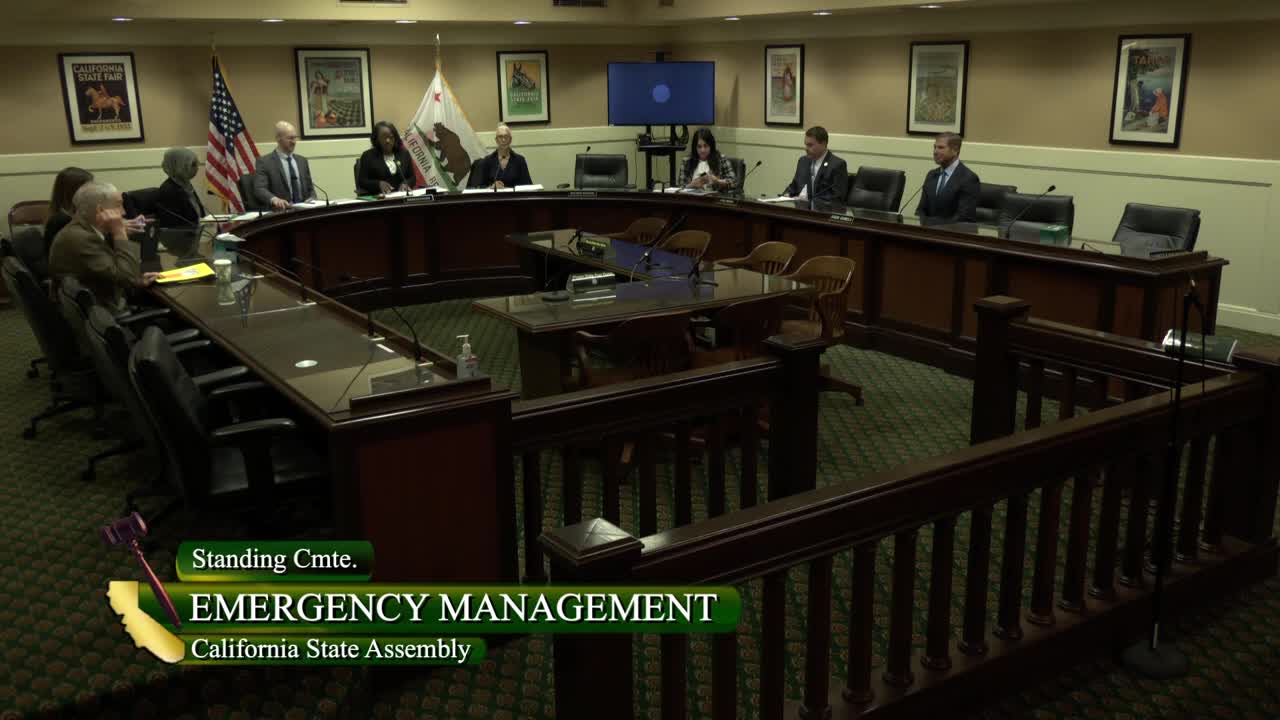 27MIN
Assembly Standing Committee on Emergency Management
Bill Author