AB 2056: Teachers: exchange programs: local educational agencies.
- Session Year: 2025-2026
- House: Assembly
- Latest Version Date: 2026-08-24
Current Status:
Passed
(2026-08-24: Chaptered by Secretary of State - Chapter 122, Statutes of 2026.)
Introduced
In Committee
Awaiting First Chamber Vote
Passed First Chamber
In Committee
Awaiting Second Chamber Vote
Passed Second Chamber
Enacted
What does this bill do?
This bill lets California bring teachers from other countries, including Mexico and Spain, into school districts, county education offices, and charter schools through J‑1 visa sponsors (the J‑1 exchange visitor visa) to promote cultural exchange, bilingual instruction, and shared teaching methods. It also allows the state and local agencies to accept federal grants for these exchange programs and defines "local educational agency" to include county offices of education and charter schools.
The summary is provided by generative AI which can make mistakes. For original language, please view the details in the table below.
Existing law, the World Language Teacher Exchange and Recruitment Law of 1963, requires the State Board of Education to adopt rules and regulations under which teachers employed by California school districts may exchange positions with teachers in schools in other countries for a period of one year or less. Existing law requires the arrangements for the exchanges to be made through the State Department of Education and in cooperation with the teacher exchange programs administered by agencies of the federal government.
This bill would revise and recast those provisions by, among other things, (1) no longer requiring the state board to adopt regulations, (2) no longer requiring the department to administer the program or take actions necessary to carry out the program, (3) expressly providing for exchanges with Mexico and Spain, (4) expanding the authorized exchanges to include county offices of education and charter schools, (5) eliminating the one-year time limit on the exchanges, and (6), if regulations are adopted, requiring those regulations to authorize specified visa sponsors designated by the United States Department of State to sponsor teachers from other countries, including Mexico and Spain, for placement in California school districts, county offices of education, and charter schools to promote cultural exchange for specified purposes.
Existing law, the World Language Teacher Exchange and Recruitment Law of 1963, requires the State Board of Education to adopt rules and regulations under which teachers employed by California school districts may exchange positions with teachers in schools in other countries for a period of one year or less. Existing law requires the arrangements for the exchanges to be made through the State Department of Education and in cooperation with the teacher exchange programs administered by agencies of the federal government.
This bill would revise and recast those provisions by, among other things, (1) no longer requiring the state board to adopt regulations, (2) no longer requiring the department to administer the program or take actions necessary to carry out the program, (3) expressly providing for exchanges with Mexico, Mexico and Spain, (4) expanding the authorized exchanges to include county offices of education and charter schools, (5) eliminating the one-year time limit on the exchanges, and (6), if regulations are adopted, requiring those regulations to authorize specified visa sponsors designated by the United States Department of State to sponsor teachers from other countries, including Mexico and Spain, for placement in California school districts, county offices of education, and charter schools to promote cultural exchange for specified purposes.
Existing law, the World Language Teacher Exchange and Recruitment Law of 1963, requires the State Board of Education to adopt rules and regulations under which teachers employed by California school districts may exchange positions with teachers in schools in other countries for a period of one year or less. Existing law requires the arrangements for the exchanges to be made through the State Department of Education and in cooperation with the teacher exchange programs administered by agencies of the federal government.
This bill would revise and recast those provisions by, among other things, (1) no longer requiring the state board to adopt regulations, (2) no longer requiring the department to administer the program or take actions necessary to carry out the program, (3) expressly providing for exchanges with Mexico, (4) expanding the authorized exchanges to include county offices of education and charter schools, (5) eliminating the one-year time limit on the exchanges, and (6), if regulations are adopted, requiring those regulations to authorize specified visa sponsors designated by the United States Department of State to sponsor teachers from Mexico for placement in California school districts, county offices of education, and charter schools to promote cultural exchange for specified purposes.
(a)(1)The state board may adopt rules and regulations under which teachers employed by California local educational agencies may exchange positions with teachers in schools in other countries, including Mexico and Spain. The arrangements for the exchanges shall be made in cooperation with the teacher exchange programs administered by agencies of the federal government.
(2)Any rules and regulations adopted pursuant to paragraph (1) shall authorize J-1 visa sponsors designated by the United States Department of State to sponsor teachers from other countries, including Mexico and Spain, for placement in California local educational agencies to promote cultural exchange for both of the following purposes:
(A)To foster cross-cultural understanding by allowing teachers from other countries, including Mexico and Spain, to share their knowledge, traditions, and teaching methodologies with pupils and educators in California.
(B)To provide participating teachers with firsthand experience in the United States education system, strengthening international collaboration and encouraging mutual appreciation of diverse educational approaches and cultural perspectives.
(C)To ensure California pupils can engage in bilingual instruction and assist local educational agencies in supporting diverse language learning opportunities.
(b)Grants from the federal government or any department or agency thereof may be accepted by the state, its agencies, and local educational agencies to be expended pursuant to the programs and plans enumerated in this article.
(c)For purposes of this section, local educational agency means a school district, county office of education, or charter school.
(a)(1)The state board may adopt rules and regulations under which teachers employed by California local educational agencies may exchange positions with teachers in schools in other countries, including Mexico. Mexico and Spain. The arrangements for the exchanges shall be made in cooperation with the teacher exchange programs administered by agencies of the federal government.
(2)Any rules and regulations adopted pursuant to paragraph (1) shall authorize J-1 visa sponsors designated by the United States Department of State to sponsor teachers from other countries, including Mexico and Spain, for placement in California local educational agencies to promote cultural exchange for both of the following purposes:
(A)To foster cross-cultural understanding by allowing Mexican teachers from other countries, including Mexico and Spain, to share their knowledge, traditions, and teaching methodologies with pupils and educators in California.
(B)To provide participating teachers with firsthand experience in the United States education system, strengthening international collaboration and encouraging mutual appreciation of diverse educational approaches and cultural perspectives.
(C)To provide ensure California pupils with access to can engage in bilingual instruction and assist the states local educational agencies in meeting their bilingual education needs. supporting diverse language learning opportunities.
(b)Grants from the federal government or any department or agency thereof may be accepted by the state, its agencies, and local educational agencies to be expended pursuant to the programs and plans enumerated in this article.
(c)For purposes of this section, local educational agency means a school district, county office of education, or charter school.
(a)(1)The State Board of Education shall state board may adopt rules and regulations under which teachers employed by California school districts local educational agencies may exchange positions with teachers in schools in other countries for a period of one year or less. countries, including Mexico. The arrangements for such the exchanges shall be made through the Department of Education and in cooperation with the teacher exchange programs administered by agencies of the federal government. The first such exchanges shall take place during the 19641965 school year.
(2)Any rules and regulations adopted pursuant to paragraph (1) shall authorize J-1 visa sponsors designated by the United States Department of State to sponsor teachers from Mexico for placement in California local educational agencies to promote cultural exchange for both of the following purposes:
(A)To foster cross-cultural understanding by allowing Mexican teachers to share their knowledge, traditions, and teaching methodologies with pupils and educators in California.
(B)To provide participating teachers with firsthand experience in the United States education system, strengthening international collaboration and encouraging mutual appreciation of diverse educational approaches and cultural perspectives.
(C)To provide California pupils with access to bilingual instruction and assist the states local educational agencies in meeting their bilingual education needs.
Grants(b)Grants from the federal government or any department or agency thereof may be accepted by the state and its agencies state, its agencies, and local educational agencies to be expended pursuant to the programs and plans enumerated in this article. The Department of Education shall administer the teacher exchange program provided for in this article and shall do all acts necessary to carry out the purposes of this article.
(c)For purposes of this section, local educational agency means a school district, county office of education, or charter school.
REVISIONS: HeadingLines 2 and 3.|
Date
|
Status
|
|---|---|
| Aug 24, 2026 | Chaptered by Secretary of State - Chapter 122, Statutes of 2026. |
| Aug 24, 2026 | Approved by the Governor. |
| Aug 12, 2026 | Enrolled and presented to the Governor at 12 p.m. |
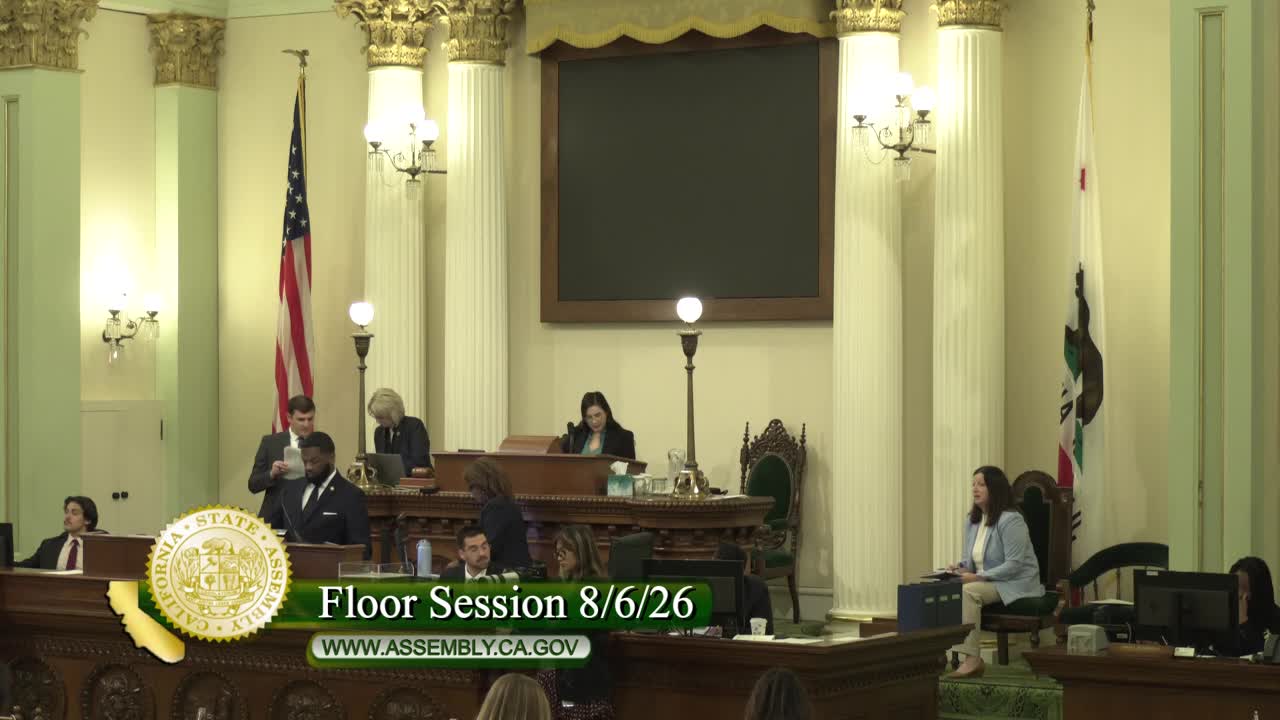
| Aug 6, 2026 | Senate amendments concurred in. To Engrossing and Enrolling. (Ayes 75. Noes 0.). |
| Aug 6, 2026 | Senate amendments concurred in. To Engrossing and Enrolling. (Ayes 75. Noes 0. Page 6072.). |
| Jun 18, 2026 | In Assembly. Concurrence in Senate amendments pending. |
| Jun 18, 2026 | Read third time. Passed. Ordered to the Assembly. (Ayes 37. Noes 0.). |
| Jun 18, 2026 | Read third time. Passed. Ordered to the Assembly. (Ayes 37. Noes 0. Page 4860.). |
| Jun 16, 2026 | Read second time. Ordered to Consent Calendar. |
| Jun 15, 2026 | From committee: Be ordered to second reading file pursuant to Senate Rule 28.8 and ordered to Consent Calendar. |
| Jun 9, 2026 | From committee chair, with author's amendments: Amend, and re-refer to committee. Read second time, amended, and re-referred to Com. on APPR. |
| Jun 4, 2026 | From committee: Do pass and re-refer to Com. on APPR. with recommendation: To Consent Calendar. (Ayes 7. Noes 0.) (June 3). Re-referred to Com. on APPR. |
| May 6, 2026 | Referred to Com. on ED. |
| Apr 23, 2026 | In Senate. Read first time. To Com. on RLS. for assignment. |
| Apr 23, 2026 | Read third time. Passed. Ordered to the Senate. (Ayes 74. Noes 0.) |
| Apr 23, 2026 | Read third time. Passed. Ordered to the Senate. (Ayes 74. Noes 0. Page 4795.) |
| Apr 16, 2026 | Read second time. Ordered to Consent Calendar. |
| Apr 15, 2026 | From committee: Do pass. To Consent Calendar. (Ayes 13. Noes 0.) (April 15). |
| Mar 25, 2026 | From committee: Do pass and re-refer to Com. on APPR. with recommendation: To Consent Calendar. (Ayes 9. Noes 0.) (March 25). Re-referred to Com. on APPR. |
| Mar 25, 2026 | Coauthors revised. |
| Mar 2, 2026 | Referred to Com. on ED. |
| Feb 19, 2026 | From printer. May be heard in committee March 21. |
| Feb 18, 2026 | Read first time. To print. |
|
Date
|
Description
|
Location
|
Votes
|
|
|---|---|---|---|---|
| Aug 6, 2026 | AB 2056 Alvarez Concurrence in Senate Amendments | Assembly Floor |
Passed |
|
| Jun 18, 2026 | Consent Calendar 2nd AB2056 Alvarez et al. | Senate Floor |
Passed |
|
| Jun 3, 2026 | Do pass, but first be re-referred to the Committee on [Appropriations] with the recommendation: To Consent Calendar | Senate Standing Committee on Education |
Passed |
|
| Apr 23, 2026 | AB 2056 Alvarez Consent Calendar Second Day Regular Session | Assembly Floor |
Passed |
|
| Apr 15, 2026 | Do pass. To Consent Calendar. | Assembly Standing Committee on Appropriations |
Passed |
|
| Mar 25, 2026 | Do pass and be re-referred to the Committee on [Appropriations] with recommendation: To Consent Calendar | Assembly Standing Committee on Education |
Passed |
This list shows positions taken on this bill by organizations on the date displayed, which is linked to the original source.
Positions by individuals are not included.
|
Organization
|
Position
|
Date
|
|---|---|---|
| Alameda County Office Of Education | ** Support | |
| Association Of California School Administrators | ** Support | |
| California Association For Bilingual Education | ** Support | |
| California Charter Schools Association | ** Support | |
| Governor | ** Against | |
| San Diego County Office of Education | ** Support | |
| San Diego Unified School District | ** Support | |
| Santa Clara County Office Of Education | ** Support |
CONCURRENCE IN SENATE AMENDMENTS
CSA1 Bill Id:AB 2056
Author:(Alvarez)
As Amended Ver:June 9, 2026
Majority vote
SUMMARY
Revises and recasts the World Language Teacher Exchange and Recruitment Law of 1963 by expanding authorized teacher exchange and recruitment activities to include county offices of education and charter schools, expressly authorizing exchanges with Mexico and Spain, removing specified state-level administrative responsibilities, and authorizing designated visa sponsors to facilitate placements of teachers from other countries, including Mexico and Spain, in California schools for cultural exchange purposes.
Senate Amendments
- Adds Spain to the named countries for which the State Board of Education (SBE) is authorized to adopt rules and regulations under which teachers employed by local educational agencies (LEAs) may exchange positions with teachers in schools in other countries. Retains the authority for the SBE to adopt rules and regulations under which teachers employed by LEAs may exchange positions with teachers in schools in any country.
- Requires any adopted SBE rules and regulations to authorize J-1 visa sponsors designated by the United States Department of State to sponsor teachers from other countries, including Mexico and Spain, for placement in California LEAs to promote cultural exchange for specified purposes, expanding current law which lists only Mexico.
- Clarifies that one of the specified purposes is to ensure California students may engage in bilingual instruction and assist LEAs in supporting diverse language learning opportunities.
COMMENTS
Modernizing a largely dormant statutory framework. The World Language Teacher Exchange and Recruitment Law of 1963 was enacted at a time when formalized teacher exchange programs were more centrally coordinated through state and federal agencies. Existing law still contemplates a state-directed structure in which the SBE adopts regulations, and the California Department of Education (CDE) administers exchange arrangements in coordination with federal programs. In practice, however, many modern international educator exchange programs operate through direct partnerships between LEAs and federally designated visa sponsors. This bill updates statute to better align with the current operational reality of international teacher recruitment and exchange programs.
Addressing ongoing bilingual teacher workforce challenges. California continues to experience staffing shortages in bilingual education and world language instruction. Teacher shortages have been particularly acute in dual language immersion programs and in schools serving large populations of English learners. LEAs have increasingly explored international recruitment pipelines, particularly with Mexico and other Spanish-speaking countries, as one strategy for addressing persistent workforce shortages. By expressly authorizing exchanges and recruitment activities involving Mexico and permitting placements facilitated through designated visa sponsors, this bill seeks to provide greater statutory clarity for these arrangements.
Shift from state-level administration to local flexibility. This bill substantially reduces the formal role of the SBE and the CDE in administering exchange programs. Rather than requiring statewide regulations and department-administered arrangements, this bill moves toward a more decentralized framework in which LEAs may work more directly with exchange organizations and visa sponsors. Supporters may argue that this approach provides greater flexibility and reduces unnecessary state administrative involvement. However, the shift also raises broader questions regarding consistency, oversight, and accountability across programs that may operate differently from one LEA to another.
Bill is similar to measure vetoed last year. AB 833 (Alvarez) of the 2025-26 Session would have required that the rules and regulations adopted by the SBE under which teachers employed by LEAs and charter schools may exchange positions with teachers in schools in other countries authorize J-1 visa sponsors designated by the United States Department of State, in addition to the CDE, to sponsor teachers from Mexico for placement in California LEAs to promote cultural exchange. That bill was vetoed by the Governor with the following message:
This bill is unnecessary as there is no statutory barrier to expanding program sponsorship for teachers from other countries, including Mexico, to California. Federal law does not require a single exclusive sponsor. Further, the author's stated goal is to help fill persistent educator shortages, which is contrary to the program's purpose to promote cross-cultural understanding and short-term professional growth opportunities.
This bill is substantially similar to AB 833, but additionally removes the requirement that exchanges be made through the CDE and removes the department's authority to administer the program; eliminates the requirement that exchanges be limited to one year or less; states that exchanges with teachers from Mexico and Spain may help provide California pupils with access to bilingual instruction and assist LEAs in meeting bilingual education needs; and removes the authority for the department to accept federal grants for the program. As a result, this bill arguably moves even farther away from the traditional conception of a short-term cultural exchange program and more directly frames the program as a workforce strategy for addressing bilingual teacher shortages.
According to the Author
"AB 2056 constitutes a bold and transformative legislative response to the persistent difficulties facing California's bilingual education and English learner programs. By opening the opportunity for supporting exchanges with Mexico, this groundbreaking legislation unlocks access to a pool of exceptionally qualified temporary educators who bring rich expertise in Spanish-language instruction and culturally relevant teaching methods. With over 1.1 million English Learners in California's public schools, the inclusion of Mexican teachers is not just beneficial but essential for cultivating an inclusive and supportive learning environment. This initiative not only aims to bridge the critical gap of bilingual teachers—particularly in subjects such as math, science, and special education—but also enhances the educational experience by fostering global education and cultural exchange."
"The proposed bill also seeks to enhance cultural exchange opportunities. Numerous teachers from Mexico have expressed interest in participating as temporary educators in California. Beyond the professional benefits of program participation, these educators are afforded the opportunity to observe and engage with California's cultural environment. It also expands the range of opportunities, allowing local educational agencies, including school districts and county offices of education, to decide whether to participate in bringing a temporary international teacher from Mexico for cross-cultural exchange."
Arguments in Support
The San Diego County Office of Education writes, "Since 1986, when the U.S. Department of State designated the California Department of Education as a sponsor for the Exchange Visitor Program, the Teacher Exchange Program has been instrumental in bringing credentialed teachers from abroad to California on J-1 visas. These educators have played a critical role in supporting bilingual and bicultural education, particularly in classrooms with high numbers of students who are English learners. Yet, the program's current structure lacks the flexibility needed to expand participation, leaving many qualified foreign teachers without access to valuable cultural and professional exchange opportunities in California."
"AB 2056 (Alvarez) expands teacher exchange opportunities with Mexico by strengthening cultural and educational collaboration between California and Mexico and increasing access for qualified bilingual educators to participate temporarily in California's Teacher Exchange Program. Increasing the number of Mexican teachers sponsored under the program would help meet the needs of California's diverse student population and support culturally responsive instruction."
Arguments in Opposition
None on file
FISCAL COMMENTS
According to the Senate Appropriations Committee, pursuant to Senate Rule 28.8, negligible state costs.
VOTES:
ASM EDUCATION: 9-0-0
YES: Patel, Hoover, Alvarez, Bonta, Alanis, Garcia, Lowenthal, Pellerin, Zbur
ASM APPROPRIATIONS: 13-0-2
YES: Wicks, Hoover, Arambula, Calderon, Caloza, Dixon, Fong, Mark González, Krell, Pacheco, Solache, Ta, Tangipa
ABS, ABST OR NV: Muratsuchi, Pellerin
ASSEMBLY FLOOR: 74-0-6
YES: Aguiar-Curry, Ahrens, Alanis, Alvarez, Arambula, Ávila Farías, Bains, Bauer-Kahan, Bennett, Berman, Boerner, Bonta, Bryan, Calderon, Caloza, Carrillo, Castillo, Chen, Connolly, Davies, DeMaio, Dixon, Elhawary, Ellis, Flora, Fong, Gabriel, Gallagher, Garcia, Gipson, Jeff Gonzalez, Mark González, Haney, Harabedian, Hart, Hoover, Irwin, Jackson, Johnson, Kalra, Krell, Lackey, Lee, Lowenthal, Macedo, McKinnor, Muratsuchi, Nguyen, Ortega, Pacheco, Papan, Patel, Patterson, Pellerin, Petrie-Norris, Quirk-Silva, Ramos, Ransom, Michelle Rodriguez, Rogers, Blanca Rubio, Sanchez, Schiavo, Schultz, Solache, Stefani, Ta, Tangipa, Valencia, Wallis, Ward, Wilson, Zbur, Rivas
ABS, ABST OR NV: Addis, Hadwick, Celeste Rodriguez, Sharp-Collins, Soria, Wicks
SENATE FLOOR: 37-0-3
YES: Allen, Alvarado-Gil, Archuleta, Arreguín, Becker, Blakespear, Cabaldon, Caballero, Cervantes, Choi, Cortese, Dahle, Durazo, Gonzalez, Grayson, Hurtado, Jones, Laird, Limón, McGuire, McNerney, Menjivar, Niello, Ochoa Bogh, Padilla, Pérez, Reyes, Richardson, Rubio, Smallwood-Cuevas, Stern, Strickland, Umberg, Valladares, Wahab, Weber Pierson, Wiener
ABS, ABST OR NV: Ashby, Grove, Seyarto
UPDATED
VERSION: June 9, 2026
CONSULTANT: Tanya Lieberman / Marguerite Ries ED. / (916) 319-2087 FN: 0003186
SENATE RULES COMMITTEE Office of Senate Floor Analyses (916) 651-4171 | AB 2056 |
CONSENT
Bill No: AB 2056
Author: Alvarez (D), et al.
Amended: 6/9/26 in Senate
Vote: 21
SENATE EDUCATION COMMITTEE: 7-0, 6/3/26
AYES: Pérez, Ochoa Bogh, Cabaldon, Choi, Cortese, Gonzalez, Reyes
SENATE APPROPRIATIONS COMMITTEE: Senate Rule 28.8
ASSEMBLY FLOOR: 74-0, 4/23/26 (Consent) - See last page for vote
SUBJECT: Teachers: exchange programs: local educational agencies
SOURCE: Author
DIGEST:
This bill revises and recasts the World Language Teacher Exchange and Recruitment Law of 1963 by expanding authorized teacher exchange and recruitment activities to include county offices of education and charter schools, expressly authorizing exchanges with Mexico and Spain, removing specified state-level administrative responsibilities, and authorizing designated visa sponsors to facilitate placements of teachers from other countries, including Mexico and Spain, in California schools for cultural exchange purposes.
ANALYSIS:
Existing law:
- Establishes the World Language Teacher Exchange and Recruitment Law of 1963.
- Requires the State Board of Education (SBE) to adopt rules and regulations under which teachers employed by California school districts may exchange positions with teachers in schools in other countries for periods of one year or less.
- Requires exchange arrangements to be made through the California Department of Education (CDE), in cooperation with teacher exchange programs administered by agencies of the federal government.
- Authorizes participating school districts to grant leaves of absence to certificated employees participating in exchange programs and to employ replacement teachers during the period of exchange.
- Provides that certificated employees participating in exchange programs retain specified rights and benefits, including retirement system membership rights and accumulated leave benefits.
- Authorizes governing boards to enter into agreements and take actions necessary to carry out teacher exchange programs.
This bill:
- Revises and recasts the World Language Teacher Exchange and Recruitment Law of 1963.
- Expands authorized participation in teacher exchange and recruitment activities to include county offices of education and charter schools, in addition to school districts.
- Expressly authorizes teacher exchanges and recruitment activities involving Mexico and Spain.
- Removes the requirement that the SBE adopt rules and regulations governing teacher exchanges.
- Removes the requirement that the CDE administer exchange arrangements or coordinate those arrangements with federal teacher exchange programs.
- Eliminates the existing one-year limitation on teacher exchanges.
- Authorizes, rather than requires, the adoption of regulations governing exchange and recruitment activities.
- Requires any regulations adopted to authorize visa sponsors designated by the United States Department of State to sponsor teachers from other countries, including Mexico and Spain, for placement in school districts, county offices of education, and charter schools for purposes of cultural exchange.
- Makes conforming and technical changes to update statutory references and terminology throughout the article.
Comments
Need for this bill. According to the author, “AB 2056 constitutes a bold and transformative legislative response to the persistent difficulties facing California's bilingual education and English learner programs. By opening the opportunity for supporting exchanges with Mexico, this groundbreaking legislation unlocks access to a pool of exceptionally qualified temporary educators who bring rich expertise in Spanish-language instruction and culturally relevant teaching methods. With over 1.1 million English Learners in California’s public schools, the inclusion of Mexican teachers is not just beneficial but essential for cultivating an inclusive and supportive learning environment. This initiative not only aims to bridge the critical gap of bilingual teachers—particularly in subjects such as math, science, and special education—but also enhances the educational experience by fostering global education and cultural exchange.
“The proposed bill also seeks to enhance cultural exchange opportunities. Numerous teachers from Mexico have expressed interest in participating as temporary educators in California. Beyond the professional benefits of program participation, these educators are afforded the opportunity to observe and engage with California’s cultural environment. It also expands the range of opportunities, allowing local educational agencies, including school districts and county offices of education, to decide whether to participate in bringing a temporary international teacher from Mexico for cross-cultural exchange.”
Modernizing a largely dormant statutory framework. The World Language Teacher Exchange and Recruitment Law of 1963 was enacted at a time when formalized teacher exchange programs were more centrally coordinated through state and federal agencies. Existing law still contemplates a state-directed structure in which the SBE adopts regulations, and the CDE administers exchange arrangements in coordination with federal programs. In practice, however, many modern international educator exchange programs operate through direct partnerships between local educational agencies (LEAs) and federally designated visa sponsors. This bill updates statute to better align with the current operational reality of international teacher recruitment and exchange programs.
Addressing ongoing bilingual teacher workforce challenges. California continues to experience staffing shortages in bilingual education and world language instruction. Teacher shortages have been particularly acute in dual language immersion programs and in schools serving large populations of English learners. LEAs have increasingly explored international recruitment pipelines, particularly with Mexico and other Spanish-speaking countries, as one strategy for addressing persistent workforce shortages. By expressly authorizing exchanges and recruitment activities involving Mexico and permitting placements facilitated through designated visa sponsors, this bill seeks to provide greater statutory clarity for these arrangements.
Shift from state-level administration to local flexibility. This bill substantially reduces the formal role of the SBE and the CDE in administering exchange programs. Rather than requiring statewide regulations and department-administered arrangements, this bill moves toward a more decentralized framework in which LEAs may work more directly with exchange organizations and visa sponsors. Supporters may argue that this approach provides greater flexibility and reduces unnecessary state administrative involvement. However, the shift also raises broader questions regarding consistency, oversight, and accountability across programs that may operate differently from one LEA to another.
Bill is similar to measure vetoed last year. AB 833 (Alvarez, 2025) would have required that the rules and regulations adopted by the SBE under which teachers employed by LEAs and charter schools may exchange positions with teachers in schools in other countries authorize J-1 visa sponsors designated by the United States Department of State, in addition to the CDE, to sponsor teachers from Mexico for placement in California LEAs to promote cultural exchange. That bill was vetoed by the Governor with the following message:
“This bill is unnecessary as there is no statutory barrier to expanding program sponsorship for teachers from other countries, including Mexico, to California. Federal law does not require a single exclusive sponsor. Further, the author’s stated goal is to help fill persistent educator shortages, which is contrary to the program’s purpose to promote cross-cultural understanding and short-term professional growth opportunities.”
This bill is substantially similar to AB 833, but additionally removes the requirement that exchanges be made through the CDE and removes the department’s authority to administer the program; eliminates the requirement that exchanges be limited to one year or less; states that exchanges with teachers from Mexico and Spain may help provide California pupils with access to bilingual instruction and assist LEAs in meeting bilingual education needs; and removes the authority for the department to accept federal grants for the program. As a result, this bill arguably moves even farther away from the traditional conception of a short-term cultural exchange program and more directly frames the program as a workforce strategy for addressing bilingual teacher shortages.
FISCAL EFFECT: Appropriation: No Fiscal Com.: Yes Local: No
SUPPORT: (Verified 6/15/26)
Alameda County Office of Education
Association of California School Administrators
California Association for Bilingual Education
California Charter Schools Association
San Diego Unified School District
Santa Clara County Office of Education
OPPOSITION: (Verified 6/15/26)
None received
ASSEMBLY FLOOR: 74-0, 4/23/26
AYES: Aguiar-Curry, Ahrens, Alanis, Alvarez, Arambula, Ávila Farías, Bains, Bauer-Kahan, Bennett, Berman, Boerner, Bonta, Bryan, Calderon, Caloza, Carrillo, Castillo, Chen, Connolly, Davies, DeMaio, Dixon, Elhawary, Ellis, Flora, Fong, Gabriel, Gallagher, Garcia, Gipson, Jeff Gonzalez, Mark González, Haney, Harabedian, Hart, Hoover, Irwin, Jackson, Johnson, Kalra, Krell, Lackey, Lee, Lowenthal, Macedo, McKinnor, Muratsuchi, Nguyen, Ortega, Pacheco, Papan, Patel, Patterson, Pellerin, Petrie-Norris, Quirk-Silva, Ramos, Ransom, Michelle Rodriguez, Rogers, Blanca Rubio, Sanchez, Schiavo, Schultz, Solache, Stefani, Ta, Tangipa, Valencia, Wallis, Ward, Wilson, Zbur, Rivas
NO VOTE RECORDED: Addis, Hadwick, Celeste Rodriguez, Sharp-Collins, Soria, Wicks
Prepared by: Ian Johnson / ED. / (916) 651-4105
6/16/26 16:43:03
SENATE COMMITTEE ON EDUCATION
Senator Sasha Renée Pérez, Chair
2025 - 2026 Regular
Bill No: Hearing Date: June 3, 2026
Author: | |||
Version: |
| ||
Urgency: | Fiscal: | ||
Consultant: | |||
Subject: .
SUMMARY
This bill revises and recasts the World Language Teacher Exchange and Recruitment Law of 1963 by expanding authorized teacher exchange and recruitment activities to include county offices of education and charter schools, expressly authorizing exchanges with Mexico, removing specified state-level administrative responsibilities, and authorizing designated visa sponsors to facilitate placements of teachers from Mexico in California schools for cultural exchange purposes.
BACKGROUND
Existing law:
- Establishes the World Language Teacher Exchange and Recruitment Law of 1963.
- Requires the State Board of Education (SBE) to adopt rules and regulations under which teachers employed by California school districts may exchange positions with teachers in schools in other countries for periods of one year or less.
- Requires exchange arrangements to be made through the California Department of Education (CDE), in cooperation with teacher exchange programs administered by agencies of the federal government.
- Authorizes participating school districts to grant leaves of absence to certificated employees participating in exchange programs and to employ replacement teachers during the period of exchange.
- Provides that certificated employees participating in exchange programs retain specified rights and benefits, including retirement system membership rights and accumulated leave benefits.
- Authorizes governing boards to enter into agreements and take actions necessary to carry out teacher exchange programs.
ANALYSIS
This bill:
- Revises and recasts the World Language Teacher Exchange and Recruitment Law of 1963.
- Expands authorized participation in teacher exchange and recruitment activities to include county offices of education and charter schools, in addition to school districts.
- Expressly authorizes teacher exchanges and recruitment activities involving Mexico.
- Removes the requirement that the SBE adopt rules and regulations governing teacher exchanges.
- Removes the requirement that the CDE administer exchange arrangements or coordinate those arrangements with federal teacher exchange programs.
- Eliminates the existing one-year limitation on teacher exchanges.
- Authorizes, rather than requires, the adoption of regulations governing exchange and recruitment activities.
- Requires any regulations adopted to authorize visa sponsors designated by the United States Department of State to sponsor teachers from Mexico for placement in school districts, county offices of education, and charter schools for purposes of cultural exchange.
- Makes conforming and technical changes to update statutory references and terminology throughout the article.
STAFF COMMENTS
- Need for the bill. According to the author, “AB 2056 constitutes a bold and transformative legislative response to the persistent difficulties facing California's bilingual education and English learner programs. By opening the opportunity for supporting exchanges with Mexico, this groundbreaking legislation unlocks access to a pool of exceptionally qualified temporary educators who bring rich expertise in Spanish-language instruction and culturally relevant teaching methods. With over 1.1 million English Learners in California’s public schools, the inclusion of Mexican teachers is not just beneficial but essential for cultivating an inclusive and supportive learning environment. This initiative not only aims to bridge the critical gap of bilingual teachers—particularly in subjects such as math, science, and special education—but also enhances the educational experience by fostering global education and cultural exchange.
“The proposed bill also seeks to enhance cultural exchange opportunities. Numerous teachers from Mexico have expressed interest in participating as temporary educators in California. Beyond the professional benefits of program participation, these educators are afforded the opportunity to observe and engage with California’s cultural environment. It also expands the range of opportunities, allowing local educational agencies, including school districts and county offices of education, to decide whether to participate in bringing a temporary international teacher from Mexico for cross-cultural exchange.”
- Modernizing a largely dormant statutory framework. The World Language Teacher Exchange and Recruitment Law of 1963 was enacted at a time when formalized teacher exchange programs were more centrally coordinated through state and federal agencies. Existing law still contemplates a state-directed structure in which the SBE adopts regulations, and the CDE administers exchange arrangements in coordination with federal programs. In practice, however, many modern international educator exchange programs operate through direct partnerships between local educational agencies (LEAs) and federally designated visa sponsors. This bill updates statute to better align with the current operational reality of international teacher recruitment and exchange programs.
- Addressing ongoing bilingual teacher workforce challenges. California continues to experience staffing shortages in bilingual education and world language instruction. Teacher shortages have been particularly acute in dual language immersion programs and in schools serving large populations of English learners. LEAs have increasingly explored international recruitment pipelines, particularly with Mexico and other Spanish-speaking countries, as one strategy for addressing persistent workforce shortages. By expressly authorizing exchanges and recruitment activities involving Mexico and permitting placements facilitated through designated visa sponsors, this bill seeks to provide greater statutory clarity for these arrangements.
- Shift from state-level administration to local flexibility. This bill substantially reduces the formal role of the SBE and the CDE in administering exchange programs. Rather than requiring statewide regulations and department-administered arrangements, the bill moves toward a more decentralized framework in which LEAs may work more directly with exchange organizations and visa sponsors. Supporters may argue that this approach provides greater flexibility and reduces unnecessary state administrative involvement. However, the shift also raises broader questions regarding consistency, oversight, and accountability across programs that may operate differently from one LEA to another.
- Bill is similar to measure vetoed last year. AB 833 (Alvarez, 2025) would have required that the rules and regulations adopted by the SBE under which teachers employed by LEAs and charter schools may exchange positions with teachers in schools in other countries authorize J-1 visa sponsors designated by the United States Department of State, in addition to the CDE, to sponsor teachers from Mexico for placement in California LEAs to promote cultural exchange. That bill was vetoed by the Governor with the following message:
“This bill is unnecessary as there is no statutory barrier to expanding program sponsorship for teachers from other countries, including Mexico, to California. Federal law does not require a single exclusive sponsor. Further, the author’s stated goal is to help fill persistent educator shortages, which is contrary to the program’s purpose to promote cross-cultural understanding and short-term professional growth opportunities.”
This bill is substantially similar to AB 833, but additionally removes the requirement that exchanges be made through the CDE and removes the department’s authority to administer the program; eliminates the requirement that exchanges be limited to one year or less; states that exchanges with teachers from Mexico may help provide California pupils with access to bilingual instruction and assist LEAs in meeting bilingual education needs; and removes the authority for the department to accept federal grants for the program. As a result, this bill arguably moves even farther away from the traditional conception of a short-term cultural exchange program and more directly frames the program as a workforce strategy for addressing bilingual teacher shortages. The Committee may wish to consider whether those objectives are appropriately aligned with the historical purpose and federal structure of J-1 cultural exchange programs.
SUPPORT
Alameda County Office of Education
Association of California School Administrators
California Association for Bilingual Education
California Charter Schools Association
San Diego Unified School District
Santa Clara County Office of Education
OPPOSITION
None received
-- END --
Date of Hearing: April 15, 2026
ASSEMBLY COMMITTEE ON APPROPRIATIONS
Buffy Wicks, Chair
ABPCA Bill Id:AB 2056
Author:(Alvarez) – As Introduced Ver:February 18, 2026
Policy Committee: | Education | Vote: | 9 - 0 |
|
| ||
|
|
Urgency: No State Mandated Local Program: No Reimbursable: No
SUMMARY:
This bill expands the teacher exchange program participation eligibility to additional local educational agency (LEA) types and authorizes LEAs that are United States Department of State (DOS) designated J-1 visa sponsors, in addition to the California Department of Education (CDE), to sponsor teachers from Mexico.
FISCAL EFFECT:
No new state costs.
COMMENTS:
- Purpose. According to the author:
By opening the opportunity for supporting exchanges with Mexico, this groundbreaking legislation unlocks access to a pool of exceptionally qualified temporary educators who bring rich expertise in Spanish-language instruction and culturally relevant teaching methods.
- Background. Exchange Visitor Teacher Program. Since the Mutual Educational and Cultural Exchange Act of 1961 (the Fulbright-Hayes Act), federal law has authorized teacher exchanges between the U.S. and other countries, using federal exchange visitor visas known as J-1 visas. The DOS designates public and private entities to act as exchange program sponsors. According to the CDE, a visiting teacher may remain in the CDE's program for a period not to exceed three years unless a specific extension of one or two years is authorized. Visiting teachers must meet the qualifications for teaching in California's public schools and must pass the first year's probation with the designated school district or charter school in order to remain for an authorized five-year program period. The CDE also operates a summer migrant education exchange program, in which teachers from Mexico serve in summer programs for students who are children or dependents of migrant agricultural workers. CDE staff coordinate the Teacher Exchange Program through an MOU with each country and participating LEAs must sign an agreement of collaboration with the CDE to employ an exchange visitor teacher.
Sponsorship of Mexican Teachers Limited to the CDE. Historically, the CDE has interpreted existing law and MOUs the CDE has with both Mexico and Spain to authorize CDE as the sole sponsor of teachers from either country under the exchange visitor teacher program. This bill authorizes all California LEAs to serve as J-1 visa sponsors for teachers from Mexico under the program, in addition to the CDE, which may increase the number of foreign teachers who could serve in California schools.
- Related Legislation. AB 833 (Alvarez) of 2025 is substantially similar to this bill. The Governor vetoed the bill with the following message:
This bill is unnecessary as there is no statutory barrier to expanding program sponsorship for teachers from other countries, including Mexico, to California. Federal law does not require a single exclusive sponsor. Further, the author′s stated goal is to help fill persistent educator shortages, which is contrary to the program′s purpose to promote cross-cultural understanding and short-term professional growth opportunities.
Analysis Prepared by: Aaron Heredia / APPR. / (916) 319-2081
Date of Hearing: March 25, 2026
ASSEMBLY COMMITTEE ON EDUCATION
Darshana R. Patel, Chair
ABPCA Bill Id:AB 2056 (
Author:Alvarez) – As Introduced Ver:February 18, 2026
SUBJECT: Teachers: exchange programs: local educational agencies
SUMMARY: Authorizes, through rules and regulations adopted by the State Board of Education (SBE), J-1 visa sponsors designated by the United States Department of State (DOS) to work directly with local educational agencies (LEAs) and charter schools, instead of through the California Department of Education (CDE) to sponsor teachers from other countries for placement in California LEAs and charter schools to promote cultural exchange and assist LEAs and charter schools in meeting their bilingual education needs. Specifically, this bill:
- Authorizes, instead of requires, the SBE to adopt rules and regulations under which teachers employed by California LEAs and charter schools may exchange positions with teachers in schools in other countries, including Mexico, for a period of one year or less.
- Removes the requirement that the exchanges be made through the CDE and the requirement that the exchanges be for one year or less, and instead authorizes them to be made directly with LEAs and charter schools.
- Requires that any rules and regulations adopted by the SBE authorize J-1 visa sponsors designated by the DOS to sponsor teachers from Mexico for placement in California LEAs and charter schools to promote cultural exchange for both of the following purposes:
- To foster cross-cultural understanding by allowing Mexican teachers to share their knowledge, traditions, and teaching methodologies with students and educators in California;
- To provide participating teachers with firsthand experience in the U.S. education system, strengthening international collaboration and encouraging mutual appreciation of diverse educational approaches and cultural perspectives; and
- To provide California students with access to bilingual instruction and assist LEAs and charter schools in meeting their bilingual education needs.
- Authorizes LEAs and charter schools to accept federal grants for this purpose.
- Removes the authority for the CDE to administer this program.
EXISTING LAW:
- Requires the SBE to adopt rules and regulations under which teachers employed by California school districts may exchange positions with teachers in schools in other countries for a period of one year or less. (Education Code (EC) Section 44612)
- Requires that these arrangements be made through the CDE and in cooperation with the teacher exchange programs administered by agencies of the federal government. Requires that the first such exchanges take place during the 1964-65 school year. (EC 44612)
- States the purpose of the program is to encourage and promote the temporary exchange of teachers between school districts in California and schools in foreign countries and to make available to California schools as teachers foreign-born persons and others who are especially qualified to provide instruction in one or more modern world languages in order that the schools of this state may comply with the requirement of the state law that world language instruction be given to pupils in grades 6, 7, and 8 as of July 1, 1965. (EC 44611)
- Requires that California teachers participating in the program file with the CDE an application setting forth a plan of study to be completed during the year of service in a foreign country and agree to teach in a California school district for a minimum of two years following the year of exchange service. (EC 44613)
- Conditions the program on the employing school district in California not being required to pay the salary of the teacher from the foreign country. Requires that teachers employed by California school districts, while serving as teachers in a foreign country, continue to receive from their employing school districts the full amounts of the regular salaries that would be payable to them if they were serving in the schools of the particular employing school districts, and requires the school districts make all deductions provided by law for retirement purposes during that period. (EC 44614)
- Authorizes the CDE to pay the teachers from a foreign country employed by a school district in California, part or all of the difference between the salary being paid to them by their respective foreign employers and the salary being paid by the California school district to the teachers with whom they are exchanged, except that no payment for these purposes to a foreign teacher may exceed $3,000 in one school year, and no more than 500 teachers from foreign countries are provided payments in any one fiscal year. (EC 44614)
- Authorizes the CDE to pay the travel expenses of teachers in the exchange program but to no more than 500 California teachers and 500 teachers from foreign countries in any one fiscal year, and requires that those payments be for the actual expense involved in travel to and from the exchange assignments or for $1,000, whichever is the lesser amount. (EC 44614)
- Requires the Commission on Teacher Credentialing (CTC) to establish minimum standards for credentials for exchange teachers from a foreign country and provide for the issuance of credentials to those teachers. (EC 44614)
- Authorizes the governing board of a school district, for the purposes of providing bilingual instruction, world language instruction, or cultural enrichment, in the schools of the school district, subject to the rules and regulations of the SBE to conclude arrangements with the proper authorities of a foreign country, or of a state, territory, or possession of the United States, for the hiring of bilingual teachers employed in public or private schools of a foreign country, state, territory, or possession. To be eligible for employment, the teacher must speak English fluently. Any persons employed pursuant to this section are known as a “sojourn certificated employee.” (EC 44856)
- Prohibits a person from being hired as a sojourn certificated employee by a school district unless they hold the necessary valid credential or credentials to serve in a position requiring certification qualifications in the school district proposing to employ them. Authorizes the person to be employed for a period not to exceed two years, except that thereafter the period of employment may be extended from year to year for a total period of not more than five years upon verification by the employing school district that termination of the employment would adversely affect an existing bilingual or world language program or program of cultural enrichment, and that attempts to secure the employment of a certificated California teacher qualified to fill the position have been unsuccessful. (EC 44856)
- Authorizes the CTC to establish minimum standards for the credentials for sojourn certificated employees. (EC 44856)
- Federal regulations authorize exchange programs for teachers from the U.S. and from other countries, and are intended to promote the interchange of U.S. and foreign teachers and enhance mutual understanding between the people of the U.S. and other countries. It authorizes programs in which teachers work full time in U.S. public and private schools for up to three years. The DOS administers the program. (22 Code of Federal Regulations (CFR), Section 62.24)
- Authorizes the DOS to designate bona fide programs as exchange visitor programs in the Teacher category.
- Requires that the non-U.S. teachers participating in these exchanges;
- Possess, at a minimum, a degree equivalent to a U.S. bachelor's degree in either education or the academic subject field in which he or she intends to teach;
- Satisfy the teaching eligibility standards of the U.S. state in which he or she will teach, including any required criminal background or other checks;
- Are of good reputation and character;
- Agree to come to the United States temporarily as a full-time teacher of record in an accredited primary or secondary school; and
- Meet the qualifications for teaching at the primary, including pre-kindergarten, or secondary levels in schools in their home country; are working as a teacher in his or her home country at the time of application; and have at least two years of full-time teaching experience; or are not working as a teacher in his or her home country at the time of application, but otherwise meets the qualifications for teaching at the primary (including pre-kindergarten) or secondary levels in schools in the home country; have had at least two years of full-time teaching experience within the past eight years; and, within 12 months of his or her application submission date for the program, have or will have completed an advanced degree in education or in an academic subject matter that he or she intends to teach or that is directly related to his or her teaching subject field;
- Requires sponsors to screen foreign teachers carefully before accepting them for the program and require each exchange teacher to complete, within the U.S., and during each academic year of program participation, at least one cross-cultural activity as specified.
- Establishes the Bilingual Teacher Professional Development Program (BTPDP), to be administered by the CDE, in consultation with the CTC. Requires the CDE to issue grants to applicants through a competitive process. Establishes the project performance period for the BTPDP as January 1, 2018, to June 30, 2021. (EC 52202)
- Establishes the Bilingual Teacher Training Assistance Program (BTTP), administered by the CDE in consultation with the CTC and representatives of bilingual educators, for teachers who are granted waivers and who are enrolled and participating in a program leading to a bilingual specialist credential or a certificate of competence for bilingual-crosscultural competence. (EC 52180)
FISCAL EFFECT: Unknown
COMMENTS:
Need for the bill. The author states, “AB 2056 constitutes a bold and transformative legislative response to the persistent difficulties facing California's bilingual education and English learner programs. By opening the opportunity for supporting exchanges with Mexico, this groundbreaking legislation unlocks access to a pool of exceptionally qualified temporary educators who bring rich expertise in Spanish-language instruction and culturally relevant teaching methods. With over 1.1 million English Learners in California’s public schools, the inclusion of Mexican teachers is not just beneficial but essential for cultivating an inclusive and supportive learning environment. This initiative not only aims to bridge the critical gap of bilingual teachers—particularly in subjects such as math, science, and special education—but also enhances the educational experience by fostering global education and cultural exchange.
The proposed bill also seeks to enhance cultural exchange opportunities. Numerous teachers from Mexico have expressed interest in participating as temporary educators in California. Beyond the professional benefits of program participation, these educators are afforded the opportunity to observe and engage with California’s cultural environment. It also expands the range of opportunities, allowing local educational agencies, including school districts and county offices of education, to decide whether to participate in bringing a temporary international teacher from Mexico for cross-cultural exchange.”
Bill is similar to measure vetoed last year. AB 833 (Alvarez) of the 2025-26 Session would have required that the rules and regulations adopted by the SBE under which teachers employed by LEAs and charter schools may exchange positions with teachers in schools in other countries authorize J-1 visa sponsors designated by the DOS, in addition to the CDE, to sponsor teachers from Mexico for placement in California LEAs to promote cultural exchange.
This bill was vetoed with the following message:
This bill is unnecessary as there is no statutory barrier to expanding program sponsorship for teachers from other countries, including Mexico, to California. Federal law does not require a single exclusive sponsor. Further, the author′s stated goal is to help fill persistent educator shortages, which is contrary to the program′s purpose to promote cross-cultural understanding and short-term professional growth opportunities.
This bill is substantially similar to AB 833, but additionally:
- Removes the requirement that exchanges be made through the CDE and the authority for the CDE to administer the program;
- Removes the requirement that the exchanges be for one year or less;
- States that one of the purposes of exchanges with teachers from Mexico under this program is to provide California students with access to bilingual instruction and assist LEAs in meeting their bilingual education needs; and
- Removes the authority for the CDE to accept federal grants for the program.
Federal and state law authorizes exchange visitor teacher program. Since the Mutual Educational and Cultural Exchange Act of 1961 (the Fulbright-Hayes Act), federal law has authorized teacher exchanges between the U.S. and other countries, using federal exchange visitor visas known as J-1 visas. According to the CDE, the purpose of the Exchange Visitor Program is to promote:
- Cross-cultural exchanges;
- Understanding and respect between California teachers and foreign teachers;
- Professional growth opportunities for California teachers and those from foreign countries; and
- Interest in international studies and cross-cultural awareness.
The DOS designates public and private entities to act as exchange program sponsors. J-1 nonimmigrants are sponsored by an exchange program that is designated as such by the DOS.
According to the CDE, a visiting teacher can remain in CDE's program for a program period not to exceed three years unless a specific extension of one or two years is authorized. Visiting teachers must meet the qualifications for teaching in California's public schools and must pass the first year's probation with the designated school district or charter school in order to remain for an authorized five-year program period. The CDE also operates a summer migrant education exchange program, in which teachers from Mexico serve in summer programs for students of migrant agricultural workers.
Teachers participating in the exchange visitor program. According to national data from the DOS, in 2022 there were 3,580 teachers working in the top 21 receiving states under the exchange visitor program. North Carolina had the greatest number of teachers (723), and California had 232. Nationwide, the greatest number of teachers came from the Philippines (1,401) and Spain (560), and 188 were from Mexico.
According to a 2022 article in Education Week, the number of international teachers employed by U.S. school districts jumped by 69% —from 2,517 in 2015 to 4,271 in 2021. Education Week reported that among the 19,491 teachers from 114 countries who taught in the U.S. within that six-year period, the greatest numbers came from:
- Philippines: 4,338;
- Spain: 3,614;
- Jamaica: 2,213;
- China: 1,816; and
- France: 1,431
Exchange visitor program seen as a means to support biliteracy, promote cultural understanding, and also to address workforce shortages. The growth in dual language immersion (DLI) programs and the low rates of bilingual teacher preparation after Proposition 227 have increased demand for bilingual certified teachers. LEAs often cite the shortage of teachers with bilingual authorizations as a constraint on establishing new dual language immersion programs.
In addition to cultural exchange, the exchange visitor program has been seen as a means of supporting the goal of biliteracy for students. The Migration Policy Institute’s 2009 report, The Binational Option: Meeting the Instructional Needs of Limited English Proficient Students, (Terrazas, 2009) recommends that, to meet the needs of English learners, states consider arranging for visiting exchange teachers through unilateral recruitment or binational programs.
Nationally, some LEAs hire exchange visitor teachers to meet other workforce needs. According to a 2022 Education Week article, “Over the past several years, an increasing number of districts have turned to a particular strategy to help meet these complex staffing needs: hiring international teachers. For districts hiring international teachers, the talent pipeline has been especially critical for hard-to-fill positions in math, science, and special education.”
Memorandum of understanding (MOU) between the CDE and Mexico’s Secretariat of Education. According to materials provided by the author, the CDE interprets a 2004 MOU between California and Mexico’s Secretariat of Education to make it the exclusive sponsor of teachers from Mexico under the exchange visitor program. According to correspondence between Mexico’s Secretariat of Education and the Superintendent of Public Instruction (SPI), the Secretariat “[sees] no issue with Mexican teachers partnering with any U.S. DOS-designated sponsor for their participation in J-1 programs, including, but not limited to, the exchange program operated by the CDE. By offering this flexibility, we aim to broaden the range of opportunities available to Mexican educators, enhancing their professional growth and allowing more schools and students across California to benefit from their expertise.”
According to the author, as a result of the CDE serving as the sole sponsor of teachers from Mexico, a small number of Mexican teachers (ranging between 8 and 21 during the years 2017-18 and 2023-24) are sponsored to teach in California each year.
This bill would authorize California LEAs and charter schools to serve as sponsors in addition to the CDE, thereby increasing the number of foreign teachers who could serve in California schools. The Committee may wish to consider that this bill could significantly expand the number of teachers exchanged with Mexico.
California’s participation in the exchange visitor program. According to the CDE, in 1986, the DOS designated the CDE as an Exchange Visitor Program sponsor to bring credentialed teachers from overseas on J-1 visas to teach in California bilingual classrooms. The CDE supports this program by providing staff to coordinate the program, working closely with the DOS, U.S. embassies, and the education agencies of participating nations.
According to the CDE, over the years since it has sponsored over 2,500 teachers from Spain and Mexico, and in any given year, the CDE has 80 to 120 sponsored J-1 teachers participating throughout the state. CDE states that participating districts have realized many benefits for their students, as documented by their continued requests for bilingual and biliterate teachers to serve California’s high percentage of Spanish-speaking students and the growing demand for bilingual classrooms.
The CDE staff coordinates the Teacher Exchange Program through a MOU with each country. As part of the MOU, the CDE staff:
- Pre-test applicants' written and verbal English language proficiency;
- Ensure that applicants are fully qualified and properly licensed in the academic and teaching requirements of their countries of origin;
- Organize necessary documents for entry into the U.S.; and
- Assist California school districts and charter schools in establishing effective processes for screening, selecting, contracting with, and credentialing exchange teachers with the CTC.
School districts and charter schools must sign an agreement of collaboration with the CDE to employ an exchange visitor teacher.
Data about the exchange visitor program limited. According to the Migration Policy Institute (Terrazas, 2009), “as a result of the extremely decentralized management of the US-Spain and US-Mexico visiting teacher programs, there is very little comprehensive data on the programs beyond numbers of participants. Once hired, states and districts can decide what grade level and what subject visiting instructors teach.”
Multiple policies promote biliteracy as a state goal. Numerous policies enacted or adopted in recent years affirm biliteracy as a state goal for students in California. They include:
- The California English Learner Roadmap, adopted by the SBE in 2017, promotes an assets orientation toward primary language while students are also learning English, and that these assets are “valued and built upon in culturally responsive curriculum and instruction and in programs that support, wherever possible, the development of proficiency in multiple languages.”
- The Global California 2030 report, published by the CDE in 2019, set as a goal that by 2030, half of all K–12 students would be participating in programs leading to proficiency in two or more languages, either through a class, a program, or an experience, and by 2040, three out of four students would be proficient in two or more languages, earning them a State Seal of Biliteracy.
- The State Seal of Biliteracy, established by AB 815 (Brownley), Chapter 618, Statutes of 2011, recognizes proficiency in two languages in the form of a seal affixed to students’ high school diplomas.
- Proposition 58, passed by the voters in 2016, authorizes school districts to establish dual language immersion programs for both native and nonnative English speakers.
- The state has created and funded several programs aimed at increasing the number of DLI programs, and increasing the number of teachers who hold bilingual authorizations.
Sojourn certificated employee credentials. Current law requires the CTC to establish minimum standards for credentials for exchange teachers from a foreign country and provide for the issuance of credentials to those teachers. Current law also authorizes school districts, for the purposes of providing bilingual instruction, world language instruction, or cultural enrichment, to conclude arrangements with the proper authorities of a foreign country for the hiring of bilingual teachers. These teachers are known as “sojourn certificated employees.”
Requirements for CTC’s sojourn certificated employee credentials include:
- Completion of 90 semester hours of college or university coursework taken at an institution in a country other than the United States;
- Satisfying the basic skills requirement;
- Certification by the governing board of the employing California school district that the individual is a bilingual-biliterate teacher, fluent both in English and the target language, as specified;
- Verification that the individual was employed as a teacher during the calendar year immediately preceding the date of application;
- Certification by the governing board of the employing California school district that the individual will be employed by the school district in a teaching assignment authorized by the Sojourn Certificated Employee Credential;
- A written statement, signed by the applicant, verifying knowledge of the general requirements for a regular credential and agreeing to diligently pursue completion of those requirements;
- Completed credential application; and
- Completed Live Scan receipt.
Additionally, federal exchange visitor requirements, noted above, include possession of a bachelor’s degree and prior teaching experience in the home country.
Arguments in support. The San Diego County Office of Education writes, “Since 1986, when the U.S. Department of State designated the California Department of Education as a sponsor for the Exchange Visitor Program, the Teacher Exchange Program has been instrumental in bringing credentialed teachers from abroad to California on J-1 visas. These educators have played a critical role in supporting bilingual and bicultural education, particularly in classrooms with high numbers of students who are English learners. Yet, the program’s current structure lacks the flexibility needed to expand participation, leaving many qualified foreign teachers without access to valuable cultural and professional exchange opportunities in California.
AB 2056 (Alvarez) expands teacher exchange opportunities with Mexico by strengthening cultural and educational collaboration between California and Mexico and increasing access for qualified bilingual educators to participate temporarily in California’s Teacher Exchange Program. Increasing the number of Mexican teachers sponsored under the program would help meet the needs of California’s diverse student population and support culturally responsive instruction.”
Related legislation. AB 833 (Alvarez) of the 2025-26 Session would have required that the rules and regulations adopted by the SBE under which teachers employed by California local educational agencies (LEAs) and charter schools may exchange positions with teachers in schools in other countries for a period of one year or less authorize J-1 visa sponsors designated by the DOS, in addition to the CDE to sponsor teachers from Mexico for placement in California LEAs to promote cultural exchange, and required the CDE to annually report on the program. This bill was vetoed with the following message:
This bill is unnecessary as there is no statutory barrier to expanding program sponsorship for teachers from other countries, including Mexico, to California. Federal law does not require a single exclusive sponsor. Further, the author′s stated goal is to help fill persistent educator shortages, which is contrary to the program′s purpose to promote cross-cultural understanding and short-term professional growth opportunities.
AB 1127 (Reyes and McCarty), Chapter 830, Statutes of 2023, extends the deadline for the submission of a final report on the Bilingual Teacher Professional Development Program (BTPDP) from 2029 to 2030, and states that specified program participants are eligible for professional development services.
SB 952 (Limon) of the 2021-22 Session would have revised and recasted an existing three-year competitive dual language grant program administered by the CDE for schools. This bill was held in the Assembly Appropriations Committee.
AB 2514 (Thurmond), Chapter 763, Statutes of 2018, establishes the Pathways to Success Grant Program for the purpose of providing grants for the establishment and expansion of dual language immersion programs, developmental bilingual programs for English learners, and early learning dual language learners programs.
AB 130 (Committee on Budget), Chapter 44, Statutes of 2021, appropriated $10 million for a dual language immersion grant program, to award 25 one-time grants over a period of 3 fiscal years to eligible entities to expand or establish dual language immersion programs.
AB 1363 (L. Rivas), Chapter 498, Statutes of 2021, requires the SPI to develop procedures for providers to identify and report data on dual language learners enrolled in the CSPP.
AB 1012 (Reyes) of the 2019-20 Session would have required, upon appropriations for this purpose, the CDE to provide grants to LEAs for, among other purposes, professional learning for child development providers so that they can support the development of dual language learners. This bill was held in the Assembly Appropriations Committee.
SB 594 (Rubio) of the 2019-20 Session would have established the California English Learner Roadmap Initiative, for the purpose of awarding grants to build capacity for implementation of the EL Roadmap, including the EL Roadmap at every level of the statewide system of support, and establishing connections to the local control and accountability plan and Title III plan, among other goals. This bill was held in the Assembly Education Committee.
AB 952 (Reyes) of the 2017-18 Session would have required the CTC to establish a process to identify short-term, high-quality pathways to address the shortage of bilingual education teachers. This bill was vetoed by the Governor, who stated:
California recently provided funds to support teachers and paraprofessionals interested in becoming bilingual teachers. This past spring the Commission awarded one-time grants to higher education institutions that sought to create or improve four-year integrated teacher education programs, including for bilingual teachers. Before making additional investments on this matter I believe it's wise to first assess the success of our current programs.
AB 99 (Committee on Budget), Chapter 15, Statutes of 2017, establishes the BTPDP and requires the CDE to allocate grant funding for purposes of providing professional development services to specified teachers and paraprofessionals to provide instruction to English learners.
REGISTERED SUPPORT / OPPOSITION:
Support
Alameda County Office of Education
California Association for Bilingual Education
San Diego County Office of Education
San Diego Unified School District
Opposition
None on file
Analysis Prepared by: Tanya Lieberman / ED. / (916) 319-2087
Bill Author