AB 2121: Community colleges: current expense of education: exclusions.
- Session Year: 2025-2026
- House: Assembly
- Latest Version Date: 2026-09-27
Current Status:
Passed
(2026-09-27: Chaptered by Secretary of State - Chapter 580, Statutes of 2026.)
Introduced
In Committee
Awaiting First Chamber Vote
Passed First Chamber
In Committee
Awaiting Second Chamber Vote
Passed Second Chamber
Enacted
What does this bill do?
Allows California community college districts to exclude certain local unrestricted spending used to replace student support services previously paid by federal discretionary grants (lost on or after Sept. 10, 2025) from the calculation of their “current expense of education,” the state measure tied to the rule that at least half of that spending go to classroom instructor salaries. The exclusion is limited to the amount of the former federal awards, is aimed at preserving services like tutoring, counseling, mentoring, and financial aid help, and may not be used to cut instructional spending, reduce full‑time faculty, or create or expand administrative positions.
The summary is provided by generative AI which can make mistakes. For original language, please view the details in the table below.
Existing law establishes the California Community Colleges, under the administration of the Board of Governors of the California Community Colleges, as one of the segments of public postsecondary education in this state. Existing law establishes community college districts throughout the state and authorizes these districts to provide instruction at community college campuses.
Existing law requires the expenditure, during each fiscal year, for the payment of salaries of classroom instructors by a community college district, of 50% of the districts current expense of education. Existing law defines current expense of education as the gross total expended for certain expenses that include academic salaries, classified salaries, employee benefits, and books, supplies, and equipment replacement, but that generally exclude expenses for student transportation, food services, and community services.
This bill, notwithstanding the above-described provisions, would authorize a community college district, for a period of 5 fiscal years following the 202526 fiscal year, or until specified federal funding is fully restored to every community college district, whichever occurs first, to exclude from its current expense of education any local unrestricted expenditures from the community college districts unrestricted general fund, as provided, and not to exceed a specified amount, that maintain student support functions that were previously funded though federal discretionary grants that have been terminated, nonrenewed, or defunded due to federal action on or after September 10, 2025. If a community college district exercises its authority pursuant to these provisions, the bill would require the community college district to annually certify eligibility to the office of the Chancellor of the California Community Colleges, as specified, and would require the chancellors office to maintain documentation and include as part of another specified report, any certifications it receives, as provided. The bill would require the above-described action to exclude local unrestricted expenditures from a community college districts current expense of education to be taken at a regular public meeting of the governing board of the community college district, as specified. The bill would make its provisions inoperative on July 1, 2031, or on the first day of the fiscal year following the full restoration of specified federal funding to every community college district, whichever occurs first, and would repeal them on January 1 of the year following the inoperative date.
This bill would declare that it is to take effect immediately as an urgency statute.Existing law establishes the California Community Colleges, under the administration of the Board of Governors of the California Community Colleges, as one of the segments of public postsecondary education in this state. Existing law establishes community college districts throughout the state and authorizes these districts to provide instruction at community college campuses.
Existing law requires the expenditure, during each fiscal year, for the payment of salaries of classroom instructors by a community college district, of 50% of the districts current expense of education. Existing law defines current expense of education as the gross total expended for certain expenses that include academic salaries, classified salaries, employee benefits, and books, supplies, and equipment replacement, but that generally exclude expenses for student transportation, food services, and community services.
This bill, notwithstanding the above-described provisions, would authorize a community college district, for a period of 5 fiscal years following the 202526 fiscal year, or until specified federal funding is fully restored to every community college district, whichever occurs first, to exclude from its current expense of education any local unrestricted expenditures from the community college districts unrestricted general fund, as provided, and not to exceed a specified amount, that maintain student support functions that were previously funded though federal discretionary grants that have been terminated, nonrenewed, or defunded due to federal action on or after September 10, 2025. If a community college district exercises its authority pursuant to these provisions, the bill would require the community college district to annually certify eligibility to the office of the Chancellor of the California Community Colleges, as specified, and would require the chancellors office to maintain documentation and include as part of another specified report, any certifications it receives, as provided. The bill would require the above-described action to exclude local unrestricted expenditures from a community college districts current expense of education to be taken at a regular public meeting of the governing board of the community college district, as specified. The bill would make its provisions inoperative on July 1, 2031, or on the first day of the fiscal year following the full restoration of specified federal funding to every community college district, whichever occurs first, and would repeal them on January 1 of the year following the inoperative date.
This bill would declare that it is to take effect immediately as an urgency statute.
Existing law establishes the California Community Colleges, under the administration of the Board of Governors of the California Community Colleges, as one of the segments of public postsecondary education in this state. Existing law establishes community college districts throughout the state and authorizes these districts to provide instruction at community college campuses.
Existing law requires the expenditure, during each fiscal year, for the payment of salaries of classroom instructors by a community college district, of 50% of the districts current expense of education. Existing law defines current expense of education as the gross total expended for certain expenses that include academic salaries, classified salaries, employee benefits, and books, supplies, and equipment replacement, but that generally exclude expenses for student transportation, food services, and community services.
This bill, notwithstanding the above-described provisions, would authorize a community college district, for a period of 5 fiscal years following the 202526 fiscal year, or until specified federal funding is restored, fully restored to every community college district, whichever occurs first, to exclude from its current expense of education any local unrestricted expenditures from the community college districts unrestricted general fund, as specified, provided, and not to exceed a specified amount, that maintain student support functions that were previously funded though federal discretionary grants that have been terminated, nonrenewed, or defunded due to federal action on or after September 10, 2025. If a community college district exercises its authority pursuant to these provisions, the bill would require the community college district to annually certify eligibility to the office of the Chancellor of the California Community Colleges Colleges, as specified, and would require the chancellors office to maintain documentation and include as part of another specified report, any certifications it receives, as provided. The bill would make its provisions inoperative on July 1, 2031, or on the first day of the fiscal year following the full restoration of specified federal funding, funding to every community college district, whichever occurs first, and would repeal them on January 1 of the year following the inoperative date.
This bill would declare that it is to take effect immediately as an urgency statute.
Existing law establishes the California Community Colleges, under the administration of the Board of Governors of the California Community Colleges, as one of the segments of public postsecondary education in this state. Existing law establishes community college districts throughout the state and authorizes these districts to provide instruction at community college campuses.
Existing law requires the expenditure, during each fiscal year, for the payment of salaries of classroom instructors by a community college district, of 50% of the districts current expense of education. Existing law defines current expense of education as the gross total expended for certain expenses that include academic salaries, classified salaries, employee benefits, and books, supplies, and equipment replacement, but that generally exclude expenses for student transportation, food services, and community services.
This bill, notwithstanding the above-described provisions, would authorize a community college district, for a period of 5 fiscal years following the 202526 fiscal year, or until specified federal funding is restored, whichever occurs first, to exclude from its current expense of education any local unrestricted expenditures from the community college districts unrestricted general fund, as specified, that maintain student support functions that were previously funded though federal discretionary grants that have been terminated, nonrenewed, or defunded due to federal action on or after September 10, 2025. If a community college district exercises its authority pursuant to these provisions, the bill would require the community college district to annually certify eligibility to the office of the Chancellor of the California Community Colleges and would require the chancellors office to maintain documentation and include as part of another specified report, any certifications it receives, as provided. The bill would make its provisions inoperative on July 1, 2031, or on the first day of the fiscal year following restoration of specified federal funding, whichever occurs first, and would repeal them on January 1 of the year following the inoperative date.
This bill would declare that it is to take effect immediately as an urgency statute.
(a)Notwithstanding Section 84362, for a period of five fiscal years following the 202526 fiscal year, or until federal funding is fully restored to every community college district, whichever occurs first, a community college district may exclude, as part of its current expense of education, as that term is used and defined in Section 84362, any local unrestricted expenditures from the community college districts unrestricted general fund, as defined by the California Community Colleges Budget and Accounting Manual, that maintain student support functions that were previously funded through federal discretionary grants that have been terminated, nonrenewed, or defunded due to federal action on or after September 10, 2025.
(b)Community college districts that choose to exclude expenditures pursuant to subdivision (a) shall annually certify eligibility to the chancellors office, consistent with submissions that may be required during the college year pursuant to subdivision (h) of Section 84362. The chancellors office shall maintain documentation and include certifications the chancellors office receives from community college districts in the annual report to the Legislature required pursuant to subdivision (i) of Section 84362.
(c)Expenditures excluded pursuant to this section shall not exceed the amount of federal discretionary grant funding awarded for use by the community college district to maintain student support functions before the termination, nonrenewal, or defunding of the federal discretionary grants due to federal action on or after September 10, 2025.
(d)Expenditures excluded pursuant to this section shall not be considered in determining compliance with subdivision (d) of Section 84362 and the use of this exclusion by a community college district shall not constitute grounds to reduce instructional expenditures. This section shall not reduce or otherwise affect a community college districts obligation to do all of the following:
(1)Maintain compliance with the requirement of subdivision (d) of Section 84362 that not less than one-half of the districts current expense of education be expended for salaries of classroom instructors.
(2)Maintain compliance with the Faculty Obligation Number and related requirements established by the board of governors, including Section 87482.6 and Section 51025 of Title 5 of the California Code of Regulations.
(3)Not reduce the number of fulltime faculty positions or otherwise diminish the overall quality of instruction.
(4)(A)Avoid any use of this exclusion to fund the creation or expansion of administrative positions, or to provide compensation increases to administrators or supervisors beyond adjustments otherwise authorized by existing contracts or salary schedules.
(B)For purposes of this paragraph, administrator and supervisor have the same meaning as defined in paragraph (2) of subdivision (b) of Section 84362.
(5)Continue to treat as a matter of negotiation any decisions affecting instructional assignments, faculty load, or course offerings.
(e)(1)A community college district that chooses to exclude expenditures pursuant to subdivision (a) shall do so by an action taken at a regular public meeting of the governing board of the community college district, with notice provided to the campus community, including faculty, in advance of that meeting consistent with the community college districts established practices for noticing governing board meetings. The governing board agenda for that meeting shall identify the proposed exclusion as a distinct agenda item.
(2)This subdivision does not preclude a community college district from taking action in compliance with the Ralph M. Brown Act (Chapter 9 (commencing with Section 54950) of Part 1 of Division 2 of Title 5 of the Government Code).
(f)For purposes of this section, the following definitions apply:
(1)Discretionary grant means a grant awarded on a competitive basis by the United States Department of Education to a community college district for the specific and limited purpose of funding student support functions. A discretionary grant does not include a financial award provided directly to an individual student on the basis of student eligibility.
(2)Student support functions means any activities that were authorized to be funded by federal discretionary grants awarded to a community college district that have been terminated, nonrenewed, or defunded due to federal action on or after September 10, 2025. Student support functions include, but are not limited to, all of the following:
(A)Academic tutoring.
(B)Individualized counseling for personal, career, and academic matters, including advice and assistance in the selection of academic courses.
(C)Mentoring programs, including mentoring provided by faculty, staff, or peers.
(D)Providing information regarding the full range of federal student financial aid programs, benefits, and resources for locating public and private scholarships, and providing assistance in completing financial aid applications.
(E)Providing assistance in applying for admission to, and obtaining financial assistance at, a community college or for enrollment in institutions that grant baccalaureate degrees.
(F)Developing articulation agreements and student support programs designed to facilitate the transfer of students from two-year to four-year institutions.
(G)Programs and services specially designed for students with limited English proficiency, students with disabilities, students who are homeless or formerly homeless, and students who are in, or aging out of, the foster care system.
(H)Securing temporary housing during breaks in the academic year for students who are homeless or aging out of foster care.
(I)Faculty development, curriculum development, and academic instruction support directly related to strengthening a community colleges capacity to serve students.
(J)Community outreach programs designed to encourage elementary and secondary school pupils to develop the academic preparation and interest to pursue postsecondary education.
(K)The development, improvement, or operation of learning centers, tutoring centers, and other dedicated student support facilities, including technology infrastructure for the delivery of those services.
(g)This section shall become inoperative on July 1, 2031, or on the first day of the fiscal year following the full restoration of the federal funding described in subdivision (a) to every community college district, whichever occurs first, and shall be repealed on January 1 of the year following the date that this section becomes inoperative.
SEC. 2.This act is an urgency statute necessary for the immediate preservation of the public peace, health, or safety within the meaning of Article IV of the California Constitution and shall go into immediate effect. The facts constituting the necessity are:In order to prevent the immediate disruption of essential student support services for economically disadvantaged, first-generation, and other vulnerable community college students as a result of sudden federal funding withdrawals, it is necessary that this bill go into immediate effect.(a)Notwithstanding Section 84362, for a period of five fiscal years following the 202526 fiscal year, or until federal funding is fully restored to every community college district, whichever occurs first, a community college district may exclude, as part of its current expense of education, as that term is used and defined in Section 84362, any local unrestricted expenditures from the community college districts unrestricted general fund, as defined by the California Community Colleges Budget and Accounting Manual, that maintain student support functions that were previously funded through federal discretionary grants that have been terminated, nonrenewed, or defunded due to federal action on or after September 10, 2025.
(b)Community college districts that choose to exclude expenditures pursuant to subdivision (a) shall annually certify eligibility to the chancellors office, consistent with submissions that may be required during the college year pursuant to subdivision (h) of Section 84362. The chancellors office shall maintain documentation and include certifications the chancellors office receives from community college districts in the annual report to the Legislature required pursuant to subdivision (i) of Section 84362.
(c)Expenditures excluded pursuant to this section shall not exceed the amount of federal discretionary grant funding awarded for use by the community college district to maintain student support functions before the termination, nonrenewal, or defunding of the federal discretionary grants due to federal action on or after September 10, 2025.
(d)Expenditures excluded pursuant to this section shall not be considered in determining compliance with subdivision (d) of Section 84362 and the use of this exclusion by a community college district shall not constitute grounds to reduce instructional expenditures. This section shall not reduce or otherwise affect a community college districts obligation to do all of the following:
(1)Maintain compliance with the requirement of subdivision (d) of Section 84362 that not less than one-half of the districts current expense of education be expended for salaries of classroom instructors.
(2)Maintain compliance with the Faculty Obligation Number and related requirements established by the board of governors, including Section 87482.6 and Section 51025 of Title 5 of the California Code of Regulations.
(3)Not reduce the number of fulltime faculty positions or otherwise diminish the overall quality of instruction.
(4)(A)Avoid any use of this exclusion to fund the creation or expansion of administrative positions, or to provide compensation increases to administrators or supervisors beyond adjustments otherwise authorized by existing contracts or salary schedules.
(B)For purposes of this paragraph, administrator and supervisor have the same meaning as defined in paragraph (2) of subdivision (b) of Section 84362.
(5)Continue to treat as a matter of negotiation any decisions affecting instructional assignments, faculty load, or course offerings.
(e)(1)A community college district that chooses to exclude expenditures pursuant to subdivision (a) shall do so by an action taken at a regular public meeting of the governing board of the community college district, with notice provided to the campus community, including faculty, in advance of that meeting consistent with the community college districts established practices for noticing governing board meetings. The governing board agenda for that meeting shall identify the proposed exclusion as a distinct agenda item.
(2)This subdivision does not preclude a community college district from taking action in compliance with the Ralph M. Brown Act (Chapter 9 (commencing with Section 54950) of Part 1 of Division 2 of Title 5 of the Government Code).
(e)(f)For purposes of this section, the following definitions apply:
(1)Discretionary grant means a grant awarded on a competitive basis by the United States Department of Education to a community college district for the specific and limited purpose of funding student support functions. A discretionary grant does not include a financial award provided directly to an individual student on the basis of student eligibility.
(2)Student support functions means any activities that were authorized to be funded by federal discretionary grants awarded to a community college district that has have been terminated, nonrenewed, or defunded due to federal action on or after September 10, 2025. Student support functions include, but are not limited to, all of the following:
(A)Academic tutoring.
(B)Individualized counseling for personal, career, and academic matters, including advice and assistance in the selection of academic courses.
(C)Mentoring programs, including mentoring provided by faculty, staff, or peers.
(D)Providing information regarding the full range of federal student financial aid programs, benefits, and resources for locating public and private scholarships, and providing assistance in completing financial aid applications.
(E)Providing assistance in applying for admission to, and obtaining financial assistance at, a community college or for enrollment in institutions that grant baccalaureate degrees.
(F)Developing articulation agreements and student support programs designed to facilitate the transfer of students from two-year to four-year institutions.
(G)Programs and services specially designed for students with limited English proficiency, students with disabilities, students who are homeless or formerly homeless, and students who are in, or aging out of, the foster care system.
(H)Securing temporary housing during breaks in the academic year for students who are homeless or aging out of foster care.
(I)Faculty development, curriculum development, and academic instruction support directly related to strengthening a community colleges capacity to serve students.
(J)Community outreach programs designed to encourage elementary and secondary school pupils to develop the academic preparation and interest to pursue postsecondary education.
(K)The development, improvement, or operation of learning centers, tutoring centers, and other dedicated student support facilities, including technology infrastructure for the delivery of those services.
(f)(g)This section shall become inoperative on July 1, 2031, or on the first day of the fiscal year following the full restoration of the federal funding described in subdivision (a) to every community college district, whichever occurs first, and shall be repealed on January 1 of the year following the date that this section becomes inoperative.
SEC. 2.This act is an urgency statute necessary for the immediate preservation of the public peace, health, or safety within the meaning of Article IV of the California Constitution and shall go into immediate effect. The facts constituting the necessity are:
In order to prevent the immediate disruption of essential student support services for economically disadvantaged, first-generation, and other vulnerable community college students as a result of sudden federal funding withdrawals, it is necessary that this bill go into immediate effect.
(a)Notwithstanding Section 84362, for a period of five fiscal years following the 202526 fiscal year, or until federal funding is restored, fully restored to every community college district, whichever occurs first, a community college district may exclude, as part of its current expense of education, as that term is used and defined in Section 84362, any local unrestricted expenditures from the community college districts unrestricted general fund, as defined by the California Community Colleges Budget and Accounting Manual, that maintain student support functions that were previously funded through federal discretionary grants that have been terminated, nonrenewed, or defunded due to federal action on or after September 10, 2025. For purposes of this subdivision, expenditures that are eligible for exclusion include all of the following programs that previously received federal funding:
(1)Strengthening Alaska Native and Native Hawaiian-Serving Institutions (20 U.S.C. Sec. 1059d).(2)Strengthening Predominantly Black Institutions (20 U.S.C. Sec. 1059e).(3)Strengthening Native American-Serving, Nontribal Institutions (20 U.S.C. Sec. 1059f).(4)Strengthening Asian American- and Native American Pacific Islander-Serving Institutions (20 U.S.C. Sec. 1059g).(5)Minority Science and Engineering Improvement (20 U.S.C. Sec. 1067 et seq.).(6)Federal TRIO Programs (20 U.S.C. Sec. 1070a11 et seq.).(7)Developing Hispanic-Serving Institutions (20 U.S.C. Sec. 1101 et seq.).(8)Promoting Postbaccalaureate Opportunities for Hispanic Americans (20 U.S.C. Sec. 1102 et seq.).(b)Community college districts that choose to exclude expenditures pursuant to subdivision (a) shall annually certify eligibility to the chancellors office. office, consistent with submissions that may be required during the college year pursuant to subdivision (h) of Section 84362. The chancellors office shall maintain documentation and include certifications the chancellors office receives from community college districts in the annual report to the Legislature required pursuant to subdivision (i) of Section 84362.
(c)Expenditures excluded pursuant to this section shall not exceed the amount of federal discretionary grant funding awarded for use by the community college district to maintain student support functions before the termination, nonrenewal, or defunding of the federal discretionary grants due to federal action on or after September 10, 2025.
(c)(d)Expenditures excluded pursuant to this section shall not be considered in determining compliance with subdivision (d) of Section 84362 and the use of this exclusion by a community college district shall not constitute grounds to reduce instructional expenditures. This section shall not reduce or otherwise affect a community college districts obligation to do all of the following:
(1)Maintain compliance with the requirement of subdivision (d) of Section 84362 that not less than one-half of the districts current expense of education be expended for salaries of classroom instructors.
(2)Maintain compliance with the Faculty Obligation Number and related requirements established by the board of governors, including Section 87482.6 and Section 51025 of Title 5 of the California Code of Regulations.
(3)Not reduce the number of fulltime faculty positions or otherwise diminish the overall quality of instruction.
(4)(A)Avoid any use of this exclusion to fund the creation or expansion of administrative positions, or to provide compensation increases to administrators or supervisors beyond adjustments otherwise authorized by existing contracts or salary schedules.
(B)For purposes of this paragraph, administrator and supervisor have the same meaning as defined in paragraph (2) of subdivision (b) of Section 84362.
(5)Continue to treat as a matter of negotiation any decisions affecting instructional assignments, faculty load, or course offerings.
(e)For purposes of this section, the following definitions apply:
(1)Discretionary grant means a grant awarded on a competitive basis by the United States Department of Education to a community college district for the specific and limited purpose of funding student support functions. A discretionary grant does not include a financial award provided directly to an individual student on the basis of student eligibility.
(2)Student support functions means any activities that were authorized to be funded by federal discretionary grants awarded to a community college district that has been terminated, nonrenewed, or defunded due to federal action on or after September 10, 2025. Student support functions include, but are not limited to, all of the following:
(A)Academic tutoring.
(B)Individualized counseling for personal, career, and academic matters, including advice and assistance in the selection of academic courses.
(C)Mentoring programs, including mentoring provided by faculty, staff, or peers.
(D)Providing information regarding the full range of federal student financial aid programs, benefits, and resources for locating public and private scholarships, and providing assistance in completing financial aid applications.
(E)Providing assistance in applying for admission to, and obtaining financial assistance at, a community college or for enrollment in institutions that grant baccalaureate degrees.
(F)Developing articulation agreements and student support programs designed to facilitate the transfer of students from two-year to four-year institutions.
(G)Programs and services specially designed for students with limited English proficiency, students with disabilities, students who are homeless or formerly homeless, and students who are in, or aging out of, the foster care system.
(H)Securing temporary housing during breaks in the academic year for students who are homeless or aging out of foster care.
(I)Faculty development, curriculum development, and academic instruction support directly related to strengthening a community colleges capacity to serve students.
(J)Community outreach programs designed to encourage elementary and secondary school pupils to develop the academic preparation and interest to pursue postsecondary education.
(K)The development, improvement, or operation of learning centers, tutoring centers, and other dedicated student support facilities, including technology infrastructure for the delivery of those services.
(d)(f)This section shall become inoperative on July 1, 2031, or on the first day of the fiscal year following the full restoration of the federal funding described in subdivision (a), (a) to every community college district, whichever occurs first, and shall be repealed on January 1 of the year following the date that this section becomes inoperative.
SEC. 2.This act is an urgency statute necessary for the immediate preservation of the public peace, health, or safety within the meaning of Article IV of the California Constitution and shall go into immediate effect. The facts constituting the necessity are:
In order to prevent the immediate disruption of essential student support services for economically disadvantaged, first-generation, and other vulnerable community college students as a result of sudden federal funding withdrawals, it is necessary that this bill go into immediate effect.
(a)Notwithstanding Section 84362, for a period of five fiscal years following the 202526 fiscal year, or until federal funding is restored, whichever occurs first, a community college district may exclude, as part of its current expense of education, as that term is used and defined in Section 84362, any local unrestricted expenditures from the community college districts unrestricted general fund, as defined by the California Community Colleges Budget and Accounting Manual, that maintain student support functions that were previously funded through federal discretionary grants that have been terminated, nonrenewed, or defunded due to federal action on or after September 10, 2025. For purposes of this subdivision, expenditures that are eligible for exclusion include all of the following programs that previously received federal funding:
(1)Strengthening Alaska Native and Native Hawaiian-Serving Institutions (20 U.S.C. Sec. 1059d).
(2)Strengthening Predominantly Black Institutions (20 U.S.C. Sec. 1059e).
(3)Strengthening Native American-Serving, Nontribal Institutions (20 U.S.C. Sec. 1059f).
(4)Strengthening Asian American- and Native American Pacific Islander-Serving Institutions (20 U.S.C. Sec. 1059g).
(5)Minority Science and Engineering Improvement (20 U.S.C. Sec. 1067 et seq.).
(6)Federal TRIO Programs (20 U.S.C. Sec. 1070a11 et seq.).
(7)Developing Hispanic-Serving Institutions (20 U.S.C. Sec. 1101 et seq.).
(8)Promoting Postbaccalaureate Opportunities for Hispanic Americans (20 U.S.C. Sec. 1102 et seq.).
(b)Community college districts that choose to exclude expenditures pursuant to subdivision (a) shall annually certify eligibility to the chancellors office. The chancellors office shall maintain documentation and include certifications the chancellors office receives from community college districts in the annual report to the Legislature required pursuant to subdivision (i) of Section 84362.
(c)Expenditures excluded pursuant to this section shall not be considered in determining compliance with subdivision (d) of Section 84362 and the use of this exclusion by a community college district shall not constitute grounds to reduce instructional expenditures. This section shall not reduce or otherwise affect a community college districts obligation to do all of the following:
(1)Maintain compliance with the requirement of subdivision (d) of Section 84362 that not less than one-half of the districts current expense of education be expended for salaries of classroom instructors.
(2)Maintain compliance with the Faculty Obligation Number and related requirements established by the board of governors, including Section 87482.6 and Section 51025 of Title 5 of the California Code of Regulations.
(3)Not reduce the number of fulltime faculty positions or otherwise diminish the overall quality of instruction.
(4)(A)Avoid any use of this exclusion to fund the creation or expansion of administrative positions, or to provide compensation increases to administrators or supervisors beyond adjustments otherwise authorized by existing contracts or salary schedules.
(B)For purposes of this paragraph, administrator and supervisor have the same meaning as defined in paragraph (2) of subdivision (b) of Section 84362.
(5)Continue to treat as a matter of negotiation any decisions affecting instructional assignments, faculty load, or course offerings.
(d)This section shall become inoperative on July 1, 2031, or on the first day of the fiscal year following restoration of the federal funding described in subdivision (a), whichever occurs first, and shall be repealed on January 1 of the year following the date that this section becomes inoperative.
SEC. 2.This act is an urgency statute necessary for the immediate preservation of the public peace, health, or safety within the meaning of Article IV of the California Constitution and shall go into immediate effect. The facts constituting the necessity are:
In order to prevent the immediate disruption of essential student support services for economically disadvantaged, first-generation, and other vulnerable community college students as a result of sudden federal funding withdrawals, it is necessary that this bill go into immediate effect.
|
Date
|
Status
|
|---|---|
| Sep 27, 2026 | Chaptered by Secretary of State - Chapter 580, Statutes of 2026. |
| Sep 27, 2026 | Approved by the Governor. |
| Sep 10, 2026 | Enrolled and presented to the Governor at 3 p.m. |
| Aug 30, 2026 | Senate amendments concurred in. To Engrossing and Enrolling. (Ayes 73. Noes 1.). |
| Aug 30, 2026 | Senate amendments concurred in. To Engrossing and Enrolling. (Ayes 73. Noes 1. Page 6916.). |
| Aug 30, 2026 | Senate amendments concurred in. To Engrossing and Enrolling. |
| Aug 30, 2026 | In Assembly. Concurrence in Senate amendments pending. |
| Aug 30, 2026 | Read third time. Passed. Ordered to the Assembly. (Ayes 31. Noes 0.). |
| Aug 17, 2026 | Read second time. Ordered to third reading. |
| Aug 13, 2026 | Read third time and amended. Ordered to second reading. |
| Aug 5, 2026 | Read second time. Ordered to third reading. |
| Aug 4, 2026 | Read third time and amended. Ordered to second reading. |
| Jun 23, 2026 | Read second time. Ordered to third reading. |
| Jun 22, 2026 | From committee: Be ordered to second reading pursuant to Senate Rule 28.8. |
| Jun 10, 2026 | From committee: Do pass and re-refer to Com. on APPR. (Ayes 6. Noes 0.) (June 10). Re-referred to Com. on APPR. |
| May 27, 2026 | Referred to Com. on ED. |
| May 14, 2026 | In Senate. Read first time. To Com. on RLS. for assignment. |
| May 14, 2026 | Read third time. Urgency clause adopted. Passed. Ordered to the Senate. (Ayes 72. Noes 1.). |
| May 14, 2026 | Read third time. Urgency clause adopted. Passed. Ordered to the Senate. (Ayes 72. Noes 1. Page 5048.). |
| May 7, 2026 | Read second time. Ordered to third reading. |
| May 6, 2026 | From committee: Do pass. (Ayes 14. Noes 0.) (May 6). |
| Apr 13, 2026 | Re-referred to Com. on APPR. |
| Apr 9, 2026 | Read second time and amended. |
| Apr 8, 2026 | From committee: Amend, and do pass as amended and re-refer to Com. on APPR. (Ayes 9. Noes 1.) (April 7). |
| Mar 2, 2026 | Referred to Com. on HIGHER ED. |
| Feb 19, 2026 | From printer. May be heard in committee March 21. |
| Feb 18, 2026 | Read first time. To print. |
|
Date
|
Description
|
Location
|
Votes
|
|
|---|---|---|---|---|
| Aug 30, 2026 | AB 2121 Berman Concurrence in Senate Amendments | Assembly Floor |
Passed |
|
| Aug 30, 2026 | Assembly 3rd Reading AB2121 Berman By Cabaldon | Senate Floor |
Passed |
|
| Jun 10, 2026 | Do pass, but first be re-referred to the Committee on [Appropriations] | Senate Standing Committee on Education |
Passed |
|
| May 14, 2026 | AB 2121 Berman Third Reading Urgency | Assembly Floor |
Passed |
|
| May 6, 2026 | Do pass. | Assembly Standing Committee on Appropriations |
Passed |
|
| Apr 7, 2026 | Do pass as amended and be re-referred to the Committee on [Appropriations] | Assembly Standing Committee on Higher Education |
Passed |
This list shows positions taken on this bill by organizations on the date displayed, which is linked to the original source.
Positions by individuals are not included.
|
Organization
|
Position
|
Date
|
|---|---|---|
| Antelope Valley Community College District | ** Support | |
| Associated Students of West Valley College | ** Support | |
| Associated Students of West Valley College (ASWVC) | ** Support | |
| Association Of California Community College Administrators | ** Support | |
| California Teachers Association | ** Against | |
| Campaign For College Opportunity | ** Support | |
| CFT – a Union of Educators & Classified Professionals, AFT, AFL-CIO | ** Against | |
| Chief Executive Officers of the California Community Colleges Board | ** Support | |
| Community College League of California | ** Support | |
| EdTrust-West | ** Support | |
| Faculty Association Of California Community Colleges | ** Against | |
| Foothill-De Anza Community College District | ** Support | |
| Kern Community College District | ** Support | |
| Lake Tahoe Community College | ** Support | |
| Lake Tahoe Community College District | ** Support | |
| Los Rios Community College District | ** Support | |
| Mission College Classified Senate | ** Support | |
| Mt. San Jacinto Community College District | ** Support | |
| San Bernardino Community College District | ** Support | |
| Saratoga Area Senior Coordinating Council | ** Support | |
| Southwestern Community College District | ** Support | |
| State Center Community College District | ** Support | |
| The Institute for College Access and Success | ** Support | |
| University Of California Student Association | ** Support | |
| Victor Valley Community College District | ** Support | |
| West Valley College Classified Senate | ** Support | |
| West Valley Mission | ** Support | |
| West Valley-mission Community College District | ** Support |
CONCURRENCE IN SENATE AMENDMENTS
CSA1 Bill Id:AB 2121
Author:(Berman)
As Amended Ver:August 13, 2026
Majority vote
SUMMARY
Allows a community college district (CCD) to exclude, as part of its current expense of education calculation, any unrestricted general fund expenditures on student support functions previously funded through federal discretionary grants that have been terminated, nonrenewed, or defunded due to federal action on or after September 10, 2025.
Senate Amendments
- Removed the Urgency Clause.
- Requires community college districts, who elect to use state funds to backfill federal grants, to approve of the backfill during a public hearing of the governing board of the community college district. Requires the public meeting where the action will take place to be publicly noticed and for the action to be done in compliance with the Ralph M. Brown Act.
COMMENTS
Fifty Percent Law. In California, every community college district is subject to a law (Education Code Section 84362) that governs how the district is to expend its nondiscretionary funds. This statutory requirement is colloquially known as the Fifty Percent Law. A simplistic definition of the Fifty Percent Law, as described by Chancellor's Office of the CCC, states the Fifty Percent Law requires all community colleges districts to spend at least half of their "Current Expense of Education" on the salaries and benefits for classroom instructors. "Expenses of education" includes all expenditures the community college district undertakes minus expenditures for sites, building, library books, media, new equipment, leasing sites, buildings, student transportation, food services, community services, state and federal funds designated for specific purposes.
In addition to containing the formula for the Fifty Percent Law, Education Code Section 84362 includes a method for how a community college district demonstrates compliance with the Fifty Percent Law and if necessary, a method for the community college to ask for an exemption if the community college district is unable to meet the requirements. The specific parameters for authorizing an exemption are low – a community college district must demonstrate to the California Community College (CCC) Board of Governors (BOG) that meeting the fifty percent threshold for instructional salaries would result in a serious financial hardship for the district or that meeting the fifty percent threshold for instructional salaries would result in salaries which exceed comparable district salaries for their instructors.
The CCC BOG has the authority to: 1) provide an exemption to the fifty percent law in the amount provided by the community college district, 2) reduce the amount of the requested exemption, or 3) to deny the exemption. If the exemption is denied the community college district must develop a plan to "pay back" whatever fiscal amount was short of the fifty percent calculation, or the district will risk having funds removed from future state general fund allocations. In recent years, exemptions have been granted to community college districts who had extenuating financial circumstances resulting in the district being financially unable to meet the Fifty Percent Law requirements for instructional salaries. These extenuating circumstances have included ransomware attacks and state of emergencies due to fires.
Concerns have been raised that the measure circumvents the existing processes in the Education Code for how a community college district seeks an exemption to the Fifty Percent Law. While the measure does provide a new avenue for community college districts to exclude funding from the calculation, it seems reasonable to interpret that these funds were already exempt from the equation as all federal funds are excluded from the Fifty Percent Law. This bill is a measured approach and allows community college district to make real-time fiscal decisions without having to wait for approval for an exemption months after the expenditure.
According to the Author
The need for the measure is ardently expressed by the author, as "the Trump administration's assault on higher education is an attack on historically marginalized students who rely on these critical programs to stay in school and succeed. When President Trump pulls the rug out from under our most vulnerable students, California must fight back, holding firm to our values of equity and access to higher education. AB 2121 responds to the Trump administration's systematic dismantling of federal student success programs by removing barriers that prevent community colleges from backfilling this loss in federal funding. Specifically, this bill would enable community colleges to backfill the federal cuts provided by the Minority Serving Institutions discretionary grants and the TRIO discretionary grants. By temporarily excluding those backfill dollars from the Fifty Percent Law, community colleges can preserve these federally-defunded student support programs."
Furthermore, the author expands on the need for the measure as "AB 2121 includes transparency requirements and annual district certifications, with a sunset after five years or upon restoration of federal funding, whichever occurs first. This bill maintains safeguards for faculty, such as not reducing spending on classroom instructors. Further, this bill does not request new state funding or create any state backfill requirement."
Arguments in Support
The sponsoring community college district, West Valley Mission, expresses support for the measure, "AB 2121 resolves this problem through a narrow, temporary mechanism so that any local unrestricted dollars a district spends to backfill federally defunded student support programs are treated as neutral under the Fifty Percent Law, excluded from the current expense of education calculation rather than inflating the denominator and pushing a district toward noncompliance. The bill requests no new state funding, creates no state backfill obligation, and provides the upfront budget certainty that governing boards need to responsibly commit resources during the annual planning cycle. Critically, the bill contains robust safeguards. It holds faculty completely harmless and prohibits any use of the exclusion to reduce instructional spending, diminish the quality of instruction, or circumvent the Faculty Obligation Number and 75/25 full-time faculty goals. It bars the use of this exclusion to create administrative positions or increase administrator salaries beyond those otherwise authorized by existing contracts. Decisions affecting instructional assignments, faculty load, and course offerings remain subject to collective bargaining. The exclusion sunsets automatically after five fiscal years or upon restoration of federal funding, whichever comes first, and requires annual district certifications and public reporting to the Chancellor's Office. The students most affected by these federal cuts are disproportionately low-income, first-generation, and students of color at open-access institutions that lack the endowments or alternative revenue streams to absorb the loss. Without AB 2121, the Fifty Percent Law becomes a second-order barrier to equity, penalizing districts for using their own funds to serve their most vulnerable populations."
Arguments in Opposition
The Faculty Association of California Community Colleges respectfully oppose AB 2121 (Berman) because, "The Fifty Percent Law requires districts to spend at least half of their unrestricted general fund on instructional costs to ensure that colleges can fulfill their primary function: educating students. While we recognize that the loss of the Hispanic-Serving Institutions (HSI), Minority-Serving Institutions (MSI), and other federal grants could have an impact on the budgets of some colleges, AB 2121 would undermine this longstanding safeguard without sufficient justification. Weakening the Fifty Percent Law would shift funding away from the classroom and the students our system serves. We appreciate the Legislature's effort to mitigate the impact of federal funding disruptions; however, this issue would be better addressed within existing system processes rather than by weakening instructional funding protections, as stakeholders discussed at the March California Community College Consultation Council. Moreover, recent federal budget actions have reduced some of the immediate uncertainty around these programs, calling into question the need for this proposal."
FISCAL COMMENTS
According to the Senate Appropriations Committee, pursuant to Senate Rule 28.8, negligible state costs.
VOTES:
ASM HIGHER EDUCATION: 9-1-0
YES: Fong, Boerner, Jeff Gonzalez, Jackson, Irwin, Patel, Bennett, Sharp-Collins, Tangipa
NO: DeMaio
ASM APPROPRIATIONS: 14-0-1
YES: Wicks, Hoover, Aguiar-Curry, Caloza, Dixon, Fong, Mark González, Krell, Pacheco, Pellerin, Sharp-Collins, Solache, Ta, Tangipa
ABS, ABST OR NV: Arambula
ASSEMBLY FLOOR: 72-1-7
YES: Addis, Aguiar-Curry, Ahrens, Alanis, Alvarez, Ávila Farías, Bains, Bauer-Kahan, Bennett, Berman, Boerner, Bonta, Bryan, Calderon, Caloza, Carrillo, Castillo, Chen, Connolly, Davies, Dixon, Elhawary, Ellis, Fong, Gabriel, Gallagher, Gipson, Jeff Gonzalez, Mark González, Haney, Harabedian, Hart, Hoover, Irwin, Jackson, Johnson, Kalra, Krell, Lackey, Lee, Lowenthal, Macedo, McKinnor, Nguyen, Ortega, Pacheco, Papan, Patel, Patterson, Pellerin, Petrie-Norris, Quirk-Silva, Ramos, Ransom, Michelle Rodriguez, Rogers, Blanca Rubio, Sanchez, Schiavo, Schultz, Sharp-Collins, Solache, Soria, Stefani, Ta, Tangipa, Valencia, Wallis, Ward, Wicks, Wilson, Rivas
NO: DeMaio
ABS, ABST OR NV: Arambula, Flora, Garcia, Hadwick, Muratsuchi, Celeste Rodriguez, Zbur
UPDATED
VERSION: August 13, 2026
CONSULTANT: Ellen Cesaretti-Monroy / HIGHER ED. / (916) 319-3960 FN: 0004365
SENATE RULES COMMITTEE Office of Senate Floor Analyses (916) 651-4171 | AB 2121 |
THIRD READING
Bill No: AB 2121
Author: Berman (D)
Amended: 8/13/26 in Senate
Vote: 21
SENATE EDUCATION COMMITTEE: 6-0, 6/10/26
AYES: Pérez, Ochoa Bogh, Cabaldon, Cortese, Menjivar, Reyes
NO VOTE RECORDED: Choi
SENATE APPROPRIATIONS COMMITTEE: Senate Rule 28.8
ASSEMBLY FLOOR: 72-1, 5/14/26 - See last page for vote
SUBJECT: Community colleges: current expense of education: exclusions
SOURCE: West Valley-Mission Community College District
DIGEST:
This bill authorizes a community college district (CCD) to exclude, as part of its current expense of education, any local unrestricted expenditures from a CCD’s unrestricted general fund maintaining student support functions previously funded through federal discretionary grants that were terminated due to federal action on or after September 10, 2025, for a period of five fiscal years following the 2025-26 fiscal year or until federal funding is fully restored.
Senate Floor Amendments of 8/13/26 remove and urgency clause, respond to questions about this bill raised by the California Federation of Teachers, and give the bill a lower vote threshold to pass the Senate floor.
Senate Floor Amendments of 8/4/26 require a CCD opting to exclude expenditures from its current expense of education pursuant to the provisions of this bill to (1) first present this action at a regular public meeting of the governing board of the CCD, (2) identify the action as a distinct agenda item, and (3) provide advance notice of the item to the campus community, including faculty, consistent with the CCD’s established practices for noticing governing board meetings.
ANALYSIS:
Existing law:
- Establishes the California Community Colleges (CCCs), a postsecondary education system in this state, under the administration of the Board of Governors (BOG), and specifies that the CCC system consists of CCDs. (Education Code (EC) § 70900)
- Defines “current expense of education” as the gross total expended for the purposes classified in the final budget of a district for the following:
- Academic salaries other than academic salaries for student transportation, food services, and community services.
- Classified salaries other than classified salaries for student transportation, food services, and community services.
- Employee benefits other than employee benefits for student transportation personnel, food services personnel, and community services personnel.
- Books, supplies, and equipment replacement other than for student transportation and food services.
- Community services, contracted services, and other operating expenses other than for student transportation, food services, and community services. (EC § 84362)
- States that “current expense of education” does not include:
- Expenditures classified as sites, buildings, books, media, and new equipment.
- The amount expended from categorical aid received from the federal or state government which funds were granted for expenditures in a program not incurring any instructor salary expenditures or requiring disbursement of the funds without regard to the requirements of this section.
- Expenditures for facility acquisition and construction.
- The amount expended pursuant to any lease agreement for plant and equipment or the amount expended from funds received from the federal government pursuant to the “Economic Opportunity Act of 1964” or any extension of that act of Congress or the amount expended by a community college from state or federal funds received by the community college for grants to community college students or for the employment of community college students. (EC § 84362)
- Requires that, during each fiscal year, a CCD expend 50% of the district’s current expense of education for payment of salaries of classroom instructors. Also known colloquially as the Fifty Percent Law. (EC § 84362)
- Requires the BOG, for CCDs that have not expended at least 50% of their current expense of education, to designate an amount of apportionment equal to the deficiency in CCD expenditures and make those funds unavailable for expenditure by the CCD pending the determination to be made by the BOG on any application for exemption which may be submitted to the BOG. (EC § 84362)
- Requires, if no exemption is made or an exemption is denied, the BOG to order the designated amount or amount not exempted to be added to the amounts expended for salaries for classroom instructors during the next fiscal year. (EC § 84362)
- Permits the governing board of a CCD to apply to the BOG, in writing, not later than September 15 of the immediately succeeding fiscal year for exemption from the requirements of the Fifty Percent Law, in the event it appears to the governing board of a CCD that the application of the Fifty Percent Law during a fiscal year results in serious hardship to the CCD, or in the payment of salaries of classroom instructors in excess of the salaries of classroom instructors paid by other districts of comparable type and functioning under comparable conditions. (EC § 84362)
- Permits the BOG to grant an exemption for a CCD from the requirement for the fiscal year for which the application is made if a majority of all the members of the BOG finds, in writing, that the CCD will suffer serious hardship or will have to pay salaries of classroom instructors in excess of those paid by other CCDs of comparable type and functioning under comparable conditions, unless the CCD is granted an exemption. (EC § 84362)
- Requires the BOG, no later than the 10th calendar day of each year of the Legislature, to submit to the Legislature a written report on the operation, effect, and the extent of compliance with this section by CCDs during the two most recently ended fiscal years. (EC § 84362)
This bill:
- Authorizes a CCD, for a period of five fiscal years following the 2025-26 fiscal year or until federal funding is fully restored to every CCD, to exclude, as part of its current expense of education, any local unrestricted expenditures from a CCD’s unrestricted general fund that maintain student support functions previously funded through federal discretionary grants that have been terminated, nonrenewed, or defunded due to federal action on or after September 10, 2025.
- Requires CCDs that choose to exclude expenditures to annually certify eligibility to the California Community Colleges Chancellor’s Office (CCCCO), consistent with existing law, and requires the CCCCO to maintain documentation and include certifications the CCCCO receives from CCDs in the annual report the CCCCO submits on the current expense of education.
- Prohibits excluded expenditures from exceeding the amount of federal discretionary grant funding awarded for use by a CCD to maintain student support functions before the termination, nonrenewal, or defunding of federal discretionary grants due to federal action on or after September 10, 2025.
- Prohibits excluded expenditures from being considered in determining compliance with a CCD’s current expense of education requirement, and prohibits the use of excluded expenditures as grounds to reduce instructional expenditures.
- Requires that a CCD continues to have the obligation to do all of the following:
- Maintain compliance with the requirement that not less than 50% of a CCD’s current expense of education be expended for salaries of classroom instructors.
- Maintain compliance with the Faculty Obligation Number and related requirements established by the BOG.
- Not reduce the number of full-time faculty positions or otherwise diminish the overall quality of instruction.
- Avoid the use of the exclusion to fund the creation or expansion of administrative positions, or to provide compensation increases to administrators or supervisors beyond adjustments otherwise authorized by existing contracts or salary schedules.
- Continue to treat as a matter of negotiation any decisions affecting instructional assignments, faculty load, or course offerings.
- Defines the following terms:
- “Discretionary grant” means a grant awarded on a competitive basis by the United States Department of Education to a CCD for the specific and limited purpose of funding student support functions, and does not include a financial award provided directly to an individual student on the basis of student eligibility.
- “Student support functions” means any activities that were authorized to be funded by federal discretionary grants awarded to a CCD that has been terminated, nonrenewed, or defunded due to federal action on or after September 10, 2025. “Student support functions” include, but are not limited to: academic tutoring; individualized counseling; mentoring programs; providing information on the full range of federal student financial aid programs and benefits; developing articulation agreements designed to facilitate the transfer of students; and faculty development, curriculum development, and academic instruction support.
- Requires that the provisions of this bill become inoperative on July 1, 2031, or on the first day of the fiscal year following the full restoration of the federal funding for every CCD, whichever occurs first, and requires that the provisions of this bill be repealed on January 1 of the year following the date that this section becomes inoperative.
Comments
Need for the bill. According to the author, “In September 2025, the Trump administration terminated $350 million in Minority Serving Institution (MSI) grants, leaving colleges without funding for these vital student support programs. The administration’s proposed fiscal year 2026 budget seeks to eliminate MSI and TRIO programs entirely, threatening long-standing initiatives that provide counseling, tutoring, mentoring, and transfer guidance to more than 1.6 million California community college students. These cuts threaten services that help California’s most vulnerable students – low-income, first-generation, and students of color – complete their degrees.
The author continues, “AB 2121 responds to the Trump administration’s systematic dismantling of federal student success programs by removing barriers that prevent community colleges from backfilling this loss in federal funding. By temporarily excluding those backfill dollars from the Fifty Percent Law, community colleges can preserve federally-defunded student supports.”
Federal government actions for various discretionary grants. Actions taken by the federal government have created programmatic and fiscal uncertainty at the CCCs, including the sudden termination of certain discretionary federal grants in September 2025, including Hispanic Serving Institution (HSI) Grants, Minority Serving Institution (MSI) Grants, and Asian American and Native American Pacific Islander-Serving Institutions (AANAPISI) Grants. The federal government also terminated some federal TRIO grants in September 2025 for specified higher education institutions, which are outreach and student services programs designed to identify and provide services for individuals from disadvantaged backgrounds. According to the CCCCO, these HSI, MSI, and AANAPISI grants were provided to select colleges and are projected to be a loss of $61.4 million statewide over the next 5 years:
(In millions) | ||||||
Program | 2025-26 | 2026-27 | 2027-28 | 2028-29 | 2029-30 | Total |
HSI | $26.4 | $13.4 | $7.5 | $4.7 | - | $52.0 |
MSI | $1.6 | $1.2 | $0.4 | $0.0 | $0.5 | $3.8 |
AANAPISI | $3.2 | $2.0 | $0.4 | $0.0 | - | $5.6 |
Total | $31.2 | $16.6 | $8.3 | $4.7 | $0.5 | $61.4 |
Differences between the current statutory exemption and the exclusions authorized by this bill. Existing law requires CCDs that have not complied with the Fifty Percent Law to designate the amount equal to the deficiency in expenditures and have those amounts expended for salaries for classroom instructors during the next fiscal year. Current statute also permits CCDs to apply for an exemption if the application of the Fifty Percent Law results in a serious hardship for the CCD. This bill provides a process for temporarily excluding specified expenditures from the calculation of the Fifty Percent Law, rather than exempting them.
According to the author, “a qualifying district may exclude the expenditures and certify eligibility to the Chancellor’s Office annually, rather than an exemption [and] applying for after-the-fact discretionary relief. This provides upfront budget certainty districts need to commit resources during the budget planning cycle.”
Related/Prior Legislation
SB 116 (Committee on Budget and Fiscal Review, Chapter 25, Statutes of 2020) requires, from July 1, 2020 to July 1, 2021, a CCD from excluding from its computation of the Fifty Percent Law any expenditures incurred by that district during a state or local declared emergency related to the COVID-19 pandemic that are not otherwise normal expenditures that would have been incurred by the CCD.
FISCAL EFFECT: Appropriation: No Fiscal Com.: Yes Local: No
SUPPORT: (Verified 8/13/26)
West Valley-Mission Community College District (source)
Antelope Valley Community College District
Associated Students of West Valley College
Association of California Community College Administrators
Campaign for College Opportunity
Community College League of California
EdTrust-West
Foothill-De Anza Community College District
Kern Community College District
Lake Tahoe Community College District
Los Rios Community College District
Mission College Classified Senate
San Bernardino Community College District
Southwestern Community College District
State Center Community College District
The Institute for College Access and Success
University of California Student Association
Victor Valley Community College District
West Valley College Classified Senate
OPPOSITION: (Verified 8/13/26)
California Teachers Association
CFT – A Union of Educators & Classified Professionals, AFT, AFL-CIO
Faculty Association of California Community Colleges
ASSEMBLY FLOOR: 72-1, 5/14/26
AYES: Addis, Aguiar-Curry, Ahrens, Alanis, Alvarez, Ávila Farías, Bains, Bauer-Kahan, Bennett, Berman, Boerner, Bonta, Bryan, Calderon, Caloza, Carrillo, Castillo, Chen, Connolly, Davies, Dixon, Elhawary, Ellis, Fong, Gabriel, Gallagher, Gipson, Jeff Gonzalez, Mark González, Haney, Harabedian, Hart, Hoover, Irwin, Jackson, Johnson, Kalra, Krell, Lackey, Lee, Lowenthal, Macedo, McKinnor, Nguyen, Ortega, Pacheco, Papan, Patel, Patterson, Pellerin, Petrie-Norris, Quirk-Silva, Ramos, Ransom, Michelle Rodriguez, Rogers, Blanca Rubio, Sanchez, Schiavo, Schultz, Sharp-Collins, Solache, Soria, Stefani, Ta, Tangipa, Valencia, Wallis, Ward, Wicks, Wilson, Rivas
NOES: DeMaio
NO VOTE RECORDED: Arambula, Flora, Garcia, Hadwick, Muratsuchi, Celeste Rodriguez, Zbur
Prepared by: Michelle Nguyen / ED. / (916) 651-4105
8/17/26 10:47:44
**** END ****
SENATE RULES COMMITTEE Office of Senate Floor Analyses (916) 651-4171 | AB 2121 |
THIRD READING
Bill No: AB 2121
Author: Berman (D)
Amended: 8/4/26 in Senate
Vote: 27 - Urgency
SENATE EDUCATION COMMITTEE: 6-0, 6/10/26
AYES: Pérez, Ochoa Bogh, Cabaldon, Cortese, Menjivar, Reyes
NO VOTE RECORDED: Choi
SENATE APPROPRIATIONS COMMITTEE: Senate Rule 28.8
ASSEMBLY FLOOR: 72-1, 5/14/26 - See last page for vote
SUBJECT: Community colleges: current expense of education: exclusions
SOURCE: West Valley-Mission Community College District
DIGEST:
This bill, an urgency measure, authorizes a community college district (CCD) to exclude, as part of its current expense of education, any local unrestricted expenditures from a CCD’s unrestricted general fund maintaining student support functions previously funded through federal discretionary grants that were terminated due to federal action on or after September 10, 2025, for a period of five fiscal years following the 2025-26 fiscal year or until federal funding is fully restored.
Senate Floor Amendments of 8/4/26 require a CCD opting to exclude expenditures from its current expense of education pursuant to the provisions of this bill to (1) first present this action at a regular public meeting of the governing board of the CCD, (2) identify the action as a distinct agenda item, and (3) provide advance notice of the item to the campus community, including faculty, consistent with the CCD’s established practices for noticing governing board meetings.
ANALYSIS:
Existing law:
- Establishes the California Community Colleges (CCCs), a postsecondary education system in this state, under the administration of the Board of Governors (BOG), and specifies that the CCC system consists of CCDs. (Education Code (EC) § 70900)
- Defines “current expense of education” as the gross total expended for the purposes classified in the final budget of a district for the following:
- Academic salaries other than academic salaries for student transportation, food services, and community services.
- Classified salaries other than classified salaries for student transportation, food services, and community services.
- Employee benefits other than employee benefits for student transportation personnel, food services personnel, and community services personnel.
- Books, supplies, and equipment replacement other than for student transportation and food services.
- Community services, contracted services, and other operating expenses other than for student transportation, food services, and community services. (EC § 84362)
- States that “current expense of education” does not include:
- Expenditures classified as sites, buildings, books, media, and new equipment.
- The amount expended from categorical aid received from the federal or state government which funds were granted for expenditures in a program not incurring any instructor salary expenditures or requiring disbursement of the funds without regard to the requirements of this section.
- Expenditures for facility acquisition and construction.
- The amount expended pursuant to any lease agreement for plant and equipment or the amount expended from funds received from the federal government pursuant to the “Economic Opportunity Act of 1964” or any extension of that act of Congress or the amount expended by a community college from state or federal funds received by the community college for grants to community college students or for the employment of community college students. (EC § 84362)
- Requires that, during each fiscal year, a CCD expend 50% of the district’s current expense of education for payment of salaries of classroom instructors. Also known colloquially as the Fifty Percent Law. (EC § 84362)
- Requires the BOG, for CCDs that have not expended at least 50% of their current expense of education, to designate an amount of apportionment equal to the deficiency in CCD expenditures and make those funds unavailable for expenditure by the CCD pending the determination to be made by the BOG on any application for exemption which may be submitted to the BOG. (EC § 84362)
- Requires, if no exemption is made or an exemption is denied, the BOG to order the designated amount or amount not exempted to be added to the amounts expended for salaries for classroom instructors during the next fiscal year. (EC § 84362)
- Permits the governing board of a CCD to apply to the BOG, in writing, not later than September 15 of the immediately succeeding fiscal year for exemption from the requirements of the Fifty Percent Law, in the event it appears to the governing board of a CCD that the application of the Fifty Percent Law during a fiscal year results in serious hardship to the CCD, or in the payment of salaries of classroom instructors in excess of the salaries of classroom instructors paid by other districts of comparable type and functioning under comparable conditions. (EC § 84362)
- Permits the BOG to grant an exemption for a CCD from the requirement for the fiscal year for which the application is made if a majority of all the members of the BOG finds, in writing, that the CCD will suffer serious hardship or will have to pay salaries of classroom instructors in excess of those paid by other CCDs of comparable type and functioning under comparable conditions, unless the CCD is granted an exemption. (EC § 84362)
- Requires the BOG, no later than the 10th calendar day of each year of the Legislature, to submit to the Legislature a written report on the operation, effect, and the extent of compliance with this section by CCDs during the two most recently ended fiscal years. (EC § 84362)
This bill, an urgency measure:
- Authorizes a CCD, for a period of five fiscal years following the 2025-26 fiscal year or until federal funding is fully restored to every CCD, to exclude, as part of its current expense of education, any local unrestricted expenditures from a CCD’s unrestricted general fund that maintain student support functions previously funded through federal discretionary grants that have been terminated, nonrenewed, or defunded due to federal action on or after September 10, 2025.
- Requires CCDs that choose to exclude expenditures to annually certify eligibility to the California Community Colleges Chancellor’s Office (CCCCO), consistent with existing law, and requires the CCCCO to maintain documentation and include certifications the CCCCO receives from CCDs in the annual report the CCCCO submits on the current expense of education.
- Prohibits excluded expenditures from exceeding the amount of federal discretionary grant funding awarded for use by a CCD to maintain student support functions before the termination, nonrenewal, or defunding of federal discretionary grants due to federal action on or after September 10, 2025.
- Prohibits excluded expenditures from being considered in determining compliance with a CCD’s current expense of education requirement, and prohibits the use of excluded expenditures as grounds to reduce instructional expenditures.
- Requires that a CCD continues to have the obligation to do all of the following:
- Maintain compliance with the requirement that not less than 50% of a CCD’s current expense of education be expended for salaries of classroom instructors.
- Maintain compliance with the Faculty Obligation Number and related requirements established by the BOG.
- Not reduce the number of full-time faculty positions or otherwise diminish the overall quality of instruction.
- Avoid the use of the exclusion to fund the creation or expansion of administrative positions, or to provide compensation increases to administrators or supervisors beyond adjustments otherwise authorized by existing contracts or salary schedules.
- Continue to treat as a matter of negotiation any decisions affecting instructional assignments, faculty load, or course offerings.
- Defines the following terms:
- “Discretionary grant” means a grant awarded on a competitive basis by the United States Department of Education to a CCD for the specific and limited purpose of funding student support functions, and does not include a financial award provided directly to an individual student on the basis of student eligibility.
- “Student support functions” means any activities that were authorized to be funded by federal discretionary grants awarded to a CCD that has been terminated, nonrenewed, or defunded due to federal action on or after September 10, 2025. “Student support functions” include, but are not limited to: academic tutoring; individualized counseling; mentoring programs; providing information on the full range of federal student financial aid programs and benefits; developing articulation agreements designed to facilitate the transfer of students; and faculty development, curriculum development, and academic instruction support.
- Requires that the provisions of this bill become inoperative on July 1, 2031, or on the first day of the fiscal year following the full restoration of the federal funding for every CCD, whichever occurs first, and requires that the provisions of this bill be repealed on January 1 of the year following the date that this section becomes inoperative.
Comments
Need for the bill. According to the author, “In September 2025, the Trump administration terminated $350 million in Minority Serving Institution (MSI) grants, leaving colleges without funding for these vital student support programs. The administration’s proposed fiscal year 2026 budget seeks to eliminate MSI and TRIO programs entirely, threatening long-standing initiatives that provide counseling, tutoring, mentoring, and transfer guidance to more than 1.6 million California community college students. These cuts threaten services that help California’s most vulnerable students – low-income, first-generation, and students of color – complete their degrees.
AB 2121 responds to the Trump administration’s systematic dismantling of federal student success programs by removing barriers that prevent community colleges from backfilling this loss in federal funding. By temporarily excluding those backfill dollars from the Fifty Percent Law, community colleges can preserve federally-defunded student supports.”
Federal government actions for various discretionary grants. Actions taken by the federal government have created programmatic and fiscal uncertainty at the CCCs, including the sudden termination of certain discretionary federal grants in September 2025, including Hispanic Serving Institution (HSI) Grants, Minority Serving Institution (MSI) Grants, and Asian American and Native American Pacific Islander-Serving Institutions (AANAPISI) Grants. The federal government also terminated some federal TRIO grants in September 2025 for specified higher education institutions, which are outreach and student services programs designed to identify and provide services for individuals from disadvantaged backgrounds. According to the CCCCO, these HSI, MSI, and AANAPISI grants were provided to select colleges and are projected to be a loss of $61.4 million statewide over the next 5 years:
(In millions) | ||||||
Program | 2025-26 | 2026-27 | 2027-28 | 2028-29 | 2029-30 | Total |
HSI | $26.4 | $13.4 | $7.5 | $4.7 | - | $52.0 |
MSI | $1.6 | $1.2 | $0.4 | $0.0 | $0.5 | $3.8 |
AANAPISI | $3.2 | $2.0 | $0.4 | $0.0 | - | $5.6 |
Total | $31.2 | $16.6 | $8.3 | $4.7 | $0.5 | $61.4 |
Differences between the current statutory exemption and the exclusions authorized by this bill. Existing law requires CCDs that have not complied with the Fifty Percent Law to designate the amount equal to the deficiency in expenditures and have those amounts expended for salaries for classroom instructors during the next fiscal year. Current statute also permits CCDs to apply for an exemption if the application of the Fifty Percent Law results in a serious hardship for the CCD. This bill provides a process for temporarily excluding specified expenditures from the calculation of the Fifty Percent Law, rather than exempting them.
According to the author, “a qualifying district may exclude the expenditures and certify eligibility to the Chancellor’s Office annually, rather than an exemption [and] applying for after-the-fact discretionary relief. This provides upfront budget certainty districts need to commit resources during the budget planning cycle.”
Urgency measure. The author indicates that this bill is an urgency measure because the federal funding disruptions are already underway and CCDs are in need of immediate relief from the sudden termination of federal grant funds. A similar provision was included in the 2020 Budget Act to provide CCDs with flexibility in the wake of the COVID-19 pandemic, and this provision excluded, on a one-time basis, pandemic-related expenditures that wouldn’t be considered normal expenditures from the calculation of the Fifty Percent Law, specifically for fiscal year 2020-21. However, statutory changes to the Fifty Percent Law itself have not been enacted since 1995.
Related/Prior Legislation
SB 116 (Committee on Budget and Fiscal Review, Chapter 25, Statutes of 2020) requires, from July 1, 2020 to July 1, 2021, a CCD from excluding from its computation of the Fifty Percent Law any expenditures incurred by that district during a state or local declared emergency related to the COVID-19 pandemic that are not otherwise normal expenditures that would have been incurred by the CCD.
FISCAL EFFECT: Appropriation: No Fiscal Com.: Yes Local: No
SUPPORT: (Verified 8/5/26)
West Valley-Mission Community College District (source)
Antelope Valley Community College District
Associated Students of West Valley College
Association of California Community College Administrators
Campaign for College Opportunity
Community College League of California
EdTrust-West
Foothill-De Anza Community College District
Kern Community College District
Lake Tahoe Community College District
Los Rios Community College District
San Bernardino Community College District
Southwestern Community College District
State Center Community College District
The Institute for College Access and Success
University of California Student Association
Victor Valley Community College District
West Valley College Classified Senate
OPPOSITION: (Verified 8/5/26)
California Teachers Association
CFT – A Union of Educators & Classified Professionals, AFT, AFL-CIO
Faculty Association of California Community Colleges
ASSEMBLY FLOOR: 72-1, 5/14/26
AYES: Addis, Aguiar-Curry, Ahrens, Alanis, Alvarez, Ávila Farías, Bains, Bauer-Kahan, Bennett, Berman, Boerner, Bonta, Bryan, Calderon, Caloza, Carrillo, Castillo, Chen, Connolly, Davies, Dixon, Elhawary, Ellis, Fong, Gabriel, Gallagher, Gipson, Jeff Gonzalez, Mark González, Haney, Harabedian, Hart, Hoover, Irwin, Jackson, Johnson, Kalra, Krell, Lackey, Lee, Lowenthal, Macedo, McKinnor, Nguyen, Ortega, Pacheco, Papan, Patel, Patterson, Pellerin, Petrie-Norris, Quirk-Silva, Ramos, Ransom, Michelle Rodriguez, Rogers, Blanca Rubio, Sanchez, Schiavo, Schultz, Sharp-Collins, Solache, Soria, Stefani, Ta, Tangipa, Valencia, Wallis, Ward, Wicks, Wilson, Rivas
NOES: DeMaio
NO VOTE RECORDED: Arambula, Flora, Garcia, Hadwick, Muratsuchi, Celeste Rodriguez, Zbur
Prepared by: Michelle Nguyen / ED. / (916) 651-4105
8/5/26 16:20:46
**** END ****
SENATE RULES COMMITTEE Office of Senate Floor Analyses (916) 651-4171 | AB 2121 |
THIRD READING
Bill No: AB 2121
Author: Berman (D)
Amended: 4/9/26 in Assembly
Vote: 27 - Urgency
SENATE EDUCATION COMMITTEE: 6-0, 6/10/26
AYES: Pérez, Ochoa Bogh, Cabaldon, Cortese, Menjivar, Reyes
NO VOTE RECORDED: Choi
SENATE APPROPRIATIONS COMMITTEE: Senate Rule 28.8
ASSEMBLY FLOOR: 72-1, 5/14/26 - See last page for vote
SUBJECT: Community colleges: current expense of education: exclusions
SOURCE: West Valley-Mission Community College District
DIGEST:
This bill, an urgency measure, authorizes a community college district (CCD) to exclude, as part of its current expense of education, any local unrestricted expenditures from a CCD’s unrestricted general fund maintaining student support functions previously funded through federal discretionary grants that were terminated due to federal action on or after September 10, 2025, for a period of five fiscal years following the 2025-26 fiscal year or until federal funding is fully restored.
ANALYSIS:
Existing law:
- Establishes the California Community Colleges (CCCs), a postsecondary education system in this state, under the administration of the Board of Governors (BOG), and specifies that the CCC system consists of CCDs. (Education Code (EC) § 70900)
- Defines “current expense of education” as the gross total expended for the purposes classified in the final budget of a district for the following:
- Academic salaries other than academic salaries for student transportation, food services, and community services.
- Classified salaries other than classified salaries for student transportation, food services, and community services.
- Employee benefits other than employee benefits for student transportation personnel, food services personnel, and community services personnel.
- Books, supplies, and equipment replacement other than for student transportation and food services.
- Community services, contracted services, and other operating expenses other than for student transportation, food services, and community services. (EC § 84362)
- States that “current expense of education” does not include:
- Expenditures classified as sites, buildings, books, media, and new equipment.
- The amount expended from categorical aid received from the federal or state government which funds were granted for expenditures in a program not incurring any instructor salary expenditures or requiring disbursement of the funds without regard to the requirements of this section.
- Expenditures for facility acquisition and construction.
- The amount expended pursuant to any lease agreement for plant and equipment or the amount expended from funds received from the federal government pursuant to the “Economic Opportunity Act of 1964” or any extension of that act of Congress or the amount expended by a community college from state or federal funds received by the community college for grants to community college students or for the employment of community college students. (EC § 84362)
- Requires that, during each fiscal year, a CCD expend 50% of the district’s current expense of education for payment of salaries of classroom instructors. Also known colloquially as the Fifty Percent Law. (EC § 84362)
- Requires the BOG, for CCDs that have not expended at least 50% of their current expense of education, to designate an amount of apportionment equal to the deficiency in CCD expenditures and make those funds unavailable for expenditure by the CCD pending the determination to be made by the BOG on any application for exemption which may be submitted to the BOG. (EC § 84362)
- Requires, if no exemption is made or an exemption is denied, the BOG to order the designated amount or amount not exempted to be added to the amounts expended for salaries for classroom instructors during the next fiscal year. (EC § 84362)
- Permits the governing board of a CCD to apply to the BOG, in writing, not later than September 15 of the immediately succeeding fiscal year for exemption from the requirements of the Fifty Percent Law, in the event it appears to the governing board of a CCD that the application of the Fifty Percent Law during a fiscal year results in serious hardship to the CCD, or in the payment of salaries of classroom instructors in excess of the salaries of classroom instructors paid by other districts of comparable type and functioning under comparable conditions. (EC § 84362)
- Permits the BOG to grant an exemption for a CCD from the requirement for the fiscal year for which the application is made if a majority of all the members of the BOG finds, in writing, that the CCD will suffer serious hardship or will have to pay salaries of classroom instructors in excess of those paid by other CCDs of comparable type and functioning under comparable conditions, unless the CCD is granted an exemption. (EC § 84362)
- Requires the BOG, no later than the 10th calendar day of each year of the Legislature, to submit to the Legislature a written report on the operation, effect, and the extent of compliance with this section by CCDs during the two most recently ended fiscal years. (EC § 84362)
This bill:
- Authorizes a CCD, for a period of five fiscal years following the 2025-26 fiscal year or until federal funding is fully restored to every CCD, to exclude, as part of its current expense of education, any local unrestricted expenditures from a CCD’s unrestricted general fund that maintain student support functions previously funded through federal discretionary grants that have been terminated, nonrenewed, or defunded due to federal action on or after September 10, 2025.
- Requires CCDs that choose to exclude expenditures to annually certify eligibility to the California Community Colleges Chancellor’s Office (CCCCO), consistent with existing law, and requires the CCCCO to maintain documentation and include certifications the CCCCO receives from CCDs in the annual report the CCCCO submits on the current expense of education.
- Prohibits excluded expenditures from exceeding the amount of federal discretionary grant funding awarded for use by a CCD to maintain student support functions before the termination, nonrenewal, or defunding of federal discretionary grants due to federal action on or after September 10, 2025.
- Prohibits excluded expenditures from being considered in determining compliance with a CCD’s current expense of education requirement, and prohibits the use of excluded expenditures as grounds to reduce instructional expenditures.
- Requires that a CCD continues to have the obligation to do all of the following:
- Maintain compliance with the requirement that not less than 50% of a CCD’s current expense of education be expended for salaries of classroom instructors.
- Maintain compliance with the Faculty Obligation Number and related requirements established by the BOG.
- Not reduce the number of full-time faculty positions or otherwise diminish the overall quality of instruction.
- Avoid the use of the exclusion to fund the creation or expansion of administrative positions, or to provide compensation increases to administrators or supervisors beyond adjustments otherwise authorized by existing contracts or salary schedules.
- Continue to treat as a matter of negotiation any decisions affecting instructional assignments, faculty load, or course offerings.
- Defines the following terms:
- “Discretionary grant” means a grant awarded on a competitive basis by the United States Department of Education to a CCD for the specific and limited purpose of funding student support functions, and does not include a financial award provided directly to an individual student on the basis of student eligibility.
- “Student support functions” means any activities that were authorized to be funded by federal discretionary grants awarded to a CCD that has been terminated, nonrenewed, or defunded due to federal action on or after September 10, 2025. “Student support functions” include, but are not limited to: academic tutoring; individualized counseling; mentoring programs; providing information on the full range of federal student financial aid programs and benefits; developing articulation agreements designed to facilitate the transfer of students; and faculty development, curriculum development, and academic instruction support.
- Requires that the provisions of this bill become inoperative on July 1, 2031, or on the first day of the fiscal year following the full restoration of the federal funding for every CCD, whichever occurs first, and requires that the provisions of this bill be repealed on January 1 of the year following the date that this section becomes inoperative.
Comments
Need for the bill. According to the author, “In September 2025, the Trump administration terminated $350 million in Minority Serving Institution (MSI) grants, leaving colleges without funding for these vital student support programs. The administration’s proposed fiscal year 2026 budget seeks to eliminate MSI and TRIO programs entirely, threatening long-standing initiatives that provide counseling, tutoring, mentoring, and transfer guidance to more than 1.6 million California community college students. These cuts threaten services that help California’s most vulnerable students – low-income, first-generation, and students of color – complete their degrees.
AB 2121 responds to the Trump administration’s systematic dismantling of federal student success programs by removing barriers that prevent community colleges from backfilling this loss in federal funding. By temporarily excluding those backfill dollars from the Fifty Percent Law, community colleges can preserve federally-defunded student supports.”
Federal government actions for various discretionary grants. Actions taken by the federal government have created programmatic and fiscal uncertainty at the CCCs, including the sudden termination of certain discretionary federal grants in September 2025, including Hispanic Serving Institution (HSI) Grants, Minority Serving Institution (MSI) Grants, and Asian American and Native American Pacific Islander-Serving Institutions (AANAPISI) Grants. The federal government also terminated some federal TRIO grants in September 2025 for specified higher education institutions, which are outreach and student services programs designed to identify and provide services for individuals from disadvantaged backgrounds. According to the CCCCO, these HSI, MSI, and AANAPISI grants were provided to select colleges and are projected to be a loss of $61.4 million statewide over the next 5 years:
| (In millions) |
| ||||
Program | 2025-26 | 2026-27 | 2027-28 | 2028-29 | 2029-30 | Total |
HSI | $26.4 | $13.4 | $7.5 | $4.7 | - | $52.0 |
MSI | $1.6 | $1.2 | $0.4 | $0.0 | $0.5 | $3.8 |
AANAPISI | $3.2 | $2.0 | $0.4 | $0.0 | - | $5.6 |
Total | $31.2 | $16.6 | $8.3 | $4.7 | $0.5 | $61.4 |
Differences between the current statutory exemption and the exclusions authorized by this bill. Existing law requires CCDs that have not complied with the Fifty Percent Law to designate the amount equal to the deficiency in expenditures and have those amounts expended for salaries for classroom instructors during the next fiscal year. Current statute also permits CCDs to apply for an exemption if the application of the Fifty Percent Law results in a serious hardship for the CCD. This bill provides a process for temporarily excluding specified expenditures from the calculation of the Fifty Percent Law, rather than exempting them.
According to the author, “a qualifying district may exclude the expenditures and certify eligibility to the Chancellor’s Office annually, rather than an exemption [and] applying for after-the-fact discretionary relief. This provides upfront budget certainty districts need to commit resources during the budget planning cycle.”
Urgency measure. The author indicates that this bill is an urgency measure because the federal funding disruptions are already underway and CCDs are in need of immediate relief from the sudden termination of federal grant funds. A similar provision was included in the 2020 Budget Act to provide CCDs with flexibility in the wake of the COVID-19 pandemic, and this provision excluded, on a one-time basis, pandemic-related expenditures that wouldn’t be considered normal expenditures from the calculation of the Fifty Percent Law, specifically for fiscal year 2020-21. However, statutory changes to the Fifty Percent Law itself have not been enacted since 1995.
Related and Prior Legislation
SB 116 (Committee on Budget and Fiscal Review, Chapter 25, Statutes of 2020) requires, from July 1, 2020 to July 1, 2021, a CCD from excluding from its computation of the Fifty Percent Law any expenditures incurred by that district during a state or local declared emergency related to the COVID-19 pandemic that are not otherwise normal expenditures that would have been incurred by the CCD.
FISCAL EFFECT: Appropriation: No Fiscal Com.: Yes Local: No
SUPPORT: (Verified 6/22/26)
West Valley-Mission Community College District (source)
Antelope Valley Community College District
Associated Students of West Valley College
Association of California Community College Administrators
Community College League of California
Foothill-De Anza Community College District
Kern Community College District
Lake Tahoe Community College District
Los Rios Community College District
San Bernardino Community College District
Southwestern Community College District
State Center Community College District
University of California Student Association
Victor Valley Community College District
West Valley College Classified Senate
OPPOSITION: (Verified 6/22/26)
California Teachers Association
CFT – A Union of Educators & Classified Professionals, AFT, AFL-CIO
Faculty Association of California Community Colleges
ASSEMBLY FLOOR: 72-1, 5/14/26
AYES: Addis, Aguiar-Curry, Ahrens, Alanis, Alvarez, Ávila Farías, Bains, Bauer-Kahan, Bennett, Berman, Boerner, Bonta, Bryan, Calderon, Caloza, Carrillo, Castillo, Chen, Connolly, Davies, Dixon, Elhawary, Ellis, Fong, Gabriel, Gallagher, Gipson, Jeff Gonzalez, Mark González, Haney, Harabedian, Hart, Hoover, Irwin, Jackson, Johnson, Kalra, Krell, Lackey, Lee, Lowenthal, Macedo, McKinnor, Nguyen, Ortega, Pacheco, Papan, Patel, Patterson, Pellerin, Petrie-Norris, Quirk-Silva, Ramos, Ransom, Michelle Rodriguez, Rogers, Blanca Rubio, Sanchez, Schiavo, Schultz, Sharp-Collins, Solache, Soria, Stefani, Ta, Tangipa, Valencia, Wallis, Ward, Wicks, Wilson, Rivas
NOES: DeMaio
NO VOTE RECORDED: Arambula, Flora, Garcia, Hadwick, Muratsuchi, Celeste Rodriguez, Zbur
Prepared by: Michelle Nguyen / ED. / (916) 651-4105
6/24/26 16:35:03
**** END ****
SENATE COMMITTEE ON EDUCATION
Senator Sasha Renée Pérez, Chair
2025 - 2026 Regular
Bill No: Hearing Date: June 10, 2026
Author: | |||
Version: |
| ||
Urgency: | Fiscal: | ||
Consultant: | |||
Subject: .
SUMMARY
This bill, an urgency measure, authorizes a community college district (CCD) to exclude, as part of its current expense of education, any local unrestricted expenditures from a CCD’s unrestricted general fund maintaining student support functions previously funded through federal discretionary grants that were terminated due to federal action on or after September 10, 2025, for a period of five fiscal years following the 2025-26 fiscal year or until federal funding is fully restored.
BACKGROUND
Existing law:
- Establishes the California Community Colleges (CCCs), a postsecondary education system in this state, under the administration of the Board of Governors (BOG), and specifies that the CCC system consists of CCDs. (Education Code (EC) § 70900)
- Defines “current expense of education” as the gross total expended for the purposes classified in the final budget of a district for the following:
- Academic salaries other than academic salaries for student transportation, food services, and community services.
- Classified salaries other than classified salaries for student transportation, food services, and community services.
- Employee benefits other than employee benefits for student transportation personnel, food services personnel, and community services personnel.
- Books, supplies, and equipment replacement other than for student transportation and food services.
- Community services, contracted services, and other operating expenses other than for student transportation, food services, and community services. (EC § 84362)
- States that “current expense of education” does not include:
- Expenditures classified as sites, buildings, books, media, and new equipment.
- The amount expended from categorical aid received from the federal or state government which funds were granted for expenditures in a program not incurring any instructor salary expenditures or requiring disbursement of the funds without regard to the requirements of this section.
- Expenditures for facility acquisition and construction.
- The amount expended pursuant to any lease agreement for plant and equipment or the amount expended from funds received from the federal government pursuant to the “Economic Opportunity Act of 1964” or any extension of that act of Congress or the amount expended by a community college from state or federal funds received by the community college for grants to community college students or for the employment of community college students. (EC § 84362)
- Requires that, during each fiscal year, a CCD expend 50% of the district’s current expense of education for payment of salaries of classroom instructors. Also known colloquially as the Fifty Percent Law. (EC § 84362)
- Requires the BOG, for CCDs that have not expended at least 50% of their current expense of education, to designate an amount of apportionment equal to the deficiency in CCD expenditures and make those funds unavailable for expenditure by the CCD pending the determination to be made by the BOG on any application for exemption which may be submitted to the BOG. (EC § 84362)
- Requires, if no exemption is made or an exemption is denied, the BOG to order the designated amount or amount not exempted to be added to the amounts expended for salaries for classroom instructors during the next fiscal year. (EC § 84362)
- Permits the governing board of a CCD to apply to the BOG, in writing, not later than September 15 of the immediately succeeding fiscal year for exemption from the requirements of the Fifty Percent Law, in the event it appears to the governing board of a CCD that the application of the Fifty Percent Law during a fiscal year results in serious hardship to the CCD, or in the payment of salaries of classroom instructors in excess of the salaries of classroom instructors paid by other districts of comparable type and functioning under comparable conditions. (EC § 84362)
- Permits the BOG to grant an exemption for a CCD from the requirement for the fiscal year for which the application is made if a majority of all the members of the BOG finds, in writing, that the CCD will suffer serious hardship or will have to pay salaries of classroom instructors in excess of those paid by other CCDs of comparable type and functioning under comparable conditions, unless the CCD is granted an exemption. (EC § 84362)
- Requires the BOG, no later than the 10th calendar day of each year of the Legislature, to submit to the Legislature a written report on the operation, effect, and the extent of compliance with this section by CCDs during the two most recently ended fiscal years. (EC § 84362)
ANALYSIS
This bill:
- Authorizes a CCD, for a period of five fiscal years following the 2025-26 fiscal year or until federal funding is fully restored to every CCD, to exclude, as part of its current expense of education, any local unrestricted expenditures from a CCD’s unrestricted general fund that maintain student support functions previously funded through federal discretionary grants that have been terminated, nonrenewed, or defunded due to federal action on or after September 10, 2025.
- Requires CCDs that choose to exclude expenditures to annually certify eligibility to the California Community Colleges Chancellor’s Office (CCCCO), consistent with existing law, and requires the CCCCO to maintain documentation and include certifications the CCCCO receives from CCDs in the annual report the CCCCO submits on the current expense of education.
- Prohibits excluded expenditures from exceeding the amount of federal discretionary grant funding awarded for use by a CCD to maintain student support functions before the termination, nonrenewal, or defunding of federal discretionary grants due to federal action on or after September 10, 2025.
- Prohibits excluded expenditures from being considered in determining compliance with a CCD’s current expense of education requirement, and prohibits the use of excluded expenditures as grounds to reduce instructional expenditures.
- Requires that a CCD continues to have the obligation to do all of the following:
- Maintain compliance with the requirement that not less than 50% of a CCD’s current expense of education be expended for salaries of classroom instructors.
- Maintain compliance with the Faculty Obligation Number and related requirements established by the BOG.
- Not reduce the number of full-time faculty positions or otherwise diminish the overall quality of instruction.
- Avoid the use of the exclusion to fund the creation or expansion of administrative positions, or to provide compensation increases to administrators or supervisors beyond adjustments otherwise authorized by existing contracts or salary schedules.
- Continue to treat as a matter of negotiation any decisions affecting instructional assignments, faculty load, or course offerings.
- Defines the following terms:
- “Discretionary grant” means a grant awarded on a competitive basis by the United States Department of Education to a CCD for the specific and limited purpose of funding student support functions, and does not include a financial award provided directly to an individual student on the basis of student eligibility.
- “Student support functions” means any activities that were authorized to be funded by federal discretionary grants awarded to a CCD that has been terminated, nonrenewed, or defunded due to federal action on or after September 10, 2025. “Student support functions” include, but are not limited to: academic tutoring; individualized counseling; mentoring programs; providing information on the full range of federal student financial aid programs and benefits; developing articulation agreements designed to facilitate the transfer of students; and faculty development, curriculum development, and academic instruction support.
- Requires that the provisions of this bill become inoperative on July 1, 2031, or on the first day of the fiscal year following the full restoration of the federal funding for every CCD, whichever occurs first, and requires that the provisions of this bill be repealed on January 1 of the year following the date that this section becomes inoperative.
STAFF COMMENTS
- Need for the bill. According to the author, “In September 2025, the Trump administration terminated $350 million in Minority Serving Institution (MSI) grants, leaving colleges without funding for these vital student support programs. The administration’s proposed fiscal year 2026 budget seeks to eliminate MSI and TRIO programs entirely, threatening long-standing initiatives that provide counseling, tutoring, mentoring, and transfer guidance to more than 1.6 million California community college students. These cuts threaten services that help California’s most vulnerable students – low-income, first-generation, and students of color – complete their degrees.
AB 2121 responds to the Trump administration’s systematic dismantling of federal student success programs by removing barriers that prevent community colleges from backfilling this loss in federal funding. By temporarily excluding those backfill dollars from the Fifty Percent Law, community colleges can preserve federally-defunded student supports.”
- Federal government actions for various discretionary grants. Actions taken by the federal government have created programmatic and fiscal uncertainty at the CCCs, including the sudden termination of certain discretionary federal grants in September 2025, including Hispanic Serving Institution (HSI) Grants, Minority Serving Institution (MSI) Grants, and Asian American and Native American Pacific Islander-Serving Institutions (AANAPISI) Grants. The federal government also terminated some federal TRIO grants in September 2025 for specified higher education institutions, which are outreach and student services programs designed to identify and provide services for individuals from disadvantaged backgrounds. According to the CCCCO, these HSI, MSI, and AANAPISI grants were provided to select colleges and are projected to be a loss of $61.4 million statewide over the next 5 years:
| (In millions) |
| ||||
Program | 2025-26 | 2026-27 | 2027-28 | 2028-29 | 2029-30 | Total |
HSI | $26.4 | $13.4 | $7.5 | $4.7 | - | $52.0 |
MSI | $1.6 | $1.2 | $0.4 | $0.0 | $0.5 | $3.8 |
AANAPISI | $3.2 | $2.0 | $0.4 | $0.0 | - | $5.6 |
Total | $31.2 | $16.6 | $8.3 | $4.7 | $0.5 | $61.4 |
- Differences between the current statutory exemption and the exclusions authorized by this bill. Existing law requires CCDs that have not complied with the Fifty Percent Law to designate the amount equal to the deficiency in expenditures and have those amounts expended for salaries for classroom instructors during the next fiscal year. Current statute also permits CCDs to apply for an exemption if the application of the Fifty Percent Law results in a serious hardship for the CCD. This bill provides a process for temporarily excluding specified expenditures from the calculation of the Fifty Percent Law, rather than exempting them.
According to the author, “a qualifying district may exclude the expenditures and certify eligibility to the Chancellor’s Office annually, rather than an exemption [and] applying for after-the-fact discretionary relief. This provides upfront budget certainty districts need to commit resources during the budget planning cycle.”
- Urgency measure. The author indicates that this bill is an urgency measure because the federal funding disruptions are already underway and CCDs are in need of immediate relief from the sudden termination of federal grant funds. A similar provision was included in the 2020 Budget Act to provide CCDs with flexibility in the wake of the COVID-19 pandemic, and this provision excluded, on a one-time basis, pandemic-related expenditures that wouldn’t be considered normal expenditures from the calculation of the Fifty Percent Law, specifically for fiscal year 2020-21. However, statutory changes to the Fifty Percent Law itself have not been enacted since 1995.
- Related and Prior Legislation.
SB 116 (Committee on Budget and Fiscal Review, Chapter 25, Statutes of 2020) requires, from July 1, 2020 to July 1, 2021, a CCD from excluding from its computation of the Fifty Percent Law any expenditures incurred by that district during a state or local declared emergency related to the COVID-19 pandemic that are not otherwise normal expenditures that would have been incurred by the CCD.
SUPPORT
West Valley-Mission Community College District (sponsor)
Antelope Valley Community College District
Associated Students of West Valley College
Association of California Community College Administrators
Community College League of California
Foothill-De Anza Community College District
Kern Community College District
Lake Tahoe Community College District
Los Rios Community College District
San Bernardino Community College District
Southwestern Community College District
State Center Community College District
University of California Student Association
Victor Valley Community College District
OPPOSITION
Faculty Association of California Community Colleges
-- END --
ASSEMBLY THIRD READING
ATR Bill Id:AB 2121
Author:(Berman)
As Amended Ver:April 9, 2026
2/3 vote. Urgency
SUMMARY
Allows a community college district (CCD) to exclude, as part of its current expense of education calculation, any unrestricted general fund expenditures on student support functions previously funded through federal discretionary grants that have been terminated, nonrenewed, or defunded due to federal action on or after September 10, 2025.
Major Provisions
- Exempts from the Fifty Percent Law calculation, for a period of five years beginning in the 2025-2026 fiscal year or until federal funding is restored, the spending of any unrestricted general fund on student support functions that were previously funded through federal discretionary grant funds. To qualify the federal discretionary grant funds must have been terminated, nonrenewed, or defunded due to federal action on or after, September 10, 2025.
- Stipulates any community college district that elects to exclude funds from the Fifty Percent Law, must annually certify eligibility through the existing Fifty Percent Law certification process, with the Chancellor's Office of the California Community Colleges (CCC).
- Clarifies the excluded funds from the Fifty Percent Law may not exceed the amount of federal discretionary grant funds that were terminated, nonrenewed, or defunded on or after, September 10, 2025.
- Clarifies the expenditures for student support services will not be used to determine if the community college district is in compliance with the Fifty Percent Law and the use of the excluded funds will not be considered grounds to reduce institutional expenditures.
- Clarifies the expenditures for student support services will not affect the community colleges obligation to do any of the following:
- Maintain compliance with the Faculty Obligation Number and related requirements, as specified;
- Maintain compliance with the Fifty Percent Law;
- Avoid any use of the excluded funds to create or expand administrative positions, or to increase or expand the compensation of administrators or supervisors beyond adjustments authorized by existing contracts or salary schedules;
- Continue to collectively bargain any decision affecting instructional assignments, faculty load, or course offerings; and,
- Maintain the number of full-time faculty positions or otherwise diminish the overall quality of instruction.
- Sunsets the provision of the exclusion from the Fifty Percent Law as described above either on July 1, 2031 or when the federal government reinstates the full amount lost federal funding to every community college district.
- Repeals the provision of the measure either on January 1, 2031 or on the January 1st, following the reinstatement of the lost funds by the federal government.
- Enacts an urgency clause for the measure to be codified upon signature of the Governor to preserve the peace, health, and safety of the public.
- Defines the following:
- Discretionary grant as a grant awarded on a competitive basis by the United States Department of Education to a community college district for a specific and limited purpose. Federal financial awards provided directly to students are not considered discretionary grants.
- "Student support functions" as any activities that were authorized by a federal discretionary grant awarded to a community college district that has been terminated, nonrenewed, or defunded due to federal action on or after September 10, 2025.
COMMENTS
Fifty Percent Law. In California, every community college district is subject to a law (Education Code Section 84362) that governs how the district is to expend its nondiscretionary funds. This statutory requirement is colloquially known as the Fifty Percent Law. A simplistic definition of the Fifty Percent Law, as described by Chancellor's Office of the CCC, states the Fifty Percent Law requires all community colleges districts to spend at least half of their "Current Expense of Education" on the salaries and benefits for classroom instructors. "Expenses of education" includes all expenditures the community college district undertakes minus expenditures for sites, building, library books, media, new equipment, leasing sites, buildings, student transportation, food services, community services, state and federal funds designated for specific purposes.
In addition to containing the formula for the Fifty Percent Law, Education Code Section 84362 includes a method for how a community college district demonstrates compliance with the Fifty Percent Law and if necessary, a method for the community college to ask for an exemption if the community college district is unable to meet the requirements. The specific parameters for authorizing an exemption are low – a community college district must demonstrate to the California Community College (CCC) Board of Governors (BOG) that meeting the fifty percent threshold for instructional salaries would result in a serious financial hardship for the district or that meeting the fifty percent threshold for instructional salaries would result in salaries which exceed comparable district salaries for their instructors.
The CCC BOG has the authority to: 1) provide an exemption to the fifty percent law in the amount provided by the community college district, 2) reduce the amount of the requested exemption, or 3) to deny the exemption. If the exemption is denied the community college district must develop a plan to "pay back" whatever fiscal amount was short of the fifty percent calculation, or the district will risk having funds removed from future state general fund allocations. In recent years, exemptions have been granted to community college districts who had extenuating financial circumstances resulting in the district being financially unable to meet the Fifty Percent Law requirements for instructional salaries. These extenuating circumstances have included ransomware attacks and state of emergencies due to fires.
Concerns have been raised that the measure circumvents the existing processes in the Education Code for how a community college district seeks an exemption to the Fifty Percent Law. While the measure does provide a new avenue for community college districts to exclude funding from the calculation, it seems reasonable to interpret that these funds were already exempt from the equation as all federal funds are excluded from the Fifty Percent Law. This bill is a measured approach and allows community college district to make real-time fiscal decisions without having to wait for approval for an exemption months after the expenditure.
According to the Author
The need for the measure is ardently expressed by the author, as "the Trump administration's assault on higher education is an attack on historically marginalized students who rely on these critical programs to stay in school and succeed. When President Trump pulls the rug out from under our most vulnerable students, California must fight back, holding firm to our values of equity and access to higher education. AB 2121 responds to the Trump administration's systematic dismantling of federal student success programs by removing barriers that prevent community colleges from backfilling this loss in federal funding. Specifically, this bill would enable community colleges to backfill the federal cuts provided by the Minority Serving Institutions discretionary grants and the TRIO discretionary grants. By temporarily excluding those backfill dollars from the Fifty Percent Law, community colleges can preserve these federally-defunded student support programs."
Furthermore, the author expands on the need for the measure as "AB 2121 includes transparency requirements and annual district certifications, with a sunset after five years or upon restoration of federal funding, whichever occurs first. This bill maintains safeguards for faculty, such as not reducing spending on classroom instructors. Further, this bill does not request new state funding or create any state backfill requirement. In order to prevent the immediate disruption of essential student support services, this bill would take effect immediately."
Arguments in Support
The sponsoring community college district, West Valley Mission, expresses support for the measure, "AB 2121 resolves this problem through a narrow, temporary mechanism so that any local unrestricted dollars a district spends to backfill federally defunded student support programs are treated as neutral under the Fifty Percent Law, excluded from the current expense of education calculation rather than inflating the denominator and pushing a district toward noncompliance. The bill requests no new state funding, creates no state backfill obligation, and provides the upfront budget certainty that governing boards need to responsibly commit resources during the annual planning cycle. Critically, the bill contains robust safeguards. It holds faculty completely harmless and prohibits any use of the exclusion to reduce instructional spending, diminish the quality of instruction, or circumvent the Faculty Obligation Number and 75/25 full-time faculty goals. It bars the use of this exclusion to create administrative positions or increase administrator salaries beyond those otherwise authorized by existing contracts. Decisions affecting instructional assignments, faculty load, and course offerings remain subject to collective bargaining. The exclusion sunsets automatically after five fiscal years or upon restoration of federal funding, whichever comes first, and requires annual district certifications and public reporting to the Chancellor's Office. The students most affected by these federal cuts are disproportionately low-income, first-generation, and students of color at open-access institutions that lack the endowments or alternative revenue streams to absorb the loss. Without AB 2121, the Fifty Percent Law becomes a second-order barrier to equity, penalizing districts for using their own funds to serve their most vulnerable populations."
Arguments in Opposition
The Faculty Association of California Community Colleges respectfully oppose AB 2121 (Berman) because, "The Fifty Percent Law requires districts to spend at least half of their unrestricted general fund on instructional costs to ensure that colleges can fulfill their primary function: educating students. While we recognize that the loss of the Hispanic-Serving Institutions (HSI), Minority-Serving Institutions (MSI), and other federal grants could have an impact on the budgets of some colleges, AB 2121 would undermine this longstanding safeguard without sufficient justification. Weakening the Fifty Percent Law would shift funding away from the classroom and the students our system serves. We appreciate the Legislature's effort to mitigate the impact of federal funding disruptions; however, this issue would be better addressed within existing system processes rather than by weakening instructional funding protections, as stakeholders discussed at the March California Community College Consultation Council. Moreover, recent federal budget actions have reduced some of the immediate uncertainty around these programs, calling into question the need for this proposal."
FISCAL COMMENTS
According to the Assembly Committee on Appropriations, no fiscal effect. To the extent a CCD utilizes the flexibility provided by this bill, it does so within existing unrestricted general fund resources, some portion of which would have ostensibly been used on classroom instruction-related staffing costs to meet the 50% expense requirement.
VOTES
ASM HIGHER EDUCATION: 9-1-0
YES: Fong, Boerner, Jeff Gonzalez, Jackson, Irwin, Patel, Bennett, Sharp-Collins, Tangipa
NO: DeMaio
ASM APPROPRIATIONS: 14-0-1
YES: Wicks, Hoover, Aguiar-Curry, Caloza, Dixon, Fong, Mark González, Krell, Pacheco, Pellerin, Sharp-Collins, Solache, Ta, Tangipa
ABS, ABST OR NV: Arambula
UPDATED
VERSION: April 9, 2026
CONSULTANT: Ellen Cesaretti-Monroy / HIGHER ED. / (916) 319-3960 FN: 0002534
Date of Hearing: May 6, 2026
ASSEMBLY COMMITTEE ON APPROPRIATIONS
Buffy Wicks, Chair
ABPCA Bill Id:AB 2121
Author:(Berman) – As Amended Ver:April 9, 2026
Policy Committee: | Higher Education | Vote: | 9 - 1 |
|
| ||
|
|
Urgency: Yes State Mandated Local Program: No Reimbursable: No
SUMMARY:
This bill allows a community college district (CCD) to exclude, as part of its current expense of education calculation, any unrestricted general fund expenditures on student support functions previously funded through federal discretionary grants that have been terminated, nonrenewed, or defunded due to federal action on or after September 10, 2025.
Specifically, the bill allows this exclusion of expenditures through fiscal year 2030-31 or until federal funding is fully restored to every CCD, whichever comes first. The bill also specifies that its exclusion does not allow a CCD to avoid compliance with the existing law requirement that not less than one-half of the district’s current expense of education go towards salaries of classroom instructors. The bill takes effect immediately as an urgency statute.
FISCAL EFFECT:
No fiscal effect. To the extent a CCD utilizes the flexibility provided by this bill, it does so within existing unrestricted general fund resources, some portion of which would have ostensibly been used on classroom instruction-related staffing costs to meet the 50% expense requirement.
COMMENTS:
- Purpose. According to the author:
AB 2121 responds to the Trump administration’s systematic dismantling of federal student success programs by removing barriers that prevent community colleges from backfilling this loss in federal funding. Specifically, this bill would enable community colleges to backfill the federal cuts provided by the Minority Serving Institutions discretionary grants and the TRIO discretionary grants. By temporarily excluding those backfill dollars from the Fifty Percent Law, community colleges can preserve these federally-defunded student support programs.
- Background. CCC Federal Funding Losses. In 2025, the U.S. Department of Education (USDE) ended discretionary grant funding for several Minority-Serving Institutions (MSI) programs providing funding exclusively to institutions meeting racial or ethnic quotas. According to the CCCCO, CCDs, collectively statewide, were estimated to lose $61.4 million in federal funding as a result of the cancelled grants. Additionally, the federal government later cut funding for TRIO programs, which providing academic, financial, and personal support to students from low-income backgrounds, first generation college students, and individuals with disabilities, citing a “a lack of accountability” and concern that TRIO funds were being used by states for diversity, equity, and inclusion (DEI) programs.
Current Expense of Education. Current law requires a CCD to spend at least half of the CCD’s current expense of education on salaries and benefits for classroom instructions. This is also known as the Fifty Percent Law. A CCDs expense of education calculation generally includes all salaries and benefits of both academic and nonacademic employees, in addition to certain supplies, contracted services, and other operating expenses, but excludes expenditures for buildings, books, and new equipment, among other things. The Fifty Percent Law mandates that at least 50% of such expenditures are for salaries and benefits costs for full-time and part-time instructions, and instructional aides. This bill allows a CCD to exclude expenditures to backfill lost federal program funding from its Fifty Percent Law calculation through the 2030-31 fiscal year or until federal funding is restored, whichever comes first.
Analysis Prepared by: Aaron Heredia / APPR. / (916) 319-2081
Date of Hearing: April 7, 2026
ASSEMBLY COMMITTEE ON HIGHER EDUCATION
Mike Fong, Chair
ABPCA Bill Id:AB 2121 (
Author:Berman) – As Introduced Ver:February 18, 2026
SUBJECT: Community colleges: current expense of education: exclusions
SUMMARY: Permits any funding that is used by a community college district to backfill funds lost due to the termination, nonrenewal, or defunding of federal discretionary grants to be exempt from the statutory requirements that fifty percent of all educational expenses expended by a community college district must be used on faculty salaries and benefits. Specifically, this bill:
- Exempts from the Fifty Percent Law calculation, for a period of five years beginning in the 2025-2026 fiscal year or until federal funding is restored, the spending of any unrestricted general fund on student support services that were previously funded through federal discretionary grant funds. To qualify the federal discretionary grant funds must have been terminated, nonrenewed, or defunded due to federal action on or after, September 10, 2025.
- Stipulates the following federal grant funds which were spent on student support services are eligible for the Fifty Percent Law exemption:
- Strengthening Alaska Native and Native Hawaiian-Serving Institutions;
- Strengthening Predominantly Black Institutions;
- Strengthening Native American-Serving, Nontribal Institutions;
- Strengthening Asian American – and Native American Pacific Islander-Serving Institutions;
- Minority Science and Engineering Improvement;
- Federal Trio Programs;
- Developing Hispanic-Serving Institutions; and,
- Promoting Postbaccalaureate Opportunities for Hispanic Americans.
- Stipulates any community college district that elects to exclude funds from the Fifty Percent Law, must annually certify eligibility with the Chancellor’s Office of the California Community Colleges (CCC).
- Clarifies the expenditures for student support services will not be used to determine if the community college district is in compliance with the Fifty Percent Law and the use of the excluded funds will not be considered grounds to reduce institutional expenditures.
- Clarifies the expenditures for student support services will not affect the community colleges obligation to do any of the following:
- Maintain compliance with the Faculty Obligation Number and related requirements, as specified;
- Maintain compliance with the Fifty Percent Law;
- Avoid any use of the excluded funds to create or expand administrative positions, or to increase or expand the compensation of administrators or supervisors beyond adjustments authorized by existing contracts or salary schedules;
- Continue to collectively bargain any decision affecting instructional assignments, faculty load, or course offerings; and,
- Maintain the number of full-time faculty positions or otherwise diminish the overall quality of instruction.
- Sunsets the provision of the exclusion from the Fifty Percent Law as described above either on July 1, 2031 or when the federal government reinstates the lost federal funding.
- Repeals the provision of the measure either on January 1, 2031 or on the January 1st, following the reinstatement of the lost funds by the federal government.
- Enacts an urgency clause for the measure to be codified upon signature of the Governor to preserve the peace, health, and safety of the public.
EXISTING LAW: Federal law.
- Provides that recipeients of federal funding must comply with the mandate that no person on the basis of race, color, or national origin be excluded from the paticipation in, denied the benefit of, or be subjected to discrimination in any federally funded program or activitiy (Title IV of the Civil Rights Act of 1964, 42 U.S.C. §§ 2000d et seq.).
United States Constitution.
- Declares all people born or naturalized in the United States are citizens of the United States and are citizens of the state where they reside. Prohibits any state from making or enforcing any law that abridges the privileges or immunities of citizens of the United States. Prohibits any state from depriving any person of life, liberty, or property, without due process of law. Prohibits any state from denying any person within its jurisdiction the equal protection of the law (The United States Constitutions, Amendment 14, the Equal Protections Clause).
California State Constitution.
- Prohibits the State, in the operation of public employment, public education, or public contracting, from discriminating against or granting preferential treatment to any individual or any group on the basis of race, sex, color, ethnicity, national origin. States the implementation is to comply with federal laws and the US Constitution and defines the “state” to include the public university system (including the University of California). Nothing in the aforementioned clause is to be interpreted as:
- Prohibiting bona fide qualifications based on sex, which are reasonably necessary to the normal operation of public employment, public education, or public contracting;
- Prohibiting action which must be taken to establish or maintain eligibility for any federal program, where ineligibility would result in a loss of federal funds to the State;
- Invalidating any court order or consent decree, which is in force as the effective date of the section (Section 31 of Article 1 of the California State Constitution…(Proposition 209)).
State law.
- Establishes the CCC under the administration of the Board of Governors of the CCC, as one of the segments of public postsecondary education in this state. The CCC shall be comprised of community college districts (Education Code Section (EDC) Section 70900).
- Known as the Fifty Percent Law, it requires all community college districts, to spend at least half of their “current expense of education” budgetary dollars on “salaries for classroom instructions.”. Defines, faculty salaries, classified staff salaries, employee benefits, books, supplies, and equipment replacement account as “expenses of education” and requires at least fifty percent of the expense of education to be spent on faculty salaries (EDC Section 84362).
FISCAL EFFECT: Unknown.
COMMENTS: Purpose. The need for the measure is ardently expressed by the author, as “the Trump administration's assault on higher education is an attack on historically marginalized students who rely on these critical programs to stay in school and succeed. When President Trump pulls the rug out from under our most vulnerable students, California must fight back, holding firm to our values of equity and access to higher education. AB 2121 responds to the Trump administration’s systematic dismantling of federal student success programs by removing barriers that prevent community colleges from backfilling this loss in federal funding. Specifically, this bill would enable community colleges to backfill the federal cuts provided by the Minority Serving Institutions discretionary grants and the TRIO discretionary grants. By temporarily excluding those backfill dollars from the Fifty Percent Law, community colleges can preserve these federally-defunded student support programs.”
Furthermore, the author expands on the need for the measure as “AB 2121 includes transparency requirements and annual district certifications, with a sunset after five years or upon restoration of federal funding, whichever occurs first. This bill maintains safeguards for faculty, such as not reducing spending on classroom instructors. Further, this bill does not request new state funding or create any state backfill requirement. In order to prevent the immediate disruption of essential student support services, this bill would take effect immediately.”
AB 2121 (Berman) provides a solution to mitigate the student service impact that may otherwise be felt by community colleges students throughout the state due to the loss of funds previously provided by the Federal Government.
Background – Minority Serving Institutions and the cancellation of grants by the U.S. Department of Education. The concept of a minority-serving institution was established in the wake of the Civil Rights Act of 1964 as a tool to provide educational equity to institutions who were serving predominately underrepresented groups in higher education. Originally comprised of Historically Black Colleges and Universities (HBCU) and Tribal Colleges and Universities, the term was expanded by amendments to the Federal Higher Education Act of 1965 to include Predominately Black Institutions (PBI), Hispanic-Serving Institutions (HSI), Asian American, Native American, and Pacific Islander-Serving Institution Program (ANNAPISI), and Alaska Native-Serving and Native Hawaiian-Serving Institutions (ANNH). Once a higher education institution qualified for one of the above designations, the institution would have subsequently qualified to apply for discretionary grants from the Federal Government.
On September 10, 2025, the U.S. Department of Education (USDE) announced “that it will end discretionary funding to several Minority-Serving Institutions (MSI) grant programs that discriminate by conferring government benefits exclusively to institutions that meet racial or ethnic quotas. This action follows the U.S. Solicitor General’s determination in July that the Hispanic-Serving Institutions (HSI) programs ‘violate the equal-protection component of the Fifth Amendment's Due Process Clause,’ and that the U.S. Department of Justice would not defend them in ongoing litigation.”[1] The announcement ended, with immediate effect, the following MSI grant programs:
- Strengthening Alaska Native and Native Hawaiian-Serving Institutions (Title III Part A);
- Strengthening Predominantly Black Institutions (Title III Part A);
- Strengthening Asian American- and Native American Pacific Islander-Serving Institutions (Title III Part A);
- Strengthening Native American-Serving Nontribal Institutions (Title III Part A);
- Minority Science and Engineering Improvement (Title III Part E);
- Developing Hispanic-Serving Institutions (Title V Part A); and
- Promoting Postbaccalaureate Opportunities for Hispanic Americans (Title V Part B).1
In the press release, the USDE estimated $350 million in grant funding were cancelled.1 In subsequent press releases, the California Community Colleges (CCC), the California State University, and the University of California all indicated the cancellation of MSI funding would impact California colleges and universities.
In preparation for the November 2025 Assembly Higher Education Committee oversight hearing on the “Impact of the Federal Government on the Future of Higher Education,” the Chancellor’s Office of the CCC shared the system was estimated to lose $61.4 million in federal funding due to the cancellation of the grants. In an article published by EdSource, 97 of the 116 community colleges held Hispanic Serving Institution designations and were receiving discretionary grant funding at the time of the cancellation of the federal funds.
After cutting funds for MSI discretionary grants, later in the 2025, the Federal Government cut funding meant to help disadvantaged students by cancelling a portion of TRIO programmatic funding.[2] Federal TRIO Programs are outreach and student services programs designed to assist higher education institutions in providing targeted services to assist low income individuals, first-generation college students, and individuals with disabilities.[3] The intention of the program is to ensure these students are able to matriculate from high school to all levels of postsecondary education. According to an Inside Higher Education article:
“TRIO [programs are] made up of eight different programs. They include the McNair Scholars Program; Talent Search, which educates middle and high school students about the college admissions and financial aid processes; Educational Opportunity Centers, which support adult learners; Student Support Services, which focus on college persistence; and three different Upward Bound programs, with one focused on STEM and another on veterans. Federal law requires that all TRIO beneficiaries be first-generation college students and that two-thirds have a household income of no more than 150 percent of federal poverty levels. More than 3,500 TRIO programs at 1,000 colleges and community-based organizations currently serve nearly 875,000 low-income students, 50,000 rural students, 7,000 students with disabilities and 6,000 veterans.”[4]
An EdSource article concluded in the 2023-2024 academic year, California-based TRIO programs served 100,000 students. The Trump Administration justified the cancellation 120 TRIO program grants due to concerns there had been a “lack of accountability” and that TRIO grant funds were being used for diversity, equity, and inclusion programs.2
Fifty Percent Law and the implications of AB 2121(Berman). In California, every community college district is subject to a law (Education Code Section 84362) that governs how the district is to expend its nondiscretionary funds. This statutory requirement is colloquially known as the Fifty Percent Law. A simplistic definition of the Fifty Percent Law, as described by Chancellor’s Office of the CCC, states the Fifty Percent Law requires all community colleges districts to spend at least half of their “Current Expense of Education” on the salaries and benefits for classroom instructors.[5] Upon reading this definition, the reader may assume every single community college district spends at least half of their state apportionment funds (general Proposition 98 dollars) on faculty salaries; however, the reader would be incorrect as the nuances of the law are far more complex than simply dividing state funding in half. To fully comprehend the Fifty Percent Law, one must first understand the purpose and formula for computing the Fifty Percent Law.
The Fifty Percent Law predates the creation of the modern-day community college system. Established in 1961 when community colleges were part of the K-12 system, the purpose of the law was to prevent “administrative bloat” or the expanding administrative costs which was seen as the root cause of the lack of instructors in the classroom. The Fifty Percent Law was enacted to increase the number of instructors thereby increasing the faculty-to-student ratio. With the creation of community college districts in 1967, the Fifty Percent Law was brought over and remains a remnant of a time when community colleges were an extension of the K-12 system. The Fifty Percent Law even predates the ability for faculty to collectively bargain, which was established in the 1977 Educational Employment Relations Act.
“Instructor salaries” includes 100% of each instructor’s compensation unless the instructor is released from teaching activities or conducts administrative duties. Additionally, “Instructor salaries” include instructional aide salaries and benefits. However, if a faculty member is released to create curriculum, conduct office hours, or engage in professional development, this portion of their salary or payment by the college is not considered instructor salaries for purposes of the law. “Expenses of education” includes all expenditures the community college district undertakes minus expenditures for sites, building, library books, media, new equipment, leasing sites, buildings, student transportation, food services, community services, state and federal funds designated for specific purposes.
The graph below, from a 2025 State Audit on the Fifty Percent Law demonstrates how the formula is used to determine the required amount each community college district must set aside for instructional salaries and benefits:[6]
In addition to containing the formula for the Fifty Percent Law, Education Code Section 84362 includes a method for how a community college district will demonstrate compliance with the Fifty Percent Law and if necessary, a method for the community college to ask for an exemption if the community college district is unable to meet the requirements. The CCC Board of Governors in collaboration with the Chancellor’s Office has adopted regulations and procedures for community college districts to provide documentation certifying their compliance with the Fifty Percent Law and a schedule for how community college district can ask for an exemption.
The California Code of Regulations, Title 5, Sections 59204-59214 contains the adopted regulations and procedures for compliance certification and the process for exempting a community college district from the law. The application cycle for an exemption from the CCC Board of Governors comes at the end of the fiscal year on June 30th. If a community college district determines they will be short of the fifty percent metric, the district has until September 15th to apply for an exemption. The specific parameters for authorizing an exemption are low –a community college district must demonstrate that meeting the fifty percent threshold for instructional salaries would result in a serious financial hardship for the district or that meeting the fifty percent threshold for instructional salaries would result in salaries which exceed comparable district salaries for their instructors.
The procedure for applying for an exemption is as follows:
The CCC Board of Governors has the authority to do any of the following: (1) accept the exemption as provided by the community college district, (2) reduce the amount of the requested exemption and accept the new lower or higher amount, or (3) to deny the exemption. If the exemption is denied the community college district must develop a plan to “pay back” whatever fiscal amount was short of the fifty percent calculation, or the district will risk having the funds removed from future state general fund allocations. In recent years, exemptions have been granted to community college districts who had extenuating financial circumstances resulting in the district being financially unable to meet the Fifty Percent Law requirements for instructional salaries. These extenuating circumstances have included ransomware attacks and state of emergencies due to fires.
Based on the above graphic and description of the Fifty Percent Law calculation, federal funding is not included as part of the moneys used in Fifty Percent Law calculation, neither in the numerator nor denominator. AB 2121 (Berman) is providing an avenue by which any monetary backfill of the lost federal funding would be treated as “federal funds” for the purpose of the fifty percent calculation. AB 2121 (Berman) permits an additional exemption outside the scope of the existing exemption procedures by removing the backfill funds from the fifty percent calculation entirely.
Chancellor’s Office proposal for exemption from the Fifty Percent Law through existing process. The Chancellor’s Office, on behalf of the CCC Board of Governors, is required to consult with a consultation council (students, faculty, and administrators), on decisions or agenda items which might be proposed to during a public hearing of the CCC Board of Governors. On March 19, 2026, the Chancellor’s Office presented to the consultation council “Item 5: Consideration of Fifty Percent Law Impacts Resulting from Loss of MSI/HIS/ANNAPISI Funding.” The item entails the Chancellor’s Office plan to authorize exemptions for community college districts who are unable to meet the Fifty Percent Law calculation as a result of backfilling the loss of federal funds with state apportionment dollars. As described by the consultation council agenda:
“Districts that experienced the sudden loss of MSI/HIS/ANNAPISI funding may need to maintain essential student support services previously funded by these categorical resources. If a district elects to use unrestricted General Funds to continue these services, the substituted expenditures count toward the non-instructional side of the Fifty Percent Law calculation. This increased non-instructional spending may reduce the district’s overall percentage dedicated to classroom instruction….
Districts seeking an exemption related to the loss of MSI/HSI/AANAPISI funding must submit a request consistent with Title 5, section 59210(c), including:
- Evidence that the funding loss was unforeseen and unbudgeted.
- Documentation demonstrating that the supported services were necessary and reasonable to maintain.
- A calculation identifying the specific portion of expenditures that would cause the district to fall below 50 percent.
- Assurances that only the amount directly attributable to this condition is being requested for exemption.”[7]
The Chancellor’s Office suggests the authority to grant an exemption exists because community college districts will be able to demonstrate an “unanticipated, unbudgeted, and necessary expenditures resulted in the district’s inability to comply with the Fifty Percent Law requirements”[8]
While this may be one interpretation, another exists in analogs of history when the CCC system experienced a cut in state funding due to the 2010 Recession. The Chancellor’s Office uses Title 5, section 59210 to justify the ability to offer an exemption for community college district; however, Title 5, section 59204.1 was adopted because the CCC Board of Governors lacked the authority to allow for an exemption based on:
““Serious hardship” is defined in section 59204. Notwithstanding the provisions of section 59204, “serious hardship” is further defined as follows:
Conformance with the 50 percent requirement during the year of deficiency would have likely resulted in a substantial reduction of funding for categorical programs as compared to the level of funding for categorical programs in 2008-09. Such a reduction would have had a detrimental impact on those programs and a detrimental impact on student success.
In determining the serious hardship under this section, the Board of Governors shall consider the following:
(a) the level of categorical funding provided by the state for categorical programs in 2008-09 compared to the fiscal year for which an exemption is requested; and
(b) the district's level of unrestricted general fund support for categorical programs in 2008-09 compared to the fiscal year for which an exemption is requested.
It is not the intent of this section to provide an exemption for a district that would have expended less than 50 percent of its CEE on the payment of classroom instructors absent the reduction of categorical funding.
This section shall be in effect for fiscal years 2009-10 through 2012-13.”[9]
The CCC Board of Governors was required to adopt a separate regulatory section to allow for an exemption similar in nature to what is being suggested at the March 2025 consolation counsel. Precedence exists for new regulations to be adopted to expand the definition of “serious hardship” for a limited and expressed purpose.
The Committee may wish to consult with the Chancellor’s Office as to changes since 2010 that would now allow for such an exemption under existing definitions.
The proposal by the Chancellor’s Office suggests an exemption pathway already exists within the confines of the existing regulatory process for districts to backfill the loss of federal funding and still receive an exemption from the Fifty Percent Law. However, as explained by the author,
“AB 2121 creates a temporary, narrowly scoped exclusion from the Fifty Percent Law denominator for local unrestricted dollars used to sustain student-support functions previously funded by federal TRIO and MSI grants. The mechanism is automatic: a qualifying district may exclude the expenditures and certify eligibility to the Chancellor’s Office annually, rather than applying for after-the-fact discretionary relief. This provides the upfront budget certainty districts need to commit resources during the budget planning cycle.”
AB 2121 (Berman) allows each community college district to make in the moment decisions regarding their fiscal ability to fund student support services which may be in jeopardy due to the loss of federal funding. The Chancellor’s Office suggestion would require the community college district to risk being in noncompliance with the Fifty Percent Law and then further risk not receiving approval for an exemption.
Arguments in support. The sponsoring community college district, West Valley Mission, expresses support for the measure, “AB 2121 resolves this problem through a narrow, temporary mechanism so that any local unrestricted dollars a district spends to backfill federally defunded student support programs are treated as neutral under the Fifty Percent Law, excluded from the current expense of education calculation rather than inflating the denominator and pushing a district toward noncompliance. The bill requests no new state funding, creates no state backfill obligation, and provides the upfront budget certainty that governing boards need to responsibly commit resources during the annual planning cycle. Critically, the bill contains robust safeguards. It holds faculty completely harmless and prohibits any use of the exclusion to reduce instructional spending, diminish the quality of instruction, or circumvent the Faculty Obligation Number and 75/25 full-time faculty goals. It bars the use of this exclusion to create administrative positions or increase administrator salaries beyond those otherwise authorized by existing contracts. Decisions affecting instructional assignments, faculty load, and course offerings remain subject to collective bargaining. The exclusion sunsets automatically after five fiscal years or upon restoration of federal funding, whichever comes first, and requires annual district certifications and public reporting to the Chancellor’s Office. The students most affected by these federal cuts are disproportionately low-income, first-generation, and students of color at open-access institutions that lack the endowments or alternative revenue streams to absorb the loss. Without AB 2121, the Fifty Percent Law becomes a second-order barrier to equity, penalizing districts for using their own funds to serve their most vulnerable populations.”
Arguments in opposition. The Faculty Association of California Community Colleges respectfully oppose AB 2121 (Berman) because, “The Fifty Percent Law requires districts to spend at least half of their unrestricted general fund on instructional costs to ensure that colleges can fulfill their primary function: educating students. While we recognize that the loss of the Hispanic-Serving Institutions (HSI), Minority-Serving Institutions (MSI), and other federal grants could have an impact on the budgets of some colleges, AB 2121 would undermine this longstanding safeguard without sufficient justification. Weakening the Fifty Percent Law would shift funding away from the classroom and the students our system serves. We appreciate the Legislature’s effort to mitigate the impact of federal funding disruptions; however, this issue would be better addressed within existing system processes rather than by weakening instructional funding protections, as stakeholders discussed at the March California Community College Consultation Council. Moreover, recent federal budget actions have reduced some of the immediate uncertainty around these programs, calling into question the need for this proposal.”
Committee comments. In September 2025, the Federal Administration repealed funding previously allocated for MSI program due the U.S. Department of Education’s understanding that “the racial quotes in the HSI program are unconstitutional. Due to similar issues with all MSI programs, the Department is using its statutory authority to reprogram discretionary funds to programs that do not present such concerns.”[10] The reasoning for the removal is rooted in the U.S. Department of Justice’s letter to Congress on July 25, 2025:
“The Higher Education Act authorizes the Department of Education to award to "Hispanic-serving institutions." 20 U.S.C. 1l0l(c). The Act defines a "Hispanic-serving institution" as an institution of higher education that, among other requirements, "has an enrollment of undergraduate full-time equivalent students that is at least 25 percent Hispanic students." 20 U.S.C. 1101a(5)(B). The Department of Justice has determined that those provisions violate the equal-protections component of the Fifth Amendment’s Due Process Clause. The Supreme Court has explained that "[o]utright racial balancing" is "patently unconstitutional." Students for Fair Admissions, Inc. v. Presidents & Fellows of Harvard College, 600 U.S. 181, 223 (2023). And its precedents make clear that the government lacks any legitimate interest in differentiating among universities based on whether "a specified number of seats in each class" are occupied by “individuals from the preferred ethnic groups." Id. at 209. Under those principles, the challenged provisions' 25-percent racial quota violates the Constitution.”[11]
Given this assertion by the U.S. Department of Justice and the U.S. Department of Education, the Committee may wish to consider the unintended consequences that may occur by identifying the specific types of grants AB 2121 (Berman) provides an exemption for when those same grants have been ruled unconstitutional by the Federal Government.
Furthermore, “The U.S. Department of Education has taken action to eliminate harmful Diversity, Equity, and Inclusion (DEI) initiatives, including references to them in public-facing communication channels and its associated workforce. These actions are in line with President Trump’s ongoing commitment to end illegal discrimination and wasteful spending across the federal government. They are the first step in reorienting the agency toward prioritizing meaningful learning ahead of divisive ideology in our schools.”[12] The U.S. Department of Education Office for Civil Rights has increased the number of investigations of colleges and universities based on this understanding that any program with DEI initiatives could be seen as violating a higher education institution’s legal obligation under Title VI of the Civil Rights Act to not discriminate against students on the basis of race.
The Committee may wish to consider the unintended consequences that may arise by identifying the specific types of grants exempted by AB 2121 (Berman) when similar programs, such as the PhD program, have led to California Community Colleges and Universities being investigated for potential violations of the Title VI of the Civil Rights Act.
In 1996, the California voters established Proposition 209, which banned the use of preferential treatment by the State and other public entities, including public colleges and universities. Since 1996, the use of affirmative action has been prohibited by the State Constitution in California. In the Legislative Analyst Office’s ballot description of Proposition 209 (1996), provided the following examples of affirmative action program, “public colleges and university programs such as scholarship, tutoring, and outreach that are targeted toward minority or women students.”[13]
In the years since the implementation of Proposition 209, the Legislature has authorized a myriad of programs which provide targeted support to minority and underserving populations. Each year, the California State Legislature provides funding for student success programs at the CCC including Umoja; which is a program dedicated to serving and promoting student success for all students through a curriculum and pedagogy responsive to the legacy of the African and African American Diasporas. In 2022, the Legislature established the Asian American, Native Hawaiian, and Pacific Islander Student Achievement Program at the CCC and appropriated $8 million to provide grants for colleges who are Asian American and Native American Pacific Islander-Serving (AANHPI) Institutions. The grants provided pursuant to the program were to be used to provide services to the entire student population, however, the college had to report how many AANHPI students were served by the grant funds. The Legislature has also created the Native American Student Support and Success Program at the CCC and allocated $30 million for the grants. Education Code Section 79520 states the funding is to be used to provide specified services to support Native American students.
AB 2121 (Berman) requires state funding to provide student support services that were previously funded with federal dollars. Since the funds are now under the State’s jurisdiction, how the funds are used will be subject to the provisions of Proposition 209. Community college district who seek to exercise the provision of AB 2121 (Berman) will be required to comply with Proposition 209 and therefore, student support services will be provided to all students regardless of race or ethnicity.
Concerns have been raised that AB 2121 (Berman) circumvents the existing processes in the Education Code for how a community college district seeks an exemption to the Fifty Percent Law. While the measure does provide a new avenue for community college districts to exclude funding from the calculation, it seems reasonable to interpret that these funds were already exempt from the equation as all federal funds are excluded from the Fifty Percent Law. This bill is a measured approach and allows community college district to make real-time fiscal decisions without having to wait for approval for an exemption months after expenditure.
To address concerns regarding the potential unintended consequences of identifying specific federal grants that would be eligible for the Fifty Percent Law exemption and to further limit the funds exempted to the amount lost by the district, the Committee has suggested, and the author has agreed to the following changes:
- Removes the list of federal grants in Section 84363, subdivision (a). Amends the language to read as follows:
(a) Notwithstanding Section 84362, for a period of five fiscal years following the 2025–26 fiscal year, or until federal funding is restored, whichever occurs first, a community college district may exclude, as part of its current expense of education, as that term is used and defined in Section 84362, any local unrestricted expenditures from the community college district’s unrestricted general fund, as defined by the California Community Colleges Budget and Accounting Manual, that maintain student support functions that were previously funded through federal discretionary grants that have been terminated, nonrenewed, or defunded due to federal action on or after September 10, 2025. For purposes of this subdivision, expenditures that are eligible for exclusion include all of the following programs that previously received federal funding:
(1) Strengthening Alaska Native and Native Hawaiian-Serving Institutions (20 U.S.C. Sec. 1059d).
(2) Strengthening Predominantly Black Institutions (20 U.S.C. Sec. 1059e).
(3) Strengthening Native American-Serving, Nontribal Institutions (20 U.S.C. Sec. 1059f).
(4) Strengthening Asian American- and Native American Pacific Islander-Serving Institutions (20 U.S.C. Sec. 1059g).
(5) Minority Science and Engineering Improvement (20 U.S.C. Sec. 1067 et seq.).
(6) Federal TRIO Programs (20 U.S.C. Sec. 1070a–11 et seq.).
(7) Developing Hispanic-Serving Institutions (20 U.S.C. Sec. 1101 et seq.).
(8) Promoting Postbaccalaureate Opportunities for Hispanic Americans (20 U.S.C. Sec. 1102 et seq.).
- Amends Section 84363, subdivision (b) to clarify each community college district who seeks the exemption will provide documentation to the chancellor’s office for certification in a similar manner as documentation is currently provided for compliance with the Fifty Percent Law. Amends the language to read as follows:
(b) Community college districts that choose to exclude expenditures pursuant to subdivision (a) shall annually certify eligibility to the chancellor’s office consistent with submission that may be required during the college year pursuant to subdivision (h) of Section 84362. The chancellor’s office shall maintain documentation and include certifications the chancellor’s office receives from community college districts in the annual report to the Legislature required pursuant to subdivision (i) of Section 84362.
- Adds a subdivision to Section 84363 to clarify the funds that are used for student support functions shall be equal to the amount of funding the community college district lost in cancelled federal discretionary grant funding. Amends subdivision (c) to read as follows;
(c) Expenditures excluded pursuant to this section shall not exceed the amount of federal discretionary grant funding awarded for use by the community college district to maintain student support functions before the termination, nonrenewal, or defunding of the federal discretionary grants due to federal action on or after September 10, 2025.
- Adds for purposes of Section 84363, definitions for discretionary grant and student support functions to further clarify the limitations of the exemption. Amends the language to read as follows:
(e) For purposes of this section, the following definitions apply:
(1) “Discretionary grant” means a grant awarded on a competitive basis by the United States Department of Education to a community college district for the specific and limited purpose of funding student support functions. A federal discretionary grant is not a financial award provided directly to an individual student on the basis of student eligibility.
(2) “Student support functions” (2) Student support functions mean any activity that was authorized to be funded by federal discretionary grant awarded to a community college district, that has been terminated, nonrenewed or defunded due to federal action on or after September 10, 2025. Student support functions include, but are not limited to:
(A)Academic tutoring.
(B)Individualized counseling for personal, career, and academic matters, including, advice and assistance in the selection of academic courses.
(C)Mentoring programs, including mentoring by faculty, staff, or peers.
(D) Information regarding the full range of federal student financial aid programs, benefits, and resources for locating public and private scholarships, and assistance in completing financial aid applications.
(E)Assistance in applying for admission to, and obtaining financial assistance at the community college or for enrollment in, baccalaureate-degree-granting institutions.
(F)Articulation agreements and student support programs designed to facilitate the transfer of students from two-year to four-year institutions.
(G)Programs and services specially designed for students with limited English proficiency, students with disabilities, students who are homeless or formerly homeless, and students who are in or aging out of the foster care system.
(H)Securing temporary housing during breaks in the academic year for students who are homeless or aging out of foster care.
(I)Faculty development, curriculum development, and academic instruction support directly related to strengthening the institution's capacity to serve students.
(J)Community outreach programs designed to encourage elementary and secondary school students to develop the academic preparation and interest to pursue postsecondary education.
(K)Development, improvement, or operation of learning centers, tutoring centers, and other dedicated student support facilities, including technology infrastructure for the delivery of such services.
- Amends Section 84362 to clarify the sunset of the exemption is contingent either on a set date or upon the reinstatement of repealed, cancelled, or not-renewed federal discretionary grant funding for all community college districts. Amends the language to read as follows:
(f) This section shall become inoperative on July 1, 2031, or on the first day of the fiscal year following the full restoration of the federal funding described in subdivision (a) to every community college district, whichever occurs first, and shall be repealed on January 1 of the year following the date that this section becomes inoperative.
- Makes clarifying and technical changes.
REGISTERED SUPPORT / OPPOSITION:
Support
Antelope Valley Community College District
Associated Students of West Valley College (ASWVC)
Chief Executive Officers of the California Community Colleges Board
Kern Community College District
Lake Tahoe Community College
Los Rios Community College District
Mt. San Jacinto Community College District
San Bernardino Community College District
Saratoga Area Senior Coordinating Council
Southwestern Community College District
State Center Community College District
University of California Student Association
Victor Valley Community College District
West Valley-mission Community College District
Opposition
Faculty Association of California Community Colleges
Analysis Prepared by: Ellen Cesaretti-Monroy / HIGHER ED. / (916) 319-3960
https://www.ed.gov/about/news/press-release/us-department-of-education-ends-funding-racially-discriminatory-discretionary-grant-programs-minority-serving-institutions ↑
https://www.insidehighered.com/news/admissions/traditional-age/2025/10/27/trumps-dei-crackdown-closes-120-trio-programs ↑
https://www.ed.gov/grants-and-programs/grants-higher-education/trio-home-page ↑
How Trump’s Proposed TRIO Cuts Could Hamper College Access ↑
https://www.cccco.edu/-/media/CCCCO-Website/docs/report/2026-fifty-percent-law-a11y.pdf?la=en&hash=AEF3E00186164CC2F3CBF201D0B0EE722EFB2648 ↑
https://www.auditor.ca.gov/reports/2023-126/ ↑
https://cccco.primegov.com/Portal/Meeting?meetingTemplateId=424 ↑
https://govt.westlaw.com/calregs/Document/I6D30BB334C6911EC93A8000D3A7C4BC3?viewType=FullText&originationContext=documenttoc&transitionType=CategoryPageItem&contextData=(sc.Default) ↑
https://govt.westlaw.com/calregs/Document/I6D38F8934C6911EC93A8000D3A7C4BC3?viewType=FullText&originationContext=documenttoc&transitionType=CategoryPageItem&contextData=(sc.Default)&bhcp=1 ↑
https://www.ed.gov/about/news/press-release/us-department-of-education-ends-funding-racially-discriminatory-discretionary-grant-programs-minority-serving-institutions ↑
https://www.justice.gov/oip/media/1411811/dl?inline ↑
https://www.ed.gov/about/news/press-release/us-department-of-education-takes-action-eliminate-dei ↑
https://lao.ca.gov/ballot/1996/prop209_11_1996.html ↑
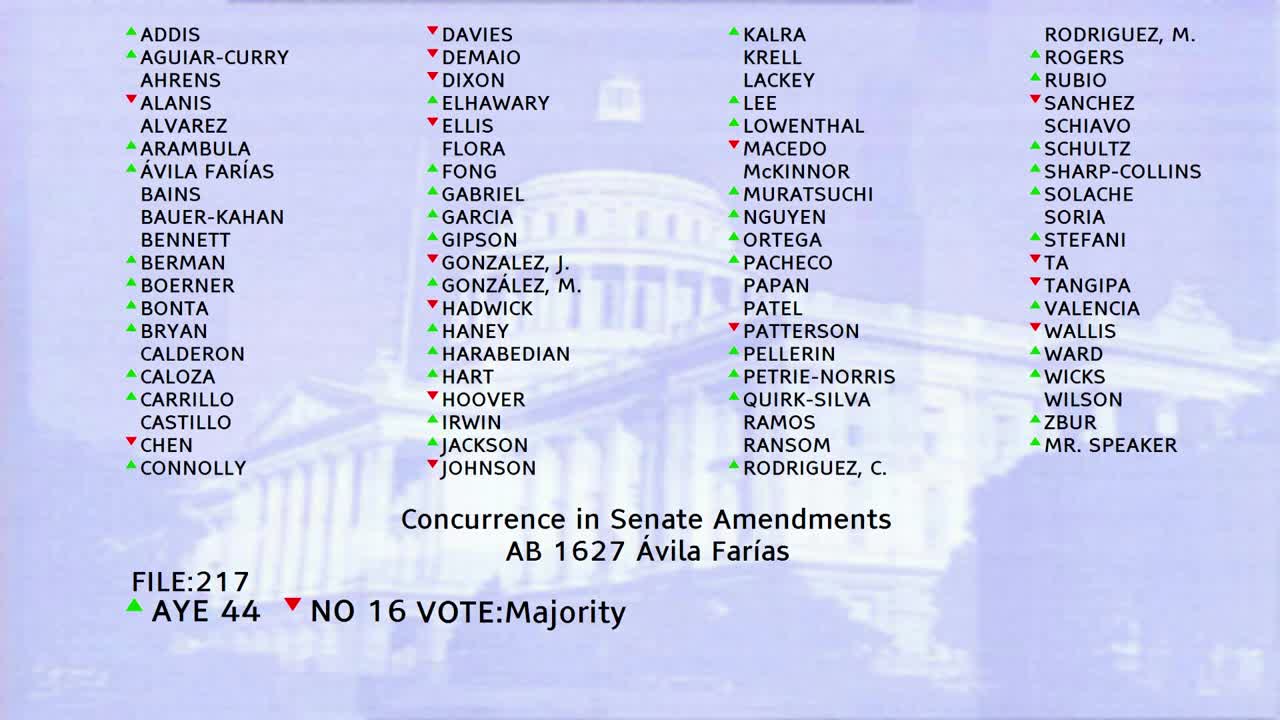
Bill Author

Bill Co-Author(s):