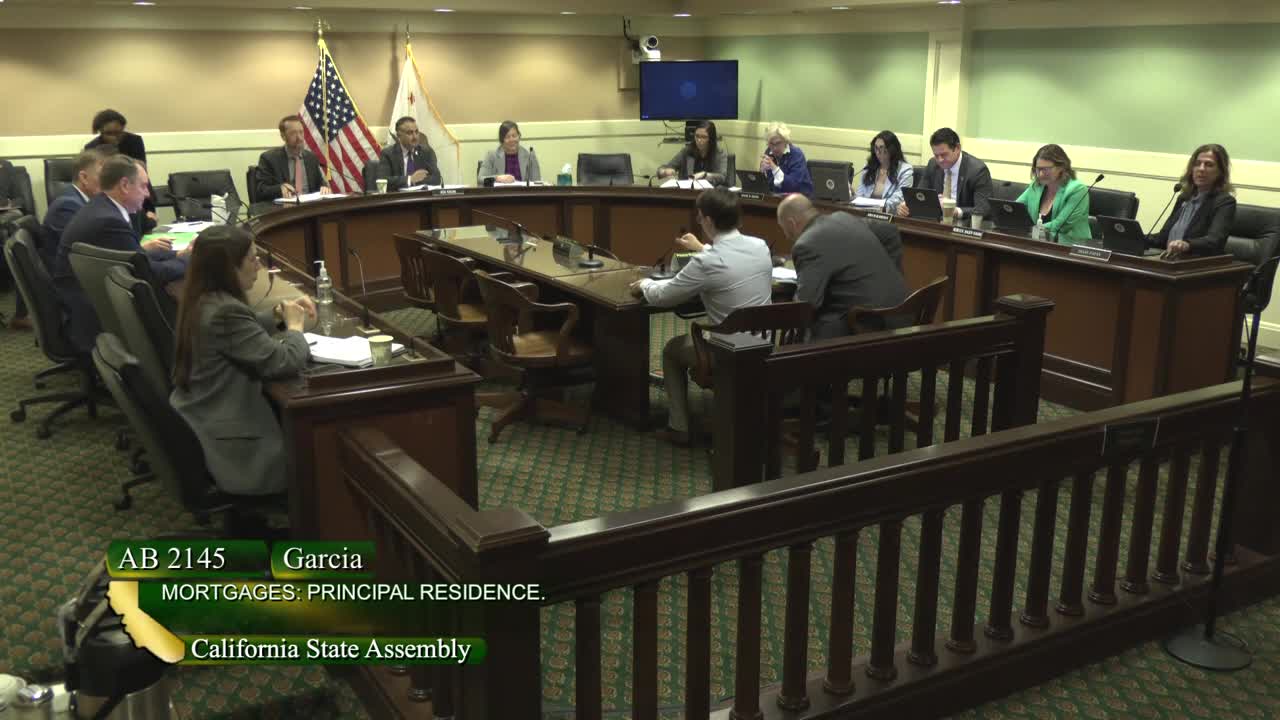
AB 2145: Housing finance: barriers to downsizing: study.
- Session Year: 2025-2026
- House: Assembly
- Latest Version Date: 2026-04-29
Current Status:
In Progress
(2026-05-14: Joint Rule 62(a), file notice suspended. (Page 5030.))
Introduced
In Committee
Awaiting First Chamber Vote
Passed First Chamber
In Committee
Awaiting Second Chamber Vote
Passed Second Chamber
Enacted
What does this bill do?
The bill requires the state Department of Housing and Community Development to study whether seniors (age 60 and older) want and can downsize their homes. The study must examine financial and nonfinancial barriers, housing preferences and mobility needs across senior age groups, and whether seniors would use an option to transfer their existing mortgage interest rate and remaining term to a new smaller home. The department must report findings and policy options to the Legislature.
The summary is provided by generative AI which can make mistakes. For original language, please view the details in the table below.
Existing law establishes the Department of Housing and Community Development and authorizes the department to study the operation and enforcement of specified laws related to housing finance, taxes, redevelopment programs, and public housing projects, as related to housing and community development.
This bill would require the department, upon appropriation by the Legislature, to conduct a study to assess the need and desire among seniors 60 years of age and older to downsize their homes, as specified. The bill would require the department to submit a report on the study to the Legislature within one year of an appropriation made for this purpose. The bill would repeal its provisions on January 1, 2032.
Existing law generally regulates mortgages and mortgage servicers, including, among other things, prohibiting the acceleration of a loan secured by a mortgage upon specified transfers of residential real property.This bill would authorize a borrower who has reached retirement age to transfer the interest rate and remaining loan term secured by a mortgage on residential real property to a mortgage secured by a new principal residence, as specified.Existing law generally regulates mortgages and mortgage servicers, including, among other things, prohibiting the acceleration of a loan secured by a mortgage upon specified transfers of residential real property.
This bill would authorize a borrower who has reached retirement age to transfer the interest rate and remaining loan term secured by a mortgage on residential real property to a mortgage secured by a new principal residence, as specified.
(a)The department shall conduct a study to assess the need and desire among seniors to downsize their homes. The purpose of the study shall be to enable the department to do all of the following:
(1)Examine the primary reasons seniors choose to downsize, including the role of financial challenges.
(2)Determine to what extent financial challenges are a barrier to downsizing.
(3)Identify nonfinancial barriers that limit seniors ability to downsize.
(4)Analyze trends across different senior age groups regarding housing preferences, including size and architectural characteristics and their impact on mobility.
(5)Evaluate the potential benefits and feasibility of enabling seniors to transfer their existing mortgage interest rate to a new home when downsizing and whether seniors would utilize this option.
(b)Not later than one year following an appropriation made for purposes of this section, the department shall submit a report on the study and its findings, as described in subdivision (a), to the Legislature, in compliance with Section 9795 of the Government Code. The report shall include findings and recommendations regarding potential policy options to facilitate downsizing opportunities for seniors.
(c)For purposes of this section, senior means a person 60 years of age or older.
(d)This section shall become operative only upon appropriation by the Legislature.
(e)This section shall remain in effect only until January 1, 2032, and as of that date is repealed.
SECTION 1.Section 2924.4 is added to the Civil Code, to read:2924.4.(a)Notwithstanding any other law, a borrower who has reached retirement age may transfer the interest rate and remaining loan term of a loan secured by a mortgage or deed of trust on residential real property that is the principal residence of the borrower to a loan secured by a mortgage or deed of trust on a residential real property that is the replacement principal residence of the borrower.(b)This section applies to any loan secured by a mortgage or deed of trust that is open on January 1, 2027, and to any new loan opened on or after January 1, 2027.(a)Notwithstanding any other law, a borrower who has reached retirement age may transfer the interest rate and remaining loan term of a loan secured by a mortgage or deed of trust on residential real property that is the principal residence of the borrower to a loan secured by a mortgage or deed of trust on a residential real property that is the replacement principal residence of the borrower.
(b)This section applies to any loan secured by a mortgage or deed of trust that is open on January 1, 2027, and to any new loan opened on or after January 1, 2027.
|
Date
|
Status
|
|---|---|
| May 14, 2026 | In committee: Held under submission. |
| May 14, 2026 | Joint Rule 62(a), file notice suspended. |
| May 14, 2026 | Joint Rule 62(a), file notice suspended. (Page 5030.) |
| May 13, 2026 | In committee: Set, first hearing. Referred to APPR. suspense file. |
| Apr 30, 2026 | Re-referred to Com. on APPR. pursuant to Joint Rule 10.5. |
| Apr 30, 2026 | Read second time. Ordered to third reading. |
| Apr 29, 2026 | Read second time and amended. Ordered returned to second reading. |
| Apr 28, 2026 | From committee: Amend, and do pass as amended. (Ayes 10. Noes 0.) (April 28). |
| Mar 9, 2026 | Referred to Com. on JUD. |
| Feb 19, 2026 | From printer. May be heard in committee March 21. |
| Feb 18, 2026 | Read first time. To print. |
|
Date
|
Description
|
Location
|
Votes
|
|
|---|---|---|---|---|
| Apr 28, 2026 | Do pass as amended. | Assembly Standing Committee on Judiciary |
Passed |
This list shows positions taken on this bill by organizations on the date displayed, which is linked to the original source.
Positions by individuals are not included.
|
Organization
|
Position
|
Date
|
|---|---|---|
| California Bankers Association | ** Against | |
| California Chamber Of Commerce | ** Against | |
| California Mba | ** Against | |
| California Mortgage Association | ** Against | |
| California's Credit Unions | ** Against | |
| LeadingAge California | ** Support |
Date of Hearing: May 13, 2026
ASSEMBLY COMMITTEE ON APPROPRIATIONS
Buffy Wicks, Chair
ABPCA Bill Id:AB 2145
Author:(Garcia) – As Amended Ver:April 29, 2026
Policy Committee: | Judiciary | Vote: | 10 - 0 |
|
| ||
|
|
Urgency: No State Mandated Local Program: No Reimbursable: No
SUMMARY:
This bill requires the Department of Housing and Community Development (HCD), upon appropriation by the Legislature, to conduct a study assessing the need and desire among seniors (age 60 or older) to downsize their homes, and to submit a report to the Legislature within one year of appropriation. The study must examine reasons seniors choose to downsize, financial and nonfinancial barriers, housing preference trends across age cohorts, and the feasibility of enabling seniors to transfer their existing mortgage interest rate to a new home. The bill sunsets on January 1, 2032.
FISCAL EFFECT:
Costs (General Fund) of an unknown amount to HCD to conduct the study and produce the report, contingent on appropriation by the Legislature. HCD was unable to provide a cost estimate at the time this analysis was written.
Consistent with the committee rules, regardless of cost, this bill is a candidate for the committee’s suspense file because it has the primary purpose of creating a report.
COMMENTS:
According to the author, “[n]early 6 million older adults are currently living in homes that are larger than they need at their stage of life, while many growing families remain in smaller spaces, unable to find affordable, larger options that meet their needs.” This bill was introduced as a substantive mortgage portability proposal that would have allowed homeowners reaching retirement age to transfer their existing mortgage interest rate to a replacement residence. Banking and mortgage industry groups raised concerns about feasibility in light of the secondary mortgage market structure, federal preemption of due-on-sale clauses under the Garn-St Germain Act, and Government-Sponsored Enterprise loan guidelines. In response, this bill was narrowed to a study and report. The author argues that elevated mortgage interest rates discourage senior homeowners with low fixed-rate mortgages from selling and downsizing, contributing to constrained inventory of larger homes for younger families. The Joint Center for Housing Studies at Harvard University reports that 2025 saw the lowest level of home buying in the United States since the mid-1990s, and that more than a third of households with a principal resident over age 65 are cost-burdened. It is unclear whether opposition remains to this version of the bill.
Analysis Prepared by: Shiran Zohar / APPR. / (916) 319-2081
Date of Hearing: April 28, 2026
ASSEMBLY COMMITTEE ON JUDICIARY
Ash Kalra, Chair
ABPCA Bill Id:AB 2145
Author:(Garcia) – As Introduced Ver:February 18, 2026
As Proposed to be Amended
SUBJECT: Mortgages: principal residence
KEY ISSUE: SHOULD A STudy be conducted to determine whether seniors want or need to downsize from their current HOME to a smaller one?
SYNOPSIS
According to the author, elevated mortgage rates and housing costs are causing a traffic jam in the housing market. Older adults, often who no longer have their children under the same roof, want to downsize but are hesitant to take on the higher interest rates that would come with moving into a new home. Concurrently, younger, growing families are stuck in smaller homes, unable to find larger, affordable ones to move into. This bill proposes studying this issue further and determining the feasibility of allowing seniors—those over the age of 60—to take their lower interest rate with them, when they downsize into a smaller home.
This bill is supported by LeadingAge California and opposed by the California Chamber of Commerce and banking and mortgage industry advocacy groups. The author has agreed to take amendments in this Committee. The amendments are reflected in the summary and discussed in the analysis.
SUMMARY: Requires the Department of Housing and Community Development to study whether seniors want or need to downsize their principal residence, and if transferring mortgage interest rates is a viable option to support that process. Specifically, this bill:
- Requires the Department of Housing and Community Development, upon appropriation by the Legislature, to conduct a study to assess the need and desire among seniors to downsize their homes. Specifically, the purpose of the study is to:
- Examine the primary reasons seniors choose to downsize, including the role of financial challenges;
- Determine to what extent financial challenges are a barrier to downsizing;
- Identify nonfinancial barriers that limit seniors’ ability to downsize;
- Analyze trends across different senior age groups regarding housing preferences, including size and architectural characteristics and their impact on mobility;
- Evaluate the potential benefits and feasibility of enabling seniors to transfer their existing mortgage interest rate to a new home when downsizing and whether seniors would utilize this option.
- Requires the Department of Housing and Community Development to submit a report on the study and findings discussed in 1), no later than one year following an appropriation made for the purposes of this bill.
- Repeals the bill on January 1, 2032.
- Defines “senior” as a person 60 years of age or older.
EXISTING LAW:
- Provides the requirements for a report submitted to the Legislature by a state or local agency. (Government Code Section 9795.)
- Requires any bill that mandates a state agency submit a report to the Legislature, must include a provision that repeals the reporting requirement. (Government Code Section 10231.5.)
- Defines, pursuant to federal law, “due-on-sale clause” as a contract provision which authorizes a lender, at its option, to declare due and payable sums secured by the lender’s security instrument if all or any part of the property, or an interest therein, securing the real property loan is sold or transferred without the lender’s prior written consent. (12 U.S.C. Section 1701j-3 (a)(1).)
FISCAL EFFECT: As currently in print this bill is keyed non-fiscal.
COMMENTS: According to the author, elevated mortgage rates and housing costs are causing a traffic jam in the housing market. Older adults, often who no longer have their children under the same roof, want to downsize but are hesitant to take on the higher interest rate that would come with moving into a new home. Concurrently, younger, growing families are stuck in smaller homes, unable to find larger, affordable ones to move into. This bill proposes studying this issue further and determining the feasibility of allowing seniors—those over the age of 60—to take their lower interest rate with them, when they downsize into a smaller home.
In support of the bill, the author writes:
Nearly 6 million older adults are currently living in homes that are larger than they need at their stage of life, while many growing families remain in smaller spaces, unable to find affordable, larger options that meet their needs. AB 2145 requires the Department of Housing and Community Development to conduct a study to assess the need and desire among to downsize their homes. This bill allows the Legislature to become aware of the needs of our seniors and take the necessary steps to make the process in downsizing homes easier.
Background. Higher home prices and increased interest rates meant 2025 saw the lowest level of home-buying in the United States since the mid-1990s. (Joint Center for Housing Studies, The State of the Nation’s Housing 2025, Harvard University (2025) at p. 1, available at: https://www.jchs.harvard.edu/state-nations-housing-2025.) For older households, where the principal resident is over the age of 65, housing affordability has gotten worse. Data from 2023 shows that over a third of these households are cost burdened, meaning more than 30 percent of the household’s income is spent on housing. (Id. at p. 28.) For these older homeowners, incomes usually do not increase over time, but costs—such as in-home care or mobility services—may.
What is a conventional home mortgage loan? A conventional mortgage loan is a type of home loan that is not insured or guaranteed by the government. Instead, it is originated and funded by private lenders such as banks, credit unions, or mortgage companies. Conventional loans typically follow guidelines set by Fannie Mae and Freddie Mac, which are two major government-sponsored enterprises (GSEs). However, they can also be offered by private lenders outside of these guidelines. Conventional loans often require higher down payments and have stricter qualification criteria compared to government-backed loans. Borrowers with good credit and stable income may prefer conventional loans because they often offer competitive interest rates and terms.
Conventional home mortgage loans must generally conform to the guidelines set by GSEs. GSEs like Fannie Mae or Freddie Mac are entities established by the government to provide liquidity and stability to the mortgage market by purchasing and securitizing mortgages. Fannie Mae and Freddie Mac do not originate loans directly but provide liquidity to the mortgage market by purchasing mortgages from lenders and bundling them into mortgage-backed securities, which are sold to investors. GSEs also establish standards and guidelines for the loans they purchase, which lenders must adhere to in order to sell their loans to Fannie Mae or Freddie Mac. The primary goal of GSEs in the mortgage market is to promote stability, affordability, and access to mortgage credit for borrowers. They help facilitate the availability of funds for lenders to originate mortgages, which in turn supports homeownership and the housing market.
The bill in print and proposed amendments. As now in print, this bill allows for a borrower who has reached requirement age to transfer their interest rate and loan terms from their principal place of residence to a replacement place of residence. However, banking and mortgage industry groups have raised concerns about the feasibility of transferring mortgages in this manner. Thus, the author has asked to amend the bill to instead study the issue of senior citizens who may want to downsize their homes.
As amended, the bill will require, pending appropriation from the Legislature, the Department of Housing and Community Development (HCD) to conduct a study to assess the need and desire among seniors—60 years of age and older—to downsize their homes. Specifically, the study would examine the reasons seniors decide to downsize, if financial challenges are a barrier to downsizing, nonfinancial barriers to downsizing, trends among seniors regarding housing preferences, and the potential feasibility of allowing seniors to transfer their existing mortgage rate to a new home when downsizing. The amendments require HCD to then submit a report to the Legislature on the results and findings of the study. The bill will be repealed on January 1, 2032.
To accomplish this, the author proposes to amend the bill as follows:
In the title, in line 1, strike out “2924.4 to the Civil Code, relating to real”, strike out line 2 and insert: “50464.5 to the Health and Safety Code, relating to housing.”
On page 1, before line 1, insert:
SECTION 1. Section 50464.5 is added to the Health and Safety Code, to read:
50464.5. (a) The department shall conduct a study to assess the need and desire among seniors to downsize their homes. The purpose of the study shall be to enable the department to do all of the following:
(1) Examine the primary reasons seniors choose to downsize, including the role of financial challenges.
(2) Determine to what extent financial challenges are a barrier to downsizing.
(3) Identify nonfinancial barriers that limit seniors’ ability to downsize.
(4) Analyze trends across different senior age groups regarding housing preferences, including size and architectural characteristics and their impact on mobility.
(5) Evaluate the potential benefits and feasibility of enabling seniors to transfer their existing mortgage interest rate to a new home when downsizing and whether seniors would utilize this option.
(b) Not later than one year following an appropriation made for purposes of this section, the department shall submit a report on the study and its findings, as described in subdivision (a), to the Legislature. The report shall include findings and recommendations regarding potential policy options to facilitate downsizing opportunities for seniors. A report to be submitted pursuant to this subdivision shall be submitted in compliance with Section 9795 of the Government Code.
(c) For purposes of this section, “senior” means a person 60 years of age or older.
(d) This section shall become operative only upon appropriation by the
Legislature.
(e) Pursuant to Section 10231.5 of the Government Code, this section is repealed on January 1, 2032.
On page 1, strike out lines 1 to 7, inclusive, and strike out page 2.
ARGUMENTS IN SUPPORT: LeadingAge California writes in support of this bill:
Stable housing is foundational to health, independence, and financial security for older adults. Many low-income seniors live on fixed incomes and are particularly vulnerable to disruptions in housing stability caused by mortgage distress, predatory lending practices, or unexpected financial shocks. Policies that protect homeowners and promote sustainable homeownership help prevent displacement and reduce the risk of housing instability among older Californians.
AB 2145 promotes greater security for homeowners by ensuring clearer standards and protections related to mortgages on a principal residence. By strengthening these safeguards, the bill helps older adults remain safely housed and reduces the likelihood that financial distress will lead to foreclosure or housing displacement. Preventing the loss of a primary residence is especially critical for seniors, for whom relocation can result in significant health and financial consequences.
For nonprofit providers and service organizations serving older adults, housing instability among residents and community members often leads to increased demand for supportive services, emergency interventions, and publicly funded care. Policies that support long-term housing stability for homeowners are an important complement to the state’s investments in affordable housing and aging services.
ARGUMENTS IN OPPOSITION: This bill is currently opposed by banking industry, mortgage company, and business advocacy groups. However, it seems the author’s proposed amendments to be taken in Committee are likely to assuage their concerns. In a joint letter, the California Chamber of Commerce, California Bankers Association, California Credit Unions, and California Mortgage Bankers Association write in opposition:
Retroactive loan portability would present significant problems for the housing finance system and would be detrimental to the mortgage-backed securities (MBS) market. The wide availability of the 30-year fixed-rate, prepayable-without-penalty, mortgage structure is based on the secondary mortgage market and robust securitization structures that attract global investors to a $12 trillion market with average daily trading volume in excess of $250 billion. Mortgage investors have purchased mortgage-backed securities based on certain investment expectations and disclosed loan terms. Portability would damage those investment expectations and change the terms of the disclosed and agreed upon securities, radically altering prepayment speeds and investor economics.
Investors purchase MBS with the assumption of receiving pass-through payments for a specific duration of time while also considering the likelihood of prepayments based on expectations of changes in mortgage rates, delinquencies and other factors. Prepayment risks and expectations are perhaps the most important investment factors for the Government-Sponsored Enterprise (GSE) and Ginnie Mae MBS because the credit risk is government-backed. The current programs and infrastructure in place for MBS activity is built around the current system of purchase or refinances that cause loans in a pool to either prepay or pass through payments until maturity. Each of these factors is extensively modeled to create an expected return on investment over time which induces the investor to purchase the security for a particular price. The models and investor expectations on the $10 trillion in outstanding GSE and Ginnie Mae MBS do not account for mortgage notes that remain with the borrower for 30 years and swap collateral. As MBS investors do not expect the vast majority of loans in a security to avoid prepayment, retroactive portability would mean altering the structure of existing MBS in a manner which would radically change investors’ expectations and returns, which were established contractually at purchase by the underlying notes and securitization agreements.
The California Mortgage Association writes in opposition:
AB 2145 would amend the California Civil Code to permit a borrower “who has reached retirement age” to transfer the interest rate and mortgage on a principal residence to a replacement principal residence of the borrower. The bill raises a host of legal and practical questions, including the following:
- When does a borrower reach retirement age? People retire at all different ages based upon their circumstances. Must the borrower actually be retired? Semi-retired? Who will determine whether the borrower is eligible?
- Lenders make loans based upon the specific property providing security for the loan. They may have relied on appraisals and inspections to ensure that the security is adequate. Would the bill provide the borrower with an absolute right to transfer the loan to a replacement property regardless of its value and condition? Would blighted or contaminated properties qualify?
- Lenders generally purchase a policy of title insurance assuring that the loan will have first priority in the chain of titles. What if the property has liens and encumbrances, such that the loan would have lower priority in case of foreclosure? Would the lender have a claim against the title policy in this circumstance?
- If there is a second mortgage on the property, does it transfer as well, or does that loan remain with the original property?
- Can the borrower utilize this transfer right while in bankruptcy, or while the loan is in default?
- Can the property be located anywhere? Must it be in the same neighborhood, city, state, or even in the U.S.?
Unfortunately, these questions and more make this well-intentioned proposal untenable. Members of the California Mortgage Association typically make or arrange loans under the authority of the California Real Estate Law, with fiduciary duties to both lenders and borrowers. The bill would place brokers in an impossible position between lenders who have a contractual right to enforce a due on sale clause in the loan, and borrowers who will assert a transfer right under this new Civil Code provision.
REGISTERED SUPPORT / OPPOSITION:
Support
LeadingAge California
Opposition (to bill in print)
CalChamber
California Bankers Association
California MBA
California Mortgage Association
California's Credit Unions
Analysis Prepared by: Griff Ryan-Roberts / JUD. / (916) 319-2334
Bill Author

Bill Co-Author(s):