AB 2182: Energy efficiency: financing options: custom agricultural and industrial efficiency projects.
- Session Year: 2025-2026
- House: Assembly
- Latest Version Date: 2026-06-25
Current Status:
In Progress
(2026-08-13: In committee: Held under submission.)
Introduced
In Committee
Awaiting First Chamber Vote
Passed First Chamber
In Committee
Awaiting Second Chamber Vote
Passed Second Chamber
Enacted
Existing law vests the Public Utilities Commission (PUC) with regulatory authority over public utilities, including electrical corporations and gas corporations. Existing law requires the State Energy Resources Conservation and Development Commission (Energy Commission) to establish a regulatory proceeding to develop and implement a comprehensive program to achieve greater energy savings in Californias existing residential and nonresidential building stock. Existing law requires the PUC to investigate the ability of electrical corporations and gas corporations to provide various energy efficiency financing options to their customers for the purpose of implementing the program developed by the Energy Commission. Existing law imposes requirements for custom projects and other custom programs for industrial, agricultural, commercial, residential, and public sector customers. Existing law requires the PUC to develop and maintain rules for custom energy efficiency projects that include eligibility criteria or metrics for determining if a project is eligible for funding.
This bill would delete the requirement on the PUC to develop and maintain those rules, and would instead require the commission, as part of the approval of the next Tier 2 advice letters submitted after January 1, 2027, by program administrators for mid-cycle review pursuant to a specific commission decision, to revise the rules adopted for custom agricultural and industrial efficiency projects to replace the commissions ex ante review process with a process that ensures the provision of incentives pursuant to these provisions for custom agricultural and industrial efficiency projects, as specified.
Under existing law, a violation of the Public Utilities Act or an order, decision, rule, direction, demand, or requirement of the commission PUC is a crime.
Because the above provisions would be part of the act and a violation of a commission PUC action implementing this bills requirements would be a crime, the bill would impose a state-mandated local program.
The California Constitution requires the state to reimburse local agencies and school districts for certain costs mandated by the state. Statutory provisions establish procedures for making that reimbursement.
This bill would provide that no reimbursement is required by this act for a specified reason.
Existing law vests the Public Utilities Commission with regulatory authority over public utilities, including electrical corporations. Existing law requires the commission to require electrical corporations to implement various programs, such as energy efficiency programs, that are funded by electrical ratepayers.
This bill would require, on or before August 1, 2027, each large electrical corporation, as defined, to file a Tier 2 advice letter with the commission establishing an Industrial Decarbonization and Energy Efficiency Program with funding allocated from energy efficiency charges collected from eligible facilities, defined as industrial or manufacturing facilities that meet specified requirements, as specified. The bill would require the program to award grants to eligible facilities for eligible projects, including, among others, energy efficiency projects that meet certain requirements. The bill would require each large electrical corporation to administer the its program, as provided, and require the Governors Office of Business and Economic Development to provide independent review and approval of grants awarded pursuant these provisions.
Under existing law, a violation of the Public Utilities Act or an order, decision, rule, direction, demand, or requirement of the commission is a crime.
Because the above provisions would be part of the Public Utilities Act act and a violation of a commission action implementing this bills requirements would be a crime, the bill would impose a state-mandated local program.
The California Constitution requires the state to reimburse local agencies and school districts for certain costs mandated by the state. Statutory provisions establish procedures for making that reimbursement.
This bill would provide that no reimbursement is required by this act for a specified reason.
Existing law vests the Public Utilities Commission with regulatory authority over public utilities, including electrical corporations. Existing law requires the commission to require electrical corporations to implement various programs, such as energy efficiency programs, that are funded by electrical ratepayers.
This bill would require, on or before August 1, 2027, each large electrical corporation, as defined, to file a Tier 2 advice letter with the commission establishing an Industrial Decarbonization and Energy Efficiency Program with funding allocated from energy efficiency charges collected from eligible facilities, defined as industrial or manufacturing facilities that meet specified requirements, as specified. The bill would require the program to award grants to eligible facilities for eligible projects, including, among others, energy efficiency projects that meet certain requirements. The bill would require each large electrical corporation to administer the program, as provided, and require the Governors Office of Business and Economic Development to provide independent review and approval of grants awarded pursuant these provisions.
Under existing law, a violation of the Public Utilities Act or an order, decision, rule, direction, demand, or requirement of the commission is a crime.
Because the above provisions would be part of the Public Utilities Act and a violation of a commission action implementing this bills requirements would be a crime, the bill would impose a state-mandated local program.
The California Constitution requires the state to reimburse local agencies and school districts for certain costs mandated by the state. Statutory provisions establish procedures for making that reimbursement.
This bill would provide that no reimbursement is required by this act for a specified reason.
(a)(1)The commission shall investigate the ability of electrical corporations and gas corporations to provide various energy efficiency financing options to their customers for the purposes purpose of implementing the program developed pursuant to Section 25943 of the Public Resources Code.
(2)It is the intent of the Legislature that the commission implement this section by establishing applicable rules, within a reasonable period of time and in an open process, that are clear and operate on a prospective basis.
(3)It is the intent of the Legislature that the commission implement this section in a cost-effective and time-efficient manner.
(b)Recognizing the already underway 2015 commission work to adopt efficiency potential and goals, the Energy Commission work on its 2015 energy demand forecast, and the need to determine how to incorporate meter-based performance into determinations of goals, portfolio cost-effectiveness, and authorized budgets, the commission, in a separate or existing proceeding, shall, by September 1, 2016, authorize electrical corporations or gas corporations to provide financial incentives, rebates, technical assistance, and support to their customers to increase the energy efficiency of existing buildings based on all estimated energy savings and energy usage reductions, taking into consideration the overall reduction in normalized metered energy consumption as a measure of energy savings. Those programs shall include energy usage reductions resulting from the adoption of a measure or installation of equipment required for modifications to existing buildings to bring them into conformity with, or to cause them to exceed, the requirements of Title 24 of the California Code of Regulations, as well as operational, behavioral, and retrocommissioning activities reasonably expected to produce multiyear savings. The commission shall authorize an electrical corporation or gas corporation to count all energy savings achieved through the authorized programs created by this subdivision, unless determined otherwise, subdivision toward overall energy efficiency goals or targets established by the commission. The commission may adjust the energy efficiency goals or targets of an electrical corporation or gas corporation to reflect this change in savings estimation consistent with this subdivision and subdivision (d).
(c)Effective January 1, 2016, electrical corporations and gas corporations are authorized to may implement the provisions of subdivision (b) for high opportunity projects or programs. The commission shall provide expedited authorization of high opportunity projects and programs to apply the savings baseline provisions in subdivision (b).
(d)In furtherance of subdivision (b), the commission, in consultation with the Energy Commission, shall consider all of the following:
(1)The results of any interagency baseline assessment.
(2)Any available results from electrical corporation and gas corporation baseline pilot studies ordered in commission Decision 14-10-046 (October 24, 2014), Decision Establishing Energy Efficiency Savings Goals and Approving 2015 Energy Efficiency Programs and Budgets.
(3)Information necessary to ensure consistency with the energy forecast and planning functions of the Energy Commission and the Independent System Operator.
(e)The commission may direct electrical corporations and gas corporations to make filings that are necessary to ensure coordination with the energy forecast and planning functions of the Energy Commission and the Independent System Operator.
(f)The commission shall prioritize energy efficiency activities consistent with Sections 454.55 and 454.56.
(g)(1)This subdivision imposes the operative requirements pursuant to this section for custom projects and other custom programs for industrial, agricultural, commercial, residential, and public sector customers. This subdivision shall become operative on July 1, 2019, and applies only to those programs and projects.
(A)The commission shall authorize electrical corporations and gas corporations to provide financial incentives, rebates, technical assistance, and support to their customers to increase the energy efficiency of industrial, agricultural, commercial, residential, and public sector customers based on nationally recognized measurement and verification standards, such as the International Performance Measurement and Verification Protocol.
(B)All energy savings achieved through the programs authorized pursuant to this subdivision shall count toward the overall energy efficiency goals or targets established by the commission for an electrical corporation, gas corporation, or program administrator.
(C)The commission may adjust the energy efficiency goals or targets of an electrical corporation or gas corporation to reflect a change in the forecast energy savings consistent with this subdivision and subdivision (d).
(2)The commission shall develop and maintain rules for custom energy efficiency projects that include eligibility criteria and other metrics for determining whether a project is eligible for funding pursuant to the program.(2)(A)As part of the approval of the next Tier 2 advice letters submitted after January 1, 2027, by program administrators for mid-cycle review pursuant to commission Decision 21-05-031 (May 20, 2021), Assessment of Energy Efficiency Potential and Goals and Modification of Portfolio Approval and Oversight Process, the commission shall revise the rules adopted for custom agricultural and industrial efficiency projects to replace the commissions ex ante review process with a process that ensures the provision of incentives pursuant to this section for custom agricultural and industrial efficiency projects that exceed existing California Building Standards Code requirements and provide measurable benefits to the electrical grid.
(B)The commission shall not adopt any project approval criteria for custom agricultural and industrial efficiency projects beyond those criteria specified in this section.
(C)For purposes of this paragraph, benefits to the electrical grid include avoided transmission and distribution costs or reductions in peak load demands that support reductions in utility costs.
(D)This paragraph shall not result in cost shifts between rate classes.
(A)(3)(A)The commission shall review and circulate for public review and comment statewide eligibility criteria or metrics at least 30 days prior to before changes, including posting on the commissions internet website.
(B)After the initial 30-day period for public review and comment, any changes to the initial proposed eligibility criteria or metrics shall be circulated for public review for not less than 15 days prior to final adoption.
(C)Once eligibility criteria or metrics are adopted, any proposed revision shall be circulated for public review and comment for not less than 30 days prior to before a revision. For these purposes, grammatical corrections or other nonsubstantive modifications are not a revision and may be made when the need for the correction or modification is discovered.
(D)Statewide eligibility criteria or metrics shall operate only on a prospective basis, shall be applied uniformly and consistently by each electrical corporation and gas corporation, and shall not be applied retroactively to any pending or approved applications.
(E)Any delay in the adoption of eligibility criteria or metrics past July 1, 2019, shall not be the basis for denial of any application nor a basis to suspend the program.
(3)(4)(A)The rules adopted by the commission for custom energy efficiency projects shall require each electrical corporation and gas corporation to maintain a custom measure project archive. The commission shall develop and maintain requirements for what information is to be included in the custom measure project archive, including information required to support the applications of customers custom energy efficiency projects.
(B)(i)Upon being notified of the filing of a new application, or that a proposed project has moved from the preapplication stage to the application stage, the commission shall make a determination of whether the application has been selected for review within 15 days and notify the electrical corporation or gas corporation of its decision to review.
(ii)The electrical corporation or gas corporation shall make the project application supporting documentation available to the commission for review within 15 business days of the commission review selection date. The commission shall develop and maintain requirements for what information is to be included in the custom measure project archive for those customer projects selected for review.
(iii)The commission shall, within 15 days of the submission of a project to the custom measure project archive, promptly notify an electrical corporation or gas corporation of any deficiency in the information supporting an application.
(iv)The review of a proposed project shall be concluded within 30 business days from when the date when a projects documentation is received by the commission, unless the commission determines it was provided incomplete or inaccurate supporting information from the electrical corporation or gas corporation, and notifies the electrical corporation and gas corporation of the need for additional review time. The 30 business days will shall restart from the time complete and accurate documentation, as noted in the notification of deficiencies, is submitted by the electrical corporation or gas corporation. The electrical corporation or gas corporation shall notify the customer applicant within 48 hours of any delays as a result of incomplete or inaccurate supporting project information, or if the commission needs additional review time.
(C)The commission shall notify the electrical corporation or gas corporation of the specific deficiencies in the information supporting an application, including each basis as to why the project is inconsistent with the eligibility criteria and metrics, which may include failure to adequately define the project, make specific recommendations for the conditions under which the project would be approved, and, if the application fails to adequately define the project, identify aspects of the project that require further definition.
(D)If, as a result of the review, the commission rejects the proposed project or requests modification of the project, the commission shall notify the electrical corporation or gas corporation of the reasons for the rejection or request for modification, including each basis as to why the project is rejected or modification is requested, and make specific recommendations for the conditions under which the project would be approved. The electrical corporation or gas corporation shall promptly inform the applicant as to the reasons why the project was rejected and the specific recommendations for the conditions under which the project would be approved.
(E)The commission shall not reject a proposed project or request modification of a project on the basis of inconsistency with eligibility criteria or metrics that were not in effect at the time the project application was submitted.
(F)If any party to the project is unsatisfied with the commissions directions for the project, a dispute resolution process may be initiated by that party. The commission shall adopt rules for the conduct of the dispute resolution process.
(G)If a project is not selected by the commission for review within the period determined pursuant to subparagraph (B), or if a project has not received written direction from the commission within the period specified in clause (iv) of subparagraph (B), the commission shall be deemed to have waived review of the project and the project may proceed as if it had been approved by the commission, but the project is subject to the review of the electrical corporation or gas corporation.
(4)(5)(A)For projects that were not reviewed and did not receive written documentation, as specified in subparagraph (G) of paragraph (3), (4), an electrical corporation or gas corporation may rely on its project application review process to determine the forecast energy savings values for the project based on rules adopted by the commission, and base the final customer incentive payment and contractor pay-for-performance payment on postinstallation measurement and verification results.
(B)The commission may employ postinstallation review of a project to determine if the project was carried out consistent with the application and to obtain information pertaining to whether the eligibility criteria or metrics should be revised. application.
(5)Except as described in paragraph (2), this subdivision does not limit the commissions existing authority to evaluate projects or programs for the purpose of prospectively adjusting the projects or programs for industrial and agricultural processes, facilities, systems, and equipment.SEC. 2.No reimbursement is required by this act pursuant to Section 6 of Article XIIIB of the California Constitution because the only costs that may be incurred by a local agency or school district will be incurred because this act creates a new crime or infraction, eliminates a crime or infraction, or changes the penalty for a crime or infraction, within the meaning of Section 17556 of the Government Code, or changes the definition of a crime within the meaning of Section 6 of Article XIIIB of the California Constitution.
For purposes of this chapter, all of the following definitions apply:
(a)Eligible facility means an industrial or manufacturing facility that meets all of the following requirements:
(1)Takes bundled, direct access, or community choice aggregation electrical service within the service territory of a large electrical corporation.
(2)Is enrolled in a medium or large energy customer electric tariff, including TOU-8, B-19, B-20, or successor tariffs.
(3)Meets a minimum peak load requirement of 500 kilowatts or more.
(4)Is not identified as a residential, state, or local government customer.
(b)Eligible project includes, but is not limited to, all of the following projects:
(1)Energy efficiency projects using commercially available technology that reduce energy consumption by at least 20 percent compared to the replaced technology, or that achieve industry standard or greater energy efficiency, based on manufacturer specifications or other documentation approved by the large electrical corporation. and result in reduced emissions of greenhouse gases.
(2)Projects for industrial process heat recovery, as defined in Section 451.7.
(3)Behind-the-meter solar generation, wind generation, energy storage, or other eligible renewable energy resources, as defined in subdivision (e) of Section 399.12, that are sited, installed, upgraded, or expanded at the eligible facility.(4)Electrification of industrial production process equipment that results in reduced emissions of greenhouse gases.(5)(3)Carbon capture, utilization, and sequestration capture technologies, subject to any limitations or eligibility criteria established by the large electrical corporation to ensure cost-effectiveness and reduced emissions of greenhouse gases. gases that are sited, installed, or expanded at the eligible facility.
(c)Large electrical corporation means an electrical corporation with more than 3,000,000 customer accounts in California.
(d)Office means the Governors Office of Business and Economic Development.
(e)Program means an Industrial Decarbonization and Energy Efficiency Program established pursuant to Section 1551.
1551.(a)(1)On or before August 1, 2027, each large electrical corporation shall file a Tier 2 advice letter with the commission to establish an Industrial Decarbonization and Energy Efficiency Program with funding allocated from energy efficiency charges collected from eligible facilities, as described in paragraph (2).
(2)Each large electrical corporation shall allocate an amount for its program equal to the amount it collects would otherwise collect from eligible facilities for energy efficiency pursuant to commission approved commission-approved tariffs.
(b)The commission shall act on a Tier 2 advice letter filed pursuant to subdivision (b) (a) on or before November 1, 2027.
(c)(1)Each program shall award grants to eligible facilities for eligible projects, as described in Section 1550. projects.
(2)Each program shall prioritize grants for eligible projects that do any all of the following:
(A)Deliver durable, durable and verifiable reduced emissions of greenhouse gases.
(B)Reduce overall electricity or fuel consumption.
(C)Improve electrical grid efficiency or reduce peak demand impacts.
(d)Each large electrical corporation shall administer the program, including by establishing eligible project intake and data validation requirements, evaluating the eligibility of facilities and projects, and administering grant payments.
(e)The office shall provide independent review and approval of grants awarded pursuant to each program, program and may clarify eligibility criteria for each program to ensure the program serves eligible facilities with significant potential for energy savings and reduced emissions of greenhouse gases.
(f)Grants awarded pursuant to each program shall fund up to to, and shall not exceed, 50 percent of the documented costs of the eligible project.
(g)(1)Each eligible facilitys cumulative grant awards shall not exceed the total amount collected from the eligible facility pursuant to the allocation described in subdivision (a).
(2)(A)Moneys that have not been awarded to an eligible project within five years may be made available to other eligible facilities on a first-come-first-served first-ready, first-served basis.
(B)Moneys made available pursuant to subparagraph (A) and awarded to an eligible facility shall be excluded from the maximum allowable cumulative grant award limit established pursuant to paragraph (1).
SEC. 2.No reimbursement is required by this act pursuant to Section 6 of Article XIIIB of the California Constitution because the only costs that may be incurred by a local agency or school district will be incurred because this act creates a new crime or infraction, eliminates a crime or infraction, or changes the penalty for a crime or infraction, within the meaning of Section 17556 of the Government Code, or changes the definition of a crime within the meaning of Section 6 of Article XIIIB of the California Constitution.
For purposes of this chapter, all of the following definitions apply:
(a)Eligible facility means an industrial or manufacturing facility that meets all of the following requirements:
(1)Takes bundled, direct access, or community choice aggregation electrical service within the service territory of a large electrical corporation.
(2)Is enrolled in a medium or large energy customer electric tariff, including TOU-8, B-19, B-20, or successor tariffs.
(3)Meets a minimum peak load requirement of 500 kilowatts or more.
(4)Is not identified as a residential, state, or local government customer.
(b)Eligible project includes, but is not limited to, all of the following projects:
(1)Energy efficiency projects using commercially available technology that reduce energy consumption by at least 20 percent compared to the replaced technology, or that achieve industry standard or greater energy efficiency, based on manufacturer specifications or other documentation approved by the large electrical corporation.
(2)Projects for industrial process heat recovery, as defined in Section 451.7.
(3)Behind-the-meter solar generation, wind generation, energy storage, or other eligible renewable energy resources, as defined in subdivision (e) of Section 399.12, that are sited, installed, upgraded, or expanded at the eligible facility.
(4)Electrification of industrial production process equipment that results in reduced emissions of greenhouse gases.
(5)Carbon capture, utilization, and sequestration technologies, subject to any limitations or eligibility criteria established by the large electrical corporation to ensure cost-effectiveness and reduced emissions of greenhouse gases.
(c)Large electrical corporation means an electrical corporation with more than 3,000,000 customer accounts in California.
(d)Office means the Governors Office of Business and Economic Development.
(e)Program means an Industrial Decarbonization and Energy Efficiency Program established pursuant to Section 1551.
1551.(a)(1)On or before August 1, 2027, each large electrical corporation shall file a Tier 2 advice letter with the commission to establish an Industrial Decarbonization and Energy Efficiency Program with funding allocated from energy efficiency charges collected from eligible facilities, as described in paragraph (2).
(2)Each large electrical corporation shall allocate an amount for its program equal to the amount it collects from eligible facilities for energy efficiency pursuant to commission approved tariffs.
(b)The commission shall act on a Tier 2 advice letter filed pursuant to subdivision (b) on or before November 1, 2027.
(c)(1)Each program shall award grants to eligible facilities for eligible projects, as described in Section 1550.
(2)Each program shall prioritize grants for eligible projects that do any of the following:
(A)Deliver durable, verifiable reduced emissions of greenhouse gases.
(B)Reduce overall electricity or fuel consumption.
(C)Improve electrical grid efficiency or reduce peak demand impacts.
(d)Each large electrical corporation shall administer the program, including by establishing eligible project intake and data validation requirements, evaluating the eligibility of facilities and projects, and administering grant payments.
(e)The office shall provide independent review and approval of grants awarded pursuant to each program, and may clarify eligibility criteria for each program to ensure the program serves eligible facilities with significant potential for energy savings and reduced emissions of greenhouse gases.
(f)Grants awarded pursuant to each program shall fund up to 50 percent of the documented costs of the eligible project.
(g)(1)Each eligible facilitys cumulative grant awards shall not exceed the total amount collected from the eligible facility pursuant to the allocation described in subdivision (a).
(2)(A)Moneys that have not been awarded to an eligible project within five years may be made available to other eligible facilities on a first-come-first-served basis.
(B)Moneys made available pursuant to subparagraph (A) and awarded to an eligible facility shall be excluded from the maximum allowable cumulative grant award limit established pursuant to paragraph (1).
SEC. 2.No reimbursement is required by this act pursuant to Section 6 of Article XIIIB of the California Constitution because the only costs that may be incurred by a local agency or school district will be incurred because this act creates a new crime or infraction, eliminates a crime or infraction, or changes the penalty for a crime or infraction, within the meaning of Section 17556 of the Government Code, or changes the definition of a crime within the meaning of Section 6 of Article XIIIB of the California Constitution.
|
Date
|
Status
|
|---|---|
| Aug 13, 2026 | In committee: Held under submission. |
| Aug 3, 2026 | In committee: Referred to APPR. suspense file. |
| Jun 29, 2026 | Withdrawn from committee. |
| Jun 29, 2026 | Re-referred to Com. on APPR. |
| Jun 25, 2026 | From committee chair, with author's amendments: Amend, and re-refer to committee. Read second time, amended, and re-referred to Com. on E.Q. |
| Jun 24, 2026 | From committee: Do pass and re-refer to Com. on E.Q. (Ayes 17. Noes 0.) (June 24). Re-referred to Com. on E.Q. |
| Jun 16, 2026 | In committee: Set, first hearing. Hearing canceled at the request of author. |
| Jun 3, 2026 | Referred to Coms. on E., U & C. and E.Q. |
| May 21, 2026 | In Senate. Read first time. To Com. on RLS. for assignment. |
| May 21, 2026 | Read third time. Passed. Ordered to the Senate. (Ayes 72. Noes 0.) |
| May 21, 2026 | Read third time. Passed. Ordered to the Senate. (Ayes 72. Noes 0. Page 5226.) |
| May 18, 2026 | Read second time. Ordered to third reading. |
| May 14, 2026 | Joint Rule 62(a), file notice suspended. (Page 5030.) |
| May 14, 2026 | Joint Rule 62(a), file notice suspended. |
| May 14, 2026 | From committee: Do pass. (Ayes 15. Noes 0.) (May 14). |
| May 13, 2026 | In committee: Set, first hearing. Referred to APPR. suspense file. |
| Apr 21, 2026 | From committee: Do pass and re-refer to Com. on APPR. (Ayes 14. Noes 0.) (April 20). Re-referred to Com. on APPR. |
| Apr 14, 2026 | Re-referred to Com. on NAT. RES. |
| Apr 13, 2026 | Read second time and amended. |
| Apr 9, 2026 | From committee: Amend, and do pass as amended and re-refer to Com. on NAT. RES. (Ayes 18. Noes 0.) (April 8). |
| Mar 9, 2026 | Referred to Coms. on U. & E. and NAT. RES. |
| Feb 20, 2026 | From printer. May be heard in committee March 22. |
| Feb 19, 2026 | Read first time. To print. |
|
Date
|
Description
|
Location
|
Votes
|
|
|---|---|---|---|---|
| Aug 3, 2026 | Placed on suspense file | Senate Standing Committee on Appropriations |
Passed |
|
| Jun 24, 2026 | Do pass, but first be re-referred to the Committee on [Environmental Quality] | Senate Standing Committee on Energy, Utilities and Communications |
Passed |
|
| May 21, 2026 | AB 2182 Irwin Assembly Third Reading | Assembly Floor |
Passed |
|
| May 14, 2026 | Do pass. | Assembly Standing Committee on Appropriations |
Passed |
|
| Apr 20, 2026 | Do pass and be re-referred to the Committee on [Appropriations] | Assembly Standing Committee on Natural Resources |
Passed |
|
| Apr 8, 2026 | Do pass as amended and be re-referred to the Committee on [Natural Resources] | Assembly Standing Committee on Utilities and Energy |
Passed |
This list shows positions taken on this bill by organizations on the date displayed, which is linked to the original source.
Positions by individuals are not included.
|
Organization
|
Position
|
Date
|
|---|---|---|
| california efficiency + demand management council | ** Support | |
| California Efficiency + Demand Management Council (CEDMC) | ** Support | |
| California Efficiency + Demand Management Council (if amended) | ** Support | |
| California Large Energy Consumers Association | ** Support | |
| California Manufacturers And Technology Association | ** Support | |
| Clean Air Task Force | ** Support | |
| U.S. Green Building Council California | ** Support |
SENATE COMMITTEE ON
Senator Sabrina Cervantes, Chair
2025 - 2026 Regular Session
AB 2182 (Irwin) - Energy efficiency: financing options: custom agricultural and industrial efficiency projects
Version: | Policy Vote: |
Urgency: | Mandate: |
Hearing Date: | Consultant: |
Bill Summary:
This bill would delete the requirement on the California Public Utilities Commission (CPUC) to develop and maintain eligibility rules for custom energy efficiency projects and would instead direct the CPUC to replace its ex ante review process for custom agricultural and industrial efficiency projects with a process ensuring that incentives are provided for those projects, as specified.
Fiscal Impact:
- The CPUC estimates ongoing costs of $1.5 million each year for the first four years and $448,000 annually thereafter (ratepayer funds) for staff to perform research and analysis, including new technology review, and make recommendations for projects and programs, relative to the target sectors, which may include conducting cost-effectiveness review, as well as contract costs for evaluations of custom agricultural and industrial programs and all associated tasks, including demonstrating projects exceed building code and developing methodologies to evaluate measurable benefits.
Background:
Prior legislation (AB 802, Williams, Chapter 590, Statutes of 2015) established a mechanism for evaluating the energy savings achieved by energy efficiency projects, including projects for commercial buildings. This evaluation establishes a baseline that can be used to measure energy savings against that baseline. Currently, this methodology is not applied to agricultural and industrial buildings due to the custom nature of agricultural and industrial energy efficiency projects. Instead of using a baseline program where metered energy savings can be measured against historic metered consumption, industrial efficiency projects undergo an ex-ante review at the CPUC. The ex-ante review process is intended to ensure that ratepayer incentives are cost-effective and provide incentives to make upgrades beyond those savings that would be achieved by simply replacing old technologies with new stock. This process of determining what technology turnover occurs naturally has also included establishing what types of technology replacements are considered “industry standard practice.” The ex-ante review excludes measures that are considered standard practice from efficiency incentives because the incentives are aimed at encouraging deeper upgrades beyond what would be achieved without ratepayer incentives. While this process has prevented the use of ratepayer incentives for some industrial efficiency projects that would not provide greater grid benefits or reduce energy consumption, some industrial projects have experienced difficulty getting incentives for above-code efficiency upgrades that achieve energy savings due to disputes over what constitutes “industry standard practice” in the highly customized industrial sector.
Proposed Law:
This bill would:
- Declare legislative intent that the CPUC implement Public Utilities Code §381.2 in a cost-effective and time-efficient manner.
- Require the CPUC, as part of approving the next Tier 2 advice letters submitted after January 1, 2027 by program administrators for mid-cycle review under CPUC Decision 21-05-031 (May 20, 2021), to revise the rules adopted for custom agricultural and industrial efficiency projects to replace the CPUC's ex ante review process with a process that ensures provision of incentives for custom agricultural and industrial efficiency projects that exceed existing California Building Standards Code requirements and provide measurable benefits to the electrical grid.
- Prohibit the CPUC from adopting any project approval criteria for custom agricultural and industrial efficiency projects beyond the criteria specified in §381.2.
- Define "benefits to the electrical grid" to include avoided transmission and distribution costs or reductions in peak load demands that support reductions in utility costs, and provide that the paragraph would not result in cost shifts between rate classes.
- Delete the existing requirement that the CPUC develop and maintain rules for custom energy efficiency projects including eligibility criteria and other metrics for determining project eligibility.
- Delete the existing provision preserving the CPUC's authority to evaluate projects or programs for the purpose of prospectively adjusting projects or programs for industrial and agricultural processes, facilities, systems, and equipment.
- Narrow the purpose of postinstallation review to determining whether a project was carried out consistent with the application, deleting the authority to use that review to obtain information on whether eligibility criteria or metrics should be revised.
- Delete the obsolete July 1, 2019 operative date for the custom project provisions, and make other technical and conforming changes.
- Provide that no state reimbursement is required.
Related Legislation:
SB 943 (Becker, 2025) would require the CPUC to establish a limit on volumetric surcharges for those industrial customers that add new electrical load for the purpose of decarbonizing certain industrial processes.
AB 2109 (Carillo, Chapter 700, Statutes of 2024) limits some non-bypassable or departing load surcharges on electric bills from applying to an industrial customer’s load reduction resulting from an industrial customer’s use of industrial process heat recovery technologies.
AB 209 (Committee on Budget, Chapter 56, Statutes of 2022) among other provisions, required the CEC to establish the INDIGO program to provide financial incentives for industrial decarbonization projects that provide benefits to the electrical grid, reduce GHG emissions, support the state’s clean energy goals, and exceed compliance requirements.
SB 1131 (Hertzberg, Chapter 562, Statutes of 2018) required the CPUC to authorize IOU incentives for customized energy efficiency projects based on nationally recognized standards and establishes new requirements and timelines for the CPUC’s review of these projects.
SB 370 (Hertzberg, 2017) would have required the CPUC to authorize IOU incentives for industrial and agricultural energy efficiency projects based on NMEC. The bill would also have established requirements and timelines for the CPUC review of projects’ eligibility for incentives. The bill was subsequently amended into a different subject matter.
AB 802 (Williams, Chapter 590, Statutes of 2015) required the CPUC to authorize IOU incentives and assistance for building energy efficiency measures that support the CEC’s energy efficiency standards for existing buildings and to allow IOUs to recover reasonable costs of those incentives and assistance through rates.
SB 350 (De León, Chapter 547, Statutes of 2015) established the Clean Energy and Pollution Reduction Act of 2015, which created the integrated resource planning process and required the doubling of statewide energy efficiency savings by 2030.
-- END --
SENATE COMMITTEE ON ENERGY, UTILITIES AND COMMUNICATIONS
Senator Benjamin Allen, Chair
2025 - 2026 Regular
Bill No: Hearing Date: 6/24/2026
Author: | |||
Version: | Amended | ||
Urgency: | Fiscal: | ||
Consultant: | |||
SUBJECT:
DIGEST: This bill requires certain large investor-owned electric utilities (IOUs) to file advice letters at the California Public Utilities Commission (CPUC) to establish the Industrial Decarbonization and Energy Efficiency Program in the Governor’s Office of Business and Economic Development (GO-Biz). This bill specifies that the Industrial Decarbonization and Energy Efficiency Program shall provide grants to industrial and manufacturing facilities using an allocation of ratepayer funds collected for existing energy efficiency incentives. This bill also clarifies that projects eligible for funding under this bill include, but are not limited to, energy efficiency, industrial process heat recovery, and carbon capture projects.
ANALYSIS:
Existing law:
- Requires the California Energy Commission (CEC) to establish a comprehensive program to achieve greater energy savings in California’s existing building stock. (Public Resources Code §25943)
- Creates a non-bypassable charge on electricity and natural gas consumption to fund cost-effective energy efficiency and conservation activities. (Public Utilities Code §§381 and 890)
- Requires the CPUC to identify all potentially achievable, cost-effective electricity and natural gas efficiency savings and establish energy efficiency targets and ratepayer-funded programs for IOUs. Requires a gas corporation to first meet its unmet resource needs through all available natural gas efficiency and demand reduction resources that are cost effective, reliable, and feasible. (Public Utilities Code §§454.55 and 454.56.)
- Requires the CPUC to authorize an IOU to provide incentives for the cost of energy efficiency programs based on all estimated energy savings, including energy savings from bringing existing buildings into compliance with mandatory building energy codes established by the CEC. Existing authorizes IOUs to recover costs for these incentives in rates. Existing law also directs the CPUC to allow an IOU to take into consideration the overall reduction in normalized metered energy consumption (NMEC) as a measure of energy savings of the IOU’s energy efficiency program. States that the CPUC may adjust the energy efficiency procurement targets to reflect energy efficiency savings achieved in meeting or exceeding mandatory energy efficiency codes for existing buildings. (Public Utilities Code §381.2)
- Defines “industrial process heat recovery” as a process that captures and reuses heat that would otherwise not be used, without any additional fuel input, thereby reducing the process’s electricity demand.
This bill:
- Requires electrical corporations with more than three million customer accounts in California to file a Tier 2 advice letter at the CPUC to establish the Industrial Decarbonization and Energy Efficiency Program.
- Requires GO-Biz to approve grants from the Industrial Decarbonization and Energy Efficiency Program for the purposes of funding projects that may include the following:
- Energy efficiency projects using commercially available technologies that reduce energy consumption by at least 20% compared to the replaced technology, and result in reduced emissions of greenhouse gases (GHG).
- Projects for industrial process heat recovery.
- Carbon capture technologies, subject to any limitations or eligibility criteria established by the large electrical corporation to ensure cost-effectiveness and reduced emissions of GHG that are sited, installed, or expanded at the eligible facility.
- Requires the IOUs funding the Industrial Decarbonization and Energy Efficiency Program to administer the grants, including collecting applications, validating data, evaluating grant eligibility, and disbursing grant payments.
- Requires programs established by this bill to be funded using an allocation of ratepayer funds collected for existing energy efficiency programs.
- Requires IOUs and GO-Biz to prioritize grants for projects that do all the following:
- Deliver durable and verifiable reduced emissions of GHG.
- Reduce overall electricity or fuel consumption.
- Improve electrical grid efficiency or reduce peak demand impacts.
- Specifies that grants awarded by GO-Biz may fund up to, and shall not exceed, 50% of a project’s documented costs.
- Prohibits grant awards from exceeding the amount of ratepayer revenues collected from the manufacturing and industrial facility’s energy efficiency charges.
- Specifies that moneys that have not been awarded to an eligible project within five years may be made available to other eligible facilities on a first-ready, first-served basis. Awards made from these remaining funds shall not count towards the maximum cumulative grant limit.
Background
The CPUC’s energy efficiency “Rolling Portfolio.” In 2015, the Legislature passed SB 350 (De León, Chapter 547, Statutes of 2015), which established new clean energy, clean air and GHG emissions reduction goals. These goals included setting a target to achieve a doubling of energy efficiency in existing buildings by 2030. The bill required the CPUC to establish energy efficiency incentives to support the doubling of energy efficiency. In 2016, the CPUC adopted a decision (D.16-08-019), establishing the rolling portfolio to support multi-year energy efficiency projects and planning. Prior to the establishment of the rolling portfolio, projects completed over several years could face start and stop uncertainty at the end of three-year investment cycles.
Rolling portfolio incentives are funded by ratepayers in the form of non-bypassable public purpose program (PPP) charges. Each utility maintains a separate budget for its energy efficiency incentives; however, multiple parties administer incentive programs. In 2018, the CPUC adopted a decision (D.18-01-004), which made several changes to the rolling portfolio, including requiring utilities to have at least 60% of their energy efficiency portfolio budgets designed and implemented by third party implementers by the end of 2022. Entities can submit proposals to obtain incentives under the rolling portfolio. Program administrators and the CPUC play roles in approving funding for incentives. Generally, energy efficiency incentives are provided as reimbursement after the completion of a project.
The ongoing saga of industrial efficiency ex-ante review. Prior legislation (AB 802, Williams, Chapter 590, Statutes of 2015) established a mechanism for
evaluating the energy savings achieved by energy efficiency projects, including
projects for commercial buildings. This evaluation establishes a baseline that can
be used to measure energy savings against that baseline. Currently, this
methodology is not applied to agricultural and industrial buildings due to the
custom nature of agricultural and industrial energy efficiency projects. Instead of using a baseline program where metered energy savings can be measured against historic metered consumption, industrial efficiency projects undergo an ex-ante review at the CPUC. The ex-ante review process is intended to ensure that ratepayer incentives are cost-effective and provide incentives to make upgrades beyond those savings that would be achieved by simply replacing old technologies with new stock. This process of determining what technology turnover occurs naturally has also included establishing what types of technology replacements are considered “industry standard practice.” The ex-ante review excludes measures that are considered standard practice from efficiency incentives because the incentives are aimed at encouraging deeper upgrades beyond what would be achieved without ratepayer incentives. While this process has prevented the use of ratepayer incentives for some industrial efficiency projects that would not provide greater grid benefits or reduce energy consumption, some industrial projects have experienced difficulty getting incentives for above-code efficiency upgrades that achieve energy savings due to disputes over what constitutes “industry standard practice” in the highly customized industrial sector.
Bill follows multiple efforts to increase industrial decarbonization and electrification. Increasingly, energy efficiency has shifted from emphasizing solely reductions in electricity consumption to supporting multiple types of measures to shape load to better match resource availability and price signals. This shift reflects ongoing efforts to decarbonize certain commercial and industrial processes through electrification and other fuel-switching activities. Increased electrification will increase overall load; however, demand responsive technologies, energy storage, and other efficiency measures can mitigate the impact of new loads and reduce the need for more resource procurement and distribution upgrades. Limiting these utility costs can save ratepayers funding in the long-term. The Legislature is considering multiple measures aimed at modifying utility rates and rate structures to encourage increased electrification in the industrial manufacturing sector while preventing cost-shifts to other customers. In addition to these bills, the CPUC has opened a proceeding (R.26-04-009) to consider changes to rates and rate structures to address costs for serving large electrical loads while preventing cost-shifts. In the CPUC’s decision initiating this proceeding, the decision states the following regarding the proceeding’s goals for the large commercial and industrial sector:
More broadly, existing rate structures for large commercial and industrial customers may not provide accurate price signals to encourage beneficial electrification or reward load flexibility. This proceeding will consider whether rate designs for these customers can be improved to better support the state's electrification and greenhouse gas reduction goals.
Bill would establish a new program at GO-Biz using existing efficiency funds. This bill would require GO-Biz to establish a new efficiency grant program using ratepayer funds collected from certain industrial manufacturing ratepayers. This bill would also require the IOUs to identify those PPP charges collected from manufacturers eligible for this bill’s grant program and track each of these customers’ use of PPP charges for energy efficiency incentives. It is not clear that establishing a new program at GO-Biz would create a more efficient process for providing efficiency incentives. Even in circumstances where GO-Biz would review and approve project eligibility, GO-Biz lacks prior experience managing ratepayer incentives. Additionally, the CPUC would remain responsible for setting many of the rules regarding surcharge collection and oversee IOUs’ balancing accounts from which incentives are disbursed. This bill also specifies that IOUs would be the sole program administrators for the incentive program established at GO-Biz. This could limit efficiency program administration options by eliminating the participation of existing community choice aggregators (CCAs) and community-based administrators that already oversee efficiency programs.
Bill may primarily impact only two of the state’s largest IOUs. This bill specifies that electrical corporations with at least three million customer accounts are subject to this bill’s requirements to file a Tier 2 advice letter to establish this bill’s efficiency program. Currently, only two electrical corporations have at least three million customer accounts: Pacific Gas and Electric (PG&E) and Southern California Edison (SCE). This bill would not require San Diego Gas and Electric (SDG&E) fund or provide incentives for this bill’s efficiency program. SDG&E has filed an application (A.25-04-014) to withdraw from the ratepayer-funded energy efficiency programs. The CPUC has opened proceeding to consider this application; however, it has not reached a conclusion on whether SDG&E will be allowed to withdraw from these PPP obligations.
Need for Amendments. This bill contains provisions that could result in the provision of ratepayer-funded incentives for projects that do not necessarily provide energy efficiency benefits or benefits to ratepayers. This bill specifically includes carbon capture projects as projects eligible for incentives funded by ratepayer funds collected for energy efficiency projects. While carbon capture may have benefits for emissions reduction, it is not clear that these projects would provide any energy savings or ratepayer benefit. As currently drafted, this bill would establish a new energy efficiency grant program within GO-Biz using ratepayer funds collected for existing energy efficiency programs. Establishing a new program at an office with limited experience administering ratepayer-funded incentives may unnecessarily delay the provision of commercial and industrial energy efficiency incentives. Additionally, funding for energy efficiency programs remains in IOU balancing accounts overseen by the CPUC, even in circumstances where other parties review and approve projects. This bill may also limit the ability of entities that already oversee energy efficiency programs to continue to administer these programs by limiting program administrators to only IOUs. For these reasons, the author and committee may wish to amend this bill to remove provisions establishing a new grant program at GO-Biz, and instead modify the existing CPUC commercial and industrial energy efficiency program to do the following:
- Require the CPUC to revise its review process for industrial efficiency incentives by January 1, 2028, to replace the existing ex-ante review with a review process providing incentives for industrial efficiency projects that exceed existing energy code requirements and achieve either 1) a 20% reduction in normalized metered energy consumption or 2) provide measurable benefits to the electrical grid.
- Specify that benefits to the electrical grid include avoided transmission and distribution utility costs and reduction in peak load demands.
- Remove this bill’s restrictions on third-party energy efficiency program administrators.
- Remove provisions of this bill providing energy efficiency incentives for carbon capture projects.
Dual Referral. Should this bill be approved by this committee, it will be re-referred to the Senate Environmental Quality Committee.
Prior/Related Legislation
SB 943 (Becker, 2025) requires the CPUC to establish a limit on volumetric surcharges for those industrial customers that add new electrical load for the purpose of decarbonizing certain industrial processes. The bill is pending in the Assembly Appropriations Committee.
AB 2109 (Carillo, Chapter 700, Statutes of 2024) limits some non-bypassable or departing load surcharges on electric bills from applying to an industrial customer’s load reduction resulting from an industrial customer’s use of industrial process heat recovery technologies.
AB 209 (Committee on Budget, Chapter 56, Statutes of 2022) among other provisions, required the CEC to establish the INDIGO program to provide financial incentives for industrial decarbonization projects that provide benefits to the electrical grid, reduce GHG emissions, support the state’s clean energy goals, and exceed compliance requirements.
SB 1131 (Hertzberg, Chapter 562, Statutes of 2018) required the CPUC to authorize IOU incentives for customized energy efficiency projects based on nationally recognized standards and establishes new requirements and timelines for the CPUC’s review of these projects.
SB 370 (Hertzberg, 2017) would have required the CPUC to authorize IOU incentives for industrial and agricultural energy efficiency projects based on NMEC. The bill would also have established requirements and timelines for the CPUC review of projects’ eligibility for incentives. The bill was subsequently amended into a different subject matter.
AB 802 (Williams, Chapter 590, Statutes of 2015) required the CPUC to authorize IOU incentives and assistance for building energy efficiency measures that support the CEC’s energy efficiency standards for existing buildings and to allow IOUs to recover reasonable costs of those incentives and assistance through rates.
SB 350 (De León, Chapter 547, Statutes of 2015) established the Clean Energy and Pollution Reduction Act of 2015, which created the integrated resource planning process and required the doubling of statewide energy efficiency savings by 2030.
FISCAL EFFECT: Appropriation: Fiscal Com.: Local:
SUPPORT:
California Large Energy Consumers Association (Sponsor)
California Efficiency + Demand Management Council
California Manufacturers and Technology Association
Clean Air Task Force
U.S. Green Building Council California
OPPOSITION:
None received
ARGUMENTS IN SUPPORT: According to the author:
The industrial energy efficiency program administered by the CPUC is misaligned with the decarbonization needs of large industrial and manufacturing facilities. The metrics used to evaluate projects do not accurately reflect much of the older equipment currently used in California’s industrial facilities and therefore underrepresent the potential benefits of energy efficiency upgrade projects. Realigning the program could accelerate energy efficiency and decarbonization projects at industrial facilities, delivering significant emissions reductions and helping to support California-based businesses. AB 2182 restructures the industrial energy efficiency program to better support upgrades and decarbonization projects for large industrial customers using only funding contributed by those same customers. Energy efficiency improvements and decarbonization investments by California’s largest electricity users would deliver significant emissions reductions, free up grid capacity needed to meet growing electricity demand, and help maintain the competitiveness of California-based manufacturers.
-- END --
SENATE COMMITTEE ON ENERGY, UTILITIES AND COMMUNICATIONS
Senator Benjamin Allen, Chair
2025 - 2026 Regular
Bill No: Hearing Date: 6/16/2026
Author: | |||
Version: | Amended | ||
Urgency: | Fiscal: | ||
Consultant: | |||
SUBJECT:
DIGEST: This bill requires certain large investor-owned electric utilities (IOUs) to file advice letters at the California Public Utilities Commission (CPUC) to establish the Industrial Decarbonization and Energy Efficiency Program in the Governor’s Office of Business and Economic Development (GO-Biz). This bill specifies that the Industrial Decarbonization and Energy Efficiency Program shall provide grants to industrial and manufacturing facilities using an allocation of ratepayer funds collected for existing energy efficiency incentives. This bill also clarifies that projects eligible for funding under this bill include, but are not limited to, energy efficiency, industrial process heat recovery, and carbon capture projects.
ANALYSIS:
Existing law:
- Requires the California Energy Commission (CEC) to establish a comprehensive program to achieve greater energy savings in California’s existing building stock. (Public Resources Code §25943)
- Creates a non-bypassable charge on electricity and natural gas consumption to fund cost-effective energy efficiency and conservation activities. (Public Utilities Code §§381 and 890)
- Requires the CPUC to identify all potentially achievable, cost-effective electricity and natural gas efficiency savings and establish energy efficiency targets and ratepayer-funded programs for IOUs. Requires a gas corporation to first meet its unmet resource needs through all available natural gas efficiency and demand reduction resources that are cost effective, reliable, and feasible. (Public Utilities Code §§454.55 and 454.56.)
- Requires the CPUC to authorize an IOU to provide incentives for the cost of energy efficiency programs based on all estimated energy savings, including energy savings from bringing existing buildings into compliance with mandatory building energy codes established by the CEC. Existing authorizes IOUs to recover costs for these incentives in rates. Existing law also directs the CPUC to allow an IOU to take into consideration the overall reduction in normalized metered energy consumption (NMEC) as a measure of energy savings of the IOU’s energy efficiency program. States that the CPUC may adjust the energy efficiency procurement targets to reflect energy efficiency savings achieved in meeting or exceeding mandatory energy efficiency codes for existing buildings. (Public Utilities Code §381.2)
- Defines “industrial process heat recovery” as a process that captures and reuses heat that would otherwise not be used, without any additional fuel input, thereby reducing the process’s electricity demand.
This bill:
- Requires electrical corporations with more than three million customer accounts in California to file a Tier 2 advice letter at the CPUC to establish the Industrial Decarbonization and Energy Efficiency Program.
- Requires GO-Biz to approve grants from the Industrial Decarbonization and Energy Efficiency Program for the purposes of funding projects that may include the following:
- Energy efficiency projects using commercially available technologies that reduce energy consumption by at least 20% compared to the replaced technology, and result in reduced emissions of greenhouse gases (GHG).
- Projects for industrial process heat recovery.
- Carbon capture technologies, subject to any limitations or eligibility criteria established by the large electrical corporation to ensure cost-effectiveness and reduced emissions of GHG that are sited, installed, or expanded at the eligible facility.
- Requires the IOUs funding the Industrial Decarbonization and Energy Efficiency Program to administer the grants, including collecting applications, validating data, evaluating grant eligibility, and disbursing grant payments.
- Requires programs established by this bill to be funded using an allocation of ratepayer funds collected for existing energy efficiency programs.
- Requires IOUs and GO-Biz to prioritize grants for projects that do all the following:
- Deliver durable and verifiable reduced emissions of GHG.
- Reduce overall electricity or fuel consumption.
- Improve electrical grid efficiency or reduce peak demand impacts.
- Specifies that grants awarded by GO-Biz may fund up to, and shall not exceed, 50% of a project’s documented costs.
- Prohibits grant awards from exceeding the amount of ratepayer revenues collected from the manufacturing and industrial facility’s energy efficiency charges.
- Specifies that moneys that have not been awarded to an eligible project within five years may be made available to other eligible facilities on a first-ready, first-served basis. Awards made from these remaining funds shall not count towards the maximum cumulative grant limit.
Background
The CPUC’s energy efficiency “Rolling Portfolio.” In 2015, the Legislature passed SB 350 (De León, Chapter 547, Statutes of 2015), which established new clean energy, clean air and GHG emissions reduction goals. These goals included setting a target to achieve a doubling of energy efficiency in existing buildings by 2030. The bill required the CPUC to establish energy efficiency incentives to support the doubling of energy efficiency. In 2016, the CPUC adopted a decision (D.16-08-019), establishing the rolling portfolio to support multi-year energy efficiency projects and planning. Prior to the establishment of the rolling portfolio, projects completed over several years could face start and stop uncertainty at the end of three-year investment cycles.
Rolling portfolio incentives are funded by ratepayers in the form of non-bypassable public purpose program (PPP) charges. Each utility maintains a separate budget for its energy efficiency incentives; however, multiple parties administer incentive programs. In 2018, the CPUC adopted a decision (D.18-01-004), which made several changes to the rolling portfolio, including requiring utilities to have at least 60% of their energy efficiency portfolio budgets designed and implemented by third party implementers by the end of 2022. Entities can submit proposals to obtain incentives under the rolling portfolio. Program administrators and the CPUC play roles in approving funding for incentives. Generally, energy efficiency incentives are provided as reimbursement after the completion of a project.
The ongoing saga of industrial efficiency ex-ante review. Prior legislation (AB 802, Williams, Chapter 590, Statutes of 2015) established a mechanism for
evaluating the energy savings achieved by energy efficiency projects, including
projects for commercial buildings. This evaluation establishes a baseline that can
be used to measure energy savings against that baseline. Currently, this
methodology is not applied to agricultural and industrial buildings due to the
custom nature of agricultural and industrial energy efficiency projects. Instead of using a baseline program where metered energy savings can be measured against historic metered consumption, industrial efficiency projects undergo an ex-ante review at the CPUC. The ex-ante review process is intended to ensure that ratepayer incentives are cost-effective and provide incentives to make upgrades beyond those savings that would be achieved by simply replacing old technologies with new stock. This process of determining what technology turnover occurs naturally has also included establishing what types of technology replacements are considered “industry standard practice.” The ex-ante review excludes measures that are considered standard practice from efficiency incentives because the incentives are aimed at encouraging deeper upgrades beyond what would be achieved without ratepayer incentives. While this process has prevented the use of ratepayer incentives for some industrial efficiency projects that would not provide greater grid benefits or reduce energy consumption, some industrial projects have experienced difficulty getting incentives for above-code efficiency upgrades that achieve energy savings due to disputes over what constitutes “industry standard practice” in the highly customized industrial sector.
Bill follows multiple efforts to increase industrial decarbonization and electrification. Increasingly, energy efficiency has shifted from emphasizing solely reductions in electricity consumption to supporting multiple types of measures to shape load to better match resource availability and price signals. This shift reflects ongoing efforts to decarbonize certain commercial and industrial processes through electrification and other fuel-switching activities. Increased electrification will increase overall load; however, demand responsive technologies, energy storage, and other efficiency measures can mitigate the impact of new loads and reduce the need for more resource procurement and distribution upgrades. Limiting these utility costs can save ratepayers funding in the long-term. The Legislature is considering multiple measures aimed at modifying utility rates and rate structures to encourage increased electrification in the industrial manufacturing sector while preventing cost-shifts to other customers. In addition to these bills, the CPUC has opened a proceeding (R.26-04-009) to consider changes to rates and rate structures to address costs for serving large electrical loads while preventing cost-shifts. In the CPUC’s decision initiating this proceeding, the decision states the following regarding the proceeding’s goals for the large commercial and industrial sector:
More broadly, existing rate structures for large commercial and industrial customers may not provide accurate price signals to encourage beneficial electrification or reward load flexibility. This proceeding will consider whether rate designs for these customers can be improved to better support the state's electrification and greenhouse gas reduction goals.
Bill would establish a new program at GO-Biz using existing efficiency funds. This bill would require GO-Biz to establish a new efficiency grant program using ratepayer funds collected from certain industrial manufacturing ratepayers. This bill would also require the IOUs to identify those PPP charges collected from manufacturers eligible for this bill’s grant program and track each of these customers’ use of PPP charges for energy efficiency incentives. It is not clear that establishing a new program at GO-Biz would create a more efficient process for providing efficiency incentives. Even in circumstances where GO-Biz would review and approve project eligibility, GO-Biz lacks prior experience managing ratepayer incentives. Additionally, the CPUC would remain responsible for setting many of the rules regarding surcharge collection and oversee IOUs’ balancing accounts from which incentives are disbursed. This bill also specifies that IOUs would be the sole program administrators for the incentive program established at GO-Biz. This could limit efficiency program administration options by eliminating the participation of existing community choice aggregators (CCAs) and community-based administrators that already oversee efficiency programs.
Bill may primarily impact only two of the state’s largest IOUs. This bill specifies that electrical corporations with at least three million customer accounts are subject to this bill’s requirements to file a Tier 2 advice letter to establish this bill’s efficiency program. Currently, only two electrical corporations have at least three million customer accounts: Pacific Gas and Electric (PG&E) and Southern California Edison (SCE). This bill would not require San Diego Gas and Electric (SDG&E) fund or provide incentives for this bill’s efficiency program. SDG&E has filed an application (A.25-04-014) to withdraw from the ratepayer-funded energy efficiency programs. The CPUC has opened proceeding to consider this application; however, it has not reached a conclusion on whether SDG&E will be allowed to withdraw from these PPP obligations.
Need for Amendments. This bill contains provisions that could result in the provision of ratepayer-funded incentives for projects that do not necessarily provide energy efficiency benefits or benefits to ratepayers. This bill specifically includes carbon capture projects as projects eligible for incentives funded by ratepayer funds collected for energy efficiency projects. While carbon capture may have benefits for emissions reduction, it is not clear that these projects would provide any energy savings or ratepayer benefit. As currently drafted, this bill would establish a new energy efficiency grant program within GO-Biz using ratepayer funds collected for existing energy efficiency programs. Establishing a new program at an office with limited experience administering ratepayer-funded incentives may unnecessarily delay the provision of commercial and industrial energy efficiency incentives. Additionally, funding for energy efficiency programs remains in IOU balancing accounts overseen by the CPUC, even in circumstances where other parties review and approve projects. This bill may also limit the ability of entities that already oversee energy efficiency programs to continue to administer these programs by limiting program administrators to only IOUs. For these reasons, the author and committee may wish to amend this bill to remove provisions establishing a new grant program at GO-Biz, and instead modify the existing CPUC commercial and industrial energy efficiency program to do the following:
- Require the CPUC to revise its review process for industrial efficiency incentives by January 1, 2028, to replace the existing ex-ante review with a review process providing incentives for industrial efficiency projects that exceed existing energy code requirements and achieve either 1) a 20% reduction in normalized metered energy consumption or 2) provide measurable benefits to the electrical grid.
- Specify that benefits to the electrical grid include avoided transmission and distribution utility costs and reduction in peak load demands.
- Remove this bill’s restrictions on third-party energy efficiency program administrators.
- Remove provisions of this bill providing energy efficiency incentives for carbon capture projects.
Dual Referral. Should this bill be approved by this committee, it will be re-referred to the Senate Environmental Quality Committee.
Prior/Related Legislation
SB 943 (Becker, 2025) requires the CPUC to establish a limit on volumetric surcharges for those industrial customers that add new electrical load for the purpose of decarbonizing certain industrial processes. The bill is pending in the Assembly Appropriations Committee.
AB 2109 (Carillo, Chapter 700, Statutes of 2024) limits some non-bypassable or departing load surcharges on electric bills from applying to an industrial customer’s load reduction resulting from an industrial customer’s use of industrial process heat recovery technologies.
AB 209 (Committee on Budget, Chapter 56, Statutes of 2022) among other provisions, required the CEC to establish the INDIGO program to provide financial incentives for industrial decarbonization projects that provide benefits to the electrical grid, reduce GHG emissions, support the state’s clean energy goals, and exceed compliance requirements.
SB 1131 (Hertzberg, Chapter 562, Statutes of 2018) required the CPUC to authorize IOU incentives for customized energy efficiency projects based on nationally recognized standards and establishes new requirements and timelines for the CPUC’s review of these projects.
SB 370 (Hertzberg, 2017) would have required the CPUC to authorize IOU incentives for industrial and agricultural energy efficiency projects based on NMEC. The bill would also have established requirements and timelines for the CPUC review of projects’ eligibility for incentives. The bill was subsequently amended into a different subject matter.
AB 802 (Williams, Chapter 590, Statutes of 2015) required the CPUC to authorize IOU incentives and assistance for building energy efficiency measures that support the CEC’s energy efficiency standards for existing buildings and to allow IOUs to recover reasonable costs of those incentives and assistance through rates.
SB 350 (De León, Chapter 547, Statutes of 2015) established the Clean Energy and Pollution Reduction Act of 2015, which created the integrated resource planning process and required the doubling of statewide energy efficiency savings by 2030.
FISCAL EFFECT: Appropriation: Fiscal Com.: Local:
SUPPORT:
California Large Energy Consumers Association (Sponsor)
California Efficiency + Demand Management Council
California Manufacturers and Technology Association
Clean Air Task Force
U.S. Green Building Council California
OPPOSITION:
None received
ARGUMENTS IN SUPPORT: According to the author:
The industrial energy efficiency program administered by the CPUC is misaligned with the decarbonization needs of large industrial and manufacturing facilities. The metrics used to evaluate projects do not accurately reflect much of the older equipment currently used in California’s industrial facilities and therefore underrepresent the potential benefits of energy efficiency upgrade projects. Realigning the program could accelerate energy efficiency and decarbonization projects at industrial facilities, delivering significant emissions reductions and helping to support California-based businesses. AB 2182 restructures the industrial energy efficiency program to better support upgrades and decarbonization projects for large industrial customers using only funding contributed by those same customers. Energy efficiency improvements and decarbonization investments by California’s largest electricity users would deliver significant emissions reductions, free up grid capacity needed to meet growing electricity demand, and help maintain the competitiveness of California-based manufacturers.
-- END --
ASSEMBLY THIRD READING
ATR Bill Id:AB 2182
Author:(Irwin)
As Amended Ver:April 13, 2026
Majority vote
SUMMARY
Requires each large electrical corporation, as defined, on or before August 1, 2027, to file a Tier 2 advice letter with the California Public Utilities Commission (CPUC) establishing an Industrial Decarbonization and Energy Efficiency Program with funding from energy efficiency charges collected from industrial or manufacturing facilities that meet specified requirements.
Major Provisions
- Defines:
- An eligible facility as an industrial or manufacturing facility enrolled in a medium or large energy customer electric tariff (schedule of charges), as specified, and that both meets a minimum peak load requirement of 500 kilowatts or more and is not a residential, state or local government customer.
- An eligible project, as a project that includes, but is not limited to, all of the following:
- Energy efficiency projects using commercially available technology that reduce energy consumption by at least 20% compared to the replaced technology, and result in greenhouse gas (GHG) emissions.
- Projects for industrial process heat recovery.
- arbon capture technologies, subject to any limitations or eligibility criteria established by the large electrical corporation to ensure cost-effectiveness and reduced GHG emissions that are sited, installed, or expanded at the eligible facility.
- Requires the CPUC to act on a Tier 2 advice letter filed on or before November 1, 2027.
- Requires each large electrical corporation to allocate an amount for its program equal to the amount it collects from eligible facilities for energy efficiency pursuant to CPUC approved tariffs.
- Requires each program to prioritize grants for eligible projects that: a) Deliver durable, verifiable reductions in greenhouse gas emissions b) Reduce overall electricity or fuel consumption c) Improve electrical grid efficiency or reduce peak demand impacts.
- Requires each large electrical corporation to administer the program, including establishing eligible project intake and data validation requirements, evaluating the eligibility of facilities and projects, and administering grant payments.
- Requires the Governor′s Office of Business and Economic Development (GO-Biz) to provide independent review and approval of grants awarded pursuant to each program and authorizes GO-Biz to clarify eligibility criteria to ensure the program serves eligible facilities with significant potential for energy savings and reductions in greenhouse gas emissions.
- Requires that grants shall fund up to, but not to exceed 50 percent of the documented costs of the eligible project.
- Provides that each eligible facility′s cumulative grant awards shall not exceed the total amount collected from the eligible facility.
- Specifies that moneys not awarded to an eligible project within five years may be made available to other eligible facilities on a first-ready, first-served basis.
COMMENTS
Energy Efficiency as a Planning Priority. California′s energy efficiency (EE) programs originated in the 1970s, when investor-owned utilities (IOUs) began implementing demand-side management (DSM) programs in response to the 1970s energy crises. By the early 1990s, DSM programs grew rapidly and were used to reduce demand and defer the need for new generation resources. In 2003, California adopted the Energy Action Plan, which established the ″loading order,″ prioritizing energy efficiency and demand reduction ahead of new generation. That policy was later reinforced by AB 2021 (Levine), Chapter 734, Statutes of 2006, which requires IOUs to meet unmet energy needs through all available cost effective, reliable, and feasible energy efficiency and demand reduction measures.
Energy Efficiency Portfolios. In 2009, the CPUC adopted Decision 09-09-047, which shifted energy efficiency program evaluation from reviewing individual programs to evaluating utility portfolios as a whole. Under this approach, utilities could adjust individual programs within an overall approved portfolio budget, while still being required to meet established energy savings and cost effectiveness standards at the portfolio level. To evaluate proposed portfolios, the CPUC used projected savings values, known as ex ante estimates, to determine whether the portfolios were expected to achieve savings targets and pass applicable cost effectiveness tests.
Energy Savings Estimation. Energy savings are generally calculated by comparing a project′s expected energy use after an upgrade against an established baseline, which may reflect the performance of existing equipment, standard industry practice, or applicable code requirements. To support more consistent savings estimates across common technologies, the CPUC uses the Database for Energy Efficient Resources (DEER), which contains standardized assumptions and projected savings values for measures such as lighting or HVAC upgrades.
For projects that are more customized or not covered by DEER, program administrators must develop project specific baseline assumptions and savings calculations and document them in technical workpapers submitted to CPUC Energy Division staff for review. These projected savings values, can work well for simpler and more standardized projects, but may not fully capture the operational differences, process variability, associated with more complex industrial facilities.
This bill would establish a separate Industrial Decarbonization and Energy Efficiency Program for certain large industrial customers of the state′s largest IOUs. Unlike the state′s traditional utility administered EE portfolios, the bill proposes a new program focused on industrial decarbonization and efficiency projects at eligible manufacturing and industrial facilities. In doing so, the bill raises questions about how California′s existing EE structure, including cost effectiveness requirements, portfolio oversight rules, would apply to large industrial projects that often involve customized processes.
GO-Biz. This bill requires GO-Biz to provide independent review and approval of grants awarded under the new program. While GO-Biz administers programs such as the Cal Competes Tax Credit, the new program proposed by this bill would involve direct grants for industrial energy efficiency and decarbonization projects that may require technical evaluation of energy savings, emissions impacts, and potential effects on electrical load. Because the bill would establish a ratepayer funded program, questions may arise regarding how program oversight, performance tracking, and technical evaluation responsibilities would be coordinated among GO-Biz, the CPUC, and the California Energy Commission, which already oversee related energy efficiency and decarbonization activities.
Tier 2 Advice Letters. AB 2182 requires utilities to establish the proposed program through a Tier 2 advice letter process under CPUC General Order 96-B. Tier 2 advice letters are generally used for issues reviewed by CPUC staff that do not require a full CPUC proceeding and are commonly used for more limited program changes or implementation activities. This bill would redirect existing energy efficiency portfolio funds to create a new industrial-focused program. The bill would implement these changes through a Tier 2 advice letter process rather than through a formal CPUC proceeding, noting that the latter is more commonly associated with broader program changes of this kind.
According to the Author
According to the author, ″The industrial energy efficiency program administered by the CPUC is misaligned with the decarbonization needs of large industrial facilities and often underrepresents the potential benefits of energy efficiency upgrades. AB 2182 restructures the program to better support energy efficiency upgrades and decarbonization projects for large industrial customers using only funding contributed by those same customers, accelerating significant emissions reductions and helping to support California-based businesses.″
Arguments in Support
AB 2182 is supported by environmental organizations, industrial customers, and sustainability advocates who contend that California′s existing energy efficiency programs are not well suited for large industrial and manufacturing facilities that often rely on long lived equipment and customized industrial processes. Supporters argue that this bill would help incentivize industrial decarbonization and efficiency investments, reduce emissions from one of the state′s largest emitting sectors, and support modernization of industrial facilities while maintaining competitiveness.
The California Efficiency + Demand Management Council (CEDMC), supports the bill if amended to ensure that the portfolio remains ″cost effective″. CEDMC states that industrial energy efficiency projects can provide significant system and ratepayer benefits, but emphasizes
states that industrial energy efficiency projects can provide significant system and ratepayer benefits, but notes that expanded industrial program funding should continue to comply with existing cost effectiveness requirements.
Arguments in Opposition
None on file.
FISCAL COMMENTS
According to the Assembly Committee on Appropriations, this bill would create significant new analytical and administrative responsibilities for GO-Biz related to grant review, approval, and eligibility determinations under the proposed Industrial Decarbonization and Energy Efficiency Program. These responsibilities would result in ongoing General Fund significant cost pressures likely in the mid to high hundreds of thousands of dollars annually. At the same time, the Legislative Analyst′s Office has also projected ongoing General Fund structural deficits of approximately $35 billion annually beginning in 2027-28 fiscal year and ongoing.
VOTES
ASM UTILITIES AND ENERGY: 18-0-0
YES: Petrie-Norris, Patterson, Boerner, Calderon, Chen, Davies, Mark González, Harabedian, Hart, Irwin, Kalra, Papan, Rogers, Schiavo, Schultz, Ta, Wallis, Zbur
ASM NATURAL RESOURCES: 14-0-0
YES: Bryan, Ellis, Alanis, Connolly, Garcia, Haney, Hoover, Kalra, Macedo, Muratsuchi, Pellerin, Schultz, Wicks, Zbur
ASM APPROPRIATIONS: 15-0-0
YES: Wicks, Hoover, Aguiar-Curry, Calderon, Caloza, Dixon, Fong, Mark González, Krell, Pacheco, Pellerin, Sharp-Collins, Solache, Ta, Tangipa
UPDATED
VERSION: April 13, 2026
CONSULTANT: Lina V. Malova / U. & E. / (916) 319-2083 FN: 0002702
Date of Hearing: May 13, 2026
ASSEMBLY COMMITTEE ON APPROPRIATIONS
Buffy Wicks, Chair
ABPCA Bill Id:AB 2182
Author:(Irwin) – As Amended Ver:April 13, 2026
Policy Committee: | Utilities and Energy | Vote: | 18 - 0 |
Natural Resources | 14 - 0 | ||
|
|
Urgency: No State Mandated Local Program: Yes Reimbursable: No
SUMMARY:
This bill creates the Industrial Decarbonization and Energy Efficiency Program (IDEE Program) through which energy-intensive industrial and commercial customers of the state’s largest electrical utilities (IOUs)—in effect, just Pacific Gas and Electric (PG&E) and Southern California Edison (SCE)—may fund projects for energy efficiency, process heat recovery and carbon capture.
Specifically, this bill, among other things:
- Requires each of the state’s largest electrical IOUs, by August 1, 2027, file a Tier 2 advice letter with the California Public Utilities Commission (CPUC) to establish an IDEE Program at each IOU to fund projects at eligible facilities, and requires the CPUC to act on such an advice letter by November 1, 2027.
- Defines an eligible facility as an industrial or manufacturing facility enrolled in a medium or large energy customer electric tariff (schedule of charges), as specified, and that both meets a minimum peak load requirement of 500 kilowatts or more and is not a residential, state or local government customer.
- State that each IOU is to provide IDEE Program funding in an amount equal to what the IOU would have collected from eligible facilities for energy efficiency pursuant to CPUC-approved tariffs.
- Directs each IOU to administer its IDEE Program by, among other things, awarding grants to eligible customers and to prioritize grants for projects that (a) deliver durable and verifiable reduced emissions of greenhouse gases, (b) reduce overall electricity or fuel consumption and (c) improve electrical grid efficiency or reduce peak demand impacts.
- Provides that (a) IDEE Program grants are to fund no more than 50% of the documented costs of an eligible project, (b) each eligible facility’s cumulative grant awards are not to exceed the total amount the IOU would have collected from the eligible facility for energy efficiency pursuant to CPUC-approved tariffs and (c) moneys that have not been awarded to an eligible project within five years may be made available to other eligible facilities on a first-ready, first-served basis, and that such money is to be excluded from the maximum allowable cumulative grant award limit.
- Directs the Governor’s Office of Business and Economic Development (GO-Biz) to provide independent review and approval of IDEE Program grants and authorizes GO-Biz to clarify eligibility criteria for each program to ensure the program serves eligible facilities with significant potential for energy savings and reduced emissions of GHGs.
FISCAL EFFECT:
This bill creates significant new analytical and administrative work for GO-Biz to provide independent review and approval of IDEE Program grants and significant cost pressure to clarify eligibility criteria for each program. The dollar amount of such costs is uncertain at this time, but likely to be at least in the mid to high hundreds of thousands of dollars annually, at least (General Fund).
The Legislative Analyst’s Office recently warned of General Fund structural deficits of around $35 billion per year in the 2027-28 fiscal year and ongoing.
COMMENTS:
Existing law directs the CPUC to direct the state’s IOUs to collect monies from their customers to fund, among other things, cost-effective energy efficiency and conservation activities. To this end, the CPUC has adopted complex program rules governing the design, administration and evaluation of IOU energy efficiency programs. The IOUs, collectively, administer several billion dollars’ worth of energy efficiency portfolios over each three-year program cycle.
Large industrial IOU customers have long complained that the CPUC’s methods of valuing their energy efficiency investments are overly complex and ignore the true energy efficiency value of those investments. For this reason, the California Large Energy Consumers Association (CLECA) sponsored this bill. CLECA characterizes the current valuation framework as one in which:
industrial custom energy efficiency projects must demonstrate savings against a “standard practice baseline” – a hypothetical construct that assumes a facility will replace its existing equipment with the most efficient modern technology in the absence of incentives. However, many CLECA member facilities operate long-lived assets, such as boilers, furnaces, kilns, motors, and compressed air systems, that have been in service for decades. The realistic counterfactual for these facilities is not “replace with new standard equipment,” but rather “continue running the existing equipment indefinitely,” defer capital investment, or in the worst case, close or relocate the facility altogether.
The current baseline framework ignores this reality and creates several interrelated problems for EITE manufacturers. First, the standard practice baseline assumes a hypothetical modern replacement that does not reflect actual industrial decision-making; many facilities will run aging equipment until it fails, meaning incentives calculated against an “industry standard” baseline dramatically understate the true value of the project. Second, the framework does not recognize facility closure or out-of-state relocation as a legitimate counterfactual, even when it is the most economically plausible outcome for a trade-exposed facility, resulting in zero or minimal incentives for projects with the highest emissions leakage risk. Third, deep retrofits are undervalued: comprehensive modernization of legacy industrial equipment often receives little or no incentive because savings above the hypothetical baseline are small, even when absolute savings compared to actual existing equipment are enormous. Finally, baseline documentation, engineering justification, and dispute resolution impose significant transaction costs on both utilities and customers, raising the barrier to participation and channeling incentives toward facilities with sufficient administrative capacity rather than those with the greatest efficiency potential.
CLECA accurately notes the energy efficiency program monies affected by this bill are limited to program funds contributed by eligible industrial facilities themselves. Or as CLECA put it, “in effect, CLECA members would be spending their own ratepayer contributions, not drawing on funds collected from other customer classes.”
There is no opposition registered against this bill.
Analysis Prepared by: Jay Dickenson / APPR. / (916) 319-2081
Date of Hearing: April 20, 2026
ASSEMBLY COMMITTEE ON NATURAL RESOURCES
Isaac G. Bryan, Chair
ABPCA Bill Id:AB 2182 (
Author:Irwin) – As Amended Ver:April 13, 2026
SUBJECT: Electrical corporations: Industrial Decarbonization and Energy Efficiency Program
SUMMARY: Requires each large electrical corporation, on or before August 1, 2027, to file a Tier 2 advice letter with the California Public Utilities Commission (CPUC) to establish an Industrial Decarbonization and Energy Efficiency Program (Program) with funding from energy efficiency charges collected from eligible facilities to fund eligible projects, including, energy efficiency projects, industrial process heat recovery, and carbon capture technologies.
EXISTING LAW:
- Requires California Air Resources Board (ARB) to prepare and approve a Scoping Plan for achieving the maximum technologically feasible and cost-effective reductions in greenhouse gas (GHG) emissions and to update the Scoping Plan at least every five years. (Health and Safety Code (HSC) 38561)
- Vests the CPUC with regulatory authority over public utilities, including electrical corporations. (California Constitution, Article XII)
- Requires the CPUC to administer ratepayer-funded energy efficiency programs and authorizes the collection of funds through a separate rate component. (Public Utilities Code (PUC) 381)
- Authorizes third parties to administer energy efficiency programs, subject to CPUC approval. (PUC 381.1)
- Requires the California Energy Commission to establish various clean energy programs, including the industrial grid support and decarbonization program, to provide financial incentives for the implementation of projects at industrial facilities that provide significant benefits to the electrical grid, reduce GHG emissions, and achieve the state’s clean energy goals. (Public Resources Code 25662-25665.1)
THIS BILL:
- Requires each large electrical corporation, on or before August 1, 2027, to file a Tier 2 advice letter with CPUC to establish a Program with funding from energy efficiency charges collected from eligible facilities.
- Requires each large electrical corporation to allocate an amount for its program equal to the amount it would otherwise collect from eligible facilities for energy efficiency pursuant to CPUC approved tariffs.
- Requires CPUC to act on the Tier 2 advice letters on or before November 1, 2027.
- Requires each Program to award grants to eligible facilities for eligible projects, and to prioritize projects that:
- Deliver durable and verifiable reduced GHG emissions;
- Reduce overall electricity or fuel consumption; and,
- Improve electrical grid efficiency or reduce peak demand impacts.
- Requires each large electrical corporation to administer the Program, including by establishing eligible project intake and data validation requirements, evaluating the eligibility of facilities and projects, and administering grant payments.
- Requires the Governor’s Office of Business and Economic Development (GO-Biz) to provide independent review and approval of grants awarded pursuant to a Program. Authorizes GO-Biz to clarify eligibility criteria for each Program to ensure it serves eligible facilities with significant potential for energy savings and reduced GHG emissions.
- Specifies that grants awarded by a Program fund up to, but not to exceed, 50% of the documented costs of the eligible project. Limits each facility’s cumulative grant awards to the total amount collected from the eligible facility pursuant to the allocation from energy efficiency charges.
- Specifies that moneys that have not been awarded to an eligible project within five years may be made available to other eligible projects on a “first-ready, first-served” basis.
- Defines terms used in the bill, including:
- “Eligible facility” as an industrial or manufacturing facility that meets all of the following:
- Takes bundled, direct access, or community choice aggregation electrical service within the service territory of a large electrical corporation;
- Is enrolled in a medium or large energy customer electric tariff, as specified;
- Meets a minimum peak load requirement of 500 kilowatts or more; and,
- Is not identified as a residential, state, or local government customer.
- “Eligible project” as including, but not limited to, the following projects:
- Energy efficiency projects using commercially available technology that reduce energy consumption by at least 20 % compared to the replaced technology and result in reduced GHG emissions;
- Projects for industrial process heat recovery, as specified; and,
- Carbon capture technologies, subject to any limitations or eligibility criteria established by the large electrical corporation to ensure cost-effectiveness and reduced GHG emissions that are sited, installed, or expanded at the eligible facility.
- “Large electrical corporation” as an electrical corporation with more than 3 million customer accounts in California.
- “Eligible facility” as an industrial or manufacturing facility that meets all of the following:
FISCAL EFFECT: Unknown
COMMENTS:
- Energy efficiency. In 2003, the state adopted the Energy Action Plan, which established the “loading order,” prioritizing energy efficiency and demand reduction ahead of new generation. This policy was later reinforced by AB 2021 (Levine), Chapter 734, Statutes of 2006, which requires utilities to meet unmet energy needs with all available energy efficiency and demand reduction resources that are cost-effective, reliable, and feasible. The CPUC subsequently developed a more formal structure for administering these programs.
CPUC’s Energy Efficiency Policy Manual establishes rules governing the design, administration, and evaluation of utility energy efficiency programs. It outlines expectations for cost-effectiveness, program eligibility, evaluation, measurement, and verification, and clarifies the roles of utilities and other program administrators. It also establishes requirements for program planning, approval, and reporting, providing a consistent plan for administering and overseeing ratepayer-funded energy efficiency activities across different utilities.
Energy efficiency programs are partially funded by the Public Purpose Program rate component, which is a state-mandated surcharge on California utility bills. The Public Purpose Program provides funding for projects benefiting society as a whole, including low-income assistance, energy efficiency, and renewable energy.
- Carbon capture. Carbon capture and storage (CCS) refers to technologies that remove carbon dioxide (CO₂) from large point sources, such as power plants or industrial facilities, and permanently store the CO₂ or use it for commercial purposes. CCS has the potential to reduce emissions from chemical reactions and high-temperature processes that are difficult and expensive to decarbonize. The most widespread technologies involve chemical absorption of CO₂ into a solvent or the physical separation CO₂ from other gasses. In some limited cases, this captured CO₂ is used on-site in commercial applications such as water treatment or chemical production. The captured CO₂ can also be compressed and transported by pipeline, ship, rail, or truck to be used in off-site commercial applications, or injected into deep geological formations (including depleted oil and gas reservoirs or saline formations) which trap the CO₂ for long-term storage. Over 81% of the CO₂ captured to date has been used for oil extraction. Questions remain about how effective CCS technologies are in real world conditions, especially given that there are few full-scale facilities in operation.
- Go-Biz. GO-Biz is intended to provide support for job growth, economic development, and business assistance efforts. The office administers programs such as the Cal Competes Tax Credit, a tax credit is a different mechanism than a direct grant and incentive program requiring technical evaluation of energy savings and emissions impacts, but GO-Biz does not typically administer ratepayer-funded energy programs, which are subject to specific requirements related to cost-effectiveness, oversight, and alignment with state energy planning goals.
- Tier 2 Advice Letters. The CPUC advice letter process is governed by General Order 96 B, which establishes three tiers of review: Tier 1 advice letters are effective upon filing, subject to protest; Tier 2 advice letters are subject to CPUC staff review and typically become effective after a 30 day review period unless suspended; and, Tier 3 advice letters require CPUC approval through a formal resolution. Tier 2 advice letters are generally used for matters requiring staff review that do not require a full CPUC proceeding. While they allow for protest and potential evidentiary hearings, Tier 2 advice letters are generally resolved through CPUC staff disposition and are intended for more limited updates or implementation of previously authorized programs.
- This bill. AB 2182 requires each large electrical corporation, particularly PG&E and Southern California Edison, to file a Tier 2 advice letter with the CPUC to establish a Program. The bill specifies that the Program is to be funded from existing energy efficiency (Public Purpose Program) charges collected from eligible industrial or manufacturing facilities, as provided, and redirects those funds into a Program dedicated to that same customer class. The bill’s eligibility criteria capture large industrial energy users, including large manufacturers and processors (such as food, beverage, chemical, cement, glass, and metals production), refineries, paper and pulp mills, semiconductor fabrication plants, industrial-classified data centers, and large distribution or cold storage warehouses. While this bill avoids concerns raised relating to the use of public funds for CCS projects by using the funds collected from large customers back to those customers to fund eligible projects, the diversion of these funds away from other purposes may reduce funding availability for other customer programs.
- Author’s statement:
The industrial energy efficiency program administered by the CPUC is misaligned with the decarbonization needs of large industrial and manufacturing facilities. The metrics used to evaluate projects do not accurately reflect much of the older equipment currently used in California’s industrial facilities and therefore underrepresent the potential benefits of energy efficiency upgrade projects. Realigning the program could accelerate energy efficiency and decarbonization projects at industrial facilities, delivering significant emissions reductions and helping to support California-based businesses. AB 2182 restructures the industrial energy efficiency program to better support upgrades and decarbonization projects for large industrial customers using only funding contributed by those same customers. Energy efficiency improvements and decarbonization investments by California’s largest electricity users would deliver significant emissions reductions, free up grid capacity needed to meet growing electricity demand, and help maintain the competitiveness of California-based manufacturers.
- Double referral. This bill passed the Assembly Utilities and Energy Committee on April 8th, 18-0.
REGISTERED SUPPORT / OPPOSITION:
Support
Clean Air Task Force
California Efficiency + Demand Management Council (if amended)
Opposition
None on file
Analysis Prepared by: Elizabeth MacMillan / NAT. RES. /
Date of Hearing: April 8, 2026
ASSEMBLY COMMITTEE ON UTILITIES AND ENERGY
Cottie Petrie-Norris, Chair
ABPCA Bill Id:AB 2182 (
Author:Irwin) – As Introduced Ver:February 19, 2026
SUBJECT: Electrical corporations: Industrial Decarbonization and Energy Efficiency Program
SUMMARY: Requires on or before August 1, 2027, each large electrical corporation, as defined, to file a Tier 2 advice letter with the California Public Utilities Commission (CPUC) establishing an Industrial Decarbonization and Energy Efficiency Program with funding allocated from energy efficiency charges collected from industrial or manufacturing facilities that meet specified requirements.
Specifically, this bill:
- Defines:
- Large electrical corporation as an electrical corporation with more than 3,000,000 customer accounts in California
- An eligible facility is an industrial or manufacturing facility that:
- Takes bundled, direct access, or community choice aggregation electrical service within the service territory of a large electrical corporation.
- Is enrolled in a medium or large energy customer electric tariff, including TOU-8, B-19, B-20, or successor tariffs.
- Meets a minimum peak load requirement of 500 kilowatts or more.
- Is not identified as a residential, state, or local government customer.
- As an eligible project, a project that includes, but is not limited to, all of the following:
- Energy efficiency projects using commercially available technology that reduce energy consumption by at least 20 percent compared to the replaced technology, or that achieve industry standard or greater energy efficiency, based on manufacturer specifications or other documentation approved by the large electrical corporation.
- Projects for industrial process heat recovery.
- Behind-the-meter solar generation, wind generation, energy storage, or other eligible renewable energy resources that are sited, installed, upgraded, or expanded at the eligible facility.
- Electrification of industrial production process equipment that results in reduced emissions of greenhouse gases.
- Carbon capture, utilization, and sequestration technologies, subject to any limitations or eligibility criteria established by the large electrical corporation to ensure cost-effectiveness and reduced emissions of greenhouse gases.
- Requires the CPUC to act on a Tier 2 advice letter filed on or before November 1, 2027.
- Requires each large electrical corporation to allocate an amount for its program equal to the amount it collects from eligible facilities for energy efficiency pursuant to commission approved tariffs.
- Requires each program to prioritize grants for eligible projects that do any of the following:
- Deliver durable, verifiable reductions in greenhouse gas emissions.
b) Reduce overall electricity or fuel consumption.
c) Improve electrical grid efficiency or reduce peak demand impacts.
- Requires each large electrical corporation to administer the program, including establishing eligible project intake and data validation requirements, evaluating the eligibility of facilities and projects, and administering grant payments.
- Requires the Governor’s Office of Business and Economic Development (GO-Biz) to provide independent review and approval of grants awarded pursuant to each program and authorizes GO-Biz to clarify eligibility criteria to ensure the program serves eligible facilities with significant potential for energy savings and reductions in greenhouse gas emissions.
- Requires that grants shall fund up to 50 percent of the documented costs of the eligible project.
- Provides that each eligible facility’s cumulative grant awards shall not exceed the total amount collected from the eligible facility.
- Provides that moneys not awarded to an eligible project within five years may be made available to other eligible facilities on a first-come, first-served basis.
- Specifies that moneys made available and awarded to an eligible facility shall be excluded from the maximum allowable cumulative grant award limit.
EXISTING LAW:
- Requires California Air Resources Board (CARB) to prepare and approve a Scoping Plan for achieving the maximum technologically feasible and cost-effective reductions in GHG emissions and to update the Scoping Plan at least every five years. (Health & Safety Code (HSC) § 38561)(h))
- Vests the CPUC with regulatory authority over public utilities, including electrical corporations. (Cal. Const., art. XII)
- Requires that all charges demanded or received by a public utility be just and reasonable. (Public Utilities Code § 451)
- Requires the CPUC to administer ratepayer-funded energy efficiency programs and authorizes the collection of funds through a separate rate component. (Public Utilities Code § 381)
- Authorizes third parties to administer energy efficiency programs subject to CPUC approval. (Public Utilities Code § 381.1)
- Requires the CEC to establish various clean energy programs, such as the industrial grid support and decarbonization program, to provide financial incentives for the implementation of projects at industrial facilities to provide significant benefits to the electrical grid, reduce emissions of greenhouse gases, and achieve the state’s clean energy goals. (Committee on Budget, AB 209, Chapter 251, Statutes of 2021, Public Resources Code § 25662-25665.1)
FISCAL EFFECT: Unknown. This bill is keyed fiscal and will be referred to the Committee on Appropriations.
Energy Efficiency Comes First. California’s energy efficiency (EE) programs originated in the 1970s, when investor-owned utilities (IOUs) began implementing demand-side management (DSM) programs in response to rising energy costs and reliability concerns following the 1970s energy crises, including the 1973–1974 oil embargo.[1] These early programs focused on reducing electricity demand through energy conservation and efficiency measures and were administered under the CPUC oversight. Over time, the CPUC developed methods to evaluate these programs, including the use of cost-effectiveness tests, and formal evaluation measurement and verification (EM&V). By the early 1990s, DSM programs grew rapidly and were being used to reduce demand and defer the need for new generation resources.[2] In 2003, the state adopted the Energy Action Plan, which established the “loading order,” prioritizing energy efficiency and demand reduction ahead of new generation. This policy was later reinforced by AB 2021 (Levine, 2006), Chapter 734, Statutes of 2006, which requires utilities to meet unmet energy needs with all available energy efficiency and demand reduction resources that are cost-effective, reliable, and feasible. The CPUC subsequently developed a more formal structure for administering these programs.
Energy Efficiency Policy Manual. Through Decision (D.) 01-11-066 in 2001, the CPUC adopted the Energy Efficiency Policy Manual, establishing rules governing the design, administration, and evaluation of utility energy efficiency programs.[3] Acting as the operating framework for California’s energy efficiency portfolio system, the manual builds on prior CPUC policies and provides direction on how programs are proposed, reviewed, and implemented. It outlines expectations for cost-effectiveness, program eligibility, evaluation, measurement, and verification (EM&V), and clarifies the roles of utilities and other program administrators. It also establishes requirements for program planning, approval, and reporting, providing a consistent plan for administering and overseeing ratepayer-funded energy efficiency activities across different utilities.
Energy Efficiency Portfolios. In 2009, the CPUC adopted a Decision 09-09-047 to evaluate energy-efficiency programs as a portfolio, meaning they were evaluated collectively rather than on a program-by-program basis.[4] This allowed utilities to manage individual programs within an overall approved budget, provided that the portfolio met established savings and cost-effectiveness requirements. The decision approved approximately $3.1 billion in total budgets for the investor-owned utilities for the 2010–2012 program cycle.[5] To evaluate proposed portfolios, the CPUC relied on projected savings values, known as ex ante estimates, to determine whether portfolios would meet required savings targets and pass cost-effectiveness tests. The decision focused on whole-building approaches, continuous improvements and coordination with local governments. While the decision established portfolio structures and savings goals, it did not fully resolve how savings would be calculated and verified across different types of programs. With an emphasis on whole building approaches, the decision inherently lacked capability to either quantify interactive effects between measures or to capture savings in complex/integrated projects.
Energy Savings, Baselines, and Ex Ante Review. Energy savings are measured using a baseline, which is based on the level of energy use associated with existing equipment, standard industry practice, or applicable codes and standards. Baselines are generally established in one of three ways: the energy use of existing equipment being replaced, standard industry practice for the type of equipment or process involved, or the minimum efficiency level required under applicable codes and standards. Savings are calculated as the difference between that baseline and the energy use after the upgrade. To support consistent savings estimation across programs, the CPUC uses the Database for Energy Efficient Resources (DEER) as a source of baseline assumptions and savings values for standardized measures where the equipment type and expected savings do not vary significantly from project to project, such as HVAC equipment upgrades.[6] The CPUC also requires that savings estimates be developed and reviewed as part of program planning and approval, using supporting documentation that describes the assumptions and methodologies used to estimate savings, a process commonly known as ex ante review. These ex-ante estimates are simply deemed/forecasted savings before program implementation and may work well for simple projects but often end up being an overgeneralization that does not reflect variability across different projects. For projects not covered by DEER, program administrators must develop project-specific or custom baseline assumptions and document them in workpapers submitted to Energy Division staff for review.[7]
Current Energy Efficiency Portfolios. In 2023, the CPUC approved energy efficiency portfolios for the 2024–2027 program cycle and business plans through 2031 and authorized approximately $4.3 billion in funding.[8] The decision requires program administrators to organize portfolios into three categories: resource acquisition, market support, and equity. It also limits the combined share of funding for market support and equity programs to no more than 30 percent of total portfolio budgets. This reflects the CPUC’s focus on cost-effective programs that deliver measurable energy savings and support reliability and load reduction, while allowing limited funding for market support and equity efforts. The decision also changes how program performance is tracked. In addition to cost-effectiveness, it adopts specific indicators for equity and market support programs, including tracking participation by underserved and hard-to-reach customers and reporting demographic data.
COMMENTS:
- Author’s Statement. According to the author, “The industrial energy efficiency program administered by the CPUC is misaligned with the decarbonization needs of large industrial and manufacturing facilities. The metrics used to evaluate projects do not accurately reflect much of the older equipment currently used in California’s industrial facilities and therefore, underrepresent the potential benefits of energy efficiency upgrade projects. Realigning the program could accelerate energy efficiency and decarbonization projects at industrial facilities, delivering significant emissions reductions and helping to support California-based businesses. AB 2182 restructures the industrial energy efficiency program to better support upgrades and decarbonization projects for large industrial customers using only funding contributed by those same customers. Energy efficiency improvements and decarbonization investments by California’s largest electricity users would deliver significant emissions reductions, free up grid capacity needed to meet growing electricity demand and help maintain the competitiveness of California-based manufacturers.”
- This Bill. AB 2182 requires each large electrical corporation, particularly PG&E and SCE, to file a Tier 2 advice letter with the CPUC to establish an Industrial Decarbonization and Energy Efficiency Program. The bill specifies that the program is to be funded from existing energy efficiency (Public Purpose Program) charges collected from eligible industrial or manufacturing facilities, as provided, and redirects those funds into a program dedicated to that same customer class.
The legislation defines an “eligible facility” as an industrial or manufacturing facility that meets specified criteria. Eligible facilities must take bundled, direct access, or community choice aggregation service within the service territory of a large electrical corporation and be served on medium- or large-customer tariffs, including TOU-8, B-19, B-20, or successor tariffs. These tariffs are time-of-use rate schedules applicable to customers with relatively high electricity demand, where prices vary by time of day and peak usage. The eligible facilities must also have a minimum peak load of 500 kilowatts or more and must not be residential, state, or local government customers.
As such, these criteria capture large industrial energy users, including large manufacturers and processors (such as food, beverage, chemical, cement, glass, and metals production), refineries, paper and pulp mills, semiconductor fabrication plants, industrial-classified data centers, and large distribution or cold storage warehouses. Preliminary estimates suggest that a large number (several thousand) of industrial facilities may meet the applicable tariff thresholds. However, the additional bill requirement that facilities be industrial or manufacturing and not government-owned would narrow the eligible facilities.
Supporters of the bill point to challenges in the CPUC’s current energy efficiency portfolio. In particular, savings are measured against a “standard practice” baseline, which assumes what a typical facility would install today under current codes and industry norms rather than the older equipment many industrial facilities are actually using. Therefore, replacing outdated equipment with newer, more efficient equipment may show little or no eligible savings if it does not go beyond that assumed standard. In addition, they note that most industrial projects require custom project review, including project specific baseline determinations, supporting studies, and detailed documentation to justify savings. This process can lead to disputes and requires significant time and resources, which can delay projects and discourage participation. Therefore, supporters contend that the CPUC’s current energy efficiency structure has led large industrial customers to seek a separate program tailored to their needs, as proposed in this measure.
- Unknown Impacts. AB 2182 would primarily affect PG&E and SCE, as it applies to large electrical corporations serving more than 3,000,000 customers. The bill would direct existing energy efficiency charges collected from certain large industrial and manufacturing customers into a new Industrial Decarbonization and Energy Efficiency Program serving that same customer class. In 2027, SCE’s total energy efficiency budget is $351 million, while annual spending on its industrial programs ranges from approximately $20 million to $75 million. However, it is unclear how much of that funding is specifically for large industrial customers. Regardless, redirecting a portion of these funds into a separate program for the same customers raises questions about potential impacts on the budget of the broader energy efficiency portfolio. Absent offsetting adjustments, programs serving other customer groups could face reduced funding. It is also unclear whether existing portfolio requirements would need to be revised or whether alternative funding sources would be needed to backfill any resulting shortfall.
- Go-Biz. AB 2182 requires GO-Biz to provide independent review and approval of grants awarded under the program. While GO-Biz administers programs such as the Cal Competes Tax Credit, a tax credit is a different mechanism than a direct grant and incentive program requiring technical evaluation of energy savings and emissions impacts. Industrial-scale energy efficiency and decarbonization projects can have system-wide implications, including impacts on load and grid operations that extend beyond an individual facility. Additionally, GO-Biz does not typically administer ratepayer-funded energy programs, which are subject to specific requirements related to cost-effectiveness, oversight, and alignment with state energy planning goals. The bill also does not establish clear requirements for tracking and reporting program performance, and may overlap or be in conflict with energy efficiency and decarbonization metrics assessments established at the California Energy Commission.
- Tier 2 Advice Letters. The CPUC advice letter process is governed by General Order 96 B, which establishes three tiers of review: Tier 1 advice letters are effective upon filing, subject to protest; Tier 2 advice letters are subject to Energy Division staff review and typically become effective after a 30 day review period unless suspended; and Tier 3 advice letters require CPUC approval through a formal Resolution.
Tier 2 advice letters are generally used for matters requiring staff review that do not require a full CPUC proceeding. While they allow for protest and potential evidentiary hearings, Tier 2 advice letters are generally resolved through Energy Division staff disposition and are intended for more limited updates or implementation of previously authorized programs.
AB 2182 requires utilities to establish the proposed program through a Tier 2 advice letter. However, the new program contemplated by this bill, including the redirection of existing portfolio funds to a new industrial only program, reflects a substantive change that was not included in the approved 2024 to 2027 energy efficiency portfolios or the proposed 2028 to 2031 portfolios. As such, a Tier 2 advice letter would not provide sufficient review to implement these changes, and a more comprehensive Commission review is warranted.
- Definition. AB 2182 defines eligible projects to include behind-the-meter solar generation, wind generation, energy storage, and other renewable resources, as defined in subdivision (e) of Section 399.12, when installed or operated at an eligible facility. In doing so, the bill expands the types of eligible projects that may be funded through energy efficiency charges. These resources are not traditional energy efficiency measures, which are designed to reduce energy consumption, and they are generally supported through other incentive programs. In this regard, the committee recommends striking the definition related to these new eligible projects.
- Flexibility. This measure provides that grants awarded pursuant to each program shall fund up to 50 percent of the documented costs of an eligible project. However, this provision may be interpreted as establishing a standard funding level, which could limit flexibility in setting grants. Funding should be based on project needs. More flexibility can allow funding to be distributed across a broader set of projects. Otherwise, some projects may receive more funding than needed, limiting the number of projects that can be otherwise supported with available resources. Therefore, the committee recommends including language that clarifies that grants shall fund no more than 50 percent of the documented cost of an eligible project.
- Clarifying Amendments. This legislation contains some provisions that may benefit from additional clarity. As such, the committee recommends other technical amendments that are clarifying in nature.
- Related legislation.
AB 2508 (Hoover) would establish the Public Utilities Public Purpose Programs Fund and require the CPUC, upon appropriation by the Legislature, to allocate funds to support specified public purpose programs and programs administered by electrical regional energy networks. The bill further requires the Controller to transfer an unspecified amount annually, beginning July 1, 2026, from the Greenhouse Gas Reduction Fund to the fund. Status: Assembly Committee on Utilities and Energy
- Prior Legislation.
AB 2109 (Carrillo) requires the CPUC to exempt certain electricity usage reductions from nonbypassable charges when those reductions result from industrial process heat recovery technology. Status: Chapter 700, Statutes of 2024.
AB 1637 (Friedman) requires the CPUC to establish a program to provide financial incentives to large commercial and industrial customers that reduce peak electrical demand. Status: Chapter 469, Statutes of 2021.
SB 596 (Becker) would require the state board to establish interim targets for reductions in the greenhouse gas intensity of cement used within the state relative to the average greenhouse gas intensity of cement used within the state during the 2019 calendar year, with the goal of reducing the greenhouse gas intensity of cement used within the state to 40% below the 2019 average levels by December 31, 2035. Status: Chapter 246, Statutes of 2021.
SB 1072 (Dodd) requires the CPUC to authorize a demand flexibility program for large commercial and industrial customers to reduce electricity consumption during peak demand periods. Status: Chapter 225, Statutes of 2022.
AB 209 (Committee on Budget, Chapter 56, Statutes of 2022) required the CPUC to establish the Industrial Efficiency and Decarbonization Program at the CEC to provide financial assistance to industrial facilities for projects that reduce GHG emissions and improve energy efficiency, funded through the Greenhouse Gas Reduction Fund.
SB 32 (Pavley) requires the CARB to ensure that statewide GHG emissions are reduced to 40% below the 1990 levels by 2030. Status: Chapter 249, Statutes of 2016
SB 350 (De León) established the Clean Energy and Pollution Reduction Act of 2015, which directed the CPUC to establish an integrated resource planning process and required the doubling of statewide energy efficiency savings by 2030. Status: Chapter 547, Statutes of 2015.
- Double Referral. This bill is double referred. Upon passage in this committee, it will be referred to the Assembly Committee on Natural Resources for its review.
REGISTERED SUPPORT / OPPOSITION:
Support
California Large Energy Consumers Association
Clean Air Task Force
Usgbc California
Support If Amended
California Efficiency + Demand Management Council
Opposition
None on file.
Analysis Prepared by: Lina V. Malova / U. & E. / (916) 319-2083
Natural Resources Defense Council (NRDC), California’s Energy Efficiency Success Story, July 3, 2013, https://www.nrdc.org/resources/californias-energy-efficiency-success-story ↑
Report to the Chairman, Environment, Energy and Natural Resources Subcommittee, Committee on Government Operations, House of Representatives, “ELECTRICITY SUPLY Utility Deman-Side Management Program Can Reduce electricity Use; pp.2; October 1991 ↑
CPUC; “D.01-11-066; https://docs.cpuc.ca.gov/published/FINAL_DECISION/11469.htm ↑
CPUC; Decision Approving 2010–2012 Energy Efficiency Portfolios; Decision 09-09-047, Issued Sept. 24, 2009, at pp 2-4 https://docs.cpuc.ca.gov/PublishedDocs/WORD_PDF/FINAL_DECISION/110007.PDF ↑
Ibid at pp 5 ↑
CPUC; Decision 05-04-051; April 21, 2005; https://docs.cpuc.ca.gov/PUBLISHED/FINAL_DECISION/45783.htm ↑
CPUC; Decision; Decision 11-07-030; July 14, 2011; pp 10–13; https://docs.cpuc.ca.gov/PublishedDocs/WORD_PDF/FINAL_DECISION/139861.pdf ↑
California Public Utilities Commission, Decision Adopting Energy Efficiency Portfolios for 2024–2027 and Business Plans Through 2031, Decision (D.) 23-02-040 (February 16, 2023); https://docs.cpuc.ca.gov/SearchRes.aspx?docformat=ALL&docid=502956567&utm_source ↑
Discussed in Hearing
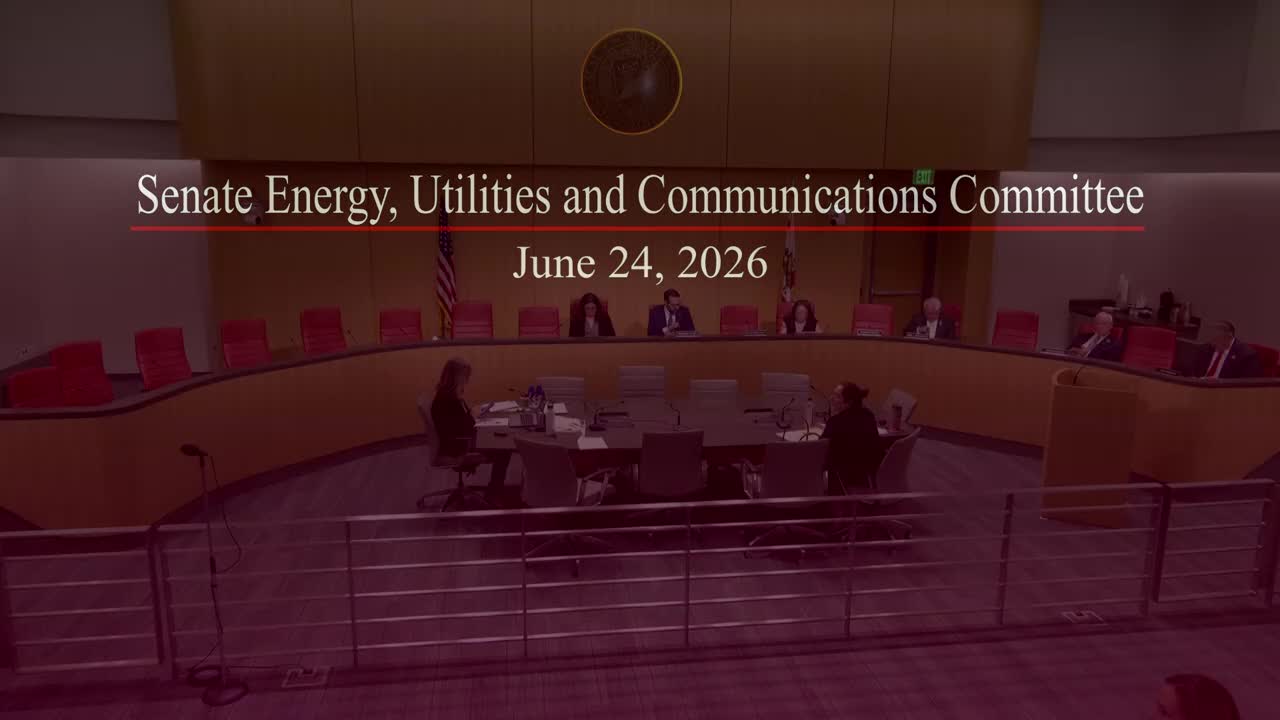 13MIN
Senate Standing Committee on Energy, Utilities and Communications
 1MIN
Assembly Floor
 4MIN
Assembly Standing Committee on Natural Resources
 5MIN
Assembly Standing Committee on Utilities and Energy
Bill Author

Bill Co-Author(s):