AB 2223: Department of Corrections and Rehabilitation: state contracts.
- Session Year: 2025-2026
- House: Assembly
- Latest Version Date: 2026-06-04
Current Status:
In Progress
(2026-08-13: In committee: Held under submission.)
Introduced
In Committee
Awaiting First Chamber Vote
Passed First Chamber
In Committee
Awaiting Second Chamber Vote
Passed Second Chamber
Enacted
Existing law establishes the Department of Corrections and Rehabilitation (CDCR) to administer the state prison system under the direction of the Secretary of the Department of Corrections and Rehabilitation. Existing law authorizes the secretary to, under certain circumstances, enter into contracts to provide housing, sustenance, supervision, and services, as provided, or to provide health care services.
This bill would require CDCR to disclose, for each new contract or contract renewal entered into by CDCR on or after January 1, 2027, for services that are performed by civil service employees, medical or mental health staffing, specified information, including, but not limited to, a description of the services provided by the contracted party, the total hours expected to be worked by contracted workers, and the total contract value. The bill would require CDCR to provide this disclosure to the exclusive bargaining representative of the affected bargaining unit at the time CDCR enters into or renews a contract as described above. The bill would require CDCR, beginning on March 1, 2028, and on or before March 1 of each year thereafter, to submit an annual report to the Legislature that contains the information required to be disclosed pursuant to these provisions. The bill would make related findings and declarations.
Existing law establishes the Department of Corrections and Rehabilitation (CDCR) to administer the state prison system under the direction of the Secretary of the Department of Corrections and Rehabilitation. Existing law authorizes the secretary to, under certain circumstances, enter into contracts to provide housing, sustenance, supervision, and services, as provided, or to provide health care services.
This bill would state the intent of the Legislature to enact legislation relating to the disclosure of state contracts by CDCR. require CDCR to disclose, for each new contract or contract renewal entered into by CDCR on or after January 1, 2027, for services that are performed by civil service employees, specified information, including, but not limited to, a description of the services provided by the contracted party, the total hours expected to be worked by contracted workers, and the total contract value. The bill would require CDCR to provide this disclosure to the exclusive bargaining representative of the affected bargaining unit at the time CDCR enters into or renews a contract as described above. The bill would require CDCR, beginning on March 1, 2028, and on or before March 1 of each year thereafter, to submit an annual report to the Legislature that contains the information required to be disclosed pursuant to these provisions. The bill would make related findings and declarations.
Existing law establishes the Department of Corrections and Rehabilitation (CDCR) to administer the state prison system under the direction of the Secretary of the Department of Corrections and Rehabilitation. Existing law authorizes the secretary to, under certain circumstances, enter into contracts to provide housing, sustenance, supervision, and services, as provided, or to provide health care services.
This bill would state the intent of the Legislature to enact legislation relating to the disclosure of state contracts by CDCR.
The Legislature finds and declares all of the following:
(a)The Department of Corrections and Rehabilitation employs civil service workers who perform critical medical, mental health, custody, and rehabilitative functions.
(b)The department has increasingly relied on contracts for services that are customarily and historically performed by state employees.
(c)Transparency regarding the cost, scope, and duration of these contracts is necessary to ensure fiscal accountability, effective workforce planning, and compliance with civil service principles.
(d)Requiring standardized reporting of contracts that substitute for civil service work will promote transparency and accountability by assisting the Legislature and exclusive bargaining representatives in evaluating the appropriate use of state resources.
SEC. 2.Section 5036 is added to the Penal Code, immediately following Section 5035, to read:5036.(a)For each new contract or contract renewal entered into by the Department of Corrections and Rehabilitation on or after January 1, 2027, for services that are customarily and historically performed by civil service employees, medical and mental health staffing, the department shall disclose the information described in subdivision (b).
(b)The disclosure required by this section shall include, but not be limited to, all of the following:
(1)A description of the services provided, including the job title or function performed by contracted workers.
(2)A statement identifying whether the contractor has been found liable, within the previous five years, for any labor law violations, including, but not limited to, violations of wage and hour laws, workplace safety laws, or unfair labor practice determinations, and a description of those violations.
(3)The job title and classification used by the contractor for the contracted workers.
(4)The minimum qualifications and professional credentials required of contracted workers, including licensure, certification, education, and experience requirements, as applicable.
(5)The corresponding state civil service classification or classifications, if any, that customarily and historically perform the same or substantially similar work.
(6)The bargaining unit or bargaining units that would represent the corresponding state civil service classification.
(7)The number of contracted workers, reported by classification.
(8)The total hours expected to be worked by contracted workers.
(9)The full-time equivalent (FTE) value of the contracted labor.
(10)The hourly rates paid to contracted workers.
(11)The total contract value, including both of the following:
(A)The annual contract amount.
(B)The cumulative contract amount over the life of the contract.
(12)Administrative fees, vendor fees, or overhead charges paid pursuant to the contract.
(13)Any emergency, premium, or expedited rates, including rates paid for last-minute staffing or urgent coverage.
(14)The duration of the contract, including the original term and any renewal or extension options.
(c)The department shall provide the disclosure required by subdivision (b) to the exclusive bargaining representative or representatives of the affected bargaining unit or units at the time the department enters into or renews the contract.
(d)Beginning on March 1, 2028, and on or before March 1 of each year thereafter, the department shall prepare and submit to the Legislature an annual report containing the information required by subdivision (b) for all contracts described in subdivision (a) that were in effect during the prior calendar year. The report shall be submitted in compliance with Section 9795 of the Government Code.
The Legislature finds and declares all of the following:
(a)The Department of Corrections and Rehabilitation employs civil service workers who perform critical medical, mental health, custody, and rehabilitative functions.
(b)The department has increasingly relied on contracts for services that are customarily and historically performed by state employees.
(c)Transparency regarding the cost, scope, and duration of these contracts is necessary to ensure fiscal accountability, effective workforce planning, and compliance with civil service principles.
(d)Requiring standardized reporting of contracts that substitute for civil service work will promote transparency and accountability by assisting the Legislature and exclusive bargaining representatives in evaluating the appropriate use of state resources.
SEC. 2.Section 5036 is added to the Penal Code, immediately following Section 5035, to read:5036.(a)For each new contract or contract renewal entered into by the Department of Corrections and Rehabilitation on or after January 1, 2027, for services that are customarily and historically performed by civil service employees, the department shall disclose the information described in subdivision (b).
(b)The disclosure required by this section shall include, but not be limited to, all of the following:
(1)A description of the services provided, including the job title or function performed by contracted workers.
(2)A statement identifying whether the contractor has been found liable, within the previous five years, for any labor law violations, including, but not limited to, violations of wage and hour laws, workplace safety laws, or unfair labor practice determinations, and a description of those violations.
(3)The job title and classification used by the contractor for the contracted workers.
(4)The minimum qualifications and professional credentials required of contracted workers, including licensure, certification, education, and experience requirements, as applicable.
(5)The corresponding state civil service classification or classifications, if any, that customarily and historically perform the same or substantially similar work.
(6)The bargaining unit or bargaining units that would represent the corresponding state civil service classification.
(7)The number of contracted workers, reported by classification.
(8)The total hours expected to be worked by contracted workers.
(9)The full-time equivalent (FTE) value of the contracted labor.
(10)The hourly rates paid to contracted workers.
(11)The total contract value, including both of the following:
(A)The annual contract amount.
(B)The cumulative contract amount over the life of the contract.
(12)Administrative fees, vendor fees, or overhead charges paid pursuant to the contract.
(13)Any emergency, premium, or expedited rates, including rates paid for last-minute staffing or urgent coverage.
(14)The duration of the contract, including the original term and any renewal or extension options.
(c)The department shall provide the disclosure required by subdivision (b) to the exclusive bargaining representative or representatives of the affected bargaining unit or units at the time the department enters into or renews the contract.
(d)Beginning on March 1, 2028, and on or before March 1 of each year thereafter, the department shall prepare and submit to the Legislature an annual report containing the information required by subdivision (b) for all contracts described in subdivision (a) that were in effect during the prior calendar year. The report shall be submitted in compliance with Section 9795 of the Government Code.
SECTION 1.It is the intent of the Legislature to enact legislation relating to the disclosure of state contracts by the Department of Corrections and Rehabilitation.It is the intent of the Legislature to enact legislation relating to the disclosure of state contracts by the Department of Corrections and Rehabilitation.
|
Date
|
Status
|
|---|---|
| Aug 13, 2026 | In committee: Held under submission. |
| Aug 3, 2026 | In committee: Referred to APPR. suspense file. |
| Jul 1, 2026 | From committee: Do pass and re-refer to Com. on APPR. (Ayes 4. Noes 1.) (July 1). Re-referred to Com. on APPR. |
| Jun 4, 2026 | From committee chair, with author's amendments: Amend, and re-refer to committee. Read second time, amended, and re-referred to Com. on L., P.E. & R. |
| Jun 3, 2026 | Referred to Com. on L., P.E. & R. |
| May 27, 2026 | In Senate. Read first time. To Com. on RLS. for assignment. |
| May 26, 2026 | Read third time. Passed. Ordered to the Senate. |
| May 26, 2026 | Read third time. Passed. Ordered to the Senate. (Ayes 60. Noes 13.) |
| May 26, 2026 | Read third time. Passed. Ordered to the Senate. (Ayes 60. Noes 13. Page 5349.) |
| May 18, 2026 | Read second time. Ordered to third reading. |
| May 14, 2026 | From committee: Do pass. (Ayes 11. Noes 3.) (May 14). |
| Apr 29, 2026 | In committee: Set, first hearing. Referred to APPR. suspense file. |
| Apr 8, 2026 | From committee: Do pass and re-refer to Com. on APPR. (Ayes 5. Noes 0.) (April 8). Re-referred to Com. on APPR. |
| Mar 23, 2026 | Re-referred to Com. on P. E. & R. |
| Mar 19, 2026 | Referred to Com. on P. E. & R. |
| Mar 19, 2026 | From committee chair, with author's amendments: Amend, and re-refer to Com. on P. E. & R. Read second time and amended. |
| Feb 20, 2026 | From printer. May be heard in committee March 22. |
| Feb 19, 2026 | Read first time. To print. |
|
Date
|
Description
|
Location
|
Votes
|
|
|---|---|---|---|---|
| Aug 3, 2026 | Placed on suspense file | Senate Standing Committee on Appropriations |
Passed |
|
| Jul 1, 2026 | Do pass, but first be re-referred to the Committee on [Appropriations] | Senate Standing Committee on Labor, Public Employment and Retirement |
Passed |
|
| May 26, 2026 | AB 2223 Lowenthal Assembly Third Reading | Assembly Floor |
Passed |
|
| May 14, 2026 | Do pass. | Assembly Standing Committee on Appropriations |
Passed |
|
| Apr 8, 2026 | Do pass and be re-referred to the Committee on [Appropriations] | Assembly Standing Committee on Public Employment and Retirement |
Passed |
This list shows positions taken on this bill by organizations on the date displayed, which is linked to the original source.
Positions by individuals are not included.
|
Organization
|
Position
|
Date
|
|---|---|---|
| American Federation of State, County and Municipal Employees (Co-sponsor) | ** Support | |
| American Federation of State, County and Municipal Employees, Local 2620 | ** Support | |
| California Association Of Psychiatric Technicians | ** Support | |
| California Federation of Labor Unions | ** Support | |
| Service Employees International Union California | ** Support | |
| Service Employees International Union Local 1000 (Co-sponsor) | ** Support | |
| Union Of American Physicians And Dentists | ** Support |
SENATE COMMITTEE ON
Senator Sabrina Cervantes, Chair
2025 - 2026 Regular Session
AB 2223 (Lowenthal) - Department of Corrections and Rehabilitation: state contracts
Version: | Policy Vote: |
Urgency: | Mandate: |
Hearing Date: | Consultant: |
Bill Summary:
AB 2223 would require the Department of Corrections and Rehabilitation (CDCR) to disclose to the exclusive representative of the affected bargaining unit specified information for each new contract or contract renewal entered into on or after January 1, 2027, for medical and mental health staffing.
Fiscal Impact:
CDCR estimates that the bill would result in ongoing General Fund costs in the millions of dollars annually to support additional staff needed to collect and report required data, update contracting policies and procedures, and monitor compliance with the bill's requirements. CDCR also indicates that the additional contracting requirements could discourage vendors from contracting with it and the California Correctional Health Care Services (CCHCS) to fill critical staffing needs. Finally, CDCR notes that the reporting requirements proposed by the bill could instead be addressed through the collective bargaining process.
Background:
The State Civil Service Act establishes a merit-based personnel system under which state work is generally performed by civil service employees. Existing law permits state agencies to enter into personal services contracts only under limited circumstances. Contracts may be used to achieve cost savings, provided they satisfy 11 statutory conditions—including a prohibition on displacing civil service employees—or for specified non-cost-related reasons, such as when the required expertise is unavailable within the civil service, the work cannot be performed satisfactorily by state employees, or the services are highly specialized or technical. These restrictions are intended to limit the state's reliance on contractors while preserving the integrity of the civil service system.
Before executing a personal services contract, a state agency must notify employee organizations representing workers who perform the affected work. Upon request by an employee organization, the State Personnel Board (SPB) reviews proposed or executed contracts for compliance with statutory requirements. Although the SPB delegates these reviews to its Executive Officer, employee organizations may request a hearing before the Board. Contracts subject to SPB review may not take effect until the SPB grants approval.
CDCR has experienced longstanding shortages of medical and mental health professionals, resulting in decades of litigation over the adequacy of prison health care. A federal court ultimately placed the prison mental health system under a court-appointed receiver, and subsequent court orders require CDCR to maintain vacancy rates below 10 percent in five key mental health classifications. In 2023, the court began imposing monthly fines for failing to meet these staffing requirements. As of 2025, CDCR had incurred more than $95 million in penalties. To supplement its workforce, CDCR relies on contracted registry staff and tele-mental health providers when sufficient state employees are unavailable.
In December 2025, the California State Auditor examined staffing practices at Atascadero State Hospital, Porterville Developmental Center, and Salinas Valley State Prison. The audit found that all three facilities experienced persistent medical and mental health staffing shortages due to difficult working conditions, shortages of qualified professionals, and competition from other public employers, private hospitals, and staffing agencies. Vacancy rates increased between fiscal years 2019-20 and 2023-24 despite significant recruitment efforts.
Although state employees continued to provide most services, the facilities increasingly relied on contract workers to maintain operations. At Salinas Valley State Prison, contract workers accounted for approximately 10 percent of authorized medical and mental health positions in 2023-24, while contract staffing hours increased substantially, particularly in nursing classifications. The Auditor found that contract workers generally cost more per hour than comparable state employees, even after accounting for salary, benefits, and overhead, and typically remained employed for shorter periods because they were used to address temporary staffing needs. Contract personnel were also required to meet the same, or higher, licensing and qualification standards as state employees performing comparable work.
The audit further found that the three facilities realized substantial salary savings from persistent vacancies, totaling approximately $592 million over the six-year audit period, including $247 million at Atascadero, $188 million at Salinas Valley, and $157 million at Porterville. However, the departments overseeing the facilities were unable to explain how those vacancy savings had been used. In addition, the Auditor found that the departments lacked a formal process for monitoring compliance with minimum staffing requirements and recommended requiring facilities to track, report, and publicly disclose staffing levels by shift, identify whether personnel are state employees or contract workers, and document instances in which minimum staffing standards were not met.
Proposed Law:
This bill, among other things, would do the following:
- Require CDCR to disclose specified information for each new contract or contract renewal entered into on or after January 1, 2027, for medical and mental health staffing. Require the disclosure to include specified information.
- Require CDCR to provide the above disclosure to the exclusive bargaining representative or representatives of the affected bargaining unit or units at the time CDCR enters into or renews the contract.
- Require CDCR, beginning on March 1, 2028, and on or before March 1 of each year thereafter, to report to the Legislature, as specified.
Related Legislation:
- AB 2367 (Kalra) would require CDCR, DDS, CalVet, and DSH to provide, on a quarterly basis, specified information, by facility, of their state-run health facilities. This bill is currently pending in this Committee.
- AB 393 (Connolly) would have required CDCR and DSH to take specified actions, including preparing an analysis comparing the hourly cost of a contractor to a civil service Bargaining Unit 16 (BU-16) physician, before entering into a personal services contract to fill a BU-16 physician position. This bill was vetoed by Governor Newsom.
- AB 339 (Ortega, Chapter 687, Statutes of 2025) required public agencies regulated by the Meyers-Milias-Brown Act to give a recognized employee organization no less than 45 days’ written notice regarding contracts to perform services that are within the scope of work of job classifications represented by the recognized employee organization.
- AB 2557 (Ortega, 2024) would have required the governing bodies of local agencies that contract for certain services to, among other things, post contracts and related documents on the agency’s website and provide advance notice to the public agency’s affected workforce union representative. This bill was held under submission on the Suspense File of this Committee.
- AB 2860 (Arambula, 2023) would have required DSH and CDCR to only fill a vacant supervisor position overseeing healthcare employees in State Bargaining Units 16, 17, 18, 19, or 20, with a permanent full-time civil service employee. This bill was held under submission on the Suspense File of the Assembly Appropriations Committee.
- SB 422 (Pan, 2022) would have required DSH to establish, by January 1, 2024, a physician registry as a three-year pilot program for the Patton State Hospital to be maintained by DSH and composed of members of State Bargaining Unit 16, who may elect to join the registry. This bill was vetoed by Governor Newsom.
- AB 657 (Cooper, 2021) would have prohibited specified professionals (generally medical personnel) employed under personal service contracts with state agencies from being under contract for a period that exceeds 365 consecutive days or 365 nonconsecutive days in a 24-month period. This bill was amended into another issue area.
-- END --
SENATE COMMITTEE ON LABOR, PUBLIC EMPLOYMENT AND RETIREMENT
Senator Lola Smallwood-Cuevas, Chair
2025 - 2026 Regular
Bill No: AB 2223 Hearing Date: July 1, 2026
Author: | Lowenthal | ||
Version: | June 4, 2026 | ||
Urgency: | No | Fiscal: | Yes |
Consultant: | Emma Bruce | ||
SUBJECT: Department of Corrections and Rehabilitation: state contracts
KEY ISSUE
This bill requires the Department of Corrections and Rehabilitation (CDCR) to disclose to the exclusive representative of the affected bargaining unit specified information for each new contract or contract renewal entered into on or after January 1, 2027, for medical and mental health staffing.
ANALYSIS
Existing law:
- Creates the state civil service that includes every officer and employee of the state except a limited number of specified, exempted officers and employees. Existing law also requires that the state make “permanent appointment and promotion in the civil service under a general system based on merit ascertained by competitive examination.” Case law and custom refer to this provision as the merit principle and it governs the administration of the state’s civil service system. (CA CONST. art. VII, §1 and §4)
- Establishes the State Personnel Board (SPB) to enforce the civil service statutes and prescribe probationary periods and classifications, adopt other rules authorized by statute, and review disciplinary actions. (CA CONST. art. VII, §2 and §3)
- Establishes the CDCR to administer the state prison system under the direction of the CDCR Secretary, and authorizes the secretary to, under certain circumstances, enter into contracts to provide housing, sustenance, supervision, and services, as provided, or to provide health care services. (Penal Code §5000 et seq.)
- Establishes the State Civil Service Act to provide a comprehensive personnel system for the state in which appointments are based upon merit and fitness ascertained through practical and competitive examination (Government Code §18500)
- Creates, under the Dills Act, a system of collective bargaining between the state and its employees’ exclusive representatives to negotiate for terms and conditions of employment (Government Code §3512 et seq.)
- Provides for state acquisition of goods and services in contracts for services. (Public Contract Code §10335 et seq.)
- Establishes strict standards for the use of personal services contracts to achieve cost savings. Among others, all of the following conditions must be met:
- The contracting agency must clearly demonstrate that the proposed contract will result in overall cost savings to the state.
- The contract does not cause the displacement of civil service employees.
- The savings are large enough to ensure that they will not be eliminated by private sector and state cost fluctuations that could normally be expected during the contracting period.
- The amount of savings clearly justify the size and duration of the contracting agreement.
- The contract is awarded through a publicized, competitive bidding process.
(Government Code §19130(a))
- Provides that personal services contracting, for non-cost savings reasons, shall also be permissible when specified conditions are met, including when the services contracted are not available within civil service, cannot be performed satisfactorily by civil service employees, or are of such a highly specialized or technical nature that the necessary expert knowledge, experience, and ability are not available through the civil service system. (Government Code §19130(b))
- Requires any state agency proposing to execute a personal services contract to achieve cost savings to notify the SPB of its intention. All organizations that represent employees who perform the type of work to be contracted and any person or organization which has filed with the SPB a request for notice shall be contacted, as specified, and given a reasonable opportunity to comment on the proposed contract. (Government Code §19131)
- Authorizes any employee organization to request, within 10 days of being notified, the SPB to review any contract proposed to achieve cost savings. Upon such a request, the SPB shall review the contract, as specified. (Government Code §19131)
- Requires the SPB, at the request of an employee organization that represents state employees, to review the adequacy of any non-cost savings proposed or executed contract. (Government Code §19132)
- Provides that unless a non-cost savings personal services contract is necessary due to a sudden and unexpected occurrence that poses a clear and imminent danger, requiring immediate action to prevent or mitigate the loss or impairment of life, health, property, or essential public services, the contract shall not be executed until the state agency proposing to execute the contract has notified all organizations that represent state employees who perform the type of work to be contracted. (Government Code §19132)
- Authorizes the SPB to establish necessary standards and controls over DGS’ approval of contracts to assure that the approval is consistent with the merit employment principles and requirements contained in Article VII of the California Constitution. The SPB shall have discretion to establish the substantive provisions of the standards. However, the SPB and DGS shall establish the specific procedures for contract review pursuant to such standards jointly. (Public Contracting Code §10337)
This bill:
- Requires CDCR to disclose specified information for each new contract or contract renewal entered into on or after January 1, 2027, for medical and mental health staffing.
- Requires the disclosure to include, but not be limited to, all of the following:
- A description of the services provided, including the job title or function performed by contracted workers.
- A statement identifying whether the contractor has been found liable, within the previous five years, for any labor law violations, including, but not limited to, violations of wage and hour laws, workplace safety laws, or unfair labor practice determinations, and a description of those violations.
- The job title and classification used by the contractor for the contracted workers.
- The minimum qualifications and professional credentials required of contracted workers, including licensure, certification, education, and experience requirements, as applicable.
- The corresponding state civil service classification or classifications, if any, that customarily and historically perform the same or substantially similar work.
- The bargaining unit or bargaining units that would represent the corresponding state civil service classification.
- The number of contracted workers, reported by classification.
- The total hours expected to be worked by contracted workers.
- The full-time equivalent (FTE) value of the contracted labor.
- The hourly rates paid to contracted workers.
- The total contract value, including both of the following:
- The annual contract amount.
- The cumulative contract amount over the life of the contract.
- Administrative fees, vendor fees, or overhead charges paid pursuant to the contract.
- Any emergency, premium, or expedited rates, including rates paid for last-minute staffing or urgent coverage.
- The duration of the contract, including the original term and any renewal or extension options.
- Requires CDCR to provide the disclosure in 2) to the exclusive bargaining representative or representatives of the affected bargaining unit or units at the time CDCR enters into or renews the contract.
- Requires CDCR, beginning on March 1, 2028, and on or before March 1 of each year thereafter, to prepare and submit to the Legislature an annual report containing the information required in 2) for all medical and mental health staffing contracts that were in effect during the prior calendar year.
COMMENTS
1. Background:
State Personnel Board (SPB) and Personal Services Contracts
When agencies use contracted personnel rather than civil service positions they enter into personal services contracts. Existing law establishes strict standards for the use of these contracts. Agencies can enter into a personal services contract to achieve cost savings or for specified, non-cost-related reasons. Contracts intended to achieve cost savings are only permissible if 11 different conditions are satisfied. For example, contracts cannot cause the displacement of civil service employees. Non-cost savings personal services contracts are only permissible in a limited number of situations, such as when the services in question are not available within the civil service or cannot be performed satisfactorily by civil service employees. These standards exist to limit the state’s reliance on contractors and to ensure civil service employees perform state work.
Any state agency proposing to execute a personal services contract must notify all organizations that represent state employees who perform the type of work covered by the contract. The SPB has the authority to review proposed contracts to ensure compliance with existing law. Upon request by an employee organization, the SPB must direct a state agency to transmit the proposed or executed contract for review. The SPB delegates the review of personal services contracts to its Executive Officer. However, if an employee organization requests it, the Executive Officer must grant the organization the opportunity to present its case against the contract and the reasons why the contract should be referred to the SPB for a hearing. Upon a showing of good cause by the organization, the Executive Officer must schedule the disputed contract for a hearing before the SPB. Contracts subject to review shall not become effective unless the SPB grants its approval.
Department of Corrections and Rehabilitation (CDCR)
CDCR’s mental health system has struggled to employ an adequate number of qualified staff. As a result of this chronic deficiency and others, CDCR has faced litigation for over three decades contending that it has not provided adequate mental health care. This culminated in a federal court appointing a mental health receiver to take direct control over the prison mental health care system. Ongoing federal court orders mandate CDCR to reduce vacancies below 10 percent in five key classifications: psychiatrists, psychologists, licensed clinical social workers, recreational therapists, and medical assistants. In 2023, the court ordered the State to pay monthly fines for noncompliance with mandated mental health staffing levels. As of 2025, CDCR had incurred more than $95 million in accumulated fines. When CDCR lacks sufficient onsite staff to fill its positions, it hires contractors known as registry staff. Tele-mental services are also used to supplement on-site providers.
2025 State Health Care Staffing Contracts Audit
In December 2025, the State Auditor released an audit examining staffing levels at three facilities: the Department of State Hospitals‑Atascadero, which the Department of State Hospitals (DSH) oversees; the Porterville Developmental Center, which the Department of Developmental Services (DDS) oversees; and Salinas Valley State Prison, which CDCR oversees.[1] State and federal laws require each of the three facilities to provide medical and mental health care to the individuals they house. DSH, DDS, and CDCR have all been involved in litigation for failing to provide adequate mental health care staffing. The Auditor found that the facilities faced challenges when recruiting staff, including difficult working conditions, a local shortage of health care professionals, and competition with other public facilities, private hospitals, and contract staffing agencies. As a result of these challenges, vacancy rates for medical and mental health positions at each of the three facilities increased from fiscal years 2019–20 through 2023–24. These vacancy rates are not due to a lack of effort on the facilities’ part; each have made significant efforts to recruit medical and mental health care professionals through online job advertisements and in‑person or virtual recruiting events.
Although the three facilities overwhelmingly rely on state employees, rather than contract workers to provide care, they have increasingly relied on contract workers to ensure adequate staffing. For example, in fiscal year 2023-24 contract workers accounted for 62 of Salinas Valley’s authorized 637 positions, or about 10 percent. However, in that same fiscal year the number of hours worked by contract workers increased. This increase in hours was particularly notable for contract workers covering nursing classifications. The auditor found that the facilities incur higher hourly costs for contract workers than for their state counterparts, even after accounting for the State’s overhead and benefit costs. Contract workers generally have a shorter tenure than state employees. This is in part because facilities often use them to meet temporary rather than long-term needs.
The facilities require contract workers to have the same licenses and certificates and to meet the same or higher qualifications as those that the State requires for state employees in the same classifications.
The Auditor found that all three facilities and their respective departments realized significant vacancy savings from unfilled medical and mental health care positions. Over the six fiscal years of the audit period Atascadero accumulated $247 million in savings, Salinas Valley accumulated $188 million, and Porterville accumulated $157 million. All three departments were unable to explain to the Auditor how they used the above specified savings.
None of the departments responsible for overseeing the three facilities has formally or specifically requested that facilities track, tabulate, and report their compliance with staffing minimums or developed a formal process for the facilities to do so. Without such oversight, the departments cannot be certain that their facilities are staffed appropriately for each shift to provide adequate medical and mental health care.
Among other recommendations, the Audit suggests requiring DSH, DDS, and CDCR to immediately require its facilities to establish a system to track, tabulate, periodically report, and make publicly available the following:
- Staffing levels by shift, including the individuals’ classifications and whether they are state employees or contract workers.
- The number of shifts during which and the number of staff by which the facility fell short of its required shift‑staffing minimums, as well as an explanation for why it missed the minimums.
Establishing such a system would ensure transparency, increase accountability, and allow adequate oversight.
2. Need for this bill?
According to the author:
“CDCR increasingly relies on private contractors to perform work that has historically been done by state civil service employees, particularly in medical and mental health classifications. However, policymakers and labor unions who represent the CDCR workforce currently lack consistent information about the size, cost, and scope of this contracted workforce.
Without standardized disclosure, it is difficult to determine:
- How many contracted workers are performing duties typically done by civil service employees
- The total cost of these contracts and associated vendor or administrative fees
- Whether vacancies in state positions are driving reliance on contractors
- Whether these contracts are temporary solutions or long-term substitutes for state employees
This lack of transparency makes it difficult for the Legislature to evaluate whether outsourcing is being used appropriately and whether investments in recruitment and retention of civil service employees could reduce costs and strengthen the state workforce.
AB 2223 addresses this gap by requiring CDCR to provide standardized disclosure of key information regarding contracts that substitute for civil service work. Hiring and retaining qualified civil service employees remains the most cost-effective and accountable way to provide essential public services. State employees are subject to rigorous hiring standards, professional oversight, and institutional training that support continuity of care and operational stability in correctional facilities. Ensuring transparency around contracting decisions will help policymakers evaluate workforce strategies that prioritize high-quality services while protecting responsible use of taxpayer resources.”
3. Proponent Arguments:
The co-sponsor of the measure, AFSCME, argues:
“CDCR has increasingly relied on private contractors to fill critical medical and mental health positions that have traditionally been performed by civil servants. While contracting may serve a limited, short-term role, the State currently lacks standardized and accessible information regarding the scope, cost, and duration of these contracts. This lack of transparency makes it difficult for the Legislature, employee representatives, and the public to evaluate whether outsourcing is being used appropriately or whether taxpayer dollars are being spent efficiently.
Recent findings by the California State Auditor underscore the urgency of this issue. The audit identified persistently high vacancy rates in key health care classifications and found that departments, including CDCR, have not made consistent or concerted efforts to assess staffing needs or evaluate the effectiveness of recruitment strategies. These gaps in workforce planning have contributed to an overreliance on contracted staff, who often cost more than comparable state employees and may not provide the same continuity of care or institutional knowledge…
AB 2223 addresses this problem by requiring CDCR to disclose key information when entering into or renewing contracts for work that is customarily and historically performed by civil service employees. This includes information related to contract costs, duration, staffing levels, worker classifications, contractor qualifications, and any labor law violations. The bill also requires that this information be provided to exclusive bargaining representatives and reported annually to the Legislature.”
SEIU Local 1000, also a co-sponsor of the measure, argues:
“Our SEIU Local 1000 members are just one part of the puzzle of providing care within CDCR facilities, and our labor siblings, like AFSCME and CAPT, are facing the same challenges within this system as our members: contracts/registry. CDCR has increasingly relied on contractors to complete work where civil service employees, like our Bargaining Units 17 and 20 workers, could complete the work instead.
These contracts do not have a standardized reporting requirement, and that is why we at SEIU Local 1000 choose to support this bill.”
4. Opponent Arguments:
None received.
5. Prior Legislation:
AB 2367 (Kalra, 2026) would require CDCR, DDS, CalVet, and DSH to provide, on a quarterly basis, specified information, by facility, of their state-run health facilities. This bill is pending in the Senate Labor, Public Employment and Retirement Committee.
AB 393 (Connolly, 2025) would have required CDCR and DSH to take specified actions, including preparing an analysis comparing the hourly cost of a contractor to a civil service Bargaining Unit 16 (BU-16) physician, before entering into a personal services contract to fill a BU-16 physician position. This bill was vetoed by Governor Newsom, who stated the following:
“While I am supportive of ideas to reduce state reliance on contractors, this measure circumvents the collective bargaining process and limits the ability of these departments to deliver critical services. The matters contemplated by this bill are more appropriately handled through the budget and labor negotiations processes.”
AB 339 (Ortega, Chapter 687, Statutes of 2025) required public agencies regulated by the Meyers-Milias-Brown Act to give a recognized employee organization no less than 45 days’ written notice regarding contracts to perform services that are within the scope of work of job classifications represented by the recognized employee organization.
AB 2557 (Ortega, 2024) would have required the governing bodies of local agencies that contract for certain services to, among other things, post contracts and related documents on the agency’s website and provide advance notice to the public agency’s affected workforce union representative. This bill was held in the Senate Committee on Appropriations.
AB 2860 (Arambula, 2023) would have required DSH and CDCR to only fill a vacant supervisor position overseeing healthcare employees in State Bargaining Units 16, 17, 18, 19, or 20, with a permanent full-time civil service employee. This bill was held in Assembly Appropriations Committee.
SB 422 (Pan, 2022) would have required DSH to establish, by January 1, 2024, a physician registry as a three-year pilot program for the Patton State Hospital to be maintained by DSH and composed of members of State Bargaining Unit 16, who may elect to join the registry. This bill was vetoed by Governor Newsom.
AB 657 (Cooper, 2021) would have prohibited specified professionals (generally medical personnel) employed under personal service contracts with state agencies from being under contract for a period that exceeds 365 consecutive days or 365 nonconsecutive days in a 24-month period. This bill was amended into another issue area.
AB 906 (Pan, Chapter 744, Statutes of 2013) prohibited a state agency from executing a personal services contract, except in specified sudden and unexpected situations, until it has certified that all employee organizations that perform the type of work being contracted out have been notified.
AB 149 (Lara, 2011) would have authorized a state department or agency, when the SPB either disapproves a personal services contract from being executed, or nullifies an executed personal services contract, to create and fill a limited-term civil service position for the equivalent number of hours for each contractor position requested in the submitted contract. This bill was held in the Senate Committee on Appropriations.
SUPPORT
American Federation of State, County and Municipal Employees (Co-sponsor)
Service Employees International Union Local 1000 (Co-sponsor)
American Federation of State, County and Municipal Employees, Local 2620
California Association of Psychiatric Technicians
California Federation of Labor Unions
Service Employees International Union California
Union of American Physicians and Dentists
OPPOSITION
None received
-- END --
State Health Care Staffing Contracts. California State Auditor. December 4, 2025.
*The entirety of this section of the analysis is based on information provided in the 2025 State Health Care Staffing Contracts Audit. ↑
ASSEMBLY THIRD READING
ATR Bill Id:AB 2223
Author:(Lowenthal)
As Amended Ver:March 19, 2026
Majority vote
SUMMARY
Requires the California Department of Corrections and Rehabilitation (CDCR) to disclose certain information regarding each new or renewed contract to the exclusive representative of the affected bargaining unit (BU), among other provisions.
Major Provisions
- Require, on or after January 1, 2027, each new or renewed contract entered into by the CDCR for services that are customarily and historically performed by civil service employees, to disclose the following to the exclusive represented employees of the affected BU at the time the CDCR enters or renews the contract:
- A description of the services provided, including the job title or function performed by contracted workers.
- A statement identifying whether the contractor has been found liable, within the previous five years, for any labor law violations, including, but not limited to, violations of wage and hour laws, workplace safety laws, or unfair labor practice determinations, and a description of those violations.
- The job title and classification used by the contractor for the contracted workers.
- The minimum qualifications and professional credentials required of contracted workers, including licensure, certification, education, and experience requirements, as applicable.
- The corresponding state civil service classification or classifications, if any, that customarily and historically perform the same or substantially similar work, and the bargaining unit or bargaining units that would represent the corresponding state civil service classification.
- The number of contracted workers, reported by classification, and the total hours expected to be worked by contracted workers; the full-time equivalent (FTE) value of the contracted labor; the hourly rates paid to contracted workers; the total contract value, including (i) the annual contract amount, and (ii) the cumulative contract amount over the life of the contract; and, the duration of the contract, including the original term and any renewal or extension options.
- Administrative fees, vendor fees, or overhead charges paid pursuant to the contract, and any emergency, premium, or expedited rates, including rates paid for last-minute staffing or urgent coverage.
- Require, beginning on March 1, 2028, and on or before March 1 each year thereafter, the CDCR to prepare and submit a report to the Legislature containing the above-described information for all contracts, as prescribed, that were in effect during the prior year.
COMMENTS
Government Contracting Public Services: Ongoing Questions and Concerns Regarding the Use of Public Funds, Transparency, Accountability, and Quality of Service Provision
Government contracting of public services, generally, is to provide a particular service for a common public need. For example, in California, to address significant wildfires, the state regularly contracts with private companies to operate specialized aircraft to cover terrain that is difficult to access by traditional ground equipment or personnel.
"Government transparency strengthens democracy, promotes fiscal responsibility, checks corruption, and bolsters public confidence. Sunshine laws enshrine transparency into the fabric of government by guaranteeing citizens access to information regarding government expenditures and policies. When government contractors assume control of public services, in many cases they are able to circumvent sunshine laws and shield important information from disclosure. Corporations may refuse to release records that would otherwise be available by claiming that transparency would hurt their bottom lines. Many times, contractors claim that the information is a "trade secret" or "proprietary" and legally protected from public review. To protect the public's right-to-information, decision makers should adopt strong sunshine laws that require government contractors to follow the same disclosure rules as government entities. As an additional protection, state and local governments should also include disclosure requirements in contracts." ("Closing the Books: How Government Contractors Hid Public Records," at p 2. In the Public Interest (ITPI), March 2015.)
Report by the California State Auditor
A report by the State Auditor focused on CDCR-Salinas Valley, DDS-Porterville, DSH-Atascadero and their use of health care staffing contracts at these facilities. Although it found that "contract workers make up a small portion of medical health staffing, the facilities have increasingly used them to address their growing number of staff vacancies."[1]
The summary of this report further states, "[s]ince July 2019, vacancy rates have increased to 30 % at Atascadero, 36 % at Porterville, and more than 50 % at Salinas Valley. Although the facilities have engaged in multiple recruitment strategies, they have not evaluated the success of their efforts to determine which are most effective. To help address vacancies, each facility has significantly increased its use of contract workers: Atascadero by 79 %, Porterville by 172 %, and Salinas Valley by 46 %. Contract workers generally cost the State more than state employees in the same job classifications, and the shorter tenure of contract workers presents challenges for facilities because of the training necessary to ensure that the contract workers are prepared to provide appropriate care to the facilities' patient populations.
"The many staff vacancies have resulted in each facility realizing significant savings from fiscal year 2019–20 through 2024–25: about $247 million for Atascadero, $188 million for Salinas Valley, and $157 million for Porterville. Nonetheless, neither [the] DSH nor DDS has required staff to evaluate staffing needs annually. Further, none of the three agencies require their facilities to report whether they are meeting shift-staffing minimums, which are critical to ensuring the provision of legally required levels of care. Because of the decades-long difficulties the facilities have had in filling vacant health care positions and a current and projected health care professional shortage, the State should consider facilitating a statewide campaign to draw medical and mental health care workers to California's civil service."
Key findings in this report include:
- The three facilities reviewed have increasingly struggled to fill vacant positions.
- To address vacancies, the three facilities have increased their use of contract workers.
- The CDCR, DDS, and DSH have not taken necessary steps to ensure that their facilities have appropriate staffing levels.
The State Auditor also reviewed staffing logs from the three facilities and found that they used state employees to provide the majority of patient care, but filled in shifts with contract workers as necessary.
In response, among the various recommendations offered by the State Auditor, the CDCR agreed with the State Auditor's recommendations, and the DDS and DSH generally agreed with the recommendations. However, the DDS disagreed with the State Auditor's recommendation that it require its facilities to track and report whether they are meeting required shift-staffing minimums, and the DSH disagreed with the State Auditor's recommendation that it evaluate whether offering affordable housing options would improve Atascadero's ability to recruit new state employees.
The State Auditor also recommended that, "to maximize the effectiveness of the State's recruiting efforts, the Legislature should require [the] CalHR to assembly and coordinate a cross-agency collaborative campaign to recruit medical and mental health care staff for state facilities statewide. [The CalHR] should continue, modify, and improve such efforts until the State can achieve and maintain appropriate vacancy rates, as the Legislature determines. This campaign should include, but not be limited to, the following:
- A total compensation analysis, and adjust as appropriate, to ensure that all medical and mental health care classifications' compensation is commensurate and competitive with similarly situated recruiting entities.
- The provision of online and in‑person assistance for candidates during the application and testing process.
- The implementation of targeted efforts, including development of marketing materials, as appropriate, highlighting the benefits of state employment in California, to recruit candidates for specific job classifications and facility locations that are historically difficult to fill.
- The establishment of measurement metrics to track the results of each type of recruiting activity and test modifications to each strategy. These measurements should include, but not be limited to, the number of candidates who express interest, apply, interview, receive, and accept employment offers."
Nexus to State Public Employment Relations
Existing law, the State Employer-Employee Relations Act (commonly referred to as the "Ralph C. Dills Act," or the "Dills Act"), regulates public employment relations between the state, as an employer, and its employees represented by a recognized employee organization by providing a reasonable of resolving disputes regarding wages, hours, and other terms and conditions of employment. In addition, the scope of representation, commonly referred to as the mandatory subjects of bargaining, is limited to wages, hours, and other terms and conditions of employment, but expressly excludes certain items. (Sections. 3512 et seq., Gov. Code). Where a state agency contracts for services and its represented employees perform the same or similar services, indeed, such contracting that may or does impact those employees, more likely than not, may be within the scope of representation under the Dills Act; thereby, being subject to bargaining under that act.
This Bill
This bill seeks to avail the exclusive representative and the Legislature of information regarding the nature, costs, and duration of CDCR contracts for services that are customarily performed by civil service employees for purposes of transparency, disclosure, and accountability. In many respects, it addresses the findings and recommendations in the State Auditor's report.
According to the Author
"In 2024, I requested a state audit examining the use of contracted medical and mental health staffing at certain state facilities. The Auditor subsequently found that vacancy rates at some facilities remain extremely high, exceeding 30 % at some state hospitals and more than 50 % at Salinas Valley State Prison. These shortages have led departments to rely heavily on private staffing contractors to fill critical positions. The audit also found that contracted workers often cost more per hour than comparable state employees, and that departments do not consistently evaluate whether recruitment strategies are effective in addressing vacancies. In addition, the auditor noted that departments lack standardized processes to track contractor staffing levels and assess the long-term impact of outsourcing on workforce planning. Despite the growing reliance on contractors, the Legislature currently lacks consistent and standardized information about the number of contracted workers, the classifications they perform, and the total cost of these contracts. [This bill] addresses this gap by requiring CDCR to provide standardized disclosure of key information regarding contracts that substitute for civil service work."
Arguments in Support
Generally, the several supporters of this bill express that, while contractors fill a short-term need, they come with higher costs to taxpayers without providing the same continuity of care, accountability, or institutional knowledge that a stable workforce delivers. As the state continues investing taxpayer dollars into such contracts while struggling to recruit and retain its own workforce, without consistent and transparent reporting, it makes it difficult for the Legislature and stakeholders to fully assess whether these decisions are fiscally responsible or aligned with state goals. Findings in the report by the State Auditor underscore the urgency of this issue, and this bill takes practical and necessary steps to increase and strengthen transparency and accountability.
Arguments in Opposition
None on file.
FISCAL COMMENTS
According to the Assembly Committee on Appropriations, this bill would result in ongoing General Fund costs likely in the millions of dollars annually for CDCR to support increased staff needed to respond to new data demands, contracting policy updates, and monitoring. To the extent that the bill's definition of services "customarily and historically performed by civil service employees" applies more broadly than solely to classifications within CDCR and the California Correctional Health Care Services umbrella to include other civil service classifications, costs would increase. Lastly, the CDCR notes requests for reports like those required by this bill may be addressed through the collective bargaining process under current law.
VOTES
ASM PUBLIC EMPLOYMENT AND RETIREMENT: 5-0-2
YES: McKinnor, Boerner, Garcia, Nguyen, Michelle Rodriguez
ABS, ABST OR NV: Lackey, Alanis
ASM APPROPRIATIONS: 11-3-1
YES: Wicks, Aguiar-Curry, Calderon, Caloza, Fong, Mark González, Krell, Pacheco, Pellerin, Sharp-Collins, Solache
NO: Hoover, Dixon, Tangipa
ABS, ABST OR NV: Ta
UPDATED
VERSION: March 19, 2026
CONSULTANT: Michael Bolden / P. E. & R. / (916) 319-3957 FN: 0002833
"Report 2024-114 State Health Care Staffing Contracts: Contract Workers Are a Small but Growing Proportion of Three State Facilities' Workforces." California State Auditor, December 4, 2025. Visit: https:// www.auditor.ca.gov/reports/2024-114/#summary ↑
Date of Hearing: April 29, 2026
ASSEMBLY COMMITTEE ON APPROPRIATIONS
Buffy Wicks, Chair
ABPCA Bill Id:AB 2223
Author:(Lowenthal) – As Amended Ver:March 19, 2026
Policy Committee: | Public Employment and Retirement | Vote: | 5 - 0 |
|
| ||
|
|
Urgency: No State Mandated Local Program: No Reimbursable: No
SUMMARY:
This bill requires, on or after January 1, 2027, the Department of Corrections and Rehabilitation (CDCR) to disclose specified information regarding each new contract or contract renewal entered for services typically performed by civil service employees to the exclusive bargaining representative of each affected bargaining unit. The bill also requires the CDCR, beginning March 1, 2028, to annually submit a report to the Legislature containing the information disclosed.
FISCAL EFFECT:
Ongoing General Fund costs likely in the millions of dollars annually for CDCR to support increased staff needed to respond to new data demands, contracting policy updates, and monitoring. To the extent that the bill’s definition of services “customarily and historically performed by civil service employees” applies more broadly than solely to classifications within CDCR and the California Correctional Health Care Services umbrella to include other civil service classifications costs would increase. Lastly, CDCR notes requests for reports like those required by this bill may be addressed through the collective bargaining process under current law.
COMMENTS:
- Purpose. According to the author:
Despite the growing reliance on contractors, the Legislature currently lacks consistent and standardized information about the number of contracted workers, the classifications they perform, and the total cost of these contracts. AB 2223 addresses this gap by requiring CDCR to provide standardized disclosure of key information regarding contracts that substitute for civil service work.
- Background. State Civil Service. The State Civil Service Act provides a comprehensive personnel system where state employment is based on the merit principle and fitness ascertained through practical and competitive examination. However, existing law also authorizes state agencies to contract for personal services under certain conditions, such as when the services contracted are not available within civil service, cannot be performed satisfactorily by civil service employees, or are of such a highly specialized or technical nature not available through the civil service system. However, current law does not limit the amount of time an department may utilize a contractor, which has resulted in some contractor’s terms being extended several times, potentially displacing employees. This bill requires, for any contracted work occurring at CDCR on or after January 1, 2027, CDCR to disclose specified information regarding such contracts, such as the total contract value, to the exclusive representative of the bargaining unit that would otherwise be responsible for such work.
State Auditor Report. In 2024, the California State Auditor (CSA) conducted an audit of state healthcare staffing contracts at three separate facilities operated by CDCR, the Department of Developmental Services (DDS), and the Department of State Hospitals (DSH), each of which with staff vacancy rates over 30%. The CSA found that between fiscal years 2019-20 and 2024-25 the three facilities had collectively saved $592 million from these staff vacancies. However, in spite of said savings and high vacancy rates, the CSA found that each facility has become increasingly reliant on contract workers, with CDCR’s facility increasing its use of contract work by 46% across that same five-year period. While the CSA recommended the Legislature establish a coordinated medical and mental healthcare staff statewide recruitment effort, the CSA specifically recommended the CDCR immediately implement tracking and reporting practices at each of CDCR’s facilities for information such as staffing levels, classification types, the number of state employees compared to contract workers, and how often facilities fall short of their shift-staffing minimums.
- Related Legislation. AB 2367 (Kalra), of the current legislative session, would require each of CDCR, DDS, DHS, and the California Department of Veterans Affairs, to quarterly report specified staffing information of all their state-run health facilities and make it available to the relevant employee representative and the public.
Analysis Prepared by: Aaron Heredia / APPR. / (916) 319-2081
Date of Hearing: April 8, 2026
ASSEMBLY COMMITTEE ON PUBLIC EMPLOYMENT AND RETIREMENT
Tina S. McKinnor, Chair
ABPCA Bill Id:AB 2223 (
Author:Lowenthal) – As Amended Ver:March 19, 2026
SUBJECT: Department of Corrections and Rehabilitation: state contracts
SUMMARY: Requires the California Department of Corrections and Rehabilitation (CDCR) to disclose specified information regarding each new or renewed contract to the exclusive representative of the affected bargaining unit (BU), among other provisions. Specifically, this bill:
- Requires, on or after January 1, 2027, each new or renewed contract entered into by the CDCR for services that are customarily and historically performed by civil service employees, to disclose the following to the exclusive represented employees of the affected BU at the time the CDCR enters or renews the contract:
- A description of the services provided, including the job title or function performed by contracted workers.
- A statement identifying whether the contractor has been found liable, within the previous five years, for any labor law violations, including, but not limited to, violations of wage and hour laws, workplace safety laws, or unfair labor practice determinations, and a description of those violations.
- The job title and classification used by the contractor for the contracted workers.
- The minimum qualifications and professional credentials required of contracted workers, including licensure, certification, education, and experience requirements, as applicable.
- The corresponding state civil service classification or classifications, if any, that customarily and historically perform the same or substantially similar work.
- The bargaining unit or bargaining units that would represent the corresponding state civil service classification.
- The number of contracted workers, reported by classification.
- The total hours expected to be worked by contracted workers.
- The full-time equivalent (FTE) value of the contracted labor, and the hourly rates paid to contracted workers.
- The total contract value, including (i) the annual contract amount, and (ii) the cumulative contract amount over the life of the contract.
- Administrative fees, vendor fees, or overhead charges paid pursuant to the contract.
- Any emergency, premium, or expedited rates, including rates paid for last-minute staffing or urgent coverage.
- The duration of the contract, including the original term and any renewal or extension options.
- Requires, beginning on March 1, 2028, and on or before March 1 each year thereafter, the CDCR to prepare and submit a report to the Legislature containing the above-described information for all contracts, as prescribed, that were in effect during the prior year.
- Includes uncodified legislative findings and declarations for these purposes.
EXISTING LAW:
- Establishes the CDCR to administer the state prison system under the direction of the CDCR Secretary, and authorizes the secretary to, under certain circumstances, enter into contracts to provide housing, sustenance, supervision, and services, as provided, or to provide health care services. (Sections 5000 et seq., Penal Code.)
- Creates the state civil service that includes every officer and employee of the State except a limited number of specified, exempted officers and employees, and requires that the state make “permanent appointment and promotion in the civil service under a general system based on merit ascertained by competitive examination.” Case law and custom refer to this provision as the merit principle and it governs the administration of the state’s civil service system. (Sections 1 and 4, art. VII, Cal. Const.)
- Establishes the State Civil Service Act to facilitate the operation of the Constitution’s merit principle for the state civil service; requires the State Personnel Board (SPB) to prescribe rules consistent with a merit based civil service system to govern appointments classifications, examinations, probationary periods, disciplinary actions, and other matters related to the SPB’s authority under Article VII of the California Constitution; authorizes the SPB to conduct audits and investigations of the personnel practices of CalHR and appointing authorities to ensure compliance with civil service policies, procedures, and statutes, and permits the CalHR and the SPB to delegate, share, or transfer between them responsibilities for programs within their respective jurisdictions pursuant to an agreement. (Sections 18500 et seq., Gov. Code.)
- Establishes, pursuant to Sections 2 and 3 of Article VII of the California Constitution, the SPB which must enforce civil service statutes, and by majority vote of all its members, prescribe probationary periods and classifications, adopt other rules authorized by statute, and review disciplinary actions. In addition, the Executive Officer of the SPB is required to administer civil service statutes under the rules of the SPB.
- Creates the California Department of Human Resources (CalHR) and vests it with the powers, duties, and authorities necessary to operate the state civil service system pursuant to Article VII of the California Constitution, the Government Code, the merit principle, and applicable rules duly adopted by the SPB. (Sections 18500 et seq., Gov. Code.)
- Requires the CalHR and the SPB to enter into a MOU to determine areas of compliance for nonmerit-related audits and to train SPB staff on the areas of compliance. (Section 18502(b)(2), Gov. Code.)
- Requires the SPB to establish minimum qualifications for determining the fitness and qualifications of employees for each class of position, among other things, and authorizes the CalHR to require applicants for examination or appointment to provide documentation as it deems necessary to establish the applicants’ qualifications. (Section 18931(a), Gov. Code.)
- Authorizes the CalHR to designate an appointing power to design, announce, or administer examinations for the establishment of employment lists as specified. Existing law also permits a designated appointing power to contract with the CalHR or another designated appointing power for the purpose of designing, publicizing, or administering an examination. (Section 18930.5, Gov. Code.)
- Provides for state acquisition of goods and services in contracts for services. (Sections 10335 et seq., Pub. Contract Code.)
- Authorizes the state to enter into personal services contracts and establishes the conditions that must be met when procuring such contracts. (Sections 19130 et seq., Gov. Code.) Further, requires the SPB to review the adequacy of any proposed or executed contract, as provided, at the request of an employee organization that represents state employees, but need not review the contract again after its execution. Further, unless certain prescribed circumstances exist (e.g., an emergency), a state agency that proposes to execute a contract must first notify all organizations that represent state employees who perform the type of work to be contracted before executing the contract, among other provisions. Section 19132, Gov. Code.)
- Requires the State Personnel Board (SPB) to review a proposed or executed contract if it receives a request to conduct a review from an employee organization representing state employees. However, the review is restricted to the question as to whether the contract complies with existing law, as provided. Further, if the employee organizations requests, the SPB Executive Officer must grant the employee organization the opportunity to present its case against the contract and the reasons why it should be referred to the board for a hearing, and upon a showing of good cause by an employee organization, SPB Executive Officer must schedule the disputed contract for a hearing before the board for the purposes of receiving evidence and hearing arguments concerning the propriety of the disputed contract. Further, authorizes the SPB to direct a state agency to transmit a contract to an employee organization for review when it has reason to believe that a proposed contract is not compliant with existing law. However, if requested to do so by an employee organization, the SPB must direct a state agency to transmit the contract for it to review. (Section 10337, Pub. Contract Code.)
- Governs collective bargaining in the private sector under the federal National Labor Relations Act (NLRA), but leaves it to the states to regulate collective bargaining in their respective public sectors. (Sections 151 et seq., Title 29, United States Code.) While the NLRA and the decisions of its National Labor Relations Board (NLRB) often provide persuasive precedent in interpreting state collective bargaining law, public employees have no collective bargaining rights absent specific statutory authority establishing those rights.
- Provides several statutory frameworks under California law to provide public employees collective bargaining rights, govern public employer-employee relations, and limit labor strife and economic disruption in the public sector through a reasonable method of resolving disputes regarding wages, hours and other terms and conditions of employment between public employers and recognized public employee organizations or their exclusive representatives. These include the Ralph C. Dills Act (“Dills Act”) governing employment relations for certain executive branch (state) employees. (Sections 3512 et seq., Gov. Code.)
- Establishes the PERB, a quasi-judicial administrative agency charged with administering certain statutory frameworks governing employer-employee relations, resolving disputes, and enforcing the statutory duties and rights of public agency employers and employee organizations, but provides the City and County of Los Angeles a local alternative to PERB oversight. (Sections 3541 et seq., Gov. Code.)
FISCAL EFFECT: Unknown. This bill is flagged as fiscal by Legislative Counsel.
COMMENTS:
Among other things, information provided by the author states, “[t]he California Department of Corrections and Rehabilitation employs thousands of civil service workers who perform critical medical, mental health, custody, and rehabilitative functions within the state’s correctional system. In recent years, the department has increasingly relied on private contractors to perform services that have historically been carried out by state employees. Persistent vacancies in key classifications have contributed to this trend. In 2024, labor organizations representing state employees… requested a state audit examining the State’s use of contracted medical and mental health staffing at certain state facilities. The California State Auditor subsequently found that vacancy rates at some facilities remain extremely high, exceeding 30 percent at some state hospitals and more than 50 percent at Salinas Valley State Prison. These shortages have led departments to rely heavily on private staffing contractors to fill critical positions. The audit also found that contracted workers often cost more per hour than comparable state employees, and that departments do not consistently evaluate whether recruitment strategies are effective in addressing vacancies. In addition, the auditor noted that departments lack standardized processes to track contractor staffing levels and assess the long-term impact of outsourcing on workforce planning.
“Despite the growing reliance on contractors, the Legislature currently lacks consistent and standardized information about the number of contracted workers, the classifications they perform, and the total cost of these contracts. Without standardized disclosure, it is difficult to determine how many contracted workers are performing duties typically done by civil service employees; the total cost of these contracts and associated vendor or administrative fees; whether vacancies in state positions are driving reliance on contractors [, and] whether these contracts are temporary solutions or long-term substitutes for state employees. This lack of transparency makes it difficult for the Legislature to evaluate whether outsourcing is being used appropriately and whether investments in recruitment and retention of civil service employees could reduce costs and strengthen the state workforce.
“[This bill] addresses this gap by… ensuring transparency around contracting decisions will help policymakers evaluate workforce strategies that prioritize high-quality services while protecting responsible use of taxpayer resources.”
Government Contracting Public Services: Ongoing Questions and Concerns Regarding the Use of Public Funds, Transparency, Accountability, and Quality of Service Provision
Government contracting of public services, generally, is to provide a particular service for a common public need. For example, in California, to address significant wildfires, the state regularly contracts with private companies to operate specialized aircraft to cover terrain that is difficult to access by traditional ground equipment or personnel.
“Government transparency strengthens democracy, promotes fiscal responsibility, checks corruption, and bolsters public confidence. Sunshine laws enshrine transparency into the fabric of government by guaranteeing citizens access to information regarding government expenditures and policies. When government contractors assume control of public services, in many cases they are able to circumvent sunshine laws and shield important information from disclosure. Corporations may refuse to release records that would otherwise be available by claiming that transparency would hurt their bottom lines. Many times, contractors claim that the information is a “trade secret” or “proprietary” and legally protected from public review. To protect the public’s right-to-information, decision makers should adopt strong sunshine laws that require government contractors to follow the same disclosure rules as government entities. As an additional protection, state and local governments should also include disclosure requirements in contracts.” (“Closing the Books: How Government Contractors Hid Public Records,” at p 2. In the Public Interest (ITPI), March 2015.)
Increasing Reliance by Public Employers on Contracting Out for Services
The committee is reminded of its informational hearing on May 10, 2023, titled “Strengthening California through the Public Sector and Its Workforce,” which focused on various subjects, including contracting out of public employee work.
During that hearing, the committee heard from a number of panelists, including experts from the University of California at Berkeley Labor Center, where data was provided and substantial concerns were expressed by other panelists about the ongoing and increasing reliance by public employers, including the state – as an employer, on a contingent, part-time, temporary, contracted out, or retired annuitant workforce to fill public sector vacancies, or to perform the duties of willing and capable existing and prospective public employees. These concerns also detailed how public employers are increasingly relying on these forms of employment and in a manner that has deleterious effects on wage growth, employee morale, employer-employee relations, and the need to ensure operational consistency and quality in the provision of services to the public that could be performed by permanent employees.
These concerns also detailed how public employers are increasingly relying on these forms of employment and in a manner that has deleterious effects on wage growth, employee morale, employer-employee relations, and the need to ensure operational consistency and quality in the provision of services to the public that could be performed by permanent employees.
On April 17, 2024, the committee held another information relating to that subject titled: “Public Service Delivery and Workforce Wellbeing – Addressing the Vacancy Crisis in Local Government,” where civil service vacancies, impacts of vacancies on the civil service workforce and services, and collaborative solutions to address civil service vacancies, were discussed.
Report by the California State Auditor
A report by the State Auditor focused on CDCR-Salinas Valley, DDS-Porterville, DSH-Atascadero and their use of health care staffing contracts at these facilities. Although it found that “contract workers make up a small portion of medical health staffing, the facilities have increasingly used them to address their growing number of staff vacancies.”[1]
The summary of this report further states, “[s]ince July 2019, vacancy rates have increased to 30 percent at Atascadero, 36 percent at Porterville, and more than 50 percent at Salinas Valley. Although the facilities have engaged in multiple recruitment strategies, they have not evaluated the success of their efforts to determine which are most effective. To help address vacancies, each facility has significantly increased its use of contract workers: Atascadero by 79 percent, Porterville by 172 percent, and Salinas Valley by 46 percent. Contract workers generally cost the State more than state employees in the same job classifications, and the shorter tenure of contract workers presents challenges for facilities because of the training necessary to ensure that the contract workers are prepared to provide appropriate care to the facilities’ patient populations.
“The many staff vacancies have resulted in each facility realizing significant savings from fiscal year 2019–20 through 2024–25: about $247 million for Atascadero, $188 million for Salinas Valley, and $157 million for Porterville. Nonetheless, neither [the] DSH nor DDS has required staff to evaluate staffing needs annually. Further, none of the three agencies require their facilities to report whether they are meeting shift-staffing minimums, which are critical to ensuring the provision of legally required levels of care. Because of the decades-long difficulties the facilities have had in filling vacant health care positions and a current and projected health care professional shortage, the State should consider facilitating a statewide campaign to draw medical and mental health care workers to California’s civil service.”
Key findings in this report include:
- The three facilities reviewed have increasingly struggled to fill vacant positions.
- To address vacancies, the three facilities have increased their use of contract workers.
- The CDCR, DDS, and DSH have not taken necessary steps to ensure that their facilities have appropriate staffing levels.
The State Auditor also reviewed staffing logs from the three facilities and found that they used state employees to provide the majority of patient care, but filled in shifts with contract workers as necessary.
In response, among the various recommendations offered by the State Auditor, the CDCR agreed with the State Auditor’s recommendations, and the DDS and DSH generally agreed with the recommendations. However, the DDS disagreed with the State Auditor’s recommendation that it require its facilities to track and report whether they are meeting required shift-staffing minimums, and the DSH disagreed with the State Auditor’s recommendation that it evaluate whether offering affordable housing options would improve Atascadero’s ability to recruit new state employees.
The State Auditor also recommended that, “to maximize the effectiveness of the State’s recruiting efforts, the Legislature should require [the] CalHR to assembly and coordinate a cross-agency collaborative campaign to recruit medical and mental health care staff for state facilities statewide. [The CalHR] should continue, modify, and improve such efforts until the State can achieve and maintain appropriate vacancy rates, as the Legislature determines. This campaign should include, but not be limited to, the following:
- A total compensation analysis, and adjust as appropriate, to ensure that all medical and mental health care classifications’ compensation is commensurate and competitive with similarly situated recruiting entities.
- The provision of online and in‑person assistance for candidates during the application and testing process.
- The implementation of targeted efforts, including development of marketing materials, as appropriate, highlighting the benefits of state employment in California, to recruit candidates for specific job classifications and facility locations that are historically difficult to fill.
- The establishment of measurement metrics to track the results of each type of recruiting activity and test modifications to each strategy. These measurements should include, but not be limited to, the number of candidates who express interest, apply, interview, receive, and accept employment offers.”
Nexus to State Public Employment Relations
Existing law, the State Employer-Employee Relations Act (commonly referred to as the “Ralph C. Dills Act,” or the “Dills Act”), regulates public employment relations between the state, as an employer, and its employees represented by a recognized employee organization by providing a reasonable of resolving disputes regarding wages, hours, and other terms and conditions of employment. In addition, the scope of representation is limited to wages, hours, and other terms and conditions of employment, while excluding other specified items. (Sections. 3512 et seq. of the Gov. Code). Where a state agency contracts for services and its represented employees perform the same or similar services, indeed, such contracting that may or does impact those employees, more likely than not, may be within the scope of representation under the Dills Act; thereby, being subject to bargaining under that act.
This Bill
This bill seeks to avail the exclusive representative and the Legislature of information regarding the nature, costs, and duration of CDCR contracts for services that are customarily performed by civil service employees for purposes of transparency, disclosure, and accountability. In many respects, it addresses the findings and recommendations in the State Auditor’s report.
Conflict Notice to the Author
The author is informed that the Office of Legislative Counsel has issued a conflict notice regarding this bill and Assembly Bill 1229 (Schultz, 2025).
A conflict exists when two or more bills and/or constitutional amendments amend, add, repeal, or amend and renumber the same section, article, chapter, division, title, or heading. The enactment of these measures in their present form could give rise to a serious legal problem that may be avoided by appropriate amendments.
Author’s Statement
“In 2024, I requested a state audit examining the use of contracted medical and mental health staffing at certain state facilities. The Auditor subsequently found that vacancy rates at some facilities remain extremely high, exceeding 30 percent at some state hospitals and more than 50 percent at Salinas Valley State Prison. These shortages have led departments to rely heavily on private staffing contractors to fill critical positions. The audit also found that contracted workers often cost more per hour than comparable state employees, and that departments do not consistently evaluate whether recruitment strategies are effective in addressing vacancies. In addition, the auditor noted that departments lack standardized processes to track contractor staffing levels and assess the long-term impact of outsourcing on workforce planning. Despite the growing reliance on contractors, the Legislature currently lacks consistent and standardized information about the number of contracted workers, the classifications they perform, and the total cost of these contracts. [This bill] addresses this gap by requiring CDCR to provide standardized disclosure of key information regarding contracts that substitute for civil service work.”
Comments by Supporters
Generally, the several supporters of this bill express that, while contractors fill a short-term need, they come with higher costs to taxpayers without providing the same continuity of care, accountability, or institutional knowledge that a stable workforce delivers. As the state continues investing taxpayer dollars into such contracts while struggling to recruit and retain its own workforce, without consistent and transparent reporting, it makes it difficult for the Legislature and stakeholders to fully assess whether these decisions are fiscally responsible or aligned with state goals. Findings in the report by the State Auditor underscore the urgency of this issue, and this bill takes practical and necessary steps to increase and strengthen transparency and accountability.
Comments by Opponents
None on file.
Prior or Related Legislation
Assembly Bill 2367 (Kalra) proposes to require the CDCR, Department of Developmental Services (DDS), Department of Veterans Affairs (CalVet), and Department State Hospitals (DSH) to provide specified information to relevant employee representatives and the public, among other provisions. This bill is currently pending in the Assembly Committee on Public Employment and Retirement.
Assembly Bill 393 (Connolly, 2025) proposed to require the CDCR and the Department of State Hospitals (DSH) to take specified actions before entering into a personal services contract to have a contractor fill a budgeted State Bargaining Unit 16 (BU 16) physician or civil service psychiatrist position. This bill was vetoed by the Governor stating:
“While I am supportive of ideas to reduce state reliance on contractors, this measure circumvents the collective bargaining process and limits the ability of these departments to deliver critical services. The matters contemplated by this bill are more appropriately handled through the budget and labor negotiations processes.”
Chapter 687, Statutes of 2025 (Assembly Bill 339, Ortega) requires public agencies regulated by the Meyers-Milias-Brown Act (MMBA) to give a recognized employee organization (REO) no less than 45 days’ written notice regarding contracts to perform services that are within the scope of work of job classifications represented by the REO, among other provisions.
Assembly Bill 24 (DeMaio, 2025) originally introduced to establish legislative intent to enact a constitutional amendment to achieve cost savings for the state and balance the budget by, among other things, requiring state government agencies to competitively source or contract out services, this bill was subsequently amended to address an unrelated matter and was held in the Assembly Committee on Local Government.
Assembly Bill 2557 (Ortega, 2024) proposed new requirements on the governing bodies of local agencies that contract for certain services, as specified, including posting contracts and related documents on the local agency’s website and providing advance notice to the public agency’s affected workforce union representative, as specified, among other provisions. This bill was held in the Senate Committee on Appropriations.
Senate Bill 422 (Pan, 2022) proposed to amend existing law relating to the use of personal services contracts by the state by establishing a health professional registry consisting of existing state employees for supplemental, temporary work that would otherwise be performed by health contractors from private company medical registries, among other provisions. This bill was vetoed by the Governor who stated that:
“This bill is unclear on implementation and does not demonstrate how it would significantly reduce DSH’s reliance on contractors. While I am supportive of ideas to reduce state reliance on contractors, the creation of the registry and the determination of associated compensation are matters that are more appropriately handled through the budget and labor negotiations processes.”
Assembly Bill 657 (Cooper, 2021) originally proposed to establish certain prohibitions and reporting requirements relating to a state agency contracting with a professional, as defined, among other provisions. This bill was substantially amended to address an unrelated subject.
Chapter 744, Statutes of 2013 (Assembly Bill 906, Pan) amended the Civil Service Act to prohibit the execution of certain personal services contracts until the state agency proposing to execute the contract permissible under specified conditions, without regard to cost savings, has notified all organizations that represent state employees who perform the type of work to be contracted, among other provisions.
Assembly Bill 149 (Lara, 2011) proposed to authorize a state department or agency, when the SPB either disapproves a personal services contract from being executed, or nullifies an executed personal services contract, to create and fill a limited-term civil service position for the equivalent number of hours for each contractor position requested in the submitted contract. This bill was held in the Senate Committee on Appropriations.
Assembly Bill 556 (Conway, 2009) proposed to prohibit a personal services contract from adversely affecting the state’s equal employment opportunity (EEO) efforts and required the contract to include assurances that the contractor’s hiring practices meet applicable nondiscrimination, EEO standards. This bill was held in the Assembly Committee on Judiciary.
REGISTERED SUPPORT / OPPOSITION:
Support
American Federation of State, County and Municipal Employees, AFL-CIO (Co-Sponsor)
American Federation of State, County and Municipal Employees, Local 57, AFL-CIO
(Co-Sponsor)
California Association of Psychiatric Technicians
California State Council of Service Employees International Union
Service Employees International Union, Local 1000
Union of American Physicians and Dentists
Opposition
None on file.
Analysis Prepared by: Michael Bolden / P. E. & R. / (916) 319-3957
“Report 2024-114 State Health Care Staffing Contracts: Contract Workers Are a Small but Growing Proportion of Three State Facilities’ Workforces.” California State Auditor, December 4, 2025. ↑
Date of Hearing: April 8, 2026
ASSEMBLY COMMITTEE ON PUBLIC EMPLOYMENT AND RETIREMENT
Tina S. McKinnor, Chair
ABPCA Bill Id:AB 2223 (
Author:Lowenthal) – As Amended Ver:March 19, 2026
SUBJECT: Department of Corrections and Rehabilitation: state contracts
SUMMARY: Requires the California Department of Corrections and Rehabilitation (CDCR) to disclose specified information regarding each new or renewed contract to the exclusive representative of the affected bargaining unit (BU), among other provisions. Specifically, this bill:
- Requires, on or after January 1, 2027, each new or renewed contract entered into by the CDCR for services that are customarily and historically performed by civil service employees, to disclose the following to the exclusive represented employees of the affected BU at the time the CDCR enters or renews the contract:
- A description of the services provided, including the job title or function performed by contracted workers.
- A statement identifying whether the contractor has been found liable, within the previous five years, for any labor law violations, including, but not limited to, violations of wage and hour laws, workplace safety laws, or unfair labor practice determinations, and a description of those violations.
- The job title and classification used by the contractor for the contracted workers.
- The minimum qualifications and professional credentials required of contracted workers, including licensure, certification, education, and experience requirements, as applicable.
- The corresponding state civil service classification or classifications, if any, that customarily and historically perform the same or substantially similar work.
- The bargaining unit or bargaining units that would represent the corresponding state civil service classification.
- The number of contracted workers, reported by classification.
- The total hours expected to be worked by contracted workers.
- The full-time equivalent (FTE) value of the contracted labor, and the hourly rates paid to contracted workers.
- The total contract value, including (i) the annual contract amount, and (ii) the cumulative contract amount over the life of the contract.
- Administrative fees, vendor fees, or overhead charges paid pursuant to the contract.
- Any emergency, premium, or expedited rates, including rates paid for last-minute staffing or urgent coverage.
- The duration of the contract, including the original term and any renewal or extension options.
- Requires, beginning on March 1, 2028, and on or before March 1 each year thereafter, the CDCR to prepare and submit a report to the Legislature containing the above-described information for all contracts, as prescribed, that were in effect during the prior year.
- Includes uncodified legislative findings and declarations for these purposes.
FISCAL EFFECT: Unknown. This bill is flagged as fiscal be Legislative Counsel.
EXISTING LAW:
- Establishes the CDCR to administer the state prison system under the direction of the CDCR Secretary, and authorizes the secretary to, under certain circumstances, enter into contracts to provide housing, sustenance, supervision, and services, as provided, or to provide health care services. (Sections 5000 et seq., Penal Code.)
- Creates the state civil service that includes every officer and employee of the State except a limited number of specified, exempted officers and employees, and requires that the state make “permanent appointment and promotion in the civil service under a general system based on merit ascertained by competitive examination.” Case law and custom refer to this provision as the merit principle and it governs the administration of the state’s civil service system. (Sections 1 and 4, art. VII, Cal. Const.)
- Establishes the State Civil Service Act to facilitate the operation of the Constitution’s merit principle for the state civil service; requires the State Personnel Board (SPB) to prescribe rules consistent with a merit based civil service system to govern appointments classifications, examinations, probationary periods, disciplinary actions, and other matters related to the SPB’s authority under Article VII of the California Constitution; authorizes the SPB to conduct audits and investigations of the personnel practices of CalHR and appointing authorities to ensure compliance with civil service policies, procedures, and statutes, and permits the CalHR and the SPB to delegate, share, or transfer between them responsibilities for programs within their respective jurisdictions pursuant to an agreement. (Sections 18500 et seq., Gov. Code.)
- Establishes, pursuant to Sections 2 and 3 of Article VII of the California Constitution, the SPB which must enforce civil service statutes, and by majority vote of all its members, prescribe probationary periods and classifications, adopt other rules authorized by statute, and review disciplinary actions. In addition, the Executive Officer of the SPB is required to administer civil service statutes under the rules of the SPB.
- Creates the California Department of Human Resources (CalHR) and vests it with the powers, duties, and authorities necessary to operate the state civil service system pursuant to Article VII of the California Constitution, the Government Code, the merit principle, and applicable rules duly adopted by the SPB. (Sections 18500 et seq., Gov. Code.)
- Requires the CalHR and the SPB to enter into a MOU to determine areas of compliance for nonmerit-related audits and to train SPB staff on the areas of compliance. (Section 18502(b)(2), Gov. Code.)
- Requires the SPB to establish minimum qualifications for determining the fitness and qualifications of employees for each class of position, among other things, and authorizes the CalHR to require applicants for examination or appointment to provide documentation as it deems necessary to establish the applicants’ qualifications. (Section 18931(a), Gov. Code.)
- Authorizes the CalHR to designate an appointing power to design, announce, or administer examinations for the establishment of employment lists as specified. Existing law also permits a designated appointing power to contract with the CalHR or another designated appointing power for the purpose of designing, publicizing, or administering an examination. (Section 18930.5, Gov. Code.)
- Provides for state acquisition of goods and services in contracts for services. (Sections 10335 et seq., Pub. Contract Code.)
- Authorizes the state to enter into personal services contracts and establishes the conditions that must be met when procuring such contracts. (Sections 19130 et seq., Gov. Code.) Further, requires the SPB to review the adequacy of any proposed or executed contract, as provided, at the request of an employee organization that represents state employees, but need not review the contract again after its execution. Further, unless certain prescribed circumstances exist (e.g., an emergency), a state agency that proposes to execute a contract must first notify all organizations that represent state employees who perform the type of work to be contracted before executing the contract, among other provisions. Section 19132, Gov. Code.)
- Requires the State Personnel Board (SPB) to review a proposed or executed contract if it receives a request to conduct a review from an employee organization representing state employees. However, the review is restricted to the question as to whether the contract complies with existing law, as provided. Further, if the employee organizations requests, the SPB Executive Officer must grant the employee organization the opportunity to present its case against the contract and the reasons why it should be referred to the board for a hearing, and upon a showing of good cause by an employee organization, SPB Executive Officer must schedule the disputed contract for a hearing before the board for the purposes of receiving evidence and hearing arguments concerning the propriety of the disputed contract. Further, authorizes the SPB to direct a state agency to transmit a contract to an employee organization for review when it has reason to believe that a proposed contract is not compliant with existing law. However, if requested to do so by an employee organization, the SPB must direct a state agency to transmit the contract for it to review. (Section 10337, Pub. Contract Code.)
- Governs collective bargaining in the private sector under the federal National Labor Relations Act (NLRA), but leaves it to the states to regulate collective bargaining in their respective public sectors. (Sections 151 et seq., Title 29, United States Code.) While the NLRA and the decisions of its National Labor Relations Board (NLRB) often provide persuasive precedent in interpreting state collective bargaining law, public employees have no collective bargaining rights absent specific statutory authority establishing those rights.
- Provides several statutory frameworks under California law to provide public employees collective bargaining rights, govern public employer-employee relations, and limit labor strife and economic disruption in the public sector through a reasonable method of resolving disputes regarding wages, hours and other terms and conditions of employment between public employers and recognized public employee organizations or their exclusive representatives. These include the Ralph C. Dills Act (“Dills Act”) governing employment relations for certain executive branch (state) employees. (Sections 3512 et seq., Gov. Code.)
- Establishes the PERB, a quasi-judicial administrative agency charged with administering certain statutory frameworks governing employer-employee relations, resolving disputes, and enforcing the statutory duties and rights of public agency employers and employee organizations, but provides the City and County of Los Angeles a local alternative to PERB oversight. (Sections 3541 et seq., Gov. Code.)
FISCAL EFFECT: Unknown. This bill is flagged as fiscal by Legislative Counsel.
COMMENTS:
Among other things, information provided by the author states, “[t]he California Department of Corrections and Rehabilitation employs thousands of civil service workers who perform critical medical, mental health, custody, and rehabilitative functions within the state’s correctional system. In recent years, the department has increasingly relied on private contractors to perform services that have historically been carried out by state employees. Persistent vacancies in key classifications have contributed to this trend. In 2024, labor organizations representing state employees… requested a state audit examining the State’s use of contracted medical and mental health staffing at certain state facilities. The California State Auditor subsequently found that vacancy rates at some facilities remain extremely high, exceeding 30 percent at some state hospitals and more than 50 percent at Salinas Valley State Prison. These shortages have led departments to rely heavily on private staffing contractors to fill critical positions. The audit also found that contracted workers often cost more per hour than comparable state employees, and that departments do not consistently evaluate whether recruitment strategies are effective in addressing vacancies. In addition, the auditor noted that departments lack standardized processes to track contractor staffing levels and assess the long-term impact of outsourcing on workforce planning.
“Despite the growing reliance on contractors, the Legislature currently lacks consistent and standardized information about the number of contracted workers, the classifications they perform, and the total cost of these contracts. Without standardized disclosure, it is difficult to determine how many contracted workers are performing duties typically done by civil service employees; the total cost of these contracts and associated vendor or administrative fees; whether vacancies in state positions are driving reliance on contractors [, and] whether these contracts are temporary solutions or long-term substitutes for state employees. This lack of transparency makes it difficult for the Legislature to evaluate whether outsourcing is being used appropriately and whether investments in recruitment and retention of civil service employees could reduce costs and strengthen the state workforce.
“[This bill] addresses this gap by… ensuring transparency around contracting decisions will help policymakers evaluate workforce strategies that prioritize high-quality services while protecting responsible use of taxpayer resources.”
Government Contracting Public Services: Ongoing Questions and Concerns Regarding the Use of Public Funds, Transparency, Accountability, and Quality of Service Provision
Government contracting of public services, generally, is to provide a particular service for a common public need. For example, in California, to address significant wildfires, the state regularly contracts with private companies to operate specialized aircraft to cover terrain that is difficult to access by traditional ground equipment or personnel.
“Government transparency strengthens democracy, promotes fiscal responsibility, checks corruption, and bolsters public confidence. Sunshine laws enshrine transparency into the fabric of government by guaranteeing citizens access to information regarding government expenditures and policies. When government contractors assume control of public services, in many cases they are able to circumvent sunshine laws and shield important information from disclosure. Corporations may refuse to release records that would otherwise be available by claiming that transparency would hurt their bottom lines. Many times, contractors claim that the information is a “trade secret” or “proprietary” and legally protected from public review. To protect the public’s right-to-information, decision makers should adopt strong sunshine laws that require government contractors to follow the same disclosure rules as government entities. As an additional protection, state and local governments should also include disclosure requirements in contracts.” (“Closing the Books: How Government Contractors Hid Public Records,” at p 2. In the Public Interest (ITPI), March 2015.)
Increasing Reliance by Public Employers on Contracting Out for Services
The committee is reminded of its informational hearing on May 10, 2023, titled “Strengthening California through the Public Sector and Its Workforce,” which focused on various subjects, including contracting out of public employee work.
During that hearing, the committee heard from a number of panelists, including experts from the University of California at Berkeley Labor Center, where data was provided and substantial concerns were expressed by other panelists about the ongoing and increasing reliance by public employers, including the state – as an employer, on a contingent, part-time, temporary, contracted out, or retired annuitant workforce to fill public sector vacancies, or to perform the duties of willing and capable existing and prospective public employees. These concerns also detailed how public employers are increasingly relying on these forms of employment and in a manner that has deleterious effects on wage growth, employee morale, employer-employee relations, and the need to ensure operational consistency and quality in the provision of services to the public that could be performed by permanent employees.
These concerns also detailed how public employers are increasingly relying on these forms of employment and in a manner that has deleterious effects on wage growth, employee morale, employer-employee relations, and the need to ensure operational consistency and quality in the provision of services to the public that could be performed by permanent employees.
On April 17, 2024, the committee held another information relating to that subject titled: “Public Service Delivery and Workforce Wellbeing – Addressing the Vacancy Crisis in Local Government,” where civil service vacancies, impacts of vacancies on the civil service workforce and services, and collaborative solutions to address civil service vacancies, were discussed.
Report by the California State Auditor
A report by the State Auditor focused on CDCR-Salinas Valley, DDS-Porterville, DSH-Atascadero and their use of health care staffing contracts at these facilities. Although it found that “contract workers make up a small portion of medical health staffing, the facilities have increasingly used them to address their growing number of staff vacancies.”[1]
The summary of this report further states, “[s]ince July 2019, vacancy rates have increased to 30 percent at Atascadero, 36 percent at Porterville, and more than 50 percent at Salinas Valley. Although the facilities have engaged in multiple recruitment strategies, they have not evaluated the success of their efforts to determine which are most effective. To help address vacancies, each facility has significantly increased its use of contract workers: Atascadero by 79 percent, Porterville by 172 percent, and Salinas Valley by 46 percent. Contract workers generally cost the State more than state employees in the same job classifications, and the shorter tenure of contract workers presents challenges for facilities because of the training necessary to ensure that the contract workers are prepared to provide appropriate care to the facilities’ patient populations.
“The many staff vacancies have resulted in each facility realizing significant savings from fiscal year 2019–20 through 2024–25: about $247 million for Atascadero, $188 million for Salinas Valley, and $157 million for Porterville. Nonetheless, neither [the] DSH nor DDS has required staff to evaluate staffing needs annually. Further, none of the three agencies require their facilities to report whether they are meeting shift-staffing minimums, which are critical to ensuring the provision of legally required levels of care. Because of the decades-long difficulties the facilities have had in filling vacant health care positions and a current and projected health care professional shortage, the State should consider facilitating a statewide campaign to draw medical and mental health care workers to California’s civil service.”
Key findings in this report include:
- The three facilities reviewed have increasingly struggled to fill vacant positions.
- To address vacancies, the three facilities have increased their use of contract workers.
- The CDCR, DDS, and DSH have not taken necessary steps to ensure that their facilities have appropriate staffing levels.
The State Auditor also reviewed staffing logs from the three facilities and found that they used state employees to provide the majority of patient care, but filled in shifts with contract workers as necessary.
In response, among the various recommendations offered by the State Auditor, the CDCR agreed with the State Auditor’s recommendations, and the DDS and DSH generally agreed with the recommendations. However, the DDS disagreed with the State Auditor’s recommendation that it require its facilities to track and report whether they are meeting required shift-staffing minimums, and the DSH disagreed with the State Auditor’s recommendation that it evaluate whether offering affordable housing options would improve Atascadero’s ability to recruit new state employees.
The State Auditor also recommended that, “to maximize the effectiveness of the State’s recruiting efforts, the Legislature should require [the] CalHR to assembly and coordinate a cross-agency collaborative campaign to recruit medical and mental health care staff for state facilities statewide. [The CalHR] should continue, modify, and improve such efforts until the State can achieve and maintain appropriate vacancy rates, as the Legislature determines. This campaign should include, but not be limited to, the following:
- A total compensation analysis, and adjust as appropriate, to ensure that all medical and mental health care classifications’ compensation is commensurate and competitive with similarly situated recruiting entities.
- The provision of online and in‑person assistance for candidates during the application and testing process.
- The implementation of targeted efforts, including development of marketing materials, as appropriate, highlighting the benefits of state employment in California, to recruit candidates for specific job classifications and facility locations that are historically difficult to fill.
- The establishment of measurement metrics to track the results of each type of recruiting activity and test modifications to each strategy. These measurements should include, but not be limited to, the number of candidates who express interest, apply, interview, receive, and accept employment offers.”
Nexus to State Public Employment Relations
Existing law, the State Employer-Employee Relations Act (commonly referred to as the “Ralph C. Dills Act,” or the “Dills Act”), regulates public employment relations between the state, as an employer, and its employees represented by a recognized employee organization by providing a reasonable of resolving disputes regarding wages, hours, and other terms and conditions of employment. In addition, the scope of representation is limited to wages, hours, and other terms and conditions of employment, while excluding other specified items. (Sections. 3512 et seq. of the Gov. Code). Where a state agency contracts for services and its represented employees perform the same or similar services, indeed, such contracting that may or does impact those employees, more likely than not, may be within the scope of representation under the Dills Act; thereby, being subject to bargaining under that act.
This Bill
This bill seeks to avail the exclusive representative and the Legislature of information regarding the nature, costs, and duration of CDCR contracts for services that are customarily performed by civil service employees for purposes of transparency, disclosure, and accountability. In many respects, it addresses the findings and recommendations in the State Auditor’s report.
Conflict Notice to the Author
The author is informed that the Office of Legislative Counsel has issued a conflict notice regarding this bill and Assembly Bill 1229 (Schultz, 2025).
A conflict exists when two or more bills and/or constitutional amendments amend, add, repeal, or amend and renumber the same section, article, chapter, division, title, or heading. The enactment of these measures in their present form could give rise to a serious legal problem that may be avoided by appropriate amendments.
Author’s Statement
“In 2024, I requested a state audit examining the use of contracted medical and mental health staffing at certain state facilities. The Auditor subsequently found that vacancy rates at some facilities remain extremely high, exceeding 30 percent at some state hospitals and more than 50 percent at Salinas Valley State Prison. These shortages have led departments to rely heavily on private staffing contractors to fill critical positions. The audit also found that contracted workers often cost more per hour than comparable state employees, and that departments do not consistently evaluate whether recruitment strategies are effective in addressing vacancies. In addition, the auditor noted that departments lack standardized processes to track contractor staffing levels and assess the long-term impact of outsourcing on workforce planning. Despite the growing reliance on contractors, the Legislature currently lacks consistent and standardized information about the number of contracted workers, the classifications they perform, and the total cost of these contracts. [This bill] addresses this gap by requiring CDCR to provide standardized disclosure of key information regarding contracts that substitute for civil service work.”
Comments by Supporters
Generally, the several supporters of this bill express that, while contractors fill a short-term need, they come with higher costs to taxpayers without providing the same continuity of care, accountability, or institutional knowledge that a stable workforce delivers. As the state continues investing taxpayer dollars into such contracts while struggling to recruit and retain its own workforce, without consistent and transparent reporting, it makes it difficult for the Legislature and stakeholders to fully assess whether these decisions are fiscally responsible or aligned with state goals. Findings in the report by the State Auditor underscore the urgency of this issue, and this bill takes practical and necessary steps to increase and strengthen transparency and accountability.
Comments by Opponents
None on file.
Prior or Related Legislation
Assembly Bill 2367 (Kalra) proposes to require the CDCR, Department of Developmental Services (DDS), Department of Veterans Affairs (CalVet), and Department State Hospitals (DSH) to provide specified information to relevant employee representatives and the public, among other provisions. This bill is currently pending in the Assembly Committee on Public Employment and Retirement.
Assembly Bill 393 (Connolly, 2025) proposed to require the CDCR and the Department of State Hospitals (DSH) to take specified actions before entering into a personal services contract to have a contractor fill a budgeted State Bargaining Unit 16 (BU 16) physician or civil service psychiatrist position. This bill was vetoed by the Governor stating:
“While I am supportive of ideas to reduce state reliance on contractors, this measure circumvents the collective bargaining process and limits the ability of these departments to deliver critical services. The matters contemplated by this bill are more appropriately handled through the budget and labor negotiations processes.”
Chapter 687, Statutes of 2025 (Assembly Bill 339, Ortega) requires public agencies regulated by the Meyers-Milias-Brown Act (MMBA) to give a recognized employee organization (REO) no less than 45 days’ written notice regarding contracts to perform services that are within the scope of work of job classifications represented by the REO, among other provisions.
Assembly Bill 24 (DeMaio, 2025) originally introduced to establish legislative intent to enact a constitutional amendment to achieve cost savings for the state and balance the budget by, among other things, requiring state government agencies to competitively source or contract out services, this bill was subsequently amended to address an unrelated matter and was held in the Assembly Committee on Local Government.
Assembly Bill 2557 (Ortega, 2024) proposed new requirements on the governing bodies of local agencies that contract for certain services, as specified, including posting contracts and related documents on the local agency’s website and providing advance notice to the public agency’s affected workforce union representative, as specified, among other provisions. This bill was held in the Senate Committee on Appropriations.
Senate Bill 422 (Pan, 2022) proposed to amend existing law relating to the use of personal services contracts by the state by establishing a health professional registry consisting of existing state employees for supplemental, temporary work that would otherwise be performed by health contractors from private company medical registries, among other provisions. This bill was vetoed by the Governor who stated that:
“This bill is unclear on implementation and does not demonstrate how it would significantly reduce DSH’s reliance on contractors. While I am supportive of ideas to reduce state reliance on contractors, the creation of the registry and the determination of associated compensation are matters that are more appropriately handled through the budget and labor negotiations processes.”
Assembly Bill 657 (Cooper, 2021) originally proposed to establish certain prohibitions and reporting requirements relating to a state agency contracting with a professional, as defined, among other provisions. This bill was substantially amended to address an unrelated subject.
Chapter 744, Statutes of 2013 (Assembly Bill 906, Pan) amended the Civil Service Act to prohibit the execution of certain personal services contracts until the state agency proposing to execute the contract permissible under specified conditions, without regard to cost savings, has notified all organizations that represent state employees who perform the type of work to be contracted, among other provisions.
Assembly Bill 149 (Lara, 2011) proposed to authorize a state department or agency, when the SPB either disapproves a personal services contract from being executed, or nullifies an executed personal services contract, to create and fill a limited-term civil service position for the equivalent number of hours for each contractor position requested in the submitted contract. This bill was held in the Senate Committee on Appropriations.
Assembly Bill 556 (Conway, 2009) proposed to prohibit a personal services contract from adversely affecting the state’s equal employment opportunity (EEO) efforts and required the contract to include assurances that the contractor’s hiring practices meet applicable nondiscrimination, EEO standards. This bill was held in the Assembly Committee on Judiciary.
REGISTERED SUPPORT / OPPOSITION:
Support
American Federation of State, County and Municipal Employees, AFL-CIO (Co-Sponsor)
American Federation of State, County and Municipal Employees, Local 57, AFL-CIO
(Co-Sponsor)
California Association of Psychiatric Technicians
California State Council of Service Employees International Union
Service Employees International Union, Local 1000
Union of American Physicians and Dentists
Opposition
None on file.
Analysis Prepared by: Michael Bolden / P. E. & R. / (916) 319-3957
“Report 2024-114 State Health Care Staffing Contracts: Contract Workers Are a Small but Growing Proportion of Three State Facilities’ Workforces.” California State Auditor, December 4, 2025. ↑
Discussed in Hearing
 57SEC
Senate Standing Committee on Appropriations
 8MIN
Senate Standing Committee on Labor, Public Employment and Retirement
 1MIN
Assembly Floor
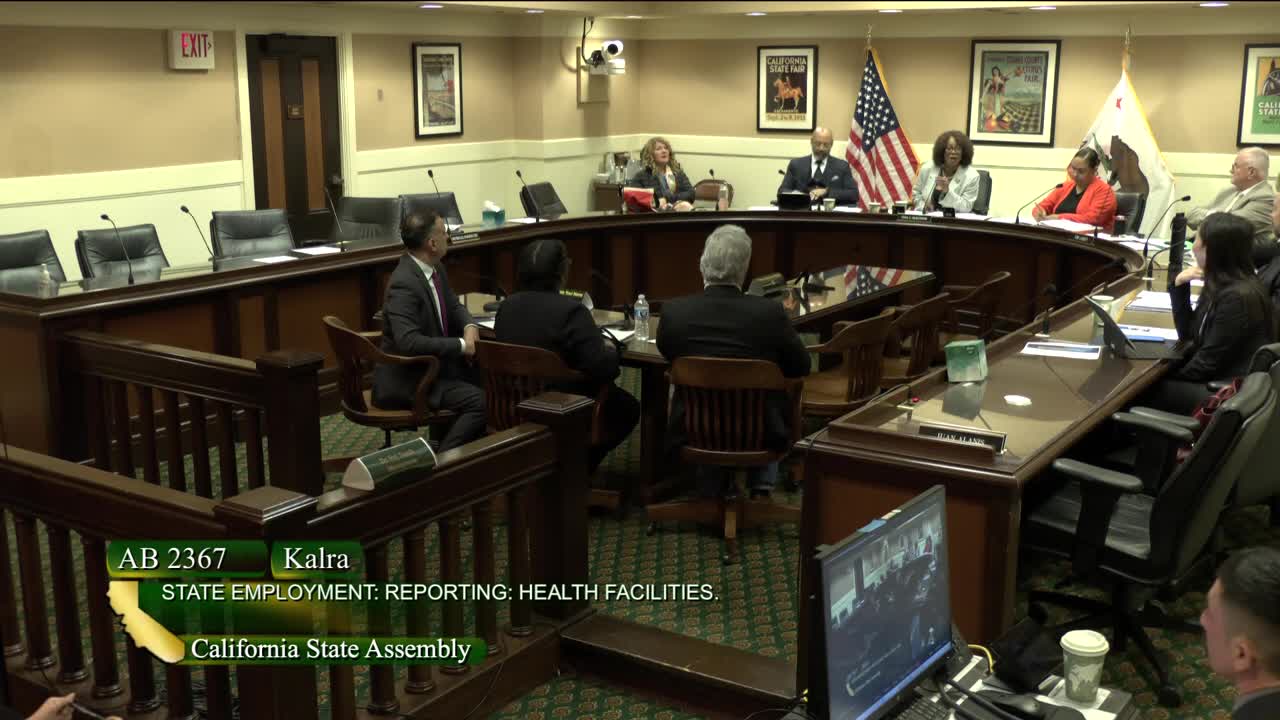 13MIN
Assembly Standing Committee on Public Employment and Retirement
Bill Author

Bill Co-Author(s):