AB 2227: Farm labor contractors: surety bonds.
- Session Year: 2025-2026
- House: Assembly
- Latest Version Date: 2026-09-18
Current Status:
Passed
(2026-09-18: Chaptered by Secretary of State - Chapter 294, Statutes of 2026.)
Introduced
In Committee
Awaiting First Chamber Vote
Passed First Chamber
In Committee
Awaiting Second Chamber Vote
Passed Second Chamber
Enacted
What does this bill do?
The bill raises the surety bond farm labor contractors must post — a guarantee that can be used to pay workers — to $50,000 for payrolls up to $500,000, $100,000 for payrolls of $500,000–$2 million, and $150,000 for payrolls over $2 million, and requires bond details be published and shared with workers. It also makes both licensed and unlicensed farm labor contractors subject to per-worker civil penalties, including for a first citation $100 per worker plus $100 per day (up to $10,000), with larger fines for repeat violations.
The summary is provided by generative AI which can make mistakes. For original language, please view the details in the table below.
Existing law requires a farm labor contractor to be licensed by the Labor Commissioner and to comply with specified employment laws applicable to farm labor contractors. Existing law provides that a person who violates the above-described provision is subject to a civil penalty, including, for any initial citation, $100 for each farmworker employed by the unlicensed person, plus $100 for each calendar day that a violation occurs, for a total penalty not to exceed $10,000.
This bill would instead provide that a person who violates employment laws applicable to farm labor contractors, unless otherwise specified, is subject to a civil penalty, including, for any initial citation, $100 for each farmworker employed by the unlicensed person or licensed farm labor contractor, plus $100 for each calendar day that a violation occurs, for a total penalty not to exceed $10,000.
Existing law prohibits the Labor Commissioner from issuing or renewing a license to act as a farm labor contractor unless specified requirements are met. Existing law requires an applicant for the issuance or renewal of a farm labor contractor license to have deposited with the Labor Commissioner a surety bond to be payable for, among other things, interest on wages and for any damages arising from violation of orders of the Industrial Welfare Commission and for any other monetary relief awarded to an agricultural worker as a result of a violation of specified employment laws. Existing law requires the amount of the surety bond to be based on the size of the persons annual payroll for all employees, and requires, for payrolls up to $500,000, a $25,000 bond, for payrolls of $500,000 to $2,000,000, a $50,000 bond, and for payrolls greater than $2,000,000, a $75,000 bond. Existing law requires the Labor Commissioner to require documentation of the size of the persons annual payroll for purposes of these provisions, as provided.
This bill would instead require, for payrolls up to $500,000, a $50,000 bond, for payrolls of $500,000 to $2,000,000, a $100,000 bond, and for payrolls greater than $2,000,000, a $150,000 bond. The bill would require the bond amounts to be deposited when a farm labor contractor first registers or files the application for their first annual renewal. The bill would require the Labor Commissioner to, among other things, include bond information on the public farm labor contractor license database, as described.
Existing law requires a farm labor contractor to be licensed by the Labor Commissioner and to comply with specified employment laws applicable to farm labor contractors. Existing law prohibits the Labor Commissioner from issuing or renewing a license to act as a farm labor contractor unless specified requirements are met. provides that a person who violates the above-described provision is subject to a civil penalty, including, for any initial citation, $100 for each farmworker employed by the unlicensed person, plus $100 for each calendar day that a violation occurs, for a total penalty not to exceed $10,000.
This bill would instead provide that a person who violates employment laws applicable to farm labor contractors, unless otherwise specified, is subject to a civil penalty, including, for any initial citation, $100 for each farmworker employed by the unlicensed person or licensed farm labor contractor, plus $100 for each calendar day that a violation occurs, for a total penalty not to exceed $10,000.
Existing law prohibits the Labor Commissioner from issuing or renewing a license to act as a farm labor contractor unless specified requirements are met. Existing law requires an applicant for the issuance or renewal of a farm labor contractor license to have deposited with the Labor Commissioner a surety bond to be payable for, among other things, interest on wages and for any damages arising from violation of orders of the Industrial Welfare Commission and for any other monetary relief awarded to an agricultural worker as a result of a violation of specified employment laws. Existing law requires the amount of the surety bond to be based on the size of the persons annual payroll for all employees, and requires, for payrolls up to $500,000, a $25,000 bond, for payrolls of $500,000 to $2,000,000, a $50,000 bond, and for payrolls greater than $2,000,000, a $75,000 bond. Existing law requires the Labor Commissioner to require documentation of the size of the persons annual payroll for purposes of these provisions, as provided.
This bill would instead require the amount of the surety bond to be based on the size of the persons annual gross receipts for all employees. Specifically, the bill would require, for gross receipts payrolls up to $500,000, a $50,000 bond, for gross receipts payrolls of $500,000 to $2,000,000, a $100,000 bond, and for gross receipts payrolls greater than $2,000,000, a $150,000 bond. The bill would require the Labor Commissioner to require documentation of the size of the persons gross receipts for purposes of these provisions, as provided. bond amounts to be deposited when a farm labor contractor first registers or files the application for their first annual renewal. The bill would require the Labor Commissioner to, among other things, include bond information on the public farm labor contractor license database, as described.
Existing law requires a farm labor contractor to be licensed by the Labor Commissioner and to comply with specified employment laws applicable to farm labor contractors. Existing law prohibits the Labor Commissioner from issuing or renewing a license to act as a farm labor contractor unless specified requirements are met.
Existing law requires an applicant for the issuance or renewal of a farm labor contractor license to have deposited with the Labor Commissioner a surety bond to be payable for, among other things, interest on wages and for any damages arising from violation of orders of the Industrial Welfare Commission and for any other monetary relief awarded to an agricultural worker as a result of a violation of specified employment laws. Existing law requires the amount of the surety bond to be based on the size of the persons annual payroll for all employees, and requires, for payrolls up to $500,000, a $25,000 bond, for payrolls of $500,000 to $2,000,000, a $50,000 bond, and for payrolls greater than $2,000,000, a $75,000 bond. Existing law requires the Labor Commissioner to require documentation of the size of the persons annual payroll for purposes of these provisions, as provided.
This bill would instead require the amount of the surety bond to be based on the size of the persons annual gross receipts from operations as a farm labor contractor and whether the person is also a foreign labor contractor. Specifically, for a farm labor contractor who is registered as a foreign labor contractor, the bill would maintain the required bond amount for each of the above-specified ranges measured instead by annual gross receipts. For a person who is not registered as foreign labor contractor, the bill would double the required bond amount. for all employees. Specifically, the bill would require, for gross receipts up to $500,000, a $50,000 bond, for gross receipts of $500,000 to $2,000,000, a $100,000 bond, and for gross receipts greater than $2,000,000, a $150,000 bond. The bill would require the Labor Commissioner to require documentation of the size of the persons gross receipts for purposes of these provisions, as provided. The bill would require the Labor Commissioner to, among other things, include bond information on the public farm labor contractor license database, as described.
Existing law authorizes the Labor Commissioner to investigate employee complaints and to provide for a hearing in any action to recover wages, penalties, and other demands for compensation. Existing law sets forth various timelines, including for a defendant to answer a complaint, for the Labor Commissioner to file a copy of the order, decision, or award, and for parties to file an appeal.If a grower, a farm labor contractor, or person acting in the capacity of a farm labor contractor fails to appear or answer within the time allowed after a complaint is filed, as described above, this bill would require the Labor Commissioner to issue an order, decision, or award in the amount stated in the notice, as specified. The bill would authorize the order, decision, or award to be appealed, as specified.Existing law requires a farm labor contractor to be licensed by the Labor Commissioner and to comply with specified employment laws applicable to farm labor contractors. Existing law prohibits the Labor Commissioner from issuing or renewing a license to act as a farm labor contractor unless specified requirements are met, including that the person has executed a written application, subscribed and sworn to by the person, and containing specified information, and has deposited with the Labor Commissioner a surety bond to be payable for, among other things, interest on wages and for any damages arising from violation of orders of the Industrial Welfare Commission and for any other monetary relief awarded to an agricultural worker as a result of a violation of specified employment laws. met.
This bill would require the above-described written application to additionally contain, among other information, the certificate of registration as a farm labor contractor with the United States Department of Labor. By expanding the scope of the crime of perjury, the bill would impose a state-mandated local program.Existing law requires an applicant for the issuance or renewal of a farm labor contractor license to have deposited with the Labor Commissioner a surety bond to be payable for, among other things, interest on wages and for any damages arising from violation of orders of the Industrial Welfare Commission and for any other monetary relief awarded to an agricultural worker as a result of a violation of specified employment laws. Existing law requires the amount of the surety bond to be based on the size of the persons annual payroll for all employees, and requires, for payrolls up to $500,000, a $25,000 bond, for payrolls of $500,000 to $2,000,000, a $50,000 bond, and for payrolls greater than $2,000,000, a $75,000 bond. Existing law requires the Labor Commissioner to require documentation of the size of the persons annual payroll for purposes of these provisions, as provided.
This bill would instead require the amount of the surety bond to be based on the size of the persons annual gross receipts from operations as a farm labor contractor and whether the person is also a foreign labor contractor. Specifically, for a farm labor contractor who is registered as a foreign labor contractor, the bill would maintain the required bond amount for each of the above-specified ranges measured instead by annual gross receipts. For a person who is not registered as foreign labor contractor, the bill would double the required bond amount. The bill would require the Labor Commissioner to require documentation of the size of the persons gross receipts for purposes of these provisions, as provided. The bill would require the Labor Commissioner to, among other things, include bond information on the public farm labor contractor license database, as described.
Existing law authorizes the Labor Commissioner to investigate employee complaints and to provide for a hearing in any action to recover wages, penalties, and other demands for compensation. Existing law sets forth various timelines, including for a defendant to answer a complaint, for the Labor Commissioner to file a copy of the order, decision, or award, and for parties to file an appeal.
If a grower, a farm labor contractor, or person acting in the capacity of a farm labor contractor fails to appear or answer within the time allowed after a complaint is filed, as described above, this bill would require the Labor Commissioner to issue an order, decision, or award in the amount stated in the notice, as specified. The bill would authorize the order, decision, or award to be appealed, as specified.
The California Constitution requires the state to reimburse local agencies and school districts for certain costs mandated by the state. Statutory provisions establish procedures for making that reimbursement.This bill would provide that no reimbursement is required by this act for a specified reason.Existing law requires a farm labor contractor to be licensed by the Labor Commissioner and to comply with specified employment laws applicable to farm labor contractors. Existing law prohibits the Labor Commissioner from issuing or renewing a license to act as a farm labor contractor unless specified requirements are met, including that the person has executed a written application, subscribed and sworn to by the person, and containing specified information, and has deposited with the Labor Commissioner a surety bond to be payable for, among other things, interest on wages and for any damages arising from violation of orders of the Industrial Welfare Commission and for any other monetary relief awarded to an agricultural worker as a result of a violation of specified employment laws.
This bill would require the above-described written application to additionally contain, among other information, the certificate of registration as a farm labor contractor with the United States Department of Labor. By expanding the scope of the crime of perjury, the bill would impose a state-mandated local program.
Existing law requires the amount of the surety bond to be based on the size of the persons annual payroll for all employees, and requires, for payrolls up to $500,000, a $25,000 bond, for payrolls of $500,000 to $2,000,000, a $50,000 bond, and for payrolls greater than $2,000,000, a $75,000 bond. Existing law requires the Labor Commissioner to require documentation of the size of the persons annual payroll for purposes of these provisions, as provided.
This bill would instead require the amount of the surety bond to be based on the size of the persons annual gross receipts from operations as a farm labor contractor and whether the person is also a foreign labor contractor. Specifically, for a farm labor contractor who is registered as a foreign labor contractor, the bill would maintain the required bond amount for each of the above-specified ranges measured instead by annual gross receipts. For a person who is not registered as foreign labor contractor, the bill would double the required bond amount. The bill would require the Labor Commissioner to require documentation of the size of the persons gross receipts for purposes of these provisions, as provided. The bill would require the Labor Commissioner to, among other things, include bond information on the public farm labor contractor license database, as described.
Existing law authorizes the Labor Commissioner to investigate employee complaints and to provide for a hearing in any action to recover wages, penalties, and other demands for compensation. Existing law sets forth various timelines, including for a defendant to answer a complaint, for the Labor Commissioner to file a copy of the order, decision, or award, and for parties to file an appeal.
If a grower, a farm labor contractor, or person acting in the capacity of a farm labor contractor fails to appear or answer within the time allowed after a complaint is filed, as described above, this bill would require the Labor Commissioner to issue an order, decision, or award in the amount stated in the notice, as specified. The bill would authorize the order, decision, or award to be appealed, as specified.
The California Constitution requires the state to reimburse local agencies and school districts for certain costs mandated by the state. Statutory provisions establish procedures for making that reimbursement.
This bill would provide that no reimbursement is required by this act for a specified reason.
Existing law requires a farm labor contractor to be licensed by the Labor Commissioner and to comply with specified employment laws applicable to farm labor contractors. Existing law prohibits the Labor Commissioner from issuing or renewing a license to act as a farm labor contractor unless specified requirements are met, including that the person has deposited with the Labor Commissioner a surety bond to be payable for, among other things, interest on wages and for any damages arising from violation of orders of the Industrial Welfare Commission and for any other monetary relief awarded to an agricultural worker as a result of a violation of specified employment laws.
Existing law requires the amount of the surety bond to be based on the size of the persons annual payroll for all employees, and requires, for payrolls up to $500,000, a $25,000 bond, for payrolls of $500,000 to $2,000,000, a $50,000 bond, and for payrolls greater than $2,000,000, a $75,000 bond. Existing law requires the Labor Commissioner to require documentation of the size of the persons annual payroll for purposes of these provisions, as provided.
This bill would instead require the amount of the surety bond to be based on the size of the persons annual gross receipts from operations as a farm labor contractor and whether the person is also a foreign labor contractor. Specifically, for a farm labor contractor who is registered as a foreign labor contractor, the bill would maintain the required bond amount for each of the above-specified ranges measured instead by annual gross receipts. For a person who is not registered as foreign labor contractor, the bill would double the required bond amount. The bill would require the Labor Commissioner to require documentation of the size of the persons gross receipts for purposes of these provisions, as provided.
(a)A person shall not act as a farm labor contractor until a license to do so has been issued to the person by the Labor Commissioner and the license is in full force and effect and in the persons possession. The Labor Commissioner shall provide by regulation a means of issuing duplicate licenses in case of loss of the original license or any other appropriate instances.
(b)(1)A person who violates this section or any provision of this chapter unless otherwise specified, is subject to a civil penalty as follows:
(A)For any initial citation, one hundred dollars ($100) for each farmworker employed by the unlicensed person or licensed farm labor contractor, plus one hundred dollars ($100) for each calendar day that a violation occurs, for a total penalty not to exceed ten thousand dollars ($10,000).
(B)For a second citation, two hundred dollars ($200) for each farmworker employed by the unlicensed person or licensed farm labor contractor, plus two hundred dollars ($200) for each calendar day that a violation occurs, for a total penalty not to exceed twenty thousand dollars ($20,000).
(C)For a third or subsequent citation, five hundred dollars ($500) for each farmworker employed by the unlicensed person or licensed farm labor contractor, plus five hundred dollars ($500) for each calendar day that a violation occurs, for a total penalty not to exceed fifty thousand dollars ($50,000).
(2)If, upon inspection or investigation, the Labor Commissioner determines that a person has violated this section or any other section of this chapter unless otherwise specified, the Labor Commissioner shall issue a citation. The procedures for issuing, contesting, and enforcing citations or civil penalties issued by the Labor Commissioner for a violation of this section or any other section of this chapter unless otherwise specified are the same as those described in Section 1197.1.
(3)The civil penalties collected pursuant to this section shall be deposited into the Farmworker Remedial Account and shall be available, upon appropriation by the Legislature, for purposes of this chapter.
(4)The civil penalties provided for in this section are in addition to any other penalty provided by law.
(c)For purposes of this section, license includes a letter of authorization issued by the Labor Commissioner pursuant to paragraph (2) of subdivision (a) of Section 1695.7.
SEC. 2.Section 1684 of the Labor Code is amended to read:1684.(a)The Labor Commissioner shall not issue to any person a license to act as a farm labor contractor, nor shall the Labor Commissioner renew that license, until all of the following conditions are satisfied:
(1)The person has executed a written application in a form prescribed by the Labor Commissioner, subscribed and sworn to by the person, and containing all of the following:
(A)A statement by the person of all facts required by the Labor Commissioner concerning the applicants character, competency, and responsibility, and the manner and method by which the person proposes to conduct operations as a farm labor contractor if the license is issued.
(B)The names and addresses of all persons, except bona fide employees on stated salaries, financially interested, either as partners, associates, or profit sharers, in the proposed operation as a farm labor contractor, together with the amount of their respective interests.
(C)A declaration consenting to the designation by a court of the Labor Commissioner as an agent available to accept service of summons in any action against the licensee if the licensee has left the jurisdiction in which the action is commenced or otherwise has become unavailable to accept service.
(D)The names and addresses of all persons who in the previous calendar year performed any services described in subdivision (b) of Section 1682 within the scope of their employment by the licensee on whose behalf they were acting, unless the person was employed as an independent contractor.
(2)The Labor Commissioner, after investigation, is satisfied as to the character, competency, and responsibility of the person.
(3)(A)The person has deposited with the Labor Commissioner a surety bond in an amount based on the size of the persons annual payroll for all employees, as follows:
(i)For payrolls up to five hundred thousand dollars ($500,000), a fifty-thousand-dollar ($50,000) bond.
(ii)For payrolls of five hundred thousand dollars ($500,000) to two million dollars ($2,000,000), a one-hundred-thousand-dollar ($100,000) bond.
(iii)For payrolls greater than two million dollars ($2,000,000), a one-hundred-fifty-thousand-dollar ($150,000) bond.
(iv)The bond amounts in this subparagraph shall be deposited when a farm labor contractor first registers or files the application for their first annual renewal.
(B)For purposes of this paragraph, the Labor Commissioner shall require documentation of the size of the persons annual payroll, which may include, but is not limited to, information provided by the person to the Employment Development Department, the Franchise Tax Board, the Division of Workers Compensation, the insurer providing the licensees workers compensation insurance, or the Internal Revenue Service.
(C)If the contractor has been the subject of a final judgment in a year in an amount equal to or greater than the amount of the bond required, they shall be required to deposit an additional bond within 60 days.
(D)All bonds required under this chapter shall be payable to the people of the State of California and shall be conditioned upon the farm labor contractors compliance with all the terms and provisions of this chapter and subdivisions (j) and (k) of Section 12940 of, and Sections 12950 and 12950.1 of, the Government Code, and payment of all damages occasioned to any person by failure to do so, or by any violation of this chapter or of subdivision (j) or (k) of Section 12940 of, or of Section 12950 or 12950.1 of, the Government Code, or any violation of Title VII of the Civil Rights Act of 1964 (Public Law 88-352), or false statements or misrepresentations made in the procurement of the license. The bond shall also be payable for interest on wages and for any damages arising from violation of orders of the Industrial Welfare Commission, and for any other monetary relief awarded to an agricultural worker as a result of a violation of this code or of subdivision (j) or (k) of Section 12940 of, or Section 12950 or 12950.1 of, the Government Code, or any violation of Title VII of the Civil Rights Act of 1964 (Public Law 88-352).
(E)The Labor Commissioner shall include bond information on the public farm labor contractor license database, including the bond number, effective and expiration dates, bond size, and contact information for the surety company for all active bonds for the previous five years.
(F)The Labor Commissioner shall disclose information about the availability of the surety bond and the process to access the surety bond to any worker that has filed a claim against a farm labor contractor.
(4)The person has paid to the Labor Commissioner a license fee of five hundred dollars ($500) plus a filing fee of ten dollars ($10). However, when a timely application for renewal is filed, the ten-dollar ($10) filing fee is not required. The license fee shall increase by one hundred dollars ($100), to six hundred dollars ($600), on January 1, 2015. The amount attributable to this increase shall be expended by the Labor Commissioner to fund the Farm Labor Contractor Enforcement Unit and the Farm Labor Contractor License Verification Unit. The Labor Commissioner shall deposit one hundred fifty dollars ($150) of each licensees annual license fee into the Farmworker Remedial Account. Funds from this account shall be disbursed by the Labor Commissioner only to persons determined by the Labor Commissioner to have been damaged by any licensee or to persons determined by the Labor Commissioner to have been damaged by an unlicensed farm labor contractor.
(A)In making these determinations, the Labor Commissioner shall disburse funds from the Farmworker Remedial Account to satisfy claims against farm labor contractors or unlicensed farm labor contractors, which shall include unpaid wages, interest on wages, and any damages or other monetary relief arising from the violation of orders of the Industrial Welfare Commission or from a violation of this code, including statutory penalties recoverable by an employee determined to be due to an agricultural worker and for all damages arising from any violation of subdivision (j) or (k) of Section 12940 of, or of Section 12950 or 12950.1 of, the Government Code, or any violation of Title VII of the Civil Rights Act of 1964 (Public Law 88-352).
(B)A disbursement shall be made pursuant to a claim for recovery from the account in accordance with procedures prescribed by the Labor Commissioner.
(C)Disbursed funds subsequently recovered from a liable party by the Labor Commissioner pursuant to Section 1693, or otherwise, shall be returned to the Farmworker Remedial Account.
(5)The person has taken a written examination that demonstrates an essential degree of knowledge of the current laws and administrative regulations concerning farm labor contractors as the Labor Commissioner deems necessary for the safety and protection of farmers, farmworkers, and the public, including the identification and prevention of sexual harassment in the workplace. To successfully complete the examinations, the person must correctly answer at least 85 percent of the questions posed. The examination period shall not exceed four hours. The examination may only be taken a maximum of three times in a calendar year. The examinations shall include a demonstration of knowledge of the current laws and regulations regarding wages, hours, and working conditions, penalties, employee housing and transportation, collective bargaining, field sanitation, and safe work practices related to pesticide use, including all of the following subjects:
(A)Field reentry regulations.
(B)Worker pesticide safety training.
(C)Employer responsibility for safe working conditions.
(D)Symptoms and appropriate treatment of pesticide poisoning.
(6)The person has registered as a farm labor contractor pursuant to the federal Migrant and Seasonal Agricultural Worker Protection Act (29 U.S.C. Sec. 1801 et seq.), when registration is required pursuant to federal law, and that information is provided by the person to the Labor Commissioner.
(7)Each of the persons employees has registered as a farm labor contractor employee pursuant to the federal Migrant and Seasonal Agricultural Worker Protection Act (29 U.S.C. Sec. 1801 et seq.) if that registration is required pursuant to federal law, and that information is provided by the person to the Labor Commissioner.
(8)(A)The person has executed a written statement, that has been provided to the Labor Commissioner, attesting that the persons supervisorial employees, including any supervisor, crewleader, mayordomo, foreperson, or other employee whose duties include the supervision, direction, or control of agricultural employees, have been trained at least once for at least two hours each calendar year in the prevention of sexual harassment in the workplace, and that all new nonsupervisorial employees, including agricultural employees, have been trained at the time of hire, and that all nonsupervisorial employees, including agricultural employees, have been trained at least once every two years in identifying, preventing, and reporting sexual harassment in the workplace.
(B)Sexual harassment prevention training shall consist of training administered by a licensee or appropriate designee of the licensee. Sexual harassment training for each agricultural employee shall be in the language understood by that employee. The person may comply with this language requirement either by providing the training in that language or by having the training interpreted for the employee in the language that they understand.
(C)Sexual harassment prevention training shall include, at a minimum, components of the following as consistent with Section 12950 of the Government Code:
(i)The illegality of sexual harassment.
(ii)The definition of sexual harassment under applicable state and federal law.
(iii)A description of sexual harassment, utilizing examples.
(iv)The internal complaint process of the employer available to the employee.
(v)The legal remedies and complaint process available through the Civil Rights Department.
(vi)Directions for how to contact the Civil Rights Department.
(vii)The protection against retaliation provided under current law.
(D)(i)The trainer may use the text of the Civil Rights Departments pamphlet CRD-185, Sexual Harassment as a guide to training, or may use other written material or other training resources covering the information required in subparagraph (C).
(ii)As part of their application for license renewal, in order to establish that training is occurring, a licensee shall provide the Labor Commissioner with a complete list of all materials or resources utilized to provide sexual harassment prevention training to their agricultural employees in the calendar year before the month the renewal application is submitted.
(E)At the conclusion of the training, the trainer shall provide the employee with a copy of the Civil Rights Departments pamphlet CRD-185, and a record of the training on a form provided by the Labor Commissioner that includes the name of the trainer and the date of the training.
(F)The licensee shall keep a record with the names of all employees who have received sexual harassment training for a period of three years.
(G)(i)As part of their application for license renewal, the licensee shall provide to the Labor Commissioner the total number of agricultural employees trained in sexual harassment prevention in the calendar year before the month the renewal application is submitted.
(ii)The Labor Commissioner shall annually aggregate the data provided under this subparagraph by licensees and publish on the internet website of the Labor Commissioner the total number of agricultural employees trained in sexual harassment prevention in the previous calendar year.
(b)The Labor Commissioner shall consult with the Director of Pesticide Regulation, the Department of the California Highway Patrol, the Department of Housing and Community Development, the Employment Development Department, the Civil Rights Department, the Department of Food and Agriculture, the Department of Motor Vehicles, and the Division of Occupational Safety and Health in preparing the examination required by paragraph (5) of subdivision (a) and the appropriate educational materials pertaining to the matters included in the examination, and may charge a fee of not more than two hundred dollars ($200) to cover the cost of administration of the examination.
(c)The person shall also enroll and participate in at least nine hours of relevant educational classes each year. The classes shall include at least one hour of sexual harassment prevention training. The classes shall be chosen from a list of approved classes prepared by the Labor Commissioner, in consultation with the persons and entities listed in subdivision (b) and county agricultural commissioners.
(d)The Labor Commissioner may renew a license without requiring the applicant for renewal to take the examination specified in paragraph (5) of subdivision (a) if the Labor Commissioner finds that the applicant meets all of the following criteria:
(1)Has satisfactorily completed the examination during the immediately preceding two years.
(2)Has not during the preceding year been found to be in violation of any applicable laws or regulations, including, but not limited to, Division 7 (commencing with Section 12500) of the Food and Agricultural Code, subdivisions (j) and (k) of Section 12940 of, and Section 12950 or 12950.1 of, the Government Code, Part 1 (commencing with Section 17000) of Division 13 of the Health and Safety Code, Division 2 (commencing with Section 200), Division 4 (commencing with Section 3200), and Division 5 (commencing with Section 6300) of this code, and Chapter 1 (commencing with Section 12500) of Division 6 of the Vehicle Code.
(3)Has, for each year since the license was obtained, enrolled and participated in at least eight hours of relevant, educational classes, chosen from a list of approved classes prepared by the Labor Commissioner.
(4)Has complied with all other requirements of this section.
(a)A person shall not act as a farm labor contractor until a license to do so has been issued to the person by the Labor Commissioner and the license is in full force and effect and in the persons possession. The Labor Commissioner shall provide by regulation a means of issuing duplicate licenses in case of loss of the original license or any other appropriate instances.
(b)(1)A person who violates this section or any provision of this chapter unless otherwise specified, is subject to a civil penalty as follows:
(A)For any initial citation, one hundred dollars ($100) for each farmworker employed by the unlicensed person, person or licensed farm labor contractor, plus one hundred dollars ($100) for each calendar day that a violation occurs, for a total penalty not to exceed ten thousand dollars ($10,000).
(B)For a second citation, two hundred dollars ($200) for each farmworker employed by the unlicensed person, person or licensed farm labor contractor, plus two hundred dollars ($200) for each calendar day that a violation occurs, for a total penalty not to exceed twenty thousand dollars ($20,000).
(C)For a third or subsequent citation, five hundred dollars ($500) for each farmworker employed by the unlicensed person, person or licensed farm labor contractor, plus five hundred dollars ($500) for each calendar day that a violation occurs, for a total penalty not to exceed fifty thousand dollars ($50,000).
(2)If, upon inspection or investigation, the Labor Commissioner determines that a person has violated this section, section or any other section of this chapter unless otherwise specified, the Labor Commissioner shall issue a citation. The procedures for issuing, contesting, and enforcing citations or civil penalties issued by the Labor Commissioner for a violation of this section or any other section of this chapter unless otherwise specified are the same as those described in Section 1197.1.
(3)The civil penalties collected pursuant to this section shall be deposited into the Farmworker Remedial Account and shall be available, upon appropriation by the Legislature, for purposes of this chapter.
(4)The civil penalties provided for in this section are in addition to any other penalty provided by law.
(c)For purposes of this section, license includes a letter of authorization issued by the Labor Commissioner pursuant to paragraph (2) of subdivision (a) of Section 1695.7.
SECTION 1.SEC. 2.Section 1684 of the Labor Code is amended to read:1684.(a)The Labor Commissioner shall not issue to any person a license to act as a farm labor contractor, nor shall the Labor Commissioner renew that license, until all of the following conditions are satisfied:
(1)The person has executed a written application in a form prescribed by the Labor Commissioner, subscribed and sworn to by the person, and containing all of the following:
(A)A statement by the person of all facts required by the Labor Commissioner concerning the applicants character, competency, and responsibility, and the manner and method by which the person proposes to conduct operations as a farm labor contractor if the license is issued.
(B)The names and addresses of all persons, except bona fide employees on stated salaries, financially interested, either as partners, associates, or profit sharers, in the proposed operation as a farm labor contractor, together with the amount of their respective interests.
(C)A declaration consenting to the designation by a court of the Labor Commissioner as an agent available to accept service of summons in any action against the licensee if the licensee has left the jurisdiction in which the action is commenced or otherwise has become unavailable to accept service.
(D)The names and addresses of all persons who in the previous calendar year performed any services described in subdivision (b) of Section 1682 within the scope of their employment by the licensee on whose behalf they were acting, unless the person was employed as an independent contractor.
(2)The Labor Commissioner, after investigation, is satisfied as to the character, competency, and responsibility of the person.
(3)(A)The person has deposited with the Labor Commissioner a surety bond in an amount based on the size of the persons annual gross receipts payroll for all employees, as follows:
(i)For gross receipts payrolls up to five hundred thousand dollars ($500,000), a fifty-thousand-dollar ($50,000) bond.
(ii)For gross receipts payrolls of five hundred thousand dollars ($500,000) to two million dollars ($2,000,000), a one-hundred-thousand-dollar ($100,000) bond.
(iii)For gross receipts payrolls greater than two million dollars ($2,000,000), a one-hundred-fifty-thousand-dollar ($150,000) bond.
(iv)The bond amounts in this subparagraph shall be deposited when a farm labor contractor first registers or files the application for their first annual renewal.
(B)For purposes of this paragraph, the Labor Commissioner shall require documentation of the size of the persons gross receipts or annual payroll, which may include, but is not limited to, information provided by the person to the Employment Development Department, the Franchise Tax Board, the Division of Workers Compensation, the insurer providing the licensees workers compensation insurance, or the Internal Revenue Service.
(C)If the contractor has been the subject of a final judgment in a year in an amount equal to or greater than the amount of the bond required, they shall be required to deposit an additional bond within 60 days.
(D)All bonds required under this chapter shall be payable to the people of the State of California and shall be conditioned upon the farm labor contractors compliance with all the terms and provisions of this chapter and subdivisions (j) and (k) of Section 12940 of, and Sections 12950 and 12950.1 of, the Government Code, and payment of all damages occasioned to any person by failure to do so, or by any violation of this chapter or of subdivision (j) or (k) of Section 12940 of, or of Section 12950 or 12950.1 of, the Government Code, or any violation of Title VII of the Civil Rights Act of 1964 (Public Law 88-352), or false statements or misrepresentations made in the procurement of the license. The bond shall also be payable for interest on wages and for any damages arising from violation of orders of the Industrial Welfare Commission, and for any other monetary relief awarded to an agricultural worker as a result of a violation of this code or of subdivision (j) or (k) of Section 12940 of, or Section 12950 or 12950.1 of, the Government Code, or any violation of Title VII of the Civil Rights Act of 1964 (Public Law 88-352).
(E)The Labor Commissioner shall include bond information on the public farm labor contractor license database, including the bond number, effective and expiration dates, bond size, and contact information for the surety company for all active bonds for the previous five years.
(F)The Labor Commissioner shall disclose information about the availability of the surety bond and the process to access the surety bond to any worker that has filed a claim against a farm labor contractor.
(4)The person has paid to the Labor Commissioner a license fee of five hundred dollars ($500) plus a filing fee of ten dollars ($10). However, when a timely application for renewal is filed, the ten-dollar ($10) filing fee is not required. The license fee shall increase by one hundred dollars ($100), to six hundred dollars ($600), on January 1, 2015. The amount attributable to this increase shall be expended by the Labor Commissioner to fund the Farm Labor Contractor Enforcement Unit and the Farm Labor Contractor License Verification Unit. The Labor Commissioner shall deposit one hundred fifty dollars ($150) of each licensees annual license fee into the Farmworker Remedial Account. Funds from this account shall be disbursed by the Labor Commissioner only to persons determined by the Labor Commissioner to have been damaged by any licensee or to persons determined by the Labor Commissioner to have been damaged by an unlicensed farm labor contractor.
(A)In making these determinations, the Labor Commissioner shall disburse funds from the Farmworker Remedial Account to satisfy claims against farm labor contractors or unlicensed farm labor contractors, which shall include unpaid wages, interest on wages, and any damages or other monetary relief arising from the violation of orders of the Industrial Welfare Commission or from a violation of this code, including statutory penalties recoverable by an employee determined to be due to an agricultural worker and for all damages arising from any violation of subdivision (j) or (k) of Section 12940 of, or of Section 12950 or 12950.1 of, the Government Code, or any violation of Title VII of the Civil Rights Act of 1964 (Public Law 88-352).
(B)A disbursement shall be made pursuant to a claim for recovery from the account in accordance with procedures prescribed by the Labor Commissioner.
(C)Disbursed funds subsequently recovered from a liable party by the Labor Commissioner pursuant to Section 1693, or otherwise, shall be returned to the Farmworker Remedial Account.
(5)The person has taken a written examination that demonstrates an essential degree of knowledge of the current laws and administrative regulations concerning farm labor contractors as the Labor Commissioner deems necessary for the safety and protection of farmers, farmworkers, and the public, including the identification and prevention of sexual harassment in the workplace. To successfully complete the examinations, the person must correctly answer at least 85 percent of the questions posed. The examination period shall not exceed four hours. The examination may only be taken a maximum of three times in a calendar year. The examinations shall include a demonstration of knowledge of the current laws and regulations regarding wages, hours, and working conditions, penalties, employee housing and transportation, collective bargaining, field sanitation, and safe work practices related to pesticide use, including all of the following subjects:
(A)Field reentry regulations.
(B)Worker pesticide safety training.
(C)Employer responsibility for safe working conditions.
(D)Symptoms and appropriate treatment of pesticide poisoning.
(6)The person has registered as a farm labor contractor pursuant to the federal Migrant and Seasonal Agricultural Worker Protection Act (29 U.S.C. Sec. 1801 et seq.), when registration is required pursuant to federal law, and that information is provided by the person to the Labor Commissioner.
(7)Each of the persons employees has registered as a farm labor contractor employee pursuant to the federal Migrant and Seasonal Agricultural Worker Protection Act (29 U.S.C. Sec. 1801 et seq.) if that registration is required pursuant to federal law, and that information is provided by the person to the Labor Commissioner.
(8)(A)The person has executed a written statement, that has been provided to the Labor Commissioner, attesting that the persons supervisorial employees, including any supervisor, crewleader, mayordomo, foreperson, or other employee whose duties include the supervision, direction, or control of agricultural employees, have been trained at least once for at least two hours each calendar year in the prevention of sexual harassment in the workplace, and that all new nonsupervisorial employees, including agricultural employees, have been trained at the time of hire, and that all nonsupervisorial employees, including agricultural employees, have been trained at least once every two years in identifying, preventing, and reporting sexual harassment in the workplace.
(B)Sexual harassment prevention training shall consist of training administered by a licensee or appropriate designee of the licensee. Sexual harassment training for each agricultural employee shall be in the language understood by that employee. The person may comply with this language requirement either by providing the training in that language or by having the training interpreted for the employee in the language that they understand.
(C)Sexual harassment prevention training shall include, at a minimum, components of the following as consistent with Section 12950 of the Government Code:
(i)The illegality of sexual harassment.
(ii)The definition of sexual harassment under applicable state and federal law.
(iii)A description of sexual harassment, utilizing examples.
(iv)The internal complaint process of the employer available to the employee.
(v)The legal remedies and complaint process available through the Civil Rights Department.
(vi)Directions for how to contact the Civil Rights Department.
(vii)The protection against retaliation provided under current law.
(D)(i)The trainer may use the text of the Civil Rights Departments pamphlet CRD-185, Sexual Harassment as a guide to training, or may use other written material or other training resources covering the information required in subparagraph (C).
(ii)As part of their application for license renewal, in order to establish that training is occurring, a licensee shall provide the Labor Commissioner with a complete list of all materials or resources utilized to provide sexual harassment prevention training to their agricultural employees in the calendar year before the month the renewal application is submitted.
(E)At the conclusion of the training, the trainer shall provide the employee with a copy of the Civil Rights Departments pamphlet CRD-185, and a record of the training on a form provided by the Labor Commissioner that includes the name of the trainer and the date of the training.
(F)The licensee shall keep a record with the names of all employees who have received sexual harassment training for a period of three years.
(G)(i)As part of their application for license renewal, the licensee shall provide to the Labor Commissioner the total number of agricultural employees trained in sexual harassment prevention in the calendar year before the month the renewal application is submitted.
(ii)The Labor Commissioner shall annually aggregate the data provided under this subparagraph by licensees and publish on the internet website of the Labor Commissioner the total number of agricultural employees trained in sexual harassment prevention in the previous calendar year.
(b)The Labor Commissioner shall consult with the Director of Pesticide Regulation, the Department of the California Highway Patrol, the Department of Housing and Community Development, the Employment Development Department, the Civil Rights Department, the Department of Food and Agriculture, the Department of Motor Vehicles, and the Division of Occupational Safety and Health in preparing the examination required by paragraph (5) of subdivision (a) and the appropriate educational materials pertaining to the matters included in the examination, and may charge a fee of not more than two hundred dollars ($200) to cover the cost of administration of the examination.
(c)The person shall also enroll and participate in at least nine hours of relevant educational classes each year. The classes shall include at least one hour of sexual harassment prevention training. The classes shall be chosen from a list of approved classes prepared by the Labor Commissioner, in consultation with the persons and entities listed in subdivision (b) and county agricultural commissioners.
(d)The Labor Commissioner may renew a license without requiring the applicant for renewal to take the examination specified in paragraph (5) of subdivision (a) if the Labor Commissioner finds that the applicant meets all of the following criteria:
(1)Has satisfactorily completed the examination during the immediately preceding two years.
(2)Has not during the preceding year been found to be in violation of any applicable laws or regulations, including, but not limited to, Division 7 (commencing with Section 12500) of the Food and Agricultural Code, subdivisions (j) and (k) of Section 12940 of, and Section 12950 or 12950.1 of, the Government Code, Part 1 (commencing with Section 17000) of Division 13 of the Health and Safety Code, Division 2 (commencing with Section 200), Division 4 (commencing with Section 3200), and Division 5 (commencing with Section 6300) of this code, and Chapter 1 (commencing with Section 12500) of Division 6 of the Vehicle Code.
(3)Has, for each year since the license was obtained, enrolled and participated in at least eight hours of relevant, educational classes, chosen from a list of approved classes prepared by the Labor Commissioner.
(4)Has complied with all other requirements of this section.
(a)The Labor Commissioner shall not issue to any person a license to act as a farm labor contractor, nor shall the Labor Commissioner renew that license, until all of the following conditions are satisfied:
(1)The person has executed a written application in a form prescribed by the Labor Commissioner, subscribed and sworn to by the person, and containing all of the following:
(A)A statement by the person of all facts required by the Labor Commissioner concerning the applicants character, competency, and responsibility, and the manner and method by which the person proposes to conduct operations as a farm labor contractor if the license is issued.
(B)The names and addresses of all persons, except bona fide employees on stated salaries, financially interested, either as partners, associates, or profit sharers, in the proposed operation as a farm labor contractor, together with the amount of their respective interests.
(C)A declaration consenting to the designation by a court of the Labor Commissioner as an agent available to accept service of summons in any action against the licensee if the licensee has left the jurisdiction in which the action is commenced or otherwise has become unavailable to accept service.
(D)The names and addresses of all persons who in the previous calendar year performed any services described in subdivision (b) of Section 1682 within the scope of their employment by the licensee on whose behalf they were acting, unless the person was employed as an independent contractor.
(2)The Labor Commissioner, after investigation, is satisfied as to the character, competency, and responsibility of the person.
(3)(A)If the person is also registered as a foreign labor contractor under Section 9998.1.5 of the Business and Professions Code, the person has deposited with the Labor Commissioner a surety bond in an amount based on the size of the persons annual gross receipts from operations as a farm labor contractor, as follows:(i)For gross receipts up to five hundred thousand dollars ($500,000), a twenty-five-thousand-dollar ($25,000) bond.(ii)For gross receipts of five hundred thousand dollars ($500,000) to two million dollars ($2,000,000), a fifty-thousand-dollar ($50,000) bond.(iii)For gross receipts greater than two million dollars ($2,000,000), a seventy-five-thousand-dollar ($75,000) bond.(B)If the person is not also registered as a foreign labor contractor under Section 9998.1.5 of the Business and Professions Code, the person has deposited with the Labor Commissioner a surety bond in an amount based on the size of the persons annual gross receipts from operations as a farm labor contractor, as follows:(3)(A)The person has deposited with the Labor Commissioner a surety bond in an amount based on the size of the persons annual gross receipts for all employees, as follows:
(i)For gross receipts up to five hundred thousand dollars ($500,000), a fifty-thousand-dollar ($50,000) bond.
(ii)For gross receipts of five hundred thousand dollars ($500,000) to two million dollars ($2,000,000), a one-hundred-thousand-dollar ($100,000) bond.
(iii)For gross receipts greater than two million dollars ($2,000,000), a one-hundred-fifty-thousand-dollar ($150,000) bond.
(C)(B)For purposes of this paragraph, the Labor Commissioner shall require documentation of the size of the persons gross receipts or annual payroll, which may include, but is not limited to, information provided by the person to the Employment Development Department, the Franchise Tax Board, the Division of Workers Compensation, the insurer providing the licensees workers compensation insurance, or the Internal Revenue Service.
(D)(C)If the contractor has been the subject of a final judgment in a year in an amount equal to or greater than the amount of the bond required, they shall be required to deposit an additional bond within 60 days.
(E)(D)All bonds required under this chapter shall be payable to the people of the State of California and shall be conditioned upon the farm labor contractors compliance with all the terms and provisions of this chapter and subdivisions (j) and (k) of Section 12940 of, and Sections 12950 and 12950.1 of, the Government Code, and payment of all damages occasioned to any person by failure to do so, or by any violation of this chapter or of subdivision (j) or (k) of Section 12940 of, or of Section 12950 or 12950.1 of, the Government Code, or any violation of Title VII of the Civil Rights Act of 1964 (Public Law 88-352), or false statements or misrepresentations made in the procurement of the license. The bond shall also be payable for interest on wages and for any damages arising from violation of orders of the Industrial Welfare Commission, and for any other monetary relief awarded to an agricultural worker as a result of a violation of this code or of subdivision (j) or (k) of Section 12940 of, or Section 12950 or 12950.1 of, the Government Code, or any violation of Title VII of the Civil Rights Act of 1964 (Public Law 88-352).
(F)(E)The Labor Commissioner shall include bond information on the public farm labor contractor license database, including the bond number, effective and expiration dates, bond size, and contact information for the surety company for all active bonds for the previous five years.
(G)(F)The Labor Commissioner shall disclose information about the availability of the surety bond and the process to access the surety bond to any worker that has filed a claim against a farm labor contractor during conferences and hearings. contractor.
(4)The person has paid to the Labor Commissioner a license fee of five hundred dollars ($500) plus a filing fee of ten dollars ($10). However, when a timely application for renewal is filed, the ten-dollar ($10) filing fee is not required. The license fee shall increase by one hundred dollars ($100), to six hundred dollars ($600), on January 1, 2015. The amount attributable to this increase shall be expended by the Labor Commissioner to fund the Farm Labor Contractor Enforcement Unit and the Farm Labor Contractor License Verification Unit. The Labor Commissioner shall deposit one hundred fifty dollars ($150) of each licensees annual license fee into the Farmworker Remedial Account. Funds from this account shall be disbursed by the Labor Commissioner only to persons determined by the Labor Commissioner to have been damaged by any licensee or to persons determined by the Labor Commissioner to have been damaged by an unlicensed farm labor contractor.
(A)In making these determinations, the Labor Commissioner shall disburse funds from the Farmworker Remedial Account to satisfy claims against farm labor contractors or unlicensed farm labor contractors, which shall include unpaid wages, interest on wages, and any damages or other monetary relief arising from the violation of orders of the Industrial Welfare Commission or from a violation of this code, including statutory penalties recoverable by an employee determined to be due to an agricultural worker and for all damages arising from any violation of subdivision (j) or (k) of Section 12940 of, or of Section 12950 or 12950.1 of, the Government Code, or any violation of Title VII of the Civil Rights Act of 1964 (Public Law 88-352).
(B)A disbursement shall be made pursuant to a claim for recovery from the account in accordance with procedures prescribed by the Labor Commissioner.
(C)Disbursed funds subsequently recovered from a liable party by the Labor Commissioner pursuant to Section 1693, or otherwise, shall be returned to the Farmworker Remedial Account.
(5)The person has taken a written examination that demonstrates an essential degree of knowledge of the current laws and administrative regulations concerning farm labor contractors as the Labor Commissioner deems necessary for the safety and protection of farmers, farmworkers, and the public, including the identification and prevention of sexual harassment in the workplace. To successfully complete the examinations, the person must correctly answer at least 85 percent of the questions posed. The examination period shall not exceed four hours. The examination may only be taken a maximum of three times in a calendar year. The examinations shall include a demonstration of knowledge of the current laws and regulations regarding wages, hours, and working conditions, penalties, employee housing and transportation, collective bargaining, field sanitation, and safe work practices related to pesticide use, including all of the following subjects:
(A)Field reentry regulations.
(B)Worker pesticide safety training.
(C)Employer responsibility for safe working conditions.
(D)Symptoms and appropriate treatment of pesticide poisoning.
(6)The person has registered as a farm labor contractor pursuant to the federal Migrant and Seasonal Agricultural Worker Protection Act (29 U.S.C. Sec. 1801 et seq.), when registration is required pursuant to federal law, and that information is provided by the person to the Labor Commissioner.
(7)Each of the persons employees has registered as a farm labor contractor employee pursuant to the federal Migrant and Seasonal Agricultural Worker Protection Act (29 U.S.C. Sec. 1801 et seq.) if that registration is required pursuant to federal law, and that information is provided by the person to the Labor Commissioner.
(8)(A)The person has executed a written statement, that has been provided to the Labor Commissioner, attesting that the persons supervisorial employees, including any supervisor, crewleader, mayordomo, foreperson, or other employee whose duties include the supervision, direction, or control of agricultural employees, have been trained at least once for at least two hours each calendar year in the prevention of sexual harassment in the workplace, and that all new nonsupervisorial employees, including agricultural employees, have been trained at the time of hire, and that all nonsupervisorial employees, including agricultural employees, have been trained at least once every two years in identifying, preventing, and reporting sexual harassment in the workplace.
(B)Sexual harassment prevention training shall consist of training administered by a licensee or appropriate designee of the licensee. Sexual harassment training for each agricultural employee shall be in the language understood by that employee. The person may comply with this language requirement either by providing the training in that language or by having the training interpreted for the employee in the language that they understand.
(C)Sexual harassment prevention training shall include, at a minimum, components of the following as consistent with Section 12950 of the Government Code:
(i)The illegality of sexual harassment.
(ii)The definition of sexual harassment under applicable state and federal law.
(iii)A description of sexual harassment, utilizing examples.
(iv)The internal complaint process of the employer available to the employee.
(v)The legal remedies and complaint process available through the Civil Rights Department.
(vi)Directions for how to contact the Civil Rights Department.
(vii)The protection against retaliation provided under current law.
(D)(i)The trainer may use the text of the Civil Rights Departments pamphlet CRD-185, Sexual Harassment as a guide to training, or may use other written material or other training resources covering the information required in subparagraph (C).
(ii)As part of their application for license renewal, in order to establish that training is occurring, a licensee shall provide the Labor Commissioner with a complete list of all materials or resources utilized to provide sexual harassment prevention training to their agricultural employees in the calendar year before the month the renewal application is submitted.
(E)At the conclusion of the training, the trainer shall provide the employee with a copy of the Civil Rights Departments pamphlet CRD-185, and a record of the training on a form provided by the Labor Commissioner that includes the name of the trainer and the date of the training.
(F)The licensee shall keep a record with the names of all employees who have received sexual harassment training for a period of three years.
(G)(i)As part of their application for license renewal, the licensee shall provide to the Labor Commissioner the total number of agricultural employees trained in sexual harassment prevention in the calendar year before the month the renewal application is submitted.
(ii)The Labor Commissioner shall annually aggregate the data provided under this subparagraph by licensees and publish on the internet website of the Labor Commissioner the total number of agricultural employees trained in sexual harassment prevention in the previous calendar year.
(b)The Labor Commissioner shall consult with the Director of Pesticide Regulation, the Department of the California Highway Patrol, the Department of Housing and Community Development, the Employment Development Department, the Civil Rights Department, the Department of Food and Agriculture, the Department of Motor Vehicles, and the Division of Occupational Safety and Health in preparing the examination required by paragraph (5) of subdivision (a) and the appropriate educational materials pertaining to the matters included in the examination, and may charge a fee of not more than two hundred dollars ($200) to cover the cost of administration of the examination.
(c)The person shall also enroll and participate in at least nine hours of relevant educational classes each year. The classes shall include at least one hour of sexual harassment prevention training. The classes shall be chosen from a list of approved classes prepared by the Labor Commissioner, in consultation with the persons and entities listed in subdivision (b) and county agricultural commissioners.
(d)The Labor Commissioner may renew a license without requiring the applicant for renewal to take the examination specified in paragraph (5) of subdivision (a) if the Labor Commissioner finds that the applicant meets all of the following criteria:
(1)Has satisfactorily completed the examination during the immediately preceding two years.
(2)Has not during the preceding year been found to be in violation of any applicable laws or regulations, including, but not limited to, Division 7 (commencing with Section 12500) of the Food and Agricultural Code, subdivisions (j) and (k) of Section 12940 of, and Section 12950 or 12950.1 of, the Government Code, Part 1 (commencing with Section 17000) of Division 13 of the Health and Safety Code, Division 2 (commencing with Section 200), Division 4 (commencing with Section 3200), and Division 5 (commencing with Section 6300) of this code, and Chapter 1 (commencing with Section 12500) of Division 6 of the Vehicle Code.
(3)Has, for each year since the license was obtained, enrolled and participated in at least eight hours of relevant, educational classes, chosen from a list of approved classes prepared by the Labor Commissioner.
(4)Has complied with all other requirements of this section.
SEC. 2.Section 1697.25 is added to the Labor Code, to read:1697.25.(a)If a grower, a farm labor contractor, or person acting in the capacity of a farm labor contractor fails to appear or answer within the time allowed after a complaint is filed, as specified in subdivision (f) of Section 98, the Labor Commissioner shall issue an order, decision, or award in the amount stated in the notice, as set forth in Section 98.1.(b)The order, decision, or award may be appealed under Section 98.2.(a)The Labor Commissioner shall not issue to any person a license to act as a farm labor contractor, nor shall the Labor Commissioner renew that license, until all of the following conditions are satisfied:
(1)The person has executed a written application in a form prescribed by the Labor Commissioner, subscribed and sworn to by the person, and containing all of the following:
(A)A statement by the person of all facts required by the Labor Commissioner concerning the applicants character, competency, and responsibility, and the manner and method by which the person proposes to conduct operations as a farm labor contractor if the license is issued.
(B)The names and addresses of all persons, except bona fide employees on stated salaries, financially interested, either as partners, associates, or profit sharers, in the proposed operation as a farm labor contractor, together with the amount of their respective interests.
(C)A declaration consenting to the designation by a court of the Labor Commissioner as an agent available to accept service of summons in any action against the licensee if the licensee has left the jurisdiction in which the action is commenced or otherwise has become unavailable to accept service.
(D)The names and addresses of all persons who in the previous calendar year performed any services described in subdivision (b) of Section 1682 within the scope of their employment by the licensee on whose behalf they were acting, unless the person was employed as an independent contractor.
(E)(i)Whether any person named in response to subparagraph (B) presently:(I)Owes any unpaid wages.(II)Has unpaid judgments outstanding.(III)Has any liens, unsatisfied sanction or contempt orders, or suits pending in court against them.(IV)Owes payroll taxes, personal, partnership, or corporate income taxes, social security taxes, or disability insurance.(ii)A person who answers affirmatively to clause (i) shall provide additional information on the unpaid amounts or outstanding actions, including the name and address of the party owed, the amount owed, and any existing payment arrangements.(F)(i)Whether any person named in response to subparagraph (B) has ever been charged, cited, or assessed any penalty for a violation of the Labor Code or federal labor law.(ii)A person who answers affirmatively to clause (i) shall provide all of the following additional information, as part of the application, as applicable:(I)The date, nature of citation, amount of penalties assessed for each citation, and the disposition of the citation, if any.(II)A description of any appeal filed.(III)If the citation was not appealed, or if it was upheld on appeal, the applicant shall state whether the penalty assessment was paid.(G)Certificate of registration as a farm labor contractor with the United States Department of Labor.(2)The Labor Commissioner, after investigation, is satisfied as to the character, competency, and responsibility of the person.
(3)(A)If the person is also registered as a foreign labor contractor under Section 9998.1.5 of the Business and Professions Code, the person has deposited with the Labor Commissioner a surety bond in an amount based on the size of the persons annual gross receipts from operations as a farm labor contractor, as follows:
(i)For gross receipts up to five hundred thousand dollars ($500,000), a twenty-five-thousand-dollar ($25,000) bond.
(ii)For gross receipts of five hundred thousand dollars ($500,000) to two million dollars ($2,000,000), a fifty-thousand-dollar ($50,000) bond.
(iii)For gross receipts greater than two million dollars ($2,000,000), a seventy-five-thousand-dollar ($75,000) bond.
(B)If the person is not also registered as a foreign labor contractor under Section 9998.1.5 of the Business and Professions Code, the person has deposited with the Labor Commissioner a surety bond in an amount based on the size of the persons annual gross receipts from operations as a farm labor contractor, as follows:
(i)For gross receipts up to five hundred thousand dollars ($500,000), a fifty-thousand-dollar ($50,000) bond.
(ii)For gross receipts of five hundred thousand dollars ($500,000) to two million dollars ($2,000,000), a one-hundred-thousand-dollar ($100,000) bond.
(iii)For gross receipts greater than two million dollars ($2,000,000), a one-hundred-fifty-thousand-dollar ($150,000) bond.
(C)For purposes of this paragraph, the Labor Commissioner shall require documentation of the size of the persons gross receipts or annual payroll, which may include, but is not limited to, information provided by the person to the Employment Development Department, the Franchise Tax Board, the Division of Workers Compensation, the insurer providing the licensees workers compensation insurance, or the Internal Revenue Service.
(D)If the contractor has been the subject of a final judgment in a year in an amount equal to or greater than the amount of the bond required, they shall be required to deposit an additional bond within 60 days.
(E)All bonds required under this chapter shall be payable to the people of the State of California and shall be conditioned upon the farm labor contractors compliance with all the terms and provisions of this chapter and subdivisions (j) and (k) of Section 12940 of, and Sections 12950 and 12950.1 of, the Government Code, and payment of all damages occasioned to any person by failure to do so, or by any violation of this chapter or of subdivision (j) or (k) of Section 12940 of, or of Section 12950 or 12950.1 of, the Government Code, or any violation of Title VII of the Civil Rights Act of 1964 (Public Law 88-352), or false statements or misrepresentations made in the procurement of the license. The bond shall also be payable for interest on wages and for any damages arising from violation of orders of the Industrial Welfare Commission, and for any other monetary relief awarded to an agricultural worker as a result of a violation of this code or of subdivision (j) or (k) of Section 12940 of, or Section 12950 or 12950.1 of, the Government Code, or any violation of Title VII of the Civil Rights Act of 1964 (Public Law 88-352).
(F)The Labor Commissioner shall include bond information on the public farm labor contractor license database, including the bond number, effective and expiration dates, bond size, and contact information for the surety company for all active bonds for the previous five years.
(G)The Labor Commissioner shall disclose information about the availability of the surety bond and the process to access the surety bond to any worker that has filed a claim against a farm labor contractor during conferences and hearings.
(4)The person has paid to the Labor Commissioner a license fee of five hundred dollars ($500) plus a filing fee of ten dollars ($10). However, when a timely application for renewal is filed, the ten-dollar ($10) filing fee is not required. The license fee shall increase by one hundred dollars ($100), to six hundred dollars ($600), on January 1, 2015. The amount attributable to this increase shall be expended by the Labor Commissioner to fund the Farm Labor Contractor Enforcement Unit and the Farm Labor Contractor License Verification Unit. The Labor Commissioner shall deposit one hundred fifty dollars ($150) of each licensees annual license fee into the Farmworker Remedial Account. Funds from this account shall be disbursed by the Labor Commissioner only to persons determined by the Labor Commissioner to have been damaged by any licensee or to persons determined by the Labor Commissioner to have been damaged by an unlicensed farm labor contractor.
(A)In making these determinations, the Labor Commissioner shall disburse funds from the Farmworker Remedial Account to satisfy claims against farm labor contractors or unlicensed farm labor contractors, which shall include unpaid wages, interest on wages, and any damages or other monetary relief arising from the violation of orders of the Industrial Welfare Commission or from a violation of this code, including statutory penalties recoverable by an employee determined to be due to an agricultural worker and for all damages arising from any violation of subdivision (j) or (k) of Section 12940 of, or of Section 12950 or 12950.1 of, the Government Code, or any violation of Title VII of the Civil Rights Act of 1964 (Public Law 88-352).
(B)A disbursement shall be made pursuant to a claim for recovery from the account in accordance with procedures prescribed by the Labor Commissioner.
(C)Disbursed funds subsequently recovered from a liable party by the Labor Commissioner pursuant to Section 1693, or otherwise, shall be returned to the Farmworker Remedial Account.
(5)The person has taken a written examination that demonstrates an essential degree of knowledge of the current laws and administrative regulations concerning farm labor contractors as the Labor Commissioner deems necessary for the safety and protection of farmers, farmworkers, and the public, including the identification and prevention of sexual harassment in the workplace. To successfully complete the examinations, the person must correctly answer at least 85 percent of the questions posed. The examination period shall not exceed four hours. The examination may only be taken a maximum of three times in a calendar year. The examinations shall include a demonstration of knowledge of the current laws and regulations regarding wages, hours, and working conditions, penalties, employee housing and transportation, collective bargaining, field sanitation, and safe work practices related to pesticide use, including all of the following subjects:
(A)Field reentry regulations.
(B)Worker pesticide safety training.
(C)Employer responsibility for safe working conditions.
(D)Symptoms and appropriate treatment of pesticide poisoning.
(6)The person has registered as a farm labor contractor pursuant to the federal Migrant and Seasonal Agricultural Worker Protection Act (29 U.S.C. Sec. 1801 et seq.), when registration is required pursuant to federal law, and that information is provided by the person to the Labor Commissioner.
(7)Each of the persons employees has registered as a farm labor contractor employee pursuant to the federal Migrant and Seasonal Agricultural Worker Protection Act (29 U.S.C. Sec. 1801 et seq.) if that registration is required pursuant to federal law, and that information is provided by the person to the Labor Commissioner.
(8)(A)The person has executed a written statement, that has been provided to the Labor Commissioner, attesting that the persons supervisorial employees, including any supervisor, crewleader, mayordomo, foreperson, or other employee whose duties include the supervision, direction, or control of agricultural employees, have been trained at least once for at least two hours each calendar year in the prevention of sexual harassment in the workplace, and that all new nonsupervisorial employees, including agricultural employees, have been trained at the time of hire, and that all nonsupervisorial employees, including agricultural employees, have been trained at least once every two years in identifying, preventing, and reporting sexual harassment in the workplace.
(B)Sexual harassment prevention training shall consist of training administered by a licensee or appropriate designee of the licensee. Sexual harassment training for each agricultural employee shall be in the language understood by that employee. The person may comply with this language requirement either by providing the training in that language or by having the training interpreted for the employee in the language that they understand.
(C)Sexual harassment prevention training shall include, at a minimum, components of the following as consistent with Section 12950 of the Government Code:
(i)The illegality of sexual harassment.
(ii)The definition of sexual harassment under applicable state and federal law.
(iii)A description of sexual harassment, utilizing examples.
(iv)The internal complaint process of the employer available to the employee.
(v)The legal remedies and complaint process available through the Civil Rights Department.
(vi)Directions for how to contact the Civil Rights Department.
(vii)The protection against retaliation provided under current law.
(D)(i)The trainer may use the text of the Civil Rights Departments pamphlet CRD-185, Sexual Harassment as a guide to training, or may use other written material or other training resources covering the information required in subparagraph (C).
(ii)As part of their application for license renewal, in order to establish that training is occurring, a licensee shall provide the Labor Commissioner with a complete list of all materials or resources utilized to provide sexual harassment prevention training to their agricultural employees in the calendar year before the month the renewal application is submitted.
(E)At the conclusion of the training, the trainer shall provide the employee with a copy of the Civil Rights Departments pamphlet CRD-185, and a record of the training on a form provided by the Labor Commissioner that includes the name of the trainer and the date of the training.
(F)The licensee shall keep a record with the names of all employees who have received sexual harassment training for a period of three years.
(G)(i)As part of their application for license renewal, the licensee shall provide to the Labor Commissioner the total number of agricultural employees trained in sexual harassment prevention in the calendar year before the month the renewal application is submitted.
(ii)The Labor Commissioner shall annually aggregate the data provided under this subparagraph by licensees and publish on the internet website of the Labor Commissioner the total number of agricultural employees trained in sexual harassment prevention in the previous calendar year.
(b)The Labor Commissioner shall consult with the Director of Pesticide Regulation, the Department of the California Highway Patrol, the Department of Housing and Community Development, the Employment Development Department, the Civil Rights Department, the Department of Food and Agriculture, the Department of Motor Vehicles, and the Division of Occupational Safety and Health in preparing the examination required by paragraph (5) of subdivision (a) and the appropriate educational materials pertaining to the matters included in the examination, and may charge a fee of not more than two hundred dollars ($200) to cover the cost of administration of the examination.
(c)The person shall also enroll and participate in at least nine hours of relevant educational classes each year. The classes shall include at least one hour of sexual harassment prevention training. The classes shall be chosen from a list of approved classes prepared by the Labor Commissioner, in consultation with the persons and entities listed in subdivision (b) and county agricultural commissioners.
(d)The Labor Commissioner may renew a license without requiring the applicant for renewal to take the examination specified in paragraph (5) of subdivision (a) if the Labor Commissioner finds that the applicant meets all of the following criteria:
(1)Has satisfactorily completed the examination during the immediately preceding two years.
(2)Has not during the preceding year been found to be in violation of any applicable laws or regulations, including, but not limited to, Division 7 (commencing with Section 12500) of the Food and Agricultural Code, subdivisions (j) and (k) of Section 12940 of, and Section 12950 or 12950.1 of, the Government Code, Part 1 (commencing with Section 17000) of Division 13 of the Health and Safety Code, Division 2 (commencing with Section 200), Division 4 (commencing with Section 3200), and Division 5 (commencing with Section 6300) of this code, and Chapter 1 (commencing with Section 12500) of Division 6 of the Vehicle Code.
(3)Has, for each year since the license was obtained, enrolled and participated in at least eight hours of relevant, educational classes, chosen from a list of approved classes prepared by the Labor Commissioner.
(4)Has complied with all other requirements of this section.
SEC. 2.Section 1697.25 is added to the Labor Code, to read:1697.25.(a)If a grower, a farm labor contractor, or person acting in the capacity of a farm labor contractor fails to appear or answer within the time allowed after a complaint is filed under filed, as specified in subdivision (f) of Section 98, the Labor Commissioner shall issue an order, decision, or award in the amount stated in the notice, as set forth in Section 98.1.
(b)The order, decision, or award may be appealed under Section 98.2.
SEC. 3.No reimbursement is required by this act pursuant to Section 6 of Article XIIIB of the California Constitution because the only costs that may be incurred by a local agency or school district will be incurred because this act creates a new crime or infraction, eliminates a crime or infraction, or changes the penalty for a crime or infraction, within the meaning of Section 17556 of the Government Code, or changes the definition of a crime within the meaning of Section 6 of Article XIIIB of the California Constitution.(a)The Labor Commissioner shall not issue to any person a license to act as a farm labor contractor, nor shall the Labor Commissioner renew that license, until all of the following conditions are satisfied:
(1)The person has executed a written application in a form prescribed by the Labor Commissioner, subscribed and sworn to by the person, and containing all of the following:
(A)A statement by the person of all facts required by the Labor Commissioner concerning the applicants character, competency, and responsibility, and the manner and method by which the person proposes to conduct operations as a farm labor contractor if the license is issued.
(B)The names and addresses of all persons, except bona fide employees on stated salaries, financially interested, either as partners, associates, or profit sharers, in the proposed operation as a farm labor contractor, together with the amount of their respective interests.
(C)A declaration consenting to the designation by a court of the Labor Commissioner as an agent available to accept service of summons in any action against the licensee if the licensee has left the jurisdiction in which the action is commenced or otherwise has become unavailable to accept service.
(D)The names and addresses of all persons who in the previous calendar year performed any services described in subdivision (b) of Section 1682 within the scope of their employment by the licensee on whose behalf they were acting, unless the person was employed as an independent contractor.
(E)(i)Whether any person named in response to subparagraph (B) presently:
(I)Owes any unpaid wages.
(II)Has unpaid judgments outstanding.
(III)Has any liens, unsatisfied sanction or contempt orders, or suits pending in court against them.
(IV)Owes payroll taxes, personal, partnership, or corporate income taxes, social security taxes, or disability insurance.
(ii)A person who answers affirmatively to clause (i) shall provide additional information on the unpaid amounts or outstanding actions, including the name and address of the party owed, the amount owed, and any existing payment arrangements.
(F)(i)Whether any person named in response to subparagraph (B) has ever been charged, cited, or assessed any penalty for a violation of the Labor Code or federal labor law.
(ii)A person who answers affirmatively to clause (i) shall provide all of the following additional information, as part of the application, as applicable:
(I)The date, nature of citation, amount of penalties assessed for each citation, and the disposition of the citation, if any.
(II)A description of any appeal filed.
(III)If the citation was not appealed, or if it was upheld on appeal, the applicant shall state whether the penalty assessment was paid.
(G)Certificate of registration as a farm labor contractor with the United States Department of Labor.
(2)The Labor Commissioner, after investigation, is satisfied as to the character, competency, and responsibility of the person.
(3)(A)If the person is also registered as a foreign labor contractor under Section 9998.1.5 of the Business and Professions Code, the person has deposited with the Labor Commissioner a surety bond in an amount based on the size of the persons annual gross receipts from operations as a farm labor contract, contractor, as follows:
(i)For gross receipts up to five hundred thousand dollars ($500,000), a twenty-five-thousand-dollar ($25,000) bond.
(ii)For gross receipts of five hundred thousand dollars ($500,000) to two million dollars ($2,000,000), a fifty-thousand-dollar ($50,000) bond.
(iii)For gross receipts greater than two million dollars ($2,000,000), a seventy-five-thousand-dollar ($75,000) bond.
(B)If the person is not also registered as a foreign labor contractor under Section 9998.1.5 of the Business and Professions Code, the person has deposited with the Labor Commissioner a surety bond in an amount based on the size of the persons annual gross receipts from operations as a farm labor contractor, as follows:
(i)For gross receipts up to five hundred thousand dollars ($500,000), a fifty-thousand-dollar ($50,000) bond.
(ii)For gross receipts of five hundred thousand dollars ($500,000) to two million dollars ($2,000,000), a one-hundred-thousand-dollar ($100,000) bond.
(iii)For gross receipts greater than two million dollars ($2,000,000), a one-hundred-fifty-thousand-dollar ($150,000) bond.
(C)For purposes of this paragraph, the Labor Commissioner shall require documentation of the size of the persons gross receipts or annual payroll, which may include, but is not limited to, information provided by the person to the Employment Development Department, the Franchise Tax Board, the Division of Workers Compensation, the insurer providing the licensees workers compensation insurance, or the Internal Revenue Service.
(D)If the contractor has been the subject of a final judgment in a year in an amount equal to or greater than the amount of the bond required, they shall be required to deposit an additional bond within 60 days.
(E)All bonds required under this chapter shall be payable to the people of the State of California and shall be conditioned upon the farm labor contractors compliance with all the terms and provisions of this chapter and subdivisions (j) and (k) of Section 12940 of, and Sections 12950 and 12950.1 of, the Government Code, and payment of all damages occasioned to any person by failure to do so, or by any violation of this chapter or of subdivision (j) or (k) of Section 12940 of, or of Section 12950 or 12950.1 of, the Government Code, or any violation of Title VII of the Civil Rights Act of 1964 (Public Law 88-352), or false statements or misrepresentations made in the procurement of the license. The bond shall also be payable for interest on wages and for any damages arising from violation of orders of the Industrial Welfare Commission, and for any other monetary relief awarded to an agricultural worker as a result of a violation of this code or of subdivision (j) or (k) of Section 12940 of, or Section 12950 or 12950.1 of, the Government Code, or any violation of Title VII of the Civil Rights Act of 1964 (Public Law 88-352).
(F)The Labor Commissioner shall include bond information on the public farm labor contractor license database, including the bond number, effective and expiration dates, bond size, and contact information for the surety company for all active bonds for the previous five years.
(G)The Labor Commissioner shall disclose information about the availability of the surety bond and the process to access the surety bond to any worker that has filed a claim against a farm labor contractor during conferences and hearings.
(4)The person has paid to the Labor Commissioner a license fee of five hundred dollars ($500) plus a filing fee of ten dollars ($10). However, when a timely application for renewal is filed, the ten-dollar ($10) filing fee is not required. The license fee shall increase by one hundred dollars ($100), to six hundred dollars ($600), on January 1, 2015. The amount attributable to this increase shall be expended by the Labor Commissioner to fund the Farm Labor Contractor Enforcement Unit and the Farm Labor Contractor License Verification Unit. The Labor Commissioner shall deposit one hundred fifty dollars ($150) of each licensees annual license fee into the Farmworker Remedial Account. Funds from this account shall be disbursed by the Labor Commissioner only to persons determined by the Labor Commissioner to have been damaged by any licensee or to persons determined by the Labor Commissioner to have been damaged by an unlicensed farm labor contractor.
(A)In making these determinations, the Labor Commissioner shall disburse funds from the Farmworker Remedial Account to satisfy claims against farm labor contractors or unlicensed farm labor contractors, which shall include unpaid wages, interest on wages, and any damages or other monetary relief arising from the violation of orders of the Industrial Welfare Commission or from a violation of this code, including statutory penalties recoverable by an employee determined to be due to an agricultural worker and for all damages arising from any violation of subdivision (j) or (k) of Section 12940 of, or of Section 12950 or 12950.1 of, the Government Code, or any violation of Title VII of the Civil Rights Act of 1964 (Public Law 88-352).
(B)A disbursement shall be made pursuant to a claim for recovery from the account in accordance with procedures prescribed by the Labor Commissioner.
(C)Disbursed funds subsequently recovered from a liable party by the Labor Commissioner pursuant to Section 1693, or otherwise, shall be returned to the Farmworker Remedial Account.
(5)The person has taken a written examination that demonstrates an essential degree of knowledge of the current laws and administrative regulations concerning farm labor contractors as the Labor Commissioner deems necessary for the safety and protection of farmers, farmworkers, and the public, including the identification and prevention of sexual harassment in the workplace. To successfully complete the examinations, the person must correctly answer at least 85 percent of the questions posed. The examination period shall not exceed four hours. The examination may only be taken a maximum of three times in a calendar year. The examinations shall include a demonstration of knowledge of the current laws and regulations regarding wages, hours, and working conditions, penalties, employee housing and transportation, collective bargaining, field sanitation, and safe work practices related to pesticide use, including all of the following subjects:
(A)Field reentry regulations.
(B)Worker pesticide safety training.
(C)Employer responsibility for safe working conditions.
(D)Symptoms and appropriate treatment of pesticide poisoning.
(6)The person has registered as a farm labor contractor pursuant to the federal Migrant and Seasonal Agricultural Worker Protection Act (29 U.S.C. Sec. 1801 et seq.), when registration is required pursuant to federal law, and that information is provided by the person to the Labor Commissioner.
(7)Each of the persons employees has registered as a farm labor contractor employee pursuant to the federal Migrant and Seasonal Agricultural Worker Protection Act (29 U.S.C. Sec. 1801 et seq.) if that registration is required pursuant to federal law, and that information is provided by the person to the Labor Commissioner.
(8)(A)The person has executed a written statement, that has been provided to the Labor Commissioner, attesting that the persons supervisorial employees, including any supervisor, crewleader, mayordomo, foreperson, or other employee whose duties include the supervision, direction, or control of agricultural employees, have been trained at least once for at least two hours each calendar year in the prevention of sexual harassment in the workplace, and that all new nonsupervisorial employees, including agricultural employees, have been trained at the time of hire, and that all nonsupervisorial employees, including agricultural employees, have been trained at least once every two years in identifying, preventing, and reporting sexual harassment in the workplace.
(B)Sexual harassment prevention training shall consist of training administered by a licensee or appropriate designee of the licensee. Sexual harassment training for each agricultural employee shall be in the language understood by that employee. The person may comply with this language requirement either by providing the training in that language or by having the training interpreted for the employee in the language that they understand.
(C)Sexual harassment prevention training shall include, at a minimum, components of the following as consistent with Section 12950 of the Government Code:
(i)The illegality of sexual harassment.
(ii)The definition of sexual harassment under applicable state and federal law.
(iii)A description of sexual harassment, utilizing examples.
(iv)The internal complaint process of the employer available to the employee.
(v)The legal remedies and complaint process available through the Civil Rights Department.
(vi)Directions for how to contact the Civil Rights Department.
(vii)The protection against retaliation provided under current law.
(D)(i)The trainer may use the text of the Civil Rights Departments pamphlet CRD-185, Sexual Harassment as a guide to training, or may use other written material or other training resources covering the information required in subparagraph (C).
(ii)As part of their application for license renewal, in order to establish that training is occurring, a licensee shall provide the Labor Commissioner with a complete list of all materials or resources utilized to provide sexual harassment prevention training to their agricultural employees in the calendar year before the month the renewal application is submitted.
(E)At the conclusion of the training, the trainer shall provide the employee with a copy of the Civil Rights Departments pamphlet CRD-185, and a record of the training on a form provided by the Labor Commissioner that includes the name of the trainer and the date of the training.
(F)The licensee shall keep a record with the names of all employees who have received sexual harassment training for a period of three years.
(G)(i)As part of their application for license renewal, the licensee shall provide to the Labor Commissioner the total number of agricultural employees trained in sexual harassment prevention in the calendar year before the month the renewal application is submitted.
(ii)The Labor Commissioner shall annually aggregate the data provided under this subparagraph by licensees and publish on the internet website of the Labor Commissioner the total number of agricultural employees trained in sexual harassment prevention in the previous calendar year.
(b)The Labor Commissioner shall consult with the Director of Pesticide Regulation, the Department of the California Highway Patrol, the Department of Housing and Community Development, the Employment Development Department, the Civil Rights Department, the Department of Food and Agriculture, the Department of Motor Vehicles, and the Division of Occupational Safety and Health in preparing the examination required by paragraph (5) of subdivision (a) and the appropriate educational materials pertaining to the matters included in the examination, and may charge a fee of not more than two hundred dollars ($200) to cover the cost of administration of the examination.
(c)The person shall also enroll and participate in at least nine hours of relevant educational classes each year. The classes shall include at least one hour of sexual harassment prevention training. The classes shall be chosen from a list of approved classes prepared by the Labor Commissioner, in consultation with the persons and entities listed in subdivision (b) and county agricultural commissioners.
(d)The Labor Commissioner may renew a license without requiring the applicant for renewal to take the examination specified in paragraph (5) of subdivision (a) if the Labor Commissioner finds that the applicant meets all of the following criteria:
(1)Has satisfactorily completed the examination during the immediately preceding two years.
(2)Has not during the preceding year been found to be in violation of any applicable laws or regulations regulations, including, but not limited to, Division 7 (commencing with Section 12500) of the Food and Agricultural Code, subdivisions (j) and (k) of Section 12940 of, and Section 12950 or 12950.1 of, the Government Code, Part 1 (commencing with Section 17000) of Division 13 of the Health and Safety Code, Division 2 (commencing with Section 200), Division 4 (commencing with Section 3200), and Division 5 (commencing with Section 6300) of this code, and Chapter 1 (commencing with Section 12500) of Division 6 of the Vehicle Code.
(3)Has, for each year since the license was obtained, enrolled and participated in at least eight hours of relevant, educational classes, chosen from a list of approved classes prepared by the Labor Commissioner.
(4)Has complied with all other requirements of this section.
SEC. 2.Section 1697.25 is added to the Labor Code, to read:1697.25.(a)If a grower, a farm labor contractor, or person acting in the capacity of a farm labor contractor fails to appear or answer within the time allowed after a complaint is filed under Section 98, the Labor Commissioner shall issue an order, decision, or award in the amount stated in the notice, as set forth in Section 98.1.
(b)The order, decision, or award may be appealed under Section 98.2.
SEC. 3.No reimbursement is required by this act pursuant to Section 6 of Article XIIIB of the California Constitution because the only costs that may be incurred by a local agency or school district will be incurred because this act creates a new crime or infraction, eliminates a crime or infraction, or changes the penalty for a crime or infraction, within the meaning of Section 17556 of the Government Code, or changes the definition of a crime within the meaning of Section 6 of Article XIIIB of the California Constitution.
REVISIONS: HeadingLine 2.(a)The Labor Commissioner shall not issue to any person a license to act as a farm labor contractor, nor shall the Labor Commissioner renew that license, until all of the following conditions are satisfied:
(1)The person has executed a written application in a form prescribed by the Labor Commissioner, subscribed and sworn to by the person, and containing all of the following:
(A)A statement by the person of all facts required by the Labor Commissioner concerning the applicants character, competency, and responsibility, and the manner and method by which the person proposes to conduct operations as a farm labor contractor if the license is issued.
(B)The names and addresses of all persons, except bona fide employees on stated salaries, financially interested, either as partners, associates, or profit sharers, in the proposed operation as a farm labor contractor, together with the amount of their respective interests.
(C)A declaration consenting to the designation by a court of the Labor Commissioner as an agent available to accept service of summons in any action against the licensee if the licensee has left the jurisdiction in which the action is commenced or otherwise has become unavailable to accept service.
(D)The names and addresses of all persons who in the previous calendar year performed any services described in subdivision (b) of Section 1682 within the scope of their employment by the licensee on whose behalf they were acting, unless the person was employed as an independent contractor.
(2)The Labor Commissioner, after investigation, is satisfied as to the character, competency, and responsibility of the person.
(3)(A)The If the person is also registered as a foreign labor contractor under Section 9998.1.5 of the Business and Professions Code, the person has deposited with the Labor Commissioner a surety bond in an amount based on the size of the persons annual payroll for all employees, gross receipts from operations as a farm labor contract, as follows:
(i)For payrolls gross receipts up to five hundred thousand dollars ($500,000), a twenty-five-thousand-dollar ($25,000) bond.
(ii)For payrolls gross receipts of five hundred thousand dollars ($500,000) to two million dollars ($2,000,000), a fifty-thousand-dollar ($50,000) bond.
(iii)For payrolls gross receipts greater than two million dollars ($2,000,000), a seventy-five-thousand-dollar ($75,000) bond.
(B)If the person is not also registered as a foreign labor contractor under Section 9998.1.5 of the Business and Professions Code, the person has deposited with the Labor Commissioner a surety bond in an amount based on the size of the persons annual gross receipts from operations as a farm labor contractor, as follows:
(i)For gross receipts up to five hundred thousand dollars ($500,000), a fifty-thousand-dollar ($50,000) bond.
(ii)For gross receipts of five hundred thousand dollars ($500,000) to two million dollars ($2,000,000), a one-hundred-thousand-dollar ($100,000) bond.
(iii)For gross receipts greater than two million dollars ($2,000,000), a one-hundred-fifty-thousand-dollar ($150,000) bond.
(B)(C)For purposes of this paragraph, the Labor Commissioner shall require documentation of the size of the persons gross receipts or annual payroll, which may include, but is not limited to, information provided by the person to the Employment Development Department, the Franchise Tax Board, the Division of Workers Compensation, the insurer providing the licensees workers compensation insurance, or the Internal Revenue Service.
(C)(D)If the contractor has been the subject of a final judgment in a year in an amount equal to or greater than the amount of the bond required, they shall be required to deposit an additional bond within 60 days.
(D)(E)All bonds required under this chapter shall be payable to the people of the State of California and shall be conditioned upon the farm labor contractors compliance with all the terms and provisions of this chapter and subdivisions (j) and (k) of Section 12940 of, and Sections 12950 and 12950.1 of, the Government Code, and payment of all damages occasioned to any person by failure to do so, or by any violation of this chapter or of subdivision (j) or (k) of Section 12940 of, or of Section 12950 or 12950.1 of, the Government Code, or any violation of Title VII of the Civil Rights Act of 1964 (Public Law 88-352), or false statements or misrepresentations made in the procurement of the license. The bond shall also be payable for interest on wages and for any damages arising from violation of orders of the Industrial Welfare Commission, and for any other monetary relief awarded to an agricultural worker as a result of a violation of this code or of subdivision (j) or (k) of Section 12940 of, or Section 12950 or 12950.1 of, the Government Code, or any violation of Title VII of the Civil Rights Act of 1964 (Public Law 88-352).
(4)The person has paid to the Labor Commissioner a license fee of five hundred dollars ($500) plus a filing fee of ten dollars ($10). However, when a timely application for renewal is filed, the ten-dollar ($10) filing fee is not required. The license fee shall increase by one hundred dollars ($100), to six hundred dollars ($600), on January 1, 2015. The amount attributable to this increase shall be expended by the Labor Commissioner to fund the Farm Labor Contractor Enforcement Unit and the Farm Labor Contractor License Verification Unit. The Labor Commissioner shall deposit one hundred fifty dollars ($150) of each licensees annual license fee into the Farmworker Remedial Account. Funds from this account shall be disbursed by the Labor Commissioner only to persons determined by the Labor Commissioner to have been damaged by any licensee or to persons determined by the Labor Commissioner to have been damaged by an unlicensed farm labor contractor.
(A)In making these determinations, the Labor Commissioner shall disburse funds from the Farmworker Remedial Account to satisfy claims against farm labor contractors or unlicensed farm labor contractors, which shall include unpaid wages, interest on wages, and any damages or other monetary relief arising from the violation of orders of the Industrial Welfare Commission or from a violation of this code, including statutory penalties recoverable by an employee determined to be due to an agricultural worker and for all damages arising from any violation of subdivision (j) or (k) of Section 12940 of, or of Section 12950 or 12950.1 of, the Government Code, or any violation of Title VII of the Civil Rights Act of 1964 (Public Law 88-352).
(B)A disbursement shall be made pursuant to a claim for recovery from the account in accordance with procedures prescribed by the Labor Commissioner.
(C)Disbursed funds subsequently recovered from a liable party by the Labor Commissioner pursuant to Section 1693, or otherwise, shall be returned to the Farmworker Remedial Account.
(5)The person has taken a written examination that demonstrates an essential degree of knowledge of the current laws and administrative regulations concerning farm labor contractors as the Labor Commissioner deems necessary for the safety and protection of farmers, farmworkers, and the public, including the identification and prevention of sexual harassment in the workplace. To successfully complete the examinations, the person must correctly answer at least 85 percent of the questions posed. The examination period shall not exceed four hours. The examination may only be taken a maximum of three times in a calendar year. The examinations shall include a demonstration of knowledge of the current laws and regulations regarding wages, hours, and working conditions, penalties, employee housing and transportation, collective bargaining, field sanitation, and safe work practices related to pesticide use, including all of the following subjects:
(A)Field reentry regulations.
(B)Worker pesticide safety training.
(C)Employer responsibility for safe working conditions.
(D)Symptoms and appropriate treatment of pesticide poisoning.
(6)The person has registered as a farm labor contractor pursuant to the federal Migrant and Seasonal Agricultural Worker Protection Act (29 U.S.C. Sec. 1801 et seq.), when registration is required pursuant to federal law, and that information is provided by the person to the Labor Commissioner.
(7)Each of the persons employees has registered as a farm labor contractor employee pursuant to the federal Migrant and Seasonal Agricultural Worker Protection Act (29 U.S.C. Sec. 1801 et seq.) if that registration is required pursuant to federal law, and that information is provided by the person to the Labor Commissioner.
(8)(A)The person has executed a written statement, that has been provided to the Labor Commissioner, attesting that the persons supervisorial employees, including any supervisor, crewleader, mayordomo, foreperson, or other employee whose duties include the supervision, direction, or control of agricultural employees, have been trained at least once for at least two hours each calendar year in the prevention of sexual harassment in the workplace, and that all new nonsupervisorial employees, including agricultural employees, have been trained at the time of hire, and that all nonsupervisorial employees, including agricultural employees, have been trained at least once every two years in identifying, preventing, and reporting sexual harassment in the workplace.
(B)Sexual harassment prevention training shall consist of training administered by a licensee or appropriate designee of the licensee. Sexual harassment training for each agricultural employee shall be in the language understood by that employee. The person may comply with this language requirement either by providing the training in that language or by having the training interpreted for the employee in the language that they understand.
(C)Sexual harassment prevention training shall include, at a minimum, components of the following as consistent with Section 12950 of the Government Code:
(i)The illegality of sexual harassment.
(ii)The definition of sexual harassment under applicable state and federal law.
(iii)A description of sexual harassment, utilizing examples.
(iv)The internal complaint process of the employer available to the employee.
(v)The legal remedies and complaint process available through the Civil Rights Department.
(vi)Directions for how to contact the Civil Rights Department.
(vii)The protection against retaliation provided under current law.
(D)(i)The trainer may use the text of the Civil Rights Departments pamphlet CRD-185, Sexual Harassment as a guide to training, or may use other written material or other training resources covering the information required in subparagraph (C).
(ii)As part of their application for license renewal, in order to establish that training is occurring, a licensee shall provide the Labor Commissioner with a complete list of all materials or resources utilized to provide sexual harassment prevention training to their agricultural employees in the calendar year before the month the renewal application is submitted.
(E)At the conclusion of the training, the trainer shall provide the employee with a copy of the Civil Rights Departments pamphlet CRD-185, and a record of the training on a form provided by the Labor Commissioner that includes the name of the trainer and the date of the training.
(F)The licensee shall keep a record with the names of all employees who have received sexual harassment training for a period of three years.
(G)(i)As part of their application for license renewal, the licensee shall provide to the Labor Commissioner the total number of agricultural employees trained in sexual harassment prevention in the calendar year before the month the renewal application is submitted.
(ii)The Labor Commissioner shall annually aggregate the data provided under this subparagraph by licensees and publish on the internet website of the Labor Commissioner the total number of agricultural employees trained in sexual harassment prevention in the previous calendar year.
(b)The Labor Commissioner shall consult with the Director of Pesticide Regulation, the Department of the California Highway Patrol, the Department of Housing and Community Development, the Employment Development Department, the Civil Rights Department, the Department of Food and Agriculture, the Department of Motor Vehicles, and the Division of Occupational Safety and Health in preparing the examination required by paragraph (5) of subdivision (a) and the appropriate educational materials pertaining to the matters included in the examination, and may charge a fee of not more than two hundred dollars ($200) to cover the cost of administration of the examination.
(c)The person shall also enroll and participate in at least nine hours of relevant educational classes each year. The classes shall include at least one hour of sexual harassment prevention training. The classes shall be chosen from a list of approved classes prepared by the Labor Commissioner, in consultation with the persons and entities listed in subdivision (b) and county agricultural commissioners.
(d)The Labor Commissioner may renew a license without requiring the applicant for renewal to take the examination specified in paragraph (5) of subdivision (a) if the Labor Commissioner finds that the applicant meets all of the following criteria:
(1)Has satisfactorily completed the examination during the immediately preceding two years.
(2)Has not during the preceding year been found to be in violation of any applicable laws or regulations including, but not limited to, Division 7 (commencing with Section 12500) of the Food and Agricultural Code, subdivisions (j) and (k) of Section 12940 of, and Section 12950 or 12950.1 of, the Government Code, Part 1 (commencing with Section 17000) of Division 13 of the Health and Safety Code, Division 2 (commencing with Section 200), Division 4 (commencing with Section 3200), and Division 5 (commencing with Section 6300) of this code, and Chapter 1 (commencing with Section 12500) of Division 6 of the Vehicle Code.
(3)Has, for each year since the license was obtained, enrolled and participated in at least eight hours of relevant, educational classes, chosen from a list of approved classes prepared by the Labor Commissioner.
(4)Has complied with all other requirements of this section.
|
Date
|
Status
|
|---|---|
| Sep 18, 2026 | Chaptered by Secretary of State - Chapter 294, Statutes of 2026. |
| Sep 18, 2026 | Approved by the Governor. |
| Sep 8, 2026 | Enrolled and presented to the Governor at 3:30 p.m. |
| Aug 28, 2026 | Senate amendments concurred in. To Engrossing and Enrolling. (Ayes 51. Noes 18.). |
| Aug 28, 2026 | Senate amendments concurred in. To Engrossing and Enrolling. (Ayes 51. Noes 18. Page 6807.). |
| Aug 27, 2026 | In Assembly. Concurrence in Senate amendments pending. |
| Aug 27, 2026 | Read third time. Passed. Ordered to the Assembly. (Ayes 28. Noes 10.). |
| Aug 17, 2026 | Read second time. Ordered to third reading. |
| Aug 13, 2026 | Read second time and amended. Ordered returned to second reading. |
| Aug 13, 2026 | From committee: Amend, and do pass as amended. (Ayes 5. Noes 2.) (August 13). |
| Aug 3, 2026 | In committee: Referred to APPR. suspense file. |
| Jun 25, 2026 | Withdrawn from committee. |
| Jun 25, 2026 | Re-referred to Com. on APPR. |
| Jun 24, 2026 | From committee: Do pass and re-refer to Com. on JUD. (Ayes 4. Noes 1.) (June 24). Re-referred to Com. on JUD. |
| Jun 15, 2026 | From committee chair, with author's amendments: Amend, and re-refer to committee. Read second time, amended, and re-referred to Com. on L., P.E. & R. |
| Jun 10, 2026 | Referred to Coms. on L., P.E. & R. and JUD. |
| May 28, 2026 | In Senate. Read first time. To Com. on RLS. for assignment. |
| May 27, 2026 | Read third time. Passed. Ordered to the Senate. (Ayes 51. Noes 20.) |
| May 27, 2026 | Read third time. Passed. Ordered to the Senate. (Ayes 51. Noes 20. Page 5480.) |
| May 27, 2026 | Read third time. Passed. Ordered to the Senate. |
| May 19, 2026 | Read second time. Ordered to third reading. |
| May 18, 2026 | Read second time and amended. Ordered returned to second reading. |
| May 14, 2026 | From committee: Amend, and do pass as amended. (Ayes 11. Noes 4.) (May 14). |
| May 6, 2026 | In committee: Set, first hearing. Referred to APPR. suspense file. |
| Apr 23, 2026 | From committee: Do pass and re-refer to Com. on APPR. (Ayes 5. Noes 0.) (April 22). Re-referred to Com. on APPR. |
| Apr 23, 2026 | Coauthors revised. |
| Apr 13, 2026 | Re-referred to Com. on L. & E. |
| Apr 9, 2026 | From committee chair, with author's amendments: Amend, and re-refer to Com. on L. & E. Read second time and amended. |
| Mar 9, 2026 | Referred to Com. on L. & E. |
| Feb 20, 2026 | From printer. May be heard in committee March 22. |
| Feb 19, 2026 | Read first time. To print. |
|
Date
|
Description
|
Location
|
Votes
|
|
|---|---|---|---|---|
| Aug 28, 2026 | AB 2227 Connolly Concurrence in Senate Amendments | Assembly Floor |
Passed |
|
| Aug 27, 2026 | Assembly 3rd Reading AB2227 Connolly et al. By Pérez | Senate Floor |
Passed |
|
| Aug 13, 2026 | Do pass as amended | Senate Standing Committee on Appropriations |
Passed |
|
| Aug 3, 2026 | Placed on suspense file | Senate Standing Committee on Appropriations |
Passed |
|
| Jun 24, 2026 | Do pass, but first be re-referred to the Committee on [Judiciary] | Senate Standing Committee on Labor, Public Employment and Retirement |
Passed |
|
| May 27, 2026 | AB 2227 Connolly Assembly Third Reading | Assembly Floor |
Passed |
|
| May 14, 2026 | Do pass as amended. | Assembly Standing Committee on Appropriations |
Passed |
|
| Apr 22, 2026 | Do pass and be re-referred to the Committee on [Appropriations] | Assembly Standing Committee on Labor and Employment |
Passed |
This list shows positions taken on this bill by organizations on the date displayed, which is linked to the original source.
Positions by individuals are not included.
|
Organization
|
Position
|
Date
|
|---|---|---|
| Acevedo Media LLC | ** Support | |
| asian pacific islander forward movement | ** Support | |
| California Association Of Winegrape Growers | ** Against | |
| California Avocado Commission | ** Against | |
| California Citrus Mutual | ** Against | |
| California Domestic Workers Coalition | ** Support | |
| California Environmental Justice Alliance (CEJA) Action | ** Support | |
| California Farm Bureau | ** Against | |
| california farm labor contractor association | ** Against | |
| California Farmworker Coalition | ** Support | |
| California Federation of Labor Unions, Afl-cio | ** Support | |
| California Food and Farming Network | ** Support | |
| California Food and Farming Network/California Alliance With Family Farmers | ** Support | |
| California Network for Immigrant and Worker Justice | ** Support | |
| California Rural Legal Assistance Foundation | ** Support | |
| California Strawberry Commission | ** Against | |
| California Tomato Growers Association | ** Against | |
| California Walnut Commission | ** Against | |
| CDP Rural Caucus | ** Support | |
| Center for Farmworker Families | ** Support | |
| Central California Environmental Justic Network | ** Support | |
| Central California Environmental Justic Network (CCEJN) | ** Support | |
| Central Coast Alliance United for a Sustainable Economy | ** Support | |
| Central Valley Immigrant Integration Collaborative | ** Support | |
| centro binacional para el desarrollo indigena oaxaqueno | ** Support | |
| Centro Binacional Para El Desarrollo Indigena Oaxaqueño (CBDIO) | ** Support | |
| Centro Legal de la Raza | ** Support | |
| Community Alliance With Family Farmers | ** Support | |
| Community Legal Services in East Palo Alto | ** Support | |
| Equal Rights Advocates | ** Support | |
| Farm2people | ** Support | |
| Grower-Shipper Association of Central California | ** Against | |
| Health in Partnership | ** Support | |
| Hijas Del Campo | ** Support | |
| Leadership Counsel for Justice and Accountability | ** Support | |
| Legal Aid At Work | ** Support | |
| Lideres Campesinas | ** Support | |
| Los Angeles Food Policy Council | ** Support | |
| Mixteco/Indígena Community Organizing Project | ** Support | |
| Mixteco/Indigena Community Organizing Project (MICOP) | ** Support | |
| Nisei Farmers League | ** Against | |
| Nisei Farmers League Inc. | ** Against | |
| North Bay Jobs with Justice | ** Support | |
| Pesticide Action & Agroecology Network | ** Support | |
| San Diego Food System Alliance | ** Support | |
| Santa Clara County Wage Theft Coalition | ** Support | |
| Second Harvest of Silicon Valley | ** Support | |
| TODEC Legal Center | ** Support | |
| UnitedAg | ** Against | |
| Valley Improvement Project | ** Support | |
| Valley Improvement Projects (VIP) | ** Support | |
| Ventura County Agricultural Association | ** Against | |
| Western Growers Association | ** Against | |
| Worksafe | ** Support |
CONCURRENCE IN SENATE AMENDMENTS
CSA1 Bill Id:AB 2227
Author:(Connolly)
As Amended Ver:August 13, 2026
Majority vote
SUMMARY
Raises the amount of the surety bond for a person to obtain from the Labor Commissioner (LC) a license to act as a farm labor contractor who is not also registered as a foreign labor contractor. Requires the LC to include bond information on the farm labor contractor license database. Additionally provides that a licensed farm labor contractor is liable for penalties related to a violation of farm labor contractor provisions.
Senate Amendment
- Add that a licensed farm labor contractor is liable for penalties related to a violation of the farm labor contractor licensing section or any part of the chapter.
- Provide that the LC's citation authority under the licensing section also applies to when a person has violated another section of the farm labor contractor provisions unless otherwise specified.
- Revise the surety bond requirement for farm labor contractors to have the amounts be based on annual payroll rather than annual gross receipts.
- Add that the bond amounts shall be deposited when a farm labor contractor first registers or files the application for their first annual renewal.
COMMENTS
Last year, the Legislature passed and the Governor signed AB 1362 (Kalra) to bring foreign labor contractors who solicit agricultural workers from outside the United States under the purview of the LC and subject them to a registration process. This change closed an important loophole in the oversight of foreign labor contractors and gave vulnerable foreign agricultural workers, known as H-2A workers, important workplace protections.
AB 2227 instead addresses the licensing process of farm labor contractors who recruit and supply much of the farmworker workforce used on California's farms.
According to the Author
According to the author, "Domestic farmworkers are the backbone of California's agricultural industry. Yet they often are the victims of labor violations, such as wage theft, at the hands of their employers. AB 2227 will provide comprehensive compensation protections for domestic farmworkers against wage theft. This bill will ensure that farmworkers can care for their families and get the pay they deserve."
Arguments in Support
The California Federation of Labor Unions, AFL-CIO, is in support and states, California's farmworkers pick nearly half of the country's vegetables and three-quarters of its fruit and nut supply. Despite this essential role in our food system, they endure poverty wages and wage theft, dangerous working conditions, and limited access to basic safety-net protections. While underreporting of labor violations amongst farmworkers is common, empirical research indicates that nearly one in five California farmworkers experience wage theft at some frequency.
Farm labor contractors (FLC), who recruit, hire, and employ farmworkers on behalf of growers and farm owners, are the fastest-growing segment of farm employment in California. FLCs are responsible for paying wages and ensuring workers' labor rights—yet they are also the worst violators of those rights, accounting for one-half of all federal wage and hour violations detected in California agriculture. By inserting a middleman between growers and workers, the FLC model distances growers from employer responsibility while leaving workers deeply vulnerable to abuse. Because of the prevalence of labor violations, the state requires FLCs to purchase a surety bond as a condition of licensure. This bond is meant to function as a financial backstop—allowing workers to access funds to compensate for stolen wages or fines, but the current system still fails workers.
AB 2227 will take meaningful steps to reform the surety bond system for farm labor contractors to ensure stronger recovery rights for farmworkers[.]"
Arguments in Opposition
A coalition of agricultural associations is opposed unless amended and states, "we must unfortunately remain respectfully opposed unless the newly conceived penalty language (Section 1 of the bill / amendments to Section 1683 of the Labor Code) is deleted. If amended to remove this new penalty language, we would withdraw our opposition to the bill.
These hastily drafted penalty provisions are not central to the purpose of the bill and were added at the last minute which denied the opportunity for any committee review.
Questions about the scope and potential application of the penalties could have been addressed, had this been heard in a policy committee. For example, contrary to proponents' assertions, legal experts and policy analysts clarified that the penalty would be nondiscretionary, with the amount fixed by statute. The Labor Commissioner would be barred from exercising discretion or considering factors such as the severity of the violation, intent, corrective actions taken or lack thereof. It is also uncertain how this would apply to growers who are not farm labor contractors.
Based on initial review, these amendments are likely to have unintended consequences, including compounding impacts on the state's already backlogged appeals process and disproportionately negatively impacting small employers and those with limited English proficiency. But without the benefit of any vetting or hearing, we cannot identify the extent of the unknown risks let alone properly assess the potential issues."
FISCAL COMMENTS
According to the Senate Appropriations Committee,
- This bill could potentially result in costs to the Department of Industrial Relations in the hundreds of thousands of dollars annually.
- The bill could result in increased penalty revenue to the State. The magnitude is unknown.
VOTES:
ASM LABOR AND EMPLOYMENT: 5-0-2
YES: Ortega, Elhawary, Kalra, Lee, Ward
ABS, ABST OR NV: Alanis, Chen
ASM APPROPRIATIONS: 11-4-0
YES: Wicks, Aguiar-Curry, Calderon, Caloza, Fong, Mark González, Krell, Pacheco, Pellerin, Sharp-Collins, Solache
NO: Hoover, Dixon, Ta, Tangipa
ASSEMBLY FLOOR: 51-20-9
YES: Addis, Aguiar-Curry, Ahrens, Arambula, Bauer-Kahan, Bennett, Berman, Boerner, Bonta, Bryan, Calderon, Caloza, Carrillo, Connolly, Elhawary, Fong, Gabriel, Garcia, Gipson, Mark González, Haney, Harabedian, Hart, Irwin, Jackson, Kalra, Krell, Lee, Lowenthal, McKinnor, Muratsuchi, Nguyen, Ortega, Papan, Patel, Pellerin, Petrie-Norris, Quirk-Silva, Ransom, Michelle Rodriguez, Rogers, Schiavo, Schultz, Sharp-Collins, Solache, Stefani, Ward, Wicks, Wilson, Zbur, Rivas
NO: Alanis, Ávila Farías, Castillo, Chen, Davies, DeMaio, Dixon, Ellis, Flora, Gallagher, Jeff Gonzalez, Hadwick, Hoover, Johnson, Macedo, Patterson, Sanchez, Ta, Tangipa, Wallis
ABS, ABST OR NV: Alvarez, Bains, Lackey, Pacheco, Ramos, Celeste Rodriguez, Blanca Rubio, Soria, Valencia
UPDATED
VERSION: August 13, 2026
CONSULTANT: Megan Lane / L. & E. / (916) 319-2091 FN: 0004253
SENATE RULES COMMITTEE Office of Senate Floor Analyses (916) 651-4171 | AB 2227 |
THIRD READING
Bill No: AB 2227
Author: Connolly (D), et al.
Amended: 8/13/26 in Senate
Vote: 21
SENATE LABOR, PUB. EMP. & RET. COMMITTEE: 4-1, 6/24/26
AYES: Smallwood-Cuevas, Cortese, Durazo, Laird
NOES: Strickland
SENATE APPROPRIATIONS COMMITTEE: 5-2, 8/13/26
AYES: Cervantes, Cabaldon, Grayson, Richardson, Wahab
NOES: Seyarto, Dahle
ASSEMBLY FLOOR: 51-20, 5/27/26 - See last page for vote
SUBJECT: Farm labor contractors: surety bonds
SOURCE: California Farmworker Coalition
California Rural Legal Assistance Foundation
DIGEST:
This bill increases the amount of a surety bond that a farm labor contractor (FLC) is required to deposit to the Labor Commissioner in order to obtain a FLC license, as specified. This bill also requires the Labor Commissioner to include the bond information on the public FLC license database, as specified, and disclose information about the availability of the bond and the process to access the bond to any worker that has filed a claim against an FLC.
ANALYSIS:
Existing federal law:
- Establishes, under the federal Migrant and Seasonal Agricultural Worker Protection Act (MSPA), employment standards for migrant and seasonal farmworkers related to wages, housing, transportation, disclosures and recordkeeping. The MSPA also requires farm labor contractors to register with the U.S. Department of Labor. (29 U.S.C. Sections 1801, et seq.; 29 C.F.R. Part 500.)
Existing state law:
- Establishes within the Department of Industrial Relations (DIR), various entities including the Division of Labor Standards Enforcement (DLSE) under the direction of the Labor Commissioner, and empowers the Labor Commissioner with ensuring a just day’s pay in every workplace and promotes economic justice through robust enforcement of labor laws. (Labor Code §79-107)
- Requires the Labor Commissioner to issue a license to any person acting as a farm labor contractor (FLC), as specified, and establishes civil penalties for any person who violates these provisions. (Labor Code §1683)
- Prohibits the Labor Commissioner from issuing a license to a person to act as an FLC, or renewing that license, until specified conditions are met, including a written application, a surety bond, and a license fee, as specified. (Labor Code §1683-1699)
- Specifies that the FLC must deposit a surety bond with the Labor Commissioner in an amount based on the size of the person’s annual payroll for all employees, as follows: (Labor Code §1684)
- For payrolls up to five hundred thousand dollars ($500,000), a twenty-five-thousand-dollar ($25,000) bond.
- For payrolls of five hundred thousand dollars ($500,000) to two million dollars ($2,000,000), a fifty-thousand-dollar ($50,000) bond.
- For payrolls greater than two million dollars ($2,000,000), a seventy-five-thousand-dollar ($75,000) bond.
- Provides that for purposes of this paragraph, the Labor Commissioner must require documentation of the size of the person’s annual payroll, which may include, but is not limited to, information provided by the person to the Employment Development Department, the Franchise Tax Board, the Division of Workers’ Compensation, the insurer providing the licensee’s workers’ compensation insurance, or the Internal Revenue Service.
- Specifies that if the contractor has been the subject of a final judgment in a year in an amount equal to or greater than the amount of the bond required, they are required to deposit an additional bond within 60 days.
- Specifies that all bonds, as required, must be payable to the people of the State of California and are conditioned upon the farm labor contractor’s compliance, as specified. The bond is also payable for interest on wages and for any damages arising from violation of orders of the Industrial Welfare Commission, and for any other monetary relief awarded to an agricultural worker as a result of a violation, as specified.
- Defines a “farm labor contractor” as any person who, for a fee, employs workers to render personal services in connection with the production of any farm products to, for, or under the direction of a third person, or who recruits, solicits, supplies, or hires workers on behalf of an employer engaged in the growing or producing of farm products, and who, for a fee, provides in connection therewith one or more of the following services: furnishes board, lodging, or transportation for those workers; supervises, times, checks, counts, weighs, or otherwise directs or measures their work; or disburses wage payments to these persons. (Labor Code §1682)
- Specifies that “farm labor contractor” includes any “day hauler.” “Day hauler” means any person who is employed by a farm labor contractor to transport, or who for a fee transports, by motor vehicle, workers to render personal services in connection with the production of any farm products to, for, or under the direction of a third person.
- Specifies that “farm labor contractor” does not include a commercial packing house engaged in both the harvesting and the packing of citrus fruit or soft fruit for a client or customer.
- Requires, on and after July 1, 2016, a person acting as a foreign labor contractor to register with the Labor Commissioner, as specified. (Business and Professions Code §9998.1.5)
- Prohibits the Labor Commissioner from registering a person to act as a foreign labor contractor, or renewing a registration, until specified conditions are met, including a written application, a surety bond, and a registration fee.
- Specifies that a foreign labor contractor must deposit with the Labor Commissioner a surety bond in an amount based on the size of the person’s annual gross receipts from operations as a foreign labor contractor, as follows:
- For gross receipts up to five hundred thousand dollars ($500,000), a fifty-thousand-dollar ($50,000) bond.
- For gross receipts of five hundred thousand dollars ($500,000) to two million dollars ($2,000,000), a one-hundred-thousand-dollar ($100,000) bond.
- For gross receipts greater than two million dollars ($2,000,000), a one-hundred-fifty-thousand-dollar ($150,000) bond.
- Specifies that if the foreign labor contractor has been the subject of a final judgment in a year in an amount equal to that of the bond required, that contractor is required to deposit an additional bond within 60 days. The bond must be payable to the people of the State of California and must be conditioned on the foreign labor contractor compliance, as specified. The bond must also be payable for interest on wages and for any damages arising from violation of applicable orders of the Industrial Welfare Commission, and for any other monetary relief awarded to a foreign worker as a result of a violation of law by the foreign labor contractor.
- Provides that a person must not act as a farm labor contractor until a license to do so has been issued to the person by the Labor Commissioner and the license is in full force and effect and in the person’s possession.
- Provides that a person who violates this section, as specified, is subject to a civil penalty as follows:
- For any initial citation, one hundred dollars ($100) for each farmworker employed by the unlicensed person, plus one hundred dollars ($100) for each calendar day that a violation occurs, for a total penalty not to exceed ten thousand dollars ($10,000).
- For a second citation, two hundred dollars ($200) for each farmworker employed by the unlicensed person, plus two hundred dollars ($200) for each calendar day that a violation occurs, for a total penalty not to exceed twenty thousand dollars ($20,000).
- For a third or subsequent citation, five hundred dollars ($500) for each farmworker employed by the unlicensed person, plus five hundred dollars ($500) for each calendar day that a violation occurs, for a total penalty not to exceed fifty thousand dollars ($50,000).
- If, upon inspection or investigation, the Labor Commissioner determines that a person has violated this section, the Labor Commissioner shall issue a citation, as specified.
- The civil penalties collected pursuant to this section must be deposited into the Farmworker Remedial Account and shall be available, upon appropriation by the Legislature, as specified.
- The specified civil penalties are in addition to any other penalty provided by law.
- Provides that a person who violates this section, as specified, is subject to a civil penalty as follows:
This bill:
- Makes the following changes to the surety bond requirement for a person to obtain from the Labor Commissioner a license to act as an FLC:
- Requires a person to deposit with the Labor Commissioner a surety bond in an amount based on the size of the person’s annual payroll, for all employees, as follows:
- For gross receipts up to five hundred thousand dollars ($500,000), a fifty-thousand-dollar ($50,000) bond.
- For gross receipts of five hundred thousand dollars ($500,000) to two million dollars ($2,000,000), a one-hundred-thousand-dollar ($100,000) bond.
- For gross receipts greater than two million dollars ($2,000,000), a one-hundred-fifty-thousand-dollar ($150,000) bond.
- Requires the bond amounts described above to be deposited when a FLC first registers or files the application for their first annual renewal.
- Requires a person to deposit with the Labor Commissioner a surety bond in an amount based on the size of the person’s annual payroll, for all employees, as follows:
- Requires the Labor Commissioner to include bond information on the public FLC license database, including the bond number, effective and expiration dates, bond size, and contact information for the surety company for all active bonds for the previous five years.
- Requires the Labor Commissioner to disclose information about the availability of the surety bond and the process to access the surety bond to any worker that has filed a claim against an FLC.
- Makes the following changes to the civil penalties for a person who violates the farm labor contractor license requirements, as follows:
- For any initial citation, one hundred dollars ($100) for each farmworker employed by the unlicensed person or licensed farm labor contractor, plus one hundred dollars ($100) for each calendar day that a violation occurs, for a total penalty not to exceed ten thousand dollars ($10,000).
- For a second citation, two hundred dollars ($200) for each farmworker employed by the unlicensed person or licensed farm labor contractor, plus two hundred dollars ($200) for each calendar day that a violation occurs, for a total penalty not to exceed twenty thousand dollars ($20,000).
- For a third or subsequent citation, five hundred dollars ($500) for each farmworker employed by the unlicensed person or licensed farm labor contractor, plus five hundred dollars ($500) for each calendar day that a violation occurs, for a total penalty not to exceed fifty thousand dollars ($50,000).
Background
Farmworkers and Wage Theft. California produces over 400 commodities including nearly half of the nation's vegetables and over three-quarters of the nation's fruits and nuts.[1] California is home to an estimated 400,000 farm workers that are the backbone to this country’s agricultural system. Although California (and the rest of the nation) relies on the important work of farm workers, they tend to earn some of the lowest wages in the labor market and they also experience wage theft and other workplace abuses all too often.
A report by the Economic Policy Institute in 2020 found that employers violate federal wage and hour laws designed to protect farm workers and investigations have found millions in wage theft every year.[2] In fact, the U.S. Department of Labor’s Wage and Hour Division conducted more than 31,000 investigations of U.S. employers in agriculture between 2000 and 2019, an average of 1,500 per year. As a result of these investigations, employers were ordered to pay $76 million in back wages to 154,000 farm workers and to pay $63 million in civil money penalties for violations. The report also found that over the past 15 years, agriculture accounted for 7% of all federal wage and hour investigations and 3% of the violations found.
According to the report, “farm labor contractors—nonfarm employers acting as staffing firms for farm employers—were the most egregious violators between 2005 to 2019. These employers represent 14% of agricultural employment nationwide but accounted for 24% of all agricultural violations from 2005 to 2019. Farm labor contractors also represented a higher share of agricultural violations than their share of employment in the two major farm labor states, California and Florida—where they accounted for approximately half of all violations over the 2005–2019 period. Farmworkers who are employed by farm labor contractors are more likely to suffer wage and hour violations than those who are hired directly by farms.”
Farm labor contractors. A farm labor contractor (FLC) is a person who, for a fee, employs people to perform work connected to the production of farm products under the direction of a third person. An FLC is also any person who recruits, supplies, or hires workers on behalf of someone engaged in the production of farm products and, for a fee, provides board, lodging, or transportation for those workers, or supervises, times, checks, counts, weighs, or otherwise directs or measures their work, or disburses wage payments to these persons. According to the California Farm Labor Contractor Association, FLCs account for over 40% of California's agricultural labor force, representing the employment of over 360,000 California farm workers.
In California, FLCs must meet the following conditions in order to obtain or renew a license from the Labor Commissioner’s Office:
- submit a written application,
- deposit a surety bond based on the size of the person’s annual payroll for all employees,
- pay a $600 license fee,
- take a written exam demonstrating an essential degree of knowledge of the current laws and regulations around FLCs for the safety and protection of farmers, farmworkers, and the public, including the identification and prevention of sexual harassment in the workplace,
- register as an FLC and their employees must register as an FLC employee, pursuant to the federal Migrant and Seasonal Agricultural Worker Protection Act[3] when registration is required by federal law,
- provide a written statement, attesting that the person’s supervisorial employees has been trained on the prevention of sexual harassment in the workplace, and that all new nonsupervisorial employees, including agricultural employees, have been trained at the time of hire, and that all nonsupervisorial employees, including agricultural employees, have been trained at least once every two years in identifying, preventing, and reporting sexual harassment in the workplace.
FLC surety bonds. A surety bond is a written agreement, often required by law, to guarantee performance or payment of another company’s obligation under a separate contract or compliance with a law or regulation.[4]
As mentioned above, an FLC must currently deposit with the Labor Commissioner a surety bond in an amount based on the size of the person’s annual payroll for all employees, as follows:
- For payrolls up to $500,000, a $25,000 bond.
- For payrolls of $500,000 to $2,000,000, a $50,000 bond.
- For payrolls greater than $2,000,000, a $75,000 bond.
The condition of the bond states that the FLC will comply with all terms and provisions of the Labor Code governing FLCs and will pay for all damages and any other monetary relief awarded because of a violation of this code. The bond is also payable for interest on wages and for any damages arising from violation of orders of the Industrial Welfare Commission, and for any other monetary relief awarded to an agricultural worker because of a violation of the Labor Code.
This bill, AB 2227, increases the amount of the surety bond the FLC must deposit with the Labor Commissioner’s office, as follows:
Existing law: | Proposed AB 2227: |
For payrolls up to $500,000 = a $25,000 bond. | For payrolls up to $500,000 = a $50,000 bond. |
For payrolls of $500,000 to $2,000,000 = a $50,000 bond. | For payrolls of $500,000 to $2,000,000 = a $100,000 bond. |
For payrolls greater than $2,000,000 = a $75,000 bond. | For payrolls greater than $2,000,000 = a $150,000 bond. |
Related/Prior Legislation
AB 1362 (Kalra, Chapter 190, Statutes of 2025) beginning on July 1, 2027, extends the foreign labor contractor registration requirements and oversight under the Labor Commissioner to all agricultural workers under the H-2A visa program, as specified, and requires DIR to conduct a study on how to expand the existing law to other temporary work visas.
AB 364 (Rodriguez, 2022, Vetoed) was identical to this AB 1362, but did not include findings and declarations. This bill was vetoed by Governor Newsom.
AB 1913 (Kalra, 2018) was identical to AB 364. This bill failed passage on the Assembly floor.
SB 477 (Steinberg, Chapter 711, Statutes of 2014) established a registration and oversight process for foreign labor contractors with the Labor Commissioner, including enumerated protections for temporary foreign workers who are recruited to work in California.
SB 516 (Steinberg, 2013, Vetoed) was nearly identical to SB 477, but it specified a contractor registration fee of $500. This bill was vetoed by Governor Brown.
FISCAL EFFECT: Appropriation: No Fiscal Com.: Yes Local: No
According to the Senate Appropriations Committee:
- This bill could potentially result in costs to the Department of Industrial Relations in the hundreds of thousands of dollars annually.
- The bill could result in increased penalty revenue to the State. The magnitude is unknown.
SUPPORT: (Verified 8/13/26)
California Farmworker Coalition (Co-Source)
California Rural Legal Assistance Foundation (Co-Source)
Acevedo Media LLC
Asian Pacific Islander Forward Movement
California Domestic Workers Coalition
California Environmental Justice Alliance (CEJA) Action
California Federation of Labor Unions
California Food and Farming Network
California Food and Farming Network/California Alliance With Family Farmers
California Network for Immigrant and Worker Justice
CDP Rural Caucus
Center for Farmworker Families
Central California Environmental Justic Network (CCEJN)
Central Coast Alliance United for a Sustainable Economy
Central Valley Immigrant Integration Collaborative
Centro Binacional Para El Desarrollo Indigena Oaxaqueño (CBDIO)
Centro Legal De LA Raza
Community Alliance With Family Farmers
Community Legal Services in East Palo Alto
Equal Rights Advocates
Farm2people
Health in Partnership
Hijas Del Campo
Leadership Counsel for Justice and Accountability
Legal Aid At Work
Lideres Campesinas
Los Angeles Food Policy Council
Mixteco/Indigena Community Organizing Project (MICOP)
North Bay Jobs With Justice
Pesticide Action & Agroecology Network
San Diego Food System Alliance
Santa Clara County Wage Theft Coalition
Second Harvest of Silicon Valley
Todec Legal Center
Valley Improvement Projects (VIP)
Worksafe
OPPOSITION: (Verified 8/13/26)
California Association of Winegrape Growers
California Avocado Commission
California Citrus Mutual
California Farm Bureau
California Farm Labor Contractor Association
California Strawberry Commission
California Tomato Growers Association
California Walnut Commission
Grower-shipper Association of Central California
Nisei Farmers League
UnitedAg
Ventura County Agricultural Association
Western Growers Association
ARGUMENTS IN SUPPORT: According to the co-sponsors of this bill, the California Rural Legal Assistance Foundation and the California Farmworker Coalition: “Farm labor contractors (FLC), who recruit, hire, and employ farmworkers on behalf of growers and farm owners, are the fastest-growing segment of farm employment in California. FLCs are responsible for paying wages and ensuring workers’ labor rights—yet they are also the worst violators of those rights, accounting for one-half of all federal wage and hour violations detected in California agriculture. By inserting a middleman between growers and workers, the FLC model distances growers from employer responsibility while leaving workers deeply vulnerable to abuse. Because of the prevalence of labor violations, the state requires FLCs to purchase a surety bond as a condition of licensure. This bond is meant to function as a financial backstop—allowing workers to access funds to compensate for stolen wages or fines. However, the current system fails workers in multiple critical ways:
- Workers cannot access the bond in a timely manner–or at all. Bond companies typically require a court judgment or Labor Commissioner decision before releasing funds. These processes can take two or more years–or may never come to completion–when employers refuse to cooperate, fail to appear at hearings, or drag out proceedings until responsible parties disappear.
- Workers don’t know the bond exists. Even when workers successfully navigate these long processes, they are rarely informed of the bond’s existence, and detailed information about which surety company holds an FLC’s bond requires a Public Records Act Request and further waiting.
- Bond amounts are far too small. The current bond ranges from $25,000–$75,000— wholly inadequate when multiple workers’ wages are stolen by the same employer.
AB 2227 will take meaningful steps to reform the surety bond system for farm labor contractors to ensure stronger recovery rights for farmworkers.”
ARGUMENTS IN OPPOSITION: A coalition of agricultural employer associations, including the California Farm Labor Contractor Association, write in an oppose unless amended position: “ [T]he bill proposes to require that the Labor Commissioner put every FLC’s bond information on the public FLC license database. While this may not seem inherently problematic, it raises questions as to the purpose of the California Department of Industrial Relations incurring additional costs, time, and resources to update the system. If the intent is for employees to file claims directly with the bond company instead of first going through the process of filing a claim with the Labor Commissioner, this is extremely problematic. If employees first go directly to the bond company, this will result in a lot of confusion for employees as the bond company would need to redirect that employee back to the Labor Commissioner to investigate and engage in enforcement as required under existing law. If the intent is for the bond company to serve as the trier of fact, this is even worse. Bond companies are not equipped for this and are the wrong entity to determine whether there is a valid wage claim; this is and should be the purview of the Labor Commissioner.
We agree the Labor Commissioner should share information regarding the FLC bond with relevant parties if an employer fails to make whole an employee after the claim has been adjudicated and all due process regarding notification, appeals, etc. has been respected. Furthermore we would encourage the Labor Commissioner to use efficient and direct methods to communicate the information (avoiding an expensive system overhaul of the FLC licensing database).”
ASSEMBLY FLOOR: 51-20, 5/27/26
AYES: Addis, Aguiar-Curry, Ahrens, Arambula, Bauer-Kahan, Bennett, Berman, Boerner, Bonta, Bryan, Calderon, Caloza, Carrillo, Connolly, Elhawary, Fong, Gabriel, Garcia, Gipson, Mark González, Haney, Harabedian, Hart, Irwin, Jackson, Kalra, Krell, Lee, Lowenthal, McKinnor, Muratsuchi, Nguyen, Ortega, Papan, Patel, Pellerin, Petrie-Norris, Quirk-Silva, Ransom, Michelle Rodriguez, Rogers, Schiavo, Schultz, Sharp-Collins, Solache, Stefani, Ward, Wicks, Wilson, Zbur, Rivas
NOES: Alanis, Ávila Farías, Castillo, Chen, Davies, DeMaio, Dixon, Ellis, Flora, Gallagher, Jeff Gonzalez, Hadwick, Hoover, Johnson, Macedo, Patterson, Sanchez, Ta, Tangipa, Wallis
NO VOTE RECORDED: Alvarez, Bains, Lackey, Pacheco, Ramos, Celeste Rodriguez, Blanca Rubio, Soria, Valencia
Prepared by: Jazmin Marroquin / L., P.E. & R. / (916) 651-1556
8/17/26 10:13:56
**** END ****
California Agricultural Production Statistics, https://www.cdfa.ca.gov/statistics/ ↑
Costa, Daniel, Phillip Martin, and Zachariah Rutledge. “Federal labor standards enforcement in agriculture.” Economic Policy Institute, Dec. 15, 2020. https://www.epi.org/publication/federal-labor-standards-enforcement-in-agriculture-data-reveal-the-biggest-violators-and-raise-new-questions-about-how-to-improve-and-target-efforts-to-protect-farmworkers/ ↑
29 U.S.C. Sec. 1801 et seq ↑
“What is a Surety Bond? The Surety & Fidelity Association of America, https://surety.org/surety-fidelity/what-is-surety/ ↑
SENATE COMMITTEE ON
Senator Sabrina Cervantes, Chair
2025 - 2026 Regular Session
AB 2227 (Connolly) - Farm labor contractors: surety bonds
Version: | Policy Vote: |
Urgency: | Mandate: |
Hearing Date: | Consultant: |
Bill Summary:
AB 2227 would (1) require a farm labor contractor (FLC) to deposit a surety bond based on the size of annual gross receipts, instead of the annual payroll, for all employees in order to obtain a license from the Labor Commissioner, and (2) increase the bond amount, as specified. This bill also would require the Labor Commissioner to include the bond information on the public FLC license database, as specified, and disclose information about the availability of the bond and the process to access the bond to any worker that has filed a claim against an FLC.
*********** ANALYSIS ADDENDUM – SUSPENSE FILE ***********
The following information is revised to reflect amendments
adopted by the committee on August 13, 2026
Fiscal Impact:
- This bill could potentially result in costs to the Department of Industrial Relations in the hundreds of thousands of dollars annually.
- The bill could result in increased penalty revenue to the State. The magnitude is unknown.
Author Amendments:
Base the bond size requirements on a firm’s payroll instead of gross receipts, impose a specified penalty, and require bond amounts to be deposited when FLCs first register or file the application for their first annual renewal.
-- END --
SENATE COMMITTEE ON
Senator Sabrina Cervantes, Chair
2025 - 2026 Regular Session
AB 2227 (Connolly) - Farm labor contractors: surety bonds
Version: | Policy Vote: |
Urgency: | Mandate: |
Hearing Date: | Consultant: |
Bill Summary:
AB 2227 would (1) require a farm labor contractor (FLC) to deposit a surety bond based on the size of annual gross receipts, instead of the annual payroll, for all employees in order to obtain a license from the Labor Commissioner, and (2) increase the bond amount, as specified. This bill also would require the Labor Commissioner to include the bond information on the public FLC license database, as specified, and disclose information about the availability of the bond and the process to access the bond to any worker that has filed a claim against an FLC.
Fiscal Impact:
This bill would result in first-year costs of approximately $1.7 million to $2 million, and ongoing costs of $1.5 million to $1.8 million annually thereafter, to the Labor Commissioner (LC) within the Department of Industrial Relations (DIR), to implement the provisions of the bill (Labor Enforcement and Compliance Fund). Cost drivers would include: (1) updating the Labor Commissioner’s Office’s policies, procedures, and processes governing license applications, reviews, and investigations, (2) conducting additional enforcement activities, and (3) expanding resources available to claimants participating in the wage claim process.
Background:
California's agricultural industry relies on an estimated 400,000 farmworkers to produce more than 400 commodities, including nearly half of the nation's vegetables and more than three-quarters of its fruits and nuts. Despite their essential role, farmworkers are among the lowest-paid workers in the labor market and are disproportionately affected by wage theft and other labor violations.
A 2020 report by the Economic Policy Institute found widespread violations of wage and hour laws in the agricultural industry. Between 2000 and 2019, the U.S. Department of Labor conducted more than 31,000 agricultural wage and hour investigations, resulting in $76 million in back wages owed to approximately 154,000 farmworkers and $63 million in civil penalties. The report also found that FLCs were responsible for a disproportionate share of violations. Although FLCs account for approximately 14 percent of agricultural employment nationally, they accounted for nearly one-quarter of all agricultural wage and hour violations during the period studied. In California, FLCs account for more than 40 percent of the agricultural workforce, representing over 360,000 farmworkers.
Existing law requires FLCs to be licensed by the Labor Commissioner and to satisfy specified licensing requirements, including posting a surety bond to secure compliance with state labor laws and payment of wages and other monetary relief owed to agricultural workers. Current bond amounts are based on the contractor's annual payroll, ranging from $25,000 to $75,000.
Proposed Law:
This bill would do the following:
- Modify the surety bond requirements for a person to obtain from the Labor Commissioner a license to act as an FLC:
- The bond is in an amount based on the size of the person’s annual gross receipts, instead of the annual payroll, for all employees, as follows:
- For gross receipts up to $500,000, a $50,000 bond.
- For gross receipts of $500,000 to $2 million, a $100,000 bond.
- For gross receipts greater than $2 million, a $150,000 bond.
- The bond is in an amount based on the size of the person’s annual gross receipts, instead of the annual payroll, for all employees, as follows:
- Require the LC to include bond information on the public FLC license database, including the bond number, effective and expiration dates, bond size, and contact information for the surety company for all active bonds for the previous five years.
- Require the LC to disclose information about the availability of the surety bond and the process to access the surety bond to any worker that has filed a claim against an FLC.
Related Legislation:
- AB 1362 (Kalra, Chapter 190, Statutes of 2025) beginning on July 1, 2027, extends the foreign labor contractor registration requirements and oversight under the Labor Commissioner to all agricultural workers under the H-2A visa program, as specified, and requires Department of Industrial Relations (DIR) to conduct a study on how to expand the existing law to other temporary work visas.
- AB 364 (Rodriguez, 2022) was identical to this AB 1362, but did not include findings and declarations. The bill was vetoed by Governor Newsom.
- AB 1913 (Kalra, 2018) was identical to AB 364. This bill failed passage on the Assembly floor.
- SB 477 (Steinberg, Chapter 711, Statutes of 2014) established a registration and oversight process for foreign labor contractors with the Labor Commissioner, including enumerated protections for temporary foreign workers who are recruited to work in California.
- SB 516 (Steinberg, 2013) was nearly identical to SB 477, but it specified a contractor registration fee of $500. The bill was vetoed by Governor Brown.
Staff Comments:
As noted above, this bill would (1) revise the surety bond requirements by basing bond amounts on an FLC's annual gross receipts rather than annual payroll, and (2) double the required bond amounts, increasing them from $25,000, $50,000, and $75,000 to $50,000, $100,000, and $150,000, respectively. The bill also would require additional disclosure of prior labor violations during the licensing process and establishes an expedited process for resolving wage claims against FLCs.
-- END --
SENATE COMMITTEE ON
Senator Sabrina Cervantes, Chair
2025 - 2026 Regular Session
AB 2227 (Connolly) - Farm labor contractors: surety bonds
Version: | Policy Vote: |
Urgency: | Mandate: |
Hearing Date: | Consultant: |
Bill Summary:
AB 2227 would (1) require a farm labor contractor (FLC) to deposit a surety bond based on the size of annual gross receipts, instead of the annual payroll, for all employees in order to obtain a license from the Labor Commissioner, and (2) increase the bond amount, as specified. This bill also would require the Labor Commissioner to include the bond information on the public FLC license database, as specified, and disclose information about the availability of the bond and the process to access the bond to any worker that has filed a claim against an FLC.
Fiscal Impact:
This bill would result in first-year costs of approximately $1.7 million to $2 million, and ongoing costs of $1.5 million to $1.8 million annually thereafter, to the Labor Commissioner (LC) within the Department of Industrial Relations (DIR), to implement expanded farm labor contractor (FLC) licensing requirements and modify the FLC licensing database to track surety bond information (Labor Enforcement and Compliance Fund). DIR previously noted that the bill would require review of approximately 2,000 license applications annually, with roughly 10 percent requiring additional investigation and about 1 percent resulting in license denial, suspension, or revocation. The bill would also require manual data entry to update the licensing database. While the bill could generate workload savings through a more streamlined Order, Decision, or Award (ODA) process, those savings may be partially offset by increased costs associated with additional appeals.
Background:
California's agricultural industry relies on an estimated 400,000 farmworkers to produce more than 400 commodities, including nearly half of the nation's vegetables and more than three-quarters of its fruits and nuts. Despite their essential role, farmworkers are among the lowest-paid workers in the labor market and are disproportionately affected by wage theft and other labor violations.
A 2020 report by the Economic Policy Institute found widespread violations of wage and hour laws in the agricultural industry. Between 2000 and 2019, the U.S. Department of Labor conducted more than 31,000 agricultural wage and hour investigations, resulting in $76 million in back wages owed to approximately 154,000 farmworkers and $63 million in civil penalties. The report also found that FLCs were responsible for a disproportionate share of violations. Although FLCs account for approximately 14 percent of agricultural employment nationally, they accounted for nearly one-quarter of all agricultural wage and hour violations during the period studied. In California, FLCs account for more than 40 percent of the agricultural workforce, representing over 360,000 farmworkers.
Existing law requires FLCs to be licensed by the Labor Commissioner and to satisfy specified licensing requirements, including posting a surety bond to secure compliance with state labor laws and payment of wages and other monetary relief owed to agricultural workers. Current bond amounts are based on the contractor's annual payroll, ranging from $25,000 to $75,000.
Proposed Law:
This bill would do the following:
- Modify the surety bond requirements for a person to obtain from the Labor Commissioner a license to act as an FLC:
- The bond is in an amount based on the size of the person’s annual gross receipts, instead of the annual payroll, for all employees, as follows:
- For gross receipts up to $500,000, a $50,000 bond.
- For gross receipts of $500,000 to $2 million, a $100,000 bond.
- For gross receipts greater than $2 million, a $150,000 bond.
- The bond is in an amount based on the size of the person’s annual gross receipts, instead of the annual payroll, for all employees, as follows:
- Require the LC to include bond information on the public FLC license database, including the bond number, effective and expiration dates, bond size, and contact information for the surety company for all active bonds for the previous five years.
- Require the LC to disclose information about the availability of the surety bond and the process to access the surety bond to any worker that has filed a claim against an FLC.
Related Legislation:
- AB 1362 (Kalra, Chapter 190, Statutes of 2025) beginning on July 1, 2027, extends the foreign labor contractor registration requirements and oversight under the Labor Commissioner to all agricultural workers under the H-2A visa program, as specified, and requires Department of Industrial Relations (DIR) to conduct a study on how to expand the existing law to other temporary work visas.
- AB 364 (Rodriguez, 2022) was identical to this AB 1362, but did not include findings and declarations. The bill was vetoed by Governor Newsom.
- AB 1913 (Kalra, 2018) was identical to AB 364. This bill failed passage on the Assembly floor.
- SB 477 (Steinberg, Chapter 711, Statutes of 2014) established a registration and oversight process for foreign labor contractors with the Labor Commissioner, including enumerated protections for temporary foreign workers who are recruited to work in California.
- SB 516 (Steinberg, 2013) was nearly identical to SB 477, but it specified a contractor registration fee of $500. The bill was vetoed by Governor Brown.
Staff Comments:
As noted above, this bill would (1) revise the surety bond requirements by basing bond amounts on an FLC's annual gross receipts rather than annual payroll, and (2) double the required bond amounts, increasing them from $25,000, $50,000, and $75,000 to $50,000, $100,000, and $150,000, respectively. The bill also would require additional disclosure of prior labor violations during the licensing process and establishes an expedited process for resolving wage claims against FLCs.
-- END --
SENATE COMMITTEE ON LABOR, PUBLIC EMPLOYMENT AND RETIREMENT
Senator Lola Smallwood-Cuevas, Chair
2025 - 2026 Regular
Bill No: AB 2227 Hearing Date: June 24, 2026
Author: | Connolly | ||
Version: | June 15, 2026 | ||
Urgency: | No | Fiscal: | Yes |
Consultant: | Jazmin Marroquin | ||
SUBJECT: Farm labor contractors: surety bonds.
KEY ISSUE
This bill requires a farm labor contractor (FLC) to deposit a surety bond based on the size of the person’s annual gross receipts, instead of the annual payroll, for all employees in order to obtain a license from the Labor Commissioner and increases the bond amount, as specified. This bill also requires the Labor Commissioner to include the bond information on the public FLC license database, as specified, and disclose information about the availability of the bond and the process to access the bond to any worker that has filed a claim against an FLC.
ANALYSIS
Existing federal law:
- Establishes, under the federal Migrant and Seasonal Agricultural Worker Protection Act (MSPA), employment standards for migrant and seasonal farmworkers related to wages, housing, transportation, disclosures and recordkeeping. The MSPA also requires farm labor contractors to register with the U.S. Department of Labor. (29 U.S.C. Sections 1801, et seq.; 29 C.F.R. Part 500.)
Existing state law:
- Establishes within the Department of Industrial Relations (DIR), various entities including the Division of Labor Standards Enforcement (DLSE) under the direction of the Labor Commissioner, and empowers the Labor Commissioner with ensuring a just day’s pay in every workplace and promotes economic justice through robust enforcement of labor laws. (Labor Code §79-107)
- Requires the Labor Commissioner to issue a license to any person acting as a farm labor contractor (FLC), as specified, and establishes civil penalties for any person who violates these provisions. (Labor Code §1683)
- Prohibits the Labor Commissioner from issuing a license to a person to act as an FLC, or renewing that license, until specified conditions are met, including a written application, a surety bond, and a license fee, as specified. (Labor Code §1683-1699)
- Specifies that the FLC must deposit a surety bond with the Labor Commissioner in an amount based on the size of the person’s annual payroll for all employees, as follows: (Labor Code §1684)
- For payrolls up to five hundred thousand dollars ($500,000), a twenty-five-thousand-dollar ($25,000) bond.
- For payrolls of five hundred thousand dollars ($500,000) to two million dollars ($2,000,000), a fifty-thousand-dollar ($50,000) bond.
- For payrolls greater than two million dollars ($2,000,000), a seventy-five-thousand-dollar ($75,000) bond.
- Provides that for purposes of this paragraph, the Labor Commissioner must require documentation of the size of the person’s annual payroll, which may include, but is not limited to, information provided by the person to the Employment Development Department, the Franchise Tax Board, the Division of Workers’ Compensation, the insurer providing the licensee’s workers’ compensation insurance, or the Internal Revenue Service.
- Specifies that if the contractor has been the subject of a final judgment in a year in an amount equal to or greater than the amount of the bond required, they are required to deposit an additional bond within 60 days.
- Specifies that all bonds, as required, must be payable to the people of the State of California and are conditioned upon the farm labor contractor’s compliance, as specified. The bond is also payable for interest on wages and for any damages arising from violation of orders of the Industrial Welfare Commission, and for any other monetary relief awarded to an agricultural worker as a result of a violation, as specified.
- Defines a “farm labor contractor” as any person who, for a fee, employs workers to render personal services in connection with the production of any farm products to, for, or under the direction of a third person, or who recruits, solicits, supplies, or hires workers on behalf of an employer engaged in the growing or producing of farm products, and who, for a fee, provides in connection therewith one or more of the following services: furnishes board, lodging, or transportation for those workers; supervises, times, checks, counts, weighs, or otherwise directs or measures their work; or disburses wage payments to these persons. (Labor Code §1682)
- Specifies that “farm labor contractor” includes any “day hauler.” “Day hauler” means any person who is employed by a farm labor contractor to transport, or who for a fee transports, by motor vehicle, workers to render personal services in connection with the production of any farm products to, for, or under the direction of a third person.
- Specifies that “farm labor contractor” does not include a commercial packing house engaged in both the harvesting and the packing of citrus fruit or soft fruit for a client or customer.
- Requires, on and after July 1, 2016, a person acting as a foreign labor contractor to register with the Labor Commissioner, as specified. (Business and Professions Code §9998.1.5)
- Prohibits the Labor Commissioner from registering a person to act as a foreign labor contractor, or renewing a registration, until specified conditions are met, including a written application, a surety bond, and a registration fee. (Business and Professions Code §9998.1.5)
- Specifies that a foreign labor contractor must deposit with the Labor Commissioner a surety bond in an amount based on the size of the person’s annual gross receipts from operations as a foreign labor contractor, as follows:
- For gross receipts up to five hundred thousand dollars ($500,000), a fifty-thousand-dollar ($50,000) bond.
- For gross receipts of five hundred thousand dollars ($500,000) to two million dollars ($2,000,000), a one-hundred-thousand-dollar ($100,000) bond.
- For gross receipts greater than two million dollars ($2,000,000), a one-hundred-fifty-thousand-dollar ($150,000) bond.
- Specifies that if the foreign labor contractor has been the subject of a final judgment in a year in an amount equal to that of the bond required, that contractor is required to deposit an additional bond within 60 days. The bond must be payable to the people of the State of California and must be conditioned on the foreign labor contractor compliance, as specified. The bond must also be payable for interest on wages and for any damages arising from violation of applicable orders of the Industrial Welfare Commission, and for any other monetary relief awarded to a foreign worker as a result of a violation of law by the foreign labor contractor.
This bill:
- Makes the following changes to the surety bond requirement for a person to obtain from the Labor Commissioner a license to act as an FLC:
- The bond is in an amount based on the size of the person’s annual gross receipts, instead of the annual payroll, for all employees, as follows:
- For gross receipts up to five hundred thousand dollars ($500,000), a fifty-thousand-dollar ($50,000) bond.
- For gross receipts of five hundred thousand dollars ($500,000) to two million dollars ($2,000,000), a one-hundred-thousand-dollar ($100,000) bond.
- For gross receipts greater than two million dollars ($2,000,000), a one-hundred-fifty-thousand-dollar ($150,000) bond.
- The bond is in an amount based on the size of the person’s annual gross receipts, instead of the annual payroll, for all employees, as follows:
- Requires the Labor Commissioner to include bond information on the public FLC license database, including the bond number, effective and expiration dates, bond size, and contact information for the surety company for all active bonds for the previous five years.
- Requires the Labor Commissioner to disclose information about the availability of the surety bond and the process to access the surety bond to any worker that has filed a claim against an FLC.
COMMENTS
1. Background:
Farmworkers and Wage Theft
California produces over 400 commodities including nearly half of the nation's vegetables and over three-quarters of the nation's fruits and nuts.[1] California is home to an estimated 400,000 farm workers that are the backbone to this country’s agricultural system. Although California (and the rest of the nation) relies on the important work of farm workers, they tend to earn some of the lowest wages in the labor market and they also experience wage theft and other workplace abuses all too often.
A report by the Economic Policy Institute in 2020 found that employers violate federal wage and hour laws designed to protect farm workers and investigations have found millions in wage theft every year.[2] In fact, the U.S. Department of Labor’s Wage and Hour Division conducted more than 31,000 investigations of U.S. employers in agriculture between 2000 and 2019, an average of 1,500 per year. As a result of these investigations, employers were ordered to pay $76 million in back wages to 154,000 farm workers and to pay $63 million in civil money penalties for violations. The report also found that over the past 15 years, agriculture accounted for 7% of all federal wage and hour investigations and 3% of the violations found.
According to the report, “farm labor contractors—nonfarm employers acting as staffing firms for farm employers—were the most egregious violators between 2005 to 2019. These employers represent 14% of agricultural employment nationwide but accounted for 24% of all agricultural violations from 2005 to 2019. Farm labor contractors also represented a higher share of agricultural violations than their share of employment in the two major farm labor states, California and Florida—where they accounted for approximately half of all violations over the 2005–2019 period. Farmworkers who are employed by farm labor contractors are more likely to suffer wage and hour violations than those who are hired directly by farms.”
Farm labor contractors
A farm labor contractor (FLC) is a person who, for a fee, employs people to perform work connected to the production of farm products under the direction of a third person. An FLC is also any person who recruits, supplies, or hires workers on behalf of someone engaged in the production of farm products and, for a fee, provides board, lodging, or transportation for those workers, or supervises, times, checks, counts, weighs, or otherwise directs or measures their work, or disburses wage payments to these persons. According to the California Farm Labor Contractor Association, FLCs account for over 40% of California's agricultural labor force, representing the employment of over 360,000 California farm workers.
In California, FLCs must meet the following conditions in order to obtain or renew a license from the Labor Commissioner’s Office:
- submit a written application,
- deposit a surety bond based on the size of the person’s annual payroll for all employees,
- pay a $600 license fee,
- take a written exam demonstrating an essential degree of knowledge of the current laws and regulations around FLCs for the safety and protection of farmers, farmworkers, and the public, including the identification and prevention of sexual harassment in the workplace,
- register as an FLC and their employees must register as an FLC employee, pursuant to the federal Migrant and Seasonal Agricultural Worker Protection Act[3] when registration is required by federal law,
- provide a written statement, attesting that the person’s supervisorial employees has been trained on the prevention of sexual harassment in the workplace, and that all new nonsupervisorial employees, including agricultural employees, have been trained at the time of hire, and that all nonsupervisorial employees, including agricultural employees, have been trained at least once every two years in identifying, preventing, and reporting sexual harassment in the workplace.
FLC surety bonds
A surety bond is a written agreement, often required by law, to guarantee performance or payment of another company’s obligation under a separate contract or compliance with a law or regulation.[4]
As mentioned above, an FLC must currently deposit with the Labor Commissioner a surety bond in an amount based on the size of the person’s annual payroll for all employees, as follows:
- For payrolls up to $500,000, a $25,000 bond.
- For payrolls of $500,000 to $2,000,000, a $50,000 bond.
- For payrolls greater than $2,000,000, a $75,000 bond.
The condition of the bond states that the FLC will comply with all terms and provisions of the Labor Code governing FLCs and will pay for all damages and any other monetary relief awarded because of a violation of this code. The bond is also payable for interest on wages and for any damages arising from violation of orders of the Industrial Welfare Commission, and for any other monetary relief awarded to an agricultural worker because of a violation of the Labor Code.
This bill, AB 2227, would instead require farm labor contractors to deposit a surety bond in the amount based on the size of the person’s annual gross receipts for all employees, instead of the size of the person’s annual payroll for employees. This bill specifies that the person’s gross receipts or annual payroll may include, but is not limited to, information provided by the person to the Employment Development Department, the Franchise Tax Board, the Division of Workers’ Compensation, the insurer providing the licensee’s workers’ compensation insurance, or the Internal Revenue Service.
This bill would also increase the bond amount that a farm labor contractor must deposit with the Labor Commissioner’s office, as follows:
Existing law: | Proposed AB 2227: |
For payrolls up to $500,000 = a $25,000 bond. | For gross receipts up to $500,000 = a $50,000 bond. |
For payrolls of $500,000 to $2,000,000 = a $50,000 bond. | For gross receipts of $500,000 to $2,000,000 = a $100,000 bond. |
For payrolls greater than $2,000,000 = a $75,000 bond. | For gross receipts greater than $2,000,000 = a $150,000 bond. |
2. Need for this bill?
According to the author’s office, “Workers often report high levels of abuse and labor violations, especially wage theft, however the scope of the problem is undercounted amongst particularly vulnerable workers who fear speaking up. According to an investigation by the US Department of Labor, California accounted for 14% of the agricultural employment law violations. From 2005 to 2019, Farm Labor Contractors (FLCs) accounted for 48% of the total violations in California. Because of the prevalence of labor violations, the state requires FLCs to purchase a surety bond in order to be licensed by the California Labor Commissioner. This bond functions as an added protection from exploitation and harmful working conditions, allowing workers to access bond funds to compensate for stolen wages or fines.
The current bond, which is dependent on an employer's size, is between $25,000-75,000, and like an insurance policy, FLCs pay a small fraction of that amount in premiums each year, between 1-10% of the bond total, or $250 for the typical bond.
Unfortunately, these bonds don’t reach workers whose wages have been stolen and desperately need compensation.”
3. Proponent Arguments:
According to the co-sponsors of this bill, the California Rural Legal Assistance Foundation and the California Farmworker Coalition:
“California’s farmworkers pick nearly half of the country’s vegetables and three quarters of its fruit and nut supply. Despite this essential role in our food system, they endure poverty wages and wage theft, dangerous working conditions, and limited access to basic safety-net protections. While underreporting of labor violations amongst farmworkers is common, empirical research indicates that nearly one in five California farmworkers experience wage theft at some frequency.
Farm labor contractors (FLC), who recruit, hire, and employ farmworkers on behalf of growers and farm owners, are the fastest-growing segment of farm employment in California. FLCs are responsible for paying wages and ensuring workers’ labor rights—yet they are also the worst violators of those rights, accounting for one-half of all federal wage and hour violations detected in California agriculture. By inserting a middleman between growers and workers, the FLC model distances growers from employer responsibility while leaving workers deeply vulnerable to abuse. Because of the prevalence of labor violations, the state requires FLCs to purchase a surety bond as a condition of licensure. This bond is meant to function as a financial backstop—allowing workers to access funds to compensate for stolen wages or fines.
However, the current system fails workers in multiple critical ways:
- Workers cannot access the bond in a timely manner–or at all. Bond companies typically require a court judgment or Labor Commissioner decision before releasing funds. These processes can take two or more years–or may never come to completion–when employers refuse to cooperate, fail to appear at hearings, or drag out proceedings until responsible parties disappear.
- Workers don’t know the bond exists. Even when workers successfully navigate these long processes, they are rarely informed of the bond’s existence, and detailed information about which surety company holds an FLC’s bond requires a Public Records Act Request and further waiting.
- Bond amounts are far too small. The current bond ranges from $25,000–$75,000— wholly inadequate when multiple workers’ wages are stolen by the same employer.
AB 1362 (Kalra) from 2025 created a bond for contractors recruiting H-2A agricultural guest workers abroad that is twice as high as the bond required for FLCs hiring California workers. Beginning in July 2027, foreign labor recruiters who are also FLCs will maintain two separate bonds—one small bond for domestically-hired workers, and one larger bond covering only H-2A workers. This disparity leaves California farmworkers with significantly less protection than guest workers recruited from abroad.
AB 2227 will take meaningful steps to reform the surety bond system for farm labor contractors to ensure stronger recovery rights for farmworkers.”
4. Opponent Arguments:
A coalition of agricultural employer associations, including the California Farm Labor Contractor Association, write in an oppose unless amended position:
“It is also entirely unclear how an FLC would demonstrate the amount of gross receipts. Currently FLCs must provide copies of the Quarterly Contribution Return and Report of Wages (DE 9) from the Employment Development Department as legal documentation to verify the payroll amount which then determines the bond level.
However, there is not one simple method to verify gross receipts. Currently when the state requests information on gross receipts they rely solely upon the employer’s self-reporting. Absent procedures to verify gross receipts, would they attempt to request income statements, tax returns, bank statements, or some other means or a combination of all the above? How would the scope be appropriately restricted to FLC activities in cases where individuals also engage in unrelated business ventures?
FLC bonds are tied to the wages those bonds are designed to protect, and we suggest this remain in place. The bill’s proposed change from payroll to gross receipts is a departure from the original intent without foundation and lacks a method to provide documentation. We ask that it be stricken and established legal verification procedures be maintained.
Additionally, the bill proposes to require that the Labor Commissioner put every FLC’s bond information on the public FLC license database. While this may not seem inherently problematic, it raises questions as to the purpose of the California Department of Industrial Relations incurring additional costs, time, and resources to update the system.
If the intent is for employees to file claims directly with the bond company instead of first going through the process of filing a claim with the Labor Commissioner, this is extremely problematic. If employees first go directly to the bond company, this will result in a lot of confusion for employees as the bond company would need to redirect that employee back to the Labor Commissioner to investigate and engage in enforcement as required under existing law.
If the intent is for the bond company to serve as the trier of fact, this is even worse. Bond companies are not equipped for this and are the wrong entity to determine whether there is a valid wage claim; this is and should be the purview of the Labor Commissioner.
We agree the Labor Commissioner should share information regarding the FLC bond with relevant parties if an employer fails to make whole an employee after the claim has been adjudicated and all due process regarding notification, appeals, etc. has been respected. Furthermore we would encourage the Labor Commissioner to use efficient and direct methods to communicate the information (avoiding an expensive system overhaul of the FLC licensing database).”
5. Double Referral:
This bill has been double referred, and should it pass this Committee, will be sent to Senate Judiciary Committee for a hearing.
6. Prior Legislation:
AB 1362 (Kalra, Chapter 190, Statutes of 2025) beginning on July 1, 2027, extends the foreign labor contractor registration requirements and oversight under the Labor Commissioner to all agricultural workers under the H-2A visa program, as specified, and requires Department of Industrial Relations (DIR) to conduct a study on how to expand the existing law to other temporary work visas.
AB 364 (Rodriguez, 2022, Vetoed) was identical to this AB 1362, but did not include findings and declarations. This bill was vetoed by Governor Newsom.
AB 1913 (Kalra, 2018) was identical to AB 364. This bill failed passage on the Assembly floor.
SB 477 (Steinberg, Chapter 711, Statutes of 2014) established a registration and oversight process for foreign labor contractors with the Labor Commissioner, including enumerated protections for temporary foreign workers who are recruited to work in California.
SB 516 (Steinberg, 2013, Vetoed) was nearly identical to SB 477, but it specified a contractor registration fee of $500. This bill was vetoed by Governor Brown.
SUPPORT
California Farmworker Coalition (Co-sponsor)
California Rural Legal Assistance Foundation (Co-sponsor)
Acevedo Media LLC
Asian Pacific Islander Forward Movement
California Domestic Workers Coalition
California Environmental Justice Alliance (CEJA) Action
California Federation of Labor Unions
California Food and Farming Network
Center for Farmworker Families
Central California Environmental Justic Network (CCEJN)
Central Coast Alliance United for a Sustainable Economy
Central Valley Immigrant Integration Collaborative
Centro Binacional Para El Desarrollo Indigena Oaxaqueño (CBDIO)
Centro Legal De LA Raza
Community Alliance With Family Farmers
Community Legal Services in East Palo Alto
Equal Rights Advocates
Farm2people
Health in Partnership
Leadership Counsel for Justice and Accountability
Legal Aid At Work
Lideres Campesinas
Los Angeles Food Policy Council
Mixteco/Indigena Community Organizing Project (MICOP)
Pesticide Action & Agroecology Network
San Diego Food System Alliance
Santa Clara County Wage Theft Coalition
Second Harvest of Silicon Valley
Todec Legal Center
Valley Improvement Project
Worksafe
OPPOSITION
California Association of Winegrape Growers
California Avocado Commission
California Citrus Mutual
California Farm Bureau
California Farm Bureau Federation
California Farm Labor Contractor Association
California Strawberry Commission
California Tomato Growers Association
California Walnut Commission
Grower-shipper Association of Central California
Nisei Farmers League
Nisei Farmers League INC.
UnitedAg
Ventura County Agricultural Association
Western Growers Association
-- END --
California Agricultural Production Statistics, https://www.cdfa.ca.gov/statistics/ ↑
Costa, Daniel, Phillip Martin, and Zachariah Rutledge. “Federal labor standards enforcement in agriculture.” Economic Policy Institute, Dec. 15, 2020. https://www.epi.org/publication/federal-labor-standards-enforcement-in-agriculture-data-reveal-the-biggest-violators-and-raise-new-questions-about-how-to-improve-and-target-efforts-to-protect-farmworkers/ ↑
29 U.S.C. Sec. 1801 et seq ↑
“What is a Surety Bond? The Surety & Fidelity Association of America, https://surety.org/surety-fidelity/what-is-surety/ ↑
ASSEMBLY THIRD READING
ATR Bill Id:AB 2227
Author:(Connolly)
As Amended Ver:May 18, 2026
Majority vote
SUMMARY
Raises the amount of the surety bond for a person to obtain from the Labor Commissioner (LC) a license to act as a farm labor contractor who is not also registered as a foreign labor contractor. Requires the LC to include bond information on the farm labor contractor license database. Additionally requires, in the wage claim complaint process, the LC to issue default judgment if the farm labor contractor fails to answer or appear, as specified.
Major Provisions
- Makes the following changes to the surety bond requirement for a person to obtain from the LC a license to act as a farm labor contractor:
- If the person is also registered as a foreign labor contractor, the surety bond is an amount based on the person′s annual gross receipts from operations as a farm labor contractor.
- If the person is not also registered as a foreign labor contractor, the surety bond is doubled and is also based on the person′s annual gross receipts from operations as a farm labor contractor. The amounts are as follows:
- For gross receipts up to five hundred thousand dollars ($500,000), a fifty-thousand-dollar ($50,000) bond.
- For gross receipts of five hundred thousand dollars ($500,000) to two million dollars ($2,000,000), a one-hundred-thousand-dollar ($100,000) bond.
- For gross receipts greater than two million dollars ($2,000,000), a one-hundred- fifty-thousand-dollar ($150,000) bond.
- Requires the LC to include bond information on the public farm labor contractor license database, as specified.
- Requires the LC to disclose information about the availability of the surety bond and the process to access the surety bond to any worker that has filed a claim against a farm labor contractor during conferences and hearings.
- Requires, if a grower, a farm labor contractor, or person acting in the capacity of a farm labor contractor fails to appear or answer within 10 days after a service of notice and complaint is provided under subdivision (c) of Section 98 or within the time allowed as specified in subdivision (f) of that section, the LC to issue an order, decision, or award in the amount stated in the notice, as specified.
- States that the order, decision, or award described in 4), above, may be appealed, as specified.
COMMENTS
Last year, the Legislature passed and the Governor signed AB 1362 (Kalra) to bring foreign labor contractors who solicit agricultural workers from outside the United States under the purview of the LC and subject them to a registration process. This change closed an important loophole in the oversight of foreign labor contractors and gave vulnerable foreign agricultural workers, known as H-2A workers, important workplace protections.
AB 2227 instead addresses the licensing process of farm labor contractors who recruit and supply much of the farmworker workforce used on California′s farms. Farm labor contractors can also be foreign labor contractors. The measure requires, among other things, that the surety bonds be increased[1] and tied to annual gross receipts.
According to the Author
According to the author, ″Domestic farmworkers are the backbone of California′s agricultural industry. Yet they often are the victims of labor violations, such as wage theft, at the hands of their employers. AB 2227 will provide comprehensive compensation protections for domestic farmworkers against wage theft. This bill will ensure that farmworkers can care for their families and get the pay they deserve.″
Arguments in Support
A coalition of worker advocates, including the California Farmworker Coalition, are in support, and state, ″AB 2227 will take meaningful steps to reform the surety bond system for farm labor contractors to ensure stronger recovery rights for farmworkers by doing the following:
- Making the bond available when an FLC defaults during the wage claim process so that workers aren′t left without any recourse when their employer isn′t cooperating with legal processes.
- Making bond information more easily accessible to workers by requiring the Labor Commissioner to disclose information to workers who have filed wage claims FLCs and making more information available online.
- Creating parity between the foreign labor recruiter and FLC bonds by raising the FLC bond amount and using gross receipts to establish a consistent method for determining bond amounts.
In the current environment—where farmworkers face targeted attacks from immigration enforcement, increasing economic precarity, and federal rollbacks of worker protections—it is more critical than ever that California′s state enforcement mechanisms are robust, accessible, and meaningfully protective.″
Arguments in Opposition
A coalition of agricultural employer associations, including the Western Growers Association, are opposed and state, ″Proponents claim that FLC bonds are regularly overprescribed, yet they offer no evidence of this. Instead, we are told by bond companies that there are few claims against FLC bonds. This is because those bonds serve as a meaningful deterrent for any FLC that would fail to comply with a wage order. So, why then are proponents pursuing an increase in the bond amounts? This makes no sense. Please ask for evidence and data.
In the absence of objective evidence that the bonds are overprescribed, we ask that the change in bond amount be stricken from the bill.
Proponents suggest that the measure for determining the appropriate bond level for FLCs should be tied to gross revenues (to align with the foreign labor contractor bond required under Business and Professions Code Section9998.1.5(b)(3)). This ignores the fact that those bonds are for two entirely different purposes.
Case in point: The Senate Judiciary Committee analysis of AB 1362 (Kalra), 2025 addressed this issue clearly and stated:
″… a California farm labor contractor who also recruits foreign workers from abroad could, under this bill, be required to put up two separate surety bonds with the Labor Commissioner, one bond would cover against harms resulting from unlawful behavior in the recruitment process, while the other bond would cover against harms arising during the work itself.″
FISCAL COMMENTS
According to the Assembly Appropriations Committee,
Ongoing costs of an unknown amount to the LC, under the Department of Industrial Relations (DIR), to revise surety bond requirements and update the FLC license database to include surety bond information (Labor Enforcement and Compliance Fund). Additionally, the LC may incur cost savings under a more streamlined ODA process, but also incur costs to adjudicate more appeals.
VOTES
ASM LABOR AND EMPLOYMENT: 5-0-2
YES: Ortega, Elhawary, Kalra, Lee, Ward
ABS, ABST OR NV: Alanis, Chen
ASM APPROPRIATIONS: 11-4-0
YES: Wicks, Aguiar-Curry, Calderon, Caloza, Fong, Mark González, Krell, Pacheco, Pellerin, Sharp-Collins, Solache
NO: Hoover, Dixon, Ta, Tangipa
UPDATED
VERSION: May 18, 2026
CONSULTANT: Megan Lane / L. & E. / (916) 319-2091 FN: 0002852
Note: The last time the amounts of the surety bonds for farm labor contractors were increased was in the year 2000. ↑
Date of Hearing: May 6, 2026
ASSEMBLY COMMITTEE ON APPROPRIATIONS
Buffy Wicks, Chair
ABPCA Bill Id:AB 2227
Author:(Connolly) – As Amended Ver:April 9, 2026
Policy Committee: | Labor and Employment | Vote: | 5 - 0 |
|
| ||
|
|
Urgency: No State Mandated Local Program: Yes Reimbursable: No
SUMMARY:
This bill increases the surety bond amount a farm labor contractor (FLC) must deposit with the Labor Commissioner (LC) and makes other changes to increase LC oversight over FLCs.
Specifically, this bill:
- Requires the provision of additional information regarding financially interested persons in an FLC’s operation as part of the LC’s FLC licensing process, such as whether the person owes any unpaid wages or payroll taxes or whether the person has ever been charged for a violation of the Labor Code, and requires a person who answers affirmatively to provide certain details about the disposition of such charges.
- Provides that the existing surety bond amounts required for all FLCs apply only to an FLC also registered as a foreign labor contractor, and provides that the existing schedule of bond amounts apply to monetary thresholds of annual gross receipts instead of annual employee payroll.
- Provides that an FLC not registered as a foreign labor contractor must deposit with the LC a surety bond in an amount that is double the size of the amount required of an FLC registered as a foreign labor contractor.
- Requires the LC to include surety bond information, such as effective and expiration dates and bond size, on the public FLC license database and requires the LC disclose information about the availability of the surety bond to a worker who files a claim against an FLC.
- Requires the LC, if a grower or FLC fails to appear or answer within the time allowed after a complaint is filed against the grower or LC, to issue an order, decision, or award (ODA) in the amount stated in the notice of the ODA, which may be appealed.
FISCAL EFFECT:
Ongoing costs in the low millions of dollars to the LC, under the Department of Industrial Relations (DIR), to administer more requirements to the FLC licensing process and update the FLC license database to include surety bond information (Labor Enforcement and Compliance Fund). DIR notes that this bill would require a review of approximately 2,000 annual license applications, approximately 10% of which may require deeper investigation and 1% of which may require revocation, suspension, or denial, as well as necessitate manual data entry to complete the database. Additionally, the LC may incur cost savings under a more streamlined ODA process, but also incur costs to adjudicate more appeals.
COMMENTS:
- Purpose. According to the author, “Domestic farmworkers are the backbone of California’s agricultural industry. Yet they often are the victims of labor violations, such as wage theft, at the hands of their employers.” The author contends this bill “will provide comprehensive compensation protections for domestic farmworkers against wage theft.”
- FLCs. Farmworkers are highly vulnerable to workplace violations, especially wage theft, and as a largely immigrant workforce, there is a strong disincentive to report labor violations. Accordingly, existing law requires every person engaged in the business of farm labor contracting be licensed by the LC. An FLC is a person who, for a fee, (a) employs workers to render personal services in connection with the production of farm products under the direction of a third person or (b) recruits, solicits, supplies, or hires workers on behalf of an employer engaged in producing farm products; and who, for a fee, provides in connection at least one of the following services to the worker: (a) furnishing lodging or transportation, (b) supervising or otherwise measuring work, or (c) disbursing wage payments.
According to the California FLC Association, FLCs account for over 40% of California’s agricultural labor force, representing the employment of over 360,000 California farmworkers. This bill requires the provision of additional information related to prior labor violations as part of the FLC licensing process, increases the amount of the surety bond an FLC must deposit with the LC, and accelerates the wage complaint process against an FLC.
- Support and Opposition. This bill is sponsored by the California Farmworker Coalition, which argues, “The surety bond system only fulfills its promise if workers can actually access it. AB 2227 is a common-sense reform that will help ensure that the most exploited workers in our food system have meaningful recourse when their wages are stolen.” This bill is also supported by a large coalition of civil rights, environmental justice, and legal aid groups.
This bill is opposed by a large coalition of agriculture associations, which argues:
The bill now creates additional unnecessary costs and administrative burdens for FLCs, increases demands on overburdened state agencies, potentially puts FLC’s out of business, eliminates jobs for farmworkers, and compromises California’s ability to provide healthy food for our communities.
- Related Legislation. AB 1363 (Kalra), Chapter 190, Statutes of 2025, expanded the LC’s foreign labor contractor registration program to include foreign agricultural labor contractors, thus providing certain workplace protections to H-2A visa agricultural workers.
AB 1234 (Ortega) accelerates the LC’s processes to investigate and adjudicate wage theft complaints and authorizes the LC to impose an administrative fee on top of certain ODAs. AB 1234 was ordered to the Senate Inactive File.
AB 2646 (Krell) requires a minimum hourly wage for an approved agricultural employee of $19.75 per hour. AB 2646 is pending hearing by this committee.
Analysis Prepared by: Irene Ho / APPR. / (916) 319-2081
Date of Hearing: April 22, 2026
ASSEMBLY COMMITTEE ON LABOR AND EMPLOYMENT
Liz Ortega, Chair
ABPCA Bill Id:AB 2227 (
Author:Connolly) – As Amended Ver:April 9, 2026
SUBJECT: Farm labor contractors
SUMMARY: Adds additional requirements to the licensing process for a farm labor contractor including, but not limited to, information on unpaid wages, unsatisfied judgments, and prior citations and penalties for labor law violations, and the procurement of larger surety bonds. Requires the Labor Commissioner (LC) to include bond information on the farm labor contractor license database. Additionally requires, in the wage claim complaint process, the LC to issue default judgment if the farm labor contractor fails to answer or appear, as specified. Specifically, this bill:
- Adds to the conditions that must be satisfied for a person to obtain from the LC a license to act as a farm labor contractor, the following pertaining to the written application:
- Whether any person named as a person financially interested in the proposed operation as a farm labor contractor presently:
- Owes any unpaid wages.
- Has unpaid judgments outstanding.
- Has any liens, unsatisfied sanction or contempt orders, or suits pending in court against them.
- Owes payroll taxes, personal, partnership, or corporate income taxes, social security taxes, or disability insurance.
- A person who answers affirmatively to a) above shall provide additional information on the unpaid amounts or outstanding actions, including the name and address of the party owed, the amount owed, and any existing payment arrangements.
- Whether any person named as a person financially interested in the proposed operation as a farm labor contractor has ever been charged, cited, or assessed any penalty for a violation of the Labor Code or federal labor law.
- A person who answers affirmatively to c) above shall provide all of the following additional information, as applicable:
- Whether any person named as a person financially interested in the proposed operation as a farm labor contractor presently:
The date, nature of citation, amount of penalties assessed for each citation, and the disposition of the citation, if any.
A description of any appeal filed.
If the citation was not appealed, or if it was upheld on appeal, the applicant shall state whether the penalty assessment was paid.
- Certificate of registration as a farm labor contractor with the United States Department of Labor.
- Makes the following changes to the surety bond requirement for a person to obtain from the LC a license to act as a farm labor contractor:
- If the person is also registered as a foreign labor contractor, the surety bond is an amount based on the person’s annual gross receipts from operations as a farm labor contractor.
- If the person is not also registered as a foreign labor contractor, the surety bond is doubled and is also based on the person’s annual gross receipts from operations as a farm labor contractor. The amounts are as follows:
- For gross receipts up to five hundred thousand dollars ($500,000), a fifty-thousand-dollar ($50,000) bond.
- For gross receipts of five hundred thousand dollars ($500,000) to two million dollars ($2,000,000), a one-hundred-thousand-dollar ($100,000) bond.
- For gross receipts greater than two million dollars ($2,000,000), a one-hundred- fifty-thousand-dollar ($150,000) bond.
- Requires the LC to include bond information on the public farm labor contractor license database, as specified.
- Requires the LC to disclose information about the availability of the surety bond and the process to access the surety bond to any worker that has filed a claim against a farm labor contractor during conferences and hearings.
- Requires, if a grower, a farm labor contractor, or person acting in the capacity of a farm labor contractor fails to appear or answer within the time allowed after a wage complaint is filed under Section 98, (see existing law (6) below), the LC to issue an order, decision, or award in the amount stated in the notice, as specified.
- States that the order, decision, or award described in 5) above may be appealed, as specified.
EXISTING LAW:
- Defines “farm labor contractor” to mean any person who, for a fee, employs workers to render personal services in connection with the production of any farm products to, for, or under the direction of a third person, or who recruits, solicits, supplies, or hires workers on behalf of an employer engaged in the growing or producing of farm products, and who, for a fee, provides in connection therewith one or more of the following services: furnishes board, lodging, or transportation for those workers; supervises, times, checks, counts, weighs, or otherwise directs or measures their work; or disburses wage payments to these persons. Labor Code §1682(b).
- Requires, for the issuance of a license from the LC to act as a farm labor contractor, a person to satisfy a number of conditions, including submitting a written application, as specified. Labor Code §1684(a).
- Requires the written application to contain, among other things, the following:
- A statement by the person of all facts required by the LC concerning the applicant’s character, competency, and responsibility, and the manner and method by which the person proposes to conduct operations as a farm labor contractor if the license is issued.
- The names and addresses of all persons, except bona fide employees on stated salaries, financially interested, either as partners, associates, or profit sharers, in the proposed operation as a farm labor contractor, together with the amount of their respective interests.
- The names and addresses of all persons who in the previous calendar year performed any services described in 1) above within the scope of their employment by the licensee on whose behalf they were acting, unless the person was employed as an independent contractor. Labor Code §1684(a)(1).
- Requires for the issuance of a license from the LC to act as a farm labor contractor, a person to deposit with the LC a surety bond in an amount based on the size of the person’s annual payroll for all employees, as follows:
- For payrolls up to five hundred thousand dollars ($500,000), a twenty-five-thousand-dollar ($25,000) bond.
- For payrolls of five hundred thousand dollars ($500,000) to two million dollars ($2,000,000), a fifty-thousand-dollar ($50,000) bond.
- For payrolls greater than two million dollars ($2,000,000), a seventy-five-thousand-dollar ($75,000) bond. Labor Code §1684(a)(3)(A).
- Authorizes the LC to investigate employee complaints, including providing for a hearing in any action to recover wages, penalties, and other demands for compensation. Labor Code §98(a).
- Requires, within 30 days of the filing of the complaint, the LC to notify the parties as to whether a hearing will be held. Within 10 days after service of the notice and the complaint, a defendant may file an answer with the LC in any form as the LC may prescribe, setting forth the particulars in which the complaint is inaccurate or incomplete and the facts upon which the defendant intends to rely. Labor Code §98(a),(c).
- Requires, within 15 days after the hearing is concluded, the LC to file in the office of the Division of Labor Standards Enforcement a copy of the order, decision, or award. The order, decision, or award shall include a summary of the hearing and the reasons for the decision. Labor Code §98.1(a).
- Authorizes, within 10 days after service of notice of an order, decision, or award, the parties to seek review by filing an appeal to the superior court, where the appeal shall be heard de novo. Labor Code §98.2(a).
FISCAL EFFECT: Unknown.
COMMENTS: Last year, the Legislature passed and the Governor signed AB 1362 (Kalra) to bring foreign labor contractors who solicit agricultural workers from outside the United States under the purview of the LC and subject them to a registration process. This change closed an important loophole in the oversight of foreign labor contractors and gave vulnerable foreign agricultural workers, known as H-2A workers, important workplace protections.
AB 2227 instead addresses the licensing process of farm labor contractors who recruit and supply much of the farmworker workforce used on California’s farms. Farm labor contractors can also be foreign labor contractors. The measure requires, among other things, that the application for a license include information about the applicant’s unpaid wages, outstanding judgments, labor related citations, and unpaid taxes. Importantly, it also requires that the surety bonds be increased[1] and tied to annual gross receipts. Opponents of this measure object to the provision of additional information, arguing it is overbroad and unclear. Committee staff notes that similar information is required for employer registration in other industries. Both the registration for car wash employers (Labor Code Section 2054 et seq.) and property service employers (Labor Code Section 1420 et seq.) requires disclosure of unpaid wages, taxes, and liens.
Across industries, workers in agriculture are highly vulnerable to workplace violations, especially wage theft. As a largely immigrant workforce, there is also a strong disincentive to report labor violations. A multi-year investigation by the federal Department of Labor found that farm labor contractors represent a higher share of wage and hour violations than their share of employment of farmworkers.[2] From 2005-2019, farm labor contractors accounted for half of all violations in California.[3]
According to the author, “Domestic farmworkers are the backbone of California’s agricultural industry. Yet they often are the victims of labor violations, such as wage theft, at the hands of their employers. AB 2227 will provide comprehensive compensation protections for domestic farmworkers against wage theft. This bill will ensure that farmworkers can care for their families and get the pay they deserve.”
The author continues, “Farmworkers are an immigrant workforce, and are at least 50% undocumented. They work in some of the most dangerous working conditions in our state, facing wildfire smoke, extreme heat, pesticide exposure, in addition to the grueling nature of farmwork. In addition, they receive low-pay and lack a safety net to support them when seasonal work dries up or their worker impacts their health. In the current environment of fear created by federal immigration action, it is critically important for farmworkers–and all workers in high-risk industries who already face barriers to accessing state enforcement agencies–to have a resourced and capacitated agency.”
Arguments in Support
A coalition of worker advocates, including the California Farmworker Coalition, are in support, and state, “AB 2227 will take meaningful steps to reform the surety bond system for farm labor contractors to ensure stronger recovery rights for farmworkers by doing the following:
- Strengthening the review process for farm labor contractor license renewal to ensure abusive employers aren’t licensed. It applies requirements that already exist for other licensed industries to ensure that any officer of a business that has stolen wages in the past or failed to register with the Department of Labor aren’t licensed in California.
- Making the bond available when an FLC defaults during the wage claim process so that workers aren’t left without any recourse when their employer isn’t cooperating with legal processes.
- Making bond information more easily accessible to workers by requiring the Labor Commissioner to disclose information to workers who have filed wage claims FLCs and making more information available online.
- Creating parity between the foreign labor recruiter and FLC bonds by raising the FLC bond amount and using gross receipts to establish a consistent method for determining bond amounts.
In the current environment—where farmworkers face targeted attacks from immigration enforcement, increasing economic precarity, and federal rollbacks of worker protections—it is more critical than ever that California’s state enforcement mechanisms are robust, accessible, and meaningfully protective.”
Arguments in Opposition
A coalition of agricultural employer associations, including the Western Growers Association, are opposed and state, “The information sought in proposed Section 1684 (a)(1)(E) is unclear and potentially unnecessary, excessive and overly broad. For example, the FLC would be required to disclose details about whether any financially interested party, “owes any unpaid wages”. We believe the purpose of this requirement is to get information about unpaid PAST DUE wages, but is poorly drafted and unclear. As presently written, FLC would have to report whether the FLC owes wages once they are earned and until they are paid on pay day, even when those wages are paid on time.
Section 1684 (a)(1)(E) would also require an FLC to annually submit information about tax disputes, traffic tickets, marriage settlement agreements, child support orders, etc. None of this information is relevant to the business of farm labor contracting. Reporting would be required even before judgements or suits are final, including taxes BEFORE they become past due, and with no time limit of how many decades back must be reported. We appreciate that this is likely not what the addition of Section 1684 (a)(1)(E) intended, but this is exactly what the exceedingly broad language does. These sweeping demands are then under the extreme potentially criminal penalty of perjury.
The requirements in proposed Section 1684 (a)(1)(E) apply to all persons who are “financially interested, either as partners, associates, or profit sharers, in the proposed operation as a farm labor contractor”. It is one thing to require the FLC to list who these people are in the annual renewal, but to then disclose the additional information sought by the bill seems entirely unnecessary, while in no way related to protecting the interests of employees and payment of wages.”
Related and Prior Legislation
AB 2646 (Krell) of 2026 would require the minimum hourly wage for an approved agricultural employee and corresponding employee, as defined, to be $19.75 per hour. Commencing January 1, 2027, and each January thereafter, the bill would require the above-described minimum hourly wage to be adjusted by an amount equal to the cost-of-living adjustment for social security benefits, as specified. This bill is pending a hearing in this Committee.
AB 1362 (Kalra) Chapter 190, Statutes of 2025, applies, on and after July 1, 2027, the foreign labor contractor registration requirements to farm labor contractors of agricultural workers under the federal H-2A visa program. Also requires the Department of Industrial Relations to submit to the Legislature, by January 1, 2028, a study on how to extend foreign labor contractor registration requirements to those foreign labor contractors recruiting or soliciting workers authorized to work in the United States under visa programs not covered by the bill or existing law.
AB 364 (Rodriguez) of 2022 would add foreign labor contractors who recruit or solicit agricultural workers to coverage under the LC’s foreign labor contractor registration program. The bill was vetoed by Governor Newsom.
AB 1913 (Kalra) of 2018 was identical to AB 364 and died on the Assembly Floor.
SB 477 (Steinberg) Chapter 711, Statutes of 2014 required, among other things, on and after July 1, 2016, a foreign labor contractor to register with the LC and imposed certain conditions for registration, including payment of specified fees. It also required the LC to enforce and administer the registration and supervision of foreign labor contractors.
REGISTERED SUPPORT / OPPOSITION:
Support
Asian Pacific Islander Forward Movement
California Domestic Workers Coalition
California Environmental Justice Alliance Action
California Farmworker Coalition
California Food and Farming Network
California Rural Legal Assistance Foundation
Center for Farmworker Families
Central California Environmental Justic Network
Central Coast Alliance United for a Sustainable Economy
Central Valley Immigrant Integration Collaborative
Centro Binacional Para El Desarrollo Indigena Oaxaqueño
Centro Legal De LA Raza
Community Alliance With Family Farmers
Community Legal Services in East Palo Alto
Farm2people
Health in Partnership
Leadership Counsel for Justice & Accountability
Legal Aid At Work
Lideres Campesinas
Mixteco/indigena Community Organizing Project
Pesticide Action & Agroecology Network
San Diego Food System Alliance
Santa Clara County Wage Theft Coalition
Second Harvest of Silicon Valley
Todec Legal Center
Valley Improvement Project
Worksafe
Opposition
California Assn of Winegrape Growers
California Association of Winegrape Growers
California Avocado Commission
California Citrus Mutual
California Farm Bureau
California Farm Bureau Federation
California Farm Labor Contractor Association
California Strawberry Commission
California Tomato Growers Association
California Walnut Commission
Grower-shipper Association of Central California
Nisei Farmers League
Nisei Farmers League INC.
United Ag
Ventura County Agricultural Association
Western Growers
Western Growers Association
Analysis Prepared by: Megan Lane / L. & E. /
Note: The last time the amounts of the surety bonds for farm labor contractors were increased was in the year 2000. ↑
“Federal labor standards enforcement in agriculture: Data reveal the biggest violators and raise new questions about how to improve and target efforts to protect farmworkers.” Economic Policy Institute, December 15, 2020. See here: Federal labor standards enforcement in agriculture: Data reveal the biggest violators and raise new questions about how to improve and target efforts to protect farmworkers | Economic Policy Institute. ↑
Ibid. ↑
Discussed in Hearing
 1MIN
Assembly Floor
 2MIN
Senate Floor
 1MIN
Senate Standing Committee on Appropriations
 18MIN
Senate Standing Committee on Labor, Public Employment and Retirement
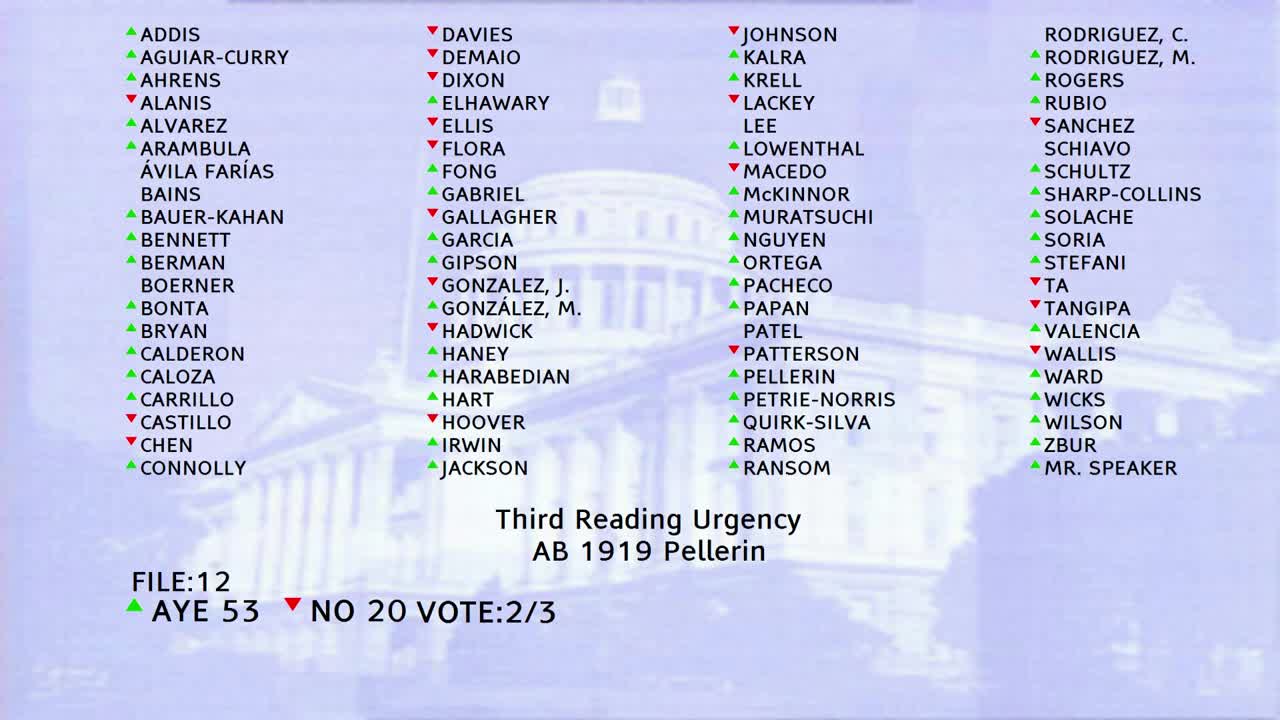 1MIN
Assembly Floor
 27MIN
Assembly Standing Committee on Labor and Employment
Bill Author