AB 2253: Solid waste: products: recycled content claims.
- Session Year: 2025-2026
- House: Assembly
- Latest Version Date: 2026-09-03
Current Status:
Failed
(2026-09-27: Vetoed by Governor.)
Introduced
In Committee
Awaiting First Chamber Vote
Passed First Chamber
In Committee
Awaiting Second Chamber Vote
Passed Second Chamber
Enacted
What does this bill do?
This bill expands recycled‑content labeling rules from just plastic food containers to any product that claims recycled material and requires manufacturers and suppliers to keep written proof supporting those claims. Proof must show the material was diverted from the waste stream, follow FTC recycled‑content guides, not exceed third‑party certified recycled amounts in the maker's supply, be based on actual content using specified chain‑of‑custody methods or audited accounting, and makers of food containers must give records to the public while other makers must provide them to the state Attorney General if a violation is suspected; trade secrets are kept confidential.
The summary is provided by generative AI which can make mistakes. For original language, please view the details in the table below.
Existing law requires a manufacturer or supplier making an environmental marketing claim relating to the recycled content of a plastic food container product to maintain specified information and documentation in written form in its records in support of that claim and to, upon request, furnish that maintained information to any member of the public, as specified. Existing law requires the maintained information to include that the recycled content for materials has been diverted from the solid waste stream either during the manufacturing process (preconsumer) or after consumer use (postconsumer) and that the recycled content claim conforms to the uniform standards for recycled content contained in the Federal Trade Commission Guides for the Use of Environmental Marketing Claims. Existing law provides for the imposition of a civil penalty by a city, county, or the state for a violation of these provisions.
This bill would, beginning January 1, 2030, expand the application of those provisions from plastic food container products to all products making recycled content claims. The bill would revise the reference to the Federal Trade Commission Guides for the Use of Environmental Marketing Claims to specifically refer to those guides as they read on January 1, 2026. The bill would additionally require documentation in written form that the recycled content material claimed does not exceed the amount of third-party certified recycled content introduced into the manufacturers or suppliers overall supply stream for the material used in that product line. The bill would require the recycled content claim to be based on the actual recycled content used in the production of the material used in the product line using specified methods. The bill would require a manufacturer or supplier making an environmental marketing claim relating to the recycled content of a product other than a plastic food container product to furnish, upon request, the aforementioned maintained information to the Attorney General, as specified. The bill would also keep any confidential, proprietary, or trade secret information provided or obtained regarding a product, other than a plastic food container product, confidential, as provided.
Existing constitutional provisions require that a statute that limits the right of access to the meetings of public bodies or the writings of public officials and agencies be adopted with findings demonstrating the interest protected by the limitation and the need for protecting that interest.
This bill would make legislative findings to that effect.
Existing law requires a manufacturer or supplier making an environmental marketing claim relating to the recycled content of a plastic food container product to maintain specified information and documentation in written form in its records in support of that claim. claim and to, upon request, furnish that maintained information to any member of the public, as specified. Existing law requires the maintained information to include that the recycled content for materials has been diverted from the solid waste stream either during the manufacturing process (preconsumer) or after consumer use (postconsumer) and that the recycled content claim conforms to the uniform standards for recycled content contained in the Federal Trade Commission Guides for the Use of Environmental Marketing Claims. Existing law provides for the imposition of a civil penalty by a city, county, or the state for a violation of these provisions.
This bill would would, beginning January 1, 2030, expand the application of those provisions from plastic food container products to all products making recycled content claims. The bill would revise the reference to the Federal Trade Commission Guides for the Use of Environmental Marketing Claims to specifically refer to those guides as they read on January 1, 2026. The bill would additionally require documentation in written form that the recycled content material claimed does not exceed the amount of third-party certified recycled content introduced into the manufacturers or suppliers overall supply stream for the material used in that product line. The bill would require the recycled content claim to be based on the actual recycled content used in the production of the material used in the product line using specified methods. The bill would require a manufacturer or supplier making an environmental marketing claim relating to the recycled content of a product other than a plastic food container product to furnish, upon request, the aforementioned maintained information to the Attorney General, as specified. The bill would also keep any confidential, proprietary, or trade secret information provided or obtained regarding a product, other than a plastic food container product, confidential, as provided.
Existing constitutional provisions require that a statute that limits the right of access to the meetings of public bodies or the writings of public officials and agencies be adopted with findings demonstrating the interest protected by the limitation and the need for protecting that interest.
This bill would make legislative findings to that effect.
Existing law requires a manufacturer or supplier making an environmental marketing claim relating to the recycled content of a plastic food container product to maintain specified information and documentation in written form in its records in support of that claim. Existing law requires the maintained information to include that the recycled content for materials has been diverted from the solid waste stream either during the manufacturing process (preconsumer) or after consumer use (postconsumer) and that the recycled content claim conforms to the uniform standards for recycled content contained in the Federal Trade Commission Guides for the Use of Environmental Marketing Claims. Existing law provides for the imposition of a civil penalty by a city, county, or the state for a violation of these provisions.
This bill would expand the application of those provisions from plastic food container products to all products. products making recycled content claims. The bill would revise the reference to the Federal Trade Commission Guides for the Use of Environmental Marketing Claims to specifically refer to those guides as they read on January 1, 2026. The bill would additionally require documentation in written form that the recycled content claim is based on the actual physical recycled content used in the production of the product, calculated as specified, without the use of certain types of accounting. The bill would define postconsumer for purposes of these provisions. material claimed does not exceed the amount of third-party certified recycled content introduced into the manufacturers or suppliers overall supply stream for the material used in that product line. The bill would require the recycled content claim to be based on the actual recycled content used in the production of the material used in the product line using specified methods.
Existing law requires a manufacturer or supplier making an environmental marketing claim relating to the recycled content of a plastic food container product to maintain specified information and documentation in written form in its records in support of that claim. Existing law requires the maintained information to include that the recycled content for materials has been diverted from the solid waste stream either during the manufacturing process (preconsumer) or after consumer use (postconsumer) and that the recycled content claim conforms to the uniform standards for recycled content contained in the Federal Trade Commission Guides for the Use of Environmental Marketing Claims. Existing law provides for the imposition of a civil penalty by a city, county, or the state for a violation of these provisions.
This bill would expand the application of those provisions from plastic food container products to all products. The bill would revise the reference to the Federal Trade Commission Guides for the Use of Environmental Marketing Claims to specifically refer to those guides as they read on January 1, 2026. The bill would additionally require documentation in written form that the recycled content claim is based on the actual physical recycled content used in the production of the product, calculated as specified, without the use of certain types of accounting. The bill would define postconsumer for purposes of these provisions.
Existing law requires a manufacturer or supplier making an environmental marketing claim relating to the recycled content of a plastic food container product to maintain specified information and documentation in written form in its records in support of that claim. Existing law requires the maintained information to include that the recycled content for materials has been diverted from the solid waste stream either during the manufacturing process (preconsumer) or after consumer use (postconsumer) and that the recycled content claim conforms to the uniform standards for recycled content contained in the Federal Trade Commission Guides for the Use of Environmental Marketing Claims. Existing law provides for the imposition of a civil penalty by a city, county, or the state for a violation of these provisions.
This bill would expand the application of those provisions from plastic food container products to all products. The bill would revise the reference to the Federal Trade Commission Guides for the Use of Environmental Marketing Claims to specifically refer to those guides as they read on January 1, 2026. The bill would additionally require documentation in written form that the recycled content claim to be is based on the actual physical recycled content used in the production of the product product, calculated as specified, without the use of certain types of accounting. The bill would define postconsumer for purposes of these provisions.
Existing law requires a manufacturer or supplier making an environmental marketing claim relating to the recycled content of a plastic food container product to maintain specified information and documentation in written form in its records in support of that claim. Existing law requires the maintained information to include that the recycled content for materials has been diverted from the solid waste stream either during the manufacturing process (preconsumer) or after consumer use (postconsumer) and that the recycled content claim conforms to the uniform standards for recycled content contained in the Federal Trade Commission Guides for the Use of Environmental Marketing Claims. Existing law provides for the imposition of a civil penalty by a city, county, or the state for a violation of these provisions.
This bill would expand those provisions from plastic food container products to all products. The bill would revise the reference to the Federal Trade Commission Guides for the Use of Environmental Marketing Claims to specifically refer to those guides as they read on January 1, 2026. The bill would additionally require the recycled content claim to be based on the actual physical recycled content in the product without the use of certain types of accounting. The bill would define postconsumer for purposes of these provisions.
(a)For purposes of this section, plastic food container product means a product made of plastic that includes a tray, clamshell container, or other receptacle and that is used, or intended to be used, to hold food.
(b)A manufacturer or supplier making an environmental marketing claim relating to the recycled content of a plastic food container product shall maintain information and documentation, which shall be in written form in its records, of both of the following in support of that claim:
(1)The recycled content for materials has been recovered or otherwise diverted from the solid waste stream either during the manufacturing process (preconsumer) or after consumer use (postconsumer).
(2)The recycled content claim conforms to the uniform standards for recycled content contained in the Federal Trade Commission Guides for the Use of Environmental Marketing Claims (16 C.F.R. Part 260).
(c)A manufacturer or supplier shall furnish the information and documentation that it is required to maintain pursuant to this section to any member of the public upon request or provide the information and documentation by furnishing a link to a document on its internet website containing the information and documentation.
(d)This section does not limit the requirements of this chapter or any other provision of law.
(e)This section shall remain in effect only until January 1, 2030, and as of that date is repealed.
SEC. 2.Section 42357.6 is added to the Public Resources Code, to read:42357.6.(a)A manufacturer or supplier making a voluntary recycled content claim on a physical product label or on digital product labeling for products sold online relating to the recycled content of a product shall maintain information and documentation, which shall be in written form in its records, of all of the following in support of that claim:
(1)The recycled content for materials has been recovered or otherwise diverted from the waste stream either during the manufacturing process (preconsumer or postindustrial) or after consumer use (postconsumer).
(2)The recycled content claim conforms to the uniform standards for recycled content contained in the Federal Trade Commission Guides for the Use of Environmental Marketing Claims (16 C.F.R. Part 260), as it read on January 1, 2026.
(3)(A)The amount of recycled content material claimed on the label or labeling does not exceed the amount of third-party certified recycled content introduced into the manufacturers or suppliers overall supply stream for the material used in that product line. Individual products within that product line may contain recycled content levels that are higher or lower than that claimed amount due to normal variations in supply chain operations or manufacturing processes. Audited documentation may be used to substantiate recycled content claims for materials where third-party certification is not feasible.
(B)In complying with subparagraph (A), the recycled content claim shall be based on the actual recycled content used in the production of the material used in the product line, as determined using any of the following chain of custody models: identity-preserved model, segregated model, controlled blending model, rolling average percentage method, as described in International Organization for Standardization (ISO) standard 22095:2020(E), or the actual recycled content used in the production of the material used in the product line, as determined through proportional attribution, as defined in ISO standard 22095-2:2026, as long as no recycling credits are provided to any form of fuel use or fuel production and without credit transfers between unrelated processes.
(C)Compliance with the reporting requirements established pursuant to subdivision (a) of Section 14549.3 shall be deemed to satisfy the requirements of subparagraphs (A) and (B).
(b)(1)For purposes of this subdivision, plastic food container product means a product made of plastic that includes a tray, clamshell container, or other receptacle and that is used, or intended to be used, to hold food.
(2)A manufacturer or supplier of a plastic food container product shall furnish the information and documentation that it is required to maintain pursuant to this section to any member of the public upon request, or provide the information and documentation by furnishing a link to a document on its internet website containing the information and documentation. The information and documentation shall disclose what compliant chain of custody model was used to calculate the recycled content over either a fiscal quarter or annual period.
(3)A manufacturer or supplier of a product other than a plastic food container product shall furnish the information and documentation that it is required to maintain pursuant to this section to the Attorney General, upon request, if the Attorney General suspects a violation of this section. The information and documentation shall disclose what compliant chain of custody model was used to calculate the recycled content over either a fiscal quarter or annual period.
(4)(A)In lieu of, or in addition to, furnishing information and documentation directly to the Attorney General pursuant to paragraph (3), a manufacturer or supplier may elect to have the information and documentation reviewed by an independent third-party auditor qualified to evaluate recycled content accounting systems, chain of custody methodologies, and supporting records.
(B)The independent third-party auditor shall assess whether the manufacturers or suppliers recycled content claim is supported by sufficient evidence, are calculated in accordance with the requirements of this section, and are substantiated through appropriate records, controls, and documentation.
(C)Upon completion of the review, the independent third-party auditor shall issue an attestation, assurance statement, or equivalent audit report stating whether the auditor identified any material deficiencies, material misstatements, or nonconformities in the substantiation of the recycled content claim.
(D)A manufacturer or supplier electing to use an independent third-party auditor pursuant to this paragraph shall maintain the resulting audit report and supporting documentation produced pursuant to subparagraph (C) and shall provide those materials to the Attorney General upon request as part of any investigation authorized pursuant to this section.
(5)Notwithstanding subdivision (d), any confidential, proprietary, or trade secret information provided or obtained pursuant to paragraph (3) or (4) shall not be subject to the California Public Records Act (Division 10 (commencing with Section 7920.000) of Title 1 of the Government Code) and shall remain protected from public disclosure to the fullest extent permitted by law.
(c)Unless otherwise required by law, nothing in this section shall be interpreted to mean that a voluntary recycled content claim on a physical product label or on digital product labeling for products sold online includes a regulatory filing or statement that is required to verify compliance with a recycled content goal or mandate, including filings, plans, or statements submitted by a producer responsibility organization.
(d)This section does not limit the requirements of this chapter or any other law.
(e)This section shall become operative on January 1, 2030.
SEC. 3.The Legislature finds and declares that Section 2 of this act, which adds Section 42357.6 to the Public Resources Code, imposes a limitation on the publics right of access to the meetings of public bodies or the writings of public officials and agencies within the meaning of Section 3 of Article I of the California Constitution. Pursuant to that constitutional provision, the Legislature makes the following findings to demonstrate the interest protected by this limitation and the need for protecting that interest:
In order to protect confidential, proprietary, or trade secret information contained in information and documentation required to be provided pursuant to Section 42357.6 of the Public Resources Code, the limitations on the publics right of access imposed by Section 2 of this act are necessary.
(a)For purposes of this section, plastic food container product means a product made of plastic that includes a tray, clamshell container, or other receptacle and that is used, or intended to be used, to hold food.
(b)A manufacturer or supplier making an environmental marketing claim relating to the recycled content of a plastic food container product shall maintain information and documentation, which shall be in written form in its records, of both of the following in support of that claim:
(1)The recycled content for materials has been recovered or otherwise diverted from the solid waste stream either during the manufacturing process (preconsumer) or after consumer use (postconsumer).
(2)The recycled content claim conforms to the uniform standards for recycled content contained in the Federal Trade Commission Guides for the Use of Environmental Marketing Claims (16 C.F.R. Part 260).
(c)A manufacturer or supplier shall furnish the information and documentation that it is required to maintain pursuant to this section to any member of the public upon request or provide the information and documentation by furnishing a link to a document on its internet website containing the information and documentation.
(d)This section does not limit the requirements of this chapter or any other provision of law.
(e)This section shall remain in effect only until January 1, 2030, and as of that date is repealed.
SEC. 2.Section 42357.6 is added to the Public Resources Code, to read:42357.6.(a)A manufacturer or supplier making a voluntary recycled content claim on a physical product label or on digital product labeling for products sold online relating to the recycled content of a product shall maintain information and documentation, which shall be in written form in its records, of all of the following in support of that claim:
(1)The recycled content for materials has been recovered or otherwise diverted from the solid waste stream either during the manufacturing process (preconsumer or postindustrial) or after consumer use (postconsumer).
(2)The recycled content claim conforms to the uniform standards for recycled content contained in the Federal Trade Commission Guides for the Use of Environmental Marketing Claims (16 C.F.R. Part 260), as it read on January 1, 2026.
(3)(A)The amount of recycled content material claimed on the label or labeling does not exceed the amount of third-party certified recycled content introduced into the manufacturers or suppliers overall supply stream for the material used in that product line. Individual products within that product line may contain recycled content levels that are higher or lower than that claimed amount due to normal variations in supply chain operations or manufacturing processes. Audited documentation may be used to substantiate recycled content claims for materials where third-party certification is not feasible.
(B)In complying with subparagraph (A), the recycled content claim shall be based on the actual recycled content used in the production of the material used in the product line, as determined using any of the following chain of custody models: identity-preserved model, segregated model, controlled blending model, rolling average percentage method, as described in International Organization for Standardization (ISO) standard 22095:2020(E), or the actual recycled content used in the production of the material used in the product line, as determined through proportional attribution, as defined in ISO standard 22095-2:2026, as long as no recycling credits are provided to any form of fuel use or fuel production and without credit transfers between unrelated processes.
(C)For a plastic beverage container subject to Section 14549.3, compliance Compliance with the reporting requirements established pursuant to subdivision (a) of Section 14549.3 shall be deemed to satisfy the requirements of subparagraphs (A) and (B).
(b)(1)For purposes of this subdivision, plastic food container product means a product made of plastic that includes a tray, clamshell container, or other receptacle and that is used, or intended to be used, to hold food.
(2)A manufacturer or supplier of a plastic food container product shall furnish the information and documentation that it is required to maintain pursuant to this section to any member of the public upon request, or provide the information and documentation by furnishing a link to a document on its internet website containing the information and documentation. The information and documentation shall disclose what compliant chain of custody model was used to calculate the recycled content over either a fiscal quarter or annual period.
(3)A manufacturer or supplier of a product other than a plastic food container product shall furnish the information and documentation that it is required to maintain pursuant to this section to the Attorney General, upon request, if the Attorney General suspects a violation of this section. The information and documentation shall disclose what compliant chain of custody model was used to calculate the recycled content over either a fiscal quarter or annual period.
(4)(A)In lieu of, or in addition to, furnishing information and documentation directly to the Attorney General pursuant to paragraph (3), a manufacturer or supplier may elect to have the information and documentation reviewed by an independent third-party auditor qualified to evaluate recycled content accounting systems, chain of custody methodologies, and supporting records.
(B)The independent third-party auditor shall assess whether the manufacturers or suppliers recycled content claim is supported by sufficient evidence, are calculated in accordance with the requirements of this section, and are substantiated through appropriate records, controls, and documentation.
(C)Upon completion of the review, the independent third-party auditor shall issue an attestation, assurance statement, or equivalent audit report stating whether the auditor identified any material deficiencies, material misstatements, or nonconformities in the substantiation of the recycled content claim.
(D)A manufacturer or supplier electing to use an independent third-party auditor pursuant to this paragraph shall maintain the resulting audit report and supporting documentation produced pursuant to subparagraph (C) and shall provide those materials to the Attorney General upon request as part of any investigation authorized pursuant to this section.
(5)Notwithstanding subdivision (d), any confidential, proprietary, or trade secret information provided or obtained pursuant to paragraph (3) or (4) shall not be subject to the California Public Records Act (Division 10 (commencing with Section 7920.000) of Title 1 of the Government Code) and shall remain protected from public disclosure to the fullest extent permitted by law.
(c)Unless otherwise required by law, nothing in this section shall be interpreted to mean that a voluntary recycled content claim on a physical product label or on digital product labeling for products sold online includes a regulatory filing or statement that is required to verify compliance with a recycled content goal or mandate, including filings, plans, or statements submitted by a producer responsibility organization.
(d)This section does not limit the requirements of this chapter or any other law.
(e)This section shall become operative on January 1, 2030.
SEC. 3.The Legislature finds and declares that Section 2 of this act, which adds Section 42357.6 to the Public Resources Code, imposes a limitation on the publics right of access to the meetings of public bodies or the writings of public officials and agencies within the meaning of Section 3 of Article I of the California Constitution. Pursuant to that constitutional provision, the Legislature makes the following findings to demonstrate the interest protected by this limitation and the need for protecting that interest:
In order to protect confidential, proprietary, or trade secret information contained in information and documentation required to be provided pursuant to Section 42357.6, 42357.6 of the Public Resources Code, the limitations on the publics right of access imposed by Section 2 of this act are necessary.
(a)For purposes of this section, plastic food container product means a product made of plastic that includes a tray, clamshell container, or other receptacle and that is used, or intended to be used, to hold food.
(b)A manufacturer or supplier making an environmental marketing claim relating to the recycled content of a plastic food container product shall maintain information and documentation, which shall be in written form in its records, of both of the following in support of that claim:
(1)The recycled content for materials has been recovered or otherwise diverted from the solid waste stream either during the manufacturing process (preconsumer) or after consumer use (postconsumer).
(2)The recycled content claim conforms to the uniform standards for recycled content contained in the Federal Trade Commission Guides for the Use of Environmental Marketing Claims (16 C.F.R. Part 260).
(c)A manufacturer or supplier shall furnish the information and documentation that it is required to maintain pursuant to this section to any member of the public upon request or provide the information and documentation by furnishing a link to a document on its Internet Web site internet website containing the information and documentation.
(d)This section does not limit the requirements of this chapter or any other provision of law.
(e)This section shall remain in effect only until January 1, 2030, and as of that date is repealed.
SEC. 2.Section 42357.6 is added to the Public Resources Code, to read:42357.6.(a)A manufacturer or supplier making a voluntary recycled content claim on a physical product label or on digital product labeling for products sold online relating to the recycled content of a product shall maintain information and documentation, which shall be in written form in its records, of all of the following in support of that claim:
(1)The recycled content for materials has been recovered or otherwise diverted from the solid waste stream either during the manufacturing process (preconsumer or postindustrial) or after consumer use (postconsumer).
(2)The recycled content claim conforms to the uniform standards for recycled content contained in the Federal Trade Commission Guides for the Use of Environmental Marketing Claims (16 C.F.R. Part 260), as it read on January 1, 2026.
(3)(A)The amount of recycled content material claimed on the label or labeling does not exceed the amount of third-party certified recycled content introduced into the manufacturers or suppliers overall supply stream for the material used in that product line. Individual products within that product line may contain recycled content levels that are higher or lower than that claimed amount due to normal variations in supply chain operations or manufacturing processes. Audited documentation may be used to substantiate recycled content claims for materials where third-party certification is not feasible.
(B)In complying with subparagraph (A), the recycled content claim shall be based on the actual recycled content used in the production of the material used in the product line, as determined using any of the following chain of custody models: segregated model, controlled blending model, rolling average percentage method, as described in International Organization for Standardization (ISO) standard 22095:2020(E), or the actual recycled content used in the production of the material used in the product line, as determined through proportional attribution, as defined in ISO standard 22095-2:2026, as long as no recycling credits are provided to any form of fuel use or fuel production and without credit transfers between unrelated processes.
(C)For a plastic beverage container subject to Section 14549.3, compliance with the reporting requirements established pursuant to subdivision (a) of Section 14549.3 shall be deemed to satisfy the requirements of subparagraphs (A) and (B).
(b)(1)For purposes of this subdivision, plastic food container product means a product made of plastic that includes a tray, clamshell container, or other receptacle and that is used, or intended to be used, to hold food.
(2)A manufacturer or supplier of a plastic food container product shall furnish the information and documentation that it is required to maintain pursuant to this section to any member of the public upon request, or provide the information and documentation by furnishing a link to a document on its internet website containing the information and documentation. The information and documentation shall disclose what compliant chain of custody model was used to calculate the recycled content over either a fiscal quarter or annual period.
(3)A manufacturer or supplier of a product other than a plastic food container product shall furnish the information and documentation that it is required to maintain pursuant to this section to the Attorney General, upon request, if the Attorney General suspects a violation of this section. The information and documentation shall disclose what compliant chain of custody model was used to calculate the recycled content over either a fiscal quarter or annual period.
(4)(A)In lieu of, or in addition to, furnishing information and documentation directly to the Attorney General pursuant to paragraph (3), a manufacturer or supplier may elect to have the information and documentation reviewed by an independent third-party auditor qualified to evaluate recycled content accounting systems, chain of custody methodologies, and supporting records.
(B)The independent third-party auditor shall assess whether the manufacturers or suppliers recycled content claim is supported by sufficient evidence, are calculated in accordance with the requirements of this section, and are substantiated through appropriate records, controls, and documentation.
(C)Upon completion of the review, the independent third-party auditor shall issue an attestation, assurance statement, or equivalent audit report stating whether the auditor identified any material deficiencies, material misstatements, or nonconformities in the substantiation of the recycled content claim.
(D)A manufacturer or supplier electing to use an independent third-party auditor pursuant to this paragraph shall maintain the resulting audit report and supporting documentation produced pursuant to subparagraph (C) and shall provide those materials to the Attorney General upon request as part of any investigation authorized pursuant to this section.
(5)Notwithstanding subdivision (d), any confidential, proprietary, or trade secret information provided or obtained pursuant to paragraph (3) or (4) shall not be subject to the California Public Records Act (Division 10 (commencing with Section 7920.000) of Title 1 of the Government Code) and shall remain protected from public disclosure to the fullest extent permitted by law.
(c)Unless otherwise required by law, nothing in this section shall be interpreted to mean that a voluntary recycled content claim on a physical product label or on digital product labeling for products sold online includes a regulatory filing or statement that is required to verify compliance with a recycled content goal or mandate, including filings, plans, or statements submitted by a producer responsibility organization.
(d)This section does not limit the requirements of this chapter or any other law.
(e)This section shall become operative on January 1, 2030.
SEC. 3.The Legislature finds and declares that Section 2 of this act, which adds Section 42357.6 to the Public Resources Code, imposes a limitation on the publics right of access to the meetings of public bodies or the writings of public officials and agencies within the meaning of Section 3 of Article I of the California Constitution. Pursuant to that constitutional provision, the Legislature makes the following findings to demonstrate the interest protected by this limitation and the need for protecting that interest:
In order to protect confidential, proprietary, or trade secret information contained in information and documentation required to be provided pursuant Section 42357.6, the limitations on the publics right of access imposed by Section 2 of this act are necessary.
SECTION 1.Section 42357.6 of the Public Resources Code is amended to read:42357.6.(a)A manufacturer or supplier making a voluntary recycled content claim on a physical product label or on digital product labeling for products sold online relating to the recycled content of a product shall maintain information and documentation, which shall be in written form in its records, of all of the following in support of that claim:(1)The recycled content for materials has been recovered or otherwise diverted from the solid waste stream either during the manufacturing process (preconsumer) or after consumer use (postconsumer).(2)The recycled content claim conforms to the uniform standards for recycled content contained in the Federal Trade Commission Guides for the Use of Environmental Marketing Claims (16 C.F.R. Part 260), as it read on January 1, 2026.(3)(A)The amount of recycled content material claimed on the label or labeling does not exceed the amount of third-party certified recycled content introduced into the manufacturers or suppliers overall supply stream for the material used in that product line. Individual products within that product line may contain recycled content levels that are higher or lower than that claimed amount due to normal variations in supply chain operations or manufacturing processes.(B)In complying with subparagraph (A), the recycled content claim shall be based on the actual recycled content used in the production of the material used in the product line, as determined using any of the following chain of custody models: segregated model, controlled blending model, or rolling average percentage method, as described in International Organization for Standardization (ISO) standard 22095:2020(E).(C)For a plastic beverage container subject to Section 14549.3, compliance with the reporting requirements established pursuant to subdivision (a) of Section 14549.3 shall be deemed to satisfy the requirements of subparagraphs (A) and (B).(b)A manufacturer or supplier shall furnish the information and documentation that it is required to maintain pursuant to this section to any member of the public upon request or provide the information and documentation by furnishing a link to a document on its internet website containing the information and documentation.(c)Unless otherwise required by law, nothing in this section shall be interpreted to mean that a voluntary recycled content claim on a physical product label or on digital product labeling for products sold online includes a regulatory filing or statement that is required to verify compliance with a recycled content goal or mandate, including filings, plans, or statements submitted by a producer responsibility organization.(d)This section does not limit the requirements of this chapter or any other law.(a)A manufacturer or supplier making an environmental marketing claim a voluntary recycled content claim on a physical product label or on digital product labeling for products sold online relating to the recycled content of a product shall maintain information and documentation, which shall be in written form in its records, of all of the following in support of that claim:
(1)The recycled content for materials has been recovered or otherwise diverted from the solid waste stream either during the manufacturing process (preconsumer) or after consumer use (postconsumer).
(2)The recycled content claim conforms to the uniform standards for recycled content contained in the Federal Trade Commission Guides for the Use of Environmental Marketing Claims (16 C.F.R. Part 260), as it read on January 1, 2026.
(3)(A)The recycled content claim is based on the actual physical recycled content used in the production of the product, as calculated by methods including segregated model, controlled blending model, and rolling average percentage, without the use of credit-based mass balance accounting, including proportional credit and nonproportional credit allocation, book-and-claim accounting, or similar approaches that are not based on the actual physical recycled content used in the production of the product.(3)(A)The amount of recycled content material claimed on the label or labeling does not exceed the amount of third-party certified recycled content introduced into the manufacturers or suppliers overall supply stream for the material used in that product line. Individual products within that product line may contain recycled content levels that are higher or lower than that claimed amount due to normal variations in supply chain operations or manufacturing processes.
(B)In complying with subparagraph (A), the recycled content claim shall be based on the actual recycled content used in the production of the material used in the product line, as determined using any of the following chain of custody models: segregated model, controlled blending model, or rolling average percentage method, as described in International Organization for Standardization (ISO) standard 22095:2020(E).
(B)(C)For a plastic beverage container subject to Section 14549.3, compliance with the reporting requirements established pursuant to subdivision (a) of Section 14549.3 shall be deemed to satisfy the requirements of subparagraph (A). subparagraphs (A) and (B).
(c)(b)A manufacturer or supplier shall furnish the information and documentation that it is required to maintain pursuant to this section to any member of the public upon request or provide the information and documentation by furnishing a link to a document on its internet website containing the information and documentation.
(d)(c)Unless otherwise required by law, nothing in this section shall be interpreted to mean that an environmental marketing claim includes a regulatory filing in compliance with any state or federal law, including, but not limited to, filings with or under any of the following: a voluntary recycled content claim on a physical product label or on digital product labeling for products sold online includes a regulatory filing or statement that is required to verify compliance with a recycled content goal or mandate, including filings, plans, or statements submitted by a producer responsibility organization.
(1)The United States Securities and Exchange Commission.(2)The Climate Corporate Data Accountability Act (Section 38532 of the Health and Safety Code).(3)The Climate Related Financial Risk Disclosure Program established under Section 38533 of the Health and Safety Code.(4)The Plastic Pollution Prevention and Packaging Producer Responsibility Act (Chapter 3 (commencing with Section 42040)).(5)The Responsible Textile Recovery Act of 2024 (Chapter 20.5 (commencing with Section 42984)).(6)The rigid plastic packaging container law established under Chapter 5.5 (commencing with Section 42300).(7)The plastic trash bag law established under Chapter 5.4 (commencing with Section 42290).(e)(d)This section does not limit the requirements of this chapter or any other law.
(a)For purposes of this section, postconsumer means a material that would otherwise be destined for disposal, having completed its intended end use and product life cycle. Postconsumer does not include materials or byproducts generated from, and commonly reused within, an original manufacturing and fabrication process.
(b)A manufacturer or supplier making an environmental marketing claim relating to the recycled content of a product shall maintain information and documentation, which shall be in written form in its records, of all of the following in support of that claim:
(1)The recycled content for materials has been recovered or otherwise diverted from the solid waste stream either during the manufacturing process (preconsumer) or after consumer use (postconsumer).
(2)The recycled content claim conforms to the uniform standards for recycled content contained in the Federal Trade Commission Guides for the Use of Environmental Marketing Claims (16 C.F.R. Part 260), as it read on January 1, 2026.
(3)(A)The recycled content claim is based on the actual physical recycled content used in the production of the product, as calculated by methods including segregated model, controlled blending model, and rolling average percentage, without the use of credit-based mass balance accounting, including proportional credit and nonproportional credit allocation, book-and-claim accounting, or similar approaches that are not based on the actual physical recycled content used in the production of the product.
(B)For a plastic beverage container subject to Section 14549.3, compliance with the reporting requirements established pursuant to subdivision (a) of Section 14549.3 shall be deemed to satisfy the requirements of subparagraph (A).
(c)A manufacturer or supplier shall furnish the information and documentation that it is required to maintain pursuant to this section to any member of the public upon request or provide the information and documentation by furnishing a link to a document on its internet website containing the information and documentation.
(d)Unless otherwise required by law, nothing in this section shall be interpreted to mean that an environmental marketing claim includes a regulatory filing in compliance with any state or federal law, including, but not limited to, filings with or under any of the following:
(1)The United States Securities and Exchange Commission.
(2)The Climate Corporate Data Accountability Act (Section 38532 of the Health and Safety Code).
(3)The Climate Related Financial Risk Disclosure Program established under Section 38533 of the Health and Safety Code.
(4)The Plastic Pollution Prevention and Packaging Producer Responsibility Act (Chapter 3 (commencing with Section 42040)).
(5)The Responsible Textile Recovery Act of 2024 (Chapter 20.5 (commencing with Section 42984)).
(6)The rigid plastic packaging container law established under Chapter 5.5 (commencing with Section 42300).
(7)The plastic trash bag law established under Chapter 5.4 (commencing with Section 42290).
(d)(e)This section does not limit the requirements of this chapter or any other law.
(a)For purposes of this section, postconsumer means a material that would otherwise be destined for disposal, having completed its intended end use and product life cycle. Postconsumer does not include materials or byproducts generated from, and commonly reused within, an original manufacturing and fabrication process.
(b)A manufacturer or supplier making an environmental marketing claim relating to the recycled content of a product shall maintain information and documentation, which shall be in written form in its records, of both all of the following in support of that claim:
(1)The recycled content for materials has been recovered or otherwise diverted from the solid waste stream either during the manufacturing process (preconsumer) or after consumer use (postconsumer).
(2)The recycled content claim conforms to the uniform standards for recycled content contained in the Federal Trade Commission Guides for the Use of Environmental Marketing Claims (16 C.F.R. Part 260), as it read on January 1, 2026.
(3)The recycled content claim shall be is based on the actual physical recycled content used in the production of the product product, as calculated by methods including segregated model, controlled blending model, and rolling average percentage, without the use of credit-based mass balance accounting, including free proportional credit and nonproportional credit allocation, book-and-claim accounting, or similar approaches that are not based on the actual physical recycled content used in the production of the product.
(c)A manufacturer or supplier shall furnish the information and documentation that it is required to maintain pursuant to this section to any member of the public upon request or provide the information and documentation by furnishing a link to a document on its internet website containing the information and documentation.
(d)This section does not limit the requirements of this chapter or any other law.
(a)For purposes of this section, plastic food container product means a product made of plastic that includes a tray, clamshell container, or other receptacle and that is used, or intended to be used, to hold food. postconsumer means a material that would otherwise be destined for disposal, having completed its intended end use and product life cycle. Postconsumer does not include materials or byproducts generated from, and commonly reused within, an original manufacturing and fabrication process.
(b)A manufacturer or supplier making an environmental marketing claim relating to the recycled content of a plastic food container product shall maintain information and documentation, which shall be in written form in its records, of both of the following in support of that claim:
(1)The recycled content for materials has been recovered or otherwise diverted from the solid waste stream either during the manufacturing process (preconsumer) or after consumer use (postconsumer).
(2)The recycled content claim conforms to the uniform standards for recycled content contained in the Federal Trade Commission Guides for the Use of Environmental Marketing Claims (16 C.F.R. Part 260). 260), as it read on January 1, 2026.
(3)The recycled content claim shall be based on the actual physical recycled content in the product without the use of credit-based mass balance accounting, including free allocation, book-and-claim accounting, or similar approaches that are not based on the actual physical recycled content in the product.
(c)A manufacturer or supplier shall furnish the information and documentation that it is required to maintain pursuant to this section to any member of the public upon request or provide the information and documentation by furnishing a link to a document on its Internet Web site internet website containing the information and documentation.
(d)This section does not limit the requirements of this chapter or any other provision of law.
|
Date
|
Status
|
|---|---|
| Sep 27, 2026 | Vetoed by Governor. |
| Sep 10, 2026 | Enrolled and presented to the Governor at 3 p.m. |
| Aug 30, 2026 | Senate amendments concurred in. To Engrossing and Enrolling. (Ayes 42. Noes 20.). |
| Aug 30, 2026 | Senate amendments concurred in. To Engrossing and Enrolling. (Ayes 42. Noes 20. Page 6892.). |
| Aug 30, 2026 | Senate amendments concurred in. To Engrossing and Enrolling. |
| Aug 28, 2026 | In Assembly. Concurrence in Senate amendments pending. |
| Aug 28, 2026 | Read third time. Passed. Ordered to the Assembly. (Ayes 27. Noes 10.). |
| Aug 24, 2026 | Read second time. Ordered to third reading. |
| Aug 21, 2026 | Read third time and amended. Ordered to second reading. |
| Aug 17, 2026 | Read second time. Ordered to third reading. |
| Aug 13, 2026 | Read second time and amended. Ordered returned to second reading. |
| Aug 13, 2026 | From committee: Amend, and do pass as amended. (Ayes 5. Noes 2.) (August 13). |
| Aug 3, 2026 | In committee: Referred to APPR. suspense file. |
| Jul 2, 2026 | From committee: Amend, and do pass as amended and re-refer to Com. on APPR. (Ayes 4. Noes 2.) (July 1). |
| Jul 2, 2026 | Read second time and amended. Re-referred to Com. on APPR. |
| Jun 25, 2026 | From committee chair, with author's amendments: Amend, and re-refer to committee. Read second time, amended, and re-referred to Com. on E.Q. |
| Jun 10, 2026 | Referred to Com. on E.Q. |
| May 28, 2026 | In Senate. Read first time. To Com. on RLS. for assignment. |
| May 27, 2026 | Read third time. Passed. Ordered to the Senate. (Ayes 42. Noes 19.) |
| May 27, 2026 | Read third time. Passed. Ordered to the Senate. (Ayes 42. Noes 19. Page 5495.) |
| May 27, 2026 | Read third time. Passed. Ordered to the Senate. |
| May 18, 2026 | Read second time. Ordered to third reading. |
| May 14, 2026 | From committee: Do pass. (Ayes 10. Noes 4.) (May 14). |
| Apr 22, 2026 | In committee: Set, first hearing. Referred to APPR. suspense file. |
| Apr 9, 2026 | Re-referred to Com. on APPR. |
| Apr 8, 2026 | Read second time and amended. |
| Apr 7, 2026 | From committee: Amend, and do pass as amended and re-refer to Com. on APPR. (Ayes 10. Noes 4.) (April 6). |
| Mar 9, 2026 | Referred to Com. on NAT. RES. |
| Feb 20, 2026 | From printer. May be heard in committee March 22. |
| Feb 19, 2026 | Read first time. To print. |
|
Date
|
Description
|
Location
|
Votes
|
|
|---|---|---|---|---|
| Aug 30, 2026 | AB 2253 Boerner Concurrence in Senate Amendments | Assembly Floor |
Passed |
|
| Aug 28, 2026 | Assembly 3rd Reading AB2253 Boerner By Reyes | Senate Floor |
Passed |
|
| Aug 13, 2026 | Do pass as amended | Senate Standing Committee on Appropriations |
Passed |
|
| Aug 3, 2026 | Placed on suspense file | Senate Standing Committee on Appropriations |
Passed |
|
| Jul 1, 2026 | Do pass as amended, but first amend, and re-refer to the Committee on [Appropriations] | Senate Standing Committee on Environmental Quality |
Passed |
|
| May 27, 2026 | AB 2253 Boerner Assembly Third Reading | Assembly Floor |
Passed |
|
| May 14, 2026 | Do pass. | Assembly Standing Committee on Appropriations |
Passed |
|
| Apr 6, 2026 | Do pass as amended and be re-referred to the Committee on [Appropriations] | Assembly Standing Committee on Natural Resources |
Passed |
This list shows positions taken on this bill by organizations on the date displayed, which is linked to the original source.
Positions by individuals are not included.
|
Organization
|
Position
|
Date
|
|---|---|---|
| 350 Bay Area Action | ** Support | |
| 350 Sacramento | ** Support | |
| Active San Gabriel Valley | ** Support | |
| Alliance For Automotive Innovation | ** Against | |
| Alliance for Chemical Distribution | ** Against | |
| American Apparel & Footwear Association | ** Against | |
| American Beverage Association | ** Against | |
| American Chemistry Council | ** Against | |
| American Cleaning Institute | ** Against | |
| American Composites Manufacturers Association | ** Against | |
| American Institute for Packaging and Environment | ** Against | |
| American Institute for Packaging and Environment (AMERIPEN) | ** Against | |
| Arts District Community Council LA | ** Support | |
| Association Of Home Appliance Manufacturers | ** Against | |
| Ban Sup (single Use Plastic) | ** Support | |
| Between the Waters | ** Support | |
| Beyond Plastics | ** Support | |
| Brea Chamber of Commerce | ** Against | |
| Breast Cancer Prevention Partners | ** Support | |
| CalAsian Chamber of Commerce | ** Against | |
| California Advanced Biofuels Alliance | ** Against | |
| California Chamber Of Commerce | ** Against | |
| California Environmental Voters | ** Support | |
| California Food Producers | ** Against | |
| California Grocers Association | ** Against | |
| California Manufacturers & Technology Association | ** Against | |
| California Product Stewardship Council | ** Support | |
| California Retailers Associaiton | ** Against | |
| California State Association Of Counties | ** Support | |
| Californians Against Waste | ** Support | |
| CALPIRG, California Public Interest Research Group | ** Support | |
| Can Manufacturers Institute | ** Against | |
| Carpet & Rug Institute | ** Against | |
| Carpet America Recovery Effort | ** Against | |
| Carton Council | ** Against | |
| Center For Environmental Health | ** Support | |
| Central Contra Costa Solid Waste Authority | ** Support | |
| Clean Water Action | ** Support | |
| cleanearth4kids.org | ** Support | |
| Climate Action California | ** Support | |
| Climate Reality Project, Orange County | ** Support | |
| Communications Cable & Connectivity Association | ** Against | |
| Consumer Brands Association | ** Against | |
| Consumer Healthcare Products Association | ** Against | |
| Corona Chamber of Commerce | ** Against | |
| Dairy Institute Of California | ** Against | |
| Danville Area Chamber of Commerce | ** Against | |
| Day One | ** Support | |
| Ecology Center | ** Support | |
| Environmental Justice Communities Against Plastics | ** Support | |
| EPS Industry Alliance | ** Against | |
| Fontana Chamber of Commerce | ** Against | |
| Forest Stewardship Council US | ** Support | |
| Friends Committee On Legislation Of California | ** Support | |
| Gateway Chambers Alliance | ** Against | |
| Glass Packaging Institute | ** Against | |
| Global Alliance for Incinerator Alternatives | ** Support | |
| Global Alliance for Incinerator Alternatives (GAIA) | ** Support | |
| Greater Bakersfield Chamber of Commerce | ** Against | |
| Greater San Fernando Valley Chamber of Commerce | ** Against | |
| Healing and Justice Center | ** Support | |
| Household and Commercial Products Association | ** Against | |
| Indivisible Ca: Statestrong | ** Support | |
| International Bottled Water Association | ** Against | |
| International Sleep Products Association | ** Against | |
| Just Transition Alliance | ** Support | |
| Just Zero | ** Support | |
| LA Canada Flintridge Chamber of Commerce | ** Against | |
| League Of California Cities | ** Support | |
| Lodi Chamber of Commerce | ** Against | |
| Long Beach Area Chamber of Commerce | ** Against | |
| Lori R. Mendez, Aplc | ** Support | |
| Meat Institute | ** Against | |
| Mission Viejo Chamber of Commerce | ** Against | |
| Napa Chamber of Commerce | ** Against | |
| National Association of Printing Ink Manufacturers | ** Against | |
| National Confectioners Association | ** Against | |
| Natural Resources Defense Council | ** Support | |
| Nevada County Climate Action Now | ** Support | |
| Northern California Recycling Association | ** Support | |
| Norwalk Chamber Of Commerce | ** Against | |
| NRDC | ** Support | |
| Orange County Business Council | ** Against | |
| ORINDA; CITY OF | ** Support | |
| Pacific Environment | ** Support | |
| Palm Desert Area Chamber of Commerce | ** Against | |
| Personal Care Products Council | ** Against | |
| Pet Food Institute | ** Against | |
| Physicians for Social Responsibility - Los Angeles | ** Support | |
| Plastic Oceans International | ** Against | |
| Plastic Pollution Coalition | ** Support | |
| Plastics Industry Association | ** Against | |
| Plastics Pipe Institute | ** Against | |
| Polyisocyanurate Insulation Manufacturers Association | ** Against | |
| Polyisocyanurate Insulation Manufacturers Association, the (PIMA) | ** Against | |
| Power Tool Institute | ** Against | |
| Printing United Alliance | ** Against | |
| Purecycle Technologies, Inc. | ** Support | |
| ReGen Monterey | ** Support | |
| Republic Services | ** Support | |
| Rethink Waste | ** Support | |
| Rural County Representatives of California | ** Support | |
| San Francisco Baykeeper | ** Support | |
| San Juan Capistrano Chamber of Commerce | ** Against | |
| Santa Ana Chamber of Commerce | ** Against | |
| Save The Albatross Coalition | ** Support | |
| SNAC International | ** Against | |
| Solution Citizen | ** Against | |
| Spray Polyurethane Foam Alliance | ** Against | |
| StopWaste | ** Support | |
| Surfrider Foundation | ** Support | |
| Sustainable Claremont | ** Support | |
| The Adhesive and Sealant Council | ** Against | |
| The Last Beach Cleanup | ** Support | |
| The Last Plastic Straw | ** Support | |
| The Story of Stuff Project | ** Support | |
| The Toy Association | ** Against | |
| The Vinyl Institute | ** Against | |
| Torrance Area Chamber of Commerce | ** Against | |
| Tulare Chamber of Commerce | ** Against | |
| Valley Improvement Projects | ** Support | |
| Valley Improvement Projects (VIP) | ** Support | |
| Wastenot | ** Support | |
| West Berkeley Alliance for Clean Air and Safe Jobs | ** Support | |
| Western Growers Association | ** Against | |
| Western Plastics Association | ** Against | |
| Wine Institute | ** Against | |
| Wishtoyo Foundation | ** Support | |
| Yorba Linda Chamber of Commerce | ** Against | |
| Zero Waste Ithaca | ** Support | |
| Zero Waste San Diego | ** Support |
GOVERNOR'S VETO
GV Bill Id:AB 2253
Author:(Boerner)
As Enrolled Ver:September 3, 2026
2/3 vote
SUMMARY
This bill requires that voluntary recycled content claims on labels do not exceed the amount of third-party certified recycled content introduced into the manufacturer's or supplier's overall supply stream for the material used in that product line and specifies that only certain chains of custody models can be used to make recycled content claims.
Governor's Veto Message
This bill would require certain recycled-content documentation obligations to apply to all products making recycled-content claims, beginning in 2030.
I share the author's goal of ensuring that environmental marketing claims are accurate and that consumers can trust the products they buy. However, I am concerned that expanding these documentation requirements will unduly burden manufacturers and suppliers already facing economic headwinds caused by federal tariff and trade policy actions. Adding new, complex compliance requirements at this time risks compounding these pressures, with little benefit to consumers.
COMMENTS
Mass Balance and other chains of custody. Generally speaking, mass balance is an accounting system that is used by industry to track materials through the production process. According to a National Institute of Standards and Technologies (NIST) report, mass balance (MB) is one of five common chain of custody models designed to create transparency and trust throughout the value chain regarding properties of goods and materials that are otherwise difficult to distinguish. These models vary on the precision of information required to be traced through the system. Some models trace material through a supply chain form start to final product; other models allow credits to be traded from different materials and products.
An important distinction between different models pertaining to recycled content is whether or not they allow fuel to count as a product or not. For example, if half of a plastic bottle is converted to fuels, can those fuels be counted as 'recycled content'?
There are several types of mass balance accounting systems, including:
- Rolling average percentage model. This model uses a rolling average percentage to track physical recycled content but allows for physical recycled content fluctuations in individual products. This method is currently used in numerous industries to calculate recycled content for finished products. For example, a facility could use a feedstock that is 10% recycled content and 90% virgin plastic over the span of a month, but each day of that month could have a different proportion of virgin to recycled content, meaning that while there is variability in recycled content in each bottle, as a batch over the course of a month will have about 90% virgin and have 10% post-consumer recycled content.
- Proportional Attribution/Allocation models. Proportional allocation: This method assumes that recycled units act the same as non-recycled units and therefore have the same distribution among outputs. The certified (e.g., recycled) inputs flow to outputs in accordance with the yield in which they went in. For example, if 10 % of the input stream is comprised of recycled polymers, then 10 % of each output stream is considered to contain recycled content and credits must be allocated accordingly.
- Proportional credit allocation. This method allows the use of credits for recycled input into the production process and allows for the allocation of that credit to be distributed proportionally to the various products produced. Depending on the certification process used, fuels may be counted as recycled inputs under this standard.
- Non proportional allocation / free credit allocation. This method allows the use of credits for recycled input into any part of the production process, whether or not any portion of recycled content is in the finished product. Many chemical processes produce multiple outputs, many of which may not have a market for recycled content. Non-proportional allocation allows for credits to be freely assigned to any product. For example, one output product can be allocated 100% of the recycled content claims and the other products have no claim. Non-proportional allocation can be fuels-exempt or "polymers only" which only counts polymer products (non-polymer products or outputs are lost and cannot be applied to other products.)
Certification and ISO standards. Industries making marketing claims for postconsumer recycled content today can use a third-party certifier. Some common third-party certifiers include the Association of Plastic Recyclers, GreenBlue Recycled Materials Standard, Intertek, International Sustainability and Carbon Certification (ISCC) Plus, SCS Global and Underwriters Laboratories.
These certifiers can provide certification based on any model of chain of custody, and which models they use depends on the certifier. For example, ISCC plus offers chain of custody certifications using segregated and mass balance. ISCC plus offers certifications using rolling average mass balance, proportional, and credit-based mass balance, including fuel included and fuel excluded systems.
The International Organization for Standardization (ISO) is an independent, non-governmental global entity that creates and publishes official standards with protocols for nearly every industry to ensure quality, safety, and efficiency. These standards create shared definitions and terminology that are essential for communication across businesses and industries. There is an ISO for chain of custody methods, and a specific ISO for mass balance, ISO 22095-2, which was recently released in 2025.
This bill ensures that if a product claims to have a certain recycled content, that product actually contains that recycled content (give or take variability of an individual product in a batch) and doesn't allow material that is turned into fuel to count as recycled content. This bill takes credit-based chain of custody models, including some subtypes of mass balance, off the table for companies making on-label marketing claims about the recycled content in their products. This is important to provide accurate and honest information to consumers and drive changes to innovate more recycled content in consumer-facing products.
According to the Author
AB 2253 ensures that consumers know whether the products they are purchasing actually contain recycled content. Currently, companies can utilize accounting to obscure the actual recycled content of their products. This practice of greenwashing means that Californians who think they are making better choices for the environment actually aren't. And, Californians are not only being misled by these fraudulent claims, but are also paying more for the false belief they are doing good because of misleading claims. California has always been the leader in the nation in protecting consumers and the environment. Californians shouldn't be bamboozled by these companies' false marketing on products that are not green. AB 2253 would protect consumers from deceptive recycled content claims by requiring companies that advertise recycled content in their products to maintain and make available written documentation proving the recycled material was diverted from the waste stream and demonstrate that their claims comply with the Federal Trade Commission standards.
Arguments in Support
A coalition of supporters state:
Consumers should be able to trust the labels they see on store shelves. When companies use credit schemes and accounting gimmicks to inflate recycled content claims without actually increasing the amount of recycled material in their products, it undermines that trust, misleads the public and disadvantages California recyclers. AB 2253 ensures that recycled content claims reflect the actual materials used in products, restores integrity to the marketplace, and protects consumers' right to make informed, environmentally responsible purchasing decisions.
Arguments in Opposition
A coalition of opponents state:
AB 2253 would eliminate a compliance tool that California's own programs and the state's international trading partners already rely on. The industries most affected, packaging manufacturers, food producers, material suppliers, and retailers, are not using mass balance to evade accountability. They are using it because these accounting systems are designed to match how manufacturing actually works. When materials are blended and inputs cannot be physically separated once mixed, the recycled content must be tracked across the production run rather than isolated in a single product. Accordingly, AB 2253 does not strengthen recycling. Instead, it creates a compliance wall that imposes enormous costs.
FISCAL COMMENTS
- Unknown, potentially significant cost pressures (Trial Court Trust Fund), possibly in excess of $150,000, to the courts to adjudicate enforcement actions. Actual costs would depend on the number of cases filed and the amount of court time needed to resolve each case. It generally costs approximately $1,000 to operate a courtroom for one hour. Although courts are not funded on the basis of workload, increased pressure on the Trial Court Trust Fund may create a demand for increased funding for courts from the General Fund. The state budget provides annual General Fund backfills to the Trial Court Trust Fund to offset revenue reductions, totaling approximately $117.3 million in 2025-26. The Legislative Analyst's Office recently warned of General Fund structural deficits of around $35 billion per year in the 2027-28 fiscal year and ongoing.
- Unknown but potentially significant costs (General Fund) for the Department of Justice to investigate, monitor, request information, and bring enforcement actions to support this bill's provisions.
- The Department of Resources Recycling and Recovery (CalRecycle) anticipates minor and absorbable costs as a result of this bill because the bill affects only the legality of marketing claims and does not impact CalRecycle's existing compliance- or enforcement-related authority, nor does the bill give the CalRecycle any new authority.
VOTES
ASM NATURAL RESOURCES: 10-4-0
YES: Bryan, Connolly, Garcia, Haney, Kalra, Boerner, Pellerin, Schultz, Wicks, Zbur
NO: Ellis, Alanis, Hoover, Macedo
ASM APPROPRIATIONS: 10-4-1
YES: Wicks, Aguiar-Curry, Caloza, Fong, Mark González, Krell, Pacheco, Pellerin, Sharp-Collins, Solache
NO: Hoover, Dixon, Ta, Tangipa
ABS, ABST OR NV: Calderon
ASSEMBLY FLOOR: 42-19-19
YES: Addis, Aguiar-Curry, Ahrens, Alvarez, Arambula, Bauer-Kahan, Bennett, Berman, Boerner, Bonta, Bryan, Caloza, Connolly, Elhawary, Fong, Gabriel, Garcia, Haney, Harabedian, Hart, Irwin, Jackson, Kalra, Krell, Lee, Lowenthal, Muratsuchi, Ortega, Pacheco, Papan, Patel, Pellerin, Ransom, Rogers, Schiavo, Schultz, Sharp-Collins, Stefani, Ward, Wicks, Wilson, Rivas
NO: Alanis, Ávila Farías, Castillo, Chen, Davies, DeMaio, Ellis, Flora, Jeff Gonzalez, Hadwick, Hoover, Johnson, Lackey, Macedo, Patterson, Sanchez, Ta, Tangipa, Wallis
ABS, ABST OR NV: Bains, Calderon, Carrillo, Dixon, Gallagher, Gipson, Mark González, McKinnor, Nguyen, Petrie-Norris, Quirk-Silva, Ramos, Celeste Rodriguez, Michelle Rodriguez, Blanca Rubio, Solache, Soria, Valencia, Zbur
SENATE FLOOR: 28-10-2
YES: Allen, Archuleta, Arreguín, Ashby, Becker, Blakespear, Cabaldon, Caballero, Cervantes, Cortese, Durazo, Gonzalez, Hurtado, Laird, Limón, McGuire, McNerney, Menjivar, Padilla, Pérez, Reyes, Rubio, Smallwood-Cuevas, Stern, Umberg, Wahab, Weber Pierson, Wiener
NO: Alvarado-Gil, Choi, Dahle, Grove, Jones, Niello, Ochoa Bogh, Seyarto, Strickland, Valladares
ABS, ABST OR NV: Grayson, Richardson
ASSEMBLY FLOOR: 42-20-17
YES: Addis, Aguiar-Curry, Ahrens, Alvarez, Arambula, Bauer-Kahan, Bennett, Berman, Boerner, Bonta, Bryan, Caloza, Connolly, Elhawary, Fong, Gabriel, Garcia, Haney, Harabedian, Hart, Irwin, Jackson, Kalra, Lee, Lowenthal, Muratsuchi, Ortega, Papan, Patel, Pellerin, Quirk-Silva, Ransom, Celeste Rodriguez, Rogers, Schiavo, Schultz, Sharp-Collins, Stefani, Ward, Wicks, Zbur, Rivas
NO: Alanis, Ávila Farías, Castillo, Chen, Davies, DeMaio, Dixon, Ellis, Flora, Jeff Gonzalez, Hadwick, Hoover, Johnson, Lackey, Macedo, Patterson, Sanchez, Ta, Tangipa, Wallis
ABS, ABST OR NV: Bains, Calderon, Carrillo, Gipson, Mark González, Krell, McKinnor, Nguyen, Pacheco, Petrie-Norris, Ramos, Michelle Rodriguez, Blanca Rubio, Solache, Soria, Valencia, Wilson
UPDATED
VERSION: September 3, 2026
CONSULTANT: Elizabeth MacMillan / NAT. RES. / (916) 319-2092 FN: 0004610
CONCURRENCE IN SENATE AMENDMENTS
CSA1 Bill Id:AB 2253
Author:(Boerner)
As Amended Ver:August 21, 2026
Majority vote
SUMMARY
Requires voluntary recycled content claims on labels to not exceed the amount of third-party certified recycled content introduced into the manufacturer's or supplier's overall supply stream for the material used in that product line, and specifies that only specified chain of custody models can be used to make recycled content claims.
Senate Amendments
- Revise the definitions to include "plastic food container product" as a product made from plastic that includes a tray, clamshell container, or other receptacle and that is used, or intended to be used, to hold food.
- Remove a requirement that the recycled content claim be based on the actual physical recycled content used in the production of a product.
- Sunset the current provision of law that governs environmental marketing claims for plastic food container products on January 1, 2030.
- Commencing January 1, 2030:
- Require a manufacturer or supplier making a voluntary recycled content claim on physical or digital product label to maintain specified information and documentation, including:
- The recycled content for materials that has been recovered or otherwise diverted from the solid waste stream either during the manufacturing process or after consumer use;
- The recycled content claim conforms to the uniform standards for recycled content contained in the Federal Trade Commission Guides for the Use of Environmental Marketing Claims;
- The amount of recycled content material claimed on the label or labeling does not exceed the amount of third-party certified recycled content introduced into the manufacturer's or supplier's overall supply stream for the material used in that product line, as specified;
- Specify that the recycled content claim shall be based on the actual recycled content used in the production of the material used in the product line, as determined using identity-preserved model, segregated model, controlled blending model, rolling average percent method, or proportional attribution, as specified; and,
- Specify that compliance with the reporting requirements for postconsumer recycled content shall be deemed to satisfy the requirements of this bill.
- Require manufacturers or suppliers of "plastic food container products" to furnish the information and documentation that is required to be maintained pursuant to this bill to any member of the public upon request or provide the information by furnishing a link on its website. This information and documentation shall disclose which chain of custody model was used to calculate the recycled content.
- Require manufacturers or suppliers of products other than plastic food containers to furnish the information and documentation that is required to be maintained pursuant to the bill to the Attorney General, upon request, of the Attorney General suspects a violation, or to an independent third-party auditor.
- Require a manufacturer or supplier making a voluntary recycled content claim on physical or digital product label to maintain specified information and documentation, including:
COMMENTS
Mass Balance and other chains of custody. Generally speaking, mass balance is an accounting system that is used by industry to track materials through the production process. According to a National Institute of Standards and Technologies (NIST) report, MB is one of five common chain of custody models designed to create transparency and trust throughout the value chain regarding properties of goods and materials that are otherwise difficult to distinguish. These models vary on the precision of information required to be traced through the system. Some models trace material through a supply chain form start to final product; other models allow credits to be traded from different materials and products.
An important distinction between different models pertaining to recycled content is whether or not they allow fuel to count as a product or not. For example, if half of a plastic bottle is converted to fuels, can those fuels be counted as 'recycled content'?
There are several types of mass balance accounting systems, including:
- Rolling average percentage model. This model uses a rolling average percentage to track physical recycled content but allows for physical recycled content fluctuations in individual products. This method is currently used in numerous industries to calculate recycled content for finished products. For example, a facility could use a feedstock that is 10% recycled content and 90% virgin plastic over the span of a month, but each day of that month could have a different proportion of virgin to recycled content, meaning that while there is variability in recycled content in each bottle, as a batch over the course of a month will have about 90% virgin and have 10% post-consumer recycled content.
- Proportional Attribution/Allocation models. Proportional allocation: This method assumes that recycled units act the same as non-recycled units and therefore have the same distribution among outputs. The certified (e.g., recycled) inputs flow to outputs in accordance with the yield in which they went in. For example, if 10 % of the input stream is comprised of recycled polymers, then 10 % of each output stream is considered to contain recycled content and credits must be allocated accordingly.
- Proportional credit allocation. This method allows the use of credits for recycled input into the production process and allows for the allocation of that credit to be distributed proportionally to the various products produced. Depending on the certification process used, fuels may be counted as recycled inputs under this standard.
- Non proportional allocation / free credit allocation. This method allows the use of credits for recycled input into any part of the production process, whether or not any portion of recycled content is in the finished product. Many chemical processes produce multiple outputs, many of which may not have a market for recycled content. Non-proportional allocation allows for credits to be freely assigned to any product. For example, one output product can be allocated 100% of the recycled content claims and the other products have no claim. Non-proportional allocation can be fuels-exempt or "polymers only" which only counts polymer products (non-polymer products or outputs are lost and cannot be applied to other products.)
Certification and ISO standards. Industries making marketing claims for postconsumer recycled content today can use a third-party certifier. Some common third-party certifiers include the Association of Plastic Recyclers, GreenBlue Recycled Materials Standard, Intertek, International Sustainability and Carbon Certification (ISCC) Plus, SCS Global and Underwriters Laboratories.
These certifiers can provide certification based on any model of chain of custody, and which models they use depends on the certifier. For example, ISCC plus offers chain of custody certifications using segregated and mass balance. ISCC plus offers certifications using rolling average mass balance, proportional, and credit-based mass balance, including fuel included and fuel excluded systems.
The International Organization for Standardization (ISO) is an independent, non-governmental global entity that creates and publishes official standards with protocols for nearly every industry to ensure quality, safety, and efficiency. These standards create shared definitions and terminology that are essential for communication across businesses and industries. There is an ISO for chain of custody methods, and a specific ISO for mass balance, ISO 22095-2, which was recently released in 2025.
This bill. AB 2553 ensures that if a product claims to have a certain recycled content, that product actually contains that recycled content (give or take variability of an individual product in a batch) and doesn't allow material that is turned into fuel to count as recycled content. AB 2553 takes credit-based chain of custody models, including some subtypes of mass balance, off the table for companies making on-label marketing claims about the recycled content in their products. This is important to provide accurate and honest information to consumers and drive changes to innovate more recycled content in consumer-facing products.
According to the Author
AB 2253 ensures that consumers know whether the products they are purchasing actually contain recycled content. Currently, companies can utilize accounting to obscure the actual recycled content of their products. This practice of greenwashing means that Californians who think they are making better choices for the environment actually aren't. And, Californians are not only being misled by these fraudulent claims, but are also paying more for the false belief they are doing good because of misleading claims. California has always been the leader in the nation in protecting consumers and the environment. Californians shouldn't be bamboozled by these companies' false marketing on products that are not green. AB 2253 would protect consumers from deceptive recycled content claims by requiring companies that advertise recycled content in their products to maintain and make available written documentation proving the recycled material was diverted from the waste stream and demonstrate that their claims comply with the Federal Trade Commission standards.
Arguments in Support
A coalition of supporters state:
Consumers should be able to trust the labels they see on store shelves. When companies use credit schemes and accounting gimmicks to inflate recycled content claims without actually increasing the amount of recycled material in their products, it undermines that trust, misleads the public and disadvantages California recyclers. AB 2253 ensures that recycled content claims reflect the actual materials used in products, restores integrity to the marketplace, and protects consumers' right to make informed, environmentally responsible purchasing decisions.
Arguments in Opposition
A coalition of opponents state:
AB 2253 would eliminate a compliance tool that California's own programs and the state's international trading partners already rely on. The industries most affected, packaging manufacturers, food producers, material suppliers, and retailers, are not using mass balance to evade accountability. They are using it because these accounting systems are designed to match how manufacturing actually works. When materials are blended and inputs cannot be physically separated once mixed, the recycled content must be tracked across the production run rather than isolated in a single product. Accordingly, AB 2253 does not strengthen recycling. Instead, it creates a compliance wall that imposes enormous costs.
FISCAL COMMENTS
- Unknown, potentially significant cost pressures (Trial Court Trust Fund), possibly in excess of $150,000, to the courts to adjudicate enforcement actions. Actual costs would depend on the number of cases filed and the amount of court time needed to resolve each case. It generally costs approximately $1,000 to operate a courtroom for one hour. Although courts are not funded on the basis of workload, increased pressure on the Trial Court Trust Fund may create a demand for increased funding for courts from the General Fund. The state budget provides annual General Fund backfills to the Trial Court Trust Fund to offset revenue reductions, totaling approximately $117.3 million in 2025-26. The Legislative Analyst's Office recently warned of General Fund structural deficits of around $35 billion per year in the 2027-28 fiscal year and ongoing.
- Unknown but potentially significant costs (General Fund) for the Department of Justice to investigate, monitor, request information, and bring enforcement actions to support this bill's provisions.
- The Department of Resources Recycling and Recovery (CalRecycle) anticipates minor and absorbable costs as a result of this bill because the bill affects only the legality of marketing claims and does not impact CalRecycle's existing compliance- or enforcement-related authority, nor does the bill give the CalRecycle any new authority.
VOTES:
ASM NATURAL RESOURCES: 10-4-0
YES: Bryan, Connolly, Garcia, Haney, Kalra, Boerner, Pellerin, Schultz, Wicks, Zbur
NO: Ellis, Alanis, Hoover, Macedo
ASM APPROPRIATIONS: 10-4-1
YES: Wicks, Aguiar-Curry, Caloza, Fong, Mark González, Krell, Pacheco, Pellerin, Sharp-Collins, Solache
NO: Hoover, Dixon, Ta, Tangipa
ABS, ABST OR NV: Calderon
ASSEMBLY FLOOR: 42-19-19
YES: Addis, Aguiar-Curry, Ahrens, Alvarez, Arambula, Bauer-Kahan, Bennett, Berman, Boerner, Bonta, Bryan, Caloza, Connolly, Elhawary, Fong, Gabriel, Garcia, Haney, Harabedian, Hart, Irwin, Jackson, Kalra, Krell, Lee, Lowenthal, Muratsuchi, Ortega, Pacheco, Papan, Patel, Pellerin, Ransom, Rogers, Schiavo, Schultz, Sharp-Collins, Stefani, Ward, Wicks, Wilson, Rivas
NO: Alanis, Ávila Farías, Castillo, Chen, Davies, DeMaio, Ellis, Flora, Jeff Gonzalez, Hadwick, Hoover, Johnson, Lackey, Macedo, Patterson, Sanchez, Ta, Tangipa, Wallis
ABS, ABST OR NV: Bains, Calderon, Carrillo, Dixon, Gallagher, Gipson, Mark González, McKinnor, Nguyen, Petrie-Norris, Quirk-Silva, Ramos, Celeste Rodriguez, Michelle Rodriguez, Blanca Rubio, Solache, Soria, Valencia, Zbur
UPDATED
VERSION: August 13, 2026
CONSULTANT: Elizabeth MacMillan / NAT. RES. / (916) 319-2092 FN: 0004179
SENATE RULES COMMITTEE Office of Senate Floor Analyses (916) 651-4171 | AB 2253 |
THIRD READING
Bill No: AB 2253
Author: Boerner (D)
Amended: 8/21/26 in Senate
Vote: 21
SENATE ENVIRONMENTAL QUALITY COMMITTEE: 4-2, 7/1/26
AYES: Blakespear, Allen, Gonzalez, Menjivar
NOES: Valladares, Dahle
NO VOTE RECORDED: Hurtado
SENATE APPROPRIATIONS COMMITTEE: 5-2, 8/13/26
AYES: Cervantes, Cabaldon, Grayson, Richardson, Wahab
NOES: Seyarto, Dahle
ASSEMBLY FLOOR: 42-19, 5/27/26 - See last page for vote
SUBJECT: Solid waste: products: environmental marketing claims
SOURCE: Author
DIGEST:
This bill requires voluntary recycled content claims on labels does not exceed the amount of third-party certified recycled content introduced into the manufacturer’s or supplier’s overall supply stream for the material used in that product line, and specifies that only certain chains of custody models can be used to make recycled content claims.
Senate floor amendments of 8/21/2026 take minor changes to this bill, most notably allowing all manufacturers, not just beverage manufacturers, to comply with the provisions of this bill through reporting requirements already established in the beverage container recycling program.
ANALYSIS:
Existing law:
- Defines “product” as including, but not limited to:
- A consumer product, as specified;
- A package or packaging component;
- A bag, sack, wrap, or other thin plastic sheet film product; and,
- A food or beverage container or container component, including straws, lids, and utensils. (Public Resources Code (PRC) section 42356)
- Requires manufacturers or suppliers making environmental marketing claims relating to the recycled content of a plastic food container product to maintain information and documentation in support of that claim, including the recycled content for materials that have been recovered or otherwise diverted from the solid waste stream either during the manufacturing process (preconsumer) or after consumer use (postconsumer), and the recycled content claim conforms to the uniform standards for recycled content contained in the Federal Trade Commission Guides for the Use of Environmental Marketing Claims. (PRC section 42357.6)
- Requires a manufacturer or supplier to furnish the information and documentation to any member of the public upon request or to provide the information on its website. (PRC section 42357.6)
This bill:
- Requires voluntary recycled content claims on product labels meet the following criteria:
- The amount of recycled content material claimed on the label or labeling cannot exceed the amount of third-party certified recycled content introduced into the manufacturer’s or supplier’s overall supply stream for the material used in that product line (while allowing variation in individual products due to normal variations in the supply chain or manufacturing operations). This amount of recycled content may be determined using any of the following chain of custody models: identity-preserved, segregated model, controlled blending model, rolling average percentage method, as described in International Organization for Standardization (ISO) standard 22095:2020(E), or the actual recycled content used in the production of the material used in the product line, as determined through proportional attribution, as defined in ISO standard 22095-2:2026, as long as no recycling credits are provided to any form of fuel use or fuel production and without credit transfers between unrelated processes.
- The recycled content for materials has been recovered or otherwise diverted from the waste stream during the manufacturing process.
- The recycled content claim conforms to the uniform standards for recycled content contained in the Federal Trade Commission Guides for the Use of Environmental Marketing Claims (16 Code of Federal Regulations [C.F.R.] Part 260), as it read on January 1, 2026.
- Requires manufacturers or suppliers making a voluntary recycled content claim to maintain documentation that the recycled content meets the requirements in (1) above.
- Requires a manufacturer or supplier of a product other than a plastic food container product to provide this information to the Attorney General, upon request.
- Alternatively, or in addition to this, a manufacturer or supplier may elect to have the information and documentation reviewed by an independent third-party auditor qualified to evaluate recycled content accounting systems, chain of custody methodologies, and supporting records, and meeting certain criteria
- Specifies that any confidential, proprietary, or trade secret information included in (3) shall not be subject to the California Public Records Act (Division 10 (commencing with Section 7920.000) of Title 1 of the Government Code) and shall remain protected from public disclosure to the fullest extent permitted by law.
- Specifies that the postconsumer recycled content reporting requirements for plastic beverage containers established through the beverage container recycling program (BCRP) satisfy the requirements of this bill.
- Specifies that the criteria for voluntary recycled content claims in this bill do not, unless otherwise required by law, include a regulatory filing or statement to comply with any plans or other documents submitted by a producer responsibility organization.
- Adds a January 1, 2030 sunset to the existing requirement that manufacturer or supplier making an environmental marketing claim relating to the recycled content of a plastic food container product keep documentation supporting that claim and provide that information to any member of the public upon request.
Background
Mass Balance and other chains of custody. Generally speaking, mass balance (MB) is an accounting system that is used by industry to track materials through the production process. According to a National Institute of Standards and Technologies (NIST) report[1], MB is one of five common chain of custody (CoC) models designed to create transparency and trust throughout the value chain regarding properties of goods and materials that are otherwise difficult to distinguish. These CoC’s vary on the precision of information required to be traced through the system. Some models trace material through a supply chain form start to finished product: other models allow credits to be traded from different materials and products.
Another important distinction in different models particularly pertaining to recycled content is whether or not they allow fuel to count as a product or not (e.g. if half of a used plastic bottle is converted to fuels, can that fuel be counted as ‘recycled content’ in another bottle on its own, or be counted as recycled content on a newly made bottle?).
There are several types of MB accounting systems, including:
- Rolling average percentage model. This model uses a rolling average percentage to track physical recycled content, but allows for physical recycled content fluctuations in individual products. This method is currently used in numerous industries to calculate recycled content for finished products. For example, a facility could use a feedstock that is 10% recycled content and 90% virgin plastic over the span of a month, but each day of that month could have a different proportion of virgin to recycled content, meaning that while there is variability in recycled content in each bottle, as a batch over the course of a month will have about 90% virgin and have 10% post-consumer recycled content.
- Proportional Attribution/Allocation models. Proportional allocation: This method is based on the assumption that recycled units act the same as non-recycled units and therefore have the same distribution among outputs. The certified (e.g., recycled) inputs flow to outputs in accordance with the yield in which they went in. For example, if 10 % of the input stream is comprised of recycled polymers, then 10 % of each output stream is considered to contain recycled content and credits must be allocated accordingly.
- Proportional credit allocation: This method allows the use of credits for recycled input into the production process and allows for the allocation of that credit to be distributed proportionally to the various products produced. Depending on the certification process used, fuels may be counted as recycled inputs under this standard.
- Non proportional allocation / free credit allocation This method allows the use of credits for recycled input into any part of the production process, whether or not any portion of recycled content is in the finished product. Many chemical processes produce multiple outputs, many of which may not have a market for recycled content. Non-proportional allocation allows for credits to be freely assigned to any product. For example, one output product can be allocated 100% of the recycled content claims and the other products have no claim. Non-proportional allocation can be fuels-exempt or “polymers only” which only counts polymer products (non-polymer products or outputs are lost and cannot be applied to other products.)
Certification and ISO standards. Industries making marketing claims for postconsumer recycled content today can use a third-party certifier. Some common third-party certifiers include the Association of Plastic Recyclers, GreenBlue Recycled Materials Standard, Intertek, ISCC Plus, SCS Global and UL.
These certifiers can provide certification based on any model of CoC, and which CoC models they use depends on the certifier. For example, ISCC plus offers chain of custody certifications using segregated and mass balance CoC. ISCC plus offers CoC certifications using rolling average mass balance, proportional, and credit-based mass balance, including fuel included and fuel excluded CoC systems[2].
ISO is an independent, non-governmental global entity that creates and publishes official standards with protocols for nearly every industry to ensure quality, safety, and efficiency[3]. These standards create shared definitions and terminology that are essential for communication across businesses and industries. There is an ISO for CoC’s, and a specific ISO for mass balance, ISO 22095-2 recently released in 2025.
Comments
- Purpose of Bill. According to the author, “AB 2253 ensures that consumers know whether the products they are purchasing actually contain recycled content. Currently, companies can utilize accounting to obscure the actual recycled content of their products. This practice of greenwashing means that Californians who think they are making better choices for the environment actually aren’t. And, Californians are not only being misled by these fraudulent claims, but are also paying more for the false belief they are doing good because of misleading claims. California has always been the leader in the nation in protecting consumers and the environment. Californians shouldn’t be bamboozled by these companies’ false marketing on products that are not green. AB 2253 would protect consumers from deceptive recycled content claims by requiring companies that advertise recycled content in their products to maintain and make available written documentation proving the recycled material was diverted from the waste stream and demonstrate that their claims comply with the Federal Trade Commission standards.”
- AB 2253, a truth in labeling bill. AB 2553 ensures that if a product claims to have a certain recycled content, that product actually does have that recycled content in it (give or take variability of an individual product in a batch), and doesn’t allow material that is turned into fuel to count as recycled content. AB 2553 takes credit based CoC systems, including some subtypes of MB, are off the table for companies making on-label marketing claims about recycled content in their products This is important to provide accurate and honest information to consumers and drive changes to innovate more recycled content in consumer-facing products.
Without requiring products to contain postconsumer recycled content in order to claim that they have post-consumer recycled content, manufacturers could up-price products with recycled content claims, using a credit system to only add recycled content to products where that is cheaper and easier. In some types of allocation, while using credits such as non-proportional or free allocation including fuel, entities could claim to be making 100% recycled containers, for instance, while those containers have no recycled content, and are taking that ‘credit’ from products such as fuel or coke ash used to make roads rather than recovering actual plastic polymers.
AB 2253 asserts that this is unfair to the public that often pays a premium price for recycled content without understanding that the product they have purchased does not actually contain recycled content.
- But can’t certifiers ensure truth in labeling? Third party certifiers play an important role in communicating the credibility of recycled content claims to consumers. However, their certification is only as good as the CoC’s that they use, and there is no limiting criteria that a third party certifier use non-credit based accounting. A third-party certifier may certify that a company is properly using the free allocation fuel included mass balance accounting system in making a 100% recycled content claim for a plastic container, but that does not mean that the plastic container has any recycled content or that any of the postconsumer material was converted to polymers to make new plastic.
As such, third party certification is only incidental to the issue raised in AB 2253, which questions what accounting systems are misleading or informative to consumers choosing to purchase products with recycled content.
- Recycled content in an advanced context. AB 2253 encompasses all consumer products, and is not restricted to plastic. However, plastic recycling provides an important example of why transparency on how recycled content is calculated is so important. In 2024, the California Department of Justice (DOJ) filed suit against ExxonMobil and related plastic industry groups based on allegations that the industry has, and continues to, “mislead consumers by engaging in an aggressive campaign to deceive the public and perpetuate the myth that recycling will solve the crisis of plastic pollution.” According to the DOJ:
- The vast majority—92%—of plastic waste processed through ExxonMobil’s “advanced recycling” technology does not become recycled plastic, but rather primarily fuels;
- The plastics that are produced through ExxonMobil’s “advanced recycling” process contain so little plastic that they are effectively virgin plastics deceptively marketed as “circular” and sold at a premium;
- ExxonMobil’s “advanced recycling” process cannot handle large amounts of post-consumer plastic waste without risking the safety and performance of its equipment; and,
- Plastics produced through ExxonMobil’s “advanced recycling” program, in its best case scenario, will only account for less than one percent of its total virgin plastic production capacity, which continues to grow.
Industry groups have stated that advanced recycling will be essential to achieve California’s recycling goals. If that is true, then having a clear understanding of what constitutes recycled content will be essential to evaluating whether meaningful progress is being made towards those recycling goals, or whether the goals will be achieved in name only.
FISCAL EFFECT: Appropriation: No Fiscal Com.: Yes Local: No
- Unknown, potentially significant cost pressures (Trial Court Trust Fund), possibly in excess of $150,000, to the courts to adjudicate enforcement actions. Actual costs would depend on the number of cases filed and the amount of court time needed to resolve each case. It generally costs approximately $1,000 to operate a courtroom for one hour. Although courts are not funded on the basis of workload, increased pressure on the Trial Court Trust Fund may create a demand for increased funding for courts from the General Fund. The state budget provides annual General Fund backfills to the Trial Court Trust Fund to offset revenue reductions, totaling approximately $117.3 million in 2025-26. The Legislative Analyst’s Office recently warned of General Fund structural deficits of around $35 billion per year in the 2027-28 fiscal year and ongoing.
- Unknown but potentially significant costs (General Fund) for the Department of Justice (DOJ) to investigate, monitor, request information, and bring enforcement actions to support this bill’s provisions.
- The Department of Resources Recycling and Recovery anticipates minor and absorbable costs as a result of this bill because the bill affects only the legality of marketing claims and does not impact CalRecycle’s existing compliance- or enforcement-related authority, nor does the bill give the department any new authority.
SUPPORT: (Verified 8/23/26)
350 Bay Area Action
350 Sacramento
Active San Gabriel Valley
Arts District Community Council LA
Ban Sup (single Use Plastic)
Between the Waters
Beyond Plastics
Breast Cancer Prevention Partners
California Environmental Voters
California Product Stewardship Council
Californians Against Waste
Calpirg, California Public Interest Research Group
Center for Environmental Health
Central Contra Costa Solid Waste Authority
Clean Water Action
Cleanearth4kids.org
Climate Action California
Climate Reality Project, Orange County
Day One
Ecology Center
Environmental Justice Communities Against Plastics
Forest Stewardship Council US
Friends Committee on Legislation of California
Global Alliance for Incinerator Alternatives
Healing and Justice Center
Indivisible Ca: Statestrong
Just Transition Alliance
Just Zero
League of California Cities
Lori R. Mendez, Aplc
Nevada County Climate Action Now
Northern California Recycling Association
Nrdc
Orinda; City of
Pacific Environment
Physicians for Social Responsibility - Los Angeles
Plastic Pollution Coalition
Regen Monterey
Rethink Waste
Rural County Representatives of California
San Francisco Baykeeper
Save the Albatross Coalition
Stopwaste
Surfrider Foundation
Sustainable Claremont
The Last Beach Cleanup
The Last Plastic Straw
The Story of Stuff Project
Valley Improvement Projects
West Berkeley Alliance for Clean Air and Safe Jobs
Wishtoyo Foundation
Zero Waste Ithaca
Zero Waste San Diego
OPPOSITION: (Verified 8/23/26)
Alliance for Automotive Innovation
Alliance for Chemical Distribution
American Apparel & Footwear Association
American Beverage Association
American Chemistry Council
American Composites Manufacturers Association
American Institute for Packaging and Environment
Association of Home Appliance Manufacturers
Brea Chamber of Commerce
Calasian Chamber of Commerce
California Advanced Biofuels Alliance
California Chamber of Commerce
California Food Producers
California Grocers Association
California Manufacturers & Technology Association
California Retailers Associaiton
Can Manufacturers Institute
Carpet & Rug Institute
Carpet America Recovery Effort
Carton Council
Communications Cable & Connectivity Association
Consumer Brands Association
Consumer Healthcare Products Association
Corona Chamber of Commerce
Dairy Institute of California
Danville Area Chamber of Commerce
EPS Industry Alliance
Fontana Chamber of Commerce
Gateway Chambers Alliance
Glass Packaging Institute
Greater Bakersfield Chamber of Commerce
Greater San Fernando Valley Chamber of Commerce
Household and Commercial Products Association
International Bottled Water Association
International Sleep Products Association
LA Canada Flintridge Chamber of Commerce
Lodi Chamber of Commerce
Long Beach Area Chamber of Commerce
Meat Institute
Mission Viejo Chamber of Commerce
Napa Chamber of Commerce
National Association of Printing Ink Manufacturers
National Confectioners Association
Norwalk Chamber of Commerce
Palm Desert Area Chamber of Commerce
Personal Care Products Council
Pet Food Institute
Plastics Industry Association
Plastics Pipe Institute
Polyisocyanurate Insulation Manufacturers Association
Power Tool Institute
Printing United Alliance
San Juan Capistrano Chamber of Commerce
Santa Ana Chamber of Commerce
Snac International
Spray Polyurethane Foam Alliance
The Adhesive and Sealant Council
The Toy Association
The Vinyl Institute
Torrance Area Chamber of Commerce
Tulare Chamber of Commerce
Western Growers Association
Western Plastics Association
Wine Institute
Yorba Linda Chamber of Commerce
Plastic Oceans International
Solution Citizen
ASSEMBLY FLOOR: 42-19, 5/27/26
AYES: Addis, Aguiar-Curry, Ahrens, Alvarez, Arambula, Bauer-Kahan, Bennett, Berman, Boerner, Bonta, Bryan, Caloza, Connolly, Elhawary, Fong, Gabriel, Garcia, Haney, Harabedian, Hart, Irwin, Jackson, Kalra, Krell, Lee, Lowenthal, Muratsuchi, Ortega, Pacheco, Papan, Patel, Pellerin, Ransom, Rogers, Schiavo, Schultz, Sharp-Collins, Stefani, Ward, Wicks, Wilson, Rivas
NOES: Alanis, Ávila Farías, Castillo, Chen, Davies, DeMaio, Ellis, Flora, Jeff Gonzalez, Hadwick, Hoover, Johnson, Lackey, Macedo, Patterson, Sanchez, Ta, Tangipa, Wallis
NO VOTE RECORDED: Bains, Calderon, Carrillo, Dixon, Gallagher, Gipson, Mark González, McKinnor, Nguyen, Petrie-Norris, Quirk-Silva, Ramos, Celeste Rodriguez, Michelle Rodriguez, Blanca Rubio, Solache, Soria, Valencia, Zbur
Prepared by: Brynn Cook / E.Q. / (916) 651-4108
8/24/26 12:17:27
**** END ****
NIST Special Publication 1500-206 An Assessment of Mass Balance Accounting Methods for Polymers Workshop Report ↑
https://iscc-system.org/wp-content/uploads/_legacy/2026/01/ISCC-PLUS_Chain-of-Custody.pdf ↑
Heires, M. (2008). The International Organization for Standardization (ISO). New Political Economy, 13(3), 357–367. https://doi.org/10.1080/13563460802302693 ↑
SENATE RULES COMMITTEE Office of Senate Floor Analyses (916) 651-4171 | AB 2253 |
THIRD READING
Bill No: AB 2253
Author: Boerner (D)
Amended: 8/13/26 in Senate
Vote: 21
SENATE ENVIRONMENTAL QUALITY COMMITTEE: 4-2, 7/1/26
AYES: Blakespear, Allen, Gonzalez, Menjivar
NOES: Valladares, Dahle
NO VOTE RECORDED: Hurtado
SENATE APPROPRIATIONS COMMITTEE: 5-2, 8/13/26
AYES: Cervantes, Cabaldon, Grayson, Richardson, Wahab
NOES: Seyarto, Dahle
ASSEMBLY FLOOR: 42-19, 5/27/26 - See last page for vote
SUBJECT: Solid waste: products: recycled content claims
SOURCE: Author
DIGEST:
This bill requires voluntary recycled content claims on labels does not exceed the amount of third-party certified recycled content introduced into the manufacturer’s or supplier’s overall supply stream for the material used in that product line, and specifies that only certain chains of custody models can be used to make recycled content claims.
ANALYSIS:
Existing law:
- Defines “product” as including, but not limited to:
- A consumer product, as specified;
- A package or packaging component;
- A bag, sack, wrap, or other thin plastic sheet film product; and,
- A food or beverage container or container component, including straws, lids, and utensils. (Public Resources Code (PRC) section 42356)
- Requires manufacturers or suppliers making environmental marketing claims relating to the recycled content of a plastic food container product to maintain information and documentation in support of that claim, including the recycled content for materials that have been recovered or otherwise diverted from the solid waste stream either during the manufacturing process (preconsumer) or after consumer use (postconsumer), and the recycled content claim conforms to the uniform standards for recycled content contained in the Federal Trade Commission Guides for the Use of Environmental Marketing Claims. (PRC section 42357.6)
- Requires a manufacturer or supplier to furnish the information and documentation to any member of the public upon request or to provide the information on its website. (PRC section 42357.6)
This bill:
- Requires voluntary recycled content claims on product labels meet the following criteria:
- The amount of recycled content material claimed on the label or labeling cannot exceed the amount of third-party certified recycled content introduced into the manufacturer’s or supplier’s overall supply stream for the material used in that product line (while allowing variation in individual products due to normal variations in the supply chain or manufacturing operations). This amount of recycled content may be determined using any of the following chain of custody models: segregated model, controlled blending model, rolling average percentage method, as described in International Organization for Standardization (ISO) standard 22095:2020(E), or the actual recycled content used in the production of the material used in the product line, as determined through proportional attribution, as defined in ISO standard 22095-2:2026, as long as no recycling credits are provided to any form of fuel use or fuel production and without credit transfers between unrelated processes.
- The recycled content for materials has been recovered or otherwise diverted from the solid waste stream during the manufacturing process.
- The recycled content claim conforms to the uniform standards for recycled content contained in the Federal Trade Commission Guides for the Use of Environmental Marketing Claims (16 Code of Federal Regulations [C.F.R.] Part 260), as it read on January 1, 2026.
- Requires manufacturers or suppliers making a voluntary recycled content claim to maintain documentation that the recycled content meets the requirements in (1) above.
- Requires a manufacturer or supplier of a product other than a plastic food container product to provide this information to the Attorney General, upon request.
- Alternatively, or in addition to this, a manufacturer or supplier may elect to have the information and documentation reviewed by an independent third-party auditor qualified to evaluate recycled content accounting systems, chain of custody methodologies, and supporting records, and meeting certain criteria
- Specifies that any confidential, proprietary, or trade secret information included in (3) shall not be subject to the California Public Records Act (Division 10 (commencing with Section 7920.000) of Title 1 of the Government Code) and shall remain protected from public disclosure to the fullest extent permitted by law.
- Specifies that the postconsumer recycled content reporting requirements for plastic beverage containers established through the beverage container recycling program (BCRP) satisfy the requirements of this bill.
- Specifies that the criteria for voluntary recycled content claims in this bill do not, unless otherwise required by law, include a regulatory filing or statement to comply with any plans or other documents submitted by a producer responsibility organization.
- Adds a January 1, 2030 sunset to the existing requirement that manufacturer or supplier making an environmental marketing claim relating to the recycled content of a plastic food container product keep documentation supporting that claim and provide that information to any member of the public upon request.
Background
Mass Balance and other chains of custody. Generally speaking, mass balance (MB) is an accounting system that is used by industry to track materials through the production process. According to a National Institute of Standards and Technologies (NIST) report[1], MB is one of five common chain of custody (CoC) models designed to create transparency and trust throughout the value chain regarding properties of goods and materials that are otherwise difficult to distinguish. These CoC’s vary on the precision of information required to be traced through the system. Some models trace material through a supply chain form start to finished product: other models allow credits to be traded from different materials and products.
Another important distinction in different models particularly pertaining to recycled content is whether or not they allow fuel to count as a product or not (e.g. if half of a used plastic bottle is converted to fuels, can that fuel be counted as ‘recycled content’ in another bottle on its own, or be counted as recycled content on a newly made bottle?).
There are several types of MB accounting systems, including:
- Rolling average percentage model. This model uses a rolling average percentage to track physical recycled content, but allows for physical recycled content fluctuations in individual products. This method is currently used in numerous industries to calculate recycled content for finished products. For example, a facility could use a feedstock that is 10% recycled content and 90% virgin plastic over the span of a month, but each day of that month could have a different proportion of virgin to recycled content, meaning that while there is variability in recycled content in each bottle, as a batch over the course of a month will have about 90% virgin and have 10% post-consumer recycled content.
- Proportional Attribution/Allocation models. Proportional allocation: This method is based on the assumption that recycled units act the same as non-recycled units and therefore have the same distribution among outputs. The certified (e.g., recycled) inputs flow to outputs in accordance with the yield in which they went in. For example, if 10 % of the input stream is comprised of recycled polymers, then 10 % of each output stream is considered to contain recycled content and credits must be allocated accordingly.
- Proportional credit allocation: This method allows the use of credits for recycled input into the production process and allows for the allocation of that credit to be distributed proportionally to the various products produced. Depending on the certification process used, fuels may be counted as recycled inputs under this standard.
- Non proportional allocation / free credit allocation This method allows the use of credits for recycled input into any part of the production process, whether or not any portion of recycled content is in the finished product. Many chemical processes produce multiple outputs, many of which may not have a market for recycled content. Non-proportional allocation allows for credits to be freely assigned to any product. For example, one output product can be allocated 100% of the recycled content claims and the other products have no claim. Non-proportional allocation can be fuels-exempt or “polymers only” which only counts polymer products (non-polymer products or outputs are lost and cannot be applied to other products.)
Certification and ISO standards. Industries making marketing claims for postconsumer recycled content today can use a third-party certifier. Some common third-party certifiers include the Association of Plastic Recyclers, GreenBlue Recycled Materials Standard, Intertek, ISCC Plus, SCS Global and UL
These certifiers can provide certification based on any model of CoC, and which CoC models they use depends on the certifier. For example, ISCC plus offers chain of custody certifications using segregated and mass balance CoC. ISCC plus offers CoC certifications using rolling average mass balance, proportional, and credit-based mass balance, including fuel included and fuel excluded CoC systems[2].
ISO is an independent, non-governmental global entity that creates and publishes official standards with protocols for nearly every industry to ensure quality, safety, and efficiency[3]. These standards create shared definitions and terminology that are essential for communication across businesses and industries. There is an ISO for CoC’s, and a specific ISO for mass balance, ISO 22095-2 recently released in 2025.
Comments
- Purpose of Bill. According to the author, “AB 2253 ensures that consumers know whether the products they are purchasing actually contain recycled content. Currently, companies can utilize accounting to obscure the actual recycled content of their products. This practice of greenwashing means that Californians who think they are making better choices for the environment actually aren’t. And, Californians are not only being misled by these fraudulent claims, but are also paying more for the false belief they are doing good because of misleading claims. California has always been the leader in the nation in protecting consumers and the environment. Californians shouldn’t be bamboozled by these companies’ false marketing on products that are not green. AB 2253 would protect consumers from deceptive recycled content claims by requiring companies that advertise recycled content in their products to maintain and make available written documentation proving the recycled material was diverted from the waste stream and demonstrate that their claims comply with the Federal Trade Commission standards.”
- AB 2253, a truth in labeling bill. AB 2553 ensures that if a product claims to have a certain recycled content, that product actually does have that recycled content in it (give or take variability of an individual product in a batch), and doesn’t allow material that is turned into fuel to count as recycled content. AB 2553 takes credit based CoC systems, including some subtypes of MB, are off the table for companies making on-label marketing claims about recycled content in their products This is important to provide accurate and honest information to consumers and drive changes to innovate more recycled content in consumer-facing products.
Without requiring products to contain postconsumer recycled content in order to claim that they have post-consumer recycled content, manufacturers could up-price products with recycled content claims, using a credit system to only add recycled content to products where that is cheaper and easier. In some types of allocation, while using credits such as non-proportional or free allocation including fuel, entities could claim to be making 100% recycled containers, for instance, while those containers have no recycled content, and are taking that ‘credit’ from products such as fuel or coke ash used to make roads rather than recovering actual plastic polymers.
AB 2253 asserts that this is unfair to the public that often pays a premium price for recycled content without understanding that the product they have purchased does not actually contain recycled content.
- But can’t certifiers ensure truth in labeling? Third party certifiers play an important role in communicating the credibility of recycled content claims to consumers. However, their certification is only as good as the CoC’s that they use, and there is no limiting criteria that a third party certifier use non-credit based accounting. A third-party certifier may certify that a company is properly using the free allocation fuel included mass balance accounting system in making a 100% recycled content claim for a plastic container, but that does not mean that the plastic container has any recycled content or that any of the postconsumer material was converted to polymers to make new plastic.
As such, third party certification is only incidental to the issue raised in AB 2253, which questions what accounting systems are misleading or informative to consumers choosing to purchase products with recycled content.
- Recycled content in an advanced context. AB 2253 encompasses all consumer products, and is not restricted to plastic. However, plastic recycling provides an important example of why transparency on how recycled content is calculated is so important. In 2024, the California Department of Justice (DOJ) filed suit against ExxonMobil and related plastic industry groups based on allegations that the industry has, and continues to, “mislead consumers by engaging in an aggressive campaign to deceive the public and perpetuate the myth that recycling will solve the crisis of plastic pollution.” According to the DOJ:
- The vast majority—92%—of plastic waste processed through ExxonMobil’s “advanced recycling” technology does not become recycled plastic, but rather primarily fuels;
- The plastics that are produced through ExxonMobil’s “advanced recycling” process contain so little plastic that they are effectively virgin plastics deceptively marketed as “circular” and sold at a premium;
- ExxonMobil’s “advanced recycling” process cannot handle large amounts of post-consumer plastic waste without risking the safety and performance of its equipment; and,
- Plastics produced through ExxonMobil’s “advanced recycling” program, in its best case scenario, will only account for less than one percent of its total virgin plastic production capacity, which continues to grow.
Industry groups have stated that advanced recycling will be essential to achieve California’s recycling goals. If that is true, then having a clear understanding of what constitutes recycled content will be essential to evaluating whether meaningful progress is being made towards those recycling goals, or whether the goals will be achieved in name only.
Related/Prior Legislation
SB 343 (Allen, Chapter 507, Statutes of 2021) tightens the requirements around the permissible use of the “chasing arrows” recycling symbol and when claims regarding recyclability can be made and requires CalRecycle to publish the types and forms of recyclable products and packaging.
FISCAL EFFECT: Appropriation: No Fiscal Com.: Yes Local: No
According to the Senate Appropriations Committee:
- Unknown, potentially significant cost pressures (Trial Court Trust Fund), possibly in excess of $150,000, to the courts to adjudicate enforcement actions. Actual costs would depend on the number of cases filed and the amount of court time needed to resolve each case. It generally costs approximately $1,000 to operate a courtroom for one hour. Although courts are not funded on the basis of workload, increased pressure on the Trial Court Trust Fund may create a demand for increased funding for courts from the General Fund. The state budget provides annual General Fund backfills to the Trial Court Trust Fund to offset revenue reductions, totaling approximately $117.3 million in 2025-26. The Legislative Analyst’s Office recently warned of General Fund structural deficits of around $35 billion per year in the 2027-28 fiscal year and ongoing.
- Unknown but potentially significant costs (General Fund) for the Department of Justice (DOJ) to investigate, monitor, request information, and bring enforcement actions to support this bill’s provisions.
- The Department of Resources Recycling and Recovery anticipates minor and absorbable costs as a result of this bill because the bill affects only the legality of marketing claims and does not impact CalRecycle’s existing compliance- or enforcement-related authority, nor does the bill give the department any new authority.
SUPPORT
350 Bay Area Action
350 Sacramento
Active San Gabriel Valley
Arts District Community Council LA
Ban Sup (single Use Plastic)
Between the Waters
Beyond Plastics
Breast Cancer Prevention Partners
California Environmental Voters
California Product Stewardship Council
Californians Against Waste
Calpirg, California Public Interest Research Group
Center for Environmental Health
Central Contra Costa Solid Waste Authority
Clean Water Action
Cleanearth4kids.org
Climate Action California
Climate Reality Project, Orange County
Day One
Ecology Center
Environmental Justice Communities Against Plastics
Friends Committee on Legislation of California
Global Alliance for Incinerator Alternatives (GAIA)
Healing and Justice Center
Indivisible Ca: Statestrong
Just Transition Alliance
Just Zero
League of California Cities
Lori R. Mendez, Aplc
Nevada County Climate Action Now
Northern California Recycling Association
Nrdc
Orinda; City of
Pacific Environment
Physicians for Social Responsibility - Los Angeles
Plastic Pollution Coalition
Regen Monterey
Rethink Waste
Rural County Representatives of California (RCRC)
San Francisco Baykeeper
Save the Albatross Coalition
Stopwaste
Surfrider Foundation
Sustainable Claremont
The Last Beach Cleanup
The Last Plastic Straw
The Story of Stuff Project
Valley Improvement Projects (VIP)
West Berkeley Alliance for Clean Air and Safe Jobs
Wishtoyo Foundation
Zero Waste Ithaca
Zero Waste San Diego
OPPOSITION
Alliance for Automotive Innovation
Alliance for Chemical Distribution
American Apparel & Footwear Association
American Beverage Association
American Chemistry Council
American Composites Manufacturers Association
American Institute for Packaging and Environment (AMERIPEN)
Association of Home Appliance Manufacturers
Brea Chamber of Commerce
Calasian Chamber of Commerce
California Advanced Biofuels Alliance
California Chamber of Commerce
California Food Producers
California Grocers Association
California Manufacturers & Technology Association
California Retailers Associaiton
Can Manufacturers Institute
Carpet & Rug Institute
Carpet America Recovery Effort
Carton Council
Communications Cable & Connectivity Association
Consumer Brands Association
Consumer Healthcare Products Association
Corona Chamber of Commerce
Dairy Institute of California
Danville Area Chamber of Commerce
EPS Industry Alliance
Fontana Chamber of Commerce
Gateway Chambers Alliance
Glass Packaging Institute
Greater Bakersfield Chamber of Commerce
Greater San Fernando Valley Chamber of Commerce
Household and Commercial Products Association
International Bottled Water Association
International Sleep Products Association
LA Canada Flintridge Chamber of Commerce
Lodi Chamber of Commerce
Long Beach Area Chamber of Commerce
Meat Institute
Mission Viejo Chamber of Commerce
Napa Chamber of Commerce
National Association of Printing Ink Manufacturers
National Confectioners Association
Norwalk Chamber of Commerce
Palm Desert Area Chamber of Commerce
Personal Care Products Council
Pet Food Institute
Plastics Industry Association
Plastics Pipe Institute
Polyisocyanurate Insulation Manufacturers Association
Power Tool Institute
Printing United Alliance
San Juan Capistrano Chamber of Commerce
Santa Ana Chamber of Commerce
Snac International
Spray Polyurethane Foam Alliance
The Adhesive and Sealant Council
The Toy Association
The Vinyl Institute
Torrance Area Chamber of Commerce
Tulare Chamber of Commerce
Western Growers Association
Western Plastics Association
Wine Institute
Yorba Linda Chamber of Commerce
Plastic Oceans International
Solution Citizen
ASSEMBLY FLOOR: 42-19, 5/27/26
AYES: Addis, Aguiar-Curry, Ahrens, Alvarez, Arambula, Bauer-Kahan, Bennett, Berman, Boerner, Bonta, Bryan, Caloza, Connolly, Elhawary, Fong, Gabriel, Garcia, Haney, Harabedian, Hart, Irwin, Jackson, Kalra, Krell, Lee, Lowenthal, Muratsuchi, Ortega, Pacheco, Papan, Patel, Pellerin, Ransom, Rogers, Schiavo, Schultz, Sharp-Collins, Stefani, Ward, Wicks, Wilson, Rivas
NOES: Alanis, Ávila Farías, Castillo, Chen, Davies, DeMaio, Ellis, Flora, Jeff Gonzalez, Hadwick, Hoover, Johnson, Lackey, Macedo, Patterson, Sanchez, Ta, Tangipa, Wallis
NO VOTE RECORDED: Bains, Calderon, Carrillo, Dixon, Gallagher, Gipson, Mark González, McKinnor, Nguyen, Petrie-Norris, Quirk-Silva, Ramos, Celeste Rodriguez, Michelle Rodriguez, Blanca Rubio, Solache, Soria, Valencia, Zbur
Prepared by: Brynn Cook / E.Q. / (916) 651-4108
8/17/26 10:13:53
**** END ****
NIST Special Publication 1500-206 An Assessment of Mass Balance Accounting Methods for Polymers Workshop Report ↑
https://iscc-system.org/wp-content/uploads/_legacy/2026/01/ISCC-PLUS_Chain-of-Custody.pdf ↑
Heires, M. (2008). The International Organization for Standardization (ISO). New Political Economy, 13(3), 357–367. https://doi.org/10.1080/13563460802302693 ↑
SENATE COMMITTEE ON
Senator Sabrina Cervantes, Chair
2025 - 2026 Regular Session
AB 2253 (Boerner) - Solid waste: products: recycled content claims
Version: | Policy Vote: |
Urgency: | Mandate: |
Hearing Date: | Consultant: |
Bill Summary:
This bill would require a recycled content claim to be based on the actual recycled content used in the production of the material used in a product line, as determined using specified chain of custody models, and would limit the amount claimed to the amount of third-party certified recycled content introduced into the manufacturer's or supplier's overall supply stream.
*********** ANALYSIS ADDENDUM – SUSPENSE FILE ***********
The following information is revised to reflect amendments
adopted by the committee on August 13, 2026
Fiscal Impact:
- Unknown, potentially significant cost pressures (Trial Court Trust Fund), possibly in excess of $150,000, to the courts to adjudicate enforcement actions. Actual costs would depend on the number of cases filed and the amount of court time needed to resolve each case. It generally costs approximately $1,000 to operate a courtroom for one hour. Although courts are not funded on the basis of workload, increased pressure on the Trial Court Trust Fund may create a demand for increased funding for courts from the General Fund. The state budget provides annual General Fund backfills to the Trial Court Trust Fund to offset revenue reductions, totaling approximately $117.3 million in 2025-26. The Legislative Analyst’s Office recently warned of General Fund structural deficits of around $35 billion per year in the 2027-28 fiscal year and ongoing.
- Unknown but potentially significant costs (General Fund) for the Department of Justice (DOJ) to investigate, monitor, request information, and bring enforcement actions to support this bill’s provisions.
- The Department of Resources Recycling and Recovery anticipates minor and absorbable costs as a result of this bill because the bill affects only the legality of marketing claims and does not impact CalRecycle’s existing compliance- or enforcement-related authority, nor does the bill give the department any new authority.
Author Amendments:
These amendments would expand permissible accounting bases for a recycled content claim to include proportional attribution under the new ISO mass balance standard, with conditions barring fuel-related credits and credit transfers between unrelated processes.
Author amendments would also, for products other than plastic food containers, no longer require that a recycled content claim be made available to the public on request. The manufacturer or supplier would instead furnish it to the Attorney General (AG), upon request, if the AG suspects a violation — or could elect review by a qualified independent third-party auditor, whose report would be maintained and provided to the AG in any investigation. Required documentation would disclose which compliant chain-of-custody model was used to calculate the recycled content—over either a fiscal quarter or an annual period—and any confidential, proprietary, or trade secret information obtained by the AG would be exempt from public records disclosure and protected from public release.
-- END --
SENATE COMMITTEE ON
Senator Sabrina Cervantes, Chair
2025 - 2026 Regular Session
AB 2253 (Boerner) - Solid waste: products: recycled content claims
Version: | Policy Vote: |
Urgency: | Mandate: |
Hearing Date: | Consultant: |
Bill Summary:
This bill would require a recycled content claim to be based on the actual recycled content used in the production of the material used in a product line, as determined using specified chain of custody models, and would limit the amount claimed to the amount of third-party certified recycled content introduced into the manufacturer's or supplier's overall supply stream.
Fiscal Impact:
- Unknown, potentially significant cost pressures (Trial Court Trust Fund), possibly in excess of $150,000, to the courts to adjudicate enforcement actions. Actual costs would depend on the number of cases filed and the amount of court time needed to resolve each case. It generally costs approximately $1,000 to operate a courtroom for one hour. Although courts are not funded on the basis of workload, increased pressure on the Trial Court Trust Fund may create a demand for increased funding for courts from the General Fund. The state budget provides annual General Fund backfills to the Trial Court Trust Fund to offset revenue reductions, totaling approximately $117.3 million in 2025-26. The Legislative Analyst’s Office recently warned of General Fund structural deficits of around $35 billion per year in the 2027-28 fiscal year and ongoing.
- The Department of Justice anticipates minor and absorbable costs.
- The Department of Resources Recycling and Recovery anticipates minor and absorbable costs as a result of this bill because the bill affects only the legality of marketing claims and does not impact CalRecycle’s existing compliance- or enforcement-related authority, nor does the bill give the department any new authority.
Background:
Recycled content. The state has established recycled content requirements for numerous products including plastic beverage containers, trash bags, rigid plastic packaging, certain paper products, and glass containers.
Chain of custody and mass balance. As described in the Assembly Natural Resources Committee's analysis of this bill, generally, mass balance is a term used to describe chain of custody systems used in the industry to track materials through the production process. Mass balance is widely used to trace materials in supply chains where it is not feasible to physically separate materials. Book-and-claim is similar to mass balance but differs in that it does not follow the physical path of a material. Book-and-claim is more like a credit trading system where no amount of physical recycled content may be used in the production process at all, but a "credit" for the amount used elsewhere is claimed as recycled content.
International standards for chain of custody. The International Organization for Standardization (ISO) is an independent, non-governmental global entity that creates and publishes official standards with protocols for nearly every industry to ensure quality, safety, and efficiency. These standards create shared definitions and terminology that are essential for communication across businesses and industries.
Chain of custody is the subject of the ISO 22095 series. ISO 22095:2020 established the common terminology and models used across industries, and is the standard this bill references. ISO has since published two additional parts strengthening the global framework for chain of custody systems, introducing internationally harmonized requirements for two widely used models: ISO 22095-2, addressing mass balance, which is widely used in sectors such as chemicals, plastics, agriculture, and textiles; and ISO 22095-3, addressing book and claim, under which sustainability characteristics are transferred through administrative instruments rather than physical material flows. Both were developed by technical committee ISO/TC 308 and build on the 2020 standard, moving from conceptual foundations to practical operational requirements.
Notably for this bill, ISO 22095-2 addresses, among other matters, differentiation from controlled blending and book and claim models, system boundaries including geography and time, conversion factors, the rolling average percentage method, and the credit method. The rolling average percentage method is therefore treated within the ISO framework as a method associated with mass balance chain of custody.
Certification. Industries making marketing claims for postconsumer recycled content today can use a third-party certifier. Common third-party certifiers include the Association of Plastic Recyclers, the GreenBlue Recycled Materials Standard, Intertek, ISCC Plus, SCS Global, and UL.
These certifiers can provide certification based on any model of chain of custody, and which models they use depends on the certifier. ISCC Plus, for example, offers chain of custody certifications using segregated and mass balance models, and its mass balance certifications encompass rolling average, proportional, and credit-based approaches, including both fuel-included and fuel-excluded systems.
Federal guidance. Under the Biden administration, the U.S. Environmental Protection Agency essentially rejected the mass balance approach to plastics recycling, instead requiring products labeled with the "Safer Choice" endorsement to contain at least 15% postconsumer recycled content, calculated by weight.
People v. Exxon Mobil Corp. In 2024, the California Department of Justice filed suit against ExxonMobil Corp and related plastic industry groups based on allegations that the industry has, and continues to, "mislead consumers by engaging in an aggressive campaign to deceive the public and perpetuate the myth that recycling will solve the crisis of plastic pollution."
Proposed Law:
This bill, among other things, would:
- Strike the definition of "postconsumer."
- Narrow the application of the recordkeeping requirement in existing law from an environmental marketing claim to a voluntary recycled content claim made on a physical product label or on digital product labeling for products sold online.
- Revise the reference to the Federal Trade Commission Guides for the Use of Environmental Marketing Claims to specifically refer to those guides as they read on January 1, 2026.
- Require that the amount of recycled content material claimed on the label or labeling not exceed the amount of third-party certified recycled content introduced into the manufacturer's or supplier's overall supply stream for the material used in that product line, and provide that individual products within that product line may contain recycled content levels higher or lower than the claimed amount due to normal variations in supply chain operations or manufacturing processes.
- Require that, in complying with the above, the recycled content claim be based on the actual recycled content used in the production of the material used in the product line, as determined using the segregated model, controlled blending model, or rolling average percentage method, as described in International Organization for Standardization (ISO) standard 22095:2020(E).
- Provide that, for a plastic beverage container subject to Public Resources Code §14549.3, compliance with the reporting requirements of that section would be deemed to satisfy both of the above requirements.
- Provide that a voluntary recycled content claim would not include a regulatory filing or statement required to verify compliance with a recycled content goal or mandate, including filings, plans, or statements submitted by a producer responsibility organization.
Related Legislation:
SB 343 (Allen, Chapter 507, Statutes of 2021) tightens the requirements around the permissible use of the “chasing arrows” recycling symbol and when claims regarding recyclability can be made and requires CalRecycle to publish the types and forms of recyclable products and packaging.
Staff Comments:
Existing law requires a manufacturer or supplier making an environmental marketing claim related to the recycled content of a plastic food container product to maintain certain information and documentation in support of that claim and authorizes a city, a county, or the state to impose specified civil penalties on violators. Current law authorizes the Attorney General to expend, upon appropriation by the Legislature, any civil penalties it collects to enforce existing law. The prohibitions in and requirements of this bill would be subject to the same civil liability and enforcement mechanism.
-- END --
SENATE COMMITTEE ON ENVIRONMENTAL QUALITY
Senator Blakespear, Chair
2025 - 2026 Regular
Bill No: AB 2253
Author: | Boerner | ||
Version: | 4/8/2026 | Hearing Date: | 7/1/2026 |
Urgency: | No | Fiscal: | Yes |
Consultant: | Brynn Cook | ||
SUBJECT: Solid waste: products: environmental marketing claims
DIGEST: This bill requires on label recycled content claims to be based on the actual physical recycled content used in the production of the product without the use of credit-based accounting systems.
ANALYSIS:
Existing law:
- Defines “product” as including, but not limited to:
- A consumer product, as specified;
- A package or packaging component;
- A bag, sack, wrap, or other thin plastic sheet film product; and,
- A food or beverage container or container component, including straws, lids, and utensils. (Public Resources Code (PRC) 42356)
- Defines “plastic food container product” as a product made from plastic that includes a tray, clamshell container, or other receptable that is used, or intended to be used, to hold food. (PRC 42357.6)
- Requires manufacturers or suppliers making environmental marketing claims relating to the recycled content of a plastic food container product to maintain information and documentation in support of that claim, including the recycled content for materials that have been recovered or otherwise diverted from the solid waste stream either during the manufacturing process (preconsumer) or after consumer use (postconsumer), and the recycled content claim conforms to the uniform standards for recycled content contained in the Federal Trade Commission Guides for the Use of Environmental Marketing Claims. (PRC 42357.6)
- Requires a manufacturer or supplier to furnish the information and documentation to any member of the public upon request or to provide the information on its website. (PRC 42357.6)
This bill:
- Expands the application of a provision in existing law relating to recycled content claims for a ″plastic food container product″ to apply to any product, which includes consumer products and their packaging.
- Requires manufacturers or suppliers making recycled content claims to meet the following criteria:
- Accounting for postconsumer recycled content has to be based on the actual physical recycled content used in the production of the product, as calculated by methods including segregated model, controlled blending model, and rolling average percentage, without the use of credit-based mass balance accounting, including proportional credit and nonproportional credit allocation, ″book-and-claim″ accounting, or similar approaches that do not consider the actual physical recycled content used in the production of the product;
- Recycled content for materials has been recovered or otherwise diverted from the solid waste stream during the manufacturing process.
- The recycled content claim conforms to the uniform standards for recycled content contained in the Federal Trade Commission Guides for the Use of Environmental Marketing Claims (16 C.F.R. Part 260), as it read on January 1, 2026.
- Specifies that market claims do not include regulatory filing in compliance with any state or federal law, including SB 54 (Allen, 2022), AB 793(Ting, 2021), and others.
- Repeals the definition of ″plastic food container product″ and instead defines ″postconsumer″ to mean a material that would otherwise be destined for disposal, having completed its intended end use and product life cycle, and provides that ″postconsumer″ does not include materials or byproducts generated from, and commonly reused within, an original manufacturing and fabrication process.
- Requires that manufacturers or suppliers keep information on recycled content of materials shall furnish the information and documentation that it is required to maintain pursuant to this section to any member of the public upon request or provide the information and documentation by furnishing a link to a document on its internet website.
Background
- Recycling Goals in California. CalRecycle is tasked with reducing the amount of waste that gets landfilled in California. The IWMA establishes a goal that 75% of solid waste generated in the state be diverted from landfills through source reduction, recycling, and composting by 2020. However, in 2021, the state’s recycling rate was just 41%, falling far short of the state’s goal. California has further established recycled content requirements for some plastic products:
- The Rigid Plastic Packaging Container (RPPC) Law requires that RPPCs contain at least 25% postconsumer material, have a recycling rate of 45%, be reusable or refillable, or be a source-reduced container.
- The bottle bill has also established minimum PCR content requirements for plastic beverage containers in the Bottle bill. Plastic containers must have contain a minimum of 25% postconsumer recycled plastic through 2029, and 50% on and after January 1, 2030.
- Statute requires that newsprint contain a minimum of 25% recycled content.
- Plastic trash bag manufacturers are required to ensure that the bags contain a quantity of postconsumer recycled content equal to 10% of the weight of the regulated bag or ensure that at least 30% of the weight of material used in all of its plastic products is postconsumer recycled content.
- Mass Balance and other chains of custody. Generally speaking, mass balance (MB) is an accounting system that is used by industry to track materials through the production process. According to a National Institute of Standards and Technologies (NIST) report[1], MB is one of five common chain of custody (CoC) models designed to create transparency and trust throughout the value chain regarding properties of goods and materials that are otherwise difficult to distinguish. These CoC’s vary on the precision of information required to be traced through the system. Some models trace material through a supply chain form start to finished product: other models allow credits to be traded from different materials and products.
Another important distinction in different models particularly pertaining to recycled content is whether or not they allow fuel to count as a product or not (e.g. if half of a used plastic bottle is converted to fuels, can that fuel be counted as ‘recycled content’ in another bottle on its own, or be counted as recycled content on a newly made bottle?).
- Identity Preservation model. a supply chain or data management practice that maintains the strict traceability and segregation of a specific product or trait from its source to the final consumer. This is used for single source coffee, for example.
- Segregated model. Requires physical separation of different feedstocks to track actual physical recycled content in a finished product (but does not require identity preservation). Mixing materials with and without designated characteristics is not allowed in identity preservation or segregation
- Controlled blending model. This is used if materials that have certain designated characteristics are mixed together, and the mixing follows predefined criteria so that the final product contains a specific, predetermined amount of each material with different characteristics. In the case of recycling material controlled blending could track the physical recycled content and new material in a finished product.
- Book and claim model. The recycled content claim in this model is completely decoupled from the physical product. This method is widely used in the renewable energy space, where renewable energy sources are supplied to the grid (booked) and customers downstream can “claim” the renewable energy even though no actual renewable electricity reached their home or business. Fuels may be counted as recycled inputs under this standard.
- Mass Balance. There are several types of MB accounting systems, including:
- Rolling average percentage model. This model uses a rolling average percentage to track physical recycled content, but allows for physical recycled content fluctuations in individual products. This method is currently used in numerous industries to calculate recycled content for finished products. For example, a facility could use a feedstock that is 10% recycled content and 90% virgin plastic over the span of a month, but each day of that month could have a different proportion of virgin to recycled content, meaning that while there is variability in recycled content in each bottle, as a batch over the course of a month will have about 90% virgin and have 10% post-consumer recycled content.
- Proportional Attribution/Allocation models.
- Proportional allocation: This method is based on the assumption that recycled units act the same as non-recycled units and therefore have the same distribution among outputs. The certified (e.g., recycled) inputs flow to outputs in accordance with the yield in which they went in. For example, if 10 % of the input stream is comprised of recycled polymers, then 10 % of each output stream is considered to contain recycled content and credits must be allocated accordingly.
- Proportional credit allocation: This method allows the use of credits for recycled input into the production process and allows for the allocation of that credit to be distributed proportionally to the various products produced. Depending on the certification process used, fuels may be counted as recycled inputs under this standard.
- Non proportional allocation / free credit allocation This method allows the use of credits for recycled input into any part of the production process, whether or not any portion of recycled content is in the finished product. Many chemical processes produce multiple outputs, many of which may not have a market for recycled content. Non-proportional allocation allows for credits to be freely assigned to any product. For example, one output product can be allocated 100% of the recycled content claims and the other products have no claim. Non-proportional allocation can be fuels-exempt or “polymers only” which only counts polymer products (non-polymer products or outputs are lost and cannot be applied to other products.)
- Certification and ISO standards. Industries making marketing claims for postconsumer recycled content today can use a third-party certifier. Some common third-party certifiers include:
These certifiers can provide certification based on any model of CoC, and which CoC models they use depends on the certifier. For example, ISCC plus offers chain of custody certifications using segregated and mass balance CoC. ISCC plus offers CoC certifications using rolling average mass balance, proportional, and credit-based mass balance, including fuel included and fuel excluded CoC systems[2].
ISO is an independent, non-governmental global entity that creates and publishes official standards with protocols for nearly every industry to ensure quality, safety, and efficiency[3]. These standards create shared definitions and terminology that are essential for communication across businesses and industries. There is an ISO for CoC’s, and a specific ISO for mass balance, ISO 22095-2 recently released in 2025.
Comments
- Purpose of Bill. According to the author, “AB 2253 ensures that consumers know whether the products they are purchasing actually contain recycled content. Currently, companies can utilize accounting to obscure the actual recycled content of their products. This practice of greenwashing means that Californians who think they are making better choices for the environment actually aren’t. And, Californians are not only being misled by these fraudulent claims, but are also paying more for the false belief they are doing good because of misleading claims. California has always been the leader in the nation in protecting consumers and the environment. Californians shouldn’t be bamboozled by these companies’ false marketing on products that are not green. AB 2253 would protect consumers from deceptive recycled content claims by requiring companies that advertise recycled content in their products to maintain and make available written documentation proving the recycled material was diverted from the waste stream and demonstrate that their claims comply with the Federal Trade Commission standards.”
- AB 2253, a truth in labeling bill. AB 2253 specifies that credit based CoC systems, including some subtypes of MB, are off the table for companies making on-label marketing claims about recycled content in their products.
AB 2553 draws a line between types of accounting that track the amount of recycled content that goes into a product (or batches of products) all the way from start to finish, and accounting systems that use credit systems to decouple recycled content going into a process and the amount of recycled content in the final product.
In essence, AB 2553 ensures that if a product claims to have a certain recycled content, that product actually does have that recycled content in it (give or take variability of an individual product in a batch). This is important to provide accurate and honest information to consumers and drive changes to innovate more recycled content in consumer-facing products.
Without requiring products to contain postconsumer recycled content in order to claim that they have post-consumer recycled content, manufacturers could up-price products with recycled content claims, using a credit system to only add recycled content to products where that is cheaper and easier. In some types of allocation, while using credits such as non-proportional or free allocation including fuel, entities could claim to be making 100% recycled containers, for instance, while those containers have no recycled content, and are taking that ‘credit’ from products such as fuel or coke ash used to make roads rather than recovering actual plastic polymers.
AB 2253 asserts that this is unfair to the public that often pays a premium price for recycled content without understanding that the product they have purchased does not actually contain recycled content.
- Will the real mass balance please stand up? Mass balance is one of several kinds of different accounting systems that can be used to calculate post-consumer recycled content. There are different kinds of mass balance, including rolling average, proportional, and non-proportional allocation accounting. AB 2253 specifies that credit-based accounting systems including credit based proportional and non-proportional/free allocation and book and claim accounting are not allowed.
Because the terminology regarding mass balance and other chain of custody models is not always consistent across the literature, the author and committee may wish to describe a process of tracking and accounting for recycled content that does not allow credit-based systems, and specify the ISO standards that correlate with the types of mass balance allowed for on-label marketing claims in AB 2553.
ISO standards, as described in the background, create a shared language for technical terminology including mass balance CoC’s.
- Drawing the line on mass balance: Rolling average vs. Proportional vs. Non proportional. As described in the background section, mass balance can be categorized as rolling average, proportional, or non proportional. AB 2253 draws the line at allowing rolling average mass balance on marketing claims, which allows for variability in the amount of recycled content added to the process over time (some days, more recycled content will be going into the process than other days, and the recycled content claim is an average of that recycled content over time). Proportional allocation assumes that the proportion of recycled content mixed with new material is consistent, but allows it to be averaged across different products. Importantly, this still means that the recycled content claims reflect the actual amount of recycled content going into products. Non-proportional allocation, on the other hand, covers a range of different types of mass balance that allow the manufacturer to separate the proportion of new and recycled content in the feedstock from the recycled content claim on the product. For example, using non proportional allocation, a manufacturer could make one hundred plastic containers with a 1% recycled content in the feedstock, and sell one plastic container with a recycled content claim of 100% (and sell the others with no recycled content claims). While the product still has a small amount of recycled content, it is far less than products made with proportional allocation or rolling average (or other non-credit based CoC’s). If the labels look the same to consumers, this could set those companies up at a disadvantage for using a higher proportional amount of more-expensive recycled content in their product.
In contrast, non-proportional allocation includes free allocation. It allows manufacturers to add up recycled content and attribute it to products that never have that recycled content in them, either in volume or in category. For instance, non-proportional allocation would allow manufacturers to count the amount of plastic pyrolyzed into coke ash and fuel as recycled content that could be attributed to new plastic products. Non proportional can be limited to be fuel exempt, or in the case of plastics, polymer only, but intrinsically it is a method that allows the amount of recycled content advertised in the end product to be (very) different than the recycled content in that particular product.
As the bill continues through the legislative process, the author may wish to consider whether to ‘move the line’ on acceptable types of accounting for recycled content claims to include proportional allocation.
- But can’t certifiers ensure truth in labeling? Third party certifiers play an important role in communicating the credibility of recycled content claims to consumers. However, their certification is only as good as the CoC’s that they use, and there is no limiting criteria that a third party certifier use non-credit based accounting. A third-party certifier may certify that a company is properly using the free allocation fuel included mass balance accounting system in making a 100% recycled content claim for a plastic container, but that does not mean that the plastic container has any recycled content or that any of the postconsumer material was converted to polymers to make new plastic.
As such, third party certification is only incidental to the issue raised in AB 2253, which questions what accounting systems are misleading or informative to consumers choosing to purchase products with recycled content.
- What is post-consumer? AB 2553 defines post-consumer recycled content to include both recycled materials that have passed through the hands of the public, material that is recovered at the back of stores (e.g. pallets, film wrapping for produce), and potentially industrial scrap such as leftover cuttings from bags and wrappers. Defining post-consumer recycled content has implications across a wide range of policies beyond marketing claims for recycled content.
Since AB 2553 does not actually rely on a definition of post-consumer recycled content, the author and committee may wish to strike the definition of post-consumer recycled content and simply rely on the definition of recycled content currently in the bill.
- What is a marketing claim? AB 2253 specifies that certain types of credit based accounting are not allowed when making marketing claims of postconsumer recycled content. While transparency on how recycled content is calculated is important for many use cases, it may be especially important to have clear, readily understood meaning of postconsumer recycled content for recycled content claims that consumers factor into their purchasing choices.
The bill further specifies that market claims d not include regulatory filings, specifically including among others:
- SB 54, the Plastic Pollution Prevention and Packaging Producer Responsibility Act
- SB 707, The Responsible Textile Recovery Act of 2024
- The rigid plastic packaging container law
- The plastic trash bag law
Carpets do not get a call-out in this list, despite having a requirement through their stewardship program to achieve 5% postconsumer recycled content. This list of regulatory programs is not complete, and the list is likely to grow, further jeopardizing its usefulness as a reference. It is also not explicitly clear if these market claims include internal sustainability reports or other claims that are not public facing.
Instead of specifying a specific list of what market claims are not, the author and committee may wish to instead specify what market claims are: on label (and on website) postconsumer recycled content claims.
The author and committee may wish to specify that the restrictions on which CoC’s and accounting systems can be used to calculate postconsumer recycled content only apply to voluntary on-label, (or on website) marketing claims, and strike the list of regulations that are not included.
- AB 2253: plastics and beyond. The scope of this bill is extremely broad. It includes consumer products and their packaging, regardless of what the products are made from (plastic, glass, paper, etc) or what the products are that are making these claims (bottles and other packaging, clothing, carpets, electronics). It is not clear which industries currently use credit based CoC’s on their recycled content marketing claims, or how prevalent such claims are across the many industries and products.
As the bill continues to move through the legislative process, the author may wish to consider which materials or products are most likely to use recycled content claims with credit-based CoC’s that are misleading to consumers and focus on those products. The author may also which to evaluate, on an industry by industry level, the relative costs and benefits associated with requiring non-credit based accounting in consumer facing recycled content labels.
- Shelf-life for credit based accounting. While it is not clear which products are currently being labeled as containing PCR under credit based accounting systems, there may be products on the shelf today with recycled content claims that would no longer be legal once AB 2253 comes into effect.
As the bill moves through the Legislative process, the author may wish to consider giving product manufacturers time to sell through their backstock and switch over their labels, the author and committee may wish to allow a grace period of one year for products to be compliant with the labeling requirements in AB 2253.
- Recycled content in an advanced context. AB 2253 encompasses all consumer products, and is not restricted to plastic. However, plastic recycling provides an important example of why transparency on how recycled content is calculated is so important. In 2024, the California Department of Justice (DOJ) filed suit against ExxonMobil and related plastic industry groups based on allegations that the industry has, and continues to, “mislead consumers by engaging in an aggressive campaign to deceive the public and perpetuate the myth that recycling will solve the crisis of plastic pollution.” According to the DOJ:
- The vast majority—92%—of plastic waste processed through ExxonMobil’s “advanced recycling” technology does not become recycled plastic, but rather primarily fuels;
- The plastics that are produced through ExxonMobil’s “advanced recycling” process contain so little plastic that they are effectively virgin plastics deceptively marketed as “circular” and sold at a premium;
- ExxonMobil’s “advanced recycling” process cannot handle large amounts of post-consumer plastic waste without risking the safety and performance of its equipment; and,
- Plastics produced through ExxonMobil’s “advanced recycling” program, in its best case scenario, will only account for less than one percent of its total virgin plastic production capacity, which continues to grow.
Industry groups have stated that advanced recycling will be essential to achieve California’s recycling goals. If that is true, then having a clear understanding of what constitutes recycled content will be essential to evaluating whether meaningful progress is being made towards those recycling goals, or whether the goals will be achieved in name only.
- Committee amendments. Staff recommends the committee adopt the bolded amendments contained in comments 3, 6, 7 and 9 above.
Related/Prior Legislation
SB 343 (Allen, Chapter 507, Statutes of 2021) tightens the requirements around the permissible use of the “chasing arrows” recycling symbol and when claims regarding recyclability can be made and requires CalRecycle to publish the types and forms of recyclable products and packaging.
SOURCE:
SUPPORT:
350 Bay Area Action
350 Sacramento
Active San Gabriel Valley
Arts District Community Council LA
Ban Sup (single Use Plastic)
Between the Waters
Beyond Plastics
Breast Cancer Prevention Partners
California Environmental Voters
California Product Stewardship Council
Californians Against Waste
Calpirg, California Public Interest Research Group
Center for Environmental Health
Central Contra Costa Solid Waste Authority
Clean Water Action
Cleanearth4kids.org
Climate Action California
Climate Reality Project, Orange County
Day One
Ecology Center
Environmental Justice Communities Against Plastics
Friends Committee on Legislation of California
Global Alliance for Incinerator Alternatives (GAIA)
Healing and Justice Center
Indivisible Ca: Statestrong
Just Transition Alliance
Just Zero
League of California Cities
Lori R. Mendez, Aplc
Nevada County Climate Action Now
Northern California Recycling Association
Nrdc
Orinda; City of
Pacific Environment
Physicians for Social Responsibility - Los Angeles
Plastic Pollution Coalition
Regen Monterey
Rethink Waste
Rural County Representatives of California (RCRC)
San Francisco Baykeeper
Save the Albatross Coalition
Stopwaste
Surfrider Foundation
Sustainable Claremont
The Last Beach Cleanup
The Last Plastic Straw
The Story of Stuff Project
Valley Improvement Projects (VIP)
West Berkeley Alliance for Clean Air and Safe Jobs
Wishtoyo Foundation
Zero Waste Ithaca
Zero Waste San Diego
OPPOSITION:
Alliance for Automotive Innovation
Alliance for Chemical Distribution
American Apparel & Footwear Association
American Beverage Association
American Chemistry Council
American Composites Manufacturers Association
American Institute for Packaging and Environment (AMERIPEN)
Association of Home Appliance Manufacturers
Brea Chamber of Commerce
Calasian Chamber of Commerce
California Advanced Biofuels Alliance
California Chamber of Commerce
California Food Producers
California Grocers Association
California Manufacturers & Technology Association
California Retailers Associaiton
Can Manufacturers Institute
Carpet & Rug Institute
Carpet America Recovery Effort
Carton Council
Communications Cable & Connectivity Association
Consumer Brands Association
Consumer Healthcare Products Association
Corona Chamber of Commerce
Dairy Institute of California
Danville Area Chamber of Commerce
EPS Industry Alliance
Fontana Chamber of Commerce
Gateway Chambers Alliance
Glass Packaging Institute
Greater Bakersfield Chamber of Commerce
Greater San Fernando Valley Chamber of Commerce
Household and Commercial Products Association
International Bottled Water Association
International Sleep Products Association
LA Canada Flintridge Chamber of Commerce
Lodi Chamber of Commerce
Long Beach Area Chamber of Commerce
Meat Institute
Mission Viejo Chamber of Commerce
Napa Chamber of Commerce
National Association of Printing Ink Manufacturers
National Confectioners Association
Norwalk Chamber of Commerce
Palm Desert Area Chamber of Commerce
Personal Care Products Council
Pet Food Institute
Plastics Industry Association
Plastics Pipe Institute
Polyisocyanurate Insulation Manufacturers Association
Power Tool Institute
Printing United Alliance
San Juan Capistrano Chamber of Commerce
Santa Ana Chamber of Commerce
Snac International
Spray Polyurethane Foam Alliance
The Adhesive and Sealant Council
The Toy Association
The Vinyl Institute
Torrance Area Chamber of Commerce
Tulare Chamber of Commerce
Western Growers Association
Western Plastics Association
Wine Institute
Yorba Linda Chamber of Commerce
Plastic Oceans International
Solution Citizen
-- END --
NIST Special Publication 1500-206 An Assessment of Mass Balance Accounting Methods for Polymers Workshop Report ↑
https://iscc-system.org/wp-content/uploads/_legacy/2026/01/ISCC-PLUS_Chain-of-Custody.pdf ↑
Heires, M. (2008). The International Organization for Standardization (ISO). New Political Economy, 13(3), 357–367. https://doi.org/10.1080/13563460802302693 ↑
ASSEMBLY THIRD READING
ATR Bill Id:AB 2253
Author:(Boerner)
As Amended Ver:April 8, 2026
Majority vote
SUMMARY
This bill requires a recycled content claim to be based on the actual physical recycled content used in the production of the product without the use of credit-based mass balance accounting.
Major Provisions
- Repeals the definition of ″plastic food container product″ and instead defines ″postconsumer″ to mean a material that would otherwise be destined for disposal, having completed its intended end use and product life cycle, and provides that ″postconsumer″ does not include materials or byproducts generated from, and commonly reused within, an original manufacturing and fabrication process.
2) Expands the application of a provision in existing law relating to recycled content claims from a ″plastic food container product″ to any product.
3) Revises the reference to the Federal Trade Commission Guides for the Use of Environmental Marketing Claims to specifically refer to those guides as they read on January 1, 2026.
4) Requires a recycled content claim be based on the actual physical recycled content used in the production of the product, as calculated by methods including segregated model, controlled blending model, and rolling average percentage, without the use of credit-based mass balance accounting, including proportional credit and nonproportional credit allocation, ″book-and-claim″ accounting, or similar approaches not based on the actual physical recycled content used in the production of the product.
COMMENTS
Recycled content. The United States has not developed significant markets for recycled content materials, including plastic. Historically, China has been the largest importer of recyclable materials. In an effort to improve the quality of the materials it accepts and to combat the country′s significant environmental challenges, China established Operation National Sword in 2017, which included inspections of imported recyclable materials and a filing with the World Trade Organization indicating its intent to ban the import of 24 types of scrap, including polyethylene terephthalate (PET), high density polyethylene (HDPE), polyvinyl chloride (PVC), and polystyrene (PS) beginning January 1, 2018. In November 2017, China announced that imports of recyclable materials that are not banned will be required to include no more than 0.5% contamination. Following China′s actions, other Southeast Asian countries have enacted policies limiting or banning the importation of recyclable plastic materials. Last year, Malaysia and Vietnam implemented import restrictions. India and Thailand have also banned scrap plastic imports.
These limitations are important to reducing plastic pollution worldwide, as these countries have received low-quality mixed plastic waste that is challenging to recycle and has little to no scrap value. The plastic is sorted to remove the materials that can be easily recycled, and the rest is left to be burned or otherwise disposed. In countries with inadequate waste management systems, this can include being left on beaches or otherwise dumped into the environment, contributing to the ocean plastic pollution crisis. For the United States, this has significantly limited our recycling options for plastics. In order to foster markets for recycled materials, the state has established recycled content requirements for various products. The Rigid Plastic Packaging Container (RPPC) Law requires that RPPCs contain at least 25% postconsumer material, have a recycling rate of 45%, be reusable or refillable, or be a source-reduced container. Plastic beverage containers subject to the state′s Bottle Bill are required to contain a minimum of 25% postconsumer recycled plastic through 2029, and 50% on and after January 1, 2030. Statute requires that newsprint contain a minimum of 25% recycled content. Plastic trash bag manufacturers are required to ensure that the bags contain a quantity of postconsumer recycled content equal to 10% of the weight of the regulated bag or ensure that at least 30% of the weight of material used in all of its plastic products is postconsumer recycled content.
Mass balance. Generally, mass balance is a term used to describe chain of custody systems used in the industry to track materials through the production process. Mass balance is widely used to trace materials in supply chains where it is not feasible to physically separate materials. As one chemical producer describes it, ″The mass balance approach supports positive environmental impact by substitution of conventional feedstock while not focusing on measurable content in the end product.″ Book and claim is similar to mass balance, but differs in that it does not follow the physical path of a material. Book and claim is more similar to a credit trading system where no amount of physical recycled content may be used in the production process at all, but a ″credit″ for the amount used elsewhere is claimed as recycled content. The International Organization for Standardization (ISO) has developed standards to govern the use of mass balance claims. The current ISO standards include:
- Segregated model, which requires physical separation to track actual physical recycled content in a finished product.
- Controlled blending model, which tracks controlled blending of physical recycled content to determine the actual physical recycled content in a finished product.
- Rolling average percentage model, which uses the rolling average percentage to track physical recycled content, but allows for physical recycled content fluctuations in individual products. This method is currently used in numerous industries to calculate recycled content for finished products.
- Proportional credit allocation, allows the use of credits for recycled input into the production process and allows for the allocation of that credit to be distributed proportionally to the various products produced. Fuels can be counted as recycled inputs under this standard.
- Free credit allocation, allows the use of credits for recycled input into any part of the production process, whether or not any portion of recycled content is in the finished product.
- Book and claim model, where the recycled content claim is completely decoupled from the physical product. This method is widely used in the renewable energy space, where renewable energy sources are supplied to the grid (booked) and customers downstream can ″claim″ the renewable energy even though no actual renewable electricity reached their home or business. Fuels can be counted as recycled inputs under this standard.
Federal guidance. Under federal law, unfair or deceptive acts or practices in or affecting commerce are declared unlawful. The Federal Trade Commission (FTC) has published guidelines (Green Guides) that help explain how the guidelines apply to environmental advertising and marketing, such as claims regarding degradability and recycling content.
While the Green Guides do not explicitly prohibit the use of mass balance claims, they do provide specific examples of how to apply the guidelines. Code of Federal Regulations 260.13 (d) specifies that recycling claims based on the ″annual weighted average″ (aka, rolling average) of recycled material purchased from the sources after accounting for loss during the production process are not deceptive. In 2023, the FTC began a process to revise the Green Guides and requested input from the US Environmental Protection Agency (USEPA). In its comment letter to the FTC, dated April 20, 2023, the USEPA states that it ″does not recommend that the Green Guides promote the mass balance approach as it is not widely implemented or accepted worldwide.″ The comment further states that the current weighted average calculation ″allows a producer to buy a certain amount of recycled material, but there is no requirement to use the recycled material. Allowing a producer to advertise that a product contains ′recycled content′ based on the annual amount of recycled material purchased is deceptive. It would be clearer to focus on calculations that involve the actual amount of material used.″ Efforts to revise the guidelines stalled after the change in administration in 2024.
People v. Exxon Mobil Corp. In 2024, the California Department of Justice (DOJ) filed suit against ExxonMobil and related plastic industry groups based on allegations that the industry has, and continues to, ″mislead consumers by engaging in an aggressive campaign to deceive the public and perpetuate the myth that recycling will solve the crisis of plastic pollution.″ According to the DOJ:
- The vast majority—92%—of plastic waste processed through ExxonMobil′s ″advanced recycling″ technology does not become recycled plastic, but rather primarily fuels;
- The plastics that are produced through ExxonMobil′s ″advanced recycling″ process contain so little plastic that they are effectively virgin plastics deceptively marketed as ″circular″ and sold at a premium;
- ExxonMobil′s ″advanced recycling″ process cannot handle large amounts of post-consumer plastic waste without risking the safety and performance of its equipment; and,
- Plastics produced through ExxonMobil′s ″advanced recycling″ program, in its best case scenario, will only account for less than one percent of its total virgin plastic production capacity, which continues to grow.
Sierra Club, Surfrider Foundation, Heal the Bay, and Baykeeper have also filed a lawsuit against the plastics industry raising similar issues. Both lawsuits are continuing to move through the legal process.
This bill. This bill is intended to ensure that the recycled content claims made by producers of products, as specified, accurately reflect the amount of postconsumer plastic in the finished product. This bill builds upon an existing requirement for plastic food containers by expanding it to other consumer products and specifying that recycled content claims must indicate the ″actual physical recycled content″ in the product. Updating these requirements at the state level is necessary to prevent deceptive recycling claims made by the plastics industry, which is especially important as the state implements ambitious new recycling and recycled content requirements.
According to the Author
AB 2253 ensures that consumers know whether the products they are purchasing actually contain recycled content. Currently, companies can utilize accounting to obscure the actual recycled content of their products. This practice of greenwashing means that Californians who think they are making better choices for the environment actually aren′t. And, Californians are not only being misled by these fraudulent claims, but are also paying more for the false belief they are doing good because of misleading claims. California has always been the leader in the nation in protecting consumers and the environment. Californians shouldn′t be bamboozled by these companies′ false marketing on products that are not green. AB 2253 would protect consumers from deceptive recycled content claims by requiring companies that advertise recycled content in their products to maintain and make available written documentation proving the recycled material was diverted from the waste stream and demonstrate that their claims comply with the Federal Trade Commission standards.
Arguments in Support
According to the Natural Resources Defense Council, ″consumers should be able to trust the labels they see on store shelves and businesses should be able to trust the claims associated with the materials they buy. AB 2253 ensures that recycled content claims reflect the actual materials used in products, restores integrity to the marketplace, protects California′s real recyclers, and protects consumers′ right to make informed, environmentally responsible purchasing decisions.″
Arguments in Opposition
According to a coalition of opponents, ″AB 2253 runs directly counter to the intent and spirit of the state′s leading efforts to increase the amount of recycled material used in the production of new products.″
FISCAL COMMENTS
- Existing law requires a manufacturer or supplier making an environmental marketing claim related to the recycled content of a plastic food container product to maintain certain information and documentation in support of that claim and authorizes a city, a county, or the state to impose specified civil penalties on violators. Current law authorizes the Attorney General to expend, upon appropriation by the Legislature, any civil penalties it collects to enforce existing law. The prohibitions in and requirements of this bill are subject to the same civil liability and enforcement mechanism.
- This bill may result in cost pressures (Trial Court Trust Fund) of an unknown amount, potentially in excess of $150,000, to the courts to adjudicate enforcement actions. Actual costs will depend on the number of cases filed and the amount of court time needed to resolve each case. It generally costs approximately $1,000 to operate a courtroom for one hour. Although courts are not funded on the basis of workload, increased pressure on the Trial Court Trust Fund may create a demand for increased funding for courts from the General Fund. The state budget provides annual General Fund backfills to the Trial Court Trust Fund to offset revenue reductions, totaling approximately $117.3 million in 2025-26. The Legislative Analyst′s Office recently warned of General Fund structural deficits of around $35 billion per year in the 2027-28 fiscal year and ongoing.
- The Department of Justice anticipates minor and absorbable costs.
- The Department of Resources Recycling and Recovery (CalRecycle) anticipates minor and absorbable costs as a result of this bill because the bill affects only the legality of marketing claims and does not impact CalRecycle′s existing compliance- or enforcement-related authority, nor does the bill give the department any new authority.
VOTES
ASM NATURAL RESOURCES: 10-4-0
YES: Bryan, Connolly, Garcia, Haney, Kalra, Boerner, Pellerin, Schultz, Wicks, Zbur
NO: Ellis, Alanis, Hoover, Macedo
ASM APPROPRIATIONS: 10-4-1
YES: Wicks, Aguiar-Curry, Caloza, Fong, Mark González, Krell, Pacheco, Pellerin, Sharp-Collins, Solache
NO: Hoover, Dixon, Ta, Tangipa
ABS, ABST OR NV: Calderon
UPDATED
VERSION: April 8, 2026
CONSULTANT: Elizabeth MacMillan / NAT. RES. / (916) 319-2092 FN: 0002661
Date of Hearing: April 22, 2026
ASSEMBLY COMMITTEE ON APPROPRIATIONS
Buffy Wicks, Chair
ABPCA Bill Id:AB 2253
Author:(Boerner) – As Amended Ver:April 8, 2026
Policy Committee: | Natural Resources | Vote: | 10 - 4 |
|
| ||
|
|
Urgency: No State Mandated Local Program: No Reimbursable: No
SUMMARY:
This bill requires a recycled content claim to be based on the actual physical recycled content used in the production of the product without the use of credit-based mass balance accounting.
Specifically, this bill, among other things:
1) Strikes the definition of “plastic food container product” and instead defines “postconsumer” to mean a material that would otherwise be destined for disposal, having completed its intended end use and product life cycle, and provides that “postconsumer” does not include materials or byproducts generated from, and commonly reused within, an original manufacturing and fabrication process.
2) Expands the application of a provision in existing law relating to recycled content claims from a “plastic food container product” to any product.
3) Revises the reference to the Federal Trade Commission Guides for the Use of Environmental Marketing Claims to specifically refer to those guides as they read on January 1, 2026.
4) Requires a recycled content claim be based on the actual physical recycled content used in the production of the product, as calculated by methods including segregated model, controlled blending model, and rolling average percentage, without the use of credit-based mass balance accounting, including proportional credit and nonproportional credit allocation, “book-and-claim” accounting, or similar approaches not based on the actual physical recycled content used in the production of the product.
FISCAL EFFECT:
1) Existing law requires a manufacturer or supplier making an environmental marketing claim related to the recycled content of a plastic food container product to maintain certain information and documentation in support of that claim and authorizes a city, a county, or the state to impose specified civil penalties on violators. Current law authorizes the Attorney General to expend, upon appropriation by the Legislature, any civil penalties it collects to enforce existing law. The prohibitions in and requirements of this bill are subject to the same civil liability and enforcement mechanism.
This bill may result in cost pressures (Trial Court Trust Fund) of an unknown amount, potentially in excess of $150,000, to the courts to adjudicate enforcement actions. Actual costs will depend on the number of cases filed and the amount of court time needed to resolve each case. It generally costs approximately $1,000 to operate a courtroom for one hour. Although courts are not funded on the basis of workload, increased pressure on the Trial Court Trust Fund may create a demand for increased funding for courts from the General Fund. The state budget provides annual General Fund backfills to the Trial Court Trust Fund to offset revenue reductions, totaling approximately $117.3 million in 2025-26. The Legislative Analyst’s Office recently warned of General Fund structural deficits of around $35 billion per year in the 2027-28 fiscal year and ongoing.
2) The Department of Justice anticipates minor and absorbable costs.
3) The Department of Resources Recycling and Recovery anticipates minor and absorbable costs as a result of this bill because the bill affects only the legality of marketing claims and does not impact CalRecycle’s existing compliance- or enforcement-related authority, nor does the bill give the department any new authority.
COMMENTS:
1) Purpose. According to the author:
AB 2253 ensures that consumers know whether the products they are purchasing actually contain recycled content. Currently, companies can utilize accounting to obscure the actual recycled content of their products. This practice of greenwashing means that Californians who think they are making better choices for the environment actually aren’t.
2) Background. Recycled Content. The state has established recycled content requirements for numerous products including plastic beverage containers, trash bags, rigid plastic packaging, certain paper products, and glass containers.
Mass Balance. As described in the Assembly Natural Resources Committee’s analysis of this bill, generally, mass balance is a term used to describe chain of custody systems used in the industry to track materials through the production process. Mass balance is widely used to trace materials in supply chains where it is not feasible to physically separate materials. Book-and claim-is similar to mass balance but differs in that it does not follow the physical path of a material. Book-and-claim is more like a credit trading system where no amount of physical recycled content may be used in the production process at all, but a “credit” for the amount used elsewhere is claimed as recycled content.
According to a coalition of organizations in support of this bill, in recent years, some plastics and consumer product companies have increasingly turned to “recycled content credit schemes or accounting gimmicks rather than using actual recycled material in their products.” Supporters contend that under these systems (like mass balance and book-and-claim accounting,) “companies can purchase credits associated with debatably recycled material from elsewhere in the global supply chain or use convoluted accounting methods that generate credits untethered from recycled material.”
Federal Guidance. Under the Biden administration, the U.S. Environmental Protection Agency essentially rejected the mass balance approach to plastics recycling, instead requiring products labeled with the “Safer Choice” endorsement to contain at least 15% postconsumer recycled content, calculated by weight.
People v. Exxon Mobil Corp. In 2024, the California Department of Justice filed suit against ExxonMobil Corp and related plastic industry groups based on allegations that the industry has, and continues to, “mislead consumers by engaging in an aggressive campaign to deceive the public and perpetuate the myth that recycling will solve the crisis of plastic pollution.”
Opposition. Writing in opposition, a coalition of organizations objects to the bill’s ban on mass balance accounting, arguing it is a proven, independently audited, and internationally standardized method used across nearly every major industrial sector:
Eliminating mass balance as a compliance tool will reduce the amount of recycled content used in manufacturing. Without it, manufacturers lose the ability to track and verify recycled content through blended production processes, making recycling systems more expensive, less transparent, less effective and resulting in unintended environmental impacts. The result: less recycling, higher costs, and a regulated community set up to fail under the state's own packaging law.
Analysis Prepared by: Nikita Koraddi / APPR. / (916) 319-2081
Date of Hearing: April 6, 2026
ASSEMBLY COMMITTEE ON NATURAL RESOURCES
Isaac G. Bryan, Chair
ABPCA Bill Id:AB 2253 (
Author:Boerner) – As Introduced Ver:February 19, 2026
SUBJECT: Solid waste: products: environmental marketing claims
SUMMARY: Requires that recycled content claims be based on the actual physical recycled content in a product without the use of credit-based mass balance accounting, including free allocation, “book and claim” accounting, or similar approaches that are not based on the actual physical recycled content in the product.
EXISTING LAW:
- Defines “product” as including, but not limited to:
- A consumer product, as specified;
- A package or packaging component;
- A bag, sack, wrap, or other thin plastic sheet film product; and,
- A food or beverage container or container component, including straws, lids, and utensils. (Public Resources Code (PRC) 42356)
- Defines “plastic food container product” as a product made from plastic that includes a tray, clamshell container, or other receptable that is used, or intended to be used, to hold food. (PRC 42357.6)
- Requires manufacturers or suppliers making environmental marketing claims relating to the recycled content of a plastic food container product to maintain information and documentation in support of that claim, including the recycled content for materials that have been recovered or otherwise diverted from the solid waste stream either during the manufacturing process (preconsumer) or after consumer use (postconsumer), and the recycled content claim conforms to the uniform standards for recycled content contained in the Federal Trade Commission Guides for the Use of Environmental Marketing Claims. (PRC 42357.6)
- Requires a manufacturer or supplier to furnish the information and documentation to any member of the public upon request or to provide the information on its website. (PRC 42357.6)
THIS BILL:
- Defines “postconsumer” as a material that would otherwise be destined for disposal, having completed its intended end use and product life cycle. Specifies that “postconsumer” does not include materials or byproducts generated from, and commonly reused within, an original manufacturing and fabrication process.
- Expands PRC 42357.6 to apply to all products, as defined.
- Requires that recycled content claims be based on the actual physical recycled content in the product without the use of credit-based mass balance accounting, including free allocation, “book and claim” accounting, or similar approaches that are not based on the actual physical recycled content in the product.
FISCAL EFFECT: Unknown
COMMENTS:
- Recycled content. The United States has not developed significant markets for recycled content materials, including plastic. Historically, China has been the largest importer of recyclable materials. In an effort to improve the quality of the materials it accepts and to combat the country's significant environmental challenges, China established Operation National Sword in 2017, which included inspections of imported recyclable materials and a filing with the World Trade Organization indicating its intent to ban the import of 24 types of scrap, including polyethylene terephthalate (PET), high density polyethylene (HDPE), polyvinyl chloride (PVC), and polystyrene (PS) beginning January 1, 2018. In November 2017, China announced that imports of recyclable materials that are not banned will be required to include no more than 0.5 percent contamination.
Following China's actions, other Southeast Asian countries have enacted policies limiting or banning the importation of recyclable plastic materials. Last year, Malaysia and Vietnam implemented import restrictions. India and Thailand have also banned scrap plastic imports.
These limitations are important to reducing plastic pollution worldwide, as these countries have received low-quality mixed plastic waste that is challenging to recycle and has little to no scrap value. The plastic is sorted to remove the materials that can be easily recycled, and the rest is left to be burned or otherwise disposed. In countries with inadequate waste management systems, this can include being left on beaches or otherwise dumped into the environment, contributing to the ocean plastic pollution crisis. For the United States, this has significantly limited our recycling options for plastics.
In order to foster markets for recycled materials, the state has established recycled content requirements for various products. The Rigid Plastic Packaging Container (RPPC) Law requires that RPPCs contain at least 25% postconsumer material, have a recycling rate of 45%, be reusable or refillable, or be a source-reduced container. Plastic beverage containers subject to the state’s Bottle Bill are required to contain a minimum of 25% postconsumer recycled plastic through 2029, and 50% on and after January 1, 2030. Statute requires that newsprint contain a minimum of 25% recycled content. Plastic trash bag manufacturers are required to ensure that the bags contain a quantity of postconsumer recycled content equal to 10% of the weight of the regulated bag or ensure that at least 30% of the weight of material used in all of its plastic products is postconsumer recycled content.
- Mass balance. Generally, mass balance is a term used to describe chain of custody systems used in the industry to track materials through the production process. Mass balance is widely used to trace materials in supply chains where it is not feasible to physically separate materials. As one chemical producer describes it, “The mass balance approach supports positive environmental impact by substitution of conventional feedstock while not focusing on measurable content in the end product.” Book and claim is similar to mass balance, but differs in that it does not follow the physical path of a material. Book and claim is more similar to a credit trading system where no amount of physical recycled content may be used in the production process at all, but a “credit” for the amount used elsewhere is claimed as recycled content.
The International Organization for Standardization (ISO) has developed standards to govern the use of mass balance claims. The current ISO standards include:- Segregated model, which requires physical separation to track actual physical recycled content in a finished product.
- Controlled blending model, which tracks controlled blending of physical recycled content to determine the actual physical recycled content in a finished product.
- Rolling average percentage model, which uses the rolling average percentage to track physical recycled content, but allows for physical recycled content fluctuations in individual products. This method is currently used in numerous industries to calculate recycled content for finished products.
- Proportional credit allocation, allows the use of credits for recycled input into the production process and allows for the allocation of that credit to be distributed proportionally to the various products produced. Fuels can be counted as recycled inputs under this standard.
- Free credit allocation, allows the use of credits for recycled input into any part of the production process, whether or not any portion of recycled content is in the finished product.
- Book and claim model, where the recycled content claim is completely decoupled from the physical product. This method is widely used in the renewable energy space, where renewable energy sources are supplied to the grid (booked) and customers downstream can “claim” the renewable energy even though no actual renewable electricity reached their home or business. Fuels can be counted as recycled inputs under this standard.
- Federal guidance. Under federal law, unfair or deceptive acts or practices in or affecting commerce are declared unlawful. The Federal Trade Commission (FTC) has published guidelines (Green Guides) that help explain how the guidelines apply to environmental advertising and marketing, such as claims regarding degradability and recycling content.
While the Green Guides do not explicitly prohibit the use of mass balance claims, they do provide specific examples of how to apply the guidelines. Code of Federal Regulations 260.13 (d) specifies that recycling claims based on the “annual weighted average” (aka, rolling average) of recycled material purchased from the sources after accounting for loss during the production process are not deceptive. In 2023, the FTC began a process to revise the Green Guides and requested input from the US Environmental Protection Agency (USEPA). In its comment letter to the FTC, dated April 20, 2023, the USEPA states that it “does not recommend that the Green Guides promote the mass balance approach as it is not widely implemented or accepted worldwide.” The comment further states that the current weighted average calculation “allows a producer to buy a certain amount of recycled material, but there is no requirement to use the recycled material. Allowing a producer to advertise that a product contains ‘recycled content’ based on the annual amount of recycled material purchased is deceptive. It would be clearer to focus on calculations that involve the actual amount of material used.” Efforts to revise the guidelines stalled after the change in administration in 2024.
- People v. Exxon Mobil Corp. In 2024, the California Department of Justice (DOJ) filed suit against ExxonMobil and related plastic industry groups based on allegations that the industry has, and continues to, “mislead consumers by engaging in an aggressive campaign to deceive the public and perpetuate the myth that recycling will solve the crisis of plastic pollution.” According to the DOJ:
- The vast majority—92%—of plastic waste processed through ExxonMobil’s “advanced recycling” technology does not become recycled plastic, but rather primarily fuels;
- The plastics that are produced through ExxonMobil’s “advanced recycling” process contain so little plastic that they are effectively virgin plastics deceptively marketed as “circular” and sold at a premium;
- ExxonMobil’s “advanced recycling” process cannot handle large amounts of post-consumer plastic waste without risking the safety and performance of its equipment; and,
- Plastics produced through ExxonMobil’s “advanced recycling” program, in its best case scenario, will only account for less than one percent of its total virgin plastic production capacity, which continues to grow.
Sierra Club, Surfrider Foundation, Heal the Bay, and Baykeeper have also filed a lawsuit against the plastics industry raising similar issues. Both lawsuits are continuing to move through the legal process.
- This bill. This bill is intended to ensure that the recycled content claims made by producers of products, as specified, accurately reflect the amount of postconsumer plastic in the finished product. This bill builds upon an existing requirement for plastic food containers by expanding it to other consumer products and specifying that recycled content claims must indicate the “actual physical recycled content” in the product. Updating these requirements at the state level is necessary to prevent deceptive recycling claims made by the plastics industry, which is especially important as the state implements ambitious new recycling and recycled content requirements.
- Author’s statement:
AB 2253 ensures that consumers know whether the products they are purchasing actually contain recycled content. Currently, companies can utilize accounting to obscure the actual recycled content of their products. This practice of greenwashing means that Californians who think they are making better choices for the environment actually aren’t. And, Californians are not only being misled by these fraudulent claims, but are also paying more for the false belief they are doing good because of misleading claims. California has always been the leader in the nation in protecting consumers and the environment. Californians shouldn’t be bamboozled by these companies’ false marketing on products that are not green. AB 2253 would protect consumers from deceptive recycled content claims by requiring companies that advertise recycled content in their products to maintain and make available written documentation proving the recycled material was diverted from the waste stream and demonstrate that their claims comply with the Federal Trade Commission standards.
- Suggested amendment. While the intent of this bill is to prohibit misleading or deceptive claims regarding recycled content, the current language seems to inadvertently prohibit traditional recycling tracking systems like rolling percent average. In order to ensure that this bill prohibits deceptive accounting systems without hampering the state’s existing recycling industry, the committee may wish to amend the bill to clarify that it permits accounting approaches used in traditional recycling processes, such as rolling average percentage, while prohibiting deceptive approaches, such as proportional credit allocation, nonproportional and free credit allocation, and book and claim model accounting, that are not based on the actual physical recycled content used in the manufacturing process of a product.
REGISTERED SUPPORT / OPPOSITION:
Support
350 Bay Area Action
350 Sacramento
Active San Gabriel Valley
Ban SUP (Single Use Plastic)
Beyond Plastics
Breast Cancer Prevention Partners
California Environmental Voters
California Product Stewardship Council
California State Association of Counties
Californians Against Waste
CALPIRG, California Public Interest Research Group
Center for Environmental Health
Clean Water Action
Cleanearth4kids.org
Climate Action California
Climate Reality Project, Orange County
Day One
Ecology Center
Environmental Justice Communities Against Plastics
Friends Committee on Legislation of California
Global Alliance for Incinerator Alternatives (GAIA)
Healing and Justice Center
Indivisible CA: Statestrong
Just Transition Alliance
Just Zero
League of California Cities
Natural Resources Defense Council (NRDC)
Nevada County Climate Action Now
Pacific Environment
Physicians for Social Responsibility - Los Angeles
Plastic Pollution Coalition
Purecycle Technologies, Inc.
Regen Monterey
Republic Services
Rural County Representatives of California (RCRC)
San Francisco Baykeeper
Save the Albatross Coalition
Surfrider Foundation
Sustainable Claremont
The Last Beach Cleanup
The Last Plastic Straw
The Story of Stuff Project
Valley Improvement Projects (VIP)
Wastenot
West Berkeley Alliance for Clean Air and Safe Jobs
Wishtoyo Foundation
Zero Waste Ithaca
Zero Waste San Diego
Opposition
Alliance for Automotive Innovation
Alliance for Chemical Distribution
American Apparel & Footwear Association
American Beverage Association
American Chemistry Council
American Cleaning Institute
American Composites Manufacturers Association
American Institute for Packaging and Environment (AMERIPEN)
Association of Home Appliance Manufacturers
Brea Chamber of Commerce
California Chamber of Commerce
California Food Producers
California Manufacturers & Technology Association
California Retailers Association
Carpet America Recovery Effort
Communications Cable & Connectivity Association
Consumer Brands Association
Corona Chamber of Commerce
Danville Area Chamber of Commerce
EPS Industry Alliance
Fontana Chamber of Commerce
Gateway Chambers Alliance
Glass Packaging Institute
Greater Bakersfield Chamber of Commerce
Greater San Fernando Valley Chamber of Commerce
Household and Commercial Products Association
International Bottled Water Association
International Sleep Products Association
LA Canada Flintridge Chamber of Commerce
Lodi Chamber of Commerce
Long Beach Area Chamber of Commerce
Meat Institute
Mission Viejo Chamber of Commerce
Napa Chamber of Commerce
National Association of Printing Ink Manufacturers
National Confectioners Association
Norwalk Chamber of Commerce
Orange County Business Council
Palm Desert Area Chamber of Commerce
Personal Care Products Council
Pet Food Institute
Plastics Industry Association
Polyisocyanurate Insulation Manufacturers Association, the (PIMA)
Power Tool Institute
Printing United Alliance
San Juan Capistrano Chamber of Commerce
Santa Ana Chamber of Commerce
SNAC International
Spray Polyurethane Foam Alliance
The Adhesive and Sealant Council
The Toy Association
Torrance Area Chamber of Commerce
Tulare Chamber of Commerce
Vinyl Institute
Western Growers Association
Western Plastics Association
Yorba Linda Chamber of Commerce
Analysis Prepared by: Elizabeth MacMillan / NAT. RES. /
Discussed in Hearing
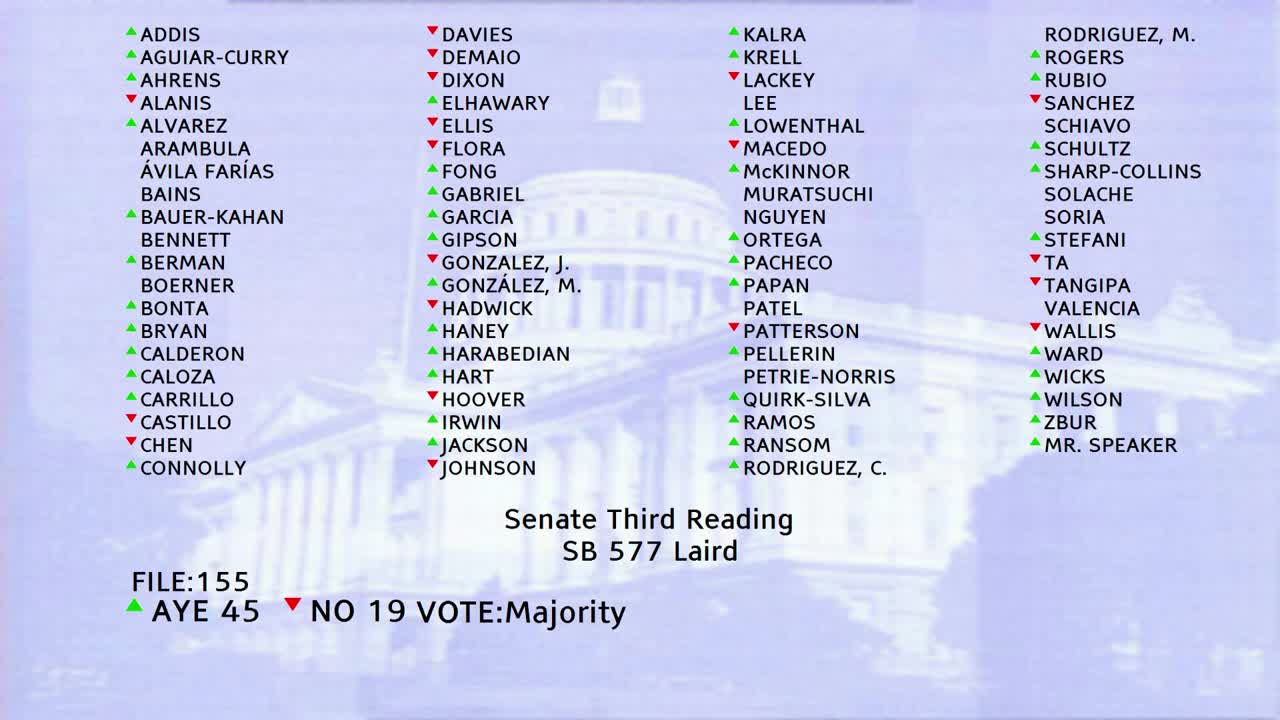 4MIN
Assembly Floor
 3MIN
Senate Floor
 6MIN
Senate Standing Committee on Environmental Quality
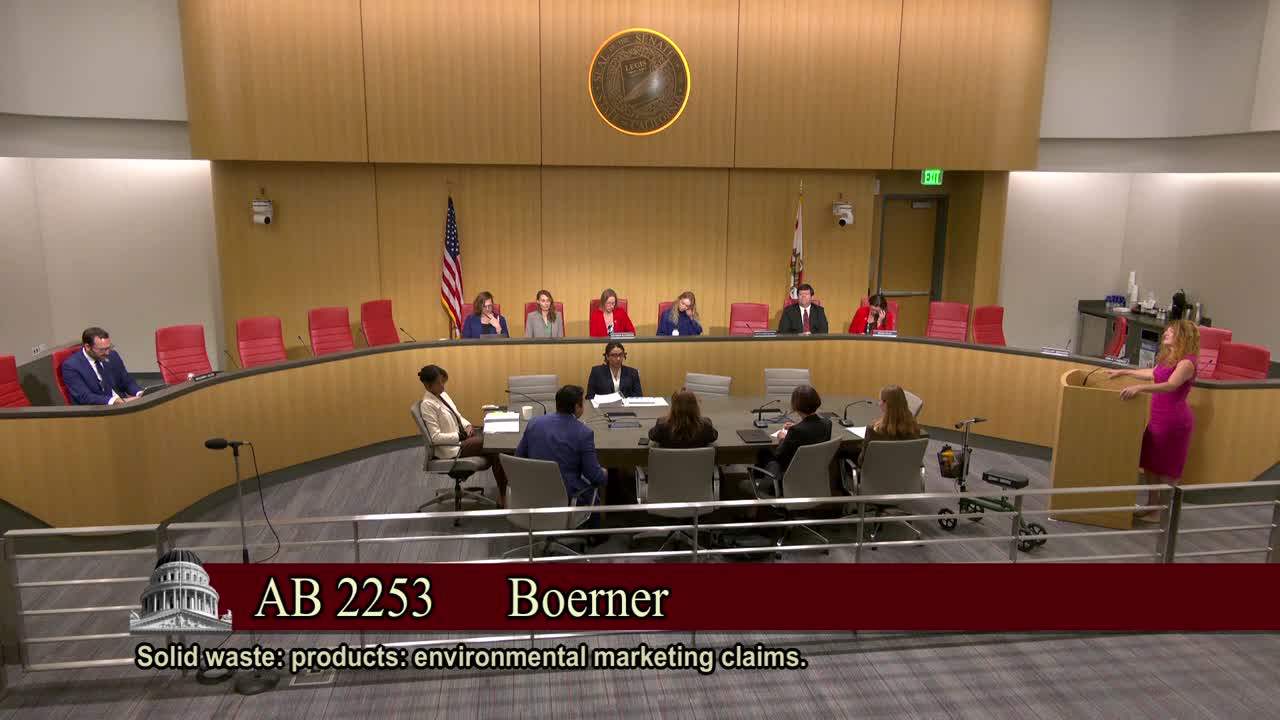 8MIN
Senate Standing Committee on Environmental Quality
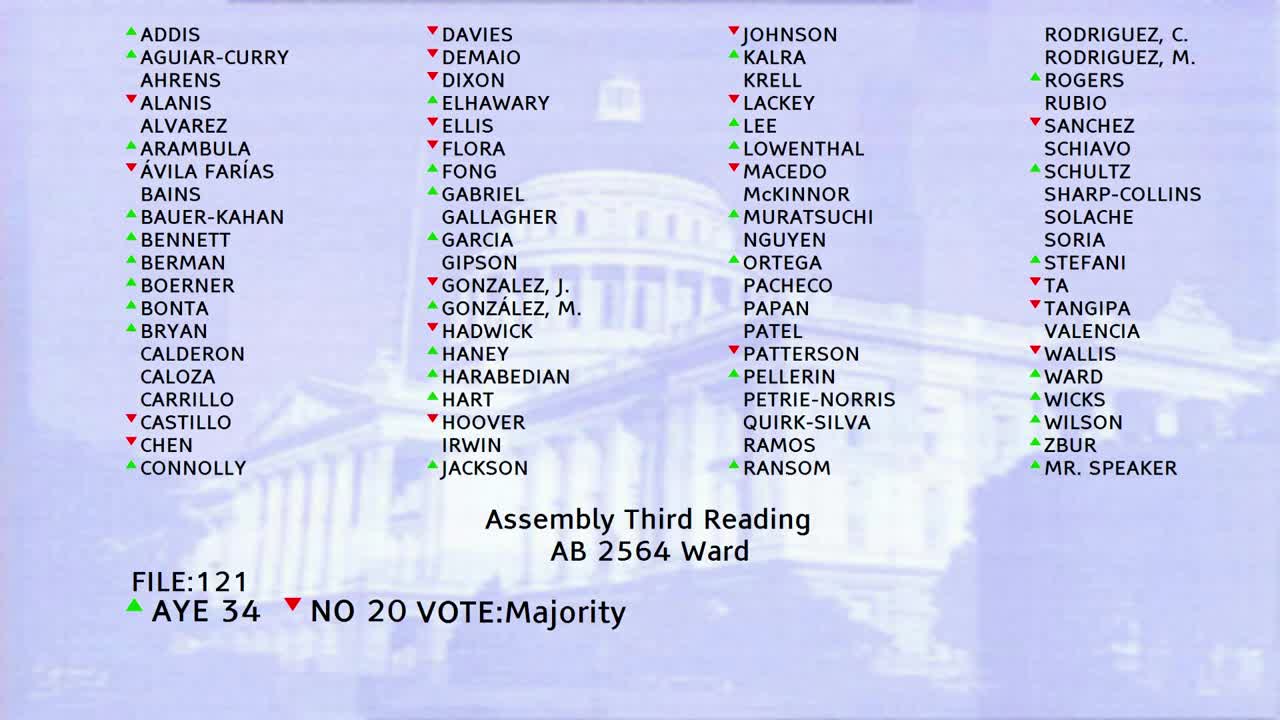 2MIN
Assembly Floor
 32MIN
Assembly Standing Committee on Appropriations
 28MIN
Assembly Standing Committee on Natural Resources
Bill Author

Bill Co-Author(s):