AB 2338: Electrical corporations and gas corporations: rates: inflation-constrained rate case scenario: standard of review.
- Session Year: 2025-2026
- House: Assembly
- Latest Version Date: 2026-03-24
Current Status:
In Progress
(2026-05-14: In committee: Held under submission.)
Introduced
In Committee
Awaiting First Chamber Vote
Passed First Chamber
In Committee
Awaiting Second Chamber Vote
Passed Second Chamber
Enacted
Existing law vests the Public Utilities Commission with regulatory authority over public utilities, including electrical corporations and gas corporations. Existing law authorizes the commission to fix the rates and charges for every public utility and requires that those rates and charges be just and reasonable.
This bill would require the commission to require every electrical corporation or gas corporation, as part of every general rate case application, to submit an inflation-constrained rate case scenario in which cumulative increases in annual expenditures proposed to be authorized in that proceeding do not exceed the projected federal social security beneficiary cost-of-living adjustment, and to compare that inflation-constrained rate case scenario with the primary rate case plan submitted by the corporation. The bill would authorize the commission to authorize expenditures in excess of the inflation-constrained rate case scenario if it determines that the electrical corporation or gas corporation has provided clear and convincing evidence that a higher level of expenditures is necessary to ensure the safe and reliable operation of its electrical system or gas system. The bill would require the commission to apply heightened scrutiny to a request that is not a general rate case application that is submitted by an electrical corporation or gas corporation that is likely to increase total systemwide expenditures beyond the projected federal social security beneficiary cost-of-living adjustment.
Under existing law, a violation of the Public Utilities Act or any order, decision, rule, direction, demand, or requirement of the commission is a crime.
Because the above-described provisions would be part of the act and a violation of a commission action implementing the above-described provisions would be a crime, this bill would impose a state-mandated local program.
The California Constitution requires the state to reimburse local agencies and school districts for certain costs mandated by the state. Statutory provisions establish procedures for making that reimbursement.
This bill would provide that no reimbursement is required by this act for a specified reason.
Existing law requires local publicly owned electric utilities serving end-use customers, among other things, to prudently plan for and procure resources that are adequate to meet its planning reserve margin and peak demand and operating reserves, sufficient to provide reliable service to its customers and to, at a minimum, meet the most recent minimum planning reserve and reliability criteria approved by the Board of Trustees of the Western Systems Coordinating Council or the Western Electricity Coordinating Council. Existing law requires those utilities to provide the State Energy Resources Conservation and Development Commission, upon request, with information the commission determines is necessary to evaluate the progress made by them in meeting the above requirements.This bill would make nonsubstantive changes to the provision regarding the provision of information to the commission.Existing law requires local publicly owned electric utilities serving end-use customers, among other things, to prudently plan for and procure resources that are adequate to meet its planning reserve margin and peak demand and operating reserves, sufficient to provide reliable service to its customers and to, at a minimum, meet the most recent minimum planning reserve and reliability criteria approved by the Board of Trustees of the Western Systems Coordinating Council or the Western Electricity Coordinating Council. Existing law requires those utilities to provide the State Energy Resources Conservation and Development Commission, upon request, with information the commission determines is necessary to evaluate the progress made by them in meeting the above requirements.
This bill would make nonsubstantive changes to the provision regarding the provision of information to the commission.
(a)(1)The commission shall require every electrical corporation or gas corporation, as part of every general rate case application, to do both of the following:
(A)Submit an inflation-constrained rate case scenario in which cumulative increases in annual expenditures proposed to be authorized in that proceeding do not exceed the projected federal social security beneficiary cost-of-living adjustment. This scenario shall include the highest priority spending needs of the electrical corporation or gas corporation.
(B)Compare the inflation-constrained rate case scenario submitted pursuant to subparagraph (A) with the primary rate case plan submitted by the electrical corporation or gas corporation.
(2)The commission may authorize expenditures in excess of the inflation-constrained rate case scenario if it determines that the electrical corporation or gas corporation has provided clear and convincing evidence that a higher level of expenditures is necessary to ensure the safe and reliable operation of its electrical system or gas system.
(b)The commission shall apply heightened scrutiny to any request that is not described in subdivision (a), is submitted by an electrical corporation or gas corporation, and is likely to increase total systemwide expenditures beyond the projected federal social security beneficiary cost-of-living adjustment.
SEC. 2.No reimbursement is required by this act pursuant to Section 6 of Article XIIIB of the California Constitution because the only costs that may be incurred by a local agency or school district will be incurred because this act creates a new crime or infraction, eliminates a crime or infraction, or changes the penalty for a crime or infraction, within the meaning of Section 17556 of the Government Code, or changes the definition of a crime within the meaning of Section 6 of Article XIIIB of the California Constitution.
SECTION 1.Section 9508.5 of the Public Utilities Code is amended to read:9508.5.Upon request, a local publicly owned electric utility serving end-use customers shall provide the Energy Commission with information the Energy Commission determines is necessary to evaluate the progress made by the local publicly owned electric utility in meeting the requirements of Section 9620.A Upon request, a local publicly owned electric utility serving end-use customers shall, upon request, shall provide the Energy Commission with any information the Energy Commission determines is necessary to evaluate the progress made by the local publicly owned electric utility in meeting the requirements of Section 9620.
|
Date
|
Status
|
|---|---|
| May 14, 2026 | In committee: Held under submission. |
| May 6, 2026 | In committee: Set, first hearing. Referred to APPR. suspense file. |
| Apr 23, 2026 | From committee: Do pass and re-refer to Com. on APPR. (Ayes 11. Noes 3.) (April 22). Re-referred to Com. on APPR. |
| Mar 25, 2026 | Re-referred to Com. on U. & E. |
| Mar 24, 2026 | From committee chair, with author's amendments: Amend, and re-refer to Com. on U. & E. Read second time and amended. |
| Mar 23, 2026 | Referred to Com. on U. & E. |
| Feb 20, 2026 | From printer. May be heard in committee March 22. |
| Feb 19, 2026 | Read first time. To print. |
|
Date
|
Description
|
Location
|
Votes
|
|
|---|---|---|---|---|
| Apr 22, 2026 | Do pass and be re-referred to the Committee on [Appropriations] | Assembly Standing Committee on Utilities and Energy |
Passed |
This list shows positions taken on this bill by organizations on the date displayed, which is linked to the original source.
Positions by individuals are not included.
|
Organization
|
Position
|
Date
|
|---|---|---|
| AARP | ** Support | |
| California Environmental Voters | ** Support | |
| California Large Energy Consumers Association | ** Support | |
| Chamber of Commerce | ** Against | |
| Climate Action Campaign | ** Support | |
| Engineers and Scientists of California, Local 20, IFPTE (ESC Local 20) | ** Against | |
| Pacific Gas And Electric Company | ** Against | |
| San Diego Gas & Electric Company | ** Against | |
| Southern California Edison | ** Against | |
| Southern California Gas Company | ** Against | |
| The Utility Reform Network | ** Support |
Date of Hearing: May 6, 2026
ASSEMBLY COMMITTEE ON APPROPRIATIONS
Buffy Wicks, Chair
ABPCA Bill Id:AB 2338
Author:(Ransom) – As Amended Ver:March 24, 2026
Policy Committee: | Utilities and Energy | Vote: | 11 - 3 |
|
| ||
|
|
Urgency: No State Mandated Local Program: Yes Reimbursable: No
SUMMARY:
This bill directs the California Public Utilities Commission (CPUC) to require each electrical or gas corporation (also known as an investor-owned utility (IOU)) (1) to submit, as part of each IOU general rate case (GRC) applications, an inflation-constrained rate case scenario, in which the IOU identifies its highest priority spending needs, and (2) to compare the inflation-constrained rate case scenario with the corporation’s primary rate case plan.
The bill empowers the CPUC to authorize expenditures in excess of the inflation-constrained rate case scenario if the CPUC determines the IOU has provided clear and convincing evidence that a higher level of expenditures is necessary to ensure the safe and reliable operation of its electrical system or gas system; and the bill directs the CPUC to apply heightened scrutiny to any such request that is likely to increase total systemwide expenditures beyond the projected federal social security beneficiary cost-of-living adjustment.
FISCAL EFFECT:
This bill creates new administrative work—requiring each IOU to submit an inflation-constrained rate case scenario, as described above—and significant new analytical work—determining whether each IOU has provided clear and convincing evidence that a higher level of expenditure is necessary to ensure the safe and reliable operation of its electrical system or gas system—of the CPUC. It is reasonable to expect the CPUC to subsume much of this work, though not all of it, in its existing regulatory duties.
The CPUC estimates the bill to result in cost of approximately $436,000 (Public Utilities Commission Utilities Reimbursement Account) annually for new GRC-related workload, including (a) reviewing IOU inflation-constrained scenarios and comparing them against the IOUs’ primary GRC requests, (b) evaluating whether costs above the inflation-constrained scenario are necessary for safe and reliable service, (c) reviewing non-GRC requests that may increase systemwide expenditures above inflation, (d) preparing data requests, hearing questions, briefing materials, proposed decisions and decision support, (e) conducting rate impact and affordability analysis and (f) reviewing models and revenue requirement calculations to ensure adopted costs are correctly reflected in customer rates.
COMMENTS:
- Purpose. The author intends this bill, at a minimum, to increase the “transparency and accountability of the utility rate-setting process,” ideally with the effect of reducing utility rate increases. According to the author:
Californians pay the highest electricity rates in the nation, at more than double the national average. Since 2014, residential electricity rates have climbed as much as 101 percent, which is more than 2.5 times the rate of inflation, leaving more than 2.3 million households behind on their energy bills. As the cost of living continues to rise, the Fighting for Affordable Informed Rates (FAIR) Act would require investor-owned utilities to submit an affordability budget, ensuring that rate increase decisions better reflect the realities facing families, workers, and small businesses across California.
- Background. The California Constitution establishes the CPUC to, among other things, fix rates, establish rules, examine records, issue subpoenas, administer oaths, take testimony, punish for contempt and prescribe a uniform system of accounts for all public utilities subject to its jurisdiction. Such public utilities are commonly referred to as IOUs.
Existing state law—section 451 of the Public Resources Code—specifies the requirements of charges, such as rates, imposed by an IOU:
- All charges demanded or received by any public utility, or by any two or more public utilities, for any product or commodity furnished or to be furnished or any service rendered or to be rendered shall be just and reasonable. Every unjust or unreasonable charge demanded or received for such product or commodity or service is unlawful.
- Every public utility shall furnish and maintain such adequate, efficient, just and reasonable service, instrumentalities, equipment and facilities, including telephone facilities, as defined in Section 54.1 of the Civil Code, as are necessary to promote the safety, health, comfort and convenience of its patrons, employees and the public.
- All rules made by a public utility affecting or pertaining to its charges or service to the public shall be just and reasonable.
It is the CPUC’s job to authorize an IOU to collect only those rates for service that are just and reasonable. The main way the CPUC reviews rates proposed by an IOU is through the GRC, which is a proceeding to address the costs of operating and maintaining the utility system and the allocation of those costs among customer classes. A GRC involves thousands of pages of documents, invites adversarial multi-party input and concerns billions of dollars of revenue. Each of the state’s largest electrical IOUs—Pacific Gas and Electric (PG&E), Southern California Edison (SCE) and San Diego Gas and Electric (SDG&E)—must file a GRC application with the CPUC once every four years.
Nonetheless, rates of the state’s IOUs, as approved by the CPUC, in recent years have increased at a pace beyond the rate of inflation. And increases in IOU rates are expected to continue to outpace inflation in the coming years.
While this bill establishes the rate of inflation as a reference point against which to assess IOU rate increase requests, it nonetheless acknowledges that there are some categories of costs that might increase out of proportion to inflation and yet still be just and reasonable. This makes sense, given that much of the recent increases in IOU rates were driven by efforts by the IOUs to keep their equipment from exploding or from sparking wildfires. And those safety-related efforts continue. Similarly, IOU rates have increased as the utilities have modernized their systems to accommodate increasingly sophisticated information technology features and a more dynamic distribution system.
This bill is sponsored by The Utility Reform Network, an organization that advocates on behalf of residential utility customers, which writes:
Addressing the affordability crisis starts with applying more scrutiny to escalating IOU spending. Using inflation (as defined by the Social Security Cost of Living Adjustment) as the benchmark for applying more scrutiny is appropriate given the various economic pressures faced by residential households.
The bill is opposed by the IOUs and the Chamber of Commerce, which describes the bill as prioritizing “optics over reliability and safety” and describes addressing the real drivers of rate increases” as a “more effective approach.”
Analysis Prepared by: Jay Dickenson / APPR. / (916) 319-2081
Date of Hearing: April 22, 2026
ASSEMBLY COMMITTEE ON UTILITIES AND ENERGY
Cottie Petrie-Norris, Chair
ABPCA Bill Id:AB 2338 (
Author:Ransom) – As Amended Ver:March 24, 2026
SUBJECT: Electrical corporations and gas corporations: rates: inflation-constrained rate case scenario: standard of review
SUMMARY: Requires the California Public Utilities Commission (CPUC) to require all electrical and gas corporations, as part of every general rate case (GRC) application, to submit an inflation-constrained rate case scenario. Specifically, this bill:
- Requires the CPUC to require all electrical and gas corporations, as part of every GRC application, to submit an inflation-constrained rate case scenario in which cumulative increases in annual expenditures proposed to be authorized in that proceeding do not exceed the projected federal social security beneficiary cost-of-living adjustment (COLA) and to compare the inflation-constrained rate case scenario with the primary rate case proposal submitted by the electrical or gas corporation.
- Authorizes the CPUC to authorize expenditures in excess of the inflation-constrained rate case scenario if it determines that the corporation has provided clear and convincing evidence that a higher level of expenditures is necessary to ensure the safe and reliable operation of its electric or gas system, and would require the CPUC to apply heightened scrutiny to any other request submitted by each electrical corporation and gas corporation that is likely to increase total systemwide expenditures beyond the COLA.
EXISTING LAW:
- Establishes and vests the CPUC with regulatory authority over public utilities, including electrical corporations and gas corporations. (Article XII of the California Constitution)
- Authorizes the CPUC to fix the rates and charges for every public utility and requires that those rates and charges be just and reasonable. (Public Utilities Code § 451)
- Prohibits a public utility from charging any rate except upon a showing before the CPUC and a finding by the CPUC that the new rate is justified. (Public Utilities Code § 454)
- Requires the CPUC to establish rates using cost allocation principles that fairly and reasonably assign to different customer classes the costs of providing service to those customers, consistent with the policies of affordability and conservation. (Public Utilities Code § 739.6)
- Requires the CPUC to ensure that any errors in estimates of demand elasticity or sales do not result in over or under collections by investor-owned utilities. (Public Utilities Code § 739.10)
- Mandates the CPUC to develop a definition of energy affordability and use the definition to assess the impact of proposed rate increases on different types of residential customers, among other requirements. (Public Utilities Code § 739.13)
- Declares the legislative intent that the CPUC reduce rates for electricity and natural gas to the lowest amount possible. (Public Utilities Code § 747)
FISCAL EFFECT: Unknown. This bill is keyed fiscal and will be referred to the Assembly Committee on Appropriations for its review.
BACKGROUND:
GRC: Cost Recovery Process – Utilities employ a number of accounts to track expenses, both anticipated and unanticipated. Anticipated costs are determined through GRC proceedings, which evaluate both past expenses and utility forecasts of likely future costs, and cover four years of a utility’s anticipated costs. The GRC establishes how much money the utilities are allowed to collect, and a fixed escalation rate is applied to expenses for the subsequent three years captured in the GRC cycle. Once the CPUC authorizes the costs, the costs are allocated to different classes of customers and built into future billing.
Any utility proposing new or increased rates must demonstrate their justification to the CPUC. Two distinct standards of proof have governed how that burden is measured in CPUC GRC decisions.
- Clear and convincing evidence: Requires that the evidence produce in the factfinder a firm belief or conviction that the asserted fact is true.
- Preponderance of the evidence: Requires that the evidence, when weighed against opposing evidence, have more convincing force and a greater probability of truth.
The clear and convincing evidence standard appeared in CPUC decisions as early as 1983 and persisted for decades.[1] More recently, the CPUC has characterized the applicable standard as preponderance of the evidence.[2] This shift occurred through the CPUC’s own decisional practice rather than through any amendment to the Public Utilities Code.
Federal Social Security Beneficiary COLA – Under federal law, Social Security benefits are subject to annual COLAs intended to ensure that the purchasing power of Social Security benefits is not eroded by inflation.[3] The Social Security Act ties the annual COLA to the increase in the Consumer Price Index for Urban Wage Earners and Clerical Workers (CPI-W), as determined by the Department of Labor’s Bureau of Labor Statistics.[4] Specifically, the COLA is based on the percentage increase in the CPI-W from the third quarter of the last year a COLA was determined to the third quarter of the current year, and if there is no increase, there can be no COLA.[5] For 2026, Social Security beneficiaries are receiving a 2.8 percent COLA, based on the increase in the CPI-W from the third quarter of 2025 through the third quarter of 2025.[6]
COMMENTS:
- Author’s Statement. According to the Author, “Californians pay the highest electricity rates in the nation, at more than double the national average. Since 2014, residential electricity rates have climbed as much as 101 percent, which is more than 2.5 times the rate of inflation, leaving more than 2.3 million households behind on their energy bills. As the cost of living continues to rise, the Fighting for Affordable Informed Rates (FAIR) Act would require investor-owned utilities to submit an affordability budget, ensuring that rate increase decisions better reflect the realities facing families, workers, and small businesses across California. This bill would bring greater transparency and accountability to the utility rate-setting process.”
- Purpose of the Bill. This bill requires electrical and gas corporations to provide the CPUC with an inflation-constrained rate case scenario alongside its standard GRC proposal and establishes heightened evidentiary standards for approving rate increases that exceed the COLA. The inflation-constrained scenario requirement is intended to give the CPUC and parties to the proceeding the opportunity to compare a COLA-constrained proposal against the utility’s primary rate case, thereby facilitating a more transparent assessment of the differences, tradeoffs, and justifications for higher spending. Beyond that comparative framework, the bill also increases the threshold for the CPUC to approve above-COLA expenditures. Within the GRC process, the CPUC may authorize spending above the constrained scenario only upon clear and convincing evidence that the higher level of spending is necessary for safe and reliable operation – a higher standard than the preponderance of the evidence standard the CPUC currently applies. Outside the GRC process, above-COLA requests are subject to “heightened scrutiny.”
- Impact on investments in safety and the state’s clean energy policies. In response to prior legislative attempts, some opponents have raised concerns that this approach could undermine necessary investments in safety and efforts to support the state’s clean energy policies. It was noted then, and remains true today, that the language as written does not preclude these investments; however, it does require the electrical and gas corporations to provide clear and convincing evidence that these investments are needed.
- Evidentiary Standards. This bill establishes a two-track framework for GRC review: utilities must submit an inflation-constrained rate case scenario at the COLA and compare it against their primary rate case plan. Expenditures above the constrained scenario may be authorized only upon clear and convincing evidence that the higher spending is necessary for safe and reliable operation. The clear and convincing standard has historical roots in CPUC practice. As noted above, the CPUC applied that standard for decades before shifting to a preponderance of the evidence standard.
For requests made outside the GRC framework that are likely to increase total systemwide expenditures beyond the COLA, the bill applies a standard of “heightened scrutiny.” According to the Author, this standard is intended to require utilities to meet a higher burden of proof for above-COLA requests and to direct the CPUC to consider prioritizing utility spending in a manner that would keep total rate impacts at or below the COLA. “Heightened scrutiny” does not appear elsewhere in the Public Utilities Code and is not a term of art with an established meaning in CPUC proceedings. The Author may wish to consider defining this standard in the bill to give the CPUC clearer direction as to the burden of proof required and the weight to be given to rate impact considerations when evaluating such requests.
- Inflation metric. This bill uses the COLA as its benchmark for constraining utility rate increases. According to the Author, this metric was selected to reflect the financial realities faced by California customers living on fixed incomes that escalate based on that COLA.
In response to prior legislative attempts, some opponents and this Committee have raised concerns about whether the COLA is the most appropriate metric for utility rate regulation. As a measure designed to preserve the purchasing power of Social Security recipients, it may not track the cost structures of capital-intensive regulated utilities. The COLA is also determined retrospectively, which may create a mismatch with the forward-looking nature of GRC proceedings. Other metrics may be better suited to this context – for example, the CPUC already uses the CPI-U as the basis for rate adjustments in water and sewer utility proceedings[7] – and California-specific CPI data is available for major metropolitan areas. The Author may wish to consider whether to specify an alternative inflation metric, or to direct the CPUC to determine the appropriate benchmark, in order to ensure the constraint is well-calibrated to utility cost dynamics while still protecting ratepayers on fixed incomes.
- Prior Legislation.
AB 99 (Ta, 2025) would have prohibited investor-owned utilities from proposing a consumer rate increase above the rate of inflation unless approved by a majority of customers through election, or if the CPUC deems the increase is directly related to safety enhancements, modernization, or higher commodity or fuel costs. Status: Assembly – Died – Appropriations.
SB 254 (Becker), among other things, included language almost identical to this bill. This language was included in the May 28, 2025, version of the bill but was removed prior to final passage and chaptering. Status: Chapter 119, Statutes of 2025.
AB 1710 (Ta, 2024) would have prohibited an electrical corporation from proposing, on a systemwide average basis, a rate increase above the rate of inflation for any given GRC cycle. Notwithstanding this general prohibition, would have allowed an electrical corporation to propose, and the CPUC to approve, a rate increase above the rate of inflation if the CPUC determined that the increase was directly related to safety enhancements and modernization, or to higher commodity or fuel costs. Status: Assembly – Died – Appropriations.
REGISTERED SUPPORT / OPPOSITION:
Support
The Utility Reform Network (TURN)
AARP
California Environmental Voters
California Large Energy Consumers Association
Climate Action Campaign
Opposition
California Chamber of Commerce
Engineers and Scientists of California, Local 20, IFPTE (ESC Local 20)
Pacific Gas and Electric Company
San Diego Gas & Electric Company
Southern California Edison
Southern California Gas Company
Analysis Prepared by: Suman Tatapudy / U. & E. / (916) 319-2083
D.08-01-020, Re Golden State Water Co., citing Re Southern California Edison Company 11 CPUC 2d 474, 475 (D.83-05-036). ↑
D.21-08-036, Decision on Test Year 2021 General Rate Case for Southern California Edison Co. (Aug. 19, 2021), at 9. ↑
Social Security Administration, Cost-of-Living Adjustment (COLA) Information, https://www.ssa.gov/cola. ↑
Social Security Administration, Social Security Announces 2.8 Percent Benefit Increase for 2026 (Oct. 24, 2025), https://www.ssa.gov/news/en/press/releases/2025-10.24.html. ↑
See Footnote 1. ↑
Social Security Administration, 2026 Cost-of-Living Adjustment (COLA) Fact Sheet (Jan. 16, 2026), https://www.ssa.gov/news/en/cola/factsheets/2026.html. ↑
California Public Utilities Commission, 2024 CPI-U Memo, https://www.cpuc.ca.gov/-/media/cpuc-website/divisions/water-division/reports/wd-memorandum/2024-cpi-u-memo.pdf. ↑
Discussed in Hearing
 48MIN
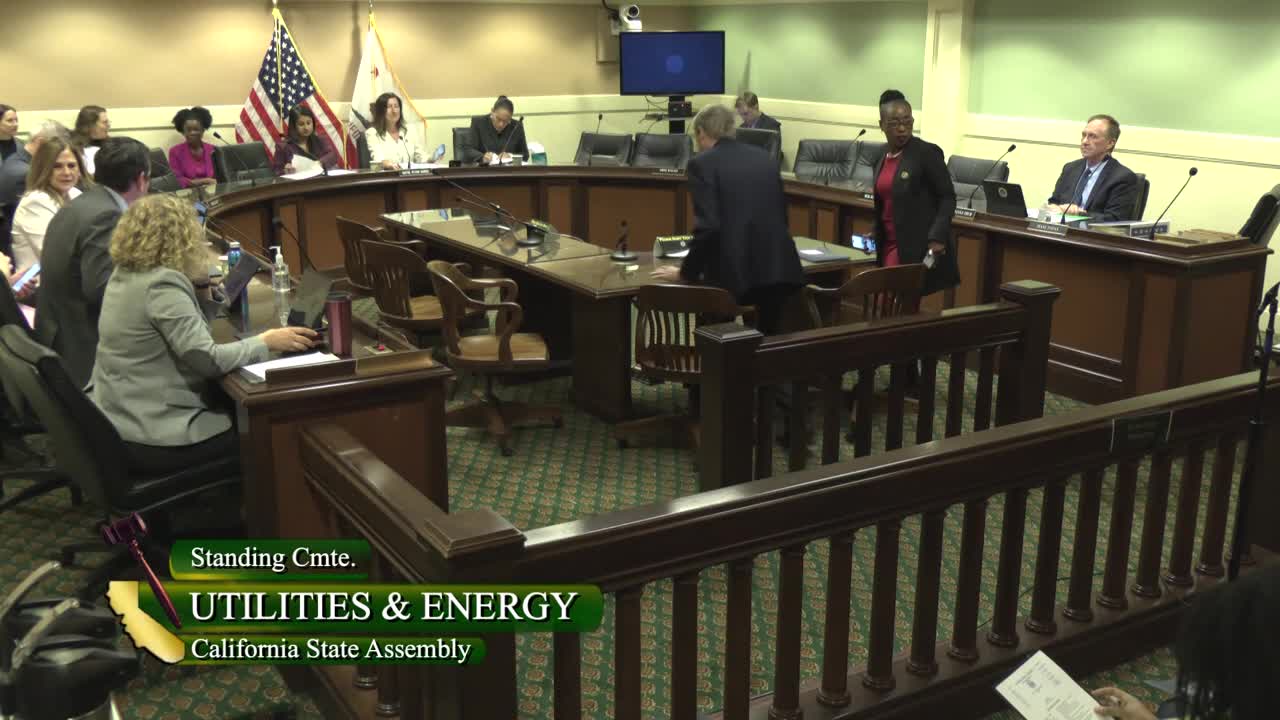
Assembly Standing Committee on Utilities and Energy
Bill Author

Bill Co-Author(s):