AB 235: Pupils: use of smartphones.
- Session Year: 2025-2026
- House: Assembly
- Latest Version Date: 2025-04-21
Current Status:
Failed
(2026-02-02: From committee: Filed with the Chief Clerk pursuant to Joint Rule 56.)
Introduced
In Committee
Awaiting First Chamber Vote
Passed First Chamber
In Committee
Awaiting Second Chamber Vote
Passed Second Chamber
Enacted
What does this bill do?
The bill allows school districts, county education boards, and charter schools to adopt policies that limit or prohibit students’ smartphone use at school and explicitly says those policies may be schedule-based (allowed at some times) or full-day bans. It directs schools to use evidence-based practices and get input from students, parents, and educators, allows exceptions for emergencies, teacher permission, medical needs, or an individualized education program, and bars monitoring or collecting students’ online activity.
The summary is provided by generative AI which can make mistakes. For original language, please view the details in the table below.
Existing law requires the governing board of a school district, a county board of education, or the governing body of a charter school, by July 1, 2026, to develop and adopt, and update every 5 years, a policy to limit or prohibit the use by its pupils of smartphones while the pupils are at a schoolsite or while the pupils are under the supervision and control of an employee or employees of that school district, county office of education, or charter school, as provided.
This bill would require expressly authorize the above-described policy to limit or prohibit the use of smartphones to be include, but not be limited to, a scheduled-based restriction policy, as defined, or a full-day restriction policy, as defined. By imposing additional duties on local educational agencies, the bill would constitute a state-mandated local program.
The California Constitution requires the state to reimburse local agencies and school districts for certain costs mandated by the state. Statutory provisions establish procedures for making that reimbursement.This bill would provide that, if the Commission on State Mandates determines that the bill contains costs mandated by the state, reimbursement for those costs shall be made pursuant to the statutory provisions noted above.Existing law requires the governing body board of a school district, a county office board of education, or the governing body of a charter school, by July 1, 2026, to develop and adopt, and update every 5 years, a policy to limit or prohibit the use by its pupils of smartphones while the pupils are at a schoolsite or while the pupils are under the supervision and control of an employee or employees of that school district, county office of education, or charter school, as provided.
This bill would state the intent of the Legislature to enact subsequent legislation to establish a statewide policy to limit the use of internet-connected devices by pupils during pupil instructional time at local educational agencies.This bill would require the above-described policy to limit or prohibit the use of smartphones to be a scheduled-based restriction policy, as defined, or a full-day restriction policy, as defined. By imposing additional duties on local educational agencies, the bill would constitute a state-mandated local program.
The California Constitution requires the state to reimburse local agencies and school districts for certain costs mandated by the state. Statutory provisions establish procedures for making that reimbursement.
This bill would provide that, if the Commission on State Mandates determines that the bill contains costs mandated by the state, reimbursement for those costs shall be made pursuant to the statutory provisions noted above.
Existing law requires the governing body of a school district, a county office of education, or a charter school, by July 1, 2026, to develop and adopt, and update every 5 years, a policy to limit or prohibit the use by its pupils of smartphones while the pupils are at a schoolsite or while the pupils are under the supervision and control of an employee or employees of that school district, county office of education, or charter school, as provided.
This bill would state the intent of the Legislature to enact subsequent legislation to establish a statewide policy to limit the use of internet-connected devices by pupils during pupil instructional time at local educational agencies.
The Legislature finds and declares that schools are encouraged to improve access to media literacy through media literacy classes, extracurricular opportunities, open tech days, and any other options in order to encourage the responsible and safe use of technology in schools.
SECTION 1.SEC. 2.Section 48901.7 of the Education Code is amended to read:48901.7.(a)(1)(A)The governing board of a school district, a county board of education, or the governing body of a charter school shall, no later than July 1, 2026, develop and adopt, and shall update every five years, a schedule-based restriction policy or full-day restriction policy to limit or prohibit the use by its pupils of smartphones while the pupils are at a schoolsite or while the pupils are under the supervision and control of an employee or employees of that school district, county office of education, or charter school. The
(B)The policy adopted pursuant to subparagraph (A) may include, but is not limited to, a schedule-based restriction policy or full-day restriction policy.
(2)The goal of the policy adopted pursuant to paragraph (1) shall be to promote evidence-based use of smartphone practices to support pupil learning and well-being. The development of the policy shall involve significant stakeholder participation in order to ensure that the policies are responsive to the unique needs and desires of pupils, parents, and educators in each community. The policy may also include enforcement mechanisms that limit access to smartphones.
(b)Notwithstanding subdivision (a), a pupil shall not be prohibited from possessing or using a smartphone under any of the following circumstances:
(1)In the case of an emergency, or in response to a perceived threat of danger.
(2)When a teacher or administrator of the school district, county office of education, or charter school grants permission to a pupil to possess or use a smartphone, subject to any reasonable limitation imposed by that teacher or administrator.
(3)When a licensed physician and surgeon determines that the possession or use of a smartphone is necessary for the health or well-being of the pupil.
(4)When the possession or use of a smartphone is required in a pupils individualized education program.
(c)This section does not authorize monitoring, collecting, or otherwise accessing any information related to a pupils online activities.
(d)For purposes of this section, the following definitions apply:
(1)Full-day restriction policy means a policy that prohibits the use of smartphones by pupils during the schoolday, including during instructional time, lunch or free periods, and passing time.
(2)Schedule-based restriction policy means a policy that prohibits the use of smartphones by pupils at certain times of the schoolday, such as during instruction, and permits the limited use of smartphones by pupils at other times of the schoolday, such as during breaks or lunch periods.
SEC. 2.If the Commission on State Mandates determines that this act contains costs mandated by the state, reimbursement to local agencies and school districts for those costs shall be made pursuant to Part 7 (commencing with Section 17500) of Division 4 of Title 2 of the Government Code.(a)The governing body board of a school district, a county office board of education, or the governing body of a charter school shall, no later than July 1, 2026, develop and adopt, and shall update every five years, a schedule-based restriction policy or full-day restriction policy to limit or prohibit the use by its pupils of smartphones while the pupils are at a schoolsite or while the pupils are under the supervision and control of an employee or employees of that school district, county office of education, or charter school. The goal of the policy shall be to promote evidence-based use of smartphone practices to support pupil learning and well-being. The development of the policy shall involve significant stakeholder participation in order to ensure that the policies are responsive to the unique needs and desires of pupils, parents, and educators in each community. The policy may also include enforcement mechanisms that limit access to smartphones.
(b)Notwithstanding subdivision (a), a pupil shall not be prohibited from possessing or using a smartphone under any of the following circumstances:
(1)In the case of an emergency, or in response to a perceived threat of danger.
(2)When a teacher or administrator of the school district, county office of education, or charter school grants permission to a pupil to possess or use a smartphone, subject to any reasonable limitation imposed by that teacher or administrator.
(3)When a licensed physician and surgeon determines that the possession or use of a smartphone is necessary for the health or well-being of the pupil.
(4)When the possession or use of a smartphone is required in a pupils individualized education program.
(c)This section does not authorize monitoring, collecting, or otherwise accessing any information related to a pupils online activities.
(d)For purposes of this section, the following definitions apply:
(1)Full-day restriction policy means a policy that prohibits the use of smartphones by pupils during the schoolday, including during instructional time, lunch or free periods, and passing time.
(2)Schedule-based restriction policy means a policy that prohibits the use of smartphones by pupils at certain times of the schoolday, such as during instruction, and permits the limited use of smartphones by pupils at other times of the schoolday, such as during breaks or lunch periods.
SEC. 2.If the Commission on State Mandates determines that this act contains costs mandated by the state, reimbursement to local agencies and school districts for those costs shall be made pursuant to Part 7 (commencing with Section 17500) of Division 4 of Title 2 of the Government Code.
SECTION 1.It is the intent of the Legislature to enact subsequent legislation to establish a statewide policy to limit the use of internet-connected devices by pupils during pupil instructional time at local educational agencies.It is the intent of the Legislature to enact subsequent legislation to establish a statewide policy to limit the use of internet-connected devices by pupils during pupil instructional time at local educational agencies.
|
Date
|
Status
|
|---|---|
| Feb 2, 2026 | From committee: Filed with the Chief Clerk pursuant to Joint Rule 56. |
| Jan 31, 2026 | Died pursuant to Art. IV, Sec. 10(c) of the Constitution. |
| May 14, 2025 | In committee: Hearing postponed by committee. |
| Apr 30, 2025 | In committee: Hearing postponed by committee. |
| Apr 22, 2025 | Re-referred to Com. on APPR. |
| Apr 21, 2025 | Read second time and amended. |
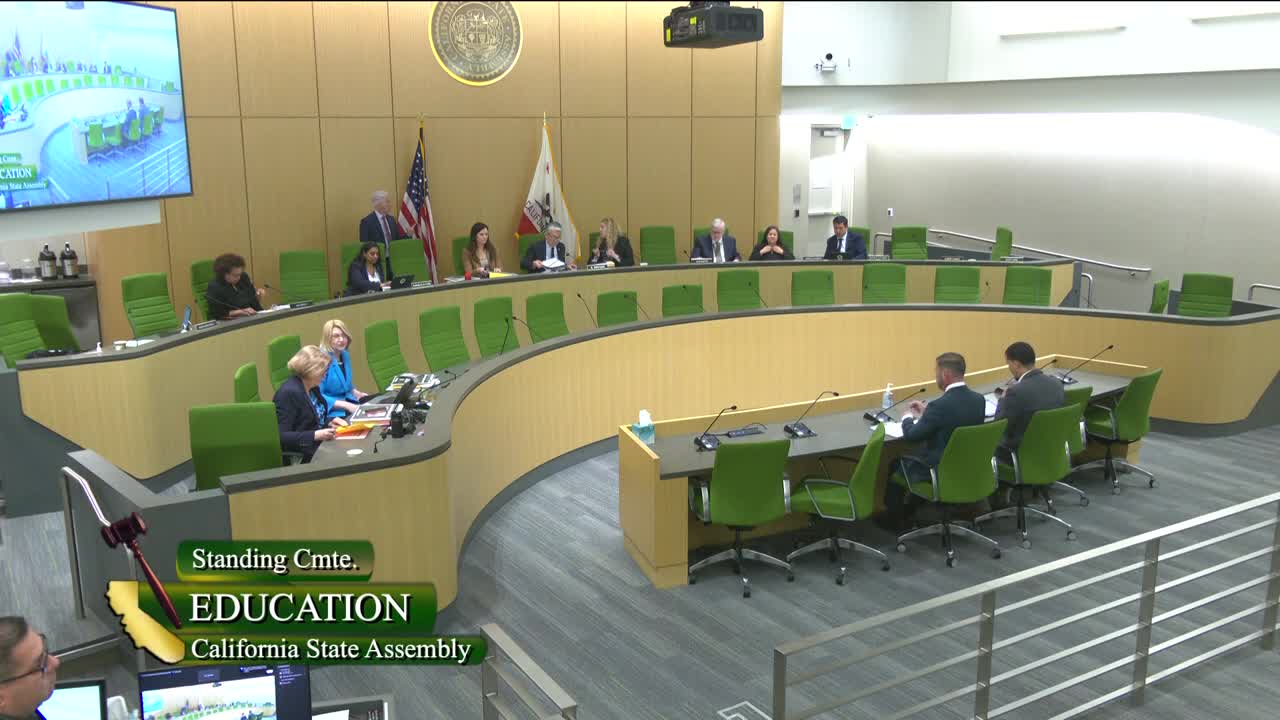
| Apr 10, 2025 | From committee: Amend, and do pass as amended and re-refer to Com. on APPR. (Ayes 7. Noes 1.) (April 9). |
| Mar 18, 2025 | Re-referred to Com. on ED. |
| Mar 17, 2025 | From committee chair, with author's amendments: Amend, and re-refer to Com. on ED. Read second time and amended. |
| Mar 17, 2025 | Referred to Com. on ED. |
| Jan 14, 2025 | From printer. May be heard in committee February 13. |
| Jan 13, 2025 | Read first time. To print. |
|
Date
|
Description
|
Location
|
Votes
|
|
|---|---|---|---|---|
| Apr 9, 2025 | Do pass as amended and be re-referred to the Committee on [Appropriations] | Assembly Standing Committee on Education |
Passed |
This list shows positions taken on this bill by organizations on the date displayed, which is linked to the original source.
Positions by individuals are not included.
|
Organization
|
Position
|
Date
|
|---|---|---|
| Small School Districts Association | ** Against |
Date of Hearing: April 9, 2025
ASSEMBLY COMMITTEE ON EDUCATION
Al Muratsuchi, Chair
ABPCA Bill Id:AB 235 (
Author:Arambula) – As Amended Ver:March 17, 2025
SUBJECT: Pupils: use of smartphones
SUMMARY: Requires the governing board of a school district, county board of education, or the governing board of a charter school to, no later than July 1, 2026, develop and adopt a schedule-based policy or full-day restriction policy to limit or prohibit the use by its pupils of smartphones while the pupils are at a schoolsite or while the pupils are under the supervision and control of an employee or employees of that school district, county office of education (COE), or charter school. Specifically, this bill:
- Requires the governing board of a school district, county board of education, or the governing board of a charter school to, no later than July 1, 2026, develop and adopt, and to update every five years, a schedule-based policy or full-day restriction policy to limit or prohibit the use by its pupils of smartphones while the pupils are at a schoolsite or while the pupils are under the supervision and control of an employee or employees of that school district, COE, or charter school.
- Defines the following:
- “Full-day restriction policy” to mean a policy that prohibits the use of smartphones by pupils during the schoolday, including during instructional time, lunch or free periods, and passing time; and
- “Schedule-based restriction policy” to mean a policy that prohibits the use of smartphones by pupils at certain times of the schoolday, such as during instruction, and permits the limited use of smartphones by pupils at other times of the schoolday, such as during breaks or lunch periods.
EXISTING LAW:
- Requires the governing body of a school district, a COE, or a charter school to, no later than July 1, 2026, develop and adopt, and shall update every five years, a policy to limit or prohibit the use by its pupils of smartphones while the pupils are at a schoolsite or while the pupils are under the supervision and control of an employee or employees of that school district, county office of education, or charter school. Requires the goal of the policy is to promote evidence-based use of smartphone practices to support pupil learning and well-being. Requires the development of the policy to involve significant stakeholder participation in order to ensure that the policies are responsive to the unique needs and desires of pupils, parents, and educators in each community. Authorizes the policy to also include enforcement mechanisms that limit access to smartphones. (Education Code (EC) 48901.7)
- Requires a pupil to not be prohibited from possessing or using a smartphone under any of the following circumstances:
- In the case of an emergency or in response to a perceived threat of danger;
- When a teacher or administrator of the school district, COE, or charter school grants permission to a pupil to possess or use a smartphone, subject to any reasonable limitation imposed by that teacher or administrator;
- When a licensed physician and surgeon determines that the possession or use of a smartphone is necessary for the health or well-being of the pupil; or
- When the possession or use of a smartphone is required in a pupil’s individualized education program. (EC 48901.7)
- States that this requirement does not authorize monitoring, collecting, or otherwise accessing any information related to a pupil’s online activities. (EC 48901.7)
- Permits the governing board of each school district, or its designee, to regulate the possession or use of any electronic signaling device that operates through the transmission or receipt of radio waves, including, but not limited to, paging and signaling equipment, by pupils of the school district while the pupils are on campus, while attending school-sponsored activities, or while under the supervision and control of school district employees. (EC 48901.5)
- Requires that no pupil may be prohibited from possessing or using an electronic signaling device that is determined by a licensed physician and surgeon to be essential for the health of the pupil and use of which is limited to purposes related to the health of the pupil. (EC 48901.5)
FISCAL EFFECT: This bill has been keyed as a possible state-mandated local program by the Office of Legislative Counsel.
COMMENTS:
Need for the bill. According to the author, “The rise of cellphones and internet-connected devices promised knowledge and connection—and in many ways, they have delivered. However, their presence in classrooms has also led to significant distractions during instructional hours, impacting students' focus and learning.
As a parent, I am deeply concerned about the effects of excessive cellphone use on children’s mental health and education. AB 235 provides school districts with clear guidance and flexible options to establish policies that minimize classroom distractions while supporting student well-being.”
Key provisions of the bill. This bill proposes to require that adopted smartphone policies are either schedule-based or include full-day restrictions. Current law requires smartphone use policies to either limit or prohibit the use of smartphones by students, and this bill would further limit the options governing boards and governing bodies may consider when adopting local policies. Some adopted local policies, after seeking school community input, have determined that some grades or school sites may benefit from a smartphone use limitation, while others may benefit from a prohibition. For example, a local policy may state that elementary and middle school students are prohibited from using smartphones, while high school students are authorized to use smartphones during passing periods and lunch breaks. This bill does not allow for that type of flexibility.
Information provided by the author’s office included that the idea for the adoption of either a schedule-based policy or full-day restriction policy originated from a U.S. Department of Education 2024 report, Planning Together: A Playbook for Student Personal Device Policies. The report states that the Playbook “serves as a resource for one approach to policy development and implementation” and encourages authentic youth and school community engagement in order to be responsive to the students and families served by the school. The Committee may wish to consider that the Playbook offered the two policy options as one approach to policy development, rather than a firm recommendation.
Smartphone use requirements in California public schools. Current law, as established by AB 3216 (Hoover), Chapter 500, Statutes of 2024, requires a governing board of a school district, COE, or a charter school no later than July 1, 2026, to develop, adopt, and update every five years a policy, to limit or prohibit the use by its pupils of smartphones while the pupils are at school or while the pupils are under the supervision and control of an employee of that school. Current law further requires the development of the policy to involve significant stakeholder participation in order to ensure that the policies are responsive to the unique needs and desires of pupils, parents, and educators in each community. The Committee may wish to consider that school districts, COEs, and charter schools are likely in the process of developing their smartphone use policies, in order to meet the statutory deadline of July 1, 2026.
Additionally, SB 1283 (Stern), Chapter 891, Statutes of 2024, authorizes a school district, a county board of education, or a charter school to adopt a policy to limit or prohibit students from using social media while at a schoolsite or under the supervision and control of an employee of the school district, COE, or charter school.
National smartphone use in schools policies. According to the U.S. Department of Education 2024 report, Planning Together: A Playbook for Student Personal Device Policies, the approach to device policies varies across grade levels. Elementary schools tend to restrict the use of devices during the school day, requiring students who do bring a device to school to store it off and away. Middle schools also tend to restrict the use of devices during the entire school day; however, some begin building in more flexibility for middle school students, allowing the use of devices during lunch or transitions. Many high schools offer additional flexibility, allowing the use of cell phones in certain areas on campus or at certain times, such as lunch, between classes, in hallways, and outside on school grounds. The Committee may wish to consider that the two options for smartphone restriction policies offered in this bill come from the U.S. Department of Education report: full-day restrictions and schedule-based restrictions. The report further states that the Playbook “serves as a resource for one approach to policy development and implementation” and encourages authentic youth and school community engagement in order to be responsive to the students and families served by the school.
According to a 2024 Pew Research article, What is it like to be a teacher in America today?, 82% of K-12 teachers in the U.S. say their school or district has a cellphone policy of some kind. Middle school teachers (94%) are especially likely to say this, followed by elementary (84%) and high school (71%) teachers.
Further, according to a 2024 Pew Research article, Most Americans back cellphone bans during class, but fewer support all-day restrictions, 68% of U.S. adults say they support a ban on middle and high school students using cellphones during class, which includes 45% who strongly support a ban. Another 24% oppose a ban, while 8% say they aren’t sure. Pew Research also reports the public is far less supportive of a full-day ban on cellphone use than a classroom ban. About one-third (36%) support banning middle and high school students from using cellphones during the entire school day, including at lunch as well as during and between classes. By comparison, 53% oppose this more restrictive approach.
Teenager use of technology. Teenager use of technology, including smartphones, is on the rise. A 2024 Pew Research report, How Teens and Parents Approach Screen Time, included a national survey of teenagers from ages 13 to 17 years, old yielded the following results:
- 95% of teens have access to a smartphone;
- 72% of U.S. teens say they often or sometimes feel peaceful when they don’t have their smartphone; 44% say it makes them feel anxious;
- 38% of teens say they spend too much time on their smartphone. About a quarter say the same regarding their social media use, but the largest shares say the amount of time they spend on their phone (51%) or on social media (64%) is about right. Relatively few teens say they don’t spend enough time with these technologies. However, views on this differ by gender. Teen girls are more likely than boys to say they spend too much time on their smartphone (44% vs. 33%) or social media (32% vs. 22%);
- 69% of teens say smartphones make it easier for youth to pursue hobbies and interests; fewer (30%) say it helps people their age learn good social skills.
- Half of parents say they have looked through their teen’s phone; and
- About four-in-ten parents and teens report regularly arguing with one another about time spent on their phone.
According to a 2023 Gallup survey of more than 1,500 adolescents, Familial and Adolescent Health, over half of U.S. teenagers (51%) report spending at least four hours per day using a variety of social media apps such as YouTube, TikTok, Instagram, Facebook and X (formerly Twitter). Across age groups, the average time spent on social media ranges from as low as 4.1 hours per day for 13-year-olds to as high as 5.8 hours per day for 17-year-olds. Girls spend nearly an hour more on social media than boys (5.3 vs. 4.4 hours, respectively).
A Pew Research report, U.S. Smartphone Use in 2018, found that 45% said they were online “almost constantly.” A 2015 Common Sense Media report and study, Common Sense Census: Media Use by Tweens and Teens, found that teenagers (ages 13-18) use an average of nine hours of entertainment media per day and that tweens (ages 8-12) use an average of six hours a day, not including time spent using media for school or homework. Despite the significant amount of time teens and tweens spend with media, not all young people use media in the same way. The report identified a significant digital equity gap between low-income kids who are far less likely to have access to computers, tablets and smartphones than their wealthier peers. However, those low-income kids who do have access are more likely to spend more time on their devices than kids from more affluent families. The survey also found that half of teenagers felt addicted to their devices, and 78% checked their devices at least hourly. Nearly three quarters of teens felt pressured to respond immediately to texts, notifications and social media messaging.
A growing body of peer-reviewed research is examining the connection between technology use and teenage student mental health. The U.S. Surgeon General issued an advisory about the effects of social media use on youth mental health in 2023. The Surgeon General issued a call for urgent action by policymakers, technology companies, researchers, families, and young people alike to gain a better understanding of the full impact of social media use, maximize the benefits and minimize the harms of social media platforms, and create safer, healthier online environments to protect children. The advisory stated:
- While social media may offer some benefits, there are ample indicators that social media can also pose a risk of harm to the mental health and well-being of children and adolescents.
- Children are affected by social media in different ways, including based on cultural, historical, and socio-economic factors. Among the benefits, adolescents report that social media helps them feel more accepted (58%), like they have people who can support them through tough times (67%), like they have a place to show their creative side (71%), and more connected to what’s going on in their friends’ lives (80%).
- Studies have also shown a relationship between social media use and poor sleep quality, reduced sleep duration, sleep difficulties, and depression among youth.
- More research is needed to determine the full impact social media use has on nearly every teenager across the country.
According to a 2019 Pew Research study, Most U.S. Teens See Anxiety and Depression as a Major Problem Among Their Peers, “Anxiety and depression are on the rise among America’s youth and, whether they personally suffer from these conditions or not, seven-in-ten teens today see them as major problems among their peers. Concern about mental health cuts across gender, racial and socio-economic lines, with roughly equal shares of teens across demographic groups saying it is a significant issue in their community.”
According to a 2020 article in the Journal of Affective Disorders, Is social media screen time really associated with poor adolescent mental health?, a greater amount of time spent on social media was associated with an increased risk of self-harm and depression and lower levels of self-esteem in In 13–15 year old girls. Findings were similar for weekday and weekend use.
Some have suggested that there is likely a correlation between the increased use of technology and smartphone use and the increased rates of teenage anxiety and depression. A widely cited book by Dr. Jean Twenge, a professor of psychology at San Diego State, iGen, presents evidence of an increase in depression and suicide among American teenagers that may be caused by increased mobile device screen time and social media use.
Impact of smartphone use on student achievement, and the use of smartphones in schools. There is an increasing body of research on the impact of technology on adolescent student outcomes in grades K-12.
A 2015 Discussion Paper from the London School of Economics and Political Science, Center for Economic Performance, Ill Communication: Technology, Distraction and Student Performance, studied four English city school systems that had banned cell phone use in schools in 2013. The authors of the paper found that student test scores improved by 6.41% of a standard deviation when schools banned cell phone use. The effect was driven by the most disadvantaged and underachieving pupils. Students in the lowest quartile of prior achievement gained 14.23% of a standard deviation, while students in the top quartile were neither positively nor negatively affected by a phone ban. The results suggest that low-achieving students are more likely to be distracted by the presence of mobile phones, while high achievers can focus in the classroom regardless of the mobile phone policy.
Governing board smartphone policies. Current law permits the governing body of a school district, COE, or charter school to regulate the possession or use of any electronic signaling device that operates through the transmission of radio waves, which includes smartphones. Many LEAs have adopted policies in accordance with current law that restrict or prohibit students’ use of smartphones.
In the past, the California School Boards Association (CSBA) shared their sample board policy on student conduct, which includes information about smartphone use, with the Committee to assist with the analysis of prior bills on this subject. Sample policies are intended to be reviewed, modified and adopted to match the policies of each governing board. The CSBA was unwilling to share their updated sample policy, based on AB 3216 (Hoover), Chapter 500, Statutes of 2024, with the Committee for the analysis of this bill.
Arguments in opposition. The Small School Districts Association writes, “Many school agencies have already begun the process of engaging their local communities and developing a policy with input from parents and other relevant community stakeholders to ensure whatever policy is ultimately adopted reflects their local needs. Our small school districts often have particular circumstances they must address that are unique to their local communities. Accordingly, we always seek flexibility and local control when considering the impacts a policy may have on our schools.
Unfortunately, AB 235 greatly diminishes the flexibility that was provided under the provisions of AB 3216. It will require that the policies adopted by school boards pursuant to AB 3216 must be either “full-day” or “schedule-based” restrictions. We feel this policy change would undermine the intent of AB 3216 by tying the hands of our local school boards and communities, and removing the local flexibility that was such an important piece of the bill.”
Recommended Committee Amendments. Staff recommends that the bill be amended as follows:
- Authorize, rather than require, the governing board of a school district, a county board of education, or the governing body of a charter school to adopt a schedule-based restriction policy or full-day restriction policy.
Related legislation. AB 3216 (Hoover), Chapter 500, Statutes of 2024, requires a governing board of a school district, COE, or a charter school no later than July 1, 2026, to develop, adopt, and update every five years a policy, as specified, to limit or prohibit the use by its pupils of smartphones while the pupils are at a schoolsite or while the pupils are under the supervision and control of an employee of that school district, COE, and charter school.
AB 2390 (Arambula) of the 2023-24 Session would have established the Social Media Harm Reduction Pilot Program (program) to develop model educational materials and methods to leverage existing peer-to-peer support programs. The bill would have required the California Health and Human Services Agency (CalHHS) to designate a nonprofit organization to implement the program. This bill was held in the Assembly Appropriations Committee.
AB 2657 (Arambula) of the 2023-24 Session would have established the Social Media Commission to provide recommendations for regulation of social media as it relates to child and adolescent mental health and well-being. This bill was held in the Assembly Appropriations Committee.
SB 1283 (Stern), Chapter 891, Statutes of 2024, authorizes a school district, a county board of education, or a charter school to adopt a policy to limit or prohibit students from using social media while at a schoolsite or under the supervision and control of an employee of the school district, COE, or charter school.
AB 272 (Muratsuchi), Chapter 42, Statutes of 2019, provides that a student shall not be prohibited from possessing or using a smartphone under specified circumstances, and authorizes governing bodies to adopt a policy to limit or prohibit the use of smartphones by students while at school.
REGISTERED SUPPORT / OPPOSITION:
Support
None on file
Opposition
Small School Districts Association
Analysis Prepared by: Marguerite Ries / ED. / (916) 319-2087
Bill Author

Bill Co-Author(s):