AB 248: County jails: wages.
- Session Year: 2025-2026
- House: Assembly
- Latest Version Date: 2025-10-03
Current Status:
Passed
(2025-10-03: Chaptered by Secretary of State - Chapter 252, Statutes of 2025.)
Introduced
In Committee
Awaiting First Chamber Vote
Passed First Chamber
In Committee
Awaiting Second Chamber Vote
Passed Second Chamber
Enacted
What does this bill do?
This bill lets a county board of supervisors decide how much money to credit people in county jails who perform assigned work. It replaces the current cap that allowed up to $2 for every eight hours of work.
The summary is provided by generative AI which can make mistakes. For original language, please view the details in the table below.
Existing law provides that a county jail is kept by the sheriff of the county in which the jail is situated and is to be used for specified purposes, including for the confinement of persons sentenced to imprisonment in the county jail upon a criminal conviction. Existing law authorizes the board of supervisors to credit each prisoner confined in or committed to county jail up to $2 for each 8 hours of work performed in jail.
This bill would instead authorize the board to credit each prisoner with a sum of money to be determined by the board.
Existing law provides that a county jail is kept by the sheriff of the county in which the jail is situated and is to be used for specified purposes, including for the confinement of persons sentenced to imprisonment in the county jail upon a criminal conviction. Existing law authorizes the board of supervisors to credit each prisoner confined in or committed to county jail up to $2 for each 8 hours of work performed in jail.
This bill would instead authorize the board to credit each prisoner with a wage sum to be determined by the board.
Existing law provides that a county jail is kept by the sheriff of the county in which the jail is situated and is to be used for specified purposes, including for the confinement of persons sentenced to imprisonment in the county jail upon a criminal conviction. Existing law authorizes the board of supervisors to credit each prisoner confined in or committed to county jail up to $2 for each 8 hours of work performed in jail.
This bill would instead authorize the board to credit each prisoner with a wage to be determined by the board.
The board of supervisors may credit each prisoner with a sum of money to be determined by the board if the prisoner is confined in or committed to a county jail and performs a work assignment.
The board of supervisors may credit each prisoner with a sum of money to be determined by the board if the prisoner is confined in or committed to a county jail and performs a work assignment.
The board of supervisors may credit each prisoner with a sum of money to be determined by the board if the prisoner is confined in or committed to a county jail and performs a work assignment.
The board of supervisors may credit each prisoner with a wage sum to be determined by the board if the prisoner is confined in or committed to a county jail and performs a work assignment.
The board of supervisors may provide that each prisoner confined in or committed to a county jail shall be credited with a sum not to exceed two dollars ($2) for each eight hours of work done by him in such county jail. credit each prisoner with a wage to be determined by the board if the prisoner is confined in or committed to a county jail and performs a work assignment.
|
Date
|
Status
|
|---|---|
| Oct 3, 2025 | Chaptered by Secretary of State - Chapter 252, Statutes of 2025. |
| Oct 3, 2025 | Approved by the Governor. |
| Sep 15, 2025 | Enrolled and presented to the Governor at 4:30 p.m. |
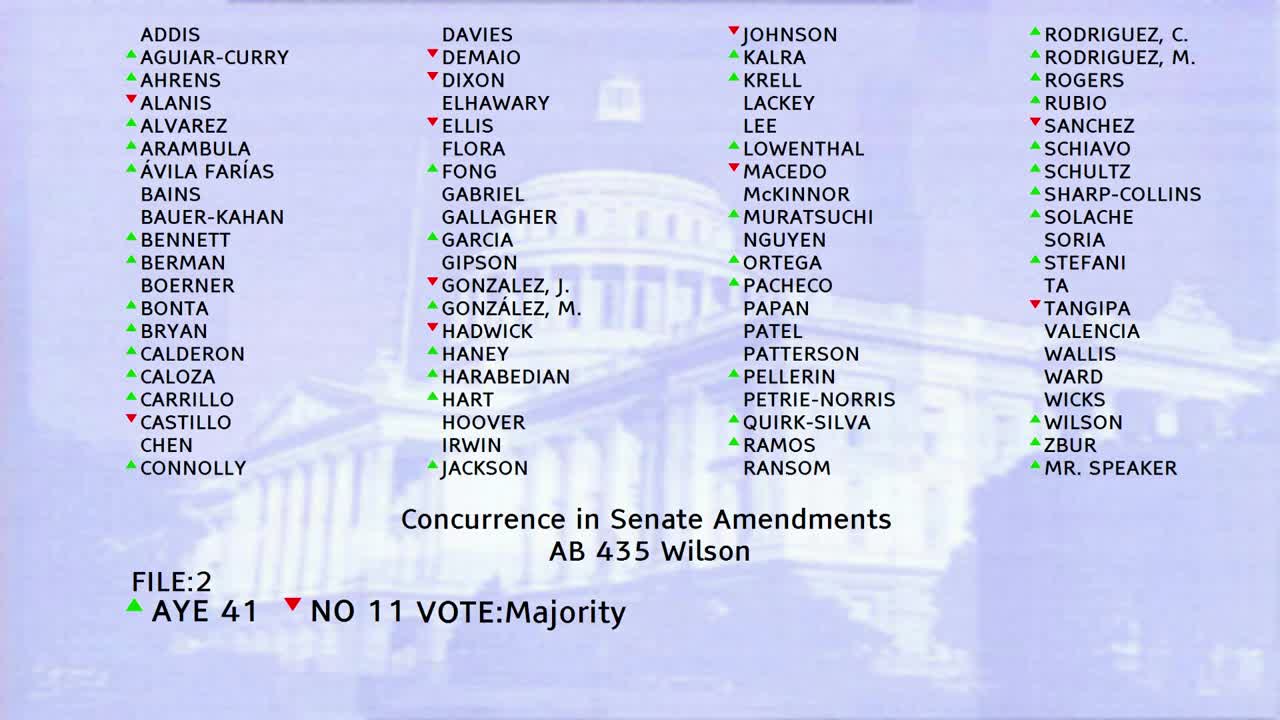
| Sep 8, 2025 | Senate amendments concurred in. To Engrossing and Enrolling. (Ayes 57. Noes 12. Page 3014.). |
| Sep 3, 2025 | In Assembly. Concurrence in Senate amendments pending. |
| Sep 3, 2025 | Read third time. Passed. Ordered to the Assembly. (Ayes 30. Noes 4. Page 2428.). |
| Jun 30, 2025 | Read second time. Ordered to third reading. |
| Jun 27, 2025 | Read third time and amended. Ordered to second reading. |
| Jun 11, 2025 | Read second time and amended. Ordered to third reading. |
| Jun 10, 2025 | From committee: Amend, and do pass as amended. (Ayes 5. Noes 0.) (June 10). |
| May 7, 2025 | Referred to Com. on PUB. S. |
| Mar 20, 2025 | In Senate. Read first time. To Com. on RLS. for assignment. |
| Mar 20, 2025 | Read third time. Passed. Ordered to the Senate. (Ayes 51. Noes 12. Page 712.) |
| Mar 12, 2025 | Read second time. Ordered to third reading. |
| Mar 11, 2025 | From committee: Do pass. (Ayes 6. Noes 0.) (March 11). |
| Mar 4, 2025 | In committee: Set, first hearing. Hearing canceled at the request of author. |
| Feb 10, 2025 | Referred to Com. on PUB. S. |
| Jan 16, 2025 | From printer. May be heard in committee February 15. |
| Jan 15, 2025 | Read first time. To print. |
|
Date
|
Description
|
Location
|
Votes
|
|
|---|---|---|---|---|
| Sep 8, 2025 | AB 248 Bryan Concurrence in Senate Amendments | Assembly Floor |
Passed |
|
| Sep 3, 2025 | Assembly 3rd Reading AB248 Bryan et al. By Becker | Senate Floor |
Passed |
|
| Jun 10, 2025 | Do pass as amended | Senate Standing Committee on Public Safety |
Passed |
|
| Mar 20, 2025 | AB 248 Bryan Assembly Third Reading | Assembly Floor |
Passed |
|
| Mar 11, 2025 | Do pass. | Assembly Standing Committee on Public Safety |
Passed |
This list shows positions taken on this bill by organizations on the date displayed, which is linked to the original source.
Positions by individuals are not included.
|
Organization
|
Position
|
Date
|
|---|---|---|
| 1 individual | ** Support | |
| A New Way of Life Re-Entry Project | ** Support | |
| All Above All | ** Support | |
| All of Us or None | ** Support | |
| Aouon Orange County | ** Support | |
| Bend the Arc: Jewish Action California | ** Support | |
| California Attorneys For Criminal Justice | ** Support | |
| California Coalition for Women Prisoners | ** Support | |
| California Immigrant Policy Center | ** Support | |
| California Innocence Coalition | ** Support | |
| California Public Defenders Association | ** Support | |
| California State Sheriffs' Association | ** Against | |
| Californians United for a Responsible Budget | ** Support | |
| Center for Employment Opportunities | ** Support | |
| Center on Juvenile and Criminal Justice | ** Support | |
| Communities United for Restorative Youth Justice | ** Support | |
| County of Los Angeles Board of Supervisors | ** Support | |
| Courage California | ** Support | |
| Debt Free Justice California | ** Support | |
| Disability Rights California | ** Support | |
| Ella Baker Center For Human Rights | ** Support | |
| Freedom 4 Youth | ** Support | |
| Friends Committee On Legislation Of California | ** Support | |
| Glide | ** Support | |
| Greenpeace Usa | ** Support | |
| Initiate Justice | ** Support | |
| Interfaith Movement for Human Integrity | ** Support | |
| Justice2jobs Coalition | ** Support | |
| LA County Public Defenders Union, Local 148 | ** Support | |
| LA Defensa | ** Support | |
| Legal Aid At Work | ** Support | |
| Legal Services for Prisoners with Children | ** Support | |
| National Employment Law Project | ** Support | |
| One Fair Wage | ** Support | |
| Riverside All of Us or None | ** Support | |
| Rubicon Programs | ** Support | |
| Ryse Center | ** Support | |
| San Francisco Public Defender | ** Support | |
| Sister Warriors Freedom Coalition | ** Support | |
| Smart Justice California | ** Support | |
| Starting Over Strong | ** Support | |
| Starting Over, Inc. | ** Support | |
| The Gathering for Justice | ** Support | |
| UAW Region 6 | ** Support | |
| Vera Institute Of Justice | ** Support | |
| Viet Voices | ** Support | |
| Western Center on Law & Poverty, INC. | ** Support | |
| Youth Empowerments Finest | ** Support | |
| Youth Leadership Institute | ** Support |
CONCURRENCE IN SENATE AMENDMENTS
CSA1 Bill Id:AB 248
Author:(Bryan)
As Amended Ver:June 27, 2025
Majority vote
SUMMARY
Authorizes the County Board of Supervisors to determine a wage to be credited to each prisoner if the prisoner is confined in or committed to a county jail and performs a work assignment.
Senate Amendments
Clarify that ″sum″ means a ″sum of money.″
COMMENTS
As passed by the assembly: This bill authorized the County Board of Supervisors to determine a wage to be credited to each prisoner if the prisoner is confined in or committed to a county jail and performs a work assignment.
According to the Author
″AB 248 will remove the arbitrary and harmful wage cap in place for incarcerated workers throughout our state's jails, and allow counties to provide their incarcerated workers with pay they deem equitable.″
Arguments in Support
According to California Attorneys for Criminal Justice, ″Incarcerated workers are workers and deserve to earn monetary wages. Currently, incarcerated workers in county jails do not earn monetary wages in over 90% of California's counties. In most counties, incarcerated workers are provided with sentence credits or other informal forms of ″compensation″ such as additional recreational time. Paying fair wages to incarcerated workers has both fiscal and non-fiscal benefits for the workers, their families, and society at large. First, paying incarcerated workers fair wages would allow them the potential to save money while incarcerated, which in turn would help them get back on their feet post-release. This would positively impact recidivism rates, as well as reincarceration expenditures and crime costs for society at large.″
Arguments in Opposition
According to California State Sheriffs' Association, ″AB 248 could create significant fiscal pressure on counties already facing challenging budget times. Counties would likely be forced to consider a substantial new cost when determining if and how to deploy inmate workers. Inmates are already eligible to earn credit toward early release by completing work assignments as well as some form of monetary compensation. AB 248 would create pressure on counties to increase the fiscal recompense provided to inmate workers, thereby potentially limiting the availability of opportunities for work while incarcerated.″
FISCAL COMMENTS
Unknown. This bill is keyed non-fiscal by the Legislative Counsel.
VOTES:
ASM PUBLIC SAFETY: 6-0-3
YES: Schultz, Mark González, Haney, Harabedian, Nguyen, Sharp-Collins
ABS, ABST OR NV: Alanis, Lackey, Ramos
ASSEMBLY FLOOR: 51-12-17
YES: Addis, Aguiar-Curry, Arambula, Ávila Farías, Bains, Bennett, Berman, Boerner, Bonta, Bryan, Caloza, Carrillo, Connolly, Elhawary, Fong, Gabriel, Garcia, Gipson, Mark González, Haney, Harabedian, Hart, Hoover, Jackson, Kalra, Krell, Lee, Lowenthal, McKinnor, Muratsuchi, Nguyen, Ortega, Pacheco, Patel, Pellerin, Petrie-Norris, Quirk-Silva, Ransom, Celeste Rodriguez, Michelle Rodriguez, Rogers, Schultz, Sharp-Collins, Soria, Stefani, Valencia, Ward, Wicks, Wilson, Zbur, Rivas
NO: Castillo, Chen, Davies, DeMaio, Dixon, Ellis, Gallagher, Jeff Gonzalez, Hadwick, Macedo, Sanchez, Tangipa
ABS, ABST OR NV: Ahrens, Alanis, Alvarez, Bauer-Kahan, Calderon, Essayli, Flora, Irwin, Lackey, Papan, Patterson, Ramos, Blanca Rubio, Schiavo, Solache, Ta, Wallis
UPDATED
VERSION: June 27, 2025
CONSULTANT: Samarpreet Kaur / PUB. S. / (916) 319-3744 FN: 0001549
SENATE RULES COMMITTEE Office of Senate Floor Analyses (916) 651-1520 Fax: (916) 327-4478 | AB 248 |
THIRD READING
Bill No: AB 248
Author: Bryan (D), et al.
Introduced: 1/15/25
Vote: 21
SENATE PUBLIC SAFETY COMMITTEE: 5-0, 6/10/25
AYES: Arreguín, Caballero, Gonzalez, Pérez, Wiener
NO VOTE RECORDED: Seyarto
ASSEMBLY FLOOR: 51-12, 3/20/25 - See last page for vote
SUBJECT: County jails: wages
SOURCE: Legal Services for Prisoners with Children
DIGEST:
This bill authorizes a county board of supervisors to determine the sum for work completed by individuals incarcerated in a county jail.
ANALYSIS:
Existing federal law states that neither slavery nor involuntary servitude, except as a punishment for crime whereof the party shall have been duly convicted, shall exist within the United States, nor any place subject to their jurisdiction. (U.S. Constitution (Const.), 13th Amend.)
Existing state law:
- Prohibits slavery. (California Constitution (Cal. Const.,) art. I, § 6.)
- Prohibits involuntary servitude except to punish crime. (Cal. Const., art. I, § 6.)
- Provides that the common jails in the several counties of this state are kept by the sheriffs of the counties in which they are respectively situated, and are used as follows:
- For the detention of persons committed in order to secure their attendance as witnesses in criminal cases;
- For the detention of persons charged with crime and committed for trial;
- For the confinement of persons committed for contempt, or upon civil process, or by other authority of law;
- For the confinement of persons sentenced to imprisonment therein upon a conviction for crime; and,
- For the confinement of persons for a violation of the terms and conditions of their postrelease community supervision. (Penal (Pen.) Code, § 4000.)
- Authorizes a board of supervisors to provide that each individual confined in or committed to a county jail be credited with a sum not to exceed $2 for each eight hours of work done by the incarcerated person. (Pen. Code, § 4019.3.)
This bill authorizes a county board of supervisors to determine the sum for work completed by individuals incarcerated in a county jail.
Background
Under current law, the board of supervisors of a county is authorized to credit a person incarcerated in the county jail up to $2 for each eight hours of work. (Pen. Code, § 4019.3.) In practice, many counties do not provide incarcerated workers with any monetary compensation. (Joe Garcia, ‘Relic of slavery’: California lawmakers are trying again to raise pay for incarcerated workers (May 19, 2025) available at <https://www.calmatters.org/justice/2025/05/incarcerated-worker-pay/#:~:text=Most%20California%20county%20jails%20do,an%20hour%2C”%20explained%20Bryan. ) The same article observed: “Mopping floors, cleaning toilets, preparing and distributing three meals a day for all persons in lockup — sheriffs and jailers treat these essential jobs as privileges bestowed on individuals who choose to trade work for time outside their cells and other perks, such as guaranteed daily showers or extra food.” (Ibid.)
A prior effort to make changes to the wages of workers incarcerated in the state’s prisons was unsuccessful. See SB 1371 (Bradford, Chapter 723, Statutes of 2022) of the 2021-2022 legislative session. In addition, Proposition 6 would have prohibited involuntary servitude with no exceptions and would have applied to both state prisons and county jails. It was rejected by the voters in November 2024.
This bill eliminates the current $2 cap per 8 hours of work and instead, authorizes a county board of supervisors to determine an amount for work completed by individuals incarcerated in a county jail. Proponents of this bill argue that the compensation currently provided, if any, to individuals incarcerated in county jails is so low that these individuals are unable to afford basic hygiene items and food products from the jail commissary, sometimes leading people to go into debt in order to purchase these types of products. Supporters of this bill also assert that low or no monetary compensation limits a person’s ability to pay restitution, causing many to go into debt.
FISCAL EFFECT: Appropriation: No Fiscal Com.: No Local: No
SUPPORT: (Verified 6/10/25)
Legal Services for Prisoners With Children (source)
A New Way of Life Re-Entry Project
All Above All
All of Us or None
California Attorneys for Criminal Justice
California Public Defenders Association
Center for Employment Opportunities
Communities United for Restorative Youth Justice
County of Los Angeles Board of Supervisors
Courage California
Debt Free Justice California
Disability Rights California
Ella Baker Center for Human Rights
Freedom 4 Youth
Friends Committee on Legislation of California
Greenpeace USA
Initiate Justice
Justice2Jobs Coalition
LA County Public Defenders Union, Local 148
La Defensa
National Employment Law Project
One Fair Wage
Riverside All of Us or None
Sister Warriors Freedom Coalition
Smart Justice California
The Gathering for Justice
UAW Region 6
Vera Institute of Justice
Viet Voices
1 Individual
OPPOSITION: (Verified 6/10/25)
California State Sheriffs’ Association
ARGUMENT IN SUPPORT:
The LA County Public Defenders Union, Local 148 writes:
This bill would promote dignity, fairness, and financial stability for incarcerated workers in California’s counties. Current law…sets a maximum wage of $2.00 per eight-hour shift for incarcerated workers in the custody of county jails. AB 248 would repeal this maximum wage and would allow counties to set their own wages for incarcerated workers under their jurisdiction. This bill does not require counties to pay wages to incarcerated workers; it simply gives them the authority to do so.
…
Incarcerated workers are workers and deserve to earn monetary wages. Currently, incarcerated workers in county jails do not earn monetary wages in over 90% of California’s counties. In most counties, incarcerated workers are provided with sentence credits or other informal “compensation” such as additional recreational time.
Paying fair wages to incarcerated workers has fiscal and non-fiscal benefits for the workers, their families, and society. First, paying incarcerated workers fair wages would allow them to potentially save money while incarcerated and help them to get back on their feet immediately post-release. This would positively impact recidivism rates and, therefore, reincarceration expenditures and crime costs for California. In addition, if incarcerated workers make monetary wage, they can better support family members, children, and other loved ones outside. Finally, paying fair wages to incarcerated workers can improve mental health outcomes, boost morale, and encourage personal agency.
ARGUMENT IN OPPOSITION:
According to the California State Sheriffs’ Association:
AB 248 would allow the board of supervisors to credit each prisoner with a wage to be determined by the board if the prisoners is confined in or committed to a county jail and performs a work assignment.
AB 248 could create significant fiscal pressure on counties already facing challenging budget times. Counties would likely be forced to consider a substantial new cost when determining if and how to deploy inmate workers. Inmates are already eligible to earn credit toward early release by completing work assignments as well as some form of monetary compensation. AB 248 would create pressure on counties to increase the fiscal recompense provided to inmate workers, thereby potentially limiting the availability of opportunities for work while incarcerated.
ASSEMBLY FLOOR: 51-12, 3/20/25
AYES: Addis, Aguiar-Curry, Arambula, Ávila Farías, Bains, Bennett, Berman, Boerner, Bonta, Bryan, Caloza, Carrillo, Connolly, Elhawary, Fong, Gabriel, Garcia, Gipson, Mark González, Haney, Harabedian, Hart, Hoover, Jackson, Kalra, Krell, Lee, Lowenthal, McKinnor, Muratsuchi, Nguyen, Ortega, Pacheco, Patel, Pellerin, Petrie-Norris, Quirk-Silva, Ransom, Celeste Rodriguez, Michelle Rodriguez, Rogers, Schultz, Sharp-Collins, Soria, Stefani, Valencia, Ward, Wicks, Wilson, Zbur, Rivas
NOES: Castillo, Chen, Davies, DeMaio, Dixon, Ellis, Gallagher, Jeff Gonzalez, Hadwick, Macedo, Sanchez, Tangipa
NO VOTE RECORDED: Ahrens, Alanis, Alvarez, Bauer-Kahan, Calderon, Essayli, Flora, Irwin, Lackey, Papan, Patterson, Ramos, Blanca Rubio, Schiavo, Solache, Ta, Wallis
Prepared by: Stephanie Jordan / PUB. S. /
6/11/25 15:55:34
**** END ****
SENATE COMMITTEE ON PUBLIC SAFETY
Senator Jesse Arreguín, Chair
2025 - 2026 Regular
Bill No: AB 248 Hearing Date: June 10, 2025
Author: | Bryan | ||
Version: | January 15, 2025 | ||
Urgency: | No | Fiscal: | No |
Consultant: | SJ | ||
Subject: County jails: wages
HISTORY
Source: Legal Services for Prisoners With Children
Prior Legislation: Proposition 6, rejected by the voters, 2024
AB 1810 (Bryan), Ch. 939, Stats. of 2024
AB 1875 (McKinnor), Ch. 56, Stats. of 2024
SB 474 (Becker), Ch. 609, Stats. of 2023
ACA 3 (Kamlager), failed passage on the Senate Floor, 2022
SB 1371 (Bradford), vetoed, 2022
SB 1008 (Becker), Ch. 827, Stats. of 2022
SCR 69 (Bradford), not heard in Assembly Public Safety, 2020
AB 1396 (Craven), Ch. 350, Stats. of 1975
SB 1394 (Fisher), Ch. 1226, Stats. of 1959
Support: A New Way of Life Re-Entry Project; All Above All; All of Us or None; California Attorneys for Criminal Justice; California Public Defenders Association; Center for Employment Opportunities; Communities United for Restorative Youth Justice; County of Los Angeles Board of Supervisors; Courage California; Debt Free Justice California; Disability Rights California; Ella Baker Center for Human Rights; Freedom 4 Youth; Friends Committee on Legislation of California; Greenpeace USA; Initiate Justice; Justice2Jobs Coalition; LA County Public Defenders Union, Local 148; La Defensa; National Employment Law Project; One Fair Wage; Riverside All of Us or None; Smart Justice California; UAW Region 6; Vera Institute of Justice; 1 Individual
Opposition: California State Sheriffs’ Association
Assembly Floor Vote: 51 - 12
PURPOSE
The purpose of this bill is to authorize a county board of supervisors to determine the wages for individuals incarcerated in a county jail.
Existing federal law states that neither slavery nor involuntary servitude, except as a punishment for crime whereof the party shall have been duly convicted, shall exist within the United States, or any place subject to their jurisdiction. (U.S. Const., 13th Amend.)
Existing law prohibits slavery. (Cal. Const., art. I, § 6.)
Existing law prohibits involuntary servitude except to punish crime. (Cal. Const., art. I, § 6.)
Existing law provides that the common jails in the several counties of this state are kept by the sheriffs of the counties in which they are respectively situated, and are used as follows:
- For the detention of persons committed in order to secure their attendance as witnesses in criminal cases;
- For the detention of persons charged with crime and committed for trial;
- For the confinement of persons committed for contempt, or upon civil process, or by other authority of law;
- For the confinement of persons sentenced to imprisonment therein upon a conviction for crime; and,
- For the confinement of persons for a violation of the terms and conditions of their postrelease community supervision. (Pen. Code, § 4000.)
Existing law authorizes a board of supervisors to provide that each individual confined in or committed to a county jail be credited with a sum not to exceed $2 for each eight hours of work done by the incarcerated person. (Pen. Code, § 4019.3.)
This bill authorizes a county board of supervisors to determine the wages for individuals incarcerated in a county jail.
COMMENTS
- Need For This Bill
According to the author:
AB 248 will remove the arbitrary and harmful wage cap in place for incarcerated workers throughout our state’s jails and allow counties to provide their incarcerated workers with pay they deem equitable.
- Wages for Workers Incarcerated in County Jail
Under current law, the board of supervisors of a county is authorized to pay a person incarcerated in the county jail up to $2 for each eight hours of work. (Pen. Code, § 4019.3.) In practice, many counties do not pay incarcerated workers any wages. (Joe Garcia, ‘Relic of slavery’: California lawmakers are trying again to raise pay for incarcerated workers (May 19, 2025) available at <https://www.calmatters.org/justice/2025/05/incarcerated-worker-pay/#:~:text=Most%20California%20county%20jails%20do,an%20hour%2C”%20explained%20Bryan.>) The same article observed: “Mopping floors, cleaning toilets, preparing and distributing three meals a day for all persons in lockup — sheriffs and jailers treat these essential jobs as privileges bestowed on individuals who choose to trade work for time outside their cells and other perks, such as guaranteed daily showers or extra food.” (Ibid.)
A prior effort to make changes to the wages of workers incarcerated in the state’s prisons was unsuccessful. (See SB 1371 (Bradford) of the 2021-2022 legislative session.) In addition, Proposition 6 would have prohibited involuntary servitude with no exceptions and would have applied to both state prisons and county jails. It was rejected by the voters in November 2024.
This bill eliminates the current $2 cap per 8 hours of work and instead, authorizes a county board of supervisors to determine the wages for individuals incarcerated in a county jail. Proponents of this bill argue that the wages currently provided, if any, to individuals incarcerated in county jails are so low that these individuals are unable to afford basic hygiene items and food products from the jail commissary, sometimes leading people to go into debt in order to purchase these types of products. Supporters of the bill also assert that low or no wages limit a person’s ability to pay restitution, causing many to go into debt.
- Argument in Support
The LA County Public Defenders Union, Local 148 writes:
This bill would promote dignity, fairness, and financial stability for incarcerated workers in California’s counties. Current law…sets a maximum wage of $2.00 per eight-hour shift for incarcerated workers in the custody of county jails. AB 248 would repeal this maximum wage and would allow counties to set their own wages for incarcerated workers under their jurisdiction. This bill does not require counties to pay wages to incarcerated workers; it simply gives them the authority to do so.
…
Incarcerated workers are workers and deserve to earn monetary wages. Currently, incarcerated workers in county jails do not earn monetary wages in over 90% of California’s counties. In most counties, incarcerated workers are provided with sentence credits or other informal “compensation” such as additional recreational time.
Paying fair wages to incarcerated workers has fiscal and non-fiscal benefits for the workers, their families, and society. First, paying incarcerated workers fair wages would allow them to potentially save money while incarcerated and help them to get back on their feet immediately post-release. This would positively impact recidivism rates and, therefore, reincarceration expenditures and crime costs for California. In addition, if incarcerated workers make monetary wage, they can better support family members, children, and other loved ones outside. Finally, paying fair wages to incarcerated workers can improve mental health outcomes, boost morale, and encourage personal agency.
- Argument in Opposition
According to the California State Sheriffs’ Association:
AB 248 would allow the board of supervisors to credit each prisoner with a wage to be determined by the board if the prisoners is confined in or committed to a county jail and performs a work assignment.
AB 248 could create significant fiscal pressure on counties already facing challenging budget times. Counties would likely be forced to consider a substantial new cost when determining if and how to deploy inmate workers. Inmates are already eligible to earn credit toward early release by completing work assignments as well as some form of monetary compensation. AB 248 would create pressure on counties to increase the fiscal recompense provided to inmate workers, thereby potentially limiting the availability of opportunities for work while incarcerated.
-- END --
ASSEMBLY THIRD READING
ATR Bill Id:AB 248
Author:(Bryan)
As Introduced Ver:January 15, 2025
Majority vote
SUMMARY
Authorizes the County Board of Supervisors to determine a wage to be credited to each prisoner if the prisoner is confined in or committed to a county jail and performs a work assignment.
Major Provisions
COMMENTS
According to the Author
"AB 248 will remove the arbitrary and harmful wage cap in place for incarcerated workers throughout our state's jails, and allow counties to provide their incarcerated workers with pay they deem equitable.”
Arguments in Support
According to California Attorneys for Criminal Justice, "Incarcerated workers are workers and deserve to earn monetary wages. Currently, incarcerated workers in county jails do not earn monetary wages in over 90% of California's counties. In most counties, incarcerated workers are provided with sentence credits or other informal forms of "compensation" such as additional recreational time. Paying fair wages to incarcerated workers has both fiscal and non-fiscal benefits for the workers, their families, and society at large. First, paying incarcerated workers fair wages would allow them the potential to save money while incarcerated, which in turn would help them get back on their feet post-release. This would positively impact recidivism rates, as well as reincarceration expenditures and crime costs for society at large."
Arguments in Opposition
According to California State Sheriffs' Association, "AB 248 could create significant fiscal pressure on counties already facing challenging budget times. Counties would likely be forced to consider a substantial new cost when determining if and how to deploy inmate workers. Inmates are already eligible to earn credit toward early release by completing work assignments as well as some form of monetary compensation. AB 248 would create pressure on counties to increase the fiscal recompense provided to inmate workers, thereby potentially limiting the availability of opportunities for work while incarcerated."
FISCAL COMMENTS
Unknown. This bill is keyed non-fiscal by the Legislative Counsel.
VOTES
ASM PUBLIC SAFETY: 6-0-3
YES: Schultz, Mark González, Haney, Harabedian, Nguyen, Sharp-Collins
ABS, ABST OR NV: Alanis, Lackey, Ramos
UPDATED
VERSION: January 15, 2025
CONSULTANT: Samarpreet Kaur / PUB. S. / (916) 319-3744 FN: 0000038
Date of Hearing: March 11, 2025
Consultant: Samarpreet Kaur
ASSEMBLY COMMITTEE ON PUBLIC SAFETY
Nick Schultz, Chair
ABPCA Bill Id:AB 248
Author:(Bryan) – As Introduced Ver:January 15, 2025
SUMMARY:
Authorizes the County Board of Supervisors to determine a wage to be credited to each prisoner if the prisoner is confined in or committed to a county jail and performs a work assignment.
EXISTING LAW:
- States that the common jails in the several counties of this state are kept by the sheriffs of the counties in which they are respectively situated, and are used as follows:
(a) For the detention of persons committed in order to secure their attendance as witnesses in criminal cases;
(b) For the detention of persons charged with crime and committed for trial;
(c) For the confinement of persons committed for contempt, or upon civil process, or by other authority of law;
(d) For the confinement of persons sentenced to imprisonment therein upon a conviction for crime; and,
(e) For the confinement of persons for a violation of the terms and conditions of their postrelease community supervision. (Pen. Code, § 4000.) - States that the board of supervisors may provide that each prisoner confined in or committed to a county jail shall be credited with a sum not to exceed two dollars ($2) for each eight hours of work done by the prisoner in such county jail. (Pen. Code, § 4019.3.)
FISCAL EFFECT:
Unknown
COMMENTS:
- Author's Statement: According to the author, "AB 248 will remove the arbitrary and harmful wage cap in place for incarcerated workers throughout our state’s jails, and allow counties to provide their incarcerated workers with pay they deem equitable.”
- Background: As of December 2024, there are 96,000 incarcerated individuals in California state prisons and 59,300 individuals being held in California county jails.[1] On average incarcerated individuals in prisons earn $0.08 to $0.37 per hour for half time and partial full time employment; or $12.00 to $56.00 per month for full time employment. These are roughly equivalent rates to 7 hour work days and 22 days per month.[2] California Department of Corrections and Rehabilitations (CDCR) 2024 operations manual breaks down the rate of wages, created by the CDCR inmate pay committee, that inmates can be eligible for in the table below[3]:
Minimum – Maximum Hourly | Minimum – Maximum Monthly | |
Level I DOT 9 Lead person | $0.32 - $0.37 | $48 - $56 |
Level 2 DOT 7-8 Special Skill | $0.l9 - $0.32 | $29 - $48 |
Level 3 DOT 5-6 Technician | $0.15 - $0.24 | $23 - $36 |
Level 4 DOT 3-4 Semi-Skill | $0.11 - $0.18 | $17 - $27 |
Level 5 DOT 1-2 Laborer | $0.08 - $0.13 | $12 - $20 |
There is not sufficient data that points to exactly how much county jail inmates get in wages for work that is done while in custody. Existing law states that the county board of supervisors may provide that each prisoner confined in or committed to a county jail shall be credited with a sum not to exceed two dollars ($2) for each eight hours of work done in such county jail. (Pen. Code, § 4019.3.) However, because there is no minimum stated in existing law, individuals confined in county jails may not get compensated in wages for the work that they perform. According to multiple organizations in support of this bill, data received through a Public Records Request sent to all 58 counties, the 48 county sheriffs’ offices who provided records responsive to this request, 44 (92%) indicated that workers incarcerated in their county’s jails are not paid monetary wages.
Penal code section 4019.3 has not been amended since 1975, when AB 1396 (Craven), Chapter 350, increased the wage limit credited to prisoners in county jail from fifty cent to two dollars. AB 248 aims to get rid of the $2 maximum put into place through existing law for individuals confined in county jails. This bill would give counties the discretion to decide a fair wage for work performed while confined in county jails.
- Ballot Measure: Proposition 6: In the 2024 General election, the California Legislature put forth Proposition 6, which intended to eliminate the current state constitutional provision that allows jails and prisons to impose involuntary servitude to punish crime. Approximately 8 million voters voted NO on Proposition 6. If this proposition were to have passed by the voters, it would have tasked CDCR and the County Board of Supervisors to change or set wages for voluntary work assignments done by incarcerated workers in prison or jail.[4] However, with this measure failing, it seems to suggest that offering incarcerated workers increased wages is concerning to Californians due to the implied increase of state costs.
As discussed above, this bill will give each county the chance to set wages for incarcerated workers confined in jail at their own discretion. This bill would not mandate that each county pay a certain wage for incarcerated workers performing a work assignment while confined in jail, potentially avoiding the issue of increased state mandated costs that Proposition 6 would have created if passed.
- Argument in Support: According to California Attorneys for Criminal Justice, “Incarcerated workers are workers and deserve to earn monetary wages. Currently, incarcerated workers in county jails do not earn monetary wages in over 90% of California’s counties.1 In most counties, incarcerated workers are provided with sentence credits or other informal forms of “compensation” such as additional recreational time. Paying fair wages to incarcerated workers has both fiscal and non-fiscal benefits for the workers, their families, and society at large. First, paying incarcerated workers fair wages would allow them the potential to save money while incarcerated, which in turn would help them get back on their feet post-release. This would positively impact recidivism rates, as well as reincarceration expenditures and crime costs for society at large.”
- Argument in Opposition: According to California State Sheriffs' Association, “AB 248 could create significant fiscal pressure on counties already facing challenging budget times. Counties would likely be forced to consider a substantial new cost when determining if and how to deploy inmate workers. Inmates are already eligible to earn credit toward early release by completing work assignments as well as some form of monetary compensation. AB 248 would create pressure on counties to increase the fiscal recompense provided to inmate workers, thereby potentially limiting the availability of opportunities for work while incarcerated.”
- Prior Legislation:
- SB 1394 (Fisher), Chapter 1226, Statutes of 1959, added section 4019.3 to the penal code and stated that each prisoner confined in or committed to a county jail shall be credited with a sum not to exceed fifty cents for each eight hours of work.
- AB 1396 (Craven), Chapter 350, Statutes of 1975, amended section 4019.3 of the penal code and stated that each prisoner confined in or committed to a county jail shall be credited with a sum not to exceed two dollars for each eight hours of work.
REGISTERED SUPPORT / OPPOSITION:
Support
A New Way of Life Re-entry Project
Aouon Orange County
Bend the Arc: Jewish Action California
California Attorneys for Criminal Justice
California Coalition for Women Prisoners
California Immigrant Policy Center
California Innocence Coalition
California Public Defenders Association (CPDA)
Californians United for A Responsible Budget
Center for Employment Opportunities
Center on Juvenile and Criminal Justice
Communities United for Restorative Youth Justice (CURYJ)
Courage California
Ella Baker Center for Human Rights
Glide
Initiate Justice
Initiate Justice Action
Interfaith Movement for Human Integrity
Justice2jobs Coalition
LA Defensa
Legal Aid At Work
Legal Services for Prisoners With Children
Local 148 LA County Public Defenders Union
One Fair Wage
Riverside All of Us or None
Rubicon Programs
Ryse Center
San Francisco Public Defender
Sister Warriors Freedom Coalition
Smart Justice California, a Project of Tides Advocacy
Starting Over Strong
Starting Over, INC.
UAW Region 6
Vera Institute of Justice
Western Center on Law & Poverty, INC.
Youth Empowerments Finest
Youth Leadership Institute
Oppose
California State Sheriffs' Association
Analysis Prepared by:
Samarpreet Kaur / PUB. S. / (916) 319-3744
Discussed in Hearing
 1MIN
Assembly Floor
 3MIN
Senate Floor
 14MIN
Senate Standing Committee on Public Safety
 8MIN
Assembly Floor
 19MIN
Assembly Standing Committee on Public Safety
 14MIN
Assembly Standing Committee on Public Safety
Bill Author

Bill Co-Author(s):