AB 2502: Vehicles: driving under the influence: driving automation.
- Session Year: 2025-2026
- House: Assembly
- Latest Version Date: 2026-08-30
Current Status:
Failed
(2026-09-27: Vetoed by Governor.)
Introduced
In Committee
Awaiting First Chamber Vote
Passed First Chamber
In Committee
Awaiting Second Chamber Vote
Passed Second Chamber
Enacted
Existing law makes it unlawful for a person who has 0.08% or more, by weight, of alcohol in their blood to drive a vehicle or to drive under the influence of alcohol or drugs and prescribes certain penalties depending on additional facts, such as whether the driving resulted in an injury to another. Existing decisional law holds that the slight volitional movement of the vehicle is sufficient for a driving under the influence violation.
This bill would state that for the purposes of a driving under the influence violation, drive includes the volitional movement of a vehicle with driver support features engaged that require a person to supervise the vehicle in order to steer, brake, or accelerate, as needed to maintain safety. To the extent that this bill would expand the scope of a crime, it would impose a state-mandated local program.
The California Constitution requires the state to reimburse local agencies and school districts for certain costs mandated by the state. Statutory provisions establish procedures for making that reimbursement.
This bill would provide that no reimbursement is required by this act for a specified reason.
Existing law makes it unlawful for a person who has 0.08% or more, by weight, of alcohol in their blood to drive a vehicle or to drive under the influence of alcohol or drugs and prescribes certain penalties depending on additional facts, such as whether the driving resulted in an injury to another. Existing decisional law holds that the slight volitional movement of the vehicle is sufficient for a driving under the influence violation.
This bill would state that for the purposes of a driving under the influence violation, drive includes the volitional movement of a vehicle with specified levels of driving automation, as defined. Because driver support features engaged that require a person to supervise the vehicle in order to steer, brake, or accelerate, as needed to maintain safety. To the extent that this bill would expand the scope of a crime, it would impose a state-mandated local program.
The California Constitution requires the state to reimburse local agencies and school districts for certain costs mandated by the state. Statutory provisions establish procedures for making that reimbursement.
This bill would provide that no reimbursement is required by this act for a specified reason.
Existing law makes it unlawful for a person who has 0.08% or more, by weight, of alcohol in their blood to drive a vehicle or to drive under the influence of alcohol or drugs and prescribes certain penalties depending on additional facts, such as whether the driving resulted in an injury to another. Existing decisional law holds that the slight volitional movement of the vehicle is sufficient for a driving under the influence violation.
This bill would state that for the purposes of a driving under the influence violation, drive includes the volitional movement of a vehicle with specified levels of driving automation, as defined. Because this bill would expand the scope of a crime, it would impose a state-mandated local program.
The California Constitution requires the state to reimburse local agencies and school districts for certain costs mandated by the state. Statutory provisions establish procedures for making that reimbursement.
This bill would provide that no reimbursement is required by this act for a specified reason.
For the purposes of Section 191.5 of the Penal Code, and Section 23103, as specified in Section 23103.5, 23152, or 23153, drive includes the volitional movement of a vehicle with driver support features engaged that require a person to supervise the vehicle in order to steer, brake, or accelerate, as needed to maintain safety. This includes driver support features that require constant supervision and those that require a person to take direct control of the vehicle upon the request of the driver support feature. The term drive does not include operating a vehicle with driver support features engaged that do not require a person to supervise the vehicle in order to steer, brake, or accelerate, as needed to maintain safety, and will not request a person to take direct control of the vehicle.
SEC. 2.No reimbursement is required by this act pursuant to Section 6 of Article XIIIB of the California Constitution because the only costs that may be incurred by a local agency or school district will be incurred because this act creates a new crime or infraction, eliminates a crime or infraction, or changes the penalty for a crime or infraction, within the meaning of Section 17556 of the Government Code, or changes the definition of a crime within the meaning of Section 6 of Article XIIIB of the California Constitution.
For the purposes of Section 191.5 of the Penal Code, and Section 23103, as specified in Section 23103.5, 23152, or 23153, drive includes the volitional movement of a vehicle with a Level 0, Level 1, Level 2, or Level 3, of driving automation, as those levels are defined by the Society of Automotive Engineers. driver support features engaged that require a person to supervise the vehicle in order to steer, brake, or accelerate, as needed to maintain safety. This includes driver support features that require constant supervision and those that require a person to take direct control of the vehicle upon the request of the driver support feature.
SEC. 2.No reimbursement is required by this act pursuant to Section 6 of Article XIIIB of the California Constitution because the only costs that may be incurred by a local agency or school district will be incurred because this act creates a new crime or infraction, eliminates a crime or infraction, or changes the penalty for a crime or infraction, within the meaning of Section 17556 of the Government Code, or changes the definition of a crime within the meaning of Section 6 of Article XIIIB of the California Constitution.
For the purposes of Section 191.5 of the Penal Code, and Section 23103, as specified in Section 23103.5, 23152, or 23153, drive includes the volitional movement of a vehicle with a Level 0, Level 1, Level 2, or Level 3, of driving automation, as those levels are defined by the Society of Automotive Engineers.
SEC. 2.No reimbursement is required by this act pursuant to Section 6 of Article XIIIB of the California Constitution because the only costs that may be incurred by a local agency or school district will be incurred because this act creates a new crime or infraction, eliminates a crime or infraction, or changes the penalty for a crime or infraction, within the meaning of Section 17556 of the Government Code, or changes the definition of a crime within the meaning of Section 6 of Article XIIIB of the California Constitution.
REVISIONS: HeadingLine 2.|
Date
|
Status
|
|---|---|
| Sep 27, 2026 | Vetoed by Governor. |
| Sep 3, 2026 | Enrolled and presented to the Governor at 4 p.m. |
| Aug 26, 2026 | Senate amendments concurred in. To Engrossing and Enrolling. (Ayes 79. Noes 0.). |
| Aug 26, 2026 | Senate amendments concurred in. To Engrossing and Enrolling. (Ayes 79. Noes 0. Page 6585.). |
| Aug 25, 2026 | In Assembly. Concurrence in Senate amendments pending. |
| Aug 25, 2026 | Read third time. Passed. Ordered to the Assembly. (Ayes 40. Noes 0. Page 5786.). |
| Aug 25, 2026 | Read third time. Passed. Ordered to the Assembly. (Ayes 38. Noes 0.). |
| Aug 24, 2026 | Read second time. Ordered to third reading. |
| Aug 21, 2026 | Read third time and amended. Ordered to second reading. |
| Aug 6, 2026 | Ordered to third reading. |
| Aug 6, 2026 | From Consent Calendar. |
| Aug 4, 2026 | Read second time. Ordered to Consent Calendar. |
| Aug 3, 2026 | From committee: Be ordered to second reading file pursuant to Senate Rule 28.8 and ordered to Consent Calendar. |
| Jul 2, 2026 | Read second time and amended. Re-referred to Com. on APPR. |
| Jul 1, 2026 | From committee: Amend, and do pass as amended and re-refer to Com. on APPR. with recommendation: To Consent Calendar. (Ayes 6. Noes 0.) (June 30). |
| Jun 22, 2026 | Referred to Com. on PUB. S. |
| Apr 23, 2026 | In Senate. Read first time. To Com. on RLS. for assignment. |
| Apr 23, 2026 | Read third time. Passed. Ordered to the Senate. (Ayes 74. Noes 0.) |
| Apr 23, 2026 | Read third time. Passed. Ordered to the Senate. (Ayes 74. Noes 0. Page 4795.) |
| Apr 16, 2026 | Read second time. Ordered to Consent Calendar. |
| Apr 15, 2026 | From committee: Do pass. To Consent Calendar. (Ayes 13. Noes 0.) (April 15). |
| Mar 25, 2026 | From committee: Do pass and re-refer to Com. on APPR. with recommendation: To Consent Calendar. (Ayes 8. Noes 0.) (March 24). Re-referred to Com. on APPR. |
| Mar 25, 2026 | Coauthors revised. |
| Mar 9, 2026 | Referred to Com. on PUB. S. |
| Feb 21, 2026 | From printer. May be heard in committee March 23. |
| Feb 20, 2026 | Read first time. To print. |
|
Date
|
Description
|
Location
|
Votes
|
|
|---|---|---|---|---|
| Aug 26, 2026 | AB 2502 Pellerin Concurrence in Senate Amendments | Assembly Floor |
Passed |
|
| Aug 25, 2026 | Assembly 3rd Reading AB2502 Pellerin et al. By Arreguín | Senate Floor |
Passed |
|
| Jun 30, 2026 | Do pass as amended, but first amend, and re-refer to the Committee on [Appropriations] with the recommendation: To Consent Calendar | Senate Standing Committee on Public Safety |
Passed |
|
| Apr 23, 2026 | AB 2502 Pellerin Consent Calendar Second Day Regular Session | Assembly Floor |
Passed |
|
| Apr 15, 2026 | Do pass. To Consent Calendar. | Assembly Standing Committee on Appropriations |
Passed |
|
| Mar 24, 2026 | Do pass and be re-referred to the Committee on [Appropriations] with recommendation: To Consent Calendar | Assembly Standing Committee on Public Safety |
Passed |
This list shows positions taken on this bill by organizations on the date displayed, which is linked to the original source.
Positions by individuals are not included.
|
Organization
|
Position
|
Date
|
|---|---|---|
| AAA Northern California, Nevada & Utah | ** Support | |
| Alcohol Justice | ** Support | |
| Arcadia Police Officers' Association | ** Support | |
| Automobile Club of Southern California | ** Support | |
| Brea Police Association | ** Support | |
| Burbank Police Officers' Association | ** Support | |
| California Association Of Highway Patrolmen | ** Support | |
| California Association of School Police Chiefs | ** Support | |
| California Coalition of School Safety Professionals | ** Support | |
| California Narcotic Officers' Association | ** Support | |
| California Police Chiefs Association | ** Support | |
| California Reserve Peace Officers Association | ** Support | |
| CLAREMONT POLICE OFFICERS ASSOCIATION | ** Support | |
| Corona Police Officers Association | ** Support | |
| Culver City Police Officers' Association | ** Support | |
| Fullerton Police Officers' Association | ** Support | |
| Los Angeles County District Attorney’s Office | ** Support | |
| Los Angeles School Police Management Association | ** Support | |
| los angeles school police officers association | ** Support | |
| Mothers Against Drunk Driving | ** Support | |
| Murrieta Police Officers' Association | ** Support | |
| Newport Beach Police Association | ** Support | |
| Palos Verdes Police Officers' Association | ** Support | |
| Placer County Deputy Sheriffs' Association | ** Support | |
| Pomona Police Officers' Association | ** Support | |
| Riverside Police Officers' Association | ** Support | |
| Riverside Sheriffs' Association | ** Support | |
| Safe California Roads Coalition | ** Support | |
| Safety and Advocacy for Empowerment (SAFE) | ** Support | |
| Streets Are For Everyone | ** Support | |
| Streets for All | ** Support |
GOVERNOR′S VETO
GV Bill Id:AB 2502
Author:(Pellerin)
As Enrolled Ver:August 30, 2026
2/3 vote
SUMMARY
Specifies, for purposes of the crimes of intoxicated vehicular manslaughter, driving under the influence (DUI), DUI causing bodily injury to another, and reckless driving in satisfaction of, or as a substitute for, an original DUI charge (″wet reckless″), as specified, ″drive″ includes the volitional movement of a vehicle with driver support features engaged that require a person to supervise the vehicle in order to steer, brake, or accelerate, as needed to maintain safety, as specified.
Senate Amendments
- Remove the bill′s application to vehicles with a Level 0, Level 1, Level 2, or Level 3 of driving automation, as those levels are defined by the Society of Automotive Engineers.
- Apply the bill, instead, to vehicles with driver support features engaged that require a person to supervise the vehicle in order to steer, brake, or accelerate, as needed to maintain safety, and state that this includes driver support features that require constant supervision and those that require a person to take direct control of the vehicle upon the request of the driver support feature.
- State that the term ″drive″ does not include operating a vehicle with driver support features engaged that do not require a person to supervise the vehicle in order to steer, brake, or accelerate, as needed to maintain safety, and will not request a person to take direct control of the vehicle.
Governor′s Veto Message
″This bill would define ′drive′ for purposes of certain driving under the influence, reckless driving, and vehicular manslaughter offenses when a vehicle is operating with specified driver-support technology.
″I share the author′s goal in ensuring that drivers cannot avoid responsibility for impaired driving by engaging partially automated technology. Unfortunately, this bill as drafted introduces significant uncertainties into DUI law, which could have the unintended consequence of making it more difficult to hold dangerous drivers accountable. By using undefined terms such as ′driver support features,′ this bill could leave officers, prosecutors, and courts to resolve complex questions about a vehicle′s software and capabilities before determining whether an impaired individual was legally driving.
″Further, the incident cited as the impetus for this bill resulted in the driver being arrested, prosecuted, and convicted of DUI, demonstrating that existing law can already hold impaired drivers accountable when these systems are engaged. I encourage the Legislature to revisit this important issue next year, and instead focus on a comprehensive framework that consistently addresses responsibility across vehicles technologies and traffic offenses, while preserving effective enforcement of the state′s impaired driving laws.″
COMMENTS
As passed by the Assembly, this bill: Specified, for purposes of the crimes of intoxicated vehicular manslaughter, driving under the influence (DUI), DUI causing bodily injury to another, and reckless driving in satisfaction of, or as a substitute for, an original DUI charge (″wet reckless″), as specified, ″drive″ includes the volitional movement of a vehicle with a Level 0, Level 1, Level 2, or Level 3 of driving automation, as those levels are defined by the Society of Automotive Engineers (SAE).
According to the Author
″Semi-autonomous vehicles have been on California roads since 2014 and currently, two out of every five cars sold in the U.S. possess some sort of semi-autonomous capability. In 2018, a Tesla driver in San Francisco passed out on the Bay Bridge with a blood alcohol level of more than twice the legal limit. When he awoke, he challenged the California Highway Patrol officer, arguing that he wasn′t driving drunk because the Tesla was ″on autopilot.″ There have been other stories in and around my district of people passed out in their car while the autopilot is engaged. These incidents are occurring more often and stem from consumers being misled into believing that it is acceptable to drive a semi-autonomous vehicle while impaired as long as the ″autopilot″ system is engaged. This confusion is worsened by companies using misleading language in advertising and exaggerating their vehicles′ capabilities, leading consumers to believe the vehicles are fully self-driving. This bill clarifies that operating a semi-autonomous vehicle while intoxicated can still lead to a DUI charge.″
Arguments in Support
According to the Automobile Club of Southern California and AAA Northern California, Nevada & Utah (AAA Clubs), AB 2502 ″clarifies that, for purposes of California′s driving under the influence (DUI) laws, ″drive″ includes the volitional movement of a vehicle equipped with Level 0 to 3 driving automation systems. This ensures impaired driving laws keep pace with evolving vehicle technologies and apply to drivers using advanced driver assistance systems.
″Impaired driving remains a leading threat to roadway safety. As vehicle technology advances, California law must continue to reflect that human drivers remain responsible for safe operation when automation does not fully replace the driving task.
″AAA has long maintained that drivers must remain attentive and ready to take control when using these systems. Vehicles equipped with Level 0–2 systems—and many Level 3 systems—still rely on human drivers to monitor conditions and intervene when necessary. Allowing impaired individuals to engage in these systems would create significant safety risks.
″Level 3 systems, or ″conditional automation″ as defined by SAE International, allow drivers to disengage under limited conditions but still require them to respond to takeover requests—often within seconds. An impaired driver cannot safely fulfill this responsibility.
″AB 2502 reinforces that vehicle automation does not eliminate driver responsibility. By clarifying the definition of ″drive,″ the bill closes a gap in DUI enforcement and helps prevent misuse of partially automated systems.″
Arguments in Opposition
None submitted.
FISCAL COMMENTS
According to the Assembly Committee on Appropriations, ″Incarceration costs (local funds, General Fund) to the counties and the California Department of Corrections and Rehabilitation. Actual incarceration costs will depend on the number of convictions, the length of each sentence, and whether each sentence must be served in county jail or state prison. The average annual cost to incarcerate one person in county jail is approximately $29,000, though costs are higher in larger counties. The Legislative Analyst′s Office estimates the average annual cost to incarcerate one person in state prison is $128,000; CDCR estimates $135,921. County incarceration costs are not subject to reimbursement by the state. However, overcrowding in county jails creates cost pressure on the General Fund because the state has historically granted new funding to counties to offset overcrowding resulting from public safety realignment.
″It is unclear whether this bill would result in any additional incarcerations given that California Highway Patrol and local law enforcement likely enforce existing laws regardless of whether someone operates a non-autonomous or semi-autonomous vehicle.″
VOTES
ASM PUBLIC SAFETY: 8-0-1
YES: Schultz, Alanis, Mark González, Harabedian, Lackey, Nguyen, Ramos, Sharp-Collins
ABS, ABST OR NV: Haney
ASM APPROPRIATIONS: 13-0-2
YES: Wicks, Hoover, Arambula, Calderon, Caloza, Dixon, Fong, Mark González, Krell, Pacheco, Solache, Ta, Tangipa
ABS, ABST OR NV: Muratsuchi, Pellerin
ASSEMBLY FLOOR: 74-0-6
YES: Aguiar-Curry, Ahrens, Alanis, Alvarez, Arambula, Ávila Farías, Bains, Bauer-Kahan, Bennett, Berman, Boerner, Bonta, Bryan, Calderon, Caloza, Carrillo, Castillo, Chen, Connolly, Davies, DeMaio, Dixon, Elhawary, Ellis, Flora, Fong, Gabriel, Gallagher, Garcia, Gipson, Jeff Gonzalez, Mark González, Haney, Harabedian, Hart, Hoover, Irwin, Jackson, Johnson, Kalra, Krell, Lackey, Lee, Lowenthal, Macedo, McKinnor, Muratsuchi, Nguyen, Ortega, Pacheco, Papan, Patel, Patterson, Pellerin, Petrie-Norris, Quirk-Silva, Ramos, Ransom, Michelle Rodriguez, Rogers, Blanca Rubio, Sanchez, Schiavo, Schultz, Solache, Stefani, Ta, Tangipa, Valencia, Wallis, Ward, Wilson, Zbur, Rivas
ABS, ABST OR NV: Addis, Hadwick, Celeste Rodriguez, Sharp-Collins, Soria, Wicks
SENATE FLOOR: 40-0-0
YES: Allen, Alvarado-Gil, Archuleta, Arreguín, Ashby, Becker, Blakespear, Cabaldon, Caballero, Cervantes, Choi, Cortese, Dahle, Durazo, Gonzalez, Grayson, Grove, Hurtado, Jones, Laird, Limón, McGuire, McNerney, Menjivar, Niello, Ochoa Bogh, Padilla, Pérez, Reyes, Richardson, Rubio, Seyarto, Smallwood-Cuevas, Stern, Strickland, Umberg, Valladares, Wahab, Weber Pierson, Wiener
ASSEMBLY FLOOR: 79-0-0
YES: Addis, Aguiar-Curry, Ahrens, Alanis, Alvarez, Arambula, Ávila Farías, Bains, Bauer-Kahan, Bennett, Berman, Boerner, Bonta, Bryan, Calderon, Caloza, Carrillo, Castillo, Chen, Connolly, Davies, DeMaio, Dixon, Elhawary, Ellis, Flora, Fong, Gabriel, Garcia, Gipson, Jeff Gonzalez, Mark González, Hadwick, Haney, Harabedian, Hart, Hoover, Irwin, Jackson, Johnson, Kalra, Krell, Lackey, Lee, Lowenthal, Macedo, McKinnor, Muratsuchi, Nguyen, Ortega, Pacheco, Papan, Patel, Patterson, Pellerin, Petrie-Norris, Quirk-Silva, Ramos, Ransom, Celeste Rodriguez, Michelle Rodriguez, Rogers, Blanca Rubio, Sanchez, Schiavo, Schultz, Sharp-Collins, Solache, Soria, Stefani, Ta, Tangipa, Valencia, Wallis, Ward, Wicks, Wilson, Zbur, Rivas
UPDATED
VERSION: August 30, 2026
CONSULTANT: Ilan Zur / PUB. S. / (916) 319-3744 FN: 0004645
CONCURRENCE IN SENATE AMENDMENTS
CSA1 Bill Id:AB 2502
Author:(Pellerin)
As Amended Ver:August 21, 2026
Majority vote
SUMMARY
Specifies, for purposes of the crimes of intoxicated vehicular manslaughter, driving under the influence (DUI), DUI causing bodily injury to another, and reckless driving in satisfaction of, or as a substitute for, an original DUI charge ("wet reckless"), as specified, "drive" includes the volitional movement of a vehicle with driver support features engaged that require a person to supervise the vehicle in order to steer, brake, or accelerate, as needed to maintain safety, as specified.
Senate Amendments
- Remove the bill's application to vehicles with a Level 0, Level 1, Level 2, or Level 3 of driving automation, as those levels are defined by the Society of Automotive Engineers.
- Apply the bill, instead, to vehicles with driver support features engaged that require a person to supervise the vehicle in order to steer, brake, or accelerate, as needed to maintain safety, and state that this includes driver support features that require constant supervision and those that require a person to take direct control of the vehicle upon the request of the driver support feature.
- State that the term "drive" does not include operating a vehicle with driver support features engaged that do not require a person to supervise the vehicle in order to steer, brake, or accelerate, as needed to maintain safety, and will not request a person to take direct control of the vehicle.
COMMENTS
As passed by the Assembly, this bill: Specified, for purposes of the crimes of intoxicated vehicular manslaughter, driving under the influence (DUI), DUI causing bodily injury to another, and reckless driving in satisfaction of, or as a substitute for, an original DUI charge ("wet reckless"), as specified, "drive" includes the volitional movement of a vehicle with a Level 0, Level 1, Level 2, or Level 3 of driving automation, as those levels are defined by the Society of Automotive Engineers (SAE).
According to the Author
"Semi-autonomous vehicles have been on California roads since 2014 and currently, two out of every five cars sold in the U.S. possess some sort of semi-autonomous capability. In 2018, a Tesla driver in San Francisco passed out on the Bay Bridge with a blood alcohol level of more than twice the legal limit. When he awoke, he challenged the California Highway Patrol officer, arguing that he wasn't driving drunk because the Tesla was "on autopilot." There have been other stories in and around my district of people passed out in their car while the autopilot is engaged. These incidents are occurring more often and stem from consumers being misled into believing that it is acceptable to drive a semi-autonomous vehicle while impaired as long as the "autopilot" system is engaged. This confusion is worsened by companies using misleading language in advertising and exaggerating their vehicles' capabilities, leading consumers to believe the vehicles are fully self-driving. This bill clarifies that operating a semi-autonomous vehicle while intoxicated can still lead to a DUI charge."
Arguments in Support
According to the Automobile Club of Southern California and AAA Northern California, Nevada & Utah (AAA Clubs), AB 2502 "clarifies that, for purposes of California's driving under the influence (DUI) laws, "drive" includes the volitional movement of a vehicle equipped with Level 0 to 3 driving automation systems. This ensures impaired driving laws keep pace with evolving vehicle technologies and apply to drivers using advanced driver assistance systems.
"Impaired driving remains a leading threat to roadway safety. As vehicle technology advances, California law must continue to reflect that human drivers remain responsible for safe operation when automation does not fully replace the driving task.
"AAA has long maintained that drivers must remain attentive and ready to take control when using these systems. Vehicles equipped with Level 0–2 systems—and many Level 3 systems—still rely on human drivers to monitor conditions and intervene when necessary. Allowing impaired individuals to engage in these systems would create significant safety risks.
"Level 3 systems, or "conditional automation" as defined by SAE International, allow drivers to disengage under limited conditions but still require them to respond to takeover requests—often within seconds. An impaired driver cannot safely fulfill this responsibility.
"AB 2502 reinforces that vehicle automation does not eliminate driver responsibility. By clarifying the definition of "drive," the bill closes a gap in DUI enforcement and helps prevent misuse of partially automated systems."
Arguments in Opposition
None submitted.
FISCAL COMMENTS
According to the Assembly Committee on Appropriations, "Incarceration costs (local funds, General Fund) to the counties and the California Department of Corrections and Rehabilitation. Actual incarceration costs will depend on the number of convictions, the length of each sentence, and whether each sentence must be served in county jail or state prison. The average annual cost to incarcerate one person in county jail is approximately $29,000, though costs are higher in larger counties. The Legislative Analyst's Office estimates the average annual cost to incarcerate one person in state prison is $128,000; CDCR estimates $135,921. County incarceration costs are not subject to reimbursement by the state. However, overcrowding in county jails creates cost pressure on the General Fund because the state has historically granted new funding to counties to offset overcrowding resulting from public safety realignment.
"It is unclear whether this bill would result in any additional incarcerations given that California Highway Patrol and local law enforcement likely enforce existing laws regardless of whether someone operates a non-autonomous or semi-autonomous vehicle."
VOTES:
ASM PUBLIC SAFETY: 8-0-1
YES: Schultz, Alanis, Mark González, Harabedian, Lackey, Nguyen, Ramos, Sharp-Collins
ABS, ABST OR NV: Haney
ASM APPROPRIATIONS: 13-0-2
YES: Wicks, Hoover, Arambula, Calderon, Caloza, Dixon, Fong, Mark González, Krell, Pacheco, Solache, Ta, Tangipa
ABS, ABST OR NV: Muratsuchi, Pellerin
ASSEMBLY FLOOR: 74-0-6
YES: Aguiar-Curry, Ahrens, Alanis, Alvarez, Arambula, Ávila Farías, Bains, Bauer-Kahan, Bennett, Berman, Boerner, Bonta, Bryan, Calderon, Caloza, Carrillo, Castillo, Chen, Connolly, Davies, DeMaio, Dixon, Elhawary, Ellis, Flora, Fong, Gabriel, Gallagher, Garcia, Gipson, Jeff Gonzalez, Mark González, Haney, Harabedian, Hart, Hoover, Irwin, Jackson, Johnson, Kalra, Krell, Lackey, Lee, Lowenthal, Macedo, McKinnor, Muratsuchi, Nguyen, Ortega, Pacheco, Papan, Patel, Patterson, Pellerin, Petrie-Norris, Quirk-Silva, Ramos, Ransom, Michelle Rodriguez, Rogers, Blanca Rubio, Sanchez, Schiavo, Schultz, Solache, Stefani, Ta, Tangipa, Valencia, Wallis, Ward, Wilson, Zbur, Rivas
ABS, ABST OR NV: Addis, Hadwick, Celeste Rodriguez, Sharp-Collins, Soria, Wicks
UPDATED
VERSION: August 21, 2026
CONSULTANT: Ilan Zur / PUB. S. / (916) 319-3744 FN: 0004191
SENATE RULES COMMITTEE Office of Senate Floor Analyses (916) 651-4171 | AB 2502 |
THIRD READING
Bill No: AB 2502
Author: Pellerin (D), et al.
Amended: 8/21/26 in Senate
Vote: 21
SENATE PUBLIC SAFETY COMMITTEE: 6-0, 6/30/26
AYES: Arreguín, Seyarto, Caballero, Cortese, Pérez, Wiener
SENATE APPROPRIATIONS COMMITTEE: Senate Rule 28.8
ASSEMBLY FLOOR: 74-0, 4/23/26 (Consent) - See last page for vote
SUBJECT: Vehicles: driving under the influence: driving automation
SOURCE: Author
DIGEST:
This bill specifies, for purposes of the crimes of gross vehicular manslaughter while intoxicated, vehicular manslaughter while intoxicated, DUI, DUI causing bodily injury to another, and “wet reckless,” “drive” includes the volitional movement of a vehicle with driver support features engaged that require a person to supervise the vehicle in order to steer, brake, or accelerate, as needed to maintain safety.
Senate Floor Amendments of 8/21/26 provide that the term “drive” does not include operating a vehicle with driver support features engaged that do not require a person to supervise the vehicle in order to steer, brake, or accelerate, as needed to maintain safety, and will not request a person to take direct control of the vehicle.
ANALYSIS:
Existing law:
- Defines “driver” for purposes of the Vehicle Code to mean a person who drives or is in actual physical control of a vehicle. (Vehicle [Veh.] Code, § 305.)
- Defines “vehicle” for purposes of the Vehicle Code to mean a device by which any person or property may be propelled, moved, or drawn upon a highway, excepting a device moved exclusively by human power or used exclusively upon stationary rails or tracks. (Veh. Code, § 670.)
- Defines “motor vehicle” to mean a vehicle that is self-propelled. (Veh. Code, § 415.)
- Defines “autonomous vehicle” to mean any vehicle equipped with autonomous technology that has been integrated into that vehicle that meets the definition of Level 3, Level 4, or Level 5 of the Society of Automotive Engineers (SAE) International’s “Taxonomy and Definitions for Terms Related to Driving Automation Systems for On-Road Motor Vehicles, standard J3016 (APR2021), as may be revised. (Veh. Code, § 38750, subd. (a)(2)(A).)
- Defines an “operator” of an autonomous vehicle to mean the person who is seated in the driver’s seat, or, if there is no person in the driver’s seat, causes the autonomous technology to engage. (Veh. Code, § 38750, subd. (a)(4).)
- Makes it unlawful for any person who is under the influence of any alcoholic beverage or drug, or under the combined influence of any alcoholic beverage and drug, or who has 0.08 percent or more, by weight, of alcohol (BAC) in their blood, “to drive a vehicle” (hereafter DUI). (Veh. Code, § 23152 subds. (a), (b) (f), & (g).)
- Makes it unlawful for any person who is under the influence of any alcoholic beverage or drug, or the combined influence of the two, or who has a BAC of .08 or more, “to drive a vehicle,” and concurrently do any act forbidden by law or neglect any duty imposed by law in driving the vehicle, which proximately causes bodily injury to any person other than the driver (hereafter DUI causing bodily injury). (Veh. Code, § 23153 subds. (a), (b), (f), & (g).)
- Defines gross vehicular manslaughter while intoxicated to mean the unlawful killing of a human being without malice aforethought, “in the driving of a vehicle” where the driving was in violation of specified DUI laws, and the killing was either the proximate result of an unlawful act, not amounting to a felony, and with gross negligence, or the proximate result of a lawful act that might produce death, in an unlawful manner, and with gross negligence, and makes this crime a felony punishable by imprisonment in state prison for four, six, or 10 years. (Penal (Pen.) Code, § 191.5, subds. (a) & (c)(1).)
- Defines intoxicated vehicular manslaughter without gross negligence to mean the unlawful killing of a human being without malice aforethought, “in the driving of a vehicle” where the driving was in violation of specified DUI laws, and the killing was either the proximate result of an unlawful act, not amounting to a felony, but without gross negligence, or the proximate result of a lawful act that might produce death, in an unlawful manner, but without gross negligence, punishable by up to one year in county jail or by imprisonment for 16 months, or two or four years. (Pen. Code, § 191.5, subds. (b) & (c)(2).)
- Provides that a person who “drives a vehicle” upon a highway in willful or wanton disregard for the safety of persons or property is guilty of reckless driving, and punishable by five to 90 days in county jail and a fine of $145 to $1,000, or by both that fine and imprisonment. (Veh. Code, § 23103, subds. (a) & (c).)
- Provides that if the prosecution agrees to a plea of guilty or nolo contendere to a charge of reckless driving, in satisfaction of, or as a substitute for, an original DUI charge, the prosecution shall state for the record a factual basis for the satisfaction or substitution, including whether or not there had been consumption of an alcoholic beverage or ingestion or administration of a drug, or both, by the defendant in connection with the offense. (Veh. Code, § 23103.5, subd. (a).)
This bill:
- Specifies, for purposes of the crimes of gross vehicular manslaughter while intoxicated, vehicular manslaughter while intoxicated, DUI, DUI causing bodily injury to another, and “wet reckless,” “drive” includes the volitional movement of a vehicle with driver support features engaged that require a person to supervise the vehicle in order to steer, brake, or accelerate, as needed to maintain safety.
- Provides that the above provision includes driver support features that require constant supervision and those that require a person to take direct control of the vehicle upon the request of the driver support feature.
Background
DUI offenses. Existing law makes it unlawful for a person who is under the influence of any alcoholic beverage or drug, or under the combined influence of any alcoholic beverage and drug, or who has 0.08 percent or more, by weight, of alcohol (BAC) in their blood, to drive a vehicle (known as DUI with no injury). (Veh. Code, § 23152, subds. (a), (b) (f), & (g).) It is also unlawful to drive impaired while concurrently doing an act forbidden by law or neglecting a duty imposed by law, which proximately causes bodily injury to another (known as DUI causing bodily injury). (Veh. Code, § 23153, subds. (a), (f), & (g).)
The punishment for a DUI or DUI causing bodily injury generally depends on the defendant’s number of separate prior convictions within 10 years of the current offense. Convictions that are considered “priors” are convictions for DUI with no injury, DUI causing bodily injury, and “wet reckless.” (Veh. Code, §§ 23550, 23152, 23153, 23103.5.) A wet reckless occurs when the prosecution agrees to allow the defendant plead guilty to a charge of reckless driving under Vehicle Code section 23103, in satisfaction of, or as a substitute for, an original DUI charge, as specified. (Veh. Code, § 23103.5.)
Vehicular manslaughter while intoxicated is the unlawful killing of a human being without malice aforethought, in the driving of a vehicle, where the driving was in violation of one of several specified DUI laws, and the killing was either the proximate result of the commission of an unlawful act, not amounting to a felony, but without gross negligence, or the proximate result of the commission of a lawful act that might produce death, in an unlawful manner, but without gross negligence. (Pen. Code, § 191.5, subd. (b).) Vehicular manslaughter while intoxicated is a
wobbler, and it is punishable by imprisonment in a county jail for not more than one year or by imprisonment in a county jail as a realigned felony for 16 months, two years, or four years. (Pen. Code, § 191.5, subd. (c)(2).)
Gross vehicular manslaughter while intoxicated is the unlawful killing of a human being without malice aforethought, in the driving of a vehicle, where the driving was in violation of Section 23140, 23152, or 23153 of the Vehicle Code (i.e., person under 21 with a BAC between .05-.07, DUI with no injury, or DUI with bodily injury) and the killing was either the proximate result of the commission of an unlawful act, not amounting to a felony, and with gross negligence, or the proximate result of the commission of a lawful act that might produce death, in an unlawful manner, and with gross negligence. (Pen. Code, § 191.5, subd. (a).) Gross vehicular manslaughter while intoxicated is a felony punishable by imprisonment in the state prison for 4, 6, or 10 years. (Pen. Code, § 191.5, subd. (c)(1).) However, if the person has one or more specified prior convictions (i.e., a prior conviction for gross vehicular manslaughter while intoxicated, vehicular manslaughter while intoxicated, gross vehicular manslaughter, or DUI), the punishment is imprisonment in the state prison for a term of 15 years to life.
Definition of driving. Most of the guidance on what constitutes driving, for purposes of when a person is driving a vehicle in violation of specified impaired driving laws, comes from case law. Driving a vehicle requires “evidence of volitional movement of a vehicle.” (Mercer v. Department of Motor Vehicles (1991) 53 Cal.3d 753, 763.) As stated by the California Criminal Jury Instructions, “a person drives a vehicle when he or she intentionally causes it to move by exercising actual physical control over it.” (2 CALCRIM 2241 (2026).) “The person must cause the vehicle to move, but the movement may be slight.” (Ibid.) The term “drive” is distinct from a person who “operates” or “is in actual physical control of” a vehicle. (Mercer, supra, 53 Cal.3d at pp. 763-764.) Driving may be established through circumstantial evidence of the movement of a vehicle. (Id. at p. 770.) For example, one court found that there was sufficient evidence of driving when a vehicle was parked with the engine running on the freeway more than a mile from the on-ramp, and the defendant was sitting in the driver’s seat and was the sole occupant of the vehicle. (People v. Wilson (1985) 176 Cal.App.3d Supp. 1, 9); 2 CALCRIM 2241 (2026).) A front passenger may be found to “drive” for purposes of a DUI prosecution if, while impaired, they grab the steering wheel, causing the car to move. (In re F.H. (2011) 192 Cal.App.4th 1465, 1472.) A vehicle may be driven even if the engine is not in use. (In re Queen T. (1993) 14 Cal.App.4th 1143, 1145; People v. Hernandez (1990) 219 Cal.App.3d 1177, 1184.)
As applied to autonomous vehicles, a person operating a vehicle with certain autonomous functions, who sits in the driver’s seat, and willfully steers or accelerates, or undertakes any other intentional action to move the vehicle, will likely be considered to be driving that vehicle for purposes of California’s impaired driving laws. However, evidence of volitional movement of a vehicle may be difficult to establish if a person is riding in the backseat of a fully autonomous vehicle and the person never interacts with a steering wheel, gas, or brakes, or any other control that moves the vehicle.
This bill specifies, for purposes of the crimes of gross vehicular manslaughter while intoxicated, vehicular manslaughter while intoxicated, DUI, DUI causing bodily injury to another, and “wet reckless,” “drive” includes the volitional movement of a vehicle with driver support features engaged that require a person to supervise the vehicle in order to steer, brake, or accelerate, as needed to maintain safety. Driver support features include those that require constant supervision and those that require a person to take direct control of the vehicle upon the request of the driver support feature.
FISCAL EFFECT: Appropriation: No Fiscal Com.: Yes Local: Yes
SUPPORT: (Verified 8/21/26)
Los Angeles County District Attorney’s Office
SAFE California Roads Coalition
Streets are for Everyone
Streets for All
OPPOSITION: (Verified 8/21/26)
None received
ASSEMBLY FLOOR: 74-0, 4/23/26
AYES: Aguiar-Curry, Ahrens, Alanis, Alvarez, Arambula, Ávila Farías, Bains, Bauer-Kahan, Bennett, Berman, Boerner, Bonta, Bryan, Calderon, Caloza, Carrillo, Castillo, Chen, Connolly, Davies, DeMaio, Dixon, Elhawary, Ellis, Flora, Fong, Gabriel, Gallagher, Garcia, Gipson, Jeff Gonzalez, Mark González, Haney, Harabedian, Hart, Hoover, Irwin, Jackson, Johnson, Kalra, Krell, Lackey, Lee, Lowenthal, Macedo, McKinnor, Muratsuchi, Nguyen, Ortega, Pacheco, Papan, Patel, Patterson, Pellerin, Petrie-Norris, Quirk-Silva, Ramos, Ransom, Michelle Rodriguez, Rogers, Blanca Rubio, Sanchez, Schiavo, Schultz, Solache, Stefani, Ta, Tangipa, Valencia, Wallis, Ward, Wilson, Zbur, Rivas
NO VOTE RECORDED: Addis, Hadwick, Celeste Rodriguez, Sharp-Collins, Soria, Wicks
Prepared by: Stephanie Jordan / PUB. S. /
8/24/26 12:10:03
**** END ****
SENATE RULES COMMITTEE Office of Senate Floor Analyses (916) 651-4171 | AB 2502 |
THIRD READING
Bill No: AB 2502
Author: Pellerin (D), et al.
Amended: 7/2/26 in Senate
Vote: 21
SENATE PUBLIC SAFETY COMMITTEE: 6-0, 6/30/26
AYES: Arreguín, Seyarto, Caballero, Cortese, Pérez, Wiener
SENATE APPROPRIATIONS COMMITTEE: Senate Rule 28.8
ASSEMBLY FLOOR: 74-0, 4/23/26 (Consent) - See last page for vote
SUBJECT: Vehicles: driving under the influence: driving automation
SOURCE: Author
DIGEST:
This bill specifies, for purposes of the crimes of gross vehicular manslaughter while intoxicated, vehicular manslaughter while intoxicated, DUI, DUI causing bodily injury to another, and “wet reckless,” “drive” includes the volitional movement of a vehicle with driver support features engaged that require a person to supervise the vehicle in order to steer, brake, or accelerate, as needed to maintain safety.
ANALYSIS:
Existing law:
- Defines “driver” for purposes of the Vehicle Code to mean a person who drives or is in actual physical control of a vehicle. (Veh. Code, § 305.)
- Defines “vehicle” for purposes of the Vehicle Code to mean a device by which any person or property may be propelled, moved, or drawn upon a highway, excepting a device moved exclusively by human power or used exclusively upon stationary rails or tracks. (Veh. Code, § 670.)
- Defines “motor vehicle” to mean a vehicle that is self-propelled. (Veh. Code, § 415.)
- Defines “autonomous vehicle” to mean any vehicle equipped with autonomous technology that has been integrated into that vehicle that meets the definition of Level 3, Level 4, or Level 5 of the Society of Automotive Engineers (SAE) International’s “Taxonomy and Definitions for Terms Related to Driving Automation Systems for On-Road Motor Vehicles, standard J3016 (APR2021), as may be revised. (Veh. Code, § 38750, subd. (a)(2)(A).)
- Defines an “operator” of an autonomous vehicle to mean the person who is seated in the driver’s seat, or, if there is no person in the driver’s seat, causes the autonomous technology to engage. (Veh. Code, § 38750, subd. (a)(4).)
- Makes it unlawful for any person who is under the influence of any alcoholic beverage or drug, or under the combined influence of any alcoholic beverage and drug, or who has 0.08 percent or more, by weight, of alcohol (BAC) in their blood, “to drive a vehicle” (hereafter DUI). (Veh. Code, § 23152 subds. (a), (b) (f), & (g).)
- Makes it unlawful for any person who is under the influence of any alcoholic beverage or drug, or the combined influence of the two, or who has a BAC of .08 or more, “to drive a vehicle,” and concurrently do any act forbidden by law or neglect any duty imposed by law in driving the vehicle, which proximately causes bodily injury to any person other than the driver (hereafter DUI causing bodily injury). (Veh. Code, § 23153 subds. (a), (b), (f), & (g).)
- Defines gross vehicular manslaughter while intoxicated to mean the unlawful killing of a human being without malice aforethought, “in the driving of a vehicle” where the driving was in violation of specified DUI laws, and the killing was either the proximate result of an unlawful act, not amounting to a felony, and with gross negligence, or the proximate result of a lawful act that might produce death, in an unlawful manner, and with gross negligence, and makes this crime a felony punishable by imprisonment in state prison for four, six, or 10 years. (Penal (Pen.) Code, § 191.5, subds. (a) & (c)(1).)
- Defines intoxicated vehicular manslaughter without gross negligence to mean the unlawful killing of a human being without malice aforethought, “in the driving of a vehicle” where the driving was in violation of specified DUI laws, and the killing was either the proximate result of an unlawful act, not amounting to a felony, but without gross negligence, or the proximate result of a lawful act that might produce death, in an unlawful manner, but without gross negligence, punishable by up to one year in county jail or by imprisonment for 16 months, or two or four years. (Pen. Code, § 191.5, subds. (b) & (c)(2).)
- Provides that a person who “drives a vehicle” upon a highway in willful or wanton disregard for the safety of persons or property is guilty of reckless driving, and punishable by five to 90 days in county jail and a fine of $145 to $1,000, or by both that fine and imprisonment. (Veh. Code, § 23103, subds. (a) & (c).)
- Provides that if the prosecution agrees to a plea of guilty or nolo contendere to a charge of reckless driving, in satisfaction of, or as a substitute for, an original DUI charge, the prosecution shall state for the record a factual basis for the satisfaction or substitution, including whether or not there had been consumption of an alcoholic beverage or ingestion or administration of a drug, or both, by the defendant in connection with the offense. (Veh. Code, § 23103.5, subd. (a).)
This bill:
- Specifies, for purposes of the crimes of gross vehicular manslaughter while intoxicated, vehicular manslaughter while intoxicated, DUI, DUI causing bodily injury to another, and “wet reckless,” “drive” includes the volitional movement of a vehicle with driver support features engaged that require a person to supervise the vehicle in order to steer, brake, or accelerate, as needed to maintain safety.
- Provides that the above provision includes driver support features that require constant supervision and those that require a person to take direct control of the vehicle upon the request of the driver support feature.
Background
DUI offenses. Existing law makes it unlawful for a person who is under the influence of any alcoholic beverage or drug, or under the combined influence of any alcoholic beverage and drug, or who has 0.08 percent or more, by weight, of alcohol (BAC) in their blood, to drive a vehicle (known as DUI with no injury). (Veh. Code, § 23152, subds. (a), (b) (f), & (g).) It is also unlawful to drive impaired while concurrently doing an act forbidden by law or neglecting a duty imposed by law, which proximately causes bodily injury to another (known as DUI causing bodily injury). (Veh. Code, § 23153, subds. (a), (f), & (g).)
The punishment for a DUI or DUI causing bodily injury generally depends on the defendant’s number of separate prior convictions within 10 years of the current offense. Convictions that are considered “priors” are convictions for DUI with no injury, DUI causing bodily injury, and “wet reckless.” (Veh. Code, §§ 23550, 23152, 23153, 23103.5.) A wet reckless occurs when the prosecution agrees to allow the defendant plead guilty to a charge of reckless driving under Vehicle Code section 23103, in satisfaction of, or as a substitute for, an original DUI charge, as specified. (Veh. Code, § 23103.5.)
Vehicular manslaughter while intoxicated is the unlawful killing of a human being without malice aforethought, in the driving of a vehicle, where the driving was in violation of one of several specified DUI laws, and the killing was either the proximate result of the commission of an unlawful act, not amounting to a felony, but without gross negligence, or the proximate result of the commission of a lawful act that might produce death, in an unlawful manner, but without gross negligence. (Pen. Code, § 191.5, subd. (b).) Vehicular manslaughter while intoxicated is a
wobbler, and it is punishable by imprisonment in a county jail for not more than one year or by imprisonment in a county jail as a realigned felony for 16 months, two years, or four years. (Pen. Code, § 191.5, subd. (c)(2).)
Gross vehicular manslaughter while intoxicated is the unlawful killing of a human being without malice aforethought, in the driving of a vehicle, where the driving was in violation of Section 23140, 23152, or 23153 of the Vehicle Code (i.e., person under 21 with a BAC between .05-.07, DUI with no injury, or DUI with bodily injury) and the killing was either the proximate result of the commission of an unlawful act, not amounting to a felony, and with gross negligence, or the proximate result of the commission of a lawful act that might produce death, in an unlawful manner, and with gross negligence. (Pen. Code, § 191.5, subd. (a).) Gross vehicular manslaughter while intoxicated is a felony punishable by imprisonment in the state prison for 4, 6, or 10 years. (Pen. Code, § 191.5, subd. (c)(1).) However, if the person has one or more specified prior convictions (i.e., a prior conviction for gross vehicular manslaughter while intoxicated, vehicular manslaughter while intoxicated, gross vehicular manslaughter, or DUI), the punishment is imprisonment in the state prison for a term of 15 years to life.
Definition of driving. Most of the guidance on what constitutes driving, for purposes of when a person is driving a vehicle in violation of specified impaired driving laws, comes from case law. Driving a vehicle requires “evidence of volitional movement of a vehicle.” (Mercer v. Department of Motor Vehicles (1991) 53 Cal.3d 753, 763.) As stated by the California Criminal Jury Instructions, “a person drives a vehicle when he or she intentionally causes it to move by exercising actual physical control over it.” (2 CALCRIM 2241 (2026).) “The person must cause the vehicle to move, but the movement may be slight.” (Ibid.) The term “drive” is distinct from a person who “operates” or “is in actual physical control of” a vehicle. (Mercer, supra, 53 Cal.3d at pp. 763-764.) Driving may be established through circumstantial evidence of the movement of a vehicle. (Id. at p. 770.) For example, one court found that there was sufficient evidence of driving when a vehicle was parked with the engine running on the freeway more than a mile from the on-ramp, and the defendant was sitting in the driver’s seat and was the sole occupant of the vehicle. (People v. Wilson (1985) 176 Cal.App.3d Supp. 1, 9); 2 CALCRIM 2241 (2026).) A front passenger may be found to “drive” for purposes of a DUI prosecution if, while impaired, they grab the steering wheel, causing the car to move. (In re F.H. (2011) 192 Cal.App.4th 1465, 1472.) A vehicle may be driven even if the engine is not in use. (In re Queen T. (1993) 14 Cal.App.4th 1143, 1145; People v. Hernandez (1990) 219 Cal.App.3d 1177, 1184.)
As applied to autonomous vehicles, a person operating a vehicle with certain autonomous functions, who sits in the driver’s seat, and willfully steers or accelerates, or undertakes any other intentional action to move the vehicle, will likely be considered to be driving that vehicle for purposes of California’s impaired driving laws. However, evidence of volitional movement of a vehicle may be very difficult to establish if a person is riding in the backseat of a fully autonomous vehicle and the person never interacts with a steering wheel, gas, or brakes, or any other control that moves the vehicle.
This bill specifies, for purposes of the crimes of gross vehicular manslaughter while intoxicated, vehicular manslaughter while intoxicated, DUI, DUI causing bodily injury to another, and “wet reckless,” “drive” includes the volitional movement of a vehicle with driver support features engaged that require a person to supervise the vehicle in order to steer, brake, or accelerate, as needed to maintain safety. Driver support features include those that require constant supervision and those that require a person to take direct control of the vehicle upon the request of the driver support feature.
FISCAL EFFECT: Appropriation: No Fiscal Com.: Yes Local: Yes
SUPPORT: (Verified 8/3/26)
Los Angeles County District Attorney’s Office
SAFE California Roads Coalition
Streets are for Everyone
Streets for All
OPPOSITION: (Verified 8/3/26)
None received
ASSEMBLY FLOOR: 74-0, 4/23/26
AYES: Aguiar-Curry, Ahrens, Alanis, Alvarez, Arambula, Ávila Farías, Bains, Bauer-Kahan, Bennett, Berman, Boerner, Bonta, Bryan, Calderon, Caloza, Carrillo, Castillo, Chen, Connolly, Davies, DeMaio, Dixon, Elhawary, Ellis, Flora, Fong, Gabriel, Gallagher, Garcia, Gipson, Jeff Gonzalez, Mark González, Haney, Harabedian, Hart, Hoover, Irwin, Jackson, Johnson, Kalra, Krell, Lackey, Lee, Lowenthal, Macedo, McKinnor, Muratsuchi, Nguyen, Ortega, Pacheco, Papan, Patel, Patterson, Pellerin, Petrie-Norris, Quirk-Silva, Ramos, Ransom, Michelle Rodriguez, Rogers, Blanca Rubio, Sanchez, Schiavo, Schultz, Solache, Stefani, Ta, Tangipa, Valencia, Wallis, Ward, Wilson, Zbur, Rivas
NO VOTE RECORDED: Addis, Hadwick, Celeste Rodriguez, Sharp-Collins, Soria, Wicks
Prepared by: Stephanie Jordan / PUB. S. /
8/6/26 11:46:10
**** END ****
SENATE RULES COMMITTEE Office of Senate Floor Analyses (916) 651-4171 | AB 2502 |
CONSENT
Bill No: AB 2502
Author: Pellerin (D), et al.
Amended: 7/2/26 in Senate
Vote: 21
SENATE PUBLIC SAFETY COMMITTEE: 6-0, 6/30/26
AYES: Arreguín, Seyarto, Caballero, Cortese, Pérez, Wiener
SENATE APPROPRIATIONS COMMITTEE: Senate Rule 28.8
ASSEMBLY FLOOR: 74-0, 4/23/26 (Consent) - See last page for vote
SUBJECT: Vehicles: driving under the influence: driving automation
SOURCE: Author
DIGEST:
This bill specifies, for purposes of the crimes of gross vehicular manslaughter while intoxicated, vehicular manslaughter while intoxicated, DUI, DUI causing bodily injury to another, and “wet reckless,” “drive” includes the volitional movement of a vehicle with driver support features engaged that require a person to supervise the vehicle in order to steer, brake, or accelerate, as needed to maintain safety.
ANALYSIS:
Existing law:
- Defines “driver” for purposes of the Vehicle Code to mean a person who drives or is in actual physical control of a vehicle. (Veh. Code, § 305.)
- Defines “vehicle” for purposes of the Vehicle Code to mean a device by which any person or property may be propelled, moved, or drawn upon a highway, excepting a device moved exclusively by human power or used exclusively upon stationary rails or tracks. (Veh. Code, § 670.)
- Defines “motor vehicle” to mean a vehicle that is self-propelled. (Veh. Code, § 415.)
- Defines “autonomous vehicle” to mean any vehicle equipped with autonomous technology that has been integrated into that vehicle that meets the definition of Level 3, Level 4, or Level 5 of the Society of Automotive Engineers (SAE) International’s “Taxonomy and Definitions for Terms Related to Driving Automation Systems for On-Road Motor Vehicles, standard J3016 (APR2021), as may be revised. (Veh. Code, § 38750, subd. (a)(2)(A).)
- Defines an “operator” of an autonomous vehicle to mean the person who is seated in the driver’s seat, or, if there is no person in the driver’s seat, causes the autonomous technology to engage. (Veh. Code, § 38750, subd. (a)(4).)
- Makes it unlawful for any person who is under the influence of any alcoholic beverage or drug, or under the combined influence of any alcoholic beverage and drug, or who has 0.08 percent or more, by weight, of alcohol (BAC) in their blood, “to drive a vehicle” (hereafter DUI). (Veh. Code, § 23152 subds. (a), (b) (f), & (g).)
- Makes it unlawful for any person who is under the influence of any alcoholic beverage or drug, or the combined influence of the two, or who has a BAC of .08 or more, “to drive a vehicle,” and concurrently do any act forbidden by law or neglect any duty imposed by law in driving the vehicle, which proximately causes bodily injury to any person other than the driver (hereafter DUI causing bodily injury). (Veh. Code, § 23153 subds. (a), (b), (f), & (g).)
- Defines gross vehicular manslaughter while intoxicated to mean the unlawful killing of a human being without malice aforethought, “in the driving of a vehicle” where the driving was in violation of specified DUI laws, and the killing was either the proximate result of an unlawful act, not amounting to a felony, and with gross negligence, or the proximate result of a lawful act that might produce death, in an unlawful manner, and with gross negligence, and makes this crime a felony punishable by imprisonment in state prison for four, six, or 10 years. (Penal (Pen.) Code, § 191.5, subds. (a) & (c)(1).)
- Defines intoxicated vehicular manslaughter without gross negligence to mean the unlawful killing of a human being without malice aforethought, “in the driving of a vehicle” where the driving was in violation of specified DUI laws, and the killing was either the proximate result of an unlawful act, not amounting to a felony, but without gross negligence, or the proximate result of a lawful act that might produce death, in an unlawful manner, but without gross negligence, punishable by up to one year in county jail or by imprisonment for 16 months, or two or four years. (Pen. Code, § 191.5, subds. (b) & (c)(2).)
- Provides that a person who “drives a vehicle” upon a highway in willful or wanton disregard for the safety of persons or property is guilty of reckless driving, and punishable by five to 90 days in county jail and a fine of $145 to $1,000, or by both that fine and imprisonment. (Veh. Code, § 23103, subds. (a) & (c).)
- Provides that if the prosecution agrees to a plea of guilty or nolo contendere to a charge of reckless driving, in satisfaction of, or as a substitute for, an original DUI charge, the prosecution shall state for the record a factual basis for the satisfaction or substitution, including whether or not there had been consumption of an alcoholic beverage or ingestion or administration of a drug, or both, by the defendant in connection with the offense. (Veh. Code, § 23103.5, subd. (a).)
This bill:
- Specifies, for purposes of the crimes of gross vehicular manslaughter while intoxicated, vehicular manslaughter while intoxicated, DUI, DUI causing bodily injury to another, and “wet reckless,” “drive” includes the volitional movement of a vehicle with driver support features engaged that require a person to supervise the vehicle in order to steer, brake, or accelerate, as needed to maintain safety.
- Provides that the above provision includes driver support features that require constant supervision and those that require a person to take direct control of the vehicle upon the request of the driver support feature.
Background
DUI offenses. Existing law makes it unlawful for a person who is under the influence of any alcoholic beverage or drug, or under the combined influence of any alcoholic beverage and drug, or who has 0.08 percent or more, by weight, of alcohol (BAC) in their blood, to drive a vehicle (known as DUI with no injury). (Veh. Code, § 23152, subds. (a), (b) (f), & (g).) It is also unlawful to drive impaired while concurrently doing an act forbidden by law or neglecting a duty imposed by law, which proximately causes bodily injury to another (known as DUI causing bodily injury). (Veh. Code, § 23153, subds. (a), (f), & (g).)
The punishment for a DUI or DUI causing bodily injury generally depends on the defendant’s number of separate prior convictions within 10 years of the current offense. Convictions that are considered “priors” are convictions for DUI with no injury, DUI causing bodily injury, and “wet reckless.” (Veh. Code, §§ 23550, 23152, 23153, 23103.5.) A wet reckless occurs when the prosecution agrees to allow the defendant plead guilty to a charge of reckless driving under Vehicle Code section 23103, in satisfaction of, or as a substitute for, an original DUI charge, as specified. (Veh. Code, § 23103.5.)
Vehicular manslaughter while intoxicated is the unlawful killing of a human being without malice aforethought, in the driving of a vehicle, where the driving was in violation of one of several specified DUI laws, and the killing was either the proximate result of the commission of an unlawful act, not amounting to a felony, but without gross negligence, or the proximate result of the commission of a lawful act that might produce death, in an unlawful manner, but without gross negligence. (Pen. Code, § 191.5, subd. (b).) Vehicular manslaughter while intoxicated is a
wobbler, and it is punishable by imprisonment in a county jail for not more than one year or by imprisonment in a county jail as a realigned felony for 16 months, two years, or four years. (Pen. Code, § 191.5, subd. (c)(2).)
Gross vehicular manslaughter while intoxicated is the unlawful killing of a human being without malice aforethought, in the driving of a vehicle, where the driving was in violation of Section 23140, 23152, or 23153 of the Vehicle Code (i.e., person under 21 with a BAC between .05-.07, DUI with no injury, or DUI with bodily injury) and the killing was either the proximate result of the commission of an unlawful act, not amounting to a felony, and with gross negligence, or the proximate result of the commission of a lawful act that might produce death, in an unlawful manner, and with gross negligence. (Pen. Code, § 191.5, subd. (a).) Gross vehicular manslaughter while intoxicated is a felony punishable by imprisonment in the state prison for 4, 6, or 10 years. (Pen. Code, § 191.5, subd. (c)(1).) However, if the person has one or more specified prior convictions (i.e., a prior conviction for gross vehicular manslaughter while intoxicated, vehicular manslaughter while intoxicated, gross vehicular manslaughter, or DUI), the punishment is imprisonment in the state prison for a term of 15 years to life.
Definition of driving. Most of the guidance on what constitutes driving, for purposes of when a person is driving a vehicle in violation of specified impaired driving laws, comes from case law. Driving a vehicle requires “evidence of volitional movement of a vehicle.” (Mercer v. Department of Motor Vehicles (1991) 53 Cal.3d 753, 763.) As stated by the California Criminal Jury Instructions, “a person drives a vehicle when he or she intentionally causes it to move by exercising actual physical control over it.” (2 CALCRIM 2241 (2026).) “The person must cause the vehicle to move, but the movement may be slight.” (Ibid.) The term “drive” is distinct from a person who “operates” or “is in actual physical control of” a vehicle. (Mercer, supra, 53 Cal.3d at pp. 763-764.) Driving may be established through circumstantial evidence of the movement of a vehicle. (Id. at p. 770.) For example, one court found that there was sufficient evidence of driving when a vehicle was parked with the engine running on the freeway more than a mile from the on-ramp, and the defendant was sitting in the driver’s seat and was the sole occupant of the vehicle. (People v. Wilson (1985) 176 Cal.App.3d Supp. 1, 9); 2 CALCRIM 2241 (2026).) A front passenger may be found to “drive” for purposes of a DUI prosecution if, while impaired, they grab the steering wheel, causing the car to move. (In re F.H. (2011) 192 Cal.App.4th 1465, 1472.) A vehicle may be driven even if the engine is not in use. (In re Queen T. (1993) 14 Cal.App.4th 1143, 1145; People v. Hernandez (1990) 219 Cal.App.3d 1177, 1184.)
As applied to autonomous vehicles, a person operating a vehicle with certain autonomous functions, who sits in the driver’s seat, and willfully steers or accelerates, or undertakes any other intentional action to move the vehicle, will likely be considered to be driving that vehicle for purposes of California’s impaired driving laws. However, evidence of volitional movement of a vehicle may be very difficult to establish if a person is riding in the backseat of a fully autonomous vehicle and the person never interacts with a steering wheel, gas, or brakes, or any other control that moves the vehicle.
This bill specifies, for purposes of the crimes of gross vehicular manslaughter while intoxicated, vehicular manslaughter while intoxicated, DUI, DUI causing bodily injury to another, and “wet reckless,” “drive” includes the volitional movement of a vehicle with driver support features engaged that require a person to supervise the vehicle in order to steer, brake, or accelerate, as needed to maintain safety. Driver support features include those that require constant supervision and those that require a person to take direct control of the vehicle upon the request of the driver support feature.
FISCAL EFFECT: Appropriation: No Fiscal Com.: Yes Local: Yes
SUPPORT: (Verified 8/3/26)
Los Angeles County District Attorney’s Office
SAFE California Roads Coalition
Streets are for Everyone
Streets for All
OPPOSITION: (Verified 8/3/26)
None received
ASSEMBLY FLOOR: 74-0, 4/23/26
AYES: Aguiar-Curry, Ahrens, Alanis, Alvarez, Arambula, Ávila Farías, Bains, Bauer-Kahan, Bennett, Berman, Boerner, Bonta, Bryan, Calderon, Caloza, Carrillo, Castillo, Chen, Connolly, Davies, DeMaio, Dixon, Elhawary, Ellis, Flora, Fong, Gabriel, Gallagher, Garcia, Gipson, Jeff Gonzalez, Mark González, Haney, Harabedian, Hart, Hoover, Irwin, Jackson, Johnson, Kalra, Krell, Lackey, Lee, Lowenthal, Macedo, McKinnor, Muratsuchi, Nguyen, Ortega, Pacheco, Papan, Patel, Patterson, Pellerin, Petrie-Norris, Quirk-Silva, Ramos, Ransom, Michelle Rodriguez, Rogers, Blanca Rubio, Sanchez, Schiavo, Schultz, Solache, Stefani, Ta, Tangipa, Valencia, Wallis, Ward, Wilson, Zbur, Rivas
NO VOTE RECORDED: Addis, Hadwick, Celeste Rodriguez, Sharp-Collins, Soria, Wicks
Prepared by: Stephanie Jordan / PUB. S. /
8/5/26 15:12:47
**** END ****
SENATE COMMITTEE ON PUBLIC SAFETY
Senator Jesse Arreguín, Chair
2025 - 2026 Regular
Bill No: AB 2502 Hearing Date: June 30, 2026
Author: | Pellerin | ||
Version: | February 20, 2026 | ||
Urgency: | No | Fiscal: | Yes |
Consultant: | SJ | ||
Subject: Vehicles: driving under the influence: driving automation
HISTORY
Source: Author
Prior Legislation: AB 1777 (Ting), Chapter 682, Statutes of 2024,
SB 421 (Bradford), held in Senate Appropriations, 2021
SB 500 (Min), Chapter 277, Statutes of 2021
AB 401 (Flora), failed passage in Assembly Public Safety, 2019
AB 1592 (Bonilla), Chapter 814, Statutes of 2016
SB 1298 (Padilla), Chapter 570, Statutes of 2012
AB 2605 (Bogh), failed passage Assembly Public Safety, 2006
Support: Los Angeles County District Attorney’s Office
Opposition: None known
Assembly Floor Vote: 74 - 0
PURPOSE
The purpose of this bill is to specify, for purposes of the crimes of gross vehicular manslaughter while intoxicated, vehicular manslaughter while intoxicated, driving under the influence (DUI), DUI causing bodily injury to another, and “wet reckless,” “drive” includes the volitional movement of a vehicle with a Level 0, Level 1, Level 2, or Level 3 of driving automation, as those levels are defined.
Existing law defines “driver” for purposes of the Vehicle Code to mean a person who drives or is in actual physical control of a vehicle. (Veh. Code, § 305.)
Existing law defines “vehicle” for purposes of the Vehicle Code to mean a device by which any person or property may be propelled, moved, or drawn upon a highway, excepting a device moved exclusively by human power or used exclusively upon stationary rails or tracks. (Veh. Code, § 670.)
Existing law defines “motor vehicle” to mean a vehicle that is self-propelled. (Veh. Code, § 415.)
Existing law defines “autonomous vehicle” to mean any vehicle equipped with autonomous technology that has been integrated into that vehicle that meets the definition of Level 3, Level 4, or Level 5 of the Society of Automotive Engineers (SAE) International’s “Taxonomy and Definitions for Terms Related to Driving Automation Systems for On-Road Motor Vehicles, standard J3016 (APR2021), as may be revised. (Veh. Code, § 38750, subd. (a)(2)(A).)
Existing law defines an “operator” of an autonomous vehicle to mean the person who is seated in the driver’s seat, or, if there is no person in the driver’s seat, causes the autonomous technology to engage. (Veh. Code, § 38750, subd. (a)(4).)
Existing law makes it unlawful for any person who is under the influence of any alcoholic beverage or drug, or under the combined influence of any alcoholic beverage and drug, or who has 0.08 percent or more, by weight, of alcohol (BAC) in their blood, “to drive a vehicle” (hereafter DUI). (Veh. Code, § 23152 subds. (a), (b) (f), & (g).)
Existing law makes it unlawful for any person who is under the influence of any alcoholic beverage or drug, or the combined influence of the two, or who has a BAC of .08 or more, “to drive a vehicle,” and concurrently do any act forbidden by law or neglect any duty imposed by law in driving the vehicle, which proximately causes bodily injury to any person other than the driver (hereafter DUI causing bodily injury). (Veh. Code, § 23153 subds. (a), (b), (f), & (g).)
Existing law defines gross vehicular manslaughter while intoxicated to mean the unlawful killing of a human being without malice aforethought, “in the driving of a vehicle” where the driving was in violation of specified DUI laws, and the killing was either the proximate result of an unlawful act, not amounting to a felony, and with gross negligence, or the proximate result of a lawful act that might produce death, in an unlawful manner, and with gross negligence, and makes this crime a felony punishable by imprisonment in state prison for four, six, or 10 years. (Pen. Code, § 191.5, subds. (a) & (c)(1).)
Existing law defines intoxicated vehicular manslaughter without gross negligence to mean the unlawful killing of a human being without malice aforethought, “in the driving of a vehicle” where the driving was in violation of specified DUI laws, and the killing was either the proximate result of an unlawful act, not amounting to a felony, but without gross negligence, or the proximate result of a lawful act that might produce death, in an unlawful manner, but without gross negligence, punishable by up to one year in county jail or by imprisonment for 16 months, or two or four years. (Pen. Code, § 191.5, subds. (b) & (c)(2).)
Existing law provides that a person who “drives a vehicle” upon a highway in willful or wanton disregard for the safety of persons or property is guilty of reckless driving, and punishable by five to 90 days in county jail and a fine of $145 to $1,000, or by both that fine and imprisonment. (Veh. Code, § 23103, subds. (a) & (c).)
Existing law provides that if the prosecution agrees to a plea of guilty or nolo contendere to a charge of reckless driving, in satisfaction of, or as a substitute for, an original DUI charge, the prosecution shall state for the record a factual basis for the satisfaction or substitution, including whether or not there had been consumption of an alcoholic beverage or ingestion or administration of a drug, or both, by the defendant in connection with the offense. (Veh. Code, § 23103.5, subd. (a).)
This bill specifies, for purposes of the crimes of gross vehicular manslaughter while intoxicated, vehicular manslaughter while intoxicated, DUI, DUI causing bodily injury to another, and “wet reckless,” “drive” includes the volitional movement of a vehicle with a Level 0, Level 1, Level 2, or Level 3 of driving automation, as defined.
COMMENTS
- Need For This Bill
According to the author:
Semi-autonomous vehicles have been on California roads since 2014 and currently, two out of every five cars sold in the U.S. possess some sort of semi-autonomous capability. In 2018, a Tesla driver in San Francisco passed out on the Bay Bridge with a blood alcohol level of more than twice the legal limit. When he awoke, he challenged the California Highway Patrol officer, arguing that he wasn’t driving drunk because the Tesla was “on autopilot.” There have been other stories in and around my district of people passed out in their car while the autopilot is engaged. These incidents are occurring more often and stem from consumers being misled into believing that it is acceptable to drive a semi-autonomous vehicle while impaired as long as the “autopilot” system is engaged. This confusion is worsened by companies using misleading language in advertising and exaggerating their vehicles’ capabilities, leading consumers to believe the vehicles are fully self-driving. This bill clarifies that operating a semi-autonomous vehicle while intoxicated can still lead to a DUI charge.
- Impaired Driving Offenses
Existing law makes it unlawful for a person who is under the influence of any alcoholic beverage or drug, or under the combined influence of any alcoholic beverage and drug, or who has 0.08 percent or more, by weight, of alcohol (BAC) in their blood, to drive a vehicle (known as DUI with no injury). (Veh. Code, § 23152, subds. (a), (b) (f), & (g).) It is also unlawful to drive impaired while concurrently doing an act forbidden by law or neglecting a duty imposed by law, which proximately causes bodily injury to another (known as DUI causing bodily injury). (Veh. Code, § 23153, subds. (a), (f), & (g).)
The punishment for a DUI or DUI causing bodily injury generally depends on the defendant’s number of separate prior convictions within 10 years of the current offense. Convictions that are considered “priors” are convictions for DUI with no injury, DUI causing bodily injury, and “wet reckless.” (Veh. Code, §§ 23550, 23152, 23153, 23103.5.) A wet reckless occurs when the prosecution agrees to allow the defendant plead guilty to a charge of reckless driving under Vehicle Code section 23103, in satisfaction of, or as a substitute for, an original DUI charge, as specified. (Veh. Code, § 23103.5.)
Vehicular manslaughter while intoxicated is the unlawful killing of a human being without malice aforethought, in the driving of a vehicle, where the driving was in violation of one of several specified DUI laws, and the killing was either the proximate result of the commission of an unlawful act, not amounting to a felony, but without gross negligence, or the proximate result of the commission of a lawful act that might produce death, in an unlawful manner, but without gross negligence. (Pen. Code, § 191.5, subd. (b).) Vehicular manslaughter while intoxicated is a
wobbler, and it is punishable by imprisonment in a county jail for not more than one year or by imprisonment in a county jail as a realigned felony for 16 months, two years, or four years. (Pen. Code, § 191.5, subd. (c)(2).)
Gross vehicular manslaughter while intoxicated is the unlawful killing of a human being without malice aforethought, in the driving of a vehicle, where the driving was in violation of Section 23140, 23152, or 23153 of the Vehicle Code (i.e., person under 21 with a BAC between .05-.07, DUI with no injury, or DUI with bodily injury) and the killing was either the proximate result of the commission of an unlawful act, not amounting to a felony, and with gross negligence, or the proximate result of the commission of a lawful act that might produce death, in an unlawful manner, and with gross negligence. (Pen. Code, § 191.5, subd. (a).) Gross vehicular manslaughter while intoxicated is a felony punishable by imprisonment in the state prison for 4, 6, or 10 years. (Pen. Code, § 191.5, subd. (c)(1).) However, if the person has one or more specified prior convictions (i.e., a prior conviction for gross vehicular manslaughter while intoxicated, vehicular manslaughter while intoxicated, gross vehicular manslaughter, or DUI), the punishment is imprisonment in the state prison for a term of 15 years to life.
- Definition of Driving
Most of the guidance on what constitutes driving, for purposes of when a person is driving a vehicle in violation of specified impaired driving laws, comes from case law. Driving a vehicle requires “evidence of volitional movement of a vehicle.” (Mercer v. Department of Motor Vehicles (1991) 53 Cal.3d 753, 763.) As stated by the California Criminal Jury Instructions, “a person drives a vehicle when he or she intentionally causes it to move by exercising actual physical control over it.” (2 CALCRIM 2241 (2026).) “The person must cause the vehicle to move, but the movement may be slight.” (Ibid.) The term “drive” is distinct from a person who “operates” or “is in actual physical control of” a vehicle. (Mercer, supra, 53 Cal.3d at pp. 763-764.) Driving may be established through circumstantial evidence of the movement of a vehicle. (Id. at p. 770.) For example, one court found that there was sufficient evidence of driving when a vehicle was parked with the engine running on the freeway more than a mile from the on-ramp, and the defendant was sitting in the driver’s seat and was the sole occupant of the vehicle. (People v. Wilson (1985) 176 Cal.App.3d Supp. 1, 9); 2 CALCRIM 2241 (2026).) A front passenger may be found to “drive” for purposes of a DUI prosecution if, while impaired, they grab the steering wheel, causing the car to move. (In re F.H. (2011) 192 Cal.App.4th 1465, 1472.) A vehicle may be driven even if the engine is not in use. (In re Queen T. (1993) 14 Cal.App.4th 1143, 1145; People v. Hernandez (1990) 219 Cal.App.3d 1177, 1184.)
As applied to autonomous vehicles, a person operating a vehicle with certain autonomous functions, who sits in the driver’s seat, and willfully steers or accelerates, or undertakes any other intentional action to move the vehicle, will likely be considered to be driving that vehicle for purposes of California’s impaired driving laws. However, evidence of volitional movement of a vehicle may be very difficult to establish if a person is riding in the backseat of a fully autonomous vehicle and the person never interacts with a steering wheel, gas, or brakes, or any other control that moves the vehicle.
- Effect of This Bill
This bill seeks to clarify the application of California’s impaired driving laws to individuals driving semi-autonomous vehicles. Specifically, it provides that for the purpose of specified impaired driving crimes, including DUI, “drive” includes the volitional movement of a vehicle with a Level 0, Level 1, Level 2, or Level 3 of driving automation, as those levels are defined by SAE.
SAE is a non-profit organization that develops mobility standards that focus on emerging technologies, such as those related to autonomous driving.[1] According to the SAE website, there are five levels of driving automation:[2]
- Level 0: No Driving Automation: “The performance by the driver of the entire [dynamic driving task (DDT)], even when enhanced by active safety systems.”[3]
- Level 1: Driver Assistance: “The sustained and [operational design domain (ODD)]-specific execution by a driving automation system of either the lateral or the longitudinal vehicle motion control subtask of the DDT (but not both simultaneously) with the expectation that the driver performs the remainder of the DDT.”[4]
- Level 2: Partial Driving Automation: “The sustained and ODD-specific execution by a driving automation system of both the lateral and longitudinal vehicle motion control subtasks of the DDT with the expectation that the driver completes the OEDR subtask and supervises the driving automation system.”[5]
- Level 3: Conditional Driving Automation: “The sustained and ODD-specific performance by an [automated driving system (ADS)] of the entire DDT under routine/normal operation…with the expectation that the DDT fallback-ready user is receptive to ADS-issued requests to intervene, as well as to DDT performance-relevant system failures in other vehicle systems, and will respond appropriately.”[6]
- Level 4: High Driving Automation: “The sustained and ODD-specific performance by an ADS of the entire DDT and DDT fallback without any expectation that a user will need to intervene.”[7]
- Level 5: Full Driving Automation: “The sustained and unconditional (i.e., not ODD-specific) performance by an ADS of the entire DDT and DDT fallback without any expectation that a user will need to intervene.”[8]
Reference to SAE standards in state law is not without precedent. Under Vehicle Code section 28750, “autonomous vehicle” means any vehicle equipped with autonomous technology that has been integrated into that vehicle that meets the definition of Level 3, Level 4, or Level 5 of SAE’s “Taxonomy and Definitions for Terms Related to Driving Automation Systems for On-Road Motor Vehicles, standard J3016 (APR2021),” as may be revised. (Veh. Code, § 38750, subd. (a)(2)(A).) This does not include a vehicle that is equipped with one or more collision avoidance systems or other similar systems that enhance safety or provide driver assistance, but are not capable, collectively or singularly, of driving the vehicle without the active control or monitoring of a human operator. (Veh. Code, § 38750, subd. (a)(2)(B).)
- Argument in Support
The Los Angeles County District Attorney’s Office writes:
California statutes do not define what it means “to drive” a vehicle, for purposes of California’s impaired driving laws. Existing law makes it unlawful for a person who is under the influence of any alcoholic beverage or drug, or under the combined influence of any alcoholic beverage and drug, or who has a BAC of 0.08 percent or more, to “drive a vehicle.” Other statutes, such as the crime of DUI causing bodily injury, similarly make it unlawful for any person who is under the influence, as specified, “to drive a vehicle,” and concurrently do any act forbidden by law or neglect any duty imposed by law in driving the vehicle, which proximately causes bodily injury to any person other than the driver.
The closest statutory guidance on what constitutes driving a vehicle is Vehicle Code 305, which defines “driver” to mean a person “who drives or is in actual physical control of a vehicle.” While this is informative, California’s DUI statutes do not refer to a “driver,” but rather make it unlawful to “drive a vehicle” while impaired. Other crimes, such as reckless driving or intoxicated vehicular manslaughter, also do not reference a “driver” and similarly refer to the “driving of a vehicle” (intoxicated vehicular manslaughter) and a person who “drives a vehicle” (reckless driving). Therefore, Vehicle Code section 305 does not directly inform what it means to “drive a vehicle” for purposes of California’s impaired driving laws.
The bulk of the guidance on what constitutes driving, for purposes of when a person is driving a vehicle in violation of specified impaired driving laws, comes from case law. Driving a vehicle requires “evidence of volitional movement of a vehicle.” (Mercer v.Department of Motor Vehicles (1991) 53 Cal.3d 753, 763.) As stated by the California Criminal Jury Instructions, “a person drives a vehicle when he or she intentionally causes it to move by exercising actual physical control over it.” (2 CALCRIM 2241 (2026).) “The person must cause the vehicle to move, but the movement may be slight.”The term “drive” is distinct from a person who “operates” or “is in actual physical control of” a vehicle. (Mercer, supra, 53 Cal.3d at pp. 763-764.) Driving may be established through circumstantial evidence of the movement of a vehicle. (Id. at p. 770.) A front passenger may be found to “drive” for purposes of a DUI prosecution if, while impaired, they grab the steering wheel, causing the car to move. (In re F.H. (2011) 192 Cal.App.4th 1465, 1472.)
…
AB 2502 is a commonsense amendment to California law that brings our Vehicle Code into conformance with today’s technology. The perception that autonomous driving systems require no human interaction, and that individuals may safely impact their operation while under the influence of alcohol or drugs, is very misleading. Drivers must remain attentive and ready to take control when using these systems.
AB 2502 makes drivers aware that vehicle automation does not eliminate driver responsibility. By clarifying the definition of “drive,” AB 2502 closes a gap in DUI enforcement and helps prevent misuse of partially automated systems.
-- END --
Standards Portal, SDO: SAE International (accessed March 19, 2026), available at <https://www.standardsportal.org/usa_en/sdo/sae.aspx#Overview>. ↑
SAE International, J3216_202504 - Taxonomy and Definitions for Terms Related to Cooperative Driving Automation for On-Road Motor Vehicles (April 13, 2025), available at <https://www.sae.org/standards/j3216_202504-taxonomy-definitions-terms-related-cooperative-driving-automation-road-motor-vehicles>. ↑
SAE International, (R) Taxonomy and Definitions for Terms Related to Driving Automation Systems for On-Road Motor Vehicles: J3016 (April 2021), at p. 30, available at: https://wiki.unece.org/download/attachments/128418539/SAE%20J3016_202104.pdf?api=v2 ↑
Ibid. ↑
Id. at p. 31. ↑
Id. at p. 26. ↑
Ibid. ↑
Ibid. ↑
Date of Hearing: April 15, 2026
ASSEMBLY COMMITTEE ON APPROPRIATIONS
Buffy Wicks, Chair
ABPCA Bill Id:AB 2502
Author:(Pellerin) – As Introduced Ver:February 20, 2026
Policy Committee: | Public Safety | Vote: | 8 - 0 |
|
| ||
|
|
Urgency: No State Mandated Local Program: Yes Reimbursable: No
SUMMARY:
This bill specifies that for purposes of certain crimes, including driving under the influence (DUI) and intoxicated vehicular manslaughter, “driving” includes the volitional movement of a semi-autonomous vehicle.
FISCAL EFFECT:
Incarceration costs (local funds, General Fund) to the counties and the California Department of Corrections and Rehabilitation. Actual incarceration costs will depend on the number of convictions, the length of each sentence, and whether each sentence must be served in county jail or state prison. The average annual cost to incarcerate one person in county jail is approximately $29,000, though costs are higher in larger counties. The Legislative Analyst’s Office estimates the average annual cost to incarcerate one person in state prison is $128,000; CDCR estimates $135,921. County incarceration costs are not subject to reimbursement by the state. However, overcrowding in county jails creates cost pressure on the General Fund because the state has historically granted new funding to counties to offset overcrowding resulting from public safety realignment.
It is unclear whether this bill would result in any additional incarcerations given that California Highway Patrol and local law enforcement likely enforce existing laws regardless of whether someone operates a non-autonomous or semi-autonomous vehicle.
COMMENTS:
California statutes do not define what it means “to drive” a vehicle, for purposes of California’s impaired driving laws. Existing law makes it unlawful for a person who is under the influence of any alcoholic beverage or drug, or under the combined influence of any alcoholic beverage and drug, or who has a blood alcohol level of 0.08 percent or more, to “drive a vehicle.” The impetus of this bill is that some people may be under the impression that they cannot be prosecuted for driving impaired when they are driving semi-autonomous vehicles because of the self-driving function of the vehicle. Accordingly, this bill seeks to clarify the application of California’s impaired driving laws to individuals driving semi-autonomous vehicles.
Analysis Prepared by: Shiran Zohar / APPR. / (916) 319-2081
Date of Hearing:
Counsel: Ilan Zur
ASSEMBLY COMMITTEE ON
Nick Schultz, Chair
ABPCA Bill Id:
Author:() – As Ver:
SUMMARY:
Specifies, for purposes of the crimes of intoxicated vehicular manslaughter, driving under the influence (DUI), DUI causing bodily injury to another, and reckless driving in satisfaction of, or as a substitute for, an original DUI charge (“wet reckless”), as specified, “drive” includes the volitional movement of a vehicle with a Level 0, Level 1, Level 2, or Level 3 of driving automation, as those levels are defined by the Society of Automotive Engineers (SAE).
EXISTING LAW:
- Defines “driver” for purposes of the Vehicle Code to mean a person who drives or is in actual physical control of a vehicle. (Veh. Code, § 305.)
- Defines “vehicle” for purposes of the Vehicle Code to mean a device by which any person or property may be propelled, moved, or drawn upon a highway, excepting a device moved exclusively by human power or used exclusively upon stationary rails or tracks. (Veh. Code, § 670.)
- Defines “motor vehicle” to mean a vehicle that is self-propelled. (Veh. Code, § 415.)
- Defines “autonomous vehicle” to mean any vehicle equipped with autonomous technology that has been integrated into that vehicle that meets the definition of Level 3, Level 4, or Level 5 of SAE International’s “Taxonomy and Definitions for Terms Related to Driving Automation Systems for On-Road Motor Vehicles, standard J3016 (APR2021), as may be revised. (Veh. Code, § 38750, subd. (a)(2)(A).)
- Defines an “operator” of an autonomous vehicle to mean the person who is seated in the driver’s seat, or, if there is no person in the driver’s seat, causes the autonomous technology to engage. (Veh. Code, § 38750, subd. (a)(4).)
- Makes it unlawful for any person who is under the influence of any alcoholic beverage or drug, or under the combined influence of any alcoholic beverage and drug, or who has 0.08 percent or more, by weight, of alcohol (BAC) in their blood, “to drive a vehicle” (hereafter DUI). (Veh. Code, § 23152 subds. (a), (b) (f), & (g).)
- Makes it unlawful for any person who is under the influence of any alcoholic beverage or drug, or the combined influence of the two, or who has a BAC of .08 or more, “to drive a vehicle,” and concurrently do any act forbidden by law or neglect any duty imposed by law in driving the vehicle, which proximately causes bodily injury to any person other than the driver (hereafter DUI causing bodily injury). (Veh. Code, § 23153 subds. (a), (b), (f), & (g).)
- Defines gross vehicular manslaughter while intoxicated to mean the unlawful killing of a human being without malice aforethought, “in the driving of a vehicle” where the driving was in violation of specified DUI laws, and the killing was either the proximate result of an unlawful act, not amounting to a felony, and with gross negligence, or the proximate result of a lawful act that might produce death, in an unlawful manner, and with gross negligence, and makes this crime a felony punishable by imprisonment in state prison for four, six, or 10 years. (Pen. Code, § 191.5, subds. (a) & (c)(1).)
- Defines intoxicated vehicular manslaughter without gross negligence to mean the unlawful killing of a human being without malice aforethought, “in the driving of a vehicle” where the driving was in violation of specified DUI laws, and the killing was either the proximate result of an unlawful act, not amounting to a felony, but without gross negligence, or the proximate result of a lawful act that might produce death, in an unlawful manner, but without gross negligence, and makes crime punishable by up to one year in county jail or by imprisonment for 16 months, or two or four years. (Pen. Code, § 191.5, subds. (b) & (c)(2).)
- Provides that a person who “drives a vehicle” upon a highway in willful or wanton disregard for the safety of persons or property is guilty of reckless driving, and punishes this offense by five to 90 days in county jail and a fine of $145 to $1,000, or by both that fine and imprisonment. (Veh. Code, § 23103, subds. (a) & (c).)
- Provides that if the prosecution agrees to a plea of guilty or nolo contendere to a charge of reckless driving, in satisfaction of, or as a substitute for, an original DUI charge, the prosecution shall state for the record a factual basis for the satisfaction or substitution, including whether or not there had been consumption of an alcoholic beverage or ingestion or administration of a drug, or both, by the defendant in connection with the offense. (Veh. Code, § 23103.5, subd. (a).)
FISCAL EFFECT:
Unknown
COMMENTS:
- Author's Statement: According to the author, “Semi-autonomous vehicles have been on California roads since 2014 and currently, two out of every five cars sold in the U.S. possess some sort of semi-autonomous capability. In 2018, a Tesla driver in San Francisco passed out on the Bay Bridge with a blood alcohol level of more than twice the legal limit. When he awoke, he challenged the California Highway Patrol officer, arguing that he wasn’t driving drunk because the Tesla was “on autopilot.” There have been other stories in and around my district of people passed out in their car while the autopilot is engaged. These incidents are occurring more often and stem from consumers being misled into believing that it is acceptable to drive a semi-autonomous vehicle while impaired as long as the “autopilot” system is engaged. This confusion is worsened by companies using misleading language in advertising and exaggerating their vehicles’ capabilities, leading consumers to believe the vehicles are fully self-driving. This bill clarifies that operating a semi-autonomous vehicle while intoxicated can still lead to a DUI charge.”
- Driving a Vehicle While Impaired: California statutes do not define what it means “to drive” a vehicle, for purposes of California’s impaired driving laws. Existing law makes it unlawful for a person who is under the influence of any alcoholic beverage or drug, or under the combined influence of any alcoholic beverage and drug, or who has a BAC of 0.08 percent or more, to “drive a vehicle.” (Veh. Code, § 23152 subds. (a), (b), (f), & (g).) This is California’s primary DUI statute. Other statutes, such as the crime of DUI causing bodily injury, similarly make it unlawful for any person who is under the influence, as specified, “to drive a vehicle,” and concurrently do any act forbidden by law or neglect any duty imposed by law in driving the vehicle, which proximately causes bodily injury to any person other than the driver (Veh. Code, § 23153 subds. (a), (f), & (g).) The closest statutory guidance on what constitutes driving a vehicle is Vehicle Code 305, which defines “driver” to mean a person “who drives or is in actual physical control of a vehicle.” While this is informative, California’s DUI statutes do not refer to a “driver,” but rather make it lawful to “drive a vehicle” while impaired. (Veh. Code, §§ 23152; 23153.) Other crimes, such as reckless driving or intoxicated vehicular manslaughter, also do not reference a “driver” and similarly refer to the “driving of a vehicle” (intoxicated vehicular manslaughter) and a person who “drives a vehicle” (reckless driving). (Veh. Code, § 23103, subds. (a) & (b); Pen. Code, § 191.5, subds. (a) & (b.) Accordingly, Vehicle Code section 305 does not directly inform what it means to “drive a vehicle” for purposes of California’s impaired driving laws.
The bulk of the guidance on what constitutes driving, for purposes of when a person is driving a vehicle in violation of specified impaired driving laws, comes from case law. Driving a vehicle requires “evidence of volitional movement of a vehicle.” (Mercer v. Department of Motor Vehicles (1991) 53 Cal.3d 753, 763.) As stated by the California Criminal Jury Instructions, “a person drives a vehicle when he or she intentionally causes it to move by exercising actual physical control over it.” (2 CALCRIM 2241 (2026).) “The person must cause the vehicle to move, but the movement may be slight.” (Ibid.) The term “drive” is distinct from a person who “operates” or “is in actual physical control of” a vehicle. (Mercer, supra, 53 Cal.3d at pp. 763-764.) Driving may be established through circumstantial evidence of the movement of a vehicle. (Id. at p. 770.) For example, one court found that there was sufficient evidence of driving when a vehicle was parked with the engine running on the freeway more than a mile from the on-ramp, and the defendant was sitting in the driver’s seat and was the sole occupant of the vehicle. (People v. Wilson (1985) 176 Cal.App.3d Supp. 1, 9); 2 CALCRIM 2241 (2026).) A front passenger may be found to “drive” for purposes of a DUI prosecution if, while impaired, they grab the steering wheel, causing the car to move. (In re F.H. (2011) 192 Cal.App.4th 1465, 1472.) A vehicle may be driven even if the engine is not in use. (In re Queen T. (1993) 14 Cal.App.4th 1143, 1145; People v. Hernandez (1990) 219 Cal.App.3d 1177, 1184.)
As applied to autonomous electric vehicles, a person operating a vehicle with certain autonomous functions, who sits in the driver’s seat, and willfully steers or accelerates, or undertakes any other intentional action to move the vehicle, will likely be considered to be driving that vehicle for purposes of California’s impaired driving laws. However, evidence of volitional movement of a vehicle may be very difficult to establish if a person is riding in the backseat of a fully autonomous vehicle and the person never interacts with a steering wheel, gas, or brakes, or any other control that moves the vehicle.
- Effect of this Bill: The impetus of this bill is reports that some people may be under the impression that they cannot be prosecuted for driving impaired when they are driving semi-autonomous vehicles because of the self-driving function of the vehicle. Accordingly, this bill seeks to clarify the application of California’s impaired driving laws to individuals driving semi-autonomous vehicles. Specifically, it provides that for the purpose of specified impaired driving crimes, including DUI, “drive” includes the volitional movement of a vehicle with a Level 0, Level 1, Level 2, or Level 3 of driving automation, as those levels are defined by SAE.
SAE is a non-profit organization that develops mobility standards that focus on emerging technologies, such as those related to autonomous driving.[1] According to the SAE website, there are five levels of driving automation:[2]
- Level 0: No Driving Automation: “The performance by the driver of the entire [dynamic driving task (DDT)], even when enhanced by active safety systems.”[3]
- Level 1: Driver Assistance: “The sustained and [operational design domain (ODD)]-specific execution by a driving automation system of either the lateral or the longitudinal vehicle motion control subtask of the DDT (but not both simultaneously) with the expectation that the driver performs the remainder of the DDT.”[4]
- Level 2: Partial Driving Automation: “The sustained and ODD-specific execution by a driving automation system of both the lateral and longitudinal vehicle motion control subtasks of the DDT with the expectation that the driver completes the OEDR subtask and supervises the driving automation system.”[5]
- Level 3: Conditional Driving Automation: “The sustained and ODD-specific performance by an [automated driving system (ADS)] of the entire DDT under routine/normal operation…with the expectation that the DDT fallback-ready user is receptive to ADS-issued requests to intervene, as well as to DDT performance-relevant system failures in other vehicle systems, and will respond appropriately.”[6]
- Level 4: High Driving Automation: “The sustained and ODD-specific performance by an ADS of the entire DDT and DDT fallback without any expectation that a user will need to intervene.”[7]
- Level 5: Full Driving Automation: “The sustained and unconditional (i.e., not ODD-specific) performance by an ADS of the entire DDT and DDT fallback without any expectation that a user will need to intervene.”[8]
Reference to SAE standards is not without precedent. Under Vehicle Code section 28750, “autonomous vehicle” means any vehicle equipped with autonomous technology that has been integrated into that vehicle that meets the definition of Level 3, Level 4, or Level 5 of SAE’s “Taxonomy and Definitions for Terms Related to Driving Automation Systems for On-Road Motor Vehicles, standard J3016 (APR2021),” as may be revised. (Veh. Code, § 38750, subd. (a)(2)(A).) This does not include a vehicle that is equipped with one or more collision avoidance systems or other similar systems that enhance safety or provide driver assistance, but are not capable, collectively or singularly, of driving the vehicle without the active control or monitoring of a human operator. (Veh. Code, § 38750, subd. (a)(2)(B).)
This bill may help clarify that individuals who drive semi-autonomous vehicles are still subject to California’s impaired driving framework. Although, given that driving a vehicle already simply requires evidence of volitional movement more generally, the impact of this bill may be limited. Further, specifying that driving includes the volitional movement of a vehicle with a Level 0, Level 1, Level 2, or Level 3 may imply that driving a vehicle does not encompass volitional movement of a vehicle with a Level 4 or Level 5. Currently, as noted above, any volitional movement of a vehicle, while impaired, can subject a person to a DUI, regardless of the level of autonomy of a vehicle. For example, if an impaired person was riding in the back of a vehicle with a Level 4 or Level 5, i.e., vehicles “without any expectation that a user will need to intervene,”[9] but that person nonetheless moved to the driver’s seat and began steering or accelerating, this may be considered driving a vehicle for purposes of impaired driving laws. The author may wish to clarify this matter to avoid unintentionally narrowing the current volitional movement standard.
- Argument in Support: According to the Automobile Club of Southern California and AAA Northern California, Nevada & Utah (AAA Clubs), AB 2502 “clarifies that, for purposes of California’s driving under the influence (DUI) laws, “drive” includes the volitional movement of a vehicle equipped with Level 0 to 3 driving automation systems. This ensures impaired driving laws keep pace with evolving vehicle technologies and apply to drivers using advanced driver assistance systems.
“Impaired driving remains a leading threat to roadway safety. As vehicle technology advances, California law must continue to reflect that human drivers remain responsible for safe operation when automation does not fully replace the driving task.
“AAA has long maintained that drivers must remain attentive and ready to take control when using these systems. Vehicles equipped with Level 0–2 systems—and many Level 3 systems—still rely on human drivers to monitor conditions and intervene when necessary. Allowing impaired individuals to engage in these systems would create significant safety risks.
“Level 3 systems, or “conditional automation” as defined by SAE International, allow drivers to disengage under limited conditions but still require them to respond to takeover requests—often within seconds. An impaired driver cannot safely fulfill this responsibility.
“AB 2502 reinforces that vehicle automation does not eliminate driver responsibility. By clarifying the definition of “drive,” the bill closes a gap in DUI enforcement and helps prevent misuse of partially automated systems.”
- Argument in Opposition: None submitted.
- Related Legislation:
- AB 1546 (Schultz) would increase the punishment for a DUI with two priors from a misdemeanor to a wobbler and increase the punishment for a DUI with four or more priors from a wobbler to a straight felony. AB 1546 is pending a hearing in the Assembly Appropriations Committee.
- AB 1686 (Lackey) would increase the punishment for a DUI with one or two priors from a misdemeanor to an alternate felony-misdemeanor and increase the minimum jail time for these offenses. AB 1686 is being heard in this Committee today.
- Prior Legislation:
- AB 1777 (Ting), Chapter 682, Statutes of 2024, places various requirements on manufacturers of autonomous vehicles by July 1, 2026, and authorizes a peace officer to issue a "notice of autonomous vehicle noncompliance" for a violation of the vehicle code or a local traffic ordinance to an AV manufacturer.
- SB 421 (Bradford), of the 2021-2022 Legislative Session, would have established a pretrial diversion scheme with specific conditions for misdemeanor DUI violations. SB 421 was held in Senate Appropriations.
- SB 783 (Bradford), of the 2021-2022 Legislative Session, was substantially similar to SB 421. SB 783 was never heard.
- SB 500 (Min), Chapter 277, Statutes of 2021, defines autonomous vehicle to mean any vehicle equipped with autonomous technology that has been integrated into that vehicle that meets the definition of Level 3, Level 4, or Level 5 of SAE’s “Taxonomy and Definitions for Terms Related to Driving Automation Systems for On-Road Motor Vehicles, standard J3016 (APR2021),” as may be revised.
- AB 401 (Flora), of the 2019-2020 Legislative Session, would have made a DUI conviction that occurs within 10 years after four or more previous specified convictions punishable only as a felony, among other changes. AB 401 failed passage in this Committee.
- AB 1592 (Bonilla), Chapter 814, Statutes of 2016, authorized the Contra Costa Transportation Authority to conduct a pilot project for the testing of autonomous vehicles under specific conditions.
- SB 1298 (Padilla), Chapter 570, Statutes of 2012, established conditions for the operation of autonomous vehicles upon public roadways.
- AB 2605 (Bogh), of the 2005-2006 Legislative Session, would have increased the penalty for a person convicted of a third DUI offense within 10 years from a misdemeanor to an alternative misdemeanor/felony, among other changes. AB 2605 failed passage in this Committee.
REGISTERED SUPPORT / OPPOSITION:
Support
AAA Northern California, Nevada & Utah
Alcohol Justice
Arcadia Police Officers' Association
Automobile Club of Southern California
Brea Police Association
Burbank Police Officers' Association
California Association of Highway Patrolmen
California Association of School Police Chiefs
California Coalition of School Safety Professionals
California Narcotic Officers' Association
California Police Chiefs Association
California Reserve Peace Officers Association
Claremont Police Officers Association
Corona Police Officers Association
Culver City Police Officers' Association
Fullerton Police Officers' Association
Los Angeles School Police Management Association
Los Angeles School Police Officers Association
Mothers Against Drunk Driving
Murrieta Police Officers' Association
Newport Beach Police Association
Palos Verdes Police Officers Association
Placer County Deputy Sheriffs' Association
Pomona Police Officers' Association
Riverside Police Officers Association
Riverside Sheriffs' Association
Safety and Advocacy for Empowerment (SAFE)
Streets for All
Opposition
None submitted.
Analysis Prepared by:
Standards Portal, SDO: SAE International (accessed March 19, 2026), available at: https://www.standardsportal.org/usa_en/sdo/sae.aspx#Overview ↑
SAE International, J3216_202504 - Taxonomy and Definitions for Terms Related to Cooperative Driving Automation for On-Road Motor Vehicles (April 13, 2025), available at: https://www.sae.org/standards/j3216_202504-taxonomy-definitions-terms-related-cooperative-driving-automation-road-motor-vehicles ↑
SAE International, (R) Taxonomy and Definitions for Terms Related to Driving Automation Systems for On-Road Motor Vehicles: J3016 (April 2021), at p. 30, available at: https://wiki.unece.org/download/attachments/128418539/SAE%20J3016_202104.pdf?api=v2 ↑
Ibid. ↑
Id. at p. 31. ↑
Id. at p. 26. ↑
Ibid. ↑
Ibid. ↑
SAE International, (R) Taxonomy and Definitions for Terms Related to Driving Automation Systems for On-Road Motor Vehicles: J3016 (April 2021), at p. 26, available at: https://wiki.unece.org/download/attachments/128418539/SAE%20J3016_202104.pdf?api=v2 ↑
Discussed in Hearing
View Older Hearings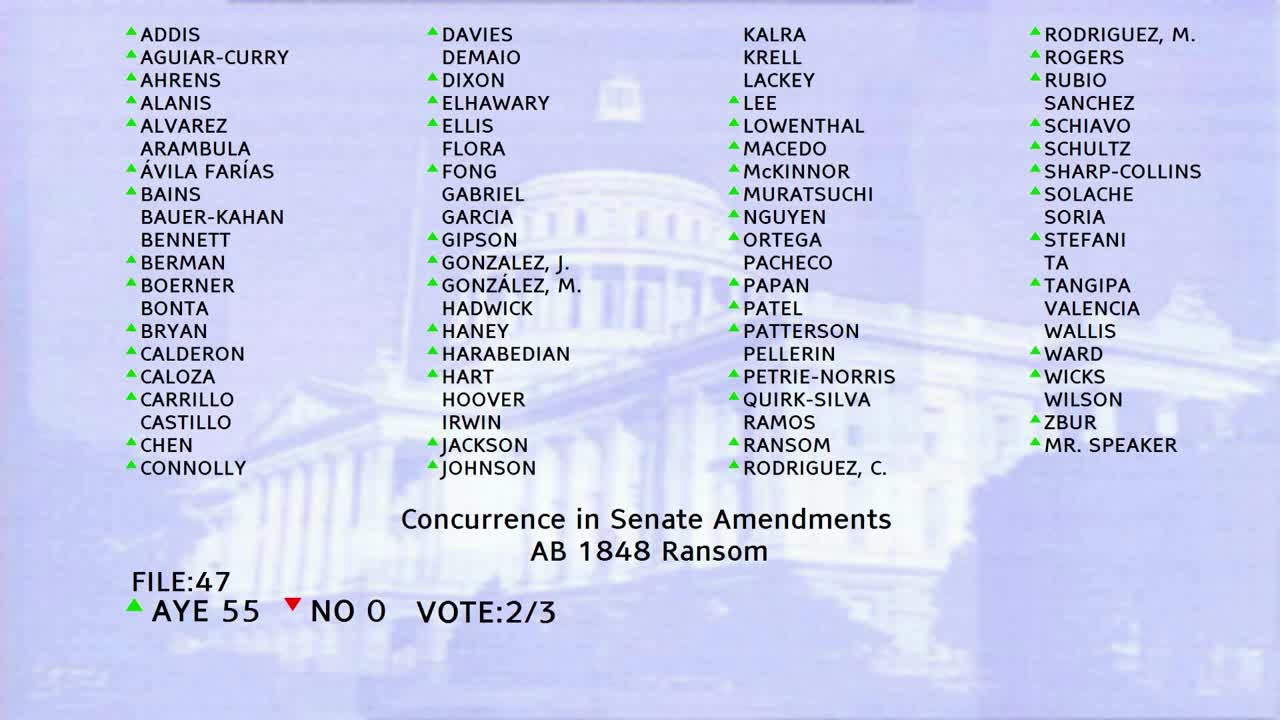
Bill Author

Bill Co-Author(s):
