AB 2505: Electrical corporations: hydrogen refueling stations.
- Session Year: 2025-2026
- House: Assembly
- Latest Version Date: 2026-09-30
Current Status:
Passed
(2026-09-30: Chaptered by Secretary of State - Chapter 946, Statutes of 2026.)
Introduced
In Committee
Awaiting First Chamber Vote
Passed First Chamber
In Committee
Awaiting Second Chamber Vote
Passed Second Chamber
Enacted
Existing law vests the Public Utilities Commission with regulatory authority over public utilities, including electrical corporations. Existing law authorizes the commission to fix the rates and charges for every public utility and requires that those rates and charges be just and reasonable. Existing law requires each electrical corporation to file an advice letter for, and requires the commission to approve, a new tariff or rule that authorizes each electrical corporation to design and deploy all electrical distribution infrastructure on the utility side of the customers meter for all customers installing separately metered infrastructure to support electric vehicle charging stations, other than those in single-family residences.
This bill would require each electrical corporation, on or before April 1, 2027, to file an advice letter for, and require the commission, on or before September 1, 2027, to approve, a new or modified tariff or rule that authorizes the electrical corporation to design, construct, own, operate, and maintain all electrical distribution and service facilities located on the utility side of a customers meter that are necessary to provide separately metered electrical service to hydrogen refueling stations, including hydrogen refueling stations located on premises that already receive electrical service for other uses. The bill would require that the tariff or rule authorize an electrical corporation to extend utility-side electrical distribution and service facilities from the existing distribution system to a dedicated revenue meter serving a heavy-duty hydrogen refueling station that serves vehicles that are 14,001 pounds or greater and authorize the installation of a dedicated revenue meter for the hydrogen refueling station load, as provided. The bill would require a facility installed pursuant to the tariff or rule to be treated, for cost allocation and customer contribution purposes, as line and service extensions, as provided. The bill would require that the tariff or rule require the electrical corporation to provide the applicant a good faith estimate before the applicant is required to execute a line or service extension agreement or make a nonrefundable payment, as provided. The bill would repeal its provisions on January 1, 2033.
Under existing law, a violation of the Public Utilities Act or any order, decision, rule, direction, demand, or requirement of the commission is a crime.
Because the provisions of the bill would be a part of the act and a violation of a commission action implementing the bills requirements would be a crime, this bill would impose a state-mandated local program.
The California Constitution requires the state to reimburse local agencies and school districts for certain costs mandated by the state. Statutory provisions establish procedures for making that reimbursement.
This bill would provide that no reimbursement is required by this act for a specified reason.
Existing law vests the Public Utilities Commission with regulatory authority over public utilities, including electrical corporations. Existing law authorizes the commission to fix the rates and charges for every public utility and requires that those rates and charges be just and reasonable. Existing law requires each electrical corporation to file an advice letter for, and requires the commission to approve, a new tariff or rule that authorizes each electrical corporation to design and deploy all electrical distribution infrastructure on the utility side of the customers meter for all customers installing separately metered infrastructure to support electric vehicle charging stations, other than those in single-family residences.
This bill would require each electrical corporation, on or before April 1, 2027, to file an advice letter for, and require the commission, on or before September 1, 2027, to approve, a new tariff or rule that authorizes the electrical corporation to design, construct, own, operate, and maintain all electrical distribution and service facilities located on the utility side of a customers meter that are necessary to provide separately metered electrical service to hydrogen refueling stations, including hydrogen refueling stations located on premises that already receive electrical service for other uses. The bill would require that the tariff or rule authorize an electrical corporation to extend utility-side electrical distribution and service facilities from the existing distribution system to a dedicated revenue meter serving a heavy-duty hydrogen refueling station that serves vehicles that are 14,001 pounds or greater and authorize the installation of a dedicated revenue meter for the hydrogen refueling station load, as provided. The bill would require a facility installed pursuant to the tariff or rule to be treated, for cost allocation and customer contribution purposes, as line and service extensions, as provided. The bill would require an electrical corporation, to the extent that the electrical corporation capitalizes costs for a facility installed pursuant to the tariff or rule, to recover its resulting revenue requirement through periodic general rate case or other appropriate ratesetting proceedings. The bill would repeal its provisions on January 1, 2033.
Under existing law, a violation of the Public Utilities Act or any order, decision, rule, direction, demand, or requirement of the commission is a crime.
Because the provisions of the bill would be a part of the act and a violation of a commission action implementing the bills requirements would be a crime, this bill would impose a state-mandated local program.
The California Constitution requires the state to reimburse local agencies and school districts for certain costs mandated by the state. Statutory provisions establish procedures for making that reimbursement.
This bill would provide that no reimbursement is required by this act for a specified reason.
Existing law vests the Public Utilities Commission with regulatory authority over public utilities, including electrical corporations. Existing law authorizes the commission to fix the rates and charges for every public utility and requires that those rates and charges be just and reasonable. Existing law requires each electrical corporation to file an advice letter for, and requires the commission to approve, a new tariff or rule that authorizes each electrical corporation to design and deploy all electrical distribution infrastructure on the utility side of the customers meter for all customers installing separately metered infrastructure to support electric vehicle charging stations, other than those in single-family residences.
This bill would require each electrical corporation, on or before April 1, 2027, to file an advice letter for, and require the commission, on or before September 1, 2027, to approve, a new tariff or rule that authorizes the electrical corporation to design, construct, own, operate, and maintain all electrical distribution and service facilities located on the utility side of a customers meter that are necessary to provide separately metered electrical service to hydrogen refueling stations, including hydrogen refueling stations located on premises that already receive electrical service for other uses. The bill would require that the tariff or rule authorize an electrical corporation to extend utility-side electrical distribution and service facilities from the existing distribution system to a dedicated revenue meter serving a hydrogen refueling station and authorize the installation of a dedicated revenue meter for the hydrogen refueling station load, as provided. The bill would require a facility installed pursuant to the tariff or rule to be treated, for cost allocation and customer contribution purposes, as line and service extensions, as provided. The bill would require an electrical corporation, to the extent that the electrical corporation capitalizes costs for a facility installed pursuant to the tariff or rule, to recover its resulting revenue requirement through periodic general rate case or other appropriate ratesetting proceedings. The bill would repeal its provisions on January 1, 2033.
Under existing law, a violation of the Public Utilities Act or any order, decision, rule, direction, demand, or requirement of the commission is a crime.
Because the provisions of the bill would be a part of the act and a violation of a commission action implementing the bills requirements would be a crime, this bill would impose a state-mandated local program.
The California Constitution requires the state to reimburse local agencies and school districts for certain costs mandated by the state. Statutory provisions establish procedures for making that reimbursement.
This bill would provide that no reimbursement is required by this act for a specified reason.
(a)It is the intent of the Legislature to ensure that hydrogen refueling stations can be served by separate electrical service and utility revenue meters, including when installed at existing facilities, and that this can be accomplished without inefficiently requiring the installation of extensive behind-the-meter electrical lines.
(b)The Legislature finds and declares all the following:
(1)Executive Order N-79-20 (September 23, 2020) set a state goal that 100 percent of in-state sales of new passenger cars and trucks will be zero emission by 2035, and 100 percent of medium-duty and heavy-duty vehicles in California will be zero emission by 2045 for all operations where feasible, and by 2035 for drayage trucks.
(2)The State Air Resources Board and the State Energy Resources Conservation and Development Commission determined that a crucial element for achieving these goals is ensuring adequate hydrogen refueling infrastructure.
(3)One of the barriers to achieving adequate hydrogen refueling infrastructure is that, unlike electrical vehicle charging stations, hydrogen refueling stations cannot obtain separate utility meters and service lines when they are installed at existing facilities that already have electrical service, such as truck stops and travel centers. Because no dedicated tariff exists for energizing hydrogen refueling stations that are colocated with other uses, hydrogen refueling stations typically must install extensive behind-the-meter electrical lines to connect hydrogen equipment to electricity, instead of more efficiently connecting them directly to the electrical corporations distribution system on the utility side of the meter.
(4)The lack of separate utility meters for hydrogen refueling stations adds high costs to hydrogen refueling station installation at existing facilities that inhibits development of those stations, especially those that serve medium-duty and heavy-duty fuel cell electric vehicles, and precludes those stations from fully participating in programs designed to support the reliability, resiliency, and flexibility of the electrical grid, including demand response, distributed energy resource, and rate design programs that rely on separately metered loads.
(5)Facilitating the use of existing facilities for hydrogen refueling stations is an efficient land use strategy that can help reduce pressure to develop greenfield sites and accelerate the deployment of zero-emission vehicle fueling infrastructure.
SEC. 2.Section 740.26 is added to the Public Utilities Code, to read:740.26.(a)On or before April 1, 2027, each electrical corporation shall file an advice letter pursuant to Section 5.1 of Commission General Order 96-B for, and on or before September 1, 2027, the commission shall approve, a new or modified tariff or rule that authorizes the electrical corporation to design, construct, own, operate, and maintain all electrical distribution and service facilities located on the utility side of a customers meter that are necessary to provide separately metered electrical service to hydrogen refueling stations, including hydrogen refueling stations located on premises that already receive electrical service for other uses.
(b)The tariff or rule described in subdivision (a) shall do both of the following:
(1)Authorize the electrical corporation to extend utility-side electrical distribution and service facilities from the existing distribution system to a dedicated revenue meter serving a heavy-duty hydrogen refueling station that serves vehicles that are 14,001 pounds or greater, consistent with the electrical corporations reasonable utility-side design, engineering, safety, and construction standards for comparable distribution and service facilities.
(2)Notwithstanding the Electric Rule 16 tariff or any successor tariff, authorize installation of a dedicated revenue meter for the hydrogen refueling station load, including where the customer or premises already receives electrical service through another meter, if the applicable safety and reliability criteria are met.
(c)A facility installed pursuant to the tariff or rule described in subdivision (a) shall be treated, for cost allocation and customer contribution purposes, as line and service extensions subject to the line extension framework adopted by the commission pursuant to Section 783 and implemented in the Electric Rule 15 tariff and Electric Rule 16 tariff, or successor tariffs. A customer allowance established for a facility pursuant to the tariff or rule shall be determined using the same revenue-based or revenue-justified allowance methodology applied under those Electric Rules, and any costs that exceed the applicable allowance shall be borne by the applicant, subject to any refund provisions the commission may approve. The tariff or rule shall require the electrical corporation to provide the applicant a good-faith estimate agreement before the applicant is required to execute a line or service extension agreement or make a nonrefundable payment, including any customer contribution, or costs associated with distribution or service facilities, system capacity, or other utility-side upgrades that may be charged to the applicant under the tariff or rule.
(d)The commission may adopt additional tariff provisions or modifications necessary to ensure that the tariff or rule described in subdivision (a) is just and reasonable and protects nonparticipating ratepayers from unreasonable cost shifts, if those provisions or modifications do not prohibit an eligible heavy-duty hydrogen refueling station from receiving service through a dedicated revenue meter where applicable safety and reliability criteria are met.
(e)This section shall remain in effect only until January 1, 2033, and as of that date is repealed.
SEC. 3.No reimbursement is required by this act pursuant to Section 6 of Article XIIIB of the California Constitution because the only costs that may be incurred by a local agency or school district will be incurred because this act creates a new crime or infraction, eliminates a crime or infraction, or changes the penalty for a crime or infraction, within the meaning of Section 17556 of the Government Code, or changes the definition of a crime within the meaning of Section 6 of Article XIIIB of the California Constitution.
(a)It is the intent of the Legislature to ensure that hydrogen refueling stations can be served by separate electrical service and utility revenue meters, including when installed at existing facilities, and that this can be accomplished without inefficiently requiring the installation of extensive behind-the-meter electrical lines.
(b)The Legislature finds and declares all the following:
(1)Executive Order N-79-20 (September 23, 2020) set a state goal that 100 percent of in-state sales of new passenger cars and trucks will be zero emission by 2035, and 100 percent of medium-duty and heavy-duty vehicles in California will be zero emission by 2045 for all operations where feasible, and by 2035 for drayage trucks.
(2)The State Air Resources Board and the State Energy Resources Conservation and Development Commission determined that a crucial element for achieving these goals is ensuring adequate hydrogen refueling infrastructure.
(3)One of the barriers to achieving adequate hydrogen refueling infrastructure is that, unlike electrical vehicle charging stations, hydrogen refueling stations cannot obtain separate utility meters and service lines when they are installed at existing facilities that already have electrical service, such as truck stops and travel centers. Because no dedicated tariff exists for energizing hydrogen refueling stations that are colocated with other uses, hydrogen refueling stations typically must install extensive behind-the-meter electrical lines to connect hydrogen equipment to electricity, instead of more efficiently connecting them directly to the electrical corporations distribution system on the utility side of the meter.
(4)The lack of separate utility meters for hydrogen refueling stations adds high costs to hydrogen refueling station installation at existing facilities that inhibits development of those stations, especially those that serve medium-duty and heavy-duty fuel cell electric vehicles, and precludes those stations from fully participating in programs designed to support the reliability, resiliency, and flexibility of the electrical grid, including demand response, distributed energy resource, and rate design programs that rely on separately metered loads.
(5)Facilitating the use of existing facilities for hydrogen refueling stations is an efficient land use strategy that can help reduce pressure to develop greenfield sites and accelerate the deployment of zero-emission vehicle fueling infrastructure.
SEC. 2.Section 740.26 is added to the Public Utilities Code, to read:740.26.(a)On or before April 1, 2027, each electrical corporation shall file an advice letter pursuant to Section 5.1 of Commission General Order 96-B for, and on or before September 1, 2027, the commission shall approve, a new or modified tariff or rule that authorizes the electrical corporation to design, construct, own, operate, and maintain all electrical distribution and service facilities located on the utility side of a customers meter that are necessary to provide separately metered electrical service to hydrogen refueling stations, including hydrogen refueling stations located on premises that already receive electrical service for other uses.
(b)The tariff or rule described in subdivision (a) shall do both of the following:
(1)Authorize the electrical corporation to extend utility-side electrical distribution and service facilities from the existing distribution system to a dedicated revenue meter serving a heavy-duty hydrogen refueling station that serves vehicles that are 14,001 pounds or greater, consistent with reasonable design and construction standards comparable to those applied under the electrical corporations tariff for electric vehicle infrastructure. the electrical corporations reasonable utility-side design, engineering, safety, and construction standards for comparable distribution and service facilities.
(2)Notwithstanding the Electric Rule 16 tariff or any successor tariff, authorize installation of a dedicated revenue meter for the hydrogen refueling station load, including where the customer or premises already receives electrical service through another meter, if the applicable safety and reliability criteria are met.
(c)A facility installed pursuant to the tariff or rule described in subdivision (a) shall be treated, for cost allocation and customer contribution purposes, as line and service extensions subject to the line extension framework adopted by the commission pursuant to Section 783 and implemented in the Electric Rule 15 tariff and Electric Rule 16 tariff, or successor tariffs. A customer allowance established for a facility pursuant to the tariff or rule shall be determined using the same revenue-based or revenue-justified allowance methodology applied under those Electric Rules, and any costs that exceed the applicable allowance shall be borne by the applicant, subject to any refund provisions the commission may approve. The tariff or rule shall require the electrical corporation to provide the applicant a good-faith estimate agreement before the applicant is required to execute a line or service extension agreement or make a nonrefundable payment, including any customer contribution, or costs associated with distribution or service facilities, system capacity, or other utility-side upgrades that may be charged to the applicant under the tariff or rule.
(d)The commission may adopt additional tariff provisions or modifications necessary to ensure that the tariff or rule described in subdivision (a) is just and reasonable and protects nonparticipating ratepayers from unreasonable cost shifts, if those provisions or modifications do not prohibit an eligible heavy-duty hydrogen refueling station from receiving service through a dedicated revenue meter where applicable safety and reliability criteria are met.
(d)(e)This section shall remain in effect only until January 1, 2033, and as of that date is repealed.
SEC. 3.No reimbursement is required by this act pursuant to Section 6 of Article XIIIB of the California Constitution because the only costs that may be incurred by a local agency or school district will be incurred because this act creates a new crime or infraction, eliminates a crime or infraction, or changes the penalty for a crime or infraction, within the meaning of Section 17556 of the Government Code, or changes the definition of a crime within the meaning of Section 6 of Article XIIIB of the California Constitution.
(a)It is the intent of the Legislature to ensure that hydrogen refueling stations can be served by separate electrical service and utility revenue meters, including when installed at existing facilities, and that this can be accomplished without inefficiently requiring the installation of extensive behind-the-meter electrical lines.
(b)The Legislature finds and declares all the following:
(1)Executive Order N-79-20 (September 23, 2020) set a state goal that 100 percent of in-state sales of new passenger cars and trucks will be zero emission by 2035, and 100 percent of medium-duty and heavy-duty vehicles in California will be zero emission by 2045 for all operations where feasible, and by 2035 for drayage trucks.
(2)The State Air Resources Board and the State Energy Resources Conservation and Development Commission determined that a crucial element for achieving these goals is ensuring adequate hydrogen refueling infrastructure.
(3)One of the barriers to achieving adequate hydrogen refueling infrastructure is that, unlike electrical vehicle charging stations, hydrogen refueling stations cannot obtain separate utility meters and service lines when they are installed at existing facilities that already have electrical service, such as truck stops and travel centers. Because no dedicated tariff exists for energizing hydrogen refueling stations that are colocated with other uses, hydrogen refueling stations typically must install extensive behind-the-meter electrical lines to connect hydrogen equipment to electricity, instead of more efficiently connecting them directly to the electrical corporations distribution system on the utility side of the meter.
(4)The lack of separate utility meters for hydrogen refueling stations adds high costs to hydrogen refueling station installation at existing facilities that inhibits development of those stations, especially those that serve medium-duty and heavy-duty fuel cell electric vehicles, and precludes those stations from fully participating in programs designed to support the reliability, resiliency, and flexibility of the electrical grid, including demand response, distributed energy resource, and rate design programs that rely on separately metered loads.
(5)Facilitating the use of existing facilities for hydrogen refueling stations is an efficient land use strategy that can help reduce pressure to develop greenfield sites and accelerate the deployment of zero-emission vehicle fueling infrastructure.
SEC. 2.Section 740.26 is added to the Public Utilities Code, to read:740.26.(a)On or before April 1, 2027, each electrical corporation shall file an advice letter pursuant to Section 5.1 of Commission General Order 96-B for, and on or before September 1, 2027, the commission shall approve, a new tariff or rule that authorizes the electrical corporation to design, construct, own, operate, and maintain all electrical distribution and service facilities located on the utility side of a customers meter that are necessary to provide separately metered electrical service to hydrogen refueling stations, including hydrogen refueling stations located on premises that already receive electrical service for other uses.
(b)The tariff or rule described in subdivision (a) shall do both of the following:
(1)Authorize the electrical corporation to extend utility-side electrical distribution and service facilities from the existing distribution system to a dedicated revenue meter serving a heavy-duty hydrogen refueling station that serves vehicles that are 14,001 pounds or greater, consistent with reasonable design and construction standards comparable to those applied under the electrical corporations tariff for electric vehicle infrastructure.
(2)Notwithstanding the Electric Rule 16 tariff or any successor tariff, authorize installation of a dedicated revenue meter for the hydrogen refueling station load, including where the customer or premises already receives electrical service through another meter, if the applicable safety and reliability criteria are met.
(c)A facility installed pursuant to the tariff or rule described in subdivision (a) shall be treated, for cost allocation and customer contribution purposes, as line and service extensions subject to the line extension framework adopted by the commission pursuant to Section 783 and implemented in the Electric Rule 15 tariff and Electric Rule 16 tariff, or successor tariffs. A customer allowance established for a facility pursuant to the tariff or rule shall be determined using the same revenue-based or revenue-justified allowance methodology applied under those Electric Rules, and any costs that exceed the applicable allowance shall be borne by the applicant, subject to any refund provisions the commission may approve.
(d)To the extent that the electrical corporation capitalizes costs for a facility installed pursuant to the tariff or rule described in subdivision (a) that are not paid by the applicant pursuant to subdivision (c), the electrical corporation shall recover its resulting revenue requirement through periodic general rate case or other appropriate ratesetting proceedings, and those costs shall be treated in a manner consistent with other necessary electrical distribution infrastructure, with the commission ensuring that ratepayers are not unreasonably burdened.(e)(d)This section shall remain in effect only until January 1, 2033, and as of that date is repealed.
SEC. 3.No reimbursement is required by this act pursuant to Section 6 of Article XIIIB of the California Constitution because the only costs that may be incurred by a local agency or school district will be incurred because this act creates a new crime or infraction, eliminates a crime or infraction, or changes the penalty for a crime or infraction, within the meaning of Section 17556 of the Government Code, or changes the definition of a crime within the meaning of Section 6 of Article XIIIB of the California Constitution.
(a)It is the intent of the Legislature to ensure that hydrogen refueling stations can be served by separate electrical service and utility revenue meters, including when installed at existing facilities, and that this can be accomplished without inefficiently requiring the installation of extensive behind-the-meter electrical lines.
(b)The Legislature finds and declares all the following:
(1)Executive Order N-79-20 (September 23, 2020) set a state goal that 100 percent of in-state sales of new passenger cars and trucks will be zero emission by 2035, and 100 percent of medium-duty and heavy-duty vehicles in California will be zero emission by 2045 for all operations where feasible, and by 2035 for drayage trucks.
(2)The State Air Resources Board and the State Energy Resources Conservation and Development Commission determined that a crucial element for achieving these goals is ensuring adequate hydrogen refueling infrastructure.
(3)One of the barriers to achieving adequate hydrogen refueling infrastructure is that, unlike electrical vehicle charging stations, hydrogen refueling stations cannot obtain separate utility meters and service lines when they are installed at existing facilities that already have electrical service, such as truck stops and travel centers. Because no dedicated tariff exists for energizing hydrogen refueling stations that are colocated with other uses, hydrogen refueling stations typically must install extensive behind-the-meter electrical lines to connect hydrogen equipment to electricity, instead of more efficiently connecting them directly to the electrical corporationss corporations distribution system on the utility side of the meter.
(4)The lack of separate utility meters for hydrogen refueling stations adds high costs to hydrogen refueling station installation at existing facilities that inhibits development of those stations, especially those that serve medium-duty and heavy-duty fuel cell electric vehicles, and precludes those stations from fully participating in programs designed to support the reliability, resiliency, and flexibility of the electrical grid, including demand response, distributed energy resource, and rate design programs that rely on separately metered loads.
(5)Facilitating the use of existing facilities for hydrogen refueling stations is an efficient land use strategy that can help reduce pressure to develop greenfield sites and accelerate the deployment of zero-emission vehicle fueling infrastructure.
SEC. 2.Section 740.26 is added to the Public Utilities Code, to read:740.26.(a)On or before April 1, 2027, each electrical corporation shall file an advice letter pursuant to Section 5.1 of Commission General Order 96-B for, and on or before September 1, 2027, the commission shall approve, a new tariff or rule that authorizes the electrical corporation to design, construct, own, operate, and maintain all electrical distribution and service facilities located on the utility side of a customers meter that are necessary to provide separately metered electrical service to hydrogen refueling stations, including hydrogen refueling stations located on premises that already receive electrical service for other uses.
(b)The tariff or rule described in subdivision (a) shall do both of the following:
(1)Authorize the electrical corporation to extend utility-side electrical distribution and service facilities from the existing distribution system to a dedicated revenue meter serving the a heavy-duty hydrogen refueling station, station that serves vehicles that are 14,001 pounds or greater, consistent with reasonable design and construction standards comparable to those applied under the electrical corporations tariff for electric vehicle infrastructure.
(2)Notwithstanding the Electric Rule 16 tariff or any successor tariff, authorize installation of a dedicated revenue meter for the hydrogen refueling station load, including where the customer or premises already receives electrical service through another meter, if the applicable safety and reliability criteria are met.
(c)A facility installed pursuant to the tariff or rule described in subdivision (a) shall be treated, for cost allocation and customer contribution purposes, as line and service extensions subject to the line extension framework adopted by the commission pursuant to Section 783 and implemented in the Electric Rule 15 tariff and Electric Rule 16 tariff, or successor tariffs. A customer allowance established for a facility pursuant to the tariff or rule shall be determined using the same revenue-based or revenue-justified allowance methodology applied under those Electric Rules, and any costs that exceed the applicable allowance shall be borne by the applicant, subject to any refund provisions the commission may approve.
(d)To the extent that the electrical corporation capitalizes costs for a facility installed pursuant to the tariff or rule described in subdivision (a) that are not paid by the applicant pursuant to subdivision (c), the electrical corporation shall recover its resulting revenue requirement through periodic general rate case or other appropriate ratesetting proceedings, and those costs shall be treated in a manner consistent with other necessary electrical distribution infrastructure, with the commission ensuring that ratepayers are not unreasonably burdened.
(e)This section shall remain in effect only until January 1, 2033, and as of that date is repealed.
SEC. 3.No reimbursement is required by this act pursuant to Section 6 of Article XIIIB of the California Constitution because the only costs that may be incurred by a local agency or school district will be incurred because this act creates a new crime or infraction, eliminates a crime or infraction, or changes the penalty for a crime or infraction, within the meaning of Section 17556 of the Government Code, or changes the definition of a crime within the meaning of Section 6 of Article XIIIB of the California Constitution.
(a)It is the intent of the Legislature to ensure that hydrogen refueling stations can be served by separate electrical service and utility revenue meters, including when installed at existing facilities, and that this can be accomplished without inefficiently requiring the installation of extensive behind-the-meter electrical lines.
(b)The Legislature finds and declares all the following:
(1)Executive Order N-79-20 (September 23, 2020) set a state goal that 100 percent of in-state sales of new passenger cars and trucks will be zero emission by 2035, and 100 percent of medium-duty and heavy-duty vehicles in California will be zero emission by 2045 for all operations where feasible, and by 2035 for drayage trucks.
(2)The State Air Resources Board and the State Energy Resources Conservation and Development Commission determined that a crucial element for achieving these goals is ensuring adequate hydrogen refueling infrastructure.
(3)One of the barriers to achieving adequate hydrogen refueling infrastructure is that, unlike electrical vehicle charging stations, hydrogen refueling stations cannot obtain separate utility meters and service lines when they are installed at existing facilities that already have electrical service, such as truck stops and travel centers. Because no dedicated tariff exists for energizing hydrogen refueling stations that are colocated with other uses, hydrogen refueling stations typically must install extensive behind-the-meter electrical lines to connect hydrogen equipment to electricity, instead of more efficiently connecting them directly to the electrical corporationss distribution system on the utility side of the meter.
(4)The lack of separate utility meters for hydrogen refueling stations adds high costs to hydrogen refueling station installation at existing facilities that inhibits development of those stations, especially those that serve medium-duty and heavy-duty fuel cell electric vehicles, and precludes those stations from fully participating in programs designed to support the reliability, resiliency, and flexibility of the electrical grid, including demand response, distributed energy resource, and rate design programs that rely on separately metered loads.
(5)Facilitating the use of existing facilities for hydrogen refueling stations is an efficient land use strategy that can help reduce pressure to develop greenfield sites and accelerate the deployment of zero-emission vehicle fueling infrastructure.
SEC. 2.Section 740.26 is added to the Public Utilities Code, to read:740.26.(a)On or before April 1, 2027, each electrical corporation shall file an advice letter pursuant to Section 5.1 of Commission General Order 96-B for, and on or before September 1, 2027, the commission shall approve, a new tariff or rule that authorizes the electrical corporation to design, construct, own, operate, and maintain all electrical distribution and service facilities located on the utility side of a customers meter that are necessary to provide separately metered electrical service to hydrogen refueling stations, including hydrogen refueling stations located on premises that already receive electrical service for other uses.
(b)The tariff or rule described in subdivision (a) shall do both of the following:
(1)Authorize the electrical corporation to extend utility-side electrical distribution and service facilities from the existing distribution system to a dedicated revenue meter serving the hydrogen refueling station, consistent with reasonable design and construction standards comparable to those applied under the electrical corporations tariff for electric vehicle infrastructure.
(2)Notwithstanding the Electric Rule 16 tariff or any successor tariff, authorize installation of a dedicated revenue meter for the hydrogen refueling station load, including where the customer or premises already receives electrical service through another meter, if the applicable safety and reliability criteria are met.
(c)A facility installed pursuant to the tariff or rule described in subdivision (a) shall be treated, for cost allocation and customer contribution purposes, as line and service extensions subject to the line extension framework adopted by the commission pursuant to Section 783 and implemented in the Electric Rule 15 tariff and Electric Rule 16 tariff, or successor tariffs. A customer allowance established for a facility pursuant to the tariff or rule shall be determined using the same revenue-based or revenue-justified allowance methodology applied under those Electric Rules, and any costs that exceed the applicable allowance shall be borne by the applicant, subject to any refund provisions the commission may approve.
(d)To the extent that the electrical corporation capitalizes costs for a facility installed pursuant to the tariff or rule described in subdivision (a) that are not paid by the applicant pursuant to subdivision (c), the electrical corporation shall recover its resulting revenue requirement through periodic general rate case or other appropriate ratesetting proceedings, and those costs shall be treated in a manner consistent with other necessary electrical distribution infrastructure, with the commission ensuring that ratepayers are not unreasonably burdened.
(e)This section shall remain in effect only until January 1, 2033, and as of that date is repealed.
SEC. 3.No reimbursement is required by this act pursuant to Section 6 of Article XIIIB of the California Constitution because the only costs that may be incurred by a local agency or school district will be incurred because this act creates a new crime or infraction, eliminates a crime or infraction, or changes the penalty for a crime or infraction, within the meaning of Section 17556 of the Government Code, or changes the definition of a crime within the meaning of Section 6 of Article XIIIB of the California Constitution.
|
Date
|
Status
|
|---|---|
| Sep 30, 2026 | Chaptered by Secretary of State - Chapter 946, Statutes of 2026. |
| Sep 30, 2026 | Approved by the Governor. |
| Sep 3, 2026 | Enrolled and presented to the Governor at 4 p.m. |
| Aug 26, 2026 | Senate amendments concurred in. To Engrossing and Enrolling. (Ayes 79. Noes 0.). |
| Aug 26, 2026 | Senate amendments concurred in. To Engrossing and Enrolling. (Ayes 79. Noes 0. Page 6649.). |
| Aug 26, 2026 | In Assembly. Concurrence in Senate amendments pending. |
| Aug 26, 2026 | Read third time. Passed. Ordered to the Assembly. (Ayes 39. Noes 0.). |
| Aug 13, 2026 | Read second time. Ordered to third reading. |
| Aug 13, 2026 | From committee: Do pass. (Ayes 7. Noes 0.) (August 13). |
| Aug 3, 2026 | In committee: Referred to APPR. suspense file. |
| Jun 30, 2026 | Read second time and amended. Re-referred to Com. on APPR. |
| Jun 29, 2026 | From committee: Amend, and do pass as amended and re-refer to Com. on APPR. (Ayes 16. Noes 0.) (June 24). |
| Jun 10, 2026 | Referred to Com. on E., U & C. |
| May 27, 2026 | In Senate. Read first time. To Com. on RLS. for assignment. |
| May 26, 2026 | Read third time. Passed. Ordered to the Senate. (Ayes 78. Noes 0.) |
| May 26, 2026 | Read third time. Passed. Ordered to the Senate. (Ayes 78. Noes 0. Page 5327.) |
| May 26, 2026 | Read third time. Passed. Ordered to the Senate. |
| May 18, 2026 | Read second time. Ordered to third reading. |
| May 14, 2026 | From committee: Do pass. (Ayes 15. Noes 0.) (May 14). |
| May 6, 2026 | In committee: Set, first hearing. Referred to APPR. suspense file. |
| Apr 14, 2026 | Re-referred to Com. on APPR. |
| Apr 13, 2026 | Read second time and amended. |
| Apr 9, 2026 | From committee: Amend, and do pass as amended and re-refer to Com. on APPR. with recommendation: To Consent Calendar. (Ayes 17. Noes 0.) (April 8). |
| Mar 18, 2026 | Re-referred to Com. on U. & E. |
| Mar 17, 2026 | From committee chair, with author's amendments: Amend, and re-refer to Com. on U. & E. Read second time and amended. |
| Mar 9, 2026 | Referred to Com. on U. & E. |
| Feb 21, 2026 | From printer. May be heard in committee March 23. |
| Feb 20, 2026 | Read first time. To print. |
|
Date
|
Description
|
Location
|
Votes
|
|
|---|---|---|---|---|
| Aug 26, 2026 | AB 2505 Carrillo Concurrence in Senate Amendments | Assembly Floor |
Passed |
|
| Aug 26, 2026 | Assembly 3rd Reading AB2505 Carrillo By Archuleta | Senate Floor |
Passed |
|
| Aug 13, 2026 | Do pass | Senate Standing Committee on Appropriations |
Passed |
|
| Aug 3, 2026 | Placed on suspense file | Senate Standing Committee on Appropriations |
Passed |
|
| Jun 24, 2026 | Do pass as amended, but first amend, and re-refer to the Committee on [Appropriations] | Senate Standing Committee on Energy, Utilities and Communications |
Passed |
|
| May 26, 2026 | AB 2505 Carrillo Assembly Third Reading | Assembly Floor |
Passed |
|
| May 14, 2026 | Do pass. | Assembly Standing Committee on Appropriations |
Passed |
|
| Apr 8, 2026 | Do pass as amended, and be re-referred to the Committee on [Appropriations] with recommendation: To Consent Calendar | Assembly Standing Committee on Utilities and Energy |
Passed |
This list shows positions taken on this bill by organizations on the date displayed, which is linked to the original source.
Positions by individuals are not included.
|
Organization
|
Position
|
Date
|
|---|---|---|
| Air Products and Chemicals, Inc. | ** Support | |
| Air Water America, Inc. | ** Support | |
| California Fuels And Convenience Alliance | ** Support | |
| California Hydrogen Business Council | ** Support | |
| California Hydrogen Business Council (Sponsor) | ** Support | |
| California Hydrogen Coalition | ** Support | |
| California State Association Of Electrical Workers | ** Support | |
| California State Pipe Trades Council | ** Support | |
| Coalition of California Utility Employees | ** Support | |
| Energy Independence Now | ** Support | |
| Hydrogen-xt, INC. | ** Support | |
| Hyundai Motor America | ** Support | |
| Iwatani Corporation of America | ** Support | |
| Managing Director - Americas | ** Support | |
| Nel Hydrogen | ** Support | |
| North American Hydrogen Mobility Low Carbon Solutions | ** Support | |
| RIC Energy | ** Support | |
| Shell | ** Support | |
| Toyota Motor Company | ** Support | |
| United States Hydrogen Alliance | ** Support | |
| Valley Clean Air Now | ** Support | |
| Wolftank USA | ** Support |
CONCURRENCE IN SENATE AMENDMENTS
CSA1 Bill Id:AB 2505
Author:(Carrillo)
As Amended Ver:June 30, 2026
Majority vote
SUMMARY
This bill directs each electrical corporation (IOU) to file an advice letter by April 1, 2027, and requires the California Public Utilities Commission (CPUC) to approve by September 1, 2027, a new or modified tariff authorizing an IOU to design, construct, own, operate, and maintain all electrical distribution and facilities on the IOU side of the meter necessary to provide separately metered electrical service to hydrogen refueling stations serving vehicles 14,001 pounds or greater, including stations collocated at existing facilities that already receive electrical service. These provisions sunset on January 1, 2033.
Senate Amendments
1) Allow the CPUC to implement this bill through not only new, but modified, tariffs or rules.
2) Replaced provisions referencing standards for electric vehicle infrastructure rules with provisions mirroring standards and ratepayer protections from Electric Rule 15 and 16.
3) Added requirements for the tariff to protects nonparticipating ratepayers from unreasonable cost shifts.
COMMENTS
The core problem the bill aims to solve is that hydrogen refueling stations currently cannot get a dedicated meter or direct utility service line, forcing developers to use costlier behind-the-meter options. The bill fixes this by letting IOUs extend a service line from the nearest grid point and install a dedicated meter, reducing upfront construction costs.
This bill directs the CPUC to establish a new tariff for hydrogen refueling station service connections that is modeled on the cost allocation framework established in Electric Tariff Rules 15/16. Rule 15 is the tariff that governs IOU distribution line extensions (the facilities that extend the existing distribution system to the point where service facilities connect to a new customer). Rule 16 is the tariff that governs service extensions (the facilities running from the distribution line to the customer′s revenue meter).
Regulatory Context:
- Rule 15/16/Exceptional Case Filing: IOUs already handle atypical large customers (e.g., Valley Transit Authority, Genetech, Microsoft) through case-by-case exceptions to standard Rule 15/16. This existing process could potentially address hydrogen station needs.
- Rule 30: This emerging rule governs new transmission-level customers whose costs exceed what Rule 15/16 was designed for. Its ratepayer protections – upfront cost payments, actual-cost billing, and revenue-tied refunds – are relevant here because they guard against stranded assets if hydrogen demand falls short of projections. It′s currently unclear whether hydrogen stations would generate enough load to reach Rule 30 thresholds.
- Load size gap: The bill sets no cap on electrical demand. Its only qualifying criterion is vehicle weight, not load size, leaving the demand profile open-ended.
The bill′s deadlines are aggressive. The CPUC′s standard timeline for this type of proceeding is 18 months; the bill compresses that significantly.
According to the Author
According to the author, ″Assembly Bill 2505 is about removing barriers that make it unnecessarily expensive to build hydrogen fueling stations where we need them most. Right now, outdated rules drive up costs at places like existing truck stops, even when the infrastructure is already in place. By allowing these sites to access a standard utility connection and meter, we can cut unnecessary costs and speed up deployment. This bill creates a practical, fair pathway that lowers costs while still protecting ratepayers and strengthening our electric grid.″
Arguments in Support
One of the supporters of the bill, Air Products and Chemicals, Inc., states that: ″One of the barriers to deploying hydrogen refueling infrastructure at scale is the inability of stations collocated at existing facilities to obtain dedicated utility meters and service connections. Without a dedicated tariff, hydrogen refueling stations must install costly behind-the-meter electrical infrastructure rather than connecting directly to the utility′s distribution system. This adds substantial cost, delays deployment, and prevents stations from participating in demand response, distributed energy resource, and rate design programs that depend on separately metered loads. AB 2505 directly addresses this barrier.″
Arguments in Opposition
None on file
FISCAL COMMENTS
According to the Senate Committee on Appropriations, the CPUC estimates ongoing costs of $218,000 annually to implement the bills requirements.
VOTES:
ASM UTILITIES AND ENERGY: 17-0-1
YES: Petrie-Norris, Patterson, Boerner, Calderon, Davies, Mark González, Harabedian, Hart, Irwin, Kalra, Papan, Rogers, Schiavo, Schultz, Ta, Wallis, Zbur
ABS, ABST OR NV: Chen
ASM APPROPRIATIONS: 15-0-0
YES: Wicks, Hoover, Aguiar-Curry, Calderon, Caloza, Dixon, Fong, Mark González, Krell, Pacheco, Pellerin, Sharp-Collins, Solache, Ta, Tangipa
ASSEMBLY FLOOR: 78-0-2
YES: Addis, Aguiar-Curry, Ahrens, Alanis, Alvarez, Arambula, Ávila Farías, Bains, Bauer-Kahan, Bennett, Berman, Boerner, Bonta, Bryan, Calderon, Caloza, Carrillo, Castillo, Chen, Connolly, Davies, DeMaio, Dixon, Elhawary, Ellis, Flora, Fong, Gabriel, Gallagher, Garcia, Gipson, Jeff Gonzalez, Mark González, Hadwick, Haney, Harabedian, Hart, Hoover, Irwin, Jackson, Johnson, Kalra, Krell, Lackey, Lee, Lowenthal, Macedo, McKinnor, Nguyen, Ortega, Pacheco, Papan, Patel, Patterson, Pellerin, Petrie-Norris, Quirk-Silva, Ramos, Ransom, Michelle Rodriguez, Rogers, Blanca Rubio, Sanchez, Schiavo, Schultz, Sharp-Collins, Solache, Soria, Stefani, Ta, Tangipa, Valencia, Wallis, Ward, Wicks, Wilson, Zbur, Rivas
ABS, ABST OR NV: Muratsuchi, Celeste Rodriguez
UPDATED
VERSION: June 30, 2026
CONSULTANT: Alexa Cohill-Milanick / U. & E. / (916) 319-2083 FN: 0004257
SENATE RULES COMMITTEE Office of Senate Floor Analyses (916) 651-4171 | AB 2505 |
THIRD READING
Bill No: AB 2505
Author: Carrillo (D)
Amended: 6/30/26 in Senate
Vote: 21
SENATE ENERGY, U. & C. COMMITTEE: 16-0, 6/24/26
AYES: Allen, Ochoa Bogh, Archuleta, Arreguín, Becker, Caballero, Dahle, Grove, Hurtado, McNerney, Reyes, Richardson, Rubio, Stern, Strickland, Wahab
NO VOTE RECORDED: Gonzalez
SENATE APPROPRIATIONS COMMITTEE: 7-0, 8/13/26
AYES: Cervantes, Seyarto, Cabaldon, Dahle, Grayson, Richardson, Wahab
ASSEMBLY FLOOR: 78-0, 5/26/26 - See last page for vote
SUBJECT: Electrical corporations: hydrogen refueling stations
SOURCE: California Hydrogen Business Council
DIGEST:
This bill requires the California Public Utilities Commission (CPUC) to establish a limited-time tariff that authorizes an electrical corporation to make distribution investments necessary to install a separate electric meter at a hydrogen refueling station serving heavy-duty vehicles.
ANALYSIS:
Existing law:
- Authorizes the CPUC to supervise and regulate every public utility in the state and permits the CPUC to do anything that is necessary and convenient to exercise its power and jurisdiction. (Public Utilities Code §701)
- Authorizes the CPUC to set rates for public utilities and specifies that every cost charged by utilities to customers must be just and reasonable. (Public Utilities Code §451)
- Defines an electrical corporation as every corporation or person owning, controlling, operating, or managing any electric plant for compensation within this state, except where electricity is generated on or distributed by the producer through private property solely for its own use or the use of its tenants and not for sale or transmission to others. (Public Utilities Code §218)
- Establishes a process for electrical and gas corporations to obtain a service line extension. Existing law requires electrical and gas corporations to use the CPUC’s existing electric and gas rules and regulations regarding line extensions and facility installations when adding a line extension. (Public Utilities Code §783)
This bill:
- Requires electrical corporations to file advice letters by April 1, 2027, to establish a new or modified tariff authorizing the electrical corporation to install and maintain all electrical distribution and service facilities located on the utility side of a customer’s meter that are necessary to provide separately metered electrical service to hydrogen refueling stations.
- Requires an electrical corporation tariff established pursuant to this bill to do both of the following:
- Allow the electrical corporation to extend utility-side electrical distribution and service facilities to a dedicated electric meter for a hydrogen refueling station serving vehicles weighing at least 14,001 pounds. This bill requires the tariff for hydrogen station line extensions and dedicated meters to be consistent with the electrical corporation’s reasonable utility-side design, engineering, safety, and construction standards for comparable distribution and service facilities.
- Authorize installation of a dedicated electric meter for hydrogen refueling, including for those hydrogen stations with an existing electric meter. This bill clarifies that dedicated meter installations under this bill are subject to safety and reliability criteria.
- Specifies that cost allocation and customer cost sharing requirements for investor-owned utilities (IOUs) distribution and service line costs incurred under this bill must follow the cost allocation framework established for Electric Rules 15 and 16. This bill requires the tariff to ensure that the electrical corporations provides the applicant a good-faith estimate agreement before the applicant is required to execute a line or service extension agreement or make a nonrefundable payment, including any customer contribution, or costs associated with distribution or service facilities, system capacity, or other utility-side upgrades that may be charged to the applicant under the tariff or rule.
- Authorizes the CPUC to adopt additional tariff provisions or modifications needed to ensure that the tariffs required under this bill are just and reasonable and protects nonparticipating ratepayers from unreasonable cost shifts, as specified.
- Requires the CPUC to approve these tariffs by September 1, 2027.
- Sunsets this bill on January 1, 2033.
Background
Line extensions and Electric Rules 15 and 16. The CPUC has adopted tariffs governing utilities’ expenses for providing distribution and service lines to connect customers to electric service. Rule 15 establishes the tariff for electric IOU distribution line extensions, which connect distribution lines from the nearest permanent and available distribution facilities to neighborhoods and commercial districts. Rule 16 establishes the tariff for electric IOUs containing the rules and requirements for service line extensions, which connect distribution lines to the customer’s electric meter. While Electric Rules 15 and 16 establish rules that apply across the electric IOUs, each IOU files their own tariff with the CPUC.
Need for this bill. This bill stems from concerns expressed by heavy-duty hydrogen refueling stations that the inability to obtain a separate meter and service line for hydrogen refueling pumps limits their ability to separately meter their refueling operations for participation in demand response programs and also increases costs for installing hydrogen refueling pumps at existing stations. For those existing stations that install hydrogen refueling pumps, the electricity required to operate the pumps generally requires the construction of an electrical line between the pumps and the existing electric meter. This electrical work is borne by the facility owner and can substantially increase the cost for upgrading a facility to install hydrogen refueling infrastructure. Existing electric rules maintain a process through which a utility can make an extraordinary case filing at the CPUC in the event that a specific project merits establishing electric service requirements that fall outside an IOU’s existing tariffs. It is unclear if hydrogen refueling stations seeking line and service extensions have attempted to use the extraordinary case filing process to address challenges for obtaining line extensions under the existing electric rules.
Bill follows the implementation of the EV Infrastructure Rules. In 2020, the Legislature passed AB 841 (Ting, Chapter 372, Statutes of 2020), which directed the CPUC to approve certain IOU energy efficiency and EV infrastructure investments. The bill also required the CPUC to approve IOU advice letters authorizing the installation of all electrical distribution infrastructure on the utility side of the meter for separately metered EV charging stations. Following the passage of the bill, the CPUC adopted 2 resolutions (E-5167 and E-5168 ), adopting an alternative to Electric Rule 16 for customers of the small and large IOUs installing separately metered or submetered EV charging infrastructure. These alternative electric rules are known as the EV Infrastructure Rules.
Use of existing electric rule cost-sharing requirements limits ratepayer impact. The EV Infrastructure Rules marked a significant departure from the cost allocation process in Electric Rules 15 and 16 by allowing utilities to recover a greater proportion of the costs for distribution and service extensions for EV chargers from all ratepayers. Unlike the cost allocation requirements in the EV Infrastructure Rules, this bill specifies that the cost allocation methodology for electric utility costs resulting from line extensions to separately metered hydrogen refueling stations shall comply with the longstanding cost sharing requirements of Electric Rules 15 and 16. Under the existing electric rules, costs for distribution and service line extensions are generally shared between the utility and the applicant seeking the line extension. Electric utilities maintain a ratepayer-funded allowance for some line extension costs. However, any costs above the allowance must be paid for by the customer seeking the line extension.
Related/Prior Legislation
AB 126 (Reyes, Chapter 319, Statutes of 2023) extended and modified California’s hydrogen fueling station funding program, replacing the fixed 100-station cap with an ongoing commitment requiring the California Energy Commission to allocate no less than 15% of Clean Transportation Program funds annually to hydrogen fueling stations until July 1, 2030, as specified.
AB 841 (Ting, Chapter 372, Statutes of 2020) directed each electrical corporation to file an advice letter establishing a new tariff authorizing the electrical corporation to design and deploy all electrical distribution infrastructure on the utility side of the meter for customers installing separately metered EV charging infrastructure (other than single-family residences) and to recover those costs through general rate case proceedings rather than through applicant contributions under Rules 15 and 16.
FISCAL EFFECT: Appropriation: No Fiscal Com.: Yes Local: Yes
According to the Senate Appropriations Committee:
- The CPUC estimates ongoing costs of $218,000 annually (ratepayer funds) to review six utility advice letters and draft six resolutions approving the corporations' proposed heavy-duty hydrogen electric rule; oversee implementation of the rule once established, including communicating with customers facing issues obtaining service under it; and support development of a proposed decision adopting energization targets.
- To the extent that this bill impacts energy rates, it could result in costs or savings to the state as a ratepayer (various funds). The State of California is an electricity customer, purchasing roughly one percent of the electricity sold by the state's utilities. As such, the state incurs costs when rates increase, and realizes cost savings if rates go down.
SUPPORT: (Verified 8/13/26)
California Hydrogen Business Council (Source)
Air Products and Chemicals, Inc.
Air Water America, Inc.
California Fuels and Convenience Alliance
California Hydrogen Coalition
California State Association of Electrical Workers
California State Pipe Trades Council
Coalition of California Utility Employees
Energy Independence Now
Hydrogen-XT, Inc.
Hyundai Motor America
Iwatani Corporation of America
Managing Director - Americas
Nel Hydrogen
RIC Energy
Shell
Toyota Motor Company
United States Hydrogen Alliance
Valley Clean Air Now
Wolftank USA
OPPOSITION: (Verified 8/13/26)
None received
ARGUMENTS IN SUPPORT: According to the author:
Assembly Bill 2505 is about removing barriers that make it unnecessarily expensive to build hydrogen fueling stations where we need them most. Right now, outdated rules drive up costs at places like existing truck stops, even when the infrastructure is already in place. By allowing these sites to access a standard utility connection and meter, we can cut unnecessary costs and speed up deployment. This bill creates a practical, fair pathway that lowers costs while still protecting ratepayers and strengthening our electric grid.
ASSEMBLY FLOOR: 78-0, 5/26/26
AYES: Addis, Aguiar-Curry, Ahrens, Alanis, Alvarez, Arambula, Ávila Farías, Bains, Bauer-Kahan, Bennett, Berman, Boerner, Bonta, Bryan, Calderon, Caloza, Carrillo, Castillo, Chen, Connolly, Davies, DeMaio, Dixon, Elhawary, Ellis, Flora, Fong, Gabriel, Gallagher, Garcia, Gipson, Jeff Gonzalez, Mark González, Hadwick, Haney, Harabedian, Hart, Hoover, Irwin, Jackson, Johnson, Kalra, Krell, Lackey, Lee, Lowenthal, Macedo, McKinnor, Nguyen, Ortega, Pacheco, Papan, Patel, Patterson, Pellerin, Petrie-Norris, Quirk-Silva, Ramos, Ransom, Michelle Rodriguez, Rogers, Blanca Rubio, Sanchez, Schiavo, Schultz, Sharp-Collins, Solache, Soria, Stefani, Ta, Tangipa, Valencia, Wallis, Ward, Wicks, Wilson, Zbur, Rivas
NO VOTE RECORDED: Muratsuchi, Celeste Rodriguez
Prepared by: Sarah Smith / E., U. & C. / (916) 651-4107
8/15/26 10:53:28
SENATE COMMITTEE ON
Senator Sabrina Cervantes, Chair
2025 - 2026 Regular Session
AB 2505 (Carrillo) - Electrical corporations: hydrogen refueling stations
Version: | Policy Vote: |
Urgency: | Mandate: |
Hearing Date: | Consultant: |
Bill Summary:
This bill would require the California Public Utilities Commission (CPUC) to establish or modify a limited-time tariff that would authorize an electrical corporation to make distribution investments necessary to install a separate electric meter at a hydrogen refueling station serving heavy-duty vehicles.
Fiscal Impact:
- The CPUC estimates ongoing costs of $218,000 annually (ratepayer funds) to review six utility advice letters and draft six resolutions approving the corporations' proposed heavy-duty hydrogen electric rule; oversee implementation of the rule once established, including communicating with customers facing issues obtaining service under it; and support development of a proposed decision adopting energization targets.
- To the extent that this bill impacts energy rates, it could result in costs or savings to the state as a ratepayer (various funds). The State of California is an electricity customer, purchasing roughly one percent of the electricity sold by the state's utilities. As such, the state incurs costs when rates increase, and realizes cost savings if rates go down.
Background:
Hydrogen refueling stations serving medium- and heavy-duty vehicles need substantial electrical service, and how that service gets built and paid for depends on two separate systems. The first is the CPUC's line extension tariffs, which allocate the cost of running distribution and service lines between the utility, its ratepayers, and the customer requesting the connection. The second is the state's direct subsidy for hydrogen fueling infrastructure through the California Energy Commission. This bill operates entirely within the first system: it creates no appropriation and no grant, and its state cost is limited to the CPUC's regulatory workload in establishing and overseeing a new tariff. Its larger fiscal significance lies in which cost allocation framework applies, because the two available frameworks divide the same costs very differently between applicants and the general ratepayer base.
Line extension cost allocation under Electric Rules 15 and 16. Rule 15 governs distribution line extensions and Rule 16 governs service line extensions from those lines to the customer's meter. Under both, the utility maintains a ratepayer-funded allowance calculated on a revenue-based or revenue-justified methodology, reflecting the revenue the new load is expected to generate. Costs up to the allowance are borne by ratepayers generally; costs above it are paid by the applicant, subject to refund provisions. The framework therefore caps ratepayer exposure at the expected revenue from the connection, and it is the framework this bill adopts.
Cost allocation under the EV Infrastructure Rules. AB 841 (Ting, 2020) directed a different allocation for EV charging infrastructure. The rules the CPUC adopted in response, an alternative to Rule 16 for separately metered charging sites other than single-family residences, allow utilities to recover utility-side costs through general rate cases rather than through applicant contributions under Rules 15 and 16. The Senate Energy analysis describes this as allowing utilities to recover a greater proportion of extension costs from all ratepayers. This bill's cost allocation follows Rules 15 and 16 instead, and the Senate amendments removed the remaining reference to the EV Infrastructure Rules.
State subsidy for hydrogen fueling infrastructure runs on a separate track. AB 126 (Reyes, 2023) reauthorized the Clean Transportation Program through July 1, 2035 and directs the California Energy Commission to allocate no less than 15% of specified Alternative and Renewable Fuel and Vehicle Technology Fund moneys to hydrogen fueling stations until July 1, 2030. That commitment was estimated at roughly $106 million through 2030 when enacted. As of September 2025 the Commission had invested about $174 million in light-duty hydrogen infrastructure, with 61 stations in the network as of August 2025. None of that funding flows through this bill, and the bill neither expands nor draws on it.
Proposed Law:
This bill would:
- Require electrical corporations to file advice letters by April 1, 2027, to establish a new or modified tariff that would authorize the electrical corporation to install and maintain all electrical distribution and service facilities located on the utility side of a customer's meter that are necessary to provide separately metered electrical service to hydrogen refueling stations.
- Require an electrical corporation tariff established pursuant to this bill to do both of the following:
- Allow the electrical corporation to extend utility-side electrical distribution and service facilities to a dedicated electric meter for a hydrogen refueling station serving vehicles weighing at least 14,001 pounds. This bill would require the tariff for hydrogen station line extensions and dedicated meters to be consistent with the electrical corporation's own reasonable utility-side design, engineering, safety, and construction standards for comparable facilities.
- Authorize installation of a dedicated electric meter for hydrogen refueling, including for those hydrogen stations with an existing electric meter. This bill would clarify that dedicated meter installations under this bill are subject to safety and reliability criteria.
- Specify that cost allocation and customer cost sharing requirements for investor-owned utilities (IOUs) distribution and service line costs incurred under this bill must follow the cost allocation framework established for Electric Rules 15 and 16.
- Require the tariff to require the electrical corporation to provide the applicant a good-faith estimate agreement before the applicant executes a line or service extension agreement or makes a nonrefundable payment.
- Authorize the CPUC to adopt additional tariff provisions protecting nonparticipating ratepayers from unreasonable cost shifts, so long as those provisions would not prevent an eligible heavy-duty hydrogen refueling station from obtaining a dedicated meter where safety and reliability criteria are met.
- Require the CPUC to approve these tariffs by September 1, 2027.
- Sunset this bill on January 1, 2033.
- Require the CPUC to approve these tariffs by September 1, 2027.
- Sunset this bill on January 1, 2033.
Related Legislation:
AB 2383 (Zbur, 2026) would require the CPUC to establish a separate electric rate class for data centers and would establish requirements the CPUC must include in rules for that rate class. These requirements include cost allocation requirements for distribution infrastructure needed to serve data centers.
AB 126 (Reyes, 2023) extended and modified California's hydrogen fueling station funding program, replacing the fixed 100-station cap with an ongoing commitment requiring the California Energy Commission to allocate no less than 15% of specified Alternative and Renewable Fuel and Vehicle Technology Fund moneys annually to hydrogen fueling stations until July 1, 2030, as specified.
AB 841 (Ting, 2020) directed each electrical corporation to file an advice letter establishing a new tariff authorizing the electrical corporation to design and deploy all electrical distribution infrastructure on the utility side of the meter for customers installing separately metered EV charging infrastructure (other than single-family residences) and to recover those costs through general rate case proceedings rather than through applicant contributions under Rules 15 and 16.
Staff Comments:
The CPUC's energy work is supported by the Public Utilities Commission Utilities Reimbursement Account (PUCURA), funded by fees paid by regulated utilities and ultimately borne by ratepayers.
Because this bill's provisions would become part of the Public Utilities Act, and a violation of a CPUC action implementing them would be a crime, this bill would impose a state-mandated local program. No reimbursement would be required because the only costs a local agency or school district would incur would result from this bill expanding the scope of an existing crime, within the meaning of Section 17556 of the Government Code.
-- END --
SENATE COMMITTEE ON
Senator Sabrina Cervantes, Chair
2025 - 2026 Regular Session
AB 2505 (Carrillo) - Electrical corporations: hydrogen refueling stations
Version: | Policy Vote: |
Urgency: | Mandate: |
Hearing Date: | Consultant: |
Bill Summary:
This bill would require the California Public Utilities Commission (CPUC) to establish or modify a limited-time tariff that would authorize an electrical corporation to make distribution investments necessary to install a separate electric meter at a hydrogen refueling station serving heavy-duty vehicles.
Fiscal Impact:
- The CPUC estimates ongoing costs of $218,000 annually (ratepayer funds) to review six utility advice letters and draft six resolutions approving the corporations' proposed heavy-duty hydrogen electric rule; oversee implementation of the rule once established, including communicating with customers facing issues obtaining service under it; and support development of a proposed decision adopting energization targets.
- To the extent that this bill impacts energy rates, it could result in costs or savings to the state as a ratepayer (various funds). The State of California is an electricity customer, purchasing roughly one percent of the electricity sold by the state's utilities. As such, the state incurs costs when rates increase, and realizes cost savings if rates go down.
Background:
Hydrogen refueling stations serving medium- and heavy-duty vehicles need substantial electrical service, and how that service gets built and paid for depends on two separate systems. The first is the CPUC's line extension tariffs, which allocate the cost of running distribution and service lines between the utility, its ratepayers, and the customer requesting the connection. The second is the state's direct subsidy for hydrogen fueling infrastructure through the California Energy Commission. This bill operates entirely within the first system: it creates no appropriation and no grant, and its state cost is limited to the CPUC's regulatory workload in establishing and overseeing a new tariff. Its larger fiscal significance lies in which cost allocation framework applies, because the two available frameworks divide the same costs very differently between applicants and the general ratepayer base.
Line extension cost allocation under Electric Rules 15 and 16. Rule 15 governs distribution line extensions and Rule 16 governs service line extensions from those lines to the customer's meter. Under both, the utility maintains a ratepayer-funded allowance calculated on a revenue-based or revenue-justified methodology, reflecting the revenue the new load is expected to generate. Costs up to the allowance are borne by ratepayers generally; costs above it are paid by the applicant, subject to refund provisions. The framework therefore caps ratepayer exposure at the expected revenue from the connection, and it is the framework this bill adopts.
Implementation he EV Infrastructure Rules moved costs onto ratepayers. AB 841 (Ting, 2020) directed a different result for EV charging infrastructure. The rules the CPUC adopted in response, an alternative to Rule 16 for separately metered charging sites other than single-family residences, allow utilities to recover utility-side make-ready costs through general rate cases rather than through applicant contributions. Ratepayers cover close to the full cost of those service line extensions. The CPUC itself characterized the change as a major policy shift, since before AB 841 it had allocated utility-side transportation electrification costs case by case. Had this bill followed that model, ratepayer exposure would have been considerably larger; the Senate Energy amendments removed the last reference to those rules.
State subsidy for hydrogen fueling infrastructure runs on a separate track. AB 126 (Reyes, 2023) reauthorized the Clean Transportation Program through July 1, 2035 and directs the California Energy Commission to allocate no less than 15% of specified Alternative and Renewable Fuel and Vehicle Technology Fund moneys to hydrogen fueling stations until July 1, 2030. That commitment was estimated at roughly $106 million through 2030 when enacted. As of September 2025 the Commission had invested about $174 million in light-duty hydrogen infrastructure, with 61 stations in the network as of August 2025. None of that funding flows through this bill, and the bill neither expands nor draws on it.
Proposed Law:
This bill would:
- Require electrical corporations to file advice letters by April 1, 2027, to establish a new or modified tariff that would authorize the electrical corporation to install and maintain all electrical distribution and service facilities located on the utility side of a customer's meter that are necessary to provide separately metered electrical service to hydrogen refueling stations.
- Require an electrical corporation tariff established pursuant to this bill to do both of the following:
- Allow the electrical corporation to extend utility-side electrical distribution and service facilities to a dedicated electric meter for a hydrogen refueling station serving vehicles weighing at least 14,001 pounds. This bill would require the tariff for hydrogen station line extensions and dedicated meters to be consistent with the electrical corporation's own reasonable utility-side design, engineering, safety, and construction standards for comparable facilities.
- Authorize installation of a dedicated electric meter for hydrogen refueling, including for those hydrogen stations with an existing electric meter. This bill would clarify that dedicated meter installations under this bill are subject to safety and reliability criteria.
- Specify that cost allocation and customer cost sharing requirements for investor-owned utilities (IOUs) distribution and service line costs incurred under this bill must follow the cost allocation framework established for Electric Rules 15 and 16.
- Require the tariff to require the electrical corporation to provide the applicant a good-faith estimate agreement before the applicant executes a line or service extension agreement or makes a nonrefundable payment.
- Authorize the CPUC to adopt additional tariff provisions protecting nonparticipating ratepayers from unreasonable cost shifts, so long as those provisions would not prevent an eligible heavy-duty hydrogen refueling station from obtaining a dedicated meter where safety and reliability criteria are met.
- Require the CPUC to approve these tariffs by September 1, 2027.
- Sunset this bill on January 1, 2033.
- Require the CPUC to approve these tariffs by September 1, 2027.
- Sunset this bill on January 1, 2033.
Related Legislation:
AB 2383 (Zbur, 2026) would require the CPUC to establish a separate electric rate class for data centers and would establish requirements the CPUC must include in rules for that rate class. These requirements include cost allocation requirements for distribution infrastructure needed to serve data centers.
AB 126 (Reyes, 2023) extended and modified California's hydrogen fueling station funding program, replacing the fixed 100-station cap with an ongoing commitment requiring the California Energy Commission to allocate no less than 15% of specified Alternative and Renewable Fuel and Vehicle Technology Fund moneys annually to hydrogen fueling stations until July 1, 2030, as specified.
AB 841 (Ting, 2020) directed each electrical corporation to file an advice letter establishing a new tariff authorizing the electrical corporation to design and deploy all electrical distribution infrastructure on the utility side of the meter for customers installing separately metered EV charging infrastructure (other than single-family residences) and to recover those costs through general rate case proceedings rather than through applicant contributions under Rules 15 and 16.
Staff Comments:
The CPUC's energy work is supported by the Public Utilities Commission Utilities Reimbursement Account (PUCURA), funded by fees paid by regulated utilities and ultimately borne by ratepayers.
Because this bill's provisions would become part of the Public Utilities Act, and a violation of a CPUC action implementing them would be a crime, this bill would impose a state-mandated local program. No reimbursement would be required because the only costs a local agency or school district would incur would result from this bill expanding the scope of an existing crime, within the meaning of Section 17556 of the Government Code.
-- END --
SENATE COMMITTEE ON ENERGY, UTILITIES AND COMMUNICATIONS
Senator Benjamin Allen, Chair
2025 - 2026 Regular
Bill No: Hearing Date: 6/24/2026
Author: | |||
Version: | Amended | ||
Urgency: | Fiscal: | ||
Consultant: | |||
SUBJECT:
DIGEST: This bill requires the California Public Utilities Commission (CPUC) to establish a limited-time tariff that authorizes an electrical corporation to make distribution investments necessary to install a separate electric meter at a hydrogen refueling station serving heavy-duty vehicles.
ANALYSIS:
Existing law:
- Authorizes the CPUC to supervise and regulate every public utility in the state and permits the CPUC to do anything that is necessary and convenient to exercise its power and jurisdiction. (Public Utilities Code §701)
- Authorizes the CPUC to set rates for public utilities and specifies that every cost charged by utilities to customers must be just and reasonable. (Public Utilities Code §451)
- Defines an electrical corporation as every corporation or person owning, controlling, operating, or managing any electric plant for compensation within this state, except where electricity is generated on or distributed by the producer through private property solely for its own use or the use of its tenants and not for sale or transmission to others. (Public Utilities Code §218)
- Establishes a process for electrical and gas corporations to obtain a service line extension. Existing law requires electrical and gas corporations to use the CPUC’s existing electric and gas rules and regulations regarding line extensions and facility installations when adding a line extension. (Public Utilities Code §783)
This bill:
- Requires electrical corporations to file advice letters by April 1, 2027, to establish a new tariff authorizing the electrical corporation to install and maintain all electrical distribution and service facilities located on the utility side of a customer’s meter that are necessary to provide separately metered electrical service to hydrogen refueling stations.
- Requires an electrical corporation tariff established pursuant to this bill to do both of the following:
- Allow the electrical corporation to extend utility-side electrical distribution and service facilities to a dedicated electric meter for a hydrogen refueling station serving vehicles weighing at least 14,001 pounds. This bill requires the tariff for hydrogen station line extensions and dedicated meters to be consistent with those tariffs for electric vehicle (EV) charging station line extensions and dedicated meters.
- Authorize installation of a dedicated electric meter for hydrogen refueling, including for those hydrogen stations with an existing electric meter. This bill clarifies that dedicated meter installations under this bill are subject to safety and reliability criteria.
- Specifies that cost allocation and customer cost sharing requirements for investor-owned utilities (IOUs) distribution and service line costs incurred under this bill must follow the cost allocation framework established for Electric Rules 15 and 16.
- Requires the CPUC to approve these tariffs by September 1, 2027.
- Sunsets this bill on January 1, 2033.
Background
Line extensions and Electric Rules 15 and 16. The CPUC has adopted tariffs governing utilities’ expenses for providing distribution and service lines to connect customers to electric service. Rule 15 establishes the tariff for electric IOU distribution line extensions, which connect distribution lines from the nearest permanent and available distribution facilities to neighborhoods and commercial districts. Rule 16 establishes the tariff for electric IOUs containing the rules and requirements for service line extensions, which connect distribution lines to the customer’s electric meter. While Electric Rules 15 and 16 establish rules that apply across the electric IOUs, each IOU files their own tariff with the CPUC.
Need for this bill. This bill stems from concerns expressed by heavy-duty hydrogen refueling stations that the inability to obtain a separate meter and service line for hydrogen refueling pumps limits their ability to separately meter their refueling operations for participation in demand response programs and also increases costs for installing hydrogen refueling pumps at existing stations. For those existing stations that install hydrogen refueling pumps, the electricity required to operate the pumps generally requires the construction of an electrical line between the pumps and the existing electric meter. This electrical work is borne by the facility owner and can substantially increase the cost for upgrading a facility to install hydrogen refueling infrastructure. Existing electric rules maintain a process through which a utility can make an extraordinary case filing at the CPUC in the event that a specific project merits establishing electric service requirements that fall outside an IOU’s existing tariffs. It is unclear if hydrogen refueling stations seeking line and service extensions have attempted to use the extraordinary case filing process to address challenges for obtaining line extensions under the existing electric rules.
Bill follows the implementation of the EV Infrastructure Rules. In 2020, the Legislature passed AB 841 (Ting, Chapter 372, Statutes of 2020), which directed the CPUC to approve certain IOU energy efficiency and EV infrastructure investments. The bill also required the CPUC to approve IOU advice letters authorizing the installation of all electrical distribution infrastructure on the utility side of the meter for separately metered EV charging stations. Following the passage of the bill, the CPUC adopted 2 resolutions (E-5167 and E-5168 ), adopting an alternative to Electric Rule 16 for customers of the small and large IOUs installing separately metered or submetered EV charging infrastructure. These alternative electric rules are known as the EV Infrastructure Rules.
Use of existing electric rule cost-sharing requirements limits ratepayer impact. The EV Infrastructure Rules marked a significant departure from the cost allocation process in Electric Rules 15 and 16 by allowing utilities to recover a greater proportion of the costs for distribution and service extensions for EV chargers from all ratepayers. Unlike the cost allocation requirements in the EV Infrastructure Rules, this bill specifies that the cost allocation methodology for electric utility costs resulting from line extensions to separately metered hydrogen refueling stations shall comply with the longstanding cost sharing requirements of Electric Rules 15 and 16. Under the existing electric rules, costs for distribution and service line extensions are generally shared between the utility and the applicant seeking the line extension. Electric utilities maintain a ratepayer-funded allowance for some line extension costs. However, any costs above the allowance must be paid for by the customer seeking the line extension.
Need for amendments. As currently written, this bill requires the CPUC to adopt a new tariff for service and line extensions that conform with requirements in existing electric rules. However, the CPUC may be able to amend an existing tariff instead of establishing a new tariff. This bill requires the new tariff to comply with cost allocation requirements in electric rules 15 and 16; however, the bill also requires the CPUC to authorize a tariff that includes design and construction standards similar to those in the EV Infrastructure Rules, which include cost allocation requirements substantially different to those in electric rules 15 and 16. To enable the CPUC to adopt tariff requirements as part of updates to existing rules and ensure clarity regarding the standards and cost allocation requirements, the author and committee may wish to amend this bill to do the following:
- Allow the CPUC to implement this bill through a new tariff or modification to an existing tariff.
- Replace provisions referencing standards for the EV Infrastructure Rules with provisions mirroring standards and ratepayer protections from electric rules 15 and 16.
Prior/Related Legislation
AB 2383 (Zbur, 2026) requires the CPUC to establish a separate electric rate class for large energy consumers and establishes requirements the CPUC must include in rules for that rate class. These requirements include cost allocation requirements for distribution infrastructure needed to serve large energy consumers. The bill is pending in the Senate Energy, Utilities and Communications Committee.
AB 126 (Reyes, Chapter 319, Statutes of 2023) extended and modified California’s hydrogen fueling station funding program, replacing the fixed 100-station cap with an ongoing commitment requiring the California Energy Commission to allocate no less than 15% of Clean Transportation Program funds annually to hydrogen fueling stations until July 1, 2030, as specified.
AB 841 (Ting, Chapter 372, Statutes of 2020) directed each electrical corporation to file an advice letter establishing a new tariff authorizing the electrical corporation to design and deploy all electrical distribution infrastructure on the utility side of the meter for customers installing separately metered EV charging infrastructure (other than single-family residences) and to recover those costs through general rate case proceedings rather than through applicant contributions under Rules 15 and 16.
FISCAL EFFECT: Appropriation: Fiscal Com.: Local:
SUPPORT:
California Hydrogen Business Council (Sponsor)
Air Products and Chemicals, Inc.
Air Water America, Inc.
California Fuels and Convenience Alliance
California Hydrogen Coalition
California State Association of Electrical Workers
California State Pipe Trades Council
Coalition of California Utility Employees
Energy Independence Now
Hydrogen-XT, Inc.
Hyundai Motor America
Iwatani Corporation of America
Managing Director - Americas
Nel Hydrogen
RIC Energy
Shell
Toyota Motor Company
United States Hydrogen Alliance
Valley Clean Air Now
Wolftank USA
OPPOSITION:
None received
ARGUMENTS IN SUPPORT: According to the author:
Assembly Bill 2505 is about removing barriers that make it unnecessarily expensive to build hydrogen fueling stations where we need them most. Right now, outdated rules drive up costs at places like existing truck stops, even when the infrastructure is already in place. By allowing these sites to access a standard utility connection and meter, we can cut unnecessary costs and speed up deployment. This bill creates a practical, fair pathway that lowers costs while still protecting ratepayers and strengthening our electric grid.
-- END --
ASSEMBLY THIRD READING
ATR Bill Id:AB 2505
Author:(Carrillo)
As Amended Ver:April 13, 2026
Majority vote
SUMMARY
Directs each electrical corporation (IOU) to file an advice letter by April 1, 2027, and requires the California Public Utilities Commission (CPUC) to approve by September 1, 2027, a new tariff authorizing the IOU to design, construct, own, operate, and maintain all electrical distribution and facilities on the IOU side of the meter necessary to provide separately metered electrical service to hydrogen refueling stations serving vehicles 14,001 pounds or greater, including stations collocated at existing facilities that already receive electrical service. These provisions sunset on January 1, 2033.
Major Provisions
The new tariff must:
- Authorize the IOU to extend distribution and service facilities from the existing distribution system to a dedicated revenue meter serving hydrogen refueling stations for vehicles 14,001 pounds or greater, consistent with design and construction standards comparable to those applied under the IOU's existing EV infrastructure tariff.
- Authorize installation of a dedicated revenue meter for the hydrogen refueling station load, including where the premises already receives electrical service through another meter, provided applicable safety and reliability criteria are met.
- Treat cost allocation and customer contributions as line and service extensions subject to the Rule 15/16 framework, with customer allowances determined using the same revenue-based methodology applied under those rules.
- Requires the applicant to bear any costs exceeding the applicable allowance, subject to any refund provisions the CPUC may approve.
- Provides that to the extent an IOU capitalizes costs for a facility installed pursuant to the tariff that are not paid by the applicant, the IOU shall recover its resulting revenue requirement through periodic general rate case or other appropriate ratesetting proceedings. Those costs shall be treated in a manner consistent with other necessary electrical distribution infrastructure, with the CPUC ensuring that ratepayers are not unreasonably burdened.
COMMENTS
The core problem the bill aims to solve is that hydrogen refueling stations currently cannot get a dedicated meter or direct utility service line, forcing developers to use costlier behind-the-meter options. The bill fixes this by letting IOUs extend a service line from the nearest grid point and install a dedicated meter, reducing upfront construction costs.
Regulatory Context:
- Rule 15/16/Exceptional Case Filing: IOUs already handle atypical large customers (e.g., Valley Transit Authority, Genetech, Microsoft) through case-by-case exceptions to standard Rule 15/16. This existing process could potentially address hydrogen station needs.
- Rule 30: This emerging rule governs new transmission-level customers whose costs exceed what Rule 15/16 was designed for. Its ratepayer protections – upfront cost payments, actual-cost billing, and revenue-tied refunds – are relevant here because they guard against stranded assets if hydrogen demand falls short of projections. It's currently unclear whether hydrogen stations would generate enough load to reach Rule 30 thresholds.
- Load size gap: The bill sets no cap on electrical demand. Its only qualifying criterion is vehicle weight, not load size, leaving the demand profile open-ended.
The bill's deadlines are aggressive. The CPUC's standard timeline for this type of proceeding is 18 months; the bill compresses that significantly.
According to the Author
"Assembly Bill 2505 is about removing barriers that make it unnecessarily expensive to build hydrogen fueling stations where we need them most. Right now, outdated rules drive up costs at places like existing truck stops, even when the infrastructure is already in place. By allowing these sites to access a standard utility connection and meter, we can cut unnecessary costs and speed up deployment. This bill creates a practical, fair pathway that lowers costs while still protecting ratepayers and strengthening our electric grid."
Arguments in Support
One of the supporters of the bill, Air Products and Chemicals, Inc., states that: "One of the barriers to deploying hydrogen refueling infrastructure at scale is the inability of stations collocated at existing facilities to obtain dedicated utility meters and service connections. Without a dedicated tariff, hydrogen refueling stations must install costly behind-the-meter electrical infrastructure rather than connecting directly to the utility's distribution system. This adds substantial cost, delays deployment, and prevents stations from participating in demand response, distributed energy resource, and rate design programs that depend on separately metered loads. AB 2505 directly addresses this barrier."
Arguments in Opposition
None on file
FISCAL COMMENTS
According to the Assembly Appropriations Committee: The CPUC will need to review and approve the advice letters submitted by the IOUs and oversee IOU implementation of the new tariff or rule. This will entail significant new workload for the CPUC, particularly during the period which the CPUC is reviewing and approving the advice letters. The CPUC believes it will need one new, permanent position, at an annual cost of $218,000 (Public Utilities Commission Utilities Reimbursement Account) to establish energization targets for the heavy-duty hydrogen electric rule, review and approve six advice letters and oversee heavy-duty hydrogen electric rule costs and implementation. While, as noted, the committee agrees the bill creates ongoing workload for the CPUC, it is reasonable to expect the CPUC's ongoing workload to be much less than its workload in 2027 and 2028, the years during which the CPUC will review and approve advice letters and establish program rules.
VOTES
ASM UTILITIES AND ENERGY: 17-0-1
YES: Petrie-Norris, Patterson, Boerner, Calderon, Davies, Mark González, Harabedian, Hart, Irwin, Kalra, Papan, Rogers, Schiavo, Schultz, Ta, Wallis, Zbur
ABS, ABST OR NV: Chen
ASM APPROPRIATIONS: 15-0-0
YES: Wicks, Hoover, Aguiar-Curry, Calderon, Caloza, Dixon, Fong, Mark González, Krell, Pacheco, Pellerin, Sharp-Collins, Solache, Ta, Tangipa
UPDATED
VERSION: April 13, 2026
CONSULTANT: Suman Tatapudy / U. & E. / (916) 319-2083 FN: 0002699
Date of Hearing: May 6, 2026
ASSEMBLY COMMITTEE ON APPROPRIATIONS
Buffy Wicks, Chair
ABPCA Bill Id:AB 2505
Author:(Carrillo) – As Amended Ver:April 13, 2026
Policy Committee: | Utilities and Energy | Vote: | 17 - 0 |
|
| ||
|
|
Urgency: No State Mandated Local Program: Yes Reimbursable: No
SUMMARY:
This bill requires each electrical corporation (also known as an investor-owned utility (IOU)), by April 1, 2027, to file an advice letter with the California Public Utilities Commission (CPUC) and, by September 1, 2027, requires the CPUC to approve a new tariff or rule that authorizes the IOU to design, construct, own, operate and maintain all electrical distribution and service facilities located on the IOU side of a customer’s meter that are necessary to provide separately metered electrical service to hydrogen refueling stations, including hydrogen refueling stations located on premises that already receive electrical service for other uses.
The bill requires the approved tariff or rule to (1) authorize the IOU to extend utility-side electrical distribution and service facilities from the existing distribution system to a dedicated revenue meter serving a heavy-duty hydrogen refueling station that serves vehicles that are 14,001 pounds or greater, as specified, and (2) authorize installation of a dedicated revenue meter for the hydrogen refueling station load, including where the customer or premises already receives electrical service through another meter, if the applicable safety and reliability criteria are met.
The bill also specifies how the CPUC is to treat any such facility for cost allocation purposes.
The bill’s provisions expire January 1, 2033.
FISCAL EFFECT:
The CPUC will need to review and approve the advice letters submitted by the IOUs and oversee IOU implementation of the new tariff or rule. This will entail significant new workload for the CPUC, particularly during the period which the CPUC is reviewing and approving the advice letters.
The CPUC believes it will need one new, permanent position, at an annual cost of $218,000 (Public Utilities Commission Utilities Reimbursement Account) to establish energization targets for the heavy-duty hydrogen electric rule, review and approve six advice letters and oversee heavy-duty hydrogen electric rule costs and implementation. While, as noted, the committee agrees the bill creates ongoing workload for the CPUC, it is reasonable to expect the CPUC’s ongoing workload to be much less than its workload in 2027 and 2028, the years during which the CPUC will review and approve advice letters and establish program rules.
COMMENTS:
This bill concerns the ability of a hydrogen fueling station for heavy-duty vehicles to have its own, dedicated electricity meter and service line that connects the fueling station to the IOU’s electricity distribution grid. As described in the policy committee analysis of this bill, such fueling stations currently must rely on electricity service via a connection on the customer’s side of the electricity meter—for example, a hydrogen fueling station co-located at a diesel fueling station having to rely on a connection through the diesel fueling station’s electrical meter for electrical service—which bill proponents describe as costly and delaying development. Or, as hydrogen supplier Air Products and Chemicals, Inc., explains it:
One of the barriers to deploying hydrogen refueling infrastructure at scale is the inability of stations collocated at existing facilities to obtain dedicated utility meters and service connections. Without a dedicated tariff, hydrogen refueling stations must install costly behind-the-meter electrical infrastructure rather than connecting directly to the utility’s distribution system. This adds substantial cost, delays deployment, and prevents stations from participating in demand response, distributed energy resource, and rate design programs that depend on separately metered loads. AB 2505 directly addresses this barrier.
There is no opposition registered against this bill.
Analysis Prepared by: Jay Dickenson / APPR. / (916) 319-2081
Date of Hearing: April 8, 2026
ASSEMBLY COMMITTEE ON UTILITIES AND ENERGY
Cottie Petrie-Norris, Chair
ABPCA Bill Id:AB 2505 (
Author:Carrillo) – As Amended Ver:March 17, 2026
SUBJECT: Electrical corporations: hydrogen refueling stations
SUMMARY: Directs each electrical corporation (utility) to file an advice letter by April 1, 2027, and requires the California Public Utilities Commission (CPUC) to approve by September 1, 2027, a new tariff authorizing the utility to design, construct, own, operate, and maintain all electrical distribution and facilities on the utility side of the meter necessary to provide separately metered electrical service to hydrogen refueling stations serving vehicles 14,001 pounds or greater, including stations collocated at existing facilities that already receive electrical service. These provisions sunset on January 1, 2033.
The new tariff must:
- Authorize the utility to extend distribution and service facilities from the existing distribution system to a dedicated revenue meter serving hydrogen refueling stations for vehicles 14,001 pounds or greater, consistent with design and construction standards comparable to those applied under the utility’s existing EV infrastructure tariff.
- Authorize installation of a dedicated revenue meter for the hydrogen refueling station load, including where the premises already receives electrical service through another meter, provided applicable safety and reliability criteria are met.
- Treat cost allocation and customer contributions as line and service extensions subject to the Rule 15/16 framework, with customer allowances determined using the same revenue-based methodology applied under those rules.
- Requires the applicant to bear any costs exceeding the applicable allowance, subject to any refund provisions the CPUC may approve.
- Provides that to the extent a utility capitalizes costs for a facility installed pursuant to the tariff that are not paid by the applicant, the utility shall recover its resulting revenue requirement through periodic general rate case or other appropriate ratesetting proceedings. Those costs shall be treated in a manner consistent with other necessary electrical distribution infrastructure, with the CPUC ensuring that ratepayers are not unreasonably burdened.
EXISTING LAW:
- Establishes and vests the CPUC with regulatory authority over public utilities, including electrical corporations and gas corporations. (California Constitution, Article XII, §1-6)
- Authorizes the CPUC to fix the rates and charges for public utilities and requires those rates and charges be just and reasonable. (Public Utilities Code § 451)
- Defines an “electrical corporation” as every corporation or person owning, controlling, operating, or managing any electric plant for compensation in the state, with limited exceptions; generally designates any entity that sells electricity to more than two contiguous parcels or across the street as an “electrical corporation.” (Public Utilities Code § 218)
- Defines the interests of ratepayers as short or long-term direct benefits specific to ratepayers that provide safer, more reliable, or less costly gas or electrical service and also support a number of resources, including increased use of alternative fuels. (Public Utilities Code § 740.8)
- Requires a utility to permit any new or existing customer who applies for an extension of service from that utility to install a gas or electric extension in accordance with the regulations of the CPUC and any applicable specifications of that utility. (Public Utilities Code § 783)
- Establishes the California Energy Commission (CEC) as a five-member body, appointed by the Governor, to analyze, monitor, and oversee various energy policy and planning activities, as specified. (Public Resources Code § 25200 et. seq.)
- Establishes the California Air Resources Board (CARB) within the California Environmental Protection Agency (CalEPA) and designates CARB as the air pollution control agency for all purposes set forth in federal law. Existing law also directs CARB to take actions to achieve air quality standards pursuant to the federal Clean Air Act. (Health and Safety Code § 39500 et. seq.)
- Requires hydrogen-fueling stations to meet certain requirements, including any rules established by CARB, the CEC, or CDFA regarding safety, reliability, weights, and measures. (Government Code § 65850.7(f)(3))
- Defines “hydrogen-fueling stations” as the equipment used to store and dispense hydrogen fuel to vehicles according to industry codes and standards and that is open to the public. (Government Code § 65850.7(i)(4))
- Requires the CPUC, in cooperation with the CEC, CARB, air quality management districts and air pollution control districts, utilities, and the motor vehicle industry, to evaluate and implement policies promoting infrastructure for low-emission vehicles; prohibits cost pass-through to ratepayers unless the CPUC finds such programs are in ratepayers’ interest, as specified. (Public Utilities Code § 740.3)
- Establishes guidelines for the design, cost allocation, and responsibilities of a project applicant and a utility for electric distribution line extensions necessary to furnish permanent electric service. (Electric Rule 15)
- Establishes guidelines for the design, cost allocation, and responsibilities of a project applicant and a utility for the extension of electric service from a utility distribution line. (Electric Rule 16)
FISCAL EFFECT: Unknown. This bill is keyed fiscal, and will be referred to the Assembly Committee on Appropriations for its review.
BACKGROUND:
Hydrogen Vehicles and Refueling Infrastructure – Through its Clean Transportation Program, the CEC is supporting the adoption of zero-emission hydrogen fuel cell cars by funding an initial network of 100 public hydrogen refueling stations across California. Hydrogen fuel cell electric vehicles use hydrogen as a fuel source and emit only water vapor. They are available in multiple vehicle types, including cars, SUVs, and buses, and can be refueled in under five minutes. The CEC has identified hydrogen refueling infrastructure as a component of the state’s efforts to place 1.5 million zero-emission vehicles on California roads and meet its climate and air quality goals.[1]
According to the CARB 2025 Annual Evaluation of Fuel Cell Electric Vehicle Deployment and Hydrogen Fuel Station Network Development, as of August 2025, California had 61 hydrogen fueling stations, of which 50 were open to the public, with the network projected to reach a maximum of 112 stations by 2030. As of April 2025, there were 14,128 fuel cell electric vehicles registered in California – the first recorded year-over-year decline. CARB identified station development timelines, financial uncertainty among developers, high hydrogen prices, and reduced auto manufacturer sales projections as persistent barriers to network growth. The report also identified geographic coverage gaps in major urban areas including Sacramento and San Francisco, where recent state grant solicitations received no applications for new stations, underscoring the challenges facing the buildout of hydrogen refueling infrastructure at existing commercial sites.[2]
Heavy-Duty Hydrogen Fueling Stations – According to the California Transportation Commission’s SB 671 Clean Freight Corridors Efficiency Assessment, California will need approximately 800-850 publicly available heavy-duty hydrogen fueling stations statewide by 2035 to support goods movement along its priority freight corridors. The report estimates that each heavy-duty hydrogen fueling station costs between $9 million and $13 million to build, with the full 2035 build-out projected to require $10-$15 billion in combined public and private investment. The report specifically identifies utility coordination as a prerequisite for station development, noting that dispensing hydrogen requires electric compressors that use significant amounts of electricity at scale, making early engagement with electric utilities essential to determining cost feasibility for any site.[3]
Electric Tariff Rules 15/16 – Distribution-Line-and-Service Extensions – This bill directs the CPUC to establish a new tariff for hydrogen refueling station service connections that is modeled on the cost allocation framework established in Electric Tariff Rules 15/16.
Rule 15 is the tariff that governs investor-owned utility distribution line extensions (the facilities that extend the existing distribution system to the point where service facilities connect to a new customer). New extensions serving developments are required to be built underground. Costs are shared between the utility and the applicant: the utility provides a free allowance funded by ratepayers, and any costs above that threshold must be paid by the applicant before construction begins. Excess costs may be contributed as a refundable advance (repaid over up to ten years as new customers connect and generate revenue) or the applicant may instead pay 50% of that amount on a non-refundable basis. Excavation, conduit, and protective structures are the applicant’s non-refundable responsibility. Any unrecovered refundable advance at the end of the ten-year window is forfeited to the utility.
Rule 16 is the tariff that governs service extensions (the facilities running from the distribution line to the customer’s revenue meter). The same allowance framework from Rule 15 applies, credited first to the service extension. The utility installs the service conductors, transformer, and metering equipment, while the applicant bears non-refundable costs for excavation, conduit, and protective structures. Unlike Rule 15, there is no refund mechanism; all applicant payments for excess service extension costs are non-refundable.
Both rules include procedures for exceptional cases. For example, in the case of Southern California Edison’s (SCE) Rule 15 and Rule 16 tariffs, the special conditions provisions state that when application of the rule “appears impractical or unjust to either party or the ratepayers, SCE or Applicant may refer the matter to the [CPUC] for a special ruling or for special condition(s), which may be mutually agreed upon.”[4]
Under Rules 15/16, the applicant typically pays the incremental costs of interconnection. As part of its consideration, the CPUC generally seeks to minimize the shifting of costs from the applicant to other customers or customer classes.
Advice Letters – Each year, regulated utilities and service providers file hundreds to thousands of advice letters with the CPUC seeking approval of tariff changes, program implementation, or other regulatory actions. The advice letter process serves as a “streamlined” mechanism to process utility requests. Rather than requiring a full evidentiary hearing, as is required in a formal proceeding, the advice letter process provides a quick and simplified review of the types of utility requests that are expected neither to be controversial nor to raise important policy questions.
COMMENTS:
- Author’s Statement. According to the author, “Assembly Bill 2505 is about removing barriers that make it unnecessarily expensive to build hydrogen fueling stations where we need them most. Right now, outdated rules drive up costs at places like existing truck stops, even when the infrastructure is already in place. By allowing these sites to access a standard utility connection and meter, we can cut unnecessary costs and speed up deployment. This bill creates a practical, fair pathway that lowers costs while still protecting ratepayers and strengthening our electric grid.”
- Purpose of the Bill. This bill requires each utility to file an advice letter by April 1, 2027, and the CPUC to approve by September 1, 2027, a new tariff for electrical connections to heavy-duty hydrogen refueling stations. Costs are treated as line and service extensions under Rules 15/16, with uncovered costs recovered through ratesetting proceedings. A key driver of the bill is the separately-metered service concern: according to the Author’s office and supporters of the bill, heavy-duty hydrogen refueling stations currently face a barrier in that they are not eligible for a dedicated meter and service line from the local investor-owned utility. Without this eligibility, station developers must rely on behind-the-meter options, which are typically located farther from the distribution grid and result in higher upfront construction costs. This bill addresses this concern by allowing the utility to extend a service line to a new station from the nearest point on the distribution grid, lowering infrastructure costs, while also enabling the installation of a dedicated meter.
- Is a new tariff necessary? Public Utilities Code Section 783 establishes procedural requirements for modifying line extension rules rooted in the Rule 15/16 framework. Investor-owned utilities already administer an Exceptional Case Filing process within that framework, which allows applicants to work through exceptions to standard Rule 15/16 requirements on a case-by-case basis. This process has previously been used to address the needs of large or atypical customers, including Santa Clara Valley Transit Authority,[5] Genentech,[6] and Microsoft Corporation[7]. The Author may wish to consider whether this existing mechanism could provide a sufficient pathway to address the separately-metered service concern this bill targets for heavy-duty hydrogen refueling stations located on a single parcel.
- Should large hydrogen refueling station loads be addressed under Rule 30 rather than a new tariff? Rule 30 is being designed to address the energization of new transmission-level retail customers whose scale and cost profile exceed what the Rule 15/16 framework was built to handle. Key features of the proposed Rule 30, including requirements that large load customers pay upfront interconnection costs, that work be performed on an actual rather than estimated cost basis, and that refunds be tied to revenues actually generated by the customer, reflect the same ratepayer protection concerns that would arise if a heavy-duty hydrogen refueling station generates a significant new load. In particular, the requirement that a large load customer receive refunds only to the extent it produces revenues to offset interconnection infrastructure costs directly addresses the stranded asset risk that would exist if hydrogen fueling demand does not materialize as projected. At this time, however, it is unclear what actual load levels heavy-duty hydrogen refueling stations would generate and whether those loads would rise to the threshold that would distinguish them from typical Rule 15/16 distribution customers. The bill does not limit the size of the electrical load a qualifying station may draw. The only limiting criterion in the bill is the vehicle weight threshold – the new tariff applies to stations serving vehicles 14,001 pounds or greater – which is a classification based on the type of vehicle being fueled, not a cap on electrical demand.
- Ratepayer Impacts. The bill provides that any capitalized costs not recovered from the applicant will flow through to general rate case proceedings and into the electrical corporation’s rate base – meaning they would ultimately be borne by ratepayers. While the bill does include a general directive that the CPUC ensure ratepayers are not unreasonably burdened, it provides no mechanism to enforce that standard or limit cost recovery. In Application 22-05-015, the CPUC issued a decision denying SoCalGas’s request for ratepayer-funded cost recovery for hydrogen refueling stations, finding that such projects “do not demonstrate the just and reasonable costs necessary for the utility to meet its obligations to serve its gas customers” and that “including these activities in the utility’s rate base would require further review and understanding of cost effectiveness and ratepayer benefits,” and further reaffirming the CPUC’s cost causation principle that, “[b]uilding and owning hydrogen refueling stations for public access does not comport with cost causation to justify ratepayer funding.”[8] Applicants should bear the financial risk of these projects, as they are the best positioned to assess and manage that risk, not the broader ratepayer base.
This bill does not authorize the utility to add refueling stations to its ratebase – as was denied for SoCalGas in 2024 – but rather all electrical distribution and service facilities leading up to the refueling station; i.e., the “make-ready” infrastructure needed to energize the station. However, this bill does guarantee, in Section 740.26(d), the cost recovery for this make-ready infrastructure. As the CPUC is the most appropriate body to make cost recovery decisions, and this bill’s subject – hydrogen refueling stations – was a central point in a recent cost recovery denial, it may be wise to tread with caution. For these reasons, the Committee recommends deleting subdivision (d) entirely.
- Statutory Timelines. The bill imposes aggressive firm deadlines – April 1, 2027, for utility advice letter filings and September 1, 2027, for CPUC approval. The CPUC’s default statutory timeline for quasi-legislative proceedings is 18 months.[9] A full rulemaking to develop a new tariff would be unlikely to conclude within the five-month window between the advice letter deadline and the approved deadline contemplated by this bill. The Author may wish to consider whether these deadlines are realistic.
- Related Legislation.
AB 2383 (Zbur, 2026) directs the CPUC to establish a separate rate classification for large energy use facilities. Status: Pending in Committee – Assembly Committee on Utilities and Energy.
SB 886 (Padilla, 2026) directs the CPUC to establish a new tariff for large load customers taking transmission-level service. Status: Pending in Committee - Senate Committee on Appropriations.
- Prior Legislation.
SB 1418 (Archuleta) extended California’s existing expedited local permitting framework for EV charging stations to also cover hydrogen fueling stations, requiring cities and counties to administratively approve hydrogen fueling station permit applications and adopt streamlined permitting ordinances on a tiered timeline based on population. Status: Chapter 607, Statutes of 2024.
AB 126 (Reyes) extended and modified California’s hydrogen fueling station funding program, replacing the fixed 100-station cap with an ongoing commitment requiring the California Energy Commission to allocate no less than 15 percent of Clean Transportation Program funds annually to hydrogen fueling stations until July 1, 2030, and directing that 50 percent of those funds benefit residents of low-income and disadvantaged communities. Status: Chapter 319, Statutes of 2023.
SB 1463 (Archuleta, 2021) would have directed the California Energy Commission to establish a hydrogen fueling hub in Southern California consisting of one heavy-duty station at the Port of Long Beach or Port of Los Angeles and one medium- and light-duty station within 80 miles of it. Status: Died – Senate Committee on Energy, Utilities and Communications.
AB 841 (Ting) directed each electrical corporation to file an advice letter establishing a new tariff authorizing the electrical corporation to design and deploy all electrical distribution infrastructure on the utility side of the meter for customers installing separately metered EV charging infrastructure (other than single-family residences) and to recover those costs through general rate case proceedings rather than through applicant contributions under Rules 15/16. Status: Chapter 372, Statutes of 2020.
AB 8 (Perea) directed the California Energy Commission to allocate up to $20 million annually to fund publicly available hydrogen refueling stations until at least 100 such stations were operational in California. Status: Chapter 401, Statutes of 2013.
REGISTERED SUPPORT / OPPOSITION:
Support
Air Products and Chemicals, INC.
California Fuels and Convenience Alliance
California Hydrogen Coalition
California State Association of Electrical Workers
California State Pipe Trades Council
Coalition of California Utility Employees
Hydrogen-xt, INC.
Hyundai Motor America
Iwatani Corporation of America
North American Hydrogen Mobility Low Carbon Solutions
Toyota Motor Company
Wolftank USA
Opposition
None on file.
Analysis Prepared by: Suman Tatapudy / U. & E. / (916) 319-2083
California Energy Commission, Hydrogen Vehicles & Refueling Infrastructure, https://www.energy.ca.gov/programs-and-topics/programs/clean-transportation-program/clean-transportation-funding-areas-1. ↑
California Air Resources Board, 2025 Annual Evaluation of Fuel Cell Electric Vehicle Deployment and Hydrogen Fuel Station Network Development (December 2025), pursuant to AB 126 (Reyes, Chapter 319, Statues of 2023). The SB 671 report uses federal truck class designations, defining “heavy-duty” as Class 7-8 vehicles (26,001 pounds and above) and “medium-duty” as Class 4-6 vehicles (14,001-26,000 pounds). This bill uses a single 14,001-pound threshold that encompasses both categories under the report’s framework. CARB’s Title 13 regulations define “heavy-duty vehicle” as any vehicle with a GVWR greater than 14,000 pounds, which aligns with this bill’s threshold. ↑
California Transportation Commission, SB 671 Clean Freight Corridors Efficiency Assessment (December 2023). ↑
Southern California Edison, Electric Rule 15, Section I3. (Exceptional Cases); Electric Rule 16, Section G (Exceptional Cases). ↑
PG&E Advice Letter 6975-E (2023). PG&E invoked Electric Rule 13 (Questionable Permanency) for transmission service facilities serving VTA. ↑
PG&E Advice Letter 7814-E (2026). PG&E requested authority to perform work on an actual cost basis for a large Genentech construction project, deviating from the standard estimated cost approach under Electric Rules 15 and 16. ↑
CPUC Resolution E-5439, PG&E Advice Letter 7635-E (2025). The CPUC approved, with modifications, agreements to energize a new Microsoft data center under an exceptional case filing. ↑
A.22-05-015, Decision 24-12-074 at 622-623. ↑
California Public Utilities Commission, Rules of Practice and Procedure, Cal. Code Regs., tit. 20, div. 1, ch. 1, at 16 (May 2021), https://www.cpuc.ca.gov/-/media/cpuc-website/divisions/administrative-law-judge-division/documents/rules-of-practice-and-procedure-may-2021.pdf. ↑
Discussed in Hearing
 57SEC
Assembly Floor
 2MIN
Senate Floor
 4MIN
Senate Standing Committee on Energy, Utilities and Communications
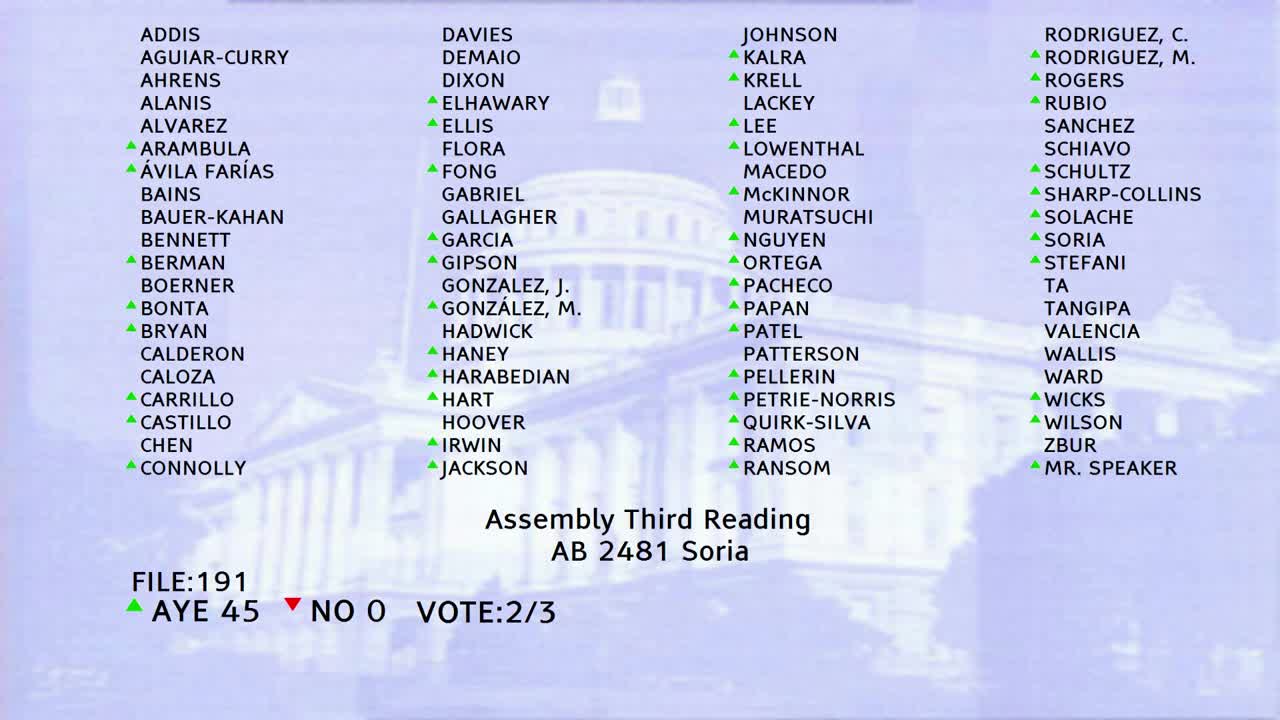 43SEC
Assembly Floor
Bill Author

Bill Co-Author(s):