AB 2580: Teacher credentialing: programs of professional preparation: California State University and community college partnerships.
- Session Year: 2025-2026
- House: Assembly
- Latest Version Date: 2026-09-27
Current Status:
Passed
(2026-09-27: Chaptered by Secretary of State - Chapter 624, Statutes of 2026.)
Introduced
In Committee
Awaiting First Chamber Vote
Passed First Chamber
In Committee
Awaiting Second Chamber Vote
Passed Second Chamber
Enacted
What does this bill do?
The chancellors of the California Community Colleges and the California State University must create a plan to expand teacher-preparation partnerships between CSU campuses and community college districts, including more online CSU programs aimed at rural students and pathways that let community college students take CSU teacher-prep courses while earning a credential. The plan would only move forward if the state provides funding for it.
The summary is provided by generative AI which can make mistakes. For original language, please view the details in the table below.
Existing law requires the Commission on Teacher Credentialing to establish standards for the issuance and renewal of credentials, certificates, and permits. Existing law authorizes the commission to approve a regionally accredited institution of higher education, as defined, to recommend to the commission the issuance of credentials to persons who have successfully completed a teacher education program of the institution if the program meets the standards approved by the commission. Existing law requires, as a minimum requirement for a preliminary multiple subject, single subject, or education specialist teaching credential, the satisfactory completion of a program of professional preparation, as provided. Existing law requires professional preparation, including student teaching, to be made available in the upper division course offerings at all California public institutions of higher learning, except as provided.
This bill would require the Chancellor of the California Community Colleges and the Chancellor of the California State University to develop, on or before July 1, 2027, a plan to increase professional teacher preparation partnerships between California State University campuses and community college districts that addresses (1) the expansion of online programs of professional preparation offered by the California State University in partnership with community college districts to increase access and opportunities for students pursuing teaching careers in rural communities, and (2) the expansion of educator preparation pathways between community college districts and the California State University to include opportunities for concurrent enrollment at the California State University in teacher preparation coursework for community college students pursuing a teaching credential. The bill would make implementation of the plan contingent upon an appropriation for its purposes. The bill would repeal these provisions on January 1, 2033.
Existing law requires the Commission on Teacher Credentialing to establish standards for the issuance and renewal of credentials, certificates, and permits. Existing law authorizes the commission to approve a regionally accredited institution of higher education, as defined, to recommend to the commission the issuance of credentials to persons who have successfully completed a teacher education program of the institution if the program meets the standards approved by the commission. Existing law requires, as a minimum requirement for a preliminary multiple subject, single subject, or education specialist teaching credential, the satisfactory completion of a program of professional preparation, as provided. Existing law requires professional preparation, including student teaching, to be made available in the upper division course offerings at all California public institutions of higher learning, except as provided.
This bill, contingent upon an appropriation for its purposes, bill would require the Chancellor of the California Community Colleges and the Chancellor of the California State University to develop and implement develop, on or before July 1, 2027, a plan to increase professional teacher preparation partnerships between California State University campuses and community colleges college districts that addresses (1) the expansion of online programs of professional preparation offered by the California State University in partnership with community college districts to increase access and opportunities for students pursuing teaching careers in rural communities, and (2) allowing dual enrollment the expansion of educator preparation pathways between community colleges college districts and the California State University for to include opportunities for concurrent enrollment at the California State University in teacher preparation coursework for community college students pursuing a teaching credential. The bill would make implementation of the plan contingent upon an appropriation for its purposes. The bill would repeal these provisions on January 1, 2033.
Existing law requires the Commission on Teacher Credentialing to establish standards for the issuance and renewal of credentials, certificates, and permits. Existing law authorizes the commission to approve a regionally accredited institution of higher education, as defined, to recommend to the commission the issuance of credentials to persons who have successfully completed a teacher education program of the institution if the program meets the standards approved by the commission. Existing law requires, as a minimum requirement for a preliminary multiple subject, single subject, or education specialist teaching credential, the satisfactory completion of a program of professional preparation, as provided. Existing law requires professional preparation, including student teaching, to be made available in the upper division course offerings at all California public institutions of higher learning, except as provided.
This bill, contingent upon an appropriation for its purposes, would require the Chancellor of the California Community Colleges and the California State University to develop and implement a plan to increase partnerships between California State University campuses and community colleges that addresses (1) the expansion of online programs of professional preparation to increase access and opportunities for students pursuing teaching careers in rural communities, and (2) allowing dual enrollment between community colleges and the California State University for students pursuing a teaching credential. The bill would repeal these provisions on January 1, 2033.
This bill would make a nonsubstantive change to the latter provision.Existing law requires the Commission on Teacher Credentialing to establish standards for the issuance and renewal of credentials, certificates, and permits. Existing law authorizes the commission to approve a regionally accredited institution of higher education, as defined, to recommend to the commission the issuance of credentials to persons who have successfully completed a teacher education program of the institution if the program meets the standards approved by the commission.
This bill would make a nonsubstantive change to the latter provision.
(a)On or before July 1, 2027, the Chancellor of the California Community Colleges and the Chancellor of the California State University shall develop a plan to increase professional teacher preparation partnerships between California State University campuses and community college districts. The plan shall address at least both of the following:
(1)The expansion of online programs of professional preparation offered by the California State University in partnership with community college districts to increase access and opportunities for students pursuing teaching careers in rural communities.
(2)The expansion of educator preparation pathways between community college districts and the California State University to include opportunities for concurrent enrollment at the California State University in teacher preparation coursework for community college students pursuing a teaching credential.
(b)Implementation of the plan developed pursuant to subdivision (a) is contingent upon an appropriation being made for its purposes in the annual Budget Act or another statute.
(c)This section shall remain in effect only until January 1, 2033, and as of that date is repealed.
(a)The On or before July 1, 2027, the Chancellor of the California Community Colleges and the Chancellor of the California State University shall develop and implement a plan to increase professional teacher preparation partnerships between California State University campuses and community colleges. districts. The plan shall address at least both of the following:
(1)The expansion of online programs of professional preparation offered by the California State University in partnership with community college districts to increase access and opportunities for students pursuing teaching careers in rural communities.
(2)Allowing dual enrollment The expansion of educator preparation pathways between community colleges college districts and the California State University for to include opportunities for concurrent enrollment at the California State University in teacher preparation coursework for community college students pursuing a teaching credential.
(b)Implementation of this section the plan developed pursuant to subdivision (a) is contingent upon an appropriation being made for its purposes in the annual Budget Act or another statute.
(c)This section shall remain in effect only until January 1, 2033, and as of that date is repealed.
(a)The Chancellor of the California Community Colleges and the California State University shall develop and implement a plan to increase partnerships between California State University campuses and community colleges. The plan shall address at least both of the following:
(1)The expansion of online programs of professional preparation to increase access and opportunities for students pursuing teaching careers in rural communities.
(2)Allowing dual enrollment between community colleges and the California State University for students pursuing a teaching credential.
(b)Implementation of this section is contingent upon an appropriation being made for its purposes in the annual Budget Act or another statute.
(c)This section shall remain in effect only until January 1, 2033, and as of that date is repealed.
SECTION 1.Section 44227 of the Education Code is amended to read:44227.(a)The commission may approve a regionally accredited institution of higher education to recommend to the commission the issuance of credentials to persons who have successfully completed a teacher education program of the institution if the program meets the standards approved by the commission.(b)A regionally accredited institution of higher education whose teacher education program has been accredited by the commission shall approve and electronically submit credential applications to the commission, and the commission shall grant credentials to these applicants based upon that approval.(c)Notwithstanding any other law, the commission may approve for credit any coursework completed for credential purposes or for step increases in programs offered in California by out-of-state institutions of higher education that meet the requirements prescribed by Chapter 8 (commencing with Section 94800) of Part 59 of Division 10 of Title 3 only if the program of courses is offered by a regionally accredited institution of higher education and evidence of satisfactory evaluation by that accrediting body is submitted by the out-of-state institution to the commission for purposes of seeking approval of the program and any courses within that program to enable potential teachers to meet one or more requirements for a teaching credential in California.(a)The commission may approve any a regionally accredited institution of higher education to recommend to the commission the issuance of credentials to persons who have successfully completed a teacher education program of the institution if the program meets the standards approved by the commission.
(b)A regionally accredited institution of higher education whose teacher education program has been accredited by the commission shall approve and electronically submit credential applications to the commission, and the commission shall grant credentials to these applicants based upon that approval.
(c)Notwithstanding any other law, the commission may approve for credit any coursework completed for credential purposes or for step increases in programs offered in California by out-of-state institutions of higher education that meet the requirements prescribed by Chapter 8 (commencing with Section 94800) of Part 59 of Division 10 of Title 3 only if the program of courses is offered by a regionally accredited institution of higher education and evidence of satisfactory evaluation by that accrediting body is submitted by the out-of-state institution to the commission for purposes of seeking approval of the program and any courses within that program to enable potential teachers to meet one or more requirements for a teaching credential in California.
|
Date
|
Status
|
|---|---|
| Sep 27, 2026 | Chaptered by Secretary of State - Chapter 624, Statutes of 2026. |
| Sep 27, 2026 | Approved by the Governor. |
| Aug 28, 2026 | Enrolled and presented to the Governor at 3:30 p.m. |
| Aug 24, 2026 | Senate amendments concurred in. To Engrossing and Enrolling. (Ayes 78. Noes 0.). |
| Aug 24, 2026 | Senate amendments concurred in. To Engrossing and Enrolling. (Ayes 78. Noes 0. Page 6412.). |
| Aug 24, 2026 | Senate amendments concurred in. To Engrossing and Enrolling. |
| Aug 20, 2026 | In Assembly. Concurrence in Senate amendments pending. |
| Aug 20, 2026 | Read third time. Passed. Ordered to the Assembly. (Ayes 39. Noes 0.). |
| Aug 20, 2026 | Read third time. Passed. Ordered to the Assembly. (Ayes 39. Noes 0. Page 5593.). |
| Aug 18, 2026 | Ordered to special consent calendar. |
| Aug 13, 2026 | Read second time. Ordered to third reading. |
| Aug 13, 2026 | From committee: Do pass. (Ayes 7. Noes 0.) (August 13). |
| Aug 3, 2026 | In committee: Referred to APPR. suspense file. |
| Jun 25, 2026 | From committee: Do pass and re-refer to Com. on APPR. with recommendation: To Consent Calendar. (Ayes 7. Noes 0.) (June 24). Re-referred to Com. on APPR. |
| Jun 15, 2026 | From committee chair, with author's amendments: Amend, and re-refer to committee. Read second time, amended, and re-referred to Com. on ED. |
| Jun 10, 2026 | Referred to Com. on ED. |
| May 28, 2026 | In Senate. Read first time. To Com. on RLS. for assignment. |
| May 27, 2026 | Read third time. Passed. Ordered to the Senate. (Ayes 79. Noes 0.) |
| May 27, 2026 | Read third time. Passed. Ordered to the Senate. (Ayes 79. Noes 0. Page 5467.) |
| May 27, 2026 | Read third time. Passed. Ordered to the Senate. |
| May 18, 2026 | Read second time. Ordered to third reading. |
| May 14, 2026 | From committee: Do pass. (Ayes 15. Noes 0.) (May 14). |
| May 6, 2026 | In committee: Set, first hearing. Referred to APPR. suspense file. |
| Apr 22, 2026 | From committee: Do pass and re-refer to Com. on APPR. with recommendation: To Consent Calendar. (Ayes 10. Noes 0.) (April 21). Re-referred to Com. on APPR. |
| Apr 14, 2026 | Re-referred to Com. on HIGHER ED. |
| Apr 13, 2026 | Read second time and amended. |
| Apr 9, 2026 | From committee: Amend, and do pass as amended and re-refer to Com. on HIGHER ED. with recommendation: To Consent Calendar. (Ayes 9. Noes 0.) (April 8). |
| Mar 23, 2026 | Re-referred to Com. on ED. |
| Mar 19, 2026 | Referred to Coms. on ED. and HIGHER ED. |
| Mar 19, 2026 | From committee chair, with author's amendments: Amend, and re-refer to Com. on ED. Read second time and amended. |
| Feb 21, 2026 | From printer. May be heard in committee March 23. |
| Feb 20, 2026 | Read first time. To print. |
|
Date
|
Description
|
Location
|
Votes
|
|
|---|---|---|---|---|
| Aug 24, 2026 | AB 2580 Muratsuchi Concurrence in Senate Amendments | Assembly Floor |
Passed |
|
| Aug 20, 2026 | Special Consent AB2580 Muratsuchi et al. | Senate Floor |
Passed |
|
| Aug 13, 2026 | Do pass | Senate Standing Committee on Appropriations |
Passed |
|
| Aug 3, 2026 | Placed on suspense file | Senate Standing Committee on Appropriations |
Passed |
|
| Jun 24, 2026 | Do pass, but first be re-referred to the Committee on [Appropriations] with the recommendation: To Consent Calendar | Senate Standing Committee on Education |
Passed |
|
| May 27, 2026 | AB 2580 Muratsuchi Assembly Third Reading | Assembly Floor |
Passed |
|
| May 14, 2026 | Do pass. | Assembly Standing Committee on Appropriations |
Passed |
|
| Apr 21, 2026 | Do pass and be re-referred to the Committee on [Appropriations] with recommendation: To Consent Calendar | Assembly Standing Committee on Higher Education |
Passed |
|
| Apr 8, 2026 | Do pass as amended, and be re-referred to the Committee on [Higher Education] with recommendation: To Consent Calendar | Assembly Standing Committee on Education |
Passed |
This list shows positions taken on this bill by organizations on the date displayed, which is linked to the original source.
Positions by individuals are not included.
|
Organization
|
Position
|
Date
|
|---|---|---|
| Education Trust West | ** Support | |
| Faculty Association Of California Community Colleges | ** Support | |
| Small School Districts Association | ** Support |
CONCURRENCE IN SENATE AMENDMENTS
CSA1 Bill Id:AB 2580
Author:(Muratsuchi and Hadwick)
As Amended Ver:June 15, 2026
Majority vote
SUMMARY
Requires the Chancellor of the California Community Colleges (CCC) and the Chancellor of the California State University (CSU) to jointly develop, by July 1, 2027, a plan to expand teacher preparation partnerships between CCC districts and CSU campuses, with a particular focus on increasing access to teacher preparation programs in rural communities and creating concurrent enrollment opportunities for community college students pursuing teaching credentials.
Senate Amendments
- Make minor technical changes.
- Add Assemblymember Hadwick as a joint author.
COMMENTS
Key provisions of the bill. This bill would require, contingent upon an appropriation in the annual Budget Act or another statute, the Chancellor of CCC and the Chancellor of CSU, on or before July 1, 2027, to jointly develop a plan to increase professional teacher preparation partnerships between CSU campuses and CCDs. The plan would be required to address the expansion of CSU online teacher preparation programs offered in partnership with CCDs to increase access to teaching careers in rural communities, and the expansion of educator preparation pathways that allow community college students pursuing a teaching credential to concurrently enroll in CSU teacher preparation coursework. If adopted, the provisions of this bill would be repealed on January 1, 2033.
Increased coordination between the CCC and CSU may lead to a strengthening of the teacher preparation pipeline. California has long relied on CSU as the state's primary producer of credentialed teachers, while community colleges serve as a key entry point into higher education for many prospective educators. According to the author, strengthening coordination between the two segments could reduce barriers for students pursuing teaching careers, particularly those who begin their postsecondary education at a community college. This bill seeks to encourage greater alignment among the segments by requiring the development of a plan to expand partnerships and improve pathways into teacher preparation programs.
Rural school districts often face unique educator workforce challenges, including smaller applicant pools, geographic isolation, and limited proximity to institutions offering educator preparation programs. By examining opportunities to expand online delivery models and local partnerships, the bill seeks to identify strategies that may allow prospective teachers to complete preparation requirements while remaining in their home communities, potentially increasing the likelihood that they ultimately teach in those areas.
This bill requires development of a plan and does not establish any new educator preparation programs, transfer pathways, or enrollment authorities. Any implementation activities resulting from the plan would be contingent upon a future appropriation. As a result, this bill primarily serves as a planning and coordination measure intended to identify opportunities for expanded partnerships and access to teacher preparation programs rather than directly implementing those changes in statute.
Existing efforts to improve teacher preparation pathways. California has undertaken numerous efforts in recent years to strengthen educator workforce pipelines, including investments in teacher residencies, classified school employee credentialing pathways, Golden State Teacher Grants, educator apprenticeship programs, and transfer pathways intended to improve access to teacher preparation. To the extent the segments develop the plan required by this bill, the Legislature may wish to consider how any recommended partnerships or concurrent enrollment models would complement and align with existing state workforce initiatives, rather than duplicating efforts already underway.
158,217 active credential holders are not currently employed in California. According to the CTC, approximately 475,427 individuals held an active preliminary and/or clear teaching credential as of April 1, 2026. It is important, however, to understand that not all individuals who hold an active teaching credential are employed. The California Department of Education's (CDE's) employment data set indicates that the number of teachers employed in California during the 2024-25 school year was 317,210. Teachers who were not employed or identified in CDE's system may be using their active teaching credential at private schools, by teaching abroad, by working at the CTC or CDE, or by being a teacher educator in a CTC-approved preparation program (not tracked by the CTC or CDE). Some active credential holders who are not currently employed in public schools may have retired but are not letting their credentials lapse, and others may choose to keep their credentials active for personal reasons. In addition, individuals recently issued a credential may not have yet had an opportunity to be hired and be included in CDE's employment data system for the active 2024-25 school year. The CTC records estimate that there are 158,217 of 475,427 individuals who can teach and provide services in California's public schools as of the date of this report.
317,932 expired credentials not renewed as of April 1, 2026. An additional pool of teachers who could be employed to teach and provide services in California's public schools are individuals who have not renewed their expired teaching credential(s). Individuals with an expired clear credential can directly renew their credential in the CTC's web-based online system. After the credential is renewed or reissued, the credential becomes valid for another five years. For expired preliminary credentials, individuals would need to complete a teacher induction program and be recommended for the clear credential to obtain a valid credential. CTC records verified that approximately 317,932 individuals hold expired teaching credentials that have not yet been renewed as of April 1, 2026. These 317,932 individuals hold a total of 339,246 credentials that can be renewed for future employment. It is possible that a small number of individuals may currently be employed using their credential as their credential did not expire prior to the start of their employment. These credentials can be renewed for employment in the remaining and following school years. Out of the 339,246 expired teaching credentials, there were:
- 185,945 (54.8%) Multiple Subject Teaching Credentials
- 131,918 (38.9%) Single Subject Teaching Credentials
- 21,383 (6.3%) Education Specialist Instruction Credentials
According to the Author
According to the author, "California's teacher shortage continues to disproportionately impact rural and underserved communities, where students often lack access to qualified, fully credentialed educators. AB 2580 is intended to expand pathways into the teaching profession by strengthening partnerships between community colleges and California State University campuses. By increasing access to online teacher preparation programs and creating opportunities for dual enrollment, this measure will make it easier for students, especially those in rural areas, to pursue a teaching career without leaving their communities. Strengthening these pathways is essential to building a more equitable and sustainable teacher workforce for the state."
Arguments in Support
Education Trust West states, "AB 2580 (Muratsuchi) represents a crucial step toward addressing California's acute teacher shortage, which continues to disproportionately impact rural and underserved communities where students often lack access to qualified, fully credentialed educators. By strengthening partnerships between community colleges and California State University campuses, AB 2580 expands pathways into the teaching profession. This measure will make it easier for students, especially those in rural areas, to pursue a teaching career without leaving their communities. Strengthening these pathways is essential to building a more equitable and sustainable teacher workforce for the state."
Arguments in Opposition
None on file.
FISCAL COMMENTS
According to the Senate Appropriations Committee:
While the bill's provisions would be contingent upon an appropriation, it could lead to one-time General Fund cost pressures in the hundreds of thousands of dollars and ongoing General Fund and Proposition 98 General Fund cost pressures in the low millions to develop and implement the plan to expand teacher preparation partnerships between CSU campuses and CCC districts. Specifically, the CSU estimates one-time costs of $40,000 per participating campus to develop the plan which includes faculty buy-out time and meetings with community colleges, while the Chancellor's Office one-time General Fund costs of $33,000 to $53,000. Additionally, the CSU estimates $1.2 million in ongoing costs to participate in partnerships established pursuant to the plan developed by this bill. Of this amount, $450,000 would be used to hire advisors for current and prospective students and $702,000 for an estimated 90 students from the CCC system to enroll in 24 units at CSU.
VOTES:
ASM EDUCATION: 9-0-0
YES: Patel, Hoover, Alvarez, Bonta, Castillo, Garcia, Lowenthal, Pellerin, Zbur
ASM HIGHER EDUCATION: 10-0-0
YES: Fong, DeMaio, Boerner, Macedo, Jackson, Muratsuchi, Patel, Ramos, Sharp-Collins, Tangipa
ASM APPROPRIATIONS: 15-0-0
YES: Wicks, Hoover, Aguiar-Curry, Calderon, Caloza, Dixon, Fong, Mark González, Krell, Pacheco, Pellerin, Sharp-Collins, Solache, Ta, Tangipa
ASSEMBLY FLOOR: 79-0-1
YES: Addis, Aguiar-Curry, Ahrens, Alanis, Alvarez, Arambula, Ávila Farías, Bains, Bauer-Kahan, Bennett, Berman, Boerner, Bonta, Bryan, Calderon, Caloza, Carrillo, Castillo, Chen, Connolly, Davies, DeMaio, Dixon, Elhawary, Ellis, Flora, Fong, Gabriel, Gallagher, Garcia, Gipson, Jeff Gonzalez, Mark González, Hadwick, Haney, Harabedian, Hart, Hoover, Irwin, Jackson, Johnson, Kalra, Krell, Lackey, Lee, Lowenthal, Macedo, McKinnor, Muratsuchi, Nguyen, Ortega, Pacheco, Papan, Patel, Patterson, Pellerin, Petrie-Norris, Quirk-Silva, Ramos, Ransom, Michelle Rodriguez, Rogers, Blanca Rubio, Sanchez, Schiavo, Schultz, Sharp-Collins, Solache, Soria, Stefani, Ta, Tangipa, Valencia, Wallis, Ward, Wicks, Wilson, Zbur, Rivas
ABS, ABST OR NV: Celeste Rodriguez
SENATE FLOOR: 39-0-1
YES: Allen, Alvarado-Gil, Archuleta, Arreguín, Ashby, Becker, Blakespear, Cabaldon, Caballero, Cervantes, Choi, Cortese, Dahle, Durazo, Gonzalez, Grayson, Grove, Hurtado, Jones, Laird, Limón, McGuire, McNerney, Menjivar, Niello, Ochoa Bogh, Padilla, Pérez, Richardson, Rubio, Seyarto, Smallwood-Cuevas, Stern, Strickland, Umberg, Valladares, Wahab, Weber Pierson, Wiener
ABS, ABST OR NV: Reyes
UPDATED
VERSION: June 15, 2026
CONSULTANT: Chelsea Kelley / ED. / (916) 319-2087 FN: 0003819
SENATE RULES COMMITTEE Office of Senate Floor Analyses (916) 651-4171 | AB 2580 |
THIRD READING
Bill No: AB 2580
Author: Muratsuchi (D) and Hadwick (R)
Amended: 6/15/26 in Senate
Vote: 21
SENATE EDUCATION COMMITTEE: 7-0, 6/24/26
AYES: Pérez, Ochoa Bogh, Cabaldon, Choi, Cortese, Gonzalez, Reyes
SENATE APPROPRIATIONS COMMITTEE: 7-0, 8/13/26
AYES: Cervantes, Seyarto, Cabaldon, Dahle, Grayson, Richardson, Wahab
ASSEMBLY FLOOR: 79-0, 5/27/26 - See last page for vote
SUBJECT: Teacher credentialing: programs of professional preparation: California State University and community college partnerships
SOURCE: Author
DIGEST:
This bill requires the Chancellor of the California Community Colleges (CCC) and the Chancellor of the California State University (CSU) to jointly develop, by July 1, 2027, a plan to expand teacher preparation partnerships between CCC districts and CSU campuses, with a particular focus on increasing access to teacher preparation programs in rural communities and creating concurrent enrollment opportunities for community college students pursuing teaching credentials.
ANALYSIS:
Existing law:
- Establishes the CCCs and the CSU as separate segments of public higher education with distinct missions under the California Master Plan for Higher Education.
- Authorizes community college districts (CCDs) to offer associate degrees, transfer pathways, and other programs designed to prepare students for transfer to four-year institutions.
- Designates CSU as California’s primary public institution responsible for preparing teachers and recommending candidates for California teaching credentials through Commission on Teacher Credentialing (CTC)-approved educator preparation programs.
- Requires educator preparation programs leading to a teaching credential to be approved and accredited by the CTC.
- Establishes various transfer and degree pathways between CCC and CSU, including Associate Degrees for Transfer (ADT), intended to facilitate student transfer and degree completion.
This bill:
- Requires the Chancellor of CCC and the Chancellor of CSU, on or before July 1, 2027, to jointly develop a plan to increase professional teacher preparation partnerships between CSU campuses and CCDs.
- Requires the plan to address the expansion of CSU online teacher preparation programs offered in partnership with CCDs to increase access to teaching careers in rural communities.
- Requires the plan to address the expansion of educator preparation pathways that allow community college students pursuing a teaching credential to concurrently enroll in CSU teacher preparation coursework.
- Provides that implementation of the plan is contingent upon an appropriation in the annual Budget Act or another statute.
- Repeals these provisions on January 1, 2033.
Comments
Need for the bill. According to the author, “California’s teacher shortage continues to disproportionately impact rural and underserved communities, where students often lack access to qualified, fully credentialed educators. AB 2580 is intended to expand pathways into the teaching profession by strengthening partnerships between community colleges and California State University campuses. By increasing access to online teacher preparation programs and creating opportunities for dual enrollment, this measure will make it easier for students, especially those in rural areas, to pursue a teaching career without leaving their communities. Strengthening these pathways is essential to building a more equitable and sustainable teacher workforce for the state.”
Strengthening the teacher preparation pipeline through increased coordination between CCC and CSU. California has long relied on CSU as the state’s primary producer of credentialed teachers, while community colleges serve as a key entry point into higher education for many prospective educators. According to the author, strengthening coordination between the two segments could reduce barriers for students pursuing teaching careers, particularly those who begin their postsecondary education at a community college. This bill seeks to encourage greater alignment among the segments by requiring the development of a plan to expand partnerships and improve pathways into teacher preparation programs.
Focus on rural teacher workforce challenges. This bill directs the segments to consider expansion of online teacher preparation opportunities designed to serve students in rural communities. Rural school districts often face unique educator workforce challenges, including smaller applicant pools, geographic isolation, and limited proximity to institutions offering educator preparation programs. By examining opportunities to expand online delivery models and local partnerships, the bill seeks to identify strategies that may allow prospective teachers to complete preparation requirements while remaining in their home communities, potentially increasing the likelihood that they ultimately teach in those areas.
Concurrent enrollment concept raises implementation questions. This bill directs the segments to explore opportunities for community college students pursuing teaching credentials to concurrently enroll in CSU teacher preparation coursework. While the concept could accelerate students’ progress toward credential attainment and strengthen transfer pathways, it may also raise practical questions regarding admissions status, tuition and fee responsibilities, financial aid eligibility, course availability, academic advising, and coordination between institutions. This bill does not prescribe a particular model, instead leaving those considerations to be addressed through the planning process developed by the two segments.
Planning requirement without guaranteed implementation. This bill requires development of a plan but does not itself establish any new educator preparation programs, transfer pathways, or enrollment authorities. Any implementation activities resulting from the plan would be contingent upon a future appropriation. As a result, this bill primarily serves as a planning and coordination measure intended to identify opportunities for expanded partnerships and access to teacher preparation programs rather than directly implementing those changes in statute.
Existing efforts to improve teacher preparation pathways. California has undertaken numerous efforts in recent years to strengthen educator workforce pipelines, including investments in teacher residencies, classified school employee credentialing pathways, Golden State Teacher Grants, educator apprenticeship programs, and transfer pathways intended to improve access to teacher preparation. To the extent the segments develop the plan required by this bill, the Legislature may wish to consider how any recommended partnerships or concurrent enrollment models would complement and align with existing state workforce initiatives, rather than duplicating efforts already underway.
FISCAL EFFECT: Appropriation: No Fiscal Com.: Yes Local: No
According to the Senate Appropriations Committee:
While the bill’s provisions would be contingent upon an appropriation, it could lead to one-time General Fund cost pressures in the hundreds of thousands of dollars and ongoing General Fund and Proposition 98 General Fund cost pressures in the low millions to develop and implement the plan to expand teacher preparation partnerships between CSU campuses and CCC districts. Specifically, the CSU estimates one-time costs of $40,000 per participating campus to develop the plan which includes faculty buy-out time and meetings with community colleges, while the Chancellor’s Office one-time General Fund costs of $33,000 to $53,000. Additionally, the CSU estimates $1.2 million in ongoing costs to participate in partnerships established pursuant to the plan developed by this bill. Of this amount, $450,000 would be used to hire advisors for current and prospective students and $702,000 for an estimated 90 students from the CCC system to enroll in 24 units at CSU.
SUPPORT: (Verified 8/13/26)
Faculty Association of California Community Colleges
Small School Districts Association
OPPOSITION: (Verified 8/13/26)
None received
ASSEMBLY FLOOR: 79-0, 5/27/26
AYES: Addis, Aguiar-Curry, Ahrens, Alanis, Alvarez, Arambula, Ávila Farías, Bains, Bauer-Kahan, Bennett, Berman, Boerner, Bonta, Bryan, Calderon, Caloza, Carrillo, Castillo, Chen, Connolly, Davies, DeMaio, Dixon, Elhawary, Ellis, Flora, Fong, Gabriel, Gallagher, Garcia, Gipson, Jeff Gonzalez, Mark González, Hadwick, Haney, Harabedian, Hart, Hoover, Irwin, Jackson, Johnson, Kalra, Krell, Lackey, Lee, Lowenthal, Macedo, McKinnor, Muratsuchi, Nguyen, Ortega, Pacheco, Papan, Patel, Patterson, Pellerin, Petrie-Norris, Quirk-Silva, Ramos, Ransom, Michelle Rodriguez, Rogers, Blanca Rubio, Sanchez, Schiavo, Schultz, Sharp-Collins, Solache, Soria, Stefani, Ta, Tangipa, Valencia, Wallis, Ward, Wicks, Wilson, Zbur, Rivas
NO VOTE RECORDED: Celeste Rodriguez
Prepared by: Ian Johnson / ED. / (916) 651-4105
8/14/26 10:27:16
**** END ****
SENATE COMMITTEE ON
Senator Sabrina Cervantes, Chair
2025 - 2026 Regular Session
AB 2580 (Muratsuchi) - Teacher credentialing: programs of professional preparation: California State University and community college partnerships
Version: | Policy Vote: |
Urgency: | Mandate: |
Hearing Date: | Consultant: |
Bill Summary:
This bill requires the Chancellor of the California Community Colleges (CCC) and the California State University (CSU) to jointly develop a plan to expand teacher preparation partnerships between CCC districts and CSU campuses, with a particular focus on increasing access to teacher preparation programs in rural communities and creating concurrent enrollment opportunities for community college students pursuing teaching credentials.
Fiscal Impact:
While the bill’s provisions would be contingent upon an appropriation, it could lead to one-time General Fund cost pressures in the hundreds of thousands of dollars and ongoing General Fund and Proposition 98 General Fund cost pressures in the low millions to develop and implement the plan to expand teacher preparation partnerships between CSU campuses and CCC districts. Specifically, the CSU estimates one-time costs of $40,000 per participating campus to develop the plan which includes faculty buy-out time and meetings with community colleges, while the Chancellor’s Office one-time General Fund costs of $33,000 to $53,000. Additionally, the CSU estimates $1.2 million in ongoing costs to participate in partnerships established pursuant to the plan developed by this bill. Of this amount, $450,000 would be used to hire advisors for current and prospective students and $702,000 for an estimated 90 students from the CCC system to enroll in 24 units at CSU.
Background:
Existing law authorizes community college districts (CCDs) to offer associate degrees, transfer pathways, and other programs designed to prepare students for transfer to four-year institutions.
Existing law designates CSU as California’s primary public institution responsible for preparing teachers and recommending candidates for California teaching credentials through Commission on Teacher Credentialing (CTC)-approved educator preparation programs. The law requires educator preparation programs leading to a teaching credential to be approved and accredited by the CTC.
Existing law establishes various transfer and degree pathways between CCC and CSU, including Associate Degrees for Transfer (ADT), intended to facilitate student transfer and degree completion.
Proposed Law:
This bill requires the Chancellor of CCC and the Chancellor of CSU, on or before July 1, 2027, to jointly develop a plan to increase professional teacher preparation partnerships between CSU campuses and CCDs.
This bill requires the plan to address the expansion of CSU online teacher preparation programs offered in partnership with CCDs to increase access to teaching careers in rural communities. It also requires the plan to address the expansion of educator preparation pathways that allow community college students pursuing a teaching credential to concurrently enroll in CSU teacher preparation coursework.
This bill provides that implementation of the plan is contingent upon an appropriation in the annual Budget Act or another statute, and repeals its provisions on January 1, 2033.
Staff Comments:
This bill requires the CSU and Chancellor of CCCs to jointly develop a plan to increase professional teacher preparation partnerships between the segments and directs them to consider expansion of online teacher preparation opportunities designed to serve students in rural communities. The bill also directs the segments to explore opportunities for community college students pursuing teaching credentials to concurrently enroll in CSU teacher preparation coursework. According to the author, “California’s teacher shortage continues to disproportionately impact rural and underserved communities, where students often lack access to qualified, fully credentialed educators. AB 2580 is intended to expand pathways into the teaching profession by strengthening partnerships between community colleges and California State University campuses. By increasing access to online teacher preparation programs and creating opportunities for dual enrollment, this measure will make it easier for students, especially those in rural areas, to pursue a teaching career without leaving their communities. Strengthening these pathways is essential to building a more equitable and sustainable teacher workforce for the state.”
-- END --
SENATE COMMITTEE ON EDUCATION
Senator Sasha Renée Pérez, Chair
2025 - 2026 Regular
Bill No: Hearing Date: June 24, 2026
Author: | |||
Version: |
| ||
Urgency: | Fiscal: | ||
Consultant: | |||
Subject:
SUMMARY
This bill requires the Chancellor of the California Community Colleges (CCC) and the Chancellor of the California State University (CSU) to jointly develop, by July 1, 2027, a plan to expand teacher preparation partnerships between CCC districts and CSU campuses, with a particular focus on increasing access to teacher preparation programs in rural communities and creating concurrent enrollment opportunities for community college students pursuing teaching credentials.
BACKGROUND
Existing law:
- Establishes the CCCs and the CSU as separate segments of public higher education with distinct missions under the California Master Plan for Higher Education.
- Authorizes community college districts (CCDs) to offer associate degrees, transfer pathways, and other programs designed to prepare students for transfer to four-year institutions.
- Designates CSU as California’s primary public institution responsible for preparing teachers and recommending candidates for California teaching credentials through Commission on Teacher Credentialing (CTC)-approved educator preparation programs.
- Requires educator preparation programs leading to a teaching credential to be approved and accredited by the CTC.
- Establishes various transfer and degree pathways between CCC and CSU, including Associate Degrees for Transfer (ADT), intended to facilitate student transfer and degree completion.
ANALYSIS
This bill:
- Requires the Chancellor of CCC and the Chancellor of CSU, on or before July 1, 2027, to jointly develop a plan to increase professional teacher preparation partnerships between CSU campuses and CCDs.
- Requires the plan to address the expansion of CSU online teacher preparation programs offered in partnership with CCDs to increase access to teaching careers in rural communities.
- Requires the plan to address the expansion of educator preparation pathways that allow community college students pursuing a teaching credential to concurrently enroll in CSU teacher preparation coursework.
- Provides that implementation of the plan is contingent upon an appropriation in the annual Budget Act or another statute.
- Repeals these provisions on January 1, 2033.
STAFF COMMENTS
- Need for the bill. According to the author, “California’s teacher shortage continues to disproportionately impact rural and underserved communities, where students often lack access to qualified, fully credentialed educators. AB 2580 is intended to expand pathways into the teaching profession by strengthening partnerships between community colleges and California State University campuses. By increasing access to online teacher preparation programs and creating opportunities for dual enrollment, this measure will make it easier for students, especially those in rural areas, to pursue a teaching career without leaving their communities. Strengthening these pathways is essential to building a more equitable and sustainable teacher workforce for the state.”
- Strengthening the teacher preparation pipeline through increased coordination between CCC and CSU. California has long relied on CSU as the state’s primary producer of credentialed teachers, while community colleges serve as a key entry point into higher education for many prospective educators. According to the author, strengthening coordination between the two segments could reduce barriers for students pursuing teaching careers, particularly those who begin their postsecondary education at a community college. The bill seeks to encourage greater alignment among the segments by requiring the development of a plan to expand partnerships and improve pathways into teacher preparation programs.
- Focus on rural teacher workforce challenges. The bill specifically directs the segments to consider expansion of online teacher preparation opportunities designed to serve students in rural communities. Rural school districts often face unique educator workforce challenges, including smaller applicant pools, geographic isolation, and limited proximity to institutions offering educator preparation programs. By examining opportunities to expand online delivery models and local partnerships, the bill seeks to identify strategies that may allow prospective teachers to complete preparation requirements while remaining in their home communities, potentially increasing the likelihood that they ultimately teach in those areas.
- Concurrent enrollment concept raises implementation questions. The bill directs the segments to explore opportunities for community college students pursuing teaching credentials to concurrently enroll in CSU teacher preparation coursework. While the concept could accelerate students’ progress toward credential attainment and strengthen transfer pathways, it may also raise practical questions regarding admissions status, tuition and fee responsibilities, financial aid eligibility, course availability, academic advising, and coordination between institutions. The bill does not prescribe a particular model, instead leaving those considerations to be addressed through the planning process developed by the two segments.
- Planning requirement without guaranteed implementation. The bill requires development of a plan but does not itself establish any new educator preparation programs, transfer pathways, or enrollment authorities. Any implementation activities resulting from the plan would be contingent upon a future appropriation. As a result, the bill primarily serves as a planning and coordination measure intended to identify opportunities for expanded partnerships and access to teacher preparation programs rather than directly implementing those changes in statute.
- Existing efforts to improve teacher preparation pathways. California has undertaken numerous efforts in recent years to strengthen educator workforce pipelines, including investments in teacher residencies, classified school employee credentialing pathways, Golden State Teacher Grants, educator apprenticeship programs, and transfer pathways intended to improve access to teacher preparation. To the extent the segments develop the plan required by this bill, the Committee may wish to consider how any recommended partnerships or concurrent enrollment models would complement and align with existing state workforce initiatives, rather than duplicating efforts already underway.
SUPPORT
Faculty Association of California Community Colleges
Small School Districts Association
OPPOSITION
None received
-- END --
ASSEMBLY THIRD READING
ATR Bill Id:AB 2580
Author:(Muratsuchi)
As Amended Ver:April 13, 2026
Majority vote
SUMMARY
Requires the Chancellor of the California Community Colleges (CCCC) and the California State University (CSU) to develop and implement a plan to increase partnerships between CSU campuses and community colleges.
Major Provisions
- Requires the Chancellor of the California Community Colleges and the California State University to develop and implement a plan to increase partnerships between California State University campuses and community colleges.
- Requires the plan to address both of the following:
- The expansion of online programs of professional preparation offered by the California State University in partnership with community college districts to increase access and opportunities for students pursuing teaching careers in rural communities.
- The expansion of educator preparation pathways between community college districts and the California State University to include opportunities for concurrent enrollment at the California State University in teacher preparation coursework for community college students pursuing a teaching credential.
- State that the plan shall be completed by July 1, 2027, and the plan shall be implemented, if an appropriation is made for the implementation of the plan in the annual Budget Act or another statute.
- States that this measure shall sunset on January 1, 2033.
COMMENTS
158,217 active credential holders are not currently employed in California. According to the CTC, approximately 475,427 individuals held an active preliminary and/or clear teaching credential as of April 1, 2026. It is important, however, to understand that not all individuals who hold an active teaching credential are employed. The California Department of Education′s (CDE′s) employment data set indicates that the number of teachers employed in California during the 2024-25 school year was 317,210. Teachers who were not employed or identified in CDE′s system may be using their active teaching credential at private schools, by teaching abroad, by working at the CTC or CDE, or by being a teacher educator in a CTC-approved preparation program (not tracked by the CTC or CDE. Some active credential holders who are not currently employed in public schools may have retired but are not letting their credentials lapse, and others may choose to keep their credentials active for personal reasons. In addition, individuals recently issued a credential may not have yet had an opportunity to be hired and be included in CDE′s employment data system for the active 2024-25 school year. The CTC records estimate that there are 158,217 of 475,427 individuals who can teach and provide services in California′s public schools as of the date of this report.
317,932 expired credentials not renewed as of April 1, 2026. An additional pool of teachers who could be employed to teach and provide services in California′s public schools are individuals who have not renewed their expired teaching credential(s). Individuals with an expired clear credential can directly renew their credential in the CTC′s web-based online system. After the credential is renewed or reissued, the credential becomes valid for another five years. For expired preliminary credentials, individuals would need to complete a teacher induction program and be recommended for the clear credential to obtain a valid credential. CTC records verified that approximately 317,932 individuals hold expired teaching credentials that have not yet been renewed as of April 1, 2026. These 317,932 individuals hold a total of 339,246 credentials that can be renewed for future employment. It is possible that a small number of individuals may currently be employed using their credential as their credential did not expire prior to the start of their employment. These credentials can be renewed for employment in the remaining and following school years.
Out of the 339,246 expired teaching credentials, there were:
- 185,945 (54.8%) Multiple Subject Teaching Credentials
- 131,918 (38.9%) Single Subject Teaching Credentials
- 21,383 (6.3%) Education Specialist Instruction Credentials
According to the Author
According to the author, ″California′s teacher shortage continues to disproportionately impact rural and underserved communities, where students often lack access to qualified, fully credentialed educators. AB 2580 is intended to expand pathways into the teaching profession by strengthening partnerships between community colleges and California State University campuses. By increasing access to online teacher preparation programs and creating opportunities for dual enrollment, this measure will make it easier for students, especially those in rural areas, to pursue a teaching career without leaving their communities. Strengthening these pathways is essential to building a more equitable and sustainable teacher workforce for the state.″
Arguments in Support
Education Trust West states, ″AB 2580 (Muratsuchi) represents a crucial step toward addressing California′s acute teacher shortage, which continues to disproportionately impact rural and underserved communities where students often lack access to qualified, fully credentialed educators. By strengthening partnerships between community colleges and California State University campuses, AB 2580 expands pathways into the teaching profession. This measure will make it easier for students, especially those in rural areas, to pursue a teaching career without leaving their communities. Strengthening these pathways is essential to building a more equitable and sustainable teacher workforce for the state.″
Arguments in Opposition
None
FISCAL COMMENTS
According to the Assembly Appropriations Committee,
- One-time General Fund cost pressures of approximately $75,000 and approximately $1.2 million General Fund ongoing annually for the CSU to participate in partnerships created pursuant to the plan developed by this bill, subject to an appropriation by the Legislature.
- Minor General Fund costs in the tens of thousands of dollars to CCCCO to develop the plan in collaboration with the CSU.
VOTES
ASM EDUCATION: 9-0-0
YES: Patel, Hoover, Alvarez, Bonta, Castillo, Garcia, Lowenthal, Pellerin, Zbur
ASM HIGHER EDUCATION: 10-0-0
YES: Fong, DeMaio, Boerner, Macedo, Jackson, Muratsuchi, Patel, Ramos, Sharp-Collins, Tangipa
ASM APPROPRIATIONS: 15-0-0
YES: Wicks, Hoover, Aguiar-Curry, Calderon, Caloza, Dixon, Fong, Mark González, Krell, Pacheco, Pellerin, Sharp-Collins, Solache, Ta, Tangipa
UPDATED
VERSION: April 13, 2026
CONSULTANT: Chelsea Kelley / ED. / (916) 319-2087 FN: 0002694
Date of Hearing: May 6, 2026
ASSEMBLY COMMITTEE ON APPROPRIATIONS
Buffy Wicks, Chair
ABPCA Bill Id:AB 2580
Author:(Muratsuchi) – As Amended Ver:April 13, 2026
Policy Committee: | Education | Vote: | 9 - 0 |
Higher Education | 10 - 0 | ||
|
|
Urgency: No State Mandated Local Program: No Reimbursable: No
SUMMARY:
This bill requires the California Community Colleges Chancellor’s Office (CCCCO) and the Chancellor of the California State University (CSU), by July 1, 2027, to develop a plan to increase professional teacher preparation partnerships, including expansion of online programs, between campuses of the CSU and community college districts (CCDs). The bill conditions implementation of the plan upon an appropriation by the Legislature for this purpose.
FISCAL EFFECT:
- One-time General Fund cost pressures of approximately $75,000 and approximately $1.2 million General Fund ongoing annually for the CSU to participate in partnerships created pursuant to the plan developed by this bill, subject to an appropriation by the Legislature.
- Minor General Fund costs in the tens of thousands of dollars to CCCCO to develop the plan in collaboration with the CSU.
COMMENTS:
- Purpose. According to the author:
AB 2580 is intended to expand pathways into the teaching profession by strengthening partnerships between community colleges and California State University campuses. By increasing access to online teacher preparation programs and creating opportunities for dual enrollment, this measure will make it easier for students, especially those in rural areas, to pursue a teaching career without leaving their communities. Strengthening these pathways is essential to building a more equitable and sustainable teacher workforce for the state.
- Background. To obtain a first-time teaching credential in California, individuals must have a bachelor’s degree, complete a teacher preparation program, meet certain basic skills requirements, and demonstrate subject matter competency. Currently, California State University (CSU), University of California (UC), and some private universities offer the upper-division coursework required to obtain a first-time teaching credential.
SB 577 (Dodd), Chapter 603, Statutes of 2018, authorized a pilot program requiring the CCCCO to work with the CTC to award $500,000 grants to three participating CCDs to support partnerships with universities to offer online teacher preparation courses, with grant funds disbursed in the fall of 2020. However, due to the COVID-19 pandemic, the three participating CCDs repurposed the grants to provide support services to prospective teacher preparation students or students already in a teacher preparation program. This bill establishes a similar program requiring the CSU and CCCCO to develop a plan to increase teacher preparation partnerships between campuses of the CSU and CCDs.
Analysis Prepared by: Aaron Heredia / APPR. / (916) 319-2081
Date of Hearing: April 21, 2026
ASSEMBLY COMMITTEE ON HIGHER EDUCATION
Mike Fong, Chair
ABPCA Bill Id:AB 2580 (
Author:Muratsuchi) – As Amended Ver:April 13, 2026
SUBJECT: Teacher credentialing: programs of professional preparation: California State University and community college partnerships
SUMMARY: Requires the Chancellors of both the California Community Colleges and the California State University to develop a plan to increase access to teacher preparation programs for students throughout the State. Specifically, this bill:
- Authorizes the Chancellor of the California Community Colleges and the Chancellor of the California State University to develop a plan to increase professional teacher preparation partnerships between the California State University (CSU) campuses and community college districts by July 1, 2027. The plan as authorized will include plans to expand:
- Online programs for teacher preparation programs offered by the CSU campuses in partnership with community college districts to increase access and opportunities for students in rural communities who wish to become teachers; and,
- Educator preparation pathways between community college districts and the CSU to include concurrent enrollment at the CSU in teacher preparation coursework for community college students.
- Conditions the implementation of the plan pursuant to (1) upon the allocation of funding from the annual Budget Act or another statute.
- Repeals the provisions of the measure on January 1, 2033.
EXISTING LAW:
- Establishes the CSU system, made of 23 campuses, and bestows upon the CSU Trustees, through the Board of Trustees, the power, duties, and functions with respect to the management, administration, and control of the CSU system (Education Code (EDC) Sections 66606 and 89030 et. Seq.).
- Establishes the California Community Colleges (CCC) under the administration of the Board of Governors of the CCC, as one of the segments of public postsecondary education in this state. The CCC shall be comprised of community college districts (EDC Section 70900).
- Establishes that CCC districts are under the control of a board of trustees, known as the governing board, who has the authority to establish, maintain, operate, and govern one or more community colleges, within its district as specified (EDC Section 70902).
- Constitutes the Donahoe Higher Education Act to establish the definition and missions of the CCC, CSU, and the University of California (UC). Establishes the definition and mission of independent institutions of higher education as nonpublic higher education institutions who are considered nonprofits and are accredited by an agency recognized by the United States Department of Education to confer undergraduate degrees, graduate degrees, or both. Specifically, authorizes the CSU and UC to offer teacher preparation programs (EDC Section 66010, et seq.).
FISCAL EFFECT: Unknown.
COMMENTS: Double referral. This measure passed out of the Assembly Committee on Education on April 08, 2026, on consent with a vote of 9-0. A review on the issues germane to K-12 education is addressed in the Committee’s analysis.
The intent of the Author. As expressed by the author, “California’s teacher shortage continues to disproportionately impact rural and underserved communities, where students often lack access to qualified, fully credentialed educators. AB 2580 is intended to expand pathways into the teaching profession by strengthening partnerships between community colleges and California State University campuses. By increasing access to online teacher preparation programs and creating opportunities for dual enrollment, this measure will make it easier for students, especially those in rural areas, to pursue a teaching career without leaving their communities. Strengthening these pathways is essential to building a more equitable and sustainable teacher workforce for the state.”
Teacher credential programs in California. The California K-12 system consists of 1,014 school districts, that collectively educate roughly five million students.[1] To provide educational services, the K-12 system employs certificated teachers, who have completed a teacher preparation program in the State in their chosen educational field. According to the Commission for Teacher Credentialing (CTC) there are 140 institutions of higher education offering teacher preparation programs in the State of California and in 2023-2024, these institutions enrolled 36,031 students.[2] In 2023-2024, 12,759 students graduated from teacher preparation program throughout the State.2
Despite year over year increases in the number of graduates from teacher preparation programs, California has a documented teacher shortage. The CTC reported in 2024-2025, that 9,907 permits and waivers were issued to K-12 districts because a qualified certificated teacher was not available to fulfill the role.[3] In 2024, the University of California, Los Angeles Center for the Transformation of Schools (UCLA Center) published a report, California’s Teacher Education Deserts: An Overlooked and Growing Equity Challenge; which, highlighted the following:
- California is experiencing an acute teacher shortage specifically in math, science, special education, and bilingual education;
- The counties of Alpine, Del Norte, Imperial, Inyo, Lassen, Modoc, Mono, Sierra, and Siskiyou are identified as “teacher education deserts” as each county faces challenges in recruiting and retaining qualified teachers due to their geographical location and economy;
- 6 out of 9 teacher education deserts have higher rates of teachers on an intern credential, permits, or waivers when compared to the statewide average; and,
- 8 out of the 9 counties have student test scores in English Language Arts and Mathematics that are significantly lower than the state average for students who meet or exceed standards.[4]
To address the shortage, the report suggested community colleges in these rural counties should work in partnership with nearby universities to “develop hybrid residency programs for local community college graduates to earn their teaching credentials without needing to leave the county to take classes or student teach.”[5] AB 2580 (Muratsuchi) seeks to implement the recommendation from the report by requiring the CSU and the CCC to work collaboratively to expand partnerships to provide pathways for community college students to receive a teacher credential.
California Community College Teacher Credentialing Partnership Pilot Program. In an effort to address the teacher shortage and to increase access to teacher preparation programs, the Legislature authorized the CCC Teacher Credentialing Partnership Pilot Program.[6] The program required the Chancellor’s Office of the CCC to work with the CTC to award $500,000 grants to three community colleges for the express purpose of partnering with universities to offer online teacher preparation courses. The pilot required the Legislative Analyst Office (LAO) to complete a report in April 2023 on the effectiveness of the program to increase the number of qualified teachers. The grant funds were dispersed in the fall of 2020 to the Feather River community college district, Monterey Peninsula community college district, and Yuba community college district. The program began at the height of the pandemic which required each of the grantees to re-invent the pilot program. Instead of having students take the online courses at the community college, each of the programs pivoted to provide support services to students who were either prospective or were already in a teacher preparation program.[7]
AB 2580 (Muratsuchi) seeks to reinstitute the premise of the SB 577 (Dodd) pilot program, by requiring CSUs to partner directly with CCC to provide community college students with access to online or concurrent enrollment opportunities to complete a teacher preparation program.
Existing partnerships between the CSU and the CCC for teacher preparation. The Donahoe Higher Education Act endows the four-year public higher education systems of the CSU and the University of California with the authority to offer teacher education programs.[8] However, the CSU as an innovative system, has sought to partner with their CCC counterparts to establish pipelines for teacher preparation for students in various regions of the state. In 1999, CSU Long Beach partnered with Cerritos College to establish the first formal CCC-CSU educator pathway. The guided pathway allows a student at Cerritos College to “students gain early hands-on classroom experience to help them find out what teaching path they hope to follow, and are paired up with a teacher mentor throughout the two-year program. Students also receive dedicated support and counseling to ensure they are well prepared to transfer to Cal State Long Beach’s liberal studies bachelor’s program—often following the Associate Degree for Transfer route.”[9]
Additional CCC-CSU partnerships include:
- CSU, Fresno partners with Fresno City College and Reedly College to provide an integrated teacher education program that prepares students to serve in bilingual classrooms in the Central Valley;
- Cal Poly San Luis Obispo partners with Cuesta College and Allan Hancock College to provide a streamlined pathway for students who wish to complete a multi-subject (elementary education) credential; and,
- CSU, Sonoma partners with Mendocino College to offer an online and in-person teacher preparation coursework course at the community colleges at flexible times for students.[10]
In continuation with the theme of providing for a skilled and trained teacher workforce, the CSU launched CalState TEACH, a fully online teacher education program in 1999. The program has provided 6,143 multiple subject teachers thought its completely online curriculum that partners with local K-12 districts to provide teacher candidates with in-classroom experience and onsite mentors.[11]
Since the CSU already has online opportunities for students to complete teacher preparation programs and has campuses already in partnership with CCC for teacher preparation programs, building upon these pre-existing partnerships will not be an undue burden for the CSU and CCC to accomplish.
REGISTERED SUPPORT / OPPOSITION:
Support
None on file.
Opposition
None on file.
Analysis Prepared by: Ellen Cesaretti-Monroy / HIGHER ED. / (916) 319-3960
https://www.cde.ca.gov/ds/ad/ceffingertipfacts.asp ↑
https://www.ctc.ca.gov/commission/reports/dashboards/state-trends/ ↑
https://www.ctc.ca.gov/commission/reports/dashboards/edu-supl-landing/ ↑
https://transformschools.ucla.edu/research/californias-teacher-education-deserts/ ↑
https://transformschools.ucla.edu/research/californias-teacher-education-deserts/ ↑
SB 577 (Dodd), Chapter 603, Statues of 2018 ↑
https://lao.ca.gov/Publications/Report/4755 ↑
Education Code Section 66010.4 ↑
https://www.calstate.edu/csu-system/news/Pages/25-year-partnership-CSU-CCC-Teacher-TRAC.aspx ↑
https://www.calstate.edu/csu-system/news/Pages/25-year-partnership-CSU-CCC-Teacher-TRAC.aspx ↑
https://www.calstateteach.net/who-we-are ↑
Date of Hearing: April 8, 2026
ASSEMBLY COMMITTEE ON EDUCATION
Darshana R. Patel, Chair
ABPCA Bill Id:AB 2580 (
Author:Muratsuchi) – As Amended Ver:March 19, 2026
[Note: This bill is double referred to the Assembly Higher Education Committee and will be heard by that Committee as it relates to issues under its jurisdiction.]
SUBJECT: Teacher credentialing: programs of professional preparation: California State University and community college partnerships
SUMMARY: Requires the Chancellor of the California Community Colleges (CCCC) and the California State University (CSU) to develop and implement a plan to increase partnerships between CSU campuses and community colleges. Specifically, this bill:
- Requires the Chancellor of the California Community Colleges and the California State University to develop and implement a plan to increase partnerships between California State University campuses and community colleges.
- Requires the plan to address both of the following:
- The expansion of online programs of professional preparation to increase access and opportunities for students pursuing teaching careers in rural communities; and
- Allowing dual enrollment between community colleges and the CSU for students pursuing a teaching credential.
- States that implementation of this measure is contingent upon an appropriation being made for its purposes in the annual Budget Act or another statute.
- States that this measure shall sunset on January 1, 2033.
EXISTING LAW:
- Requires the governing board of each higher education segment to expand existing practices related to concurrent enrollment, in which community college students are provided the opportunity to take courses at University of California (UC) and CSU campuses, as space is available; and to expand opportunities for potential transfer students to participate in activities that familiarize them with the university campus. (Education Code (EC) 66738)
- Establishes the Rebuilding Nursing Infrastructure Grant Program for California Community Colleges to partner with the CSUs and UCs to expand partnerships for nursing programs. (EC 88771-88773)
- Establishes the Donahoe Higher Education Act and contains the codified sections of the 1960 Master Plan for Higher Education including the different missions of the public higher education segments for the purpose of providing postsecondary education services for the State. Authorizes the California Community College to offer education up to a two-year degree. Authorizes the CSU to offer undergraduate and graduate education up to a master’s degree in liberal arts, sciences, and professional education; including teacher education. Permits the CSU in specific circumstances the ability to offer applied doctoral degree programs. Permits the UC to provide undergraduate and graduate education in liberal arts and sciences; and professional education such as legal studies, doctoral programs, and teacher education. (EC 66010.4)
- Establishes the baccalaureate degree program at the California Community Colleges; whereby, in specific circumstances and with the approval of the CSU and the UC, approved community college districts may offer baccalaureate degrees to meet unmet workforce needs in the region of the community college. (EC 78040-78043)
FISCAL EFFECT: Unknown
COMMENTS:
Need for the bill. According to the author, “California’s teacher shortage continues to disproportionately impact rural and underserved communities, where students often lack access to qualified, fully credentialed educators. AB 2580 is intended to expand pathways into the teaching profession by strengthening partnerships between community colleges and California State University campuses. By increasing access to online teacher preparation programs and creating opportunities for dual enrollment, this measure will make it easier for students, especially those in rural areas, to pursue a teaching career without leaving their communities. Strengthening these pathways is essential to building a more equitable and sustainable teacher workforce for the state.”
Teacher credentialing trends. According to the Commission on Teacher Credentialing (CTC), as of April 1, 2026, the following chart displays the number of teaching credentials issued by type of preparation pathway.
Individuals Issued a New Teaching Credential by Preparation, 2020-21 to 2024-25
Preparation | 2020-21 | 2021-22 | 2022-23 | 2023-24 | 2024-25 | Percent Change from 2023-24 |
|---|---|---|---|---|---|---|
California IHE-Prepared* | 15,705 | 11,833 | 10,508 | 12,896 | 14,703 | 14.0% |
California LEA- Prepared (Intern only) | 829 | 803 | 637 | 781 | 1,139 | 45.8% |
Out-of-State/Out-of-Country Prepared | 2,672 | 3,380 | 3,182 | 3,254 | 3,815 | 17.2% |
Total | 19,206 | 16,016 | 14,327 | 16,931 | 19,657 | 16.1% |
(Source: CTC) *IHE prepared includes both traditional and intern delivery models.
158,217 active credential holders are not currently employed in California. According to the CTC, approximately 475,427 individuals held an active preliminary and/or clear teaching credential as of April 1, 2026. It is important, however, to understand that not all individuals who hold an active teaching credential are employed. The California Department of Education’s (CDE’s) employment data set indicates that the number of teachers employed in California during the 2024-25 school year was 317,210. Teachers who were not employed or identified in CDE’s system may be using their active teaching credential at private schools, by teaching abroad, by working at the CTC or CDE, or by being a teacher educator in a CTC-approved preparation program (not tracked by the CTC or CDE. Some active credential holders who are not currently employed in public schools may have retired but are not letting their credentials lapse, and others may choose to keep their credentials active for personal reasons. In addition, individuals recently issued a credential may not have yet had an opportunity to be hired and be included in CDE’s employment data system for the active 2024-25 school year. The CTC records estimate that there are 158,217 of 475,427 individuals who can teach and provide services in California’s public schools as of the date of this report.
317,932 expired credentials not renewed as of April 1, 2026. An additional pool of teachers who could be employed to teach and provide services in California’s public schools are individuals who have not renewed their expired teaching credential(s). Individuals with an expired clear credential can directly renew their credential in the CTC’s web-based online system. After the credential is renewed or reissued, the credential becomes valid for another five years. For expired preliminary credentials, individuals would need to complete a teacher induction program and be recommended for the clear credential to obtain a valid credential. CTC records verified that approximately 317,932 individuals hold expired teaching credentials that have not yet been renewed as of April 1, 2026. These 317,932 individuals hold a total of 339,246 credentials that can be renewed for future employment. It is possible that a small number of individuals may currently be employed using their credential as their credential did not expire prior to the start of their employment. These credentials can be renewed for employment in the remaining and following school years.
Out of the 339,246 expired teaching credentials, there were:
- 185,945 (54.8%) Multiple Subject Teaching Credentials
- 131,918 (38.9%) Single Subject Teaching Credentials
- 21,383 (6.3%) Education Specialist Instruction Credentials
Recommended committee amendments. Staff recommends the bill be amended to:
- Clarify that the plan for the expansion of educator preparation pathways between community colleges and the CSU include opportunities for concurrent enrollment at the CSU in teacher preparation coursework for community college students pursuing a teacher credential.
- Clarify that the plan for the expansion of online programs of professional preparation shall be offered by the CSU in partnership with community college campuses to increase access and opportunities for students pursuing teaching careers in rural communities.
- State that the plan shall be completed by July 1, 2027, and the plan shall be implemented, if an appropriation is made for the implementation of the plan in the annual Budget Act or another statute.
Related legislation. AB 2206 (Fong) of the 2025-26 Session would authorize CCC that currently offer baccalaureate degrees in career technical education fields to offer a corresponding teacher preparation program and recommend the issuance of designated subjects teacher credentials in the career technical education field associated with the baccalaureate degree.
AB 644 (Alvarez) of the 2025-26 Session would authorize the (CCCC) to allow the Southwestern Community College District (SWCCD) to offer no more than four workforce-aligned baccalaureate degree programs and requires reports to be conducted by the Legislative Analyst’s Office on the student success outcomes of the programs.
AB 2053 (Ta) of the 2025-26 Session would authorize Coast Community College District to offer a baccalaureate degree in cybersecurity that may be duplicative of degrees offered at the CSU and the UC.
AB 2136 (Pacheco) of the 2025-26 Session would authorize Cerritos Community College District to offer baccalaureate degrees in public safety management, paralegal studies, and automotive technology, even if they are duplicative of programs currently offered by the CSU and the UC.
AB 2301 (Soria) of the 2025-26 Session would authorize 10 community colleges, as authorized by the Board of Governors of the California Community Colleges, to offer a baccalaureate in Nursing degree.
AB 2694 (Alvarez) of the 2025-26 Session would prohibit a community college district baccalaureate degree program from offering a baccalaureate degree program or program curricula substantially similar to a baccalaureate degree program offered by the CSU or the UC within the geographic region served by the community college district, except where the CSU or the UC does not enroll students from that geographic region in the same degree pathway or where documented unmet regional workforce needs justify the program.
AB 960 (Cabaldon) of the 2025-26 Session would prohibit a community college district from offering a baccalaureate degree program or program curricula already offered by the UC, or a campus of the CSU whose local admission area includes, or overlaps with, the territory of the community college district, unless the CSU program has been impacted for 3 consecutive years before the date the program is approved.
REGISTERED SUPPORT / OPPOSITION:
Support
None on file
Opposition
None on file
Analysis Prepared by: Chelsea Kelley / ED. / (916) 319-2087
Discussed in Hearing
 2MIN
Assembly Floor
 1MIN
Senate Standing Committee on Appropriations
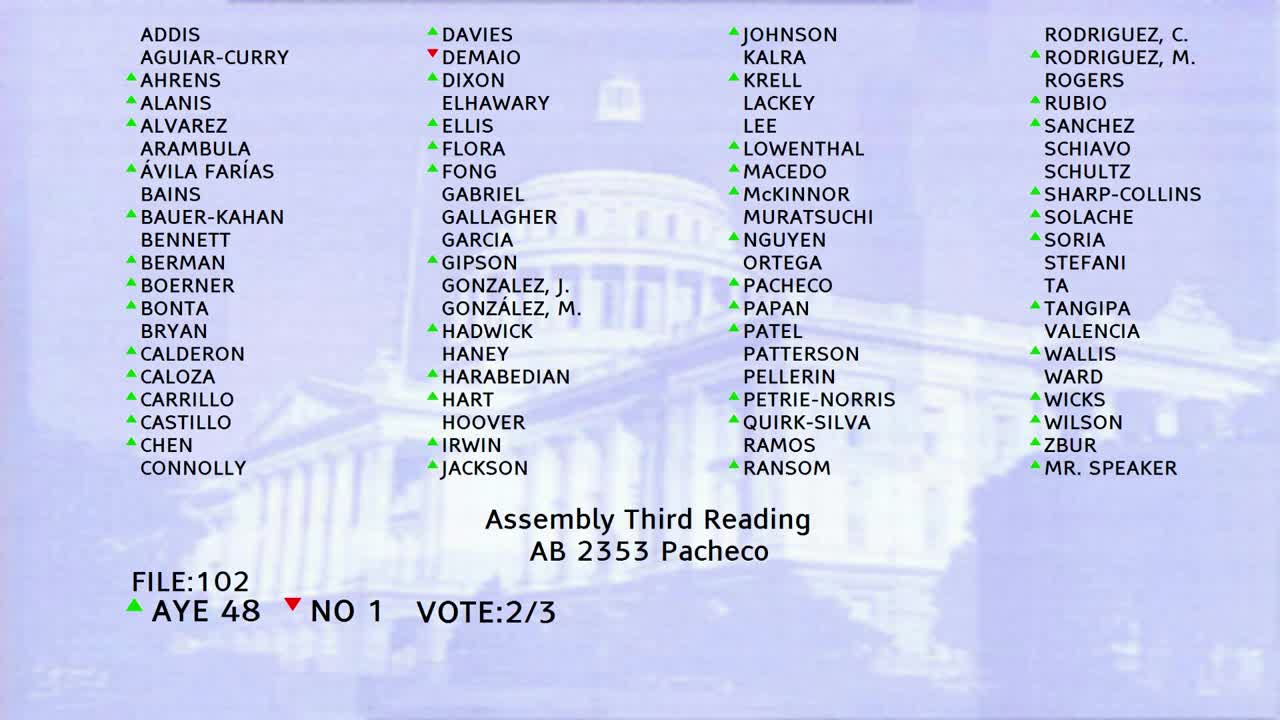 1MIN
Assembly Floor

Bill Co-Author(s):