AB 2664: Places of religious worship: unlawful activities.
- Session Year: 2025-2026
- House: Assembly
- Latest Version Date: 2026-09-25
Current Status:
Passed
(2026-09-25: Chaptered by Secretary of State - Chapter 442, Statutes of 2026.)
Introduced
In Committee
Awaiting First Chamber Vote
Passed First Chamber
In Committee
Awaiting Second Chamber Vote
Passed Second Chamber
Enacted
What does this bill do?
The bill makes it a crime for someone, within 100 feet of a place of worship entrance, to intentionally come within 8 feet of a person entering or leaving in order to hand them a leaflet, display a sign, speak to them, or to harass, block, threaten, or intimidate them. A first offense is a misdemeanor (a criminal offense) punishable by up to a $1,000 fine, six months in county jail, or both; repeat offenses can bring up to a $5,000 fine, one year in county jail, or both.
The summary is provided by generative AI which can make mistakes. For original language, please view the details in the table below.
Existing law makes it a crime to, by force, threat of force, or physical obstruction that is a crime of violence, intentionally injure, intimidate, interfere with, or attempt to injure, intimidate, or interfere with any person lawfully exercising or seeking to exercise the First Amendment right of religious freedom at a place of religious worship.
This bill would make it unlawful for a person to, within a radius of 100 feet from an entrance or exit of a place of religious worship, as defined, intentionally approach another person seeking to enter or exit a place of religious worship within 8 feet of that person to either pass a leaflet or handbill to, display a sign to, or engage in oral protest or education or to harass, obstruct, threaten, or intimidate the person or occupant. The bill would, for the purposes of determining that distance, measure from the body of the person seeking to enter or exit, or the exterior of a motor vehicle they occupy, to the body of, or any sign or object held by, the other person. The bill would prescribe specified fines, imprisonment, or fine and imprisonment for a violation of these provisions. By creating a new crime, the bill would impose a state-mandated local program.
The California Constitution requires the state to reimburse local agencies and school districts for certain costs mandated by the state. Statutory provisions establish procedures for making that reimbursement.
This bill would provide that no reimbursement is required by this act for a specified reason.
Existing law makes it a crime to, by force, threat of force, or physical obstruction that is a crime of violence, intentionally injure, intimidate, interfere with, or attempt to injure, intimidate, or interfere with any person lawfully exercising or seeking to exercise the First Amendment right of religious freedom at a place of religious worship.
This bill would make it unlawful for a person to, within a radius of 100 feet from an entrance or exit of a place of religious worship, as defined, intentionally approach another person or occupant of a motor vehicle seeking to enter or exit a place of religious worship within 8 feet of that person or occupant to either pass a leaflet or handbill to, display a sign to, or engage in oral protest or education or to harass, obstruct, threaten, or intimidate the person or occupant. The bill would, for the purposes of determining that distance, measure from the body of the person seeking to enter or exit, or the exterior of a motor vehicle they occupy, to the body of, or any sign or object held by, the other person. The bill would prescribe specified fines, imprisonment, or fine and imprisonment for a violation of these provisions. By creating a new crime, the bill would impose a state-mandated local program.
The California Constitution requires the state to reimburse local agencies and school districts for certain costs mandated by the state. Statutory provisions establish procedures for making that reimbursement.
This bill would provide that no reimbursement is required by this act for a specified reason.
Existing law makes it a crime to, by force, threat of force, or physical obstruction that is a crime of violence, intentionally injure, intimidate, interfere with, or attempt to injure, intimidate, or interfere with any person lawfully exercising or seeking to exercise the First Amendment right of religious freedom at a place of religious worship.
This bill would make it unlawful for a person to, within a radius of 100 feet from an entrance or exit of a place of religious worship, as defined, intentionally approach another person or occupant of a motor vehicle within 8 feet of that person or occupant to either pass a leaflet or handbill to, display a sign to, or engage in oral protest or education or to harass, obstruct, threaten, or intimidate the person or occupant. The bill would prescribe specified fines, imprisonment, or fine and imprisonment for a violation of these provisions. By creating a new crime, the bill would impose a state-mandated local program.
The California Constitution requires the state to reimburse local agencies and school districts for certain costs mandated by the state. Statutory provisions establish procedures for making that reimbursement.
This bill would provide that no reimbursement is required by this act for a specified reason.
Existing law prescribes the information required to be included in a warrant of arrest, including the name of the defendant, the time it is issued, and the city or county where the warrant is issued.This bill would make technical, nonsubstantive changes to these provisions.Existing law prescribes the information required to be included in a warrant of arrest, including the name of the defendant, the time it is issued, and the city or county where the warrant is issued.
This bill would make technical, nonsubstantive changes to these provisions.
(a)The Legislature recognizes that access to places of worship is imperative to the free exercise of religion in the State of California. Ensuring the safety and unimpeded access of individuals entering and exiting places of worship is therefore a compelling government interest and essential for the immediate preservation of public peace and safety. Toward that end, this section is aimed at making clear that conduct that intentionally obstructs a persons lawful exercise of that persons religious freedom under the California Constitution and United States Constitution is unlawful. The Legislature further finds that the protection of persons from deliberate and physical interference with their access to places of worship may be accomplished without infringing on constitutionally protected speech or activity and affirms that its intent is to not seek to favor one viewpoint over another or to limit speech regarding any specific topic.
(b)For purposes of this section, place of religious worship means any building, structure, or space that is used primarily for religious worship activities or to provide religious education or instruction. A place of religious worship shall include the parking lot and parking lot entrances, if the primary entrance to the building is through the parking lot, and the driveway and driveway entrances of any such building, structure, or space.
(c)Within a radius of 100 feet from an entrance or exit of a place of religious worship, a person shall not, without consent, intentionally approach another person seeking to enter or exit a place of religious worship within 8 feet of that person to do either of the following:
(1)Pass a leaflet or handbill to, display a sign to, or engage in oral protest or education with the other person.
(2)Harass, obstruct, threaten, or intimidate the other person.
(d)(1)For purposes of this section, 8 feet shall be measured from the body of the person seeking to enter or exit a place of religious worship, or the exterior of a motor vehicle that the person occupies while seeking to enter or exit a parking lot, to the body of, or any sign or object held by, another person.
(2)For purposes of this section, 100 feet shall be measured from the entrance or exit of the place of religious worship to the body of, or any sign or object held by, a person.
(e)(1)A first violation of this section is a misdemeanor, punishable by a fine not exceeding one thousand dollars ($1,000), imprisonment in a county jail not exceeding six months, or by both that fine and imprisonment.
(2)A second or subsequent violation of this section is punishable by a fine not to exceed five thousand dollars ($5,000), by imprisonment in a county jail for a period of not more than one year, or by both that fine and imprisonment.
(f)The provisions of this section are severable. If any provision of this section or its application is held invalid, that invalidity shall not affect other provisions or applications that can be given effect without the invalid provision or application.
SEC. 2.No reimbursement is required by this act pursuant to Section 6 of Article XIIIB of the California Constitution because the only costs that may be incurred by a local agency or school district will be incurred because this act creates a new crime or infraction, eliminates a crime or infraction, or changes the penalty for a crime or infraction, within the meaning of Section 17556 of the Government Code, or changes the definition of a crime within the meaning of Section 6 of Article XIIIB of the California Constitution.
(a)The Legislature recognizes that access to places of worship is imperative to the free exercise of religion in the State of California. Ensuring the safety and unimpeded access of individuals entering and exiting places of worship is therefore a compelling government interest and essential for the immediate preservation of public peace and safety. Toward that end, this section is aimed at making clear that conduct that intentionally obstructs a persons lawful exercise of that persons religious freedom under the California Constitution and United States Constitution is unlawful. The Legislature further finds that the protection of persons from deliberate and physical interference with their access to places of worship may be accomplished without infringing on constitutionally protected speech or activity and affirms that its intent is to not seek to favor one viewpoint over another or to limit speech regarding any specific topic.
(b)For purposes of this section, place of religious worship means any building, structure, or space that is used primarily for religious worship activities or to provide religious education or instruction. A place of religious worship shall include the parking lot, lot and parking lot entrances, driveway, if the primary entrance to the building is through the parking lot, and the driveway and driveway entrances of any such building, structure, or space.
(c)Within a radius of 100 feet from an entrance or exit of a place of religious worship, a person shall not not, without consent, intentionally approach another person or occupant of a motor vehicle within 8 feet of that person or occupant, unless they consent, seeking to enter or exit a place of religious worship within 8 feet of that person to do either of the following:
(1)Pass a leaflet or handbill to, display a sign to, or engage in oral protest or education with the other person or occupant. person.
(2)Harass, obstruct, threaten, or intimidate the other person or occupant. person.
(d)(1)For purposes of this section, 8 feet shall be measured from the body of the person seeking to enter or exit a place of religious worship, or the exterior of the occupied a motor vehicle that the person occupies while seeking to enter or exit a parking lot, to the body of, or any sign or object held by, another person.
(2)For purposes of this section, 100 feet shall be measured from the entrance or exit of the place of religious worship to the body of, or any sign or object held by, a person.
(e)(1)A first violation of this section is a misdemeanor, punishable by a fine not exceeding one thousand dollars ($1,000), imprisonment in a county jail not exceeding six months, or by both that fine and imprisonment.
(2)A second or subsequent violation of this section is punishable by a fine not to exceed five thousand dollars ($5,000), by imprisonment in a county jail for a period of not more than one year, or by both that fine and imprisonment.
(f)The provisions of this section are severable. If any provision of this section or its application is held invalid, that invalidity shall not affect other provisions or applications that can be given effect without the invalid provision or application.
SEC. 2.No reimbursement is required by this act pursuant to Section 6 of Article XIIIB of the California Constitution because the only costs that may be incurred by a local agency or school district will be incurred because this act creates a new crime or infraction, eliminates a crime or infraction, or changes the penalty for a crime or infraction, within the meaning of Section 17556 of the Government Code, or changes the definition of a crime within the meaning of Section 6 of Article XIIIB of the California Constitution.
(a)The Legislature recognizes that access to places of worship is imperative to the free exercise of religion in the State of California. Ensuring the safety and unimpeded access of individuals entering and exiting places of worship is therefore a compelling government interest and essential for the immediate preservation of public peace and safety. Toward that end, this section is aimed at making clear that conduct that intentionally obstructs a persons lawful exercise of that persons religious freedom under the California Constitution and United States Constitution is unlawful. The Legislature further finds that the protection of persons from deliberate and physical interference with their access to places of worship may be accomplished without infringing on constitutionally protected speech or activity and affirms that its intent is to not seek to favor one viewpoint over another or to limit speech regarding any specific topic.
(b)For purposes of this section, place of religious worship means any building, structure, or space that is used primarily for religious worship activities or to provide religious education or instruction. A place of religious worship shall include the parking lot, parking lot entrances, driveway, and driveway entrances of any such building, structure, or space.
(c)Within a radius of 100 feet from an entrance or exit of a place of religious worship, a person shall not intentionally approach another person or occupant of a motor vehicle within 8 feet of that person or occupant, unless they consent, to do either of the following:
(1)Pass a leaflet or handbill to, display a sign to, or engage in oral protest or education with the other person or occupant.
(2)Harass, obstruct, threaten, or intimidate the other person or occupant.
(d)(1)For purposes of this section, 8 feet shall be measured from the body of the person seeking to enter or exit a place of religious worship, or the exterior of the occupied motor vehicle seeking to enter or exit a parking lot, to the body of, or any sign or object held by, another person.
(2)For purposes of this section, 100 feet shall be measured from the entrance or exit of the place of religious worship to the body of, or any sign or object held by, a person.
(e)(1)A first violation of this section is a misdemeanor, punishable by a fine not exceeding ten thousand dollars ($10,000), one thousand dollars ($1,000), imprisonment in a county jail not exceeding one year, six months, or by both that fine and imprisonment.
(2)A second or subsequent violation of this section is punishable by a fine not to exceed twenty-five thousand dollars ($25,000), five thousand dollars ($5,000), by imprisonment in a county jail for a period of not more than one year, or by imprisonment pursuant to subdivision (h) of Section 1170, or by both that fine and imprisonment.
(f)The provisions of this section are severable. If any provision of this section or its application is held invalid, that invalidity shall not affect other provisions or applications that can be given effect without the invalid provision or application.
SEC. 2.No reimbursement is required by this act pursuant to Section 6 of Article XIIIB of the California Constitution because the only costs that may be incurred by a local agency or school district will be incurred because this act creates a new crime or infraction, eliminates a crime or infraction, or changes the penalty for a crime or infraction, within the meaning of Section 17556 of the Government Code, or changes the definition of a crime within the meaning of Section 6 of Article XIIIB of the California Constitution.
(a)The Legislature recognizes that access to places of worship is imperative to the free exercise of religion in the State of California. Ensuring the safety and unimpeded access of individuals entering and exiting places of worship is therefore a compelling government interest and essential for the immediate preservation of public peace and safety. Toward that end, this section is aimed at making clear that conduct that intentionally obstructs a persons lawful exercise of that persons religious freedom under the California Constitution and United States Constitution is unlawful. The Legislature further finds that the protection of persons from deliberate and physical interference with their access to places of worship may be accomplished without infringing on constitutionally protected speech or activity and affirms that its intent is to not seek to favor one viewpoint over another or to limit speech regarding any specific topic.
(b)For purposes of this section, place of religious worship means any building, structure, or space that is used primarily for religious worship activities or to provide religious education or instruction. A place of religious worship shall include the parking lot, parking lot entrances, driveway, and driveway entrances of any such building, structure, or space.
(c)Within a radius of 100 feet from an entrance or exit of a place of religious worship, a person shall not intentionally approach another person or occupant of a motor vehicle within 8 feet of that person or occupant, unless they consent, to do either of the following:
(1)Pass a leaflet or handbill to, display a sign to, or engage in oral protest or education with the other person or occupant.
(2)Harass, obstruct, threaten, or intimidate the other person or occupant.
(d)(1)For purposes of this section, 8 feet shall be measured from the body of the person seeking to enter or exit a place of religious worship, or the exterior of the occupied motor vehicle seeking to enter or exit a parking lot, to the body of, or any sign or object held by, another person.
(2)For purposes of this section, 100 feet shall be measured from the entrance or exit of the place of religious worship to the body of, or any sign or object held by, a person.
(e)(1)A first violation of this section is a misdemeanor, punishable by a fine not exceeding ten thousand dollars ($10,000), imprisonment in a county jail not exceeding one year, or by both that fine and imprisonment.
(2)A second or subsequent violation of this section is punishable by a fine not to exceed twenty-five thousand dollars ($25,000), by imprisonment in a county jail for a period of not more than one year, or by imprisonment pursuant to subdivision (h) of Section 1170, or by both that fine and imprisonment.
(f)The provisions of this section are severable. If any provision of this section or its application is held invalid, that invalidity shall not affect other provisions or applications that can be given effect without the invalid provision or application.
SEC. 2.No reimbursement is required by this act pursuant to Section 6 of Article XIIIB of the California Constitution because the only costs that may be incurred by a local agency or school district will be incurred because this act creates a new crime or infraction, eliminates a crime or infraction, or changes the penalty for a crime or infraction, within the meaning of Section 17556 of the Government Code, or changes the definition of a crime within the meaning of Section 6 of Article XIIIB of the California Constitution.
SECTION 1.Section 815 of the Penal Code is amended to read:815.A warrant of arrest shall specify all of the following:(a)The name of the defendant or, if it is unknown to the magistrate, judge, justice, or other issuing authority, the defendant may be designated therein by any name.(b)The time of issuing the warrant.(c)The city or county where the warrant is issued.(d)The signature of the magistrate, judge, justice, or other issuing authority issuing the warrant, including the title of their office and the name of the court or other issuing agency.A warrant of arrest shall specify the all of the following:
(a)The name of the defendant or, if it is unknown to the magistrate, judge, justice, or other issuing authority, the defendant may be designated therein by any name. It shall also state the
(b)The time of issuing it, and the the warrant.
(c)The city or county where it is issued, and shall be signed by the the warrant is issued.
(d)The signature of the magistrate, judge, justice, or other issuing authority issuing it with the warrant, including the title of his their office and the name of the court or other issuing agency.
|
Date
|
Status
|
|---|---|
| Sep 25, 2026 | Chaptered by Secretary of State - Chapter 442, Statutes of 2026. |
| Sep 25, 2026 | Approved by the Governor. |
| Sep 10, 2026 | Enrolled and presented to the Governor at 3 p.m. |
| Aug 30, 2026 | Senate amendments concurred in. To Engrossing and Enrolling. (Ayes 59. Noes 2.). |
| Aug 30, 2026 | Senate amendments concurred in. To Engrossing and Enrolling. (Ayes 59. Noes 2. Page 6884.). |
| Aug 30, 2026 | Senate amendments concurred in. To Engrossing and Enrolling. |
| Aug 28, 2026 | In Assembly. Concurrence in Senate amendments pending. |
| Aug 27, 2026 | Reconsideration granted. (Ayes 39. Noes 0.) |
| Aug 27, 2026 | Read third time. Passed. Ordered to the Assembly. (Ayes 33. Noes 0.). |
| Aug 27, 2026 | Read third time. Passed. Ordered to the Assembly. (Ayes 37. Noes 0.). |
| Aug 24, 2026 | Read second time. Ordered to third reading. |
| Aug 20, 2026 | Read third time and amended. Ordered to second reading. |
| Aug 13, 2026 | Read second time. Ordered to third reading. |
| Aug 13, 2026 | From committee: Do pass. (Ayes 7. Noes 0.) (August 13). |
| Jun 29, 2026 | In committee: Referred to APPR. suspense file. |
| Jun 16, 2026 | From committee: Do pass and re-refer to Com. on APPR. (Ayes 5. Noes 0.) (June 16). Re-referred to Com. on APPR. |
| Jun 3, 2026 | Referred to Com. on PUB. S. |
| May 27, 2026 | In Senate. Read first time. To Com. on RLS. for assignment. |
| May 26, 2026 | Read third time. Passed. Ordered to the Senate. (Ayes 61. Noes 2.) |
| May 26, 2026 | Read third time. Passed. Ordered to the Senate. (Ayes 61. Noes 2. Page 5318.) |
| May 26, 2026 | Read third time. Passed. Ordered to the Senate. |
| May 18, 2026 | Read second time. Ordered to third reading. |
| May 14, 2026 | From committee: Do pass. (Ayes 11. Noes 2.) (May 14). |
| May 6, 2026 | In committee: Set, first hearing. Referred to APPR. suspense file. |
| Apr 22, 2026 | From committee: Do pass and re-refer to Com. on APPR. (Ayes 10. Noes 0.) (April 21). Re-referred to Com. on APPR. |
| Apr 20, 2026 | Re-referred to Com. on JUD. |
| Apr 16, 2026 | Read second time and amended. |
| Apr 15, 2026 | From committee: Amend, and do pass as amended and re-refer to Com. on JUD. (Ayes 8. Noes 0.) (April 14). |
| Mar 23, 2026 | Re-referred to Com. on PUB. S. |
| Mar 19, 2026 | Referred to Coms. on PUB. S. and JUD. |
| Mar 19, 2026 | From committee chair, with author's amendments: Amend, and re-refer to Com. on PUB. S. Read second time and amended. |
| Feb 21, 2026 | From printer. May be heard in committee March 23. |
| Feb 20, 2026 | Read first time. To print. |
|
Date
|
Description
|
Location
|
Votes
|
|
|---|---|---|---|---|
| Aug 30, 2026 | AB 2664 Bauer-Kahan Concurrence in Senate Amendments | Assembly Floor |
Passed |
|
| Aug 27, 2026 | Assembly 3rd Reading AB2664 Bauer-Kahan et al. By Becker | Senate Floor |
Passed |
|
| Aug 27, 2026 | Assembly 3rd Reading AB2664 Bauer-Kahan et al. By Becker Reconsider | Senate Floor |
Passed |
|
| Aug 27, 2026 | Assembly 3rd Reading AB2664 Bauer-Kahan et al. By Becker | Senate Floor |
Passed |
|
| Aug 13, 2026 | Do pass | Senate Standing Committee on Appropriations |
Passed |
|
| Jun 29, 2026 | Placed on suspense file | Senate Standing Committee on Appropriations |
Passed |
|
| Jun 16, 2026 | Do pass, but first be re-referred to the Committee on [Appropriations] | Senate Standing Committee on Public Safety |
Passed |
|
| May 26, 2026 | AB 2664 Bauer-Kahan Assembly Third Reading | Assembly Floor |
Passed |
|
| May 14, 2026 | Do pass. | Assembly Standing Committee on Appropriations |
Passed |
|
| Apr 21, 2026 | Do pass and be re-referred to the Committee on [Appropriations] | Assembly Standing Committee on Judiciary |
Passed |
|
| Apr 14, 2026 | Do pass as amended and be re-referred to the Committee on [Judiciary] | Assembly Standing Committee on Public Safety |
Passed |
This list shows positions taken on this bill by organizations on the date displayed, which is linked to the original source.
Positions by individuals are not included.
|
Organization
|
Position
|
Date
|
|---|---|---|
| Pasadena Jewish Temple and Center | ** Support | |
| 1021 Jewish Workers for Justice | ** Against | |
| 1021 Members for Palestine | ** Against | |
| 30 Years After | ** Support | |
| 88th Street Temple Church of God in Christ | ** Support | |
| Aclu California Action | ** Against | |
| Adas Torah | ** Support | |
| Adat Shalom | ** Support | |
| Adat Shalom Los Angeles | ** Support | |
| ADL | ** Support | |
| Agudath Israel Of California | ** Support | |
| Ahavat Torah | ** Support | |
| AJC Northern California | ** Support | |
| All of US or None (HQ) | ** Against | |
| American Jewish Committee - Los Angeles | ** Support | |
| American Jewish Committee - Northern California | ** Support | |
| American Jewish Committee - San Diego | ** Support | |
| American Jewish Committee – Los Angeles | ** Support | |
| Anti-Defamation League | ** Support | |
| Arab American Anti-discrimination Committee | ** Against | |
| AROC Action | ** Against | |
| B'nai David-Judea Congregation | ** Support | |
| Bay Area Center to Counter Antisemitism | ** Support | |
| Bay Area Jewish Coalition Education & Advocacy | ** Support | |
| Bel Air Church | ** Support | |
| Bend the Arc California | ** Against | |
| Beverly Hills Synagogue | ** Support | |
| Board of Rabbis of Southern California | ** Support | |
| Breath of Life Los Angeles | ** Support | |
| Breed Street Shul Project | ** Support | |
| Brotherhood Crusade | ** Support | |
| B’Nai David-Judea Congregation | ** Support | |
| Cair California | ** Against | |
| Cal-pac Annual Conference | ** Support | |
| California Jewish Democrats | ** Support | |
| California Public Defenders Association | ** Against | |
| California Sikh Council | ** Support | |
| California Teachers Association | ** Against | |
| Californians United for a Responsible Budget | ** Against | |
| Central Coast Antiwar Coalition | ** Against | |
| Chai Marin | ** Support | |
| Congregation Kol Ami | ** Support | |
| Contra Costa Jewish Democrats | ** Support | |
| Democrats for Israel Los Angeles | ** Support | |
| Democrats for Palestinian Rights - Bay Area | ** Against | |
| Ella Baker Center For Human Rights | ** Against | |
| Episcopal Diocese of Los Angeles | ** Support | |
| Faith And Community Empowerment | ** Support | |
| Friends Committee On Legislation Of California | ** Against | |
| Greater Zion Church Family | ** Support | |
| Hadassah, the Women's Zionist of America, INC. | ** Support | |
| Hadassah, the Women’s Zionist of America | ** Support | |
| Hadassah, the Women’s Zionist of America, INC. | ** Support | |
| Harmony Law | ** Against | |
| Hillel of San Diego | ** Support | |
| Hindu American Foundation | ** Support | |
| Hollywood Temple Beth El | ** Support | |
| Holocaust Museum LA | ** Support | |
| Hope the Mission | ** Support | |
| Iman Cultural Center | ** Support | |
| Interfaith Movement for Human Integrity | ** Against | |
| Israeli-American Council | ** Support | |
| JCAN | ** Support | |
| JCC Federation of San Luis Obispo | ** Support | |
| JCC/Federation of San Luis Obispo | ** Support | |
| JCRC Bay Area | ** Support | |
| JCRC Long Beach | ** Support | |
| JCRC, Bay Area | ** Support | |
| JCRC, Jewish Long Beach | ** Support | |
| JCRC, Santa Barbara County | ** Support | |
| Jewish California | ** Support | |
| Jewish Center for Justice | ** Support | |
| Jewish Center of Berkeley | ** Support | |
| Jewish Coalition of Berkeley | ** Support | |
| jewish community relations council of sacramento | ** Support | |
| Jewish Democratic Club of Marin | ** Support | |
| Jewish Democratic Coalition of the Bay Area | ** Support | |
| Jewish Family & Community Services East Bay | ** Support | |
| Jewish Family and Children's Services of San Francisco, the Peninsula, Marin and Sonoma Counties | ** Support | |
| Jewish Family and Children’s Services of San Francisco, the Peninsula, Marin and Sonoma Counties | ** Support | |
| Jewish Family Service LA | ** Support | |
| Jewish Family Service of San Diego | ** Support | |
| Jewish Family Service of Silicon Valley | ** Support | |
| Jewish Family Service of the Desert | ** Support | |
| Jewish Family Services of Silicon Valley | ** Support | |
| Jewish Federation Bay Area | ** Support | |
| Jewish Federation Los Angeles | ** Support | |
| Jewish Federation of Greater Santa Barbara | ** Support | |
| Jewish Federation of Orange County | ** Support | |
| Jewish Federation of San Diego | ** Support | |
| Jewish Federation of the Desert | ** Support | |
| Jewish Federation of The Greater San Gabriel and Pomona Valleys | ** Support | |
| Jewish Federation Of The Sacramento Region | ** Support | |
| Jewish Federation of Ventura County | ** Support | |
| Jewish Free Loan Association | ** Support | |
| Jewish Parents for Collective Liberation | ** Against | |
| Jewish Partisan Educational Foundation | ** Support | |
| Jewish Silicon Valley | ** Support | |
| Jewish Voice for Peace Santa Barbara | ** Against | |
| Jewish Voice for Peace, Sacramento Chapter | ** Against | |
| Jewish Voice for Peace-South Bay | ** Against | |
| Jewish War Veterans, Department of California | ** Support | |
| Jewish War Veterans, Jewish Family & Children’s Services of Long Beach and Orange County | ** Support | |
| JFCS East Bay | ** Support | |
| JFCS Long Beach and Orange County | ** Support | |
| Justice2jobs Coalition | ** Against | |
| Korean American Federation Of Los Angeles | ** Support | |
| LA Defensa | ** Against | |
| Legal Services for Prisoners with Children | ** Against | |
| Local 148 Los Angeles County Public Defender's Union | ** Against | |
| Los Angeles Baha’i Center | ** Support | |
| Multiple Individuals | ** Against | |
| National Council of Jewish Women CA | ** Support | |
| National Council Of Jewish Women San Francisco | ** Support | |
| Northern California Jewish Labor Committee | ** Support | |
| Oakland Jewish Alliance | ** Support | |
| Oakland Privacy | ** Against | |
| Orale: Organizing Rooted in Abolition, Liberation, and Empowerment | ** Against | |
| Organizing Rooted in Abolition, Liberation and Empowerment | ** Against | |
| Osborne Neighborhood Church | ** Support | |
| Osbourne Neighborhood Church | ** Support | |
| Palestine Justice Coalition, Santa Cruz | ** Against | |
| Palo Alto Jewish Alliance | ** Support | |
| Pasadena Jewish Temple and Center | ** Support | |
| Progressive Zionists of California | ** Support | |
| QUIT! | ** Against | |
| Quit! (queers Undermining Israeli Terrorism) | ** Against | |
| ReNew UMC | ** Support | |
| Renew United Method Church | ** Support | |
| Restauracion LA | ** Support | |
| Sacramento Regional Coalition for Palestinian Rights | ** Against | |
| San Francisco Public Defender | ** Against | |
| Sephardic Temple Tifereth Israel | ** Support | |
| Sf Jews in School | ** Support | |
| Simon Wiesenthal Center | ** Support | |
| Sinai Temple | ** Support | |
| SLACDEC | ** Support | |
| south bay people power | ** Against | |
| Southwest California Synod of the Evangelical Lutheran Church of America | ** Support | |
| St Paul the Apostle Catholic Community | ** Support | |
| St. Paul the Apostle Catholic Community | ** Support | |
| StandWithUs | ** Support | |
| Stephen Wise Temple, Los Angeles, CA | ** Support | |
| Temple Beth Hillel | ** Support | |
| Temple Beth-el | ** Support | |
| Temple Judea of Laguna Hills | ** Support | |
| Temple Ramat Zion | ** Support | |
| The Jewish Coalition of Berkeley | ** Support | |
| United Methodist Church | ** Support | |
| Valley Beth Shalom | ** Support | |
| West Angeles Church Community Development Corporation | ** Support | |
| Western Diocese of the Armenian Church of North America | ** Support | |
| Westwood Presbyterian Church | ** Support | |
| Westwood United Methodist Church | ** Support | |
| Wilshire Boulevard Temple | ** Support | |
| Workers Circle/Arbeter Ring of Northern California | ** Against | |
| Young Israel of Century City | ** Support |
CONCURRENCE IN SENATE AMENDMENTS
CSA1 Bill Id:AB 2664
Author:(Bauer-Kahan)
As Amended Ver:August 20, 2026
Majority vote
SUMMARY
Prohibits any person from, within 100 feet of an entrance or exit of a place of religious worship, as specified, and without consent, intentionally approaching another person seeking to enter or exit a place of worship within eight feet of that person and pass a leaflet or handbill, display a sign to, or engage in oral protest or education of a person, or harass, obstruct, threaten, or intimidate another person.
Senate Amendments
- Clarifies a ″place of worship″ parking lot entrance is included in the 100 ft. radius requirement only if the primary entrance to the building is through the parking lot, and the driveway.
- Clarifies that the eight ft. radius applies when a person is seeking to enter or exit a place of religious worship, or the exterior of a motor vehicle that the person occupies while seeking to enter or exit a parking lot.
COMMENTS
As Passed by the Assembly, this bill: Prohibited any person from, within 100 feet of an entrance or exit of a place of religious worship, as specified, and within eight feet of a person or occupant of vehicle, passing a leaflet or handbill, displaying a sign to, or engaging in oral protest or education of a person or occupant of a vehicle, or harassing, obstructing, threatening, or intimidating another person or occupant of a vehicle.
Major Provisions
- Forbade any person within a radius of 100 feet from an entrance or exit of a place of religious worship, from intentionally approaching another person or occupant of a motor vehicle within eight feet of that person or occupant, unless they consent, to do either of the following:
- Pass a leaflet or handbill to, display a sign to, or engage in oral protest or education with the other person or occupant.
- Harass, obstruct, threaten, or intimidate the other person or occupant.
- Mandated eight feet shall be measured from the body of the person seeking to enter or exit a place of religious worship, or the exterior of the occupied motor vehicle seeking to enter or exit a parking lot, to the body of, or any sign or object held by, another person.
- Stated 100 feet shall be measured from the entrance or exit of the place of religious worship to the body of, or any sign or object held by, a person.
- Stated a first violation of this prohibition is a misdemeanor, punishable by up to six months in county jail, or a fine not more than $1,000, or by both imprisonment and fine.
- Stated a second or subsequent violation of this prohibition is a misdemeanor punishable by up to one year in county jail, or by a fine of not more than $5,000, or by both imprisonment and fine.
- Stated the provisions of this bill are severable.
- Stated the intent of the Legislature as follows: ″The Legislature recognizes that access to places of worship is imperative to the free exercise of religion in the State of California. Ensuring the safety and unimpeded access of individuals entering and exiting places of worship is therefore a compelling government interest and essential for the immediate preservation of public peace and safety. Toward that end, this section is aimed at making clear that conduct that intentionally obstructs a person′s lawful exercise of that person′s religious freedom under the California Constitution and United States Constitution is unlawful. The Legislature further finds that the protection of persons from deliberate and physical interference with their access to places of worship may be accomplished without infringing on constitutionally protected speech or activity and affirms that its intent is to not seek to favor one viewpoint over another or to limit speech regarding any specific topic.″
According to the Author
″Amidst rising antisemitism and hate, many Jewish People fear simply going to synagogue. A recent study from the American Jewish Committee (AJC) reported that 26% of Jewish people in the United States don′t feel safe attending Jewish institutions. Additionally, the Anti-Defamation League reported in 2024 that antisemitic incidents have increased across the United States by 344% over the last five years. Other faith communities have also experienced dramatic increases in hate incidents and violence in recent years. Recently there has also been a disturbing pattern of protests outside houses of worship. AB 2664 establishes a zone around the entrances of houses of worship, within which protesters may not intentionally approach congregants without consent. These protections are designed to ensure that people can enter and exit religious institutions without being obstructed or intimidated. Bubble zones are a common-sense step to ensure people of all faiths can gather safely and freely. This bill takes a balanced approach that has existed for decades in other states and localities, carefully protecting both freedom of worship and freedom of speech. Similarly structured laws have long been in place across the country and have been upheld by the U.S. Supreme Court multiple times, recognizing that tailored protections at entrances can coexist with robust First Amendment rights.″
Arguments in Support
According to Jewish California, ″The Anti-Defamation League reported in 2024 that antisemitic incidents have surged 307% over the last five years in California. As a result, Jewish community members are increasingly scared to go to synagogue. According to a recent American Jewish Committee study, 26% of Jewish Americans do not feel safe attending Jewish institutions.
″Here in California, we have witnessed this fear. Troubling protests outside Wilshire Boulevard Temple and Adas Torah in Los Angeles have left congregants feeling harassed and intimidated simply for trying to attend synagogue. We know similar incidents targeting other faith communities are increasing as well, threatening our collective First Amendment right to worship. AB 2664 responds to this crisis with a targeted, constitutionally sound solution.
″The bill establishes a 100-foot ″Safe Worship Zone″ around the entrances of houses of worship, within which protesters may not approach congregants without their consent. These protections ensure that people can enter and leave religious institutions without being confronted, surrounded, obstructed, or intimidated. This approach is not new. Bubble zone laws structured in similar ways have long been law across the country and have been upheld by the U.S. Supreme Court, which has consistently found this law to be a proper balance between two fundamental rights: the right to protest and the right to worship freely.
″Critically, this bill protects Californians of all faiths. No congregant should have to face intimidation to practice their faith. At a moment of heightened tensions impacting many faith communities, AB 2664 makes clear that California will act to protect religious life and the dignity of all who engage with their faith.″
Arguments in Opposition
According to the ACLU California Action, ″We strongly believe in the principle that free expression for ourselves requires free expression for others, as the First Amendment guarantees us all the essential right to assemble peacefully to advocate for any cause. From speaking in public, through books and radio to film, television, and the internet — we have consistently fought to make sure people have the right to say, think, read, and write whatever they want without fear of government reprisal.
″The United States Supreme Court has repeatedly emphasized that public ways and sidewalks ″occupy a ′special position in terms of First Amendment protection′ because of their historic role as sites for discussion and debate.″[1] Since ″time out of mind,″ these places have been used ″for purposes of assembly, communicating thoughts between citizens, and discussing public questions.″[2] As currently drafted, AB 2664 defines a ″place of religious worship″ to be any space used primarily for ″religious worship activities,″ which explicitly includes a ″parking lot [and] . . driveway entrances of any such . . . space.″
″By restricting speech within 100 feet of places of religious worship, the bill would needlessly include public sidewalks, and in many places, people′s private residence if they live within 100 feet of a place of religious worship, or its parking lot. Furthermore, this bill would prohibit within a buffer zone the ability to ″display a sign,″ without ever approaching a person without their consent. If AB 2664 were to become law, this may include a person′s private property who may have a sign with a political message visible to the public and suppress their political speech.
″In McCullen v. Coakley the Supreme Court made clear that ordinances creating buffer zones around specific locations within public for a satisfy the First Amendment only if the government has compiled a substantial record justifying the need for such buffer zone. Specifically, the government needs to show that (1) there is a significant history of problems, such as illegal behavior that interferes with people′s ability to access the locations covered by the ordinance (2) the government has employed other more narrowly targeted means to try address those problems, and (3) the alternative means have failed to achieve the government′s objective.
″The Court recognized that Massachusetts had ″significant interests in maintaining public safety on . . . streets and sidewalks, as well as in preserving access to adjacent healthcare facilities.″[3] But the Court nonetheless ruled that the law and the 35 foot buffer zone — which was much smaller than the buffer zone proposed in this bill — was not narrowly tailored to address this interest, and instead constituted the ″extreme step of closing a substantial portion of a traditional public forum to all speakers.″[4]
″Moreover, courts are particularly concerned about these kinds of buffer zones because they target ″one-on-one communication, which is the most effective, fundamental, and perhaps economical avenue of political discourse.″[5] Even if the government could establish a sufficient record of problems at all ″places of religious worship″ covered by this bill, it would still need to show that it tried to employ other more narrowly tailored methods to address them without success before it could adopt a buffer zone that complies with the First Amendment.
″For example, if the government has identified problems with people blocking others from entering into a place of worship, it will need to show that law enforcement has tried to address the problem through application of legal state or local law.[6] If there is a record of people′s being harassed or assaulted at a place of religious worship, the government would need to show that it has attempted to enforce ″generic criminal statutes forbidding assault [and] breach of the peace″ without success before it could justify adopting an expansive buffer zone covering all of California.[7] Finally, if the government were to identify problems at particular spaces, it could pursue the more narrowly tailored remedy of an injunction at those locations, rather than an overly broad ordinance that would apply to tens of thousands of religious spaces throughout California.[8]
″The enormous breadth of this ordinance is exacerbated by the fact that — by definition — it would restrict peaceful protests on a huge number of public streets and sidewalks, or even people′s private residence. Fixed buffer zones pose serious First Amendment problems and should be permitted only in the most limited circumstances. The ACLU continues to ensure that buffer zones are imposed only when there are competing constitutional rights at stake and where protesters are provided with adequate ways to communicate their message. This proposal falls far short of this standard.″
FISCAL COMMENTS
According to the Senate Appropriations Committee, ″Unknown, potentially significant court costs to adjudicate the new misdemeanor offense.
″The fiscal impact will depend on the number of people charged with the new offense and the factors unique to each case. An eight-hour court day costs approximately $10,500. Although the courts are not funded on the basis of workload, increased pressure on the Trial Court Trust Fund may create demand for increased funding. The 2026-27 Budget provides $70 million to help pay for increased trial court operation costs (Trial Court Trust Fund, General Fund).
″Unknown cost pressure on the counties depending on how the misdemeanor sentence is imposed. Actual costs will depend on the number of convictions and whether the punishment is incarceration, a fine, or both. The average annual cost to incarcerate one person in county jail is approximately $77,250. In 2021 Los Angeles County budgeted $1.3 billion for jail costs, including $89,580 per incarcerated person. Generally, county incarceration costs are not reimbursable state mandates pursuant to Proposition 30 (2012).″
VOTES:
ASM PUBLIC SAFETY: 8-0-1
YES: Schultz, Alanis, Mark González, Haney, Harabedian, Lackey, Nguyen, Ramos
ABS, ABST OR NV: Sharp-Collins
ASM JUDICIARY: 10-0-2
YES: Macedo, Bauer-Kahan, Connolly, Dixon, Harabedian, Pacheco, Papan, Sanchez, Stefani, Zbur
ABS, ABST OR NV: Kalra, Bryan
ASM APPROPRIATIONS: 11-2-2
YES: Wicks, Hoover, Aguiar-Curry, Calderon, Caloza, Fong, Mark González, Krell, Pacheco, Pellerin, Solache
NO: Dixon, Tangipa
ABS, ABST OR NV: Sharp-Collins, Ta
ASSEMBLY FLOOR: 61-2-17
YES: Addis, Aguiar-Curry, Ahrens, Alanis, Alvarez, Arambula, Ávila Farías, Bains, Bauer-Kahan, Bennett, Berman, Boerner, Calderon, Caloza, Carrillo, Chen, Connolly, Davies, Dixon, Ellis, Fong, Gabriel, Gipson, Mark González, Haney, Harabedian, Hart, Hoover, Irwin, Jackson, Krell, Lackey, Lowenthal, Macedo, McKinnor, Nguyen, Ortega, Pacheco, Papan, Patel, Patterson, Pellerin, Petrie-Norris, Quirk-Silva, Ramos, Michelle Rodriguez, Rogers, Blanca Rubio, Sanchez, Schiavo, Schultz, Solache, Soria, Stefani, Valencia, Wallis, Ward, Wicks, Wilson, Zbur, Rivas
NO: DeMaio, Tangipa
ABS, ABST OR NV: Bonta, Bryan, Castillo, Elhawary, Flora, Gallagher, Garcia, Jeff Gonzalez, Hadwick, Johnson, Kalra, Lee, Muratsuchi, Ransom, Celeste Rodriguez, Sharp-Collins, Ta
UPDATED
VERSION: August 20, 2026
CONSULTANT: Kimberly Horiuchi / PUB. S. / (916) 319-3744 FN: 0004406
McCullen v. Coakley, 573 U.S. 464, 476 (2014) (quoting United States v. Grace, 461 U.S. 171, 180 (1983)). ↑
Id. (internal quotations omitted) ↑
Id. at 497. ↑
Id. ↑
Id. at 488. ↑
See id. at 492 (noting that risks created by blocking entrances ″can readily be addressed through existing local ordinances″); see also Cal. Penal Code Section 647c (″Every person who willfully and maliciously obstructs the free movement of any person on any street, sidewalk, or other public place or on or in any place open to the public is guilty of a misdemeanor.″) ↑
Id. ↑
Id. at 492 (″We have previously noted the First Amendment virtues of targeted injunctions as alternatives to broad, prophylactic measures.″) ↑
SENATE RULES COMMITTEE Office of Senate Floor Analyses (916) 651-4171 | AB 2664 |
THIRD READING
Bill No: AB 2664
Author: Bauer-Kahan (D), et al.
Amended: 8/20/26 in Senate
Vote: 21
SENATE PUBLIC SAFETY COMMITTEE: 5-0, 6/16/26
AYES: Arreguín, Seyarto, Caballero, Cortese, Wiener
NO VOTE RECORDED: Pérez
SENATE APPROPRIATIONS COMMITTEE: 7-0, 8/13/26
AYES: Cervantes, Seyarto, Cabaldon, Dahle, Grayson, Richardson, Wahab
ASSEMBLY FLOOR: 61-2, 5/26/26 - See last page for vote
SUBJECT: Places of religious worship: unlawful activities
SOURCE: Jewish California
DIGEST:
This bill prohibits a person, within a radius of 100 feet from an entrance or exit of a place of religious worship, from intentionally and nonconsensually approaching another person seeking to enter or exit a place of religious worship within 8 feet of that person to engage in specified conduct with that person.
Senate Floor Amendments of 8/20/26 clarify the definition of “place of religious worship” with regard to parking lots and specify that the above prohibition protects only those seeking to enter or exit a place of religious worship.
ANALYSIS:
Existing law:
- Provides that Congress shall make no law respecting an establishment of religion, or prohibiting the free exercise thereof. (U.S. Constitution (Const.), 1st Amend.)
- Provides that the free exercise and enjoyment of religion without discrimination or preference are guaranteed, and that the Legislature of the State of California shall make no law respecting an establishment of religion. (California (Cal.) Const, art. I, § 3.)
- Establishes a legislative finding and declaration that it is the right of every person regardless of actual or perceived disability, gender, gender identity, gender expression, nationality, race or ethnicity, religion, sexual orientation, or association with a person or group with these actual or perceived characteristics, to be secure and protected from fear, intimidation, and physical harm caused by the activities of violent groups and individuals. (Penal [Pen.] Code, §11410, subd. (a).)
- Establishes that the Legislature recognizes the constitutional right of every citizen to harbor and express beliefs on any subject whatsoever and to associate with others who share similar beliefs, but also that the advocacy of unlawful violent acts by groups against other persons or groups under circumstances where death or great bodily injury is likely to result is not constitutionally protected, poses a threat to public order and safety, and should be subject to criminal and civil sanctions. (Ibid.)
- Provides that, except as provided, any person who willfully threatens, by any means, including, but not limited to, an image or threat posted or published on an internet web page, to commit a crime that will result in death or great bodily injury to another person or persons at any number of specified locations, including a house of worship, with specific intent that the statement is to be taken as a threat, even if there is no intent of actually carrying it out, if the threat on its face and under the circumstances in which it is made is so unequivocal, unconditional, immediate, and specific as to convey to the person or persons threatened a gravity of purpose and an immediate prospect of execution of the threat, and if that threat causes a person or persons to reasonably be in sustained fear for their own safety or the safety of others at these locations, shall be guilty of a crime, punishable as a wobbler. (Pen. Code, § 422.3.)
- Provides, via the California Freedom of Access to Clinic and Church Entrances (FACE) Act, that every person who, except a parent or guardian acting towards his or her minor child or ward, commits any of the following acts shall be subject to criminal punishment, as specified:
- By force, threat of force, or physical obstruction that is a crime of violence, intentionally injures, intimidates, interferes with, or attempts to injure, intimidate, or interfere with, any person or entity because that person or entity is a reproductive health services client, provider, or assistant, or in order to intimidate any person or entity, or any class of persons or entities, from becoming or remaining a reproductive health services client, provider, or assistant; or
- By force, threat of force, or physical obstruction that is a crime of violence, intentionally injures, intimidates, interferes with, or attempts to injure, intimidate, or interfere with any person lawfully exercising or seeking to exercise the First Amendment right of religious freedom at a place of religious worship; or
- By nonviolent physical obstruction, intentionally injures, intimidates, or interferes with, or attempts to injure, intimidate, or interfere with, any person or entity because that person or entity is a reproductive health services client, provider, or assistant, or in order to intimidate any person or entity, or any class of persons or entities, from becoming or remaining a reproductive health services client, provider, or assistant; or
- By nonviolent physical obstruction, intentionally injures, intimidates, or interferes with, or attempts to injure, intimidate, or interfere with, any person lawfully exercising or seeking to exercise the First Amendment right of religious freedom at a place of religious worship; or
- Intentionally damages or destroys the property of a person, entity, or facility, or attempts to do so, because the person, entity, or facility is a reproductive health services client, provider, assistant, or facility; or
- Intentionally damages or destroys the property of a place of religious worship. (Pen. Code, § 423.2, subds. (a)-(f).)
- Makes a first violation involving nonviolent physical obstruction a misdemeanor, punishable by imprisonment in a county jail for a period of not more than six months and a fine not to exceed $2,000. (Pen. Code, § 423.3, subd. (a).)
- Makes a second or subsequent violation involving violation involving nonviolent physical obstruction a misdemeanor, punishable by imprisonment in a county jail for a period of not more than six months and a fine not to exceed $5,000. (Pen. Code, § 423.3, subd. (b).)
- Makes a first violation involving force, threat of force, or physical obstruction that is a crime of violence or intentional property damage a misdemeanor, punishable by imprisonment in a county jail for a period of not more than one year and a fine not to exceed $25,000. (Pen. Code, § 423.3, subd. (c).)
- Makes a second or subsequent violation involving force, threat of force, or physical obstruction that is a crime of violence or intentional property damage a misdemeanor, punishable by imprisonment in a county jail for a period of not more than one year and a fine not to exceed $50,000. (Pen. Code, § 423.3, subd. (d).)
- Provides that a person aggrieved by a violation of the FACE Act may bring a civil action to enjoin the violation, for compensatory and punitive damages, and for the costs of suit and reasonable fees for attorneys and expert witnesses, except that only a person lawfully exercising or seeking to exercise the First Amendment right of religious freedom in a place of religious worship, or the entity that owns or operates a place of religious worship, may bring an action under provisions of the FACE Act related to conduct at a place of worship. (Pen. Code, § 423.4, subd. (a).)
- Provides that courts in which a criminal or civil proceeding is filed for violations of the FACE Act shall take all action reasonably required, including granting restraining orders, to safeguard the health, safety, or privacy of specified parties that are parties to the proceeding, witnesses, victims, potential victims and others. (Pen. Code, § 423.5, subd. (a).)
- Makes it a wobbler for a person to burn or desecrate a cross or other religious symbol, knowing it to be a religious symbol, on the property of a place of worship for the purpose of terrorizing a person who attends it, works at it, or is otherwise associated with it. (Pen. Code, § 11411, subd. (d).)
- Provides that any person who, with intent to cause, attempts to cause or causes another to refrain from exercising his or her religion or from engaging in a religious service by means of a threat, directly communicated to such person, to inflict an unlawful injury upon any person or property, and it reasonably appears to the recipient of the threat that such threat could be carried out is guilty of a felony. (Pen. Code, § 11412.)
- Defines “hate crime” as a criminal act committed, in whole or in part, because of one or more specified actual or perceived characteristics of the victim, including the victim’s religion., where “religion” is defined as including all aspects of religious belief, observance, and practice and includes agnosticism and atheism. (Pen. Code, §§ 422.55, 422.56, subd. (g).)
- Provides that a person, whether or not acting under color of law, shall not, by force or threat of force, willfully injure, intimidate, interfere with, oppress, or threaten any other person in the free exercise or enjoyment of a right or privilege secured by the Constitution or laws of this state or by the Constitution or laws of the United States in whole or in part because of one or more of the actual or perceived characteristics of the victim, including the victim’s religion. (Pen. Code, § 422.6, subd. (a).)
- Provides that a person, whether or not acting under color of law, shall not knowingly deface, damage, or destroy the real or personal property of any other person for the purpose of intimidating or interfering with the free exercise or enjoyment of a right or privilege secured by the Constitution or laws of this state or by the Constitution or laws of the United States, in whole or in part because of one or more of the actual or perceived characteristics of the victim, including the victim’s religion. (Pen. Code, § 422.6, subd. (b).)
- Provides that every person who intentionally disturbs or disquiets any assemblage of people met for religious worship at a tax-exempt place of worship, by profane discourse, rude or indecent behavior, or by any unnecessary noise, either within the place where the meeting is held, or so near it as to disturb the order and solemnity of the meeting, is guilty of a misdemeanor punishable by a fine not exceeding $1,000, or by imprisonment in a county jail for a period not exceeding one year, or by both that fine and imprisonment. (Pen. Code, § 302, subd. (a).)
This bill:
- Provides that, within a 100-foot radius from an entrance or exit from a place of worship a person shall not, without consent, intentionally approach another person seeking to enter or exit a place of religious worship within 8 feet of that person to do either of the following:
- Pass a leaflet or handbill to, display a sign to, or engage in oral protest or education with the other person.
- Harass, obstruct, threaten, or intimidate the other person.
- Provides that 8 feet shall be measured from the body of the person seeking to enter or exit a place of religious worship, or the exterior of a motor vehicle seeking to enter or exit a parking lot, to the body of, or any sign or object held by, another person.
- Defines “place of religious worship” as any building, structure, or space that is used primarily for religious worship activities or to provide religious education or instruction. A “place of religious worship” shall include the parking lot and parking lot entrances, if the primary entrance to the building is through the parking lot, and the driveway and driveway entrances of any such building, structure, or space.
- Provides that 100 feet shall be measured from the entrance or exit of the place of religious worship to the body of, or any sign or object held by, a person.
- Provides that a first violation of the prohibition above is a misdemeanor, punishable by a fine not exceeding one $1,000, imprisonment in a county jail not exceeding six months, or by both that fine and imprisonment.
- Provides that a second or subsequent violation of this section is punishable by a fine not to exceed $5,000, by imprisonment in a county jail for a period of not more than one year, or by both that fine and imprisonment.
- Includes a severability clause.
Comments
California law safeguards the free exercise of religion and religious worship through a robust and well-established set of criminal statutes addressing a wide range of conduct. In 2001, the Legislature enacted AB 780 (Ortiz, Chapter 899, Statutes of 2001) which established a California FACE Act modeled closely after its federal counterpart, and as such included criminal penalties for conduct interfering with both religious and reproductive rights. Substantively, the California FACE Act sets forth 8 distinct crimes, three of which specifically apply to interference with persons or property damage at places of worship, and punishable as either misdemeanors or felonies depending on specified factors.
Perhaps the most comprehensive and well-defined criminal protections for religious freedom in California are its hate crime statutes, which include both standalone offenses and sentencing enhancements for specific conduct. Existing law defines “hate crime” as a criminal act committed, in whole or in part, because of one or more specified actual or perceived characteristics of the victim, including the victim’s religion, where “religion” is defined as including all aspects of religious belief, observance, and practice and includes agnosticism and atheism. The criminal statutes include a standalone wobbler prohibiting the use of force or threat of force to willfully injure, intimidate, interfere with, oppress, or threaten any other person in the free exercise or enjoyment of a constitutional right, as well as an enhancement that allows other misdemeanors, if motivated by religious animus (or any other desire to interfere with constitutional rights), to be charged as felonies. Yet another provision adds up to three additional years to felony hate crime sentences for specified aggravating conduct, such as acting in concert, using a firearm in the commission of the offense, or having a prior hate crime conviction.
Citing an uptick in antisemitism and violence driven by religious animus, the author seeks to add to this body of law aimed at protecting the free exercise of religion. Specifically, this bill prohibits a person, within a 100-foot radius from an entrance or exit of a place of religious worship, from intentionally and nonconsensually approaching within eight feet of another person seeking to enter or exit a place of religious worship to do either of the following: (1) pass a leaflet, display a sign, or engage in oral protest or education with another person; or (2) harass, obstruct, threaten, or intimidate the other person or occupant. It is already generally unlawful to harass, threaten, or intimidate another person. A violation of this provision is a misdemeanor, punishable by a fine of up to $1000 and 6 months in jail for a first offense, and by a fine of up to $5,000 and a year in jail for a second or subsequent offense. The bill defines “place of religious worship” as any building, structure, or space that is used primarily for religious worship activities or to provide religious education or instruction, including their parking lots, parking lot entrances, if the primary entrance to the building is through the parking lot, and the driveway and driveway entrances of such building. Moreover, this bill specifies that 100 feet shall be measured from the entrance or exit of the place of religious worship to the body of, or any sign or object held by, a person, and 8 feet shall be measured from the body of the person seeking to enter or exit a place of religious worship, or the exterior of the occupied motor vehicle seeking to enter or exit a parking lot, to the body of, or any sign or object held by, another person.
This bill includes a legislative intent section stating that its substantive provisions are “aimed at making clear that conduct that intentionally obstructs a person’s lawful exercise of that person’s religious freedom under the California Constitution and United States Constitution is unlawful.” To that end, this bill’s findings go on to state that “the protection of persons from deliberate and physical interference with their access to places of worship may be accomplished without infringing on constitutionally protected speech or activity,” and is not intended to “seek to favor one viewpoint over another or to limit speech regarding any specific topic.” While these findings have no bearing on the measure’s ultimate constitutionality, they do foreshadow the First Amendment analysis that is likely to be dispositive in that regard.
For a discussion of this issue, please see the analysis prepared by the Senate Committee on Public Safety.
FISCAL EFFECT: Appropriation: No Fiscal Com.: Yes Local: Yes
According to the Senate Appropriations Committee:
Unknown, potentially significant court costs to adjudicate the new misdemeanor offense.
The fiscal impact will depend on the number of people charged with the new offense and the factors unique to each case. An eight-hour court day costs approximately $10,500. Although the courts are not funded on the basis of workload, increased pressure on the Trial Court Trust Fund may create demand for increased funding. The 2026-27 Budget provides $70 million to help pay for increased trial court operation costs (Trial Court Trust Fund, General Fund).
Unknown cost pressure on the counties depending on how the misdemeanor sentence is imposed. Actual costs will depend on the number of convictions and whether the punishment is incarceration, a fine, or both. The average annual cost to incarcerate one person in county jail is approximately $77,250. In 2021 Los Angeles County budgeted $1.3 billion for jail costs, including $89,580 per incarcerated person. Generally, county incarceration costs are not reimbursable state mandates pursuant to Proposition 30 (2012).
SUPPORT: (Verified 8/13/26)
Jewish California (source)
30 Years After
88th Street Temple Church of God in Christ
Adas Torah
Adat Shalom
Adat Shalom Los Angeles
ADL
Agudath Israel of California
Agudath Israel of California
Ahavat Torah
American Jewish Committee - Los Angeles
American Jewish Committee - Northern California
American Jewish Committee - San Diego
B'Nai David-Judea Congregation
Bay Area Center to Counter Antisemitism
Bay Area Jewish Coalition Education & Advocacy
Bel Air Church
Beverly Hills Synagogue
Board of Rabbis of Southern California
Breath of Life Los Angeles
Breed Street Shul Project
Brotherhood Crusade
Cal-pac Annual Conference
California Jewish Democrats
California Sikh Council
Chai Marin
Congregation Kol Ami
Contra Costa Jewish Democrats
Democrats for Israel Los Angeles
Episcopal Diocese of Los Angeles
Faith and Community Empowerment
Greater Zion Church Family
Hadassah, the Women's Zionist of America, INC.
Hillel of San Diego
Hindu American Foundation
Hindu American Foundation, INC.
Hollywood Temple Beth El
Holocaust Museum LA
Hope the Mission
Iman Cultural Center
Israeli-American Council
JCAN
JCC Federation of San Luis Obispo
JCRC, Bay Area
JCRC, Santa Barbara County
JCRC, Jewish Long Beach
Jewish California
Jewish Center for Justice
Jewish Coalition of Berkeley
Jewish Community Relations Council of Sacramento
Jewish Democratic Club of Marin
Jewish Democratic Coalition of the Bay Area
Jewish Family & Community Services East Bay
Jewish Family and Children's Services of San Francisco, the Peninsula, Marin and Sonoma Counties
Jewish Family Service LA
Jewish Family Service of San Diego
Jewish Family Service of the Desert
Jewish Family Services of Silicon Valley
Jewish Federation Bay Area
Jewish Federation Los Angeles
Jewish Federation of Greater Santa Barbara
Jewish Federation of Orange County
Jewish Federation of San Diego
Jewish Federation of the Desert
Jewish Federation of the Greater San Gabriel and Pomona Valleys
Jewish Federation of the Sacramento Region
Jewish Federation of Ventura County
Jewish Free Loan Association
Jewish Partisan Educational Foundation
Jewish Silicon Valley
Jewish War Veterans, Department of California
JFCS Long Beach and Orange County
Korean American Federation of Los Angeles
Los Angeles Baha'i Center
National Council of Jewish Women CA
National Council of Jewish Women- SF
National Council of Jewish Women-California
Northern California Jewish Labor Committee
Oakland Jewish Alliance
Osborne Neighborhood Church
Osbourne Neighborhood Church
Palo Alto Jewish Alliance
Pasadena Jewish Temple and Center
Progressive Zionists of California
ReNew UMC
Restauracion LA
Sephardic Temple Tifereth Israel
SF Jews in School
Simon Wiesenthal Center
Sinai Temple
SLACDEC
Southwest California Synod of the Evangelical Lutheran Church of America
St Paul the Apostle Catholic Community
StandWithUs
Stephen Wise Temple, Los Angeles, CA
Temple Beth Hillel
Temple Beth-el
Temple Judea of Laguna Hills
Temple Ramat Zion
The Jewish Coalition of Berkeley
United Methodist Church
Valley Beth Shalom
West Angeles Church Community Development Corporation
Western Diocese of the Armenian Church of North America
Westwood Presbyterian Church
Westwood United Methodist Church
Wilshire Boulevard Temple
Young Israel of Century City
OPPOSITION: (Verified 8/13/26)
1021 Jewish Workers for Justice
1021 Members for Palestine
ACLU California Action
Aroc Action
Bend the Arc California
CAIR California
California Teachers Association
California Public Defenders Association
Californians United for a Responsible Budget
Ella Baker Center for Human Rights
Friends Committee on Legislation of California
Harmony Law
Jewish Parents for Collective Liberation
Jewish Voice for Peace Santa Barbara
Jewish Voice for Peace, Sacramento Chapter
Jewish Voice for Peace-South Bay
Justice2Jobs Coalition
La Defensa
Local 148 Los Angeles County Public Defender's Union
Oakland Privacy
Orale: Organizing Rooted in Abolition, Liberation, and Empowerment
Palestine Justice Coalition, Santa Cruz
Quit! (queers Undermining Israeli Terrorism)
Sacramento Regional Coalition for Palestinian Rights
San Francisco Public Defender
South Bay People Power
Workers Circle/Arbeter Ring of Northern California
Multiple Individuals
ASSEMBLY FLOOR: 61-2, 5/26/26
AYES: Addis, Aguiar-Curry, Ahrens, Alanis, Alvarez, Arambula, Ávila Farías, Bains, Bauer-Kahan, Bennett, Berman, Boerner, Calderon, Caloza, Carrillo, Chen, Connolly, Davies, Dixon, Ellis, Fong, Gabriel, Gipson, Mark González, Haney, Harabedian, Hart, Hoover, Irwin, Jackson, Krell, Lackey, Lowenthal, Macedo, McKinnor, Nguyen, Ortega, Pacheco, Papan, Patel, Patterson, Pellerin, Petrie-Norris, Quirk-Silva, Ramos, Michelle Rodriguez, Rogers, Blanca Rubio, Sanchez, Schiavo, Schultz, Solache, Soria, Stefani, Valencia, Wallis, Ward, Wicks, Wilson, Zbur, Rivas
NOES: DeMaio, Tangipa
NO VOTE RECORDED: Bonta, Bryan, Castillo, Elhawary, Flora, Gallagher, Garcia, Jeff Gonzalez, Hadwick, Johnson, Kalra, Lee, Muratsuchi, Ransom, Celeste Rodriguez, Sharp-Collins, Ta
Prepared by: Alex Barnett / PUB. S. /
8/24/26 14:04:46
**** END ****
SENATE RULES COMMITTEE Office of Senate Floor Analyses (916) 651-4171 | AB 2664 |
THIRD READING
Bill No: AB 2664
Author: Bauer-Kahan (D), et al.
Amended: 4/16/26 in Assembly
Vote: 21
SENATE PUBLIC SAFETY COMMITTEE: 5-0, 6/16/26
AYES: Arreguín, Seyarto, Caballero, Cortese, Wiener
NO VOTE RECORDED: Pérez
SENATE APPROPRIATIONS COMMITTEE: 7-0, 8/13/26
AYES: Cervantes, Seyarto, Cabaldon, Dahle, Grayson, Richardson, Wahab
ASSEMBLY FLOOR: 61-2, 5/26/26 - See last page for vote
SUBJECT: Places of religious worship: unlawful activities
SOURCE: Jewish California
DIGEST:
This bill prohibits a person, within a radius of 100 feet from an entrance or exit of a place of religious worship, from intentionally approaching another person or occupant of a motor vehicle within 8 feet of that person or occupant, without consent, to engage in specified conduct with that person or occupant.
ANALYSIS:
Existing law:
- Provides that Congress shall make no law respecting an establishment of religion, or prohibiting the free exercise thereof. (U.S. Const., 1st Amend.)
- Provides that the free exercise and enjoyment of religion without discrimination or preference are guaranteed, and that the Legislature of the State of California shall make no law respecting an establishment of religion. (Cal. Const, art. I, § 3.)
- Establishes a legislative finding and declaration that it is the right of every person regardless of actual or perceived disability, gender, gender identity, gender expression, nationality, race or ethnicity, religion, sexual orientation, or association with a person or group with these actual or perceived characteristics, to be secure and protected from fear, intimidation, and physical harm caused by the activities of violent groups and individuals. (Penal [Pen.] Code, §11410, subd. (a).)
- Establishes that the Legislature recognizes the constitutional right of every citizen to harbor and express beliefs on any subject whatsoever and to associate with others who share similar beliefs, but also that the advocacy of unlawful violent acts by groups against other persons or groups under circumstances where death or great bodily injury is likely to result is not constitutionally protected, poses a threat to public order and safety, and should be subject to criminal and civil sanctions. (Ibid.)
- Provides that, except as provided, any person who willfully threatens, by any means, including, but not limited to, an image or threat posted or published on an internet web page, to commit a crime that will result in death or great bodily injury to another person or persons at any number of specified locations, including a house of worship, with specific intent that the statement is to be taken as a threat, even if there is no intent of actually carrying it out, if the threat on its face and under the circumstances in which it is made is so unequivocal, unconditional, immediate, and specific as to convey to the person or persons threatened a gravity of purpose and an immediate prospect of execution of the threat, and if that threat causes a person or persons to reasonably be in sustained fear for their own safety or the safety of others at these locations, shall be guilty of a crime, punishable as a wobbler. (Pen. Code, § 422.3.)
- The California Freedom of Access to Clinic and Church Entrances (FACE) Act, provides that every person who, except a parent or guardian acting towards his or her minor child or ward, commits any of the following acts shall be subject to criminal punishment, as specified:
- By force, threat of force, or physical obstruction that is a crime of violence, intentionally injures, intimidates, interferes with, or attempts to injure, intimidate, or interfere with, any person or entity because that person or entity is a reproductive health services client, provider, or assistant, or in order to intimidate any person or entity, or any class of persons or entities, from becoming or remaining a reproductive health services client, provider, or assistant; or
- By force, threat of force, or physical obstruction that is a crime of violence, intentionally injures, intimidates, interferes with, or attempts to injure, intimidate, or interfere with any person lawfully exercising or seeking to exercise the First Amendment right of religious freedom at a place of religious worship; or
- By nonviolent physical obstruction, intentionally injures, intimidates, or interferes with, or attempts to injure, intimidate, or interfere with, any person or entity because that person or entity is a reproductive health services client, provider, or assistant, or in order to intimidate any person or entity, or any class of persons or entities, from becoming or remaining a reproductive health services client, provider, or assistant; or
- By nonviolent physical obstruction, intentionally injures, intimidates, or interferes with, or attempts to injure, intimidate, or interfere with, any person lawfully exercising or seeking to exercise the First Amendment right of religious freedom at a place of religious worship; or
- Intentionally damages or destroys the property of a person, entity, or facility, or attempts to do so, because the person, entity, or facility is a reproductive health services client, provider, assistant, or facility; or
- Intentionally damages or destroys the property of a place of religious worship. (Pen. Code, § 423.2, subds. (a)-(f).)
- Makes a first violation involving nonviolent physical obstruction a misdemeanor, punishable by imprisonment in a county jail for a period of not more than six months and a fine not to exceed $2,000. (Pen. Code, § 423.3, subd. (a).)
- Makes a second or subsequent violation involving violation involving nonviolent physical obstruction a misdemeanor, punishable by imprisonment in a county jail for a period of not more than six months and a fine not to exceed $5,000. (Pen. Code, § 423.3, subd. (b).)
- Makes a first violation involving force, threat of force, or physical obstruction that is a crime of violence or intentional property damage a misdemeanor, punishable by imprisonment in a county jail for a period of not more than one year and a fine not to exceed $25,000. (Pen. Code, § 423.3, subd. (c).)
- Makes a second or subsequent violation involving force, threat of force, or physical obstruction that is a crime of violence or intentional property damage a misdemeanor, punishable by imprisonment in a county jail for a period of not more than one year and a fine not to exceed $50,000. (Pen. Code, § 423.3, subd. (d).)
- Provides that a person aggrieved by a violation of the FACE Act may bring a civil action to enjoin the violation, for compensatory and punitive damages, and for the costs of suit and reasonable fees for attorneys and expert witnesses, except that only a person lawfully exercising or seeking to exercise the First Amendment right of religious freedom in a place of religious worship, or the entity that owns or operates a place of religious worship, may bring an action under provisions of the FACE Act related to conduct at a place of worship. (Pen. Code, § 423.4, subd. (a).)
- Provides that courts in which a criminal or civil proceeding is filed for violations of the FACE Act shall take all action reasonably required, including granting restraining orders, to safeguard the health, safety, or privacy of specified parties that are parties to the proceeding, witnesses, victims, potential victims and others. (Pen. Code, § 423.5, subd. (a).)
- Makes it a wobbler for a person to burn or desecrate a cross or other religious symbol, knowing it to be a religious symbol, on the property of a place of worship for the purpose of terrorizing a person who attends it, works at it, or is otherwise associated with it. (Pen. Code, § 11411, subd. (d).)
- Provides that any person who, with intent to cause, attempts to cause or causes another to refrain from exercising his or her religion or from engaging in a religious service by means of a threat, directly communicated to such person, to inflict an unlawful injury upon any person or property, and it reasonably appears to the recipient of the threat that such threat could be carried out is guilty of a felony. (Pen. Code, § 11412.)
- Defines “hate crime” as a criminal act committed, in whole or in part, because of one or more specified actual or perceived characteristics of the victim, including the victim’s religion., where “religion” is defined as including all aspects of religious belief, observance, and practice and includes agnosticism and atheism. (Pen. Code, §§ 422.55, 422.56, subd. (g).)
- Provides that a person, whether or not acting under color of law, shall not, by force or threat of force, willfully injure, intimidate, interfere with, oppress, or threaten any other person in the free exercise or enjoyment of a right or privilege secured by the Constitution or laws of this state or by the Constitution or laws of the United States in whole or in part because of one or more of the actual or perceived characteristics of the victim, including the victim’s religion. (Pen. Code, § 422.6, subd. (a).)
- Provides that a person, whether or not acting under color of law, shall not knowingly deface, damage, or destroy the real or personal property of any other person for the purpose of intimidating or interfering with the free exercise or enjoyment of a right or privilege secured by the Constitution or laws of this state or by the Constitution or laws of the United States, in whole or in part because of one or more of the actual or perceived characteristics of the victim, including the victim’s religion. (Pen. Code, § 422.6, subd. (b).)
- Provides that every person who intentionally disturbs or disquiets any assemblage of people met for religious worship at a tax-exempt place of worship, by profane discourse, rude or indecent behavior, or by any unnecessary noise, either within the place where the meeting is held, or so near it as to disturb the order and solemnity of the meeting, is guilty of a misdemeanor punishable by a fine not exceeding $1,000, or by imprisonment in a county jail for a period not exceeding one year, or by both that fine and imprisonment. (Pen. Code, § 302, subd. (a).)
This bill:
- Provides that, within a 100-foot radius from an entrance or exit from a place of worship a person shall not intentionally approach another person or occupant of a motor vehicle within 8 feet of that person or occupant, unless they consent, to do either of the following:
- Pass a leaflet or handbill to, display a sign to, or engage in oral protest or education with the other person or occupant.
- Harass, obstruct, threaten, or intimidate the other person or occupant.
- Provides that 8 feet shall be measured from the body of the person seeking to enter or exit a place of religious worship, or the exterior of the occupied motor vehicle seeking to enter or exit a parking lot, to the body of, or any sign or object held by, another person.
- Provides that 100 feet shall be measured from the entrance or exit of the place of religious worship to the body of, or any sign or object held by, a person.
- Provides that a first violation of the prohibition above is a misdemeanor, punishable by a fine not exceeding one $1,000, imprisonment in a county jail not exceeding six months, or by both that fine and imprisonment.
- Provides that a second or subsequent violation of this section is punishable by a fine not to exceed $5,000, by imprisonment in a county jail for a period of not more than one year, or by both that fine and imprisonment.
- Includes a severability clause.
Comments
California law safeguards the free exercise of religion and religious worship through a robust and well-established set of criminal statutes addressing a wide range of conduct. In 2001, the Legislature enacted AB 780 (Ortiz), Chapter 899, Statutes of 2001, which established a California FACE Act modeled closely after its federal counterpart, and as such included criminal penalties for conduct interfering with both religious and reproductive rights. Substantively, the California FACE Act sets forth 8 distinct crimes, three of which specifically apply to interference with persons or property damage at places of worship, and punishable as either misdemeanors or felonies depending on specified factors.
Perhaps the most comprehensive and well-defined criminal protections for religious freedom in California are its hate crime statutes, which include both standalone offenses and sentencing enhancements for specific conduct. Existing law defines “hate crime” as a criminal act committed, in whole or in part, because of one or more specified actual or perceived characteristics of the victim, including the victim’s religion, where “religion” is defined as including all aspects of religious belief, observance, and practice and includes agnosticism and atheism. The criminal statutes include a standalone wobbler prohibiting the use of force or threat of force to willfully injure, intimidate, interfere with, oppress, or threaten any other person in the free exercise or enjoyment of a constitutional right, as well as an enhancement that allows other misdemeanors, if motivated by religious animus (or any other desire to interfere with constitutional rights), to be charged as felonies. Yet another provision adds up to three additional years to felony hate crime sentences for specified aggravating conduct, such as acting in concert, using a firearm in the commission of the offense, or having a prior hate crime conviction.
Citing an uptick in antisemitism and violence driven by religious animus, the author seeks to add to this body of law aimed at protecting the free exercise of religion. Specifically, this bill prohibits a person, within a 100-foot radius from an entrance or exit of a place of religious worship, from intentionally approaching within eight feet of another person or occupant of a vehicle, without their consent, to do either of the following: (1) pass a leaflet, display a sign, or engage in oral protest or education with another person; or (2) harass, obstruct, threaten, or intimidate the other person or occupant. It is already generally unlawful to harass, threaten, or intimidate another person. A violation of this provision is a misdemeanor, punishable by a fine of up to $1000 and 6 months in jail for a first offense, and by a fine of up to $5,000 and a year in jail for a second or subsequent offense. The bill defines “place of religious worship” as any building, structure, or space that is used primarily for religious worship activities or to provide religious education or instruction, including their parking lots, parking lot entrances, driveways, and driveway entrances. Moreover, this bill specifies that 100 feet shall be measured from the entrance or exit of the place of religious worship to the body of, or any sign or object held by, a person, and 8 feet shall be measured from the body of the person seeking to enter or exit a place of religious worship, or the exterior of the occupied motor vehicle seeking to enter or exit a parking lot, to the body of, or any sign or object held by, another person.
This bill includes a legislative intent section stating that its substantive provisions are “aimed at making clear that conduct that intentionally obstructs a person’s lawful exercise of that person’s religious freedom under the California Constitution and United States Constitution is unlawful.” To that end, this bill’s findings go on to state that “the protection of persons from deliberate and physical interference with their access to places of worship may be accomplished without infringing on constitutionally protected speech or activity,” and is not intended to “seek to favor one viewpoint over another or to limit speech regarding any specific topic.” While these findings have no bearing on the measure’s ultimate constitutionality, they do foreshadow the First Amendment analysis that is likely to be dispositive in that regard. For a discussion of this issue, please see the analysis prepared by the Senate Committee on Public Safety.
FISCAL EFFECT: Appropriation: No Fiscal Com.: Yes Local: Yes
According to the Senate Appropriations Committee:
Unknown, potentially significant court costs to adjudicate the new misdemeanor offense.
The fiscal impact will depend on the number of people charged with the new offense and the factors unique to each case. An eight-hour court day costs approximately $10,500. Although the courts are not funded on the basis of workload, increased pressure on the Trial Court Trust Fund may create demand for increased funding. The 2026-27 Budget provides $70 million to help pay for increased trial court operation costs (Trial Court Trust Fund, General Fund).
Unknown cost pressure on the counties depending on how the misdemeanor sentence is imposed. Actual costs will depend on the number of convictions and whether the punishment is incarceration, a fine, or both. The average annual cost to incarcerate one person in county jail is approximately $77,250. In 2021 Los Angeles County budgeted $1.3 billion for jail costs, including $89,580 per incarcerated person. Generally, county incarceration costs are not reimbursable state mandates pursuant to Proposition 30 (2012).
SUPPORT: (Verified 8/13/26)
Jewish California (source)
30 Years After
88th Street Temple Church of God in Christ
Adas Torah
Adat Shalom
Adat Shalom Los Angeles
ADL
Agudath Israel of California
Agudath Israel of California
Ahavat Torah
American Jewish Committee - Los Angeles
American Jewish Committee - Northern California
American Jewish Committee - San Diego
B'Nai David-Judea Congregation
Bay Area Center to Counter Antisemitism
Bay Area Jewish Coalition Education & Advocacy
Bel Air Church
Beverly Hills Synagogue
Board of Rabbis of Southern California
Breath of Life Los Angeles
Breed Street Shul Project
Brotherhood Crusade
Cal-pac Annual Conference
California Jewish Democrats
California Sikh Council
Chai Marin
Congregation Kol Ami
Contra Costa Jewish Democrats
Democrats for Israel Los Angeles
Episcopal Diocese of Los Angeles
Faith and Community Empowerment
Greater Zion Church Family
Hadassah, the Women's Zionist of America, INC.
Hillel of San Diego
Hindu American Foundation
Hindu American Foundation, INC.
Hollywood Temple Beth El
Holocaust Museum LA
Hope the Mission
Iman Cultural Center
Israeli-American Council
JCAN
JCC Federation of San Luis Obispo
JCRC, Bay Area
JCRC, Santa Barbara County
JCRC, Jewish Long Beach
Jewish California
Jewish Center for Justice
Jewish Coalition of Berkeley
Jewish Community Relations Council of Sacramento
Jewish Democratic Club of Marin
Jewish Democratic Coalition of the Bay Area
Jewish Family & Community Services East Bay
Jewish Family and Children's Services of San Francisco, the Peninsula, Marin and Sonoma Counties
Jewish Family Service LA
Jewish Family Service of San Diego
Jewish Family Service of the Desert
Jewish Family Services of Silicon Valley
Jewish Federation Bay Area
Jewish Federation Los Angeles
Jewish Federation of Greater Santa Barbara
Jewish Federation of Orange County
Jewish Federation of San Diego
Jewish Federation of the Desert
Jewish Federation of the Greater San Gabriel and Pomona Valleys
Jewish Federation of the Sacramento Region
Jewish Federation of Ventura County
Jewish Free Loan Association
Jewish Partisan Educational Foundation
Jewish Silicon Valley
Jewish War Veterans, Department of California
JFCS Long Beach and Orange County
Korean American Federation of Los Angeles
Los Angeles Baha'i Center
National Council of Jewish Women CA
National Council of Jewish Women- SF
National Council of Jewish Women-California
Northern California Jewish Labor Committee
Oakland Jewish Alliance
Osborne Neighborhood Church
Osbourne Neighborhood Church
Palo Alto Jewish Alliance
Pasadena Jewish Temple and Center
Progressive Zionists of California
ReNew UMC
Restauracion LA
Sephardic Temple Tifereth Israel
SF Jews in School
Simon Wiesenthal Center
Sinai Temple
SLACDEC
Southwest California Synod of the Evangelical Lutheran Church of America
St Paul the Apostle Catholic Community
StandWithUs
Stephen Wise Temple, Los Angeles, CA
Temple Beth Hillel
Temple Beth-el
Temple Judea of Laguna Hills
Temple Ramat Zion
The Jewish Coalition of Berkeley
United Methodist Church
Valley Beth Shalom
West Angeles Church Community Development Corporation
Western Diocese of the Armenian Church of North America
Westwood Presbyterian Church
Westwood United Methodist Church
Wilshire Boulevard Temple
Young Israel of Century City
OPPOSITION: (Verified 8/13/26)
1021 Jewish Workers for Justice
1021 Members for Palestine
ACLU California Action
Aroc Action
Bend the Arc California
CAIR California
California Teachers Association
California Public Defenders Association
Californians United for a Responsible Budget
Ella Baker Center for Human Rights
Friends Committee on Legislation of California
Harmony Law
Jewish Parents for Collective Liberation
Jewish Voice for Peace Santa Barbara
Jewish Voice for Peace, Sacramento Chapter
Jewish Voice for Peace-South Bay
Justice2Jobs Coalition
La Defensa
Local 148 Los Angeles County Public Defender's Union
Oakland Privacy
Orale: Organizing Rooted in Abolition, Liberation, and Empowerment
Palestine Justice Coalition, Santa Cruz
Quit! (queers Undermining Israeli Terrorism)
Sacramento Regional Coalition for Palestinian Rights
San Francisco Public Defender
South Bay People Power
Workers Circle/Arbeter Ring of Northern California
Multiple Individuals
ASSEMBLY FLOOR: 61-2, 5/26/26
AYES: Addis, Aguiar-Curry, Ahrens, Alanis, Alvarez, Arambula, Ávila Farías, Bains, Bauer-Kahan, Bennett, Berman, Boerner, Calderon, Caloza, Carrillo, Chen, Connolly, Davies, Dixon, Ellis, Fong, Gabriel, Gipson, Mark González, Haney, Harabedian, Hart, Hoover, Irwin, Jackson, Krell, Lackey, Lowenthal, Macedo, McKinnor, Nguyen, Ortega, Pacheco, Papan, Patel, Patterson, Pellerin, Petrie-Norris, Quirk-Silva, Ramos, Michelle Rodriguez, Rogers, Blanca Rubio, Sanchez, Schiavo, Schultz, Solache, Soria, Stefani, Valencia, Wallis, Ward, Wicks, Wilson, Zbur, Rivas
NOES: DeMaio, Tangipa
NO VOTE RECORDED: Bonta, Bryan, Castillo, Elhawary, Flora, Gallagher, Garcia, Jeff Gonzalez, Hadwick, Johnson, Kalra, Lee, Muratsuchi, Ransom, Celeste Rodriguez, Sharp-Collins, Ta
Prepared by: Alex Barnett / PUB. S. /
8/14/26 10:09:16
**** END ****
SENATE COMMITTEE ON
Senator Sabrina Cervantes, Chair
2025 - 2026 Regular Session
AB 2664 (Bauer-Kahan) - Places of religious worship: unlawful activities
Version: | Policy Vote: |
Urgency: | Mandate: |
Hearing Date: | Consultant: |
Bill Summary:
AB 2664 would establish a misdemeanor when a person, within 100 feet from an entrance or exit of a place of religious worship, intentionally approaches another person or occupant of a motor vehicle within eight feet of that person or occupant, without consent, to pass a leaflet or handbill, display a sign, or engage in oral protest or education or to harass, obstruct, threaten or intimidate that person or occupant.
Fiscal Impact:
Unknown, potentially significant court costs to adjudicate the new misdemeanor offense.
The fiscal impact will depend on the number of people charged with the new offense and the factors unique to each case. An eight-hour court day costs approximately $10,500. Although the courts are not funded on the basis of workload, increased pressure on the Trial Court Trust Fund may create demand for increased funding. The 2026-27 Budget provides $70 million to help pay for increased trial court operation costs (Trial Court Trust Fund, General Fund).
Unknown cost pressure on the counties depending on how the misdemeanor sentence is imposed. Actual costs will depend on the number of convictions and whether the punishment is incarceration, a fine, or both. The average annual cost to incarcerate one person in county jail is approximately $77,250. In 2021 Los Angeles County budgeted $1.3 billion for jail costs, including $89,580 per incarcerated person. Generally, county incarceration costs are not reimbursable state mandates pursuant to Proposition 30 (2012).
Background:
In 2023–24, over 4.8 million cases were filed statewide in the superior courts, including 179,821 felony cases and 451,647 misdemeanor cases.
Proposed Law:
A first violation of the prohibition is a misdemeanor, punishable by a fine not exceeding $1,000, imprisonment in county jail not exceeding six months, or by both.
A second violation of the prohibition is punishable by a fine not to exceed $5,000, imprisonment in county jail not exceeding one year, or both.
Related Legislation:
SB 19 (Rubio) Chapter 594/2025 provides that any person who willfully threatens to commit a crime that will result in death or great bodily injury to another person or persons at a house of worship (as well as at a daycare, school, university, workplace, or medical facility) with specific intent that the statement is to be taken as a threat, even if there is no intent of actually carrying it out, is guilty of a wobbler, provided other facts are true about the content of the threat and its impact on the recipient.
SENATE COMMITTEE ON PUBLIC SAFETY
Senator Jesse Arreguín, Chair
2025 - 2026 Regular
Bill No: AB 2664 Hearing Date: June 16, 2026
Author: | Bauer-Kahan | ||
Version: | April 16, 2026 | ||
Urgency: | No | Fiscal: | Yes |
Consultant: | AB | ||
Subject: Places of religious worship: unlawful activities
HISTORY
Source: Jewish California
Prior Legislation: SB 19 (Rubio), Ch. 594, Stats. of 2025
AB 2282 (Bauer-Kahan), Ch. 397, Stats. of 2022
AB 1356 (Bauer-Kahan), Ch. 191, Stats. of 2021
SB 661 (Lieu), Ch. 354, Stats. of 2012
AB 3103 (Ferguson), Ch. 401, Stats. of 1994
SB 2483 (Russell), Ch. 822, Stats. of 1990
Support: 30 Years After; Adas Torah; Adat Shalom Los Angeles; Anti-Defamation League; Agudath Israel of California; Ahavat Torah; American Jewish Committee – Los Angeles; American Jewish Committee - Northern California; American Jewish Committee - San Diego; B’Nai David-Judea Congregation; Bay Area Center to Counter Antisemitism; Bay Area Jewish Coalition Education & Advocacy; Bel Air Church; Beverly Hills Synagogue; Board of Rabbis of Southern California; Breath of Life Los Angeles; Brotherhood Crusade; California Jewish Democrats; California Sikh Council; Chai Marin; Congregation Kol Ami; Contra Costa Jewish Democrats; Democrats for Israel Los Angeles; Episcopal Diocese of Los Angeles; Faith and Community Empowerment; Greater Zion Church Family; Hadassah, the Women’s Zionist of America; Hillel of San Diego; Hindu American Foundation; Hollywood Temple Beth El; Holocaust Museum LA; Hope the Mission; Iman Cultural Center; Israeli-American Council; JCC/Federation of San Luis Obispo; JCRC Bay Area; Jewish Center for Justice; Jewish Democratic Coalition of the Bay Area; Jewish Family & Community Services East Bay; Jewish Family and Children’s Services of San Francisco, the Peninsula, Marin and Sonoma Counties; Jewish Family Service LA; Jewish Family Service of San Diego; Jewish Family Service of the Desert; Jewish Family Services of Silicon Valley; Jewish Federation Bay Area; Jewish Federation Los Angeles; Jewish Federation of Greater Santa Barbara; Jewish Federation of Orange County; Jewish Federation of San Diego; Jewish Federation of the Desert; Jewish Federation of the Greater San Gabriel and Pomona Valleys; Jewish Federation of the Sacramento Region; Jewish Federation of Ventura County; Jewish Partisan Educational Foundation; Jewish Silicon Valley; Jewish War Veterans, Jewish Family & Children’s Services of Long Beach and Orange County; Korean American Federation of Los Angeles; Los Angeles Baha’i Center; National Council of Jewish Women CA; National Council of Jewish Women San Francisco; Northern California Jewish Labor Committee; Oakland Jewish Alliance; Osbourne Neighborhood Church; Palo Alto Jewish Alliance; Pasadena Jewish Temple and Center; Progressive Zionists of California; Renew United Method Church; Restauracion LA; Sephardic Temple Tifereth Israel; SF Jews in School; Simon Wiesenthal Center; Sinai Temple; SLACDEC; Southwest California Synod of the Evangelical Lutheran Church of America; St. Paul the Apostle Catholic Community; StandWithUs; Stephen Wise Temple, Los Angeles, CA; Temple Beth Hillel; Temple Judea of Laguna Hills; Temple Ramat Zion; The Jewish Coalition of Berkeley; United Methodist Church; Valley Beth Shalom; West Angeles Church Community Development Corporation; Western Diocese of the Armenian Church of North America; Westwood Presbyterian Church; Westwood United Methodist Church; Wilshire Boulevard Temple; Young Israel of Century City
Opposition: 1021 Jewish Workers for Justice; 1021 Members for Palestine; ACLU California Action; Californians United for A Responsible Budget; Council on American-Islamic Relations, California; Ella Baker Center for Human Rights; Friends Committee on Legislation of California; Harmony Law; Jewish Parents for Collective Liberation; Jewish Voice for Peace – Sacramento Chapter; Jewish Voice for Peace Santa Barbara; Jewish Voice for Peace – South Bay; Justice2Jobs Coalition; La Defensa; Local 148, Los Angeles County Public Defender’s Union; Organizing Rooted in Abolition, Liberation and Empowerment; Palestine Justice Coalition, Santa Cruz; QUIT!; San Francisco Public Defender; South Bay People Power; Workers Circle/Arbeter Ring of Northern California; Multiple Individuals
Assembly Floor Vote: 61 - 2
PURPOSE
The purpose of this bill is to prohibit a person, within a radius of 100 feet from an entrance or exit of a place of religious worship, from intentionally approaching another person or occupant of a motor vehicle within 8 feet of that person or occupant, without consent, to engage in specified conduct with that person or occupant.
Existing law provides that Congress shall make no law respecting an establishment of religion, or prohibiting the free exercise thereof. (U.S. Const., 1st Amend.)
Existing law provides that the free exercise and enjoyment of religion without discrimination or preference are guaranteed, and that the Legislature of the State of California shall make no law respecting an establishment of religion. (Cal. Const, art. I, § 3.)
Existing federal law makes it a crime to intentionally damage or destroy religious real property because of the religious character of that property or to intentionally obstruct, by force or threat of force, including by threat of force against religious real property, any person in the enjoyment of that person’s free exercise of religious beliefs, or attempts to do so. (18 U.S.C. § 247, subd. (a).)
Existing federal law provides that a violation of the above prohibition is punishable under specified circumstances as a felony and in all other cases as a misdemeanor. (18 U.S.C. § 247, subd. (d).)
Existing federal law provides that whoever by force or threat of force or by physical obstruction, intentionally injures, intimidates or interferes with or attempts to injure, intimidate or interfere with any person lawfully exercising or seeking to exercise the First Amendment right of religious freedom at a place of worship shall be subject to specified criminal penalties and civil remedies, as specified. (18 U.S.C. § 248, subds. (a)(2), (b).)
Existing law establishes a legislative finding and declaration that it is the right of every person regardless of actual or perceived disability, gender, gender identity, gender expression, nationality, race or ethnicity, religion, sexual orientation, or association with a person or group with these actual or perceived characteristics, to be secure and protected from fear, intimidation, and physical harm caused by the activities of violent groups and individuals. (Pen. Code, §11410, subd. (a).)
Existing law establishes that the Legislature recognizes the constitutional right of every citizen to harbor and express beliefs on any subject whatsoever and to associate with others who share similar beliefs, but also that the advocacy of unlawful violent acts by groups against other persons or groups under circumstances where death or great bodily injury is likely to result is not constitutionally protected, poses a threat to public order and safety, and should be subject to criminal and civil sanctions. (Ibid.)
Existing law provides that, except as provided, any person who willfully threatens, by any means, including, but not limited to, an image or threat posted or published on an internet web page, to commit a crime that will result in death or great bodily injury to another person or persons at any number of specified locations, including a house of worship, with specific intent that the statement is to be taken as a threat, even if there is no intent of actually carrying it out, if the threat on its face and under the circumstances in which it is made is so unequivocal, unconditional, immediate, and specific as to convey to the person or persons threatened a gravity of purpose and an immediate prospect of execution of the threat, and if that threat causes a person or persons to reasonably be in sustained fear for their own safety or the safety of others at these locations, shall be guilty of a crime, punishable as a wobbler. (Pen. Code, § 422.3.)
Existing law, the California Freedom of Access to Clinic and Church Entrances (FACE) Act, provides that every person who, except a parent or guardian acting towards his or her minor child or ward, commits any of the following acts shall be subject to criminal punishment, as specified:
- By force, threat of force, or physical obstruction that is a crime of violence, intentionally injures, intimidates, interferes with, or attempts to injure, intimidate, or interfere with, any person or entity because that person or entity is a reproductive health services client, provider, or assistant, or in order to intimidate any person or entity, or any class of persons or entities, from becoming or remaining a reproductive health services client, provider, or assistant; or
- By force, threat of force, or physical obstruction that is a crime of violence, intentionally injures, intimidates, interferes with, or attempts to injure, intimidate, or interfere with any person lawfully exercising or seeking to exercise the First Amendment right of religious freedom at a place of religious worship; or
- By nonviolent physical obstruction, intentionally injures, intimidates, or interferes with, or attempts to injure, intimidate, or interfere with, any person or entity because that person or entity is a reproductive health services client, provider, or assistant, or in order to intimidate any person or entity, or any class of persons or entities, from becoming or remaining a reproductive health services client, provider, or assistant; or
- By nonviolent physical obstruction, intentionally injures, intimidates, or interferes with, or attempts to injure, intimidate, or interfere with, any person lawfully exercising or seeking to exercise the First Amendment right of religious freedom at a place of religious worship; or
- Intentionally damages or destroys the property of a person, entity, or facility, or attempts to do so, because the person, entity, or facility is a reproductive health services client, provider, assistant, or facility; or
- Intentionally damages or destroys the property of a place of religious worship. (Pen. Code, § 423.2, subds. (a)-(f).)
Existing law makes a first violation involving nonviolent physical obstruction a misdemeanor, punishable by imprisonment in a county jail for a period of not more than six months and a fine not to exceed $2,000. (Pen. Code, § 423.3, subd. (a).)
Existing law makes a second or subsequent violation involving violation involving nonviolent physical obstruction a misdemeanor, punishable by imprisonment in a county jail for a period of not more than six months and a fine not to exceed $5,000. (Pen. Code, § 423.3, subd. (b).)
Existing law makes a first violation involving force, threat of force, or physical obstruction that is a crime of violence or intentional property damage a misdemeanor, punishable by imprisonment in a county jail for a period of not more than one year and a fine not to exceed $25,000. (Pen. Code, § 423.3, subd. (c).)
Existing law makes a second or subsequent violation involving force, threat of force, or physical obstruction that is a crime of violence or intentional property damage a misdemeanor, punishable by imprisonment in a county jail for a period of not more than one year and a fine not to exceed $50,000. (Pen. Code, § 423.3, subd. (d).)
Existing law provides that a person aggrieved by a violation of the FACE Act may bring a civil action to enjoin the violation, for compensatory and punitive damages, and for the costs of suit and reasonable fees for attorneys and expert witnesses, except that only a person lawfully exercising or seeking to exercise the First Amendment right of religious freedom in a place of religious worship, or the entity that owns or operates a place of religious worship, may bring an action under provisions of the FACE Act related to conduct at a place of worship. (Pen. Code, § 423.4, subd. (a).)
Existing law provides that courts in which a criminal or civil proceeding is filed for violations of the FACE Act shall take all action reasonably required, including granting restraining orders, to safeguard the health, safety, or privacy of specified parties that are parties to the proceeding, witnesses, victims, potential victims and others. (Pen. Code, § 423.5, subd. (a).)
Existing law makes it a wobbler for a person to burn or desecrate a cross or other religious symbol, knowing it to be a religious symbol, on the property of a place of worship for the purpose of terrorizing a person who attends it, works at it, or is otherwise associated with it. (Pen. Code, § 11411, subd. (d).)
Existing law provides that any person who, with intent to cause, attempts to cause or causes another to refrain from exercising his or her religion or from engaging in a religious service by means of a threat, directly communicated to such person, to inflict an unlawful injury upon any person or property, and it reasonably appears to the recipient of the threat that such threat could be carried out is guilty of a felony. (Pen. Code, § 11412.)
Existing law defines “hate crime” as a criminal act committed, in whole or in part, because of one or more specified actual or perceived characteristics of the victim, including the victim’s religion., where “religion” is defined as including all aspects of religious belief, observance, and practice and includes agnosticism and atheism. (Pen. Code, §§ 422.55, 422.56, subd. (g).)
Existing law provides that a person, whether or not acting under color of law, shall not, by force or threat of force, willfully injure, intimidate, interfere with, oppress, or threaten any other person in the free exercise or enjoyment of a right or privilege secured by the Constitution or laws of this state or by the Constitution or laws of the United States in whole or in part because of one or more of the actual or perceived characteristics of the victim, including the victim’s religion. (Pen. Code, § 422.6, subd. (a).)
Existing law provides that a person, whether or not acting under color of law, shall not knowingly deface, damage, or destroy the real or personal property of any other person for the purpose of intimidating or interfering with the free exercise or enjoyment of a right or privilege secured by the Constitution or laws of this state or by the Constitution or laws of the United States, in whole or in part because of one or more of the actual or perceived characteristics of the victim, including the victim’s religion. (Pen. Code, § 422.6, subd. (b).)
Existing law provides that every person who intentionally disturbs or disquiets any assemblage of people met for religious worship at a tax-exempt place of worship, by profane discourse, rude or indecent behavior, or by any unnecessary noise, either within the place where the meeting is held, or so near it as to disturb the order and solemnity of the meeting, is guilty of a misdemeanor punishable by a fine not exceeding $1,000, or by imprisonment in a county jail for a period not exceeding one year, or by both that fine and imprisonment. (Pen. Code, § 302, subd. (a).)
This bill provides that, within a 100-foot radius from an entrance or exit from a place of worship a person shall not intentionally approach another person or occupant of a motor vehicle within 8 feet of that person or occupant, unless they consent, to do either of the following:
- Pass a leaflet or handbill to, display a sign to, or engage in oral protest or education with the other person or occupant.
- Harass, obstruct, threaten, or intimidate the other person or occupant.
This bill provides that 8 feet shall be measured from the body of the person seeking to enter or exit a place of religious worship, or the exterior of the occupied motor vehicle seeking to enter or exit a parking lot, to the body of, or any sign or object held by, another person.
This bill provides that 100 feet shall be measured from the entrance or exit of the place of religious worship to the body of, or any sign or object held by, a person.
This bill provides that a first violation of the prohibition above is a misdemeanor, punishable by a fine not exceeding one $1,000, imprisonment in a county jail not exceeding six months, or by both that fine and imprisonment.
This bill provides that a second or subsequent violation of this section is punishable by a fine not to exceed $5,000, by imprisonment in a county jail for a period of not more than one year, or by both that fine and imprisonment.
This bill includes a severability clause.
COMMENTS
- Need for This Bill
According to the author:
Amidst rising antisemitism and hate, many Jewish People fear simply going to synagogue. A recent study from AJC reported that 26% of Jewish people in the United States don’t feel safe attending Jewish institutions. Additionally, the Anti-Defamation League reported in 2024 that antisemitic incidents have increased across the United States by 344% over the last five years. Other faith communities have also experienced dramatic increases in hate incidents and violence in recent years. Recently there has also been a disturbing pattern of protests outside houses of worship. AB 2664 establishes a zone around the entrances of houses of worship, within which protesters may not intentionally approach congregants without consent. These protections are designed to ensure that people can enter and exit religious institutions without being obstructed or intimidated. Bubble zones are a common-sense step to ensure people of all faiths can gather safely and freely. This bill takes a balanced approach that has existed for decades in other states and localities, carefully protecting both freedom of worship and freedom of speech. Similarly structured laws have long been in place across the country and have been upheld by the U.S. Supreme Court multiple times, recognizing that tailored protections at entrances can coexist with robust First Amendment rights.
- Existing Criminal Law Related to Religious Freedom and Effect of This Bill
In 1994, President Clinton signed the Freedom of Access to Clinic Entrances (FACE) Act, which prohibits the use of physical force, threat of physical force, or physical obstruction to intentionally injure, intimidate, interfere with or attempt to injure, intimidate or interfere with any person who is obtaining an abortion or exercising or trying to exercise their First Amendment right of religious freedom at a place of religious worship.[1] The FACE Act has been subject to considerable debate recently as President Trump’s Department of Justice has begun using the law – traditionally deployed almost exclusively to protect patients and staff at abortion clinics – to safeguard the exercise of religious freedom. Although threats to abortion providers and patients have become no less prevalent, the Department of Justice issued a memo soon after President Trump took office stating that “future abortion-related FACE Act prosecutions and civil actions will be permitted only in extraordinary circumstances, or in cases presenting significant aggravating factors.”[2] The Trump Administration has pivoted to enforcing the law’s other provision prohibiting interference with the exercise of religious freedom, including the recent prosecution of pro-Palestinian protesters whose demonstrations resulted in a clash with pro-Israel counterprotesters in New Jersey. FACE Act charges were also recently brought against a group of individuals protesting a church in Minneapolis. Controversially, two journalists were also charged under the statute, despite being unassociated with the protestors.[3]
California law safeguards the free exercise of religion and religious worship through a robust and well-established set of criminal statutes addressing a wide range of conduct. In 2001, the Legislature enacted AB 780 (Ortiz), Chapter 899, Statutes of 2001, which established a California FACE Act modeled closely after its federal counterpart, and as such included criminal penalties for conduct interfering with both religious and reproductive rights.[4] Substantively, the California FACE Act sets forth 8 distinct crimes, three of which specifically apply to interference with persons or property damage at places of worship, and punishable as either misdemeanors or felonies depending on specified factors.[5]
Other assorted criminal penalties related to interference with one’s exercise of religious freedom include a misdemeanor for intentionally disturbing a religious meeting, and another making it a wobbler to knowingly commit an act of vandalism to a place of worship.[6] Existing law also imposes significant penalties for threats related to the exercise of religion, including a felony for attempting to cause or causing another to refrain from exercising their religion or from engaging in a religious service by means of a threat to inflict injury upon person or property.[7] A more recent criminal threat statute, enacted last year by SB 19 (Rubio), Chapter 594, Statutes of 2025, provides that any person who willfully threatens to commit a crime that will result in death or great bodily injury to another person or persons at a house of worship (as well as many other specified locations), with specific intent that the statement is to be taken as a threat, even if there is no intent of actually carrying it out, is guilty of a wobbler, provided other facts are true about the content of the threat and its impact on the recipient.[8]
Perhaps the most comprehensive and well-defined criminal protections for religious freedom in California are its hate crime statutes, which include both standalone offenses and sentencing enhancements for specific conduct. Existing law defines “hate crime” as a criminal act committed, in whole or in part, because of one or more specified actual or perceived characteristics of the victim, including the victim’s religion, where “religion” is defined as including all aspects of religious belief, observance, and practice and includes agnosticism and atheism.[9] The criminal statutes include a standalone wobbler prohibiting the use of force or threat of force to willfully injure, intimidate, interfere with, oppress, or threaten any other person in the free exercise or enjoyment of a constitutional right, as well as an enhancement that allows other misdemeanors, if motivated by religious animus (or any other desire to interfere with constitutional rights), to be charged as felonies.[10] Yet another provision adds up to three additional years to felony hate crime sentences for specified aggravating conduct, such as acting in concert, using a firearm in the commission of the offense, or having a prior hate crime conviction.[11]
Citing an uptick in antisemitism and violence driven by religious animus, the author seeks to add to this body of law aimed at protecting the free exercise of religion. Specifically, this bill prohibits a person, within a 100-foot radius from an entrance or exit of a place of religious worship, from intentionally approaching within eight feet of another person or occupant of a vehicle, without their consent, to do either of the following: (1) pass a leaflet, display a sign, or engage in oral protest or education with another person; or (2) harass, obstruct, threaten, or intimidate the other person or occupant. It is already generally unlawful to harass, threaten, or intimidate another person. A violation of this provision is a misdemeanor, punishable by a fine of up to $1000 and 6 months in jail for a first offense, and by a fine of up to $5,000 and a year in jail for a second or subsequent offense. The bill defines “place of religious worship” as any building, structure, or space that is used primarily for religious worship activities or to provide religious education or instruction, including their parking lots, parking lot entrances, driveways, and driveway entrances. Moreover, the bill specifies that 100 feet shall be measured from the entrance or exit of the place of religious worship to the body of, or any sign or object held by, a person, and 8 feet shall be measured from the body of the person seeking to enter or exit a place of religious worship, or the exterior of the occupied motor vehicle seeking to enter or exit a parking lot, to the body of, or any sign or object held by, another person.
This bill includes a legislative intent section stating that its substantive provisions are “aimed at making clear that conduct that intentionally obstructs a person’s lawful exercise of that person’s religious freedom under the California Constitution and United States Constitution is unlawful.” To that end, the bill’s findings go on to state that “the protection of persons from deliberate and physical interference with their access to places of worship may be accomplished without infringing on constitutionally protected speech or activity,” and is not intended to “seek to favor one viewpoint over another or to limit speech regarding any specific topic.” While these findings have no bearing on the measure’s ultimate constitutionality, they do foreshadow the First Amendment analysis that is likely to be dispositive in that regard.
- Relevant First Amendment Protections Generally
This bill implicates two core constitutional rights that are central to our democratic system of government: the right to free speech and the right to freely exercise one’s religion. Indeed the first two provisions of the First Amendment to the United States Constitution set forth that “Congress shall make no law respecting an establishment of religion, or prohibiting the free exercise thereof; or abridging the freedom of speech.”[12] The California Constitution also protects these rights, providing that “every person may freely speak, write and publish his or her sentiments on all subjects, being responsible for the abuse of this right [and] a law may not restrain or abridge liberty of speech or press,” and that “free exercise and enjoyment of religion without discrimination or preference are guaranteed.”[13] The Supreme Court of the United States has opined that “as a general matter, the First Amendment means that government has no power to restrict expression because of its message, its ideas, its subject matter, or its content.”[14] However, “the rights of free speech and assembly, while fundamental in our democratic society, still do not mean that everyone with opinions or beliefs to express may address a group at any public place and at any time. […] A group of demonstrators could not insist upon the right to cordon off a street, or entrance to a public or private building, and allow no one to pass who did not agree to listen to their exhortations.”[15] To be sure, the Supreme Court has been clear that violence, such as a physical assault, is not protected by the First Amendment, and has opined that “other types of potentially expressive activities that produce special harms distinct from their communicative impact…are entitled to no constitutional protection.”[16]
It is long-established that the First Amendment’s protections are strongest in a “public forum,” such as a public street, sidewalk or town square, which occupy a special position within these protections because of their historic role as sites for discussion and debate.[17] Notably, peaceful picketing and leafletting are expressive activities involving speech that fall under First Amendment protection.[18] The Court has also stated that publicly owned or operated property does not become a “public forum” simply because members of the public are permitted to come and go at will, and it has rejected arguments that the First Amendment requires private property owners to accommodate speech.[19] Neither does the First Amendment guarantee a right to trespass on private property, or to physically block access to private property as a means of protest.[20] Though as the Court made clear in Marsh v. Alabama (1946) 326 U.S. 501, 506, this principle has its limits - indeed, “the more an owner, for his advantage, opens up his property for use by the public in general, the more do his rights become circumscribed by the statutory and constitutional rights of those who use it.”
Another relevant element of the First Amendment analysis is whether the speech being regulated is “content neutral,” or “content based,”—i.e., targeting a particular type of speech. A law is content based when the proscribed speech is “defined solely on the basis of the content of the suppressed speech” or “if it require[s] ‘enforcement authorities’ to ‘examine the content of the message that is conveyed to determine whether’ a violation has occurred.”[21] If a restriction on speech is determined to be content based, it will be subject to strict scrutiny, meaning that it narrowly tailored to serve a compelling government interest.[22] Conversely, a law is content neutral when it “serves purposes unrelated to the content of the expression,” and such laws need only meet intermediate scrutiny, under which the government must show an important government interest, served via means not substantially broader than necessary to meet said interest.[23] One subset of content-neutral restrictions is time, place and manner (TPM) restrictions, which focus on the circumstances surrounding the speech, and which are at issue in this bill. TPM restrictions are only permissible when they are justified without reference to the content of the regulated speech, are narrowly tailored to serve a significant governmental interest, and that in doing so they leave open ample alternative channels for communication of the information.”[24]
Many prior cases subject to this TPM analysis, like the instant bill, involved the concept of “buffer zones,” and the extent of the government’s ability to impose such zones around sensitive areas where there is some governmental interest in limiting constitutionally protected expression. Historically, these cases, including the two landmark cases central to the analysis of this bill’s constitutionality, have involved abortion clinics, whereas this bill involves “places of religious worship,” potentially altering the analysis of the governmental interest at play. That said, the courts have held that buffer zones around abortion clinics are content-neutral restrictions, making it likely that buffer zones around places of worship are as well. The analysis then becomes a fact-specific one looking at whether the buffer zones in this bill - around places of worship and around individuals within that larger zone – are sufficiently tailored to meet the governmental interest in protecting one’s free exercise of religion without being approached by a person intending to “pass a leaflet or handbill to, display a sign to, or engage in oral protest or education with the other person.”
- Relevant Buffer Zone Jurisprudence
As referenced above, two United States Supreme Court cases regarding “buffer zones” are critical to understanding the constitutionality of this bill. In the first of these cases, Colorado v. Hill (2000) 530 U.S. 703, the Supreme Court upheld a buffer zone, also called a “floating bubble” by the courts, around abortion clinics that mirrors the one created by this bill: the Colorado statute made it unlawful for any person within 100 feet of a health care facility's entrance to knowingly approach within 8 feet of another person, without that person's consent, in order to pass "a leaflet or handbill to, display a sign to, or engage in oral protest, education, or counseling with” another person.”[25] The plaintiffs in Hill were self-described “sidewalk counselors” who engaged women entering the clinic to discuss alternatives to abortion and challenged the law on First Amendment grounds. On a 6-3 vote, the Court held that Colorado had a legitimate interest in protecting the health and safety of its citizens and that the statute was a content-neutral TPM restriction that left ample alternative channels for communication.[26] Critically, the Court concluded that “although the statute prohibits speakers from approaching unwilling listeners it does not require a standing speaker to move away from anyone passing by. Nor does it place any restriction on the content of any message that anyone may wish to communicate to anyone else, either inside or outside the regulated areas.”[27]
More recently, in 2014, the Supreme Court once again took up the issue of buffer zones, this time scrutinizing the First Amendment integrity of a Massachusetts law prohibiting a person from standing on a public sidewalk within 35 feet of an abortion clinic, subject to certain exemptions.[28] The Court ultimately overturned the law by a vote of 6-3, concluding that although the statute was content-neutral and was therefore not subject to strict scrutiny, it was not sufficiently tailored to serve the significant government interests at play. That is, while regulations subject to intermediate scrutiny need not be the least restrictive means of serving the government’s legitimate interest, the Massachusetts law burdened substantially more speech than was necessary to further that interest, and it was not sufficient for the state to simply say that alternatives had not worked.[29] The Court highlighted that the law denied petitioners the ability to engage in even peaceful conversation and leafletting on public streets and sidewalks, which, in addition to commenting on matters of public concern, are classic forms of speech that lie at the heart of the First Amendment.[30] It should be noted that while the 3 concurring justices agreed that the law ran afoul the First Amendment, they believed that it was in fact a content-based regulation, and declared that the precedent set in Hill, which renders many such restrictions in public for content-neutral simply because they do not explicitly describe the content of the speech, should be overturned.[31]
In support of this bill, the author cites recent increases in antisemitic incidents across the county:
Amidst rising antisemitism and hate, many Jewish People fear simply going to synagogue. A recent study from AJC reported that 26% of Jewish people in the United States don’t feel safe attending Jewish institutions. Additionally, the Anti-Defamation League reported in 2024 that antisemitic incidents have increased across the United States by 344% over the last five years. A disturbing pattern of protests outside houses of worship – including incidents at Wilshire Boulevard Temple and Adas Torah in Los Angeles – have made it clear that this fear is real.
Groups opposed to the bill, however, argue that existing laws and criminal penalties are sufficient to address this conduct, and that the bill represents an unacceptable encroachment on rights protected by the First Amendment (see comment 7).
Given the controversy surrounding this bill, it is almost certain that the bill will face a constitutional challenge if it is signed into law, but its fate under such a challenge is far from certain. As mentioned above, under the caselaw on buffer zones and assuming Hill is still controlling, the bill is likely to be viewed as a content-neutral restriction, and presumably a court would uphold it if California can demonstrate the following: that the 8- and 100-foot buffer zones constitute a sufficiently tailored approach to serve the state’s interest in preventing what the Court in Hill described as “the unwilling listener’s interest in avoiding unwanted communication.”[32] Moreover, California will have to show that it considered less restrictive alternatives and that those alternatives failed, perhaps even that the state’s criminal statutes protecting the free exercise of religion were insufficient. The author and Committee might consider modifying the definition of “place of religious worship” to ensure that buffer zones do not extend to public fora, perhaps by excluding parking lots and driveways. The definition could also be limited to structures used primarily for religious worship, which may be underinclusive, but would avoid including outbuildings and outdoor spaces that may be used to education or instruction.
Even beyond the constitutional issue, the question arises: is it appropriate to impose misdemeanor liability for passing a leaflet or handbill, displaying a sign, or engaging in oral protest or education with someone near the entrance or exit to a place of worship? For instance, because the bill’s protections apply to the occupant of a vehicle, a person standing on a public sidewalk with a sign who takes a step toward a vehicle departing out of a church’s driveway, provided the person comes within 8 feet of that departing vehicle, would be subject to a misdemeanor under this measure. Is this appropriately understood as criminal conduct?
- Related Legislation
SB 1070 (Grove), introduced this year, would have increased the penalty for the crime of disturbing or disquieting an assemblage of people met for religious worship from a misdemeanor to a wobbler and implicated distinct yet related constitutional concerns. SB 1070 failed in this committee by a vote of 1-5.
- Argument in Support
According to Jewish California, the sponsor of the bill, representing over 40 member organizations:
The Anti-Defamation League reported in 2024 that antisemitic incidents have surged 307% over the last five years in California. As a result, Jewish community members are increasingly scared to go to synagogue. According to a recent American Jewish Committee study, 26% of Jewish Americans do not feel safe attending Jewish institutions. Here in California, we have witnessed this fear. Troubling protests outside Wilshire Boulevard Temple and Adas Torah in Los Angeles have left congregants feeling harassed and intimidated simply for trying to attend synagogue. We know similar incidents targeting other faith communities are increasing as well, threatening our collective First Amendment right to worship.
AB 2664 responds to this crisis with a targeted, constitutionally sound solution. The bill establishes a 100-foot “Safe Worship Zone” around the entrances of houses of worship, within which protesters may not approach congregants without their consent. These protections ensure that people can enter and leave religious institutions without being confronted, surrounded, obstructed, or intimidated. This approach is not new. Bubble zone laws structured in similar ways have long been law across the country and have been upheld by the U.S. Supreme Court, which has consistently found this law to be a proper balance between two fundamental rights: the right to protest and the right to worship freely.
Critically, this bill protects Californians of all faiths. No congregant should have to face intimidation to practice their faith. At a moment of heightened tensions impacting many faith communities, AB 2664 makes clear that California will act to protect religious life and the dignity of all who engage with their faith.
- Argument in Opposition
According to 1021 Jewish Workers for Justice:
Real Safety Requires Real Solutions — Not Censorship
Threats and acts of violence against religious institutions are already crimes under federal and California law. The FACE Act of 1994 prohibits force and threats of force at houses of worship, and existing state law covers harassment, intimidation, and obstruction. If our synagogues face genuine threats, those laws must be enforced. AB 2664 adds nothing to that protection. What it does instead is make it a misdemeanor — punishable by up to a year in jail and a $5,000 fine — to approach someone within eight feet of a 100-foot perimeter around any religious institution to hand them a leaflet, hold a sign, or have a conversation.
This Bill Is Being Used to Shield Harmful Activities from Accountability
AB 2664 was drafted specifically in response to protests at synagogues and churches hosting IDF recruitment events, speakers from weapons manufacturers, and events marketing illegally occupied Palestinian land. Many of us, as Jews committed to justice and international law, believe these activities must be open to peaceful public protest. Silencing that protest — in our name — does not make Jewish communities safer. It makes dissent within and around our community a criminal act.
AB 2664 Threatens the Rights of All Californians
The bill's sweeping 100-foot buffer zone extends to public sidewalks and neighboring private property. A homeowner's yard sign. A flyer on a public street. One-on-one conversation — what courts have called the most fundamental form of political discourse.
-- END --
18 U.S.C. §§ 247, 248. Although the impetus for the law was violence against abortion clinics and providers, a fraught legislative conflict resulted in a Republican-sponsored clause being added that provided for penalties for disruptions of worship services. See “What to know about the civil rights charges Don Lemon faces for covering church protest in Minnesota.” Associated Press. 30 January 2026. https://apnews.com/article/minneapolis-church-ice-protest-lemon-charges-arrests-8f09050ecabb2239b837d3f08c272f0d ↑
“FACE Act Charging Policy.” Memorandum from the Chief of Staff to the Attorney General. United States Department of Justice, Office of the Attorney General. 24 January 2025. https://www.justice.gov/media/1386461/dl ; For statistics regarding threats to abortion providers and patients, see NAF 2024 Violence & Disruption Report, https://nationalabortionfederation.org/safety-security/2024-naf-violence-disruption/#findings ↑
What to Know About the ‘Abortion Clinic’ Law Being Used to Charge Don Lemon.” New York Times. 30 January 2026. https://www.nytimes.com/2026/01/30/us/politics/face-act-lemon-explainer.html ↑
Pen. Code, §§ 423, et. seq. ↑
Pen. Code, §§ 423.2, subds. (b), (d), (f), 423.3. ↑
Pen. Code, §§ 302, 594.3. ↑
Pen. Code, § 14412. ↑
Pen. Code, § 422.3. ↑
Pen. Code, § 422.55. ↑
Pen. Code, §§ 422.6, 422.7. ↑
Pen. Code, § 422.75. ↑
U.S. Const., 1st Amend. Section 1. This amendment also protects the freedom of assembly, a right relevant to this bill. ↑
Cal. Const., art. I, §§ 2, 4. ↑
Ashcroft v. American Civil Liberties Union (2002) 535 U.S. 564, 573. ↑
Cox v. La (1965) 379 U.S. 536, 554-555. ↑
Wisconsin v. Mitchell (1993) 508 U.S. 476, 484; Roberts v. United States Jaycees (1984) 409 U.S. 609, 628. ↑
United States v. Grace (1983) 461 U.S. 171, 172; Perry Ed. Assn. v. Perry Local Educators Assn. (1983) 460 U.S. 37 ↑
United States v. Grace, supra. ↑
Perry Ed. Assn. v. Perry Local Educators Assn, supra; Lloyd Corp. v. Tanner (1972) 407 U.S. 551, 567-568. See also Adderley v. Florida (1966) 385 U.S. 39, 47-48; Cox v. Louisiana (1965) 379 U.S. 536, 554-55. ↑
Nat’l Org. for Women v. Operation Rescue (1994) 37 F.3d 646, 655. ↑
FCC v. League of Women Voters (1984) 468 U.S. 364, 383. McCullen v. Coakley (2014) 573 U.S. 464, 478-479. ↑
Id. ↑
Ward v. Rock Against Racism (1989) 491 U.S. 781, 791. ↑
Heffron v. International Soc. For Krishna Consciousness, Inc. (1981) 452 U.S. 640, 647-648; McCullen, supra, at p. 477; Ward, supra. ↑
Id. at p. 707. ↑
Id. at p. 715. ↑
Id. at pp. 707-708 ↑
McCullen v. Coakley (2014) 573 U.S. 464; note that the buffer zone in this case did not include the 8-foot “floating bubble” present in the Hill case. ↑
Id. at pp. 496-497. ↑
Id. at. 489, quoting Schenck v. Pro-Choice Network of W. N.Y (1997) 519 U.S. 357, 377. ↑
McCullen, supra at pp. 497-505. It should also be noted that since McCullen, many courts have questioned the precedent set by Hill and expressed skepticism about whether it was rightly decided. See Coalition for Life v. City of Carbondale (S.D. Ill. July 6, 2023, No. 23-cv-01651-SPM) 2023 U.S. Dist. LEXIS 116179, affirmed by 2024 U.S. App. LEXIS 5657 (7th Cir), and Price v. City of Chicago (7th Cir. 2019) 915 F.3d 1107, 1109; See also Turco v. City of Englewood (3d Cir. 2019) 935 F.3d 155, 167. ↑
Hill, supra, at p. 716. ↑
ASSEMBLY THIRD READING
ATR Bill Id:AB 2664
Author:(Bauer-Kahan)
As Amended Ver:April 16, 2026
Majority vote
SUMMARY
Prohibits any person from, within 100 feet of an entrance or exit of a place of religious worship, as specified, and within 8 feet of a person or occupant of vehicle, passing a leaflet or handbill, displaying a sign to, or engaging in oral protest or education of a person or occupant of a vehicle, or harassing, obstructing, threatening, or intimidating another person or occupant of a vehicle.
Major Provisions
- Forbids any person within a radius of 100 feet from an entrance or exit of a place of religious worship, from intentionally approaching another person or occupant of a motor vehicle within eight feet of that person or occupant, unless they consent, to do either of the following:
- Pass a leaflet or handbill to, display a sign to, or engage in oral protest or education with the other person or occupant.
- Harass, obstruct, threaten, or intimidate the other person or occupant.
- Mandates eight feet shall be measured from the body of the person seeking to enter or exit a place of religious worship, or the exterior of the occupied motor vehicle seeking to enter or exit a parking lot, to the body of, or any sign or object held by, another person.
- States 100 feet shall be measured from the entrance or exit of the place of religious worship to the body of, or any sign or object held by, a person.
- States a first violation of this prohibition is a misdemeanor, punishable by up to six months in county jail, or a fine not more than $1,000, or by both imprisonment and fine.
- States a second or subsequent violation of this prohibition is a misdemeanor punishable by up to one year in county jail, or by a fine of not more than $5,000, or by both imprisonment and fine.
- States the provisions of this bill are severable.
- States the intent of the Legislature as follows: ″The Legislature recognizes that access to places of worship is imperative to the free exercise of religion in the State of California. Ensuring the safety and unimpeded access of individuals entering and exiting places of worship is therefore a compelling government interest and essential for the immediate preservation of public peace and safety. Toward that end, this section is aimed at making clear that conduct that intentionally obstructs a person′s lawful exercise of that person′s religious freedom under the California Constitution and United States Constitution is unlawful. The Legislature further finds that the protection of persons from deliberate and physical interference with their access to places of worship may be accomplished without infringing on constitutionally protected speech or activity and affirms that its intent is to not seek to favor one viewpoint over another or to limit speech regarding any specific topic.″
COMMENTS
According to the Author
″Amidst rising antisemitism and hate, many Jewish People fear simply going to synagogue. A recent study from AJC reported that 26% of Jewish people in the United States don′t feel safe attending Jewish institutions. Additionally, the Anti-Defamation League reported in 2024 that antisemitic incidents have increased across the United States by 344% over the last five years. Other faith communities have also experienced dramatic increases in hate incidents and violence in recent years. Recently there has also been a disturbing pattern of protests outside houses of worship. AB 2664 establishes a zone around the entrances of houses of worship, within which protesters may not intentionally approach congregants without consent. These protections are designed to ensure that people can enter and exit religious institutions without being obstructed or intimidated. Bubble zones are a common-sense step to ensure people of all faiths can gather safely and freely. This bill takes a balanced approach that has existed for decades in other states and localities, carefully protecting both freedom of worship and freedom of speech. Similarly structured laws have long been in place across the country and have been upheld by the U.S. Supreme Court multiple times, recognizing that tailored protections at entrances can coexist with robust First Amendment rights.″
Arguments in Support
According to Jewish California, ″The Anti-Defamation League reported in 2024 that antisemitic incidents have surged 307% over the last five years in California. As a result, Jewish community members are increasingly scared to go to synagogue. According to a recent American Jewish Committee study, 26% of Jewish Americans do not feel safe attending Jewish institutions.
″Here in California, we have witnessed this fear. Troubling protests outside Wilshire Boulevard Temple and Adas Torah in Los Angeles have left congregants feeling harassed and intimidated simply for trying to attend synagogue. We know similar incidents targeting other faith communities are increasing as well, threatening our collective First Amendment right to worship. AB 2664 responds to this crisis with a targeted, constitutionally sound solution.
″The bill establishes a 100-foot ″Safe Worship Zone″ around the entrances of houses of worship, within which protesters may not approach congregants without their consent. These protections ensure that people can enter and leave religious institutions without being confronted, surrounded, obstructed, or intimidated. This approach is not new. Bubble zone laws structured in similar ways have long been law across the country and have been upheld by the U.S. Supreme Court, which has consistently found this law to be a proper balance between two fundamental rights: the right to protest and the right to worship freely.
″Critically, this bill protects Californians of all faiths. No congregant should have to face intimidation to practice their faith. At a moment of heightened tensions impacting many faith communities, AB 2664 makes clear that California will act to protect religious life and the dignity of all who engage with their faith.″
Arguments in Opposition
According to the ACLU California Action, ″We strongly believe in the principle that free expression for ourselves requires free expression for others, as the First Amendment guarantees us all the essential right to assemble peacefully to advocate for any cause. From speaking in public, through books and radio to film, television, and the internet — we have consistently fought to make sure people have the right to say, think, read, and write whatever they want without fear of government reprisal.
″The United States Supreme Court has repeatedly emphasized that public ways and sidewalks ″occupy a ′special position in terms of First Amendment protection′ because of their historic role as sites for discussion and debate.″[1] Since ″time out of mind,″ these places have been used ″for purposes of assembly, communicating thoughts between citizens, and discussing public questions.″[2] As currently drafted, AB 2664 defines a ″place of religious worship″ to be any space used primarily for ″religious worship activities,″ which explicitly includes a ″parking lot [and] . . driveway entrances of any such . . . space.″
″By restricting speech within 100 feet of places of religious worship, the bill would needlessly include public sidewalks, and in many places, people′s private residence if they live within 100 feet of a place of religious worship, or its parking lot. Furthermore, this bill would prohibit within a buffer zone the ability to ″display a sign,″ without ever approaching a person without their consent. If AB 2664 were to become law, this may include a person′s private property who may have a sign with a political message visible to the public and suppress their political speech.
″In McCullen v. Coakley the Supreme Court made clear that ordinances creating buffer zones around specific locations within public for a satisfy the First Amendment only if the government has compiled a substantial record justifying the need for such buffer zone. Specifically, the government needs to show that (1) there is a significant history of problems, such as illegal behavior that interferes with people′s ability to access the locations covered by the ordinance (2) the government has employed other more narrowly targeted means to try address those problems, and (3) the alternative means have failed to achieve the government′s objective.
″The Court recognized that Massachusetts had ″significant interests in maintaining public safety on . . . streets and sidewalks, as well as in preserving access to adjacent healthcare facilities.″[3] But the Court nonetheless ruled that the law and the 35 foot buffer zone — which was much smaller than the buffer zone proposed in this bill — was not narrowly tailored to address this interest, and instead constituted the ″extreme step of closing a substantial portion of a traditional public forum to all speakers.″[4]
″Moreover, courts are particularly concerned about these kinds of buffer zones because they target ″one-on-one communication, which is the most effective, fundamental, and perhaps economical avenue of political discourse.″[5] Even if the government could establish a sufficient record of problems at all ″places of religious worship″ covered by this bill, it would still need to show that it tried to employ other more narrowly tailored methods to address them without success before it could adopt a buffer zone that complies with the First Amendment.
″For example, if the government has identified problems with people blocking others from entering into a place of worship, it will need to show that law enforcement has tried to address the problem through application of legal state or local law.[6] If there is a record of people′s being harassed or assaulted at a place of religious worship, the government would need to show that it has attempted to enforce ″generic criminal statutes forbidding assault [and] breach of the peace″ without success before it could justify adopting an expansive buffer zone covering all of California.[7] Finally, if the government were to identify problems at particular spaces, it could pursue the more narrowly tailored remedy of an injunction at those locations, rather than an overly broad ordinance that would apply to tens of thousands of religious spaces throughout California.[8]
″The enormous breadth of this ordinance is exacerbated by the fact that — by definition — it would restrict peaceful protests on a huge number of public streets and sidewalks, or even people′s private residence. Fixed buffer zones pose serious First Amendment problems and should be permitted only in the most limited circumstances. The ACLU continues to ensure that buffer zones are imposed only when there are competing constitutional rights at stake and where protesters are provided with adequate ways to communicate their message. This proposal falls far short of this standard.″
FISCAL COMMENTS
According to the Assembly Appropriations Committee, ″Workload costs (Trial Court Trust Fund, General Fund) of an unknown but likely moderate amount to the trial courts to adjudicate prosecutions for the new misdemeanor offense. One hour of court time has an estimated cost of approximately $1,000; even a small number of contested prosecutions reaching trial could generate court costs exceeding the $150,000 suspense threshold. Although courts are not funded on the basis of workload, increased pressure on the Trial Court Trust Fund may create a demand for increased funding for courts from the General Fund. The state budget provides annual General Fund backfills to the Trial Court Trust Fund to offset revenue reductions, totaling approximately $117.3 million in 2025-26.
″ The Legislative Analyst′s Office recently warned of General Fund structural deficits of around $35 billion per year beginning in the 2027-28 fiscal year.″
VOTES
ASM PUBLIC SAFETY: 8-0-1
YES: Schultz, Alanis, Mark González, Haney, Harabedian, Lackey, Nguyen, Ramos
ABS, ABST OR NV: Sharp-Collins
ASM JUDICIARY: 10-0-2
YES: Macedo, Bauer-Kahan, Connolly, Dixon, Harabedian, Pacheco, Papan, Sanchez, Stefani, Zbur
ABS, ABST OR NV: Kalra, Bryan
ASM APPROPRIATIONS: 11-2-2
YES: Wicks, Hoover, Aguiar-Curry, Calderon, Caloza, Fong, Mark González, Krell, Pacheco, Pellerin, Solache
NO: Dixon, Tangipa
ABS, ABST OR NV: Sharp-Collins, Ta
UPDATED
VERSION: April 16, 2026
CONSULTANT: Kimberly Horiuchi / PUB. S. / (916) 319-3744 FN: 0002879
McCullen v. Coakley, 573 U.S. 464, 476 (2014) (quoting United States v. Grace, 461 U.S. 171, 180 (1983)). ↑
Id. (internal quotations omitted) ↑
Id. at 497. ↑
Id. ↑
Id. at 488. ↑
See id. at 492 (noting that risks created by blocking entrances “can readily be addressed through existing local ordinances”); see also Cal. Penal Code Section 647c (“Every person who willfully and maliciously obstructs the free movement of any person on any street, sidewalk, or other public place or on or in any place open to the public is guilty of a misdemeanor.”) ↑
Id. ↑
Id. at 492 (“We have previously noted the First Amendment virtues of targeted injunctions as alternatives to broad, prophylactic measures.”) ↑
Date of Hearing: May 6, 2026
ASSEMBLY COMMITTEE ON APPROPRIATIONS
Buffy Wicks, Chair
ABPCA Bill Id:AB 2664
Author:(Bauer-Kahan) – As Amended Ver:April 16, 2026
Policy Committee: | Public Safety | Vote: | 8 - 0 |
Judiciary | 10 - 0 | ||
|
|
Urgency: No State Mandated Local Program: Yes Reimbursable: No
SUMMARY:
This bill makes it unlawful for a person, within 100 feet of an entrance or exit of a place of religious worship, to intentionally approach within eight feet of any other person or occupant of a motor vehicle, without their consent, to (a) pass a leaflet or handbill, display a sign, or engage in oral protest or education, or (b) harass, obstruct, threaten, or intimidate that person or occupant.
Specifically, this bill:
- Defines “place of religious worship” as any building, structure, or space primarily used for religious worship activities or to provide religious education or instruction, and includes the parking lot, parking lot entrances, driveway, and driveway entrances of any such building or space.
- Makes a first violation a misdemeanor punishable by a fine not exceeding $1,000, imprisonment in a county jail not exceeding six months, or both. Makes a second or subsequent violation a misdemeanor punishable by a fine not to exceed $5,000, imprisonment in a county jail not exceeding one year, or both.
FISCAL EFFECT:
Workload costs (Trial Court Trust Fund, General Fund) of an unknown but likely moderate amount to the trial courts to adjudicate prosecutions for the new misdemeanor offense. One hour of court time has an estimated cost of approximately $1,000; even a small number of contested prosecutions reaching trial could generate court costs exceeding the $150,000 suspense threshold. Although courts are not funded on the basis of workload, increased pressure on the Trial Court Trust Fund may create a demand for increased funding for courts from the General Fund. The state budget provides annual General Fund backfills to the Trial Court Trust Fund to offset revenue reductions, totaling approximately $117.3 million in 2025-26.
The Legislative Analyst’s Office recently warned of General Fund structural deficits of around $35 billion per year beginning in the 2027-28 fiscal year.
COMMENTS:
- Purpose. According to the author:
Amidst rising antisemitism and hate, many Jewish People fear simply going to synagogue… AB 2664 establishes a zone around the entrances of houses of worship, within which protesters may not intentionally approach congregants without consent. These protections are designed to ensure that people can enter and exit religious institutions without being obstructed or intimidated… This bill takes a balanced approach that has existed for decades in other states and localities, carefully protecting both freedom of worship and freedom of speech.
- Background. The bill creates a “floating bubble” buffer zone modeled on the Colorado statute upheld by the U.S. Supreme Court in Hill v. Colorado, (2000) 530 U.S. 703, but applied to places of religious worship rather than reproductive health care facilities. Under existing California law, the FACE Act (Penal Code Section 423 et seq.) already prohibits the use of force, threat of force, or physical obstruction to interfere with a person’s exercise of First Amendment religious freedom at a place of religious worship. Existing law also prohibits hate crimes, stalking and credible threats, and other forms of harassment, threats, and intimidation. The new conduct captured by this bill that is not already prohibited under existing law is principally the leafletting, sign-display, and oral protest or education provision in subdivision (c)(1).
According to the policy committee analyses, the bill responds to recent protests at synagogues in Los Angeles, including incidents at Wilshire Boulevard Temple and Adas Torah, and to broader increases in antisemitic and other hate-motivated incidents reported by the Anti-Defamation League and American Jewish Committee. The Judiciary Committee’s analysis notes that the U.S. Supreme Court’s subsequent decision in McCullen v. Coakley, (2014) 573 U.S. 464 — which struck down a 35-foot fixed buffer zone around abortion clinics in Massachusetts on narrow-tailoring grounds — established a three-part inquiry that the government must satisfy when defending such a buffer zone: (1) a substantial record of the problem, (2) consideration of less restrictive alternatives, and (3) demonstration that those alternatives have failed. To the extent the bill is challenged in court, any defense costs would be borne by the Department of Justice.
Analysis Prepared by: Shiran Zohar / APPR. / (916) 319-2081
Date of Hearing: April 21, 2026
ASSEMBLY COMMITTEE ON JUDICIARY
Ash Kalra, Chair
ABPCA Bill Id:AB 2664
Author:Bauer-Kahan – As Amended Ver:April 16, 2026
SUBJECT: Places of religious worship: unlawful activities
KEY ISSUE: should it be unlawful, within 100 feet of the entrance of a place of religious worship, for a person to come within eight feet of another person to hand that other person a leaflet, hold a sign, or engage in oral protest or education?
SYNOPSIS
This bill reflects commitment to two competing values. On the one hand, we not only value but constitutionally protect the right of people to freely engage in peaceful protest by handing out leaflets, holding signs, or engaging people in public places for the purposes of persuasion, especially on matters of public interest. On the other hand, we not only value but constitutionally protect the free exercise of religion, which includes the right to access places of worship free from harassment and intimidation. We hope – but the constitution does not require – that protest will happen in a civil and respectful manner. Yet, for better or worse, that speech is unwelcome, offensive, or makes people uncomfortable does not matter as a constitutional matter. Indeed, as Martin Luther King Jr. noted in his “Letter from the Birmingham Jail,” the point of peaceful protest is to create “tension.” Creating tension, however, does not justify harassment, intimidation, or blocking another person’s physical movement.
In response to recent protests at Jewish synagogues, this bill prohibits a person, within a 100-foot radius from an entrance or exit of a place of religious worship, from intentionally approaching, within eight feet of another person or occupant of a vehicle, without consent, to do either of the following: (1) pass a leaflet, display a sign, or engage in oral protest or education with another person; or (2) harass, obstruct, threaten, or intimidate the other person or occupant. Because it is already unlawful to harass, obstruct, threaten, or intimidate another person, the more controversial part of this measure is the prohibition on leafleting, displaying signs, and engaging in oral persuasion. Those practices, especially when done on sidewalks or public spaces, are among the most traditional and favored modes of political expression protected by the First Amendment.
The bill is sponsored by the organization Jewish California and supported by dozens of Jewish organizations who believe that an increase in antisemitic violence has left many Jews fearful of attending religious services. The bill is opposed on First Amendment grounds by ACLU Action, the Ella Baker Center for Human Rights, interfaith social justice groups, and pro-Palestinian groups. The California Public Defender Association opposes the bill unless amended, citing the bill’s criminal penalties as well as its chilling effect on even peaceful protest. The bill recently passed out of the Public Safety Committee on an 8-0 vote with one member not voting.
SUMMARY: Makes it unlawful for a person, within 100 feet of the entrance or exit of a place of religious worship, to intentionally approach within eight feet of any other person or occupant of a motor vehicle, without their consent, for specified purposes. Specifically, this bill:
- Finds that access to places of worship is imperative to the free exercise of religion in California and that ensuring safe and unimpeded access to places of worship is a compelling government interest and essential to the immediate preservation of public peace and safety. To that the end, the bill seeks to clarify that conduct that intentionally obstructs a person’s lawful exercise of religious freedom is unlawful. It also finds that protecting persons from deliberate and physical interference with their access to places of worship may be accomplished without infringing on constitutionally protected speech or activity, and it affirms that the bill’s intent is to not seek to favor one viewpoint over another or to limit speech on any particular topic.
- Defines “place of religious worship” to mean any building, structure, or space that is primarily used for religious worship services or to provide religious education or instruction. Specifies that a place of religious worship includes the parking lot, parking lot entrances, driveway, and driveway entrances of any such building, structure, or place.
- Prohibits a person, within a radius of 100 feet from an entrance or exit of a place of religious worship, from intentionally approaching another person or occupant of a motor vehicle within eight feet of that person or occupant, without their consent, to do either of the following:
- Pass a leaflet or handbill, display a sign, or engage in oral protest or education with the other person or occupant.
- Harass, obstruct, threaten, or intimidate the other person or occupant.
- Specifies that the eight feet for purposes of 3) above is to be measured from the body of the person seeking to enter or exit a place of worship, or the exterior of the occupied motor vehicle seeking to enter or exit the parking lot, to the body of, or any sign or object held by, another person.
- Specifies that the 100 feet for purposes of 3) above shall be measured from the entrance or exit of the place of religious worship to the body of, or any sign or object held by, another person. Specifies also that the 100 feet shall be measured from a parking lot or any driveway leading to the place of religious worship.
- Provides that a first violation of the provisions of this bill is a misdemeanor, punishable by a fine not exceeding $1,000, imprisonment in a county jail not exceeding six months, or by both fine and imprisonment. Provides that a second or subsequent violation shall be punishable by a fine not to exceed $5,000, by imprisonment in county jail for not more than one year, or by both fine and imprisonment.
- Provides that the provisions of this bill are severable.
EXISTING LAW:
- Makes it a misdemeanor to, by force or threat of force, willfully injure, intimidate, interfere with, oppress, or threaten another person in the free exercise or enjoyment of a right or privilege secured by the Constitution or laws of this state or by the Constitution or laws of the United States, in whole or in part, because of one or more of specified actual or perceived characteristics of the victim, including disability, gender, religion, race, or sexual orientation. (Penal Code Section 422.6 and 422.55.)
- Makes it unlawful for any person to willfully, maliciously, and repeatedly follow or willfully and maliciously harass another person, and to make a credible threat with the intent to place that person in reasonable fear for their safety. Subjects a person who violates this provision to imprisonment in a county jail of not more than a year, or a fine of not more than $1,000, or both fine and penalty. (Penal Code Section 646.9.)
- Makes it unlawful, under the California Freedom of Access to Clinic and Church Entrances (FACE) Act, for a person to do any of the following acts:
- By force, threat of force, or physical obstruction that is a crime of violence, intentionally injures, intimidates, interferes with, or attempts to injure, intimidate, or interfere with, any person or entity because that person or entity is a reproductive health services patient, provider, or assistant, or in order to intimidate a person or entity, or a class of persons or entities, or from becoming or remaining a reproductive health services patient, provider, or assistant.
- By force, threat of force, or physical obstruction that is a crime of violence, intentionally injures, intimidates, interferes with, or attempts to injure, intimidate, or interfere with a person lawfully exercising or seeking to exercise the First Amendment right of religious freedom at a place of religious worship.
- By nonviolent physical obstruction, intentionally injures, intimidates, or interferes with, or attempts to injure, intimidate, or interfere with, any person or entity because that person or entity is a reproductive health services patient, provider, or assistant, or in order to intimidate any person or entity, or any class of persons or entities, from becoming or remaining a reproductive health services patient, provider, or assistant.
- By nonviolent physical obstruction, intentionally injures, intimidates, or interferes with, or attempts to injure, intimidate, or interfere with, a person lawfully exercising or seeking to exercise the First Amendment right of religious freedom at a place of religious worship.
- Intentionally damages or destroys the property of a person, entity, or facility, or attempts to do so, because the person, entity, or facility is a reproductive health services patient, provider, assistant, or facility.
- Intentionally damages or destroys the property of a place of religious worship.
- Within 100 feet of the entrance to, or within, a reproductive health services facility, intentionally videotapes, films, photographs, or records by electronic means, a reproductive health services patient, provider, or assistant without that person’s consent with specific intent to intimidate the person from becoming or remaining a reproductive health services patient, provider, or assistant, and thereby causes the person to be intimidated. (Penal Code Sections 423-423.3.)
- Makes it unlawful, under the federal Freedom of Access to Clinic Entrances (FACE) Act, the use of force, threat of force, or physical obstruction to intentionally injure, intimidate, or interfere with anyone obtaining or providing reproductive health services, or using force, threats, or obstruction to stop persons from exercising their rights at places of religious worship. (18 U.S.C. Section 248.)
FISCAL EFFECT: As currently in print this bill is keyed fiscal.
COMMENTS: According to the author:
Amidst rising antisemitism and hate, many Jewish People fear simply going to synagogue. A recent study from AJC reported that 26% of Jewish people in the United States don’t feel safe attending Jewish institutions. Additionally, the Anti-Defamation League reported in 2024 that antisemitic incidents have increased across the United States by 344% over the last five years. Other faith communities have also experienced dramatic increases in hate incidents and violence in recent years. Recently there has also been a disturbing pattern of protests outside houses of worship. AB 2664 establishes a zone around the entrances of houses of worship, within which protesters may not intentionally approach congregants without consent. These protections are designed to ensure that people can enter and exit religious institutions without being obstructed or intimidated. Bubble zones are a common-sense step to ensure people of all faiths can gather safely and freely. This bill takes a balanced approach that has existed for decades in other states and localities, carefully protecting both freedom of worship and freedom of speech. Similarly structured laws have long been in place across the country and have been upheld by the U.S. Supreme Court multiple times, recognizing that tailored protections at entrances can coexist with robust First Amendment rights.
In response to recent protests at Jewish synagogues and temples, this bill prohibits a person, within a 100-foot radius from an entrance or exit of a place of religious worship, from intentionally approaching within eight feet of another person or occupant of a vehicle, without their consent, to do either of the following: (1) pass a leaflet, display a sign, or engage in oral protest or education with another person; or (2) harass, obstruct, threaten, or intimidate the other person or occupant. It is already generally unlawful to harass, threaten, or intimidate another person. For example, under both the federal and state law (the FACE Acts) it is unlawful to use force, threats, or intimidation to interfere with someone’s right to exercise the First Amendment right of religious freedom at a place of religious worship. (18 U.S.C. Section 248; Penal Code Section 423 et seq.) Therefore, since harassing, obstructing, threatening, and intimidating a person attempting to enter a place of religious worship is already unlawful, the more controversial part of this bill concerns the limitation on passing leaflets, displaying signs, or engaging in oral protest or education. These activities, especially when done on sidewalks or public spaces, are among the most traditional and favored modes of political expression protected by the First Amendment.
First Amendment: Free Exercise and Free Speech. This bill reflects a commitment to two core constitutional rights, both of which are affirmed in the First Amendment to the U.S. Constitution. The first part of the First Amendment states that “Congress shall make no law respecting the establishment of religion or abridging the free exercise thereof.” The next part of the First Amendment states that Congress shall make no law “abridging the freedom of speech. . . or the right of the people to peaceably assemble.” The bill’s legislative findings assert that prohibiting one group of people from physically interfering with another group’s right to access religious worship “may be accomplished without infringing on constitutionally protected speech or activity.” However, a bill’s findings do not necessarily render a matter constitutional as the ultimate outcome of any statute lays in the hands of the court. Balancing the competing rights and values may be more difficult than the bill’s findings suggest.
Buffer zones and floating bubbles. Because the federal and state FACE Acts did not stop protests interfering with access to reproductive health clinics, some states and localities began enacting statutes and ordinances establishing buffer zones around the clinics so that patients could enter them without fear of harassment and intimidation and to prevent physical confrontations that sometimes turned violent. Some of these laws and ordinances simply created fixed “buffer zones,” which was usually defined as a radius around the clinic that was off limits to protests. Other laws and ordinances created more complicated buffer zones with “floating bubbles,” which is what this bill creates. That is, the bill establishes a 100 foot radius around the entrance or exit of a place of worship. Within that 100 foot radius, a person cannot approach within eight feet of another person without their consent, if the purpose of approaching them is to hand out leaflets, hold up signs, engage in “educational” conversation, to obstruct the entrance. or to otherwise harass, threaten, or intimidate a person attempting to enter the place of worship. Not surprisingly, the laws and ordinances were challenged on free speech grounds by anti-abortion groups, First Amendment groups, or both. Two U.S. Supreme Court cases loom large in the analysis of the constitutionality of such restrictions. In Colorado v. Hill (2000), the U.S. Supreme Court upheld a 100 foot buffer zone with an eight foot floating bubble. In McCullen v Coakley (2014), the court struck down a 35-foot buffer zone in Massachusetts because it was not narrowly tailored and had failed to consider alternative means of protecting people’s access to abortion clinics.
Content-based and content-neutral distinctions. The preliminary question that the court considered in Hill and McCullen was whether the state laws were “content-based” or “content-neutral,” for this determines what level of scrutiny the Court will apply. Because the core principle of the First Amendment is that government cannot suppress speech on account of its message, the U.S. Supreme Court has declared that “content-based regulations are presumptively invalid.” (R.A.V. v. City of St. Paul (1992) 505 U.S. 377, 282.) Content-based restrictions must meet strict scrutiny, which means the government must prove that the restriction serves a “compelling government interest” and is “narrowly tailored” to use the “least restrictive” means. Although it is not impossible for a content-based restriction to survive strict scrutiny, it is exceedingly rare. Content-neutral restrictions, on the other hand, need only meet “intermediate scrutiny,” which means that the government must show an “important (not compelling) government interest” and that the means used to achieve the interest must not be substantially broader than necessary to achieve the important government interest (though it need not be the “least restrictive.”) Significantly, “time, place, and manner” (TPM) restrictions – the kind at issue in this bill – only apply if the restriction is content-neutral. The Court will uphold a TPM restriction only if the restriction is (1) content neutral; (2) narrowly tailored so that it does not burden more speech than is necessary; and (3) leaves open ample alternative channels of communication. (Ward v. Rock Against Racism (1989) 491 U.S. 781, 791.)
The case law considering the constitutionally of “buffer zones” has primarily involved state and local laws attempting to curtail anti-abortion protests at reproductive health care clinics. Despite the fact these laws were motivated by desire to address a specific kind of protest, the courts have nonetheless held that the restrictions were content neutral. Some of the justices – mostly writing in dissent – have argued that laws that only apply to abortion clinics are inherently content-based (and even viewpoint-based), because presumably the only people protesting at abortion clinics are people who oppose abortion. However, the courts have rejected this view because buffer zones target conduct, not speech. Whatever the merits of this reasoning, if the courts have held that buffer zones around abortion clinics are content neutral, then certainly buffer zones around a place of religious worship are also content neutral. After all, restricting protests at abortion clinics will primarily if not exclusively restrict people expressing views about abortion. However, protests at a place of religious worship could be about any number of subjects.
Colorado v Hill. In Colorado v. Hill (2000) 530 U.S. 703, the U.S. Supreme Court upheld a buffer zone and floating bubble around abortion clinics that mirrors the one created by this bill. Like this bill, the Colorado statute made it unlawful for any person within 100 feet of a health care facility's entrance to knowingly approach within 8 feet of another person, without that person's consent, in order to pass "a leaflet or handbill to, display a sign to, or engage in oral protest, education, or counseling with” another person. (Hill, 520 U.S. at 707.) The plaintiffs who challenged the law described themselves as “sidewalk counselors” who sought to converse with women entering the clinic and offer them alternatives to abortion. The trial court dismissed the complaint, and the Colorado Court of Appeals affirmed, because it found that the statute imposed a narrowly tailored TPM restriction that served a significant government interest in protecting public safety and permitting patients to exercise a constitutional right without fear or intimidation. The Colorado Supreme Court denied review and the petitioner appealed to the U.S. Supreme Court.
On appeal, the Court reversed the lower courts and upheld the restriction in a 6-3 decision. The Court found that the statute was a content-neutral TPM restriction that did not regulate the content of speech, but only the places where the speech could occur. The majority reasoned that while the statute prohibited speakers from approaching unwilling listeners, it did not require a standing speaker to move away from anyone passing by (that is, it only prohibited “approaching” within eight feet of an unwilling listener.) A dissenting opinion by Justices Scalia, Thomas, and Kennedy argued that restricting protest at an abortion clinic, as a practical matter, only prohibits speech about abortion; therefore, they would have found the law content-based and subject to the higher bar of strict scrutiny.
McCullen V Coakley. The Hill decision, which involved, like this bill, an eight-foot bubble within a 100-foot radius, seemingly lends substantial weight to the view of the author and supporters that this bill passes constitutional muster. However, Hill was not the final word on the matter, and some commentators suggest that the holding in Hill has become suspect. (See e.g. “Note on McCullen v Coakley,” 128 Harv. L. Rev. 221(2021); Susan Gogniat, “McCullen v Coakley and Dying Buffer Zone Laws,” 77 U. of Pittsburgh L. Rev. 235 (2015).)
In McCullen v Coakley (2014) 573 U.S. 464, without expressly overturning Hill, the U.S. Supreme Court considered a Massachusetts law that created 35-foot buffer zones around the entrances, exits, and driveways of abortion clinics. Even though it found that the restriction was content-neutral, it struck it down because it is not sufficiently narrowly tailored. The petitioners, individuals who by all accounts engaged in peaceful and respectful leafleting and sidewalk counseling near an abortion clinic, challenged the law. The district court found, and the U.S. First Circuit Court of Appeal affirmed, that the buffer zone was a permissible TPM restriction that left alternative means of communications, even though it prevented the petitioners from engaging in their most effective means of communication: talking with people entering the clinic. Although the 35-feet buffer zone was smaller than the 100-foot buffer in Hill – and thus less expansive – it did not contain the eight foot floating bubble, which meant that protesters could not come as close to people entering the clinic as they could under the Colorado statute.
In a 9-0 decision, the Court held that the Massachusetts law was content-neutral, and thus only subject to intermediate scrutiny. However, while the law served a significant interest, the Court found that the law was not sufficiently narrowly tailored and placed too great a burden on the protesters First Amendment rights and burdened “substantially more speech than is necessary than is necessary to further the government’s legitimate interests.” (McCullen quoting Ward 491 U.S. at 799.) The Court, in particular, pointed to the fact that the law denied the petitioners the ability to engage in even peaceful conversation and leafletting on public streets and sidewalks, exactly the kinds of speech that the First Amendment is meant to protect. Finally, the Court concluded that the Massachusetts “had not shown that it seriously undertook to address these various problems with the less intrusive tools readily available to it.”
In the wake of McCullen, it appears that restrictions on traditional means of protest (especially leafleting and oral counseling) cannot be justified unless the government can show the following: (1) a record or history demonstrating the need for the restriction; (2) that the government considered less restrictive alternatives to address the problem; and (3) that those less restrictive alternatives failed. It is uncertain whether California could meet this burden. Is there a sufficient record demonstrating the need for the restriction? The sponsor’s letter cites two incidents at synagogues in Los Angeles, one in 2024 and the most recent in December of 2025. In both instances, the protesters reportedly did more than hand out leaflets or engage in oral education, and the protest eventually led to violent confrontations and a handful of arrests. Thus, one alternative means suggested by these examples is that, rather than restrict peaceful leafletting and oral education, the state could use existing laws (such as the California FACE Act), which prevents harassment, intimidation, and obstructing entrances, which the supporters and press reports suggested was the problem. It would also be necessary to know whether the arrests that occurred at these two synagogues resolved the problem. Have there been continued protests at these locations or elsewhere in Los Angeles? These, of course, are not legal or constitutional questions, but empirical questions that need to be answered in order to justify restrictions on traditional forms of expression.
In addition, California would need to show that it had considered and implemented less restrictive alternatives, and that these alternatives have failed. For example, if the problem is, as supporters claim, harassment, intimidation, threats, and physical obstruction, could these problems be addressed by more aggressive enforcement of the FACE Act? Have there been efforts to enjoin the protesters when they have crossed the line of peaceful and non-harassing forms of conduct? If local governments have tried these methods, have they failed? Once again, these are empirical rather than legal questions, but the McCullen case suggests that if this bill is enacted and eventually challenged, California will need to document the problem, identify the less restrictive alternative means that have been employed, and produce evidence that the alternative means have failed.
The current federal administration and the revival of the federal FACE Act. Both the author and the Committee may wish to consider the potential consequences of enacting this measure, especially during the present political times. For example, while the federal FACE Act was enacted primarily to prohibit protests with a person’s free access to reproductive health care clinics, in recent years the Act has been used for different ends. While the Trump administration has announced that it will scale back use of the law to protect abortion clinics, Senator Thom Tillis has called for using the Act to prevent protests at crisis pregnancy centers, who protesters claim give false information to women about the health risks of abortion. In addition, earlier this year the Trump administration invoked the FACE Act (which protects places of worship as well as clinics) to arrest and successfully seek a grand jury indictment against journalist Don Lemon and several others who engaged in protests against ICE activity at a church in St. Paul Minnesota. While the sponsors of this bill may justifiably feel that the actions of anti-Israel and pro-Palestinian protesters at synagogues must be reined in, the bill may end up silencing other sympathetic protesters. In addition to the use of the FACE Act against anti-ICE protesters at a church in Minnesota, one can think of other examples, such as a group protesting the Catholic Church's response to allegations of child sexual abuse. The author and sponsors may believe that preventing groups who feel strongly about these issues from peacefully handing out leaflets at places of worship is justified and appropriate, but it is also appropriate to consider whether such a sweeping restriction will burden substantially more speech than is necessary.
Possible amendments. The author will not take amendments in this Committee, but if the bill moves out of this Committee, the author may wish to consider amendments that would both protect peaceful leafleting and sidewalk counseling and thereby increase the bill’s chances of surviving judicial scrutiny. If this bill were challenged, one cannot predict the kind or the scope of the precedents that could result, especially considering that the current U.S. Supreme Court has issued troubling reversals of many long-standing decisions. In particular, in light of the Court’s suggestions in McCullen, and the traditional weight given to leafletting, sidewalk counseling, and other peaceful modes of protest, the author may wish to consider the following two amendments:
Permit peaceful leafletting and oral counseling or education if the 100 foot buffer extends into public sidewalks. The Court stressed in McCullen that leafletting and oral persuasion are historical, highly valued forms of protest, especially when they occur on public sidewalks. The 100-foot buffer in this bill is likely in most situations to extend into these traditional public fora, especially given that the 100-feet buffer is not measured from the entrance or exit of the building, but from any parking lot or driveway leading to the building. In short, the author may wish to consider an exception for peacefully offering a leaflet on a public sidewalk, even if it falls within the 100-foot buffer or the eight foot bubble. Indeed, not only the letters of support, but the bills legislative findings speak in terms ensuring “unimpeded access” and clarifying that “conduct that intentionally obstructs a person’s lawful exercise of religious freedom is unlawful.” However, the bill not only makes it unlawful to physically impede someone’s access; it makes it unlawful to peacefully offer leaflets or engage in sidewalk counseling that does not physically obstruct or impede access.
Restrict the bill’s application to hours of religious service. While the stated intent of the bill is to protect a person’s right to engage in religious worship, the bill would create a buffer zone and floating bubble around places of worship on any day of the week and any time of day, regardless of whether religious services were occurring. Places of worship are often used for events that have nothing to do with religious worship. For example, according to newspaper reports, at least some of protests, in California and elsewhere, occurred because the building was hosting a controversial speaker or other events unrelated to religious worship.
Finally, whether further amendments are adopted or not, the author and the bill’s supporters should be prepared to meet the McCullen test by showing (1) a substantial record of the problem; (2) that less restrictive alternative means have been attempted; and (3) that these alternative means have failed.
ARGUMENTS IN SUPPORT: Jewish California, the bill’s sponsor, writes in support:
The Anti-Defamation League reported in 2024 that antisemitic incidents have surged
307% over the last five years in California. As a result, Jewish community members are
increasingly scared to go to synagogue. According to a recent American Jewish
Committee study, 26% of Jewish Americans do not feel safe attending Jewish
institutions.
Here in California, we have witnessed this fear. Troubling protests outside Wilshire Boulevard Temple and Adas Torah in Los Angeles have left congregants feeling harassed and intimidated simply for trying to attend synagogue. We know similar incidents targeting other faith communities are increasing as well, threatening our collective First Amendment right to worship.
AB 2664 responds to this crisis with a targeted, constitutionally sound solution. The bill
establishes a 100-foot "Safe Worship Zone" around the entrances of houses of worship,
within which protesters may not approach congregants without their consent. These
protections ensure that people can enter and leave religious institutions without being
confronted, surrounded, obstructed, or intimidated. This approach is not new. Bubble
zone laws structured in similar ways have long been law across the country and have
been upheld by the U.S. Supreme Court, which has consistently found this law to be a
proper balance between two fundamental rights: the right to protest and the right to
worship freely.
Critically, this bill protects Californians of all faiths. No congregant should have to face
intimidation to practice their faith. At a moment of heightened tensions impacting many
faith communities, AB 2664 makes clear that California will act to protect religious life
and the dignity of all who engage with their faith.
ARGUMENTS IN OPPOSITION: ACLU Action writes in opposition:
The ACLU advocates for the principle that free expression for ourselves requires free expression for others, as the First Amendment guarantees us all the essential right to assemble peacefully to advocate for any cause. From speaking in public, through books and radio to film, television, and the internet — we have consistently fought to make sure people have the right to say, think, read, and write whatever they want without fear of government reprisal.
The United States Supreme Court has repeatedly emphasized that public ways and sidewalks “occupy a ‘special position in terms of First Amendment protection’ because of their historic role as sites for discussion and debate.” Since “time out of mind,” these places have been used “for purposes of assembly, communicating thoughts between citizens, and discussing public questions.” As currently drafted, AB 2664 defines a “place of religious worship” to be any space used primarily for “religious worship activities,” which explicitly includes a “parking lot [and] . . . driveway entrances of any such . . . space.”
By restricting speech within 100 feet of places of religious worship, the bill would needlessly include public sidewalks, and in many places, people’s private residence if they live within 100-feet of a place of religious worship, or its parking lot. Furthermore, this bill would prohibit within a buffer zone the ability to “display a sign,” without ever approaching a person without their consent. If AB 2664 were to become law, this may include a person’s private property who may have a sign with a political message visible to the public and suppress their political speech.
In McCullen v. Coakley the Supreme Court made clear that ordinances creating buffer zones around specific locations within public fora satisfy the First Amendment only if the government has compiled a substantial record justifying the need for such buffer zone. Specifically, the government needs to show that (1) there is a significant history of problems, such as illegal behavior that interferes with peoples’ ability to access the locations covered by the ordinance (2) the government has employed other more narrowly targeted means to try address those problems, and (3) the alternative means have failed to achieve the government’s objective. . . Even if the government could establish a sufficient record of problems at all “places of religious worship” covered by this bill, it would still need to show that it tried to employ other more narrowly tailored methods to address them without success before it could adopt a buffer zone that complies with the First Amendment.
Arguments in Opposition Unless Amended. The California Public Defenders Association (CPDA) opposes this bill unless it is amended to be more narrowly tailored so as not to reach traditional and peaceful forms of conduct. CPDA also objects to the steep fines and criminal penalties, including incarceration for up to one year. CPDA wrote its letter of opposition before the amendments taken in the Assembly Public Safety Committee reduced the fines and reduced the felony offense to a misdemeanor. It is unclear, however, if these changes were enough to change their position.
REGISTERED SUPPORT / OPPOSITION:
Support
Jewish California (sponsor)
30 Years After
Adat Shalom Los Angeles
Agudath Israel of California
AJC - Los Angeles
AJC - San Diego
AJC Northern California
Anti-Defamation League
Bay Area Center to Counter Antisemitism
Bay Area Jewish Coalition Education & Advocacy
Beverly Hills Synagogue
Board of Rabbis of Southern California
California Jewish Democrats
Chai Marin
Contra Costa Jewish Democrats
Hadassah, the Women's Zionist of America, INC.
Hillel of San Diego
Hindu American Foundation, INC.
JCC/Federation of San Luis Obispo
JCRC Bay Area
JCRC Long Beach
Jewish Center for Justice
Jewish Center of Berkeley
Jewish Community Relations Council of Sacramento
Jewish Democratic Coalition of the Bay Area
Jewish Family and Children's Services of San Francisco, the Peninsula, Marin and Sonoma Counties
Jewish Family Service LA
Jewish Family Service of San Diego
Jewish Family Service of the Desert
Jewish Family Services of Silicon Valley
Jewish Federation Bay Area
Jewish Federation Los Angeles
Jewish Federation of Greater Santa Barbara
Jewish Federation of Orange County
Jewish Federation of San Diego
Jewish Federation of the Desert
Jewish Federation of the Greater San Gabriel and Pomona Valleys
Jewish Federation of Ventura County
Jewish Silicon Valley
JFCS East Bay
National Council of Jewish Women CA
Northern California Jewish Labor Committee
Oakland Jewish Alliance
Palo Alto Jewish Alliance
Progressive Zionists of California
Sf Jews in School
Stand With Us
Valley Beth Shalom
Opposition
ACLU California Action
All of US or None (HQ)
Arab American Anti-discrimination Committee
Californians United for a Responsible Budget
Central Coast Antiwar Coalition
Democrats for Palestinian Rights - Bay Area
Ella Baker Center for Human Rights
Friends Committee on Legislation of California
Interfaith Movement for Human Integrity
Jewish Voice for Peace Santa Barbara
Justice2jobs Coalition
LA Defensa
Legal Services for Prisoners With Children
Local 148 Los Angeles County Public Defender's Union
San Francisco Public Defender
Opposition Unless Amended
California Public Defenders Association
Oakland Privacy
Analysis Prepared by: Tom Clark / JUD. / (916) 319-2334
Date of Hearing:
Counsel: Kimberly Horiuchi
ASSEMBLY COMMITTEE ON
Nick Schultz, Chair
ABPCA Bill Id:
Author:() – As Ver:
As Proposed to be Amended in Committee
SUMMARY:
Prohibits any person from, within 100 feet of an entrance or exit of a place of religious worship, as specified, and within 8 feet of a person or occupant of vehicle, passing a leaflet or handbill, displaying a sign to, or engaging in oral protest or education of a person or occupant of a vehicle, or harassing, obstructing, threatening, or intimidating another person or occupant of a vehicle. Specifically, this bill:
- Forbids any person within a radius of 100 feet from an entrance or exit of a place of religious worship, from intentionally approaching another person or occupant of a motor vehicle within eight feet of that person or occupant, unless they consent, to do either of the following:
- Pass a leaflet or handbill to, display a sign to, or engage in oral protest or education with the other person or occupant.
- Harass, obstruct, threaten, or intimidate the other person or occupant.
- Mandates eight feet shall be measured from the body of the person seeking to enter or exit a place of religious worship, or the exterior of the occupied motor vehicle seeking to enter or exit a parking lot, to the body of, or any sign or object held by, another person.
- States 100 feet shall be measured from the entrance or exit of the place of religious worship to the body of, or any sign or object held by, a person.
- States a first violation of this prohibition is a misdemeanor, punishable by up to six months in county jail, or a fine not more than $1,000, or by both imprisonment and fine.
- States a second or subsequent violation of this prohibition is a misdemeanor punishable by up to one year in county jail, or by a fine of not more than $5,000, or by both imprisonment and fine.
- States the provisions of this bill are severable.
- States the intent of the Legislature as follows: “The Legislature recognizes that access to places of worship is imperative to the free exercise of religion in the State of California. Ensuring the safety and unimpeded access of individuals entering and exiting places of worship is therefore a compelling government interest and essential for the immediate preservation of public peace and safety. Toward that end, this section is aimed at making clear that conduct that intentionally obstructs a person’s lawful exercise of that person’s religious freedom under the California Constitution and United States Constitution is unlawful. The Legislature further finds that the protection of persons from deliberate and physical interference with their access to places of worship may be accomplished without infringing on constitutionally protected speech or activity and affirms that its intent is to not seek to favor one viewpoint over another or to limit speech regarding any specific topic.”
EXISTING LAW:
- Defines “crime of violence” as an offense that has as an element the use, attempted use, or threatened use of physical force against the person or property of another. (Pen. Code, § 423.1, subd. (a).)
- Defines “interfere with” as meaning to restrict a person’s freedom of movement. (Pen. Code, § 423.1, subd. (b).)
- Defines “intimidate” as meaning to place a person in reasonable apprehension of bodily harm to herself or himself or to another. (Pen. Code, § 423.1, subd. (c).)
- Defines “nonviolent” as meaning to conduct that would not constitute a crime of violence. (Pen. Code, § 423.1, subd. (d).)
- Defines “physical obstruction” as rendering ingress to or egress from a reproductive health services facility or to or from a place of religious worship impassable to another person, or rendering passage to or from a reproductive health services facility or a place of religious worship unreasonably difficult or hazardous to another person. (Pen. Code, § 423.1, subd. (e).)
- Defines “reproductive health services” as meaning reproductive health services provided in a hospital, clinic, physician’s office, or other facility and includes medical, surgical, counseling, or referral services relating to the human reproductive system, including services relating to pregnancy or the termination of a pregnancy. (Pen. Code, § 423.1, subd. (f).)
- Defines “reproductive health services client, provider, or assistant” as a person or entity that is or was involved in obtaining, seeking to obtain, providing, seeking to provide, or assisting or seeking to assist another person, at that other person’s request, to obtain or provide any services in a reproductive health services facility, or a person or entity that is or was involved in owning or operating or seeking to own or operate, a reproductive health services facility. (Pen. Code, § 423.1, subd. (g).)
- States “reproductive health services facility” includes a hospital, clinic, physician’s office, or other facility that provides or seeks to provide reproductive health services and includes the building or structure in which the facility is located. (Pen. Code, § 423.1, subd. (h).)
- Provides that every person who, except a parent or guardian acting towards his or her minor child or ward, commits any of the following acts shall be subject to the punishment, as specified (Pen. Code, § 423.2, subds. (a)-(f)):
- By force, threat of force, or physical obstruction that is a crime of violence, intentionally injures, intimidates, interferes with, or attempts to injure, intimidate, or interfere with, any person or entity because that person or entity is a reproductive health services client, provider, or assistant, or in order to intimidate any person or entity, or any class of persons or entities, from becoming or remaining a reproductive health services client, provider, or assistant; or
- By force, threat of force, or physical obstruction that is a crime of violence, intentionally injures, intimidates, interferes with, or attempts to injure, intimidate, or interfere with any person lawfully exercising or seeking to exercise the First Amendment right of religious freedom at a place of religious worship; or
- By nonviolent physical obstruction, intentionally injures, intimidates, or interferes with, or attempts to injure, intimidate, or interfere with, any person or entity because that person or entity is a reproductive health services client, provider, or assistant, or in order to intimidate any person or entity, or any class of persons or entities, from becoming or remaining a reproductive health services client, provider, or assistant; or
- By nonviolent physical obstruction, intentionally injures, intimidates, or interferes with, or attempts to injure, intimidate, or interfere with, any person lawfully exercising or seeking to exercise the First Amendment right of religious freedom at a place of religious worship; or
- Intentionally damages or destroys the property of a person, entity, or facility, or attempts to do so, because the person, entity, or facility is a reproductive health services client, provider, assistant, or facility; or
- Intentionally damages or destroys the property of a place of religious worship. (Pen. Code, § 423.2.)
- By force, threat of force, or physical obstruction that is a crime of violence, intentionally injures, intimidates, interferes with, or attempts to injure, intimidate, or interfere with, any person or entity because that person or entity is a reproductive health services client, provider, or assistant, or in order to intimidate any person or entity, or any class of persons or entities, from becoming or remaining a reproductive health services client, provider, or assistant; or
- Makes a first violation involving nonviolent physical obstruction a misdemeanor, punishable by imprisonment in a county jail for a period of not more than six months and a fine not to exceed $2,000. (Pen. Code, § 423.3, subd. (a).)
- Makes a second or subsequent violation involving violation involving nonviolent physical obstruction a misdemeanor, punishable by imprisonment in a county jail for a period of not more than six months and a fine not to exceed $5,000. (Pen. Code, § 423.3, subd. (b).)
- Makes a first violation involving force, threat of force, or physical obstruction that is a crime of violence or intentional property damage a misdemeanor, punishable by imprisonment in a county jail for a period of not more than one year and a fine not to exceed $25,000. (Pen. Code, § 423.3, subd. (c).)
- Makes a second or subsequent violation involving force, threat of force, or physical obstruction that is a crime of violence or intentional property damage a misdemeanor, punishable by imprisonment in a county jail for a period of not more than one year and a fine not to exceed $50,000. (Pen. Code, § 423.3, subd. (d).)
- Provides that in imposing fines pursuant to this section, the court shall consider applicable factors in aggravation and mitigation set out in Rules of the California Rules of Court, and shall consider a prior violation of the federal Freedom of Access to Clinic Entrances Act of 1994 (18 U.S.C. Sec. 248), or a prior violation of a statute of another jurisdiction that would constitute a violation of Section 423.2 or of the federal Freedom of Access to Clinic Entrances Act of 1994, to be a prior violation of Section 423.2. (Pen. Code, § 423.3, subd. (e).)
- States that this title establishes concurrent state jurisdiction over conduct that is also prohibited by the federal Freedom of Access to Clinic Entrances Act of 1994 (18 U.S.C. Sec. 248), which provides for more severe misdemeanor penalties for first violations and felony-misdemeanor penalties for second and subsequent violations. State law enforcement agencies and prosecutors shall cooperate with federal authorities in the prevention, apprehension, and prosecution of these crimes, and shall seek federal prosecutions when appropriate. (Pen. Code, § 423.3, subd. (f).)
- No person shall be convicted under this article for conduct in violation of Section 423.2 that was done on a particular occasion where the identical conduct on that occasion was the basis for a conviction of that person under the federal Freedom of Access to Clinic Entrances Act of 1994 (18 U.S.C. Sec. 248). (Pen. Code, § 423.3, subd. (g).)
- Requires the Attorney General, under the Reproductive Rights Law Enforcement Act to carry out certain functions relating to anti-reproductive-rights crimes in consultation with, among others, subject matter experts. The Attorney General must:
- Collect information relating to anti-reproductive-rights crimes, including, but not limited to, the threatened commission of these crimes and persons suspected of committing these crimes or making these threats;
- Direct local law enforcement agencies to provide to the Department of Justice (DOJ), in a manner that the Attorney General prescribes, any information that may be required relative to anti-reproductive-rights crimes, as specified; and,
- Develop a plan to prevent, apprehend, prosecute, and report anti-reproductive-rights crimes, and to carry out the legislative intent. (Pen. Code, § 13777, subds. (a) & (b).)
- Collect information relating to anti-reproductive-rights crimes, including, but not limited to, the threatened commission of these crimes and persons suspected of committing these crimes or making these threats;
- Requires the Attorney General to implement this section to the extent the Legislature appropriates funds in the Budget Act or another statute for this purpose. (Pen. Code, § 13777, subds. (c).)
- Requires the Commission on the Status of Women and Girls to convene an advisory committee that consists of members of the organizations identified as subject matter experts. Requires the advisory committee to make two reports to specified legislative entities, the POST, and the Commission on the Status of Women and Girls, the first by December 31, 2007, and the 2nd by December 31, 2011, to evaluate the implementation of the act and making recommendations. (Pen. Code, § 13777.2, subd. (a)-(c).)
- Requires POST to develop a two-hour telecourse on anti-reproductive-rights crimes and make the telecourse available to all California law enforcement agencies and to the advisory committee. (Pen. Code, §§ 13777.2, subd. (d) & 13778, subd. (a).)
- Makes it a misdemeanor to, by force or threat of force, willfully injure, intimidate, interfere with, oppress, or threaten another person in the free exercise or enjoyment of a right or privilege secured by the Constitution or laws of this state or by the Constitution or laws of the United States, in whole or in part, because of one or more of specified actual or perceived characteristics of the victim, including disability, gender, religion, race, or sexual orientation. (Pen. Code, §§ 422.6, subd. (a) & 422.55, subd. (a).)
- Makes it a misdemeanor to knowingly deface, damage, or destroy the real or personal property of another person for the purpose of intimidating or interfering with the free exercise or enjoyment of a right or privilege secured by the Constitution or laws of this state or by the Constitution or laws of the United States, in whole or in part, because of one or more of the same actual or perceived characteristics of the victim. (Pen. Code, §§ 422.6, subd. (b) & 422.55, subd. (a).)
FISCAL EFFECT:
Unknown
COMMENTS:
- Author's Statement: According to the author, “Amidst rising antisemitism and hate, many Jewish People fear simply going to synagogue. A recent study from AJC reported that 26% of Jewish people in the United States don’t feel safe attending Jewish institutions. Additionally, the Anti-Defamation League reported in 2024 that antisemitic incidents have increased across the United States by 344% over the last five years. Other faith communities have also experienced dramatic increases in hate incidents and violence in recent years. Recently there has also been a disturbing pattern of protests outside houses of worship. AB 2664 establishes a zone around the entrances of houses of worship, within which protesters may not intentionally approach congregants without consent. These protections are designed to ensure that people can enter and exit religious institutions without being obstructed or intimidated. Bubble zones are a common-sense step to ensure people of all faiths can gather safely and freely. This bill takes a balanced approach that has existed for decades in other states and localities, carefully protecting both freedom of worship and freedom of speech. Similarly structured laws have long been in place across the country and have been upheld by the U.S. Supreme Court multiple times, recognizing that tailored protections at entrances can coexist with robust First Amendment rights.”
- First Amendment Generally: First Amendment provides that “Congress shall make no law . . . abridging the freedom of speech.” (U.S. Const, 1st Amend.) The California Constitution also protects free speech. “Every person may freely speak, write and publish his or her sentiments on all subjects, being responsible for the abuse of this right. A law may not restrain or abridge liberty of speech or press.” (Cal. Const., art. I, § 2.) “[A]s a general matter, the First Amendment means that government has no power to restrict expression because of its message, its ideas, its subject matter, or its content.” (Ashcroft v. American Civil Liberties Union (2002) 535 U.S. 564, 573.)
Peaceful picketing and leafletting are expressive activities involving speech protected by the First Amendment. (United States v. Grace (1983) 461 U.S. 171, 172.) Public ways and sidewalks occupy a special position in terms of First Amendment protection because of their historic role as sites for discussion and debate. (Ibid.)
These places - which we have labeled “traditional public places” - have immemorially been held in trust for the use of the public and, time out of mind, have been used for purposes of assembly, communicating thoughts between citizens, and discussing public questions. (Pleasant Grove City v. Summum (2009) 555 U.S. 460, 469, quoting Perry Ed. Assn. v. Perry Local Educators’ Assn. (1983) 460 U.S. 37, 45; McCullen v. Coakley (2014) 573 U.S. 464, 476.)
However, publicly owned or operated property does not become a “public forum” simply because members of the public are permitted to come and go at will. (See Greer v. Spock (1976) 424 U.S. 828, 836.) Although whether the property has been “generally opened to the public” is a factor to consider in determining whether the government has opened its property to the use of the people for communicative purposes, it is not determinative of the question. We have regularly rejected the assertion that people who wish “to propagandize protests or views have a constitutional right to do so whenever and however and wherever they please.” (Adderley v. Florida (1966) 385 U.S. 39, 47-48; Cox v. Louisiana (1965) 379 U.S. 536, 554-55)
However, the court may afford the government somewhat wider leeway to regulate features of speech unrelated to its content.
Even in a public forum the government may impose reasonable restrictions on the time, place, or manner of protected speech, provided the restrictions ‘are justified without reference to the content of the regulated speech, that they are narrowly tailored to serve a significant governmental interest, and that they leave open ample alternative channels for communication of the information. (Ward v. Rock Against Racism (1989) 491 U.S. 781, 791 quoting Clark v. Community for Creative Non-Violence (1984) 468 U.S. 288, 293; McCullen v. Coakley, 573 U.S. at 477.)
This statute appears content neutral, and as explained below, is almost identical to a statute that was validated, at least as it pertains to reproductive healthcare clinics, by the U.S. Supreme Court in another case. As a content neutral statute, it is likely the court will review it as a time, place, and manner restriction. As such, if it is narrowly tailored to serve a significant government interest and leaves open ample alternative channels for communication of information, it may be approved.
Since it is likely a time, place, and manner restriction, the inquiry becomes highly fact intensive. Two cases stand on either end of the Court’s determination of what legal scholars have called the “floating buffer zone”: Colorado v. Hill (2000) 530 U.S. 703 (which is the model for this statute) and McCullen v. Coakley, supra, 573 U.S. 464.
Additionally, it is worth noting, those statutes regulate communication around reproductive healthcare clinics and the Court’s stated reasoning for approving the significant governmental interest in Colorado’s statute was “the potential trauma associated with confrontational protests for patients who may be especially vulnerable both physically and emotionally when attempting to enter such a facility.” (Colorado v. Hill, supra, 530 U.S. at 715.) (Emphasis added.) This statute revolves around “places of religious worship.”
- Colorado v. Hill and Floating Buffer Zones: In Colorado v. Hill (hereinafter “Hill”), the Supreme Court upheld a Colorado statute that is substantially similar to this bill. It prohibited, within 100 feet of a reproductive healthcare facility “knowingly approaching” within 8 feet of another person, without their consent, for purposes of passing leaflets, handbills, displaying signs, or engaging in oral protest or education. (See Colo. Rev. Stat. § 18-9-122; Hill, supra, 503 U.S. at 730.)
The Court in Hill found: (a) the state had a legitimate interest in protecting the health and safety of its citizens’ “unimpeded access to healthcare facilities”; (b) the statute was a valid time, place, and manner restriction that leaves ample alternative channels for communication; and is content-neutral. Specifically, the Court in Hill was convinced that the state had a legitimate interest that “may justify a special focus on unimpeded access to health care facilities and the avoidance of potential trauma to patients associated with confrontational protests.” (Hill, supra, 503 U.S. at 715, citing Madsen v. Women's Health Center, Inc. (1994) 512 U.S. 753; NLRB v. Baptist Hospital, Inc. (1979) 442 U.S. 773.) Furthermore, the Court focused on the ease of alternate channels for communication including oral statements from beyond the eight-foot bubble. While there is considerable bluster among some circuits about Hill, it still controls, and even courts that do not think it is constitutional must admit it is currently controlling.[1]
- McCullen v. Coakley: In 2014, nearly 15 years after Hill, a unanimous Court agreed in McCullen v. Coakley, supra, 503 U.S. 464, that a Massachusetts law prohibiting a person from standing on a public sidewalk within 35 feet of an abortion facility was unconstitutional. However, there was a strong disagreement between Chief Justice Robert’s decision on behalf of five justices (C.J. Roberts, JJ. Ginsburg, Breyer, Sotomayor, and Kagan) and the concurring opinions filed by Justices Kennedy, Scalia and Alito. The majority opinion agreed that the law was neither content nor viewpoint based and, therefore, was not subject to strict scrutiny, but found it unconstitutional because it was not narrowly tailored. By contrast, the concurring justices would have struck the law down because they thought the law was either content or viewpoint based.[2]
Even though an act is content neutral, it still must be narrowly tailored to serve a significant governmental interest to comply with the First Amendment. The tailoring requirement does not simply guard against an impermissible desire to censor. The government may attempt to suppress speech not only because it disagrees with the message being expressed, but also for mere convenience. Where certain speech is associated with particular problems, silencing the speech is sometimes the path of least resistance. But by demanding a close fit between ends and means, the tailoring requirement prevents the government from too readily sacrificing speech for efficiency. … Handing out leaflets in the advocacy of a politically controversial viewpoint is the essence of First Amendment expression; no form of speech is entitled to greater constitutional protection. When the government makes it more difficult to engage in these modes of communication, it imposes an especially significant First Amendment burden. (Emphasis added.) (McCullen, supra, 573 U.S. at pp. 476 and 489.)
The Massachusetts statue was slightly different than the instant statute in that it established a 35 foot bubble, but it is important to note that the Court made very little reference to Hill and at least three Justices expressed a desire to overrule Hill. The Majority expressed the judgment that the Massachusetts statute criminalized simply standing, while not speaking or holding a sign. It pointed out that McCullen’s advocacy was neither aggressive nor vitriolic. She simply stood near the entrance and handed leaflets and pamphlets to women entering the facility.
Furthermore, the majority held that the Massachusetts law, which created a standing buffer, prohibited people from communicating from the sidewalk and was broader than necessary to achieve the government objective.
Petitioners wish to converse with their fellow citizens about an important subject on the public streets and sidewalks—sites that have hosted discussions about the issues of the day throughout history. Respondents assert undeniably significant interests in maintaining public safety on those same streets and sidewalks, as well as in preserving access to adjacent healthcare facilities. But here the Commonwealth has pursued those interests by the extreme step of closing a substantial portion of a traditional public forum to all speakers. It has done so without seriously addressing the problem through alternatives that leave the forum open for its time-honored purposes. The Commonwealth may not do that consistent with the First Amendment. (McCullen, 573 U.S, at 496-497.)
Therefore, these two cases: Hill and McCullen – 15 years apart – set the stage for determining whether an eight foot floating buffer within 100 feet of a place of worship is: (a) a content and viewpoint neutral law subject to intermediate scrutiny; and (b) narrowly tailored to achieve the government objective.
- Cases Questioning Hill in Recent Years: There have been a growing number of circuit courts that have expressed skepticism about whether Hill was rightly decided and whether it should be overruled. First, the 7th Circuit in two cases, Coalition for Life v. City of Carbondale and Price v. Chicago, seem to ask the Court to overrule Hill.
In Hill, the Supreme Court upheld a similar "bubble zone" Colorado statute as a content-neutral time, place and matter restriction. Hill, 530 U.S. at 719-720. More recently, this Circuit upheld a similar "bubble zone" ordinance enacted by the City of Chicago after holding that Hill remained good law and directly controlled the issue, even though Hill was decided more than twenty years ago and appears inconsistent with other Supreme Court decisions. Price, 915 F.3d at 1119 [‘While the Supreme Court has deeply unsettled Hill, it has not overruled the decision. So, it remains binding on us.’]. (Coal. for Life St. Louis v. City of Carbondale (S.D. Ill. July 6, 2023, No. 23-cv-01651-SPM) 2023 U.S. Dist. LEXIS 116179, at *1-2, affirmed by 2024 U.S. App. LEXIS 5657 (7th Cir.); Price v. City of Chicago (7th Cir. 2019) 915 F.3d 1107, 1109.)
The 7th Circuit expressed frustration with Hill, but conceded it was still binding precedent, even after McCullen, as explained below. The court also held that Chicago’s ordinance was somewhat different. To date, the Supreme Court has applied the intermediate standard of scrutiny to abortion-clinic buffer zones, with mixed results.
[Following Hill], [n]o new buffer-zone case reached the Court until McCullen in 2014. At issue was a Massachusetts law imposing a fixed 35-foot buffer zone around the entrance, exit, and driveway of every abortion clinic in the state. [Internal citation omitted.] Certain persons were exempt and could freely enter the zone: those entering or leaving the clinic; employees or agents of the clinic; law enforcement, firefighters, construction and utility workers, and other municipal agents; and persons using the sidewalk or public way to reach a destination other than the clinic. Everyone else was kept out on pain of criminal penalty.
But the Massachusetts buffer-zone law did not survive intermediate scrutiny. Citing Schenck and Madsen (but not Hill), the Court held that the Commonwealth's safety and access objectives were sufficiently weighty under the intermediate standard of review. [Internal citation omitted.] ‘At the same time,’ however, ‘the buffer zones impose serious burdens on [the sidewalk counselors'] speech.’ [Internal citation omitted]. Relying again on Schenck, the Court observed that the fixed 35-foot buffer zone made it ‘substantially more difficult’ for sidewalk counselors to "distribute literature to arriving patients" and to engage in the kind of personal and compassionate conversations required for their messages to be heard. (Price v. City of Chicago (7th Cir. 2019) 915 F.3d 1107, 1115-118.)
However, the U.S. Supreme Court, in 2025, denied certiorari on both Coalition for Life v. City of Carbondale, supra, and the other case from the 3rd Circuit, Turco v. City of Englewood v. New Jersey (3rd. Cir. 2019) 935 F.3d 155, leaving Hill intact.
Given the Court's analysis in Hill, we simply cannot conclude that the eight-foot buffer zones established under the Ordinance posed a severe burden on speech, and the record is clearly inadequate to support such a conclusion as a matter of law. Rather, we conclude that there are material issues of genuine fact regarding the extent to which Turco retained the ability to communicate despite enactment of the eight-foot buffer zone. (Turco v. City of Englewood (3d Cir. 2019) 935 F.3d 155, 167.)
The U.S. Supreme Court faced two questions deciding whether to grant certiorari on Turco and Price: (a) whether the Cities’ speech-free buffer zones, including zones outside an abortion clinic, violate the First Amendment; and (b) whether the court should overrule Hill v. Colorado. As noted above, the Court denied cert. on both cases. However, Justices Thomas and Alito both dissented and would have granted cert.
A number of us have since described [Hill] decision as an ‘absurd,’ ‘defunct,’ ‘erroneous,’ and ‘long discredited’ ‘aberration’ from the rest of our First Amendment jurisprudence.[3] We have long stopped applying Hill. See, e.g., City of Austin, 596 U. S., at 76, 142 S. Ct. 1464, 212 L. Ed. 2d 418. And, a majority of this Court recently acknowledged that Hill “distorted [our] First Amendment doctrines.” Dobbs v. Jackson Women’s Health Org., 597 U. S. 215, 287, 142 S. Ct. 2228, 213 L. Ed. 2d 545, and n. 65 (2022). Following our repudiation in Dobbs, I do not see what is left of Hill. Yet, lower courts continue to feel bound by it. The Court today declines an invitation to set the record straight on Hill’s defunct status. (Coal. Life v. City of Carbondale (2025) 145 S.Ct. 537, 538.)
Dobbs, a case that denied Americans the constitutional right of privacy in reproductive choices, and in pure dicta, shaded Hill:
They have flouted the ordinary rules on the starts here severability of unconstitutional provisions, as well as the rule that statutes should be read where possible to avoid unconstitutionality. And they have distorted First Amendment doctrines. (See Dobbs, supra, 597 U. S. at 286-87, fn. 65.)
To be clear, Justices Thomas and Alito should be viewed as outliers on issues related to reproductive health as they have expressed open hostility to choice in numerous aspects of life, including abortion and even birth control.[4] But this statute is not a floating buffer around a reproductive healthcare facility. It is a buffer around places of worship.
- Practical Application: Whether the Court approves this statute, assuming it is enacted and litigated, is pure speculation. Additionally, it seems less likely that a court will view this bill as a content- or viewpoint-based regulation, and will uphold the measure against accusations it violates the First Amendment if it is narrowly tailored to achieve a significant government interest.
A significant government interest appears readily apparent in this case if we consider the rise of violence against non-Christian religions like Judaism and Islam. According to information provided by the author:
Amidst rising antisemitism and hate, many Jewish People fear simply going to synagogue. A recent study from AJC reported that 26% of Jewish people in the United States don’t feel safe attending Jewish institutions.[5] Additionally, the Anti-Defamation League reported in 2024 that antisemitic incidents have increased across the United States by 344% over the last five years. A disturbing pattern of protests outside houses of worship – including incidents at Wilshire Boulevard Temple and Adas Torah in Los Angeles – have made it clear that this fear is real. While this threat is particularly felt by the Jewish community, safe access to places of worship must be protected for all faiths and religions.
According to the New York Times,
Many synagogues around the country, already accustomed to having a heavy security presence, increased precautions after the United States and Israel struck Iran in late February, Mr. Segal said. Law enforcement agencies have also increased attention to Jewish institutions.
‘For anybody who hasn’t reached out to their law enforcement partners, now is the time,’ Mr. Segal said, referring to synagogues and other Jewish organizations.
A recent survey by the American Jewish Committee, a nonprofit, found that 91 percent of American Jews say they feel less safe in the United States in the wake of high-profile attacks last year, including the arson attack at the home of Pennsylvania’s governor, Josh Shapiro, and the killing of two Israeli Embassy aides last spring outside a Jewish museum in Washington. More than half said that they had changed their behavior out of fear. On March 5, Secure Community Network, an organization that provides security consulting for Jewish institutions in North America, sent out a bulletin to hundreds of law enforcement agencies around the country warning that threats would rise significantly after the start of war in the Middle East.[6]
Furthermore, since 2025, there has been a rise in violence here in the United States against Muslims. As reported by the Center for the Study of Organized Hate:
“Since the start of 2026, harmful content targeting Muslims across social media platforms has escalated at an alarming pace. For much of January and February, Islamophobic posts maintained a steady and persistent presence, continuing the deeply hostile climate that has built since the start of the Israeli war on Gaza in October 2023. The onset of the US-Israel war on Iran on February 28 accelerated this trend sharply, sending Islamophobic content targeting Muslim Americans to new extremes. Political rhetoric has compounded the crisis. Senior Trump administration officials and some members of Congress have framed the war in overtly religious terms, drawing on Christian nationalist narratives, and inflaming anti-Muslim hatred. Secretary of War Pete Hegseth described Iran as driven by ‘prophetic Islamic delusions.’ …
House Speaker Mike Johnson, while referring to Iran, stated that ‘we’re the Great Satan in their analogy and their misguided religion.’ Muslim civil rights groups have condemned such language as dangerous and inflammatory. Political leaders at the highest levels framing a military campaign in language that indicts an entire faith and draws on Christian nationalist rhetoric contributes to an environment in which Muslims and those perceived to be Muslim become targets of suspicion, hostility, and violence. … Beyond dehumanization, [CSOH] found social media posts that cross the line from hatred into explicit incitement to violence, including direct calls to exterminate Muslims. Some posts frame the elimination of Muslims as an act of self-defense or civilizational survival, lending a veneer of patriotic duty to the genocidal rhetoric. In the current climate, this content functions as a call to action directed at a community that is already experiencing rising rates of bias, harassment, discrimination, and hate-fueled violence.”
Quelling violence against any religion in the United States, a place that was founded, in part, on religious tolerance and the free exercise of religion, is perhaps one of the most important interests of our government and certainly significant. However, the most challenging question is whether or not this proposal is sufficiently narrowly tailored to ensure alternate channels of expression and does not impose serious burdens on speech that is beyond what is necessary to achieve the government interest.
First, the definition of “place of religious worship” includes any building, structure, or space that is used primarily for religious worship activities or to provide religious education or instruction. The definition also includes the parking lot, parking lot entrance, and driveway entrance of any such building or structure.
As explained above, the author’s statement of harm this bill seeks to remedy explains there is a rise in antisemitic attacks in California and the U.S. However, at the outset of the proposed statute it refers to “ensuring the safety and unimpeded access of individuals entering and exiting places of worship.” Presumably, the author does not intend a court to assume this statute only applies to places of worship affiliated with Judaism.
This may be too broad to be narrowly tailored since it could hinder speech having nothing at all to do with people coming in and out of a place of worship or an area around a place of worship. For instance, as noted in McCullen, the Court seemed troubled by a statute that prohibited even quietly standing by and handing out leaflets or handbills if closer than eight feet and within 100 feet from an entrance. (McCullen, 573 U.S, at 496-497.) Additionally, like McCullen, other people, including delivery people, pedestrians, and possibly people affiliated with other parts of a shared building, could all obstruct an entrance or exit of a place of worship with no concern for violating this statute.
The Court in McCullen noted that ordinary abatement efforts could be deployed to avoid obstruction from entering or exiting the place of religious worship. If the stated government interest is avoiding obstruction from places of worship, the desire for the statute seems to hold less weight. Avoiding obstruction could be handled via local zoning ordinances, prohibitions against solicitation (similar to those around private businesses), and traffic enforcement.
Moreover, it is already a crime to intimidate, threaten, or otherwise interfere with a person’s right in the free exercise of religion and when entering and exiting a place of worship. The Freedom of Access to Clinic and Church Entrances Act created new crimes for videotaping, photographing, or recording patients or providers within 100 feet of the facility (i.e., the "buffer" zone) or disclosing or distributing those images. It also increased misdemeanor penalties for violations of the FACCE Act and expanded online privacy laws and peace officer trainings relative to anti-reproduction-rights offenses. (See Pen. Code, § 423.1, et seq.; Gov. Code, § 6218.)
Finally, because the proposed statute includes parking lots, it could prohibit speech having nothing to do with the place of worship and be attached to another building. Many places of worship share space and parking lots with other buildings. For instance, Blessed Sacrament in the City of Sacramento faces both commercial and residential buildings. If a person wished to display a sign in the window of a residence or business that read “PAPAL AUTHORITY IS HERESY” or even a strictly political sign like “PROTECT ALL LGBTQIA PEOPLE” a court may be concerned with interfering with the business owner’s or resident’s right to express their view in the form of a sign attached to their business or home.
There is little concern of obstruction in that case since the sign is affixed to a window in close proximity to the place of worship and there is no immediate threat of violence, harassment, or intimidation. Given the proximity of some places of worship to public streets and sidewalks, it could be something as innocuous as handing out menus for local restaurants. Accordingly, a court may find that the statute is too broad and prohibits more than just the speech at issue in a valid time, place, and manner restriction. However, as stated above, this is a highly fact-intensive analysis, and it is pure speculation to opine how a court may rule.
- New Felony and Jail Overcrowding: This bill creates both a new misdemeanor and an alternate misdemeanor-Realignment felony for breaching the floating buffer zone of eight feet within 100 feet of a place of religious worship. It also includes fines ranging between $10,000 and $25,000. Existing law requires that any person who is sentenced to a Realigned felony is either sentenced to county jail or state prison, depending on whether they have a prior conviction for a serious or violent felony or registerable sex offense. (See Pen. Code, § 1170, subd. (h)(5).)
AB 109, The Criminal Justice Realignment Act, was implemented in 2011 in response to prison overcrowding. In part, it shifted to county jails the responsibility for incarcerating lower-level offenders previously incarcerated in state prison. (Pen. Code, § 1170, subd. (h).) This, however, increased the pressure on county jails to house larger populations and to make difficult decisions about how to manage their growing jail populations. These pressures manifest differently by county based on a number of factors including jail capacity and whether the county jail system is operating under a court-mandated population cap. Such caps have been in place in some counties long before Brown v. Plata addressed state prison overcrowding. (Sarah Lawrence, Court-Ordered Population Caps in California County Jails (Dec. 2014).)[7]
In 2024, CalMatters published an article explaining that jails are facing increasing death rates even as the population may be declining. As the article explains, most of the people who died were pre-trial inmates – meaning they have not been convicted. Aside from natural causes, the two major causes of death for inmates in county jail were suicide, followed by overdoses, particularly fentanyl. The Board of State and Community Corrections (“BSCC”) have repeatedly warned about failures in the county jails and refusal by locals to adhere to required state standards.
Until recently, BSCC was not even notified about deaths inside the county-run lockups. Nor was the pandemic the driving factor: California in 2022 had the smallest share of deaths due to natural causes in the past four decades. A surge in overdoses drove the trend of increasing deaths. And almost every person who died was waiting to be tried. A previous CalMatters investigation found that three-quarters of those held in county jails had not been convicted or sentenced, with many awaiting trial more than three years. (Duara and Kimelman, “California jails are holding thousands fewer people but far more people are dying in them,” Cal Matters (March 25, 2024).)[8]
The Vera Institute noted that in Los Angeles County, “…budgeted $1.3 billion to detain people held by the Los Angeles County Sheriff's Department. Total jail spending amounts to $134.22 per county resident annually.”[9] County jails are overcrowded in many counties and have an alarming rate of inmate death. According to a BSCC summary of community insights on California jails, “Individuals described deeply disturbing conditions in California’s jails. Facilities are dirty and incarcerated persons are responsible for their upkeep. Respondents described overcrowded and unsanitary conditions with rodents, bugs, urine, and feces.
Based on the precarious state of California’s jails post-Realignment, it is critical that the state take care in deciding on new crimes wherein an inmate may be sentenced to up to three years in county jail if convicted of a felony, to avoid exacerbating the already heavy burden of ensuring constitutional prisons and jails.
- Argument in Support: According to Jewish California, “The Anti-Defamation League reported in 2024 that antisemitic incidents have surged 307% over the last five years in California. As a result, Jewish community members are increasingly scared to go to synagogue. According to a recent American Jewish Committee study, 26% of Jewish Americans do not feel safe attending Jewish institutions.
“Here in California, we have witnessed this fear. Troubling protests outside Wilshire Boulevard Temple and Adas Torah in Los Angeles have left congregants feeling harassed and intimidated simply for trying to attend synagogue. We know similar incidents targeting other faith communities are increasing as well, threatening our collective First Amendment right to worship. AB 2664 responds to this crisis with a targeted, constitutionally sound solution.
“The bill establishes a 100-foot "Safe Worship Zone" around the entrances of houses of worship, within which protesters may not approach congregants without their consent. These protections ensure that people can enter and leave religious institutions without being confronted, surrounded, obstructed, or intimidated. This approach is not new. Bubble zone laws structured in similar ways have long been law across the country and have been upheld by the U.S. Supreme Court, which has consistently found this law to be a proper balance between two fundamental rights: the right to protest and the right to worship freely.
“Critically, this bill protects Californians of all faiths. No congregant should have to face intimidation to practice their faith. At a moment of heightened tensions impacting many faith communities, AB 2664 makes clear that California will act to protect religious life and the dignity of all who engage with their faith.”
- Argument in Opposition: According to the ACLU California Action, “We strongly believe in the principle that free expression for ourselves requires free expression for others, as the First Amendment guarantees us all the essential right to assemble peacefully to advocate for any cause. From speaking in public, through books and radio to film, television, and the internet — we have consistently fought to make sure people have the right to say, think, read, and write whatever they want without fear of government reprisal.
“The United States Supreme Court has repeatedly emphasized that public ways and sidewalks “occupy a ‘special position in terms of First Amendment protection’ because of their historic role as sites for discussion and debate.”[10] Since “time out of mind,” these places have been used “for purposes of assembly, communicating thoughts between citizens, and discussing public questions.”[11] As currently drafted, AB 2664 defines a “place of religious worship” to be any space used primarily for “religious worship activities,” which explicitly includes a “parking lot [and] . . . driveway entrances of any such . . . space.”
“By restricting speech within 100 feet of places of religious worship, the bill would needlessly include public sidewalks, and in many places, people’s private residence if they live within 100 feet of a place of religious worship, or its parking lot. Furthermore, this bill would prohibit within a buffer zone the ability to “display a sign,” without ever approaching a person without their consent. If AB 2664 were to become law, this may include a person’s private property who may have a sign with a political message visible to the public and suppress their political speech.
“In McCullen v. Coakley the Supreme Court made clear that ordinances creating buffer zones around specific locations within public for a satisfy the First Amendment only if the government has compiled a substantial record justifying the need for such buffer zone. Specifically, the government needs to show that (1) there is a significant history of problems, such as illegal behavior that interferes with people’s ability to access the locations covered by the ordinance (2) the government has employed other more narrowly targeted means to try address those problems, and (3) the alternative means have failed to achieve the government’s objective.
“The Court recognized that Massachusetts had “significant interests in maintaining public safety on . . . streets and sidewalks, as well as in preserving access to adjacent healthcare facilities.”[12] But the Court nonetheless ruled that the law and the 35 foot buffer zone — which was much smaller than the buffer zone proposed in this bill — was not narrowly tailored to address this interest, and instead constituted the “extreme step of closing a substantial portion of a traditional public forum to all speakers.”[13]
“Moreover, courts are particularly concerned about these kinds of buffer zones because they target “one-on-one communication, which is the most effective, fundamental, and perhaps economical avenue of political discourse.”[14] Even if the government could establish a sufficient record of problems at all “places of religious worship” covered by this bill, it would still need to show that it tried to employ other more narrowly tailored methods to address them without success before it could adopt a buffer zone that complies with the First Amendment.
“For example, if the government has identified problems with people blocking others from entering into a place of worship, it will need to show that law enforcement has tried to address the problem through application of legal state or local law.[15] If there is a record of people’s being harassed or assaulted at a place of religious worship, the government would need to show that it has attempted to enforce “generic criminal statutes forbidding assault [and] breach of the peace” without success before it could justify adopting an expansive buffer zone covering all of California.[16] Finally, if the government were to identify problems at particular spaces, it could pursue the more narrowly tailored remedy of an injunction at those locations, rather than an overly broad ordinance that would apply to tens of thousands of religious spaces throughout California.[17]
“The enormous breadth of this ordinance is exacerbated by the fact that — by definition — it would restrict peaceful protests on a huge number of public streets and sidewalks, or even people’s private residence. Fixed buffer zones pose serious First Amendment problems and should be permitted only in the most limited circumstances. The ACLU continues to ensure that buffer zones are imposed only when there are competing constitutional rights at stake and where protesters are provided with adequate ways to communicate their message. This proposal falls far short of this standard.”
- Prior Legislation:
- AB 2099 (Bauer-Kahan), Chapter 821, Statutes of 2024, increased the penalty for a misdemeanor offense of posting on the internet or social media, threats of violence with the intent that another person imminently use that information to commit a violent crime against a reproductive health care worker to an alternate misdemeanor-felony punishable by up to one year in the county jail or 16 months, 2 or 3 years in addition to the existing $10,000 fine plus penalty assessments.
- AB 1356 (Bauer-Kahan), Chapter 191, Statutes of 2021, increased penalties for current crimes under the California Freedom of Access to Clinic Act (Act), making them wobblers; created new crimes under the Act directed at videotaping, photographing, or recording patients or providers within 100 feet of the facility (“buffer” zone) or disclosing or distributing those images and makes these new crimes wobblers; increases current misdemeanor hate crime penalties making them wobblers; and, updated and expands online privacy laws and peace officer trainings relative to anti-reproduction-rights offenses.
- SB 661 (Lieu), Chapter 354, Statutes of 2012 prohibited picketing, except on private property, targeted at a funeral during a time period beginning one hour prior to the funeral and ending one hour after the conclusion of the funeral.
- AB 279 (Huff), of the 2007-08 Legislation Session, would have made it an infraction for a person to disrupt a funeral service for a member or former member of the Armed Services and imposes a $250 fine, in addition to any other penalty provided by law. AB 279 was never heard by Assembly Judiciary Committee.
- AB 2707 (Keene), of the 2005-06 Legislative Session, would have created a new misdemeanor for picketing within 300 feet of a burial site, mortuary, or church, and allowed a court to award damages including, but not limited to, punitive damages, and may also award injunctive relief, attorney's fees, and any other appropriate relief against a person who violates the above provision. AB 2707 failed passage in this Committee
- AB 2099 (Bauer-Kahan), Chapter 821, Statutes of 2024, increased the penalty for a misdemeanor offense of posting on the internet or social media, threats of violence with the intent that another person imminently use that information to commit a violent crime against a reproductive health care worker to an alternate misdemeanor-felony punishable by up to one year in the county jail or 16 months, 2 or 3 years in addition to the existing $10,000 fine plus penalty assessments.
REGISTERED SUPPORT / OPPOSITION:
Support
30 Years After
Adat Shalom Los Angeles
Agudath Israel of California
Ajc - Los Angeles
Ajc - San Diego
Ajc Northern California
Anti-defamation League
Bay Area Center to Counter Antisemitism
Bay Area Jewish Coalition Education & Advocacy
Beverly Hills Synagogue
California Jewish Democrats
Chai Marin
Contra Costa Jewish Democrats
Hadassah, the Women's Zionist of America, INC.
Hillel of San Diego
Jcc/federation of San Luis Obispo
Jcrc Bay Area
Jcrc, Jewish Long Beach
Jewish California (formerly Jpac)
Jewish Center for Justice
Jewish Center of Berkeley
Jewish Community Relations Council of Sacramento
Jewish Democratic Coalition of the Bay Area
Jewish Family and Children's Services of San Francisco, the Peninsula, Marin and Sonoma Counties
Jewish Family Service LA
Jewish Family Service of San Diego
Jewish Family Service of the Desert
Jewish Family Services of Silicon Valley
Jewish Federation Bay Area
Jewish Federation Los Angeles
Jewish Federation of Greater Santa Barbara
Jewish Federation of Orange County
Jewish Federation of San Diego
Jewish Federation of the Desert
Jewish Federation of the Greater San Gabriel and Pomona Valleys
Jewish Federation of Ventura County
Jewish Silicon Valley
Jfcs East Bay
National Council of Jewish Women CA
Northern California Jewish Labor Committee
Oakland Jewish Alliance
Palo Alto Jewish Alliance
Progressive Zionists of California
Sf Jews in School
Standwithus
Valley Beth Shalom
Opposition
ACLU California Action
California Public Defenders Association
Californians United for a Responsible Budget
Friends Committee on Legislation of California
Interfaith Movement for Human Integrity
Justice2jobs Coalition
LA Defensa
Legal Services for Prisoners With Children
Oakland Privacy
San Francisco Public Defender
Analysis Prepared by:
The author submitted a ruling from the Southern District of California denying a preliminary injunction on a San Diego ordinance that is similar to this bill except it covers health care facilities, places of worship, and school grounds. (Blythe v. City of San Diego, Case No.: 24-cv-02211-GPC-DDL (S.D. Cal January 14, 2025).) It is worth pointing out that Judge Curiel did not directly address issues pertaining directly to places of worship – namely in instances where places of worship are directly accessed from sidewalks or where it impedes the free exercise of religion. For instance, in Sacramento, both Blessed Sacrament and St. Francis are accessed from a square or sidewalk. A variety of demonstrations may be occurring in and around those churches, but having nothing to do with the churches. However, if a group of Lutherans or Evangelicals got together and wanted to pass out literature about turning away from the liturgy or denying the Catholic Eucharist – it may present a challenge based on denial of the free exercise of religion. ↑
See https://firstamendment.mtsu.edu/article/mccullen-v-coakley/ ↑
See City of Austin v. Reagan Nat. Advertising of Austin, LLC (2022) 596 U. S. 61, 86-87, 92, 103-104 (Thomas, J., joined by Gorsuch and Barrett, JJ., dissenting) (internal quotation marks omitted). ↑
Dobbs v. Jackson Women's Health Org. (2022) 597 U.S. 215, 241, 273 [“Not only was there no support for such a constitutional right until shortly before Roe, but abortion had long been a crime in every single State. At common law, abortion was criminal in at least some stages of pregnancy and was regarded as unlawful and could have very serious consequences at all stages. American law followed the common law until a wave of statutory restrictions in the 1800s expanded criminal liability for abortions. By the time of the adoption of the Fourteenth Amendment, three-quarters of the States had made abortion a crime at any stage of pregnancy and the remaining States would soon follow. Roe either ignored or misstated this history, and Casey declined to reconsider Roe’s faulty historical analysis. It is therefore important to set the record straight.].) ↑
https://www.ajc.org/AntisemitismReport2025/AmericanJews; https://www.adl.org/resources/report/audit-antisemitic-incidents-2024 ↑
Graham, “Attack on Synagogue Comes Amid Significant Rise in Antisemitic Incidents,” New Tork Times, March 12, 2026, located at https://www.nytimes.com/2026/03/12/us/antisemitism-synagogue-attack-michigan.html ↑
https://law.stanford.edu/search-sls/?q_as=california%20county%20jails. ↑
https://calmatters.org/justice/2024/03/death-in-california-jails/. ↑
https://www.vera.org/publications/what-jails-cost-cities/los-angeles-ca ↑
McCullen v. Coakley, 573 U.S. 464, 476 (2014) (quoting United States v. Grace, 461 U.S. 171, 180 (1983)). ↑
Id. (internal quotations omitted) ↑
Id. at 497. ↑
Id. ↑
Id. at 488. ↑
See id. at 492 (noting that risks created by blocking entrances “can readily be addressed through existing local ordinances”); see also Cal. Penal Code § 647c (“Every person who willfully and maliciously obstructs the free movement of any person on any street, sidewalk, or other public place or on or in any place open to the public is guilty of a misdemeanor.”) ↑
Id. ↑
Id. at 492 (“We have previously noted the First Amendment virtues of targeted injunctions as alternatives to broad, prophylactic measures.”) ↑
Discussed in Hearing
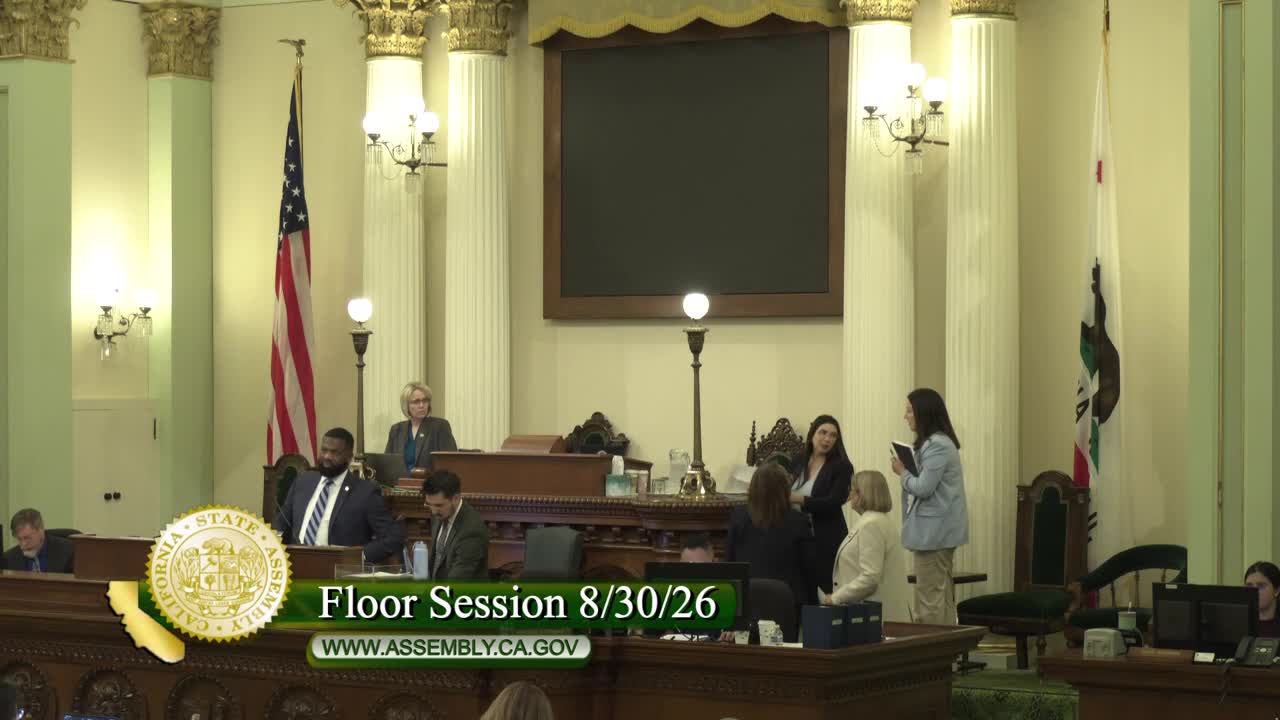 57SEC
Assembly Floor
 3MIN
Senate Floor
 21MIN
Senate Standing Committee on Public Safety
 1MIN
Assembly Floor
 32MIN
Assembly Standing Committee on Judiciary
 19MIN
Assembly Standing Committee on Public Safety
Bill Author