AB 2745: International trade and investment: Global Partnership Advisory Body.
- Session Year: 2025-2026
- House: Assembly
- Latest Version Date: 2026-04-16
Current Status:
In Progress
(2026-05-14: In committee: Held under submission.)
Introduced
In Committee
Awaiting First Chamber Vote
Passed First Chamber
In Committee
Awaiting Second Chamber Vote
Passed Second Chamber
Enacted
Existing law requires the Governors Office of Business and Economic Development (GO-Biz) to develop and implement an International Trade and Investment Program, which among other things, attracts employment-producing direct foreign investment, and states related findings and declarations of the Legislature. Existing law requires the Director of the Governors Office of Business and Economic Development to provide to the Legislature, and update every 5 years, a strategy for international trade and investment, as specified.
This bill would recast these provisions to, among other things, expand the required program activities. The bill would also require the office to convene the Global Partnership Advisory Body, a statewide business partnership for international trade and investment, that would advise the director, as specified. The bill would require the director to provide to the Legislature a 5-year strategy for the implementation of the international trade and investment program, developed in consultation with the advisory body, which would give input on goals, performance metrics, and implementation tactics. The bill would require the strategy to be reviewed in at least one public hearing, as specified, and would make other conforming changes.
Existing law authorizes GO-Biz to establish an international trade and investment office outside the United States if specified conditions are met.
This bill would also authorize GO-Biz to establish regional trade assistance hubs within California to support facilitate international trade and investment if specified conditions are met, met through a specified competitive designation process, and would make other conforming changes.
Existing law establishes the Economic Development and Trade Promotion Account in the Special Deposit Fund within the State Treasury. Existing law authorizes the director to expend funds in the account, and any other state, federal, or private funds for international trade and investment offices or international trade shows or activities related to promoting international trade and investment events by entering into contracts to support international market development activities, including, but not limited to, trade shows, trade missions, promotional events, and seminars, as well as staffing support for those activities, in an amount not exceeding $200,000, except as specified. Existing law authorizes GO-Biz to accept moneys, including, but not limited to, state, federal, and private sector funds, for the purposes of operating any international trade and investment office or international trade show or activity related to promoting international trade and investment events.
This bill would increase the amount that the director can expend from the account as described above to $500,000 and would expand the purposes for which the funds can be spent, thereby making an appropriation. The bill would make other conforming changes relating to funds donated by a private donor for an international trade and investment office.
Existing law requires the Governors Office of Business and Economic Development (GO-Biz) to develop and implement an International Trade and Investment Program, which among other things, attracts employment-producing direct foreign investment, and states related findings and declarations of the Legislature. Existing law requires the Director of the Governors Office of Business and Economic Development to provide to the Legislature, and update every 5 years, a strategy for international trade and investment, as specified.
This bill would recast these provisions to, among other things, expand the required program activities. The bill would also require the office to convene the Global Partnership Advisory Body, a statewide business partnership for international trade and investment, that would advise the director, as specified. The bill would require the director to provide to the Legislature a 5-year strategy for the implementation of the international trade and investment program, developed in consultation with the advisory body, which would give input on goals, performance metrics, and implementation tactics. The bill would require the strategy to be reviewed in at least one public hearing, as specified, and would make other conforming changes.
Existing law authorizes GO-Biz to establish an international trade and investment office outside the United States if specified conditions are met.
This bill would also authorize GO-Biz to establish regional hubs within California to support international trade and investment if specified conditions are met, and would make other conforming changes.
Existing law establishes the Economic Development and Trade Promotion Account in the Special Deposit Fund within the State Treasury. Existing law authorizes the director to expend funds in the account, and any other state, federal, or private funds for international trade and investment offices or international trade shows or activities related to promoting international trade and investment events by entering into contracts to support international market development activities, including, but not limited to, trade shows, trade missions, promotional events, and seminars, as well as staffing support for those activities, in an amount not exceeding $200,000, except as specified. Existing law authorizes GO-Biz to accept moneys, including, but not limited to, state, federal, and private sector funds, for the purposes of operating any international trade and investment office or international trade show or activity related to promoting international trade and investment events.
This bill would increase the amount that the director can expend from the account as described above to $500,000 and would expand the purposes for which the funds can be spent, thereby making an appropriation. The bill would make other conforming changes relating to funds donated by a private donor for an international trade and investment office.
The Legislature finds and declares all of the following:
(a)(1)The statutory authority for the Technology, Trade, and Commerce Agency, including the agencys international trade and investment promotion programs, was repealed by Chapter 229 of the Statutes of 2003, thereby reducing the capacity of state government to assist California firms in developing global business opportunities.
(2)The repeal of the statutory authority for the Technology, Trade, and Commerce Agency has increased the importance of strengthening collaborative linkages among remaining California-based international trade and investment promotion programs operated at federal, state, regional, and local levels. These programs include, but are not limited to, the Centers for International Trade Development operated by the California Community Colleges, 15 offices of the United States Commercial Service within the United States Department of Commerce, numerous local and regional World Trade Centers, and public and private economic development and trade associations.
(3)According to data for 2000, international trade and investment activity in the state supports one in every seven California jobs.(3)According to the most recent available data, international trade and investment activity in California supports nearly one in five state jobs, up from one in seven at the turn of the century, reflecting the states growing role as a gateway for global commerce and capital.
(4)According to the Public Policy Institute of California: United States Census Bureau and the United States Small Business Administration:
(A)Nearly 94 Ninety-five percent of all exporters located in California are small- or medium-sized firms. Over 90 percent of businesses in California are small businesses and over 50 percent of all workers are employed by a small business.
(B)Exporters are more productive and pay higher wages than nonexporters.(C)Effective state programs supporting export opportunities should identify and respond to differing needs of both export-willing and export-ready firms.(D)United States subsidiaries of foreign companies in California employed 561,000 California workers from 2000 to 2005, inclusive. This is a 15 percent increase. In comparison to other states, California is an attractive location for international employers, ranking first in the United States in the number of employees supported by United States subsidiaries.(B)Californias small businesses account for more than 99 percent of total business in the state and employ nearly one-half of the states private sector workforce.
(C)According to a 2024 Beacon Economics study, 53 percent of small businesses in California are minority owned, support over 3,600,000 jobs annually, and generate fifty billion two hundred million dollars ($50,200,000,000) in tax revenue, including twenty-four billion five hundred million dollars ($24,500,000,000) for state and local governments.
(D)Foreign-owned firms now employ more than 814,000 California workers; more than any other state. That figure has grown by roughly 50 percent since 2005.
(E)The 2025 United States National Security Strategy codifies tariffs, export controls, and supply chain policy as integrated instruments of national security, conditioning commercial access on security alignment rather than market efficiency. For California firms operating in the nations largest exporting state and top destination for foreign direct investment, this structural shift imposes new compliance burdens, restricts market access, and heightens scrutiny of inbound foreign investment, necessitating a coordinated state response that builds compliance capacity, diversifies markets, and connects firms to trusted global networks.
(b)The interests of the state would be greatly served by creating a policy organizing organization and coordination vehicle that moves beyond traditional export promotion toward durable, compliant, and diversified trade participation; attracts into Californias priority sectors foreign direct investment, knowledge, and best practices; practices into Californias priority industry sectors; and builds trusted channels for collaboration in talent, research, and workforce development.
(c)The adequacy of the states infrastructure, workforce, research facilities, manufacturing and service industries, and access to capital form the foundation of Californias global market-related economy.
(d)Californias multicultural and ethnic populations offer unique opportunities for international trade and investment.
(e)Californias trade and investment policy is a living document that should be regularly updated to reflect emerging business trends and the changing needs of California businesses and workers.
SEC. 2.Section 13996.41 of the Government Code is amended to read:13996.41.(a)The Governors Office of Business and Economic Development shall develop and implement an International Trade and Investment Program that does all of the following:
(1)Attracts employment-producing direct foreign investment to the state.
(2)Provides support for California businesses in accessing international markets, including assistance to increase California exports.
(3)Facilitates the establishment and expansion of foreign-owned subsidiaries in California.
(4)Supports the establishment of collaborative research and technology adoption agreements that benefit the state economy and quality of life.
(5)Facilitates multinational cooperation across public-public, public-private, and private-private sectors on issues that contribute to a more resilient and competitive economy.
(6)Connects global partners with Californias innovation ecosystems, universities, and entrepreneurs.
(7)Supports cultural and heritage exchanges that leverage Californias competitive advantage as a diverse population, including sister state and sister city exchanges.
(8)Leverages and adapts trade and investment programs, services, and initiatives sponsored by other public and private entities, including the federal government.
(9)Shares information and makes recommendations on how to overcome financing impediments to foreign trade and investment.
(10) Supports the development and implementation of trade promotion and business development agreements.
(11)Engages in other international trade or foreign investment activities assigned by the Governor.
(b)The Director of the Governors Office of Business and Economic Development may establish, operate, and terminate international trade and investment offices outside of the United States as they determine is appropriate if the requirements of Section 13996.65 are satisfied.
(c)This section shall not be construed to confer powers or impose duties upon the Governors Office of Business and Economic Development that conflict with any powers conferred or duties imposed upon the Department of Food and Agriculture with respect to the promotion of California agriculture, fish, or forest exports.
(d)The Governors Office of Business and Economic Development shall develop a conflict-of-interest and gift policy that applies to the Governors Office of Business and Economic Development and all international trade and investment offices established by it.
(e)Any international trade and investment office established or regional hub established, designated, or otherwise contracted for by the Governors Office of Business and Economic Development may be funded in whole or in part by nonstate funds, subject to the requirements of this chapter and Section 13997.
(f)The Governors Office of Business and Economic Development may contract with a nonprofit entity to operate an international trade and investment office. support the implementation of the strategy developed pursuant to Section 13996.55, including the operation of an international trade and investment office inside California or outside of the United States. The contract shall, among other provisions, require the nonprofit entity to provide the Governors Office of Business and Economic Development information sufficient to satisfy the reporting requirements in subdivision (c) of Section 13997 within 30 days of receipt by the nonprofit entity of each donation used to fund an international trade and investment office.
(g)The Director of the Governors Office of Business and Economic Development shall convene the Global Partnership Advisory Body, a statewide business partnership for international trade and investment, by March 1, 2027.
(1)The business partnership shall include representatives from small, medium, and large businesses and industries, as well as nongovernmental organizations, including chambers of commerce, government representatives, workforce training, banking and finance, and transportation and logistics.
(2)The business partnership shall advise the director on business needs and priorities as they relate to international trade and investment.
SEC. 3.Section 13996.42 of the Government Code is amended to read:13996.42.(a)The Governors Office of Business and Economic Development may establish an international trade and investment office outside of the United States if both of the following conditions are met:
(1)The country where an international trade and investment office would be located is among those with the greatest potential for direct foreign investment in California, export growth, or both, as determined by the director.
(2)The Director of the Governors Office of Business and Economic Development has included the new international trade and investment office in the Governors Office of Business and Economic Developments annual program budget, and the current program strategy, and the business plan for the year as required by Section 13996.65.
(b)The Governors Office of Business and Economic Development may establish regional trade assistance hubs within California to support facilitate international trade and investment if the regional hub is included in the Governors Office of Business and Economic Developments annual budget and the current program strategy as required by Section 13996.65. Regional trade assistance hubs may be established though a competitive designation process that meets all of the following requirements:
(1)In designating regional trade assistance hubs, the Governors Office of Business and Economic Development shall consider the 13 economic regions established pursuant to Chapter 5.1 (commencing with Section 14531) of Division 7 of the Unemployment Insurance Code, also known as the California Jobs First regions, to promote equitable geographic distribution of services and alignment with regional economic priorities.
(2)Eligible applicants for a regional trade assistance hub designation shall be a small business technical assistance center, as defined in subdivision (s) of Section 12100.62.
(3)The evaluation of applications shall be based upon the criteria listed in subparagraphs (A) to (C), inclusive. The Governors Office of Business and Economic Development shall establish minimum threshold criteria for each criterion to ensure that only qualified applicants receive regional trade assistance hub designations.
(A)The applicant, along with the partners identified in the application, has demonstrated experience providing international trade, export, or investment services to businesses in the region.
(B)The applicant, along with the partners identified in the application, has provided evidence that their organizational leadership, partnerships, and program design are informed by and aligned with regional economic strategies, priority sectors and industries, and communities present within their service region.
(C)The applicant, along with the partners identified in the application, has demonstrated experience and capacity to serve minority-owned, immigrant-owned, and small businesses in the region.
(4)In addition to the criteria set forth in paragraph (3), priority in making designations shall be provided to an applicant who has secured or demonstrated the capacity to secure nonstate funding or in-kind support to sustain hub operations.
(5)Regional trade assistance designation opportunities shall be publicly advertised, including the evaluation criteria, scoring rubric, the terms and conditions of the designation agreement, and the scope of work related to the operation and services of a designated hub. Designation decisions shall be published on the offices internet website, along with the basis therefor.
(6)Regional hub designations shall be reviewed biennially, and may be renewed, transferred, or revoked by the Governors Office of Business and Economic Development upon finding that a hub no longer meets the selection criteria and commitments made in the designation agreement.
(c)For the purpose of this chapter, current program strategy means a strategy approved by the director within the last five years that meets the requirements of 13996.55.
SEC. 4.Section 13996.55 of the Government Code is amended to read:13996.55.(a)The Director of the Governors Office of Business and Economic Development shall provide to the Legislature, not later than July 1, 2019, a five-year strategy for the implementation of the international trade and investment program. At a minimum, the strategy shall include all of the following:
(1)Policy goals, objectives, and recommendations necessary to implement a comprehensive international trade and investment program for the state. This information shall be provided in a fashion that clearly indicates priority within the overall strategy.
(2)Measurable outcomes and timelines for the goals, objectives, and actions for the international trade and investment program.
(3)Identification of impediments for achieving goals and objectives.
(4)Identification of key stakeholder partnerships that will be used in implementing the strategy.
(5)Identification of options for funding recommended actions.
(6)A current organizational structure for the state administration of international trade and investment policies, programs, and services. The organizational chart may include other state entities that are related to achieving the goals, objectives, and actions identified in the strategy.
(b)(1)The strategy shall be based on current and emerging market conditions and the needs of investors, businesses, and workers to be competitive in global markets.
(2)The strategy shall identify the process the Governors Office of Business and Economic Development will use to evaluate on an ongoing basis, as appropriate, current workforce trends, training and skill requirements, capital constraints, regulatory impediments, infrastructure, research and development, and other needs of small and large firms, including, but not limited to, highways, logistic hubs, and rail that link businesses with the states ports of entry and foreign and domestic markets.
(3)The strategy may, to the extent relevant and feasible, be based on existing studies and reports, including, but not limited to, the Goods Movement Action Plan, the California Strategic Workforce Development Plan, the California Export of Recycled Materials Report, the California Five-Year Infrastructure Plan, and the Environmental Goals and Policy Report. Report, and the California Jobs First State Economic Blueprint or its successor document.
(c)The strategy shall be developed in consultation with the business community, including, but not limited to, advice from the Global Partnership Advisory Body established pursuant to Section 13996.41. The consultation shall include input on goals, performance metrics, and implementation tactics.
(d)The strategy shall be submitted to the Chief Clerk of the Assembly and the Secretary of the Senate and a notice of its submittal shall be provided to the Speaker of the Assembly, the President pro Tempore of the Senate, and the chairs of the Assembly and Senate committees with jurisdiction over international trade and economic development programs.
(e)(1)The strategy shall be reviewed in at least one public hearing by the relevant policy and fiscal committees of each house of the Legislature with jurisdiction over international trade and economic development programs. The hearings shall be held within 60 business days of the strategy being submitted to the Legislature. In calculating the number of business days, any day on which the Legislature is in recess shall not be included.
(2)The legislative committees may make recommendations to the director on the strategy, and the director may modify the strategy accordingly.
(3)The requirement for legislative hearings shall not limit the directors ability to move forward in implementing the strategy.
(f)The strategy shall be updated pursuant to the procedures of this section at least once every five years.
SEC. 5.Section 13996.65 of the Government Code is amended to read:13996.65.(a)The director shall prepare the following:
(1)A budget for the International Trade and Investment Program that includes a separately stated budget for each international trade and investment office within California and outside of the United States. The budget shall provide all the following:
(A)A description of how the International Trade and Investment Program and each individual international trade and investment office will be funded.
(B)A description of staffing levels and the positions needed to operate each international trade and investment office.
(2)A strategy that meets the requirements of Section 13996.55, and a business plan for the International Trade and Investment Program that includes, but is not limited to, all of the following:
(A)A description of the staffing levels and staff expertise needed to operate each international trade and investment office.
(B)A description of monitoring and oversight procedures implemented for the International Trade and Investment Program.
(C)A description of how a newly proposed international trade and investment office will facilitate an increase in foreign direct investment, business expansion, and job creation in California or an increase in California exports, or both.
(3)A written review of the implementation of the prior years strategy and business plan for the International Trade and Investment Program that addresses the performance of the program and each international trade and investment office.
(b)The annual budget, strategy, and business plan for the International Trade and Investment Program, and the prior years review drafted pursuant to subdivision (a) shall be transmitted to the Chief Clerk of the Assembly, the Secretary of the Senate, the Speaker of the Assembly, the President pro Tempore of the Senate, the chair of the Assembly Committee on Jobs, Economic Development, and the Economy and the chair of the Senate Committee on Business, Professions and Economic Development, or respective successor committees, with jurisdiction over the international trade and economic development programs.
SEC. 6.Section 13997 of the Government Code is amended to read:13997.(a)With respect to international trade and investment offices within California and outside of the United States or international trade shows or activities related to the implementation of the international trade and investment strategy funded in whole or in part by state and nonstate funds, all of the following shall apply:
(1)(A)The Governors Office of Business and Economic Development may accept moneys, including, but not limited to, state, federal, and private sector funds, for the purposes of implementing the international trade and investment strategy, including operating any international trade and investment office or international trade show, subject to Title 9 (commencing with Section 81000).
(B)(i)If a private donor designates all or a portion of their donation to cover the cost of establishing or operating an international trade and investment office, the designated portion shall not be more than 25 percent of the annual budget of the designated office in a calendar year.
(ii)The donor may specify the use of the donation, including, but not limited to, the operation of an international trade and investment office, or an international trade show, or a specific activity in the international trade and investment strategy for which the funds shall be used. If no designation is provided with the donation, the funding shall be available for any activity or purpose consistent with the strategy.
(C)Nonstate funds received for the purpose of implementing the international trade and investment strategy, including the establishment and operation of an office pursuant to subdivision (e) of Section 13996.41 shall be deposited into the Economic Development and Trade Promotion Account, which is hereby established in the Special Deposit Fund (Article 2 (commencing with Section 16370) of Chapter 2 of Part 2 of Division 4) within the State Treasury.
(D)(i)Notwithstanding Section 13340, the Director of the Governors Office of Business and Economic Development may expend funds in the Economic Development and Trade Promotion Account, and any other state, federal, or private funds authorized for purposes of this subdivision, by entering into goods and services contracts using those funds as necessary to support international market development activities, including, but not limited to, trade shows, trade missions, promotional events, and seminars, as well as staffing support for those activities, not to exceed five hundred thousand dollars ($500,000), without regard to fiscal year, for the purposes of this subdivision.
(ii)Justification and approval from the director shall be required for contracts that exceed this threshold.
(iii)The director may also pursue activities that directly benefit the industry sources from which the funds are derived.
(iv)Notwithstanding any other law, any goods and services contract entered into by the Governors Office of Business and Economic Development pursuant to this subparagraph shall be exempt from any contracting requirements applicable only to state contracts, including, but not limited to, Section 10295 of the Public Contract Code.
(E)(i)Funds in the Economic Development and Trade Promotion Account may be allocated to an international trade and investment office or an international trade show or activities related to promoting international trade and investment events.
(ii)If allocated to an international trade and investment office, funds shall be maintained by that office in a separate account. Records of donations received and expenditures made pursuant to this section shall be subject to public disclosure.
(2)For each donation that it receives to fund the international trade and investment strategy, including an international trade and investment office or international trade show, the Governors Office of Business and Economic Development shall post a report on its internet website within 30 days of receiving that donation. The report shall contain all of the following information: name and address of the donor; amount of the donation; date the donation was made; name and address of the entity receiving or using the donation; a brief description of the goods or services provided or purchased, if any; and a description of the specific purpose or event for which the donation was made, if any.
(b)Funds from the Economic Development and Trade Promotion Account may, in addition to other purposes authorized in statute, be expended for representational allowance expenditures for the purpose of providing the proper representation of California to foreign government officials and federal officials of the United States, which shall include both of the following:
(1)Business-related meals that include the participation of both foreign government officials or federal officials of the United States and the California business community, not to exceed 300 percent of established per diem rates.
(2)Representational gifts, not to exceed one hundred dollars ($100) per item.
(c)This section does not affect any requirement of the Political Reform Act of 1974 (Title 9 (commencing with Section 81000)).
The Legislature finds and declares all of the following:
(a)(1)The statutory authority for the Technology, Trade, and Commerce Agency, including the agencys international trade and investment promotion programs, was repealed by Chapter 229 of the Statutes of 2003, thereby reducing the capacity of state government to assist California firms in developing global business opportunities.
(b)(2)The repeal of the statutory authority for the Technology, Trade, and Commerce Agency has increased the importance of strengthening collaborative linkages among remaining California-based international trade and investment promotion programs operated at federal, state, regional, and local levels. These programs include, but are not limited to, the Centers for International Trade Development operated by the California Community Colleges, 15 offices of the United States Commercial Service within the United States Department of Commerce, numerous local and regional World Trade Centers, and public and private economic development and trade associations.
(c)(3)According to data for 2000, international trade and investment activity in the state supports one in every seven California jobs.
(d)(4)According to the Public Policy Institute of California:
(1)(A)Nearly 94 percent of all exporters located in California are small- or medium-sized firms. Over 90 percent of businesses in California are small businesses and over 50 percent of all workers are employed by a small business.
(2)(B)Exporters are more productive and pay higher wages than nonexporters.
(3)(C)Effective state programs supporting export opportunities should identify and respond to differing needs of both export-willing and export-ready firms.
(D)United States subsidiaries of foreign companies in California employed 561,000 California workers from 2000 to 2005, inclusive. This is a 15 percent increase. In comparison to other states, California is an attractive location for international employers, ranking first in the United States in the number of employees supported by United States subsidiaries.
(b)The interests of the state would be greatly served by creating a policy organizing and coordination vehicle that moves beyond traditional export promotion toward durable, compliant, and diversified trade participation; attracts into Californias priority sectors foreign direct investment, knowledge, and best practices; and builds trusted channels for collaboration in talent, research, and workforce development.
(e)(c)The adequacy of the states infrastructure, workforce, research facilities, manufacturing and service industries, and access to capital form the foundation of Californias global market-related economy.
(f)(d)Californias multicultural and ethnic populations offer unique opportunities for international trade and investment.
(g) United States subsidiaries of foreign companies in California employed 561,000 California workers from 2000 to 2005. This is an increase of 15 percent. In comparison to other states, California is an attractive location for international employers, ranking first in the United States in the number of employees supported by United States subsidiaries.(h)(e)Californias trade and investment policy is a living document that should be regularly updated to reflect emerging business trends and the changing needs of California businesses and workers.
SEC. 2.Section 13996.41 of the Government Code is amended to read:13996.41.(a)The Governors Office of Business and Economic Development shall develop and implement an International Trade and Investment Program that does all of the following:
(1)Attracts employment-producing direct foreign investment to the state.
(2)Provides support for California businesses in accessing international markets, including assistance to increase California exports.
(3)Facilitates the establishment and expansion of foreign-owned subsidiaries in California.
(4)Supports the establishment of collaborative research and technology adoption agreements that benefit the state economy and quality of life.
(5)Facilitates multinational cooperation across public-public, public-private, and private-private sectors on issues that contribute to a more resilient and competitive economy.
(6)Connects global partners with Californias innovation ecosystems, universities, and entrepreneurs.
(7)Supports cultural and heritage exchanges that leverage Californias competitive advantage as a diverse population, including sister state and sister city exchanges.
(8)Leverages and adapts trade and investment programs, services, and initiatives sponsored by other public and private entities, including the federal government.
(9)Shares information and makes recommendations on how to overcome financing impediments to foreign trade and investment.
(10) Supports the development and implementation of trade promotion and business development agreements.
(3)(11)Engages in other international trade or foreign investment activities assigned by the Governor.
(b)The Director of the Governors Office of Business and Economic Development may establish establish, operate, and terminate international trade and investment offices outside of the United States as he or she determines they determine is appropriate if the requirements of Section 13996.65 are satisfied.
(c)This section shall not be construed to confer powers or impose duties upon the Governors Office of Business and Economic Development that conflict with any powers conferred or duties imposed upon the Department of Food and Agriculture with respect to the promotion of California agriculture, fish, or forest exports.
(d)The Governors Office of Business and Economic Development shall develop a conflict-of-interest and gift policy that applies to the Governors Office of Business and Economic Development and all international trade and investment offices established by it.
(e)Any international trade and investment office established by the Governors Office of Business and Economic Development may be funded in whole or in part by nonstate funds. funds, subject to the requirements of this chapter and Section 13997.
(f)The Governors Office of Business and Economic Development may contract with a nonprofit entity to operate an international trade and investment office. The contract shall, among other provisions, require the nonprofit entity to provide the Governors Office of Business and Economic Development information sufficient to satisfy the reporting requirements in subdivision (c) of Section 13997 within 30 days of receipt by the nonprofit entity of each donation used to fund an international trade and investment office.
(g)The Director of the Governors Office of Business and Economic Development shall convene the Global Partnership Advisory Body, a statewide business partnership for international trade and investment, by March 1, 2027.
(1)The business partnership shall include representatives from small, medium, and large businesses and industries, as well as nongovernmental organizations, including chambers of commerce, government representatives, workforce training, banking and finance, and transportation and logistics.
(2)The business partnership shall advise the director on business needs and priorities as they relate to international trade and investment.
SEC. 3.Section 13996.42 of the Government Code is amended to read:13996.42.(a)The Governors Office of Business and Economic Development may establish an international trade and investment office outside of the United States if both of the following conditions are met:
(a)(1)The country where an international trade and investment office would be located is among those with the greatest potential for direct foreign investment in California, export growth, or both, as determined by the director.
(b)(2)The Director of the Governors Office of Business and Economic Development has included the new international trade and investment office in the Governors Office of Business and Economic Developments current annual program budget and strategy and budget, and the current program strategy, and the business plan for the year for the International Trade and Investment Program as required by Section 13996.65.
(b)The Governors Office of Business and Economic Development may establish regional hubs within California to support international trade and investment if the regional hub is included in the Governors Office of Business and Economic Developments annual budget and the current program strategy as required by Section 13996.65.
(c)For the purpose of this chapter, current program strategy means a strategy approved by the director within the last five years that meets the requirements of 13996.55.
SEC. 4.Section 13996.55 of the Government Code is amended to read:13996.55.(a)The Director of the Governors Office of Business and Economic Development shall provide to the Legislature, not later than July 1, 2019, a five-year strategy for the implementation of the international trade and investment that, at program. At a minimum, includes the strategy shall include all of the following:
(1)Policy goals, objectives, and recommendations necessary to implement a comprehensive international trade and investment program for the state. This information shall be provided in a fashion that clearly indicates priority within the overall strategy.
(2)Measurable outcomes and timelines for the goals, objectives, and actions for the international trade and investment program.
(3)Identification of impediments for achieving goals and objectives.
(4)Identification of key stakeholder partnerships that will be used in implementing the strategy.
(5)Identification of options for funding recommended actions.
(6)A current organizational structure for the state administration of international trade and investment policies, programs, and services. The organizational chart may include other state entities that are related to achieving the goals, objectives, and actions identified in the strategy.
(b)(1)The strategy shall be based on current and emerging market conditions and the needs of investors, businesses, and workers to be competitive in global markets.
(2)The strategy shall identify the process the Governors Office of Business and Economic Development will use to evaluate on an ongoing basis, as appropriate, current workforce, workforce trends, training and skill requirements, capital constraints, regulatory impediments, infrastructure, research and development, and other needs of small and large firms, including, but not limited to, highways, logistic hubs, and rail that link businesses with the states ports of entry and foreign and domestic markets.
(3)The strategy may, to the extent relevant and feasible, be based on existing studies and reports, including, but not limited to, the Goods Movement Action Plan, the California Strategic Workforce Development Plan, the California Export of Recycled Materials Report, the California Five-Year Infrastructure Plan, and the Environmental Goals and Policy Report.
(c)The strategy shall be developed in consultation with the business community, including, but not limited to, advice from the Global Partnership Advisory Body established pursuant to Section 13996.41. The consultation shall include input on goals, performance metrics, and implementation tactics.
(c)(d)The strategy shall be submitted to the Chief Clerk of the Assembly and the Secretary of the Senate and a notice of its submittal shall be provided to the Speaker of the Assembly, the President pro Tempore of the Senate, and the chairs of the Assembly Committee on Jobs, Economic Development, and the Economy and the Senate Committee on Business, Professions and Economic Development, or the successor and Senate committees with jurisdiction over international trade and economic development programs.
(e)(1)The strategy shall be reviewed in at least one public hearing by the relevant policy and fiscal committees of each house of the Legislature with jurisdiction over international trade and economic development programs. The hearings shall be held within 60 business days of the strategy being submitted to the Legislature. In calculating the number of business days, any day on which the Legislature is in recess shall not be included.
(2)The legislative committees may make recommendations to the director on the strategy, and the director may modify the strategy accordingly.
(3)The requirement for legislative hearings shall not limit the directors ability to move forward in implementing the strategy.
(d)(f)The strategy shall be updated pursuant to the procedures of this section at least once every five years.
SEC. 5.Section 13996.65 of the Government Code is amended to read:13996.65.(a)The director shall prepare the following:
(1)A budget for the International Trade and Investment Program that includes a separately stated budget for each international trade and investment office. office within California and outside of the United States. The budget shall provide all the following:
(A)A description of how the International Trade and Investment Program and each individual international trade and investment office will be funded.
(B)A description of staffing levels and the positions needed to operate each international trade and investment office.
(2)A strategy and that meets the requirements of Section 13996.55, and a business plan for the International Trade and Investment Program, developed with input from California businesses that shall include, but not be limited to, measurable goals, objectives, and outcomes and timelines necessary to attract employment-producing direct foreign investment to the state and increase California exports. The strategy and business plan shall include, Program that includes, but not be is not limited to, all of the following:
(A)A description of the staffing levels and staff expertise needed to operate each international trade and investment office.
(B)A description of monitoring and oversight procedures implemented for the International Trade and Investment Program.
(C)A description of how a newly proposed international trade and investment office will facilitate an increase of direct foreign investment in foreign direct investment, business expansion, and job creation in California or an increase in California exports, or both.
(3)A written review of the implementation of the prior years strategy and business plan for the International Trade and Investment Program that addresses the performance of the program and each international trade and investment office.
(b)The annual budget, the strategy strategy, and business plan for the International Trade and Investment Program, and the prior years review drafted pursuant to subdivision (a) shall be transmitted to the Chief Clerk of the Assembly, the Secretary of the Senate, the Speaker of the Assembly, the President pro Tempore of the Senate, the chair of the Assembly Committee on Jobs, Economic Development, and the Economy and the chair of the Senate Committee on Business, Professions and Economic Development, or respective successor committees, with jurisdiction over the international trade and economic development programs.
SEC. 6.Section 13997 of the Government Code is amended to read:13997.(a)With respect to international trade and investment offices within California and outside of the United States or international trade show shows or activities related to promoting the implementation of the international trade and investment events strategy funded in whole or in part by state and nonstate funds pursuant to subdivision (e) of Section 13996.41, funds, all of the following shall apply:
(1)(A)The Governors Office of Business and Economic Development may accept moneys, including, but not limited to, state, federal, and private sector funds, for the purposes of implementing the international trade and investment strategy, including operating any international trade and investment office or international trade show or activity related to promoting international trade and investment events, show, subject to Title 9 (commencing with Section 81000).
(B)(i)A donor shall not donate If a private donor designates all or a portion of their donation to cover the cost of establishing or operating an international trade and investment office, the designated portion shall not be more than 25 percent of the annual budget of an international trade and investment the designated office in a calendar year.
(ii)The donor may specify the international trade and investment office or international trade show or activity related to promoting international trade and investment events use of the donation, including, but not limited to, the operation of an international trade and investment office, or an international trade show, or a specific activity in the international trade and investment strategy for which the funds shall be used. If no designation is provided with the donation, the funding shall be available for any activity or purpose consistent with the strategy.
(C)Funds Nonstate funds received for the purpose of implementing the international trade and investment strategy, including the establishment and operation of an office pursuant to subdivision (e) of Section 13996.41 shall be deposited into the Economic Development and Trade Promotion Account, which is hereby established in the Special Deposit Fund (Article 2 (commencing with Section 16370) of Chapter 2 of Part 2 of Division 4) within the State Treasury.
(D)(i)Notwithstanding Section 13340, the Director of the Governors Office of Business and Economic Development may expend funds in the Economic Development and Trade Promotion Account, and any other state, federal, or private funds authorized for purposes of this subdivision, by entering into goods and services contracts using those funds as necessary to support international market development activities, including, but not limited to, trade shows, trade missions, promotional events, and seminars, as well as staffing support for those activities, not to exceed two hundred thousand dollars ($200,000), five hundred thousand dollars ($500,000), without regard to fiscal year, for the purposes of this subdivision.
(ii)Justification and approval from the director shall be required for contracts that exceed this threshold.
(iii)The director may also pursue activities that directly benefit the industry sources from which the funds are derived.
(iv)Notwithstanding any other law, any goods and services contract entered into by the Governors Office of Business and Economic Development pursuant to this subparagraph shall be exempt from any contracting requirements applicable only to state contracts, including, but not limited to, Section 10295 of the Public Contract Code.
(E)(i)Funds in the Economic Development and Trade Promotion Account may be allocated to an international trade and investment office or an international trade show or activities related to promoting international trade and investment events.
(ii)If allocated to an international trade and investment office, funds shall be maintained by that office in an a separate account. Records of donations received and expenditures made pursuant to this section shall be subject to public disclosure.
(2)For each donation that it receives to fund the international trade and investment strategy, including an international trade and investment office or international trade show or activity related to promoting international trade and investment events, show, the Governors Office of Business and Economic Development shall post a report on its internet website within 30 days of receiving that donation. The report shall contain all of the following information: name and address of the donor; amount of the donation; date the donation was made; name and address of the entity receiving or using the donation; a brief description of the goods or services provided or purchased, if any; and a description of the specific purpose or event for which the donation was made, if any.
(b)Funds from the Economic Development and Trade Promotion Account may may, in addition to other purposes authorized in statute, be expended for representational allowance expenditures for the purpose of providing the proper representation of California to foreign government officials and federal officials of the United States, which shall include both of the following:
(1)Business-related meals that include the participation of both foreign government officials or federal officials of the United States and the California business community, not to exceed 300 percent of established per diem rates.
(2)Representational gifts, not to exceed one hundred dollars ($100) per item.
(c)This section does not affect any requirement of the Political Reform Act of 1974 (Title 9 (commencing with Section 81000)).
|
Date
|
Status
|
|---|---|
| May 14, 2026 | In committee: Held under submission. |
| May 6, 2026 | In committee: Set, first hearing. Referred to APPR. suspense file. |
| Apr 20, 2026 | Re-referred to Com. on APPR. |
| Apr 16, 2026 | Read second time and amended. |
| Apr 15, 2026 | From committee: Amend, and do pass as amended and re-refer to Com. on APPR. (Ayes 7. Noes 0.) (April 14). |
| Mar 16, 2026 | Referred to Com. on E.D., G., & H.I. |
| Feb 21, 2026 | From printer. May be heard in committee March 23. |
| Feb 20, 2026 | Read first time. To print. |
This list shows positions taken on this bill by organizations on the date displayed, which is linked to the original source.
Positions by individuals are not included.
Date of Hearing: May 6, 2026
ASSEMBLY COMMITTEE ON APPROPRIATIONS
Buffy Wicks, Chair
ABPCA Bill Id:AB 2745
Author:(Fong) – As Amended Ver:April 16, 2026
Policy Committee: | Economic Development, Growth, and Household Impact | Vote: | 7 - 0 |
|
| ||
|
|
Urgency: No State Mandated Local Program: No Reimbursable: No
SUMMARY:
This bill requires the director of the Governor’s Office of Business and Economic Development (GO-Biz) to convene the Global Partnership Advisory Body, by March 1, 2027, as a statewide business partnership for international trade and investment and authorizes GO-Biz to establish regional trade assistance hubs to facilitate international trade and investment subject to a competitive application process available to eligible small business technical assistance centers in each of the state’s 13 economic regions.
FISCAL EFFECT:
One-time General Fund costs, likely minor and absorbable, for GO-Biz to convene the Global Partnership Advisory Body.
Ongoing General Fund cost pressures of approximately $12.5 million for GO-Biz to support advisory bodies, regional hubs, cultural and heritage coordinate, and associated program functions. According to GO-Biz, approximately $11.7 million of this estimate is necessary, should GO-Biz use its expanded authority in this bill, to ensure regional hubs are adequately staffed, operationally sustainable, and positioned to leverage and match federal funding opportunities.
COMMENTS:
- Purpose. According to the author:
AB 2745 updates and modernizes California’s approach by strengthening the state’s trade and investment strategy, improving coordination with private-sector partners, and removing barriers to more effective program implementation. These changes will help ensure California remains competitive in global markets and continues to support economic growth and job creation statewide.
- Background. Current law tasks GO-Biz with developing and implementing an International Trade and Investment Program to attract employment-producing direct foreign investment, among other things. Additionally, GO-Biz must provide, and update every five years, a strategy for international trade and investment. Current law also authorizes the director of GO-Biz to expend Economic Development and Trade Promotion Account funds for international trade and investments events, not to exceed $200,000. This bill increases the expenditure limit to $500,000 and adds several elements to GO-Biz’s international trade and investment strategy review process. Lastly, this bill authorizes GO-Biz to establish regional trade assistance hubs, considering each of the state’s existing 13 economic regions. The author claims his intent is to update the existing statutory framework and authority for GO-Biz’s international trade activities to keep pace with changes in the global economy.
Analysis Prepared by: Aaron Heredia / APPR. / (916) 319-2081
Date of Hearing: April 14, 2026
ASSEMBLY COMMITTEE ON ECONOMIC DEVELOPMENT, GROWTH, AND HOUSEHOLD IMPACT
José Luis Solache, Jr., Chair
ABPCA Bill Id:AB 2745 (
Author:Fong) – As Introduced Ver:February 20, 2026
SUBJECT: International trade and investment: Global Partnership Advisory Body
SUMMARY: AB 2745 modernizes California’s international trade framework by establishing the Global Partnership Advisory Body by March 1, 2027, to advise on business priorities and performance metrics. The bill requires a 5-year implementation strategy, updated every five years, which must undergo at least one public legislative hearing. Notably, it increases the expenditure limit for trade activities from $200,000 to $500,000 and authorizes the establishment of regional trade hubs within California.
Specifically, this bill:
- Recast these provisions to, among other things, expand the required program activities to include connecting global partners with California's innovation ecosystems and supporting cultural exchanges.
- Requires the office to convene the Global Partnership Advisory Body, a statewide business partnership for international trade and investment, that would advise the director, as specified.
- Requires the director to provide to the Legislature a 5-year strategy for the implementation of the international trade and investment program, developed in consultation with the advisory body, which would give input on goals, performance metrics, and implementation tactics.
- Requires the strategy to be reviewed in at least one public hearing within 60 business days of submittal, as specified, and would make other conforming changes.
- Authorizes GO-Biz to establish regional hubs within California to support international trade and investment if specified conditions are met and would make other conforming changes.
- Increases the amount that the director can expend from the account as described above from $200,000 to $500,000 without regard to fiscal year and would expand the purposes for which the funds can be spent, thereby making an appropriation.
- Makes other conforming changes relating to funds donated by a private donor, limiting designated donations to 25% of an office’s annual budget for an international trade and investment office.
EXISTING LAW:
- Requires the Governor’s Office of Business and Economic Development (GO-Biz) to develop and implement an International Trade and Investment Program, which among other things, attracts employment-producing direct foreign investment, and states related findings and declarations of the Legislature.
- Requires the Director of the Governor’s Office of Business and Economic Development to provide the Legislature, and update every 5 years, a strategy for international trade and investment, as specified.
- Authorizes GO-Biz to establish an international trade and investment office outside the United States if specified conditions are met.
- Establishes the Economic Development and Trade Promotion Account in the Special Deposit Fund within the State Treasury.
- Authorizes the director to expend funds in the account, and any other state, federal, or private funds for international trade and investment offices or international trade shows or activities related to promoting international trade and investment events by entering into contracts to support international market development activities, including, but not limited to, trade shows, trade missions, promotional events, and seminars, as well as staffing support for those activities, in an amount not exceeding $200,000, except as specified.
- Authorizes GO-Biz to accept money, including, but not limited to, state, federal, and private sector funds, for the purposes of operating any international trade and investment office or international trade show or activity related to promoting international trade and investment events.
FISCAL EFFECT: Unknown
COMMENTS: AB 2745, introduced by Assembly Member Mike Fong, serves as a legislative intervention to revitalize California’s standing in the global marketplace. Despite California's reputation as a global innovation leader, the state's export growth plummeted to 42nd in the nation between 2015 and 2024, signaling a significant decline in competitiveness. The author’s intent is to resolve this stagnation by replacing the state’s lapsed international trade roadmap, which expired in 2024, with a modernized, long-term strategy that accounts for contemporary challenges like geopolitical instability and supply chain disruptions. By formalizing the Global Partnership Advisory Body, the bill ensures that state policy is no longer developed in a vacuum but is instead informed by a diverse coalition of business, government, and workforce stakeholders.
Under the proposed law, the statutory framework of the International Trade and Investment Program is significantly expanded to move beyond simple export promotion. The bill authorizes the creation of regional hubs within California, allowing for a more decentralized and accessible approach to trade support that reaches local innovation ecosystems and small businesses. Furthermore, AB 2745 increases the fiscal flexibility of the Governor’s Office of Business and Economic Development (GO-Biz) by raising the contracting expenditure limit from $200,000 to $500,000. This allows the state to more aggressively pursue high-impact trade missions and promotional events while maintaining strict transparency standards, such as capping private donor influence at 25% of an individual office's budget. This comprehensive update aims to safeguard the one in every five California jobs supported by international trade, ensuring the state remains the nation’s primary gateway to the global economy.
The proposed amendments:
- Update the legislative intent with current trade statistics.
- Clarify GO-Biz's authority to contract for all actions related to implementing the strategy.
- Add detail to the existing regional trade assistance hub provisions.
- Add the California Jobs First State Economic Blueprint to the list of existing state policy and strategy documents that GO-Biz may use to develop the international trade strategy.
Author’s Statement: According to the author, “California is the fourth-largest economy in the world, and international trade is a key driver of its economic strength, supporting one in four jobs and powering thousands of small- and medium-sized businesses across the state. Existing law establishes a framework for promoting trade and investment through a five-year strategy; however, that strategy has lapsed, and the statutory framework has not kept pace with changes in the global economy.
AB 2745 updates and modernizes California’s approach by strengthening the state’s trade and investment strategy, improving coordination with private-sector partners, and removing barriers to more effective program implementation. These changes will help ensure California remains competitive in global markets and continues to support economic growth and job creation statewide.”
REGISTERED SUPPORT / OPPOSITION:
Support
None on file.
Opposition
None on file.
Analysis Prepared by: Carla Castilla / E.D., G., & H.I. / (916) 319-2090
Date of Hearing:
ASSEMBLY COMMITTEE ON ECONOMIC DEVELOPMENT, GROWTH, AND HOUSEHOLD IMPACT
José Luis Solache, Jr., Chair
ABPCA Bill Id:AB 2745 (
Author:Fong) – As Introduced Ver:February 20, 2026
SUBJECT: International trade and investment: Global Partnership Advisory Body
SUMMARY: AB 2745 modernizes California’s international trade framework by establishing the Global Partnership Advisory Body by March 1, 2027, to advise on business priorities and performance metrics. The bill requires a 5-year implementation strategy, updated every five years, which must undergo at least one public legislative hearing. Notably, it increases the expenditure limit for trade activities from $200,000 to $500,000 and authorizes the establishment of regional trade hubs within California.
Specifically, this bill:
- Recast these provisions to, among other things, expand the required program activities to include connecting global partners with California's innovation ecosystems and supporting cultural exchanges.
- Requires the office to convene the Global Partnership Advisory Body, a statewide business partnership for international trade and investment, that would advise the director, as specified.
- Requires the director to provide to the Legislature a 5-year strategy for the implementation of the international trade and investment program, developed in consultation with the advisory body, which would give input on goals, performance metrics, and implementation tactics.
- Requires the strategy to be reviewed in at least one public hearing within 60 business days of submittal, as specified, and would make other conforming changes.
- Authorizes GO-Biz to establish regional hubs within California to support international trade and investment if specified conditions are met and would make other conforming changes.
- Increases the amount that the director can expend from the account as described above from $200,000 to $500,000 without regard to fiscal year and would expand the purposes for which the funds can be spent, thereby making an appropriation.
- Makes other conforming changes relating to funds donated by a private donor, limiting designated donations to 25% of an office’s annual budget for an international trade and investment office.
EXISTING LAW:
- Requires the Governor’s Office of Business and Economic Development (GO-Biz) to develop and implement an International Trade and Investment Program, which among other things, attracts employment-producing direct foreign investment, and states related findings and declarations of the Legislature.
- Requires the Director of the Governor’s Office of Business and Economic Development to provide the Legislature, and update every 5 years, a strategy for international trade and investment, as specified.
- Authorizes GO-Biz to establish an international trade and investment office outside the United States if specified conditions are met.
- Establishes the Economic Development and Trade Promotion Account in the Special Deposit Fund within the State Treasury.
- Authorizes the director to expend funds in the account, and any other state, federal, or private funds for international trade and investment offices or international trade shows or activities related to promoting international trade and investment events by entering into contracts to support international market development activities, including, but not limited to, trade shows, trade missions, promotional events, and seminars, as well as staffing support for those activities, in an amount not exceeding $200,000, except as specified.
- Authorizes GO-Biz to accept money, including, but not limited to, state, federal, and private sector funds, for the purposes of operating any international trade and investment office or international trade show or activity related to promoting international trade and investment events.
FISCAL EFFECT: Unknown
COMMENTS: AB 2745, introduced by Assembly Member Mike Fong, serves as a legislative intervention to revitalize California’s standing in the global marketplace. Despite California's reputation as a global innovation leader, the state's export growth plummeted to 42nd in the nation between 2015 and 2024, signaling a significant decline in competitiveness. The author’s intent is to resolve this stagnation by replacing the state’s lapsed international trade roadmap, which expired in 2024, with a modernized, long-term strategy that accounts for contemporary challenges like geopolitical instability and supply chain disruptions. By formalizing the Global Partnership Advisory Body, the bill ensures that state policy is no longer developed in a vacuum but is instead informed by a diverse coalition of business, government, and workforce stakeholders.
Under the proposed law, the statutory framework of the International Trade and Investment Program is significantly expanded to move beyond simple export promotion. The bill authorizes the creation of regional hubs within California, allowing for a more decentralized and accessible approach to trade support that reaches local innovation ecosystems and small businesses. Furthermore, AB 2745 increases the fiscal flexibility of the Governor’s Office of Business and Economic Development (GO-Biz) by raising the contracting expenditure limit from $200,000 to $500,000. This allows the state to more aggressively pursue high-impact trade missions and promotional events while maintaining strict transparency standards, such as capping private donor influence at 25% of an individual office's budget. This comprehensive update aims to safeguard the one in every five California jobs supported by international trade, ensuring the state remains the nation’s primary gateway to the global economy.
The proposed amendments:
- Update the legislative intent with current trade statistics.
- Clarify GO-Biz's authority to contract for all actions related to implementing the strategy.
- Add detail to the existing regional trade assistance hub provisions.
- Add the California Jobs First State Economic Blueprint to the list of existing state policy and strategy documents that GO-Biz may use to develop the international trade strategy.
Author’s Statement: According to the author, “California is the fourth-largest economy in the world, and international trade is a key driver of its economic strength, supporting one in four jobs and powering thousands of small- and medium-sized businesses across the state. Existing law establishes a framework for promoting trade and investment through a five-year strategy; however, that strategy has lapsed, and the statutory framework has not kept pace with changes in the global economy.
AB 2745 updates and modernizes California’s approach by strengthening the state’s trade and investment strategy, improving coordination with private-sector partners, and removing barriers to more effective program implementation. These changes will help ensure California remains competitive in global markets and continues to support economic growth and job creation statewide.”
REGISTERED SUPPORT / OPPOSITION:
Support
None on file.
Opposition
None on file.
Analysis Prepared by: Carla Castilla / E.D., G., & H.I. / (916) 319-2090
Discussed in Hearing
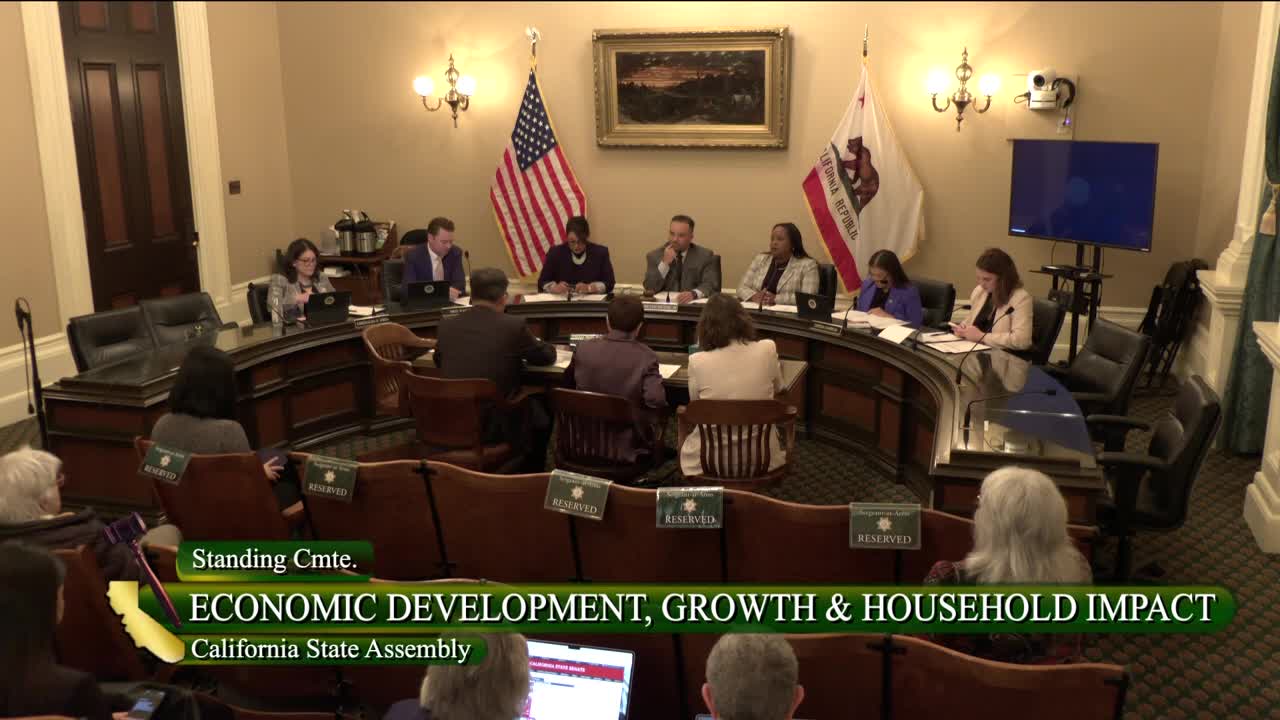 7MIN
Assembly Standing Committee on Economic Development, Growth, and Household Impact
Bill Author

Bill Co-Author(s):