AB 2752: Bay Area Air Quality Management District and South Coast Air Quality Management District: policies: oil refineries.
- Session Year: 2025-2026
- House: Assembly
- Latest Version Date: 2026-04-06
Current Status:
In Progress
(2026-04-20: In committee: Set, first hearing. Testimony taken.)
Introduced
In Committee
Awaiting First Chamber Vote
Passed First Chamber
In Committee
Awaiting Second Chamber Vote
Passed Second Chamber
Enacted
Existing law establishes the Bay Area Air Quality Management District, which is vested with the authority to regulate air emissions located in the boundaries of the Counties of Alameda, Contra Costa, Marin, Napa, San Francisco, San Mateo, and Santa Clara and portions of the Counties of Solano and Sonoma.
Under existing law, the Lewis-Presley Air Quality Management Act establishes the South Coast Air Quality Management District in those portions of the Counties of Los Angeles, Orange, Riverside, and San Bernardino included within the South Coast Air Basin as the local agency with the responsibility for comprehensive air pollution control within the basin.
This bill would require the Bay Area Air Quality Management District and the South Coast Air Quality Management District District, on or before December 31, 2027, to analyze all of their policies that have been adopted and all future policies that they are considering adopting that impact oil refineries located in their districts and specified policies to determine the cost of compliance, potential cost to consumers, impacts on state and local tax revenue, and refinery employment. refinery employment, and impacts on the statewide gasoline supply, as provided. The bill would also require those districts, on or before January 1, 2028, to make a good faith effort to minimize any adverse impacts identified pursuant to that requirement. By requiring a higher level of service of local entities, the bill would impose a state-mandated local program.
Existing law requires, whenever a district intends to propose the adoption, amendment, or repeal of a rule or regulation that will significantly affect air quality or emissions limitations, that district to perform an assessment of the socioeconomic impacts of the adoption, amendment, or repeal of the rule or regulation. Existing law defines socioeconomic impact for these purposes.
With respect to the adoption, amendment, or repeal of a rule or regulation related to oil refineries by the Bay Area Air Quality Management District and the South Coast Air Quality Management District, the bill would expand the definition of socioeconomic impact to also mean the cost to consumers, impacts on state and local tax revenue, and impacts on the statewide gasoline supply. The bill would also require those districts to actively consider those additional socioeconomic impacts and make a good faith effort to minimize any adverse impacts, as provided, before adopting, amending, or repealing a rule or regulation related to oil refineries.
This bill would make legislative findings and declarations as to the necessity of a special statute for the Bay Area Air Quality Management District and the South Coast Air Quality Management District.
The California Constitution requires the state to reimburse local agencies and school districts for certain costs mandated by the state. Statutory provisions establish procedures for making that reimbursement.
This bill would provide that, if the Commission on State Mandates determines that the bill contains costs mandated by the state, reimbursement for those costs shall be made pursuant to the statutory provisions noted above.
Existing law establishes the Bay Area Air Quality Management District, which is vested with the authority to regulate air emissions located in the boundaries of the Counties of Alameda, Contra Costa, Marin, Napa, San Francisco, San Mateo, and Santa Clara and portions of the Counties of Solano and Sonoma.
Under existing law, the Lewis-Presley Air Quality Management Act establishes the South Coast Air Quality Management District in those portions of the Counties of Los Angeles, Orange, Riverside, and San Bernardino included within the South Coast Air Basin, Basin as the local agency with the responsibility for comprehensive air pollution control within the basin.
This bill would state the intent of the Legislature to enact future legislation to ensure accountability and oversight of the Bay Area Air Quality Management District and the South Coast Air Quality Management District to ensure the rules and regulations they adopt are cost effective, affordable, and achievable.This bill would require the Bay Area Air Quality Management District and the South Coast Air Quality Management District to analyze all of their policies that have been adopted and all future policies that they are considering adopting that impact oil refineries located in their districts and determine the cost of compliance, potential cost to consumers, impacts on state and local tax revenue, and refinery employment. By requiring a higher level of service of local entities, the bill would impose a state-mandated local program.
This bill would make legislative findings and declarations as to the necessity of a special statute for the Bay Area Air Quality Management District and the South Coast Air Quality Management District.
The California Constitution requires the state to reimburse local agencies and school districts for certain costs mandated by the state. Statutory provisions establish procedures for making that reimbursement.
This bill would provide that, if the Commission on State Mandates determines that the bill contains costs mandated by the state, reimbursement for those costs shall be made pursuant to the statutory provisions noted above.
Existing law establishes the Bay Area Air Quality Management District, which is vested with the authority to regulate air emissions located in the boundaries of the Counties of Alameda, Contra Costa, Marin, Napa, San Francisco, San Mateo, and Santa Clara and portions of the Counties of Solano and Sonoma.
Under existing law, the Lewis-Presley Air Quality Management Act establishes the South Coast Air Quality Management District in those portions of the Counties of Los Angeles, Orange, Riverside, and San Bernardino included within the South Coast Air Basin, as the local agency with the responsibility for comprehensive air pollution control within the basin.
This bill would state the intent of the Legislature to enact future legislation to ensure accountability and oversight of the Bay Area Air Quality Management District and the South Coast Air Quality Management District to ensure the rules and regulations they adopt are cost effective, affordable, and achievable.
The Legislature finds and declares all of the following:
(a)With one oil refinery closed in 2025 and another scheduled to close in April 2026, safe, reliable, and affordable fuel supply is of statewide importance for the 26,800,000 gasoline-powered vehicles registered in California, the states residents, and Californias economy.
(b)In April 2025, Governor Gavin Newsom sent a letter to the State Energy Resources Conservation and Development Commission (CEC) directing the CEC to work closely with oil refineries on short-term and long-term planning to ensure Californians have access to affordable and reliable supply of transportation fuels.
(c)In June 2025, the CEC responded to the Governors letter with several recommendations to stabilize gasoline supply. The report highlighted inconsistencies and high compliance costs of Californias system to allow the state, local governments, and regional air quality districts to adopt regulations that impact oil refineries. To address this, the letter recommended that the Legislature strategically align regulations and permitting processes across all levels of government to achieve state policy goals.
(d)With more than 30 oil refineries in California in the 1980s having been reduced to six major refineries serving 28 million California drivers, an adequate supply of gasoline is of statewide importance.
(e)Restrictive state regulations and legislative policies that have been adopted over the past decades have resulted in oil refineries leaving the state. In addition, regional and local governments have adopted restrictive policies that impose significant compliance costs on refineries, impeding their ability to meet the demand for California drivers. Specifically, the Bay Area Air Quality Management District and the South Coast Air Quality Management District have adopted policies and requirements over the last six years that have cost refineries between $4,500,000,000 and $6,600,000,000.
SEC. 2.Section 40004.5 is added to the Health and Safety Code, to read:40004.5.(a)The Bay Area Air Quality Management District and the South Coast Air Quality Management District District, on or before December 31, 2027, shall analyze all of their policies that have been adopted and all future policies that they are considering adopting that impact oil refineries located in their districts and determine the following policies to determine, with respect to oil refineries, the cost of compliance, potential cost to consumers, impacts on state and local tax revenue, and refinery employment. employment, and impacts on statewide gasoline supply:
(1)Bay Area Air Quality Management District Regulation 3 fees.
(2)Bay Area Air Quality Management District Regulation 6 Rule 5.
(3)South Coast Air Quality Management District Regulation III fees.
(4)South Coast Air Quality Management District Rule 1109.1.
(b)The Bay Area Air Quality Management District and the South Coast Air Quality Management District, on or before January 1, 2028, shall make a good faith effort to minimize any adverse impacts identified pursuant to subdivision (a).
SEC. 3.Section 40728.5 of the Health and Safety Code is amended to read:40728.5.(a) Whenever a district intends to propose the adoption, amendment, or repeal of a rule or regulation that will significantly affect air quality or emissions limitations, that agency shall, to the extent data are available, perform an assessment of the socioeconomic impacts of the adoption, amendment, or repeal of the rule or regulation. The district board shall actively consider the socioeconomic impact of regulations and make a good faith effort to minimize adverse socioeconomic impacts, as defined below. This section does not apply to the adoption, amendment, or repeal of any rule or regulation that results in any less restrictive emissions limit if the action does not interfere with the districts adopted plan to attain ambient air quality standards, or does not result in any significant increase in emissions.
(b) (1)For purposes of this section, socioeconomic impact means the following:
(1)(A)The type of industries or business, including small business, affected by the rule or regulation.
(2)(B)The impact of the rule or regulation on employment and the economy of the region affected by the adoption of the rule or regulation.
(3)(C)The range of probable costs, including costs to industry or business, including small business, of the rule or regulation.
(4)(D)The availability and cost-effectiveness of alternatives to the rule or regulation being proposed or amended.
(5)(E)The emission reduction potential of the rule or regulation.
(6)(F)The necessity of adopting, amending, or repealing the rule or regulation to attain state and federal ambient air standards pursuant to Chapter 10 (commencing with Section 40910).
(2)(A)With respect to the adoption, amendment, or repeal of a rule or regulation related to oil refineries by the Bay Area Air Quality Management District and the South Coast Air Quality Management District, socioeconomic impact shall also mean the cost to consumers, impacts on state and local tax revenue, and impacts on the statewide gasoline supply.
(B)Before adopting, amending, or repealing a rule or regulation related to oil refineries, the Bay Area Air Quality Management District and the South Coast Air Quality Management District shall actively consider the socioeconomic impacts described in subparagraph (A) and make a good faith effort to minimize any adverse impacts identified in subparagraphs (B) and (C) of paragraph (1) and subparagraph (A).
(c) To the extent that information on the socioeconomic impact of a regulation is required to be developed by a district pursuant to other provisions of this division, that information may be used or referenced in the assessment in order to comply with the requirements of this section.
(d) This section does not apply to any district with a population of less than 500,000 persons.
(e) Upon the approval by a majority vote of the district board, a county district is not required to include the analysis specified in paragraphs (2) and (4) of subparagraphs (B) and (D) of paragraph (1) of subdivision (b) in any assessment of socioeconomic impacts for any rule or regulation that only adopts a requirement that is substantially similar to, or is required by, a state or federal statute, regulation, or applicable formal guidance document. Examples of state or federal formal guidance documents include, but are not limited to, federal Control Techniques Guidelines, state and federal reasonably available control technology determinations, state best available retrofit control technology determinations, and state air toxic control measures.
SEC. 3.SEC. 4.The Legislature finds and declares that a special statute is necessary and that a general statute cannot be made applicable within the meaning of Section 16 of Article IV of the California Constitution because of the potentially deleterious effect of regulations imposed on oil refineries by the Bay Area Air Quality Management District and South Coast Air Quality Management District and the impact of those regulations on the states fuel supply.
SEC. 4.SEC. 5.If the Commission on State Mandates determines that this act contains costs mandated by the state, reimbursement to local agencies and school districts for those costs shall be made pursuant to Part 7 (commencing with Section 17500) of Division 4 of Title 2 of the Government Code.
The Legislature finds and declares all of the following:
(a)With one oil refinery closed in 2025 and another scheduled to close in April 2026, safe, reliable, and affordable fuel supply is of statewide importance for the 26,800,000 gasoline-powered vehicles registered in California, the states residents, and Californias economy.
(b)In April 2025, Governor Gavin Newsom sent a letter to the State Energy Resources Conservation and Development Commission (CEC) directing the CEC to work closely with oil refineries on short-term and long-term planning to ensure Californians have access to affordable and reliable supply of transportation fuels.
(c)In June 2025, the CEC responded to the Governors letter with several recommendations to stabilize gasoline supply. The report highlighted inconsistencies and high compliance costs of Californias system to allow the state, local governments, and regional air quality districts to adopt regulations that impact oil refineries. To address this, the letter recommended that the Legislature strategically align regulations and permitting processes across all levels of government to achieve state policy goals.
(d)With more than 30 oil refineries in California in the 1980s having been reduced to six major refineries serving 28 million California drivers, an adequate supply of gasoline is of statewide importance.
(e)Restrictive state regulations and legislative policies that have been adopted over the past decades have resulted in oil refineries leaving the state. In addition, regional and local governments have adopted restrictive policies that impose significant compliance costs on refineries, impeding their ability to meet the demand for California drivers. Specifically, the Bay Area Air Quality Management District and the South Coast Air Quality Management District have adopted policies and requirements over the last six years that have cost refineries between $4,500,000,000 and $6,600,000,000.
SEC. 2.Section 40004.5 is added to the Health and Safety Code, to read:40004.5.The Bay Area Air Quality Management District and the South Coast Air Quality Management District shall analyze all of their policies that have been adopted and all future policies that they are considering adopting that impact oil refineries located in their districts and determine the cost of compliance, potential cost to consumers, impacts on state and local tax revenue, and refinery employment.
SEC. 3.The Legislature finds and declares that a special statute is necessary and that a general statute cannot be made applicable within the meaning of Section 16 of Article IV of the California Constitution because of the potentially deleterious effect of regulations imposed on oil refineries by the Bay Area Air Quality Management District and South Coast Air Quality Management District and the impact of those regulations on the states fuel supply.
SEC. 4.If the Commission on State Mandates determines that this act contains costs mandated by the state, reimbursement to local agencies and school districts for those costs shall be made pursuant to Part 7 (commencing with Section 17500) of Division 4 of Title 2 of the Government Code.
SECTION 1.It is the intent of the Legislature to enact subsequent legislation to ensure accountability and oversight of the Bay Area Air Quality Management District and the South Coast Air Quality Management District to ensure the rules and regulations they adopt are cost effective, affordable, and achievable.It is the intent of the Legislature to enact subsequent legislation to ensure accountability and oversight of the Bay Area Air Quality Management District and the South Coast Air Quality Management District to ensure the rules and regulations they adopt are cost effective, affordable, and achievable.
|
Date
|
Status
|
|---|---|
| Apr 20, 2026 | In committee: Set, first hearing. Testimony taken. |
| Apr 7, 2026 | Re-referred to Com. on NAT. RES. |
| Apr 6, 2026 | From committee chair, with author's amendments: Amend, and re-refer to Com. on NAT. RES. Read second time and amended. |
| Mar 23, 2026 | Re-referred to Com. on NAT. RES. |
| Mar 19, 2026 | From committee chair, with author's amendments: Amend, and re-refer to Com. on NAT. RES. Read second time and amended. |
| Mar 19, 2026 | Referred to Com. on NAT. RES. |
| Feb 21, 2026 | From printer. May be heard in committee March 23. |
| Feb 20, 2026 | Read first time. To print. |
This list shows positions taken on this bill by organizations on the date displayed, which is linked to the original source.
Positions by individuals are not included.
|
Organization
|
Position
|
Date
|
|---|---|---|
| 350 Bay Area Action | ** Against | |
| Active San Gabriel Valley | ** Against | |
| Alliance of Nurses for Healthy Environments | ** Against | |
| American Lung Association | ** Against | |
| Apen Action | ** Against | |
| Asians in Energy | ** Support | |
| Bay Area Air Quality Management District | ** Against | |
| Bay Area Council | ** Support | |
| Bay Planning Coalition | ** Support | |
| California African American Chamber Of Commerce | ** Support | |
| California Air Pollution Control Officers Association | ** Against | |
| California Environmental Voters | ** Against | |
| California Hispanic Chambers Of Commerce | ** Support | |
| California Multicultural Business Alliance | ** Support | |
| California Nurses for Environmental Health and Justice | ** Against | |
| Center For Biological Diversity | ** Against | |
| Center for Community Action and Environmental Justice (CCAEJ) | ** Against | |
| Center For Environmental Health | ** Against | |
| Central City Association Of Los Angeles | ** Support | |
| Central Valley Yemen Association | ** Support | |
| cleanearth4kids.org | ** Against | |
| Climate Action California | ** Against | |
| Coalition For Clean Air | ** Against | |
| Coalition of Filipino American Chambers of Commerce | ** Support | |
| Communities for a Better Environment | ** Against | |
| Contra Costa Building and Construction Trades Council | ** Support | |
| Earthjustice | ** Against | |
| East Bay Leadership Council | ** Support | |
| East Yard Communities for Environmental Justice | ** Against | |
| Environmental Protection Information Center | ** Against | |
| Epic - Environmental Protection Information Center | ** Against | |
| Facts Families Advocating for Chemical and Toxics Safety | ** Against | |
| Families Advocating for Chemical and Toxics Safety | ** Against | |
| Garden Grove Chamber Of Commerce | ** Support | |
| Harbor Association of Industry and Commerce | ** Support | |
| Hispanic 100 | ** Support | |
| Hispanic Chambers Of Commerce Of San Francisco | ** Support | |
| IBEW Local 302 | ** Support | |
| Industrial Association | ** Support | |
| Industrious Labs | ** Against | |
| International Brotherhood of Boilermakers Local 549 | ** Support | |
| International Brotherhood of Boilermakers Local 92 | ** Support | |
| INTERNATIONAL BROTHERHOOD OF BOILERMAKERS, WESTERN STATES SECTION | ** Support | |
| Latin American and Caribbean Business Chamber of Commerce | ** Support | |
| Latin Business Association | ** Support | |
| Legacy La | ** Against | |
| Long Beach Area Chamber of Commerce | ** Support | |
| Los Angeles / Orange Counties Building and Construction Trades Council | ** Support | |
| Marina Chamber of Commerce | ** Support | |
| Pacific Environment | ** Against | |
| Pleasant Hill Chamber of Commerce | ** Support | |
| Redondo Beach Chamber of Commerce | ** Support | |
| Regional Asthma Management and Prevention | ** Against | |
| Resource Renewal Institute | ** Against | |
| San Francisco Bay Physicians for Social Responsibility | ** Against | |
| San Francisco Baykeeper | ** Against | |
| San Pedro Chamber of Commerce | ** Support | |
| Sierra Club California | ** Against | |
| SMART Local Union 105 | ** Support | |
| South Bay Association of Chambers of Commerce | ** Support | |
| South Coast Air Quality Management District | ** Against | |
| State Building & Construction Trades Council Of California | ** Support | |
| Sunflower Alliance | ** Against | |
| The Climate Center | ** Against | |
| Torrance Area Chamber of Commerce | ** Support | |
| West Long Beach Neighborhood Association | ** Against | |
| Western States Petroleum Association | ** Support | |
| Wilmington Chamber of Commerce | ** Support |
Date of Hearing: April 20, 2026
ASSEMBLY COMMITTEE ON NATURAL RESOURCES
Isaac G. Bryan, Chair
ABPCA Bill Id:AB 2752 (
Author:Ávila Farías) – As Amended Ver:April 6, 2026
SUBJECT: Bay Area Air Quality Management District and South Coast Air Quality Management District: policies: oil refineries
SUMMARY: Requires the Bay Area Air quality Management District (BAAQMD) and the South Coast Air Quality Management District (SCAQMD) to reanalyze specified adopted rules to determine, with respect to oil refineries, the cost of compliance, potential cost to consumers, impacts on state and local tax revenue, refinery employment, and impacts on statewide gasoline supply. Requires, with respect to BAAQMD and SCAQMD rules pertaining to oil refineries going forward, that the district’s socioeconomic impact analysis specifically consider cost to consumers, impacts on state and local tax revenue, and impacts on the statewide gasoline supply. Requires the BAAQMD and SCAQMD to make a “good faith effort” to minimize adverse impacts on these topics.
EXISTING LAW:
- The federal Clean Air Act (CAA) and its implementing regulations set National Ambient Air Quality Standard (NAAQS) for six criteria pollutants, designate air basins that do not achieve NAAQS as nonattainment, and require states with nonattainment areas to submit a State Implementation Plan (SIP) detailing how they will achieve compliance with NAAQS. (42 U.S.C. 7401 et seq.)
- Establishes the Air Resources Board (ARB) as the air pollution control agency in California and requires the ARB, among other things, to control emissions from a wide array of mobile sources and coordinate with local air districts to control emissions from stationary sources in order to implement the CAA. (Health and Safety Code (HSC) 39000 et seq.)
- Requires, subject to the powers and duties of the ARB, air districts to adopt and enforce rules and regulations to achieve and maintain the state and federal air quality standards in all areas affected by emission sources under their jurisdiction, and to enforce all applicable provisions of state and federal law. (HSC 40001)
- Requires each air district that is a nonattainment area for one or more air pollutants to adopt an expedited schedule for the implementation of best available retrofit control technology (BARCT) for each industrial source subject to ARB’s cap and trade regulation, including sources at oil refineries, no later than December 31, 2023. (HSC 40920.6)
- Prohibits a person, except as specified, from discharging air contaminants or other material that cause injury, detriment, nuisance, or annoyance or endanger the comfort, repose, health or safety to any considerable number of persons, or to the public, or that cause, or have a tendency to cause, injury or damage to a business or property. (HSC 41700)
- Deems any person who violates air pollution laws, rules, regulations, permits, or orders of ARB or of a district, including a district hearing board, as specified to be guilty of a misdemeanor and subject to specified fines, imprisonment in the county jail for not more than six months, or both. (HSC 42400)
- Requires a district with a population over 500,000 to perform an assessment of the socioeconomic impacts of the adoption, amendment, or repeal of any rule or regulation that will significantly affect air quality or emissions limitations. (HSC 40728.5)
THIS BILL:
- Requires BAAQMD and SCAQMD, on or before December 31, 2027, shall analyze the following policies to determine, with respect to oil refineries, the cost of compliance, potential cost to consumers, impacts on state and local tax revenue, refinery employment, and impacts on statewide gasoline supply:
- BAAQMD Regulation 3 fees.
- BAAQMD District Regulation 6 Rule 5.
- SCAQMD Regulation III fees.
- SCAQMD Rule 1109.1.
- Requires BAAQMD and SCAQMD, on or before January 1, 2028, to make a good faith effort to minimize any adverse impacts identified pursuant to this analysis.
- Requires, for BAAQMD and SCAQMD rules related to oil refineries, that the existing socioeconomic impacts analysis consider cost to consumers, impacts on state and local tax revenue, and impacts on the statewide gasoline supply. Requires BAAQMD and SCAQMD to actively consider and make a good faith effort to minimize any adverse impacts related to these particular “socioeconomic impacts,” as well as related to employment and the economy of the region affected and the range of probable costs, including costs to industry or business, including small business.
FISCAL EFFECT: Unknown
COMMENTS:
- Author’s statement:
In spite of increases in fuel efficiency and electric vehicle usage, safe, reliable and affordable fuel supply remains of statewide importance for the 26.8 million gasoline-powered vehicles registered in California, the state’s residents, and California's economy. With more than 30 refineries in California in the 1980s having been reduced to six major refineries today and another refinery scheduled to close in April 2026, California’s oil refining capacity is declining faster than gasoline usage, putting an upward pressure on pricing and encouraging oil and gasoline imports from locales with less friendly environmental and labor protections.
Both state and local policy has contributed to refiners leaving the state. ARB is reviewing the state impacts of the Cap and Invest Program as we speak. At the regional level, BAAQMD and SCAQMD have adopted significant fees and policies that increase refinery compliance costs and make California gasoline uncompetitive. Annual fees will cost refiners $103 million in the Bay Area and $140.6 million in Southern California between 2026 and 2030. In addition, since 2017, the BAAQMD has imposed one-time refinery compliance costs of $700 million and the SCAQMD compliance costs of $3.4 billion.
AB 2752 seeks to help restore the balance between environmental and economic impacts by reevaluating these regional compliance costs that have led to refinery closure and more expensive gasoline for our constituents.
These cost estimates are drawn from a white paper “Regulatory Costs for refineries operating in the (SCAMQD) and (BAAQMD)” developed by Ramboll under contract to the Western States Petroleum Association (WSPA).
- Summary of the district rules in question:
BAAQMD Regulation 3: Fees include revisions to the district’s fees and fee schedules and other regulatory language, and coincide with the district’s annual budget process. Recommendations to adjust fees begin in the District Finance and Administration Committee in the February/March time period, and are then considered over two public hearings by the Board of Directors leading up to the beginning of the fiscal year on July 1.
BAAQMD Rule 6-5: Included new and modified limits on ammonia and sulfur dioxide, and also included a direct limit on total particulate matter less than 10 microns in diameter (total PM10), which included both filterable and condensable particulate matter. The proposed amendments also included modifications to existing rule language to clarify existing provisions and improve monitoring requirements. As part of the district’s BARCT retrofit schedule, the district identified a number of potential rule development projects to evaluate and implement BARCT levels of emission control, including a rule development project to control emissions of total particulate matter from fluidized catalytic cracking units at oil refineries. Staff identified strategies for addressing these emissions through potential amendments to Rule 6-5 that would address components of condensable particulate matter, including ammonia and sulfur dioxide.
SCAQMD Regulation III: Establishes emission and permitting fees for sources regulated by the district, including new and annual permitting fees, criteria pollutant and toxic emissions fees, and program-specific and administrative costs for cost recovery for implementation of the Toxics Hot Spots program, fenceline monitoring, review and approval of source tests, and Hearing Board fees. In general, most fees are increased annually by the Consumer Price Index.
SCAQMD Rule 1109.1: Establishes oxides of nitrogen (Nox) and carbon monoxide (CO) concentration limits that represent BARCT for combustion equipment located at sixteen petroleum refineries and facilities with operations related to petroleum refineries (e.g., sulfur recovery plants).
- Oil companies already took one or two bites at these rules. This bill gives them one or two more. Oil companies and industry trade groups actively participated in each of the rulemaking processes above. BAAQMD Rule 6-5 was challenged in court by Chevron and Martinez Refining Company (MRC). Chevron and MRC eventually settled and agreed to be bound by the rule. MRC installed controls that did not require a wet gas scrubber, and met the requirements of the rule at less cost than they claimed they would have to spend, and that the district’s socioeconomic analysis projected. Note this rule didn’t impose new requirements on the Valero Benicia refinery because Valero installed the required controls 10 years prior to the rulemaking.
WSPA supported adoption of SCAQMD Rule 1109.1.
The bill would permit oil companies to relitigate the districts’ adopted rules under the new standards imposed by the bill’s reanalysis and “good faith effort” requirements.
- Measuring clean air rules in cents per gallon? This bill attempts to unpack the effect of specified district refinery rules on gas prices and oil companies’ strategic decisions, while apparently discounting other significant factors on both sides of the ledger, such as Clean Air Act objectives, public health benefits, global oil markets, market power, and oil companies’ determination to maximize profits above all else.
A more effective approach to obtain new, relevant information may be to request the affected refineries to provide their actual compliance costs, pass through costs to consumers, tax payments, and employment impacts of the specified rules and regulations.
REGISTERED SUPPORT / OPPOSITION:
Support
Asians in Energy
Bay Area Council
Bay Planning Coalition
California African American Chamber of Commerce
California Hispanic Chambers of Commerce
California Multicultural Business Alliance
Central City Association of Los Angeles
Central Valley Yemen Association
Coalition of Filipino American Chambers of Commerce
Contra Costa Building and Construction Trades Council
East Bay Leadership Council
Garden Grove Chamber of Commerce
Harbor Association of Industry and Commerce
Hispanic 100
Hispanic Chambers of Commerce of San Francisco
IBEW Local 302
Industrial Association
International Brotherhood of Boilermakers Local 549
International Brotherhood of Boilermakers Local 92
International Brotherhood of Boilermakers, Western States Section
Latin American and Caribbean Business Chamber of Commerce
Latin Business Association
Long Beach Area Chamber of Commerce
Los Angeles / Orange Counties Building and Construction Trades Council
Marina Chamber of Commerce
Pleasant Hill Chamber of Commerce
Redondo Beach Chamber of Commerce
San Pedro Chamber of Commerce
Smart Local Union 105
South Bay Association of Chambers of Commerce
State Building & Construction Trades Council of California
Torrance Area Chamber of Commerce
Western States Petroleum Association
Wilmington Chamber of Commerce
Opposition
350 Bay Area Action
Active San Gabriel Valley
Alliance of Nurses for Healthy Environments
American Lung Association
APEN Action
Bay Area Air Quality Management District
California Air Pollution Control Officers Association
California Environmental Voters
California Nurses for Environmental Health and Justice
Center for Biological Diversity
Center for Community Action and Environmental Justice (CCAEJ)
Center for Environmental Health
Cleanearth4kids.org
Climate Action California
Coalition for Clean Air
Communities for a Better Environment
Earthjustice
East Yard Communities for Environmental Justice
Environmental Protection Information Center
EPIC - Environmental Protection Information Center
Facts Families Advocating for Chemical and Toxics Safety
Families Advocating for Chemical and Toxics Safety
Industrious Labs
Legacy LA
Pacific Environment
Regional Asthma Management and Prevention
Resource Renewal Institute
San Francisco Bay Physicians for Social Responsibility
San Francisco Baykeeper
Sierra Club California
South Coast Air Quality Management District
Sunflower Alliance
The Climate Center
West Long Beach Neighborhood Association
Analysis Prepared by: Lawrence Lingbloom / NAT. RES. /
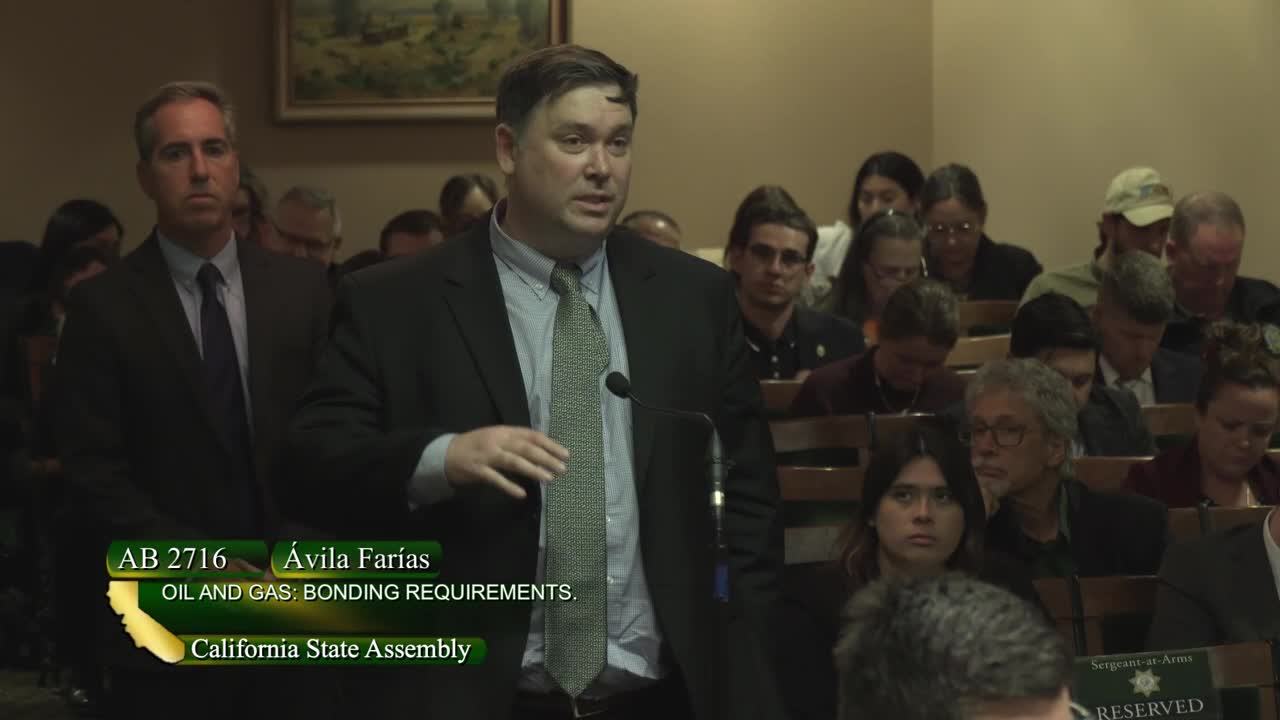
Discussed in Hearing
 16MIN
Assembly Standing Committee on Natural Resources
Bill Author

Bill Co-Author(s):