AB 311: Consumer Driving Data Protection Act of 2026.
- Session Year: 2025-2026
- House: Assembly
- Latest Version Date: 2026-07-09
Current Status:
In Progress
(2026-08-13: In committee: Held under submission.)
Introduced
In Committee
Awaiting First Chamber Vote
Passed First Chamber
In Committee
Awaiting Second Chamber Vote
Passed Second Chamber
Enacted
What does this bill do?
This bill lets drivers opt in to have insurers use telematics—data from in‑car devices or mobile apps that record speed, braking, and miles—to establish their driving record for auto insurance. It requires written opt‑in consent and clear disclosures, bars insurers from forcing or penalizing participation, limits data collection to driving behavior (no biometrics, audio/video, or unrelated location data), requires deletion after a rating and no longer than six months, and gives the Insurance Commissioner authority to review programs and impose penalties for violations.
The summary is provided by generative AI which can make mistakes. For original language, please view the details in the table below.
The Insurance Rate Reduction and Reform Act of 1988, an initiative measure enacted by Proposition 103, as approved by the voters at the November 8, 1988, statewide general election, prohibits specified insurance rates from being approved or remaining in effect that are excessive, inadequate, unfairly discriminatory, or otherwise in violation of the act. Under the act, rates and premiums for automobile insurance are determined based on specified factors, including the insureds driving safety record. Existing law authorizes the provisions of Proposition 103 to be amended by a statute that furthers the purposes of the act and is enacted by the Legislature with a 2/3 vote.
This bill, the Consumer Driving Data Protection Act of 2026, would authorize a consumer to opt to use telematics to establish their driving record, thus amending Proposition 103. The bill would prohibit the use of telematics data for a purpose other than rating private passenger automobile insurance. The bill would require a rate application under which telematics would be used to establish an insureds driving record to include specified materials related to the insurers telematics program. This bill would prohibit an insurer that uses telematics from taking specified actions, including conditioning eligibility for a discount upon participation in a telematics program, unless the discount is approved by the commissioner. The bill would also set forth written consent and privacy requirements for the collection and use of telematics data. The bill would authorize the commissioner to impose specified penalties for violations of the bills provisions, including civil penalties and suspension of an insurers telematics program.
This bill would require an insurance provider or third-party vendor to take specified actions with respect to the telematics data, including immediately deleting the data once a rating has been assigned to the consumer and obtaining an express written or electronic signature of a consumer on a notice meeting specified conditions. The bill would additionally prohibit an insurance provider or third-party vendor from keeping the telematics data for longer than 6 months and collecting audio or visual recordings of the occupants of the vehicle or persons outside the vehicle, among other specified prohibitions. The bill would declare that its provisions further the purposes of Proposition 103.
Existing constitutional provisions require that a statute that limits the right of access to the meetings of public bodies or the writings of public officials and agencies be adopted with findings demonstrating the interest protected by the limitation and the need for protecting that interest.
This bill would make legislative findings to that effect.
The Insurance Rate Reduction and Reform Act of 1988, an initiative measure enacted by Proposition 103, as approved by the voters at the November 8, 1988, statewide general election, prohibits specified insurance rates from being approved or remaining in effect that are excessive, inadequate, unfairly discriminatory, or otherwise in violation of the act. Under the act, rates and premiums for automobile insurance are determined based on specified factors, including the insureds driving safety record. Existing law authorizes the provisions of Proposition 103 to be amended by a statute that furthers the purposes of the act and is enacted by the Legislature with a 2/3 vote.
This bill, the Consumer Driving Data Protection Act of 2026, would authorize a consumer to opt to use telematics to establish their driving record, thus amending Proposition 103. The bill would prohibit the use of telematics data for a purpose other than rating private passenger automobile insurance. The bill would require a rate application under which telematics would be used to establish an insureds driving record to include specified materials related to the insurers telematics program. This bill would prohibit an insurer that uses telematics from taking specified actions, including conditioning eligibility for a discount upon participation in a telematics program, unless the discount is approved by the commissioner. The bill would also set forth consent and privacy requirements for the collection and use of telematics data. The bill would authorize the commissioner to impose specified penalties for violations of the bills provisions, including civil penalties and suspension of an insurers telematics program.
This bill would require an insurance provider or third-party vendor to take specified actions with respect to the telematics data, including immediately deleting the data once a rating has been assigned to the consumer and obtaining an express written or electronic signature of a consumer on a notice meeting specified conditions. The bill would additionally prohibit an insurance provider or third-party vendor from keeping the telematics data for longer than 6 months and collecting audio or visual recordings of the occupants of the vehicle, among other specified prohibitions. The bill would declare that its provisions further the purposes of Proposition 103.
Existing constitutional provisions require that a statute that limits the right of access to the meetings of public bodies or the writings of public officials and agencies be adopted with findings demonstrating the interest protected by the limitation and the need for protecting that interest.
This bill would make legislative findings to that effect.
Prior law, until January 1, 2024, authorized a tenant to temporarily permit the occupancy of their dwelling unit by a person who is at risk of homelessness, as defined, regardless of the terms of the lease or rental agreement, with the written approval of the owner or landlord of the property, and subject to extension under certain circumstances. Prior law further authorized an owner or landlord to adjust the rent payable under the lease during the time the person who is at risk of homelessness is occupying the dwelling unit, as compensation for the occupancy of that person, and required the terms regarding the rent payable in those circumstances to be agreed to in writing by the owner or landlord and the tenant.This bill, until January 1, 2031, would reinstate the above-described provisions, and would include certain new provisions regarding occupancy. The bill would additionally define person at risk of homelessness to include any person who is displaced from their residence as a result of a disaster in a disaster-stricken area in which a state of emergency has been proclaimed by the Governor. The bill, among other things, would permit a tenant, with written approval of the owner or landlord, to temporarily permit the occupancy of their dwelling unit by a person who is at risk of homelessness and one or more common household pets owned or otherwise maintained by the person. The bill would provide that if the lease or rental agreement authorizes the landlord to charge a separate or additional rent for the ownership or otherwise maintenance of the common household pet in the tenants dwelling unit, the rent payable may be adjusted to include separate or additional rent during the time the person owns or otherwise maintains the pet.This bill would declare that it is to take effect immediately as an urgency statute.Prior law, until January 1, 2024, authorized a tenant to temporarily permit the occupancy of their dwelling unit by a person who is at risk of homelessness, as defined, regardless of the terms of the lease or rental agreement, with the written approval of the owner or landlord of the property, and subject to extension under certain circumstances. Prior law further authorized an owner or landlord to adjust the rent payable under the lease during the time the person who is at risk of homelessness is occupying the dwelling unit, as compensation for the occupancy of that person, and required the terms regarding the rent payable in those circumstances to be agreed to in writing by the owner or landlord and the tenant.
This bill, until January 1, 2031, would reinstate the above-described provisions, and would include certain new provisions regarding occupancy. The bill would additionally define person at risk of homelessness to include any person who is displaced from their residence as a result of a disaster in a disaster-stricken area in which a state of emergency has been proclaimed by the Governor. The bill, among other things, would permit a tenant, with written approval of the owner or landlord, to temporarily permit the occupancy of their dwelling unit by a person who is at risk of homelessness and one or more common household pets owned or otherwise maintained by the person. The bill would provide that if the lease or rental agreement authorizes the landlord to charge a separate or additional rent for the ownership or otherwise maintenance of the common household pet in the tenants dwelling unit, the rent payable may be adjusted to include separate or additional rent during the time the person owns or otherwise maintains the pet.
This bill would declare that it is to take effect immediately as an urgency statute.
This act shall be known, and may be cited, as the Consumer Driving Data Protection Act of 2026.
SEC. 2.The Legislature finds and declares all of the following:
(a)(1)The Insurance Rate Reduction and Reform Act of 1988, an initiative measure enacted by Proposition 103, as approved by the voters at the November 8, 1988, statewide general election (Proposition 103), established a prior approval system for private passenger automobile insurance rates and required automobile insurers to use the following three mandatory rating factors in order of importance:
(A)Driving safety record.
(B)Annual miles driven.
(C)Years of driving experience.
(2)Neither the text of Proposition 103 nor the associated ballot materials from the 1988 campaign define the first mandatory rating factor: driving safety record.
(3)In addition, Proposition 103 authorizes the Insurance Commissioner to adopt regulations that add additional, optional rating factors that an automobile insurer may, but is not required to, use after the commissioner determines they have a substantial relationship to the risk of loss. In Foundation for Taxpayer & Consumer Rights v. Garamendi (2005) 132 Cal.App.4th 1354, the California Court of Appeals stated that Proposition 103 delegated the exclusive authority to approve optional rating factors to the elected Insurance Commissioner and, further, held that any legislative attempt to add optional rating factors arrogates to the Legislature the Insurance Commissioners exclusive authority to adopt optional rating factors, contrary to Proposition 103.
(b)Since issuance of the original California Department of Insurance regulations in 1989 defining the first mandatory rating factor, the only permissible data to determine driving safety record has been a drivers Motor Vehicle Report (MVR) at the California Department of Motor Vehicles, which includes traffic violation convictions and principally-at-fault crashes. There has been significant technological advancement since adoption of these regulations in 1989, when cutting-edge technology included dial-up internet, fax machines, and the first GPS satellites. California is the only remaining state that mandates exclusive use of MVR data to measure driving safety record, following New Yorks decision in 2021 and Idahos decision in 2022 to authorize usage based insurance or telematics programs that rely upon actual, observed driving data collected directly by a vehicle or by a plug-in or wireless device that connects to a vehicle. A few examples of permissible driving safety records include speeding above the flow of traffic, distracted driving, including use of cell phones, and hard acceleration, and braking and cornering. By linking those behaviors with higher insurance premiums, telematics programs encourage the opposite behaviors. In his bulletin encouraging auto insurers to adopt telematics programs, New York Superintendent of Financial Services Benjamin Lawsky stated: Telematics programs can be a win-win for insurers and drivers. They can save policyholder money and save lives by making our roads safer. We encourage all New York auto insurers to submit plans to our Department making use of this innovative technology.
(c)(1)The Legislature may only amend Proposition 103 upon a two-thirds vote and if the legislation furthers the purposes of the initiative. The stated purpose of Proposition 103 is to protect consumers from arbitrary insurance rates and practices, to encourage a competitive insurance marketplace, to provide for an accountable Insurance Commissioner, and to ensure that insurance is fair, available, and affordable for all Californians.
(2)The Legislature has repeatedly amended Proposition 103 since its original passage, with courts establishing clear rules that the Legislature cannot further Proposition 103s purposes while simultaneously restricting its application. Examples of court decisions striking down legislative amendments include: Amwest Surety Ins. Co. v. Wilson (1995) 11 Cal.4th 1243 (exempting sureties from Proposition 103), Proposition 103 Enforcement Project v. Quackenbush (1998) 64 Cal.App.4th 1473 (reducing the rollback refunds insurers owed policyholders), and Foundation for Taxpayer & Consumer Rights v. Garamendi (2005) 132 Cal.App.4th 1354 (discriminating against previously uninsured drivers and arrogating to the Legislature the Insurance Commissioners exclusive authority to adopt optional rating factors).
(3)In adding a modern consumer option to an undefined term in Proposition 103s mandatory rating factors to allow telematics, with no impact on the Insurance Commissioners exclusive authority to control optional rating factors, the Legislature is furthering the initiatives purposes. Consistent with the first stated purpose of Proposition 103 to protect consumers from arbitrary rates, this legislation would allow drivers to choose, on a voluntary basis, day-to-day driving measurement of driving safety, as opposed to the current system that only measures driving behavior in isolated incidences or based upon policing presence and practices.
(4)Consistent with the second stated purpose of Proposition 103 of encouraging a competitive insurance market, this legislation would allow automobile insurers to submit rate filings to the Insurance Commissioner, for rejection or approval, that include a wider variety of options for consumers than presently exists. The legislation would not impact Proposition 103s prior approval ratemaking requirements.
(5)Consistent with the third stated purpose of Proposition 103 to provide for an accountable Insurance Commissioner, this legislation preserves the Insurance Commissioners sole authority to review automobile insurance rate filings that include telematics measurements, subject only to this legislations general requirements for consumer privacy protection and public transparency.
(6)Consistent with the fourth stated purpose of Proposition 103 to ensure that insurance is fair, available, and affordable for all Californians, this legislation preserves Californias prior approval rate system implemented by the elected Insurance Commissioner while providing consumers the choice of modern technology that improves assessment of insurance risk and empowers consumers to make daily improvements in their driving behaviors that are measured and which would translate directly into lower insurance premiums. Regarding fairness of insurance rates, the Legislature acknowledges the 2022 study entitled Measuring Racial and Ethnic Disparities in Traffic Enforcement with Large-Scale Telematics Data, by William Cai, Johann Gaebler, Justin Kaashoek, Lisa Pinals, Samuel Madden, and Sharad Goel, which finds that, while the racial composition of traffic stops closely tracks with residential demographics of the areas where enforcement is focused, telematics measurements of speeding are uncorrelated with neighborhood racial or ethnic demographics, and averaged across the cities we analyze, and after adjusting for differences in speeding behavior, we find that neighborhoods with higher proportions of non-White residents have greater numbers of speeding stops...Our results show that current enforcement practices can lead to inequities across race and ethnicity.
(d)(1)In its 2021 publication, Watch Where Youre Going: Whats Needed to Make Auto Insurance Telematics Work for Consumers, the Consumer Federation of America states: While telematics has great potential to help consumers, promote better driving, and make auto insurance more affordable, it also has significant potential for misuse, violations of consumer privacy, and poorly explained premium impacts.
(2)In its 2023 publication, Steering Mobility Data to a Better Privacy Regime, the Electronic Frontier Foundation suggests consumer protection guardrails for deployment of an insurance telematics program, including all of the following:
(A)Opt-in, informed consumer consent.
(B)Insurer public disclosure of telematics data collection and use, along with clear consumer data access, dispute rules, and a subsequent opt-out procedure.
(C)Consumer consent rights regarding sharing, selling, disclosing, and marketing of data.
(D)Consumer notice rights regarding information sharing.
(E)Continued consumer option to be rated without telematics.
(F)reasonable Reasonable limits on insurer retention of data.
(3)The purpose of this act is to provide statutory guidance for the voluntary collection, use, analysis, retention, and disclosure of telematics data in private passenger automobile insurance rating, while ensuring actuarial integrity, promoting fairness, preserving regulatory oversight, and safeguarding strong fundamental consumer privacy rights, consistent with these concerns and principles and in furtherance of the purposes of Proposition 103.
(e)Because Proposition 103 does not define driving safety record and the California Department of Insurance regulations that initially defined the term are more than 35 years old, leaving California as a national outlier in options for automobile insurance consumers, it is the intent of the Legislature to modernize Californias outdated, and anachronistic, automobile insurance system, with the purpose of promoting better driving, lowering emissions, and reducing social concern about insurance rates being linked to traffic stops. This legislation authorizing voluntary telematics-based discount programs is consistent with the intent of voters upon passing Proposition 103 in 1988, particularly because this legislation:
(1)Does not alter the mandatory rating factor hierarchy established under Section 1861.02 of the Insurance Code.
(2)Creates an additional consumer option in the undefined term driving safety record under the first mandatory factor, while allowing consumers to ignore telematics rating programs in favor of the current MVR system.
(3)Does not disturb the Insurance Commissioners exclusive authority over optional rating factors.
(f)California seeks to modernize its insurance regulatory system by adopting a telematics framework consistent with the protections of Proposition 103. It is the intent of the Legislature to authorize voluntary telematics-based rating programs that (1) do not alter the mandatory rating factor hierarchy established under Section 1861.02 of the Insurance Code and (2) are adopted as a driving record under the first mandatory factor and are a voluntary consumer choice alternative to the Department of Motor Vehicles motor vehicle record, which has been the only form of driving information allowable for rating purposes since Proposition 103 passed almost 40 years ago.
(g)The purpose of this act is to provide statutory guidance for the voluntary collection, use, analysis, retention, and disclosure of telematics data in private passenger automobile insurance rating, while ensuring actuarial integrity, promoting fairness, preserving regulatory oversight, and safeguarding strong fundamental consumer privacy rights.
(h)Ensuring fairness, transparency, and accountability in the use of telematics data is essential to maintaining public trust in the insurance marketplace and preventing the emergence of hidden or unregulated rating factors.
(i)Consumers have a fundamental interest in controlling their personal driving data, including the right to know what is collected, how it is used, and with whom it is shared.
(j)Strong privacy and data security standards are necessary to protect consumers from unauthorized access, misuse, or commercial exploitation of telematics data by insurers, third-party telematics providers, or other parties.
(k)A clear statutory framework governing telematics programs will promote innovation, improve existing safety incentives, and highlight for consumers the connection between the environmental benefits of driving fewer miles with lower automobile insurance premiums, while ensuring that new technologies operate within the consumer protection principles established by California law.
SEC. 3.Article 10.5 (commencing with Section 1861.5) is added to Chapter 9 of Part 2 of Division 1 of the Insurance Code, to read:10.5.Telematics and Usage-Based Insurance Programs1861.5.For purposes of this article:
(a)Consent means a freely given, specific, informed, and unambiguous indication of the consumers wishes by which the consumer, or the consumers legal guardian, a person who has power of attorney, or a person acting as a conservator for the consumer, including by a statement or by a clear affirmative action, signifies agreement in writing to the processing of telematics data relating to the consumer for a narrowly defined particular purpose. Consent shall be voluntary, informed, affirmative, stand-alone consent provided by the subject consumer before the collection or use of telematics data.
(b)Consumer authorization means the manner in which consumer consent is obtained and documented.
(c)Scoring model means a computational, statistical, actuarial, or algorithmic methodology capable of evaluating telematics data, or the inferences derived from those methodologies, to generate a numerical score or predictive assessment used directly or indirectly in rating automobile insurance.
(d)Telematics means technology that uses vehicle devices, connected devices, mobile applications, embedded systems, or other technological means to collect, transmit, and analyze objectively measurable data for private passenger automobile insurance rating. Telematics shall not include the collection of nondriving-related personal information, such as biometric or biometric-adjacent information, audio or visual recordings of vehicle occupants, precise geolocation data outside of a rated trip, and any data unrelated to the operation of a motor vehicle.
(e)Telematics data means information electronically collected, transmitted, or derived that reflects the operation, mileage, or use of a motor vehicle, including speed, acceleration, and braking.
(f)Telematics program means a program operated by an insurer or third-party telematics provider that collects, receives, analyzes, or uses telematics data for rating.
(g)Third-party telematics provider means an entity, including an affiliate of an insurer, that collects, stores, discloses, processes, or analyzes telematics data used in the business of insurance.
(h)Written or in writing includes a writing, including electronic communications subject to the Uniform Electronics Transactions Act (Title 2.5 (commencing with Section 1633.1) of Part 2 of Division 3 of the Civil Code) or the requirements of Section 38.6.
1861.51.(a)A consumer may opt to use telematics to establish their driving record for purposes of paragraph (1) of subdivision (a) of Section 1861.02. Participation in a telematics program shall be strictly voluntary. voluntary and shall be based upon the insureds written consent.
(b)An insurer that uses telematics shall not do any of the following:
(1)Require participation in a telematics program as a condition of obtaining or renewing coverage.
(2)Penalize, surcharge, or otherwise adversely underwrite a consumer who declines to participate in a telematics program.
(3)Condition eligibility for a discount upon participation in a telematics program, unless the discount is approved by the commissioner.
(4)Increase premium in increments of less than six months from the date the policy goes into effect. This paragraph does not affect the ability of an insurer to make adjustments throughout the policy term, provided the flexibility is approved by the commissioner in a rate filing for a telematics program.
(c)A consumer may revoke consent for participation in a telematics program at any time. The revocation shall be effective at the beginning of the following policy term. An insurer may use telematics data collected before the revocation for rating purposes for the remainder of the policy term in which the revocation occurred. begin immediately. If a consumer revokes consent for participation in a telematics program, an insurer shall not collect any telematics data past the point of revocation.
(d)An insurer that uses telematics shall establish a process by which the consumer may appeal data collected through the telematics program that the consumer believes is incorrect, or appeal the application of a rating factor to the consumer. The commissioner may adopt regulations pertaining to insurer dispute resolution programs.
(e)(1)A request to correct trip data relating to telematics data collected via a mobile device shall be resolved in favor of the consumer.
(2)If a company determines after investigation that a consumer has repeatedly and fraudulently requested changes to their driving history under a telematics program, the insurer shall have the right to return that driver to rating under the traditional rating factors.
(f)A telematics program may consider a drivers Motor Vehicle Record information from the Department of Motor Vehicles that pertains to high-risk behavior that has resulted in a two-point or three-point violation.
(g)(1)A telematics program shall access a drivers Motor Vehicle Record information from the Department of Motor Vehicles to determine if the driver is entitled to a Good Driver Discount, as outlined in Sections 1861.02 and 1861.025.
(2)If a driver is entitled to a Good Driver Discount under Sections 1861.02 and 1861.025, then the same Good Driver Discount shall be applied for the initial policy term utilizing telematics. Continuation of the discount may be determined on telematics-based data.
1861.52.(a)An insurer or third-party telematics provider shall not do any of the following:
(1)Collect or use telematics data without obtaining and documenting prior consumer consent in writing or through electronic means, consistent with the consumers elected method of communication with the insurer. writing.
(2)Collect or use telematics data that predates the consumer authorization required by this section, including from a third-party telematics provider, unless the consumer has expressly authorized in writing the insurer to request that data to rate for telematics. If the authorization is not granted, the insurer may continue to traditional rating factors until sufficient telematics data has been collected to provide a telematics rate.
(3)Collect or use telematics data for marketing, or any purpose other than rating of private passenger automobile insurance policies pursuant to Sections 660, 661, and 1861.02.
(4)Underwriting, except as conforms with permitted underwriting application under existing traditional rating factors.
(5)Claims handling, except when expressly permitted or provided by the driver.
(6)Share or disclose telematics data to a person, except to a third-party telematics provider under contract solely for the purpose of performing telematics-related insurance services, and only to the extent strictly necessary to perform those services.
(7)Sell or obtain valuable consideration in connection with the disclosure of telematics data.
(8)Undertake any other prohibited acts specified by the commissioner in regulation.
(b)(1)Consumer authorization shall be all of the following:
(A)Written in clear, plain language easily understood by the consumer.
(B)Free from any feature or characteristic that may confuse a consumer or impair the consumers ability to freely express the consumers preference. It shall be equally easy for a consumer to opt out of a telematics program as it is to opt in, and ready means shall be provided for a consumer to opt out of a telematics program once the consumer has opted in.
(C)Provided to the department with the rate application seeking to apply telematics to establish an insureds driving record.
(2)(A)An insurer shall not disclose to a third party any telematics data other than is necessary to provide the service.
(B)Notwithstanding subparagraph (A), an insurer may disclose telematics data that identifies a consumer, pursuant to a valid, court-issued subpoena or other legally enforceable process. warrant. An insurer shall provide written notice to the consumer before disclosing personally identifiable information pursuant to this subparagraph.
(c)The consumer authorization document shall disclose all of the following, at a minimum:
(1)All categories of telematics data to be collected from the consumer.
(2)The specific devices, methods, and sources that shall be used to collect telematics data from the consumer.
(3)The specific purpose for which the telematics data will be used.
(4)If and how the telematics data will affect premiums.
(5)The identity of a third-party telematics provider that may access the consumers telematics data.
(6)The duration of telematics data retention.
(7)The consumers right to access the consumers telematics data, the process to access the consumers telematics data, the right to receive a copy of all telematics data collected by the insurer, and the process to request correction of incorrect telematics data.
(8)The consumers right to revoke authorization at any time.
(9)The consumers right to appeal the application of rates developed using telematics data or the accuracy of underlying telematics data.
(10)Additional disclosures specified by the commissioner in regulation.
(d)An insurer shall provide a requesting consumer with access to the consumers telematics data and a clear explanation of how the data contributed to a rating determination or any other insurer decision that impacted the consumer and that relied upon or was informed by telematics data.
(e)(1)Before using telematics data to make a rating determination or any other insurer decision, the insurer shall provide the insured an opportunity to review the telematics data collected to that point, and any areas identified for improvement, and provide the insured with the ability to choose between the following options:
(A)Authorize a rating determination based on the collected telematics data.
(B)Request deletion of the collected telematics data before being used to make a rating determination or any other insurer decision and initiate one additional period of telematics data collection of at least 30 days in order to make a rating determination.
(C)Revoke consent for participation in the telematics program, pursuant to subdivision (c) of Section 1861.51.
(2)The insurer shall allow for at least 30 days of telematics data collection before providing the insured the ability to review, as provided in paragraph (1).
(3)The insurer shall provide clear and conspicuous notice to the insured of the right provided by this subdivision.
(f)An insurer shall provide a consumer with a copy, in an accessible format, of all telematics data collected by the insurer upon request by the consumer. The commissioner may adopt regulations regarding the appropriate format required with consideration of the portability of that data to a different insurer or telematics provider.
1861.53.(a)Advertising materials relating to the insurers private passenger automobile insurance products shall clearly state that both telematic and traditional insurance products are available to the consumer.
(b)When advertising rates or savings, or providing a quote to a consumer, an insurer shall clearly indicate the rates or savings related to participation in the insurers telematics program, and shall provide a comparison rate from an equivalent traditional product offered by the insurer.
1861.54.(a)Telematics data shall be used only for rating for private passenger automobile insurance, as described in subdivision (a) of Section 660 and paragraph (1) of subdivision (a) of Section 1861.02.
(b)The insurer shall obtain prior written consumer authorization before the collection or use of telematics data.
(c)Telematics data shall qualify as a driving safety record and shall not be used as a proxy for anything else.
(d)Data collected pursuant to this article shall not be used for immigration enforcement purposes.
1861.55.(a)A rate application under which telematics shall be used to establish an insureds driving record shall be deemed complete only if the insurer submits to the commissioner the following materials related to the insurers telematics program:
(1)A complete description of the telematics program.
(2)All telematics data elements collected.
(3)All scoring models, including algorithms, variables, and weighting factors.
(4)All validation studies and actuarial support.
(5)All consumer disclosures and authorization forms.
(6)A list of third-party telematics providers with which the insurer is contracted with for purposes of providing telematics in California.
(7)All documentation relating to privacy and data security protections pertaining to telematics data and the insurers telematics program.
(8)A complete class plan application.
(9)Any other information required by the commissioner.
(b)Any documents, materials, or other information submitted pursuant to this section that are proprietary or constitute trade secrets shall be confidential by law and privileged, shall not be subject to public disclosure, including under the California Public Records Act (Chapter 3.5 (commencing with Section 6250) of Division 7 of Title 1 of the Government Code) and shall not be subject to subpoena, discovery, or admissible in evidence in a private civil action. A waiver of an applicable privilege or claim of confidentiality shall not occur as a result of submission of the information to the commissioner.
1861.56.(a)Insurers shall regularly conduct, document, and disclose upon request to the department both of the following:
(1)Validation studies.
(2)Ongoing model governance of scoring models.
(b)The commissioner may require independent audits.
(c)The commissioner may prohibit or suspend an insurers use of a telematics program that causes rates to be excessive, inadequate, or unfairly discriminatory in violation of Section 1861.05 or that violates this article.
(d)Upon request by the commissioner, an insurer shall provide documentation regarding the insurers compliance with this article, including any records required to be kept pursuant to this article.
(e)An insurer shall retain all information and documentation sufficient enough to demonstrate compliance with this article for a minimum of seven years. Telematics data itself shall not be required to be retained for that period unless necessary for regulatory compliance, unless otherwise required by the commissioner.
1861.57.(a)Insurers and third-party telematics providers shall implement administrative, technical, and physical safeguards to protect telematics data.
(b)Insurers and third-party telematics providers shall collect only data that is reasonably necessary to determine driving behavior and evaluate risk.
(c)Telematics data shall be retained only as long as necessary for the purposes authorized by the consumer or as required by law. Personally identifiable telematics data shall be deleted in accordance with Article 6.6 (commencing with Section 791) of Chapter 1.
(d)None of the following data shall be collected:
(1)Biometrics data, including facial recognition, fingerprint, retina scan, voice print, or physiological monitoring data.
(2)Audio or visual recordings of vehicle occupants. occupants or persons outside of the vehicle.
(3)Any telematics data that is unrelated to the collected elements of subdivision (a) of Section 1861.6, including data unrelated to safe driving such as time of driving and location of the vehicle.
(4)Other connected vehicle information, including screen captures.
(e)(1)Unless retention is necessary for compliance, fraud investigation, or any other matter of specifically required by law, telematics data shall be deleted upon any of the following:
(1)(A)Revocation of consumer authorization.
(2)(B)Termination of participation.
(3)(C)Consumer request.
(2)If telematics data is not deleted upon the events identified in subparagraphs (A) to (C), inclusive, of paragraph (1) because it is necessary for compliance, fraud investigation, or specifically required by law, the insured shall be notified of the information that is retained and the reason for that retention.
(f)Telematics data shall not be:
(1)Sold, shared, exchanged, or otherwise disclosed.
(2)Licensed.
(3)Shared or used for marketing.
(4)Used for any purpose, except as permitted under this article and only with explicit consumer authorization.
(5)Transferred to an affiliate or service provider.
(6)Combined with external datasets.
(g)A governmental entity shall not collect, receive, retain, access, use, disclose, or obtain telematics data, except for deidentified, aggregated telematics data, which shall only be used for roadway safety analysis, infrastructure planning, or crash prevention research as long as the data and derived outputs cannot reasonably identify an individual, vehicle, telematics device, or trip. A governmental entity shall not collect, receive, retain, access, use, disclose, or obtain identifiable trip-level telematics data, identifiable precise geolocation data, identifiable origin and destination data, or any other linked telematics data regulated pursuant to this article. Deidentified, aggregated telematics data and aggregated inputs derived from that data are not personal information. The exemption for the collection, reception, retention, access, use, disclosure, or obtainment of deidentified, aggregated telematics data shall not apply to a federal governmental entity.
(h)An insurer is fully responsible for the actions of a third-party telematics provider if the insurer knew knew, or reasonably should have known, that the third-party telematics provider was violating this article and did not take steps to stop the violation.
1861.58.(a)A contract entered into by an insurer or a third-party telematics provider under contract with an insurer for the function of collecting, storing, processing, or analyzing telematics data shall not relieve the insurer of an obligation under this article.
(b)An insurer shall conduct due diligence on all third-party telematics providers.
(c)During a market conduct exam pursuant to Section 730, an insurer shall maintain and disclose to the department all written contracts with third-party telematics providers.
(d)An insurer is responsible for any violations of this code committed by a third-party telematics provider if the insurer knew knew, or reasonably should have known, that the third-party telematics provider was violating this code and did not take steps to stop the violation.
(e)An insurer shall ensure through a written contract that a third-party provider complies with this article.
1861.59.(a)An insurer shall not deny a consumer the ability to participate in the insurers telematics program solely on the basis of one of the following, except to the extent these factors are necessary to meet reasonable technology and compatibility requirements of the program:
(1)A vehicle operated by the consumer.
(2)The consumers mobile device, carrier, operating system, or other technological attribute.
(3)The consumers lack of mobile device.
(4)Any factor beyond the control of the consumer or that requires the consumer to incur an expense other than the payment of premium, excluding ordinary and incidental costs associated with participation in the program, including mobile device or data usage.
(b)A licensee or a third-party service provider shall not retaliate against a consumer because the consumer exercised or attempted to exercise the consumers rights pursuant to this article, including declining to participate in a telematics program. A licensee or a third-party service provider retaliates against a consumer if the licensee or third-party service provider, as a result of a consumers privacy choices, does any of the following:
(1)Infringes upon a right, or impairs or impedes a benefit or protection, that is afforded to a consumer under this article.
(2)Requires the consumer to consent to sharing of the consumers personal information for a purpose unrelated to the telematics program to obtain a particular product, coverage, rate, or service, if the consumer has an option to consent to sharing pursuant to this article.
(3)Imposes a fee or charge for a consumer to exercise the consumers rights pursuant to this article.
(4)Charges a different rate or premium to the consumer, other than as approved by the commissioner in a rate application using telematics.
(5)Provides a different insurance product.
(c)An insurer shall not condition participation in a telematics program upon waiver of the rights held by a consumer or require a consumer to submit to binding arbitration with respect to any matters arising from the insurers telematics program.
1861.6.Notwithstanding any other provisions in this article, an insurance provider or third-party vendor shall do all of the following:
(a)Collect only data that is strictly necessary to determine that a consumer is doing any of the following:
(1)Driving the posted speed limit or with the speed of traffic in order to determine whether the consumer is posing a risk to themselves or others.
(2)Braking abruptly in a dangerous manner.
(3)Coming to a complete stop at all stop signs and red lights.
(4)Changing lanes frequently to determine if the car is unsafely weaving in and out of traffic.
(b)(1)Delete all data previously collected through the telematics program, including any ratings based upon telematics data, within 24 hours of receiving the notice if a consumer elects to leave the telematics program or program, changes insurance providers. providers, or terminates coverage.
(2)Provide a consumer with the option to obtain a copy, in an accessible format, of all telematics data collected by the insurer before the data deletion pursuant to paragraph (1).
(c)Immediately delete the collected data once a rating has been assigned to the consumer and refrain from collecting additional data prior to the next policy renewal period.
(d)Only use data collected while the car is being operated.
(e)If using cameras facing outside of the car to capture the surrounding traffic, render unidentifiable in any video recording or photographic images all of the following:
(1)Drivers.
(2)Passengers.
(3)Pedestrians.
(4)Any other individuals captured by the camera.
(5)License plates.
(f)Obtain the express written or electronic signature of a consumer on a notice that complies with all of the following:
(1)Communicates, in clear and understandable language, all of the following:
(A)Participation in a telematics program shall be strictly voluntary and that a consumer shall opt in to participate.
(B)All categories of telematics data to be collected from the consumer.
(C)The specific devices, methods, and sources that shall be used to collect telematics data from the consumer.
(D)The specific purpose for which the telematics data will be used.
(E)If and how the telematics data will affect premiums.
(F)The identity of a third-party telematics provider that may access the consumers telematics data.
(G)The duration of telematics data retention.
(H)The consumers right to access the consumers telematics data, the process to access the consumers telematics data, and the process to request correction of incorrect telematics data.
(I)The consumers right to revoke authorization at any time.
(J)The consumers right to appeal application of a rating factor developed using telematics data or the accuracy of underlying telematics data.
(K)Additional disclosures specified by the commissioner in regulation.
(2)Written in clear, plain language easily understood by the consumer.
(3)Presented as a stand-alone document separate from any other policy documents.
1861.61.Notwithstanding any other provisions in this article, an insurance provider or third-party vendor shall not do any of the following:
(a)Collect audio or visual recordings of the occupants inside of the vehicle, including the driver. driver, or persons outside of the vehicle.
(b)Use technology that collects biometric information, including imagery of the iris, retina, fingerprint, face, hand, palm, vein patterns, heart rate, neural activity, voice recordings, or any other information identifying the unique characteristics of a person.
(c)Combine the data collected through the in-car technology with any other data, including information acquired from another business or affiliate. This includes a business operating as a data broker, as defined in Section 1798.99.80 of the Civil Code.
(d)Combine the data described in subdivision (c) with any other data to make inferences about whether a person is a safe driver.
(e)Use telematics data for any purpose other than identifying whether a driver is driving safely and following street and highway safety laws.
(f)Sell or share the data with another business, including an affiliated business.
(g)Purchase or acquire data from another source as part of a telematics program.
(h)Retain telematic data for more than six months.
(i)Collect any telematics data that is unrelated to the collected elements of subdivision (a) of Section 1861.6, including data unrelated to safe driving such as time of driving, location of the vehicle, and other connected vehicle information, including screen captures.
1861.62.(a)A violation of this article constitutes a rating violation pursuant to Sections 1858.07 and 1858.1.
(b)The commissioner may impose any of the following, in accordance with Sections 1858, 1859, and 1859.1:
(1)Civil penalties.
(2)Corrective orders.
(3)Suspension of the insurers telematics program.
(4)License discipline, including revocation of the insurers certificate of authority.
(c)Hearings and judicial review shall be conducted in accordance with Article 7 (commencing with Section 1858).
1861.63.The commissioner shall, as the commissioner deems necessary, adopt regulations to administer this article. These regulations shall be exempt from the Administrative Procedure Act (Chapter 3.5 (commencing with Section 11340) of Part 1 of Division 3 of Title 2 of the Government Code).
SEC. 4.The Legislature finds and declares that Section 3 of this act, which adds Section 1861.55 to the Insurance Code, imposes a limitation on the publics right of access to the meetings of public bodies or the writings of public officials and agencies within the meaning of Section 3 of Article I of the California Constitution. Pursuant to that constitutional provision, the Legislature makes the following findings to demonstrate the interest protected by this limitation and the need for protecting that interest:
To protect proprietary information and trade secrets, it is necessary for documents, materials, and other information submitted pursuant to this act to be kept confidential.
SEC. 5.The Legislature finds and declares that this act furthers the purposes of the Insurance Rate Reduction and Reform Act of 1988.
This act shall be known, and may be cited, as the Consumer Driving Data Protection Act of 2026.
SEC. 2.The Legislature finds and declares all of the following:
(a)(1)The Insurance Rate Reduction and Reform Act of 1988, an initiative measure enacted by Proposition 103, as approved by the voters at the November 8, 1988, statewide general election (Proposition 103), established a prior approval system for private passenger automobile insurance rates and required automobile insurers to use the following three mandatory rating factors in order of importance:
(A)Driving safety record.
(B)Annual miles driven.
(C)Years of driving experience.
(2)Neither the text of Proposition 103 nor the associated ballot materials from the 1988 campaign define the first mandatory rating factor: driving safety record.
(3)In addition, Proposition 103 authorizes the Insurance Commissioner to adopt regulations that add additional, optional rating factors that an automobile insurer may, but is not required to, use after the commissioner determines they have a substantial relationship to the risk of loss. In Foundation for Taxpayer & Consumer Rights v. Garamendi (2005) 132 Cal.App.4th 1354, the California Court of Appeals stated that Proposition 103 delegated the exclusive authority to approve optional rating factors to the elected Insurance Commissioner and, further, held that any legislative attempt to add optional rating factors arrogates to the Legislature the Insurance Commissioners exclusive authority to adopt optional rating factors, contrary to Proposition 103.
(b)Since issuance of the original California Department of Insurance regulations in 1989 defining the first mandatory rating factor, the only permissible data to determine driving safety record has been a drivers Motor Vehicle Report (MVR) at the California Department of Motor Vehicles, which includes traffic violation convictions and principally-at-fault crashes. There has been significant technological advancement since adoption of these regulations in 1989, when cutting-edge technology included dial-up internet, fax machines, and the first GPS satellites. California is the only remaining state that mandates exclusive use of MVR data to measure driving safety record, following New Yorks decision in 2021 and Idahos decision in 2022 to authorize usage based insurance or telematics programs that rely upon actual, observed driving data collected directly by a vehicle or by a plug-in or wireless device that connects to a vehicle. A few examples of permissible driving safety records include speeding above the flow of traffic, distracted driving, including use of cell phones, and hard acceleration, braking and cornering. By linking those behaviors with higher insurance premiums, telematics programs encourage the opposite behaviors. In his bulletin encouraging auto insurers to adopt telematics programs, New York Superintendent of Financial Services Benjamin Lawsky stated: Telematics programs can be a win-win for insurers and drivers. They can save policyholder money and save lives by making our roads safer. We encourage all New York auto insurers to submit plans to our Department making use of this innovative technology.
(c)(1)The Legislature may only amend Proposition 103 upon a two-thirds vote and if the legislation furthers the purposes of the initiative. The stated purpose of Proposition 103 is to protect consumers from arbitrary insurance rates and practices, to encourage a competitive insurance marketplace, to provide for an accountable Insurance Commissioner, and to ensure that insurance is fair, available, and affordable for all Californians.
(2)The Legislature has repeatedly amended Proposition 103 since its original passage, with courts establishing clear rules that the Legislature cannot further Proposition 103s purposes while simultaneously restricting its application. Examples of court decisions striking down legislative amendments include: Amwest Surety Ins. Co. v. Wilson (1995) 11 Cal.4th 1243 (exempting sureties from Proposition 103), Proposition 103 Enforcement Project v. Quackenbush (1998) 64 Cal.App.4th 1473 (reducing the rollback refunds insurers owed policyholders), and Foundation for Taxpayer & Consumer Rights v. Garamendi (2005) 132 Cal.App.4th 1354 (discriminating against previously uninsured drivers and arrogating to the Legislature the Insurance Commissioners exclusive authority to adopt optional rating factors).
(3)In adding a modern consumer option to an undefined term in Proposition 103s mandatory rating factors to allow telematics, with no impact on the Insurance Commissioners exclusive authority to control optional rating factors, the Legislature is furthering the initiatives purposes. Consistent with the first stated purpose of Proposition 103 to protect consumers from arbitrary rates, this legislation would allow drivers to choose, on a voluntary basis, day-to-day driving measurement of driving safety, as opposed to the current system that only measures driving behavior in isolated incidences or based upon policing presence and practices.
(4)Consistent with the second stated purpose of Proposition 103 of encouraging a competitive insurance market, this legislation would allow automobile insurers to submit rate filings to the Insurance Commissioner, for rejection or approval, that include a wider variety of options for consumers than presently exists. The legislation would not impact Proposition 103s prior approval ratemaking requirements.
(5)Consistent with the third stated purpose of Proposition 103 to provide for an accountable Insurance Commissioner, this legislation preserves the Insurance Commissioners sole authority to review automobile insurance rate filings that include telematics measurements, subject only to this legislations general requirements for consumer privacy protection and public transparency.
(6)Consistent with the fourth stated purpose of Proposition 103 to ensure that insurance is fair, available, and affordable for all Californians, this legislation preserves Californias prior approval rate system implemented by the elected Insurance Commissioner while providing consumers the choice of modern technology that improves assessment of insurance risk and empowers consumers to make daily improvements in their driving behaviors that are measured and which would translate directly into lower insurance premiums. Regarding fairness of insurance rates, the Legislature acknowledges the 2022 study entitled Measuring Racial and Ethnic Disparities in Traffic Enforcement with Large-Scale Telematics Data, by William Cai, Johann Gaebler, Justin Kaashoek, Lisa Pinals, Samuel Madden, and Sharad Goel, which finds that, while the racial composition of traffic stops closely tracks with residential demographics of the areas where enforcement is focused, telematics measurements of speeding are uncorrelated with neighborhood racial or ethnic demographics, and averaged across the cities we analyze, and after adjusting for differences in speeding behavior, we find that neighborhoods with higher proportions of non-White residents have greater numbers of speeding stops...Our results show that current enforcement practices can lead to inequities across race and ethnicity.
(d)(1)In its 2021 publication, Watch Where Youre Going: Whats Needed to Make Auto Insurance Telematics Work for Consumers, the Consumer Federation of America states: While telematics has great potential to help consumers, promote better driving, and make auto insurance more affordable, it also has significant potential for misuse, violations of consumer privacy, and poorly explained premium impacts.
(2)In its 2023 publication, Steering Mobility Data to a Better Privacy Regime, the Electronic Frontier Foundation suggests consumer protection guardrails for deployment of an insurance telematics program, including all of the following:
(A)Opt-in, informed consumer consent.
(B)Insurer public disclosure of telematics data collection and use, along with clear consumer data access, dispute rules, and a subsequent opt-out procedure.
(C)Consumer consent rights regarding sharing, selling, disclosing, and marketing of data.
(D)Consumer notice rights regarding information sharing.
(E)Continued consumer option to be rated without telematics.
(F)reasonable limits on insurer retention of data.
(3)The purpose of this act is to provide statutory guidance for the voluntary collection, use, analysis, retention, and disclosure of telematics data in private passenger automobile insurance rating, while ensuring actuarial integrity, promoting fairness, preserving regulatory oversight, and safeguarding strong fundamental consumer privacy rights, consistent with these concerns and principles and in furtherance of the purposes of Proposition 103.
(e)Because Proposition 103 does not define driving safety record and the California Department of Insurance regulations that initially defined the term are more than 35 years old, leaving California as a national outlier in options for automobile insurance consumers, it is the intent of the Legislature to modernize Californias outdated, and anachronistic, automobile insurance system, with the purpose of promoting better driving, lowering emissions, and reducing social concern about insurance rates being linked to traffic stops. This legislation authorizing voluntary telematics-based discount programs is consistent with the intent of voters upon passing Proposition 103 in 1988, particularly because this legislation:
(1)Does not alter the mandatory rating factor hierarchy established under Section 1861.02 of the Insurance Code.
(2)Creates an additional consumer option in the undefined term driving safety record under the first mandatory factor, while allowing consumers to ignore telematics rating programs in favor of the current MVR system.
(3)Does not disturb the Insurance Commissioners exclusive authority over optional rating factors.
(f)California seeks to modernize its insurance regulatory system by adopting a telematics framework consistent with the protections of Proposition 103. It is the intent of the Legislature to authorize voluntary telematics-based rating programs that (1) do not alter the mandatory rating factor hierarchy established under Section 1861.02 of the Insurance Code and (2) are adopted as a driving record under the first mandatory factor and are a voluntary consumer choice alternative to the Department of Motor Vehicles motor vehicle record, which has been the only form of driving information allowable for rating purposes since Proposition 103 passed almost 40 years ago.
(g)The purpose of this act is to provide statutory guidance for the voluntary collection, use, analysis, retention, and disclosure of telematics data in private passenger automobile insurance rating, while ensuring actuarial integrity, promoting fairness, preserving regulatory oversight, and safeguarding strong fundamental consumer privacy rights.
(h)Ensuring fairness, transparency, and accountability in the use of telematics data is essential to maintaining public trust in the insurance marketplace and preventing the emergence of hidden or unregulated rating factors.
(i)Consumers have a fundamental interest in controlling their personal driving data, including the right to know what is collected, how it is used, and with whom it is shared.
(j)Strong privacy and data security standards are necessary to protect consumers from unauthorized access, misuse, or commercial exploitation of telematics data by insurers, third-party telematics providers, or other parties.
(k)A clear statutory framework governing telematics programs will promote innovation, improve existing safety incentives, and highlight for consumers the connection between the environmental benefits of driving fewer miles with lower automobile insurance premiums, while ensuring that new technologies operate within the consumer protection principles established by California law.
SEC. 3.Article 10.5 (commencing with Section 1861.5) is added to Chapter 9 of Part 2 of Division 1 of the Insurance Code, to read:10.5.Telematics and Usage-Based Insurance Programs1861.5.For purposes of this article:
(a)Consent means a freely given, specific, informed, and unambiguous indication of the consumers wishes by which the consumer, or the consumers legal guardian, a person who has power of attorney, or a person acting as a conservator for the consumer, including by a statement or by a clear affirmative action, signifies agreement to the processing of telematics data relating to the consumer for a narrowly defined particular purpose. Consent shall be voluntary, informed, affirmative, stand-alone consent provided by the subject consumer before the collection or use of telematics data.
(b)Consumer authorization means the manner in which consumer consent is obtained and documented.
(c)Scoring model means a computational, statistical, actuarial, or algorithmic methodology capable of evaluating telematics data, or the inferences derived from those methodologies, to generate a numerical score or predictive assessment used directly or indirectly in rating automobile insurance.
(d)Telematics means technology that uses vehicle devices, connected devices, mobile applications, embedded systems, or other technological means to collect, transmit, and analyze objectively measurable data for private passenger automobile insurance rating. Telematics shall not include the collection of nondriving-related personal information, such as biometric or biometric-adjacent information, audio or visual recordings of vehicle occupants, precise geolocation data outside of a rated trip, and any data unrelated to the operation of a motor vehicle.
(e)Telematics data means information electronically collected, transmitted, or derived that reflects the operation, mileage, or use of a motor vehicle, including speed, acceleration, and braking.
(f)Telematics program means a program operated by an insurer or third-party telematics provider that collects, receives, analyzes, or uses telematics data for rating.
(g)Third-party telematics provider means an entity, including an affiliate of an insurer, that collects, stores, discloses, processes, or analyzes telematics data used in the business of insurance.
1861.51.(a)A consumer may opt to use telematics to establish their driving record for purposes of paragraph (1) of subdivision (a) of Section 1861.02. Participation in a telematics program shall be strictly voluntary.
(b)An insurer that uses telematics shall not do any of the following:
(1)Require participation in a telematics program as a condition of obtaining or renewing coverage.
(2)Penalize, surcharge, or otherwise adversely underwrite a consumer who declines to participate in a telematics program.
(3)Condition eligibility for a discount upon participation in a telematics program, unless the discount is approved by the commissioner.
(4)Increase premium in increments of less than six months from the date the policy goes into effect. This paragraph does not affect the ability of an insurer to make adjustments throughout the policy term, provided the flexibility is approved by the commissioner in a rate filing for a telematics program.
(c)A consumer may revoke consent for participation in a telematics program at any time. The revocation shall be effective at the beginning of the following policy term. An insurer may use telematics data collected before the revocation for rating purposes for the remainder of the policy term in which the revocation occurred.
(d)An insurer that uses telematics shall establish a process by which the consumer may appeal data collected through the telematics program that the consumer believes is incorrect, or appeal the application of a rating factor to the consumer. The commissioner may adopt regulations pertaining to insurer dispute resolution programs.
(e)(1)A request to correct trip data relating to telematics data collected via a mobile device shall be resolved in favor of the consumer.
(2)If a company determines after investigation that a consumer has repeatedly and fraudulently requested changes to their driving history under a telematics program, the insurer shall have the right to return that driver to rating under the traditional rating factors.
(f)A telematics program may consider a drivers Motor Vehicle Record information from the Department of Motor Vehicles that pertains to high-risk behavior that has resulted in a two-point or three-point violation.
(g)(1)A telematics program shall access a drivers Motor Vehicle Record information from the Department of Motor Vehicles to determine if the driver is entitled to a Good Driver Discount, as outlined in Sections 1861.02 and 1861.025.
(2)If a driver is entitled to a Good Driver Discount under Sections 1861.02 and 1861.025, then the same Good Driver Discount shall be applied for the initial policy term utilizing telematics. Continuation of the discount may be determined on telematics-based data.
1861.52.(a)An insurer or third-party telematics provider shall not do any of the following:
(1)Collect or use telematics data without obtaining and documenting prior consumer consent in writing or through electronic means, consistent with the consumers elected method of communication with the insurer.
(2)Collect or use telematics data that predates the consumer authorization required by this section, including from a third-party telematics provider, unless the consumer has expressly authorized the insurer to request that data to rate for telematics. If the authorization is not granted, the insurer may continue to traditional rating factors until sufficient telematics data has been collected to provide a telematics rate.
(3)Collect or use telematics data for marketing, or any purpose other than rating of private passenger automobile insurance policies pursuant to Sections 660, 661, and 1861.02.
(4)Underwriting, except as conforms with permitted underwriting application under existing traditional rating factors.
(5)Claims handling, except when expressly permitted or provided by the driver.
(6)Share or disclose telematics data to a person, except to a third-party telematics provider under contract solely for the purpose of performing telematics-related insurance services, and only to the extent strictly necessary to perform those services.
(7)Sell or obtain valuable consideration in connection with the disclosure of telematics data.
(8)Undertake any other prohibited acts specified by the commissioner in regulation.
(b)(1)Consumer authorization shall be all of the following:
(A)Written in clear, plain language easily understood by the consumer.
(B)Free from any feature or characteristic that may confuse a consumer or impair the consumers ability to freely express the consumers preference. It shall be equally easy for a consumer to opt out of a telematics program as it is to opt in, and ready means shall be provided for a consumer to opt out of a telematics program once the consumer has opted in.
(C)Provided to the department with the rate application seeking to apply telematics to establish an insureds driving record.
(2)(A)An insurer shall not disclose to a third party any telematics data other than is necessary to provide the service.
(B)Notwithstanding subparagraph (A), an insurer may disclose telematics data that identifies a consumer, pursuant to subpoena or other legally enforceable process. An insurer shall provide written notice to the consumer before disclosing personally identifiable information pursuant to this subparagraph.
(c)The consumer authorization document shall disclose all of the following, at a minimum:
(1)All categories of telematics data to be collected from the consumer.
(2)The specific devices, methods, and sources that shall be used to collect telematics data from the consumer.
(3)The specific purpose for which the telematics data will be used.
(4)If and how the telematics data will affect premiums.
(5)The identity of a third-party telematics provider that may access the consumers telematics data.
(6)The duration of telematics data retention.
(7)The consumers right to access the consumers telematics data, the process to access the consumers telematics data, and the process to request correction of incorrect telematics data.
(8)The consumers right to revoke authorization at any time.
(9)The consumers right to appeal the application of rates developed using telematics data or the accuracy of underlying telematics data.
(10)Additional disclosures specified by the commissioner in regulation.
(d)An insurer shall provide a requesting consumer with access to the consumers telematics data and a clear explanation of how the data contributed to a rating determination or any other insurer decision that impacted the consumer and that relied upon or was informed by telematics data.
1861.53.(a)Advertising materials relating to the insurers private passenger automobile insurance products shall clearly state that both telematic and traditional insurance products are available to the consumer.
(b)When advertising rates or savings, or providing a quote to a consumer, an insurer shall clearly indicate the rates or savings related to participation in the insurers telematics program, and shall provide a comparison rate from an equivalent traditional product offered by the insurer.
1861.54.(a)Telematics data shall be used only for rating for private passenger automobile insurance, as described in subdivision (a) of Section 660 and paragraph (1) of subdivision (a) of Section 1861.02.
(b)The insurer shall obtain prior consumer authorization before the collection or use of telematics data.
(c)Telematics data shall qualify as a driving safety record and shall not be used as a proxy for anything else.
(d)Data collected pursuant to this article shall not be used for immigration enforcement purposes.
1861.55.(a)A rate application under which telematics shall be used to establish an insureds driving record shall be deemed complete only if the insurer submits to the commissioner the following materials related to the insurers telematics program:
(1)A complete description of the telematics program.
(2)All telematics data elements collected.
(3)All scoring models, including algorithms, variables, and weighting factors.
(4)All validation studies and actuarial support.
(5)All consumer disclosures and authorization forms.
(6)A list of third-party telematics providers with which the insurer is contracted with for purposes of providing telematics in California.
(7)All documentation relating to privacy and data security protections pertaining to telematics data and the insurers telematics program.
(8)A complete class plan application.
(9)Any other information required by the commissioner.
(b)Any documents, materials, or other information submitted pursuant to this section that are proprietary or constitute trade secrets shall be confidential by law and privileged, shall not be subject to public disclosure, including under the California Public Records Act (Chapter 3.5 (commencing with Section 6250) of Division 7 of Title 1 of the Government Code) and shall not be subject to subpoena, discovery, or admissible in evidence in a private civil action. A waiver of an applicable privilege or claim of confidentiality shall not occur as a result of submission of the information to the commissioner.
1861.56.(a)Insurers shall regularly conduct, document, and disclose upon request to the department both of the following:
(1)Validation studies.
(2)Ongoing model governance of scoring models.
(b)The commissioner may require independent audits.
(c)The commissioner may prohibit or suspend an insurers use of a telematics program that causes rates to be excessive, inadequate, or unfairly discriminatory in violation of Section 1861.05 or that violates this article.
(d)Upon request by the commissioner, an insurer shall provide documentation regarding the insurers compliance with this article, including any records required to be kept pursuant to this article.
(e)An insurer shall retain all information and documentation sufficient enough to demonstrate compliance with this article for a minimum of seven years. Telematics data itself shall not be required to be retained for that period unless necessary for regulatory compliance, unless otherwise required by the commissioner.
1861.57.(a)Insurers and third-party telematics providers shall implement administrative, technical, and physical safeguards to protect telematics data.
(b)Insurers and third-party telematics providers shall collect only data that is reasonably necessary to determine driving behavior and evaluate risk.
(c)Telematics data shall be retained only as long as necessary for the purposes authorized by the consumer or as required by law. Personally identifiable telematics data shall be deleted in accordance with Article 6.6 (commencing with Section 791) of Chapter 1.
(d)None of the following data shall be collected:
(1)Biometrics data, including facial recognition, fingerprint, retina scan, voice print, or physiological monitoring data.
(2)Audio or visual recordings of vehicle occupants.
(e)Unless retention is necessary for compliance, fraud investigation, or any other matter of law, telematics data shall be deleted upon any of the following:
(1)Revocation of consumer authorization.
(2)Termination of participation.
(3)Consumer request.
(f)Telematics data shall not be:
(1)Sold, shared, exchanged, or otherwise disclosed.
(2)Licensed.
(3)Shared or used for marketing.
(4)Used for any purpose, except as permitted under this article and only with explicit consumer authorization.
(5)Transferred to an affiliate or service provider.
(6)Combined with external datasets.
(g)A governmental entity shall not collect, receive, retain, access, use, disclose, or obtain telematics data, except for deidentified, aggregated telematics data, which shall only be used for roadway safety analysis, infrastructure planning, or crash prevention research as long as the data and derived outputs cannot reasonably identify an individual, vehicle, telematics device, or trip. A governmental entity shall not collect, receive, retain, access, use, disclose, or obtain identifiable trip-level telematics data, identifiable precise geolocation data, identifiable origin and destination data, or any other linked telematics data regulated pursuant to this article. Deidentified, aggregated telematics data and aggregated inputs derived from that data are not personal information.
(h)An insurer is fully responsible for the actions of a third-party telematics provider if the insurer knew that the third-party telematics provider was violating this article and did not take steps to stop the violation.
1861.58.(a)A contract entered into by an insurer or a third-party telematics provider under contract with an insurer for the function of collecting, storing, processing, or analyzing telematics data shall not relieve the insurer of an obligation under this article.
(b)An insurer shall conduct due diligence on all third-party telematics providers.
(c)During a market conduct exam pursuant to Section 730, an insurer shall maintain and disclose to the department all written contracts with third-party telematics providers.
(d)An insurer is responsible for any violations of this code committed by a third-party telematics provider if the insurer knew that the third-party telematics provider was violating this code and did not take steps to stop the violation.
(e)An insurer shall ensure through a written contract that a third-party provider complies with this article.
1861.59.(a)An insurer shall not deny a consumer the ability to participate in the insurers telematics program solely on the basis of one of the following, except to the extent these factors are necessary to meet reasonable technology and compatibility requirements of the program:
(1)A vehicle operated by the consumer.
(2)The consumers mobile device, carrier, operating system, or other technological attribute.
(3)The consumers lack of mobile device.
(4)Any factor beyond the control of the consumer or that requires the consumer to incur an expense other than the payment of premium, excluding ordinary and incidental costs associated with participation in the program, including mobile device or data usage.
(b)A licensee or a third-party service provider shall not retaliate against a consumer because the consumer exercised or attempted to exercise the consumers rights pursuant to this article, including declining to participate in a telematics program. A licensee or a third-party service provider retaliates against a consumer if the licensee or third-party service provider, as a result of a consumers privacy choices, does any of the following:
(1)Infringes upon a right, or impairs or impedes a benefit or protection, that is afforded to a consumer under this article.
(2)Requires the consumer to consent to sharing of the consumers personal information for a purpose unrelated to the telematics program to obtain a particular product, coverage, rate, or service, if the consumer has an option to consent to sharing pursuant to this article.
(3)Imposes a fee or charge for a consumer to exercise the consumers rights pursuant to this article.
(4)Charges a different rate or premium to the consumer, other than as approved by the commissioner in a rate application using telematics.
(5)Provides a different insurance product.
(c)An insurer shall not condition participation in a telematics program upon waiver of the rights held by a consumer or require a consumer to submit to binding arbitration with respect to any matters arising from the insurers telematics program.
1861.6.Notwithstanding any other provisions in this article, an insurance provider or third-party vendor shall do all of the following:
(a)Collect only data that is strictly necessary to determine that a consumer is doing any of the following:
(1)Driving the posted speed limit or with the speed of traffic in order to determine whether the consumer is posing a risk to themselves or others.
(2)Braking abruptly in a dangerous manner.
(3)Coming to a complete stop at all stop signs and red lights.
(4)Changing lanes frequently to determine if the car is unsafely weaving in and out of traffic.
(b)Delete all data previously collected through the telematics program, including any ratings based upon telematics data, within 24 hours of receiving the notice if a consumer elects to leave the telematics program or changes insurance providers.
(c)Immediately delete the collected data once a rating has been assigned to the consumer and refrain from collecting additional data prior to the next policy renewal period.
(d)Only use data collected while the car is being operated.
(e)If using cameras facing outside of the car to capture the surrounding traffic, render unidentifiable in any video recording or photographic images all of the following:
(1)Drivers.
(2)Passengers.
(3)Pedestrians.
(4)Any other individuals captured by the camera.
(5)License plates.
(f)Obtain the express written or electronic signature of a consumer on a notice that complies with all of the following:
(1)Communicates, in clear and understandable language, all of the following:
(A)Participation in a telematics program shall be strictly voluntary and that a consumer shall opt in to participate.
(B)All categories of telematics data to be collected from the consumer.
(C)The specific devices, methods, and sources that shall be used to collect telematics data from the consumer.
(D)The specific purpose for which the telematics data will be used.
(E)If and how the telematics data will affect premiums.
(F)The identity of a third-party telematics provider that may access the consumers telematics data.
(G)The duration of telematics data retention.
(H)The consumers right to access the consumers telematics data, the process to access the consumers telematics data, and the process to request correction of incorrect telematics data.
(I)The consumers right to revoke authorization at any time.
(J)The consumers right to appeal application of a rating factor developed using telematics data or the accuracy of underlying telematics data.
(K)Additional disclosures specified by the commissioner in regulation.
(2)Written in clear, plain language easily understood by the consumer.
(3)Presented as a stand-alone document separate from any other policy documents.
1861.61.Notwithstanding any other provisions in this article, an insurance provider or third-party vendor shall not do any of the following:
(a)Collect audio or visual recordings of the occupants inside of the vehicle, including the driver.
(b)Use technology that collects biometric information, including imagery of the iris, retina, fingerprint, face, hand, palm, vein patterns, heart rate, neural activity, voice recordings, or any other information identifying the unique characteristics of a person.
(c)Combine the data collected through the in-car technology with any other data, including information acquired from another business or affiliate. This includes a business operating as a data broker, as defined in Section 1798.99.80 of the Civil Code.
(d)Combine the data described in subdivision (c) with any other data to make inferences about whether a person is a safe driver.
(e)Use telematics data for any purpose other than identifying whether a driver is driving safely and following street and highway safety laws.
(f)Sell or share the data with another business, including an affiliated business.
(g)Purchase or acquire data from another source as part of a telematics program.
(h)Retain telematic data for more than six months.
1861.62.(a)A violation of this article constitutes a rating violation pursuant to Sections 1858.07 and 1858.1.
(b)The commissioner may impose any of the following, in accordance with Sections 1858, 1859, and 1859.1:
(1)Civil penalties.
(2)Corrective orders.
(3)Suspension of the insurers telematics program.
(4)License discipline, including revocation of the insurers certificate of authority.
(c)Hearings and judicial review shall be conducted in accordance with Article 7 (commencing with Section 1858).
1861.63.The commissioner shall, as the commissioner deems necessary, adopt regulations to administer this article. These regulations shall be exempt from the Administrative Procedure Act (Chapter 3.5 (commencing with Section 11340) of Part 1 of Division 3 of Title 2 of the Government Code).
SEC. 4.The Legislature finds and declares that Section 3 of this act, which adds Section 1861.55 to the Insurance Code, imposes a limitation on the publics right of access to the meetings of public bodies or the writings of public officials and agencies within the meaning of Section 3 of Article I of the California Constitution. Pursuant to that constitutional provision, the Legislature makes the following findings to demonstrate the interest protected by this limitation and the need for protecting that interest:
To protect proprietary information and trade secrets, it is necessary for documents, materials, and other information submitted pursuant to this act to be kept confidential.
SEC. 5.The Legislature finds and declares that this act furthers the purposes of the Insurance Rate Reduction and Reform Act of 1988.
SECTION 1.Section 1942.8 is added to the Civil Code, to read:1942.8.(a)It is the intent of the Legislature in enacting this section to assist those at risk of homelessness and to encourage landlords and tenants to permit those persons to temporarily reside on their property.(b)Notwithstanding any other law, and regardless of the terms of the lease or rental agreement, a tenant may, with the written approval of the owner or landlord of the property, temporarily permit the occupancy of their dwelling unit by a person who is at risk of homelessness and one or more common household pets owned or otherwise maintained by the person, as defined in Section 50466 of the Health and Safety Code.(c)(1)An owner or landlord may adjust the rent payable under the lease or rental agreement during the time the person who is at risk of homelessness is occupying the tenants dwelling unit, as compensation for the occupancy of that person. The terms regarding the rent payable shall be agreed to in writing by the owner or landlord and the tenant, and shall be consistent with any applicable rent stabilization law or regulation. If the person owns or otherwise maintains a common household pet and the lease or rental agreement authorizes the landlord to charge a separate or additional rent for the ownership or otherwise maintenance of the common household pet in the tenants dwelling unit, the rent payable may be adjusted to include that separate or additional rent during the time the person owns or otherwise maintains the pet.(2)If the person who is at risk of homelessness moves out during the term of the lease or rental agreement to which the tenant was already subject, the landlord shall adjust the rent back to the amount that was due from the tenant before the time the person at risk of homelessness occupied the unit plus any lawful intervening rent increases that were not based on the occupancy of the person at risk of homelessness.(3)The tenant shall be liable for the timely and total payment of the rent, pursuant to the lease or property agreement, in its entirety.(d)The person at risk of homelessness shall have all of the rights and obligations of a lodger under California law, except that termination of the right of occupancy of the person at risk of homelessness shall be governed exclusively by subdivision (g).(e)For purposes of this section, the tenant shall have the same rights and obligations toward the person at risk of homelessness as an owner has to a lodger under California law, except that termination of the right of occupancy of the person at risk of homelessness shall be governed exclusively by subdivision (g).(f)Unless otherwise agreed upon by all parties, all of the following apply:(1)The tenant shall be liable for the actions of the person at risk of homelessness to the extent those actions are bound by the terms of the lease or property agreement to which the tenant was already subject, and the tenant shall inform the person at risk of homelessness of all rules and regulations applicable to the premises, and occupants thereof.(2)The tenant and the landlord shall enter into a written agreement, signed by both parties, indicating that the tenant is liable for the actions of the person at risk of homelessness as provided in paragraph (1). The agreement shall include a provision that states that failure by the tenant to terminate the occupancy of the person at risk of homelessness upon that persons violation of the rules and regulations pursuant to the lease or property agreement of the tenant could result in termination of the lease or property agreement of the tenant.(3)The tenant shall provide the person at risk of homelessness with a copy of the lease or property agreement with the landlord to which the tenant was already subject.(4)The tenant and the person at risk of homelessness shall enter into a written agreement, signed by both parties, acknowledging that the person at risk of homelessness shall abide by the rules and regulations prescribed under the lease or property agreement to which the tenant was already subject.(5)The tenant shall provide the person at risk of homelessness and the landlord with a copy of the signed written agreement described in paragraph (4).(g)(1)The person at risk of homelessness right to occupy the premises shall terminate on the earlier of any of the following:(A)The date agreed to by the landlord.(B)The termination of the tenants tenancy for any reason.(C)The tenant vacating the premises.(D)At least seven days after the tenant provides notice that specifies the date and time by which the person at risk of homelessness must vacate the premises, unless either of the following apply:(i)If the landlord has served the tenant with a three-day notice to cure or quit the property pursuant to paragraph (3) of Section 1161 of the Code of Civil Procedure, then the person at risk of homelessness right to occupy shall terminate 24 hours after the tenant provides notice in writing to the person at risk of homelessness that specifies the date and time by which the person at risk of homelessness must vacate the premises.(ii)The person at risk of homelessness right to occupy the premises may be terminated immediately, without notice, if that person has engaged in criminal conduct on the premises.(2)Upon termination of the person at risk of homelessness right to remain in the dwelling unit, the person at risk of homelessness may be removed from the premises pursuant to Section 602.3 of the Penal Code, as though the person at risk of homelessness were a lodger.(h)Prior to terminating the tenants lease or property agreement based on a violation of the rules and regulations by the person at risk of homelessness, the landlord shall provide the tenant with notice and an opportunity to cure the violation pursuant to paragraph (3) of Section 1161 of the Code of Civil Procedure. Termination of the occupancy of the person at risk of homelessness shall constitute cure of the violation.(i)Nothing in this section shall be construed to compel a landlord or property owner to agree to permit the occupancy of the person at risk of homelessness in the unit.(j)Notwithstanding subdivision (b), occupancy by a person who is at risk of homelessness pursuant to this section is not permissible if the addition of another person in the dwelling unit would violate the buildings occupancy limits or other applicable building standards.(k)(1)For the purposes of this section, person who is at risk of homelessness has the same meaning as defined in Section 578.3 of Title 24 of the Code of Federal Regulations, except that the criterion provided in subdivision (ii) of subsection (1) of that definition shall not apply.(2)Person who is at risk of homelessness also includes any person who is displaced from their residence as a result of a disaster in a disaster-stricken area in which a state of emergency has been proclaimed by the Governor pursuant to the California Emergency Services Act, as specified in Section 8625 of the Government Code.(l)This section does not apply to federal Section 8 housing (42 U.S.C. Sec. 1437 et seq.) or to any other federally funded or assisted low-income housing.(m)This section is not intended to supersede any other applicable law or regulation governing the ability of tenants to add additional members to their household with or without prior approval from the landlord.(n)This section shall remain in effect only until January 1, 2031, and as of that date is repealed.SEC. 2.This act is an urgency statute necessary for the immediate preservation of the public peace, health, or safety within the meaning of Article IV of the California Constitution and shall go into immediate effect. The facts constituting the necessity are:To avert economic and social harm as a result of natural disasters and the severe lack of affordable housing in the state, it is necessary for this act to take effect immediately.(a)It is the intent of the Legislature in enacting this section to assist those at risk of homelessness and to encourage landlords and tenants to permit those persons to temporarily reside on their property.
(b)Notwithstanding any other law, and regardless of the terms of the lease or rental agreement, a tenant may, with the written approval of the owner or landlord of the property, temporarily permit the occupancy of their dwelling unit by a person who is at risk of homelessness and one or more common household pets owned or otherwise maintained by the person, as defined in Section 50466 of the Health and Safety Code.
(c)(1)An owner or landlord may adjust the rent payable under the lease or rental agreement during the time the person who is at risk of homelessness is occupying the tenants dwelling unit, as compensation for the occupancy of that person. The terms regarding the rent payable shall be agreed to in writing by the owner or landlord and the tenant, and shall be consistent with any applicable rent stabilization law or regulation. If the person owns or otherwise maintains a common household pet and the lease or rental agreement authorizes the landlord to charge a separate or additional rent for the ownership or otherwise maintenance of the common household pet in the tenants dwelling unit, the rent payable may be adjusted to include that separate or additional rent during the time the person owns or otherwise maintains the pet.
(2)If the person who is at risk of homelessness moves out during the term of the lease or rental agreement to which the tenant was already subject, the landlord shall adjust the rent back to the amount that was due from the tenant before the time the person at risk of homelessness occupied the unit plus any lawful intervening rent increases that were not based on the occupancy of the person at risk of homelessness.
(3)The tenant shall be liable for the timely and total payment of the rent, pursuant to the lease or property agreement, in its entirety.
(d)The person at risk of homelessness shall have all of the rights and obligations of a lodger under California law, except that termination of the right of occupancy of the person at risk of homelessness shall be governed exclusively by subdivision (g).
(e)For purposes of this section, the tenant shall have the same rights and obligations toward the person at risk of homelessness as an owner has to a lodger under California law, except that termination of the right of occupancy of the person at risk of homelessness shall be governed exclusively by subdivision (g).
(f)Unless otherwise agreed upon by all parties, all of the following apply:
(1)The tenant shall be liable for the actions of the person at risk of homelessness to the extent those actions are bound by the terms of the lease or property agreement to which the tenant was already subject, and the tenant shall inform the person at risk of homelessness of all rules and regulations applicable to the premises, and occupants thereof.
(2)The tenant and the landlord shall enter into a written agreement, signed by both parties, indicating that the tenant is liable for the actions of the person at risk of homelessness as provided in paragraph (1). The agreement shall include a provision that states that failure by the tenant to terminate the occupancy of the person at risk of homelessness upon that persons violation of the rules and regulations pursuant to the lease or property agreement of the tenant could result in termination of the lease or property agreement of the tenant.
(3)The tenant shall provide the person at risk of homelessness with a copy of the lease or property agreement with the landlord to which the tenant was already subject.
(4)The tenant and the person at risk of homelessness shall enter into a written agreement, signed by both parties, acknowledging that the person at risk of homelessness shall abide by the rules and regulations prescribed under the lease or property agreement to which the tenant was already subject.
(5)The tenant shall provide the person at risk of homelessness and the landlord with a copy of the signed written agreement described in paragraph (4).
(g)(1)The person at risk of homelessness right to occupy the premises shall terminate on the earlier of any of the following:
(A)The date agreed to by the landlord.
(B)The termination of the tenants tenancy for any reason.
(C)The tenant vacating the premises.
(D)At least seven days after the tenant provides notice that specifies the date and time by which the person at risk of homelessness must vacate the premises, unless either of the following apply:
(i)If the landlord has served the tenant with a three-day notice to cure or quit the property pursuant to paragraph (3) of Section 1161 of the Code of Civil Procedure, then the person at risk of homelessness right to occupy shall terminate 24 hours after the tenant provides notice in writing to the person at risk of homelessness that specifies the date and time by which the person at risk of homelessness must vacate the premises.
(ii)The person at risk of homelessness right to occupy the premises may be terminated immediately, without notice, if that person has engaged in criminal conduct on the premises.
(2)Upon termination of the person at risk of homelessness right to remain in the dwelling unit, the person at risk of homelessness may be removed from the premises pursuant to Section 602.3 of the Penal Code, as though the person at risk of homelessness were a lodger.
(h)Prior to terminating the tenants lease or property agreement based on a violation of the rules and regulations by the person at risk of homelessness, the landlord shall provide the tenant with notice and an opportunity to cure the violation pursuant to paragraph (3) of Section 1161 of the Code of Civil Procedure. Termination of the occupancy of the person at risk of homelessness shall constitute cure of the violation.
(i)Nothing in this section shall be construed to compel a landlord or property owner to agree to permit the occupancy of the person at risk of homelessness in the unit.
(j)Notwithstanding subdivision (b), occupancy by a person who is at risk of homelessness pursuant to this section is not permissible if the addition of another person in the dwelling unit would violate the buildings occupancy limits or other applicable building standards.
(k)(1)For the purposes of this section, person who is at risk of homelessness has the same meaning as defined in Section 578.3 of Title 24 of the Code of Federal Regulations, except that the criterion provided in subdivision (ii) of subsection (1) of that definition shall not apply.
(2)Person who is at risk of homelessness also includes any person who is displaced from their residence as a result of a disaster in a disaster-stricken area in which a state of emergency has been proclaimed by the Governor pursuant to the California Emergency Services Act, as specified in Section 8625 of the Government Code.
(l)This section does not apply to federal Section 8 housing (42 U.S.C. Sec. 1437 et seq.) or to any other federally funded or assisted low-income housing.
(m)This section is not intended to supersede any other applicable law or regulation governing the ability of tenants to add additional members to their household with or without prior approval from the landlord.
(n)This section shall remain in effect only until January 1, 2031, and as of that date is repealed.
SEC. 2.This act is an urgency statute necessary for the immediate preservation of the public peace, health, or safety within the meaning of Article IV of the California Constitution and shall go into immediate effect. The facts constituting the necessity are:
To avert economic and social harm as a result of natural disasters and the severe lack of affordable housing in the state, it is necessary for this act to take effect immediately.
|
Date
|
Status
|
|---|---|
| Aug 13, 2026 | In committee: Held under submission. |
| Aug 3, 2026 | In committee: Referred to APPR. suspense file. |
| Jul 9, 2026 | Read second time and amended. Re-referred to Com. on APPR. |
| Jul 9, 2026 | From committee: Amend, and do pass as amended and re-refer to Com. on APPR. (Ayes 8. Noes 0.) (June 29). |
| Jun 25, 2026 | From committee: Do pass and re-refer to Com. on P., D.T., & C.P. (Ayes 5. Noes 0.) (June 24). Re-referred to Com. on P., D.T., & C.P. |
| Jun 15, 2026 | Re-referred to Coms. on INS. and P., D.T., & C.P. |
| Jun 11, 2026 | Withdrawn from committee. |
| Jun 11, 2026 | Re-referred to Com. on RLS. |
| Jun 10, 2026 | From committee chair, with author's amendments: Amend, and re-refer to committee. Read second time, amended, and re-referred to Com. on JUD. |
| May 7, 2025 | Referred to Com. on JUD. |
| Apr 2, 2025 | In Senate. Read first time. To Com. on RLS. for assignment. |
| Apr 1, 2025 | Read third time. Urgency clause adopted. Passed. Ordered to the Senate. (Ayes 77. Noes 0. Page 949.). |
| Mar 5, 2025 | Read second time. Ordered to third reading. |
| Mar 4, 2025 | From committee: Do pass. (Ayes 12. Noes 0.) (March 4). |
| Feb 18, 2025 | Referred to Com. on JUD. |
| Jan 24, 2025 | From printer. May be heard in committee February 23. |
| Jan 23, 2025 | Read first time. To print. |
|
Date
|
Description
|
Location
|
Votes
|
|
|---|---|---|---|---|
| Aug 3, 2026 | Placed on suspense file | Senate Standing Committee on Appropriations |
Passed |
|
| Jun 29, 2026 | Do pass as amended, but first amend, and re-refer to the Committee on [Appropriations] | Senate Standing Committee on Privacy, Digital Technologies, and Consumer Protection |
Passed |
|
| Jun 24, 2026 | Do pass, but first be re-referred to the Committee on [Privacy, Digital Technologies, and Consumer Protection] | Senate Standing Committee on Insurance |
Passed |
|
| Apr 1, 2025 | AB 311 McKinnor Third Reading Urgency | Assembly Floor |
Passed |
|
| Mar 4, 2025 | Do pass. | Assembly Standing Committee on Judiciary |
Passed |
This list shows positions taken on this bill by organizations on the date displayed, which is linked to the original source.
Positions by individuals are not included.
|
Organization
|
Position
|
Date
|
|---|---|---|
| Aclu California Action | ** Against | |
| Active San Gabriel Valley | ** Support | |
| Agero, INC. | ** Support | |
| Aids Healthcare Foundation | ** Support | |
| American Property Casualty Insurance Association | ** Support | |
| Association of Transportation Safety Information Professionals | ** Support | |
| Bike East Bay | ** Support | |
| Biking in LA | ** Support | |
| California Apartment Association | ** Support | |
| California Department of Insurance | ** Against | |
| Community Build, Inc. | ** Support | |
| Conor Lynch Foundation | ** Support | |
| Consumer Federation Of California | ** Against | |
| Consumer Watchdog | ** Against | |
| County of Los Angeles Board of Supervisors | ** Support | |
| Courage California | ** Support | |
| Cross Country Motor Club | ** Support | |
| Environmental Justice League | ** Support | |
| Families for Safe Streets San Diego | ** Support | |
| Livable Communities Initiative | ** Support | |
| Los Angeles Neighborhood Initiative | ** Support | |
| Los Angeles Walks | ** Support | |
| Marin County Bicycle Coalition | ** Support | |
| Move LA | ** Support | |
| Move Santa Barbara County | ** Support | |
| Napa County Bicycle Coalition (napa Bike) | ** Support | |
| National Association of Mutual Insurance Companies | ** Support | |
| National Coalition for Safer Roads | ** Support | |
| National Road Safety Foundation | ** Support | |
| National Safety Council | ** Support | |
| Pacific Association Of Domestic Insurance Companies | ** Support | |
| Personal Insurance Federation Of California | ** Support | |
| Privacy Defense Alliance | ** Against | |
| Privacy Rights Clearinghouse | ** Against | |
| Safe Routes Partnership | ** Support | |
| San Diego County Bicycle Coalition | ** Support | |
| San Diego Humane Society And Spca | ** Support | |
| San Francisco Bay Area Families for Safe Streets | ** Support | |
| San Francisco Bicycle Coalition | ** Support | |
| Santa Monica Families for Safe Streets | ** Support | |
| Santa Monica Safe Streets Alliance | ** Support | |
| Santa Monica Spoke | ** Support | |
| SoCal Cycling | ** Support | |
| Stopdistractions.org | ** Support | |
| Street Racing Kills | ** Support | |
| Streets are for Everyone (Co-Sponsor) | ** Support | |
| Streets for All | ** Support | |
| Sunnyvale Safe Streets | ** Support | |
| Techequity Action | ** Against | |
| The Emily Shane Foundation | ** Support | |
| The Honorable Ricardo Martinez, MD, FACEP | ** Support | |
| The Kiefer Foundation | ** Support | |
| Walk San Francisco | ** Support | |
| West Hollywood Bicycle Coalition | ** Support |
SENATE COMMITTEE ON
Senator Sabrina Cervantes, Chair
2025 - 2026 Regular Session
AB 311 (McKinnor) - Consumer Driving Data Protection Act of 2026
Version: | Policy Vote: |
Urgency: | Mandate: |
Hearing Date: | Consultant: |
Bill Summary:
AB 311 establishes the Consumer Driving Data Protection Act of 2026, authorizing private passenger automobile consumers to use telematics to establish their driving records for rate and premium determinations. AB 311 also creates comprehensive standards for the collection, retention, and use of this data, while establishing oversight requirements for the California Department of Insurance (CDI).
Fiscal Impact:
- CDI estimates costs of $2.03 million in Fiscal Year (FY) 2026-27, $3.90 million in FY 2027-28, and $3.62 million in FY 2028-29 and ongoing for an additional 14 positions (Insurance Fund). CDI notes the bill creates additional costs without a revenue mechanism, which would put additional pressure on its Fees and License and Proposition 103 sub-accounts.
- The Department of General Services (DGS) estimates a total ongoing fiscal impact in the tens of millions of dollars annually (General Fund and special funds). DGS’s Office of Fleet and Asset Management (OFAM) manages the state fleet of approximately 36,000 vehicles. To maintain statewide fleet standards and required travel logs (per State Administrative Manual Sections 4107 and 4122), OFAM relies heavily on vehicle-specific telematics data for utilization tracking, right sizing decisions, safety monitoring, idling reduction, maintenance scheduling, emissions reporting, supporting EV charging and infrastructure planning, and monitoring fuel efficiencies.
Because the bill restricts governmental access to telematics data, prohibiting the collection of any identifiable or trip-level data and limiting its use to roadway safety analysis, infrastructure planning, or crash prevention research, OFAM would no longer be able to utilize the automated telematics data collection it depends on to evaluate the state fleet’s operations. Consequently, DGS anticipates significant costs to replace the state’s current telematics program with a labor-intensive, manual process.
- Unknown, likely absorbable costs for the Department of Motor Vehicles (DMV) to provide a telematics program access to a driver’s Motor Vehicle Record (MVR), as DMV already has a dedicated process for businesses, including insurers, to request information on a driver’s MVR through its commercial Information Requester program. Additionally, DMV does not collect telematics data on drivers and is generally prohibited from disclosing MVR information outside of convictions, accidents, suspensions, or revocations as part of a public driving record.
Background:
Since the passage of Proposition 103, Californians’ driving records have been largely based on three factors: driving record, annual mileage, and years of driving experience. While the Insurance Commissioner can adopt Optional Rating Factors, none can be weighed more than the three factors established by the proposition. Consequently, Californians have been unable to use certain advanced technologies to establish their driving records. One such technology is telematics. Telematics is the use of various technologies to track driving behavior. Telematics promises reduced auto insurance premiums and encourages safer driving; however, the practice is not without serious privacy, equity, and effectiveness concerns.
Proposed Law:
- Establishes the Consumer Driving Data Protection Act of 2026.
- Authorizes consumers to opt into using telematics to establish their driving record for determining automobile insurance rates and premiums. Specifies that participation in a telematics program is voluntary and requires the insured’s written consent. Requires consumer authorization to be all of the following:
- Written in clear, plain language easily understood by the consumer.
- Free from any feature or characteristic that may confuse a consumer or impair the consumer’s ability to freely express the consumer’s preference. It shall be equally easy for a consumer to opt out of a telematics program as it is to opt in, and ready means shall be provided for a consumer to opt out of a telematics program once the consumer has opted in.
- Provided to the CDI with the rate application seeking to apply telematics to establish an insured’s driving record.
- Prohibits insurers that use telematics from doing any of the following:
- Requiring participation in a telematics program as a condition of obtaining or renewing coverage.
- Penalizing, surcharging, or otherwise adversely underwriting a consumer who declines to participate in a telematics program.
- Conditioning eligibility for a discount upon participation in a telematics program, unless the discount is approved by the Commissioner.
- Increasing premium in increments of less than six months from the date the policy goes into effect. Clarifies that an insurer may still make adjustments throughout the policy term if the Commissioner approves such flexibility in a rate filing for the telematics program.
- Authorizes consumers to revoke their consent to participate in a telematics program at any time, with the revocation taking effect immediately. Prohibits insurers from collecting any telematics data after consent is revoked.
- Requires insurers that use telematics to establish a process allowing consumers to appeal data collected through the program that they believe is incorrect, or to appeal the application of a rating factor. Authorizes the Commissioner to adopt regulations for this dispute process.
- Requires requests to correct telematics trip data collected via a mobile device to be resolved in favor of the consumer.
- Authorizes insurers to return a driver to traditional rating factors if that driver is found to have repeatedly and fraudulently requested changes to their driving history under a telematics program.
- Authorizes a telematics program to consider a driver’s Motor Vehicle Record (MVR) information from DMV pertaining to high-risk behavior that has resulted in a two- or three-point violation.
- Requires telematics programs to access a driver’s MVR to determine if the driver is entitled to a Good Driver Discount (GDD). If a driver is entitled to a GDD, the program must apply this same discount for the initial policy term utilizing telematics; the continuation of the discount may then be determined based on telematics data.
- Prohibits insurers or third-party telematics providers from doing any of the following:
- Collecting or using telematics data without obtaining and documenting prior written consumer consent.
- Collecting or using telematics data that predates the required consumer authorization, including data from a third-party provider, unless the consumer has expressly authorized the insurer in writing to request that data for telematics rating. If authorization is withheld, the insurer may continue using traditional rating factors until sufficient telematics data has been collected to provide a telematics rate.
- Collecting or using telematics data for marketing, or for any purpose other than rating private passenger automobile insurance policies.
- Underwriting, except as it conforms with permitted underwriting applications under existing traditional rating factors.
- Handling claims, unless expressly permitted or provided by the driver.
- Sharing or disclosing telematics data to any person, except to a contracted third-party telematics provider solely to perform telematics-related insurance services, and only to the extent strictly necessary for those services.
- Selling or obtaining valuable consideration in connection with the disclosure of telematics data.
- Undertaking any other prohibited acts specified by the Commissioner in regulation.
- Prohibits insurers from sharing telematics data with third parties beyond what is required to provide contracted services, except in specified situations where the insurer provides written notice to the consumer prior to disclosing any personally identifiable information. Requires the consumer authorization document to explicitly outline data collection methods, usage purposes, premium impacts, third-party access, retention limits, and comprehensive consumer rights regarding data access, revocation, and appeals..
- Requires insurers, upon request, to provide a consumer’s telematics data and clearly explain how it contributed to a rating determination or any other insurer decision impacting the consumer.
- Requires insurers, before using telematics data to make a rating or insurance decision, to allow the insured to review their data and any identified areas for improvement. Requires insurers to give the insured the option to:
- Authorize a rating determination based on the collected data.
- Request deletion of the collected data prior to any decision being made, and initiate one additional data collection period of at least 30 days.
- Revoke their consent to participate in the telematics program.
- Requires insurers to collect telematics data for at least 30 days before providing the insured the ability to review.
- Requires insurers to provide the insured with a clear and conspicuous notice of their rights under the Act, along with a copy of all collected telematics data upon request.
- Requires insurers to clearly state in all private passenger auto insurance advertising that both telematics and traditional products are available. Additionally, when advertising savings or providing quotes, insurers must indicate the rates tied to the telematics program alongside a comparison rate for an equivalent traditional product.
- Specifies that telematics data be used only for rating for private passenger automobile insurance, and requires insurers to obtain prior written consumer authorization before the collection or use of telematics data.
- Specifies that a telematics rate application is deemed complete only upon submission of specified comprehensive program materials to the Commissioner and exempts any proprietary or trade secret information within these submissions from the California Public Records Act.
- Requires insurers to regularly conduct, document, and disclose validation studies and ongoing model governance of scoring models to CDI upon request.
- Authorizes the Commissioner to require independent audits and to suspend or prohibit any telematics program resulting in rates that are excessive, inadequate, or unfairly discriminatory. Additionally, requires insurers to provide compliance documentation to the Commissioner upon request and to retain these records for at least seven years.
- Establishes strict data collection, security, and usage mandates for insurers and third-party providers, requiring them to implement physical and technical safeguards and collect only necessary data. Prohibits the collection of biometrics, audio/video recordings, or unrelated connected-vehicle information, and strictly bans the sale, sharing, licensing, or use of telematics data for marketing.
- Specifies retention limits and deletion protocols, requiring telematics data to be deleted upon consumer request, authorization revocation, or program termination, unless needed for compliance or fraud investigation.
- Restricts governmental access to telematics data by prohibiting the collection of any identifiable or trip-level data. Authorizes state and local, but not federal, entities to use only deidentified, aggregated data, and limits this use to roadway safety analysis, infrastructure planning, or crash prevention research.
- Provides that insurers are fully responsible for third-party provider violations they knew or reasonably should have known about but did not take steps to stop.
- Requires insurers to maintain and disclose all written contracts with third-party telematics providers during CDI market conduct exams.
- Clarifies that a contract entered into by an insurer or a third-party telematics provider for collecting, storing, processing, or analyzing telematics data does not relieve the insurer of any obligation under the Act.
- Prohibits insurers from denying a consumer the ability to participate in its telematics program solely based on one of the following, except to the extent these factors are necessary to meet reasonable technology and compatibility requirements of the program:
- A vehicle operated by the consumer.
- The consumer’s mobile device, carrier, operating system, or other technological attribute.
- The consumer’s lack of mobile device.
- Any factor beyond the control of the consumer or that requires the consumer to incur an expense other than the payment of premium, excluding ordinary and incidental costs associated with participation in the program, including mobile device or data usage.
- Prohibits retaliation against a consumer by a licensee or third-party service provider, as specified.
- Prohibits insurers from conditioning participation in a telematics program upon waiver of the rights held by a consumer under the Act.
- Requires insurance providers and third-party vendors to strictly limit telematics data collection to specific driving safety metrics (such as speed, abrupt braking, stopping, and lane changes) captured only while the vehicle is in operation, and mandates the anonymization of all individuals and license plates in any external camera footage.
- Requires providers to immediately delete data once a rating is assigned, suspending further collection until the next renewal period, and delete all collected data within 24 hours if a consumer exits the program, provided the consumer is first offered a copy of their data.
- Requires providers to obtain the consumer’s express written or electronic consent via a standalone, plain-language document prior to data collection. This notice must explicitly state that participation is voluntary and comprehensively detail the data categories collected, collection methods, usage purposes, premium impacts, third-party access, retention timelines, and the consumer’s rights regarding data access, correction, revocation, and appeals.
- Prohibits an insurance provider or third-party vendor from:
- Collecting audio or visual recordings of the occupants inside of the vehicle, including the driver, or persons outside of the vehicle.
- Using technology that collects biometric information, including imagery of the iris, retina, fingerprint, face, hand, palm, vein patterns, heart rate, neural activity, voice recordings, or any other information identifying the unique characteristics of a person.
- Combining the data collected through the in-car technology with any other data, including information acquired from another business or affiliate, and using this data to make inferences whether a person is a safe driver.
- Using telematics data for any purpose other than identifying whether a driver is driving safely and following street and highway safety laws.
- Selling or sharing the data with another business, including an affiliated business.
- Purchasing or acquiring data from another source as part of a telematics program.
- Retaining telematic data for more than six months.
- Collecting any telematics data that is unrelated to the collected elements of subdivision (a) of Section 1861.6, including data unrelated to safe driving such as time of driving, location of the vehicle, and other connected vehicle information, including screen captures.
- Provides that a violation of the Act constitutes a rating violation and authorizes the Commissioner to impose civil penalties, corrective orders, suspension of an insurer’s telematics program, license discipline.
- Authorizes the Commissioner to adopt regulations as deemed necessary to administer the Act. Specifies that these regulations are exempt from the Administrative Procedures Act.
- Provides definitions for purposes of the Act.
- States legislative findings and declarations.
-- END --
SENATE PRIVACY, DIGITAL TECHNOLOGIES, AND CONSUMER PROTECTION COMMITTEE
Senator Christopher Cabaldon, Chair
2025-2026 Regular Session
Bill No: AB 311 (Author:McKinnor)
Version: June 10, 2026
Hearing Date: June 29, 2026
Fiscal: Yes
Urgency: No
Consultant: BD
SUBJECT
Consumer Driving Data Protection Act of 2026
DIGEST
This bill creates a framework that authorizes a consumer to opt to use telematics data to establish their driving record.
EXECUTIVE SUMMARY
Since the passage of Proposition 103, Californians’ driving records have been largely based on three factors: driving record, annual mileage, and years of driving experience. While the Insurance Commissioner can adopt Optional Rating Factors, none can be weighed more than the three factors established by the proposition. Consequently, Californians have been unable to use certain advanced technologies to establish their driving records. One such technology is telematics. Telematics is the use of various technologies to track driving behavior. Telematics promises reduced auto insurance premiums and encourages safer driving; however, the practice is not without serious privacy, equity, and effectiveness concerns.
This bill authorizes a consumer to use telematics data to establish their driving record. The bill sets forth a series of standards, practices, and requirements for the collection, retention, use, and application of telematics data. Lastly, the bill provides certain oversight authority to the California Department of Insurance (CDI).
This bill is co-sponsored by Streets for All and Streets are for Everyone, and is supported by a wide array of insurance organizations and street safety groups, including the American Property Casualty Insurance Association and the National Safety Council. It is opposed by various consumer groups, privacy advocates, and the California Department of Insurance. The bill passed out of the Senate Insurance Committee with a vote of 5 to 0.
PROPOSED CHANGES TO THE LAW
Existing law:
- Provides under the Insurance Rate Reduction and Reform Act of 1988, also known as Proposition 103, approved by the voters, rules for how auto insurance rates are calculated as well as a system of prior approval of rates, to be administered by an elected Insurance Commissioner (Commissioner). (Ins. Code § 1861.01 et seq.; Proposition 103 (1988).)
- Requires that automobile insurance rates are to be determined by application of the following three Mandatory Factors in decreasing order of importance:
- Driver safety record.
- Miles driven annually.
- Years of driving experience. (Ins. Code § 1861.02.)
- Provides that the Insurance Commissioner may adopt other Optional Factors in setting rates and premiums for automobile insurance. (Ins. Code § 1861.02.)
- Requires insurers to offer and sell a Good Driver Discount policy to any person who meets the following criteria:
- They have been licensed to drive for the previous three years.
- During the previous three years, they have not had more than one point violation count, as specified.
- The date 10 years prior to an application or renewal, the person had not been convicted of specified crimes.
- They have met the criteria of a), b), and c) based entirely or partially on a driver’s license or experience acquired anywhere other than the United States or Canada (Ins. Code § 1861.025.)
- Stipulates that the provisions of Proposition 103 may only be amended by a statute that furthers the purposes of the act and is enacted by the Legislature with a two-thirds vote (Proposition 103 § 8 (1988).)
- Establishes the CCPA, which grants consumers certain rights with regard to their personal information, including enhanced notice, access, and disclosure; the right to deletion; the right to restrict the sale of information; and protection from discrimination for exercising these rights. It places attendant obligations on businesses to respect those rights. (Civ. Code § 1798.100 et seq.)
- Establishes the CPRA, which amends the CCPA. (Civ. Code § 798.100 et seq.; Proposition 24 (2020).)
- Provides consumers the right to request that a business delete any personal information about the consumer which the business has collected from the consumer. (Civ. Code § 1798.105(a).)
- Requires a business that collects a consumer’s personal information to, at or before the point of collection, inform consumers of the following:
- The categories of personal information to be collected and the purposes for which the categories of personal information are collected or used and whether that information is sold or shared. A business shall not collect additional categories of personal information or use personal information collected for additional purposes that are incompatible with the disclosed purpose for which the personal information was collected without providing the consumer with notice consistent with this section;
- If the business collects sensitive personal information, the categories of sensitive personal information to be collected and the purposes for which the categories of sensitive personal information are collected or used, and whether that information is sold or shared. A business shall not collect additional categories of sensitive personal information or use sensitive personal information collected for additional purposes that are incompatible with the disclosed purpose for which the sensitive personal information was collected without providing the consumer with notice consistent with this section; and
- The length of time the business intends to retain each category of personal information, including sensitive personal information, or if that is not possible, the criteria used to determine that period, provided that a business shall not retain a consumer’s personal information or sensitive personal information for each disclosed purpose for which the personal information was collected for longer than is reasonably necessary for that disclosed purpose. (Civ. Code § 1798.100(a).)
- Grants a consumer the right to request that a business that collects personal information about the consumer disclose to the consumer the following:
- The categories of personal information it has collected about that consumer;
- The categories of sources from which the personal information is collected;
- The business or commercial purpose for collecting, selling, or sharing personal information;
- The categories of third parties with whom the business shares personal information; and
- The specific pieces of personal information it has collected about that consumer. (Civ. Code § 1798.110.)
- Provides consumers the right to request that a business that sells or shares the consumer’s personal information, or that discloses it for a business purpose, disclose to the consumer specified information, including the categories of personal information collected, shared, sold, and disclosed and the categories of third parties receiving the information. (Civ. Code § 1798.115.)
- Provides a consumer the right, at any time, to direct a business that sells or shares personal information about the consumer to third parties not to sell or share the consumer’s personal information. It requires such a business to provide notice to consumers, as specified, that this information may be sold or shared and that consumers have the right to opt out of the sale or sharing of their personal information. (Civ. Code § 1798.120.)
- Defines “personal information” as information that identifies, relates to, describes, is reasonably capable of being associated with, or could reasonably be linked, directly or indirectly, with a particular consumer or household. The CCPA provides a nonexclusive series of categories of information deemed to be personal information, including biometric information, geolocation data, and “sensitive personal information.” It does not include publicly available information or lawfully obtained, truthful information that is a matter of public concern. (Civ. Code § 1798.140(v).)
- Extends additional protections to “sensitive personal information,” which is defined as personal information that reveals particularly sensitive information such as “neural data,” which means information that is generated by measuring the activity of a consumer’s central or peripheral nervous system, and that is not inferred from nonneural information. (Civ. Code § 1798.140(ae).)
- Provides various exemptions from the obligations imposed by the CCPA, including where they would restrict a business’ ability to comply with federal, state, or local laws. (Civ. Code § 1798.145.)
- Directs CalPrivacy to review existing Insurance Code provisions and regulations relating to consumer privacy, except those relating to insurance rates or pricing, to determine whether any provisions of the Insurance Code provide greater protection to consumers than the provisions of this title. Upon completing its review, the agency shall adopt a regulation that applies only the more protective provisions of this title to insurance companies. For the purpose of clarity, the Insurance Commissioner shall have jurisdiction over insurance rates and pricing. (Civ. Code § 1798.185(a)(20).)
- Permits amendment of the CPRA by a majority vote of each house of the Legislature and the signature of the Governor, provided such amendments are consistent with and further the purpose and intent of this act as set forth therein. (Proposition 24 § 25 (2020).)
- Establishes the Insurance Information and Privacy Protection Act (IIPPA), to establish standards for the collection, use, and disclosure of information gathered in connection with insurance transactions and to maintain a balance between the need for information by those conducting the business of insurance and the public’s need for fairness in insurance information practices. (Ins. Code § 791.)
- Requires an insurance institution or agent to provide a notice of information practices to all applicants or policyholders in connection with insurance transactions at the time of delivery or initial data collection and at the point of renewal, reinstatement, and change in benefits, as provided. (Ins. Code § 791.04.)
- Authorizes an insurer to disclose personal or privileged information about an individual, which is collected or received in connection with an insurance transaction, as provided. This includes the authority to share personal or privileged information about an individual with an unaffiliated third party whose only use of the information will be in connection with the marketing of a product or service, as long as the individual is given an opportunity to opt out of this information-sharing. (Ins. Code § 791.13.)
This bill:
- Defines the following terms:
- “Consent” means freely given, specific, informed, and unambiguous indication of the consumer’s wishes by which the consumer, or the consumer’s legal guardian, a person who has power of attorney, or a person acting as a conservator for the consumer, including by a statement or by a clear affirmative action, signifies agreement to the processing of telematics data relating to the consumer for a narrowly defined particular purpose. Requires consent to be voluntary, informed, affirmative, stand-alone consent provided by the subject consumer before the collection or use of telematics data.
- “Consumer authorization” means the manner in which consumer consent is obtained and documented.
- “Scoring model” means a computational, statistical, actuarial, or algorithmic methodology capable of evaluating telematics data, or inferences derived from those methodologies, to generate a numerical score or predictive assessment used directly or indirectly in rating automobile insurance.
- “Telematics” means a technology that uses vehicle devices, connected devices, mobile applications, embedded systems, or other technological means to collect, transmit, and analyze objectively measurable data for private passenger automobile insurance rating.
- “Telematics data” means information electronically collected, transmitted, or derived that reflects the operation, mileage, or use of a motor vehicle, including speed, acceleration, and braking.
- “Telematics program” means a program operated by an insurer or third-party telematics provider that collects, receives, analyzes, or uses telematics data for rating.
- “Third-party telematics provider” means an entity, including an affiliate of an insurer, that collects, stores, discloses, processes, or analyzes telematics data used in the business of insurance.
- Provides that a consumer may opt to use telematics to establish their driving record. Requires that participation in a telematics program be strictly voluntary.
- Prohibits an insurer that uses telematics from doing any of the following:
- Requiring participation in a telematics program as a condition of obtaining or renewing coverage.
- Penalizing, surcharging, or adversely underwriting a consumer who declines to participate in a telematics program.
- Conditioning eligibility for a discount upon participation in a telematics program, unless the discount is approved by the Insurance Commissioner (commissioner).
- Increasing the premium in increments of less than six months from the date the policy goes into effect. Provides that this does not affect the ability of an insurer to make adjustments throughout the policy term, provided the flexibility is approved by the commissioner in a rate filing.
- Provides that a consumer may revoke consent for participation in a telematics program at any time and requires the revocation to become effective at the beginning of the following policy term.
- Requires a request to correct trip data relating to telematics collected via a mobile device to be resolved in favor of the consumer. Provides that if a company determines, after investigation, that a consumer has repeatedly and fraudulently requested changes to their driving history under a telematics program, the insurer may return the driver to traditional rating factors.
- Provides that a telematics program may consider a driver’s motor vehicle record information from the Department of Motor Vehicles that pertains to high-risk behavior resulting from a two- or three-point violation.
- Requires a telematics program to access a driver’s Motor Vehicle Record information from the Department of Motor Vehicles to determine if the driver is entitled to a Good Driver Discount. Provides that if a driver is entitled to a Good Driver Discount, it shall be applied for the initial policy term using telematics, with continuation of the discount determined on telematics data.
- Prohibits an insurer or third-party telematics provider from doing any of the following:
- Collecting or using telematics data without obtaining and documenting prior consumer consent in writing or through electronic means.
- Collecting or using telematics data that predates consumer authorization.
- Collecting or using telematics data for marketing or any other purpose than the rating of private passenger automobile insurance policies.
- Underwriting, except as conforms with permitted underwriting application under existing rating factors.
- Claims handling, except when expressly permitted or provided by the driver.
- Sharing or disclosing telematics data to a person, except to a third-party telematics provider under contract solely for the purposes of performing telematics-related insurance services, and only to the extent strictly necessary to perform those services.
- Selling or obtaining valuable consideration in connection with the disclosure of telematics data.
- Undertaking any other prohibited acts specified by the commissioner in the regulation.
- Requires consumer authorization to be all of the following:
- Written in clear, plain language easily understood by the consumer.
- Free from any feature or characteristic that may confuse a consumer or impair the consumer’s ability to freely express the consumer’s preference.
- Provided to the department with the rate application seeking to apply telematics to establish an insured’s driving record.
- Prohibits an insurer from disclosing telematics data to a third party other than is necessary to provide the service.
- Provides that an insurer may disclose telematics data that identifies a consumer, pursuant to a subpoena or other legally enforceable process, and requires an insurer to provide notice before disclosing personally identifiable information if it is pursuant to a subpoena or other legally enforceable process.
- Requires the consumer authorization document to disclose all of the following:
- All categories of telematics data to be collected from the consumer.
- The specific devices, methods, and sources that shall be used to collect telematics data from the consumer.
- The specific purpose for which the telematics data will be used.
- If and how the telematics data will affect premiums.
- The identity of a third-party telematics provider that may access the consumer’s telematics data.
- The duration of telematics data retention.
- The consumer’s right to access the consumer’s telematics data, the process to access such data, and the process to request correction of incorrect telematics data.
- The consumer’s right to revoke authorization at any time.
- The consumer’s right to appeal the application of rates developed using telematics data or the accuracy of underlying telematics data.
- Additional disclosures specified by the commissioner in regulation.
- Requires an insurer to provide a consumer with access to the consumer’s telematics data, upon request, and a clear explanation of how the data contributed to a rating determination or any other insurer decision that impacted the consumer that was made using telematics data.
- Requires telematics data be used only for rating of private passenger automobile insurance.
- Requires an insurer to obtain prior consumer authorization before the collection or use of telematics data.
- Requires telematics data to qualify only as a “driving safety record” and prohibits the use of telematics data as a proxy for anything else.
- Prohibits data collected pursuant to telematics from being used for immigration enforcement purposes.
- Requires a rate application where telematics is used to establish an insured’s driving record to be deemed complete only if the insurer submits the following:
- A complete description of the telematics program.
- All telematics data elements collected.
- All scoring models, including algorithms, variables, and weighting factors.
- All validation studies and actuarial support.
- All consumer disclosures and authorization forms.
- A list of third-party telematics providers with which the insurer is contracted.
- All documentation related to privacy and data security protections related to telematics data.
- A complete class plan application.
- Any other information required by the commissioner.
- Requires any documents, materials, and other information submitted in the above provision that are proprietary or constitute trade secrets and not be subject to public disclosure, subpoena, discovery, or admissible in a private civil action.
- Requires insurers to regularly conduct, document, and disclose, upon request to the department, validation studies and ongoing model governance of scoring models. Provides that the commissioner may require audits or suspend or terminate a telematics program that causes rates to be excessive, inadequate, or unfairly discriminatory.
- Requires insurers and third-party telematics providers to collect only data that is reasonably necessary to determine driving behavior and evaluate risk. Requires various safeguards to protect this data.
- Requires telematics data to be retained only as long as necessary for purposes authorized by the consumer or required by law. Requires the deletion of personally identifiable telematics data.
- Prohibits the collection of the following data:
- Biometrics data.
- Audio or visual records for vehicle occupants.
- Provides that, unless retention is necessary for compliance, fraud investigation, or any other matter of law, telematics data shall be deleted upon the revocation of consumer authorization, termination of participation, or consumer request.
- Prohibits telematics data from being any of the following:
- Sold, shared, exchanged, or otherwise disclosed.
- Licensed.
- Shared or used for marketing.
- Used for any purpose except as permitted by these provisions and only with explicit consumer authorization.
- Transferred to an affiliate or service provider.
- Combined with external data sets.
- Prohibits a government entity from collecting, receiving, retaining, accessing, using, disclosing, or obtaining telematics data, except for deidentified, aggregated telematics data only for the purposes of roadway safety analysis, infrastructure planning, or crash prevention research, as long as the data and outputs cannot reasonably identify an individual, vehicle, or trip.
- Prohibits a governmental entity from collecting, receiving, retaining, accessing, using, disclosing, or obtaining identifiable trip-level telematics data, identifiable precise geolocation data, or any other linked telematics data. Provides that deidentified, aggregated telematics data and aggregated inputs are not personal information.
- Provides that an insurer is fully responsible for the actions of a third-party telematics provider if the insurer knew that the third-party provider was violating this article and did not take steps to stop the violation.
- Provides that a contract for telematics data storage does not relieve the insurer of its obligations for various data protections.
- Requires insurers to conduct due diligence on all third-party telematics providers, maintain and disclose to the department all written contracts with third-party telematics providers, and ensure, through a written contract, that a third-party telematics provider complies with the various standards, safeguards, and requirements of telematics data.
- Prohibits an insurer from denying a consumer the ability to participate in a telematics program solely based on either a vehicle, the consumer’s device, the consumer’s lack of a mobile device, or any factor beyond the control of a consumer, excluding ordinary costs, such as a mobile device, and to the extent these factors are necessary to meet reasonable technology and compatibility requirements.
- Prohibits retaliation against the consumer because the consumer exercised their rights, as specified.
- Requires an insurance provider or third-party vendor to collect only data that is strictly necessary to do all of the following:
- Driving the posted speed limit or at the speed of traffic.
- Braking abruptly in a dangerous manner.
- Coming to a complete stop at all stop signs and red lights.
- Changing lanes frequently to determine if the car is weaving in and out of traffic unsafely.
- Requires an insurance provider or third-party vendor to delete all data previously collected through a telematics program within 24 hours of receiving notice if a consumer elects to leave the program or changes providers.
- Requires an insurance provider or third-party vendor to immediately delete the collected data once a rating has been assigned to the consumer and refrain from collecting additional data prior to the next renewal period.
- Requires an insurance provider or third-party vendor to only use data while the car is being operated and, if using cameras facing outside of the car, render unidentifiable any videos or images of specified items.
- Requires an insurance provider or third-party vendor to obtain express written or electronic consent on a notice containing specified logistical, privacy, and consumer rights information.
- Prohibits, notwithstanding the above provisions, an insurance provider or third-party vendor from collecting audio or video inside the vehicle, using technology that captures biometric information, combining in-car data with other data, using telematics data for any purpose other than identifying if a driver is driving safely, purchasing or acquiring data from another source, or retaining telematic data for more than six months.
- Specifies corrections, penalties, and other punitive actions for violations of the bill’s provisions.
- Provides that the Commissioner may promulgate regulations pursuant to administering the above provisions.
- Makes related findings and declarations asserting that the bill furthers the purpose of Proposition 103, and stating the necessity of confidentiality for documents, materials, and other information submitted to comply with the bill’s provisions.
COMMENTS
- Proposition 103, 101
For numerous reasons, California’s insurance market is uniquely situated. This is largely due to the Insurance Rate Reduction and Reform Act of 1988, or Proposition 103. Written by the Foundation for Consumer and Taxpayer Rights (now known as Consumer Watchdog), the proposition sought to address rising insurance rates, with a particular focus on automobile insurance. In 1988, California voters passed the proposition, which, among other changes, required three factors when setting rates for automobile insurance: driving safety record, annual mileage, and years of driving experience.[1] These factors are in decreasing order of importance. The Insurance Commissioner has the authority to enact regulations that allow additional rating factors that have a substantial relationship to the risk of loss. These have led to Optional Rating Factors such as vehicle type and percentage use. However, these Optional Rating Factors cannot outweigh the primary three.
The first rating factor, driver safety record, by method of regulation, refers to the California Department of Motor Vehicles’ (DMV) Motor Vehicle Report (MVR). The MVR is a public record of traffic violation convictions, based on the last 3 years at the time of renewal or whenever a new person is added.[2]
Importantly, Proposition 103 cannot be amended unless it receives a two-thirds vote and furthers the purpose of the proposition. The purpose is as follows:
The purpose of this chapter is to protect consumers from arbitrary insurance rates and practices, to encourage a competitive insurance marketplace, to provide for an accountable Insurance Commissioner, and to ensure that insurance is fair, available, and affordable for all Californians.[3]
2. Telematics
Telematics is a type of usage-based insurance (UBI) that uses various technologies to track driving behavior. This technology includes in-vehicle telecommunication devices. These devices may be included in the vehicle when it is sold or added later, often in the form of a plug-in mechanism. Telematics may also take the form of a mobile application, such as a smartphone app. This technology can track driving behaviors like braking, speeding, and turning, as well as mileage, time of day, location, weather, and road conditions, among others. As it pertains to insurance, these devices monitor driving behavior while a person operates their vehicle and generate information insurers can use to calculate a premium that reflects the driver’s specific driving behavior.
Telematics can also provide drivers with data and feedback about their own driving behaviors with the goal of making them more aware of their less-than-ideal habits, like speeding, hard braking, or rapid acceleration, and subsequently encourage better habits. Typical telematics programs will track individual trips, mapping potential incidents that contribute to a lower score.[4] Additionally, the existence of these programs can draw attention to the link between driving behavior and the cost of insurance. Several states, like Missouri, Minnesota, and Ohio, have implemented telematics programs that discourage distracted driving by seeking to limit cell phone use among drivers. For example, this can be accomplished by targeting traffic safety resources in areas where cell phone use while driving has been shown to be higher.
Currently, telematics cannot be used in California to set automobile insurance rates. It has neither been adopted as an Optional Rating Factor by the Commissioner nor has it been amended into Proposition 103.
The promise of increased driver safety via telematics is one that resonates with many individuals. Supporters of this bill point to a Cambridge Telematics Study. The study, conducted by a telematics provider, Cambridge Telematics, showed that both low-scoring drivers and mid-range drivers saw improvement in reduced distracted driving and hard braking, among other items.[5]
In addition to safety benefits, there exists potential for telematics to lower insurance costs. Broadly speaking, most insurers offer an initial sign-up discount upon enrolling in a telematics program.[6] While these vary in terms of how much of a discount is provided, they can provide consumers with initial price relief. Additionally, telematics is based on good driving behavior, so if an individual is a safe driver, they should naturally see a reduced rate.
There is evidence, however, to suggest that this lofty goal may not be fully realized. In 2025, the Maryland Insurance Administration released a survey on telematics. The respondents consisted of 18 insurers, representing 80.9 percent of the state's auto insurance market, and focused only on private passenger automobile insurance. The survey found that 31.16 percent of in-force telematics policies experienced a decrease in premium rates due to telematics. Roughly 45.25 percent saw no changes in premiums at the time of renewal. Lastly, 23.6 percent of policies saw an increase in their premiums due to adjustments in the telematics score.[7] The survey concludes that this would suggest that there is only a 31.16 percent chance that a policyholder would experience a premium decrease when enrolled in a telematics program.
For a more thorough analysis of the potential impact of telematics on the California insurance market, please see the Senate Insurance Committee analysis.
3. Mapping your every move (and more)
Vehicle data, in general, is incredibly sensitive. Driving is a necessity for many Californians, who rely on cars to commute to work, practice their religion, and engage with the community. In the age of connected products, vehicle data can reveal numerous data points and sensitivities about a driver, from precise geolocation data to driving behavior. In certain cases, cars can collect audio and visual data of the interior and exterior of the car. New automobiles are increasingly equipped with advanced technology that exacerbates this expansive data collection.
The very essence of telematics necessitates the expansive collection of data. In fact, as one article notes, telematics produces the best results when the maximum data on vehicles and driving can be collected.[8] For instance, below is a non-exhaustive list of data elements that Maryland insurers use in their telematics programs:
|
|
|
However, the specifics of information collection vary significantly on a state-by-state basis. Each state has its own respective laws on insurance and data privacy, making it challenging to ascertain what data may be collected in a given state or program. Generally, however, telematics programs use location data. This does raise privacy concerns, even if that data is deidentified. As explained by Consumer Reports:
If an insurer collects location data, for example, sensitive information about your driving routes and habits can become available to other parties if there’s a data breach, or if your insurer’s privacy agreement contains confusing language that allows the company to sell that data without your knowledge.
“Companies can say they’re not selling your data, but use weaselly language that hides the fact that the data has been ‘de-identified’, or stripped of personal information, and sold anyway,” says [John Davisson, senior counsel and director of litigation at the Electronic Privacy Information Center]. “But that de-identified data can later be matched with other commercially available data about you and ‘re-identified’.”[10]
A coalition of privacy rights advocates, including Privacy Rights Clearinghouse and TechEquity Action, echoes this sentiment in opposition to this bill:
Behavioral and location data cannot be meaningfully anonymized. A 2013 study published in Scientific Reports found that just four spatio-temporal data points from an otherwise anonymous dataset of 1.5 million individuals’ location information are sufficient to reidentify 95% of individuals. Two points can uniquely identify 50%. Telematics data, which captures daily driving patterns between home, work, school, and other regular destinations, creates a behavioral fingerprint that survives the removal of direct identifiers.
Data collection can be done either by the insurers themselves or by a third-party telematics provider. In certain cases, it can be a mix of both, with some insurers operating multiple telematics policies.
Telematics data has been used for nefarious purposes. Most concerningly, Customs and Border Protection (CBP) and Immigrations Custom Enforcement (ICE) have utilized telematics data:
If the police know a car has General Motors OnStar on board, they know they can ask America’s largest carmaker to hand over the vehicle’s location information from the internet-connected safety and security system. They can do the same with any business that stores so-called telematics information, which includes not only a vehicle’s whereabouts, but also more specific data, such as how fast a car is traveling or for how long it is idle.
In previously undisclosed uses of that power, in the last 18 months Customs and Border Protection (CBP) and Immigrations Customs Enforcement (ICE) officials demanded location data from three companies who collectively track the movements of tens of millions of vehicles every day: GM OnStar, Geotab and Spireon. The cases show not only that immigration agencies have yet another valuable tool to help locate unknown individuals of interest, but also highlight how car systems constantly collect location and car use information from a vehicle, data that can be provided to the government when it makes a valid request.
In February, according to a search warrant unearthed by Forbes, a CBP agent was looking out for traffic trying to avoid a border patrol checkpoint in the Sonoita area of Arizona. He’d started following a vehicle—a Chevrolet Equinox—that had begun driving erratically, and when it swerved to avoid a collision with oncoming traffic, three heads popped up from the rear passenger seats, indicating that people were hiding in the back. That’s when the officer pulled the Chevrolet over for inspection. But as he got out of his patrol car and was approaching the car, it sped off, and a pursuit began. The chase came to an end when the car's occupants exited the still-moving vehicle, with the first contorted in the middle of the road, the second semi-conscious with a head wound. A third emerged from the brush by the roadside, uninjured. They would later claim they were immigrants from Mexico and had been forced out of the car by the driver.
Knowing that Chevrolet cars come equipped with OnStar, the CBP, working with ICE’s Homeland Security Investigations (HSI) division, was able to demand location information for the vehicle. At first, OnStar provided “one-time vehicle location data,” though when checked, the car was not at the given coordinates. But a day later, ICE found the car thanks to another disclosure of OnStar location information and had a lead as to the whereabouts of their chief suspect. (No one has yet been charged in that case and the DOJ hadn’t responded to a request for comment at the time of publication.)
GM said it could not comment on the investigation in Arizona but noted it does “receive warrants and court orders from time to time that request vehicle data.”[11]
4. What this bill does
This bill authorizes a consumer to opt in to telematics to establish their driving record, amending Proposition 103. The bill requires that participation in such a program be voluntary, requiring a notice that necessitates informed consumer consent. It provides the revocation of consent for participation in a telematics program at any time, with it coming into effect at the beginning of the next policy term. It further provides that the Good Driver discount may be determined using telematics data, following the initial policy term.
Related to changes in premiums, the bill prohibits premium increases in increments of less than six months from the policy’s effective data. It also provides that this does not affect the ability of an insurer to make adjustments during the policy term, if the flexibility is approved by the Commissioner.
The bill also provides some data protections surrounding telematics data, including by creating prohibitions surrounding the sale, sharing, disclosure, use, and obtainment of telematics data by insurance providers and third-party telematics providers. This includes prohibitions surrounding the collection or use of telematics data for marketing or for any purpose other than auto insurance rating. The bill does provide for disclosure of identifying telematics data pursuant to a subpoena or other legally enforceable process, requiring a written notice before disclosing this information.
This bill highlights the rate application process for telematics, requiring various materials to be submitted in order to use telematics to establish an insured’s driving record. This includes all data elements collected, a description of the telematics program, and all scoring models, among other items. The bill provides that all of this information constitutes a trade secret and can, therefore, not be subject to public disclosure.
Additionally, this bill provides that an insurer is responsible for the actions of third-party telematics providers only if the insurer knew of violations and did not take steps to stop the violation. The bill provides that the Commissioner may impose civil penalties, corrective orders, suspension of the insurer’s telematics program, and license discipline, including revocation of the insurer’s certificate of authority. It further requires, as the Commissioner deems necessary, the adoption of regulations to administer this bill’s provisions.
According to the author:
AB 311, The Consumer Data Protection Act of 2026 will modernize California’s insurance regulatory system by allowing consumers to opt-in, and just as easily opt-out, of a telematics-based option, giving consumers a choice, while maintaining the strong consumer protection of Proposition 103. California motorists deserve modern options to keep their families safe behind the wheel, protect their privacy and have their insurance rates based on their actual driving habits.
5. Concerns
Telematics, as a practice, does have the potential to reduce insurance premiums and encourage driver safety. However, there are a number of concerns with this practice, related to privacy, equity, and effectiveness. For the purposes of this Committee, this analysis will focus on the two former concerns.
This bill provides that an insurer is only liable for sharing data with a third-party telematics company that misuses consumer data if it knowingly does so. Liability, generally, is intended to promote compliance and encourage careful intentions. Unfortunately, as explained by the California Department of Insurance:
AB 311 conditions insurer responsibility on what the insurer “knew,” creating a substantial liability loophole that enables insurers to evade accountability simply by declining to monitor their vendors. Consumers cannot prove an insurer’s knowledge, and the Insurance Commissioner cannot enforce violations when insurers can assert ignorance under this proposal. The framework proposed in AB 311 incentivizes insurers to outsource rating activities, privacy violations, and unlawful practices to out-of-state or foreign third-party service vendors who fall entirely outside Prop. 103’s regulatory structure and the regulatory oversight of the Department. These concerns are compounded by the bill’s treatment of telematics data as a “record,” despite Prop. 103’s requirement that rating factors be based on verifiable government records such as Motor Vehicle Report (MVR). The bill also improperly ties the “Good Driver Discount” eligibility to telematics data rather than the statutory MVR-based definition and conflates mandatory rating factors by embedding mileage into the telematics definition. These conflicts directly undermine Prop. 103’s core mandate that insurers remain fully and unequivocally accountable for all rating activities conducted on their behalf.
Furthermore, this bill raises questions surrounding its intersection with California’s right to privacy. The bill provides that, while a consumer can opt out of using telematics to dictate their driving record, insurers can use pre-opt out telematics data to determine the remainder of the consumer’s driving record. As noted by a coalition of consumer rights advocates and privacy groups:
AB 311 delays that revocation to the start of the following policy term and allows the insurer to continue using telematics data collected before the revocation for rating through the remainder of the current term (§1861.51(c)). A consumer who decides mid-term to stop being tracked, including a consumer who concludes the program is penalizing them or who faces a safety reason to stop, can no longer end the collection and use of their data when they revoke. They must wait until the next term, and their pre-revocation data continues to rate them in the meantime. This is a direct reduction of the control the bill purports to give consumers over their own data.
These issues are compounded by the fact that critical terms in this bill remain undefined, leaving gaps as to what data may be collected. As noted by the consumer and privacy coalition:
AB 311 excludes “nondriving-related personal information” from its definition of telematics (§1861.5(d)-(e)), but the bill never defines what that term means. AB 311 makes its strongest concession here. It bars collecting biometric data, including facial recognition, fingerprint, retina scan, voice print, and physiological monitoring data, and bars audio or visual recordings of vehicle occupants (§1861.57(d)). It also adds examples to the exclusion in §1861.5(d): biometric and biometric-adjacent information, audio or visual recordings of occupants, precise geolocation data outside of a rated trip, and any data unrelated to the operation of a motor vehicle. These prohibitions answer concerns we raised in April.
However, the concession does not reach the underlying problem. AB 311 still does not define “nondriving-related personal information.” The new examples are introduced by “such as,” which is non-exhaustive, so the term’s boundaries remain open to interpretation. The exclusion of “precise geolocation data outside of a rated trip” concedes that precise location inside a rated trip is still collected. Driving data inherently reveals far more than driving behavior. Daily patterns of movement between home, work, school, medical appointments, places of worship, and political gatherings create a detailed portrait of a person’s life, and that portrait is built from the in-trip location tracking the bill continues to authorize.
The California Department of Insurance further notes:
AB 311 repeatedly fails to provide the Insurance Commissioner with direct enforcement authority over vendors, while simultaneously insulating those vendors from meaningful accountability. Critical terms remain undefined, including “trip data” and “driving history,” which are used in similar contexts but lack statutory clarity. We believe the proposed enforcement mechanisms applicable to insurers are insufficient to ensure compliance when vendors perform essential rating functions, while the bill’s delegation of statutory changes to regulation violates “in furtherance” case law, creating significant litigation risk and potential invalidation. These structural deficiencies allow insurers to shift responsibility to entities beyond the Insurance Commissioner’s jurisdiction, fundamentally undermining the regulatory framework established by Prop. 103 and weakening the Department’s ability to protect consumers.
As previously noted, telematics data has been used for nefarious purposes. It, therefore, is a legitimate question as to whether or not this bill’s data safeguards are enough to protect it from external outcomes:
AB 311 responds to the government-access concern twice. A governmental entity “shall not collect, receive, retain, access, use, disclose, or obtain telematics data,” except deidentified, aggregated data used only for roadway safety analysis, infrastructure planning, or crash prevention research (§1861.57(g)), and data collected under the article “shall not be used for immigration enforcement purposes” (§1861.54(d)).
AB 311 supplies no mechanism for enforcing §1861.57(g) against a governmental entity, as its enforcement provisions run through the commissioner’s authority over insurers (§1861.62). It does not define “governmental entity.” And no California insurance statute binds federal agencies or other states’ authorities, so the command that data “shall not be used” for immigration enforcement depends on the federal government policing itself. Meanwhile, the bill’s own disclosure rule runs the other way. An insurer “may disclose telematics data that identifies a consumer, pursuant to subpoena or other legally enforceable process,” with written notice to the consumer (§1861.52(b)(2)(B)). Immigration, civil, and administrative demands run on exactly that kind of process, from any jurisdiction, and an insurer served with enforceable process will comply.
As it relates to equity concerns, there are legitimate questions as to whether those who need lower premiums the most would actually receive them. To begin, driving time is not exempt from telematics data. Low-income individuals often have to work multiple jobs, which can lead to a high volume of late-night drives. This is often a factor that is associated with a higher risk. As explained by a coalition of consumer rights advocates and privacy groups:
Telematics programs score drivers on factors that correlate strongly with race and income. A 2021 Consumer Reports investigation of the ten largest auto insurers’ telematics programs found that nearly all penalize late-night and early-morning driving. Workers who drive these hours are disproportionately Black, Latino, low-income, and employed in shift work and the gig economy. They do not choose when they commute.
[…]
AB 311 attempts to respond to the equity concern, but not in a way that resolves it. Its findings do not limit what a scoring model may weigh; the operative text does, and the operative text preserves the problem. AB 311 directs insurers to collect “only data that is strictly necessary” to determine four behaviors: speeding relative to the posted limit or the flow of traffic, abrupt braking, complete stops, and frequent lane changes (§1861.6(a)). Abrupt braking and speed relative to traffic are the two factors Consumer Reports found penalize dense urban driving. Additionally, the definition of telematics data remains open-ended (“including,” §1861.5(e)), so nothing confines scoring to even those four factors.
Access to telematics is itself unequal. Older and cheaper vehicles, more likely driven by lower-income Californians, are less compatible with telematics hardware, and lower-income drivers are less likely to own the smartphones that many telematics apps require. AB 311 builds that inequality into the program. An insurer may deny participation to a consumer who cannot “meet reasonable technology and compatibility requirements of the program” (§1861.59(a)), and consumers bear the “ordinary and incidental costs” of participating, including mobile device or data usage (§1861.59(a)(4)). The drivers under the most financial pressure to enroll are the most likely to be turned away or charged for entry, and the most likely to be penalized by the scoring once enrolled.
On a related equity concern, the Department of Insurance further notes:
AB 311 authorizes the collection and use of variables unrelated to a driver’s safety record, violating Prop. 103’s rating-factor requirements, which limit permissible factors to those directly tied to driving safety. The bill also lacks key protections against the use of telematics data as a proxy for protected classes or prohibited rating factors. The statement, in proposed section 1861.54, that “telematics data shall qualify as a ‘driving safety record’ and shall not be used as a proxy for anything else” is vague and unenforceable, and Department staff have documented numerous cases where facially neutral criteria produce disparate impacts, such as the use of census-tract voter registration rates as a proxy for race or citizenship. […]
The vast data collection and potential for various disparities necessitate that a telematics program be subject to significant oversight and scrutiny. Unfortunately, as explained by the California Department of Insurance:
AB 311 substantially weakens the transparency and public-disclosure framework mandated by Prop. 103 by overriding long-standing requirements that ensure regulatory accountability and public access to insurer rating information. Proposed trade secret protections provisions directly conflict with Prop. 103’s long-standing public-disclosure mandate for all publicly filed applications to the Department and limit civil discovery. The opt-in provision conflicts with California’s Uniform Electronic Transactions Act (CIV 1633.1, eq seq.) and the Department’s authority by permitting consent through undefined “electronic means,” enabling potentially deceptive methods for obtaining consumer consent. By eliminating or restricting critical disclosure obligations, the bill impedes the Insurance Commissioner’s ability to evaluate rating practices, limits the public’s right to scrutinize insurer conduct, and undermines the statutory safeguards designed to prevent unfair or discriminatory pricing. These reductions in transparency directly erode consumer protections and are fundamentally inconsistent with both the letter and the purpose of Prop. 103.
To tie it back to the opening statement of this analysis, California’s insurance market is unique, even when compared to other states. Changing such a long-standing precedent regarding a required type of insurance necessitates full certainty; this, unfortunately, is lacking with regard to the use of telematics. Data is essential to this endeavor. As such, the author may wish to consider amending the bill to consolidate and prepare research and recommendations related to the potential for proper implementation of telematics in California’s auto insurance market.
6. Additional stakeholder positions
Streets for All, a sponsor of this bill, writes in support:
While telematics-based insurance programs are already widely available across the country – in 49 states – California has lagged behind due to limitations in existing law. As a result, drivers in the state have been unable to access programs that can better reflect real-world driving behavior and offer potential cost savings for safer driving. At the same time, advances in vehicle and mobile technology have made it easier than ever to measure driving patterns in a way that is accurate and useful for insurance purposes.
AB 311 brings California in line with these national trends by authorizing the use of telematics in a way that is consistent with the consumer protection principles established under Proposition 103. The bill maintains the existing rating framework while allowing telematics to serve as a modern, voluntary tool for establishing a driver’s safety record. Importantly, it pairs this new flexibility with strong privacy protections, including clear consent requirements, strict limits on data use, limits on data retention, prohibitions on collecting audio or visual recordings of vehicle occupants, and robust oversight to ensure accountability.
The California Department of Insurance writes with an oppose unless amended position:
AB 311 introduces significant administrative and operational burdens on the Department. It will increase rate-filing volume and complexity, require more frequent and technically complex filings, and likely increase intervenor activity in response to reduced consumer protections. Ambiguous data-retention standards create operational uncertainty for the regulator and insurers alike, and the requirement for mandatory MVR access for telematics programs raises compliance and implementation questions. The bill also relies on outdated regulatory guidance, including a 2014 New York Department of Financial Services’ (NYDFS) Circular Letter2 that predates modern AI-driven telematics systems; we believe the relevant authority is the 2024 NYDFS Circular Letter3 , which requires demonstrated actuarial validity, statistical significance, non-discrimination, and vendor-oversight safeguards—standards that AB 311 does not provide, leaving consumers and regulators vulnerably exposed.
A group of insurers, including the Personal Insurance Federation of California, write in support:
For many, the biggest concern when they hear about these types of programs is around privacy. Those concerns have certainly been reinforced in recent months by news stories about the unauthorized collection of driver data by auto manufacturers. Covert, unauthorized collection of personal information violates core principles of California law and would not be permissible in any program were it to move forward in California. The trades support the privacy principles outlined in ACR 224, as well as those that the Electronic Frontier Foundation published in their article about safe driver incentives, dated June 22, 2023. Our industry has supported a California model and has attached our letter dating July 5, 2023 indicating our support for a more rigorous California-centric model here.
Core to such a model would be:
• An opt-in structure,
• limitations on data use,
• limitation of retention time,
• and transparency.
The trades have worked to ensure that the privacy principles which California has pioneered would be central in a new California-specific safe driver incentive model. Protections outlined in laws like the California Consumer Privacy Act would be included to the degree that they conform with the requirements of existing insurance regulatory and statutory requirements.
Some have raised concerns that these incentives would not be available to those most in need, particularly for those with limited access to new technology. However, nine of ten people in the United States have a smartphone4 which would be able to support any app-based safe driving incentive program. For the one in ten who do not, many insurers offer alternatives such as dash dongles, which plug directly into the vehicle to collect the necessary data.
SUPPORT
Streets for All (sponsor)
American Property Casualty Insurance Association
Community Build, INC.
Environmental Justice League
National Association of Mutual Insurance Companies
Pacific Association of Domestic Insurance Companies
Personal Insurance Federation of California
The Honorable Ricardo Martinez, Md, Facep
OPPOSITION
ACLU California Action
California Department of Insurance
Consumer Federation of California
Consumer Watchdog
Privacy Defense Alliance
Privacy Rights Clearinghouse
Techequity Action
RELATED LEGISLATION
AB 1833 (McKinnor, 2026) would amend Proposition 103 to authorize, as specified, a consumer to utilize telematics to establish their driving record as a mandatory rating factor for the purposes of determining rates and premiums for auto insurance. AB 1833 is pending in the Assembly Privacy and Consumer Protection Committee.
SB 572 (Gonzalez, 2025) would have required, contingent on the repeal of an applicable federal order, a manufacturer of a vehicle with specified advanced driver assistance system technology to report accident data to the Department of Motor Vehicles. SB 572 was held in the Assembly Appropriations Committee.
PRIOR VOTES:
Senate Insurance Committee (Ayes 5, Noes 0)
Not Relevant
**************
Ins. Code § 1861.02. ↑
Cal. Code Regs. Tit. 10, § 2632.5. ↑
Proposition 103 § 8 (1988). ↑
Kara McGinley, How Does Usage-Based Car Insurance Work? (February 20, 2026) Wall Street Journal, https://www.wsj.com/buyside/personal-finance/auto-insurance/usage-based-insurance?msockid=07f0c87217e16bc80b6adf3e16946a14. ↑
Lisa Pinals et al., Motivating Safer Driving with Telematics, Cambridge Telematics, https://m.cmtelematics.com/hubfs/CMT%20Study%20-%20UBI%20Engagement%20Impact.pdf. ↑
Kara McGinley, How Does Usage-Based Car Insurance Work? (February 20, 2026) Wall Street Journal, https://www.wsj.com/buyside/personal-finance/auto-insurance/usage-based-insurance?msockid=07f0c87217e16bc80b6adf3e16946a14. ↑
Telematics Survey Report: Auto Insurance Market in Maryland (July 2025) Maryland Insurance Administration, https://insurance.maryland.gov/Consumer/Appeals%20and%20Grievances%20Reports/Telematics-Survey-Report-2025.pdf. ↑
Jon Truby et al., Regulatory options for vehicle telematics devices: balancing driver safety, data privacy, and data security (2024) International Review of Law, Computers & Technology 38(1), https://ris.utwente.nl/ws/portalfiles/portal/319981640/Regulatory_options_for_vehicle_telematics_devices_balancing_driver_safety_data_privacy_and_data_security.pdf. ↑
Telematics Survey Report: Auto Insurance Market in Maryland (July 2025) Maryland Insurance Administration, https://insurance.maryland.gov/Consumer/Appeals%20and%20Grievances%20Reports/Telematics-Survey-Report-2025.pdf ↑
Benjamin Preston, Usage-Based Car Insurance Can Save You Money, but It Puts Your Data Privacy at Risk (August 21, 2025) Consumer Reports, https://www.consumerreports.org/money/car-insurance/car-insurance-telematics-pros-and-cons-a5869096072/. ↑
Thomas Brewster, These Companies Track Millions Of Cars—Immigration And Border Police Have Been Grabbing Their Data (April 1, 2021) Forbes, https://www.forbes.com/sites/thomasbrewster/2021/04/01/these-companies-track-millions-of-cars-immigration-and-border-police-have-been-grabbing-their-data/. ↑
SENATE COMMITTEE ON INSURANCE
Senator Stephen Padilla, Chair
2025 - 2026 Regular
Bill No: AB 311 Hearing Date: June 24, 2026
Author: | McKinnor | ||
Version: | June 10, 2026 Amended | ||
Urgency: | No | Fiscal: | Yes |
Consultant: | Brandon Seto | ||
SUBJECT: Consumer Driving Data Protection Act of 2026
DIGEST:
This bill authorizes private passenger automobile insurance consumers to allow the use of telematics to establish their driving record, as an amendment to the Insurance Rate Reduction and Reform Act of 1988. Creates standards, practices, and requirements related to the collection, retention, use, and application of such telematics data for the purposes of insurance and oversight by the California Department of Insurance (CDI).
ANALYSIS:
Existing law:
- Provides under the Insurance Rate Reduction and Reform Act of 1988, also known as Proposition 103, approved by the voters, rules for how auto insurance rates are calculated as well as a system of prior approval of rates, to be administered by an elected Insurance Commissioner (Commissioner). Regarding rate-setting, Proposition 103 provides that automobile insurance rates are to be determined by application of the following three Mandatory Factors in decreasing order of importance:
- Driver safety record
- Miles driven annually
- Years of driving experience
- Further states under Proposition 103 that the Insurance Commissioner may adopt other Optional Factors in setting rates and premiums for automobile insurance.
- Stipulates that the provisions of Proposition 103 may only be amended by a statute that furthers the purposes of the act and is enacted by the Legislature with a two-thirds vote.
This bill:
- Creates the following definitions:
- “Consent” means a freely given, specific, informed, and unambiguous indication of the consumer’s wishes by which the consumer, or the consumer’s legal guardian, a person who has power of attorney, or a person acting as a conservator for the consumer, including by a statement or by a clear affirmative action, signifies agreement to the processing of telematics data relating to the consumer for a narrowly defined particular purpose. Consent shall be voluntary, informed, affirmative, stand-alone consent provided by the subject consumer before the collection or use of telematics data.
- “Consumer authorization” means the manner in which consumer consent is obtained and documented.
- “Scoring model” means a computational, statistical, actuarial, or algorithmic methodology capable of evaluating telematics data, or the inferences derived from those methodologies, to generate a numerical score or predictive assessment used directly or indirectly in rating automobile insurance.
- “Telematics” means technology that uses vehicle devices, connected devices, mobile applications, embedded systems, or other technological means to collect, transmit, and analyze objectively measurable data for private passenger automobile insurance rating. Telematics shall not include the collection of nondriving-related personal information, such as biometric or biometric-adjacent information, audio or visual recordings of vehicle occupants, precise geolocation data outside of a rated trip, and any data unrelated to the operation of a motor vehicle.
- “Telematics data” means information electronically collected, transmitted, or derived that reflects the operation, mileage, or use of a motor vehicle, including speed, acceleration, and braking.
- “Telematics program” means a program operated by an insurer or third-party telematics provider that collects, receives, analyzes, or uses telematics data for rating.
- “Third-party telematics provider” means an entity, including an affiliate of an insurer, that collects, stores, discloses, processes, or analyzes telematics data used in the business of insurance.
- States that a consumer may opt to use telematics to establish their driving record as a factor in determining rates and premiums for automobile insurance under Proposition 103. Such consent can be revoked at any time by the consumer, but it will take effect at the beginning of the following policy term. In the intervening time, the insurer can continue to utilize the consumer’s telematics data.
- Specifies that an insurer cannot require participation in a telematics program, penalize a consumer for non-participation in such a program, condition eligibility for a discount upon participation in a telematics program, unless the discount is approved by the Commissioner, or increase premiums in less than six-month increments, unless adjustments are approved by the Commissioner in a rate filing for a telematics program.
- Creates an appeal process for consumers to contest data collected under the telematics program and applied as a rating factor.
- Allows a telematics program to consider a driver’s Department of Motor Vehicles Motor Vehicle Record, including for the purposes of determining eligibility for a Good Driver Discount.
- Prohibits an insurer or third-party telematics provider from collecting or using telematics data without prior consumer consent, as specified, or from using it for underwriting or claims handling with certain exceptions.
- Prohibits telematics data from being shared or disclosed to a person, or sold for valuable consideration, except to a third-party telematics provider under contract solely for the purpose of performing telematics-related insurance services, and only to the extent strictly necessary to perform those services.
- Defines requirements for obtaining consumer authorization, including clarity, disclosure of how the data will be collected, stored, used, and applied to the consumer’s policy. This includes the consumer’s right to access their telematics data, appeal its use, or revoke authorization for such participation. Insurers may disclose telematics data that identifies a consumer, pursuant to subpoena or other legally enforceable process after notice to the consumer.
- Requires insurers to provide a requesting consumer with access to the consumer’s telematics data and a clear explanation of how the data contributed to a rating determination or any other insurer decision that impacted the consumer and that relied upon or was informed by telematics data.
- States that advertising materials relating to the insurer’s private passenger automobile insurance products clearly state that both telematics and traditional insurance products are available to the consumer, and include a comparison of rates between both programs.
- Limits use of telematics data for rating private passenger automobile insurance, as specified.
- Sets requirements for rate applications to the Commissioner for which telematics would be used including description of the program, its data elements, scoring models, including algorithms, variables, weighting factors, privacy and security protections, and third-party telematics providers. Classifies all such information submitted as proprietary or trade secrets, and thus confidential by law, privileged, and not subject to public disclosure.
- Requires insurers regularly to conduct, document, and disclose upon request of CDI, validation studies and ongoing model governance of scoring models.
- Allows the Commissioner to conduct audits, or prohibit or suspend an insurer’s use of a telematics program that causes rates to be excessive, inadequate, or unfairly discriminatory. Insurers must maintain and provide such data to the Commissioner as specified to demonstrate compliance with the provisions of this bill.
- States that insurers and third-party telematics providers shall implement administrative, technical, and physical safeguards to protect telematics data, and collect only data that is reasonably necessary to determine driving behavior and evaluate risk.
- Prohibits collection of biometrics data, including facial recognition, fingerprint, retina scan, voice print, physiological monitoring data, or visual recordings of vehicle occupants.
- Requires that telematics data be deleted upon revocation of consumer authorization, termination of participation, or consumer request. Sets additional limits on the sharing and use of telematics data.
- States that a governmental entity cannot collect, receive, retain, access, use, disclose, or obtain telematics data, except for deidentified, aggregated telematics data, used only for roadway safety analysis, infrastructure planning, or crash prevention research as long as the data and derived outputs cannot reasonably identify an individual, vehicle, telematics device, or trip. A governmental entity shall not collect, receive, retain, access, use, disclose, or obtain identifiable trip-level telematics data, identifiable precise geolocation data, identifiable origin and destination data, or any other linked telematics data regulated pursuant to this bill. Deidentified, aggregated telematics data and aggregated inputs derived from that data are not considered personal information.
- Stipulates that an insurer is fully responsible for the actions of a third-party telematics provider if the insurer knew that the third-party telematics provider was violating this bill’s provisions and did not take steps to stop the violation.
- Specifies that a contract entered into by an insurer or a third-party telematics provider under contract with an insurer for the function of collecting, storing, processing, or analyzing telematics data does not relieve the insurer of an obligation under this bill. Further specifies the responsibility of insurers for maintaining specified information on their third-party telematics providers, and ensuring compliance with the provisions of this bill.
- Specifies certain factors for which an insurer cannot deny a consumer the ability to participate in the insurer’s telematics program including the consumer’s vehicle, possession of a mobile device or other applicable technology, except to the extent these factors are necessary to meet reasonable technology and compatibility requirements of the program.
- States that a licensee or a third-party service provider cannot retaliate against a consumer because the consumer exercised or attempted to exercise the consumer’s rights pursuant to this bill, including declining to participate in a telematics program. Defines the circumstances considered retaliation against a consumer by the licensee or third-party service provider including the imposition of unrelated fees, coercion for the illicit use of consumer information, and infringement of the rights specified in this bill.
- Prohibits an insurer from conditioning participation in a telematics program upon waiver of the rights held by a consumer or requiring a consumer to submit to binding arbitration with respect to any matters arising from the insurer’s telematics program.
- Creates various requirements and prohibitions for insurance providers or third-party vendors related to privacy under telematics programs.
- Specifies corrections, penalties, and other punitive actions for violations of the bill’s provisions.
- Allows the Commissioner to promulgate regulations pursuant to administering the provisions of this bill.
- Makes related findings and declarations asserting that the bill furthers the purpose of Proposition 103, and stating the necessity of confidentiality for documents, materials, and other information submitted to comply with the bill’s provisions.
Background
According to the author:
“AB 311, The Consumer Data Protection Act of 2026 will modernize California’s insurance regulatory system by allowing consumers to opt-in, and just as easily opt-out, of a telematics-based option, giving consumers a choice, while maintaining the strong consumer protection of Proposition 103. California motorists deserve modern options to keep their families safe behind the wheel, protect their privacy and have their insurance rates based on their actual driving habits.”
Related/Prior Legislation
AB 1833 (McKinnor, 2026). Substantially similar to AB 311, this bill would amend Proposition 103 to authorize, as specified, a consumer to utilize telematics to establish their driving record as a mandatory rating factor for the purposes of determining rates and premiums for auto insurance. Pulled from hearing by author in Assembly Privacy and Consumer Protection Committee.
ARGUMENTS IN SUPPORT:
A coalition of road safety groups states:
“While telematics-based insurance programs are already widely available across the country – in
49 states – California has lagged behind due to limitations in existing law. As a result, drivers in
the state have been unable to access programs that can better reflect real-world driving
behavior and offer potential cost savings for safer driving. At the same time, advances in vehicle
and mobile technology have made it easier than ever to measure driving patterns in a way that
is accurate and useful for insurance purposes.
AB 311 would allow drivers to voluntarily participate in usage-based insurance programs that use telematics to measure driving behavior. These programs can support safe-driving discounts, improve rate accuracy, and encourage safer habits such as less speeding, less handheld phone use, and less aggressive driving. Similar opt-in programs are already allowed in 49 other states.
Research shows that telematics-based feedback can directly reduce risky driving behaviors that increase crash risk. Studies have found reductions in handheld phone use, speeding, hard braking, and rapid acceleration among participating drivers. This same research has also found that these safety improvements occurred by similar amounts regardless of age, sex, and race or
ethnicity.
AB 311 has also been designed with privacy and consumer protection safeguards in mind by prohibiting the use of telematics data for any purpose other than rating private passenger automobile insurance. The bill would also require telematics data to be deleted once a rating has been assigned and prohibit insurers or third-party vendors from keeping data longer than
six months. It would also prohibit the collection of audio or visual recordings of vehicle occupants, with the bill also establishing consent and privacy requirements for the collection and use of telematics data.
These provisions would strictly limit the use of telematics data to automobile insurance rating purposes, establish limits on data retention, and provide consumers with greater transparency and control over their driving information. AB 311 offers a voluntary way to encourage safer driving, reward responsible behavior, and support a more accurate and fairer system while protecting
consumer privacy.”
ARGUMENTS IN OPPOSITION:
The California Department of Insurance states:
“The Department is “OPPOSE UNLESS AMENDED” to AB 311, as the bill in its newly amended form would significantly weaken the long-standing consumer-protection and insurer-accountability framework established by Proposition 103. Rather than strengthening safeguards around emerging telematics and data-driven rating practices, the bill creates broad liability loopholes, dilutes regulator oversight, and allows insurance companies to shift core regulatory responsibilities to unregulated third-party telematics vendors, among other concerns. These structural deficiencies in the bill would expose consumers to unlawful rating practices, undermine transparency, and erode the Insurance Commissioner’s ability to enforce the law. Without substantial amendments, AB 311 would move California backward on fundamental protections that voters mandated under Prop. 103.
The framework proposed in AB 311 incentivizes insurers to outsource rating activities, privacy violations, and unlawful practices to out-of-state or foreign third-party service vendors who fall entirely outside Prop. 103’s regulatory structure and the regulatory oversight of the Department. AB 311 repeatedly fails to provide the Insurance Commissioner with direct enforcement authority over vendors, while simultaneously insulating those vendors from meaningful accountability. AB 311’s proposed “due diligence” requirement is vague, lacks standards, and includes no meaningful reporting, audit, or verification mechanisms.
AB 311 authorizes the collection and use of variables unrelated to a driver’s safety record, violating Prop. 103’s rating-factor requirements, which limit permissible factors to those directly tied to driving safety. The bill also lacks key protections against the use of telematics data as a proxy for protected classes or prohibited rating factors. AB 311 substantially weakens the transparency and public-disclosure framework mandated by Prop. 103 by overriding long-standing requirements that ensure regulatory accountability and public access to insurer rating information. AB 311 introduces significant administrative and operational burdens on the Department. It will increase rate-filing volume and complexity, require more frequent and technically complex filings, and likely increase intervenor activity in response to reduced consumer protections.
For the reasons stated above, among others, the California Department of Insurance is OPPOSED UNLESS AMENDED to AB 311 to ensure fuller insurer accountability, meaningful regulatory oversight, and compliance with Prop. 103’s consumer protection mandates.”
SUPPORT:
Streets are for Everyone (Co-Sponsor)
Streets for All (Co-Sponsor)
Active San Gabriel Valley
Agero, INC.
AIDS Healthcare Foundation
American Property Casualty Insurance Association
Association of Transportation Safety Information Professionals
Bike East Bay
Biking in LA
California Apartment Association
Community Build, INC.
Conor Lynch Foundation
County of Los Angeles Board of Supervisors
Courage California
Cross Country Motor Club
Families for Safe Streets San Diego
Livable Communities Initiative
Los Angeles Neighborhood Initiative
Los Angeles Walks
Marin County Bicycle Coalition
Move LA
Move Santa Barbara County
Napa County Bicycle Coalition (napa Bike)
National Association of Mutual Insurance Companies
National Coalition for Safer Roads
National Road Safety Foundation
National Safety Council
Pacific Association of Domestic Insurance Companies
Personal Insurance Federation of California
Safe Routes Partnership
San Diego County Bicycle Coalition
San Diego Humane Society and SPCA
San Francisco Bay Area Families for Safe Streets
San Francisco Bicycle Coalition
Santa Monica Families for Safe Streets
Santa Monica Safe Streets Alliance
Santa Monica Spoke
SoCal Cycling
Stopdistractions.org
Street Racing Kills
Sunnyvale Safe Streets
The Emily Shane Foundation
The Honorable Ricardo Martinez, MD, FACEP
The Kiefer Foundation
Walk San Francisco
West Hollywood Bicycle Coalition
OPPOSITION:
ACLU California Action
California Department of Insurance
Consumer Federation of California
Consumer Watchdog
Privacy Defense Alliance
Privacy Rights Clearinghouse
Techequity Action
-- END --
ASSEMBLY THIRD READING
ATR Bill Id:AB 311
Author:(McKinnor and Rivas)
As Introduced Ver:January 23, 2025
2/3 vote. Urgency
SUMMARY
Allows a tenant, with the written approval of the landlord, to permit a person who is at risk of homelessness, as defined, to occupy their dwelling unit notwithstanding the terms of the rental agreement.
Major Provisions
- Provides that notwithstanding any other law, and regardless of the terms of a lease or rental agreement, a tenant may, with the written approval of the owner or landlord of the property, temporarily permit the occupancy of their dwelling by a person at risk of homelessness [at risk person] and one or more common household pets.
- Permits the landlord to adjust the rent payable as compensation for the addition of the at-risk person, or any pet, so long as the terms regarding the rent payable are in writing and consistent with any rent stabilization law or regulation. Specifies that if the at-risk person moves out, the landlord shall adjust the rent back to the earlier amount.
- Provides that the at-risk person who is allowed to occupy the unit shall have all of the rights and obligations of a lodger under California law, and the tenant shall have the rights and obligations that an owner has toward a lodger, except that the termination of at-risk person's occupancy shall be governed by the provisions of this bill, as described in 4) below.
- Provides that the at-risk person's right to occupy the premises shall terminate on any of the following:
- The date agreed to by the landlord.
- The termination of the tenant's tenancy.
- The tenant vacating the premise.
- At least seven days after the tenant provides notice specifying the date and time at which the at-risk person must vacate the premises, unless either of the following apply:
- The landlord has served the tenant with a three-day notice to quit, in which case the at-risk person's right to occupy terminates in 24 hours, as specified.
- The at-risk person has engaged in criminal conduct on the premises, in which case their right to occupy terminates immediately.
- Provides, unless otherwise agreed upon by all parties, that all of the following apply:
- The tenant shall be liable for the actions of the at-risk person to the extent those actions are bound by the terms of the rental agreement.
- The tenant and landlord shall enter into a written agreement pertaining to, among other things, the tenant's responsibility to terminate the occupancy of the at-risk person if the at-risk person violates the terms of the rental agreement.
- The tenant shall provide the at-risk person with a copy of the rental agreement to which the tenant was already subject.
- The tenant and the at-risk person shall enter into a written agreement acknowledging the terms of the rental agreement and the tenant shall provide copy of the former agreement to the landlord.
- Requires the landlord to provide the tenant with a notice and opportunity to cure before terminating the tenant's lease based on a violation by the at-risk person.
- Specifies that nothing in the provisions of this bill require a landlord to permit the occupancy of an at-risk person and that nothing would permit an at-risk person to occupy a dwelling if to do so would violate occupancy limits or other building standards.
- Defines "person who is at risk of homelessness" to mean either of the following:
- An individual or family who has an annual income below 30% of the median family income and meets one of the following conditions:
- Has moved because of economic reasons two or more times during the 60 days immediately preceding the application for homelessness prevention assistance.
- Is living in the home of another because of economic hardship.
- Has been notified in writing that their right to occupy their current housing or living situation will be terminated within 21 days of the date of application for assistance.
- Lives in a hotel or motel and the cost of the hotel or motel stay is not paid by charitable organizations or by federal, state, or local government programs for low-income individuals.
- Lives in a single-room occupancy or efficiency apartment unit in which there reside more than two persons, or lives in a larger housing unit in which there reside more than 1.5 people per room, as defined by the United States Census Bureau.
- Is exiting a publically funded institution, or system of care (such as a health-care facility, a mental health facility, foster care or other youth facility, or correction program or institution).
- Otherwise lives in housing that has characteristics associated with instability and an increased risk of homelessness.
- Any person who is displaced from their residence as a result of a disaster in a disaster stricken area in which a state of emergency has been proclaimed by the Governor.
- An individual or family who has an annual income below 30% of the median family income and meets one of the following conditions:
COMMENTS
This bill allows a tenant, notwithstanding any terms of the lease or rental agreement, to permit "a person who is at risk of homelessness" [or "at-risk person"] and one or more of their common household pets to reside in the rental unit, so long as they have the consent of the landlord. The bill allows the landlord to adjust the rent payable under the lease, as provided in a written agreement between the landlord and tenant, to compensate for the occupancy of an additional person and/or common household pet. The bill specifies that the tenant shall be liable for the adjusted rent in its entirety. The bill also specifies that the at-risk person who resides in the rental unit shall have all the rights and obligations of a "lodger" under California law, except that the process for terminating the occupancy will be governed by the provisions of this bill.
There is nothing in existing law that would prevent a landlord and tenant from mutually agreeing to permit an additional person to temporarily reside in the rental unit, whether that person is at risk of homelessness or not. However, by treating the at-risk person as a "lodger" and providing an easier, non-judicial means of evicting the person, the author and supporters apparently assume that this bill will encourage both landlords and tenants to agree to allow the person to occupy the rental unit when they otherwise would not have done so.
Balancing the policy interests and tenant protections. As the author and supporters of this bill stress, this bill is needed to encourage landlords to consent to the temporary occupancy by the at-risk person, and they argue that the primary incentive for the landlord is the ability to terminate the occupancy without needing to initiate an unlawful detainer (UD) action and obtain a court order. This further assumes that, in the absence of this bill, the temporary at-risk "guest" could at some point attain the status of a "tenant" with the rights of tenancy – most notably, the right to not be evicted without a court order. The bill addresses this issue by declaring that the at-risk person who occupies the rental unit (with permission of the landlord) shall have the same rights and obligations as a "lodger" under existing California law, except that the termination of the at-risk person's occupancy shall be governed by the provisions of this bill. These provisions generally requires that the at-risk person must be given at least a seven-day notice to vacate. However, if the tenant (as opposed to the at-risk person) has received a three-day notice to quit from the landlord, the at-risk person would be required to vacate within 24 hours. If the at-risk person engaged in criminal activity, they would be required to vacate immediately.
In short, the at-risk person may be evicted by either the landlord or tenant without a court order and without any of the protections that the UD process affords to tenants. This easier removal, according to the author and supporters, provides the primary incentive for a landlord to consent to the at-risk person residing in the rental unit, thereby keeping that person from living on the streets or checking into a homeless shelter. As a policy matter, it may be that preventing a person from becoming homeless outweighs a person's right not to be evicted without a court order; for if the landlord does not consent, the at-risk person might not have a dwelling to be evicted from.
Defining "a person who is at risk of homelessness." The bill uses the federal definition for "person who is at risk of homelessness" provided in Section 578.3 of Title 24 of the Code of Federal Regulations. While this definition is, in most ways, appropriate for the application here, subdivision (ii) of subsection (1) of the definition of "at risk of homelessness" requires that the individual or family "does not have sufficient resources or support networks, e.g., family, friends, faith-based or other social networks, immediately available to prevent them from moving to an emergency shelter or another place" that would qualify them as "homeless" under the federal definition. Given that existing law, like this bill, assumes that it would likely be a family member or friend that opens their home to the at-risk person, this criterion that the person have no friend or family member would by definition disqualify the envisioned beneficiary, since by definition they have a family member or friend available to prevent them from becoming homeless.
According to the Author
According to the author, "California has a multi-million unit housing deficit due to a grave supply and demand mismatch. We were already facing an astonishing level of homelessness in the state, which exceeded 180,000 unhoused Californians, and the recent fires in Los Angeles have only exacerbated our housing crisis." The author believes that there are many friends and family who would be willing to take in displaced persons, but who feel constrained by lease provisions that prohibit additional residents. Landlords may fear that, if they allow a tenant to take in an additional resident, even if only temporarily, they run the risk of creating "new tenancies that can only be terminated via the unlawful detainer process."
Arguments in Support
The Los Angeles County Board of Supervisors [Board] supports this bill because it will "allow a tenant and landlord to temporarily house a person, family, and/or pet displaced by a declared state of emergency without granting that person full tenancy status or amendment the lease." The Board points out that the January wildfires burned over 50,000 acres and is projected to result in more than $250 billion in economic losses. "As we begin our road to recovery," the Board writes, "we cannot make our housing and homelessness crisis worse." The Board believes that AB 311 will "help allow anyone generous enough to take in a victim of the fires and/or their pet to do so without granting that person full tenancy status of amending the lease, and it would provide the County with a powerful tool to mitigate our housing crisis."
The California Apartment Association (CAA) writes that "many people displaced by the fires in Los Angeles need temporary housing options as they work to get their lives back in order. Temporarily moving in with a friend or family member is a helpful solution. AB 311 adequately balances the rights and responsibilities of both tenants and landlords."
Arguments in Opposition
None on file
FISCAL COMMENTS
None
VOTES
ASM JUDICIARY: 12-0-0
YES: Kalra, Bauer-Kahan, Bryan, Connolly, Chen, Essayli, Harabedian, Pacheco, Papan, Sanchez, Stefani, Zbur
UPDATED
VERSION: January 23, 2025
CONSULTANT: Tom Clark / JUD. / (916) 319-2334 FN: 0000029
Date of Hearing: March 4, 2025
ASSEMBLY COMMITTEE ON JUDICIARY
Ash Kalra, Chair
ABPCA Bill Id:AB 311
Author:(McKinnor and Rivas) – As Introduced Ver:January 23, 2025
SUBJECT: Dwelling units: persons at risk of homelessness
KEY ISSUE: should a tenant be allowed to permit a person who is at risk of homelessness to temporarIly reside with them, notwithstanding any contrary provision in the rental agreement, so long as the landlord or property owner consents?
SYNOPSIS
This bill, an urgency measure, would restore, with some modification, a statute that became inoperative on January 1, 2024. The bill, like the statute that has expired, attempts to modestly chip away at the homelessness crisis in California by allowing tenants to permit “a person who is at risk of homelessness” to reside with them, notwithstanding restrictions in the lease, so long as the tenant obtains the consent of the landlord. One might reasonably ask why this legislation is necessary given that a landlord and tenant could voluntarily come to such an agreement. According to the author, the bill is needed in order to counter presumptions in existing law that could transform a temporary “guest” into a “tenant,” who having acquired the rights of a tenant could only be evicted by an unlawful detainer [UD] action and court order.” In short, the bill assumes that landlords and tenants will more likely allow a person who is at risk of homelessness to live in the rental unit so long as there is a simple way to evict the person if things do not work out. The bill grants the at-risk person the same rights that a “lodger” has under existing law, except that the at-risk person’s right of occupancy could be terminated by the terms of the bill, which generally requires a seven-day notice to vacate. At the end of the notice period, the person would become a trespasser and removable by law enforcement, without need of a UD action and court order.
This bill is substantially similar to AB 1188 (Ch. 339, Stats. 2019), which enacted the statute that expired on January 1, 2024. However, this bill is different from the expired law in two ways. First, while AB 1188 permitted an at-risk person to occupy the rental unit, this bill permits occupancy by the at-risk person “and one or more common household pets.” Second, this bill adds to the definition of “a person who is at risk of homelessness” any person displaced as a result of a disaster for which a state of emergency has been proclaimed by the Governor. Otherwise the definition of “a person who is at risk of homelessness” in this bill draws from a definition under federal law, except for one exception discussed in the analysis. The bill’s provisions will sunset on January 1, 2031.
This bill is supported by the California Apartment Association and the Los Angeles County Board of Supervisors, who point out that the housing loss caused by the recent Los Angeles wildfires exacerbated an existing affordable housing and homelessness crisis. It should be noted, however, that this bill would benefit anyone at risk of homelessness, as defined, whether they have been affected by the wildfires or not. There is no registered opposition to this bill at the time of this writing.
SUMMARY: Allows a tenant, with the written approval of the landlord, to permit a person who is at risk of homelessness, as defined, to occupy their dwelling unit notwithstanding the terms of the rental agreement. Specifically, this bill:
- States the intent of the Legislature to assist those at risk of homelessness and to encourage landlords and tenants to permit those persons to temporarily reside on their property.
- Provides that notwithstanding any other law, and regardless of the terms of a lease or rental agreement, a tenant may, with the written approval of the owner or landlord of the property, temporarily permit the occupancy of their dwelling by a person at risk of homelessness [at risk person] and one or more common household pets.
- Permits the landlord to adjust the rent payable as compensation for the addition of the at-risk person, or any pet, so long as the terms regarding the rent payable are in writing and consistent with any rent stabilization law or regulation. Specifies that if the at-risk person moves out, the landlord shall adjust the rent back to the earlier amount.
- Provides that the at-risk person who is allowed to occupy the unit shall have all of the rights and obligations of a lodger under California law, and the tenant shall have the rights and obligations that an owner has toward a lodger, except that the termination of at-risk person’s occupancy shall be governed by the provisions of this bill, as described in 5) below.
- Provides that the at-risk person’s right to occupy the premises shall terminate on any of the following:
- The date agreed to by the landlord.
- The termination of the tenant’s tenancy.
- The tenant vacating the premise.
- At least seven days after the tenant provides notice specifying the date and time at which the at-risk person must vacate the premises, unless either of the following apply:
- The landlord has served the tenant with a three-day notice to quit, in which case the at-risk person’s right to occupy terminates in 24 hours, as specified.
- The at-risk person has engaged in criminal conduct on the premises, in which case their right to occupy terminates immediately.
- Provides, unless otherwise agreed upon by all parties, that all of the following apply:
- The tenant shall be liable for the actions of the at-risk person to the extant those actions are bound by the terms of the rental agreement.
- The tenant and landlord shall enter into a written agreement pertaining to, among other things, the tenant’s responsibility to terminate the occupancy of the at-risk person if the at-risk person violates the terms of the rental agreement.
- The tenant shall provide the at-risk person with a copy of the rental agreement to which the tenant was already subject.
- The tenant and the at-risk person shall enter into a written agreement acknowledging the terms of the rental agreement and the tenant shall provide copy of the former agreement to the landlord.
- Requires the landlord to provide the tenant with a notice and opportunity to cure before terminating the tenant’s lease based on a violation by the at-risk person.
- Specifies that nothing in the provisions of this bill require a landlord to permit the occupancy of an at-risk person and that nothing would permit an at-risk person to occupy a dwelling if to do so would violate occupancy limits or other building standards.
- Defines “person who is at risk of homelessness” to mean either of the following:
- An individual or family who has an annual income below 30% of the median family income and meets one of the following conditions:
- Has moved because of economic reasons two or more times during the 60 days immediately preceding the application for homelessness prevention assistance.
- Is living in the home of another because of economic hardship.
- Has been notified in writing that their right to occupy their current housing or living situation will be terminated within 21 days of the date of application for assistance.
- Lives in a hotel or motel and the cost of the hotel or motel stay is not paid by charitable organizations or by federal, state, or local government programs for low-income individuals.
- Lives in a single-room occupancy or efficiency apartment unit in which there reside more than two persons, or lives in a larger housing unit in which there reside more than 1.5 people per room, as defined by the United States Census Bureau.
- Is exiting a publically funded institution, or system of care (such as a health-care facility, a mental health facility, foster care or other youth facility, or correction program or institution).
- Otherwise lives in housing that has characteristics associated with instability and an increased risk of homelessness.
- Any person who is displaced from their residence as a result of a disaster in a disaster stricken area in which a state of emergency has been proclaimed by the Governor.
- An individual or family who has an annual income below 30% of the median family income and meets one of the following conditions:
EXISTING LAW:
- Provides, unless otherwise specified, that protections and obligations governing the hiring of real property apply to all persons who hire dwelling units located within this state including tenants, lessees, boarders, lodgers, and others, however denominated, except under specified circumstances. (Civil Code Section 1940 (a).)
- Defines “dwelling unit” to mean a structure or part of a structure that is used as a home, residence, or sleeping place by one person who maintains a household or by two or more persons who maintain a common household. (Civil Code Section 1940 (c).)
- Provides that a hiring of real property for a term not specified by the parties is deemed to be renewed at the end of the term implied by law, unless one of the parties gives written notice to the other of that party’s intention to terminate the same, at least as long before the expiration thereof as the term of the hiring itself, not exceeding 30 days. (Civil Code Section 1946.)
- Provides that an owner of a residential dwelling shall give notice at least 60 days prior to the proposed date of termination for a tenant or resident who has resided in the dwelling unit for a year or more, or 30 days prior to the proposed date of termination if any tenant or resident has resided in the dwelling for less than one year. (Civil Code Section 1946.1 (b-c).)
- Provides that a tenant has committed unlawful detainer when he or she continues in possession of the property without the landlord's permission after the tenant's nonpayment of rent and service of a 3-day notice to pay or quit, stating the amount that is due. (Code of Civil Procedure Section 1161 (2).)
- Provides that a tenant has committed unlawful detainer when he or she continues in possession of the property without the landlord's permission after the tenant has breached a covenant of the lease or failed to perform other conditions under the lease and after service of a 3-day notice requiring performance of such covenants or conditions. (Code of Civil Procedure Section 1161 (3).)
- Provides that a tenant has committed unlawful detainer when he or she continues in possession of the property without the landlord's permission after the tenant has breached a covenant of the lease prohibiting subletting, assignment, or waste; has committed or permitted a nuisance on the premises; or used the premises for an unlawful purpose. (Code of Civil Procedure Section 1161 (4).)
- Provides that the hiring of a room by a lodger on a periodic basis within a dwelling unit occupied by the owner may be terminated by either party giving written notice to the other of their intention to terminate the hiring, at least as long before the expiration of the term of hiring, but not less than seven days. (Civil Code Section 1946.5 (a).)
- Provides that, upon expiration of the notice period provided in the notice of termination, any right of the lodger to remain in the dwelling unit or any part thereof is terminated by operation of law, and the lodger’s removal from the premises may thereafter be effected pursuant to laws governing trespassing or any other applicable provisions of law. (Civil Code Section 1946.5 (b).)
- Defines “lodger,” for the purposes of the provisions in 9) and 10) to mean a person contracting with the owner of a dwelling unit for a room or room and board within a dwelling unit that is personally occupied by the owner, where the owner retains a right of access to all areas of the dwelling unit occupied by the lodger, and has overall control of the dwelling unit. (Civil Code Section 1946.5 (c).)
- Provides that the chief distinction between a tenant and a lodger lies in the character of the possession, with a tenant maintaining exclusive legal possession of premises and responsibility for their care and condition, and a lodger maintaining only the right to use the premises, subject to the landlord’s retention of control and right of access to them. (Stowe v. Fritzie Hotels, Inc. (1955) 44 Cal. 2d 416, 421.)
- Defines “person who is at risk of homelessness,” under federal law, to mean an individual or family who has an annual income below 30% of the median family income for the area, does not have sufficient resources or support networks immediately available to prevent them from moving to an emergency shelter or another place that would qualify them as “homeless” under federal law, and meets one of the following conditions:
- Has moved because of economic reasons two or more times during the 60 days immediately preceding the application for homelessness prevention assistance.
- Is living in the home of another because of economic hardship.
- Has been notified in writing that their right to occupy their current housing or living situation will be terminated within 21 days of the date of application for assistance.
- Lives in a hotel or motel and the cost of the hotel or motel stay is not paid by charitable organizations or by federal, state, or local government programs for low-income individuals.
- Lives in a single-room occupancy or efficiency apartment unit in which there reside more than two persons, or lives in a larger housing unit in which there reside more than 1.5 people per room, as defined by the United States Census Bureau.
- Is exiting a publically funded institution, or system of care (such as a health-care facility, a mental health facility, foster care or other youth facility, or correction program or institution).
- Otherwise lives in housing that has characteristics associated with instability and an increased risk of homelessness. (24 CFR 578.3.)
FISCAL EFFECT: As currently in print this bill is keyed non-fiscal.
COMMENTS: According to the author, “California has a multi-million unit housing deficit due to a grave supply and demand mismatch. We were already facing an astonishing level of homelessness in the state, which exceeded 180,000 unhoused Californians, and the recent fires in Los Angeles have only exacerbated our housing crisis.” The author believes that there are many friends and family who would be willing to take in displaced persons, but who feel constrained by lease provisions that prohibit additional residents. Landlords may fear that, if they allow a tenant to take in an additional resident, even if only temporarily, they run the risk of creating “new tenancies that can only be terminated via the unlawful detainer process.” This bill would presumably encourage landlords and tenants to permit at-risk and displaced persons to temporarily reside in the rental unit. It does this, in part, by designating the at-risk person a “lodger” to eliminate the possible creation of a tenancy, and thus the requirement that the tenant may only be removed by an unlawful detainer action and court order.
Specifically, this bill allows a tenant, notwithstanding any terms of the lease or rental agreement, to permit “a person who is at risk of homelessness” [or “at-risk person”] and one or more of their common household pets to reside in the rental unit, so long as they have the consent of the landlord. The bill would allow the landlord to adjust the rent payable under the lease, as provided in a written agreement between the landlord and tenant, to compensate for the occupancy of an additional person and/or common household pet. The bill specifies that the tenant shall be liable for the adjusted rent in its entirety. The bill also specifies that the at-risk person who resides in the rental unit shall have all the rights and obligations of a “lodger” under California law, except that the process for terminating the occupancy will be governed by the provisions of this bill.
There is nothing in existing law that would prevent a landlord and tenant from mutually agreeing to permit an additional person to temporarily reside in the rental unit, whether that person is at risk of homelessness or not. However, by treating the at-risk person as a “lodger” and providing an easier, non-judicial means of evicting the person, the author and supporters apparently assume that this bill will encourage both landlords and tenants to agree to allow the person to occupy the rental unit when they otherwise would not have done so. The validity of this assumption is debatable. To be sure, the landlord (or the tenant) could evict the person without a UD action, but it would still require more of the landlord than if the landlord simply refused to agree to the arrangement in the first place.
The impact of local and state rent control on this bill. The operation of this bill – and its presumed incentives – could also be affected by local and state rent control laws. For example, the landlord’s ability to adjust the rent to compensate for an additional person and/or household pet would be limited by any applicable local or state rent control laws and regulations. For example, if the landlord had already raised the rent by the amount allowed in a 12-month period – whether as provided in the state Tenant Protection Act (TPA) or any local ordinance – the landlord presumably could not raise the rent again in order to compensate for the additional resident. Similarly, if AB 246 – which is also before this Committee today – is enacted, it would prohibit a landlord in Los Angeles County from charging more for a rental unit than was charged for that unit on January 7, 2025. How the inability to adjust the rent in certain parts of the state will affect a landlord’s willingness to consent to the occupancy of the at-risk person remains to be seen. Of course, there are many units in the state not covered by local rent control, and the state TPA does not apply to the single-family residences that constitute a considerable part of the rental market.
Balancing the policy interests and tenant protections. As the author and supporters of this bill stress, this bill is needed to encourage landlords to consent to the temporary occupancy by the at-risk person, and they argue that the primary incentive for the landlord is the ability to terminate the occupancy without needing to initiate a UD action and obtain a court order. This further assumes that, in the absence of this bill, the temporary at-risk “guest” could at some point attain the status of a “tenant” with the rights of tenancy – most notably, the right to not be evicted without a court order. The bill addresses this issue by declaring that the at-risk person who occupies the rental unit (with permission of the landlord) shall have the same rights and obligations as a “lodger” under existing California law, as set forth in Civil Code Section 1946.5, except that the termination of the at-risk person’s occupancy shall be governed by the provisions of this bill. In order to evict a tenant under existing law, a landlord must provide proper notice and, if the tenant does not leave within the notice period prescribed by law, the landlord may initiate a UD action. If the landlord prevails, the court issues a writ of possession that authorizes a sheriff to physically remove the tenant and their belongings. In order to evict a lodger, on the other hand, the property owner does not need court approval, but simply provides the lodger with notice that they must leave. The notice period must be as long as the period of hiring, but not less than seven days. For example, if the lodger makes daily or weekly payments, then they must have seven days to vacate. If the lodger pays monthly, the lodger must have 30 days to vacate. Because at-risk persons staying with family and friends may not make payments at all, this bill simply states that the at-risk person must be given at least a seven-day notice to vacate. However, if the tenant (as opposed to the at-risk person) has received a three-day notice to quit from the landlord, the at-risk person would be required to vacate within 24 hours. If the at-risk person engaged in criminal activity, they would be required to vacate immediately.
In short, the at-risk person may be evicted by either the landlord or tenant without a court order and without any of the protections that the UD process affords to tenants. This easier removal, according to the author and supporters, provides the primary incentive for a landlord to consent to the at-risk person residing in the rental unit, thereby keeping that person from living on the streets or checking into a homeless shelter. As a policy matter, it may be that preventing a person from becoming homeless outweighs a person’s right not to be evicted without a court order; for if the landlord does not consent, the at-risk person might not have a dwelling to be evicted from.
Alternative approaches to address persons displaced during states of emergency. This bill applies to both “a person who is at risk of homelessness” who likely is at long-term risk of housing insecurity, as well as persons who are displaced because of a disaster that gave rise to a state of emergency – whose housing insecurity is likely to be a shorter-term issue. However, the differing situations that these two groups confront may warrant different policy responses. As a practical matter, during a state of emergency, a tenant might very well open their doors to a displaced friend or family member before they can obtain the landlord’s consent, and certainly before they can negotiate a written agreement on a fair adjustment to the rent. Also, as noted above, a landlord who is barred from raising the rent, or is simply unwilling to take on additional residents and their pets, may be reluctant to provide consent. What the tenant needs in this situation is some assurance that, if they allow displaced friends and family to reside with them for a reasonable period of time during a declared state of emergency, they will not face eviction for violating the lease. After all, it is not only the displaced person, but the tenant who needs protection for opening their doors to people in need. Such an approach could be more narrowly tailored to persons who are displaced by the disaster that gave rise to the state of emergency and apply only for a reasonable period of time. The author may wish to consider amending the bill, at least as it applies to persons who are displaced by a disaster that gives rise to a declared state of emergency, to clarify that tenants who permit a displaced person to reside in the residence for a reasonable period of time shall not, because of that, be subject to eviction for violating the lease. If the landlord objects to permitting the displaced person to continue residing in the unit, they can seek the lawful removal of that person but could not evict the tenant. The provisions of the bill that allow the tenant and landlord to mutually agree to permit “a person who is at risk of homelessness” (those not necessarily displaced by a disaster) could remain as they are.
Defining “a person who is at risk of homelessness.” When AB 1188 was enacted in 2019, it sought to address the crisis of homelessness more generally, not the exacerbation of the crisis by the Los Angeles wildfires. As such, AB 1188 used the federal definition for “person who is at risk of homelessness” provided in Section 578.3 of Title 24 of the Code of Federal Regulations. While this definition is, in most ways, appropriate for the application here, subdivision (ii) of subsection (1) of the definition of “at risk of homelessness” requires that the individual or family “does not have sufficient resources or support networks, e.g., family, friends, faith-based or other social networks, immediately available to prevent them from moving to an emergency shelter or another place” that would qualify them as “homeless” under the federal definition. Given that AB 1188 assumed that it would likely be a family member or friend that opens their home to the at-risk person, this criterion would have disqualified the envisioned beneficiary, since by definition they have a family member or friend available to prevent them from becoming homeless. This bill adopts this modification of the federal definition but expands it to include a person who is displaced from their residence as a result of a disaster that prompted the Governor to proclaim a state of emergency.
ARGUMENTS IN SUPPORT: The Los Angeles County Board of Supervisors [Board] supports this bill because it will “allow a tenant and landlord to temporarily house a person, family, and/or pet displaced by a declared state of emergency without granting that person full tenancy status or amendment the lease.” The Board points out that the January wildfires burned over 50,000 acres and is projected to result in more than $250 billion in economic losses. “As we begin our road to recovery,” the Board writes, “we cannot make our housing and homelessness crisis worse.” The Board believes that AB 311 will “help allow anyone generous enough to take in a victim of the fires and/or their pet to do so without granting that person full tenancy status of amending the lease, and it would provide the County with a powerful tool to mitigate our housing crisis.”
The California Apartment Association (CAA) writes that “many people displaced by the fires in Los Angeles need temporary housing options as they work to get their lives back in order. Temporarily moving in with a friend or family member is a helpful solution. AB 311 adequately balances the rights and responsibilities of both tenants and landlords.”
REGISTERED SUPPORT / OPPOSITION:
Support
California Apartment Association
Los Angeles County Board of Supervisors
Opposition
None on file
Analysis Prepared by: Tom Clark / JUD. / (916) 319-2334
Discussed in Hearing
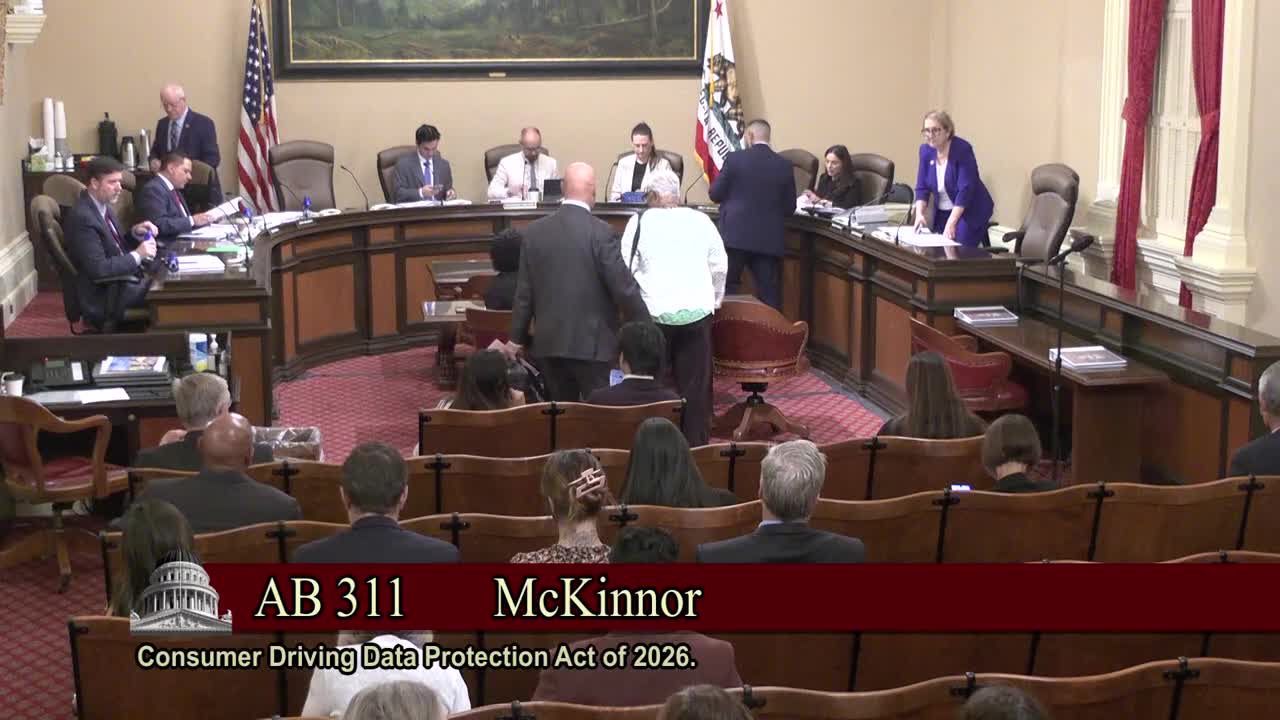 32MIN
Senate Standing Committee on Privacy, Digital Technologies, and Consumer Protection
 34MIN
Senate Standing Committee on Insurance
 5MIN
Assembly Floor
 8MIN
Assembly Standing Committee on Judiciary


Bill Co-Author(s):