AB 406: Employment: unlawful discrimination: victims of violence.
- Session Year: 2025-2026
- House: Assembly
- Latest Version Date: 2025-10-01
Current Status:
Passed
(2025-10-01: Chaptered by Secretary of State - Chapter 148, Statutes of 2025.)
Introduced
In Committee
Awaiting First Chamber Vote
Passed First Chamber
In Committee
Awaiting Second Chamber Vote
Passed Second Chamber
Enacted
What does this bill do?
This bill reinstates former Labor Code protections that stop employers from firing, punishing, or discriminating against workers who take time off for jury duty, court appearances, or to get relief or services after a crime or abuse, and it requires employers to consider safety-related accommodations. Those Labor Code rules apply only to alleged employer actions on or before December 31, 2024. The bill also moves enforcement for certain court-attendance protections from the Division of Labor Standards Enforcement to the Civil Rights Department.
The summary is provided by generative AI which can make mistakes. For original language, please view the details in the table below.
Existing law, the California Fair Employment and Housing Act, establishes the Civil Rights Department within the Business, Consumer Services, and Housing Agency, under the direction of the Director of Civil Rights, to enforce civil rights laws with respect to housing and employment and to protect and safeguard the right of all persons to obtain and hold employment without discrimination based on specified characteristics or status. Existing law prescribes various functions, duties, and powers of the department, including, among others, to bring prescribed civil actions for violations of specified federal civil rights and antidiscrimination laws.
Prior law, until January 1, 2025, authorized an employee who was discriminated or retaliated against for exercising certain rights to file a complaint with the Division of Labor Standards Enforcement in accordance with specified Labor Code provisions. These employee rights include, among other things, the right to take time off work to serve on a trial or to obtain specified crime-related relief.
Existing law, as of January 1, 2025, transferred the authority to enforce these discrimination provisions from the Division of Labor Standards Enforcement to the Civil Rights Department. Existing law also repealed the above-described Labor Code provisions, and added new enforcement provisions to the California Fair Employment and Housing Act within the Government Code. Among other changes, these provisions refer to a qualifying act of violence, as defined, instead of crime, or crime or abuse, for purposes of obtaining relief. Existing law further prohibits an employer with 25 or more employees from discharging or in any manner discriminating or retaliating against an employee who is a victim or who has a family member who is a victim for taking time off work for any of a number of additional prescribed purposes relating to a qualifying act of violence, as defined. Existing law requires an employee, as a condition of taking time off, to provide the employer with reasonable advance notice, unless not feasible, in accordance with certain procedural requirements.
This bill would reinstate the above-described former Labor Code provisions, to apply only to alleged actions or inactions occurring on or before December 31, 2024.
This bill would also transfer enforcement authority for two additional discrimination provisions relating to attending judicial proceedings from the Division of Labor Standards Enforcement to the Civil Rights Department.
The bill would make other conforming changes.
This bill would declare that it is to take effect immediately as an urgency statute.
Existing law, the California Fair Employment and Housing Act, establishes the Civil Rights Department within the Business, Consumer Services, and Housing Agency, under the direction of the Director of Civil Rights, to enforce civil rights laws with respect to housing and employment and to protect and safeguard the right of all persons to obtain and hold employment without discrimination based on specified characteristics or status. Existing law prescribes various functions, duties, and powers of the department, including, among others, to bring prescribed civil actions for violations of specified federal civil rights and antidiscrimination laws.
Prior law, until January 1, 2025, authorized an employee who was discriminated or retaliated against for exercising certain rights to file a complaint with the Division of Labor Standards Enforcement in accordance with specified Labor Code provisions. These employee rights include, among other things, the right to take time off work to serve on a trial or to obtain specified crime-related relief.
Existing law, as of January 1, 2025, transferred the authority to enforce these discrimination provisions from the Division of Labor Standards Enforcement to the Civil Rights Department. Existing law also repealed the above-described Labor Code provisions, and added new enforcement provisions to the California Fair Employment and Housing Act within the Government Code. Among other changes, these provisions refer to a qualifying act of violence, as defined, instead of crime, or crime or abuse, for purposes of obtaining relief. Existing law further prohibits an employer with 25 or more employees from discharging or in any manner discriminating or retaliating against an employee who is a victim or who has a family member who is a victim for taking time off work for any of a number of additional prescribed purposes relating to a qualifying act of violence, as defined. Existing law requires an employee, as a condition of taking time off, to provide the employer with reasonable advance notice, unless not feasible, in accordance with certain procedural requirements.
This bill would reinstate the above-described former Labor Code provisions, to apply only to alleged actions or inactions occurring on or before December 31, 2024.
This bill would also transfer enforcement authority for two additional discrimination provisions relating to attending judicial proceedings from the Division of Labor Standards Enforcement to the Civil Rights Department.
The bill would make other conforming changes.
Existing law requires the State Energy Resources Conservation and Development Commission, on or before January 1, 2024, and every 3 years thereafter, to submit an assessment related to transportation fuels to the Legislature, as specified.This bill would require the commission, beginning with the first assessment submitted after January 1, 2025, to propose recommendations for implementing solutions to mitigate any impacts described in the assessment, and would authorize the commission to request information from the State Air Resources Board, the Geologic Energy Management Division, and other relevant state agencies in preparing the recommendations and the assessment. The bill would require those entities to provide information the commission deems necessary.Existing law requires the State Energy Resources Conservation and Development Commission, on or before January 1, 2024, and every 3 years thereafter, to submit an assessment related to transportation fuels to the Legislature, as specified.
This bill would require the commission, beginning with the first assessment submitted after January 1, 2025, to propose recommendations for implementing solutions to mitigate any impacts described in the assessment, and would authorize the commission to request information from the State Air Resources Board, the Geologic Energy Management Division, and other relevant state agencies in preparing the recommendations and the assessment. The bill would require those entities to collaborate with the commission and to provide information deemed necessary by the commission to complete the assessment. deems necessary.
Existing law requires the State Energy Resources Conservation and Development Commission, on or before January 1, 2024, and every 3 years thereafter, to submit an assessment related to transportation fuels to the Legislature, as specified.
This bill would authorize the commission to request information from the State Air Resources Board, the Geologic Energy Management Division, and other relevant state agencies in preparing the assessment. The bill would require those entities to collaborate with the commission and to provide information deemed necessary by the commission to complete the assessment.
(a)An employer shall not do any of the following:
(1)Discharge or in any manner discriminate against an employee for taking time off to serve as required by law on an inquest jury or trial jury.
(2)Discharge or in any manner discriminate or retaliate against an employee, including, but not limited to, an employee who is a victim, for taking time off to appear in court to comply with a subpoena or other court order as a witness in any judicial proceeding.
(3)Discharge or in any manner discriminate or retaliate against an employee who is a victim for taking time off from work to obtain or attempt to obtain any relief. Relief includes, but is not limited to, a temporary restraining order, restraining order, or other injunctive relief, to help ensure the health, safety, or welfare of the victim or their child.
(4)Commencing January 1, 2026, discharge or in any manner discriminate or retaliate against an employee who is a victim or a family member of a victim for taking time off from work in order to attend judicial proceedings related to that crime, including, but not limited to, any delinquency proceeding, a postarrest release decision, plea, sentencing, postconviction release decision, or any proceeding where a right of that person is an issue.
(b)An employer with 25 or more employees shall not discharge or in any manner discriminate or retaliate against an employee who is a victim or who has a family member who is a victim for taking time off from work for any of the following purposes:
(1)To obtain or attempt to obtain any relief for the family member. Relief includes, but is not limited to, a temporary restraining order, restraining order, or other injunctive relief, to help ensure the health, safety, or welfare of the family member of the victim.
(2)To seek, obtain, or assist a family member to seek or obtain, medical attention for or to recover from injuries caused by a qualifying act of violence.
(3)To seek, obtain, or assist a family member to seek or obtain services from a domestic violence shelter, program, rape crisis center, or victim services organization or agency as a result of a qualifying act of violence.
(4)To seek, obtain, or assist a family member to seek or obtain psychological counseling or mental health services related to an experience of a qualifying act of violence.
(5)To participate in safety planning or take other actions to increase safety from future qualifying acts of violence.
(6)To relocate or engage in the process of securing a new residence due to the qualifying act of violence, including, but not limited to, securing temporary or permanent housing or enrolling children in a new school or childcare.
(7)To provide care to a family member who is recovering from injuries caused by a qualifying act of violence.
(8)To seek, obtain, or assist a family member to seek or obtain civil or criminal legal services in relation to the qualifying act of violence.
(9)To prepare for, participate in, or attend any civil, administrative, or criminal legal proceeding related to the qualifying act of violence.
(10)To seek, obtain, or provide childcare or care to a care-dependent adult if the childcare or care is necessary to ensure the safety of the child or dependent adult as a result of the qualifying act of violence.
(c)(1)As a condition of taking time off for a purpose set forth in paragraph (1), (3), or (4) of subdivision (a), or subdivision (b), the employee shall give the employer reasonable advance notice of the employees intention to take time off, unless the advance notice is not feasible.
(2)When an unscheduled absence occurs, the employer shall not take any action against the employee if the employee, within a reasonable time after the absence, provides a certification to the employer upon request by the employer. Certification shall be sufficient in the form of any of the following:
(A)A police report indicating that the employee or a family member of the employee was a victim.
(B)A court order protecting or separating the employee or a family member of the employee from the perpetrator of the qualifying act of violence, or other evidence from a court or prosecuting attorney that the employee or a family member of the employee has appeared in court.
(C)Documentation from a licensed medical professional, domestic violence counselor, as defined in Section 1037.1 of the Evidence Code, a sexual assault counselor, as defined in Section 1035.2 of the Evidence Code, victim advocate, licensed health care provider, or counselor that the employee or a family member of the employee was undergoing treatment or seeking or receiving services directly related to the qualifying act of violence.
(D)Any other form of documentation that reasonably verifies that the qualifying act of violence occurred, including, but not limited to, a written statement signed by the employee, or an individual acting on the employees behalf, certifying that the absence is for a purpose authorized under this section.
(3)To the extent allowed by law and consistent with subparagraph (D) of paragraph (7) of subdivision (e), the employer shall maintain the confidentiality of any employee requesting leave under paragraph (3) or (4) of subdivision (a), or subdivision (b). Furnishing evidence or providing a certification under this subdivision shall not waive any confidentiality or privilege that may exist between the employee or employees family member and a third party.
(d)An employer shall not discharge or in any manner discriminate or retaliate against an employee because of the employees status, or the employees family members status, as a victim if the employee provides notice to the employer of the status or the employer has actual knowledge of the status.
(e)(1)An employer shall provide reasonable accommodations for an employee who is a victim or whose family member is a victim of a qualifying act of violence who requests an accommodation for the safety of the employee while at work.
(2)For purposes of this subdivision, reasonable accommodations may include the implementation of safety measures, including a transfer, reassignment, modified schedule, changed work telephone, permission to carry telephone at work, changed work station, installed lock, assistance in documenting domestic violence, sexual assault, stalking, or another qualifying act of violence that occurs in the workplace, an implemented safety procedure, or another adjustment to a job structure, workplace facility, or work requirement in response to domestic violence, sexual assault, stalking, or other qualifying act of violence, or referral to a victim assistance organization.
(3)An employer is not required under this section to provide a reasonable accommodation to an employee who has not disclosed the employees status, or the employees family members status, as a victim.
(4)The employer shall engage in a timely, good faith, and interactive process with the employee to determine effective reasonable accommodations.
(5)In determining whether the accommodation is reasonable, the employer shall consider an exigent circumstance or danger facing the employee or their family member.
(6)This subdivision does not require the employer to undertake an action that constitutes an undue hardship on the employers business operations, as defined by Section 12926 of the Government Code. For the purposes of this subdivision, an undue hardship also includes an action that would violate an employers duty to furnish and maintain a place of employment that is safe and healthful for all employees as required by Section 6400 of the Labor Code.
(7)(A)Upon the request of an employer, an employee requesting a reasonable accommodation pursuant to this subdivision shall provide the employer a written statement signed by the employee or an individual acting on the employees behalf, certifying that the accommodation is for a purpose authorized under this subdivision.
(B)The employer may also request certification from an employee requesting an accommodation pursuant to this subdivision demonstrating the employees status, or the employees family members status, as a victim. Certification shall be sufficient in the form of any of the categories described in paragraph (2) of subdivision (c).
(C)An employer who requests certification pursuant to subparagraph (B) may request recertification of an employees status, or an employees family members status, as a victim, or ongoing circumstances related to the qualifying act of violence, every six months after the date of the previous certification.
(D)Any verbal or written statement, police or court record, or other documentation provided to an employer identifying an employee or the employees family member as a victim shall be maintained as confidential by the employer and shall not be disclosed by the employer except as required by federal or state law or as necessary to protect the employees safety in the workplace. The employee shall be given notice before any authorized disclosure. Furnishing evidence or providing a certification under this subdivision shall not waive any confidentiality or privilege that may exist between the employee or employees family member and a third party.
(E)(i)If circumstances change and an employee needs a new accommodation, the employee shall request a new accommodation from the employer.
(ii)Upon receiving the request, the employer shall engage in a timely, good faith, and interactive process with the employee to determine effective reasonable accommodations.
(F)If an employee no longer needs an accommodation, the employee shall notify the employer that the accommodation is no longer needed.
(8)An employer shall not retaliate against an employee for requesting a reasonable accommodation under this subdivision, regardless of whether the request was granted.
(f)It shall be an unlawful employment practice for an employer to interfere with, restrain, or deny the exercise of, or the attempt to exercise, any right provided under this section.
(g)An employee may use vacation, personal leave, paid sick leave, or compensatory time off that is otherwise available to the employee under the applicable terms of employment, unless otherwise provided by a collective bargaining agreement, for time taken off for a purpose specified in subdivision (a) or (b). The entitlement of any employee under this section shall not be diminished by any collective bargaining agreement term or condition.
(h)This section does not create a right for an employee to take unpaid leave that exceeds the unpaid leave time allowed under, or is in addition to the unpaid leave time permitted by, the 12 weeks provided under the federal Family and Medical Leave Act of 1993 (29 U.S.C. Sec. 2601 et seq.).
(i)An employer may limit the total leave taken pursuant to this section as follows:
(1)An employer may limit total leave time taken pursuant to subdivision (b) to 12 weeks.
(2)If an employees family member is a victim who is not deceased as a result of a crime, and the employee is not a victim, and the employee takes leave pursuant to paragraph (6) of subdivision (b), the employer may limit the leave taken for that reason to five days.
(3)If any employees family member is a victim who is not deceased as a result of crime, and the employee is not a victim, the employer may limit the total leave taken pursuant to subdivision (b) to 10 days.
(4)Leave taken by an employee pursuant to this section shall run concurrently with leave taken pursuant to the federal Family and Medical Leave Act of 1993 (29 U.S.C. Sec. 2601 et seq.) and the Moore-Brown-Roberti Family Rights Act, commonly referred to as the California Family Rights Act (Sections 12945.2 and 19702.3 of the Government Code), if the employee would have been eligible for that leave.
(j)For purposes of this section:
(1)Crime means a crime or public offense as set forth in Section 13951 of the Government Code, and regardless of whether any person is arrested for, prosecuted for, or convicted of, committing the crime.
(2)Domestic violence means any of the types of abuse set forth in Section 6211 of the Family Code, as amended.
(3)Employer means any of the following:
(A)Any person who directly employs one or more persons to perform services for a wage or salary.
(B)The state, and any political or civil subdivision of the state and cities.
(4)Family member means a child, parent, grandparent, grandchild, sibling, spouse, or domestic partner, as those terms are defined in Section 12945.2, or designated person. For purposes of this paragraph, designated person means any individual related by blood or whose association with the employee is the equivalent of a family relationship. The designated person may be identified by the employee at the time the employee requests the leave. An employer may limit an employee to one designated person per 12-month period for leave pursuant to this section.
(5)Qualifying act of violence means any of the following, regardless of whether anyone is arrested for, prosecuted for, or convicted of committing any crime:
(A)Domestic violence.
(B)Sexual assault.
(C)Stalking.
(D)An act, conduct, or pattern of conduct that includes any of the following:
(i)In which an individual causes bodily injury or death to another individual.
(ii)In which an individual exhibits, draws, brandishes, or uses a firearm, or other dangerous weapon, with respect to another individual.
(iii)In which an individual uses, or makes a reasonably perceived or actual threat to use, force against another individual to cause physical injury or death.
(6)Sexual assault means any nonconsensual sexual act proscribed by federal, tribal, or state law, including when the victim lacks capacity to consent.
(7)Stalking means engaging in a course of conduct directed at a specific person that would cause a reasonable person to fear for that persons safety or the safety of others or suffer substantial emotional distress.
(8)Victim means one of the following:
(A)An individual against whom a qualifying act of violence is committed.
(B)For the purposes of paragraph (2) of subdivision (a) only, a person against whom any crime has been committed.
(C)For the purposes of paragraph (4) of subdivision (a) only, either of the following:
(i)A person against whom any of the following crimes are committed:
(I)A violent felony, as defined in subdivision (c) of Section 667.5 of the Penal Code.
(II)A serious felony, as defined in subdivision (c) of Section 1192.7 of the Penal Code.
(III)A felony provision of law proscribing theft or embezzlement.
(ii)A person who suffers direct or threatened physical, psychological, or financial harm as a result of the commission or attempted commission of any of the following crimes or delinquent acts:
(I)Vehicular manslaughter while intoxicated, as defined in subdivision (b) of Section 191.5 of the Penal Code.
(II)Felony child abuse likely to produce great bodily harm or a death, as defined in Section 273a of the Penal Code.
(III)Assault resulting in the death of a child under eight years of age, as defined in Section 273ab of the Penal Code.
(IV)Felony domestic violence, as defined in Section 273.5 of the Penal Code.
(V)Felony physical abuse of an elder or dependent adult, as defined in subdivision (b) of Section 368 of the Penal Code.
(VI)Felony stalking, as defined in Section 646.9 of the Penal Code.
(VII)Solicitation for murder, as defined in subdivision (b) of Section 653f of the Penal Code.
(VIII)A serious felony, as defined in subdivision (c) of Section 1192.7 of the Penal Code.
(IX)Hit-and-run causing death or injury, as defined in Section 20001 of the Vehicle Code.
(X)Felony driving under the influence causing injury, as defined in Section 23153 of the Vehicle Code.
(XI)Sexual assault as set forth in Section 261, 261.5, 265, 266, 266a, 266b, 266c, 266g, 266j, 267, 269, 273.4, 285, 286, 287, 288, 288.5, 289, or 311.4 of, or former Section 288a of, the Penal Code.
(9)Victim advocate means an individual, whether paid or serving as a volunteer, who provides services to victims under the auspices or supervision of an agency or organization that has a documented record of providing services to victims, or under the auspices or supervision of a court or a law enforcement or prosecution agency.
(10)Victim services organization or agency means an agency or organization that has a documented record of providing services to victims.
(k)(1)An employer shall inform each employee of their rights established under this section in writing. The information shall be provided to new employees upon hire, to all employees annually, at any time upon request, and any time an employee informs an employer that the employee or the employees family member is a victim. If an employer elects not to use the form developed by the department, as specified in paragraph (2), the notice provided by the employer to the employees shall be substantially similar in content and clarity to that form developed by the department.
(2)The department shall develop a form that an employer may use to comply with the notice requirements in paragraph (1). The form shall be entitled Survivors of Violence and Family Members of Victims Right to Leave and Accommodations and shall set forth the rights and duties of employers and employees under this section in clear and concise language. The notice shall also include language that advises employees in clear and concise language that if leave taken under this section is due to an employees inability to work as a result of a serious health condition, or need to care for a family member with a serious health condition, they may also be eligible for wage replacement under the disability insurance program, the family temporary disability insurance program, or other programs administered by the Employment Development Department. The notice shall also include language that advises employees in clear and concise language that if they are a family member of a deceased victim, they may be eligible for leave under this section and also for bereavement leave under Section 12945.7. The department shall post the form in English, Spanish, Chinese, Vietnamese, Tagalog, Korean, Armenian, Arabic, Farsi, Punjabi, Russian, Japanese, Hindi, Mon-Khmer, Thai, and any other language that is spoken by a substantial number of non-English-speaking people, as that phrase is defined in Section 7296.2, on the departments internet website to make it available to employers who are required to comply with this section. The department shall create the form and post it in accordance with this paragraph on or before July 1, 2025.
(3)An employer shall not be required to comply with paragraph (1) until the department posts the form on the departments internet website in accordance with paragraph (2).
SEC. 2.Section 230 is added to the Labor Code, to read:230.(a)An employer shall not discharge or in any manner discriminate against an employee for taking time off to serve as required by law on an inquest jury or trial jury, if the employee, prior to taking the time off, gives reasonable notice to the employer that the employee is required to serve.
(b)An employer shall not discharge or in any manner discriminate or retaliate against an employee, including, but not limited to, an employee who is a victim of a crime, for taking time off to appear in court to comply with a subpoena or other court order as a witness in any judicial proceeding.
(c)An employer shall not discharge or in any manner discriminate or retaliate against an employee who is a victim for taking time off from work to obtain or attempt to obtain any relief. Relief includes, but is not limited to, a temporary restraining order, restraining order, or other injunctive relief, to help ensure the health, safety, or welfare of the victim or their child.
(d)(1)As a condition of taking time off for a purpose set forth in subdivision (c), the employee shall give the employer reasonable advance notice of the employees intention to take time off, unless the advance notice is not feasible.
(2)When an unscheduled absence occurs, the employer shall not take any action against the employee if the employee, within a reasonable time after the absence, provides a certification to the employer. Certification shall be sufficient in the form of any of the following:
(A)A police report indicating that the employee was a victim.
(B)A court order protecting or separating the employee from the perpetrator of the crime or abuse, or other evidence from the court or prosecuting attorney that the employee has appeared in court.
(C)Documentation from a licensed medical professional, domestic violence counselor, as defined in Section 1037.1 of the Evidence Code, a sexual assault counselor, as defined in Section 1035.2 of the Evidence Code, victim advocate, licensed health care provider, or counselor that the employee was undergoing treatment or receiving services for physical or mental injuries or abuse resulting in victimization from the crime or abuse.
(D)Any other form of documentation that reasonably verifies that the crime or abuse occurred, including, but not limited to, a written statement signed by the employee, or an individual acting on the employees behalf, certifying that the absence is for a purpose authorized under this section or under Section 230.1.
(3)To the extent allowed by law and consistent with subparagraph (D) of paragraph (7) of subdivision (f), the employer shall maintain the confidentiality of any employee requesting leave under subdivision (c).
(e)An employer shall not discharge or in any manner discriminate or retaliate against an employee because of the employees status as a victim of crime or abuse, if the employee provides notice to the employer of the status or the employer has actual knowledge of the status.
(f)(1)An employer shall provide reasonable accommodations for a victim of domestic violence, sexual assault, or stalking, who requests an accommodation for the safety of the victim while at work.
(2)For purposes of this subdivision, reasonable accommodations may include the implementation of safety measures, including a transfer, reassignment, modified schedule, changed work telephone, changed work station, installed lock, assistance in documenting domestic violence, sexual assault, stalking, or other crime that occurs in the workplace, an implemented safety procedure, or another adjustment to a job structure, workplace facility, or work requirement in response to domestic violence, sexual assault, stalking, or other crime, or referral to a victim assistance organization.
(3)An employer is not required to provide a reasonable accommodation to an employee who has not disclosed the employees status as a victim of domestic violence, sexual assault, or stalking.
(4)The employer shall engage in a timely, good faith, and interactive process with the employee to determine effective reasonable accommodations.
(5)In determining whether the accommodation is reasonable, the employer shall consider an exigent circumstance or danger facing the employee.
(6)This subdivision does not require the employer to undertake an action that constitutes an undue hardship on the employers business operations, as defined by Section 12926 of the Government Code. For the purposes of this subdivision, an undue hardship also includes an action that would violate an employers duty to furnish and maintain a place of employment that is safe and healthful for all employees as required by Section 6400 of the Labor Code.
(7)(A)Upon the request of an employer, an employee requesting a reasonable accommodation pursuant to this subdivision shall provide the employer a written statement signed by the employee or an individual acting on the employees behalf, certifying that the accommodation is for a purpose authorized under this subdivision.
(B)The employer may also request certification from an employee requesting an accommodation pursuant to this subdivision demonstrating the employees status as a victim of domestic violence, sexual assault, or stalking. Certification shall be sufficient in the form of any of the categories described in paragraph (3) of subdivision (d).
(C)An employer who requests certification pursuant to subparagraph (B) may request recertification of an employees status as a victim of domestic violence, sexual assault, or stalking, or ongoing circumstances related to the crime or abuse, every six months after the date of the previous certification.
(D)Any verbal or written statement, police or court record, or other documentation provided to an employer identifying an employee as a victim shall be maintained as confidential by the employer and shall not be disclosed by the employer except as required by federal or state law or as necessary to protect the employees safety in the workplace. The employee shall be given notice before any authorized disclosure.
(E)(i)If circumstances change and an employee needs a new accommodation, the employee shall request a new accommodation from the employer.
(ii)Upon receiving the request, the employer shall engage in a timely, good faith, and interactive process with the employee to determine effective reasonable accommodations.
(F)If an employee no longer needs an accommodation, the employee shall notify the employer that the accommodation is no longer needed.
(8)An employer shall not retaliate against a victim for requesting a reasonable accommodation, regardless of whether the request was granted.
(g)(1)An employee who is discharged, threatened with discharge, demoted, suspended, or in any other manner discriminated or retaliated against in the terms and conditions of employment by their employer because the employee has taken time off for a purpose set forth in subdivision (a) or (b) shall be entitled to reinstatement and reimbursement for lost wages and work benefits caused by the acts of the employer.
(2)An employee who is discharged, threatened with discharge, demoted, suspended, or in any other manner discriminated or retaliated against in the terms and conditions of employment by their employer for reasons prohibited in subdivision (c) or (e), or because the employee has requested or received a reasonable accommodation as set forth in subdivision (f), shall be entitled to reinstatement and reimbursement for lost wages and work benefits caused by the acts of the employer, as well as appropriate equitable relief.
(3)An employer who willfully refuses to rehire, promote, or otherwise restore an employee or former employee who has been determined to be eligible for rehiring or promotion by a grievance procedure or hearing authorized by law is guilty of a misdemeanor.
(h)(1)An employee who is discharged, threatened with discharge, demoted, suspended, or in any other manner discriminated or retaliated against in the terms and conditions of employment by their employer because the employee has exercised their rights as set forth in subdivision (a), (b), (c), (e), or (f) may file a complaint with the Division of Labor Standards Enforcement of the Department of Industrial Relations pursuant to Section 98.7.
(2)Notwithstanding any time limitation in Section 98.7, an employee may file a complaint with the division based upon a violation of subdivision (c), (e), or (f) within one year from the date of occurrence of the violation.
(i)An employee may use vacation, personal leave, or compensatory time off that is otherwise available to the employee under the applicable terms of employment, unless otherwise provided by a collective bargaining agreement, for time taken off for a purpose specified in subdivision (a), (b), or (c). The entitlement of any employee under this section shall not be diminished by any collective bargaining agreement term or condition.
(j)For purposes of this section:
(1)Crime means a crime or public offense as set forth in Section 13951 of the Government Code, and regardless of whether any person is arrested for, prosecuted for, or convicted of, committing the crime.
(2)Domestic violence means any of the types of abuse set forth in Section 6211 of the Family Code, as amended.
(3)Immediate family member means a person who is any of the following:
(A)Regardless of age, a biological, adopted, or foster child, stepchild, or legal ward, a child of a domestic partner, a child to whom the employee stands in loco parentis, or a person to whom the employee stood in loco parentis when the person was a minor.
(B)A biological, adoptive, or foster parent, stepparent, or legal guardian of an employee or an employees spouse or domestic partner, or a person who stood in loco parentis when the employee or the employees spouse or domestic partner was a minor child.
(C)A person to whom the employee is legally married under the laws of any state, or a domestic partner of an employee as registered under the laws of any state or political subdivision.
(D)A biological, foster, or adoptive sibling, a stepsibling, or a half sibling.
(E)Any other individual whose close association with the employee is the equivalent of a family relationship described in subparagraph (A), (B), (C), or (D).
(4)Sexual assault means any of the crimes set forth in Section 261, 261.5, 262, 265, 266, 266a, 266b, 266c, 266g, 266j, 267, 269, 273.4, 285, 286, 287, 288, 288.5, 289, or 311.4 of, or former Section 288a of, the Penal Code, as amended.
(5)Stalking means a crime set forth in Section 646.9 of the Penal Code or Section 1708.7 of the Civil Code.
(6)Victim includes any of the following:
(A)A victim of stalking, domestic violence, or sexual assault.
(B)A victim of a crime that caused physical injury or that caused mental injury and a threat of physical injury.
(C)A person whose immediate family member is deceased as the direct result of a crime.
(D)For the purposes of subdivision (b) only, any person against whom any crime has been committed.
(7)Victim advocate means an individual, whether paid or serving as a volunteer, who provides services to victims under the auspices or supervision of an agency or organization that has a documented record of providing services to victims, or under the auspices or supervision of a court or a law enforcement or prosecution agency.
(k)This section shall apply only to alleged actions or inactions occurring on or before December 31, 2024.
(l)This section shall remain in effect only until January 1, 2035, and as of that date is repealed.
SEC. 3.Section 230.1 is added to the Labor Code, to read:230.1.(a)In addition to the requirements and prohibitions imposed on employees pursuant to Section 230, an employer with 25 or more employees shall not discharge, or in any manner discriminate or retaliate against, an employee who is a victim, for taking time off from work for any of the following purposes:
(1)To seek medical attention for injuries caused by crime or abuse.
(2)To obtain services from a domestic violence shelter, program, rape crisis center, or victim services organization or agency as a result of the crime or abuse.
(3)To obtain psychological counseling or mental health services related to an experience of crime or abuse.
(4)To participate in safety planning and take other actions to increase safety from future crime or abuse, including temporary or permanent relocation.
(b)(1)As a condition of taking time off for a purpose set forth in subdivision (a), the employee shall give the employer reasonable advance notice of the employees intention to take time off, unless the advance notice is not feasible.
(2)When an unscheduled absence occurs, the employer shall not take any action against the employee if the employee, within a reasonable time after the absence, provides a certification to the employer. Certification shall be sufficient in the form of any of the categories described in paragraph (2) of subdivision (d) of Section 230.
(3)To the extent allowed by law and consistent with subparagraph (D) of paragraph (7) of subdivision (f) of Section 230, employers shall maintain the confidentiality of any employee requesting leave under subdivision (a).
(c)An employee who is discharged, threatened with discharge, demoted, suspended, or in any other manner discriminated or retaliated against in the terms and conditions of employment by their employer because the employee has taken time off for a purpose set forth in subdivision (a) is entitled to reinstatement and reimbursement for lost wages and work benefits caused by the acts of the employer, as well as appropriate equitable relief. An employer who willfully refuses to rehire, promote, or otherwise restore an employee or former employee who has been determined to be eligible for rehiring or promotion by a grievance procedure or hearing authorized by law is guilty of a misdemeanor.
(d)(1)An employee who is discharged, threatened with discharge, demoted, suspended, or in any other manner discriminated or retaliated against in the terms and conditions of employment by their employer because the employee has exercised their rights as set forth in subdivision (a) may file a complaint with the Division of Labor Standards Enforcement of the Department of Industrial Relations pursuant to Section 98.7.
(2)Notwithstanding any time limitation in Section 98.7, an employee may file a complaint with the division based upon a violation of subdivision (a) within one year from the date of occurrence of the violation.
(e)An employee may use vacation, personal leave, or compensatory time off that is otherwise available to the employee under the applicable terms of employment, unless otherwise provided by a collective bargaining agreement, for time taken off for a purpose specified in subdivision (a). The entitlement of any employee under this section shall not be diminished by any term or condition of a collective bargaining agreement.
(f)This section does not create a right for an employee to take unpaid leave that exceeds the unpaid leave time allowed under, or is in addition to the unpaid leave time permitted by, the federal Family and Medical Leave Act of 1993 (29 U.S.C. Sec. 2601 et seq.).
(g)For purposes of this section:
(1)Crime means a crime or public offense as set forth in Section 13951 of the Government Code, and regardless of whether any person is arrested for, prosecuted for, or convicted of, committing the crime.
(2)Domestic violence means any of the types of abuse set forth in Section 6211 of the Family Code, as amended.
(3)Immediate family member means a person who is any of the following:
(A)Regardless of age, a biological, adopted, or foster child, stepchild, or legal ward, a child of a domestic partner, a child to whom the employee stands in loco parentis, or a person to whom the employee stood in loco parentis when the person was a minor.
(B)A biological, adoptive, or foster parent, stepparent, or legal guardian of an employee or an employees spouse or domestic partner, or a person who stood in loco parentis when the employee or the employees spouse or domestic partner was a minor child.
(C)A person to whom the employee is legally married under the laws of any state, or a domestic partner of an employee as registered under the laws of any state or political subdivision.
(D)A biological, foster, or adoptive sibling, a stepsibling, or a half sibling.
(E)Any other individual whose close association with the employee is the equivalent of a family relationship described in subparagraph (A), (B), (C), or (D).
(4)Sexual assault means any of the crimes set forth in Section 261, 261.5, 262, 265, 266, 266a, 266b, 266c, 266g, 266j, 267, 269, 273.4, 285, 286, 287, 288, 288.5, 289, or 311.4 of, or former Section 288a of, the Penal Code, as amended.
(5)Stalking means a crime set forth in Section 646.9 of the Penal Code or Section 1708.7 of the Civil Code.
(6)Victim includes any of the following:
(A)A victim of stalking, domestic violence, or sexual assault.
(B)A victim of a crime that caused physical injury or that caused mental injury and a threat of physical injury.
(C)A person whose immediate family member is deceased as the direct result of a crime.
(7)Victim services organization or agency means an agency or organization that has a documented record of providing services to victims.
(h)(1)Employers shall inform each employee of their rights established under this section and subdivisions (c), (e), and (f) of Section 230 in writing. The information shall be provided to new employees upon hire and to other employees upon request.
(2)The Labor Commissioner shall develop a form that an employer may use to comply with the notice requirements in paragraph (1). The form shall set forth the rights and duties of employers and employees under this section in clear and concise language. The Labor Commissioner shall post the form on the commissioners internet website to make it available to employers who are required to comply with this section. If an employer elects not to use the form developed by the Labor Commissioner, the notice provided by the employer to the employees shall be substantially similar in content and clarity to the form developed by the Labor Commissioner. The Labor Commissioner shall revise the form and post it in accordance with this paragraph on or before January 1, 2022.
(3)Employers shall not be required to comply with paragraph (1) until the Labor Commissioner posts the form on the commissioners internet website in accordance with paragraph (2).
(i)This section shall apply only to alleged actions or inactions occurring on or before December 31, 2024.
(j)This section shall remain in effect only until January 1, 2035, and as of that date is repealed.
SEC. 4.Section 230.2 of the Labor Code is amended to read:230.2.(a)As used in this section:
(1)Immediate family member means spouse, child, stepchild, brother, stepbrother, sister, stepsister, mother, stepmother, father, or stepfather.
(2)Registered domestic partner means a domestic partner, as defined in Section 297 of the Family Code, and registered pursuant to Part 2 (commencing with Section 298) of Division 2.5 of the Family Code.
(3)Victim means a person against whom one of the following crimes has been committed:
(A)A violent felony, as defined in subdivision (c) of Section 667.5 of the Penal Code.
(B)A serious felony, as defined in subdivision (c) of Section 1192.7 of the Penal Code.
(C)A felony provision of law proscribing theft or embezzlement.
(b)An employer, and any agent of an employer, shall allow an employee who is a victim of a crime, an immediate family member of a victim, a registered domestic partner of a victim, or the child of a registered domestic partner of a victim to be absent from work in order to attend judicial proceedings related to that crime.
(c)Before an employee may be absent from work pursuant to subdivision (b), the employee shall give the employer a copy of the notice of each scheduled proceeding that is provided to the victim by the agency responsible for providing notice, unless advance notice is not feasible. When advance notice is not feasible or an unscheduled absence occurs, the employer shall not take any action against the employee if the employee, within a reasonable time after the absence, provides the employer with documentation evidencing the judicial proceeding from any of the following entities:
(1)The court or government agency setting the hearing.
(2)The district attorney or prosecuting attorneys office.
(3)The victim/witness office that is advocating on behalf of the victim.
(d)An employee who is absent from work pursuant to subdivision (b) may elect to use the employees accrued paid vacation time, personal leave time, sick leave time, compensatory time off that is otherwise available to the employee, or unpaid leave time, unless otherwise provided by a collective bargaining agreement, for an absence pursuant to subdivision (b). The entitlement of any employee under this section shall not be diminished by any collective bargaining agreement term or condition.
(e)An employer shall keep confidential any records regarding the employees absence from work pursuant to subdivision (b).
(f)An employer may not discharge from employment or in any manner discriminate against an employee, in compensation or other terms, conditions, or privileges of employment, including, but not limited to, the loss of seniority or precedence, because the employee is absent from work pursuant to this section.
(g)(1)Any employee who is discharged, threatened with discharge, demoted, suspended, or in any other manner discriminated or retaliated against in the terms and conditions of employment by their employer because the employee has exercised their rights as set forth in subdivision (b) may file a complaint with the Division of Labor Standards Enforcement of the Department of Industrial Relations pursuant to Section 98.7.
(2)Notwithstanding any time limitation in Section 98.7, an employee filing a complaint with the division based upon a violation of subdivision (b) shall have one year from the date of occurrence of the violation to file a complaint.
(h)District attorney and victim/witness offices are encouraged to make information regarding this section available for distribution at their offices.
(i)This section shall apply only to alleged actions or inactions occurring on or before December 31, 2025.
(j)This section shall remain in effect only until January 1, 2035, and as of that date is repealed.
SEC. 5.Section 230.5 of the Labor Code is amended to read:230.5.(a)(1)An employer shall not discharge or in any manner discriminate or retaliate against an employee who is a victim of an offense listed in paragraph (2) for taking time off from work, upon the victims request, to appear in court to be heard at any proceeding, including any delinquency proceeding, involving a postarrest release decision, plea, sentencing, postconviction release decision, or any proceeding in which a right of the victim is at issue.
(2)The offenses include all of the following:
(A)Vehicular manslaughter while intoxicated, as defined in subdivision (b) of Section 191.5 of the Penal Code.
(B)Felony child abuse likely to produce great bodily harm or a death, as defined in Section 273a of the Penal Code.
(C)Assault resulting in the death of a child under eight years of age, as defined in Section 273ab of the Penal Code.
(D)Felony domestic violence, as defined in Section 273.5 of the Penal Code.
(E)Felony physical abuse of an elder or dependent adult, as defined in subdivision (b) of Section 368 of the Penal Code.
(F)Felony stalking, as defined in Section 646.9 of the Penal Code.
(G)Solicitation for murder, as defined in subdivision (b) of Section 653f of the Penal Code.
(H)A serious felony, as defined in subdivision (c) of Section 1192.7 of the Penal Code.
(I)Hit-and-run causing death or injury, as defined in Section 20001 of the Vehicle Code.
(J)Felony driving under the influence causing injury, as defined in Section 23153 of the Vehicle Code.
(K)Sexual assault as set forth in Section 261, 261.5, 262, 265, 266, 266a, 266b, 266c, 266g, 266j, 267, 269, 273.4, 285, 286, 287, 288, 288.5, 289, or 311.4 of, or former Section 288a of, the Penal Code.
(b)(1)As a condition of taking time off for a purpose set forth in subdivision (a), the employee shall give the employer reasonable advance notice of the employees intention to take time off, unless the advance notice is not feasible.
(2)When an unscheduled absence occurs, the employer shall not take any action against the employee if the employee, within a reasonable time after the absence, provides a certification to the employer. Certification shall be sufficient in the form of any of the following:
(A)A police report indicating that the employee was a victim of an offense specified in subdivision (a).
(B)A court order protecting or separating the employee from the perpetrator of an offense specified in subdivision (a), or other evidence from the court or prosecuting attorney that the employee has appeared in court.
(C)Documentation from a medical professional, domestic violence advocate or advocate for victims of sexual assault, health care provider, or counselor that the employee was undergoing treatment for physical or mental injuries or abuse resulting in victimization from an offense specified in subdivision (a).
(3)To the extent allowed by law, the employer shall maintain the confidentiality of any employee requesting leave under subdivision (a).
(c)An employee who is discharged, threatened with discharge, demoted, suspended, or in any other manner discriminated or retaliated against in the terms and conditions of employment by their employer because the employee has taken time off for a purpose set forth in subdivision (a) shall be entitled to reinstatement and reimbursement for lost wages and work benefits caused by the acts of the employer. Any employer who willfully refuses to rehire, promote, or otherwise restore an employee or former employee who has been determined to be eligible for rehiring or promotion by a grievance procedure or hearing authorized by law is guilty of a misdemeanor.
(d)(1)An employee who is discharged, threatened with discharge, demoted, suspended, or in any other manner discriminated or retaliated against in the terms and conditions of employment by their employer because the employee has exercised their rights as set forth in subdivision (a) may file a complaint with the Division of Labor Standards Enforcement of the Department of Industrial Relations pursuant to Section 98.7.
(2)Notwithstanding any time limitation in Section 98.7, an employee may file a complaint with the division based upon a violation of subdivision (a) within one year from the date of occurrence of the violation.
(e)An employee may use vacation, personal leave, or compensatory time off that is otherwise available to the employee under the applicable terms of employment, unless otherwise provided by a collective bargaining agreement, for time taken off for a purpose specified in this section. The entitlement of any employee under this section shall not be diminished by any collective bargaining agreement term or condition.
(f)For purposes of this section, victim means any person who suffers direct or threatened physical, psychological, or financial harm as a result of the commission or attempted commission of a crime or delinquent act. The term victim also includes the persons spouse, parent, child, sibling, or guardian.
(g)This section shall apply only to alleged actions or inactions occurring on or before December 31, 2025.
(h)This section shall remain in effect only until January 1, 2035, and as of that date is repealed.
SEC. 6.Section 246.5 of the Labor Code is amended to read:246.5.(a)Upon the oral or written request of an employee, an employer shall provide paid sick days for the following purposes:
(1)Diagnosis, care, or treatment of an existing health condition of, or preventive care for, an employee or an employees family member.
(2)(A)For leave taken or requested on or before December 31, 2024, for a purpose described in subdivision (c) of Section 230 or subdivision (a) of Section 230.1.
(B)For leave taken or requested on or after January 1, 2025, for a purpose described in paragraph (1), (2), or (3) of subdivision (a) of, or subdivision (b) of, Section 12945.8 of the Government Code.
(C)For leave taken or requested on or after January 1, 2026, for a purpose described in paragraph (4) of subdivision (a) of Section 12945.8 of the Government Code.
(3)(A)For an employee who is an agricultural employee, as defined in Section 9110, who works outside and who is entitled to paid sick days under this article, to avoid smoke, heat, or flooding conditions created by a local or state emergency, including, but not limited to, when the employees worksite is closed due to the smoke, heat, or flooding conditions.
(B)For purposes of this paragraph, there are smoke, heat, or flood conditions created by a local or state emergency if the Governor proclaims a state of emergency pursuant to Section 8625 of the Government Code, or a local emergency is proclaimed pursuant to Section 8630 of the Government Code, due to smoke, heat, or flooding conditions that prevent agricultural employees from working.
(b)An employer shall not require as a condition of using paid sick days that the employee search for or find a replacement worker to cover the days during which the employee uses paid sick days.
(c)(1)An employer shall not deny an employee the right to use accrued sick days, discharge, threaten to discharge, demote, suspend, or in any manner discriminate against an employee for using accrued sick days, attempting to exercise the right to use accrued sick days, filing a complaint with the department or alleging a violation of this article, cooperating in an investigation or prosecution of an alleged violation of this article, or opposing any policy or practice or act that is prohibited by this article.
(2)There shall be a rebuttable presumption of unlawful retaliation if an employer denies an employee the right to use accrued sick days, discharges, threatens to discharge, demotes, suspends, or in any manner discriminates against an employee within 30 days of any of the following:
(A)The filing of a complaint by the employee with the Labor Commissioner or alleging a violation of this article.
(B)The cooperation of an employee with an investigation or prosecution of an alleged violation of this article.
(C)Opposition by the employee to a policy, practice, or act that is prohibited by this article.
(d)Notwithstanding subdivision (a) of Section 245.5, for purposes of this section, employee shall include an employee described in paragraph (1) of subdivision (a) of Section 245.5.
SEC. 7.This act is an urgency statute necessary for the immediate preservation of the public peace, health, or safety within the meaning of Article IV of the California Constitution and shall go into immediate effect. The facts constituting the necessity are:
To ensure efficient implementation by the Labor Commissioner and Civil Rights Department and to provide clarity to workers and victims of crimes, it is necessary that this act take effect immediately.
(a)An employer shall not do any of the following:
(1)Discharge or in any manner discriminate against an employee for taking time off to serve as required by law on an inquest jury or trial jury.
(2)Discharge or in any manner discriminate or retaliate against an employee, including, but not limited to, an employee who is a victim, for taking time off to appear in court to comply with a subpoena or other court order as a witness in any judicial proceeding.
(3)Discharge or in any manner discriminate or retaliate against an employee who is a victim for taking time off from work to obtain or attempt to obtain any relief. Relief includes, but is not limited to, a temporary restraining order, restraining order, or other injunctive relief, to help ensure the health, safety, or welfare of the victim or their child.
(4)Commencing January 1, 2026, discharge or in any manner discriminate or retaliate against an employee who is a victim or a family member of a victim for taking time off from work in order to attend judicial proceedings related to that crime, including, but not limited to, any delinquency proceeding, a postarrest release decision, plea, sentencing, postconviction release decision, or any proceeding where a right of that person is an issue.
(b)An employer with 25 or more employees shall not discharge or in any manner discriminate or retaliate against an employee who is a victim or who has a family member who is a victim for taking time off from work for any of the following purposes:
(1)To obtain or attempt to obtain any relief for the family member. Relief includes, but is not limited to, a temporary restraining order, restraining order, or other injunctive relief, to help ensure the health, safety, or welfare of the family member of the victim.
(2)To seek, obtain, or assist a family member to seek or obtain, medical attention for or to recover from injuries caused by a qualifying act of violence.
(3)To seek, obtain, or assist a family member to seek or obtain services from a domestic violence shelter, program, rape crisis center, or victim services organization or agency as a result of a qualifying act of violence.
(4)To seek, obtain, or assist a family member to seek or obtain psychological counseling or mental health services related to an experience of a qualifying act of violence.
(5)To participate in safety planning or take other actions to increase safety from future qualifying acts of violence.
(6)To relocate or engage in the process of securing a new residence due to the qualifying act of violence, including, but not limited to, securing temporary or permanent housing or enrolling children in a new school or childcare.
(7)To provide care to a family member who is recovering from injuries caused by a qualifying act of violence.
(8)To seek, obtain, or assist a family member to seek or obtain civil or criminal legal services in relation to the qualifying act of violence.
(9)To prepare for, participate in, or attend any civil, administrative, or criminal legal proceeding related to the qualifying act of violence.
(10)To seek, obtain, or provide childcare or care to a care-dependent adult if the childcare or care is necessary to ensure the safety of the child or dependent adult as a result of the qualifying act of violence.
(c)(1)As a condition of taking time off for a purpose set forth in paragraph (1), (3), or (4) of subdivision (a), or subdivision (b), the employee shall give the employer reasonable advance notice of the employees intention to take time off, unless the advance notice is not feasible.
(2)When an unscheduled absence occurs, the employer shall not take any action against the employee if the employee, within a reasonable time after the absence, provides a certification to the employer upon request by the employer. Certification shall be sufficient in the form of any of the following:
(A)A police report indicating that the employee or a family member of the employee was a victim.
(B)A court order protecting or separating the employee or a family member of the employee from the perpetrator of the qualifying act of violence, or other evidence from a court or prosecuting attorney that the employee or a family member of the employee has appeared in court.
(C)Documentation from a licensed medical professional, domestic violence counselor, as defined in Section 1037.1 of the Evidence Code, a sexual assault counselor, as defined in Section 1035.2 of the Evidence Code, victim advocate, licensed health care provider, or counselor that the employee or a family member of the employee was undergoing treatment or seeking or receiving services directly related to the qualifying act of violence.
(D)Any other form of documentation that reasonably verifies that the qualifying act of violence occurred, including, but not limited to, a written statement signed by the employee, or an individual acting on the employees behalf, certifying that the absence is for a purpose authorized under this section.
(3)To the extent allowed by law and consistent with subparagraph (D) of paragraph (7) of subdivision (e), the employer shall maintain the confidentiality of any employee requesting leave under paragraph (3) or (4) of subdivision (a), or subdivision (b). Furnishing evidence or providing a certification under this subdivision shall not waive any confidentiality or privilege that may exist between the employee or employees family member and a third party.
(d)An employer shall not discharge or in any manner discriminate or retaliate against an employee because of the employees status, or the employees family members status, as a victim if the employee provides notice to the employer of the status or the employer has actual knowledge of the status.
(e)(1)An employer shall provide reasonable accommodations for an employee who is a victim or whose family member is a victim of a qualifying act of violence who requests an accommodation for the safety of the employee while at work.
(2)For purposes of this subdivision, reasonable accommodations may include the implementation of safety measures, including a transfer, reassignment, modified schedule, changed work telephone, permission to carry telephone at work, changed work station, installed lock, assistance in documenting domestic violence, sexual assault, stalking, or another qualifying act of violence that occurs in the workplace, an implemented safety procedure, or another adjustment to a job structure, workplace facility, or work requirement in response to domestic violence, sexual assault, stalking, or other qualifying act of violence, or referral to a victim assistance organization.
(3)An employer is not required under this section to provide a reasonable accommodation to an employee who has not disclosed the employees status, or the employees family members status, as a victim.
(4)The employer shall engage in a timely, good faith, and interactive process with the employee to determine effective reasonable accommodations.
(5)In determining whether the accommodation is reasonable, the employer shall consider an exigent circumstance or danger facing the employee or their family member.
(6)This subdivision does not require the employer to undertake an action that constitutes an undue hardship on the employers business operations, as defined by Section 12926 of the Government Code. For the purposes of this subdivision, an undue hardship also includes an action that would violate an employers duty to furnish and maintain a place of employment that is safe and healthful for all employees as required by Section 6400 of the Labor Code.
(7)(A)Upon the request of an employer, an employee requesting a reasonable accommodation pursuant to this subdivision shall provide the employer a written statement signed by the employee or an individual acting on the employees behalf, certifying that the accommodation is for a purpose authorized under this subdivision.
(B)The employer may also request certification from an employee requesting an accommodation pursuant to this subdivision demonstrating the employees status, or the employees family members status, as a victim. Certification shall be sufficient in the form of any of the categories described in paragraph (2) of subdivision (c).
(C)An employer who requests certification pursuant to subparagraph (B) may request recertification of an employees status, or an employees family members status, as a victim, or ongoing circumstances related to the qualifying act of violence, every six months after the date of the previous certification.
(D)Any verbal or written statement, police or court record, or other documentation provided to an employer identifying an employee or the employees family member as a victim shall be maintained as confidential by the employer and shall not be disclosed by the employer except as required by federal or state law or as necessary to protect the employees safety in the workplace. The employee shall be given notice before any authorized disclosure. Furnishing evidence or providing a certification under this subdivision shall not waive any confidentiality or privilege that may exist between the employee or employees family member and a third party.
(E)(i)If circumstances change and an employee needs a new accommodation, the employee shall request a new accommodation from the employer.
(ii)Upon receiving the request, the employer shall engage in a timely, good faith, and interactive process with the employee to determine effective reasonable accommodations.
(F)If an employee no longer needs an accommodation, the employee shall notify the employer that the accommodation is no longer needed.
(8)An employer shall not retaliate against an employee for requesting a reasonable accommodation under this subdivision, regardless of whether the request was granted.
(f)It shall be an unlawful employment practice for an employer to interfere with, restrain, or deny the exercise of, or the attempt to exercise, any right provided under this section.
(g)An employee may use vacation, personal leave, paid sick leave, or compensatory time off that is otherwise available to the employee under the applicable terms of employment, unless otherwise provided by a collective bargaining agreement, for time taken off for a purpose specified in subdivision (a) or (b). The entitlement of any employee under this section shall not be diminished by any collective bargaining agreement term or condition.
(h)This section does not create a right for an employee to take unpaid leave that exceeds the unpaid leave time allowed under, or is in addition to the unpaid leave time permitted by, the 12 weeks provided under the federal Family and Medical Leave Act of 1993 (29 U.S.C. Sec. 2601 et seq.).
(i)An employer may limit the total leave taken pursuant to this section as follows:
(1)An employer may limit total leave time taken pursuant to subdivision (b) to 12 weeks.
(2)If an employees family member is a victim who is not deceased as a result of a crime, and the employee is not a victim, and the employee takes leave pursuant to paragraph (6) of subdivision (b), the employer may limit the leave taken for that reason to five days.
(3)If any employees family member is a victim who is not deceased as a result of crime, and the employee is not a victim, the employer may limit the total leave taken pursuant to subdivision (b) to 10 days.
(4)Leave taken by an employee pursuant to this section shall run concurrently with leave taken pursuant to the federal Family and Medical Leave Act of 1993 (29 U.S.C. Sec. 2601 et seq.) and the Moore-Brown-Roberti Family Rights Act, commonly referred to as the California Family Rights Act (Sections 12945.2 and 19702.3 of the Government Code), if the employee would have been eligible for that leave.
(j)For purposes of this section:
(1)Crime means a crime or public offense as set forth in Section 13951 of the Government Code, and regardless of whether any person is arrested for, prosecuted for, or convicted of, committing the crime.
(2)Domestic violence means any of the types of abuse set forth in Section 6211 of the Family Code, as amended.
(3)Employer means any of the following:
(A)Any person who directly employs one or more persons to perform services for a wage or salary.
(B)The state, and any political or civil subdivision of the state and cities.
(4)Family member means a child, parent, grandparent, grandchild, sibling, spouse, or domestic partner, as those terms are defined in Section 12945.2, or designated person. For purposes of this paragraph, designated person means any individual related by blood or whose association with the employee is the equivalent of a family relationship. The designated person may be identified by the employee at the time the employee requests the leave. An employer may limit an employee to one designated person per 12-month period for leave pursuant to this section.
(5)Qualifying act of violence means any of the following, regardless of whether anyone is arrested for, prosecuted for, or convicted of committing any crime:
(A)Domestic violence.
(B)Sexual assault.
(C)Stalking.
(D)An act, conduct, or pattern of conduct that includes any of the following:
(i)In which an individual causes bodily injury or death to another individual.
(ii)In which an individual exhibits, draws, brandishes, or uses a firearm, or other dangerous weapon, with respect to another individual.
(iii)In which an individual uses, or makes a reasonably perceived or actual threat to use, force against another individual to cause physical injury or death.
(6)Sexual assault means any nonconsensual sexual act proscribed by federal, tribal, or state law, including when the victim lacks capacity to consent.
(7)Stalking means engaging in a course of conduct directed at a specific person that would cause a reasonable person to fear for that persons safety or the safety of others or suffer substantial emotional distress.
(8)Victim means one of the following:
(A)An individual against whom a qualifying act of violence is committed.
(B)For the purposes of paragraph (2) of subdivision (a) only, a person against whom any crime has been committed.
(C)For the purposes of paragraph (4) of subdivision (a) only, either of the following:
(i)A person against whom any of the following crimes are committed:
(I)A violent felony, as defined in subdivision (c) of Section 667.5 of the Penal Code.
(II)A serious felony, as defined in subdivision (c) of Section 1192.7 of the Penal Code.
(III)A felony provision of law proscribing theft or embezzlement.
(ii)A person who suffers direct or threatened physical, psychological, or financial harm as a result of the commission or attempted commission of any of the following crimes or delinquent acts:
(I)Vehicular manslaughter while intoxicated, as defined in subdivision (b) of Section 191.5 of the Penal Code.
(II)Felony child abuse likely to produce great bodily harm or a death, as defined in Section 273a of the Penal Code.
(III)Assault resulting in the death of a child under eight years of age, as defined in Section 273ab of the Penal Code.
(IV)Felony domestic violence, as defined in Section 273.5 of the Penal Code.
(V)Felony physical abuse of an elder or dependent adult, as defined in subdivision (b) of Section 368 of the Penal Code.
(VI)Felony stalking, as defined in Section 646.9 of the Penal Code.
(VII)Solicitation for murder, as defined in subdivision (b) of Section 653f of the Penal Code.
(VIII)A serious felony, as defined in subdivision (c) of Section 1192.7 of the Penal Code.
(IX)Hit-and-run causing death or injury, as defined in Section 20001 of the Vehicle Code.
(X)Felony driving under the influence causing injury, as defined in Section 23153 of the Vehicle Code.
(XI)Sexual assault as set forth in Section 261, 261.5, 265, 266, 266a, 266b, 266c, 266g, 266j, 267, 269, 273.4, 285, 286, 287, 288, 288.5, 289, or 311.4 of, or former Section 288a of, the Penal Code.
(9)Victim advocate means an individual, whether paid or serving as a volunteer, who provides services to victims under the auspices or supervision of an agency or organization that has a documented record of providing services to victims, or under the auspices or supervision of a court or a law enforcement or prosecution agency.
(10)Victim services organization or agency means an agency or organization that has a documented record of providing services to victims.
(k)(1)An employer shall inform each employee of their rights established under this section in writing. The information shall be provided to new employees upon hire, to all employees annually, at any time upon request, and any time an employee informs an employer that the employee or the employees family member is a victim. If an employer elects not to use the form developed by the department, as specified in paragraph (2), the notice provided by the employer to the employees shall be substantially similar in content and clarity to that form developed by the department.
(2)The department shall develop a form that an employer may use to comply with the notice requirements in paragraph (1). The form shall be entitled Survivors of Violence and Family Members of Victims Right to Leave and Accommodations and shall set forth the rights and duties of employers and employees under this section in clear and concise language. The notice shall also include language that advises employees in clear and concise language that if leave taken under this section is due to an employees inability to work as a result of a serious health condition, or need to care for a family member with a serious health condition, they may also be eligible for wage replacement under the disability insurance program, the family temporary disability insurance program, or other programs administered by the Employment Development Department. The notice shall also include language that advises employees in clear and concise language that if they are a family member of a deceased victim, they may be eligible for leave under this section and also for bereavement leave under Section 12945.7. The department shall post the form in English, Spanish, Chinese, Vietnamese, Tagalog, Korean, Armenian, Arabic, Farsi, Punjabi, Russian, Japanese, Hindi, Mon-Khmer, Thai, and any other language that is spoken by a substantial number of non-English-speaking people, as that phrase is defined in Section 7296.2, on the departments internet website to make it available to employers who are required to comply with this section. The department shall create the form and post it in accordance with this paragraph on or before July 1, 2025.
(3)An employer shall not be required to comply with paragraph (1) until the department posts the form on the departments internet website in accordance with paragraph (2).
SEC. 2.Section 230 is added to the Labor Code, to read:230.(a)An employer shall not discharge or in any manner discriminate against an employee for taking time off to serve as required by law on an inquest jury or trial jury, if the employee, prior to taking the time off, gives reasonable notice to the employer that the employee is required to serve.
(b)An employer shall not discharge or in any manner discriminate or retaliate against an employee, including, but not limited to, an employee who is a victim of a crime, for taking time off to appear in court to comply with a subpoena or other court order as a witness in any judicial proceeding.
(c)An employer shall not discharge or in any manner discriminate or retaliate against an employee who is a victim for taking time off from work to obtain or attempt to obtain any relief. Relief includes, but is not limited to, a temporary restraining order, restraining order, or other injunctive relief, to help ensure the health, safety, or welfare of the victim or their child.
(d)(1)As a condition of taking time off for a purpose set forth in subdivision (c), the employee shall give the employer reasonable advance notice of the employees intention to take time off, unless the advance notice is not feasible.
(2)When an unscheduled absence occurs, the employer shall not take any action against the employee if the employee, within a reasonable time after the absence, provides a certification to the employer. Certification shall be sufficient in the form of any of the following:
(A)A police report indicating that the employee was a victim.
(B)A court order protecting or separating the employee from the perpetrator of the crime or abuse, or other evidence from the court or prosecuting attorney that the employee has appeared in court.
(C)Documentation from a licensed medical professional, domestic violence counselor, as defined in Section 1037.1 of the Evidence Code, a sexual assault counselor, as defined in Section 1035.2 of the Evidence Code, victim advocate, licensed health care provider, or counselor that the employee was undergoing treatment or receiving services for physical or mental injuries or abuse resulting in victimization from the crime or abuse.
(D)Any other form of documentation that reasonably verifies that the crime or abuse occurred, including including, but not limited to, a written statement signed by the employee, or an individual acting on the employees behalf, certifying that the absence is for a purpose authorized under this section or under Section 230.1.
(3)To the extent allowed by law and consistent with subparagraph (D) of paragraph (7) of subdivision (f), the employer shall maintain the confidentiality of any employee requesting leave under subdivision (c).
(e)An employer shall not discharge or in any manner discriminate or retaliate against an employee because of the employees status as a victim of crime or abuse, if the employee provides notice to the employer of the status or the employer has actual knowledge of the status.
(f)(1)An employer shall provide reasonable accommodations for a victim of domestic violence, sexual assault, or stalking, who requests an accommodation for the safety of the victim while at work.
(2)For purposes of this subdivision, reasonable accommodations may include the implementation of safety measures, including a transfer, reassignment, modified schedule, changed work telephone, changed work station, installed lock, assistance in documenting domestic violence, sexual assault, stalking, or other crime that occurs in the workplace, an implemented safety procedure, or another adjustment to a job structure, workplace facility, or work requirement in response to domestic violence, sexual assault, stalking, or other crime, or referral to a victim assistance organization.
(3)An employer is not required to provide a reasonable accommodation to an employee who has not disclosed the employees status as a victim of domestic violence, sexual assault, or stalking.
(4)The employer shall engage in a timely, good faith, and interactive process with the employee to determine effective reasonable accommodations.
(5)In determining whether the accommodation is reasonable, the employer shall consider an exigent circumstance or danger facing the employee.
(6)This subdivision does not require the employer to undertake an action that constitutes an undue hardship on the employers business operations, as defined by Section 12926 of the Government Code. For the purposes of this subdivision, an undue hardship also includes an action that would violate an employers duty to furnish and maintain a place of employment that is safe and healthful for all employees as required by Section 6400 of the Labor Code.
(7)(A)Upon the request of an employer, an employee requesting a reasonable accommodation pursuant to this subdivision shall provide the employer a written statement signed by the employee or an individual acting on the employees behalf, certifying that the accommodation is for a purpose authorized under this subdivision.
(B)The employer may also request certification from an employee requesting an accommodation pursuant to this subdivision demonstrating the employees status as a victim of domestic violence, sexual assault, or stalking. Certification shall be sufficient in the form of any of the categories described in paragraph (3) of subdivision (d).
(C)An employer who requests certification pursuant to subparagraph (B) may request recertification of an employees status as a victim of domestic violence, sexual assault, or stalking, or ongoing circumstances related to the crime or abuse, every six months after the date of the previous certification.
(D)Any verbal or written statement, police or court record, or other documentation provided to an employer identifying an employee as a victim shall be maintained as confidential by the employer and shall not be disclosed by the employer except as required by federal or state law or as necessary to protect the employees safety in the workplace. The employee shall be given notice before any authorized disclosure.
(E)(i)If circumstances change and an employee needs a new accommodation, the employee shall request a new accommodation from the employer.
(ii)Upon receiving the request, the employer shall engage in a timely, good faith, and interactive process with the employee to determine effective reasonable accommodations.
(F)If an employee no longer needs an accommodation, the employee shall notify the employer that the accommodation is no longer needed.
(8)An employer shall not retaliate against a victim for requesting a reasonable accommodation, regardless of whether the request was granted.
(g)(1)An employee who is discharged, threatened with discharge, demoted, suspended, or in any other manner discriminated or retaliated against in the terms and conditions of employment by their employer because the employee has taken time off for a purpose set forth in subdivision (a) or (b) shall be entitled to reinstatement and reimbursement for lost wages and work benefits caused by the acts of the employer.
(2)An employee who is discharged, threatened with discharge, demoted, suspended, or in any other manner discriminated or retaliated against in the terms and conditions of employment by their employer for reasons prohibited in subdivision (c) or (e), or because the employee has requested or received a reasonable accommodation as set forth in subdivision (f), shall be entitled to reinstatement and reimbursement for lost wages and work benefits caused by the acts of the employer, as well as appropriate equitable relief.
(3)An employer who willfully refuses to rehire, promote, or otherwise restore an employee or former employee who has been determined to be eligible for rehiring or promotion by a grievance procedure or hearing authorized by law is guilty of a misdemeanor.
(h)(1)An employee who is discharged, threatened with discharge, demoted, suspended, or in any other manner discriminated or retaliated against in the terms and conditions of employment by their employer because the employee has exercised their rights as set forth in subdivision (a), (b), (c), (e), or (f) may file a complaint with the Division of Labor Standards Enforcement of the Department of Industrial Relations pursuant to Section 98.7.
(2)Notwithstanding any time limitation in Section 98.7, an employee may file a complaint with the division based upon a violation of subdivision (c), (e), or (f) within one year from the date of occurrence of the violation.
(i)An employee may use vacation, personal leave, or compensatory time off that is otherwise available to the employee under the applicable terms of employment, unless otherwise provided by a collective bargaining agreement, for time taken off for a purpose specified in subdivision (a), (b), or (c). The entitlement of any employee under this section shall not be diminished by any collective bargaining agreement term or condition.
(j)For purposes of this section:
(1)Crime means a crime or public offense as set forth in Section 13951 of the Government Code, and regardless of whether any person is arrested for, prosecuted for, or convicted of, committing the crime.
(2)Domestic violence means any of the types of abuse set forth in Section 6211 of the Family Code, as amended.
(3)Immediate family member means a person who is any of the following:
(A)Regardless of age, a biological, adopted, or foster child, stepchild, or legal ward, a child of a domestic partner, a child to whom the employee stands in loco parentis, or a person to whom the employee stood in loco parentis when the person was a minor.
(B)A biological, adoptive, or foster parent, stepparent, or legal guardian of an employee or an employees spouse or domestic partner, or a person who stood in loco parentis when the employee or the employees spouse or domestic partner was a minor child.
(C)A person to whom the employee is legally married under the laws of any state, or a domestic partner of an employee as registered under the laws of any state or political subdivision.
(D)A biological, foster, or adoptive sibling, a stepsibling, or a half-sibling. half sibling.
(E)Any other individual whose close association with the employee is the equivalent of a family relationship described in subparagraph (A), (B), (C), or (D).
(4)Sexual assault means any of the crimes set forth in Section 261, 261.5, 262, 265, 266, 266a, 266b, 266c, 266g, 266j, 267, 269, 273.4, 285, 286, 287, 288, 288.5, 289, or 311.4 of, or former Section 288a of, the Penal Code, as amended.
(5)Stalking means a crime set forth in Section 646.9 of the Penal Code or Section 1708.7 of the Civil Code.
(6)Victim includes any of the following:
(A)A victim of stalking, domestic violence, or sexual assault.
(B)A victim of a crime that caused physical injury or that caused mental injury and a threat of physical injury.
(C)A person whose immediate family member is deceased as the direct result of a crime.
(D)For the purposes of subdivision (b) only, any person against whom any crime has been committed.
(7)Victim advocate means an individual, whether paid or serving as a volunteer, who provides services to victims under the auspices or supervision of an agency or organization that has a documented record of providing services to victims, or under the auspices or supervision of a court or a law enforcement or prosecution agency.
(k)This section shall apply only to alleged actions or inactions occurring on or before December 31, 2024.
(l)This section shall remain in effect only until January 1, 2035, and as of that date is repealed.
SEC. 3.Section 230.1 is added to the Labor Code, to read:230.1.(a)In addition to the requirements and prohibitions imposed on employees pursuant to Section 230, an employer with 25 or more employees shall not discharge, or in any manner discriminate or retaliate against, an employee who is a victim, for taking time off from work for any of the following purposes:
(1)To seek medical attention for injuries caused by crime or abuse.
(2)To obtain services from a domestic violence shelter, program, rape crisis center, or victim services organization or agency as a result of the crime or abuse.
(3)To obtain psychological counseling or mental health services related to an experience of crime or abuse.
(4)To participate in safety planning and take other actions to increase safety from future crime or abuse, including temporary or permanent relocation.
(b)(1)As a condition of taking time off for a purpose set forth in subdivision (a), the employee shall give the employer reasonable advance notice of the employees intention to take time off, unless the advance notice is not feasible.
(2)When an unscheduled absence occurs, the employer shall not take any action against the employee if the employee, within a reasonable time after the absence, provides a certification to the employer. Certification shall be sufficient in the form of any of the categories described in paragraph (2) of subdivision (d) of Section 230.
(3)To the extent allowed by law and consistent with subparagraph (D) of paragraph (7) of subdivision (f) of Section 230, employers shall maintain the confidentiality of any employee requesting leave under subdivision (a).
(c)An employee who is discharged, threatened with discharge, demoted, suspended, or in any other manner discriminated or retaliated against in the terms and conditions of employment by their employer because the employee has taken time off for a purpose set forth in subdivision (a) is entitled to reinstatement and reimbursement for lost wages and work benefits caused by the acts of the employer, as well as appropriate equitable relief. An employer who willfully refuses to rehire, promote, or otherwise restore an employee or former employee who has been determined to be eligible for rehiring or promotion by a grievance procedure or hearing authorized by law is guilty of a misdemeanor.
(d)(1)An employee who is discharged, threatened with discharge, demoted, suspended, or in any other manner discriminated or retaliated against in the terms and conditions of employment by their employer because the employee has exercised their rights as set forth in subdivision (a) may file a complaint with the Division of Labor Standards Enforcement of the Department of Industrial Relations pursuant to Section 98.7.
(2)Notwithstanding any time limitation in Section 98.7, an employee may file a complaint with the division based upon a violation of subdivision (a) within one year from the date of occurrence of the violation.
(e)An employee may use vacation, personal leave, or compensatory time off that is otherwise available to the employee under the applicable terms of employment, unless otherwise provided by a collective bargaining agreement, for time taken off for a purpose specified in subdivision (a). The entitlement of any employee under this section shall not be diminished by any term or condition of a collective bargaining agreement.
(f)This section does not create a right for an employee to take unpaid leave that exceeds the unpaid leave time allowed under, or is in addition to the unpaid leave time permitted by, the federal Family and Medical Leave Act of 1993 (29 U.S.C. Sec. 2601 et seq.).
(g)For purposes of this section:
(1)Crime means a crime or public offense as set forth in Section 13951 of the Government Code, and regardless of whether any person is arrested for, prosecuted for, or convicted of, committing the crime.
(2)Domestic violence means any of the types of abuse set forth in Section 6211 of the Family Code, as amended.
(3)Immediate family member means a person who is any of the following:
(A)Regardless of age, a biological, adopted, or foster child, stepchild, or legal ward, a child of a domestic partner, a child to whom the employee stands in loco parentis, or a person to whom the employee stood in loco parentis when the person was a minor.
(B)A biological, adoptive, or foster parent, stepparent, or legal guardian of an employee or an employees spouse or domestic partner, or a person who stood in loco parentis when the employee or the employees spouse or domestic partner was a minor child.
(C)A person to whom the employee is legally married under the laws of any state, or a domestic partner of an employee as registered under the laws of any state or political subdivision.
(D)A biological, foster, or adoptive sibling, a stepsibling, or a half-sibling. half sibling.
(E)Any other individual whose close association with the employee is the equivalent of a family relationship described in subparagraph (A), (B), (C), or (D).
(4)Sexual assault means any of the crimes set forth in Section 261, 261.5, 262, 265, 266, 266a, 266b, 266c, 266g, 266j, 267, 269, 273.4, 285, 286, 287, 288, 288.5, 289, or 311.4 of, or former Section 288a of, the Penal Code, as amended.
(5)Stalking means a crime set forth in Section 646.9 of the Penal Code or Section 1708.7 of the Civil Code.
(6)Victim includes any of the following:
(A)A victim of stalking, domestic violence, or sexual assault.
(B)A victim of a crime that caused physical injury or that caused mental injury and a threat of physical injury.
(C)A person whose immediate family member is deceased as the direct result of a crime.
(7)Victim services organization or agency means an agency or organization that has a documented record of providing services to victims.
(h)(1)Employers shall inform each employee of their rights established under this section and subdivisions (c), (e), and (f) of Section 230 in writing. The information shall be provided to new employees upon hire and to other employees upon request.
(2)The Labor Commissioner shall develop a form that an employer may use to comply with the notice requirements in paragraph (1). The form shall set forth the rights and duties of employers and employees under this section in clear and concise language. The Labor Commissioner shall post the form on the commissioner's internet website to make it available to employers who are required to comply with this section. If an employer elects not to use the form developed by the Labor Commissioner, the notice provided by the employer to the employees shall be substantially similar in content and clarity to the form developed by the Labor Commissioner. The Labor Commissioner shall revise the form and post it in accordance with this paragraph on or before January 1, 2022.
(3)Employers shall not be required to comply with paragraph (1) until the Labor Commissioner posts the form on the commissioner's internet website in accordance with paragraph (2).
(i)This section shall apply only to alleged actions or inactions occurring on or before December 31, 2024.
(j)This section shall remain in effect only until January 1, 2035, and as of that date is repealed.
SEC. 4.Section 230.2 of the Labor Code is amended to read:230.2.(a)As used in this section:
(1)Immediate family member means spouse, child, stepchild, brother, stepbrother, sister, stepsister, mother, stepmother, father, or stepfather.
(2)Registered domestic partner means a domestic partner, as defined in Section 297 of the Family Code, and registered pursuant to Part 2 (commencing with Section 298) of Division 2.5 of the Family Code.
(3)Victim means a person against whom one of the following crimes has been committed:
(A)A violent felony, as defined in subdivision (c) of Section 667.5 of the Penal Code.
(B)A serious felony, as defined in subdivision (c) of Section 1192.7 of the Penal Code.
(C)A felony provision of law proscribing theft or embezzlement.
(b)An employer, and any agent of an employer, shall allow an employee who is a victim of a crime, an immediate family member of a victim, a registered domestic partner of a victim, or the child of a registered domestic partner of a victim to be absent from work in order to attend judicial proceedings related to that crime.
(c)Before an employee may be absent from work pursuant to subdivision (b), the employee shall give the employer a copy of the notice of each scheduled proceeding that is provided to the victim by the agency responsible for providing notice, unless advance notice is not feasible. When advance notice is not feasible or an unscheduled absence occurs, the employer shall not take any action against the employee if the employee, within a reasonable time after the absence, provides the employer with documentation evidencing the judicial proceeding from any of the following entities:
(1)The court or government agency setting the hearing.
(2)The district attorney or prosecuting attorneys office.
(3)The victim/witness office that is advocating on behalf of the victim.
(d)An employee who is absent from work pursuant to subdivision (b) may elect to use the employees accrued paid vacation time, personal leave time, sick leave time, compensatory time off that is otherwise available to the employee, or unpaid leave time, unless otherwise provided by a collective bargaining agreement, for an absence pursuant to subdivision (b). The entitlement of any employee under this section shall not be diminished by any collective bargaining agreement term or condition.
(e)An employer shall keep confidential any records regarding the employees absence from work pursuant to subdivision (b).
(f)An employer may not discharge from employment or in any manner discriminate against an employee, in compensation or other terms, conditions, or privileges of employment, including, but not limited to to, the loss of seniority or precedence, because the employee is absent from work pursuant to this section.
(g)(1)Any employee who is discharged, threatened with discharge, demoted, suspended, or in any other manner discriminated or retaliated against in the terms and conditions of employment by his or her their employer because the employee has exercised his or her their rights as set forth in subdivision (b) may file a complaint with the Division of Labor Standards Enforcement of the Department of Industrial Relations pursuant to Section 98.7.
(2)Notwithstanding any time limitation in Section 98.7, an employee filing a complaint with the division based upon a violation of subdivision (b) shall have one year from the date of occurrence of the violation to file his or her a complaint.
(h)District attorney and victim/witness offices are encouraged to make information regarding this section available for distribution at their offices.
(i)This section shall apply only to alleged actions or inactions occurring on or before December 31, 2025.
(j)This section shall remain in effect only until January 1, 2035, and as of that date is repealed.
SEC. 5.Section 230.5 of the Labor Code is amended to read:230.5.(a)(1)An employer shall not discharge or in any manner discriminate or retaliate against an employee who is a victim of an offense listed in paragraph (2) for taking time off from work, upon the victims request, to appear in court to be heard at any proceeding, including any delinquency proceeding, involving a postarrest release decision, plea, sentencing, postconviction release decision, or any proceeding in which a right of the victim is at issue.
(2)The offenses include all of the following:
(A)Vehicular manslaughter while intoxicated, as defined in subdivision (b) of Section 191.5 of the Penal Code.
(B)Felony child abuse likely to produce great bodily harm or a death, as defined in Section 273a of the Penal Code.
(C)Assault resulting in the death of a child under eight years of age, as defined in Section 273ab of the Penal Code.
(D)Felony domestic violence, as defined in Section 273.5 of the Penal Code.
(E)Felony physical abuse of an elder or dependent adult, as defined in subdivision (b) of Section 368 of the Penal Code.
(F)Felony stalking, as defined in Section 646.9 of the Penal Code.
(G)Solicitation for murder, as defined in subdivision (b) of Section 653f of the Penal Code.
(H)A serious felony, as defined in subdivision (c) of Section 1192.7 of the Penal Code.
(I)Hit-and-run causing death or injury, as defined in Section 20001 of the Vehicle Code.
(J)Felony driving under the influence causing injury, as defined in Section 23153 of the Vehicle Code.
(K)Sexual assault as set forth in Section 261, 261.5, 262, 265, 266, 266a, 266b, 266c, 266g, 266j, 267, 269, 273.4, 285, 286, 287, 288, 288.5, 289, or 311.4 of, or former Section 288a of, the Penal Code.
(b)(1)As a condition of taking time off for a purpose set forth in subdivision (a), the employee shall give the employer reasonable advance notice of the employees intention to take time off, unless the advance notice is not feasible.
(2)When an unscheduled absence occurs, the employer shall not take any action against the employee if the employee, within a reasonable time after the absence, provides a certification to the employer. Certification shall be sufficient in the form of any of the following:
(A)A police report indicating that the employee was a victim of an offense specified in subdivision (a).
(B)A court order protecting or separating the employee from the perpetrator of an offense specified in subdivision (a), or other evidence from the court or prosecuting attorney that the employee has appeared in court.
(C)Documentation from a medical professional, domestic violence advocate or advocate for victims of sexual assault, health care provider, or counselor that the employee was undergoing treatment for physical or mental injuries or abuse resulting in victimization from an offense specified in subdivision (a).
(3)To the extent allowed by law, the employer shall maintain the confidentiality of any employee requesting leave under subdivision (a).
(c)An employee who is discharged, threatened with discharge, demoted, suspended, or in any other manner discriminated or retaliated against in the terms and conditions of employment by his or her their employer because the employee has taken time off for a purpose set forth in subdivision (a) shall be entitled to reinstatement and reimbursement for lost wages and work benefits caused by the acts of the employer. Any employer who willfully refuses to rehire, promote, or otherwise restore an employee or former employee who has been determined to be eligible for rehiring or promotion by a grievance procedure or hearing authorized by law is guilty of a misdemeanor.
(d)(1)An employee who is discharged, threatened with discharge, demoted, suspended, or in any other manner discriminated or retaliated against in the terms and conditions of employment by his or her their employer because the employee has exercised his or her their rights as set forth in subdivision (a) may file a complaint with the Division of Labor Standards Enforcement of the Department of Industrial Relations pursuant to Section 98.7.
(2)Notwithstanding any time limitation in Section 98.7, an employee may file a complaint with the division based upon a violation of subdivision (a) within one year from the date of occurrence of the violation.
(e)An employee may use vacation, personal leave, or compensatory time off that is otherwise available to the employee under the applicable terms of employment, unless otherwise provided by a collective bargaining agreement, for time taken off for a purpose specified in this section. The entitlement of any employee under this section shall not be diminished by any collective bargaining agreement term or condition.
(f)For purposes of this section, victim means any person who suffers direct or threatened physical, psychological, or financial harm as a result of the commission or attempted commission of a crime or delinquent act. The term victim also includes the persons spouse, parent, child, sibling, or guardian.
(g)This section shall apply only to alleged actions or inactions occurring on or before December 31, 2025.
(h)This section shall remain in effect only until January 1, 2035, and as of that date is repealed.
SEC. 6.Section 246.5 of the Labor Code is amended to read:246.5.(a)Upon the oral or written request of an employee, an employer shall provide paid sick days for the following purposes:
(1)Diagnosis, care, or treatment of an existing health condition of, or preventive care for, an employee or an employees family member.
(2)(A)For leave taken or requested on or before December 31, 2024, for a purpose described in subdivision (c) of Section 230 or subdivision (a) of Section 230.1.
(B)For leave taken or requested on or after January 1, 2025, for a purpose described in paragraph (1), (2), or (3) of subdivision (a) of, or subdivision (b) of, Section 12945.8 of the Government Code.
(C)For leave taken or requested on or after January 1, 2026, for a purpose described in paragraph (4) of subdivision (a) of Section 12945.8 of the Government Code.
(3)(A)For an employee who is an agricultural employee, as defined in Section 9110, who works outside and who is entitled to paid sick days under this article, to avoid smoke, heat, or flooding conditions created by a local or state emergency, including, but not limited to, when the employees worksite is closed due to the smoke, heat, or flooding conditions.
(B)For purposes of this paragraph, there are smoke, heat, or flood conditions created by a local or state emergency if the Governor proclaims a state of emergency pursuant to Section 8625 of the Government Code, or a local emergency is proclaimed pursuant to Section 8630 of the Government Code, due to smoke, heat, or flooding conditions that prevent agricultural employees from working.
(b)An employer shall not require as a condition of using paid sick days that the employee search for or find a replacement worker to cover the days during which the employee uses paid sick days.
(c)(1)An employer shall not deny an employee the right to use accrued sick days, discharge, threaten to discharge, demote, suspend, or in any manner discriminate against an employee for using accrued sick days, attempting to exercise the right to use accrued sick days, filing a complaint with the department or alleging a violation of this article, cooperating in an investigation or prosecution of an alleged violation of this article, or opposing any policy or practice or act that is prohibited by this article.
(2)There shall be a rebuttable presumption of unlawful retaliation if an employer denies an employee the right to use accrued sick days, discharges, threatens to discharge, demotes, suspends, or in any manner discriminates against an employee within 30 days of any of the following:
(A)The filing of a complaint by the employee with the Labor Commissioner or alleging a violation of this article.
(B)The cooperation of an employee with an investigation or prosecution of an alleged violation of this article.
(C)Opposition by the employee to a policy, practice, or act that is prohibited by this article.
(d)Notwithstanding subdivision (a) of Section 245.5, for purposes of this section, employee shall include an employee described in paragraph (1) of subdivision (a) of Section 245.5.
SEC. 7.This act is an urgency statute necessary for the immediate preservation of the public peace, health, or safety within the meaning of Article IV of the California Constitution and shall go into immediate effect. The facts constituting the necessity are:
To ensure efficient implementation by the Labor Commissioner and Civil Rights Department and to provide clarity to workers and victims of crimes, it is necessary that this act take effect immediately.
(a)An employer shall not do any of the following:
(1)Discharge or in any manner discriminate against an employee for taking time off to serve as required by law on an inquest jury or trial jury, if the employee, prior to taking the time off, gives reasonable notice to the employer that the employee is required to serve. jury.
(2)Discharge or in any manner discriminate or retaliate against an employee, including, but not limited to, an employee who is a victim, for taking time off to appear in court to comply with a subpoena or other court order as a witness in any judicial proceeding.
(3)Discharge or in any manner discriminate or retaliate against an employee who is a victim for taking time off from work to obtain or attempt to obtain any relief. Relief includes, but is not limited to, a temporary restraining order, restraining order, or other injunctive relief, to help ensure the health, safety, or welfare of the victim or their child.
(4)Commencing January 1, 2026, discharge or in any manner discriminate or retaliate against an employee who is a victim or a family member of a victim for taking time off from work in order to attend judicial proceedings related to that crime, including, but not limited to, any delinquency proceeding, a postarrest release decision, plea, sentencing, postconviction release decision, or any proceeding where a right of that person is an issue.
(b)An employer with 25 or more employees shall not discharge or in any manner discriminate or retaliate against an employee who is a victim or who has a family member who is a victim for taking time off from work for any of the following purposes:
(1)To obtain or attempt to obtain any relief for the family member. Relief includes, but is not limited to, a temporary restraining order, restraining order, or other injunctive relief, to help ensure the health, safety, or welfare of the family member of the victim.
(2)To seek, obtain, or assist a family member to seek or obtain, medical attention for or to recover from injuries caused by a qualifying act of violence.
(3)To seek, obtain, or assist a family member to seek or obtain services from a domestic violence shelter, program, rape crisis center, or victim services organization or agency as a result of a qualifying act of violence.
(4)To seek, obtain, or assist a family member to seek or obtain psychological counseling or mental health services related to an experience of a qualifying act of violence.
(5)To participate in safety planning or take other actions to increase safety from future qualifying acts of violence.
(6)To relocate or engage in the process of securing a new residence due to the qualifying act of violence, including, but not limited to, securing temporary or permanent housing or enrolling children in a new school or childcare.
(7)To provide care to a family member who is recovering from injuries caused by a qualifying act of violence.
(8)To seek, obtain, or assist a family member to seek or obtain civil or criminal legal services in relation to the qualifying act of violence.
(9)To prepare for, participate in, or attend any civil, administrative, or criminal legal proceeding related to the qualifying act of violence.
(10)To seek, obtain, or provide childcare or care to a care-dependent adult if the childcare or care is necessary to ensure the safety of the child or dependent adult as a result of the qualifying act of violence.
(c)(1)As a condition of taking time off for a purpose set forth in paragraph (3) (1), (3), or (4) of subdivision (a), or subdivision (b), the employee shall give the employer reasonable advance notice of the employees intention to take time off, unless the advance notice is not feasible.
(2)When an unscheduled absence occurs, the employer shall not take any action against the employee if the employee, within a reasonable time after the absence, provides a certification to the employer upon request by the employer. Certification shall be sufficient in the form of any of the following:
(A)A police report indicating that the employee or a family member of the employee was a victim.
(B)A court order protecting or separating the employee or a family member of the employee from the perpetrator of the qualifying act of violence, or other evidence from a court or prosecuting attorney that the employee or a family member of the employee has appeared in court.
(C)Documentation from a licensed medical professional, domestic violence counselor, as defined in Section 1037.1 of the Evidence Code, a sexual assault counselor, as defined in Section 1035.2 of the Evidence Code, victim advocate, licensed health care provider, or counselor that the employee or a family member of the employee was undergoing treatment or seeking or receiving services directly related to the qualifying act of violence.
(D)Any other form of documentation that reasonably verifies that the qualifying act of violence occurred, including, but not limited to, a written statement signed by the employee, or an individual acting on the employees behalf, certifying that the absence is for a purpose authorized under this section.
(3)To the extent allowed by law and consistent with subparagraph (D) of paragraph (7) of subdivision (e), the employer shall maintain the confidentiality of any employee requesting leave under paragraph (3) or (4) of subdivision (a), or subdivision (b). Furnishing evidence or providing a certification under this subdivision shall not waive any confidentiality or privilege that may exist between the employee or employees family member and a third party.
(d)An employer shall not discharge or in any manner discriminate or retaliate against an employee because of the employees status, or the employees family members status, as a victim if the employee provides notice to the employer of the status or the employer has actual knowledge of the status.
(e)(1)An employer shall provide reasonable accommodations for an employee who is a victim or whose family member is a victim of a qualifying act of violence who requests an accommodation for the safety of the employee while at work.
(2)For purposes of this subdivision, reasonable accommodations may include the implementation of safety measures, including a transfer, reassignment, modified schedule, changed work telephone, permission to carry telephone at work, changed work station, installed lock, assistance in documenting domestic violence, sexual assault, stalking, or another qualifying act of violence that occurs in the workplace, an implemented safety procedure, or another adjustment to a job structure, workplace facility, or work requirement in response to domestic violence, sexual assault, stalking, or other qualifying act of violence, or referral to a victim assistance organization.
(3)An employer is not required under this section to provide a reasonable accommodation to an employee who has not disclosed the employees status, or the employees family members status, as a victim.
(4)The employer shall engage in a timely, good faith, and interactive process with the employee to determine effective reasonable accommodations.
(5)In determining whether the accommodation is reasonable, the employer shall consider an exigent circumstance or danger facing the employee or their family member.
(6)This subdivision does not require the employer to undertake an action that constitutes an undue hardship on the employers business operations, as defined by Section 12926 of the Government Code. For the purposes of this subdivision, an undue hardship also includes an action that would violate an employers duty to furnish and maintain a place of employment that is safe and healthful for all employees as required by Section 6400 of the Labor Code.
(7)(A)Upon the request of an employer, an employee requesting a reasonable accommodation pursuant to this subdivision shall provide the employer a written statement signed by the employee or an individual acting on the employees behalf, certifying that the accommodation is for a purpose authorized under this subdivision.
(B)The employer may also request certification from an employee requesting an accommodation pursuant to this subdivision demonstrating the employees status, or the employees family members status, as a victim. Certification shall be sufficient in the form of any of the categories described in paragraph (2) of subdivision (c).
(C)An employer who requests certification pursuant to subparagraph (B) may request recertification of an employees status, or an employees family members status, as a victim, or ongoing circumstances related to the qualifying act of violence, every six months after the date of the previous certification.
(D)Any verbal or written statement, police or court record, or other documentation provided to an employer identifying an employee or the employees family member as a victim shall be maintained as confidential by the employer and shall not be disclosed by the employer except as required by federal or state law or as necessary to protect the employees safety in the workplace. The employee shall be given notice before any authorized disclosure. Furnishing evidence or providing a certification under this subdivision shall not waive any confidentiality or privilege that may exist between the employee or employees family member and a third party.
(E)(i)If circumstances change and an employee needs a new accommodation, the employee shall request a new accommodation from the employer.
(ii)Upon receiving the request, the employer shall engage in a timely, good faith, and interactive process with the employee to determine effective reasonable accommodations.
(F)If an employee no longer needs an accommodation, the employee shall notify the employer that the accommodation is no longer needed.
(8)An employer shall not retaliate against an employee for requesting a reasonable accommodation under this subdivision, regardless of whether the request was granted.
(f)It shall be an unlawful employment practice for an employer to interfere with, restrain, or deny the exercise of, or the attempt to exercise, any right provided under this section.
(g)An employee may use vacation, personal leave, paid sick leave, or compensatory time off that is otherwise available to the employee under the applicable terms of employment, unless otherwise provided by a collective bargaining agreement, for time taken off for a purpose specified in subdivision (a) or (b). The entitlement of any employee under this section shall not be diminished by any collective bargaining agreement term or condition.
(h)This section does not create a right for an employee to take unpaid leave that exceeds the unpaid leave time allowed under, or is in addition to the unpaid leave time permitted by, the 12 weeks provided under the federal Family and Medical Leave Act of 1993 (29 U.S.C. Sec. 2601 et seq.).
(i)An employer may limit the total leave taken pursuant to this section as follows:
(1)An employer may limit total leave time taken pursuant to subdivision (b) to 12 weeks.
(2)If an employees family member is a victim who is not deceased as a result of a crime, and the employee is not a victim, and the employee takes leave pursuant to paragraph (6) of subdivision (b), the employer may limit the leave taken for that reason to five days.
(3)If any employees family member is a victim who is not deceased as a result of crime, and the employee is not a victim, the employer may limit the total leave taken pursuant to subdivision (b) to 10 days.
(4)Leave taken by an employee pursuant to this section shall run concurrently with leave taken pursuant to the federal Family and Medical Leave Act of 1993 (29 U.S.C. Sec. 2601 et seq.) and the Moore-Brown-Roberti Family Rights Act, commonly referred to as the California Family Rights Act (Sections 12945.2 and 19702.3 of the Government Code), if the employee would have been eligible for that leave.
(j)For purposes of this section:
(1)Crime means a crime or public offense as set forth in Section 13951 of the Government Code, and regardless of whether any person is arrested for, prosecuted for, or convicted of, committing the crime.
(2)Domestic violence means any of the types of abuse set forth in Section 6211 of the Family Code, as amended.
(3)Employer means any of the following:
(A)Any person who directly employs one or more persons to perform services for a wage or salary.
(B)The state, and any political or civil subdivision of the state and cities.
(4)Family member means a child, parent, grandparent, grandchild, sibling, spouse, or domestic partner, as those terms are defined in Section 12945.2, or designated person. For purposes of this paragraph, designated person means any individual related by blood or whose association with the employee is the equivalent of a family relationship. The designated person may be identified by the employee at the time the employee requests the leave. An employer may limit an employee to one designated person per 12-month period for leave pursuant to this section.
(5)Qualifying act of violence means any of the following, regardless of whether anyone is arrested for, prosecuted for, or convicted of committing any crime:
(A)Domestic violence.
(B)Sexual assault.
(C)Stalking.
(D)An act, conduct, or pattern of conduct that includes any of the following:
(i)In which an individual causes bodily injury or death to another individual.
(ii)In which an individual exhibits, draws, brandishes, or uses a firearm, or other dangerous weapon, with respect to another individual.
(iii)In which an individual uses, or makes a reasonably perceived or actual threat to use, force against another individual to cause physical injury or death.
(6)Sexual assault means any nonconsensual sexual act proscribed by federal, tribal, or state law, including when the victim lacks capacity to consent.
(7)Stalking means engaging in a course of conduct directed at a specific person that would cause a reasonable person to fear for that persons safety or the safety of others or suffer substantial emotional distress.
(8)Victim means either one of the following:
(A)An individual against whom a qualifying act of violence is committed.
(B)For the purposes of paragraph (2) of subdivision (a) only, a person against whom any crime has been committed.
(C)For the purposes of paragraph (4) of subdivision (a) only, either of the following:
(i)A person against whom any of the following crimes are committed:
(I)A violent felony, as defined in subdivision (c) of Section 667.5 of the Penal Code.
(II)A serious felony, as defined in subdivision (c) of Section 1192.7 of the Penal Code.
(III)A felony provision of law proscribing theft or embezzlement.
(ii)A person who suffers direct or threatened physical, psychological, or financial harm as a result of the commission or attempted commission of any of the following crimes or delinquent acts:
(I)Vehicular manslaughter while intoxicated, as defined in subdivision (b) of Section 191.5 of the Penal Code.
(II)Felony child abuse likely to produce great bodily harm or a death, as defined in Section 273a of the Penal Code.
(III)Assault resulting in the death of a child under eight years of age, as defined in Section 273ab of the Penal Code.
(IV)Felony domestic violence, as defined in Section 273.5 of the Penal Code.
(V)Felony physical abuse of an elder or dependent adult, as defined in subdivision (b) of Section 368 of the Penal Code.
(VI)Felony stalking, as defined in Section 646.9 of the Penal Code.
(VII)Solicitation for murder, as defined in subdivision (b) of Section 653f of the Penal Code.
(VIII)A serious felony, as defined in subdivision (c) of Section 1192.7 of the Penal Code.
(IX)Hit-and-run causing death or injury, as defined in Section 20001 of the Vehicle Code.
(X)Felony driving under the influence causing injury, as defined in Section 23153 of the Vehicle Code.
(XI)Sexual assault as set forth in Section 261, 261.5, 265, 266, 266a, 266b, 266c, 266g, 266j, 267, 269, 273.4, 285, 286, 287, 288, 288.5, 289, or 311.4 of, or former Section 288a of, the Penal Code.
(9)Victim advocate means an individual, whether paid or serving as a volunteer, who provides services to victims under the auspices or supervision of an agency or organization that has a documented record of providing services to victims, or under the auspices or supervision of a court or a law enforcement or prosecution agency.
(10)Victim services organization or agency means an agency or organization that has a documented record of providing services to victims.
(k)(1)An employer shall inform each employee of their rights established under this section in writing. The information shall be provided to new employees upon hire, to all employees annually, at any time upon request, and any time an employee informs an employer that the employee or the employees family member is a victim. If an employer elects not to use the form developed by the department, as specified in paragraph (2), the notice provided by the employer to the employees shall be substantially similar in content and clarity to that form developed by the department.
(2)The department shall develop a form that an employer may use to comply with the notice requirements in paragraph (1). The form shall be entitled Survivors of Violence and Family Members of Victims Right to Leave and Accommodations and shall set forth the rights and duties of employers and employees under this section in clear and concise language. The notice shall also include language that advises employees in clear and concise language that if leave taken under this section is due to an employees inability to work as a result of a serious health condition, or need to care for a family member with a serious health condition, they may also be eligible for wage replacement under the disability insurance program, the family temporary disability insurance program, or other programs administered by the Employment Development Department. The notice shall also include language that advises employees in clear and concise language that if they are a family member of a deceased victim, they may be eligible for leave under this section and also for bereavement leave under Section 12945.7. The notice shall also inform employees in clear and concise language that they may be eligible for leave pursuant to Sections 230.2 and 230.5 of the Labor Code. The department shall post the form in English, Spanish, Chinese, Vietnamese, Tagalog, Korean, Armenian, Arabic, Farsi, Punjabi, Russian, Japanese, Hindi, Mon-Khmer, Thai, and any other language that is spoken by a substantial number of non-English-speaking people, as that phrase is defined in Section 7296.2, on the departments internet website to make it available to employers who are required to comply with this section. The department shall create the form and post it in accordance with this paragraph on or before July 1, 2025.
(3)An employer shall not be required to comply with paragraph (1) until the department posts the form on the departments internet website in accordance with paragraph (2).
SEC. 2.Section 230 is added to the Labor Code, to read:230.(a)An employer shall not discharge or in any manner discriminate against an employee for taking time off to serve as required by law on an inquest jury or trial jury, if the employee, prior to taking the time off, gives reasonable notice to the employer that the employee is required to serve.
(b)An employer shall not discharge or in any manner discriminate or retaliate against an employee, including, but not limited to, an employee who is a victim of a crime, for taking time off to appear in court to comply with a subpoena or other court order as a witness in any judicial proceeding.
(c)An employer shall not discharge or in any manner discriminate or retaliate against an employee who is a victim for taking time off from work to obtain or attempt to obtain any relief. Relief includes, but is not limited to, a temporary restraining order, restraining order, or other injunctive relief, to help ensure the health, safety, or welfare of the victim or their child.
(d)(1)As a condition of taking time off for a purpose set forth in subdivision (c), the employee shall give the employer reasonable advance notice of the employees intention to take time off, unless the advance notice is not feasible.
(2)When an unscheduled absence occurs, the employer shall not take any action against the employee if the employee, within a reasonable time after the absence, provides a certification to the employer. Certification shall be sufficient in the form of any of the following:
(A)A police report indicating that the employee was a victim.
(B)A court order protecting or separating the employee from the perpetrator of the crime or abuse, or other evidence from the court or prosecuting attorney that the employee has appeared in court.
(C)Documentation from a licensed medical professional, domestic violence counselor, as defined in Section 1037.1 of the Evidence Code, a sexual assault counselor, as defined in Section 1035.2 of the Evidence Code, victim advocate, licensed health care provider, or counselor that the employee was undergoing treatment or receiving services for physical or mental injuries or abuse resulting in victimization from the crime or abuse.
(D)Any other form of documentation that reasonably verifies that the crime or abuse occurred, including but not limited to, a written statement signed by the employee, or an individual acting on the employees behalf, certifying that the absence is for a purpose authorized under this section or under Section 230.1.
(3)To the extent allowed by law and consistent with subparagraph (D) of paragraph (7) of subdivision (f), the employer shall maintain the confidentiality of any employee requesting leave under subdivision (c).
(e)An employer shall not discharge or in any manner discriminate or retaliate against an employee because of the employees status as a victim of crime or abuse, if the employee provides notice to the employer of the status or the employer has actual knowledge of the status.
(f)(1)An employer shall provide reasonable accommodations for a victim of domestic violence, sexual assault, or stalking, who requests an accommodation for the safety of the victim while at work.
(2)For purposes of this subdivision, reasonable accommodations may include the implementation of safety measures, including a transfer, reassignment, modified schedule, changed work telephone, changed work station, installed lock, assistance in documenting domestic violence, sexual assault, stalking, or other crime that occurs in the workplace, an implemented safety procedure, or another adjustment to a job structure, workplace facility, or work requirement in response to domestic violence, sexual assault, stalking, or other crime, or referral to a victim assistance organization.
(3)An employer is not required to provide a reasonable accommodation to an employee who has not disclosed the employees status as a victim of domestic violence, sexual assault, or stalking.
(4)The employer shall engage in a timely, good faith, and interactive process with the employee to determine effective reasonable accommodations.
(5)In determining whether the accommodation is reasonable, the employer shall consider an exigent circumstance or danger facing the employee.
(6)This subdivision does not require the employer to undertake an action that constitutes an undue hardship on the employers business operations, as defined by Section 12926 of the Government Code. For the purposes of this subdivision, an undue hardship also includes an action that would violate an employers duty to furnish and maintain a place of employment that is safe and healthful for all employees as required by Section 6400 of the Labor Code.
(7)(A)Upon the request of an employer, an employee requesting a reasonable accommodation pursuant to this subdivision shall provide the employer a written statement signed by the employee or an individual acting on the employees behalf, certifying that the accommodation is for a purpose authorized under this subdivision.
(B)The employer may also request certification from an employee requesting an accommodation pursuant to this subdivision demonstrating the employees status as a victim of domestic violence, sexual assault, or stalking. Certification shall be sufficient in the form of any of the categories described in paragraph (3) of subdivision (d).
(C)An employer who requests certification pursuant to subparagraph (B) may request recertification of an employees status as a victim of domestic violence, sexual assault, or stalking, or ongoing circumstances related to the crime or abuse, every six months after the date of the previous certification.
(D)Any verbal or written statement, police or court record, or other documentation provided to an employer identifying an employee as a victim shall be maintained as confidential by the employer and shall not be disclosed by the employer except as required by federal or state law or as necessary to protect the employees safety in the workplace. The employee shall be given notice before any authorized disclosure.
(E)(i)If circumstances change and an employee needs a new accommodation, the employee shall request a new accommodation from the employer.
(ii)Upon receiving the request, the employer shall engage in a timely, good faith, and interactive process with the employee to determine effective reasonable accommodations.
(F)If an employee no longer needs an accommodation, the employee shall notify the employer that the accommodation is no longer needed.
(8)An employer shall not retaliate against a victim for requesting a reasonable accommodation, regardless of whether the request was granted.
(g)(1)An employee who is discharged, threatened with discharge, demoted, suspended, or in any other manner discriminated or retaliated against in the terms and conditions of employment by their employer because the employee has taken time off for a purpose set forth in subdivision (a) or (b) shall be entitled to reinstatement and reimbursement for lost wages and work benefits caused by the acts of the employer.
(2)An employee who is discharged, threatened with discharge, demoted, suspended, or in any other manner discriminated or retaliated against in the terms and conditions of employment by their employer for reasons prohibited in subdivision (c) or (e), or because the employee has requested or received a reasonable accommodation as set forth in subdivision (f), shall be entitled to reinstatement and reimbursement for lost wages and work benefits caused by the acts of the employer, as well as appropriate equitable relief.
(3)An employer who willfully refuses to rehire, promote, or otherwise restore an employee or former employee who has been determined to be eligible for rehiring or promotion by a grievance procedure or hearing authorized by law is guilty of a misdemeanor.
(h)(1)An employee who is discharged, threatened with discharge, demoted, suspended, or in any other manner discriminated or retaliated against in the terms and conditions of employment by their employer because the employee has exercised their rights as set forth in subdivision (a), (b), (c), (e), or (f) may file a complaint with the Division of Labor Standards Enforcement of the Department of Industrial Relations pursuant to Section 98.7.
(2)Notwithstanding any time limitation in Section 98.7, an employee may file a complaint with the division based upon a violation of subdivision (c), (e), or (f) within one year from the date of occurrence of the violation.
(i)An employee may use vacation, personal leave, or compensatory time off that is otherwise available to the employee under the applicable terms of employment, unless otherwise provided by a collective bargaining agreement, for time taken off for a purpose specified in subdivision (a), (b), or (c). The entitlement of any employee under this section shall not be diminished by any collective bargaining agreement term or condition.
(j)For purposes of this section:
(1)Crime means a crime or public offense as set forth in Section 13951 of the Government Code, and regardless of whether any person is arrested for, prosecuted for, or convicted of, committing the crime.
(2)Domestic violence means any of the types of abuse set forth in Section 6211 of the Family Code, as amended.
(3)Immediate family member means a person who is any of the following:
(A)Regardless of age, a biological, adopted, or foster child, stepchild, or legal ward, a child of a domestic partner, a child to whom the employee stands in loco parentis, or a person to whom the employee stood in loco parentis when the person was a minor.
(B)A biological, adoptive, or foster parent, stepparent, or legal guardian of an employee or an employees spouse or domestic partner, or a person who stood in loco parentis when the employee or the employees spouse or domestic partner was a minor child.
(C)A person to whom the employee is legally married under the laws of any state, or a domestic partner of an employee as registered under the laws of any state or political subdivision.
(D)A biological, foster, or adoptive sibling, a stepsibling, or a half-sibling.
(E)Any other individual whose close association with the employee is the equivalent of a family relationship described in subparagraph (A), (B), (C), or (D).
(4)Sexual assault means any of the crimes set forth in Section 261, 261.5, 262, 265, 266, 266a, 266b, 266c, 266g, 266j, 267, 269, 273.4, 285, 286, 287, 288, 288.5, 289, or 311.4 of, or former Section 288a of, the Penal Code, as amended.
(5)Stalking means a crime set forth in Section 646.9 of the Penal Code or Section 1708.7 of the Civil Code.
(6)Victim includes any of the following:
(A)A victim of stalking, domestic violence, or sexual assault.
(B)A victim of a crime that caused physical injury or that caused mental injury and a threat of physical injury.
(C)A person whose immediate family member is deceased as the direct result of a crime.
(D)For the purposes of subdivision (b) only, any person against whom any crime has been committed.
(7)Victim advocate means an individual, whether paid or serving as a volunteer, who provides services to victims under the auspices or supervision of an agency or organization that has a documented record of providing services to victims, or under the auspices or supervision of a court or a law enforcement or prosecution agency.
(k)This section shall apply only to alleged actions or inactions occurring on or before December 31, 2024.
(l)This section shall remain in effect only until January 1, 2035, and as of that date is repealed.
SEC. 3.Section 230.1 is added to the Labor Code, to read:230.1.(a)In addition to the requirements and prohibitions imposed on employees pursuant to Section 230, an employer with 25 or more employees shall not discharge, or in any manner discriminate or retaliate against, an employee who is a victim, for taking time off from work for any of the following purposes:
(1)To seek medical attention for injuries caused by crime or abuse.
(2)To obtain services from a domestic violence shelter, program, rape crisis center, or victim services organization or agency as a result of the crime or abuse.
(3)To obtain psychological counseling or mental health services related to an experience of crime or abuse.
(4)To participate in safety planning and take other actions to increase safety from future crime or abuse, including temporary or permanent relocation.
(b)(1)As a condition of taking time off for a purpose set forth in subdivision (a), the employee shall give the employer reasonable advance notice of the employees intention to take time off, unless the advance notice is not feasible.
(2)When an unscheduled absence occurs, the employer shall not take any action against the employee if the employee, within a reasonable time after the absence, provides a certification to the employer. Certification shall be sufficient in the form of any of the categories described in paragraph (2) of subdivision (d) of Section 230.
(3)To the extent allowed by law and consistent with subparagraph (D) of paragraph (7) of subdivision (f) of Section 230, employers shall maintain the confidentiality of any employee requesting leave under subdivision (a).
(c)An employee who is discharged, threatened with discharge, demoted, suspended, or in any other manner discriminated or retaliated against in the terms and conditions of employment by their employer because the employee has taken time off for a purpose set forth in subdivision (a) is entitled to reinstatement and reimbursement for lost wages and work benefits caused by the acts of the employer, as well as appropriate equitable relief. An employer who willfully refuses to rehire, promote, or otherwise restore an employee or former employee who has been determined to be eligible for rehiring or promotion by a grievance procedure or hearing authorized by law is guilty of a misdemeanor.
(d)(1)An employee who is discharged, threatened with discharge, demoted, suspended, or in any other manner discriminated or retaliated against in the terms and conditions of employment by their employer because the employee has exercised their rights as set forth in subdivision (a) may file a complaint with the Division of Labor Standards Enforcement of the Department of Industrial Relations pursuant to Section 98.7.
(2)Notwithstanding any time limitation in Section 98.7, an employee may file a complaint with the division based upon a violation of subdivision (a) within one year from the date of occurrence of the violation.
(e)An employee may use vacation, personal leave, or compensatory time off that is otherwise available to the employee under the applicable terms of employment, unless otherwise provided by a collective bargaining agreement, for time taken off for a purpose specified in subdivision (a). The entitlement of any employee under this section shall not be diminished by any term or condition of a collective bargaining agreement.
(f)This section does not create a right for an employee to take unpaid leave that exceeds the unpaid leave time allowed under, or is in addition to the unpaid leave time permitted by, the federal Family and Medical Leave Act of 1993 (29 U.S.C. Sec. 2601 et seq.).
(g)For purposes of this section:
(1)Crime means a crime or public offense as set forth in Section 13951 of the Government Code, and regardless of whether any person is arrested for, prosecuted for, or convicted of, committing the crime.
(2)Domestic violence means any of the types of abuse set forth in Section 6211 of the Family Code, as amended.
(3)Immediate family member means a person who is any of the following:
(A)Regardless of age, a biological, adopted, or foster child, stepchild, or legal ward, a child of a domestic partner, a child to whom the employee stands in loco parentis, or a person to whom the employee stood in loco parentis when the person was a minor.
(B)A biological, adoptive, or foster parent, stepparent, or legal guardian of an employee or an employees spouse or domestic partner, or a person who stood in loco parentis when the employee or the employees spouse or domestic partner was a minor child.
(C)A person to whom the employee is legally married under the laws of any state, or a domestic partner of an employee as registered under the laws of any state or political subdivision.
(D)A biological, foster, or adoptive sibling, a stepsibling, or a half-sibling.
(E)Any other individual whose close association with the employee is the equivalent of a family relationship described in subparagraph (A), (B), (C), or (D).
(4)Sexual assault means any of the crimes set forth in Section 261, 261.5, 262, 265, 266, 266a, 266b, 266c, 266g, 266j, 267, 269, 273.4, 285, 286, 287, 288, 288.5, 289, or 311.4 of, or former Section 288a of, the Penal Code, as amended.
(5)Stalking means a crime set forth in Section 646.9 of the Penal Code or Section 1708.7 of the Civil Code.
(6)Victim includes any of the following:
(A)A victim of stalking, domestic violence, or sexual assault.
(B)A victim of a crime that caused physical injury or that caused mental injury and a threat of physical injury.
(C)A person whose immediate family member is deceased as the direct result of a crime.
(7)Victim services organization or agency means an agency or organization that has a documented record of providing services to victims.
(h)(1)Employers shall inform each employee of their rights established under this section and subdivisions (c), (e), and (f) of Section 230 in writing. The information shall be provided to new employees upon hire and to other employees upon request.
(2)The Labor Commissioner shall develop a form that an employer may use to comply with the notice requirements in paragraph (1). The form shall set forth the rights and duties of employers and employees under this section in clear and concise language. The Labor Commissioner shall post the form on the commissioner's internet website to make it available to employers who are required to comply with this section. If an employer elects not to use the form developed by the Labor Commissioner, the notice provided by the employer to the employees shall be substantially similar in content and clarity to the form developed by the Labor Commissioner. The Labor Commissioner shall revise the form and post it in accordance with this paragraph on or before January 1, 2022.
(3)Employers shall not be required to comply with paragraph (1) until the Labor Commissioner posts the form on the commissioner's internet website in accordance with paragraph (2).
(i)This section shall apply only to alleged actions or inactions occurring on or before December 31, 2024.
(j)This section shall remain in effect only until January 1, 2035, and as of that date is repealed.
SEC. 4.Section 230.2 of the Labor Code is amended to read:230.2.(a)As used in this section:
(1)Immediate family member means spouse, child, stepchild, brother, stepbrother, sister, stepsister, mother, stepmother, father, or stepfather.
(2)Registered domestic partner means a domestic partner, as defined in Section 297 of the Family Code, and registered pursuant to Part 2 (commencing with Section 298) of Division 2.5 of the Family Code.
(3)Victim means a person against whom one of the following crimes has been committed:
(A)A violent felony, as defined in subdivision (c) of Section 667.5 of the Penal Code.
(B)A serious felony, as defined in subdivision (c) of Section 1192.7 of the Penal Code.
(C)A felony provision of law proscribing theft or embezzlement.
(b)An employer, and any agent of an employer, shall allow an employee who is a victim of a crime, an immediate family member of a victim, a registered domestic partner of a victim, or the child of a registered domestic partner of a victim to be absent from work in order to attend judicial proceedings related to that crime.
(c)Before an employee may be absent from work pursuant to subdivision (b), the employee shall give the employer a copy of the notice of each scheduled proceeding that is provided to the victim by the agency responsible for providing notice, unless advance notice is not feasible. When advance notice is not feasible or an unscheduled absence occurs, the employer shall not take any action against the employee if the employee, within a reasonable time after the absence, provides the employer with documentation evidencing the judicial proceeding from any of the following entities:
(1)The court or government agency setting the hearing.
(2)The district attorney or prosecuting attorneys office.
(3)The victim/witness office that is advocating on behalf of the victim.
(d)An employee who is absent from work pursuant to subdivision (b) may elect to use the employees accrued paid vacation time, personal leave time, sick leave time, compensatory time off that is otherwise available to the employee, or unpaid leave time, unless otherwise provided by a collective bargaining agreement, for an absence pursuant to subdivision (b). The entitlement of any employee under this section shall not be diminished by any collective bargaining agreement term or condition.
(e)An employer shall keep confidential any records regarding the employees absence from work pursuant to subdivision (b).
(f)An employer may not discharge from employment or in any manner discriminate against an employee, in compensation or other terms, conditions, or privileges of employment, including, but not limited to the loss of seniority or precedence, because the employee is absent from work pursuant to this section.
(g)(1)Any employee who is discharged, threatened with discharge, demoted, suspended, or in any other manner discriminated or retaliated against in the terms and conditions of employment by his or her employer because the employee has exercised his or her rights as set forth in subdivision (b) may file a complaint with the Division of Labor Standards Enforcement of the Department of Industrial Relations pursuant to Section 98.7.
(2)Notwithstanding any time limitation in Section 98.7, an employee filing a complaint with the division based upon a violation of subdivision (b) shall have one year from the date of occurrence of the violation to file his or her complaint.
(h)District attorney and victim/witness offices are encouraged to make information regarding this section available for distribution at their offices.
(i)This section shall apply only to alleged actions or inactions occurring on or before December 31, 2025.
(j)This section shall remain in effect only until January 1, 2035, and as of that date is repealed.
SEC. 5.Section 230.5 of the Labor Code is amended to read:230.5.(a)(1)An employer shall not discharge or in any manner discriminate or retaliate against an employee who is a victim of an offense listed in paragraph (2) for taking time off from work, upon the victims request, to appear in court to be heard at any proceeding, including any delinquency proceeding, involving a postarrest release decision, plea, sentencing, postconviction release decision, or any proceeding in which a right of the victim is at issue.
(2)The offenses include all of the following:
(A)Vehicular manslaughter while intoxicated, as defined in subdivision (b) of Section 191.5 of the Penal Code.
(B)Felony child abuse likely to produce great bodily harm or a death, as defined in Section 273a of the Penal Code.
(C)Assault resulting in the death of a child under eight years of age, as defined in Section 273ab of the Penal Code.
(D)Felony domestic violence, as defined in Section 273.5 of the Penal Code.
(E)Felony physical abuse of an elder or dependent adult, as defined in subdivision (b) of Section 368 of the Penal Code.
(F)Felony stalking, as defined in Section 646.9 of the Penal Code.
(G)Solicitation for murder, as defined in subdivision (b) of Section 653f of the Penal Code.
(H)A serious felony, as defined in subdivision (c) of Section 1192.7 of the Penal Code.
(I)Hit-and-run causing death or injury, as defined in Section 20001 of the Vehicle Code.
(J)Felony driving under the influence causing injury, as defined in Section 23153 of the Vehicle Code.
(K)Sexual assault as set forth in Section 261, 261.5, 262, 265, 266, 266a, 266b, 266c, 266g, 266j, 267, 269, 273.4, 285, 286, 287, 288, 288.5, 289, or 311.4 of, or former Section 288a of, the Penal Code.
(b)(1)As a condition of taking time off for a purpose set forth in subdivision (a), the employee shall give the employer reasonable advance notice of the employees intention to take time off, unless the advance notice is not feasible.
(2)When an unscheduled absence occurs, the employer shall not take any action against the employee if the employee, within a reasonable time after the absence, provides a certification to the employer. Certification shall be sufficient in the form of any of the following:
(A)A police report indicating that the employee was a victim of an offense specified in subdivision (a).
(B)A court order protecting or separating the employee from the perpetrator of an offense specified in subdivision (a), or other evidence from the court or prosecuting attorney that the employee has appeared in court.
(C)Documentation from a medical professional, domestic violence advocate or advocate for victims of sexual assault, health care provider, or counselor that the employee was undergoing treatment for physical or mental injuries or abuse resulting in victimization from an offense specified in subdivision (a).
(3)To the extent allowed by law, the employer shall maintain the confidentiality of any employee requesting leave under subdivision (a).
(c)An employee who is discharged, threatened with discharge, demoted, suspended, or in any other manner discriminated or retaliated against in the terms and conditions of employment by his or her employer because the employee has taken time off for a purpose set forth in subdivision (a) shall be entitled to reinstatement and reimbursement for lost wages and work benefits caused by the acts of the employer. Any employer who willfully refuses to rehire, promote, or otherwise restore an employee or former employee who has been determined to be eligible for rehiring or promotion by a grievance procedure or hearing authorized by law is guilty of a misdemeanor.
(d)(1)An employee who is discharged, threatened with discharge, demoted, suspended, or in any other manner discriminated or retaliated against in the terms and conditions of employment by his or her employer because the employee has exercised his or her rights as set forth in subdivision (a) may file a complaint with the Division of Labor Standards Enforcement of the Department of Industrial Relations pursuant to Section 98.7.
(2)Notwithstanding any time limitation in Section 98.7, an employee may file a complaint with the division based upon a violation of subdivision (a) within one year from the date of occurrence of the violation.
(e)An employee may use vacation, personal leave, or compensatory time off that is otherwise available to the employee under the applicable terms of employment, unless otherwise provided by a collective bargaining agreement, for time taken off for a purpose specified in this section. The entitlement of any employee under this section shall not be diminished by any collective bargaining agreement term or condition.
(f)For purposes of this section, victim means any person who suffers direct or threatened physical, psychological, or financial harm as a result of the commission or attempted commission of a crime or delinquent act. The term victim also includes the persons spouse, parent, child, sibling, or guardian.
(g)This section shall apply only to alleged actions or inactions occurring on or before December 31, 2025.
(h)This section shall remain in effect only until January 1, 2035, and as of that date is repealed.
SEC. 6.Section 246.5 of the Labor Code is amended to read:246.5.(a)Upon the oral or written request of an employee, an employer shall provide paid sick days for the following purposes:
(1)Diagnosis, care, or treatment of an existing health condition of, or preventive care for, an employee or an employees family member.
(2)For an employee who is a victim or whose family member is a victim, as defined in subdivision (j) of Section 12945.8 of the Government Code, the purposes described in paragraph (3) of subdivision (a), or subdivision (b), of Section 12945.8 of the Government Code.(2)(A)For leave taken or requested on or before December 31, 2024, for a purpose described in subdivision (c) of Section 230 or subdivision (a) of Section 230.1.
(B)For leave taken or requested on or after January 1, 2025, for a purpose described in paragraph (1), (2), or (3) of subdivision (a) of, or subdivision (b) of, Section 12945.8 of the Government Code.
(C)For leave taken or requested on or after January 1, 2026, for a purpose described in paragraph (4) of subdivision (a) of Section 12945.8 of the Government Code.
(3)(A)For an employee who is an agricultural employee, as defined in Section 9110, who works outside and who is entitled to paid sick days under this article, to avoid smoke, heat, or flooding conditions created by a local or state emergency, including, but not limited to, when the employees worksite is closed due to the smoke, heat, or flooding conditions.
(B)For purposes of this paragraph, there are smoke, heat, or flood conditions created by a local or state emergency if the Governor proclaims a state of emergency pursuant to Section 8625 of the Government Code, or a local emergency is proclaimed pursuant to Section 8630 of the Government Code, due to smoke, heat, or flooding conditions that prevent agricultural employees from working.
(b)An employer shall not require as a condition of using paid sick days that the employee search for or find a replacement worker to cover the days during which the employee uses paid sick days.
(c)(1)An employer shall not deny an employee the right to use accrued sick days, discharge, threaten to discharge, demote, suspend, or in any manner discriminate against an employee for using accrued sick days, attempting to exercise the right to use accrued sick days, filing a complaint with the department or alleging a violation of this article, cooperating in an investigation or prosecution of an alleged violation of this article, or opposing any policy or practice or act that is prohibited by this article.
(2)There shall be a rebuttable presumption of unlawful retaliation if an employer denies an employee the right to use accrued sick days, discharges, threatens to discharge, demotes, suspends, or in any manner discriminates against an employee within 30 days of any of the following:
(A)The filing of a complaint by the employee with the Labor Commissioner or alleging a violation of this article.
(B)The cooperation of an employee with an investigation or prosecution of an alleged violation of this article.
(C)Opposition by the employee to a policy, practice, or act that is prohibited by this article.
(d)Notwithstanding subdivision (a) of Section 245.5, for purposes of this section, employee shall include an employee described in paragraph (1) of subdivision (a) of Section 245.5.
SECTION 1.Section 25371 of the Public Resources Code is amended to read:25371.(a)(1)Notwithstanding Section 10231.5 of the Government Code, on or before January 1, 2024, and every three years thereafter, the commission shall submit an assessment to the Legislature, in accordance with Section 9795 of the Government Code, and to the Governor that does all of the following:(A)Identifies methods to ensure a reliable supply of affordable and safe transportation fuels in California. The assessment shall include estimates for the level of transportation fuels at the state level, and, to the extent feasible, at regional and local levels, and individual refineries if relevant, that should be held in reserve by refiners to prevent gasoline price spikes. The assessment shall consider all factors causing price fluctuations in retail gasoline prices when recommending adequate reserve levels. The commission shall consider all relevant evidence from any reasonably available source, including, but not limited to, information about imports, by amount, source, if known, and data received by the commission pursuant to existing laws, economic and business experts, and information from any local, state, and federal agencies. The commission shall transmit to the Legislature, in accordance with Section 9795 of the Government Code, any proposals it deems appropriate for mandatory reserve levels and the terms of a program to implement reserve levels.(B)Evaluates the price of transportation fuels, including branded and unbranded retail prices, alternate formulations of gasoline with lower carbon impact, and other products suitable for production from refineries in California. This evaluation shall consider the market demand for these products at 3-, 7-, 10-, and 20-year intervals from the date of the assessment and shall rely on the most recent transportation forecasting and assessment activities conducted pursuant to Section 25304. This evaluation shall include both of the following:(i)An examination of whether branded fuel additives have any impact, and, if so, how much, on fuel efficiency and vehicle emissions.(ii)An assessment of the presence and availability of retail outlets, including monitoring changes in availability of retail outlets that contribute to increasing retail prices in local and regional areas.(C)Considers different levels of supply conditions and assesses the impact of potential refinery closures in California.(D)Includes an analysis of the impacts on production of refinery planned maintenance, unplanned maintenance, and turnaround. The assessment shall evaluate ways to manage necessary maintenance among the various facilities that would protect the health and safety of employees and the public, and minimize the impact of maintenance-related production losses. Notwithstanding any other law, the Department of Industrial Relations and Division of Occupational Safety and Health shall disclose to the commission, upon request, any information the department and division have received under Section 7872 of the Labor Code to ensure all aspects of refinery safety are incorporated into the assessment. All information designated confidential shall be treated as confidential by the commission.(E)Evaluates the utility and feasibility of alternative methods to maintain adequate supplies of transportation fuels, including delivery alternatives for fuel and components of refined fuel, such as delivery by rail, a publicly maintained strategic fuel reserve, and other solutions beyond the activities of refineries and petroleum market participants.(F)Proposes solutions to mitigate any impacts described in the assessment. The solutions shall include an assessment of the employment impacts and the cost and cost-effectiveness of any proposal, including cost impacts to all impacted sectors, both public and private. The assessment shall include recommendations and alternatives.(G)Beginning with the first assessment submitted after January 13, 2025, evaluates Californias future petroleum product and crude oil import needs and identifies steps that can be taken to ensure that marine infrastructure and port facilities will be adequate to accommodate the efficient movement of petroleum products to meet those needs. In preparing the evaluation pursuant to this subparagraph, the commission shall consult with the ports in California at which petroleum and refined transportation fuels are imported, tanker terminal operators at California ports, the State Lands Commission, the California Coastal Commission, and the San Francisco Bay Conservation and Development Commission and evaluate ways to maximize the use of existing infrastructure and minimize cumulative pollution burdens.(H)Beginning with the first assessment submitted after January 13, 2025, evaluates the effects of state regulations on supplies of transportation fuels that the commission identifies may be causing supply constraints, or for which the commission believes alternative compliance pathways should be considered by state agencies to mitigate potential impacts on supply.(2)The first assessment shall include the evaluation of oil and gas extraction and refining that the State Air Resources Board outlined in the most recent update to the scoping plan prepared pursuant to Section 38561 of the Health and Safety Code.(b)Beginning with the first assessment submitted after January 1, 2025, the commission shall propose recommendations for implementing solutions to mitigate any impacts described in the assessment. In preparing the recommendations and assessment required by subdivision (a), the commission may request information from the State Air Resources Board, the Geologic Energy Management Division, or other relevant state agencies, and those entities shall provide any information the commission deems necessary.(c)The assessment shall be separate from the report submitted pursuant to Section 25302 and shall be developed in a public process. The assessment shall be available to the public within the proceeding docket and shall be approved by a vote of the commission at its business meeting.(d)The commission may enter into contracts to perform the assessment required by subdivision (a) and the contracts shall not require the review, consent, or approval of the Department of General Services or any other state department or agency and do not need to comply with requirements under the State Contracting Manual or the Public Contract Code.(e)The Division of Petroleum Market Oversight shall provide input to and otherwise support other divisions of the commission in preparation of the assessment required by subdivision (a).(f)The Independent Consumer Fuels Advisory Committee established pursuant to Section 25373 shall provide input to the commission in preparation of the assessment required by subdivision (a).(a)(1)Notwithstanding Section 10231.5 of the Government Code, on or before January 1, 2024, and every three years thereafter, the commission shall submit an assessment to the Legislature, in accordance with Section 9795 of the Government Code, and to the Governor that does all of the following:
(A)Identifies methods to ensure a reliable supply of affordable and safe transportation fuels in California. The assessment shall include estimates for the level of transportation fuels at the state level, and, to the extent feasible, at regional and local levels, and individual refineries if relevant, that should be held in reserve by refiners to prevent gasoline price spikes. The assessment shall consider all factors causing price fluctuations in retail gasoline prices when recommending adequate reserve levels. The commission shall consider all relevant evidence from any reasonably available source, including, but not limited to, information about imports, by amount, source, if known, and data received by the commission pursuant to existing laws, economic and business experts, and information from any local, state, and federal agencies. The commission shall transmit to the Legislature, in accordance with Section 9795 of the Government Code, any proposals it deems appropriate for mandatory reserve levels and the terms of a program to implement reserve levels.
(B)Evaluates the price of transportation fuels, including branded and unbranded retail prices, alternate formulations of gasoline with lower carbon impact, and other products suitable for production from refineries in California. This evaluation shall consider the market demand for these products at 3-, 7-, 10-, and 20-year intervals from the date of the assessment and shall rely on the most recent transportation forecasting and assessment activities conducted pursuant to Section 25304. This evaluation shall include both of the following:
(i)An examination of whether branded fuel additives have any impact, and, if so, how much, on fuel efficiency and vehicle emissions.
(ii)An assessment of the presence and availability of retail outlets, including monitoring changes in availability of retail outlets that contribute to increasing retail prices in local and regional areas.
(C)Considers different levels of supply conditions and assesses the impact of potential refinery closures in California.
(D)Includes an analysis of the impacts on production of refinery planned maintenance, unplanned maintenance, and turnaround. The assessment shall evaluate ways to manage necessary maintenance among the various facilities that would protect the health and safety of employees and the public, and minimize the impact of maintenance-related production losses. Notwithstanding any other law, the Department of Industrial Relations and Division of Occupational Safety and Health shall disclose to the commission, upon request, any information the department and division have received under Section 7872 of the Labor Code to ensure all aspects of refinery safety are incorporated into the assessment. All information designated confidential shall be treated as confidential by the commission.
(E)Evaluates the utility and feasibility of alternative methods to maintain adequate supplies of transportation fuels, including delivery alternatives for fuel and components of refined fuel, such as delivery by rail, a publicly maintained strategic fuel reserve, and other solutions beyond the activities of refineries and petroleum market participants.
(F)Proposes solutions to mitigate any impacts described in the assessment. The solutions shall include an assessment of the employment impacts and the cost and cost-effectiveness of any proposal, including cost impacts to all impacted sectors, both public and private. The assessment shall include recommendations and alternatives.
(G)Beginning with the first assessment submitted after the effective date of this subparagraph, January 13, 2025, evaluates Californias future petroleum product and crude oil import needs and identifies steps that can be taken to ensure that marine infrastructure and port facilities will be adequate to accommodate the efficient movement of petroleum products to meet those needs. In preparing the evaluation pursuant to this subparagraph, the commission shall consult with the ports in California at which petroleum and refined transportation fuels are imported, tanker terminal operators at California ports, the State Lands Commission, the California Coastal Commission, and the San Francisco Bay Conservation and Development Commission and evaluate ways to maximize the use of existing infrastructure and minimize cumulative pollution burdens.
(H)Beginning with the first assessment submitted after the effective date of this subparagraph, January 13, 2025, evaluates the effects of state regulations on supplies of transportation fuels that the commission identifies may be causing supply constraints, or for which the commission believes alternative compliance pathways should be considered by state agencies to mitigate potential impacts on supply.
(2)The first assessment shall include the evaluation of oil and gas extraction and refining that the State Air Resources Board outlined in the most recent update to the scoping plan prepared pursuant to Section 38561 of the Health and Safety Code.
(b)Beginning with the first assessment submitted after January 1, 2025, the commission shall propose recommendations for implementing solutions to mitigate any impacts described in the assessment. In preparing the recommendations and assessment required by subdivision (a), the commission may request information from the State Air Resources Board, the Geologic Energy Management Division, or other relevant state agencies, and those entities shall provide any information the commission deems necessary.
(b)(c)The assessment shall be separate from the report submitted pursuant to Section 25302 and shall be developed in a public process. The assessment shall be available to the public within the proceeding docket and shall be approved by a vote of the commission at its business meeting.
(c)(d)The commission may enter into contracts to perform the assessment required by subdivision (a) and the contracts shall not require the review, consent, or approval of the Department of General Services or any other state department or agency and do not need to comply with requirements under the State Contracting Manual or the Public Contract Code.
(d)(e)The Division of Petroleum Market Oversight shall provide input to and otherwise support other divisions of the commission in preparation of the assessment required by subdivision (a).
(e)(f)The Independent Consumer Fuels Advisory Committee established pursuant to Section 25373 shall provide input to the commission in preparation of the assessment required by subdivision (a).
SECTION 1.Section 25371 of the Public Resources Code, as amended by Section 7 of Chapter 1 of the 2023-24 Second Extraordinary Session, is amended to read:25371.(a)(1)Notwithstanding Section 10231.5 of the Government Code, on or before January 1, 2024, and every three years thereafter, the commission shall submit an assessment to the Legislature, in accordance with Section 9795 of the Government Code, and to the Governor that does all of the following:(A)Identifies methods to ensure a reliable supply of affordable and safe transportation fuels in California. The assessment shall include estimates for the level of transportation fuels at the state level, and, to the extent feasible, at regional and local levels, and individual refineries if relevant, that should be held in reserve by refiners to prevent gasoline price spikes. The assessment shall consider all factors causing price fluctuations in retail gasoline prices when recommending adequate reserve levels. The commission shall consider all relevant evidence from any reasonably available source, including, but not limited to, information about imports, by amount, source, if known, and data received by the commission pursuant to existing laws, economic and business experts, and information from any local, state, and federal agencies. The commission shall transmit to the Legislature, in accordance with Section 9795 of the Government Code, any proposals it deems appropriate for mandatory reserve levels and the terms of a program to implement reserve levels.(B)Evaluates the price of transportation fuels, including branded and unbranded retail prices, alternate formulations of gasoline with lower carbon impact, and other products suitable for production from refineries in California. This evaluation shall consider the market demand for these products at 3-, 7-, 10-, and 20-year intervals from the date of the assessment and shall rely on the most recent transportation forecasting and assessment activities conducted pursuant to Section 25304. This evaluation shall include both of the following:(i)An examination of whether branded fuel additives have any impact, and, if so, how much, on fuel efficiency and vehicle emissions.(ii)An assessment of the presence and availability of retail outlets, including monitoring changes in availability of retail outlets that contribute to increasing retail prices in local and regional areas.(C)Considers different levels of supply conditions and assesses the impact of potential refinery closures in California.(D)Includes an analysis of the impacts on production of refinery planned maintenance, unplanned maintenance, and turnaround. The assessment shall evaluate ways to manage necessary maintenance among the various facilities that would protect the health and safety of employees and the public, and minimize the impact of maintenance-related production losses. Notwithstanding any other law, the Department of Industrial Relations and Division of Occupational Safety and Health shall disclose to the commission, upon request, any information the department and division have received under Section 7872 of the Labor Code to ensure all aspects of refinery safety are incorporated into the assessment. All information designated confidential shall be treated as confidential by the commission.(E)Evaluates the utility and feasibility of alternative methods to maintain adequate supplies of transportation fuels, including delivery alternatives for fuel and components of refined fuel, such as delivery by rail, a publicly maintained strategic fuel reserve, and other solutions beyond the activities of refineries and petroleum market participants.(F)Proposes solutions to mitigate any impacts described in the assessment. The solutions shall include an assessment of the employment impacts and the cost and cost-effectiveness of any proposal, including cost impacts to all impacted sectors, both public and private. The assessment shall include recommendations and alternatives.(G)Beginning with the first assessment submitted after January 13, 2025, evaluates Californias future petroleum product and crude oil import needs and identifies steps that can be taken to ensure that marine infrastructure and port facilities will be adequate to accommodate the efficient movement of petroleum products to meet those needs. In preparing the evaluation pursuant to this subparagraph, the commission shall consult with the ports in California at which petroleum and refined transportation fuels are imported, tanker terminal operators at California ports, the State Lands Commission, the California Coastal Commission, and the San Francisco Bay Conservation and Development Commission and evaluate ways to maximize the use of existing infrastructure and minimize cumulative pollution burdens.(H)Beginning with the first assessment submitted after January 13, 2025, evaluates the effects of state regulations on supplies of transportation fuels that the commission identifies may be causing supply constraints, or for which the commission believes alternative compliance pathways should be considered by state agencies to mitigate potential impacts on supply.(2)The first assessment shall include the evaluation of oil and gas extraction and refining that the State Air Resources Board outlined in the most recent update to the scoping plan prepared pursuant to Section 38561 of the Health and Safety Code.(b)In preparing the assessment required by subdivision (a), the commission may request information from the State Air Resources Board, the Geologic Energy Management Division, or other relevant state agencies and those entities shall collaborate with the commission and provide any information the commission deems necessary to complete the assessment.(c)The assessment shall be separate from the report submitted pursuant to Section 25302 and shall be developed in a public process. The assessment shall be available to the public within the proceeding docket and shall be approved by a vote of the commission at its business meeting.(d)The commission may enter into contracts to perform the assessment required by subdivision (a) and the contracts shall not require the review, consent, or approval of the Department of General Services or any other state department or agency and do not need to comply with requirements under the State Contracting Manual or the Public Contract Code.(e)The Division of Petroleum Market Oversight shall provide input to and otherwise support other divisions of the commission in preparation of the assessment required by subdivision (a).(f)The Independent Consumer Fuels Advisory Committee established pursuant to Section 25373 shall provide input to the commission in preparation of the assessment required by subdivision (a).(a)(1)Notwithstanding Section 10231.5 of the Government Code, on or before January 1, 2024, and every three years thereafter, the commission shall submit an assessment to the Legislature, in accordance with Section 9795 of the Government Code, and to the Governor that does all of the following:
(A)Identifies methods to ensure a reliable supply of affordable and safe transportation fuels in California. The assessment shall include estimates for the level of transportation fuels at the state level, and, to the extent feasible, at regional and local levels, and individual refineries if relevant, that should be held in reserve by refiners to prevent gasoline price spikes. The assessment shall consider all factors causing price fluctuations in retail gasoline prices when recommending adequate reserve levels. The commission shall consider all relevant evidence from any reasonably available source, including, but not limited to, information about imports, by amount, source, if known, and data received by the commission pursuant to existing laws, economic and business experts, and information from any local, state, and federal agencies. The commission shall transmit to the Legislature, in accordance with Section 9795 of the Government Code, any proposals it deems appropriate for mandatory reserve levels and the terms of a program to implement reserve levels.
(B)Evaluates the price of transportation fuels, including branded and unbranded retail prices, alternate formulations of gasoline with lower carbon impact, and other products suitable for production from refineries in California. This evaluation shall consider the market demand for these products at 3-, 7-, 10-, and 20-year intervals from the date of the assessment and shall rely on the most recent transportation forecasting and assessment activities conducted pursuant to Section 25304. This evaluation shall include both of the following:
(i)An examination of whether branded fuel additives have any impact, and, if so, how much, on fuel efficiency and vehicle emissions.
(ii)An assessment of the presence and availability of retail outlets, including monitoring changes in availability of retail outlets that contribute to increasing retail prices in local and regional areas.
(C)Considers different levels of supply conditions and assesses the impact of potential refinery closures in California.
(D)Includes an analysis of the impacts on production of refinery planned maintenance, unplanned maintenance, and turnaround. The assessment shall evaluate ways to manage necessary maintenance among the various facilities that would protect the health and safety of employees and the public, and minimize the impact of maintenance-related production losses. Notwithstanding any other law, the Department of Industrial Relations and Division of Occupational Safety and Health shall disclose to the commission, upon request, any information the department and division have received under Section 7872 of the Labor Code to ensure all aspects of refinery safety are incorporated into the assessment. All information designated confidential shall be treated as confidential by the commission.
(E)Evaluates the utility and feasibility of alternative methods to maintain adequate supplies of transportation fuels, including delivery alternatives for fuel and components of refined fuel, such as delivery by rail, a publicly maintained strategic fuel reserve, and other solutions beyond the activities of refineries and petroleum market participants.
(F)Proposes solutions to mitigate any impacts described in the assessment. The solutions shall include an assessment of the employment impacts and the cost and cost-effectiveness of any proposal, including cost impacts to all impacted sectors, both public and private. The assessment shall include recommendations and alternatives.
(G)Beginning with the first assessment submitted after the effective date of this subparagraph, January 13, 2025, evaluates Californias future petroleum product and crude oil import needs and identifies steps that can be taken to ensure that marine infrastructure and port facilities will be adequate to accommodate the efficient movement of petroleum products to meet those needs. In preparing the evaluation pursuant to this subparagraph, the commission shall consult with the ports in California at which petroleum and refined transportation fuels are imported, tanker terminal operators at California ports, the State Lands Commission, the California Coastal Commission, and the San Francisco Bay Conservation and Development Commission and evaluate ways to maximize the use of existing infrastructure and minimize cumulative pollution burdens.
(H)Beginning with the first assessment submitted after the effective date of this subparagraph, January 13, 2025, evaluates the effects of state regulations on supplies of transportation fuels that the commission identifies may be causing supply constraints, or for which the commission believes alternative compliance pathways should be considered by state agencies to mitigate potential impacts on supply.
(2)The first assessment shall include the evaluation of oil and gas extraction and refining that the State Air Resources Board outlined in the most recent update to the scoping plan prepared pursuant to Section 38561 of the Health and Safety Code.
(b)In preparing the assessment required by subdivision (a), the commission may request information from the State Air Resources Board, the Geologic Energy Management Division, or other relevant state agencies and those entities shall collaborate with the commission and provide any information the commission deems necessary to complete the assessment.
(b)(c)The assessment shall be separate from the report submitted pursuant to Section 25302 and shall be developed in a public process. The assessment shall be available to the public within the proceeding docket and shall be approved by a vote of the commission at its business meeting.
(c)(d)The commission may enter into contracts to perform the assessment required by subdivision (a) and the contracts shall not require the review, consent, or approval of the Department of General Services or any other state department or agency and do not need to comply with requirements under the State Contracting Manual or the Public Contract Code.
(d)(e)The Division of Petroleum Market Oversight shall provide input to and otherwise support other divisions of the commission in preparation of the assessment required by subdivision (a).
(e)(f)The Independent Consumer Fuels Advisory Committee established pursuant to Section 25373 shall provide input to the commission in preparation of the assessment required by subdivision (a).
|
Date
|
Status
|
|---|---|
| Oct 1, 2025 | Chaptered by Secretary of State - Chapter 148, Statutes of 2025. |
| Oct 1, 2025 | Approved by the Governor. |
| Sep 23, 2025 | Enrolled and presented to the Governor at 4 p.m. |
| Sep 11, 2025 | Urgency clause adopted. Senate amendments concurred in. To Engrossing and Enrolling. (Ayes 67. Noes 0. Page 3286.). |
| Sep 10, 2025 | From committee: That the Senate amendments be concurred in. (Ayes 5. Noes 0.) (September 10). |
| Sep 9, 2025 | Joint Rule 62(a), file notice suspended. (Page 3061.) |
| Sep 4, 2025 | Re-referred to Com. on L. & E. pursuant to Assembly Rule 77.2. |
| Sep 3, 2025 | In Assembly. Concurrence in Senate amendments pending. |
| Sep 3, 2025 | Read third time. Urgency clause adopted. Passed. Ordered to the Assembly. (Ayes 30. Noes 2. Page 2460.). |
| Aug 20, 2025 | Read second time. Ordered to third reading. |
| Aug 19, 2025 | From committee: Be ordered to second reading pursuant to Senate Rule 28.8. |
| Jul 16, 2025 | From committee: Do pass and re-refer to Com. on APPR. (Ayes 11. Noes 0.) (July 15). Re-referred to Com. on APPR. |
| Jul 9, 2025 | From committee: Do pass and re-refer to Com. on JUD. (Ayes 4. Noes 1.) (July 9). Re-referred to Com. on JUD. |
| Jun 27, 2025 | From committee chair, with author's amendments: Amend, and re-refer to committee. Read second time, amended, and re-referred to Com. on L., P.E. & R. |
| Jun 25, 2025 | Re-referred to Coms. on L., P.E. & R. and JUD. |
| Jun 24, 2025 | Withdrawn from committee. |
| Jun 24, 2025 | Re-referred to Com. on RLS. |
| Jun 23, 2025 | From committee chair, with author's amendments: Amend, and re-refer to committee. Read second time, amended, and re-referred to Com. on E., U & C. |
| May 14, 2025 | Referred to Com. on E., U & C. |
| May 1, 2025 | In Senate. Read first time. To Com. on RLS. for assignment. |
| May 1, 2025 | Read third time. Passed. Ordered to the Senate. (Ayes 76. Noes 0. Page 1386.) |
| Apr 24, 2025 | Read second time. Ordered to Consent Calendar. |
| Apr 23, 2025 | From committee: Do pass. To Consent Calendar. (Ayes 15. Noes 0.) (April 23). |
| Mar 27, 2025 | From committee: Do pass and re-refer to Com. on APPR. with recommendation: To Consent Calendar. (Ayes 18. Noes 0.) (March 26). Re-referred to Com. on APPR. |
| Mar 5, 2025 | Re-referred to Com. on U. & E. |
| Mar 4, 2025 | From committee chair, with author's amendments: Amend, and re-refer to Com. on U. & E. Read second time and amended. |
| Feb 24, 2025 | Referred to Com. on U. & E. |
| Feb 5, 2025 | From printer. May be heard in committee March 7. |
| Feb 4, 2025 | Read first time. To print. |
|
Date
|
Description
|
Location
|
Votes
|
|
|---|---|---|---|---|
| Sep 11, 2025 | AB 406 Schiavo Concurrence - Urgency Added | Assembly Floor |
Passed |
|
| Sep 10, 2025 | With recommendation: That Senate amendments be concurred in. | Assembly Standing Committee on Labor and Employment |
Passed |
|
| Sep 3, 2025 | Assembly 3rd Reading AB406 Schiavo By Smallwood-Cuevas Urgency Clause | Senate Floor |
Passed |
|
| Jul 15, 2025 | Do pass, but first be re-referred to the Committee on [Appropriations] | Senate Standing Committee on Judiciary |
Passed |
|
| Jul 9, 2025 | Do pass, but first be re-referred to the Committee on [Judiciary] | Senate Standing Committee on Labor, Public Employment and Retirement |
Passed |
|
| May 1, 2025 | AB 406 Bennett Consent Calendar Second Day Regular Session | Assembly Floor |
Passed |
|
| Apr 23, 2025 | Do pass. To Consent Calendar. | Assembly Standing Committee on Appropriations |
Passed |
|
| Mar 26, 2025 | Do pass and be re-referred to the Committee on [Appropriations] with recommendation: To Consent Calendar | Assembly Standing Committee on Utilities and Energy |
Passed |
This list shows positions taken on this bill by organizations on the date displayed, which is linked to the original source.
Positions by individuals are not included.
CONCURRENCE IN SENATE AMENDMENTS
CSA2 Bill Id:AB 406
Author:(Schiavo)
As Amended Ver:June 27, 2025
2/3 vote. Urgency.
SUMMARY
Original Committee of Reference: Assembly Utilities and Energy Committee.
Makes technical and conforming amendments to Labor Code and Government Code sections to clarify timelines for enforcement by the Civil Rights Department (CRD) and the Division of Labor Standards Enforcement (DLSE) regarding employee protections for victims of crime and family members of victims of crime related to AB 2499 (Schiavo, Chapter 967, Statutes of 2024).
Senate Amendments
Current Committee Recommendation: Concur in Senate amendments.
Delete the Assembly version of this bill and instead:
- Recast and restore specified Labor Code sections that AB 2499 deleted regarding employees' rights to use take time off work for jury duty, judicial proceedings to serve as a witness or answer subpoenas, or to obtain relief related to being a crime victim. Repeal these sections on January 1, 2035.
- Clarify that pending cases arising from employer violations of the above rights, as specified, occurring on or before December 31, 2024, are still valid and within the jurisdiction of the DLSE. Transfer jurisdiction to the CRD for such cases arising from employer violations on or after January 1, 2025.
- Move to the Government Code from the Labor Code, the mandate that, commencing January 1, 2026, an employer may not discharge or in any manner discriminate or retaliate against an employee who is a victim or a family member of a victim for taking time off from work in order to attend judicial proceedings related to that crime, including, but not limited to, any delinquency proceeding, a post-arrest release decision, plea, sentencing, post-conviction release decision, or any proceeding where a right of that person is an issue. Retain the DLSE's jurisdiction over claims arising from employer violations of these rights on or before December 31, 2025.
- Align specified Labor Code sections with the new Government Code section referenced in (3) above to allow crime victims to use paid sick leave for crime-related purposes, as specified.
- Make conforming changes to correct conflicts between the Government Code and the Labor Code about permitted uses for paid sick leave.
- Make other technical and clarifying changes.
- Add an urgency clause.
COMMENTS
According to the author, "Last year I authored AB 2499 to ensure crime victim survivors and their loved ones had the ability to take protected leave to recover and regain their sense of safety. That measure also permitted both an employee victim and an employee who has a family member who is a victim to use sick leave to obtain victim services. AB 406 includes technical clean up to AB 2499. AB 406 transfers remaining crime related protections from the Labor Commissioner's jurisdiction to the Civil Rights Department, aligns timelines for this transfer, corrects conflict between Government Code and Labor Code about permitted uses for Paid Sick Leave, and clarifies authority over pending claims."
Specifically, the author states that cleanup legislation is necessary in that:
- "There is unclear jurisdiction over pending cases where an adverse action took place on or before December 31, 2024.
- Certain crime victim related protections are in Labor Code while others are in Government Code, which makes it more difficult for crime victims to know where to file claims.
- Paid sick leave under Labor Section 230.2 and 230.5 within the new Government Code Section 12945.8(a)(4) are unaligned.
- There are conflicts between Government Code and Labor Code about permitted uses for paid sick leave. Government Code Section 12945.8 allows an employee to use paid sick leave for jury duty, crime victims appearing in court to comply with a subpoena, or other court order but corresponding Labor Code Section 246.5(a)(2) does not allow for paid sick leave to be used for these purposes."
The author adds, per HR 39 (Gipson, 2021), that "this bill will help implement job protection measures for crime victims in AB 2499, which will help to promote more equitable solutions for vulnerable workers."
According to the Author
See comments above.
Arguments in Support
None on file.
Arguments in Opposition
None on file.
FISCAL COMMENTS
According to the Senate Appropriations Committee, pursuant to Senate Rule 28.8, negligible state costs.
VOTES
ASM UTILITIES AND ENERGY: Votes not relevant
YES:
ASM APPROPRIATIONS: Votes not relevant
YES:
ASSEMBLY FLOOR: Votes not relevant
YES:
ABS, ABST OR NV:
SENATE FLOOR: 30-2-8
YES: Allen, Archuleta, Arreguín, Ashby, Becker, Blakespear, Cabaldon, Caballero, Cervantes, Cortese, Durazo, Gonzalez, Grayson, Hurtado, Laird, Limón, McGuire, McNerney, Menjivar, Padilla, Pérez, Reyes, Richardson, Rubio, Smallwood-Cuevas, Stern, Umberg, Wahab, Weber Pierson, Wiener
NO: Alvarado-Gil, Strickland
ABS, ABST OR NV: Choi, Dahle, Grove, Jones, Niello, Ochoa Bogh, Seyarto, Valladares
ASM LABOR AND EMPLOYMENT: 5-0-2
YES: Ortega, Elhawary, Kalra, Lee, Ward
ABS, ABST OR NV: Flora, Chen
UPDATED
VERSION: June 27, 2025
CONSULTANT: Erin Hickey / L. & E. / (916) 319-2091 FN: 0002000
Date of Hearing: September 10, 2025
ASSEMBLY COMMITTEE ON LABOR AND EMPLOYMENT
Liz Ortega, Chair
ABPCA Bill Id:AB 406 (
Author:Schiavo) – As Amended Ver:June 27, 2025
SUBJECT: Employment: unlawful discrimination: victims of violence
SUMMARY: Makes technical and conforming amendments to Labor Code and Government Code sections to clarify timelines for enforcement by the Civil Rights Department (CRD) and the Division of Labor Standards Enforcement (DLSE) regarding employee protections for victims of crime and family members of victims of crime related to AB 2499 (Schiavo, Chapter 967, Statutes of 2024). Specifically, this bill:
- Recasts and restores specified Labor Code sections that AB 2499 deleted regarding employees’ rights to use take time off work for jury duty, judicial proceedings to serve as a witness or answer subpoenas, or to obtain relief related to being a crime victim. Repeals these sections on January 1, 2035.
- Clarifies that pending cases arising from employer violations of the above rights, as specified, occurring on or before December 31, 2024, are still valid and within the jurisdiction of the DLSE. Transfers jurisdiction to the CRD for such cases arising from employer violations on or after January 1, 2025.
- Moves to the Government Code from the Labor Code, the mandate that, commencing January 1, 2026, an employer may not discharge or in any manner discriminate or retaliate against an employee who is a victim or a family member of a victim for taking time off from work in order to attend judicial proceedings related to that crime, including, but not limited to, any delinquency proceeding, a post-arrest release decision, plea, sentencing, post-conviction release decision, or any proceeding where a right of that person is an issue. Retains the DLSE’s jurisdiction over claims arising from employer violations of these rights on or before December 31, 2025.
- Aligns specified Labor Code sections with the new Government Code section referenced in (3) above to allow crime victims to use paid sick leave for crime-related purposes, as specified.
- Makes conforming changes to correct conflicts between the Government Code and the Labor Code about permitted uses for paid sick leave.
- Makes other technical and clarifying changes.
- Contains an urgency clause.
EXISTING LAW:
- Establishes the DLSE within the Department of Industrial Relations (DIR), to enforce, among other things, wage and hour law, anti-retaliation provisions, and employer notice requirements. Labor Code § 79 et seq.
- Establishes the CRD in the Business, Consumer Services, and Housing Agency to, among other things, receive, investigate, conciliate, mediate, and prosecute complaints alleging practices made unlawful under specified state and federal laws prohibiting discrimination and protecting civil rights. Government Code § 12900 et seq.
- Prohibits an employer from discharging or in any manner discriminating or retaliating against an employee who is a victim for taking time off from work to obtain or attempt to obtain any relief. Relief includes, but is not limited to, a temporary restraining order, restraining order, or other injunctive relief, to help ensure the health, safety, or welfare of the victim or their child. Government Code § 12945.8(a).
- Prohibits an employer with 25 or more employees from discharging or in any manner discriminating or retaliating against an employee who is a victim or who has a family member who is a victim for taking time off from work for a number of specified reasons related to obtaining relief. Government Code § 12945.8(b).
- Authorizes an employee to use vacation, personal leave, paid sick leave, or compensatory time off, unless otherwise provided by a collective bargaining agreement, for time taken off for a specified purposes arising from being a victim of a crime. Government Code § 12945.8(g).
- Requires an employer to allow an employee who is a victim of a crime to be absent from work in order to attend judicial proceedings related to that crime. Labor Code § 230.2(b).
- Prohibits an employer from discharging from employment or in any manner discriminating against an employee because the employee is absent from work for specified purposes arising from being a victim of a crime. Labor Code § 230.2(f).
- Authorizes any employee who is discharged, threatened with discharge, demoted, suspended, or in any other manner discriminated or retaliated against in the terms and conditions of employment by his or her employer because the employee has exercised his or rights, as specified, to file a complaint with the DLSE. Labor Code § 230.2(g).
FISCAL EFFECT: According to the Senate Appropriations Committee, pursuant to Senate Rule 28.8, negligible state costs.
COMMENTS: According to the author, “Last year I authored AB 2499 to ensure crime victim survivors and their loved ones had the ability to take protected leave to recover and regain their sense of safety. That measure also permitted both an employee victim and an employee who has a family member who is a victim to use sick leave to obtain victim services. AB 406 includes technical clean up to AB 2499. AB 406 transfers remaining crime related protections from the Labor Commissioner’s jurisdiction to the Civil Rights Department, aligns timelines for this transfer, corrects conflict between Government Code and Labor Code about permitted uses for Paid Sick Leave, and clarifies authority over pending claims.”
Specifically, the author states that cleanup legislation is necessary in that:
- “There is unclear jurisdiction over pending cases where an adverse action took place on or before December 31, 2024.
- Certain crime victim related protections are in Labor Code while others are in Government Code, which makes it more difficult for crime victims to know where to file claims.
- Paid sick leave under Labor Section 230.2 and 230.5 within the new Government Code Section 12945.8(a)(4) are unaligned.
- There are conflicts between Government Code and Labor Code about permitted uses for paid sick leave. Government Code Section 12945.8 allows an employee to use paid sick leave for jury duty, crime victims appearing in court to comply with a subpoena, or other court order but corresponding Labor Code Section 246.5(a)(2) does not allow for paid sick leave to be used for these purposes.”
The author adds, per HR 39 (Gipson, 2021), that “this bill will help implement job protection measures for crime victims in AB 2499, which will help to promote more equitable solutions for vulnerable workers.”
Arguments in Support:
None on file.
Arguments in Opposition:
None on file.
Prior Legislation:
AB 2499 (Schiavo), Chapter 967, Statutes of 2024, entitled an employee of an employer with 25 or more employees who is a victim or who has a family member who is a victim of a crime to job protected leave up to 12 weeks to attend to their or their family member's needs and ensure their safety; the law permits both an employee victim and an employee who has a family member who is a victim to use sick leave for time off to obtain victim services.
REGISTERED SUPPORT / OPPOSITION:
Support
None on file.
Opposition
None on file.
Analysis Prepared by: Erin Hickey / L. & E. /
SENATE RULES COMMITTEE Office of Senate Floor Analyses (916) 651-1520 Fax: (916) 327-4478 | AB 406 |
THIRD READING
Bill No: AB 406
Author: Schiavo (D)
Amended: 6/27/25 in Senate
Vote: 27 - Urgency
SENATE LABOR, PUB. EMP. & RET. COMMITTEE: 4-1, 7/9/25
AYES: Smallwood-Cuevas, Cortese, Durazo, Laird
NOES: Strickland
SENATE JUDICIARY COMMITTEE: 11-0, 7/15/25
AYES: Umberg, Allen, Arreguín, Ashby, Caballero, Durazo, Laird, Stern, Wahab, Weber Pierson, Wiener
NO VOTE RECORDED: Niello, Valladares
ASSEMBLY FLOOR: 76-0, 5/1/25 (Consent) - See last page for vote
SUBJECT: Employment: unlawful discrimination: victims of violence
SOURCE: Author
DIGEST:
This bill makes technical amendments to Labor and Government code sections related to last year’s AB 2499 (Schiavo, Chapter 967, Statutes of 2024), to clarify the rights of crime victims to use paid time off for specified purposes; designates the Labor Commissioner’ Office as the agency that retains jurisdiction of pending cases arising from specified adverse actions against employees on or before December 31, 2024; clarifies the Civil Rights Department (CRD)’s jurisdiction of such cases after that date; and makes conforming changes to the Labor Code and the Government Code to reflect the transfer of responsibilities between the two agencies.
ANALYSIS:
Existing law:
- Establishes the Department of Industrial Relations (DIR) in the Labor and Workforce Development Agency and vests it with various powers and duties to foster, promote, and develop the welfare of the wage earners of California, to improve their working conditions, and to advance their opportunities for profitable employment. (Labor Code §50.5.)
- Establishes within the DIR the Division of Labor Standards Enforcement under the direction of the Labor Commissioner (LC), and empowers the LC with ensuring a just day’s pay in every workplace through robust enforcement of labor laws, including the investigation of complaints. (Labor Code §§79-107.)
- Establishes the CRD in the Business, Consumer Services, and Housing Agency and authorizes it to bring civil actions pursuant to several state and federal laws prohibiting discrimination and protecting civil rights. (Government Code §§12900 et seq.)
- Makes specified discriminatory actions by an employer unlawful employment practices, unless based upon a bona fide occupational qualification, or, except as specified. (Government Code §12940)
- Prohibits an employer from, inter alia, discharging or in any manner discriminating or retaliating against an employee who is a victim for taking time off from work to obtain or attempt to obtain any relief. Relief includes, but is not limited to, a temporary restraining order, restraining order, or other injunctive relief, to help ensure the health, safety, or welfare of the victim or their child. (Government Code §12945.8 (a))
- Prohibits an employer with 25 or more employees from discharging or in any manner discriminating or retaliating against an employee who is a victim or who has a family member who is a victim for taking time off from work for a number of specified reasons related to obtaining relief. (Government Code §12945.8 (b))
- Allows an employee to use vacation, personal leave, paid sick leave, or compensatory time off that is otherwise available to the employee under the applicable terms of employment, unless otherwise provided by a collective bargaining agreement, for time taken off for a specified purposes arising from being a victim of a crime. (Government Code §12945.8 (g))
- Defines various terms including “Victim” and “Qualifying act of violence”, as specified. (Government Code §12945.8 (j))
- Requires an employer to allow an employee who is a victim of a crime to be absent from work in order to attend judicial proceedings related to that crime. (Labor Code §230.2 (b))
- Prohibits an employer from discharging from employment or in any manner discriminating against an employee because the employee is absent from work for specified purposes arising from being a victim of a crime. (Labor Code §230.2 (f))
- Authorizes any employee who is discharged, threatened with discharge, demoted, suspended, or in any other manner discriminated or retaliated against in the terms and conditions of employment by his or her employer because the employee has exercised his or rights, as specified, may file a complaint with the Division of Labor Standards Enforcement of the Department of Industrial Relations. (Labor Code §230.2 (g))
This bill:
- Makes a technical, non-substantive amendment that recasts the requirement that an employee give reasonable notice to an employer when taking time off for jury duty and combines that requirement in another provision requiring reasonable notice for several types of permitted leave.
- Moves to the Government Code from the Labor Code, the mandate that commencing January 1, 2026, an employer may not discharge or in any manner discriminate or retaliate against an employee who is a victim or a family member of a victim for taking time off from work in order to attend judicial proceedings related to that crime, including, but not limited to, any delinquency proceeding, a post-arrest release decision, plea, sentencing, post-conviction release decision, or any proceeding where a right of that person is an issue.
- Clarifies the list of crimes, as specified, for which a victim of crime may take time off to be the following:
- For a person against whom any of the following crimes as defined in specified sections of the Penal Code are committed:
- A violent felony.
- A serious felony.
- Felonious theft or embezzlement.
- For a person who suffers direct or threatened physical, psychological, or financial harm as a result of the commission or attempted commission of any of the following crimes or delinquent acts:
- Vehicular manslaughter while intoxicated.
- Felony child abuse likely to produce great bodily harm or a death.
- Assault resulting in the death of a child under eight years of age.
- Felony domestic violence.
- Felony physical abuse of an elder or dependent adult.
- Felony stalking.
- Solicitation for murder.
- A serious felony.
- Hit-and-run causing death or injury.
- Felony driving under the influence causing injury.
- Sexual assault.
- For a person against whom any of the following crimes as defined in specified sections of the Penal Code are committed:
- Recasts and restores Labor Code §230 and §230.1 that AB 2499 deleted regarding employees’ rights to use paid leave, inter alia, for jury duty, judicial proceedings to serve as a witness or answer subpoenas, or to obtain relief from domestic violence. This bill clarifies that pending cases arising from employer violations of these rights, as specified, occurring on or before December 31, 2024, are still valid and within the jurisdiction of the Labor Commissioner. This bill repeals §230 and §230.1 on January 1, 2035.
- Makes a technical amendment to provide that Labor provisions governing employer violations of employee rights under Labor Code §230.2 and §230.5 (regarding employees who are victims of crimes or whose family members are victims of crimes, to use paid leave to attend judicial proceedings related to the crime, as specified,) apply only to alleged actions or inactions occurring on or before December 31, 2025. This bill repeals §230.2 and 230.5 on January 1, 2035.
- Makes a technical amendment to Labor Code §246.5 requiring an employer to provide paid sick days for specified purposes on the oral or written request of an employee’s request, to reference the appropriate Labor and Government Code sections for which an employee may take paid leave.
- Contains an urgency clause so that this bill’s provisions are effective upon signing by the Governor.
Comments
Need for this bill? According to the author: “AB 2499 inadvertently left out crime victim survivor protections that should have been transferred from the Labor Code to Government Code. Additionally, AB 2499 did not include timelines for the transfer of enforcement authority over these provisions from the Labor Commissioners Office to the Civil Rights Department.”
Proponent Arguments. According to the author: “AB 406 corrects the disjointed timelines and clearly delineates enforcement authority between the Civil Rights Department and the Labor Commissioner’s Office by:
- Reenacting Labor Code Section 230 and 230.1 and adding a repeal date of January 01, 2035, to those sections to make clear LCO retains jurisdiction over pending cases where an adverse action took place on or before December 31, 2024.
- Transferring remaining crime victim related protections from Labor Code Sections 230.2 and 230.5 to Government Code Section 12945.8 and adding a sunset date of December 31, 2025, to Labor Code Section 230.2 and 230.5 to house all crime victim related protections within one agency, the Civil Rights Department, and make it easier for crime victims to know where to file claims.
- Aligning paid sick leave under Labor Section 230.2 and 230.5 within the new Government Code Section 12945.8(a)(4) to allow crime victims to use paid sick leave for crime related purposes protected under Government Code Section 12945.8.
- Correcting conflicts between Government Code and Labor Code about permitted uses for paid sick leave. Government Code Section 12945.8 allows an employee to use paid sick leave for jury duty, crime victims appearing in court to comply with a subpoena, or other court order but corresponding Labor Code Section 246.5(a) (2) does not allow for paid sick leave to be used for these purposes. This allows workers to get relief through the wage claim process for paid sick leave used for these purposes.”
Related/Prior Legislation
AB 2499 (Schiavo, Chapter 967, Statutes of 2024) provided an employee of an employer with 25 or more employees who is a victim or who has a family member who is a victim of a crime the right to job-protected leave to attend to their or their family member's needs and ensure their safety. Additionally, the act permitted both an employee victim and an employee who has a family member who is a victim to use sick leave for time off to obtain victim services.
AB 1041 (Wicks, Chapter 748, Statutes of 2022) added a “designated person” to the list of individuals for whom an employee may take leave under CFRA and the Healthy Workplaces, Healthy Families Act of 2014 (Paid Sick Days).
AB 1119 (Wicks, 2021) would have expanded the list of protected characteristics under FEHA to include “family responsibilities,” defined to mean the obligations of an employee to provide direct and ongoing care for a minor child or a care recipient. AB 1119 was held by the Assembly Appropriations Committee.
AB 2366 (R. Bonta, 2018) would have extended permitted time off protections to victims of sexual harassment and to the immediate family members providing support to victims of sexual harassment, domestic violence, sexual assault and stalking. AB 2366 was held by the Assembly Appropriations Committee.
SB 1383 (Jackson, Chapter 86, Statutes of 2020) expanded the CFRA to provide job-protected leave to additional employees (those working for employers with five or more employees instead of the previous 50 employee threshold) and expanded the list of family members for which an employee can take leave.
FISCAL EFFECT: Appropriation: No Fiscal Com.: Yes Local: No
SUPPORT: (Verified 8/18/25)
None received
OPPOSITION: (Verified 8/18/25)
None received
ASSEMBLY FLOOR: 76-0, 5/1/25
AYES: Addis, Aguiar-Curry, Ahrens, Alanis, Alvarez, Arambula, Ávila Farías, Bains, Bauer-Kahan, Bennett, Berman, Boerner, Bonta, Bryan, Calderon, Caloza, Carrillo, Castillo, Connolly, Davies, DeMaio, Dixon, Elhawary, Ellis, Flora, Fong, Gabriel, Gallagher, Garcia, Gipson, Jeff Gonzalez, Mark González, Hadwick, Haney, Harabedian, Hart, Hoover, Irwin, Jackson, Kalra, Krell, Lackey, Lee, Lowenthal, Macedo, Muratsuchi, Nguyen, Ortega, Pacheco, Patel, Patterson, Pellerin, Petrie-Norris, Quirk-Silva, Ramos, Ransom, Celeste Rodriguez, Michelle Rodriguez, Rogers, Blanca Rubio, Sanchez, Schiavo, Schultz, Sharp-Collins, Solache, Soria, Stefani, Ta, Tangipa, Valencia, Wallis, Ward, Wicks, Wilson, Zbur, Rivas
NO VOTE RECORDED: Chen, McKinnor, Papan
Prepared by: Glenn Miles / L., P.E. & R. / (916) 651-1556
8/20/25 23:11:13
**** END ****
Senator Thomas Umberg, Chair
2025-2026 Regular Session
Bill No: AB 406 (Author:Schiavo)
Version: June 27, 2025
Hearing Date: July 15, 2025
Fiscal: Yes
Urgency: Yes
Consultant: ME
SUBJECT
Employment: unlawful discrimination: victims of violence
DIGEST
Clarifies timelines for enforcement authority of the Civil Rights Department and the Division of Labor Standards and Enforcement with regard to employee protections for victims of crime and family members of victims of crime.
EXECUTIVE SUMMARY
Last year the legislature passed and the Governor signed AB 2499. AB 2499 entitled an employee of an employer with 25 or more employees, who is a victim or who has a family member who is a victim of a crime, to job protected leave to attend to their or their family member's needs and ensure their safety. The bill also permitted an employee victim and an employee who has a family member who is a victim to use sick leave for time off to obtain victim services. The total leave could be capped at 12 weeks.
AB 2499 did not include timelines for the transfer of enforcement authority over these provisions from the Division of Labor Standards and Enforcement (DLSE) to the Civil Rights Department (CRD). The bill currently before the Committee is an author sponsored urgency measure that, according to the author, was introduced at the request of Californians for Safety and Justice, Legal Aid at Work, and the California Chamber of Commerce to clean up the enforcement timeline that was not specified in AB 2499 and to move enforcement of employee protections to serve on a jury from the DLSE to the CRD. There is no opposition to this bill.
This bill passed the Senate Labor, Public Employment and Retirement Committee on a vote of 4 to 1.
PROPOSED CHANGES TO THE LAW
Existing law:
- Establishes the Civil Rights Department (CRD) to, among other things, enforce California’s Fair Employment and Housing Act and certain civil rights laws in order to protect Californians from discrimination in employment, housing, businesses, state-funded programs, and from bias-motivated violence, and from human trafficking. (Gov. Code §§ 12900 et seq.)
- Establishes the Office of the Labor Commissioner (LC) within the Department of Industrial Relations (DIR), to enforce, among other things, wage and hour laws, anti-retaliation provisions, and employer notice requirements. (Lab. Code §§ 79 et seq.)
- Entitles an employee of an employer with 25 or more employees who is a victim or who has a family member who is a victim of a crime to job protected leave to attend to their or their family member’s needs and ensure their safety. (Gov. Code § 12945.8.)
- Permits an employee victim and an employee who has a family member who is a victim to use sick leave for time off to obtain victim services. (Lab. Code § 246.5.)
- Provides that the Civil Rights Department has enforcement authority regarding violations of 3), above. (Gov. Code §§ 12900 et seq.)
Prior law, until January 1, 2025, authorized an employee who was discriminated or retaliated against for exercising certain rights to file a complaint with the Division of Labor Standards Enforcement in accordance with specified Labor Code provisions, including the right to take time off work to serve on a trial or to obtain crime-related relief. (Former Lab. Code §§ 230 & 230.1, repealed Jan. 1, 2025 by AB 2499 (Schiavo, Ch. 967, Stats. 2024), and former Lab. Code § 246.5 amended by AB 2499 (Schiavo, Ch. 967, Stats. 2024).)
This bill:
- Reinstates the prior Labor Code provisions (§§ 230 & 230.1) described in “prior law” above, to apply only to alleged actions or inactions occurring on or before December 31, 2024.
- Transfers enforcement for specified discrimination provisions relating to attending judicial proceedings from the Department of Labor Standards Enforcement to the Civil Rights Department.
COMMENTS
- Stated need for the bill
According to the author:
Last year I authored AB 2499 to ensure crime victim survivors and their loved ones had the ability to take protected leave to recover and regain their sense of safety. That measure also permitted both an employee victim and an employee who has a family member who is a victim to use sick leave to obtain victim services. AB 406 includes technical clean up to AB 2499. AB 406 transfers remaining crime related protections from the Labor Commissioner’s jurisdiction to the Civil Rights Department, aligns timelines for this transfer, corrects conflict between Government Code and Labor Code about permitted uses for Paid Sick Leave, and clarifies authority over pending claims.
2. This is a noncontroversial bill to make AB 2499 (Schiavo, Ch. 967, Stats. 2024) workable
Last year the Legislature passed and the Governor signed AB 2499. AB 2499 entitled an employee of an employer with 25 or more employees, who is a victim or who has a family member who is a victim of a crime, to job protected leave to attend to their or their family member's needs and ensure their safety. The bill also permitted an employee victim and an employee who has a family member who is a victim to use sick leave for time off to obtain victim services. The total leave could be capped at 12 weeks.
AB 2499 inadvertently left out crime victim survivor protections that should have been transferred from the Labor Code to Government Code. Additionally, AB 2499 did not include timelines for the transfer of enforcement authority over these employee protections from the Department of Labor Standards and Enforcement to the Civil Rights Department. The bill currently before the Committee is an author sponsored urgency measure that the author asserts was introduced at the request of Californians for Safety and Justice, Legal Aid at Work, and the California Chamber of Commerce to clean up the inadvertent errors from AB 2499. There is no opposition to this bill.
Specifically, AB 406 corrects the timelines and clarifies the enforcement authority of the Civil Rights Department and the Labor Commissioner.
SUPPORT
None known
OPPOSITION
None known
RELATED LEGISLATION
Pending Legislation: None known.
Prior Legislation: AB 2499 (Schiavo, Ch. 967, Stats. 2024) Entitled an employee of an employer with 25 or more employees who is a victim or who has a family member who is a victim of a crime to job protected leave to attend to their or their family member's needs and ensure their safety. Permitted an employee victim and an employee who has a family member who is a victim to use sick leave for time off to obtain victim services. The total leave could be capped at 12 weeks.
PRIOR VOTES:
Labor, Public Employment and Retirement Committee (Ayes 4, Noes 1)
Assembly Floor (Ayes 76, Noes 0)
Assembly Appropriations Committee (Ayes 15, Noes 0)
Assembly Utilities and Energy Committee (Ayes 18, Noes 0)
**************
SENATE COMMITTEE ON LABOR, PUBLIC EMPLOYMENT AND RETIREMENT
Senator Lola Smallwood-Cuevas, Chair
2025 - 2026 Regular
Bill No: AB 406 Hearing Date: July 9, 2025
Author: | Schiavo | ||
Version: | June 27, 2025 | ||
Urgency: | Yes | Fiscal: | Yes |
Consultant: | Glenn Miles | ||
SUBJECT: Employment: unlawful discrimination: victims of violence
KEY ISSUE
This bill makes technical amendments to Labor and Government code sections related to last year’s AB 2499, to clarify the rights of crime victims to use paid time off for specified purposes; designates the Labor Commissioner’ Office as the agency that retains jurisdiction of pending cases arising from specified adverse actions against employees on or before December 31, 2024; clarifies the Civil Rights Department (CRD)’s jurisdiction of such cases after that date; and makes conforming changes to the Labor Code and the Government Code to reflect the transfer of responsibilities between the two agencies.
ANALYSIS
Existing law:
- Establishes the Department of Industrial Relations (DIR) in the Labor and Workforce Development Agency and vests it with various powers and duties to foster, promote, and develop the welfare of the wage earners of California, to improve their working conditions, and to advance their opportunities for profitable employment. (Labor Code §50.5.)
- Establishes within the DIR the Division of Labor Standards Enforcement (DLSE) under the direction of the Labor Commissioner (LC), and empowers the LC with ensuring a just day’s pay in every workplace through robust enforcement of labor laws, including the investigation of complaints. (Labor Code §§79-107.)
- Establishes the Civil Rights Department (CRD) in the Business, Consumer Services, and Housing Agency and authorizes it to bring civil actions pursuant to several state and federal laws prohibiting discrimination and protecting civil rights. (Government Code §§12900 et seq.)
- Makes specified discriminatory actions by an employer unlawful employment practices, unless based upon a bona fide occupational qualification, or, except as specified. (Government Code §12940)
- Prohibits an employer from, inter alia, discharging or in any manner discriminating or retaliating against an employee who is a victim for taking time off from work to obtain or attempt to obtain any relief. Relief includes, but is not limited to, a temporary restraining order, restraining order, or other injunctive relief, to help ensure the health, safety, or welfare of the victim or their child. (Government Code § 12945.8 (a))
- Prohibits an employer with 25 or more employees from discharging or in any manner discriminating or retaliating against an employee who is a victim or who has a family member who is a victim for taking time off from work for a number of specified reasons related to obtaining relief. (Government Code §12945.8 (b))
- Allows an employee to use vacation, personal leave, paid sick leave, or compensatory time off that is otherwise available to the employee under the applicable terms of employment, unless otherwise provided by a collective bargaining agreement, for time taken off for a specified purposes arising from being a victim of a crime. (Government Code §12945.8 (g))
- Defines various terms including “Victim” and “Qualifying act of violence”, as specified. (Government Code §12945.8 (j))
- Requires an employer to allow an employee who is a victim of a crime to be absent from work in order to attend judicial proceedings related to that crime. (Labor Code §230.2 (b))
- Prohibits an employer from discharging from employment or in any manner discriminating against an employee because the employee is absent from work for specified purposes arising from being a victim of a crime. (Labor Code §230.2 (f))
- Authorizes any employee who is discharged, threatened with discharge, demoted, suspended, or in any other manner discriminated or retaliated against in the terms and conditions of employment by his or her employer because the employee has exercised his or rights, as specified, may file a complaint with the Division of Labor Standards Enforcement of the Department of Industrial Relations. (Labor Code §230.2 (g))
This bill:
- Makes a technical, non-substantive amendment that recasts the requirement that an employee give reasonable notice to an employer when taking time off for jury duty and combines that requirement in another provision requiring reasonable notice for several types of permitted leave.
- Moves to the Government Code from the Labor Code, the mandate that commencing January 1, 2026, an employer may not discharge or in any manner discriminate or retaliate against an employee who is a victim or a family member of a victim for taking time off from work in order to attend judicial proceedings related to that crime, including, but not limited to, any delinquency proceeding, a post-arrest release decision, plea, sentencing, post-conviction release decision, or any proceeding where a right of that person is an issue.
- Clarifies the list of crimes, as specified, for which a victim of crime may take time off to be the following:
- For a person against whom any of the following crimes as defined in specified sections of the Penal Code are committed:
- A violent felony.
- A serious felony.
- Felonious theft or embezzlement.
- For a person who suffers direct or threatened physical, psychological, or financial harm as a result of the commission or attempted commission of any of the following crimes or delinquent acts:
- Vehicular manslaughter while intoxicated.
- Felony child abuse likely to produce great bodily harm or a death.
- Assault resulting in the death of a child under eight years of age.
- Felony domestic violence.
- Felony physical abuse of an elder or dependent adult.
- Felony stalking.
- Solicitation for murder.
- A serious felony.
- Hit-and-run causing death or injury.
- Felony driving under the influence causing injury.
- Sexual assault.
- For a person against whom any of the following crimes as defined in specified sections of the Penal Code are committed:
- Recasts and restores Labor Code §230 and §230.1 that AB 2499 deleted regarding employees’ rights to use paid leave, inter alia, for jury duty, judicial proceedings to serve as a witness or answer subpoenas, or to obtain relief from domestic violence. The bill clarifies that pending cases arising from employer violations of these rights, as specified, occurring on or before December 31, 2024, are still valid and within the jurisdiction of the Labor Commissioner. The bill repeals §230 and §230.1 on January 1, 2035.
- Makes a technical amendment to provide that Labor provisions governing employer violations of employee rights under Labor Code §230.2 and §230.5 (regarding employees who are victims of crimes or whose family members are victims of crimes, to use paid leave to attend judicial proceedings related to the crime, as specified,) apply only to alleged actions or inactions occurring on or before December 31, 2025. The bill repeals §230.2 and 230.5 on January 1, 2035.
- Makes a technical amendment to Labor Code §246.5 requiring an employer to provide paid sick days for specified purposes on the oral or written request of an employee’s request, to reference the appropriate Labor and Government Code sections for which an employee may take paid leave.
- Contains an urgency clause so that the bill’s provisions are effective upon signing by the Governor.
COMMENTS
1. Need for this bill?
According to the author:
“AB 2499 inadvertently left out crime victim survivor protections that should have been transferred from the Labor Code to Government Code. Additionally, AB 2499 did not include timelines for the transfer of enforcement authority over these provisions from the Labor Commissioners Office to the Civil Rights Department.”
2. Proponent Arguments
According to the author:
“AB 406 corrects the disjointed timelines and clearly delineates enforcement authority between the Civil Rights Department and the Labor Commissioner’s Office by:
- Reenacting Labor Code Section 230 and 230.1 and adding a repeal date of January 01, 2035, to those sections to make clear LCO retains jurisdiction over pending cases where an adverse action took place on or before December 31, 2024.
- Transferring remaining crime victim related protections from Labor Code Sections 230.2 and 230.5 to Government Code Section 12945.8 and adding a sunset date of December 31, 2025, to Labor Code Section 230.2 and 230.5 to house all crime victim related protections within one agency, the Civil Rights Department, and make it easier for crime victims to know where to file claims.
- Aligning paid sick leave under Labor Section 230.2 and 230.5 within the new Government Code Section 12945.8(a)(4) to allow crime victims to use paid sick leave for crime related purposes protected under Government Code Section 12945.8.
- Correcting conflicts between Government Code and Labor Code about permitted uses for paid sick leave. Government Code Section 12945.8 allows an employee to use paid sick leave for jury duty, crime victims appearing in court to comply with a subpoena, or other court order but corresponding Labor Code Section 246.5(a) (2) does not allow for paid sick leave to be used for these purposes. This allows workers to get relief through the wage claim process for paid sick leave used for these purposes.”
3. Opponent Arguments:
None received.
4. Dual Referral:
The Senate Rules Committee referred this bill to the Senate Labor, Public Employment and Retirement Committee and to the Senate Judiciary Committee.
5. Prior Legislation:
AB 2499 (Schiavo, Chapter 967, Statutes of 2024) provided an employee of an employer with 25 or more employees who is a victim or who has a family member who is a victim of a crime the right to job-protected leave to attend to their or their family member's needs and ensure their safety. Additionally, the act permitted both an employee victim and an employee who has a family member who is a victim to use sick leave for time off to obtain victim services.
AB 1041 (Wicks, Chapter 748, Statutes of 2022) added a “designated person” to the list of individuals for whom an employee may take leave under CFRA and the Healthy Workplaces, Healthy Families Act of 2014 (Paid Sick Days).
AB 1119 (Wicks, 2021) would have expanded the list of protected characteristics under FEHA to include “family responsibilities,” defined to mean the obligations of an employee to provide direct and ongoing care for a minor child or a care recipient. AB 1119 was held by the Assembly Appropriations Committee.
AB 2366 (R. Bonta, 2018) would have extended permitted time off protections to victims of sexual harassment and to the immediate family members providing support to victims of sexual harassment, domestic violence, sexual assault and stalking. AB 2366 was held by the Assembly Appropriations Committee.
SB 1383 (Jackson, Chapter 86, Statutes of 2020) expanded the CFRA to provide job-protected leave to additional employees (those working for employers with five or more employees instead of the previous 50 employee threshold) and expanded the list of family members for which an employee can take leave.
SUPPORT
None received.
OPPOSITION
None received.
-- END --
Date of Hearing: April 23, 2025
ASSEMBLY COMMITTEE ON APPROPRIATIONS
Buffy Wicks, Chair
ABPCA Bill Id:AB 406
Author:(Bennett) – As Amended Ver:March 4, 2025
Policy Committee: | Utilities and Energy | Vote: | 18 - 0 |
|
| ||
|
|
Urgency: No State Mandated Local Program: No Reimbursable: No
SUMMARY:
This bill requires the California Energy Commission (CEC) to propose recommendations for implementing solutions to mitigate any impacts described in its triennial “Transportation Fuels Assessment,” beginning with the first assessment submitted after January 1, 2025.
In addition, the bill authorizes CEC, in preparing the fuels assessment, to request information from the Air Resources Board (ARB), the Geologic Energy Management Division (CalGEM), or other relevant state agencies, and directs those entities to provide any information CEC deems necessary.
FISCAL EFFECT:
The CEC should be able to incorporate the analytical work required by this bill into the resources it would already use to produce the triennial fuels assessment.
Similarly, ARB, CalGEM or any other state agency should be able to respond to CEC’s requests for information by using existing resources.
COMMENTS:
In response to dramatic spikes in the state’s retail market, the Legislature empowered the CEC with significant new authority to collect data from participants in the state petroleum refining and retailing industries and to establish a maxim profit margin on gasoline, with the obligation to penalize any refiner whose profits exceeded the margin. (See SB-1x 2 (Skinner), Chapter 1, Statutes of 2023.) As part of the same effort, the Legislature directed the CEC to submit to the Legislature every three years an assessment—the “Transportation Fuels Assessment”—that identifies methods to ensure a reliable supply of affordable and safe transportation fuels in California.
The statute specifically directs the CEC to include in the assessment proposed solutions to “mitigate any impacts” described in the assessment. The statute, however, did not direct the CEC to propose recommendations for implementing solutions to mitigate any impacts described in the assessment. Nor did it specifically authorize CEC, in preparing the assessment, to request information from other executive-branch agencies or obligate any such agency to provide the CEC with the requested information.
This bill does.
It is not clear what effect this bill will have, if any. Consistent with the cost estimate provided above, the CEC asserts that “the additional requirement to lay out implementation options won't be substantially different than the already existing requirement of identifying solutions in the Transportation Fuels Assessment.” In addition, this committee expects executive-branch entities to cooperate and share information with one another, to the extent they are practically and legally able, and, if they are not doing so, a legislative requirement is unlikely to change this bad behavior.
Nonetheless, according to the author, AB 406 “ensures that the commission has what it needs to deliver a thoughtful Transportation Fuels Assessment report, and accompanying recommendations, for elected leaders to continue combatting rising gas prices.”
Analysis Prepared by: Jay Dickenson / APPR. / (916) 319-2081
Date of Hearing: March 26, 2025
ASSEMBLY COMMITTEE ON UTILITIES AND ENERGY
Cottie Petrie-Norris, Chair
ABPCA Bill Id:AB 406 (
Author:Bennett) – As Amended Ver:March 4, 2025
SUBJECT: Energy: transportation fuels assessment
SUMMARY: Requires the California Energy Commission (CEC) to propose recommendations to implement solutions for mitigating impacts to the transportation fuels market outlined in the CEC’s Transportation Fuels Assessment. Additionally requires the California Air Resources Board (CARB), the California Geologic Energy Management Division (CalGEM), or other relevant state agencies to provide to the CEC any information the CEC deems necessary for preparing the Fuels Assessment.
EXISTING LAW:
- Requires the CEC to submit an analysis every three years assessing the transportation fuels market in California, known as the Transportation Fuels Assessment. (Public Resources Code §§ 25371-25371.3).
- Requires the CEC and CARB to produce, by December 31, 2024, a transportation fuels transition plan on how to maintain affordable, reliable, equitable, and adequate fuels supply as instate petroleum demand declines. (Public Resources Code § 25371.3).
- Requires, under the California Global Warming Solutions Act of 2006 (also known as AB 32), CARB to determine the 1990 statewide greenhouse gas (GHG) emissions level and approve a statewide GHG emissions limit that is equivalent to that level to be achieved by 2020. (Health and Safety Code §§ 38500, et seq.)
- Requires CARB to ensure that statewide GHG emissions are reduced to at least 40% below the 1990 level by December 31, 2030. (Health and Safety Code § 38566)
FISCAL EFFECT: Unknown. This bill is keyed fiscal and will be referred to the Assembly Committee on Appropriations for its review.
CONSUMER COST IMPACTS: This bill seeks to reduce gasoline prices by identifying methods to ensure a reliable supply of affordable transportation fuel, such as options to mitigate gasoline price spikes.
BACKGROUND:
The Californian Fuel Market – California’s transportation fuels market is currently dominated by gasoline and diesel, both with challenges that affect the stability of their pricing. Moreover, California’s fuel market is in a period of transition.[1] Supply is tightening, as demand is declining. These trends are unlikely to subside. Rather, more volatility in the market is likely if the state does not strategize and appropriately plan for smoothing the transition. These challenges are exacerbated in California due to our specific fuels market structure and infrastructure limitations.[2]
Broadly speaking, California’s petroleum production operates with little headroom: the state’s refining capacity is comparable with its demand. As shown in Figure 1,[3] as of March 2024, nine refineries in the state produce the California-specific, California Reformulated Blendstocks for Oxygenate Blending (CARBOB) gasoline. Figure 1 shows the capacity of CARBOB generated by in-state gas refiners every year. The salmon bars are southern California refineries and the blue bars are northern California refineries. The purple line shows demand for CARBOB gas every year in the state. The figure only records demand until 2022 (the purple line) but it shows that the 2022 demand has met the projected supply in 2024 (the top of the blue box). Adding to issues of refinery capacity, in October 2024, Phillips 66 announced a planned closure of its Wilmington refinery in 2025[4] and in February 2025, the PBF refinery in Martinez, CA, caught fire and remains offline.[5]
Figure 1 – Peak CARBOB Gasoline Refinery Capacity (approximate) Overlaid with Maximum Monthly Consumption (purple line), with northern California (blue bars), southern California (salmon bars), and closed or converted (grey bars) refineries identified.
An additional concern to decreased supply is the regional nature of the California refineries. Except for one small refinery in central California (Kern Oil), nearly all instate supply will come from two refineries in northern California and four refineries in southern California. These regions are not connected via pipeline; thus, any temporary reduction of refining capacity at a single refinery in either the north or the south would represent a critical reduction for each respective region.[6]
As also demonstrated in Figure 1, demand has been trending downward over the last two decades. As this occurs, supply has adjusted to match. This can be a bumpy process where sharp drops in supply occur when refineries close or convert. If demand continues to decline, the market is likely to further thin, leading to less in-state capacity and more reliance on imports. This could lead to a market mismatch, where supply does not meet demand, which would have consequences, such as enhanced price volatility.
Challenges for California’s Fuel Market – This trend of thinner margins between supply and demand may come to dominate the landscape of California petroleum operations in the decades to come. As a result, absent intervention, pricing volatility may be a likely consequence. Moments where a mismatch between supply and demand are likely to occur – either from force majeure or intentional behavior – should be closely evaluated in order to develop potential mitigation or buffering strategies. These “pinch points” can fit into three categories:
- Easily manageable and foreseeable – such as turnaround events at refineries that are planned years in advance.
- More costly to manage, but foreseeable events or policies – such as shipping constraints,[7] or changing state policies.[8]
- Difficult to manage and to foresee – such as catastrophic events resulting in unplanned outages (such as the power loss at Benicia in 2017[9] or the fire at PBF Martinez this February) or geopolitical developments (such as the Russia-Ukraine war or the COVID pandemic).
The Transportation Fuels Assessment – These pinch points highlight the difficulty state agencies, local communities, the industry, and its workforce face in developing solutions that 1) help smooth the decarbonization transition; 2) protect consumers and keep costs low; 3) maintain the workforce; and 4) ensure the health and safety of both the workforce and the public. One of the requirements under SBX1-2 (Skinner, Chapter 1, Statutes of 2023) was a report – the Transportation Fuels Assessment – that the CEC must submit every three years to identify methods to ensure a reliable supply of affordable and safe transportation fuels in California. The Assessment shall evaluate the price of transportation fuels, and consider market demand at regular intervals, out to 20 years. It shall also include an analysis of refinery maintenance operations, and evaluate ways to manage necessary maintenance among the various facilities.[10]
In August 2024, the CEC submitted their Fuels Assessment.[11] The final chapter, “Policy Options to Mitigate Price Spikes,” offered a discussion of potential ideas to help stabilize, or mitigate impacts to, California’s fuel market. The ideas ranged from targeting supply or demand to ideas that would be substantially more difficult to implement. These include, media alerts of potential fuel shortages to move consumers to conserve; setting up a strategic reserve; or state ownership of a Jones Act tanker[12] to provide “stand-by” support to move fuel between domestic ports.[13]
COMMENTS:
- Author’s statement. According to the author, “Transitioning to carbonless fuel alternatives that will result in less pollution and cleaner air means having to plan for scenarios where gasoline demand and supply are mismatched. As more consumers adopt zero-emission vehicles, including hybrids, we will see a stair-step decline in supply, and we will need as much information as possible to ensure that we do everything we can to contain soaring gas prices. The Legislature tasked the California Energy Commission with providing that vital information. AB 406 ensures that the commission has what it needs to deliver a thoughtful Transportation Fuels Assessment report, and accompanying recommendations, for elected leaders to continue combatting rising gas prices.”
- A More Detailed Assessment. As noted above, the CEC issued its first Transportation Fuels Assessment in August 2024, as required by SBX1-2 (Skinner, Chapter 1, Statutes of 2023). The assessment included several potential strategies worthy of further analysis that could increase availability of gasoline, including:
- State-owned product reserve;
- Increasing ethanol blending to 15% of fuel volume;
- Modifying the timing of summer-blend gasoline requirements;
- Allowing in-state use of non-CARBOB-compliant gasoline with a mitigation fee;
- Sending CARBOB fuel to Reno through its pipeline connection to California;
- Compensation to companies or traders to stimulate transport of CARBOB during a fuel shortage.
It is these potential policies on which this bill seeks to require the CEC to produce timely recommendations to the Legislature on how to implement. This legislative direction would accelerate work underway, as the CEC is required in statute to update their report every three years, without prescribing an outcome. Moreover, this bill requires state agencies, specifically CARB and CalGEM, to provide to the CEC any data deemed necessary by the CEC; presumably in aide of ensuring updates to the Fuels Assessment are as robust and informed as possible.
- Prior legislation.
ABX2-9 (Petrie-Norris, 2024) required the CEC to report to the Legislature by July 1, 2025, on specified potential solutions to increase the supply of gasoline identified by the 2024 CEC Transportation Fuels Assessment. Status: Died – Senate.
SBX1-2 (Skinner) requires wide-ranging data reporting to the CEC by various specified entities in the California petroleum and transportation fuels supply chain, authorizes the CEC to establish a maximum gross gasoline refining margin and penalty on gasoline sold in the state, creates an independent Division of Petroleum Market Oversight, and required reporting to the Legislature, including a recurring transportation fuels assessment and a one-time transportation fuels transition plan. Status: Chapter 1, Statutes of 2023.
REGISTERED SUPPORT / OPPOSITION:
Support
None on file.
Opposition
None on file.
Analysis Prepared by: Laura Shybut / U. & E. / (916) 319-2083
See informational hearings of this committee on September 18th and 19th, 2024, during the 2nd Extraordinary Session that discusses the state’s transportation fuel market. ↑
See the background document and discussion prepared on September 18, 2024, “California’s Petroleum Economy: The Current Market and the Future Fuels Transition Plan,” for more detail on this market structure and its limitations. ↑
Figure ES-2, pg 2; CEC Transportation Fuels Assessment; August 2024 | CEC-200-2024-003-CMF; https://efiling.energy.ca.gov/GetDocument.aspx?tn=258521&DocumentContentId=94552 ↑
Philips 66 news release; “Phillips 66 provides notice of its plan to cease operations at Los Angeles-area refinery;” October 16, 2024; https://investor.phillips66.com/financial-information/news-releases/news-release-details/2024/Phillips-66-provides-notice-of-its-plan-to-cease-operations-at-Los-Angeles-area-refinery/default.aspx.
Bay City News; “Over 7,000 gallons spilled during Martinez Refining Company fire last month, report says;” ABC7; March 5, 2025; https://abc7news.com/post/martinez-refining-company-says-7000-gallons-hydrocarbon-materials-released-during-february-fire-new-report/15980905/ ↑
Though, the CEC notes, waterborne transportation is available; though presumably subject to Jones Act shipping limitations and not often utilized as a viable option. ↑
like the federal Jones Act which places strict requirements on the vessels that may be used between US ports ↑
such as permitting limitations for new port berths or tankage, or emission-reduction strategies like CARB’s ocean-going vessels regulation ↑
Ted Goldberg, “CPUC Probe Says PG&E Mistakes Led to Benicia Refinery Outage,” KQED, July 19, 2018. https://www.kqed.org/news/11681218/cpuc-probe-says-pge-mistakes-led-to-benicia-refinery-outage ↑
Public Resources Code §§ 25371-25371.1 ↑
CEC, Transportation Fuels Assessment, August 2024; CEC-200-2024-003-CMF. https://efiling.energy.ca.gov/GetDocument.aspx?tn=258521&DocumentContentId=94552 ↑
The Jones Act requires that any cargo traveling by sea between two U.S. ports must be built in the U.S. and be crewed by mostly U.S. citizens. ↑
See the tables on pgs. 57-76 of the Transportation Fuels Assessment for the exhaustive list of ideas; CEC, Transportation Fuels Assessment, August 2024; CEC-200-2024-003-CMF. https://efiling.energy.ca.gov/GetDocument.aspx?tn=258521&DocumentContentId=94552 ↑
Discussed in Hearing
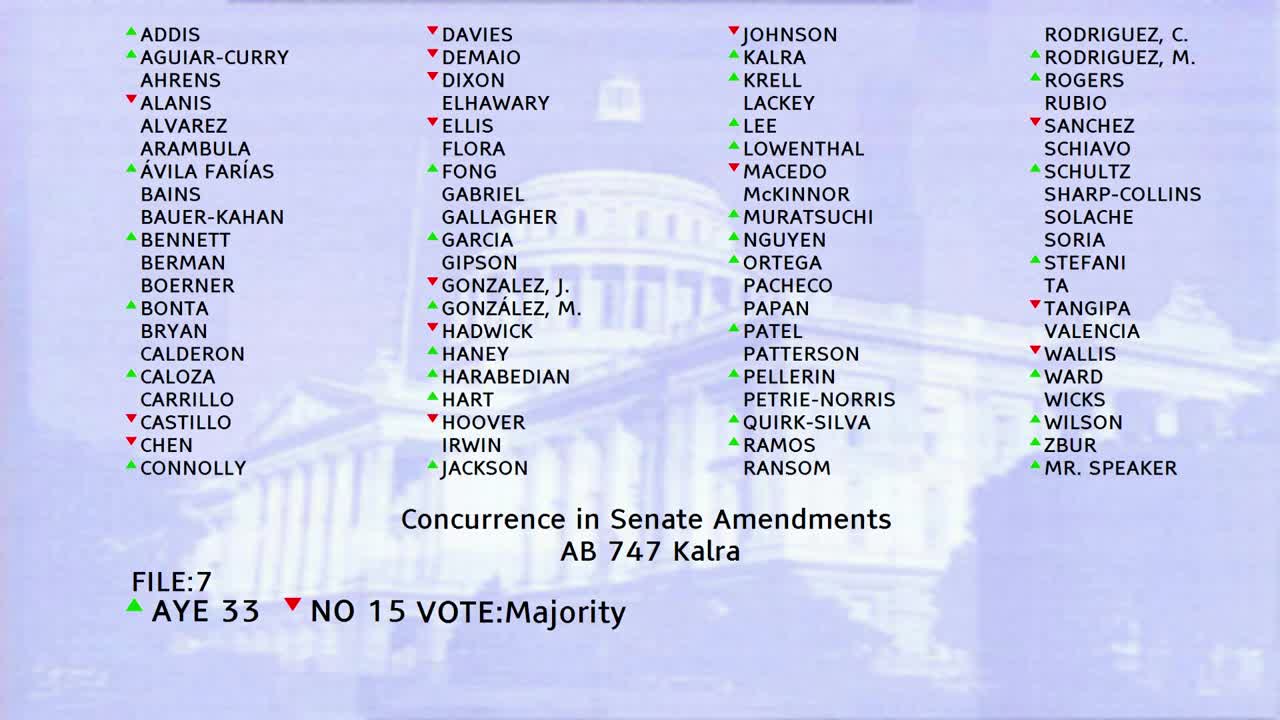 4MIN
Assembly Floor
 1MIN
Assembly Standing Committee on Labor and Employment
 4MIN
Assembly Floor
 2MIN
Senate Floor
 2MIN
Senate Standing Committee on Judiciary
 2MIN
Senate Standing Committee on Labor, Public Employment and Retirement


Bill Co-Author(s):