AB 431: Advanced Air Mobility Infrastructure Act.
- Session Year: 2025-2026
- House: Assembly
- Latest Version Date: 2026-09-27
Current Status:
Passed
(2026-09-27: Chaptered by Secretary of State - Chapter 503, Statutes of 2026.)
Introduced
In Committee
Awaiting First Chamber Vote
Passed First Chamber
In Committee
Awaiting Second Chamber Vote
Passed Second Chamber
Enacted
What does this bill do?
This bill requires the California Department of Transportation to add advanced air mobility — electric aircraft like eVTOLs and eCTOLs and their landing sites (vertiports) that carry people or cargo — to the state transportation plan and to set up a statewide working group of state agencies, local emergency offices, and industry to study infrastructure, technology, and job opportunities. It limits the rules to electric and powered‑lift aircraft meeting a weight or payload test and says it does not override federal aviation rules, local zoning, or airport operators’ authority.
The summary is provided by generative AI which can make mistakes. For original language, please view the details in the table below.
Existing law, the State Aeronautics Act, governs various matters relative to aviation in the state, and authorizes the Department of Transportation to adopt, administer, and enforce rules and regulations for the administration of the act.
This bill, the Advanced Air Mobility Infrastructure Act, would require the department, in coordination with specified agencies, to include advanced air mobility, as defined, in the next update to the California Transportation Plan prepared after January 1, 2027, and to establish a statewide working group to facilitate ongoing collaboration to explore Californias role as a leader in the development and implementation of advanced air mobility, as specified. The bill would prohibit its provisions from being construed to (1) interfere with or suspend the authority of the Federal Aviation Administration or any other federal department or agency, or state zoning laws or regulations, as specified, or (2) limit or interfere with the jurisdiction, authority, rights, or responsibilities of any airport sponsor or operator, as specified.
Existing law, the State Aeronautics Act, governs various matters relative to aviation in the state, and authorizes the Department of Transportation to adopt, administer, and enforce rules and regulations for the administration of the act. Existing law establishes the Advanced Air Mobility, Zero-Emission, and Electrification Aviation Advisory Panel to assess the feasibility and readiness of existing infrastructure to support a vertiport network to facilitate the development of advanced air mobility services, the development of a 3-year prioritized workplan for the state to advance advanced air mobility services, and pathways for promoting equity of access to advanced air mobility infrastructure, as specified. Existing law requires the department, not later than January 1, 2025, to report to the Legislature on the infrastructure feasibility and readiness study and the 3-year prioritized workplan.
This bill, the Advanced Air Mobility Infrastructure Act, would require the department to take certain actions related to advanced air mobility, as defined, including, among other things, developing a statewide plan, or updating the statewide aviation plan, to include vertiports, electric aviation charging, and the infrastructure needs of other advances in aviation technology, and designating a subject matter expert for advanced air mobility within the department, as specified. department, in coordination with specified agencies, to include advanced air mobility, as defined, in the next update to the California Transportation Plan prepared after January 1, 2027, and to establish a statewide working group to facilitate ongoing collaboration to explore Californias role as a leader in the development and implementation of advanced air mobility, as specified. The bill would prohibit its provisions from being construed to (1) interfere with or suspend the authority of the Federal Aviation Administration or any other federal department or agency, or state zoning laws or regulations, as specified, or (2) limit or interfere with the jurisdiction, authority, rights, or responsibilities of any airport sponsor or operator, as specified.
The bill would include findings that changes proposed by this bill address a matter of statewide concern rather than a municipal affair and, therefore, applies to all cities, including charter cities.Under existing law, a violation of the State Aeronautics Act is a crime.Because the above provisions would be part of the State Aeronautics Act, the bill would impose a state-mandated local program.The California Constitution requires the state to reimburse local agencies and school districts for certain costs mandated by the state. Statutory provisions establish procedures for making that reimbursement.This bill would provide that no reimbursement is required by this act for a specified reason.Existing law, the State Aeronautics Act, governs various matters relative to aviation in the state, and authorizes the Department of Transportation to adopt, administer, and enforce rules and regulations for the administration of the act. Existing law establishes the Advanced Air Mobility, Zero-Emission, and Electrification Aviation Advisory Panel to assess the feasibility and readiness of existing infrastructure to support a vertiport network to facilitate the development of advanced air mobility services, the development of a 3-year prioritized workplan for the state to advance advanced air mobility services, and pathways for promoting equity of access to advanced air mobility infrastructure, as specified. Existing law requires the department, not later than January 1, 2025, to report to the Legislature on the infrastructure feasibility and readiness study and the 3-year prioritized workplan.
This bill, the Advanced Air Mobility Infrastructure Act, would require the department to take certain actions related to advanced air mobility, as defined, including, among other things, developing a statewide plan, or updating the statewide aviation plan, to include vertiports, electric aviation charging, and the infrastructure needs of other advances in aviation technology, and designating a subject matter expert for advanced air mobility within the department, as specified. The bill would prohibit a political subdivision of the state, or an entity within a political subdivision of the state, from enacting a law, ordinance, or rule relating to advanced air mobility, the ownership of an advanced air mobility aircraft, or the aerial operation of an advanced air mobility aircraft, except as specified, and provides that the Advanced Air Mobility Infrastructure Act supersedes any law, ordinance, or rule enacted by a political subdivision of the state before July 1, 2025. its provisions from being construed to (1) interfere with or suspend the authority of the Federal Aviation Administration or any other federal department or agency, or state zoning laws or regulations, as specified, or (2) limit or interfere with the jurisdiction, authority, rights, or responsibilities of any airport sponsor or operator, as specified.
The bill would include findings that changes proposed by this bill address a matter of statewide concern rather than a municipal affair and, therefore, applies to all cities, including charter cities.
Under existing law, a violation of the State Aeronautics Act is a crime.
Because the above provisions would be part of the State Aeronautics Act, the bill would impose a state-mandated local program.
The California Constitution requires the state to reimburse local agencies and school districts for certain costs mandated by the state. Statutory provisions establish procedures for making that reimbursement.
This bill would provide that no reimbursement is required by this act for a specified reason.
Existing law, the State Aeronautics Act, governs various matters relative to aviation in the state, and authorizes the Department of Transportation to adopt, administer, and enforce rules and regulations for the administration of the act. Existing law establishes the Advanced Air Mobility, Zero-Emission, and Electrification Aviation Advisory Panel to assess the feasibility and readiness of existing infrastructure to support a vertiport network to facilitate the development of advanced air mobility services, the development of a 3-year prioritized workplan for the state to advance advanced air mobility services, and pathways for promoting equity of access to advanced air mobility infrastructure, as specified. Existing law requires the department, not later than January 1, 2025, to report to the Legislature on the infrastructure feasibility and readiness study and the 3-year prioritized workplan.
This bill, the Advanced Air Mobility Infrastructure Act, would require the department to take certain actions related to advanced air mobility, as defined, including, among other things, developing a statewide plan, or updating the statewide aviation plan, to include vertiports, electric aviation charging, and the infrastructure needs of other advances in aviation technology, and designating a subject matter expert for advanced air mobility within the department, as specified. The bill would prohibit a political subdivision of the state, or an entity within a political subdivision of the state, from enacting a law, ordinance, or rule relating to advanced air mobility, the ownership of an advanced air mobility aircraft, or the aerial operation of an advanced air mobility aircraft, except as specified, and provides that the Advanced Air Mobility Infrastructure Act supersedes any law, ordinance, or rule enacted by a political subdivision of the state before July 1, 2025.
The bill would include findings that changes proposed by this bill address a matter of statewide concern rather than a municipal affair and, therefore, applies to all cities, including charter cities.
Under existing law, a violation of the State Aeronautics Act is a crime.
Because the above provisions would be part of the State Aeronautics Act, the bill would impose a state-mandated local program.
The California Constitution requires the state to reimburse local agencies and school districts for certain costs mandated by the state. Statutory provisions establish procedures for making that reimbursement.
This bill would provide that no reimbursement is required by this act for a specified reason.
The Legislature finds and declares all of the following:
(a)If developed and deployed at scale, the development of advanced air mobility can provide economic and environmental benefits to the state and the nation.
(b)The use of advanced air mobility can aid in Californias progress toward its statutory renewable energy and climate mandates.
(c)Diversity in technologies lowers overall costs. Advanced air mobility technology adds diversity to the states transportation portfolio.
(d)The development of advanced air mobility presents an opportunity to California by providing a tremendous opportunity for economic growth, including the development and preservation of a skilled and trained construction workforce to carry out projects and long-term job creation, all while improving mobility and accessibility for all Californians.
(e)Advanced air mobility improves multimodal transportation and access to destinations by providing transportation opportunities that improve access to jobs, services, educational opportunities, and emergency and medical services.
(f)Advanced air mobility will allow all Californians to traverse densely populated areas in a matter of minutes instead of hours, expanding accessibility while reducing traffic congestion on our roadways.
(g)Investment in advanced air mobility can offer career pathways and workforce training in clean energy development. Advanced air mobility will provide additional blue collar industrial work opportunities and support apprenticeship opportunities for a diverse labor pool.
SEC. 2.Chapter 9 (commencing with Section 21720) is added to Part 1 of Division 9 of the Public Utilities Code, to read:9.Advanced Air Mobility Infrastructure Act21720.This chapter shall be known, and may be cited, as the Advanced Air Mobility Infrastructure Act.
21721.For purposes of this chapter, the following definitions apply:
(a)Advanced air mobility means an air transportation system primarily using electric aircraft, including eVTOL and eCTOL aircraft, to carry passengers, cargo, or provide services in an urban or regional setting, with a gross takeoff weight of 300 pounds or more.
(b)eCTOL means an electric conventional takeoff and landing aircraft.
(c)eVTOL means an electric vertical takeoff and landing aircraft.
(d)Powered-lift aircraft means the same as that term is defined in Part 1 (commencing with Section 1.1) of Subchapter A of Chapter I of Title 14 of the Code of Federal Regulations.
(e)Vertiport means an area of land, water, or a structure used or intended to be used for the landing or takeoff of powered-lift aircraft and includes associated buildings and facilities.
21722.This chapter only applies to electric aircraft, including eVTOL and eCTOL aircraft, and powered-lift aircraft that satisfy either of the following criteria:
(a)Have a gross takeoff weight of 300 pounds or more.
(b)Are capable of carrying humans or an equivalent amount of cargo.
21723.(a)The department, in coordination with the Transportation Agency, shall include advanced air mobility in the next update to the California Transportation Plan prepared after January 1, 2027.
(b)The department, in coordination with the Transportation Agency, the Energy Commission, the State Air Resources Board, the Governors Office of Business and Economic Development, and the Office of Land Use and Climate Innovation, shall establish a statewide working group to facilitate ongoing collaboration among state agencies, local offices of emergency management, and industry stakeholders to explore Californias role as a leader in the development and implementation of advanced air mobility, supporting technology, and economic development, including job creation.
21724.(a)This chapter shall not be construed to interfere with or suspend either of the following:
(1)The authority of the Federal Aviation Administration, or any other federal department or agency, including, but not limited to, federal authority related to the governance of federal airspace, air traffic control, and aviation safety, or any other federal regulations, laws, or policies governing the operation of airports or air transportation.
(2)State zoning laws or regulations, including, but not limited to, zoning laws or regulations related to land use, development, or the construction of facilities within the jurisdiction of the local zoning authority.
(b)This chapter shall not be construed to limit or interfere with the jurisdiction, authority, rights, or responsibilities of any airport sponsor or airport operator with respect to the operation, maintenance, management, or capital development of any airport within the state.
The Legislature finds and declares all of the following:
(a)If developed and deployed at scale, the development of advanced air mobility can provide economic and environmental benefits to the state and the nation.
(b)The use of advanced air mobility can aid in Californias progress toward its statutory renewable energy and climate mandates.
(c)Diversity in technologies lowers overall costs. Advanced air mobility technology adds diversity to the states transportation portfolio.
(d)The development of advanced air mobility presents an opportunity to California by providing a tremendous opportunity for economic growth, including the development and preservation of a skilled and trained construction workforce to carry out projects and long-term job creation, all while improving mobility and accessibility for all Californians.
(e)Advanced air mobility improves multimodal transportation and access to destinations by providing transportation opportunities that improve access to jobs, services, educational opportunities, and emergency and medical services.
(f)Advanced air mobility will allow all Californians to traverse densely populated areas in a matter of minutes instead of hours, expanding accessibility while reducing traffic congestion on our roadways.
(g)Investment in advanced air mobility can offer career pathways and workforce training in clean energy development. Advanced air mobility will provide additional blue collar industrial work opportunities and support apprenticeship opportunities for a diverse labor pool.
SEC. 2.Chapter 9 (commencing with Section 21720) is added to Part 1 of Division 9 of the Public Utilities Code, to read:9.Advanced Air Mobility Infrastructure Act21720.This chapter shall be known, and may be cited, as the Advanced Air Mobility Infrastructure Act.
21721.For purposes of this chapter, the following definitions apply:
(a)Advanced air mobility means an air transportation system primarily using electric aircraft, including eVTOL and eCTOL aircraft, to carry passengers, cargo, or provide services in an urban or regional setting, with a gross takeoff weight of 300 pounds or more.
(b)eCTOL means an electric conventional takeoff and landing aircraft.
(c)eVTOL means an electric vertical takeoff and landing aircraft.
(d)Powered-lift aircraft means the same as that term is defined in Part 1 (commencing with Section 1.1) of Subchapter A of Chapter I of Title 14 of the Code of Federal Regulations.
(e)Vertiport means an area of land, water, or a structure used or intended to be used for the landing or takeoff of powered-lift aircraft and includes associated buildings and facilities.
21722.This chapter only applies to electric aircraft, including eVTOL and eCTOL aircraft, and powered-lift aircraft that satisfy either of the following criteria:
(a)Have a gross takeoff weight of 300 pounds or more.
(b)Are capable of carrying humans or an equivalent amount of cargo.
21723.The department shall do all of the following:(a)Develop a statewide plan, or update the statewide aviation plan, to include vertiports, electric aviation charging, and the infrastructure needs of other advances in aviation technology in the statewide aviation plan and as appropriate in the statewide work plan.(b)Designate a subject matter expert for advanced air mobility within the department as a resource for local and regional jurisdictions navigating advances in aviation technology, including electric powered-lift aircraft and electric aviation.(c)Lead a statewide education campaign for local and regional decisionmakers to educate them on the benefits of electric powered-lift aircraft and advancements in aviation technology.(d)Provide local and regional jurisdictions with guidance, including best practices, and technical resources to support uniform planning and zoning language across the state related to powered-lift aircraft, electric aviation, and other advances in aviation technology.21723.(a)The department, in coordination with the Transportation Agency, shall include advanced air mobility in the next update to the California Transportation Plan prepared after January 1, 2027.
(b)The department, in coordination with the Transportation Agency, the Energy Commission, the State Air Resources Board, the Governors Office of Business and Economic Development, and the Office of Land Use and Climate Innovation, shall establish a statewide working group to facilitate ongoing collaboration among state agencies, local offices of emergency management, and industry stakeholders to explore Californias role as a leader in the development and implementation of advanced air mobility, supporting technology, and economic development, including job creation.
21724.(a)This chapter shall not be construed to interfere with or suspend either of the following:
(1)The authority of the Federal Aviation Administration, or any other federal department or agency, including, but not limited to, federal authority related to the governance of federal airspace, air traffic control, and aviation safety, or any other federal regulations, laws, or policies governing the operation of airports or air transportation.
(2)State zoning laws or regulations, including, but not limited to, zoning laws or regulations related to land use, development, or the construction of facilities within the jurisdiction of the local zoning authority.
(b)This chapter shall not be construed to limit or interfere with the jurisdiction, authority, rights, or responsibilities of any airport sponsor or airport operator with respect to the operation, maintenance, management, or capital development of any airport within the state.
SEC. 3.The Legislature finds and declares that Section 2 of this act adding Chapter 9 (commencing with Section 21720) to Part 1 of Division 9 of the Public Utilities Code addresses a matter of statewide concern rather than a municipal affair as that term is used in Section 5 of Article XI of the California Constitution. Therefore, Section 2 of this act applies to all cities, including charter cities.SEC. 4.No reimbursement is required by this act pursuant to Section 6 of Article XIIIB of the California Constitution because the only costs that may be incurred by a local agency or school district will be incurred because this act creates a new crime or infraction, eliminates a crime or infraction, or changes the penalty for a crime or infraction, within the meaning of Section 17556 of the Government Code, or changes the definition of a crime within the meaning of Section 6 of Article XIIIB of the California Constitution.The Legislature finds and declares all of the following:
(a)If developed and deployed at scale, the development of advanced air mobility can provide economic and environmental benefits to the state and the nation.
(b)The use of advanced air mobility can aid in Californias progress toward its statutory renewable energy and climate mandates.
(c)Diversity in technologies lowers overall costs. Advanced air mobility technology adds diversity to the states transportation portfolio.
(d)The development of advanced air mobility presents an opportunity to California by providing a tremendous opportunity for economic growth, including the development and preservation of a skilled and trained construction workforce to carry out projects and long-term job creation, all while improving mobility and accessibility for all Californians.
(e)Advanced air mobility improves multimodal transportation and access to destinations by providing transportation opportunities that improve access to jobs, services, educational opportunities, and emergency and medical services.
(f)Advanced air mobility will allow all Californians to traverse densely populated areas in a matter of minutes instead of hours, expanding accessibility while reducing traffic congestion on our roadways.
(g)Investment in advanced air mobility can offer career pathways and workforce training in clean energy development. Advanced air mobility will provide additional blue collar industrial work opportunities and support apprenticeship opportunities for a diverse labor pool.
SEC. 2.Chapter 9 (commencing with Section 21720) is added to Part 1 of Division 9 of the Public Utilities Code, to read:9.Advanced Air Mobility Infrastructure Act21720.This chapter shall be known, and may be cited, as the Advanced Air Mobility Infrastructure Act.
21721.For purposes of this chapter, the following definitions apply:
(a)Advanced air mobility means an air transportation system primarily using electric aircraft, including eVTOL and eCTOL aircraft, to carry passengers, cargo, or provide services in an urban or regional setting, with a gross takeoff weight of 300 pounds or more.
(b)eCTOL means an electric conventional takeoff and landing aircraft.
(c)eVTOL means an electric vertical takeoff and landing aircraft.
(d)Powered-lift aircraft means a heavier-than-air aircraft capable of vertical takeoff, vertical landing, and low-speed flight that depends principally on engine-driven lift devices or engine thrust for lift during these flight regimes and on nonrotating airfoils for lift during horizontal flight. the same as that term is defined in Part 1 (commencing with Section 1.1) of Subchapter A of Chapter I of Title 14 of the Code of Federal Regulations.
(e)Vertiport means an area of land, water, or a structure used or intended to be used for the landing or takeoff of powered-lift aircraft and includes associated buildings and facilities.
21722.This chapter only applies to electric aircraft, including eVTOL and eCTOL aircraft, and powered-lift aircraft that satisfy either of the following criteria:
(a)Have a gross takeoff weight of 300 pounds or more.
(b)Are capable of carrying humans or an equivalent amount of cargo.
21723.The department shall do all of the following:
(a)Develop a statewide plan, or update the statewide aviation plan, to include vertiports, electric aviation charging, and the infrastructure needs of other advances in aviation technology in the statewide aviation plan and as appropriate in the statewide work plan.
(b)Designate a subject matter expert for advanced air mobility within the department as a resource for local and regional jurisdictions navigating advances in aviation technology, including electric powered-lift aircraft and electric aviation.
(c)Lead a statewide education campaign for local and regional decisionmakers to educate them on the benefits of electric powered-lift aircraft and advancements in aviation technology.
(d)Provide local and regional jurisdictions with a guidebook guidance, including best practices, and technical resources to support uniform planning and zoning language across the state related to powered-lift aircraft, electric aviation, and other advances in aviation technology.
21724.(a)Except as provided in subdivision (b), a political subdivision of the state, or an entity within a political subdivision of the state, shall not enact a law, ordinance, or rule relating to advanced air mobility, the ownership of an advanced air mobility aircraft, or the aerial operation of an advanced air mobility aircraft.(b)If the political subdivision or entity is an airport operator, it may enact a law, rule, or ordinance to govern either of the following:(1)The operation of an advanced air mobility aircraft within the geographic boundaries of the airport over which the airport operator has authority.(2)The takeoff or landing of an advanced air mobility aircraft at the airport over which the airport operator has authority. (c)This chapter supersedes any law, ordinance, or rule enacted by a political subdivision of the state before July 1, 2025. 21724.(a)This chapter shall not be construed to interfere with or suspend either of the following:
(1)The authority of the Federal Aviation Administration, or any other federal department or agency, including, but not limited to, federal authority related to the governance of federal airspace, air traffic control, and aviation safety, or any other federal regulations, laws, or policies governing the operation of airports or air transportation.
(2)State zoning laws or regulations, including, but not limited to, zoning laws or regulations related to land use, development, or the construction of facilities within the jurisdiction of the local zoning authority.
(b)This chapter shall not be construed to limit or interfere with the jurisdiction, authority, rights, or responsibilities of any airport sponsor or airport operator with respect to the operation, maintenance, management, or capital development of any airport within the state.
SEC. 3.The Legislature finds and declares that Section 2 of this act adding Chapter 9 (commencing with Section 21720) to Part 1 of Division 9 of the Public Utilities Code address addresses a matter of statewide concern rather than a municipal affair as that term is used in Section 5 of Article XI of the California Constitution. Therefore, Section 2 of this act applies to all cities, including charter cities.
SEC. 4.No reimbursement is required by this act pursuant to Section 6 of Article XIIIB of the California Constitution because the only costs that may be incurred by a local agency or school district will be incurred because this act creates a new crime or infraction, eliminates a crime or infraction, or changes the penalty for a crime or infraction, within the meaning of Section 17556 of the Government Code, or changes the definition of a crime within the meaning of Section 6 of Article XIIIB of the California Constitution.
The Legislature finds and declares all of the following:
(a)If developed and deployed at scale, the development of advanced air mobility can provide economic and environmental benefits to the state and the nation.
(b)The use of advanced air mobility can aid in Californias progress toward its statutory renewable energy and climate mandates.
(c)Diversity in technologies lowers overall costs. Advanced air mobility technology adds diversity to the states transportation portfolio.
(d)The development of advanced air mobility presents an opportunity to California by providing a tremendous opportunity for economic growth, including the development and preservation of a skilled and trained construction workforce to carry out projects and long-term job creation, all while improving mobility and accessibility for all Californians.
(e)Advanced air mobility improves multimodal transportation and access to destinations by providing transportation opportunities that improve access to jobs, services, educational opportunities, and emergency and medical services.
(f)Advanced air mobility will allow all Californians to traverse densely populated areas in a matter of minutes instead of hours, expanding accessibility while reducing traffic congestion on our roadways.
(g)Investment in advanced air mobility can offer career pathways and workforce training in clean energy development. Advanced air mobility will provide additional blue collar industrial work opportunities and support apprenticeship opportunities for a diverse labor pool.
SEC. 2.Chapter 9 (commencing with Section 21720) is added to Part 1 of Division 9 of the Public Utilities Code, to read:9.Advanced Air Mobility Infrastructure Act21720.This chapter shall be known, and may be cited, as the Advanced Air Mobility Infrastructure Act.
21721.For purposes of this chapter, the following definitions apply:
(a)Advanced air mobility means an air transportation system primarily using electric aircraft, including eVTOL and eCTOL aircraft, to carry passengers, cargo, or provide services in an urban or regional setting, with a gross takeoff weight of 300 pounds or more.
(b)eCTOL means an electric conventional takeoff and landing aircraft.
(c)eVTOL means an electric vertical takeoff and landing aircraft.
(d)Powered-lift aircraft means a heavier-than-air aircraft capable of vertical takeoff, vertical landing, and low-speed flight that depends principally on engine-driven lift devices or engine thrust for lift during these flight regimes and on nonrotating airfoils for lift during horizontal flight.
(e)Vertiport means an area of land, water, or a structure used or intended to be used for the landing or takeoff of powered-lift aircraft and includes associated buildings and facilities.
21722.This chapter only applies to electric aircraft, including eVTOL and eCTOL aircraft, and powered-lift aircraft that satisfy either of the following criteria:
(a)Have a gross takeoff weight of 300 pounds or more.
(b)Are capable of carrying humans or an equivalent amount of cargo.
21723.The department shall do all of the following:
(a)Develop a statewide plan, or update the statewide aviation plan, to include vertiports, electric aviation charging, and the infrastructure needs of other advances in aviation technology in the statewide aviation plan and as appropriate in the statewide work plan.
(b)Designate a subject matter expert for advanced air mobility within the department as a resource for local and regional jurisdictions navigating advances in aviation technology, including electric powered-lift aircraft and electric aviation.
(c)Lead a statewide education campaign for local and regional decisionmakers to educate them on the benefits of electric powered-lift aircraft and advancements in aviation technology.
(d)Provide local and regional jurisdictions with a guidebook and technical resources to support uniform planning and zoning language across the state related to powered-lift aircraft, electric aviation, and other advances in aviation technology.
21724.(a)Except as provided in subdivision (b), a political subdivision of the state, or an entity within a political subdivision of the state, shall not enact a law, ordinance, or rule relating to advanced air mobility, the ownership of an advanced air mobility aircraft, or the aerial operation of an advanced air mobility aircraft.
(b)If the political subdivision or entity is an airport operator, it may enact a law, rule, or ordinance to govern either of the following:
(1)The operation of an advanced air mobility aircraft within the geographic boundaries of the airport over which the airport operator has authority.
(2)The takeoff or landing of an advanced air mobility aircraft at the airport over which the airport operator has authority.
(c)This chapter supersedes any law, ordinance, or rule enacted by a political subdivision of the state before July 1, 2025.
SEC. 3.The Legislature finds and declares that Section 2 of this act adding Chapter 9 (commencing with Section 21720) to Part 1 of Division 9 of the Public Utilities Code address a matter of statewide concern rather than a municipal affair as that term is used in Section 5 of Article XI of the California Constitution. Therefore, Section 2 of this act applies to all cities, including charter cities.
SEC. 4.No reimbursement is required by this act pursuant to Section 6 of Article XIIIB of the California Constitution because the only costs that may be incurred by a local agency or school district will be incurred because this act creates a new crime or infraction, eliminates a crime or infraction, or changes the penalty for a crime or infraction, within the meaning of Section 17556 of the Government Code, or changes the definition of a crime within the meaning of Section 6 of Article XIIIB of the California Constitution.
|
Date
|
Status
|
|---|---|
| Sep 27, 2026 | Chaptered by Secretary of State - Chapter 503, Statutes of 2026. |
| Sep 27, 2026 | Approved by the Governor. |
| Aug 28, 2026 | Enrolled and presented to the Governor at 3:30 p.m. |
| Aug 24, 2026 | Senate amendments concurred in. To Engrossing and Enrolling. (Ayes 78. Noes 0.). |
| Aug 24, 2026 | Senate amendments concurred in. To Engrossing and Enrolling. (Ayes 78. Noes 0. Page 6398.). |
| Aug 24, 2026 | Senate amendments concurred in. To Engrossing and Enrolling. |
| Aug 20, 2026 | In Assembly. Concurrence in Senate amendments pending. |
| Aug 20, 2026 | Read third time. Passed. Ordered to the Assembly. (Ayes 39. Noes 0.). |
| Aug 20, 2026 | Read third time. Passed. Ordered to the Assembly. (Ayes 39. Noes 0. Page 5587.). |
| Aug 18, 2026 | Ordered to special consent calendar. |
| Aug 13, 2026 | Read second time. Ordered to third reading. |
| Aug 13, 2026 | From committee: Do pass. (Ayes 7. Noes 0.) (August 13). |
| Jun 22, 2026 | In committee: Referred to APPR. suspense file. |
| Jun 9, 2026 | From committee: Do pass and re-refer to Com. on APPR. with recommendation: To Consent Calendar. (Ayes 13. Noes 0.) (June 9). Re-referred to Com. on APPR. |
| May 27, 2026 | From committee chair, with author's amendments: Amend, and re-refer to committee. Read second time, amended, and re-referred to Com. on TRANS. |
| Jul 8, 2025 | In committee: Set, first hearing. Hearing canceled at the request of author. |
| Jun 11, 2025 | Referred to Com. on TRANS. |
| Jun 3, 2025 | In Senate. Read first time. To Com. on RLS. for assignment. |
| Jun 2, 2025 | Read third time. Passed. Ordered to the Senate. (Ayes 79. Noes 0. Page 1828.) |
| May 27, 2025 | Read second time. Ordered to third reading. |
| May 23, 2025 | From committee: Do pass. (Ayes 14. Noes 0.) (May 23). |
| May 14, 2025 | In committee: Set, first hearing. Referred to suspense file. |
| May 1, 2025 | Re-referred to Com. on APPR. |
| Apr 30, 2025 | Read second time and amended. |
| Apr 29, 2025 | From committee: Amend, and do pass as amended and re-refer to Com. on APPR. (Ayes 15. Noes 0.) (April 28). |
| Feb 18, 2025 | Referred to Com. on TRANS. |
| Feb 6, 2025 | From printer. May be heard in committee March 8. |
| Feb 5, 2025 | Read first time. To print. |
|
Date
|
Description
|
Location
|
Votes
|
|
|---|---|---|---|---|
| Aug 24, 2026 | AB 431 Wilson Concurrence in Senate Amendments | Assembly Floor |
Passed |
|
| Aug 20, 2026 | Special Consent AB431 Wilson et al. By Caballero | Senate Floor |
Passed |
|
| Aug 13, 2026 | Do pass | Senate Standing Committee on Appropriations |
Passed |
|
| Jun 22, 2026 | Placed on suspense file | Senate Standing Committee on Appropriations |
Passed |
|
| Jun 9, 2026 | Do pass, but first be re-referred to the Committee on [Appropriations] with the recommendation: To Consent Calendar | Senate Standing Committee on Transportation |
Passed |
|
| Jun 2, 2025 | AB 431 Wilson Assembly Third Reading | Assembly Floor |
Passed |
|
| May 23, 2025 | Do pass. | Assembly Standing Committee on Appropriations |
Passed |
|
| Apr 28, 2025 | Do pass as amended and be re-referred to the Committee on [Appropriations] | Assembly Standing Committee on Transportation |
Passed |
This list shows positions taken on this bill by organizations on the date displayed, which is linked to the original source.
Positions by individuals are not included.
|
Organization
|
Position
|
Date
|
|---|---|---|
| Aerospace and Defense Alliance of California | ** Support | |
| Airlines for America | ** Support | |
| Archer Aviation | ** Support | |
| Association for Uncrewed Vehicle Systems International | ** Support | |
| Association of California Airports | ** Support | |
| California Airports Council | ** Support | |
| California Chamber Of Commerce | ** Support | |
| California Chapter of Association of Uncrewed Vehicle Systems International | ** Support | |
| California Chapter of Association of Uncrewed Vehicle Systems International (AUVSI) | ** Support | |
| California Manufacturers And Technology Association | ** Support | |
| City of Long Beach | ** Support | |
| City of Newport Beach | ** Against | |
| County of Monterey | ** Support | |
| County of Ventura | ** Support | |
| El Segundo Chamber of Commerce | ** Support | |
| Joby Aero Inc | ** Support | |
| Joby Aero Inc. | ** Support | |
| Joby Aviation | ** Support | |
| Long Beach Area Chamber of Commerce | ** Support | |
| Long Beach; City of | ** Support | |
| Monterey Bay Economic Partnership | ** Support | |
| Orange County Business Council | ** Support | |
| University of California | ** Support | |
| VALLEY INDUSTRY AND COMMERCE ASSOCIATION | ** Support | |
| Vertiports Aviation Atlantic | ** Support | |
| Wisk | ** Support | |
| Wisk Aero (Sponsor) | ** Support |
CONCURRENCE IN SENATE AMENDMENTS
CSA1 Bill Id:AB 431
Author:(Wilson)
As Amended Ver:May 27, 2026
Majority vote
SUMMARY
Requires the California Department of Transportation (Caltrans) to include advanced air mobility (AAM) in the next update to the California Transportation Plan prepared after January 1, 2027 and requires Caltrans to establish a statewide working group to explore California's role as a leader in the development and implementation of advanced air mobility.
Senate Amendments
- Delete requirements that Caltrans:
- Include AAM infrastructure issues in the statewide aviation plan;
- Designate an AAM subject matter expert as a resource for local and regional jurisdictions.
- Lead a statewide education campaign for local and regional decisionmakers on the benefits of electric powered-lift aircraft.
- Provide local and regional jurisdictions with guidance, including best practices, and technical resources to support uniform planning and zoning.
- Delete legislative findings and declarations.
- Requires Caltrans, in coordination with the California State Transportation Agency, to include AAM in the next update to the California Transportation Plan prepared after January 1, 2027.
- Requires Caltrans, in coordination with the California State Transportation Agency (CalSTA), the Energy Commission (CEC), the State Air Resources Board (CARB), the Governor's Office of Business and Economic Development (GOBiz), and the Office of Land Use and Climate Innovation (LCI), to establish a statewide working group to facilitate ongoing collaboration among state agencies, local offices of emergency management, and industry stakeholders to explore California's role as a leader in the development and implementation of advanced air mobility, supporting technology, and economic development, including job creation.
COMMENTS
The Federal Aviation Administration (FAA) defines AAM as a transportation system that transports people and property by air between two points using aircraft with advanced technologies, including electric aircraft or eVTOL aircraft, in both controlled and uncontrolled airspace. A new generation of eVTOL aircraft has the potential to enhance urban and regional aviation with a smaller carbon footprint. Manufacturers, technology companies, and transportation providers envision the use of cleaner, quieter electric aircraft to provide cost-effective intra-city, inter-city, and regional air travel in the nation's most congested areas. In fact, different prototype electric aircraft are already under development around the world, and some have begun test flights.
Current AAM efforts. Many companies developing AAM technology are based in California (e.g. Archer Aviation, Joby, Wisk, Overair, Kittyhawk). In a 2023 report, California State University Long Beach found that a six vertiport network in the Los Angeles-Orange County region could generate 2,133 jobs during construction and 943 jobs annually once operational. The study projects the vertiport network would annually generate $173.3 million in expenditures and deliver $90.3 million in labor income.
The report notes that Pyka, an autonomous electric aircraft manufacturer based in Alameda, plans to invest more than $9 million to expand operations, creating over 130 new jobs, and Joby, an electric aircraft manufacturer, plans to invest more than $40 million to expand operations in Santa Cruz and Marina, creating over 700 new jobs. Governor Newsom highlighted both companies in his February 2025 economic blueprint. Other states, like Utah, Arkansas, Michigan, Texas and Ohio have begun to update their regulatory framework to accommodate AAM.
Federal initiatives span high-level strategic roadmaps, targeted testing programs, infrastructure funding, and legislative modernizations. In December 2025, the U.S. Department of Transportation released an Advanced Air Mobility National Strategy, a whole-of-government framework outlining how the U.S. plans to integrate AAM aircraft, including eVTOL and other powered-lift vehicles, into the national transportation system over the next decade. Other countries, including Canada and Japan, as well as the European Union, are similarly focused.
Caltrans' Aeronautics Division. This division within Caltrans oversees a diverse suite of airport-related issues, including airport noise, heliport permits, land use planning, maps and resources, and hospital heliports, and AAM.
It also publishes the California Aviation System Plan (CASP), which aims to preserve, enhance, and guide the development of the state's aviation infrastructure. It ensures airports operate safely, remain connected to the multimodal network, and foster sustainable economic growth. Though several years old, CASP 2020 recognizes AAM and notes that aircraft manufacturers envision the use of electric aircraft to provide cost-effective intra-city, inter-city, and regional air travel in the nation's most congested areas including Los Angeles and San Francisco. It finds that financial and business opportunities exist, but there are significant technological, operational, and regulatory challenges including those involving public perception and acceptance. Several manufacturers of eVTOL vehicles have developed prototype aircraft to transport passengers within and between large metropolitan areas but none have achieved full FAA certification to offer commercial service.
The CASP 2020 report finds that "despite the strides made by aircraft manufactures to develop viable aircraft, (AAM) challenges remain as neither the physical infrastructure (e.g., takeoff and landing infrastructure, power infrastructure, etc.) nor the regulatory and policy framework have been developed to address UAM operation in urban areas."
CA Transportation Plan. While there is no shortage of capital, commercial interest and R&D efforts in the state, our regulatory framework currently lags more aggressive states like Texas, Florida, and Utah. SB 800 (Caballero), Chapter 416, Statutes of 2023, required Caltrans to establish the Advanced Air Mobility, Zero-Emission, and Electrification Aviation Advisory Panel to assess the feasibility and readiness of existing infrastructure, the development of a three-year prioritized workplan, and pathways for promoting equitable access to AAM infrastructure. SB 800 required Caltrans to report to the Legislature by January 1, 2025; while it has not yet done so, Caltrans released draft report last December. Some of its key findings include:
- California's existing airport system can support early AAM operations—nearly all public-use airports can theoretically handle STOL (short take-off and landing) and VTOL (vertical) aircraft, and any airport with a 3,000-foot runway can handle CTOL (conventional) aircraft. But existing facilities are often limited by location, size, energy capacity, airspace access, and hangar space.
- General aviation (GA) airports are already functioning as AAM hubs — companies such as Joby, Archer, and Wisk already use them for R&D, manufacturing, and testing. But the 191 GA airports get only a small fraction of the federal funding commercial airports receive, a significant constraint.
- Energy infrastructure is a major bottleneck: eVTOL charging will likely stress the state's power grid; coordination with the California Energy Commission is critical.
- Regarding a three-year a workplan, some of the recommendations include:
- Updating the State Aeronautics Act;
- Secure funding for airports and AAM deployment;
- Identify energy and infrastructure needs, and provide land use/environmental permitting guidance;
- Include AAM in the California Transportation Plan.
This bill addresses one of the above draft recommendations by requiring Caltrans include advanced air mobility in the next update to the California Transportation Plan (CTP), a statutorily required document which "outlines a vision for the future transportation system, establishes statewide priorities, and acts as a roadmap for Caltrans and its partner agencies to implement [its] recommendations."
Caltrans is required to update the CTP every five years, and the next update is anticipated this year; thus, AAM would not be included until the next update due in 2031. As a high-level strategic plan, the CTP often lacks the granular technical guidance needed to build physical assets like vertiports.
However, given its multimodal focus, including AAM in the CTP could help to ensure it is planned in an integrated way alongside highways, high-speed rail, and urban mass transit. It also better aligns AAM with the state's greenhouse gas reduction goals and equity priorities. Finally, inclusion in the CTP could better position AAM to compete for broad, intermodal infrastructure funds rather than small aviation grants.
According to the Author
"Advanced Air Mobility (AAM) is a new and innovative mode of transportation that will modernize the future of mobility for passengers and cargo by relying on underutilized aerial transit routes. Referred to by the Federal Aviation Administration (FAA) as a "new era of aviation," AAM utilizes a new type of aircraft known as electric vertical take-off and landing (eVTOL). eVTOL aircraft have a variety of applications including the transport of people, cargo, and medical services. While AAM represents a step toward the future there currently are no guiding principles on the implementation or rollout of AAM across California. AB 431 aims to establish those guiding principles setting California up for success in the future."
Arguments in Support
California Chapter of Association of Uncrewed Vehicle Systems International (AUVSI) writes, "AB 431 (Wilson) builds off SB 800 (Caballero, 2023) and establishes the groundwork for the successful introduction of AAM technology into California. Advanced Air Mobility (AAM) is a new and innovative mode of transportation that will modernize the future of mobility for passengers and cargo by relying on underutilized aerial transit routes."
Joby Aviation writes, "Currently, there is no set of clear, comprehensive, and concrete steps for the deployment and scaling of AAM in California. Although the FAA has the overarching authority over all airspace in the U.S., the California state government will have a key role in providing guidance to local municipalities, raising public awareness, and integrating necessary infrastructure."
Arguments in Opposition
Writing in opposition, the City of Newport Beach is concerned that this bill could be interpreted to preempt local regulation, including zoning requirements, of AAM projects, and requests clarifying amendments in this regard.
FISCAL COMMENTS
According to the Senate Appropriations Committee:
- Caltrans estimates ongoing costs of approximately $215,000 annually for 1.0 PY of staff workload to meet the requirements of this bill, including establishing an expanded statewide working group, collaborating with and facilitating communication among participating entities, researching ongoing developments in the evolving AAM sector, and developing expanded AAM information for inclusion in the CTP. (Aeronautics Account)
- Staff estimates that CalSTA, CEC, CARB, GO-Biz, and LCI would each incur minor to moderate ongoing costs to participate in activities related to the statewide working group. For example, LCI reports ongoing annual costs of approximately $61,500 (General Fund) for a partial PY of staff time to support the work needed to participate in the statewide working group. Staff assumes a similar level of workload for each of the other participating entities, resulting in total costs in the low hundreds of thousands of dollars in the aggregate. (General Fund, various special funds)
VOTES:
ASM TRANSPORTATION: 15-0-1
YES: Wilson, Davies, Ahrens, Carrillo, Harabedian, Hart, Hoover, Jackson, Lackey, Lowenthal, Macedo, Papan, Ransom, Rogers, Ward
ABS, ABST OR NV: Aguiar-Curry
ASM APPROPRIATIONS: 14-0-1
YES: Wicks, Arambula, Calderon, Caloza, Dixon, Elhawary, Fong, Mark González, Hart, Pacheco, Pellerin, Solache, Ta, Tangipa
ABS, ABST OR NV: Sanchez
ASSEMBLY FLOOR: 79-0-0
YES: Addis, Aguiar-Curry, Ahrens, Alanis, Alvarez, Arambula, Ávila Farías, Bains, Bauer-Kahan, Bennett, Berman, Boerner, Bonta, Bryan, Calderon, Caloza, Carrillo, Castillo, Chen, Connolly, Davies, DeMaio, Dixon, Elhawary, Ellis, Flora, Fong, Gabriel, Gallagher, Garcia, Gipson, Jeff Gonzalez, Mark González, Hadwick, Haney, Harabedian, Hart, Hoover, Irwin, Jackson, Kalra, Krell, Lackey, Lee, Lowenthal, Macedo, McKinnor, Muratsuchi, Nguyen, Ortega, Pacheco, Papan, Patel, Patterson, Pellerin, Petrie-Norris, Quirk-Silva, Ramos, Ransom, Celeste Rodriguez, Michelle Rodriguez, Rogers, Blanca Rubio, Sanchez, Schiavo, Schultz, Sharp-Collins, Solache, Soria, Stefani, Ta, Tangipa, Valencia, Wallis, Ward, Wicks, Wilson, Zbur, Rivas
UPDATED
VERSION: May 27, 2026
CONSULTANT: Dan Chia / TRANS. / (916) 319-2093 FN: 0003865
SENATE RULES COMMITTEE Office of Senate Floor Analyses (916) 651-4171 | AB 431 |
THIRD READING
Bill No: AB 431
Author: Wilson (D), et al.
Amended: 5/27/26 in Senate
Vote: 21
SENATE TRANSPORTATION COMMITTEE: 13-0, 6/9/26
AYES: Cortese, Strickland, Archuleta, Arreguín, Blakespear, Dahle, Gonzalez, Grayson, Menjivar, Richardson, Seyarto, Valladares, Wiener
SENATE APPROPRIATIONS COMMITTEE: 7-0, 8/13/26
AYES: Cervantes, Seyarto, Cabaldon, Dahle, Grayson, Richardson, Wahab
ASSEMBLY FLOOR: 79-0, 6/2/25 - See last page for vote
SUBJECT: Advanced Air Mobility Infrastructure Act
SOURCE: Author
DIGEST:
This bill requires the California Department of Transportation (Caltrans), in coordination with other state agencies, to establish a working group related to the implementation of Advanced Air Mobility (AAM) technology in California.
ANALYSIS:
Existing law:
- Establishes the State Aeronautics Act with the purposes of, among other things, encouraging the development of private flying and general use of air transportation, fostering and promoting safety in aeronautics, effecting uniformity of laws and regulations consistent with federal laws and regulations, providing for cooperation with federal authorities, and protecting people living in proximity of airports from noise. (Public Utilities Code (PUC) § 21001, 21002)
- Requires Caltrans to encourage, foster, and assist in the development of aeronautics in the state and encourage the establishment of airports and air navigation facilities. (PUC §21241)
- Authorizes Caltrans to draft and recommend necessary legislation to advance the interest of the state in aeronautics and to make and amend general or special rules, regulations, and procedures and establish minimum standards for aeronautics. (PUC §§21242, 21243)
This bill:
- Specifies the provisions of this bill only apply to electric aircraft, including electric vertical takeoff and landing (eVTOL) and electric conventional takeoff and landing (eCTOL) aircraft, and powered-lift aircraft that satisfy either of the following criteria:
- Have a gross takeoff weight of 300 pounds or more; and,
- Are capable of carrying humans or an equivalent amount of cargo.
- Requires Caltrans, in coordination with the California State Transportation Agency (CalSTA), to include AAM in the next update to the California Transportation Plan (CTP) after January 1, 2027.
- Requires Caltrans to establish a statewide working group to facilitate broad stakeholder engagement to explore California’s role in the development and implementation of AAM technology. Requires this to be done in coordination with CalSTA, the California Energy Commission (CEC), the California Air Resources Board (CARB), the Governor’s Office of Business and Economic Development (GO-Biz), and the Office of Land Use and Climate Innovation (LCI).
- Stipulates this bill shall not interfere with or suspend either of the following:
- The authority of the Federal Aviation Administration (FAA), or any other federal department or agency, as specified.
- State zoning laws or regulations, including, but not limited to, zoning laws or regulations related to land use, development, or the construction of facilities within the jurisdiction of the local zoning authority.
- The authority of the Federal Aviation Administration (FAA), or any other federal department or agency, as specified.
- Clarifies this bill shall not limit or interfere with the jurisdiction, authority, rights, or responsibilities of any airport sponsor or airport operator with respect to the operation, maintenance, management, or capital development of any airport within the state.
Comments
- Purpose of the bill. According to the author, “Advanced Air Mobility (AAM) is a new and innovative mode of transportation that will modernize the future of mobility for passengers and cargo by relying on underutilized aerial transit routes. Referred to by the Federal Aviation Administration (FAA) as a “new era of aviation,” AAM utilizes a new type of aircraft known as electric vertical take-off and landing (eVTOL). eVTOL aircraft have a variety of applications, including the transport of people, cargo, and medical services. While AAM represents a step toward the future, there currently are no guiding principles on the implementation or rollout of AAM across California. AB 431 aims to establish those guiding principles, setting California up for success in the future.
Currently, there is no set of clear, comprehensive, and concrete steps for the deployment and scaling of AAM in California. Although the FAA has the overarching authority over all airspace in the U.S., the California state government will have a key role in guiding local municipalities, raising public awareness, and integrating necessary infrastructure. AB 431 aims to build off of SB 800, which required the Department of Transportation to create an advisory panel and publish an infrastructure feasibility and readiness study on AAM.” - AAM in California. AAM is a generalized term that can refer to a range of different technologies. Usually, the term is understood to encompass new types of aircraft designs, new air transportation modes, zero-emission aircraft technology, and autonomous aircraft technology. Specifically, AAM services tend to be focused on aviation that can accommodate urban, suburban, and rural flights up to several hundred miles. Proposed AAM operations will serve passengers, logistics and goods delivery, aeromedical transportation and treatment, emergency response, disaster relief operations, and other professional and industrial activities. Overall, AAM incorporates several converging innovations, such as vertical takeoff/landing, electrification, automation, and the growth of app-based on-demand mobility services.
Many companies developing AAM are based in California, such as Archer Aviation, Joby, Wisk, Overair, and Kittyhawk. Although each company has a slightly different focus, they all generally aim to establish some form of air taxi service here in the state. For example, Joby is targeting eVTOL service, initially focused on bringing passengers from smaller, regional airports to major airports throughout California. As part of this effort, they are working towards having initial passenger service available in time for the 2028 Olympics. Wisk, which is a partnership between Boeing and Google, is following a similar track. They are currently testing a four-passenger eVOTL vehicle with a 90-mile range. However, unlike Joby, Wisk plans to start passenger operations with a fully autonomous vehicle.
Regardless of operational model, AAM is projected to have a major effect on California’s economy moving forward. For instance, a 2023 report from California State University Long Beach found that a six vertiport network in the Los Angeles-Orange County region could generate 2,133 jobs during construction and 943 jobs annually once operational. The study projects the vertiport network would annually generate $173.3 million in expenditures and deliver $90.3 million in labor income.
Due to this impact, California has already started taking steps towards supporting the AAM industry. For example, in 2023, GO-Biz awarded Joby a $9.8 million California Competes grant to support statewide expansions. Namely, the grant aimed to support the expansion of Joby’s manufacturing facilities in the state and to support further job creation at their existing offices in California. Similarly, in 2025 the California Jobs First Council, an initiative led by the Governor’s Regional Investment Initiative, awarded a $7.5 million grant to the Monterey Bay Economic Partnership to develop AAM flight corridors in the Central Coast.
Legislatively, in 2024 the Legislature passed, and Governor Newsom signed into law, SB 800 (Caballero, Chapter 416, Statutes of 2024), which required Caltrans to establish the Advance Air Mobility and Aviation Electrification Advisory Panel (Advisory Panel), to assess infrastructure readiness, prepare a three-year workplan, and assess pathways to equity of access for AAM. Specifically, the Advisory Panel was required to assess (1) the feasibility and readiness of existing infrastructure in the state to support a vertiport network to facilitate the development of AAM services; (2) the development of a three-year prioritized workplan that maps out medium-term state activities necessary for the state to advance AAM services for Californians; and (3) pathways for promoting equity of access to advanced air mobility infrastructure to ensure open access and prohibit the monopolization of advanced air mobility infrastructure ownership and operations.
The Advisory Panel consisted of representatives from CARB, the Governor’s Office of Planning and Research, the general aviation industry, commercial airports, local governments, and the AAM industry. Caltrans was required to issue a report to the Legislature by January 1, 2025, on the infrastructure feasibility and the three-year workplan. A draft version of that report was released in December 2025. - AAM and Caltrans. While FAA has jurisdiction over the National Airspace System, Caltrans’ Division of Aeronautics is responsible for promoting aviation safety and ensuring the efficient operation of California's airports. They oversee airport permitting, conduct safety and compliance inspections, and provide guidance on aviation-related matters, including AAM. The division also develops the California Aviation System Plan (CASP), which is intended to better align aviation planning from the perspectives of both FAA and Caltrans to demonstrate how aviation is an integral part of California’s multimodal transportation system.
CASP 2020 considers aviation’s capabilities and specifies airport roles and needs. Notably, CASP 2020 also includes an analysis of AAM, finding that financial and business opportunities exist, but that significant technological, operational, and regulatory challenges exist. These primarily include issues involving public perception and acceptance. - Next steps for AAM in California. In December 2025, Caltrans released the draft version of the report mandated by SB 800. The Advanced Air Mobility: Infrastructure Readiness and Three-Year Implementation Work Plan provided an analysis of AAM readiness in California and provided a number of recommendations for advancing AAM in California.
AB 431 seeks to take the first step towards implementing the recommendations included in this report. Specifically, AB 431 implements two of these recommendations: (1) Include AAM in the CTP, and (2) Facilitate ongoing collaboration among agency and industry stakeholders. The first of these can be done directly by Caltrans and CalSTA. However, as CTP is done every five years, and one is expected at the end of this year, this requirement will not take effect until the 2031 CTP. The second recommendation will be implemented by forming a working group comprised of Caltrans, CalSTA, CEC, CARB, GO‑Biz, and LCI. The goal of this working group will be to facilitate further cooperation between state agencies, local offices of emergency management, and industry stakeholders, with the ultimate goal of further advancing AAM development in California.
FISCAL EFFECT: Appropriation: No Fiscal Com.: Yes Local: No
According to the Senate Appropriations Committee:
- Caltrans estimates ongoing costs of approximately $215,000 annually for 1.0 PY of staff workload to meet the requirements of this bill, including establishing an expanded statewide working group, collaborating with and facilitating communication among participating entities, researching ongoing developments in the evolving AAM sector, and developing expanded AAM information for inclusion in the CTP. (Aeronautics Account)
- Staff estimates that CalSTA, CEC, CARB, GO-Biz, and LCI would each incur minor to moderate ongoing costs to participate in activities related to the statewide working group. For example, LCI reports ongoing annual costs of approximately $61,500 (General Fund) for a partial PY of staff time to support the work needed to participate in the statewide working group. Staff assumes a similar level of workload for each of the other participating entities, resulting in total costs in the low hundreds of thousands of dollars in the aggregate. (General Fund, various special funds)
SUPPORT: (Verified 8/13/26)
Aerospace and Defense Alliance of California
Airlines for America
Archer Aviation
Association for Uncrewed Vehicle Systems International
Association of California Airports
California Airports Council
California Chamber of Commerce
California Manufacturers and Technology Association
City of Long Beach
County of Monterey
County of Ventura
Joby Aero INC
Joby Aviation
Long Beach Area Chamber of Commerce
Long Beach; City of
Monterey Bay Economic Partnership
University of California
Valley Industry and Commerce Association
Vertiports Aviation Atlantic
Wisk
OPPOSITION: (Verified 8/13/26)
City of Newport Beach
ASSEMBLY FLOOR: 79-0, 6/2/25
AYES: Addis, Aguiar-Curry, Ahrens, Alanis, Alvarez, Arambula, Ávila Farías, Bains, Bauer-Kahan, Bennett, Berman, Boerner, Bonta, Bryan, Calderon, Caloza, Carrillo, Castillo, Chen, Connolly, Davies, DeMaio, Dixon, Elhawary, Ellis, Flora, Fong, Gabriel, Gallagher, Garcia, Gipson, Jeff Gonzalez, Mark González, Hadwick, Haney, Harabedian, Hart, Hoover, Irwin, Jackson, Kalra, Krell, Lackey, Lee, Lowenthal, Macedo, McKinnor, Muratsuchi, Nguyen, Ortega, Pacheco, Papan, Patel, Patterson, Pellerin, Petrie-Norris, Quirk-Silva, Ramos, Ransom, Celeste Rodriguez, Michelle Rodriguez, Rogers, Blanca Rubio, Sanchez, Schiavo, Schultz, Sharp-Collins, Solache, Soria, Stefani, Ta, Tangipa, Valencia, Wallis, Ward, Wicks, Wilson, Zbur, Rivas
Prepared by: Samuel Myers / TRANS. / (916) 651-4121
8/14/26 14:55:24
**** END ****
SENATE COMMITTEE ON
Senator Sabrina Cervantes, Chair
2025 - 2026 Regular Session
AB 431 (Wilson) - Advanced Air Mobility Infrastructure Act
Version: | Policy Vote: |
Urgency: | Mandate: |
Hearing Date: | Consultant: |
Bill Summary:
AB 431 would require the Department of Transportation (Caltrans) to coordinate with the Transportation Agency (CalSTA) to include “advanced air mobility” (AAM) in the next update to the California Transportation Plan (CTP). The bill would also require Caltrans, in coordination with specified state entities, to establish a statewide working group to facilitate collaboration in the development and implementation of AAM in California, as specified.
Fiscal Impact:
- Caltrans estimates ongoing costs of approximately $215,000 annually for 1.0 PY of staff workload to meet the requirements of this bill, including establishing an expanded statewide working group, collaborating with and facilitating communication among participating entities, researching ongoing developments in the evolving AAM sector, and developing expanded AAM information for inclusion in the CTP. (Aeronautics Account)
- Staff estimates that CalSTA, the Energy Commission (CEC), the State Air Resources Board (CARB), the Governor’s Office of Business and Economic Development (GO-Biz), and the Office of Land Use and Climate Innovation (LCI) would each incur minor to moderate ongoing costs to participate in activities related to the statewide working group. For example, LCI reports ongoing annual costs of approximately $61,500 (General Fund) for a partial PY of staff time to support the work needed to participate in the statewide working group. Staff assumes a similar level of workload for each of the other participating entities, resulting in total costs in the low hundreds of thousands of dollars in the aggregate. (General Fund, various special funds)
Background:
Existing law requires Caltrans to prepare a statewide, long-range transportation plan that describes the integrated multimodal transportation system necessary to meet specified greenhouse gas emission reduction targets. The CTP is updated every five years and must include a policy element that describes state policies and system performance objectives, a strategies element that synthesizes the regional transportation plans’ concepts and strategies, and a recommendations element that includes economic forecasts and recommendations to achieve the plan’s objectives. The CTP must consider all of the following subject areas for the movement of people and freight: (1) mobility and accessibility; (2) integration and connectivity; (3) efficient system management and operation; (4) existing system preservation; (5) safety and security; (6) economic development, including productivity and efficiency; (7) environmental protection and quality of life; and (8) environmental justice.
Existing law establishes a Division of Aeronautics within Caltrans to foster and promote safety in aeronautics and establish only those regulations that are necessary so that persons may engage in aeronautics with the least possible restriction consistent with the safety and rights of others. The Division of Aeronautics is primarily involved in the siting, planning, and inspection of public-use airports in the state. Existing law requires Caltrans, in consultation with the transportation planning agencies, to prepare a California Aviation System Plan (CASP) with elements that address specified areas including planning and capital improvements. Caltrans must biennially update the 10-year capital improvement element, and update the remaining elements every five years for adoption by the California Transportation Commission.
The most recent CASP, completed in 2020, includes sections on both electric aircraft and Urban Air Mobility, which is also referenced as Advanced Air Mobility, or AAM. The report notes that aircraft manufacturers envision the use of electric aircraft to provide cost-effective intra-city, inter-city, and regional air travel in the nation’s most congested areas, including Los Angeles and San Francisco. It further notes that financial and business opportunities exist, but there are significant technological, operational, and regulatory challenges including issues involving public perception and acceptance. The CASP 2020 report states that “despite the strides made by aircraft manufactures to develop viable aircraft, (AAM) challenges remain as neither the physical infrastructure (e.g., takeoff and landing infrastructure, power infrastructure, etc.) nor the regulatory and policy framework have been developed to address UAM operation in urban areas.” The 2026 CASP is currently under development. In 2025, an advisory committee was established to support the 2026 CASP development, and a draft of the 2026 CASP is expected to be available for public comment in late 2026.
The enactment of SB 800 (Caballero), Chap. 416/2024, required Caltrans to establish the Advance Air Mobility and Aviation Electrification Advisory Panel to assess the feasibility and readiness of existing infrastructure, develop a three-year prioritized workplan that maps out medium-term state activities necessary to advance AAM services, and identify pathways for promoting equity of access to AAM infrastructure. AB 800 required Caltrans to submit a report to the Legislature by January 1, 2025 on the infrastructure feasibility and readiness study and the three-year prioritized workplan. In December of 2025, Caltrans released a draft report entitled Advanced Air Mobility: Infrastructure Readiness and Three-Year Implementation Work Plan, which includes specified action items necessary to advance AAM, and included the following conclusion:
Collaborations between agencies and industry stakeholders will be an ongoing effort to pursue AAM development and achieve the broader goals of zero emission aviation. California's existing multimodal infrastructure offers numerous opportunities to support initial AAM operations. Some of California's airport facilities may be equipped to support emerging aircraft, including conventional takeoff, short takeoff and landing, and vertical takeoff and landing. Besides mobility and accessibility benefits, AAM is expected to provide lower emissions and quieter operations compared with other current travel alternatives. It also raises equity-based considerations such as accessibility to services, environmental and socioeconomic effects on nearby communities. State and local agencies will need to consider FAA direction and guidance as they review and update relevant laws, procedures, and land use approvals to safely implement AAM in their jurisdictions. More complex AAM operations and a broader AAM ecosystem will require collaboration among multiple state and local agencies to identify priorities, protect airspace and ground safety, navigate new site approvals, and address challenges associated with diverse funding sources for infrastructure maintenance and upgrades - including vertiport space and energy needs.
Proposed Law:
AB 431, the Advanced Air Mobility Infrastructure Act, would require Caltrans to coordinate with specified entities and include AAM in the next update to the CTP and to establish a statewide working group to facilitate ongoing collaboration in the development and implementation of AAM. Specifically, this bill would:
- Define “Advanced Air Mobility” as an air transportation system primarily using electric aircraft to carry passengers, cargo, or provide services in an urban or regional setting, with a gross takeoff weight of 300 pounds or more.
- Specify that the bill only applies to electric aircraft, including aircraft with both vertical and conventional takeoff and landing capabilities, and powered-lift aircraft that satisfy either of the following criteria:
- Have a gross weight of 300 pounds or more.
- Can carry humans or an equivalent amount of cargo.
- Require Caltrans, in coordination with CalSTA, to include AAM in the next update to the CTP prepared after January 1, 2027.
- Require Caltrans, in coordination with CalSTA, CEC, CARB, GO-Biz, and LCI, to establish a statewide working group to facilitate ongoing collaboration among state agencies, local offices of emergency management, and industry stakeholders to explore California’s role as a leader in the development and implementation of AAM, supporting technology, and economic development, including job creation.
- Specify that the bill shall not be construed to:
- Interfere with or suspend either: (1) the authority of the Federal Aviation Administration, or any other federal department or agency, or any other federal regulations, laws, or policies governing the operation of airports or air transportation; or (2) state zoning laws or regulation, as specified.
- Limit or interfere with the jurisdiction, authority, rights, or responsibilities of any airport sponsor or operator with respect to the operation, maintenance, management, or capital development of any airport within the state.
Related Legislation:
SB 800 (Caballero), Chap. 416/2023, required Caltrans to establish an Advanced Air Mobility, Zero-Emission, and Electrification Aviation Advisory Panel to assess the feasibility and readiness of existing infrastructure, the development of a 3-year prioritized workplan, and pathways for promoting equity of access to AAM infrastructure. The bill required Caltrans to submit a report to the Legislature regarding these issues by January 1, 2025.
Staff Comments:
This bill would implement several of the action items and recommendations from the draft SB 800 report’s three-year implementation work plan. Specifically, the report recommended that Caltrans and CalSTA integrate AAM into a future CTP update, and that Caltrans, CalSTA, LCI, Go-Biz, CARB, and the CEC establish a statewide AAM forum for broad collaboration among state agencies, OEMs, industry stakeholders, and others to pursue the state's ongoing efforts toward zero-emission aviation, including AAM. The forum could work together to explore California's role as a leader in the development and implementation of AAM, supporting technology, and economic development, including job creation. In addition to creating a specific forum, the report recommends that CalSTA and Caltrans should promote participation in existing interagency efforts, such as the AAM Working Group, Multi-state Collaborative, the American Association of Airport Executives Operations Safety, Planning, and Emergency Management Committee, and other multi-agency efforts.
-- END --
SENATE COMMITTEE ON TRANSPORTATION
Senator Dave Cortese, Chair
2025 - 2026 Regular
Bill No: Hearing Date: 6/9/2026
Author: | Wilson | ||
Version: | 5/27/2026 Amended | ||
Urgency: | No | Fiscal: | Yes |
Consultant: | Samuel Myers | ||
SUBJECT:
DIGEST: This bill requires the California Department of Transportation (Caltrans), in coordination with other state agencies, to establish a working group related to the implementation of Advanced Air Mobility (AAM) technology in California.
ANALYSIS:
Existing federal law:
- Authorizes the Federal Aviation Administration (FAA) to develop plans and policy for airspace use, assign airspace use, and prescribe air traffic regulations. (49 USC 40103)
Existing state law:
- Establishes the State Aeronautics Act with the purposes of, among other things, encouraging the development of private flying and general use of air transportation, fostering and promoting safety in aeronautics, effecting uniformity of laws and regulations consistent with federal laws and regulations, providing for cooperation with federal authorities, and protecting people living in proximity of airports from noise. (PUC 21001, 21002)
- Defines “aeronautics” as the science and art of flight, including transportation by aircraft; the operation, construction, repair, or maintenance of aircraft and aircraft power plants and accessories; or the design, establishment, construction, extension, operation, improvement, repair, or maintenance of airports or other air navigation facilities. (PUC 21011)
- Grants the state power to regulate the intrastate rates of common carriers by air, but otherwise recognizes the authority of the federal government to regulate the operation of aircraft and to control the use of the airways. (PUC 21240)
- Requires Caltrans to encourage, foster, and assist in the development of aeronautics in the state and encourage the establishment of airports and air navigation facilities. (PUC 21241)
- Authorizes Caltrans to draft and recommend necessary legislation to advance the interest of the state in aeronautics and to make and amend general or special rules, regulation, and procedures and establish minimum standards for aeronautics. (PUC 21242, 21243)
This bill:
- Includes findings and declarations supporting the goals of the bill.
- Declares the provisions may be cited as the “Advanced Air Mobility Infrastructure Act.”
- Defines “eCTOL” to mean an electric conventional takeoff and landing aircraft.
- Defines “eVTOL” to mean an electric vertical takeoff and landing aircraft.
- Defines “advanced air mobility” to mean an air transportation system primarily using electric aircraft, including eVTOL and eCTOL aircraft, to carry passengers, cargo, or provide services in an urban or regional setting, with a gross takeoff weight of 300 pounds or more.
- Defines “powered-lift aircraft” to mean a heavier-than-air aircraft capable of vertical takeoff, vertical landing, and low speed flight that depends principally on engine-driven lift devices or engine thrust for lift during these flight regimes and on nonrotating airfoil(s) for lift during horizontal flight.
- Defines “vertiport” to mean an area of land, water, or a structure used or intended to be used for the landing or takeoff of powered-lift aircraft and includes associated buildings and facilities.
- Specifies the provisions of this bill only apply to electric aircraft, including eVTOL and eCTOL aircraft, and powered-lift aircraft that satisfy either of the following criteria:
- Have a gross takeoff weight of 300 pounds or more; and,
- Are capable of carrying humans or an equivalent amount of cargo.
- Requires Caltrans, in coordination with the California State Transportation Agency (CalSTA), to include AAM in the next update to the California Transportation Plan after January 1, 2027.
- Requires Caltrans to establish a statewide working group to facilitate broad stakeholder engagement to explore California’s role in the development and implementation of AAM technology. Requires this to be done in coordination with CalSTA, the California Energy Commission (CEC), the California Air Resources Board (CARB), the Governor’s Office of Business and Economic Development (GO-Biz), and the Office of Land Use and Climate Innovation (LCI).
- Stipulates the bill shall not interfere with or suspend either of the following:
- The authority of FAA, or any other federal department or agency, as specified.
- State zoning laws or regulations, including, but not limited to, zoning laws or regulations related to land use, development, or the construction of facilities within the jurisdiction of the local zoning authority.
- The authority of FAA, or any other federal department or agency, as specified.
- Clarifies the bill shall not limit or interfere with the jurisdiction, authority, rights, or responsibilities of any airport sponsor or airport operator with respect to the operation, maintenance, management, or capital development of any airport within the state.
COMMENTS:
- Purpose of the bill. According to the author, “Advanced Air Mobility (AAM) is a new and innovative mode of transportation that will modernize the future of mobility for passengers and cargo by relying on underutilized aerial transit routes. Referred to by the Federal Aviation Administration (FAA) as a “new era of aviation,” AAM utilizes a new type of aircraft known as electric vertical take-off and landing (eVTOL). eVTOL aircraft have a variety of applications, including the transport of people, cargo, and medical services. While AAM represents a step toward the future, there currently are no guiding principles on the implementation or rollout of AAM across California. AB 431 aims to establish those guiding principles, setting California up for success in the future.
Currently, there is no set of clear, comprehensive, and concrete steps for the deployment and scaling of AAM in California. Although the FAA has the overarching authority over all airspace in the U.S., the California state government will have a key role in guiding local municipalities, raising public awareness, and integrating necessary infrastructure. AB 431 aims to build off of SB 800, which required the Department of Transportation to create an advisory panel and publish an infrastructure feasibility and readiness study on AAM.” - What is AAM? AAM is a generalized term that can refer to a range of different technologies. Usually, the term is understood to encompass new types of aircraft designs, new air transportation modes, zero-emission aircraft technology, and autonomous aircraft technology. Specifically, AAM services tend to be focused on aviation that can accommodate urban, suburban, and rural flights up to several hundred miles. Proposed AAM operations will serve passengers, logistics and goods delivery, aeromedical transportation and treatment, emergency response, disaster relief operations, and other professional and industrial activities. Overall, AAM incorporates several converging innovations, such as vertical takeoff/landing, electrification, automation, and the growth of app-based on-demand mobility services.
The term AAM also encompasses multiple related terms such as Urban Air Mobility (UAM) and Regional Air Mobility (RAM). UAM usually refers to local trips up to 50 miles in length, while RAM refers to wider regional connectivity up to several hundred miles. In general, these types of AAM are focused on first and last mile connections as part of interregional, continental, or trans-oceanic flight itineraries.
Another area of focus within AAM is electric aircraft, powered either by battery packs or hydrogen fuel cells. These can take two different forms. The first are eCTOL (electric conventional take-off and landing). As traditional aircraft powered entirely by electric motors, eCTOLs require runways for takeoff and landing. The second form are eVTOL (electric vertical take-off and landing) which have the ability to land and take off vertically, just like conventional helicopters, making them a suitable vehicle for urban environments with little room to maneuver. eVTOLs also sport a diversity of designs, with fixed and rotary wing models.
Unlike eCTOLs, eVTOLs would have the ability to operate out of vertiports. These are dedicated facilities, much like heliports, that serve as stations and charging hubs for eVTOLs. Vertiports would be located at key transportation hubs, points of origin, or destinations of interest to easily integrate AAM into a broader transportation network.
Manufacturers, technology companies, and transportation providers envision the use of electric aircraft overall, but eVTOLs specifically, to provide cost-effective intra-city, inter-city, and regional air travel in the nation’s most congested areas. There is significant global activity with numerous different prototype aircraft under development, with many companies already conducting test flights.
Finally, many companies are working on autonomous flight technology, with the goal of implementing on-demand, UAM robo-air taxi service akin to Uber or Waymo, using highly or fully autonomous vehicles. - AAM Federally. FAA is responsible for regulating aircraft, airports, and air traffic, including managing the National Airspace System (NAS). FAA also plays a role in encouraging and developing new aviation technology. FAA is working on integrating AAM into the NAS. To that end, FAA released a final rule for powered-lift pilot certification and operations in October 2024. Specifically, the rule outlined pilot and instructor certification requirements as well as operational rules. The operational rules are performance-based so that the appropriate regulation applies to the aircraft in the powered-lift category depending on its flight characteristics.
FAA is also working on aircraft certification and operator certification, infrastructure development, community engagement, and implementation plans for AAM operations. In fact, FAA released an implementation plan providing the steps they and others will need to take to safely enable AAM operations in the near term. According to FAA, the so-called “Innovate28 (I28) is an FAA initiative that will culminate in integrated AAM operations with original equipment manufacturers and/or operators flying between multiple origins and destinations at one or more locations in the U.S. by 2028.”
More recently, in April 2025, the federal government also launched the eVTOL Integration Pilot Program (eIPP). The program came in response to an executive order titled Unleashing American Drone Dominance focused on drone and other autonomous aviation technology. eIPP is three-year pilot project for the development of airspace corridors and operations in the AAM space. 50 applicants across the nation applied, including California with Caltrans in conjunction with local governments and manufacturers. Project selections were announced in March 2026. Although Caltrans was not selected, eight projects across 26 states were awarded that collectively cover AAM implementations such as urban air taxis, emergency medical response, and autonomous flight, among others. - AAM in California. Many companies developing AAM are based in California, such as Archer Aviation, Joby, Wisk, Overair, and Kittyhawk. Although each company has a slightly different focus, they all generally aim to establish some form of air taxi service here in the state. For example, Joby is targeting eVTOL service, initially focused on bringing passengers from smaller, regional airports to major airports throughout California. As part of this effort, they are working towards having initial passenger service available in time for the 2028 Olympics. Wisk, which is a partnership between Boeing and Google, is following a similar track. They are currently testing a four-passenger eVOTL vehicle with a 90-mile range. However, unlike Joby, Wisk plans to start passenger operations with a fully autonomous vehicle.
Regardless of operational model, AAM is projected to have a major effect on California’s economy moving forward. For instance, a 2023 report from California State University Long Beach found that a six vertiport network in the Los Angeles-Orange County region could generate 2,133 jobs during construction and 943 jobs annually once operational. The study projects the vertiport network would annually generate $173.3 million in expenditures and deliver $90.3 million in labor income.
Additionally, AAM manufacturers Pyka and Joby were highlighted in Governor Newsom’s February 2025 economic blueprint. The report notes that Pyka, an autonomous electric aircraft manufacturer based in Alameda, plans to invest more than $9 million to expand operations, creating over 130 new jobs, and Joby plans to invest more than $40 million to expand operations in Santa Cruz and Marina, creating over 700 new jobs.
Due to this impact, California has already started taking steps towards supporting the AAM industry. For example, in 2023, GO-Biz awarded Joby a $9.8 million California Competes grant to support statewide expansions. Namely, the grant aimed to support the expansion of Joby’s manufacturing facilities in the state and to support further job creation at their existing offices in California. Similarly, in 2025 the California Jobs First Council, an initiative led by the Governor’s Regional Investment Imitative, awarded a $7.5 million grant to the Monterey Bay Economic Partnership to develop AAM flight corridors in the Central Coast.
Legislatively, in 2024 the Legislature passed, and Governor Newsom signed into law, SB 800 (Caballero, Chapter 416, Statutes of 2024), which required Caltrans to establish the Advance Air Mobility and Aviation Electrification Advisory Panel (Advisor Panel), to assess infrastructure readiness, prepare a three-year workplan, and assess pathways to equity of access for AAM. Specifically, the Advisory Panel was required to assess (1) the feasibility and readiness of existing infrastructure in the state to support a vertiport network to facilitate the development of AAM services; (2) the development of a three-year prioritized workplan that maps out medium-term state activities necessary for the state to advance AAM services for Californians; and (3) pathways for promoting equity of access to advanced air mobility infrastructure to ensure open access and prohibit the monopolization of advanced air mobility infrastructure ownership and operations.
The Advisory Panel consisted of representatives from CARB, the Governor’s Office of Planning and Research, the general aviation industry, commercial airports, local governments, and the AAM industry. Caltrans was required to issue a report to the Legislature by January 1, 2025, on the infrastructure feasibility and the three-year workplan. A draft version of that report was released in December 2025. - AAM and Caltrans. While FAA has jurisdiction over NAS, Caltrans’ Division of Aeronautics is responsible for promoting aviation safety and ensuring the efficient operation of California's airports. They oversee airport permitting, conduct safety and compliance inspections, and provide guidance on aviation-related matters, including AAM. Additionally, they manage the California Aid to Airports Program (CAAP) and facilitate the delivery of capital projects related to aviation. The division also develops the California Aviation System Plan (CASP), which includes a 10‑year capital improvement program which is submitted to the California Transportation Commission. CASP is intended to better align aviation planning from the perspectives of both FAA and Caltrans to demonstrate how aviation is an integral part of California’s multimodal transportation system.
The CASP 2020 considers aviation’s capabilities and specifies airport roles and needs. According to Caltrans, “CASP 2020 comprehensively views California public-use airports to evaluate aviation and contribute to the California Transportation Plan of 2050 (CTP 2050). CTP 2050 is the state's long-range transportation plan that establishes an aspirational vision that articulates strategic goals, policies, and recommendations to improve multimodal mobility and accessibility while reducing greenhouse gas (GHG) emissions.”
CASP 2020 included AAM, noting, “Several manufacturers of electric Vertical Takeoff and Landing (e-VTOL) have completed prototype aircraft to transport passengers within and between large metropolitan areas. The aircraft could operate in a range of altitudes from 500 to 5,000 feet, rely on battery power to reduce GHG emissions, and are expected to operate more quietly than rotor aircraft. Areas targeted for the initial implementation of on-demand e-VTOL travel include the San Francisco Bay Area and Los Angeles metropolitan area.”
Additionally, Caltrans found that financial and business opportunities exist, but there are significant technological, operational, and regulatory challenges including issues involving public perception and acceptance. Specifically, CASP 2020 found that “despite the strides made by aircraft manufactures to develop viable aircraft, AAM challenges remain as neither the physical infrastructure (e.g., takeoff and landing infrastructure, power infrastructure, etc.) nor the regulatory and policy framework have been developed to address UAM [now AAM] operation in urban areas.” - AAM in other states. As of 2025, fourteen other states had passed some form of AAM legislation, including study bills such as in Georgia, Oklahoma, Texas, Utah, and Washington, with scopes ranging from vertiport development to analyzing the AAM industry as a whole. Legislation in other states has authorized or established specific funding sources, such as in Arizona, Florida, Louisiana, and Michigan. Finally, some states have also legislated definitions, limitations, and regulations of vertiports, including Alabama, Arizona, Connecticut, Florida, Georgia, Oklahoma, Oregon, Utah, and West Virginia. Among these states, many have also prohibited local governments from granting exclusive rights to vertiports to a single operator. In all cases this type of restriction has been opposed by the AAM manufacturers.
Utah in particular has been very active in the AAM space. Last year, Utah completed a study of their AAM infrastructure and recommended revisions to state law to support AAM. The Utah report included a number of recommended actions for their Legislature to consider including, further defining terms for AAM; better defining roles of government and three-dimensional property rights, including enacting formal processes for licensing vertiports; and enacting municipal permitting and zoning changes. - Next steps for AAM in California. In December 2025 Caltrans released the draft version of the report mandated by SB 800. The Advanced Air Mobility: Infrastructure Readiness and Three-Year Implementation Work Plan provided an analysis of AAM readiness in California and provided a number of recommendations for advancing AAM in California. These included:
- Review the State Aeronautics Act.
- Review Caltrans’ role in vertiport siting and permitting.
- Identify opportunities to increase funding for the state’s general aviation airports.
- Identify funding opportunities for AAM-related infrastructure and business development.
- Identify energy and infrastructure needs.
- Provide supplemental environmental guidance for reviewing AAM-related projects prior to decision making.
- Review and amend the California Airport Land Use Planning Handbook to address AAM.
- Include AAM in the California Transportation Plan (CTP).
- Create a public education and outreach framework for local agencies to learn about AAM.
- Distribute best practices to assist local agencies with community and public outreach.
- Establish best practices for AAM planning and evaluation at the local level.
- Facilitate ongoing collaboration among agency and industry stakeholders.
- Review the State Aeronautics Act.
AB 431 seeks to take the first step towards implementing the recommendations included in this report. Specifically, AB 431 implements two of these recommendations: (1) Include AAM in the California Transportation Plan, and (2) Facilitate ongoing collaboration among agency and industry stakeholders. The first of these can be done directly by Caltrans and CalSTA. However, as the CTP is done every five years, and one is expected at the end of this year, this requirement will not take affect until the 2031 CTP. The second recommendation will be implemented by forming a working group comprised of Caltrans, CalSTA, CEC, CARB, GO-Biz, LCI. The goal of this working group will be to facilitate further cooperation between state agencies, local offices of emergency management, and industry stakeholders, with the ultimate goal of further advancing AAM development in California.
While AB 431 does not address all of the issues raised by the Caltrans AAM report, it is an important next step in preparing California for the burgeoning AAM industry.
According to Wisk Aero, writing as the sponsor, “AB 431 requires the Department of Transportation to include AAM in the next update to the California Transportation Plan and to establish a working group to explore the development and implementation of AAM, supporting technology, and economic development. By providing a comprehensive and strategic plan for the deployment of this technology, AB 431 (Wilson) will ensure that the State reaps the benefits of this California-grown technology.”
Related/PREVIOUS Legislation:
SB 800 (Caballero, Chapter 416, Statutes of 2024) – Required Caltrans to establish the Advanced Air Mobility, Zero-Emission, and Electrification Aviation Advisory Panel to assess the feasibility and readiness of existing infrastructure, while developing an implementation plan for AAM. Required the department to provide a report to the legislature no later than Jan 1, 2025.
FISCAL EFFECT: Appropriation: Fiscal Com.: Local:
POSITIONS: (Communicated to the committee before noon on Wednesday,
June 3, 2026.)
SUPPORT:
Aerospace and Defense Alliance of California
Airlines for America (A4A)
Association of California Airports
California Airports Council
California Chamber of Commerce
California Manufacturers and Technology Association
County of Ventura
Joby Aero Inc.
Monterey Bay Economic Partnership
Wisk
OPPOSITION:
None received
-- END --
SENATE COMMITTEE ON TRANSPORTATION
Senator Dave Cortese, Chair
2025 - 2026 Regular
Bill No: Hearing Date: 6/9/2026
Author: | Wilson | ||
Version: | 5/27/2026 Amended | ||
Urgency: | No | Fiscal: | Yes |
Consultant: | Samuel Myers | ||
SUBJECT:
DIGEST: This bill requires the California Department of Transportation (Caltrans), in coordination with other state agencies, to establish a working group related to the implementation of Advanced Air Mobility (AAM) technology in California.
ANALYSIS:
Existing federal law:
- Authorizes the Federal Aviation Administration (FAA) to develop plans and policy for airspace use, assign airspace use, and prescribe air traffic regulations. (49 USC 40103)
Existing state law:
- Establishes the State Aeronautics Act with the purposes of, among other things, encouraging the development of private flying and general use of air transportation, fostering and promoting safety in aeronautics, effecting uniformity of laws and regulations consistent with federal laws and regulations, providing for cooperation with federal authorities, and protecting people living in proximity of airports from noise. (PUC 21001, 21002)
- Defines “aeronautics” as the science and art of flight, including transportation by aircraft; the operation, construction, repair, or maintenance of aircraft and aircraft power plants and accessories; or the design, establishment, construction, extension, operation, improvement, repair, or maintenance of airports or other air navigation facilities. (PUC 21011)
- Grants the state power to regulate the intrastate rates of common carriers by air, but otherwise recognizes the authority of the federal government to regulate the operation of aircraft and to control the use of the airways. (PUC 21240)
- Requires Caltrans to encourage, foster, and assist in the development of aeronautics in the state and encourage the establishment of airports and air navigation facilities. (PUC 21241)
- Authorizes Caltrans to draft and recommend necessary legislation to advance the interest of the state in aeronautics and to make and amend general or special rules, regulation, and procedures and establish minimum standards for aeronautics. (PUC 21242, 21243)
This bill:
- Includes findings and declarations supporting the goals of the bill.
- Declares the provisions may be cited as the “Advanced Air Mobility Infrastructure Act.”
- Defines “eCTOL” to mean an electric conventional takeoff and landing aircraft.
- Defines “eVTOL” to mean an electric vertical takeoff and landing aircraft.
- Defines “advanced air mobility” to mean an air transportation system primarily using electric aircraft, including eVTOL and eCTOL aircraft, to carry passengers, cargo, or provide services in an urban or regional setting, with a gross takeoff weight of 300 pounds or more.
- Defines “powered-lift aircraft” to mean a heavier-than-air aircraft capable of vertical takeoff, vertical landing, and low speed flight that depends principally on engine-driven lift devices or engine thrust for lift during these flight regimes and on nonrotating airfoil(s) for lift during horizontal flight.
- Defines “vertiport” to mean an area of land, water, or a structure used or intended to be used for the landing or takeoff of powered-lift aircraft and includes associated buildings and facilities.
- Specifies the provisions of this bill only apply to electric aircraft, including eVTOL and eCTOL aircraft, and powered-lift aircraft that satisfy either of the following criteria:
- Have a gross takeoff weight of 300 pounds or more; and,
- Are capable of carrying humans or an equivalent amount of cargo.
- Requires Caltrans, in coordination with the California State Transportation Agency (CalSTA), to include AAM in the next update to the California Transportation Plan after January 1, 2027.
- Requires Caltrans to establish a statewide working group to facilitate broad stakeholder engagement to explore California’s role in the development and implementation of AAM technology. Requires this to be done in coordination with CalSTA, the California Energy Commission (CEC), the California Air Resources Board (CARB), the Governor’s Office of Business and Economic Development (GO-Biz), and the Office of Land Use and Climate Innovation (LCI).
- Stipulates the bill shall not interfere with or suspend either of the following:
- The authority of FAA, or any other federal department or agency, as specified.
- State zoning laws or regulations, including, but not limited to, zoning laws or regulations related to land use, development, or the construction of facilities within the jurisdiction of the local zoning authority.
- The authority of FAA, or any other federal department or agency, as specified.
- Clarifies the bill shall not limit or interfere with the jurisdiction, authority, rights, or responsibilities of any airport sponsor or airport operator with respect to the operation, maintenance, management, or capital development of any airport within the state.
COMMENTS:
- Purpose of the bill. According to the author, “Advanced Air Mobility (AAM) is a new and innovative mode of transportation that will modernize the future of mobility for passengers and cargo by relying on underutilized aerial transit routes. Referred to by the Federal Aviation Administration (FAA) as a “new era of aviation,” AAM utilizes a new type of aircraft known as electric vertical take-off and landing (eVTOL). eVTOL aircraft have a variety of applications, including the transport of people, cargo, and medical services. While AAM represents a step toward the future, there currently are no guiding principles on the implementation or rollout of AAM across California. AB 431 aims to establish those guiding principles, setting California up for success in the future.
Currently, there is no set of clear, comprehensive, and concrete steps for the deployment and scaling of AAM in California. Although the FAA has the overarching authority over all airspace in the U.S., the California state government will have a key role in guiding local municipalities, raising public awareness, and integrating necessary infrastructure. AB 431 aims to build off of SB 800, which required the Department of Transportation to create an advisory panel and publish an infrastructure feasibility and readiness study on AAM.” - What is AAM? AAM is a generalized term that can refer to a range of different technologies. Usually, the term is understood to encompass new types of aircraft designs, new air transportation modes, zero-emission aircraft technology, and autonomous aircraft technology. Specifically, AAM services tend to be focused on aviation that can accommodate urban, suburban, and rural flights up to several hundred miles. Proposed AAM operations will serve passengers, logistics and goods delivery, aeromedical transportation and treatment, emergency response, disaster relief operations, and other professional and industrial activities. Overall, AAM incorporates several converging innovations, such as vertical takeoff/landing, electrification, automation, and the growth of app-based on-demand mobility services.
The term AAM also encompasses multiple related terms such as Urban Air Mobility (UAM) and Regional Air Mobility (RAM). UAM usually refers to local trips up to 50 miles in length, while RAM refers to wider regional connectivity up to several hundred miles. In general, these types of AAM are focused on first and last mile connections as part of interregional, continental, or trans-oceanic flight itineraries.
Another area of focus within AAM is electric aircraft, powered either by battery packs or hydrogen fuel cells. These can take two different forms. The first are eCTOL (electric conventional take-off and landing). As traditional aircraft powered entirely by electric motors, eCTOLs require runways for takeoff and landing. The second form are eVTOL (electric vertical take-off and landing) which have the ability to land and take off vertically, just like conventional helicopters, making them a suitable vehicle for urban environments with little room to maneuver. eVTOLs also sport a diversity of designs, with fixed and rotary wing models.
Unlike eCTOLs, eVTOLs would have the ability to operate out of vertiports. These are dedicated facilities, much like heliports, that serve as stations and charging hubs for eVTOLs. Vertiports would be located at key transportation hubs, points of origin, or destinations of interest to easily integrate AAM into a broader transportation network.
Manufacturers, technology companies, and transportation providers envision the use of electric aircraft overall, but eVTOLs specifically, to provide cost-effective intra-city, inter-city, and regional air travel in the nation’s most congested areas. There is significant global activity with numerous different prototype aircraft under development, with many companies already conducting test flights.
Finally, many companies are working on autonomous flight technology, with the goal of implementing on-demand, UAM robo-air taxi service akin to Uber or Waymo, using highly or fully autonomous vehicles. - AAM Federally. FAA is responsible for regulating aircraft, airports, and air traffic, including managing the National Airspace System (NAS). FAA also plays a role in encouraging and developing new aviation technology. FAA is working on integrating AAM into the NAS. To that end, FAA released a final rule for powered-lift pilot certification and operations in October 2024. Specifically, the rule outlined pilot and instructor certification requirements as well as operational rules. The operational rules are performance-based so that the appropriate regulation applies to the aircraft in the powered-lift category depending on its flight characteristics.
FAA is also working on aircraft certification and operator certification, infrastructure development, community engagement, and implementation plans for AAM operations. In fact, FAA released an implementation plan providing the steps they and others will need to take to safely enable AAM operations in the near term. According to FAA, the so-called “Innovate28 (I28) is an FAA initiative that will culminate in integrated AAM operations with original equipment manufacturers and/or operators flying between multiple origins and destinations at one or more locations in the U.S. by 2028.”
More recently, in April 2025, the federal government also launched the eVTOL Integration Pilot Program (eIPP). The program came in response to an executive order titled Unleashing American Drone Dominance focused on drone and other autonomous aviation technology. eIPP is three-year pilot project for the development of airspace corridors and operations in the AAM space. 50 applicants across the nation applied, including California with Caltrans in conjunction with local governments and manufacturers. Project selections were announced in March 2026. Although Caltrans was not selected, eight projects across 26 states were awarded that collectively cover AAM implementations such as urban air taxis, emergency medical response, and autonomous flight, among others. - AAM in California. Many companies developing AAM are based in California, such as Archer Aviation, Joby, Wisk, Overair, and Kittyhawk. Although each company has a slightly different focus, they all generally aim to establish some form of air taxi service here in the state. For example, Joby is targeting eVTOL service, initially focused on bringing passengers from smaller, regional airports to major airports throughout California. As part of this effort, they are working towards having initial passenger service available in time for the 2028 Olympics. Wisk, which is a partnership between Boeing and Google, is following a similar track. They are currently testing a four-passenger eVOTL vehicle with a 90-mile range. However, unlike Joby, Wisk plans to start passenger operations with a fully autonomous vehicle.
Regardless of operational model, AAM is projected to have a major effect on California’s economy moving forward. For instance, a 2023 report from California State University Long Beach found that a six vertiport network in the Los Angeles-Orange County region could generate 2,133 jobs during construction and 943 jobs annually once operational. The study projects the vertiport network would annually generate $173.3 million in expenditures and deliver $90.3 million in labor income.
Additionally, AAM manufacturers Pyka and Joby were highlighted in Governor Newsom’s February 2025 economic blueprint. The report notes that Pyka, an autonomous electric aircraft manufacturer based in Alameda, plans to invest more than $9 million to expand operations, creating over 130 new jobs, and Joby plans to invest more than $40 million to expand operations in Santa Cruz and Marina, creating over 700 new jobs.
Due to this impact, California has already started taking steps towards supporting the AAM industry. For example, in 2023, GO-Biz awarded Joby a $9.8 million California Competes grant to support statewide expansions. Namely, the grant aimed to support the expansion of Joby’s manufacturing facilities in the state and to support further job creation at their existing offices in California. Similarly, in 2025 the California Jobs First Council, an initiative led by the Governor’s Regional Investment Imitative, awarded a $7.5 million grant to the Monterey Bay Economic Partnership to develop AAM flight corridors in the Central Coast.
Legislatively, in 2024 the Legislature passed, and Governor Newsom signed into law, SB 800 (Caballero, Chapter 416, Statutes of 2024), which required Caltrans to establish the Advance Air Mobility and Aviation Electrification Advisory Panel (Advisor Panel), to assess infrastructure readiness, prepare a three-year workplan, and assess pathways to equity of access for AAM. Specifically, the Advisory Panel was required to assess (1) the feasibility and readiness of existing infrastructure in the state to support a vertiport network to facilitate the development of AAM services; (2) the development of a three-year prioritized workplan that maps out medium-term state activities necessary for the state to advance AAM services for Californians; and (3) pathways for promoting equity of access to advanced air mobility infrastructure to ensure open access and prohibit the monopolization of advanced air mobility infrastructure ownership and operations.
The Advisory Panel consisted of representatives from CARB, the Governor’s Office of Planning and Research, the general aviation industry, commercial airports, local governments, and the AAM industry. Caltrans was required to issue a report to the Legislature by January 1, 2025, on the infrastructure feasibility and the three-year workplan. A draft version of that report was released in December 2025. - AAM and Caltrans. While FAA has jurisdiction over NAS, Caltrans’ Division of Aeronautics is responsible for promoting aviation safety and ensuring the efficient operation of California's airports. They oversee airport permitting, conduct safety and compliance inspections, and provide guidance on aviation-related matters, including AAM. Additionally, they manage the California Aid to Airports Program (CAAP) and facilitate the delivery of capital projects related to aviation. The division also develops the California Aviation System Plan (CASP), which includes a 10‑year capital improvement program which is submitted to the California Transportation Commission. CASP is intended to better align aviation planning from the perspectives of both FAA and Caltrans to demonstrate how aviation is an integral part of California’s multimodal transportation system.
The CASP 2020 considers aviation’s capabilities and specifies airport roles and needs. According to Caltrans, “CASP 2020 comprehensively views California public-use airports to evaluate aviation and contribute to the California Transportation Plan of 2050 (CTP 2050). CTP 2050 is the state's long-range transportation plan that establishes an aspirational vision that articulates strategic goals, policies, and recommendations to improve multimodal mobility and accessibility while reducing greenhouse gas (GHG) emissions.”
CASP 2020 included AAM, noting, “Several manufacturers of electric Vertical Takeoff and Landing (e-VTOL) have completed prototype aircraft to transport passengers within and between large metropolitan areas. The aircraft could operate in a range of altitudes from 500 to 5,000 feet, rely on battery power to reduce GHG emissions, and are expected to operate more quietly than rotor aircraft. Areas targeted for the initial implementation of on-demand e-VTOL travel include the San Francisco Bay Area and Los Angeles metropolitan area.”
Additionally, Caltrans found that financial and business opportunities exist, but there are significant technological, operational, and regulatory challenges including issues involving public perception and acceptance. Specifically, CASP 2020 found that “despite the strides made by aircraft manufactures to develop viable aircraft, AAM challenges remain as neither the physical infrastructure (e.g., takeoff and landing infrastructure, power infrastructure, etc.) nor the regulatory and policy framework have been developed to address UAM [now AAM] operation in urban areas.” - AAM in other states. As of 2025, fourteen other states had passed some form of AAM legislation, including study bills such as in Georgia, Oklahoma, Texas, Utah, and Washington, with scopes ranging from vertiport development to analyzing the AAM industry as a whole. Legislation in other states has authorized or established specific funding sources, such as in Arizona, Florida, Louisiana, and Michigan. Finally, some states have also legislated definitions, limitations, and regulations of vertiports, including Alabama, Arizona, Connecticut, Florida, Georgia, Oklahoma, Oregon, Utah, and West Virginia. Among these states, many have also prohibited local governments from granting exclusive rights to vertiports to a single operator. In all cases this type of restriction has been opposed by the AAM manufacturers.
Utah in particular has been very active in the AAM space. Last year, Utah completed a study of their AAM infrastructure and recommended revisions to state law to support AAM. The Utah report included a number of recommended actions for their Legislature to consider including, further defining terms for AAM; better defining roles of government and three-dimensional property rights, including enacting formal processes for licensing vertiports; and enacting municipal permitting and zoning changes. - Next steps for AAM in California. In December 2025 Caltrans released the draft version of the report mandated by SB 800. The Advanced Air Mobility: Infrastructure Readiness and Three-Year Implementation Work Plan provided an analysis of AAM readiness in California and provided a number of recommendations for advancing AAM in California. These included:
- Review the State Aeronautics Act.
- Review Caltrans’ role in vertiport siting and permitting.
- Identify opportunities to increase funding for the state’s general aviation airports.
- Identify funding opportunities for AAM-related infrastructure and business development.
- Identify energy and infrastructure needs.
- Provide supplemental environmental guidance for reviewing AAM-related projects prior to decision making.
- Review and amend the California Airport Land Use Planning Handbook to address AAM.
- Include AAM in the California Transportation Plan (CTP).
- Create a public education and outreach framework for local agencies to learn about AAM.
- Distribute best practices to assist local agencies with community and public outreach.
- Establish best practices for AAM planning and evaluation at the local level.
- Facilitate ongoing collaboration among agency and industry stakeholders.
- Review the State Aeronautics Act.
AB 431 seeks to take the first step towards implementing the recommendations included in this report. Specifically, AB 431 implements two of these recommendations: (1) Include AAM in the California Transportation Plan, and (2) Facilitate ongoing collaboration among agency and industry stakeholders. The first of these can be done directly by Caltrans and CalSTA. However, as the CTP is done every five years, and one is expected at the end of this year, this requirement will not take affect until the 2031 CTP. The second recommendation will be implemented by forming a working group comprised of Caltrans, CalSTA, CEC, CARB, GO-Biz, LCI. The goal of this working group will be to facilitate further cooperation between state agencies, local offices of emergency management, and industry stakeholders, with the ultimate goal of further advancing AAM development in California.
While AB 431 does not address all of the issues raised by the Caltrans AAM report, it is an important next step in preparing California for the burgeoning AAM industry.
According to Wisk Aero, writing as the sponsor, “AB 431 requires the Department of Transportation to include AAM in the next update to the California Transportation Plan and to establish a working group to explore the development and implementation of AAM, supporting technology, and economic development. By providing a comprehensive and strategic plan for the deployment of this technology, AB 431 (Wilson) will ensure that the State reaps the benefits of this California-grown technology.”
Related/PREVIOUS Legislation:
SB 800 (Caballero, Chapter 416, Statutes of 2024) – Required Caltrans to establish the Advanced Air Mobility, Zero-Emission, and Electrification Aviation Advisory Panel to assess the feasibility and readiness of existing infrastructure, while developing an implementation plan for AAM. Required the department to provide a report to the legislature no later than Jan 1, 2025.
FISCAL EFFECT: Appropriation: Fiscal Com.: Local:
POSITIONS: (Communicated to the committee before noon on Wednesday,
June 3, 2026.)
SUPPORT:
Wisk Aero (Sponsor)
Association of California Airports
California Airports Council
California Chamber of Commerce
Joby Aero INC
Valley Industry and Commerce Association (VICA)
OPPOSITION:
None received
-- END --
ASSEMBLY THIRD READING
ATR Bill Id:AB 431
Author:(Wilson)
As Amended Ver:April 30, 2025
Majority vote
SUMMARY
Requires the Department of Transportation (Caltrans) to develop a statewide plan, or update the statewide aviation plan, to include vertiports, electric aviation charging, and the infrastructure needs of other advances in aviation technology in the statewide aviation plan and as appropriate in the statewide work plan.
Major Provisions
- Requires Caltrans to:
- Develop a statewide plan, or update the statewide aviation plan, to include vertiports, electric aviation charging, and the infrastructure needs of other advances in aviation technology in the statewide aviation plan;
- Designate a subject matter expert for advanced air mobility within Caltrans as a resource for local and regional jurisdictions navigating advances in aviation technology, including electric powered-lift aircraft and electric aviation;
- Lead a statewide education campaign for local and regional decision makers to educate them on the benefits of electric powered-lift aircraft and advancements in aviation technology; and,
- Provide local and regional jurisdictions with guidance, including best practices, and technical resources to support uniform planning and zoning language across the state related to powered-lift aircraft, electric aviation, and other advances in aviation technology.
- Stipulates this bill shall not interfere with or suspend either of the following:
- The authority of the Federal Aviation Administration (FAA), or any other federal department or agency;
- State zoning laws or regulations, including, but not limited to, zoning laws or regulations related to land use, development, or the construction of facilities within the jurisdiction of the local zoning authority;
- Clarifies this bill shall not limit or interfere with the jurisdiction, authority, rights, or responsibilities of any airport sponsor or airport operator with respect to the operation, maintenance, management, or capital development of any airport within the state.
- Defines the following:
- “Advanced air mobility” as an air transportation system primarily using electric aircraft, including eVTOL and eCTOL aircraft, to carry passengers, cargo, or provide services in an urban or regional setting, with a gross takeoff weight of 300 pounds or more;
- “eCTOL” as an electric conventional takeoff and landing aircraft;
- “eVTOL” as an electric vertical takeoff and landing aircraft;
- “Powered-lift aircraft” as the same as that term is defined in Part 1 (commencing with Section 1.1) of Subchapter A of Chapter I of Title 14 of the Code of Federal Regulations; and,
- “Vertiport” as an area of land, water, or a structure used or intended to be used for the landing or takeoff of powered-lift aircraft and includes associated buildings and facilities.
- Specifies the provisions of this bill only apply to electric aircrafts, including eVTOL and eCTOL aircraft, and powered-lift aircraft that satisfy either of the following criteria:
- Have a gross takeoff weight of 300 pounds or more; and,
- Are capable of carrying humans or an equivalent amount of cargo.
COMMENTS
The Federal Aviation Administration (FAA) defines AAM as a transportation system that transports people and property by air between two points using aircraft with advanced technologies, including electric aircraft or eVTOL aircraft, in both controlled and uncontrolled airspace. A new generation of eVTOL aircraft have the potential to alter urban and regional aviation. Manufacturers, technology companies, and transportation providers envision the use of electric aircraft to provide cost-effective intra-city, inter-city, and regional air travel in the nation’s most congested areas. There is significant global activity with many different prototype aircraft under development, some already having begun test flights.
State aeronautics. Caltrans’ aeronautics division Caltrans oversees airport environmental and noise, airport heliport permits, airport land use planning, airport maps and resources, Caltrans heliplates and hospital heliports, and AAM. This division develops the California Aviation System Plan (CASP). The CASP is intended to better align aviation planning from the perspectives of both the FAA and Caltrans to positively demonstrate that aviation is an integral part of California’s multimodal transportation system.
The CASP 2020 considers aviation’s capabilities and specifies airport roles and needs. Though it is several years old, CASP 2020 recognizes AAM. It notes aircraft manufacturers envision the use of electric aircraft to provide cost-effective intra-city, inter-city, and regional air travel in the nation’s most congested areas including Los Angeles and San Francisco. It finds that financial and business opportunities exist, but there are significant technological, operational, and regulatory challenges including issues involving public perception and acceptance. Several manufacturers of eVTOL vehicles have completed prototype aircraft to transport passengers within and between large metropolitan areas. The aircraft relies on battery power to reduce greenhouse gas (GHG) emissions, and they are expected to operate more quietly than rotor aircraft.
Some manufacturers expect to complete the FAA’s aircraft certification process by 2024 and begin service in 2025. The CASP 2020 report finds that “despite the strides made by aircraft manufactures to develop viable aircraft, (AAM) challenges remain as neither the physical infrastructure (e.g., takeoff and landing infrastructure, power infrastructure, etc.) nor the regulatory and policy framework have been developed to address UAM operation in urban areas.”
Current AAM efforts. Many companies developing AAM are based in California (e.g. Archer Aviation, Joby, Wisk, Overair, Kittyhawk). A 2023 report from California State University Long Beach found that a six vertiport network in the Los Angeles-Orange County region could generate 2,133 jobs during construction and 943 jobs annually once operational. The study projects the vertiport network would annually generate $173.3 million in expenditures and deliver $90.3 million in labor income.
AAM manufacturers Pyka and Joby were highlighted in Governor Newsom’s February 2025 economic blueprint. The report notes that Pyka, an autonomous electric aircraft manufacturer based in Alameda, plans to invest more than $9 million to expand operations, creating over 130 new jobs, and Joby, an electric aircraft manufacturer, plans to invest more than $40 million to expand operations in Santa Cruz and Marina, creating over 700 new jobs.
A number of other states and countries have begun to develop a regulatory structure to license and support AAM. Utah recently completed a study of their AAM infrastructure and recommended revisions to state law to support AAM. Arkansas, Michigan, Texas and Ohio have begun state-level efforts to review current law and regulations. The federal government is also actively engaged in supporting AAM through efforts by the FAA, NASA, and the Transportation Research Board. Other countries, including Canada and Japan, as well as the European Union, are similarly focused.
Future guidance. Currently, there is no set of clear, comprehensive, and concrete steps for the deployment and scaling of AAM in California. Although the FAA has the overarching authority over all airspace in the U.S., the California state government has a key role in guiding local municipalities, raising public awareness, and integrating necessary infrastructure.
This bill requires Caltrans to develop a statewide plan, designate a subject matter expert for AAM, lead a statewide education campaign for local and regional decision makers, and provide local and regional jurisdictions with a guidebook and technical resources to support uniform planning and zoning language across the state related to powered-lift aircraft, electric aviation, and other advances in aviation technology.
Existing law requires Caltrans to report to the Legislature by January 1, 2025 on the infrastructure feasibility and readiness assessment of AAM across the state. To date, Caltrans has not submitted this report. The author seeks to incorporate the recommendations from this report into this bill.
According to the Author
“Advanced Air Mobility (AAM) is a new and innovative mode of transportation that will modernize the future of mobility for passengers and cargo by relying on underutilized aerial transit routes. Referred to by the Federal Aviation Administration (FAA) as a “new era of aviation,” AAM utilizes a new type of aircraft known as electric vertical take-off and landing (eVTOL). eVTOL aircraft have a variety of applications including the transport of people, cargo, and medical services. While AAM represents a step toward the future there currently are no guiding principles on the implementation or rollout of AAM across California. AB 431 aims to establish those guiding principles setting California up for success in the future.”
Arguments in Support
California Chapter of Association of Uncrewed Vehicle Systems International (AUVSI) writes, “AB 431 (Wilson) builds off SB 800 (Caballero) Chapter 416, Statutes of 2023, and establishes the groundwork for the successful introduction of AAM technology into California. Advanced Air Mobility (AAM) is a new and innovative mode of transportation that will modernize the future of mobility for passengers and cargo by relying on underutilized aerial transit routes.”
Arguments in Opposition
None on file.
FISCAL COMMENTS
According to the Assembly Committee on Appropriations:
“This bill creates new, ongoing analytical and administrative work for Caltrans and, therefore, substantial new costs. Caltrans estimates it will need new, ongoing resources in the mid to high hundreds of thousands of dollar annually (special fund), including for new engineering staff with expertise in AAM, to undertake the following activities: developing or updating the statewide aviation plan to include vertiport-related elements, acting as a subject matter expertise for AAM to coordinate with local and regional jurisdictions and provide an educational campaign related to AAM for local and regional elected and public officials. Once Caltrans has developed the AAM statewide plan, its staff would need to provide ongoing guidance and technical support to local and regional jurisdictions to ensure uniform planning and zoning across the state.
Presumably, Caltrans’ costs would be higher initially, but come down following completion of the statewide plan.
Caltrans notes that the bill does not direct Caltrans to develop a corresponding permitting process to authorize AAM operations, so its cost estimate to implement the bill do not account for that activity.”
VOTES
ASM TRANSPORTATION: 15-0-1
YES: Wilson, Davies, Ahrens, Carrillo, Harabedian, Hart, Hoover, Jackson, Lackey, Lowenthal, Macedo, Papan, Ransom, Rogers, Ward
ABS, ABST OR NV: Aguiar-Curry
ASM APPROPRIATIONS: 14-0-1
YES: Wicks, Arambula, Calderon, Caloza, Dixon, Elhawary, Fong, Mark González, Hart, Pacheco, Pellerin, Solache, Ta, Tangipa
ABS, ABST OR NV: Sanchez
UPDATED
VERSION: April 30, 2025
CONSULTANT: Julia Kingsley / TRANS. / (916) 319-2093 FN: 0000563
Date of Hearing: May 14, 2025
ASSEMBLY COMMITTEE ON APPROPRIATIONS
Buffy Wicks, Chair
ABPCA Bill Id:AB 431
Author:(Wilson) – As Amended Ver:April 30, 2025
Policy Committee: | Transportation | Vote: | 15 - 0 |
|
| ||
|
|
Urgency: No State Mandated Local Program: Yes Reimbursable: No
SUMMARY:
This bill requires the Department of Transportation (Caltrans) to develop a statewide plan, or update the statewide aviation plan, to include vertiports, electric aviation charging, and the infrastructure needs of other advances in aviation technology in the statewide aviation plan and as appropriate in the statewide work plan.
In addition, the bill requires Caltrans to (1) designate a subject matter expert for advanced air mobility within the department as a resource for local and regional jurisdictions navigating advances in aviation technology, including electric powered-lift aircraft and electric aviation, (2) lead a statewide education campaign for local and regional decisionmakers to educate them on the benefits of electric powered-lift aircraft and advancements in aviation technology and (3) provide local and regional jurisdictions with guidance, including best practices, and technical resources to support uniform planning and zoning language across the state related to powered-lift aircraft, electric aviation, and other advances in aviation technology.
The bill provides several definitions, including “advanced air mobility” (AAM), which, according to the bill, means an air transportation system primarily using electric aircraft to carry passengers, cargo or provide services in an urban or regional setting, with a gross takeoff weight of 300 pounds or more.
FISCAL EFFECT:
This bill creates new, ongoing analytical and administrative work for Caltrans and, therefore, substantial new costs. Caltrans estimates it will need new, ongoing resources in the mid to high hundreds of thousands of dollar annually (special fund), including for new engineering staff with expertise in AAM, to undertake the following activities: developing or updating the statewide aviation plan to include vertiport-related elements, acting as a subject matter expertise for AAM to coordinate with local and regional jurisdictions and provide an educational campaign related to AAM for local and regional elected and public officials. Once Caltrans has developed the AAM statewide plan, its staff would need to provide ongoing guidance and technical support to local and regional jurisdictions to ensure uniform planning and zoning across the state.
Presumably, Caltrans’ costs would be higher initially, but come down following completion of the statewide plan.
Caltrans notes that the bill does not direct Caltrans to develop a corresponding permitting process to authorize AAM operations, so its cost estimate to implement the bill do not account for that activity.
COMMENTS:
State law generally encourages private aviation and directs Caltrans, specifically, to “encourage, foster and assist in the development of aeronautics in this state and encourage the establishment of airports and air navigation facilities.” To this end, Caltrans periodically produces the California Aviation Systems Plan (CASP), which becomes a component of the California Transportation Plan.
According to the author:
Advanced Air Mobility (AAM) is a new and innovative mode of transportation that will modernize the future of mobility for passengers and cargo by relying on underutilized aerial transit routes. Referred to by the Federal Aviation Administration (FAA) as a “new era of aviation,” AAM utilizes a new type of aircraft known as electric vertical take-off and landing (eVTOL). eVTOL aircraft have a variety of applications including the transport of people, cargo, and medical services. While AAM represents a step toward the future there currently are no guiding principles on the implementation or rollout of AAM across California. AB 431 aims to establish those guiding principles setting California up for success in the future.
Two years ago, the Legislature approved SB 800 (Caballero), Chapter 416, Statutes of 2023, which directed Caltrans to establish an advisory panel on AAM. The California Chapter of ASUVI (Association of Uncrewed Vehicle Systems International) describes this bill as building off SB 800 by establishing “the groundwork for the successful introduction of AAM technology in California.
There is no opposition registered to this bill.
Analysis Prepared by: Jay Dickenson / APPR. / (916) 319-2081
Date of Hearing: April 28, 2025
ASSEMBLY COMMITTEE ON TRANSPORTATION
Lori D. Wilson, Chair
ABPCA Bill Id:AB 431 (
Author:Wilson) – As Introduced Ver:February 5, 2025
SUBJECT: Advanced Air Mobility Infrastructure Act
SUMMARY: Requires the Department of Transportation (Caltrans) to develop a statewide plan to include vertiports, designate a subject matter expert for advanced air mobility (AAM) within Caltrans, and prohibits a local entity from enacting a law, ordinance, or rule relating to AAM. Specifically, this bill:
- Requires Caltrans to:
- Develop a statewide plan, or update the statewide aviation plan, to include vertiports, electric aviation charging, and the infrastructure needs of other advances in aviation technology in the statewide aviation plan;
- Designate a subject matter expert for advanced air mobility within Caltrans as a resource for local and regional jurisdictions navigating advances in aviation technology, including electric powered-lift aircraft and electric aviation;
- Lead a statewide education campaign for local and regional decision makers to educate them on the benefits of electric powered-lift aircraft and advancements in aviation technology; and,
- Provide local and regional jurisdictions with a guidebook and technical resources to support uniform planning and zoning language across the state related to powered-lift aircraft, electric aviation, and other advances in aviation technology.
- Prohibits a political subdivision of the state, or an entity within a political subdivision of the state, from enacting a law, ordinance, or rule relating to advanced air mobility, the ownership of an advanced air mobility aircraft, or the aerial operation of an advanced air mobility aircraft.
- Allows an airport operator to enact a law, rule, or ordinance to govern either of the following:
- The operation of an advanced air mobility aircraft within the geographic boundaries of the airport over which the airport operator has authority; and,
- The takeoff or landing of an advanced air mobility aircraft at the airport over which the airport operator has authority.
- Defines the following:
- “Advanced air mobility” as an air transportation system primarily using electric aircraft, including eVTOL and eCTOL aircraft, to carry passengers, cargo, or provide services in an urban or regional setting, with a gross takeoff weight of 300 pounds or more;
- “eCTOL” as an electric conventional takeoff and landing aircraft;
- “eVTOL” as an electric vertical takeoff and landing aircraft;
- “Powered-lift aircraft” as a heavier-than-air aircraft capable of vertical takeoff, vertical landing, and low-speed flight that depends principally on engine-driven lift devices or engine thrust for lift during these flight regimes and on nonrotating airfoils for lift during horizontal flight; and,
- “Vertiport” as an area of land, water, or a structure used or intended to be used for the landing or takeoff of powered-lift aircraft and includes associated buildings and facilities.
- Specifies the provisions of this bill only apply to electric aircrafts, including eVTOL and eCTOL aircraft, and powered-lift aircraft that satisfy either of the following criteria:
- Have a gross takeoff weight of 300 pounds or more; and,
- Are capable of carrying humans or an equivalent amount of cargo.
- Specifies that this chapter supersedes any law, ordinance, or rule enacted by a political subdivision of the state before July 1, 2025.
EXISTING LAW:
- Establishes the State Aeronautics Act with the purposes of, among other things, encouraging the development of private flying and general use of air transportation, fostering and promoting safety in aeronautics, effecting uniformity of laws and regulations consistent with federal laws and regulations, providing for cooperation with federal authorities, and protecting people living in proximity of airports from noise. (Public Utilities Code (PUC) 21001 and 21002)
- Defines “aeronautics” as the science and art of flight, including transportation by aircraft; the operation, construction, repair, or maintenance of aircraft and aircraft power plants and accessories; or the design, establishment, construction, extension, operation, improvement, repair, or maintenance of airports or other air navigation facilities. (PUC 21011)
- Grants the state power to regulate the intrastate rates of common carriers by air, but otherwise recognizes the authority of the federal government to regulate the operation of aircraft and to control the use of the airways. (PUC 21240)
- Requires Caltrans to encourage, foster, and assist in the development of aeronautics in the state and encourage the establishment of airports and air navigation facilities. (PUC 21241)
- Authorizes Caltrans to draft and recommend necessary legislation to advance the interest of the state in aeronautics and to make and amend general or special rules, regulation, and procedures and establish minimum standards for aeronautics. (PUC 21242 & 21243)
- Requires Caltrans to establish an advisory panel, known as the Advance Air Mobility, Zero Emission, and Electrification Aviation Advisory Panel, to assess all of the following:
- The feasibility and readiness of existing infrastructure to support a vertiport network to facilitate the development of advanced air mobility services;
- The development of a three-year prioritized workplan that maps out medium-term state activities necessary to advance air mobility services for Californians; and,
- Pathways for promoting equity of access to advanced air mobility infrastructure to ensure open access and prohibit the monopolization of advanced air mobility infrastructure ownership and operations.
- Requires Caltrans to report on the infrastructure feasibility and readiness assessment and the three-year prioritized workplan to the Legislature not later than January 1, 2025.
- Federal law authorizes the Federal Aviation Administration (FAA) to develop plans and policy for airspace use, assign airspace use, and prescribe air traffic regulations. (49 United State Code Section 40103)
FISCAL EFFECT: Unknown
COMMENTS: The Federal Aviation Administration (FAA) defines AAM as a transportation system that transports people and property by air between two points using aircraft with advanced technologies, including electric aircraft or eVTOL aircraft, in both controlled and uncontrolled airspace. A new generation of eVTOL aircraft have the potential to alter urban and regional aviation. Manufacturers, technology companies, and transportation providers envision the use of electric aircraft to provide cost-effective intra-city, inter-city, and regional air travel in the nation’s most congested areas. There is significant global activity with many different prototype aircraft under development, some already having begun test flights.
State aeronautics. Caltrans’ aeronautics division Caltrans oversees airport environmental and noise, airport heliport permits, airport land use planning, airport maps and resources, Caltrans heliplates and hospital heliports, and AAM. This division develops the California Aviation System Plan (CASP). The CASP is intended to better align aviation planning from the perspectives of both the FAA and Caltrans to positively demonstrate that aviation is an integral part of California’s multimodal transportation system.
The CASP 2020 considers aviation’s capabilities and specifies airport roles and needs. Though it is several years old, CASP 2020 recognizes AAM. It notes aircraft manufacturers envision the use of electric aircraft to provide cost-effective intra-city, inter-city, and regional air travel in the nation’s most congested areas including Los Angeles and San Francisco. It finds that financial and business opportunities exist, but there are significant technological, operational, and regulatory challenges including issues involving public perception and acceptance. Several manufacturers of eVTOL vehicles have completed prototype aircraft to transport passengers within and between large metropolitan areas. The aircraft relies on battery power to reduce greenhouse gas (GHG) emissions, and they are expected to operate more quietly than rotor aircraft.
Some manufacturers expect to complete the FAA’s aircraft certification process by 2024 and begin service in 2025. The CASP 2020 report finds that “despite the strides made by aircraft manufactures to develop viable aircraft, (AAM) challenges remain as neither the physical infrastructure (e.g., takeoff and landing infrastructure, power infrastructure, etc.) nor the regulatory and policy framework have been developed to address UAM operation in urban areas.”
Current AAM efforts. Many companies developing AAM are based in California (e.g. Archer Aviation, Joby, Wisk, Overair, Kittyhawk). A 2023 report from California State University Long Beach found that a six vertiport network in the Los Angeles-Orange County region could generate 2,133 jobs during construction and 943 jobs annually once operational. The study projects the vertiport network would annually generate $173.3 million in expenditures and deliver $90.3 million in labor income.
AAM manufacturers Pyka and Joby were highlighted in Governor Newsom’s February 2025 economic blueprint. The report notes that Pyka, an autonomous electric aircraft manufacturer based in Alameda, plans to invest more than $9 million to expand operations, creating over 130 new jobs, and Joby, an electric aircraft manufacturer, plans to invest more than $40 million to expand operations in Santa Cruz and Marina, creating over 700 new jobs.
A number of other states and countries have begun to develop a regulatory structure to license and support AAM. Utah recently completed a study of their AAM infrastructure and recommended revisions to state law to support AAM. Arkansas, Michigan, Texas and Ohio have begun state-level efforts to review current law and regulations. The federal government is also actively engaged in supporting AAM through efforts by the FAA, NASA, and the Transportation Research Board. Other countries, including Canada and Japan, as well as the European Union, are similarly focused.
Future guidance. Currently, there is no set of clear, comprehensive, and concrete steps for the deployment and scaling of AAM in California. Although the FAA has the overarching authority over all airspace in the U.S., the California state government has a key role in guiding local municipalities, raising public awareness, and integrating necessary infrastructure.
This bill requires Caltrans to develop a statewide plan, designate a subject matter expert for AAM, lead a statewide education campaign for local and regional decision makers, and provide local and regional jurisdictions with a guidebook and technical resources to support uniform planning and zoning language across the state related to powered-lift aircraft, electric aviation, and other advances in aviation technology.
Existing law requires Caltrans to report to the Legislature by January 1, 2025 on the infrastructure feasibility and readiness assessment of AAM across the state. To date, Caltrans has not submitted this report. It is the understanding of the committee that it may be another year before the report is finalized. The author seeks to incorporate the recommendations from that report into this bill.
Local preemption. Concerns have been raised regarding preventing locals from enacting a law, ordinance, or rule related to advanced air mobility. This bill exempts airports from that prohibition. The author may wish to address concerns with local preemption based on recommendations from Caltrans’ forthcoming report.
Committee amendments. The committee may wish to propose the following amendments:
- PUC 21721. (d) “Powered-lift aircraft”
means a heavier-than-air aircraft capable of vertical takeoff, vertical landing, and low-speed flight that depends principally on engine-driven lift devices or engine thrust for lift during these flight regimes and on nonrotating airfoils for lift during horizontal flight. the same as that term is defined in Part 1 (commencing with Section 1.1) of Subchapter A of Chapter I of Title 14 of the Code of Federal Regulations.
2) PUC 21723. (d) Provide local and regional jurisdictions with a guidebook, including best
practices, and technical resources to support uniform planning and zoning language across the state related to powered-lift aircraft, electric aviation, and other advances in aviation technology.
3) PUC 21724. (a) Except as provided in subdivision (b), a political subdivision of the state, or an entity within a political subdivision of the state, shall not enact a law, ordinance, or rule relating to advanced air mobility, the ownership of an advanced air mobility aircraft, or the aerial operation of an advanced air mobility aircraft.
(b) If the political subdivision or entity is an airport operator, may enact a law, rule, or ordinance to govern either of the following:
(1) The operation of an advanced air mobility aircraft within the geographic boundaries of the airport over which the airport operator has authority.
(2) The takeoff or landing of an advanced air mobility aircraft at the airport over which the airport operator has authority.
(c) This chapter supersedes any law, ordinance, or rule enacted by a political subdivision of the state before July 1, 2025.
(a) This chapter shall not be construed to interfere with or suspend either of the following:
(1) The authority of the Federal Aviation Administration, or any other federal department or agency, including, but not limited to, federal authority related to the governance of federal airspace, air traffic control, and aviation safety, or any other federal regulations, laws, or policies governing the operation of airports or air transportation.
(2) State zoning laws or regulations, including, but not limited to, zoning laws or regulations related to land use, development, or the construction of facilities within the jurisdiction of the local zoning authority.
(b) This chapter shall not be construed to limit or interfere with the jurisdiction, authority, rights, or responsibilities of any airport sponsor or airport operator with respect to the operation, maintenance, management, or capital development of any airport within the state.
According to the author, “Advanced Air Mobility (AAM) is a new and innovative mode of transportation that will modernize the future of mobility for passengers and cargo by relying on underutilized aerial transit routes. Referred to by the Federal Aviation Administration (FAA) as a “new era of aviation,” AAM utilizes a new type of aircraft known as electric vertical take-off and landing (eVTOL). eVTOL aircraft have a variety of applications including the transport of people, cargo, and medical services. While AAM represents a step toward the future there currently are no guiding principles on the implementation or rollout of AAM across California. AB 431 aims to establish those guiding principles setting California up for success in the future.”
In support, the California Chapter of Association of Uncrewed Vehicle Systems International (AUVSI) writes, “AB 431 (Wilson) builds off SB 800 (Caballero, 2023) and establishes the groundwork for the successful introduction of AAM technology into California. Advanced Air Mobility (AAM) is a new and innovative mode of transportation that will modernize the future of mobility for passengers and cargo by relying on underutilized aerial transit routes.”
Previous legislation. SB 800 (Caballero) Chapter 416, Statutes of 2024 requires Caltrans to establish an advisory panel (Advanced Air Mobility, Zero-Emission, and Electrification Aviation Advisory Panel) to assess the feasibility and readiness of existing infrastructure, while developing an implementation plan for AAM. The bill also requires the department to provide a report to the legislature no later than Jan 1, 2025.
REGISTERED SUPPORT / OPPOSITION:
Support
Association of California Airports
California Airports Council
California Chapter of Association of Uncrewed Vehicle Systems International
City of Long Beach
El Segundo Chamber of Commerce
Monterey Bay Economic Partnership
Orange County Business Council
Valley Industry and Commerce Association
Wisk
Opposition
None on file
Analysis Prepared by: Julia Kingsley / TRANS. / (916) 319-2093
Discussed in Hearing
 58SEC
Assembly Floor
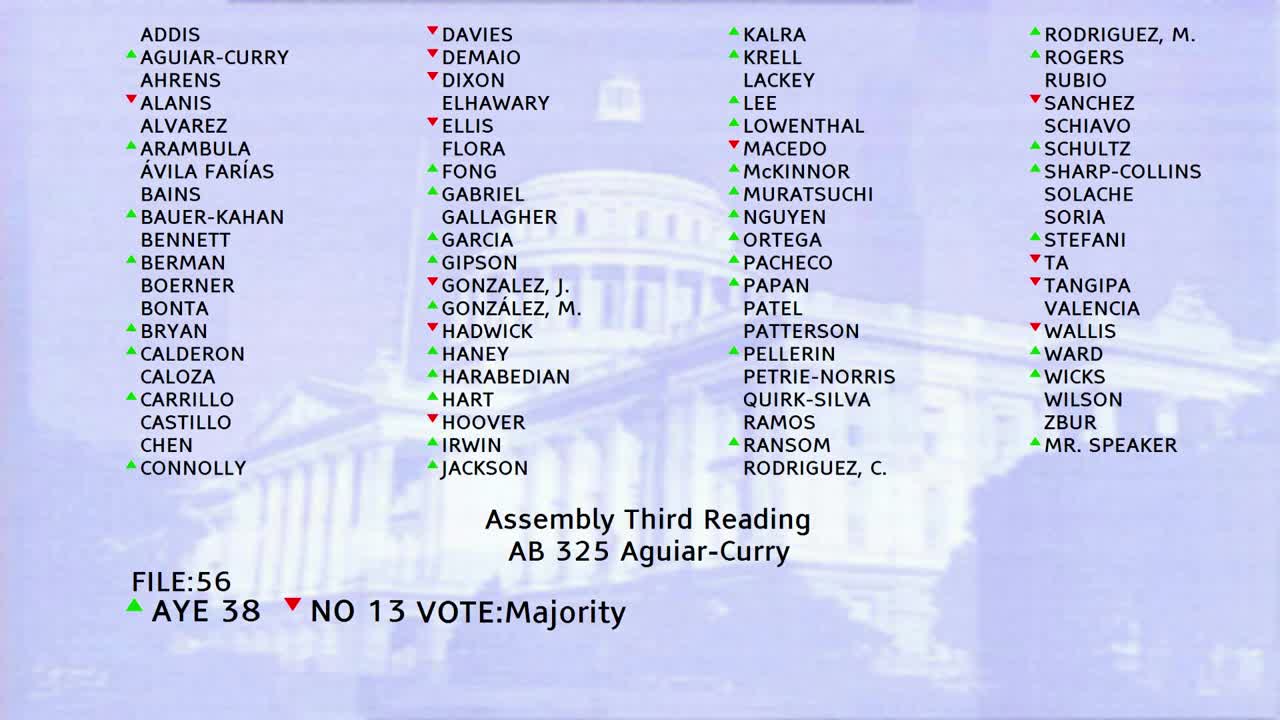 1MIN
Assembly Floor
 12MIN
Assembly Standing Committee on Transportation
Bill Author