AB 443: Energy Commission: integrated energy policy report: curtailed solar and wind generation: hydrogen production.
- Session Year: 2025-2026
- House: Assembly
- Latest Version Date: 2025-02-06
Current Status:
In Progress
(2025-08-29: In committee: Held under submission.)
Introduced
In Committee
Awaiting First Chamber Vote
Passed First Chamber
In Committee
Awaiting Second Chamber Vote
Passed Second Chamber
Enacted
Existing law requires the State Energy Resources Conservation and Development Commission, beginning November 1, 2003, and biennially thereafter, to adopt an integrated energy policy report that contains an overview of major energy trends and issues facing the state, presents policy recommendations based on an in-depth and integrated analysis of the most current and pressing energy issues facing the state, and includes an assessment and forecast of system reliability and the need for resource additions, efficiency, and conservation, as specified. Existing law also requires the commission, beginning November 1, 2004, and biennially thereafter, to prepare an energy policy review to update analyses from the integrated energy policy report or to raise energy issues that have emerged since the release of the integrated energy policy report, as specified.
This bill would require the commission, as part of the 2027 edition of the integrated energy policy report, to include an assessment of the potential for using curtailed solar and wind generation to produce hydrogen, as provided. The bill would define curtailed solar and wind generation for this purpose and require the assessment to do specified things, including to provide an estimate of how much hydrogen could feasibly and reliably be produced using energy from curtailed solar and wind generation. The bill would repeal its provisions on January 1, 2029.
(a)As part of the 2027 edition of the integrated energy policy report, the commission shall include an assessment of the potential for using curtailed solar and wind generation to produce hydrogen.
(b)The assessment shall do all of the following:
(1)Provide an estimate of how much solar and wind generation is curtailed monthly and annually.
(2)Provide an estimate of how much solar and wind generation that is curtailed monthly and annually is due to an excess of solar and wind generation relative to system demand.
(3)Provide an estimate of how much solar and wind generation that is curtailed monthly and annually is due to a lack of capacity from transmission facilities.
(4)Identify the regions of the state where solar and wind energy is being curtailed and determine for each identified region whether the curtailment is due to excess solar and wind generation relative to system demand or due to a lack of capacity from transmission facilities.
(5)Provide an estimate of how much hydrogen could feasibly and reliably be produced using energy from curtailed solar and wind generation.
(6)Identify the necessary regulatory and policy actions to optimize the use of energy from curtailed solar and wind generation for hydrogen production.
(c)For purposes of this section, curtailed solar and wind generation means the difference between the reduced solar and wind generation output and the amount of solar and wind energy that could be produced without demand or transmission constraints.
(d)This section shall remain in effect only until January 1, 2029, and as of that date is repealed.
|
Date
|
Status
|
|---|---|
| Aug 29, 2025 | In committee: Held under submission. |
| Jul 14, 2025 | In committee: Referred to APPR. suspense file. |
| Jul 1, 2025 | From committee: Do pass and re-refer to Com. on APPR. (Ayes 17. Noes 0.) (July 1). Re-referred to Com. on APPR. |
| Jun 11, 2025 | Referred to Com. on E., U & C. |
| Jun 3, 2025 | In Senate. Read first time. To Com. on RLS. for assignment. |
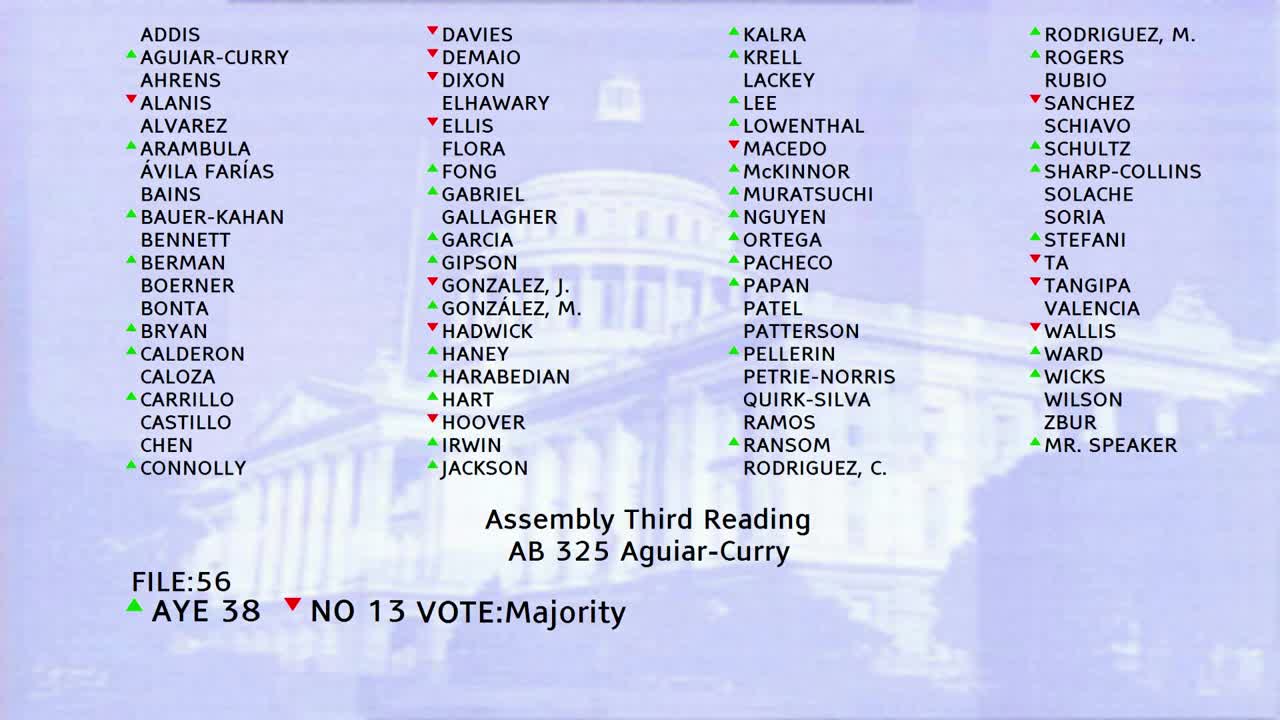
| Jun 2, 2025 | Read third time. Passed. Ordered to the Senate. (Ayes 79. Noes 0. Page 1829.) |
| May 27, 2025 | Read second time. Ordered to third reading. |
| May 23, 2025 | From committee: Do pass. (Ayes 14. Noes 0.) (May 23). |
| May 14, 2025 | In committee: Set, first hearing. Referred to suspense file. |
| Apr 22, 2025 | From committee: Do pass and re-refer to Com. on APPR. with recommendation: To Consent Calendar. (Ayes 14. Noes 0.) (April 21). Re-referred to Com. on APPR. |
| Apr 3, 2025 | From committee: Do pass and re-refer to Com. on NAT. RES. with recommendation: To Consent Calendar. (Ayes 18. Noes 0.) (April 2). Re-referred to Com. on NAT. RES. |
| Mar 13, 2025 | Referred to Coms. on U. & E. and NAT. RES. |
| Feb 7, 2025 | From printer. May be heard in committee March 9. |
| Feb 6, 2025 | Read first time. To print. |
|
Date
|
Description
|
Location
|
Votes
|
|
|---|---|---|---|---|
| Jul 14, 2025 | Placed on suspense file | Senate Standing Committee on Appropriations |
Passed |
|
| Jul 1, 2025 | Do pass, but first be re-referred to the Committee on [Appropriations] | Senate Standing Committee on Energy, Utilities and Communications |
Passed |
|
| Jun 2, 2025 | AB 443 Bennett Assembly Third Reading | Assembly Floor |
Passed |
|
| May 23, 2025 | Do pass. | Assembly Standing Committee on Appropriations |
Passed |
|
| Apr 21, 2025 | Do pass and be re-referred to the Committee on [Appropriations] with recommendation: To Consent Calendar | Assembly Standing Committee on Natural Resources |
Passed |
|
| Apr 2, 2025 | Do pass and be re-referred to the Committee on [Appropriations] with recommendation: To Consent Calendar | Assembly Standing Committee on Utilities and Energy |
Passed |
|
| Apr 2, 2025 | Do pass and be re-referred to the Committee on [Natural Resources] with recommendation: To Consent Calendar | Assembly Standing Committee on Utilities and Energy |
Passed |
This list shows positions taken on this bill by organizations on the date displayed, which is linked to the original source.
Positions by individuals are not included.
|
Organization
|
Position
|
Date
|
|---|---|---|
| Air Products and Chemicals, Inc. | ** Support | |
| Green Hydrogen Coalition | ** Support | |
| Independent Energy Producers Association | ** Support | |
| Invenergy LLC | ** Support | |
| Long Beach Area Chamber of Commerce | ** Support | |
| Marin Clean Energy | ** Support |
SENATE COMMITTEE ON
Senator Anna Caballero, Chair
2025 - 2026 Regular Session
AB 443 (Bennett) - Energy Commission: integrated energy policy report: curtailed solar and wind generation: hydrogen production
Version: | Policy Vote: |
Urgency: | Mandate: |
Hearing Date: | Consultant: |
Bill Summary:
This bill would require the California Energy Commission (CEC) to include an assessment of the availability, location, and transmission constraints associated with potential renewable resources for hydrogen production in the next Integrated Energy Policy Report (IEPR).
Fiscal Impact:
- The CEC estimates one-time costs of about $500,000 (Energy Resources Program Account [ERPA], General Fund, or other fund) for contract support to conduct an analysis to determine quantities of curtailed energy, regions of curtailment, and estimating hydrogen production from curtailed energy.
Background:
Existing law requires the CEC to develop the IEPR and establishes requirements for certain reports that must be included in the IEPR. The IEPR is intended to be a comprehensive energy policy report covering many aspects of California’s energy market, including energy supply and demand forecasts. In compliance with existing law, the CEC develops a full IEPR report every two years, with an update in the years between those full reports. The CEC develops the IEPR through public workshops, which include stakeholders relevant to the topics covered by the report. A draft version of the report is publicly available for comment and the IEPR is adopted at a CEC business meeting, which is also open to the public. The final IEPR is submitted to the Governor, Legislature, and other stakeholders in addition to being posted on the CEC’s webpage. Over time, legislation has substantially expanded IEPR reporting duties.
The CEC has included an analysis of hydrogen demand and supply as part of prior IEPRs. However, the CEC has noted that forecasting demand and supply of electrolytic hydrogen produced in state faces challenges, particularly when assessing hydrogen production facilities’ demand for electricity and the availability of infrastructure to support that demand. The 2024 update to the IEPR states:
“There is uncertainty surrounding the role of hydrogen in the state’s energy future. This is due to unknowns about the infrastructure build out to support grid connected hydrogen production, unknowns on the potential for off-grid production, and uncertainty in use cases for hydrogen. For example, the light-duty fuel cell electric vehicle market has remained a very small portion of the total zero-emission vehicle market, reaching a record low 0.12% of ZEV sales year-to-date as of Q3 2024. As a result of the above factors, there is a similarly high level of uncertainty in forecasting electricity demand for hydrogen production, especially via grid-connected electrolysis.”
Proposed Law:
This bill would require that the CEC include a specified report on the potential for using curtailed solar and wind energy to produce hydrogen as part of the 2027 IEPR. Since this bill would sunset in 2029, it is unclear if this bill also establishes a requirement for the CEC to update its 2027 IEPR findings on hydrogen in the 2028 update to the IEPR.
Specifically, this bill would:
- Define “curtailed solar and wind generation” as the difference between the reduced solar and wind generation output and the amount of solar and wind energy that could be produced without demand or transmission constraints.
- Require the CEC to include an assessment in the 2027 IEPR regarding the potential for using curtailed solar and wind generation to produce hydrogen.
- Specify that the assessment required by this bill must do all the following:
- Include an estimate of how much solar and wind generation is curtailed monthly and annually.
- Include an estimate of how much solar and wind generation that is curtailed monthly and annually is due to an excess of solar and wind generation relative to system demand.
- Include an estimate of how much solar and wind generation that is curtailed monthly and annually is due to a lack of capacity from transmission facilities.
- Identify the regions of the state where solar and wind energy is being curtailed and determine for each identified region, whether the curtailment is due to excess solar and wind generation relative to system demand or due to a lack of capacity from transmission facilities.
- Provide an estimate of how much hydrogen could feasibly and reliably be produced using energy from curtailed solar and wind generation.
- Identify the necessary regulatory and policy actions to optimize the use of energy from curtailed solar and wind generation for hydrogen production.
- Sunset these provisions on January 1, 2029.
Related Legislation:
SB 1420 (Caballero, Chapter 608, Statutes of 2024) added certain hydrogen production facilities that receive specified state funding to the list of projects eligible for the CEC’s opt-in permitting process.
AB 205 (Committee on Budget, Chapter 61, Statutes of 2022) among other provisions, established a framework for specified clean energy projects to seek consolidated permitting at the CEC by June 30, 2029, if they adhere to specified labor standards, including the use of skilled and trained workforce, and provide community benefits, as specified.
AB 209 (Committee on Budget, Chapter 251, Statutes of 2022) among other provisions, established a hydrogen funding program at the CEC to support projects that produce, process, deliver, store, or use hydrogen.
SB 1374 (Hueso, Chapter 611, Statutes of 2018) deleted various outdated reporting requirements in the IEPR and established a 2025 sunset for a provision requiring the CEC to include a report in the IEPR every four years on maximizing natural gas benefits.
SB 1369 (Skinner, Chapter 567, Statutes of 2018) established a definition of green electrolytic hydrogen, required the CPUC, CARB, and the CEC to consider green electrolytic hydrogen an eligible form of energy storage, and required these agencies consider other potential uses of green electrolytic hydrogen.
SB 1389 (Bowen and Sher, Chapter 568, Statutes of 2002) required the CEC to develop and adopt the IEPR and submit the IEPR to the Governor and Legislature every two years.
Staff Comments:
According to the CEC, the 2027 IEPR could potentially accommodate the one-time study this bill would require. Each IEPR includes core recurring analyses, but also has capacity for a limited number of one-time studies due to staff and resource constraints.
The CEC has already incorporated studies required under prior legislation into IEPRs. In response to SB 1075 (Skinner, 2022), one such study was completed as part of the 2023 and 2025 IEPRs that analyzed the cost and amount of renewable electricity needed to produce hydrogen via electrolysis, including under scenarios where excess generation might be available. The second, more broad hydrogen study required by the same bill, SB 1075, is set for inclusion as part of the 2025 IEPR covering additional production pathways, delivery, and storage options. However, the CEC has not completed a study specifically focused on using curtailed renewable electricity to produce hydrogen as requested by the current bill.
-- END --
SENATE COMMITTEE ON ENERGY, UTILITIES AND COMMUNICATIONS
Senator Josh Becker, Chair
2025 - 2026 Regular
Bill No: Hearing Date: 7/1/2025
Author: | |||
Version: | Introduced | ||
Urgency: | Fiscal: | ||
Consultant: | |||
SUBJECT:
DIGEST: This bill requires the California Energy Commission (CEC) to include an assessment of the availability, location, and transmission constraints associated with potential renewable resources for hydrogen production in the next Integrated Energy Policy Report (IEPR).
ANALYSIS:
Existing law:
- Requires the CEC to adopt an IEPR every two years, with an update published every year. Existing law specifies the contents of the IEPR and requires the CEC to report on major energy trends in the IEPR, including assessments of statewide electricity, natural gas and transportation fuel demands. (Public Resources Code §25302)
- Defines “green electrolytic hydrogen” as hydrogen gas produced through electrolysis and does not include hydrogen gas manufactured using steam reforming or any other conversion technology that produces hydrogen from a fossil fuel feedstock. (Public Utilities Code §400.2)
- Requires the California Public Utilities Commission (CPUC), CEC and California Air Resources Board (CARB) to consider green electrolytic hydrogen an eligible form of energy storage and consider its potential uses. (Public Utilities Code §400.3)
- Establishes an “opt-in” framework for specified clean energy projects to seek consolidated permitting at the CEC by June 30, 2029, if they adhere to specified labor standards, including the use of skilled and trained workforce, and provide community benefits, as specified. Existing law specifies that this consolidated permitting process shall not supersede the authorities of the Lands Commission to require leases and receive lease revenues, if applicable, or the authority of the California Coastal Commission, the San Francisco Bay Conservation and Development Commission, the State Water Resources Control Board, or the applicable regional water quality control boards. Existing law specifies that the following types of facilities are eligible for this consolidated permitting:
- A solar or terrestrial wind facility with a generating capacity of 50 megawatts (MW) or more and associated facilities.
- An energy storage system capable of storing 200 MW or more of energy, as specified.
- A stationary thermal electrical generating powerplant, with a generating capacity of 50 MW or more, which does not use or rely on fossil or nuclear fuels.
- Certain renewable energy component manufacturing facilities and transmission lines to certain renewable energy facilities.
- An electrical transmission line for certain solar, wind, energy storage or non-fossil, non-nuclear stationary powerplants.
- A hydrogen production facility and associated onsite storage and processing facilities that receive funding from specified state funding programs. (Public Resources Code §25545)
This bill:
- Defines “curtailed solar and wind generation” as the difference between the reduced solar and wind generation output and the amount of solar and wind energy that could be produced without demand or transmission constraints.
- Requires the CEC to include an assessment in the 2027 IEPR regarding the potential for using curtailed solar and wind generation to produce hydrogen.
- Specifies that the assessment required by this bill must do all the following:
- Include an estimate of how much solar and wind generation is curtailed monthly and annually.
- Include an estimate of how much solar and wind generation that is curtailed monthly and annually is due to an excess of solar and wind generation relative to system demand.
- Include an estimate of how much solar and wind generation that is curtailed monthly and annually is due to a lack of capacity from transmission facilities.
- Identify the regions of the state where solar and wind energy is being curtailed and determine for each identified region, whether the curtailment is due to excess solar and wind generation relative to system demand or due to a lack of capacity from transmission facilities.
- Provide an estimate of how much hydrogen could feasibly and reliably be produced using energy from curtailed solar and wind generation.
- Identify the necessary regulatory and policy actions to optimize the use of energy from curtailed solar and wind generation for hydrogen production.
- Sunsets this bill on January 1, 2029.
Background
The CEC’s IEPR. Existing law requires the CEC to develop the IEPR and establishes requirements for certain reports that must be included in the IEPR. The IEPR is intended to be a comprehensive energy policy report covering many aspects of California’s energy market, including energy supply and demand forecasts. In compliance with existing law, the CEC develops a full IEPR report every two years, with an update in the years between those full reports. The CEC develops the IEPR through public workshops, which include stakeholders relevant to the topics covered by the report. A draft version of the report is publicly available for comment and the IEPR is adopted at a CEC business meeting, which is also open to the public. The final IEPR is submitted to the Governor, Legislature, and other stakeholders in addition to being posted on the CEC’s webpage. Over time, legislation has substantially expanded IEPR reporting duties. This bill requires the CEC to include a specified report on the potential for using curtailed solar and wind energy to produce hydrogen as part of the 2027 full IEPR. Since this bill would sunset in 2029, it is unclear if this bill also establishes a requirement for the CEC to update its 2027 IEPR findings on hydrogen in the 2028 update to the IEPR.
Bill requires the CEC to forecast the potential for curtailed renewables to support hydrogen production. The CEC has included an analysis of hydrogen demand and supply as part of prior IEPRs. However, the CEC has noted that forecasting demand and supply of electrolytic hydrogen produced in state faces challenges, particularly when assessing hydrogen production facilities’ demand for electricity and the availability of infrastructure to support that demand. The 2024 update to the IEPR states:
There is uncertainty surrounding the role of hydrogen in the state’s energy future. This is due to unknowns about the infrastructure build out to support grid connected hydrogen production, unknowns on the potential for off-grid production, and uncertainty in use cases for hydrogen. For example, the light-duty fuel cell electric vehicle market has remained a very small portion of the total zero-emission vehicle (ZEV) market, reaching a record low 0.12% of ZEV sales year-to-date as of Q3 2024. As a result of the above factors, there is a similarly high level of uncertainty in forecasting electricity demand for hydrogen production, especially via grid-connected electrolysis.
While the CEC notes the challenges associated with demand-side analyses of grid-connected electricity for hydrogen production, this bill would require the CEC to assess the potential supply of certain excess renewables on the grid for hydrogen production and identify those areas where transmission constraints limit the use of curtailed renewables that could support hydrogen production.
Prior/Related Legislation
SB 1420 (Caballero, Chapter 608, Statutes of 2024) added certain hydrogen production facilities that receive specified state funding to the list of projects eligible for the CEC’s opt-in permitting process.
AB 205 (Committee on Budget, Chapter 61, Statutes of 2022) among other provisions, established a framework for specified clean energy projects to seek consolidated permitting at the CEC by June 30, 2029, if they adhere to specified labor standards, including the use of skilled and trained workforce, and provide community benefits, as specified.
AB 209 (Committee on Budget, Chapter 251, Statutes of 2022) among other provisions, established a hydrogen funding program at the CEC to support projects that produce, process, deliver, store, or use hydrogen.
SB 1374 (Hueso, Chapter 611, Statutes of 2018) deleted various outdated reporting requirements in the IEPR and established a 2025 sunset for a provision requiring the CEC to include a report in the IEPR every four years on maximizing natural gas benefits.
SB 1369 (Skinner, Chapter 567, Statutes of 2018) established a definition of green electrolytic hydrogen, required the CPUC, CARB, and the CEC to consider green electrolytic hydrogen an eligible form of energy storage, and required these agencies consider other potential uses of green electrolytic hydrogen.
SB 1389 (Bowen and Sher, Chapter 568, Statutes of 2002) required the CEC to develop and adopt the IEPR and submit the IEPR to the Governor and Legislature every two years.
FISCAL EFFECT: Appropriation: Fiscal Com.: Local:
SUPPORT:
Air Products and Chemicals, Inc.
Green Hydrogen Coalition
Independent Energy Producers Association
Invenergy LLC
Long Beach Area Chamber of Commerce
Marin Clean Energy
OPPOSITION:
None received
ARGUMENTS IN SUPPORT: According to the author:
California has done an amazing job trying to meet its clean energy goals with over 32,000 megawatts of installed renewable resources. This has meant that at times we have too much of a good thing and curtail our renewable resources. As we add more renewables, the problem of seasonally availably electricity will grow, having too much in spring and summer while not enough in winter and fall. We must focus on how to harness this energy, and make best use of it. Having the California Energy Commission assess this issue and provide recommendations on how we can use curtailed energy to address long-term storage concerns using hydrogen just makes sense. AB 443 will give us all a better understanding of how to use and design our system to maximize the use of renewable resources.
-- END --
ASSEMBLY THIRD READING
ATR Bill Id:AB 443
Author:(Bennett)
As Introduced Ver:February 6, 2025
Majority vote
SUMMARY
Requires the California Energy Commission (CEC) to assess, as specified, the potential for using curtailed solar and wind generation to produce hydrogen.
Major Provisions
COMMENTS
This bill requires the CEC to assess the potential for using curtailed solar and wind generation to produce hydrogen, and specifically to estimate monthly solar and wind generation curtailment; identify regions of the state where curtailment is occurring; assign whether that curtailment is due to excess generation (oversupply) or lack of transmission capacity (congestion); and provide estimates of how much hydrogen could feasibly and reliably be produced from the curtailed solar and wind energy.
While some elements of these assessments are available with public California Independent System Operator (CAISO) data, such as the monthly solar and wind generation curtailment, the granular data needed for a regional analysis called for in this bill could be highly valuable, especially given transmission congestion is the primary cause for curtailment. The bill also includes within the assessment areas and balancing authorities outside of CAISO – such as the Balancing Authority of Northern California and the Los Angeles Department of Water and Power – regions currently with little public visibility as to their curtailment volumes and causes.
The CEC completed a study required by SB 1075 (Skinner) Chapter 363, Statutes of 2022, in 2023 that analyzed the cost and amount of renewable electricity needed to produce hydrogen via electrolysis, including scenarios where excess generation could be available. The CEC reports it intends to include a second, broader hydrogen study in 202, covering additional production pathways, delivery, and storage options. However, the CEC notes, it has not completed a study specifically focused on using curtailed renewable electricity to produce hydrogen.
According to the Author
According to the author, "California has done an amazing job trying to meet its clean energy goals with over 32,000 megawatts of installed renewable resources. This has meant that at times we have too much of a good thing and curtail our renewable resources. As we add more renewables, the problem of seasonally available electricity will grow, having too much in spring and summer while not enough in winter and fall. We must focus on how to harness this energy, and make best use of it. Having the California Energy Commission assess this issue and provide recommendations on how we can use curtailed energy to address long-term storage concerns using hydrogen just makes sense. AB 443 will give us all a better understanding of how to use and design our system to maximize the use of renewable resources."
Arguments in Support
This bill is supported by hydrogen production companies, the Independent Energy Producers Association, and Marin Clean Energy, a community choice aggregator. Invenergy, a clean energy developer, notes solar and wind development is common "creating a missed opportunity to maximize the value of this energy for ratepayers." They note the findings in the report called for by this bill could provide "valuable insights into how to best take advantage of these opportunities."
Arguments in Opposition
None on file.
FISCAL COMMENTS
According to the Assembly Committee on Appropriations, this bill creates significant new and reoccurring work for the CEC. The CEC notes it does not have in-house expertise capable of conducting the assessment and would, therefore, need to contract with an outside consultant to complete the work, at a cost of approximately $500,000 for the first assessment
VOTES
ASM UTILITIES AND ENERGY: 18-0-0
YES: Petrie-Norris, Patterson, Boerner, Calderon, Chen, Davies, Mark González, Harabedian, Hart, Irwin, Kalra, Papan, Rogers, Schiavo, Schultz, Ta, Wallis, Zbur
ASM NATURAL RESOURCES: 14-0-0
YES: Bryan, Alanis, Connolly, Ellis, Flora, Garcia, Haney, Hoover, Kalra, Muratsuchi, Pellerin, Schultz, Wicks, Zbur
ASM APPROPRIATIONS: 14-0-1
YES: Wicks, Arambula, Calderon, Caloza, Dixon, Elhawary, Fong, Mark González, Hart, Pacheco, Pellerin, Solache, Ta, Tangipa
ABS, ABST OR NV: Sanchez
UPDATED
VERSION: February 6, 2025
CONSULTANT: Laura Shybut / U. & E. / (916) 319-2083 FN: 0000687
Date of Hearing: May 14, 2025
ASSEMBLY COMMITTEE ON APPROPRIATIONS
Buffy Wicks, Chair
ABPCA Bill Id:AB 443
Author:(Bennett) – As Introduced Ver:February 6, 2025
Policy Committee: | Utilities and Energy | Vote: | 18 - 0 |
Natural Resources | 14 - 0 | ||
|
|
Urgency: No State Mandated Local Program: No Reimbursable: No
SUMMARY:
This bill requires the California Energy Commission (CEC) to include, in the 2027 edition of the integrated energy policy report (IEPR) statute requires CEC to periodically produce, an assessment of the potential for using curtailed solar and wind generation to produce hydrogen.
FISCAL EFFECT:
This bill creates significant new and reoccurring analytical work for the CEC to periodically assess the potential for using curtailed solar and wind generation to produce hydrogen. The CEC notes it does not have in-house expertise capable of conducting the assessment and would, therefore, need to contract with an outside consultant to complete the work, at a cost of approximately $500,000 for the first assessment. The appropriate sources of funds is the Energy Resources Programs Account, which faces an ongoing structural deficit.
COMMENTS:
Statute directs the CEC to produce every two years an IEPR that contains an overview of major energy trends and issues facing the state and presents policy recommendations based on an in-depth and integrated analysis of the most current and pressing energy issues facing the state. A key component of each edition of the IEPR is a forecast of energy demand and an assessment and forecast of system reliability and the need for resource additions, efficiency and conservation, which is a key input to the procurement orders issued by the California Public Utilities Commission (CPUC) and the transmission planning process at the California Independent System Operator (CAISO).
The author contends CEC should include in the 2027 edition of the IEPR an assessment of the potential for using curtailed solar and wind generation to produce hydrogen. According to the author:
California has done an amazing job trying to meet its clean energy goals with over 32,000 megawatts of installed renewable resources. This has meant that at times we have too much of a good thing and curtail our renewable resources. As we add more renewables, the problem of seasonally available electricity will grow, having too much in spring and summer while not enough in winter and fall. We must focus on how to harness this energy, and make best use of it. Having the CEC assess this issue and provide recommendations on how we can use curtailed energy to address long-term storage concerns using hydrogen just makes sense. AB 443 will give us all a better understanding of how to use and design our system to maximize the use of renewable resources.
The CEC completed a study required by SB 1075 (Skinner), Chapter 363, Statutes of 2022, in the 2023 IEPR that analyzed the cost and amount of renewable electricity needed to produce hydrogen via electrolysis, including scenarios where excess generation could be available. The CEC reports it intends to include a second, broader hydrogen study in the 2025 IEPR, covering additional production pathways, delivery and storage options. However, the CEC notes, it has not completed a study specifically focused on using curtailed renewable electricity to produce hydrogen.
Analysis Prepared by: Jay Dickenson / APPR. / (916) 319-2081
Date of Hearing: April 21, 2025
ASSEMBLY COMMITTEE ON NATURAL RESOURCES
Isaac G. Bryan, Chair
ABPCA Bill Id:AB 443 (
Author:Bennett) – As Introduced Ver:February 6, 2025
SUBJECT: Energy Commission: integrated energy policy report: curtailed solar and wind generation: hydrogen production
SUMMARY: Requires the California Energy Commission (CEC) to prepare an assessment of the potential for using curtailed solar and wind generation (SAWG) to produce hydrogen.
EXISTING LAW:
- Requires the CEC to conduct assessments and forecasts of all aspects of energy industry supply, production, transportation, delivery and distribution, demand, and prices and use these assessments and forecasts to develop and evaluate energy policies and programs that conserve resources, protect the environment, ensure energy reliability, enhance the state’s economy, and protect public health and safety. (Public Resources Code (PRC) 25301)
- Requires the CEC to adopt the integrated energy policy report (IEPR) every two years, which must contain an overview of major energy trends and issues facing the state, including, but not limited to, supply, demand, pricing, reliability, efficiency, and impacts on public health and safety, the economy, resources, and the environment. (PRC 25302)
THIS BILL:
- Requires the CEC, as part of the 2027 IEPR, to assess the potential for using curtailed SAWG to produce hydrogen. Requires the assessment to do all of the following:
- Provide an estimate of (1) how much SAWG is curtailed monthly and annually, (2) how much curtailed SAWG is due to excess SAWG relative to system demand, and (3) how much curtailed SAWG is due to a lack of capacity from transmission facilities.
- Identify the regions of the state where SAWG is being curtailed and determine for each identified region whether the curtailment is due to excess SAWG relative to system demand or due to a lack of capacity from transmission facilities.
- Provide an estimate of how much hydrogen could feasibly and reliably be produced using energy from curtailed SAWG.
- Identify the necessary regulatory and policy actions to optimize the use of energy from curtailed SAWG for hydrogen production.
- Defines curtailed SAWG as the difference between the reduced SAWG output and the amount of SAWG that could be produced without demand or transmission constraints.
- Sunsets January 1, 2029.
FISCAL EFFECT: Unknown
COMMENTS:
- Background. Grid operators must constantly match the amount of power being produced (supply) with the amount of power needed to run homes and businesses (demand) to prevent the grid from overloading. During the middle of the day, California’s renewable resources, especially solar generation facilities, sometimes generate more electricity than is needed to serve demand. For those resources in the California Independent System Operator (CAISO) market, the market automatically reduces, or curtails, the renewable generation to match supply with demand. Renewable curtailment occurs most frequently in spring and fall when supply is high due to California’s characteristic sunny and breezy climate, but demand is low due to that same moderate climate. Such conditions produce an abundant supply of solar and wind generation. Curtailment, therefore, is the deliberate reduction in generator output – either through negative market prices or a direct order to reduce output – below what would have otherwise been produced.
Curtailment is a common operational tool. Yet, as increasing amounts of renewable generation come online without commensurate amounts of demand to consume generation midday, oversupply conditions will continue to occur. Over the last decade both solar and wind generation and curtailment have increased. However, the proportion of curtailment relative to generation has grown over the last decade. While only a little more than 0.4% of total wind and solar production were curtailed in 2015, that number has grown to a little more than 4% curtailed in 2023, representing a 900% increase in under a decade. In recent years, during spring months those percentages can reach 12-13% of monthly wind and solar generation curtailed. These high percentages of curtailment seem to suggest more than just oversupply conditions are occurring.
Today’s solar and wind resources can often generate electricity at almost zero cost. These generators can bid negative prices (i.e., pay someone) to use their clean electricity when supply exceeds demand. Generators are motivated to do this because they only gain access to federal production tax credits and accrue renewable energy credits (RECs) when they produce energy. In these circumstances, the tax credits and sale of RECs are worth more than the negative market price.
The CAISO curtails renewables in these times of oversupply only if no one is willing to get paid to consume excess clean electricity. Curtailment due to oversupply is around 30% of total curtailment. The remaining curtailment is due to congestion: traffic jams in electric transmission lines. Congestion-related curtailment has increased significantly since 2019. The federal Energy Information Administration (EIA) notes this is due to solar generation development outpacing upgrades in transmission capacity. While curtailment is a loss of otherwise useful energy, it is important to note that to utilize the surplus power completely, often expensive and time-intensive methods are required, such as building new power lines or storage resources.
The environmental impacts of hydrogen, including effects on climate and air quality, can range from very favorable to very unfavorable, depending on production, delivery, end use, and the fuel the hydrogen is replacing. For example, hydrogen produced with fossil fuels and used in a combustion application that replaces a renewable energy source is not a good environmental solution. However, hydrogen produced with zero-carbon energy and used in a zero-emission application that replaces diesel combustion has clear climate and air quality benefits. Green hydrogen can result in almost no GHG emissions. Produced by electrolyzing water, green hydrogen is made using 100% renewable electricity to split hydrogen from water molecules. About 2% of hydrogen production globally comes from water electrolysis, with a smaller fraction produced using 100% renewable electricity. Therefore, the potential to harness curtailed SAWG to produce hydrogen is a promising solution.
- Author’s statement:
California has done an amazing job trying to meet its clean energy goals with over 32,000 megawatts of installed renewable resources. This has meant that at times we have too much of a good thing and curtail our renewable resources. As we add more renewables, the problem of seasonally available electricity will grow, having too much in spring and summer while not enough in winter and fall. We must focus on how to harness this energy, and make best use of it. Having the CEC assess this issue and provide recommendations on how we can use curtailed energy to address long-term storage concerns using hydrogen just makes sense. AB 443 will give us all a better understanding of how to use and design our system to maximize the use of renewable resources.
- Double referral. This bill was heard in the Utilities and Energy Committee on April 2 and passed by a vote of 18-0.
REGISTERED SUPPORT / OPPOSITION:
Support
Air Products and Chemicals
Independent Energy Producers Association
Invenergy
Marin Clean Energy
Opposition
None on file
Analysis Prepared by: Lawrence Lingbloom / NAT. RES. /
Date of Hearing: April 2, 2025
ASSEMBLY COMMITTEE ON UTILITIES AND ENERGY
Cottie Petrie-Norris, Chair
ABPCA Bill Id:AB 443 (
Author:Bennett) – As Introduced Ver:February 6, 2025
SUBJECT: Energy Commission: integrated energy policy report: curtailed solar and wind generation: hydrogen production
SUMMARY: Requires the California Energy Commission (CEC) to assess, as specified, the potential for using curtailed solar and wind generation to produce hydrogen. Specifically, this bill requires the assessment:
- Be part of the CEC’s 2027 edition of the integrated energy policy report (IEPR).
- Provide an estimate of monthly solar and wind generation curtailment and whether that curtailment is due to excess generation or lack of transmission capacity.
- Identify regions of the state where curtailment is occurring and assign whether the curtailment is due to excess generation or a lack of transmission capacity.
- Provide estimates of how much hydrogen could feasibly and reliably be produced from curtailed solar and wind energy, and identify policy actions to optimize the curtailed generation for hydrogen production.
- Be repealed on January 1, 2029.
EXISTING LAW:
- Establishes the California Independent System Operator (CAISO) governing board with five members appointed for three-year terms by the governor and subject to confirmation by the Senate. (Public Utilities Code § 337 et seq.)
- Charges CAISO with management of the transmission grid and related energy markets in order to ensure the reliability of electric service and the health and safety of the public. (Public Utilities Code § 345.5)
- Establishes the policy that 100% of the state's retail electricity be supplied with a mix of Renewables Portfolio Standard (RPS)-eligible and zero-carbon resources by December 31, 2045 and 100% of electricity procured to serve all state agencies by December 31, 2035, for a total of 100% clean energy. Sets interim targets of 90% by December 31, 2035, and 95% by December 31, 2040. (Public Utilities Code § 454.53)
- Requires retail sellers and publicly owned utilities (POUs) to increase purchases of renewable energy such that at least 60% of retail sales are procured from eligible renewable energy resources by December 31, 2030. This is known as the RPS. (Public Utilities Code § 399.11 et seq.)
- Permits the California Public Utilities Commission (CPUC) to waive enforcement of the RPS if it finds that the retail seller (usually the utility) has demonstrated conditions beyond the control of the seller, including “unanticipated curtailment of eligible renewable energy resources” so long as the CPUC RPS waiver would not “result in an increase in greenhouse gas emissions.” (Public Utilities Code § 399.15 (b)(5)(C))
- Permits the CPUC to prohibit, upon a complaint made by a geothermal energy producer, any electrical corporation from curtailing the generation, production, or transmission of electricity from a geothermal powerplant, if the CPUC deems such curtailment is not in the public interest. (Public Utilities Code § 782)
BACKGROUND:
California’s Supply of Renewable Resources – According to the CEC, in 2023 total generation for California was 281,141 gigawatt-hours (GWh). Approximately 58% was due to zero-carbon generation (nuclear, large hydroelectric, and renewables), while 17% and 11%, respectively, were solely from solar and wind generation,[1] as shown in Table 1 below.
Table 1: 2023 Total System Electric Generation[2]
Fuel Type | In state Generation (GWh) | % in state | Total Imports (GWh) | Total Energy Mix (GWh) | % of Total Mix |
Coal | 257 | 0.12 | 4,724 | 4,981 | 1.77 |
Natural Gas | 94,192 | 43.68 | 8,582 | 102,774 | 36.56 |
Oil | 36 | 0.02 | 0 | 36 | 0.01 |
Other (Waste Heat / Petroleum Coke) | 206 | 0.10 | 0 | 206 | 0.07 |
Unspecified | - |
| 10,373 | 10,373 | 3.69 |
|
|
|
|
|
|
Biomass | 5,037 | 2.34 | 753 | 5,790 | 2.06 |
Geothermal | 10,999 | 5.10 | 2,569 | 13,567 | 4.83 |
Large Hydro | 27,066 | 12.55 | 5,821 | 32,886 | 11.70 |
Nuclear | 17,714 | 8.22 | 8,558 | 26,272 | 9.34 |
Small Hydro | 4,853 | 2.25 | 135 | 4,988 | 1.77 |
Solar | 41,344 | 19.17 | 6,525 | 47,869 | 17.03 |
Wind | 13,920 | 6.46 | 17,479 | 31,399 | 11.17 |
Total Zero Carbon | 120,933 | 56.09 | 41,840 | 162,771 | 57.90 |
|
|
|
|
|
|
California Total | 215,623 |
|
| 281,141 |
|
The Curtailment Landscape – Grid operators must constantly match the amount of power being produced (supply) with the amount of power needed to run homes and businesses (demand) to prevent the grid from overloading. During the middle of the day, California’s renewable resources, especially solar generation facilities, sometimes generate more electricity than is needed to serve demand. For those resources in the CAISO market, the market automatically reduces,[3] or curtails, the renewable generation to match supply with demand. Renewable curtailment occurs most frequently in spring and fall when supply is high due to California’s characteristic sunny and breezy climate, but demand is low due to that same moderate climate. Such conditions produce an abundant supply of solar and wind generation, as shown in Figure 1.[4] Curtailment, therefore, is the deliberate reduction in generator output – either through negative market prices or a direct order to reduce output – below what would have otherwise been produced.
Figure 1: CAISO reported monthly metered generation of solar (orange, solid line) and wind (blue, dashed line),[5] alongside monthly curtailment of solar and wind combined (red bars)[6] from April 2014 - April 2024.
Curtailment is a common operational tool. Yet, as increasing amounts of renewable generation come online without commensurate amounts of demand to consume generation midday, oversupply conditions will continue to occur. As also shown in Figure 1, over the last decade both solar and wind generation and curtailment have increased. However, the proportion of curtailment relative to generation has grown over the last decade. While only a little more than 0.4% of total wind and solar production were curtailed in 2015, that number has grown to a little more than 4% curtailed in 2023;[7] representing a 900% increase in under a decade. In recent years, during spring months those percentages can reach 12-13% of monthly wind and solar generation curtailed.[8] These high percentages of curtailment seem to suggest more than just oversupply conditions are occurring.
Oversupply vs. Congestion – Today’s solar and wind resources can often generate electricity at almost zero cost. These generators can bid negative prices (i.e., pay someone) to use their clean electricity when supply exceeds demand. Generators are motivated to do this because they only gain access to federal production tax credits and accrue renewable energy credits (RECs) when they produce energy.[9] In these circumstances, the tax credits and sale of RECs are worth more than the negative market price.[10]
Figure 2: Curtailment by cause: sky blue (oversupply) and navy blue (congestion); CAISO 2019-Sept 2023 (million MWh)[11]

The CAISO curtails renewables in these times of oversupply only if no one is willing to get paid to consume excess clean electricity. As shown in Figure 2, curtailment due to oversupply is around 30% of total curtailment.[12] The remaining curtailment is due to congestion: traffic jams in electric transmission lines. As shown in Figure 2, congestion related curtailments have increased significantly since 2019. The federal Energy Information Administration (EIA) notes this is due to solar generation development outpacing upgrades in transmission capacity.[13] While curtailment is a loss of otherwise useful energy, it is important to note that to utilize the surplus power completely, often expensive and time-intensive methods are required, such as building new power lines or storage resources.
FISCAL EFFECT: Unknown. This bill is keyed fiscal and will be referred to the Assembly Committee on Appropriations for review.
CONSUMER COST IMPACTS: Unknown. This bill seeks to maximize existing renewable resources whose production would otherwise be reduced for the purposes of hydrogen production. Such an effort should maximize grid benefits, but is likely to still bear a cost to consumers for hydrogen production.
COMMENTS:
- Author’s Statement. According to the author, “California has done an amazing job trying to meet its clean energy goals with over 32,000 megawatts of installed renewable resources. This has meant that at times we have too much of a good thing and curtail our renewable resources. As we add more renewables, the problem of seasonally available electricity will grow, having too much in spring and summer while not enough in winter and fall. We must focus on how to harness this energy, and make best use of it. Having the California Energy Commission assess this issue and provide recommendations on how we can use curtailed energy to address long-term storage concerns using hydrogen just makes sense. AB 443 will give us all a better understanding of how to use and design our system to maximize the use of renewable resources.”
- Benefits and Purpose. This bill requires the CEC to assess the potential for using curtailed solar and wind generation to produce hydrogen, and specifically to estimate monthly solar and wind generation curtailment; identify regions of the state where curtailment is occurring; assign whether that curtailment is due to excess generation (oversupply) or lack of transmission capacity (congestion); and provide estimates of how much hydrogen could feasibly and reliably be produced from the curtailed solar and wind energy. While some elements of these assessments are available with public CAISO data, such as the monthly solar and wind generation curtailment (Figure 1) or curtailment causes (Figure 2), the granular data needed for a regional analysis called for in this bill could be highly valuable, especially given transmission congestion is the primary cause for curtailment. Moreover, the CAISO’s public databases label curtailments with vague reasons such as “local” or “system,”[14] or label their generator outages as “transmission-induced;”[15] this provides little clarity on whether incidents involve oversupply or congestion conditions. The bill also includes within the assessment areas and balancing authorities outside of CAISO – such as the Balancing Authority of Northern California[16] and the Los Angeles Department of Water and Power – regions currently with little public visibility as to their curtailment volumes and causes.
- Harnessing the Negative. As noted above, one of the key strategies to encourage curtailment – before CAISO issues a direct order to reduce output – is for the market to reduce resource prices to below zero, such that solar and wind farms are paying folks to take their power. These negative prices encourage putting clean electricity, which would otherwise be wasted, to good use. Through strategies such as the Western Energy Imbalance Market (WEIM), utilities outside the state may choose to meet their real-time demand with California’s solar, since our negative solar prices make their in-state resources more expensive. This not only reduces GHGs, as many of the replacement resources are fossil, but it also helps reduce system costs. According to CAISO, since 2024, the WEIM has helped mitigate total curtailment by 1%, with over $6 billion in cumulative savings for participants.[17]
Negative prices are also a signal to battery storage developers that they can make money by storing excess clean electricity and then outbidding polluting power plants a few hours later. As battery storage prices keep decreasing,[18] more batteries are likely to come online to harness this excess power. In fact, California has increased battery storage capacity by 1,250% in the last five years.[19] And a growing share of new renewable contracts are for hybrid generators that pair solar or wind with storage.[20]
But while battery and hybrid resource installations are growing, so is curtailment. Additional strategies to address curtailment, such as increasing transmission capacity or expanding market operations may take years to reach their potential. This bill proposes examining an additional option – treating hydrogen production as a battery, and harnessing the growing percentage of curtailed power to generate hydrogen fuel for later use.
- A Sense of Scale from the Back of the Envelope. It takes roughly 50-55 kilowatt-hours to make 1 kilogram of electrolytic hydrogen.[21] As shown in Figure 1, the total solar and wind curtailment in CAISO for 2023 was approximately 2.65 terawatt-hours.[22] Harnessing every electron of that curtailed electricity would therefore generate roughly 50 million kilograms of electrolytic hydrogen per year.[23] (Assuming curtailment doesn’t increase, which is unlikely.) This level of production is roughly a third of what California’s Hydrogen Hub, ARCHES, intends to use per year.[24] In order for this curtailed energy to be fully captured, locational considerations and grid constraints must be considered; otherwise, local congestion issues might interfere with accessing the excess generation. This bill recognizes these complexities, in the hopes of maximizing curtailment opportunities, by having the CEC identify regions where the curtailment is occurring.
- What’s in a Definition? “Curtailment” appears, but is undefined, within the Public Utilities Code. This bill provides a definition of “curtailed solar and wind generation” to include the difference between the reduced solar and wind generation output and the amount of solar and wind energy that could be produced without demand or transmission constraints. While this bill’s definition may capture some common understanding of “curtailment,” the committee is unaware of how this definition compares to ones used by CAISO or the CEC in evaluating grid conditions. For example, the meaning of solar and wind energy “produced without demand” is unclear. The author may consider reflecting on the content and the necessity of the definition used in this measure.
- Prior Legislation.
AB 1172 (Calderon) requires the CEC to evaluate various fusion technologies and to analyze the feasibility of using nuclear fusion in the state as part of its 2027 IEPR. Status: Chapter 360, Statutes of 2023.
SB 664 (Stern, 2023) among other provisions requires the CEC to include extreme weather events within the existing energy demand forecasts of the IEPR. Status: Vetoed, citing duplicating existing requirements.
AB 2587 (E. Garcia, 2022) requires the CEC to additionally include firm renewable energy resources in the IEPR. Status: Died – Senate Committee on Appropriations.
- Double Referral. This bill is double referred. Should it pass out of this committee it will be referred to the Assembly Committee on Natural Resources for its consideration.
REGISTERED SUPPORT / OPPOSITION:
Support
Invenergy, LLC
Marin Clean Energy (MCE)
Opposition
None on file.
Analysis Prepared by: Laura Shybut / U. & E. / (916) 319-2083
CEC “2023 Total System Electric Generation;” website; accessed 03.25.2025; https://www.energy.ca.gov/data-reports/energy-almanac/california-electricity-data/2023-total-system-electric-generation#:~:text=In%202023%2C%20total%20generation%20for,percent%20in%202022.%20California's%20wide ↑
Reproduced from Citation #1 ↑
Often by reducing the resource price to below zero, making the generator pay to put electrons on the grid. ↑
Solar is the majority of the energy curtailed in CAISO: 95% in 2022 and 94% in 2023; https://www.eia.gov/todayinenergy/detail.php?id=60822 ↑
CAISO Monthly Metered Renewable Generation data, in terawatt-hours; last accessed 03.25.2025; https://www.caiso.com/documents/monthlyrenewablesperformancereport-apr2024.html ↑
CAISO wind and solar curtailments data, in terawatt-hours; last accessed 03.30.2025; https://www.caiso.com/about/our-business/managing-the-evolving-grid#renewable-curtailment ↑
Averaging over the entire year’s wind+solar generation and wind+solar curtailment. ↑
In March and April of 2023 and 2024 – see CAISO source data in Citations #3 and #4. ↑
Melody Peterson, “Solar power glut boosts California electric bills. Other states reap the benefits.” LA Times; November 24, 2024; https://www.latimes.com/environment/story/2024-11-24/california-has-so-much-solar-power-that-increasingly-it-goes-to-waste ↑
Mohit Chhabra, “Feasting on the Glut: Putting Renewable Curtailment in Context;” NRDC Blog; December 4, 2024; https://www.nrdc.org/bio/mohit-chhabra/feasting-glut-putting-renewable-curtailment-context ↑
U.S. Energy Information Administration, “Solar and wind power curtailments are rising in California;” October 23, 2023; https://www.eia.gov/todayinenergy/detail.php?id=60822 ↑
U.S. Energy Information Administration, “Solar and wind power curtailments are rising in California;” October 23, 2023; https://www.eia.gov/todayinenergy/detail.php?id=60822 ↑
U.S. Energy Information Administration, “Solar and wind power curtailments are rising in California;” October 23, 2023; https://www.eia.gov/todayinenergy/detail.php?id=60822 ↑
CAISO Annual “Production and Curtailments Data” – 2025 source last accessed on 03.20.2025; https://www.caiso.com/documents/production-and-curtailments-data-2025.xlsx ↑
CAISO “Curtailed and non-operational generator prior trade date report, March 28, 2025;” updated 03.29.2025; https://www.caiso.com/documents/curtailed-non-operational-generator-prior-trade-date-report-20250328.xlsx; full listing on https://www.caiso.com/market-operations/outages/curtailed-and-non-operational-generators ↑
https://thebanc.org/ ↑
CAISO press release; “Western Energy Imbalance Market surpasses the $6 billion benefit milestone;” October, 28, 2024; https://www.caiso.com/about/news/news-releases/western-energy-imbalance-market-surpasses-the-6-billion-benefit-milestone ↑
Wesley Cole and Akash Karmakar; NREL; Cost Projections for Utility-Scale Battery Storage: 2023 Update; June 2023; https://www.nrel.gov/docs/fy23osti/85332.pdf ↑
For a host of reasons, not just negative prices; Governor Newsom Office, press release; “California Achieves Major Clean Energy Victory: 10,000 Megawatts of Battery Storage;” April 2024; https://www.gov.ca.gov/2024/04/25/california-achieves-major-clean-energy-victory-10000-megawatts-of-battery-storage/ ↑
Kavya Balaraman, “CAISO approves hybrid storage policies as California preps to add 1.5 GW by 2022; Utility Dive; November 24, 2020; https://www.utilitydive.com/news/caiso-approves-hybrid-storage-policies-as-california-preps-for-addition-of/589609/ ↑
Bart Kolodziejczyk; “Seawater electrolysis: a hydrogen revolution or technological dud? Here are the numbers;” Sep. 29, 2023; World Economic Forum; https://www.weforum.org/stories/2023/09/seawater-electrolysis-a-hydrogen-revolution-or-technological-dead-end-here-are-the-numbers/#:~:text=In%20perfect%20conditions%2C%20production%20of,50%20%E2%80%93%2055%20kWh/kg. ↑
CAISO wind and solar curtailments data, in terawatt-hours; last accessed 03.30.2025; https://www.caiso.com/about/our-business/managing-the-evolving-grid#renewable-curtailment ↑
(2.65TWh x 10^9 kWh)/53 kWh ↑
ARCHES notes planned “use [of] over 400 metric tons per day;” 400 metric tons x 1000kg x 365 days = 146 million kg H2/year. https://archesh2.org/publications/#:~:text=What%20is%20the%20scale%20of,or%20in%20our%20recent%20presentations. ↑
Discussed in Hearing
 1MIN
Senate Standing Committee on Appropriations
 5MIN
Senate Standing Committee on Energy, Utilities and Communications
 1MIN
Assembly Floor
Bill Author

Bill Co-Author(s):