AB 500: University of California: admissions changes.
- Session Year: 2025-2026
- House: Assembly
- Latest Version Date: 2025-06-23
Current Status:
In Progress
(2025-08-29: In committee: Held under submission.)
Introduced
In Committee
Awaiting First Chamber Vote
Passed First Chamber
In Committee
Awaiting Second Chamber Vote
Passed Second Chamber
Enacted
Existing law establishes the California State University, under the administration of the Trustees of the California State University, and the University of California, under the administration of the Regents of the University of California, as 2 segments of public postsecondary education in the state. Existing law states legislative intent for the University of California and California State University governing boards, in determining the standards and criteria for undergraduate and graduate admissions, to develop processes that strive to be fair and easily understandable, consider using criteria allowing eligible students with uncontrollable course deficiencies to enroll, and consult broadly with Californias diverse communities, as provided.
This bill would state the intent of the Legislature for a University of California proposal regarding a change to the conditions for undergraduate admissions, as specified, to become operative only after request the University of California, before a proposal regarding a change to the conditions for undergraduate admissions is adopted by the regents, to complete certain actions have been taken, actions, including, among other actions, providing the proposal to the official student organization representing the student body of the University of California, the State Board of Education, and the trustees for consideration, and would require the state board and trustees have identified to identify the proposal as an item for discussion and discussed discuss the proposal at a meeting of each of these boards, as specified.
Existing law establishes the California State University, under the administration of the Trustees of the California State University, and the University of California, under the administration of the Regents of the University of California, as 2 segments of public postsecondary education in the state. Existing law states legislative intent for the University of California and California State University governing boards, in determining the standards and criteria for undergraduate and graduate admissions, to develop processes that strive to be fair and easily understandable, consider using criteria allowing eligible students with uncontrollable course deficiencies to enroll, and consult broadly with Californias diverse communities, as provided.
This bill would state the intent of the Legislature for a University of California proposal regarding standards and criteria for a change to the conditions for undergraduate admissions admissions, as specified, to become operative only after certain actions have been taken, including, among other actions, providing the proposal to the University of California Student Association, official student organization representing the student body of the University of California, the State Board of Education, and the trustees for consideration consideration, and the state board and trustees have identified the proposal as an item for discussion and discussed the proposal as a discussion item at a meeting of the each of these boards, as specified.
Existing law establishes the California State University, under the administration of the Trustees of the California State University, and the University of California, under the administration of the Regents of the University of California, as 2 segments of public postsecondary education in the state. Existing law states legislative intent for the University of California and California State University governing boards, in determining the standards and criteria for undergraduate and graduate admissions, to develop processes that strive to be fair and easily understandable, consider using criteria allowing eligible students with uncontrollable course deficiencies to enroll, and consult broadly with Californias diverse communities, as provided.
This bill would state the intent of the Legislature for a University of California proposal regarding standards and criteria for undergraduate admissions to become operative only after certain actions have been taken, including, among other actions, providing the proposal to the University of California Student Association, the State Board of Education, and the trustees for consideration and the state board and trustees have discussed the proposal as a discussion item at a meeting of the boards, as specified.
(a)As used in this section, the following definitions apply:
(1)A change to the conditions for undergraduate admissions means any of the following:
(A)A change to the policy for undergraduate admissions to the University of California adopted by the regents.
(B)A reclassification or modification of which types of high school courses meet the AG subject matter requirements for admission to the University of California.
(C)A change to the admissions requirement criteria used in the review and certification of high school courses as meeting the AG subject matter requirements for admission to the University of California.
(2)Local educational agency means a school district, county office of education, or charter school.
(3)Regent means a board member of the Regents of the University of California.
(4)Regents means the Regents of the University of California.
(5)State board means the State Board of Education.
(6)Trustees means the Trustees of the California State University.
(b)It is the intent of the Legislature that a University of California proposal Before a proposal regarding a change to the conditions for undergraduate admissions becomes operative only after all of the following has occurred: is adopted by the regents, the University of California is requested to complete all of the following:
(1)The proposal has been provided Provide the proposal to the official student organization representing the student body of the University of California, the state board, and the trustees for consideration.
(2)The proposal has been identified as an item for discussion and discussed by the state board and the trustees at a meeting of each of these boards, respectively.(3)(2)(A)Notice Provide notice of the meeting of the regents at which the proposal is to be considered has been provided to each regent.
(B)Information Provide information and materials regarding the proposal, including a full disclosure of the impact on local educational agencies, the University of California, and the California State University, have been made available to each regent in advance of the meeting described in subparagraph (A).
(C)The intention Provide a meeting notice regarding the intent of the regents to vote on the proposal has been included in the meeting notice made available to the public pursuant to the requirements of Article 9 (commencing with Section 11120) of Chapter 1 of Part 1 of Division 3 of Title 2 of the Government Code.
(D)The proposal has been made available, Ensure that the proposal has been made available to members of the public present at the open session at which adoption of the proposal is to be considered before the commencement of an the open session of the regents at which adoption of the proposal is to be considered, to members of the public present at the open session. session.
(E)The proposal is acted upon by the regents as the final open session action item.(4)The proposal has been adopted(3)Adopt the proposal by majority vote of the regents through the making of a motion. This paragraph does not prohibit full discussion, in open session, of the contents of the motion or the reasons why the proposal should or should not be adopted.
(c)Upon being provided a proposal by the University of California, as described in paragraph (1) of subdivision (b), the state board and the trustees shall identify as an item for discussion and discuss the proposal at an open meeting of each of these boards, respectively.
(a)As used in this section, the following definitions apply:
(1)A change to the conditions for undergraduate admissions means any of the following:
(A)A change to the policy for undergraduate admissions to the University of California adopted by the regents.
(B)A reclassification or modification of which types of high school courses meet the AG subject matter requirements for admission to the University of California.
(C)A change to the admissions requirement criteria used in the review and certification of high school courses as meeting the AG subject matter requirements for admission to the University of California.
(2)Local educational agency means a school district, county office of education, or charter school.
(1)(3)Regent means a board member of the Regents of the University of California.
(2)(4)Regents means the Regents of the University of California.
(3)(5)State board means the State Board of Education.
(4)(6)Trustees means the Trustees of the California State University.
(b)It is the intent of the Legislature that a University of California proposal regarding standards and criteria a change to the conditions for undergraduate admissions becomes operative only after all of the following has occurred:
(1)The proposal has been provided to the University of California Student Association, official student organization representing the student body of the University of California, the state board, and the trustees for consideration.
(2)The proposal has been identified as an item for discussion and discussed by the state board and the trustees as a discussion item at a meeting of each of the these boards, respectively.
(3)(A)Notice of the meeting of the regents at which the proposal is to be considered has been provided to each regent.
(B)Information and materials regarding the proposal, including a full disclosure of the impact to school districts on local educational agencies, the University of California, and the California State University, have been made available to each regent in advance of the meeting described in subparagraph (A).
(C)The intention of the regents to vote on the proposal has been included in the meeting notice made available to the public pursuant to the requirements of Article 9 (commencing with Section 11120) of Chapter 1 of Part 1 of Division 3 of Title 2 of the Government Code or, if the vote is to occur at a special meeting, the requirements of subdivision (a) of Section 92032. Code.
(D)The proposal has been made available, before the commencement of an open session of the regents at which adoption of the proposal is to be considered, to members of the public present at the open session.
(E)The proposal is acted upon by the regents as the final open session action item.
(4)The proposal has been adopted by majority vote of the regents through the making of a motion. This paragraph does not prohibit full discussion, in open session, of the contents of the motion or the reasons why the proposal should or should not be adopted.
(a)As used in this section, the following definitions apply:
(1)Regent means a board member of the Regents of the University of California.
(2)Regents means the Regents of the University of California.
(3)State board means the State Board of Education.
(4)Trustees means the Trustees of the California State University.
(b)It is the intent of the Legislature that a University of California proposal regarding standards and criteria for undergraduate admissions becomes operative only after all of the following has occurred:
(1)The proposal has been provided to the University of California Student Association, the state board, and the trustees for consideration.
(2)The proposal has been discussed by the state board and the trustees as a discussion item at a meeting of the boards, respectively.
(3)(A)Notice of the meeting at which the proposal is to be considered has been provided to each regent.
(B)Information and materials regarding the proposal, including a full disclosure of the impact to school districts and the California State University, have been made available to each regent in advance of the meeting described in subparagraph (A).
(C)The intention of the regents to vote on the proposal has been included in the meeting notice made available to the public pursuant to the requirements of Article 9 (commencing with Section 11120) of Chapter 1 of Part 1 of Division 3 of Title 2 of the Government Code or, if the vote is to occur at a special meeting, the requirements of subdivision (a) of Section 92032.
(D)The proposal has been made available, before the commencement of an open session of the regents at which adoption of the proposal is to be considered, to members of the public present at the open session.
(E)The proposal is acted upon by the regents as the final open session action item.
(4)The proposal has been adopted by majority vote of the regents through the making of a motion. This paragraph does not prohibit full discussion, in open session, of the contents of the motion or the reasons why the proposal should or should not be adopted.
|
Date
|
Status
|
|---|---|
| Aug 29, 2025 | In committee: Held under submission. |
| Aug 18, 2025 | In committee: Referred to suspense file. |
| Jul 17, 2025 | From committee: Do pass and re-refer to Com. on APPR. (Ayes 6. Noes 0.) (July 16). Re-referred to Com. on APPR. |
| Jun 25, 2025 | Re-referred to Com. on ED. |
| Jun 23, 2025 | From committee chair, with author's amendments: Amend, and re-refer to committee. Read second time, amended, and re-referred to Com. on RLS. |
| Jun 4, 2025 | Referred to Com. on RLS. |
| May 23, 2025 | In Senate. Read first time. To Com. on RLS. for assignment. |
| May 23, 2025 | Read third time. Passed. Ordered to the Senate. (Ayes 73. Noes 0. Page 1651.) |
| May 15, 2025 | Read second time. Ordered to third reading. |
| May 14, 2025 | From committee: Do pass. (Ayes 15. Noes 0.) (May 14). |
| May 1, 2025 | From committee: Do pass and re-refer to Com. on APPR. (Ayes 9. Noes 0.) (April 30). Re-referred to Com. on APPR. |
| Apr 9, 2025 | From committee: Do pass and re-refer to Com. on ED. (Ayes 10. Noes 0.) (April 8). Re-referred to Com. on ED. |
| Apr 3, 2025 | Re-referred to Com. on HIGHER ED. |
| Apr 2, 2025 | From committee chair, with author's amendments: Amend, and re-refer to Com. on HIGHER ED. Read second time and amended. |
| Feb 24, 2025 | Referred to Com. on HIGHER ED. |
| Feb 11, 2025 | From printer. May be heard in committee March 13. |
| Feb 10, 2025 | Read first time. To print. |
|
Date
|
Description
|
Location
|
Votes
|
|
|---|---|---|---|---|
| Aug 18, 2025 | Placed on suspense file | Senate Standing Committee on Appropriations |
Passed |
|
| Jul 16, 2025 | Do pass, but first be re-referred to the Committee on [Appropriations] | Senate Standing Committee on Education |
Passed |
|
| May 23, 2025 | AB 500 Quirk-Silva Assembly Third Reading | Assembly Floor |
Passed |
|
| May 14, 2025 | Do pass. | Assembly Standing Committee on Appropriations |
Passed |
|
| Apr 30, 2025 | Do pass and be re-referred to the Committee on [Appropriations] | Assembly Standing Committee on Education |
Passed |
|
| Apr 8, 2025 | Do pass and be re-referred to the Committee on [Education] | Assembly Standing Committee on Higher Education |
Passed |
This list shows positions taken on this bill by organizations on the date displayed, which is linked to the original source.
Positions by individuals are not included.
|
Organization
|
Position
|
Date
|
|---|---|---|
| Council Of Uc Faculty Associations | ** Against | |
| Kern County Superintendent of Schools Office | ** Support | |
| SaveMath | ** Against |
SENATE COMMITTEE ON APPROPRIATIONS
Senator Anna Caballero, Chair
2025 - 2026 Regular Session
AB 500 (Quirk-Silva) - University of California: admissions changes
Version: June 23, 2025 | Policy Vote: ED. 6 - 0 |
Urgency: No | Mandate: No |
Hearing Date: August 18, 2025 | Consultant: Lenin Del Castillo |
Bill Summary:
This bill requests the University of California (UC) to undertake certain actions before a proposal to change the conditions for undergraduate admissions is adopted by the UC Regents, and provides the procedural requirements for the UC to follow before considering and voting on such a proposal.
Fiscal Impact:
The UC estimates General Fund costs of $50,000 each year to track, process, and issue the notifications required pursuant to this bill.
Background:
The California Constitution establishes the UC as a public trust administered by the UC Regents and endows the Regents with full powers of organization and government. It specifies that the UC is only beholden to legislative control as necessary to ensure the security of funds, compliance with the terms of the endowments of the university, and competitive bidding procedures where applicable to the university by statute for construction contracts, sales of property, and purchasing of materials, goods and services. It also provides that the UC is to be entirely independent of all political or sectarian influence and kept free in the appointment of its Regents and in the administration of the UC’s affairs.
Existing law states it is the intent of the Legislature for the academic standards for a high school course to meet the model uniform set of standards for admission to the CSU and UC (A-G course criteria) to align with the standards developed by the Academic Content Standards Commission in 2010 and adopted by the SBE. The law requires the CSU and requests the UC to do the following:
- Establish a model uniform set of standards for high school courses (A-G course criteria) for the purpose of determining eligibility for admission to undergraduate programs offered by the UC and CSU;
- When developing the A-G course criteria, the faculty of the CSU and UC may work in consultation with administrators and faculty from K-12 schools. Requires K-12 schools who are consulted to establish advisory boards with specified membership, including parents, classroom teachers in career technical education (CTE), business and industry representatives, to provide additional input;
- Develop and implement a process for approving high school courses meeting the A-G course criteria by January 1, 2006. The courses will be approved by August 1 of each school year and a notification will be provided to the high school of the approval or denial of the course as meeting the A-G course criteria;
- Develop a procedure to evaluate a high school career education course as meeting the A-G course criteria, as defined;
- Take into consideration any previous work conducted to approve a high school course as meeting the A-G course criteria; and
- Develop guidelines for high school computer courses to be approved as meeting the A-G course criteria.
Proposed Law:
This bill requests the UC, before a proposal regarding a change to conditions for undergraduate admissions is adopted by the Regents, to complete all of the following:
- Provide the proposal to the official student organization representing the UC student body, the SBE, and the CSU Trustees for consideration.
- Provide to each UC Regent notification of the UC Regents meeting at which the proposal is to be considered and information and materials regarding the proposal, including on the impact on local educational agencies (LEA), the UC, and the CSU, in advance of the meeting at which the proposal is to be considered.
- Provide to the public a meeting notice regarding the UC Regents’ intent to vote on the proposal pursuant to the Bagley-Keene Open Meeting Act and before the open session begins, ensure that the proposal has been made available to the public present at the session where it will be considered for adoption.
- Adopt the proposal by majority vote of the UC Regents through the making of a motion. The bill clarifies that a full discussion, in open session, of the contents of the motion or the reason why the proposal should or should not be adopted is not prohibited.
This bill requires, upon receiving the proposal from UC, the SBE and the CSU Trustees to identify as an item for discussion and discuss the proposal at an open meeting of each of the these boards, respectively.
Related Legislation: AB 684 (Patel) subjects the UC Board of Admissions and Relations with Schools (BOARS) meetings to the Bagley-Keene Open Meetings Act. AB 684 was held on the Suspense File in the Assembly Appropriations Committee.
AB 1217 (Fong, 2025) requests the UC to align its admission criteria used for high school course certification with the content standards, frameworks, and model curriculum adopted by the SBE and updates the existing course certification process. AB 1217 was held on the Suspense File in the Assembly Appropriations Committee.
AB 1215 (Boerner Horvath, 2021) would have requested the UC Board of Regents to adopt policies directing the UC Office of the President to establish various systemwide protocols pertaining to undergraduate admissions. AB 1215 was vetoed by Governor Newsom whose veto message read in part:
I am committed to ensuring the fairness of admissions processes at all California colleges and universities, which is why I signed previous legislation with that goal in mind. However, I believe that the system-wide requirements stipulated in this bill could constrain the UC's ability to effectively use its holistic admissions process in admitting diverse cohorts of new students.
“Moreover, I believe that the UC has addressed the majority of issues identified by the State Auditor with the seriousness they deserve and has already implemented many of the safeguards required by this bill. In light of the UC's ongoing implementation of audit recommendations, this bill is premature.
“I will continue to monitor this issue and expect that the UC follows through on these new procedures.
Staff Comments:
The Board of Admissions and Relations with Schools (BOARS) is a committee of the UC Academic Senate that oversees all matters relating to UC admissions of undergraduate students. The BOARS regulates the policies and practices used in the admissions process that directly relates to the educational mission of the University. It also recommends and directs efforts to improve the admissions process. The setting of eligibility standards as well as defining A-G requirements are among its duties.
According to the author, “AB 500 seeks to address the lack of transparency and stakeholder input in changes to undergraduate admissions criteria at the University of California (UC). Currently, UC can modify its admissions policies without external review or consultation, which has led to abrupt and unclear changes, such as the recent removal of data science as an alternative to Algebra II. These changes have disproportionately impacted students from under-resourced schools who may already face limited access to required coursework. Without structured oversight, midstream shifts can create barriers to higher education for students statewide, particularly those from historically marginalized communities.”
-- END --
SENATE COMMITTEE ON EDUCATION
Senator Sasha Renée Pérez, Chair
2025 - 2026 Regular
Bill No: Hearing Date: July 16, 2025
Author: | Quirk-Silva | ||
Version: |
| ||
Urgency: | Fiscal: | ||
Consultant: | |||
Subject:
SUMMARY
This bill requests the University of California (UC), to undertake certain actions before a proposal to change the conditions for undergraduate admissions is adopted by the UC Regents, including providing the proposal to the official UC student organization, the State Board of Education (SBE), the California State University (CSU) Trustees and each UC Regent. It further requires, upon receiving the proposal from UC, the SBE and the CSU Trustees to identify as an item for discussion and discuss the proposal at an open meeting of each of these boards, respectively. The bill also outlines procedural requirements the UC is requested to follow before considering and voting on a proposal.
BACKGROUND
Existing law:
- Establishes the UC as a public trust administered by the UC Regents and endows the Regents with full powers of organization and government. Clarifies the UC is only beholden to legislative control as necessary to ensure the security of funds, compliance with the terms of the endowments of the university, and competitive bidding procedures where applicable to the university by statute for construction contracts, sales of property, and purchasing of materials, goods and services. (Article IX, Section 9, subdivision (a) of the California State Constitution)
- Authorizes the Board of Regents to be comprised of seven ex-officio members, 18 members of the public appointed by the Governor, one student appointed by the Regents, and one faculty appointed by the Regents. The seven ex-officio members on the Board are the Governor, the Lieutenant Governor, the Speaker of the Assembly, the Superintendent of Public Instruction (SPI), the president and vice president of the UC alumni association, and the acting president of the UC system. (Article IX, Section 9, subdivision (a) of the California State Constitution)
- Stipulates the UC is to be entirely independent of all political or sectarian influence and kept free in the appointment of its Regents and in the administration of the UC’s affairs. Prohibits the UC from barring a person from being admitted to any department of the UC based on the person’s race, religion, ethnic heritage, or sex. Gives the Regents legal title, management, and disposition of UC property. Authorizes the Regents to do the following:
- Use the UC seal (enter into contracts);
- Sue or be sued; and,
- Delegate any function of the university to committees of the Regents or the faculty of the University or others, as deemed wise by the Regents. (Article IX, Section 9, subdivision (f) of the California State Constitution)
- Mandates the meetings of the Regents be public with exceptions and notices as authorized by law. (Article IX, Section 9, subdivision (g) of the California State Constitution)
- States it is the intent of the Legislature for the academic standards for a high school course to meet the model uniform set of standards for admission to the CSU and UC (A-G course criteria) to align with the standards developed by the Academic Content Standards Commission in 2010 and adopted by the SBE. Requires the CSU and requests the UC to do the following:
- Establish a model uniform set of standards for high school courses (A-G course criteria) for the purpose of determining eligibility for admission to undergraduate programs offered by the UC and CSU;
- When developing the A-G course criteria, the faculty of the CSU and UC may work in consultation with administrators and faculty from K-12 schools. Requires K-12 schools who are consulted to establish advisory boards with specified membership, including parents, classroom teachers in career technical education (CTE), business and industry representatives, to provide additional input;
- Develop and implement a process for approving high school courses meeting the A-G course criteria by January 1, 2006. The courses will be approved by August 1 of each school year and a notification will be provided to the high school of the approval or denial of the course as meeting the A-G course criteria;
- Develop a procedure to evaluate a high school career education course as meeting the A-G course criteria, as defined;
- Take into consideration any previous work conducted to approve a high school course as meeting the A-G course criteria; and
- Develop guidelines for high school computer courses to be approved as meeting the A-G course criteria. (Education Code (EC) § 60605.8)
- Requires the Legislature to provide for the appointment or election of the SBE, and requires it to adopt textbooks for grades one through eight. (Article IX, Sections 7 and 7.5 of the California Constitution)
- Establishes requirements for graduation from high school, including three courses in English, two courses in mathematics, two courses in science, three courses in social studies, one course in visual or performing arts or world languages or CTE, two courses in physical education, a one-semester course in ethnic studies, and a one semester course in personal financial education. (EC § 51225.3)
ANALYSIS
This bill:
- Requests the UC, before a proposal regarding a change to conditions for undergraduate admissions is adopted by the regents, to complete all of the following:
- Provide the proposal to the official student organization representing the
UC student body, the SBE, and the CSU Trustees for consideration.
- Provide to each UC Regent:
- Notification of the UC Regents meeting at which the proposal is to
- Provide to each UC Regent:
be considered.
- Information and materials regarding the proposal, including on the
impact on local educational agencies (LEA), the UC, and the CSU, in advance of the meeting at which the proposal is to be considered.
- Provide to the public a meeting notice regarding the UC Regents’ intent to
vote on the proposal pursuant to the Bagley-Keene Open Meeting Act and before the open session begins, ensure that the proposal has been made available to the public present at the session where it will be considered for adoption.
- Adopt the proposal by majority vote of the UC Regents through
the making of a motion. The bill clarifies that a full discussion, in open session, of the contents of the motion or the reason why the proposal should or should not be adopted is not prohibited.
- Requires, upon receiving the proposal from UC, the SBE, and the CSU Trustees to identify as an item for discussion and discuss the proposal at an open meeting of each of the these boards, respectively.
- Defines various terms for purposes of the bill including:
- “A change to the conditions for undergraduate admissions” to mean any of
the following:
- A change to the policy for undergraduate admissions to the
UC adopted by the UC Regents.
- A reclassification or modification of which types of high school
courses meet the A-G subject matter requirements for admission to the UC.
- A change to the admissions requirement criteria used in the review
and certification of high school courses as meeting the A-G subject matter requirements for admission to the UC.
STAFF COMMENTS
- Need for the bill. According to the author, “AB 500 seeks to address the lack of transparency and stakeholder input in changes to undergraduate admissions criteria at the University of California (UC). Currently, UC can modify its admissions policies without external review or consultation, which has led to abrupt and unclear changes, such as the recent removal of data science as an alternative to Algebra II. These changes have disproportionately impacted students from under-resourced schools who may already face limited access to required coursework. Without structured oversight, midstream shifts can create barriers to higher education for students statewide, particularly those from historically marginalized communities.”
- Undergraduate admissions. UC Regent policy specifies that admission requirements established by the University follow the guidelines set by the California Master Plan for Higher Education, which requires that the top one-eighth (12.5 percent) of the state’s high school graduates, as well as those transfer students who have successfully completed specific college work, be eligible for admission to the UC. Accordingly, UC’s admission policy deems a student eligible for admission to the system (guaranteed placement, though not necessarily to the first-choice campus) for all California applicants who are in the top 9 percent of California high school graduates (eligibility in the statewide context) or in the top 9 percent of their respective high school class (eligibility in the local context). Eligibility in the local and statewide context is based on a combination of GPA and completed A-G high school coursework. Applicants who are not in the top 9 percent must also meet eligibility requirements—completion of A-G high school courses with a weighted GPA of at least 3.0 for residents (3.4 for nonresidents)—and are considered through a comprehensive review process that evaluates 13 factors on academic and personal achievements. A limited number of students may also be admitted by exception to the academic achievement and preparation requirements. Additionally, exceptions to the academic and achievement and preparation standards may be applied to applied number of students.
- A-G course requirements. High school students must complete at least 15 courses across seven subject areas to be eligible for admission directly from high school to either the UC or CSU. CSU has adopted the UC’s A-G course pattern as the foundation for determining eligibility for its first-time freshmen. A CSU applicant must receive a grade of “C” or better in each course for that course to count toward the requirement. A-G course requirements are as follows:
- Two years of history/social science, including one year of world history, cultures, and historical geography and one year of U.S. history, or one-half year of U.S. history and one-half year of American government or civics.
- Four years of college preparatory English that integrates reading of classic and modern literature, frequent and regular writing, and practice listening and speaking.
- Three years of college-preparatory math, including or integrating the topics covered in elementary and advanced algebra and two- and three-dimensional geometry.
- Two years of laboratory science providing fundamental knowledge in at least two of the three disciplines of biology, chemistry, and physics.
- Two years of the same language other than English or equivalent to the second level of high school instruction.
- One year of visual and performing arts chosen from dance, music, theater, or the visual arts.
- One year of a college-preparatory elective beyond those used to satisfy the requirements above, or courses that have been approved solely in the elective area.
- UC Academic Senate committee oversees admissions policy. The Board of Admissions and Relations with Schools (BOARS) is a committee of the UC Academic Senate that oversees all matters relating to UC admissions of undergraduate students. BOARS regulates the policies and practices used in the admissions process that directly relates to the educational mission of the University. It also recommends and directs efforts to improve the admissions process. The setting of eligibility standards as well as defining A-G requirements are among its duties.
- Changes in UC admission policies have led to calls for increased transparency. On July 07, 2023, the BOARS committee unanimously voted for data science courses to no longer be considered as a replacement course for Algebra II for incoming UC applicants and further voted to create a workgroup to determine which high school mathematics courses would be considered “advanced mathematics courses” or adequate replacements for Algebra II. Subsequent reports published by a BOARS workgroup determined that, beginning in the fall of 2025, neither data science nor statistics would be considered a suitable replacement for Algebra II for purposes of fulfilling the math requirements for admission to the UC. A vote of the full board of the UC Regents to approve the changes in the criteria for admissions has not yet taken place. This has raised concerns regarding the timing of the changes and whether they changes will actually take place. Additionally, concerns were raised about the level of engagement with K-12 partners concerning admissions decisions, which directly affect students’ to meet A-G coursework requirements and schools’ capacity to adequately prepare those students.
On October 10, 2024, the Assembly Committees on Higher Education and Education convened a joint hearing on the changes that found all of the following:
- UC BOARS made the admission criteria change due to concerns regarding the preparation of students for the academic rigor of the UC.
- The UC did not follow its policies for criteria changes to admission requirements.
- The BOARS decision will greatly impact K-12 curriculum implementation of the new mathematics framework and has left the K-12 community in a state of confusion with little to no time to implement the changes required by BOARS.
In a letter submitted by the Chairs of the Assembly Committees to the UC Regents, stated that these decisions have a tremendous impact on K-12 students seeking to meet graduation and admissions requirements for both the CSU and UC, and without consulting the SBE, UC BOARS changed the eligibility criteria for securing admission to the UC. It further called for the UC to partner with K-12 and with the broader higher education community in the decision to change the admissions criteria.
- UC Academic Senate response. In response to the formal request from the UC Board of Regents and the Assembly Committees on Higher Education and Education, on April 23, 2025, the UC Academic Senate voted to change their bylaws to state BOARS’ responsibilities in its engagement with California K-12 education partners. Specifically, the bylaw changes require the BOARS committee to consult with representatives from the SBE and K-12 subject matter specialists on proposed changes to course requirements for undergraduate admissions. Regarding the changes to the mathematics requirements, UC stated that BOARS updates to the definition of courses that fulfill the UC’s mathematics admission requirements would not require approval from the UC Regents. However, the university administration will postpone implementation of the changes by one year so that the change will take effect for students applying in fall 2026 for enrollment in the 2027-2028 academic year.
This bill as it relates to educational partners, requests the UC to provide, prior to adoption, a proposal to change the conditions for undergraduate admissions to the SBE as well as to the UC student association and the CSU trustees. It requires the SBE and the CSU Trustees to discuss openly those proposed changes at a meeting of their respective boards. This bill attempts reinforce the role of educational partners in decisions that impact their students.
- Applicable admission changes. The applicable changes to the conditions for undergraduate admissions under this bill include changes to the policy made by the UC Regents, changes to which high school courses count towards the A-G subject requirements, and changes in how high school courses are reviewed and approved for meeting the A-G subject requirements. Any of these changes would represent modification to the conditions for undergraduate admission.
- Prescribes meeting conditions. The bill outlines procedural requirements the UC is requested to follow before considering and voting on a proposal including how they notify the UC Regents, inform the public, and conduct the voting (by majority vote). Given UC’s constitutional autonomy, this bill requests UC to establish meeting requirements. The committee may wish to consider whether these provisions strike the appropriate balance between supporting transparency on matters impacting K-12 students and educational partners, while also acknowledging UC’s autonomous governance status.
- Related and prior legislation.
AB 684 (Patel, 2025) would expand the definition of “Regent of the University of California” to also include the Academic Senate of the University of California, Board of Admissions and Relations with Schools for purposes of the Bagley-Keene Open Meetings Act. AB 684 was held in the Assembly Appropriations Committee.
AB 1217 (Fong, 2025) would request the UC to align the admission criteria used in the review and certification of high school courses with the content standards, frameworks, and model curriculum adopted by the SBE for the applicable subject area. AB 1217 further updates the existing local educational agency course certification process for CSU and UC admissions, including a requirement that the approving entity provide a reason for a denial and suggest ways for the local educational agency to obtain future approval. AB 1217 was held in the Assembly Appropriations Committee.
SB 309 (Leyva, 2023) would have established the A\-G Completion Improvement Grant Program, contingent upon an appropriation, for the purpose of providing additional supports to LEAs to help increase the number of California high school pupils, particularly unduplicated pupils, who graduate from high school eligible to attend a UC or CSU; (2) increases notification requirements regarding high school graduation requirements and UC/CSU admission requirements; and (3) commencing with the 2026-27 school year, would have required charter schools and county offices of education to meet the same requirement as school districts to offer to all otherwise qualified pupils a course of study fulfilling the requirements and prerequisites for admission to the UC/CSU in a timely manner. SB 309 died in the Assembly Education Committee, it contents were subsequently included in the 2021 Budget.
AB 233 (Boerner Horvath, 2021) would have requested the UC Regents to adopt a policy directing the UC Office of the President implement other various California State Auditor recommendations related to the general student admission process to be effective for the UC’s 2023 admissions cycle. AB 233 died in the Senate Appropriations Committee.
AB 1215 (Boerner Horvath, 2021) would have requested the UC Board of Regents (Regents) to adopt policies directing the UC Office of the President to establish various systemwide protocols pertaining to undergraduate admissions. AB 1215 was vetoed by Governor Newsom whose veto message read in part:
“I am committed to ensuring the fairness of admissions processes at all California colleges and universities, which is why I signed previous legislation with that goal in mind. However, I believe that the system-wide requirements stipulated in this bill could constrain the UC's ability to effectively use its holistic admissions process in admitting diverse cohorts of new students.
“Moreover, I believe that the UC has addressed the majority of issues identified by the State Auditor with the seriousness they deserve and has already implemented many of the safeguards required by this bill. In light of the UC's ongoing implementation of audit recommendations, this bill is premature.
“I will continue to monitor this issue and expect that the UC follows through on these new procedures.”
SUPPORT
None received
OPPOSITION
SaveMath
-- END --
ASSEMBLY THIRD READING
ATR Bill Id:AB 500
Author:(Quirk-Silva)
As Amended Ver:April 2, 2025
Majority vote
SUMMARY
Establishes the procedures the California State Legislature intends for the University of California (UC) Board of Regents to undertake prior to a vote to determine a change in the undergraduate admissions criteria or standards for admission to the UC.
Major Provisions
- States it is the intent of the Legislature for any proposed change to the conditions for undergraduate admissions at the UC become operational only after the following procedures have been fulfilled:
- The admission change proposal has been provided to the official student organization representing the student body of the University of California, the California State Board of Education (state board), and the Trustees of the California State University (trustees) for consideration and discussion;
- The admission change proposal has been identified as an item for discussion and has been discussed in a public meetings of the state board and the trustees, respectively (not jointly);
- Notice of the UC Board of Regent's meetings where the admission change proposal is to be considered has been provided to each Regent;
- Information and materials affiliated with the admission change proposal, including disclosure on the impact of the change on K-12 school districts, the University of California, and the California State University has been provided to each Regent in advance of the UC Board of Regent's meeting where the admission change proposal is to be considered;
- The intention to vote on the admission change proposal at a meeting of the UC Regents has been included in a public meeting notice;
- The admission change proposal has been made available prior to the public meeting of the UC Board of Regents, where the admission change proposal is to be considered;
- The admission change proposal has been voted on by the Regents as a final open session action item; and,
- The admission change proposal has been adopted by the majority vote of the Regents through the making of a motion. Nothing is to preclude the Regents from having a discussion in open session of the contents of the admission change proposal as to the reasons why the admission change proposal should or should not be adopted.
- Defines a "change to the conditions for undergraduate admissions" to mean any of the following:
- A change to the policy for undergraduate admissions to the UC as adopted by the UC Regents;
- A reclassification or modification of which type of high school course meets the A-G subject matter requirements for admission to the UC; and,
- A change to the admissions requirements criteria used in the review and certification of high school courses as meeting the A-G subject matter requirements for admissions to the UC.
- Defines a "local education agency" to mean a school district, county office of education, or a charter school.
COMMENTS
Background on California State University (CSU) and UC admissions. The governance structure of the California State University (CSU) and the UC system are relatively the same, with one exception. While the authority of the CSU system lies in the Education Code as delineated by the Legislature, the UC system is constitutionally autonomous. Essentially the Board of Regents, the governing body of the UC, has authority over every aspect of the system. The Board of Trustees, the governing board of the CSU, has the authority delegated to it by the Legislature. Both governing bodies of the CSU and UC oversee admissions and admission requirements for their respective systems.
However, completing the courses in the categories listed above is only part of the requirement to be minimally qualified for admission to the CSU or UC. Even if a student has three years of math on their high school transcript, the math courses must meet the academic qualifications for admission to the CSU and UC. The entity tasked with determining if the high school course meets the academic qualifications for admission to the CSU and UC is the UC Office of the President, specifically the UC Enrollment Services Unit. Therefore, any changes to the conditions for admission to the UC would also change the admissions conditions for the CSU.
In order to certify a course as academically qualified or "A-G" qualified, a high school district submits their courses to the UC Enrollment Service Unit for review and approval. The UC Enrollment Services Unit, who will in turn evaluate the course and supporting materials to determine if the course meets the criteria established by the Academic Senate Board of Admissions and School Relations (UC BOARS).
Delegated authority to UC Board of Admissions and School Relations (UC BOARS). The California Constitution authorizes the UC Regents the ability to delegate operations to subcommittees of the UC Regents or to others, as necessary. The UC Regents have delegated much of the day-to-day operations to the UC Office of the President, but in Regents policy 2102, the UC Regents delegated the authority of determining the conditions of undergraduate admissions to the Academic Senate, more specifically the UC Board of Admission and School Relations (UC BOARS).
UC BOARS oversees all matters relating to the admission of undergraduate students. UC BOARS oversees all matters relating to the admission of undergraduate students. UC BOARS regulates the policies used in the admission process and directs efforts to improve the admission process. The membership of UC BOARS includes one faculty representative from each of the 10 UC campuses, two additional faculty acting as Chair and Vice Chair, and two student representatives. In addition to the members of the Committee, staff from the UC Office of the President attend the meetings and provide technical support. The primary objective of UC BOARS is to determine if the undergraduate admission criteria is representative of the academic requirements to succeed at the UC. If a majority of the membership of UC BOARS determines a change is required, UC BOARS will make a recommendation to the full assembly of the Academic Senate. If approved by the Academic Senate, the UC Regents will then approve the change in admission criteria at a public meeting of the board.
UC BOARS sets the criteria for the high school course evaluations and the UC Enrollment Services Unit reviews and either approves or disapproves course as "A-G qualified."
Joint Legislative Hearing on October 10, 2024. On July 07, 2023, UC BOARS unanimously voted to remove data science and statistics as a qualifying course to replace algebra II on a high school student's transcript. Algebra II is a required A-G course listed in the UC Regent policy. The decision to exclude data science and statistics as replacements for algebra II is directly contrary to the newly adopted Mathematics Framework published by the State Board of Education. The decision to remove data science and statistics as a suitable alternative to algebra II undermined years of work by the State Board of Education and the Instructional Quality Commission to improve data literacy and mathematical attainment in the K-12 system.
On October 10, 2024, the Chairs of the Assembly Committee on Education and the Assembly Committee on Higher Education hosted a joint oversight hearing to determine the scope of the unintended consequences of the UC BOARS decision to change the conditions for undergraduate admission. During the October 2024, Joint Oversight Hearing, the UC Representatives were asked if anyone from the K-12 governance system was consulted prior to the decision to reclassify the data science and statistics courses, and neither representative could provide an answer. Furthermore, according to the UC BOARS minutes and subsequent presentations to the UC Regents, it is unclear the extent to which CSU faculty were involved in the final decision to exclude certain math courses as "advance math."
Committee comments. After the Joint Oversight Hearing, the Chairs of the Assembly Committees on Education and Higher Education submitted a letter to the UC Regents asking for the Regents to vote on the admission criteria change of which math courses were considered substitutes for algebra II; and/or delay in the implementation of the UC BOARS admission criteria change for math.
The letter from the Chairs stated that, "the precedent set by the decision to change the Area C course criteria undermines the collaborative relationship between K-12 and postsecondary education in the academic preparation of high school students for collegiate work. To quote the previous Chair of the BOARS Committee during a recent UC Regents meeting, 'any substantive change to the admission requirements [to the UC] would require collaboration, alignment, and shared goals with kindergarten to postsecondary levels.' To this end, the University of California should partner with K-12 and with the broader higher education community in the decision to change the admissions criteria."
On February 24, 2025, the UC Regents replied to the Chairs of the two committees stating they would delay the implementation of the changes for one year, but reasserted their belief a vote of the Regents was not necessary, as the reclassification of what qualifies as an algebra II alternative course did not constitute a change in the conditions for admission.
According to the Author
As conveyed by the author, "every student deserves a fair chance to pursue higher education. AB 500 ensures that changes to UC admissions do not leave students behind by requiring an open and transparent process. When universities engage educators, students, and policymakers before making decisions, we create a system that reflects our values of fairness, equity, and opportunity for all."
Arguments in Support
The UC Student Association wrote that "currently, UC holds the authority to update its admissions standards without any external consultation, and this leads to accidental consequences. Recent changes, such as the removal of data science and statistics courses as alternatives to Algebra II, have caused confusion and created new barriers for students who chose their coursework in good faith. Changes made without transparency disproportionately impact students from low income, rural and historically marginalized communities, who already face significant obstacles accessing college-preparatory coursework due to staffing shortages, underfunded K-12 schools, limited course availability. When admission standards change unexpectedly, students who made good-faith academic decisions are then unfairly penalized and this further widens opportunity gaps and makes colleges less attainable for many students… AB 500 represents a necessary step toward more inclusive and thoughtful governance in higher education. By requiring collaboration with key stakeholders before admissions changes are adopted, the bill helps bridge the gap between K-12 preparation and university expectations, especially for students in under-resourced communities. It promotes a proactive approach that works towards transparency and supports equitable access to college opportunities for all California students."
Arguments in Opposition
The Council of UC Faculty Associations wrote that "the State of California, through Article IX, Section 9 of the California Constitution, has entrusted the Regents of the [UC] with the responsibility of governing the university, including developing its admissions criteria. This system was designed to prevent the politicization of university admissions, ensuring academic integrity and institutional autonomy. [AB 500] undermine[s] the independence granted to the [UC] by imposing legislative mandates on its admissions process. As recent actions at the federal level demonstrate, politicizing the university risks harming the institution's credibility and excellence and sets a concerning precedent for future political interference in its governance.
Please reconsider these legislative efforts and instead respect the autonomy and governance structure established for the [UC]. Preserving the integrity of our higher education system is crucial for maintaining its credibility and excellence."
FISCAL COMMENTS
According to the Assembly Committee on Appropriations:
Ongoing General Fund costs of $50,000 to the UC for staff to track, process, and issue notifications required under the bill.
VOTES
ASM HIGHER EDUCATION: 10-0-0
YES: Fong, DeMaio, Boerner, Jeff Gonzalez, Jackson, Muratsuchi, Patel, Celeste Rodriguez, Sharp-Collins, Tangipa
ASM EDUCATION: 9-0-0
YES: Muratsuchi, Hoover, Addis, Alvarez, Bonta, Castillo, Garcia, Lowenthal, Patel
ASM APPROPRIATIONS: 15-0-0
YES: Wicks, Sanchez, Arambula, Calderon, Caloza, Dixon, Elhawary, Fong, Mark González, Hart, Pacheco, Pellerin, Solache, Ta, Tangipa
UPDATED
VERSION: April 2, 2025
CONSULTANT: Ellen Cesaretti-Monroy / HIGHER ED. / (916) 319-3960 FN: 0000415
Date of Hearing: May 14, 2025
ASSEMBLY COMMITTEE ON APPROPRIATIONS
Buffy Wicks, Chair
ABPCA Bill Id:AB 500
Author:(Quirk-Silva) – As Amended Ver:April 2, 2025
Policy Committee: | Higher Education | Vote: | 10 - 0 |
Education | 9 - 0 | ||
|
|
Urgency: No State Mandated Local Program: No Reimbursable: No
SUMMARY:
This bill states legislative intent that the University of California (UC) Board of Regents propose a change to the undergraduate admission requirements and take it to a vote only if the board first provide information regarding the change to members of the public, as specified.
Specifically, this bill states legislative intent that any proposed change made by the UC to the conditions for undergraduate admissions (defined to include the reclassification of A-G courses or changes to the criteria used to review them) become operational only after (a) the change has been provided to the State Board of Education (SBE), the proposal has been identified as an item for discussion and the proposal has been discussed in a public meeting of the SBE, and (b) disclosure on the impact of the change on K-12 school districts has been provided to each Regent in advance of the UC Board of Regents meeting considering the proposed change.
FISCAL EFFECT:
Ongoing General Fund costs of $50,000 to the UC for staff to track, process, and issue notifications required under the bill.
COMMENTS:
- Purpose. According the author:
Every student deserves a fair chance to pursue higher education. AB 500 ensures that changes to UC admissions do not leave students behind by requiring an open and transparent process. When universities engage educators, students, and policymakers before making decisions, we create a system that reflects our values of fairness, equity, and opportunity for all.
- Background. Disconnection between K-12 and Higher Education. While the SBE adopts curriculum of public schools in California, the UC Regents oversee the UC Board of Admissions and Relations with Schools (BOARS) who set admissions criteria based on the preparation they believe necessary for academic success in their institutions. Therefore, LEAs must align their high school course offerings and content with the eligibility criteria of the UC to ensure students receive the required preparation to qualify for admission, even though only 8% of California public high school graduates will attend a UC campus. Some LEAs choose to align their high school graduation requirements with UC’s A-G requirements, meaning a student must meet UC admission criteria solely for high school graduation. Despite this interconnectedness, nothing in current law explicitly requires the K-12 and higher education systems to consult or collaborate on criteria for admissions. The SBE President, Linda Darling Hammond, in the aftermath of a decision occurring less than a week before the SBE’s adoption of the 2023 Mathematics Curriculum Framework, stated the following:
I want to be clear that these problems are not of BOARS making – nor of the efforts of the committed faculty members who have been involved in this process. We have inherited a fragmented and antiquated governance structure for education in California. There is no established mechanism to coordinate between and among higher education segments and K12, or to do so with business and labor with both an educational and an economic lens on what our curriculum should be to prepare students to succeed in this rapidly changing world. Nor is there an established mechanism for BOARS to coordinate with K12 colleagues, to hear from the public, or to hold open hearings or receive comment in the way that the legislature, State Board and other public bodies must do in making decisions.
Content used for A-G Course Approval. Since 1965, the UC has required high schools to submit high school courses for review and approval as A-G courses for purposes of meeting the admission requirements for the California State University and UC. The UC Enrollment Services Unit reviews and approves high school course as “A-G” and maintains a list of approved A-G courses.
According to the UC, course assessment includes using subject-specific rubrics against the content and skills guidelines for each subject. The High School Articulation team also engages in periodic norming processes, which helps to facilitate timely review of submissions as well as consistent outcomes. Courses that are not approved after an initial submission are returned to the school with guidance on how to revise the course. Many course submissions are automatically approved for the purposes of a school’s A-G list. However, it is unclear to the committee which content the UC uses in these rubrics. It may be content standards approved by the SBE but also may be different standards the UC chooses.
This bill states the intent of the Legislature for the UC Board of Regents to propose a change to the undergraduate admission requirements and take it to a vote only if it first provide information regarding the change to specified members of the public, such as the SBE.
- Related Legislation. AB 684 (Patel) subjects meeting of the UC BOARS to the Bagley-Keene Open Meetings Act. AB 684 is pending on this committee’s suspense file.
AB 1217 (Fong) requests the UC align its admission criteria used for high school course certification with the content standards, frameworks, and model curriculum adopted by the SBE and updates the existing course certification process. AB 1217 is pending hearing in this committee.
Analysis Prepared by: Aaron Heredia / APPR. / (916) 319-2081
Date of Hearing: April 30, 2025
ASSEMBLY COMMITTEE ON EDUCATION
Al Muratsuchi, Chair
ABPCA Bill Id:AB 500 (
Author:Quirk-Silva) – As Amended Ver:April 2, 2025
[This bill was double referred to the Committee on Higher Education and was heard on issues in its jurisdiction.]
SUBJECT: University of California: admissions changes
SUMMARY: States the intent of the Legislature that the University of California (UC) Board of Regents undertake specified procedures prior to a vote to determine a change in the undergraduate admissions criteria or standards for admission to the UC. Specifically, this bill:
- States it is the intent of the Legislature that any proposed change to the conditions for undergraduate admissions at the UC become operational only after the following procedures have been fulfilled:
- The admissions change proposal has been provided to the official student organization representing the student body of the UC, the State Board of Education (SBE), and the Trustees of the California State University (CSU) for consideration and discussion;
- The admissions change proposal has been identified as an item for discussion and has been discussed in a public meeting of the SBE and the CSU trustees;
- Notice of the UC Board of Regents’ meetings at which the admissions change proposal is to be considered has been provided to each Regent;
- Information and materials affiliated with the admissions change proposal, including disclosure on the impact of the change on K-12 school districts, the UC, and the CSU has been provided to each Regent in advance of the UC Board of Regents meeting where the admission change proposal is to be considered;
- The intention to vote on the admission change proposal at a meeting of the UC Regents has been included in a public meeting notice;
- The admission change proposal has been made available prior to the public meeting of the UC Board of Regents, at which the admission change proposal is to be considered;
- The admission change proposal has been voted on by the Regents as a final open session action item; and
- The admission change proposal has been adopted by the majority vote of the Regents through the making of a motion. States that nothing is to preclude the Regents from having a discussion in open session of the contents of the admission change proposal as to the reasons why the admission change proposal should or should not be adopted.
- Defines a “change to the conditions for undergraduate admissions” to mean any of the following:
- A change to the policy for undergraduate admissions to the UC as adopted by the UC Regents;
- A reclassification or modification of which type of high school course meets the A-G subject matter requirements for admission to the UC; and
- A change to the admissions requirements criteria used in the review and certification of high school courses as meeting the A-G subject matter requirements for admissions to the UC.
- Defines a “local education agency (LEA)” to mean a school district, county office of education (COE), or a charter school.
EXISTING LAW:
- Establishes the UC as a public trust administered by the Regents of the University of California (Regents) and endows the Regents with full powers of organization and government. Clarifies the UC is only beholden to Legislative control as necessary to ensure the security of funds, compliance with the terms of the endowments of the university, and competitive bidding procedures where applicable to the university by statute for construction contracts, sales of property, and purchasing of materials, goods and services. (Article IX, Section 9, subdivision (a) of the California State Constitution).
- Authorizes the Board of Regents to be comprised of seven ex-officio members, 18 members of the public appointed by the Governor, one student appointed by the Regents, and one faculty appointed by the Regents. The seven ex-officio members on the Board are the Governor, the Lieutenant Governor, the Speaker of the Assembly, the Superintendent of Public Instruction (SPI), the president and vice president of the UC alumni association, and the acting president of the UC system (Article IX, Section 9, subdivision (a) of the California State Constitution).
- Stipulates the UC is to be entirely independent of all political or sectarian influence and kept free in the appointment of its Regents and in the administration of the UC’s affairs. Prohibits the UC from barring a person from being admitted to any department of the UC based on the person’s race, religion, ethnic heritage, or sex. Gives the Regents legal title, management, and disposition of UC property. Authorizes the Regents to do the following:
- Use the UC seal (enter into contracts);
- Sue or be sued; and,
- Delegate any function of the university to committees of the Regents or the faculty of the University or others, as deemed wise by the Regents (Article IX, Section 9, subdivision (f) of the California State Constitution).
- Mandates the meetings of the Regents be public with exceptions and notices as authorized by law (Article IX, Section 9, subdivision (g) of the California State Constitution).
- States it is the intent of the Legislature for the academic standards for a high school course to meet the model uniform set of standards for admission to the CSU and UC (A- G course criteria) to align with the standards developed by the Academic Content Standards Commission in 2010 and adopted by the SBE. Requires the CSU and requests the UC to do the following:
- Establish a model uniform set of standards for high school courses (A-G course criteria) for the purpose of determining eligibility for admission to undergraduate programs offered by the UC and CSU;
- When developing the A-G course criteria, the faculty of the CSU and UC may work in consultation with administrators and faculty from K-12 schools. Requires K-12 schools who are consulted to establish advisory boards with specified membership, including parents, classroom teachers in career technical education (CTE), business and industry representatives, to provide additional input;
- Develop and implement a process for approving high school courses meeting the A-G course criteria by January 1, 2006. The courses will be approved by August 1 of each school year and a notification will be provided to the high school of the approval or denial of the course as meeting the A-G course criteria;
- Develop a procedure to evaluate a high school career education course as meeting the A-G course criteria, as defined;
- Take into consideration any previous work conducted to approve a high school course as meeting the A-G course criteria; and
- Develop guidelines for high school computer courses to be approved as meeting the A-G course criteria (EC 60605.8).
- Requires the Legislature to provide for the appointment or election of the State Board of Education (SBE), and requires it to adopt textbooks for grades one through eight. (Article IX, Sections 7 and 7.5 of the California Constitution)
- Establishes requirements for graduation from high school, including three courses in English, two courses in mathematics, two courses in science, three courses in social studies, one course in visual or performing arts or world languages or CTE, two courses in physical education, a one-semester course in ethnic studies, and a one semester course in personal financial education. (EC 51225.3)
FISCAL EFFECT: Unknown
COMMENTS:
Need for the bill. According to the author, “Every student deserves a fair chance to pursue higher education. AB 500 ensures that changes to UC admissions do not leave students behind by requiring an open and transparent process. When universities engage educators, students, and policymakers before making decisions, we create a system that reflects our values of fairness, equity, and opportunity for all.”
Key provisions of this bill for K-12 education. This bill states the intent of the Legislature that any proposed change made by the UC to the conditions for undergraduate admissions (defined to include the reclassification of A-G courses or changes to the criteria used to review them) become operational only after:
- It has been provided to the SBE and the proposal has been identified as an item for discussion and has been discussed in a public meeting of the SBE; and
- Disclosure on the impact of the change on K-12 school districts has been provided to each Regent in advance of the UC Board of Regents meeting at which the admissions change proposal is to be considered.
These changes are intended to promote coordination and collaboration between the K-12 and UC systems, which are governed by two policymaking bodies:
- The SBE is California's K-12 policy-making body for academic standards, curriculum, instructional materials, assessments and accountability, for the state’s 6 million public school students. Its 11 members are appointed by the Governor and serve for four year terms. The SBE adopts content standards and curriculum frameworks each subject and in each grade, and adopts instructional materials for grades K-8. State graduation requirements are set in statute by the Legislature and Governor, and school districts have the authority to add local requirements as they see fit.
- The UC Regents adopts admissions criteria for K-12 students, including the required “A-G” course sequence, which exceed the state’s graduation requirements. These changes are developed by the UC Board of Admissions and Relations with Schools (BOARS). The membership of UC BOARS includes one faculty representative from each of the 10 UC campuses, two additional faculty acting as Chair and Vice Chair, and two student representatives. The UC BOARS oversees all matters relating to the admissions of undergraduate students, and regulates the policies and practices used in the admissions process that directly relate to the educational mission of the UC and the welfare of students. The UC BOARS also recommends and directs efforts to improve the admissions process.
“A fragmented and antiquated governance structure for education in California.” As noted above, the SBE is responsible for adopting the curriculum of the public schools in California. The UC Regents set admissions criteria based in part on the preparation they believe is necessary for academic success in their institutions.
While the K-12 system is responsible for implementing the California K-12 curriculum, school districts have little choice but to align their course secondary course offerings – and content - with the eligibility criteria of the UC. This is true even though only 8% of California public high school graduates will attend a UC campus. Some school districts even align their high school graduation requirements with UC’s A-G requirements, with the result that no student – college bound or not - is able to earn a high school diploma without meeting the UC’s requirements. The Committee may wish to consider that, when there is a conflict between the K-12 curriculum and the UC’s admissions criteria, the UC’s criteria will prevail.
In spite of the interconnected nature of these two systems, current law does not explicitly require the two systems to consult or collaborate on qualifications for admissions to the UC or CSU. At times, this disconnected relationship results in conflict and confusion.
At an October, 2024 joint hearing of the Assembly Education and Higher Education Committees regarding a recent change made by the UC BOARS to the Area C Mathematics admissions criteria, SBE President Linda Darling-Hammond testified that:
The acronym BOARS stands for the Board of Admissions and Relations with Schools, and while BOARS decisions are connected to UC admissions (as well as those of CSU since CSU agreed to abide by BOARS decisions), BOARS effectively has no relationship with K-12 schools. There is no governance or required consultative relationship with the K-12 system. [emphasis added]
BOARS is a unique committee. There is no other state in the nation that has a higher education body which prescribes and approves the content of specific courses for high schools, like the A-G courses. This set of courses must be met by all in-state applicants in order to be eligible for admission. (Ironically, out-of-state applicants to UC do not have to meet these requirements. Although they are asked to use the A-G requirements as a guide, there is no approved course list for them or their schools to follow.)
The SBE President described, as an illustration of this fragmented relationship, the disruption caused in the SBE’s of adoption of the 2023 Mathematics Curriculum Framework, after three years of development:
The State Board was informed only a few days before its meeting in July 2023 that BOARS had held a non-public meeting the Friday before our Wednesday meeting and wanted to request changes to the framework, which had been revised several times in response to extensive public commentary over 3 years. The Board staff reached out multiple times to try to get clarity on what had been decided in the Friday meeting, which was not public and did not have clearly recorded decisions, and received competing accounts from various people present at the meeting.
Our goal at that time was that the University’s decision be accurately represented in the vote on the framework. Finally, on the morning of the vote (July 12th), while in the process of considering the item, the Board’s staff was able to get a formal statement from the University… I read this statement - which was handed to me as we were deliberating for our vote - aloud to the board as we made in-the-moment changes to the text of the framework so that it could be as accurate as possible at the time of the vote.
At the hearing, both the SBE President and K-12 representatives spoke of poorly timed and inconsistent messaging from the UC on the Area C decision, resulting in, as described by the SBE President, “a rushed and confusing aftermath.” A representative of the Kern County Superintendent of Schools testified that the decision left school staff “scrambling to comply in the middle of summer when a majority of staff and students were on break:”
With master schedules set and students enrolled, many schools were under the impression they had to make quick decisions about their 2023-24 course offerings, leading to inconsistencies in how districts handled the changes. Some school sites rolled back data science courses entirely, while others sought temporary solutions, creating confusion for teachers, administrators, students, and families alike.
The SBE President characterized the broader governance problem as follows:
I want to be clear that these problems are not of BOARS making – nor of the efforts of the committed faculty members who have been involved in this process. We have inherited a fragmented and antiquated governance structure for education in California. There is no established mechanism to coordinate between and among higher education segments and K12, or to do so with business and labor with both an educational and an economic lens on what our curriculum should be to prepare students to succeed in this rapidly changing world. Nor is there an established mechanism for BOARS to coordinate with K12 colleagues, to hear from the public, or to hold open hearings or receive comment in the way that the legislature, State Board and other public bodies must do in making decisions. [emphasis added]
So, we find ourselves in a situation where important curriculum decisions about the types of courses to be offered to our high school students, and the specific content of those courses, are driven not by local governing boards, nor by the Legislature or the State Board of Education, but rather by a committee of professors that changes annually and which can change policies at any time with these rapid changes in membership. These professors, and those who review courses using their criteria, may be making the absolutely right decisions, but they do not have the benefit of the structured public engagements and drafting processes that include a wide range of experts, educators from K-12 and post-secondary institutions, and K-12 parents and students who help sensitize us to the realities of the work on the ground that needs to be considered when changes are made.
UC Regents and Academic Senate recognize need for consultation process with K-12. After this joint hearing, the Chairs of the Education and Higher Education Committees sent a letter to the UC Regents expressing concern over the effects of the Area C mathematics decision and the need for consultation between the UC and K-12 systems.
In February of this year, the UC Regents Chair and Vice Chair responded with a letter affirming their commitment to “greater collaboration between the University and its K-12 partners, as well as increased consultation between BOARS and the State Board of Education regarding admissions policy changes.” The letter also stated that the Regents have “requested that BOARS and University undergraduate admissions personnel review their consultation processes and present to the Regents a proposed new process for robust K-12 consultation as well as provide an opportunity for public comment on any changes to admissions policy or its implementation.”
On April 23, 2025, the Academic Senate voted to amend the Academic Senate Bylaws to include, in the duties of the UC BOARS, “The committee shall consult with representatives from the State Board of Education and K-12 subject matter specialists on proposed changes to course requirements for undergraduate admissions.” The Committee may wish to consider that the response of the UC Regents and the Academic Senate is consistent with this bill, and that this bill would establish a durable statement of Legislative intent that the systems consult on these issues of importance to both systems.
Which content is used in the approval of UC A-G courses? This bill states the intent of the Legislature that any proposed change by the UC to the conditions for undergraduate admissions, including a criteria used to review A-G courses become operational only after it has been discussed in a public meeting of the SBE, among other requirements.
Since 1965, the UC has required high schools to submit high school courses for review and approval as A-G courses for purposes of meeting the admission requirements for the CSU and UC. The UC Enrollment Services Unit reviews and approves high school course as “A-G” and maintains a list of approved A-G courses. A 2016 State Auditor report, College Readiness of California’s High School Students, described the process for approving high school course as A-G as follows:
- All college preparatory courses must be certified by UC as A-G approved. Courses that are approved by UC meet both UC and CSU admission requirements. UC is the only state entity that certifies if a course is A-G approved. CSU adopted the same basic college preparatory curriculum (A-G course sequence) and relies on UC to approve the courses.
- To certify a course, California high schools submit college preparatory courses in the seven A-G areas to the UC.
- UC evaluates the course submissions based on criteria developed by the UC BOARS.
- UC maintains an A-G list for each school and instructs schools to update the lists regularly. The A-G course lists for each school should include all courses available to students for the upcoming academic year that have been approved by the UC.
According to the UC, the courses that high school students take to fulfill A-G admissions requirements must be on their school’s A-G course list, and they are listed on UC’s A-G Course List Website. California high schools maintain their A-G course lists in the A-G Course Management Portal. Course lists are also used to populate the UC and CSU applications for undergraduate admission, so that students may select from pre-loaded courses instead of entering courses manually. Each school or district has a designated list manager who is the primary administrative A-G contact for their institution and who ensures that the course list is updated for the next academic year during the annual A-G course submission period, which runs from February through June of each year. Schools are encouraged to update their lists during the primary phase to ensure that approved courses are available in the UC application when it launches on August 1.
High schools and other local education agencies that serve students in grades 9–12 submit individual course outlines to UCOP for review. The High School Articulation team (HSA) reviews submissions on behalf of UC faculty. Each A-G course submission consists of basic course information and a course description. The course description provides information about what students learn and do in the course and helps the HSA team understand how the course fulfills A-G course policy and criteria. Each course description includes:
- Course overview: A brief summary of overarching content and goals of the course;
- Unit summaries and assignments: For every unit, a summary and at least one sample assignment; and
- Unit labs (only for area D science courses): For every unit, a description of a laboratory activity that involves inquiry, observation, analysis and write-up.
According to the UC, courses are assessed using subject-specific rubrics against the content and skills guidelines for the subject. The HSA team also engages in periodic norming processes, which helps to facilitate timely review of submissions as well as consistent outcomes. Courses that are not approved after an initial submission are returned to the school via the A-G CMP with guidance on how to revise the course. Many course submissions are automatically approved for the purposes of a school’s A-G list.
In the 2024–25 submission period, 90% of courses submitted for A-G review were ultimately approved (not including auto approvals). The UC reports the following data for 2024–25 course submissions:
- Submitted for review: 6,307
- Approved: 5,680
- Not approved: 627
- Auto-approved: 12,088
- Total submissions (includes resubmissions of not approved courses): 18,395
This process has become more efficient over time. The State Auditor’s report found that in the four years from 2012–13 through 2015–16, UC improved its process of approving college preparatory courses and increased the percentage of new courses it approved from 57% in 2012–13 to 90% in 2015–16. During that same period, UC also substantially lowered the average time it took to issue certification decisions from 50 days to 14 days. In addition, in 2015 UC changed the format for course submissions and the new format reduced the length of most course proposals it receives from 10 to 25 pages to about five pages.
As noted above, current law requires the CSU and requests the UC to establish a model uniform set of standards for high school courses for the purpose of determining eligibility for admission to undergraduate programs offered by the UC and CSU. The UC also reports, as noted above, that courses are assessed using subject-specific rubrics against the content and skills guidelines for the subject. However, the Committee may wish to consider that it is unclear which content is used in these rubrics. It could be the content standards approved by the SBE, or it could be different standards established by the UC. It is also unclear whether these rubrics are made available to school districts.
A companion bill to this measure, AB 1217 (Fong and Muratsuchi) of this Session states the intent of the Legislature that, in determining the standards and criteria for undergraduate admissions the University of California and the CSU develop the standards and criteria based on the content standards, frameworks, and model curriculum adopted by the SBE for the applicable subject area.
What happens when the K-12 standards and UC’s standards conflict? As noted above, K-12 schools have little choice but to align their curricula with the admissions criteria of the UC. Failure to do so could render their students ineligible to apply to a four-year public university in California.
At the joint hearing, the SBE President testified about the consequences of a conflict between the standards of the two systems, raising as an example recent proposal to create a new Ethnic Studies course requirement:
The many public laws and regulations we have designed to ensure a coherent, transparent process with accountability can be rendered moot by this nonpublic process. For example, if, as BOARS has proposed recently, an entirely new subject area requirement is added as Area H (which would require for admissions and determine the content of Ethnic Studies courses), local high schools would have to make significant course, curriculum and professional development changes rapidly. If not, they would place their students in jeopardy of being ineligible for UC and CSU. And many districts require all of their students to meet these requirements in order to graduate. The A-G (or potentially A-H) course content requirements do not have to be consistent with policies adopted by the State Board of Education or the Legislature. This can wreak havoc on the complex and multifaceted course offerings and schedules in high schools.
Arguments in support. The Kern County Superintendent of Schools writes, “AB 500 (Quirk-Silva) proposes that any changes to the admission standards and criteria for undergraduate admissions at the University of California become operative only after thorough consideration and discussion by key stakeholders, including the University of California Student Association, the State Board of Education, and the Trustees of the California State University. This inclusive approach will ensure the admissions process is fair, easily understandable, and reflective of diverse communities within California.
Furthermore, AB 500 (Quirk-Silva) will help address the challenges faced by students with uncontrollable course deficiencies and promote broader consultation with California’s diverse communities. By implementing these measures, the University of California will be better equipped to provide opportunities for all eligible students, regardless of their background or circumstances.”
Arguments in opposition. The Council of UC Faculty Associations writes, “The State of California, through Article IX, Section 9 of the California Constitution, has entrusted the Regents of the University of California with the responsibility of governing the university, including developing its admissions criteria. This system was designed to prevent the politicization of university admissions, ensuring academic integrity and institutional autonomy.
These bills undermine the independence granted to the University of California by imposing legislative mandates on its admissions process. As recent actions at the federal level demonstrate, politicizing the university risks harming the institution's credibility and excellence and sets a concerning precedent for future political interference in its governance.
Please reconsider these legislative efforts and instead respect the autonomy and governance structure established for the University of California. Preserving the integrity of our higher education system is crucial for maintaining its credibility and excellence.”
Related legislation. AB 684 (Patel) of the 2025-26 Session would make meetings of the UC BOARS subject to the Bagley-Keene Open Meetings Act.
AB 1217 (M. Fong and Muratsuchi) of the 2025-26 Session would establish Legislative intent for how the UC Office of the President determines if a high school course is a college preparatory course.
REGISTERED SUPPORT / OPPOSITION:
Support
Kern County Superintendent of Schools Office
Oppose
Council of UC Faculty Associations
1 individual
Analysis Prepared by: Tanya Lieberman / ED. / (916) 319-2087
Date of Hearing: April 30, 2025
ASSEMBLY COMMITTEE ON EDUCATION
Al Muratsuchi, Chair
ABPCA Bill Id:AB 500 (
Author:Quirk-Silva) – As Amended Ver:April 2, 2025
SUBJECT: University of California: admissions changes
SUMMARY: States the intent of the Legislature that the University of California (UC) Board of Regents undertake specified procedures prior to a vote to determine a change in the undergraduate admissions criteria or standards for admission to the UC. Specifically, this bill:
- States it is the intent of the Legislature that any proposed change to the conditions for undergraduate admissions at the UC become operational only after the following procedures have been fulfilled:
- The admissions change proposal has been provided to the official student organization representing the student body of the UC, the State Board of Education (SBE), and the Trustees of the California State University (CSU) for consideration and discussion;
- The admissions change proposal has been identified as an item for discussion and has been discussed in a public meeting of the SBE and the CSU trustees;
- Notice of the UC Board of Regents’ meetings at which the admissions change proposal is to be considered has been provided to each Regent;
- Information and materials affiliated with the admissions change proposal, including disclosure on the impact of the change on K-12 school districts, the UC, and the CSU has been provided to each Regent in advance of the UC Board of Regents meeting where the admission change proposal is to be considered;
- The intention to vote on the admission change proposal at a meeting of the UC Regents has been included in a public meeting notice;
- The admission change proposal has been made available prior to the public meeting of the UC Board of Regents, at which the admission change proposal is to be considered;
- The admission change proposal has been voted on by the Regents as a final open session action item; and
- The admission change proposal has been adopted by the majority vote of the Regents through the making of a motion. States that nothing is to preclude the Regents from having a discussion in open session of the contents of the admission change proposal as to the reasons why the admission change proposal should or should not be adopted.
- Defines a “change to the conditions for undergraduate admissions” to mean any of the following:
- A change to the policy for undergraduate admissions to the UC as adopted by the UC Regents;
- A reclassification or modification of which type of high school course meets the A-G subject matter requirements for admission to the UC; and
- A change to the admissions requirements criteria used in the review and certification of high school courses as meeting the A-G subject matter requirements for admissions to the UC.
- Defines a “local education agency (LEA)” to mean a school district, county office of education (COE), or a charter school.
EXISTING LAW:
- Establishes the UC as a public trust administered by the Regents of the University of California (Regents) and endows the Regents with full powers of organization and government. Clarifies the UC is only beholden to Legislative control as necessary to ensure the security of funds, compliance with the terms of the endowments of the university, and competitive bidding procedures where applicable to the university by statute for construction contracts, sales of property, and purchasing of materials, goods and services. (Article IX, Section 9, subdivision (a) of the California State Constitution).
- Authorizes the Board of Regents to be comprised of seven ex-officio members, 18 members of the public appointed by the Governor, one student appointed by the Regents, and one faculty appointed by the Regents. The seven ex-officio members on the Board are the Governor, the Lieutenant Governor, the Speaker of the Assembly, the Superintendent of Public Instruction (SPI), the president and vice president of the UC alumni association, and the acting president of the UC system (Article IX, Section 9, subdivision (a) of the California State Constitution).
- Stipulates the UC is to be entirely independent of all political or sectarian influence and kept free in the appointment of its Regents and in the administration of the UC’s affairs. Prohibits the UC from barring a person from being admitted to any department of the UC based on the person’s race, religion, ethnic heritage, or sex. Gives the Regents legal title, management, and disposition of UC property. Authorizes the Regents to do the following:
- Use the UC seal (enter into contracts);
- Sue or be sued; and,
- Delegate any function of the university to committees of the Regents or the faculty of the University or others, as deemed wise by the Regents (Article IX, Section 9, subdivision (f) of the California State Constitution).
- Mandates the meetings of the Regents be public with exceptions and notices as authorized by law (Article IX, Section 9, subdivision (g) of the California State Constitution).
- States it is the intent of the Legislature for the academic standards for a high school course to meet the model uniform set of standards for admission to the CSU and UC (A- G course criteria) to align with the standards developed by the Academic Content Standards Commission in 2010 and adopted by the SBE. Requires the CSU and requests the UC to do the following:
- Establish a model uniform set of standards for high school courses (A-G course criteria) for the purpose of determining eligibility for admission to undergraduate programs offered by the UC and CSU;
- When developing the A-G course criteria, the faculty of the CSU and UC may work in consultation with administrators and faculty from K-12 schools. Requires K-12 schools who are consulted to establish advisory boards with specified membership, including parents, classroom teachers in career technical education (CTE), business and industry representatives, to provide additional input;
- Develop and implement a process for approving high school courses meeting the A-G course criteria by January 1, 2006. The courses will be approved by August 1 of each school year and a notification will be provided to the high school of the approval or denial of the course as meeting the A-G course criteria;
- Develop a procedure to evaluate a high school career education course as meeting the A-G course criteria, as defined;
- Take into consideration any previous work conducted to approve a high school course as meeting the A-G course criteria; and
- Develop guidelines for high school computer courses to be approved as meeting the A-G course criteria (EC 60605.8).
- Requires the Legislature to provide for the appointment or election of the State Board of Education (SBE), and requires it to adopt textbooks for grades one through eight. (Article IX, Sections 7 and 7.5 of the California Constitution)
- Establishes requirements for graduation from high school, including three courses in English, two courses in mathematics, two courses in science, three courses in social studies, one course in visual or performing arts or world languages or CTE, two courses in physical education, a one-semester course in ethnic studies, and a one semester course in personal financial education. (EC 51225.3)
FISCAL EFFECT: Unknown
COMMENTS:
Need for the bill. According to the author, “Every student deserves a fair chance to pursue higher education. AB 500 ensures that changes to UC admissions do not leave students behind by requiring an open and transparent process. When universities engage educators, students, and policymakers before making decisions, we create a system that reflects our values of fairness, equity, and opportunity for all.”
Key provisions of this bill for K-12 education. This bill states the intent of the Legislature that any proposed change made by the UC to the conditions for undergraduate admissions (defined to include the reclassification of A-G courses or changes to the criteria used to review them) become operational only after:
- It has been provided to the SBE and the proposal has been identified as an item for discussion and has been discussed in a public meeting of the SBE; and
- Disclosure on the impact of the change on K-12 school districts has been provided to each Regent in advance of the UC Board of Regents meeting at which the admissions change proposal is to be considered.
These changes are intended to promote coordination and collaboration between the K-12 and UC systems, which are governed by two policymaking bodies:
- The SBE is California's K-12 policy-making body for academic standards, curriculum, instructional materials, assessments and accountability, for the state’s 6 million public school students. Its 11 members are appointed by the Governor and serve for four year terms. The SBE adopts content standards and curriculum frameworks each subject and in each grade, and adopts instructional materials for grades K-8. State graduation requirements are set in statute by the Legislature and Governor, and school districts have the authority to add local requirements as they see fit.
- The UC Regents adopts admissions criteria for K-12 students, including the required “A-G” course sequence, which exceed the state’s graduation requirements. These changes are developed by the UC Board of Admissions and Relations with Schools (BOARS). The membership of UC BOARS includes one faculty representative from each of the 10 UC campuses, two additional faculty acting as Chair and Vice Chair, and two student representatives. The UC BOARS oversees all matters relating to the admissions of undergraduate students, and regulates the policies and practices used in the admissions process that directly relate to the educational mission of the UC and the welfare of students. The UC BOARS also recommends and directs efforts to improve the admissions process.
“A fragmented and antiquated governance structure for education in California.” As noted above, the SBE is responsible for adopting the curriculum of the public schools in California. The UC Regents set admissions criteria based in part on the preparation they believe is necessary for academic success in their institutions.
While the K-12 system is responsible for implementing the California K-12 curriculum, school districts have little choice but to align their course secondary course offerings – and content - with the eligibility criteria of the UC. This is true even though only 8% of California public high school graduates will attend a UC campus. Some school districts even align their high school graduation requirements with UC’s A-G requirements, with the result that no student – college bound or not - is able to earn a high school diploma without meeting the UC’s requirements. The Committee may wish to consider that, when there is a conflict between the K-12 curriculum and the UC’s admissions criteria, the UC’s criteria will prevail.
In spite of the interconnected nature of these two systems, current law does not explicitly require the two systems to consult or collaborate on qualifications for admissions to the UC or CSU. At times, this disconnected relationship results in conflict and confusion.
At an October, 2024 joint hearing of the Assembly Education and Higher Education Committees regarding a recent change made by the UC BOARS to the Area C Mathematics admissions criteria, SBE President Linda Darling-Hammond testified that:
The acronym BOARS stands for the Board of Admissions and Relations with Schools, and while BOARS decisions are connected to UC admissions (as well as those of CSU since CSU agreed to abide by BOARS decisions), BOARS effectively has no relationship with K-12 schools. There is no governance or required consultative relationship with the K-12 system. [emphasis added]
BOARS is a unique committee. There is no other state in the nation that has a higher education body which prescribes and approves the content of specific courses for high schools, like the A-G courses. This set of courses must be met by all in-state applicants in order to be eligible for admission. (Ironically, out-of-state applicants to UC do not have to meet these requirements. Although they are asked to use the A-G requirements as a guide, there is no approved course list for them or their schools to follow.)
The SBE President described, as an illustration of this fragmented relationship, the disruption caused in the SBE’s of adoption of the 2023 Mathematics Curriculum Framework, after three years of development:
The State Board was informed only a few days before its meeting in July 2023 that BOARS had held a non-public meeting the Friday before our Wednesday meeting and wanted to request changes to the framework, which had been revised several times in response to extensive public commentary over 3 years. The Board staff reached out multiple times to try to get clarity on what had been decided in the Friday meeting, which was not public and did not have clearly recorded decisions, and received competing accounts from various people present at the meeting.
Our goal at that time was that the University’s decision be accurately represented in the vote on the framework. Finally, on the morning of the vote (July 12th), while in the process of considering the item, the Board’s staff was able to get a formal statement from the University… I read this statement - which was handed to me as we were deliberating for our vote - aloud to the board as we made in-the-moment changes to the text of the framework so that it could be as accurate as possible at the time of the vote.
At the hearing, both the SBE President and K-12 representatives spoke of poorly timed and inconsistent messaging from the UC on the Area C decision, resulting in, as described by the SBE President, “a rushed and confusing aftermath.” A representative of the Kern County Superintendent of Schools testified that the decision left school staff “scrambling to comply in the middle of summer when a majority of staff and students were on break:”
With master schedules set and students enrolled, many schools were under the impression they had to make quick decisions about their 2023-24 course offerings, leading to inconsistencies in how districts handled the changes. Some school sites rolled back data science courses entirely, while others sought temporary solutions, creating confusion for teachers, administrators, students, and families alike.
The SBE President characterized the broader governance problem as follows:
I want to be clear that these problems are not of BOARS making – nor of the efforts of the committed faculty members who have been involved in this process. We have inherited a fragmented and antiquated governance structure for education in California. There is no established mechanism to coordinate between and among higher education segments and K12, or to do so with business and labor with both an educational and an economic lens on what our curriculum should be to prepare students to succeed in this rapidly changing world. Nor is there an established mechanism for BOARS to coordinate with K12 colleagues, to hear from the public, or to hold open hearings or receive comment in the way that the legislature, State Board and other public bodies must do in making decisions. [emphasis added]
So, we find ourselves in a situation where important curriculum decisions about the types of courses to be offered to our high school students, and the specific content of those courses, are driven not by local governing boards, nor by the Legislature or the State Board of Education, but rather by a committee of professors that changes annually and which can change policies at any time with these rapid changes in membership. These professors, and those who review courses using their criteria, may be making the absolutely right decisions, but they do not have the benefit of the structured public engagements and drafting processes that include a wide range of experts, educators from K-12 and post-secondary institutions, and K-12 parents and students who help sensitize us to the realities of the work on the ground that needs to be considered when changes are made.
UC Regents and Academic Senate recognize need for consultation process with K-12. After this joint hearing, the Chairs of the Education and Higher Education Committees sent a letter to the UC Regents expressing concern over the effects of the Area C mathematics decision and the need for consultation between the UC and K-12 systems.
In February of this year, the UC Regents Chair and Vice Chair responded with a letter affirming their commitment to “greater collaboration between the University and its K-12 partners, as well as increased consultation between BOARS and the State Board of Education regarding admissions policy changes.” The letter also stated that the Regents have “requested that BOARS and University undergraduate admissions personnel review their consultation processes and present to the Regents a proposed new process for robust K-12 consultation as well as provide an opportunity for public comment on any changes to admissions policy or its implementation.”
On April 23, 2025, the Academic Senate voted to amend the Academic Senate Bylaws to include, in the duties of the UC BOARS, “The committee shall consult with representatives from the State Board of Education and K-12 subject matter specialists on proposed changes to course requirements for undergraduate admissions.” The Committee may wish to consider that the response of the UC Regents and the Academic Senate is consistent with this bill, and that this bill would establish a durable statement of Legislative intent that the systems consult on these issues of importance to both systems.
Which content is used in the approval of UC A-G courses? This bill states the intent of the Legislature that any proposed change by the UC to the conditions for undergraduate admissions, including a criteria used to review A-G courses become operational only after it has been discussed in a public meeting of the SBE, among other requirements.
Since 1965, the UC has required high schools to submit high school courses for review and approval as A-G courses for purposes of meeting the admission requirements for the CSU and UC. The UC Enrollment Services Unit reviews and approves high school course as “A-G” and maintains a list of approved A-G courses. A 2016 State Auditor report, College Readiness of California’s High School Students, described the process for approving high school course as A-G as follows:
- All college preparatory courses must be certified by UC as A-G approved. Courses that are approved by UC meet both UC and CSU admission requirements. UC is the only state entity that certifies if a course is A-G approved. CSU adopted the same basic college preparatory curriculum (A-G course sequence) and relies on UC to approve the courses.
- To certify a course, California high schools submit college preparatory courses in the seven A-G areas to the UC.
- UC evaluates the course submissions based on criteria developed by the UC BOARS.
- UC maintains an A-G list for each school and instructs schools to update the lists regularly. The A-G course lists for each school should include all courses available to students for the upcoming academic year that have been approved by the UC.
According to the UC, the courses that high school students take to fulfill A-G admissions requirements must be on their school’s A-G course list, and they are listed on UC’s A-G Course List Website. California high schools maintain their A-G course lists in the A-G Course Management Portal. Course lists are also used to populate the UC and CSU applications for undergraduate admission, so that students may select from pre-loaded courses instead of entering courses manually. Each school or district has a designated list manager who is the primary administrative A-G contact for their institution and who ensures that the course list is updated for the next academic year during the annual A-G course submission period, which runs from February through June of each year. Schools are encouraged to update their lists during the primary phase to ensure that approved courses are available in the UC application when it launches on August 1.
High schools and other local education agencies that serve students in grades 9–12 submit individual course outlines to UCOP for review. The High School Articulation team (HSA) reviews submissions on behalf of UC faculty. Each A-G course submission consists of basic course information and a course description. The course description provides information about what students learn and do in the course and helps the HSA team understand how the course fulfills A-G course policy and criteria. Each course description includes:
- Course overview: A brief summary of overarching content and goals of the course;
- Unit summaries and assignments: For every unit, a summary and at least one sample assignment; and
- Unit labs (only for area D science courses): For every unit, a description of a laboratory activity that involves inquiry, observation, analysis and write-up.
According to the UC, courses are assessed using subject-specific rubrics against the content and skills guidelines for the subject. The HSA team also engages in periodic norming processes, which helps to facilitate timely review of submissions as well as consistent outcomes. Courses that are not approved after an initial submission are returned to the school via the A-G CMP with guidance on how to revise the course. Many course submissions are automatically approved for the purposes of a school’s A-G list.
In the 2024–25 submission period, 90% of courses submitted for A-G review were ultimately approved (not including auto approvals). The UC reports the following data for 2024–25 course submissions:
- Submitted for review: 6,307
- Approved: 5,680
- Not approved: 627
- Auto-approved: 12,088
- Total submissions (includes resubmissions of not approved courses): 18,395
This process has become more efficient over time. The State Auditor’s report found that in the four years from 2012–13 through 2015–16, UC improved its process of approving college preparatory courses and increased the percentage of new courses it approved from 57% in 2012–13 to 90% in 2015–16. During that same period, UC also substantially lowered the average time it took to issue certification decisions from 50 days to 14 days. In addition, in 2015 UC changed the format for course submissions and the new format reduced the length of most course proposals it receives from 10 to 25 pages to about five pages.
As noted above, current law requires the CSU and requests the UC to establish a model uniform set of standards for high school courses for the purpose of determining eligibility for admission to undergraduate programs offered by the UC and CSU. The UC also reports, as noted above, that courses are assessed using subject-specific rubrics against the content and skills guidelines for the subject. However, the Committee may wish to consider that it is unclear which content is used in these rubrics. It could be the content standards approved by the SBE, or it could be different standards established by the UC. It is also unclear whether these rubrics are made available to school districts.
A companion bill to this measure, AB 1217 (Fong and Muratsuchi) of this Session states the intent of the Legislature that, in determining the standards and criteria for undergraduate admissions the University of California and the CSU develop the standards and criteria based on the content standards, frameworks, and model curriculum adopted by the SBE for the applicable subject area.
What happens when the K-12 standards and UC’s standards conflict? As noted above, K-12 schools have little choice but to align their curricula with the admissions criteria of the UC. Failure to do so could render their students ineligible to apply to a four-year public university in California.
At the joint hearing, the SBE President testified about the consequences of a conflict between the standards of the two systems, raising as an example recent proposal to create a new Ethnic Studies course requirement:
The many public laws and regulations we have designed to ensure a coherent, transparent process with accountability can be rendered moot by this nonpublic process. For example, if, as BOARS has proposed recently, an entirely new subject area requirement is added as Area H (which would require for admissions and determine the content of Ethnic Studies courses), local high schools would have to make significant course, curriculum and professional development changes rapidly. If not, they would place their students in jeopardy of being ineligible for UC and CSU. And many districts require all of their students to meet these requirements in order to graduate. The A-G (or potentially A-H) course content requirements do not have to be consistent with policies adopted by the State Board of Education or the Legislature. This can wreak havoc on the complex and multifaceted course offerings and schedules in high schools.
Arguments in support. The Kern County Superintendent of Schools writes, “AB 500 (Quirk-Silva) proposes that any changes to the admission standards and criteria for undergraduate admissions at the University of California become operative only after thorough consideration and discussion by key stakeholders, including the University of California Student Association, the State Board of Education, and the Trustees of the California State University. This inclusive approach will ensure the admissions process is fair, easily understandable, and reflective of diverse communities within California.
Furthermore, AB 500 (Quirk-Silva) will help address the challenges faced by students with uncontrollable course deficiencies and promote broader consultation with California’s diverse communities. By implementing these measures, the University of California will be better equipped to provide opportunities for all eligible students, regardless of their background or circumstances.”
Arguments in opposition. The Council of UC Faculty Associations writes, “The State of California, through Article IX, Section 9 of the California Constitution, has entrusted the Regents of the University of California with the responsibility of governing the university, including developing its admissions criteria. This system was designed to prevent the politicization of university admissions, ensuring academic integrity and institutional autonomy.
These bills undermine the independence granted to the University of California by imposing legislative mandates on its admissions process. As recent actions at the federal level demonstrate, politicizing the university risks harming the institution's credibility and excellence and sets a concerning precedent for future political interference in its governance.
Please reconsider these legislative efforts and instead respect the autonomy and governance structure established for the University of California. Preserving the integrity of our higher education system is crucial for maintaining its credibility and excellence.”
Related legislation. AB 684 (Patel) of the 2025-26 Session would make meetings of the UC BOARS subject to the Bagley-Keene Open Meetings Act.
AB 1217 (M. Fong and Muratsuchi) of the 2025-26 Session would establish Legislative intent for how the UC Office of the President determines if a high school course is a college preparatory course.
REGISTERED SUPPORT / OPPOSITION:
Support
Kern County Superintendent of Schools Office
Oppose
Council of UC Faculty Associations
1 individual
Analysis Prepared by: Tanya Lieberman / ED. / (916) 319-2087
Date of Hearing: April 8, 2025
ASSEMBLY COMMITTEE ON HIGHER EDUCATION
Mike Fong, Chair
ABPCA Bill Id:AB 500 (
Author:Quirk-Silva) – As Amended Ver:April 02, 2025
SUBJECT: University of California: admissions changes
SUMMARY: Establishes the procedures the California State Legislature intends for the University of California (UC) Board of Regents to undertake prior to a vote to determine a change in the undergraduate admissions criteria or standards for admission to the UC. Specifically, this bill:
- States it is the intent of the Legislature for any proposed change to the conditions for undergraduate admissions at the UC become operational only after the following procedures have been fulfilled:
- The admission change proposal has been provided to the official student organization representing the student body of the University of California, the California State Board of Education (state board), and the Trustees of the California State University (trustees) for consideration and discussion;
- The admission change proposal has been identified as an item for discussion and has been discussed in a public meetings of the state board and the trustees, respectively (not jointly);
- Notice of the UC Board of Regent’s meetings where the admission change proposal is to be considered has been provided to each Regent;
- Information and materials affiliated with the admission change proposal, including disclosure on the impact of the change on K-12 school districts, the University of California, and the California State University has been provided to each Regent in advance of the UC Board of Regent’s meeting where the admission change proposal is to be considered;
- The intention to vote on the admission change proposal at a meeting of the UC Regents has been included in a public meeting notice;
- The admission change proposal has been made available prior to the public meeting of the UC Board of Regents, where the admission change proposal is to be considered;
- The admission change proposal has been voted on by the Regents as a final open session action item; and,
- The admission change proposal has been adopted by the majority vote of the Regents through the making of a motion. Nothing is to preclude the Regents from having a discussion in open session of the contents of the admission change proposal as to the reasons why the admission change proposal should or should not be adopted.
- Defines a “change to the conditions for undergraduate admissions” to mean any of the following:
- A change to the policy for undergraduate admissions to the UC as adopted by the UC Regents;
- A reclassification or modification of which type of high school course meets the A-G subject matter requirements for admission to the UC; and,
- A change to the admissions requirements criteria used in the review and certification of high school courses as meeting the A-G subject matter requirements for admissions to the UC.
- Defines a “local education agency” to mean a school district, county office of education, or a charter school.
EXISTING LAW:
- Establishes the University of California (UC) as a public trust administered by the Regents of the University of California (Regents) and endows the Regents with full powers of organization and government. Clarifies the UC is only beholden to legislative control as necessary to ensure the security of funds, compliance with the terms of the endowments of the university, and competitive bidding procedures where applicable to the university by statute for construction contracts, sales of property, and purchasing of materials, goods and services. Authorizes the Board of Regents to be comprised of seven ex-officio members, 18 members of the public appointed by the Governor, one student appointed by the Regents, and one faculty appointed by the Regents. The seven ex-officio members on the Board are the Governor, the Lieutenant Governor, the Speaker of the Assembly, the Superintendent of Public Instruction, the president and vice president of the UC alumni association, and the acting president of the UC system (Article IX, Section 9, subdivision (a) of the California State Constitution).
- Stipulates the UC is to be entirely independent of all political or sectarian influence and kept free in the appointment of its regents and in the administration of the UC’s affairs. Prohibits the UC from barring a person from being admitted to any department of the UC based on the person’s race, religion, ethnic heritage, or sex. Gives the Regents legal title, management, and disposition of UC property. Authorizes the Regents to do the following:
- Use the UC seal (enter into contracts);
- Sue or be sued; and,
- Delegate any function of the university to committees of the Regents or the faculty of the University or others, as deemed wise by the Regents (Article IX, Section 9, subdivision (f) of the California State Constitution).
- Mandates the meetings of the Regents be public with exceptions and notices as authorized by law (Article IX, Section 9, subdivision (g) of the California State Constitution).
FISCAL EFFECT: Unknown.
COMMENTS: Author’s intent. As conveyed by the author, “every student deserves a fair chance to pursue higher education. AB 500 ensures that changes to UC admissions do not leave students behind by requiring an open and transparent process. When universities engage educators, students, and policymakers before making decisions, we create a system that reflects our values of fairness, equity, and opportunity for all.”
Background on California State University (CSU) and UC admissions. The governance structure of the California State University (CSU) and the UC system are relatively the same, with one exception. While the authority of the CSU system lies in the Education Code as delineated by the Legislature, the UC system is constitutionally autonomous. Essentially the Board of Regents, the governing body of the UC, has authority over every aspect of the system. The Board of Trustees, the governing board of the CSU, has the authority delegated to it by the Legislature. Both governing bodies of the CSU and UC oversee admissions and admission requirements for their respective system.
The CSU requirements for undergraduate admission are located in the California Code of Regulations: Title 5, Section 40753 and 40601. The regulations states for admission to the CSU a student must have as follows:
“at least four years of English, three years of mathematics, two years of history or social science, two years of laboratory science, two years of foreign language, one year of visual and performing arts, and one year of electives from any combination of English, mathematics, social science, history, laboratory science, foreign language, visual and performing arts, CSU-approved career technical education courses, and other fields of study determined by the Chancellor to be appropriate preparation for California State University study.”
The UC Board of Regents (UC Regents) adopted Regents policy 2102 in May 1988, and according to the policy:
“First year applicants will be required to complete a minimum of 15 high school year-long courses to be taken during grades 9 through 12. These fifteen must be academic or college preparatory courses approved by the University and consisting of courses in a) history/social science (2 courses); b) English (4 courses); c) mathematics (3 courses including elementary algebra, geometry, and intermediate algebra); d) laboratory science (2 courses to be taken from two disciplines); e) foreign language (2 courses); f) visual and performing arts (1 course); and g) college preparatory elective courses (1 course, to be chosen from the fields listed above).”[1]
However, completing the courses in the categories listed above is only part of the requirement to be minimally qualified for admission to the CSU or UC. Even if a student has three years of math on their high school transcript, the math courses must meet the academic qualifications for admission to the CSU and UC. The entity tasked with determining if the high school course meets the academic qualifications for admission to the CSU and UC is the UC Office of the President, specifically the UC Enrollment Services Unit.
As stated in the 2025-2026 CSU Admission Handbook:
“the CSU faculty has delegated to the University of California (UC) the responsibility for certifying high school courses that meet the “A-G” requirements. Consequently, the CSU accepts high school courses on the UC “A-G” course list. Courses on the “A-G” list can be used to meet CSU requirements in the designated subject areas or may be used as electives.”[2]
Therefore, any changes to the conditions for admission to the UC would also change the admissions conditions for the CSU.
In order to certify a course as academically qualified or “A-G” qualified, a high school district submits their courses to the UC Enrollment Service Unit for review and approval. The UC Enrollment Services Unit, who will in turn evaluate the course and supporting materials to determine if the course meets the criteria established by the Academic Senate Board of Admissions and School Relations (UC BOARS).
Delegated authority to UC Board of Admissions and School Relations (UC BOARS). The California Constitution authorizes the UC Regents the ability to delegate operations to subcommittees of the UC Regents or to others, as necessary. The UC Regents have delegated much of the day-to-day operations to the UC Office of the President, but in Regents policy 2102, the UC Regents delegated the authority of determining the conditions of undergraduate admissions to the Academic Senate, more specifically the UC Board of Admission and School Relations (UC BOARS).1
UC BOARS oversees all matters relating to the admission of undergraduate students. UC BOARS oversees all matters relating to the admission of undergraduate students. UC BOARS regulates the policies used in the admission process and directs efforts to improve the admission process.[3] The membership of UC BOARS includes one faculty representative from each of the 10 UC campuses, two additional faculty acting as Chair and Vice Chair, and two student representatives. In addition to the members of the Committee, staff from the UC Office of the President attend the meetings and provide technical support.[4] The primary objective of UC BOARS is to determine if the undergraduate admission criteria is representative of the academic requirements to succeed at the UC. If a majority of the membership of UC BOARS determines a change is required, UC BOARS will make a recommendation to the full assembly of the Academic Senate. If approved by the Academic Senate, the UC Regents will then approve the change in admission criteria at a public meeting of the board.
Additional authority granted to UC BOARS by the UC Academic Senate bylaws, includes the following:
“Require secondary schools in California whose graduates are to be admitted on a transcript to submit for approval a list of those courses certified by the school as fulfilling the subject requirements for admission. The committee shall review these courses annually.”[5]
Committee staff note that it is unclear when the transition occurred from having UC BOARS review courses annually for approval to the A-G list maintained by the UC Office of the President, but currently the responsibility of reviewing and approving courses lies with the Enrollment Services Unit in the UC Office of the President.
UC BOARS sets the criteria for the high school course evaluations and the UC Enrollment Services Unit reviews and either approves or disapproves course as “A-G qualified.”
Joint Legislative Hearing on October 10, 2024. On July 07, 2023, UC BOARS unanimously voted to remove data science and statistics as a qualifying course to replace algebra II on a high school student’s transcript. Algebra II is a required A-G course listed in the UC Regent policy. The decision to exclude data science and statistics as replacements for algebra II is directly contrary to the newly adopted Mathematics Framework published by the State Board of Education. The decision to remove data science and statistics as a suitable alternative to algebra II undermined years of work by the State Board of Education and the Instructional Quality Commission to improve data literacy and mathematical attainment in the K-12 system.
On October 10, 2024, the Chairs of the Assembly Committee on Education and the Assembly Committee on Higher Education hosted a joint oversight hearing to determine the scope of the unintended consequences of the UC BOARS decision to change the conditions for undergraduate admission. Dr. Deborah Swenson, the Chair of the UC BOARS, and the Executive Director of Undergraduate Admissions, Dr. Han Mi Yoon-Wu represented the UC during the hearing.
During the course of the hearing, both UC representatives refused to provide a direct answer as to whether the UC Regents should have voted on the UC BOARS decision to exclude data science and statistics as advance math. Dr. Swenson continuously suggested the “change to the admission requirement” was not a change at all, but rather a “reclassification” of which courses would qualify as advance mathematics. The semantics of the issue is important as the UC maintains a vote of the Regents is only necessary if UC BOARS suggest a change in the conditions for admission. Therefore, UC BOARS can reclassify any course as no longer qualifying as A-G and disrupt hundreds, if not thousands of high school students’ course taking patterns; potentially, leading to their disqualification from admission to the CSU and the UC.
Dr. Han Mi Yoon-Wu insisted during her testimony the “reclassification” of mathematics courses would only affect data science and statistics courses; however in November 2024, the UC Office of the President hosted a webinar where UC Enrollment Services staff explained what was changing in Area C (A – G qualified math courses) and provided additional guidance on discipline changes and reclassification of Area C courses. The webinar listed other “advance math courses” which are being reclassified as “additional math courses” or no longer qualifying as a replacement for algebra II:[6]

During the October 2024, Joint Oversight Hearing, the UC Representatives were asked if anyone from the K-12 governance system was consulted prior to the decision to reclassify the data science and statistics courses, and neither representative could provide an answer. Furthermore, according to the UC BOARS minutes and subsequent presentations to the UC Regents, it is unclear the extent to which CSU faculty were involved in the final decision to exclude certain math courses as “advance math.”[7]
Committee comments. After the Joint Oversight Hearing, the Chairs of the Assembly Committees on Education and Higher Education submitted a letter to the UC Regents asking for the following:
- The Regents to vote on the admission criteria change of which math courses were considered substitutes for algebra II; and/or,
- A delay in the implementation of the UC BOARS admission criteria change for math.
The letter from the Chairs stated that, “the precedent set by the decision to change the Area C course criteria undermines the collaborative relationship between K-12 and postsecondary education in the academic preparation of high school students for collegiate work. To quote the previous Chair of the BOARS Committee during a recent UC Regents meeting, ‘any substantive change to the admission requirements [to the UC] would require collaboration, alignment, and shared goals with kindergarten to postsecondary levels.’ To this end, the University of California should partner with K-12 and with the broader higher education community in the decision to change the admissions criteria.”
On February 24, 2025, the UC Regents replied to the Chairs of the two committees stating they would delay the implementation of the changes for one year, but reasserted their belief a vote of the Regents was not necessary, as the reclassification of what qualifies as an algebra II alternative course did not constitute a change in the conditions for admission. Specifically the letter states:
“As a point of clarification, there has been no change to the math admissions requirements as outlined in Regents Policy 2102: Policy on Undergraduate Admissions. This policy requires first-year students to complete three mathematics courses – elementary algebra, geometry, and intermediate algebra – standards that align with California’s Common Core K-12 mathematics framework. BOARS recently determined that data science courses cannot serve as a substitute for the intermediate algebra requirement, as the content is not necessarily based on knowledge acquired in lower-level required coursework. As a result of this clarification, a small number of data science courses that had previously been approved no longer fulfill the algebra II requirement and must undergo review to ascertain if their content is sufficient to qualify as substitutes. Under the authority delegated by the Regents, the Academic Senate may make these determinations based on its subject matter expertise. We assure you that any substantive change to UC’s basic admission requirements would necessitate amendment of Regents Policy 2102 and approval by the Board. However, because this update is a refinement of implementation rather than a change in policy, it does not require Board action.”
It is imperative to note, the Regent policy 2102 does not make a point of clarification between substantive changes, or clarification, the policy simply states, “subject to approval by the Board, the Academic Senate determines the conditions for admission.”1
The Cornell Law School Legal Information Institute definition of condition is “a requirement or limitation involved in a law or contract that changes the rights and duties of those involved.”[8] Therefore reclassifying the type of courses that would qualify a student for admission to the UC is changing the rights and duties of those involved in the contract of admission; and as such, a reclassification of courses should be subject to the approval of the UC Regents.
AB 500 (Quirk – Silva) provides the legislative intent for how the UC is to adopt changes, alterations, clarifications, or reclassifications, to the conditions for undergraduate admission to the UC. The measure would require the UC to provide meaningful consultation with the governing bodies of the CSU and the K-12 system, both of whom oversee the academic content of their respective system. Furthermore, the measure would allow the public at least three separate opportunities to provide input as to overall impact of the admission change. Finally, it provides clarity that all changes, regardless of how innate should be subject to approval by the UC Regents.
The measure is a request of the Legislature as the UC is constitutionally autonomous and therefore, neither the Legislature nor the Executive can require the entity in regards to UC governance. However, in 1993 the Legislature passed a similar bill stating its intent for how salary, benefits, perquisites, retirement benefits, and severance payments would be determined for an officer of the UC. SB 504, Chapter 1290, Statutes 1993 outlined how the UC would determine salaries for officers of the UC and the policy, in part, was adopted by the Regents and is Regent’s Policy 7201.
Similar legislation.
AB 684 (Patel) of 2025, is scheduled to be heard in Assembly Higher Education Committee on April 08, 2025. The measure would subject UC BOARS to the Bagley-Keene Open Meetings Act.
AB 1217 (M. Fong) of 2025, is scheduled to be heard in Assembly Higher Education Committee on April 08, 2025. The measure would establish the legislative intent for how the UC Office of the President determines if a high school course is a college preparatory course.
REGISTERED SUPPORT / OPPOSITION:
Support
None on file.
Opposition
None on file.
Analysis Prepared by: Ellen Cesaretti-Monroy / HIGHER ED. / (916) 319-3960
https://regents.universityofcalifornia.edu/governance/policies/2102.html ↑
https://www.calstate.edu/attend/student-services/Documents/csu-admission-handbook.pdf ↑
https://senate.universityofcalifornia.edu/committees/boars/index.html ↑
https://senate.universityofcalifornia.edu/rosters/committees.html?admin_task=committee_details&comm_name=boars ↑
https://senate.universityofcalifornia.edu/bylaws-regulations/bylaws/blpart2.html#bl145 ↑
https://ucop.app.box.com/s/aifjhye0kox028jyvt73cx2x8gcagcwd ↑
https://ahed.assembly.ca.gov/media/3294 ↑
https://www.law.cornell.edu/wex/condition ↑
Discussed in Hearing
 7MIN
Senate Standing Committee on Education
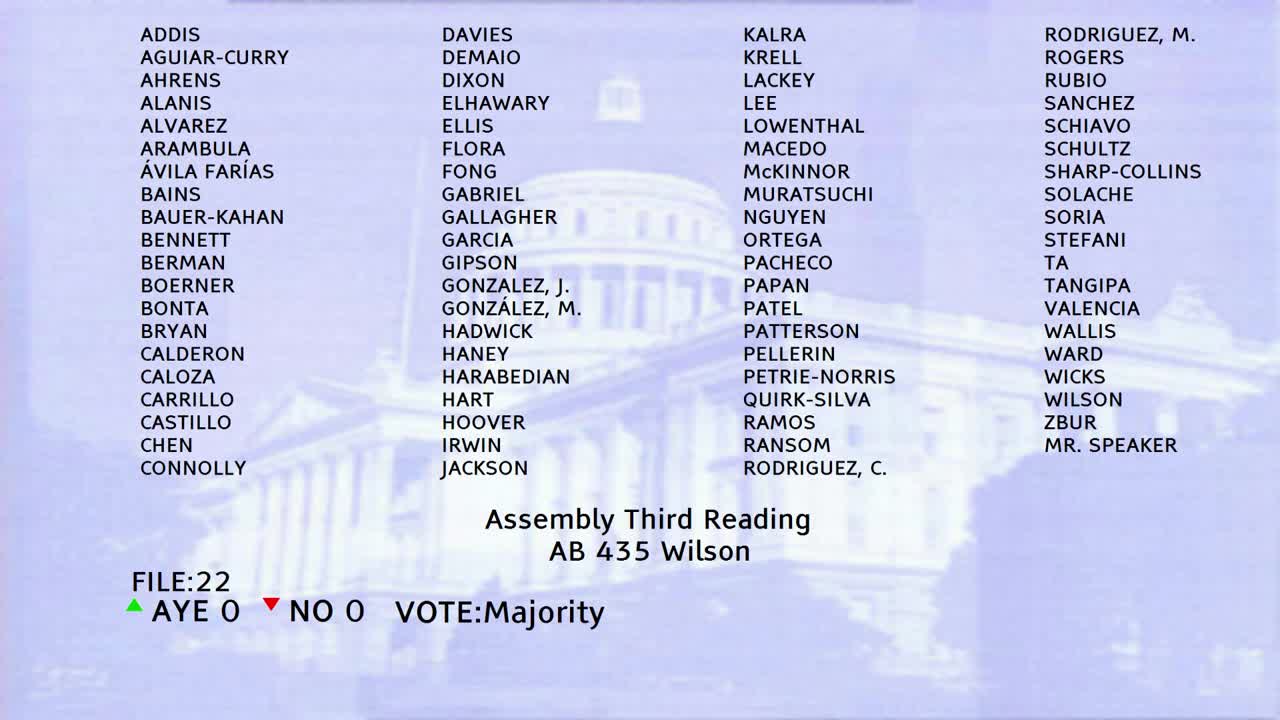 58SEC
Assembly Floor
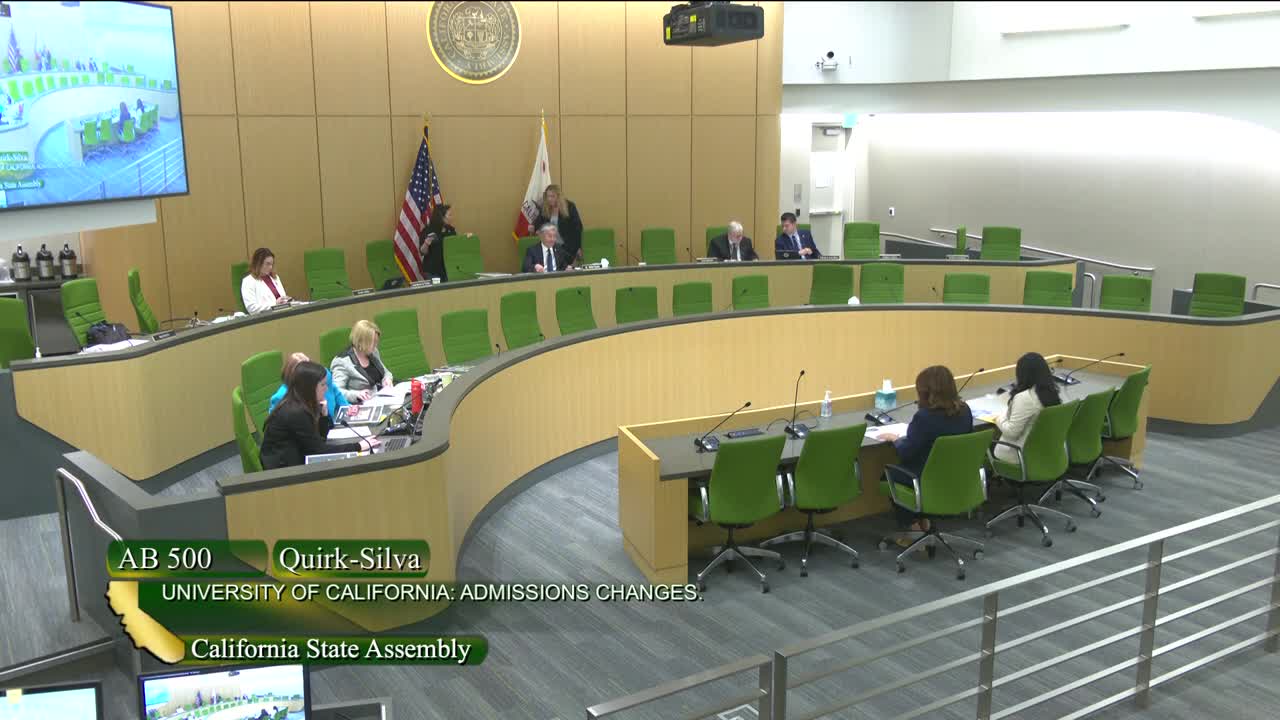 13MIN
Assembly Standing Committee on Education
 7MIN
Assembly Standing Committee on Higher Education
Bill Author

Bill Co-Author(s):