AB 501: Lawsuits, liens, and other encumbrances.
- Session Year: 2025-2026
- House: Assembly
- Latest Version Date: 2026-09-27
Current Status:
Passed
(2026-09-27: Chaptered by Secretary of State - Chapter 505, Statutes of 2026.)
Introduced
In Committee
Awaiting First Chamber Vote
Passed First Chamber
In Committee
Awaiting Second Chamber Vote
Passed Second Chamber
Enacted
Existing law prohibits a person from filing or recording, or directing another to file or record, a lawsuit, lien, or other encumbrance against any person or entity, knowing that it is false, with the intent to harass the person or entity or to influence or hinder the person in discharging their official duties if the person is a public officer or employee. Existing law also provides that a person who files a lawsuit, lien, or other encumbrance against any person or entity in violation of this prohibition is liable for a civil penalty not to exceed $5,000.
This bill would instead provide that a person who files a lawsuit, lien, or other encumbrance against a person or entity in violation of the above-described prohibition is liable for a civil penalty not to exceed $15,000. The bill would also define lien, for purposes of the above-described prohibition, to include a financing statement. The bill would prohibit a person from filing, or directing another to file, a financing statement for which no reasonable basis or legal cause exists. The bill would make related, conforming changes to these provisions.
The Uniform Commercial Code-Secured Transactions governs security interests in collateral, including personal property and fixtures, as well as certain sales of accounts, contract rights, and chattel paper. That code, among other things, specifies requirements and procedures regarding perfecting a security interest, including the filing of a financing statement with the Secretary of State or the county recorder, based on the property type. Existing law specifies that a financing statement is sufficient if it provides, among other things, the name of the debtor. If it is established that a secured party is not proceeding in accordance with the code, existing law authorizes a court to restrain collection, enforcement, or disposition of collateral on appropriate terms and conditions.
This bill would require the Secretary of State to notify the debtor named in the financing statement within 21 days after the financing statement is filed. The bill would additionally require any court fees incurred by a debtor to be paid at the end of the judicial proceeding, as specified. The bill would also make any party deemed to have violated above-described provision regarding lawsuits, liens, or other encumbrances liable to the debtor for three times all of the court fees paid.
This bill would authorize a person identified as a debtor in a financing statement or a person who reasonably appears to be the person intended to be identified as a debtor in a financing statement that was not permitted to be filed, as prescribed, to file an affidavit, under penalty of perjury, attesting as such with the filing office in which the statement was filed. The bill would require the Secretary of State to make available a form affidavit for use. The bill would require the filing office, following acceptance of a properly signed affidavit, to hold the affidavit in abeyance for a 30-day period. The bill would require the filing office, upon expiration of that 30-day period, if no court order enjoining the filing has been received, to file a termination statement with respect to the financing statement identified in the affidavit, in accordance with certain legal procedures and timelines.
The bill would authorize a secured party of record, identified in a financing statement for which an affidavit has been accepted, to petition the court to enjoin the filing office from filing the termination statement and for the court to determine whether the financing statement is valid and should be reinstated, as specified. The bill would authorize a court to award costs, reasonable attorneys fees, and, upon determining an affidavit was filed in bad faith, a $5,000 civil penalty. By expanding the crime of perjury and imposing new duties on county recorders, the bill would impose a state-mandated local program.
The California Constitution requires the state to reimburse local agencies and school districts for certain costs mandated by the state. Statutory provisions establish procedures for making that reimbursement.
This bill would provide that with regard to certain mandates no reimbursement is required by this act for a specified reason.
With regard to any other mandates, this bill would provide that, if the Commission on State Mandates determines that the bill contains costs so mandated by the state, reimbursement for those costs shall be made pursuant to the statutory provisions noted above.
Existing law prohibits a person from filing or recording, or directing another to file or record, a lawsuit, lien, or other encumbrance against any person or entity, knowing that it is false, with the intent to harass the person or entity or to influence or hinder the person in discharging their official duties if the person is a public officer or employee. Existing law also provides that a person who files a lawsuit, lien, or other encumbrance against any person or entity in violation of this prohibition is liable for a civil penalty not to exceed $5,000.
This bill would instead provide that a person who files a lawsuit, lien, or other encumbrance against a person or entity in violation of the above-described prohibition is liable for a civil penalty not to exceed $15,000. The bill would also define lien, for purposes of the above-described prohibition, to include a financing statement. The bill would prohibit a person from filing, or directing another to file, a financing statement for which no reasonable basis or legal cause exists. The bill would make related, conforming changes to these provisions.
The Uniform Commercial Code-Secured Transactions governs security interests in collateral, including personal property and fixtures, as well as certain sales of accounts, contract rights, and chattel paper. That code, among other things, specifies requirements and procedures regarding perfecting a security interest, including the filing of a financing statement with the Secretary of State. State or the county recorder, based on the property type. Existing law specifies that a financing statement is sufficient if it provides, among other things, the name of the debtor. If it is established that a secured party is not proceeding in accordance with the code, existing law authorizes a court to restrain collection, enforcement, or disposition of collateral on appropriate terms and conditions.
This bill would require the Secretary of State to notify the debtor named in the financing statement within 21 days after the financing statement is filed. The bill would additionally require any court fees incurred by a debtor to be paid at the end of the judicial proceeding, as specified. The bill would also make any party deemed to have violated above-described provision regarding lawsuits, liens, or other encumbrances liable to the debtor for three times all of the court fees paid.
This bill would authorize a person identified as a debtor in a financing statement or a person who reasonably appears to be the person intended to be identified as a debtor in a financing statement that was not permitted to be filed, as prescribed, to file an affidavit, under penalty of perjury, attesting as such with the filing office in which the statement was filed. The bill would require the Secretary of State to make available a form affidavit for use. The bill would require the filing office, following acceptance of a properly signed affidavit, to hold the affidavit in abeyance for a 30-day period. The bill would require the filing office, upon expiration of that 30-day period, if no court order enjoining the filing has been received, to file a termination statement with respect to the financing statement identified in the affidavit, in accordance with certain legal procedures and timelines.
The bill would authorize a secured party of record, identified in a financing statement for which an affidavit has been accepted, to petition the court to enjoin the filing office from filing the termination statement and for the court to determine whether the financing statement is valid and should be reinstated, as specified. The bill would authorize a court to award costs, reasonable attorneys fees, and, upon determining an affidavit was filed in bad faith, a $5,000 civil penalty. By expanding the crime of perjury and imposing new duties on county recorders, the bill would impose a state-mandated local program.
The California Constitution requires the state to reimburse local agencies and school districts for certain costs mandated by the state. Statutory provisions establish procedures for making that reimbursement.
This bill would provide that with regard to certain mandates no reimbursement is required by this act for a specified reason.
With regard to any other mandates, this bill would provide that, if the Commission on State Mandates determines that the bill contains costs so mandated by the state, reimbursement for those costs shall be made pursuant to the statutory provisions noted above.
Existing law prohibits a person from filing or recording, or directing another to file or record, a lawsuit, lien, or other encumbrance against any person or entity, knowing that it is false, with the intent to harass the person or entity or to influence or hinder the person in discharging their official duties if the person is a public officer or employee. Existing law also provides that a person who files a lawsuit, lien, or other encumbrance against any person or entity in violation of this prohibition is liable for a civil penalty not to exceed $5,000.
This bill would instead provide that a person who files a lawsuit, lien, or other encumbrance against a person or entity in violation of the above-described prohibition is liable for a civil penalty not to exceed $15,000.
The Uniform Commercial Code-Secured Transactions governs security interests in collateral, including personal property and fixtures, as well as certain sales of accounts, contract rights, and chattel paper. That code, among other things, specifies requirements and procedures regarding perfecting a security interest, including the filing of a financing statement with the Secretary of State. Existing law specifies that a financing statement is sufficient if it provides, among other things, the name of the debtor. If it is established that a secured party is not proceeding in accordance with the code, existing law authorizes a court to restrain collection, enforcement, or disposition of collateral on appropriate terms and conditions.
This bill would require the Secretary of State to notify the debtor named in the financing statement within 21 days after the financing statement is filed. The bill would additionally require any court fees incurred by a debtor to be paid at the end of the judicial proceeding, as specified. The bill would also make any party deemed to have violated above-described provision regarding lawsuits, liens, or other encumbrances liable to the debtor for three times all of the court fees paid.
Under existing law a person has a lien, dependent upon possession, for the amount the person is owed for any services, materials, or storage provided for any aircraft, unless specified exceptions apply. If the lienholder is not paid the amount due within 10 days of its due date, the lienholder may sell the property at public auction. Prior to selling the property, the lienholder must publish a notice of sale in a newspaper published in the county or, if there is no such newspaper, in three of the most public places in the city or place where airplanes are sold, as specified.This bill would increase the notice requirement to require the lienholder, where there is no newspaper in the county, to publish a notice of sale in five of the most public places in the city or place where airplanes are sold and, if known, at the airport at which the aircraft is located.Under existing law a person has a lien, dependent upon possession, for the amount the person is owed for any services, materials, or storage provided for any aircraft, unless specified exceptions apply. If the lienholder is not paid the amount due within 10 days of its due date, the lienholder may sell the property at public auction. Prior to selling the property, the lienholder must publish a notice of sale in a newspaper published in the county or, if there is no such newspaper, in three of the most public places in the city or place where airplanes are sold, as specified.
This bill would increase the notice requirement to require the lienholder, where there is no newspaper in the county, to publish a notice of sale in five of the most public places in the city or place where airplanes are sold. sold and, if known, at the airport at which the aircraft is located.
Under existing law a person has a lien, dependent upon possession, for the amount the person is owed for any services, materials, or storage provided for any aircraft, unless specified exceptions apply. If the lienholder is not paid the amount due within 10 days of its due date, the lienholder may sell the property at public auction. Prior to selling the property, the lienholder must publish a notice of sale in a newspaper published in the county or, if there is no such newspaper, in three of the most public places in the city or place where airplanes are sold, as specified.
This bill would increase the notice requirement to require the lienholder, where there is no newspaper in the county, to publish a notice of sale in five of the most public places in the city or place where airplanes are sold.
Existing law authorizes the establishment of corporations for specific purposes, including, among others, certain types of charitable corporations. Existing law requires every charitable corporation to file with the Attorney General a registration form and other related documents, under oath, within 30 days after the corporation initially receives property and thereafter on a periodic basis, as specified.This bill would define a startup venture capital nonprofit to mean a charitable corporation meeting a certain amount of specified requirements, including that the corporation has obtained combined revenues of $100,000,000 or more during any 5-year period. The bill would further define related terms.This bill would prohibit a startup venture capital nonprofit from transferring a substantial amount of its assets, meaning a cumulative fair market value in excess of $100,000,000, to an acquiring entity as part of a single transaction, as defined. The bill would prohibit a startup venture capital nonprofit from converting into a mutual benefit corporation, public benefit corporation, social purpose corporation, business corporation, or any other wholly or partially for-profit entity or form. The bill would require the Attorney General to take all necessary action to ensure compliance with those provisions.By expanding the crime of perjury, the bill would impose a state-mandated local program.The California Constitution requires the state to reimburse local agencies and school districts for certain costs mandated by the state. Statutory provisions establish procedures for making that reimbursement.This bill would provide that no reimbursement is required by this act for a specified reason.Existing law authorizes the establishment of corporations for specific purposes, including, among others, certain types of charitable corporations. Existing law requires every charitable corporation to file with the Attorney General a registration form and other related documents, under oath, within 30 days after the corporation initially receives property and thereafter on a periodic basis, as specified.
This bill would define a startup venture capital nonprofit to mean a charitable corporation meeting a certain amount of specified requirements, including that the corporation has obtained combined revenues of $100,000,000 or more during any 5-year period. The bill would further define related terms.
This bill would prohibit a startup venture capital nonprofit from transferring a substantial amount of its assets, meaning a cumulative fair market value in excess of $100,000,000, to an acquiring entity as part of a single transaction, as defined. The bill would prohibit a startup venture capital nonprofit from converting into a mutual benefit corporation, public benefit corporation, social purpose corporation, business corporation, or any other wholly or partially for-profit entity or form. The bill would require the Attorney General to take all necessary action to ensure compliance with those provisions.
By expanding the crime of perjury, the bill would impose a state-mandated local program.
The California Constitution requires the state to reimburse local agencies and school districts for certain costs mandated by the state. Statutory provisions establish procedures for making that reimbursement.
This bill would provide that no reimbursement is required by this act for a specified reason.
Existing law, the Nonprofit Mutual Benefit Corporation Law, generally regulates the formation and conduct of nonprofit mutual benefit corporations. Existing law authorizes one or more persons to form a nonprofit mutual benefit corporation by executing and filing articles of incorporation. If initial directors are not named in the articles, existing law requires the articles to be signed by one or more persons who thereupon are the incorporators of the corporation.This bill would instead require the articles to be signed by two or more persons if initial directors are not named in the articles.Existing law, the Nonprofit Mutual Benefit Corporation Law, generally regulates the formation and conduct of nonprofit mutual benefit corporations. Existing law authorizes one or more persons to form a nonprofit mutual benefit corporation by executing and filing articles of incorporation. If initial directors are not named in the articles, existing law requires the articles to be signed by one or more persons who thereupon are the incorporators of the corporation.
This bill would instead require the articles to be signed by two or more persons if initial directors are not named in the articles.
(a)For purposes of this section:
(1)Harass means engage in knowing and willful conduct that serves no legitimate purpose.
(2)Entity includes both governmental and private entities.
(3)Lien includes a financing statement, as defined in Section 9102 of the Commercial Code.
(b)(1)A person shall not file or record, or direct another to file or record, a lawsuit, lien, or other encumbrance, including a notice of lis pendens, against another person or entity knowing it is false, with the intent to harass the person or entity or to influence or hinder the person in discharging their official duties if the person is a public officer or employee.
(2)A person shall not file, or direct another to file, a financing statement for which no reasonable basis or legal cause exists.
(c)(1)A person or entity whose property is subject to a lien or encumbrance or who is named in a lawsuit, financing statement, or notice of lis pendens in violation of this section may petition the superior court of the county in which the person or entity resides, in which the financing statement was filed, or in which the property is located for an order, which may be granted ex parte, directing the lien or other encumbrance claimant to appear at a hearing before the court and show cause why the lien or other encumbrance should not be stricken and other relief provided by this article should not be granted.
(2)The court shall schedule the hearing no earlier than 14 days after the date of the order. The scheduled date of the hearing shall allow adequate time for notice of the hearing.
SEC. 2.Section 765.040 of the Code of Civil Procedure is amended to read:765.040.Any lien or encumbrance claimant who records or files, or directs another to record or file, a lawsuit, lien, or other encumbrance in violation of paragraph (1) of subdivision (b) of Section 765.010 shall be liable to the person subject to the lawsuit or the owner of the property bound by the lien or other encumbrance for a civil penalty of up to fifteen thousand dollars ($15,000).
SEC. 3.Section 9513.1 is added to the Commercial Code, to read:9513.1.(a)A person identified as a debtor in a financing statement or a person who reasonably appears to be the person intended to be identified as a debtor in a financing statement, including where the financing statement identifies the debtor by a trade name, fictitious business name, former name, misspelling or truncation, that was not permitted to be filed under Section 9509 of this code or was filed in violation of subdivision (b) of Section 765.010 of the Code of Civil Procedure may, under penalty of perjury, file an affidavit attesting as such with the filing office in which the statement was filed. The Secretary of State shall make available a form affidavit for use. The filing office shall reject an affidavit filed under this subdivision if the affidavit is incomplete or violates subdivision (i).
(b)Following acceptance of an affidavit properly filed under subdivision (a), the filing office shall hold the affidavit in abeyance for 30 days. Upon the expiration of the 30-day period, if no court order enjoining the filing has been received, the filing office shall file a termination statement with respect to the financing statement identified in the affidavit. Notwithstanding Section 9510, the termination statement shall be immediately effective upon filing. The termination statement shall indicate that the statement was filed under this section and include a copy of the affidavit.
(c)Immediately upon acceptance of an affidavit filed under subdivision (a), the filing office shall send notice of the pending termination of the financing statement to each secured party of record identified in the financing statement at the mailing address provided in the financing statement.
(d)A secured party of record identified in a financing statement for which an affidavit has been accepted under subdivision (b) may petition the superior court of the county in which the filing office is located, or in which the secured party of record resides or has its principal place of business, for preliminary injunctive relief to enjoin the filing office from filing the termination statement and for an order, which may be granted ex parte, directing the affiant to appear at a hearing before the court at which the court shall determine whether the financing statement is valid and should be reinstated. The court shall schedule the hearing no earlier than 14 days after the date of the order. The scheduled date of the hearing shall allow adequate time for notice of the hearing. An action under this subdivision must be brought not later than the 90th day after the date on which the termination statement is filed.
(e)(1)If the affiant fails to appear at the hearing after proper service, and upon a prima facie showing by the petitioner, the court may deem the financing statement valid and issue an order to that effect.
(2)If the court determines that the financing statement is invalid, the court shall issue an order to that effect and may award costs and reasonable attorneys fees to the affiant to be paid by the petitioner.
(3)If the court determines that the financing statement is valid and should be reinstated, the court shall issue an order to that effect and may award costs and reasonable attorneys fees to the petitioner to be paid by the affiant. If the court further determines that the affidavit filed was made in bad faith, it may additionally award the petitioner actual damages and may impose a civil penalty not to exceed five thousand dollars ($5,000) against the affiant. This subdivision does not limit criminal liability for perjury or other applicable offenses.
(f)(1)Upon receipt of a certified order of the court that a terminated financing statement is valid and should be reinstated, the filing office shall promptly file an amendment to the financing statement indicating that the financing statement has been reinstated.
(2)Upon receipt of a certified order of the court that a financing statement for which no termination statement has been filed under subdivision (b) is invalid, the filing office shall promptly file such termination statement.
(g)A financing statement reinstated under subdivision (f) is effective from the initial filing date and is considered to have never been ineffective against all persons and for all purposes except against a purchaser of the collateral described in the financing statement who gave value in reliance on the termination statement.
(h)If the period of effectiveness of a financing statement reinstated under subdivision (f) would have lapsed during the period of termination, a secured party of record may file a continuation statement not later than the 30th day after the financing statement is reinstated, and the continuation statement shall have the same effect as if it had been filed during the six-month period prescribed by subdivision (d) of Section 9515 of this code.
(i)An affidavit filed under subdivision (a) and any termination statement filed under subdivision (b) are not effective with respect to a financing statement filed by or on behalf of a financial institution, as defined in subdivision (a) of Section 14161 of the Penal Code or Section 481.113 of the Code of Civil Procedure, or a public entity, as defined in Section 481.200 of the Code of Civil Procedure.
(j)If an affidavit under subdivision (a) is filed by or on behalf of a public officer or employee, the state or local agency that employs the public officer or employee may provide counsel for the public officer or employee in an action brought under subdivision (d).
(k)The filing office or an employee of the filing office may not be subject to liability for the termination or amendment of a financing statement in the lawful performance of the duties of the filing office under this section.
(l)The provisions of this section are not exclusive. The remedies provided in this section shall be in addition to any other procedures or remedies for any violation or conduct provided for in any other law.
SEC. 4.Section 9529 is added to the Commercial Code, to read:9529.The Secretary of State shall notify the debtor named in the financing statement within 21 days after the financing statement is filed.
SEC. 5.Section 9625 of the Commercial Code is amended to read:9625.(a)(1)If it is established that a secured party is not proceeding in accordance with this division, a court may order or restrain collection, enforcement, or disposition of collateral on appropriate terms and conditions.
(2)Any court fees incurred by a debtor shall be paid at the end of the judicial proceeding brought pursuant to this section. Any party deemed to have violated Section 765.010 of the Code of Civil Procedure shall be liable to the debtor for three times all of the court fees paid.
(b)Subject to subdivisions (c), (d), and (f), a person is liable for damages in the amount of any loss caused by a failure to comply with this division. Loss caused by a failure to comply may include loss resulting from the debtors inability to obtain, or increased costs of, alternative financing.
(c)Except as otherwise provided in Section 9628, a person that, at the time of the failure, was a debtor, was an obligor, or held a security interest in or other lien on the collateral may recover damages under subdivision (b) for its loss.
(d)A debtor whose deficiency is eliminated under Section 9626 may recover damages for the loss of any surplus. However, in a transaction other than a consumer transaction, a debtor or secondary obligor whose deficiency is eliminated or reduced under Section 9626 may not otherwise recover under subdivision (b) for noncompliance with the provisions of this chapter relating to collection, enforcement, disposition, or acceptance.
(e)In addition to any damages recoverable under subdivision (b), the debtor, consumer obligor, or person named as a debtor in a filed record, as applicable, may recover five hundred dollars ($500) in each case from any of the following persons:
(1)A person that fails to comply with Section 9208.
(2)A person that fails to comply with Section 9209.
(3)A person that files a record that the person is not entitled to file under subdivision (a) of Section 9509.
(4)A person that fails to cause the secured party of record to file or send a termination statement as required by subdivision (a) or (c) of Section 9513.
(5)A person that fails to comply with paragraph (1) of subdivision (b) of Section 9616 and whose failure is part of a pattern, or consistent with a practice, of noncompliance.
(6)A person that fails to comply with paragraph (2) of subdivision (b) of Section 9616.
(f)A debtor or consumer obligor may recover damages under subdivision (b) and, in addition, five hundred dollars ($500) in each case from a person that, without reasonable cause, fails to comply with a request under Section 9210. A recipient of a request under Section 9210 which never claimed an interest in the collateral or obligations that are the subject of a request under that section has a reasonable excuse for failure to comply with the request within the meaning of this subdivision.
(g)If a secured party fails to comply with a request regarding a list of collateral or a statement of account under Section 9210, the secured party may claim a security interest only as shown in the list or statement included in the request as against a person that is reasonably misled by the failure.
SEC. 6.No reimbursement is required by this act pursuant to Section 6 of Article XIIIB of the California Constitution for certain costs that may be incurred by a local agency or school district because, in that regard, this act creates a new crime or infraction, eliminates a crime or infraction, or changes the penalty for a crime or infraction, within the meaning of Section 17556 of the Government Code, or changes the definition of a crime within the meaning of Section 6 of Article XIIIB of the California Constitution.
However, if the Commission on State Mandates determines that this act contains other costs mandated by the state, reimbursement to local agencies and school districts for those costs shall be made pursuant to Part 7 (commencing with Section 17500) of Division 4 of Title 2 of the Government Code.
(a)For purposes of this section:
(1)Harass means engage in knowing and willful conduct that serves no legitimate purpose.
(2)Entity includes both governmental and private entities.
(3)Lien includes a financing statement, as defined in Section 9102 of the Commercial Code.
(b)(1)A person shall not file or record, or direct another to file or record, a lawsuit, lien, or other encumbrance, including a notice of lis pendens, against another person or entity knowing it is false, with the intent to harass the person or entity or to influence or hinder the person in discharging his or her their official duties if the person is a public officer or employee.
(2)A person shall not file, or direct another to file, a financing statement for which no reasonable basis or legal cause exists.
(c)(1)A person or entity whose property is subject to a lien or encumbrance or who is named in a lawsuit, financing statement, or notice of lis pendens in violation of this section may petition the superior court of the county in which the person or entity resides resides, in which the financing statement was filed, or in which the property is located for an order, which may be granted ex parte, directing the lien or other encumbrance claimant to appear at a hearing before the court and show cause why the lien or other encumbrance should not be stricken and other relief provided by this article should not be granted.
(2)The court shall schedule the hearing no earlier than 14 days after the date of the order. The scheduled date of the hearing shall allow adequate time for notice of the hearing.
SECTION 1.SEC. 2.Section 765.040 of the Code of Civil Procedure is amended to read:765.040.Any lien or encumbrance claimant who records or files, or directs another to record or file, a lawsuit, lien, or other encumbrance in violation of paragraph (1) of subdivision (b) of Section 765.010 shall be liable to the person subject to the lawsuit or the owner of the property bound by the lien or other encumbrance for a civil penalty of up to fifteen thousand dollars ($15,000).
SEC. 3.Section 9513.1 is added to the Commercial Code, to read:9513.1.(a)A person identified as a debtor in a financing statement or a person who reasonably appears to be the person intended to be identified as a debtor in a financing statement, including where the financing statement identifies the debtor by a trade name, fictitious business name, former name, misspelling or truncation, that was not permitted to be filed under Section 9509 of this code or was filed in violation of subdivision (b) of Section 765.010 of the Code of Civil Procedure may, under penalty of perjury, file an affidavit attesting as such with the filing office in which the statement was filed. The Secretary of State shall make available a form affidavit for use. The filing office shall reject an affidavit filed under this subdivision if the affidavit is incomplete or violates subdivision (i).
(b)Following acceptance of an affidavit properly filed under subdivision (a), the filing office shall hold the affidavit in abeyance for 30 days. Upon the expiration of the 30-day period, if no court order enjoining the filing has been received, the filing office shall file a termination statement with respect to the financing statement identified in the affidavit. Notwithstanding Section 9510, the termination statement shall be immediately effective upon filing. The termination statement shall indicate that the statement was filed under this section and include a copy of the affidavit.
(c)Immediately upon acceptance of an affidavit filed under subdivision (a), the filing office shall send notice of the pending termination of the financing statement to each secured party of record identified in the financing statement at the mailing address provided in the financing statement.
(d)A secured party of record identified in a financing statement for which an affidavit has been accepted under subdivision (b) may petition the superior court of the county in which the filing office is located, or in which the secured party of record resides or has its principal place of business, for preliminary injunctive relief to enjoin the filing office from filing the termination statement and for an order, which may be granted ex parte, directing the affiant to appear at a hearing before the court at which the court shall determine whether the financing statement is valid and should be reinstated. The court shall schedule the hearing no earlier than 14 days after the date of the order. The scheduled date of the hearing shall allow adequate time for notice of the hearing. An action under this subdivision must be brought not later than the 90th day after the date on which the termination statement is filed.
(e)(1)If the affiant fails to appear at the hearing after proper service, and upon a prima facie showing by the petitioner, the court may deem the financing statement valid and issue an order to that effect.
(2)If the court determines that the financing statement is invalid, the court shall issue an order to that effect and may award costs and reasonable attorneys fees to the affiant to be paid by the petitioner.
(3)If the court determines that the financing statement is valid and should be reinstated, the court shall issue an order to that effect and may award costs and reasonable attorneys fees to the petitioner to be paid by the affiant. If the court further determines that the affidavit filed was made in bad faith, it may additionally award the petitioner actual damages and may impose a civil penalty not to exceed five thousand dollars ($5,000) against the affiant. This subdivision does not limit criminal liability for perjury or other applicable offenses.
(f)(1)Upon receipt of a certified order of the court that a terminated financing statement is valid and should be reinstated, the filing office shall promptly file an amendment to the financing statement indicating that the financing statement has been reinstated.
(2)Upon receipt of a certified order of the court that a financing statement for which no termination statement has been filed under subdivision (b) is invalid, the filing office shall promptly file such termination statement.
(g)A financing statement reinstated under subdivision (f) is effective from the initial filing date and is considered to have never been ineffective against all persons and for all purposes except against a purchaser of the collateral described in the financing statement who gave value in reliance on the termination statement.
(h)If the period of effectiveness of a financing statement reinstated under subdivision (f) would have lapsed during the period of termination, a secured party of record may file a continuation statement not later than the 30th day after the financing statement is reinstated, and the continuation statement shall have the same effect as if it had been filed during the six-month period prescribed by subdivision (d) of Section 9515 of this code.
(i)An affidavit filed under subdivision (a) and any termination statement filed under subdivision (b) are not effective with respect to a financing statement filed by or on behalf of a financial institution, as defined in subdivision (a) of Section 14161 of the Penal Code or Section 481.113 of the Code of Civil Procedure, or a public entity, as defined in Section 481.200 of the Code of Civil Procedure.
(j)If an affidavit under subdivision (a) is filed by or on behalf of a public officer or employee, the state or local agency that employs the public officer or employee may provide counsel for the public officer or employee in an action brought under subdivision (d).
(k)The filing office or an employee of the filing office may not be subject to liability for the termination or amendment of a financing statement in the lawful performance of the duties of the filing office under this section.
(l)The provisions of this section are not exclusive. The remedies provided in this section shall be in addition to any other procedures or remedies for any violation or conduct provided for in any other law.
SEC. 2.SEC. 4.Section 9529 is added to the Commercial Code, to read:9529.The Secretary of State shall notify the debtor named in the financing statement within 21 days after the financing statement is filed.
SEC. 3.SEC. 5.Section 9625 of the Commercial Code is amended to read:9625.(a)(1)If it is established that a secured party is not proceeding in accordance with this division, a court may order or restrain collection, enforcement, or disposition of collateral on appropriate terms and conditions.
(2)Any court fees incurred by a debtor shall be paid at the end of the judicial proceeding brought pursuant to this section. Any party deemed to have violated Section 765.010 of the Code of Civil Procedure shall be liable to the debtor for three times all of the court fees paid.
(b)Subject to subdivisions (c), (d), and (f), a person is liable for damages in the amount of any loss caused by a failure to comply with this division. Loss caused by a failure to comply may include loss resulting from the debtors inability to obtain, or increased costs of, alternative financing.
(c)Except as otherwise provided in Section 9628, a person that, at the time of the failure, was a debtor, was an obligor, or held a security interest in or other lien on the collateral may recover damages under subdivision (b) for its loss.
(d)A debtor whose deficiency is eliminated under Section 9626 may recover damages for the loss of any surplus. However, in a transaction other than a consumer transaction, a debtor or secondary obligor whose deficiency is eliminated or reduced under Section 9626 may not otherwise recover under subdivision (b) for noncompliance with the provisions of this chapter relating to collection, enforcement, disposition, or acceptance.
(e)In addition to any damages recoverable under subdivision (b), the debtor, consumer obligor, or person named as a debtor in a filed record, as applicable, may recover five hundred dollars ($500) in each case from any of the following persons:
(1)A person that fails to comply with Section 9208.
(2)A person that fails to comply with Section 9209.
(3)A person that files a record that the person is not entitled to file under subdivision (a) of Section 9509.
(4)A person that fails to cause the secured party of record to file or send a termination statement as required by subdivision (a) or (c) of Section 9513.
(5)A person that fails to comply with paragraph (1) of subdivision (b) of Section 9616 and whose failure is part of a pattern, or consistent with a practice, of noncompliance.
(6)A person that fails to comply with paragraph (2) of subdivision (b) of Section 9616.
(f)A debtor or consumer obligor may recover damages under subdivision (b) and, in addition, five hundred dollars ($500) in each case from a person that, without reasonable cause, fails to comply with a request under Section 9210. A recipient of a request under Section 9210 which never claimed an interest in the collateral or obligations that are the subject of a request under that section has a reasonable excuse for failure to comply with the request within the meaning of this subdivision.
(g)If a secured party fails to comply with a request regarding a list of collateral or a statement of account under Section 9210, the secured party may claim a security interest only as shown in the list or statement included in the request as against a person that is reasonably misled by the failure.
SEC. 6.No reimbursement is required by this act pursuant to Section 6 of Article XIIIB of the California Constitution for certain costs that may be incurred by a local agency or school district because, in that regard, this act creates a new crime or infraction, eliminates a crime or infraction, or changes the penalty for a crime or infraction, within the meaning of Section 17556 of the Government Code, or changes the definition of a crime within the meaning of Section 6 of Article XIIIB of the California Constitution.
However, if the Commission on State Mandates determines that this act contains other costs mandated by the state, reimbursement to local agencies and school districts for those costs shall be made pursuant to Part 7 (commencing with Section 17500) of Division 4 of Title 2 of the Government Code.
Any lien or encumbrance claimant who records or files, or directs another to record or file, a lawsuit, lien, or other encumbrance in violation of Section 765.010 shall be liable to the person subject to the lawsuit or the owner of the property bound by the lien or other encumbrance for a civil penalty of up to five thousand dollars ($5,000). fifteen thousand dollars ($15,000).
SEC. 2.Section 9529 is added to the Commercial Code, to read:9529.The Secretary of State shall notify the debtor named in the financing statement within 21 days after the financing statement is filed.
SEC. 3.Section 9625 of the Commercial Code is amended to read:9625.(a)(1)If it is established that a secured party is not proceeding in accordance with this division, a court may order or restrain collection, enforcement, or disposition of collateral on appropriate terms and conditions.
(2)Any court fees incurred by a debtor shall be paid at the end of the judicial proceeding brought pursuant to this section. Any party deemed to have violated Section 765.010 of the Code of Civil Procedure shall be liable to the debtor for three times all of the court fees paid.
(b)Subject to subdivisions (c), (d), and (f), a person is liable for damages in the amount of any loss caused by a failure to comply with this division. Loss caused by a failure to comply may include loss resulting from the debtors inability to obtain, or increased costs of, alternative financing.
(c)Except as otherwise provided in Section 9628, a person that, at the time of the failure, was a debtor, was an obligor, or held a security interest in or other lien on the collateral may recover damages under subdivision (b) for its loss.
(d)A debtor whose deficiency is eliminated under Section 9626 may recover damages for the loss of any surplus. However, in a transaction other than a consumer transaction, a debtor or secondary obligor whose deficiency is eliminated or reduced under Section 9626 may not otherwise recover under subdivision (b) for noncompliance with the provisions of this chapter relating to collection, enforcement, disposition, or acceptance.
(e)In addition to any damages recoverable under subdivision (b), the debtor, consumer obligor, or person named as a debtor in a filed record, as applicable, may recover five hundred dollars ($500) in each case from any of the following persons:
(1)A person that fails to comply with Section 9208.
(2)A person that fails to comply with Section 9209.
(3)A person that files a record that the person is not entitled to file under subdivision (a) of Section 9509.
(4)A person that fails to cause the secured party of record to file or send a termination statement as required by subdivision (a) or (c) of Section 9513.
(5)A person that fails to comply with paragraph (1) of subdivision (b) of Section 9616 and whose failure is part of a pattern, or consistent with a practice, of noncompliance.
(6)A person that fails to comply with paragraph (2) of subdivision (b) of Section 9616.
(f)A debtor or consumer obligor may recover damages under subdivision (b) and, in addition, five hundred dollars ($500) in each case from a person that, without reasonable cause, fails to comply with a request under Section 9210. A recipient of a request under Section 9210 which never claimed an interest in the collateral or obligations that are the subject of a request under that section has a reasonable excuse for failure to comply with the request within the meaning of this subdivision.
(g)If a secured party fails to comply with a request regarding a list of collateral or a statement of account under Section 9210, the secured party may claim a security interest only as shown in the list or statement included in the request as against a person that is reasonably misled by the failure.
SECTION 1.Section 1208.66 of the Code of Civil Procedure is amended to read:1208.66.Prior to any such sale the lienholder shall publish a notice of the sale pursuant to Section 6062 of the Government Code in a newspaper published in the county in which the aircraft is situated, or if there is no such newspaper, by posting notice of sale in five of the most public places in the city or place where such aircraft is to be sold and, if known, at the airport at which the aircraft is located, for 10 days prior to the date of the sale. Prior to the sale of any aircraft to satisfy any such lien, 20 days notice by registered mail shall be given to the legal owner as it appears in the registration certificate.Prior to any such sale the lienholder shall publish a notice of the sale pursuant to Section 6062 of the Government Code in a newspaper published in the county in which the aircraft is situated, or if there is no such newspaper, by posting notice of sale in five of the most public places in the city or place where such aircraft is to be sold and, if known, at the airport at which the aircraft is located, for 10 days previous prior to the date of the sale. Prior to the sale of any aircraft to satisfy any such lien, 20 days notice by registered mail shall be given to the legal owner as it appears in the registration certificate.
Prior to any such sale the lienholder shall publish a notice of the sale pursuant to Section 6062 of the Government Code in a newspaper published in the county in which the aircraft is situated, or if there is no such newspaper, by posting notice of sale in three five of the most public places in the city or place where such aircraft is to be sold for 10 days previous to the date of the sale. Prior to the sale of any aircraft to satisfy any such lien, 20 days notice by registered mail shall be given to the legal owner as it appears in the registration certificate.
SECTION 1.Chapter 3 (commencing with Section 14350) is added to Part 7 of Division 3 of Title 1 of the Corporations Code, to read:3.Startup Venture Capital Nonprofits1.Definitions14350.As used in this chapter, the following definitions shall apply:(a)Acquiring entity means a natural person, for-profit corporation, or other for-profit legal or corporate organization of any kind, including a parent, subsidiary, or affiliate entity.(b)Asset means all of the following:(1)A thing, whether tangible or intangible, capable of ownership, possession, use, or control, including, but not limited to, the following:(A)Real property, personal property, intellectual property, tangible property, and intangible property.(B)Inventions, discoveries, developed technologies, computing systems, trade secrets, and leases and licenses.(2)The right to use or control, either wholly or partially, of anything described in paragraph (1).(3)The know-how, relationships, and experiences gained or acquired in the course of researching, developing, building, testing, or operating any theories, concepts, designs, plans, inventions, discoveries, technologies, computing systems, or other intellectual property.(c)Economic interest means stock, equity, units of ownership, profit participating units, profit interest units, claims on earnings or assets, voting rights, shares, profit-sharing agreements, or other similar rights or interests.(d)Fair market value means the most likely price that the asset being transferred would bring in a competitive and open market under all conditions requisite to a fair transfer, including that the buyer and seller would each act prudently, knowledgeably, and in their own best interest, and that a reasonable time would be allowed for exposure in the open market.(e)Single transaction means all transfers of assets by a startup venture capital nonprofit to an acquiring entity occurring within a 60-month period, commencing with the date of the first transfer, and includes all transfers of assets by a startup venture capital nonprofit to one or more intermediary entities that eventually transfer the asset to the acquiring entity.(f)Startup venture capital nonprofit means a charitable corporation, as defined in Section 12582.1 of the Government Code, that satisfies at least three of the following conditions during any 10-year period:(1)The entity has obtained combined revenues of one hundred million dollars ($100,000,000) or more during any five-year period, as determined from the Internal Revenue Service Return of Organization Exempt From Income Tax (Form 990) filings submitted by the entity.(2)The entity creates, owns, or controls, wholly or partially and directly or indirectly, one or more for-profit companies, whether organized as a corporation, limited partnership, general partnership, limited liability company, or similar legal structure, and for which either of the following apply:(A)The for-profit companies have, in the aggregate, obtained investments or funding commitments valued in excess of one billion dollars ($1,000,000,000) from outside sources. Existence of those investments may be proven based upon a file or record submitted by the entity or the outside source to the Attorney General, the Secretary of State, the United States Internal Revenue Service, the United States Securities and Exchange Commission, or another agency of the United States or any state thereof.(B)Another for-profit entity currently has, or previously obtained, an economic interest in a for-profit company described in subparagraph (A). Existence of an economic interest may be proven based upon any file or record submitted by the entity or the other for-profit entity to the Attorney General, the Secretary of State, the United States Internal Revenue Service, the United States Securities and Exchange Commission, or another agency of the United States or any state thereof.(3)Current or former officers, directors, or employees of the entity have obtained, or been offered or promised, an economic interest in a for-profit company described in paragraph (2).(4)In a 12-month period, a majority or more of the individuals serving on the entitys board of directors resign, are terminated, or otherwise depart the board.(5)In any calendar year, the entitys compensation of current officers, directors, trustees, and key employees exceeds five million dollars ($5,000,000), as determined from the Internal Revenue Service Return of Organization Exempt From Income Tax (Form 990) filings submitted by the entity.(6)In any calendar year, the aggregate amount of compensation of current officers, directors, trustees, and key employees, in addition to other salaries and wages paid by the entity, exceeds 75 percent of the entitys total functional expenses, as determined from the Internal Revenue Service Return of Organization Exempt From Income Tax (Form 990) filings submitted by the entity.(g)Substantial amount means a fair market value in excess of one hundred million dollars ($100,000,000).(h)Transfer means to sell, convey, license, lease, exchange, or otherwise relinquish full or partial ownership, use, or control.2.Prohibition on Transfer of Startup Venture Capital Nonprofit Property to a For-Profit Entity14351.(a)A startup venture capital nonprofit shall not transfer a substantial amount of its assets to an acquiring entity as part of a single transaction.(b)Notwithstanding Section 5813.5 or any other law, a startup venture capital nonprofit shall not convert into a mutual benefit corporation, public benefit corporation, social purpose corporation, business corporation, or any other wholly or partially for-profit entity or form.(c)The Attorney General shall take all necessary actions to ensure compliance with this section.SEC. 2.No reimbursement is required by this act pursuant to Section 6 of Article XIIIB of the California Constitution because the only costs that may be incurred by a local agency or school district will be incurred because this act creates a new crime or infraction, eliminates a crime or infraction, or changes the penalty for a crime or infraction, within the meaning of Section 17556 of the Government Code, or changes the definition of a crime within the meaning of Section 6 of Article XIIIB of the California Constitution.As used in this chapter, the following definitions shall apply:
(a)Acquiring entity means a natural person, for-profit corporation, or other for-profit legal or corporate organization of any kind, including a parent, subsidiary, or affiliate entity.
(b)Asset means all of the following:
(1)A thing, whether tangible or intangible, capable of ownership, possession, use, or control, including, but not limited to, the following:
(A)Real property, personal property, intellectual property, tangible property, and intangible property.
(B)Inventions, discoveries, developed technologies, computing systems, trade secrets, and leases and licenses.
(2)The right to use or control, either wholly or partially, of anything described in paragraph (1).
(3)The know-how, relationships, and experiences gained or acquired in the course of researching, developing, building, testing, or operating any theories, concepts, designs, plans, inventions, discoveries, technologies, computing systems, or other intellectual property.
(c)Economic interest means stock, equity, units of ownership, profit participating units, profit interest units, claims on earnings or assets, voting rights, shares, profit-sharing agreements, or other similar rights or interests.
(d)Fair market value means the most likely price that the asset being transferred would bring in a competitive and open market under all conditions requisite to a fair transfer, including that the buyer and seller would each act prudently, knowledgeably, and in their own best interest, and that a reasonable time would be allowed for exposure in the open market.
(e)Single transaction means all transfers of assets by a startup venture capital nonprofit to an acquiring entity occurring within a 60-month period, commencing with the date of the first transfer, and includes all transfers of assets by a startup venture capital nonprofit to one or more intermediary entities that eventually transfer the asset to the acquiring entity.
(f)Startup venture capital nonprofit means a charitable corporation, as defined in Section 12582.1 of the Government Code, that satisfies at least three of the following conditions during any 10-year period:
(1)The entity has obtained combined revenues of one hundred million dollars ($100,000,000) or more during any five-year period, as determined from the Internal Revenue Service Return of Organization Exempt From Income Tax (Form 990) filings submitted by the entity.
(2)The entity creates, owns, or controls, wholly or partially and directly or indirectly, one or more for-profit companies, whether organized as a corporation, limited partnership, general partnership, limited liability company, or similar legal structure, and for which either of the following apply:
(A)The for-profit companies have, in the aggregate, obtained investments or funding commitments valued in excess of one billion dollars ($1,000,000,000) from outside sources. Existence of those investments may be proven based upon a file or record submitted by the entity or the outside source to the Attorney General, the Secretary of State, the United States Internal Revenue Service, the United States Securities and Exchange Commission, or another agency of the United States or any state thereof.
(B)Another for-profit entity currently has, or previously obtained, an economic interest in a for-profit company described in subparagraph (A). Existence of an economic interest may be proven based upon any file or record submitted by the entity or the other for-profit entity to the Attorney General, the Secretary of State, the United States Internal Revenue Service, the United States Securities and Exchange Commission, or another agency of the United States or any state thereof.
(3)Current or former officers, directors, or employees of the entity have obtained, or been offered or promised, an economic interest in a for-profit company described in paragraph (2).
(4)In a 12-month period, a majority or more of the individuals serving on the entitys board of directors resign, are terminated, or otherwise depart the board.
(5)In any calendar year, the entitys compensation of current officers, directors, trustees, and key employees exceeds five million dollars ($5,000,000), as determined from the Internal Revenue Service Return of Organization Exempt From Income Tax (Form 990) filings submitted by the entity.
(6)In any calendar year, the aggregate amount of compensation of current officers, directors, trustees, and key employees, in addition to other salaries and wages paid by the entity, exceeds 75 percent of the entitys total functional expenses, as determined from the Internal Revenue Service Return of Organization Exempt From Income Tax (Form 990) filings submitted by the entity.
(g)Substantial amount means a fair market value in excess of one hundred million dollars ($100,000,000).
(h)Transfer means to sell, convey, license, lease, exchange, or otherwise relinquish full or partial ownership, use, or control.
2.Prohibition on Transfer of Startup Venture Capital Nonprofit Property to a For-Profit Entity14351.(a)A startup venture capital nonprofit shall not transfer a substantial amount of its assets to an acquiring entity as part of a single transaction.
(b)Notwithstanding Section 5813.5 or any other law, a startup venture capital nonprofit shall not convert into a mutual benefit corporation, public benefit corporation, social purpose corporation, business corporation, or any other wholly or partially for-profit entity or form.
(c)The Attorney General shall take all necessary actions to ensure compliance with this section.
SEC. 2.No reimbursement is required by this act pursuant to Section 6 of Article XIIIB of the California Constitution because the only costs that may be incurred by a local agency or school district will be incurred because this act creates a new crime or infraction, eliminates a crime or infraction, or changes the penalty for a crime or infraction, within the meaning of Section 17556 of the Government Code, or changes the definition of a crime within the meaning of Section 6 of Article XIIIB of the California Constitution.
SECTION 1.Section 7120 of the Corporations Code is amended to read:7120.(a)One or more persons may form a corporation under this part by executing and filing articles of incorporation.(b)If initial directors are named in the articles, each director named in the articles shall sign and acknowledge the articles; if initial directors are not named in the articles, the articles shall be signed by two or more persons who thereupon are the incorporators of the corporation.(c)The corporate existence begins upon the filing of the articles and continues perpetually, unless otherwise expressly provided by law or in the articles.(a)One or more persons may form a corporation under this part by executing and filing articles of incorporation.
(b)If initial directors are named in the articles, each director named in the articles shall sign and acknowledge the articles; if initial directors are not named in the articles, the articles shall be signed by one two or more persons who thereupon are the incorporators of the corporation.
(c)The corporate existence begins upon the filing of the articles and continues perpetually, unless otherwise expressly provided by law or in the articles.
|
Date
|
Status
|
|---|---|
| Sep 27, 2026 | Chaptered by Secretary of State - Chapter 505, Statutes of 2026. |
| Sep 27, 2026 | Approved by the Governor. |
| Aug 28, 2026 | Enrolled and presented to the Governor at 3:30 p.m. |
| Aug 24, 2026 | Senate amendments concurred in. To Engrossing and Enrolling. (Ayes 78. Noes 0.). |
| Aug 24, 2026 | Senate amendments concurred in. To Engrossing and Enrolling. (Ayes 78. Noes 0. Page 6423.). |
| Aug 24, 2026 | Senate amendments concurred in. To Engrossing and Enrolling. |
| Aug 20, 2026 | In Assembly. Concurrence in Senate amendments pending. |
| Aug 20, 2026 | Read third time. Passed. Ordered to the Assembly. (Ayes 39. Noes 0.). |
| Aug 20, 2026 | Read third time. Passed. Ordered to the Assembly. (Ayes 39. Noes 0. Page 5587.). |
| Aug 18, 2026 | Ordered to special consent calendar. |
| Aug 13, 2026 | Read second time. Ordered to third reading. |
| Aug 13, 2026 | From committee: Do pass. (Ayes 7. Noes 0.) (August 13). |
| Aug 3, 2026 | In committee: Referred to APPR. suspense file. |
| Jul 1, 2026 | From committee: Do pass and re-refer to Com. on APPR. with recommendation: To Consent Calendar. (Ayes 6. Noes 0.) (June 30). Re-referred to Com. on APPR. |
| Jun 15, 2026 | Re-referred to Com. on PUB. S. |
| Jun 10, 2026 | From committee: Do pass and re-refer to Com. on RLS. with recommendation: To Consent Calendar. (Ayes 12. Noes 0.) (June 9). Re-referred to Com. on RLS. |
| Jun 1, 2026 | From committee chair, with author's amendments: Amend, and re-refer to committee. Read second time, amended, and re-referred to Com. on JUD. |
| May 6, 2026 | Referred to Com. on JUD. |
| Jan 29, 2026 | In Senate. Read first time. To Com. on RLS. for assignment. |
| Jan 29, 2026 | Read third time. Passed. Ordered to the Senate. (Ayes 75. Noes 0. Page 3872.) |
| Jan 22, 2026 | Read second time. Ordered to third reading. |
| Jan 22, 2026 | In committee: Set, first hearing. Referred to suspense file. |
| Jan 22, 2026 | From committee: Do pass. (Ayes 15. Noes 0.) (January 22). |
| Jan 22, 2026 | Assembly Rule 63 suspended. (Page 3806.) |
| Jan 15, 2026 | From committee: Do pass and re-refer to Com. on APPR. with recommendation: To Consent Calendar. (Ayes 12. Noes 0.) (January 15). Re-referred to Com. on APPR. |
| Jan 13, 2026 | From committee: Do pass and re-refer to Com. on JUD. with recommendation: To Consent Calendar. (Ayes 8. Noes 0.) (January 12). Re-referred to Com. on JUD. |
| Jan 8, 2026 | Assembly Rule 56 suspended. (Page 3717.) |
| Jan 8, 2026 | (Pending re-refer to Com. on JUD.) |
| Jan 5, 2026 | From committee chair, with author's amendments: Amend, and re-refer to Com. on JUD. Read second time and amended. |
| Jan 5, 2026 | Re-referred to Com. on JUD. |
| Jan 5, 2026 | Re-referred to Coms. on B. & F. and JUD. pursuant to Assembly Rule 96. |
| May 13, 2025 | Re-referred to Com. on JUD. |
| May 12, 2025 | From committee chair, with author's amendments: Amend, and re-refer to Com. on JUD. Read second time and amended. |
| Apr 30, 2025 | In committee: Hearing postponed by committee. |
| Apr 7, 2025 | Re-referred to Com. on JUD. pursuant to Assembly Rule 96. |
| Apr 7, 2025 | Re-referred to Com. on B. & F. |
| Apr 3, 2025 | From committee chair, with author's amendments: Amend, and re-refer to Com. on B. & F. Read second time and amended. |
| Mar 25, 2025 | Re-referred to Com. on B.&F. |
| Mar 24, 2025 | Referred to Coms. on B.&F. and JUD. |
| Mar 24, 2025 | From committee chair, with author's amendments: Amend, and re-refer to Com. on B.&F. Read second time and amended. |
| Feb 11, 2025 | From printer. May be heard in committee March 13. |
| Feb 10, 2025 | Read first time. To print. |
|
Date
|
Description
|
Location
|
Votes
|
|
|---|---|---|---|---|
| Aug 24, 2026 | AB 501 Papan Concurrence in Senate Amendments | Assembly Floor |
Passed |
|
| Aug 20, 2026 | Special Consent AB501 Papan By Umberg | Senate Floor |
Passed |
|
| Aug 13, 2026 | Do pass | Senate Standing Committee on Appropriations |
Passed |
|
| Aug 3, 2026 | Placed on suspense file | Senate Standing Committee on Appropriations |
Passed |
|
| Jun 30, 2026 | Do pass, but first be re-referred to the Committee on [Appropriations] with the recommendation: To Consent Calendar | Senate Standing Committee on Public Safety |
Passed |
|
| Jun 9, 2026 | Do pass, but first be re-referred to the Committee on [Rules] with the recommendation: To Consent Calendar | Senate Standing Committee on Judiciary |
Passed |
|
| Jan 29, 2026 | AB 501 Papan Assembly Third Reading | Assembly Floor |
Passed |
|
| Jan 22, 2026 | Do pass. | Assembly Standing Committee on Appropriations |
Passed |
|
| Jan 15, 2026 | Do pass and be re-referred to the Committee on [Appropriations] with recommendation: To Consent Calendar | Assembly Standing Committee on Judiciary |
Passed |
|
| Jan 12, 2026 | Do pass and be re-referred to the Committee on [Judiciary] with recommendation: To Consent Calendar | Assembly Standing Committee on Banking and Finance |
Passed |
This list shows positions taken on this bill by organizations on the date displayed, which is linked to the original source.
Positions by individuals are not included.
CONCURRENCE IN SENATE AMENDMENTS
CSA1 Bill Id:AB 501
Author:(Papan)
As Amended Ver:June 1, 2026
Majority vote
SUMMARY
False UCC liens have been used to harass and dox businesses and public officials for decades, but more frequently today. This bill will modernize code sections addressing the foreseen problem of abuse of lien recordings that are 10 years old and 27 years old.
Senate Amendments
- Adds a pathway for an affected person to file an affidavit with the Secretary of State (SOS) to contest the validity of a false filing. The pathway consists of:
- An affidavit made under the penalty of perjury by the person identified as the debtor. The SOS must send notice of the affidavit to all secured parties of record on the financing statement. The notice shall provide notice as to the pending termination of the financing statement based on the affidavit in 30 days.
- The recording party during this period, the recording party may seek an ex parte order from a court of jurisdiction to order the affiant to appear no less than 14 days after the date of the order. The hearing shall determine the validity of the financial statement with the findings to be filed with the SOS, and the outcome of the financial statement, termination or acceptance, based on the on the findings.
- If an affiant fails to appear after lawful notice, the financial statements may be deemed valid.
- The prevailing party may recover their fees and costs for the court hearing. And if it is determined that the affiant filed its affidavit in bad faith, the court may award civil penalties not to exceed $5,000.
- This pathway does not apply for UCC-1s filed by or on behalf of a financial institution or public entity.
- Clarifies that for an affidavit filed by or on behalf of a public employee, the state or local agency that employs them may provide legal counsel.
- Clarifies that the filing office or an employee of the filing office may not be subject to liability for the termination or amendment of a financing statement in the lawful performance of the duties of the filing office under this section.
COMMENTS
- Background
A lien is a legal claim used to assert a lender’s right to collateral that is used to secure a debt in the event that the borrower fails to pay. Some commonly encountered liens are: a mechanic’s lien (for laborers on the property they worked on), car lien (the right the lender has to the car’s title until the loan is fully repaid), and for small businesses, a merchant cash advance lien (the finance company's claim against the business's receivables or assets to secure full repayment of the financing). Liens can arise contractually and statutorily.
A UCC lien is a reference to the Uniform Commercial Code (UCC); the federal code section under which liens for commercial transactions involving property and equipment are regulated. In order to perfect a lien (complete all necessary legal steps to make the lien binding and establish priority to the collateral over any subsequent lienholders), in the interest of due process, the lienholder must file a financing statement, known as the UCC-1 form, on a public record, such as the Secretary of State or county recorder[1] to create public notice.
- Commercial Credit Reporting v. Consumer Credit Reporting
For businesses, a recorded UCC lien is reported on the business’ credit report by a data furnisher. Data furnishers are multitudinous; creditors, landlords, banks, lienholders, and student loans providers are examples of different data furnishers. In addition to providing its own data about the subject of the report, some data furnishers scrape public records for information that gets reported, albeit, under strict requirements of the Fair Credit Reporting Act (FCRA) if applicable.
The commercial credit report, much like a consumer credit report, is used to determine the creditworthiness of a business or how leveraged a business may already be for financing. However, unlike consumer credit reports, business credit reports do not enjoy the same safeguards and dispute requirements as its consumer counterpart. When a lien is recorded on a business credit report, it communicates to users of that report that the business does not pay its debts, or that it is overleveraged. For example, if the pizza oven of the pizza business already has a lien on it, were it to be used as collateral, the next person in line (a subordinate lienholder) is unlikely to recoup from any sale of that collateral. This makes the business look like a risky borrower to the lender, which can result in higher interest rates or complete denial for financing.
Two key abuse impact points raised by the author are the low barrier to recording liens and the low stake repercussions for filing false claims.
- In pure business to business transactions, the federal law, FCRA, does not apply, however if personal assets are used as collateral, FCRA does apply. Unlike consumer credit reporting which has clear and conspicuous rules for accuracy and completeness for data furnishers,[2] the California Commercial Credit Report statute is silent as to any standards for data furnisher, even going so far as to permit credit reporting agencies to protect the identity of the sources of information used in the commercial credit report.[3]
- Under the California Commercial Credit Report statute, no financial recourse is available for proven injuries.
- Impact of UCC Liens on Credit Reports
A practical disparity between the California Commercial Credit Report statute and FCRA is the dispute process. Because accuracy and completeness are foundational cornerstones of FCRA, the dispute process requires removal of disputed information if the reporting agency’s investigation determines the information to be inaccurate, incomplete or cannot be verified.[4]
California’s Commercial Credit Reporting statute is more limiting on the business and permissive for the credit reporting bureau. First, the statute limits the window of time the business may dispute information to 30 days from receiving the report. Second, the statute limits the business to a 50 word summary statement of dispute to explain the inaccuracy. And third, the statute only requires the agency to either delete or include an indication that the business’ statement of dispute will be provided upon request. No investigation as to the validity of the information is required. And yet, a commercial credit report is used to determine a business’ creditworthiness on the presumption of accuracy.
It is a well-known statistic that 99.9% of U.S. businesses are small businesses which employ 45.9% of the country's employees.[5] Unsurprisingly, small businesses rarely use private investors or venture capital to fund their work, instead small businesses seek financing. Access to credit is essential for business, but access to credit with terms that are reasonable is the difference between succeeding and failing. Thus, even though commercial credit reports and the information provided on them are used the same way that consumer credit reports are used, the lack of parity in the requirements for trustworthiness and correction makes the consequences of false reporting deeply dire for businesses.
- This Bill
This bill seeks to address these issues above and thus mitigate the harm on innocent parties in three ways: 1) deterrence, 2) notice, and 3) correction. First, the bill increases penalties from $5,000 to $15,000 and trebles all court fees that were paid by the debtor for violations of the Civil Code of Procedure (CCP) Section 765.010 under the UCC. The bill then addresses a big issue of dormancy by requiring the Secretary of the State to notify the debtor named in a financing statement for a Uniform Commercial Code lien within 21 days of being filed. Finally the bill provides a balanced process that will allow for an expedient dispute of claims while deterring the abuse of process in valid claims through fee shifting and civil penalties.
According to the Author
Assembly Bill 501 is a common sense approach to fix the recurring and frivolous weaponization of the UCC-1 filing process. Filing a UCC-1 Lien is an accessible tool for businesses that need to perfect debts attached to a commercial transaction. Unfortunately, bad actors are currently using the process to smear the name and credit of public officials and others.
This bill will hold fraudulent lien filers accountable while ensuring individuals targeted with a false claim can take swift action. First, the bill requires the Secretary of State’s office to immediately notify all individuals when named on a UCC-1 filing, giving them plenty of time to pursue a corrective course of action. Second, the bill establishes a process which individuals can use to expedite the removal of the falsely filed lien without forcing victims to go to court. Third, the bill also moves court fees to the back end of litigation to ease the process of debtors going after the claimants and requires the guilty party to pay all court fees. Lastly, the bill additionally raises the penalty for those found guilty of filing a fraudulent lien. Taken together, these reforms create a targeted, practical fix to the vulnerabilities in the current UCC-1 filing system and help protect Californians from misuse.
Arguments in Support
None received. Last verified 8/20/2026.
Arguments in Opposition
None received. Last verified 8/20/2026.
FISCAL COMMENTS
The following is from the analysis of the Senate Committee on Appropriations following the last amendments taken in the Senate on June 1, 2026.
Costs of up to $3 million in FY 2026-27 and FY 2027-28 and costs of up to $2.4 million annually ongoing for the SOS to comply with updated Uniform Commercial Code (UCC) financing statement notification and dispute requirements.
To notify an estimated 1.2 million debtors annually will generate an estimated 60,000 customer service calls per year, necessitating six positions. The new affidavit dispute process will require one position to process an estimated 1,040 annual submissions while meeting the statutorily mandated UCC two business day processing time. Information technology system modifications to bizfile Online, including automated notification workflows, affidavit intake, and termination statement processing, will require one-time contractor and first year support and three permanent positions. The SOS receives approximately 600,000 financing statements and amendments annually.
Potentially significant costs to the courts to adjudicate new penalties depending on many unknowns, including the numbers of people charged and the factors unique to each case. Potential savings of an unknown amount to the extent increasing penalties for filing fraudulent liens decreases the practice and results in a commensurate reduction in workload. An eight-hour court day costs approximately $10,500 based on the hourly rate of court personnel including at minimum the judge, clerk, bailiff, court reporter, jury administrator, administrative staff, and jury per-diems. While the courts are not funded on a workload basis, an increase in workload could result in delayed court services and would put pressure on the General Fund to fund additional staff and resources. The FY 2026-27 Budget appropriated $70 million General Fund for this purpose (Trial Court Trust Fund, General Fund).
VOTES:
ASM BANKING AND FINANCE: 8-0-1
YES: Valencia, Dixon, Fong, Krell, Michelle Rodriguez, Blanca Rubio, Schiavo, Soria
ABS, ABST OR NV: Chen
ASM JUDICIARY: 12-0-0
YES: Kalra, Dixon, Bauer-Kahan, Bryan, Connolly, Harabedian, Macedo, Pacheco, Papan, Johnson, Stefani, Zbur
ASM APPROPRIATIONS: 15-0-0
YES: Wicks, Hoover, Stefani, Calderon, Caloza, Dixon, Fong, Mark González, Krell, Bauer-Kahan, Pacheco, Pellerin, Solache, Ta, Tangipa
ASSEMBLY FLOOR: 75-0-5
YES: Addis, Aguiar-Curry, Ahrens, Alanis, Alvarez, Ávila Farías, Bains, Bauer-Kahan, Bennett, Berman, Boerner, Bonta, Bryan, Calderon, Caloza, Carrillo, Castillo, Chen, Connolly, Davies, DeMaio, Dixon, Elhawary, Ellis, Flora, Fong, Gabriel, Gallagher, Garcia, Jeff Gonzalez, Mark González, Hadwick, Haney, Harabedian, Hart, Hoover, Irwin, Jackson, Johnson, Kalra, Krell, Lackey, Lee, Lowenthal, Macedo, McKinnor, Muratsuchi, Nguyen, Ortega, Pacheco, Papan, Patel, Patterson, Pellerin, Petrie-Norris, Quirk-Silva, Ramos, Michelle Rodriguez, Rogers, Blanca Rubio, Sanchez, Schiavo, Schultz, Sharp-Collins, Solache, Soria, Stefani, Ta, Tangipa, Wallis, Ward, Wicks, Wilson, Zbur, Rivas
ABS, ABST OR NV: Arambula, Gipson, Ransom, Celeste Rodriguez, Valencia
SENATE FLOOR: 39-0-1
YES: Allen, Alvarado-Gil, Archuleta, Arreguín, Ashby, Becker, Blakespear, Cabaldon, Caballero, Cervantes, Choi, Cortese, Dahle, Durazo, Gonzalez, Grayson, Grove, Hurtado, Jones, Laird, Limón, McGuire, McNerney, Menjivar, Niello, Ochoa Bogh, Padilla, Pérez, Richardson, Rubio, Seyarto, Smallwood-Cuevas, Stern, Strickland, Umberg, Valladares, Wahab, Weber Pierson, Wiener
ABS, ABST OR NV: Reyes
UPDATED
VERSION: June 1, 2026
CONSULTANT: Desiree NguyenOrth / B. & F. / (916) 319-3081 FN: 0003917
The office in which the claimant files is determined based on the property type and the corresponding statute. ↑
Federal Fair Credit Reporting Act (FCRA) 15 U.S. Code Section 1681s-2- Responsibilities of furnishers of information to consumer reporting agencies. And Tile 16 Code of Federal Regulations Part 660.3 Reasonable policies and procedures concerning the accuracy and integrity of furnished information. ↑
Civil Code Section 1785.43(a) ↑
15 U.S. Code Section 1681i(5) Treatment of inaccurate or unverifiable information ↑
U.S. Small Business Administration Office of Advocacy 2025 Small Business Profile: https://advocacy.sba.gov/wp-content/uploads/2025/06/United_States_2025-State-Profile.pdf ↑
SENATE RULES COMMITTEE Office of Senate Floor Analyses (916) 651-4171 | AB 501 |
THIRD READING
Bill No: AB 501
Author: Papan (D)
Amended: 6/1/26 in Senate
Vote: 21
SENATE JUDICIARY COMMITTEE: 12-0, 6/9/26
AYES: Umberg, Niello, Allen, Ashby, Caballero, Durazo, Laird, Reyes, Valladares, Wahab, Weber Pierson, Wiener
NO VOTE RECORDED: Stern
SENATE PUBLIC SAFETY COMMITTEE: 6-0, 6/30/26
AYES: Arreguín, Seyarto, Caballero, Cortese, Pérez, Wiener
SENATE APPROPRIATIONS COMMITTEE: 7-0, 8/13/26
AYES: Cervantes, Seyarto, Cabaldon, Dahle, Grayson, Richardson, Wahab
ASSEMBLY FLOOR: 75-0, 1/29/26 - See last page for vote
SUBJECT: Lawsuits, liens, and other encumbrances
SOURCE: Author
DIGEST:
This bill (1) raises the existing penalty for filing a false lien to $15,000 from the existing $5,000, and provides that any party deemed to have fraudulent filed a lien is liable to the debtor for three times all of the court fees paid; (2) requires the Secretary of State (SOS) to notify a debtor named in a financing statement within 21 days after the financing statement is filed with the SOS; (3) authorizes a person identified as a debtor in a fraudulent financing statement to file an affidavit, under penalty of perjury, attesting as such with the filing office in which the statement was filed and authorizes a person who filed the financing statement to contest the affidavit in court, as provided.
ANALYSIS:
Existing law:
- Establishes the California Uniform Commercial Code (CUCC), which generally governs commercial transactions with the goal of simplifying, clarifying, and modernizing the law relating to those transactions. (California Uniform Commercial Code §§ 9101 et seq.[1])
- Defines, for the purpose of the CUCC, “lien creditor” to mean any of the following:
- A creditor that has acquired a lien on the property involved by attachment, levy, or the like;
- an assignee for benefit of creditors from the time of assignment;
- a trustee in bankruptcy from the date of the filing of the petition; or
- a receiver in equity from the time of appointment. (§ 9102(a)(52)(A).)
- Defines, for the purpose of the CUCC, “obligor” to mean a person that, with respect to an obligation secured by a security interest in or an agricultural lien on the collateral: (i) owes payment or other performance of the obligation; (ii) has provided property other than the collateral to secure payment or other performance of the obligation; or (iii) is otherwise accountable in whole or in part for payment or other performance of the obligation. (§ 9102(a)(59).)
- Outlines the rules regarding the perfection of a security interest. (§§ 9301 et seq.)
- Provides procedures for filing a lien against a secured interest pursuant to the CUCC, including the requirement that specified financing statements must be transmitted to the SOS in order to perfect a security interest in collateral. (§ 9501.)
- Authorizes a person subject to a lien filed pursuant to 4) to file in the filing office an information statement with respect to a record indexed there under the person’s name if the person believes that the record is inaccurate or was wrongfully filed. (§ 9518.)
- Outlines the roles and responsibilities imposed on the filing office that collects the record of a lien filed. (§ 9519.)
- Provides that if it is established that a secured party is not proceeding in accordance with the CUCC, a court may order or restrain collection, enforcement, or disposition of collateral on appropriate terms and conditions. (§ 9625(a).)
- Prohibits a person from filing or recording, or directing another to file or record, a lawsuit, lien, or other encumbrance, including a notice of lis pendens, against another person or entity knowing it is false, with the intent to harass the person or entity or to influence or hinder the person in discharging their official duties if the person is a public officer or employee. (Code of Civil Procedure § 765.010(b).)
- Authorizes a person or entity whose property is subject to a lien or encumbrance in violation of 11) to petition the superior court of the county in which the person or entity resides or in which the property is located for an order, which may be granted ex parte, directing the lien or other encumbrance claimant to appear at a hearing before the court and show cause why the lien or other encumbrance should not be stricken and that other relief should not be granted. (Code of Civil Procedure § 765.010(c).)
- Provides that any lien or encumbrance claimant who records or files, or directs another to record or file, a lawsuit, lien, or other encumbrance in violation of 11) is liable to the person subject to the lawsuit or the owner of the property bound by the lien or other encumbrance for a civil penalty of up to $5,000. (Code of Civil Procedure § 765.040.)
This bill:
- Raises the existing penalty for filing a false lien to $15,000 from the existing $5,000.
- Provides that any party deemed to have fraudulently filed a lien in violation of Section 765.010 of the Code of Civil Procedure is liable to the debtor for three times all of the court fees paid.
- Requires the SOS to notify a debtor named in a financing statement within 21 days after the financing statement is filed.
- Authorizes a person identified as a debtor in a fraudulent financing statement or a person who reasonably appears to be the person intended to be identified as a debtor in a fraudulent financing statement, including where the financing statement identifies the debtor by a trade name, fictitious business name, former name, misspelling or truncation, to file an affidavit, under penalty of perjury, attesting as such with the filing office in which the statement was filed.
- The SOS must make available a form affidavit for use.
- The filing office must reject a filed affidavit that is incomplete or violates (c), below.
- An affidavit is not effective with respect to a financing statement filed by, or on behalf of, a financial institution or a public entity.
- Requires the filing office to hold the affidavit in abeyance for 30 days.
- Upon the expiration of the 30-day period, if no court order enjoining the filing has been received, the filing office must file a termination statement with respect to the financing statement identified in the affidavit.
- The termination statement is to be immediately effective upon filing.
- The termination statement must indicate that the statement was filed under these provisions and include a copy of the affidavit.
- Requires, immediately upon acceptance of an affidavit filed under 3), the filing office to send notice of the pending termination of the financing statement to each secured party of record identified in the financing statement at the mailing address provided in the financing statement.
- Authorizes a secured party of record identified in a financing statement for which an affidavit has been accepted to petition the superior court of the county in which the filing office is located, or in which the secured party of record resides or has its principal place of business, for preliminary injunctive relief to enjoin the filing office from filing the termination statement and for an order, which may be granted ex parte, directing the affiant to appear at a hearing before the court at which the court is to determine whether the financing statement is valid and should be reinstated.
- The court must schedule the hearing no earlier than 14 days after the date of the order.
- The scheduled date of the hearing must allow adequate time for notice of the hearing.
- Any action brought under 6), must be brought not later than the 90th day after the date on which the termination statement is filed.
- Authorizes the court to deem the financing statement valid and issue an order to that effect if the affiant fails to appear at the hearing after proper service, and upon a prima facie showing by the petitioner.
- If the court determines that the financing statement is invalid, the court must issue an order to that effect and may award costs and reasonable attorney’s fees to the affiant to be paid by the petitioner.
- If the court determines that the financing statement is valid and should be reinstated, the court must issue an order to that effect and may award costs and reasonable attorney’s fees to the petitioner to be paid by the affiant. If the court further determines that the affidavit filed was made in bad faith, it may additionally award the petitioner actual damages and may impose a civil penalty not to exceed $5,000 against the affiant. This does not limit criminal liability for perjury or other applicable offenses.
- Requires the filing office to promptly file an amendment to the financing statement indicating that the financing statement has been reinstated upon receipt of a certified order of the court that a terminated financing statement is valid and should be reinstated.
- Upon receipt of a certified order of the court that a financing statement for which no termination statement has been filed is invalid, the filing office must promptly file such termination statement.
- A financing statement reinstated is effective from the initial filing date and is considered to have never been ineffective against all persons and for all purposes except against a purchaser of the collateral described in the financing statement who gave value in reliance on the termination statement.
- If the period of effectiveness of a reinstated financing statement would have lapsed during the period of termination, a secured party of record may file a continuation statement not later than the 30th day after the financing statement is reinstated, and the continuation statement has the same effect as if it had been filed during the statutory period.
- Provides that if an affidavit is filed by or on behalf of a public officer or employee, the state or local agency that employs the public officer or employee may provide counsel for the public officer or employee in an action brought under 6).
- Provides that the filing office or an employee of the filing office is not subject to liability for the termination or amendment of a financing statement in the lawful performance of the duties of the filing office under this section.
Comments
The UCC “is a comprehensive set of laws governing all commercial transactions in the United States.”[2] The UCC was developed as a joint project between the Uniform Law Commission (ULC) and the American Law Institute to create a comprehensive set of laws governing commercial transactions.[3] Every state in the country has adopted the UCC (or portions of it), which promotes uniformity in commercial transactions across the country.[4] California adopted the UCC as the CUCC in 1963.[5] Under the CUCC, financing statements are filed with the SOS’s in order to provide public notice of secured transactions to designate a commercial agreement between a debtor and a secured party.[6] The SOS office generally acts as a repository for these liens and does not verify or validate the filings, though the SOS may refuse to file a notice if they believe it is being submitted for an unlawful, false, or fraudulent purpose or for the purpose of harassing or defrauding a person or entity. (Government Code § 12181.).
Unfortunately, a troubling trend has arisen where people are using this system to harass public officials with fraudulent filings. In 2014, the National Association of Secretaries of State highlighted this issue in a report, writing:
The vast majority of Uniform Commercial Code (UCC) financing statements filed with Secretary of State offices are legitimate documents authorized by relevant parties. However, financing statements with no legitimate basis under the UCC, often referred to as fraudulent or bogus filings, are a persistent problem for state filing offices and the individuals targeted by these spurious claims. Often used as a retaliatory measure by government separatist group members, prison inmates, and others looking to harass or intimidate public officials and corporations/lending institutions, these filings can create serious financial difficulties for victims.[7]
This harassment of public officials has only continued as our nation’s political climate has become more acrimonious over the past decade. These fraudulent filings can have real financial consequences. As noted in a Los Angeles Times article on this issue, a “single false filing can claim an individual or business owes debts worth hundreds of millions or even trillions of dollars.”[8]
This bill seeks to address this issue in three ways. First, it raises the existing penalty for filing a false lien to $15,000 from the existing $5,000 and provides that a person who has fraudulently filed a lien is liable for three times all court fees paid by the debtor. Second, it requires the SOS office to notify a debtor named in a financing statement within 21 days after the financing statement is filed. Lastly, it creates a process for a person to file an affidavit with the SOS office stating that the filing is false. The affidavit process is drafted in a way to provide balance to the competing needs of addressing the issue of fraudulent filings while ensuring that legitimate filings are not extinguished.
Under this bill, the affidavit must be signed under penalty of perjury and notice must be provided to the person that filed the financing statement being contested as fraudulent. The person that filed the statement is authorized to bring an action in court to prove that the filing was valid. A court may award attorney’s fees and costs to the prevailing party and, if the court further determines that the affidavit filed was made in bad faith, award the petitioner actual damages. Additionally, the court can impose a civil penalty not to exceed $5,000 against the affiant. These are all in addition to any other liability that the affiant could be subject to, such as criminal charges for perjury. This bill provides that the SOS office or an employee of the SOS office is not subject to liability for the termination or amendment of a financing statement in the lawful performance of the duties of the filing office under these provisions.
FISCAL EFFECT: Appropriation: No Fiscal Com.: Yes Local: Yes
The Senate Appropriations Committee analysis states “[c]osts of up to $3 million in FY 2026-27 and FY 2027-28 and costs of up to $2.4 million annually ongoing for the SOS to comply with updated Uniform Commercial Code (UCC) financing statement notification and dispute requirements.
To notify an estimated 1.2 million debtors annually will generate an estimated 60,000 customer service calls per year, necessitating six positions. The new affidavit dispute process will require one position to process an estimated 1,040 annual submissions while meeting the statutorily mandated UCC two business day processing time. Information technology system modifications to bizfile Online, including automated notification workflows, affidavit intake, and termination statement processing, will require one-time contractor and first year support and three permanent positions. The SOS receives approximately 600,000 financing statements and amendments annually.
Potentially significant costs to the courts to adjudicate new penalties depending on many unknowns, including the numbers of people charged and the factors unique to each case. Potential savings of an unknown amount to the extent increasing penalties for filing fraudulent liens decreases the practice and results in a commensurate reduction in workload. An eight-hour court day costs approximately $10,500 based on the hourly rate of court personnel including at minimum the judge, clerk, bailiff, court reporter, jury administrator, administrative staff, and jury per-diems. While the courts are not funded on a workload basis, an increase in workload could result in delayed court services and would put pressure on the General Fund to fund additional staff and resources. The FY 2026-27 Budget appropriated $70 million General Fund for this purpose (Trial Court Trust Fund, General Fund).”
SUPPORT: (Verified 8/12/26)
None received
OPPOSITION: (Verified 8/12/26)
None received
ARGUMENTS IN SUPPORT: The author writes:
AB 501 is a common sense approach to fix the recurring and frivolous weaponization of the UCC-1 filing process. Filing a UCC-1 Lien is an accessible tool for businesses that need to perfect debts attached to a commercial transaction. Unfortunately, bad actors are currently using the process to smear the name and credit of public officials and others.
This bill will hold fraudulent lien filers accountable while ensuring individuals targeted with a false claim can take swift action. First, this bill requires the Secretary of State’s office to immediately notify all individuals when named on a UCC-1 filing, giving them plenty of time to pursue a corrective course of action. Second, this bill establishes a process which individuals can use to expedite the removal of the falsely filed lien without forcing victims to go to court. Third, this bill also moves court fees to the back end of litigation to ease the process of debtors going after the claimants and requires the guilty party to pay all court fees. Lastly, this bill additionally raises the penalty for those found guilty of filing a fraudulent lien. Taken together, these reforms create a targeted, practical fix to the vulnerabilities in the current UCC-1 filing system and help protect Californians from misuse.
ASSEMBLY FLOOR: 75-0, 1/29/26
AYES: Addis, Aguiar-Curry, Ahrens, Alanis, Alvarez, Ávila Farías, Bains, Bauer-Kahan, Bennett, Berman, Boerner, Bonta, Bryan, Calderon, Caloza, Carrillo, Castillo, Chen, Connolly, Davies, DeMaio, Dixon, Elhawary, Ellis, Flora, Fong, Gabriel, Gallagher, Garcia, Jeff Gonzalez, Mark González, Hadwick, Haney, Harabedian, Hart, Hoover, Irwin, Jackson, Johnson, Kalra, Krell, Lackey, Lee, Lowenthal, Macedo, McKinnor, Muratsuchi, Nguyen, Ortega, Pacheco, Papan, Patel, Patterson, Pellerin, Petrie-Norris, Quirk-Silva, Ramos, Michelle Rodriguez, Rogers, Blanca Rubio, Sanchez, Schiavo, Schultz, Sharp-Collins, Solache, Soria, Stefani, Ta, Tangipa, Wallis, Ward, Wicks, Wilson, Zbur, Rivas
NO VOTE RECORDED: Arambula, Gipson, Ransom, Celeste Rodriguez, Valencia
Prepared by: Amanda Mattson / JUD. / (916) 651-4113
8/14/26 10:58:51
**** END ****
All further references are to the California Uniform Commercial Code unless specified otherwise. ↑
ULC, Uniform Commercial Code Summary, https://www.uniformlaws.org/acts/ucc. ↑
Ibid. ↑
Ibid. ↑
SB 118 (Ch. 819, Stats. 1963). ↑
Cal. Sec. of State, Uniform Commercial Code (UCC) Records, https://www.sos.ca.gov/administration/public-records-act-requests/uniform-commercial-code-ucc-records. ↑
Nat’l. Ass. of Sec. of State, State Strategies to Subvert Fraudulent Uniform Commercial Code (UCC) Filings, Apr. 2014, available at https://www.nass.org/sites/default/files/surveys/2017-08/final-nass-report-bogus-filings-040914.pdf. ↑
Melody Gutierrez, L.A. Times, Jan. 6, 2026, California bill increases penalties for fake liens used to harass politicians, businesses, available at https://www.latimes.com/politics/story/2026-01-06/california-bill-increases-penalties-for-fake-liens. ↑
SENATE COMMITTEE ON
Senator Sabrina Cervantes, Chair
2025 - 2026 Regular Session
AB 501 (Papan) - Lawsuits, liens, and other encumbrances
Version: | Policy Vote: |
Urgency: | Mandate: |
Hearing Date: | Consultant: |
Bill Summary:
AB 501 would provide that a person who files a lawsuit, lien, or other encumbrance, knowing that it is false, with the intent to harass is liable for a civil penalty not to exceed $15,000. This bill would (1) require the Secretary of State (SOS) to perform additional duties related to debtor notifications and (2) enact a process for removal through an affidavit process for persons who have had a fraudulent claim filed against them.
Fiscal Impact:
Costs of up to $3 million in FY 2026-27 and FY 2027-28 and costs of up to $2.4 million annually ongoing for the SOS to comply with updated Uniform Commercial Code (UCC) financing statement notification and dispute requirements.
To notify an estimated 1.2 million debtors annually will generate an estimated 60,000 customer service calls per year, necessitating six positions. The new affidavit dispute process will require one position to process an estimated 1,040 annual submissions while meeting the statutorily mandated UCC two business day processing time. Information technology system modifications to bizfile Online, including automated notification workflows, affidavit intake, and termination statement processing, will require one-time contractor and first year support and three permanent positions. The SOS receives approximately 600,000 financing statements and amendments annually.
Potentially significant costs to the courts to adjudicate new penalties depending on many unknowns, including the numbers of people charged and the factors unique to each case. Potential savings of an unknown amount to the extent increasing penalties for filing fraudulent liens decreases the practice and results in a commensurate reduction in workload. An eight-hour court day costs approximately $10,500 based on the hourly rate of court personnel including at minimum the judge, clerk, bailiff, court reporter, jury administrator, administrative staff, and jury per-diems. While the courts are not funded on a workload basis, an increase in workload could result in delayed court services and would put pressure on the General Fund to fund additional staff and resources. The FY 2026-27 Budget appropriated $70 million General Fund for this purpose (Trial Court Trust Fund, General Fund).
Background:
The Uniform Commercial Code (UCC) was intended to provide a comprehensive set of laws governing all commercial transactions across the nation. However, a troubling trend has arisen where fraudulent liens are being filed under its provisions against public officials, employees, judges, candidates for elected office, and elected officials. This process is used to harass and intimidate public officials and can have real financial consequences. This bill seeks to address this issue by increasing penalties for fraudulently filed liens, allowing treble court costs to be awarded, and requiring the SOS to notify a person when a lien has been field against them. The bill also enacts a mechanism for those who have had a fraudulent lien filed against them to request the lien be removed through an affidavit process.
Proposed Law:
This bill would do, among other things, the following:
Raise the civil penalty for filing a fraudulent lien from up to $5,000 to up to $15,000.
Make any party deemed to have violated provisions regarding lawsuits, liens or encumbrances liable to the debtor for three times all court fees paid.
Require the SOS to notify a debtor named in a financing statement with 21 days after the financing statement is filed.
Authorize a person identified as a debtor to file an affidavit attesting that the financing statement was not permitted to be filed and would require the SOS to make available a form affidavit for use.
Authorize a party of record to petition the court to enjoin the filing office from filing the termination statement and for the court to determine whether the financing statement is valid and should be reinstated.
Related Legislation:
AB 75 (Roth) Chapter 269/2011 authorized the SOS to refuse to perform a service or refuse a filing based on a reasonable belief that the service or filing is being requested for an unlawful, false, or fraudulent purpose, to promote or conduct an illegitimate object or purpose, or is being requested or submitted in bad faith or for the purpose of harassing or defrauding a person or entity,
SENATE COMMITTEE ON PUBLIC SAFETY
Senator Jesse Arreguín, Chair
2025 - 2026 Regular
Bill No: AB 501 Hearing Date: June 30, 2026
Author: | Papan | ||
Version: | June 1, 2026 | ||
Urgency: | No | Fiscal: | Yes |
Consultant: | NDT | ||
Subject: Lawsuits, liens, and other encumbrances
HISTORY
Source: Author
Prior Legislation: AB 909 (Schiavo), held in Assembly Banking, 2025
SB 255 (Seyarto), Ch. 351, Stats. of 2025
SB 95 (Roth), Ch. 210, Stats. of 2023
AB 75 (Roth), Ch. 269, Stats. of 2011
SB 45 (Sher), Ch. 991, Stats. of 1999
Support: Unknown
Opposition: None known
Assembly Floor Vote: 75 - 0
PURPOSE
The purpose of this bill is to increase penalties for fraudulently filed liens, including by adding attestations under penalty of perjury, by allowing treble court costs to be awarded, and by requiring the Secretary of State to notify a person when a lien has been field against them. The bill also enacts a mechanism for those who have had a fraudulent lien filed against them to request the lien be removed through an affidavit process.
Existing law defines “lien creditor” to mean any of the following:
- A creditor that has acquired a lien on the property involved by attachment, levy, or the like;
- An assignee for benefit of creditors from the time of assignment;
- A trustee in bankruptcy from the date of the filing of the petition; or
- A receiver in equity from the time of appointment. (Cal. U. Com. Code, § 9102(a)(52)(A).)
Existing law defines “obligor” to mean a person that, with respect to an obligation secured by a security interest in or an agricultural lien on the collateral:
- Owes payment or other performance of the obligation;
- Has provided property other than the collateral to secure payment or other performance of the obligation; or
- Is otherwise accountable in whole or in part for payment or other performance of the obligation. (Cal. U. Com. Code, § 9102(a)(59).)
Existing law outlines the rules regarding the perfection of a security interest. (Cal. U. Com. Code, §§ 9301 et seq.)
Existing law provides procedures for filing a lien against a secured interest, as specified, including the requirement that specified financing statements must be transmitted to the Secretary of State (SOS) in order to perfect a security interest in collateral. (Cal. U. Com. Code, § 9501.)
Existing law authorizes a person subject to a lien, as outlined above, to file in the filing office an information statement with respect to a record indexed there under the person’s name if the person believes that the record is inaccurate or was wrongfully filed. (Cal. U. Com. Code, § 9518.)
Existing law outlines the roles and responsibilities imposed on the filing office that collects the record of a lien filed. (Cal. U. Com. Code, § 9519.)
Existing law provides that if it is established that a secured party is not proceeding in accordance with these procedures, a court may order or restrain collection, enforcement, or disposition of collateral on appropriate terms and conditions. (Cal. U. Com. Code, § 9625(a).)
Existing law prohibits a person from filing or recording, or directing another to file or record, a lawsuit, lien, or other encumbrance, including a notice of lis pendens, against another person or entity knowing it is false, with the intent to harass the person or entity or to influence or hinder the person in discharging their official duties if the person is a public officer or employee. (Code of Civ. Proc., § 765.010(b).)
Existing law authorizes a person or entity whose property is subject to a lien or encumbrance in violation of the above provision to petition the superior court of the county in which the person or entity resides or in which the property is located for an order, which may be granted ex parte, directing the lien or other encumbrance claimant to appear at a hearing before the court and show cause why the lien or other encumbrance should not be stricken and that other relief should not be granted. (Code of Civ. Proc., § 765.010(c).)
Existing law provides that any lien or encumbrance claimant who records or files, or directs another to record or file, a lawsuit, lien, or other encumbrance in violation of the above provision is liable to the person subject to the lawsuit or the owner of the property bound by the lien or other encumbrance for a civil penalty of up to $5,000. (Code of Civ. Proc. § 765.040.)
Existing law provides that falsely impersonating another, either in their private or official capacity, and does the following, is punishable by a fine not to exceed $10,000, or imprisonment in county jail for up to one year, or as a jail felony, or by both that fine and imprisonment:
- Verifies, publishes, acknowledges, or proves, in the name of another person, any written instrument, with intent that the same may be recorded, delivered, or used as true.
- Does any other act whereby, if done by the person falsely personated, that person might become liable to any suit or prosecution, or to pay any sum of money, or to incur any charge, forfeiture, or penalty, or whereby any benefit might accrue to the party personating, or to any other person. (Pen. Code, § 529, subd. (a)(1)-(2).)
Existing law provides that willfully obtaining personal identifying information, as defined, of another person, and using that information for any unlawful purpose, including to obtain, or attempt to obtain, credit, goods, services, real property, or medical information without the consent of that person, is punishable by a fine not to exceed $10,000, or imprisonment in county jail for up to one year, or as a jail felony, or by both that fine and imprisonment. (Pen. Code, § 530.5.)
Existing law provides that every person who, having taken an oath that he or she will testify, declare, depose, or certify truly before any competent tribunal, officer, or person, in any of the cases in which the oath may by law of the State of California be administered, willfully and contrary to the oath, states as true any material matter which he or she knows to be false, and every person who testifies, declares, deposes, or certifies under penalty of perjury in any of the cases in which the testimony, declarations, depositions, or certification is permitted by law of the State of California under penalty of perjury and willfully states as true any material matter which he or she knows to be false, is guilty of perjury. (Pen. Code, § 118, subd. (a).)
Existing law provides that any person who, in any affidavit taken before any person authorized to administer oaths, swears, affirms, declares, deposes, or certifies that they will testify, declare, depose, or certify before any competent tribunal, officer, or person, in any case then pending or thereafter to be instituted, in any particular manner, or to any particular fact, and in such affidavit willfully and contrary to such oath states as true any material matter which they know to be false, is guilty of perjury. In any prosecution, the subsequent testimony of such person, in any action involving the matters in such affidavit contained, which is contrary to any of the matters in such affidavit contained, shall be prima facie evidence that the matters in such affidavit were false. (Pen. Code, § 118a.)
Existing law makes perjury a jail felony, punishable by imprisonment for two, three, or four years. (Pen. Code, § 126.)
This bill raises the existing penalty for filing a false lien to $15,000 from the existing $5,000, and provides that any party deemed to have fraudulently filed a lien in violation of section 765.010 of the Code of Civil Procedure is liable to the debtor for three times all of the court fees paid.
This bill requires the SOS to notify a debtor named in a financing statement within 21 days of the financing statement being filed.
This bill authorizes a person identified as a debtor in a fraudulent financing statement or a person who reasonably appears to be the person intended to be identified as a debtor in a fraudulent financing statement, including where the financing statement identifies the debtor by a trade name, fictitious business name, former name, misspelling or truncation, to file an affidavit, under penalty of perjury, attesting as such with the filing office in which the statement was filed.
- The SOS must make available a form affidavit for use.
- The filing office must reject a filed affidavit that is incomplete or violates these provisions.
- An affidavit is not effective with respect to a financing statement filed by, or on behalf of, a financial institution or a public entity.
This bill requires the filing office to hold the affidavit in abeyance for 30 days.
- Upon the expiration of the 30-day period, if no court order enjoining the filing has been received, the filing office must file a termination statement with respect to the financing statement identified in the affidavit.
- The termination statement is to be immediately effective upon filing.
- The termination statement must indicate that the statement was filed under these provisions and include a copy of the affidavit.
This bill requires, immediately upon acceptance of an affidavit, as specified, the filing office to send notice of the pending termination of the financing statement to each secured party of record identified in the financing statement at the mailing address provided in the financing statement.
This bill authorizes a secured party of record identified in a financing statement for which an affidavit has been accepted to petition the superior court of the county in which the filing office is located, or in which the secured party of record resides or has its principal place of business, for preliminary injunctive relief to enjoin the filing office from filing the termination statement and for an order, which may be granted ex parte, directing the affiant to appear at a hearing before the court at which the court is to determine whether the financing statement is valid and should be reinstated.
- The court must schedule the hearing no earlier than 14 days after the date of the order.
- The scheduled date of the hearing must allow adequate time for notice of the hearing.
- Any action must be brought not later than the 90th day after the date on which the termination statement is filed.
This bill authorizes the court to deem the financing statement valid and issue an order to that effect if the affiant fails to appear at the hearing after proper service, and upon a prima facie showing by the petitioner.
- If the court determines that the financing statement is invalid, the court must issue an order to that effect and may award costs and reasonable attorney’s fees to the affiant to be paid by the petitioner.
- If the court determines that the financing statement is valid and should be reinstated, the court must issue an order to that effect and may award costs and reasonable attorney’s fees to the petitioner to be paid by the affiant. If the court further determines that the affidavit filed was made in bad faith, it may additionally award the petitioner actual damages and may impose a civil penalty not to exceed $5,000 against the affiant. This does not limit criminal liability for perjury or other applicable offenses.
This bill requires the filing office to promptly file an amendment to the financing statement indicating that the financing statement has been reinstated upon receipt of a certified order of the court that a terminated financing statement is valid and should be reinstated.
- Upon receipt of a certified order of the court that a financing statement for which no termination statement has been filed is invalid, the filing office must promptly file such termination statement.
- A financing statement reinstated is effective from the initial filing date and is considered to have never been ineffective against all persons and for all purposes except against a purchaser of the collateral described in the financing statement who gave value in reliance on the termination statement.
- If the period of effectiveness of a reinstated financing statement would have lapsed during the period of termination, a secured party of record may file a continuation statement not later than the 30th day after the financing statement is reinstated, and the continuation statement has the same effect as if it had been filed during the statutory period.
This bill provides that if an affidavit is filed by or on behalf of a public officer or employee, the state or local agency that employs the public officer or employee may provide counsel for the public officer or employee in an action.
This bill provides that the filing office or an employee of the filing office is not subject to liability for the termination or amendment of a financing statement in the lawful performance of the duties of the filing office under this section.
This bill makes a person who violates the above provisions guilty of the crime of perjury, as specified.
COMMENTS
- Need for This Bill
According to the author:
Assembly Bill 501 is a common sense approach to fix the recurring and frivolous weaponization of the UCC-1 filing process. Filing a UCC-1 Lien is an accessible tool for businesses that need to perfect debts attached to a commercial transaction. Unfortunately, bad actors are currently using the process to smear the name and credit of public officials and others.
This bill will hold fraudulent lien filers accountable while ensuring individuals targeted with a false claim can take swift action. First, the bill requires the Secretary of State’s office to immediately notify all individuals when named on a UCC-1 filing, giving them plenty of time to pursue a corrective course of action. Second, the bill establishes a process which individuals can use to expedite the removal of the falsely filed lien without forcing victims to go to court. Third, the bill also moves court fees to the back end of litigation to ease the process of debtors going after the claimants and requires the guilty party to pay all court fees. Lastly, the bill additionally raises the penalty for those found guilty of filing a fraudulent lien. Taken together, these reforms create a targeted, practical fix to the vulnerabilities in the current UCC-1 filing system and help protect Californians from misuse.
- Perjury
Perjury occurs when a person, having taken an oath that they will speak honestly before a tribunal, officer, or person, states as true any material matter which they know to be false. (Pen. Code, § 118, subd. (a).) Perjury applies not only to the described testimony but also to written sworn affidavits. (Pen. Code, § 118a.) It is a felony punishable by two, three, or four years of imprisonment in a county jail. (Pen. Code, § 126.)
It is not a defense to perjury that the person accused was not competent to give the testimony of which the falsehood is alleged. (Pen. Code, § 122.) It is also not a defense to perjury that the person accused did not know the materiality of the false statement or did not know the effect that the false statement could have. (Pen. Code, § 123.) A person cannot be convicted of perjury if the proof of their perjury rests solely upon the testimony of one other person. (Pen. Code, § 118, subd. (b).)
- Enhanced Sentencing and Deterrence
Research shows that increasing the severity of punishment does little to deter crime. According to the National Institute of Justice, an agency of the U.S. Department of Justice, “[l]aws and policies designed to deter crime by focusing mainly on increasing the severity of punishment are ineffective partly because criminals know little about the sanctions for specific crimes. More severe punishments do not ‘chasten’ individuals convicted of crimes, and prisons may exacerbate recidivism… Studies show that for most individuals convicted of a crime, short to moderate prison sentences may be a deterrent but longer prison terms produce only a limited deterrent effect. In addition, the crime prevention benefit falls far short of the social and economic costs.”[1]
- Effect of This Bill
This bill requires a person identified as a debtor in a financing statement, as specified, to file a petition with the Secretary of State, as specified, under penalty of perjury. Perjury is punishable as a jail felony of up to four years.
By expanding the definition of this crime, it is possible more individuals will be incarcerated; increased punishment does little to deter crime. However, placing a lien against a person can be incredibly harmful and the person placing the lien will likely know at the time of placing it if they are committing this crime. While this offense may be punishable by the criminal statutes governing fraud, no current statute is clearly applicable to this narrow offense.
-- END --
National Institute of Justice (May 2016). Five Things about Deterrence https://www.ojp.gov/pdffiles1/nij/247350.pdf ↑
Senator Thomas Umberg, Chair
2025-2026 Regular Session
Bill No: AB 501 (Author:Papan)
Version: June 1, 2026
Hearing Date: June 9, 2026
Fiscal: Yes
Urgency: No
Consultant: AM
SUBJECT
Lawsuits, liens, and other encumbrances
DIGEST
This bill raises the existing penalty for filing a false lien to $15,000 from the existing $5,000, and provides that any party deemed to have fraudulent filed a lien is liable to the debtor for three times all of the court fees paid. The bill requires the Secretary of State (SOS) to notify a debtor named in a financing statement within 21 days after the financing statement is filed with the SOS. The bill authorizes a person identified as a debtor in a fraudulent financing statement to file an affidavit, under penalty of perjury, attesting as such with the filing office in which the statement was filed and authorizes a person who filed the financing statement to contest the affidavit in court, as provided.
EXECUTIVE SUMMARY
The Uniform Commercial Code (UCC) was intended to provide a comprehensive set of laws governing all commercial transactions across the nation. However, a troubling trend has arisen where fraudulent liens are being filed under its provisions against public officials, employees, judges, candidates for elected office, and elected officials. This process is used to harass and intimidate public officials and can have real financial consequences. This bill seeks to address this issue by increasing penalties for fraudulently filed liens, allowing treble court costs to be awarded, and requiring the SOS to notify a person when a lien has been field against them. The bill also enacts a mechanism for those who have had a fraudulent lien filed against them to request the lien be removed through an affidavit process.
The bill is author sponsored. No timely support or opposition was received by the Committee.
PROPOSED CHANGES TO THE LAW
Existing law:
- Establishes the California Uniform Commercial Code (CUCC), which generally governs commercial transactions with the goal of simplifying, clarifying, and modernizing the law relating to those transactions. (Cal. U. Com. Code §§ 9101 et seq.[1])
- Defines, for the purpose of the CUCC, “lien creditor” to mean any of the following:
- A creditor that has acquired a lien on the property involved by attachment, levy, or the like;
- an assignee for benefit of creditors from the time of assignment;
- a trustee in bankruptcy from the date of the filing of the petition; or
- a receiver in equity from the time of appointment. (§ 9102(a)(52)(A).)
- Defines, for the purpose of the CUCC, “obligor” to mean a person that, with respect to an obligation secured by a security interest in or an agricultural lien on the collateral: (i) owes payment or other performance of the obligation; (ii) has provided property other than the collateral to secure payment or other performance of the obligation; or (iii) is otherwise accountable in whole or in part for payment or other performance of the obligation. (§ 9102(a)(59).)
- Outlines the rules regarding the perfection of a security interest. (§§ 9301 et seq.)
- Provides procedures for filing a lien against a secured interest pursuant to the CUCC, including the requirement that specified financing statements must be transmitted to the SOS in order to perfect a security interest in collateral. (§ 9501.)
- Authorizes a person subject to a lien filed pursuant to 4) to file in the filing office an information statement with respect to a record indexed there under the person’s name if the person believes that the record is inaccurate or was wrongfully filed. (§ 9518.)
- Outlines the roles and responsibilities imposed on the filing office that collects the record of a lien filed. (§ 9519.)
- Provides that if it is established that a secured party is not proceeding in accordance with the CUCC, a court may order or restrain collection, enforcement, or disposition of collateral on appropriate terms and conditions. (§ 9625(a).)
- Prohibits a person from filing or recording, or directing another to file or record, a lawsuit, lien, or other encumbrance, including a notice of lis pendens, against another person or entity knowing it is false, with the intent to harass the person or entity or to influence or hinder the person in discharging their official duties if the person is a public officer or employee. (Code of Civ. Proc. § 765.010(b).)
- Authorizes a person or entity whose property is subject to a lien or encumbrance in violation of 11) to petition the superior court of the county in which the person or entity resides or in which the property is located for an order, which may be granted ex parte, directing the lien or other encumbrance claimant to appear at a hearing before the court and show cause why the lien or other encumbrance should not be stricken and that other relief should not be granted. (Code of Civ. Proc. § 765.010(c).)
- Provides that any lien or encumbrance claimant who records or files, or directs another to record or file, a lawsuit, lien, or other encumbrance in violation of 11) is liable to the person subject to the lawsuit or the owner of the property bound by the lien or other encumbrance for a civil penalty of up to $5,000. (Code of Civ. Proc. § 765.040.)
This bill:
- Raises the existing penalty for filing a false lien to $15,000 from the existing $5,000.
- Provides that any party deemed to have fraudulently filed a lien in violation of Section 765.010 of the Code of Civil Procedure is liable to the debtor for three times all of the court fees paid.
- Requires the SOS to notify a debtor named in a financing statement within 21 days after the financing statement is filed.
- Authorizes a person identified as a debtor in a fraudulent financing statement or a person who reasonably appears to be the person intended to be identified as a debtor in a fraudulent financing statement, including where the financing statement identifies the debtor by a trade name, fictitious business name, former name, misspelling or truncation, to file an affidavit, under penalty of perjury, attesting as such with the filing office in which the statement was filed.
- The SOS must make available a form affidavit for use.
- The filing office must reject a filed affidavit that is incomplete or violates (c), below.
- An affidavit is not effective with respect to a financing statement filed by, or on behalf of, a financial institution or a public entity.
- Requires the filing office to hold the affidavit in abeyance for 30 days.
- Upon the expiration of the 30-day period, if no court order enjoining the filing has been received, the filing office must file a termination statement with respect to the financing statement identified in the affidavit.
- The termination statement is to be immediately effective upon filing.
- The termination statement must indicate that the statement was filed under these provisions and include a copy of the affidavit.
- Requires, immediately upon acceptance of an affidavit filed under 3), the filing office to send notice of the pending termination of the financing statement to each secured party of record identified in the financing statement at the mailing address provided in the financing statement.
- Authorizes a secured party of record identified in a financing statement for which an affidavit has been accepted to petition the superior court of the county in which the filing office is located, or in which the secured party of record resides or has its principal place of business, for preliminary injunctive relief to enjoin the filing office from filing the termination statement and for an order, which may be granted ex parte, directing the affiant to appear at a hearing before the court at which the court is to determine whether the financing statement is valid and should be reinstated.
- The court must schedule the hearing no earlier than 14 days after the date of the order.
- The scheduled date of the hearing must allow adequate time for notice of the hearing.
- Any action brought under 6), must be brought not later than the 90th day after the date on which the termination statement is filed.
- Authorizes the court to deem the financing statement valid and issue an order to that effect if the affiant fails to appear at the hearing after proper service, and upon a prima facie showing by the petitioner.
- If the court determines that the financing statement is invalid, the court must issue an order to that effect and may award costs and reasonable attorney’s fees to the affiant to be paid by the petitioner.
- If the court determines that the financing statement is valid and should be reinstated, the court must issue an order to that effect and may award costs and reasonable attorney’s fees to the petitioner to be paid by the affiant. If the court further determines that the affidavit filed was made in bad faith, it may additionally award the petitioner actual damages and may impose a civil penalty not to exceed $5,000 against the affiant. This does not limit criminal liability for perjury or other applicable offenses.
- Requires the filing office to promptly file an amendment to the financing statement indicating that the financing statement has been reinstated upon receipt of a certified order of the court that a terminated financing statement is valid and should be reinstated.
- Upon receipt of a certified order of the court that a financing statement for which no termination statement has been filed is invalid, the filing office must promptly file such termination statement.
- A financing statement reinstated is effective from the initial filing date and is considered to have never been ineffective against all persons and for all purposes except against a purchaser of the collateral described in the financing statement who gave value in reliance on the termination statement.
- If the period of effectiveness of a reinstated financing statement would have lapsed during the period of termination, a secured party of record may file a continuation statement not later than the 30th day after the financing statement is reinstated, and the continuation statement has the same effect as if it had been filed during the statutory period.
- Provides that if an affidavit is filed by or on behalf of a public officer or employee, the state or local agency that employs the public officer or employee may provide counsel for the public officer or employee in an action brought under 6).
- Provides that the filing office or an employee of the filing office is not subject to liability for the termination or amendment of a financing statement in the lawful performance of the duties of the filing office under this section.
COMMENTS
- Stated need for the bill
The author writes:
AB 501 is a common sense approach to fix the recurring and frivolous weaponization of the UCC-1 filing process. Filing a UCC-1 Lien is an accessible tool for businesses that need to perfect debts attached to a commercial transaction. Unfortunately, bad actors are currently using the process to smear the name and credit of public officials and others.
This bill will hold fraudulent lien filers accountable while ensuring individuals targeted with a false claim can take swift action. First, the bill requires the Secretary of State’s office to immediately notify all individuals when named on a UCC-1 filing, giving them plenty of time to pursue a corrective course of action. Second, the bill establishes a process which individuals can use to expedite the removal of the falsely filed lien without forcing victims to go to court. Third, the bill also moves court fees to the back end of litigation to ease the process of debtors going after the claimants and requires the guilty party to pay all court fees. Lastly, the bill additionally raises the penalty for those found guilty of filing a fraudulent lien. Taken together, these reforms create a targeted, practical fix to the vulnerabilities in the current UCC-1 filing system and help protect Californians from misuse.
- Combatting fraudulent lien filings made under the CUCC
The UCC “is a comprehensive set of laws governing all commercial transactions in the United States.”[2] The UCC was developed as a joint project between the Uniform Law Commission (ULC) and the American Law Institute to create a comprehensive set of laws governing commercial transactions.[3] Every state in the country has adopted the UCC (or portions of it), which promotes uniformity in commercial transactions across the country.[4] California adopted the UCC as the CUCC in 1963.[5] Under the CUCC, financing statements are filed with the Secretary of State’s (SOS) in order to provide public notice of secured transactions to designate a commercial agreement between a debtor and a secured party.[6] The SOS office generally acts as a repository for these liens and does not verify or validate the filings, though the SOS may refuse to file a notice if they believe it is being submitted for an unlawful, false, or fraudulent purpose or for the purpose of harassing or defrauding a person or entity. (Gov. C. § 12181.).
Unfortunately, a troubling trend has arisen where people are using this system to harass public officials with fraudulent filings. In 2014, the National Association of Secretaries of State highlighted this issue in a report, writing:
The vast majority of Uniform Commercial Code (UCC) financing statements filed with Secretary of State offices are legitimate documents authorized by relevant parties. However, financing statements with no legitimate basis under the UCC, often referred to as fraudulent or bogus filings, are a persistent problem for state filing offices and the individuals targeted by these spurious claims. Often used as a retaliatory measure by government separatist group members, prison inmates, and others looking to harass or intimidate public officials and corporations/lending institutions, these filings can create serious financial difficulties for victims.[7]
This harassment of public officials has only continued as our nation’s political climate has become more acrimonious over the past decade. These fraudulent filings can have real financial consequences. As noted in a Los Angeles Times article on this issue, a “single false filing can claim an individual or business owes debts worth hundreds of millions or even trillions of dollars.”[8]
This bill seeks to address this issue in three ways. First, it raises the existing penalty for filing a false lien to $15,000 from the existing $5,000 and provides that a person who has fraudulently filed a lien is liable for three times all court fees paid by the debtor. Second, it requires the SOS office to notify a debtor named in a financing statement within 21 days after the financing statement is filed. Lastly, it creates a process for a person to file an affidavit with the SOS office stating that the filing is false. The affidavit process is drafted in a way to provide balance to the competing needs of addressing the issue of fraudulent filings while ensuring that legitimate filings are not extinguished.
Under the bill, the affidavit must be signed under penalty of perjury and notice must be provided to the person that filed the financing statement being contested as fraudulent. The person that filed the statement is authorized to bring an action in court to prove that the filing was valid. A court may award attorney’s fees and costs to the prevailing party and, if the court further determines that the affidavit filed was made in bad faith, award the petitioner actual damages. Additionally, the court can impose a civil penalty not to exceed $5,000 against the affiant. These are all in addition to any other liability that the affiant could be subject to, such as criminal charges for perjury. The bill provides that the SOS office or an employee of the SOS office is not subject to liability for the termination or amendment of a financing statement in the lawful performance of the duties of the filing office under these provisions.
SUPPORT
None received
OPPOSITION
None received
RELATED LEGISLATION
Pending Legislation: None known.
Prior Legislation:
AB 909 (Schiavo, 2025) would have required banks and other financial institutions to include more prevention tactics for scams and reimburse victims if they were scammed. AB 909 died in the Assembly banking and Finance Committee.
SB 95 (Roth, Ch. 210, Stats. 2023) revised the CUCC to conform with recommendations made by the Uniform Law Commission, focusing primarily on the treatment of digital assets.
AB 75 (Roth, Ch. 269, Stats. 2011), among other things, authorized the SOS office to refuse to perform a service or refuse a filing based on a reasonable belief that the service or filing is being requested for an unlawful, false, or fraudulent purpose, to promote or conduct an illegitimate object or purpose, or is being requested or submitted in bad faith or for the purpose of harassing or defrauding a person or entity.
SB 45 (Sher, Ch. 991, Stats. 1999) repealed the then titled Uniform Commercial Code and replaced it with the CUCC which enacted a comprehensive scheme for the regulation of security interests in personal property, fixtures and chattel paper.
PRIOR VOTES
Assembly Floor (Ayes 75, Noes 0)
Assembly Appropriations Committee (Ayes 15, Noes 0)
Assembly Judiciary Committee (Ayes 12, Noes 0)
Assembly Banking and Finance Committee (Ayes 8, Noes 0)
**************
All further references are to the California Uniform Commercial Code unless specified otherwise. ↑
ULC, Uniform Commercial Code Summary, https://www.uniformlaws.org/acts/ucc. ↑
Ibid. ↑
Ibid. ↑
SB 118 (Ch. 819, Stats. 1963). ↑
Cal. Sec. of State, Uniform Commercial Code (UCC) Records, https://www.sos.ca.gov/administration/public-records-act-requests/uniform-commercial-code-ucc-records. ↑
Nat’l. Ass. of Sec. of State, State Strategies to Subvert Fraudulent Uniform Commercial Code (UCC) Filings, Apr. 2014, available at https://www.nass.org/sites/default/files/surveys/2017-08/final-nass-report-bogus-filings-040914.pdf. ↑
Melody Gutierrez, L.A. Times, Jan. 6, 2026, California bill increases penalties for fake liens used to harass politicians, businesses, available at https://www.latimes.com/politics/story/2026-01-06/california-bill-increases-penalties-for-fake-liens. ↑
ASSEMBLY THIRD READING
ATR Bill Id:AB 501
Author:(Papan)
As Amended Ver:January 5, 2026
Majority vote
SUMMARY
False UCC liens have been used to harass and dox businesses and public officials for decades, but more frequently today. This bill will modernize code sections addressing the foreseen problem of abuse of lien recordings that are 10 years old and 27 years old.
Major Provisions
- Requires the Secretary of the State to notify the debtor named in a financing statement for a Uniform Commercial Code lien within 21 days of being filed,
- Delays payment of court fees incurred by a debtor to the end of a judicial proceeding for enforcement of rights that may have been violated by a claimant,
- Trebles all court fees that were paid by the debtor for violations of the Civil Code of Procedure (CCP) Section 765.010 under the UCC, and
- Increases penalties from $5,000 to $15,000 for violations of CCP Section 765.010.
COMMENTS
Background
A lien is a legal claim used to assert a lender′s right to collateral that is used to secure a debt in the event that the borrower fails to pay. Some commonly encountered liens are: a mechanic′s lien (for laborers on the property they worked on), car lien (the right the lender has to the car′s title until the loan is fully repaid), and for small businesses, a merchant cash advance lien (the finance company′s claim against the business′s receivables or assets to secure full repayment of the financing). Liens can arise contractually and statutorily.
A UCC lien is a reference to the Uniform Commercial Code (UCC); the federal code section under which liens for commercial transactions involving property and equipment are regulated. In order to perfect a lien (complete all necessary legal steps to make the lien binding and establish priority to the collateral over any subsequent lienholders), in the interest of due process, the lienholder must file a financing statement, known as the UCC-1 form, on a public record, such as the Secretary of State or county recorder[1] to create public notice.
Commercial Credit Reporting v. Consumer Credit Reporting
For businesses, a recorded UCC lien is reported on the business′ credit report by a data furnisher. Data furnishers are multitudinous; creditors, landlords, banks, lienholders, and student loans providers are examples of different data furnishers. In addition to providing its own data about the subject of the report, some data furnishers scrape public records for information that gets reported, albeit, under strict requirements of the Fair Credit Reporting Act (FCRA) if applicable.
The commercial credit report, much like a consumer credit report, is used to determine the creditworthiness of a business or how leveraged a business may already be for financing. However, unlike consumer credit reports, business credit reports do not enjoy the same safeguards and dispute requirements as its consumer counterpart. When a lien is recorded on a business credit report, it communicates to users of that report that the business does not pay its debts, or that it is overleveraged. For example, if the pizza oven of the pizza business already has a lien on it, were it to be used as collateral, the next person in line (a subordinate lienholder) is unlikely to recoup from any sale of that collateral. This makes the business look like a risky borrower to the lender, which can result in higher interest rates or complete denial for financing.
Two key abuse impact points raised by the author are the low barrier to recording liens and the low stake repercussions for filing false claims.
- In pure business to business transactions, the federal law, FCRA, does not apply, however if personal assets are used as collateral, FCRA does apply. Unlike consumer credit reporting which has clear and conspicuous rules for accuracy and completeness for data furnishers,[2] the California Commercial Credit Report statute is silent as to any standards for data furnisher, even going so far as to permit credit reporting agencies to protect the identity of the sources of information used in the commercial credit report.[3]
- Under the California Commercial Credit Report statute, no financial recourse is available for proven injuries.
Impact of UCC Liens on Credit Reports
A practical disparity between the California Commercial Credit Report statute and FCRA is the dispute process. Because accuracy and completeness are foundational cornerstones of FCRA, the dispute process requires removal of disputed information if the reporting agency′s investigation determines the information to be inaccurate, incomplete or cannot be verified.[4]
California′s Commercial Credit Reporting statute is more limiting on the business and permissive for the credit reporting bureau. First, the statute limits the window of time the business may dispute information to 30 days from receiving the report. Second, the statute limits the business to a 50 word summary statement of dispute to explain the inaccuracy. And third, the statute only requires the agency to either delete or include an indication that the business′ statement of dispute will be provided upon request. No investigation as to the validity of the information is required. And yet, a commercial credit report is used to determine a business′ creditworthiness on the presumption of accuracy.
It is a well-known statistic that 99.9% of U.S. businesses are small businesses which employ 45.9% of the country′s employees.[5] Unsurprisingly, small businesses rarely use private investors or venture capital to fund their work, instead small businesses seek financing. Access to credit is essential for business, but access to credit with terms that are reasonable is the difference between succeeding and failing. Thus, even though commercial credit reports and the information provided on them are used the same way that consumer credit reports are used, the lack of parity in the requirements for trustworthiness and correction makes the consequences of false reporting deeply dire for businesses.
The sovereign citizens movement are anti-government extremists who believe that even though they physically reside in this country, they are separate, or ″sovereign″ from the United States.[6] According to the National Association of Secretaries of State, beginning with the reemergence of the ″sovereign citizen″ movement during the Obama Administration, a growing number of fraudulent UCC liens were filed with Secretaries of State across the country by ″sovereign citizens″ in their attempt to ″punish″ judges and elected officials who they believed were derelict in upholding their oath of office.[7]
According to the Author
Assembly Bill 501 is a common sense, stepped approach to fix the recurring and frivolous weaponization of the UCC-1 filing process. Though filing a lien should remain an accessible tool for businesses and individuals seeking to complete a commercial transaction, bad actors are currently using the process to smear the name and credit of public officials and others. Unsuspecting victims are being thrust into debt with no way of protecting themselves; in my own district, I′ve received complaints from officials who have been victimized by such a scheme.
This bill would take a three-pronged approach to hold fraudulent lien filers accountable and ensure those targeted can take swift action. The bill requires the Secretary of State′s office to immediately notify all individuals when named on a UCC-1 filing, giving them plenty of time to pursue a corrective course of action. The bill also moves court fees to the back end of litigation to ease the process of debtors going after the claimants and requires the guilty party to pay all court fees. The bill additionally raises the penalty for those found guilty of filing a fraudulent lien. Taken together, these reforms create a targeted, practical fix to the vulnerabilities in the current UCC-1 filing system and help protect Californians from misuse.
Arguments in Support
None received. Verified 1/22/2026
Arguments in Opposition
None received. Verified 1/22/2026
FISCAL COMMENTS
- Costs of approximately $2.2 million in the first year and $1.8 million ongoing to the SOS to provide timely notice to debtors, including approximately $1.1 million annually for printing, envelopes, and postage (General Fund). The SOS notes it receives approximately 600,000 financing statements and amendments per year and anticipates needing seven additional positions and information technology system modifications to provide the notification.
- Potential ongoing cost savings of an unknown amount to the courts, to the extent increasing penalties for filing fraudulent liens decreases the practice and results in a commensurate reduction in court workload (Trial Court Trust Fund).
VOTES
ASM BANKING AND FINANCE: 8-0-1
YES: Valencia, Dixon, Fong, Krell, Michelle Rodriguez, Blanca Rubio, Schiavo, Soria
ABS, ABST OR NV: Chen
ASM JUDICIARY: 12-0-0
YES: Kalra, Dixon, Bauer-Kahan, Bryan, Connolly, Harabedian, Macedo, Pacheco, Papan, Johnson, Stefani, Zbur
ASM APPROPRIATIONS: 15-0-0
YES: Wicks, Hoover, Stefani, Calderon, Caloza, Dixon, Fong, Mark González, Krell, Bauer-Kahan, Pacheco, Pellerin, Solache, Ta, Tangipa
UPDATED
VERSION: January 5, 2026
CONSULTANT: Desiree Nguyen Orth / B. & F. / (916) 319-3081 FN: 0002228
The office in which the claimant files is determined based on the property type and the corresponding statute. ↑
Federal Fair Credit Reporting Act (FCRA) 15 U.S. Code Section 1681s-2- Responsibilities of furnishers of information to consumer reporting agencies. And Tile 16 Code of Federal Regulations Part 660.3 Reasonable policies and procedures concerning the accuracy and integrity of furnished information. ↑
Civil Code Section 1785.43(a) ↑
15 U.S. Code Section 1681i(5) Treatment of inaccurate or unverifiable information ↑
U.S. Small Business Administration Office of Advocacy 2025 Small Business Profile: https://advocacy.sba.gov/wp-content/uploads/2025/06/United_States_2025-State-Profile.pdf ↑
FBI archives: Domestic Terrorism Sovereign Citizen Movement 4/13/10, https://archives.fbi.gov/archives/news/stories/2010/april/sovereigncitizens_041310/domestic-terrorism-the-sovereign-citizen-movement ↑
State Strategies to Subvert Fraudulent Uniform Commercial Code Filings, National Association of Secretaries of State (Nov. 2025) ), at p 3. https://www.nass.org/sites/default/files/reports/ucc-fraudulent-filing-report-november25.pdf. ↑
Date of Hearing: January 22, 2026
ASSEMBLY COMMITTEE ON APPROPRIATIONS
Buffy Wicks, Chair
ABPCA Bill Id:AB 501
Author:(Papan) – As Amended Ver:January 5, 2026
Policy Committee: | Banking and Finance | Vote: | 8 - 0 |
Judiciary | 12 - 0 | ||
|
|
Urgency: No State Mandated Local Program: No Reimbursable: No
SUMMARY:
This bill requires the Secretary of State (SOS) to notify a debtor named in a lien filed under the Universal Commercial Code (UCC) and imposes new penalties on a person found liable for filing fraudulent liens.
Specifically, this bill:
- Requires the SOS to notify a debtor named in a financing statement filed to perfect a lien under the UCC within 21 days after the statement is filed.
- Requires court fees incurred by a debtor be paid at the end of certain judicial proceedings brought under the UCC, and requires a party deemed to have filed a fraudulent UCC lien be liable to the debtor for three times the amount of court fees paid.
- Increases the maximum civil penalty, from $5,000 to $15,000, that may be imposed on a person who files a false lawsuit, lien, or other encumbrance against another person.
FISCAL EFFECT:
- Costs of approximately $2.2 million in the first year and $1.8 million ongoing to the SOS to provide timely notice to debtors, including approximately $1.1 million annually for printing, envelopes, and postage (General Fund). The SOS notes it receives approximately 600,000 financing statements and amendments per year and anticipates needing seven additional positions and information technology system modifications to provide the notification.
- Potential ongoing cost savings of an unknown amount to the courts, to the extent increasing penalties for filing fraudulent liens decreases the practice and results in a commensurate reduction in court workload (Trial Court Trust Fund).
COMMENTS:
- Purpose. According to the author:
[AB] 501 is a common sense, stepped approach to fix the recurring and frivolous weaponization of the UCC-1 filing process. Though filing a lien should remain an accessible tool for businesses and individuals seeking to complete a commercial transaction, bad actors are currently using the process to smear the name and credit of public officials and others…This bill would take a three-pronged approach to hold fraudulent lien filers accountable and ensure those targeted can take swift action.
- Background. UCC Liens. The UCC generally governs commercial transactions in California. The code is “universal” because virtually identical provisions have been adopted in every state, allowing businesses to operate across state lines under a standardized set of laws. To perfect a lien under the UCC, the lienholder must pay a nominal fee and file a financing statement, known as the UCC-1 form, on a public record, generally with the SOS instead of the county recorder as is typical for most other types of liens. A UCC lien also differs from other types of liens because a UCC lien does not require the debtor be notified of the filing before the lien takes effect. The financing statement is retained by the SOS and may be accessed by financial institutions and other lenders to determine the creditworthiness of a business or individual. While this filing process works to streamline business transactions, the ease of filing also presents risk of fraud outside a business context.
Fraudulent Liens. According to the National Association of Secretaries of State, a growing number of fraudulent UCC liens have been filed with secretaries of state across the country by “sovereign citizens” in attempt to “punish” judges and elected officials alleged to be derelict in upholding their oath of office. The process of removing a fraudulent lien from one’s record can be expensive and time consuming. Since it is not necessary to notify the alleged debtor before filing a UCC lien, many are unaware a lien was ever filed until the debtor seeks to make a major purchase requiring a credit check. And, since there is no administrative remedy to remove the lien, the alleged debtor incurs legal expenses to remove the lien through the courts. This bill requires the SOS to notify a named debtor within 21 days of the filing of a financing statement to perfect a UCC lien. This bill also defers payment of court fees incurred by the debtor until the conclusion of the legal process to remove the UCC lien, makes the filer liable for triple the amount of court fees paid by an alleged debtor if the court finds the UCC lien to be fraudulent, and triples the existing civil penalty for filing any type of fraudulent lawsuit, lien, or other encumbrance.
Analysis Prepared by: Irene Ho / APPR. / (916) 319-2081
Date of Hearing: January 15, 2026
ASSEMBLY COMMITTEE ON JUDICIARY
Ash Kalra, Chair
ABPCA Bill Id:AB 501
Author:(Papan) – As Amended Ver:January 5, 2026
SUBJECT: Lawsuits, liens, and other encumbrances
KEY ISSUE: should additional financial penalties be imposed on persons found liable for filing fraudulent liens pursuant to the uniform commercial code?
SYNOPSIS
The modern iteration of the Uniform Commercial Code was established in the 1950s to guide commercial transactions, typically those between businesses. Among the litany of commercial interactions governed by the Uniform Commercial Code, is the creation and enforcement of commercial debts. Because the Uniform Commercial Code is generally meant to apply to two sophisticated business entities, the process to file a lien to recover a debt was designed to be far simpler than traditional liens. Given that most business entities are represented by legal counsel when drafting the original contracts governing business transactions, commercial liens lack some of the safeguards provided to other liens authorized elsewhere in existing law. A person seeking to file a lien under the Uniform Commercial Code need simply file a “filing statement” with the Secretary of State who then maintains the record in a database that can be accessed by lenders and other financial institutions when the debtor seeks to obtain a new line of credit.
Unfortunately, as America’s political climate has grown more contentious, the number of fraudulent Uniform Commercial Code liens filed against judges, candidates, and elected officials has skyrocketed. Given the relative ease with which these liens can be filed, they have become a favored tool of “sovereign citizens” and conspiracy theorists seeking to harm political figures of the opposing political party. In fact, the National Association of Secretaries of State now publishes guidance to all fifty Secretaries of State to assist in combating the rise in fraudulent liens.
This bill represents California’s first attempt to combat the rising problem of fraudulent commercial liens. First, this bill imposes a notice requirement on the Secretary of State to notify the alleged debtor of the lien’s existence within 21 days of the original filing. Given that these liens must be removed through judicial processes, the bill defers the payment of specified court fees to the conclusions of the case, and if a party is determined to have filed a fraudulent lien, automatically shifts all legal costs and fees onto the perpetrator. Finally, this bill triples the existing law’s civil penalties for fraudulent liens from $5,000 to $15,000. This measure has no registered support or opposition and will be heard in the Banking & Finance Cmte prior to this hearing.
SUMMARY: Enhances the penalties imposed on those found to have filed a fraudulent lien pursuant to the Uniform Commercial Code. Specifically, this bill:
- Requires the Secretary of State to notify the debtor named in the financing statement, filed pursuant to the Uniform Commercial Code, within 21 days after the financing statement is filed.
- Provides that any court fees incurred by a debtor are to be paid at the end of the judicial proceeding brought to remove a fraudulent lien and that any party deemed to have filed the fraudulent lien be liable to the debtor for three times all of the court fees paid.
- Increases the civil penalties imposed on a person found to have filed a fraudulent lien to $15,000.
EXISTING LAW:
- Establishes, pursuant to the Uniform Commercial Code, the rules regarding secured commercial transactions. (Commercial Code Section 9101 et seq.)
- Defines, for the purpose of the Uniform Commercial Code, “lien creditor” to mean any of the following:
- A creditor that has acquired a lien on the property involved by attachment, levy, or the like;
- An assignee for benefit of creditors from the time of assignment;
- A trustee in bankruptcy from the date of the filing of the petition; or
- A receiver in equity from the time of appointment. (Commercial Code Section 9102 (a)(52)(A).)
- Defines, for the purpose of the Uniform Commercial Code, “obligor” to mean a person that, with respect to an obligation secured by a security interest in or an agricultural lien on the collateral, (i) owes payment or other performance of the obligation, (ii) has provided property other than the collateral to secure payment or other performance of the obligation, or (iii) is otherwise accountable in whole or in part for payment or other performance of the obligation. (Commercial Code Section 9102(a)(59).)
- Outlines the rules regarding the perfection of a security interest and specifies which agency within this state’s government the imposition of a lien on a secured interest. (Commercial Code Section 9301 et seq.)
- Provides for the procedures for filing a lien against a secured interest pursuant to the Uniform Commercial Code, including the requirement that specified financing statements must be transmitted to the Secretary of State in order to perfect a security interest in collateral. (Commercial Code Section 9501.)
- Authorizes a person subject to a lien filed pursuant to 5) to file in the filing office an information statement with respect to a record indexed there under the person’s name if the person believes that the record is inaccurate or was wrongfully filed. (Commercial Code Section 9518.)
- Outlines the roles and responsibilities imposed on the filing office that collects the record of a lien filed pursuant to the Uniform Commercial Code. (Commercial Code Section 9519.)
- Provides that upon the default of an obligor, a lien creditor may do the following:
- Reduce a claim to judgment, foreclose, or otherwise enforce the claim, security interest, or agricultural lien by any available judicial procedure; or
- If the collateral is documents, proceed either as to the documents or as to the goods they cover. (Commercial Code Section 9601.)
- Provides that if it is established that a secured party is not proceeding in accordance with the Uniform Commercial Code, a court may order or restrain collection, enforcement, or disposition of collateral on appropriate terms and conditions. (Commercial Code Section 9625(a).)
- Holds that a secured party is liable for damages in the amount of any loss caused by the failure to comply with the Unfirm Commercial Code. (Commercial Code Section 9625(b).)
- Prohibits a person from filing or recording, or directing another to file or record, a lawsuit, lien, or other encumbrance, including a notice of lis pendens, against another person or entity knowing it is false, with the intent to harass the person or entity or to influence or hinder the person in discharging his or her official duties if the person is a public officer or employee. (Code of Civil Procedure Section 765.010(b).)
- Authorizes a person or entity whose property is subject to a lien or encumbrance in violation of 11) to petition the superior court of the county in which the person or entity resides or in which the property is located for an order, which may be granted ex parte, directing the lien or other encumbrance claimant to appear at a hearing before the court and show cause why the lien or other encumbrance should not be stricken and that other relief should not be granted. (Code of Civil Procedure Section 765.010(c).)
- Provides that any lien or encumbrance claimant who records or files, or directs another to record or file, a lawsuit, lien, or other encumbrance in violation of 11) is liable to the person subject to the lawsuit or the owner of the property bound by the lien or other encumbrance for a civil penalty of up to five thousand dollars ($5,000). (Code of Civil Procedure Section 765.040.)
- Defines, generally, a lien as a charge imposed in some mode other than by a transfer in trust upon specific property by which it is made security for the performance of an act. (Civil Code Section 2872.)
FISCAL EFFECT: As currently in print this bill is keyed fiscal.
COMMENTS: The Uniform Commercial Code (UCC) generally dictates the laws governing commercial transactions in California. Because the code is “universal,” virtually identical provisions have been adopted in every state in the nation, permitting businesses to operate across state lines under a standardized set of laws. One aspect of the UCC involves the creation, regulation, and recovery of secured debts. Typically, when a commercial debt has not been satisfied, the creditor may seek to impose a lien against the debtor by filing a claim with the Secretary of State. This deviates from the other liens, including tax and mechanics liens, which are filed locally.
As a result of the unique process for commercial liens, the author notes that these liens are more vulnerable to abuse. Indeed, evidence suggests that in light of current political tensions roiling the country, commercial liens are now being utilized to harass judges, candidates, and elected officials over political disputes. This measure seeks to preserve the effectiveness and efficiency of the existing commercial lien process while simultaneously seeking to curb the abuse of the lien process for political gain. In support of this bill the author states:
Assembly Bill 501 is a common sense, stepped approach to fix the recurring and frivolous weaponization of the UCC-1 filing process. Though filing a lien should remain an accessible tool for businesses and individuals seeking to complete a commercial transaction, bad actors are currently using the process to smear the name and credit of public officials and others. Unsuspecting victims are being thrust into debt with no way of protecting themselves; in my own district, I’ve received complaints from officials who have been victimized by such a scheme.
This bill would take a three-pronged approach to hold fraudulent lien filers accountable and ensure those targeted can take swift action. The bill requires the Secretary of State’s office to immediately notify all individuals when named on a UCC-1 filing, giving them plenty of time to pursue a corrective course of action. The bill also moves court fees to the back end of litigation to ease the process of debtors going after the claimants and requires the guilty party to pay all court fees. The bill additionally raises the penalty for those found guilty of filing a fraudulent lien. Taken together, these reforms create a targeted, practical fix to the vulnerabilities in the current UCC-1 filing system and help protect Californians from misuse.
The Uniform Commercial Code’s lien process. Given that the UCC regulates commercial transactions, as it relates to debt transactions between businesses, the law generally defers to the contract terms between businesses, so long as the contracts remain within the constraints of the UCC. Should a party to a commercial transaction fail to pay their debts or otherwise adhere to the terms of the agreement and should secured collateral have been part of the agreement the other party make seek to file a lien to enforce the debt. Given that many states utilize their Secretary of State’s offices as the centralized location for incorporating businesses within the jurisdiction, the UCC provides that the Secretary of State is to be the default venue for filing liens stemming from transactions governed by the UCC. California is no exception to this standard. These filings, generally referred to as filing statements, are retained by the Secretary of State and may be accessed by financial institutions and other lenders to determine the creditworthiness of a specific business or individual. Unlike several other types of liens in existing law, UCC liens do not require notice to be transmitted to the debtor. A creditor simply needs to submit the filing statement and a nominal fee to the Secretary of State and the lien takes effect. While this approach generally makes sense in the context of transactions governed by the UCC, commonly transactions between two relatively sophisticated business entities, the existing system does present risks of fraud outside of that context given the lack of mandated notice to a debtor.
The sovereign citizen movement and the abuse of commercial liens. According to the National Association of Secretaries of State, beginning with the reemergence of the “sovereign citizen” movement during the Obama Administration, a growing number of fraudulent UCC liens were filed with Secretaries of State across the country by “sovereign citizens” in their attempt to “punish” judges and elected officials who they believed were derelict in upholding their oath of office. (State Strategies to Subvert Fraudulent Uniform Commercial Code Filings, National Association of Secretaries of State (Nov. 2025), at p 3, available at: https://www.nass.org/sites/default/files/reports/ucc-fraudulent-filing-report-november25.pdf.) In fact, a 2025 investigation by the Los Angeles Times discovered that many anti-government “sovereign citizens” organizations and other conspiracy theorists are now hosting online trainings to instruct sympathetic followers on how to file a UCC lien. (Melody Gutierrez, With fake liens, antigovernment agitators aim to damage political opponents’ credit, careers, Los Angeles Times (July 30, 2025) available at: https://www.latimes.com/california/story/2025-07-30/fake-filings-real-consequences-how-paper-terrorism-is-burying-a-state-system-with-bogus-claims.) These trainings include information regarding how to incorporate terms commonly used in legitimate liens in order to ensure that the fraudulent liens can clear the automated review systems employed by many Secretaries of State to safeguard against fraud. (State Strategies to Subvert Fraudulent Uniform Commercial Code Filings, supra, at. 4.)
While removing a fraudulent lien from one’s record may seem straightforward, the process can be expensive and time consuming. First, given the existing law’s lack of a notice requirement to the alleged debtor, many victims are unaware a fraudulent lien was ever filed until they seek to make a major purchase that requires a credit check, including buying a car or a new home. Secondly, lacking a straightforward administrative remedy, many victims are forced to hire legal counsel and have the lien removed through court actions. Although the Code of Civil Procedure provides a relatively streamlined process to remove the lien, the legal process can strain the finances of even well-off public officials, and certainly distract the public official from their duty to serve the people of this state.
This bill. Following the recommendations of the National Association of Secretaries of States, dozens of states have sought to crack down on fraudulent UCC liens in recent years. Although the approaches vary from increased penalties for fraudulent filings to streamlining administrative remedies, states reflecting both sides of the political spectrum have moved to stop fraudulent liens. This bill represents California’s first meaningful effort to address this problem. First, this bill requires California’s Secretary of State to notify all persons or entities subject to a UCC lien of the lien’s presence within 21 days of the filing of the financing statement. This enables a victim to address the lien before significant damage is inflicted on their personal credit. Secondly, this measure permits a victim to defer the payment of court fees until the conclusion of the legal process to remove the lien and shifts the legal fees onto the filer of the fraudulent lien if the court finds the lien is legally invalid. The bill provides the victim compensation up to three times their legal fees in order to defray the other costs associated with remedying the fraudulent lien’s damage to one’s personal credit, for example filing the court order with the three major credit reporting agencies. Finally, this measure triples the existing civil penalties for filing a fraudulent lien from $5,000 to $15,000.
REGISTERED SUPPORT / OPPOSITION:
Support
None on file.
Opposition
None on file.
Analysis Prepared by: Nicholas Liedtke / JUD. / (916) 319-2334
Date of Hearing: January 12, 2026
ASSEMBLY COMMITTEE ON BANKING AND FINANCE
Avelino Valencia, Chair
ABPCA Bill Id:AB 501 (
Author:Papan) – As Amended Ver:January 5, 2026
SUBJECT: Lawsuits, liens, and other encumbrances
SUMMARY: False UCC liens have been used to harass and dox businesses and public officials. For decades, but more frequently today. This bill will modernize code sections addressing the foreseen problem of abuse of lien recordings that are 10 years old and 27 years old by 1) requiring notice to the impacted person, 2) increasing penalties for proven harassment, and 3) fee shifting for court proceedings necessary to pursue harassment claims.
EXISTING LAW:
- Prohibits a person from filing, recording, or directing another to file or record a lawsuit, lien, or other encumbrance, including a notice of lis pendens, against another person or entity knowing it is false, with the intent to harass the person or entity or to influence or hinder the person in discharging his or her official duties if the person is a public officer or employee. Code of Civil Procedure Section 765.010(b).
- Requires a court to issue an order striking and releasing a lien or other encumbrance if it determines that the lien or other encumbrance is in violation of Section 765.010[(b)]. Code of Civil Procedure Section 765.030.
- Petitioner to be paid by the lien or encumbrance claimant. Id.
- If the court determines that the lien or other encumbrance is valid, the court shall issue an order so stating and may award costs and reasonable attorney’s fees to the encumbrance claimant to be paid by the petitioner. Id.
- Requires a penalty of up to $5,000 to be paid by the lien or encumbrance claimant who records or files, or directs another to record or file, a lawsuit, lien, or other encumbrance in violation of Section 765.010. Code of Civil Procedure Section 765.040.
- Designates the Secretary of State for filing of financing statements to perfect a security interest in collateral, including fixtures, of a transmitting utility. Commercial Code Section 9501(b).
- Requires the following conditions for the financing statement of certain secured interest:
- The name of the debtor.
- The name of the secured party or a representative of the secured party.
- The collateral covered by the financing statement. Commercial Code Section 9502.
- Holds a UCC filing statement valid for five years after the date of filing. Commercial Code Section 9515(a).
- Permits a person to file in the filing office an information statement with respect to a record indexed there under the person’s name if the person believes that the record is inaccurate or was wrongfully filed. Commercial Code Section 9518(a).
- The information statement must do several things, notably, indicate that it is an information state, provide a basis for the person’s belief that the record is inaccurate and indicate the manner in which the person believes the record should be amended to cure any inaccuracy or provide the basis for the person’s belief that the record was wrongfully filed. Commercial Code Section 9518(b).
- Permits a court to order or restrain collection, enforcement, or disposition of collateral on appropriate terms and conditions if it is established that a secured party is not proceeding in accordance with the division. Commercial Code Section 9625(a).
- In some cases, permits the debtor to recover damages in the amount of any loss caused by a failure to comply with this division. Loss caused by a failure to comply may include loss resulting from the debtor’s inability to obtain, or increased costs of, alternative financing. Commercial Code Section 9625(b).
- In addition to any damages the debtor, consumer obligor, or person named as a debtor in a filed record, as applicable, may recover five hundred dollars ($500) for each person that fails to comply under certain defined sections. Commercial Code Section 9625(e).
- Establishes that commercial credit reports are separate and distinct from consumer credit reports and are not subject to the Consumer Credit Reporting Agencies Act. Civil Code Section 1785.41.
- Permits the subject of a commercial credit report, within 30 days of receiving its report, to file a statement of dispute limited to 50 words explaining the nature of the disagreement. Within 30 days of receiving the dispute, the agency shall either delete or include an indication that the subject’s statement of dispute will be provided upon request. Civil Code Section 1785.43(c).
FISCAL EFFECT: None.
COMMENTS:
Statement from the Author
Assembly Bill 501 is a common sense, stepped approach to fix the recurring and frivolous weaponization of the UCC-1 filing process. Though filing a lien should remain an accessible tool for businesses and individuals seeking to complete a commercial transaction, bad actors are currently using the process to smear the name and credit of public officials and others. Unsuspecting victims are being thrust into debt with no way of protecting themselves; in my own district, I’ve received complaints from officials who have been victimized by such a scheme.
This bill would take a three-pronged approach to hold fraudulent lien filers accountable and ensure those targeted can take swift action. The bill requires the Secretary of State’s office to immediately notify all individuals when named on a UCC-1 filing, giving them plenty of time to pursue a corrective course of action. The bill also moves court fees to the back end of litigation to ease the process of debtors going after the claimants and requires the guilty party to pay all court fees. The bill additionally raises the penalty for those found guilty of filing a fraudulent lien. Taken together, these reforms create a targeted, practical fix to the vulnerabilities in the current UCC-1 filing system and help protect Californians from misuse.
Background
A lien is a legal claim used to assert a lender’s right to collateral that is used to secure a debt in the event that the borrower fails to pay. Some commonly encountered liens are: a mechanic’s lien (for laborers on the property they worked on), car lien (the right the lender has to the car’s title until the loan is fully repaid), and for small businesses, a merchant cash advance lien (the finance company’s claim against the business’s receivables or assets to secure full repayment of the financing). Liens can arise contractually and statutorily.
A UCC lien is a reference to the Uniform Commercial Code (UCC); the federal code section under which liens for commercial transactions involving property and equipment are regulated. In order to perfect a lien (complete all necessary legal steps to make the lien binding and establish priority to the collateral over any subsequent lienholders), in the interest of due process, the lienholder must file a financing statement, known as the UCC-1 form, on a public record, such as the Secretary of State or county recorder[1] to create public notice.
Commercial Credit Reporting v, Consumer Credit Reporting
For businesses, a recorded UCC lien is reported on the business’ credit report by a data furnisher. Data furnishers are multitudinous; creditors, landlords, banks, lienholders, and student loans providers are examples of different data furnishers. In addition to providing its own data about the subject of the report, some data furnishers scrape public records for information that gets reported, albeit, under strict requirements of the Fair Credit Reporting Act (FCRA) if applicable.
The commercial credit report, much like a consumer credit report, is used to determine the creditworthiness of a business or how leveraged a business may already be for financing. However, unlike consumer credit reports, business credit reports do not enjoy the same safeguards and dispute requirements as its consumer counterpart. When a lien is recorded on a business credit report, it communicates to users of that report that the business does not pay its debts, or that it is overleveraged. For example, if the pizza oven of the pizza business already has a lien on it, were it to be used as collateral, the next person in line (a subordinate lienholder) is unlikely to recoup from any sale of that collateral. This makes the business look like a risky borrower to the lender, which can result in higher interest rates or complete denial for financing.
Two key abuse impact points raised by the author are the low barrier to recording liens and the low stake repercussions for filing false claims.
- In pure business to business transactions, the federal law, FCRA, does not apply, however if personal assets are used as collateral, FCRA does apply. Unlike consumer credit reporting which has clear and conspicuous rules for accuracy and completeness for data furnishers[2], the California Commercial Credit Report statute is silent as to any standards for data furnisher, even going so far as to permit credit reporting agencies to protect the identity of the sources of information used in the commercial credit report.[3]
- Under the California Commercial Credit Report statute, no financial recourse is available for proven injuries.
Impact of UCC Liens on Credit Reports
A practical disparity between the California Commercial Credit Report statute and FCRA is the dispute process. Because accuracy and completeness are foundational cornerstones of FCRA, the dispute process requires removal of disputed information if the reporting agency’s investigation determines the information to be inaccurate, incomplete or cannot be verified.[4]
California’s Commercial Credit Reporting statute is more limiting on the business and permissive for the credit reporting bureau. First, the statute limits the time the business may dispute information to 30 days from receiving the report. Second, the statute limits the business to a 50-word summary statement of dispute to explain the inaccuracy. And third, the statute only requires the agency to either delete or include an indication that the business’ statement of dispute will be provided upon request. No investigation as to the validity of the information is required. And yet, a commercial credit report is used to determine a business’ creditworthiness on the presumption of accuracy.
It is a well-known statistic that 99.9% of U.S. businesses are small businesses which employ 45.9% of the country's employees.[5] Unsurprisingly, small businesses rarely use private investors or venture capital to fund their work, instead small businesses seek financing. Access to credit is essential for business, but access to credit with terms that are reasonable is the difference between succeeding and failing. Thus, even though commercial credit reports and the information provided on them are used the same way that consumer credit reports are used, the lack of parity in the requirements for trustworthiness and correction makes the consequences of false reporting deeply dire for businesses.
REGISTERED SUPPORT / OPPOSITION:
Support
None.
Verified 1/8/2026
Opposition
None.
Verified 1/8/2026
Analysis Prepared by: Desiree Nguyen Orth / B. & F. / (916) 319-3081
The office in which the claimant files is determined based on the property type and the corresponding statute. ↑
Federal Fair Credit Reporting Act (FCRA) 15 U.S. Code Section 1681s-2- Responsibilities of furnishers of information to consumer reporting agencies. And Tile 16 Code of Federal Regulations Part 660.3 Reasonable policies and procedures concerning the accuracy and integrity of furnished information. ↑
Civil Code Section 1785.43(a) ↑
15 U.S. Code Section 1681i(5) Treatment of inaccurate or unverifiable information. ↑
U.S. Small Business Administration Office of Advocacy 2025 Small Business Profile: https://advocacy.sba.gov/wp-content/uploads/2025/06/United_States_2025-State-Profile.pdf ↑
Discussed in Hearing
View Older Hearings
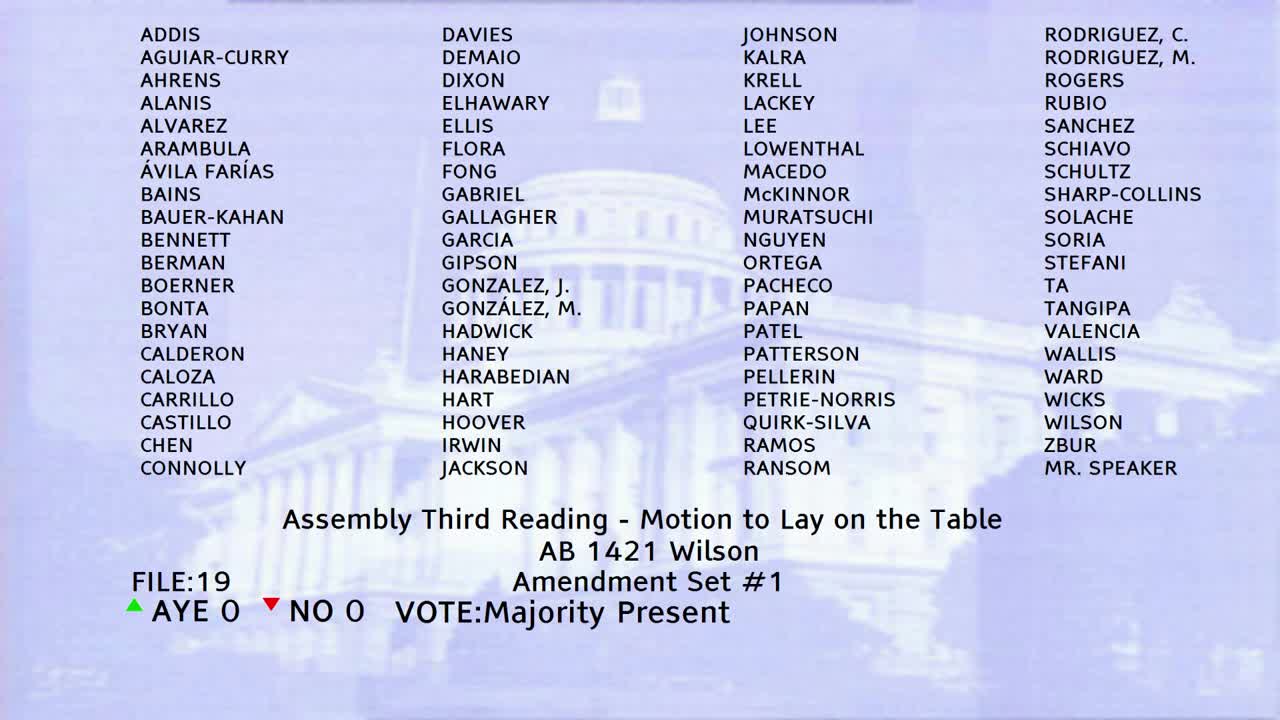
Bill Author

Bill Co-Author(s):