AB 557: California Factory-Built Housing Law.
- Session Year: 2025-2026
- House: Assembly
- Latest Version Date: 2025-04-24
Current Status:
In Progress
(2025-07-09: In committee: Set, first hearing. Hearing canceled at the request of author.)
Introduced
In Committee
Awaiting First Chamber Vote
Passed First Chamber
In Committee
Awaiting Second Chamber Vote
Passed Second Chamber
Enacted
Existing law, the California Factory-Built Housing Law, requires all factory-built housing after a specified date that is sold or offered for sale to first users within the state to bear insignia of approval issued by the department, deems that housing to comply with the requirements of all ordinances or regulations enacted by any city, city and county, county, or district that may be applicable to the construction of housing, as specified, and prohibits a city, city and county, county, and district from requiring submittal of plans for any factory-built housing manufactured, or to be manufactured pursuant to these provisions, as specified. The law requires the Department of Housing and Community Development to enforce its provisions, except for in-plant inspections of the manufacture and installation of factory-built housing by local enforcement or inspection agencies, as specified. Existing law requires the department to provide by regulation for the qualification and disqualification of design approval agencies to perform approval of factory-built housing plans and specification and of quality assurance agencies to perform inspections of factory-built housing. Existing law specifications and makes approval by these agencies the equivalent of department approval. The law requires the department to adopt rules and regulations to interpret and make specific these provisions, as specified. The law provides that any person who violates any of these provisions and other specified law is guilty of a misdemeanor, as specified.
This bill would expand the application of the California Factory-Built Housing Law to include the inspection and approval of factory-built developments, defined to mean any development project that uses factory-built housing for at least 50% of the residential square footage of the project. The bill would remove the inspection and enforcement duties on local governments and would require the department to provide by regulation for the qualification and disqualification of installation inspection agencies, as defined and specified. The bill would additionally authorize licensed architects, under penalty of perjury, to approve factory-built housing and factory-built development plans and specifications on behalf of the department. The bill would require plans or specifications of factory-built housing approved pursuant to these provisions to be approved by unit serial number, as specified. The bill would make conforming changes. number and would authorize the approved plans or specifications to be used in subsequent development projects unless building standards relating to factory-built housing are modified, as specified. The bill would require the department and the design approval agencies to limit their review to the portions of a plan or specification that has not already received approval, as specified. By expanding the scope of existing crimes, an existing crime, this bill would impose a state-mandated local program.
The California Constitution requires the state to reimburse local agencies and school districts for certain costs mandated by the state. Statutory provisions establish procedures for making that reimbursement.
This bill would provide that no reimbursement is required by this act for a specified reason.
The bill would include findings that changes proposed by this bill address a matter of statewide concern rather than a municipal affair and, therefore, apply to all cities, including charter cities.
Existing law, the California Factory-Built Housing Law, requires all factory-built housing after a specified date that is sold or offered for sale to first users within the state to bear insignia of approval issued by the department, deems that housing to comply with the requirements of all ordinances or regulations enacted by any city, city and county, county, or district that may be applicable to the construction of housing, as specified, and prohibits a city, city and county, county, and district from requiring submittal of plans for any factory-built housing manufactured, or to be manufactured pursuant to these provisions, as specified. The law requires the Department of Housing and Community Development to enforce its provisions, except for in-plant inspections of the manufacture and installation of factory-built housing by local enforcement or inspection agencies, as specified. Existing law requires the department to provide by regulation for the qualification and disqualification of design approval agencies to perform approval of factory-built housing plans and specification and of quality assurance agencies to perform inspections of factory-built housing. Existing law makes approval by these agencies the equivalent of department approval. The law requires the department to adopt rules and regulations to interpret and make specific these provisions, as specified. The law provides that any person who violates any of these provisions and other specified law is guilty of a misdemeanor, as specified.
This bill would expand the application of the California Factory-Built Housing Law to include the inspection and approval of factory-built developments, defined to mean any development project that uses factory-built housing for at least 50% of the residential square footage of the project. The bill would remove the inspection and enforcement duties on local governments and would require the department to provide by regulation for the qualification and disqualification of installation inspection agencies, as defined and specified. The bill would additionally authorize licensed architects, under penalty of perjury, to approve factory-built housing and factory-built development plans and specifications on behalf of the department. The bill would require plans or specifications of factory-built housing approved pursuant to these provisions to be approved by unit serial number, as specified. The bill would make conforming changes. By expanding the scope of existing crimes, this bill would impose a state-mandated local program.
The California Constitution requires the state to reimburse local agencies and school districts for certain costs mandated by the state. Statutory provisions establish procedures for making that reimbursement.
This bill would provide that no reimbursement is required by this act for a specified reason.
The bill would include findings that changes proposed by this bill address a matter of statewide concern rather than a municipal affair and, therefore, apply to all cities, including charter cities.
Existing law, the State Housing Law, establishes statewide construction and occupancy standards for buildings used for human habitation. Existing law requires the building department of every city or county to enforce within its jurisdiction the provisions of the California Building Standards Code, the provisions of the State Housing Law, and specified other rules and regulations promulgated pursuant to that law.This bill would express the intent of the Legislature to enact legislation relating to modular housing standards.Existing law, the State Housing Law, establishes statewide construction and occupancy standards for buildings used for human habitation. Existing law requires the building department of every city or county to enforce within its jurisdiction the provisions of the California Building Standards Code, the provisions of the State Housing Law, and specified other rules and regulations promulgated pursuant to that law.
This bill would express the intent of the Legislature to enact legislation relating to modular housing standards.
(a)Any factory-built housing manufactured after the effective date of the building standards published in the State Building Standards Code and the other regulations adopted pursuant to Chapter 4 (commencing with Section 19990) of this part, which is sold or offered for sale to first users within this state, and any factory-built development constructed on or after January 1, 2026, shall bear insignia of approval issued by the department.
(b)Any plans or specifications of factory-built housing approved by the department pursuant to this part shall be approved by unit serial number for use in any development project and may be used in subsequent development projects without receiving approval for each project in which that unit design is used. pursuant to this subdivision:
(1)A plan or specification that has been approved by the department and issued a unit serial number or numbers may be used in any subsequent development project within the same triennial building code cycle in which the plan or specification received its initial approval.
(2)A plan or specification that has been approved by the department and issued a unit serial number or numbers may be used in any subsequent development project in a subsequent triennial building code cycle provided that no modification has been made to the building standards relating to factory-built housing adopted pursuant to this part since the plan or specification received its initial approval.
(c)The department, or a qualified design approval agency acting pursuant to Section 19991.3, shall limit its review of new plans or specifications for factory-built housing to the portions of those plans or specifications that have not been approved for use in that triennial building code cycle pursuant to subdivision (b).
SEC. 6.Section 19981 of the Health and Safety Code is amended to read:19981.(a) All factory-built housing or factory-built developments bearing an insignia of approval pursuant to Section 19980 shall be deemed to comply with the requirements of all ordinances or regulations enacted by any city, city and county, county, or district that may be applicable to the construction of housing. A city, city and county, county, or district shall not require submittal of plans for any factory-built housing manufactured, or to be manufactured, or factory-built development constructed, or to be constructed, pursuant to this part for the purpose of determining compliance with this part or the regulations promulgated thereunder, or for determining compliance with any local construction requirement, except as provided in Section 19993.(b) Any factory-built housing or factory-built development bearing a department insignia of approval pursuant to Section 19980 shall not be in any way modified prior to, or during, installation unless approval is first obtained from the department.SEC. 7.Section 19991 of the Health and Safety Code is amended to read:19991.The department shall enforce every provision of this part, the building standards published in the State Building Standards Code relating to factory-built housing, and the other regulations adopted pursuant to this part.SEC. 8.Section 19991.1 of the Health and Safety Code is repealed.SEC. 9.Section 19991.2 of the Health and Safety Code is amended to read:19991.2.The department shall make in-plant inspection of all factory-built housing in all places of manufacture.SEC. 10.Section 19991.3 of the Health and Safety Code is amended to read:19991.3.(a)The department shall provide by regulation for qualification and disqualification of design approval agencies to perform approval of factory-built housing and factory-built development plans and specifications, and the approvals of those agencies shall be deemed the equivalent of department approval. The regulations for qualification of design approval agencies shall specifically provide for the absence of any conflict of interest between manufacturers and design approval agencies and for department oversight of design approval agency performance.(b)An architect licensed pursuant to Chapter 3 (commencing with Section 5500) of Division 3 of the Business and Professions Code may perform approval of factory-built housing and factory-built development plans and specifications under penalty of perjury. Approvals by an architect shall be deemed the equivalent of department approval. The department shall provide by regulation for the disqualification of architects for this purpose.SEC. 11.Section 19992 of the Health and Safety Code is amended to read:19992.The department shall enforce and inspect the installation of factory-built housing. The department shall provide by regulation for the qualification and disqualification of installation inspection agencies to perform inspections of the installation of factory-built housing and the construction of factory-built developments. The installation of factory-built housing and the construction of factory-built developments shall be conducted in accordance with the requirements of the building standards published in the State Building Standards Code relating to factory-built housing and the other requirements of Part 1.5 (commencing with Section 17910), subject to the provisions of Section 19990.SEC. 12.Section 19993 of the Health and Safety Code is amended to read:19993.(a) Local use zone requirements, local snow load requirements, local wind pressure requirements, local fire zones, building setback, side and rear yard requirements, site development and property line requirements, as well as the review and regulation of architectural and aesthetic requirements are hereby specifically and entirely reserved to local jurisdictions notwithstanding any requirement of this part.(b) Local requirements imposed on factory-built housing or factory-built developments pursuant to the authority granted by this section shall not vary substantially from the requirements imposed on other residential buildings of similar size.SEC. 13.Section 19995 of the Health and Safety Code is amended to read:19995.Except as provided in Section 18945, the department shall hear appeals brought by any person regarding the application to that person of any building standard published in the State Building Standards Code relating to factory-built housing or factory-built developments or to any other rule or regulation of the department promulgated pursuant to this part.SEC. 14.Section 19997 of the Health and Safety Code is amended to read:19997.(a)Any person who violates any of the provisions of this part, a building standard published in the State Building Standards Code relating to factory-built housing or factory-built developments, or any other rules or regulations adopted pursuant to this part is guilty of a misdemeanor, punishable by a fine not exceeding one thousand dollars ($1,000) or by imprisonment not exceeding 30 days, or by both that fine and imprisonment.(b)(1)For violations of Section 19980, 19991.3, or 19991.4, the department shall assess civil penalties in a range between two hundred fifty dollars ($250) and two thousand dollars ($2,000). When determining the amount of the assessed civil penalty, the department shall take into consideration whether one or more of the following or similar circumstances apply:(A)The citation includes multiple violations.(B)The cited person has a history of violations of the same or similar provisions of this part and the regulations promulgated under this part.(C)In the judgment of the department, the person has exhibited bad faith or a conflict of interest.(D)In the judgment of the department, the violation is serious or harmful.(E)The citation involves a violation perpetrated against a senior citizen, veteran, or person with disabilities.(F)There is exculpatory evidence that, in the judgment of the department, is material to the elements of the current violation for which the citation is being issued and is significantly related to the degree of fault.(2)If a citation lists more than one violation and each of the violations relates to the same manufacturing facility or client, the total penalty assessment in each citation shall not exceed ten thousand dollars ($10,000).(3)If a citation lists more than one violation, the amount of assessed civil penalty shall be stated separately for each section violated.(4)Appeals procedures shall be the same as those provided under subdivisions (c) to (e), inclusive, of Section 18021.7.(c)Nothing in this section is intended to preclude remedies available under other provisions of law.SEC. 15.SEC. 2.The provisions of this act are severable. If any provision of this act or its application is held invalid, that invalidity shall not affect other provisions or applications that can be given effect without the invalid provision or application.
SEC. 16.SEC. 3.No reimbursement is required by this act pursuant to Section 6 of Article XIIIB of the California Constitution because the only costs that may be incurred by a local agency or school district will be incurred because this act creates a new crime or infraction, eliminates a crime or infraction, or changes the penalty for a crime or infraction, within the meaning of Section 17556 of the Government Code, or changes the definition of a crime within the meaning of Section 6 of Article XIIIB of the California Constitution.
SEC. 17.SEC. 4.The Legislature finds and declares that in light of the severe shortage of housing and emergency shelter in this state, lowering the cost and timeline of housing production by reducing obstacles in approvals and inspections of factory-built housing and factory-built developments is a matter of statewide concern and is not a municipal affair as that term is used in Section 5 of Article XI of the California Constitution. Therefore, Sections 1 to 14, inclusive, Section 1 of this act, amending Sections 19980, 19981, 19991, 19991.2, 19991.3, 19992, 19993, 19995, and 19997 of, adding Section 19970.5 to, repealing Sections 19975.1 and 19991.1 of, and repealing and adding Section 19975 of, Section 19980 of the Health and Safety Code, apply applies to all cities, including charter cities.
Factory-built development means a development project that uses factory-built housing for at least 50 percent of the residential square footage of the project.
SEC. 2.Section 19975 of the Health and Safety Code is repealed.19975.Local enforcement agency means the city, county, or city and county in which factory-built housing is installed.SEC. 3.Section 19975 is added to the Health and Safety Code, to read:19975.Installation inspection agency means a private organization meeting the requirements of department regulations to perform inspections of the installation of factory-built housing and the construction of factory-built developments.
SEC. 4.Section 19975.1 of the Health and Safety Code is repealed.19975.1.Local inspection agency means the building department of a city, county, or city and county, which has been certified by the department, and which has assumed responsibility for inspection of in-plant construction as provided by Section 19991.1.SEC. 5.Section 19980 of the Health and Safety Code is amended to read:19980.All (a)Any factory-built housing manufactured after the effective date of the building standards published in the State Building Standards Code and the other regulations adopted pursuant to Chapter 4 (commencing with Section 19990) of this part, which is sold or offered for sale to first users within this state, and any factory-built development constructed on or after January 1, 2026, shall bear insignia of approval issued by the department.
(b)Any plans or specifications of factory-built housing approved by the department pursuant to this part shall be approved by unit serial number for use in any development project and may be used in subsequent development projects without receiving approval for each project in which that unit design is used.
SEC. 6.Section 19981 of the Health and Safety Code is amended to read:19981.(a) All factory-built housing or factory-built developments bearing an insignia of approval pursuant to Section 19980 shall be deemed to comply with the requirements of all ordinances or regulations enacted by any city, city and county, county, or district which that may be applicable to the construction of housing. No A city, city and county, county, or district shall not require submittal of plans for any factory-built housing manufactured, or to be manufactured, or factory-built development constructed, or to be constructed, pursuant to this part for the purpose of determining compliance with this part or the regulations promulgated thereunder, or for determining compliance with any local construction requirement, except as provided in Section 19993.
(b) No Any factory-built housing or factory-built development bearing a department insignia of approval pursuant to Section 19980 shall not be in any way modified prior to to, or during, installation unless approval is first obtained from the department.
(c) No factory-built housing shall be in any way modified during installation unless approval for the modification is first obtained from the local enforcement agency.SEC. 7.Section 19991 of the Health and Safety Code is amended to read:19991.The department shall enforce every provision of this part, the building standards published in the State Building Standards Code relating to factory-built housing, and the other regulations adopted pursuant to this part, except as provided in Sections 19991.1, 19991.3, 19991.4, and 19992. part.
SEC. 8.Section 19991.1 of the Health and Safety Code is repealed.19991.1.The governing body of any city, county, or city and county may by ordinance elect to have its building department assume responsibility, for in-plant inspections of all factory-built housing in all places of manufacture within the political limits of the jurisdiction of such city, county, or city and county. If certified by the department as qualified to perform such inspections, the building department shall be the local inspection agency within the city, county, or city and county. The governing body of any city, county, or city and county having a local inspection agency may, by ordinance, establish a reasonable inspection fee for in-plant inspections to defray the actual cost of inspections.SEC. 9.Section 19991.2 of the Health and Safety Code is amended to read:19991.2.Where there is no certified local inspection agency, the The department shall make in-plant inspection of all factory-built housing in all places of manufacture located within the political limits of the jurisdiction in which such manufacturing plants are located. manufacture.
SEC. 10.Section 19991.3 of the Health and Safety Code is amended to read:19991.3.(a)The department shall provide by regulation for qualification and disqualification of design approval agencies to perform approval of factory-built housing and factory-built development plans and specifications, and the approvals of those agencies shall be deemed the equivalent of department approval. The regulations for qualification of design approval agencies shall specifically provide for the absence of any conflict of interest between manufacturers and design approval agencies and for department oversight of design approval agency performance.
(b)An architect licensed pursuant to Chapter 3 (commencing with Section 5500) of Division 3 of the Business and Professions Code may perform approval of factory-built housing and factory-built development plans and specifications under penalty of perjury. Approvals by an architect shall be deemed the equivalent of department approval. The department shall provide by regulation for the disqualification of architects for this purpose.
SEC. 11.Section 19992 of the Health and Safety Code is amended to read:19992.Local enforcement agencies The department shall enforce and inspect the installation of factory-built housing. The department shall provide by regulation for the qualification and disqualification of installation inspection agencies to perform inspections of the installation of factory-built housing and the construction of factory-built developments. The installation of factory-built housing and the construction of factory-built developments shall be conducted in accordance with the requirements of the building standards published in the State Building Standards Code relating to factory-built housing and the other requirements of Part 1.5 (commencing with Section 17910), subject to the provisions of Section 19990. The local enforcement agency may, by ordinance, establish an inspection fee for the inspection of the installation of factory-built housing.
SEC. 12.Section 19993 of the Health and Safety Code is amended to read:19993.(a) Local use zone requirements, local snow load requirements, local wind pressure requirements, local fire zones, building setback, side and rear yard requirements, site development and property line requirements, as well as the review and regulation of architectural and aesthetic requirements are hereby specifically and entirely reserved to local jurisdictions notwithstanding any requirement of this part.
(b) Local requirements imposed on factory-built housing or factory-built developments pursuant to the authority granted by this section shall not vary substantially from the requirements imposed on other residential buildings of similar size.
SEC. 13.Section 19995 of the Health and Safety Code is amended to read:19995.Except as provided in Section 18945, the department shall hear appeals brought by any person regarding the application to such that person of any building standard published in the State Building Standards Code relating to factory-built housing or factory-built developments or to any other rule or regulation of the department promulgated pursuant to this part. Any such appeals shall first be submitted to the local enforcement agency, if any, delegated by the department to enforce the provisions of this part. The department shall not hear any appeal regarding any local ordinance, rule, or regulation related to the installation of factory-built housing.
SEC. 14.Section 19997 of the Health and Safety Code is amended to read:19997.(a)Any person who violates any of the provisions of this part, a building standard published in the State Building Standards Code relating to factory-built housing, housing or factory-built developments, or any other rules or regulations adopted pursuant to this part is guilty of a misdemeanor, punishable by a fine not exceeding one thousand dollars ($1,000) or by imprisonment not exceeding 30 days, or by both that fine and imprisonment.
(b)(1)For violations of Section 19980, 19991.3, or 19991.4, the department shall assess civil penalties in a range between two hundred fifty dollars ($250) and two thousand dollars ($2,000). When determining the amount of the assessed civil penalty, the department shall take into consideration whether one or more of the following or similar circumstances apply:
(A)The citation includes multiple violations.
(B)The cited person has a history of violations of the same or similar provisions of this part and the regulations promulgated under this part.
(C)In the judgment of the department, the person has exhibited bad faith or a conflict of interest.
(D)In the judgment of the department, the violation is serious or harmful.
(E)The citation involves a violation perpetrated against a senior citizen, veteran, or person with disabilities.
(F)There is exculpatory evidence that, in the judgment of the department, is material to the elements of the current violation for which the citation is being issued and is significantly related to the degree of fault.
(2)If a citation lists more than one violation and each of the violations relates to the same manufacturing facility or client, the total penalty assessment in each citation shall not exceed ten thousand dollars ($10,000).
(3)If a citation lists more than one violation, the amount of assessed civil penalty shall be stated separately for each section violated.
(4)Appeals procedures shall be the same as those provided under subdivisions (c) to (e), inclusive, of Section 18021.7.
(c)Nothing in this section is intended to preclude remedies available under other provisions of law.
SEC. 15.The provisions of this act are severable. If any provision of this act or its application is held invalid, that invalidity shall not affect other provisions or applications that can be given effect without the invalid provision or application.
SEC. 16.No reimbursement is required by this act pursuant to Section 6 of Article XIIIB of the California Constitution because the only costs that may be incurred by a local agency or school district will be incurred because this act creates a new crime or infraction, eliminates a crime or infraction, or changes the penalty for a crime or infraction, within the meaning of Section 17556 of the Government Code, or changes the definition of a crime within the meaning of Section 6 of Article XIIIB of the California Constitution.
SEC. 17.The Legislature finds and declares that in light of the severe shortage of housing and emergency shelter in this state, lowering the cost and timeline of housing production by reducing obstacles in approvals and inspections of factory-built housing and factory-built developments is a matter of statewide concern and is not a municipal affair as that term is used in Section 5 of Article XI of the California Constitution. Therefore, Sections 1 to 14, inclusive, of this act, amending Sections 19980, 19981, 19991, 19991.2, 19991.3, 19992, 19993, 19995, and 19997 of, adding Section 19970.5 to, repealing Sections 19975.1 and 19991.1 of, and repealing and adding Section 19975 of, the Health and Safety Code, apply to all cities, including charter cities.
SECTION 1.It is the intent of the Legislature to enact legislation relating to modular housing standards.It is the intent of the Legislature to enact legislation relating to modular housing standards.
|
Date
|
Status
|
|---|---|
| Jul 9, 2025 | In committee: Set, first hearing. Hearing canceled at the request of author. |
| Jun 11, 2025 | Referred to Com. on HOUSING. |
| Jun 3, 2025 | In Senate. Read first time. To Com. on RLS. for assignment. |
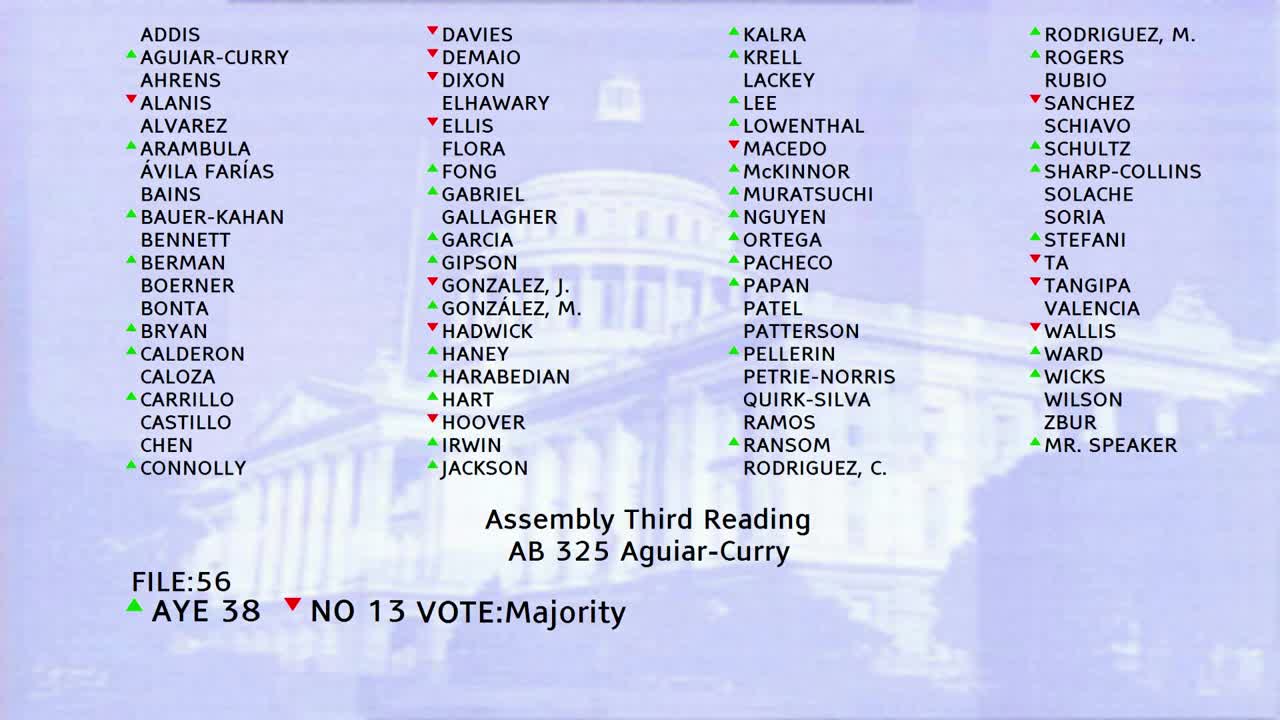
| Jun 2, 2025 | Read third time. Passed. Ordered to the Senate. (Ayes 76. Noes 0. Page 1837.) |
| May 27, 2025 | Read second time. Ordered to third reading. |
| May 23, 2025 | From committee: Do pass. (Ayes 13. Noes 0.) (May 23). |
| May 21, 2025 | Joint Rule 62(a), file notice suspended. (Page 1627.) |
| May 21, 2025 | In committee: Set, first hearing. Referred to APPR. suspense file. |
| May 14, 2025 | In committee: Hearing postponed by committee. |
| Apr 28, 2025 | Re-referred to Com. on L. GOV. |
| Apr 28, 2025 | Re-referred to Com. on APPR. pursuant to Assembly Rule 96. |
| Apr 24, 2025 | From committee: Do pass and re-refer to Com. on L. GOV. (Ayes 11. Noes 0.) (April 24). Re-referred to Com. on L. GOV. |
| Apr 24, 2025 | From committee chair, with author's amendments: Amend, and re-refer to Com. on L. GOV. Read second time and amended. |
| Apr 24, 2025 | Assembly Rule 56 suspended. (Page 1265.) |
| Apr 24, 2025 | (Pending re-refer to Com. on L. GOV.) |
| Mar 25, 2025 | Re-referred to Com. on H. & C.D. |
| Mar 24, 2025 | Referred to Coms. on H. & C.D. and L. GOV. |
| Mar 24, 2025 | From committee chair, with author's amendments: Amend, and re-refer to Com. on H. & C.D. Read second time and amended. |
| Feb 13, 2025 | From printer. May be heard in committee March 15. |
| Feb 12, 2025 | Read first time. To print. |
|
Date
|
Description
|
Location
|
Votes
|
|
|---|---|---|---|---|
| Jun 2, 2025 | AB 557 McKinnor Assembly Third Reading | Assembly Floor |
Passed |
|
| May 23, 2025 | Do pass. | Assembly Standing Committee on Appropriations |
Passed |
|
| Apr 24, 2025 | Do pass and be re-referred to the Committee on [Local Government] | Assembly Standing Committee on Housing and Community Development |
Passed |
This list shows positions taken on this bill by organizations on the date displayed, which is linked to the original source.
Positions by individuals are not included.
|
Organization
|
Position
|
Date
|
|---|---|---|
| Allies for Every Child | ** Support | |
| California Building Officials | ** Against | |
| California State Association Of Electrical Workers | ** Against | |
| California State Pipe Trades Council | ** Against | |
| California YIMBY | ** Support | |
| City of Murrieta | ** Against | |
| Climate Resolve | ** Support | |
| Inner City Law Center | ** Support | |
| Western States Council Sheet Metal, Air, Rail And Transportation | ** Against | |
| Zillow Group | ** Support |
SENATE COMMITTEE ON HOUSING
Senator Aisha Wahab, Chair
2025 - 2026 Regular
Bill No: AB 557 Hearing Date: 7/15/ 2025
Author: | McKinnor | ||
Version: | 4/24/2025 Amended | ||
Urgency: | No | Fiscal: | Yes |
Consultant: | Ryan Hardmeyer | ||
SUBJECT: California Factory-Built Housing Law
DIGEST: This bill allows for the reuse of certain plans or specifications for factory-built housing (FBH) if the plans for an individual unit have previously been approved by the Department of Housing and Community Development (HCD) or a qualified design approval agency, as specified.
ANALYSIS:
Existing law:
- Under California Building Standards Code (BSC), establishes “the minimum requirements to safeguard the public health, safety and general welfare through structural strength, means of egress facilities, stability, access to persons with disabilities, sanitation, adequate lighting and ventilation and energy conservation; safety to life and property from fire and other hazards attributed to the built environment; and to provide safety to fire fighters and emergency responders during emergency operations.”
- Establishes the California Factory-Built Housing Law, which defines FBH as a residential building, dwelling unit, individual dwelling room, or combination of rooms, or building components, assembly, or system manufactured so that all concealed parts or processes of manufacturing cannot be inspected before installation.
- “Building component” means any subsystem, subassembly, or other system designed for use in, or as part of, a structure, which may include structural, electrical, mechanical, plumbing, and fire protection systems and other systems affecting health and safety. However, “building component” does not include appliances or equipment, such as heaters, stoves, refrigerators, or air conditioners, listed and labeled by an approved testing and listing agency.
- “Building system” means plans, specifications, and documentation for a system of manufactured building, or for a type or a system of building components, which may include structural, electrical, mechanical, plumbing, and fire protection systems and other systems affecting health and safety, including variations which are submitted as part of the building system.
- “Design approval agency” is a private organization meeting the requirements of department regulations to perform evaluation of factory-built housing plans and specifications.
- Requires all FBH manufactured after the effective date of the FBH building standards adopted under the California Factory-Built Housing Law that is sold or offered for sale to first users within California to bear insignia of approval issued by HCD.
- Requires all FBH bearing an insignia of approval to be deemed to comply with the requirements of all ordinances or regulations enacted by any city, county, or district that may be applicable to the construction of housing.
- The insignia informs local building officials that the unit has been inspected and approved in accordance with the approved plans, which must be submitted to the local agency.
- Installation of factory-built housing or building components is subject to inspection by the local building department.
- Requires HCD to regulate the qualification and disqualification of DAAs, which performs approvals of FBH plans and specifications. The approval of DAAs is deemed to be the equivalent of HCD approval.
- Prohibits a city, county, or district from requiring submittal of plans for any FBH manufactured or to be manufactured under the FBH Law for purpose of determining compliance with the FBH Law or regulations, or for determining compliance with any local construction requirement, except as specified.
This bill:
- Requires HCD to approve plans or specifications of FBH by unit serial number and allows those same plans to be used in subsequent development projects within the same triennial Building Standards Code cycle.
- Requires HCD or a qualified DAA to limit its review of new plans or specifications for FBH to the portions of plans or specifications that have not received prior approval and have not been previously issued a unit serial number or numbers within the same triennial building code cycle.
- Requires HCD, if no modifications or changes have been made to FBH building standards in a subsequent building code cycle, to allow for the reuse of previously approved plans or specifications with a unit serial number for the subsequent building code cycle.
Background
California Building Standards and FBH. HCD protects the health and safety of Californians by enforcing standards for housing construction, maintenance of farmworker housing, and manufactured/factory-built homes. FBH is a residential building, dwelling unit, individual dwelling room, or combination of rooms, or building components, assembly, or system manufactured so that all concealed parts or processes of manufacturing cannot be inspected before installation. Once assembled onsite, there is no practical difference between FBH and site-built residential structures. HCD oversees implementation of the California Factory-Built Housing Law to ensure the health and safety of persons using or purchasing FBH or FBH building components. The program seeks to provide California residents with reduced housing costs through mass production techniques resulting from a factory production environment.
For FBH, HCD pre-inspects units prior to shipment to placement sites to ensure compliance with BSC. All FBH components and systems offered for sale within the state to first users (meaning a person, firm or corporation who initially installs a factory-built home or component) must bear an insignia of approval issued by HCD and confirmed by a DAA upon installation of the unit(s). DAAs are responsible for approving FBH plans and specifications for the housing project.
Comments
- Author’s Statement. “Delays in the local government approvals process for housing developments are cited as a significant constraint restricting the housing production pipeline. Projects utilizing factory-built housing (FBH) face unnecessary obstacles in the post-entitlement permitting process. Existing California Factory-Built Housing Law only allows for full building approval and does not allow for individual units to be pre-approved. When submitting a new project’s factory-built units for state-level permitting approvals, all units must be reviewed and approved for a new permit, even if the units are the same unit models as previously approved for another project. Under existing practice, each individual project is required to be reviewed anew in its entirety, whether or not the factory-built unit models utilized within have been previously approved by the agency. This means that unchanged, identical approved unit models are being needlessly reviewed from the beginning on all subsequent projects that use them, adding unnecessary time and expense in the plan check and inspection process. AB 557 will limit the review of factory-built plans in all projects to only the portions that have not received prior approval, allowing for the reuse of previously-approved FBH unit models in new projects without requiring new reviews.”
- Where can FBH be built? FBH may be installed where other similar types of dwelling units are zoned. State law allows local governments to exercise specified local land use requirements with respect to FBH, but the Attorney General has ruled that local governments may not require use permits for FBH built in residential areas. Local requirements imposed on FBH may not differ substantially from requirements imposed on other residential buildings of the same size.
- HCD’s role in approving FBH. Unlike other housing development projects, the state plays a much larger role in the regulation and approval of FBH and statutorily limits the role for locals, unless the local government is permitted to assume more responsibility. With regards to FBH, HCD is responsible for the following:
a) Plan check of FBH designs through HCD-approved Design Approval Agency (DAA).
b) Conduct in-plant inspections of FBH through HCD-approved DAAs.
c) Issue HCD’s Insignia of Approval and oversee insignia record-keeping.
d) Review applications for eligibility to act as a DAA and perform plan checking on behalf of HCD.
e) Review applications for eligibility to act as a DAA or Quality Assurance Inspector (QAI) performing in-plant inspections on behalf of HCD.
r) Monitor DAAs, QAIs, and local building departments for compliance.
g) Handle complaints and investigations.
Plan approval is required for every model or design of FBH and building component that is designated for sale in California. Design approval is performed by a third-party Design Approval Agency (DAA), which is certified and monitored by HCD. The DAA reviews the FBH designs and supporting calculations to ensure compliance with the requirements of the California Building Standards Code (BSC) and relevant FBH regulations. Approved designs must also provide a document describing in detail all of the installation and assembly methods required onsite in order to clarify the onsite inspection responsibilities of the local building departments. HCD also pre-inspects units prior to shipment to placement sites to ensure compliance with BSC. All FBH components and systems offered for sale within the state to first users (meaning a person, firm or corporation who initially installs a factory-built home or component) must bear an insignia of approval issued by HCD and confirmed by a DAA upon installation of the unit(s). DAAs are responsible for approving FBH plans and specifications for the housing project.
4) In-plant inspections. In-plant inspections ensure FBH and modular buildings meet state codes and standards during the manufacturing process. The inspection of FBH may be made either by: 1) HCD, 2) third parties approved by HCD; or, 3) city or county building departments that are specifically approved by HCD. HCD may certify an FBH Quality Assurance Agency (QAA) or local building department to act on its behalf. These agencies conduct in-plant inspections to monitor the manufacturer’s compliance with HCD-approved plans and CBSC.
City or county building departments may request a reciprocity agreement with HCD to conduct in-plant inspections of FBH products that are manufactured within the political limits of their jurisdiction. The authority having jurisdiction must first enact an ordinance in this regard, then seek approval from HCD in order for HCD to qualify inspections of FBH in manufacturing facilities located within their political boundaries and jurisdiction.
5) Current responsibilities of local governments. State laws establish three limited roles for local governments in the FBH approval process:
- Review portions of project plans either not designated as FBH, or that have not been previously approved by HCD or an HCD-designated agency.
- Issue permits and inspect the installation and assembly of FBH units at the building site in its jurisdiction.
- By ordinance, the locality may establish an inspection fee for the inspection involved in the installation of the FBH structure.
Local governments cannot require review of any FBH plans — though they may review portions of the development hat are not designated as FBH — or charge plan check fees when plans have already been approved by HCD or an HCD-approved third-party DAA. State law does authorize local governments to prescribe “local zoning requirements, local snow load requirements, local wind pressure requirements, local fire zones, building setbacks, side and rear yard requirements, site development and property line requirements, as well as the review and regulation of architectural and aesthetic requirements.” However, all other aspects of the overall project plan approval lie with HCD.
6) Who’s in charge? The sponsors of the bill describe a duplicative approval process, where they must receive approval to install the same FBH model unit across different project sites. To that end, this bill would allow HCD to review an individual model unit once during the building standards triennial cycle, and a manufactured housing developer could then use that model for any subsequent project in any project configuration without additional HCD approval. In other words, this bill, as written, would eliminate HCD building standard review of a subsequent FBH development for the development as a whole, if HCD has previously approved a single model unit previously, without requiring any other agency to assume that duty. As a policy matter, and as is required for all other housing developments in the state, each individual development should be subject to review for compliance with state and local building codes. This is because each housing project configuration could require different plumbing, electrical, sanitation, accessibility, energy, or other health and safety requirements. Additionally, a different project site could be in flood plain or on a fault line and thus subject to unique seismic development requirements, or present a number of different challenges.
While an individual FBH unit may be suitable for one site under one project configuration and under specific plan approvals submitted to HCD, one individual unit approved in another project may not suitable or representative of the plans for an entirely different project for another due to these concerns.
The author’s stated goal is to streamline FBH approvals and authorize approved models across housing projects. To do so, however, would require a comprehensive review of the permitting process and the inclusion of stakeholders to come up with alternative processes and proposals that do not completely eliminate health and safety standards.
Instead of the bill in print, the committee may wish to consider requiring HCD to conduct a study and report back to the Legislature by the end of 2026 on how best to achieve the objectives of the author, and even consider additional changes beyond what is contemplated in this bill to encourage FBH construction. The study could include the following:
a) HCD shall conduct a study of existing approval processes for factory built housing units at the state and local levels and provide recommendations to the Legislature by December 31, 2026 for how to best streamline those approvals.
b) HCD shall receive input in the study from relevant stakeholders, including but not limited to, manufactured housing developers, affordable housing developers, local agencies, and state and local building officials.
c) The study shall include, but not be limited to, recommendations related to the following:
(1) Changes to state and local factory built approval processes to reduce model unit approval timelines.
(2) Changes to state and local factory built housing approval processes that provide flexibility to use approved design model serial codes across projects.
(3) Changes to state and local approval processes to provide flexibility to use previously approved models from one triennial cycle to another.
d) The study shall also consider processes to allow developers to identify previously approved model unit serial codes.
Related/Prior Legislation
AB 1332 (J. Carillo, Chapter 759, Statutes of 2023) — required each local agency, by January 1, 2025, to develop a program for the preapproval of ADU plans and for the ministerial approval of ADU applications utilizing a plan for an ADU that has been preapproved by the local agency within the current triennial building standards code cycle.
FISCAL EFFECT: Appropriation: Fiscal Com.: Local:
POSITIONS: (Communicated to the committee before noon on Wednesday, July 9, 2025.)
SUPPORT:
Inner City Law Center
Zillow Group
OPPOSITION:
None received.
-- END --
ASSEMBLY THIRD READING
ATR Bill Id:AB 557
Author:(McKinnor)
As Amended Ver:April 24, 2025
Majority vote
SUMMARY
Allows for the reuse of certain plans or specifications for factory-built housing (FBH) if the plans have previously been approved by the Department of Housing and Community Development (HCD) or a qualified design approval agency (DAA) in the same building code cycle, with conditions.
Major Provisions
- Requires HCD to approve plans or specifications of FBH by unit serial number and allows those plans to be used in subsequent development projects within the same triennial California Building Standards Code cycle.
- Requires HCD or a qualified DAA to limit its review of new plans or specifications for FBH to the portions of plans or specifications that have not received prior approval and have not been previously issued a unit serial number or numbers within the same triennial building code cycle.
- Requires HCD, if no modifications or changes have been made to FBH building standards in a subsequent building code cycle, to allow for the reuse of previously approved plans or specifications with a unit serial number for the subsequent building code cycle.
COMMENTS
Factory-Built Housing: FBH, often referred to as modular, manufactured, or prefabricated housing, involves the construction or assembly of various components of a housing unit or room in a factory and the transport of those components or structures to the construction site, where they are installed and fixed to a building foundation. This is in contrast to traditional ("site-built" or "stick-built") homes, which are built piece by piece on top of the foundation at the actual construction site. The mass production techniques in a factory environment can sometimes be faster and cheaper than site-built construction methods and are not as impacted by weather constraints that might hamper construction progress on a site, though benefits will vary widely between projects.
HCD has maintained building code and plan approval authority over FBH since the California Factory-Built Housing Law was first enacted in the 1960s. HCD currently contracts with various DAAs who perform third-party review and approval of FBH designs according to regulations established by HCD and the building standards governing FBH. Approved FBH must bear a California Insignia of Approval on each FBH system or component in the project. There are also Quality Assurance Agencies approved by HCD that inspect FBH during the production phase in the manufacturing facility or offsite. Local agencies maintain authority over a variety of post-manufacture elements of these projects (for example, snow load, wind pressure, building setback, and architectural requirements) and are also responsible for inspecting and approving the installation of the FBH at the project site.
Other Preapproved Plans: The Legislature in recent years has moved forward a handful of bills to require local agencies to review and pre-approve certain types of housing plans, similar to this bill. The practice is intended to speed up plan check and entitlement approvals for projects that are extremely similar or identical to plans that the local agency has already reviewed and approved, freeing up local planning and building department staff to focus their resources on more intensive projects. Generally these preapprovals have been limited to one triennial building code cycle, as building codes may change each cycle and plans designed to meet prior codes likely need modifications to comply with new or updated building standards.
In 2023, AB 1332 (J. Carrillo), Chapter 759, Statutes of 2023 required local agencies to develop a program for the preapproval of ADU plans and required locals to ministerially approve ADU applications utilizing a plan for an ADU that had been preapproved already by the agency within the same building code cycle. AB 1206 (Harabedian) of the current legislative session proposes to require local agencies to develop a program for the preapproval of single-family and multifamily residential housing plans and would require locals to ministerially approve applications utilizing those plans that have been preapproved in the same code cycle.
This bill would require HCD or DAAs acting on HCD's behalf to approve FBH plans by unit serial number and would allow those plans to be reused in other FBH projects in the same building code cycle without HCD/DAAs having to complete a full review of the same rooms or units that have already been approved and issued a serial number. HCD and DAAs would only need to review the portion of plans that are new and have not received prior approval within the code cycle. If no modifications have been made to the FBH building standards adopted by HCD in a subsequent building code cycle, this bill would allow the reuse of previously approved plans from the prior code cycle.
According to the Author
"California faces an acute housing crisis, marked by a severe shortage of homes to meet the needs of all Californians. Delays in the local government approvals process for housing developments are cited as a significant constraint restricting the housing production pipeline.
Projects utilizing factory-built housing face unnecessary obstacles in the post-entitlement permitting process. Existing California Factory-Built Housing Law only allows for full building approval and does not allow for individual units to be pre-approved. When submitting a new project's factory-built units for state-level permitting approvals, all units must be reviewed and approved for a new permit, even if the units are the same unit models as previously approved for another project.
AB 557 would allow for the reuse of previously approved plans and specifications without having to redo a full review of models or units that have already been reviewed and approved in the same building code cycle. It would allow for the reuse of approved plans and specifications during the next code cycle if the factory-built housing code is not changed from one cycle to the next. This would give the opportunity for the reuse of previously approved unit plans for 3 to 6 years."
Arguments in Support
According to Abundant Housing Los Angeles, "Existing law requires factory-built unit models to be submitted to and approved by California's Department of Housing and Community Development (HCD). These factory-built unit models typically utilize a single repeatable unit plan that is reused over and over, within a single building and across multiple projects. Under existing practice, each individual project is required to be reviewed anew in its entirety, whether the factory-built unit models have been previously approved by the agency or not. This means unchanged, identical approved unit models are being needlessly reviewed from the beginning on all subsequent projects that use them, adding unnecessary time and expense in the plan check and inspection process. AB 557 will limit the review of factory-built plans in all projects to only the portions that have not received prior approval, allowing for reuse of previously-approved FBH unit models in new projects without requiring new reviews."
Arguments in Opposition
None on file for the current version of the bill.
FISCAL COMMENTS
According to the Assembly Committee on Appropriations:
HCD estimates General Fund (GF) costs of $1.24 million in fiscal year (FY) 2026-27 and $1.10 million in FY 2027-28 annually ongoing for five staff positions to implement the bill's provisions. These costs also include a one-time contracting cost of $125,000 for consultant support of Salesforce and the Codes and Standards Automated System, a one-time cost of 20,000 to update the FBH program online application systems, and ongoing costs of $25,000 per year for online storage of FBH information.
VOTES
ASM HOUSING AND COMMUNITY DEVELOPMENT: 11-0-1
YES: Haney, Patterson, Ávila Farías, Caloza, Garcia, Kalra, Lee, Quirk-Silva, Ta, Wicks, Wilson
ABS, ABST OR NV: Tangipa
ASM APPROPRIATIONS: 13-0-2
YES: Wicks, Arambula, Calderon, Caloza, Dixon, Elhawary, Fong, Mark González, Hart, Pacheco, Pellerin, Solache, Ta
ABS, ABST OR NV: Sanchez, Tangipa
UPDATED
VERSION: April 24, 2025
CONSULTANT: Nicole Restmeyer / H. & C.D. / (916) 319-2085 FN: 0000612
Date of Hearing: May 21, 2025
ASSEMBLY COMMITTEE ON APPROPRIATIONS
Buffy Wicks, Chair
ABPCA Bill Id:AB 557
Author:(McKinnor) – As Amended Ver:April 24, 2025
Policy Committee: | Housing and Community Development | Vote: | 11 - 0 |
|
| ||
|
|
Urgency: No State Mandated Local Program: Yes Reimbursable: No
SUMMARY:
This bill allows a plan or specification for factory-built housing (FBH) previously approved by the Department of Housing and Community Development (HCD) or a qualified design approval agency to be used in subsequent development projects.
Specifically, this bill:
- Requires HCD to approve plans or specifications of FBH by unit serial number and allows those plans to be used in subsequent development projects within the same triennial California Building Standards Code cycle.
- Requires HCD or a qualified design approval agency to limit its review of new plans or specifications for FBH to the portions of plans or specifications that have not received prior approval and have not been previously issued a unit serial number or numbers within the same triennial building code cycle.
- Requires HCD, if no modifications or changes have been made to FBH building standards in a subsequent building code cycle, to allow for the reuse of previously approved plans or specifications with a unit serial number for the subsequent building code cycle.
FISCAL EFFECT:
HCD estimates General Fund (GF) costs of $1.24 million in fiscal year (FY) 2026-27 and $1.10 million in FY 2027-28 annually ongoing for five staff positions to implement the bill’s provisions. These costs also include a one-time contracting cost of $125,000 for consultant support of Salesforce and the Codes and Standards Automated System, a one-time cost of $20,000 to update the FBH program online application systems, and ongoing costs of $25,000 per year for online storage of FBH information.
COMMENTS:
- Purpose. According to the author:
Projects utilizing factory-built housing face unnecessary obstacles in the post-entitlement permitting process. Existing California Factory-Built Housing Law only allows for full building approval and does not allow for individual units to be pre-approved. When submitting a new project’s factory-built units for state-level permitting approvals, all units must be reviewed and approved for a new permit, even if the units are the same unit models as previously approved for another project. [This bill] would allow for the reuse of previously approved plans and specifications without having to redo a full review of models or units that have already been reviewed and approved in the same building code cycle.
- Background. Factory-Built Housing: FBH, often referred to as modular, manufactured, or prefabricated housing, is housing where various components of the housing unit are constructed or assembled in a factory and then are transported to a construction site where they are installed and fixed to a building foundation.
Existing law gives HCD building code and plan approval authority for FBH. In this capacity, HCD contracts with design approval agencies who perform third-party review and approval of FBH designs according to regulations established by HCD and the building standards governing FBH. Approved FBH must bear a California Insignia of Approval on each FBH system or component in the project. In addition, quality assurance agencies approved by HCD inspect FBH during the production phase in the manufacturing facilities. Local agencies maintain authority over a variety of post-manufacture elements, such as snow load, wind pressure, building setback, and architectural requirements, and are responsible for inspecting and approving the installation of the FBH at the project site.
Preapproved Plans. Preapproving housing plans speeds up plan check and entitlement approvals for projects that are extremely similar or identical to plans that a local agency has previously reviewed and approved. Generally, preapprovals are limited to one triennial building code cycle so plans can be modified to comply with new or updated building standards.
In 2023, AB 1332 (J. Carrillo), Chapter 759, required local agencies to develop a program for the preapproval of accessory dwelling units (ADU) plans and required locals to ministerially approve ADU applications utilizing a plan for an ADU that had been previously approved by the agency within the same building code cycle.
This bill requires HCD or a design approval agency to approve FBH plans by unit serial number and allows those plans to be reused in other FBH projects in the same building code cycle without the need for a full review of the rooms or units previously assigned a serial number. HCD or a design approval agency would need only review the portion of a plan that is new and has not received prior approval within the code cycle. If no modifications are made to the FBH building standards adopted by HCD in a subsequent building code cycle, this bill allows the reuse of previously approved plans from the prior code cycle.
- Related Legislation. AB 1206 (Harabedian), of this legislative session, requires each local agency to develop a program for the preapproval of single-family and multifamily residential housing plans and to ministerially approve applications utilizing plans that have been preapproved in the same code cycle. AB 1206 is pending referral in the Senate.
Analysis Prepared by: Jennifer Swenson / APPR. / (916) 319-2081
Date of Hearing: April 24, 2025
ASSEMBLY COMMITTEE ON HOUSING AND COMMUNITY DEVELOPMENT
Matt Haney, Chair
ABPCA Bill Id:AB 557 (
Author:McKinnor) – As Amended Ver:March 24, 2025
AS PROPOSED TO BE AMENDED
SUBJECT: California Factory-Built Housing Law
SUMMARY: Allows for the reuse of certain plans or specifications for factory-built housing (FBH) if the plans have previously been approved by the Department of Housing and Community Development (HCD) or a qualified design approval agency (DAA) in the same building code cycle, with conditions. Specifically, this bill:
- Requires HCD to approve plans or specifications of FBH by unit serial number and allows those plans to be used in subsequent development projects within the same triennial California Building Standards Code cycle.
- Requires HCD or a qualified DAA to limit its review of new plans or specifications for FBH to the portions of plans or specifications that have not received prior approval and have not been previously issued a unit serial number or numbers within the same triennial building code cycle.
- Requires HCD, if no modifications or changes have been made to FBH building standards in a subsequent building code cycle, to allow for the reuse of previously approved plans or specifications with a unit serial number for the subsequent building code cycle.
EXISTING LAW:
- Establishes the California FBH Law. (Health and Safety Code (HSC) Section 19960 et seq.)
- Defines “FBH” to mean a residential building, dwelling unit, or an individual dwelling room or combination of rooms thereof, or building component, assembly, or system manufactured in such a manner that all concealed parts or processes of manufacture cannot be inspected before installation at the building site without disassembly, damage, or deconstruction of the part, including units designed for use as part of an institution for resident or patient care, that is either wholly manufactured or is in substantial part manufactured at an offsite location to be wholly or partially assembled onsite in accordance with specified building standards and regulations. Excludes from the definition of FBH a mobilehome, recreational vehicle, or a commercial modular, as specified. (HSC 19971)
- Requires all FBH manufactured after the effective date of the FBH building standards adopted under the FBH Law that is sold or offered for sale to first users within California to bear insignia of approval issued by HCD. (HSC 19980)
- Requires all FBH bearing an insignia of approval to be deemed to comply with the requirements of all ordinances or regulations enacted by any city, county, or district that may be applicable to the construction of housing. (HSC 19981(a))
- Prohibits a city, county, or district from requiring submittal of plans for any FBH manufactured or to be manufactured under the FBH Law for purpose of determining compliance with the FBH Law or regulations, or for determining compliance with any local construction requirement, except as specified. (HSC 19981(a))
- Requires HCD to provide by regulation for qualification and disqualification of DAAs to perform approval of FBH plans and specifications, and provides that the approvals of DAAs is deemed to be the equivalent of HCD approval. Requires the regulations for qualification of DAAs to specifically provide for the absence of any conflict of interest between manufacturers and DAAs and for HCD oversight of DAA performance. (HSC 19991.3)
- Requires each local agency, by January 1, 2025, to develop a program for the preapproval of accessory dwelling unit (ADU) plans and for the ministerial approval of ADU applications utilizing a plan for an ADU that has been preapproved by the local agency within the current triennial building code cycle. (Government Code Section 65852.27)
FISCAL EFFECT: Unknown.
COMMENTS:
Author’s Statement: According to the author, “California faces an acute housing crisis, marked by a severe shortage of homes to meet the needs of all Californians. Delays in the local government approvals process for housing developments are cited as a significant constraint restricting the housing production pipeline.
Projects utilizing factory-built housing face unnecessary obstacles in the post-entitlement permitting process. Existing California Factory-Built Housing Law only allows for full building approval and does not allow for individual units to be pre-approved. When submitting a new project’s factory-built units for state-level permitting approvals, all units must be reviewed and approved for a new permit, even if the units are the same unit models as previously approved for another project.
AB 557 would allow for the reuse of previously approved plans and specifications without having to redo a full review of models or units that have already been reviewed and approved in the same building code cycle. It would allow for the reuse of approved plans and specifications during the next code cycle if the factory-built housing code is not changed from one cycle to the next. This would give the opportunity for the reuse of previously approved unit plans for 3 to 6 years.”
Factory-Built Housing: FBH, often referred to as modular, manufactured, or prefabricated housing, involves the construction or assembly of various components of a housing unit or room in a factory and the transport of those components or structures to the construction site, where they are installed and fixed to a building foundation. This is in contrast to traditional (“site-built” or “stick-built”) homes, which are built piece by piece on top of the foundation at the actual construction site. The mass production techniques in a factory environment can sometimes be faster and cheaper than site-built construction methods and are not as impacted by weather constraints that might hamper construction progress on a site, though benefits will vary widely between projects.
HCD has maintained building code and plan approval authority over FBH since the California Factory-Built Housing Law was first enacted in the 1960s. HCD currently contracts with various Design Approval Agencies (DAAs) who perform third-party review and approval of FBH designs according to regulations established by HCD and the building standards governing FBH. Approved FBH must bear a California Insignia of Approval on each FBH system or component in the project. There are also Quality Assurance Agencies (QAAs) approved by HCD that inspect FBH during the production phase in the manufacturing facility or offsite. Local agencies maintain authority over a variety of post-manufacture elements of these projects (for example, snow load, wind pressure, building setback, and architectural requirements) and are also responsible for inspecting and approving the installation of the FBH at the project site.[1]
Other Preapproved Plans: The Legislature in recent years has moved forward a handful of bills to require local agencies to review and pre-approve certain types of housing plans, similar to this bill as it is proposed to be amended. The practice is intended to speed up plan check and entitlement approvals for projects that are extremely similar or identical to plans that the local agency has already reviewed and approved, freeing up local planning and building department staff to focus their resources on more intensive projects. Generally these preapprovals have been limited to one triennial building code cycle, as building codes may change each cycle and plans designed to meet prior codes likely need at least minor (if not major) modifications to comply with new or updated building standards.
In 2023, AB 1332 (J. Carrillo), Chapter 759, required local agencies to develop a program for the preapproval of ADU plans and required locals to ministerially approve ADU applications utilizing a plan for an ADU that had been preapproved already by the agency within the same building code cycle. This committee also recently heard and passed AB 1206 (Harabedian) on a vote of 11-0. AB 1206 proposes to require local agencies to develop a program for the preapproval of single-family and multifamily residential housing plans and would require locals to ministerially approve applications utilizing those plans that have been preapproved in the same code cycle.
This bill, as proposed to be amended, would require HCD or DAAs acting on HCD’s behalf to approve FBH plans by unit serial number and would allow those plans to be reused in other FBH projects in the same building code cycle without HCD/DAAs having to complete a full review of the same rooms or units that have already been approved and issued a serial number. HCD and DAAs would only need to review the portion of plans that are new and have not received prior approval within the code cycle. If no modifications have been made to the FBH building standards adopted by HCD in a subsequent building code cycle, this bill would allow the reuse of previously approved plans from the prior code cycle.
Arguments in Support: California YIMBY writes in support of the in-print bill, “Factory-built housing is a critical solution to California’s housing crisis that can shrink construction timelines by as much as 60%, as well as reduce waste by 80% as compared to traditional construction, while eliminating cost overruns on 55% of the project as factory costs are fixed. Additionally, the technology provides steady manufacturing jobs in controlled, enclosed environments that are safer than traditional construction job sites.”
Arguments in Opposition: The California Building Officials write in opposition to the in-print bill, “Factory build housing is a complex design solution, and while it has many efficiency merits, it requires trained inspection and enforcement of applicable health and safety codes. At the local level, building departments and their personnel know the communities they serve best including applicable local codes and ordinances. Although AB 557 applies post-entitlement, removing local inspection and control over factory-built housing raises large concerns for our community of public safety professionals. State-level ‘blanket’ approvals does little to protect the safety of the local citizenry.”
Related Legislation:
AB 1206 (Harabedian) of the current legislative session would require local agencies to develop a program for the preapproval of single-family and multifamily residential housing plans and would require locals to ministerially approve applications utilizing those plans that have been preapproved in the same code cycle. AB 1206 recently passed this committee on a vote of 11-0 and is pending before the Assembly Appropriations Committee.
AB 1332 (J. Carrillo), Chapter 759, Statutes of 2023: Required each local agency, by January 1, 2025, to develop a program for the preapproval of ADU plans and for the ministerial approval of ADU applications utilizing a plan for an ADU that has been preapproved by the local agency within the current triennial building code cycle.
Double-referred: This bill was also referred to the Assembly Committee on Local Government where it will be heard should it pass out of this committee.
REGISTERED SUPPORT / OPPOSITION:
Support
Allies for Every Child
California YIMBY
Climate Resolve
Individual - 1
Opposition
California Building Officials
California State Association of Electrical Workers
California State Pipe Trades Council
City of Murrieta
Western States Council Sheet Metal, Air, Rail and Transportation
Analysis Prepared by: Nicole Restmeyer / H. & C.D. / (916) 319-2085
For more information, see HCD’s “Factory-Built Housing Handbook for Local Enforcement Agencies, Builders, and the General Public,” https://www.hcd.ca.gov/building-standards/manufactured-modular-factory-built/factory-built-housing/docs/hcdfbh314.pdf ↑
Discussed in Hearing
 41SEC
Assembly Floor
 7MIN
Assembly Standing Committee on Housing and Community Development
Bill Author

Bill Co-Author(s):