AB 569: California Public Employees’ Pension Reform Act of 2013: exceptions: supplemental defined benefit plans.
- Session Year: 2025-2026
- House: Assembly
- Latest Version Date: 2025-04-24
Current Status:
Failed
(2026-02-02: From committee: Filed with the Chief Clerk pursuant to Joint Rule 56.)
Introduced
In Committee
Awaiting First Chamber Vote
Passed First Chamber
In Committee
Awaiting Second Chamber Vote
Passed Second Chamber
Enacted
Existing law, the California Public Employees Pension Reform Act of 2013 (PEPRA), on and after January 1, 2013, requires a public retirement system, as defined, to modify its plan or plans to comply with PEPRA, as specified. Among other things, PEPRA prohibits a public employer from offering a defined benefit pension plan exceeding specified retirement formulas, requires new members of public retirement systems to contribute at least a specified amount of the normal cost, as defined, for their defined benefit plans, and prohibits an enhancement of a public employees retirement formula or benefit adopted after January 1, 2013, from applying to service performed prior to the operative date of the enhancement.
PEPRA prohibits a public employer from offering a supplemental defined benefit plan if the public employer did not do so before January 1, 2013, or, if it did, from offering that plan to an additional employee group after that date.
This bill would, notwithstanding that prohibition, would authorize a public employer, as defined, to bargain over contributions for supplemental retirement benefits administered by, or on behalf of, an exclusive bargaining representative of one or more of the public employers bargaining units. units, subject to the limitations specified above.
Existing law, the California Public Employees Pension Reform Act of 2013 (PEPRA), on and after January 1, 2013, requires a public retirement system, as defined, to modify its plan or plans to comply with PEPRA, as specified. Among other things, PEPRA prohibits a public employer from offering a defined benefit pension plan exceeding specified retirement formulas, requires new members of public retirement systems to contribute at least a specified amount of the normal cost, as defined, for their defined benefit plans, and prohibits an enhancement of a public employees retirement formula or benefit adopted after January 1, 2013, from applying to service performed prior to the operative date of the enhancement.
PEPRA prohibits a public employer from offering a supplemental defined benefit plan if the public employer did not do so before January 1, 2013, or, if it did, from offering that plan to an additional employee group after that date.
This bill would, notwithstanding that prohibition, authorize a public employer, as defined, to bargain over contributions for supplemental retirement benefits administered by, or on behalf of, an exclusive bargaining representative of one or more of the public employers bargaining units.
(a)A public employer that does not offer a supplemental defined benefit plan before January 1, 2013, shall not offer a supplemental defined benefit plan for any employee on or after January 1, 2013.
(b)A public employer that provides a supplemental defined benefit plan, including a defined benefit plan offered by a private provider, before January 1, 2013, shall not offer a supplemental defined benefit plan to any additional employee group to which the plan was not provided before January 1, 2013.
(c)Except as provided in Chapter 38 (commencing with Section 25000) of Article 1 of Part 13 of Title 1 of the Education Code, a public employer shall not offer or provide a supplemental defined benefit plan, including a defined benefit plan offered by a private provider, to any employee hired on or after January 1, 2013.
(d)Notwithstanding subdivisions (a) and (b), a A public employer, as defined in paragraph (2) of subdivision (i) of Section 7522.04, may bargain over contributions for supplemental retirement benefits administered by, or on behalf of, an exclusive bargaining representative of one or more of the public employers bargaining units. units, subject to the limitations set forth in this section.
(a)A public employer that does not offer a supplemental defined benefit plan before January 1, 2013, shall not offer a supplemental defined benefit plan for any employee on or after January 1, 2013.
(b)A public employer that provides a supplemental defined benefit plan, including a defined benefit plan offered by a private provider, before January 1, 2013, shall not offer a supplemental defined benefit plan to any additional employee group to which the plan was not provided before January 1, 2013.
(c)Except as provided in Chapter 38 (commencing with Section 25000) of Article 1 of Part 13 of Title 1 of the Education Code, a public employer shall not offer or provide a supplemental defined benefit plan, including a defined benefit plan offered by a private provider, to any employee hired on or after January 1, 2013.
(d)Notwithstanding subdivisions (a) and (b), a public employer, as defined in paragraph (2) of subdivision (i) of Section 7522.04, may bargain over contributions for supplemental retirement benefits administered by, or on behalf of, an exclusive bargaining representative of one or more of the public employers bargaining units.
|
Date
|
Status
|
|---|---|
| Feb 2, 2026 | From committee: Filed with the Chief Clerk pursuant to Joint Rule 56. |
| Jan 31, 2026 | Died pursuant to Art. IV, Sec. 10(c) of the Constitution. |
| May 23, 2025 | In committee: Held under submission. |
| May 21, 2025 | In committee: Set, first hearing. Referred to APPR. suspense file. |
| May 21, 2025 | Joint Rule 62(a), file notice suspended. (Page 1627.) |
| May 14, 2025 | In committee: Hearing postponed by committee. |
| May 5, 2025 | Re-referred to Com. on APPR. pursuant to Assembly Rule 97. |
| Apr 28, 2025 | Read second time. Ordered to third reading. |
| Apr 24, 2025 | Read second time and amended. Ordered returned to second reading. |
| Apr 23, 2025 | From committee: Amend, and do pass as amended. (Ayes 7. Noes 0.) (April 23). |
| Feb 24, 2025 | Referred to Com. on P. E. & R. |
| Feb 13, 2025 | From printer. May be heard in committee March 15. |
| Feb 12, 2025 | Read first time. To print. |
|
Date
|
Description
|
Location
|
Votes
|
|
|---|---|---|---|---|
| Apr 23, 2025 | Do pass as amended. | Assembly Standing Committee on Public Employment and Retirement |
Passed |
This list shows positions taken on this bill by organizations on the date displayed, which is linked to the original source.
Positions by individuals are not included.
|
Organization
|
Position
|
Date
|
|---|---|---|
| California Federation of Labor Unions, Afl-cio | ** Support | |
| California Teamsters Public Affairs Council | ** Support |
Date of Hearing: May 21, 2025
ASSEMBLY COMMITTEE ON APPROPRIATIONS
Buffy Wicks, Chair
ABPCA Bill Id:AB 569
Author:(Stefani) – As Amended Ver:April 24, 2025
Policy Committee: | Public Employment and Retirement | Vote: | 7 - 0 |
|
| ||
|
|
Urgency: No State Mandated Local Program: No Reimbursable: No
SUMMARY:
This bill authorizes a public employer to bargain over contributions for supplemental retirement benefits administered by, or on behalf of, an exclusive bargaining representative of one or more of the employer’s bargaining units.
The authorization is subject to the express and existing limitations of the California Public Employees’ Pension Reform Act of 2013 (PEPRA).
FISCAL EFFECT:
Local cost pressures of an unknown amount, potentially in excess of $150,000, to the extent this bill results in local employers making additional contributions for supplemental retirement benefits to employees permissible under PEPRA. Although such local costs are non-reimbursable, increased local pension contribution liabilities create cost pressures on other local services, such as police, fire, and homelessness services, which in turn create General Fund cost pressures to backfill these specific local services.
COMMENTS:
- Purpose. According to the author:
Chronic [local government] staffing shortages have affected the ability to provide quality services to the public and have negatively impacted staff morale. [This bill] would provide local governments with more options to improve retirement benefits, increase retirement security, and recruit and retain a quality workforce by allowing employees to participate in a supplemental pension plan.
- Background. PEPRA. PEPRA was a comprehensive reform of public employee retirement that increased member contribution rates towards retirement, decreased retirement benefit formulas, and increased the age of retirement, among other provisions. Generally, a PEPRA member is a public employee who joined a retirement system, or rejoined the system after a break in service, on or after January 1, 2013, with all other members considered “classic” members.
Supplemental Defined Benefit Plan. A supplemental defined benefit plan is a set of retirement benefits designed to provide additional retirement income, generally for higher paid employees, given the limits and restrictions on the employee’s existing defined benefit plan (e.g., California Public Employees’ Retirement System). PEPRA prohibits a public employer from offering a supplemental defined benefit plan if the employer did not offer a plan before January 1, 2013. If the public employer did offer a supplemental defined benefit plan prior to that date, PEPRA prohibits the employer from offering that plan to an additional employee group after that date. This bill authorizes a public employer to bargain over contributions for supplemental retirement benefits, subject to PEPRA limitations. As noted in the Assembly Public Employment and Retirement Committee’s analysis of this bill, “Statutory clarity may be the intent regarding this bill,” but “given a plain reading of the aforementioned statutes and their construction, questions exist as to the need for this bill.”
- Support and Opposition. This bill is sponsored by the California Teamsters Public Affairs Council, which argues, “Local government should have more options to improve retirement benefits, increase retirement security, and recruit and retain a quality workforce.” This bill is also supported by another labor organization.
This bill is opposed by the City of La Verne, which argues, “This provision would effectively reopen the door to additional defined benefit commitments, even though many cities across the state – La Verne included – continue to grapple with escalating pension liabilities that threaten core service delivery and fiscal stability.”
- Related Legislation. AB 1383 (McKinnor) modifies PEPRA to increase pensionable compensation, defined benefit retirement formulas, and contribution cost sharing. AB 1383 is pending hearing by this committee.
Analysis Prepared by: Irene Ho / APPR. / (916) 319-2081
ASSEMBLY THIRD READING
ATR Bill Id:AB 569
Author:(Stefani)
As Amended Ver:April 24, 2025
Majority vote
SUMMARY
Amends the California Public Employees' Pension Reform Act (PEPRA) of 2013 relating to supplemental defined benefit (DB) plan exceptions.
Major Provisions
Authorizes a public employer to bargain over contributions for supplemental retirement benefits administered by, or on behalf of, an exclusive bargaining representative of one or more of the public employer's bargaining units, subject to the express and existing limitations of the statute to be amended by this bill.
COMMENTS
The section of the PEPRA proposed to be amended by this bill prohibits a public employer from offering a supplemental DB plan if it did not do so before January 1, 2013, or, from offering that plan to an additional employee group after that date. That section does not explicitly address a public employer's ability to bargain over contributions for supplemental DB plans, including Taft-Hartley plans; therefore, the law is silent as to this specific matter or activity. As such, it reasonably is construed that such bargaining is permissible, provided that the bargaining does not result in a violation of the express prohibitions or limitations of the existing law.
This bill proposes to provide clarity by expressly authorizing a public employer to bargain over contributions to such plans, subject to the express limitations in existing law.
According to the Author
"[Increasingly,] workers are concerned about their ability to have economic stability in retirement. Inflation, housing costs, and stagnant wage growth are major contributors to this concern, along with the high cost of living in many regions of California. Retirement security concerns have contributed to the recruitment and retention problems of public employees providing vital services to Californians.
"Local governments throughout the state have significant vacancies for important positions across all wage and occupational categories. Chronic staffing shortages have affected the ability to provide quality services to the public and have negatively impacted staff morale. [This bill] would provide local governments with more options to improve retirement benefits, increase retirement security, and recruit and retain a quality workforce by allowing employees to participate in a supplemental pension plan."
Arguments in Support
The California Teamsters Public Affairs Council states that, "[this bill] would permit a local public employer and a union representing one or more of its bargaining units to negotiate and agree to contributions to a supplemental pension plan administered by or on behalf of the union representing the bargaining unit. This option would be completely permissive and would not change any of the other rules established by PEPRA.
"Even public employees with defined benefit plans are concerned about retirement security. This is largely due to changes to pension rules that were enacted over a decade ago, most notably the [PEPRA]. Public employees hired since those changes spend more out of pocket for lower pension benefits in retirement. While many of the changes were necessary to curb abuses in public retirement systems, some changes may have had little relation to the targeted abuses and, unfortunately, eliminated tools to attract highly qualified job seekers. […retirement] security concerns have contributed to the recruitment and retention of public employees providing vital services to Californians. Local governments throughout the state have significant vacancies for positions across all wage and occupational categories. Chronic staffing shortages have affected the ability to provide quality services to the public and have driven down staff morale."
Arguments in Opposition
None.
FISCAL COMMENTS
This bill is keyed nonfiscal by Legislative Counsel.
VOTES
ASM PUBLIC EMPLOYMENT AND RETIREMENT: 7-0-0
YES: McKinnor, Lackey, Alanis, Boerner, Elhawary, Garcia, Nguyen
UPDATED
VERSION: April 24, 2025
CONSULTANT: Michael Bolden / P. E. & R. / (916) 319-3957 FN: 0000271
ASSEMBLY THIRD READING
ATR Bill Id:AB 569
Author:(Stefani)
As Introduced Ver:February 12, 2025
Majority vote
SUMMARY
Amends the California Public Employees' Pension Reform Act (PEPRA) of 2013 relating to supplemental defined benefit (DB) plan exceptions.
Major Provisions
Authorizes a public employer to bargain over contributions for supplemental retirement benefits administered by, or on behalf of, an exclusive bargaining representative of one or more of the public employer's bargaining units, subject to the express and existing limitations of the statute to be amended by this bill.
COMMENTS
The section of the PEPRA proposed to be amended by this bill prohibits a public employer from offering a supplemental DB plan if it did not do so before January 1, 2013, or, from offering that plan to an additional employee group after that date. That section does not explicitly address a public employer's ability to bargain over contributions for supplemental DB plans, including Taft-Hartley plans; therefore, the law is silent as to this specific matter or activity. As such, it reasonably is construed that such bargaining is permissible, provided that the bargaining does not result in a violation of the express prohibitions or limitations of the existing law.
This bill proposes to provide clarity by expressly authorizing a public employer to bargain over contributions to such plans, subject to the express limitations in existing law.
According to the Author
"[Increasingly,] workers are concerned about their ability to have economic stability in retirement. Inflation, housing costs, and stagnant wage growth are major contributors to this concern, along with the high cost of living in many regions of California. Retirement security concerns have contributed to the recruitment and retention problems of public employees providing vital services to Californians.
"Local governments throughout the state have significant vacancies for important positions across all wage and occupational categories. Chronic staffing shortages have affected the ability to provide quality services to the public and have negatively impacted staff morale. [This bill] would provide local governments with more options to improve retirement benefits, increase retirement security, and recruit and retain a quality workforce by allowing employees to participate in a supplemental pension plan."
Arguments in Support
The California Teamsters Public Affairs Council states that, "[this bill] would permit a local public employer and a union representing one or more of its bargaining units to negotiate and agree to contributions to a supplemental pension plan administered by or on behalf of the union representing the bargaining unit. This option would be completely permissive and would not change any of the other rules established by PEPRA.
"Even public employees with defined benefit plans are concerned about retirement security. This is largely due to changes to pension rules that were enacted over a decade ago, most notably the [PEPRA]. Public employees hired since those changes spend more out of pocket for lower pension benefits in retirement. While many of the changes were necessary to curb abuses in public retirement systems, some changes may have had little relation to the targeted abuses and, unfortunately, eliminated tools to attract highly qualified job seekers. […retirement] security concerns have contributed to the recruitment and retention of public employees providing vital services to Californians. Local governments throughout the state have significant vacancies for positions across all wage and occupational categories. Chronic staffing shortages have affected the ability to provide quality services to the public and have driven down staff morale."
Arguments in Opposition
None.
FISCAL COMMENTS
This bill is keyed nonfiscal by Legislative Counsel.
VOTES
ASM PUBLIC EMPLOYMENT AND RETIREMENT: 7-0-0
YES: McKinnor, Lackey, Alanis, Boerner, Elhawary, Garcia, Nguyen
UPDATED
VERSION: February 12, 2025
CONSULTANT: Michael Bolden / P. E. & R. / (916) 319-3957 FN: 0000271
Date of Hearing: April 23, 2025
ASSEMBLY COMMITTEE ON PUBLIC EMPLOYMENT AND RETIREMENT
Tina S. McKinnor, Chair
ABPCA Bill Id:AB 569 (
Author:Stefani) – As Introduced Ver:February 12, 2025
SUBJECT: California Public Employees’ Pension Reform Act of 2013: exceptions: supplemental defined benefit plans
SUMMARY: Amends the California Public Employees’ Pension Reform Act (PEPRA) of 2013 relating to supplemental defined benefit (DB) plan exceptions by authorizing a public employer to bargain over contributions for supplemental retirement benefits administered by, or on behalf of, an exclusive bargaining representative of one or more of the public employer’s bargaining units.
EXISTING LAW:
- Establishes the PEPRA – a comprehensive reform of public employee retirement that, among other things, increased contribution rates towards retirement, decreased retirement benefit formulas, and increased the age of retirement that apply to new members of the system first hired on or after January 1, 2013, and made changes that apply to all members towards resolving unfunded liabilities, manipulation of compensation for purposes of calculating a retirement allowance (e.g., pensions spiking and double-dipping), and includes other prescribed best practice measures as a matter of prudent public policy. (Sections 7522.02 et seq., Government (Gov.) Code.)
- Prohibits, pursuant to the PEPRA:
- A public employer that does not offer a supplemental DB plan before January 1, 2013, from offering such a plan for any employee on or after that date. (Section 7522.18 (a), Gov. Code.)
- A public employer that offers a supplemental DB plan, including one offered by a private employer, before January 1, 2013, from offering such a plan to any additional employee group to which the plan was not provided before that date. (Section 7522.18 (b), Gov. Code.)
- A public employer from offering or providing a supplemental DB plan, including a DB plan offered by a private employer, to any employee hired on or after January 1, 2013. (Section 7522.18 (c), Gov. Code.)
- Establishes that the PEPRA does not apply to a multiemployer plan authorized by the federal Taft-Hartley Act, as specified, if the public employer began participating in that plan prior to January 1, 2013, and the plan is regulated by the federal Employee Retirement Income Security Act (ERISA) of 1974, as provided. (Section 7522.02 (a) (4), Gov. Code.)
FISCAL EFFECT: None. This bill is keyed nonfiscal by Legislative Counsel.
COMMENTS:
- What is a Supplemental DB Plan?
Generally, such plans are a set of retirement benefits that are designed to provide retirement income, typically, but not exclusively, to highly paid employees to address a shortfall caused by limits and restrictions in qualified retirement plans.
As noted by the active term “supplemental” in the name of such retirement plans, where an employee, for example, may receive retirement benefits from a defined benefit retirement plan (e.g., California public employee pension system) and in which their retirement benefit may be subject to certain limits and restrictions, a “supplemental” DB plan provides additional retirement income based on an employee’s age, years of service, and combination of contributions to that retirement plan at the time they retire towards added financial security in retirement. (Emphasis.)
- Why Does the PEPRA Include Prohibitions and Limitations Regarding Supplemental DB Plans?
Among other things, the PEPRA established certain prohibitions and limitations regarding the creation of new supplemental DB plans, as stated under “Existing Law.” The purposes of those prohibitions and limitations are to address related suspect activities that intentionally inflated an employee’s compensation used to calculate their retirement while the long-term future cost of the retirement benefits had not fully been paid resulting in increased unfunded or underfunded liability, i.e., costs. Prior to legislative action, such activities were amplified by the media as “double-dipping” and “pension-spiking,” among other negative characterization.
Although there is substantially more detailed history as to the public policy reasons necessitating the PEPRA dating to the year 2000 that need not be discussed relating to this bill, to address negative legislative experience regarding public employee retirement, the Legislature enacted the PEPRA as a means to address such concerns among others; restore public confidence in public employee retirement; and, reduce costs, among other reasons, through a prudent- and best-practice public policy.
In large part, the PEPRA requires public employees to contribute more towards their retirement, work more years of service towards retirement, and be of higher age at retirement (while receiving less than their pre-PEPRA public employee-colleagues in retirement). Though this may be viewed by some as unfair or other negative adjective, the history of questionable public employee retirement activities pre-PEPRA resulted in the PEPRA, which is intended to achieve its multiple public policy objectives.
- This Bill
It is noted that this bill is narrow in its scope by specifically addressing the negotiability of contributions to a supplemental DB plan, and does not affect other PEPRA guardrails.
However, because the proposed amendment is prefaced by “notwithstanding…,” which could be construed to mean “regardless of…,” or “despite…,” the prohibitions and limitations of this PEPRA section, the negotiation of contributions to such a plan potentially could circumvent the limitations and prohibitions of the affected PEPRA provision in a manner contrary to the original intents and purposes of, and by, legislative enactment of the PEPRA public policy.
To the extent that the proposed amendment to this PEPRA provision could be construed to have that meaning and effect, the committee proposes amendments to address concerns.
- Proposed Committee Amendments
To guard against making the same or similar costly public policy mistakes and potentially encouraging a return of the suspect activities of years past, the committee proposes the following amendment that would maintain the proposed authorization to negotiate contributions to supplemental DB plans, but also maintain consistency with the existing PEPRA prohibitions and limitations.
As such, the committee’s proposed amendment specifically to subdivision (d) of this bill would read as follows (RN2514041):
“7522.18 (d) Notwithstanding subdivisions (a) and (b), a public employer, A public employer, as defined in paragraph (2) of subdivision (i) of Section 7522.04, may bargain over contributions for supplemental retirement benefits administered by, or on behalf of, an exclusive bargaining representative of one or more of the public employer’s bargaining units, subject to the limitations set forth in this section.”
- Notwithstanding the Committee’s Proposed Amendment, Questions Exist as to the Need for this Bill
The explicit PEPRA provisions proposed to be affected by this bill simultaneously are limiting and prohibitive. Meaning, if a public employer did not offer such a plan before the effectuation of the PEPRA, i.e., January 1, 2013, they are prohibited from doing so after the PEPRA’s effectuation. (Section 7522.18 (a), ibid.) Further, if a public employer provides such a plan (including a DB plan offered by a private provider) prior to that date, it is prohibited from offering that plan to any additional employee group. (Section 7522.18 (b), ibid.) As to the two provisions, the latter provision “grandfathered in” supplemental DB plans and their participants that existed prior to effectuation of the PEPRA, and includes a prohibitive condition on additional “employee groups.” This goes to follow that a public employer that offers or provides such a plan prior to that date, is permitted to continue to do so, subject to an express prohibition.
Further, the PEPRA also explicitly establishes that its provisions do not apply to a multiemployer plan authorized by the federal Taft-Hartley Act, as specified, if the public employer began participating in that plan prior to January 1, 2013, and the plan is regulated by the federal Employee Retirement Income Security Act (ERISA) of 1974, as provided. (Section 7522.02 (a) (4), Gov. Code.).
It is noted that while this bill is intended to apply to negotiating contributions relating to a supplemental DB plan, including a Taft-Hartley plan, typically, Taft-Hartley plans are union-sponsored (administered by them or on their behalf) and not established by a public employer. It is further noted that each of the aforementioned PEPRA provisions are intended to, and indeed do, operate in concert with the other, including relating to a Taft-Hartley plan.
Where the aforementioned PEPRA provisions establish exacting specificity regarding prohibitions and limitation as to “providing,” “offering,” and “any new employee group” as to such plans, and in concert with the effective date of the PEPRA, these PEPRA provisions as to a public employer and employee organization “negotiating contributions” to such plans are silent. Where the PEPRA is silent as to negotiating contributions to such a plan, a plain reading of the aforementioned provisions, in toto, reasonably are construed that the negotiation of contributions between a public employer and employee organization to such a plan is permissible, subject to the express prohibitions and limitations that are in concert with the effective date of the PEPRA.
Statutory clarity may be the intent regarding this bill, and notwithstanding the committee’s proposed amendment, given a plain reading of the aforementioned statutes and their construction, questions exist as to the need for this bill.
- Statement by the Author
“[Increasingly,] workers are concerned about their ability to have economic stability in retirement. Inflation, housing costs, and stagnant wage growth are major contributors to this concern, along with the high cost of living in many regions of California. Retirement security concerns have contributed to the recruitment and retention problems of public employees providing vital services to Californians.
“Local governments throughout the state have significant vacancies for important positions across all wage and occupational categories. Chronic staffing shortages have affected the ability to provide quality services to the public and have negatively impacted staff morale. [This bill] would provide local governments with more options to improve retirement benefits, increase retirement security, and recruit and retain a quality workforce by allowing employees to participate in a supplemental pension plan.”
- Comments by Supporters
The California Teamsters Public Affairs Council states that, “[this bill] would permit a local public employer and a union representing one or more of its bargaining units to negotiate and agree to contributions to a supplemental pension plan administered by or on behalf of the union representing the bargaining unit. This option would be completely permissive and would not change any of the other rules established by PEPRA.
“Even public employees with defined benefit plans are concerned about retirement security. This is largely due to changes to pension rules that were enacted over a decade ago, most notably the [PEPRA]. Public employees hired since those changes spend more out of pocket for lower pension benefits in retirement. While many of the changes were necessary to curb abuses in public retirement systems, some changes may have had little relation to the targeted abuses and, unfortunately, eliminated tools to attract highly qualified job seekers. […retirement] security concerns have contributed to the recruitment and retention of public employees providing vital services to Californians. Local governments throughout the state have significant vacancies for positions across all wage and occupational categories. Chronic staffing shortages have affected the ability to provide quality services to the public and have driven down staff morale.”
- Comments by Opponents
None.
- Prior or Related Legislation
Chapter 296, Statutes of 2012 (Assembly Bill 340, Furutani) established the PEPRA.
REGISTERED SUPPORT / OPPOSITION:
Support
California Teamsters Public Affairs Council (Sponsor)
California Federation of Labor Unions, AFL-CIO
Opposition
None on file.
Analysis Prepared by: Michael Bolden / P. E. & R. / (916) 319-3957
Discussed in Hearing
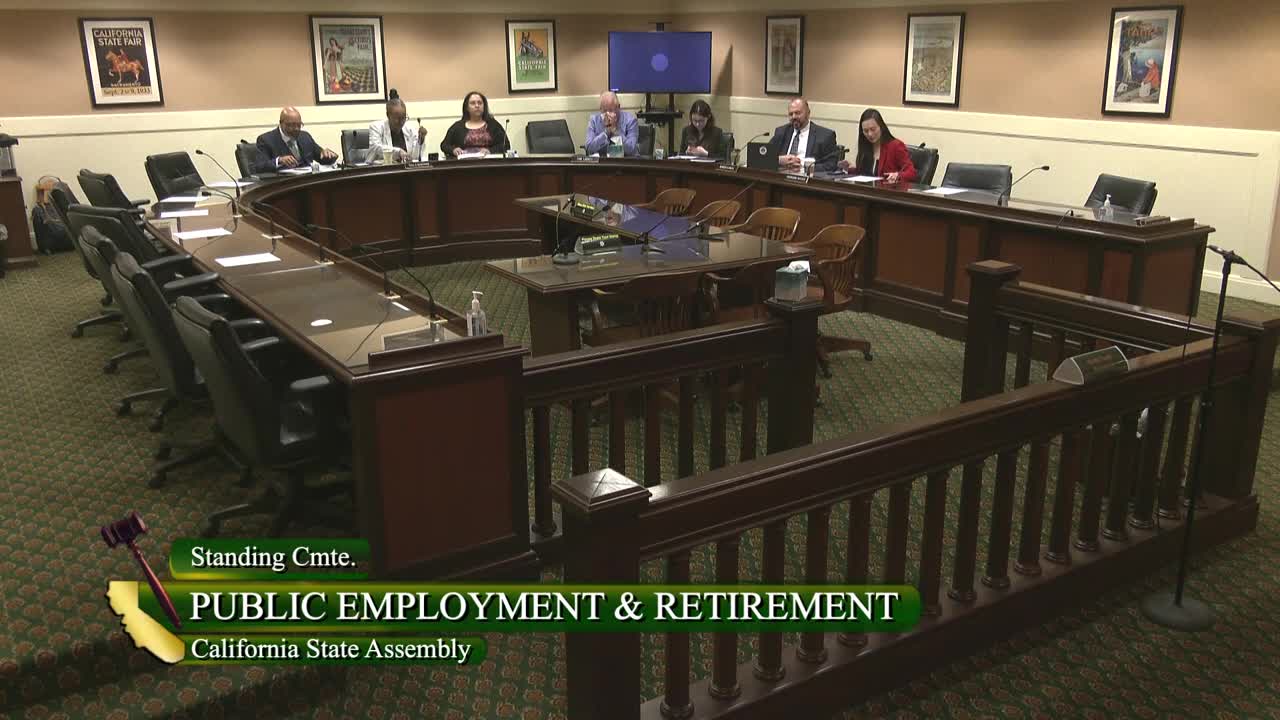 5MIN
Assembly Standing Committee on Public Employment and Retirement
Bill Author

Bill Co-Author(s):