AB 63: Loitering with intent to commit prostitution.
- Session Year: 2025-2026
- House: Assembly
- Latest Version Date: 2025-03-27
Current Status:
Failed
(2026-02-02: From committee: Filed with the Chief Clerk pursuant to Joint Rule 56.)
Introduced
In Committee
Awaiting First Chamber Vote
Passed First Chamber
In Committee
Awaiting Second Chamber Vote
Passed Second Chamber
Enacted
Existing law, until January 1, 2023, prohibited loitering in a public place with the intent to commit prostitution, as defined, and made that crime a misdemeanor.
This bill would reinstate those provisions and would prohibit California law enforcement, as defined, from making an arrest pursuant to these provisions solely based on the individuals gender identity or sexual preference. orientation. The bill would also require law enforcement, prior to making an arrest of the individual pursuant to these provisions, to document their attempts to offer the individual services. By creating a new crime, and by imposing new duties on local law enforcement, this bill would impose a state-mandated local program.
The California Constitution requires the state to reimburse local agencies and school districts for certain costs mandated by the state. Statutory provisions establish procedures for making that reimbursement.
This bill would provide that with regard to certain mandates no reimbursement is required by this act for a specified reason.
With regard to any other mandates, this bill would provide that, if the Commission on State Mandates determines that the bill contains costs so mandated by the state, reimbursement for those costs shall be made pursuant to the statutory provisions noted above.
Existing law, until January 1, 2023, prohibited loitering in a public place with the intent to commit prostitution, as defined, and made that crime a misdemeanor.
This bill would reinstate those provisions and would prohibit California law enforcement, as defined, from making an arrest pursuant to these provisions solely based on the individuals gender identity or sexual preference. The bill would also require law enforcement, prior to making an arrest of the individual pursuant to these provisions, to document their attempts to offer the individual services. By creating a new crime, and by imposing new duties on local law enforcement, this bill would impose a state-mandated local program.
The California Constitution requires the state to reimburse local agencies and school districts for certain costs mandated by the state. Statutory provisions establish procedures for making that reimbursement.
This bill would provide that with regard to certain mandates no reimbursement is required by this act for a specified reason.
With regard to any other mandates, this bill would provide that, if the Commission on State Mandates determines that the bill contains costs so mandated by the state, reimbursement for those costs shall be made pursuant to the statutory provisions noted above.
Existing law prohibits violating the personal liberty of another person with the intent to obtain forced labor or services or with the intent to engage in extortion or specified sex offenses.This bill would make technical, nonsubstantive changes to those provisions.Existing law prohibits violating the personal liberty of another person with the intent to obtain forced labor or services or with the intent to engage in extortion or specified sex offenses.
This bill would make technical, nonsubstantive changes to those provisions.
For purposes of this chapter, the following definitions apply:
(a)California law Law enforcement means any department or agency of the state or any local government, special district, or other political subdivision thereof, that employs any peace officer, as described in Section 830.
(b)Commit prostitution means to engage in sexual conduct for money or other consideration, but does not include sexual conduct engaged in as a part of any stage performance, play, or other entertainment open to the public.
(c)Loiter means to delay or linger without a lawful purpose for being on the property and for the purpose of committing a crime as opportunity may be discovered.
(d)Public place means an area open to the public, or an alley, plaza, park, driveway, or parking lot, or an automobile, whether moving or not, or a building open to the general public, including one that serves food or drink, or provides entertainment, or the doorways and entrances to a building or dwelling, or the grounds enclosing a building or dwelling.
SEC. 2.Section 653.22 is added to the Penal Code, immediately following Section 653.20, to read:653.22.(a)(1)Except as specified in paragraph (2), it is unlawful for any person to loiter in a public place with the intent to commit prostitution. This intent is evidenced by acting in a manner and under circumstances that openly demonstrate the purpose of inducing, enticing, or soliciting prostitution, or procuring another to commit prostitution.
(2)Notwithstanding paragraph (1), this subdivision does not apply to a child under 18 years of age who is alleged to have engaged in conduct that would, if committed by an adult, violate this subdivision. A commercially exploited child under this paragraph may be adjudged a dependent child of the court pursuant to Section 300 of the Welfare and Institutions Code and may be taken into temporary custody pursuant to subdivision (a) of Section 305 of the Welfare and Institutions Code, if the conditions allowing temporary custody without warrant are met.
(b)Among the circumstances that may be considered in determining whether a person loiters with the intent to commit prostitution are that the person:
(1)Repeatedly beckons to, stops, engages in conversations with, or attempts to stop or engage in conversations with passersby, indicative of soliciting for prostitution.
(2)Repeatedly stops or attempts to stop motor vehicles by hailing the drivers, waving arms, or making any other bodily gestures, or engages or attempts to engage the drivers or passengers of the motor vehicles in conversation, indicative of soliciting for prostitution.
(3)Has been convicted of violating this section, subdivision (a) or (b) of Section 647, or any other offense relating to or involving prostitution within five years of the arrest under this section.
(4)Circles an area in a motor vehicle and repeatedly beckons to, contacts, or attempts to contact or stop pedestrians or other motorists, indicative of soliciting for prostitution.
(5)Has engaged, within six months prior to the arrest under this section, in any behavior described in this subdivision, with the exception of paragraph (3), or in any other behavior indicative of prostitution activity.
(c)The list of circumstances set forth in subdivision (b) is not exclusive. The court shall consider the circumstances set forth in subdivision (b) particularly salient if they occur in an area that is known for prostitution activity. Any other relevant circumstances may be considered in determining whether a person has the requisite intent. Moreover, no one circumstance or combination of circumstances is in itself determinative of intent. Intent shall be determined based on an evaluation of the particular circumstances of each case.
(d)California law Law enforcement shall not make an arrest pursuant to this section against an individual solely based on their perceived gender identity or sexual preference. orientation.
(e)Prior to making an arrest pursuant to this section, California law enforcement shall document their attempts to offer services to the individual who is suspected of loitering with intent to commit prostitution.
(f)If it is determined by a peace officer that the person is a victim of human trafficking and crimes have occurred, Section 236.23 shall apply, and the law enforcement agency employing the peace officer shall initiate an investigation of the violation of Section 236.1.
SEC. 3.No reimbursement is required by this act pursuant to Section 6 of Article XIIIB of the California Constitution for certain costs that may be incurred by a local agency or school district because, in that regard, this act creates a new crime or infraction, eliminates a crime or infraction, or changes the penalty for a crime or infraction, within the meaning of Section 17556 of the Government Code, or changes the definition of a crime within the meaning of Section 6 of Article XIIIB of the California Constitution.
However, if the Commission on State Mandates determines that this act contains other costs mandated by the state, reimbursement to local agencies and school districts for those costs shall be made pursuant to Part 7 (commencing with Section 17500) of Division 4 of Title 2 of the Government Code.
For purposes of this chapter, the following definitions apply:
(a)California law enforcement means any department or agency of the state or any local government, special district, or other political subdivision thereof, that employs any peace officer, as described in Section 830.
(b)Commit prostitution means to engage in sexual conduct for money or other consideration, but does not include sexual conduct engaged in as a part of any stage performance, play, or other entertainment open to the public.
(c)Loiter means to delay or linger without a lawful purpose for being on the property and for the purpose of committing a crime as opportunity may be discovered.
(d)Public place means an area open to the public, or an alley, plaza, park, driveway, or parking lot, or an automobile, whether moving or not, or a building open to the general public, including one that serves food or drink, or provides entertainment, or the doorways and entrances to a building or dwelling, or the grounds enclosing a building or dwelling.
SEC. 2.Section 653.22 is added to the Penal Code, immediately following Section 653.20, to read:653.22.(a)(1)Except as specified in paragraph (2), it is unlawful for any person to loiter in a public place with the intent to commit prostitution. This intent is evidenced by acting in a manner and under circumstances that openly demonstrate the purpose of inducing, enticing, or soliciting prostitution, or procuring another to commit prostitution.
(2)Notwithstanding paragraph (1), this subdivision does not apply to a child under 18 years of age who is alleged to have engaged in conduct that would, if committed by an adult, violate this subdivision. A commercially exploited child under this paragraph may be adjudged a dependent child of the court pursuant to Section 300 of the Welfare and Institutions Code and may be taken into temporary custody pursuant to subdivision (a) of Section 305 of the Welfare and Institutions Code, if the conditions allowing temporary custody without warrant are met.
(b)Among the circumstances that may be considered in determining whether a person loiters with the intent to commit prostitution are that the person:
(1)Repeatedly beckons to, stops, engages in conversations with, or attempts to stop or engage in conversations with passersby, indicative of soliciting for prostitution.
(2)Repeatedly stops or attempts to stop motor vehicles by hailing the drivers, waving arms, or making any other bodily gestures, or engages or attempts to engage the drivers or passengers of the motor vehicles in conversation, indicative of soliciting for prostitution.
(3)Has been convicted of violating this section, subdivision (a) or (b) of Section 647, or any other offense relating to or involving prostitution within five years of the arrest under this section.
(4)Circles an area in a motor vehicle and repeatedly beckons to, contacts, or attempts to contact or stop pedestrians or other motorists, indicative of soliciting for prostitution.
(5)Has engaged, within six months prior to the arrest under this section, in any behavior described in this subdivision, with the exception of paragraph (3), or in any other behavior indicative of prostitution activity.
(c)The list of circumstances set forth in subdivision (b) is not exclusive. The court shall consider the circumstances set forth in subdivision (b) particularly salient if they occur in an area that is known for prostitution activity. Any other relevant circumstances may be considered in determining whether a person has the requisite intent. Moreover, no one circumstance or combination of circumstances is in itself determinative of intent. Intent shall be determined based on an evaluation of the particular circumstances of each case.
(d)California law enforcement shall not make an arrest pursuant to this section against an individual solely based on their perceived gender identity or sexual preference.
(e)Prior to making an arrest pursuant to this section, California law enforcement shall document their attempts to offer services to the individual who is suspected of loitering with intent to commit prostitution.
(f)If it is determined by a peace officer that the person is a victim of human trafficking and crimes have occurred, Section 236.23 shall apply, and the law enforcement agency employing the peace officer shall initiate an investigation of the violation of Section 236.1.
SEC. 3.No reimbursement is required by this act pursuant to Section 6 of Article XIIIB of the California Constitution for certain costs that may be incurred by a local agency or school district because, in that regard, this act creates a new crime or infraction, eliminates a crime or infraction, or changes the penalty for a crime or infraction, within the meaning of Section 17556 of the Government Code, or changes the definition of a crime within the meaning of Section 6 of Article XIIIB of the California Constitution.
However, if the Commission on State Mandates determines that this act contains other costs mandated by the state, reimbursement to local agencies and school districts for those costs shall be made pursuant to Part 7 (commencing with Section 17500) of Division 4 of Title 2 of the Government Code.
SECTION 1.Section 236.1 of the Penal Code, as amended by Section 6 of Chapter 226 of the Statutes of 2024, is amended to read:236.1.(a)A person who deprives or violates the personal liberty of another person with the intent to obtain forced labor or services, is guilty of human trafficking and shall be punished by imprisonment in the state prison for 5, 8, or 12 years and a fine of not more than five hundred thousand dollars ($500,000).(b)A person who deprives or violates the personal liberty of another person with the intent to effect or maintain a violation of Section 266, 266h, 266i, 266j, 267, 311.1, 311.2, 311.3, 311.4, 311.5, 311.6, or 518 is guilty of human trafficking and shall be punished by imprisonment in the state prison for 8, 14, or 20 years and a fine of not more than five hundred thousand dollars ($500,000).(c)A person who causes, induces, or persuades, or attempts to cause, induce, or persuade, a person who is a minor at the time of commission of the offense to engage in a commercial sex act, with the intent to effect or maintain a violation of Section 266, 266h, 266i, 266j, 267, 311.1, 311.2, 311.3, 311.4, 311.5, 311.6, or 518 is guilty of human trafficking. A violation of this subdivision is punishable by imprisonment in the state prison as follows:(1)Five, 8, or 12 years and a fine of not more than five hundred thousand dollars ($500,000).(2)Fifteen years to life and a fine of not more than five hundred thousand dollars ($500,000) when the offense involves force, fear, fraud, deceit, coercion, violence, duress, menace, or threat of unlawful injury to the victim or to another person.(d)In determining whether a minor was caused, induced, or persuaded to engage in a commercial sex act, the totality of the circumstances, including the age of the victim, the victims relationship to the trafficker or agents of the trafficker, and any handicap or disability of the victim, shall be considered.(e)Consent by a victim of human trafficking who is a minor at the time of the commission of the offense is not a defense to a criminal prosecution under this section.(f)Mistake of fact as to the age of a victim of human trafficking who is a minor at the time of the commission of the offense is not a defense to a criminal prosecution under this section.(g)The Legislature finds that the definition of human trafficking in this section is equivalent to the federal definition of a severe form of trafficking found in Section 7102(11) of Title 22 of the United States Code.(h)For purposes of this chapter, the following definitions apply:(1)Coercion includes a scheme, plan, or pattern intended to cause a person to believe that failure to perform an act would result in serious harm to or physical restraint against any person; the abuse or threatened abuse of the legal process; debt bondage; or providing and facilitating the possession of a controlled substance to a person with the intent to impair the persons judgment.(2)Commercial sex act means sexual conduct on account of which anything of value is given or received by a person.(3)Deprivation or violation of the personal liberty of another includes substantial and sustained restriction of anothers liberty accomplished through force, fear, fraud, deceit, coercion, violence, duress, menace, or threat of unlawful injury to the victim or to another person, under circumstances where the person receiving or apprehending the threat reasonably believes that it is likely that the person making the threat would carry it out.(4)Duress includes a direct or implied threat of force, violence, danger, hardship, or retribution sufficient to cause a reasonable person to acquiesce in or perform an act which the person would otherwise not have submitted to or performed; a direct or implied threat to destroy, conceal, remove, confiscate, or possess an actual or purported passport or immigration document of the victim; or knowingly destroying, concealing, removing, confiscating, or possessing an actual or purported passport or immigration document of the victim.(5)Forced labor or services means labor or services that are performed or provided by a person and are obtained or maintained through force, fraud, duress, or coercion, or equivalent conduct that would reasonably overbear the will of the person.(6)Great bodily injury means a significant or substantial physical injury.(7)Minor means a person less than 18 years of age.(8)Serious harm includes any harm, whether physical or nonphysical, including psychological, financial, or reputational harm, that is sufficiently serious, under all the surrounding circumstances, to compel a reasonable person of the same background and in the same circumstances to perform or to continue performing labor, services, or commercial sexual acts in order to avoid incurring that harm.(i)The total circumstances, including the age of the victim, the relationship between the victim and the trafficker or agents of the trafficker, and any handicap or disability of the victim, shall be factors to consider in determining the presence of deprivation or violation of the personal liberty of another, duress, and coercion as described in this section.(j)In any case brought pursuant to this section, the prosecutor shall consider whether to seek protective orders pursuant to Section 136.2.(k)A court shall report a conviction of subdivision (a), (b), or (c) of this section that occurred while the person was using a commercial motor vehicle, as defined in Section 15210 of the Vehicle Code, to the Department of Motor Vehicles.(a)A person who deprives or violates the personal liberty of another person with the intent to obtain forced labor or services, is guilty of human trafficking and shall be punished by imprisonment in the state prison for 5, 8, or 12 years and a fine of not more than five hundred thousand dollars ($500,000).
(b)A person who deprives or violates the personal liberty of another person with the intent to effect or maintain a violation of Section 266, 266h, 266i, 266j, 267, 311.1, 311.2, 311.3, 311.4, 311.5, 311.6, or 518 is guilty of human trafficking and shall be punished by imprisonment in the state prison for 8, 14, or 20 years and a fine of not more than five hundred thousand dollars ($500,000).
(c)A person who causes, induces, or persuades, or attempts to cause, induce, or persuade, a person who is a minor at the time of commission of the offense to engage in a commercial sex act, with the intent to effect or maintain a violation of Section 266, 266h, 266i, 266j, 267, 311.1, 311.2, 311.3, 311.4, 311.5, 311.6, or 518 is guilty of human trafficking. A violation of this subdivision is punishable by imprisonment in the state prison as follows:
(1)Five, 8, or 12 years and a fine of not more than five hundred thousand dollars ($500,000).
(2)Fifteen years to life and a fine of not more than five hundred thousand dollars ($500,000) when the offense involves force, fear, fraud, deceit, coercion, violence, duress, menace, or threat of unlawful injury to the victim or to another person.
(d)In determining whether a minor was caused, induced, or persuaded to engage in a commercial sex act, the totality of the circumstances, including the age of the victim, the victims relationship to the trafficker or agents of the trafficker, and any handicap or disability of the victim, shall be considered.
(e)Consent by a victim of human trafficking who is a minor at the time of the commission of the offense is not a defense to a criminal prosecution under this section.
(f)Mistake of fact as to the age of a victim of human trafficking who is a minor at the time of the commission of the offense is not a defense to a criminal prosecution under this section.
(g)The Legislature finds that the definition of human trafficking in this section is equivalent to the federal definition of a severe form of trafficking found in Section 7102(11) of Title 22 of the United States Code.
(h)For purposes of this chapter, the following definitions apply:
(1)Coercion includes a scheme, plan, or pattern intended to cause a person to believe that failure to perform an act would result in serious harm to or physical restraint against any person; the abuse or threatened abuse of the legal process; debt bondage; or providing and facilitating the possession of a controlled substance to a person with the intent to impair the persons judgment.
(2)Commercial sex act means sexual conduct on account of which anything of value is given or received by a person.
(3)Deprivation or violation of the personal liberty of another includes substantial and sustained restriction of anothers liberty accomplished through force, fear, fraud, deceit, coercion, violence, duress, menace, or threat of unlawful injury to the victim or to another person, under circumstances where the person receiving or apprehending the threat reasonably believes that it is likely that the person making the threat would carry it out.
(4)Duress includes a direct or implied threat of force, violence, danger, hardship, or retribution sufficient to cause a reasonable person to acquiesce in or perform an act which the person would otherwise not have submitted to or performed; a direct or implied threat to destroy, conceal, remove, confiscate, or possess an actual or purported passport or immigration document of the victim; or knowingly destroying, concealing, removing, confiscating, or possessing an actual or purported passport or immigration document of the victim.
(5)Forced labor or services means labor or services that are performed or provided by a person and are obtained or maintained through force, fraud, duress, or coercion, or equivalent conduct that would reasonably overbear the will of the person.
(6)Great bodily injury means a significant or substantial physical injury.
(7)Minor means a person less than 18 years of age.
(8)Serious harm includes any harm, whether physical or nonphysical, including psychological, financial, or reputational harm, that is sufficiently serious, under all the surrounding circumstances, to compel a reasonable person of the same background and in the same circumstances to perform or to continue performing labor, services, or commercial sexual acts in order to avoid incurring that harm.
(i)The total circumstances, including the age of the victim, the relationship between the victim and the trafficker or agents of the trafficker, and any handicap or disability of the victim, shall be factors to consider in determining the presence of deprivation or violation of the personal liberty of another, duress, and coercion as described in this section.
(j)In any case brought pursuant to this section, the prosecutor shall consider whether to seek protective orders pursuant to Section 136.2.
(k)A court shall report a conviction of subdivision (a), (b), or (c) of this section that occurred while the person was using a commercial motor vehicle, as defined in Section 15210 of the Vehicle Code, to the Department of Motor Vehicles.
|
Date
|
Status
|
|---|---|
| Feb 2, 2026 | From committee: Filed with the Chief Clerk pursuant to Joint Rule 56. |
| Jan 31, 2026 | Died pursuant to Art. IV, Sec. 10(c) of the Constitution. |
| Apr 29, 2025 | In committee: Hearing for testimony only. |
| Apr 28, 2025 | Joint Rule 62(a) suspended. (Page 1307.) |
| Mar 28, 2025 | Re-referred to Com. on PUB. S. |
| Mar 27, 2025 | From committee chair, with author's amendments: Amend, and re-refer to Com. on PUB. S. Read second time and amended. |
| Mar 25, 2025 | From committee chair, with author's amendments: Amend, and re-refer to Com. on PUB. S. Read second time and amended. |
| Mar 25, 2025 | Re-referred to Com. on PUB. S. |
| Mar 24, 2025 | From committee chair, with author's amendments: Amend, and re-refer to Com. on PUB. S. Read second time and amended. |
| Mar 24, 2025 | Referred to Com. on PUB. S. |
| Dec 3, 2024 | From printer. May be heard in committee January 2. |
| Dec 2, 2024 | Read first time. To print. |
This list shows positions taken on this bill by organizations on the date displayed, which is linked to the original source.
Positions by individuals are not included.
|
Organization
|
Position
|
Date
|
|---|---|---|
| Aclu California Action | ** Against | |
| Alliance for Transyouth Liberation | ** Against | |
| Arcadia Police Officers' Association | ** Support | |
| Association For Los Angeles Deputy Sheriffs | ** Support | |
| Black Women For Wellness Action Project | ** Against | |
| Brea Police Association | ** Support | |
| Burbank Police Officers' Association | ** Support | |
| California Association of School Police Chiefs | ** Support | |
| California Attorneys For Criminal Justice | ** Against | |
| California Coalition of School Safety Professionals | ** Support | |
| California Legislative LGBTQ Caucus | ** Against | |
| California Narcotic Officers' Association | ** Support | |
| California Peace Officers Association | ** Support | |
| California Reserve Peace Officers Association | ** Support | |
| California Women's Law Center | ** Against | |
| Californians United for a Responsible Budget | ** Against | |
| Center on Reproductive Rights and Justice At Berkeley Law | ** Against | |
| City of Chino | ** Support | |
| City of Montclair | ** Support | |
| City of Pomona Mayor Tim Sandoval | ** Support | |
| City of Riverside | ** Support | |
| City Of San Diego | ** Support | |
| City Of Upland | ** Support | |
| CLAREMONT POLICE OFFICERS ASSOCIATION | ** Support | |
| Communities United for Restorative Youth Justice | ** Against | |
| Corona Police Officers Association | ** Support | |
| County of Monterey | ** Support | |
| Culver City Police Officers' Association | ** Support | |
| Decriminalize Sex Work | ** Against | |
| Decrimsexworkca | ** Against | |
| Equality California | ** Against | |
| Erotic Service Providers Legal, Education, and Research Project | ** Against | |
| Fullerton Police Officers' Association | ** Support | |
| Heald Women Heal | ** Support | |
| Healed Women Heal, INC. | ** Support | |
| Initiate Justice | ** Against | |
| LA Defensa | ** Against | |
| League Of California Cities | ** Support | |
| Local 148 La County Public Defenders Union | ** Against | |
| Los Angeles School Police Management Association | ** Support | |
| los angeles school police officers association | ** Support | |
| Murrieta Police Officers' Association | ** Support | |
| Newport Beach Police Association | ** Support | |
| Orange County Sheriff's Department | ** Support | |
| Palos Verdes Police Officers Association | ** Support | |
| Placer County Deputy Sheriffs' Assocation | ** Support | |
| Pomona City Council Member Debra Martin | ** Support | |
| Pomona Police Officers' Association | ** Support | |
| RIVERSIDE POLICE OFFICERS ASSOCIATION | ** Support | |
| Riverside Sheriffs' Association | ** Support | |
| Sacramento County Sheriff Jim Cooper | ** Support | |
| Salinas City Of | ** Support | |
| San Bernardino County Police Chiefs and Sheriff Association | ** Support | |
| San Bernardino County Sheriff'S Department | ** Support | |
| San Francisco Public Defender | ** Against | |
| Santa Ana Police Officers Association | ** Support | |
| Sex Worker Outreach Project Behind Bars | ** Against | |
| sex workers outreach project los angeles | ** Against | |
| Smart Justice California, a project of Tides Advocacy | ** Against | |
| Survivor Policy Coalition | ** Against | |
| The Translatin@ Coalition | ** Against | |
| Transfamily Support Services | ** Against | |
| Unique Woman's Coalition | ** Against | |
| Universidad Popular | ** Against | |
| Woodhull Freedom Foundation | ** Against |
Date of Hearing:
Counsel: Kimberly Horiuchi
ASSEMBLY COMMITTEE ON PUBLIC SAFETY
Nick Schultz, Chair
ABPCA Bill Id:AB 63
Author:(Michelle Rodriguez) – As Amended Ver:March 27, 2025
TESTIMONY/PRESENTATION ONLY
SUMMARY:
Re-enacts the crime of loitering for the purpose of engaging in a prostitution offense (hereinafter “loitering with intent” or “loitering with intent to commit prostitution”) which, before it was repealed, criminalized standing or loitering in public in order to engage in sex for compensation. Specifically, this bill:
- Specifies that loitering with intent is evidenced by acting in a manner and under circumstances that openly demonstrate the purpose of inducing, enticing, or soliciting prostitution or procuring another to commit prostitution.
- States a person under the age of 18 shall not be guilty of loitering with intent. A commercially exploited child, as specified, may be adjudged a dependent child of the court and may be taken into temporary custody if the conditions allowing temporary custody without warrant are met.
- Provides that among the circumstances that may be considered in determining whether a person loiters with intent to commit prostitution are that the person:
- Repeatedly beckons to, stops, engages in conversations with, or attempts to stop or engage in conversations with passersby, indicative of soliciting for prostitution.
- Repeatedly stops or attempts to stop motor vehicles by hailing the drivers, waving arms, or making any other bodily gestures, or engages or attempts to engage the drivers or passengers of the motor vehicles in conversation, indicative of soliciting for prostitution.
- Has been convicted of loitering with intent, solicitation of prostitution, or any other offense relating to or involving prostitution within five years of the arrest.
- Circle an area in a motor vehicle and repeatedly beckons to, contacts, or attempts to contact or stop pedestrians or other motorists, indicative of soliciting for prostitution.
- Has engaged, within six months prior to the arrest in any behavior specified above, with the exception of being previously convicted of loitering or solicitation or in any other behavior indicative of prostitution activity.
- Repeatedly beckons to, stops, engages in conversations with, or attempts to stop or engage in conversations with passersby, indicative of soliciting for prostitution.
- Retains recently enacted portions of SB 357 (Weiner), Chapter 86, Statutes of 2022 that state a person convicted for loitering with intent may petition to recall their conviction, as specified. However, restricts the opportunity to seek recall and resentence to only a person convicted of loitering with intent before January 1, 2023.
- Requires a court to consider the circumstances above that are particularly salient if they occur in an area that is known for prostitution activity.
- Authorizes a court to consider other relevant circumstances in determining whether a person has the requisite intent.
- States no one circumstance or combination of circumstances is in itself determinative of intent. Intent shall be determined based on an evaluation of the particular circumstances of each case.
- Prohibits law enforcement from making an arrest for loitering with intent solely based on a person’s perceived gender identity or sexual orientation.
- Requires law enforcement prior to making an arrest pursuant to this section, law enforcement shall document their attempts to offer services to the individual who is suspected of loitering with intent to commit prostitution.
- States if it is determined by a peace officer that the person is a victim of human trafficking and crimes have occurred, a person is entitled to an affirmative defense, as specified, and the law enforcement agency employing the peace officer shall initiate an investigation into human trafficking.
- Defines the following terms:
- “Law enforcement” means any department or agency of the state or any local government, special district, or other political subdivision, that employs any peace officer, as specified.
- “Commit prostitution” means to engage in sexual conduct for money or other consideration, but does not include sexual conduct engaged in as a part of any stage performance, play, or other entertainment open to the public.
- “Loiter” means to delay or linger without a lawful purpose for being on the property and for the purpose of committing a crime as opportunity may be discovered.
- “Public place” means an area open to the public, or an alley, plaza, park, driveway, or parking lot, or an automobile, whether moving or not, or a building open to the general public, including one that serves food or drink, or provides entertainment, or the doorways and entrances to a building or dwelling, or the grounds enclosing a building or dwelling.
- “Law enforcement” means any department or agency of the state or any local government, special district, or other political subdivision, that employs any peace officer, as specified.
EXISTING LAW:
- Makes it a misdemeanor to solicit anyone to engage in, or engages in, lewd or dissolute conduct in any public place or in any place open to the public or exposed to public view. (Pen. Code, § 647, subd. (a).)
- Makes it a misdemeanor to solicit, agree to engage in, or engages in any act of prostitution with the intent to receive compensation, money, or anything of value from another person. (Pen. Code, § 647, subd. (b)(1).)
- Makes it a misdemeanor to solicit, agree to engage in, or engages in, any act of prostitution with another person who is 18 years of age or older in exchange for the individual providing compensation, money, or anything of value to the other person. (Pen. Code § 647, subd. (b)(2).)
- States it is unlawful for any person to direct, supervise, recruit, or otherwise aid another person in the commission of prostitution or collect or receive proceeds earned from prostitution. (Pen. Code, § 653.23 subd. (a)(1-2).)
- Punishes any person who deprives or violates the personal liberty of another with the intent to obtain forced labor or services, is guilty of human trafficking and shall be punished by imprisonment in the state prison for 5, 8, or 12 years and a fine of not more than $500,000. (Pen. Code, § 236.1, subd. (a).)
FISCAL EFFECT:
Unknown
COMMENTS:
- Author's Statement: According to the author, “Since the passage of SB 357 (Weiner 2022), cities have been thwarted in their ability to combat sex trafficking and prostitution on their streets. Even though SB 357 (Weiner 2022) was well intended, it has made police enforcement and victim recovery efforts more difficult. AB 63 provides a mechanism for public safety officers to combat prostitution and sex trafficking in their neighborhoods. The goal of this bill is not to punish the victims. This bill ensures we strengthen enforcement against human trafficking and allows us to give victims a voice.
- Differences in this bill and existing law: Former Penal Code section 653.22 prohibited loitering with the intent. (Pen. Code, § 653.22, subd. (a).) That statute also defined the types of admissible evidence that may be used to prove intent, including: (1) repeatedly beckoning to passersby; (2) a previous conviction for loitering with intent to commit prostitution in the past five years; (3) circling an area in a vehicle and repeatedly beckoning passersby in a vehicle or on foot; or (4) a previous arrest for loitering with intent in the past six months. (See former Pen. Code, § 653.22, subd. (b)(1)-(5).) This bill simply re-enacts Penal Code section 653.22 – thereby repealing SB 357.
(a) AB 1035 ((Katz) Chapter 981, Statutes of 1995
Penal Code section 653.22 was originally enacted in 1995. According to the Senate Committee on Criminal Procedure analysis of AB 1035, the author and proponents of the bill declared the law necessary because existing laws at that time were ineffective at producing arrests of persons believed to be sex workers, and the presence of such individuals added to crime and blight to neighborhoods. This theory of crime prevention is often referred to as the “broken windows” theory.[1] According to the author’s statement provided in the analysis:
Prostitutes and drug dealers blatantly work on the streets in defiance of law enforcement. Prostitution and drug dealing adversely affect the safety, welfare, and health of our neighborhoods while hurting small businesses and decreasing property values. While it is usually quite obvious that prostitutes and drug dealers are conducting business, existing law has been ineffective in securing their arrest.
In order to be arrested, prostitutes must either solicit, accept, or engage in a sexual act for money. Drug dealers must be caught exchanging controlled substances for money. These criminals have become skilled in their operations -- they are familiar with undercover officers and know exactly what they can and cannot say to avoid arrest. They blatantly work the streets in defiance of law enforcement -- and add to the rampant crime and blight in some of our neighborhoods.[2]
Opponents of AB 1035 stated that by enacting this statute, police would be allowed to make arrests for alleged sex work where there is no evidence of probable cause that a crime has been committed or will be committed as required by the court in Terry v. Ohio (1968) 392 U.S. 1. “In determining whether the Fourth Amendment was violated by a police officer's seizure of a person by way of stopping him for interrogation, the notions which underlie both the warrant procedure and the requirement of probable cause remain fully relevant; in order to assess the reasonableness of the police officer's conduct as a general proposition, … in justifying the particular intrusion the police officer must be able to point to specific and articulable facts which, taken together with rational inferences from those facts, reasonably warrant that intrusion.” (Terry v. Ohio (1968) 392 U.S. 1, 4, 21.) AB 1035 provided broad discretion to law enforcement on what circumstances could satisfy evidence of intent to commit sex work, potentially leading to subjective and arbitrary arrests. (Id. at pp. i-j.)
(b) SB 357 (Wiener), Chapter 86, Statutes of 2022
SB 357 repealed the crime of loitering with intent arguing enforcement led to discriminatory and harmful outcomes, particularly for people of color and members of the LGBTQ+ community.
The language embraced in former Penal Code section 653.22 was premised on the concept of the societal harm caused by “unchaste women.”[3] It largely ignores the harms suffered by people in an overly criminalized sex trade that are not cis-gender females and are not “working the street.” According to the author of SB 357:
“This misdemeanor crime has failed to protect public safety, in addition to contributing to the discrimination on the basis of gender, race, class and perceived sex worker status – in particular, targeting Black women and members of the transgender community. … SB 357 simply eliminates an anti-loitering offense that results in the legal harassment of LGTBQ+, Black, and Brown communities for simply existing and looking like a “sex worker” to law enforcement.”
When the Governor signed SB 357, he did so with the following signing message:
The author brought forth this legislation because the crime of loitering has disproportionately impacted Black and Brown women and members of the LGBTQ community. Black adults accounted for 56.1 % of the loitering charges in Los Angeles between 2017 and 2019, despite making up less than 10% of the city's population. To be clear, this bill does not legalize prostitution. It simply revokes provisions of the law that have led to disproportionate harassment of women and transgender adults. …”
In his signing statement, the Governor also “promised to monitor crime and prosecution trends for any possible unintended consequences and will act to mitigate any such impacts.” To date, this committee has not received any indication from the Governor of any unintended consequences.
SB 357 also repealed Penal Code section 653.20 which defined the phrases “commit prostitution,” “public place,” and what it means to “loiter.” Additionally, SB 357 authorizes any person currently serving a sentence for, or any person previously convicted of, loitering with intent to commit prostitution, to petition the trial court for a recall or dismissal of the sentence. This bill retains that section without amendment. It is not clear whether this section would no longer be applicable if this bill were signed.
- Need for the Bill: According to the author’s office, without this statute, law enforcement is not able to investigate larger prostitution and trafficking rings. However, the crime of loitering with intent only contemplates open air sex work – i.e., the long worn image of scantily-clad women walking up and down major urban thoroughfares hailing passersby. If the goal is combatting trafficking, victims being trafficked on-line or through online marketplaces, would see no protection from this law.
Additionally, certainly nothing prevents law enforcement from investigating solicitation if they believe there is evidence of commercial sex trafficking. There is no evidence that cracking down on loitering with intent or prostitution has any impact on rates of commercial sex trafficking. In fact, victims of commercial sex trafficking are not likely to communicate with law enforcement because of its discriminatory conduct toward women and members of the LGBTQ+ community.
As noted in greater detail below, the International Human Rights Clinic at the University of Southern California, Gould School of Law states sex workers often do not cooperate with law enforcement in arresting traffickers because they fear arrest, harassment, violence, and even abuse - by police. (University of Southern California (USC) Gould School of Law International Human Rights Clinic, “Over-Policing Sex Trafficking: How U.S. Law Enforcement Should Reform Operations,” November 15, 2021, p. 6.) Is arresting a sex worker for loitering with intent the best way to glean information about commercial sex trafficking? Also, this bill does not address issues pertaining to labor trafficking as commercial sex trafficking is not the only type of trafficking.
- Criminalizing Poverty and Mental Illness: Solicitation generally is often a crime of poverty and absence of resources. People may rely on sex work to simply pay bills and feed families when employment income is not sufficient[4] – which is increasingly more common. Furthermore, often what may appear to be loitering with intent, is actually a person suffering from mental health crisis and unhoused. According to a 2020 study at Stanford University Institute for Economic Policy Research,
In 2020, about 25 percent of all homeless adults in Los Angeles County had severe mental illnesses such as a psychotic disorder and schizophrenia and 27 percent had a long-term substance use disorder. Moreover, a higher percentage of so-called chronically homeless have drug addiction, a severe mental illness, or both.[5]
Local jurisdictions may complain about what appears to be people in states of undress in a downtown or underserved area and claim they are loitering with intent, when in reality, they are homeless and in psychiatric distress causing them to act out in more hypersexual ways.
- Disparate Impact on Black, Indigenous, People of Color, and Members of the LGBTQ+ Community: There seems to be little dispute between supporters and opponents of this bill that members of the LGBTQ+ community and Black, Indigenous, and People of Color are uniquely disadvantaged in sex work and at significantly higher risk of being trafficked.[6]
A study conducted in 2019 through the Los Angeles County Public Defender’s office compiled data from all of the charges of violations of Penal Code section 653.22 reported from the Compton Branch of the Public Defender’s office. During a one-week period of time in July 2019, a total of 48 cases were reported. (Derek J. Demeri, “Policing of People in the Sex Trades in Compton: Analysis of Section 653.22 Clients,” Law Offices of the Los Angeles County Public Defender (2019).)
The Demeri study also found that the majority of arrests were made up of young Black women. 42.6 percent of arrests were for people aged 21-24 with the next highest rate being 23.4 percent for people aged 18-20. (Id. at p. 2.) As for race, 72.3 percent were Black with the next highest rate being 17 percent for Hispanic. (Id., at p. 4.) Additionally, the study showed the same four officers made the majority of arrests during that period. (Id., p. 10.) Twenty-five percent (25%) of people arrested for loitering with intent had no prior sex work-related convictions. In 76.7 percent of cases, alleged suspects were characterized as wearing revealing clothing as evidence in support of intent to solicit a sex act. (Id., p. 12) Finally, in 45 out of 46 cases, the suspect’s state of dress was the stated basis for probable cause to arrest. (Ibid.) In 71.7% of cases, possession of condoms was used to support probable cause. (Ibid.)[7]
According to the Yale Global Health Partnership in June 2020, arrest and conviction records for prostitution-related crimes make it harder for sex workers, and those cited for unlawful sex work, to find alternative employment - holding them in street economies and economic hardships - “exacerbating ongoing race and gender discrimination.”[8] Criminalization exacerbates the barriers to housing, public benefits, and other social supports especially needed by street-based sex workers. These harms most often fall on People of Color and members of the LGBTQ+ community because there are higher rates of arrest and conviction for those groups.
As explained above, sex work takes on many forms. In many cases, sex workers do not “walk the stroll” offering services – they provide outcall services via an internet website. For the most part, sex workers who provide outcall services tend to be Caucasian and more affluent. However, sex workers who offer services to passersby on the street are at much greater risk of discrimination and harassment by law enforcement and are much more likely to be people of color.
This particular statute – loitering with intent – is more often used against Black and Latinx sex workers because they are more likely be identified as sex workers on the street – even if they are not sex workers. According to the University of Southern California, Gould School of Law, International Human Rights Clinic’s November 15, 2021 report, “Over-Policing Sex Trafficking: How U.S. Law Enforcement Should Reform Operations,” many sex workers reported abusive and even violent and dehumanizing encounters with law enforcement.
The Gould School of Law Report also notes that in most cases, the sex worker is prosecuted – not the trafficker. If the goal is addressing the horrors of sex trafficking, it may make more sense to immunize sex workers against any arrest and prosecution and offer trauma-informed medical and mental health care so they may feel confident assisting law enforcement in prosecuting traffickers.
To make matters worse, this bill seems to tacitly approve of profiling Trans or queer sex workers. It states that law enforcement may not focus solely on whether someone is a member of the LGBTQ+ community. However, law enforcement is already prohibited from targeting someone simply because of their membership in a protected classification. (See Code Civ. Proc. § 52, et seq.) Law enforcement also cannot violate a person’s rights simply because of their sexual orientation. (See Code Civ. Proc. § 52.45.) There would be no need to mention intent to harass or discriminate against members of the LGBTQ+ community unless the author intends for law enforcement to rely, in part, on a person’s orientation.
Finally, this lack of trust between police and members of the LGBTQ+ community and cis women engaging in sex work may increase the amount of violence aimed at sex workers. Because law enforcement often treats participants in sex work as criminals they are uniquely likely to be victimized by serial offenders because those offenders know law enforcement is less likely to respond to missing person reports. This is demonstrated by the ten year investigation into the Long Island Serial Killer case, as discussed in numerous main stream media articles.
Women are overrepresented among serial killer homicide victims; sex workers are even more disproportionately affected. One study cited in a 2011 Homicide Studies article, which tracked victims in the early 1990s, found that 65% of victims of serial killers were women, and 78% of these female victims were sex workers. Another larger study of international serial killers, covering over two centuries, pointed to 73% of victims being women, and 23% of all victims being sex workers. … The belief that sex workers make themselves targets for serial killers and are therefore responsible for their own murder has allowed violence against them to continue, hampering police investigations throughout the 20th and 21st centuries.”[9]
Steven Egger, a professor of criminology at the University of Houston Clear Lake who has written four books about serial killers, stated, “Prostitutes are what I would call the throwaways of our society. They are less alive because they are marginalized. They don't have power or prestige. He (the serial killer) knows they are vulnerable. He knows they aren't going to be missed right away."[10] Since law enforcement often maligns sex workers, near victims are not likely to report their attacks. This may result in police missing crucial leads into a suspect that is obviously very dangerous. Further criminalizing sex work, particularly when the Legislature just repealed this law two and a half years ago, arguably makes women less safe.
- Immigration Consequences: A conviction for any crime where the penalty following conviction is a year or more and specified crimes “of moral turpitude” will likely bar a person from receiving lawful permanent residence status and may result in deportation. Prostitution-related immigration laws developed primarily in the late 1800s and early 1900s to respond to the singular concern about the threat of the sexuality of noncitizen women to American morality. (Dadhania, Article: Deporting Undesirable Women (2018) 9 U.C. Irvine L. Rev. 53, 56.)
Federal law states any person “directly or indirectly procures or attempts to procure, or (within 10 years of the date of application for a visa, admission, or adjustment of status) procured or attempted to procure or to import, prostitutes or persons for the purpose of prostitution” may be denied admission, re-admission, or LPR status. (8 U.S.C. § 1182, subd. (a)(2)(D); See generally, Argot v. Superior Court of San Bernardino County [People of State of California] (June 8, 2022, No. E075674) ___Cal.App.5th___ [2022 Cal. App. Unpub. LEXIS 3535, at *6-7].)
Congress passed the Victims of Trafficking Violence and Protection Act (VTVPA) in 2000. This law was enacted in the wake of increased awareness of human trafficking, particularly commercial sex trafficking. The VTVPA was multi-faceted legislation targeting human trafficking. It created T and U nonimmigrant statuses for victims of severe forms of human trafficking to allow them to remain in the United States to assist in law enforcement efforts against their traffickers and for victims of serious crimes including human trafficking, respectively. (Dadhania, 9 U.C. Irvine L. Rev., at 73.)
However, U and T visas are frequently denied to trafficking victims unless they participate in a law enforcement investigation – which may risk their lives or even their families’ lives. If a trafficking victim makes the decision to protect their family rather than speak to the police, the VTVPA may not provide any remedy. Hence, undocumented Californians may be uniquely penalized because an arrest or conviction for a prostitution-related crime may result in deportation or other serious immigration consequences. If the goal is protect human trafficking victims, does it make more sense to provide a full range of services to those who seek assistance and complex law enforcement actions to arrest traffickers –many of whom operate organized criminal operations?
Concerns for immigration consequences are especially acute now given the current Trump Administration’s rendition of anyone even alleged to be a “criminal” to an El Salvadoran mega prison known for brutal, tortuous conditions. Given California’s commitment to protecting legal and undocumented Californians from abroad, does it make sense to restore a criminal penalty that may impact the immigrant community in most horrific ways?
Finally, the Governor vetoed AB 1726 (Kalra) from 2023 which declared any former conviction for loitering with intent was legally invalid if: there is evidence of race, ethnicity, or national origin discrimination in the arrest or prosecution as defined by the Racial Justice Act; if there is evidence the defendant acted under duress; or if the defendant did not meaningfully understand how a conviction would affect their immigration status. In his veto message, the Governor notes the short amount of time since loitering with intent was repealed.
“When I signed Senate Bill 357 (2022) which repealed penal code section 653.22 (loitering with the intent to commit prostitution), I committed to monitoring crime and prosecution trends for any possible unintended consequences. Given that this legislation was signed just last year, and we continue to monitor, further changes to the law are premature.
As noted above, the only evidence in support of restoring this statute to the law are declining arrest rates for loitering with intent and allegations, with little evidence, that it was an effective statute in addressing human trafficking. However, both crime statistics and sex worker accounts belies the success of this statute in protecting those who have fallen victim to trafficking. This law was in place until 2022 and the rates of trafficking have allegedly only increased over the last twenty years.
- Argument in Support:
- According to the Orange County Sheriff’s Department, “In 2022 the Legislature narrowly passed Senator Weiner's SB 357 and, unfortunately, it was signed into law by the Governor. SB 357 repealed a section of the penal code that prohibited loitering for prostitution. This irresponsible action hindered law enforcement officers ability to help victims of sex trafficking. The loitering law was a tool used by investigators to engage potential victims and determine if they were a victim of human trafficking. It also helped us identify those who may be conducting the larger sex trafficking operation.
“Absent this tool, there has been a proliferation of prostitution in cities across California. Proponents of SB 357 fail to understand the nature of the human trafficking industry. Research and law enforcement experience continues to show the prevalence of trafficking victims among those engaged in prostitution. Recognizing this fact, the Orange County Sheriff's Department and our partner agencies have long taken a victim-centered approach to addressing prostitution. SB 357's removal of the legal barriers to loitering has allowed human traffickers to operate more freely knowing that their victims are less likely to face interaction with law enforcement. Rather than help victims, SB 357's normalization of the sex trade increases the demand for commercial sex services and the likelihood that human trafficking will occur to meet this demand.
“The impacts of SB 357 were further exacerbated by the crisis that had occurred at the southern border over the last few years. Tragically among those who entered our country during that period were victims of trafficking, both for purposes of labor and sexual exploitation. Helping these victims will require us to have tools available like the law proposed in AB 63.”
- According to the City of San Diego, “Since the enactment of Senate Bill 357 in 2022, which repealed Penal Code provisions related to loitering for the intent to engage in prostitution, cities like San Diego have witnessed a dramatic escalation in visible and aggressive street- level sex work and trafficking activity. Prior to SB 357, the San Diego Police Department would encounter an average of four to eight individuals engaging in prostitution on the streets. Today, that number has ballooned to between 12 and 30 individuals daily, concentrated in areas like the San Diego “Blade.”
“These individuals—often underage or vulnerable women coerced by traffickers—can be seen standing in the middle of the street, impeding traffic, and aggressively soliciting passersby. They are often dressed in lingerie, see- through clothing, or underwear, with this behavior occurring in full view of surveillance cameras and community members, including children and families. Pimps and traffickers are frequently present, monitoring and intimidating victims to maintain control and prevent them from seeking help.
“The 2022 law has had the unintended consequence of empowering traffickers while stripping police officers of a vital tool that was previously used to remove victims from dangerous environments and offer them services, shelter, and a path to safety. Without the authority to make contact or intervene, patrol officers are left unable to act—even when a victim is clearly in distress. AB 63 restores a critical mechanism for law enforcement to engage with potential victims, protect communities, and hold traffickers accountable. This legislation will provide officers with a humane, victim-centered approach that prioritizes removing individuals from coercive environments and offering them meaningful support. It also allows cities like San Diego to take back their streets from criminal enterprises that have thrived in the legal vacuum created by SB 357.”
- Argument in Opposition:
- According to Woodhull Freedom Foundation, “AB 63 would revive a flawed law, California Penal Code § 653.22, to criminalize loitering with the intent to engage in prostitution. Law enforcement used the past iteration of Penal Code § 653.22 to disproportionately target and criminalize people of color, LGBTQ+ individuals, and those experiencing poverty, under the pretext of public safety. Given these facts, the Legislature repealed the law in 2022. There is no reason to revive this faulty policy through AB 63.
“Public records paint a clear picture that Penal Code § 653.22 was a tool police used to harass marginalized communities:
“In Los Angeles, Black adults made up over half of the people arrested under this provision, even though they are only 8.9% of the city’s population.
“In Pomona, Black youth accounted for 75.5% of sex work-related arrests between 2016 and 2020, even though they are only 6% of the population. The second most common charge for people 18-25 years old was charges related to 653.22.
“Women accounted for 67.1% of all Penal Code § 653.22 charges in Los Angeles. Notably, women may have been underrepresented in this study as the data set possibly counts many Trans women as males.
“In a separate study of enforcement in Compton, cis and Trans women comprised 100% of
Penal Code § 653.22 arrests.
“Law enforcement’s use of loitering statutes like Penal Code § 653.22 to profile transgender women of color as sex workers was so pervasive that the term “walking while trans” was coined to describe this phenomenon.
“The same vagueness in Penal Code § 653.22 that led to disparate policing also led to ineffective prosecutions. In Los Angeles County, charges related to Penal Code § 653.22 were rejected at higher rates than other penal code provisions related to sex work — nearly one in three “loitering with intent” charges were rejected due to lack of sufficient evidence. This dismissal rate is almost three times higher than other penal code provisions that criminalize sex work, including laws that criminalize sex sellers and sex buyers.7 Penal Code § 653.22 was an ineffective policing tool by every measure.
“Notably, and unlike the previous iteration of Penal Code § 653.22, AB 63 would codify discriminatory enforcement by explicitly allowing gender identity or sexual orientation to be a factor in arrest, in clear violation of California’s civil rights laws. Proposed Penal Code § 653.22 (d) reads: “Law enforcement shall not make an arrest pursuant to this section against an individual solely based on their perceived gender identity or sexual orientation.” (Emphasis added). By restricting arrests based “solely” on gender identity or sexual orientation, AB 63 green-lights arrests based in part on gender identity or sexual orientation. The Legislature should not reintroduce this tremendously biased policing tool to California via AB 63.
“There is little evidence that arrests by law enforcement help reduce loitering with intent, or that victims are provided any support when stopped by police. Using arrest as a means to provide “support” harms survivors of trafficking. Consequently, the federal Bureau of Justice Assistance, which funds anti-trafficking task forces, prohibits the use of their funds for arresting purchasers of commercial sex in most cases or arresting sex workers as a means of identifying victims of trafficking. More fundamentally, police do not need to arrest or charge someone with a crime to offer assistance.
‘Instead of reviving old, problematic policies that we know do not reduce human trafficking, the Legislature should prioritize comprehensive, survivor-centered solutions that address the root causes of trafficking. True systemic support requires long-term investments in housing, economic opportunities, and voluntary, trauma-informed services, not an increase in discriminatory policing of marginalized communities.”
- According to the California Legislative LGBTQ Caucus, “The California’s Legislative LGBTQ Caucus was formed in 2002 to create a forum for California Legislators to discuss issues that affect LGBTQ+ Californians and to further the goal of equality and justice for all Californians. California became the first state in the United States to officially form a caucus of openly-LGBTQ state legislators and continues to be a leader of progress for all Americans. By way of background, SB 357 (Wiener), the Safer Streets for All Act, was a California Legislative LGBTQ Caucus priority bill. Specifically, this bill repealed the discriminatory loitering law that largely targeted transgender, gender nonconforming and nonbinary, and intersex (TGI) members of our community.
“While we share the goals of improving community safety and ending human trafficking, AB 63 will harm survivors of trafficking by adding further trauma to their experience and leaving them with criminal records that hinder their ability to develop safe and independent survival systems. AB 63 will also allow law enforcement to engage in discriminatory policing that targets Black and Brown women, immigrants, and TGI members of our community. It must be noted that soliciting or engaging in sex work has been and is still illegal under existing law and was not affected by SB 357, the Safer Streets for All Act. SB 357 simply eliminated an anti-loitering offense that resulted in the legal harassment of LGBTQ+, Black, and Brown communities for simply existing and looking like a “sex worker” to law enforcement.
“The broad, subjective nature of the former loitering law created opportunities for law enforcement to engage in discriminatory policing and rely on bias rather than evidence to criminalize otherwise legal activities like walking, dressing or standing in public. For instance, Black adults accounted for 56.1% of the former loitering charges in Los Angeles between 2017- 2019, despite only making up 8.9% of the city’s population. Additionally, nearly one in three “loitering with intent” charges in Los Angeles County were rejected due to lack of sufficient evidence. In Compton, Black cisgender and TGI women accounted for 72% of those charged with loitering with intent despite only being 30.9% of the population. The legal bullying cisgender and TGI women of color by police results in distrust and an unwillingness to call on police to protect them and others from violence or other forms of victimization. AB 63 not only seeks to reinstate this harmful language, but also states subjective perceptions law enforcement can use to justify their inequitable targeting of TGI members of our community.”
- Related Legislation: AB 379 (Krell), makes solicitation of a minor aged 16 or 17 punishable as an alternate felony-misdemeanor, regardless of whether the minor was a victim of human trafficking, and makes it a misdemeanor for any person to loiter in any public place with the intent to purchase commercial sex, as specified. AB 379 is pending in this committee.
- Prior Legislation: AB 2034 (F. Rodriguez), of the 2023-24 Legislative Session, was mostly identical to this bill. AB 2034 was referred to, but never heard in the Assembly Committee on Public Safety.
REGISTERED SUPPORT / OPPOSITION:
Support
Arcadia Police Officers' Association
Association for Los Angeles Deputy Sheriffs (ALADS)
Brea Police Association
Burbank Police Officers' Association
California Association of School Police Chiefs
California Coalition of School Safety Professionals
California Narcotic Officers' Association
California Peace Officers Association
California Reserve Peace Officers Association
City of Chino
City of Montclair
City of Pomona, Mayor Tim Sandoval
City of Riverside
City of San Diego
City of Upland
Claremont Police Officers Association
Corona Police Officers Association
County of Monterey
Culver City Police Officers' Association
Fullerton Police Officers' Association
Heald Women Heal
Healed Women Heal, INC.
League of California Cities
Los Angeles School Police Management Association
Los Angeles School Police Officers Association
Mayor Todd Gloria, City of San Diego
Murrieta Police Officers' Association
Newport Beach Police Association
Orange County Sheriff's Department
Palos Verdes Police Officers Association
Placer County Deputy Sheriffs' Assocation
Pomona City Council Member Debra Martin
Pomona Police Officers' Association
Riverside Police Officers Association
Riverside Sheriffs' Association
Sacramento County Sheriff Jim Cooper
Salinas; City of
San Bernardino County Police Chiefs and Sheriff Association
San Bernardino County Sheriff's Department
Santa Ana Police Officers Association
Oppose
ACLU California Action
Alliance for Transyouth Liberation
Black Women for Wellness Action Project
California Attorneys for Criminal Justice
California Legislative Lgbtq Caucus
California Women's Law Center
Californians United for a Responsible Budget
Center on Reproductive Rights and Justice At Berkeley Law
Communities United for Restorative Youth Justice (CURYJ)
Decriminalize Sex Work
Decrimsexworkca (DECRIMSWCA)
Equality California
Erotic Service Providers Legal, Education, and Research Project
Initiate Justice
LA Defensa
Local 148 LA County Public Defenders Union
San Francisco Public Defender
Sex Worker Outreach Project Behind Bar
Sex Worker's Outreach Project Los Angeles
Smart Justice California, a Project of Tides Advocacy
Survivor Policy Coalition
The Translatin@ Coalition
Transfamily Support Services
Unique Woman's Coalition
Universidad Popular
Woodhull Freedom Foundation
Analysis Prepared by:
Kimberly Horiuchi / PUB. S. / (916) 319-3744
The “broken windows” theory of crime prevention posits policing should focus more on maintaining order in a neighborhood through arrests of more petty crime such as breaking windows, spitting on the sidewalk, and other crimes that affect the quality of life for residents. This theory of policing has been criticized as increasing the likelihood of racial profiling and other forms of police abuse. (See Bernard E. Harcourt, Reflecting on the Subject: A Critique of the Social Influence Conception of Deterrence, the Broken Windows Theory, and Order-Maintenance Policing New York Style, (1998) 97 Mich. L.Rev. 291, 343-347; Debra Livingston, Police Discretion and the Quality of Life in Public Places: Courts, Communities and the New Policing (1997) 97 Colum. L. Rev. 551, 584-585 [“The Broken Windows model in fact relies on irregular, extra-legal police action to create the order it extols.”].) ↑
Sen. Com. on Crim. Procedure, Analysis of Assem. Bill No. 1035 (1995-1996 Reg. Sess.) as amended Apr. 6, 1995, p. d.) ↑
See Carrasquillo, "Understanding Prostitution and the Need for Reform," (2014) Touro L.Rev. Vol. 30: No. 3, Article 11 available at: https://digitalcommons.tourolaw.edu/lawreview/vol30/iss3/11 [“In the early twentieth century, when prostitution was newly criminalized, women who were arrested for prostitution were subject to mental health and genetic defect testing, and many were forcibly sterilized. This testing was used as a form of social control, which furthered the stigma attached to prostitution. The threat of venereal disease was a valid concern, and it, like prostitution, became a “symbol of social contamination” and “served to modify [the] public[’s] attitudes toward prostitution.”].) ↑
Monroe, Jacquelyn. 2005. “Women in Street Prostitution: The Result of Poverty and the Brunt of Inequity.” Journal of Poverty 9 (3): 69–88. doi:10.1300/J134v09n03_04. ↑
https://siepr.stanford.edu/publications/policy-brief/homelessness-california-causes-and-policy-considerations ↑
(See Micaela Anderson, Child Trafficking Hits Close to Home, UNICEF USA, January 12, 2021, found at https://www.unicefusa.org/stories/child-trafficking-hits-close-home, last visited February 23, 2024.) ↑
2019 is the same year the Legislature enacted SB 233 (Weiner), Chapter 141, Statutes of 2019 which explicitly prevents use of condoms as a basis for probable cause to arrest a person for solicitation or loitering with intent to commit prostitution. ↑
Yale Global Health Justice Partnership, Sex Workers and Allies Network, “The Harmful Consequences of Sex Work Criminalization on Health and Rights” (June 2020) (last visited February 22, 2024 https://law.yale.edu/center.ghip.docoments.) ↑
Brett, “Gilgo Beach Murders: The Media and Police Have a History of Ignoring Violence Against Sex Workers,” August 31, 2023, Teen Vogue. ↑
See https://www.reuters.com/article/us-usa-britain-prostitutes/serial-killers-find-prostitutes-easy-prey-experts-idUSN1642165920061216/ ↑
Discussed in Hearing
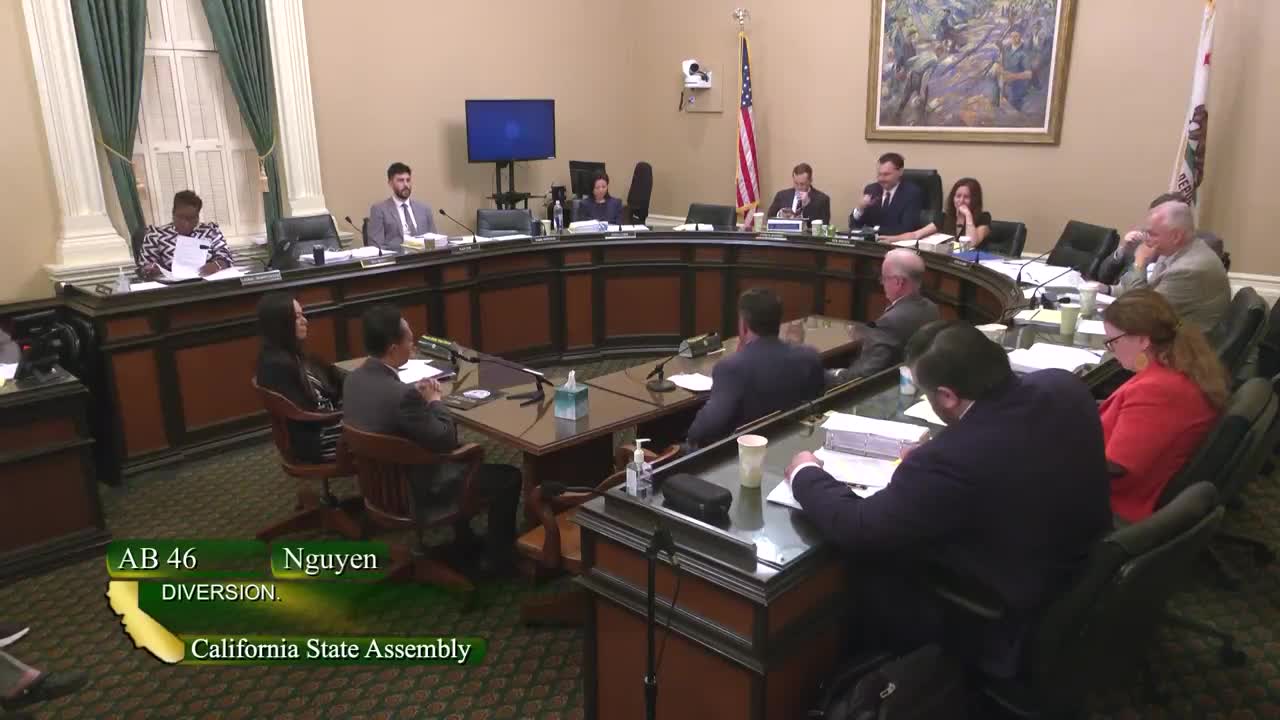 20MIN
Assembly Standing Committee on Public Safety
Bill Author

Bill Co-Author(s):