AB 684: University of California: meetings of the Regents.
- Session Year: 2025-2026
- House: Assembly
- Latest Version Date: 2025-02-14
Current Status:
Failed
(2026-02-02: From committee: Filed with the Chief Clerk pursuant to Joint Rule 56.)
Introduced
In Committee
Awaiting First Chamber Vote
Passed First Chamber
In Committee
Awaiting Second Chamber Vote
Passed Second Chamber
Enacted
Existing law establishes the University of California, under the administration of the Regents of the University of California, as one of the segments of public postsecondary education in the state. Existing law requires all meetings of the regents, defined to include the Board of Regents, the standing and special committees or subcommittees of the board, and an advisory board, advisory commission, advisory committee, advisory subcommittee, study group, task force, or similar multimember advisory body of the board that has continuing subject matter jurisdiction in the area of compensation, to be subject to the Bagley-Keene Open Meeting Act, except as provided.
This bill would define, for purposes of being subject to the Bagley-Keene Open Meeting Act, the Regents of the University of California to also include the Academic Senate of the University of California, Board of Admissions and Relations with Schools.
(a)All meetings of the Regents of the University of California shall, except as otherwise provided in this article, be subject to Article 9 (commencing with Section 11120) of Chapter 1 of Part 1 of Division 3 of Title 2 of the Government Code.
(b)For purposes of this section, Regents of the University of California, as defined in Section 92020, includes the Academic Senate of the University of California, Board of Admissions and Relations with Schools.
|
Date
|
Status
|
|---|---|
| Feb 2, 2026 | From committee: Filed with the Chief Clerk pursuant to Joint Rule 56. |
| Jan 31, 2026 | Died pursuant to Art. IV, Sec. 10(c) of the Constitution. |
| May 23, 2025 | In committee: Held under submission. |
| May 7, 2025 | In committee: Set, first hearing. Referred to APPR. suspense file. |
| Apr 24, 2025 | From committee: Do pass and re-refer to Com. on APPR. (Ayes 22. Noes 0.) (April 23). Re-referred to Com. on APPR. |
| Apr 9, 2025 | From committee: Do pass and re-refer to Com. on G.O. (Ayes 10. Noes 0.) (April 8). Re-referred to Com. on G.O. |
| Mar 10, 2025 | Referred to Coms. on HIGHER ED. and G.O. |
| Feb 15, 2025 | From printer. May be heard in committee March 17. |
| Feb 14, 2025 | Read first time. To print. |
|
Date
|
Description
|
Location
|
Votes
|
|
|---|---|---|---|---|
| Apr 23, 2025 | Do pass and be re-referred to the Committee on [Appropriations] | Assembly Standing Committee on Governmental Organization |
Passed |
|
| Apr 8, 2025 | Do pass and be re-referred to the Committee on [Governmental Organization] | Assembly Standing Committee on Higher Education |
Passed |
This list shows positions taken on this bill by organizations on the date displayed, which is linked to the original source.
Positions by individuals are not included.
|
Organization
|
Position
|
Date
|
|---|---|---|
| Kern County Superintendent of Schools Office | ** Support |
Date of Hearing: May 7, 2025
ASSEMBLY COMMITTEE ON APPROPRIATIONS
Buffy Wicks, Chair
ABPCA Bill Id:AB 684
Author:(Patel) – As Introduced Ver:February 14, 2025
Policy Committee: | Higher Education | Vote: | 10 - 0 |
Governmental Organization | 22 - 0 | ||
|
|
Urgency: No State Mandated Local Program: No Reimbursable: No
SUMMARY:
This bill expands the Regents of the University of California (UC), for purposes of the Bagley-Keen Open Meetings Act, to include the Academic Senate of the University of California, Board of Admissions and Relations with Schools (UC BOARS).
FISCAL EFFECT:
One-time General Fund costs of $2 million and $1 million ongoing to the UC BOARS to comply with the Bagley Keen Open Meetings Act. Costs represent hiring two additional staff to manage the public process in compliance with law, providing faculty stipends associated with additional workload, securing meeting spaces and security as needed, acquiring additional legal counsel, and administrative workload needed to facilitate the transition to the public process.
COMMENTS:
- Purpose. According to the author:
Matriculating from K-12 schools to our University of California system is one of our biggest drivers of social mobility and we should ensure that as many students as possible have the ability to possibly attend a UC school. Unfortunately, our A-G requirements that high schools rely upon to ensure their students can apply to UC’s are complicated and unfortunately, the process to decide on changes for them is not public. AB 684 will make this process public by requiring the University of California Board for Admission and School Relations (UC BOARS) to be subject to the Bagley-Keene Open Meeting Act.
- Background. UC BOARS is a sub-committee of the UC Systemwide Academic Senate. UC BOARS oversees all matters relating to the admission of undergraduate students and regulates the policies used in the admission process. The membership of UC BOARS includes one faculty representative from each of the 10 UC campuses, two additional faculty members acting as Chair and Vice Chair, and two student representatives. In addition to the members of the Committee, staff from the UC Office of the President attend the meetings and provide technical support. The primary objective of UC BOARS is to determine if undergraduate admission criteria are representative of the academic requirements to succeed at the UC. If a majority of the membership of UC BOARS determines a change is required, UC BOARS will make a recommendation to the full assembly of the Academic Senate. If approved by the Academic Senate, the UC Regents then approve the change in admission criteria at a public meeting of the board.
The UC Enrollment Services Unit reviews and approves high school courses as meeting A-G requirements. UC BOARS sets the criteria for the evaluation and therefore, UC BOARS is responsible for determining the academic criteria necessary for admissions to not only the UC, but also the CSU. UC BOARS has the authority to change the conditions of admission by changing the type of courses considered as “approved A-G” courses. However, unlike the UC Regents, UC BOARS is not subject to the Bagley-Keene Act and therefore its meetings are not accessible by the public. Based on minutes produced by UC BOARS, typically amended after publication, decisions made by UC faculty often do not align with the course content, standards, and framework of the State Board of Education for K-12 courses. This bill makes UC BOARS meetings open to the public and subject to the Bagley-Keene Act.
Analysis Prepared by: Aaron Heredia / APPR. / (916) 319-2081
Date of Hearing: April 23, 2025
ASSEMBLY COMMITTEE ON GOVERNMENTAL ORGANIZATION
Blanca Rubio, Chair
ABPCA Bill Id:AB 684 (
Author:Patel) – As Introduced Ver:February 14, 2025
SUBJECT: University of California: meetings of the Regents
SUMMARY: This bill would expand the definition of “Regent of the University of California” (UC) to also include the Academic Senate of the University of California, Board of Admissions and Relations with Schools (UC BOARS) for purposes of the Bagley-Keene Open Meetings Act (Bagley-Keene or Act).
EXISTING LAW:
1) Provides, pursuant to the California Constitution, that the people have the right of access to information concerning the conduct of the people’s business, and, therefore, the meetings of public bodies and the writings of public officials and agencies are required to be open to public scrutiny. (Cal. const. art. I, § 3(b)(1).)
- Requires a statute to be broadly construed if it furthers the people’s right of access, and narrowly construed if it limits the right of access. (Cal. const. art. I, § 3(b)(1).)
- Requires a statute that limits the public’s right of access to be adopted with findings demonstrating the interest protected by the limitation and the need for protecting that interest. (Cal. const. art. I, § 3(b)(1).)
2) Establishes the UC as a public trust to be administered by the Regents and grants the Regents full powers of organization and governance subject only to legislative control as necessary to ensure the security of funds, compliance with terms of its endowments, and the statutory requirements around competitive bidding and contracts, sales of property, and the purchase of materials, goods, and services. (Article IX, Section (9) (a) of the California Constitution)
3) Authorizes the Board of Regents to be comprised of seven ex-officio members, 18 members of the public appointed by the Governor, one student appointed by the Regents, and one faculty appointed by the Regents. The seven ex-officio members on the Board are the Governor, the Lieutenant Governor, the Speaker of the Assembly, the Superintendent of Public Instruction, the president and vice president of the UC alumni association, and the acting president of the UC system. (Article IX, Section 9, subdivision (a) of the California State Constitution)
4) Mandates the meetings of the Regents be public with exceptions and notices as authorized by law (Article IX, Section 9, subdivision (g) of the California State Constitution).
5) States that all meetings of the Regents shall adhere to the Bagley-Keene with the following topics being allowed to be discussed or considered in closed meeting:
- Matters affection national security;
- The conferring of honorary degrees or other honors or commemorations;
- Matters involving gifts, devises, and bequests;
- Matters involving the purchase or sale of investments for endowments and pension funds;
- Matters involving litigation, when discussion in open session concerning those matters would adversely affect or would be detrimental to the public interest;
- The acquisition or disposition of property in specified circumstances;
- Matters concerning the appointment, employment, performance, compensation, dismissal of UC officers or employees excluding regents other than the president of the university; and,
- Matters relating to complaints or charges brought against university officers or employees excluding individual regents other than the president of the university unless the officer or employee request a public hearing. (Education Code (EDC) Section 92030 and 92032, subdivision (b))
6) Stipulates proceedings of public agencies that conduct the people’s business of California are subject to public discord and public interaction. The Bagley-Keene provides the terms and conditions for how open meetings are to be conduct by public agencies. The terms include, but are not limited to: how to conduct open, closed, and teleconference meetings, the right to record meetings, the manner in which to conduct emergency and special meetings, how to address disorderly conduct, and specific requirement for specified agencies, as defined. (Government Code Sections 11120-11132)
7) Authorizes, under the Bagley-Keene, meetings through teleconference subject to specified requirements, including, among others, that the state body post agendas at all teleconference locations, that each teleconference location be identified in the notice and agenda of the meeting or proceeding, that each teleconference location be accessible to the public, that the agenda provide an opportunity for members of the public to address the state body directly at each teleconference location, and that at least one member of the state body be physically present at the location specified in the notice of the meeting. (Government Code Sections 11120-11132)
8) Authorizes, under the Act, an additional, alternative set of provisions under which a state body may hold a meeting by teleconference subject to specified requirements, including, among others, that at least one member of the state body is physically present at each teleconference location, and that members of the state body visibly appear on camera during the open portion of a meeting that is publicly accessible, as specified. Existing law repeals these provisions on January 1, 2026. (Government Code Sections 11120-11132)
FISCAL EFFECT: This bill is keyed fiscal by Legislative Counsel.
COMMENTS:
Purpose of the bill. According to the author’s office, “Matriculating from K-12 schools to our University of California system is one of our biggest drivers of social mobility and we should ensure that as many students as possible have the ability to possibly attend a UC school. Unfortunately, our A-G requirements that high schools rely upon to ensure their students can apply to UC’s are complicated and unfortunately, the process to decide on changes for them is not public. AB 684 will make this process public by requiring the University of California Board for Admission and School Relations (UC BOARS) to be subject to the Bagley-Keene.”
Background.
The Bagley-Keene Open Meeting Act of 1967. Bagley-Keene originated as a response to growing concerns about transparency and public involvement in the decision-making process of state agencies. Bagley-Keene aims to ensure that state boards, commissions, and agencies conduct their business openly and transparently, allowing the public to be informed and participate in the decision-making process.
The Bagley-Keene generally requires state bodies to conduct their meetings openly and make them accessible to the public. The law also requires state bodies to provide advance notice of their meetings and agendas and to allow public comments on matters under consideration. The act includes certain exceptions, such as closed sessions for discussing personnel issues or pending litigation, to protect the privacy and legal interests of individuals and the state.
The Act applies to state bodies, which include boards, commissions, committees, councils, and any other public agencies created by statute or executive order, with some exceptions. The law does not apply to individual officials, advisory committees with no decision-making authority, or the California State Legislature.
Admissions to the UC. As stated in the California State Constitution, the UC is a public trust administered by the UC Regents and the Regents have the authority to oversee and delegate the operations of the system through the adoption of policies and procedures. Regents policy 2102, adopted in May 1988 and most recently revised in July 2022, sets the terms and conditions for undergraduate admissions to the UC.
Contained within the policy is a clause where the UC Regents delegate authority to both the Academic Senate and the UC Office of the President to determine the conditions for admission, specifically: “Subject to approval by the Board, the Academic Senate determines the conditions for admission. The President of the University, through the system wide Provost, implements admission policy.”
UC's minimum admission requirements are comprised of a subject and a GPA requirement, and they represent the minimum academic standards students must attain to be considered for admission as a first year. Most applicants present more than the minimum requirements when applying for admission.
First-year applicants are required to complete a minimum of 15 yearlong A-G courses with a letter grade of C or better in grades 9-12. Seven of these courses must be taken in the last two years of high school. Students must complete:
- History or social science: two years
- English or language of instruction: four years
- Mathematics: three years (four years recommended)
- Laboratory science: two years (three years recommended)
- Language other than English or other second language: two years (three years recommended)
- Visual and performing arts: one year
- College preparatory elective: one year
Board of Admissions and Relations with Schools (BOARS). BOARS is a sub-committee of the UC Academic Senate. BOARS oversees all matters relating to the admission of undergraduate students. BOARS regulates the policies used in the admission process and directs efforts to improve the admission process. UC faculty in the Academic Senate carry out shared-governance responsibilities established by The Regents. The Senate is empowered by UC's governing body, the Board of Regents, to exercise direct control over academic matters of central importance to the University – to determine academic policy, set conditions for admission and the granting of degrees, authorize and supervise courses and curricula; and to advise the administration on faculty appointments, promotions and budgets.
The primary objective of BOARS is to determine if the undergraduate admission criteria is representative of the academic requirements to succeed at the UC. If a majority of the membership of BOARS determines a change is required, BOARS will make a recommendation to the full assembly of the Academic Senate. If approved by the Academic Senate, the UC Regents will then approve the change in admission criteria at a public meeting of the board.
Unlike the UC Regents, BOARS is not subject to the Bagley-Keene and therefore their meetings are not accessible by the public. BOARS publishes their agenda and minutes after each meeting. However, the minutes are often truncated and do not include the full discussion of the agenda items; furthermore, the minutes have been amended to delete or add additional information.
The UC has constitutional autonomy and is the only public higher education whose entire operation occurs outside of executive or legislative authority. As a public trust entity, the UC is subject to the Bagley-Keene and is required to hold open meetings where the public, stakeholders, and policy makers can engage with the system to provide discord on decisions.
It is important to recognize that BOARS' decisions extend beyond the UC system. Their policies directly impact admission criteria for the CSU and influence the types of courses high schools must offer to their students. BOARS operates under the authority delegated by the UC Regents to oversee admissions policies and requirements. Given their significant role in shaping California’s educational landscape, an essential question arises: should BOARS also be subject to the Bagley-Keene, like other governing bodies conducting the people's business in the state?
2004 California Proposition 59. California Proposition 59, also known as the California Sunshine Amendment, was a measure on the 2004 California General Election ballot. It was passed with overwhelming support and focused on the issue of open government and public access to government records. Proposition 59 amended the California Constitution to state, “The people have the right of access to information concerning the conduct of the people’s business, and therefore the meetings of public bodies and the writings of public officials and agencies shall be open to public scrutiny.” Prop 59 preserved specified constitutional rights; retains existing exclusions for certain meetings and records.
Double-referred. In addition to this Committee, this bill was referred to the Assembly Committee on Higher Education, which passed this bill on April 9th on a vote of 7-to-2.
In support. The Kern County Superintendent of Schools Office writes, “AB 684 is a crucial step towards ensuring that the decision-making processes within the UC are conducted in a manner that is transparent and accessible to the public. The UC plays a pivotal role in shaping the future of our state by providing high-quality educational opportunities and conducting groundbreaking research. It is imperative that the governance of such an influential institution is conducted openly, allowing for public input. This bill will help achieve this goal by ensuring that key meetings and deliberations are subject to the same transparency requirements as other public bodies in California.”
Related legislation. AB 500 (Quirk-Silva) of 2025. This bill would establish the procedures the California State Legislature intends for the UC Board of Regents to undertake prior to a vote to determine a change in the undergraduate admissions criteria or standards for admission to the UC. (Assembly Committee on Education)
AB 1217 (M. Fong) of 2025. This bill would establish the intention of the Legislature for how high school courses will be evaluated by the segments for content in order to determine if the course meets the admission requirements of the UC and the California State University (CSU).
This bill would request the UC to align the admission requirement criteria used in the review and certification of high school courses with the content standards, frameworks, and model curriculum adopted by the State Board of Education for the applicable subject area, as provided. (Assembly Committee on Education)
SB 470 (Laird) of 2025. This bill would extend the January 1, 2026 to 2030, for certain provisions in the Bagley-Keene that authorize and specify the conditions under which a state body may hold a meeting by teleconference, as specified. (Senate Committee on Appropriations)
Prior legislation. SB 544 (Laird), Chapter 216, Statutes of 2023. Revised and repealed, until January 1, 2026, certain teleconference requirements under Bagley-Keene, which requires all meetings of a state body be open and public, as specified.
SB 189 (Committee on Budget and Fiscal Review), Chapter 48, Statutes of 2022. Among other things, provided a temporary statutory extension (July 1, 2023) for state bodies in California to hold public meetings through teleconferencing, such as phone or video calls, instead of in-person gatherings, as specified.
REGISTERED SUPPORT / OPPOSITION:
Support
Kern County Superintendent of Schools Office
Opposition
None on file
Analysis Prepared by: Eric Johnson / G.O. / (916) 319-2531
Date of Hearing: April 8, 2025
ASSEMBLY COMMITTEE ON HIGHER EDUCATION
Mike Fong, Chair
ABPCA Bill Id:AB 684 (
Author:Patel) – As Introduced Ver:February 14, 2025
[Note: This bill is double referred to the Assembly Committee on Governmental Organization, where the Committee will hear it as it relates to issues under its jurisdiction.]
SUBJECT: University of California: meetings of the Regents
SUMMARY: Expands the definition of “Regent of the University of California” to include the Board of Admissions and Relations with Schools for purposes of the Bagley-Keene Open Meetings Act.
EXISTING LAW:
- Establishes the University of California (UC) as a public trust administered by the Regents of the University of California (Regents) and endows the Regents with full powers of organization and government. Clarifies the UC is only beholden to legislative control as necessary to ensure the security of funds, compliance with the terms of the endowments of the university, and competitive bidding procedures where applicable to the university by statute for construction contracts, sales of property, and purchasing of materials, goods and services. Authorizes the Board of Regents to be comprised of seven ex-officio members, 18 members of the public appointed by the Governor, one student appointed by the Regents, and one faculty appointed by the Regents. The seven ex-officio members on the Board are the Governor, the Lieutenant Governor, the Speaker of the Assembly, the Superintendent of Public Instruction, the president and vice president of the UC alumni association, and the acting president of the UC system (Article IX, Section 9, subdivision (a) of the California State Constitution).
- Stipulates that the UC is to be entirely independent of all political or sectarian influence and kept free in the appointment of its regents and in the administration of the UC’s affairs. Prohibits a person from being debarred from admission to any department of the UC based on the person’s race, religion, ethnic heritage, or sex. Gives the Regents legal title, management, and disposition of UC property. Gives the Regents authority to take property by sale or gift without restriction for the benefit of the UC. Subjects the sale of UC property to a competitive bidding process. Authorizes the Regents to do the following:
- Use the UC seal (enter into contracts);
- Sue or be sued; and,
- Delegate any function of the university to committees of the Regents or the faculty of the University or others, as deemed wise by the Regents (Article IX, Section 9, subdivision (f) of the California State Constitution).
- Mandates the meetings of the Regents be public with exceptions and notices as authorized by law (Article IX, Section 9, subdivision (g) of the California State Constitution).
- Conditions all meetings of the Regents to adhere to the Bagley-Keene Open Meetings Act with the following topics being permitted to be discussed or considered in closed meeting:
- Matters affection national security;
- The conferring of honorary degrees or other honors or commemorations;
- Matters involving gifts, devises, and bequests;
- Matters involving the purchase or sale of investments for endowments and pension funds;
- Matters involving litigation, when discussion in open session concerning those matters would adversely affect or would be detrimental to the public interest;
- The acquisition or disposition of property in specified circumstances;
- Matters concerning the appointment, employment, performance, compensation, dismissal of UC officers or employees excluding regents other than the president of the university; and,
- Matters relating to complaints or charges brought against university officers or employees excluding individual regents other than the president of the university unless the officer or employee request a public hearing (Education Code (EDC) Section 92030 and 92032, subdivision (b)).
- Stipulates proceedings of public agencies that conduct the people’s business of California are subject to public discord and public interaction. The Bagley-Keene Open Meetings Act provides the terms and conditions for how open meetings are to be conduct by public agencies. The terms include, but are not limited to: how to conduct open, closed, and teleconference meetings, the right to record meetings, the manner in which to conduct emergency and special meetings, how to address disorderly conduct, and specific requirement for specified agencies, as defined (Government Code Sections 11120-11132).
FISCAL EFFECT: Unknown.
COMMENTS: Author’s intent. As described by the author, “Matriculating from K-12 schools to our University of California system is one of our biggest drivers of social mobility and we should ensure that as many students as possible have the ability to possibly attend a UC school. Unfortunately, our A-G requirements that high schools rely upon to ensure their students can apply to UC’s are complicated and unfortunately, the process to decide on changes for them is not public. AB 684 will make this process public by requiring the University of California Board for Admission and School Relations (UC BOARS) to be subject to the Bagely-Keene Open Meeting Act.”
Admissions to the UC. As stated in the California State Constitution, the UC is a public trust administered by the UC Regents and the Regents have the authority to oversee and delegate the operations of the system through the adoption of policies and procedures. Regents policy 2102, adopted in May 1988 and most recently revised in July 2022, sets the terms and conditions for undergraduate admissions to the UC. Regent policy 2102 states the following:
“First year applicants will be required to complete a minimum of 15 high school year-long courses to be taken during grades 9 through 12. These fifteen must be academic or college preparatory courses approved by the University and consisting of courses in a) history/social science (2 courses); b) English (4 courses); c) mathematics (3 courses including elementary algebra, geometry, and intermediate algebra); d) laboratory science (2 courses to be taken from two disciplines); e) foreign language (2 courses); f) visual and performing arts (1 course); and g) college preparatory elective courses (1 course, to be chosen from the fields listed above).”[1]
Contained within the policy is a clause where the UC Regents delegate authority to both the Academic Senate and the UC Office of the President to determine the conditions for admission, specifically:
“Subject to approval by the Board, the Academic Senate determines the conditions for admission. The President of the University, through the systemwide Provost, implements admission policy.”1
Committee staff note the term “conditions” is not defined by the UC Regents policy; however, it is understood to mean, any changes that would affect a student’s ability to qualify for admission to the UC is a change in the conditions.
Admission to the UC (and technically the California State University (CSU)), begins long before a student applies to the university system. Technically, a student’s admission journey begins in high school with “approved courses.” To streamline admissions to the UC and CSU, a list of subject matter requirements was orchestrated known as “A-G.” Essentially, A-G is a list of subject matters and the required number of courses in each subject matter that are required in order for a high school student to meet the minimum eligibility standards for admission to both the CSU and the UC. A-G matches the UC Regents policy for undergraduate admissions. Having the right number of courses, in the right subject matters is only half of what is required in order for a high school student to meet the minimum eligibility requirements for admission. In order to count towards eligibility, the course listed on the transcript must be a certified A-G course. To certify a course as A-G, a K-12 district will submit the course criteria, curriculum, and supporting documents to the UC Enrollment Services Unit, who will in turn evaluate the course and supporting materials to determine if the course meets the criteria established by the Academic Senate Board of Admissions and School Relations (UC BOARS).
Committee staff note that although the UC Regents Policy for undergraduate admissions stipulate all applicant’s courses must be “approved by the University,” only California-based high schools submit courses for A-G course approval. The evaluation of whether an out of state and international applicants is entirely relegated to the minimum grade point average required and whether the student has the appropriate number of courses in the A-G subjects on their transcript.
The UC Enrollment Services Unit maintains a public website that contains a list of every certified A-G course. The list is disaggregates each “approved” course by school site and subject matter.[2] Admission counselors and application evaluators at both the UC and CSU use this A-G course list in order to determine if a high school student has the appropriate courses necessary to meet the minimum standards for admission.
UC Academic Senate Board of Admissions and School Relations (UC BOARS). UC BOARS is a sub-committee of the UC Systemwide Academic Senate. UC BOARS oversees all matters relating to the admission of undergraduate students. UC BOARS regulates the policies used in the admission process and directs efforts to improve the admission process.[3] The membership of UC BOARS includes one faculty representative from each of the 10 UC campuses, two additional faculty acting as Chair and Vice Chair, and two student representatives. In addition to the members of the Committee, staff from the UC Office of the President attend the meetings and provide technical support.[4] The primary objective of UC BOARS is to determine if the undergraduate admission criteria is representative of the academic requirements to succeed at the UC. If a majority of the membership of UC BOARS determines a change is required, UC BOARS will make a recommendation to the full assembly of the Academic Senate. If approved by the Academic Senate, the UC Regents will then approve the change in admission criteria at a public meeting of the board.
Additional authority granted to UC BOARS by the UC Academic Senate bylaws, includes the following:
“Require secondary schools in California whose graduates are to be admitted on a transcript to submit for approval a list of those courses certified by the school as fulfilling the subject requirements for admission. The committee shall review these courses annually.”[5]
Committee staff note it is unclear when the transition occurred from having UC BOARS review courses annually for approval to the A-G list maintained by the UC Office of the President, but currently the responsibility of reviewing and approving courses lies with the Enrollment Services Unit in the UC Office of the President.
As stated above, the Enrollment Services Unit reviews and approves high school courses as A-G. UC BOARS sets the criteria for the evaluation and therefore, UC BOARS is responsible for determining the academic criteria necessary for admissions to not only the UC, but also the CSU.
Unlike the UC Regents, UC BOARS is not subject to the Bagley-Keene Act and therefore their meetings are not accessible by the public. Based on minutes produced by UC BOARS, which have been amended after publication, decisions are often made by UC faculty that do not align with the course content, standards, and framework of the State Board of Education for K-12 courses.
Area C – mathematics change. On July 07, 2023, UC BOARS unanimously voted to remove data science and statistics as a qualifying course to replace Algebra II on a high school student’s transcript. Algebra II is a required A-G course listed in the UC Regent policy. The exclusion of data science and statistics was conducted without input by CSU and was directly contrary to the Mathematics Framework published by the State Board of Education in the same month. The decision to remove data science and statistics as a suitable alternative to algebra II undermined years of work by the State Board of Education and the Instructional Quality Commission to improve data literacy and mathematical attainment in the K-12 system.
By making a decision without public input or public discord, UC BOARS conducted the people’s business in manner that negatively impacted the K-12 system and the CSU system. The decision made without consultation created a more restrictive math sequence for admission to the two largest public university systems in the State.[6]
UC Regent meeting on Area C – mathematics change. At a public meeting of the UC Regents’ Academic and Student Affairs Committee (committee), the Regents discussed UC BOARS’ decision to remove data science and statistics as alternative algebra II courses and the decision to re-evaluate all advance mathematics courses. The Chair of the committee, Regent Leib, raised questions from a letter submitted by the Chair of the California State Board of Education regarding how the changes to the mathematics requirements would negatively affect K-12 and by extension UC admissions. The questions posed went unanswered. The proposed change was accepted without a vote of the UC Regents.
Joint oversight hearing of the Assembly Committees on Education and Higher Education. On October 10, 2024, the Chairs of the Assembly Committee on Education and the Assembly Committee on Higher Education hosted a joint oversight hearing to determine the scope of the unintended consequences of the UC BOARS decision to change the conditions for undergraduate admission. Dr. Deborah Swenson, the Chair of the UC BOARS, and the Executive Director of Undergraduate Admissions, Dr. Han Mi Yoon-Wu represented the UC during the hearing. During their testimony, both representatives confirmed that neither the K-12 system nor the CSU were consulted prior to the decision to exclude data science and statistics as “advance” math courses for purposes of admission.
As previously stated, UC BOARS meetings are not public and Dr. Swenson explained why in her testimony:
“Although BOARS comes up with recommendations, we are not a policy body that imposes policy on the state in order for a recommendation that comes from BOARS be implemented it needs to go through subsequent steps and ultimately, be approved by the UC Regents. Who are appointed by the Governor so BOARS is not by itself making decision, there is a lot of scrutiny that comes, in those later stages, and to the extent there is concerns about public ability to weigh in, as you know UC Regents meetings open to the public, they invite speakers from all impacted groups, although our meetings do not include open session, our decisions are subject to a lot of scrutiny, and are not going to just be rubber stamped.”[7]
Later in the hearing, both representatives from the UC suggested a vote by the UC Regents was unnecessary, as removing data science and statistics as alternative courses for algebra II did not qualify as a “change in the conditions for admission.”
Committee comments. After the Joint Oversight Hearing in October 2024, the Chairs of the Assembly Committee on Education and Higher Education sent a letter to the UC Regents requesting a delay in the implementation of the Area C - mathematics change and requested the UC Regents to follow the UC policy and vote on the proposed changes to the conditions for admission.
On February 24, 2025, the UC Regents replied to the Chairs of the two committees stating they would delay the implementation of the changes for one year, but reasserted their belief a vote of the Regents was not necessary, as the reclassification of what qualifies as an algebra II alternative course did not constitute a change in the conditions for admission. Additionally, the UC Regents’ letter stated the following:
“We have also requested that BOARS and University undergraduate admissions personnel review their consultation process and present to the Regents a proposed new process for robust K-12 consultation as well as provide an opportunity for public comment on any changes to admissions policy or its implementation. We understand that BOARS has already planned to reinstate its prior practice of engaging a broad range of stakeholders. The Academic Senate leadership supports codifying consultation processes in Academic Senate Bylaws and BOARS guidelines to ensure greater transparency in future deliberations and decisions and will engage with BOARS to pursue formal amendments. We commit to you that we will follow up with Academic Senate leadership to ensure that these measures are codified in university policy.”
Committee staff note at the February 2025 UC BOARS meeting, Dr. Linda Darling-Hammond, President of the California State Board, presented to UC BOARS on the K-12 system. The minutes indicate the Chair of UC BOARS would follow up with President Darling-Hammond about future consultation.[8]
UC BOARS publishes their agenda and minutes after each meeting. However, the minutes are often truncated and do not include the full discussion of the agenda items; furthermore, the minutes have been amended to delete or add additional information.
The UC has constitutional autonomy and is the only public higher education whose entire operation occurs outside of executive or legislative authority. As a public trust entity, the UC is subject to Bagley Keene Open Meetings Act (Bagley-Keene) and is required to hold open meetings where the public, stakeholders, and policy makers can engage with the system to provide discord on decisions.
Despite assertions to the contrary during the Joint Oversight Hearing, UC BOARS does make unilateral decisions on admissions without public consultation. Additionally, UC BOARS has the authority to change the conditions of admission by changing the type of courses considered as “approved A-G” courses.
UC BOARS decisions affect more than the UC system, their decisions change the admissions criteria for the CSU and change the type of courses a high school needs to offer their students. UC BOARS has been delegated authority by the UC Regents to oversee admissions conditions and therefore, just as with every other governing board, that oversees the people’s business in California, it should be subject to Bagley Keene.
Similar Legislation.
AB 500 (Quirk - Silva) of 2025, is scheduled to be heard in Assembly Higher Education Committee on April 08, 2025. The measure establishes the procedures the California State Legislature intends for the UC Regents to undertake prior to a vote to determine a change in the undergraduate admissions criteria or standards for admission to the UC.
AB 1217 (M. Fong) of 2025, is scheduled to be heard in Assembly Higher Education Committee on April 08, 2025. The measure would establish the legislative intent for how the UC Office of the President determines if a high school course is a college preparatory course.
REGISTERED SUPPORT / OPPOSITION:
Support
None on file.
Opposition
None on file.
Analysis Prepared by: Ellen Cesaretti-Monroy / HIGHER ED. / (916) 319-3960
https://regents.universityofcalifornia.edu/governance/policies/2102.html ↑
https://hs-articulation.ucop.edu/agcourselist ↑
https://senate.universityofcalifornia.edu/committees/boars/index.html ↑
https://senate.universityofcalifornia.edu/rosters/committees.html?admin_task=committee_details&comm_name=boars ↑
https://senate.universityofcalifornia.edu/bylaws-regulations/bylaws/blpart2.html#bl145 ↑
https://www.chronicle.com/article/did-the-university-of-california-try-to-bury-a-consequential-vote-on-math ↑
https://www.assembly.ca.gov/media/joint-hearing-higher-education-and-education-20241010 ↑
https://senate.universityofcalifornia.edu/_files/committees/boars/boars-2-7-2025-minutes.pdf ↑
Discussed in Hearing
 6MIN
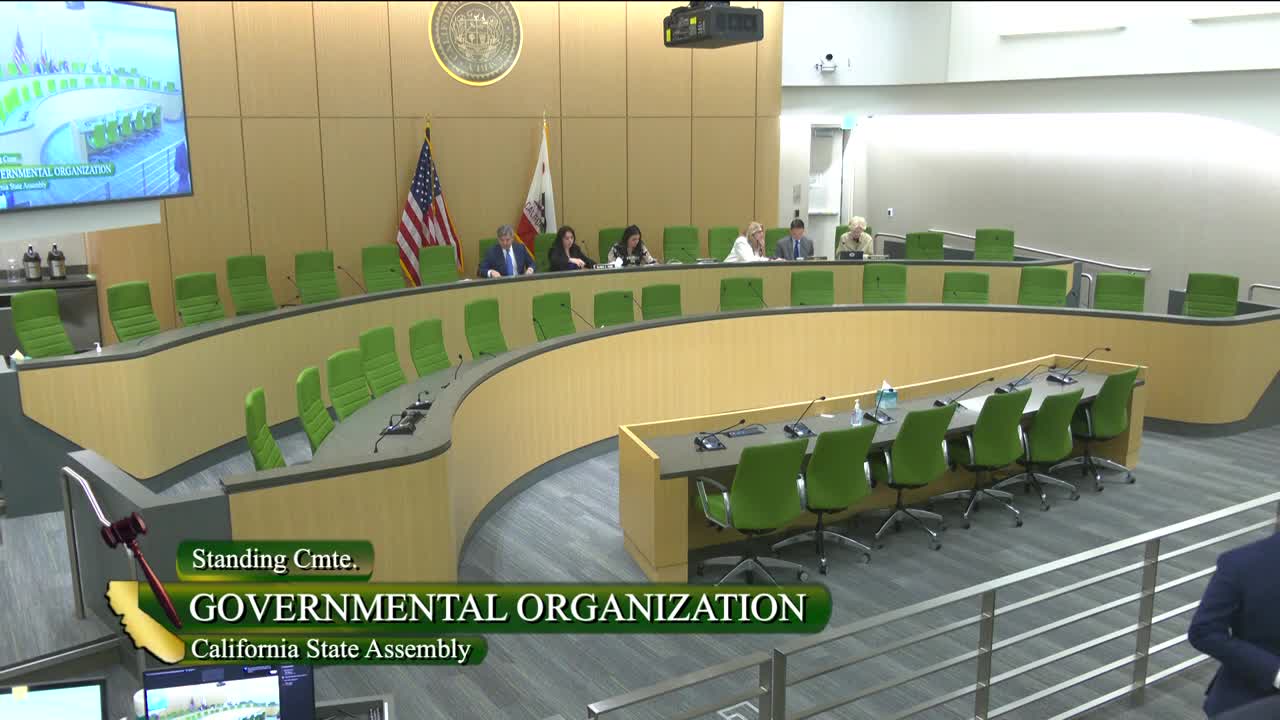
Assembly Standing Committee on Governmental Organization
 6MIN
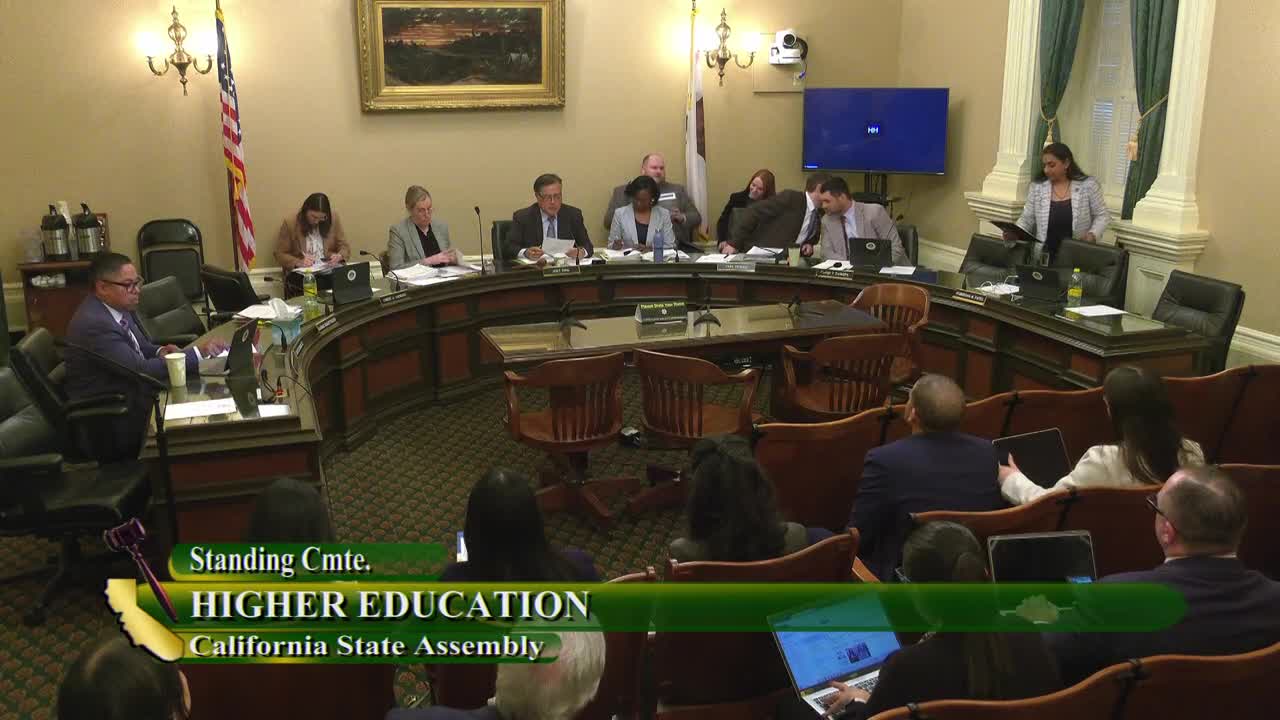
Assembly Standing Committee on Higher Education
Bill Author

Bill Co-Author(s):