AB 72: Electric Vehicle Economic Opportunity Zone: County of Riverside.
- Session Year: 2025-2026
- House: Assembly
- Latest Version Date: 2026-01-05
Current Status:
In Progress
(2026-08-13: In committee: Held under submission.)
Introduced
In Committee
Awaiting First Chamber Vote
Passed First Chamber
In Committee
Awaiting Second Chamber Vote
Passed Second Chamber
Enacted
What does this bill do?
This bill creates an Electric Vehicle Economic Opportunity Zone (EVEOZ) in Riverside County run by the Labor and Workforce Development Agency to expand electric vehicle manufacturing jobs and education for lower‑income communities. The agency can partner with schools, manufacturers, and banks to set up college programs, apprenticeships, technician and charging‑station training, and investment programs (loans, tax credits, grants, and hiring subsidies) and must prioritize recruiting low‑income residents who live in the zone.
The summary is provided by generative AI which can make mistakes. For original language, please view the details in the table below.
Existing law, the California Clean Energy Jobs Act, expresses a goal of creating good-paying energy efficiency and clean energy jobs in California. Existing law establishes in state government the Labor and Workforce Development Agency, under the supervision of the Secretary of Labor and Workforce Development, which consists of the Office of the Secretary of Labor and Workforce Development and the California Workforce Development Board, among others. Existing law creates the position of Deputy Secretary for Climate within the agency, subject to appropriation by the Legislature, for the purpose of assisting in the oversight of Californias workforce transition to a sustainable and equitable carbon neutral economy.
This bill would, upon appropriation by the Legislature, establish an Electric Vehicle Economic Opportunity Zone (EVEOZ) for the County of Riverside, administered by the Labor and Workforce Development Agency, for the purpose of creating programs to make electric vehicle manufacturing jobs and education more accessible to lower income communities. The bill would require the agency to collaborate with the County of Riverside in determining the geographical boundaries of the EVEOZ. By imposing additional duties on local officials, the bill would impose a state-mandated local program. The bill would authorize the agency to partner with educational institutions, electric vehicle manufacturing businesses, and local and national financial intuitions to develop EVEOZ education, training, and investment programs, as specified.
This bill would make legislative findings and declarations as to the necessity of a special statute for the County of Riverside.
The California Constitution requires the state to reimburse local agencies and school districts for certain costs mandated by the state. Statutory provisions establish procedures for making that reimbursement.
This bill would provide that, if the Commission on State Mandates determines that the bill contains costs mandated by the state, reimbursement for those costs shall be made pursuant to the statutory provisions noted above.
Existing state and federal law, including the federal Voting Rights Act of 1965, require the Secretary of State and county elections officials to provide language assistance to voters in order to access voting information, register to vote, and cast their votes at the polling place. Existing law requires a county elections official to provide a facsimile copy of the ballot with the ballot measures and ballot instructions printed in languages other than English if the Secretary of State has determined that doing so is appropriate, as specified. This bill would require elections officials to provide a voter with registration or voting notices, forms, instructions, assistance, or other materials or information relating to the electoral process, including ballots, in Bengali if the voter requests it. By increasing duties on local elections officials, this bill would impose a state-mandated local program.The California Constitution requires the state to reimburse local agencies and school districts for certain costs mandated by the state. Statutory provisions establish procedures for making that reimbursement.This bill would provide that, if the Commission on State Mandates determines that the bill contains costs mandated by the state, reimbursement for those costs shall be made pursuant to the statutory provisions noted above.Existing state and federal law, including the federal Voting Rights Act of 1965, require the Secretary of State and county elections officials to provide language assistance to voters in order to access voting information, register to vote, and cast their votes at the polling place. Existing law requires a county elections official to provide a facsimile copy of the ballot with the ballot measures and ballot instructions printed in languages other than English if the Secretary of State has determined that doing so is appropriate, as specified.
This bill would require elections officials to provide a voter with registration or voting notices, forms, instructions, assistance, or other materials or information relating to the electoral process, including ballots, in Bengali if the voter requests it. By increasing duties on local elections officials, this bill would impose a state-mandated local program.
The California Constitution requires the state to reimburse local agencies and school districts for certain costs mandated by the state. Statutory provisions establish procedures for making that reimbursement.
This bill would provide that, if the Commission on State Mandates determines that the bill contains costs mandated by the state, reimbursement for those costs shall be made pursuant to the statutory provisions noted above.
(a)It is the intent of the Legislature that, as Executive Order No. N-79-20 established the goal that 100 percent of in-state sales of new passenger cars and trucks will be zero-emission by 2035, lower income communities will share in the economic benefits of the zero-emission vehicle industry, including electric vehicle manufacturing.
(b)(1)Upon appropriation by the Legislature, an Electric Vehicle Economic Opportunity Zone (EVEOZ) for the County of Riverside is hereby established to be administered by the Labor and Workforce Development Agency for the purpose of creating programs to make electric vehicle manufacturing jobs and education more accessible to lower income communities.
(2)The agency shall collaborate with the County of Riverside in determining the geographical boundaries of the EVEOZ.
(c)The agency may partner with educational institutions best fitted for educational and workforce development programs to develop EVEOZ education and training programs that may include, but are not limited to, any of the following:
(1)A fully accredited associate or bachelors collegiate electric vehicle manufacturing and engineering program.
(2)Workforce development related to electric vehicle and electric vehicle battery manufacturing.
(3)Career pathway, education, training, and support programs for electric vehicle manufacturing certification.
(4)Career pathway, education, training, and support programs for electric vehicle service technician development.
(5)Career pathway, education, training, and support programs for electric vehicle charging station installation and service.
(6)Electric vehicle apprenticeship programs.
(7)Engineering and manufacturing of the entire electric vehicle including, but not limited to, battery, safety equipment, electronics and computer coding, and other components necessary to electric vehicles.
(d)The agency may partner with electric vehicle manufacturing businesses and local and national financial intuitions to develop EVEOZ investment programs that may include, but are not limited to, any of the following:
(1)Incentives, including providing business loans, tax credits, and grants, to build, modify, or upgrade electric vehicle manufacturing facilities within the geographical boundaries of the EVEOZ.
(2)Hiring programs and corporate subsidies for companies to onboard, train, and retain workers who reside within the geographical boundaries of the EVEOZ.
(e)Any EVEOZ program developed pursuant to this section shall prioritize the recruitment and enrollment of workers or students of underprivileged economic status, as determined by the agency, that reside within the geographical boundaries of the EVEOZ.
SEC. 2.The Legislature finds and declares that a special statute is necessary and that a general statute cannot be made applicable within the meaning of Section 16 of Article IV of the California Constitution as Executive Order No. N-79-20 mandates the transition of the states automotive sales to be 100 percent zero-emissions vehicles, cultivating the workforce pipeline locally will financially benefit the state and build industry. Establishing an Electric Vehicle Economic Opportunity Zone (EVEOZ) in the County of Riverside would empower the people with economic and engineering skills, help make the transition to zero-emission vehicles more seamless, and would serve as a model for the establishment of future EVEOZs across the state.
SEC. 3.If the Commission on State Mandates determines that this act contains costs mandated by the state, reimbursement to local agencies and school districts for those costs shall be made pursuant to Part 7 (commencing with Section 17500) of Division 4 of Title 2 of the Government Code.
SECTION 1.Section 2601 is added to the Elections Code, to read:2601.An elections official shall provide a voter with registration or voting notices, forms, instructions, assistance, or other materials or information relating to the electoral process, including ballots, in Bengali if the voter requests it.SEC. 2.If the Commission on State Mandates determines that this act contains costs mandated by the state, reimbursement to local agencies and school districts for those costs shall be made pursuant to Part 7 (commencing with Section 17500) of Division 4 of Title 2 of the Government Code.An elections official shall provide a voter with registration or voting notices, forms, instructions, assistance, or other materials or information relating to the electoral process, including ballots, in Bengali if the voter requests it.
SEC. 2.If the Commission on State Mandates determines that this act contains costs mandated by the state, reimbursement to local agencies and school districts for those costs shall be made pursuant to Part 7 (commencing with Section 17500) of Division 4 of Title 2 of the Government Code.
|
Date
|
Status
|
|---|---|
| Aug 13, 2026 | In committee: Held under submission. |
| Aug 3, 2026 | In committee: Referred to APPR. suspense file. |
| Jun 17, 2026 | From committee: Do pass and re-refer to Com. on APPR. (Ayes 4. Noes 1.) (June 17). Re-referred to Com. on APPR. |
| Jun 8, 2026 | From committee: Do pass and re-refer to Com. on L., P.E. & R. (Ayes 8. Noes 1.) (June 8). Re-referred to Com. on L., P.E. & R. |
| May 6, 2026 | Referred to Coms. on B. P. & E.D. and L., P.E. & R. |
| Jan 27, 2026 | In Senate. Read first time. To Com. on RLS. for assignment. |
| Jan 26, 2026 | Read third time. Passed. Ordered to the Senate. (Ayes 74. Noes 0. Page 3828.) |
| Jan 22, 2026 | From committee: Do pass. (Ayes 15. Noes 0.) (January 22). |
| Jan 22, 2026 | Read second time. Ordered to third reading. |
| Jan 22, 2026 | In committee: Set, first hearing. Referred to suspense file. |
| Jan 22, 2026 | Assembly Rule 63 suspended. (Page 3806.) |
| Jan 13, 2026 | From committee: Do pass and re-refer to Com. on APPR. (Ayes 8. Noes 0.) (January 13). Re-referred to Com. on APPR. |
| Jan 5, 2026 | Re-referred to Com. on ELECTIONS. |
| Jan 5, 2026 | Re-referred to Com. on E.D., G., & H.I. pursuant to Assembly Rule 96. |
| Jan 5, 2026 | From committee chair, with author's amendments: Amend, and re-refer to Com. on ELECTIONS. Read second time and amended. |
| Mar 20, 2025 | In committee: Set, first hearing. Hearing canceled at the request of author. |
| Feb 3, 2025 | Referred to Com. on ELECTIONS. |
| Jan 6, 2025 | Read first time. |
| Dec 13, 2024 | From printer. May be heard in committee January 12. |
| Dec 12, 2024 | Introduced. To print. |
|
Date
|
Description
|
Location
|
Votes
|
|
|---|---|---|---|---|
| Aug 3, 2026 | Placed on suspense file | Senate Standing Committee on Appropriations |
Passed |
|
| Jun 17, 2026 | Do pass, but first be re-referred to the Committee on [Appropriations] | Senate Standing Committee on Labor, Public Employment and Retirement |
Passed |
|
| Jun 8, 2026 | Do pass, but first be re-referred to the Committee on [Labor, Public Employment and Retirement ] | Senate Standing Committee on Business, Professions and Economic Development |
Passed |
|
| Jan 26, 2026 | AB 72 Jackson Assembly Third Reading | Assembly Floor |
Passed |
|
| Jan 22, 2026 | Do pass. | Assembly Standing Committee on Appropriations |
Passed |
This list shows positions taken on this bill by organizations on the date displayed, which is linked to the original source.
Positions by individuals are not included.
|
Organization
|
Position
|
Date
|
|---|---|---|
| City of Moreno Valley | ** Support | |
| City Of Temecula | ** Support | |
| County of Riverside Board of Supervisors | ** Support | |
| Southwest California Council | ** Support |
SENATE COMMITTEE ON
Senator Sabrina Cervantes, Chair
2025 - 2026 Regular Session
AB 72 (Jackson) - Electric Vehicle Economic Opportunity Zone: County of Riverside
Version: | Policy Vote: |
Urgency: | Mandate: |
Hearing Date: | Consultant: |
Bill Summary:
AB 72 establishes an Electric Vehicle Economic Opportunity Zone (EVEOZ) for the County of Riverside, administered by the Labor and Workforce Development Agency (LWDA), for the purpose of creating programs to make electric vehicle (EV) manufacturing jobs and education more accessible to lower income communities.
Fiscal Impact:
- LWDA estimates $5.4 million in one-time costs and $1.5 million in ongoing costs to establish EVEOZ boundaries, develop training program standards, and create economic incentives for the industry (General Fund).
- The California Workforce Development Board reports a one-time cost of approximately $320,000.
- By requiring Riverside County to assist LWDA in determining the geographical boundaries of the EVEOZ, this bill creates a state-mandated local program. To the extent the Commission on State Mandates determines that the provisions of this bill create a new program or impose a higher level of service on local agencies, local agencies could claim reimbursement of those costs. However, costs to Riverside County resulting from the bill would likely be minor.
Background:
Executive Order N-79-20. On September 23, 2020, Governor Gavin Newsom issued Executive Order (EO) N-79-20 as a cornerstone of California’s effort to achieve economy-wide carbon neutrality by 2045. The order focuses primarily on reducing greenhouse gas emissions from the transportation sector, which is California's largest source of emissions. EO N-79-20 established the following goals:
- 100% of new passenger cars and light-duty trucks sold in California must be zero-emission vehicles (ZEVs) by 2035.
- 100% of drayage trucks serving California ports should be zero-emission by 2035.
- 100% of medium- and heavy-duty vehicles should be zero-emission by 2045 where feasible.
- 100% of off-road vehicles and equipment should be zero-emission by 2035 where feasible.
State agencies were directed to accelerate deployment of charging and fueling infrastructure and develop a coordinated statewide strategy for ZEV market growth. EO N-79-20 called for the development of a statewide ZEV Market Development Strategy to coordinate actions across multiple agencies, including California Air Resources Board, California Energy Commission, California Public Utilities Commission, and Governor’s Office of Business and Economic Development.
The strategy focuses on infrastructure deployment, vehicle affordability, workforce development, supply chain development, equity and access for disadvantaged communities, and grid integration and reliability, among other priorities. The strategy has become the framework through which state agencies align investments and policy development.
Proposed Law:
- Upon appropriation, establishes the EVEOZ for the County of Riverside. Tasks LWDA with administering the program for the purpose to making EV manufacturing jobs and education more accessible to lower income communities.
- Requires LWDA to collaborate with the County of Riverside in determining the geographical boundaries of the EVEOZ. Authorizes LWDA to partner with educational institutions best fitted for educational and workforce development programs to develop EVEOZ education and training programs. Authorizes LWDA to partner with EV manufacturing businesses and local and national financial intuitions to develop EVEOZ investment programs.
- Requires any EVEOZ programs developed to prioritize the recruitment and enrollment of workers or students of underprivileged economic status, as determined by LWDA, that reside within the geographical boundaries of the EVEOZ.
- States legislative intent that lower income communities will share in the economic benefits of the ZEV industry, including EV manufacturing.
Related Legislation:
AB 2448 (Jackson, 2024) was identical to this bill. AB 2448 was vetoed.
-- END --
SENATE COMMITTEE ON LABOR, PUBLIC EMPLOYMENT AND RETIREMENT
Senator Lola Smallwood-Cuevas, Chair
2025 - 2026 Regular
Bill No: AB 72 Hearing Date: June 17, 2026
Author: | Jackson | ||
Version: | January 5, 2026 | ||
Urgency: | No | Fiscal: | Yes |
Consultant: | Emma Bruce | ||
SUBJECT: Electric Vehicle Economic Opportunity Zone: County of Riverside
KEY ISSUE
This bill directs the Labor Workforce and Development Agency (LWDA) to administer, upon appropriation, an Electric Vehicle Economic Opportunity Zone (EVEOZ) for the County of Riverside, to increase the accessibility of electric vehicle manufacturing jobs and education, as specified.
ANALYSIS
Existing law:
- Establishes the Labor Workforce and Development Agency (LWDA) under the supervision of an executive officer known as the Secretary. (Government Code §15551)
- Tasks the LWDA with serving California workers and businesses by improving access to employment and training programs; enforcing California labor laws to protect workers and create an even playing field for employers; and administering benefits that include workers’ compensation, unemployment insurance, disability insurance, and paid family leave. (Government Code §15550 et seq.)
- Establishes, within the LWDA, the position of Deputy Secretary for Climate to assist in the oversight of California’s workforce transition to a sustainable and equitable carbon neutral economy. (Government Code §15563.2)
- Establishes the California Workforce Development Board (CWDB), under the LWDA, as the body responsible for assisting the Governor in the development, oversight, and continuous improvement of California’s workforce system, including its alignment to the needs of the economy and the workforce. (Unemployment Insurance Code §14010 et seq.)
- Provides that members of the CWDB are appointed by the Governor and are representative of the areas of business, labor, public education, higher education, economic development, youth activities, employment and training, as well as the Legislature (Unemployment Insurance Code §14011 and §14012)
- Authorizes the California Air Resources Board (CARB) to protect public health from the harmful effects of air pollution and lead state efforts to address global climate change (Health and Safety Code §38510 & §38600 et seq.)
This bill:
- Establishes, upon appropriation by the Legislature, an Electric Vehicle Economic Opportunity Zone (EVEOZ) for the County of Riverside that is administered by the LWDA for the purpose of creating programs to make electric vehicle manufacturing jobs and education more accessible to lower income communities.
- Requires the LWDA to collaborate with the County of Riverside in determining the geographical boundaries of the EVEOZ.
- Authorizes the LWDA to partner with educational institutions to develop EVEOZ education and training programs that may include, but are not limited to, any of the following:
- A fully accredited associate or bachelor’s collegiate electric vehicle manufacturing and engineering program.
- Workforce development related to electric vehicle and electric vehicle battery manufacturing.
- Career pathway, education, training, and support programs for electric vehicle service technician development.
- Career pathway, education, training, and support programs for electric vehicle charging station installation and service.
- Electric vehicle apprenticeship programs.
- Authorizes the LWDA to partner with electric vehicle manufacturing businesses and local and national financial intuitions to develop EVEOZ investment programs that may include, but are not limited to, any of the following:
- Incentives, including providing business loans, tax credits, and grants, to build, modify, or upgrade electric vehicle manufacturing facilities within the geographical boundaries of the EVEOZ.
- Hiring programs and corporate subsidies for companies to onboard, train, and retain workers who reside within the geographical boundaries of the EVEOZ.
- Requires any EVEOZ program to prioritize the recruitment and enrollment of workers or students of underprivileged economic status, as determined by the LWDA, that reside within the geographical boundaries of the EVEOZ.
- Declares that establishing an EVEOZ in the County of Riverside would empower the people with economic and engineering skills, help make the transition to zero-emission vehicles more seamless, and would serve as a model for the establishment of future EVEOZs across the state.
COMMENTS
1. Background:
Race to Zero Emission Vehicles
On September 23, 2020, Governor Newsom issued Executive Order (EO) No. N-79-20, setting new statewide goals for phasing out gasoline-powered vehicles. Under the EO, 100 percent of in-state sales of new passenger cars and trucks will be zero-emission by 2035 and 100 percent of medium-and heavy-duty vehicles in the State will be zero-emission by 2045, where feasible. CARB, the Energy Commission, the Public Utilities Commission, and other agencies have been directed to accelerate deployment of affordable fueling and charging options for zero-emission vehicles in ways that serve all communities, particularly low-income and disadvantaged ones. In August of 2022, CARB adopted standards intended to further the EO and set interim targets. In the lead up to the 2035 deadline, 35 percent of new passenger vehicles sold by 2026 will be zero-emission and 68 percent will be by 2030. Transportation is the State’s top source of planet-warming greenhouse gas emissions. These mandates are an enormous step towards reducing dependence on fossil fuels and meeting our climate goals.
The transition to zero emissions will not be easy. For many people the price of an electric vehicle is prohibitive. State subsidies meant to assist with the purchase are inconsistent and underfunded. An article from CalMatters identified a “strikingly homogenous” portrait of who owns electric vehicles in California. Communities with mostly white and Asian, college-educated and high-income residents have the state’s highest contributions of zero-emission cars and most are concentrated in Silicon Valley or affluent coastal areas of Los Angeles and Orange counties.[1] In the 20 California zip codes where Latinos make up more than 95% of the population, including parts of Kings, Tulare, Fresno, Riverside, and Imperial counties, less than 1 percent of cars are electric.[2]
California’s workforce will need to transform to meet the state’s ambitious climate goals. CARB estimates that 64,700 jobs will be lost because of the zero emission mandate. However, CARB also estimates 24,900 jobs will be gained in other sectors. In addition to retraining/upskilling workers employed in the fuels, vehicles, and transportation supply chains, the state needs to construct a massive charging infrastructure.
Riverside County
In the past decade, the County of Riverside experienced a boom in warehouse growth. Trucks bring goods in from the Los Angeles and Long Beach ports to be shipped across the county. This movement of goods ties up roads, causing significant pollution. Warehouse workers also contribute to this pollution, as many do not earn enough money to live close to their jobs. The health consequences of this boom are clear; the region has unusually high incidences of asthma and cancer.[3] The Inland Empire, which is comprised of Riverside and San Bernardino Counties, is a major economic hub with a rapidly growing population. Despite this, its workers earn less than statewide averages, and there are fewer college graduates than in most metro areas. Local leaders are looking to reduce pollution and diversify the workforce. This unique combination of factors creates an opportunity for the County of Riverside to reap significant benefits as the state transitions to zero-emission vehicles.
Promise Zones and Opportunity Zones
According to the Senate Business, Professions and Economic Development Committee:
“In the last decade, efforts such as Promise Zones and Opportunity Zones have emerged as a way to support the country’s most disadvantaged and economically-distressed geographical locations and communities. Generally speaking, Promise Zones are high-poverty areas that are eligible for various tax credits in order to create jobs and spur investment. These zones also receive governmental aid and partnership in the form of assistance to reduce crime and recidivism, as well as increase educational opportunities. There are currently 22 Promise Zones in the United States.
Originally created via the federal 2017 Tax Cuts and Jobs Acts, Opportunity Zones are economically-distressed areas where private investments may be eligible for capital gain tax incentives, under certain conditions. According to the Brookings Institute, ‘Opportunity Zones offer favorable capital gains treatment for taxpayers with unrealized gains who invest in designated low-income communities.’ Only investors with pre-existing capital gains and those who anticipate facing future capital gains taxes qualify for Opportunity Zone tax benefits. Both of these efforts are examples of programs meant to increase economic development in areas that need assistance.”
The Committee further notes:
“The bill’s designation of an ‘Electric Vehicle Opportunity Zone’ may also create confusion regarding the benefits associated with the term ‘opportunity zone.’ Unlike federally designated Opportunity Zones, the designation proposed by AB 72 does not itself confer any tax benefits or establish new tax incentives. Businesses may already compete for economic development incentives, including California Competes awards and other state assistance programs, regardless of whether they are located within a specially designated zone.”
2. Committee Comments:
This bill would direct the LWDA, upon appropriation, to administer an EVEOZ and authorize the LWDA to partner with educational institutions, manufacturing businesses, and local and national financial institutions to make the electric vehicle industry more accessible. Aside from requiring EVEOZ programs to prioritize the recruitment and enrollment of workers or students of underprivileged economic status, this bill does not place any specific requirements on the education, workforce development, or investment programs that may be developed.
The LWDA oversees seven major departments, boards, and panels that serve California workers and employers. The LWDA does not create educational and workforce development programs or partner with businesses and financial institutions to develop investment programs. However, the LWDA does oversee the CWDB, which is the body responsible for assisting the Governor in the development, oversight, and continuous improvement of California’s workforce system. The CWDB has experience administering workforce programs that support regional priorities and community needs. For example, the CWDB currently administers several high road training partnerships within the Inland Empire aimed at upskilling workers for the transportation and healthcare sectors.
The author may wish to consider narrowing the scope of the bill to focus on education and workforce development programs, rather than investment programs.[4] Additionally, the author may wish to consider moving the EVEOZ from the LWDA to the CWDB.
3. Need for this bill?
According to the author:
“In brief, this bill is looking to solve the problem of EV car manufacturing (or more so contribute to the solution) in ensuring that California will be able to meet its forecasts for new cars/EV demand by 2035. This bill is also looking to provide opportunities (initially) for the citizens of Riverside County to participate and grow careers in the coming EV/Green Economy.”
4. Dual Referral:
The Senate Rules Committee referred this bill to the Senate Business, Professions and Economic Development Committee, where it passed on a 8-1 vote, and to the Senate Labor, Public Employment and Retirement Committee.
5. Proponent Arguments:
The County of Riverside Board of Supervisors supports the measure, arguing:
“As California advances toward its statutory goal of 100 percent zero-emission passenger vehicle sales by 2035, it is critical that the economic opportunities generated by this transition — including workforce development, job creation, innovation, and educational pathways — are equitably distributed across regions. AB 72 provides a forward-looking framework to ensure that Riverside County and the broader Inland Empire are positioned to compete and thrive in California’s clean transportation economy.
Riverside County is uniquely situated to serve as a regional hub for electric vehicle manufacturing, logistics, workforce training, and related innovation. As one of the fastest-growing counties in California, Riverside County continues to experience rapid population growth while also confronting longstanding challenges related to income disparities, workforce diversification, and air quality impacts associated with transportation and goods movement. Establishing an Electric Vehicle Economic Opportunity Zone in Riverside County would help align state climate objectives with local economic development strategies, ensuring that residents benefit directly from the clean energy transition.
AB 72 thoughtfully advances this goal by encouraging partnerships among educational institutions, electric vehicle manufacturers, workforce development entities, labor organizations, and financial institutions. By fostering coordinated investment and collaboration, the EVEOZ framework would expand access to high-quality job training programs, strengthen career pathways in emerging clean transportation industries, and support the transition of internal combustion engine–related businesses toward electric vehicle technologies.
From the County’s perspective, this approach reflects our ongoing commitment to economic vitality, environmental stewardship, and long-term community resilience. Facilitating the growth of electric vehicle–related industries within Riverside County will not only help advance statewide emissions reduction goals but also create sustainable, well-paying jobs that support families and strengthen our local tax base.”
6. Opponent Arguments:
None received.
7. Prior Legislation:
AB 2448 (Jackson, 2024) would have directed the LWDA the Labor Workforce and to administer, upon appropriation, an EVEOZ for the County of Riverside, to make electric vehicle manufacturing jobs and education more accessible. AB 72 is identical to AB 2448. This bill was vetoed by Governor Newsom, who stated:
“While I support efforts to boost electric vehicle manufacturing jobs and education in this state, particularly in low-income communities, this bill creates General Fund cost pressures and should be considered in the annual budget process.
In partnership with the Legislature this year, my Administration has enacted a balanced budget that avoids deep program cuts to vital services and protected investments in education, health care, climate, public safety, housing, and social service programs that millions of Californians rely on. It is important to remain disciplined when considering bills with significant fiscal implications that are not included in the budget, such as this measure.”
AB 2204 (Boerner, Chapter 348, Statutes of 2022) established, upon appropriation, the position of Deputy Secretary for Climate within the LWDA, as specified.
SUPPORT
City of Moreno Valley
City of Temecula
County of Riverside Board of Supervisors
Southwest California Council
OPPOSITION
None received
-- END --
Nadia Lopes, Erica Yee, “Who buys electric cars in California-and who doesn’t?,” CalMatters, March 22, 2023, Who buys electric cars in California? - CalMatters ↑
Ibid. ↑
Jim Newton, “Pushback to Inland Empire Warehouse Boom Spans California’s Economic, Racial Divides,” CalMatters, February 23, 2023, https://calmatters.org/commentary/2023/02/inland-empire-warehouse-class-divide/ ↑
AB 72 states that investment programs may include, but are not limited to, any of the following:
Incentives, including providing business loans, tax credits, and grants, to build, modify, or upgrade electric vehicle manufacturing facilities within the geographical boundaries of the EVEOZ.
Hiring programs and corporate subsidies for companies to onboard, train, and retain workers who reside within the geographical boundaries of the EVEOZ.
SENATE COMMITTEE ON
BUSINESS, PROFESSIONS AND ECONOMIC DEVELOPMENT
Senator Dr. Aisha Wahab, Chair
2025 - 2026 Regular
Bill No: Hearing Date: June 8, 2026
Author: | |||
Version: |
| ||
Urgency: | Fiscal: | ||
Consultant: | |||
Subject:
SUMMARY:
Establishes an Electric Vehicle Economic Opportunity Zone (EVEOZ) for the County of Riverside, administered by the Labor and Workforce Development Agency (LWDA), for the purpose of creating programs to make electric vehicle manufacturing jobs and education more accessible to lower income communities.
NOTE: This bill is double-referred to the Senate Committee on Labor, Public Employees, and Retirement, second.
Existing law:
- Establishes GO-Biz within the Governor's office for the purpose of serving as the lead state entity for economic strategy and marketing of California on issues relating to business development, private sector investment and economic growth. (Government Code (GC) §§ 12096 et. seq.)
- Authorizes GO-Biz to develop content in order to provide information and resources to inform the general public about place-based and other geographically targeted economic development programs, including, but not limited to, federal Promise Zones within California that are designated by the United States Department of Housing and Urban Development; and Opportunity Zones designated by the United States Treasury. Requires GO-Biz to at least annually convene representatives from various programs and agencies across the state and from various federal programs and agencies for the purpose of discussing how California can leverage Promise Zones and Opportunity Zones to meet state and local community and economic development needs. (GC § 12097.5)
- Continues the zero-emission vehicle (ZEV) division within GO-Biz as the ZEV Market Development Office (ZEV Office) until January 1, 2028 to steer the development of a shared, cross-agency definition of equity, and set an equity agenda for the deployment of light-, medium-, and heavy-duty ZEVs, the supporting infrastructure, and workforce development. Requires the ZEV Office to serve as a point of contact for stakeholders to provide concerns and suggestions related to the state’s progress in equitably achieving the state’s zero-emission vehicle deployment goals. Authorizes the ZEV Office to convene meetings or task forces that include state agencies, local government, utilities, labor, community-based organizations, air pollution control districts, air quality management districts, or private sector actors key to advancing zero-emission transportation goals. Requires the ZEV Office to develop and adopt an equity action plan as part of the ZEV Market Development Strategy that includes, recommendations to advance equity by reducing pollution driven by the transportation sector and related industries in low-income, disadvantaged, and historically underserved communities, including emissions from medium- and heavy-duty vehicles, and by supporting an equitable ZEV industry and workforce, among other requirements. (GC § 12100.151)
This bill:
- Establishes a EVEOZ for Riverside County, upon appropriation by the Legislature, and administered by LWDA or the purpose of creating programs to make electric vehicle manufacturing jobs and education more accessible to lower income communities. Requires LWDA to collaborate with Riverside County to determine the EVEOZ geographical boundaries. Authorizes LWDA to partner with educational institutions to develop training programs. Authorizes LWDA to partner with EV manufacturing business and local and national financial institutions to develop investment programs that may include incentives like business loans, tax credits, and grants for manufacturing facilities in the EVEOZ boundaries and to develop hiring programs and corporate subsidies for workforce development for workers who reside within the EVEOZ geographical boundaries. Requires a EVEOZ program to prioritize the recruitment and enrollment of workers or students of underprivileged economic status, as determined by LWDA, that reside within the geographical boundaries of the EVEOZ.
- States Legislative intent that lower income communities will share in the economic benefits of the zero-emission vehicle industry, including electric vehicle manufacturing.
FISCAL EFFECT: This bill is keyed fiscal by Legislative Counsel. According to the Assembly Committee on Appropriations, the bill will result in one-time General Fund costs of $5.8 million, and ongoing costs of $1.2 million, for the LWDA to implement and administer the Riverside County EVEOZ. By requiring Riverside County to assist LWDA in determining the geographical boundaries of the EVEOZ, this bill creates a state-mandated local program. To the extent, the Commission on State Mandates determines that the provisions of this bill create a new program or impose a higher level of service on local agencies, local agencies could claim reimbursement of those costs. However, costs to Riverside County resulting from the bill would likely be minor.
COMMENTS:
- Purpose. The Author is the Sponsor of this bill. According to the Author, “This bill is crucial for Riverside County and California as it establishes an Electric Vehicle Economic Opportunity Zone, aiming to enhance accessibility to electric vehicle manufacturing jobs and education in underserved communities. By partnering with educational institutions and businesses, this bill not only fosters economic growth but also promotes sustainable practices, making it vital for the state's future development and environmental goals.”
- Background.
Executive Order N-79-20. On September 23, 2020, Governor Gavin Newsom issued Executive Order (EO) N-79-20 as a cornerstone of California’s effort to achieve economy-wide carbon neutrality by 2045. The order focuses primarily on reducing greenhouse gas emissions from the transportation sector, which is California's largest source of emissions. EO N-79-20 established the following goals:
- 100% of new passenger cars and light-duty trucks sold in California must be zero-emission vehicles (ZEVs) by 2035.
- 100% of drayage trucks serving California ports should be zero-emission by 2035.
- 100% of medium- and heavy-duty vehicles should be zero-emission by 2045 where feasible.
- 100% of off-road vehicles and equipment should be zero-emission by 2035 where feasible.
State agencies were directed to accelerate deployment of charging and fueling infrastructure and develop a coordinated statewide strategy for ZEV market growth. EO N-79-20 called for the development of a statewide ZEV Market Development Strategy to coordinate actions across multiple agencies, including California Air Resources Board (CARB), California Energy Commission (CEC), California Public Utilities Commission (CPUC), and GO-Biz.
The strategy focuses on infrastructure deployment, vehicle affordability, workforce development, supply chain development, equity and access for disadvantaged communities, and grid integration and reliability, among other priorities. The strategy has become the framework through which state agencies align investments and policy development.
GO-Biz. In February 2010, the Little Hoover Commission undertook a review of the state's economic and workforce development programs. In its final report, Making up for Lost Ground: Creating a Governor's Office of Economic Development, it analyzed the status and effectiveness of current programs since the 2003 demise of the Technology, Trade and Commerce Agency and recommended the creation of a new governmental entity to fill the void left by the dismantled agency.
The report called for a single entity that would promote greater economic development, foster job creation, serve as a policy advisor and deliver specific services (i.e., permitting, tax, regulatory, and other information) directly to the California business community. In April 2010, Governor Schwarzenegger issued Executive Order S-05-10 as a means to operationalize the report recommendations including the creation of the Governor's Office of Economic Development (GOED).
In October 2011, the Governor signed AB 29 (John A. Pérez, Chapter 475, Statutes of 2011), which effectively codified GOED and changed its name to GO-Biz. Since its inception, the office has served thousands of businesses, 95 percent of which are small businesses. The most frequent types of assistance include help with permit streamlining, starting a business, relocation and expansion of businesses, and regulatory challenges.
In March 2012, Governor Brown initiated a reorganization process to realign the state's administrative structure. Key changes include dismantling of the Business, Transportation and Housing Agency and the shifting of a number of key programs to GO-Biz including the Small Business Loan Guarantee Program, the California Travel and Tourism Commission, the California Film Commission, the Film California First Program, and the Infrastructure and Economic Development Bank (IBank).
Currently, GO-Biz administers the following programs and units:
- The (ZEV) Infrastructure Unit which works to accelerate the deployment of ZEV infrastructure. GO-Biz initially established a ZEV Infrastructure Unit in 2014, with funding from the California Energy Commission's Clean Transportation Program, to support deployment of electric vehicle charging and hydrogen fueling infrastructure through coordination among state agencies, local governments, utilities, automakers, and private-sector stakeholders. Over time, GO-Biz’s ZEV activities expanded beyond infrastructure deployment to include statewide market development, equity, workforce development, stakeholder engagement, and strategy coordination.
In 2022, SB 1251 formally continued GO-Biz's existing ZEV Division as the ZEV Office, which now serves as the state's lead coordinator for the ZEV Market Development Strategy. The unit has supported implementation of the California ZEV Market Development Strategy, assisted local governments with ZEV infrastructure readiness and permitting efforts, maintained statewide ZEV funding and incentive resources, advanced equity-focused transportation electrification initiatives, and convened stakeholders to address infrastructure deployment challenges. The unit serves as a coordinating entity that helps align infrastructure planning, market development, workforce considerations, and public investments in support of California's long-term zero-emission transportation goals.
- The California Inclusive Innovation Hub Program (iHub2) to incubate and/or accelerate technology and science-based firms, with a focus on underserved regions and communities.
- The California Competes Tax Credit Program under which “businesses who want to come to California or stay and grow in California” can receive an income tax credit.
- The California Business Investment Services Unit, which provides no-fee, tailored site selection services to employers and others who may be considering California for relocation or expansion.
- The California Business Portal, which provides information to California businesses about common questions, permitting, financial options, and more.
- Made In California program for the purpose of encouraging consumer product awareness and to foster the purchases of products manufactured in California.
- The California Community Reinvestment Grants Program, which was included in Proposition 64, authorized GO-Biz to award grants to local health departments and certain nonprofit organizations to support communities disproportionately affected by the War on Drugs.
- Office of the Small Business Advocate which provides information and assistance to small businesses.
- The International Affairs and Business Development Unit, which serves as California’s primary point of contact for expanding international trade and investment relations. This unit focuses on foreign direct investment (services for foreign investors, foreign investment technical assistance, and the EB-5 Investor Visa Program), international trade promotion (STEP program, trade missions, export assistance, and the California-China Trade Office), and international agreements.
In 2022, GO-Biz established the Community and Place-Based Solutions Team (Team) to support local governments, non-profits, community-based organizations, colleges and universities, and other economic development partners in their community development needs. The Team provides key technical assistance for community and economic development planning. According to the Team’s website, place-based economic development strategies are initiatives to encourage economic and community development activity in defined geographic areas. Many communities have started emphasizing place-based strategies to strengthen hyperlocal activities around physical place, economic conditions and social infrastructure. Place-based economic development strategies include a variety of approaches to incentivize investment in disadvantaged communities, including funding for infrastructure & public facilities, job creation & workforce development, affordable & workforce housing, and more.
In February 2025, the California Jobs First State Economic Blueprint was released, following the establishment of a state Regional Investment Initiative (RII) in 2021. The report noted that the RII brought together “a diverse set of community members to build the economic vision for their region.” 13 economic regions were identified: North State, Redwood, Capital, Sierra, Bay Area, North San Joaquin, Central San Joaquin, Central Coast, Kern County, Los Angeles County, Inland SoCal, Orange County, and Southern Border.
Promise Zones and Opportunity Zones as Efforts to Increase Economic Development. In the last decade, efforts such as Promise Zones and Opportunity Zones have emerged as a way to support the country’s most disadvantaged and economically-distressed geographical locations and communities. Generally speaking, Promise Zones are high-poverty areas that are eligible for various tax credits in order to create jobs and spur investment. These zones also receive governmental aid and partnership in the form of assistance to reduce crime and recidivism, as well as increase educational opportunities. There are currently 22 Promise Zones in the United States.
Originally created via the federal 2017 Tax Cuts and Jobs Acts, Opportunity Zones are economically-distressed areas where private investments may be eligible for capital gain tax incentives, under certain conditions. According to the Brookings Institute, “Opportunity Zones offer favorable capital gains treatment for taxpayers with unrealized gains who invest in designated low-income communities.” Only investors with pre-existing capital gains and those who anticipate facing future capital gains taxes qualify for Opportunity Zone tax benefits. Both of these efforts are examples of programs meant to increase economic development in areas that need assistance.
This bill is a reintroduction of the Author’s AB 2448 of 2024. That measure, identical to this bill, was vetoed by the Governor who stated “While I support efforts to boost electric vehicle manufacturing jobs and education in this state, particularly in low-income communities, this bill creates General Fund cost pressures and should be considered in the annual budget process.
In partnership with the Legislature this year, my Administration has enacted a balanced budget that avoids deep program cuts to vital services and protected investments in education, health care, climate, public safety, housing, and social service programs that millions of Californians rely on. It is important to remain disciplined when considering bills with significant fiscal implications that are not included in the budget, such as this measure.”
- Arguments in Support. The City of Moreno Valley writes in support “Moreno Valley and the broader Riverside County region are well-suited to serve as a hub for electric vehicle manufacturing, workforce training, and related innovation. The Inland Empire continues to experience rapid population growth while facing persistent challenges related to income disparities, workforce diversification, and air quality impacts from transportation and good movement. AB 72 directly addresses these challenges by fostering partnerships among educational institutions, electric vehicle manufacturers, workforce organizations, and financial institutions to expand access to training and high-quality jobs in emerging clean transportation industries.”
The City of Temecula the County of Riverside Board of Supervisors and the Southwest California Legislative Council note, “AB 72 represents a forward-looking investment in workforce development, manufacturing, and regional competitiveness. Establishing an Electric Vehicle Economic Opportunity Zone in Riverside County will not only support the state’s clean energy goal but also strengthen the economic foundation of our local communities for decades to come.”
- Is this bill necessary? AB 72 appears largely duplicative of existing state economic development, workforce, and zero-emission vehicle (ZEV) market development efforts. The Governor's 2025 California Jobs First Economic Blueprint already establishes a framework for identifying and advancing regionally driven economic development priorities through collaboration among local governments, economic development organizations, educational institutions, labor representatives, and industry stakeholders. These efforts are intended to align state investments with regional strengths and opportunities, including advanced manufacturing, clean transportation, and supply chain development.
Additionally, existing law provides GO-Biz with broad authority to support business attraction, retention, expansion, and economic development activities throughout the state. Through programs such as the California Competes Tax Credit, the ZEV Office, and coordination with the California Energy Commission, California Air Resources Board, and other state entities, GO-Biz already performs many of the coordination, outreach, and business development functions contemplated by the bill. Existing state programs also provide funding, technical assistance, workforce development support, infrastructure investments, and other incentives designed to encourage ZEV deployment and manufacturing.
The bill’s designation of an “Electric Vehicle Opportunity Zone” may also create confusion regarding the benefits associated with the term “opportunity zone.” Unlike federally designated Opportunity Zones, the designation proposed by AB 72 does not itself confer any tax benefits or establish new tax incentives. Businesses may already compete for economic development incentives, including California Competes awards and other state assistance programs, regardless of whether they are located within a specially designated zone.
State and federal efforts have already been, and continue to be undertaken, to invest in domestic clean energy and advanced manufacturing through initiatives such as the CHIPS and Science Act, the Inflation Reduction Act, California's Clean Transportation Program, and various ZEV manufacturing grant programs. These efforts are already intended to support many of the same objectives identified in the bill, including expanding ZEV manufacturing capacity, strengthening supply chains, creating jobs, and accelerating deployment of zero-emission technologies.
Riverside County, local governments, economic development organizations, educational institutions, utilities, or private-sector partners can collaborate today to leverage existing state and federal resources to attract ZEV manufacturers and related businesses. Local and regional stakeholders already possess significant flexibility to pursue economic development strategies tailored to their region's assets and workforce needs without the creation of a new statutory opportunity zone designation. Moreover, if additional statutory authority is ultimately determined to be necessary, a potentially more instructive model may be the Green Empowerment Zone established by the Legislature in Contra Costa County. That program was designed to promote economic development, workforce opportunities, and clean energy investment through coordinated state, local, and private-sector partnerships. To the extent the Legislature wishes to explore place-based strategies for advancing ZEV manufacturing and related economic activity, the Green Empowerment Zone may provide a framework upon which to build rather than creating a new and potentially duplicative Electric Vehicle Opportunity Zone designation.
SUPPORT AND OPPOSITION:
Support:
City of Moreno Valley
City of Temecula
County of Riverside Board of Supervisors
Southwest California Legislative Council
Opposition:
None received
-- END --
ASSEMBLY THIRD READING
ATR Bill Id:AB 72
Author:(Jackson)
As Amended Ver:January 5, 2026
Majority vote
SUMMARY
This bill establishes an Electric Vehicle Economic Opportunity Zone in Riverside County to expand EV manufacturing jobs and education for lower-income communities. Administered by the Labor and Workforce Development Agency, it authorizes partnerships for training and investment programs, requires coordination with Riverside County to set zone boundaries, and provides state reimbursement for any mandated local costs.
Major Provisions
COMMENTS
This bill aims to expand access to electric vehicle (EV) manufacturing jobs and education in lower-income and underserved communities, supporting California’s goal under Executive Order N-79-20 to require 100% zero-emission new passenger vehicle sales by 2035. It directs the Electric Vehicle Economic Opportunity Zone (EVEOZ) to partner with educational institutions, EV manufacturers, and financial institutions to develop training, education, investment, and incentive programs, particularly in the Riverside County region.
The bill based on prior legislation, AB 2448 (2023–24), which passed the Assembly but was vetoed due to unbudgeted fiscal impacts. AB 72 reasserts the Legislature’s intent to ensure that the economic benefits of the transition to a zero-emission vehicle economy, such as workforce development, regional growth, and high-quality jobs, are equitably shared with historically underserved communities.
According to the Author
″This bill is crucial for Riverside County and California as it establishes an Electric Vehicle Economic Opportunity Zone, aiming to enhance accessibility to electric vehicle manufacturing jobs and education in underserved communities. By partnering with educational institutions and businesses, this bill not only fosters economic growth but also promotes sustainable practices, making it vital for the state's future development and environmental goals″.
Arguments in Support
None on file.
Arguments in Opposition
None on file.
FISCAL COMMENTS
According to the Assembly Appropriations Committee:
- One-time General Fund costs of $5.8 million, and ongoing costs of $1.2 million, for the Labor Workforce Development Agency (LWDA) implement and administer the Riverside County EVEOZ.
- By requiring Riverside County to assist LWDA in determining the geographical boundaries of the EVEOZ, this bill creates a state-mandated local program. To the extent, the Commission on State Mandates determines that the provisions of this bill create a new program or impose a higher level of service on local agencies, local agencies could claim reimbursement of those costs. However, costs to Riverside County resulting from the bill would likely be minor.
VOTES
ASM ECONOMIC DEVELOPMENT, GROWTH, AND HOUSEHOLD IMPACT: 8-0-0
YES: Solache, Castillo, Bonta, Patel, Petrie-Norris, Soria, Stefani, Wallis
ASM APPROPRIATIONS: 15-0-0
YES: Wicks, Hoover, Stefani, Calderon, Caloza, Dixon, Fong, Mark González, Krell, Bauer-Kahan, Pacheco, Pellerin, Solache, Ta, Tangipa
UPDATED
VERSION: January 5, 2026
CONSULTANT: Carla Castilla / E.D., G., & H.I. / (916) 319-2090 FN: 0002259
Date of Hearing: January 22, 2026
ASSEMBLY COMMITTEE ON APPROPRIATIONS
Buffy Wicks, Chair
ABPCA Bill Id:AB 72
Author:(Jackson) – As Amended Ver:January 5, 2026
Policy Committee: | Economic Development, Growth, and Household Impact | Vote: | 8 - 0 |
|
| ||
|
|
Urgency: No State Mandated Local Program: Yes Reimbursable: Yes
SUMMARY:
This bill establishes, upon an appropriation, an Electric Vehicle Economic Opportunity Zone (EVEOZ) for the County of Riverside to increase electric vehicle manufacturing jobs and education opportunities for lower income communities, administered by the Labor and Workforce Development Agency (LWDA). The bill also requires the LWDA to collaborate with Riverside County to determine the geographical boundaries of the EVEOZ.
FISCAL EFFECT:
- One-time General Fund costs of $5.8 million, and ongoing costs of $1.2 million, for the LWDA implement and administer the Riverside County EVEOZ.
- By requiring Riverside County to assist LWDA in determining the geographical boundaries of the EVEOZ, this bill creates a state-mandated local program. To the extent, the Commission on State Mandates determines that the provisions of this bill create a new program or impose a higher level of service on local agencies, local agencies could claim reimbursement of those costs. However, costs to Riverside County resulting from the bill would likely be minor.
COMMENTS:
- Purpose. According to the author’s office, this bill aims “to enhance accessibility to electric vehicle manufacturing jobs and education in underserved communities” by expanding access to electric vehicle (EV) manufacturing jobs and education for lower-income communities. Pursuant to Executive Order No. N-79-20, 100% of in-state sales of new passenger cars and trucks must be zero-emission by 2035. The executive order mentions several times the positive impacts of reducing our reliance on fossil fuels, including disproportionate harms fossil fuel use imposes on low-income and disadvantaged communities.
The bill requires the EVEOZ to partner with educational institutions, EV manufacturing business, and local and national financial institutions to develop training, education, investment, and incentive programs. Therefore, by helping increase availability of EV manufacturing education and training within the Riverside County region, this bill may help achieve the executive order’s statewide 100% zero-emission cars and trucks policy goal.
- Prior Legislation. AB 2448 (Jackson), of the 2023-24 legislative session, was identical to this bill and was vetoed by Governor, who asserted the bill entailed significant fiscal implications not included in the budget.
Analysis Prepared by: Aaron Heredia / APPR. / (916) 319-2081
Date of Hearing: January 13, 2026
ASSEMBLY COMMITTEE ON ECONOMIC DEVELOPMENT, GROWTH, AND HOUSEHOLD IMPACT
José Luis Solache, Jr., Chair
ABPCA Bill Id:AB 72 (
Author:Jackson) – As Amended Ver:January 5, 2026
SUBJECT: Electric Vehicle Economic Opportunity Zone: County of Riverside
SUMMARY: Creates an Electric Vehicle Economic Opportunity Zone in Riverside County to expand access to EV manufacturing jobs and education for lower-income communities, administered by the Labor and Workforce Development Agency. It would authorize partnerships for training and investment programs and provide state reimbursement for any mandated local costs.
Specifically, this bill:
A. Upon appropriation by the Legislature, establish an Electric Vehicle Economic Opportunity Zone (EVEOZ) for the County of Riverside, administered by the California Competes Tax Credit Committee, for the purpose of creating programs to make electric vehicle manufacturing jobs and education more accessible to lower income communities.
B. Requires the County of Riverside to assist in determining the geographical boundaries of the EVEOZ. By imposing additional duties on local officials, the bill would impose a state-mandated local program.
C. Authorizes the committee to partner with educational institutions, electric vehicle manufacturing businesses, and local and national financial intuitions to develop EVEOZ education, training, and investment programs, as specified.
D. Makes legislative findings and declarations as to the necessity of a special statute for the County of Riverside.
E. Provides that, if the Commission on State Mandates determines that the bill contains costs mandated by the state, reimbursement for those costs shall be made.
F. Establishing an Electric Vehicle Economic Opportunity Zone (EVEOZ) in the County of Riverside would empower the people with economic and engineering skills, help make the transition to zero-emission vehicles more seamless and would serve as a model for the establishment of future EVEOZs across the state.
EXISTING LAW:
- The California Clean Energy Jobs Act expresses a goal of creating good-paying energy efficiency and clean energy jobs in California.
- Establishes in state government the Labor and Workforce Development Agency, under the supervision of the Secretary of Labor and Workforce Development, which consists of the Office of the Secretary of Labor and Workforce Development and the California Workforce Development Board, among others.
- Creates the position of Deputy Secretary for Climate within the agency, subject to appropriation by the Legislature, for the purpose of assisting in the oversight of California’s workforce transition to a sustainable and equitable carbon neutral economy.
FISCAL EFFECT: Unknown but potentially added costs to educational institutions and GO-BIZ to provide certain credits to businesses.
COMMENTS:
It is the intent of the Legislature that, as California advances toward the goal established in Executive Order No. N-79-20-requiring 100 percent of in-state sales of new passenger cars and trucks to be zero-emission by 2035, the economic benefits associated with the transition to a zero-emission vehicle (ZEV) economy are broadly shared. This includes ensuring that lower-income and historically underserved communities have meaningful access to employment, training, and investment opportunities generated by electric vehicle manufacturing and related supply-chain activities.
AB 72 builds upon this statewide policy objective by recognizing that California’s climate and clean transportation goals are inextricably linked to workforce development, regional economic growth, and equitable access to high-quality jobs.
This bill was previously introduced in session year 2023-2024 as AB 2448. The bill passed the assembly floor with a 75-4 vote. It was vetoed by Governor due to the significant fiscal implication that was not included in the budget.
Author Statement: “This bill is crucial for Riverside County and California as it establishes an Electric Vehicle Economic Opportunity Zone, aiming to enhance accessibility to electric vehicle manufacturing jobs and education in underserved communities. By partnering with educational institutions and businesses, this bill not only fosters economic growth but also promotes sustainable practices, making it vital for the state's future development and environmental goals.”
REGISTERED SUPPORT / OPPOSITION:
Support
None on file
Opposition
None on file
Analysis Prepared by: Carla Castilla / E.D., G., & H.I. / (916) 319-2090
Discussed in Hearing
 1MIN
Senate Standing Committee on Appropriations
 1MIN
Senate Standing Committee on Labor, Public Employment and Retirement
 13MIN
Senate Standing Committee on Business, Professions and Economic Development
 40SEC
Assembly Floor
 4MIN
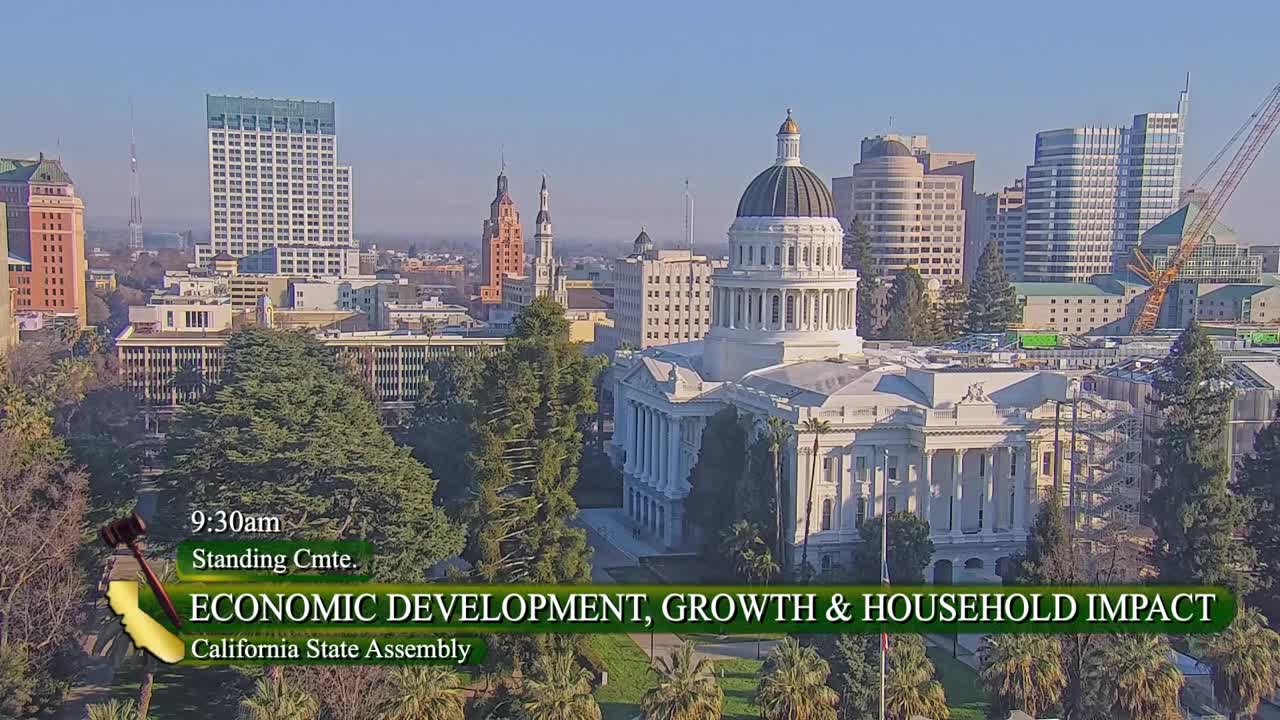
Assembly Standing Committee on Economic Development, Growth, and Household Impact
Bill Author

Bill Co-Author(s):