AB 801: Nondiscrimination.
- Session Year: 2025-2026
- House: Assembly
- Latest Version Date: 2026-09-30
Current Status:
Passed
(2026-09-30: Chaptered by Secretary of State - Chapter 871, Statutes of 2026.)
Introduced
In Committee
Awaiting First Chamber Vote
Passed First Chamber
In Committee
Awaiting Second Chamber Vote
Passed Second Chamber
Enacted
Existing law establishes the Department of Financial Protection and Innovation under the direction of the Commissioner of Financial Protection and Innovation. Existing law makes the department responsible for administering various laws relating to financial institutions, including the Banking Law, the California Credit Union Law (CCUL), and the California Residential Mortgage Lending Act (CRMLA), a willful violation of which is punishable as a misdemeanor. The CRMLA requires, as often as the commissioner deems necessary and appropriate, but at least once every 48 months, the commissioner to examine the affairs of each residential mortgage lender and servicer licensee for compliance with the CRMLA. The CRMLA authorizes the commissioner to examine the licensees officers, directors, employees, or agents under oath regarding the licensees operations. The CRMLA requires the commissioner to provide a written statement, the disclosure of which is subject to certain restrictions, of the findings of the examination, issue a copy of that statement to each licensees principals, officers, or directors, and take appropriate steps to ensure correction of any violations of the CRMLA.
This bill, the California Fair Lending Examination Act, would require, under the Banking Law and the CCUL, the commissioner to, at least once every 4 years, examine, as prescribed, the books and records of certain entities subject to the commissioners examination authority under those laws for compliance with any nondiscrimination law applicable to mortgage lending, as specified, and would require the commissioner to provide a written statement of the findings of that examination, issue a copy of that statement to the subjects principals, officers, or directors, and take appropriate steps to ensure correction of any violations of applicable nondiscrimination laws. The bill would prohibit disclosure of that statement to anyone other than the subject entity, law enforcement officials, or other state or federal regulatory agencies for further investigation and enforcement.
This bill would, as part of the above-described examination required by the CRMLA, require the commissioner to additionally examine the licensee for compliance with any nondiscrimination law applicable to mortgage lending, as prescribed.
This bill would make a violation of an applicable nondiscrimination law a violation of the Banking Law, the CCUL, or the CRMLA, as applicable, and would authorize, under the Banking Law and the CCUL, the commissioner to examine the applicable entitys officers, directors, employees, or agents under oath regarding the entitys operations.
By expanding the scope of the crimes of perjury and of violating the CRMLA, this bill would impose a state-mandated local program.
Existing constitutional provisions require that a statute that limits the right of access to the meetings of public bodies or the writings of public officials and agencies be adopted with findings demonstrating the interest protected by the limitation and the need for protecting that interest.
This bill would make legislative findings to that effect.
The California Constitution requires the state to reimburse local agencies and school districts for certain costs mandated by the state. Statutory provisions establish procedures for making that reimbursement.
This bill would provide that no reimbursement is required by this act for a specified reason.
Existing law establishes the Department of Financial Protection and Innovation under the direction of the Commissioner of Financial Protection and Innovation. Existing law makes the department responsible for administering various laws relating to financial institutions, including the Banking Law, the California Credit Union Law (CCUL), and the California Residential Mortgage Lending Act (CRMLA), a willful violation of which is punishable as a misdemeanor. The CRMLA requires, as often as the commissioner deems necessary and appropriate, but at least once every 48 months, the commissioner to examine the affairs of each residential mortgage lender and servicer licensee for compliance with the CRMLA. The CRMLA authorizes the commissioner to examine the licensees officers, directors, employees, or agents under oath regarding the licensees operations. The CRMLA requires the commissioner to provide a written statement, the disclosure of which is subject to certain restrictions, of the findings of the examination, issue a copy of that statement to each licensees principals, officers, or directors, and take appropriate steps to ensure correction of any violations of the CRMLA.
This bill, the California Fair Lending Examination Act, would require, under the Banking Law and the CCUL, the commissioner to, at least once every 4 years, examine, as prescribed, the books and records of certain entities subject to the commissioners examination authority under those laws for compliance with any nondiscrimination law applicable to mortgage lending, as specified, and would require the commissioner to provide a written statement of the findings of that examination, issue a copy of that statement to the subjects principals, officers, or directors, and take appropriate steps to ensure correction of any violations of applicable nondiscrimination laws. The bill would prohibit disclosure of that statement to anyone other than the subject entity, law enforcement officials, or other state or federal regulatory agencies for further investigation and enforcement.
This bill would, as part of the above-described examination required by the CRMLA, require the commissioner to additionally examine the licensee for compliance with any nondiscrimination law applicable to mortgage lending, as prescribed.
This bill would make a violation of an applicable nondiscrimination law a violation of the Banking Law, the CCUL, or the CRMLA, as applicable, and would authorize, under the Banking Law and the CCUL, the commissioner to examine the applicable entitys officers, directors, employees, or agents under oath regarding the entitys operations.
By expanding the scope of the crimes of perjury and of violating the CRMLA, this bill would impose a state-mandated local program.
Existing constitutional provisions require that a statute that limits the right of access to the meetings of public bodies or the writings of public officials and agencies be adopted with findings demonstrating the interest protected by the limitation and the need for protecting that interest.
This bill would make legislative findings to that effect.
The California Constitution requires the state to reimburse local agencies and school districts for certain costs mandated by the state. Statutory provisions establish procedures for making that reimbursement.
This bill would provide that no reimbursement is required by this act for a specified reason.
Existing law establishes the Department of Financial Protection and Innovation under the direction of the Commissioner of Financial Protection and Innovation. Existing law makes the department responsible for administering various laws relating to financial institutions, including the Banking Law, the California Credit Union Law (CCUL), and the California Residential Mortgage Lending Act (CRMLA), a willful violation of which is punishable as a misdemeanor. The CRMLA requires, as often as the commissioner deems necessary and appropriate, but at least once every 48 months, the commissioner to examine the affairs of each residential mortgage lender and servicer licensee for compliance with the CRMLA. The CRMLA authorizes the commissioner to examine the licensees officers, directors, employees, or agents under oath regarding the licensees operations. The CRMLA requires the commissioner to provide a written statement, the disclosure of which is subject to certain restrictions, of the findings of the examination, issue a copy of that statement to each licensees principals, officers, or directors, and take appropriate steps to ensure correction of any violations of the CRMLA.
This bill, the California Fair Lending Examination Act, would require, under the Banking Law, the CCUL, and the CRMLA, Law and the CCUL, the commissioner to, at least once every 4 years, examine, as prescribed, the books and records of certain entities subject to the commissioners examination authority under those laws for compliance with any nondiscrimination law applicable to mortgage lending, as specified, and would require the commissioner to provide a written statement of the findings of that examination, issue a copy of that statement to the subjects principals, officers, or directors, and take appropriate steps to ensure correction of any violations of applicable nondiscrimination laws. The bill would prohibit disclosure of that statement to anyone other than the subject entity, law enforcement officials, or other state or federal regulatory agencies for further investigation and enforcement.
This bill would as part of the above-described examination required by the CRMLA, require the commissioner to additionally examine the licensee for compliance with any nondiscrimination law applicable to mortgage lending, as prescribed.
This bill would make a violation of an applicable nondiscrimination law a violation of the Banking Law, the CCUL, or the CRMLA, as applicable, and would authorize authorize, under the Banking Law and the CCUL, the commissioner to examine the applicable entitys officers, directors, employees, or agents under oath regarding the banks entitys operations.
By expanding the scope of the crimes of perjury and of violating the CRMLA, this bill would impose a state-mandated local program.
Existing constitutional provisions require that a statute that limits the right of access to the meetings of public bodies or the writings of public officials and agencies be adopted with findings demonstrating the interest protected by the limitation and the need for protecting that interest.
This bill would make legislative findings to that effect.
The California Constitution requires the state to reimburse local agencies and school districts for certain costs mandated by the state. Statutory provisions establish procedures for making that reimbursement.
This bill would provide that no reimbursement is required by this act for a specified reason.
Existing law establishes the Department of Financial Protection and Innovation, which is Innovation under the direction of the Commissioner of Financial Protection and Innovation. Existing law makes the department responsible for administering various laws relating to financial institutions, including the Banking Law, the California Credit Union Law (CCUL), and the California Residential Mortgage Lending Act (CRMLA), a willful violation of which is punishable as a misdemeanor.
This bill, the California Fair Lending Examination Act, would require, under the Banking Law, the CCUL, and the CRMLA, the commissioner to, at least once every 4 years, examine, as prescribed, the books and records of any entity certain entities subject to the commissioners examination authority under those laws for compliance with any applicable nondiscrimination law, law applicable to mortgage lending, as specified, and would require the commissioner to provide a written statement of the findings of that examination, issue a copy of that statement to the subjects principals, officers, or directors, and take appropriate steps to ensure correction of any violations of applicable nondiscrimination laws. The bill would prohibit disclosure of that statement to anyone other than the subject entity, law enforcement officials, or other state or federal regulatory agencies for further investigation and enforcement.
This bill would make a violation of an applicable nondiscrimination law a violation of the Banking Law, the CCUL, or the CRMLA, as applicable, and would authorize the commissioner to examine the applicable entitys officers, directors, employees, or agents under oath regarding the banks operations.
By expanding the scope of the crimes of perjury and of violating the CRMLA, this bill would impose a state-mandated local program.
Existing constitutional provisions require that a statute that limits the right of access to the meetings of public bodies or the writings of public officials and agencies be adopted with findings demonstrating the interest protected by the limitation and the need for protecting that interest.
This bill would make legislative findings to that effect.
The California Constitution requires the state to reimburse local agencies and school districts for certain costs mandated by the state. Statutory provisions establish procedures for making that reimbursement.
This bill would provide that no reimbursement is required by this act for a specified reason.
Existing law establishes the Department of Financial Protection and Innovation, which is under the direction of the Commissioner of Financial Protection and Innovation. Existing law makes the department responsible for administering various laws relating to financial institutions, including the Banking Law, the California Credit Union Law (CCUL), and the California Residential Mortgage Lending Act (CRMLA), a willful violation of which is punishable as a misdemeanor.
This bill, the California Fair Lending Examination Act, would require, under the Banking Law, the CCUL, and the CRMLA, the commissioner to, at least once every 4 years, examine, as prescribed, the books and records of any entity subject to the commissioners examination authority under those laws for compliance with any applicable nondiscrimination law, as specified, and would require the commissioner to provide a written statement of the findings of that examination, issue a copy of that statement to the subjects principals, officers, or directors, and take appropriate steps to ensure correction of any violations of applicable nondiscrimination laws. The bill would prohibit disclosure of that statement to anyone other than the bank, subject entity, law enforcement officials, or other state or federal regulatory agencies for further investigation and enforcement.
This bill would make a violation of an applicable nondiscrimination law a violation of the Banking Law, the CCUL, or the CRMLA, as applicable, and would authorize the commissioner to examine the banks applicable entitys officers, directors, employees, or agents under oath regarding the banks operations.
By expanding the scope of the crimes of perjury and of violating the CRMLA, this bill would impose a state-mandated local program.
Existing constitutional provisions require that a statute that limits the right of access to the meetings of public bodies or the writings of public officials and agencies be adopted with findings demonstrating the interest protected by the limitation and the need for protecting that interest.
This bill would make legislative findings to that effect.
The California Constitution requires the state to reimburse local agencies and school districts for certain costs mandated by the state. Statutory provisions establish procedures for making that reimbursement.
This bill would provide that no reimbursement is required by this act for a specified reason.
Existing law establishes the Department of Financial Protection and Innovation, which is under the direction of the Commissioner of Financial Protection and Innovation. Existing law makes the department responsible for administering various laws relating to financial institutions, including banks and credit unions. Existing law, until January 1, 2030, establishes the Financial Empowerment Fund, and provides that moneys in the fund are continuously appropriated to the commissioner for allocation to fund financial education and financial empowerment programs and services for at-risk populations in California, as specified. the Banking Law, the California Credit Union Law (CCUL), and the California Residential Mortgage Lending Act (CRMLA), a willful violation of which is punishable as a misdemeanor.
This bill would establish the California Community Reinvestment Act, and would require a covered financial institution, as defined, to have a continuing and affirmative obligation to meet the financial services needs of the communities, including low- and moderate-income communities and communities of color, in which the covered financial institution conducts substantial business, as specified. The bill would require the commissioner to assess the record of each covered financial institution in satisfying this obligation no less than once every 3 years, as specified. After each assessment, the bill would require the commissioner to assign one of 5 possible ratings to describe how the covered financial institution is meeting its community financial services needs, and to prepare a specified written evaluation of the covered financial institutions record of performance. The bill would authorize the commissioner to consider this record of performance when considering an application for, among other things, the establishment of a branch or the relocation of a main office. The bill would also prohibit a covered financial institution with certain ratings from receiving state funds for deposit or being awarded a state contract to provide financial services.This bill would also authorize the commissioner to conduct specified investigations into covered financial institutions for compliance with the act. The bill would also authorize the commissioner to examine, in consultation with state and federal regulators, covered financial institutions for their compliance with specified state and federal laws.This bill would establish the Community Reinvestment Fund within the State Treasury, and would make moneys in the fund available, upon appropriation by the Legislature, to the commissioner for purposes of administering these provisions. The bill would authorize the commissioner to issue an administrative penalty of up to $100,000 to a covered financial institution that regularly fails to meet its obligations under the act, and would require those penalties to be deposited in the fund.This bill, the California Fair Lending Examination Act, would require, under the Banking Law, the CCUL, and the CRMLA, the commissioner to, at least once every 4 years, examine, as prescribed, the books and records of any entity subject to the commissioners examination authority under those laws for compliance with any applicable nondiscrimination law, as specified, and would require the commissioner to provide a written statement of the findings of that examination, issue a copy of that statement to the subjects principals, officers, or directors, and take appropriate steps to ensure correction of any violations of applicable nondiscrimination laws. The bill would prohibit disclosure of that statement to anyone other than the bank, law enforcement officials, or other state or federal regulatory agencies for further investigation and enforcement.
This bill would make a violation of an applicable nondiscrimination law a violation of the Banking Law, the CCUL, or the CRMLA, as applicable, and would authorize the commissioner to examine the banks officers, directors, employees, or agents under oath regarding the banks operations.
By expanding the scope of the crimes of perjury and of violating the CRMLA, this bill would impose a state-mandated local program.
Existing constitutional provisions require that a statute that limits the right of access to the meetings of public bodies or the writings of public officials and agencies be adopted with findings demonstrating the interest protected by the limitation and the need for protecting that interest.
This bill would make legislative findings to that effect.
The California Constitution requires the state to reimburse local agencies and school districts for certain costs mandated by the state. Statutory provisions establish procedures for making that reimbursement.
This bill would provide that no reimbursement is required by this act for a specified reason.
Existing law establishes the Department of Financial Protection and Innovation, which is under the direction of the Commissioner of Financial Protection and Innovation. Existing law makes the department responsible for administering various laws relating to financial institutions, including banks and credit unions. Existing law, until January 1, 2030, establishes the Financial Empowerment Fund, and provides that moneys in the fund are continuously appropriated to the commissioner for allocation to fund financial education and financial empowerment programs and services for at-risk populations in California, as specified.
This bill would establish the California Community Reinvestment Act, and would require a covered financial institution, as defined, to have a continuing and affirmative obligation to meet the financial services needs of the communities, including low- and moderate-income communities and communities of color, in which the covered financial institution conducts substantial business, as specified. The bill would require the commissioner to assess the record of each covered financial institution in satisfying this obligation no less than once every 3 years, as specified. After each assessment, the bill would require the commissioner to assign one of 5 possible ratings to describe how the covered financial institution is meeting its community financial services needs, and to prepare a specified written evaluation of the covered financial institutions record of performance. The bill would authorize the commissioner to consider this record of performance when considering an application for, among other things, the establishment of a branch or the relocation of a main office. The bill would also prohibit a covered financial institution with certain ratings from receiving state funds for deposit or being awarded a state contract to provide financial services.
This bill would also authorize the commissioner to conduct specified investigations into covered financial institutions for compliance with the act. The bill would also authorize the commissioner to examine, in consultation with state and federal regulators, covered financial institutions for their compliance with specified state and federal laws.
This bill would establish the Community Reinvestment Fund within the State Treasury, and would make moneys in the fund available, upon appropriation by the Legislature, to the commissioner for purposes of administering these provisions. The bill would authorize the commissioner to issue an administrative penalty of up to $100,000 to a covered financial institution that regularly fails to meet its obligations under the act, and would require those penalties to be deposited in the fund.
Existing law establishes the Department of Financial Protection and Innovation, which is under the direction of the Commissioner of Financial Protection and Innovation. Existing law makes the department responsible for administering various laws relating to financial institutions, including banks and credit unions. Existing law, until January 1, 2030, establishes the Financial Empowerment Fund, and provides that moneys in the fund are continuously appropriated to the commissioner for allocation to fund financial education and financial empowerment programs and services for at-risk populations in California, as specified.
This bill would establish the California Community Reinvestment Act, and would require a covered financial institution, as defined, to have a continuing and affirmative obligation to meet the financial services needs of the communities, including low- and moderate-income communities and communities of color, in which the covered financial institution conducts substantial business, as specified. The bill would require the commissioner to assess the record of each covered financial institution in satisfying this obligation no less than once every 3 years, as specified. After each assessment, the bill would require the commissioner to assign one of 5 possible ratings to describe how the covered financial institution is meeting its community financial services needs, and to prepare a specified written evaluation of the covered financial institutions record of performance. The bill would authorize the commissioner to consider this record of performance when considering an application for, among other things, the establishment of a branch or the relocation of a main office. The bill would also prohibit a covered financial institution with certain ratings from receiving state funds for deposit or being awarded a state contract to provide financial services.
This bill would also authorize the commissioner to conduct specified investigations into covered financial institutions for compliance with the act. The bill would also authorize the commissioner to examine, in consultation with state and federal regulators, covered financial institutions for their compliance with specified state and federal laws.
This bill would establish the Community Reinvestment Fund within the State Treasury, and would make moneys in the fund available, upon appropriation by the Legislature, to the commissioner for purposes of administering these provisions. The bill would authorize the commissioner to issue an administrative penalty of up to $100,000 to a covered financial institution that regularly fails to meet its obligations under the act, and would require those penalties to be deposited in the fund.
Existing law establishes the Department of Financial Protection and Innovation, which is under the direction of the Commissioner of Financial Protection and Innovation. Existing law makes the department responsible for administering various laws relating to financial institutions, including banks and credit unions. Existing law, until January 1, 2030, establishes the Financial Empowerment Fund, and provides that moneys in the fund are continuously appropriated to the commissioner for allocation to fund financial education and financial empowerment programs and services for at-risk populations in California, as specified.
This bill would establish the California Community Reinvestment Act, and would require a covered financial institution, as defined, to have a continuing and affirmative obligation to meet the financial services needs of the communities, including low- and moderate-income communities and communities of color, in which the covered financial institution conducts substantial business, as specified. The bill would require the commissioner to assess the record of each covered financial institution in satisfying this obligation no less than once every 3 years, as specified. After each assessment, the bill would require the commissioner to assign one of 5 possible ratings to describe how the covered financial institution is meeting its community financial services needs, and to prepare a specified written evaluation of the covered financial institutions record of performance. The bill would authorize the commissioner to consider this record of performance when considering an application for, among other things, the establishment of a branch or the relocation of a main office. The bill would also prohibit a covered financial institution with certain ratings from receiving state funds for deposit or being awarded a state contract to provide financial services.
This bill would also authorize the commissioner to conduct specified investigations into covered financial institutions for compliance with the act. The bill would also authorize the commissioner to examine, in consultation with state and federal regulators, covered financial institutions for their compliance with specified state and federal laws.
This bill would establish the Community Reinvestment Fund within the State Treasury, and would make moneys in the fund available, upon appropriation by the Legislature, to the commissioner for purposes of administering these provisions. The bill would authorize the commissioner to issue an administrative penalty of up to $100,000 to a covered financial institution that regularly fails to meet its obligations under the act, and would require those penalties to be deposited in the fund.
Existing law establishes the Department of Financial Protection and Innovation, which is under the direction of the Commissioner of Financial Protection and Innovation. Existing law makes the department responsible for administering various laws relating to financial institutions, including banks and credit unions. Existing law, until January 1, 2030, establishes the Financial Empowerment Fund, and provides that moneys in the fund are continuously appropriated to the commissioner for allocation to fund financial education and financial empowerment programs and services for at-risk populations in California, as specified.
This bill would establish the California Community Reinvestment Act, and would require a covered financial institution, as defined, to have a continuing and affirmative obligation to meet the financial services needs of the communities, including low- and moderate-income communities and communities of color, in which the covered financial institution conducts substantial business, as specified. The bill would require the commissioner to assess the record of each covered financial institution in satisfying this obligation no less than once every 3 years, as specified. After each assessment, the bill would require the commissioner to assign one of 5 possible ratings to describe how the covered financial institution is meeting its community financial services needs, and to prepare a specified written evaluation of the covered financial institutions record of performance. The bill would authorize the commissioner to consider this record of performance when considering an application for, among other things, the establishment of a branch or the relocation of a main office. The bill would also prohibit a covered financial institution with certain ratings from receiving state funds for deposit or being awarded a state contract to provide financial services.
This bill would also authorize the commissioner to conduct specified investigations into covered financial institutions for compliance with the act. The bill would also authorize the commissioner to examine, in consultation with state and federal regulators, covered financial institutions for their compliance with specified state and federal laws.
This bill would establish the Community Reinvestment Fund within the State Treasury, and would make moneys in the fund available, upon appropriation by the Legislature, to the commissioner for purposes of administering these provisions. The bill would authorize the commissioner to issue an administrative penalty of up to $100,000 to a covered financial institution that regularly fails to meet its obligations under the act, and would require those penalties to be deposited in the fund.
Existing law, the California Residential Mortgage Lending Act, generally provides for the licensure and regulation of persons engaging in the business of making residential mortgage loans or servicing residential mortgage loans.This bill would state the intent of the Legislature to enact legislation relating to residential mortgage loans.Existing law, the California Residential Mortgage Lending Act, generally provides for the licensure and regulation of persons engaging in the business of making residential mortgage loans or servicing residential mortgage loans.
This bill would state the intent of the Legislature to enact legislation relating to residential mortgage loans.
This act shall be known as the California Fair Lending Examination Act.
SEC. 2.Chapter 22 (commencing with Section 1915) is added to Division 1.1 of the Financial Code, to read:22.Nondiscrimination1915.(a)(1)At least once every four years, the commissioner shall examine, pursuant to paragraph (2), the books and records of any bank subject to the commissioners examination authority that meets at least one of the criteria listed in Section 1003.2(g)(1)(v) of Title 12 of the Code of Federal Regulations for compliance with any nondiscrimination law applicable to mortgage lending, including the federal Equal Credit Opportunity Act (15 U.S.C. Sec. 1691 et seq.), the federal Fair Housing Act (42 U.S.C. Sec. 3601 et seq.), the California Fair Employment and Housing Act (Part 2.8 (commencing with Section 12900) of Division 3 of Title 2 of the Government Code), the Holden Act (Part 6 (commencing with Section 35800) of Division 24 of the Health and Safety Code), and the Unruh Civil Rights Act (Section 51 of the Civil Code).
(2)(A)The commissioner may examine the books, records, and documents of the bank and may examine the banks officers, directors, employees, or agents under oath regarding the banks operations.
(B)The commissioner may cooperate with any agency of the state or federal government, other states, agencies, the Federal National Mortgage Association, or the Federal Home Loan Mortgage Corporation, and the commissioner may accept an examination conducted by any of those entities in place of an examination by the commissioner under this chapter, unless the commissioner determines that the examination does not provide information necessary to enable the commissioner to fulfill the commissioners responsibilities under this chapter.
(C)(i)The commissioner shall align the schedule of examinations required by this subdivision with scheduled examinations under other law administered by the commissioner.
(ii)This subparagraph does not limit the authority of the commissioner to conduct a targeted or off-schedule examination for due cause, including receiving complaints or other evidence related to potential discrimination by a bank.
(D)The commissioner may exempt from examination, or examine less frequently than otherwise required by paragraph (1), a bank that demonstrates full compliance with applicable nondiscrimination law in the most recent examination, pursuant to this chapter, of the bank.
(E)In implementing and administering the scope of examination described in this subdivision, the commissioner shall seek to enhance the efficiency and effectiveness of required examinations to reduce the total exam costs billed to banks.
(b)(1)The commissioner shall provide a written statement of the findings of any examination conducted under this chapter, issue a copy of that statement to the subject banks principals, officers, or directors, and take appropriate steps to ensure correction of any violation of applicable nondiscrimination law, including a discriminatory effect under the California Fair Employment and Housing Act (Part 2.8 (commencing with Section 12900) of Division 3 of Title 2 of the Government Code), that is not attributable to a legitimate business interest of the bank.
(2)Notwithstanding any other law, a statement required by this subdivision of the findings of an examination shall not be disclosed to anyone other than the bank, law enforcement officials, or other state or federal regulatory agencies for further investigation and enforcement. An examination report prepared by the commissioners duly designated representatives pursuant to this chapter shall not be a public record.
(c)An affiliate of a bank is subject to examination by the commissioner on the same terms as the bank, if a report from, or examination of, a bank provides documented evidence of unlawful activity between a bank and an affiliate benefiting, affecting, or arising from the activities regulated by this chapter.
(d)The commissioner shall assess to the bank a fee for the purpose of covering the costs of the examination that does not exceed the reasonable expenses of the examination under this chapter.
(e)A violation of an applicable nondiscrimination law is a violation of this division, and the commissioner may use the authority provided by this division or Division 24 (commencing with Section 90000) to bring an appropriate enforcement action based on the nature of the violation.
SEC. 3.Chapter 13 (commencing with Section 16910) is added to Division 5 of the Financial Code, to read:13.Nondiscrimination16910.(a)(1)At least once every four years, the commissioner shall examine, pursuant to paragraph (2), the books and records of any credit union subject to the commissioners examination authority that meets at least one of the criteria listed in Section 1003.2(g)(1)(v) of Title 12 of the Code of Federal Regulations for compliance with any nondiscrimination law applicable to mortgage lending, including the federal Equal Credit Opportunity Act (15 U.S.C. Sec. 1691 et seq.), the federal Fair Housing Act (42 U.S.C. Sec. 3601 et seq.), the California Fair Employment and Housing Act (Part 2.8 (commencing with Section 12900) of Division 3 of Title 2 of the Government Code), the Holden Act (Part 6 (commencing with Section 35800) of Division 24 of the Health and Safety Code), and the Unruh Civil Rights Act (Section 51 of the Civil Code).
(2)(A)The commissioner may examine the books, records, and documents of the credit union and may examine the credit unions officers, directors, employees, or agents under oath regarding the credit unions operations.
(B)The commissioner may cooperate with any agency of the state or federal government, other states, agencies, the Federal National Mortgage Association, or the Federal Home Loan Mortgage Corporation, and the commissioner may accept an examination conducted by any of those entities in place of an examination by the commissioner under this chapter, unless the commissioner determines that the examination does not provide information necessary to enable the commissioner to fulfill the commissioners responsibilities under this chapter.
(C)(i)The commissioner shall align the schedule of examinations required by this subdivision with scheduled examinations under other law administered by the commissioner.
(ii)This subparagraph does not limit the authority of the commissioner to conduct a targeted or off-schedule examination for due cause, including receiving complaints or other evidence related to potential discrimination by a credit union.
(D)The commissioner may exempt from examination, or examine less frequently than otherwise required by paragraph (1), a credit union that demonstrates full compliance with applicable nondiscrimination law in the most recent examination, pursuant to this chapter, of the credit union.
(E)In implementing and administering the scope of examination described in this subdivision, the commissioner shall seek to enhance the efficiency and effectiveness of required examinations to reduce the total exam costs billed to credit unions.
(b)(1)The commissioner shall provide a written statement of the findings of any examination conducted under this chapter, issue a copy of that statement to the subject credit unions principals, officers, or directors, and take appropriate steps to ensure correction of any violation of applicable nondiscrimination law, including a discriminatory effect under the California Fair Employment and Housing Act (Part 2.8 (commencing with Section 12900) of Division 3 of Title 2 of the Government Code), that is not attributable to a legitimate business interest of the credit union.
(2)Notwithstanding any other law, a statement required by this subdivision of the findings of an examination shall not be disclosed to anyone other than the credit union, law enforcement officials, or other state or federal regulatory agencies for further investigation and enforcement. An examination report prepared by the commissioners duly designated representatives pursuant to this chapter shall not be a public record and shall be treated as an examination report subject to the provisions of Section 14257 and other applicable law.
(c)An affiliate of a credit union is subject to examination by the commissioner on the same terms as the credit union, if a report from, or examination of, a credit union provides documented evidence of unlawful activity between a credit union and an affiliate benefiting, affecting, or arising from the activities regulated by this chapter.
(d)The commissioner shall assess to the credit union a fee for the purpose of covering the costs of the examination that does not exceed the reasonable expenses of the examination under this chapter.
(e)A violation of an applicable nondiscrimination law is a violation of this division, and the commissioner may use the authority provided by this division or Division 24 (commencing with Section 90000) to bring an appropriate enforcement action based on the nature of the violation.
SEC. 4.Section 50302 of the Financial Code is amended to read:50302.(a)(1)As often as the commissioner deems necessary and appropriate, but at least once every 48 months, the commissioner shall examine the affairs of each residential mortgage lender and servicer licensee for compliance with this division. The commissioner shall appoint suitable persons to perform the examination. The commissioner and the commissioners appointees may examine the books, records, and documents of the licensee, and may examine the licensees officers, directors, employees, or agents under oath regarding the licensees operations. The commissioner may cooperate with any agency of the state or federal government, other states, agencies, the Federal National Mortgage Association, or the Federal Home Loan Mortgage Corporation. The commissioner may accept an examination conducted by one of these entities in place of an examination by the commissioner under this law unless the commissioner determines that the examination does not provide information necessary to enable the commissioner to fulfill the commissioners responsibilities under this division.
(2)(A)As part of the examination required by this subdivision, the commissioner shall examine the licensee for compliance with any nondiscrimination law applicable to mortgage lending, including the federal Equal Credit Opportunity Act (15 U.S.C. Sec. 1691 et seq.), the federal Fair Housing Act (42 U.S.C. Sec. 3601 et seq.), the California Fair Employment and Housing Act (Part 2.8 (commencing with Section 12900) of Division 3 of Title 2 of the Government Code), the Holden Act (Part 6 (commencing with Section 35800) of Division 24 of the Health and Safety Code), and the Unruh Civil Rights Act (Section 51 of the Civil Code).
(B)A violation of an applicable nondiscrimination law is a violation of this division, and the commissioner may use the authority provided by this division or Division 24 (commencing with Section 90000) to bring an appropriate enforcement action based on the nature of the violation.
(3)In implementing and administering the scope of examination described in paragraph (2), commissioner shall seek to enhance the efficiency and effectiveness of required examinations to reduce the total exam costs billed to licensees.
(b)The commissioner shall provide a written statement of the findings of the examination, issue a copy of that statement to each licensees principals, officers, or directors, and take appropriate steps to ensure correction of any violations of this division.
(c)Affiliates of a licensee are subject to examination by the commissioner on the same terms as the licensee but only when reports from, or examination of, a licensee provides documented evidence of unlawful activity between a licensee and affiliate benefiting, affecting, or arising from the activities regulated by this division.
(d)The residential mortgage lender or servicer licensee shall pay, and the commissioner shall assess, the reasonable expenses of any examination of the licensee and affiliates, consistent with the requirements of subdivision (c) of Section 50314.
(e)The statement of the findings of an examination shall belong to the commissioner and shall not be disclosed to anyone other than the licensee, law enforcement officials, or other state or federal regulatory agencies for further investigation and enforcement. Reports required of licensees by the commissioner under this division and results of examinations performed by the commissioner under this division are the property of the commissioner and, pursuant to Section 50314, are not public records.
SEC. 5.The Legislature finds and declares that Sections 2, 3, and 4 of this act, which amend Section 50302 of, and add Chapter 22 (commencing with Section 1915) to Division 1.1 of, and Chapter 13 (commencing with Section 16910) to Division 5 of, the Financial Code, impose a limitation on the publics right of access to the meetings of public bodies or the writings of public officials and agencies within the meaning of Section 3 of Article I of the California Constitution. Pursuant to that constitutional provision, the Legislature makes the following findings to demonstrate the interest protected by this limitation and the need for protecting that interest:
In order to protect the privacy of a licensee who has complied with the Commissioner of Financial Protection and Innovations demands, or otherwise reached a mutually agreeable resolution of any issues, during an investigation, it is necessary to hold any examinations and correspondence related to that investigation confidential. Furthermore, in order to protect the safety and soundness of a depository institution, records related to an examination should remain confidential, as that information is similarly protected by federal regulators of depository institutions.
SEC. 6.No reimbursement is required by this act pursuant to Section 6 of Article XIIIB of the California Constitution because the only costs that may be incurred by a local agency or school district will be incurred because this act creates a new crime or infraction, eliminates a crime or infraction, or changes the penalty for a crime or infraction, within the meaning of Section 17556 of the Government Code, or changes the definition of a crime within the meaning of Section 6 of Article XIIIB of the California Constitution.
This act shall be known as the California Fair Lending Examination Act.
SEC. 2.Chapter 22 (commencing with Section 1915) is added to Division 1.1 of the Financial Code, to read:22.Nondiscrimination1915.(a)(1)At least once every four years, the commissioner shall examine, pursuant to paragraph (2), the books and records of any bank subject to the commissioners examination authority that meets at least one of the criteria listed in Section 1003.2(g)(1)(v) of Title 12 of the Code of Federal Regulations for compliance with any nondiscrimination law applicable to mortgage lending, including the federal Equal Credit Opportunity Act (15 U.S.C. Sec. 1691 et seq.), the federal Fair Housing Act (42 U.S.C. Sec. 3601 et seq.), the California Fair Employment and Housing Act (Part 2.8 (commencing with Section 12900) of Division 3 of Title 2 of the Government Code), the Holden Act (Part 6 (commencing with Section 35800) of Division 24 of the Health and Safety Code), and the Unruh Civil Rights Act (Section 51 of the Civil Code).
(2)(A)The commissioner may examine the books, records, and documents of the bank and may examine the banks officers, directors, employees, or agents under oath regarding the banks operations.
(B)The commissioner may cooperate with any agency of the state or federal government, other states, agencies, the Federal National Mortgage Association, or the Federal Home Loan Mortgage Corporation, and the commissioner may accept an examination conducted by any of those entities in place of an examination by the commissioner under this chapter, unless the commissioner determines that the examination does not provide information necessary to enable the commissioner to fulfill the commissioners responsibilities under this chapter.
(C)(i)The commissioner shall align the schedule of examinations required by this subdivision with scheduled examinations under other law administered by the commissioner.
(ii)This subparagraph does not limit the authority of the commissioner to conduct a targeted or off-schedule examination for due cause, including receiving complaints or other evidence related to potential discrimination by a bank.
(D)The commissioner may exempt from examination, or examine less frequently than otherwise required by paragraph (1), a bank that demonstrates full compliance with applicable nondiscrimination law in the most recent examination, pursuant to this chapter, of the bank.
(E)In implementing and administering the scope of examination described in this subdivision, the commissioner shall seek to enhance the efficiency and effectiveness of required examinations to reduce the total exam costs billed to banks.
(b)(1)The commissioner shall provide a written statement of the findings of any examination conducted under this chapter, issue a copy of that statement to the subject banks principals, officers, or directors, and take appropriate steps to ensure correction of any violation of applicable nondiscrimination law, including a discriminatory effect under the California Fair Employment and Housing Act (Part 2.8 (commencing with Section 12900) of Division 3 of Title 2 of the Government Code), that is not attributable to a legitimate business interest of the bank.
(2)Notwithstanding any other law, a statement required by this subdivision of the findings of an examination shall not be disclosed to anyone other than the bank, law enforcement officials, or other state or federal regulatory agencies for further investigation and enforcement. An examination report prepared by the commissioners duly designated representatives pursuant to this chapter shall not be a public record.
(c)An affiliate of a bank is subject to examination by the commissioner on the same terms as the bank, if a report from, or examination of, a bank provides documented evidence of unlawful activity between a bank and an affiliate benefiting, affecting, or arising from the activities regulated by this chapter.
(d)The commissioner shall assess to the bank a fee for the purpose of covering the costs of the examination that does not exceed the reasonable expenses of the examination under this chapter.
(e)A violation of an applicable nondiscrimination law is a violation of this division, and the commissioner may use the authority provided by this division or Division 24 (commencing with Section 90000) to bring an appropriate enforcement action based on the nature of the violation.
SEC. 3.Chapter 13 (commencing with Section 16910) is added to Division 5 of the Financial Code, to read:13.Nondiscrimination16910.(a)(1)At least once every four years, the commissioner shall examine, pursuant to paragraph (2), the books and records of any credit union subject to the commissioners examination authority that meets at least one of the criteria listed in Section 1003.2(g)(1)(v) of Title 12 of the Code of Federal Regulations for compliance with any nondiscrimination law applicable to mortgage lending, including the federal Equal Credit Opportunity Act (15 U.S.C. Sec. 1691 et seq.), the federal Fair Housing Act (42 U.S.C. Sec. 3601 et seq.), the California Fair Employment and Housing Act (Part 2.8 (commencing with Section 12900) of Division 3 of Title 2 of the Government Code), the Holden Act (Part 6 (commencing with Section 35800) of Division 24 of the Health and Safety Code), and the Unruh Civil Rights Act (Section 51 of the Civil Code).
(2)(A)The commissioner may examine the books, records, and documents of the credit union and may examine the credit unions officers, directors, employees, or agents under oath regarding the credit unions operations.
(B)The commissioner may cooperate with any agency of the state or federal government, other states, agencies, the Federal National Mortgage Association, or the Federal Home Loan Mortgage Corporation, and the commissioner may accept an examination conducted by any of those entities in place of an examination by the commissioner under this chapter, unless the commissioner determines that the examination does not provide information necessary to enable the commissioner to fulfill the commissioners responsibilities under this chapter.
(C)(i)The commissioner shall align the schedule of examinations required by this subdivision with scheduled examinations under other law administered by the commissioner.
(ii)This subparagraph does not limit the authority of the commissioner to conduct a targeted or off-schedule examination for due cause, including receiving complaints or other evidence related to potential discrimination by a credit union.
(D)The commissioner may exempt from examination, or examine less frequently than otherwise required by paragraph (1), a credit union that demonstrates full compliance with applicable nondiscrimination law in the most recent examination, pursuant to this chapter, of the credit union.
(E)In implementing and administering the scope of examination described in this subdivision, the commissioner shall seek to enhance the efficiency and effectiveness of required examinations to reduce the total exam costs billed to credit unions.
(b)(1)The commissioner shall provide a written statement of the findings of any examination conducted under this chapter, issue a copy of that statement to the subject credit unions principals, officers, or directors, and take appropriate steps to ensure correction of any violation of applicable nondiscrimination law, including a discriminatory effect under the California Fair Employment and Housing Act (Part 2.8 (commencing with Section 12900) of Division 3 of Title 2 of the Government Code), that is not attributable to a legitimate business interest of the credit union.
(2)Notwithstanding any other law, a statement required by this subdivision of the findings of an examination shall not be disclosed to anyone other than the credit union, law enforcement officials, or other state or federal regulatory agencies for further investigation and enforcement. An examination report prepared by the commissioners duly designated representatives pursuant to this chapter shall not be a public record and shall be treated as an examination report subject to the provisions of Section 14257 and other applicable law.
(c)An affiliate of a credit union is subject to examination by the commissioner on the same terms as the credit union, if a report from, or examination of, a credit union provides documented evidence of unlawful activity between a credit union and an affiliate benefiting, affecting, or arising from the activities regulated by this chapter.
(d)The commissioner shall assess to the credit union a fee for the purpose of covering the costs of the examination that does not exceed the reasonable expenses of the examination under this chapter.
(e)A violation of an applicable nondiscrimination law is a violation of this division, and the commissioner may use the authority provided by this division or Division 24 (commencing with Section 90000) to bring an appropriate enforcement action based on the nature of the violation.
SEC. 4.Section 50302 of the Financial Code is amended to read:50302.(a)(1)As often as the commissioner deems necessary and appropriate, but at least once every 48 months, the commissioner shall examine the affairs of each residential mortgage lender and servicer licensee for compliance with this division. The commissioner shall appoint suitable persons to perform the examination. The commissioner and the commissioners appointees may examine the books, records, and documents of the licensee, and may examine the licensees officers, directors, employees, or agents under oath regarding the licensees operations. The commissioner may cooperate with any agency of the state or federal government, other states, agencies, the Federal National Mortgage Association, or the Federal Home Loan Mortgage Corporation. The commissioner may accept an examination conducted by one of these entities in place of an examination by the commissioner under this law unless the commissioner determines that the examination does not provide information necessary to enable the commissioner to fulfill the commissioners responsibilities under this division.
(2)(A)As part of the examination required by this subdivision, the commissioner shall examine the licensee for compliance with any nondiscrimination law applicable to mortgage lending, including the federal Equal Credit Opportunity Act (15 U.S.C. Sec. 1691 et seq.), the federal Fair Housing Act (42 U.S.C. Sec. 3601 et seq.), the California Fair Employment and Housing Act (Part 2.8 (commencing with Section 12900) of Division 3 of Title 2 of the Government Code), the Holden Act (Part 6 (commencing with Section 35800) of Division 24 of the Health and Safety Code), and the Unruh Civil Rights Act (Section 51 of the Civil Code).
(B)A violation of an applicable nondiscrimination law is a violation of this division, and the commissioner may use the authority provided by this division or Division 24 (commencing with Section 90000) to bring an appropriate enforcement action based on the nature of the violation.
(3)In implementing and administering the scope of examination described in paragraph (2), commissioner shall seek to enhance the efficiency and effectiveness of required examinations to reduce the total exam costs billed to licensees.
(b)The commissioner shall provide a written statement of the findings of the examination, issue a copy of that statement to each licensees principals, officers, or directors, and take appropriate steps to ensure correction of any violations of this division.
(c)Affiliates of a licensee are subject to examination by the commissioner on the same terms as the licensee but only when reports from, or examination of, a licensee provides documented evidence of unlawful activity between a licensee and affiliate benefiting, affecting, or arising from the activities regulated by this division.
(d)The residential mortgage lender or servicer licensee shall pay, and the commissioner shall assess, the reasonable expenses of any examination of the licensee and affiliates, consistent with the requirements of subdivision (c) of Section 50314.
(e)The statement of the findings of an examination shall belong to the commissioner and shall not be disclosed to anyone other than the licensee, law enforcement officials, or other state or federal regulatory agencies for further investigation and enforcement. Reports required of licensees by the commissioner under this division and results of examinations performed by the commissioner under this division are the property of the commissioner and, pursuant to Section 50314, are not public records.
SEC. 5.The Legislature finds and declares that Sections 2, 3, and 4 of this act, which amend Section 50302 of, and add Chapter 22 (commencing with Section 1915) to Division 1.1 of, and Chapter 13 (commencing with Section 16910) to Division 5 of, the Financial Code, impose a limitation on the publics right of access to the meetings of public bodies or the writings of public officials and agencies within the meaning of Section 3 of Article I of the California Constitution. Pursuant to that constitutional provision, the Legislature makes the following findings to demonstrate the interest protected by this limitation and the need for protecting that interest:
In order to protect the privacy of a licensee who has complied with the Commissioner of Financial Protection and Innovations demands, or otherwise reached a mutually agreeable resolution of any issues, during an investigation, it is necessary to hold any examinations and correspondence related to that investigation confidential. Furthermore, in order to protect the safety and soundness of a depository institution, records related to an examination should remain confidential, as that information is similarly protected by federal regulators of depository institutions.
SEC. 6.No reimbursement is required by this act pursuant to Section 6 of Article XIIIB of the California Constitution because the only costs that may be incurred by a local agency or school district will be incurred because this act creates a new crime or infraction, eliminates a crime or infraction, or changes the penalty for a crime or infraction, within the meaning of Section 17556 of the Government Code, or changes the definition of a crime within the meaning of Section 6 of Article XIIIB of the California Constitution.
This act shall be known as the California Fair Lending Examination Act.
SEC. 2.Chapter 22 (commencing with Section 1915) is added to Division 1.1 of the Financial Code, to read:22.Nondiscrimination1915.(a)(1)At least once every four years, the commissioner shall examine, pursuant to paragraph (2), the books and records of any bank subject to the commissioners examination authority that meets at least one of the criteria listed in Section 1003.2(g)(1)(v) of Title 12 of the Code of Federal Regulations for compliance with any nondiscrimination law applicable to mortgage lending, including the federal Equal Credit Opportunity Act (15 U.S.C. Sec. 1691 et seq.), the federal Fair Housing Act (42 U.S.C. Sec. 3601 et seq.), the California Fair Employment and Housing Act (Part 2.8 (commencing with Section 12900) of Division 3 of Title 2 of the Government Code), the Holden Act (Part 6 (commencing with Section 35800) of Division 24 of the Health and Safety Code), and the Unruh Civil Rights Act (Section 51 of the Civil Code).
(2)(A)The commissioner may examine the books, records, and documents of the bank and may examine the banks officers, directors, employees, or agents under oath regarding the banks operations.
(B)The commissioner may cooperate with any agency of the state or federal government, other states, agencies, the Federal National Mortgage Association, or the Federal Home Loan Mortgage Corporation, and the commissioner may accept an examination conducted by any of those entities in place of an examination by the commissioner under this chapter, unless the commissioner determines that the examination does not provide information necessary to enable the commissioner to fulfill the commissioners responsibilities under this chapter.
(C)(i)The commissioner may alter shall align the schedule of examinations required by this subdivision to align with scheduled examinations under other law. law administered by the commissioner.
(ii)This subparagraph does not limit the authority of the commissioner to conduct a targeted or off-schedule examination for due cause, including receiving complaints or other evidence related to potential discrimination by a bank.
(D)The commissioner may exempt from examination, or examine less frequently than otherwise required by paragraph (1), a bank that demonstrates full compliance with applicable nondiscrimination law in the most recent examination, pursuant to this chapter, of the bank.
(E)In implementing and administering the scope of examination described in this subdivision, the commissioner shall seek to enhance the efficiency and effectiveness of required examinations to reduce the total exam costs billed to banks.
(b)(1)The commissioner shall provide a written statement of the findings of any examination conducted under this chapter, issue a copy of that statement to the subject banks principals, officers, or directors, and take appropriate steps to ensure correction of any violation of applicable nondiscrimination law, including a discriminatory effect under the California Fair Employment and Housing Act (Part 2.8 (commencing with Section 12900) of Division 3 of Title 2 of the Government Code), that is not attributable to a legitimate business interest of the bank.
(2)Notwithstanding any other law, a statement required by this subdivision of the findings of an examination shall not be disclosed to anyone other than the bank, law enforcement officials, or other state or federal regulatory agencies for further investigation and enforcement. An examination report prepared by the commissioners duly designated representatives pursuant to this chapter shall not be a public record.
(c)An affiliate of a bank is subject to examination by the commissioner on the same terms as the bank, if a report from, or examination of, a bank provides documented evidence of unlawful activity between a bank and an affiliate benefiting, affecting, or arising from the activities regulated by this chapter.
(d)The commissioner shall assess to the bank a fee for the purpose of covering the costs of the examination that does not exceed the reasonable expenses of the examination under this chapter.
(e)A violation of an applicable nondiscrimination law is a violation of this division, and the commissioner may use the authority provided by this division or Division 24 (commencing with Section 90000) to bring an appropriate enforcement action based on the nature of the violation.
SEC. 3.Chapter 13 (commencing with Section 16910) is added to Division 5 of the Financial Code, to read:13.Nondiscrimination16910.(a)(1)At least once every four years, the commissioner shall examine, pursuant to paragraph (2), the books and records of any credit union subject to the commissioners examination authority that meets at least one of the criteria listed in Section 1003.2(g)(1)(v) of Title 12 of the Code of Federal Regulations for compliance with any nondiscrimination law applicable to mortgage lending, including the federal Equal Credit Opportunity Act (15 U.S.C. Sec. 1691 et seq.), the federal Fair Housing Act (42 U.S.C. Sec. 3601 et seq.), the California Fair Employment and Housing Act (Part 2.8 (commencing with Section 12900) of Division 3 of Title 2 of the Government Code), the Holden Act (Part 6 (commencing with Section 35800) of Division 24 of the Health and Safety Code), and the Unruh Civil Rights Act (Section 51 of the Civil Code).
(2)(A)The commissioner may examine the books, records, and documents of the credit union and may examine the credit unions officers, directors, employees, or agents under oath regarding the credit unions operations.
(B)The commissioner may cooperate with any agency of the state or federal government, other states, agencies, the Federal National Mortgage Association, or the Federal Home Loan Mortgage Corporation, and the commissioner may accept an examination conducted by any of those entities in place of an examination by the commissioner under this chapter, unless the commissioner determines that the examination does not provide information necessary to enable the commissioner to fulfill the commissioners responsibilities under this chapter.
(C)(i)The commissioner may alter shall align the schedule of examinations required by this subdivision to align with scheduled examinations under other law. law administered by the commissioner.
(ii)This subparagraph does not limit the authority of the commissioner to conduct a targeted or off-schedule examination for due cause, including receiving complaints or other evidence related to potential discrimination by a credit union.
(D)The commissioner may exempt from examination, or examine less frequently than otherwise required by paragraph (1), a credit union that demonstrates full compliance with applicable nondiscrimination law in the most recent examination, pursuant to this chapter, of the credit union.
(E)In implementing and administering the scope of examination described in this subdivision, the commissioner shall seek to enhance the efficiency and effectiveness of required examinations to reduce the total exam costs billed to credit unions.
(b)(1)The commissioner shall provide a written statement of the findings of any examination conducted under this chapter, issue a copy of that statement to the subject credit unions principals, officers, or directors, and take appropriate steps to ensure correction of any violation of applicable nondiscrimination law, including a discriminatory effect under the California Fair Employment and Housing Act (Part 2.8 (commencing with Section 12900) of Division 3 of Title 2 of the Government Code), that is not attributable to a legitimate business interest of the credit union.
(2)Notwithstanding any other law, a statement required by this subdivision of the findings of an examination shall not be disclosed to anyone other than the credit union, law enforcement officials, or other state or federal regulatory agencies for further investigation and enforcement. An examination report prepared by the commissioners duly designated representatives pursuant to this chapter shall not be a public record and shall be treated as an examination report subject to the provisions of Section 14257 and other applicable law.
(c)An affiliate of a credit union is subject to examination by the commissioner on the same terms as the credit union, if a report from, or examination of, a credit union provides documented evidence of unlawful activity between a credit union and an affiliate benefiting, affecting, or arising from the activities regulated by this chapter.
(d)The commissioner shall assess to the credit union a fee for the purpose of covering the costs of the examination that does not exceed the reasonable expenses of the examination under this chapter.
(e)A violation of an applicable nondiscrimination law is a violation of this division, and the commissioner may use the authority provided by this division or Division 24 (commencing with Section 90000) to bring an appropriate enforcement action based on the nature of the violation.
SEC. 4.Chapter 10 (commencing with Section 50710) is added to Division 20 of the Financial Code, to read:10.Nondiscrimination50710.(a)(1)At least once every four years, the commissioner shall examine, pursuant to paragraph (2), the books and records of any licensee subject to the commissioners examination authority for compliance with applicable nondiscrimination law applicable to mortgage lending, including the federal Equal Credit Opportunity Act (15 U.S.C. Sec. 1691 et seq.), the federal Fair Housing Act (42 U.S.C. Sec. 3601 et seq.), the California Fair Employment and Housing Act (Part 2.8 (commencing with Section 12900) of Division 3 of Title 2 of the Government Code), the Holden Act (Part 6 (commencing with Section 35800) of Division 24 of the Health and Safety Code), and the Unruh Civil Rights Act (Section 51 of the Civil Code).(2)(A)The commissioner may examine the books, records, and documents of the licensee and may examine the licensees officers, directors, employees, or agents under oath regarding the licensees operations.(B)The commissioner may cooperate with any agency of the state or federal government, other states, agencies, the Federal National Mortgage Association, or the Federal Home Loan Mortgage Corporation, and the commissioner may accept an examination conducted by any of those entities in place of an examination by the commissioner under this chapter, unless the commissioner determines that the examination does not provide information necessary to enable the commissioner to fulfill the commissioners responsibilities under this chapter.(C)The commissioner may alter the schedule of examinations required by this subdivision to align with scheduled examinations under other law.(D)The commissioner may exempt from examination, or examine less frequently than otherwise required by paragraph (1), a licensee that demonstrates full compliance with applicable nondiscrimination law in the most recent examination, pursuant to this chapter, of the licensee.(b)(1)The commissioner shall provide a written statement of the findings of any examination conducted under this chapter, issue a copy of that statement to the subject licensees principals, officers, or directors, and take appropriate steps to ensure correction of any violation of applicable nondiscrimination law, including a discriminatory effect under the California Fair Employment and Housing Act (Part 2.8 (commencing with Section 12900) of Division 3 of Title 2 of the Government Code), that is not attributable to a legitimate business interest of the licensee.(2)Notwithstanding any other law, a statement required by this subdivision of the findings of an examination shall not be disclosed to anyone other than the licensee, law enforcement officials, or other state or federal regulatory agencies for further investigation and enforcement.(c)An affiliate of a licensee is subject to examination by the commissioner on the same terms as the licensee, if a report from, or examination of, a licensee provides documented evidence of unlawful activity between a licensee and an affiliate benefiting, affecting, or arising from the activities regulated by this chapter.(d)The commissioner shall assess to the licensee a fee for the purpose of covering the costs of the examination that does not exceed the reasonable expenses of the examination under this chapter.(e)A violation of an applicable nondiscrimination law is a violation of this division, and the commissioner may use the authority provided by this division or Division 24 (commencing with Section 90000) to bring an appropriate enforcement action based on the nature of the violation.SEC. 4.Section 50302 of the Financial Code is amended to read:50302.(a)(1)As often as the commissioner deems necessary and appropriate, but at least once every 48 months, the commissioner shall examine the affairs of each residential mortgage lender and servicer licensee for compliance with this division. The commissioner shall appoint suitable persons to perform the examination. The commissioner and his or her the commissioners appointees may examine the books, records, and documents of the licensee, and may examine the licensees officers, directors, employees, or agents under oath regarding the licensees operations. The commissioner may cooperate with any agency of the state or federal government, other states, agencies, the Federal National Mortgage Association, or the Federal Home Loan Mortgage Corporation. The commissioner may accept an examination conducted by one of these entities in place of an examination by the commissioner under this law, law unless the commissioner determines that the examination does not provide information necessary to enable the commissioner to fulfill his or her the commissioners responsibilities under this division.
(2)(A)As part of the examination required by this subdivision, the commissioner shall examine the licensee for compliance with any nondiscrimination law applicable to mortgage lending, including the federal Equal Credit Opportunity Act (15 U.S.C. Sec. 1691 et seq.), the federal Fair Housing Act (42 U.S.C. Sec. 3601 et seq.), the California Fair Employment and Housing Act (Part 2.8 (commencing with Section 12900) of Division 3 of Title 2 of the Government Code), the Holden Act (Part 6 (commencing with Section 35800) of Division 24 of the Health and Safety Code), and the Unruh Civil Rights Act (Section 51 of the Civil Code).
(B)A violation of an applicable nondiscrimination law is a violation of this division, and the commissioner may use the authority provided by this division or Division 24 (commencing with Section 90000) to bring an appropriate enforcement action based on the nature of the violation.
(3)In implementing and administering the scope of examination described in paragraph (2), commissioner shall seek to enhance the efficiency and effectiveness of required examinations to reduce the total exam costs billed to licensees.
(b)The commissioner shall provide a written statement of the findings of the examination, issue a copy of that statement to each licensees principals, officers, or directors, and take appropriate steps to ensure correction of any violations of this division.
(c)Affiliates of a licensee are subject to examination by the commissioner on the same terms as the licensee, licensee but only when reports from, or examination of, a licensee provides documented evidence of unlawful activity between a licensee and affiliate benefiting, affecting, or arising from the activities regulated by this division.
(d)The residential mortgage lender or servicer licensee shall pay, and the commissioner shall assess, the reasonable expenses of any examination of the licensee and affiliates, consistent with the requirements of subdivision (c) of Section 50314.
(e)The statement of the findings of an examination shall belong to the commissioner and shall not be disclosed to anyone other than the licensee, law enforcement officials, or other state or federal regulatory agencies for further investigation and enforcement. Reports required of licensees by the commissioner under this division and results of examinations performed by the commissioner under this division are the property of the commissioner. commissioner and, pursuant to Section 50314, are not public records.
SEC. 5.The Legislature finds and declares that Sections 2, 3, and 4 of this act, which amend Section 50302 of, and add Chapter 22 (commencing with Section 1915) to Division 1.1 of, and Chapter 13 (commencing with Section 16910) to Division 5 of, and Chapter 10 (commencing with Section 50710) to Division 20 of, the Financial Code, impose a limitation on the publics right of access to the meetings of public bodies or the writings of public officials and agencies within the meaning of Section 3 of Article I of the California Constitution. Pursuant to that constitutional provision, the Legislature makes the following findings to demonstrate the interest protected by this limitation and the need for protecting that interest:
In order to protect the privacy of a licensee who has complied with the Commissioner of Financial Protection and Innovations demands, or otherwise reached a mutually agreeable resolution of any issues, during an investigation, it is necessary to hold any examinations and correspondence related to that investigation confidential. Furthermore, in order to protect the safety and soundness of a depository institution, records related to an examination should remain confidential, as that information is similarly protected by federal regulators of depository institutions.
SEC. 6.No reimbursement is required by this act pursuant to Section 6 of Article XIIIB of the California Constitution because the only costs that may be incurred by a local agency or school district will be incurred because this act creates a new crime or infraction, eliminates a crime or infraction, or changes the penalty for a crime or infraction, within the meaning of Section 17556 of the Government Code, or changes the definition of a crime within the meaning of Section 6 of Article XIIIB of the California Constitution.
This act shall be known as the California Fair Lending Examination Act.
SEC. 2.Chapter 22 (commencing with Section 1915) is added to Division 1.1 of the Financial Code, to read:22.Nondiscrimination1915.(a)(1)At least once every four years, the commissioner shall examine, pursuant to paragraph (2), the books and records of any bank subject to the commissioners examination authority for compliance with any applicable nondiscrimination law, law applicable to mortgage lending, including the federal Equal Credit Opportunity Act (15 U.S.C. Sec. 1691 et seq.), the federal Fair Housing Act (42 U.S.C. Sec. 3601 et seq.), the California Fair Employment and Housing Act (Part 2.8 (commencing with Section 12900) of Division 3 of Title 2 of the Government Code), the Holden Act (Part 6 (commencing with Section 35800) of Division 24 of the Health and Safety Code), and the Unruh Civil Rights Act (Section 51 of the Civil Code).
(2)(A)The commissioner may examine the books, records, and documents of the bank and may examine the banks officers, directors, employees, or agents under oath regarding the banks operations.
(B)The commissioner may cooperate with any agency of the state or federal government, other states, agencies, the Federal National Mortgage Association, or the Federal Home Loan Mortgage Corporation, and the commissioner may accept an examination conducted by any of those entities in place of an examination by the commissioner under this chapter, unless the commissioner determines that the examination does not provide information necessary to enable the commissioner to fulfill the commissioners responsibilities under this chapter.
(C)The commissioner may alter the schedule of examinations required by this subdivision to align with scheduled examinations under other law.
(D)The commissioner may exempt from examination, or examine less frequently than otherwise required by paragraph (1), a bank that demonstrates full compliance with applicable nondiscrimination law in the most recent examination, pursuant to this chapter, of the bank.
(b)(1)The commissioner shall provide a written statement of the findings of any examination conducted under this chapter, issue a copy of that statement to the subject banks principals, officers, or directors, and take appropriate steps to ensure correction of any violation of applicable nondiscrimination law, including a discriminatory effect under the California Fair Employment and Housing Act (Part 2.8 (commencing with Section 12900) of Division 3 of Title 2 of the Government Code), that is not attributable to a legitimate business interest of the bank.
(2)Notwithstanding any other law, a statement required by this subdivision of the findings of an examination shall not be disclosed to anyone other than the bank, law enforcement officials, or other state or federal regulatory agencies for further investigation and enforcement.
(c)An affiliate of a bank is subject to examination by the commissioner on the same terms as the bank, if a report from, or examination of, a bank provides documented evidence of unlawful activity between a bank and an affiliate benefiting, affecting, or arising from the activities regulated by this chapter.
(d)The commissioner shall assess to the bank a fee for the purpose of covering the costs of the examination that does not exceed the reasonable expenses of the examination under this chapter.
(e)A violation of an applicable nondiscrimination law is a violation of this division, and the commissioner may use the authority provided by this division or Division 24 (commencing with Section 90000) to bring an appropriate enforcement action based on the nature of the violation.
SEC. 3.Chapter 13 (commencing with Section 16910) is added to Division 5 of the Financial Code, to read:13.Nondiscrimination16910.(a)(1)At least once every four years, the commissioner shall examine, pursuant to paragraph (2), the books and records of any credit union subject to the commissioners examination authority that meets at least one of the criteria listed in Section 1003.2(g)(1)(v) of Title 12 of the Code of Federal Regulations for compliance with any applicable nondiscrimination law, law applicable to mortgage lending, including the federal Equal Credit Opportunity Act (15 U.S.C. Sec. 1691 et seq.), the federal Fair Housing Act (42 U.S.C. Sec. 3601 et seq.), the California Fair Employment and Housing Act (Part 2.8 (commencing with Section 12900) of Division 3 of Title 2 of the Government Code), the Holden Act (Part 6 (commencing with Section 35800) of Division 24 of the Health and Safety Code), and the Unruh Civil Rights Act (Section 51 of the Civil Code).
(2)(A)The commissioner may examine the books, records, and documents of the credit union and may examine the credit unions officers, directors, employees, or agents under oath regarding the credit unions operations.
(B)The commissioner may cooperate with any agency of the state or federal government, other states, agencies, the Federal National Mortgage Association, or the Federal Home Loan Mortgage Corporation, and the commissioner may accept an examination conducted by any of those entities in place of an examination by the commissioner under this chapter, unless the commissioner determines that the examination does not provide information necessary to enable the commissioner to fulfill the commissioners responsibilities under this chapter.
(C)The commissioner may alter the schedule of examinations required by this subdivision to align with scheduled examinations under other law.
(D)The commissioner may exempt from examination, or examine less frequently than otherwise required by paragraph (1), a credit union that demonstrates full compliance with applicable nondiscrimination law in the most recent examination, pursuant to this chapter, of the credit union.
(b)(1)The commissioner shall provide a written statement of the findings of any examination conducted under this chapter, issue a copy of that statement to the subject credit unions principals, officers, or directors, and take appropriate steps to ensure correction of any violation of applicable nondiscrimination law, including a discriminatory effect under the California Fair Employment and Housing Act (Part 2.8 (commencing with Section 12900) of Division 3 of Title 2 of the Government Code), that is not attributable to a legitimate business interest of the credit union.
(2)Notwithstanding any other law, a statement required by this subdivision of the findings of an examination shall not be disclosed to anyone other than the credit union, law enforcement officials, or other state or federal regulatory agencies for further investigation and enforcement.
(c)An affiliate of a credit union is subject to examination by the commissioner on the same terms as the credit union, if a report from, or examination of, a credit union provides documented evidence of unlawful activity between a credit union and an affiliate benefiting, affecting, or arising from the activities regulated by this chapter.
(d)The commissioner shall assess to the credit union a fee for the purpose of covering the costs of the examination that does not exceed the reasonable expenses of the examination under this chapter.
(e)A violation of an applicable nondiscrimination law is a violation of this division, and the commissioner may use the authority provided by this division or Division 24 (commencing with Section 90000) to bring an appropriate enforcement action based on the nature of the violation.
SEC. 4.Chapter 10 (commencing with Section 50710) is added to Division 20 of the Financial Code, to read:10.Nondiscrimination50710.(a)(1)At least once every four years, the commissioner shall examine, pursuant to paragraph (2), the books and records of any licensee subject to the commissioners examination authority for compliance with any applicable nondiscrimination law, law applicable to mortgage lending, including the federal Equal Credit Opportunity Act (15 U.S.C. Sec. 1691 et seq.), the federal Fair Housing Act (42 U.S.C. Sec. 3601 et seq.), the California Fair Employment and Housing Act (Part 2.8 (commencing with Section 12900) of Division 3 of Title 2 of the Government Code), the Holden Act (Part 6 (commencing with Section 35800) of Division 24 of the Health and Safety Code), and the Unruh Civil Rights Act (Section 51 of the Civil Code).
(2)(A)The commissioner may examine the books, records, and documents of the licensee and may examine the licensees officers, directors, employees, or agents under oath regarding the licensees operations.
(B)The commissioner may cooperate with any agency of the state or federal government, other states, agencies, the Federal National Mortgage Association, or the Federal Home Loan Mortgage Corporation, and the commissioner may accept an examination conducted by any of those entities in place of an examination by the commissioner under this chapter, unless the commissioner determines that the examination does not provide information necessary to enable the commissioner to fulfill the commissioners responsibilities under this chapter.
(C)The commissioner may alter the schedule of examinations required by this subdivision to align with scheduled examinations under other law.
(D)The commissioner may exempt from examination, or examine less frequently than otherwise required by paragraph (1), a licensee that demonstrates full compliance with applicable nondiscrimination law in the most recent examination, pursuant to this chapter, of the licensee.
(b)(1)The commissioner shall provide a written statement of the findings of any examination conducted under this chapter, issue a copy of that statement to the subject licensees principals, officers, or directors, and take appropriate steps to ensure correction of any violation of applicable nondiscrimination law, including a discriminatory effect under the California Fair Employment and Housing Act (Part 2.8 (commencing with Section 12900) of Division 3 of Title 2 of the Government Code), that is not attributable to a legitimate business interest of the licensee.
(2)Notwithstanding any other law, a statement required by this subdivision of the findings of an examination shall not be disclosed to anyone other than the licensee, law enforcement officials, or other state or federal regulatory agencies for further investigation and enforcement.
(c)An affiliate of a licensee is subject to examination by the commissioner on the same terms as the licensee, if a report from, or examination of, a licensee provides documented evidence of unlawful activity between a licensee and an affiliate benefiting, affecting, or arising from the activities regulated by this chapter.
(d)The commissioner shall assess to the licensee a fee for the purpose of covering the costs of the examination that does not exceed the reasonable expenses of the examination under this chapter.
(e)A violation of an applicable nondiscrimination law is a violation of this division, and the commissioner may use the authority provided by this division or Division 24 (commencing with Section 90000) to bring an appropriate enforcement action based on the nature of the violation.
SEC. 5.The Legislature finds and declares that Sections 2, 3, and 4 of this act, which add Chapter 22 (commencing with Section 1915) to Division 1.1 of, Chapter 13 (commencing with Section 16910) to Division 5 of, and Chapter 10 (commencing with Section 50710) to Division 20 of, the Financial Code, impose a limitation on the publics right of access to the meetings of public bodies or the writings of public officials and agencies within the meaning of Section 3 of Article I of the California Constitution. Pursuant to that constitutional provision, the Legislature makes the following findings to demonstrate the interest protected by this limitation and the need for protecting that interest:
In order to protect the privacy of a licensee who has complied with the Commissioner of Financial Protection and Innovations demands, or otherwise reached a mutually agreeable resolution of any issues, during an investigation, it is necessary to hold any examinations and correspondence related to that investigation confidential. Furthermore, in order to protect the safety and soundness of a depository institution, records related to an examination should remain confidential, as that information is similarly protected by federal regulators of depository institutions.
SEC. 6.No reimbursement is required by this act pursuant to Section 6 of Article XIIIB of the California Constitution because the only costs that may be incurred by a local agency or school district will be incurred because this act creates a new crime or infraction, eliminates a crime or infraction, or changes the penalty for a crime or infraction, within the meaning of Section 17556 of the Government Code, or changes the definition of a crime within the meaning of Section 6 of Article XIIIB of the California Constitution.
This act shall be known as the California Fair Lending Examination Act.
SEC. 2.Chapter 22 (commencing with Section 1915) is added to Division 1.1 of the Financial Code, to read:22.Nondiscrimination1915.(a)(1)At least once every four years, the commissioner shall examine, pursuant to paragraph (2), the books and records of any bank subject to the commissioners examination authority for compliance with any applicable nondiscrimination law, including the federal Equal Credit Opportunity Act (15 U.S.C. Sec. 1691 et seq.), the federal Fair Housing Act (42 U.S.C. Sec. 3601 et seq.), the California Fair Employment and Housing Act (Part 2.8 (commencing with Section 12900) of Division 3 of Title 2 of the Government Code), the Holden Act (Part 6 (commencing with Section 35800) of Division 24 of the Health and Safety Code), and the Unruh Civil Rights Act (Section 51 of the Civil Code).
(2)(A)The commissioner may examine the books, records, and documents of the bank and may examine the banks officers, directors, employees, or agents under oath regarding the banks operations.
(B)The commissioner may cooperate with any agency of the state or federal government, other states, agencies, the Federal National Mortgage Association, or the Federal Home Loan Mortgage Corporation, and the commissioner may accept an examination conducted by any of those entities in place of an examination by the commissioner under this chapter, unless the commissioner determines that the examination does not provide information necessary to enable the commissioner to fulfill the commissioners responsibilities under this chapter.
(b)(1)The commissioner shall provide a written statement of the findings of any examination conducted under this chapter, issue a copy of that statement to the subject banks principals, officers, or directors, and take appropriate steps to ensure correction of any violation of applicable nondiscrimination law, including a disparate impact related to a characteristic listed in Section 51 of the Civil Code discriminatory effect under the California Fair Employment and Housing Act (Part 2.8 (commencing with Section 12900) of Division 3 of Title 2 of the Government Code), that is not attributable to a legitimate business interest of the bank.
(2)Notwithstanding any other law, a statement required by this subdivision of the findings of an examination shall not be disclosed to anyone other than the bank, law enforcement officials, or other state or federal regulatory agencies for further investigation and enforcement.
(c)An affiliate of a bank is subject to examination by the commissioner on the same terms as the bank, if a report from, or examination of, a bank provides documented evidence of unlawful activity between a bank and an affiliate benefiting, affecting, or arising from the activities regulated by this chapter.
(d)The commissioner shall assess to the bank a fee for the purpose of covering the costs of the examination that does not exceed the reasonable expenses of the examination under this chapter.
(e)A violation of an applicable nondiscrimination law is a violation of this division, and the commissioner may use the authority provided by this division or Division 24 (commencing with Section 90000) to bring an appropriate enforcement action based on the nature of the violation.
SEC. 3.Chapter 13 (commencing with Section 16910) is added to Division 5 of the Financial Code, to read:13.Nondiscrimination16910.(a)(1)At least once every four years, the commissioner shall examine, pursuant to paragraph (2), the books and records of any credit union subject to the commissioners examination authority for compliance with any applicable nondiscrimination law, including the federal Equal Credit Opportunity Act (15 U.S.C. Sec. 1691 et seq.), the federal Fair Housing Act (42 U.S.C. Sec. 3601 et seq.), the California Fair Employment and Housing Act (Part 2.8 (commencing with Section 12900) of Division 3 of Title 2 of the Government Code), the Holden Act (Part 6 (commencing with Section 35800) of Division 24 of the Health and Safety Code), and the Unruh Civil Rights Act (Section 51 of the Civil Code).
(2)(A)The commissioner may examine the books, records, and documents of the credit union and may examine the credit unions officers, directors, employees, or agents under oath regarding the credit unions operations.
(B)The commissioner may cooperate with any agency of the state or federal government, other states, agencies, the Federal National Mortgage Association, or the Federal Home Loan Mortgage Corporation, and the commissioner may accept an examination conducted by any of those entities in place of an examination by the commissioner under this chapter, unless the commissioner determines that the examination does not provide information necessary to enable the commissioner to fulfill the commissioners responsibilities under this chapter.
(b)(1)The commissioner shall provide a written statement of the findings of any examination conducted under this chapter, issue a copy of that statement to the subject credit unions principals, officers, or directors, and take appropriate steps to ensure correction of any violation of applicable nondiscrimination law, including a disparate impact related to a characteristic listed in Section 51 of the Civil Code discriminatory effect under the California Fair Employment and Housing Act (Part 2.8 (commencing with Section 12900) of Division 3 of Title 2 of the Government Code), that is not attributable to a legitimate business interest of the credit union.
(2)Notwithstanding any other law, a statement required by this subdivision of the findings of an examination shall not be disclosed to anyone other than the credit union, law enforcement officials, or other state or federal regulatory agencies for further investigation and enforcement.
(c)An affiliate of a credit union is subject to examination by the commissioner on the same terms as the credit union, if a report from, or examination of, a credit union provides documented evidence of unlawful activity between a credit union and an affiliate benefiting, affecting, or arising from the activities regulated by this chapter.
(d)The commissioner shall assess to the credit union a fee for the purpose of covering the costs of the examination that does not exceed the reasonable expenses of the examination under this chapter.
(e)A violation of an applicable nondiscrimination law is a violation of this division, and the commissioner may use the authority provided by this division or Division 24 (commencing with Section 90000) to bring an appropriate enforcement action based on the nature of the violation.
SEC. 4.Chapter 10 (commencing with Section 50710) is added to Division 20 of the Financial Code, to read:10.Nondiscrimination50710.(a)(1)At least once every four years, the commissioner shall examine, pursuant to paragraph (2), the books and records of any licensee subject to the commissioners examination authority for compliance with any applicable nondiscrimination law, including the federal Equal Credit Opportunity Act (15 U.S.C. Sec. 1691 et seq.), the federal Fair Housing Act (42 U.S.C. Sec. 3601 et seq.), the California Fair Employment and Housing Act (Part 2.8 (commencing with Section 12900) of Division 3 of Title 2 of the Government Code), the Holden Act (Part 6 (commencing with Section 35800) of Division 24 of the Health and Safety Code), and the Unruh Civil Rights Act (Section 51 of the Civil Code).
(2)(A)The commissioner may examine the books, records, and documents of the licensee and may examine the licensees officers, directors, employees, or agents under oath regarding the licensees operations.
(B)The commissioner may cooperate with any agency of the state or federal government, other states, agencies, the Federal National Mortgage Association, or the Federal Home Loan Mortgage Corporation, and the commissioner may accept an examination conducted by any of those entities in place of an examination by the commissioner under this chapter, unless the commissioner determines that the examination does not provide information necessary to enable the commissioner to fulfill the commissioners responsibilities under this chapter.
(b)(1)The commissioner shall provide a written statement of the findings of any examination conducted under this chapter, issue a copy of that statement to the subject licensees principals, officers, or directors, and take appropriate steps to ensure correction of any violation of applicable nondiscrimination law, including a disparate impact related to a characteristic listed in Section 51 of the Civil Code discriminatory effect under the California Fair Employment and Housing Act (Part 2.8 (commencing with Section 12900) of Division 3 of Title 2 of the Government Code), that is not attributable to a legitimate business interest of the licensee.
(2)Notwithstanding any other law, a statement required by this subdivision of the findings of an examination shall not be disclosed to anyone other than the licensee, law enforcement officials, or other state or federal regulatory agencies for further investigation and enforcement.
(c)An affiliate of a licensee is subject to examination by the commissioner on the same terms as the licensee, if a report from, or examination of, a licensee provides documented evidence of unlawful activity between a licensee and an affiliate benefiting, affecting, or arising from the activities regulated by this chapter.
(d)The commissioner shall assess to the licensee a fee for the purpose of covering the costs of the examination that does not exceed the reasonable expenses of the examination under this chapter.
(e)A violation of an applicable nondiscrimination law is a violation of this division, and the commissioner may use the authority provided by this division or Division 24 (commencing with Section 90000) to bring an appropriate enforcement action based on the nature of the violation.
SEC. 5.The Legislature finds and declares that Sections 2, 3, and 4 of this act, which add Chapter 22 (commencing with Section 1915) to Division 1.1 of, Chapter 13 (commencing with Section 16910) to Division 5 of, and Chapter 10 (commencing with Section 50710) to Division 20 of, the Financial Code, impose a limitation on the publics right of access to the meetings of public bodies or the writings of public officials and agencies within the meaning of Section 3 of Article I of the California Constitution. Pursuant to that constitutional provision, the Legislature makes the following findings to demonstrate the interest protected by this limitation and the need for protecting that interest:
In order to protect the privacy of a licensee who has complied with the Commissioner of Financial Protection and Innovations demands, or otherwise reached a mutually agreeable resolution of any issues, during an investigation, it is necessary to hold any examinations and correspondence related to that investigation confidential. Furthermore, in order to protect the safety and soundness of a depository institution, records related to an examination should remain confidential, as that information is similarly protected by federal regulators of depository institutions.
SEC. 6.No reimbursement is required by this act pursuant to Section 6 of Article XIIIB of the California Constitution because the only costs that may be incurred by a local agency or school district will be incurred because this act creates a new crime or infraction, eliminates a crime or infraction, or changes the penalty for a crime or infraction, within the meaning of Section 17556 of the Government Code, or changes the definition of a crime within the meaning of Section 6 of Article XIIIB of the California Constitution.
This act shall be known as the California Fair Lending Examination Act.
SEC. 2.Chapter 22 (commencing with Section 1915) is added to Division 1.1 of the Financial Code, to read:22.Nondiscrimination1915.(a)(1)At least once every four years, the commissioner shall examine, pursuant to paragraph (2), the books and records of any bank subject to the commissioners examination authority for compliance with any applicable nondiscrimination law, including the federal Equal Credit Opportunity Act (15 U.S.C. Sec. 1691 et seq.), the federal Fair Housing Act (42 U.S.C. Sec. 3601 et seq.), and the Unruh Civil Rights Act (Section 51 of the Civil Code).
(2)(A)The commissioner may examine the books, records, and documents of the bank and may examine the banks officers, directors, employees, or agents under oath regarding the banks operations.
(B)The commissioner may cooperate with any agency of the state or federal government, other states, agencies, the Federal National Mortgage Association, or the Federal Home Loan Mortgage Corporation, and the commissioner may accept an examination conducted by any of those entities in place of an examination by the commissioner under this chapter, unless the commissioner determines that the examination does not provide information necessary to enable the commissioner to fulfill the commissioners responsibilities under this chapter.
(b)(1)The commissioner shall provide a written statement of the findings of any examination conducted under this chapter, issue a copy of that statement to the subject banks principals, officers, or directors, and take appropriate steps to ensure correction of any violation of applicable nondiscrimination law, including a disparate impact related to a characteristic listed in Section 51 of the Civil Code that is not attributable to a legitimate business interest of the bank.
(2)Notwithstanding any other law, a statement required by this subdivision of the findings of an examination shall not be disclosed to anyone other than the bank, law enforcement officials, or other state or federal regulatory agencies for further investigation and enforcement.
(c)An affiliate of a bank is subject to examination by the commissioner on the same terms as the bank, if a report from, or examination of, a bank provides documented evidence of unlawful activity between a bank and an affiliate benefiting, affecting, or arising from the activities regulated by this chapter.
(d)The commissioner shall assess to the bank a fee for the purpose of covering the costs of the examination that does not exceed the reasonable expenses of the examination under this chapter.
(e)A violation of an applicable nondiscrimination law is a violation of this division, and the commissioner may use the authority provided by this division or Division 24 (commencing with Section 90000) to bring an appropriate enforcement action based on the nature of the violation.
SEC. 3.Chapter 13 (commencing with Section 16910) is added to Division 5 of the Financial Code, to read:13.Nondiscrimination16910.(a)(1)At least once every four years, the commissioner shall examine, pursuant to paragraph (2), the books and records of any credit union subject to the commissioners examination authority for compliance with any applicable nondiscrimination law, including the federal Equal Credit Opportunity Act (15 U.S.C. Sec. 1691 et seq.), the federal Fair Housing Act (42 U.S.C. Sec. 3601 et seq.), and the Unruh Civil Rights Act (Section 51 of the Civil Code).
(2)(A)The commissioner may examine the books, records, and documents of the credit union and may examine the credit unions officers, directors, employees, or agents under oath regarding the credit unions operations.
(B)The commissioner may cooperate with any agency of the state or federal government, other states, agencies, the Federal National Mortgage Association, or the Federal Home Loan Mortgage Corporation, and the commissioner may accept an examination conducted by any of those entities in place of an examination by the commissioner under this chapter, unless the commissioner determines that the examination does not provide information necessary to enable the commissioner to fulfill the commissioners responsibilities under this chapter.
(b)(1)The commissioner shall provide a written statement of the findings of any examination conducted under this chapter, issue a copy of that statement to the subject credit unions principals, officers, or directors, and take appropriate steps to ensure correction of any violation of applicable nondiscrimination law, including a disparate impact related to a characteristic listed in Section 51 of the Civil Code that is not attributable to a legitimate business interest of the credit union.
(2)Notwithstanding any other law, a statement required by this subdivision of the findings of an examination shall not be disclosed to anyone other than the credit union, law enforcement officials, or other state or federal regulatory agencies for further investigation and enforcement.
(c)An affiliate of a credit union is subject to examination by the commissioner on the same terms as the credit union, if a report from, or examination of, a credit union provides documented evidence of unlawful activity between a credit union and an affiliate benefiting, affecting, or arising from the activities regulated by this chapter.
(d)The commissioner shall assess to the credit union a fee for the purpose of covering the costs of the examination that does not exceed the reasonable expenses of the examination under this chapter.
(e)A violation of an applicable nondiscrimination law is a violation of this division, and the commissioner may use the authority provided by this division or Division 24 (commencing with Section 90000) to bring an appropriate enforcement action based on the nature of the violation.
SEC. 4.Chapter 10 (commencing with Section 50710) is added to Division 20 of the Financial Code, to read:10.Nondiscrimination50710.(a)(1)At least once every four years, the commissioner shall examine, pursuant to paragraph (2), the books and records of any licensee subject to the commissioners examination authority for compliance with any applicable nondiscrimination law, including the federal Equal Credit Opportunity Act (15 U.S.C. Sec. 1691 et seq.), the federal Fair Housing Act (42 U.S.C. Sec. 3601 et seq.), and the Unruh Civil Rights Act (Section 51 of the Civil Code).
(2)(A)The commissioner may examine the books, records, and documents of the licensee and may examine the licensees officers, directors, employees, or agents under oath regarding the licensees operations.
(B)The commissioner may cooperate with any agency of the state or federal government, other states, agencies, the Federal National Mortgage Association, or the Federal Home Loan Mortgage Corporation, and the commissioner may accept an examination conducted by any of those entities in place of an examination by the commissioner under this chapter, unless the commissioner determines that the examination does not provide information necessary to enable the commissioner to fulfill the commissioners responsibilities under this chapter.
(b)(1)The commissioner shall provide a written statement of the findings of any examination conducted under this chapter, issue a copy of that statement to the subject licensees principals, officers, or directors, and take appropriate steps to ensure correction of any violation of applicable nondiscrimination law, including a disparate impact related to a characteristic listed in Section 51 of the Civil Code that is not attributable to a legitimate business interest of the licensee.
(2)Notwithstanding any other law, a statement required by this subdivision of the findings of an examination shall not be disclosed to anyone other than the licensee, law enforcement officials, or other state or federal regulatory agencies for further investigation and enforcement.
(c)An affiliate of a licensee is subject to examination by the commissioner on the same terms as the licensee, if a report from, or examination of, a licensee provides documented evidence of unlawful activity between a licensee and an affiliate benefiting, affecting, or arising from the activities regulated by this chapter.
(d)The commissioner shall assess to the licensee a fee for the purpose of covering the costs of the examination that does not exceed the reasonable expenses of the examination under this chapter.
(e)A violation of an applicable nondiscrimination law is a violation of this division, and the commissioner may use the authority provided by this division or Division 24 (commencing with Section 90000) to bring an appropriate enforcement action based on the nature of the violation.
SEC. 5.The Legislature finds and declares that Sections 2, 3, and 4 of this act, which add Chapter 22 (commencing with Section 1915) to Division 1.1 of, Chapter 13 (commencing with Section 16910) to Division 5 of, and Chapter 10 (commencing with Section 50710) to Division 20 of, the Financial Code, impose a limitation on the publics right of access to the meetings of public bodies or the writings of public officials and agencies within the meaning of Section 3 of Article I of the California Constitution. Pursuant to that constitutional provision, the Legislature makes the following findings to demonstrate the interest protected by this limitation and the need for protecting that interest:
In order to protect the privacy of a licensee who has complied with the Commissioner of Financial Protection and Innovations demands, or otherwise reached a mutually agreeable resolution of any issues, during an investigation, it is necessary to hold any examinations and correspondence related to that investigation confidential. Furthermore, in order to protect the safety and soundness of a depository institution, records related to an examination should remain confidential, as that information is similarly protected by federal regulators of depository institutions.
SEC. 6.No reimbursement is required by this act pursuant to Section 6 of Article XIIIB of the California Constitution because the only costs that may be incurred by a local agency or school district will be incurred because this act creates a new crime or infraction, eliminates a crime or infraction, or changes the penalty for a crime or infraction, within the meaning of Section 17556 of the Government Code, or changes the definition of a crime within the meaning of Section 6 of Article XIIIB of the California Constitution.
All matter omitted in this version of the bill appears in the bill as amended in the Assembly, May 23, 2025. (JR11)The Legislature finds and declares:
(a)The federal Community Reinvestment Act (federal CRA) creates an affirmative obligation on the part of deposit-taking banks to meet the credit needs of their communities, including low- and moderate-income communities. The federal CRA has encouraged banks to lend and invest billions of dollars in low- and moderate-income communities in California. Administered at the federal level, banking regulators and banks have established a regulatory and institutional framework and infrastructure over decades of implementation. Nevertheless, the federal CRA statute and its implementation demonstrate significant limitations and gaps in meeting community credit needs, cover a decreasing share of financial service industry stakeholders, and remain subject to loosening regulatory oversight at the federal level and diminished commitment by covered banks. Under the current administration, comments and actions by government officials and bank officers suggest the potential for weakening federal CRA oversight and implementation.
(b)Seven other states and the District of Columbia already have put into place state and local versions of the federal CRA to extend coverage of the CRA to new entities, and to provide for local oversight and implementation.
(c)A state Community Reinvestment Act can direct private capital to the Community of Altadena and other disaster-impacted areas on an emergency basis to help residents, businesses, and community institutions to remain or return in the short term, and to ensure that financial institutions contribute to the economic health of California communities in the long term.
(d)In California, the federal, state, and local governments created segregation through redlining, zoning ordinances, school and highway siting decisions, and discriminatory federal mortgage policy. Californias sundown towns, like most of the suburbs of the City of Los Angeles and the City and County of San Francisco, prohibited African Americans from living in towns throughout the state. The federal government financed many Whites-only restricted neighborhoods throughout the state. The federal Home Owners Loan Corporation maps used in redlining described many California neighborhoods in racially discriminatory terms. Numerous neighborhoods around the state rezoned African American neighborhoods for industrial use to keep out White residents or adopted zoning ordinances to ban apartment buildings to try to keep out African American residents. State agencies demolished thriving African American neighborhoods in the name of urban renewal, infrastructure development, and park construction.
(e)The Task Force to Study and Develop Reparation Proposals for African Americans recommended that the Legislature provide compensation to redress the discriminatory harms eligible individuals experience from other predatory housing industrial complex issues, such as having to pay higher costs on insurance, due to race, ethnicity, nationality, or other contributing factors.
SEC. 2.Division 27 (commencing with Section 120000) is added to the Financial Code, to read:27.California Community Reinvestment Act120000.This division may be known and cited as the California Community Reinvestment Act.
120002.For the purposes of this division, the following definitions apply:
(a)Commissioner means the Commissioner of Financial Protection and Innovation.
(b)Covered financial institution means all of the following that are subject to the licensing laws of this state:
(1)A bank.
(2)A credit union. union with assets exceeding seventy-five million dollars ($75,000,000).
(3)A residential mortgage lender that originated 200 or more loans in the two most recent consecutive years.
(4)A money transmitter that sells or issues stored value, as defined in Section 2003.
(c)Fund means the Community Reinvestment Fund, as specified in subdivision (a) of Section 120028.
120004.(a)A covered financial institution shall have a continuing and affirmative obligation to meet the financial services needs of the communities, including low- and moderate-income communities and communities of color, in which its offices, branches, and other facilities are maintained and where it conducts substantial business, consistent with the safe and sound operation of the financial institution, and for credit unions, consistent with its common bond.
(b)A covered financial institution that provides all or a majority of its products and services via mobile and other digital channels shall have a continuing and affirmative obligation to help meet the financial services needs of a deposit-based, lending-based, activities-based, or statewide assessment area, including low-income and moderate-income neighborhoods and neighborhoods of color, and areas where there is a lack of access to safe and affordable banking and lending services, consistent with the safe and sound operation of those financial institutions, including credit unions, consistent with its common bond.
(c)By January 1, 2027, and every three years thereafter, the commissioner, in collaboration with the Civil Rights Department, shall conduct a disparity study that does both of the following:
(1)Identifies and delineates geographies in California exhibiting significant disparities across consumer, borrower, and neighborhood demographics with respect to access to financial products or services and lending and investments by covered financial institutions.
(2)Identifies financial policies, procedures, patterns, or practices that have or may have a disparate impact or discriminatory effect on underserved communities of color or other underserved communities, including, but not limited to, redlining maps, public or private decisions that disrupt communities, restrictive covenants, and discriminatory covenants, conditions, and restrictions.
(d)By January 1, 2028, the commissioner shall develop rules to implement the findings and other results from the disparity study required by subdivision (c) into the assessment process described in Section 120008 in order to encourage additional wealth-building and wealth-stabilizing investments, loans, and financial services in communities that have historically suffered from discriminatory practices and unequal access to financial services.
(e)The commissioner shall make the findings of the disparity study required by subdivision (c) available to the public.
120006.(a)Before January 1, 2029, a covered financial institution shall conduct an initial assessment to determine the financial services needs of local communities.
(b)The covered financial institution shall solicit public input to be considered in the assessment required by subdivision (a).
(c)(1)Upon completion of the assessment required by subdivision (a), the covered financial institution shall deliver, in writing, both of the following to the commissioner:
(A)The assessment and evidence of the covered financial institutions satisfaction of subdivision (b).
(B)Any documentation submitted to comply with the federal Community Reinvestment Act (Chapter 30 (commencing with Section 2901) of Title 12 of the United States Code).
(2)The covered financial institution and the commissioner shall make the documents submitted pursuant to paragraph (1) available to the public for further comment on their respective internet websites.
120008.(a)The commissioner shall assess the record of each covered financial institution in satisfying its obligation under Section 120004.
(b)The assessment requirement required by subdivision (a) shall be based on both of the following:
(1)The business activities of the covered financial institution.
(2)Any limitations on membership in the credit union charter, if applicable.
(c)The commissioner shall conduct an assessment described by subdivision (a) for every covered financial institution for compliance with this division no less than once every three years.
(d)(1)The commissioner shall make public an assessment schedule at the beginning of each year and invite public comment related to a covered financial institutions compliance with this division.
(2)The commissioner shall notify a covered financial institution of the assessment schedule described in paragraph (1) before making the assessment schedule public.
(e)To the extent practicable, the assessment required by this section shall be made concurrently with any other assessment or examination of the covered financial institution by the commissioner.
120010.To assist in conducting the assessments required by Section 120008, the commissioner shall adopt rules providing for consideration of the following factors, at a minimum, pertaining to whether covered financial institutions are meeting the financial services needs of local communities:
(a)Activities to ascertain the financial services needs of the community, including communication with community members regarding the financial services provided.
(b)Extent of marketing to make members of the community aware of the financial services and products offered.
(c)The current distribution of the institutions branches among low-, moderate-, middle-, and upper-income geographies, and the institutions record of opening and closing branches, particularly branches located in rural or low- and moderate-income geographies and neighborhoods of color.
(d)(1)The number of mortgage loan applications received and the number and dollar amount of mortgage loans originated.
(2)For purposes of this subdivision, mortgage loans include, but are not limited to, home purchase, home refinancing, home improvement and rehabilitation loans, and other efforts to assist existing low-income and moderate-income residents to be able to remain in affordable housing in their neighborhoods.
(e)The range of mortgage loan products offered, including, but not limited to, the offerings and origination of government-backed loans or loans featuring low downpayments or other features designed to facilitate lending to low- and moderate-income borrowers.
(f)For small business and farm lenders, the origination of loans to businesses and farms with gross annual revenues of one million dollars ($1,000,000) or less, particularly those in rural and low- and moderate-income neighborhoods.
(g)The percentage of consumer and commercial loans applied for and originated by race and ethnicity, as reported by the borrower, and whether these consumer and commercial credit needs are being met.
(h)Participation, including by making investments or grants, in programs designed specifically to meet the needs of low and moderate income low- and moderate-income communities, community development and redevelopment programs, affordable housing creation and preservation, workforce housing for low- and moderate-income workers in close proximity to jobs, low-cost education loans provided to low-income borrowers and as otherwise encouraged by the federal Community Reinvestment Act (Chapter 30 (commencing with Section 2901) of Title 12 of the United States Code), social housing, small business technical assistance programs, minority-owned depository institutions, community development financial institutions, tribal communities, projects and initiatives to increase access to high-speed internet and broadband services for underserved communities, government programs that accept private capital to support the elderly or disabled, programs that provide disaster preparedness, recovery, and relief efforts, climate resiliency initiatives, housing counseling agencies, community land trusts, and other nonprofit organizations serving the affordable and fair housing, economic development, and wealth building needs of the community.
(i)Efforts working with delinquent customers to facilitate a resolution of the delinquency.
(j)For mortgage loans, the institutions efforts to work with delinquent borrowers to facilitate a resolution of the delinquency, including the number of loan modifications, the timeliness of such modifications, and the extent to which those modifications are effective in preventing subsequent defaults or foreclosures, in addition to data on numbers of delinquencies and foreclosures. If foreclosure is unavoidable, efforts to transfer property ownership to community land trusts, bona fide nonprofit housing organizations, or prospective owner occupants.
(k)Origination of loans that show an undue concentration and a systematic pattern of lending resulting in the loss of affordable housing, deed restricted and rent controlled units, and displacement of residents, which shall result in a downgrade of the rating given pursuant to Section 120014.
(l)The racial, ethnic, and gender diversity of the institutions board of directors and senior management, to the extent that information is available to the commissioner.
(m)For a covered financial institution that is a depository institution, the institutions use of reports from a specialty consumer reporting agency to determine eligibility for opening a bank account.
(n)For covered financial institutions that are depository institutions, the number of open and active accounts that meet the Bank On National Account Standards issued by the Cities for Financial Empowerment Fund.
(o)Evidence of discriminatory and prohibited practices, including violations of consumer protection laws, fair housing and fair lending laws, or wage theft protection and labor laws, which shall result in a downgrade of the rating given pursuant to Section 120014.
(p)An institutions record of meeting community needs, as informed by public comment, including the institutions responsiveness to needs of communities that have faced public and private discrimination, including the use of redlining, covenants, conditions, and restrictions to exclude residents based on race, or other discriminatory housing and lending practices.
(q)Low-cost investments, loans, or financial services that further community stabilization, antispeculation, right of return, or other support that benefits homeowners, tenants, small businesses, or community institutions impacted by disasters declared by the Governor, which shall result in an upgrade of the rating given pursuant to Section 120014.
(r)Hiring, contracting, or lending activities that support projects, programs, businesses, or other institutions that provide employment opportunities providing worker compensation, benefits, or career opportunities substantially above technical levels for the relevant industry, which shall result in an upgrade of the rating given pursuant to Section 120014 if there is a legally enforceable mechanism for the provision of those employment opportunities.
(s)An institutions performance in relation to the demographics of the areas in which it has offices and other facilities and where it conducts substantial business.
(t)An institutions performance in relation to its peers.
(u)Any other factors or requirements, as determined by the commissioner, which reasonably bear on the extent to which a covered financial institution is meeting the financial services needs of its entire community, including responsiveness to community needs as reflected by public comments.
120012.(a)(1)The commissioner may at any time investigate into the affairs of, and examine the books, accounts, records, files, and offices, whether within or outside of this state, used in the business of a covered financial institution, for compliance with this division.
(2)The commissioner and the commissioners duly designated representatives shall have free access to the offices and places of business, books, accounts, papers, records, files, safes, and vaults of a covered financial institution referred to in paragraph (1).
(3)The examined officers and employees of a covered financial institution shall exhibit to the examiners, on request, any or all of its securities, books, records, and accounts and shall otherwise cooperate with the examination as far as it is in their power.
(b)The commissioner, in consultation with state and federal regulators with an appropriate regulatory interest, shall examine each covered financial institution for compliance with this division, as well as applicable consumer protection, fair housing, and fair lending laws, including, but not limited to, the Unruh Civil Rights Act, the federal Equal Credit Opportunity Act, the federal Fair Housing Act, the federal Home Mortgage Disclosure Act, and Section 1071 of the Dodd-Frank Act.
(c)The commissioner may adopt rules with respect to the manner of examination, including the imposition of examination fees.
(d)The commissioner may conduct any examinations under this division with other state or federal regulators and may enter into cooperative agreements relative to the coordination of or joint participation in any examinations, the amount and assessment of fees therefor or enforcement actions relevant thereto, and may accept reports of assessments by these regulators under those arrangements or agreements.
120014.(a)The commissioner shall assign one of the following ratings to describe how a covered financial institution is meeting its community financial services needs based on the assessment conducted under Section 120008:
(1)Outstanding.
(2)High satisfactory.
(3)Satisfactory.
(4)Needs to improve.
(5)Substantial noncompliance.
(b)The commissioner shall adopt rules setting minimum thresholds or ranges of performance required for each rating described in subdivision (a) by type of covered financial institution.
120016.Upon the completion of the assessment of a covered financial institution under Section 120008, the commissioner shall prepare a written evaluation of the covered financial institutions record of performance relative to this division. The written evaluation shall have a public section, which shall include no less information than would be disclosed in a written evaluation under the federal Community Reinvestment Act, and a summary of relevant Home Mortgage Disclosure Act data, including data related to applications, originations, and denials for conventional and government-insured mortgages based on the demographics of applicants and demographics of neighborhoods, and a confidential section. The commissioner shall give the covered financial institution an opportunity to comment on the evaluation, and then shall make the public section of the written evaluation publicly available on the internet websites of the department and covered financial institution, respectively. The written evaluation shall include, but not be limited to, all of the following:
(a)The assessment factors utilized to determine the covered financial institutions descriptive rating.
(b)The commissioners conclusions with respect to each assessment factor.
(c)A discussion of the facts supporting the conclusions made under subdivision (b).
(d)The covered financial institutions descriptive rating and the basis therefor.
(e)A summary of public comments.
120018.Notwithstanding any other section in this division, the commissioner may establish, by rule, an alternative examination procedure for any covered financial institution that, as of the most recent examination, has been assigned a rating of outstanding or high satisfactory for its record of performance in meeting its community financial services needs.
120020.A covered financial institution that receives a rating of needs to improve or substantial noncompliance shall submit a plan within 180 days of receiving the rating to the commissioner describing the covered financial institutions efforts to improve its performance in helping to meet the financial needs of local communities and the results of those efforts. The plan shall be subject to public comment and updated quarterly until the covered financial institution receives a rating of satisfactory or better.
120022.A covered financial institution shall provide, in the public lobby of each of its offices, if any, and on its internet website, a public notice that is substantially similar to the following:
State of California Community Reinvestment Notice
The California Department of Financial Protection and Innovation (Department) evaluates our performance in meeting the financial services needs of this community, including the needs of low-income to moderate-income households. The Department takes this evaluation into account when deciding on certain applications submitted by us for approval by the Department. Your involvement is encouraged. You may obtain a copy of our evaluation. You may also submit signed, written comments about our performance in meeting community financial services needs to the Department.
120024.
In considering an application for the establishment of a branch, office, or other facility, the relocation of a main office, branch, office, or other facility, a license renewal, change in control of a covered financial institution, or a merger or consolidation with or the acquisition of assets or assumption of liabilities of any covered financial institution, out-of-state bank, credit union, or residential mortgage licensee, national bank or credit union, or foreign financial institution, the commissioner shall consider, but not be limited to considering, the record of performance of the covered financial institution and its parent company, including all subsidiaries and affiliates thereof, relative to this division. The record of performance of the covered financial institution may be the basis for the denial of an application.
120026.(a)The commissioner shall prepare and submit annually to the Treasurer a list of covered financial institutions that have received a rating of needs to improve or substantial noncompliance pursuant to this division.
(b)Notwithstanding any other law, a covered financial institution with a rating of needs to improve or substantial noncompliance shall not receive state funds for deposit, be awarded a new state contract to provide financial services, or be awarded an extension of an existing state contract to provide financial services.
(c)The Treasurer shall make every effort to avoid interrupting existing services provided by a covered financial institution that is subject to subdivision (b).
120028.(a)The Community Reinvestment Fund is hereby established within the State Treasury. Moneys in the fund shall be available, upon appropriation by the Legislature, to the commissioner for purposes of administering this division.
(b)(1)The commissioner may issue an administrative penalty of up to one hundred thousand dollars ($100,000) to a covered financial institution that regularly fails to meet its obligations prescribed by Section 120004, including, but not limited to, a covered financial institution that receives a rating of substantial noncompliance in any two successive examinations.
(2)All moneys received in payment of administrative penalties under this section shall be deposited in the fund.
120030.The commissioner shall adopt regulations to implement this division.
The Legislature finds and declares:
(a)The federal Community Reinvestment Act (federal CRA) creates an affirmative obligation on the part of deposit-taking banks to meet the credit needs of their communities, including low- and moderate-income communities. The federal CRA has encouraged banks to lend and invest billions of dollars in low- and moderate-income communities in California. Administered at the federal level, banking regulators and banks have established a regulatory and institutional framework and infrastructure over decades of implementation. Nevertheless, the federal CRA statute and its implementation demonstrate significant limitations and gaps in meeting community credit needs, cover a decreasing share of financial service industry stakeholders, and remain subject to loosening regulatory oversight at the federal level and diminished commitment by covered banks. Under the current administration, comments and actions by government officials and bank officers suggest the potential for weakening federal CRA oversight and implementation.
(b)Seven other states and the District of Columbia already have put into place state and local versions of the federal CRA to extend coverage of the CRA to new entities, and to provide for local oversight and implementation.
(c)The Eaton, Palisades, Bert, and Hurst Fires have resulted in devastating loss of life, property, businesses, jobs, and community in the Community of Altadena and other disaster-impacted areas.(d)(c)A state Community Reinvestment Act can direct private capital to the Community of Altadena and other disaster-impacted areas on an emergency basis to help residents, businesses, and community institutions to remain or return in the short term, and to ensure that financial institutions contribute to the economic health of California communities in the long term.
(e)(d)In California, the federal, state, and local governments created segregation through redlining, zoning ordinances, school and highway siting decisions, and discriminatory federal mortgage policy. Californias sundown towns, like most of the suburbs of the City of Los Angeles and the City and County of San Francisco, prohibited African Americans from living in towns throughout the state. The federal government financed many Whites-only restricted neighborhoods throughout the state. The federal Home Owners Loan Corporation maps used in redlining described many Californian California neighborhoods in racially discriminatory terms. Numerous neighborhoods around the state rezoned African American neighborhoods for industrial use to keep out White residents or adopted zoning ordinances to ban apartment buildings to try to keep out African American residents. State agencies demolished thriving African American neighborhoods in the name of urban renewal, infrastructure development, and park construction.
(f)(e)The Task Force to Study and Develop Reparation Proposals for African Americans recommended that the Legislature provide compensation to redress the discriminatory harms eligible individuals experience from other predatory housing industrial complex issues, such as having to pay higher costs on insurance, due to race, ethnicity, nationality, or other contributing factors.
SEC. 2.Division 27 (commencing with Section 120000) is added to the Financial Code, to read:27.California Community Reinvestment Act120000.This division may be known and cited as the California Community Reinvestment Act.
120002.For the purposes of this division, the following definitions apply:
(a)Commissioner means the Commissioner of Financial Protection and Innovation.
(b)Covered financial institution means all of the following that are subject to the licensing laws of this state:
(1)A bank.
(2)A credit union.
(3)A residential mortgage lender that originates originated 200 or more loans in the two most recent consecutive years.
(4)A money transmitter that sells or issues stored value, as defined in Section 2003.
(5)Any other financial institution as determined by the commissioner.(c)Fund means the Community Reinvestment Fund, as specified in subdivision (a) of Section 120028.
120004.(a)A covered financial institution shall have a continuing and affirmative obligation to meet the financial services needs of the communities, including low- and moderate-income communities and communities of color, in which its offices, branches, and other facilities are maintained and where it conducts substantial business, consistent with the safe and sound operation of the financial institution, and for credit unions, consistent with its common bond.
(b)A covered financial institution that provides all or a majority of its products and services via mobile and other digital channels shall have a continuing and affirmative obligation to help meet the financial services needs of a deposit-based, lending-based, activities-based, or statewide assessment area, including low-income and moderate-income neighborhoods and neighborhoods of color, and areas where there is a lack of access to safe and affordable banking and lending services, consistent with the safe and sound operation of those financial institutions, including credit unions, consistent with its common bond.
(c)By January 1, 2027, and every three years thereafter, the commissioner, in collaboration with the Civil Rights Department, shall conduct a disparity study that does both of the following:
(1)Identifies and delineates geographies in California exhibiting significant disparities across consumer, borrower, and neighborhood demographics with respect to access to financial products or services and lending and investments by covered financial institutions.
(2)Identifies financial policies, procedures, patterns, or practices that have or may have a disparate impact or discriminatory effect on underserved communities of color or other underserved communities, including, but not limited to, redlining maps, public or private decisions that disrupt communities, restrictive covenants, and discriminatory covenants, conditions, and restrictions.
(d)By January 1, 2028, the commissioner shall develop rules to implement the findings and other results from the disparity study required by subdivision (c) into the assessment process described in Section 120008 in order to encourage additional wealth-building and wealth-stabilizing investments, loans, and financial services in communities that have historically suffered from discriminatory practices and unequal access to financial services.
(e)The commissioner shall make the findings of the disparity study required by subdivision (c) available to the public.
120006.(a)Before January 1, 2029, a covered financial institution shall conduct an initial assessment to determine the financial services needs of local communities.
(b)The covered financial institution shall solicit public input to be considered in the assessment required by subdivision (a).
(c)(1)Upon completion of the assessment required by subdivision (a), the covered financial institution shall deliver, in writing, the both of the following to the commissioner:
(A)The assessment and evidence of the covered financial institutions satisfaction of subdivision (b) to the commissioner. (b).
(B)Any documentation submitted to comply with federal Community Reinvestment Act (Chapter 30 (commencing with Section 2901) of Title 12 of the United States Code).
(2)The covered financial institution and the commissioner shall make the documents submitted pursuant to paragraph (1) available to the public for further comment on their respective internet websites.
120008.(a)The commissioner shall assess the record of each covered financial institution in satisfying its obligation under Section 120004.
(b)The assessment requirement by subdivision (a) shall be based on both of the following:
(1)The business activities of the covered financial institution.
(2)Any limitations on membership in the credit union charter, if applicable.
(b)(c)The commissioner shall conduct an assessment described by subdivision (a) for every covered financial institution for compliance with this division no less than once every three years.
(c)(d)(1)The commissioner shall make public an assessment schedule at the beginning of each year and invite public comment related to a covered financial institutions compliance with this division.
(2)The commissioner shall notify a covered financial institution of the assessment schedule described in paragraph (1) before making the assessment schedule public.
120010.To assist in conducting the assessments required by Section 120008, the commissioner shall adopt rules providing for consideration of the following factors, at a minimum, pertaining to whether covered financial institutions are meeting the financial services needs of local communities:
(a)Activities to ascertain the financial services needs of the community, including communication with community members regarding the financial services provided.
(b)Extent of marketing to make members of the community aware of the financial services and products offered.
(c)The current distribution of the institutions branches among low-, moderate-, middle-, and upper-income geographies, and the institutions record of opening and closing branches, particularly branches located in rural or low- and moderate-income geographies and neighborhoods of color.
(d)(1)The number of mortgage loan applications received and the number and dollar amount of mortgage loans originated.
(2)For purposes of this subdivision, mortgage loans include, but are not limited to, home purchase, home refinancing, home improvement and rehabilitation loans, and other efforts to assist existing low-income and moderate-income residents to be able to remain in affordable housing in their neighborhoods.
(e)The range of mortgage loan products offered, including, but not limited to, the offerings and origination of government-backed loans or loans featuring low downpayments or other features designed to facilitate lending to low- and moderate-income borrowers.
(f)For small business and farm lenders, the origination of loans to businesses and farms with gross annual revenues of one million dollars ($1,000,000) or less, particularly those in rural and low- and moderate-income neighborhoods.
(g)The percentage of consumer and commercial loans applied for and originated by race and ethnicity, as reported by the borrower, and whether these consumer and commercial credit needs are being met.
(h)Participation, including by making investments or grants, in programs designed specifically to meet the needs of low and moderate income communities, community development and redevelopment programs, affordable housing creation and preservation, workforce housing for low- and moderate-income workers in close proximity to jobs jobs, low-cost education loans provided to low-income borrowers and as otherwise encouraged by the federal Community Reinvestment Act (Chapter 30 (commencing with Section 2901) of Title 12 of the United States Code), social housing, small business technical assistance programs, minority-owned depository institutions, community development financial institutions, tribal communities, projects and initiatives to increase access to high-speed internet and broadband services for underserved communities, government programs that accept private capital to support the elderly or disabled, government programs that provide disaster preparedness, recovery, and relief efforts, climate resiliency initiatives, housing counseling agencies, community land trusts, and other nonprofit organizations serving the affordable and fair housing, economic development, and wealth building needs of the community.
(i)Efforts working with delinquent customers to facilitate a resolution of the delinquency.
(j)For mortgage loans, the institutions efforts to work with delinquent borrowers to facilitate a resolution of the delinquency, including the number of loan modifications, the timeliness of such modifications, and the extent to which those modifications are effective in preventing subsequent defaults or foreclosures, in addition to data on numbers of delinquencies and foreclosures. If foreclosure is unavoidable, efforts to transfer property ownership to community land trusts, bona fide nonprofit housing organizations, or prospective owner occupants.
(k)Origination of loans that show an undue concentration and a systematic pattern of lending resulting in the loss of affordable housing, deed restricted and rent controlled units, and displacement of residents, which shall result in a downgrade of the rating given pursuant to Section 120014.
(l)Origination of loans that show an undue concentration and a systematic pattern of lending to employers with a history of wage theft or labor violations, which shall result in a downgrade of the rating given pursuant to Section 120014.(m)(l)The racial, ethnic, and gender diversity of the institutions board of directors and senior management, to the extent that information is available to the commissioner.
(n)(m)For a covered financial institution that is a depository institution, the institutions use of reports from a specialty consumer reporting agency to determine eligibility for opening a bank account.
(o)(n)For covered financial institutions that are depository institutions, the number of open and active accounts that meet the Bank On National Account Standards issued by the Cities for Financial Empowerment Fund.
(p)(o)Evidence of discriminatory and prohibited practices, including violations of consumer protection laws, fair housing and fair lending laws, or wage theft protection and labor laws, which shall result in a downgrade of the rating given pursuant to Section 120014.
(q)(p)An institutions record of meeting community needs, as informed by public comment, including the institutions responsiveness to needs of communities that have faced public and private discrimination, including the use of redlining, covenants, conditions, and restrictions to exclude residents based on race, or other discriminatory housing and lending practices.
(r)(q)Low-cost investments, loans, or financial services that further community stabilization, antispeculation, right of return, or other support that benefits homeowners, tenants, small businesses, or community institutions impacted by disasters declared by the Governor, which shall result in an upgrade of the rating given pursuant to Section 120014.
(s)(r)Hiring, contracting, or lending activities that support projects, programs, businesses, or other institutions that provide employment opportunities providing worker compensation, benefits, or career opportunities substantially above technical levels for the relevant industry, which shall result in an upgrade of the rating given pursuant to Section 120014 if there is a legally enforceable mechanism for the provision of those employment opportunities.
(t)(s)An institutions performance in relation to the demographics of the areas in which it has offices and other facilities and where it conducts substantial business.
(u)(t)An institutions performance in relation to its peers.
(v)(u)Any other factors or requirements, as determined by the commissioner, which reasonably bear on the extent to which a covered financial institution is meeting the financial services needs of its entire community, including responsiveness to community needs as reflected by public comments.
120012.(a)(1)The commissioner may at any time investigate into the affairs of, and examine the books, accounts, records, files, and offices, whether within or outside of this state, used in the business of a covered financial institution, for compliance with this division.
(2)The commissioner and the commissioners duly designated representatives shall have free access to the offices and places of business, books, accounts, papers, records, files, safes, and vaults of a covered financial institution referred to in paragraph (1).
(3)The examined officers and employees of a covered financial institution shall exhibit to the examiners, on request, any or all of its securities, books, records, and accounts and shall otherwise cooperate with the examination as far as it is in their power.
(b)The commissioner, in consultation with state and federal regulators with an appropriate regulatory interest, shall examine each covered financial institution for compliance with this division, as well as applicable consumer protection, fair housing, and fair lending laws, including, but not limited to, the Unruh Civil Rights Act, the federal Equal Credit Opportunity Act, the federal Fair Housing Act, the federal Home Mortgage Disclosure Act, and Section 1071 of the Dodd-Frank Act.
(c)The commissioner may adopt rules with respect to the manner of examination, including the imposition of examination fees.
(d)The commissioner may conduct any examinations under this division with other state or federal regulators and may enter into cooperative agreements relative to the coordination of or joint participation in any examinations, the amount and assessment of fees therefor or enforcement actions relevant thereto, and may accept reports of assessments by these regulators under those arrangements or agreements.
120014.(a)The commissioner shall assign one of the following ratings to describe how a covered financial institution is meeting its community financial services needs based on the assessment conducted under Section 120008:
(1)Outstanding.
(2)High satisfactory.
(3)Satisfactory.
(4)Needs to improve.
(5)Substantial noncompliance.
(b)The commissioner shall adopt rules setting minimum thresholds or ranges of performance required for each rating described in subdivision (a). (a) by type of covered financial institution.
120016.Upon the completion of the assessment of a covered financial institution under Section 120008, the commissioner shall prepare a written evaluation of the covered financial institutions record of performance relative to this division. The written evaluation shall have a public section, which shall include no less information than would be disclosed in a written evaluation under the federal Community Reinvestment Act, and a summary of relevant Home Mortgage Disclosure Act data, including data related to applications, originations, and denials for conventional and government-insured mortgages based on the demographics of applicants and demographics of neighborhoods, and a confidential section. The commissioner shall give the covered financial institution an opportunity to comment on the evaluation, and then shall make the public section of the written evaluation publicly available on the internet websites of the department and covered financial institution, respectively. The written evaluation shall include, but not be limited to, all of the following:
(a)The assessment factors utilized to determine the covered financial institutions descriptive rating.
(b)The commissioners conclusions with respect to each assessment factor.
(c)A discussion of the facts supporting the conclusions made under subdivision (b).
(d)The covered financial institutions descriptive rating and the basis therefor.
(e)A summary of public comments.
120018.Notwithstanding any other section in this division, the commissioner may establish, by rule, an alternative examination procedure for any covered financial institution that, as of the most recent examination, has been assigned a rating of outstanding or high satisfactory for its record of performance in meeting its community financial services needs.
120020.A covered financial institution that receives a rating of needs to improve or substantial noncompliance shall submit a plan within 180 days of receiving the rating to the commissioner describing the covered financial institutions efforts to improve its performance in helping to meet the financial needs of local communities and the results of those efforts. The plan shall be subject to public comment and updated quarterly until the covered financial institution receives a rating of satisfactory or better.
120022.A covered financial institution shall provide, in the public lobby of each of its offices, if any, and on its internet website, a public notice that is substantially similar to the following:
State of California Community Reinvestment Notice
The California Department of Financial Protection and Innovation (Department) evaluates our performance in meeting the financial services needs of this community, including the needs of low-income to moderate-income households. The Department takes this evaluation into account when deciding on certain applications submitted by us for approval by the Department. Your involvement is encouraged. You may obtain a copy of our evaluation. You may also submit signed, written comments about our performance in meeting community financial services needs to the Department.
120024.
In considering an application for the establishment of a branch, office, or other facility, the relocation of a main office, branch, office, or other facility, a license renewal, change in control of a covered financial institution, or a merger or consolidation with or the acquisition of assets or assumption of liabilities of any covered financial institution, out-of-state bank, credit union, or residential mortgage licensee, national bank or credit union, or foreign financial institution, the commissioner shall consider, but not be limited to considering, the record of performance of the covered financial institution and its parent company, including all subsidiaries and affiliates thereof, relative to this division. The record of performance of the covered financial institution may be the basis for the denial of an application.
120026.(a)The commissioner shall prepare and submit annually to the Treasurer a list of covered financial institutions that have received a rating of needs to improve or substantial noncompliance pursuant to this division. Notwithstanding
(b)Notwithstanding any other law, a covered financial institution with a rating of needs to improve or substantial noncompliance shall not receive state funds for deposit or deposit, be awarded a new state contract to provide financial services. services, or be awarded an extension of an existing state contract to provide financial services.
(c)The Treasurer shall make every effort to avoid interrupting existing services provided by a covered financial institution that is subject to subdivision (b).
120028.(a)The Community Reinvestment Fund is hereby established within the State Treasury. Moneys in the fund shall be available, upon appropriation by the Legislature, to the commissioner for purposes of administering this division.
(b)(1)The commissioner may issue an administrative penalty of up to one hundred thousand dollars ($100,000) to a covered financial institution that regularly fails to meet its obligations prescribed by Section 120004, including, but not limited to, a covered financial institution that receives a rating of substantial noncompliance in any two successive examinations.
(2)All moneys received in payment of administrative penalties under this section shall be deposited in the fund.
120030.The commissioner shall adopt regulations to implement this division.
The Legislature finds and declares:
(a)The federal Community Reinvestment Act (federal CRA) creates an affirmative obligation on the part of deposit-taking banks to meet the credit needs of their communities, including low- and moderate-income communities. The federal CRA has encouraged banks to lend and invest billions of dollars in low- and moderate-income communities in California. Administered at the federal level, banking regulators and banks have established a regulatory and institutional framework and infrastructure over decades of implementation. Nevertheless, the federal CRA statute and its implementation demonstrate significant limitations and gaps in meeting community credit needs, cover a decreasing share of financial service industry stakeholders, and remain subject to loosening regulatory oversight at the federal level and diminished commitment by covered banks. Under the current administration, comments and actions by government officials and bank officers suggest the potential for weakening federal CRA oversight and implementation.
(b)Seven other states and the District of Columbia already have put into place state and local versions of the federal CRA to extend coverage of the CRA to new entities, and to provide for local oversight and implementation.
(c)The Eaton, Palisades, Bert, and Hurst Fires have resulted in devastating loss of life, property, businesses, jobs, and community in the Community of Altadena and other disaster-impacted areas.
(d)A state Community Reinvestment Act can direct private capital to the Community of Altadena and other disaster-impacted areas on an emergency basis to help residents, businesses, and community institutions to remain or return in the short term, and to ensure that financial institutions contribute to the economic health of California communities in the long term.
(a)(e)In California, the federal, state, and local governments created segregation through redlining, zoning ordinances, school and highway siting decisions, and discriminatory federal mortgage policy. Californias sundown towns, like most of the suburbs of the City of Los Angeles and the City and County of San Francisco, prohibited African Americans from living in towns throughout the state. The federal government financed many Whites-only restricted neighborhoods throughout the state. The federal Home Owners Loan Corporation maps used in redlining described many Californian neighborhoods in racially discriminatory terms. Numerous neighborhoods around the state rezoned African American neighborhoods for industrial use to keep out White residents or adopted zoning ordinances to ban apartment buildings to try to keep out African American residents. State agencies demolished thriving African American neighborhoods in the name of urban renewal renewal, infrastructure development, and park construction.
(b)(f)The Task Force to Study and Develop Reparation Proposals for African Americans recommended that the Legislature provide compensation to redress the discriminatory harms eligible individuals experience from other predatory housing industrial complex issues, such as having to pay higher costs on insurance, due to race race, ethnicity, nationality, or other contributing factors.
SEC. 2.Division 27 (commencing with Section 120000) is added to the Financial Code, to read:27.California Community Reinvestment Act120000.This division may be known and cited as the California Community Reinvestment Act.
120002.For the purposes of this division, the following definitions apply:
(a)Commissioner means the Commissioner of Financial Protection and Innovation.
(b)Covered financial institution means all of the following that are subject to the licensing laws of this state:
(1)A bank.
(2)A credit union.
(3)A residential mortgage lender. lender that originates 200 or more loans in the two most recent consecutive years.
(4)A money transmitter that sells or issues stored value, as defined in Section 2003.
(5)Any other financial institution as determined by the commissioner.
(c)Fund means the Community Reinvestment Fund, as specified in subdivision (a) of Section 120028.
120004.(a)A covered financial institution shall have a continuing and affirmative obligation to meet the financial services needs of the communities, including low- and moderate-income communities and communities of color, in which its offices, branches, and other facilities are maintained and where it conducts substantial business, consistent with the safe and sound operation of the financial institution, and for credit unions, consistent with its common bond.
(b)A covered financial institution that provides all or a majority of its products and services via mobile and other digital channels shall have a continuing and affirmative obligation to help meet the financial services needs of a deposit-based, lending-based, activities-based, or statewide assessment area, including low-income and moderate-income neighborhoods and neighborhoods of color, and areas where there is a lack of access to safe and affordable banking and lending services, consistent with the safe and sound operation of those financial institutions, including credit unions, consistent with its common bond.
(c)By January 1, 2027, and every three years thereafter, the commissioner, in collaboration with the Civil Rights Department, shall conduct a disparity study that does both of the following:
(1)Identifies and delineates geographies in California exhibiting significant disparities across consumer, borrower, and neighborhood demographics with respect to access to financial products or services and lending and investments by covered financial institutions.
(2)Identifies financial policies, procedures, patterns, or practices that have or may have a disparate impact or discriminatory effect on underserved communities of color or other underserved communities, including, but not limited to, redlining maps, public or private decisions that disrupt communities, restrictive covenants, and discriminatory covenants, conditions, and restrictions.
(d)By January 1, 2028, the commissioner shall develop rules to implement the findings and other results from the disparity study required by subdivision (c) into the assessment process described in Section 120008 in order to encourage additional wealth-building and wealth-stabilizing investments, loans, and financial services in communities that have historically suffered from discriminatory practices and unequal access to financial services.
(e)The commissioner shall make the findings of the disparity study required by subdivision (c) available to the public.
120006.(a)Before January 1, ____, 2029, a covered financial institution shall conduct an initial assessment to determine the financial services needs of local communities.
(b)The covered financial institution shall solicit public input to be considered in the assessment required by subdivision (a).
(c)(1)Upon completion of the assessment required by subdivision (a), the covered financial institution shall deliver, in writing, the assessment and evidence of the covered financial institutions satisfaction of subdivision (b) to the commissioner.
(2)The covered financial institution and the commissioner shall make the documents submitted pursuant to paragraph (1) available to the public for further comment on their respective internet websites.
120008.(a)The commissioner shall assess the record of each covered financial institution in satisfying its obligation under Section 120004.
(b)The commissioner shall conduct an assessment described by subdivision (a) for every covered financial institution for compliance with this division no less than once every three years.
(c)The commissioner shall make public an assessment schedule at the beginning of each year and invite public comment related to a covered financial institutions compliance with this division.
120010.To assist in conducting the assessments required by Section 120008, the commissioner shall adopt rules providing for consideration of the following factors, at a minimum, pertaining to whether covered financial institutions are meeting the financial services needs of local communities:
(a)Activities to ascertain the financial services needs of the community, including communication with community members regarding the financial services provided.
(b)Extent of marketing to make members of the community aware of the financial services and products offered.
(c)The current distribution of the institutions branches among low-, moderate-, middle-, and upper-income geographies, and the institutions record of opening and closing branches, particularly branches located in rural or low- and moderate-income geographies and neighborhoods of color.
(d)The origination of mortgage loans, including, but not limited to, home purchase, home improvement and rehabilitation loans, and other efforts to assist existing low-income and moderate-income residents to be able to remain in affordable housing in their neighborhoods.(d)(1)The number of mortgage loan applications received and the number and dollar amount of mortgage loans originated.
(2)For purposes of this subdivision, mortgage loans include, but are not limited to, home purchase, home refinancing, home improvement and rehabilitation loans, and other efforts to assist existing low-income and moderate-income residents to be able to remain in affordable housing in their neighborhoods.
(e)The range of mortgage loan products offered, including, but not limited to, the offerings and origination of government-backed loans or loans featuring low downpayments or other features designed to facilitate lending to low- and moderate-income borrowers.
(f)For small business and farm lenders, the origination of loans to businesses and farms with gross annual revenues of one million dollars ($1,000,000) or less, particularly those in rural and low- and moderate-income neighborhoods.
(g)The percentage of consumer and commercial loans applied for and originated by race and ethnicity, as reported by the borrower, and whether these consumer and commercial credit needs are being met.
(h)Participation, including by making investments or grants, in community development and redevelopment programs, affordable housing creation and preservation, workforce housing for low- and moderate-income workers in close proximity to jobs and as otherwise encouraged by the federal Community Reinvestment Act (Chapter 30 (commencing with Section 2901) of Title 12 of the United States Code), social housing, small business technical assistance programs, minority-owned depository institutions, community development financial institutions, tribal communities, projects and initiatives to increase access to high-speed internet and broadband services for underserved communities, green initiatives, government programs that support the elderly or disabled, government programs that provide disaster preparedness, recovery, and relief efforts, climate resiliency initiatives, housing counseling agencies, community land trusts, and other nonprofit organizations serving the affordable and fair housing, economic development, and wealth building needs of the community.
(i)Efforts working with delinquent customers to facilitate a resolution of the delinquency.
(j)For mortgage loans, the institutions efforts to work with delinquent borrowers to facilitate a resolution of the delinquency, including the number of loan modifications, the timeliness of such modifications, and the extent to which those modifications are effective in preventing subsequent defaults or foreclosures, in addition to data on numbers of delinquencies and foreclosures. If foreclosure is unavoidable, efforts to transfer property ownership to community land trusts, bona fide nonprofit housing organizations, or prospective owner occupants.
(k)Origination of loans that show an undue concentration and a systematic pattern of lending resulting in the loss of affordable housing, deed restricted and rent controlled units, and displacement of residents, which shall result in a downgrade of the rating given pursuant to Section 120014.
(l)Origination of loans that show an undue concentration and a systematic pattern of lending to employers with a history of wage theft or labor violations, which shall result in a downgrade of the rating given pursuant to Section 120014.
(l)(m)The racial, ethnic, and gender diversity of the institutions board of directors and senior management. management, to the extent that information is available to the commissioner.
(m)(n)For a covered financial institution that is a depository institution, the institutions use of reports from a specialty consumer reporting agency to determine eligibility for opening a bank account.
(n)(o)For covered financial institutions that are depository institutions, the number of open and active accounts that meet the Bank On National Account Standards issued by the Cities for Financial Empowerment Fund.
(o)(p)Evidence of discriminatory and prohibited practices, including violations of consumer protection laws, fair housing and fair lending laws, or wage theft protection and labor laws, which shall result in a downgrade of the rating given pursuant to Section 120014.
(p)(q)An institutions record of meeting community needs, as informed by public comment, including the institutions responsiveness to needs of communities that have faced public and private discrimination, including the use of redlining, covenants, conditions, and restrictions to exclude residents based on race, or other discriminatory housing and lending practices.
(r)Low-cost investments, loans, or financial services that further community stabilization, antispeculation, right of return, or other support that benefits homeowners, tenants, small businesses, or community institutions impacted by disasters declared by the Governor, which shall result in an upgrade of the rating given pursuant to Section 120014.
(s)Hiring, contracting, or lending activities that support projects, programs, businesses, or other institutions that provide employment opportunities providing worker compensation, benefits, or career opportunities substantially above technical levels for the relevant industry, which shall result in an upgrade of the rating given pursuant to Section 120014 if there is a legally enforceable mechanism for the provision of those employment opportunities.
(t)An institutions performance in relation to the demographics of the areas in which it has offices and other facilities and where it conducts substantial business.
(u)An institutions performance in relation to its peers.
(q)(v)Any other factors or requirements, as determined by the commissioner, which reasonably bear on the extent to which a covered financial institution is meeting the financial services needs of its entire community, including responsiveness to community needs as reflected by public comments.
120012.(a)(1)The commissioner may at any time investigate into the affairs of, and examine the books, accounts, records, files, and offices, whether within or outside of this state, used in the business of a covered financial institution, for compliance with this division.
(2)The commissioner and the commissioners duly designated representatives shall have free access to the offices and places of business, books, accounts, papers, records, files, safes, and vaults of a covered financial institution referred to in paragraph (1).
(3)The examined officers and employees of a covered financial institution shall exhibit to the examiners, on request, any or all of its securities, books, records, and accounts and shall otherwise cooperate with the examination as far as it is in their power.
(b)The commissioner, in consultation with state and federal regulators with an appropriate regulatory interest, shall examine each covered financial institution for compliance with this division, as well as applicable consumer protection, fair housing, and fair lending laws, including, but not limited to, the Unruh Civil Rights Act, the federal Equal Credit Opportunity Act, the federal Fair Housing Act, the federal Home Mortgage Disclosure Act, and Section 1071 of the Dodd-Frank Act.
(c)The commissioner may adopt rules with respect to the manner of examination, including the imposition of examination fees.
(d)The commissioner may conduct any examinations under this division with other state or federal regulators and may enter into cooperative agreements relative to the coordination of or joint participation in any examinations, the amount and assessment of fees therefor or enforcement actions relevant thereto, and may accept reports of assessments by these regulators under those arrangements or agreements.
120014.(a)The commissioner shall assign one of the following ratings to describe how a covered financial institution is meeting its community financial services needs based on the assessment conducted under Section 120008:
(a)(1)Outstanding.
(b)(2)High satisfactory.
(c)(3)Satisfactory.
(d)(4)Needs to improve.
(e)(5)Substantial noncompliance.
(b)The commissioner shall adopt rules setting minimum thresholds or ranges of performance required for each rating described in subdivision (a).
120016.Upon the completion of the assessment of a covered financial institution under Section 120008, the commissioner shall prepare a written evaluation of the covered financial institutions record of performance relative to this division. The written evaluation shall have a public section, which shall include no less information than would be disclosed in a written evaluation under the federal Community Reinvestment Act, and a summary of relevant Home Mortgage Disclosure Act data, including data related to applications, originations, and denials for conventional and government-insured mortgages based on the demographics of applicants and demographics of neighborhoods, and a confidential section. The commissioner shall give the covered financial institution an opportunity to comment on the evaluation, and then shall make the public section of the written evaluation publicly available on the internet websites of the department and covered financial institution, respectively. The written evaluation shall include, but not be limited to, all of the following:
(a)The assessment factors utilized to determine the covered financial institutions descriptive rating.
(b)The commissioners conclusions with respect to each assessment factor.
(c)A discussion of the facts supporting the conclusions made under subdivision (b).
(d)The covered financial institutions descriptive rating and the basis therefor.
(e)A summary of public comments.
120018.Notwithstanding any other section in this division, the commissioner may establish, by rule, an alternative examination procedure for any covered financial institution that, as of the most recent examination, has been assigned a rating of outstanding or high satisfactory for its record of performance in meeting its community financial services needs.
120020.A covered financial institution that receives a rating of needs to improve or substantial noncompliance shall submit a plan within 180 days of receiving the rating to the commissioner describing the covered financial institutions efforts to improve its performance in helping to meet the financial needs of local communities and the results of those efforts. The plan shall be subject to public comment and updated quarterly until the covered financial institution receives a rating of satisfactory or better.
120022.A covered financial institution shall provide, in the public lobby of each of its offices, if any, and on its internet website, a public notice that is substantially similar to the following:
State of California Community Reinvestment Notice
The California Department of Financial Protection and Innovation (Department) evaluates our performance in meeting the financial services needs of this community, including the needs of low-income to moderate-income households. The Department takes this evaluation into account when deciding on certain applications submitted by us for approval by the Department. Your involvement is encouraged. You may obtain a copy of our evaluation. You may also submit signed, written comments about our performance in meeting community financial services needs to the Department.
120024.
In considering an application for the establishment of a branch, office, or other facility, the relocation of a main office, branch, office, or other facility, a license renewal, change in control of a covered financial institution, or a merger or consolidation with or the acquisition of assets or assumption of liabilities of any covered financial institution, out-of-state bank, credit union, or residential mortgage licensee, national bank or credit union, or foreign financial institution, the commissioner shall consider, but not be limited to considering, the record of performance of the covered financial institution and its parent company, including all subsidiaries and affiliates thereof, relative to this division. The record of performance of the covered financial institution may be the basis for the denial of an application.
120026.The commissioner shall prepare and submit annually to the Treasurer a list of covered financial institutions that have received a rating of needs to improve or substantial noncompliance pursuant to this division. Notwithstanding any other law, a covered financial institution with a rating of needs to improve or substantial noncompliance shall not receive state funds for deposit or be awarded a state contract to provide financial services.
120028.(a)The Community Reinvestment Fund is hereby established within the State Treasury. Moneys in the fund shall be available, upon appropriation by the Legislature, to the commissioner for purposes of administering this division.
(b)(1)The commissioner may issue an administrative penalty of up to one hundred thousand dollars ($100,000) to a covered financial institution that regularly fails to meet its obligations prescribed by Section 120004, including, but not limited to, a covered financial institution that receives a rating of substantial noncompliance in any two successive examinations.
(2)All moneys received in payment of administrative penalties under this section shall be deposited in the fund.
120030.The commissioner shall adopt regulations to implement this division.
The Legislature finds and declares:
(a)In California, the federal, state, and local governments created segregation through redlining, zoning ordinances, school and highway siting decisions, and discriminatory federal mortgage policy. Californias sundown towns, like most of the suburbs of the City of Los Angeles and the City and County of San Francisco, prohibited African Americans from living in towns throughout the state. The federal government financed many Whites-only neighborhoods throughout the state. The federal Home Owners Loan Corporation maps used in redlining described many Californian neighborhoods in racially discriminatory terms. Numerous neighborhoods around the state rezoned African American neighborhoods for industrial use to keep out White residents or adopted zoning ordinances to ban apartment buildings to try to keep out African American residents. State agencies demolished thriving African American neighborhoods in the name of urban renewal and park construction.
(b)The Task Force to Study and Develop Reparation Proposals for African Americans recommended that the Legislature provide compensation to redress the discriminatory harms eligible individuals experience from other predatory housing industrial complex issues, such as having to pay higher costs on insurance, due to race or other contributing factors.
SEC. 2.Division 27 (commencing with Section 120000) is added to the Financial Code, to read:27.California Community Reinvestment Act120000.This division may be known and cited as the California Community Reinvestment Act.
120002.For the purposes of this division, the following definitions apply:
(a)Commissioner means the Commissioner of Financial Protection and Innovation.
(b)Covered financial institution means all of the following that are subject to the licensing laws of this state:
(1)A bank.
(2)A credit union.
(3)A residential mortgage lender.
(4)A money transmitter that sells or issues stored value, as defined in Section 2003.
(c)Fund means the Community Reinvestment Fund, as specified in subdivision (a) of Section 120028.
120004.(a)A covered financial institution shall have a continuing and affirmative obligation to meet the financial services needs of the communities, including low- and moderate-income communities and communities of color, in which its offices, branches, and other facilities are maintained and where it conducts substantial business, consistent with the safe and sound operation of the financial institution, and for credit unions, consistent with its common bond.
(b)A covered financial institution that provides all or a majority of its products and services via mobile and other digital channels shall have a continuing and affirmative obligation to help meet the financial services needs of a deposit-based, lending-based, activities-based, or statewide assessment area, including low-income and moderate-income neighborhoods and neighborhoods of color, and areas where there is a lack of access to safe and affordable banking and lending services, consistent with the safe and sound operation of those financial institutions, including credit unions, consistent with its common bond.
120006.(a)Before January 1, ____, a covered financial institution shall conduct an initial assessment to determine the financial services needs of local communities.
(b)The covered financial institution shall solicit public input to be considered in the assessment required by subdivision (a).
(c)(1)Upon completion of the assessment required by subdivision (a), the covered financial institution shall deliver, in writing, the assessment and evidence of the covered financial institutions satisfaction of subdivision (b) to the commissioner.
(2)The covered financial institution and the commissioner shall make the documents submitted pursuant to paragraph (1) available to the public for further comment on their respective internet websites.
120008.(a)The commissioner shall assess the record of each covered financial institution in satisfying its obligation under Section 120004.
(b)The commissioner shall conduct an assessment described by subdivision (a) for every covered financial institution for compliance with this division no less than once every three years.
(c)The commissioner shall make public an assessment schedule at the beginning of each year and invite public comment related to a covered financial institutions compliance with this division.
120010.To assist in conducting the assessments required by Section 120008, the commissioner shall adopt rules providing for consideration of the following factors, at a minimum, pertaining to whether covered financial institutions are meeting the financial services needs of local communities:
(a)Activities to ascertain the financial services needs of the community, including communication with community members regarding the financial services provided.
(b)Extent of marketing to make members of the community aware of the financial services and products offered.
(c)The current distribution of the institutions branches among low-, moderate-, middle-, and upper-income geographies, and the institutions record of opening and closing branches, particularly branches located in rural or low- and moderate-income geographies and neighborhoods of color.
(d)The origination of mortgage loans, including, but not limited to, home purchase, home improvement and rehabilitation loans, and other efforts to assist existing low-income and moderate-income residents to be able to remain in affordable housing in their neighborhoods.
(e)The range of mortgage loan products offered, including, but not limited to, the offerings of government-backed loans or loans featuring low downpayments or other features designed to facilitate lending to low- and moderate-income borrowers.
(f)For small business and farm lenders, the origination of loans to businesses and farms with gross annual revenues of one million dollars ($1,000,000) or less, particularly those in rural and low- and moderate-income neighborhoods.
(g)The percentage of consumer and commercial loans applied for and originated by race and ethnicity, as reported by the borrower, and whether these consumer and commercial credit needs are being met.
(h)Participation, including by making investments or grants, in community development and redevelopment programs, affordable housing creation and preservation, small business technical assistance programs, minority-owned depository institutions, community development financial institutions, tribal communities, projects and initiatives to increase access to high-speed internet and broadband services for underserved communities, green initiatives, housing counseling agencies, community land trusts, and other nonprofit organizations serving the affordable and fair housing, economic development, and wealth building needs of the community.
(i)Efforts working with delinquent customers to facilitate a resolution of the delinquency.
(j)For mortgage loans, the institutions efforts to work with delinquent borrowers to facilitate a resolution of the delinquency, including the number of loan modifications, the timeliness of such modifications, and the extent to which those modifications are effective in preventing subsequent defaults or foreclosures, in addition to data on numbers of delinquencies and foreclosures. If foreclosure is unavoidable, efforts to transfer property ownership to community land trusts, bona fide nonprofit housing organizations, or prospective owner occupants.
(k)Origination of loans that show an undue concentration and a systematic pattern of lending resulting in the loss of affordable housing, deed restricted and rent controlled units, and displacement of residents, which shall result in a downgrade of the rating given pursuant to Section 120014.
(l)The racial, ethnic, and gender diversity of the institutions board of directors and senior management.
(m)For a covered financial institution that is a depository institution, the institutions use of reports from a specialty consumer reporting agency to determine eligibility for opening a bank account.
(n)For covered financial institutions that are depository institutions, the number of open and active accounts that meet the Bank On National Account Standards issued by the Cities for Financial Empowerment Fund.
(o)Evidence of discriminatory and prohibited practices, including violations of consumer protection laws, which shall result in a downgrade of the rating given pursuant to Section 120014.
(p)An institutions record of meeting community needs, as informed by public comment, including the institutions responsiveness to needs of communities that have faced public and private discrimination, including the use of redlining, covenants, conditions, and restrictions to exclude residents based on race, or other discriminatory housing and lending practices.
(q)Any other factors or requirements, as determined by the commissioner, which reasonably bear on the extent to which a covered financial institution is meeting the financial services needs of its entire community, including responsiveness to community needs as reflected by public comments.
120012.(a)(1)The commissioner may at any time investigate into the affairs of, and examine the books, accounts, records, files, and offices, whether within or outside of this state, used in the business of a covered financial institution, for compliance with this division.
(2)The commissioner and the commissioners duly designated representatives shall have free access to the offices and places of business, books, accounts, papers, records, files, safes, and vaults of a covered financial institution referred to in paragraph (1).
(3)The examined officers and employees of a covered financial institution shall exhibit to the examiners, on request, any or all of its securities, books, records, and accounts and shall otherwise cooperate with the examination as far as it is in their power.
(b)The commissioner, in consultation with state and federal regulators with an appropriate regulatory interest, shall examine each covered financial institution for compliance with this division, as well as applicable fair lending laws, including, but not limited to, the Unruh Civil Rights Act, the federal Equal Credit Opportunity Act, the federal Fair Housing Act, the federal Home Mortgage Disclosure Act, and Section 1071 of the Dodd-Frank Act.
(c)The commissioner may adopt rules with respect to the manner of examination, including the imposition of examination fees.
(d)The commissioner may conduct any examinations under this division with other state or federal regulators and may enter into cooperative agreements relative to the coordination of or joint participation in any examinations, the amount and assessment of fees therefor or enforcement actions relevant thereto, and may accept reports of assessments by these regulators under those arrangements or agreements.
120014.The commissioner shall assign one of the following ratings to describe how a covered financial institution is meeting its community financial services needs based on the assessment conducted under Section 120008:
(a)Outstanding.
(b)High satisfactory.
(c)Satisfactory.
(d)Needs to improve.
(e)Substantial noncompliance.
120016.Upon the completion of the assessment of a covered financial institution under Section 120008, the commissioner shall prepare a written evaluation of the covered financial institutions record of performance relative to this division. The written evaluation shall have a public section, which shall include no less information than would be disclosed in a written evaluation under the federal Community Reinvestment Act, and a summary of relevant Home Mortgage Disclosure Act data, including data related to applications, originations, and denials for conventional and government-insured mortgages based on the demographics of applicants and demographics of neighborhoods, and a confidential section. The commissioner shall give the covered financial institution an opportunity to comment on the evaluation, and then shall make the public section of the written evaluation publicly available on the internet websites of the department and covered financial institution, respectively. The written evaluation shall include, but not be limited to, all of the following:
(a)The assessment factors utilized to determine the covered financial institutions descriptive rating.
(b)The commissioners conclusions with respect to each assessment factor.
(c)A discussion of the facts supporting the conclusions made under subdivision (b).
(d)The covered financial institutions descriptive rating and the basis therefor.
(e)A summary of public comments.
120018.Notwithstanding any other section in this division, the commissioner may establish, by rule, an alternative examination procedure for any covered financial institution that, as of the most recent examination, has been assigned a rating of outstanding or high satisfactory for its record of performance in meeting its community financial services needs.
120020.A covered financial institution that receives a rating of needs to improve or substantial noncompliance shall submit a plan within 180 days of receiving the rating to the commissioner describing the covered financial institutions efforts to improve its performance in helping to meet the financial needs of local communities and the results of those efforts. The plan shall be subject to public comment and updated quarterly until the covered financial institution receives a rating of satisfactory or better.
120022.A covered financial institution shall provide, in the public lobby of each of its offices, if any, and on its internet website, a public notice that is substantially similar to the following:
State of California Community Reinvestment Notice
The California Department of Financial Protection and Innovation (Department) evaluates our performance in meeting the financial services needs of this community, including the needs of low-income to moderate-income households. The Department takes this evaluation into account when deciding on certain applications submitted by us for approval by the Department. Your involvement is encouraged. You may obtain a copy of our evaluation. You may also submit signed, written comments about our performance in meeting community financial services needs to the Department.
120024.
In considering an application for the establishment of a branch, office, or other facility, the relocation of a main office, branch, office, or other facility, a license renewal, change in control of a covered financial institution, or a merger or consolidation with or the acquisition of assets or assumption of liabilities of any covered financial institution, out-of-state bank, credit union, or residential mortgage licensee, national bank or credit union, or foreign financial institution, the commissioner shall consider, but not be limited to considering, the record of performance of the covered financial institution and its parent company, including all subsidiaries and affiliates thereof, relative to this division. The record of performance of the covered financial institution may be the basis for the denial of an application.
120026.The commissioner shall prepare and submit annually to the Treasurer a list of covered financial institutions that have received a rating of needs to improve or substantial noncompliance pursuant to this division. Notwithstanding any other law, a covered financial institution with a rating of needs to improve or substantial noncompliance shall not receive state funds for deposit or be awarded a state contract to provide financial services.
120028.(a)The Community Reinvestment Fund is hereby established within the State Treasury. Moneys in the fund shall be available, upon appropriation by the Legislature, to the commissioner for purposes of administering this division.
(b)(1)The commissioner may issue an administrative penalty of up to one hundred thousand dollars ($100,000) to a covered financial institution that regularly fails to meet its obligations prescribed by Section 120004, including, but not limited to, a covered financial institution that receives a rating of substantial noncompliance in any two successive examinations.
(2)All moneys received in payment of administrative penalties under this section shall be deposited in the fund.
120030.The commissioner shall adopt regulations to implement this division.
SECTION 1.It is the intent of the Legislature to enact legislation relating to residential mortgage loans.It is the intent of the Legislature to enact legislation relating to residential mortgage loans.
|
Date
|
Status
|
|---|---|
| Sep 30, 2026 | Chaptered by Secretary of State - Chapter 871, Statutes of 2026. |
| Sep 30, 2026 | Approved by the Governor. |
| Sep 3, 2026 | Enrolled and presented to the Governor at 4 p.m. |
| Aug 26, 2026 | Senate amendments concurred in. To Engrossing and Enrolling. (Ayes 60. Noes 11.). |
| Aug 26, 2026 | Senate amendments concurred in. To Engrossing and Enrolling. (Ayes 60. Noes 11. Page 6564.). |
| Aug 25, 2026 | In Assembly. Concurrence in Senate amendments pending. |
| Aug 25, 2026 | Read third time. Passed. Ordered to the Assembly. (Ayes 30. Noes 7.). |
| Aug 19, 2026 | Read second time. Ordered to third reading. |
| Aug 18, 2026 | Read third time and amended. Ordered to second reading. |
| Aug 17, 2026 | Read second time. Ordered to third reading. |
| Aug 13, 2026 | Read second time and amended. Ordered returned to second reading. |
| Aug 13, 2026 | From committee: Amend, and do pass as amended. (Ayes 5. Noes 2.) (August 13). |
| Aug 3, 2026 | In committee: Referred to APPR. suspense file. |
| Jul 2, 2026 | Read second time and amended. Re-referred to Com. on APPR. |
| Jul 1, 2026 | From committee: Amend, and do pass as amended and re-refer to Com. on APPR. (Ayes 11. Noes 2.) (June 30). |
| Jun 18, 2026 | From committee: Do pass and re-refer to Com. on JUD. (Ayes 5. Noes 2.) (June 17). Re-referred to Com. on JUD. |
| Jun 4, 2026 | From committee chair, with author's amendments: Amend, and re-refer to committee. Read second time, amended, and re-referred to Com. on B. & F.I. |
| Jul 1, 2025 | In committee: Set, first hearing. Hearing canceled at the request of author. |
| Jun 18, 2025 | Referred to Coms. on B. & F.I. and JUD. |
| Jun 4, 2025 | In Senate. Read first time. To Com. on RLS. for assignment. |
| Jun 3, 2025 | Read third time. Passed. Ordered to the Senate. (Ayes 45. Noes 15. Page 2027.) |
| May 27, 2025 | Read second time. Ordered to third reading. |
| May 23, 2025 | Read second time and amended. Ordered returned to second reading. |
| May 23, 2025 | From committee: Amend, and do pass as amended. (Ayes 11. Noes 2.) (May 23). |
| May 23, 2025 | Assembly Rule 63 suspended. (Ayes 51. Noes 16. Page 1644.) |
| May 14, 2025 | In committee: Set, first hearing. Referred to APPR. suspense file. |
| May 7, 2025 | Re-referred to Com. on APPR. |
| May 6, 2025 | Read second time and amended. |
| May 5, 2025 | From committee: Amend, and do pass as amended and re-refer to Com. on APPR. (Ayes 5. Noes 1.) (April 28). |
| Apr 28, 2025 | Joint Rule 62(a) suspended. (Page 1307.) |
| Apr 22, 2025 | Re-referred to Com. on B. & F. |
| Apr 21, 2025 | From committee chair, with author's amendments: Amend, and re-refer to Com. on B. & F. Read second time and amended. |
| Apr 1, 2025 | Re-referred to Com. on B. & F. |
| Mar 28, 2025 | Referred to Com. on B.&F. |
| Mar 28, 2025 | From committee chair, with author's amendments: Amend, and re-refer to Com. on B.&F. Read second time and amended. |
| Feb 19, 2025 | From printer. May be heard in committee March 21. |
| Feb 18, 2025 | Read first time. To print. |
|
Date
|
Description
|
Location
|
Votes
|
|
|---|---|---|---|---|
| Aug 26, 2026 | AB 801 Bonta Concurrence in Senate Amendments | Assembly Floor |
Passed |
|
| Aug 25, 2026 | Assembly 3rd Reading AB801 Bonta et al. By Smallwood-Cuevas | Senate Floor |
Passed |
|
| Aug 13, 2026 | Do pass as amended | Senate Standing Committee on Appropriations |
Passed |
|
| Aug 3, 2026 | Placed on suspense file | Senate Standing Committee on Appropriations |
Passed |
|
| Jun 30, 2026 | Do pass as amended, but first amend, and re-refer to the Committee on [Appropriations] | Senate Standing Committee on Judiciary |
Passed |
|
| Jun 17, 2026 | Do pass, but first be re-referred to the Committee on [Judiciary] | Senate Standing Committee on Banking and Financial Institutions |
Passed |
|
| Jun 3, 2025 | AB 801 Bonta Assembly Third Reading | Assembly Floor |
Passed |
|
| May 23, 2025 | Do pass as amended. | Assembly Standing Committee on Appropriations |
Passed |
|
| Apr 28, 2025 | Do pass as amended and be re-referred to the Committee on [Appropriations] | Assembly Standing Committee on Banking and Finance |
Passed |
This list shows positions taken on this bill by organizations on the date displayed, which is linked to the original source.
Positions by individuals are not included.
|
Organization
|
Position
|
Date
|
|---|---|---|
| ACCE Action | ** Support | |
| Access Plus Capital | ** Support | |
| Accessity | ** Support | |
| African-American Credit Union Coalition | ** Against | |
| Alameda County Board of Supervisors | ** Support | |
| AltCap California | ** Support | |
| America’s Credit Unions | ** Against | |
| AmPac Tri-State CDC | ** Support | |
| Anew America Community Corporation | ** Support | |
| AnewAmerica Community Corporation | ** Support | |
| Asian Business Association of Los Angeles | ** Support | |
| Asian Business Association of Silicon Valley | ** Support | |
| Asian Business Association, Inc. | ** Support | |
| Asian Pacific Islander Small Business Collaborative | ** Support | |
| ASiAN, Inc. | ** Support | |
| Asset Plus Capital | ** Support | |
| Ben Tzedek Legal Services | ** Support | |
| Black Women Organized for Political Action | ** Support | |
| California Bankers Association | ** Against | |
| California Building Industry | ** Against | |
| California Capital Financial Development Corporation | ** Support | |
| California Chamber Of Commerce | ** Against | |
| California Coalition For Rural Housing | ** Support | |
| California Community Banking Network | ** Against | |
| California Community Land Trust Network | ** Support | |
| California Credit Union League | ** Against | |
| California Democratic Renters Council | ** Support | |
| California Dream Alliance | ** Support | |
| California Farm Link | ** Support | |
| California Green New Deal Coalition | ** Support | |
| California Housing Partnership | ** Support | |
| California Independent Bankers Of The Independent Community Bankers Of America | ** Against | |
| California Mortgage Bankers Association | ** Against | |
| California Public Banking Alliance | ** Support | |
| California YIMBY | ** Support | |
| CAMEO Network | ** Support | |
| Center for Community Action & Environmental Justice | ** Support | |
| Center for Lgbtq Economic Advancement & Research | ** Support | |
| Center for Responsible Lending | ** Support | |
| City of Oakland Mayor Barbara Lee | ** Support | |
| Community Vision Capital and Consulting | ** Support | |
| Consumer Action | ** Support | |
| Consumer Federation of America | ** Support | |
| Consumer Federation Of California | ** Support | |
| Consumers For Auto Reliability & Safety | ** Support | |
| Defense Credit Union Council | ** Against | |
| East Bay Housing Organizations | ** Support | |
| East Los Angeles Community Corporation | ** Support | |
| Economic Security California Action | ** Support | |
| Electronic Transactions Association | ** Against | |
| End Poverty in California | ** Support | |
| Enterprise Community Partners | ** Support | |
| Esperanza Community Housing Corporation | ** Support | |
| Fair Housing Advocates of Northern California | ** Support | |
| Faith And Community Empowerment | ** Support | |
| First Unitarian Church of Los Angeles | ** Support | |
| Haven Neighborhood Services | ** Support | |
| Home Preservation and Prevention INC Dba Hpp Cares | ** Support | |
| Housing and Economic Rights Advocates | ** Support | |
| Housing California | ** Support | |
| Housing Now! | ** Support | |
| Housing Rights Center | ** Support | |
| Inclusive Action for the City | ** Support | |
| Initiating Change in Our Neighborhoods Community Development Corporation Icon CDC | ** Support | |
| Inland Equity Community Land Trust | ** Support | |
| Main Street Launch | ** Support | |
| MicroEnterprise Collaborative of Inland Southern California | ** Support | |
| Multi-faith Action Coalition | ** Support | |
| Multicultural Real Estate Alliance for Urban Change | ** Support | |
| National Alliance to End Homelessness | ** Support | |
| National Community Reinvestment Coalition | ** Support | |
| Neighborhood Housing Services of Los Angeles County | ** Support | |
| Neighborhood Housing Services of the Inland Empire | ** Support | |
| Neighborhood Partnership Housing Services, INC. | ** Support | |
| NeighborWorks Orange County | ** Support | |
| Nonprofit Finance Fund | ** Support | |
| Oakland City Council Member Rowena Brown | ** Support | |
| Opportunity Fund | ** Support | |
| Pacific Coast Regional Small Business Development Corporation | ** Support | |
| Pacific Community Ventures | ** Support | |
| Public Advocates | ** Support | |
| Public Counsel | ** Support | |
| Reinvent South Stockton Coalition | ** Support | |
| Rise Economy | ** Support | |
| Rural Community Assistance Corporation | ** Support | |
| Sacramento Environmental Justice Coalition | ** Support | |
| San Gabriel Valley Community Land Trust | ** Support | |
| SEIU California State Council | ** Support | |
| Small Business Majority | ** Support | |
| Southern California Association of Nonprofit Housing | ** Support | |
| Southern California Black Chamber of Commerce | ** Support | |
| Support, if amended | ** Support | |
| Technet | ** Against | |
| Thai Community Development Center | ** Support | |
| The Academy of Financial Education | ** Support | |
| The Central Valley Urban Institute | ** Support | |
| The Fresno Housing Authority | ** Support | |
| The Greenlining Institute | ** Support | |
| The Unity Council | ** Support | |
| The Unity Counsel | ** Support | |
| Urban Strategies Council | ** Support | |
| Ventures | ** Support | |
| Women's Economic Ventures | ** Support | |
| Working Solutions | ** Support | |
| Youth Leadership Institute | ** Support |
CONCURRENCE IN SENATE AMENDMENTS
CSA1 Bill Id:AB 801
Author:(Bonta)
As Amended Ver:August 18, 2026
Majority vote
SUMMARY
This bill requires the Department of Financial Protection and Innovation (DFPI) to examine the books and records of any bank, credit union, and licensee subject to the DFPI's examination authority for compliance with applicable federal or state nondiscrimination laws at least once every four years.
Senate Amendments
- Repeals community reinvestment act provisions, including the establishment of a community reinvestment fund and all continuing and affirmative obligations defined covered financial institutions to meet community needs.
- Retains the requirement for the DFPI to examine the books and records of any banks, certain credit unions, and California Residential Mortgage Lending Act licensee (collectively referred to as "financial entity") under the examination authority of the Department for compliance with applicable federal and state nondiscrimination laws.
- Specifies the credit unions subject to the Act are those that meet at least one of the loan-volume thresholds listed in Section 1003.2(g)(1)(v) of Title 12 of the Code of Federal Regulations.
- Specifies a list of potential nondiscrimination laws to be: law applicable to mortgage lending, including the federal Equal Credit Opportunity Act (15 U.S.C. Sec. 1691 et seq.), the federal Fair Housing Act (42 U.S.C. Sec. 3601 et seq.), the California Fair Employment and Housing Act (Part 2.8 (commencing with Section 12900) of Division 3 of Title 2 of the Government Code), the Holden Act (Part 6 (commencing with Section 35800) of Division 24 of the Health and Safety Code), and the Unruh Civil Rights Act (Section 51 of the Civil Code).
- Requires the DFPI to align examinations pursuant to this section with any other examinations under the purview of the DFPI and conduct efficiently and effectively.
- Requires the DFPI to provide the financial entity with a written statement of findings of any exam conducted under this chapter to the subject financial entity, as well as take any steps to ensure correction of any violation of applicable nondiscrimination law including a discriminatory effect under the California Fair Employment and Housing that is not attributable to a legitimate business interest.
- Clarifies that statements of examination findings are not public records and shall be treated as an examination report subject to the provisions of Section 14257 and other applicable law.
COMMENTS
- Recent federal Consumer Financial Protection Bureau (CFPB) Rule
On April 22, 2026, the CFPB issued a significant final rule (Rule) reshaping the agency's approach to fair lending enforcement under the Equal Credit Opportunity Act (ECOA) and Regulation B, effective July 21, 2026.[1] The Rule addresses "disparate impact" and "discouragement" liability and Special Purpose Credit Programs (SPCP).
While the objective of the ECOA remains to make "unlawful for any creditor to discriminate against any applicant, with respect to any aspect of a credit transaction (1) on the basis of race, color, religion, national origin, sex or marital status, or age (provided the applicant has the capacity to contract); (2) because all or part of the applicant's income derives from any public assistance program; or (3) because the applicant has in good faith exercised any right under [the Consumer Credit Protection Act], the Rule more narrowly interprets current standards of harm or potential harm. Specifically, prior to the Rule, disparate-impact liability under the ECOA was an "effects-based test". Under a disparate-impact claim, a plaintiff may challenge as unlawful discrimination facially neutral policies that have a disproportionate effect along prohibited basis lines. The Supreme Court has noted that "[i]n contrast to a disparate-treatment case, . . . a plaintiff bringing a disparate-impact claim challenges practices that have a disproportionately adverse effect on minorities and are otherwise unjustified by a legitimate rationale.[2] These cases looked at legislative intent of nondiscrimination laws for employment, civil rights, and housing. In its final Rule, the CFPB determined that the best reading of the ECOA does not include effects-based language.[3]
Similarly, regarding "discouragement", Regulation B Section 1002.4(b) provides that, "[a] creditor shall not make any oral or written statement, in advertising or otherwise, to applicants or prospective applicants that would discourage on a prohibited basis a reasonable person from making or pursuing an application." In CFPB v. Townstone Financial, Inc., the United States Court of Appeals for the Seventh Circuit accepted the CFPB's argument that Regulation B's discouragement provisions could reach prospective applicants who had not yet submitted a formal application for credit.[4] That holding relied heavily on the prior regulatory definition of "applicant" and the broader scope of discouragement embedded in former Regulation B. The CFPB's latest Rule has determined that the current interpretation is overly broad. The Rule addressed several different aspects of "discouragement" in Regulation B: (1) what constitutes an oral or written statement, (2) what constitutes a statement to an applicant or prospective applicant, and (3) the standard for showing prohibited discouragement.[5] Notably, the Rule states "[e]ncouraging statements are not intended to (or even likely to) discourage other applicants or prospective applicants, who did not receive the statements and might, in fact, have been entirely unaware of them, from applying for credit. Such conduct is not typically an evasion of ECOA's prohibitions, nor is prohibiting it necessary or proper to achieve the purposes of ECOA."[6] (Emphasis supplied.)
Said plainly, the Rule takes a literal interpretation of the ECOA and raises the bar for claims by requiring more concrete and demonstrable evidence of discouragement, focusing more heavily on spoken or written words, including visual images, limiting reliance on speculative or attenuated inferences, and providing narrow specificity on what constitutes actionable conduct. Suffice to say, discrimination is often not conducted in a manner that is concrete and demonstrable.
- Limitations of the CFPB Rule
The Supreme Court held that disparate impact claims remain cognizable under the Fair Housing Act (FHA).[7] Thus, FHA loans, broadly speaking--loans secured by residential real estate, are not subject to the ECOA Rule. The CFPB rule will most significantly affect unsecured consumer lending, consumer credit, auto financing, personal loans not secured by a personal real estate and certain small business or commercial purpose credit not tied to residential real estate. Additionally, state anti-discrimination laws are not altered by the Rule.
- What this bill does
In response to the new narrow interpretation of the ECOA requirements and liability, this bill codifies--independent of federal laws-- the requirement for specified financial entities, to comply with antidiscrimination laws. Credit unions subject to the bill are those that meet at least one of the loan-volume thresholds listed in Home Mortgage Disclosure Act. This bill requires the DFPI to conduct an examination of these financial entities at least once every four years. This bill gives the DFPI discretion on method of examination, cooperation with any other applicable agencies, and schedule of examination. If the financial entity demonstrated full compliance with applicable nondiscrimination laws in the most recent examination, the DFPI may exempt the financial entity or examine it less frequently. The examinations mandated by this bill are designed to evaluate compliance with applicable mortgage lending nondiscrimination laws. Following an examination, the DFPI is required to issue a written statement of findings to the financial institution and take necessary measures to rectify any violations. This includes addressing discriminatory effects under the California Fair Employment and Housing Act that lack a legitimate business rationale. Furthermore, the legislation establishes that noncompliance with any governing nondiscrimination law constitutes a violation of the institution's licensing requirements.
- What the bill does not do
The bill does not create a new antidiscrimination regime or new protected classes. The bill does not establish separate standards for violations of any of the applicable antidiscrimination laws. As a result, affected financial entities should not have to change their existing business practices other than being subject to the exam.
According to the Author
Homeownership is the primary vehicle for building family wealth in America, yet California's communities of color continue to face documented disparities in access to credit. Since 2015, Black and Latino borrowers have received conventional mortgage originations at roughly half the rate of white borrowers in California, and the Black-white homeownership gap today is approximately what it was before the Fair Housing Act passed in 1968. The California Task Force to Study and Develop Reparation Proposals for African Americans has called on this Legislature to take structural action addressing the continuing economic harm of housing discrimination, and I introduced this bill as part of that response. The need is more urgent now than ever: in April 2026, the Consumer Financial Protection Bureau (CFPB) finalized a rule eliminating disparate impact as a liability theory under the Equal Credit Opportunity Act (ECOA), the U.S. Department of Housing and Urban Development's (HUD) fair housing enforcement staff has been cut by 65%, and the U.S. Department of Justice (DOJ) has dropped pending redlining prosecutions. I believe California has both the authority and the responsibility to ensure that federal retreat does not become an excuse for diminished accountability here at home.
AB 801 would require the Department of Financial Protection and Innovation (DFPI) to examine covered mortgage lenders under its jurisdiction, state-chartered banks, credit unions, and independent mortgage companies, for compliance with fair lending laws, so that this recent federal retreat from fair lending enforcement does not translate into reduced accountability for California's lenders, particularly for communities of color who continue to face documented disparities in access to credit. This is a consumer protection bill that shows California's willingness to lead even when the federal government will not.
Arguments in Support
"Concerning the fiscal impact within the committee's analysis, DFPI estimates covering a majority of estimated costs through the Financial Protection Fund. While there is a small estimated cost for the general fund, these costs are minimal relative to the value of upholding fair lending, ensuring the costs of mortgage discrimination are not being passed on to California borrowers, and are otherwise necessary to ensure implementation of existing California statute.
Additionally, the author's proposed amendments will reduce associated costs to the state by exempting small institutions and providing DFPI more discretion over examination cadence.
The need for AB 801 is urgent. The federal government has sharply curtailed fair lending enforcement: the CFPB eliminated disparate impact as a liability theory under ECOA, the Department of Housing and Urban Development (HUD) proposed repealing its Fair Housing Act disparate-impact rule, and HUD's fair housing staff was cut by 65%. California cannot rely on federal oversight that no longer exists.
This bill does not create new substantive obligations. It ensures that existing fair lending laws are actually examined and enforced. Without an examination structure, California's fair lending protections exist on paper but not in practice." – Public Counsel
Arguments in Opposition
None received. Last checked 8/19/2026
FISCAL COMMENTS
The following is from the analysis of the Senate Committee on Appropriation, revised to reflect amendments on August 13, 2026.
Unknown costs, potentially ranging in the mid-hundreds of thousands of dollars, for DFPI to establish procedures, update training, and conduct examinations (Financial Protection Fund). Fees from examination assessments may offset DFPI's administrative costs. To the extent that DFPI may streamline examinations required by this bill into its existing exam schedules and workload, actual costs may be lower.
VOTES:
ASM BANKING AND FINANCE: 5-1-3
YES: Valencia, Fong, Krell, Schiavo, Soria
NO: Dixon
ABS, ABST OR NV: Chen, Michelle Rodriguez, Blanca Rubio
ASM APPROPRIATIONS: 11-2-2
YES: Wicks, Arambula, Calderon, Caloza, Elhawary, Fong, Mark González, Hart, Pacheco, Pellerin, Solache
NO: Dixon, Tangipa
ABS, ABST OR NV: Sanchez, Ta
ASSEMBLY FLOOR: 45-15-19
YES: Addis, Aguiar-Curry, Ahrens, Alvarez, Arambula, Bennett, Berman, Boerner, Bonta, Bryan, Caloza, Carrillo, Elhawary, Fong, Gabriel, Garcia, Gipson, Mark González, Haney, Harabedian, Hart, Jackson, Kalra, Lee, Lowenthal, McKinnor, Muratsuchi, Ortega, Patel, Pellerin, Ramos, Ransom, Celeste Rodriguez, Schiavo, Schultz, Sharp-Collins, Solache, Soria, Stefani, Valencia, Ward, Wicks, Wilson, Zbur, Rivas
NO: Alanis, Chen, Davies, DeMaio, Dixon, Ellis, Gallagher, Jeff Gonzalez, Hadwick, Hoover, Macedo, Patterson, Sanchez, Tangipa, Wallis
ABS, ABST OR NV: Ávila Farías, Bains, Bauer-Kahan, Calderon, Castillo, Connolly, Flora, Irwin, Krell, Lackey, Nguyen, Pacheco, Papan, Petrie-Norris, Quirk-Silva, Michelle Rodriguez, Rogers, Blanca Rubio, Ta
UPDATED
VERSION: August 18, 2026
CONSULTANT: Desiree Nguyen Orth / B. & F. / (916) 319-3081 FN: 0004023
12 CFR Part 1002. [Docket No. CFPB-2025-0039] Consumer Financial Protection Bureau ↑
Texas Dep't of Hous. & Cmty. Affairs v. Inclusive Cmtys. Project, Inc., 576 U.S. 519, 524 (2015). ↑
12 CFR Part 1002. [Docket No. CFPB-2025-0039] Consumer Financial Protection Bureau. https://www.federalregister.gov/d/2026-07804/p-169. Last visited 8/18/2026 ↑
CFPB v. Townstone Financial, Inc., 2024 WL 3370023 (7th Cir. July 11, 2024) ↑
https://www.federalregister.gov/d/2026-07804/p-334 Last visited 8/18/2026. ↑
Id. ↑
Texas Department of Housing and Community Affairs v. Inclusive Communities Project, Inc., 576 U.S. 519 (2015) ↑
SENATE RULES COMMITTEE Office of Senate Floor Analyses (916) 651-4171 | AB 801 |
THIRD READING
Bill No: AB 801
Author: Bonta (D), et al.
Amended: 8/18/26 in Senate
Vote: 21
SENATE BANKING & F.I. COMMITTEE: 5-2, 6/17/26
AYES: Grayson, Cervantes, Hurtado, Reyes, Richardson
NOES: Niello, Strickland
SENATE JUDICIARY COMMITTEE: 11-2, 6/30/26
AYES: Umberg, Allen, Ashby, Caballero, Durazo, Laird, Reyes, Stern, Wahab, Weber Pierson, Wiener
NOES: Niello, Valladares
SENATE APPROPRIATIONS COMMITTEE: 5-2, 8/13/26
AYES: Cervantes, Cabaldon, Grayson, Richardson, Wahab
NOES: Seyarto, Dahle
ASSEMBLY FLOOR: 45-15, 6/3/25 - See last page for vote
SUBJECT: Nondiscrimination
SOURCE: Author
DIGEST:
This bill requires the Department of Financial Protection and Innovation (DFPI) to examine specified banks, credit unions, and residential mortgage lenders under the supervision of the department for compliance with any nondiscrimination law applicable to mortgage lending.
Senate Floor Amendments of 8/18/26, are technical and clarifying in nature.
ANALYSIS:
Existing federal law:
- Provides the Equal Credit Opportunity Act (ECOA) that prohibits creditors from discriminating against credit applicants on the basis of race, color, national origin, and other specified factors. (15 United States Code (U.S.C.) 1691 et seq., 12 Code of Federal Regulations (CFR) Part 1002)
- Provides the Fair Housing Act (FHA) that prohibits discrimination by direct providers of housing, as well as financing of housing by lenders, based on specified protected classes. (42 U.S.C. 3601 et seq.)
- Provides the Home Mortgage Disclosure Act that requires many financial institutions to maintain, report, and publicly disclose loan-level information about mortgages. (12 U.S.C. Section 2801 et seq., 12 CFR Part 1003)
- Provides the Consumer Financial Protection Act of 2010 that establishes the Consumer Financial Protection Bureau (CFPB) and authorizes the CFPB to take enforcement action against a person that commits or engages in an unfair, deceptive, or abusive act or practice in connection with a consumer financial product or service. (12 U.S.C. Subchapter V, Section 5481 et seq.)
Existing state law:
- Establishes DFPI as the state agency responsible for licensing, regulating, and supervising a range of financial services companies that provide products or services to California consumers, including but not limited to, certain banks and credit unions, finance lenders and brokers, residential mortgage lenders, and persons offering or providing consumer financial products or services. (Financial Code Section 300)
- Prohibits a person or business entity from engaging in the following businesses without a certificate of authorization or license, as specified, issued by DFPI:
- Banking and trust (Financial Code Section 1005),
- Credit union (Financial Code Section 14150), and
- Residential mortgage lender (Financial Code Section 50120).
- Authorizes the commissioner of DFPI to examine the books, records, and accounts of any person or business authorized to engage in the businesses described in 2). (Financial Code Sections 500, 14250, and 50302)
- Clarifies and streamlines the authority provided to DFPI to take enforcement action for an unfair, deceptive, or abusive act or practice conducted by a person acting under the authority of a specified licensing law. (Financial Code Sections 90002 and 90003)
- Prohibits, pursuant to the Fair Employment and Housing Act, discrimination on the basis of race, color, religion, sex, gender, gender identity, gender expression, sexual orientation, marital status, national origin, ancestry, familial status, disability, source of income, veteran or military status, or genetic information in the terms, conditions, or privileges relating to the obtaining or use of financial assistance for the purchase, refinance, organization, or construction of any housing accommodation. (Government Code Section 12955)
- Prohibits, pursuant to the Holden Act, a financial institution from discriminating in providing mortgage financing, as specified, due to the consideration of conditions, characteristics, or trends in the neighborhood or geographic area surrounding the housing accommodation, unless the financial institution can demonstrate such discrimination is required to avoid an unsafe and unsound business practice. (Health and Safety Code Section 35810)
- Provides that all persons in California are entitled to the full and equal accommodations, advantages, facilities, privileges, or services in all business establishments of every kind whatsoever. (Civil Code Section 51, known as “the Unruh Civil Rights Act”)
- Provides the California Consumer Financial Protection Law (CCFPL) which authorizes DFPI to regulate the provision of consumer financial products and services in this state. (Division 24 of the Financial Code, commencing with Section 90000)
- Prohibits a person covered by the CCFPL from the following:
- Engaging in any unlawful, unfair, deceptive, or abusive act or practice (UDAAP) with respect to consumer financial products or services.
- Offering or providing to a consumer any financial product or service not in conformity with any consumer financial law or otherwise committing any act or omission in violation of a consumer financial law. (Financial Code Section 90003)
This bill:
For each bank, credit union, and California Residential Mortgage Lending Act licensee under the examination authority of DFPI, unless otherwise exempt (referred to as “financial institution” in the following paragraphs):
- Requires DFPI to, at least once every four years, examine the books and records of the financial institution for compliance with any nondiscrimination law applicable to mortgage lending, as specified.
- Authorizes DFPI:
- To examine the books, records, and documents of the financial institution and examine the financial institution’s officers, directors, employees, or agents under oath regarding the financial institution’s operations.
- To cooperate with any agency of the state or federal government, other states, agencies, the Federal National Mortgage Association, or the Federal Home Loan Mortgage Corporation, and allows DFPI to accept an examination conducted by one of these entities in place of an examination by DFPI, unless DFPI determines that the examination does not provide information necessary to enable DFPI to fulfill its responsibilities.
- To exempt from examination, or examine less frequently than otherwise required by #1, above, a financial institution that demonstrates full compliance with applicable nondiscrimination law in the most recent examination.
- Requires DFPI to align the schedule of examinations required by this bill with scheduled examinations under other laws administered by DFPI. Provides that DFPI maintains authority to conduct a targeted or off-schedule examination for due cause, such as receiving complaints or other evidence related to potential discrimination.
- Exempts a credit union or bank from #1, above, if the credit union made fewer than 25 closed-end mortgage loans and fewer than 200 open-end lines of credit, as specified by regulations promulgated pursuant to the federal Home Mortgage Disclosure Act.
- Requires DFPI to provide a written statement of the findings of the exam required by #1 above, issue a copy to the financial institution, and to take appropriate steps to ensure correction of any violations of applicable nondiscrimination laws. Protects the written statement from public disclosure and limits such disclosure to only the financial institution, law enforcement officials, or other state or federal regulatory agencies for further investigation and enforcement.
- Subjects an affiliate of a financial institution to the examination authority described in #2, if a report from, or examination of, a financial institution provides documented evidence of unlawful activity between the financial institution and affiliate.
- Requires DFPI to assess to the financial institution a fee for the purpose of covering the costs of the examination required by #1 that does not exceed the reasonable expenses of the examination.
- Provides that a violation of an applicable nondiscrimination law is a violation of the licensing law that governs the financial institution and authorizes DFPI to use authority provided by the licensing law or the CCFPL to bring an appropriate enforcement action based on the nature of the violation.
Background
Disparities in access to financial services among income groups and along racial and ethnic categories have persisted for decades. As outlined in a speech by a top federal financial regulator during the Biden Administration, Black and Hispanic households are five times as likely as White households to be unbanked; the wealth gap between Black and White Americans in modern times is roughly the same as it was before the passage of the Civil Rights Act of 1964; and Black-owned businesses are more likely to be denied credit even after controlling for differences in creditworthiness.[1] Furthermore, the gap in the homeownership rate between Black and White Americans is now the same as it was before the passage of the Fair Housing Act in 1968.
Federal and state law establish bedrock prohibitions against discrimination that apply to certain financial services transactions. The federal Fair Housing Act (FHA) prohibits, among other things, discrimination in housing-related activities, including the making of loans to buy, build, repair, or improve homes. The federal Equal Credit Opportunity Act (ECOA) prohibits discrimination in credit transactions more broadly, including credit cards, personal loans, car financing, and retail sales financing, as well as mortgages. State law provides additional protections from discrimination through the Fair Employment and Housing Act, the Holden Act, and the Unruh Civil Rights Act.
Existing nondiscrimination laws that apply to financial services have various enforcement mechanisms. At the federal level, public agency enforcement may be conducted by the Office of Fair Housing and Equal Opportunity within the U.S. Department of Housing and Urban Development (HUD), U.S. Department of Justice, or Consumer Financial Protection Bureau (CFPB), depending on the nature of the complaint. At the state level, public enforcement typically occurs through the Civil Rights Department. In lieu of public enforcement, victims of discrimination may file a lawsuit in federal or state court, with existing law providing a variety of remedies that may be awarded to a prevailing plaintiff.
Fair lending exams. A fair lending exam refers to the process whereby a financial regulator investigates and analyzes the records of a financial institution to determine whether the financial institution has complied with relevant nondiscrimination laws. Depository institutions and larger nonbank mortgage lenders are subject to fair lending exams conducted by federal regulators, though significant policy changes under the current federal administration have narrowed the scope of exams or even curtailed exams altogether. But taking a historical perspective on fair lending exams, one or more federal regulators had authority to conduct a fair lending exam on a given financial institution, depending on the type and size of the institution. Recognizing overlapping authorities, the federal regulators agreed on a set of interagency exam procedures to reduce duplicative or conflicting approaches between regulators.[2] These procedures aided examiners in establishing the scope of the exam (i.e., the products, markets, time frame, and protected groups to analyze) and the intensity of the exam (i.e., the breadth and depth of the analysis to be conducted on the selected loan products). Notably, these procedures recognized the three methods of proof of lending discrimination under FHA and ECOA: overt evidence of disparate treatment, comparative evidence of disparate treatment, and evidence of disparate impact.
Disparate treatment occurs when a lender treats a credit applicant differently based on one of the prohibited bases, such as race or sex. Disparate treatment can be identified on the basis of overt evidence when a statement or record reveals that a lender explicitly considered prohibited factors in their lending activities or on the basis of comparative evidence when differences in treatment are not fully explained by legitimate nondiscriminatory factors. Comparative evidence does not require showing that the treatment was motivated by prejudice or a conscious intention to discriminate.
Disparate impact describes a neutral policy or practice that is applied equally to all credit applicants but still results in the disproportionate exclusion of certain persons on a prohibited basis. In addition to showing that a disparate impact exists, in order to be considered a violation of FHA or ECOA, the examiner would need to determine if the policy or practice is justified by “business necessity.” Even if the policy or practice that has a disparate impact can be justified by business necessity, a violation could be found if an alternative policy or practice could serve the same business purpose with less discriminatory effect.
Recent policy changes announced by the Trump administration make a significant amount of the preceding paragraphs moot. An executive order issued in April 2025 requires federal regulators to eliminate the use of disparate-impact liability to the maximum degree possible.[3] Later that year, the Office of the Comptroller of the Currency, which supervises national banks, paused fair lending exams altogether, while HUD pulled back its own fair lending efforts.[4] In April 2026, the CFPB issued a final rule that substantially curtails fair lending enforcement under ECOA.[5] Given these rollbacks, federal regulatory agencies are unlikely to bring enforcement actions under nondiscrimination laws, except for overt, individual cases. In a blow to underserved communities, these policy changes also include curtailment of special purpose credit programs that have allowed creditors to structure lending programs to extend credit to groups of consumers sharing common characteristics who would not receive such credit or would receive it on less favorable terms.
Proposed state-level exams. This bill requires DFPI to administer fair lending exams of certain bank, credit union, and California Residential Mortgage Lending Act (CRMLA) licensees under the supervisory authority of the department. Relative to banks and credit unions, the DFPI has supervisory authority of those institutions that have a California state charter, which does not include national banks, federal credit unions, or banks and credit unions chartered under another state’s laws. With respect to CRMLA licensees, the DFPI supervises nondepository mortgage lenders, servicers, and originators who collectively comprise a majority of mortgage market activity in the state, particularly in the federally-backed mortgage markets.
The purpose of the exams required by this bill is to determine compliance with any nondiscrimination law applicable to mortgage lending. Upon completion of the exam, DFPI must provide a written statement of findings, issue a copy of that statement to the financial institution, and take appropriate steps to ensure correction of any violation of applicable nondiscrimination law, including a discriminatory effect under the California Fair Employment and Housing Act that is not attributable to a legitimate business interest. The bill provides that a violation of any applicable nondiscrimination law is a violation of the licensing law to which the financial institution is subject.
As drafted, this bill does not define the scope or intensity of the required exam, with these decisions implicitly delegated to DFPI. Similarly, this bill does not specify exam procedures, except for authorizing the DFPI to partner with other federal or state regulators that may conduct similar exams. In line with exams required by existing licensing laws, the bill requires the DFPI to assess a fee to the licensee to cover the reasonable expenses of the examination.
FISCAL EFFECT: Appropriation: No Fiscal Com.: Yes Local: Yes
According to the Senate Appropriations Committee, unknown costs, potentially ranging in the mid-hundreds of thousands of dollars, for DFPI to establish procedures, update training, and conduct examinations (Financial Protection Fund). Fees from examination assessments may offset DFPI’s administrative costs. To the extent that DFPI may streamline examinations required by this bill into its existing exam schedules and workload, actual costs may be lower.
SUPPORT: (Verified 8/13/26)
Access Plus Capital
Alameda County Board of Supervisors
Anew America Community Corporation
Asian Business Association of Los Angeles
Asian Business Association of Silicon Valley
Asian Pacific Islander Small Business Collaborative
California Public Banking Alliance
California Yimby
Cameo Network
Center for Responsible Lending
City of Oakland Mayor Barbara Lee
Consumer Action
Consumer Federation of America
Consumer Federation of California
End Poverty in California
Housing and Economic Rights Advocates
Housing and Economic Rights Advocates
National Alliance to End Homelessness
Oakland City Council Member Rowena Brown
Public Counsel
Small Business Majority
Southern California Black Chamber of Commerce
The Greenlining Institute
The Unity Council
Ventures
OPPOSITION: (Verified 8/13/26)
None received
ARGUMENTS IN SUPPORT: The Greenlining Institute writes in support:
The need for AB 801 is urgent. The federal government has sharply curtailed fair lending enforcement: the CFPB eliminated disparate impact as a liability theory under ECOA, the Department of Housing and Urban Development (HUD) proposed repealing its Fair Housing Act disparate-impact rule, and HUD's fair housing staff was cut by 65%. California cannot rely on federal oversight that no longer exists.
AB 801 fills this gap by establishing a mandatory 48-month examination cycle covering every DFPI-regulated lender: banks, credit unions, and independent mortgage companies. It expressly covers both intentional discrimination and lending practices with unjustified disparate impacts on protected classes, preserving California's standard even as federal protections have been rolled back. Critically, independent mortgage companies, the primary source of mortgage credit for borrowers of color in California, are included for the first time in a structured, recurring examination requirement.
This bill does not create new substantive obligations. It ensures that existing fair lending laws are actually examined and enforced. Without an examination structure, California's fair lending protections exist on paper but not in practice.
ASSEMBLY FLOOR: 45-15, 6/3/25
AYES: Addis, Aguiar-Curry, Ahrens, Alvarez, Arambula, Bennett, Berman, Boerner, Bonta, Bryan, Caloza, Carrillo, Elhawary, Fong, Gabriel, Garcia, Gipson, Mark González, Haney, Harabedian, Hart, Jackson, Kalra, Lee, Lowenthal, McKinnor, Muratsuchi, Ortega, Patel, Pellerin, Ramos, Ransom, Celeste Rodriguez, Schiavo, Schultz, Sharp-Collins, Solache, Soria, Stefani, Valencia, Ward, Wicks, Wilson, Zbur, Rivas
NOES: Alanis, Chen, Davies, DeMaio, Dixon, Ellis, Gallagher, Jeff Gonzalez, Hadwick, Hoover, Macedo, Patterson, Sanchez, Tangipa, Wallis
NO VOTE RECORDED: Ávila Farías, Bains, Bauer-Kahan, Calderon, Castillo, Connolly, Flora, Irwin, Krell, Lackey, Nguyen, Pacheco, Papan, Petrie-Norris, Quirk-Silva, Michelle Rodriguez, Rogers, Blanca Rubio, Ta
Prepared by: Michael Burdick / B. & F.I. /
8/19/26 21:34:46
**** END ****
https://www.ots.treas.gov/news-issuances/speeches/2022/pub-speech-2022-15.pdf ↑
https://www.ffiec.gov/sites/default/files/media/press-releases/2021/2021-june-17-fairlend.pdf ↑
https://www.whitehouse.gov/presidential-actions/2025/04/restoring-equality-of-opportunity-and-meritocracy/ ↑
https://finsights.cooley.com/occ-to-halt-fair-lending-exams/ ↑
https://www.bakerdonelson.com/cfpbs-new-fair-lending-rule-is-out-no-surprises-but-big-changes ↑
SENATE RULES COMMITTEE Office of Senate Floor Analyses (916) 651-4171 | AB 801 |
THIRD READING
Bill No: AB 801
Author: Bonta (D), et al.
Amended: 8/13/26 in Senate
Vote: 21
SENATE BANKING & F.I. COMMITTEE: 5-2, 6/17/26
AYES: Grayson, Cervantes, Hurtado, Reyes, Richardson
NOES: Niello, Strickland
SENATE JUDICIARY COMMITTEE: 11-2, 6/30/26
AYES: Umberg, Allen, Ashby, Caballero, Durazo, Laird, Reyes, Stern, Wahab, Weber Pierson, Wiener
NOES: Niello, Valladares
SENATE APPROPRIATIONS COMMITTEE: 5-2, 8/13/26
AYES: Cervantes, Cabaldon, Grayson, Richardson, Wahab
NOES: Seyarto, Dahle
ASSEMBLY FLOOR: 45-15, 6/3/25 - See last page for vote
SUBJECT: Nondiscrimination
SOURCE: Author
DIGEST:
This bill requires the Department of Financial Protection and Innovation (DFPI) to examine, at least once every four years, each bank, credit union, and residential mortgage lender under the supervision of the department for compliance with any nondiscrimination law applicable to mortgage lending, as specified.
ANALYSIS:
Existing federal law:
- Provides the Equal Credit Opportunity Act (ECOA) that prohibits creditors from discriminating against credit applicants on the basis of race, color, national origin, and other specified factors. (15 United States Code (U.S.C.) 1691 et seq., 12 Code of Federal Regulations (CFR) Part 1002)
- Provides the Fair Housing Act (FHA) that prohibits discrimination by direct providers of housing, as well as financing of housing by lenders, based on specified protected classes. (42 U.S.C. 3601 et seq.)
- Provides the Home Mortgage Disclosure Act that requires many financial institutions to maintain, report, and publicly disclose loan-level information about mortgages. (12 U.S.C. Section 2801 et seq., 12 CFR Part 1003)
- Provides the Consumer Financial Protection Act of 2010 that establishes the Consumer Financial Protection Bureau (CFPB) and authorizes the CFPB to take enforcement action against a person that commits or engages in an unfair, deceptive, or abusive act or practice in connection with a consumer financial product or service. (12 U.S.C. Subchapter V, Section 5481 et seq.)
Existing state law:
- Establishes DFPI as the state agency responsible for licensing, regulating, and supervising a range of financial services companies that provide products or services to California consumers, including but not limited to, certain banks and credit unions, finance lenders and brokers, residential mortgage lenders, and persons offering or providing consumer financial products or services. (Financial Code Section 300)
- Prohibits a person or business entity from engaging in the following businesses without a certificate of authorization or license, as specified, issued by DFPI:
- Banking and trust (Financial Code Section 1005),
- Credit union (Financial Code Section 14150), and
- Residential mortgage lender (Financial Code Section 50120).
- Authorizes the commissioner of DFPI to examine the books, records, and accounts of any person or business authorized to engage in the businesses described in 2). (Financial Code Sections 500, 14250, and 50302)
- Clarifies and streamlines the authority provided to DFPI to take enforcement action for an unfair, deceptive, or abusive act or practice conducted by a person acting under the authority of a specified licensing law. (Financial Code Sections 90002 and 90003)
- Prohibits, pursuant to the Fair Employment and Housing Act, discrimination on the basis of race, color, religion, sex, gender, gender identity, gender expression, sexual orientation, marital status, national origin, ancestry, familial status, disability, source of income, veteran or military status, or genetic information in the terms, conditions, or privileges relating to the obtaining or use of financial assistance for the purchase, refinance, organization, or construction of any housing accommodation. (Government Code Section 12955)
- Prohibits, pursuant to the Holden Act, a financial institution from discriminating in providing mortgage financing, as specified, due to the consideration of conditions, characteristics, or trends in the neighborhood or geographic area surrounding the housing accommodation, unless the financial institution can demonstrate such discrimination is required to avoid an unsafe and unsound business practice. (Health and Safety Code Section 35810)
- Provides that all persons in California are entitled to the full and equal accommodations, advantages, facilities, privileges, or services in all business establishments of every kind whatsoever. (Civil Code Section 51, known as “the Unruh Civil Rights Act”)
- Provides the California Consumer Financial Protection Law (CCFPL) which authorizes DFPI to regulate the provision of consumer financial products and services in this state. (Division 24 of the Financial Code, commencing with Section 90000)
- Prohibits a person covered by the CCFPL from the following:
- Engaging in any unlawful, unfair, deceptive, or abusive act or practice (UDAAP) with respect to consumer financial products or services.
- Offering or providing to a consumer any financial product or service not in conformity with any consumer financial law or otherwise committing any act or omission in violation of a consumer financial law. (Financial Code Section 90003)
This bill:
For each bank, credit union, and California Residential Mortgage Lending Act licensee under the examination authority of DFPI, unless otherwise exempt (referred to as “financial institution” in the following paragraphs):
- Requires DFPI to, at least once every four years, examine the books and records of the financial institution for compliance with any nondiscrimination law applicable to mortgage lending, as specified.
- Authorizes DFPI:
- To examine the books, records, and documents of the financial institution and examine the financial institution’s officers, directors, employees, or agents under oath regarding the financial institution’s operations.
- To cooperate with any agency of the state or federal government, other states, agencies, the Federal National Mortgage Association, or the Federal Home Loan Mortgage Corporation, and allows DFPI to accept an examination conducted by one of these entities in place of an examination by DFPI, unless DFPI determines that the examination does not provide information necessary to enable DFPI to fulfill its responsibilities.
- To alter the schedule of fair lending examinations to align with scheduled examinations under other law.
- To exempt from examination, or examine less frequently than otherwise required by #1, above, a financial institution that demonstrates full compliance with applicable nondiscrimination law in the most recent examination.
- Exempts a credit union from #1, above, if the credit union made fewer than 25 closed-end mortgage loans and fewer than 200 open-end lines of credit, as specified by regulations promulgated pursuant to the federal Home Mortgage Disclosure Act.
- Requires DFPI to provide a written statement of the findings of the exam required by #1 above, issue a copy to the financial institution, and to take appropriate steps to ensure correction of any violations of applicable nondiscrimination laws. Protects the written statement from public disclosure and limits such disclosure to only the financial institution, law enforcement officials, or other state or federal regulatory agencies for further investigation and enforcement.
- Subjects an affiliate of a financial institution to the examination authority described in #2, if a report from, or examination of, a financial institution provides documented evidence of unlawful activity between the financial institution and affiliate.
- Requires DFPI to assess to the financial institution a fee for the purpose of covering the costs of the examination required by #1 that does not exceed the reasonable expenses of the examination.
- Provides that a violation of an applicable nondiscrimination law is a violation of the licensing law that governs the financial institution and authorizes DFPI to use authority provided by the licensing law or the CCFPL to bring an appropriate enforcement action based on the nature of the violation.
Background
Disparities in access to financial services among income groups and along racial and ethnic categories have persisted for decades. As outlined in a speech by a top federal financial regulator during the Biden Administration, Black and Hispanic households are five times as likely as White households to be unbanked; the wealth gap between Black and White Americans in modern times is roughly the same as it was before the passage of the Civil Rights Act of 1964; and Black-owned businesses are more likely to be denied credit even after controlling for differences in creditworthiness.[1] Furthermore, the gap in the homeownership rate between Black and White Americans is now the same as it was before the passage of the Fair Housing Act in 1968.
Federal and state law establish bedrock prohibitions against discrimination that apply to certain financial services transactions. The federal Fair Housing Act (FHA) prohibits, among other things, discrimination in housing-related activities, including the making of loans to buy, build, repair, or improve homes. The federal Equal Credit Opportunity Act (ECOA) prohibits discrimination in credit transactions more broadly, including credit cards, personal loans, car financing, and retail sales financing, as well as mortgages. State law provides additional protections from discrimination through the Fair Employment and Housing Act, the Holden Act, and the Unruh Civil Rights Act.
Existing nondiscrimination laws that apply to financial services have various enforcement mechanisms. At the federal level, public agency enforcement may be conducted by the Office of Fair Housing and Equal Opportunity within the U.S. Department of Housing and Urban Development (HUD), U.S. Department of Justice, or Consumer Financial Protection Bureau (CFPB), depending on the nature of the complaint. At the state level, public enforcement typically occurs through the Civil Rights Department. In lieu of public enforcement, victims of discrimination may file a lawsuit in federal or state court, with existing law providing a variety of remedies that may be awarded to a prevailing plaintiff.
Fair lending exams. A fair lending exam refers to the process whereby a financial regulator investigates and analyzes the records of a financial institution to determine whether the financial institution has complied with relevant nondiscrimination laws. Depository institutions and larger nonbank mortgage lenders are subject to fair lending exams conducted by federal regulators, though significant policy changes under the current federal administration have narrowed the scope of exams or even curtailed exams altogether. But taking a historical perspective on fair lending exams, one or more federal regulators had authority to conduct a fair lending exam on a given financial institution, depending on the type and size of the institution. Recognizing overlapping authorities, the federal regulators agreed on a set of interagency exam procedures to reduce duplicative or conflicting approaches between regulators.[2] These procedures aided examiners in establishing the scope of the exam (i.e., the products, markets, time frame, and protected groups to analyze) and the intensity of the exam (i.e., the breadth and depth of the analysis to be conducted on the selected loan products). Notably, these procedures recognized the three methods of proof of lending discrimination under FHA and ECOA: overt evidence of disparate treatment, comparative evidence of disparate treatment, and evidence of disparate impact.
Disparate treatment occurs when a lender treats a credit applicant differently based on one of the prohibited bases, such as race or sex. Disparate treatment can be identified on the basis of overt evidence when a statement or record reveals that a lender explicitly considered prohibited factors in their lending activities or on the basis of comparative evidence when differences in treatment are not fully explained by legitimate nondiscriminatory factors. Comparative evidence does not require showing that the treatment was motivated by prejudice or a conscious intention to discriminate.
Disparate impact describes a neutral policy or practice that is applied equally to all credit applicants but still results in the disproportionate exclusion of certain persons on a prohibited basis. In addition to showing that a disparate impact exists, in order to be considered a violation of FHA or ECOA, the examiner would need to determine if the policy or practice is justified by “business necessity.” Even if the policy or practice that has a disparate impact can be justified by business necessity, a violation could be found if an alternative policy or practice could serve the same business purpose with less discriminatory effect.
Recent policy changes announced by the Trump administration make a significant amount of the preceding paragraphs moot. An executive order issued in April 2025 requires federal regulators to eliminate the use of disparate-impact liability to the maximum degree possible.[3] Later that year, the Office of the Comptroller of the Currency, which supervises national banks, paused fair lending exams altogether, while HUD pulled back its own fair lending efforts.[4] In April 2026, the CFPB issued a final rule that substantially curtails fair lending enforcement under ECOA.[5] Given these rollbacks, federal regulatory agencies are unlikely to bring enforcement actions under nondiscrimination laws, except for overt, individual cases. In a blow to underserved communities, these policy changes also include curtailment of special purpose credit programs that have allowed creditors to structure lending programs to extend credit to groups of consumers sharing common characteristics who would not receive such credit or would receive it on less favorable terms.
Proposed state-level exams. This bill requires DFPI to administer fair lending exams of certain bank, credit union, and California Residential Mortgage Lending Act (CRMLA) licensees under the supervisory authority of the department. Relative to banks and credit unions, the DFPI has supervisory authority of those institutions that have a California state charter, which does not include national banks, federal credit unions, or banks and credit unions chartered under another state’s laws. With respect to CRMLA licensees, the DFPI supervises nondepository mortgage lenders, servicers, and originators who collectively comprise a majority of mortgage market activity in the state, particularly in the federally-backed mortgage markets.
The purpose of the exams required by this bill is to determine compliance with any nondiscrimination law applicable to mortgage lending. Upon completion of the exam, DFPI must provide a written statement of findings, issue a copy of that statement to the financial institution, and take appropriate steps to ensure correction of any violation of applicable nondiscrimination law, including a discriminatory effect under the California Fair Employment and Housing Act that is not attributable to a legitimate business interest. The bill provides that a violation of any applicable nondiscrimination law is a violation of the licensing law to which the financial institution is subject.
As drafted, this bill does not define the scope or intensity of the required exam, with these decisions implicitly delegated to DFPI. Similarly, this bill does not specify exam procedures, except for authorizing the DFPI to partner with other federal or state regulators that may conduct similar exams. In line with exams required by existing licensing laws, the bill requires the DFPI to assess a fee to the licensee to cover the reasonable expenses of the examination.
FISCAL EFFECT: Appropriation: No Fiscal Com.: Yes Local: Yes
According to the Senate Appropriations Committee, unknown costs, potentially ranging in the mid-hundreds of thousands of dollars, for DFPI to establish procedures, update training, and conduct examinations (Financial Protection Fund). Fees from examination assessments may offset DFPI’s administrative costs. To the extent that DFPI may streamline examinations required by this bill into its existing exam schedules and workload, actual costs may be lower.
SUPPORT: (Verified 8/13/26)
Access Plus Capital
Alameda County Board of Supervisors
Anew America Community Corporation
Asian Business Association of Los Angeles
Asian Business Association of Silicon Valley
Asian Pacific Islander Small Business Collaborative
California Public Banking Alliance
California Yimby
Cameo Network
Center for Responsible Lending
City of Oakland Mayor Barbara Lee
Consumer Action
Consumer Federation of America
Consumer Federation of California
End Poverty in California
Housing and Economic Rights Advocates
Housing and Economic Rights Advocates
National Alliance to End Homelessness
Oakland City Council Member Rowena Brown
Public Counsel
Small Business Majority
Southern California Black Chamber of Commerce
The Greenlining Institute
The Unity Council
Ventures
OPPOSITION: (Verified 8/13/26)
California Bankers Association
California Credit Union League
California Community Banking Network
ARGUMENTS IN SUPPORT: The Greenlining Institute writes in support:
The need for AB 801 is urgent. The federal government has sharply curtailed fair lending enforcement: the CFPB eliminated disparate impact as a liability theory under ECOA, the Department of Housing and Urban Development (HUD) proposed repealing its Fair Housing Act disparate-impact rule, and HUD's fair housing staff was cut by 65%. California cannot rely on federal oversight that no longer exists.
AB 801 fills this gap by establishing a mandatory 48-month examination cycle covering every DFPI-regulated lender: banks, credit unions, and independent mortgage companies. It expressly covers both intentional discrimination and lending practices with unjustified disparate impacts on protected classes, preserving California's standard even as federal protections have been rolled back. Critically, independent mortgage companies, the primary source of mortgage credit for borrowers of color in California, are included for the first time in a structured, recurring examination requirement.
This bill does not create new substantive obligations. It ensures that existing fair lending laws are actually examined and enforced. Without an examination structure, California's fair lending protections exist on paper but not in practice.
ARGUMENTS IN OPPOSITION: The California Credit Union League writes in opposition:
Credit unions strongly support fair lending laws and equal access to financial services. Discrimination in lending has no place in California, and credit unions remain committed to serving all eligible consumers fairly and equitably. However, AB 801 creates a new regulatory framework that is unnecessary, duplicative of existing oversight, and likely to create significant legal and compliance uncertainty for California state-chartered credit unions.
The letter goes on to outline concerns related to added costs of exams, uncertainty caused by the disparate impact standard, insufficient confidentiality provisions, and unequal application to state, compared to federal, credit unions.
ASSEMBLY FLOOR: 45-15, 6/3/25
AYES: Addis, Aguiar-Curry, Ahrens, Alvarez, Arambula, Bennett, Berman, Boerner, Bonta, Bryan, Caloza, Carrillo, Elhawary, Fong, Gabriel, Garcia, Gipson, Mark González, Haney, Harabedian, Hart, Jackson, Kalra, Lee, Lowenthal, McKinnor, Muratsuchi, Ortega, Patel, Pellerin, Ramos, Ransom, Celeste Rodriguez, Schiavo, Schultz, Sharp-Collins, Solache, Soria, Stefani, Valencia, Ward, Wicks, Wilson, Zbur, Rivas
NOES: Alanis, Chen, Davies, DeMaio, Dixon, Ellis, Gallagher, Jeff Gonzalez, Hadwick, Hoover, Macedo, Patterson, Sanchez, Tangipa, Wallis
NO VOTE RECORDED: Ávila Farías, Bains, Bauer-Kahan, Calderon, Castillo, Connolly, Flora, Irwin, Krell, Lackey, Nguyen, Pacheco, Papan, Petrie-Norris, Quirk-Silva, Michelle Rodriguez, Rogers, Blanca Rubio, Ta
Prepared by: Michael Burdick / B. & F.I. /
8/17/26 10:37:58
**** END ****
https://www.ots.treas.gov/news-issuances/speeches/2022/pub-speech-2022-15.pdf ↑
https://www.ffiec.gov/sites/default/files/media/press-releases/2021/2021-june-17-fairlend.pdf ↑
https://www.whitehouse.gov/presidential-actions/2025/04/restoring-equality-of-opportunity-and-meritocracy/ ↑
https://finsights.cooley.com/occ-to-halt-fair-lending-exams/ ↑
https://www.bakerdonelson.com/cfpbs-new-fair-lending-rule-is-out-no-surprises-but-big-changes ↑
SENATE COMMITTEE ON
Senator Sabrina Cervantes, Chair
2025 - 2026 Regular Session
AB 801 (Bonta) - Nondiscrimination
Version: | Policy Vote: |
Urgency: | Mandate: |
Hearing Date: | Consultant: |
Bill Summary:
AB 801 requires the Department of Financial Protection and Innovation (DFPI) to examine, at least once every four years, each bank, credit union, and residential mortgage lender under the supervision of the department for compliance with any applicable nondiscrimination law, as specified.
*********** ANALYSIS ADDENDUM – SUSPENSE FILE ***********
The following information is revised to reflect amendments
adopted by the committee on August 13, 2026
Fiscal Impact:
Unknown costs, potentially ranging in the mid-hundreds of thousands of dollars, for DFPI to establish procedures, update training, and conduct examinations (Financial Protection Fund). Fees from examination assessments may offset DFPI’s administrative costs. To the extent that DFPI may streamline examinations required by this bill into its existing exam schedules and workload, actual costs may be lower.
Author Amendments:
- Narrow the scope of examinations to laws applicable to mortgage lending.
- Authorize the commissioner to alter examination schedules under the California Fair Lending Examination Act (Act) established by this bill to align with scheduled examinations under other laws.
- Authorize the commissioner to exempt, or examine less frequently, banks, credit unions, and residential mortgage lenders that demonstrate full compliance in their most recent examination under the Act.
- Specify the credit unions subject to the Act are those that meet at least one of the loan-volume thresholds listed in Section 1003.2(g)(1)(v) of Title 12 of the Code of Federal Regulations.
-- END --
SENATE COMMITTEE ON
Senator Sabrina Cervantes, Chair
2025 - 2026 Regular Session
AB 801 (Bonta) - Nondiscrimination
Version: | Policy Vote: |
Urgency: | Mandate: |
Hearing Date: | Consultant: |
Bill Summary:
AB 801 requires the Department of Financial Protection and Innovation (DFPI) to examine, at least once every four years, each bank, credit union, and residential mortgage lender under the supervision of the department for compliance with any applicable nondiscrimination law, as specified.
Fiscal Impact:
DFPI estimates:
- Financial Protection Fund: Costs of $937,000 in Fiscal Year (FY) 2027-28 and $881,000 ongoing to establish procedures, update training manuals, and perform examinations of financial institutions.
- General Fund: Costs of $81,000 in FY 2027-28 and $66,000 ongoing for specialized fair lending training for examiners, including annual training to ensure compliance with federal and state fair lending laws.
Fees from examination assessments may offset these administrative costs to some extent; however, DFPI notes that General Fund support may be required to help reduce any impact on its licensing fees.
Background:
A fair lending exam refers to the process whereby a financial regulator investigates and analyzes the records of a financial institution to determine whether the financial institution has complied with relevant nondiscrimination laws. Depository institutions and larger nonbank mortgage lenders are subject to fair lending exams conducted by federal regulators, though significant policy changes under the current federal administration have narrowed the scope of exams or even curtailed exams altogether. But taking a historical perspective on fair lending exams, one or more federal regulators had authority to conduct a fair lending exam on a given financial institution, depending on the type and size of the institution. Recognizing overlapping authorities, the federal regulators agreed on a set of interagency exam procedures to reduce duplicative or conflicting approaches between regulators. These procedures aided examiners in establishing the scope of the exam (i.e., the products, markets, time frame, and protected groups to analyze) and the intensity of the exam (i.e., the breadth and depth of the analysis to be conducted on the selected loan products). Notably, these procedures recognized the three methods of proof of lending discrimination under the federal Equal Credit Opportunity Act (ECOA) and federal Fair Housing Act (FHA): overt evidence of disparate treatment, comparative evidence of disparate treatment, and evidence of disparate impact.
Disparate treatment occurs when a lender treats a credit applicant differently based on one of the prohibited bases, such as race or sex. Disparate treatment can be identified on the basis of overt evidence when a statement or record reveals that a lender explicitly considered prohibited factors in their lending activities or on the basis of comparative evidence when differences in treatment are not fully explained by legitimate nondiscriminatory factors. Comparative evidence does not require showing that the treatment was motivated by prejudice or a conscious intention to discriminate.
Disparate impact describes a racially (or based on a different protected class) neutral policy or practice that is applied equally to all credit applicants but still results in the disproportionate exclusion of certain persons on a prohibited basis. In addition to showing that a disparate impact exists, in order to be considered a violation of FHA or ECOA, the examiner would need to determine if the policy or practice is justified by “business necessity.” Even if the policy or practice that has a disparate impact can be justified by business necessity, a violation could be found if an alternative policy or practice could serve the same business purpose with less discriminatory effect.
Proposed Law:
- Establishes the California Fair Lending Examination Act (Act).
- Requires the Commissioner, at least once every four years, to examine the books and records of banks, credit unions, and residential mortgage lenders under the examination authority of the DFPI, for compliance with applicable nondiscrimination laws, including the ECOA, FHA, California Fair Employment and Housing Act (FEHA), Holden Act, and Unruh Civil Rights Act.
- In conducting these examinations:
- Authorizes the Commissioner to examine the financial institution’s books, records, and documents, and to examine the financial institution’s officers, directors, employees, or agents under oath regarding the financial institution’s operations.
- Authorizes the Commissioner to cooperate with any state or federal agency, the Federal National Mortgage Association, or the Federal Home Loan Mortgage Corporation. Authorizes the Commissioner to accept an examination conducted by any of these entities in place of an examination by the Commissioner under the Act, unless the Commissioner determines that an exam conducted by any of these entities is insufficient to fulfil the Commissioner’s responsibilities under the Act.
- Requires the Commissioner to provide a written statement of findings for any examination conducted under the Act, issue a copy of that statement to the financial institution’s principals, officers, or directors, and take appropriate steps to ensure correction of any violation of applicable nondiscrimination law, including a disparate impact related to a characteristic listed in FEHA that is not attributable to a legitimate business interest of the financial institution.
- Provides that a statement of findings shall not be disclosed to anyone other than the financial institution, law enforcement officials, or other state or federal regulatory agencies for further investigation and enforcement.
- Requires the Commissioner to assess a fee to the financial institution for the purpose of covering the costs of an examination conducted pursuant to the Act, not to exceed the reasonable expenses of the examination.
- Provides that an affiliate of the financial institution is subject to examination by the Commissioner on the same terms as the financial institution if a report from, or examination of, the financial institution provides documented evidence of unlawful activity between that financial institution and an affiliate benefitting, affecting, or arising from the activates regulated by the Act.
- Provides that a violation of an applicable nondiscrimination law is a violation of the licensing law that governs the financial institution, and that the DFPI may use its existing authority to bring an enforcement action against the financial institution based on the violation.
-- END --
Senator Thomas Umberg, Chair
2025-2026 Regular Session
Bill No: AB 801 (Author:Bonta)
Version: June 4, 2026
Hearing Date: June 30, 2026
Fiscal: Yes
Urgency: No
Consultant: AWM
SUBJECT
Financial institutions: California Community Reinvestment Act
DIGEST
This bill, as currently in print, establishes the California Fair Lending Examination Act, which requires the Commissioner of the Department of Financial Protection and Innovation (DFPI) to examine, at least quadrennially, the books, records, and documents of banks, credit unions, and residential mortgage lenders in the state to assess compliance with applicable nondiscrimination laws, as specified.
EXECUTIVE SUMMARY
Despite state and federal efforts, California’s communities of color continue to face disparities in access to credit, particularly mortgages, which prevents the accumulation of wealth at the same rate as white Californians. Now, the Trump Administration has made enforcement even harder, by pulling back on fair lending examinations of covered financial institutions and eliminating enforcement of lending practices that result in a disparate impact, where there’s no legitimate business justification for the practice.
This bill is intended to help close the regulatory gap left by the Trump Administration by establishing the California Fair Lending Examination Act (Act). Under the Act, the Commissioner of the DFPI must examine, at least quadrennially, the books, records, and documents of banks, credit unions, and residential mortgage lenders in the state to assess compliance with applicable nondiscrimination laws, as specified. The Commissioner must report its findings to the financial institution and ensure that the institution takes appropriate action to correct any violations of applicable antidiscrimination laws.
In the Senate Banking and Financial Institutions Committee, the author made a commitment to clarify that the bill applies to mortgage lending activities, not all financial activities engaged in by the covered financial entities. Due to the timing of the hearings, the author has not yet made those changes. In response to concerns from this Committee, the author has agreed to amend the provisions relating to the antidiscrimination laws covered by the bill.
This bill is sponsored by The Greenlining Institute and is supported by over 20 organizations, including housing and consumer advocates, and two individuals. This bill is opposed by a number of organizations, including bank and credit union organizations. The Senate Banking and Financial Institutions Committee passed this bill with a vote of 5-2.
PROPOSED CHANGES TO THE LAW
Existing federal law:
- Establishes the Community Reinvestment Act, which requires federal bank supervisors to use their examination authority to encourage banks to help meet the credit needs of the local communities in which they are chartered. (12 U.S.C., ch. 30, §§ 2901 et seq.)
- Establishes the Equal Credit Opportunity Act (ECOA), which prohibits creditors from discriminating against credit applicants on the basis of race, color, national origin, and other specified factors. (15 USC, ch. 41, subch. IV, §§ 1691 et seq.l 12 CFR Part 1002.)
- Establishes the Fair Housing Act (FHA), which prohibits discrimination by direct providers of housing, as well as financing of housing by lenders, based on specified protected classes. (42 U.S.C. §§ 3601 et seq.)
Existing state law:
- Establishes the DFPI as the state agency responsible for licensing, regulating, and supervising a range of financial services companies that provide products or services to California consumers, including, but not limited to, certain banks and credit unions, finance lenders and brokers, residential mortgage lenders, and persons offering or providing consumer financial products or services. (Fin. Code, div. 1, ch. 3, §§ 300 et seq.)
- Prohibits a person or business entity from engaging in the following businesses without a certificate of authorization, as specified, issued by the DFPI:
- Banking and trust. (Fin. Code, div 1.1, ch. 3, §§ 1040 et seq.)
- Money transmission, including the selling or issuing of stored value. (Fin. Code, div. 1.2, ch. 3, §§ 2030 et seq.)
- Credit union. (Fin. Code, div. 5, ch. 2, art. 2, §§ 14150 et seq.)
- Residential mortgage lender. (Fin. Code, div. 20, ch. 2, §§ 50120 et seq.)
- For purposes of 2)(b), defines “stored value” as monetary value representing a claim against the issuer that is stored on an electronic or digital medium and evidenced by an electronic or digital record, and that is intended and accepted for use as a means of redemption for money or monetary value or payment for goods or services; “stored value” does not include a credit card voucher, letter of credit, or any stored value that is redeemable by the issuer for goods or services provided by the issuer or its affiliate, except to the extent required by applicable law to be redeemable in cash for its cash value. (Fin. Code, § 2003(x).)
- Authorizes the Commissioner of the DFPI (Commissioner) to examine the books, records, and accounts of any person or business authorized or engaged in a business described in 2). (Fin. Code, §§ 500, 2120, 14250, 50302.)
- Authorizes the Commissioner to take action to enforce state laws relating to the businesses listed in 2) and the federal Consumer Financial Protection Act of 2010 (12 US.C. §§ 5481 et seq.). (Fin. Code, § 326.)
- Establishes the Unruh Civil Rights Act, which provides that all persons in California are free and equal, and regardless of a person’s actual or perceived sex, race, color, religion, ancestry, national origin, disability, medical condition, genetic information, marital status, sexual orientation, citizenship, primary language, or immigration status, everyone is entitled to the full and equal accommodations, advantages, facilities, privileges, or services in all business establishments. (Civ. Code, § 51.)
This bill:
- Establishes the California Fair Lending Examination Act (the Act).
- Requires the Commissioner, at least quadrennially, to examine the books and records of banks, credit unions, and residential mortgage lenders under the examination authority of the DFPI, for compliance with applicable nondiscrimination laws, including the ECOA, FHA, and Unruh Civil Rights Act.
- The Commissioner may examine the financial institution’s books, records, and documents, and may examine the financial institution’s officers, directors, employees, or agents under oath regarding the financial institution’s operations.
- The Commissioner may cooperate with any agency of the state or federal government, other states, agencies, the Federal National Mortgage Association, or the Federal Home Loan Mortgage Corporation, and the Commissioner may accept an examination conducted by any of those in place of an examination by the Commissioner under the Act.
- The Commissioner shall provide a written statement of findings of any examination conducted under the Act, issue a copy of that statement to the financial institution’s principals, officers, or directors, and take appropriate steps to ensure correction of any violation of applicable nondiscrimination law, including a disparate impact related to a characteristic listed in the Unruh Civil Rights Act that is not attributable to a legitimate business interest of the financial institution.
- Provides that a statement of findings under 2)(c) shall not be disclosed to anyone other than the financial institution, law enforcement officials, or other state or federal regulatory agencies for further investigation and enforcement.
- Provides that an affiliate of the financial institution is subject to examination of the Commissioner on the same terms as the financial institution, if a report from, or examination of, the financial institution provides documented evidence of unlawful activity between a bank and an affiliate benefitting, affecting, or arising from the activates regulated by the Act.
- Provides that the Commissioner shall assess a fee to the financial institution for the purpose of covering the costs of an examination in 2) that does not exceed the reasonable expenses of the examination.
- Provides that a violation of an applicable nondiscrimination law is a violation of the licensing law that governs the financial institution, and that the DFPI may use its existing authority to bring an enforcement action against the financial institution based on the violation.
COMMENTS
- Author’s comment
According to the author:
Homeownership is the primary vehicle for building family wealth in America, yet California’s communities of color continue to face documented disparities in access to credit. Since 2015, Black and Latino borrowers have received conventional mortgage originations at roughly half the rate of white borrowers in California, and the Black-white homeownership gap today is approximately what it was before the Fair Housing Act passed in 1968. The California Task Force to Study and Develop Reparation Proposals for African Americans has called on this Legislature to take structural action addressing the continuing economic harm of housing discrimination, and I introduced this bill as part of that response. The need is more urgent now than ever: in April 2026, the Consumer Financial Protection Bureau (CFPB) finalized a rule eliminating disparate impact as a liability theory under the Equal Credit Opportunity Act (ECOA), the U.S. Department of Housing and Urban Development’s (HUD) fair housing enforcement staff has been cut by 65 percent, and the U.S. Department of Justice (DOJ) has dropped pending redlining prosecutions. I believe California has both the authority and the responsibility to ensure that federal retreat does not become an excuse for diminished accountability here at home.
AB 801 would require the Department of Financial Protection and Innovation (DFPI) to examine every lender under its jurisdiction, state-chartered banks, credit unions, and independent mortgage companies, for compliance with fair lending laws at least once every four years, so that this recent federal retreat from fair lending enforcement does not translate into reduced accountability for California’s lenders, particularly for communities of color who continue to face documented disparities in access to credit. This is a consumer protection bill that shows California’s willingness to lead even when the federal government will not.
2. Background on disparities in access to financial services and existing antidiscrimination laws
As explained by the Senate Banking and Financial Institution Committee’s analysis of this bill:
Disparities in access to financial services among income groups and along racial and ethnic categories have persisted for decades. As outlined in a speech by a top federal financial regulator during the Biden Administration, Black and Hispanic households are five times as likely as White households to be unbanked; the wealth gap between Black and White Americans in modern times is roughly the same as it was before the passage of the Civil Rights Act of 1964; and Black-owned businesses are more likely to be denied credit even after controlling for differences in creditworthiness.[1] Furthermore, the gap in the homeownership rate between Black and White Americans is now the same as it was before the passage of the Fair Housing Act in 1968.
Federal and state law establish bedrock prohibitions against discrimination that apply to certain financial services transactions. The federal Fair Housing Act (FHA) prohibits, among other things, discrimination in housing-related activities, including the making of loans to buy, build, repair, or improve homes. The federal Equal Credit Opportunity Act (ECOA) prohibits discrimination in credit transactions more broadly, including credit cards, personal loans, car financing, and retail sales financing, as well as mortgages. State law provides additional protections from discrimination through the Fair Employment and Housing Act, the Holden Act, and the Unruh Civil Rights Act.
Existing nondiscrimination laws that apply to financial services have various enforcement mechanisms. At the federal level, public agency enforcement may be conducted by the Office of Fair Housing and Equal Opportunity within the U.S. Department of Housing and Urban Development (HUD), U.S. Department of Justice, or Consumer Financial Protection Bureau (CFPB), depending on the nature of the complaint. At the state level, public enforcement typically occurs through the Civil Rights Department. In lieu of public enforcement, victims of discrimination may file a lawsuit in federal or state court, with existing law providing a variety of remedies that may be awarded to a prevailing plaintiff.
To assist regulators with monitoring for discriminatory practices in mortgage markets, the Home Mortgage Disclosure Act (HMDA) was enacted in 1975. HMDA requires many financial institutions to maintain, report, and publicly disclose loan-level information about mortgages. On its own, the HMDA dataset is insufficient to prove discrimination, but financial regulators can use the dataset to target institutions for closer examination, wherein the regulator can examine loan files that contain borrower-specific information not reported under HMDA.
In the second Trump Administration, the federal government has sharply curtailed its efforts to ensure equal opportunity in access to financial services. In 2025, President Trump issued an executive order that eliminates the use of disparate-impact liability under federal law, including the FHA, to the maximum degree possible;[2] this prohibits federal regulators from halting practices that have a disparate impact on members of different groups, without evidence of intentional discrimination, but which have no business justification. Also in 2025, federal agencies slowed the rate of, or stopped conducting altogether, fair lending examinations, which leaves many theoretically regulated agencies without oversight. This year, the Consumer Financial Protection Bureau announced regulations to eliminate disparate impact claims under the ECOA.[3]
3. This bill authorizes the DFPI to conduct examinations of financial institutions licensed in the state to assess compliance with antidiscrimination laws
This bill is intended to help close the regulatory gap left by the Trump Administration. To do so, this bill requires the Commissioner of the DFPI to conduct a fair lending exam of covered licensees—banks, credit unions, and California Residential Mortgage Lending Act (CRMLA) licensees—once every four years. The purpose of the exam is to determine compliance with any applicable nondiscrimination law, including ECOA, FHA, and the Unruh Civil Rights Act. Upon completion of the exam, the DFPI must provide a written statement of findings, issue a copy of that statement to the financial institution, and take appropriate steps to ensure correction of any violation of applicable nondiscrimination law, including a disparate impact for any category of persons specified in the Unruh Civil Rights Act. This report shall remain confidential, except that it may be shared with law enforcement or state and federal regulators as necessary for further investigation and enforcement. The bill provides that a violation of any applicable nondiscrimination law is a violation of the licensing law to which the financial institution is subject.
The Senate Banking and Financial Committee, which passed this bill with a vote of 5-2, considered this bill from a financial policy standpoint. That Committee’s analysis raised concerns relating to implementation of the bill and the bill’s scope. At the hearing, the author committed to clarify that the scope of the bill applies to mortgage lending activities, not all of the covered entities’ financial activities. Due to the timing of the hearings, the author has not yet been able to make those changes.
For purposes of this Committee’s jurisdiction, namely, the antidiscrimination issue, the bill requires the Commissioner, following the issuance of a post-examination report, to ensure that the financial institution takes appropriate steps to correct violations of nondiscrimination law, including a disparate impact related to a characteristic listed under the Unruh Civil Rights Act that is not attributable to a legitimate business interest of the credit union. The Unruh Civil Rights Act does not, however, prohibit disparate impact discrimination—only intentional discrimination is covered.[4] The bill also does not include, within the scope of the statutes covered by the examination, two of California’s important antidiscrimination statutes: the FEHA and the Holden Act.
To ensure that the examination in this bill is effective at uncovering all forms of prohibited discrimination in mortgage lending, the author has agreed to amend each section of the bill to (1) add the FEHA and the Holden Act to the list of antidiscrimination laws covered by the bill’s examination, (2) delete the reference to disparate impact under the Unruh Act, and (3) add a provision requiring a covered entity to take appropriate action where the DFIP finds a violation of the FEHA, including a discriminatory effect that is not attributable to a legitimate business interest of the institution.
4. Arguments in support
According to The Greenlining Institute:
The need for AB 801 is urgent. The federal government has sharply curtailed fair lending enforcement: the CFPB eliminated disparate impact as a liability theory under ECOA, the Department of Housing and Urban Development (HUD) proposed repealing its Fair Housing Act disparate-impact rule, and HUD's fair housing staff was cut by 65%. California cannot rely on federal oversight that no longer exists.
AB 801 fills this gap by establishing a mandatory 48-month examination cycle covering every DFPI-regulated lender: banks, credit unions, and independent mortgage companies. It expressly covers both intentional discrimination and lending practices with unjustified disparate impacts on protected classes, preserving California's standard even as federal protections have been rolled back. Critically, independent mortgage companies, the primary source of mortgage credit for borrowers of color in California, are included for the first time in a structured, recurring examination requirement.
This bill does not create new substantive obligations. It ensures that existing fair lending laws are actually examined and enforced. Without an examination structure, California's fair lending protections exist on paper but not in practice.
5. Arguments in opposition
According to the California Bankers Association and the California Community Banking Network:
AB 801 would require additional examinations and reporting obligations covering many of the same issues already evaluated through existing supervisory processes. Although the bill contemplates consideration of examinations performed by other regulators, it does not eliminate the possibility of duplicative reviews, conflicting findings, or repetitive requests for information.
Community banks, in particular, operate with limited compliance resources. Redirecting personnel and financial resources toward overlapping examinations may reduce the capacity of these institutions to focus on serving customers, expanding access to credit, and investing in their local communities. Adding additional complexity to the mortgage lending environment -- especially in this high-interest rate environment – risks driving up costs for consumers already struggling to afford a home.
SUPPORT
The Greenlining Institute (sponsor)
ASIAN, Inc.
Asset Plus Capital
AnewAmerica Community Corporation
Asian Business Association, Inc.
Asian Business Association of Silicon Valley
Asian Pacific Islander Small Business Collaborative
California Democratic Renters Council
California Public Banking Alliance
California YIMBY
CAMEO Network
Center for Responsible Lending
Consumer Action
Consumer Federation of California
End Poverty in California
Enterprise Community Partners
Housing and Economic Rights Advocates
Multi-faith ACTION Coalition
National Alliance to End Homelessness
Public Counsel
Southern California Black Chamber of Commerce
The Unity Counsel
Ventures
Two individuals
OPPOSITION
African-American Credit Union Coalition
America’s Credit Unions
California Bankers Association
California Building Industry
California Chamber of Commerce
California Community Banking Network
California Credit Union League
California Mortgage Bankers Association
Defense Credit Union Council
Electronic Transactions Association
TechNet
RELATED LEGISLATION
Pending legislation: None known.
Prior legislation: SB 1176 (Limón, 2022) would have established the California Community Reinvestment Act and was substantially similar to this bill before it was amended on June 4, 2022. SB 1176 was amended, prior to its first committee hearing, to instead require the DFPI to conduct a peer group analysis of mortgage-related activities of certain of its licensees. SB 1176 died in the Assembly Banking and Finance Committee.
PRIOR VOTES:
Senate Banking and Financial Institutions Committee (Ayes 5, Noes 2)
Assembly Floor (Ayes 45, Noes 15)
Assembly Appropriations Committee (Ayes 11, Noes 2)
Assembly Banking and Finance Committee (Ayes 5, Noes 1)
**************
https://www.ots.treas.gov/news-issuances/speeches/2022/pub-speech-2022-15.pdf ↑
Exec. Order No. 14281, 90 Fed. Reg. 17537 (Apr. 23, 2025). ↑
Equal Credit Opportunity Act (Regulation B) 91 Fed. Reg. 21620 (Apr. 22, 2026). ↑
E.g., Koebke v. Bernardo Heights Country Club (2005) 36 Cal.4th 824, 853. ↑
SENATE COMMITTEE ON
BANKING AND FINANCIAL INSTITUTIONS
Senator Timothy Grayson, Chair
2025 - 2026 Regular
Bill No: AB 801 Hearing Date: June 17, 2026
Author: | Bonta | ||
Version: | June 4, 2026 Amended | ||
Urgency: | No | Fiscal: | Yes |
Consultant: | Michael Burdick | ||
Subject: Nondiscrimination
SUMMARY
This bill requires the Department of Financial Protection and Innovation to examine, at least once every four years, each bank, credit union, and residential mortgage lender under the supervision of the department for compliance with any applicable nondiscrimination law, as specified.
EXISTING STATE LAW
- Establishes the Department of Financial Protection and Innovation (DFPI) as the state agency responsible for licensing, regulating, and supervising a range of financial services companies that provide products or services to California consumers, including but not limited to, certain banks and credit unions, finance lenders and brokers, residential mortgage lenders, and persons offering or providing consumer financial products or services. (Financial Code Section 300)
- Prohibits a person or business entity from engaging in the following businesses without a certificate of authorization or license, as specified, issued by DFPI:
- Banking and trust (Financial Code Section 1005),
- Credit union (Financial Code Section 14150), and
- Residential mortgage lender (Financial Code Section 50120).
- Authorizes the commissioner of DFPI to examine the books, records, and accounts of any person or business authorized to engage in the businesses described in #2. (Financial Code Sections 500, 14250, and 50302)
- Clarifies and streamlines the authority provided to DFPI to take enforcement action for an unfair, deceptive, or abusive act or practice conducted by a person acting under the authority of a specified licensing law. (Financial Code Sections 90002 and 90003)
- Prohibits, pursuant to the Fair Employment and Housing Act, discrimination on the basis of race, color, religion, sex, gender, gender identity, gender expression, sexual orientation, marital status, national origin, ancestry, familial status, disability, source of income, veteran or military status, or genetic information in the terms, conditions, or privileges relating to the obtaining or use of financial assistance for the purchase, refinance, organization, or construction of any housing accommodation. (Government Code Section 12955)
- Prohibits, pursuant to the Holden Act, a financial institution from discriminating in providing mortgage financing, as specified, due to the consideration of conditions, characteristics, or trends in the neighborhood or geographic area surrounding the housing accommodation, unless the financial institution can demonstrate such discrimination is required to avoid an unsafe and unsound business practice. (Health and Safety Code Section 35810)
- Provides that all persons in California are entitled to the full and equal accommodations, advantages, facilities, privileges, or services in all business establishments of every kind whatsoever. (Civil Code Section 51, known as “the Unruh Civil Rights Act”)
- Provides the California Consumer Financial Protection Law (CCFPL) which authorizes DFPI to regulate the provision of consumer financial products and services in this state. (Division 24 of the Financial Code, commencing with Section 90000)
- Prohibits a person covered by the CCFPL from the following:
- Engaging in any unlawful, unfair, deceptive, or abusive act or practice (UDAAP) with respect to consumer financial products or services.
- Offering or providing to a consumer any financial product or service not in conformity with any consumer financial law or otherwise committing any act or omission in violation of a consumer financial law. (Financial Code Section 90003)
EXISTING FEDERAL LAW
- Provides the Equal Credit Opportunity Act (ECOA) that prohibits creditors from discriminating against credit applicants on the basis of race, color, national origin, and other specified factors. (15 U.S.C. 1691 et seq., 12 CFR Part 1002)
- Provides the Fair Housing Act (FHA) that prohibits discrimination by direct providers of housing, as well as financing of housing by lenders, based on specified protected classes. (42 U.S.C. 3601 et seq.)
- Provides the Home Mortgage Disclosure Act that requires many financial institutions to maintain, report, and publicly disclose loan-level information about mortgages. (12 U.S.C. Section 2801 et seq., 12 CFR Part 1003)
- Provides the Consumer Financial Protection Act of 2010 that establishes the Consumer Financial Protection Bureau (CFPB) and authorizes the CFPB to take enforcement action against a person that commits or engages in an unfair, deceptive, or abusive act or practice in connection with a consumer financial product or service. (12 U.S.C. Subchapter V, Section 5481 et seq.)
THIS BILL
For each bank, credit union, and California Residential Mortgage Lending Act licensee under the examination authority of DFPI (referred to as “financial institution” in the following paragraphs):
- Requires DFPI to, at least once every four years, examine the books and records of the financial institution for compliance with any applicable nondiscrimination law, including ECOA, FHA, and the Unruh Civil Rights Act.
- Authorizes DFPI:
- To examine the books, records, and documents of the financial institution and examine the financial institution’s officers, directors, employees, or agents under oath regarding the financial institution’s operations.
- To cooperate with any agency of the state or federal government, other states, agencies, the Federal National Mortgage Association, or the Federal Home Loan Mortgage Corporation, and allows DFPI to accept an examination conducted by one of these entities in place of an examination by DFPI, unless DFPI determines that the examination does not provide information necessary to enable DFPI to fulfill its responsibilities.
- Requires DFPI to provide a written statement of the findings of the exam required by #1 above, issue a copy to the financial institution, and to take appropriate steps to ensure correction of any violations of applicable nondiscrimination laws. Protects the written statement from public disclosure and limits such disclosure to only the financial institution, law enforcement officials, or other state or federal regulatory agencies for further investigation and enforcement.
- Subject an affiliate of a financial institution to the examination authority described in #2, if a report from, or examination of, a financial institution provides documented evidence of unlawful activity between the financial institution and affiliate.
- Requires DFPI to assess to the financial institution a fee for the purpose of covering the costs of the examination required by #1 that does not exceed the reasonable expenses of the examination.
- Provides that a violation of an applicable nondiscrimination law is a violation of the licensing law that governs the financial institution and authorizes DFPI to use authority provided by the licensing law or the CCFPL to bring an appropriate enforcement action based on the nature of the violation.
COMMENTS
- Purpose
According to the author:
AB 801, the California Fair Lending Examination Act, requires the Department of Financial Protection and Innovation (DFPI) to examine banks, credit unions, and licensed independent mortgage companies under its jurisdiction for compliance with state and federal fair lending laws at least once every four years. These examinations will evaluate compliance with the federal Equal Credit Opportunity Act (ECOA), the federal Fair Housing Act (FHA), and California’s Unruh Civil Rights Act, including identifying both intentional discrimination and lending practices that result in disparate impacts not justified by a legitimate business necessity.
- Background
Disparities in access to financial services among income groups and along racial and ethnic categories have persisted for decades. As outlined in a speech by a top federal financial regulator during the Biden Administration, Black and Hispanic households are five times as likely as White households to be unbanked; the wealth gap between Black and White Americans in modern times is roughly the same as it was before the passage of the Civil Rights Act of 1964; and Black-owned businesses are more likely to be denied credit even after controlling for differences in creditworthiness.[1] Furthermore, the gap in the homeownership rate between Black and White Americans is now the same as it was before the passage of the Fair Housing Act in 1968.
Federal and state law establish bedrock prohibitions against discrimination that apply to certain financial services transactions. The federal Fair Housing Act (FHA) prohibits, among other things, discrimination in housing-related activities, including the making of loans to buy, build, repair, or improve homes. The federal Equal Credit Opportunity Act (ECOA) prohibits discrimination in credit transactions more broadly, including credit cards, personal loans, car financing, and retail sales financing, as well as mortgages. State law provides additional protections from discrimination through the Fair Employment and Housing Act, the Holden Act, and the Unruh Civil Rights Act.
Existing nondiscrimination laws that apply to financial services have various enforcement mechanisms. At the federal level, public agency enforcement may be conducted by the Office of Fair Housing and Equal Opportunity within the U.S. Department of Housing and Urban Development (HUD), U.S. Department of Justice, or Consumer Financial Protection Bureau (CFPB), depending on the nature of the complaint. At the state level, public enforcement typically occurs through the Civil Rights Department. In lieu of public enforcement, victims of discrimination may file a lawsuit in federal or state court, with existing law providing a variety of remedies that may be awarded to a prevailing plaintiff.
To assist regulators with monitoring for discriminatory practices in mortgage markets, the Home Mortgage Disclosure Act (HMDA) was enacted in 1975. HMDA requires many financial institutions to maintain, report, and publicly disclose loan-level information about mortgages. On its own, the HMDA dataset is insufficient to prove discrimination, but financial regulators can use the dataset to target institutions for closer examination, wherein the regulator can examine loan files that contain borrower-specific information not reported under HMDA.
- Fair lending exams
A fair lending exam refers to the process whereby a financial regulator investigates and analyzes the records of a financial institution to determine whether the financial institution has complied with relevant nondiscrimination laws. Depository institutions and larger nonbank mortgage lenders are subject to fair lending exams conducted by federal regulators, though significant policy changes under the current federal administration have narrowed the scope of exams or even curtailed exams altogether. But taking a historical perspective on fair lending exams, one or more federal regulators had authority to conduct a fair lending exam on a given financial institution, depending on the type and size of the institution. Recognizing overlapping authorities, the federal regulators agreed on a set of interagency exam procedures to reduce duplicative or conflicting approaches between regulators.[2] These procedures aided examiners in establishing the scope of the exam (i.e., the products, markets, time frame, and protected groups to analyze) and the intensity of the exam (i.e., the breadth and depth of the analysis to be conducted on the selected loan products). Notably, these procedures recognized the three methods of proof of lending discrimination under FHA and ECOA: overt evidence of disparate treatment, comparative evidence of disparate treatment, and evidence of disparate impact.
Disparate treatment occurs when a lender treats a credit applicant differently based on one of the prohibited bases, such as race or sex. Disparate treatment can be identified on the basis of overt evidence when a statement or record reveals that a lender explicitly considered prohibited factors in their lending activities or on the basis of comparative evidence when differences in treatment are not fully explained by legitimate nondiscriminatory factors. Comparative evidence does not require showing that the treatment was motivated by prejudice or a conscious intention to discriminate.
Disparate impact describes a racially (or based on a different protected class) neutral policy or practice that is applied equally to all credit applicants but still results in the disproportionate exclusion of certain persons on a prohibited basis. In addition to showing that a disparate impact exists, in order to be considered a violation of FHA or ECOA, the examiner would need to determine if the policy or practice is justified by “business necessity.” Even if the policy or practice that has a disparate impact can be justified by business necessity, a violation could be found if an alternative policy or practice could serve the same business purpose with less discriminatory effect.
Recent policy changes announced by the Trump administration make a significant amount of the preceding paragraphs moot. An executive order issued in April 2025 requires federal regulators to eliminate the use of disparate-impact liability to the maximum degree possible.[3] Later that year, the Office of the Comptroller of the Currency, which supervises national banks, paused fair lending exams altogether, while HUD pulled back its own fair lending efforts.[4] In April 2026, the CFPB issued a final rule that substantially curtails fair lending enforcement under ECOA.[5] Given these rollbacks, federal regulatory agencies are unlikely to bring enforcement actions under nondiscrimination laws, except for overt, individual cases. In a blow to underserved communities, these policy changes also include curtailment of special purpose credit programs that have allowed creditors to structure lending programs to extend credit to groups of consumers sharing common characteristics who would not receive such credit or would receive it on less favorable terms.
- Proposed state-level exams
This bill requires DFPI to administer fair lending exams of each bank, credit union, and California Residential Mortgage Lending Act (CRMLA) licensee under the supervisory authority of the department. Relative to banks and credit unions, the DFPI has supervisory authority of those institutions that have a California state charter, which does not include national banks, federal credit unions, or banks and credit unions chartered under another state’s laws. With respect to CRMLA licensees, the DFPI supervises nondepository mortgage lenders, servicers, and originators who collectively comprise a majority of mortgage market activity in the state, particularly in the federally-backed mortgage markets.
This bill requires DFPI to conduct a fair lending exam of each covered licensee once every four years. The purpose of the exam is to determine compliance with any applicable nondiscrimination law, including ECOA, FHA, and the Unruh Civil Rights Act. Upon completion of the exam, DFPI must provide a written statement of findings, issue a copy of that statement to the financial institution, and take appropriate steps to ensure correction of any violation of applicable nondiscrimination law, including a disparate impact for any category of persons specified in the Unruh Civil Rights Act. The bill provides that a violation of any applicable nondiscrimination law is a violation of the licensing law to which the financial institution is subject.
As drafted, the bill does not define the scope or intensity of the required exam. Unless amended to further specify, the decisions on how to structure the exam is delegated to DFPI. Similarly, the bill does not specify exam procedures, except for authorizing the DFPI to partner with other federal or state regulators that may conduct similar exams. In line with exams required by existing licensing laws, the bill requires the DFPI to assess a fee to the licensee to cover the reasonable expenses of the examination.
- Implementation considerations
The intent of this bill is to ensure compliance with existing state and federal nondiscrimination laws by financial institutions under the state’s jurisdiction. Particularly given the rollbacks at the federal level, a stronger role for the state financial regulator is justifiable. Looking beyond financial services, it also clear that the current federal administration is undermining hard-fought gains in civil rights, in a manner inconsistent with the values held by a majority of Californians.[6]
As the author continues to work on this bill, several implementation issues may be worth considering. First, the mandatory exam frequency of once every four years for each licensee covered by the bill may generate significant costs for the department and licensees, while returning diminishing benefits over time. This bill proposes a new, standalone exam without authorizing DFPI to add a new scope of issues to existing exam procedures and frequencies. Some financial institutions have strong processes in place to ensure full compliance with nondiscrimination laws, including mechanisms to detect and address any disparate impacts that may arise from their business activities. A mandatory exam every four years may have low probability of revealing discriminatory activities, yet the DFPI will need to maintain staff capacity to meet the required exam frequencies. These costs are borne initially by the department but are recovered via fees charged to licensees. To address concerns that may arise from DFPI or licensees, the author could consider a more flexible exam requirement that provides more discretion to DFPI on the frequency of exams, allows for smaller institutions to be exempt from or subject to fewer and less frequent exams, or exemptions or relaxation of frequency of exams for a licensee that shows satisfactory compliance during an initial exam conducted after this bill is enacted.
Second, the author may consider whether the bill should include language that either authorizes or requires DFPI to employ technological solutions to examine a licensee’s loan records for disparate impacts. Disparate impact analysis is often conducted using statistical tools which may be easier to standardize and automate, so long as the law provides sufficient direction and authority for DFPI to do so. For example, if the bill authorized DFPI to require a licensee to provide its HMDA dataset in a specified format, DFPI may be able to design more efficient and scalable processes that reduce the overall costs of administering the bill. Related, the bill could direct DFPI to research and determine best practices employed by federal regulatory agencies that, prior to the recent policy changes, conducted similar analyses as contemplated by this bill.
Third, the author may consider clarifying which state and federal nondiscrimination laws are best fits within the contemplated exam and provide authority to DFPI to partner or rely upon other state agencies, if necessary. For example, the state Fair Employment and Housing Act and Holden Act are not specified as applicable nondiscrimination laws in the bill, but either or both may be appropriately structured to fulfill the author’s intent within the exam framework. Relatedly, other state agencies, particularly the Civil Rights Department, have responsibilities and authorities related to nondiscrimination. The author could consider whether DFPI should collaborate with or rely upon the work conducted by other departments when determining the scope or frequency of exams.
Fourth, the author may consider clarifying the scope of lending products subject to a fair lending exam under this bill. If costs and administrative burden are a significant consideration, the bill could be narrowed to apply only to mortgage lending, which would effectively carve out credit card, personal loans, and auto financing products offered by some depository institutions. Such a narrowing may have the additional benefit of reducing the risk that DFPI could run afoul of federal preemption arguments that could arise with the recent narrowing of ECOA regulations by the CFPB that remove disparate impact liability from the law.
- Arguments in Support
The Greenlining Institute writes in support:
The need for AB 801 is urgent. The federal government has sharply curtailed fair lending enforcement: the CFPB eliminated disparate impact as a liability theory under ECOA, the Department of Housing and Urban Development (HUD) proposed repealing its Fair Housing Act disparate-impact rule, and HUD's fair housing staff was cut by 65%. California cannot rely on federal oversight that no longer exists.
AB 801 fi lls this gap by establishing a mandatory 48-month examination cycle covering every DFPI-regulated lender: banks, credit unions, and independent mortgage companies. It expressly covers both intentional discrimination and lending practices with unjustifi ed disparate impacts on protected classes, preserving California's standard even as federal protections have been rolled back. Critically, independent mortgage companies, the primary source of mortgage credit for borrowers of color in California, are included for the fi rst time in a structured, recurring examination requirement.
This bill does not create new substantive obligations. It ensures that existing fair lending laws are actually examined and enforced. Without an examination structure, California's fair lending protections exist on paper but not in practice.
- Arguments in Opposition
The California Credit Union League writes in opposition:
Credit unions strongly support fair lending laws and equal access to financial services. Discrimination in lending has no place in California, and credit unions remain committed to serving all eligible consumers fairly and equitably. However, AB 801 creates a new regulatory framework that is unnecessary, duplicative of existing oversight, and likely to create significant legal and compliance uncertainty for California state-chartered credit unions.
The letter goes on to outline concerns relate to added costs of exams, uncertainty caused by the disparate impact standard, insufficient confidentiality provisions, and unequal application to state, compared to federal, credit unions.
- Double Referral
This bill is double referred to the Committee on Judiciary.
LIST OF REGISTERED SUPPORT/OPPOSITION
Support
City of Oakland Mayor Barbara Lee
Housing and Economic Rights Advocates
National Alliance to End Homelessness
Oakland City Council Member Rowena Brown
The Greenlining Institute
Opposition
California Bankers Association
California Credit Union League
California Independent Bankers of the Independent Community Bankers of America
-- END --
https://www.ots.treas.gov/news-issuances/speeches/2022/pub-speech-2022-15.pdf ↑
https://www.ffiec.gov/sites/default/files/media/press-releases/2021/2021-june-17-fairlend.pdf ↑
https://www.whitehouse.gov/presidential-actions/2025/04/restoring-equality-of-opportunity-and-meritocracy/ ↑
https://finsights.cooley.com/occ-to-halt-fair-lending-exams/ ↑
https://www.bakerdonelson.com/cfpbs-new-fair-lending-rule-is-out-no-surprises-but-big-changes ↑
https://www.ppic.org/blog/californians-racial-attitudes-and-the-reparations-task-force/ ↑
ASSEMBLY THIRD READING
ATR Bill Id:AB 801
Author:(Bonta)
As Amended Ver:May 23, 2025
Majority vote
SUMMARY
This bill establishes the California Community Reinvestment Act. (CCRA)
Major Provisions
- Requires a covered financial institution to have an obligation to meet the financial services needs of communities, including low- and moderate-income communities and communities of color, in which the institution conducts substantial business.
- A "covered financial institution" includes the following institutions subject to state licensing laws, including institutions that provide a majority of their services via mobile or digital channels:
- A bank.
- A credit union with more than $75,000,000 in assets.
- A residential mortgage lender that originates 200 or more loans in the two most recent consecutive years.
- A money transmitter that sells or issues stored value, as defined in Section 2003.
- Requires, by January 1, 2027, and every three years thereafter, the Department of Financial Protection and Innovation (DFPI) commissioner, in collaboration with the Civil Rights Department (CRD), to conduct a disparity study that identifies areas in California with significant disparities regarding access to financial services and investments, and financial policies and practices that have a discriminatory effect on underserved communities. DFPI must develop rules to implement the disparity study's findings into the below-described assessment process and make the findings available to the public.
- Directs the DFPI, to the extent practicable, to align the assessment with any other assessment or examination of the covered financial institution by the commissioner.
- Requires, by January 1, 2029, a covered financial institution to solicit public input and conduct an initial assessment to determine the financial services needs of local communities. The institution must deliver the assessment to DFPI, and both entities must make the document available for public comment on their respective websites.
- Requires DFPI to assess, at least once every three years, the record of each covered financial institution in satisfying its obligation under the CCRA. DFPI must publish an assessment schedule and invite public comment related to each institution's compliance with the CCRA, and adopt rules that provide minimum factors pertaining to whether an institution is meeting community needs. Following this assessment, DFPI must assign one of five possible ratings to describe how the institution is meeting community needs and prepare a written evaluation of the institution's record of performance. After the institution is given an opportunity to comment, the evaluation must be made available on DFPI's and the institution's websites.
- Requires DFPI to consider a covered financial institution's record of performance when considering an institution's application for licensure renewal, among other types of applications, and provides a covered institution's record of performance may serve as the basis for denial of an application.
- Requires DFPI to annually submit a list of covered financial institutions with a "needs to improve" or "substantial noncompliance" rating to the State Treasurer, and prohibits such institutions from receiving state funds for deposit or being awarded a state contract to provide financial services.
- Establishes the Community Reinvestment Fund (Fund) within the State Treasury and makes money available, upon appropriation, to DFPI to administer these provisions.
- Authorizes DFPI to issue an administrative penalty of up to $100,000, deposited into the Fund, to a covered financial institution that regularly fails to meet CCRA obligations.
- Authorizes DFPI to conduct an investigation into a covered financial institution's compliance with the CCRA, as well as other applicable consumer protection, fair housing, and fair lending laws, such as the Unruh Civil Rights Act and the Dodd-Frank Act.
COMMENTS
Recent amendments limit inclusion of credit unions with more than $75 million in assets to address concerns about the impact on small institutions. Additional amendments align the examination schedule to an existing assessment or examination of the covered financial institution by the commissioner.
- Community Reinvestment Act (CRA). The Community Reinvestment Act (CRA), enacted in 1977, was created to combat redlining—the illegal denial of credit based on race, national origin, or neighborhood. It encourages banks to meet the credit needs of all areas where they operate, especially low- and moderate-income neighborhoods while maintaining sound business practices.
CRA compliance has led to partnerships between banks and community groups to expand credit access and support development in underserved areas. Related efforts include low-income housing tax credits and programs like the Community Development Financial Institutions Fund and the New Markets Tax Credit Program.[1]
Market Changes. In 1977, banks held 74 percent of outstanding mortgage debt. Since the passage of the CRA, nonbank mortgage companies now originate more than 60-70% of new residential mortgages. They typically sell these loans to Fannie Mae, Freddie Mac, or Ginnie Mae and then retain servicing rights—not the debt itself.[2] Traditional commercial banks still hold the most mortgage debt overall, especially in portfolio loans and home equity lines of credit. [3]
- California Community Reinvestment Act (CCRA)
Who is subject to the CCRA? AB 801 applies to state-licensed banks, credit unions, residential mortgage lenders, and money transmitters that are licensed in California. Federally chartered-only banks are not subject to the provisions of this bill. Some community banks are subject to federal and state CRA as they are state-chartered and federally insured.
How does CCRA compare to other states? Connecticut, Illinois, Massachusetts, New York, Rhode Island, Washington, West Virginia, and the District of Columbia established state-level CRAs. In recognition of market changes, several states included mortgage companies in their CRAs. Additionally, some states apply CRA obligations to credit unions. States have taken a wide range of approaches in implementing this obligation, from public notification of such an obligation to a periodic, written assessment of a financial institution's performance. [4]
Banks – State Chartered (All states)
Credit unions (e.g., CA, CT, MA, NY)
Mortgage companies (e.g., CA, IL, MA, NY, DC)
Money Transmitters (CA, possibly IL, DC*)
*Definitions are broadly defined, which may include money transmitters.
- Federal Changes Necessitate State CRA. Under the first Trump administration, change proposed by the Office of the Comptroller of the Currency would have made it easier for banks to pass CRA exams by issuing credit cards and, under certain circumstances, for loans they make to build or improve facilities such as sports stadiums and hospitals. The Federal Reserve and the Federal Deposit Insurance Corporation refused to sign on, leaving banks confused as to which regulator to follow.[5] Under Biden, those changes were reversed.
In March, the Trump administration withdrew the 2023 CRA Final Rules. According to the National Community Reinvestment Coalition, "The rule would have brought the law into the 21st century, closed major gaps that allow banks to avoid investing in underserved areas both rural and urban, and created greater investments in affordable housing, small business development, and community services – all desperately needed in this time." [6] What comes next is unclear at best.
According to the Author
The federal Community Reinvestment Act (CRA), enacted in 1977 as a key piece of civil rights legislation, was designed to combat the discriminatory practice of redlining, where lenders systematically denied credit to marginalized communities. While the CRA has driven historic investments in underserved neighborhoods, it does not cover certain financial institutions, such as credit unions and non-depository institutions. Today, these institutions—particularly independent mortgage companies—originate and service the majority of residential mortgages nationwide, marking a major shift in the financial landscape.
AB 801 is a priority bill for the California Legislative Black Caucus that responds to this shift. At a time of increasing federal deregulation, a strong state-level CRA is critical to advancing racial equity, expanding access to affordable housing, and ensuring that all financial institutions are accountable for reinvesting in the communities they serve.
Arguments in Support
California Community Reinvestment Act, Rise Economy, SEIU California, Inclusive Action for the City, and the California Housing Partnership write:
Federal CRA examinations consistently demonstrate inadequate accountability despite banks' obligations. The system routinely overlooks serious violations, with 81% of fair lending violations and 91% of redlining cases missed during evaluations. Most concerning, 12 of 16 recent DOJ redlining consent decrees involved banks that had received passing CRA ratings. This fundamental disconnect demonstrates how banks engaging in discriminatory practices continue receiving "Satisfactory" or "Outstanding" ratings from federal regulators. AB 801 addresses such grade inflation.
The proposed California Community Reinvestment Act would level the playing field, ensuring that all financial institutions profiting from our communities invest in addressing critical needs for affordable housing, small business development, and fair financial services. This is especially critical at a time like now, when the Trump administration has targeted Department of Housing and Urban Development programs that provide capital for California's housing needs. The Administration has taken steps towards dismantling the Small Business Administration, the Community Development Finance Institution Fund, and other capital sources, such as the Greenhouse Gas Reduction Fund, all of which support community economic development in California's most vulnerable communities.
Arguments in Opposition
California Credit Union League writes:
Credit unions are financial cooperatives that exist solely to provide pooled funds for member-owners and should be recognized as the good actors they are. Due to their unique structure, credit unions don't need a push to serve people of modest means—doing so is embedded in the mission of all credit unions.
The credit union cooperative business model already delivers on serving the underserved. CRA would increase costs and create roadblocks to this excellent track record.
California Mortgage Bankers Association writes:
The federal CRA law is intended to cover a fundamentally different financial service business model than the model of independent mortgage banks (IMBs) that make up the majority of our lender membership.
While IMBs have advanced their market share it is important to note depository institutions continue to have a role in the mortgage market. While some depositories are competitive in direct mortgage origination, all offer the liquidity necessary for IMBs to continue to extend their reach. It is important for the state to consider all aspects of mortgage lending in any assessment, from those providing liquidity for lending to be made available, those processing and originating the mortgage loan, and those taking the applications within the community.
FISCAL COMMENTS
- Ongoing costs in the millions to tens of millions of dollars to DFPI to establish and administer the CCRA, including conducting the disparity study, developing assessment practices, conducting assessments of numerous covered financial institutions, assigning ratings, and making various documents available for review and public comment online (Financial Protection Fund). DFPI will also need to train examination staff on CCRA compliance, respond to consumer complaints related to an institution's rating, and potentially partner with other state and federal regulators to examine compliance with other laws. Although this bill authorizes a penalty on non-compliant institutions, such revenue is unlikely to cover administrative costs.
- According to a DFPI fund condition report submitted to the Legislature on February 25, 2025, the Financial Protection Fund is projected to become insolvent by the end of fiscal year (FY) 2025-26, with growing deficits anticipated in the following years.
- Costs of approximately $396,000 in FY 2025-26 and $390,000 in FY 2026-27 and annually thereafter to CRD to collaborate with DFPI on the disparity study every three years (General Fund). CRD notes that the scope of its obligations under this bill are unclear. However, CRD's expertise is likely necessary to develop and revise study criteria, given CRD's administration of the Unruh Civil Rights Act and Fair Employment and Housing Act, as well as to consult with DFPI, should DFPI examine institutions for compliance with those laws.
- Costs of an unknown amount to the State Treasurer's Office to revise depository and contracting practices. Additionally, in cases where a foregone contractor would have been the low bidder, the state will pay more, and remaining contractors may face less competitive pressure when bidding on contracts, thus increasing contract costs.
VOTES
ASM BANKING AND FINANCE: 5-1-3
YES: Valencia, Fong, Krell, Schiavo, Soria
NO: Dixon
ABS, ABST OR NV: Chen, Michelle Rodriguez, Blanca Rubio
ASM APPROPRIATIONS: 11-2-2
YES: Wicks, Arambula, Calderon, Caloza, Elhawary, Fong, Mark González, Hart, Pacheco, Pellerin, Solache
NO: Dixon, Tangipa
ABS, ABST OR NV: Sanchez, Ta
UPDATED
VERSION: May 23, 2025
CONSULTANT: Darci Sears / B. & F. / (916) 319-3081 FN: 0000855
https://www.stlouisfed.org/on-the-economy/2018/january/community-reinvestment-act-history-future ↑
http://www.urban.org/policy-centers/housing-finance-policy-center ↑
http://www.federalreserve.gov/releases/z1/ ↑
https://files.consumerfinance.gov/f/documents/cfpb_state_community_reinvestment_acts_2023-11.pdf ↑
https://www.pbs.org/newshour/politics/biden-reverses-trump-changes-to-bank-antidiscrimination-law ↑
https://ncrc.org/ncrc-statement-on-trump-administration-withdrawal-of-2023-community-reinvestment-act-final-rule/ ↑
Date of Hearing: May 14, 2025
ASSEMBLY COMMITTEE ON APPROPRIATIONS
Buffy Wicks, Chair
ABPCA Bill Id:AB 801
Author:(Bonta) – As Amended Ver:May 6, 2025
Policy Committee: | Banking and Finance | Vote: | 5 - 1 |
|
| ||
|
|
Urgency: No State Mandated Local Program: No Reimbursable: No
SUMMARY:
This bill establishes the California Community Reinvestment Act (CCRA).
Specifically, this bill:
- Requires a covered financial institution to have an obligation to meet the financial services needs of communities, including low- and moderate-income communities and communities of color, in which the institution conducts substantial business. A “covered financial institution” includes the following institutions subject to state licensing laws, including institutions that provide a majority of their services via mobile or digital channels: a bank, credit union, residential mortgage lender that originated 200 or more loans in the two most recent consecutive years, and money transmitter that sells or issues stored value.
- Requires, by January 1, 2027, and every three years thereafter, the Department of Financial Protection and Innovation (DFPI) commissioner, in collaboration with the Civil Rights Department (CRD), to conduct a disparity study that identifies areas in California with significant disparities regarding access to financial services and investments, and financial policies and practices that have a discriminatory effect on underserved communities. DFPI must develop rules to implement the disparity study’s findings into the below-described assessment process and make the findings available to the public.
- Requires, by January 1, 2029, a covered financial institution to solicit public input and conduct an initial assessment to determine the financial services needs of local communities. The institution must deliver the assessment to DFPI, and both entities must make the document available for public comment on their respective websites.
- Requires DFPI to assess, at least once every three years, the record of each covered financial institution in satisfying its obligation under the CCRA. DFPI must publish an assessment schedule and invite public comment related to each institution’s compliance with the CCRA, and adopt rules that provide minimum factors pertaining to whether an institution is meeting community needs. Following this assessment, DFPI must assign one of five possible ratings to describe how the institution is meeting community needs and prepare a written evaluation of the institution’s record of performance. After the institution is given an opportunity to comment, the evaluation must be made available on DFPI’s and the institution’s websites.
- Requires DFPI to consider a covered financial institution’s record of performance when considering an institution’s application for licensure renewal, among other types of applications, and provides a covered institution’s record of performance may serve as the basis for denial of an application.
- Requires DFPI to annually submit a list of covered financial institutions with a “needs to improve” or “substantial noncompliance” rating to the State Treasurer, and prohibits such institutions from receiving state funds for deposit or being awarded a state contract to provide financial services.
- Establishes the Community Reinvestment Fund (Fund) within the State Treasury and makes money available, upon appropriation, to DFPI to administer these provisions.
- Authorizes DFPI to issue an administrative penalty of up to $100,000, deposited into the Fund, to a covered financial institution that regularly fails to meet CCRA obligations.
- Authorizes DFPI to conduct an investigation into a covered financial institution’s compliance with the CCRA, as well as other applicable consumer protection, fair housing, and fair lending laws, such as the Unruh Civil Rights Act and the Dodd-Frank Act.
FISCAL EFFECT:
- Ongoing costs in the millions to tens of millions of dollars to DFPI to establish and administer the CCRA, including conducting the disparity study, developing assessment practices, conducting assessments of numerous covered financial institutions, assigning ratings, and making various documents available for review and public comment online (Financial Protection Fund). DFPI will also need to train examination staff on CCRA compliance, respond to consumer complaints related to an institution’s rating, and potentially partner with other state and federal regulators to examine compliance with other laws. Although this bill authorizes a penalty on non-compliant institutions, such revenue is unlikely to cover administrative costs.
According to a DFPI fund condition report submitted to the Legislature on February 25, 2025, the Financial Protection Fund is projected to become insolvent by the end of fiscal year (FY) 2025-26, with growing deficits anticipated in the following years.
- Costs of approximately $396,000 in FY 2025-26 and $390,000 in FY 2026-27 and annually thereafter to CRD to collaborate with DFPI on the disparity study every three years (General Fund). CRD notes that the scope of its obligations under this bill are unclear. However, CRD’s expertise is likely necessary to develop and revise study criteria, given CRD’s administration of the Unruh Civil Rights Act and Fair Employment and Housing Act, as well as to consult with DFPI, should DFPI examine institutions for compliance with those laws.
- Costs of an unknown amount to the State Treasurer’s Office to revise depository and contracting practices. Additionally, in cases where a foregone contractor would have been the low bidder, the state will pay more, and remaining contractors may face less competitive pressure when bidding on contracts, thus increasing contract costs.
COMMENTS:
- Purpose. According to the author:
While the [federal Community Reinvestment Act (CRA)] has driven historic investments in underserved neighborhoods, it does not cover certain financial institutions, such as credit unions and non-depository institutions. Today, these institutions – particularly independent mortgage companies – originate and service the majority of residential mortgages nationwide, marking a major shift in the financial landscape.
AB 801 is a priority bill for the California Legislative Black Caucus that responds to this shift. At a time of increasing federal deregulation, a strong state-level CRA is critical to advancing racial equity, expanding access to affordable housing, and ensuring that all financial institutions are accountable for reinvesting in the communities they serve.
- CRA. The CRA was established in 1977 to help address the problem of redlining in certain communities. Under the CRA, the Office of the Comptroller of the Currency, Board of Governors of the Federal Reserve System, and Federal Deposit Insurance Corporation (the “Agencies”) must examine a depository institution’s record of meeting the credit needs of the community, including low- and moderate-income neighborhoods. The Agencies issue a written public report and rating for each institution, which are taken into account when determining whether to approve merger and acquisition transactions. Thus, compliance requirements and incentives provided under the CRA have prompted partnerships between banks and community groups to promote access to credit for low- and moderate-income communities and foster development in those areas.
Other states (Connecticut, Illinois, Massachusetts, New York, Rhode Island, Washington, West Virginia, and the District of Columbia) have established state-level community reinvestment acts applicable to state-licensed financial institutions. In light of the fact that non-bank mortgage companies now originate more than 60-70% of new residential mortgages, four of those states have included mortgage companies in their acts, and three states have included credit unions. This bill establishes and subjects state-licensed banks, credit unions, independent mortgage companies, and money transmitters to a state-level CCRA. Under the CCRA, DFPI must assess and assign each covered financial institution a compliance rating, which must be made public and taken into account when reviewing an institution’s application for various applications to DFPI. An institution with a low rating is also subject to potential administrative penalties and may lose certain state contracts.
- Support and Opposition. This bill is co-sponsored by Rise Economy, SEIU California, Inclusive Action for the City, and the California Housing Partnership, which argue this bill would “level the playing field, ensuring that all financial institutions profiting from our communities invest in addressing critical needs for affordable housing, small business development, and fair financial services.”
This bill is opposed by the California Credit Union League and the California Mortgage Bankers Association, with the former arguing, “While we agree with the intent to serve the underserved, and seek that noble goal, subjecting community-based, not-for-profit, member-owned cooperatives to state CRA is simply unnecessary.”
Analysis Prepared by: Irene Ho / APPR. / (916) 319-2081
Date of Hearing: April 28, 2025
ASSEMBLY COMMITTEE ON BANKING AND FINANCE
Avelino Valencia, Chair
ABPCA Bill Id:AB 801 (
Author:Bonta) – As Amended Ver:April 21, 2025
SUBJECT: Financial institutions: California Community Reinvestment Act
SUMMARY: Establishes the California Community Reinvestment Act.
Specifically, this bill:
- Includes findings and declarations.
- Defines the following terms:
- “Commissioner” means the Commissioner of Financial Protection and Innovation.
- “Covered financial institution” means all of the following that are subject to the licensing laws of this state:
- A bank.
- A credit union.
- A residential mortgage lender that originates 200 or more loans in the two most recent consecutive years.
- A money transmitter that sells or issues stored value, as defined in Section 2003.
- Any other financial institution as determined by the commissioner.
- “Fund” means the Community Reinvestment Fund, as specified in subdivision (a) of Section 120028.
- A covered financial institution must actively meet the financial needs of the communities it serves—including low- and moderate-income (LMI) and communities of color—while operating safely and, for credit unions, in line with their common bond.
- A covered financial institution delivering most services digitally must help meet the financial needs of its assessment area—including underserved and LMI communities—while operating safely and, for credit unions, within their common bond.
- By January 1, 2027, and every three years after, the commissioner and Civil Rights Department shall conduct a disparity study to (a) Identify areas in California with significant gaps in access to financial services and investments; and (b) examine financial practices that may have a discriminatory impact on underserved communities, including redlining and restrictive covenants. The commissioner shall make the findings of the disparity study available to the public.
- By January 1, 2028, the commissioner shall adopt rules incorporating disparity study findings into the assessment process to promote wealth-building and wealth-stabilizing investments, loans, and financial services in communities that have historically suffered from discriminatory practices and unequal access to financial services.
- By January 1, 2029, a covered financial institution shall conduct an initial assessment to determine the financial services needs of local communities, seek public input, and submit the findings to the commissioner. The covered financial institution and the commissioner shall make the documents available to the public for further comment on their respective internet websites.
- The commissioner shall assess each covered financial institution at least every three years, publish an annual assessment schedule, and invite public comment.
- To assist in conducting the assessments required by Section 120008, the commissioner shall adopt rules providing for consideration of the following factors, at a minimum, pertaining to whether covered financial institutions are meeting the financial services needs of local communities:
- Activities to ascertain the financial services needs of the community, including communication with community members regarding the financial services provided.
- Extent of marketing to make members of the community aware of the financial services and products offered.
- The current distribution of the institution’s branches among low-, moderate-, middle-, and upper-income geographies, and the institution’s record of opening and closing branches, particularly branches located in rural or low- and moderate-income geographies and neighborhoods of color.
- The number of mortgage loan applications received and the number and dollar amount of mortgage loans originated. For purposes of this subdivision, mortgage loans include, but are not limited to, home purchase, home refinancing, home improvement and rehabilitation loans, and other efforts to assist existing low-income and moderate-income residents to be able to remain in affordable housing in their neighborhoods.
- The range of mortgage loan products offered, including, but not limited to, the offerings and origination of government-backed loans or loans featuring low downpayments or other features designed to facilitate lending to low- and moderate-income borrowers.
- For small business and farm lenders, the origination of loans to businesses and farms with gross annual revenues of one million dollars ($1,000,000) or less, particularly those in rural and low- and moderate-income neighborhoods.
- The percentage of consumer and commercial loans applied for and originated by race and ethnicity, as reported by the borrower, and whether these consumer and commercial credit needs are being met.
- Participation, including by making investments or grants, in community development and redevelopment programs, affordable housing creation and preservation, workforce housing for low- and moderate-income workers in close proximity to jobs and as otherwise encouraged by the federal Community Reinvestment Act (Chapter 30 (commencing with Section 2901) of Title 12 of the United States Code), social housing, small business technical assistance programs, minority-owned depository institutions, community development financial institutions, tribal communities, projects and initiatives to increase access to high-speed internet and broadband services for underserved communities, government programs that support the elderly or disabled, government programs that provide disaster preparedness, recovery, and relief efforts, climate resiliency initiatives, housing counseling agencies, community land trusts, and other nonprofit organizations serving the affordable and fair housing, economic development, and wealth building needs of the community.
- Efforts working with delinquent customers to facilitate a resolution of the delinquency.
- For mortgage loans, the institution’s efforts to work with delinquent borrowers to facilitate a resolution of the delinquency, including the number of loan modifications, the timeliness of such modifications, and the extent to which those modifications are effective in preventing subsequent defaults or foreclosures, in addition to data on numbers of delinquencies and foreclosures. If foreclosure is unavoidable, efforts to transfer property ownership to community land trusts, bona fide nonprofit housing organizations, or prospective owner occupants.
- Origination of loans that show an undue concentration and a systematic pattern of lending resulting in the loss of affordable housing, deed restricted and rent controlled units, and displacement of residents, which shall result in a downgrade of the rating given pursuant to Section 120014.
- Origination of loans that show an undue concentration and a systematic pattern of lending to employers with a history of wage theft or labor violations, which shall result in a downgrade of the rating given pursuant to Section 120014.
- The racial, ethnic, and gender diversity of the institution’s board of directors and senior management, to the extent that information is available to the commissioner.
- For a covered financial institution that is a depository institution, the institution’s use of reports from a specialty consumer reporting agency to determine eligibility for opening a bank account.
- For covered financial institutions that are depository institutions, the number of open and active accounts that meet the Bank On National Account Standards issued by the Cities for Financial Empowerment Fund.
- Evidence of discriminatory and prohibited practices, including violations of consumer protection laws, fair housing and fair lending laws, or wage theft protection and labor laws, which shall result in a downgrade of the rating given pursuant to Section 120014.
- An institution’s record of meeting community needs, as informed by public comment, including the institution’s responsiveness to needs of communities that have faced public and private discrimination, including the use of redlining, covenants, conditions, and restrictions to exclude residents based on race, or other discriminatory housing and lending practices.
- Low-cost investments, loans, or financial services that further community stabilization, antispeculation, right of return, or other support that benefits homeowners, tenants, small businesses, or community institutions impacted by disasters declared by the Governor, which shall result in an upgrade of the rating given pursuant to Section 120014.
- Hiring, contracting, or lending activities that support projects, programs, businesses, or other institutions that provide employment opportunities providing worker compensation, benefits, or career opportunities substantially above technical levels for the relevant industry, which shall result in an upgrade of the rating given pursuant to Section 120014 if there is a legally enforceable mechanism for the provision of those employment opportunities.
- An institution’s performance in relation to the demographics of the areas in which it has offices and other facilities and where it conducts substantial business.
- An institution’s performance in relation to its peers.
- Any other factors or requirements, as determined by the commissioner, which reasonably bear on the extent to which a covered financial institution is meeting the financial services needs of its entire community, including responsiveness to community needs as reflected by public comments.
- The commissioner may investigate and examine a covered financial institution’s books, accounts, records, files, and offices, whether within or outside of this state, used in the business of a covered financial institution for compliance with this division.
- Examiners shall have full access, and institution staff must cooperate and provide requested documents.
- The examined officers and employees of a covered financial institution shall exhibit to the examiners, on request, any or all of its securities, books, records, and accounts and shall otherwise cooperate with the examination as far as it is in their power.
- Requires the commissioner, in consultation with state and federal regulators with an appropriate regulatory interest, to examine each covered financial institution for compliance with this division, as well as applicable consumer protection, fair housing, and fair lending laws, including, but not limited to, the Unruh Civil Rights Act, the federal Equal Credit Opportunity Act, the federal Fair Housing Act, the federal Home Mortgage Disclosure Act, and Section 1071 of the Dodd-Frank Act.
- Authorizes the commissioner to adopt rules on the examination, including the imposition of examination fees.
- Authorizes the commissioner to conduct examinations under this division with other state or federal regulators and enter into cooperative agreements relative to the coordination of or joint participation in any examinations, the amount and assessment of fees therefor or enforcement actions relevant thereto, and to
- accept reports of assessments by these regulators under those arrangements or agreements.
- Requires the commissioner to assign one of the following ratings to describe how a covered financial institution is meeting its community financial services needs based on the assessment in #8.
- Outstanding.
- High satisfactory.
- Satisfactory.
- Needs to improve.
- Substantial noncompliance.
- Requires the commissioner shall adopt rules setting minimum thresholds or ranges of performance required for each rating described in subdivision (a).
- Requires the commissioner to prepare a written evaluation upon the completion of the assessment of a covered financial institution of the covered financial institution’s record of performance relative to this division. The written evaluation shall have a public section, which shall include no less information than would be disclosed in a written evaluation under the federal Community Reinvestment Act, and a summary of relevant Home Mortgage Disclosure Act data, including data related to applications, originations, and denials for conventional and government-insured mortgages based on the demographics of applicants and demographics of neighborhoods, and a confidential section. The commissioner shall give the covered financial institution an opportunity to comment on the evaluation, and then shall make the public section of the written evaluation publicly available on the internet websites of the department and covered financial institution, respectively. The written evaluation shall include, but not be limited to, all of the following:
- The assessment factors utilized to determine the covered financial institution’s descriptive rating.
- The commissioner’s conclusions with respect to each assessment factor.
- A discussion of the facts supporting the conclusions made under subdivision (b).
- The covered financial institution’s descriptive rating and the basis therefor.
- A summary of public comments.
- Authorizes the commissioner to establish, by rule, an alternative examination procedure for any covered financial institution that, as of the most recent examination, has been assigned a rating of outstanding or high satisfactory for its record of performance in meeting its community financial services needs.
- Requires a covered financial institution that receives a rating of “needs to improve” or “substantial noncompliance” to submit a plan within 180 days of receiving the rating to the commissioner describing the covered financial institution’s efforts to improve its performance in helping to meet the financial needs of local communities and the results of those efforts. The plan shall be subject to public comment and updated quarterly until the covered financial institution receives a rating of “satisfactory” or better.
- Requires a covered financial institution to provide, in the public lobby of each of its offices, if any, and on its internet website, a public notice that is substantially similar to the following:
“State of California Community Reinvestment Notice
The California Department of Financial Protection and Innovation (Department) evaluates our performance in meeting the financial services needs of this community, including the needs of low-income to moderate-income households. The Department takes this evaluation into account when deciding on certain applications submitted by us for approval by the Department. Your involvement is encouraged. You may obtain a copy of our evaluation. You may also submit signed, written comments about our performance in meeting community financial services needs to the Department.
- In considering an application for the establishment of a branch, office, or other facility, the relocation of a main office, branch, office, or other facility, a license renewal, change in control of a covered financial institution, or a merger or consolidation with or the acquisition of assets or assumption of liabilities of any covered financial institution, out-of-state bank, credit union, or residential mortgage licensee, national bank or credit union, or foreign financial institution, the commissioner shall consider, but not be limited to considering, the record of performance of the covered financial institution and its parent company, including all subsidiaries and affiliates thereof, relative to this division. The record of performance of the covered financial institution may be the basis for the denial of an application.”
- Requires the commissioner to prepare and submit annually to the Treasurer a list of covered financial institutions that have received a rating of “needs to improve” or “substantial noncompliance” pursuant to this division. Notwithstanding any other law, a covered financial institution with a rating of “needs to improve” or “substantial noncompliance” shall not receive state funds for deposit or be awarded a state contract to provide financial services.
- Establishes the Community Reinvestment Fund within the State Treasury. Moneys in the fund shall be available, upon appropriation by the Legislature, to the commissioner for purposes of administering this division.
- Authorizes the commissioner to issue an administrative penalty of up to one hundred thousand dollars ($100,000) to a covered financial institution that regularly fails to meet its obligations, including, but not limited to, a covered financial institution that receives a rating of “substantial noncompliance” in any two successive examinations. All moneys received in payment of administrative penalties under this section shall be deposited in the fund.
- The commissioner shall adopt regulations to implement this division.
EXISTING STATE LAW:
- Establishes the Department of Financial Protection and Innovation (DFPI) as the state agency responsible for licensing, regulating, and supervising a range of financial services companies that provide products or services to California consumers, including but not limited to, certain banks and credit unions, finance lenders and brokers, residential mortgage lenders, and persons offering or providing consumer financial products or services. (Financial Code Section 300)
- Prohibits a person or business entity from engaging in the following businesses without a certificate of authorization, organizing permit, or license, as specified, issued by DFPI:
- Bank (Fin. Code Section 1005)
- Credit union (Fin. Code Section 14150)
- Residential mortgage lender (Fin. Code Section 50120)
- Money transmitter (Fin. Code Section 2030)
- Authorizes the commissioner of DFPI to examine the books, records, and accounts of any person or business authorized to engage in the businesses described in #2. (Financial Code Sections 500, 14250, 50302, 2120)
- Clarifies the authority of the commissioner of DFPI to bring an action to enforce the provisions of the federal Consumer Financial Protection Act of 2010, as specified, with respect to an entity that is licensed, registered, or subject to oversight by the commissioner, as specified. (Financial Code Section 326)
- Provides that all persons in California are entitled to the full and equal accommodations, advantages, facilities, privileges, or services in all business establishments of every kind whatsoever. (Civil Code Section 51)
EXISTING FEDERAL LAW
- Provides the Community Reinvestment Act that requires federal bank supervisors to use their examination authority to encourage banks to help meet the credit needs of the local communities in which they are chartered. (12 USC Section 2901 et seq., 12 CFR parts 25, 195, 228, and 345)
- Provides the Equal Credit Opportunity Act that prohibits creditors from discriminating against credit applicants on the basis of race, color, national origin, and other specified factors. (15 USC 1691 et seq., 12 CFR Part 1002)
- Provides the Consumer Financial Protection Act of 2010 that establishes the Consumer Financial Protection Bureau (CFPB) and authorizes the CFPB to take enforcement action against a person that commits or engages in an unfair, deceptive, or abusive act or practice in connection with a consumer financial product or service. (12 USC Subchapter V, Section 5481 et seq.)
- Provides the Home Mortgage Disclosure Act that requires many financial institutions to maintain, report, and publicly disclose loan-level information about mortgages. (12 USC Section 2801 et seq., 12 CFR Part 1003)
FISCAL EFFECT: Unknown. This bill is keyed Fiscal by Legislative Counsel.
COMMENTS:
- Purpose. According to the author:
The federal Community Reinvestment Act (CRA), enacted in 1977 as a key piece of civil rights legislation, was designed to combat the discriminatory practice of redlining, where lenders systematically denied credit to marginalized communities. While the CRA has driven historic investments in underserved neighborhoods, it does not cover certain financial institutions, such as credit unions and non-depository institutions. Today, these institutions—particularly independent mortgage companies—originate and service the majority of residential mortgages nationwide, marking a major shift in the financial landscape.
AB 801 is a priority bill for the California Legislative Black Caucus that responds to this shift. At a time of increasing federal deregulation, a strong state-level CRA is critical to advancing racial equity, expanding access to affordable housing, and ensuring that all financial institutions are accountable for reinvesting in the communities they serve.
- Community Reinvestment Act (CRA)
History. The CRA was established in 1977 to help address the persistent problem of redlining, the illegal practice where people living in a certain area or neighborhood are not given the same access to loans and other credit services as people in other areas or communities based on race, color, national origin, or another prohibited reason.[1]
The CRA was designed to encourage insured depository institutions (including banks) to help meet the credit needs of the communities in which they are chartered, consistent with their safe and sound operations, by requiring the agencies to examine an institution’s record of meeting the credit needs of its entire community, including low- and moderate-income neighborhoods.[2]
Achievements. Incentives provided by the CRA and requirements for compliance with other laws and regulations have prompted partnerships between banks and community groups to promote access to credit for low- and moderate-income communities and foster development in these areas. Other policy developments over time include the low-income housing tax credits and the Department of the Treasury’s Community Development Financial Institutions Fund and New Markets Tax Credit Program..[3]
Market Changes. In 1977, banks held 74 percent of outstanding mortgage debt. Since the passage of the CRA, nonbank mortgage companies now originate more than 60-70% of new residential mortgages. They typically sell these loans to Fannie Mae, Freddie Mac, or Ginnie Mae and then retain servicing rights—not the debt itself.[4] Traditional commercial banks still hold the most mortgage debt overall, especially in portfolio loans and home equity lines of credit.[5]
Other States. Connecticut, Illinois, Massachusetts, New York, Rhode Island, Washington, West Virginia, and the District of Columbia established state-level CRAs. In recognition of market changes, several states included mortgage companies in their state CRAs. Additionally, some states apply CRA obligations to credit unions. States have taken a wide range of approaches in implementing this obligation, from public notification of such an obligation to a periodic, written assessment of a financial institution’s performance. [6]
- California Community Reinvestment Act (CCRA)
Who is subject to the CCRA? AB 801 applies to state-licensed banks, credit unions, residential mortgage lenders (as specified), and money transmitters that are licensed in California. Federally chartered-only banks are not subject to the provisions of this bill. Some community banks are subject to federal and state CRA as they are state-chartered and federally insured.
How does CCRA compare to other states?
Banks – State Chartered (All states)
Credit unions (e.g., CA, CT, MA, NY)
Mortgage companies (e.g., CA, IL, MA, NY, DC)
Money Transmitters (CA, possibly IL, DC*)
*Definitions are broadly defined which may include money transmitters.
- Federal Changes Necessitate State CRA.
Under the first Trump administration, change proposed by the Office of the Comptroller of the Currency would have made it made it easier for banks to pass CRA exams, by issuing credit cards and, under certain circumstances, for loans they make to build or improve facilities such as sports stadiums and hospitals. The Federal Reserve and the Federal Deposit Insurance Corporation, refused to sign on leaving banks confused as to which regulator to follow. [7] Under Biden those changes were reversed.
Last month, the Trump administration it is withdrawing the 2023 CRA Final Rules. According to the National Community Reinvestment Coalition, “The rule would have brought the law into the 21st century, closed major gaps that allow banks to avoid investing in underserved areas both rural and urban, and created greater investments in affordable housing, small business development and community services – all desperately needed in this time.”[8] What comes next is unclear at best. - Policy Items for Consideration
- Timelines. 120006. This section sets the obligations of a covered financial institution (CFI) to conduct an initial assessment, solicit public input, and the documents to be delivered to the commissioners before January 1, 2029. It is unlikely that the DFPI will be able to begin a review of all CFIs immediately. The author may wish to consider aligning the assessment with the existing timeline for examination of covered financial institutions, but no later than three years after receiving the initial assessment.
- 120010. “(o)” This language should be expanded to include programs similar to BankOn offered in California. The author may wish to consider including similar programs serving people with low income – the unbanked or underbanked.[9]
- 120020. Rating Updates. The author may wish to consider changing the required quarterly updates submitted by the CFIs if they receive “needs to improve” or “substantial noncompliance” as it may not be possible to receive and report public comments every 90 days.
- Amendments.
- Section 1. (c) and (d). The findings and declaration state the CCRA can direct private capital to the Community of Altadena and other disaster–impacted areas on an emergency basis. Language directing the specific assistance for disaster purposes is covered under subdivision “(h)”120008.
On page 3, delete lines 18-27.
- 120002. This language cedes legislative authority to the DFPI commissioner. The Legislature should review changes to the covered financial institutions.
On page 4, delete lines 5-6. - 120006. Obligations. Direct CFIs subject to the federal CRA to include documentation submitted for federal CRA compliance the assessment packet submitted to the commissioner.
On page 6, line 9, after “(b)” please insert:
and documentation submitted to comply with the requirements of 12 U.S.C. §§ 2901–2908, as applicable,” - 120008. Require notice to the CFIs subject to examination prior to the release of the public schedule.
- 120010. (h) This provision provides a factor for consideration in the assessment of CFIs, which includes a list of programs that may not include options that show investment in services and programs designed specifically to meet the needs of low and moderate-income communities. This provision should be amended to account for such programs and specifically include financial literacy programs and (as found in the original CRA) low-cost education loans the financial institution provides to low-income borrowers.
Additionally, recent amendments add participation in government programs, but not all government programs allow for private capital inclusion. The bill should be amended to clarify government programs that accept private capital for the specified purpose.
(h) Participation, including by making investments or grants, in programs designed specifically to meet the needs of low and moderate income communities, in community development and redevelopment programs, affordable housing creation and preservation, workforce housing for low- and moderate-income workers in close proximity to jobs and low-cost education loans provided by the financial institution to low-income borrowers.as otherwise encouraged by the federal Community Reinvestment Act (Chapter 30 (commencing with Section 2901) of Title 12 of the United States Code), social housing, small business technical assistance programs, financial literacy programs, minority-owned depository institutions, community development financial institutions, tribal communities, projects and initiatives to increase access to high-speed internet and broadband services for underserved communities,green initiatives,government programs that accept private capital to support the elderly or disabled,government programs thator provide disaster preparedness, recovery, and relief efforts, climate resiliency initiatives, housing counseling agencies, community land trusts, and other nonprofit organizations serving the affordable and fair housing, economic development, and wealth building needs of the community. - 120010. (l). This language references a systematic pattern of lending to employers with a history of wage theft, worker’s comp violations, etc. It is unclear how DFPI can make this determination without accessing information about entities funded by CFIs and cross-matching that data with violations received by other regulators. Access to and sharing this information may violate state and federal privacy laws.
- 120002. This language cedes legislative authority to the DFPI commissioner. The Legislature should review changes to the covered financial institutions.
On page 8, delete lines 17-20.
- 120010. The factors used for evaluation in the assessment may not apply to the examined CFI. Clarify that the factors used for evaluation in the assessment should be based on the business activities of the CFI and the credit union charter, if applicable.
On page 9, line 27, please insert after “(v)”:
Factors used for evaluation in the assessment will be based on the business activities of the covered financial institution and limitations on membership in the credit union charter, if applicable. - 120014. The minimum thresholds or ranges of performance required for each rating should be by category of CFI.
On page 10, line 39, after “(a)”, please insert:
By category of covered financial institution. - 120026. The rating should apply to new or extensions of existing state contracts to avoid an interruption in service.
On page 12, line 37, after “a” please insert:
“new or an extension of an existing”
On page 12, line 38, after “services.” please add:
All efforts should be made to avoid interruption of existing services provided by the covered financial institution.
- 120010. The factors used for evaluation in the assessment may not apply to the examined CFI. Clarify that the factors used for evaluation in the assessment should be based on the business activities of the CFI and the credit union charter, if applicable.
ARGUMENTS IN SUPPORT
California Community Reinvestment Act, Rise Economy, SEIU California, Inclusive Action for the City, and the California Housing Partnership write:
Federal CRA examinations consistently demonstrate inadequate accountability despite banks' obligations. The system routinely overlooks serious violations, with 81% of fair lending violations and 91% of redlining cases missed during evaluations. Most concerning, 12 of 16 recent DOJ redlining consent decrees involved banks that had received passing CRA ratings. This fundamental disconnect demonstrates how banks engaging in discriminatory practices continue receiving "Satisfactory" or "Outstanding" ratings from federal regulators. AB 801 addresses such grade inflation.
The proposed California Community Reinvestment Act would level the playing field, ensuring that all financial institutions profiting from our communities invest in addressing critical needs for affordable housing, small business development, and fair financial services. This is especially critical at a time like now, when the Trump administration has targeted Department of Housing and Urban Development programs that provide capital for California's housing needs. The Administration has taken steps towards dismantling the Small Business Administration, the Community Development Finance Institution Fund, and other capital sources, such as the Greenhouse Gas Reduction Fund, all of which support community economic development in California’s most vulnerable communities.
ARGUMENTS IN OPPOSITION
California Credit Union League writes:
Credit unions are financial cooperatives that exist solely to provide pooled funds for member-owners and should be recognized as the good actors they are. Due to their unique structure, credit unions don’t need a push to serve people of modest means—doing so is embedded in the mission of all credit unions.
CCUL firmly believes that subjecting credit unions to CRA is unnecessary and will impede the credit union’s natural ability to serve the underserved.
California Mortgage Bankers Association writes:
We believe the CRA regulatory structure which the bill would impose would do more harm than good with respect to mortgage lending for California consumers. The federal CRA law is intended to cover a fundamentally different financial service business model than the model of independent mortgage banks (IMBs) that make up the majority of our lender membership.
The type of state mandated CRA in AB 801 is not just an illogical fit for IMBs, it is also unnecessary and a costly addition to existing regulatory burdens. IMBs are already closely regulated and examined by the DFPI and are covered by Federal and State fair lending laws. They are also subject to supervision by the mortgage regulators of every other state in which they are licensed. In addition to needlessly expanding this robust state and federal regulatory framework, the bill’s new DFPI examination mandate would add regulatory burdens that will raise costs, by imposing additional expensive examination fees and the potential for significant administrative fines. Rising costs cannot simply be absorbed by lenders and will likely impact their ability to continue to provide efficient and affordable financing for California’s housing needs.
REGISTERED SUPPORT / OPPOSITION:
Support
Acce Action (alliance of Californians for Community Empowerment)
Accessity
Altcap California
Ampac Tri-state CDC
Asian Pacific Islander Small Business Collaborative
Asian, INC.
Ben Tzedek Legal Services
Black Women Organized for Political Action (BWOPA)
California Capital Financial Development Corporation
California Coalition for Rural Housing
California Community Land Trust Network
California Dream Alliance
California Farm Link
California Green New Deal Coalition
California Housing Partnership
Cameo Network
Center for Community Action & Environmental Justice
Center for Lgbtq Economic Advancement & Research (CLEAR)
Community Vision Capital and Consulting
Consumer Action
Consumers for Auto Reliability & Safety
East Bay Housing Organizations
East Los Angeles Community Corporation
Economic Security California Action
End Poverty in California (EPIC)
Esperanza Community Housing Corporation
Fair Housing Advocates of Northern California
Faith and Community Empowerment
First Unitarian Church of Los Angeles
Haven Neighborhood Services
Home Preservation and Prevention INC Dba Hpp Cares
Housing California
Housing Now!
Housing Rights Center
Inclusive Action for the City
Initiating Change in Our Neighborhoods Community Development Corporation Icon CDC
Inland Equity Community Land Trusts
Main Street Launch
Microenterprise Collaborative of Inland Southern California
Multicultural Real Estate Alliance for Urban Change
National Community Reinvestment Coalition
Neighborhood Housing Services of Los Angeles County
Neighborhood Housing Services of the Inland Empire (NHSIE)
Neighborhood Partnership Housing Services INC
Neighborworks Orange County
Nonprofit Finance Fund
Opportunity Fund
Pacific Coast Regional Small Business Development Corporation
Pacific Community Ventures
Public Advocates
Public Counsel
Reinvent South Stockton Coalition
Rise Economy
Rural Community Assistance Corporation (RCAC)
Sacramento Environmental Justice Coalition
San Gabriel Valley Community Land Trust
Seiu California State Council
Southern California Association of Nonprofit Housing
Southern California Black Chamber of Commerce
Thai Community Development Center
The Academy of Financial Education
The Central Valley Urban Institute
The Fresno Housing Authority
The Greenlining Institute
Urban Strategies Council
Women's Economic Ventures
Working Solutions
Youth Leadershiop Institute
Support, if amended
California Bankers Association
California Community Banking Network
Opposition
California Credit Union League |
California Mortgage Bankers Association |
Analysis Prepared by: Darci Sears / B. & F. / (916) 319-3081
https://files.consumerfinance.gov/f/documents/cfpb_state_community_reinvestment_acts_2023-11.pdf ↑
https://www.occ.gov/news-issuances/bulletins/2025/bulletin-2025-5.html ↑
https://www.stlouisfed.org/on-the-economy/2018/january/community-reinvestment-act-history-future ↑
http://www.urban.org/policy-centers/housing-finance-policy-center ↑
http://www.federalreserve.gov/releases/z1/ ↑
https://files.consumerfinance.gov/f/documents/cfpb_state_community_reinvestment_acts_2023-11.pdf ↑
https://www.pbs.org/newshour/politics/biden-reverses-trump-changes-to-bank-antidiscrimination-law ↑
https://ncrc.org/ncrc-statement-on-trump-administration-withdrawal-of-2023-community-reinvestment-act-final-rule/ ↑
https://www.rand.org/pubs/research_reports/RRA3117-1.html ↑
Discussed in Hearing
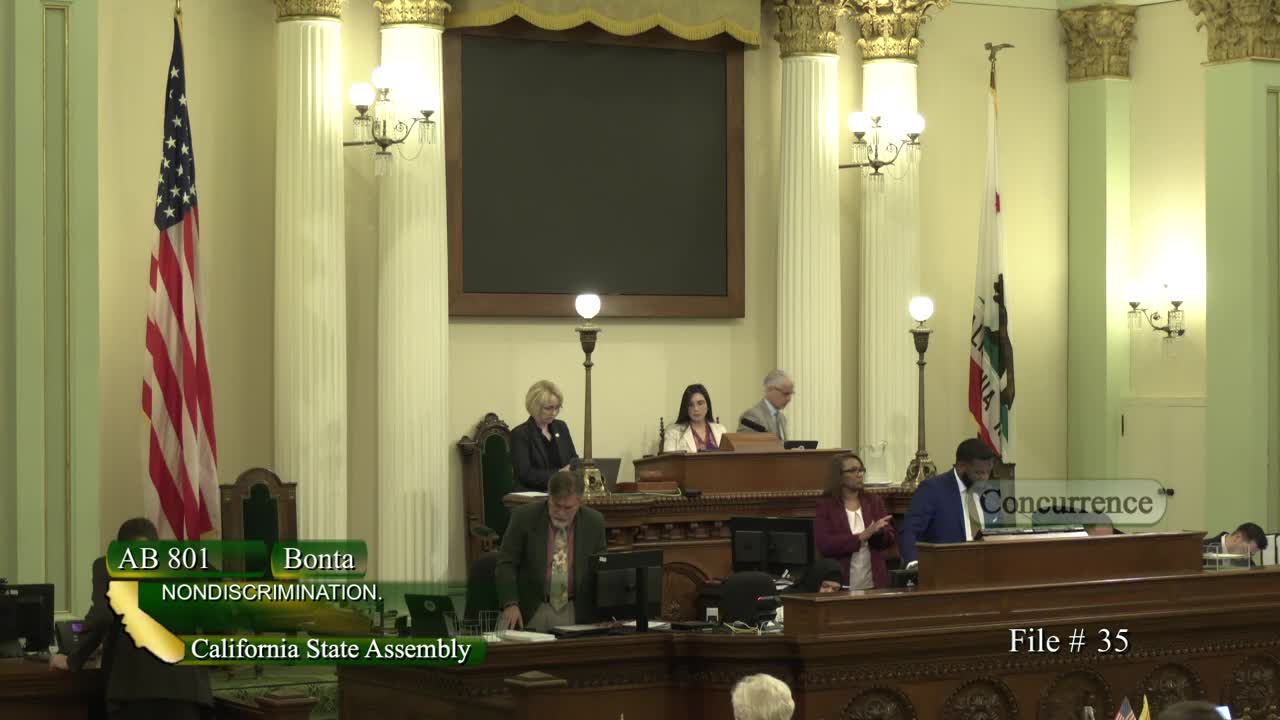 4MIN
Assembly Floor
 2MIN
Senate Floor
 9MIN
Senate Standing Committee on Judiciary
 16MIN
Senate Standing Committee on Banking and Financial Institutions
 2MIN
Assembly Floor
 37MIN
Assembly Standing Committee on Banking and Finance
Bill Author