AB 844: Educational equity: sex-segregated school and athletic programs and activities: use of facilities.
- Session Year: 2025-2026
- House: Assembly
- Latest Version Date: 2025-02-19
Current Status:
Failed
(2025-05-05: From committee: Without further action pursuant to Joint Rule 62(a).)
Introduced
In Committee
Awaiting First Chamber Vote
Passed First Chamber
In Committee
Awaiting Second Chamber Vote
Passed Second Chamber
Enacted
(1)Existing law requires that a pupil be permitted to participate in sex-segregated school programs and activities, including athletic teams and competitions, and use facilities consistent with the pupils gender identity, irrespective of the gender listed on the pupils records.
This bill would require that a pupils participation in sex-segregated school programs and activities, including athletic teams and competitions, and use of facilities, including bathrooms, locker rooms, showers, and overnight accommodations instead be based upon the pupils sex, as defined.
(2)The Donahoe Higher Education Act sets forth, among other things, the missions and functions of Californias public and independent segments of higher education and their respective institutions of higher education. A provision of the act applies to the University of California only to the extent that the Regents of the University of California, by appropriate resolution, act to make the provision applicable.
A portion of the Donahoe Higher Education Act, known as the Equity in Higher Education Act, provides, among other things, that all students have the right to participate fully in the educational process, free from discrimination and harassment, and that Californias postsecondary educational institutions have an affirmative obligation to combat racism, sexism, and other forms of bias, and a responsibility to provide equal educational opportunity.
This bill, notwithstanding any other law, would require that a students participation in sex-segregated athletic programs and activities and use of facilities, including bathrooms, locker rooms, showers, overnight accommodations, and student housing at a postsecondary institution be based upon the students sex.
(a)It is the policy of the this state that elementary and secondary school classes and courses, including nonacademic and elective classes and courses, be conducted, conducted without regard to the sex of the pupil enrolled in these classes and courses.
(b)A school district shall not prohibit a pupil from enrolling in any a class or course on the basis of the sex of the pupil, except a class subject to Chapter 5.6 (commencing with Section 51930) of Part 28 of Division 4 of Title 2.
(c)A school district shall not require a pupil of one sex to enroll in a particular class or course, course unless the same class or course is also required of a pupil of the opposite sex.
(d)A school counselor, teacher, instructor, administrator, or aide shall not, on the basis of the sex of a pupil, offer vocational or school program guidance to a pupil of one sex that is different from that offered to a pupil of the opposite sex or, in counseling a pupil, differentiate career, vocational, or higher education opportunities on the basis of the sex of the pupil counseled. Any school personnel acting in a career counseling or course selection capacity to a pupil shall affirmatively explore with the pupil the possibility of careers, or courses leading to careers, that are nontraditional for that pupils sex. The parents parent or legal guardian of the pupil shall be notified in a general manner at least once in the manner prescribed by Section 48980, in advance of career counseling and course selection selection, commencing with course selection for grade 7 7, so that they the parent or legal guardian may participate in the counseling sessions and decisions.
(e)Participation in a particular physical education activity or sport, if required of pupils of one sex, shall be available to pupils of each sex.
(f)(1)A pupil shall be permitted to participate pupils participation in sex-segregated school programs and activities, including athletic teams and competitions, and use facilities consistent with his or her gender identity, irrespective of the gender listed on the pupils records. of facilities, including bathrooms, locker rooms, showers, and overnight accommodations, shall be based upon the pupils sex.
(2)This section shall not prohibit a pupil whose identity does not align with the pupils sex from participating in sex-segregated school programs and activities, including athletic teams and competitions, and using facilities, including bathrooms, locker rooms, showers, and overnight accommodations, that is based upon the pupils sex.
(g)For purposes of this section, the following definitions apply:
(1)Female means a person whose reproductive system, as determined by anatomy and genetics at the time of birth, naturally has, had, will, will have, or would have, but for a congenital anomaly or intentional or unintentional disruption, produced eggs, whether or not eggs are produced.
(2)Male means a person whose reproductive system, as determined by anatomy and genetics at the time of birth, naturally has, had, will, will have, or would have, but for a congenital anomaly or intentional or unintentional disruption, produced sperm, whether or not sperm is produced.
(3)Sex means male or female.
SEC. 2.Section 66271.85 is added to the Education Code, immediately following Section 66271.8, to read:66271.85.(a)It is the intent of the Legislature that this section shall maintain fairness among athletes, protect equal opportunities for athletes of both sexes, and protect the dignity, privacy, and safety of students.
(b)Notwithstanding any other law, including Section 67400, a students participation in sex-segregated athletic programs and activities and use of facilities, including bathrooms, locker rooms, showers, overnight accommodations, and student housing at a postsecondary institution shall be based upon the students sex.
(c)For purposes of this section, the following definitions apply:
(1)Postsecondary institution means a campus of the University of California, the California State University, or the California Community Colleges, a private postsecondary educational institution, or an independent institution of higher education that receives state financial assistance.
(2)Sex has the same meaning as defined in Section 221.5.
|
Date
|
Status
|
|---|---|
| May 5, 2025 | From committee: Without further action pursuant to Joint Rule 62(a). |
| Apr 1, 2025 | In committee: Set, first hearing. Failed passage. |
| Mar 17, 2025 | Referred to Coms. on A.,E.,S., & T., ED. and Higher ED. |
| Feb 20, 2025 | From printer. May be heard in committee March 22. |
| Feb 19, 2025 | Read first time. To print. |
|
Date
|
Description
|
Location
|
Votes
|
|
|---|---|---|---|---|
| Apr 1, 2025 | Do pass and be re-referred to the Committee on [Education] | Assembly Standing Committee on Arts, Entertainment, Sports, and Tourism |
Failed |
This list shows positions taken on this bill by organizations on the date displayed, which is linked to the original source.
Positions by individuals are not included.
|
Organization
|
Position
|
Date
|
|---|---|---|
| Aclu California Action | ** Against | |
| Alliance San Diego | ** Against | |
| API Equality-Los Angeles | ** Against | |
| Asian Americans Advancing Justice Southern California | ** Against | |
| California Baptist for Biblical Values | ** Support | |
| California Family Council | ** Support | |
| California Federation Of Republican Women | ** Support | |
| California Legislative LGBTQ Caucus | ** Against | |
| California LGBTQ Health and Human Services Network | ** Against | |
| California School Employees Association | ** Against | |
| Calpride Valle Central | ** Against | |
| CFT- a Union of Educators & Classified Professionals, Aft, Afl-cio | ** Against | |
| Concerned Women for America | ** Support | |
| Courage California | ** Against | |
| El/La Para TransLatinas | ** Against | |
| Equality California | ** Against | |
| GRACE Institute - End Child Poverty in California | ** Against | |
| Interfaithstatewide Coalition | ** Support | |
| Larkin Street Youth Services | ** Against | |
| latino equality alliance | ** Against | |
| Let's Kick Ass Palm Springs | ** Against | |
| Los Angeles LGBT Center | ** Against | |
| Mexican-American Legal Defense and Ed Fund | ** Against | |
| Oasis Legal Services | ** Against | |
| Office of Lieutenant Governor Eleni Kounalakis | ** Against | |
| Orange County Equality Coalition | ** Against | |
| Perk Advocacy | ** Support | |
| Pride At the Pier | ** Against | |
| Public Counsel | ** Against | |
| Sacramento LGBT Community Center | ** Against | |
| San Francisco Aids Foundation | ** Against | |
| the san diego lgbt community center | ** Against | |
| West Hollywood/hernan Molina, Governmental Affairs Liaison | ** Against | |
| Women’s Liberation Front | ** Support |
Date of Hearing:
ASSEMBLY COMMITTEE ON ARTS, ENTERTAINMENT, SPORTS, AND TOURISM
Christopher M. Ward, Chair
ABPCA Bill Id:AB 844 (
Author:Essayli) – As Introduced Ver:February 19, 2025
SUBJECT: Educational equity: sex-segregated school and athletic programs and activities: use of facilities
SUMMARY: This bill would require participation in sex-segregated school programs and activities, including athletic teams and competitions, and access to school facilities, at elementary, secondary, and postsecondary institutions, be determined their anatomy and genetics at the time of birth.
Specifically, this bill:
- Requires elementary and secondary schools to base participation in sex-segregated school programs and activities, including athletic teams and competitions, and use of facilities, including bathrooms, locker rooms, showers, and overnight accommodations, on the sex of pupils.
- Requires postsecondary institutions to base a student’s participation in sex-segregated athletic programs and activities, and the use of facilities, including bathrooms, locker rooms, showers, overnight accommodations, and student housing, on the sex of students.
- Defines “sex” to mean male or female.
- Defines “female” to mean a person whose reproductive system, as determined by anatomy and genetics at the time of birth, naturally has, had, will, will have, or would have, but for a congenital anomaly or intentional or unintentional disruption, produced eggs, whether or not eggs are produced.
- Defines “male” to mean a person whose reproductive system, as determined by anatomy and genetics at the time of birth, naturally has, had, will, will have, or would have, but for a congenital anomaly or intentional or unintentional disruption, produced sperm, whether or not sperm is produced.
- Defines “Postsecondary institution” to mean a campus of the University of California, the California State University, or the California Community Colleges, a private postsecondary educational institution, or an independent institution of higher education that receives state financial assistance.
EXISTING LAW:
- Permits pupils to participate in sex-segregated school programs and activities, including athletic teams and competitions, and use facilities consistent with his or her gender identity, irrespective of the gender listed on the pupil’s records. (Education Code (EDC) Section 221.5 (f))
- States that no person shall be subjected to discrimination on the basis of disability, gender, gender identity, gender expression, nationality, race or ethnicity, religion, sexual orientation, or any other characteristic that is contained in the definition of hate crimes set forth in Section 422.55 of the Penal Code, including immigration status, in any program or activity conducted by an educational institution that receives, or benefits from, state financial assistance, or enrolls pupils who receive state student financial aid. (EDC 220 and 66270)
- Defines “Gender” to mean sex, and includes a person’s gender identity and gender expression. “Gender expression” means a person’s gender-related appearance and behavior whether or not stereotypically associated with the person’s assigned sex at birth. (EDC 210.7 and 66260.7)
- Provides that an educational institution is not prohibited from maintaining separate toilet facilities, locker rooms, or living facilities for the different sexes so long as comparable facilities are provided. (EDC 231)
- Provides, under the Sex Equity in Education Act, that pupils have the right to fair and equitable treatment and not be discriminated against based on sex, have the right to be provided with an equitable opportunity to participate in all academic extracurricular activities including athletics, have the right to receive equitable treatment and benefits including provisions for locker rooms, and have the right to contact the California Department of Education (CDE) and California Interscholastic Federation (CIF) to access information on gender equity laws. (EDC 221.8)
- Establishes CIF as a voluntary organization that consists of school and school-related personnel with responsibility for administering interscholastic athletic activities in secondary schools. (EDC 33353 (a))
- Requires CIF to report to the appropriate policy committees of the Legislature and the Governor on its evaluation and accountability activities, on or before January 1, 2023, and on or before January 1 every seven years thereafter. One section of the report is required to include CIF’s goals and objectives with regard to, and the status of, gender equity in interscholastic athletics, including, but not limited to, the number of male and female pupils participating in interscholastic athletics in secondary schools, and action taken by CIF in order to ensure compliance with Title IX of the federal Education Amendments of 1972 (20 U.S.C. Sec. 1681 et seq.). (EDC 33353)
FISCAL EFFECT: None. This measure is keyed non-fiscal by the Legislative Counsel.
COMMENTS:
- Author’s statement. According to the author, “AB 844 is about restoring common sense, fairness, and safety in our schools. California’s current policy allowing biological males to compete in girls’ sports and access female locker rooms is not only unfair—it’s dangerous. It violates the privacy of our students, robs female athletes of their hard-earned opportunities, and undermines the very intent of Title IX. AB 844 ensures that participation in school athletics and use of school facilities will be determined by biological sex rather than gender identity. Simply put, if a school program is sex-segregated, then participation must be based on biological sex. This is what parents expect, what students deserve, and what fairness demands.”
- Background. Title IX is a federal civil rights law passed as part of the Education Amendments of 1972. It prohibits sex-based discrimination in any educational program or activity that receives federal funding. The law applies to schools, colleges, and universities, ensuring equal opportunities in academics, athletics, and other aspects of education. Title IX had a transformative impact on girls' sports. Before Title IX, girls had limited opportunities to participate in organized sports, and funding for girls' sports programs was almost nonexistent.
Title IX led to a surge in female participation in sports. High school girls went from comprising about 7% of all athletes in 1972 to nearly 43% by the 2010s, with millions of girls now competing annually.
In 2013, California passed AB 1266, the School Success and Opportunity Act, which requires local school districts to allow transgender students to full participate in school activities and programs consistent with their gender identity. Since then, local school districts throughout the state have implemented policies to allow students to compete consistent with state law.
Examination of the Education Code suggests the section of code in which students are allowed to participate in school programs and activities based on their gender identity resides in the General Provisions a section of the Education Code which can pertain to both K-12 or/and postsecondary education. Further, in recent years, Title IX protections have been extended to include transgender students, meaning colleges cannot exclude transgender athletes from competing according to their gender identity.
On May 15, 2020, the Department of Education issued a letter stating that the policy of the state of Connecticut, which allows transgender girls to compete in high school sports as girls, was a violation of the civil rights of female student-athletes and of Title IX. It stated that Connecticut's policy "denied female student-athletes athletic benefits and opportunities, including advancing to the finals in events, higher-level competitions, awards, medals, recognition, and the possibility of greater visibility to colleges and other benefits."
On March 8, 2021, President Joe Biden issued Executive Order 14021 entitled "Guaranteeing an Educational Environment Free From Discrimination on the Basis of Sex, Including Sexual Orientation or Gender Identity.” This executive order reversed changes made by the first Trump administration to limit the scope of Title IX to sex only, excluding gender identity and sexual orientation.
In 2024, the U.S. Department of Education issued a new regulation for how K-12 schools, colleges, and universities should enforce Title IX. Twenty-six states filed lawsuits against the U.S. Department of Education alleging the proposed regulations violated the United States Constitution and the traditional interpretation of Title IX. Each state was granted a partial injunction stating that the states enjoined were not required to implement the regulations as issued by the U.S. Department of Education.
On April 29, 2024, the Department of Education finalized regulations regarding Title IX, which took effect on August 1, 2024, addressing sexual harassment and assault allegations in educational institutions. The regulations expanded the definition of sex-based harassment to include sexual orientation, gender identity, sex stereotypes, and pregnancy. At the time the regulations were finalized and implemented, 26 states had received partial injunctions stating Title IX in those states would be enforced by the 2020 regulations.
On January 9, 2025, U.S. District court judge Danny C. Reeves vacated the Biden administration's expanded protections for the entire United States in response to the lawsuit filed by the states of Tennessee, Kentucky, Indiana, Ohio, Virginia, and West Virginia.
- Federal Government Policies. As mentioned above, the U.S. District Court for the Eastern District of Kentucky vacated the U.S. Department of Education’s 2024 Title IX Final Rule. The court found that the 2024 Title IX Final Rule violated the First Amendment and the Spending Clause of the United States Constitution, and it exceeded the U.S. Department of Education’s authority under Title IX of the Education Amendments of 1972, which traditionally prohibited only discrimination based on sex as male or female, not gender identity. The court also determined the rule was vague, overbroad, and arbitrary.
The decision concluded that while the plaintiff states and their schools, colleges, and universities were not required to comply with the 2024 Title IX Final Rule to receive federal funding, they potentially “could violate Title IX in ways unrelated to the Final Rule, which might render them ineligible for federal funding.” The 2020 Title IX Rule remains in place for federal enforcement and investigations by the U.S. Department of Education.
While the Title IX 2024 regulations have been vacated, case law has upheld the participation of transgender student-athletes in sports. In April 2024, the Fourth Circuit Court of Appeals blocked a West Virginia law banning transgender student-athletes from playing on teams consistent with their gender identity. The Circuit Court found the law violated the rights of transgender students under Title IX. In determining if the law was in violation of Title IX, the court used the 2020 Title IX regulations. The case has been appealed to the United States Supreme Court.[1]
On February 05, 2025, the President of the United States issued an executive order stating as for purpose of enforcing Title IX, the Secretary of Education is to define sex pursuant to the biological definitions provided in an Executive order issued on January 20, 2025. After the February executive order, the U.S. Department of Education Office for Civil Rights issued a “Dear Colleague” letter stating, the 2020 Title IX regulations would be enforced with the definition of sex being the biological definition as provided by the executive order.
Since the executive order, the Maine Department of Education was found to have violated Title IX by the Office for Civil Rights because the department permits biological males to participate in female sports. [2]
On February 5, 2025, President Donald Trump issued an Executive Order aiming to ban individuals assigned male at birth from participating in female sports. While the president has authority to issue executive orders, executive orders do not have the binding enforcement of law and District Federal Courts have already concluded that, when state law and federal regulations do not align, state law has precedence. California has explicit statute governing antidiscrimination protections for schools, including state law allowing students to participate in sports and activities based on their gender identity.
- The National Collegiate Athletic Association (NCAA). On February 6, 2025, the NCAA announced the Board of Governors voted to update the Association's participation policy for transgender student-athletes following the Trump administration's executive order. The new policy creates a bifurcated system where different policies apply to male and female NCAA teams. Specifically:
- For Male NCAA Teams – Regardless of sex assigned at birth or gender identity, a student athlete may participate, practice and compete, with a men’s team.
- For Female NCAA Teams – A student athlete who was assigned male at birth may not compete on a women’s team, but is eligible to practice on the team consistent with their gender identity. Only women assigned female at birth may compete on a women’s team.[3]
This policy is effective immediately and applies to all student-athletes regardless of previous eligibility reviews under the NCAA's prior transgender participation policy.
According to NCAA President, Charlie Baker, "The NCAA is an organization made up of 1,100 colleges and universities in all 50 states that collectively enroll more than 530,000 student-athletes. We strongly believe that clear, consistent, and uniform eligibility standards would best serve today's student-athletes instead of a patchwork of conflicting state laws and court decisions. To that end, President Trump's order provides a clear, national standard."
In a 2024 statement, Baker said he knew of only 10 transgender athletes in the NCAA nationwide. In California, there is only 1 known allegation of a transgender athlete.
- Prior NCAA transgender policies. In 2011, the NCAA added policies that would allow transgender individuals to compete at the collegiate level. Transgender women were eligible one year of testosterone suppression treatment, while transgender men could compete on men's teams but were required to undergo medical treatment with testosterone for gender transition.
In January 2022, the NCAA updated its transgender student-athlete participation policy to a sport-by-sport approach, aligning with the practices of national and international governing bodies. Under this policy, each sport's national governing body established specific eligibility criteria for transgender athletes. If a sport lacked a national governing body, the NCAA deferred to the policies of the sport's international federation or the International Olympic Committee's (IOC) 2015 guidelines. For example, in women's swimming and diving, the NCAA initially followed the IOC's 2015 guidelines, which required transgender women to maintain testosterone levels below 10 nanomoles per liter for at least 12 months before competition.
The prior adaptive approach was subject to change as guidelines provided by governing bodies evolved and were updated, and aimed to create a balance with inclusivity, fairness, and safety.
- California Interscholastic Federation. The CIF was organized at a high school athletic convention on March 28, 1914, as a voluntary association of schools. Since 1914, the California Department of Education (CDE) has allowed the CIF to regulate interscholastic athletics, and the CIF has been the rule-making body for all of California's K-12 athletics programs since 1917. In 1981, that rule-making authority was expanded to include control over all interscholastic athletics, replacing the CDE in that role.
The Federation consists of ten regional sections, each of which is divided into several “leagues,” for purposes of scheduling athletic contests, and assigning referees. Similar organizations exist in other states. Almost all public, private and parochial schools in California are CIF members.
The primary responsibilities of the CIF are to administer high school athletic programs and to promulgate and enforce rules relating to a student’s involvement in athletics – age, semesters in school, scholarship, residence, transfer status, and amateur standing. Such regulations, which are generated by the 1,609 member base of secondary schools, prevent undesirable exploitation of high school students, provide for the welfare of participants, and ensure that interscholastic athletics offer major benefits to students in a safe, rewarding environment.
After President Donald Trump issued an executive order banning transgender women and girls from college women’s and high school girls’ sports teams, CIF released a statement saying that they would continue to follow California law, which allows athletes to play on a sports team consistent with their gender identity:
“The CIF provides students with the opportunity to belong, connect, and compete in education-based experiences in compliance with California law [Education Code section 221.5. (f)] which permits students to participate in school programs and activities, including athletic teams and competitions, consistent with the student’s gender identity, irrespective of the gender listed on the student’s records.”
The CIF often requires medical clearances and adheres to specific guidelines to ensure student-athletes’ health and safety. Participation in competitive athletic activities and contact sports are addressed on a case-by-case basis. Eligibility criteria may vary depending on various factors, such as hormone levels, medical documentation, and, as aforementioned, a case-by-case review. The CIF Bylaw 300.D. that addresses Gender Identity Participation was approved by the CIF membership in 2013. The policy focuses on allowing students to compete based on their gender identity, with certain guidelines such as regarding hormone levels for transgender female athletes.
- California’s Anti-Discrimination Statute. Under California law, schools are prohibited from discriminating on the basis of several protected characteristics, including sex, sexual orientation, and gender identity. Regarding equal access to school activities and programs, California is one of 24 states that allows students to participate in school activities and programs based on their gender identity.
Exclusion from athletics could also result in discrimination or harassment of the population that is being banned. A recent study using Youth Risk Behavior Surveillance System data found that transgender high school students report disproportionate bullying, persistent hopelessness, and suicidal ideation compared to cisgender students. Such disparities can worsen should transgender students be denied participation in school activities and programs due to their gender identity or be forced to participate in school activities in programs consistent with their sex assigned at birth, regardless of their gender identity.
- Impact of Policies Restricting the Rights of Transgender Students. According to the Trevor Project’s most recent survey of youth mental health, nearly 1 in 3 LGBTQ+ young people reported that their mental health was poor most of the time or always due to laws or policies negatively targeting LGBTQ+ individuals. Studies have shown that participating in athletics and school programs lead to better outcomes in academics and mental health. Participation in sports has been correlated with higher levels of self-esteem, lower levels of depression, and greater school belonging. A study found that transgender students who participated in sports reported higher grades compared to those transgender students who did not participate.
When transgender youth have been banned from participating in athletics and programs, reports yield that the transgender student’s mental health worsens and their risk of adverse outcomes worsen. When transgender youth are not allowed to participate in athletics and other programs, they not only face isolation from their peers, but also report bullying and rejection, in addition to concerns of discrimination based on their gender identity.
- Threats to Safety and Well-Being of Student Athletes. Policies banning transgender individuals from participating in sports not only harm transgender athletes – noted by reports of being doxed, cyberbullied, and on the receiving end of threats – but such sports bans also harm cisgender individuals – or, individuals whose gender identity aligns with the sex they were assigned at birth. For instance, a Utah state school board member falsely stated a girl playing on a high school basketball team was transgender. The post by the Utah official suggested that the high school athlete was transgender due to having a larger physical build, among other terms known colloquially as slurs against transgender individuals. The family of the young girl who was targeted reported that their child became the target of threats and harassment, including by adults.
Another such notable instance includes the international allegations when long-time Algerian women’s boxer Imane Khelif participated in the 2024 Paris Summer Olympics. Globally, she was labeled as a transgender woman – those alleging so due to Khelif’s body, mannerisms, identity, and athleticism. These allegations were harmful not only because of the harassment and threats Khelif received, but also because LGBTQ+ identities and acts are prohibited by law in her home country of Algeria.
- Uncertain Enforceability. Policies banning transgender individuals from participating in sports lack guidance on how such policies will be enforced. Methods in which governing bodies have enforced gender verifications include sex testing and inspections of the individual’s body. In 2020, for instance, Idaho became the first state to pass a law prohibiting transgender women and girls from playing on female-designated sports teams. Idaho mandated that a student whose sex was in dispute would have to undergo genital checks and chromosomal testing. The law has since been blocked by the 9th U.S. Circuit Court of Appeals. Recently, Texas is actively suing the NCAA to require the testing of NCAA athletes’ sex, such tests including examinations of their genital or the requirement that athletes alleged to be transgender must submit to chromosomal testing. Such testing would be required of anyone who is alleged to be transgender, regardless of whether or not the individual identifies as transgender.
- Arguments in support. According to the Interfaith Statewide Coalition, “Over 70% of California School Districts are declining enrollment because parents of diverse faiths do not want their children being taught that gender can change like the weather based on their feelings and that there are infinite pronouns to choose from. These radical gender ideologies, which betray the trust of taxpayers funding public education, are reflective in district policies that affirm gender fluidity and deny protective boundaries between biological males and females in sports and private spaces.”
- Arguments in opposition. According to Equality California, “AB 844 would require that K-12 and postsecondary students’ participation in sex-segregated activities and programs, including sports, and utilization of sex-segregated facilities be based on students’ assigned sex at birth. The bill would discriminate against transgender individuals and prohibit them from playing school sports—even if they have been living consistent with their gender identity, and receiving treatment for gender dysphoria, for years. The bill would also invite scrutiny and harassment of any student perceived as not conforming to sex stereotypes, and violate student privacy by requiring students to answer invasive personal questions if they want to play sports or even to use the bathroom. AB 844 would subject both cisgender and transgender students to needless interrogation and humiliation.”
- Triple-referral. If the bill is passed from this committee, it will be re-referred to the Assembly Committee on Education. It is also referred to the Assembly Committee on Higher Education.
- Policy considerations. Gender segregation in sports is mainly based on concerns about unfair physical advantages between the sexes. A disproportionate amount of political and media focus has been put on perceived competitive advantages that transgender women or girls have when competing on women’s or girls’ teams. These issues are based on beliefs that transgender girls and women should not be considered girls or women in the context of deserving of an equal competitive opportunity. Claims have been asserted that being born with a male body automatically gives a transgender girl or woman an unfair advantage when competing against non-transgender girls and women. There are also unfounded fears that current policies allow boys or men to pretend to be transgender in order to compete with girls or women.
Concerns that transgender women have an unfair advantage over non-transgender women is based on the belief that transgender girls or women who have gone through male puberty may have an unfair advantage due to size, muscle mass, and strength that is triggered by testosterone. It is worth note there has been a growing number of transgender youth that have undergone medically guided hormonal treatment prior to puberty. Transgender girls who transition in this way do not go through a male puberty, and therefore it is argued that their participation in athletics as girls does not raise the same equity concerns. Transgender girls who do not access hormone blockers or cross-gender hormones still display a great deal of physical variation. It is inaccurate to assume that all male-bodied people are taller, stronger, and more highly skilled in a sport than all female-bodied people.
A 2023 study by the Centers for Disease Control and Prevention, found that just 3% of high school students identify as transgender nationally. There is very little evidence to suggest that transgender female athletes are dominating high school sports. The portrayal of transgender athletes in the media can affect public perceptions by emphasizing extreme cases or focusing on controversial incidents. For instance, stories about high-profile transgender female athletes winning competitions draw significant attention, while the experiences of the majority of transgender athletes who do not compete at elite levels often goes unnoticed.
Transgender people comprise 1.6% of the human population. Of that fraction, even less play sports. Only 34 trans-athletes have openly competed in U.S. college sports across various divisions and across the nation, with even fewer making it to the professional level.
In contrast, supporters of inclusion focus on the benefits to the psychological well-being of trans-female athletes, which they believe take precedence over concerns about potential physical advantages. In their view, the opportunity for trans-females to participate in sports is crucial for their mental health and sense of belonging. Denying them the opportunity could have damaging consequences, both socially and psychologically. Additionally, ban on transgender females could harm cisgender females as well, as it creates a pathway for gender policing that could subject any woman to invasive tests or accusations of being “too masculine” or “too good” at their sport to be a “real” woman.
It is unclear based on the language contained in this bill, how a restriction on transgender female participation on girls’ high school sports teams would be enforced. A transgender person can obtain a new birth certificate with a corrected gender marker by submitting a request to the California Department of Public Health (CDPH). A court order is not required to change the gender marker. For a minor under 18, a parent or legal guardian must submit the request on their behalf.
The NCAA policy has colleges and universities determine the sex of an athlete with athletes “sex assigned at birth;” which the NCAA has defined as “the male or female designation doctors assign to infants at birth, which is marked on their birth records.” Birth records are a birth certificate and therefore, it is unclear how California colleges and universities will determine the sex of an individual if a transgender person can obtain a new birth certificate which is different from the sex assigned by a doctor at birth.
Furthermore, the measure impacts more than high school and collegiate athletic teams. The measure also requires the use of facilities (including restrooms) to be based on a students or pupil’s biological sex. The measure does not include a procedure or method for how the “pupil’s or student’s sex” will be determined for the use of bathrooms, locker rooms, showers, overnight accommodations, or student housing.
In California, student-athletes are generally required to undergo a pre-participation physical examination (PPE) before participating in high school sports. CIF mandates that students complete the PPE, conducted by a licensed medical professional, which focuses on assessing a student's overall health, cardiovascular fitness, joint stability, and medical history to ensure they are safe to participate in athletics. Schools typically provide specific forms that must be completed and submitted before a student can join a team.
Genital inspections are not required during the PPE. While some exams may include a brief hernia check (which involves palpation of the lower abdomen and groin area), this is not always required and varies based on a healthcare provider’s discretion. If there are concerns about privacy or discomfort, students and their families can discuss alternative evaluation methods with their doctor. Schools and organizations cannot mandate genital inspections as part of sports eligibility.
Moving forward, the author may wish to provide an explicit method for how a pupil’s or student’s sex will be determined by K-12 schools, colleges, and universities in the State of California. Further, AB 844 is also silent on the process for intersex students’ participation in programs and activities, as well as access to facilities, creating further ambiguity in California statute.
- Prior and related legislation.
- AB 89 (Sanchez), of 2025, would require CIF to amend its constitution, bylaws, and policies, to prohibit a pupil whose sex was assigned male at birth from participating on a girls’ interscholastic sports team, notwithstanding any other law. The bill is currently in the Assembly’s Committee on Arts, Entertainment, Sports, and Tourism.
- AB 3067 (Gipson), of 2024, would have required CIF and its sections to post on their respective websites information about sanctions imposed on a member school or on an interscholastic team of a member school. The bill was held in the Senate on third reading.
- AB 1327 (Weber), Chapter 366, Statutes of 2023, requires CDE to develop a standardized incident form to track racial discrimination, harassment, or hazing that occurs at high school sporting games or sporting events, and annually report the information from completed incident forms as statewide totals on the department’s internet website. CIF is required to include this information in their report to the legislature on the health and safety of pupils, coaches, officials, and spectators.
- AB 1538 (Assembly Committee on Arts, Entertainment, Sports, Tourism, and Internet Media), Chapter 43, Statutes of 2015, moved language from a section entitled “Athletes’ Bill of Rights” to the Sex Equity in Education Act, which includes rights available to a pupil relating to gender equity in athletics.
- AB 1266 (Ammiano), Chapter 85, Statutes of 2013, require that a pupil be permitted to participate in sex-segregated school programs and activities, including athletic teams and competitions, and use facilities consistent with his or her gender identity, irrespective of the gender listed on the pupil’s records.
- AB 322 (Oropeza), Chapter 386, Statutes of 2005, enacted the Athletes' Bill of Rights which enumerates the rights available to a pupil relating to gender equity in athletics. The bill requires the State Department of Education to post the rights established by federal Title IX on its website.
- AB 499 (Kuehl), Chapter 914, Statutes of 1998, created the Sex Equity in Education Act, which consolidated and standardized the non-discrimination provisions of the Education Code into two chapters, one for K-12 and one for higher education.
REGISTERED SUPPORT / OPPOSITION:
Support
California Baptist for Biblical Values
California Family Council
California Federation of Republican Women
Concerned Women for America
Interfaith Statewide Coalition
Perk Advocacy
Women’s Liberation Front
Opposition
ACLU California Action
Alliance San Diego
API Equality- Los Angeles
Asian Americans Advancing Justice-Southern California
California Legislative LGBTQ Caucus
California LGBTQ Health and Human Services Network
California School Employees Association
Calpride Valle Central
CFT- a Union of Educators & Classified Professionals, AFT, AFL-CIO
Courage California
El/La Para Translatinas
Equality California
Grace Institute - End Child Poverty in California
Larkin Street Youth Services
Latino Equality Alliance
Let's Kick Ass (AIDS Survivor Syndrome) Palm Springs
Los Angeles LGBT Center
Mexican-American Legal Defense and Ed Fund [MALDEF]
Oasis Legal Services
Office of Lieutenant Governor Eleni Kounalakis
Orange County Equality Coalition
Pride at the Pier
Public Counsel
Sacramento LGBT Community Center
San Francisco AIDS Foundation
The San Diego LGBT Community Center
West Hollywood/Hernan Molina, Governmental Affairs Liaison
Analysis Prepared by: Brian V. Anderson, Jr. / A.,E.,S., & T. / (916) 319-3450
https://www.aclu.org/cases/bpj-v-west-virginia-state-board-education ↑
https://www.ed.gov/about/news/press-release/us-department-of-educations-office-civil-rights-concludes-maine-department-of-education-violating-title-ix ↑
https://www.ncaa.org/sports/2022/1/27/transgender-participation-policy.aspx ↑
Discussed in Hearing
 1H
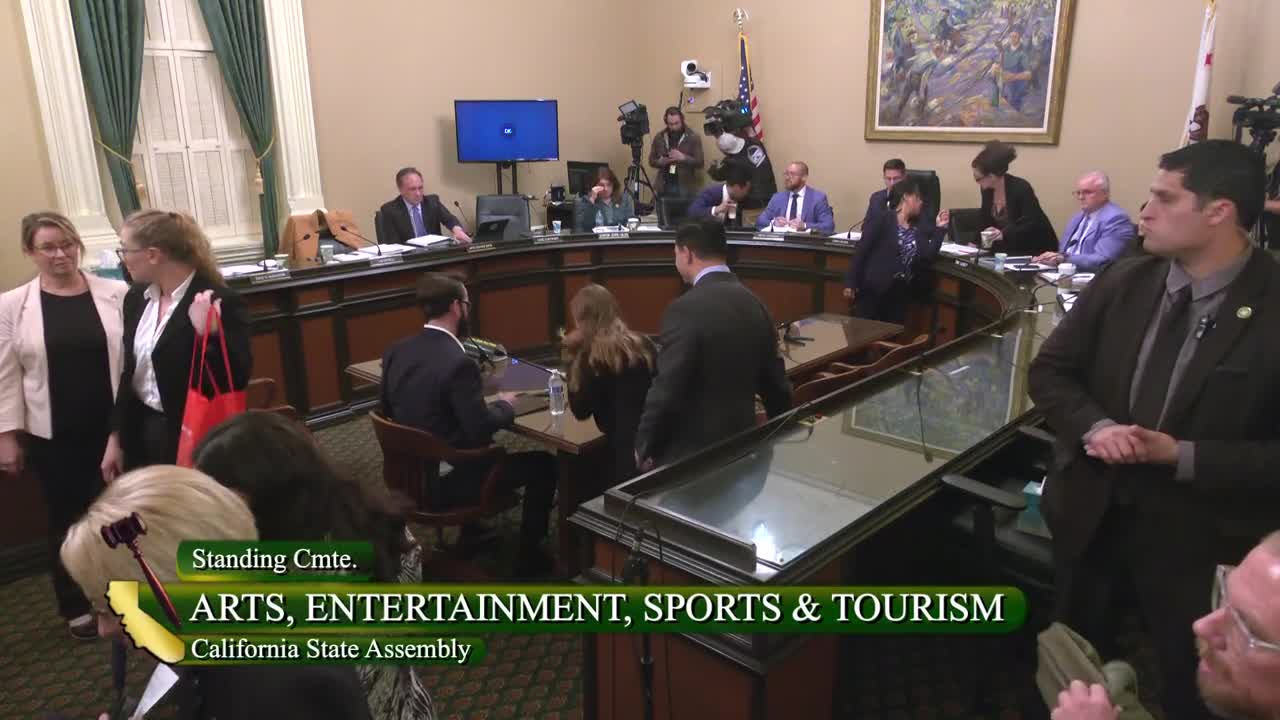
Assembly Standing Committee on Arts, Entertainment, Sports, and Tourism
Bill Author

Bill Co-Author(s):