AB 931: State Bar Act: consumer legal funding.
- Session Year: 2025-2026
- House: Assembly
- Latest Version Date: 2025-10-10
Current Status:
Passed
(2025-10-10: Chaptered by Secretary of State - Chapter 565, Statutes of 2025.)
Introduced
In Committee
Awaiting First Chamber Vote
Passed First Chamber
In Committee
Awaiting Second Chamber Vote
Passed Second Chamber
Enacted
What does this bill do?
The bill creates the California Consumer Legal Funding Act to regulate nonrecourse deals where a company buys a consumer’s right to settlement proceeds, requiring plain‑English written contracts that disclose the funded amount, one‑time charges, a repayment schedule, a five‑day cancel right, and capping charges to 36 months; it bars funders from paying referral fees to or steering clients to attorneys. It also bars attorneys from having financial interests in funding companies or giving anything of value for referrals and bans lawyers from sharing fees with out‑of‑state firms that allow nonlawyer ownership, with violations subject to State Bar discipline and damages.
The summary is provided by generative AI which can make mistakes. For original language, please view the details in the table below.
Existing law, the State Bar Act, provides for the licensure and regulation of attorneys by the State Bar of California, a public corporation. The act prohibits an attorney from accepting a client from a referral service, unless it is a certified lawyer referral service or specified conditions are met, and makes a violation of that prohibition subject to a civil penalty. The act additionally imposes various restrictions on contracts for legal services and specified fee agreements, including that the contract or agreement be in writing and that the basis of compensation is expressly included.
This bill, for purposes of the State Bar Act, would define consumer legal funding to mean a transaction in which a consumer legal funding company, as defined, purchases and a consumer assigns to the company a contingent right to receive an amount of the potential proceeds of a settlement, judgment, award, or verdict obtained in the consumers legal claim. The bill would require a consumer legal funding transaction to be in writing and contain specified provisions, including that the contract contain the amount to be paid to the consumer by the consumer legal funding company upon the completion of litigation and an itemization of any one-time charges. The bill would require, for a consumer legal funding contract negotiated in a language other than English, that the consumer receive a copy of the contract in both English and that language. The bill would prohibit those charges from exceeding 36 months from the funding date. The bill would prohibit a consumer legal funding company from paying commissions, referral fees, or other forms of consideration to an attorney or law firm, or their employees, for referring a consumer to the company, among other things, and would impose various penalties, including statutory damages, set as prescribed, for violation of those prohibitions. The bill would additionally state that the contingent right to receive an amount of the potential proceeds of a legal claim is assignable by a consumer.
This bill would prohibit an attorney from, among other things, promising or giving anything of value to a person for the purpose of recommending or securing the services of the attorney or the attorneys law firm, except as provided. The bill would additionally, until January 1, 2030, prohibit an attorney licensed or otherwise authorized to practice in the state from sharing legal fees directly or indirectly with an out-of-state entity that provides legal services while allowing nonlawyer ownership or decisionmaking authority, except as specified. The bill would specify that the above-described prohibition of the sharing of legal fees only applies to contracts entered into on or after January 1, 2026. The bill would make a violation of that prohibition of the sharing of legal fees cause for the imposition of discipline by the State Bar of California and would subject a violator to specified penalties.
Existing law, the State Bar Act, provides for the licensure and regulation of attorneys by the State Bar of California, a public corporation. The act prohibits an attorney from accepting a client from a referral service, unless it is a certified lawyer referral service or specified conditions are met, and makes a violation of that prohibition subject to a civil penalty. The act additionally imposes various restrictions on contracts for legal services and specified fee agreements, including that the contract or agreement be in writing and that the basis of compensation is expressly included.
This bill, for purposes of the State Bar Act, would define consumer legal funding to mean a transaction in which a consumer legal funding company, as defined, purchases and a consumer assigns to the company a contingent right to receive an amount of the potential proceeds of a settlement, judgment, award, or verdict obtained in the consumers legal claim. The bill would require a consumer legal funding transaction to be in writing and contain specified provisions, including that the contract contain the amount to be paid to the consumer by the consumer legal funding company upon the completion of litigation and an itemization of any one-time charges. The bill would require, for a consumer legal funding contract negotiated in a language other than English, that the consumer receive a copy of the contract in both English and that language. The bill would prohibit those charges from exceeding 36 months from the funding date. The bill would prohibit a consumer legal funding company from paying commissions, referral fees, or other forms of consideration to an attorney or law firm, or their employees, for referring a consumer to the company, among other things, and would impose various penalties, including statutory damages, set as prescribed, for violation of those prohibitions. The bill would additionally state that the contingent right to receive an amount of the potential proceeds of a legal claim is assignable by a consumer, and that only attorneys liens related to the legal claim take priority over a lien of the consumer legal funding company. consumer.
This bill would prohibit an attorney from, among other things, promising or giving anything of value to a person for the purpose of recommending or securing the services of the attorney or the attorneys law firm, except as provided. The bill would additionally additionally, until January 1, 2030, prohibit an attorney licensed or otherwise authorized to practice in the state from sharing legal fees directly or indirectly with an out-of-state entity that provides legal services while allowing nonlawyer ownership or decisionmaking authority, except as specified. The bill would make a violation of that prohibition of the sharing of legal fees cause for the imposition of discipline by the State Bar of California and would subject a violator to specified penalties.
Existing law, the State Bar Act, provides for the licensure and regulation of attorneys by the State Bar of California, a public corporation. The act prohibits an attorney from accepting a client from a referral service, unless it is a certified lawyer referral service or specified conditions are met, and makes a violation of that prohibition subject to a civil penalty. The act additionally imposes various restrictions on contracts for legal services and specified fee agreements, including that the contract or agreement be in writing and that the basis of compensation is expressly included.
This bill, for purposes of the State Bar Act, would define consumer legal funding to mean a transaction in which a consumer legal funding company, as defined, purchases and a consumer assigns to the company a contingent right to receive an amount of the potential proceeds of a settlement, judgment, award, or verdict obtained in the consumers legal claim. The bill would require a consumer legal funding transaction to be in writing and contain specified provisions, including that the contract contain the amount to be paid to the consumer by the consumer legal funding company upon the completion of litigation and an itemization of any one-time charges. The bill would require, for a consumer legal funding contract negotiated in a language other than English, that the consumer receive a copy of the contract in both English and that language. The bill would prohibit those charges from exceeding 36 months from the funding date. The bill would prohibit a consumer legal funding company from paying commissions, referral fees, or other forms of consideration to an attorney or law firm, or their employees, for referring a consumer to the company, among other things, and would impose various penalties, including statutory damages, set as prescribed, for violation of those prohibitions. The bill would additionally state that the contingent right to receive an amount of the potential proceeds of a legal claim is assignable by a consumer, and that only attorneys liens related to the legal claim take priority over a lien of the consumer legal funding company.
This bill would prohibit an attorney from, among other things, promising or giving anything of value to a person for the purpose of recommending or securing the services of the attorney or the attorneys law firm, except as provided. The bill would additionally prohibit an attorney licensed or otherwise authorized to practice in the state from sharing legal fees directly or indirectly with an out-of-state entity that provides legal services while allowing nonlawyer ownership or decisionmaking authority, except as specified. The bill would make a violation of that prohibition of the sharing of legal fees cause for the imposition of discipline by the State Bar of California and would subject a violator to specified penalties.
Existing law, the State Bar Act, provides for the licensure and regulation of attorneys by the State Bar of California, a public corporation. The act prohibits an attorney from accepting a client from a referral service, unless it is a certified lawyer referral service or specified conditions are met, and makes a violation of that prohibition subject to a civil penalty. The act additionally imposes various restrictions on contracts for legal services and specified fee agreements, including that the contract or agreement be in writing and that the basis of compensation is expressly included.
This bill, for purposes of the State Bar Act, would define consumer legal funding to mean a transaction in which a consumer legal funding company, as defined, purchases and a consumer assigns to the company a contingent right to receive an amount of the potential proceeds of a settlement, judgment, award, or verdict obtained in the consumers legal claim. The bill would require a consumer legal funding transaction to be in writing and contain specified provisions, including that the contract contain the amount to be paid to the consumer by the consumer legal funding company upon the completion of litigation and an itemization of any one-time charges. The bill would prohibit those charges from exceeding 36 months from the funding date. The bill would prohibit a consumer legal funding company from paying commissions, referral fees, or other forms of consideration to an attorney or law firm, or their employees, for referring a consumer to the company, among other things, and would impose various penalties, including statutory damages, set as prescribed, for violation of those prohibitions. The bill would additionally state that the contingent right to receive an amount of the potential proceeds of a legal claim is assignable by a consumer, and that only attorneys liens related to the legal claim take priority over a lien of the consumer legal funding company.
This bill would prohibit an attorney from, among other things, promising or giving anything of value to a person for the purpose of recommending or securing the services of the attorney or the attorneys law firm, except as provided. The bill would additionally prohibit an attorney licensed or otherwise authorized to practice in the state from sharing legal fees directly or indirectly with an out-of-state entity that provides legal services while allowing nonlawyer ownership, management, ownership or decisionmaking authority, except as specified. The bill would make a violation of that prohibition of the sharing of legal fees cause for the imposition of discipline by the State Bar of California and would subject a violator to specified penalties.
Existing law, the State Bar Act, provides for the licensure and regulation of attorneys by the State Bar of California, a public corporation. The act prohibits an attorney from accepting a client from a referral service, unless it is a certified lawyer referral service or specified conditions are met, and makes a violation of that prohibition subject to a civil penalty. The act additionally imposes various restrictions on contracts for legal services and specified fee agreements, including that the contract or agreement be in writing and that the basis of compensation is expressly included.
This bill, for purposes of the State Bar Act, would define consumer legal funding to mean a transaction in which a consumer legal funding company, as defined, purchases and a consumer assigns to the company a contingent right to receive an amount of the potential proceeds of a settlement, judgment, award, or verdict obtained in the consumers legal claim. The bill would require a consumer legal funding transaction to be in writing and contain specified provisions, including that the contract contain the amount to be paid to the consumer by the consumer legal funding company upon the completion of litigation and an itemization of any one-time charges. The bill would prohibit those charges from exceeding 36 months from the funding date. The bill would prohibit a consumer legal funding company from paying commissions, referral fees, or other forms of consideration to an attorney or law firm, or their employees, for referring a consumer to the company, among other things, and would impose various penalties, including statutory damages, set as prescribed, for violation of those prohibitions. The bill would additionally state that the contingent right to receive an amount of the potential proceeds of a legal claim is assignable by a consumer, and that only attorneys liens related to the legal claim take priority over a lien of the consumer legal funding company.
This bill would prohibit an attorney from, among other things, promising or giving anything of value to a person for the purpose of recommending or securing the services of the attorney or the attorneys law firm, except as provided. The bill would additionally prohibit an attorney or other legal entity in the state from directly or indirectly sharing legal fees licensed or otherwise authorized to practice in the state from sharing legal fees directly or indirectly with an out-of-state entity that provides legal services while allowing nonlawyer ownership, management, or decisionmaking authority. authority, except as specified.
Existing law, the State Bar Act, provides for the licensure and regulation of attorneys by the State Bar of California, a public corporation. The act prohibits an attorney from accepting a client from a referral service, unless it is a certified lawyer referral service or specified conditions are met, and makes a violation of that prohibition subject to a civil penalty. The act additionally imposes various restrictions on contracts for legal services and specified fee agreements, including that the contract or agreement be in writing and that the basis of compensation is expressly included.
This bill, for purposes of the State Bar Act, would define consumer legal funding to mean a transaction in which a consumer legal funding company, as defined, purchases and a consumer assigns to the company a contingent right to receive an amount of the potential proceeds of a settlement, judgment, award, or verdict obtained in the consumers legal claim. The bill would require a consumer legal funding transaction to be in writing and contain specified provisions, including that the contract contain the amount to be paid to the consumer by the consumer legal funding company upon the completion of litigation and an itemization of any one-time charges. The bill would prohibit a consumer legal funding company from paying commissions, referral fees, or other forms of consideration to an attorney or law firm, or their employees, for referring a consumer to the company, among other things, and would impose various penalties, including statutory damages, for violation of those prohibitions. The bill would additionally state that the contingent right to receive an amount of the potential proceeds of a legal claim is assignable by a consumer, and that only attorneys attorneys liens related to the legal claim take priority over a lien of the consumer legal funding company.
This bill would additionally prohibit an attorney or other legal entity in the state from directly or indirectly sharing legal fees with an out-of-state entity that provides legal services while allowing nonlawyer ownership, management, or decisionmaking authority.
Existing law, the State Bar Act, provides for the licensure and regulation of attorneys by the State Bar of California, a public corporation. The act prohibits an attorney from encouraging either the commencement or the continuance of an action or proceeding from any corrupt motive of passion or interest. accepting a client from a referral service, unless it is a certified lawyer referral service or specified conditions are met, and makes a violation of that prohibition subject to a civil penalty. The act additionally imposes various restrictions on contracts for legal services and specified fee agreements, including that the contract or agreement be in writing and that the basis of compensation is expressly included.
This bill, for purposes of the State Bar Act, would define consumer legal funding to mean a transaction in which a consumer legal funding company, as defined, purchases and a consumer assigns to the company a contingent right to receive an amount of the potential proceeds of a settlement, judgment, award, or verdict obtained in the consumers legal claim. The bill would require a consumer legal funding transaction to be in writing and contain specified provisions, including that the contract contain the amount to be paid to the consumer by the consumer legal funding company upon the completion of litigation and an itemization of any one-time charges. The bill would prohibit a consumer legal funding company from paying commissions, referral fees, or other forms of consideration to an attorney or law firm, or their employees, for referring a consumer to the company, among other things, and would impose various penalties, including statutory damages, for violation of those prohibitions. The bill would additionally state that the contingent right to receive an amount of the potential proceeds of a legal claim is assignable by a consumer, and that only attorneys liens related to the legal claim take priority over a lien of the consumer legal funding company.
This bill would additionally prohibit an attorney from encouraging either the commencement or the continuance of an action or proceeding from any discriminatory motive of passion or interest. or other legal entity in the state from directly or indirectly sharing legal fees with an out-of-state entity that provides legal services while allowing nonlawyer ownership, management, or decisionmaking authority.
Existing law, the State Bar Act, provides for the licensure and regulation of attorneys by the State Bar of California, a public corporation. The act prohibits an attorney from encouraging either the commencement or the continuance of an action or proceeding from any corrupt motive of passion or interest.
This bill would additionally prohibit an attorney from encouraging either the commencement or the continuance of an action or proceeding from any discriminatory motive of passion or interest.
(a)Any individual, partnership, association, corporation, or other entity, including, but not limited to, any person or entity having an ownership interest in a lawyer referral service, that engages, has engaged, or proposes to engage in violations of Section 6155, shall be liable for a civil penalty as defined in Sections 17206, 17206.1, and 17536, respectively, which shall be assessed and recovered in a civil action brought:
(1)In the manner specified in subdivision (a) of Section 17206 or Section 17536.
(2)By the State Bar of California.
(b)If the action is brought pursuant to subdivision (a), the court shall determine the reasonable expenses, if any, incurred by the State Bar in its investigation and prosecution of the action. In these cases, before any penalty collected is paid out pursuant to subdivision (b) of Section 17206 or Section 17536, the amount of the reasonable expenses incurred by the State Bar shall be paid to the State Bar and shall be deposited and used as provided in subdivision (c).
(c)If the action is brought pursuant to paragraph (2) of subdivision (a), the civil penalty shall be paid to the State Bar and shall be deposited into a special fund to be used first for the investigation and prosecution of other such cases by the State Bar, with any excess to be used for the investigation and prosecution of attorney discipline cases.
SEC. 2.Section 6156 is added to the Business and Professions Code, to read:6156.(a)No attorney licensed or otherwise authorized to practice in this state shall share legal fees directly or indirectly with an out-of-state alternative business structure unless all of the following apply:
(1)The attorney is also licensed in the state in which the alternative business structure is approved.
(2)The fees are compensation for the provision of legal services in that state.
(3)The law of that state is controlling pursuant to Rule 8.5 of the California Rules of Professional Conduct or any successor rule.
(b)A violation of this section shall constitute cause for the imposition of discipline by the State Bar of California and shall subject the attorney to the following penalties:
(1)Statutory damages of ten thousand dollars ($10,000) per violation or three times the actual damages incurred by the consumer, whichever is greater.
(2)Attorneys costs and fees.
(3)Injunctive or declaratory relief.
(c)(1)For the purposes of this section, alternative business structure means any entity that provides legal services while allowing nonattorney ownership or decisionmaking authority.
(2)For the purposes of this section, alternative business structure does not include nonprofit organizations.
(d)This section shall not apply to any arrangement for the sharing of legal fees if both of the following conditions are satisfied:
(1)The arrangement for the sharing of legal fees was ordered or approved by a court or tribunal of competent jurisdiction, including, but not limited to, the establishment or distribution of a common benefit fund in coordinated, consolidated, or multidistrict litigation.
(2)The manner in which the legal fees are to be allocated is subject to judicial or tribunal oversight and determined to be fair, reasonable, and necessary for the administration of justice.
(e)This section shall not apply to a contract in which all of the following are satisfied:
(1)The contract outlines a specific dollar amount for services rendered.
(2)No payment is related to the referral of legal services or purchase of a lead for a potential client or case.
(3)No payment is contingent on the amount recovered in a specific case.
(f)Nothing in this section shall be construed as superseding the holding in Ridgley v. Lew 55 F. Supp. 3d 89 (2014).
(g)This section shall only apply to contracts entered into on or after January 1, 2026.
(h)This section shall remain in effect only until January 1, 2030, and as of that date is repealed.
SEC. 3.Article 17 (commencing with Section 6250) is added to Chapter 4 of Division 3 of the Business and Professions Code, to read:17.The California Consumer Legal Funding Act6250.(a)Charges means the amount of money to be paid to the consumer legal funding company by or on behalf of the consumer, above the funded amount provided by or on behalf of the company to a California consumer pursuant to this article. Charges include all administrative, origination, underwriting, or other fees, including interest, no matter how denominated. Those charges shall not exceed 36 months from the funding date.
(b)Consumer means a natural person who has a pending legal claim and who resides or is domiciled in California.
(c)Consumer legal funding means a nonrecourse transaction in which a consumer legal funding company purchases and a consumer assigns to the company a contingent right to receive an amount of the potential proceeds of a settlement, judgment, award, or verdict obtained in the consumers legal claim.
(d)Consumer legal funding company means a person or entity that enters into a consumer legal funding contract with a consumer. A consumer legal company shall not include any of the following:
(1)An immediate family member of the consumer.
(2)A bank, lender, or other special purpose entity that is engaged in either of the following:
(A)Provides financing to a consumer legal funding company.
(B)Receives a security interest or transfer of rights from a consumer legal funding company.
(3)An attorney or accountant who provides services to a consumer.
(e)Funded amount means the amount of moneys provided to, or on behalf of, the consumer through a transaction meeting the definition of consumer legal funding.
(f)Funding date means the date on which the funded amount is transferred to the consumer by the consumer legal funding company either by personal delivery, wire, automated clearing house, or other electronic means, or mailed by insured, certified, or registered United States mail.
(g)Immediate family member means a parent, sibling, child by blood, adoption, or marriage, spouse, domestic partner, cohabitant, stepchild, immediate in-law, aunt, uncle, first cousin, grandparent, or grandchild.
(h)Legal claim means a bona fide civil claim or cause of action.
(i)Resolution date means the date the funded amount, plus the agreed upon charges, are delivered to the consumer legal funding company by the consumer or the consumers attorney.
(j)Nothing in this article shall apply to support legal services rendered to an attorney regarding the legal claim.
6251.(a)(1)All consumer legal funding transactions shall be codified in a written contract.
(2)If the consumer legal funding contract was negotiated in a language other than English, the consumer shall be provided a copy of the contract in both English and the language in which the contract was negotiated.
(b)All contracts codifying a consumer legal funding transaction shall meet the following requirements:
(1)The contract shall be drafted in plain English such that the average consumer can read and understand the terms of the contract without having to obtain the assistance of a professional.
(2)All contract terms shall be contained in the agreement when first presented to the consumer.
(3)The contract shall contain a right of rescission allowing the consumer to cancel the contract without penalty or further obligation if, within five business days after the funding date, the consumer returns all funds disbursed by the consumer legal funding company.
(4)The contract requires the consumer to initial receipt of every page of the agreement.
(5)The contract contains a statement that there shall be no fees or charges to be paid by the consumer other than what is disclosed in the contract.
(6)The contract contains a statement of the maximum amount the consumer may be obligated to pay under the contract other than in a case of material breach, fraud, or misrepresentation by or on behalf of the consumer.
(7)The contract contains a clear statement of how charges, including any applicable fees, are incurred or accrued.
(c)The contract shall contain a written acknowledgement by an attorney retained by the consumer attesting to the following:
(1)The attorney has reviewed the disclosures specified in Section 6252 with the consumer.
(2)The attorney is being compensated on a contingency basis pursuant to a written agreement.
(3)All proceeds of the legal claim will be disbursed through the attorneys client trust account or a separate settlement fund established to receive the proceeds of the legal claim on behalf of the consumer.
(4)The attorney agrees to disburse funds from the legal claim in accordance with the contract and take any steps necessary to ensure that the terms of the litigation funding contract are fulfilled.
(5)A statement that the attorney has not received a referral fee or other consideration from the consumer legal funding company in connection with the contract and that the attorney will not receive future fees or consideration from the legal funding company.
(d)The absence of the acknowledgement required by subdivision (c) shall render the consumer legal funding transaction and associated contract null and void.
(e)Notwithstanding subdivision (d), a contract for a consumer legal funding transaction shall remain valid and enforceable in the event the consumer terminates the attorney who made the attestation required pursuant to subdivision (c).
(f)Notwithstanding any other law, a provision of the contract for a consumer legal funding transaction shall not impose a prepayment penalty on a consumer.
6252.(a)All contracts for a consumer legal funding transaction shall disclose material terms to the consumer, including, but not limited to, all of the following:
(1)Clear and conspicuous language, on the first page of the contract, detailing all of the following:
(A)The funded amount to be paid to the consumer by the consumer legal funding company upon the completion of litigation.
(B)An itemization of any one-time charges.
(C)The maximum total amount to be assigned by the consumer to the consumer litigation funding company, including the funded amount and all charges.
(D)A repayment schedule, including the dates in which all payments are due to the consumer litigation funding company.
(2)A disclosure stating, Consumers right to cancellation: You may cancel this contract without penalty or further obligation within five business days after the funding date if you return to the consumer legal funding company the full amount of the disbursed funds.
(3)(A)A disclosure stating that the consumer legal funding company shall have no role in deciding whether, when, or for what dollar amount a legal claim may be settled.
(B)Notwithstanding subparagraph (A), the consumer legal funding company may seek updated information about the status of the legal claim.
(b)All contracts for a consumer legal funding transaction shall require the consumer or the consumers attorney to notify the consumer legal funding company of the outcome of the legal claim, including, but not limited to, all settlements, verdicts, or other means of dispute resolution.
6253.The contracted amount to be paid to the consumer legal funding company shall be a predetermined amount based upon intervals of time from the funding date through the resolution date, and shall not be determined as a percentage of the recovery from the legal claim.
6254.(a)A consumer legal funding company shall be prohibited from doing any of the following:
(1)Paying or offering to pay commissions, referral fees, or other forms of consideration to any attorney, law firm, or any of their employees for referring a consumer to the company.
(2)Accepting any commissions, referral fees, rebates, or other forms of consideration from an attorney, law firm, or any of their employees.
(3)Intentionally providing a consumer materially false or misleading information regarding its products or services.
(4)(A)Referring, in furtherance of legal funding, a customer or potential customer to a specific attorney, law firm, or any of their employees.
(B)Nothing in subparagraph (A) shall prevent a consumer legal funding company from referring a consumer to a publicly available attorney referral service operated by a local bar association of the State Bar of California.
(5)Providing funding to a consumer who has previously assigned or sold portions of the consumers right to proceeds from the consumers legal claim without first making payment to satisfy that assignment if the consumer legal funding company knew or should have known that the consumer had assigned or sold a portion of their rights to the proceeds of the consumers legal claim.
(6)Receiving any right to, or making, any decisions with respect to the conduct of the underlying legal claim or any settlement or resolution thereof.
(7)Attempting to obtain a waiver of any remedy or right by the consumer, including, but not limited to, the right to trial by jury.
(8)Paying or offering to pay for court costs, filing fees, or attorneys fees either during or after the resolution of the legal claim, using funds from the consumer legal funding transaction.
(9)Offering consumer legal funding on the condition that a consumer that is represented by counsel terminate that representation and adopt counsel recommended by the consumer legal funding company.
(10)Knowingly assisting a lawyer or law firm that is enticing or intends to entice a consumer to bring a claim that the company knows or has reason to know is fabricated or otherwise not brought in good faith.
(b)Any legal funding company that engages in conduct that is prohibited by subdivision (a) shall be liable for all of the following:
(1)Automatic termination of the contract for the consumer legal funding transaction.
(2)Statutory damages not to exceed ten thousand dollars ($10,000) per violation or three times the actual damages incurred by the consumer, whichever is greater.
(3)Attorneys costs and fees.
(4)Injunctive or declaratory relief.
(c)In assessing the amount of statutory damages to be set pursuant to paragraph (2) of subdivision (b), the court shall consider any one or more of the relevant circumstances presented by any of the parties to the case, including, but not limited to, the nature and seriousness of the misconduct, the number of violations, the persistence of the misconduct, the length of time over which the misconduct occurred, the willfulness of the defendants misconduct, and the defendants assets, liabilities, and net worth.
6255.The contingent right to receive an amount of the potential proceeds of a legal claim is assignable by a consumer.
6256.(a)An attorney, or the attorneys immediate family, retained by a consumer shall not have a financial interest in a consumer legal funding company offering consumer legal funding, and shall not provide consumer legal funding directly to a consumer.
(b)Any attorney who has referred the consumer to the consumers retained attorney shall not have a financial interest in a consumer legal funding company offering consumer legal funding to that consumer.
(c)An attorney retained by a consumer shall not disclose any privileged information to a legal funding company without the written consent of the consumer. Disclosing information to a legal funding company at the consumers request shall not otherwise void the attorney-client privilege.
(d)An attorney shall not compensate, promise, or give anything of value to a person for the purpose of recommending or securing the services of the attorney or the attorneys law firm, except that an attorney may do the following:
(1)Pay the reasonable costs of advertisements or communications permitted by Rule 7.2 of the California Rules of Professional Conduct, or any successor rule.
(2)Pay the usual charges of a legal services plan or a qualified attorney referral service operating in accordance with the rules established by the state bar.
(3)Pay for a law practice operating in accordance with Rule 1.17 of the California Rules of Professional Conduct, or any successor rule.
(4)Refer clients to another attorney or a nonlawyer professional pursuant to an arrangement not otherwise prohibited by the California Rules of Professional Conduct or this chapter.
(e)Any attorney who violates this section shall be subject to discipline by the State Bar of California.
(a)Any individual, partnership, association, corporation, or other entity, including, but not limited to, any person or entity having an ownership interest in a lawyer referral service, that engages, has engaged, or proposes to engage in violations of Section 6155, shall be liable for a civil penalty as defined in Sections 17206, 17206.1, and 17536, respectively, which shall be assessed and recovered in a civil action brought:
(1)In the manner specified in subdivision (a) of Section 17206 or Section 17536.
(2)By the State Bar of California.
(b)If the action is brought pursuant to subdivision (a), the court shall determine the reasonable expenses, if any, incurred by the State Bar in its investigation and prosecution of the action. In these cases, before any penalty collected is paid out pursuant to subdivision (b) of Section 17206 or Section 17536, the amount of the reasonable expenses incurred by the State Bar shall be paid to the State Bar and shall be deposited and used as provided in subdivision (c).
(c)If the action is brought pursuant to paragraph (2) of subdivision (a), the civil penalty shall be paid to the State Bar and shall be deposited into a special fund to be used first for the investigation and prosecution of other such cases by the State Bar, with any excess to be used for the investigation and prosecution of attorney discipline cases.
SEC. 2.Section 6156 is added to the Business and Professions Code, to read:6156.(a)No attorney licensed or otherwise authorized to practice in this state shall share legal fees directly or indirectly with an out-of-state alternative business structure unless all of the following apply:
(1)The attorney is also licensed in the state in which the alternative business structure is approved.
(2)The fees are compensation for the provision of legal services in that state.
(3)The law of that state is controlling pursuant to Rule 8.5 of the California Rules of Professional Conduct or any successor rule.
(b)A violation of this section shall constitute cause for the imposition of discipline by the State Bar of California and shall subject the attorney to the following penalties:
(1)Statutory damages of ten thousand dollars ($10,000) per violation or three times the actual damages incurred by the consumer, whichever is greater.
(2)Attorneys costs and fees.
(3)Injunctive or declaratory relief.
(c)(1)For the purposes of this section, alternative business structure means any entity that provides legal services while allowing nonattorney ownership or decisionmaking authority.
(2)For the purposes of this section, alternative business structure does not include nonprofit organizations.
(d)This section shall not apply to any arrangement for the sharing of legal fees if both of the following conditions are satisfied:
(1)The arrangement for the sharing of legal fees was ordered or approved by a court or tribunal of competent jurisdiction, including, but not limited to, the establishment or distribution of a common benefit fund in coordinated, consolidated, or multidistrict litigation.
(2)The manner in which the legal fees are to be allocated is subject to judicial or tribunal oversight and determined to be fair, reasonable, and necessary for the administration of justice.
(e)This section shall not apply to a contract in which all of the following are satisfied:
(1)The contract outlines a specific dollar amount for services rendered.
(2)No payment is related to the referral of legal services or purchase of a lead for a potential client or case.
(3)No payment is contingent on the amount recovered in a specific case.
(f)Nothing in this section shall be construed as superseding the holding in Ridgley v. Lew 55 F. Supp. 3d 89 (2014).
(g)This section shall only apply to contracts entered into on or after January 1, 2026.
(e)(h)This section shall remain in effect only until January 1, 2030, and as of that date is repealed.
SEC. 3.Article 17 (commencing with Section 6250) is added to Chapter 4 of Division 3 of the Business and Professions Code, to read:17.The California Consumer Legal Funding Act6250.(a)Charges means the amount of money to be paid to the consumer legal funding company by or on behalf of the consumer, above the funded amount provided by or on behalf of the company to a California consumer pursuant to this article. Charges include all administrative, origination, underwriting, or other fees, including interest, no matter how denominated. Those charges shall not exceed 36 months from the funding date.
(b)Consumer means a natural person who has a pending legal claim and who resides or is domiciled in California.
(c)Consumer legal funding means a nonrecourse transaction in which a consumer legal funding company purchases and a consumer assigns to the company a contingent right to receive an amount of the potential proceeds of a settlement, judgment, award, or verdict obtained in the consumers legal claim.
(d)Consumer legal funding company means a person or entity that enters into a consumer legal funding contract with a consumer. A consumer legal company shall not include any of the following:
(1)An immediate family member of the consumer.
(2)A bank, lender, or other special purpose entity that is engaged in either of the following:
(A)Provides financing to a consumer legal funding company.
(B)Receives a security interest or transfer of rights from a consumer legal funding company.
(3)An attorney or accountant who provides services to a consumer.
(e)Funded amount means the amount of moneys provided to, or on behalf of, the consumer through a transaction meeting the definition of consumer legal funding.
(f)Funding date means the date on which the funded amount is transferred to the consumer by the consumer legal funding company either by personal delivery, wire, automated clearing house, or other electronic means, or mailed by insured, certified, or registered United States mail.
(g)Immediate family member means a parent, sibling, child by blood, adoption, or marriage, spouse, domestic partner, cohabitant, stepchild, immediate in-law, aunt, uncle, first cousin, grandparent, or grandchild.
(h)Legal claim means a bona fide civil claim or cause of action.
(i)Resolution date means the date the funded amount, plus the agreed upon charges, are delivered to the consumer legal funding company by the consumer or the consumers attorney.
(j)Nothing in this article shall apply to support legal services rendered to an attorney regarding the legal claim.
6251.(a)(1)All consumer legal funding transactions shall be codified in a written contract.
(2)If the consumer legal funding contract was negotiated in a language other than English, the consumer shall be provided a copy of the contract in both English and the language in which the contract was negotiated.
(b)All contracts codifying a consumer legal funding transaction shall meet the following requirements:
(1)The contract shall be drafted in plain English such that the average consumer can read and understand the terms of the contract without having to obtain the assistance of a professional.
(2)All contract terms shall be contained in the agreement when first presented to the consumer.
(3)The contract shall contain a right of rescission allowing the consumer to cancel the contract without penalty or further obligation if, within five business days after the funding date, the consumer returns all funds disbursed by the consumer legal funding company.
(4)The contract requires the consumer to initial receipt of every page of the agreement.
(5)The contract contains a statement that there shall be no fees or charges to be paid by the consumer other than what is disclosed in the contract.
(6)The contract contains a statement of the maximum amount the consumer may be obligated to pay under the contract other than in a case of material breach, fraud, or misrepresentation by or on behalf of the consumer.
(7)The contract contains a clear statement of how charges, including any applicable fees, are incurred or accrued.
(c)The contract shall contain a written acknowledgement by an attorney retained by the consumer attesting to the following:
(1)The attorney has reviewed the disclosures specified in Section 6252 with the consumer.
(2)The attorney is being compensated on a contingency basis pursuant to a written agreement.
(3)All proceeds of the legal claim will be disbursed through the attorneys client trust account or a separate settlement fund established to receive the proceeds of the legal claim on behalf of the consumer.
(4)The attorney agrees to disburse funds from the legal claim in accordance with the contract and take any steps necessary to ensure that the terms of the litigation funding contract are fulfilled.
(5)A statement that the attorney has not received a referral fee or other consideration from the consumer legal funding company in connection with the contract and that the attorney will not receive future fees or consideration from the legal funding company.
(d)The absence of the acknowledgement required by subdivision (c) shall render the consumer legal funding transaction and associated contract null and void.
(e)Notwithstanding subdivision (d), a contract for a consumer legal funding transaction shall remain valid and enforceable in the event the consumer terminates the attorney who made the attestation required pursuant to subdivision (c).
(f)Notwithstanding any other law, a provision of the contract for a consumer legal funding transaction shall not impose a prepayment penalty on a consumer.
6252.(a)All contracts for a consumer legal funding transaction shall disclose material terms to the consumer, including, but not limited to, all of the following:
(1)Clear and conspicuous language, on the first page of the contract, detailing all of the following:
(A)The funded amount to be paid to the consumer by the consumer legal funding company upon the completion of litigation.
(B)An itemization of any one-time charges.
(C)The maximum total amount to be assigned by the consumer to the consumer litigation funding company, including the funded amount and all charges.
(D)A repayment schedule, including the dates in which all payments are due to the consumer litigation funding company.
(2)A disclosure stating, Consumers right to cancellation: You may cancel this contract without penalty or further obligation within five business days after the funding date if you return to the consumer legal funding company the full amount of the disbursed funds.
(3)(A)A disclosure stating that the consumer legal funding company shall have no role in deciding whether, when, or for what dollar amount a legal claim may be settled.
(B)Notwithstanding subparagraph (A), the consumer legal funding company may seek updated information about the status of the legal claim.
(b)All contracts for a consumer legal funding transaction shall require the consumer or the consumers attorney to notify the consumer legal funding company of the outcome of the legal claim, including, but not limited to, all settlements, verdicts, or other means of dispute resolution.
6253.The contracted amount to be paid to the consumer legal funding company shall be a predetermined amount based upon intervals of time from the funding date through the resolution date, and shall not be determined as a percentage of the recovery from the legal claim.
6254.(a)A consumer legal funding company shall be prohibited from doing any of the following:
(1)Paying or offering to pay commissions, referral fees, or other forms of consideration to any attorney, law firm, or any of their employees for referring a consumer to the company.
(2)Accepting any commissions, referral fees, rebates, or other forms of consideration from an attorney, law firm, or any of their employees.
(3)Intentionally providing a consumer materially false or misleading information regarding its products or services.
(4)(A)Referring, in furtherance of legal funding, a customer or potential customer to a specific attorney, law firm, or any of their employees.
(B)Nothing in subparagraph (A) shall prevent a consumer legal funding company from referring a consumer to a publicly available attorney referral service operated by a local bar association of the State Bar of California.
(5)Providing funding to a consumer who has previously assigned or sold portions of the consumers right to proceeds from the consumers legal claim without first making payment to satisfy that assignment if the consumer legal funding company knew or should have known that the consumer had assigned or sold a portion of their rights to the proceeds of the consumers legal claim.
(6)Receiving any right to, or making, any decisions with respect to the conduct of the underlying legal claim or any settlement or resolution thereof.
(7)Attempting to obtain a waiver of any remedy or right by the consumer, including, but not limited to, the right to trial by jury.
(8)Paying or offering to pay for court costs, filing fees, or attorneys fees either during or after the resolution of the legal claim, using funds from the consumer legal funding transaction.
(9)Offering consumer legal funding on the condition that a consumer that is represented by counsel terminate that representation and adopt counsel recommended by the consumer legal funding company.
(10)Knowingly assisting a lawyer or law firm that is enticing or intends to entice a consumer to bring a claim that the company knows or has reason to know is fabricated or otherwise not brought in good faith.
(b)Any legal funding company that engages in conduct that is prohibited by subdivision (a) shall be liable for all of the following:
(1)Automatic termination of the contract for the consumer legal funding transaction.
(2)Statutory damages not to exceed ten thousand dollars ($10,000) per violation or three times the actual damages incurred by the consumer, whichever is greater.
(3)Attorneys costs and fees.
(4)Injunctive or declaratory relief.
(c)In assessing the amount of statutory damages to be set pursuant to paragraph (2) of subdivision (b), the court shall consider any one or more of the relevant circumstances presented by any of the parties to the case, including, but not limited to, the nature and seriousness of the misconduct, the number of violations, the persistence of the misconduct, the length of time over which the misconduct occurred, the willfulness of the defendants misconduct, and the defendants assets, liabilities, and net worth.
6255.The contingent right to receive an amount of the potential proceeds of a legal claim is assignable by a consumer.
6256.(a)An attorney, or the attorneys immediate family, retained by a consumer shall not have a financial interest in a consumer legal funding company offering consumer legal funding, and shall not provide consumer legal funding directly to a consumer.
(b)Any attorney who has referred the consumer to the consumers retained attorney shall not have a financial interest in a consumer legal funding company offering consumer legal funding to that consumer.
(c)An attorney retained by a consumer shall not disclose any privileged information to a legal funding company without the written consent of the consumer. Disclosing information to a legal funding company at the consumers request shall not otherwise void the attorney-client privilege.
(d)An attorney shall not compensate, promise, or give anything of value to a person for the purpose of recommending or securing the services of the attorney or the attorneys law firm, except that an attorney may do the following:
(1)Pay the reasonable costs of advertisements or communications permitted by Rule 7.2 of the California Rules of Professional Conduct, or any successor rule.
(2)Pay the usual charges of a legal services plan or a qualified attorney referral service operating in accordance with the rules established by the state bar.
(3)Pay for a law practice operating in accordance with Rule 1.17 of the California Rules of Professional Conduct, or any successor rule.
(4)Refer clients to another attorney or a nonlawyer professional pursuant to an arrangement not otherwise prohibited by the California Rules of Professional Conduct or this chapter.
(e)Any attorney who violates this section shall be subject to discipline by the State Bar of California.
(a)Any individual, partnership, association, corporation, or other entity, including, but not limited to, any person or entity having an ownership interest in a lawyer referral service, that engages, has engaged, or proposes to engage in violations of Section 6155, shall be liable for a civil penalty as defined in Sections 17206, 17206.1, and 17536, respectively, which shall be assessed and recovered in a civil action brought:
(1)In the manner specified in subdivision (a) of Section 17206 or Section 17536.
(2)By the State Bar of California.
(b)If the action is brought pursuant to subdivision (a), the court shall determine the reasonable expenses, if any, incurred by the State Bar in its investigation and prosecution of the action. In these cases, before any penalty collected is paid out pursuant to subdivision (b) of Section 17206 or Section 17536, the amount of the reasonable expenses incurred by the State Bar shall be paid to the State Bar and shall be deposited and used as provided in subdivision (c).
(c)If the action is brought pursuant to paragraph (2) of subdivision (a), the civil penalty shall be paid to the State Bar and shall be deposited into a special fund to be used first for the investigation and prosecution of other such cases by the State Bar, with any excess to be used for the investigation and prosecution of attorney discipline cases.
SEC. 2.Section 6156 is added to the Business and Professions Code, to read:6156.(a)No attorney licensed or otherwise authorized to practice in this state shall share legal fees directly or indirectly with an out-of-state alternative business structure unless all of the following apply:
(1)The attorney is also licensed in the state in which the alternative business structure is approved.
(2)The fees are compensation for the provision of legal services in that state.
(3)The law of that state is controlling pursuant to Rule 8.5 of the California Rules of Professional Conduct or any successor rule.
(b)A violation of this section shall constitute cause for the imposition of discipline by the State Bar of California and shall subject the attorney to the following penalties:
(1)Statutory damages of ten thousand dollars ($10,000) per violation or three times the actual damages incurred by the consumer, whichever is greater.
(2)Attorneys costs and fees.
(3)Injunctive or declaratory relief.
(c)(1)For the purposes of this section, alternative business structure means any entity that provides legal services while allowing nonattorney ownership or decisionmaking authority.
(2)For the purposes of this section, alternative business structure does not include nonprofit organizations.
(d)This section shall not apply to any arrangement for the sharing of legal fees if both of the following conditions are satisfied:
(1)The arrangement for the sharing of legal fees was ordered or approved by a court of competent jurisdiction, including, but not limited to, the establishment or distribution of a common benefit fund in coordinated, consolidated, or multidistrict litigation.
(2)The manner in which the legal fees are to be allocated is subject to judicial oversight and determined to be fair, reasonable, and necessary for the administration of justice.
(e)This section shall remain in effect only until January 1, 2030, and as of that date is repealed.
SEC. 3.Article 17 (commencing with Section 6250) is added to Chapter 4 of Division 3 of the Business and Professions Code, to read:17.The California Consumer Legal Funding Act6250.(a)Charges means the amount of money to be paid to the consumer legal funding company by or on behalf of the consumer, above the funded amount provided by or on behalf of the company to a California consumer pursuant to this article. Charges include all administrative, origination, underwriting, or other fees, including interest, no matter how denominated. Those charges shall not exceed 36 months from the funding date.
(b)Consumer means a natural person who has a pending legal claim and who resides or is domiciled in California.
(c)Consumer legal funding means a nonrecourse transaction in which a consumer legal funding company purchases and a consumer assigns to the company a contingent right to receive an amount of the potential proceeds of a settlement, judgment, award, or verdict obtained in the consumers legal claim.
(d)Consumer legal funding company means a person or entity that enters into a consumer legal funding contract with a consumer. A consumer legal company shall not include any of the following:
(1)An immediate family member of the consumer.
(2)A bank, lender, or other special purpose entity that is engaged in either of the following:
(A)Provides financing to a consumer legal funding company.
(B)Receives a security interest or transfer of rights from a consumer legal funding company.
(3)An attorney or accountant who provides services to a consumer.
(e)Funded amount means the amount of moneys provided to, or on behalf of, the consumer through a transaction meeting the definition of consumer legal funding.
(f)Funding date means the date on which the funded amount is transferred to the consumer by the consumer legal funding company either by personal delivery, wire, automated clearing house, or other electronic means, or mailed by insured, certified, or registered United States mail.
(g)Immediate family member means a parent, sibling, child by blood, adoption, or marriage, spouse, domestic partner, cohabitant, stepchild, immediate in-law, aunt, uncle, first cousin, grandparent, or grandchild.
(h)Legal claim means a bona fide civil claim or cause of action.
(i)Resolution date means the date the funded amount, plus the agreed upon charges, are delivered to the consumer legal funding company by the consumer or the consumers attorney.
6251.(a)(1)All consumer legal funding transactions shall be codified in a written contract.
(2)If the consumer legal funding contract was negotiated in a language other than English, the consumer shall be provided a copy of the contract in both English and the language in which the contract was negotiated.
(b)All contracts codifying a consumer legal funding transaction shall meet the following requirements:
(1)The contract shall be drafted in plain English such that the average consumer can read and understand the terms of the contract without having to obtain the assistance of a professional.
(2)All contract terms shall be contained in the agreement when first presented to the consumer.
(3)The contract shall contain a right of rescission allowing the consumer to cancel the contract without penalty or further obligation if, within five business days after the funding date, the consumer returns all funds disbursed by the consumer legal funding company.
(4)The contract requires the consumer to initial receipt of every page of the agreement.
(5)The contract contains a statement that there shall be no fees or charges to be paid by the consumer other than what is disclosed in the contract.
(6)The contract contains a statement of the maximum amount the consumer may be obligated to pay under the contract other than in a case of material breach, fraud, or misrepresentation by or on behalf of the consumer.
(7)The contract contains a clear statement of how charges, including any applicable fees, are incurred or accrued.
(c)The contract shall contain a written acknowledgement by an attorney retained by the consumer attesting to the following:
(1)The attorney has reviewed the disclosures specified in Section 6252 with the consumer.
(2)The attorney is being compensated on a contingency basis pursuant to a written agreement.
(3)All proceeds of the legal claim will be disbursed through the attorneys client trust account or a separate settlement fund established to receive the proceeds of the legal claim on behalf of the consumer.
(4)The attorney agrees to disburse funds from the legal claim in accordance with the contract and take any steps necessary to ensure that the terms of the litigation funding contract are fulfilled.
(5)A statement that the attorney has not received a referral fee or other consideration from the consumer legal funding company in connection with the contract and that the attorney will not receive future fees or consideration from the legal funding company.
(d)The absence of the acknowledgement required by subdivision (c) shall render the consumer legal funding transaction and associated contract null and void.
(e)Notwithstanding subdivision (d), a contract for a consumer legal funding transaction shall remain valid and enforceable in the event the consumer terminates the attorney who made the attestation required pursuant to subdivision (c).
(f)Notwithstanding any other law, a provision of the contract for a consumer legal funding transaction shall not impose a prepayment penalty on a consumer.
6252.(a)All contracts for a consumer legal funding transaction shall disclose material terms to the consumer, including, but not limited to, all of the following:
(1)Clear and conspicuous language, on the first page of the contract, detailing all of the following:
(A)The funded amount to be paid to the consumer by the consumer legal funding company upon the completion of litigation.
(B)An itemization of any one-time charges.
(C)The maximum total amount to be assigned by the consumer to the consumer litigation funding company, including the funded amount and all charges.
(D)A repayment schedule, including the dates in which all payments are due to the consumer litigation funding company.
(2)A disclosure stating, Consumers right to cancellation: You may cancel this contract without penalty or further obligation within five business days after the funding date if you return to the consumer legal funding company the full amount of the disbursed funds.
(3)(A)A disclosure stating that the consumer legal funding company shall have no role in deciding whether, when, or for what dollar amount a legal claim may be settled.
(B)Notwithstanding subparagraph (A), the consumer legal funding company may seek updated information about the status of the legal claim.
(b)All contracts for a consumer legal funding transaction shall require the consumer or the consumers attorney to notify the consumer legal funding company of the outcome of the legal claim, including, but not limited to, all settlements, verdicts, or other means of dispute resolution.
6253.The contracted amount to be paid to the consumer legal funding company shall be a predetermined amount based upon intervals of time from the funding date through the resolution date, and shall not be determined as a percentage of the recovery from the legal claim.
6254.(a)A consumer legal funding company shall be prohibited from doing any of the following:
(1)Paying or offering to pay commissions, referral fees, or other forms of consideration to any attorney, law firm, or any of their employees for referring a consumer to the company.
(2)Accepting any commissions, referral fees, rebates, or other forms of consideration from an attorney, law firm, or any of their employees.
(3)Intentionally providing a consumer materially false or misleading information regarding its products or services.
(4)(A)Referring, in furtherance of legal funding, a customer or potential customer to a specific attorney, law firm, or any of their employees.
(B)Nothing in subparagraph (A) shall prevent a consumer legal funding company from referring a consumer to a publicly available attorney referral service operated by a local bar association of the State Bar of California.
(5)Providing funding to a consumer who has previously assigned or sold portions of the consumers right to proceeds from the consumers legal claim without first making payment to satisfy that assignment if the consumer legal funding company knew or should have known that the consumer had assigned or sold a portion of their rights to the proceeds of the consumers legal claim.
(6)Receiving any right to, or making, any decisions with respect to the conduct of the underlying legal claim or any settlement or resolution thereof.
(7)Attempting to obtain a waiver of any remedy or right by the consumer, including, but not limited to, the right to trial by jury.
(8)Paying or offering to pay for court costs, filing fees, or attorneys fees either during or after the resolution of the legal claim, using funds from the consumer legal funding transaction.
(9)Offering consumer legal funding on the condition that a consumer that is represented by counsel terminate that representation and adopt counsel recommended by the consumer legal funding company.
(10)Knowingly assisting a lawyer or law firm that is enticing or intends to entice a consumer to bring a claim that the company knows or has reason to know is fabricated or otherwise not brought in good faith.
(b)Any legal funding company that engages in conduct that is prohibited by subdivision (a) shall be liable for all of the following:
(1)Automatic termination of the contract for the consumer legal funding transaction.
(2)Statutory damages not to exceed ten thousand dollars ($10,000) per violation or three times the actual damages incurred by the consumer, whichever is greater.
(3)Attorneys costs and fees.
(4)Injunctive or declaratory relief.
(c)In assessing the amount of statutory damages to be set pursuant to paragraph (2) of subdivision (b), the court shall consider any one or more of the relevant circumstances presented by any of the parties to the case, including, but not limited to, the nature and seriousness of the misconduct, the number of violations, the persistence of the misconduct, the length of time over which the misconduct occurred, the willfulness of the defendants misconduct, and the defendants assets, liabilities, and net worth.
6255.(a)The contingent right to receive an amount of the potential proceeds of a legal claim is assignable by a consumer.
(b)Notwithstanding any other law, only attorneys liens related to the legal claim, which is the subject of the consumer legal funding or Medicare or other statutory liens related to the legal claim, shall take priority over any lien of the consumer legal funding company.6256.(a)An attorney, or the attorneys immediate family, retained by a consumer shall not have a financial interest in a consumer legal funding company offering consumer legal funding, and shall not provide consumer legal funding directly to a consumer.
(b)Any attorney who has referred the consumer to the consumers retained attorney shall not have a financial interest in a consumer legal funding company offering consumer legal funding to that consumer.
(c)An attorney retained by a consumer shall not disclose any privileged information to a legal funding company without the written consent of the consumer. Disclosing information to a legal funding company at the consumers request shall not otherwise void the attorney-client privilege.
(d)An attorney shall not compensate, promise, or give anything of value to a person for the purpose of recommending or securing the services of the attorney or the attorneys law firm, except that an attorney may do the following:
(1)Pay the reasonable costs of advertisements or communications permitted by Rule 7.2 of the California Rules of Professional Conduct, or any successor rule.
(2)Pay the usual charges of a legal services plan or a qualified attorney referral service operating in accordance with the rules established by the state bar.
(3)Pay for a law practice operating in accordance with Rule 1.17 of the California Rules of Professional Conduct, or any successor rule.
(4)Refer clients to another attorney or a nonlawyer professional pursuant to an arrangement not otherwise prohibited by the California Rules of Professional Conduct or this chapter.
(5)Offer or give a gratuity to a person having made a recommendation resulting in the employment of the attorney or the attorneys law firm, provided that the gift or gratuity was not offered or given in consideration of any promise, agreement, or understanding that such a gift or gratuity would be forthcoming or that referrals would be made or encouraged in the future.(e)Any attorney who violates this section shall be subject to discipline by the State Bar of California.
(a)Any individual, partnership, association, corporation, or other entity, including, but not limited to, any person or entity having an ownership interest in a lawyer referral service, that engages, has engaged, or proposes to engage in violations of Section 6155, shall be liable for a civil penalty as defined in Sections 17206, 17206.1, and 17536, respectively, which shall be assessed and recovered in a civil action brought:
(1)In the manner specified in subdivision (a) of Section 17206 or Section 17536.
(2)By the State Bar of California.
(b)If the action is brought pursuant to subdivision (a), the court shall determine the reasonable expenses, if any, incurred by the State Bar in its investigation and prosecution of the action. In these cases, before any penalty collected is paid out pursuant to subdivision (b) of Section 17206 or Section 17536, the amount of the reasonable expenses incurred by the State Bar shall be paid to the State Bar and shall be deposited and used as provided in subdivision (c).
(c)If the action is brought pursuant to paragraph (2) of subdivision (a), the civil penalty shall be paid to the State Bar and shall be deposited into a special fund to be used first for the investigation and prosecution of other such cases by the State Bar, with any excess to be used for the investigation and prosecution of attorney discipline cases.
SEC. 2.Section 6156 is added to the Business and Professions Code, to read:6156.(a)No attorney licensed or otherwise authorized to practice in this state shall share legal fees directly or indirectly with an out-of-state alternative business structure unless all of the following apply:
(1)The attorney is also licensed in the state in which the alternative business structure is approved.
(2)The fees are compensation for the provision of legal services in that state.
(3)The law of that state is controlling pursuant to Rule 8.5 of the California Rules of Professional Conduct or any successor rule.
(b)A violation of this section shall constitute cause for the imposition of discipline by the State Bar of California and shall subject the attorney to the following penalties:
(1)Statutory damages of ten thousand dollars ($10,000) per violation or three times the actual damages incurred by the consumer, whichever is greater.
(2)Attorneys costs and fees.
(3)Injunctive or declaratory relief.
(c)(1)For the purposes of this section, alternative business structure means any entity that provides legal services while allowing nonattorney ownership or decisionmaking authority.
(2)For the purposes of this section, alternative business structure does not include nonprofit organizations.
(d)This section shall not apply to any arrangement for the sharing of legal fees if both of the following conditions are satisfied:
(1)The arrangement for the sharing of legal fees was ordered or approved by a court of competent jurisdiction, including, but not limited to, the establishment or distribution of a common benefit fund in coordinated, consolidated, or multidistrict litigation.
(2)The manner in which the legal fees are to be allocated is subject to judicial oversight and determined to be fair, reasonable, and necessary for the administration of justice.
SEC. 3.Article 17 (commencing with Section 6250) is added to Chapter 4 of Division 3 of the Business and Professions Code, to read:17.The California Consumer Legal Funding Act6250.(a)Charges means the amount of money to be paid to the consumer legal funding company by or on behalf of the consumer, above the funded amount provided by or on behalf of the company to a California consumer pursuant to this article. Charges include all administrative, origination, underwriting, or other fees, including interest, no matter how denominated. Those charges shall not exceed 36 months from the funding date.
(b)Consumer means a natural person who has a pending legal claim and who resides or is domiciled in California.
(c)Consumer legal funding means a nonrecourse transaction in which a consumer legal funding company purchases and a consumer assigns to the company a contingent right to receive an amount of the potential proceeds of a settlement, judgment, award, or verdict obtained in the consumers legal claim.
(d)Consumer legal funding company means a person or entity that enters into a consumer legal funding contract with a consumer. A consumer legal company shall not include any of the following:
(1)An immediate family member of the consumer.
(2)A bank, lender, or other special purpose entity that is engaged in either of the following:
(A)Provides financing to a consumer legal funding company.
(B)Receives a security interest or transfer of rights from a consumer legal funding company.
(3)An attorney or accountant who provides services to a consumer.
(e)Funded amount means the amount of moneys provided to, or on behalf of, the consumer through a transaction meeting the definition of consumer legal funding.
(f)Funding date means the date on which the funded amount is transferred to the consumer by the consumer legal funding company either by personal delivery, wire, automated clearing house, or other electronic means, or mailed by insured, certified, or registered United States mail.
(g)Immediate family member means a parent, sibling, child by blood, adoption, or marriage, spouse, domestic partner, cohabitant, stepchild, immediate in-law, aunt, uncle, first cousin, grandparent, or grandchild.
(h)Legal claim means a bona fide civil claim or cause of action.
(i)Resolution date means the date the funded amount, plus the agreed upon charges, are delivered to the consumer legal funding company by the consumer or the consumers attorney.
6251.(a)(1)All consumer legal funding transactions shall be codified in a written contract.
(2)If the consumer legal funding contract was negotiated in a language other than English, the consumer shall be provided a copy of the contract in both English and the language in which the contract was negotiated.
(b)All contracts codifying a consumer legal funding transaction shall meet the following requirements:
(1)The contract shall be drafted in plain English such that the average consumer can read and understand the terms of the contract without having to obtain the assistance of a professional.
(2)All contract terms shall be contained in the agreement when first presented to the consumer.
(3)The contract shall contain a right of rescission allowing the consumer to cancel the contract without penalty or further obligation if, within five business days after the funding date, the consumer returns all funds disbursed by the consumer legal funding company.
(4)The contract requires the consumer to initial receipt of every page of the agreement.
(5)The contract contains a statement that there shall be no fees or charges to be paid by the consumer other than what is disclosed in the contract.
(6)The contract contains a statement of the maximum amount the consumer may be obligated to pay under the contract other than in a case of material breach, fraud, or misrepresentation by or on behalf of the consumer.
(7)The contract contains a clear statement of how charges, including any applicable fees, are incurred or accrued.
(c)The contract shall contain a written acknowledgement by an attorney retained by the consumer attesting to the following:
(1)The attorney has reviewed the disclosures specified in Section 6252 with the consumer.
(2)The attorney is being compensated on a contingency basis pursuant to a written agreement.
(3)All proceeds of the legal claim will be disbursed through the attorneys client trust account or a separate settlement fund established to receive the proceeds of the legal claim on behalf of the consumer.
(4)The attorney agrees to disburse funds from the legal claim in accordance with the contract and take any steps necessary to ensure that the terms of the litigation funding contract are fulfilled.
(5)A statement that the attorney has not received a referral fee or other consideration from the consumer legal funding company in connection with the contract and that the attorney will not receive future fees or consideration from the legal funding company.
(d)The absence of the acknowledgement required by subdivision (c) shall render the consumer legal funding transaction and associated contract null and void.
(e)Notwithstanding subdivision (d), a contract for a consumer legal funding transaction shall remain valid and enforceable in the event the consumer terminates the attorney who made the attestation required pursuant to subdivision (c).
(f)Notwithstanding any other law, a provision of the contract for a consumer legal funding transaction shall not impose a prepayment penalty on a consumer.
6252.(a)All contracts for a consumer legal funding transaction shall disclose material terms to the consumer, including, but not limited to, all of the following:
(1)Clear and conspicuous language, on the first page of the contract, detailing all of the following:
(A)The funded amount to be paid to the consumer by the consumer legal funding company upon the completion of litigation.
(B)An itemization of any one-time charges.
(C)The maximum total amount to be assigned by the consumer to the consumer litigation funding company, including the funded amount and all charges.
(D)A repayment schedule, including the dates in which all payments are due to the consumer litigation funding company.
(2)A disclosure stating, Consumers right to cancellation: You may cancel this contract without penalty or further obligation within five business days after the funding date if you return to the consumer legal funding company the full amount of the disbursed funds.
(3)(A)A disclosure stating that the consumer legal funding company shall have no role in deciding whether, when, or for what dollar amount a legal claim may be settled.
(B)Notwithstanding subparagraph (A), the consumer legal funding company may seek updated information about the status of the legal claim.
(b)All contracts for a consumer legal funding transaction shall require the consumer or the consumers attorney to notify the consumer legal funding company of the outcome of the legal claim, including, but not limited to, all settlements, verdicts, or other means of dispute resolution.
6253.The contracted amount to be paid to the consumer legal funding company shall be a predetermined amount based upon intervals of time from the funding date through the resolution date, and shall not be determined as a percentage of the recovery from the legal claim.
6254.(a)A consumer legal funding company shall be prohibited from doing any of the following:
(1)Paying or offering to pay commissions, referral fees, or other forms of consideration to any attorney, law firm, or any of their employees for referring a consumer to the company.
(2)Accepting any commissions, referral fees, rebates, or other forms of consideration from an attorney, law firm, or any of their employees.
(3)Intentionally providing a consumer materially false or misleading information regarding its products or services.
(4)(A)Referring, in furtherance of legal funding, a customer or potential customer to a specific attorney, law firm, or any of their employees.
(B)Nothing in subparagraph (A) shall prevent a consumer legal funding company from referring a consumer to a publically publicly available attorney referral service operated by a local bar association of the State Bar of California.
(5)Providing funding to a consumer who has previously assigned or sold portions of the consumers right to proceeds from the consumers legal claim without first making payment to satisfy that assignment if the consumer legal funding company knew or should have known that the consumer had assigned or sold a portion of their rights to the proceeds of the consumers legal claim.
(6)Receiving any right to, or making, any decisions with respect to the conduct of the underlying legal claim or any settlement or resolution thereof.
(7)Attempting to obtain a waiver of any remedy or right by the consumer, including, but not limited to, the right to trial by jury.
(8)Paying or offering to pay for court costs, filing fees, or attorneys fees either during or after the resolution of the legal claim, using funds from the consumer legal funding transaction.
(9)Offering consumer legal funding on the condition that a consumer that is represented by counsel terminate that representation and adopt counsel recommended by the consumer legal funding company.
(10)Knowingly assisting a lawyer or law firm that is enticing or intends to entice a consumer to bring a claim that the company knows or has reason to know is fabricated or otherwise not brought in good faith.
(b)Any legal funding company that engages in conduct that is prohibited by subdivision (a) shall be liable for all of the following:
(1)Automatic termination of the contract for the consumer legal funding transaction.
(2)Statutory damages not to exceed ten thousand dollars ($10,000) per violation or three times the actual damages incurred by the consumer, whichever is greater.
(3)Attorneys costs and fees.
(4)Injunctive or declaratory relief.
(c)In assessing the amount of statutory damages to be set pursuant to paragraph (2) of subdivision (b), the court shall consider any one or more of the relevant circumstances presented by any of the parties to the case, including, but not limited to, the nature and seriousness of the misconduct, the number of violations, the persistence of the misconduct, the length of time over which the misconduct occurred, the willfulness of the defendants misconduct, and the defendants assets, liabilities, and net worth.
6255.(a)The contingent right to receive an amount of the potential proceeds of a legal claim is assignable by a consumer.
(b)Notwithstanding any other law, only attorneys liens related to the legal claim, which is the subject of the consumer legal funding or Medicare or other statutory liens related to the legal claim, shall take priority over any lien of the consumer legal funding company.
6256.(a)An attorney, or the attorneys immediate family, retained by a consumer shall not have a financial interest in a consumer legal funding company offering consumer legal funding, and shall not provide consumer legal funding directly to a consumer.
(b)Any attorney who has referred the consumer to the consumers retained attorney shall not have a financial interest in a consumer legal funding company offering consumer legal funding to that consumer.
(c)An attorney retained by a consumer shall not disclose any privileged information to a legal funding company without the written consent of the consumer. Disclosing information to a legal funding company at the consumers request shall not otherwise void the attorney-client privilege.
(d)An attorney shall not compensate, promise, or give anything of value to a person for the purpose of recommending or securing the services of the attorney or the attorneys law firm, except that an attorney may do the following:
(1)Pay the reasonable costs of advertisements or communications permitted by Rule 7.2 of the California Rules of Professional Conduct, or any successor rule.
(2)Pay the usual charges of a legal services plan or a qualified attorney referral service operating in accordance with the rules established by the state bar.
(3)Pay for a law practice operating in accordance with Rule 1.17 of the California Rules of Professional Conduct, or any successor rule.
(4)Refer clients to another attorney or a nonlawyer professional pursuant to an arrangement not otherwise prohibited by the California Rules of Professional Conduct or this chapter.
(5)Offer or give a gratuity to a person having made a recommendation resulting in the employment of the attorney or the attorneys law firm, provided that the gift or gratuity was not offered or given in consideration of any promise, agreement, or understanding that such a gift or gratuity would be forthcoming or that referrals would be made or encouraged in the future.
(e)Any attorney who violates this section shall be subject to discipline by the State Bar of California.
(a)Any individual, partnership, association, corporation, or other entity, including, but not limited to, any person or entity having an ownership interest in a lawyer referral service, that engages, has engaged, or proposes to engage in violations of Section 6155, shall be liable for a civil penalty as defined in Sections 17206, 17206.1, and 17536, respectively, which shall be assessed and recovered in a civil action brought:
(1)In the manner specified in subdivision (a) of Section 17206 or Section 17536.
(2)By the State Bar of California.
(b)If the action is brought pursuant to subdivision (a), the court shall determine the reasonable expenses, if any, incurred by the State Bar in its investigation and prosecution of the action. In these cases, before any penalty collected is paid out pursuant to subdivision (b) of Section 17206 or Section 17536, the amount of the reasonable expenses incurred by the State Bar shall be paid to the State Bar and shall be deposited and used as provided in subdivision (c).
(c)If the action is brought pursuant to paragraph (2) of subdivision (a), the civil penalty shall be paid to the State Bar and shall be deposited into a special fund to be used first for the investigation and prosecution of other such cases by the State Bar, with any excess to be used for the investigation and prosecution of attorney discipline cases.
SEC. 2.Section 6156 is added to the Business and Professions Code, to read:6156.(a)No attorney licensed or otherwise authorized to practice in this state shall share legal fees directly or indirectly with an out-of-state alternative business structure unless all of the following apply:
(1)The attorney is also licensed in the state in which the alternative business structure is approved.
(2)The fees are compensation for the provision of legal services in that state.
(3)The law of that state is controlling pursuant to Rule 8.5 of the California Rules of Professional Conduct or any successor rule.
(b)A violation of subdivision (a) this section shall constitute cause for the imposition of discipline by the State Bar of California and shall subject an the attorney or law firm to the following penalties:
(1)Statutory damages of ten thousand dollars ($10,000) per violation or three times the actual damages incurred by the consumer, whichever is greater.
(2)Attorneys costs and fees.
(3)Injunctive or declaratory relief.
(4)Discipline by the State Bar of California.(c)(1)For the purposes of this section, alternative business structure means any entity that provides legal services while allowing nonattorney ownership, management, ownership or decisionmaking authority.
(2)For the purposes of this section, alternative business structure does not include nonprofit organizations.
(d)This section shall not apply to any arrangement for the sharing of legal fees if both of the following conditions are satisfied:
(1)The arrangement for the sharing of legal fees was ordered or approved by a court of competent jurisdiction, including, but not limited to, the establishment or distribution of a common benefit fund in coordinated, consolidated, or multidistrict litigation.
(2)The manner in which the legal fees are to be allocated is subject to judicial oversight and determined to be fair, reasonable, and necessary for the administration of justice.
SEC. 3.Article 17 (commencing with Section 6250) is added to Chapter 4 of Division 3 of the Business and Professions Code, to read:17.The California Consumer Legal Funding Act6250.(a)Charges means the amount of money to be paid to the consumer legal funding company by or on behalf of the consumer, above the funded amount provided by or on behalf of the company to a California consumer pursuant to this article. Charges include all administrative, origination, underwriting, or other fees, including interest, no matter how denominated. Those charges shall not exceed 36 months from the funding date.
(b)Consumer means a natural person who has a pending legal claim and who resides or is domiciled in California.
(c)Consumer legal funding means a nonrecourse transaction in which a consumer legal funding company purchases and a consumer assigns to the company a contingent right to receive an amount of the potential proceeds of a settlement, judgment, award, or verdict obtained in the consumers legal claim.
(d)Consumer legal funding company means a person or entity that enters into a consumer legal funding contract with a consumer. A consumer legal company shall not include any of the following:
(1)An immediate family member of the consumer.
(2)A bank, lender, or other special purpose entity that is engaged in either of the following:
(A)Provides financing to a consumer legal funding company.
(B)Receives a security interest or transfer of rights from a consumer legal funding company.
(3)An attorney or accountant who provides services to a consumer.
(e)Funded amount means the amount of moneys provided to, or on behalf of, the consumer through a transaction meeting the definition of consumer legal funding.
(f)Funding date means the date on which the funded amount is transferred to the consumer by the consumer legal funding company either by personal delivery, wire, automated clearing house, or other electronic means, or mailed by insured, certified, or registered United States mail.
(g)Immediate family member means a parent, sibling, child by blood, adoption, or marriage, spouse, domestic partner, cohabitant, stepchild, immediate in-law, aunt, uncle, first cousin, grandparent, or grandchild.
(h)Legal claim means a bona fide civil claim or cause of action.
(i)Resolution date means the date the funded amount, plus the agreed upon charges, are delivered to the consumer legal funding company by the consumer or the consumers attorney.
6251.(a)All consumer legal funding transactions shall be codified in a written contract.
(b)All contracts codifying a consumer legal funding transaction shall meet the following requirements:
(1)The contract shall be drafted in plain English such that the average consumer can read and understand the terms of the contract without having to obtain the assistance of a professional.
(2)All contract terms shall be contained in the agreement when first presented to the consumer.
(3)The contract shall contain a right of rescission allowing the consumer to cancel the contract without penalty or further obligation if, within five business days after the funding date, the consumer returns all funds disbursed by the consumer legal funding company.
(4)The contract requires the consumer to initial receipt of every page of the agreement.
(5)The contract contains a statement that there shall be no fees or charges to be paid by the consumer other than what is disclosed in the contract.
(6)The contract contains a statement of the maximum amount the consumer may be obligated to pay under the contract other than in a case of material breach, fraud, or misrepresentation by or on behalf of the consumer.
(7)The contract contains a clear statement of how charges, including any applicable fees, are incurred or accrued.
(c)The contract shall contain a written acknowledgement by an attorney retained by the consumer attesting to the following:
(1)The attorney has reviewed the disclosures specified in Section 6252 with the consumer.
(2)The attorney is being compensated on a contingency basis pursuant to a written agreement.
(3)All proceeds of the legal claim will be disbursed through the attorneys client trust account or a separate settlement fund established to receive the proceeds of the legal claim on behalf of the consumer.
(4)The attorney agrees to disburse funds from the legal claim in accordance with the contract and take any steps necessary to ensure that the terms of the litigation funding contract are fulfilled.
(5)A statement that the attorney has not received a referral fee or other consideration from the consumer legal funding company in connection with the contract and that the attorney will not receive future fees or consideration from the legal funding company.
(d)The absence of the acknowledgement required by subdivision (c) shall render the consumer legal funding transaction and associated contract null and void.
(e)Notwithstanding subdivision (d), a contract for a consumer legal funding transaction shall remain valid and enforceable in the event the consumer terminates the attorney who made the attestation required pursuant to subdivision (c).
(f)Notwithstanding any other law, a provision of the contract for a consumer legal funding transaction shall not impose a prepayment penalty on a consumer.
6252.(a)All contracts for a consumer legal funding transaction shall disclose material terms to the consumer, including, but not limited to, all of the following:
(1)Clear and conspicuous language, on the first page of the contract, detailing all of the following:
(A)The funded amount to be paid to the consumer by the consumer legal funding company upon the completion of litigation.
(B)An itemization of any one-time charges.
(C)The maximum total amount to be assigned by the consumer to the consumer litigation funding company, including the funded amount and all charges.
(D)A repayment schedule, including the dates in which all payments are due to the consumer litigation funding company.
(2)A disclosure stating, Consumers right to cancellation: You may cancel this contract without penalty or further obligation within five business days after the funding date if you return to the consumer legal funding company the full amount of the disbursed funds.
(3)(A)A disclosure stating that the consumer legal funding company shall have no role in deciding whether, when, or for what dollar amount a legal claim may be settled.
(B)Notwithstanding subparagraph (A), the consumer legal funding company may seek updated information about the status of the legal claim.
(b)All contracts for a consumer legal funding transaction shall require the consumer or the consumers attorney to notify the consumer legal funding company of the outcome of the legal claim, including, but not limited to, all settlements, verdicts, or other means of dispute resolution.
6253.The contracted amount to be paid to the consumer legal funding company shall be a predetermined amount based upon intervals of time from the funding date through the resolution date, and shall not be determined as a percentage of the recovery from the legal claim.
6254.(a)A consumer legal funding company shall be prohibited from doing any of the following:
(1)Paying or offering to pay commissions, referral fees, or other forms of consideration to any attorney, law firm, or any of their employees for referring a consumer to the company.
(2)Accepting any commissions, referral fees, rebates, or other forms of consideration from an attorney, law firm, or any of their employees.
(3)Intentionally providing a consumer materially false or misleading information regarding its products or services.
(4)(A)Referring, in furtherance of legal funding, a customer or potential customer to a specific attorney, law firm, or any of their employees.
(B)Nothing in subparagraph (A) shall prevent a consumer legal funding company from referring a consumer to a publically available attorney referral service operated by a local bar association of the State Bar of California.
(5)Providing funding to a consumer who has previously assigned or sold portions of the consumers right to proceeds from the consumers legal claim without first making payment to satisfy that assignment if the consumer legal funding company knew or should have known that the consumer had assigned or sold a portion of their rights to the proceeds of the consumers legal claim.
(6)Receiving any right to, or making, any decisions with respect to the conduct of the underlying legal claim or any settlement or resolution thereof.
(7)Attempting to obtain a waiver of any remedy or right by the consumer, including, but not limited to, the right to trial by jury.
(8)Paying or offering to pay for court costs, filing fees, or attorneys fees either during or after the resolution of the legal claim, using funds from the consumer legal funding transaction.
(9)Offering consumer legal funding on the condition that a consumer that is represented by counsel terminate that representation and adopt counsel recommended by the consumer legal funding company.
(10)Knowingly assisting a lawyer or law firm that is enticing or intends to entice a consumer to bring a claim that the company knows or has reason to know is fabricated or otherwise not brought in good faith.
(b)Any legal funding company that engages in conduct that is prohibited by subdivision (a) shall be liable for all of the following:
(1)Automatic termination of the contract for the consumer legal funding transaction.
(2)Statutory damages not to exceed ten thousand dollars ($10,000) per violation or three times the actual damages incurred by the consumer, whichever is greater.
(3)Attorneys costs and fees.
(4)Injunctive or declaratory relief.
(c)In assessing the amount of statutory damages to be set pursuant to paragraph (2) of subdivision (b), the court shall consider any one or more of the relevant circumstances presented by any of the parties to the case, including, but not limited to, the nature and seriousness of the misconduct, the number of violations, the persistence of the misconduct, the length of time over which the misconduct occurred, the willfulness of the defendants misconduct, and the defendants assets, liabilities, and net worth.
6255.(a)The contingent right to receive an amount of the potential proceeds of a legal claim is assignable by a consumer.
(b)Notwithstanding any other law, only attorneys liens related to the legal claim, which is the subject of the consumer legal funding or Medicare or other statutory liens related to the legal claim, shall take priority over any lien of the consumer legal funding company.
6256.(a)An attorney, or the attorneys immediate family, retained by a consumer shall not have a financial interest in a consumer legal funding company offering consumer legal funding, and shall not provide consumer legal funding directly to a consumer.
(b)Any attorney who has referred the consumer to the consumers retained attorney shall not have a financial interest in a consumer legal funding company offering consumer legal funding to that consumer.
(c)An attorney retained by a consumer shall not disclose any privileged information to a legal funding company without the written consent of the consumer. Disclosing information to a legal funding company at the consumers request shall not otherwise void the attorney-client privilege.
(d)An attorney shall not compensate, promise, or give anything of value to a person for the purpose of recommending or securing the services of the attorney or the attorneys law firm, except that an attorney may do the following:
(1)Pay the reasonable costs of advertisements or communications permitted by Rule 7.2 of the California Rules of Professional Conduct, or any successor rule.
(2)Pay the usual charges of a legal services plan or a qualified attorney referral service operating in accordance with the rules established by the state bar.
(3)Pay for a law practice operating in accordance with Rule 1.17 of the California Rules of Professional Conduct, or any successor rule.
(4)Refer clients to another attorney or a nonlawyer professional pursuant to an arrangement not otherwise prohibited by the California Rules of Professional Conduct or this chapter.
(5)Offer or give a gratuity to a person having made a recommendation resulting in the employment of the attorney or the attorneys law firm, provided that the gift or gratuity was not offered or given in consideration of any promise, agreement, or understanding that such a gift or gratuity would be forthcoming or that referrals would be made or encouraged in the future.
(e)Any attorney who violates this section shall be subject to discipline by the State Bar of California.
(a)Any individual, partnership, association, corporation, or other entity, including, but not limited to, any person or entity having an ownership interest in a lawyer referral service, that engages, has engaged, or proposes to engage in violations of Section 6155, shall be liable for a civil penalty as defined in Sections 17206, 17206.1, and 17536, respectively, which shall be assessed and recovered in a civil action brought:
(1)In the manner specified in subdivision (a) of Section 17206 or Section 17536.
(2)By the State Bar of California.
(b)If the action is brought pursuant to subdivision (a), the court shall determine the reasonable expenses, if any, incurred by the State Bar in its investigation and prosecution of the action. In these cases, before any penalty collected is paid out pursuant to subdivision (b) of Section 17206 or Section 17536, the amount of the reasonable expenses incurred by the State Bar shall be paid to the State Bar and shall be deposited and used as provided in subdivision (c).
(c)If the action is brought pursuant to paragraph (2) of subdivision (a), the civil penalty shall be paid to the State Bar and shall be deposited into a special fund to be used first for the investigation and prosecution of other such cases by the State Bar, with any excess to be used for the investigation and prosecution of attorney discipline cases.
SEC. 2.Section 6156 is added to the Business and Professions Code, to read:6156.(a)No attorney licensed or otherwise authorized to practice in this state, or a partnership, corporation, association, or any other nongovernmental entity employing an attorney licensed in this state, state shall directly or indirectly share legal fees directly or indirectly with an out-of-state alternative business structure. structure unless all of the following apply:
(1)The attorney is also licensed in the state in which the alternative business structure is approved.
(2)The fees are compensation for the provision of legal services in that state.
(3)The law of that state is controlling pursuant to Rule 8.5 of the California Rules of Professional Conduct or any successor rule.
(b)A violation of subdivision (a) shall subject an attorney or law firm to the following penalties:
(1)Statutory damages of ten thousand dollars ($10,000) per violation or three times the actual damages incurred by the consumer, whichever is greater.
(2)Attorneys costs and fees.
(3)Injunctive or declaratory relief.
(4)Discipline by the State Bar of California.
(c)For the purposes of this section, alternative business structure means any entity that provides legal services while allowing nonattorney ownership, management, or decisionmaking authority.
(d)This section shall not apply to any arrangement for the sharing of legal fees if both of the following conditions are satisfied:
(1)The arrangement for the sharing of legal fees was ordered or approved by a court of competent jurisdiction, including, but not limited to, the establishment or distribution of a common benefit fund in coordinated, consolidated, or multidistrict litigation.
(2)The manner in which the legal fees are to be allocated is subject to judicial oversight and determined to be fair, reasonable, and necessary for the administration of justice.
SEC. 3.Article 17 (commencing with Section 6250) is added to Chapter 4 of Division 3 of the Business and Professions Code, to read:17.The California Consumer Legal Funding Act6250.(a)Charges means the amount of money to be paid to the consumer legal funding company by or on behalf of the consumer, above the funded amount provided by or on behalf of the company to a California consumer pursuant to this article. Charges include all administrative, origination, underwriting, or other fees, including interest, no matter how denominated. Those charges shall not exceed 36 months from the funding date.
(b)Consumer means a natural person who has a pending legal claim and who resides or is domiciled in California.
(c)Consumer legal funding means a nonrecourse transaction in which a consumer legal funding company purchases and a consumer assigns to the company a contingent right to receive an amount of the potential proceeds of a settlement, judgment, award, or verdict obtained in the consumers legal claim.
(d)Consumer legal funding company means a person or entity that enters into a consumer legal funding contract with a consumer. A consumer legal company shall not include any of the following:
(1)An immediate family member of the consumer.
(2)A bank, lender, or other special purpose entity that is engaged in either of the following:
(A)Provides financing to a consumer legal funding company.
(B)Receives a security interest or transfer of rights from a consumer legal funding company.
(3)An attorney or accountant who providers provides services to a consumer.
(e)Funded amount means the amount of moneys provided to, or on behalf of, the consumer through a transaction meeting the definition of consumer legal funding.
(f)Funding date means the date on which the funded amount is transferred to the consumer by the consumer legal funding company either by personal delivery, wire, automated clearing house, or other electronic means, or mailed by insured, certified, or registered United States mail.
(g)Immediate family member means a parent, sibling, child by blood, adoption, or marriage, spouse, domestic partner, cohabitant, stepchild, immediate in-law, aunt, uncle, first cousin, grandparent, or grandchild.
(h)Legal claim means a bona fide civil claim or cause of action.
(i)Resolution date means the date the funded amount, plus the agreed upon charges, are delivered to the consumer legal funding company by the consumer or the consumers attorney.
6251.(a)All consumer legal funding transactions shall be codified in a written contract.
(b)All contracts codifying a consumer legal funding transaction shall meet the following requirements:
(1)The contract shall be drafted in plain English such that the average consumer can read and understand the terms of the contract without having to obtain the assistance of a professional.
(2)All contract terms shall be contained in the agreement when first presented to the consumer.
(3)The contract shall contain a right of rescission allowing the consumer to cancel the contract without penalty or further obligation if, within five business days after the funding date, the consumer returns all funds disbursed by the consumer legal funding company.
(4)The contract requires the consumer to initial receipt of every page of the agreement.
(5)The contract contains a statement that there shall be no fees or charges to be paid by the consumer other than what is disclosed in the contract.
(6)The contract contains a statement of the maximum amount the consumer may be obligated to pay under the contract other than in a case of material breach, fraud, or misrepresentation by or on behalf of the consumer.
(7)The contract contains a clear statement of how charges, including any applicable fees, are incurred or accrued.
(c)The contract shall contain a written acknowledgement by an attorney retained by the consumer attesting to the following:
(1)The attorney has reviewed the disclosures specified in Section 6252 with the consumer.
(2)The attorney is being compensated on a contingency basis pursuant to a written agreement.
(3)All proceeds of the legal claim will be disbursed through the attorneys client trust account or a separate settlement fund established to receive the proceeds of the legal claim on behalf of the consumer.
(4)The attorney agrees to disburse funds from the legal claim in accordance with the contract and take any steps necessary to ensure that the terms of the litigation funding contract are fulfilled.
(5)A statement that the attorney has not received a referral fee or other consideration from the consumer legal funding company in connection with the contract and that the attorney will not receive future fees or consideration from the legal funding company.
(d)The absence of the acknowledgement required by subdivision (c) shall render the consumer legal funding transaction and associated contract null and void.
(e)Notwithstanding subdivision (d), a contract for a consumer legal funding transaction shall remain valid and enforceable in the event the consumer terminates the attorney who made the attestation required pursuant to subdivision (c).
(f)Notwithstanding any other law, a provision of the contract for a consumer legal funding transaction shall not impose a prepayment penalty on a consumer.
6252.(a)All contracts for a consumer legal funding transaction shall disclose material terms to the consumer, including, but not limited to, all of the following:
(1)Clear and conspicuous language, on the first page of the contract, detailing all of the following:
(A)The funded amount to be paid to the consumer by the consumer legal funding company upon the completion of litigation.
(B)An itemization of any one-time charges.
(C)The maximum total amount to be assigned by the consumer to the consumer litigation funding company, including the funded amount and all charges.
(D)A repayment schedule, including the dates in which all payments are due to the consumer litigation funding company.
(2)A disclosure stating, Consumers right to cancellation: You may cancel this contract without penalty or further obligation within five business days after the funding date if you return to the consumer legal funding company the full amount of the disbursed funds.
(3)(A)A disclosure stating that the consumer legal funding company shall have no role in deciding whether, when, or for what dollar amount a legal claim may be settled.
(B)Notwithstanding subparagraph (A), the consumer legal funding company may seek updated information about the status of the legal claim.
(b)All contracts for a consumer legal funding transaction shall require the consumer or the consumers attorney to notify the consumer legal funding company of the outcome of the legal claim, including, but not limited to, all settlements, verdicts, or other means of dispute resolution.
6253.The contracted amount to be paid to the consumer legal funding company shall be a predetermined amount based upon intervals of time from the funding date through the resolution date, and shall not be determined as a percentage of the recovery from the legal claim.
6254.(a)A consumer legal funding company shall be prohibited from doing any of the following:
(1)Paying or offering to pay commissions, referral fees, or other forms of consideration to any attorney, law firm, or any of their employees for referring a consumer to the company.
(2)Accepting any commissions, referral fees, rebates, or other forms of consideration from an attorney, law firm, or any of their employees.
(3)Intentionally providing a consumer materially false or misleading information regarding its products or services.
(4)(A)Referring, in furtherance of legal funding, a customer or potential customer to a specific attorney, law firm, or any of their employees.
(B)Nothing in subparagraph (A) shall prevent a consumer legal funding company from referring a consumer to a publically available attorney referral service operated by a local bar association of the State Bar of California.
(5)Providing funding to a consumer who has previously assigned or sold portions of the consumers right to proceeds from the consumers legal claim without first making payment to satisfy that assignment if the consumer legal funding company knew or should have known that the consumer had assigned or sold a portion of their rights to the proceeds of the consumers legal claim.
(6)Receiving any right to, or making, any decisions with respect to the conduct of the underlying legal claim or any settlement or resolution thereof.
(7)Attempting to obtain a waiver of any remedy or right by the consumer, including, but not limited to, the right to trial by jury.
(8)Paying or offering to pay for court costs, filing fees, or attorneys fees either during or after the resolution of the legal claim, using funds from the consumer legal funding transaction.
(9)Offering consumer legal funding on the condition that a consumer that is represented by counsel terminate that representation and adopt counsel recommended by the consumer legal funding company.
(10)Knowingly assisting a lawyer or law firm that is enticing or intends to entice a consumer to bring a claim that the company knows or has reason to know is fabricated or otherwise not brought in good faith.
(b)Any legal funding company that engages in conduct that is prohibited by subdivision (a) shall be liable for all of the following:
(1)Automatic termination of the contract for the consumer legal funding transaction.
(2)Statutory damages of not to exceed ten thousand dollars ($10,000) per violation or three times the actual damages incurred by the consumer, whichever is greater.
(3)Attorneys costs and fees.
(4)Injunctive or declaratory relief.
(c)In assessing the amount of statutory damages to be set pursuant to paragraph (2) of subdivision (b), the court shall consider any one or more of the relevant circumstances presented by any of the parties to the case, including, but not limited to, the nature and seriousness of the misconduct, the number of violations, the persistence of the misconduct, the length of time over which the misconduct occurred, the willfulness of the defendants misconduct, and the defendants assets, liabilities, and net worth.
6255.(a)The contingent right to receive an amount of the potential proceeds of a legal claim is assignable by a consumer.
(b)Notwithstanding any other law, only attorneys liens related to the legal claim, which is the subject of the consumer legal funding or Medicare or other statutory liens related to the legal claim, shall take priority over any lien of the consumer legal funding company.
6256.(a)An attorney, or the attorneys immediate family, retained by a consumer shall not have a financial interest in a consumer legal funding company offering consumer legal funding, and shall not provide consumer legal funding directly to a consumer.
(b)Any attorney who has referred the consumer to the consumers retained attorney shall not have a financial interest in a consumer legal funding company offering consumer legal funding to that consumer.
(c)An attorney retained by a consumer shall not disclose any privileged information to a legal funding company without the written consent of the consumer. Disclosing information to a legal funding company at the consumers request shall not otherwise void the attorney-client privilege.
(d)An attorney shall not compensate, promise, or give anything of value to a person for the purpose of recommending or securing the services of the attorney or the attorneys law firm, except that an attorney may do the following:
(1)Pay the reasonable costs of advertisements or communications permitted by Rule 7.2 of the California Rules of Professional Conduct, or any successor rule.
(2)Pay the usual charges of a legal services plan or a qualified attorney referral service operating in accordance with the rules established by the state bar.
(3)Pay for a law practice operating in accordance with Rule 1.17 of the California Rules of Professional Conduct, or any successor rule.
(4)Refer clients to another attorney or a nonlawyer professional pursuant to an arrangement not otherwise prohibited by the California Rules of Professional Conduct or this chapter.
(5)Offer or give a gratuity to a person having made a recommendation resulting in the employment of the attorney or the attorneys law firm, provided that the gift or gratuity was not offered or given in consideration of any promise, agreement, or understanding that such a gift or gratuity would be forthcoming or that referrals would be made or encouraged in the future.
(d)(e)Any attorney who violates this section shall be subject to discipline by the State Bar of California.
(a)Any individual, partnership, association, corporation, or other entity, including, but not limited to, any person or entity having an ownership interest in a lawyer referral service, that engages, has engaged, or proposes to engage in violations of Section 6155, shall be liable for a civil penalty as defined in Sections 17206, 17206.1, and 17536, respectively, which shall be assessed and recovered in a civil action brought:
(1)In the manner specified in subdivision (a) of Section 17206 or Section 17536.
(2)By the State Bar of California.
(b)If the action is brought pursuant to subdivision (a), the court shall determine the reasonable expenses, if any, incurred by the State Bar in its investigation and prosecution of the action. In these cases, before any penalty collected is paid out pursuant to subdivision (b) of Section 17206 or Section 17536, the amount of the reasonable expenses incurred by the State Bar shall be paid to the State Bar and shall be deposited and used as provided in subdivision (c).
(c)If the action is brought pursuant to paragraph (2) of subdivision (a), the civil penalty shall be paid to the State Bar and shall be deposited into a special fund to be used first for the investigation and prosecution of other such cases by the State Bar, with any excess to be used for the investigation and prosecution of attorney discipline cases.
SEC. 2.Section 6156 is added to the Business and Professions Code, to read:6156.(a)No attorney licensed in this state, or a partnership, corporation, association, or any other nongovernmental entity employing an attorney licensed in this state, shall directly or indirectly share legal fees with an out-of-state alternative business structure.
(b)A violation of subdivision (a) shall subject an attorney or law firm to the following penalties:
(1)Statutory damages of $10,000 ten thousand dollars ($10,000) per violation or three times the actual damages incurred by the consumer, whichever is greater.
(2)Attorneys costs and fees.
(3)Injunctive or declaratory relief.
(4)Discipline by the State Bar of California.
(c)For the purpose purposes of this section, alternative business structure means any entity that provides legal services while allowing nonattorney ownership, management, or decisionmaking authority.
SEC. 3.Article 17 (commencing with Section 6250) is added to Chapter 4 of Division 3 of the Business and Professions Code, to read:17.The California Consumer Legal Funding Act6250.(a)Charges means the amount of money to be paid to the consumer legal funding company by or on behalf of the consumer, above the funded amount provided by or on behalf of the company to a California consumer pursuant to this article. Charges include all administrative, origination, underwriting, or other fees, including interest, no matter how denominated.
(b)Consumer means a natural person who has a pending legal claim and who resides or is domiciled in California.
(c)Consumer legal funding means a nonrecourse transaction in which a consumer legal funding company purchases and a consumer assigns to the company a contingent right to receive an amount of the potential proceeds of a settlement, judgment, award, or verdict obtained in the consumers legal claim.
(d)Consumer legal funding company means a person or entity that enters into a consumer legal funding contract with a consumer. A consumer legal company shall not include any of the following:
(1)An immediate family member of the consumer.
(2)A bank, lender, or other special purpose entity that is engaged in either of the following:
(A)Provides financing to a consumer legal funding company.
(B)Receives a security interest or transfer of rights from a consumer legal funding company.
(3)An attorney or accountant who providers services to a consumer.
(e)Funded amount means the amount of moneys provided to, or on behalf of, the consumer through a transaction meeting the definition of consumer legal funding.
(f)Funding date means the date on which the funded amount is transferred to the consumer by the consumer legal funding company either by personal delivery, wire, automated clearing house, or other electronic means, or mailed by insured, certified, or registered United States mail.
(g)Immediate family member means a parent, sibling, child by blood, adoption, or marriage, spouse, domestic partner, cohabitant, stepchild, immediate in-law, aunt, uncle, first cousin, grandparent, or grandchild.
(h)Legal claim means a bona fide civil claim or cause of action.
(i)Resolution date means the date the funded amount, plus the agreed upon charges, are delivered to the consumer legal funding company by the consumer or the consumers attorney.
6251.(a)All consumer legal funding transactions shall be codified in a written contract.
(b)All contracts codifying a consumer legal funding transaction shall meet the following requirements:
(1)The contract shall be drafted in plain English such that the average consumer can read and understand the terms of the contract without having to obtain the assistance of a professional.
(2)All contract terms shall be contained in the agreement when first presented to the consumer.
(3)The contract shall contain a right of rescission allowing the consumer to cancel the contract without penalty or further obligation if, within five business days after the funding date, the consumer returns all funds disbursed by the consumer legal funding company.
(4)The contract requires the consumer to initial receipt of every page of the agreement.
(5)The contract contains a statement that there shall be no fees or charges to be paid by the consumer other than what is disclosed in the contract.
(6)The contact contract contains a statement of the maximum amount the consumer may be obligated to pay under the contract other than in a case of material breach, fraud fraud, or misrepresentation by or on behalf of the consumer.
(7)The contract contains a clear statement of how charges, including any applicable fees, are incurred or accrued.
(c)The contract shall contain a written acknowledgement by an attorney retained by the consumer attesting to the following:
(1)The attorney has reviewed the disclosures specified in Section 6252 with the consumer.
(2)The attorney is being compensated on a contingency basis pursuant to a written agreement.
(3)All proceeds of the legal claim will be disbursed through the attorneys client trust account or a separate settlement fund established to receive the proceeds of the legal claim on behalf of the consumer.
(4)The attorney agrees to disburse funds from the legal claim in accordance with the contract and take any steps necessary to ensure that the terms of the litigation funding contract are fulfilled.
(5)A statement that the attorney has not received a referral fee or other consideration from the consumer legal funding company in connection with the contract and that the attorney will not receive future fees or consideration from the legal funding company.
(d)The absence of the acknowledgement required by subdivision (c) shall render the consumer legal funding transaction and associated contract null and void.
(e)Notwithstanding subdivision (d), a contact contract for a consumer legal funding transaction shall remain valid and enforceable in the event the consumer terminates the attorney who made the attestation required pursuant to subdivision (c).
(f)Notwithstanding any other law, a provision of the contract for a consumer legal funding transaction shall not impose a prepayment penalty on a consumer.
6252.(a)All contracts for a consumer legal funding transaction shall disclose material terms to the consumer, including, but not limited to, all of the following:
(1)Clear and conspicuous language, on the first page of the contract, detailing all of the following:
(A)The funded amount to be paid to the consumer by the consumer legal funding company upon the completion of litigation.
(B)An itemization of any one-time charges.
(C)The maximum total amount to be assigned by the consumer to the consumer litigation funding company, including the funded amount and all charges.
(D)A repayment schedule, including the dates in which all payments are due to the consumer litigation funding company.
(2)A disclosure stating, Consumers right to cancellation: You may cancel this contract without penalty or further obligation within five business days after the funding date if you return to the consumer legal funding company the full amount of the disbursed funds.
(3)(A)A disclosure stating that the consumer legal funding company shall have no role in deciding whether, when, or for what dollar amount a legal claim may be settled.
(B)Notwithstanding subparagraph (A), the consumer legal funding company may seek updated information about the status of the legal claim.
(b)All contracts for a consumer legal funding transaction shall require the consumer or the consumers attorney to notify the consumer legal funding company of the outcome of the legal claim, including, but not limited to, all settlements, verdicts, or other means of dispute resolution.
6253.The contracted amount to be paid to the consumer legal funding company shall be a predetermined amount based upon intervals of time from the funding date through the resolution date, and shall not be determined as a percentage of the recovery from the legal claim.
6254.(a)A consumer legal funding company shall be prohibited from doing any of the following:
(1)Paying or offering to pay commissions, referral fees, or other forms of consideration to any attorney, law firm, or any of their employees for referring a consumer to the company.
(2)Accepting any commissions, referral fees, rebates rebates, or other forms of consideration from an attorney, law firm, or any of their employees.
(3)Intentionally providing a consumer materially false or misleading information regarding its products or services.
(4)(A)Referring, in furtherance of legal funding, a customer or potential customer to a specific attorney, law firm, or any of their employees.
(B)Nothing in subparagraph (A) shall prevent a consumer legal funding company from referring a consumer to a publically available attorney referral service operated by a local bar association of the State Bar of California.
(5)Providing funding to a consumer who has previously assigned or sold portions of the consumers right to proceeds from the consumers legal claim without first making payment to satisfy that assignment if the consumer legal funding company knew or should have known that the consumer had assigned or sold a portion of their rights to the proceeds of the consumers legal claim.
(6)Receiving any right to, or making, any decisions with respect to the conduct of the underlying legal claim or any settlement or resolution thereof.
(7)Attempting to obtain a waiver of any remedy or right by the consumer, including, but not limited to, the right to trial by jury.
(8)Paying or offering to pay for court costs, filing fees, or attorneys fees either during or after the resolution of the legal claim, using funds from the consumer legal funding transaction.
(9)Offering consumer legal funding on the condition that a consumer that is represented by counsel terminate that representation and adopt counsel recommended by the consumer legal funding company.
(10)Knowingly assisting a lawyer or law firm that is enticing or intends to entice a consumer to bring a claim that the company knows or has reason to know is fabricated or otherwise not brought in good faith.
(b)Any legal funding company that engages in conduct that is prohibited by subdivision (a) shall be liable for all of the following:
(1)Automatic termination of the contract for the consumer legal funding transaction.
(2)Statutory damages of $10,000 ten thousand dollars ($10,000) per violation or three times the actual damages incurred by the consumer, whichever is greater.
(3)Attorneys costs and fees.
(4)Injunctive or declaratory relief.
6255.(a)The contingent right to receive an amount of the potential proceeds of a legal claim is assignable by a consumer.
(b)Notwithstanding any other law, only attorneys attorneys liens related to the legal claim, which is the subject of the consumer legal funding or medicare Medicare or other statutory liens related to the legal claim, shall take priority over any lien of the consumer legal funding company.
6256.(a)An attorney, or the attorneys immediate family, retained by a consumer shall not have a have a financial interest in a consumer legal funding company offering consumer legal funding, and shall not provide consumer legal funding directly to a consumer.
(b)Any attorney who has referred the consumer to the consumers retained attorney shall not have a financial interest in a consumer legal funding company offering consumer legal funding to that consumer.
(c)An attorney retained by a consumer shall not disclose any privileged information to a legal funding company without the written consent of the consumer. Disclosing information to a legal funding company at the consumers request shall not otherwise void the attorney-client privilege.
(d)Any attorney who violates this section shall be subject to discipline by the State Bar of California.
(a)Any individual, partnership, association, corporation, or other entity, including, but not limited to, any person or entity having an ownership interest in a lawyer referral service, that engages, has engaged, or proposes to engage in violations of Section 6155, shall be liable for a civil penalty as defined in Sections 17206, 17206.1, and 17536, respectively, which shall be assessed and recovered in a civil action brought:
(1)In the manner specified in subdivision (a) of Section 17206 or Section 17536.
(2)By the State Bar of California.
(b)If the action is brought pursuant to subdivision (a), the court shall determine the reasonable expenses, if any, incurred by the State Bar in its investigation and prosecution of the action. In these cases, before any penalty collected is paid out pursuant to subdivision (b) of Section 17206 or Section 17536, the amount of the reasonable expenses incurred by the State Bar shall be paid to the State Bar and shall be deposited and used as provided in subdivision (c).
(c)If the action is brought pursuant to paragraph (2) of subdivision (a), the civil penalty shall be paid to the State Bar and shall be deposited into a special fund to be used first for the investigation and prosecution of other such cases by the State Bar, with any excess to be used for the investigation and prosecution of attorney discipline cases.
SEC. 2.Section 6156 is added to the Business and Professions Code, to read:6156.No attorney licensed in this state, or a partnership, corporation, association, or any other nongovernmental entity employing an attorney licensed in this state, shall directly or indirectly share legal fees with an out-of-state alternative business structure.
(b)A violation of subdivision (a) shall subject an attorney or law firm to the following penalties:
(1)Statutory damages of $10,000 per violation or three times the actual damages incurred by the consumer, whichever is greater.
(2)Attorneys costs and fees.
(3)Injunctive or declaratory relief.
(4)Discipline by the State Bar of California.
(c)For the purpose of this section, alternative business structure means any entity that provides legal services while allowing nonattorney ownership, management, or decisionmaking authority.
SEC. 3.Article 17 (commencing with Section 6250) is added to Chapter 4 of Division 3 of the Business and Professions Code, to read:17.The California Consumer Legal Funding Act6250.(a)Charges means the amount of money to be paid to the consumer legal funding company by or on behalf of the consumer, above the funded amount provided by or on behalf of the company to a California consumer pursuant to this article. Charges include all administrative, origination, underwriting, or other fees, including interest, no matter how denominated.
(b)Consumer means a natural person who has a pending legal claim and who resides or is domiciled in California.
(c)Consumer legal funding means a nonrecourse transaction in which a consumer legal funding company purchases and a consumer assigns to the company a contingent right to receive an amount of the potential proceeds of a settlement, judgment, award, or verdict obtained in the consumer's legal claim.
(d)Consumer legal funding company means a person or entity that enters into a consumer legal funding contract with a consumer. A consumer legal company shall not include any of the following:
(1)An immediate family member of the consumer.
(2)A bank, lender, or other special purpose entity that is engaged in either of the following:
(A)Provides financing to a consumer legal funding company.
(B)Receives a security interest or transfer of rights from a consumer legal funding company.
(3)An attorney or accountant who providers services to a consumer.
(e)Funded amount means the amount of moneys provided to, or on behalf of, the consumer through a transaction meeting the definition of consumer legal funding.
(f)Funding date means the date on which the funded amount is transferred to the consumer by the consumer legal funding company either by personal delivery, wire, automated clearing house, or other electronic means, or mailed by insured, certified, or registered United States mail.
(g)Immediate family member means a parent, sibling, child by blood, adoption, or marriage, spouse, domestic partner, cohabitant, stepchild, immediate in-law, aunt, uncle, first cousin, grandparent, or grandchild.
(h)Legal claim means a bona fide civil claim or cause of action.
(i)Resolution date means the date the funded amount, plus the agreed upon charges, are delivered to the consumer legal funding company by the consumer or the consumers attorney.
6251.(a)All consumer legal funding transactions shall be codified in a written contract.
(b)All contracts codifying a consumer legal funding transaction shall meet the following requirements:
(1)The contract shall be drafted in plain English such that the average consumer can read and understand the terms of the contract without having to obtain the assistance of a professional.
(2)All contract terms shall be contained in the agreement when first presented to the consumer.
(3)The contract shall contain a right of rescission allowing the consumer to cancel the contract without penalty or further obligation if, within five business days after the funding date, the consumer returns all funds disbursed by the consumer legal funding company.
(4)The contract requires the consumer to initial receipt of every page of the agreement.
(5)The contract contains a statement that there shall be no fees or charges to be paid by the consumer other than what is disclosed in the contract.
(6)The contact contains a statement of the maximum amount the consumer may be obligated to pay under the contract other than in a case of material breach, fraud or misrepresentation by or on behalf of the consumer.
(7)The contract contains a clear statement of how charges, including any applicable fees, are incurred or accrued.
(c)The contract shall contain a written acknowledgement by an attorney retained by the consumer attesting to the following:
(1)The attorney has reviewed the disclosures specified in Section 6252 with the consumer.
(2)The attorney is being compensated on a contingency basis pursuant to a written agreement.
(3)All proceeds of the legal claim will be disbursed through the attorneys client trust account or a separate settlement fund established to receive the proceeds of the legal claim on behalf of the consumer.
(4)The attorney agrees to disburse funds from the legal claim in accordance with the contract and take any steps necessary to ensure that the terms of the litigation funding contract are fulfilled.
(5)A statement that the attorney has not received a referral fee or other consideration from the consumer legal funding company in connection with the contract and that the attorney will not receive future fees or consideration from the legal funding company.
(d)The absence of the acknowledgement required by subdivision (c) shall render the consumer legal funding transaction and associated contract null and void.
(e)Notwithstanding subdivision (d), a contact for a consumer legal funding transaction shall remain valid and enforceable in the event the consumer terminates the attorney who made the attestation required pursuant to subdivision (c).
(f)Notwithstanding any other law, a provision of the contract for a consumer legal funding transaction shall not impose a prepayment penalty on a consumer.
6252.(a)All contracts for a consumer legal funding transaction shall disclose material terms to the consumer, including, but not limited to, all of the following:
(1)Clear and conspicuous language, on the first page of the contract, detailing all of the following:
(A)The funded amount to be paid to the consumer by the consumer legal funding company upon the completion of litigation.
(B)An itemization of any one-time charges.
(C)The maximum total amount to be assigned by the consumer to the consumer litigation funding company, including the funded amount and all charges.
(D)A repayment schedule, including the dates in which all payments are due to the consumer litigation funding company.
(2)A disclosure stating, Consumers right to cancellation: You may cancel this contract without penalty or further obligation within five business days after the funding date if you return to the consumer legal funding company the full amount of the disbursed funds.
(3)(A)A disclosure stating that the consumer legal funding company shall have no role in deciding whether, when, or for what dollar amount a legal claim may be settled.
(B)Notwithstanding subparagraph (A), the consumer legal funding company may seek updated information about the status of the legal claim.
(b)All contracts for a consumer legal funding transaction shall require the consumer or the consumers attorney to notify the consumer legal funding company of the outcome of the legal claim, including, but not limited to, all settlements, verdicts, or other means of dispute resolution.
6253.The contracted amount to be paid to the consumer legal funding company shall be a predetermined amount based upon intervals of time from the funding date through the resolution date, and shall not be determined as a percentage of the recovery from the legal claim.
6254.(a)A consumer legal funding company shall be prohibited from doing any of the following:
(1)Paying or offering to pay commissions, referral fees, or other forms of consideration to any attorney, law firm, or any of their employees for referring a consumer to the company.
(2)Accepting any commissions, referral fees, rebates or other forms of consideration from an attorney, law firm, or any of their employees.
(3)Intentionally providing a consumer materially false or misleading information regarding its products or services.
(4)(A)Referring, in furtherance of legal funding, a customer or potential customer to a specific attorney, law firm, or any of their employees.
(B)Nothing in subparagraph (A) shall prevent a consumer legal funding company from referring a consumer to a publically available attorney referral service operated by a local bar association of the State Bar of California.
(5)Providing funding to a consumer who has previously assigned or sold portions of the consumers right to proceeds from the consumers legal claim without first making payment to satisfy that assignment if the consumer legal funding company knew or should have known that the consumer had assigned or sold a portion of their rights to the proceeds of the consumers legal claim.
(6)Receiving any right to, or making, any decisions with respect to the conduct of the underlying legal claim or any settlement or resolution thereof.
(7)Attempting to obtain a waiver of any remedy or right by the consumer, including, but not limited to, the right to trial by jury.
(8)Paying or offering to pay for court costs, filing fees, or attorneys fees either during or after the resolution of the legal claim, using funds from the consumer legal funding transaction.
(9)Offering consumer legal funding on the condition that a consumer that is represented by counsel terminate that representation and adopt counsel recommended by the consumer legal funding company.
(10)Knowingly assisting a lawyer or law firm that is enticing or intends to entice a consumer to bring a claim that the company knows or has reason to know is fabricated or otherwise not brought in good faith.
(b)Any legal funding company that engages in conduct that is prohibited by subdivision (a) shall be liable for all of the following:
(1)Automatic termination of the contract for the consumer legal funding transaction.
(2)Statutory damages of $10,000 per violation or three times the actual damages incurred by the consumer, whichever is greater.
(3)Attorneys costs and fees.
(4)Injunctive or declaratory relief.
6255.(a)The contingent right to receive an amount of the potential proceeds of a legal claim is assignable by a consumer.
(b)Notwithstanding any other law, only attorneys liens related to the legal claim, which is the subject of the consumer legal funding or medicare or other statutory liens related to the legal claim, shall take priority over any lien of the consumer legal funding company.
6256.(a)An attorney, or the attorneys immediate family, retained by a consumer shall not have a have a financial interest in a consumer legal funding company offering consumer legal funding, and shall not provide consumer legal funding directly to a consumer.
(b)Any attorney who has referred the consumer to the consumers retained attorney shall not have a financial interest in a consumer legal funding company offering consumer legal funding to that consumer.
(c)An attorney retained by a consumer shall not disclose any privileged information to a legal funding company without the written consent of the consumer. Disclosing information to a legal funding company at the consumers request shall not otherwise void the attorney-client privilege.
(d)Any attorney who violates this section shall be subject to discipline by the State Bar of California.
SECTION 1.Section 6068 of the Business and Professions Code is amended to read:6068.It is the duty of an attorney to do all of the following:(a)To support the Constitution and laws of the United States and of this state.(b)To maintain the respect due to the courts of justice and judicial officers.(c)To counsel or maintain those actions, proceedings, or defenses only as appear to him or her legal or just, except the defense of a person charged with a public offense.(d)To employ, for the purpose of maintaining the causes confided to him or her those means only as are consistent with truth, and never to seek to mislead the judge or any judicial officer by an artifice or false statement of fact or law.(e)(1)To maintain inviolate the confidence, and at every peril to himself or herself to preserve the secrets, of his or her client.(2)Notwithstanding paragraph (1), an attorney may, but is not required to, reveal confidential information relating to the representation of a client to the extent that the attorney reasonably believes the disclosure is necessary to prevent a criminal act that the attorney reasonably believes is likely to result in death of, or substantial bodily harm to, an individual.(f)To advance no fact prejudicial to the honor or reputation of a party or witness, unless required by the justice of the cause with which he or she is charged.(g)Not to encourage either the commencement or the continuance of an action or proceeding from any corrupt or discriminatory motive of passion or interest.(h)Never to reject, for any consideration personal to himself or herself, the cause of the defenseless or the oppressed.(i)To cooperate and participate in any disciplinary investigation or other regulatory or disciplinary proceeding pending against himself or herself. However, this subdivision shall not be construed to deprive an attorney of any privilege guaranteed by the Fifth Amendment to the Constitution of the United States, or any other constitutional or statutory privileges. This subdivision shall not be construed to require an attorney to cooperate with a request that requires him or her to waive any constitutional or statutory privilege or to comply with a request for information or other matters within an unreasonable period of time in light of the time constraints of the attorneys practice. Any exercise by an attorney of any constitutional or statutory privilege shall not be used against the attorney in a regulatory or disciplinary proceeding against him or her.(j)To comply with the requirements of Section 6002.1.(k)To comply with all conditions attached to any disciplinary probation, including a probation imposed with the concurrence of the attorney.(l)To keep all agreements made in lieu of disciplinary prosecution with the State Bar.(m)To respond promptly to reasonable status inquiries of clients and to keep clients reasonably informed of significant developments in matters with regard to which the attorney has agreed to provide legal services.(n)To provide copies to the client of certain documents under time limits and as prescribed in a rule of professional conduct which the board shall adopt.(o)To report to the State Bar, in writing, within 30 days of the time the attorney has knowledge of any of the following:(1)The filing of three or more lawsuits in a 12-month period against the attorney for malpractice or other wrongful conduct committed in a professional capacity.(2)The entry of judgment against the attorney in a civil action for fraud, misrepresentation, breach of fiduciary duty, or gross negligence committed in a professional capacity.(3)The imposition of judicial sanctions against the attorney, except for sanctions for failure to make discovery or monetary sanctions of less than one thousand dollars ($1,000).(4)The bringing of an indictment or information charging a felony against the attorney.(5)The conviction of the attorney, including any verdict of guilty, or plea of guilty or no contest, of a felony, or a misdemeanor committed in the course of the practice of law, or in a manner in which a client of the attorney was the victim, or a necessary element of which, as determined by the statutory or common law definition of the misdemeanor, involves improper conduct of an attorney, including dishonesty or other moral turpitude, or an attempt or a conspiracy or solicitation of another to commit a felony or a misdemeanor of that type.(6)The imposition of discipline against the attorney by a professional or occupational disciplinary agency or licensing board, whether in California or elsewhere.(7)Reversal of judgment in a proceeding based in whole or in part upon misconduct, grossly incompetent representation, or willful misrepresentation by an attorney.(8)As used in this subdivision, against the attorney includes claims and proceedings against any firm of attorneys for the practice of law in which the attorney was a partner at the time of the conduct complained of and any law corporation in which the attorney was a shareholder at the time of the conduct complained of unless the matter has to the attorneys knowledge already been reported by the law firm or corporation.(9)The State Bar may develop a prescribed form for the making of reports required by this section, usage of which it may require by rule or regulation.(10)This subdivision is only intended to provide that the failure to report as required herein may serve as a basis of discipline.It is the duty of an attorney to do all of the following:
(a)To support the Constitution and laws of the United States and of this state.
(b)To maintain the respect due to the courts of justice and judicial officers.
(c)To counsel or maintain those actions, proceedings, or defenses only as appear to him or her legal or just, except the defense of a person charged with a public offense.
(d)To employ, for the purpose of maintaining the causes confided to him or her those means only as are consistent with truth, and never to seek to mislead the judge or any judicial officer by an artifice or false statement of fact or law.
(e)(1)To maintain inviolate the confidence, and at every peril to himself or herself to preserve the secrets, of his or her client.
(2)Notwithstanding paragraph (1), an attorney may, but is not required to, reveal confidential information relating to the representation of a client to the extent that the attorney reasonably believes the disclosure is necessary to prevent a criminal act that the attorney reasonably believes is likely to result in death of, or substantial bodily harm to, an individual.
(f)To advance no fact prejudicial to the honor or reputation of a party or witness, unless required by the justice of the cause with which he or she is charged.
(g)Not to encourage either the commencement or the continuance of an action or proceeding from any corrupt or discriminatory motive of passion or interest.
(h)Never to reject, for any consideration personal to himself or herself, the cause of the defenseless or the oppressed.
(i)To cooperate and participate in any disciplinary investigation or other regulatory or disciplinary proceeding pending against himself or herself. However, this subdivision shall not be construed to deprive an attorney of any privilege guaranteed by the Fifth Amendment to the Constitution of the United States, or any other constitutional or statutory privileges. This subdivision shall not be construed to require an attorney to cooperate with a request that requires him or her to waive any constitutional or statutory privilege or to comply with a request for information or other matters within an unreasonable period of time in light of the time constraints of the attorneys practice. Any exercise by an attorney of any constitutional or statutory privilege shall not be used against the attorney in a regulatory or disciplinary proceeding against him or her.
(j)To comply with the requirements of Section 6002.1.
(k)To comply with all conditions attached to any disciplinary probation, including a probation imposed with the concurrence of the attorney.
(l)To keep all agreements made in lieu of disciplinary prosecution with the State Bar.
(m)To respond promptly to reasonable status inquiries of clients and to keep clients reasonably informed of significant developments in matters with regard to which the attorney has agreed to provide legal services.
(n)To provide copies to the client of certain documents under time limits and as prescribed in a rule of professional conduct which the board shall adopt.
(o)To report to the State Bar, in writing, within 30 days of the time the attorney has knowledge of any of the following:
(1)The filing of three or more lawsuits in a 12-month period against the attorney for malpractice or other wrongful conduct committed in a professional capacity.
(2)The entry of judgment against the attorney in a civil action for fraud, misrepresentation, breach of fiduciary duty, or gross negligence committed in a professional capacity.
(3)The imposition of judicial sanctions against the attorney, except for sanctions for failure to make discovery or monetary sanctions of less than one thousand dollars ($1,000).
(4)The bringing of an indictment or information charging a felony against the attorney.
(5)The conviction of the attorney, including any verdict of guilty, or plea of guilty or no contest, of a felony, or a misdemeanor committed in the course of the practice of law, or in a manner in which a client of the attorney was the victim, or a necessary element of which, as determined by the statutory or common law definition of the misdemeanor, involves improper conduct of an attorney, including dishonesty or other moral turpitude, or an attempt or a conspiracy or solicitation of another to commit a felony or a misdemeanor of that type.
(6)The imposition of discipline against the attorney by a professional or occupational disciplinary agency or licensing board, whether in California or elsewhere.
(7)Reversal of judgment in a proceeding based in whole or in part upon misconduct, grossly incompetent representation, or willful misrepresentation by an attorney.
(8)As used in this subdivision, against the attorney includes claims and proceedings against any firm of attorneys for the practice of law in which the attorney was a partner at the time of the conduct complained of and any law corporation in which the attorney was a shareholder at the time of the conduct complained of unless the matter has to the attorneys knowledge already been reported by the law firm or corporation.
(9)The State Bar may develop a prescribed form for the making of reports required by this section, usage of which it may require by rule or regulation.
(10)This subdivision is only intended to provide that the failure to report as required herein may serve as a basis of discipline.
|
Date
|
Status
|
|---|---|
| Oct 10, 2025 | Chaptered by Secretary of State - Chapter 565, Statutes of 2025. |
| Oct 10, 2025 | Approved by the Governor. |
| Sep 15, 2025 | Enrolled and presented to the Governor at 4:30 p.m. |
| Sep 8, 2025 | Senate amendments concurred in. To Engrossing and Enrolling. (Ayes 60. Noes 16. Page 3034.). |
| Sep 4, 2025 | In Assembly. Concurrence in Senate amendments pending. |
| Sep 4, 2025 | Read third time. Passed. Ordered to the Assembly. (Ayes 29. Noes 10. Page 2515.). |
| Aug 27, 2025 | Read second time. Ordered to third reading. |
| Aug 26, 2025 | Read third time and amended. Ordered to second reading. |
| Jul 3, 2025 | Read second time and amended. Ordered to third reading. |
| Jul 2, 2025 | From committee: Amend, and do pass as amended. (Ayes 11. Noes 2.) (July 1). |
| Jun 19, 2025 | From committee chair, with author's amendments: Amend, and re-refer to committee. Read second time, amended, and re-referred to Com. on JUD. |
| Jun 17, 2025 | From committee chair, with author's amendments: Amend, and re-refer to committee. Read second time, amended, and re-referred to Com. on JUD. |
| Jun 17, 2025 | In committee: Set, first hearing. Hearing canceled at the request of author. |
| Jun 12, 2025 | From committee chair, with author's amendments: Amend, and re-refer to committee. Read second time, amended, and re-referred to Com. on JUD. |
| May 7, 2025 | Referred to Com. on JUD. |
| Apr 21, 2025 | In Senate. Read first time. To Com. on RLS. for assignment. |
| Apr 21, 2025 | Read third time. Passed. Ordered to the Senate. (Ayes 59. Noes 0. Page 1173.) |
| Apr 10, 2025 | Read second time. Ordered to third reading. |
| Apr 9, 2025 | Read second time and amended. Ordered returned to second reading. |
| Apr 8, 2025 | From committee: Amend, and do pass as amended. (Ayes 12. Noes 0.) (April 8). |
| Mar 27, 2025 | Re-referred to Com. on JUD. |
| Mar 26, 2025 | From committee chair, with author's amendments: Amend, and re-refer to Com. on JUD. Read second time and amended. |
| Mar 3, 2025 | Referred to Com. on JUD. |
| Feb 20, 2025 | From printer. May be heard in committee March 22. |
| Feb 19, 2025 | Read first time. To print. |
|
Date
|
Description
|
Location
|
Votes
|
|
|---|---|---|---|---|
| Sep 8, 2025 | AB 931 Kalra Concurrence in Senate Amendments | Assembly Floor |
Passed |
|
| Sep 4, 2025 | Assembly 3rd Reading AB931 Kalra By Umberg | Senate Floor |
Passed |
|
| Jul 1, 2025 | Do pass as amended | Senate Standing Committee on Judiciary |
Passed |
|
| Apr 21, 2025 | AB 931 Kalra Assembly Third Reading | Assembly Floor |
Passed |
|
| Apr 8, 2025 | Do pass as amended. | Assembly Standing Committee on Judiciary |
Passed |
This list shows positions taken on this bill by organizations on the date displayed, which is linked to the original source.
Positions by individuals are not included.
|
Organization
|
Position
|
Date
|
|---|---|---|
| Alameda Contra-costa Trial Lawyers Association | ** Support | |
| Alliance for Responsible Consumer Legal Funding | ** Support | |
| Alliance of Californians for Community Empowerment Institute | ** Against | |
| American Legion Auxiliary Department of California | ** Against | |
| American Property Casualty Insurance Association | ** Against | |
| Asian Law Alliance | ** Against | |
| Building Owners and Managers Association of California | ** Against | |
| CalAsian Chamber of Commerce | ** Against | |
| California Advocates for Nursing Home Reform | ** Support | |
| California African American Chamber Of Commerce | ** Against | |
| California Alliance For Retired Americans | ** Support | |
| California Asian Pacific Chamber Of Commerce | ** Against | |
| California Black Chamber of Commerce | ** Against | |
| California Business Properties Association | ** Against | |
| California Business Roundtable | ** Against | |
| California Chamber Of Commerce | ** Against | |
| California Employment Lawyers Association | ** Support | |
| California Hispanic Chambers Of Commerce | ** Against | |
| California League of United Latin American Citizens | ** Against | |
| California Rural Legal Assistance Foundation, Inc. | ** Support | |
| California Trucking Association | ** Against | |
| Capitol City Trial Lawyers Association | ** Support | |
| Center for Restorative Justice Works | ** Against | |
| Central Valley Trial Lawyers Association | ** Support | |
| Civil Justice Association Of California | ** Against | |
| Coalition of California Welfare Rights Organizations | ** Support | |
| Commercial Real Estate Development Association, NAIOP of California | ** Against | |
| Community Legal Aid SoCal | ** Support | |
| Community Legal Services in East Palo Alto | ** Support | |
| Consumer Attorneys Of California | ** Support | |
| Consumer Federation Of California | ** Support | |
| Consumer Watchdog | ** Support | |
| Consumers For Auto Reliability And Safety | ** Support | |
| Cooperative of American Physicians, Inc. | ** Against | |
| Family Business Association of California | ** Against | |
| La Raza Centro Legal | ** Support | |
| Legal Access Advocates LLC | ** Against | |
| Legal Aid Association Of California | ** Support | |
| Legal Services for Seniors | ** Support | |
| Los Angeles Metropolitan Hispanic Chambers of Commerce | ** Against | |
| Madera Coalition for Community Justice | ** Against | |
| Marin Trial Lawyers Association | ** Support | |
| National Association of Mutual Insurance Companies | ** Against | |
| oca sacramento, asian pacific american advocates | ** Against | |
| Orange County Hispanic Chamber of Commerce | ** Against | |
| Orange County Trial Lawyers Association | ** Support | |
| Personal Insurance Federation Of California | ** Against | |
| Responsive Law | ** Against | |
| San Francisco Trial Lawyers Association | ** Support | |
| San Joaquin County Trial Lawyers Association | ** Support | |
| San Mateo County Trial Lawyers Association | ** Support | |
| Senior Advocacy Network | ** Support | |
| Solano County Black Chamber of Commerce Political Action Committee | ** Against | |
| South Bay Center for Counseling | ** Against | |
| Strength Based Community Change | ** Against | |
| The Law Foundation Of Silicon Valley | ** Support | |
| United Policyholders | ** Support | |
| Western Center on Law & Poverty, INC. | ** Support |
CONCURRENCE IN SENATE AMENDMENTS
CSA1 Bill Id:AB 931
Author:(Kalra)
As Amended Ver:August 26, 2025
Majority vote
SUMMARY
Adopts a regulatory framework for providing protections to consumers seeking to obtain a loan via a legal funding agreement.
Major Provisions
- Requires all contracts for a consumer legal funding transaction to disclose material terms to the consumer, as specified.
- Requires that all contracts for a consumer legal funding transaction require the consumer or the consumer's attorney to notify the consumer legal funding company of the outcome of the legal claim, including, but not limited to, all settlements, verdicts, or other means of dispute resolution.
- Requires that the contracted amount to be paid to the consumer legal funding company is to be a predetermined amount based upon intervals of time from the funding date through the resolution date, and cannot be determined as a percentage of the recovery from the legal claim.
- Prohibits a consumer legal funding company from doing any of the following:
- Paying or offering to pay commissions, referral fees, or other forms of consideration to any attorney, law firm, or any of their employees for referring a consumer to the company;
- Accepting any commissions, referral fees, rebates or other forms of consideration from an attorney, law firm, or any of their employees;
- Intentionally providing a consumer materially false or misleading information regarding its products or services;
- Referring, in furtherance of legal funding, a customer or potential customer to a specific attorney, law firm, or any of their employees except that a legal funding company may refer a customer or potential customer to a legal referral service approved by the State Bar of California;
- Providing funding to a consumer who has previously assigned or sold portions of the consumer's right to proceeds from the consumer's legal claim without first making payment to satisfy that assignment if the consumer legal funding company knew or should have known that the consumer had assigned or sold a portion of their rights to the proceeds of the consumer's legal claim;
- Receiving any right to, or making, any decisions with respect to the conduct of the underlying legal claim or any settlement or resolution thereof;
- Attempting to obtain a waiver of any remedy or right by the consumer, including, but not limited to, the right to trial by jury;
- Paying or offering to pay for court costs, filing fees, or attorney's fees either during or after the resolution of the legal claim, using funds from the consumer legal funding transaction;
- Offering consumer legal funding on the condition that a consumer that is represented by counsel terminate that representation and adopt counsel recommended by the consumer legal funding company; and
- Knowingly assisting a lawyer or law firm that is enticing or intends to entice a consumer to bring a claim that the company knows or has reason to know is fabricated or otherwise not brought in good faith.
- Authorizes a civil action against a legal funding company that violates the provisions of this bill.
- Provides that, notwithstanding any other law, only attorneys' liens related to the legal claim, which is the subject of the consumer legal funding or medicare or other statutory liens related to the legal claim, take priority over any lien of the consumer legal funding company.
- Prohibits an attorney, or the attorney's immediate family, retained by a consumer from having a financial interest in a consumer legal funding company offering consumer legal funding, and cannot provide consumer legal funding directly to a consumer.
- Prohibits any attorney who has referred the consumer to the consumer's retained attorney from having a financial interest in a consumer legal funding company offering consumer legal funding to that consumer.
- Prohibits an attorney from disclosing any privileged information to a legal funding company without the written consent of the consumer, and that disclosing information to a legal funding company at the consumer's request does not otherwise void the attorney-client privilege.
- Provides that an attorney who violates the provisions of 7) through 9) is subject to discipline by the State Bar of California.
- Prohibits an attorney licensed in this state, or a partnership, corporation, association, or any other nongovernmental entity employing an attorney licensed in this state, from directly or indirectly sharing legal fees with an out-of-state alternative business structure unless the following applies:
- The attorney is also licensed in the state in which the alternative business structure is approved;
- The fees are compensation for the provision of legal services in that state; and
- The law of that state is controlling pursuant to the California Rules of Professional Conduct.
- Provides that the provisions of 11) do not apply if all of the following are satisfied:
- A contract between a California attorney and an alternative business structure establishes a specific dollar amount to be tendered for services rendered;
- No payment is related to the referral of legal services or purchase of a lead for a potential client or case; and
- No payment is contingent on the amount recovered in a specific case.
- Provides that the provisions of 11) are to remain effect only until January 1, 2030, and as of that date is repealed.
- Authorizes a civil action against attorneys who violate 11).
- Defines for the purpose of 11) and 12) "alternative business structure" to mean any entity that provides legal services while allowing nonattorney ownership, management, or decisionmaking authority, unless the entity is a non-profit.
Senate Amendments
- Narrow the scope of the provisions related to alternative business structures and permit these businesses to work with California attorneys so long as no client fees are directly shared.
- Adopt a sunset date of January 1, 2030 for the provisions related to alternative business structures.
- Clarify that an attorney is prohibited from compensating or promising to give anything of value for the purpose of securing legal services.
- Make various technical changes.
COMMENTS
Consumer legal funding agreements are contracts whereby a financing entity offers a contingent loan to a consumer to assist that consumer with expenses while the consumer is pursuing a civil cause of action. If the consumer wins their case, they would be required to pay the loan off with the proceeds of their legal action. If the consumer loses in court, the contingent loan would not necessarily be required to be paid back. These loans are especially helpful in a tort litigation context. For example, if a consumer were injured and could not work, a legal funding agreement may be the only source of income for the consumer, pending the outcome of their claim. However, when unscrupulous actors refer unsuspecting consumers to legal funding companies where a conflict of interest exists, the resulting agreement may significantly harm the consumer. Seeking to protect consumers, while maintaining this critical industry in California, this bill adopts a framework for regulating legal funding providers.
Legal funding agreements can supplement a plaintiff's income pending the resolution of their claim. In return for a portion of the plaintiff's ultimate recovery, the legal funding company provides the plaintiff with funds to spend in the near-term; and if the claim is ultimately unsuccessful, the plaintiff rarely has to repay their loan. Unfortunately, the industry is presently unregulated. As a result, attorneys with a stake in the funding company can refer consumers to unscrupulous legal funding companies. Perhaps even more pernicious, consumers can be pressured into signing loan agreements with extremely high interest rates, unrealistic repayment timelines, and even terms permitting the legal funding company to play a role in litigation strategy. Without legal protections, desperate consumers may have no choice but to sign these predatory agreements or face financial ruin.
In order to protect consumers from agreeing to loans with unfair terms, this bill adopts a framework to safeguard consumers seeking legal funding. First, the bill adopts contract transparency rules that require disclosure of critical loan terms, including interest rates and repayment schedules, in easy-to-read plain English. The bill also provides consumers with a five-day right to terminate the legal funding agreement. The measure seeks to avoid conflicts of interest by regulating how a consumer may be referred to legal funding providers and prohibits attorneys from referring a consumer to a funding company with which the attorney has a financial interest. The bill also prohibits the legal funding company from dictating legal strategy, or requiring a consumer to use legal counsel preferred by the company. The bill provides for a private right of action against parties found to have violated these provisions, and authorizes the State Bar of California to institute professional disciplinary proceedings against an attorney who violates the bill.
This bill also seeks to limit fee sharing between California attorneys and out-of-state alternative business structure law firms. Unlike California law firms, which must be wholly owned by attorneys, these out-of-state firms may be owned by non-attorneys, potentially hindering attorneys professional judgment in the name of profit. While the bill permits these companies to sell technology to California attorneys, the bill prohibits the direct sharing of legal fees, thus protecting California consumers.
According to the Author
Recognizing that the litigation finance industry, when behaving in an ethical manner, provides a vital service to plaintiffs, this bill adopts regulations that will enable the industry to operate while better protecting consumers. AB 931 establishes legal and ethical guidelines to protect consumer who must seek out litigation financing loans. This bill ensures that consumers are better informed about the terms of their loan agreement, can rescind agreements signed under duress, and protects the sanctity of the attorney-client relationship by prohibiting litigation funding companies from dictating legal strategy. By permitting both consumers and the State Bar of California to enforce the provisions of this bill, Californians will be better protected from potentially nefarious practices in the litigation financing industry.
Arguments in Support
This bill is sponsored by the Consumer Attorneys of California and supported by the California Employment Lawyers Association. In support of the bill, the Consumer Attorneys of California write:
This bill addresses a pressing need for oversight and regulation in a largely unregulated industry that has significant impacts on vulnerable plaintiffs.
Litigation funding can serve as a financial lifeline for those injured due to another party's negligence, allowing them to cover essential expenses such as rent, medical bills, and daily necessities. However, the absence of regulation has allowed predatory practices to thrive, leaving plaintiffs exposed to opaque contract terms and deceptive lending practices.
Arguments in Opposition
The American Property Casualty Insurance Association and several other business and insurance organizations oppose the bill unless they can gain access to consumer legal funding contracts. In opposition the coalition writes: We appreciate that AB 931 recognizes that hedge funds are controlling cases in California and believes that while AB 931 contains some positive provisions, the legislation currently lacks important consumer protection and transparency requirements that many other states have implemented, and so APCIA must oppose and request that these deficiencies in the bill be addressed. In recent years, we have seen a proliferation of third parties investing money in litigation, viewing the civil justice system not as a way of resolving disputes and providing fair compensation, but purely as a profit-making opportunity. An outside funder’s presence can turn what is traditionally a negotiation between two opposing parties into a multi-party affair with a “behind the scenes” funder. Given the above, it is therefore critical that all parties engaged in the litigation be informed of the existence of TPLF agreements to ensure that both plaintiffs and defendants are equally equipped to pursue justice. Just as insurance contracts are required to be disclosed pursuant to California Rule CCP § 2016.090 and 2017.210, TPLF agreements should also be disclosed so that the parties can make realistic and knowing assessments of a case and develop appropriate settlement or litigation strategies. Disclosure is a step that has been and is increasingly being taken nationwide. At least nine states have now taken action to increase the transparency of TPLF arrangements, with five of those states acting in the past two years. Montana, Oklahoma, Wisconsin and West Virginia require disclosure of the litigation funding agreements themselves.
FISCAL COMMENTS
None
VOTES:
ASM JUDICIARY: 12-0-0
YES: Kalra, Dixon, Wicks, Bryan, Connolly, Harabedian, Pacheco, Papan, Sanchez, Stefani, Zbur, Tangipa
ASSEMBLY FLOOR: 59-0-20
YES: Addis, Aguiar-Curry, Ahrens, Alvarez, Arambula, Ávila Farías, Bains, Bauer-Kahan, Bennett, Berman, Boerner, Bonta, Bryan, Calderon, Caloza, Carrillo, Chen, Connolly, Davies, Elhawary, Ellis, Fong, Gabriel, Garcia, Gipson, Mark González, Haney, Harabedian, Hart, Irwin, Jackson, Kalra, Krell, Lee, Lowenthal, McKinnor, Muratsuchi, Nguyen, Ortega, Pacheco, Patel, Pellerin, Petrie-Norris, Quirk-Silva, Ransom, Celeste Rodriguez, Michelle Rodriguez, Rogers, Blanca Rubio, Schiavo, Schultz, Solache, Stefani, Valencia, Ward, Wicks, Wilson, Zbur, Rivas
ABS, ABST OR NV: Alanis, Castillo, DeMaio, Dixon, Flora, Gallagher, Jeff Gonzalez, Hadwick, Hoover, Lackey, Macedo, Papan, Patterson, Ramos, Sanchez, Sharp-Collins, Soria, Ta, Tangipa, Wallis
SENATE FLOOR: 29-10-1
YES: Allen, Archuleta, Arreguín, Ashby, Becker, Blakespear, Cabaldon, Caballero, Cervantes, Cortese, Durazo, Gonzalez, Grayson, Hurtado, Laird, Limón, McGuire, McNerney, Menjivar, Padilla, Pérez, Richardson, Rubio, Smallwood-Cuevas, Stern, Umberg, Wahab, Weber Pierson, Wiener
NO: Alvarado-Gil, Choi, Dahle, Grove, Jones, Niello, Ochoa Bogh, Seyarto, Strickland, Valladares
ABS, ABST OR NV: Reyes
UPDATED
VERSION: August 26, 2025
CONSULTANT: Nicholas Liedtke / JUD. / (916) 319-2334 FN: 0001403
SENATE RULES COMMITTEE Office of Senate Floor Analyses (916) 651-1520 Fax: (916) 327-4478 | AB 931 |
THIRD READING
Bill No: AB 931
Author: Kalra (D)
Amended: 8/26/25 in Senate
Vote: 21
SENATE JUDICIARY COMMITTEE: 11-2, 7/1/25
AYES: Umberg, Allen, Arreguín, Ashby, Caballero, Durazo, Laird, Stern, Wahab, Weber Pierson, Wiener
NOES: Niello, Valladares
ASSEMBLY FLOOR: 59-0, 4/21/25 - See last page for vote
SUBJECT: State Bar Act: consumer legal funding
SOURCE: Consumer Attorneys of California
DIGEST:
This bill creates a regulatory framework for the litigation financing industry. This bill prohibits attorneys from directly or indirectly sharing legal fees with an out-of-state alternative business structure, except as specified.
Senate Floor amendments of 8/26/25 narrow the restrictions on legal fee sharing.
ANALYSIS:
Existing law:
- Establishes the State Bar Act and provides for the licensure and regulations of attorneys practicing in California. (Business (Bus.) & Professions (Prof.) Code § 6000 et seq.)
- Requires all attorneys who practice law in California to be licensed by the State Bar. (California Constitution (Cal. Const.), art. VI, § 9; Bus. & Prof. Code § 6000 et seq.)
- Requires an attorney who contracts to represent a client on a contingency fee basis to, at the time the contract is entered into, provide a duplicate copy of the signed contract to the plaintiff, as specified, which must include specified information. (Bus. & Prof. Code § 6147(a).)
- Provides that a written fee agreement is subject to the attorney-client privilege. (Bus. & Prof. Code § 6149.)
- Prohibits an individual, partnership, corporation, association, or any other nongovernmental entity from operating for the direct or indirect purpose, in whole or in part, of referring potential clients to attorneys, and no attorney can accept a referral of such potential clients, unless specified requirements are met. (Bus. & Prof. Code § 6155.)
This bill:
- Establishes the California Consumer Legal Funding Act.
- Defines the relevant terms, including:
- “Consumer legal funding” means a nonrecourse transaction in which a consumer legal funding company purchases and a consumer assigns to the company a contingent right to receive an amount of the potential proceeds of a settlement, judgment, award, or verdict obtained in the consumer’s legal claim.
- “Consumer legal funding company” means a person or entity that enters into a consumer legal funding contract with a consumer, except as provided.
- Requires all consumer legal funding transactions to be codified in a written contract that meets specified requirements.
- Requires the contract, to be valid, to contain a written acknowledgement by an attorney retained by the consumer attesting to specified conditions, including that the attorney has reviewed the disclosures with the consumer.
- Provides that a contract for a consumer legal funding transaction shall remain valid and enforceable in the event the consumer terminates the attorney who made the required attestation.
- Prohibits these contracts from imposing a prepayment penalty on a consumer.
- Requires all contracts for a consumer legal funding transaction to disclose material terms to the consumer, as specified.
- Provides that all contracts shall require the consumer or the consumer’s attorney to notify the consumer legal funding company of the outcome of the legal claim, including, but not limited to, all settlements, verdicts, or other means of dispute resolution.
- Requires the contracted amount to be paid to the consumer legal funding company be a predetermined amount based upon intervals of time from the funding date through the resolution date, and shall not be determined as a percentage of the recovery from the legal claim.
- Prohibits a consumer legal funding company from engaging in specified conduct, including paying or offering to pay commissions, referral fees, or other forms of consideration to any attorney, law firm, or any of their employees for referring a consumer to the company; and receiving any right to, or making, any decisions with respect to the conduct of the underlying legal claim or any settlement or resolution thereof.
- Provides that any legal funding company that engages in conduct that is prohibited in the preceding paragraph is liable for specified remedies, including automatic termination of the contract; statutory damages; and attorneys’ fees.
- Makes the contingent right to receive an amount of the potential proceeds of a legal claim assignable by a consumer.
- Prohibits an attorney, or the attorney’s immediate family, retained by a consumer from having a financial interest in a consumer legal funding company offering consumer legal funding, and from providing consumer legal funding directly to a consumer. Provides that any attorney who has referred the consumer to their retained attorney shall not have a financial interest in a funding company offering consumer legal funding to that consumer.
- Prohibits an attorney retained by a consumer from disclosing any privileged information to a legal funding company without the written consent of the consumer. Disclosing information to a legal funding company at the consumer’s request shall not otherwise void the attorney-client privilege.
- Provides that an attorney shall not compensate, promise, or give anything of value to a person for the purpose of recommending or securing the services of the attorney or their firm, except as provided.
- Subjects any attorney who violates the preceding conflict of interest provisions to discipline by the State Bar of California.
- Prohibits any attorney licensed or otherwise authorized to practice in this state, from directly or indirectly sharing legal fees with an out-of-state alternative business structure, until January 1, 2030, unless specified conditions apply.
- Provides that the above does not apply to any fee sharing arrangement if the following conditions are satisfied:
- The arrangement for the sharing of legal fees was ordered or approved by a court or tribunal of competent jurisdiction, including the establishment or distribution of a common benefit fund in coordinated, consolidated, or multidistrict litigation.
- The manner in which the legal fees are to be allocated is subject to judicial or tribunal oversight and determined to be fair, reasonable, and necessary for the administration of justice.
- Exempts from the above provisions, contracts entered into before January 1, 2026 or those that meet all of the following:
- The contract outlines a specific dollar amount for services rendered.
- No payment is related to the referral of legal services or purchase of a lead for a potential client or case.
- No payment is contingent on the amount recovered in a specific case.
- Clarifies that this should not be construed as superseding the holding in Ridgley v. Lew 55 F. Supp. 3d 89 (2014).
- Subjects an attorney that violates the previous provision to the following:
- Statutory damages of $10,000 per violation or three times the actual damages incurred by the consumer, whichever is greater.
- Attorney’s costs and fees.
- Injunctive or declaratory relief.
- Provides that a violation of the fee sharing prohibition shall also constitute cause for the imposition of discipline by the State Bar of California.
- Defines “alternative business structure” as any entity that provides legal services while allowing nonattorney ownership or decisionmaking authority. It does not include nonprofit organizations.
Background
Generally speaking, litigation financing is the practice in which a third party unrelated to an underlying lawsuit provides funds to a plaintiff in return for a portion of any financial recovery resulting from the case. This allows plaintiffs the financial ability to pay bills and other expenses while they wait for their anticipated award. This financing is non-recourse, meaning that the lender only collects if the lawsuit is ultimately successful. However, if the case is successful, the plaintiff is usually required to pay back the loan and a pre-negotiated rate of interest.
Concerns have arisen that many of these litigation financing contracts are predatory and usurious, leaving plaintiffs with a fraction of their ultimate settlement or judgement. Issues have also been raised about potential conflicts of interest between consumers’ attorneys and the lending companies. Critics argue that this type of lending disproportionately hurts vulnerable communities who have no other financial safety net to rely on. Given their unique nature, this type of financing is not thoroughly regulated, although some states outright ban such lending under a legal doctrine called champerty. This bill seeks to bring some needed oversight to the industry by erecting clear guardrails and implementing conflict of interest provisions.
This bill also prohibits any attorney licensed in this state, and associated entities, from directly or indirectly sharing legal fees with an out-of-state “alternative business structure,” essentially an entity that provides legal services while allowing nonattorney ownership, management, or decision making authority. This section of this bill includes a sunset on January 1, 2030 and exempts certain contracts.
This bill is sponsored by the Consumer Attorneys of California. It is supported by a variety of consumer and legal organizations, including the Western Center on Law and Poverty. It is opposed by various business and insurance associations, including the California Trucking Association and the California Hispanic Chambers of Commerce. For a more thorough analysis, please see the Senate Judiciary Committee analysis of this bill.
Comment
According to the author:
[R]ecognizing that the litigation finance industry, when behaving in an ethical manner, provides a vital service to plaintiffs, this bill adopts regulations that will enable the industry to operate while better protecting consumers. AB 931 establishes legal and ethical guidelines to protect consumers who must seek out litigation financing loans. This bill ensures that consumers are better informed about the terms of their loan agreement, can rescind agreements signed under duress, and protects the sanctity of the attorney-client relationship by prohibiting litigation funding companies from dictating legal strategy. By permitting both consumers and the State Bar of California to enforce the provisions of this bill, Californians will be better protected from nefarious practices in the litigation financing industry.
FISCAL EFFECT: Appropriation: No Fiscal Com.: No Local: No
SUPPORT: (Verified 9/2/25)
Consumer Attorneys of California (Source)
Alameda Contra-costa Trial Lawyers Association
Alliance for Responsible Consumer Legal Funding
California Advocates for Nursing Home Reform
California Alliance for Retired Americans
California Employment Lawyers Association
California Rural Legal Assistance Foundation, Inc.
Capitol City Trial Lawyers Association
Central Valley Trial Lawyers Association
Coalition of California Welfare Rights Organizations
Community Legal Aid SoCal
Community Legal Services in East Palo Alto
Consumer Attorneys Association of Los Angeles
Consumer Attorneys of California
Consumer Federation of California
Consumer Watchdog
Consumers for Auto Reliability and Safety
La Raza Centro Legal
The Law Foundation of Silicon Valley
Legal Aid Association of California
Legal Services for Seniors
Marin Trial Lawyers Association
Orange County Trial Lawyers Association
San Francisco Trial Lawyers Association
San Joaquin County Trial Lawyer's Association
San Mateo County Trial Lawyers Association
Senior Advocacy Network
United Policyholders
Western Center on Law & Poverty, Inc.
OPPOSITION: (Verified 9/2/25)
Alliance of Californians for Community Empowerment Institute
American Legion Auxiliary Department of California
American Property Casualty Insurance Association
Asian Law Alliance
Building Owners and Managers Association of California
California Asian Pacific Chamber of Commerce
California Black Chamber of Commerce
California Business Properties Association
California Business Roundtable
California Chamber of Commerce
California League of United Latin American Citizens
California Trucking Association
Center for Restorative Justice Works
Civil Justice Association of California
Commercial Real Estate Development Association, NAIOP of California
Cooperative of American Physicians, INC.
Family Business Association of California
Los Angeles Metropolitan Hispanic Chamber of Commerce
Madera Coalition for Community Justice
National Association of Mutual Insurance Companies
OCA Sacramento - Asian Pacific American Advocates
Orange County Hispanic Chamber of Commerce
Personal Insurance Federation of California
Responsive Law
Solano County Black Chamber of Commerce Political Action Committee
South Bay Center for Counseling
Strength Based Community Change
ARGUMENTS IN SUPPORT: The California Employment Lawyers Association argues:
Litigation funding can serve as a financial lifeline for those injured due to another party’s negligence, allowing them to cover essential expenses such as rent, medical bills, and daily necessities. However, the absence of regulation has allowed predatory practices to thrive, leaving plaintiffs exposed to opaque contract terms and deceptive lending practices. Many individuals rely on these advances to survive. They may seek out litigation financing because they are in desperate financial situations due to injuries or other hardships. Unfortunately, without legal safeguards, too many consumers find themselves trapped in financially devastating agreements.
AB 931 addresses a pressing need for oversight and regulation in a largely unregulated industry that has significant impacts on vulnerable plaintiffs.
ARGUMENTS IN OPPOSITION: The American Property Casualty Insurance Association writes:
We appreciate that AB 931 recognizes that hedge funds are controlling cases in California and believes that while AB 931 contains some positive provisions, the legislation currently lacks important consumer protection and transparency requirements that many other states have implemented, and so APCIA must oppose and request that these deficiencies in the bill be addressed. . . .
Many states provide additional consumer protections that are not included in the current version of AB 931. California consumers should be afforded such protections. TPLF agreements with consumers often charge excessive interest rates that can leave borrowers with little to no recovery in their lawsuit. Some states limit the interest and other fees that consumers can be charged under TPLF arrangements. Given the widely acknowledged danger of excessive charges in this type of lending arrangement, these protections are essential to make AB 931 effective in protecting consumers.
ASSEMBLY FLOOR: 59-0, 4/21/25
AYES: Addis, Aguiar-Curry, Ahrens, Alvarez, Arambula, Ávila Farías, Bains, Bauer-Kahan, Bennett, Berman, Boerner, Bonta, Bryan, Calderon, Caloza, Carrillo, Chen, Connolly, Davies, Elhawary, Ellis, Fong, Gabriel, Garcia, Gipson, Mark González, Haney, Harabedian, Hart, Irwin, Jackson, Kalra, Krell, Lee, Lowenthal, McKinnor, Muratsuchi, Nguyen, Ortega, Pacheco, Patel, Pellerin, Petrie-Norris, Quirk-Silva, Ransom, Celeste Rodriguez, Michelle Rodriguez, Rogers, Blanca Rubio, Schiavo, Schultz, Solache, Stefani, Valencia, Ward, Wicks, Wilson, Zbur, Rivas
NO VOTE RECORDED: Alanis, Castillo, DeMaio, Dixon, Flora, Gallagher, Jeff Gonzalez, Hadwick, Hoover, Lackey, Macedo, Papan, Patterson, Ramos, Sanchez, Sharp-Collins, Soria, Ta, Tangipa, Wallis
Prepared by: Christian Kurpiewski / JUD. / (916) 651-4113
9/2/25 14:56:35
**** END ****
SENATE RULES COMMITTEE Office of Senate Floor Analyses (916) 651-1520 Fax: (916) 327-4478 | AB 931 |
THIRD READING
Bill No: AB 931
Author: Kalra (D)
Amended: 8/26/25 in Senate
Vote: 21
SENATE JUDICIARY COMMITTEE: 11-2, 7/1/25
AYES: Umberg, Allen, Arreguín, Ashby, Caballero, Durazo, Laird, Stern, Wahab, Weber Pierson, Wiener
NOES: Niello, Valladares
ASSEMBLY FLOOR: 59-0, 4/21/25 - See last page for vote
SUBJECT: State Bar Act: consumer legal funding
SOURCE: Consumer Attorneys of California
DIGEST:
This bill creates a regulatory framework for the litigation financing industry. This bill prohibits attorneys from directly or indirectly sharing legal fees with an out-of-state alternative business structure, except as specified.
Senate Floor amendments of 8/26/25 narrow the restrictions on legal fee sharing.
ANALYSIS:
Existing law:
- Establishes the State Bar Act and provides for the licensure and regulations of attorneys practicing in California. (Business (Bus.) & Professions (Prof.) Code § 6000 et seq.)
- Requires all attorneys who practice law in California to be licensed by the State Bar. (California Constitution (Cal. Const.), art. VI, § 9; Bus. & Prof. Code § 6000 et seq.)
- Requires an attorney who contracts to represent a client on a contingency fee basis to, at the time the contract is entered into, provide a duplicate copy of the signed contract to the plaintiff, as specified, which must include specified information. (Bus. & Prof. Code § 6147(a).)
- Provides that a written fee agreement is subject to the attorney-client privilege. (Bus. & Prof. Code § 6149.)
- Prohibits an individual, partnership, corporation, association, or any other nongovernmental entity from operating for the direct or indirect purpose, in whole or in part, of referring potential clients to attorneys, and no attorney can accept a referral of such potential clients, unless specified requirements are met. (Bus. & Prof. Code § 6155.)
This bill:
- Establishes the California Consumer Legal Funding Act.
- Defines the relevant terms, including:
- “Consumer legal funding” means a nonrecourse transaction in which a consumer legal funding company purchases and a consumer assigns to the company a contingent right to receive an amount of the potential proceeds of a settlement, judgment, award, or verdict obtained in the consumer’s legal claim.
- “Consumer legal funding company” means a person or entity that enters into a consumer legal funding contract with a consumer, except as provided.
- Requires all consumer legal funding transactions to be codified in a written contract that meets specified requirements.
- Requires the contract, to be valid, to contain a written acknowledgement by an attorney retained by the consumer attesting to specified conditions, including that the attorney has reviewed the disclosures with the consumer.
- Provides that a contract for a consumer legal funding transaction shall remain valid and enforceable in the event the consumer terminates the attorney who made the required attestation.
- Prohibits these contracts from imposing a prepayment penalty on a consumer.
- Requires all contracts for a consumer legal funding transaction to disclose material terms to the consumer, as specified.
- Provides that all contracts shall require the consumer or the consumer’s attorney to notify the consumer legal funding company of the outcome of the legal claim, including, but not limited to, all settlements, verdicts, or other means of dispute resolution.
- Requires the contracted amount to be paid to the consumer legal funding company be a predetermined amount based upon intervals of time from the funding date through the resolution date, and shall not be determined as a percentage of the recovery from the legal claim.
- Prohibits a consumer legal funding company from engaging in specified conduct, including paying or offering to pay commissions, referral fees, or other forms of consideration to any attorney, law firm, or any of their employees for referring a consumer to the company; and receiving any right to, or making, any decisions with respect to the conduct of the underlying legal claim or any settlement or resolution thereof.
- Provides that any legal funding company that engages in conduct that is prohibited in the preceding paragraph is liable for specified remedies, including automatic termination of the contract; statutory damages; and attorneys’ fees.
- Makes the contingent right to receive an amount of the potential proceeds of a legal claim assignable by a consumer.
- Prohibits an attorney, or the attorney’s immediate family, retained by a consumer from having a financial interest in a consumer legal funding company offering consumer legal funding, and from providing consumer legal funding directly to a consumer. Provides that any attorney who has referred the consumer to their retained attorney shall not have a financial interest in a funding company offering consumer legal funding to that consumer.
- Prohibits an attorney retained by a consumer from disclosing any privileged information to a legal funding company without the written consent of the consumer. Disclosing information to a legal funding company at the consumer’s request shall not otherwise void the attorney-client privilege.
- Provides that an attorney shall not compensate, promise, or give anything of value to a person for the purpose of recommending or securing the services of the attorney or their firm, except as provided.
- Subjects any attorney who violates the preceding conflict of interest provisions to discipline by the State Bar of California.
- Prohibits any attorney licensed or otherwise authorized to practice in this state, from directly or indirectly sharing legal fees with an out-of-state alternative business structure, until January 1, 2030, unless specified conditions apply.
- Provides that the above does not apply to any fee sharing arrangement if the following conditions are satisfied:
- The arrangement for the sharing of legal fees was ordered or approved by a court or tribunal of competent jurisdiction, including the establishment or distribution of a common benefit fund in coordinated, consolidated, or multidistrict litigation.
- The manner in which the legal fees are to be allocated is subject to judicial or tribunal oversight and determined to be fair, reasonable, and necessary for the administration of justice.
- Exempts from the above provisions, contracts entered into before January 1, 2026 or those that meet all of the following:
- The contract outlines a specific dollar amount for services rendered.
- No payment is related to the referral of legal services or purchase of a lead for a potential client or case.
- No payment is contingent on the amount recovered in a specific case.
- Clarifies that this should not be construed as superseding the holding in Ridgley v. Lew 55 F. Supp. 3d 89 (2014).
- Subjects an attorney that violates the previous provision to the following:
- Statutory damages of $10,000 per violation or three times the actual damages incurred by the consumer, whichever is greater.
- Attorney’s costs and fees.
- Injunctive or declaratory relief.
- Provides that a violation of the fee sharing prohibition shall also constitute cause for the imposition of discipline by the State Bar of California.
- Defines “alternative business structure” as any entity that provides legal services while allowing nonattorney ownership or decisionmaking authority. It does not include nonprofit organizations.
Background
Generally speaking, litigation financing is the practice in which a third party unrelated to an underlying lawsuit provides funds to a plaintiff in return for a portion of any financial recovery resulting from the case. This allows plaintiffs the financial ability to pay bills and other expenses while they wait for their anticipated award. This financing is non-recourse, meaning that the lender only collects if the lawsuit is ultimately successful. However, if the case is successful, the plaintiff is usually required to pay back the loan and a pre-negotiated rate of interest.
Concerns have arisen that many of these litigation financing contracts are predatory and usurious, leaving plaintiffs with a fraction of their ultimate settlement or judgement. Issues have also been raised about potential conflicts of interest between consumers’ attorneys and the lending companies. Critics argue that this type of lending disproportionately hurts vulnerable communities who have no other financial safety net to rely on. Given their unique nature, this type of financing is not thoroughly regulated, although some states outright ban such lending under a legal doctrine called champerty. This bill seeks to bring some needed oversight to the industry by erecting clear guardrails and implementing conflict of interest provisions.
This bill also prohibits any attorney licensed in this state, and associated entities, from directly or indirectly sharing legal fees with an out-of-state “alternative business structure,” essentially an entity that provides legal services while allowing nonattorney ownership, management, or decision making authority. This section of this bill includes a sunset on January 1, 2030 and exempts certain contracts.
This bill is sponsored by the Consumer Attorneys of California. It is supported by a variety of consumer and legal organizations, including the Western Center on Law and Poverty. It is opposed by various business and insurance associations, including the California Trucking Association and the California Hispanic Chambers of Commerce. For a more thorough analysis, please see the Senate Judiciary Committee analysis of this bill.
Comment
According to the author:
[R]ecognizing that the litigation finance industry, when behaving in an ethical manner, provides a vital service to plaintiffs, this bill adopts regulations that will enable the industry to operate while better protecting consumers. AB 931 establishes legal and ethical guidelines to protect consumers who must seek out litigation financing loans. This bill ensures that consumers are better informed about the terms of their loan agreement, can rescind agreements signed under duress, and protects the sanctity of the attorney-client relationship by prohibiting litigation funding companies from dictating legal strategy. By permitting both consumers and the State Bar of California to enforce the provisions of this bill, Californians will be better protected from nefarious practices in the litigation financing industry.
FISCAL EFFECT: Appropriation: No Fiscal Com.: No Local: No
SUPPORT: (Verified 8/26/25)
Consumer Attorneys of California (Source)
Alameda Contra-costa Trial Lawyers Association
Alliance for Responsible Consumer Legal Funding
California Advocates for Nursing Home Reform
California Alliance for Retired Americans
California Employment Lawyers Association
California Rural Legal Assistance Foundation, Inc.
Capitol City Trial Lawyers Association
Central Valley Trial Lawyers Association
Coalition of California Welfare Rights Organizations
Community Legal Aid SoCal
Community Legal Services in East Palo Alto
Consumer Attorneys Association of Los Angeles
Consumer Attorneys of California
Consumer Federation of California
Consumer Watchdog
Consumers for Auto Reliability and Safety
La Raza Centro Legal
The Law Foundation of Silicon Valley
Legal Aid Association of California
Legal Services for Seniors
Marin Trial Lawyers Association
Orange County Trial Lawyers Association
San Francisco Trial Lawyers Association
San Joaquin County Trial Lawyer's Association
San Mateo County Trial Lawyers Association
Senior Advocacy Network
United Policyholders
Western Center on Law & Poverty, Inc.
OPPOSITION: (Verified 8/26/25)
Alliance of Californians for Community Empowerment Institute
American Legion Auxiliary Department of California
American Property Casualty Insurance Association
Asian Law Alliance
Building Owners and Managers Association of California
Calasian Chamber of Commerce
California African American Chamber of Commerce
California Asian Pacific Chamber of Commerce
California Black Chamber of Commerce
California Business Properties Association
California Business Roundtable
California Chamber of Commerce
California Hispanic Chambers of Commerce
California League of United Latin American Citizens
California Trucking Association
Center for Restorative Justice Works
Civil Justice Association of California
Commercial Real Estate Development Association, NAIOP of California
Cooperative of American Physicians, INC.
Family Business Association of California
Los Angeles Metropolitan Hispanic Chamber of Commerce
Madera Coalition for Community Justice
National Association of Mutual Insurance Companies
OCA Sacramento - Asian Pacific American Advocates
Orange County Hispanic Chamber of Commerce
Personal Insurance Federation of California
Responsive Law
Solano County Black Chamber of Commerce Political Action Committee
South Bay Center for Counseling
Strength Based Community Change
ARGUMENTS IN SUPPORT: The California Employment Lawyers Association argues:
Litigation funding can serve as a financial lifeline for those injured due to another party’s negligence, allowing them to cover essential expenses such as rent, medical bills, and daily necessities. However, the absence of regulation has allowed predatory practices to thrive, leaving plaintiffs exposed to opaque contract terms and deceptive lending practices. Many individuals rely on these advances to survive. They may seek out litigation financing because they are in desperate financial situations due to injuries or other hardships. Unfortunately, without legal safeguards, too many consumers find themselves trapped in financially devastating agreements.
AB 931 addresses a pressing need for oversight and regulation in a largely unregulated industry that has significant impacts on vulnerable plaintiffs.
ARGUMENTS IN OPPOSITION: The American Property Casualty Insurance Association writes:
We appreciate that AB 931 recognizes that hedge funds are controlling cases in California and believes that while AB 931 contains some positive provisions, the legislation currently lacks important consumer protection and transparency requirements that many other states have implemented, and so APCIA must oppose and request that these deficiencies in the bill be addressed. . . .
Many states provide additional consumer protections that are not included in the current version of AB 931. California consumers should be afforded such protections. TPLF agreements with consumers often charge excessive interest rates that can leave borrowers with little to no recovery in their lawsuit. Some states limit the interest and other fees that consumers can be charged under TPLF arrangements. Given the widely acknowledged danger of excessive charges in this type of lending arrangement, these protections are essential to make AB 931 effective in protecting consumers.
ASSEMBLY FLOOR: 59-0, 4/21/25
AYES: Addis, Aguiar-Curry, Ahrens, Alvarez, Arambula, Ávila Farías, Bains, Bauer-Kahan, Bennett, Berman, Boerner, Bonta, Bryan, Calderon, Caloza, Carrillo, Chen, Connolly, Davies, Elhawary, Ellis, Fong, Gabriel, Garcia, Gipson, Mark González, Haney, Harabedian, Hart, Irwin, Jackson, Kalra, Krell, Lee, Lowenthal, McKinnor, Muratsuchi, Nguyen, Ortega, Pacheco, Patel, Pellerin, Petrie-Norris, Quirk-Silva, Ransom, Celeste Rodriguez, Michelle Rodriguez, Rogers, Blanca Rubio, Schiavo, Schultz, Solache, Stefani, Valencia, Ward, Wicks, Wilson, Zbur, Rivas
NO VOTE RECORDED: Alanis, Castillo, DeMaio, Dixon, Flora, Gallagher, Jeff Gonzalez, Hadwick, Hoover, Lackey, Macedo, Papan, Patterson, Ramos, Sanchez, Sharp-Collins, Soria, Ta, Tangipa, Wallis
Prepared by: Christian Kurpiewski / JUD. / (916) 651-4113
8/29/25 8:42:10
**** END ****
SENATE RULES COMMITTEE Office of Senate Floor Analyses (916) 651-1520 Fax: (916) 327-4478 | AB 931 |
THIRD READING
Bill No: AB 931
Author: Kalra (D)
Amended: 8/26/25 in Senate
Vote: 21
SENATE JUDICIARY COMMITTEE: 11-2, 7/1/25
AYES: Umberg, Allen, Arreguín, Ashby, Caballero, Durazo, Laird, Stern, Wahab, Weber Pierson, Wiener
NOES: Niello, Valladares
ASSEMBLY FLOOR: 59-0, 4/21/25 - See last page for vote
SUBJECT: State Bar Act: consumer legal funding
SOURCE: Consumer Attorneys of California
DIGEST:
This bill creates a regulatory framework for the litigation financing industry. This bill prohibits attorneys from directly or indirectly sharing legal fees with an out-of-state alternative business structure, except as specified.
Senate Floor amendments of 8/26/25 narrow the restrictions on legal fee sharing.
ANALYSIS:
Existing law:
- Establishes the State Bar Act and provides for the licensure and regulations of attorneys practicing in California. (Business (Bus.) & Professions (Prof.) Code § 6000 et seq.)
- Requires all attorneys who practice law in California to be licensed by the State Bar. (California Constitution (Cal. Const.), art. VI, § 9; Bus. & Prof. Code § 6000 et seq.)
- Requires an attorney who contracts to represent a client on a contingency fee basis to, at the time the contract is entered into, provide a duplicate copy of the signed contract to the plaintiff, as specified, which must include specified information. (Bus. & Prof. Code § 6147(a).)
- Provides that a written fee agreement is subject to the attorney-client privilege. (Bus. & Prof. Code § 6149.)
- Prohibits an individual, partnership, corporation, association, or any other nongovernmental entity from operating for the direct or indirect purpose, in whole or in part, of referring potential clients to attorneys, and no attorney can accept a referral of such potential clients, unless specified requirements are met. (Bus. & Prof. Code § 6155.)
This bill:
- Establishes the California Consumer Legal Funding Act.
- Defines the relevant terms, including:
- “Consumer legal funding” means a nonrecourse transaction in which a consumer legal funding company purchases and a consumer assigns to the company a contingent right to receive an amount of the potential proceeds of a settlement, judgment, award, or verdict obtained in the consumer’s legal claim.
- “Consumer legal funding company” means a person or entity that enters into a consumer legal funding contract with a consumer, except as provided.
- Requires all consumer legal funding transactions to be codified in a written contract that meets specified requirements.
- Requires the contract, to be valid, to contain a written acknowledgement by an attorney retained by the consumer attesting to specified conditions, including that the attorney has reviewed the disclosures with the consumer.
- Provides that a contract for a consumer legal funding transaction shall remain valid and enforceable in the event the consumer terminates the attorney who made the required attestation.
- Prohibits these contracts from imposing a prepayment penalty on a consumer.
- Requires all contracts for a consumer legal funding transaction to disclose material terms to the consumer, as specified.
- Provides that all contracts shall require the consumer or the consumer’s attorney to notify the consumer legal funding company of the outcome of the legal claim, including, but not limited to, all settlements, verdicts, or other means of dispute resolution.
- Requires the contracted amount to be paid to the consumer legal funding company be a predetermined amount based upon intervals of time from the funding date through the resolution date, and shall not be determined as a percentage of the recovery from the legal claim.
- Prohibits a consumer legal funding company from engaging in specified conduct, including paying or offering to pay commissions, referral fees, or other forms of consideration to any attorney, law firm, or any of their employees for referring a consumer to the company; and receiving any right to, or making, any decisions with respect to the conduct of the underlying legal claim or any settlement or resolution thereof.
- Provides that any legal funding company that engages in conduct that is prohibited in the preceding paragraph is liable for specified remedies, including automatic termination of the contract; statutory damages; and attorneys’ fees.
- Makes the contingent right to receive an amount of the potential proceeds of a legal claim assignable by a consumer.
- Prohibits an attorney, or the attorney’s immediate family, retained by a consumer from having a financial interest in a consumer legal funding company offering consumer legal funding, and from providing consumer legal funding directly to a consumer. Provides that any attorney who has referred the consumer to their retained attorney shall not have a financial interest in a funding company offering consumer legal funding to that consumer.
- Prohibits an attorney retained by a consumer from disclosing any privileged information to a legal funding company without the written consent of the consumer. Disclosing information to a legal funding company at the consumer’s request shall not otherwise void the attorney-client privilege.
- Provides that an attorney shall not compensate, promise, or give anything of value to a person for the purpose of recommending or securing the services of the attorney or their firm, except as provided.
- Subjects any attorney who violates the preceding conflict of interest provisions to discipline by the State Bar of California.
- Prohibits any attorney licensed or otherwise authorized to practice in this state, from directly or indirectly sharing legal fees with an out-of-state alternative business structure, until January 1, 2030, unless specified conditions apply.
- Provides that the above does not apply to any fee sharing arrangement if the following conditions are satisfied:
- The arrangement for the sharing of legal fees was ordered or approved by a court or tribunal of competent jurisdiction, including the establishment or distribution of a common benefit fund in coordinated, consolidated, or multidistrict litigation.
- The manner in which the legal fees are to be allocated is subject to judicial or tribunal oversight and determined to be fair, reasonable, and necessary for the administration of justice.
- Exempts from the above provisions, contracts entered into before January 1, 2026 or those that meet all of the following:
- The contract outlines a specific dollar amount for services rendered.
- No payment is related to the referral of legal services or purchase of a lead for a potential client or case.
- No payment is contingent on the amount recovered in a specific case.
- Clarifies that this should not be construed as superseding the holding in Ridgley v. Lew 55 F. Supp. 3d 89 (2014).
- Subjects an attorney that violates the previous provision to the following:
- Statutory damages of $10,000 per violation or three times the actual damages incurred by the consumer, whichever is greater.
- Attorney’s costs and fees.
- Injunctive or declaratory relief.
- Provides that a violation of the fee sharing prohibition shall also constitute cause for the imposition of discipline by the State Bar of California.
- Defines “alternative business structure” as any entity that provides legal services while allowing nonattorney ownership or decisionmaking authority. It does not include nonprofit organizations.
Background
Generally speaking, litigation financing is the practice in which a third party unrelated to an underlying lawsuit provides funds to a plaintiff in return for a portion of any financial recovery resulting from the case. This allows plaintiffs the financial ability to pay bills and other expenses while they wait for their anticipated award. This financing is non-recourse, meaning that the lender only collects if the lawsuit is ultimately successful. However, if the case is successful, the plaintiff is usually required to pay back the loan and a pre-negotiated rate of interest.
Concerns have arisen that many of these litigation financing contracts are predatory and usurious, leaving plaintiffs with a fraction of their ultimate settlement or judgement. Issues have also been raised about potential conflicts of interest between consumers’ attorneys and the lending companies. Critics argue that this type of lending disproportionately hurts vulnerable communities who have no other financial safety net to rely on. Given their unique nature, this type of financing is not thoroughly regulated, although some states outright ban such lending under a legal doctrine called champerty. This bill seeks to bring some needed oversight to the industry by erecting clear guardrails and implementing conflict of interest provisions.
This bill also prohibits any attorney licensed in this state, and associated entities, from directly or indirectly sharing legal fees with an out-of-state “alternative business structure,” essentially an entity that provides legal services while allowing nonattorney ownership, management, or decision making authority. This section of this bill includes a sunset on January 1, 2030 and exempts certain contracts.
This bill is sponsored by the Consumer Attorneys of California. It is supported by a variety of consumer and legal organizations, including the Western Center on Law and Poverty. It is opposed by various business and insurance associations, including the California Trucking Association and the California Hispanic Chambers of Commerce. For a more thorough analysis, please see the Senate Judiciary Committee analysis of this bill.
Comment
According to the author:
[R]ecognizing that the litigation finance industry, when behaving in an ethical manner, provides a vital service to plaintiffs, this bill adopts regulations that will enable the industry to operate while better protecting consumers. AB 931 establishes legal and ethical guidelines to protect consumers who must seek out litigation financing loans. This bill ensures that consumers are better informed about the terms of their loan agreement, can rescind agreements signed under duress, and protects the sanctity of the attorney-client relationship by prohibiting litigation funding companies from dictating legal strategy. By permitting both consumers and the State Bar of California to enforce the provisions of this bill, Californians will be better protected from nefarious practices in the litigation financing industry.
FISCAL EFFECT: Appropriation: No Fiscal Com.: No Local: No
SUPPORT: (Verified 8/26/25)
Consumer Attorneys of California (Source)
Alameda Contra-costa Trial Lawyers Association
Alliance for Responsible Consumer Legal Funding
California Advocates for Nursing Home Reform
California Alliance for Retired Americans
California Employment Lawyers Association
California Rural Legal Assistance Foundation, Inc.
Capitol City Trial Lawyers Association
Central Valley Trial Lawyers Association
Coalition of California Welfare Rights Organizations
Community Legal Aid SoCal
Community Legal Services in East Palo Alto
Consumer Attorneys Association of Los Angeles
Consumer Attorneys of California
Consumer Federation of California
Consumer Watchdog
Consumers for Auto Reliability and Safety
La Raza Centro Legal
The Law Foundation of Silicon Valley
Legal Aid Association of California
Legal Services for Seniors
Marin Trial Lawyers Association
Orange County Trial Lawyers Association
San Francisco Trial Lawyers Association
San Joaquin County Trial Lawyer's Association
San Mateo County Trial Lawyers Association
Senior Advocacy Network
United Policyholders
Western Center on Law & Poverty, Inc.
OPPOSITION: (Verified 8/26/25)
Alliance of Californians for Community Empowerment Institute
American Legion Auxiliary Department of California
American Property Casualty Insurance Association
Asian Law Alliance
Building Owners and Managers Association of California
Calasian Chamber of Commerce
California African American Chamber of Commerce
California Asian Pacific Chamber of Commerce
California Black Chamber of Commerce
California Business Properties Association
California Business Roundtable
California Chamber of Commerce
California Hispanic Chambers of Commerce
California League of United Latin American Citizens
California Trucking Association
Center for Restorative Justice Works
Civil Justice Association of California
Commercial Real Estate Development Association, NAIOP of California
Cooperative of American Physicians, INC.
Family Business Association of California
Legal Access Advocates, LLC
Los Angeles Metropolitan Hispanic Chamber of Commerce
Madera Coalition for Community Justice
National Association of Mutual Insurance Companies
OCA Sacramento - Asian Pacific American Advocates
Orange County Hispanic Chamber of Commerce
Personal Insurance Federation of California
Responsive Law
Solano County Black Chamber of Commerce Political Action Committee
South Bay Center for Counseling
Strength Based Community Change
ARGUMENTS IN SUPPORT: The California Employment Lawyers Association argues:
Litigation funding can serve as a financial lifeline for those injured due to another party’s negligence, allowing them to cover essential expenses such as rent, medical bills, and daily necessities. However, the absence of regulation has allowed predatory practices to thrive, leaving plaintiffs exposed to opaque contract terms and deceptive lending practices. Many individuals rely on these advances to survive. They may seek out litigation financing because they are in desperate financial situations due to injuries or other hardships. Unfortunately, without legal safeguards, too many consumers find themselves trapped in financially devastating agreements.
AB 931 addresses a pressing need for oversight and regulation in a largely unregulated industry that has significant impacts on vulnerable plaintiffs.
ARGUMENTS IN OPPOSITION: The American Property Casualty Insurance Association writes:
We appreciate that AB 931 recognizes that hedge funds are controlling cases in California and believes that while AB 931 contains some positive provisions, the legislation currently lacks important consumer protection and transparency requirements that many other states have implemented, and so APCIA must oppose and request that these deficiencies in the bill be addressed. . . .
Many states provide additional consumer protections that are not included in the current version of AB 931. California consumers should be afforded such protections. TPLF agreements with consumers often charge excessive interest rates that can leave borrowers with little to no recovery in their lawsuit. Some states limit the interest and other fees that consumers can be charged under TPLF arrangements. Given the widely acknowledged danger of excessive charges in this type of lending arrangement, these protections are essential to make AB 931 effective in protecting consumers.
ASSEMBLY FLOOR: 59-0, 4/21/25
AYES: Addis, Aguiar-Curry, Ahrens, Alvarez, Arambula, Ávila Farías, Bains, Bauer-Kahan, Bennett, Berman, Boerner, Bonta, Bryan, Calderon, Caloza, Carrillo, Chen, Connolly, Davies, Elhawary, Ellis, Fong, Gabriel, Garcia, Gipson, Mark González, Haney, Harabedian, Hart, Irwin, Jackson, Kalra, Krell, Lee, Lowenthal, McKinnor, Muratsuchi, Nguyen, Ortega, Pacheco, Patel, Pellerin, Petrie-Norris, Quirk-Silva, Ransom, Celeste Rodriguez, Michelle Rodriguez, Rogers, Blanca Rubio, Schiavo, Schultz, Solache, Stefani, Valencia, Ward, Wicks, Wilson, Zbur, Rivas
NO VOTE RECORDED: Alanis, Castillo, DeMaio, Dixon, Flora, Gallagher, Jeff Gonzalez, Hadwick, Hoover, Lackey, Macedo, Papan, Patterson, Ramos, Sanchez, Sharp-Collins, Soria, Ta, Tangipa, Wallis
Prepared by: Christian Kurpiewski / JUD. / (916) 651-4113
8/27/25 16:23:16
**** END ****
Senator Thomas Umberg, Chair
2025-2026 Regular Session
Bill No: AB 931 (Author:Kalra)
Version: June 19, 2025
Hearing Date: July 1, 2025
Fiscal: No
Urgency: No
Consultant: CK
SUBJECT
State Bar Act: consumer legal funding
DIGEST
This bill creates a regulatory framework for the litigation financing industry. The bill prohibits attorneys from directly or indirectly sharing legal fees with an out-of-state alternative business structure, except as specified.
EXECUTIVE SUMMARY
Generally speaking, litigation financing is the practice in which a third party unrelated to an underlying lawsuit provides funds to a plaintiff in return for a portion of any financial recovery resulting from the case. This allows plaintiffs the financial ability to pay bills and other expenses while they wait for their anticipated award. This financing is non-recourse, meaning that the lender only collects if the lawsuit is ultimately successful. However, if the case is successful, the plaintiff is usually required to pay back the loan and a pre-negotiated rate of interest.
Concerns have arisen that many of these litigation financing contracts are predatory and usurious, leaving plaintiffs with a fraction of their ultimate settlement or judgement. Issues have also been raised about potential conflicts of interest between consumers’ attorneys and the lending companies. Critics argue that this type of lending disproportionately hurts vulnerable communities who have no other financial safety net to rely on. Given their unique nature, this type of financing is not thoroughly regulated, although some states outright ban such lending under a legal doctrine called champerty. This bill seeks to bring some needed oversight to the industry by erecting clear guardrails and implementing conflict of interest provisions.
The bill also prohibits any attorney licensed in this state, and associated entities, from directly or indirectly sharing legal fees with an out-of-state “alternative business structure,” essentially an entity that provides legal services while allowing nonattorney ownership, management, or decisionmaking authority. Much of the opposition is focused on this portion of the bill, which seeks to codify an existing California Rule of Professional Conduct.
The bill is sponsored by the Consumer Attorneys of California. It is supported by a variety of consumer and legal organizations, including the Western Center on Law and Poverty. It is opposed by various business and insurance associations, including the California Trucking Association and the California Hispanic Chambers of Commerce.
PROPOSED CHANGES TO THE LAW
Existing law:
- Establishes the State Bar Act and provides for the licensure and regulations of attorneys practicing in California. (Bus. & Prof. Code § 6000 et seq.)
- Requires all attorneys who practice law in California to be licensed by the State Bar. (Cal. Const., art. VI, § 9; Bus. & Prof. Code § 6000 et seq.)
- Requires an attorney who contracts to represent a client on a contingency fee basis to, at the time the contract is entered into, provide a duplicate copy of the signed contract to the plaintiff, as specified, which must include the following:
- A statement of the contingency fee rate that the client and attorney have agreed upon.
- A statement as to how disbursements and costs incurred in connection with the prosecution or settlement of the claim will affect the contingency fee and the client’s recovery.
- A statement as to what extent, if any, the client could be required to pay any compensation to the attorney for related matters that arise out of their relationship not covered by their contingency fee contract. This may include any amounts collected for the plaintiff by the attorney.
- Unless the claim is subject to the provisions of Section 6146, a statement that the fee is not set by law but is negotiable between attorney and client.
- If the claim is subject to the provisions of Section 6146, a statement that the rates set forth in that section are the maximum limits for the contingency fee agreement, and that the attorney and client may negotiate a lower rate. (Bus. & Prof. Code § 6147(a).)
- Provides that a written fee agreement is subject to the attorney-client privilege. (Bus. & Prof. Code § 6149.)
- Prohibits an individual, partnership, corporation, association, or any other nongovernmental entity from operating for the direct or indirect purpose, in whole or in part, of referring potential clients to attorneys, and no attorney can accept a referral of such potential clients, unless specified requirements are met. (Bus. & Prof. Code § 6155.)
This bill:
- Establishes the California Consumer Legal Funding Act.
- Defines the relevant terms, including:
- “Charges” means the amount of money to be paid to the consumer legal funding company by or on behalf of the consumer, above the funded amount provided by or on behalf of the company to a consumer pursuant hereto. Charges include all administrative, origination, underwriting, or other fees, including interest, no matter how denominated. Those charges shall not exceed 36 months from the funding date.
- “Consumer legal funding” means a nonrecourse transaction in which a consumer legal funding company purchases and a consumer assigns to the company a contingent right to receive an amount of the potential proceeds of a settlement, judgment, award, or verdict obtained in the consumer’s legal claim.
- “Consumer legal funding company” means a person or entity that enters into a consumer legal funding contract with a consumer. A consumer legal company shall not include any of the following:
- An immediate family member of the consumer.
- A bank, lender, or other special purpose entity that is engaged in either of the following:
- Provides financing to a consumer legal funding company.
- Receives a security interest or transfer of rights from a consumer legal funding company.
- An attorney or accountant who provides services to a consumer.
- Requires all consumer legal funding transactions to be codified in a written contract that meets the following requirements:
- The contract shall be drafted in plain English such that the average consumer can read and understand the terms of the contract without having to obtain the assistance of a professional. If it was negotiated in a language other than English, it shall also be provided to the consumer in that language.
- All contract terms shall be contained in the agreement when first presented to the consumer.
- The contract shall contain a right of rescission allowing the consumer to cancel the contract without penalty or further obligation if, within five business days after the funding date, the consumer returns all funds disbursed by the consumer legal funding company.
- The contract requires the consumer to initial receipt of every page of the agreement.
- The contract contains a statement that there shall be no fees or charges to be paid by the consumer other than what is disclosed in the contract.
- The contract contains a statement of the maximum amount the consumer may be obligated to pay under the contract other than in a case of material breach, fraud, or misrepresentation by or on behalf of the consumer.
- The contract contains a clear statement of how charges, including any applicable fees, are incurred or accrued.
- Requires the contract, to be valid, to contain a written acknowledgement by an attorney retained by the consumer attesting to the following:
- The attorney has reviewed the disclosures specified in Section 6252 with the consumer.
- The attorney is being compensated on a contingency basis pursuant to a written agreement.
- All proceeds of the legal claim will be disbursed through the attorney’s client trust account or a separate settlement fund established to receive the proceeds of the legal claim on behalf of the consumer.
- The attorney agrees to disburse funds from the legal claim in accordance with the contract and take any steps necessary to ensure that the terms of the litigation funding contract are fulfilled.
- A statement that the attorney has not received a referral fee or other consideration from the consumer legal funding company in connection with the contract and that the attorney will not receive future fees or consideration from the legal funding company.
- Provides that a contract for a consumer legal funding transaction shall remain valid and enforceable in the event the consumer terminates the attorney who made the required attestation.
- Prohibits these contracts from imposing a prepayment penalty on a consumer.
- Requires all contracts for a consumer legal funding transaction to disclose material terms to the consumer, including all of the following:
- Clear and conspicuous language, on the first page of the contract, detailing all of the following:
- The funded amount to be paid to the consumer by the consumer legal funding company upon the completion of litigation.
- An itemization of any one-time charges.
- The maximum total amount to be assigned by the consumer to the consumer litigation funding company, including the funded amount and all charges.
- A repayment schedule, including the dates in which all payments are due to the consumer litigation funding company.
- A disclosure stating, “Consumer’s right to cancellation: You may cancel this contract without penalty or further obligation within five business days after the funding date if you return to the consumer legal funding company the full amount of the disbursed funds.”
- A disclosure stating that the consumer legal funding company shall have no role in deciding whether, when, or for what dollar amount a legal claim may be settled. However, the company may seek updated information about the status of the legal claim.
- Clear and conspicuous language, on the first page of the contract, detailing all of the following:
- Provides that all contracts shall require the consumer or the consumer’s attorney to notify the consumer legal funding company of the outcome of the legal claim, including, but not limited to, all settlements, verdicts, or other means of dispute resolution.
- Requires the contracted amount to be paid to the consumer legal funding company be a predetermined amount based upon intervals of time from the funding date through the resolution date, and shall not be determined as a percentage of the recovery from the legal claim.
- Prohibits a consumer legal funding company from doing any of the following:
- Paying or offering to pay commissions, referral fees, or other forms of consideration to any attorney, law firm, or any of their employees for referring a consumer to the company.
- Accepting any commissions, referral fees, rebates, or other forms of consideration from an attorney, law firm, or any of their employees.
- Intentionally providing a consumer materially false or misleading information regarding its products or services.
- Referring, in furtherance of legal funding, a customer or potential customer to a specific attorney, law firm, or any of their employees. This does not include referrals to an attorney referral service operated by a local bar association of the State Bar of California.
- Providing funding to a consumer who has previously assigned or sold portions of the consumer’s right to proceeds from the consumer’s legal claim without first making payment to satisfy that assignment if the consumer legal funding company knew or should have known that the consumer had assigned or sold a portion of their rights to the proceeds of the consumer’s legal claim.
- Receiving any right to, or making, any decisions with respect to the conduct of the underlying legal claim or any settlement or resolution thereof.
- Attempting to obtain a waiver of any remedy or right by the consumer, including, but not limited to, the right to trial by jury.
- Paying or offering to pay for court costs, filing fees, or attorney’s fees either during or after the resolution of the legal claim, using funds from the consumer legal funding transaction.
- Offering consumer legal funding on the condition that a consumer that is represented by counsel terminate that representation and adopt counsel recommended by the consumer legal funding company.
- Knowingly assisting a lawyer or law firm that is enticing or intends to entice a consumer to bring a claim that the company knows or has reason to know is fabricated or otherwise not brought in good faith.
- Provides that any legal funding company that engages in conduct that is prohibited in the preceding paragraph is liable for all of the following:
- Automatic termination of the consumer legal funding contract.
- Statutory damages not to exceed $10,000 per violation or three times the actual damages incurred by the consumer, whichever is greater.
- Attorney’s costs and fees.
- Injunctive or declaratory relief.
- Makes the contingent right to receive an amount of the potential proceeds of a legal claim assignable by a consumer. Notwithstanding any other law, only attorney’s liens related to the legal claim, which is the subject of the consumer legal funding or Medicare or other statutory liens related to the legal claim, shall take priority over any lien of the consumer legal funding company.
- Prohibits an attorney, or the attorney’s immediate family, retained by a consumer from having a financial interest in a consumer legal funding company offering consumer legal funding, and from providing consumer legal funding directly to a consumer.
- Provides that any attorney who has referred the consumer to the consumer’s retained attorney shall not have a financial interest in a consumer legal funding company offering consumer legal funding to that consumer.
- Prohibits an attorney retained by a consumer from disclosing any privileged information to a legal funding company without the written consent of the consumer. Disclosing information to a legal funding company at the consumer’s request shall not otherwise void the attorney-client privilege.
- Provides that an attorney shall not compensate, promise, or give anything of value to a person for the purpose of recommending or securing the services of the attorney or their firm, except that an attorney may do the following:
- Pay the reasonable costs of advertisements or communications permitted by Rule 7.2 of the California Rules of Professional Conduct, or any successor rule.
- Pay the usual charges of a legal services plan or a qualified attorney referral service operating in accordance with the rules established by the state bar.
- Pay for a law practice operating in accordance with Rule 1.17 of the California Rules of Professional Conduct, or any successor rule.
- Refer clients to another attorney or a nonlawyer professional pursuant to an arrangement not otherwise prohibited by the California Rules of Professional Conduct or this chapter.
- Offer or give a gratuity to a person having made a recommendation resulting in the employment of the attorney or the attorney’s law firm, provided that the gift or gratuity was not offered or given in consideration of any promise, agreement, or understanding that such a gift or gratuity would be forthcoming or that referrals would be made or encouraged in the future.
- Subjects any attorney who violates the preceding conflict of interest provisions to discipline by the State Bar of California.
- Prohibits any attorney licensed or otherwise authorized to practice in this state, from directly or indirectly sharing legal fees with an out-of-state alternative business structure unless all of the following apply:
- The attorney is also licensed in the state in which the alternative business structure is approved.
- The fees are compensation for the provision of legal services in that state.
- The law of that state is controlling pursuant to Rule 8.5 of the California Rules of Professional Conduct or any successor rule.
- Provides that the above does not apply to any fee sharing arrangement if the following conditions are satisfied:
- The arrangement for the sharing of legal fees was ordered or approved by a court of competent jurisdiction, including the establishment or distribution of a common benefit fund in coordinated, consolidated, or multidistrict litigation.
- The manner in which the legal fees are to be allocated is subject to judicial oversight and determined to be fair, reasonable, and necessary for the administration of justice.
- Subjects an attorney that violates the previous provision to the following:
- Statutory damages of $10,000 per violation or three times the actual damages incurred by the consumer, whichever is greater.
- Attorney’s costs and fees.
- Injunctive or declaratory relief.
- Provides that a violation of the fee sharing prohibition shall also constitute cause for the imposition of discipline by the State Bar of California.
- Defines “alternative business structure” as any entity that provides legal services while allowing nonattorney ownership or decisionmaking authority. It does not include nonprofit organizations.
COMMENTS
- Concerns in the litigation financing industry
While litigation financing has been around in some countries for much longer, it has gained increased prominence in the United States in the last decade or so. A report from the United States Government Accountability Office (GAO) on third-party litigation financing provides a useful primer:
Third-party litigation financing is an arrangement where a funder that is not a
party to a lawsuit agrees to provide funding to a litigant (typically a plaintiff) or law firm in exchange for an interest in the potential recovery in a lawsuit (see figure). Plaintiffs do not have to repay the funding if their lawsuit is not successful. This funding generally falls into two categories: commercial and consumer funding. Commercial arrangements are between funders and corporate litigants or law firms. For example, a funder agrees to provide funding for legal or business expenses in exchange for a portion of the court award if the plaintiff wins. The funding is typically in the millions of dollars. Consumer arrangements are between a funder and an individual, such as the plaintiff in a personal injury case. The funder provides a relatively small amount (typically under $10,000) to the plaintiff, who uses it for living expenses.
Like other types of financing and consumer loans, there are upsides and drawbacks from this type of service. Especially in the consumer context, where a consumer is injured and out of work, money may be extremely tight until a settlement or judgment is awarded. Given the timelines for civil litigation, especially cases making it to trial, some consumers just cannot make ends meet without tapping into this potential award. The attractiveness from their perspective is clear. They can get money now to pay off piling debts with no risk should the case ultimately prove to be unsuccessful. However, as noted by the author and supporters, the ultimate price can be much steeper than many initially realize.
An investigate segment on 60 Minutes put a spotlight on the largely opaque and under-regulated industry.[2] As it summarizes: “Litigation funding can help in cases where otherwise the little guy who’s suing would just get crushed or lowballed by defendants with deep pockets. Problem is – this market is exploding with nearly no rules or oversight.” The report highlighted a case brought by a farmer suing for breach of contract. He had won a massive settlement but when the defendant appealed, he found himself unable to keep his business running until he contracted with one of the bigger players in this market, Burford Capital. While the financing helped bridge the gap, he ended up having to pay 100 percent of his financing back, in addition to the amount financed.
This type of rate would be unlawful in other consumer lending contexts, but because this non-recourse financing does not fall within existing regulatory structures, there are no rules. The CEO of Burford admits that in some cases his company walks away with more money than the funded plaintiff. They justify the excessive return by pointing to the risk they take should the case end up unsuccessful and they are unable to collect. However, critics point out that these companies have teams of lawyers that investigate cases before financing. In fact, as the Wall Street Journal puts it, litigation finance has become “the new hot law job.”[3]
Additional concerns are raised when such financing companies attempt to interfere with the litigation or pressure clients into early settlement or costly trial. The potential conflict with the attorney-client relationship is apparent. The Standing Committee on Professional Responsibility and Conduct of the State Bar of California issued a formal opinion on alternative litigation funding and these potentially thorny issues:
Litigation funding, like a third-party payor, introduces a third party with its own interests into the lawyer-client relationship, posing risks to the lawyer’s independent professional judgment and the relationship of confidence between the lawyer and client. The duty of loyalty and independent professional judgment require the lawyer to act in the client’s interest at all times and particularly where the client’s interest might depart from the funder’s.
The lawyer’s independent professional judgment may also be impaired if the funding arrangement imposes limitations on the how the case is litigated. Some ethics committees have suggested that there could be circumstances in which a funding agreement imposes such limitations on the attorney’s judgment that the lawyer might not be able to competently represent the client. ABA Commission on Ethics 20/20, Informational Report to the House of Delegates 23 (2012); Ohio Sup. Ct. Ethics Opn. No. 2012-3 (lawyer must ensure the alternative litigation funding company providing nonrecourse loan to client “does not attempt to dictate the lawyer’s representation of the client”). Others have suggested that such arrangements are permissible with client consent. Assn. of the Bar of the City of N.Y. Com. on Prof. and Jud. Ethics, Formal Opn. No. 2011-02 (client may “agree to permit a financing company to direct strategy or other aspects of a lawsuit” and the lawyer is not prohibited from acceding to the funder’s direction as long as the client consents); cf. ABA Formal Opn. No. 01-421 (lawyer hired by insurer to represent insureds may not comply with insurer’s guidelines or directives relating to representation if these would “impair materially the lawyer’s independent professional judgment”).
COPRAC does not reach a general conclusion that any particular degree of control is per se unethical. However, it is clear that where the funder has some degree of control of the litigation, the lawyer has an obligation to advise the client about the impact of such limitations on the lawyer’s representation. Rule 1.4; see also ABA Formal Opn. No. 01-421 (where lawyer represents insured and the insurer imposes limitations on the representation, lawyer must communicate limitations to the client early in the representation).
A lawyer’s duties are not dictated by the funding contract but by the lawyer’s ethical duties.[4]
This bill attempts to place clear guardrails around this industry to rein in the most egregious conduct while allowing the often critical tool to remain available to consumers in need without interfering with the consumer’s legal representation.
- The California Consumer Legal Funding Act
This bill establishes the California Consumer Legal Funding Act, a legal framework for the funding of consumers engaged in litigation in this state. “Consumer legal funding” is defined as a nonrecourse transaction in which a consumer legal funding company purchases and a consumer assigns to the company a contingent right to receive an amount of the potential proceeds of a settlement, judgment, award, or verdict obtained in the consumer’s legal claim. The bill requires all such transactions to be codified in written contracts that meet a series of requirements. This includes that it be drafted in plain English and contain all material terms of the contract, as provided. Such contracts must contain a clear statement of how charges are incurred or accrued and indicate the maximum amount the consumer may be obligated to pay. If the contract was negotiated in a language other than English, a copy of the contract in the language shall be provided to the consumer.
The bill requires these contracts to be acknowledged by the consumer’s attorney, attesting to a series of facts, including that the attorney has reviewed it, that the attorney is being paid on a contingency basis, and that the attorney has not received a referral fee or other consideration from the consumer legal funding company in connection with the contract and that the attorney will not receive future fees or consideration from the company.
Consumers must be afforded a right to cancel the contract without penalty within five days and be notified of this right. Consumer legal funding companies are prohibited from playing any role in deciding whether and how to settle a relevant claim. The contracted amount must be a predetermined amount, as specified, and cannot be determined as a percentage of the proceeds from the legal claim. The bill also lists out a series of prohibited actions for legal funding companies. This includes a prohibition on paying, offering, or accepting any commissions, referral fees, or other forms of consideration to or from attorneys or law firms. These companies are also prohibited from referring customers to specific attorneys or firms or requiring customers to switch attorneys.
The bill provides that an attorney shall not compensate, promise, or give anything of value to a person for the purpose of recommending or securing the services of the attorney or the attorney’s law firm. However, there are various exceptions including that an attorney may offer or give a gratuity to a person having made a recommendation resulting in the employment of the attorney or the attorney’s law firm, provided that the gift or gratuity was not offered or given in consideration of any promise, agreement, or understanding that such a gift or gratuity would be forthcoming or that referrals would be made or encouraged in the future. Some concerns were raised about the lack of limitations on these gifts or gratuities. In response, the author has agreed to remove this exception and to continue to work with the Committee and stakeholders on a more refined exception.
To avoid stacked debt, a company cannot provide funding to a consumer who has previously assigned or sold portions of the consumer’s right to proceeds from their legal claim without first making payment to satisfy that assignment if the consumer legal funding company knew or should have known that fact. The bill makes clear that funding companies cannot provide consumers false information or assist an attorney in enticing a consumer to bring a claim that they have reason to know is fabricated or otherwise not in good faith.
If a consumer legal funding company violates the above, the contract is automatically terminated and the company is liable for the greater of up to $10,000 in statutory damages per violation, or three times the actual damages. The company is also responsible for paying attorney’s fees and costs and the consumer may seek injunctive or declaratory relief.
To combat potential conflicts of interest, the bill prohibits the consumer’s attorney or the immediate family of the attorney to have a financial interest in the consumer legal funding company that is funding the consumer. Additionally, the attorney and their family cannot provide the funding directly. To prevent further conflicted dealings, any attorney that has referred the consumer to an attorney ultimately retained by the consumer must also not have a financial interest in the legal funding company. To prevent improper communications, the consumer’s attorney is prohibited from sharing any privileged information with the legal funding company without the written consent of the consumer. Such consensual disclosure does not void the attorney-client privilege. Any violations of these conflict of interest provisions subject an attorney to discipline by the State Bar of California.
According to the author:
[R]ecognizing that the litigation finance industry, when behaving in an ethical manner, provides a vital service to plaintiffs, this bill adopts regulations that will enable the industry to operate while better protecting consumers. AB 931 establishes legal and ethical guidelines to protect consumers who must seek out litigation financing loans. This bill ensures that consumers are better informed about the terms of their loan agreement, can rescind agreements signed under duress, and protects the sanctity of the attorney-client relationship by prohibiting litigation funding companies from dictating legal strategy. By permitting both consumers and the State Bar of California to enforce the provisions of this bill, Californians will be better protected from nefarious practices in the litigation financing industry.
Writing in support, the California Employment Lawyers Association argues:
Litigation funding can serve as a financial lifeline for those injured due to another party’s negligence, allowing them to cover essential expenses such as rent, medical bills, and daily necessities. However, the absence of regulation has allowed predatory practices to thrive, leaving plaintiffs exposed to opaque contract terms and deceptive lending practices. Many individuals rely on these advances to survive. They may seek out litigation financing because they are in desperate financial situations due to injuries or other hardships. Unfortunately, without legal safeguards, too many consumers find themselves trapped in financially devastating agreements.
AB 931 addresses a pressing need for oversight and regulation in a largely unregulated industry that has significant impacts on vulnerable plaintiffs.
A coalition of industry associations, including the American Property Casualty Insurance Association, write in opposition:
We appreciate that AB 931 recognizes that hedge funds are controlling cases in California and believes that while AB 931 contains some positive provisions, the legislation currently lacks important consumer protection and transparency requirements that many other states have implemented, and so APCIA must oppose and request that these deficiencies in the bill be addressed. . . .
Many states provide additional consumer protections that are not included in the current version of AB 931. California consumers should be afforded such protections. TPLF agreements with consumers often charge excessive interest rates that can leave borrowers with little to no recovery in their lawsuit. Some states limit the interest and other fees that consumers can be charged under TPLF arrangements. Given the widely acknowledged danger of excessive charges in this type of lending arrangement, these protections are essential to make AB 931 effective in protecting consumers.
This opposition coalition also argues that “AB 931 should not prioritize attorney and consumer legal funding liens over consumers’ interests.” In response, the author has agreed to an amendment that removes the lien priority provision.
- Sharing legal fees
Rule 5.4 of the California Rules of Professional Conduct governs financial and similar arrangements between lawyers and nonlawyers. The rule generally prohibits a lawyer or law firm from sharing legal fees directly or indirectly with a nonlawyer or with an organization that is not authorized to practice law with a series of listed exceptions. A lawyer is also prohibited from practicing with, or in the form of, a professional corporation or other organization authorized to practice law for a profit if any of the following apply:
- A nonlawyer owns any interest in it, except as specified.
- A nonlawyer is a director or officer of the corporation or occupies a position of similar responsibility in any other form of organization.
- A nonlawyer has the right or authority to direct or control the lawyer’s independent professional judgment.
This bill prohibits any attorney licensed in this state from directly or indirectly sharing legal fees with an out-of-state “alternative business structure,” except as provided. An “alternative business structure” is defined as any entity that provides legal services while allowing nonattorney ownership or decisionmaking authority. The bill excludes nonprofit organizations from this definition. Currently only a few jurisdictions allow for alternative business structures, including Arizona and Utah.
The bill also exempts any fee sharing arrangement where:
- The arrangement for the sharing of legal fees was ordered or approved by a court of competent jurisdiction, including the establishment or distribution of a common benefit fund in coordinated, consolidated, or multidistrict litigation.
- The manner in which the legal fees are to be allocated is subject to judicial oversight and determined to be fair, reasonable, and necessary for the administration of justice.
Attorneys or law firms that violate this prohibition are subject to statutory damages of $10,000 per violation or three times the actual damages incurred by the consumer, whichever is greater, as well as attorney’s costs and fees. A court may award injunctive or declaratory relief. Attorneys and law firms are also subject to discipline by the State Bar of California.
According to the author:
[T]his bill codifies the protections of Rule 5.4 of the California Rules of Professional Conduct by prohibiting California attorneys from splitting fees with out-of-state law firms that share revenues with non-attorneys, including large hedge funds. Rule 5.4 is designed to ensure that an attorney’s legal judgment and not profit, drive legal decisions. This bill will ensure that other state’s less protective attorney regulations cannot be used as a loophole to take advantage of California consumers.
Much of the opposition is focused on this latter section of the bill (“Section 2”). A number of affinity chambers of commerce assert this prohibition on partnering with alternative business structures will hurt low-income Californians. The Los Angeles Metropolitan Hispanic Chamber of Commerce argues:
Section 2 would block innovative legal partnerships that offer lower-cost services and better reflect the cultural and financial realities of our community.
The State Bar of California’s recently released 2024 Justice Gap Study confirms the crisis: nearly 75% of households report experiencing at least one civil legal problem each year, but Californians seek help for only 18% of those issues. That gap is even more pronounced for small business owners navigating complex permitting, employment, and contractual matters. These challenges are compounded for Latino entrepreneurs, many of whom are first-generation business owners working without institutional support or generational capital.
Rather than expanding affordable legal access, Section 2 would close off one of the few flexible models that underserved business owners rely on-especially in communities that already face language, cost, and trust barriers in navigating the legal system.
A coalition of other chambers of commerce, including the California African American Chamber of Commerce, write in similar opposition:
Section 2 would prohibit California attorneys from sharing fees with or co-counseling alongside out-of-state law firms with non-lawyer ownership, even when those firms are entirely legal, regulated, and practicing per the rules of their home jurisdictions.
This change would:
- Cut off access to affordable legal services that many small and minority-owned businesses rely on, particularly in areas like immigration, intellectual property, regulatory compliance, and contract disputes.
- Limit innovation in legal service delivery helps reduce costs and expand access for underserved entrepreneurs.
- Disproportionately harm communities of color, veterans, and immigrant-owned businesses—groups that already face steep challenges in navigating California’s legal and regulatory landscape.
We are not advocating for California to adopt a non-lawyer ownership model. Instead, we urge the Legislature to respect the validity of other states regulated legal practices and preserve California attorneys' ability to partner with those firms to serve vulnerable and under-resourced clients.
Access to justice should not be denied based on corporate structure. For these reasons, we must oppose AB 931 unless Section 2 is amended or removed.
Legal Access Advocates LLC writes in opposition:
At a time when the justice gap in California remains urgent and well-documented, lawmakers should be working to expand, not restrict, options for cost-effective legal services. AB 931, even as amended, would make California an outlier that would make it the only state to prohibit lawyers from collaborating with out-of-state co-counsel solely due to firm structure, isolating California from national progress on legal innovation.
Writing in support, a coalition of legal aid organizations rebuts some of these assertions:
Opponents to the bill may cite regulation of alternative business structures as stifling innovation that would expand access to justice. While it has been an aim of legal reforms, such as the allowing of alternative business structures in Arizona, to encourage innovation that would expand access, we have yet to see that impact on the low-income communities that legal aid serves. A June 2025 study conducted by Stanford Law School’s Deborah L. Rhode Center on the Legal Profession, Legal Innovation After Reform: Five Years of Data on Regulatory Change, examined these reforms in Arizona and Utah. According to that study, none of the registered alternative business structures in Arizona seek to serve low-income individuals. At the time of the report there were four entities in Utah that aimed to serve low-income people, and all those entities are nonprofits, now exempt from regulation by this bill. We are confident that no existing work that expands access to low-income people will be inhibited by this bill, and the exception for nonprofits will allow for future innovation.
The Consumer Attorneys of California, the sponsor of the bill, argue the provision is necessary to uphold the integrity of the legal profession:
AB 931 also codifies existing State Bar rules that prohibit fee sharing between lawyers and non-lawyers, aligning statutory law with California Rule of Professional Conduct 5.4. This ensures that California attorneys remain accountable to their clients—not to corporate shareholders or private investors.
California Professional Rule of Conduct 5.4, states: “A lawyer or law firm* shall not share legal fees directly or indirectly with a nonlawyer or with an organization that is not authorized to practice law.” AB 931 specifically prohibits California attorneys from sharing fees with out-of-state Alternative Business Structures, thereby protecting the integrity of the attorney-client relationship in California.
Unfortunately, Arizona has taken a riskier approach by repealing fee-sharing prohibitions and allowing private equity ownership of legal service providers. They have set up a system that allows corporations, such as private equity firms or hedge funds, to wholly or partly own companies that are called Alternative Business Structures (ABS). Private equity firms freely acknowledge they regard ownership or investment in these companies as a way to maximize profit and diversify their portfolios. They owe no fiduciary duty to legal clients; instead, they are beholden to their shareholders. The regulations in Arizona that say that the corporate owners cannot influence the practice of law in these firms are an empty promise when the ABS is controlled by hedge fund or private equity money. In contrast, California has stood strong for consumer protection by rejecting this lax approach in 2022 enacted state bar legislation, AB 2589, which said, in part, California must:
(1) Prioritize protecting individuals, especially those in need of legal assistance, from unscrupulous actors, including those actors seeking to do business in the legal field, above all else.
(2) Prioritize increasing access to justice for persons who qualify for legal assistance from qualified legal services organizations or from State Department of Social Services-funded immigration legal services.
(3) Exclude corporate ownership of law firms and splitting legal fees with nonlawyers, which has historically been banned by common law and statute due to grave concerns that it could undermine consumer protection by creating conflicts of interests that are difficult to overcome and fundamentally infringe on the basic and paramount obligations of attorneys to their clients.
Therefore, the degradation of ethical standards has already been soundly rejected in California and AB 931 builds on that consumer protection mission.
In response to these concerns, the author has agreed to an amendment that would sunset this provision on January 1, 2030. This will provide an opportunity for the Legislature to revisit the issue as the landscape has more fully developed.
SUPPORT
Consumer Attorneys of California (sponsor)
Alameda Contra-costa Trial Lawyers Association
California Alliance for Retired Americans
California Employment Lawyers Association
California Rural Legal Assistance Foundation, Inc.
Capitol City Trial Lawyers Association
Central Valley Trial Lawyers Association
Coalition of California Welfare Rights Organizations
Consumer Attorneys Association of Los Angeles
Consumer Attorneys of California
Consumer Federation of California
Consumer Watchdog
Consumers for Auto Reliability and Safety
Legal Aid Association of California
Marin Trial Lawyers Association
Orange County Trial Lawyers Association
San Francisco Trial Lawyers Association
San Joaquin County Trial Lawyer's Association
San Mateo County Trial Lawyers Association
United Policyholders
Western Center on Law & Poverty, Inc.
OPPOSITION
Alliance of Californians for Community Empowerment (ACCE) Institute
American Legion Auxiliary Department of California
American Property Casualty Insurance Association
Asian Law Alliance
Building Owners and Managers Association of California
Calasian Chamber of Commerce
California African American Chamber of Commerce
California Asian Pacific Chamber of Commerce
California Black Chamber of Commerce
California Business Properties Association
California Business Roundtable
California Chamber of Commerce
California Hispanic Chambers of Commerce
California League of United Latin American Citizens
California Trucking Association
Civil Justice Association of California (CJAC)
Commercial Real Estate Development Association, NAIOP of California
Cooperative of American Physicians, INC.
Family Business Association of California
Legal Access Advocates, LLC
Los Angeles Metropolitan Hispanic Chamber of Commerce
Madera Coalition for Community Justice
National Association of Mutual Insurance Companies
OCA Sacramento - Asian Pacific American Advocates
Orange County Hispanic Chamber of Commerce
Personal Insurance Federation of California
Responsive Law
Solano County Black Chamber of Commerce Political Action Committee
RELATED LEGISLATION
Pending Legislation: AB 743 (Michelle Rodriguez, 2025) regulates the business of lawsuit financing and requires lawsuit financiers to be licensed by the Commissioner of Financial Protection and Innovation and to maintain surety bonds of at least $250,000. It includes lawsuit financing within the definition of “commercial loan” in existing law. AB 743 is currently in the Senate Banking and Financial Institutions Committee.
Prior Legislation: SB 581 (Caballero, 2023) would have required litigation financers to register with the Secretary of State’s office. It would have placed various consumer protections on the practice, including a cap on interest rates and a restriction on securitizing such loans. Financers would have been prohibited from receiving or exercising any right to direct, control, or otherwise influence the conduct of the consumer’s legal claim or action, including any settlement or resolution thereof. SB 581 died in the Senate Appropriations Committee.
PRIOR VOTES:
Assembly Floor (Ayes 59, Noes 0)
Assembly Judiciary Committee (Ayes 12, Noes 0)
**************
Third-Party Litigation Financing Market Characteristics, Data, and Trends (Dec. 2022) GAO, https://www.gao.gov/assets/gao-23-105210.pdf. All internet citations are current as of June 11, 2025. ↑
Lesley Stahl, Litigation Funding: A multibillion-dollar industry for investments in lawsuits with little oversight (December 18, 2022) CBS News 60 Minutes, https://www.cbsnews.com/news/litigation-funding-60-minutes-2022-12-18/. ↑
Sara Randazzo, The New Hot Law Job: Litigation Finance (July 5, 2018) The Wall Street Journal, https://www.wsj.com/articles/the-new-hot-law-job-litigation-finance-1530783000. ↑
Formal Opinion Interim No. 14-0002 Alternative Litigation Funding (2020) COPRAC, https://www.calbar.ca.gov/Portals/0/documents/publicComment/2019/14-0002-Alternative-Litigation-Funding.pdf?ver=2019-10-11-111840-073. ↑
ASSEMBLY THIRD READING
ATR Bill Id:AB 931
Author:(Kalra)
As Amended Ver:March 26, 2025
Majority vote
SUMMARY
Adopts a regulatory framework for providing protections to consumers seeking to obtain a loan via a legal funding agreement.
Major Provisions
- Requires all contracts for a consumer legal funding transaction to disclose material terms to the consumer, including, but not limited to, all of the following:
- The funded amount to be paid to the consumer by the consumer legal funding company upon the completion of litigation;
- An itemization of any one-time charges;
- The maximum total amount to be assigned by the consumer to the consumer litigation funding company, including the funded amount and all charges;
- A repayment schedule, including the dates in which all payments are due to the consumer litigation funding company;
- A disclosure stating, "Consumer's right to cancellation: You may cancel this contract without penalty or further obligation within five business days after the funding date if you return to the consumer legal funding company the full amount of the disbursed funds;" and
- A disclosure stating that the consumer legal funding company has no role in deciding whether, when, or for what dollar amount a legal claim may be settled, as specified.
- Requires that all contracts for a consumer legal funding transaction require the consumer or the consumer's attorney to notify the consumer legal funding company of the outcome of the legal claim, including, but not limited to, all settlements, verdicts, or other means of dispute resolution.
- Requires that the contracted amount to be paid to the consumer legal funding company is to be a predetermined amount based upon intervals of time from the funding date through the resolution date, and cannot be determined as a percentage of the recovery from the legal claim.
- Prohibits a consumer legal funding company from doing any of the following:
- Paying or offering to pay commissions, referral fees, or other forms of consideration to any attorney, law firm, or any of their employees for referring a consumer to the company;
- Accepting any commissions, referral fees, rebates or other forms of consideration from an attorney, law firm, or any of their employees;
- Intentionally providing a consumer materially false or misleading information regarding its products or services;
- Referring, in furtherance of legal funding, a customer or potential customer to a specific attorney, law firm, or any of their employees except that a legal funding company may refer a customer or potential customer to a legal referral service approved by the State Bar of California;
- Providing funding to a consumer who has previously assigned or sold portions of the consumer's right to proceeds from the consumer's legal claim without first making payment to satisfy that assignment if the consumer legal funding company knew or should have known that the consumer had assigned or sold a portion of their rights to the proceeds of the consumer's legal claim;
- Receiving any right to, or making, any decisions with respect to the conduct of the underlying legal claim or any settlement or resolution thereof;
- Attempting to obtain a waiver of any remedy or right by the consumer, including, but not limited to, the right to trial by jury;
- Paying or offering to pay for court costs, filing fees, or attorney's fees either during or after the resolution of the legal claim, using funds from the consumer legal funding transaction;
- Offering consumer legal funding on the condition that a consumer that is represented by counsel terminate that representation and adopt counsel recommended by the consumer legal funding company; and
- Knowingly assisting a lawyer or law firm that is enticing or intends to entice a consumer to bring a claim that the company knows or has reason to know is fabricated or otherwise not brought in good faith.
- Provides that a legal funding company that violates 4) is liable for the following:
- Automatic termination of the contract for the consumer legal funding transaction;
- Statutory damages of $10,000 per violation or three times the actual damages incurred by the consumer, whichever is greater;
- Injunctive or declaratory relief; and
- Attorney's costs and fees.
- Provides that, notwithstanding any other law, only attorneys' liens related to the legal claim, which is the subject of the consumer legal funding or medicare or other statutory liens related to the legal claim, take priority over any lien of the consumer legal funding company.
- Prohibits an attorney, or the attorney's immediate family, retained by a consumer from having a financial interest in a consumer legal funding company offering consumer legal funding, and cannot provide consumer legal funding directly to a consumer.
- Prohibits any attorney who has referred the consumer to the consumer's retained attorney from having a financial interest in a consumer legal funding company offering consumer legal funding to that consumer.
- Prohibits an attorney from disclosing any privileged information to a legal funding company without the written consent of the consumer, and that disclosing information to a legal funding company at the consumer's request does not otherwise void the attorney-client privilege.
- Provides that an attorney who violates the provisions of 8) through 10) is subject to discipline by the State Bar of California.
- Prohibits an attorney licensed in this state, or a partnership, corporation, association, or any other nongovernmental entity employing an attorney licensed in this state, from directly or indirectly sharing legal fees with an out-of-state alternative business structure.
- Provides that a violation of 11) will subject an attorney or law firm to the following:
- Statutory damages of $10,000 per violation or three times the actual damages incurred by the consumer, whichever is greater;
- Attorney's costs and fees;
- Injunctive or declaratory relief; and
- Discipline by the State Bar of California.
- Defines for the purpose of 11) and 12) "alternative business structure" to mean any entity that provides legal services while allowing nonattorney ownership, management, or decisionmaking authority.
COMMENTS
Consumer legal funding agreements are contracts whereby a financing entity offers a contingent loan to a consumer to assist that consumer with expenses while the consumer is pursuing a civil cause of action. If the consumer wins their case, they would be required to pay the loan off with the proceeds of their legal action. If the consumer loses in court, the contingent loan would not necessarily be required to be paid back. These loans are especially helpful in a tort litigation context. For example, if a consumer were injured and could not work, a legal funding agreement may be the only source of income for the consumer, pending the outcome of their claim. However, when unscrupulous actors refer unsuspecting consumers to legal funding companies where a conflict of interest exists, the resulting agreement may significantly harm the consumer. Seeking to protect consumers, while maintaining this critical industry in California, this bill adopts a framework for regulating legal funding providers.
Legal funding agreements can supplement a plaintiff's income pending the resolution of their claim. In return for a portion of the plaintiff's ultimate recovery, the legal funding company provides the plaintiff with funds to spend in the near-term; and if the claim is ultimately unsuccessful, the plaintiff rarely has to repay their loan. Unfortunately, the industry is presently unregulated. As a result, attorneys with a stake in the funding company can refer consumers to unscrupulous legal funding companies. Perhaps even more pernicious, consumers can be pressured into signing loan agreements with extremely high interest rates, unrealistic repayment timelines, and even terms permitting the legal funding company to play a role in litigation strategy. Without legal protections, desperate consumers may have no choice but to sign these predatory agreements or face financial ruin.
In order to protect consumers from agreeing to loans with unfair terms, this bill adopts a framework to safeguard consumers seeking legal funding. First, the bill adopts contract transparency rules that require disclosure of critical loan terms, including interest rates and repayment schedules, in easy-to-read plain English. The bill also provides consumers with a five-day right to terminate the legal funding agreement. The measure seeks to avoid conflicts of interest by regulating how a consumer may be referred to legal funding providers and prohibits attorneys from referring a consumer to a funding company with which the attorney has a financial interest. The bill also prohibits the legal funding company from dictating legal strategy, or requiring a consumer to use legal counsel preferred by the company. The bill provides for a private right of action against parties found to have violated these provisions, and authorizes the State Bar of California to institute professional disciplinary proceedings against an attorney who violates the bill.
According to the Author
Recognizing that the litigation finance industry, when behaving in an ethical manner, provides a vital service to plaintiffs, this bill adopts regulations that will enable the industry to operate while better protecting consumers. AB 931 establishes legal and ethical guidelines to protect consumer who must seek out litigation financing loans. This bill ensures that consumers are better informed about the terms of their loan agreement, can rescind agreements signed under duress, and protects the sanctity of the attorney-client relationship by prohibiting litigation funding companies from dictating legal strategy. By permitting both consumers and the State Bar of California to enforce the provisions of this bill, Californians will be better protected from potentially nefarious practices in the litigation financing industry.
Arguments in Support
This bill is sponsored by the Consumer Attorneys of California and supported by the California Employment Lawyers Association. In support of the bill, the Consumer Attorneys of California write:
This bill addresses a pressing need for oversight and regulation in a largely unregulated industry that has significant impacts on vulnerable plaintiffs.
Litigation funding can serve as a financial lifeline for those injured due to another party's negligence, allowing them to cover essential expenses such as rent, medical bills, and daily necessities. However, the absence of regulation has allowed predatory practices to thrive, leaving plaintiffs exposed to opaque contract terms and deceptive lending practices.
Arguments in Opposition
None on file
FISCAL COMMENTS
None
VOTES
ASM JUDICIARY: 12-0-0
YES: Kalra, Dixon, Wicks, Bryan, Connolly, Harabedian, Pacheco, Papan, Sanchez, Stefani, Zbur, Tangipa
UPDATED
VERSION: March 26, 2025
CONSULTANT: Nicholas Liedtke / JUD. / (916) 319-2334 FN: 0000215
Date of Hearing: April 8, 2025
ASSEMBLY COMMITTEE ON JUDICIARY
Ash Kalra, Chair
ABPCA Bill Id:AB 931
Author:(Kalra) – As Amended Ver:March 26, 2025
As Proposed to be Amended
SUBJECT: State Bar Act: consumer legal funding
KEY ISSUE: should new consumer protections be adopted to better regulate the consumer legal funding industry?
SYNOPSIS
Litigating a civil action can be an expensive endeavor, even if a plaintiff’s attorney is working pursuant to a contingency agreement. If a plaintiff is injured and cannot work, their ability to earn income is severely impacted; and while the ultimate resolution of their legal claim may make them financially whole, waiting for a final case disposition can take time. Furthermore, even for plaintiffs who can work and earn wages, litigation often means attending depositions, hearings, and other meetings during business hours. To help offset the financial strain of civil litigation, consumer legal funding providers will offer litigants loans to be paid back once a case is resolved. As beneficial as this service appears to financially struggling plaintiffs, absent regulation, bad actors can charge extreme interest rates, refer clients to firms with which they have a financial interest, or force clients to permit the legal funding company to dictate litigation tactics.
This measure seeks to regulate the consumer legal funding industry in several ways. First, the bill establishes a series of disclosures that must be drafted in plain English to inform the litigant of the terms of the agreement. The bill also mandates a five-day cooling off period whereby a consumer can cancel the contract. The bill also establishes conflict of interest rules to ensure that attorneys are not steering business to legal financing companies in which they or their family have a financial interest. The bill prohibits California attorneys from working with out-of-state firms that permit non-attorney ownership. Finally, this measure provides that the terms of the bill may be enforced through a civil action, and authorizes the State Bar of California to enforce the provisions of the bill that directly apply to licensed attorneys.
This bill is sponsored by the Consumer Attorneys of California and is supported by the California Employment Lawyers Association. The proponents of the bill stress that the legal financing industry can provide a vital service to their clients when financing agreements are reaching in a fair and ethical manner. This measure has no recorded opposition. Proposed amendments simply correct a minor drafting error to the bill in print.
SUMMARY: Adopts a regulatory framework for providing protections to consumers seeking to obtain a loan via a legal funding agreement. Specifically, this bill:
- Requires all contracts for a consumer legal funding transaction to disclose material terms to the consumer, including, but not limited to, all of the following:
- The funded amount to be paid to the consumer by the consumer legal funding company upon the completion of litigation;
- An itemization of any one-time charges;
- The maximum total amount to be assigned by the consumer to the consumer litigation funding company, including the funded amount and all charges;
- A repayment schedule, including the dates in which all payments are due to the consumer litigation funding company;
- A disclosure stating, “Consumer’s right to cancellation: You may cancel this contract without penalty or further obligation within five business days after the funding date if you return to the consumer legal funding company the full amount of the disbursed funds;” and
- A disclosure stating that the consumer legal funding company has no role in deciding whether, when, or for what dollar amount a legal claim may be settled, as specified.
- Requires that all contracts for a consumer legal funding transaction require the consumer or the consumer’s attorney to notify the consumer legal funding company of the outcome of the legal claim, including, but not limited to, all settlements, verdicts, or other means of dispute resolution.
- Requires that the contracted amount to be paid to the consumer legal funding company is to be a predetermined amount based upon intervals of time from the funding date through the resolution date, and cannot be determined as a percentage of the recovery from the legal claim.
- Prohibits a consumer legal funding company from doing any of the following:
- Paying or offering to pay commissions, referral fees, or other forms of consideration to any attorney, law firm, or any of their employees for referring a consumer to the company;
- Accepting any commissions, referral fees, rebates or other forms of consideration from an attorney, law firm, or any of their employees;
- Intentionally providing a consumer materially false or misleading information regarding its products or services;
- Referring, in furtherance of legal funding, a customer or potential customer to a specific attorney, law firm, or any of their employees except that a legal funding company may refer a customer or potential customer to a legal referral service approved by the State Bar of California;
- Providing funding to a consumer who has previously assigned or sold portions of the consumer’s right to proceeds from the consumer’s legal claim without first making payment to satisfy that assignment if the consumer legal funding company knew or should have known that the consumer had assigned or sold a portion of their rights to the proceeds of the consumer’s legal claim;
- Receiving any right to, or making, any decisions with respect to the conduct of the underlying legal claim or any settlement or resolution thereof;
- Attempting to obtain a waiver of any remedy or right by the consumer, including, but not limited to, the right to trial by jury;
- Paying or offering to pay for court costs, filing fees, or attorney’s fees either during or after the resolution of the legal claim, using funds from the consumer legal funding transaction;
- Offering consumer legal funding on the condition that a consumer that is represented by counsel terminate that representation and adopt counsel recommended by the consumer legal funding company; and
- Knowingly assisting a lawyer or law firm that is enticing or intends to entice a consumer to bring a claim that the company knows or has reason to know is fabricated or otherwise not brought in good faith.
- Provides that a legal funding company that violates 4) is liable for the following:
- Automatic termination of the contract for the consumer legal funding transaction;
- Statutory damages of $10,000 per violation or three times the actual damages incurred by the consumer, whichever is greater;
- Injunctive or declaratory relief; and
- Attorney’s costs and fees.
- Clarifies that the contingent right to receive an amount of the potential proceeds of a legal claim is assignable by a consumer.
- Provides that, notwithstanding any other law, only attorneys’ liens related to the legal claim, which is the subject of the consumer legal funding or medicare or other statutory liens related to the legal claim, take priority over any lien of the consumer legal funding company.
- Prohibits an attorney, or the attorney’s immediate family, retained by a consumer from having a financial interest in a consumer legal funding company offering consumer legal funding, and cannot provide consumer legal funding directly to a consumer.
- Prohibits any attorney who has referred the consumer to the consumer’s retained attorney from having a financial interest in a consumer legal funding company offering consumer legal funding to that consumer.
- Prohibits an attorney from disclosing any privileged information to a legal funding company without the written consent of the consumer, and that disclosing information to a legal funding company at the consumer’s request does not otherwise void the attorney-client privilege.
- Provides that an attorney who violates the provisions of 8) through 10) is subject to discipline by the State Bar of California.
- Defines for the purpose of 1) though 11) the following terms:
- “Charges” means the amount of money to be paid to the consumer legal funding company by or on behalf of the consumer, above the funded amount provided by or on behalf of the company to a California consumer, as specified;
- “Consumer” means a natural person who has a pending legal claim and who resides or is domiciled in California;
- ”Consumer legal funding” means a nonrecourse transaction in which a consumer legal funding company purchases and a consumer assigns to the company a contingent right to receive an amount of the potential proceeds of a settlement, judgment, award, or verdict obtained in the consumer's legal claim;
- “Consumer legal funding company” means a person or entity that enters into a consumer legal funding contract with a consumer, as specified;
- “Funded amount” means the amount of moneys provided to, or on behalf of, the consumer through a transaction meeting the definition of consumer legal funding;
- “Funding date” means the date on which the funded amount is transferred to the consumer by the consumer legal funding company either by personal delivery, wire, automated clearing house, or other electronic means, or mailed by insured, certified, or registered United States mail;
- “Immediate family member” means a parent, sibling, child by blood, adoption, or marriage, spouse, domestic partner, cohabitant, stepchild, immediate in-law, aunt, uncle, first cousin, grandparent, or grandchild;
- “Legal claim” means a bona fide civil claim or cause of action; and
- “Resolution date” means the date the funded amount, plus the agreed upon charges, are delivered to the consumer legal funding company by the consumer or the consumer’s attorney.
- Prohibits an attorney licensed in this state, or a partnership, corporation, association, or any other nongovernmental entity employing an attorney licensed in this state, from directly or indirectly sharing legal fees with an out-of-state alternative business structure.
- Provides that a violation of 13) will subject an attorney or law firm to the following:
- Statutory damages of $10,000 per violation or three times the actual damages incurred by the consumer, whichever is greater;
- Attorney’s costs and fees;
- Injunctive or declaratory relief; and
- Discipline by the State Bar of California.
- Defines for the purpose of 13) and 14) “alternative business structure” to mean any entity that provides legal services while allowing nonattorney ownership, management, or decisionmaking authority.
EXISTING LAW:
- Establishes the State Bar Act and provides for the licensure and regulations of attorneys practicing in California. (Business and Professions Code Section 6000 et seq.)
- Prohibits an attorney from contracting or collect a contingency fee for representing any person seeking damages in connection with an action for injury or damage against a health care provider based upon such person’s alleged professional negligence in excess of the following limits:
- Twenty-five percent of the dollar amount recovered if the recovery is pursuant to settlement agreement and release of all claims executed by all parties thereto prior to a civil complaint or demand for arbitration being filed;
- Thirty-three percent of the dollar amount recovered if the recovery is pursuant to settlement, arbitration, or judgment after a civil complaint or demand for arbitration is filed; or
- If an action is tried in a civil court or arbitrated, the attorney representing the plaintiff or claimant may file a motion with the court or arbitrator for a contingency fee in excess of the percentage stated in paragraph b) to be filed on all parties and decided in the court’s discretion based on evidence establishing good cause for the higher contingency fee. (Business and Professions Code Section 6146.)
- Requires an attorney who contracts to represent a client on a contingency fee basis to, at the time the contract is entered into, provide a duplicate copy of the contract, signed by both the attorney and the client, or the client’s guardian or representative, to the plaintiff, or to the client’s guardian or representative, as specified. (Business and Professions Code Section 6147 (a).)
- Requires the contract outlines in 3) to contain the following terms:
- A statement of the contingency fee rate that the client and attorney have agreed upon;
- A statement as to how disbursements and costs incurred in connection with the prosecution or settlement of the claim will affect the contingency fee and the client’s recovery;
- A statement as to what extent, if any, the client could be required to pay any compensation to the attorney for related matters that arise out of their relationship not covered by their contingency fee contract, including any amounts collected for the plaintiff by the attorney;
- A statement that the fee is not set by law but is negotiable between attorney and client, as specified;
- A statement that the rates set forth in that section are the maximum limits for the contingency fee agreement, and that the attorney and client may negotiate a lower rate. (Ibid.)
- Provides that if an attorney who fails to adhere to 3) and 4) the plaintiff may opt to void the agreement. (Business and Professions Code Section 6147 (b).)
- Provides that a written fee agreement is subject to the attorney-client privilege. (Business and Professions Code Section 6149.)
- Prohibits an individual, partnership, corporation, association, or any other nongovernmental entity from operating for the direct or indirect purpose, in whole or in part, of referring potential clients to attorneys, and no attorney can accept a referral of such potential clients, unless all of the following requirements are met:
- The service is certified by the State Bar of California and is operated in conformity with minimum standards for a lawyer referral service established by the State Bar and approved by the Supreme Court; and
- The combined charges to the potential client by the referral service and the attorney to whom the potential client is referred do not exceed the total cost that the client would normally pay if no referral service were involved. (Business and Professions Code Section 6155.)
- Provides that any individual, partnership, association, corporation, or other entity, including, but not limited to, any person or entity having an ownership interest in a lawyer referral service, that engages, has engaged, or proposes to engage in violations of 7) is liable for a civil penalty that may be brought by the State Bar of California or by a public prosecutor utilizing the state’s Unfair Competition Law. (Business and Professions Code Section 6156.)
FISCAL EFFECT: As currently in print this bill is keyed non-fiscal.
COMMENTS: Consumer legal funding agreements are contracts whereby a financing entity offers a contingent loan to a consumer to assist that consumer with expenses while the consumer is pursuing a civil cause of action. If the consumer wins their case, they would be required to pay the loan off with the proceeds of their legal action. If the consumer loses in court, the contingent loan would not necessarily be required to be paid back.
These loans are especially helpful in a tort litigation context. For example, if a consumer were injured and could not work, a legal funding agreement may be the only source of income for the consumer, pending the outcome of their claim. However, when unscrupulous actors refer unsuspecting consumers to legal funding companies where a conflict of interest exists, the resulting agreement may significantly harm the consumer. Seeking to protect consumers, while maintaining this critical industry in California, this bill adopts a framework for regulating legal funding providers. In support of the bill the author states:
Recognizing that the litigation finance industry, when behaving in an ethical manner, provides a vital service to plaintiffs, this bill adopts regulations that will enable the industry to operate while better protecting consumers. AB 931 establishes legal and ethical guidelines to protect consumer who must seek out litigation financing loans. This bill ensures that consumers are better informed about the terms of their loan agreement, can rescind agreements signed under duress, and protects the sanctity of the attorney-client relationship by prohibiting litigation funding companies from dictating legal strategy. By permitting both consumers and the State Bar of California to enforce the provisions of this bill, Californians will be better protected from potentially nefarious practices in the litigation financing industry.
Legal funding agreements can serve as a critical lifeline to plaintiffs. Nobody wants to have to file a civil legal claim as a result of an injury or other grievance. However, when a plaintiff is involved in civil litigation, even if their attorney is working on a contingency basis, litigation can strain personal finances. For persons with serious injuries, lost wages and medical bills can quickly add up before a claim is settled or reaches a verdict. Even for plaintiffs who can still earn a living during litigation, missed workdays due to court appearances, depositions, and meetings with counsel can take a financial toll.
Legal funding agreements can supplement a plaintiff’s income pending the resolution of their claim. In return for a portion of the plaintiff’s ultimate recovery, the legal funding company provides the plaintiff with funds to spend in the near-term; and if the claim is ultimately unsuccessful, the plaintiff rarely has to repay their loan. Unfortunately, the industry is presently unregulated. As a result, attorneys with a stake in the funding company can refer consumers to unscrupulous legal funding companies. Perhaps even more pernicious, consumers can be pressured into signing loan agreements with extremely high interest rates, unrealistic repayment timelines, and even terms permitting the legal funding company to play a role in litigation strategy. Without legal protections, desperate consumers may have no choice but to sign these predatory agreements or face financial ruin.
This bill adopts a framework to regulate legal funding agreements. In order to protect consumers from agreeing to loans with unfair terms, this bill adopts a framework to safeguard consumers seeking legal funding. First, the bill adopts contract transparency rules that require disclosure of critical loan terms, including interest rates and repayment schedules, in easy-to-read plain English. The bill also provides consumers with a five-day right to terminate the legal funding agreement. The measure seeks to avoid conflicts of interest by regulating how a consumer may be referred to legal funding providers and prohibits attorneys from referring a consumer to a funding company with which the attorney has a financial interest. The bill also prohibits the legal funding company from dictating legal strategy, or requiring a consumer to use legal counsel preferred by the company. The bill provides for a private right of action against parties found to have violated these provisions, and authorizes the State Bar of California to institute professional disciplinary proceedings against an attorney who violates the bill.
To further protect consumers, this bill also prohibits out-of-state entities with non-attorney ownership from engaging in business with California law firms. In addition to applying a regulatory framework to police legal funding companies, this bill also seeks to clarify California law related to non-attorney ownership of law firms. Although existing California law prohibits non-attorneys from owning a financial stake in legal firms, several adjacent jurisdictions are beginning to permit non-attorneys to purchase stakes in law firms. Seeking to prevent these firms from doing business in California or working with California firms, and thereby inadvertently permitting non-attorneys to offer advice on legal issues, this bill clarifies the existing fee sharing statutes so that no California attorney may directly or indirectly share legal fees with non-attorneys from outside the jurisdiction. The bill makes a violation of these provisions subject to a lawsuit for damages; and subjects attorneys violating the law to professional discipline.
Technical amendments address a drafting error in the bill in print. One section of the bill in print contains a typo whereby the phrase “have a” is utilized twice before referring to a financial interest in a legal funding business. Proposed amendments simply delete one of the references to “have a” in the bill. Accordingly, subdivision (a) of the proposed Business and Professions Code Section 6256 will now read:
a) An attorney, or the attorney’s immediate family, retained by a consumer shall not have a have a financial interest in a consumer legal funding company offering consumer legal funding, and shall not provide consumer legal funding directly to a consumer.
ARGUMENTS IN SUPPORT: This bill is sponsored by the Consumer Attorneys of California and supported by the California Employment Lawyers Association. In support of the bill, the Consumer Attorneys of California write:
This bill addresses a pressing need for oversight and regulation in a largely unregulated industry that has significant impacts on vulnerable plaintiffs.
Litigation funding can serve as a financial lifeline for those injured due to another party’s negligence, allowing them to cover essential expenses such as rent, medical bills, and daily necessities. However, the absence of regulation has allowed predatory practices to thrive, leaving plaintiffs exposed to opaque contract terms and deceptive lending practices.
Many individuals rely on these advances to survive. They may seek out litigation financing because they are in desperate financial situations due to injuries or other hardships. Unfortunately, without legal safeguards, too many consumers find themselves trapped in financially devastating agreements.
AB 931 introduces vital reforms that will protect consumers by ensuring:
• Transparent, written contracts with a five-day right to cancel;
• Clear disclosures on interest rates, including information on compounding interests;
• A reasonable cap on interest rates to prevent exploitative charges;
• Prohibitions on conflicts of interest, including funding influences on legal representation;
• Safeguards to prevent undue influence over settlement amounts and timing.
Additionally, California upholds ABA Rule 5.4, which prohibits non-lawyer ownership of law firms. AB 931 reinforces this commitment by banning fee-sharing between California attorneys and out-of-state Alternative Business Structures (ABSs), ensuring the attorney-client relationship remains legally and ethically sound.
REGISTERED SUPPORT / OPPOSITION:
Support
Consumer Attorneys of California (sponsor)
California Employment Lawyers Association
United Policyholders
Opposition
None on file
Analysis Prepared by: Nicholas Liedtke / JUD. / (916) 319-2334
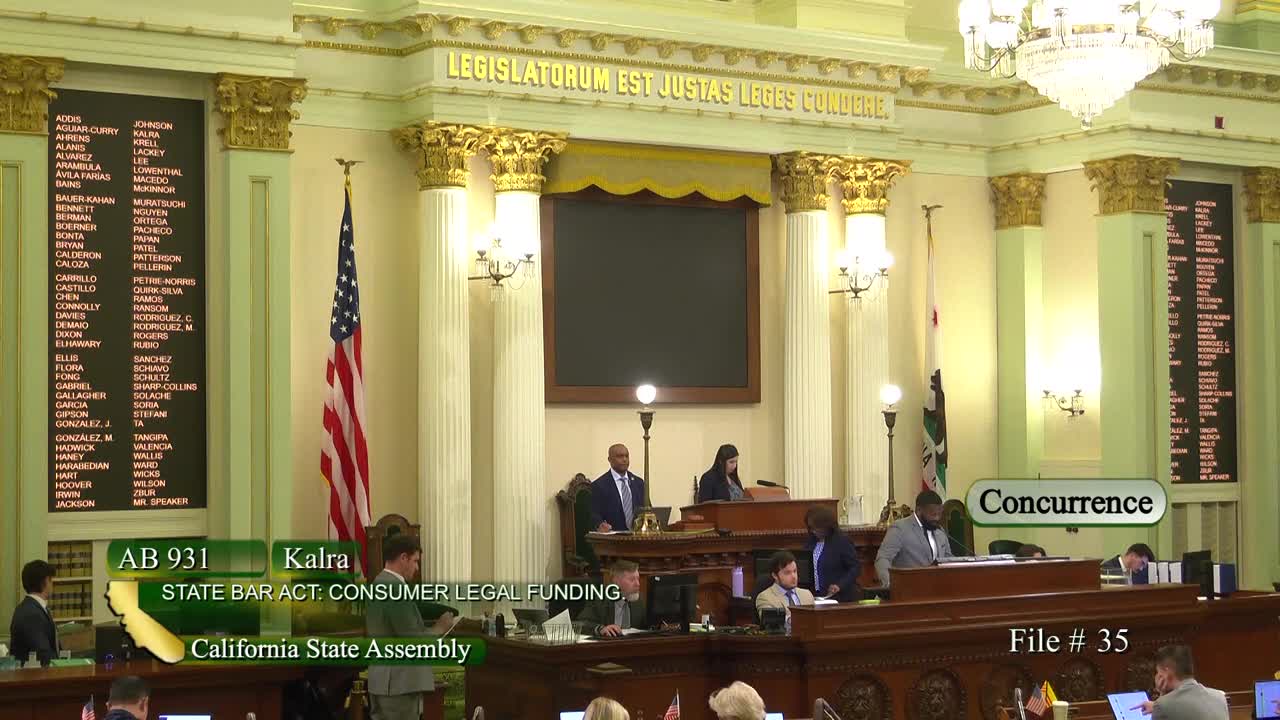
Bill Author

Bill Co-Author(s):