SB 1012: Employment of inmates.
- Session Year: 2025-2026
- House: Senate
- Latest Version Date: 2026-09-30
Current Status:
Passed
(2026-09-30: Chaptered by Secretary of State. Chapter 997, Statutes of 2026.)
Introduced
In Committee
Awaiting First Chamber Vote
Passed First Chamber
In Committee
Awaiting Second Chamber Vote
Passed Second Chamber
Enacted
What does this bill do?
The bill lets people who were incarcerated and completed the state's California Conservation Camp programs — including wildland firefighter and forestry work — use that training to enter state-approved apprenticeships as construction craft laborers. It requires the corrections department and its partners to give eligible participants a written certificate showing their training and says successful participation counts as qualifying experience for those apprenticeships.
The summary is provided by generative AI which can make mistakes. For original language, please view the details in the table below.
Existing law establishes the Prerelease Construction Trades Certificate Program in the Department of Corrections and Rehabilitation to increase employment opportunities in the construction trades for inmates upon release. Existing law requires the department to establish a joint advisory committee composed of, among others, representatives from building and construction trades employee organizations to implement the program, as specified. Existing law establishes the California Conservation Camp program to provide for the training and use of the inmates and wards assigned to conservation camps in the furtherance of public conservation, including forest fire prevention and control.
This bill would additionally require the joint advisory committee, in consultation with various state entities, to facilitate the admission of graduates of the California Conservation Camp program, as defined, after release into state-approved apprenticeship programs for the construction craft laborer occupation, as specified. The bill would state that successful participation in the program, beginning July 1, 2027, constitutes qualifying experience for a state-approved apprenticeship for the construction craft laborer occupation. The bill would require the department, in partnership with the Department of Forestry and Fire Protection, and the California Conservation Camp program to ensure that eligible individuals who successfully participate in the program receive a written certificate to ensure eligibility for state-approved apprenticeship programs for the construction craft laborer occupation.
Existing law establishes the Prerelease Construction Trades Certificate Program in the Department of Corrections and Rehabilitation to increase employment opportunities in the construction trades for inmates upon release. Existing law requires the department to establish a joint advisory committee composed of, among others, representatives from building and construction trades employee organizations to implement the program, as specified. Existing law establishes the California Conservation Camp program to provide for the training and use of the inmates and wards assigned to conservation camps in the furtherance of public conservation, including forest fire prevention and control.
This bill would additionally require the joint advisory committee, in consultation with various state entities, to facilitate the admission of graduates of the California Conservation Camp program, as defined, after release into state-approved apprenticeships and apprenticeship programs in the building and construction trades, for the construction craft laborer occupation, as specified. The bill would state that successful completion of the program participation in the program, beginning July 1, 2027, constitutes qualifying experience for a state-approved apprenticeship in the building and construction trades. for the construction craft laborer occupation. The bill would require the department, in partnership with the Department of Forestry and Fire Protection, and the California Conservation Camp program to ensure that eligible individuals who complete successfully participate in the program receive a written certificate to ensure eligibility for state-approved apprenticeship programs in the building and construction trades. for the construction craft laborer occupation.
Existing law establishes the Prerelease Construction Trades Certificate Program in the Department of Corrections and Rehabilitation to increase employment opportunities in the construction trades for inmates upon release. Existing law requires the department to establish a joint advisory committee composed of, among others, representatives from building and construction trades employee organizations to implement the program, as specified. Existing law establishes the California Conservation Camp program to provide for the training and use of the inmates and wards assigned to conservation camps in the furtherance of public conservation, including forest fire prevention and control.
This bill would additionally require the joint advisory committee, in consultation with various state entities, to facilitate the admission of graduates of the California Conservation Camp program program, as defined, after release into state-approved apprenticeships and apprenticeship programs in the building and construction trades, as specified. The bill would state that successful completion of the program constitutes qualifying experience for a state-approved apprenticeship in the building and construction trades. The bill would require the department, in partnership with the Department of Forestry and Fire Protection, and the California Conservation Camp program to ensure that individuals who complete the program receive a certificate to ensure eligibility for state-approved apprenticeship programs in the building and construction trades.
Existing law establishes the Prerelease Construction Trades Certificate Program in the Department of Corrections and Rehabilitation to increase employment opportunities in the construction trades for inmates upon release. Existing law requires the department to establish a joint advisory committee composed of, among others, representatives from building and construction trades employee organizations to implement the program, as specified. Existing law establishes the California Conservation Camp program to provide for the training and use of the inmates and wards assigned to conservation camps in the furtherance of public conservation, including forest fire prevention and control.
This bill would additionally require the joint advisory committee, in consultation with various state entities, to facilitate the admission of graduates of the California Conservation Camp program after release into state-approved apprenticeships and apprenticeship programs, programs in the building and construction trades, as specified. The bill would state that successful completion of the program constitutes qualifying experience for a state-approved apprenticeship, as specified. apprenticeship in the building and construction trades. The bill would require the department, in partnership with the Department of Forestry and Fire Protection, and the California Conservation Camp program to ensure that individuals who complete the program receive a certificate to ensure eligibility for state-approved apprenticeship programs. programs in the building and construction trades.
Existing law establishes the Prerelease Construction Trades Certificate Program in the Department of Corrections and Rehabilitation to increase employment opportunities in the construction trades for inmates upon release. Existing law requires the department to establish a joint advisory committee composed of, among others, representatives from building and construction trades employee organizations to implement the program, as specified. Existing law establishes the California Conservation Camp program to provide for the training and use of the inmates and wards assigned to conservation camps in the furtherance of public conservation, including forest fire prevention and control.
This bill would make a technical, nonsubstantive change to that provision.This bill would additionally require the joint advisory committee, in consultation with various state entities, to facilitate the admission of graduates of the California Conservation Camp program after release into state-approved apprenticeships and apprenticeship programs, as specified. The bill would state that successful completion of the program constitutes qualifying experience for a state-approved apprenticeship, as specified. The bill would require the department, in partnership with the Department of Forestry and Fire Protection, and the California Conservation Camp program to ensure that individuals who complete the program receive a certificate to ensure eligibility for state-approved apprenticeship programs.
Existing law establishes the Prerelease Construction Trades Certificate Program in the Department of Corrections and Rehabilitation to increase employment opportunities in the construction trades for inmates upon release. Existing law requires the department to establish a joint advisory committee composed of, among others, representatives from building and construction trades employee organizations to implement the program, as specified.
This bill would make a technical, nonsubstantive change to that provision.
(a)There is hereby established the Prerelease Construction Trades Certificate Program, hereinafter referred to in this section as the program, in the Department of Corrections and Rehabilitation, hereinafter referred to in this section as the department, to increase employment opportunities in the construction trades for inmates upon release.
(b)The department shall establish a joint advisory committee to implement the program. The committee shall be composed of representatives from building and construction trades employee organizations, the State Building and Construction Trades Council of California, joint apprenticeship training programs, the California Correctional Training and Rehabilitation Authority, the Division of Apprenticeship Standards, the Labor and Workforce Development Agency, and any other representatives the department determines appropriate. The responsibilities of the committee shall include, but are not be limited to, the following:
(1)Develop guidelines for the participation of inmates in preapprenticeship training programs, as described in subdivision (e) of Section 14230 of the Unemployment Insurance Code. The guidelines shall provide for the integration, for all inmate preapprenticeship training programs in the building and construction trades, of the multicraft core curriculum implemented by the State Department of Education for its California Partnership Academies pilot project and by the California Workforce Development Board and local boards.
(2)Develop and implement a prerelease construction trades certification that validates that an inmate completed instruction, skills, and competencies required by and recognized by the participating building and construction trades.
(3)Ensure compliance with any applicable requirements and regulations of the Division of Apprenticeship Standards.
(4)Evaluate prerelease on-the-job training opportunities to compare and match competencies with those of registered apprentices in the building and construction trades.
(5)Explore the feasibility of the electronic tracking of each participating inmates relevant activities to efficiently capture competencies related to the certification.
(6)Explore the prerelease awarding of formal credit for apprenticeship hours recognized by joint apprenticeship training programs and the Division of Apprenticeship Standards.
(7)Facilitate the admission of graduates of inmate preapprenticeship programs and graduates of the California Conservation Camp program, after release, into state-approved apprenticeship programs and for apprenticeship programs to evaluate such individuals for admission with advanced standing based on prior coursework and work experience.
(c)For purposes of this article, graduates of the California Conservation program means individuals who have successfully participated in California Conservation Camp programs as an incarcerated individual hand crewmember pursuant to Section 1203.4b.
SEC. 2.Section 2716.6 is added to the Penal Code, to read:2716.6.(a)The joint advisory committee described in Section 2716.5, in consultation with the Department of Corrections and Rehabilitation, the Department of Forestry and Fire Protection, the Department of Industrial Relations, and the California Conservation Camp program, shall facilitate the admission of graduates of the program, after release, into state-approved apprenticeship programs for the construction craft laborer occupation and for those programs, to evaluate such individuals for admission with advanced standing based on prior coursework and work experience.
(b)Successful participation in conservation camp programs, including, but not limited to, wildland firefighter training, such as environmental remediation and forestry management and emergency response, shall constitute qualifying experience for a state-approved apprenticeship for the construction craft laborer occupation under the Division of Apprenticeship Standards.
(c)The Department of Corrections and Rehabilitation shall, in partnership with the Department of Forestry and Fire Protection and the California Conservation Camp program, ensure that all eligible individuals who successfully participate in the program receive a written certification reflective of the training completed to ensure eligibility for state-approved apprenticeship programs for the construction craft laborer occupation.
(d)Nothing in this section shall preclude state-approved apprenticeship programs under the Division of Apprenticeship Standards for occupations other than the construction craft laborer occupation, including occupations within and outside of the building and construction trades, from evaluating graduates of the California Conservation Camp program for admission with advanced standing based on prior coursework and work experience.
(e)This section shall become operative on July 1, 2027.
(a)There is hereby established the Prerelease Construction Trades Certificate Program, hereinafter referred to in this section as the program, in the Department of Corrections and Rehabilitation, hereinafter referred to in this section as the department, to increase employment opportunities in the construction trades for inmates upon release.
(b)The department shall establish a joint advisory committee to implement the program. The committee shall be composed of representatives from building and construction trades employee organizations, the State Building and Construction Trades Council of California, joint apprenticeship training programs, the California Correctional Training and Rehabilitation Authority, the Division of Apprenticeship Standards, the Labor and Workforce Development Agency, and any other representatives the department determines appropriate. The responsibilities of the committee shall include, but are not be limited to, the following:
(1)Develop guidelines for the participation of inmates in preapprenticeship training programs, as described in subdivision (e) of Section 14230 of the Unemployment Insurance Code. The guidelines shall provide for the integration, for all inmate preapprenticeship training programs in the building and construction trades, of the multicraft core curriculum implemented by the State Department of Education for its California Partnership Academies pilot project and by the California Workforce Development Board and local boards.
(2)Develop and implement a prerelease construction trades certification that validates that an inmate completed instruction, skills, and competencies required by and recognized by the participating building and construction trades.
(3)Ensure compliance with any applicable requirements and regulations of the Division of Apprenticeship Standards.
(4)Evaluate prerelease on-the-job training opportunities to compare and match competencies with those of registered apprentices in the building and construction trades.
(5)Explore the feasibility of the electronic tracking of each participating inmates relevant activities to efficiently capture competencies related to the certification.
(6)Explore the prerelease awarding of formal credit for apprenticeship hours recognized by joint apprenticeship training programs and the Division of Apprenticeship Standards.
(7)Facilitate the admission of graduates of inmate preapprenticeship programs and graduates of the California Conservation Camp program, after release, into state-approved apprenticeship programs and for apprenticeship programs to evaluate such individuals for admission with advanced standing based on prior coursework and work experience.
(c)For purposes of this article, graduates of the California Conservation program means graduates individuals who have successfully participated in California Conservation Camp programs as an incarcerated individual hand crewmember. crewmember pursuant to Section 1203.4b.
SEC. 2.Section 2716.6 is added to the Penal Code, to read:2716.6.(a)The joint advisory committee described in Section 2716.5, in consultation with the Department of Corrections and Rehabilitation, the Department of Forestry and Fire Protection, the Department of Industrial Relations, and the California Conservation Camp program, shall facilitate the admission of graduates of the program, after release, into any relevant state-approved apprenticeship and for state-approved apprenticeship programs in the building and construction trades, including those in general construction, state-approved apprenticeship programs for the construction craft laborer occupation and for those programs, to evaluate such individuals for admission with advanced standing based on prior coursework and work experience.
(b)Successful completion of participation in conservation camp programs, including, but not limited to, wildland firefighter training, such as environmental remediation and forestry management, management and emergency response, and hazardous waste cleanup, shall constitute qualifying experience for a state-approved apprenticeship in the building and construction trades for the construction craft laborer occupation under the Division of Apprenticeship Standards.
(c)The Department of Corrections and Rehabilitation shall, in partnership with the Department of Forestry and Fire Protection and the California Conservation Camp program, ensure that all eligible individuals who complete successfully participate in the program receive a written certification acknowledging their fire camp training and work experience reflective of the training completed to ensure eligibility for state-approved apprenticeship programs in the building and construction trades. for the construction craft laborer occupation.
(d)Nothing in this section shall preclude state-approved apprenticeship programs outside of the building and construction trades under the Division of Apprenticeship Standards for occupations other than the construction craft laborer occupation, including occupations within and outside of the building and construction trades, from evaluating graduates of the California Conservation Camp program for admission with advanced standing based on prior coursework and work experience.
(e)This section shall become operative on July 1, 2027.
(a)There is hereby established the Prerelease Construction Trades Certificate Program, hereinafter referred to in this section as the program, in the Department of Corrections and Rehabilitation, hereinafter referred to in this section as the department, to increase employment opportunities in the construction trades for inmates upon release.
(b)The department shall establish a joint advisory committee to implement the program. The committee shall be composed of representatives from building and construction trades employee organizations, the State Building and Construction Trades Council of California, joint apprenticeship training programs, the California Correctional Training and Rehabilitation Authority, the Division of Apprenticeship Standards, the Labor and Workforce Development Agency, and any other representatives the department determines appropriate. The responsibilities of the committee shall include, but are not be limited to, the following:
(1)Develop guidelines for the participation of inmates in preapprenticeship training programs, as described in subdivision (e) of Section 14230 of the Unemployment Insurance Code. The guidelines shall provide for the integration, for all inmate preapprenticeship training programs in the building and construction trades, of the multicraft core curriculum implemented by the State Department of Education for its California Partnership Academies pilot project and by the California Workforce Development Board and local boards.
(2)Develop and implement a prerelease construction trades certification that validates that an inmate completed instruction, skills, and competencies required by and recognized by the participating building and construction trades.
(3)Ensure compliance with any applicable requirements and regulations of the Division of Apprenticeship Standards.
(4)Evaluate prerelease on-the-job training opportunities to compare and match competencies with those of registered apprentices in the building and construction trades.
(5)Explore the feasibility of the electronic tracking of each participating inmates relevant activities to efficiently capture competencies related to the certification.
(6)Explore the prerelease awarding of formal credit for apprenticeship hours recognized by joint apprenticeship training programs and the Division of Apprenticeship Standards.
(7)Facilitate the admission of graduates of inmate preapprenticeship programs and graduates of the California Conservation Camp program, after release, into state-approved apprenticeship programs and for apprenticeship programs to evaluate such individuals for admission with advanced standing based on prior coursework and work experience.
(c)For purposes of this article, graduates of the California Conservation program means graduates who have participated in California Conservation Camp programs as an incarcerated individual hand crewmember.
SEC. 2.Section 2716.6 is added to the Penal Code, to read:2716.6.(a)The joint advisory committee described in Section 2716.5, in consultation with the Department of Corrections and Rehabilitation, the Department of Forestry and Fire Protection, the Department of Industrial Relations, and the California Conservation Camp program, shall facilitate the admission of graduates of the program, after release, into any relevant state-approved apprenticeship and for state-approved apprenticeship programs in the building and construction trades, including those in general construction, to evaluate such individuals for admission with advanced standing based on prior coursework and work experience.
(b)Successful completion of conservation camp programs, including, but not limited to, wildland firefighter training, such as environmental remediation and forestry management, emergency response, and hazardous waste cleanup, shall constitute qualifying experience for a state-approved apprenticeship in the building and construction trades under the Division of Apprenticeship Standards.
(c)The Department of Corrections and Rehabilitation shall, in partnership with the Department of Forestry and Fire Protection and the California Conservation Camp program, ensure that all individuals who complete the program receive a certification acknowledging their fire camp training and work experience to ensure eligibility for state-approved apprenticeship programs in the building and construction trades.
(d)Nothing in this section shall preclude state-approved apprenticeship programs outside of the building and construction trades under the Division of Apprenticeship Standards from evaluating graduates of the California Conservation Camp program for admission with advanced standing based on prior coursework and work experience.
REVISIONS: HeadingLine 2.(a)There is hereby established the Prerelease Construction Trades Certificate Program, hereinafter referred to in this section as the program, in the Department of Corrections and Rehabilitation, hereinafter referred to in this section as the department, to increase employment opportunities in the construction trades for inmates upon release.
(b)The department shall establish a joint advisory committee to implement the program. The committee shall be composed of representatives from building and construction trades employee organizations, the State Building and Construction Trades Council of California, joint apprenticeship training programs, the California Correctional Training and Rehabilitation Authority, the Division of Apprenticeship Standards, the Labor and Workforce Development Agency, and any other representatives the department determines appropriate. The responsibilities of the committee shall include, but are not be limited to, the following:
(1)Develop guidelines for the participation of inmates in preapprenticeship training programs, as described in subdivision (e) of Section 14230 of the Unemployment Insurance Code. The guidelines shall provide for the integration, for all inmate preapprenticeship training programs in the building and construction trades, of the multicraft core curriculum implemented by the State Department of Education for its California Partnership Academies pilot project and by the California Workforce Development Board and local boards.
(2)Develop and implement a prerelease construction trades certification that validates that an inmate completed instruction, skills, and competencies required by and recognized by the participating building and construction trades.
(3)Ensure compliance with any applicable requirements and regulations of the Division of Apprenticeship Standards.
(4)Evaluate prerelease on-the-job training opportunities to compare and match competencies with those of registered apprentices in the building and construction trades.
(5)Explore the feasibility of the electronic tracking of each participating inmates relevant activities to efficiently capture competencies related to the certification.
(6)Explore the prerelease awarding of formal credit for apprenticeship hours recognized by joint apprenticeship training programs and the Division of Apprenticeship Standards.
(7)Facilitate the admission of graduates of inmate preapprenticeship programs and graduates of the California Conservation Camp program, after release, into state-approved apprenticeship programs and for apprenticeship programs to evaluate such individuals for admission with advanced standing based on prior coursework and work experience.
SEC. 2.Section 2716.6 is added to the Penal Code, to read:2716.6.(a)The joint advisory committee described in Section 2716.5, in consultation with the Department of Corrections and Rehabilitation, the Department of Forestry and Fire Protection, the Department of Industrial Relations, and the California Conservation Camp program, shall facilitate the admission of graduates of the program, after release, into any relevant state-approved apprenticeship and for state-approved apprenticeship programs, programs in the building and construction trades, including those in general construction and heavy equipment operations, construction, to evaluate such individuals for admission with advanced standing based on prior coursework and work experience.
(b)Successful completion of conservation camp programs, including, but not limited to, wildland firefighter training, such as environmental remediation and forestry management, emergency response, and hazardous waste cleanup, shall constitute qualifying experience for a state-approved apprenticeship in the building and construction trades under the Division of Apprenticeship Standards.
(c)The Department of Corrections and Rehabilitation shall, in partnership with the Department of Forestry and Fire Protection and the California Conservation Camp program, ensure that all individuals who complete the program receive a certification acknowledging their fire camp training and work experience to ensure eligibility for state-approved apprenticeship programs. programs in the building and construction trades.
(d)Nothing in this section shall preclude state-approved apprenticeship programs outside of the building and construction trades under the Division of Apprenticeship Standards from evaluating graduates of the California Conservation Camp program for admission with advanced standing based on prior coursework and work experience.
(a)There is hereby established the Prerelease Construction Trades Certificate Program, hereinafter referred to in this section as the program, in the Department of Corrections and Rehabilitation, hereinafter referred to in this section as the department, to increase employment opportunities in the construction trades for inmates upon release.
(b)The department shall establish a joint advisory committee to implement the program. The committee shall be composed of representatives from building and construction trades employee organizations, the State Building and Construction Trades Council of California, joint apprenticeship training programs, the California Correctional Training and Rehabilitation Authority, the Division of Apprenticeship Standards, the Labor and Workforce Development Agency, and any other representatives the department determines appropriate. The responsibilities of the committee shall include, but are not be limited to, the following:
(1)Develop guidelines for the participation of inmates in preapprenticeship training programs, as described in subdivision (e) of Section 14230 of the Unemployment Insurance Code. The guidelines shall provide for the integration, for all inmate preapprenticeship training programs in the building and construction trades, of the multicraft core curriculum implemented by the State Department of Education for its California Partnership Academies pilot project and by the California Workforce Development Board and local boards.
(2)Develop and implement a prerelease construction trades certification that validates that an inmate completed instruction, skills, and competencies required by and recognized by the participating building and construction trades.
(3)Ensure compliance with any applicable requirements and regulations of the Division of Apprenticeship Standards.
(4)Evaluate prerelease on-the-job training opportunities to compare and match competencies with those of registered apprentices in the building and construction trades.
(5)Explore the feasibility of the electronic tracking of each participating inmates relevant activities to efficiently capture competencies related to the certification.
(6)Explore the prerelease awarding of formal credit for apprenticeship hours recognized by joint apprenticeship training programs and the Division of Apprenticeship Standards.
(7)Facilitate the admission of graduates of inmate preapprenticeship programs, programs and graduates of the California Conservation Camp program, after release, into state-approved apprenticeship programs and for apprenticeship programs to evaluate such individuals for admission with advanced standing based on prior coursework and work experience.
SEC. 2.Section 2716.6 is added to the Penal Code, to read:2716.6.(a)The joint advisory committee described in Section 2716.5, in consultation with the Department of Corrections and Rehabilitation, the Department of Forestry and Fire Protection, the Department of Industrial Relations, and the California Conservation Camp program, shall facilitate the admission of graduates of the program, after release, into any relevant state-approved apprenticeship and for state-approved apprenticeship programs, including those in general construction and heavy equipment operations, to evaluate such individuals for admission with advanced standing based on prior coursework and work experience.
(b)Successful completion of conservation camp programs, including, but not limited to, wildland firefighter training, such as environmental remediation and forestry management, emergency response, and hazardous waste cleanup, shall constitute qualifying experience for a state-approved apprenticeship under the Division of Apprenticeship Standards.
(c)The Department of Corrections and Rehabilitation shall, in partnership with the Department of Forestry and Fire Protection and the California Conservation Camp program, ensure that all individuals who complete the program receive a certification acknowledging their fire camp training and work experience to ensure eligibility for state-approved apprenticeship programs.
(a)There is hereby established the Prerelease Construction Trades Certificate Program, hereinafter referred to in this section as the program, in the Department of Corrections and Rehabilitation, hereinafter referred to in this section as the department, to increase employment opportunities in the construction trades for inmates upon release.
(b)The department shall establish a joint advisory committee for the purpose of implementation of to implement the program. The committee shall be composed of representatives from building and construction trades employee organizations, the State Building and Construction Trades Council of California, joint apprenticeship training programs, the California Correctional Training and Rehabilitation Authority, the Division of Apprenticeship Standards, the Labor and Workforce Development Agency, and any other representatives the department determines appropriate. The responsibilities of the committee shall include, but are not be limited to, the following:
(1)Develop guidelines for the participation of inmates in preapprenticeship training programs, as described in subdivision (e) of Section 14230 of the Unemployment Insurance Code. The guidelines shall provide for the integration, for all inmate preapprenticeship training programs in the building and construction trades, of the multicraft core curriculum implemented by the State Department of Education for its California Partnership Academies pilot project and by the California Workforce Development Board and local boards.
(2)Develop and implement a prerelease construction trades certification that validates that an inmate completed instruction, skills, and competencies required by and recognized by the participating building and construction trades.
(3)Ensure compliance with any applicable requirements and regulations of the Division of Apprenticeship Standards.
(4)Evaluate prerelease on-the-job training opportunities to compare and match competencies with those of registered apprentices in the building and construction trades.
(5)Explore the feasibility of the electronic tracking of each participating inmates relevant activities to efficiently capture competencies related to the certification.
(6)Explore the prerelease awarding of formal credit for apprenticeship hours recognized by joint apprenticeship training programs and the Division of Apprenticeship Standards.
(7)Facilitate the admission of graduates of inmate preapprenticeship programs, after release, into state-approved apprenticeship programs and for apprenticeship programs to evaluate such individuals for admission with advanced standing based on prior coursework and work experience.
|
Date
|
Status
|
|---|---|
| Sep 30, 2026 | Chaptered by Secretary of State. Chapter 997, Statutes of 2026. |
| Sep 30, 2026 | Approved by the Governor. |
| Aug 30, 2026 | Enrolled and presented to the Governor at 6 p.m. |
| Aug 25, 2026 | Assembly amendments concurred in. (Ayes 40. Noes 0.) Ordered to engrossing and enrolling. |
| Aug 25, 2026 | Assembly amendments concurred in. (Ayes 40. Noes 0. Page 5741.) Ordered to engrossing and enrolling. |
| Aug 24, 2026 | In Senate. Concurrence in Assembly amendments pending. |
| Aug 24, 2026 | Read third time. Passed. (Ayes 77. Noes 0. Page 6391.) Ordered to the Senate. |
| Aug 24, 2026 | Read third time. Passed. Ordered to the Senate. |
| Aug 18, 2026 | Ordered to third reading. |
| Aug 18, 2026 | Read third time and amended. |
| Aug 13, 2026 | Read second time. Ordered to third reading. |
| Aug 13, 2026 | From committee: Do pass. (Ayes 15. Noes 0.) (August 13). |
| Aug 13, 2026 | Assembly Rule 63 suspended. |
| Aug 5, 2026 | August 5 set for first hearing. Placed on suspense file. |
| Jun 25, 2026 | From committee: Do pass and re-refer to Com. on APPR. with recommendation: To consent calendar. (Ayes 7. Noes 0.) (June 24). Re-referred to Com. on APPR. |
| Jun 25, 2026 | Coauthors revised. |
| Jun 9, 2026 | From committee: Do pass and re-refer to Com. on L. & E. with recommendation: To consent calendar. (Ayes 9. Noes 0.) (June 9). Re-referred to Com. on L. & E. |
| May 26, 2026 | Referred to Coms. on PUB. S. and L. & E. |
| May 20, 2026 | In Assembly. Read first time. Held at Desk. |
| May 19, 2026 | Read third time. Passed. (Ayes 39. Noes 0.) Ordered to the Assembly. |
| May 19, 2026 | Read third time. Passed. (Ayes 39. Noes 0. Page 4365.) Ordered to the Assembly. |
| May 18, 2026 | Read second time. Ordered to third reading. |
| May 14, 2026 | Read second time and amended. Ordered to second reading. |
| May 14, 2026 | From committee: Do pass as amended. (Ayes 7. Noes 0.) (May 14). |
| May 14, 2026 | From committee: Do pass as amended. (Ayes 7. Noes 0. Page 4261.) (May 14). |
| May 8, 2026 | Set for hearing May 14. |
| May 4, 2026 | May 4 hearing: Placed on APPR. suspense file. |
| Apr 24, 2026 | Set for hearing May 4. |
| Apr 22, 2026 | From committee: Do pass and re-refer to Com. on APPR. (Ayes 5. Noes 0. Page 4012.) (April 22). Re-referred to Com. on APPR. |
| Apr 22, 2026 | From committee: Do pass and re-refer to Com. on APPR. (Ayes 5. Noes 0.) (April 22). Re-referred to Com. on APPR. |
| Apr 15, 2026 | Set for hearing April 22. |
| Apr 15, 2026 | From committee with author's amendments. Read second time and amended. Re-referred to Com. on L., P.E. & R. |
| Apr 14, 2026 | From committee: Do pass and re-refer to Com. on L., P.E. & R. (Ayes 6. Noes 0.) (April 14). Re-referred to Com. on L., P.E. & R. |
| Apr 14, 2026 | From committee: Do pass and re-refer to Com. on L., P.E. & R. (Ayes 6. Noes 0. Page 3871.) (April 14). Re-referred to Com. on L., P.E. & R. |
| Apr 9, 2026 | Set for hearing April 14. |
| Apr 8, 2026 | Re-referred to Coms. on PUB. S. and L., P.E. & R. |
| Mar 24, 2026 | From committee with author's amendments. Read second time and amended. Re-referred to Com. on RLS. |
| Feb 18, 2026 | Referred to Com. on RLS. |
| Feb 11, 2026 | From printer. May be acted upon on or after March 13. |
| Feb 10, 2026 | Introduced. Read first time. To Com. on RLS. for assignment. To print. |
|
Date
|
Description
|
Location
|
Votes
|
|
|---|---|---|---|---|
| Aug 25, 2026 | Unfinished Business SB1012 Smallwood-Cuevas Concurrence | Senate Floor |
Passed |
|
| Aug 24, 2026 | SB 1012 Smallwood-Cuevas Senate Third Reading By Elhawary | Assembly Floor |
Passed |
|
| Aug 13, 2026 | Do pass. | Assembly Standing Committee on Appropriations |
Passed |
|
| Jun 24, 2026 | Do pass and be re-referred to the Committee on [Appropriations] with recommendation: To Consent Calendar | Assembly Standing Committee on Labor and Employment |
Passed |
|
| Jun 9, 2026 | Do pass and be re-referred to the Committee on [Labor and Employment] with recommendation: To Consent Calendar | Assembly Standing Committee on Public Safety |
Passed |
|
| May 19, 2026 | Senate 3rd Reading SB1012 Smallwood-Cuevas | Senate Floor |
Passed |
|
| May 14, 2026 | Do pass as amended | Senate Standing Committee on Appropriations |
Passed |
|
| May 4, 2026 | Placed on suspense file | Senate Standing Committee on Appropriations |
Passed |
|
| Apr 22, 2026 | Do pass, but first be re-referred to the Committee on [Appropriations] | Senate Standing Committee on Labor, Public Employment and Retirement |
Passed |
|
| Apr 14, 2026 | Do pass, but first be re-referred to the Committee on [Labor, Public Employment and Retirement ] | Senate Standing Committee on Public Safety |
Passed |
This list shows positions taken on this bill by organizations on the date displayed, which is linked to the original source.
Positions by individuals are not included.
|
Organization
|
Position
|
Date
|
|---|---|---|
| Aclu California Action | ** Support | |
| Associated General Contractors, California Chapters | ** Support | |
| California Federation of Labor Unions, Afl-cio | ** Support | |
| California Forestry Association | ** Support | |
| California Public Defenders Association | ** Support | |
| California State Council Of Laborers | ** Support | |
| California State Council of Laborers (Co-Sponsor) | ** Support | |
| Chrysalis | ** Support | |
| Chrysalis Center | ** Support | |
| Forestry And Fire Recruitment Program | ** Support | |
| Grip Training Institute | ** Support | |
| Guiding Rage into Power Training Institute | ** Support | |
| Initiate Justice | ** Support | |
| Laborers’ International Union of North America | ** Support | |
| Los Angeles Conservation Corps | ** Support | |
| Nextgen Policy | ** Support | |
| San Quentin Skunkworks | ** Support |
SENATE RULES COMMITTEE Office of Senate Floor Analyses (916) 651-4171 | SB 1012 |
UNFINISHED BUSINESS
Bill No: SB 1012
Author: Smallwood-Cuevas (D), et al.
Amended: 8/18/26
Vote: 21
SENATE PUBLIC SAFETY COMMITTEE: 6-0, 4/14/26
AYES: Arreguín, Seyarto, Caballero, Cortese, Pérez, Wiener
SENATE LABOR, PUB. EMP. & RET. COMMITTEE: 5-0, 4/22/26
AYES: Smallwood-Cuevas, Strickland, Cortese, Durazo, Laird
SENATE APPROPRIATIONS COMMITTEE: 7-0, 5/14/26
AYES: Cervantes, Seyarto, Cabaldon, Dahle, Grayson, Richardson, Wahab
SENATE FLOOR: 39-0, 5/19/26
AYES: Allen, Alvarado-Gil, Archuleta, Arreguín, Ashby, Becker, Blakespear, Cabaldon, Caballero, Cervantes, Choi, Cortese, Dahle, Durazo, Gonzalez, Grayson, Grove, Hurtado, Jones, Laird, Limón, McGuire, McNerney, Menjivar, Ochoa Bogh, Padilla, Pérez, Reyes, Richardson, Rubio, Seyarto, Smallwood-Cuevas, Stern, Strickland, Umberg, Valladares, Wahab, Weber Pierson, Wiener
NO VOTE RECORDED: Niello
ASSEMBLY FLOOR: 77-0, 8/24/26 - See last page for vote
SUBJECT: Employment of inmates
SOURCE: Laborers’ International Union of Northern California, California State Council of Laborers;
NextGen
DIGEST:
This bill requires the Pre-Release Construction Trades Certificate Program’s joint advisory committee, in consultation with the California Department of Corrections and Rehabilitation (CDCR), the Department of Forestry and Fire Protection (Cal Fire), the Department of Industrial Relations (DIR), and the fire camp program, to facilitate the post-release admission of program graduates into state-approved apprenticeship programs for the construction craft laborer occupation and for those programs, to evaluate such individuals for admission with advanced standing based on prior coursework and work experience; requires that participation in the fire camp program constitutes a qualifying experience for a state-approved apprenticeship for construction craft laborer occupation; and requires CDCR, in partnership with Cal Fire and the fire camp program, to ensure that all eligible individuals who successfully participate in the fire camp program receive a certification reflective of the training completed to ensure eligibility for state-approved apprenticeship programs in the building and construction trades.
Assembly Amendments delay the implementation date of most of the bill’s provisions to July 1, 2027 and make other minor changes.
ANALYSIS:
Existing law:
- Establishes the Prison to Employment program, administered by the California Workforce Development Board (CWDB), to coordinate reentry and workforce services in each of the state’s 14 workforce regions so that the formerly incarcerated and other justice-involved individuals in these regions can find and retain employment. (Unemployment Insurance (Unemp. Ins.) Code, §§ 14040-14042.)
- Requires a career technical education program consider all of the following factors, consistent with the goals and priorities of CDCR:
- Whether the program aligns with the workforce needs of high-demand sectors of the state and regional economies;
- Whether there is an active job market for the skills being developed where the incarcerated person will likely be released;
- Whether the program increases the number of incarcerated individuals who obtain a marketable and industry or apprenticeship board-recognized certification, credential, or degree;
- Whether there are formal or informal networks in the field that support finding employment upon release from prison; and,
- Whether the program will lead to employment in occupations with a livable wage. (Penal (Pen.) Code § 2053.5.)
- Establishes the Pre-Release Construction Trades Certificate Program administered by CDCR to increase employment opportunities in the construction trades for incarcerated individuals upon release. (Pen. Code, § 2716.5, subd. (a).)
- Requires CDCR to establish a joint advisory committee for the purpose of implementation of the program and specifies entities that must be represented on the committee. (Pen. Code, § 2716.5, subd. (b).)
- Provides that the committee has the following responsibilities:
- Develop guidelines for the participation of inmates in preapprenticeship training programs. Requires the guidelines to provide for the integration, for all preapprenticeship training programs in the building and construction trades, of the multicraft core curriculum (MC3) implemented by the State Department of Education (CDE) for its California Partnership Academies pilot project and by the CWDB and local boards.
- Develop and implement a prerelease construction trades certification that validates that an incarcerated person completed instruction, skills, and competencies required by and recognized by the participating building and construction trades.
- Ensure compliance with any applicable requirements and regulations of the Division of Apprenticeship Standards (DAS).
- Evaluate prerelease on-the-job training opportunities to compare and match competencies with those of registered apprentices in the building and construction trades.
- Explore the feasibility of the electronic tracking of each participating person’s relevant activities to efficiently capture competencies related to the certification.
- Explore the prerelease awarding of formal credit for apprenticeship hours recognized by joint apprenticeship training programs and the DAS.
- Facilitate the admission of graduates of preapprenticeship programs for incarcerated individuals, after release, into state-approved apprenticeship programs and for apprenticeship programs to evaluate such individuals for admission with advanced standing based on prior coursework and work experience. (Pen. Code, § 2716.5, subd. (b).)
- Requires CWDB and each local workforce development board to ensure, to the maximum extent feasible, that federal respectively awarded by them for purposes of pre-apprenticeship training in the building and construction trades fund programs and services follow the MC3 implemented by CDE for its pilot project with California Partnership Academies. (Unemp. Ins. Code, § 14230, subd. (e)(2).)
This bill:
- Amends the joint advisory committee’s responsibility to facilitate the post-release admission of graduates of pre-apprenticeship programs for incarcerated individuals into state-approved apprenticeship programs, to include graduates of the fire camp program.
- Requires the joint advisory committee, in consultation with CDCR, Cal Fire, DIR, and the fire camp program to facilitate the admission of graduates of the program, after release, into state-approved apprenticeship programs for the construction craft laborer occupation and for those programs, to evaluate such individuals for admission with advanced standing based on prior coursework and work experience.
- Requires the successful participation in fire camp programs, including, but not limited to, wildland firefighter training, such as environmental remediation and forestry management and emergency response, to constitute qualifying experience for a state-approved apprenticeship for the construction craft laborer occupation under the DAS.
- Requires CDCR, in partnership with Cal Fire and the fire camp program, to ensure that all eligible individuals who successfully participate in the program receive a written certification reflective of the training completed to ensure eligibility for state-approved apprenticeship programs for the construction craft laborer occupation to ensure eligibility for state-approved apprenticeship programs in the building and construction trades.
- Provides that nothing in its provisions preclude state-approved apprenticeship programs under DAS for occupations other than the construction craft laborer occupation, including occupations within and outside of the building and construction trades, from evaluating graduates of the fire camp program for admission with advanced standing based on prior coursework and work experience.
Background
Pre-apprenticeships. The DAS within the Department of Industrial Relations administers the state’s apprenticeship laws and enforces apprenticeship standards for wages, hours, working conditions, and the specific skills required for state certification as a journey person in an apprenticeable occupation. In general, apprenticeship programs provide instruction that combines a formal course of in-class instruction with practical “on-the-job” training.
Pre-apprenticeship programs are designed to prepare individuals to enter and succeed in registered apprenticeship programs. These programs have a documented partnership with at least one registered apprenticeship program sponsor and together, they expand the participant’s career pathway opportunities with industry-based training coupled with classroom instruction.
The Multi-Craft Core Curriculum (MC3) is a pre-apprenticeship training program that was developed in 2007 by North America’s Building Trades Union. It was designed to identify common elements in all building and construction trades’ apprenticeship programs and combine them into one curriculum encompassing 120 hours of training. Among other things, the curriculum includes general orientation to apprenticeships, an introduction to the construction industry, cardiopulmonary resuscitation and first aid, an Occupational Safety and Health Administration 10-hour certification course, applied mathematics for construction, and blueprint reading.
In-Prison Job Training. Many studies have examined the relationship between employment and recidivism. Although the formerly incarcerated face many barriers to obtaining employment, good quality employment is correlated with lower rates of recidivism. Given this correlation, California has invested in various types of in-prison job training programs in order to improve job prospects for the incarcerated population upon release.
In 2018, the Legislature established the Pre-Release Construction Trades Certification Program, administered by CDCR, to increase employment opportunities in the construction trades for incarcerated individuals after release. The program is overseen by a joint advisory committee, composed of representatives from building and construction trades employee organizations, the State Building and Construction Trades Council of California, joint apprenticeship training programs, Cal PIA, the DAS, the Labor and Workforce Development Agency, and any other representatives the department determines appropriate.
Conservation (Fire) Camps. CDCR, in cooperation with Cal Fire and the Los Angeles County Fire Department, jointly operates 35 conservation camps, commonly referred to as fire camps, in 25 counties across the state. Fire camp participants support state, local and federal government agencies as they respond to emergencies such as fires, floods, and other natural or manmade disasters, and complete community service projects when not assigned to an emergency. All fire camps are minimum-security facilities which are overseen by CDCR employees. Participants are supervised by Cal Fire staff when responding to a wildfire or working on a conservation project.
Incarcerated individuals participating in fire camps receive the same entry-level training as Cal Fire’s seasonal firefighters as well as ongoing training from Cal Fire throughout their time in the program. An incarcerated person must volunteer for the fire camp program, and some individuals are ineligible for fire camp assignment based on their convictions, including convictions for sex offenses, arson, and escape with force or violence. Individuals who volunteer for fire camp must complete Cal Fire’s Firefighting Training Program, and program participants become certified wildland firefighters after completing this training.
Reentry Programs. The State has also invested in reentry work training programs. As part of California’s efforts to increase rehabilitative opportunities and reduce recidivism, CWDB, CDCR, Cal PIA, and California Workforce Association created the Corrections-Workforce Partnership in 2017. This partnership links education, job training, and work experience in prison to post-release jobs by fostering a system of coordinated service delivery to a population that faces a variety of barriers.
In 2018, the Legislature appropriated $37 million for the Prison to Employment Initiative (P2E), which is administered by the CWDB. The mission of P2E is to create a pathway toward employment and away from recidivism for formerly incarcerated and justice-involved individuals. P2E funds the integration of workforce and reentry services through grants to workforce service providers across California, including both direct services and supportive services, paving a pathway towards employment and away from recidivism for the formerly incarcerated and justice-involved population.
This bill seeks to build upon prior efforts to provide career options to fire camp participants following their release from incarceration.
FISCAL EFFECT: Appropriation: No Fiscal Com.: Yes Local: No
According to the Assembly Appropriations Committee:
Significant annual costs to CDCR for workload associated with program development and expansion, interdepartmental coordination, and the validation and tracking of training skills and competencies (General Fund), to the extent this this bill results in new or expanded requirements related to the Pre-Release Construction Trades Certificate Program.
The Division of Apprenticeship Standards (DAS), within DIR, estimates a fiscal impact of $450,000 in the first year and $400,000 for the second and third year (Apprenticeship Training Contribution Fund), to evaluate camp graduates for advanced standing against approved apprenticeship standards and to communicate the bill’s qualifying-experience designation to sponsoring committees. DAS has advised that the bill does not make clear whether the qualifying-experience provision substitutes for pre-apprenticeship completion in a sponsoring committee’s admissions decision or only counts toward advanced standing after admission, and the broader reading may not be captured in the estimate.
Costs of an unknown amount, likely minor, to CAL FIRE and DIR to participate in the joint advisory committee to facilitate the admission of program graduates into apprenticeship programs (special funds, General Fund).
SUPPORT: (Verified 8/20/26)
Laborers’ International Union of North America, California State Council of Laborers (co-source)
NextGen Policy (co-source)
ACLU California Action
Associated General Contractors, California Chapters
California Federation of Labor Unions, AFL-CIO
California Public Defenders Association
Chrysalis
OPPOSITION: (Verified 8/20/26)
ASSEMBLY FLOOR: 77-0 8/24/26
AYES: Addis, Aguiar-Curry, Ahrens, Alanis, Alvarez, Arambula, Ávila Farías, Bains, Bauer-Kahan, Bennett, Berman, Boerner, Bonta, Bryan, Calderon, Caloza, Carrillo, Castillo, Chen, Connolly, Davies, DeMaio, Dixon, Elhawary, Ellis, Flora, Fong, Gabriel, Garcia, Gipson, Jeff Gonzalez, Mark González, Hadwick, Haney, Harabedian, Hart, Hoover, Irwin, Jackson, Johnson, Kalra, Krell, Lee, Lowenthal, Macedo, Muratsuchi, Nguyen, Ortega, Pacheco, Papan, Patel, Patterson, Pellerin, Petrie-Norris, Quirk-Silva, Ramos, Ransom, Celeste Rodriguez, Michelle Rodriguez, Rogers, Blanca Rubio, Sanchez, Schiavo, Schultz, Sharp-Collins, Solache, Soria, Stefani, Ta, Tangipa, Valencia, Wallis, Ward, Wicks, Wilson, Zbur,
NO VOTE RECORDED: Lackey, McKinnor
Prepared by: Stephanie Jordan / PUB. S. /
9/14/26 11:13:55
**** END ****
SENATE RULES COMMITTEE Office of Senate Floor Analyses (916) 651-4171 | SB 1012 |
UNFINISHED BUSINESS
Bill No: SB 1012
Author: Smallwood-Cuevas (D), et al.
Amended: 8/18/26
Vote: 21
SENATE PUBLIC SAFETY COMMITTEE: 6-0, 4/14/26
AYES: Arreguín, Seyarto, Caballero, Cortese, Pérez, Wiener
SENATE LABOR, PUB. EMP. & RET. COMMITTEE: 5-0, 4/22/26
AYES: Smallwood-Cuevas, Strickland, Cortese, Durazo, Laird
SENATE APPROPRIATIONS COMMITTEE: 7-0, 5/14/26
AYES: Cervantes, Seyarto, Cabaldon, Dahle, Grayson, Richardson, Wahab
SENATE FLOOR: 39-0, 5/19/26
AYES: Allen, Alvarado-Gil, Archuleta, Arreguín, Ashby, Becker, Blakespear, Cabaldon, Caballero, Cervantes, Choi, Cortese, Dahle, Durazo, Gonzalez, Grayson, Grove, Hurtado, Jones, Laird, Limón, McGuire, McNerney, Menjivar, Ochoa Bogh, Padilla, Pérez, Reyes, Richardson, Rubio, Seyarto, Smallwood-Cuevas, Stern, Strickland, Umberg, Valladares, Wahab, Weber Pierson, Wiener
NO VOTE RECORDED: Niello
ASSEMBLY FLOOR: Passed, 8/24/26
SUBJECT: Employment of inmates
SOURCE: Laborers’ International Union of Northern California, California State Council of Laborers;
NextGen
DIGEST:
This bill requires the Pre-Release Construction Trades Certificate Program’s joint advisory committee, in consultation with the California Department of Corrections and Rehabilitation (CDCR), the Department of Forestry and Fire Protection (Cal Fire), the Department of Industrial Relations (DIR), and the fire camp program, to facilitate the post-release admission of program graduates into state-approved apprenticeship programs for the construction craft laborer occupation and for those programs, to evaluate such individuals for admission with advanced standing based on prior coursework and work experience; requires that participation in the fire camp program constitutes a qualifying experience for a state-approved apprenticeship for construction craft laborer occupation; and requires CDCR, in partnership with Cal Fire and the fire camp program, to ensure that all eligible individuals who successfully participate in the fire camp program receive a certification reflective of the training completed to ensure eligibility for state-approved apprenticeship programs in the building and construction trades.
Assembly Amendments delay the implementation date of most of the bill’s provisions to July 1, 2027 and make other minor changes.
ANALYSIS:
Existing law:
- Establishes the Prison to Employment program, administered by the California Workforce Development Board (CWDB), to coordinate reentry and workforce services in each of the state’s 14 workforce regions so that the formerly incarcerated and other justice-involved individuals in these regions can find and retain employment. (Unemployment Insurance (Unemp. Ins.) Code, §§ 14040-14042.)
- Requires a career technical education program consider all of the following factors, consistent with the goals and priorities of CDCR:
- Whether the program aligns with the workforce needs of high-demand sectors of the state and regional economies;
- Whether there is an active job market for the skills being developed where the incarcerated person will likely be released;
- Whether the program increases the number of incarcerated individuals who obtain a marketable and industry or apprenticeship board-recognized certification, credential, or degree;
- Whether there are formal or informal networks in the field that support finding employment upon release from prison; and,
- Whether the program will lead to employment in occupations with a livable wage. (Penal (Pen.) Code § 2053.5.)
- Establishes the Pre-Release Construction Trades Certificate Program administered by CDCR to increase employment opportunities in the construction trades for incarcerated individuals upon release. (Pen. Code, § 2716.5, subd. (a).)
- Requires CDCR to establish a joint advisory committee for the purpose of implementation of the program and specifies entities that must be represented on the committee. (Pen. Code, § 2716.5, subd. (b).)
- Provides that the committee has the following responsibilities:
- Develop guidelines for the participation of inmates in preapprenticeship training programs. Requires the guidelines to provide for the integration, for all preapprenticeship training programs in the building and construction trades, of the multicraft core curriculum (MC3) implemented by the State Department of Education (CDE) for its California Partnership Academies pilot project and by the CWDB and local boards.
- Develop and implement a prerelease construction trades certification that validates that an incarcerated person completed instruction, skills, and competencies required by and recognized by the participating building and construction trades.
- Ensure compliance with any applicable requirements and regulations of the Division of Apprenticeship Standards (DAS).
- Evaluate prerelease on-the-job training opportunities to compare and match competencies with those of registered apprentices in the building and construction trades.
- Explore the feasibility of the electronic tracking of each participating person’s relevant activities to efficiently capture competencies related to the certification.
- Explore the prerelease awarding of formal credit for apprenticeship hours recognized by joint apprenticeship training programs and the DAS.
- Facilitate the admission of graduates of preapprenticeship programs for incarcerated individuals, after release, into state-approved apprenticeship programs and for apprenticeship programs to evaluate such individuals for admission with advanced standing based on prior coursework and work experience. (Pen. Code, § 2716.5, subd. (b).)
- Requires CWDB and each local workforce development board to ensure, to the maximum extent feasible, that federal respectively awarded by them for purposes of pre-apprenticeship training in the building and construction trades fund programs and services follow the MC3 implemented by CDE for its pilot project with California Partnership Academies. (Unemp. Ins. Code, § 14230, subd. (e)(2).)
This bill:
- Amends the joint advisory committee’s responsibility to facilitate the post-release admission of graduates of pre-apprenticeship programs for incarcerated individuals into state-approved apprenticeship programs, to include graduates of the fire camp program.
- Requires the joint advisory committee, in consultation with CDCR, Cal Fire, DIR, and the fire camp program to facilitate the admission of graduates of the program, after release, into state-approved apprenticeship programs for the construction craft laborer occupation and for those programs, to evaluate such individuals for admission with advanced standing based on prior coursework and work experience.
- Requires the successful participation in fire camp programs, including, but not limited to, wildland firefighter training, such as environmental remediation and forestry management and emergency response, to constitute qualifying experience for a state-approved apprenticeship for the construction craft laborer occupation under the DAS.
- Requires CDCR, in partnership with Cal Fire and the fire camp program, to ensure that all eligible individuals who successfully participate in the program receive a written certification reflective of the training completed to ensure eligibility for state-approved apprenticeship programs for the construction craft laborer occupation to ensure eligibility for state-approved apprenticeship programs in the building and construction trades.
- Provides that nothing in its provisions preclude state-approved apprenticeship programs under DAS for occupations other than the construction craft laborer occupation, including occupations within and outside of the building and construction trades, from evaluating graduates of the fire camp program for admission with advanced standing based on prior coursework and work experience.
Background
Pre-apprenticeships. The DAS within the Department of Industrial Relations administers the state’s apprenticeship laws and enforces apprenticeship standards for wages, hours, working conditions, and the specific skills required for state certification as a journey person in an apprenticeable occupation. In general, apprenticeship programs provide instruction that combines a formal course of in-class instruction with practical “on-the-job” training.
Pre-apprenticeship programs are designed to prepare individuals to enter and succeed in registered apprenticeship programs. These programs have a documented partnership with at least one registered apprenticeship program sponsor and together, they expand the participant’s career pathway opportunities with industry-based training coupled with classroom instruction.
The Multi-Craft Core Curriculum (MC3) is a pre-apprenticeship training program that was developed in 2007 by North America’s Building Trades Union. It was designed to identify common elements in all building and construction trades’ apprenticeship programs and combine them into one curriculum encompassing 120 hours of training. Among other things, the curriculum includes general orientation to apprenticeships, an introduction to the construction industry, cardiopulmonary resuscitation and first aid, an Occupational Safety and Health Administration 10-hour certification course, applied mathematics for construction, and blueprint reading.
In-Prison Job Training. Many studies have examined the relationship between employment and recidivism. Although the formerly incarcerated face many barriers to obtaining employment, good quality employment is correlated with lower rates of recidivism. Given this correlation, California has invested in various types of in-prison job training programs in order to improve job prospects for the incarcerated population upon release.
In 2018, the Legislature established the Pre-Release Construction Trades Certification Program, administered by CDCR, to increase employment opportunities in the construction trades for incarcerated individuals after release. The program is overseen by a joint advisory committee, composed of representatives from building and construction trades employee organizations, the State Building and Construction Trades Council of California, joint apprenticeship training programs, Cal PIA, the DAS, the Labor and Workforce Development Agency, and any other representatives the department determines appropriate.
Conservation (Fire) Camps. CDCR, in cooperation with Cal Fire and the Los Angeles County Fire Department, jointly operates 35 conservation camps, commonly referred to as fire camps, in 25 counties across the state. Fire camp participants support state, local and federal government agencies as they respond to emergencies such as fires, floods, and other natural or manmade disasters, and complete community service projects when not assigned to an emergency. All fire camps are minimum-security facilities which are overseen by CDCR employees. Participants are supervised by Cal Fire staff when responding to a wildfire or working on a conservation project.
Incarcerated individuals participating in fire camps receive the same entry-level training as Cal Fire’s seasonal firefighters as well as ongoing training from Cal Fire throughout their time in the program. An incarcerated person must volunteer for the fire camp program, and some individuals are ineligible for fire camp assignment based on their convictions, including convictions for sex offenses, arson, and escape with force or violence. Individuals who volunteer for fire camp must complete Cal Fire’s Firefighting Training Program, and program participants become certified wildland firefighters after completing this training.
Reentry Programs. The State has also invested in reentry work training programs. As part of California’s efforts to increase rehabilitative opportunities and reduce recidivism, CWDB, CDCR, Cal PIA, and California Workforce Association created the Corrections-Workforce Partnership in 2017. This partnership links education, job training, and work experience in prison to post-release jobs by fostering a system of coordinated service delivery to a population that faces a variety of barriers.
In 2018, the Legislature appropriated $37 million for the Prison to Employment Initiative (P2E), which is administered by the CWDB. The mission of P2E is to create a pathway toward employment and away from recidivism for formerly incarcerated and justice-involved individuals. P2E funds the integration of workforce and reentry services through grants to workforce service providers across California, including both direct services and supportive services, paving a pathway towards employment and away from recidivism for the formerly incarcerated and justice-involved population.
This bill seeks to build upon prior efforts to provide career options to fire camp participants following their release from incarceration.
FISCAL EFFECT: Appropriation: No Fiscal Com.: Yes Local: No
According to the Assembly Appropriations Committee:
Significant annual costs to CDCR for workload associated with program development and expansion, interdepartmental coordination, and the validation and tracking of training skills and competencies (General Fund), to the extent this this bill results in new or expanded requirements related to the Pre-Release Construction Trades Certificate Program.
The Division of Apprenticeship Standards (DAS), within DIR, estimates a fiscal impact of $450,000 in the first year and $400,000 for the second and third year (Apprenticeship Training Contribution Fund), to evaluate camp graduates for advanced standing against approved apprenticeship standards and to communicate the bill’s qualifying-experience designation to sponsoring committees. DAS has advised that the bill does not make clear whether the qualifying-experience provision substitutes for pre-apprenticeship completion in a sponsoring committee’s admissions decision or only counts toward advanced standing after admission, and the broader reading may not be captured in the estimate.
Costs of an unknown amount, likely minor, to CAL FIRE and DIR to participate in the joint advisory committee to facilitate the admission of program graduates into apprenticeship programs (special funds, General Fund).
SUPPORT: (Verified 8/20/26)
Laborers’ International Union of North America, California State Council of Laborers (co-source)
NextGen Policy (co-source)
ACLU California Action
Associated General Contractors, California Chapters
California Federation of Labor Unions, AFL-CIO
California Public Defenders Association
Chrysalis
OPPOSITION: (Verified 8/20/26)
Prepared by: Stephanie Jordan / PUB. S. /
8/24/26 16:53:50
**** END ****
SENATE THIRD READING
STR Bill Id:SB 1012
Author:(Smallwood-Cuevas)
As Amended Ver:August 18, 2026
Majority vote
SUMMARY
Requires the Pre-Release Construction Trades Certificate Program′s joint advisory committee, in consultation with the California Department of Corrections and Rehabilitation (CDCR), the Department of Forestry and Fire Protection (CAL FIRE), the Department of Industrial Relations (DIR), and the fire camp program, to facilitate the post-release admission of program graduates into state-approved apprenticeship programs for the construction craft laborer occupation and for those programs, to evaluate these individuals for admission with advanced standing.
Major Provisions
- Amends the joint advisory committee′s responsibility to facilitate the post-release admission of graduates of preapprenticeship programs for incarcerated individuals into state-approved apprenticeship programs for the construction craft laborer occupation and for those programs to include graduates of the fire camp program.
- Requires the joint advisory committee, in consultation with CDCR, CAL FIRE, DIR, and the fire camp program, to facilitate the admission of graduates of the program, after release, into state-approved apprenticeship programs for the construction craft laborer occupation and for those programs, to evaluate such individuals for admission with advanced standing based on prior coursework and work experience.
- Provides that successful participation of fire camp programs, including, but not limited to, wildland firefighter training, such as environmental remediation and forestry management and emergency response, shall constitute qualifying experience for a state-approved apprenticeship for the construction craft laborer occupation under the Division of Apprenticeship Standards.
- Requires CDCR, in partnership with CAL FIRE and the fire camp program, to ensure that all individuals who successfully participate in the program receive a written certification reflective of the training completed to ensure eligibility for state-approved apprenticeship programs for the construction craft laborer occupation.
- Delays the operative date of this bill until July 1, 2027.
- Makes conforming changes.
COMMENTS
According to the Author
″SB 1012 recognizes the tremendous skill and sacrifice of incarcerated individuals who serve in the California Conservation Fire Camp program by ensuring they have access to equitable pathways that lead to real opportunities upon release. For too long, the state has relied on incarcerated fire camp participants while offering limited opportunities for stable employment once they return home.
″SB 1012 expands the state′s commitment to fire camp participants by ensuring they receive the support needed to continue serving California after their time has been served. In doing so, this bill helps address critical public safety workforce needs, reduces recidivism, and creates pathways to meaningful careers.″
Arguments in Support
According to the NextGen California, one of the bill′s co-sponsors, ″Successful reentry into society after incarceration remains a significant challenge for far too many justice-involved individuals facing systemic barriers to sustainable, long-term careers. Despite past investments in programs that support successful reentry for those formerly incarcerated, the state has taken advantage of incarcerated fire camp participants – training them and then placing them in dangerous conditions fighting fires only to provide them with little in the way of employment opportunities upon release.
″SB 1012 tackles this issue by requiring the existing joint advisory committee under the Prerelease Construction Trades Certificate Program, in consultation with relevant state agencies, to help facilitate admission of fire camp graduates into relevant state-approved apprenticeship programs, including evaluation for advanced standing based on prior coursework and work experience. The bill also specifies that successful completion of conservation camp programs constitutes qualifying experience for state-approved apprenticeships in the building and construction trades and requires that participants receive a certification acknowledging their training and work experience.
″California continues to face growing wildfire risk and an urgent need for a trained workforce capable of supporting vegetation management, fuel reduction, and defensible space efforts. SB 1012 aligns workforce development, public safety, and successful reentry in a way that benefits workers, communities, and the state as a whole.″
Arguments in Opposition
None submitted.
FISCAL COMMENTS
According to the Assembly Appropriations Committee:
- Significant annual costs to CDCR for workload associated with program development and expansion, interdepartmental coordination, and the validation and tracking of training skills and competencies (General Fund), to the extent this this bill results in new or expanded requirements related to the Pre-Release Construction Trades Certificate Program.
- The Division of Apprenticeship Standards (DAS), within DIR, estimates a fiscal impact of $450,000 in the first year and $400,000 for the second and third year (Apprenticeship Training Contribution Fund), to evaluate camp graduates for advanced standing against approved apprenticeship standards and to communicate the bill′s qualifying-experience designation to sponsoring committees. DAS has advised that the bill does not make clear whether the qualifying-experience provision substitutes for pre-apprenticeship completion in a sponsoring committee′s admissions decision or only counts toward advanced standing after admission, and the broader reading may not be captured in the estimate.
- Costs of an unknown amount, likely minor, to CAL FIRE and DIR to participate in the joint advisory committee to facilitate the admission of program graduates into apprenticeship programs (special funds, General Fund).
VOTES
SENATE FLOOR: 39-0-1
YES: Allen, Alvarado-Gil, Archuleta, Arreguín, Ashby, Becker, Blakespear, Cabaldon, Caballero, Cervantes, Choi, Cortese, Dahle, Durazo, Gonzalez, Grayson, Grove, Hurtado, Jones, Laird, Limón, McGuire, McNerney, Menjivar, Ochoa Bogh, Padilla, Pérez, Reyes, Richardson, Rubio, Seyarto, Smallwood-Cuevas, Stern, Strickland, Umberg, Valladares, Wahab, Weber Pierson, Wiener
ABS, ABST OR NV: Niello
ASM PUBLIC SAFETY: 9-0-0
YES: Schultz, Alanis, Hart, Haney, Harabedian, Lackey, Nguyen, Ramos, Sharp-Collins
ASM LABOR AND EMPLOYMENT: 7-0-0
YES: Ortega, Alanis, Chen, Elhawary, Kalra, Lee, Ward
ASM APPROPRIATIONS: 15-0-0
YES: Wicks, Hoover, Arambula, Calderon, Caloza, Dixon, Fong, Mark González, Krell, Pacheco, Pellerin, Sharp-Collins, Solache, Ta, Tangipa
UPDATED
VERSION: August 18, 2026
CONSULTANT: Andrew Ironside / PUB. S. / (916) 319-3744 FN: 0003723
SENATE THIRD READING
STR Bill Id:SB 1012
Author:(Smallwood-Cuevas)
As Amended Ver:May 14, 2026
Majority vote
SUMMARY
Requires the Pre-Release Construction Trades Certificate Program′s joint advisory committee, in consultation with the California Department of Corrections and Rehabilitation (CDCR), the Department of Forestry and Fire Protection (CAL FIRE), the Department of Industrial Relations (DIR), and the fire camp program, to facilitate the post-release admission of program graduates into any relevant state-approved apprenticeship and require state-approved apprenticeship programs to evaluate these individuals for admission with advanced standing.
Major Provisions
- Amends the joint advisory committee′s responsibility to facilitate the post-release admission of graduates of preapprenticeship programs for incarcerated individuals into state-approved apprenticeship programs to include graduates of the fire camp program.
- Requires the joint advisory committee, in consultation with CDCR, CAL FIRE, DIR, and the fire camp program, to facilitate the admission of graduates of the program, after release, into any relevant state-approved apprenticeship and for state-approved apprenticeship programs, including those in general construction and heavy equipment operations, to evaluate such individuals for admission with advanced standing based on prior coursework and work experience.
- Provides that successful completion of fire camp programs, including, but not limited to, wildland firefighter training, such as environmental remediation and forestry management, emergency response, and hazardous waste cleanup, shall constitute qualifying experience for a state-approved apprenticeship under the Division of Apprenticeship Standards.
- Requires CDCR, in partnership with CAL FIRE and the fire camp program, to ensure that all individuals who complete the program receive a certification acknowledging their fire camp training and work experience to ensure eligibility for state-approved apprenticeship programs.
COMMENTS
According to the Author
″SB 1012 recognizes the tremendous skill and sacrifice of incarcerated individuals who serve in the California Conservation Fire Camp program by ensuring they have access to equitable pathways that lead to real opportunities upon release. For too long, the state has relied on incarcerated fire camp participants while offering limited opportunities for stable employment once they return home.
″SB 1012 expands the state′s commitment to fire camp participants by ensuring they receive the support needed to continue serving California after their time has been served. In doing so, this bill helps address critical public safety workforce needs, reduces recidivism, and creates pathways to meaningful careers.″
Arguments in Support
According to the NextGen California, one of the bill′s co-sponsors, ″Successful reentry into society after incarceration remains a significant challenge for far too many justice-involved individuals facing systemic barriers to sustainable, long-term careers. Despite past investments in programs that support successful reentry for those formerly incarcerated, the state has taken advantage of incarcerated fire camp participants – training them and then placing them in dangerous conditions fighting fires only to provide them with little in the way of employment opportunities upon release.
″SB 1012 tackles this issue by requiring the existing joint advisory committee under the Prerelease Construction Trades Certificate Program, in consultation with relevant state agencies, to help facilitate admission of fire camp graduates into relevant state-approved apprenticeship programs, including evaluation for advanced standing based on prior coursework and work experience. The bill also specifies that successful completion of conservation camp programs constitutes qualifying experience for state-approved apprenticeships in the building and construction trades and requires that participants receive a certification acknowledging their training and work experience.
″California continues to face growing wildfire risk and an urgent need for a trained workforce capable of supporting vegetation management, fuel reduction, and defensible space efforts. SB 1012 aligns workforce development, public safety, and successful reentry in a way that benefits workers, communities, and the state as a whole.″
Arguments in Opposition
None submitted.
FISCAL COMMENTS
According to the Assembly Appropriations Committee:
- Significant annual costs to CDCR for workload associated with program development and expansion, interdepartmental coordination, and the validation and tracking of training skills and competencies (General Fund), to the extent this this bill results in new or expanded requirements related to the Pre-Release Construction Trades Certificate Program.
- The Division of Apprenticeship Standards (DAS), within DIR, estimates a fiscal impact of $450,000 in the first year and $400,000 for the second and third year (Apprenticeship Training Contribution Fund), to evaluate camp graduates for advanced standing against approved apprenticeship standards and to communicate the bill′s qualifying-experience designation to sponsoring committees. DAS has advised that the bill does not make clear whether the qualifying-experience provision substitutes for pre-apprenticeship completion in a sponsoring committee′s admissions decision or only counts toward advanced standing after admission, and the broader reading may not be captured in the estimate.
- Costs of an unknown amount, likely minor, to CAL FIRE and DIR to participate in the joint advisory committee to facilitate the admission of program graduates into apprenticeship programs (special funds, General Fund).
VOTES
SENATE FLOOR: 39-0-1
YES: Allen, Alvarado-Gil, Archuleta, Arreguín, Ashby, Becker, Blakespear, Cabaldon, Caballero, Cervantes, Choi, Cortese, Dahle, Durazo, Gonzalez, Grayson, Grove, Hurtado, Jones, Laird, Limón, McGuire, McNerney, Menjivar, Ochoa Bogh, Padilla, Pérez, Reyes, Richardson, Rubio, Seyarto, Smallwood-Cuevas, Stern, Strickland, Umberg, Valladares, Wahab, Weber Pierson, Wiener
ABS, ABST OR NV: Niello
ASM PUBLIC SAFETY: 9-0-0
YES: Schultz, Alanis, Hart, Haney, Harabedian, Lackey, Nguyen, Ramos, Sharp-Collins
ASM LABOR AND EMPLOYMENT: 7-0-0
YES: Ortega, Alanis, Chen, Elhawary, Kalra, Lee, Ward
ASM APPROPRIATIONS: 15-0-0
YES: Wicks, Hoover, Arambula, Calderon, Caloza, Dixon, Fong, Mark González, Krell, Pacheco, Pellerin, Sharp-Collins, Solache, Ta, Tangipa
UPDATED
VERSION: May 14, 2026
CONSULTANT: Andrew Ironside / PUB. S. / (916) 319-3744 FN: 0003513
Date of Hearing: August 5, 2026
ASSEMBLY COMMITTEE ON APPROPRIATIONS
Buffy Wicks, Chair
SBPCA Bill Id:SB 1012
Author:(Smallwood-Cuevas) – As Amended Ver:May 14, 2026
Policy Committee: | Public Safety | Vote: | 9 - 0 |
Labor and Employment | 7 - 0 | ||
|
|
Urgency: No State Mandated Local Program: No Reimbursable: No
SUMMARY:
This bill creates a pathway for graduates of the California Conservation Camp program to enter state-approved apprenticeships in the building and construction trades.
Specifically, this bill:
- Requires the joint advisory committee of the Pre-Release Construction Trades Certificate Program, in consultation with the California Department of Corrections and Rehabilitation (CDCR), the Department of Forestry and Fire Protection (CAL FIRE), the Department of Industrial Relations (DIR), and the Conservation Camp program, to facilitate the post-release admission of camp graduates into state-approved apprenticeship programs.
- Requires camp graduates to be evaluated for advanced standing in an apprenticeship based on prior coursework and work experience.
- Provides that successful completion of the Conservation Camp program constitutes qualifying experience for a state-approved apprenticeship in the building and construction trades.
- Requires CDCR, in partnership with CAL FIRE, to ensure all individuals who complete the program receive a certification acknowledging their fire camp training and work experience.
- Defines program graduates as individuals who participated as incarcerated hand crew members.
FISCAL EFFECT:
- Significant annual costs to CDCR for workload associated with program development and expansion, interdepartmental coordination, and the validation and tracking of training skills and competencies (General Fund), to the extent this this bill results in new or expanded requirements related to the Pre-Release Construction Trades Certificate Program.
- The Division of Apprenticeship Standards (DAS), within DIR, estimates a fiscal impact of $450,000 in the first year and $400,000 for the second and third year (Apprenticeship Training Contribution Fund), to evaluate camp graduates for advanced standing against approved apprenticeship standards and to communicate the bill’s qualifying-experience designation to sponsoring committees. DAS has advised that the bill does not make clear whether the qualifying-experience provision substitutes for pre-apprenticeship completion in a sponsoring committee’s admissions decision or only counts toward advanced standing after admission, and the broader reading may not be captured in the estimate.
- Costs of an unknown amount, likely minor, to CAL FIRE and DIR to participate in the joint advisory committee to facilitate the admission of program graduates into apprenticeship programs (special funds, General Fund).
COMMENTS:
- Purpose. According to the author:
SB 1012 recognizes the tremendous skill and sacrifice of incarcerated individuals who serve in the California Conservation Fire Camp program by ensuring they have access to equitable pathways that lead to real opportunities upon release... In doing so, this bill helps address critical public safety workforce needs, reduces recidivism, and creates pathways to meaningful careers.
- Background. Apprenticeship and Pre-apprenticeship. In 2018, SB 866 (Committee on Budget and Fiscal Review), Chapter 53, Statutes of 2018, established the Pre-Release Construction Trades Certificate Program in CDCR to increase employment opportunities in the construction trades for incarcerated individuals upon release. The program is overseen by a joint advisory committee composed of representatives from the State Building and Construction Trades Council of California and similar organizations, joint apprenticeship training programs, the California Correctional Training and Rehabilitation Authority, DAS and the Labor and Workforce Development Agency. Among other responsibilities, the committee develops guidelines for participation in pre-apprenticeship training programs, implements a prerelease construction trades certification validating completed instruction and competencies, and facilitates the admission of graduates of inmate pre-apprenticeship programs into state-approved apprenticeship programs.
A state-approved apprenticeship combines classroom instruction with paid on-the-job training under standards administered by DAS. Pre-apprenticeship is a distinct, preparatory step designed to prepare individuals to enter and succeed in registered apprenticeship programs, and requires a documented partnership with at least one registered apprenticeship sponsor. The relevant curriculum is the multicraft core curriculum (MC3), a 120-hour program covering orientation to apprenticeships, introduction to the construction industry, cardiopulmonary resuscitation and first aid, an Occupational Safety and Health Administration 10-hour certification, applied construction mathematics, and blueprint reading. Existing law requires the joint advisory committee to integrate MC3 into all inmate pre-apprenticeship training programs in the building and construction trades.
California Conservation Camp. CDCR, in cooperation with CAL FIRE and the Los Angeles County Fire Department, jointly operates 35 conservation camps in 25 counties. Camp participation is voluntary and limited to individuals with minimum custody status, with specified convictions disqualifying. Participants receive the same entry-level training as CAL FIRE’s seasonal firefighters along with ongoing training throughout the program, must complete CAL FIRE’s Firefighting Training Program, and become certified wildland firefighters upon completion. Crews are deployed as hand crews under the supervision of a CAL FIRE captain. According to the author, over 1,000 incarcerated individuals were deployed as first responders during the 2025 Los Angeles wildfires.
This bill extends the joint advisory committee’s facilitation responsibility to conservation camp graduates, makes camp completion qualifying experience for a state-approved apprenticeship, and requires a certification documenting camp training and work experience. Conservation camp training, however, is wildland firefighting rather than construction trades instruction, and camp participants do not complete MC3. DAS reports it is unable to determine whether the bill’s qualifying experience provision is intended to substitute for pre-apprenticeship completion in a sponsoring committee’s admissions decision, or only to count toward advanced standing once an applicant has been admitted. Those two readings carry substantially different implications for how the pathway would operate and for what the state would need to provide to make the pathway function.
- Related Legislation. AB 2483 (Elhawary) requires CAL FIRE to implement a standardized process ensuring any individual who completes training in a CAL FIRE firefighting training camp while incarcerated receives official written certification before release, and to award hiring preferences to certain qualified formerly incarcerated individuals. AB 2483 is pending in the Senate Appropriations Committee.
AB 1380 (Elhawary) requires CAL FIRE to provide official certification for all individuals who complete firefighting training while incarcerated. AB 1380 was held on the Senate Appropriations Committee suspense file.
SB 75 (Smallwood-Cuevas) requires CDCR to establish a pre-apprenticeship pilot program aligned with state-registered apprenticeships in the building and construction trades by January 1, 2028. Governor Newsom vetoed SB 75, stating the bill would establish a structure that could not be implemented, conflicted with existing work, and created cost pressures exceeding several million dollars annually.
- Prior Legislation.
AB 247 (Bryan), Chapter 681, Statutes of 2025, requires incarcerated hand crew members to be paid an hourly wage of $7.25 while assigned to an active fire incident.
AB 409 (Weber), of the 2023-2024 Legislative Session, would have required CDCR to modify hand crew training to allow participants to earn specified firefighting certifications. AB 409 did not receive a hearing in the Assembly Natural Resources Committee.
AB 1908 (Maienschein), of the 2021-2022 Legislative Session, would have made an incarcerated individual who completed hand crew training eligible for a firefighter certificate provided by CDCR. The hearing on AB 1908 was canceled at the author's request.
AB 2147 (Reyes), Chapter 60, Statutes of 2020, established an expedited expungement pathway for individuals who successfully participated in the California Conservation Camp Program or a county hand crew.
SB 245 (Reyes), Chapter 746, Statutes of 2025, requires CDCR or a county authority, upon release of a defendant who successfully participated in an inmate fire crew, to certify that participation to the sentencing court and to provide a copy to the defendant.
Analysis Prepared by: Shiran Zohar / APPR. / (916) 319-2081
Date of Hearing: June 24, 2026
ASSEMBLY COMMITTEE ON LABOR AND EMPLOYMENT
Liz Ortega, Chair
SBPCA Bill Id:SB 1012
Author:(Smallwood-Cuevas) – As Amended Ver:May 14, 2026
SENATE VOTE: 39-0
SUBJECT: Employment of inmates
SUMMARY: Requires the Pre-Release Construction Trades Certificate Program joint advisory committee (joint advisory committee) within the California Department of Corrections and Rehabilitation (CDCR) to facilitate the post-release admission of graduates of the California Conservation Camp program into state-approved apprenticeship programs, and for state-approved apprenticeship programs in the building and construction trades to evaluate such individuals for admission with advanced standing based on prior coursework and work experience, as specified. Specifically, this bill:
- Requires the joint advisory committee, in consultation with the CDCR, the Department of Forestry and Fire Protection (CAL FIRE), the Department of Industrial Relations (DIR), and the California Conservation Camp program, to facilitate the admission of graduates of the California Conservation Camp program, after release, into any relevant state-approved apprenticeship and for state-approved apprenticeship programs in the building and construction trades, including those in general construction, to evaluate such individuals for admission with advanced standing based on prior coursework and work experience.
- Amends the enumerated responsibilities of the joint advisory committee to additionally include this requirement.
- Requires that successful completion of California Conservation Camp programs, including, but not limited to, wildland firefighter training, such as environmental remediation and forestry management, emergency response, and hazardous waste cleanup, constitute qualifying experience for a state-approved apprenticeship in the building and construction trades under the Division of Apprenticeship Standards (DAS).
- Requires the CDCR, in partnership with CAL FIRE and the California Conservation Camp program, to ensure that all individuals who complete the program receive a certification acknowledging their California Conservation Camp program training and work experience to ensure eligibility for state-approved apprenticeship programs in the building and construction trades.
- Provides that nothing in the bill’s provisions preclude state-approved apprenticeship programs outside of the building and construction trades under the DAS from evaluating California Conservation Camp program graduates for admission with advanced standing based on prior coursework and work experience.
EXISTING LAW:
- Establishes the CDCR and provides that the primary objective of adult incarceration in the CDCR is to facilitate the successful reintegration of the individuals in the department’s care back to their communities equipped with the tools to be drug-free, healthy, and employable members of society by providing education, treatment, and rehabilitative and restorative justice programs, all in a safe and humane environment to promote personal growth for all residents, as specified. Penal Code §§ 5000-5035.
- Provides that the CDCR must require every able-bodied incarcerated individual imprisoned in any state prison as many hours of faithful labor in each day and every day during the person’s term of imprisonment as is prescribed by the rules and regulations of the Secretary. Penal Code § 2700.
- Authorizes the CDCR to cause prisoners in the prisons of this state to be employed in the rendering of emergency services for the preservation of life or property within the state, as specified, when a county level state of emergency has been declared due to a natural disaster and the local governing board has requested the assistance of the CDCR. Penal Code § 2701.
- Establishes the Pre-Release Construction Trades Certificate Program administered by the CDCR to increase employment opportunities in the construction trades for incarcerated individuals upon release. Penal Code § 2716.5(a).
- Requires the CDCR to establish a joint advisory committee for the purpose of implementation of the Pre-Release Construction Trades Certificate Program.
- Requires the joint advisory committee to be composed of representatives from building and construction trades employee organizations, the State Building and Construction Trades Council of California, joint apprenticeship training programs, the California Correctional Training and Rehabilitation Authority, the DAS, the Labor and Workforce Development Agency (LWDA), and any other representatives the CDCR determines appropriate.
- Requires the joint advisory committee to:
- Develop guidelines for the participation of inmates in preapprenticeship training programs, as described. The guidelines will provide for the integration, for all inmate preapprenticeship training programs in the building and construction trades, of the multicraft core curriculum.
- Develop and implement a prerelease construction trades certification that validates that an inmate completed instruction, skills, and competencies required by and recognized by the participating building and construction trades.
- Ensure compliance with any applicable requirements and regulations of the DAS.
- Evaluate prerelease on-the-job training opportunities to compare and match competencies with those of registered apprentices in the building and construction trades.
- Explore the feasibility of the electronic tracking of each participating inmate’s relevant activities to efficiently capture competencies related to the certification.
- Explore the prerelease awarding of formal credit for apprenticeship hours recognized by joint apprenticeship training programs and the DAS.
- Facilitate the admission of graduates of inmate preapprenticeship programs, after release, into state-approved apprenticeship programs and for apprenticeship programs to evaluate such individuals for admission with advanced standing based on prior coursework and work experience. Penal Code § 2716.5(b).
- Establishes the California Conservation Camp Program to provide for the training and use of the inmates and wards assigned to conservation camps in the furtherance of public conservation. Provides that it is the policy of the state to require the inmates and wards assigned to such camps to perform public conservation projects including, but not limited to, forest fire prevention and control, forest and watershed management, recreation, fish and game management, soil conservation and forest and watershed revegetation. Public Resources Code §§ 4951-4958.
- Establishes the CAL FIRE to oversee and administer programs related to forest health and fire prevention and response. Public Resources Code § 701.
- Establishes the DIR in the LWDA, and vests it with various powers and duties to foster, promote, and develop the welfare of the wage earners of California, to improve their working conditions, and to advance their opportunities for profitable employment. Labor Code § 50.
- Establishes the DAS within the DIR to oversee apprenticeship programs and requires the Chief of the DAS to perform various functions to promote the welfare of apprentices. Labor Code § 3070 et seq.
- Creates, within the DAS, the California Apprenticeship Council, which issues rules and regulations that establish standards for minimum wages, maximum hours, and working conditions for apprentice agreements in the building and construction trades and for firefighter occupations, as specified. Labor Code § 3070 et seq.
FISCAL EFFECT: According to the Senate Appropriations Committee:
- CDCR would incur significant annual costs for additional workload associated with program development and expansion, interdepartmental coordination and the validation and tracking of training skills and competencies.
- CalFire and DIR would likely incur minor costs to participate with the joint advisory committee to facilitate the admission of graduates of the program into apprenticeship programs.
COMMENTS:
Pre-Release Construction Trades Certificate Program:
In 2018, the Legislature established via SB 866 (Committee on Budget and Fiscal Review, Chapter 53, Statutes of 2018) the Pre-Release Construction Trades Certification Program, administered by the CDCR, to increase employment opportunities in the construction trades for incarcerated individuals after release. The program is overseen by a joint advisory committee composed of representatives from building and construction trades employee organizations, the State Building and Construction Trades Council of California, joint apprenticeship training programs, the California Correctional Training and Rehabilitation Authority, the DAS, the LWDA, and any other representatives the CDCR determines appropriate.
One of the joint advisory committee’s current mandates is to facilitate the admission of graduates of inmate preapprenticeship programs, after release, into state-approved apprenticeship programs in which they will be evaluated for admission with advanced standing based on prior coursework and work experience.
This bill would additionally require the joint advisory committee to facilitate the admission of graduates of the California Conservation Camp program into state-approved apprenticeship programs, and for state-approved apprenticeship programs in the building and construction trades to evaluate such individuals for admission with advanced standing based on prior coursework and work experience, as specified.
Conservation (Fire) Camps Program:
According to the CDCR’s website, “CDCR, in cooperation with CAL FIRE and the Los Angeles County Fire Department (LACFD), jointly operates 35 conservation camps, commonly known as fire camps, located in 25 counties across California. All camps are minimum-security facilities and staffed with correctional staff.
Participants in CDCR’s Conservation (Fire) Camp Program support state, local and federal government agencies as they respond to all types of emergencies such as fires, floods, and other natural or manmade disasters. When not assigned to an emergency, crews complete community service projects in areas close to their camp.
Fire-fighting crews, also known as hand crews, use hand tools to aid in fire suppression during wildland fires. They do not use water or hoses.
Participants can also work as camp support and maintenance staff including cooks, laundry workers, landscapers and water treatment plant operators.”
The CDCR is responsible for the selection, supervision and discipline of camp participants. When responding to a wildfire or working on conservation projects, a CAL FIRE captain is responsible for the inmates’ custody and acts as the supervisor for the hand crew, which can include up to 17 people. When the hand crews end their shift and return to either the camp or a base camp, custody transfers back to CDCR staff.
Inmates participating in the camps receive the same entry-level training as CAL FIRE’s seasonal firefighters, and ongoing training from CAL FIRE throughout the program. After completing the training, program participants become certified wildland firefighters.
An incarcerated person must volunteer for the fire camp program, and some individuals are ineligible for fire camp assignment based on their convictions. To be eligible, volunteers must have “minimum custody” status, or the lowest-security classification based on good behavior in prison, ability to follow rules, and participation in rehabilitative programs.
With the passage last year of AB 247 (Bryan, Chapter 681, Statutes of 2025), fire camp participants now receive an hourly wage of $7.25 per hour while assigned to an active fire incident, regardless of skill level.
Camp participants also earn credits for time served. According to the CDCR website, “Most incarcerated fire crew members receive 2-for-1 credits, meaning they receive two additional days off their sentence for every one day they serve on a fire crew. Camp volunteers who work as support staff, but not on a fire crew, receive day-for day credits, meaning they receive one day off their sentence for every one day they serve as a firefighter.”[1]
The Conservation Camp Program can lead to several post-release benefits, as well, including advanced training and criminal record expungement. Many former participants go on to work for CAL FIRE and the United States Forest Service.
According to the author:
“SB 1012 recognizes the tremendous skill and sacrifice of incarcerated individuals who serve in the California Conservation Fire Camp program by ensuring they have access to equitable pathways that lead to real opportunities upon release. For too long, the state has relied on incarcerated fire camp participants while offering limited opportunities for stable employment once they return home.
SB 1012 expands the state’s commitment to fire camp participants by ensuring they receive the support needed to continue serving California after their time has been served. In doing so, this bill helps address critical public safety workforce needs, reduces recidivism, and creates pathways to meaningful careers.”
The author adds that the measure supports equity per HR 39 (Gipson, 2021) in that, “During the 2025 Los Angeles wildfires, over 1,000 incarcerated individuals were deployed as first responders. Unfortunately, despite this experience, their training and work experience are often not recognized in ways that allow them to pursue related careers in wildfire mitigation, forestry and vegetation management, and other skilled trades.
SB 1012 will support equitable and sustainable pathways for formerly incarcerated individuals to access union-affiliated skilled trades careers by ensuring that successful completion of the Fire Camp program results in clear eligibility and streamlined admission into state-approved apprenticeships in the building and construction trades after release.”
Arguments in Support
The California State Council of Laborers, co-sponsor of this measure, writes that “these opportunities benefit the entire state, far beyond the individuals themselves. When we bridge the gap between fire camps and union careers, we reduce recidivism by transitioning individuals directly into high-road utility and construction jobs; strengthen the economy by converting a formerly dependent population into tax-paying, skilled workers who contribute to California's infrastructure; and enhance public safety by creating a specialized pipeline of workers trained in vegetation and forestry management, ensuring California has a permanent, professional workforce to combat the ongoing climate and wildfire crisis.”
Arguments in Opposition
None on file.
Prior and Related Legislation
AB 2483 (Elhawary) of 2026 would require CAL FIRE to implement a standardized process to ensure any individual who successfully completes training in a CAL FIRE firefighting training camp while incarcerated receives official written certification before their release from prison and would require CAL FIRE to award hiring preferences to certain qualified formerly incarcerated individuals. Pending in the Senate Natural Resources and Water Committee.
SB 75 (Smallwood-Cuevas) of 2025 would have required the CDCR, in partnership with the DIR and recognized building and construction trades councils, to establish the Pre-apprenticeship Pathways to Employment Pilot Program to provide incarcerated individuals with access to pre-apprenticeship training aligned with state-registered apprenticeships in the building and construction trades, no later than January 1, 2028. Vetoed by Governor Newsom.
AB 247 (Bryan), Chapter 681, Statutes of 2025, requires that individual hand crew members incarcerated in a state prison or county jail, or a ward hand crew member placed at Pine Grove Youth Conservation Camp, be paid an hourly wage of $7.25 while assigned to an active fire incident.
SB 423 (Smallwood-Cuevas) of 2025 would have established the Firefighter Hiring Pipeline Program, the Local Handcrew Pilot Program, and expanded access to certain community college courses for firefighting-related education. This bill was gutted and amended into a new bill with unrelated provisions, and is in the Assembly Local Government Committee.
AB 1380 (Elhawary) of 2025 would have directed CAL FIRE to implement a standardized process to ensure that all individuals who complete CAL FIRE’s firefighting training program while incarcerated receive official written certification before their release; required CAL FIRE to award hiring preference to qualified formerly incarcerated individuals; and tracked incarcerated individuals who have completed the firefighting training program and report to the Legislature the effectiveness of the program. Held in the Senate Appropriations Committee.
AB 2147 (Reyes), Chapter 60, Statutes of 2020, allows a person who has successfully participated in the California Conservation Camp Program or in a county incarcerated individual hand crew to petition for expungement of their conviction.
REGISTERED SUPPORT / OPPOSITION:
Support
Nextgen California (Sponsor)
California State Council of Laborers (Co-Sponsor)
Associated General Contractors, California Chapters
California Federation of Labor Unions, AFL-CIO
California Forestry Association
Chrysalis Center
Forestry and Fire Recruitment Program
Guiding Rage into Power Training Institute
Initiate Justice
Los Angeles Conservation Corps
The American Civil Liberties Union California Action
Opposition
None
Analysis Prepared by: Erin Hickey / L. & E. / (916) 319-2091
https://www.cdcr.ca.gov/facility-locator/conservation-camps/faq-conservation-fire-camp-program/ ↑
Date of Hearing: June 9, 2026
Chief Counsel: Andrew Ironside
ASSEMBLY COMMITTEE ON PUBLIC SAFETY
Nick Schultz, Chair
SBPCA Bill Id:SB 1012
Author:(Smallwood-Cuevas) – As Amended Ver:May 14, 2026
SUMMARY: Requires the Pre-Release Construction Trades Certificate Program’s joint advisory committee, in consultation with the California Department of Corrections and Rehabilitation (CDCR), the Department of Forestry and Fire Protection (CAL FIRE), the Department of Industrial Relations (DIR), and the fire camp program, to facilitate the post-release admission of program graduates into any relevant state-approved apprenticeship and require state-approved apprenticeship programs to evaluate these individuals for admission with advanced standing. Specifically, this bill:
- Amends the joint advisory committee’s responsibility to facilitate the post-release admission of graduates of preapprenticeship programs for incarcerated individuals into state-approved apprenticeship programs to include graduates of the fire camp program.
- Requires the joint advisory committee, in consultation with CDCR, CAL FIRE, DIR, and the fire camp program, to facilitate the admission of graduates of the program, after release, into any relevant state-approved apprenticeship and for state-approved apprenticeship programs, including those in general construction and heavy equipment operations, to evaluate such individuals for admission with advanced standing based on prior coursework and work experience.
- Provides that successful completion of fire camp programs, including, but not limited to, wildland firefighter training, such as environmental remediation and forestry management, emergency response, and hazardous waste cleanup, shall constitute qualifying experience for a state-approved apprenticeship under the Division of Apprenticeship Standards.
- Requires CDCR, in partnership with CAL FIRE and the fire camp program, to ensure that all individuals who complete the program receive a certification acknowledging their fire camp training and work experience to ensure eligibility for state-approved apprenticeship programs.
EXISTING LAW:
- Establishes the California Workforce Development Board (CWDB), under the Labor and Workforce Development Agency, as the body responsible for assisting the Governor in the development, oversight, and continuous improvement of California’s workforce system, including its alignment to the needs of the economy and the workforce. (Unemp. Ins. Code, § 14010 et seq.)
- Establishes the Prison to Employment program, administered by CWDB, to coordinate reentry and workforce services in each of the state’s 14 workforce regions so that the formerly incarcerated and other justice-involved individuals in these regions can find and retain employment. (Unemp. Ins. Code, §§ 14040-14042.)
- Requires the Secretary of CDCR to appoint a Superintendent of Correctional Education, who oversees and administers all prison education programs. Requires the Superintendent to set both short- and long-term goals for literacy and testing and career technical education programs, and to establish priorities for prison academic and career technical education programs. (Pen. Code § 2053.4.)
- Requires a career technical education program consider all of the following factors, consistent with the goals and priorities of CDCR:
- Whether the program aligns with the workforce needs of high-demand sectors of the state and regional economies;
- Whether there is an active job market for the skills being developed where the incarcerated person will likely be released;
- Whether the program increases the number of incarcerated individuals who obtain a marketable and industry or apprenticeship board-recognized certification, credential, or degree;
- Whether there are formal or informal networks in the field that support finding employment upon release from prison; and,
- Whether the program will lead to employment in occupations with a livable wage. (Pen. Code § 2053.5.)
- Whether the program aligns with the workforce needs of high-demand sectors of the state and regional economies;
- Establishes the Pre-Release Construction Trades Certificate Program (PRCTCP) administered by CDCR to increase employment opportunities in the construction trades for incarcerated individuals upon release. (Pen. Code, § 2716.5, subd. (a).)
- Requires CDCR to establish a joint advisory committee for the purpose of implementation of the PRCTCP. Requires the committee to be composed of representatives from building and construction trades employee organizations, the State Building and Construction Trades Council of California, joint apprenticeship training programs, the California Correctional Training and Rehabilitation Authority, the Division of Apprenticeship Standards (DAS), the Labor and Workforce Development Agency, and any other representatives the department determines appropriate. (Pen. Code, § 2716.5, subd. (b).)
- Provides that the committee has the following responsibilities:
- Develop guidelines for the participation of inmates in preapprenticeship training programs. Requires the guidelines to provide for the integration, for all preapprenticeship training programs in the building and construction trades, of the multicraft core curriculum (MC3) implemented by the State Department of Education (CDE) for its California Partnership Academies pilot project and by the CWDB and local boards.
- Develop and implement a prerelease construction trades certification that validates that an incarcerated person completed instruction, skills, and competencies required by and recognized by the participating building and construction trades.
- Ensure compliance with any applicable requirements and regulations DAS.
- Evaluate prerelease on-the-job training opportunities to compare and match competencies with those of registered apprentices in the building and construction trades.
- Explore the feasibility of the electronic tracking of each participating person’s relevant activities to efficiently capture competencies related to the certification.
- Explore the prerelease awarding of formal credit for apprenticeship hours recognized by joint apprenticeship training programs and the DAS.
- Facilitate the admission of graduates of preapprenticeship programs for incarcerated individuals, after release, into state-approved apprenticeship programs and for apprenticeship programs to evaluate such individuals for admission with advanced standing based on prior coursework and work experience. (Pen. Code, § 2716.5, subd. (b).)
- Develop guidelines for the participation of inmates in preapprenticeship training programs. Requires the guidelines to provide for the integration, for all preapprenticeship training programs in the building and construction trades, of the multicraft core curriculum (MC3) implemented by the State Department of Education (CDE) for its California Partnership Academies pilot project and by the CWDB and local boards.
- Requires CWDB and each local workforce development board to ensure, to the maximum extent feasible, that federal respectively awarded by them for purposes of preapprenticeship training in the building and construction trades fund programs and services follow the MC3 implemented by CDE for its pilot project with California Partnership Academies. (Umemp. Ins. Code, § 14230, subd. (e)(2).)
- Establishes the California Correctional Training and Rehabilitation Authority (CALCTRA), formally known as the Prison Industry Authority (Cal PIA), within CDCR, and describes Cal PIA’s purposes as:
- Developing and operating industrial, agricultural, and service enterprises employing individuals incarcerated in the state’s prisons.
- Creating and maintaining working conditions within the enterprises as much like those which prevail in private industry as possible, to ensure incarcerated individuals the opportunity to work productively, to earn funds, and to acquire or improve effective work habits and occupational skills.
- Operating a work program for incarcerated individuals that will be self-supporting by generating sufficient funds from the sale of products and services to pay all the expenses of the program, and one that will provide goods and services that are or will be used by CDCR. (Pen. Code, §§ 2800, 2801.)
- Developing and operating industrial, agricultural, and service enterprises employing individuals incarcerated in the state’s prisons.
FISCAL EFFECT: Unknown.
COMMENTS:
- Sponsors: NextGen California and the California State Council of Laborers.
- Author's Statement: According to the author, “SB 1012 recognizes the tremendous skill and sacrifice of incarcerated individuals who serve in the California Conservation Fire Camp program by ensuring they have access to equitable pathways that lead to real opportunities upon release. For too long, the state has relied on incarcerated fire camp participants while offering limited opportunities for stable employment once they return home.
“SB 1012 expands the state’s commitment to fire camp participants by ensuring they receive the support needed to continue serving California after their time has been served. In doing so, this bill helps address critical public safety workforce needs, reduces recidivism, and creates pathways to meaningful careers.” - Pre-Apprenticeships: The Division of Apprenticeship Standards (DAS) within the Department of Industrial Relations (DIR) administers the state’s apprenticeship laws and enforces apprenticeship standards for wages, hours, working conditions, and the specific skills required for state certification as a journey person in an apprenticeable occupation. In general, apprenticeship programs provide instruction that combines a formal course of in-class instruction with practical “on-the-job” training.
Pre-apprenticeship programs are designed to prepare individuals to enter and succeed in registered apprenticeship programs. These programs have a documented partnership with at least one registered apprenticeship program sponsor and together, they expand the participant’s career pathway opportunities with industry-based training coupled with classroom instruction.
MC3 is a pre-apprenticeship training program that was developed in 2007 by North America’s Building Trades Union. It was designed to identify common elements in all building and construction trades’ apprenticeship programs and combine them into one curriculum encompassing 120 hours of training. Among other things, the curriculum includes general orientation to apprenticeships, an introduction to the construction industry, cardiopulmonary resuscitation and first aid, an Occupational Safety and Health Administration 10-hour certification course, applied mathematics for construction, and blueprint reading. - In-Prison Job Training Programs: Many studies have examined the relationship between employment and recidivism. Although formerly incarcerated individuals face many barriers to obtaining employment, good quality employment is correlated with lower rates of recidivism.[1] Given this correlation, California has invested in various types of in-prison job training programs in order to improve job prospects for the incarcerated population upon release.
In 2018, the Legislature established the Pre-Release Construction Trades Certification Program, administered by CDCR to increase employment opportunities in the construction trades for incarcerated individuals after release. The program is overseen by a joint advisory committee composed of representatives from building and construction trades employee organizations, the State Building and Construction Trades Council of California, joint apprenticeship training programs, CALCTRA, DAS, the Labor and Workforce Development Agency, and any other representatives CDCR determines appropriate. The joint advisory committee’s responsibilities include:
- Developing guidelines for the participation of incarcerated individuals in preapprenticeship training programs.
- Developing and implementing a pre-release construction trades certification that validates that an incarcerated person completed instruction, skills, and competencies required by and recognized by the participating building and construction trades.
- Ensuring compliance with any applicable requirements and regulations of the DAS.
- Evaluating pre-release on-the-job training opportunities to compare and match competencies with those of registered apprentices in the building and construction trades.
- Exploring the feasibility of the electronic tracking of each participating incarcerated individual’s relevant activities to efficiently capture competencies related to the certification.
- Exploring the pre-release awarding of formal credit for apprenticeship hours recognized by joint apprenticeship training programs and the DAS.
- Facilitating the admission of graduates of preapprenticeship programs for incarcerated individuals, after release, into state-approved apprenticeship programs and for apprenticeship programs to evaluate such individuals for admission with advanced standing based on prior coursework and work experience.
- Conservation (Fire) Camp Program: According to CDCR:
CDCR initiated the Conservation (Fire) Camp Program to provide able-bodied incarcerated people the opportunity to work on meaningful projects throughout the state. The CDCR road camps were established in 1915. During World War II, much of the work force that was used by the Division of Forestry (now known as CAL FIRE), was depleted.
CDCR provided the needed work force by having incarcerated people occupy “temporary camps” to augment the regular firefighting forces. During WWII, were 41 “interim camps,” which would become the foundation for the network of camps in operation today. In 1946, the Rainbow Conservation Camp opened as the first permanent male conservation camp. Rainbow made history again when it converted to a female camp in 1983. The Los Angeles County Fire Department (LAC), in contract with the CDCR, opened five camps in Los Angeles County in the 1980’s.[2]
Today, CDCR, in cooperation with CAL FIRE and the Los Angeles County Fire Department, jointly operate 35 conservation camps in 25 counties across the state. Fire camp participants support state, local, and federal government agencies as they respond to emergencies such as fires, floods, and other natural or manmade disasters, and complete community service projects when not assigned to an emergency. All fire camps are minimum-security facilities which are overseen by CDCR employees.[3]
When responding to a wildfire or working on conservation projects, a CAL FIRE captain is responsible for the incarcerated inmates’ custody. The fire captain acts as the supervisor for the hand crew, which can include up to 17 people. Custody transfers back to correctional staff when the hand crews end their shift and return to either the fire location camp or a base camp. CAL FIRE assigns conservation projects for the crews. Prior to the start of a project, CDCR and CAL FIRE staff members evaluate the project site to ensure there are no security issues.[4]
Incarcerated individuals participating in fire camps receive the same entry-level training as CAL FIRE’s seasonal firefighters as well as ongoing training from CAL FIRE throughout their time in the program. An incarcerated person must volunteer for the fire camp program, and some individuals are ineligible for fire camp assignment based on their convictions, including convictions for sex offenses, arson, and escape with force or violence.[5] Individuals who volunteer for fire camp must complete CAL FIRE’s Firefighting Training Program, and program participants become certified wildland firefighters after completing this training.[6]
California Conservation Camp participants make up 27% of the state’s firefighting force. The demographics are similar to the demographics of California’s general incarcerated population: while most people involved are adult males, women and juveniles may also participate in fire camps.
- Ventura Training Center (VTC): The VTC began training participants in October 2018.[7] It accepts trainees who have recently been part of a trained firefighting workforce housed in fire camps or institutional firehouses operated by CAL FIRE and CDCR.[8] To offer formerly-incarcerated firefighters an opportunity to continue using the skills and knowledge they worked to achieve while participating in the Conservation Camp Program, CALFIRE, CCC, and CDCR, in partnership with the Anti-Recidivism Coalition (ARC), developed an enhanced firefighter training and certification program at the VTC in Ventura County.[9] Participants in the 18-month certification program are provided with additional rehabilitation and job training skills to help them be more successful after completion of the program.[10] Cadets who complete the program will be qualified to apply for entry-level firefighting jobs with local, state, and federal firefighting agencies.[11]
CDCR parole agents are on duty at VTC on a daily basis. Through a contract with CDCR’s Division of Rehabilitative Programs (DRP), ARC provides life skills training and resources, including education and employment assistance, and community service referrals. VTC has enrolled 432 cadets to date, and only 272 currently have jobs – 78 of which are not employed in a fire related role.[12] That results in a 63% employment rate. Requiring an evaluation of VTC could identify obstacles that prevent more VTC graduates from securing full-time employment, which could facilitate the reintegration of trained individuals into the workforce and augment the state's firefighting capacity. - Reentry Programs: The State has also invested in reentry work training programs. As part of California’s efforts to increase rehabilitative opportunities and reduce recidivism, CWDB, CDCR, CALCTRA, and California Workforce Association created the Corrections-Workforce Partnership in 2017. This partnership links education, job training, and work experience in prison to post-release jobs by fostering a system of coordinated service delivery to a population that faces a variety of barriers.
In 2018, the Legislature appropriated $37 million for the Prison to Employment Initiative (P2E), which is administered by the CWDB. The mission of P2E is to create a pathway toward employment and away from recidivism for formerly incarcerated and justice-involved individuals.[13] P2E funds the integration of workforce and reentry services through grants to workforce service providers across California, including both “direct services” and “supportive services,” paving a pathway towards employment and away from recidivism for the formerly incarcerated and justice-involved population.[14]
CDWB’s interim report evaluating the P2E program outlines the types of direct services participants receive such as interview coaching and tuition for MC3 training in the construction trades.[15] Additionally, supportive services help participants meet their basic needs, including stipends to cover participants’ transportation, clothing, and food costs.[16] As of June 2021, P2E funds have been used to serve over 3,190 formerly-incarcerated and justice-involved individuals statewide.[17] In January 2023, CWDB announced $19 million in awards to new projects (P2E 2.0).[18] The grant term for P2E 2.0 runs from January 2023 through December 2025. - Effect of This Bill: This bill seeks to build upon prior efforts to provide career options to fire camp participants following their release from incarceration. Specifically, this bill amends the joint advisory committee’s responsibility to facilitate the post-release admission of graduates of pre-apprenticeship programs for incarcerated individuals into state-approved apprenticeship programs so that graduates of the fire camp program are included.
This bill also requires the joint advisory committee to facilitate the admission of graduates of the existing Pre-Release Construction Trades Certificate Program into any relevant state-approved apprenticeship after they are released from prison. In addition, this bill requires state-approved apprenticeship programs to consider these individuals for admission with advanced standing based on their prior coursework and work experience.
This bill additionally requires that successful completion of the fire camp program, including, but not limited to, wildland firefighter training, such as environmental remediation and forestry management, emergency response, and hazardous waste cleanup, constitute qualifying experience for a state-approved apprenticeship under the DAS.
Finally, this bill requires CDCR, in partnership with CAL FIRE and the fire camp program, to ensure that all individuals who complete the fire camp program receive a certification acknowledging their fire camp training and work experience to ensure eligibility for state-approved apprenticeship programs. - Argument in Support: According to the NextGen California, one of the bill’s sponsors, “Successful reentry into society after incarceration remains a significant challenge for far too many justice-involved individuals facing systemic barriers to sustainable, long-term careers. Despite past investments in programs that support successful reentry for those formerly incarcerated, the state has taken advantage of incarcerated fire camp participants – training them and then placing them in dangerous conditions fighting fires only to provide them with little in the way of employment opportunities upon release.
“SB 1012 tackles this issue by requiring the existing joint advisory committee under the Prerelease Construction Trades Certificate Program, in consultation with relevant state agencies, to help facilitate admission of fire camp graduates into relevant state-approved apprenticeship programs, including evaluation for advanced standing based on prior coursework and work experience. The bill also specifies that successful completion of conservation camp programs constitutes qualifying experience for state-approved apprenticeships in the building and construction trades and requires that participants receive a certification acknowledging their training and work experience.
“California continues to face growing wildfire risk and an urgent need for a trained workforce capable of supporting vegetation management, fuel reduction, and defensible space efforts. SB 1012 aligns workforce development, public safety, and successful reentry in a way that benefits workers, communities, and the state as a whole.” - Argument in Opposition: None submitted.
- Related Legislation: AB 2483 (Elhawary) would require the Department of Forestry and Fire Protection (CAL FIRE) to implement a standardized process to ensure any individual who successfully completes training in a CAL FIRE firefighting training camp while incarcerated receives official written certification before their release from prison and requires CAL FIRE to award hiring preferences to certain qualified formerly incarcerated individuals. AB 2483 has been referred to the Senate Natural Resources and Water Committee.
- Prior Legislation:
- AB 1380 (Elhawary), of the 2025-2026 Legislative Session, would have required the CAL FIRE, in partnership with CDCR and the California Conservation Camp program (CCC), to provide for official certification for all individuals who complete CAL FIRE’s firefighting training (FFT) program while incarcerated. AB 1380 was held in suspense in the Senate Appropriations Committee.
- SB 245 (Reyes), Chapter 746, Statutes of 2025, required CDCR or a county authority, upon the release of a defendant, to certify to the court in the county where the defendant was sentenced, if the individual successfully participated in an inmate fire crew, as specified, and to provide a copy of that certification to the defendant
- SB 75 (Smallwood-Cuevas), would have required, no later than January 1, 2028, the CDCR, in partnership with DIR and recognized building and construction trades councils, to establish the Preapprenticeship Pathways to Employment Pilot Program (program) to provide incarcerated individuals nearing release with access to high-quality preapprenticeship training aligned with state-registered apprenticeships in the building and construction trades. The Governor vetoed SB 75.
- AB 409 (Weber), of the 2023-2024 Legislative Session, would have required CDCR to modify its training program for inmate firefighters serving as hand crew members through the CC Camp Program to provide participants the opportunity to earn a specified list of certifications related to firefighting, among other provisions. AB 409 did not receive a hearing in the Assembly Committee on Natural Resources.
- AB 1908 (Maienschein), of the 2021-2022 Legislative Session, would have allowed an incarcerated individual who successfully participated and completed training in a program, as specified, as an incarcerated hand crewmember, to be eligible for a firefighter certificate provided by the CDCR, among other provisions. The hearing on AB 1908 in the Assembly Committee on Natural Resources was canceled at the request of the author.
- AB 2147 (Reyes), Chapter 60, Statutes of 2020, provides an expedited expungement pathway for formerly incarcerated people who have successfully participated as incarcerated firefighters in the state’s Conservation Camp Program. Many former incarcerated firefighters from fire camps go on to gain employment with CAL FIRE, the USFS and interagency hotshot crews.
- SB 866 (Com. on Budget & Fiscal Review), Chapter 53, Statutes of 2018, among other things, established the Pre-Release Construction Trades Certificate Program in CDCR to increase employment opportunities in the construction trades for incarcerated persons upon release.
- SB 825 (Beall), of the 2017-2018 Legislative Session, would have required CDCR to develop guidelines for inmate preapprenticeship training programs. SB 825 failed passage in this committee.
- AB 2129 (Jones-Sawyer), of the 2013-2014 Legislative Session, would have required CDCR to implement a voluntary prerelease reentry program for all inmates to begin no later than six months prior to release from prison. AB 2129 was held in suspense in the Assembly Appropriations Committee.
- AB 2060 (V. Manuel Perez), Chapter 383, Statutes of 2014, established the Supervised Population Workforce Training Grant Program.
- AB 1380 (Elhawary), of the 2025-2026 Legislative Session, would have required the CAL FIRE, in partnership with CDCR and the California Conservation Camp program (CCC), to provide for official certification for all individuals who complete CAL FIRE’s firefighting training (FFT) program while incarcerated. AB 1380 was held in suspense in the Senate Appropriations Committee.
REGISTERED SUPPORT / OPPOSITION:
Support
Nextgen California (Sponsor)
ACLU California Action
Associated General Contractors, California Chapters
California Federation of Labor Unions, Afl-cio
California Forestry Association
California Public Defenders Association
California State Council of Laborers
Grip Training Institute
San Quentin Skunkworks
Opposition
None submitted.
Analysis Prepared by: Andrew Ironside / PUB. S. / (916) 319-3744
Connell, C., et al. Effectiveness of interventions to improve employment for people released from prison: systematic review and meta-analysis, Health Justice 11, 17 (2023) <https://www.healthandjusticejournal.biomedcentral.com/articles/10.1186/s40352-023-00217-w#:~:text=Employment%20is%20associated%20with%20a,Sampson%20%26%20Laub%2C%201993> [as of May 28, 2026]. ↑
See https://www.cdcr.ca.gov/facility-locator/conservation-camps/faq-conservation-fire-camp-program/, last visited March 14, 2025. ↑
See https://www.cdcr.ca.gov/facility-locator/conservation-camps/faq-conservation-fire-camp-program/ [as of May 29, 2026]. ↑
Ibid. ↑
Ibid. ↑
Ibid. ↑
Ventura Training Center, California Department of Corrections and Rehabilitation (CDCR) <https://www.cdcr.ca.gov/facility-locator/conservation-camps/ventura/> [as of May 29, 2026]. ↑
Ibid. ↑
Ibid. ↑
Ibid. ↑
Ventura Training Center, Anti-Recidivism Coalition (ARC) <https://antirecidivism.org/our-programs/vtc/> [as of May 29, 2026]. ↑
Ibid. ↑
CWDB, Interim Report for Evaluation of Workforce Development Programs submitted pursuant to Supplemental Report of the 2018-19 Budget Act, Item 7120-101-000 (Oct. 2021), p. 1 <https://cwdb.ca.gov/wp-content/uploads/sites/43/2021/10/P2E-Interim-Report_ACCESSIBLE.pdf#:~:text=P2E%20funds%20the%20integration%20of%20workforce%20and%20reentry,recidivism%20for%20the%20formerly%20incarcerated%20and%20justice-involved%20population> [as of May 29, 2026]. ↑
Id. at p. 2. ↑
Id. at p. 2. ↑
Ibid. ↑
Id. at p. 4. ↑
CWDB, Prison to Employment (P2E 2.0) Award Announcements available at <https://cwdb.ca.gov/wp-content/uploads/sites/43/2023/01/P2E-2.0-Award-Announcement-Jan-2023_ACCESSIBLE.pdf>. ↑
SENATE RULES COMMITTEE Office of Senate Floor Analyses (916) 651-4171 | SB 1012 |
THIRD READING
Bill No: SB 1012
Author: Smallwood-Cuevas (D)
Amended: 5/14/26
Vote: 21
SENATE PUBLIC SAFETY COMMITTEE: 6-0, 4/14/26
AYES: Arreguín, Seyarto, Caballero, Cortese, Pérez, Wiener
SENATE LABOR, PUB. EMP. & RET. COMMITTEE: 5-0, 4/22/26
AYES: Smallwood-Cuevas, Strickland, Cortese, Durazo, Laird
SENATE APPROPRIATIONS COMMITTEE: 7-0, 5/14/26
AYES: Cervantes, Seyarto, Cabaldon, Dahle, Grayson, Richardson, Wahab
SUBJECT: Employment of inmates
SOURCE: Laborers’ International Union of Northern California, California State Council of Laborers; NextGen Policy
DIGEST:
This bill requires the Pre-Release Construction Trades Certificate Program’s joint advisory committee, in consultation with the California Department of Corrections and Rehabilitation (CDCR), the Department of Forestry and Fire Protection (Cal Fire), the Department of Industrial Relations (DIR), and the fire camp program, to facilitate the post-release admission of program graduates into any relevant state-approved apprenticeship and require state-approved apprenticeship programs in the building and construction trades to evaluate these individuals for admission with advanced standing; requires that successful completion of the fire camp program constitutes a qualifying experience for a state-approved apprenticeship in the building and construction trades; and requires CDCR, in partnership with Cal Fire and the fire camp program, to ensure that all individuals who complete the fire camp program receive a certification acknowledging their fire camp training and work experience to ensure eligibility for state-approved apprenticeship programs in the building and construction trades.
ANALYSIS:
Existing law:
- Establishes the Prison to Employment program, administered by the California Workforce Development Board (CWDB), to coordinate reentry and workforce services in each of the state’s 14 workforce regions so that the formerly incarcerated and other justice-involved individuals in these regions can find and retain employment. (Unemployment Insurance (Unemp. Ins.) Code, §§ 14040-14042.)
- Requires a career technical education program consider all of the following factors, consistent with the goals and priorities of CDCR:
- Whether the program aligns with the workforce needs of high-demand sectors of the state and regional economies;
- Whether there is an active job market for the skills being developed where the incarcerated person will likely be released;
- Whether the program increases the number of incarcerated individuals who obtain a marketable and industry or apprenticeship board-recognized certification, credential, or degree;
- Whether there are formal or informal networks in the field that support finding employment upon release from prison; and,
- Whether the program will lead to employment in occupations with a livable wage. (Penal (Pen.) Code § 2053.5.)
- Establishes the Pre-Release Construction Trades Certificate Program administered by CDCR to increase employment opportunities in the construction trades for incarcerated individuals upon release. (Pen. Code, § 2716.5, subd. (a).)
- Requires CDCR to establish a joint advisory committee for the purpose of implementation of the program and specifies entities that must be represented on the committee. (Pen. Code, § 2716.5, subd. (b).)
- Provides that the committee has the following responsibilities:
- Develop guidelines for the participation of inmates in preapprenticeship training programs. Requires the guidelines to provide for the integration, for all preapprenticeship training programs in the building and construction trades, of the multicraft core curriculum (MC3) implemented by the State Department of Education (CDE) for its California Partnership Academies pilot project and by the CWDB and local boards.
- Develop and implement a prerelease construction trades certification that validates that an incarcerated person completed instruction, skills, and competencies required by and recognized by the participating building and construction trades.
- Ensure compliance with any applicable requirements and regulations of the Division of Apprenticeship Standards (DAS).
- Evaluate prerelease on-the-job training opportunities to compare and match competencies with those of registered apprentices in the building and construction trades.
- Explore the feasibility of the electronic tracking of each participating person’s relevant activities to efficiently capture competencies related to the certification.
- Explore the prerelease awarding of formal credit for apprenticeship hours recognized by joint apprenticeship training programs and the DAS.
- Facilitate the admission of graduates of preapprenticeship programs for incarcerated individuals, after release, into state-approved apprenticeship programs and for apprenticeship programs to evaluate such individuals for admission with advanced standing based on prior coursework and work experience. (Pen. Code, § 2716.5, subd. (b).)
- Requires CWDB and each local workforce development board to ensure, to the maximum extent feasible, that federal respectively awarded by them for purposes of preapprenticeship training in the building and construction trades fund programs and services follow the MC3 implemented by CDE for its pilot project with California Partnership Academies. (Unemp. Ins. Code, § 14230, subd. (e)(2).)
This bill:
- Amends the joint advisory committee’s responsibility to facilitate the post-release admission of graduates of preapprenticeship programs for incarcerated individuals into state-approved apprenticeship programs, to include graduates of the fire camp program.
- Requires the joint advisory committee, in consultation with CDCR, Cal Fire, DIR, and the fire camp program, to facilitate the admission of graduates of the program, after release, into any relevant state-approved apprenticeship and for state-approved apprenticeship programs in the building and construction trades, including those in general construction, to evaluate such individuals for admission with advanced standing based on prior coursework and work experience.
- Requires that successful completion of fire camp programs, including, but not limited to, wildland firefighter training, such as environmental remediation and forestry management, emergency response, and hazardous waste cleanup, constitute qualifying experience for a state-approved apprenticeship in the building and construction trades under the DAS.
- Requires CDCR, in partnership with Cal Fire and the fire camp program, to ensure that all individuals who complete the program receive a certification acknowledging their fire camp training and work experience to ensure eligibility for state-approved apprenticeship programs in the building and construction trades.
- Provides that nothing in its provisions preclude state-approved apprenticeship programs outside of the building and construction trades under the DAS from evaluating fire camp program graduates for admission with advanced standing based on prior coursework and work experience
Background
Pre-apprenticeships. The Division of Apprenticeship Standards (DAS) within the Department of Industrial Relations administers the state’s apprenticeship laws and enforces apprenticeship standards for wages, hours, working conditions, and the specific skills required for state certification as a journey person in an apprenticeable occupation. In general, apprenticeship programs provide instruction that combines a formal course of in-class instruction with practical “on-the-job” training.
Pre-apprenticeship programs are designed to prepare individuals to enter and succeed in registered apprenticeship programs. These programs have a documented partnership with at least one registered apprenticeship program sponsor and together, they expand the participant’s career pathway opportunities with industry-based training coupled with classroom instruction.
The Multi-Craft Core Curriculum (MC3) is a pre-apprenticeship training program that was developed in 2007 by North America’s Building Trades Union. It was designed to identify common elements in all building and construction trades’ apprenticeship programs and combine them into one curriculum encompassing 120 hours of training. Among other things, the curriculum includes general orientation to apprenticeships, an introduction to the construction industry, cardiopulmonary resuscitation and first aid, an Occupational Safety and Health Administration 10-hour certification course, applied mathematics for construction, and blueprint reading.
In-Prison Job Training. Many studies have examined the relationship between employment and recidivism. Although the formerly incarcerated face many barriers to obtaining employment, good quality employment is correlated with lower rates of recidivism. Given this correlation, California has invested in various types of in-prison job training programs in order to improve job prospects for the incarcerated population upon release.
In 2018, the Legislature established the Pre-Release Construction Trades Certification Program, administered by CDCR, to increase employment opportunities in the construction trades for incarcerated individuals after release. The program is overseen by a joint advisory committee, composed of representatives from building and construction trades employee organizations, the State Building and Construction Trades Council of California, joint apprenticeship training programs, Cal PIA, the DAS, the Labor and Workforce Development Agency, and any other representatives the department determines appropriate.
Conservation (Fire) Camps. CDCR, in cooperation with Cal Fire and the Los Angeles County Fire Department, jointly operates 35 conservation camps, commonly referred to as fire camps, in 25 counties across the state. Fire camp participants support state, local and federal government agencies as they respond to emergencies such as fires, floods, and other natural or manmade disasters, and complete community service projects when not assigned to an emergency. All fire camps are minimum-security facilities which are overseen by CDCR employees. Participants are supervised by Cal Fire staff when responding to a wildfire or working on a conservation project.
Incarcerated individuals participating in fire camps receive the same entry-level training as Cal Fire’s seasonal firefighters as well as ongoing training from Cal Fire throughout their time in the program. An incarcerated person must volunteer for the fire camp program, and some individuals are ineligible for fire camp assignment based on their convictions, including convictions for sex offenses, arson, and escape with force or violence. Individuals who volunteer for fire camp must complete Cal Fire’s Firefighting Training Program, and program participants become certified wildland firefighters after completing this training.
Reentry Programs. The State has also invested in reentry work training programs. As part of California’s efforts to increase rehabilitative opportunities and reduce recidivism, CWDB, CDCR, Cal PIA, and California Workforce Association created the Corrections-Workforce Partnership in 2017. This partnership links education, job training, and work experience in prison to post-release jobs by fostering a system of coordinated service delivery to a population that faces a variety of barriers.
In 2018, the Legislature appropriated $37 million for the Prison to Employment Initiative (P2E), which is administered by the CWDB. The mission of P2E is to create a pathway toward employment and away from recidivism for formerly incarcerated and justice-involved individuals. P2E funds the integration of workforce and reentry services through grants to workforce service providers across California, including both direct services and supportive services, paving a pathway towards employment and away from recidivism for the formerly incarcerated and justice-involved population.
This bill seeks to build upon prior efforts to provide career options to fire camp participants following their release from incarceration.
FISCAL EFFECT: Appropriation: No Fiscal Com.: Yes Local: No
According to the Senate Appropriations Committee:
CDCR would incur significant annual costs for additional workload associated with program development and expansion, interdepartmental coordination and the validation and tracking of training skills and competencies.
CalFire and DIR would likely incur minor costs to participate with the joint advisory committee to facilitate the admission of graduates of the program into apprenticeship programs.
SUPPORT: (Verified 5/14/26)
Laborers’ International Union of North America, California State Council of Laborers (co-source)
NextGen Policy (co-source)
ACLU California Action
Associated General Contractors, California Chapters
California Federation of Labor Unions, AFL-CIO
California Public Defenders Association
OPPOSITION: (Verified 5/14/26)
None received
Prepared by: Stephanie Jordan / PUB. S. /
5/18/26 15:17:58
**** END ****
SENATE COMMITTEE ON
Senator Sabrina Cervantes, Chair
2025 - 2026 Regular Session
SB 1012 (Smallwood-Cuevas) - Employment of inmates
Version: | Policy Vote: |
Urgency: | Mandate: |
Hearing Date: | Consultant: |
Bill Summary:
SB 1012 would (1) require the Pre-Release Construction Trades Certificate Program’s joint advisory committee, in consultation with the California Department of Corrections and Rehabilitation (CDCR), the Department of Forestry and Fire Protection (CalFire), the Department of Industrial Relations (DIR), and the fire camp program, to facilitate the post-release admission of program graduates into any relevant state-approved apprenticeship and require state-approved apprenticeship programs to evaluate these individuals for admission with advanced standing, (2) require that successful completion of the fire camp program constitutes a qualifying experience for a state-approved apprenticeship, and (3) require CDCR, in partnership with Cal Fire and the fire camp program, to ensure that all individuals who complete the fire camp program receive a certification acknowledging their fire camp training and work experience to ensure eligibility for state-approved apprenticeship programs.
*********** ANALYSIS ADDENDUM – SUSPENSE FILE ***********
The following information is revised to reflect amendments
adopted by the committee on May 14, 2026
Fiscal Impact:
CDCR would incur significant annual costs for additional workload associated with program development and expansion, interdepartmental coordination and the validation and tracking of training skills and competencies.
CalFire and DIR would likely incur minor costs to participate with the joint advisory committee to facilitate the admission of graduates of the program into apprenticeship programs.
Author Amendments:
Amend to clarify provisions of the bill only apply to incarcerated persons who successfully served as fire crew members in the Conservation Camp program.
-- END --
SENATE COMMITTEE ON
Senator Sabrina Cervantes, Chair
2025 - 2026 Regular Session
SB 1012 (Smallwood-Cuevas) - Employment of inmates
Version: | Policy Vote: |
Urgency: | Mandate: |
Hearing Date: | Consultant: |
Bill Summary:
SB 1012 would (1) require the Pre-Release Construction Trades Certificate Program’s joint advisory committee, in consultation with the California Department of Corrections and Rehabilitation (CDCR), the Department of Forestry and Fire Protection (CalFire), the Department of Industrial Relations (DIR), and the fire camp program, to facilitate the post-release admission of program graduates into any relevant state-approved apprenticeship and require state-approved apprenticeship programs to evaluate these individuals for admission with advanced standing, (2) require that successful completion of the fire camp program constitutes a qualifying experience for a state-approved apprenticeship, and (3) require CDCR, in partnership with Cal Fire and the fire camp program, to ensure that all individuals who complete the fire camp program receive a certification acknowledging their fire camp training and work experience to ensure eligibility for state-approved apprenticeship programs.
Fiscal Impact:
CDCR would incur significant annual costs for additional workload associated with program development and expansion, interdepartmental coordination and the validation and tracking of training skills and competencies.
CalFire and DIR would likely incur minor costs to participate with the joint advisory committee to facilitate the admission of graduates of the program into apprenticeship programs.
Background:
In 2018, the Legislature established the Pre-Release Construction Trades Certification Program, administered by CDCR, to increase employment opportunities in the construction trades for inmates upon release. The program is overseen by a joint advisory committee, composed of representatives from building and construction trades employee organizations, the State Building and Construction Trades Council of California, joint apprenticeship training programs, the California Correctional Training and Rehabilitation Authority, the Division of Apprenticeship Standards in the DIR, the Labor and Workforce Development Agency, and any other representatives the department determines appropriate.
The DAS administers the state’s apprenticeship laws and enforces apprenticeship standards for wages, hours, working conditions and the specific skills required for state certification as a journey person in an apprenticeable occupation. In general, apprenticeship programs provide instruction that combines a formal course of in-class instruction with practical “on-the-job” training.
Preapprenticeship services and programs are designed to prepare individuals to enter and succeed in registered apprenticeship programs. These programs have a documented partnership with at least one registered apprenticeship program sponsor and together, they expand the participant's career pathway opportunities with industry-based training coupled with classroom instruction.
SENATE COMMITTEE ON LABOR, PUBLIC EMPLOYMENT AND RETIREMENT
Senator Lola Smallwood-Cuevas, Chair
2025 - 2026 Regular
Bill No: SB 1012 Hearing Date: April 22, 2026
Author: | Smallwood-Cuevas | ||
Version: | April 15, 2026 | ||
Urgency: | No | Fiscal: | Yes |
Consultant: | Jazmin Marroquin | ||
SUBJECT: Employment of inmates
KEY ISSUE
This bill requires a joint advisory committee, as specified, in consultation with the Department of Corrections and Rehabilitation (CDCR), the Department of Forestry and Fire Protection (CAL FIRE), the Department of Industrial Relations (DIR), and the California Conservation (fire) Camp program, to facilitate the admission of graduates of the program, after release, into any relevant state-approved apprenticeship and for state-approved apprenticeship programs in the building and construction trades, as specified, to evaluate such individuals for admission with advanced standing based on prior coursework and work experience. It also requires CDCR, in partnership with the CAL FIRE and the fire camp program, to ensure that all individuals who complete the program receive a certification acknowledging their fire camp training and work experience to ensure eligibility for state-approved apprenticeship programs in the building and construction trades.
ANALYSIS
Existing law:
- Establishes the California Department of Corrections and Rehabilitation (CDCR) and provides that the primary objective of adult incarceration in CDCR is to facilitate the successful reintegration of the individuals in the department’s care back to their communities equipped with the tools to be drug-free, healthy, and employable members of society by providing education, treatment, and rehabilitative and restorative justice programs, all in a safe and humane environment to promote personal growth for all residents, as specified. (Penal Code §§5000-5035)
- Provides that CDCR must require every able-bodied incarcerated individual imprisoned in any state prison as many hours of faithful labor in each day and every day during the person’s term of imprisonment as is prescribed by the rules and regulations of the Secretary. (Penal Code §2700)
- Authorizes CDCR to cause prisoners in the prisons of this state to be employed in the rendering of emergency services for the preservation of life or property within the state, as specified, when a county level state of emergency has been declared due to a natural disaster and the local governing board has requested the assistance of CDCR. (Penal Code §2701)
- Provides that, in addition to specified credits, incarcerated individual hand crew members shall be paid an hourly wage equal to seven dollars and twenty-five cents ($7.25) while assigned to an active fire incident. The wage rate shall be reviewed annually. (Penal Code §2714).
- Establishes the Pre-Release Construction Trades Certificate Program, administered by CDCR, to increase employment opportunities in the construction trades for inmates upon release. (Penal Code §2716.5)
- Requires CDCR to establish a joint advisory committee for the purpose of implementation of this program.
- Requires the committee to be composed of representatives from building and construction trades employee organizations, the State Building and Construction Trades Council of California, joint apprenticeship training programs, the California Correctional Training and Rehabilitation Authority, the Division of Apprenticeship Standards, the Labor and Workforce Development Agency, and any other representatives the department determines appropriate. Requires the committee to:
- Develop guidelines for the participation of inmates in preapprenticeship training programs, as described. The guidelines will provide for the integration, for all inmate preapprenticeship training programs in the building and construction trades, of the multicraft core curriculum implemented by the State Department of Education for its California Partnership Academies pilot project and by the California Workforce Development Board and local boards.
- Develop and implement a prerelease construction trades certification that validates that an inmate completed instruction, skills, and competencies required by and recognized by the participating building and construction trades.
- Ensure compliance with any applicable requirements and regulations of the Division of Apprenticeship Standards (DAS).
- Evaluate prerelease on-the-job training opportunities to compare and match competencies with those of registered apprentices in the building and construction trades.
- Explore the feasibility of the electronic tracking of each participating inmate’s relevant activities to efficiently capture competencies related to the certification.
- Explore the prerelease awarding of formal credit for apprenticeship hours recognized by joint apprenticeship training programs and the DAS.
- Facilitate the admission of graduates of inmate preapprenticeship programs, after release, into state-approved apprenticeship programs and for apprenticeship programs to evaluate such individuals for admission with advanced standing based on prior coursework and work experience.
- Establishes the California Conservation Camp Program to provide for the training and use of the inmates and wards assigned to conservation camps in the furtherance of public conservation. Provides that it is the policy of the state to require the inmates and wards assigned to such camps to perform public conservation projects including, but not limited to, forest fire prevention and control, forest and watershed management, recreation, fish and game management, soil conservation and forest and watershed revegetation. (Public Resources Code §§4951-4958)
- Provides that, notwithstanding any other law, any inmate assigned to a conservation camp by CDCR, who is eligible to earn one day of credit for every one day of incarceration, as specified, will instead earn two days of credit for every one day of service. (Penal Code § 2933.3)
- Establishes the Department of Forestry and Fire Protection (CAL FIRE) to oversee and administer programs related to forest health and fire prevention and response. (Public Resources Code §701)
- Establishes the Department of Industrial Relations (DIR) in the Labor and Workforce Development Agency (LWDA), and vests it with various powers and duties to foster, promote, and develop the welfare of the wage earners of California, to improve their working conditions, and to advance their opportunities for profitable employment. (Labor Code §50.5)
- Establishes the Division of Apprenticeship Standards (DAS) within DIR to oversee apprenticeship programs and requires the Chief of the Division to perform various functions to promote the welfare of apprentices. (Labor Code §3070 et seq.)
- Creates, within DAS, the California Apprenticeship Council (CAC), which issues rules and regulations that establish standards for minimum wages, maximum hours, and working conditions for apprentice agreements in the building and construction trades and for firefighter occupations, as specified. (Labor Code §3070 et seq.)
- Creates, within DAS, the Interagency Advisory Committee on Apprenticeship (IACA), which provides advice and guidance to the Administrator of Apprenticeship and Chief of DAS on the development and administration of standards governing preapprenticeship, certification, and on-the-job training and retraining programs outside the building and construction trades and firefighters. (Labor Code §3071.5)
- Authorizes a joint apprenticeship committee, unilateral management or labor apprenticeship committee, or an individual employer to administer an apprenticeship program. The Chief may approve programs in any trade in the state or in a city or trade area, whenever the apprentice training needs justify the establishment. Where a collective bargaining agreement exists, a program shall be jointly sponsored unless either party to the agreement waives its right to representation in writing. (Labor Code §3075)
- Defines “apprentice” to mean a person at least 16 years of age who has entered into a written agreement, or apprentice agreement, with an employer or program sponsor. The Chief shall approve the term of apprenticeship for each apprenticeable occupation, as specified. (Labor Code §3077)
- Provides that the term of apprenticeship may be measured either through the completion of the industry standard for hours of on-the-job learning and related and supplemental instruction, attainment of competency, or a hybrid blend of the time-based and competency-based approaches, as specified, but that programs in the building and construction trades and for firefighters shall use the time-based approach. (Labor Code §3078.5)
- Establishes the California Workforce Development Board (CWDB), under the purview of the LWDA, as the body responsible for assisting the Governor in the development, oversight, and continuous improvement of California’s workforce system, including its alignment to the needs of the economy and the workforce. (Unemployment Insurance Code §14010 et seq.)
- Requires the CWDB and each local board to ensure that programs and services, as specified, including preapprencticeship training, are conducted, to the maximum extent feasible, in coordination with one or more apprenticeship programs approved by the DAS for the occupation and geographic area, as specified. (Unemployment Insurance Code §14230)
This bill:
- Requires the joint advisory committee, as specified, in consultation with specified state entities, to additionally facilitate the admission of graduates of the California Conservation Camp program after release into state-approved apprenticeships and apprenticeship programs, as specified.
- Requires the joint advisory committee, as specified, in consultation with CDCR, CAL FIRE, DIR, and the fire camp program, to facilitate the admission of graduates of the program, after release, into any relevant state-approved apprenticeship and for state-approved apprenticeship programs in the building and construction trades, including those in general construction, to evaluate such individuals for admission with advanced standing based on prior coursework and work experience.
- Provides that successful completion of conservation camp programs, including, but not limited to, wildland firefighter training, such as environmental remediation and forestry management, emergency response, and hazardous waste cleanup, constitutes qualifying experience for a state-approved apprenticeship in the building and construction trades under the DAS.
- Requires CDCR, in partnership with the CAL FIRE and the fire camp program, to ensure that all individuals who complete the program receive a certification acknowledging their fire camp training and work experience to ensure eligibility for state-approved apprenticeship programs in the building and construction trades.
- Provides that nothing in this section will preclude state-approved apprenticeship programs outside of the building and construction trades under the DAS from evaluating graduates of the fire camp program for admission with advanced standing based on prior coursework and work experience.
COMMENTS
1. Background:
Apprenticeships and Preapprenticeships
The DAS administers the state’s apprenticeship laws and enforces apprenticeship standards for wages, hours, working conditions and the specific skills required for state certification as a journey person in an apprenticeable occupation. In general, apprenticeship programs provide instruction that combines a formal course of in-class instruction with practical “on-the-job” training.
Preapprenticeship services and programs are designed to prepare individuals to enter and succeed in registered apprenticeship programs. These programs have a documented partnership with at least one registered apprenticeship program sponsor and together, they expand the participant's career pathway opportunities with industry-based training coupled with classroom instruction.
The Multi-Craft Core Curriculum (MC3) is a pre-apprenticeship training program that was developed in 2007 by North America’s Building Trades Union. It was designed to identify common elements in all building and construction trades’ apprenticeship programs and combine them into one curriculum encompassing 120 hours of training. Among other things, the curriculum includes general orientation to apprenticeships, an introduction to the construction industry, cardiopulmonary resuscitation and first aid, an Occupational Safety and Health Administration 10-hour certification course, applied mathematics for construction, and blueprint reading.
Pre-Release Construction Trades Certificate Program
In 2018, the Legislature established the Pre-Release Construction Trades Certification Program, administered by CDCR, to increase employment opportunities in the construction trades for inmates upon release. The program is overseen by a joint advisory committee, composed of representatives from building and construction trades employee organizations, the State Building and Construction Trades Council of California, joint apprenticeship training programs, the California Correctional Training and Rehabilitation Authority, the DAS, the LWDA, and any other representatives the department determines appropriate.
The joint advisory committee is tasked with developing guidelines for the participation of inmates in preapprenticeship training programs. The guidelines must include the integration of the MC3 implemented by the State Department of Education for its California Partnership Academies pilot project and by the CDWB and local workforce development boards for all inmate preapprenticeship training programs in the building and construction trades. The joint advisory committee must also develop and implement a prerelease construction trades certification that validates an individual’s completed instruction and skills required by and recognized by the participating building and construction trades. The committee facilitates the admission of graduates of inmate preapprenticeship programs, after release, into state-approved apprenticeship programs and for apprenticeship programs to evaluate such individuals for admission with advanced standing based on prior coursework and work experience.
California Conservation Camp program
The primary mission of the Conservation (Fire) Camp Program is to support state, local, and federal government agencies as they respond to emergencies including fires, floods, and other natural disasters.
CDCR initiated the Fire Camp Program to provide able-bodied incarcerated people with the opportunity to work on meaningful projects throughout the state.[1] The CDCR road camps were established in 1915. During World War II (WWII), much of the workforce that was used by the Division of Forestry (now known as CAL FIRE) was depleted so CDCR provided the necessary workforce by having incarcerated people occupy “temporary camps” to augment the regular firefighting forces. During WWII, there were 41 “interim camps,” which would become the foundation for the network of camps in operation today. CDCR, in cooperation with the CAL FIRE and the Los Angeles County Fire Department (LACFD), jointly operates 35 conservation camps, commonly known as fire camps, located in 25 counties across California. Two of the camps are for incarcerated women. All camps are minimum-security facilities and staffed with correctional staff.
CDCR employees oversee the fire camps and CDCR is responsible for the selection, supervision and discipline of camp participants. When responding to a wildfire or working on conservation projects, a CAL FIRE fire captain is responsible for their custody. The fire captain acts as the supervisor for the hand crew, which can include up to 17 people. Custody transfers back to correctional staff when the hand crews end their shift and return to either the camp or a base camp. Crews are directly supervised 24 hours per day on work projects and while assigned to emergencies. CAL FIRE assigns conservation projects for the crews. Prior to the start of a project, CDCR and CAL FIRE staff members evaluate the project site to ensure there are no security issues.
The Fire Camp Program paves the way for several job opportunities and benefits after release, including advanced training and criminal record expungement. When not assigned to an emergency, crews complete community service projects in areas close to their camp. Hand crews use hand tools to aid fire suppression during wildland fires, they do not use water or hoses. Participants can also work as camp support and maintenance staff including cooks, laundry workers, landscapers and water treatment plant operators. These pathways allow formerly incarcerated people to seek professional emergency response certifications that were not previously available to them.
According to the CDCR website, incarcerated fire crew members assigned to conservation camps earn between $5.80 and $10.24 per day while housed, working, and training at the camp, paid by CDCR, depending on skill level. In 2025, the Governor signed AB 247 (Bryan, Chapter 681) into law, which increased the hourly wage for fire camp participants to $7.25 per hour while assigned to an active fire incident, regardless of skill level. During emergencies, crews may work 24-hour shifts followed by 24 hours of rest. Fire camp participants also earn time credits. Most incarcerated fire crew members receive 2-for-1 credits, meaning they receive two additional days off their sentence for every one day they serve on a fire crew. Fire camp volunteers who work as support staff, but not on a fire crew, receive day-for day credits, meaning they receive one day off their sentence for every one day they serve as a firefighter. Incarcerated firefighters may gain employment with CAL FIRE after their release because a felony conviction does not disqualify employment with CAL FIRE. Many former fire camp firefighters go on to gain employment with CAL FIRE and the United States Forest Service.[2]
2. Need for this bill?
According to the author, “Successful reentry into society after incarceration remains a significant challenge, as formerly incarcerated individuals often face systemic barriers to sustainable, long-term careers. Despite past investments, the state has for far too long exploited incarcerated fire crews, putting them in harm’s way with little opportunity for stable employment upon release. Expanding meaningful, stable employment opportunities is necessary to improve reentry outcomes.
SB 1012 will support equitable and sustainable pathways for incarcerated individuals to access union-affiliated skilled trades careers by ensuring that successful completion of the CA Conservation (Fire) Camp Program results in clear eligibility and streamlined admission into state-approved apprenticeships after release.”
3. Proponent Arguments:
According to the California State Council of Laborers, co-sponsors of this bill:
“This critical legislation addresses a long-standing inequity by ensuring that the sacrifice and skilled training of incarcerated fire camp participants are recognized as the professional assets they truly are. Successful reentry into society after incarceration remains a significant challenge, as formerly incarcerated individuals often face systemic barriers to sustainable, long-term careers. Despite past investments, the state has for far too long exploited incarcerated fire camp participants, putting them in harm's way with little opportunity for stable employment upon release.
California has made significant investments in rehabilitation and post-release employment
outcomes. These include pre-apprenticeship programs such as the Pre-Release Construction Trades Certificate Program, which allow incarcerated individuals to complete industry-recognized training and education to prepare for registered apprenticeships upon release. Like preapprenticeship programs, the California Conservation (Fire) Camp program also provides incarcerated individuals with extensive training and real work experiences, such as responding to wildfires and performing critical vegetation and forestry management work.
The state has relied on the courage of incarcerated individuals to battle our most devastating
wildfires-most recently deploying over 1,000 as first responders during the 2025 Los Angeles
wildfires-only for them to face systemic barriers to those same careers upon release. These
individuals perform grueling, dangerous work in vegetation management, emergency response, and hazardous waste cleanup-skills that are directly applicable to our organization and other union-affiliated crafts.
The Laborers are not just supporters of this movement; we are leaders in this space. We have long been firm believers in second chances, understanding that providing opportunities to those affected by the criminal justice system is what builds a strong community. By championing SB 1012, we are formalizing our commitment to transforming ‘hard time’ into ‘career time.’”
4. Opponent Arguments:
None received.
The Senate Rules Committee referred this bill to the Senate Public Safety Committee, where it passed with a vote of 6-0, and the Senate Labor, Public Employment and Retirement Committee.
6. Prior/Related Legislation:
SB 75 (Smallwood-Cuevas, 2025) would have required the CDCR, in partnership with DIR and recognized building and construction trades councils to establish the Pre-apprenticeship Pathways to Employment Pilot Program to provide incarcerated individuals with access to pre-apprenticeship training aligned with state-registered apprenticeships in the building and construction trades, no later than January 1, 2028. This bill was vetoed by Governor Newsom.
AB 247 (Bryan, Chapter 681, Statutes of 2025) requires that individual hand crew members incarcerated in a state prison or county jail, or a ward hand crew member placed at Pine Grove Youth Conservation Camp, be paid an hourly wage of $7.25 while assigned to an active fire incident.
SB 423 (Smallwood-Cuevas, 2025) would have required the CDCR and the office of the Chancellor of the California Community Colleges to expand access to community college courses that lead to degrees or certificates in fire science, forestry, basic emergency medical technician, or related subjects; requires CAL FIRE in collaboration with the California Conservation Corps and CDCR, and upon an appropriation, to (2) operate an enhanced firefighter training and certification program; and (3) authorizes the Los Angeles County Fire Department, upon an appropriation, to establish the Local Handcrew Pilot Program.
This bill was gutted and amended into a new bill with unrelated provisions.
AB 1380 (Elhawary, 2025) would have directed CAL FIRE to implement a standardized process to ensure that all individuals who complete the department’s firefighting training program while incarcerated receive official written certification before their release; required CDCR to award hiring preference to qualified formerly incarcerated individuals; and track incarcerated individuals who have completed the firefighting training program and report to the Legislature the effectiveness of the program. This bill was held in the Senate Appropriations Committee.
AB 2147 (Reyes, Chapter 60, Statutes of 2020), allows a person who has successfully participated in the California Conservation Camp Program or in a county incarcerated individual hand crew to petition for expungement of their conviction
SB 866 (Committee on Budget and Fiscal Review, Chapter 53, Statutes of 2018) which among other things, establishes the Pre-Release Construction Trades Certification Program to increase employment opportunities in the construction trades for inmates upon release. The bill requires CDCR to establish a joint advisory committee, composed of representatives from specified organizations and state agencies, for the purpose of implementation of the program and specified the duties of the committee with respect to the program.
SB 835 (Beall, 2018) would have required the CDCR to develop guidelines for inmate participation in pre-apprenticeship training programs, as specified, and would have required CDCR to coordinate with local state-approved apprenticeship programs and local building trade councils so that inmates who complete an inmate pre-apprenticeship program have a pathway to employment upon release. This bill died in the Senate Public Safety Committee.
SUPPORT
California State Council of Laborers (Co-Sponsor)
NextGen California (Co-Sponsor)
ACLU California Action
Associated General Contractors, California Chapters
California Federation of Labor Unions
California Public Defenders Association
OPPOSITION
None received
-- END --
https://www.cdcr.ca.gov/facility-locator/conservation-camps/ ↑
CAL FIRE, California Conservation Corps, and CDCR, in partnership with the Anti-Recidivism Coalition, developed an 18-month enhanced firefighter training and certification program at the Ventura Training Center (VTC), located in Ventura County. The VTC trains formerly incarcerated people on parole who have recently been part of a trained firefighting workforce housed in fire camps or institutional firehouses operated by CAL FIRE and CDCR. VTC cadets who complete the program are qualified to apply for entry-level firefighting jobs with local, state, and federal firefighting agencies. https://www.cdcr.ca.gov/facility-locator/conservation-camps/ventura/ ↑
SENATE COMMITTEE ON PUBLIC SAFETY
Senator Jesse Arreguín, Chair
2025 - 2026 Regular
Bill No: SB 1012 Hearing Date: April 14, 2026
Author: | Smallwood-Cuevas | ||
Version: | March 24, 2026 | ||
Urgency: | No | Fiscal: | Yes |
Consultant: | SJ | ||
Subject: Employment of inmates
HISTORY
Source: Laborers’ International Union of North America, California State Council of Laborers; NextGen Policy
Prior Legislation: SB 245 (Reyes), Ch. 746, Stats. of 2025
SB 75 (Smallwood-Cuevas), vetoed, 2025
SB 423 (Smallwood-Cuevas), amended into another bill, 2025
AB 1380 (Elhawary), held in Senate Appropriations, 2025
AB 2147 (Reyes), Ch. 60, Stats. of 2020
SB 866 (Com. on Budget & Fiscal Review), Ch. 53, Stats. of 2018
SB 825 (Beall), died in Assembly Public Safety Committee, 2018
AB 2129 (Jones-Sawyer), held in Assembly Appropriations, 2014
AB 2060 (V. Manuel Perez), Ch. 383, Stats. of 2014
Support: California Public Defenders Association
Opposition: None known
PURPOSE
The purpose of this bill it to 1) require the Pre-Release Construction Trades Certificate Program’s joint advisory committee, in consultation with the California Department of Corrections and Rehabilitation (CDCR), the Department of Forestry and Fire Protection (Cal Fire), the Department of Industrial Relations (DIR), and the fire camp program, to facilitate the post-release admission of program graduates into any relevant state-approved apprenticeship and require state-approved apprenticeship programs to evaluate these individuals for admission with advanced standing; 2) require that successful completion of the fire camp program constitutes a qualifying experience for a state-approved apprenticeship; and 3) require CDCR, in partnership with Cal Fire and the fire camp program, to ensure that all individuals who complete the fire camp program receive a certification acknowledging their fire camp training and work experience to ensure eligibility for state-approved apprenticeship programs.
Existing law establishes the California Workforce Development Board (CWDB), under the Labor and Workforce Development Agency, as the body responsible for assisting the Governor in the development, oversight, and continuous improvement of California’s workforce system, including its alignment to the needs of the economy and the workforce. (Unemp. Ins. Code, § 14010 et seq.)
Existing law establishes the Prison to Employment program, administered by CWDB, to coordinate reentry and workforce services in each of the state’s 14 workforce regions so that the formerly incarcerated and other justice-involved individuals in these regions can find and retain employment. (Unemp. Ins. Code, §§ 14040-14042.)
Existing law requires the Secretary of CDCR to appoint a Superintendent of Correctional Education, who oversees and administers all prison education programs. Requires the Superintendent to set both short- and long-term goals for literacy and testing and career technical education programs, and to establish priorities for prison academic and career technical education programs. (Pen. Code § 2053.4.)
Existing law requires a career technical education program consider all of the following factors, consistent with the goals and priorities of CDCR:
- Whether the program aligns with the workforce needs of high-demand sectors of the state and regional economies;
- Whether there is an active job market for the skills being developed where the incarcerated person will likely be released;
- Whether the program increases the number of incarcerated individuals who obtain a marketable and industry or apprenticeship board-recognized certification, credential, or degree;
- Whether there are formal or informal networks in the field that support finding employment upon release from prison; and,
- Whether the program will lead to employment in occupations with a livable wage. (Pen. Code § 2053.5.)
Existing law establishes the Pre-Release Construction Trades Certificate Program administered by CDCR to increase employment opportunities in the construction trades for incarcerated individuals upon release. (Pen. Code, § 2716.5, subd. (a).)
Existing law requires CDCR to establish a joint advisory committee for the purpose of implementation of the program. Requires the committee to be composed of representatives from building and construction trades employee organizations, the State Building and Construction Trades Council of California, joint apprenticeship training programs, the California Correctional Training and Rehabilitation Authority, the Division of Apprenticeship Standards (DAS), the Labor and Workforce Development Agency, and any other representatives the department determines appropriate. (Pen. Code, § 2716.5, subd. (b).)
Existing law provides that the committee has the following responsibilities:
- Develop guidelines for the participation of inmates in preapprenticeship training programs. Requires the guidelines to provide for the integration, for all preapprenticeship training programs in the building and construction trades, of the multicraft core curriculum (MC3) implemented by the State Department of Education (CDE) for its California Partnership Academies pilot project and by the CWDB and local boards.
- Develop and implement a prerelease construction trades certification that validates that an incarcerated person completed instruction, skills, and competencies required by and recognized by the participating building and construction trades.
- Ensure compliance with any applicable requirements and regulations DAS.
- Evaluate prerelease on-the-job training opportunities to compare and match competencies with those of registered apprentices in the building and construction trades.
- Explore the feasibility of the electronic tracking of each participating person’s relevant activities to efficiently capture competencies related to the certification.
- Explore the prerelease awarding of formal credit for apprenticeship hours recognized by joint apprenticeship training programs and the DAS.
- Facilitate the admission of graduates of preapprenticeship programs for incarcerated individuals, after release, into state-approved apprenticeship programs and for apprenticeship programs to evaluate such individuals for admission with advanced standing based on prior coursework and work experience.
(Pen. Code, § 2716.5, subd. (b).)
Existing law requires CWDB and each local workforce development board to ensure, to the maximum extent feasible, that federal respectively awarded by them for purposes of preapprenticeship training in the building and construction trades fund programs and services follow the MC3 implemented by CDE for its pilot project with California Partnership Academies. (Umemp. Ins. Code, § 14230, subd. (e)(2).)
Existing law establishes the Prison Industry Authority (Cal PIA) within CDCR, and describes Cal PIA’s purposes as:
- Developing and operating industrial, agricultural, and service enterprises employing individuals incarcerated in the state’s prisons.
- Creating and maintaining working conditions within the enterprises as much like those which prevail in private industry as possible, to ensure incarcerated individuals the opportunity to work productively, to earn funds, and to acquire or improve effective work habits and occupational skills.
- Operating a work program for incarcerated individuals that will be self-supporting by generating sufficient funds from the sale of products and services to pay all the expenses of the program, and one that will provide goods and services that are or will be used by CDCR. (Pen. Code, §§ 2800, 2801.)
This bill amends the joint advisory committee’s responsibility to facilitate the post-release admission of graduates of preapprenticeship programs for incarcerated individuals into state-approved apprenticeship programs, to include graduates of the fire camp program.
This bill requires the joint advisory committee, in consultation with CDCR, Cal Fire, DIR, and the fire camp program, to facilitate the admission of graduates of the program, after release, into any relevant state-approved apprenticeship and for state-approved apprenticeship programs, including those in general construction and heavy equipment operations, to evaluate such individuals for admission with advanced standing based on prior coursework and work experience.
This bill requires that successful completion of fire camp programs, including, but not limited to, wildland firefighter training, such as environmental remediation and forestry management, emergency response, and hazardous waste cleanup, constitute qualifying experience for a state-approved apprenticeship under the DAS.
This bill requires CDCR, in partnership with Cal Fire and the fire camp program, to ensure that all individuals who complete the program receive a certification acknowledging their fire camp training and work experience to ensure eligibility for state-approved apprenticeship programs.
COMMENTS
- Need For This Bill
According to the author:
SB 1012 recognizes the tremendous skill and sacrifice of incarcerated individuals who serve in the California Conservation Fire Camp program by ensuring they have access to equitable pathways that lead to real opportunities upon release. For too long, the state has relied on incarcerated fire camp participants while offering limited opportunities for stable employment once they return home.
SB 1012 expands the state’s commitment to fire camp participants by ensuring they receive the support needed to continue serving California after their time has been served. In doing so, this bill helps address critical public safety workforce needs, reduces recidivism, and creates pathways to meaningful careers.
- Pre-Apprenticeships
The Division of Apprenticeship Standards (DAS) within the Department of Industrial Relations administers the state’s apprenticeship laws and enforces apprenticeship standards for wages, hours, working conditions, and the specific skills required for state certification as a journey person in an apprenticeable occupation. In general, apprenticeship programs provide instruction that combines a formal course of in-class instruction with practical “on-the-job” training.
Pre-apprenticeship programs are designed to prepare individuals to enter and succeed in registered apprenticeship programs. These programs have a documented partnership with at least one registered apprenticeship program sponsor and together, they expand the participant’s career pathway opportunities with industry-based training coupled with classroom instruction.
The Multi-Craft Core Curriculum (MC3) is a pre-apprenticeship training program that was developed in 2007 by North America’s Building Trades Union. It was designed to identify common elements in all building and construction trades’ apprenticeship programs and combine them into one curriculum encompassing 120 hours of training. Among other things, the curriculum includes general orientation to apprenticeships, an introduction to the construction industry, cardiopulmonary resuscitation and first aid, an Occupational Safety and Health Administration 10-hour certification course, applied mathematics for construction, and blueprint reading.
- In-Prison Job Training Programs
Many studies have examined the relationship between employment and recidivism. Although the formerly incarcerated face many barriers to obtaining employment, good quality employment is correlated with lower rates of recidivism.[1] Given this correlation, California has invested in various types of in-prison job training programs in order to improve job prospects for the incarcerated population upon release.
In 2018, the Legislature established the Pre-Release Construction Trades Certification Program, administered by CDCR, to increase employment opportunities in the construction trades for incarcerated individuals after release. The program is overseen by a joint advisory committee, composed of representatives from building and construction trades employee organizations, the State Building and Construction Trades Council of California, joint apprenticeship training programs, Cal PIA, the DAS, the Labor and Workforce Development Agency, and any other representatives the department determines appropriate. The joint advisory committee’s responsibilities include:
- Developing guidelines for the participation of incarcerated individuals in preapprenticeship training programs.
- Developing and implementing a pre-release construction trades certification that validates that an incarcerated person completed instruction, skills, and competencies required by and recognized by the participating building and construction trades.
- Ensuring compliance with any applicable requirements and regulations of the DAS.
- Evaluating pre-release on-the-job training opportunities to compare and match competencies with those of registered apprentices in the building and construction trades.
- Exploring the feasibility of the electronic tracking of each participating incarcerated individual’s relevant activities to efficiently capture competencies related to the certification.
- Exploring the pre-release awarding of formal credit for apprenticeship hours recognized by joint apprenticeship training programs and the DAS.
- Facilitating the admission of graduates of preapprenticeship programs for incarcerated individuals, after release, into state-approved apprenticeship programs and for apprenticeship programs to evaluate such individuals for admission with advanced standing based on prior coursework and work experience.
- Conservation (Fire) Camp Program
CDCR, in cooperation with Cal Fire and the Los Angeles County Fire Department, jointly operates 35 conservation camps, commonly referred to as fire camps, in 25 counties across the state. Fire camp participants support state, local and federal government agencies as they respond to emergencies such as fires, floods, and other natural or manmade disasters, and complete community service projects when not assigned to an emergency. All fire camps are minimum-security facilities which are overseen by CDCR employees. Participants are supervised by Cal Fire staff when responding to a wildfire or working on a conservation project.[2]
Incarcerated individuals participating in fire camps receive the same entry-level training as Cal Fire’s seasonal firefighters as well as ongoing training from Cal Fire throughout their time in the program. An incarcerated person must volunteer for the fire camp program, and some individuals are ineligible for fire camp assignment based on their convictions, including convictions for sex offenses, arson, and escape with force or violence.[3] Individuals who volunteer for fire camp must complete Cal Fire’s Firefighting Training Program, and program participants become certified wildland firefighters after completing this training.[4]
- Reentry Programs
The State has also invested in reentry work training programs. As part of California’s efforts to increase rehabilitative opportunities and reduce recidivism, CWDB, CDCR, Cal PIA, and California Workforce Association created the Corrections-Workforce Partnership in 2017. This partnership links education, job training, and work experience in prison to post-release jobs by fostering a system of coordinated service delivery to a population that faces a variety of barriers.
In 2018, the Legislature appropriated $37 million for the Prison to Employment Initiative (P2E), which is administered by the CWDB. The mission of P2E is to create a pathway toward employment and away from recidivism for formerly incarcerated and justice-involved individuals.[5] P2E funds the integration of workforce and reentry services through grants to workforce service providers across California, including both “direct services” and “supportive services,” paving a pathway towards employment and away from recidivism for the formerly incarcerated and justice-involved population.[6]
CDWB’s interim report evaluating the P2E program outlines the types of direct services participants receive such as interview coaching and tuition for MC3 training in the construction trades.[7] Additionally, supportive services help participants meet their basic needs, including stipends to cover participants’ transportation, clothing, and food costs.[8] As of June 2021, P2E funds have been used to serve over 3,190 formerly-incarcerated and justice-involved individuals statewide.[9] In January 2023, CWDB announced $19 million in awards to new projects (P2E 2.0).[10] The grant term for P2E 2.0 runs from January 2023 through December 2025.
Ventura Training Center
In an effort to expand employment opportunities to formerly incarcerated firefighters who served in a fire camp, the Ventura Training Center (VTC) was established at the Ventura Conservation Camp. Cal Fire, CDCR, and CCC, in partnership with the Anti-Recidivism Coalition, developed an enhanced firefighter training and certification program. The VTC program runs for 18 months, divided into three phases of training. The program began operating in October 2018. (<https://www.cdcr.ca.gov/facility-locator/conservation-camps/ventura/>
In order to be eligible for VTC, participants must have had minimum-custody status while incarcerated and were determined to be eligible after a review of their behavior in prison, medical and mental health issues, and time remaining to serve. Participants must also be recommended by Cal Fire, have no serious rules violations while serving at a fire camp or while on parole or probation; and have no conditions of parole or community supervision requirements that would restrict their participation in the program.[11]
In addition to the job training provided at VTC, participants receive life skills training and resources, including employment skill assessments, money management, technology education, tutoring, career planning, developing resumes and cover letters, and searching and applying for employment, from the Anti-Recidivism Coalition.
- Effect of This Bill
This bill seeks to build upon prior efforts to provide career options to fire camp participants following their release from incarceration. Specifically, this bill amends the joint advisory committee’s responsibility to facilitate the post-release admission of graduates of pre-apprenticeship programs for incarcerated individuals into state-approved apprenticeship programs so that graduates of the fire camp program are included.
This bill also requires the joint advisory committee to facilitate the admission of graduates of the existing Pre-Release Construction Trades Certificate Program into any relevant state-approved apprenticeship after they are released from prison. In addition, this bill requires state-approved apprenticeship programs to consider these individuals for admission with advanced standing based on their prior coursework and work experience.
This bill additionally requires that successful completion of the fire camp program, including, but not limited to, wildland firefighter training, such as environmental remediation and forestry management, emergency response, and hazardous waste cleanup, constitute qualifying experience for a state-approved apprenticeship under the DAS.
Finally, this bill requires CDCR, in partnership with Cal Fire and the fire camp program, to ensure that all individuals who complete the fire camp program receive a certification acknowledging their fire camp training and work experience to ensure eligibility for state-approved apprenticeship programs.
- Argument in Support
The California Public Defenders Association writes:
SB 1012 would require the joint advisory committee overseeing prerelease construction trades programming to facilitate the admission of graduates of the California Conservation Camp program into state-approved apprenticeship programs upon release. It would further clarify that successful completion of conservation camp programming constitutes qualifying experience for such apprenticeships and would require that individuals receive certification documenting their training and work experience to ensure eligibility for these opportunities.
SB 1012 is important and necessary to ensure that individuals who have engaged in rigorous, demanding, and often dangerous work while incarcerated are not met with unnecessary barriers to employment upon release. Participants in conservation camp programs, including those trained in wildfire response, environmental remediation, and emergency services, acquire substantial, real-world skills that directly translate to the workforce. These individuals routinely perform physically demanding labor under high-risk conditions, often in service of protecting California communities and natural resources. Despite this, many face structural impediments to entering formal apprenticeship pathways, including the lack of recognized credentials and clear pathways to transition their experience into civilian employment. This bill addresses that gap by creating a clear and meaningful bridge between in-custody training and post-release employment.
Individuals leaving custody face significant challenges in securing stable employment, which is one of the most critical factors in reducing recidivism and promoting long-term community stability. By recognizing conservation camp training as qualifying experience and facilitating entry into apprenticeship programs, SB 1012 promotes successful reentry, enhances public safety, and ensures that the substantial labor and skill development performed by incarcerated individuals is appropriately valued. Employment not only provides financial stability, but also fosters dignity, structure, and a sense of purpose, factors that are essential to successful reintegration. This bill further ensures that individuals who have demonstrated discipline, commitment, and the ability to perform under demanding conditions are not excluded from opportunities for advancement due to technical or bureaucratic barriers.
It also strengthens California’s workforce by creating a pipeline of trained individuals ready to contribute in high-need industries, including those essential to the state’s response to natural disasters. At a time when California continues to face increasingly severe wildfire seasons and infrastructure demands, it is both practical and equitable to invest in a workforce that has already been trained and tested in these environments. By aligning correctional programming with workforce development needs, SB 1012 advances both public safety and economic efficiency.
CPDA supports this bill because it advances fairness, accountability, and rehabilitation within the criminal legal system. It acknowledges the contributions of incarcerated individuals who have performed vital public service and ensures that their efforts translate into meaningful opportunities upon release. It reflects a commitment to a system that not only imposes consequences, but also meaningfully prepares individuals for successful reentry and long-term stability.
-- END --
Connell, C., et al. Effectiveness of interventions to improve employment for people released from prison: systematic review and meta-analysis, Health Justice 11, 17 (2023) available at <https://www.healthandjusticejournal.biomedcentral.com/articles/10.1186/s40352-023-00217-w#:~:text=Employment%20is%20associated%20with%20a,Sampson%20%26%20Laub%2C%201993>. ↑
See <https://www.cdcr.ca.gov/facility-locator/conservation-camps/faq-conservation-fire-camp-program/>. ↑
https://www.cdcr.ca.gov/facility-locator/conservation-camps/faq-conservation-fire-camp-program/. ↑
Ibid. ↑
CWDB, Interim Report for Evaluation of Workforce Development Programs submitted pursuant to Supplemental Report of the 2018-19 Budget Act, Item 7120-101-000 (Oct. 2021), p. 1 available at <https://cwdb.ca.gov/wp-content/uploads/sites/43/2021/10/P2E-Interim-Report_ACCESSIBLE.pdf#:~:text=P2E%20funds%20the%20integration%20of%20workforce%20and%20reentry,recidivism%20for%20the%20formerly%20incarcerated%20and%20justice-involved%20population>.) ↑
Id. at p. 2. ↑
Id. at p. 2. ↑
Ibid. ↑
Id. at p. 4. ↑
CWDB, Prison to Employment (P2E 2.0) Award Announcements available at <https://cwdb.ca.gov/wp-content/uploads/sites/43/2023/01/P2E-2.0-Award-Announcement-Jan-2023_ACCESSIBLE.pdf>. ↑
https://www.cdcr.ca.gov/facility-locator/conservation-camps/ventura/ ↑

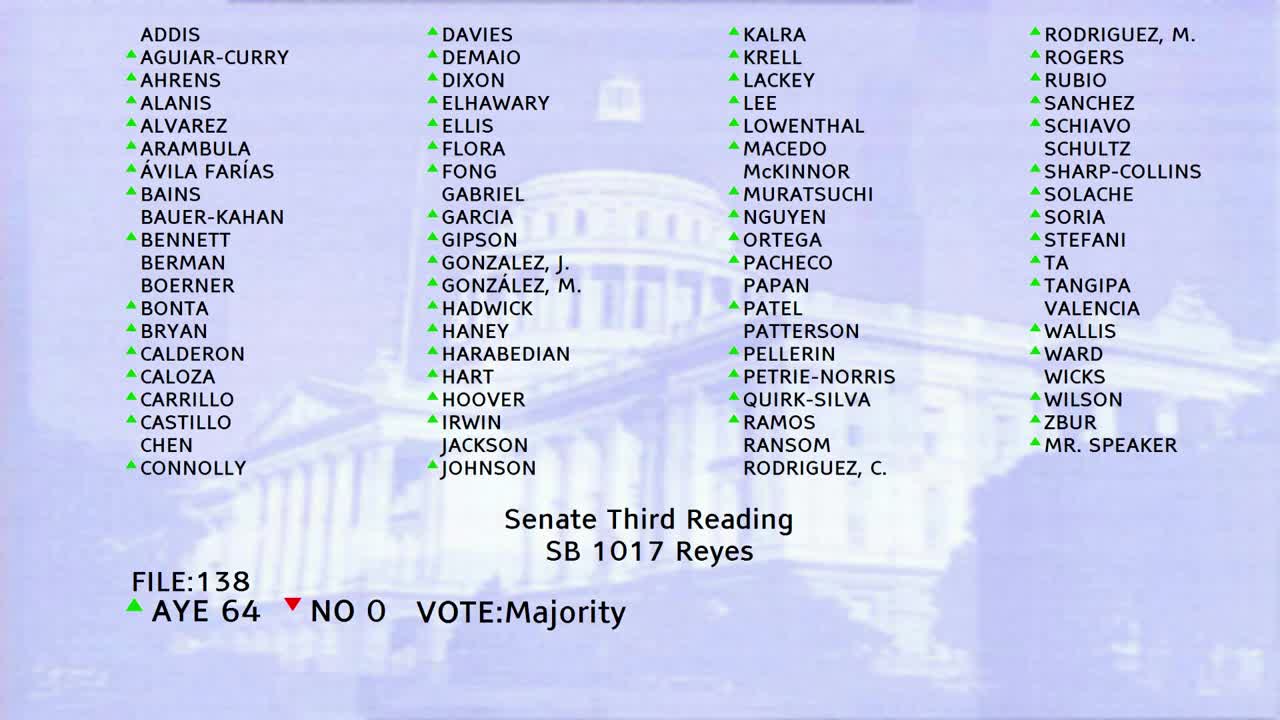

Bill Author

Bill Co-Author(s):