SB 1034: Vehicles: special license plates.
- Session Year: 2025-2026
- House: Senate
- Latest Version Date: 2026-04-14
Current Status:
In Progress
(2026-05-14: May 14 hearing: Held in committee and under submission.)
Introduced
In Committee
Awaiting First Chamber Vote
Passed First Chamber
In Committee
Awaiting Second Chamber Vote
Passed Second Chamber
Enacted
Existing law defines disabled veteran for purposes of the Vehicle Code as, among other things, a person who, as a result of injury or disease suffered while on active service with the Armed Forces of the United States, has a disability that has been rated at 100% by the Department of Veterans Affairs. Existing law also defines a disabled veteran as a veteran who is unable to move without the aid of an assistant device. Existing law defines a disabled person as a person who has lost, or has lost the use of, one or more lower extremities or both hands, or who has significant limitation in the use of lower extremities, or who has a diagnosed disease or disorder which substantially impairs or interferes with mobility, or who is so severely disabled as to be unable to move without the aid of an assistant device, among other conditions.
This bill would instead define a disabled veteran as a veteran who cannot walk without the use of an assistant device. The bill would expand the definition of disabled veteran to include a veteran who cannot walk 200 feet without stopping to rest, a veteran who is severely limited in the ability to walk because of an arthritic, neurological, or orthopedic condition, or a veteran who has visual acuity of 20/200 or less, among other conditions, as specified. a person who has a condition that meets the eligibility requirements for a disabled person, as specified above.
Existing law requires the Department of Motor Vehicles, upon application and without additional fees, to issue a special license plate or plates to a disabled person, disabled veteran, or an organization or agency involved in the transportation of disabled persons or veterans, as specified, in accordance with procedures adopted by the department. Existing law authorizes a disabled person or disabled veteran to apply to the department for the issuance of a distinguishing placard in lieu of the special license plate or plates for parking purposes, as specified. Existing law authorizes the department to establish procedures for the issuance and renewal of the placards.
This bill would require the department to issue a special license plate or plates to a disabled veteran rated 100% permanent and total if the veteran also qualifies for the placard mentioned above, regardless of whether the qualifying mobility condition is service connected.
Existing law defines disabled veteran for purposes of the Vehicle Code as, among other things, a person who, as a result of injury or disease suffered while on active service with the Armed Forces of the United States, has a disability that has been rated at 100% by the Department of Veterans Affairs. Existing law also defines a disabled veteran as a veteran who is unable to move without the aid of an assistant device.
This bill would instead define a disabled veteran as a veteran who cannot walk without the use of an assistant device. The bill would expand the definition of disabled veteran to include a veteran who cannot walk 200 feet without stopping to rest, a veteran who is severely limited in the ability to walk because of an arthritic, neurological, or orthopedic condition, or a veteran who has visual acuity of 20/200 or less, among other conditions, as specified.
Existing law requires the Department of Motor Vehicles, upon application and without additional fees, to issue a special license plate or plates to a disabled person, disabled veteran, or an organization or agency involved in the transportation of disabled persons or veterans, as specified, in accordance with procedures adopted by the department. Existing law authorizes a disabled person or disabled veteran to apply to the department for the issuance of a distinguishing placard in lieu of the special license plate or plates for parking purposes, as specified. Existing law authorizes the department to establish procedures for the issuance and renewal of the placards.
This bill would require the department to issue a special license plate or plates to a disabled veteran rated 100% permanent and total if the veteran also qualifies for the placard mentioned above, regardless of whether the qualifying mobility condition is service connected.
A disabled veteran is a person who, as a result of injury or disease suffered while on active service with the armed forces of the United States, suffers any of the following:
(a)Has a disability which has been rated at 100 percent by the Department of Veterans Affairs or the military service from which the veteran was discharged, due to a diagnosed disease or disorder which substantially impairs or interferes with mobility.
(b)Cannot walk without the use of, or assistance from, an assistant device, including a brace, cane, crutch, another person, or a prosthetic device, wheelchair, or similar device.(b)Is so severely disabled as to be unable to move without the aid of an assistant device.
(c)Has lost, or has lost use of, one or more limbs.
(d)Has suffered permanent blindness, as defined in Section 19153 of the Welfare and Institutions Code.
(e)Has visual acuity of 20/200 or less in the better eye with correcting lenses or visual acuity of more than 20/200 but with a limited field of vision in which the widest diameter of the visual field subtends an angle of 20 degrees or less.(f)Cannot walk 200 feet without stopping to rest.(g)Is restricted by lung disease to the extent that the persons forced (respiratory) expiratory volume for one second when measured by spirometry is less than one liter, or the persons arterial oxygen tension (pO2) is less than 60 mm/Hg on room air while the person is at rest.(h)Has a cardiac condition to the extent that the persons functional limitations are classified in severity as Class III or Class IV according to standards set by the American Heart Association.(i)Is severely limited in the ability to walk because of an arthritic, neurological, or orthopedic condition.(j)Has a disorder of the foot that, in the opinion of a physician, limits or impairs the persons ability to walk, or has another debilitating condition that, in the opinion of a physician or a person authorized by applicable law to practice medicine in a hospital or other health facility of the Department of Veterans Affairs, limits or impairs the persons ability to walk.(k)Uses portable oxygen.(e)Has a condition that meets the eligibility requirements for a disabled person pursuant to Section 295.5.
SEC. 2.Section 5007 of the Vehicle Code is amended to read:5007.(a)The department shall, upon application and without additional fees, issue a special license plate or plates pursuant to procedures adopted by the department to all of the following:
(1)A disabled person.
(2)A disabled veteran. Notwithstanding Section 295.7, a disabled veteran rated 100 percent permanent and total qualifies for a plate pursuant to this section if the veteran also qualifies for a placard issued under Section 22511.55 or 22511.59, regardless of whether the qualifying mobility condition is service connected.
(3)An organization or agency involved in the transportation of disabled persons or disabled veterans if the motor vehicle that will have the special license plate is used solely for the purpose of transporting those persons.
(b)The special license plates issued under subdivision (a) shall run in a regular numerical series that shall include one or more unique two-letter codes reserved for disabled person license plates or disabled veteran license plates. The International Symbol of Access adopted pursuant to Section 3 of Public Law 100-641, commonly known as the wheelchair symbol, shall be depicted on each plate.
(c)(1)Except as provided in paragraph (3), before issuing a special license plate to a disabled person or disabled veteran, the department shall require the submission of a certificate, in accordance with paragraph (2), signed by the physician and surgeon, or to the extent that it does not cause a reduction in the receipt of federal aid highway funds, by a nurse practitioner, certified nurse-midwife, or physician assistant, substantiating the disability, unless the applicants disability is readily observable and uncontested. The disability of a person who has lost, or has lost the use of, one or more lower extremities or one hand, for a disabled veteran, or both hands for a disabled person, or who has significant limitation in the use of lower extremities, may also be certified by a licensed chiropractor. The disability of a person related to the foot or ankle may be certified by a licensed podiatrist. The blindness of an applicant shall be certified by a licensed physician and surgeon who specializes in diseases of the eye or a licensed optometrist. The physician and surgeon, nurse practitioner, certified nurse-midwife, physician assistant, chiropractor, or optometrist certifying the qualifying disability shall provide a full description of the illness or disability on the form submitted to the department.
(2)The physician and surgeon, nurse practitioner, certified nurse midwife, physician assistant, chiropractor, podiatrist, or optometrist who signs a certificate submitted under this subdivision shall retain information sufficient to substantiate that certificate and, upon request of the department, shall make that information available for inspection by the Medical Board of California or the appropriate regulatory board.
(3)For a disabled veteran, the department shall accept, in lieu of the certificate described in paragraph (1), a certificate from a county veterans service officer, the Department of Veterans Affairs, or the United States Department of Veterans Affairs that certifies that the applicant is a disabled veteran as described in Section 295.7.
(d)A disabled person or disabled veteran who is issued a license plate or plates under this section shall, upon request, present to a peace officer, or person authorized to enforce parking laws, ordinances, or regulations, a certification form that substantiates the eligibility of the disabled person or veteran to possess the plate or plates. The certification shall be on a form prescribed by the department and contain the name of the disabled person or disabled veteran to whom the plate or plates were issued, and the name, address, and telephone number of the medical professional described in subdivision (c) who certified the eligibility of the person or veteran for the plate or plates.
(e)The certification requirements of subdivisions (c) and (d) do not apply to an organization or agency that is issued a special license plate or plates under paragraph (3) of subdivision (a).
(f)The special license plate shall, upon the death of the disabled person or disabled veteran, be returned to the department within 60 days or upon the expiration of the vehicle registration, whichever occurs first.
(g)When a motor vehicle subject to paragraph (3) of subdivision (a) is sold or transferred, the special license plate or plates issued to an organization or agency under paragraph (3) of subdivision (a) for that motor vehicle shall be immediately returned to the department.
(h)The department shall require a person who applies for a special license plate pursuant to this section to provide proof of the applicants true full name and date of birth that shall be established by submitting one of the following to the department:
(1)A copy or facsimile of the applicants state issued drivers license or identification card.
(2)A copy or facsimile of the document required for an applicant for a drivers license or identification card to establish the applicants true full name.
(3)An applicant unable to establish legal presence in the United States may fulfill the true full name and date of birth requirement by providing the department a copy or facsimile of the documents used to establish identity pursuant to Section 12801.9.
A disabled veteran is any a person who, as a result of injury or disease suffered while on active service with the armed forces of the United States, suffers any of the following:
(a)Has a disability which has been rated at 100 percent by the Department of Veterans Affairs or the military service from which the veteran was discharged, due to a diagnosed disease or disorder which substantially impairs or interferes with mobility.
(b)Is so severely disabled as to be unable to move without the aid of an assistant device.(b)Cannot walk without the use of, or assistance from, an assistant device, including a brace, cane, crutch, another person, or a prosthetic device, wheelchair, or similar device.
(c)Has lost, or has lost use of, one or more limbs.
(d)Has suffered permanent blindness, as defined in Section 19153 of the Welfare and Institutions Code.
(e)Has visual acuity of 20/200 or less in the better eye with correcting lenses or visual acuity of more than 20/200 but with a limited field of vision in which the widest diameter of the visual field subtends an angle of 20 degrees or less.
(f)Cannot walk 200 feet without stopping to rest.
(g)Is restricted by lung disease to the extent that the persons forced (respiratory) expiratory volume for one second when measured by spirometry is less than one liter, or the persons arterial oxygen tension (pO2) is less than 60 mm/Hg on room air while the person is at rest.
(h)Has a cardiac condition to the extent that the persons functional limitations are classified in severity as Class III or Class IV according to standards set by the American Heart Association.
(i)Is severely limited in the ability to walk because of an arthritic, neurological, or orthopedic condition.
(j)Has a disorder of the foot that, in the opinion of a physician, limits or impairs the persons ability to walk, or has another debilitating condition that, in the opinion of a physician or a person authorized by applicable law to practice medicine in a hospital or other health facility of the Department of Veterans Affairs, limits or impairs the persons ability to walk.
(k)Uses portable oxygen.
SEC. 2.Section 5007 of the Vehicle Code is amended to read:5007.(a)The department shall, upon application and without additional fees, issue a special license plate or plates pursuant to procedures adopted by the department to all of the following:
(1)A disabled person.
(2)A disabled veteran. Notwithstanding Section 295.7, a disabled veteran rated 100 percent permanent and total qualifies for a plate pursuant to this section if the veteran also qualifies for a placard issued under Section 22511.55 or 22511.59, regardless of whether the qualifying mobility condition is service connected.
(3)An organization or agency involved in the transportation of disabled persons or disabled veterans if the motor vehicle that will have the special license plate is used solely for the purpose of transporting those persons.
(b)The special license plates issued under subdivision (a) shall run in a regular numerical series that shall include one or more unique two-letter codes reserved for disabled person license plates or disabled veteran license plates. The International Symbol of Access adopted pursuant to Section 3 of Public Law 100-641, commonly known as the wheelchair symbol symbol, shall be depicted on each plate.
(c)(1)Except as provided in paragraph (3), before issuing a special license plate to a disabled person or disabled veteran, the department shall require the submission of a certificate, in accordance with paragraph (2), signed by the physician and surgeon, or to the extent that it does not cause a reduction in the receipt of federal aid highway funds, by a nurse practitioner, certified nurse-midwife, or physician assistant, substantiating the disability, unless the applicants disability is readily observable and uncontested. The disability of a person who has lost, or has lost the use of, one or more lower extremities or one hand, for a disabled veteran, or both hands for a disabled person, or who has significant limitation in the use of lower extremities, may also be certified by a licensed chiropractor. The disability of a person related to the foot or ankle may be certified by a licensed podiatrist. The blindness of an applicant shall be certified by a licensed physician and surgeon who specializes in diseases of the eye or a licensed optometrist. The physician and surgeon, nurse practitioner, certified nurse-midwife, physician assistant, chiropractor, or optometrist certifying the qualifying disability shall provide a full description of the illness or disability on the form submitted to the department.
(2)The physician and surgeon, nurse practitioner, certified nurse midwife, physician assistant, chiropractor, podiatrist, or optometrist who signs a certificate submitted under this subdivision shall retain information sufficient to substantiate that certificate and, upon request of the department, shall make that information available for inspection by the Medical Board of California or the appropriate regulatory board.
(3)For a disabled veteran, the department shall accept, in lieu of the certificate described in paragraph (1), a certificate from a county veterans service officer, the Department of Veterans Affairs, or the United States Department of Veterans Affairs that certifies that the applicant is a disabled veteran as described in Section 295.7.
(d)A disabled person or disabled veteran who is issued a license plate or plates under this section shall, upon request, present to a peace officer, or person authorized to enforce parking laws, ordinances, or regulations, a certification form that substantiates the eligibility of the disabled person or veteran to possess the plate or plates. The certification shall be on a form prescribed by the department and contain the name of the disabled person or disabled veteran to whom the plate or plates were issued, and the name, address, and telephone number of the medical professional described in subdivision (c) who certified the eligibility of the person or veteran for the plate or plates.
(e)The certification requirements of subdivisions (c) and (d) do not apply to an organization or agency that is issued a special license plate or plates under paragraph (3) of subdivision (a).
(f)The special license plate shall, upon the death of the disabled person or disabled veteran, be returned to the department within 60 days or upon the expiration of the vehicle registration, whichever occurs first.
(g)When a motor vehicle subject to paragraph (3) of subdivision (a) is sold or transferred, the special license plate or plates issued to an organization or agency under paragraph (3) of subdivision (a) for that motor vehicle shall be immediately returned to the department.
(h)The department shall require a person who applies for a special license plate pursuant to this section to provide proof of the applicants true full name and date of birth that shall be established by submitting one of the following to the department:
(1)A copy or facsimile of the applicants state issued drivers license or identification card.
(2)A copy or facsimile of the document required for an applicant for a drivers license or identification card to establish the applicants true full name.
(3)An applicant unable to establish legal presence in the United States may fulfill the true full name and date of birth requirement by providing the department a copy or facsimile of the documents used to establish identity pursuant to Section 12801.9.
|
Date
|
Status
|
|---|---|
| May 14, 2026 | May 14 hearing: Held in committee and under submission. |
| May 8, 2026 | Set for hearing May 14. |
| May 4, 2026 | May 4 hearing: Placed on APPR. suspense file. |
| Apr 24, 2026 | Set for hearing May 4. |
| Apr 21, 2026 | From committee: Do pass and re-refer to Com. on APPR. (Ayes 4. Noes 0. Page 3956.) (April 20). Re-referred to Com. on APPR. |
| Apr 21, 2026 | From committee: Do pass and re-refer to Com. on APPR. (Ayes 4. Noes 0.) (April 20). Re-referred to Com. on APPR. |
| Apr 14, 2026 | From committee with author's amendments. Read second time and amended. Re-referred to Com. on M. & V.A. |
| Apr 8, 2026 | From committee: Do pass and re-refer to Com. on M. & V.A. (Ayes 12. Noes 0. Page 3760.) (April 7). Re-referred to Com. on M. & V.A. |
| Apr 8, 2026 | From committee: Do pass and re-refer to Com. on M. & V.A. (Ayes 12. Noes 0.) (April 7). Re-referred to Com. on M. & V.A. |
| Mar 17, 2026 | Set for hearing April 7. |
| Feb 18, 2026 | Referred to Coms. on TRANS. and M. & V.A. |
| Feb 12, 2026 | From printer. May be acted upon on or after March 14. |
| Feb 11, 2026 | Introduced. Read first time. To Com. on RLS. for assignment. To print. |
|
Date
|
Description
|
Location
|
Votes
|
|
|---|---|---|---|---|
| May 4, 2026 | Placed on suspense file | Senate Standing Committee on Appropriations |
Passed |
|
| Apr 20, 2026 | Do pass, but first be re-referred to the Committee on [Appropriations] | Senate Standing Committee on Military and Veterans Affairs |
Passed |
|
| Apr 7, 2026 | Do pass, but first be re-referred to the Committee on [Military and Veterans Affairs] | Senate Standing Committee on Transportation |
Passed |
This list shows positions taken on this bill by organizations on the date displayed, which is linked to the original source.
Positions by individuals are not included.
|
Organization
|
Position
|
Date
|
|---|---|---|
| American Legion, Department Of California | ** Support | |
| Amvets, Department Of California | ** Support | |
| California State Commanders Veterans Council | ** Support | |
| Department of California Disabled Americans Veterans | ** Support | |
| Military Officers Association Of America, California Council Of Chapters | ** Support | |
| Vietnam Veterans Of America, California State Council | ** Support |
SENATE COMMITTEE ON
Senator Sabrina Cervantes, Chair
2025 - 2026 Regular Session
SB 1034 (McNerney) - Vehicles: special license plates
Version: | Policy Vote: |
Urgency: | Mandate: |
Hearing Date: | Consultant: |
Bill Summary:
AB 1034 would expand the definition of “disabled veteran” for purposes of qualifying for a disabled veteran (DV) special license plate. Specifically, the bill requires the Department of Motor Vehicles (DMV) to issue a DV plate to a disabled veteran with a 100% permanent and total disability, regardless of whether the qualifying mobility condition is service connected.
Fiscal Impact:
- Unknown significant revenue loss to various special funds, likely in the low millions annually, as a result of more disabled veterans qualifying for a vehicle registration fee waiver. Actual revenue losses would depend on the increase in DV plates issued under the expanded eligibility criteria. See Staff Comments. (Motor Vehicle Account [MVA], Public Transportation Account [PTA], State Highway Account [SHA], Road Maintenance and Rehabilitation Account [RMRA], local funds)
- Likely minor and absorbable one-time DMV costs to update forms and publications, and to update its website. (MVA)
Background:
Existing law defines a “disabled veteran” as a person who, as a result of injury or disease suffered while on active service with the armed forces of the United States (U.S.), suffers any of the following: has a 100% disability rating related to a condition that impairs mobility, is severely disabled as to be unable to move without the aid of an assistant device, has lost or lost the use of one or more limbs, or has suffered permanent blindness.
Existing law requires DMV to issue a DV special license plate, upon application and without additional fees, to a qualifying disabled veteran, and requires the applicant to provide a certificate from a medical provider or a county veterans service officer or Department of Veterans Affairs that substantiates the disability and certifies status as a disabled veteran, as specified. Existing law exempts a disabled veteran from paying registration-related fees for one passenger motor vehicle, motorcycle, or commercial vehicle with an unladen weight of 8,000 pounds or less, that is owned by the disabled veteran and is not used for transportation for hire, compensation, or profit. A DV license plate provides the same parking privileges afforded to the holder of a disabled parking placard, including the ability to park in a metered parking space at no charge, and park in a space with the International Symbol of Access (wheelchair symbol).
Proposed Law:
SB 1034 would expand eligibility for a DV special license plate by requiring DMV to issue a DV plate to a disabled veteran rated 100% permanent and total if the veteran also qualifies for a disabled placard, regardless of whether the qualifying mobility condition is service connected.
The bill would expand the definition of “disabled veteran” to include a person who, as a result of injury or disease while on active duty with the U.S. armed forces, has a condition that meets the eligibility requirements for a disabled person, as specified.
Related Legislation:
AB 1882 (Villapudua), which was held on the Assembly Appropriations Committee’s Suspense File in 2024, would have revised eligibility criteria for the disabled veteran’s license plate and exempted a partially disabled veteran, as defined, from paying vehicle registration fees.
AB 2837 (C. Garcia), which was held on the Assembly Appropriations Committee’s Suspense File in 2022, would have reduced the disability rating required to be considered a disabled veteran from 100% to 70% for veterans that meet the definition of “disabled veteran.”
Staff Comments:
The DMV indicates that, as of March of 2026, approximately 77,000 vehicles are registered with DV special license plates and qualify for a fee waiver. The average fees paid for an automobile registration total $296, excluding any special or local add-on fees, as follows: a $76 registration fee (MVA), a $34 California Highway Patrol fee (MVA), an $80 Transportation Improvement Fee (PTA, SHA, RMRA), and a $106 Vehicle License Fee (local funds). This bill would authorize a veteran with a qualifying disability, regardless of whether that disability is related to the veteran’s military service, to apply for a DV special license plate. This bill’s expansion of eligibility for DV plates would result in revenue losses, the magnitude of which would depend on the increase in demand for DV plates that come with a registration fee waiver. For illustrative purposes, if this bill results in a 5% increase in demand for DV plates, the annual revenue losses would total $1.14 million (including $423,000 in MVA funds), and if the demand increases by 10%, the annual revenue losses would total $2.28 million (including 846,000 in MVA funds).
The Motor Vehicle Account is the primary funding source for the California Highway Patrol and DMV. The MVA has had a structural deficit since the 2021-22 fiscal year, with expenditures exceeding revenues by approximately $60 million in the current year, and approximately $112 million in the budget year (projected). Absent further actions to address the MVA fund condition, approving any new proposals that increase MVA expenditures would exacerbate the current structural imbalance of the fund. The Budget Summary published for the Governor’s proposed 2026-27 Budget notes that “the MVA will be insolvent as soon as 2028-29. Given the ongoing fiscal constraints in the MVA, the Administration will continue to limit new workload or initiatives, including those with delayed implementation dates that would create additional cost pressures over time.”
-- END --
SENATE COMMITTEE ON MILITARY AND VETERANS AFFAIRS
Senator Bob Archuleta, Chair
2025 - 2026 Regular
Bill No: SB 1034 Hearing Date: 4/20/26
Author: | McNerney | ||
Version: | 4/14/26 Amended | ||
Urgency: | No | Fiscal: | Yes |
Consultant: | Diego Nelson | ||
Subject: Vehicles: special license plates
DESCRIPTION
Summary:
This bill expands the definition of “disabled veteran” for purposes of special license plates and requires the Department of Motor Vehicles (DMV) to issue disabled veteran (DV) plates to veterans rated 100% permanent and total who also qualify for a disabled parking placard, regardless of whether the qualifying mobility condition is service connected.
Existing law:
- Defines “disabled veteran” as a veteran who, as a result of military service:
- Has a 100% disability rating related to a condition that impairs mobility.
- Is unable to move without the aid of an assistive device.
- Has specified severe conditions (e.g., loss of limb, blindness). (Vehicle Code § 295.7)
- Requires DMV to issue special license plates at no cost to qualifying disabled veterans. (Vehicle Code § 5007)
- Authorizes issuance of disabled parking placards to individuals with mobility limitations, based on a functional standard that includes persons who:
- Have lost, or lost the use of, one or more lower extremities or both hands.
- Have a significant limitation in the use of lower extremities.
- Have a diagnosed disease or disorder that substantially impairs or interferes with mobility.
- Are so severely disabled as to be unable to move without the aid of an assistive device.
- Are blind.
- Are suffering from lung disease.
- Are suffering from cardiovascular disease. (Vehicle Code § 295.5)
This bill:
- Expands the definition of “disabled veteran” to include veterans who have a condition that meets the eligibility requirements for a disabled person pursuant to Section 295.5 of the Vehicle Code.
- Requires the DMV to issue Disabled Veteran (DV) plates to a veteran who is rated 100 percent permanent and total by the United States Department of Veterans Affairs, without regard to whether the veteran’s mobility limitation is service connected, and who meets the eligibility requirements for a disabled parking placard.
BACKGROUND
Under current California law, disability-related parking benefits are administered through two separate legal frameworks that developed along different paths over time. The state’s general disabled parking placard program is based on functional mobility limitations rather than the cause of the disability. A person may qualify for a placard if they are unable to walk without assistance, cannot walk a specified distance without stopping, or have another qualifying condition that substantially limits mobility. Because the standard focuses on the individual’s present physical condition, eligibility does not depend on whether the disability is related to military service.
The Disabled Veteran plate program is narrower than the general disabled parking placard program and is reserved for veterans who meet service-connected disability requirements recognized by the U.S. Department of Veterans Affairs. Under current California law, DV plates provide three main benefits: parking privileges, an exemption from registration fees for one qualifying vehicle, and, if the vehicle is registered to a FasTrak or other eligible electronic toll account, an exemption from tolls on California toll roads, toll bridges, toll highways, vehicular crossings, and other toll facilities, except high-occupancy toll lanes ss specified in Vehicle Code section 23301.3. State law also allows a county veterans service officer (CVSO), CalVet, or the VA to certify eligibility in place of the usual medical certification.
The VA may determine that a veteran is “100% disabled” in several different ways, and not all of them necessarily reflect the same type of disability or functional limitation. In some cases, the veteran has an actual 100% disability rating under the VA rating schedule. In others, the veteran is compensated at the 100% rate because service-connected disabilities prevent substantially gainful employment, even though the combined schedular rating is less than 100%. The VA may also determine that a total disability is permanent and not expected to improve or assign a temporary 100% rating for a limited period based on recovery from surgery, hospitalization, or a similar circumstance.
The main categories are as follows:
- Schedular 100% rating: The veteran has an actual 100% disability rating assigned by the VA under its rating schedule, either because a single condition is rated at 100% or because the combined rating reaches 100%.
- Total Disability based on Individual Unemployability (TDIU): The veteran’s service-connected disabilities prevent substantially gainful employment, so the VA pays compensation at the 100% rate even though the schedular rating is less than 100%.
- Permanent and Total (P&T): The VA has determined that the veteran’s total disability is permanent and not expected to improve. This is generally a status attached to a total disability rating rather than a separate rating percentage.
- Temporary 100% rating: The VA assigns a temporary total rating for a limited period when a veteran qualifies based on circumstances such as surgery, hospitalization, or immobilization related to a service-connected disability.
COMMENT
According to the author: “California prides itself for how it takes care of veterans, especially those who were seriously injured while defending our country or are disabled. But current California law discriminates against disabled veterans by making it tougher for them to access parking benefits. For many veterans, a DV license plate is not merely a parking accommodation, it is a symbol of service, sacrifice, and earned recognition. Without parity in California law, disabled veterans will continue to face barriers in accessing parking benefits to which they should be entitled. SB 1034 ensures parity for disabled veterans seeking to obtain disabled veterans parking placards from the DMV.”
Under current law, the DMV treats DV plate eligibility as a veteran-specific benefit tied to the definition of “disabled veteran” as specified in Vehicle Code section 295.7. State law also requires the DMV to accept, in lieu of an otherwise required medical certification, a certificate from a CVSO, CalVet, or the United States Department of Veterans Affairs confirming that the applicant qualifies as a disabled veteran for purposes of receiving a DV plate. In practice, CVSOs commonly help verify whether the veteran has a 100% VA disability rating and whether the qualifying mobility limitation is service connected before the application is submitted to DMV. Under the status quo, a veteran who is rated 100% permanent and total but does not have a service-connected mobility limitation would not qualify for a DV plate solely based on the rating.
This bill raises a broader policy question about whether the Disabled Veteran plate program should remain a veteran-specific benefit tied to service-connected disability or instead move closer to the general disabled parking placard program. By cross-referencing Vehicle Code section 295.5, the bill could blur the distinction between those two standards and shift the DV plate program away from the narrower service-connected framework that has historically set it apart. The bill could also create uncertainty in the CVSO verification process. CVSOs have traditionally verified veteran status, VA disability ratings, and whether the qualifying condition is service connected. If the program begins to incorporate the broader disability criteria used for placards, it may become less clear what CVSOs are expected to certify at the front end of the application process.
At the same time, a broader eligibility standard could make the program more useful to some veterans with serious mobility impairments who do not qualify under the current approach. In practice, the current framework is narrower, and some veterans may have substantial day-to-day mobility limitations but still fall outside the DV plate program because their condition is not recognized as qualifying in the required way for DV plate purposes.
SB 1034 could expand access for veterans who are rated 100% permanent and total and who face significant difficulty walking or traveling independently, but whose mobility impairment is not currently treated as service connected for purposes of DV plate eligibility. This bill could improve access to parking and vehicle-related benefits for a group of veterans whose transportation needs are real and substantial, even if they do not fit neatly within the program’s traditional service-connected framework. It therefore presents a policy tradeoff: broadening the program may make it more responsive to veterans with serious mobility challenges, while also moving it away from the narrower veteran-specific standard that has historically defined the DV plate benefit.
Previous legislation
AB 1882 (Villapudua, 2024) would have expanded the definition of “disabled veteran” for Vehicle Code purposes by cross-referencing criteria like those used for disabled parking placards, including specified mobility- and vision-based conditions. The bill was held in the Assembly Committee on Appropriations.
Amendments
The author amended SB 1034 to delete the Section 1 language listing eligibility criteria based on the standards for disabled parking placards and instead cross-references Vehicle Code Section 295.5, which defines a disabled person using specified criteria.
POSITIONS
Sponsor: Department of California Disabled Americans Veterans
Support: American Legion, Department of California
Amvets, Department of California
California State Commanders Veterans Council
Military Officers Association of America, California Council of Chapters
Vietnam Veterans of America, California State Council
Oppose: None
-- END --
SENATE COMMITTEE ON TRANSPORTATION
Senator Dave Cortese, Chair
2025 - 2026 Regular
Bill No: Hearing Date: 4/7/2026
Author: | McNerney | ||
Version: | 2/11/2026 Introduced | ||
Urgency: | No | Fiscal: | Yes |
Consultant: | Isabelle LaSalle | ||
SUBJECT:
DIGEST: This bill removes the requirement that a disabled veteran’s qualifying mobility condition be service connected in ordered to qualify for a Disabled Veteran License Plate and be exempt from vehicle registration and license fees. This bill also expands the definition of disabled veteran, as specified.
ANALYSIS:
Existing law:
- Defines a “disabled veteran” as any person who, as a result of injury or disease suffered while on active service with the armed forces of the United States (U.S.), suffers any of the following:
- Has a disability which has been rated at 100 percent by the Department of Veterans Affairs or the military service from which the veteran was discharged, due to a diagnosed disease or disorder which substantially impairs or interferes with mobility.
- Has lost, or has lost use of, one or more limbs.
- Has suffered permanent blindness, as defined in Section 19153 of the Welfare and Institutions Code. (VEH §295.7)
- Specifies that Vehicle Code fees need not be paid for a vehicle owned by any of the following:
- A disabled veteran.
- A former American prisoner of war or their surviving spouse.
- A Congressional Medal of Honor recipient or their surviving spouse. (VEH §9105)
- Requires the Department of Motor Vehicles (DMV), before issuing a special license plate to a disabled person or disabled veteran, to require the submission of a certificate signed by the relevant physician, nurse practitioner, certified nurse-midwife, or physician assistant, substantiating the disability, unless the applicant’s disability is readily observable and uncontested. (VEH §5007)
- Specifies that for a disabled veteran, DMV shall accept, in lieu of the certificate from a medical provider, a certificate from a county veterans service officer, the Department of Veterans Affairs, or the United States Department of Veterans Affairs that certifies that the applicant is a disabled veteran. (VEH §5007)
This bill:
- Extends eligibility for the Disabled Veteran License Plate and associated fee waivers to all disabled veterans rated 100 percent permanent and total, regardless of whether their qualifying mobility condition is service connected.
- Expands the definition of disabled veteran to include individuals with the following conditions:
- Cannot walk without the use of, or assistance from, an assistant device, including a brace, cane, crutch, another person, or a prosthetic device, wheelchair, or similar device.
- Has visual acuity of 20/200 or less in the better eye with correcting lenses or visual acuity of more than 20/200 but with a limited field of vision in which the widest diameter of the visual field subtends an angle of 20 degrees or less.
- Cannot walk 200 feet without stopping to rest.
- Is restricted by lung disease to the extent that the person’s forced (respiratory) expiratory volume for one second when measured by spirometry is less than one liter, or the person’s arterial oxygen tension (pO2) is less than 60 mm/Hg on room air while the person is at rest.
- Has a cardiac condition to the extent that the person’s functional limitations are classified in severity as Class III or Class IV according to standards set by the American Heart Association.
- Is severely limited in the ability to walk because of an arthritic, neurological, or orthopedic condition.
- Has a disorder of the foot that, in the opinion of a physician, limits or impairs the person’s ability to walk, or has another debilitating condition that, in the opinion of a physician or a person authorized by applicable law to practice medicine in a hospital or other health facility of the Department of Veterans Affairs, limits or impairs the person’s ability to walk.
- Uses portable oxygen.
COMMENTS:
- Purpose of the bill. According to the author, “California prides itself for how it takes care of veterans, especially those who were seriously injured while defending our country or are disabled. But current California law discriminates against disabled veterans by making it tougher for them to access parking benefits. For many veterans, a DV license plate is not merely a parking accommodation, it is a symbol of service, sacrifice, and earned recognition. Without parity in California law, disabled veterans will continue to face barriers in accessing parking benefits to which they should be entitled. SB 1034 ensures parity for disabled veterans seeking to obtain disabled veterans parking placards from the DMV.”
- Disabled Veteran (DV) License plates. Veterans permanently disabled as a result of an injury or disease that occurred while on active service with the U.S. Armed Forces may be eligible for DV License Plates. A qualified disabled veteran is exempt from paying all fees (except fees for duplicate DV License Plates, certificates, or cards if they’re lost, stolen, or damaged) on one vehicle. In addition to waiving all registration fees, the DV License Plate allows the owner the same parking privileges afforded to the disabled parking placard, including the ability to park in an on-street metered parking space at no charge. In 2024, DVM reported there were 29,361 disabled veteran plates in circulation.
- Application process. In order to apply for a DV License Plate, an applicant must submit one of the following documents to DMV:
- A Medical Certification form completed and signed by a licensed physician, surgeon, chiropractor, optometrist, physician assistant, nurse practitioner, or certified nurse midwife who has knowledge of the disease and/or disability.
- A certification completed and signed by a County Veterans Service Officer.
- A certification completed and signed by an authorized representative of the Department of Veterans Affairs (CalVet).
- A certification completed and signed by an authorized representative of the United States Department of Veterans Affairs.
These options allow veterans multiple avenues for certifying their disabled veteran status.
- Alignment with federal definition. This bill adds to the definition of “disabled veteran” a wide variety of disabling medical conditions, most of which are included in the federal definition of “persons with disabilities which limit or impair the ability to walk” (CFR §1235.2). California’s current definition is fairly unspecific. It defers largely to determinations made by the Department of Veterans Affairs or the military service from which the veteran was discharged. Specifically, a disabled veteran must have one of the following conditions: a diagnosed disease or disorder which substantially impairs or interferes with mobility, has lost, or has lost use of, one or more limbs, or has suffered permanent blindness.
This bill adds substantial specificity to that list of qualifications. For example, it adds those who cannot walk two hundred feet without stopping to rest and those who use portable oxygen. These conditions are included in the federal definition of a person with disabilities as it relates to the international symbol of access.
- Removing the link to active service injury. The most significant change in this bill is the removal of the requirement that a disabled veteran’s disability be service related. This change will significantly expand eligibility for the disabled veteran license plate, which is currently only available to veterans permanently disabled as a result of an injury or disease that occurred while on active service with the U.S. Armed Forces. According to the bill’s sponsors, the change may result in an estimated 21,000 more veterans becoming eligible for the disabled veteran plate and registration fee waiver.
- Disabled person license plates. The disabled person license plate grants the same parking privileges afforded to the disabled veteran license plate holders. The primary difference between the two plates is that the disabled veteran plate includes a registration fee waiver. The author’s office argues that the provisions of this bill alleviate barriers veterans face in accessing parking benefits to which they should be entitled. However, a disabled veteran can access the parking benefits of the disabled person license plate regardless of the circumstances of their injury or disability. A disabled person license plate allows a driver to park in parking spaces with the International Symbol of Access (wheelchair symbol), next to a blue curb authorized for persons with disabilities parking, next to a green curb (green curbs indicate limited time parking) for as long as they wish, in an on-street metered parking space at no charge, and in an area that indicates it requires a resident or merchant permit. The disabled person license plate does not have any limitations on how the individual became disabled.
- Revenue loss. Vehicle registration fees fund numerous essential state and local governmental services. The average fee paid during vehicle registration for an automobile is $295, while a commercial truck is $1,346 and a non-commercial truck is $406. This includes the California Highway Patrol (CHP) Fee which funds the services of CHP, the Vehicle license Fee (VLF) which funds local government services such as public safety, and the Transportation Improvement Fee (TIF) which funds transit operations, road maintenance, and infrastructure repairs throughout the state. These fees are in addition to the base registration fee, which fund numerous state services, including DMV.
Furthermore, registration fees make up a substantial part of the Motor Vehicle Account (MVA). A February 2025 Legislative Analyst’s Office (LAO) report found that for 2025-26, MVA revenues are estimated to total about $5 billion. Of this amount, over $4 billion is projected to come from vehicle registration fees. MVA is the primary funding source for CHP and DMV. According to the LAO, MVA is “rapidly heading for insolvency” as expenditures continue to outpace revenues. Specifically, MVA is projected to become insolvent in 2025/26 with deficits increasing in future years. As such, LAO recommends the Legislature set a high bar for considering approval of any proposals that create additional MVA cost pressures and accelerate the risk of insolvency.
The committee may wish to evaluate any proposals that may result in a significant loss of vehicle registration revenue. It is unclear to what extent the loss of these fees may result in the degradation of essential governmental services.
- Double Referral. This bill has been double referred to the Senate Military and Veterans Affairs Committee.
Related/previous Legislation:
AB 1765 (Alanis, 2026) – This bill would clarify that the disabled veteran license plate registration fee waiver can be applied to a commercial motor vehicle of less than 10,000 pounds unladen weight. This bill is currently in the Assembly Transportation Committee.
AB 1882 (Villapudua, 2024) – This bill would have revised eligibility criteria for the disabled veteran’s license plate and exempted a partially disabled veteran, as defined, from paying vehicle registration fees. This was held in the Assembly Appropriations Committee.
AB 2837 (C. Garcia, 2022) – This bill would have reduced the disability rating required to be considered a disabled veteran from 100% to 70% for veterans that meet the definition of “disabled veteran.” This bill was held in the Assembly Appropriations Committee.
FISCAL EFFECT: Appropriation: Fiscal Com.: Local:
POSITIONS: (Communicated to the committee before noon on Wednesday, April 1, 2026.)
SUPPORT:
American Legion, Department of California
Amvets, Department of California
California State Commanders Veterans Council
Military Officers Association of America, California Council of Chapters
Vietnam Veterans of America, California State Council
OPPOSITION:
None received
Discussed in Hearing
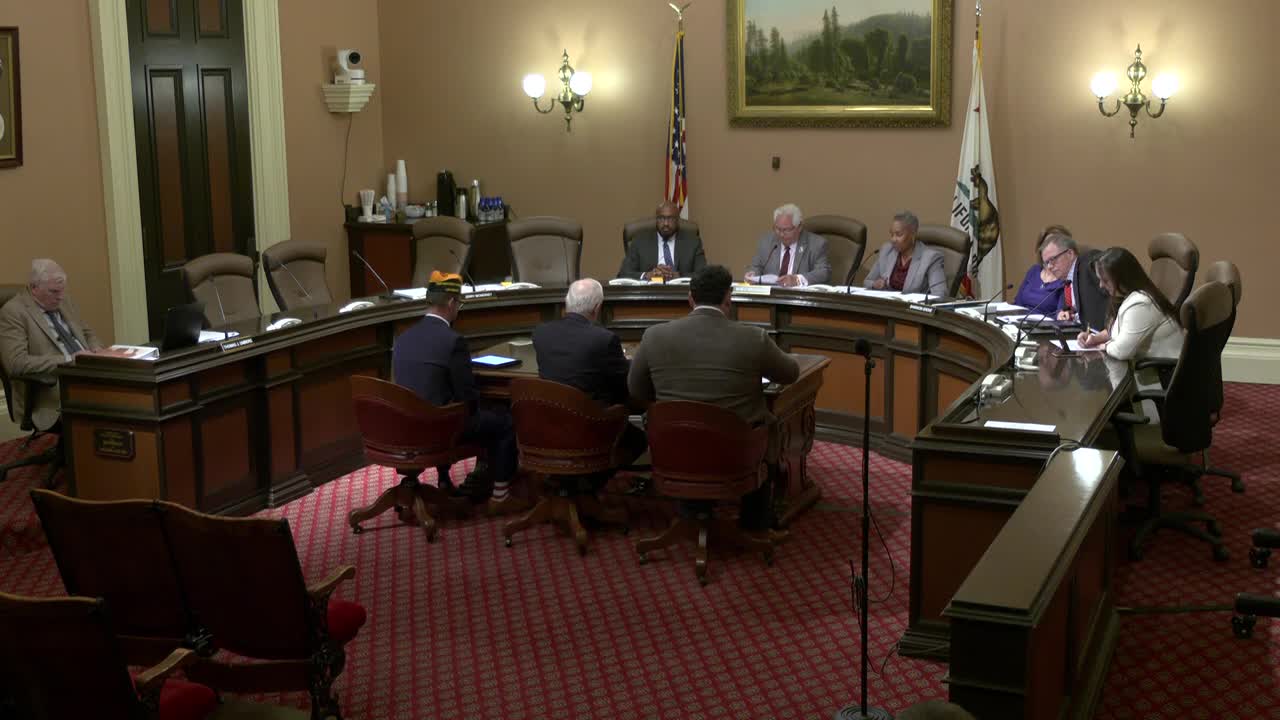 10MIN
Senate Standing Committee on Military and Veterans Affairs
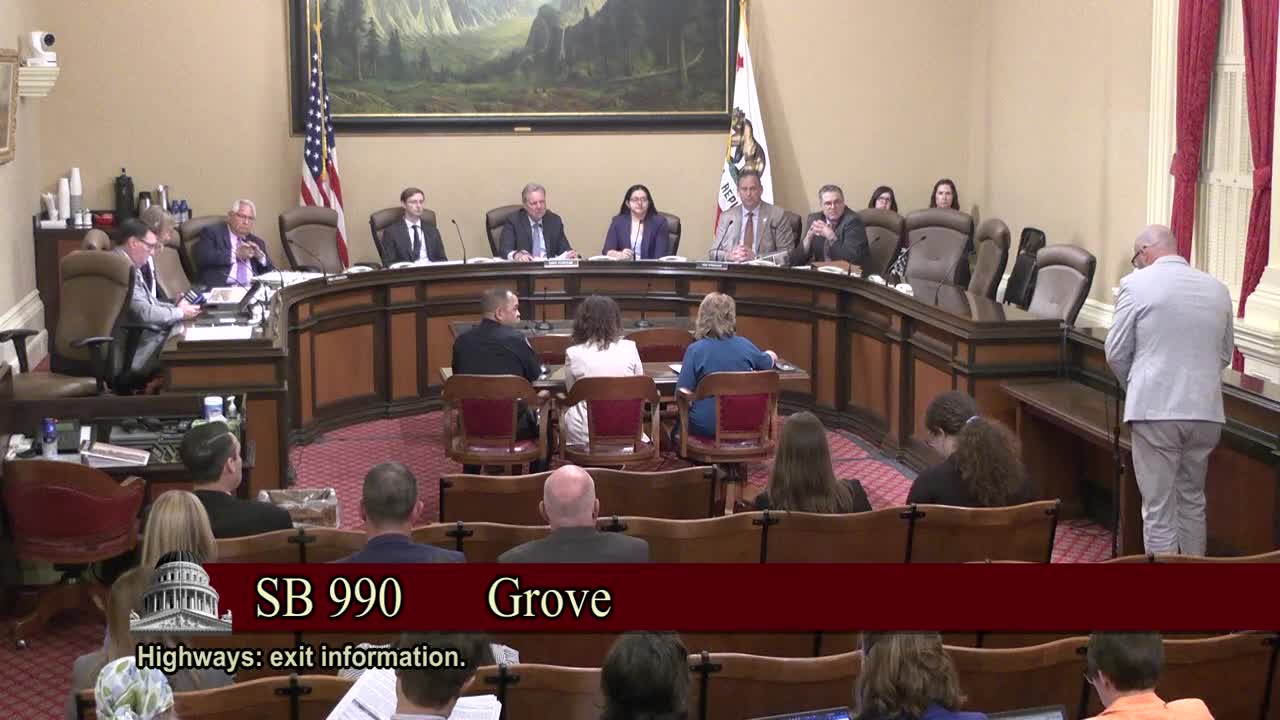 10MIN
Senate Standing Committee on Transportation
Bill Author

Bill Co-Author(s):