SB 1058: School districts: contracting: purchases for child nutrition programs.
- Session Year: 2025-2026
- House: Senate
- Latest Version Date: 2026-07-13
Current Status:
Passed
(2026-07-13: Chaptered by Secretary of State. Chapter 87, Statutes of 2026.)
Introduced
In Committee
Awaiting First Chamber Vote
Passed First Chamber
In Committee
Awaiting Second Chamber Vote
Passed Second Chamber
Enacted
Existing law requires a school district approved to operate at least one federal nonprofit child nutrition program to make procurement bid solicitations and awards for purchases in support of those programs consistent with specified federal procurement standards. Existing law requires these awards to be let to the most responsive and responsible party, and further requires that price be the primary consideration, but not the only determining factor.
This bill would eliminate the requirement that price be the primary consideration, but not the only determining factor. The bill would also modify the specified federal procurement standards a school district is required to be consistent with when making procurement bid solicitations and awards.
(a)(1) The governing board of any school district, in accordance with any requirement established by that governing board pursuant to subdivision (a) of Section 2000, shall let any contracts involving an expenditure of more than fifty thousand dollars ($50,000) for any of the following:
(A)The purchase of equipment, materials, or supplies to be furnished, sold, or leased to the district.
(B)Services, except construction services.
(C)Repairs, including maintenance as defined in Section 20115, that are not a public project as defined in subdivision (c) of Section 22002.
(2)The governing board shall let the contract to the lowest responsible bidder who shall give security as the board requires, or else reject all bids.
(b)(1)The governing board shall let any contract for a public project, as defined in subdivision (c) of Section 22002, involving an expenditure of fifteen thousand dollars ($15,000) or more, to the lowest responsible bidder who shall give security as the board requires, or else reject all bids. All bids for construction work shall be presented under sealed cover, and shall be accompanied by one of the following forms of bidders security:
(A)Cash.
(B)A cashiers check made payable to the school district.
(C)A certified check made payable to the school district.
(D)A bidders bond executed by an admitted surety insurer, made payable to the school district.
(2)Upon award to the lowest bidder, the security of an unsuccessful bidder shall be returned in a reasonable period of time, but in no event shall that security be held by the school district beyond 60 days from the time the award is made.
(c)Procurement bid solicitations and awards made by a school district approved to operate at least one federal nonprofit child nutrition program for purchases in support of those programs shall be consistent with the federal procurement standards in Sections 200.317 to 200.327, inclusive, of Part 200 of Title 2 of the Code of Federal Regulations. These awards shall be let to the most responsive and responsible party.
(d)This section applies to all equipment, materials, or supplies, whether patented or otherwise, and to contracts awarded pursuant to subdivision (a) of Section 2000. This section shall not apply to professional services or advice, insurance services, or any other purchase or service otherwise exempt from this section, or to any work done by day labor or by force account pursuant to Section 20114.
(e)Commencing January 1, 1997, the Superintendent of Public Instruction shall annually adjust the dollar amounts specified in subdivision (a) to reflect the percentage change in the annual average value of the Implicit Price Deflator for State and Local Government Purchases of Goods and Services for the United States, as published by the United States Department of Commerce for the 12-month period ending in the prior fiscal year. The annual adjustments shall be rounded to the nearest one hundred dollars ($100).
(a)(1) The governing board of any school district, in accordance with any requirement established by that governing board pursuant to subdivision (a) of Section 2000, shall let any contracts involving an expenditure of more than fifty thousand dollars ($50,000) for any of the following:
(A)The purchase of equipment, materials, or supplies to be furnished, sold, or leased to the district.
(B)Services, except construction services.
(C)Repairs, including maintenance as defined in Section 20115, that are not a public project as defined in subdivision (c) of Section 22002.
(2)The governing board shall let the contract to the lowest responsible bidder who shall give security as the board requires, or else reject all bids.
(b)(1)The governing board shall let any contract for a public project, as defined in subdivision (c) of Section 22002, involving an expenditure of fifteen thousand dollars ($15,000) or more, to the lowest responsible bidder who shall give security as the board requires, or else reject all bids. All bids for construction work shall be presented under sealed cover, and shall be accompanied by one of the following forms of bidders security:
(A)Cash.
(B)A cashiers check made payable to the school district.
(C)A certified check made payable to the school district.
(D)A bidders bond executed by an admitted surety insurer, made payable to the school district.
(2)Upon award to the lowest bidder, the security of an unsuccessful bidder shall be returned in a reasonable period of time, but in no event shall that security be held by the school district beyond 60 days from the time the award is made.
(c)Procurement bid solicitations and awards made by a school district approved to operate at least one federal nonprofit child nutrition program for purchases in support of those programs shall be consistent with the federal procurement standards in Sections 200.318 to 200.326, 200.317 to 200.327, inclusive, of Part 200 of Title 2 of the Code of Federal Regulations. These awards shall be let to the most responsive and responsible party. The price shall be the primary consideration, but not the only determining factor.
(d)This section applies to all equipment, materials, or supplies, whether patented or otherwise, and to contracts awarded pursuant to subdivision (a) of Section 2000. This section shall not apply to professional services or advice, insurance services, or any other purchase or service otherwise exempt from this section, or to any work done by day labor or by force account pursuant to Section 20114.
(e)Commencing January 1, 1997, the Superintendent of Public Instruction shall annually adjust the dollar amounts specified in subdivision (a) to reflect the percentage change in the annual average value of the Implicit Price Deflator for State and Local Government Purchases of Goods and Services for the United States, as published by the United States Department of Commerce for the 12-month period ending in the prior fiscal year. The annual adjustments shall be rounded to the nearest one hundred dollars ($100).
|
Date
|
Status
|
|---|---|
| Jul 13, 2026 | Chaptered by Secretary of State. Chapter 87, Statutes of 2026. |
| Jul 13, 2026 | Approved by the Governor. |
| Jul 2, 2026 | Enrolled and presented to the Governor at 2 p.m. |
| Jun 25, 2026 | In Senate. Ordered to engrossing and enrolling. |
| Jun 25, 2026 | Read third time. Passed. (Ayes 73. Noes 0. Page 5864.) Ordered to the Senate. |
| Jun 25, 2026 | Read third time. Passed. Ordered to the Senate. |
| Jun 22, 2026 | Read second time. Ordered to consent calendar. |
| Jun 18, 2026 | From committee: Do pass. Ordered to consent calendar. (Ayes 8. Noes 0.) (June 17). |
| May 11, 2026 | Referred to Com. on ED. |
| Apr 27, 2026 | In Assembly. Read first time. Held at Desk. |
| Apr 27, 2026 | Read third time. Passed. (Ayes 37. Noes 0.) Ordered to the Assembly. |
| Apr 27, 2026 | Read third time. Passed. (Ayes 37. Noes 0. Page 4064.) Ordered to the Assembly. |
| Mar 26, 2026 | Read second time. Ordered to third reading. |
| Mar 25, 2026 | From committee: Do pass. (Ayes 7. Noes 0.) (March 25). |
| Mar 25, 2026 | From committee: Do pass. (Ayes 7. Noes 0. Page 3688.) (March 25). |
| Mar 12, 2026 | Set for hearing March 25. |
| Feb 26, 2026 | Referred to Com. on ED. |
| Feb 13, 2026 | From printer. May be acted upon on or after March 15. |
| Feb 12, 2026 | Introduced. Read first time. To Com. on RLS. for assignment. To print. |
|
Date
|
Description
|
Location
|
Votes
|
|
|---|---|---|---|---|
| Jun 17, 2026 | Do pass. To Consent Calendar. | Assembly Standing Committee on Education |
Passed |
|
| Apr 27, 2026 | Senate 3rd Reading SB1058 McNerney | Senate Floor |
Passed |
|
| Mar 25, 2026 | Do pass | Senate Standing Committee on Education |
Passed |
This list shows positions taken on this bill by organizations on the date displayed, which is linked to the original source.
Positions by individuals are not included.
|
Organization
|
Position
|
Date
|
|---|---|---|
| Alameda County Office Of Education | ** Support | |
| California Association Of School Business Officials | ** Support | |
| California School Nutrition Association | ** Support | |
| Los Angeles County Office Of Education | ** Support |
Date of Hearing: June 17, 2026
ASSEMBLY COMMITTEE ON EDUCATION
Darshana R. Patel, Chair
SBPCA Bill Id:SB 1058
Author:(McNerney) – As Introduced Ver:February 12, 2026
SENATE VOTE: 37-0
SUBJECT: School districts: contracting: purchases for child nutrition programs
SUMMARY: Removes price as the primary determining factor for school districts when receiving and awarding procurement bids related to federal nonprofit child nutrition programs, and corrects references to the Code of Federal Regulations. Specifically, this bill:
- Authorizes school districts to let awards to the most responsive and responsible party, without having to consider price as the primary consideration.
- Corrects the Code of Federal Regulations (CFR) sections that school districts must adhere to when making procurement bid solicitations and awards related to federal nonprofit child nutrition programs.
EXISTING LAW:
- Federal law requires, as a condition of receipt of federal funds, that the recipient award contracts only to responsible contractors possessing the ability to perform successfully under the terms and conditions of a proposed contract. Consideration is to be given to such matters as contractor integrity, public policy compliance, past performance record, and financial and technical resources. Contracts are to be awarded to the responsible offeror whose proposal is most advantageous to the recipient or subrecipient considering price and other factors. (CFR, Title 2, Section 200.318 and 200.320)
- Requires procurement bid solicitations and awards made by a school district operating a federal nonprofit child nutrition program to adhere to the following requirements:
- Remain consistent with specified federal procurement sections in the CFR;
- Award procurement bids to the most responsive and responsible party; and
- Award procurement bids with price as the primary consideration, but not the only determining factor. (Public Contract Code (PCC) 20111)
FISCAL EFFECT: This bill has been keyed nonfiscal by the Office of Legislative Counsel.
COMMENTS:
Need for the bill. According to the author’s office, “California was the first state to provide two free meals a day to all public schoolchildren and was one of the first to establish nutrition guidelines for healthy school meals for kids. SB 1058 updates CA’s school meals procurement law to allow districts to provide more high-quality, locally grown and culturally appropriate foods for kids. SB 1058 helps schools to further support local farmers and small businesses.”
Procurement types for school districts operating federal nonprofit nutrition programs. When school food authorities (SFAs) make purchases related to federal nonprofit child nutrition programs, they are required to conduct a procurement process. Small purchases may be facilitated through informal procurement methods, while larger purchases must go through formal procurement that allows for full and open competition. The two primary formal competitive procurement methods are Request for Proposals (RFPs) and Invitation for Bids (IFBs, also known as sealed bids).
According to the California Department of Education (CDE), this bill would remove the state requirement that SFAs use price as the primary consideration when making awards for all procurement processes under federal nonprofit nutrition programs. However, federal regulations still require IFBs to be awarded to the lowest priced bidder.
The role of price in school nutrition procurement processes. Current state law requires SFAs to follow three principles when conducting procurement bids and awards for federal nutrition programs:
- Remain consistent with specified federal procurement sections in the CFR;
- Award procurement bids to the most responsive and responsible party; and
- Award procurement bids with price as the primary consideration, but not the only determining factor.
This bill would strike the third provision from current law, thus removing price as the primary consideration. As summarized by the Senate Education Committee analysis of this bill, this provision was added through SB 544 (McGuire), Chapter 395, Statutes of 2017. At the time, federal guidance indicated that price was required to be the primary consideration for awarding contracts. However, in their 2022 Procuring Local Foods for Child Nutrition Programs guide, the USDA published updated guidance that stated explicitly that an RFP “allows for consideration of factors other than price.” The 2025 USDA Farm to School Procurement Guide also states, “While price is an important factor, other elements must also be considered when making an award.” Striking the reference to price in current state law is thus an attempt to align current state laws with federal recommendations.
Further, information provided by the author’s office indicates that prioritizing price over other factors can limit the ability of a school to acquire the most optimal nutrition program. A review article published in the Journal of School Health noted that incorporating more locally grown and organic foods into school-based meals is often associated with higher prices (Zuercher et. al., 2025). Thus, authorizing school districts to make awards based on factors other than price may allow schools to procure fresher, more local food.
Updated CFR references. This bill also expands the sections of the CFR that school districts must adhere to when making procurement bid solicitations and awards related to federal nonprofit child nutrition programs. According to information provided by the CDE, this change is necessary to align with federal updates to the CFR that went into effect in October, 2024.
Arguments in support. According to the California School Nutrition Association, “Since 2021, California has led the nation by providing two free meals a day to all public school students. However, under current law, school meal programs must consider the price of food above all other elements in an RFP, which can severely limit or even prohibit other more palatable options.
SB 1058 provides a necessary solution for our schools by empowering districts with the clarity needed to ensure students receive the highest quality locally sourced, minimally processed, and sustainable food. By making price a secondary consideration, the bill allows schools to better support local farmers and small businesses while tailoring their programs to meet the specific needs of local communities. Ultimately, this allows for diverse criteria to be included in the RFP process beyond just the lowest bid, ensuring that meals are both culturally appropriate and highly nutritious.
By allowing schools to pick the most responsive and responsible partners, SB 1058 ensures that California's groundbreaking universal school meals program is implemented as intended. It also makes for happier and healthier students who are ready to learn.”
Related legislation. SB 544 (McGuire), Chapter 395, Statutes of 2017, requires school districts operating federal child nutrition programs to award contracts for these programs consistent with federal procurement standards. Requires that these contracts be awarded to the most responsive and responsible party, and that price shall be the primary, but not the only, consideration when awarding contracts.
REGISTERED SUPPORT / OPPOSITION:
Support
Alameda County Office of Education
California Association of School Business Officials
California School Nutrition Association
Los Angeles County Office of Education
Opposition
None on file
Analysis Prepared by: Sarah Cate Hawthorne / ED. / (916) 319-2087
SENATE RULES COMMITTEE Office of Senate Floor Analyses (916) 651-4171 | SB 1058 |
THIRD READING
Bill No: SB 1058
Author: McNerney (D)
Introduced: 2/12/26
Vote: 21
SENATE EDUCATION COMMITTEE: 7-0, 3/25/26
AYES: Pérez, Ochoa Bogh, Cabaldon, Choi, Cortese, Gonzalez, Reyes
SUBJECT: School districts: contracting: purchases for child nutrition programs
SOURCE: California School Nutrition Association
DIGEST:
This bill makes clarifying changes to align statute—specifically relating to procurement bid solicitations and awards for school districts operating approved federal child nutrition programs—with federal procurement standards, which include removing a reference to price being the primary consideration for procurement bid solicitations and awards as well as correcting references to the Code of Federal Regulations.
ANALYSIS:
Existing federal law requires, as a condition of receipt of federal funds, that the recipient award contracts only to responsible contractors possessing the ability to perform successfully under the terms and conditions of a proposed contract. Consideration is to be given to such matters as contractor integrity, public policy compliance, past performance record, and financial and technical resources. Contracts are to be awarded to the responsible offeror whose proposal is most advantageous to the recipient or subrecipient considering price and other factors. (Code of Federal Regulations (CFR), Title 2, § 200.318 and 200.320)
Existing state law requires that procurement bid solicitations and awards made by a school district approved to operate at least one federal nonprofit child nutrition program for purchases in support of those programs shall (1) be consistent with specified federal procurement standard sections in the CFR; (2) that these awards shall be let to the most responsive and responsible party; and (3) that the price shall be the primary consideration, but not the only determining factor. (Public Contract Code (PCC) § 20111)
This bill makes clarifying changes to align statute—specifically relating to procurement bid solicitations and awards for school districts operating approved federal child nutrition programs—with federal procurement standards, which include removing a reference to price being the primary consideration for procurement bid solicitations and awards as well as correcting references to the CFR.
Comments
- Need for the bill. According to the author, school nutrition directors “often use requests for proposals (RFPs) in their purchasing… This bill helps schools to better tailor their meal programs to the specific needs of their local communities by allowing them to consider factors beyond price when selecting vendors through the RFP process. … Clarity is needed to ensure that they are able to obtain the highest quality locally sourced, minimally processed, most sustainable food and most culturally appropriate products for their students.”
- Procurement types for school districts operating nutrition programs. Both federal regulations and California state laws require competitive procurements to be conducted in a manner that provides full and open competition. School food authorities (SFAs), which are governing boards of school districts that are authorized to operate federal child nutrition programs, must conduct either a formal or an informal procurement process. There are two primary formal competitive procurement methods: 1) RFPs and 2) Invitation for Bids (IFBs).
An RFP is a method of procurement in which SFAs publicly solicit (A) a technical proposal that explains how the prospective contractor will meet the objectives of the solicitation and (B) a cost proposal that identifies a price that could accomplish the technical proposal. The CFR states that these RFP contracts are to “be awarded to the responsible offeror whose proposal is most advantageous to the recipient or subrecipient considering price and other factors.”
An IFB, also known as “sealed bids”, is a method of procurement in which SFAs publicly solicit sealed bids from an adequate number of known suppliers, with the goal of obtaining three bids at a minimum. An SFA must award the fixed-price contract to the lowest priced, most responsible bidder, whose bid is responsive, and conforms with all the material terms and conditions of the IFB. SFAs must allow bidders sufficient time to respond prior to the date set for opening the bids.
- State’s recent approach has trended toward healthier, local food options. In recent years, California state government has taken action to encourage healthier food options and choices in schools, including encouraging school districts to procure and use fresh produce from local farms to prepare healthy and nutritious school meals for students. In addition, AB 1264 (Gabriel, Chapter 467, Statutes of 2025) reduces the consumption of ultra processed foods that are sold or served in schools by phasing these out over time. The state’s recent approach necessitates changes in what foods and supplies schools procure, which could lead to increased costs for healthier, local foods.
- Proposed statutory changes intended to point at federal regulations. This bill includes two technical amendments that: (1) correct the specific federal regulations code sections cited in the Public Contract Code (PCC) and (2) strike a phrase about selection criterion that only applies to one out of the two formal competitive procurement methods (specifically IFBs). These amendments are intended to point this specific provision in statute to federal procurement standards for school districts making purchases for federal nonprofit child nutrition programs.
SB 544 (McGuire, Chapter 395, Statutes of 2017), was the most recent legislation that amended the PCC code section being amended by SB 1058, and that bill required school districts operating child nutrition programs to award contracts for these programs with price being the primary, but not the only, selection criterion. Though the language for federal procurement standards on RFPs has been fairly consistent over the past ten years in requiring that RFP contracts must be awarded “while considering price and other factors”, the California Department of Education (CDE) indicated that the United States Department of Agriculture (USDA) has shifted their guidance on RFP selection criteria in recent years. According to the CDE, when SB 544 was being heard in the Legislature in 2017, the USDA indicated in webinars and trainings that price was the primary, but not the only consideration, for awarding contracts using the RFP procurement method.
However, in 2022, the USDA published updated written guidance through a guide called “Procuring Local Foods for Child Nutrition Programs” that stated explicitly that an RFP “allows for consideration of factors other than price”, which is a change from SB 544. This 2022 guidance is also consistent with the CFR language on RFPs. SB 1058 proposes changes that point to the federal regulations, and if a scenario arises where the federal government shifts its guidance again, whether formally or informally, SB 1058’s proposed language is intended to be broad enough to accommodate those changes by simply pointing to the federal regulations.
Related/Prior Legislation
SB 544 (McGuire, Chapter 395, Statutes of 2017) required school districts operating federal child nutrition programs to award contracts for these programs consistent with federal procurement standards. This bill also required that these contracts be awarded to the most responsive and responsible party, and that price shall be the primary, but not the only, consideration when awarding contracts.
FISCAL EFFECT: Appropriation: No Fiscal Com.: No Local: No
SUPPORT: (Verified 3/25/26)
California School Nutrition Association (source)
Alameda County Office of Education
California Association of School Business Officials
Los Angeles County Office of Education
OPPOSITION: (Verified 3/25/26)
None received
Prepared by: Michelle Nguyen / ED. / (916) 651-4105
4/3/26 9:46:00
**** END ****
SENATE RULES COMMITTEE Office of Senate Floor Analyses (916) 651-4171 | SB 1058 |
THIRD READING
Bill No: SB 1058
Author: McNerney (D)
Introduced: 2/12/26
Vote: 21
SENATE EDUCATION COMMITTEE: 7-0, 3/25/26
AYES: Pérez, Ochoa Bogh, Cabaldon, Choi, Cortese, Gonzalez, Reyes
SUBJECT: School districts: contracting: purchases for child nutrition programs
SOURCE: California School Nutrition Association
DIGEST:
This bill makes clarifying changes to align statute—specifically relating to procurement bid solicitations and awards for school districts operating approved federal child nutrition programs—with federal procurement standards, which include removing a reference to price being the primary consideration for procurement bid solicitations and awards as well as correcting references to the Code of Federal Regulations.
ANALYSIS:
Existing federal law requires, as a condition of receipt of federal funds, that the recipient award contracts only to responsible contractors possessing the ability to perform successfully under the terms and conditions of a proposed contract. Consideration is to be given to such matters as contractor integrity, public policy compliance, past performance record, and financial and technical resources. Contracts are to be awarded to the responsible offeror whose proposal is most advantageous to the recipient or subrecipient considering price and other factors. (Code of Federal Regulations (CFR), Title 2, § 200.318 and 200.320)
Existing state law requires that procurement bid solicitations and awards made by a school district approved to operate at least one federal nonprofit child nutrition program for purchases in support of those programs shall (1) be consistent with specified federal procurement standard sections in the CFR; (2) that these awards shall be let to the most responsive and responsible party; and (3) that the price shall be the primary consideration, but not the only determining factor. (Public Contract Code (PCC) § 20111)
This bill makes clarifying changes to align statute—specifically relating to procurement bid solicitations and awards for school districts operating approved federal child nutrition programs—with federal procurement standards, which include removing a reference to price being the primary consideration for procurement bid solicitations and awards as well as correcting references to the CFR.
Comments
- Need for the bill. According to the author, school nutrition directors “often use requests for proposals (RFPs) in their purchasing… This bill helps schools to better tailor their meal programs to the specific needs of their local communities by allowing them to consider factors beyond price when selecting vendors through the RFP process. … Clarity is needed to ensure that they are able to obtain the highest quality locally sourced, minimally processed, most sustainable food and most culturally appropriate products for their students.”
- Procurement types for school districts operating nutrition programs. Both federal regulations and California state laws require competitive procurements to be conducted in a manner that provides full and open competition. School food authorities (SFAs), which are governing boards of school districts that are authorized to operate federal child nutrition programs, must conduct either a formal or an informal procurement process. There are two primary formal competitive procurement methods: 1) RFPs and 2) Invitation for Bids (IFBs).
An RFP is a method of procurement in which SFAs publicly solicit (A) a technical proposal that explains how the prospective contractor will meet the objectives of the solicitation and (B) a cost proposal that identifies a price that could accomplish the technical proposal. The CFR states that these RFP contracts are to “be awarded to the responsible offeror whose proposal is most advantageous to the recipient or subrecipient considering price and other factors.”
An IFB, also known as “sealed bids”, is a method of procurement in which SFAs publicly solicit sealed bids from an adequate number of known suppliers, with the goal of obtaining three bids at a minimum. An SFA must award the fixed-price contract to the lowest priced, most responsible bidder, whose bid is responsive, and conforms with all the material terms and conditions of the IFB. SFAs must allow bidders sufficient time to respond prior to the date set for opening the bids.
- State’s recent approach has trended toward healthier, local food options. In recent years, California state government has taken action to encourage healthier food options and choices in schools, including encouraging school districts to procure and use fresh produce from local farms to prepare healthy and nutritious school meals for students. In addition, AB 1264 (Gabriel, Chapter 467, Statutes of 2025) reduces the consumption of ultra processed foods that are sold or served in schools by phasing these out over time. The state’s recent approach necessitates changes in what foods and supplies schools procure, which could lead to increased costs for healthier, local foods.
- Proposed statutory changes intended to point at federal regulations. This bill includes two technical amendments that: (1) correct the specific federal regulations code sections cited in the Public Contract Code (PCC) and (2) strike a phrase about selection criterion that only applies to one out of the two formal competitive procurement methods (specifically IFBs). These amendments are intended to point this specific provision in statute to federal procurement standards for school districts making purchases for federal nonprofit child nutrition programs.
SB 544 (McGuire, Chapter 395, Statutes of 2017), was the most recent legislation that amended the PCC code section being amended by SB 1058, and that bill required school districts operating child nutrition programs to award contracts for these programs with price being the primary, but not the only, selection criterion. Though the language for federal procurement standards on RFPs has been fairly consistent over the past ten years in requiring that RFP contracts must be awarded “while considering price and other factors”, the California Department of Education (CDE) indicated that the United States Department of Agriculture (USDA) has shifted their guidance on RFP selection criteria in recent years. According to the CDE, when SB 544 was being heard in the Legislature in 2017, the USDA indicated in webinars and trainings that price was the primary, but not the only consideration, for awarding contracts using the RFP procurement method.
However, in 2022, the USDA published updated written guidance through a guide called “Procuring Local Foods for Child Nutrition Programs” that stated explicitly that an RFP “allows for consideration of factors other than price”, which is a change from SB 544. This 2022 guidance is also consistent with the CFR language on RFPs. SB 1058 proposes changes that point to the federal regulations, and if a scenario arises where the federal government shifts its guidance again, whether formally or informally, SB 1058’s proposed language is intended to be broad enough to accommodate those changes by simply pointing to the federal regulations.
Related/Prior Legislation
SB 544 (McGuire, Chapter 395, Statutes of 2017) required school districts operating federal child nutrition programs to award contracts for these programs consistent with federal procurement standards. This bill also required that these contracts be awarded to the most responsive and responsible party, and that price shall be the primary, but not the only, consideration when awarding contracts.
FISCAL EFFECT: Appropriation: No Fiscal Com.: No Local: No
SUPPORT: (Verified 3/25/26)
California School Nutrition Association (source)
Alameda County Office of Education
California Association of School Business Officials
Los Angeles County Office of Education
OPPOSITION: (Verified 3/25/26)
None received
Prepared by: Michelle Nguyen / ED. / (916) 651-4105
3/26/26 13:38:303/26/26 13:38:30
**** END ****
SENATE COMMITTEE ON EDUCATION
Senator Sasha Renée Pérez, Chair
2025 - 2026 Regular
Bill No: Hearing Date: March 25, 2026
Author: | |||
Version: |
| ||
Urgency: | Fiscal: | ||
Consultant: | |||
Subject: .
SUMMARY
This bill makes clarifying changes to align statute—specifically relating to procurement bid solicitations and awards for school districts operating approved federal child nutrition programs—with federal procurement standards, which include removing a reference to price being the primary consideration for procurement bid solicitations and awards as well as correcting references to the Code of Federal Regulations.
BACKGROUND
Existing federal law requires, as a condition of receipt of federal funds, that the recipient award contracts only to responsible contractors possessing the ability to perform successfully under the terms and conditions of a proposed contract. Consideration is to be given to such matters as contractor integrity, public policy compliance, past performance record, and financial and technical resources. Contracts are to be awarded to the responsible offeror whose proposal is most advantageous to the recipient or subrecipient considering price and other factors. (Code of Federal Regulations (CFR), Title 2, § 200.318 and 200.320)
Existing state law requires that procurement bid solicitations and awards made by a school district approved to operate at least one federal nonprofit child nutrition program for purchases in support of those programs shall (1) be consistent with specified federal procurement standard sections in the CFR; (2) that these awards shall be let to the most responsive and responsible party; and (3) that the price shall be the primary consideration, but not the only determining factor. (Public Contract Code (PCC) § 20111)
ANALYSIS
This bill makes clarifying changes to align statute—specifically relating to procurement bid solicitations and awards for school districts operating approved federal child nutrition programs—with federal procurement standards, which include removing a reference to price being the primary consideration for procurement bid solicitations and awards as well as correcting references to the CFR.
STAFF COMMENTS
- Need for the bill. According to the author, school nutrition directors “often use requests for proposals (RFPs) in their purchasing… This bill helps schools to better tailor their meal programs to the specific needs of their local communities by allowing them to consider factors beyond price when selecting vendors through the RFP process. … Clarity is needed to ensure that they are able to obtain the highest quality locally sourced, minimally processed, most sustainable food and most culturally appropriate products for their students.”
- Procurement types for school districts operating nutrition programs. Both federal regulations and California state laws require competitive procurements to be conducted in a manner that provides full and open competition. School food authorities (SFAs), which are governing boards of school districts that are authorized to operate federal child nutrition programs, must conduct either a formal or an informal procurement process. There are two primary formal competitive procurement methods: 1) RFPs and 2) Invitation for Bids (IFBs).
An RFP is a method of procurement in which SFAs publicly solicit (A) a technical proposal that explains how the prospective contractor will meet the objectives of the solicitation and (B) a cost proposal that identifies a price that could accomplish the technical proposal. The CFR states that these RFP contracts are to “be awarded to the responsible offeror whose proposal is most advantageous to the recipient or subrecipient considering price and other factors.”
An IFB, also known as “sealed bids”, is a method of procurement in which SFAs publicly solicit sealed bids from an adequate number of known suppliers, with the goal of obtaining three bids at a minimum. An SFA must award the fixed-price contract to the lowest priced, most responsible bidder, whose bid is responsive, and conforms with all the material terms and conditions of the IFB. SFAs must allow bidders sufficient time to respond prior to the date set for opening the bids.
- State’s recent approach has trended toward healthier, local food options. In recent years, California state government has taken action to encourage healthier food options and choices in schools, including encouraging school districts to procure and use fresh produce from local farms to prepare healthy and nutritious school meals for students. In addition, AB 1264 (Gabriel, 2025) reduces the consumption of ultraprocessed foods that are sold or served in schools by phasing these out over time. The state’s recent approach necessitates changes in what foods and supplies schools procure, which could lead to increased costs for healthier, local foods.
- Proposed statutory changes intended to point at federal regulations. This bill includes two technical amendments that: (1) correct the specific federal regulations code sections cited in the PCC and (2) strike a phrase about selection criterion that only applies to one out of the two formal competitive procurement methods (specifically IFBs). These amendments are intended to point this specific provision in statute to federal procurement standards for school districts making purchases for federal nonprofit child nutrition programs.
SB 544 (McGuire, 2017) was the most recent legislation that amended the PCC code section being amended by SB 1058, and that bill required school districts operating child nutrition programs to award contracts for these programs with price being the primary, but not the only, selection criterion. Though the language for federal procurement standards on RFPs has been fairly consistent over the past ten years in requiring that RFP contracts must be awarded “while considering price and other factors”, the California Department of Education (CDE) indicated that the United States Department of Agriculture (USDA) has shifted their guidance on RFP selection criteria in recent years. According to the CDE, when SB 544 was being heard in the Legislature in 2017, the USDA indicated in webinars and trainings that price was the primary, but not the only consideration, for awarding contracts using the RFP procurement method.
However, in 2022, the USDA published updated written guidance through a guide called “Procuring Local Foods for Child Nutrition Programs” that stated explicitly that an RFP “allows for consideration of factors other than price”, which is a change from SB 544. This 2022 guidance is also consistent with the CFR language on RFPs. SB 1058 proposes changes that point to the federal regulations, and if a scenario arises where the federal government shifts its guidance again, whether formally or informally, SB 1058’s proposed language is intended to be broad enough to accommodate those changes by simply pointing to the federal regulations.
- Prior and Related Legislation.
SB 544 (McGuire, Chapter 395, Statutes of 2017) required school districts operating federal child nutrition programs to award contracts for these programs consistent with federal procurement standards. This bill also required that these contracts be awarded to the most responsive and responsible party, and that price shall be the primary, but not the only, consideration when awarding contracts.
SUPPORT
California School Nutrition Association (sponsor)
Alameda County Office of Education
California Association of School Business Officials
Los Angeles County Office of Education
OPPOSITION
None received
-- END --
Discussed in Hearing
View Older Hearings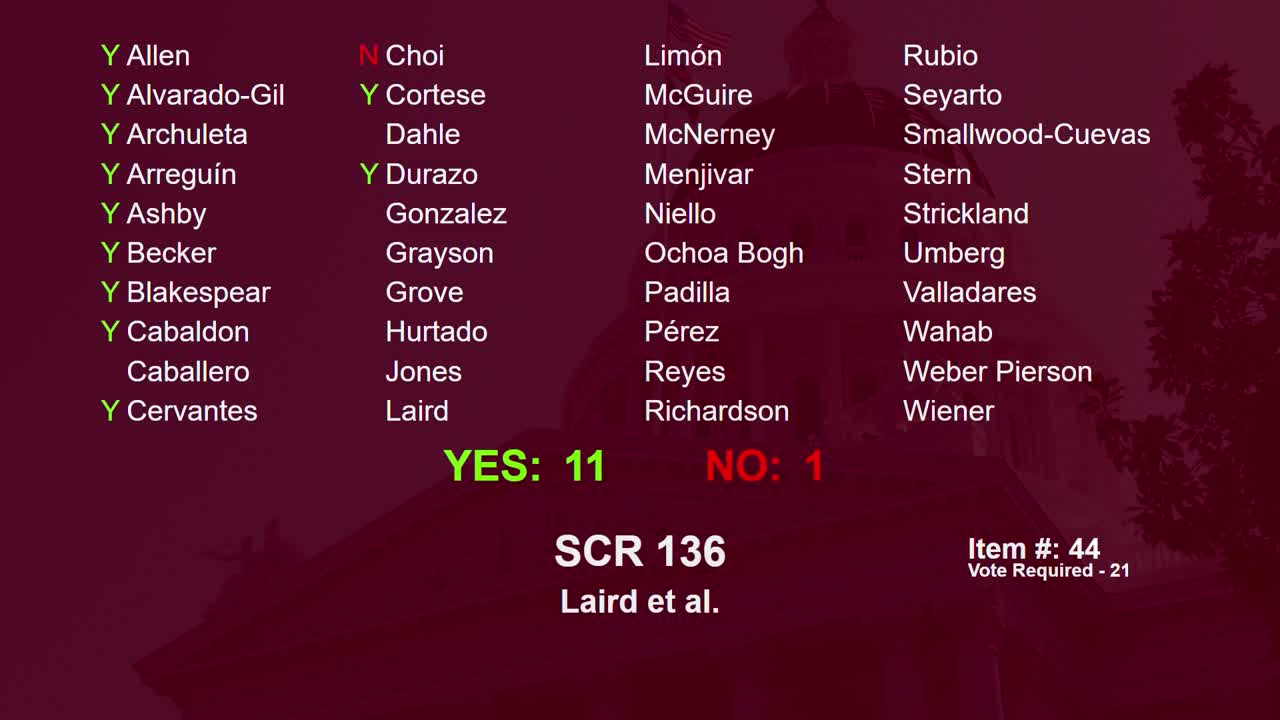
Bill Author
Bill Co-Author(s):