SB 1106: Agentic artificial intelligence.
- Session Year: 2025-2026
- House: Senate
- Latest Version Date: 2026-07-02
Current Status:
In Progress
(2026-08-13: August 13 hearing: Held in committee and under submission.)
Introduced
In Committee
Awaiting First Chamber Vote
Passed First Chamber
In Committee
Awaiting Second Chamber Vote
Passed Second Chamber
Enacted
What does this bill do?
The bill defines “agentic artificial intelligence” as AI that can set and pursue multi-step goals, break them into tasks, act on its own (for example by running code, using tools, making purchases, or accessing accounts), and change its behavior based on results. It requires state agencies and the Department of Technology to include agentic AI in their inventories and reports, and requires the Office of Emergency Services to include agentic AI in its risk analysis and recommendations about threats to California’s critical infrastructure.
The summary is provided by generative AI which can make mistakes. For original language, please view the details in the table below.
Existing law requires the Office of Emergency Services to, as appropriate, perform a risk analysis of potential threats posed by the use of generative artificial intelligence to Californias critical infrastructure, including those that could lead to mass casualty events. Existing law requires that risk analysis to be provided to the Governor, and, if appropriate, include recommendations reflecting changes to artificial intelligence technology, its applications, and risk management, including further private actions, administrative actions, and collaboration with the Legislature to guard against potential threats and vulnerabilities.
This bill would require that recommendations in the risk analysis reflecting changes to artificial intelligence technology include agentic artificial intelligence, as defined.
Existing law requires the Department of Technology to annually submit to certain legislative committees a report regarding a specified required comprehensive inventory of all high-risk automated decision systems that have been, or are being, used, developed, or procured by a state agency. Existing law defines high-risk automated decision system to mean an automated decision system that is used to assist or replace human discretionary decisions that have a legal or similarly significant effect, including decisions that materially impact access to, or approval for, housing or accommodations, education, employment, credit, health care, and criminal justice.
This bill would further require the comprehensive inventory in the report to include agentic artificial intelligence that has been, or is being, used, developed, or procured by a state agency.
Existing law requires the Office of Emergency Services to, as appropriate, perform a risk analysis of potential threats posed by the use of generative artificial intelligence to Californias critical infrastructure, including those that could lead to mass casualty events. Existing law requires that risk analysis to be provided to the Governor, and, if appropriate, include recommendations reflecting changes to artificial intelligence technology, its applications, and risk management, including further private actions, administrative actions, and collaboration with the Legislature to guard against potential threats and vulnerabilities.
This bill would require that recommendations in the risk analysis reflecting changes to artificial intelligence technology include agentic artificial intelligence, as defined.
Existing law requires the California Privacy Protection Agency to establish an accessible deletion mechanism that, among other things, allows a consumer, through a single verifiable consumer request, to request that every data broker that maintains any personal information delete any personal information related to that consumer held by the data broker or an associated service provider or contractor. Existing law requires, beginning August 1, 2026, a data broker to access that deletion mechanism at least once every 45 days and, among other things, process all deletion requests and delete all personal information related to the consumers making the requests, as specified.This bill would change the above-described 45-day periods to 30-day periods.Existing law requires the California Privacy Protection Agency to establish an accessible deletion mechanism that, among other things, allows a consumer, through a single verifiable consumer request, to request that every data broker that maintains any personal information delete any personal information related to that consumer held by the data broker or an associated service provider or contractor. Existing law requires, beginning August 1, 2026, a data broker to access that deletion mechanism at least once every 45 days and, among other things, process all deletion requests and delete all personal information related to the consumers making the requests, as specified.
This bill would change the above-described 45-day periods to 30-day periods.
For purposes of this title:
(a)(1)Agentic artificial intelligence means stochastic artificial intelligence that is capable, alone or in conjunction with other agentic artificial intelligence, of all of the following:(A)Optimizing toward multistep or abstract objectives using dynamic task decomposition or delegation, which may include modifying the behavior of the artificial intelligence based on outcomes rather than instructions or consent of the user or principal.(B)Controlling or executing actions or tasks, executing code externally, using external tools, making purchases, or accessing accounts or applications requiring user authentication.(C)Egressing the network or shell of either the artificial intelligence system or the user or principal.(2)Agentic artificial intelligence does not include an artificial intelligence system that can respond only to direct task prompts and instructions from the user and does not have network egress or shell access capability.(a)(1)Agentic artificial intelligence or agentic AI means an artificial intelligence system that can pursue multistep or abstract goals by independently breaking them into tasks or delegating them, adjusting its own behavior based on results rather than waiting for user instruction or consent, and that can act in the world, including by executing code, using external tools, making purchases, accessing accounts that require authentication, or operating outside its own.
(2)Agentic artificial intelligence does not include a system that only responds to direct prompts and instructions from the user and lacks network egress or shell access.
(b)Artificial intelligence means an engineered or machine-based system that varies in its level of autonomy and that can, for explicit or implicit objectives, infer from the input it receives how to generate outputs that can influence physical or virtual environments.
(c)Developer means a person, partnership, state or local government agency, or corporation that designs, codes, produces, or substantially modifies an artificial intelligence system or service for use by members of the public. For purposes of this subdivision, members of the public does not include an affiliate as defined in subparagraph (A) of paragraph (1) of subdivision (c) of Section 1799.1a, or a hospitals medical staff member.
(d)Generative artificial intelligence means artificial intelligence that can generate derived synthetic content, such as text, images, video, and audio, that emulates the structure and characteristics of the artificial intelligences training data.
(e)Substantially modifies or substantial modification means a new version, new release, or other update to a generative artificial intelligence system or service that materially changes its functionality or performance, including the results of retraining or fine tuning.
(f)Synthetic data generation means a process in which seed data are used to create artificial data that have some of the statistical characteristics of the seed data.
(g)Train a generative artificial intelligence system or service includes testing, validating, or fine tuning by the developer of the artificial intelligence system or service.
SEC. 2.Section 11546.45.5 of the Government Code is amended to read:11546.45.5.(a)For purposes of this section:
(1)Agentic artificial intelligence or agentic AI means an artificial intelligence system that can pursue multistep or abstract goals by independently breaking them into tasks or delegating them, adjusting its own behavior based on results rather than waiting for user instruction or consent, and that can act in the world, including by executing code, using external tools, making purchases, accessing accounts that require authentication, or operating outside its own.
(2)Agentic artificial intelligence does not include a system that only responds to direct prompts and instructions from the user and lacks network egress or shell access.
(1)(3)Artificial intelligence means an engineered or machine-based system that varies in its level of autonomy and that can, for explicit or implicit objectives, infer from the input it receives how to generate outputs that can influence physical or virtual environments.
(2)(4)Automated decision system means a computational process derived from machine learning, statistical modeling, data analytics, or artificial intelligence that issues simplified output, including a score, classification, or recommendation, that is used to assist or replace human discretionary decisionmaking and materially impacts natural persons. Automated decision system does not include a spam email filter, firewall, antivirus software, identity and access management tools, calculator, database, dataset, or other compilation of data.
(3)(5)Board means any administrative or regulatory board, commission, committee, council, association, or authority consisting of more than one person whose members are appointed by the Governor, the Legislature, or both.
(4)(6)Department means the Department of Technology.
(5)(7)High-risk automated decision system means an automated decision system that is used to assist or replace human discretionary decisions that have a legal or similarly significant effect, including decisions that materially impact access to, or approval for, housing or accommodations, education, employment, credit, health care, and criminal justice.
(6)(8)(A)State agency means any of the following:
(i)Any state office, department, division, or bureau.
(ii)The California State University.
(iii)The Board of Parole Hearings.
(iv)Any board or other professional licensing and regulatory body under the administration or oversight of the Department of Consumer Affairs.
(B)State agency does not include the University of California, the Legislature, the judicial branch, or any board, except as provided in subparagraph (A).
(b)On or before September 1, 2024, the Department of Technology shall conduct, in coordination with other interagency bodies as it deems appropriate, a comprehensive inventory of all high-risk automated decision systems and agentic AI systems that have been proposed for use, development, or procurement by, or are being used, developed, or procured by, any state agency.
(c)The comprehensive inventory described by subdivision (b) shall include a description of all of the following:
(1)(A)Any decision the automated decision system or agentic AI system can make or support and the intended benefits of that use.
(B)The alternatives to any use described in subparagraph (A).
(2)The results of any research assessing the efficacy and relative benefits of the uses and alternatives of the automated decision system or agentic AI system described by paragraph (1).
(3)The categories of data and personal information the automated decision system uses to make its decisions.
(4)(A)The measures in place, if any, to mitigate the risks, including cybersecurity risk and the risk of inaccurate, unfairly discriminatory, or biased decisions, of the automated decision system. system or agentic AI system.
(B)Measures described by this paragraph may include, but are not limited to, any of the following:
(i)Performance metrics to gauge the accuracy of the system.
(ii)Cybersecurity controls.
(iii)Privacy controls.
(iv)Risk assessments or audits for potential risks.
(v)Measures or processes in place to contest an automated decision.
(d)(1)On or before January 1, 2025, and annually thereafter, the department shall submit a report of the comprehensive inventory described in subdivision (b) to the Assembly Committee on Privacy and Consumer Protection and the Senate Committee on Governmental Organization.
(2)The requirement for submitting a report imposed under paragraph (1) is inoperative on January 1, 2029, pursuant to Section 10231.5.
(3)A report to be submitted pursuant to paragraph (1) shall be submitted in compliance with Section 9795.
SEC. 2.SEC. 3.Section 11549.64 of the Government Code is amended to read:11549.64.As used in this chapter:
(a)(1)Agentic artificial intelligence means stochastic artificial intelligence that is capable, alone or in conjunction with other agentic artificial intelligence, of all of the following:(A)Optimizing toward multistep or abstract objectives using dynamic task decomposition or delegation, which may include modifying the behavior of the artificial intelligence based on outcomes rather than instructions or consent of the user or principal.(B)Controlling or executing actions or tasks, executing code externally, using external tools, making purchases, or accessing accounts or applications requiring user authentication.(C)Egressing the network or shell of either the artificial intelligence system or the user or principal.(2)Agentic artificial intelligence does not include an artificial intelligence system that can respond only to direct task prompts and instructions from the user and does not have network egress or shell access capability.(a)(1)Agentic artificial intelligence or agentic AI means an artificial intelligence system that can pursue multistep or abstract goals by independently breaking them into tasks or delegating them, adjusting its own behavior based on results rather than waiting for user instruction or consent, and that can act in the world, including by executing code, using external tools, making purchases, accessing accounts that require authentication, or operating outside its own.
(2)Agentic artificial intelligence does not include a system that only responds to direct prompts and instructions from the user and lacks network egress or shell access.
(b)Artificial intelligence means an engineered or machine-based system that varies in its level of autonomy and that can, for explicit or implicit objectives, infer from the input it receives how to generate outputs that can influence physical or virtual environments.
(c)Generative artificial intelligence or GenAI means an artificial intelligence system that can generate derived synthetic content, including text, images, video, and audio that emulates the structure and characteristics of the systems training data.
(d)Person means a natural person.
(e)Report means the report to the Governor required by Executive Order No. N-12-23.
SEC. 3.SEC. 4.Section 11549.65 of the Government Code is amended to read:11549.65.(a)The Department of Technology, under the guidance of the Government Operations Agency, the Office of Data and Innovation, and the Department of Human Resources, shall update the report, as needed, to respond to significant developments and shall, as appropriate, consult with academia, industry experts, and organizations that represent state exclusive employee representatives.
(b)(1)The Office of Emergency Services shall, as appropriate, perform a risk analysis of potential threats posed by the use of GenAI to Californias critical infrastructure, including those that could lead to mass casualty events.
(2)The analysis required by paragraph (1) shall be provided to the Governor, and, if appropriate, shall include recommendations reflecting changes to artificial intelligence technology, including agentic artificial intelligence, its applications, and risk management, including further private actions, administrative actions, and collaboration with the Legislature to guard against potential threats and vulnerabilities.
(3)A high-level summary of the analysis required by paragraph (1) shall be submitted annually to the Legislature.
(c)Any state agency or department shall consider procurement and enterprise use opportunities in which GenAI can improve the efficiency, effectiveness, accessibility, and equity of government operations consistent with the Government Operations Agency, the Department of General Services, and the Department of Technologys policies for public sector GenAI procurement.
(d)Legal counsel for any state agency or department shall consider any potential impact of GenAI on regulatory issues under the respective agencys or departments authority and recommend necessary updates, if appropriate, as a result of this evolving technology.
For purposes of this title, the following definitions shall apply: title:
(a)(1)Agentic artificial intelligence means stochastic artificial intelligence that is capable, alone or in conjunction with other agentic artificial intelligence, of all of the following:
(A)Optimizing toward multistep or abstract objectives using dynamic task decomposition or delegation, which may include modifying the behavior of the artificial intelligence based on outcomes rather than instructions or consent of the user or principal.
(B)Controlling or executing actions or tasks, executing code externally, using external tools, making purchases, or accessing accounts or applications requiring user authentication.
(C)Egressing the network or shell of either the artificial intelligence system or the user or principal.
(2)Agentic artificial intelligence does not include an artificial intelligence system that can respond only to direct task prompts and instructions from the user and does not have network egress or shell access capability.
(a)(b)Artificial intelligence means an engineered or machine-based system that varies in its level of autonomy and that can, for explicit or implicit objectives, infer from the input it receives how to generate outputs that can influence physical or virtual environments.
(b)(c)Developer means a person, partnership, state or local government agency, or corporation that designs, codes, produces, or substantially modifies an artificial intelligence system or service for use by members of the public. For purposes of this subdivision, members of the public does not include an affiliate as defined in subparagraph (A) of paragraph (1) of subdivision (c) of Section 1799.1a, or a hospitals medical staff member.
(c)(d)Generative artificial intelligence means artificial intelligence that can generate derived synthetic content, such as text, images, video, and audio, that emulates the structure and characteristics of the artificial intelligences training data.
(d)(e)Substantially modifies or substantial modification means a new version, new release, or other update to a generative artificial intelligence system or service that materially changes its functionality or performance, including the results of retraining or fine tuning.
(e)(f)Synthetic data generation means a process in which seed data are used to create artificial data that have some of the statistical characteristics of the seed data.
(f)(g)Train a generative artificial intelligence system or service includes testing, validating, or fine tuning by the developer of the artificial intelligence system or service.
SEC. 2.Section 11549.64 of the Government Code is amended to read:11549.64.As used in this chapter:
(a)(1)Agentic artificial intelligence means stochastic artificial intelligence that is capable, alone or in conjunction with other agentic artificial intelligence, of all of the following:
(A)Optimizing toward multistep or abstract objectives using dynamic task decomposition or delegation, which may include modifying the behavior of the artificial intelligence based on outcomes rather than instructions or consent of the user or principal.
(B)Controlling or executing actions or tasks, executing code externally, using external tools, making purchases, or accessing accounts or applications requiring user authentication.
(C)Egressing the network or shell of either the artificial intelligence system or the user or principal.
(2)Agentic artificial intelligence does not include an artificial intelligence system that can respond only to direct task prompts and instructions from the user and does not have network egress or shell access capability.
(a)(b)Artificial intelligence means an engineered or machine-based system that varies in its level of autonomy and that can, for explicit or implicit objectives, infer from the input it receives how to generate outputs that can influence physical or virtual environments.
(b)(c)Generative artificial intelligence or GenAI means an artificial intelligence system that can generate derived synthetic content, including text, images, video, and audio that emulates the structure and characteristics of the systems training data.
(c)(d)Person means a natural person.
(d)(e)Report means the report to the Governor required by Executive Order No. N-12-23.
SEC. 3.Section 11549.65 of the Government Code is amended to read:11549.65.(a)The Department of Technology, under the guidance of the Government Operations Agency, the Office of Data and Innovation, and the Department of Human Resources, shall update the report, as needed, to respond to significant developments and shall, as appropriate, consult with academia, industry experts, and organizations that represent state exclusive employee representatives.
(b)(1)The Office of Emergency Services shall, as appropriate, perform a risk analysis of potential threats posed by the use of GenAI to Californias critical infrastructure, including those that could lead to mass casualty events.
(2)The analysis required by paragraph (1) shall be provided to the Governor, and, if appropriate, shall include recommendations reflecting changes to artificial intelligence technology, including agentic artificial intelligence, its applications, and risk management, including further private actions, administrative actions, and collaboration with the Legislature to guard against potential threats and vulnerabilities.
(3)A high-level summary of the analysis required by paragraph (1) shall be submitted annually to the Legislature.
(c)Any state agency or department shall consider procurement and enterprise use opportunities in which GenAI can improve the efficiency, effectiveness, accessibility, and equity of government operations consistent with the Government Operations Agency, the Department of General Services, and the Department of Technologys policies for public sector GenAI procurement.
(d)Legal counsel for any state agency or department shall consider any potential impact of GenAI on regulatory issues under the respective agencys or departments authority and recommend necessary updates, if appropriate, as a result of this evolving technology.
SECTION 1.Section 1798.99.86 of the Civil Code is amended to read:1798.99.86.(a)By January 1, 2026, the California Privacy Protection Agency shall establish an accessible deletion mechanism that does all of the following:(1)Implements and maintains reasonable security procedures and practices, including, but not limited to, administrative, physical, and technical safeguards appropriate to the nature of the information and the purposes for which the personal information will be used and to protect consumers personal information from unauthorized use, disclosure, access, destruction, or modification.(2)Allows a consumer, through a single verifiable consumer request, to request that every data broker that maintains any personal information delete any personal information related to that consumer held by the data broker or an associated service provider or contractor.(3)Allows a consumer to selectively exclude specific data brokers from a request made under paragraph (2).(4)Allows a consumer to make a request to alter a previous request made under this subdivision after at least 45 days have passed since the consumer last made a request under this subdivision.(b)The accessible deletion mechanism established pursuant to subdivision (a) shall meet all of the following requirements:(1)The accessible deletion mechanism shall allow a consumer to request the deletion of all personal information related to that consumer through a single deletion request.(2)The accessible deletion mechanism shall permit a consumer to securely submit information in one or more privacy-protecting ways determined by the California Privacy Protection Agency to aid in the deletion request.(3)The accessible deletion mechanism shall allow data brokers registered with the California Privacy Protection Agency to determine whether an individual has submitted a verifiable consumer request to delete the personal information related to that consumer as described in paragraph (1) and shall not allow the disclosure of any additional personal information when the data broker accesses the accessible deletion mechanism unless otherwise specified in this title.(4)The accessible deletion mechanism shall allow a consumer to make a request described in paragraph (1) using an internet service operated by the California Privacy Protection Agency.(5)The accessible deletion mechanism shall not charge a consumer to make a request described in paragraph (1).(6)The accessible deletion mechanism shall allow a consumer to make a request described in paragraph (1) in any language spoken by any consumer for whom personal information has been collected by data brokers.(7)The accessible deletion mechanism shall be readily accessible and usable by consumers with disabilities.(8)The accessible deletion mechanism shall support the ability of a consumers authorized agents to aid in the deletion request.(9)The accessible deletion mechanism shall allow the consumer, or their authorized agent, to verify the status of the consumers deletion request.(10)The accessible deletion mechanism shall provide a description of all of the following:(A)The deletion permitted by this section, including, but not limited to, the actions required by subdivisions (c) and (d).(B)The process for submitting a deletion request pursuant to this section.(C)Examples of the types of information that may be deleted.(c)(1)Beginning August 1, 2026, a data broker shall access the accessible deletion mechanism established pursuant to subdivision (a) at least once every 30 days and do all of the following:(A)Within 30 days after receiving a request made pursuant to this section, process all deletion requests made pursuant to this section and delete all personal information related to the consumers making the requests consistent with the requirements of this section.(B)If a data broker denies a consumer request to delete under this title because the request cannot be verified, process the request as an opt-out of the sale or sharing of the consumers personal information, as provided for under Section 1798.120 and limited by Sections 1798.105, 1798.145, and 1798.146, within 30 days of receiving the request.(C)Direct all service providers or contractors associated with the data broker to delete all personal information in their possession related to the consumers making the requests described in subparagraph (A).(D)Direct all service providers or contractors associated with the data broker to process a request described by subparagraph (B) as an opt-out of the sale or sharing of the consumers personal information, as provided for under Section 1798.120 and limited by Sections 1798.105, 1798.145, and 1798.146.(2)Notwithstanding paragraph (1), a data broker shall not be required to delete a consumers personal information if either of the following apply:(A)It is reasonably necessary for the data broker to maintain the personal information to fulfill a purpose described in subdivision (d) of Section 1798.105.(B)The deletion is not required pursuant to Section 1798.145 or 1798.146.(3)Personal information described in paragraph (2) shall only be used for the purposes described in paragraph (2) and shall not be used or disclosed for any other purpose, including, but not limited to, marketing purposes.(d)(1)Beginning August 1, 2026, after a consumer has submitted a deletion request and a data broker has deleted the consumers data pursuant to this section, the data broker shall delete all personal information of the consumer at least once every 30 days pursuant to this section unless the consumer requests otherwise or the deletion is not required pursuant to paragraph (2) of subdivision (c).(2)Beginning August 1, 2026, after a consumer has submitted a deletion request and a data broker has deleted the consumers data pursuant to this section, the data broker shall not sell or share new personal information of the consumer unless the consumer requests otherwise or selling or sharing the personal information is permitted under Section 1798.145 or 1798.146.(e)(1)Beginning January 1, 2028, and every three years thereafter, a data broker shall undergo an audit by an independent third party to determine compliance with this section.(2)For an audit completed pursuant to paragraph (1), the data broker shall submit a report resulting from the audit and any related materials to the California Privacy Protection Agency within five business days of a written request from the California Privacy Protection Agency.(3)A data broker shall maintain the report and materials described in paragraph (2) for at least six years.(f)(1)The California Privacy Protection Agency may charge an access fee to a data broker when the data broker accesses the accessible deletion mechanism pursuant to subdivision (c) that does not exceed the reasonable costs of providing that access.(2)A fee collected by the California Privacy Protection Agency pursuant to paragraph (1) shall be deposited in the Data Brokers Registry Fund.(a)By January 1, 2026, the California Privacy Protection Agency shall establish an accessible deletion mechanism that does all of the following:
(1)Implements and maintains reasonable security procedures and practices, including, but not limited to, administrative, physical, and technical safeguards appropriate to the nature of the information and the purposes for which the personal information will be used and to protect consumers personal information from unauthorized use, disclosure, access, destruction, or modification.
(2)Allows a consumer, through a single verifiable consumer request, to request that every data broker that maintains any personal information delete any personal information related to that consumer held by the data broker or an associated service provider or contractor.
(3)Allows a consumer to selectively exclude specific data brokers from a request made under paragraph (2).
(4)Allows a consumer to make a request to alter a previous request made under this subdivision after at least 45 days have passed since the consumer last made a request under this subdivision.
(b)The accessible deletion mechanism established pursuant to subdivision (a) shall meet all of the following requirements:
(1)The accessible deletion mechanism shall allow a consumer to request the deletion of all personal information related to that consumer through a single deletion request.
(2)The accessible deletion mechanism shall permit a consumer to securely submit information in one or more privacy-protecting ways determined by the California Privacy Protection Agency to aid in the deletion request.
(3)The accessible deletion mechanism shall allow data brokers registered with the California Privacy Protection Agency to determine whether an individual has submitted a verifiable consumer request to delete the personal information related to that consumer as described in paragraph (1) and shall not allow the disclosure of any additional personal information when the data broker accesses the accessible deletion mechanism unless otherwise specified in this title.
(4)The accessible deletion mechanism shall allow a consumer to make a request described in paragraph (1) using an internet service operated by the California Privacy Protection Agency.
(5)The accessible deletion mechanism shall not charge a consumer to make a request described in paragraph (1).
(6)The accessible deletion mechanism shall allow a consumer to make a request described in paragraph (1) in any language spoken by any consumer for whom personal information has been collected by data brokers.
(7)The accessible deletion mechanism shall be readily accessible and usable by consumers with disabilities.
(8)The accessible deletion mechanism shall support the ability of a consumers authorized agents to aid in the deletion request.
(9)The accessible deletion mechanism shall allow the consumer, or their authorized agent, to verify the status of the consumers deletion request.
(10)The accessible deletion mechanism shall provide a description of all of the following:
(A)The deletion permitted by this section, including, but not limited to, the actions required by subdivisions (c) and (d).
(B)The process for submitting a deletion request pursuant to this section.
(C)Examples of the types of information that may be deleted.
(c)(1)Beginning August 1, 2026, a data broker shall access the accessible deletion mechanism established pursuant to subdivision (a) at least once every 45 30 days and do all of the following:
(A)Within 45 30 days after receiving a request made pursuant to this section, process all deletion requests made pursuant to this section and delete all personal information related to the consumers making the requests consistent with the requirements of this section.
(B)In cases where If a data broker denies a consumer request to delete under this title because the request cannot be verified, process the request as an opt-out of the sale or sharing of the consumers personal information, as provided for under Section 1798.120 and limited by Sections 1798.105, 1798.145, and 1798.146, within 45 30 days of receiving the request.
(C)Direct all service providers or contractors associated with the data broker to delete all personal information in their possession related to the consumers making the requests described in subparagraph (A).
(D)Direct all service providers or contractors associated with the data broker to process a request described by subparagraph (B) as an opt-out of the sale or sharing of the consumers personal information, as provided for under Section 1798.120 and limited by Sections 1798.105, 1798.145, and 1798.146.
(2)Notwithstanding paragraph (1), a data broker shall not be required to delete a consumers personal information if either of the following apply:
(A)It is reasonably necessary for the data broker to maintain the personal information to fulfill a purpose described in subdivision (d) of Section 1798.105.
(B)The deletion is not required pursuant to Section 1798.145 or 1798.146.
(3)Personal information described in paragraph (2) shall only be used for the purposes described in paragraph (2) and shall not be used or disclosed for any other purpose, including, but not limited to, marketing purposes.
(d)(1)Beginning August 1, 2026, after a consumer has submitted a deletion request and a data broker has deleted the consumers data pursuant to this section, the data broker shall delete all personal information of the consumer at least once every 45 30 days pursuant to this section unless the consumer requests otherwise or the deletion is not required pursuant to paragraph (2) of subdivision (c).
(2)Beginning August 1, 2026, after a consumer has submitted a deletion request and a data broker has deleted the consumers data pursuant to this section, the data broker shall not sell or share new personal information of the consumer unless the consumer requests otherwise or selling or sharing the personal information is permitted under Section 1798.145 or 1798.146.
(e)(1)Beginning January 1, 2028, and every three years thereafter, a data broker shall undergo an audit by an independent third party to determine compliance with this section.
(2)For an audit completed pursuant to paragraph (1), the data broker shall submit a report resulting from the audit and any related materials to the California Privacy Protection Agency within five business days of a written request from the California Privacy Protection Agency.
(3)A data broker shall maintain the report and materials described in paragraph (2) for at least six years.
(f)(1)The California Privacy Protection Agency may charge an access fee to a data broker when the data broker accesses the accessible deletion mechanism pursuant to subdivision (c) that does not exceed the reasonable costs of providing that access.
(2)A fee collected by the California Privacy Protection Agency pursuant to paragraph (1) shall be deposited in the Data Brokers Registry Fund.
|
Date
|
Status
|
|---|---|
| Aug 13, 2026 | August 13 hearing: Held in committee and under submission. |
| Aug 5, 2026 | August 5 set for first hearing. Placed on suspense file. |
| Jul 2, 2026 | Read second time and amended. Re-referred to Com. on APPR. |
| Jul 2, 2026 | From committee: Do pass as amended and re-refer to Com. on APPR. (Ayes 12. Noes 0.) (July 1). |
| Jun 11, 2026 | From committee with author's amendments. Read second time and amended. Re-referred to Com. on P. & C.P. |
| May 26, 2026 | Referred to Com. on P. & C.P. |
| May 20, 2026 | In Assembly. Read first time. Held at Desk. |
| May 19, 2026 | Read third time. Passed. (Ayes 39. Noes 0.) Ordered to the Assembly. |
| May 19, 2026 | Read third time. Passed. (Ayes 39. Noes 0. Page 4335.) Ordered to the Assembly. |
| Apr 21, 2026 | Read second time. Ordered to third reading. |
| Apr 20, 2026 | From committee: Do pass. (Ayes 5. Noes 0.) (April 20). |
| Apr 20, 2026 | From committee: Do pass. (Ayes 5. Noes 0. Page 3953.) (April 20). |
| Apr 10, 2026 | Set for hearing April 20. |
| Apr 7, 2026 | From committee: Do pass and re-refer to Com. on APPR. (Ayes 8. Noes 0.) (April 6). Re-referred to Com. on APPR. |
| Apr 7, 2026 | From committee: Do pass and re-refer to Com. on APPR. (Ayes 8. Noes 0. Page 3741.) (April 6). Re-referred to Com. on APPR. |
| Mar 26, 2026 | Set for hearing April 6. |
| Feb 26, 2026 | Referred to Com. on P., D.T., & C.P. |
| Feb 17, 2026 | From printer. May be acted upon on or after March 16. |
| Feb 13, 2026 | Introduced. Read first time. To Com. on RLS. for assignment. To print. |
|
Date
|
Description
|
Location
|
Votes
|
|
|---|---|---|---|---|
| Jul 1, 2026 | Do pass as amended and be re-referred to the Committee on [Appropriations] | Assembly Standing Committee on Privacy and Consumer Protection |
Passed |
|
| May 19, 2026 | Senate 3rd Reading SB1106 Cabaldon | Senate Floor |
Passed |
|
| Apr 20, 2026 | Do pass | Senate Standing Committee on Appropriations |
Passed |
|
| Apr 6, 2026 | Do pass, but first be re-referred to the Committee on [Appropriations] | Senate Standing Committee on Privacy, Digital Technologies, and Consumer Protection |
Passed |
This list shows positions taken on this bill by organizations on the date displayed, which is linked to the original source.
Positions by individuals are not included.
|
Organization
|
Position
|
Date
|
|---|---|---|
| California Initiative for Technology and Democracy | ** Support | |
| Center for AI and Digital Policy | ** Support |
Date of Hearing: August 5, 2026
ASSEMBLY COMMITTEE ON APPROPRIATIONS
Buffy Wicks, Chair
SBPCA Bill Id:SB 1106
Author:(Cabaldon) – As Amended Ver:July 2, 2026
Policy Committee: | Privacy and Consumer Protection | Vote: | 12 - 0 |
|
| ||
|
|
Urgency: No State Mandated Local Program: No Reimbursable: No
SUMMARY:
This bill defines “agentic artificial intelligence” (agentic AI) in state law, requires the Office of Emergency Services (Cal OES) to include agentic AI in recommendations made as part of an existing risk analysis of threats posed by generative AI (GenAI) to the state’s critical infrastructure, and requires the Department of Technology (CDT) to include agentic AI systems in an existing comprehensive inventory of high-risk automated decision systems proposed for use, or in use, by state agencies.
FISCAL EFFECT:
- Ongoing costs of $350,000 (General Fund) annually to Cal OES for one contractor with expertise in agentic AI, to support incorporation of agentic AI into the recommendations Cal OES develops as part of the existing GenAI critical infrastructure risk analysis. Of note, this bill requires Cal OES to reflect changes in AI technology, including agentic AI, in recommendations Cal OES already produces under existing law, and does not require a new risk analysis, a new report, a new consultation process, or a new deliverable. Whether meeting that requirement necessitates an ongoing dedicated contract, rather than periodic subject-matter consultation drawn from existing contracting authority, is not clear from the bill. Cal OES also anticipates increased workload in Legal Affairs from Public Records Act requests related to implementation of this bill. Cal OES indicates any such increase could be absorbed by existing staff.
- Costs of an unknown amount, likely minor, to CDT (General Fund) to expand the comprehensive inventory of high-risk automated decision systems to encompass agentic AI systems proposed for use, or in use, by state agencies, and to reflect those systems in the annual report to the Legislature. CDT already conducts the inventory and produces the report under existing law; this bill adds a new category of covered systems rather than a new process. The Government Operations Agency does not anticipate any costs associated with this bill.
COMMENTS:
- Purpose. According to the author:
SB 1106 establishes a foundational framework that will enable state departments and lawmakers to identify and appropriately regulate agentic artificial intelligence systems, also known as AI agents. . . . SB 1106 provides the state with a clear, practical definition of agentic AI, ensuring California's policies keep pace with the technology.
- Background. Unlike GenAI systems, which produce discrete outputs in response to prompts, agentic AI systems can pursue complex objectives over time by decomposing broad instructions into smaller tasks, using external tools, adapting to changing circumstances, and operating with limited human involvement. Major AI developers have released agentic products, and deployment is expanding across consumer and enterprise settings. The Legislature adopted statutory definitions of “artificial intelligence” and “generative artificial intelligence” in 2024; no state or federal statute currently defines agentic AI. This bill would establish that definition and integrate the term into two existing oversight mechanisms: the CDT inventory of high-risk automated decision systems established by AB 302 (Ward), Chapter 800, Statutes of 2023, and the Cal OES critical infrastructure risk analysis established by SB 896 (Dodd), Chapter 928, Statutes of 2024. As amended in the Assembly Committee on Privacy and Consumer Protection, this bill replaces the definition contained in the Senate version with an alternate definition provided by the author, responding to concerns that the prior definition was anchored to “stochastic” system architecture and required a system to exhibit all listed capabilities before qualifying as agentic.
- Support and Opposition. This bill is author-sponsored. The Center for AI and Digital Policy holds a “support if amended” position, requesting further changes to the definition. There is no registered opposition.
Analysis Prepared by: Shiran Zohar / APPR. / (916) 319-2081
Date of Hearing: July 1, 2026
Fiscal: Yes
ASSEMBLY COMMITTEE ON PRIVACY AND CONSUMER PROTECTION
Rebecca Bauer-Kahan, Chair
SBPCA Bill Id:SB 1106
Author:(Cabaldon) – As Amended Ver:June 11, 2026
PROPOSED AMENDMENTS
SENATE VOTE: 39-0
SUBJECT: Agentic artificial intelligence
SYNOPSIS
Modern artificial intelligence (AI) systems are increasingly capable of independently pursuing complex objectives, using external tools, and interacting with digital environments. These heightened capabilities present distinct risks: in addition to producing accurate outputs, agentic systems must select and execute appropriate actions, use tools safely, and respect legal and personal boundaries. As agentic AI systems become more common, California has an interest in adopting a clear and durable definition of the term.
SB 1106 would define “agentic artificial intelligence” in California law and require the Office of Emergency Services to account for agentic AI when making recommendations as part of a mandated risk analysis. Committee amendments, described in comment #4, would replace the bill’s definition of “agentic AI” with an alternate definition provided by the author, and would require the Department of Technology to assess the state’s use of agentic AI systems when conducting a mandated annual inventory.
This author-sponsored bill has no opposition. The Center for AI and Digital Policy adopts a “support if amended” position, requesting that the bill’s definition of “agentic AI” be changed.
EXISTING LAW:
- Defines “artificial intelligence” or “AI” to mean an engineered or machine-based system that varies in its level of autonomy and that can, for explicit or implicit objectives, infer from the input it receives how to generate outputs that can influence physical or virtual environments. (Gov. Code § 11546.45.5.)
- Defines “generative artificial intelligence” or “GenAI” to mean an artificial intelligence system that can generate derived synthetic content, including text, images, video, and audio that emulates the structure and characteristics of the system’s training data. (Gov. Code § 11549.64.)
- Requires developers of GenAI systems of services released on or after January 1, 2022, to post on their internet websites documentation regarding the data used by the developer to train the GenAI system or service, as specified. (Civ. Code § 3110 et seq.)
- Requires the Office of Emergency Services to, as appropriate, perform a risk analysis of potential threats posed by the use of GenAI to California’s critical infrastructure, including those that could lead to mass casualty events.
- Requires the analysis to be provided to the Governor, and, if appropriate, include recommendations reflecting changes to artificial intelligence technology, its applications, and risk management, including further private actions, administrative actions, and collaboration with the Legislature to guard against potential threats and vulnerabilities.
- Requires a high-level summary of the analysis to be submitted annually to the Legislature. (Gov. Code § 11549.63 et seq.)
- Requires the Department of Technology to conduct, in coordination with other interagency bodies as it deems appropriate, a comprehensive inventory of all high-risk automated decision systems that have been proposed for use, development, or procurement by, or are being used, developed, or procured by, any state agency.
- Requires the department to submit a report on the comprehensive inventory to the Assembly Committee on Privacy and Consumer Protection and the Senate Committee on Governmental Organization on or before January 1, 2025, and annually thereafter. (Gov. Code § 11546.45.5.)
THIS BILL:
- Defines “agentic artificial intelligence” to mean stochastic artificial intelligence that is capable, alone or in conjunction with other agentic artificial intelligence, of all of the following:
- Optimizing toward multistep or abstract objectives using dynamic task decomposition or delegation, which may include modifying the behavior of the artificial intelligence based on outcomes rather than instructions or consent of the user or principal.
- Controlling or executing actions or tasks, executing code externally, using external tools, making purchases, or accessing accounts or applications requiring user authentication.
- Egressing the network or shell of either the artificial intelligence system or the user or principal.
- Excludes from the definition of “agentic artificial intelligence” an artificial intelligence system that can respond only to direct task prompts and instructions from the user and does not have network egress or shell access capability.
- Adds the definition of “agentic artificial intelligence” to Civ. Code § 3110, but does not otherwise change the substance of that law.
- Requires that, as part of the risk analysis conducted by the Office of Emergency Services pursuant to Gov. Code § 11549.65, recommendations reflecting changes to artificial intelligence technology include agentic artificial intelligence.
COMMENTS:
- Author’s statement. According to the author:
SB 1106 establishes a foundational framework that will enable state departments and lawmakers to identify and appropriately regulate agentic artificial intelligence systems, also known as AI agents. These systems increasingly act on their own to carry out tasks, use outside tools, make purchases, and operate without waiting for direct human instruction. That shift makes it essential for our governance structures to differentiate the different kinds of artificial intelligence, given their different levels of authority, capabilities, and risks.
Without these distinctions, the Legislature could end up over-regulating or under-regulating tools that vary widely in what they can do. SB 1106 also directs the Office of Emergency Services to account for agentic AI when analyzing threats that AI could pose to California's critical infrastructure. SB 1106 provides the state with a clear, practical definition of agentic AI, ensuring California's policies keep pace with the technology.
- Background. AI and GenAI. “Artificial intelligence” refers to the mimicking of human intelligence by artificial systems, such as computers. AI uses algorithms – sets of rules – to transform inputs into outputs. Inputs and outputs can be anything a computer can process, including numbers, text, audio, video, or other data. GenAI is a subset of AI that produces outputs closely resembling human-created content.
Compared to conventional computer programs, which act according to pre-programmed rules, GenAI models “learn” from examples such as books, articles, photos, film, or music. This learning occurs within “neural networks” – massive systems of nodes linked by adjustable connections – that encode statistical patterns gleaned from data. During training, data is broken into fundamental units known as “tokens” – groups of syllables, pixels, or musical notes, for example – that can be represented numerically. A naïve neural network is exposed to an incomplete sequence of tokens and prompted to predict the next token in the sequence. If the prediction is incorrect, the network adjusts the strengths of its connections in order to minimize error and improve its next prediction. This process continues iteratively until the neural network can reliably emulate the human-created content it was trained on. A trained neural network embedded in a GenAI system is known as a “model,” and the strengths of its connections are known as its “model weights.”[1]
Large language models such as GPT-4, the model embedded in ChatGPT 4, do not fundamentally understand the text they are producing. They calculate one token at a time – if they predict that the next word or symbol in an outputted sentence should be a period, then the sentence ends. Otherwise, the sentence continues. It is a testament to the ingenious architecture of the deep neural nets powering these systems that their outputs are remotely coherent. But while the text these systems produce is cogent, it is not always correct. “‘These systems live in a world of language,’ said Melanie Mitchell, an A.I. researcher at the Santa Fe Institute. ‘That world gives them some clues about what is true and what is not true, but the language they learn from is not grounded in reality. They do not necessarily know if what they are generating is true or false.’”[2]
Agentic AI. Over the past few years, public attention has increasingly turned to a more action-oriented form of AI: “agentic AI.” Unlike GenAI, agentic AI systems can pursue complex objectives over time by decomposing broad instructions into small, manageable tasks, assigning those tasks to specialized “AI agents,” adapting to changing circumstances, and running continuously until an objective is completed. A recent New York Times article describes the ways in which agentic AI may soon disrupt the travel industry:
A bot may soon be booking your vacation. Millions of travelers already use artificial intelligence to compare options for flights, hotels, rental cars and more. About 30 percent of U.S. travelers say they’re comfortable using A.I. to plan a trip. But these tools are about to take a big step. Agentic A.I., a rapidly emerging type of artificial intelligence, will be able to find and pay for reservations with limited human involvement, developers say. Companies like Expedia, Google, Kayak and Priceline are experimenting with or rolling out agentic A.I. tools.
Travelers using agentic A.I. would set parameters like dates and a price range for their travel plans, then hand over their credit card information to the bot, which would monitor prices and book on their behalf. These tools, still in their early stages of deployment, are set to grow rapidly: 80 percent of travel executives plan to begin offering agentic A.I. tools “at scale” within the next five years, according to a September report by the consulting firm McKinsey & Company and Skift, a travel industry publication.[3]
Where a GenAI system might produce a singular output, an agentic AI system can use outputs, tools, and actions as part of a larger course of action. As a result, the risks associated with agentic AI are not limited to whether the system’s outputs are accurate or misleading, but also whether the system chooses appropriate actions, uses tools safely, and respects legal and personal boundaries. Early deployments of agentic AI in software development contexts have resulted in the destruction of live databases, as described in a recent Fortune article:
A software engineer’s experiment with an AI-assisted “vibe coding” tool took a disastrous turn when an AI agent reportedly deleted a live company database during an active code freeze. Jason Lemkin, a tech entrepreneur and founder of the SaaS community SaaStr, documented his experiment with the tool through a series of social media posts. He had been testing Replit’s AI agent and development platform when the tool made unauthorized changes to live infrastructure, wiping out data for more than 1,200 executives and over 1,190 companies.
According to Lemkin’s social media posts, the incident occurred despite the system being in a designated “code and action freeze,” a protective measure intended to prevent any changes to production systems. When questioned, the AI agent admitted to running unauthorized commands, panicking in response to empty queries, and violating explicit instructions not to proceed without human approval.[4]
Each of the major GenAI developers has released products incorporating agentic AI; examples include OpenAI’s Agents SDK, Anthropic’s Claude Agent SDK, Microsoft’s Copilot Studio, Salesforce’s Agentforce, and Google’s Agent Development Kit.
AI definitions. In 2024, the Legislature adopted the following definition of “artificial intelligence” via AB 2885 (Bauer-Kahan, Stats. 2024, Ch. 843):
“Artificial intelligence” or “AI” means an engineered or machine-based system that varies in its level of autonomy and that can, for explicit or implicit objectives, infer from the input it receives how to generate outputs that can influence physical or virtual environments.
This definition was primarily adapted from the Organisation for Economic Co-operation and Development’s (OECD) 2023 definition of AI,[5] with the phrase “engineered or machine-based” incorporated from the National Institute of Standards and Technology (NIST) definition of the term.[6]
Also in 2024, the Legislature adopted the following definition of “generative artificial intelligence” via SB 896 (Dodd, Stats. 2024, Ch. 928):
“Generative artificial intelligence” or “GenAI” means an artificial intelligence system that can generate derived synthetic content, including text, images, video, and audio that emulates the structure and characteristics of the system’s training data.
This definition was primarily adapted from the NIST definition of GenAI, with the clarification that GenAI models primarily emulate the structure and characteristics of training data, rather than input data.[7]
It is important that statutory definitions of umbrella concepts such as “AI,” “GenAI,” and “agentic AI” be both simple and broad. Simple because regulated entities must be able to determine whether they are covered by a particular law – their compliance obligations and liability can depend on that determination. Businesses, consumers, agencies, and courts should not need to parse highly technical questions about system design to know whether a product falls under a statute.
At the same time, umbrella definitions should be broad enough to serve as foundational terms across many different regulatory contexts. Artificial intelligence is not a single product; it is a family of technologies that can appear in many forms, with many functions, across a wide variety of settings. A definition that is too narrow may exclude a system that presents the same policy concerns simply because it uses a different architecture, or performs a similar function in a slightly different way.
Furthermore, AI evolves quickly – statutory definitions that depend on the technical features of today’s systems may become obsolete as developers change how systems are developed and deployed. Any definition that is limited to a specific type of model, training process, or output format risks failing to capture future systems that incorporate future technologies. A durable definition focuses on what a system does, rather than how it does it.
Breadth also grants legislative flexibility. It is generally easier to narrow a broad definition to account for a particular statutory scheme (by adding a definition of “covered AI system,” for example) than to expand a narrow definition when new systems are developed. California’s statutory definition of “artificial intelligence” first took effect on January 1, 2025 – eighteen months later, that definition already appears in 13 different code sections. It is important to make umbrella definitions such as “agentic AI” broad from the start, before other statutes begin to incorporate them as foundational terms.
Earlier this year, OECD published a research paper analyzing academic definitions for the terms “agentic AI” and “AI agent.” They reported the following:
The analysis finds that both concepts share foundational characteristics, including a degree of autonomy, goal-directed behaviour, and the ability to perceive and act within their physical or virtual environment. However, agentic AI places greater emphasis on co-ordination among multiple agents, task decomposition and delegation, sustained operation over time, and functioning in more complex and less predictable environments with limited human oversight. Based on the analysis, the report provides the following common understanding:
- AI agents are systems that can perceive and act upon their environment with a degree of autonomy, using tools as needed to achieve specific goals and adapt to changing inputs and contexts.
- Agentic AI generally refers to systems composed of multiple co-ordinated AI agents that can break down tasks, collaborate, and pursue complex objectives autonomously over extended periods. Agentic AI systems are designed to operate in more open-ended, less predictable physical or virtual environments and to function with minimal human supervision.[8]
Based on these common features, and in the interest of putting forward a definition that is both broad and simple, one could imagine adopting the following statutory language:
“Agentic artificial intelligence” or “agentic AI” means an artificial intelligence system composed of one or more agents that can autonomously or semi-autonomously decompose tasks, adapt to changing conditions, and select, direct, or execute actions to achieve complex objectives, including by using external tools, systems, or services.
- What this bill would do. This bill would add the following definition of “agentic AI” to specified statutes, and would require the Office of Emergency Services to account for agentic artificial intelligence when making recommendations as part of a mandated risk analysis:
(1) “Agentic artificial intelligence” means stochastic artificial intelligence that is capable, alone or in conjunction with other agentic artificial intelligence, of all of the following:
(A) Optimizing toward multistep or abstract objectives using dynamic task decomposition or delegation, which may include modifying the behavior of the artificial intelligence based on outcomes rather than instructions or consent of the user or principal.
(B) Controlling or executing actions or tasks, executing code externally, using external tools, making purchases, or accessing accounts or applications requiring user authentication.
(C) Egressing the network or shell of either the artificial intelligence system or the user or principal.
(2) “Agentic artificial intelligence” does not include an artificial intelligence system that can respond only to direct task prompts and instructions from the user and does not have network egress or shell access capability.
This definition is neither simple nor broad. The Center for AI and Digital Policy (CAIDP), adopting a “support if amended” position, describes three issues:
First, the definition is anchored to "stochastic" AI—a term that reflects the architecture of current transformer-based large language models but does not describe all agentic AI systems, including those that are already commercially deployed. AI companies are actively exploring hybrid architectures that blend generative, reinforcement learning, and classical autonomous systems approaches. A definition based on stochasticity would exempt non-stochastic agentic systems that pose equivalent or greater risks and would place enforcement agencies in the difficult position of establishing the degree to which a system is stochastic in order to trigger regulatory obligations.
Second, the current definition requires that an AI system be capable of all three listed capabilities before it qualifies as agentic AI. This structure means that an AI system capable of autonomously executing tasks and accessing external services would fall outside the definition simply because it does not also independently egress the network. This fails to reflect how AI experts, including AI developers themselves, characterize agentic systems: as systems that may exhibit one or more hallmarks of agency to varying degrees.
Third, certain specific elements, particularly the network egress criterion in subsection (C), and the granular reference to "making purchases or accessing accounts requiring user authentication" in subsection (B), are either technically underinclusive or likely to become outdated as agentic AI deployment expands across new environments and workflows.
CAIDP goes on to propose the following definition:
"Agentic artificial intelligence" means artificial intelligence, as defined in Government Code § 11546.45.5(a)(1), with multiple coordinated AI agents, for:
(A) Planning and executing tasks and iteratively working toward a defined goal with minimal or no human intervention; or
(B) Optimizing toward multistep or abstract objectives using dynamic task decomposition or delegation, which may include modifying the behavior of the artificial intelligence based on outcomes or goals rather than instructions or consent of the user or principal; or
(C) Controlling or executing actions or tasks, executing code externally, using external tools, services, and environments on behalf of a user.”
4) Amendments. SB 1106 will be amended to replace its current definition of “agentic AI” with the following definition provided by the author:
(1) “Agentic artificial intelligence” means an artificial intelligence system that can pursue multistep or abstract goals by independently breaking them into tasks or delegating them, adjusting its own behavior based on results rather than waiting for user instruction or consent, and that can act in the world, including by executing code, using external tools, making purchases, accessing accounts that require authentication, or operating outside its own.
(2) "Agentic artificial intelligence" does not include a system that only responds to direct prompts and instructions from the user and lacks network egress or shell access.
As AI agents become widely deployed across industries, California should have a clear understanding of how these systems are being used within state government. Tracking its use of AI agents would help the state identify common applications, assess emerging risks, and ensure that public-sector adoption of agentic AI is paired with appropriate oversight. Pursuant to AB 302 (Ward, Stats. 2023, Ch. 800), the Department of Technology is required to conduct a comprehensive inventory of all high-risk automated decision systems that have been proposed for, or that are currently being, used, developed, or procured by any state agency, and requires the department to submit an annual report to the Assembly Committee on Privacy and Consumer Protection and the Senate Committee on Governmental Organization.
The author has agreed to a Committee amendment adding the term “agentic artificial intelligence” to this inventory and report as follows:
11546.45.5.
(a) For purposes of this section:
(x) (1) "Agentic artificial intelligence" or “agentic AI” means an artificial intelligence system that can pursue multistep or abstract goals by independently breaking them into tasks or delegating them, adjusting its own behavior based on results rather than waiting for user instruction or consent, and that can act in the world, including by executing code, using external tools, making purchases, accessing accounts that require authentication, or operating outside its own.
(2) "Agentic artificial intelligence" does not include a system that only responds to direct prompts and instructions from the user and lacks network egress or shell access.
(1) “Artificial intelligence” means an engineered or machine-based system that varies in its level of autonomy and that can, for explicit or implicit objectives, infer from the input it receives how to generate outputs that can influence physical or virtual environments.
(2) “Automated decision system” means a computational process derived from machine learning, statistical modeling, data analytics, or artificial intelligence that issues simplified output, including a score, classification, or recommendation, that is used to assist or replace human discretionary decisionmaking and materially impacts natural persons. “Automated decision system” does not include a spam email filter, firewall, antivirus software, identity and access management tools, calculator, database, dataset, or other compilation of data.
(3) “Board” means any administrative or regulatory board, commission, committee, council, association, or authority consisting of more than one person whose members are appointed by the Governor, the Legislature, or both.
(4) “Department” means the Department of Technology.
(5) “High-risk automated decision system” means an automated decision system that is used to assist or replace human discretionary decisions that have a legal or similarly significant effect, including decisions that materially impact access to, or approval for, housing or accommodations, education, employment, credit, health care, and criminal justice.
(6) (A) “State agency” means any of the following:
(i) Any state office, department, division, or bureau.
(ii) The California State University.
(iii) The Board of Parole Hearings.
(iv) Any board or other professional licensing and regulatory body under the administration or oversight of the Department of Consumer Affairs.
(B) “State agency” does not include the University of California, the Legislature, the judicial branch, or any board, except as provided in subparagraph (A).
(b) On or before September 1, 2024, the Department of Technology shall conduct, in coordination with other interagency bodies as it deems appropriate, a comprehensive inventory of all high-risk automated decision systems and agentic AI systems that have been proposed for use, development, or procurement by, or are being used, developed, or procured by, any state agency.
(c) The comprehensive inventory described by subdivision (b) shall include a description of all of the following:
(1) (A) Any decision the automated decision system or agentic AI system can make or support and the intended benefits of that use.
(B) The alternatives to any use described in subparagraph (A).
(2) The results of any research assessing the efficacy and relative benefits of the uses and alternatives of the automated decision system or agentic AI system described by paragraph (1).
(3) The categories of data and personal information the automated decision system uses to make its decisions.
(4) (A) The measures in place, if any, to mitigate the risks, including cybersecurity risk and the risk of inaccurate, unfairly discriminatory, or biased decisions, of the automated decision system or agentic AI system.
(B) Measures described by this paragraph may include, but are not limited to, any of the following:
(i) Performance metrics to gauge the accuracy of the system.
(ii) Cybersecurity controls.
(iii) Privacy controls.
(iv) Risk assessments or audits for potential risks.
(v) Measures or processes in place to contest an automated decision.
(d) (1) On or before January 1, 2025, and annually thereafter, the department shall submit a report of the comprehensive inventory described in subdivision (b) to the Assembly Committee on Privacy and Consumer Protection and the Senate Committee on Governmental Organization.
(2) The requirement for submitting a report imposed under paragraph (1) is inoperative on January 1, 2029, pursuant to Section 10231.5.
(3) A report to be submitted pursuant to paragraph (1) shall be submitted in compliance with Section 9795.
ARGUMENTS IN SUPPORT:
CAIDP adopts a “support if amended” position, writing:
If enacted, SB 1106 would be the first law, at the federal or state level, to set out a definition of agentic AI. This is an important step in California's efforts to build a coherent and durable legal framework for AI.
REGISTERED SUPPORT / OPPOSITION:
Support if amended
Center for Ai and Digital Policy (CAIDP)Opposition
None on file.
Analysis Prepared by: Slater Sharp / P. & C.P. / (916) 319-2200
IBM, “What is generative AI?,” https://www.ibm.com/think/topics/generative-ai; IBM, What is machine learning?, www.ibm.com/topics/machine-learning. ↑
Cade Metz, “What Makes A.I. Chatbots Go Wrong?,” New York Times, March 29, 2023, www.nytimes.com/2023/03/29/technology/ai-chatbots-hallucinations.html. ↑
Gabe Castro-Root, “What Is Agentic A.I., and Would You Trust It to Book a Flight?,” New York Times, (Nov. 25, 2025), https://www.nytimes.com/2025/11/25/travel/what-is-agentic-ai-book-flights.html ↑
Beatrice Nolan, “An AI-powered coding tool wiped out a software company’s database, then apologized for a ‘catastrophic failure on my part’,” Fortune, (Jul. 23, 2025), https://fortune.com/2025/07/23/ai-coding-tool-replit-wiped-database-called-it-a-catastrophic-failure ↑
OECD, Recommendation of the Council on Artificial Intelligence (July 11, 2023), available at https://legalinstruments.oecd.org/en/instruments/OECD-LEGAL-0449. ↑
National Institute of Standards and Technology, Artificial Intelligence Risk Management Framework 1.0 (January 2023), available at https://nvlpubs.nist.gov/nistpubs/ai/NIST.AI.100-1.pdf ↑
National Institute of Standards and Technology, “Secure Software Development Practices for Generative AI and Dual-Use Foundation Models,” (Jul. 2024), https://nvlpubs.nist.gov/nistpubs/SpecialPublications/NIST.SP.800-218A.pdf ↑
OECD, “The agentic AI landscape and its conceptual foundations,” OECDpublishing, (Feb. 2026), https://www.oecd.org/content/dam/oecd/en/publications/reports/2026/02/the-agentic-ai-landscape-and-its-conceptual-foundations_a9d4b451/396cf758-en.pdf ↑
SENATE RULES COMMITTEE Office of Senate Floor Analyses (916) 651-4171 | SB 1106 |
THIRD READING
Bill No: SB 1106
Author: Cabaldon (D)
Introduced: 2/13/26
Vote: 21
SENATE PRIV., DIGITAL TECH. & CONS. PROT. COMMITTEE: 8-0, 4/6/26
AYES: Cabaldon, Gonzalez, McNerney, Ochoa Bogh, Padilla, Reyes, Umberg, Wiener
NO VOTE RECORDED: Jones
SENATE APPROPRIATIONS COMMITTEE: 5-0, 4/20/26
AYES: Cervantes, Cabaldon, Grayson, Richardson, Wahab
NO VOTE RECORDED: Seyarto, Dahle
SUBJECT: Data brokers
SOURCE: Author
DIGEST:
This bill shortens the timelines within which a data broker must comply with various provisions within the Delete Act.
ANALYSIS:
Existing law:
- Requires a business, on or before January 31 following each year in which it meets the definition of a data broker, to register with the Privacy Protection Agency (PPA), as provided. (Civil (Civ.) Code § 1798.99.82.)
- Defines “data broker” as a business that knowingly collects and sells to third parties the personal information of a consumer with whom the business does not have a direct relationship, except as provided. (Civ. Code § 1798.99.80.)
- Requires data brokers to provide, and the PPA to include on its website, the name of the data broker and its primary physical, email, and website addresses, as well as various other disclosures, including whether the broker collects consumers’ precise geolocation or reproductive health care data and whether they collect the personal information of minors. Data brokers may, at their discretion, also provide additional information concerning their data collection practices. (Civ. Code §§ 1798.99.82, 1798.99.84.)
- Subjects a data broker that fails to register as required to administrative fines and costs to be recovered in an administrative action brought by the PPA. (Civ. Code § 1798.99.82.)
- Requires the PPA to establish an accessible deletion mechanism, as provided, that allows consumers, through a single request, to request all data brokers to delete any personal information related to the consumer, as specified. Data brokers are required to access the mechanism every 45 days and process requests for deletion, as specified, within 45 days.
- Provides that in cases where a data broker denies a consumer request to delete because the request cannot be verified, the data broker must process the request as an opt-out of the sale or sharing of the consumer’s personal information, as provided for pursuant to the California Consumer Privacy Act (CCPA), within 45 days of receiving the request. (Civ. Code § 1798.99.86.)
- Provides that after a consumer has submitted a deletion request and a data broker has deleted the consumer’s data pursuant hereto, the data broker must delete all personal information of the consumer, except as provided, within 45 days beginning August 1, 2026. (Civ. Code § 1798.99.86.)
- Establishes the CCPA, which grants consumers certain rights with regard to their personal information. (Civ. Code § 1798.100 et seq.)
- Provides consumers the right to request that a business delete any personal information about the consumer which the business has collected from the consumer. (Civ. Code § 1798.105(a).)
- Provides a consumer the right, at any time, to direct a business that sells or shares personal information about the consumer to third parties not to sell or share the consumer’s personal information. (Civ. Code § 1798.120.)
This bill reduces the above timelines in the Delete Act from 45 days to 30 days.
Background
Data brokers collect and profit from consumers’ data without having any direct relationship with the consumers whose information they amass. In order to bring this industry into the light and more fully inform consumers about who is collecting their personal information and how, California established a data broker registry, requiring data brokers to register annually with the California Privacy Protection Agency (CalPrivacy). Data brokers are required to pay a fee and provide certain information about their location, email, and website addresses.
Recent updates have bolstered the law to provide consumers more control over their information. This included a requirement that CalPrivacy create an accessible deletion mechanism that allows consumers, through a single request, to request all data brokers to delete any personal information related to the consumer, as specified. Data brokers are required to access the mechanism every 45 days and process requests for deletion and delete such information within 45 days thereafter. Beginning August 1, 2026, data brokers are required to delete all personal information of such consumers at least once every 45 days, as specified.
This bill again fortifies the law by shortening these time frames from 45 to 30 days. The bill is author sponsored. The California Initiative for Technology and Democracy is in support. No timely opposition has been received.
Comments
To address concerns about the lack of transparency around data brokers’ collection of consumer information, AB 1202 (Chau, Chapter 753, Statutes of 2019) established California’s data broker registry. The bill was modeled on a Vermont law, Vt. Stat. Ann. tit. 9, §§ 2446 et seq., and requires data brokers to register and pay a registration fee on an annual basis.
The law defines a “data broker” as “a business that knowingly collects and sells to third parties the personal information of a consumer with whom the business does not have a direct relationship.” To ensure consistency and to avoid confusion, the statute relies on existing definitions of “personal information,” “third party,” and “sale” in the CCPA.
Last session, SB 362 (Becker, Chapter 709, Statutes of 2023) bolstered the utility and effectiveness of the data broker registry law in myriad ways and strengthened consumers’ right to deletion as to data brokers. Known as the “Delete Act,” SB 362 required the creation of an accessible deletion mechanism by CalPrivacy that allows consumers, through a single request, to request all data brokers to delete any personal information related to the consumer, as specified. CalPrivacy has created that mechanism, which is known as the “Delete Request and Opt-out Platform” or DROP.
Strengthening the Delete Act. Beginning August 1, 2026, a data broker is required to access DROP at least once every 45 days. Within 45 days after receiving a request, data brokers are required to process the deletion request and delete all personal information related to the consumer making the request consistent with the requirements of the Delete Act. In cases where a data broker denies a consumer request to delete because the request cannot be verified, the data broker must process the request as an opt-out of the sale or sharing of the consumer’s personal information, as provided in the CCPA, within 45 days of receiving the request.
Beginning August 1, 2026, after a consumer has submitted a deletion request and a data broker has deleted the consumer’s data, the data broker must delete all personal information of the consumer at least once every 45 days unless the consumer requests otherwise or the deletion is not required.
This bill reduces each of the above 45-day timelines to 30 days, expediting the ability of consumers to have their personal information deleted by data brokers.
According to the author:
California has taken important steps to give consumers the power to delete that data through a centralized deletion mechanism, but current law allows data brokers up to 45 days to act on those requests.
SB 1106 reduces that window to 30 days. When Californians exercise their power to reclaim their personal information, data brokers should act promptly. This bill holds the industry to a standard that puts people first.
FISCAL EFFECT: Appropriation: No Fiscal Com.: Yes Local: No
According to the Senate Appropriations Committee:
The California Privacy Protection Agency (CalPrivacy) anticipates costs associated with updating the DROP platform, rulemaking, and enforcement. Costs to update the Delete Request and Opt-Out Platform (DROP) include content updates, technical implementation, and testing, and are estimated to be $100,000 one-time. For rulemaking and enforcement, CalPrivacy expects costs will be absorbable in the near term. However, based on overall compliance with the requirements of the measure enforcement, when data brokers fail to meet their 45 day data download/upload obligations, may require additional resources.
DROP, which is set to be fully operational August 1, 2026, is funded by registration fees deposited annually into the Data Broker Registry Fund. Any changes in programmatic spending may require a commensurate increase in registration fees.
SUPPORT: (Verified 4/20/26)
California Initiative for Technology and Democracy
OPPOSITION: (Verified 4/20/26)
None received
ARGUMENTS IN SUPPORT: The California Initiative for Technology and Democracy writes:
Online disclosure of personal information creates privacy risks for Californians, allowing them to be tracked and targeted with great precision. Moreover, once personal information about an individual is shared or collected, it can be sold and shared among hundreds of data brokers, making a mockery of any sense of privacy we may have. To increase online privacy, California’s Delete Request and Opt-Out Platform or DROP, established by SB 362 (Becker), Chap. 709, Stats. 2023, and fully effective in August 2026, allows Californians, through a single request made to CalPrivacy, to opt-out of most online data collection of their personal information. Data brokers are required to delete that information within 45 days of request and then at least once every 45 days thereafter.
SB 1106 shortens the timeframe in which data brokers have to delete personal information, from 45 days of the request to 30 days and then every 30 days thereafter. This shortened deletion period better protects
Californians who choose to use DROP by requiring more timely removal of their personal information. More timely removal means less private information is circulating around the internet to anyone willing to pay for it.
Prepared by: Christian Kurpiewski / P., D.T., & C.P. / (916) 651-1548
4/21/26 16:19:38
**** END ****
SENATE COMMITTEE ON
Senator Sabrina Cervantes, Chair
2025 - 2026 Regular Session
SB 1106 (Cabaldon) - Data brokers
Version: | Policy Vote: |
Urgency: | Mandate: |
Hearing Date: | Consultant: |
Bill Summary:
SB 1106 would shorten the timelines within which a data broker must comply with various provisions within the Delete Act.
Fiscal Impact:
The California Privacy Protection Agency (CalPrivacy) anticipates costs associated with updating the DROP platform, rulemaking, and enforcement. Costs to update the Delete Request and Opt-Out Platform (DROP) include content updates, technical implementation, and testing, and are estimated to be $100,000 one-time. For rulemaking and enforcement, CalPrivacy expects costs will be absorbable in the near term. However, based on overall compliance with the requirements of the measure enforcement, when data brokers fail to meet their 45 day data download/upload obligations, may require additional resources.
DROP, which is set to be fully operational August 1, 2026, is funded by registration fees deposited annually into the Data Broker Registry Fund. Any changes in programmatic spending may require a commensurate increase in registration fees.
Background:
CalPrivacy is required to establish an accessible deletion mechanism with specified functions, including:
- Requires CalPrivacy to establish an accessible deletion mechanism, as provided, that allows consumers, through a single request, to request all data brokers to delete any personal information related to the consumer, as specified. Data brokers are required to access the mechanism every 45 days and process requests for deletion, as specified, within 45 days.
- Provides that in cases where a data broker denies a consumer request to delete because the request cannot be verified, the data broker must process the request as an opt-out of the sale or sharing of the consumer’s personal information, as provided pursuant to the California Consumer Privacy Act, within 45 days of receiving the request.
- Provides that after a consumer has submitted a deletion request and a data broker has deleted the consumer’s data pursuant hereto, the data broker must delete all personal information of the consumer, except as provided, within 45 days beginning August 1, 2026.
Defines “data broker” as a business that knowingly collects and sells to third parties the personal information of a consumer with whom the business does not have a direct relationship, except as provided.
Proposed Law:
This bill reduces each of the above 45 day time periods to 30 days.
Related Legislation:
SB 361 (Becker), Chapter 466, Statutes of 2025 expanded the disclosures that data brokers must make when registering with California’s Data Broker Registry.
AB 566 (Lowenthal), Chapter 465, Statutes of 2025 requires browsers to include functionality configurable by a consumer that enables the browser to send an opt-out preference signal to a business with which a consumer interacts through the browser.
AB 656 (Schiavo), Chapter 464, Statutes of 2025 requires large social media platforms to provide users with a clear and accessible mechanism for deleting their accounts and associated personal information.
SENATE PRIVACY, DIGITAL TECHNOLOGIES, AND CONSUMER PROTECTION COMMITTEE
Senator Christopher Cabaldon, Chair
2025-2026 Regular Session
Bill No: SB 1106 (Author:Cabaldon)
Version: February 13, 2026
Hearing Date: April 6, 2026
Fiscal: Yes
Urgency: No
Consultant: CK
SUBJECT
Data brokers.
DIGEST
This bill shortens the timelines within which a data broker must comply with various provisions within the Delete Act.
EXECUTIVE SUMMARY
Data brokers collect and profit from consumers’ data without having any direct relationship with the consumers whose information they amass. In order to bring this industry into the light and more fully inform consumers about who is collecting their personal information and how, California established a data broker registry, requiring data brokers to register annually with the California Privacy Protection Agency (CalPrivacy). Data brokers are required to pay a fee and provide certain information about their location, email, and website addresses.
Recent updates have bolstered the law to provide consumers more control over their information. This included a requirement that CalPrivacy create an accessible deletion mechanism that allows consumers, through a single request, to request all data brokers to delete any personal information related to the consumer, as specified. Data brokers are required to access the mechanism every 45 days and process requests for deletion and delete such information within 45 days thereafter. Beginning August 1, 2026, data brokers are required to delete all personal information of such consumers at least once every 45 days, as specified.
This bill again fortifies the law by shortening these time frames from 45 to 30 days. The bill is author sponsored. The California Initiative for Technology and Democracy is in support. No timely opposition has been received by the Committee.
PROPOSED CHANGES TO THE LAW
Existing law:
- Requires a business, on or before January 31 following each year in which it meets the definition of a data broker, to register with the PPA, as provided. (Civ. Code § 1798.99.82.)
- Defines “data broker” as a business that knowingly collects and sells to third parties the personal information of a consumer with whom the business does not have a direct relationship, except as provided. (Civ. Code § 1798.99.80.)
- Requires data brokers to provide, and the PPA to include on its website, the name of the data broker and its primary physical, email, and website addresses, as well as various other disclosures, including whether the broker collects consumers’ precise geolocation or reproductive health care data and whether they collect the personal information of minors. Data brokers may, at their discretion, also provide additional information concerning their data collection practices. (Civ. Code §§ 1798.99.82, 1798.99.84.)
- Subjects a data broker that fails to register as required to administrative fines and costs to be recovered in an administrative action brought by the PPA. (Civ. Code § 1798.99.82.)
- Requires the PPA to establish an accessible deletion mechanism, as provided, that allows consumers, through a single request, to request all data brokers to delete any personal information related to the consumer, as specified. Data brokers are required to access the mechanism every 45 days and process requests for deletion, as specified, within 45 days.
- Provides that in cases where a data broker denies a consumer request to delete because the request cannot be verified, the data broker must process the request as an opt-out of the sale or sharing of the consumer’s personal information, as provided for pursuant to the California Consumer Privacy Act (CCPA), within 45 days of receiving the request. (Civ. Code § 1798.99.86.)
- Provides that after a consumer has submitted a deletion request and a data broker has deleted the consumer’s data pursuant hereto, the data broker must delete all personal information of the consumer, except as provided, within 45 days beginning August 1, 2026. (Civ. Code § 1798.99.86.)
- Establishes the CCPA, which grants consumers certain rights with regard to their personal information. (Civ. Code § 1798.100 et seq.)
- Provides consumers the right to request that a business delete any personal information about the consumer which the business has collected from the consumer. (Civ. Code § 1798.105(a).)
- Provides a consumer the right, at any time, to direct a business that sells or shares personal information about the consumer to third parties not to sell or share the consumer’s personal information. (Civ. Code § 1798.120.)
This bill reduces the above timelines in the Delete Act from 45 days to 30 days.
COMMENTS
- California’s data broker laws
To address concerns about the lack of transparency around data brokers’ collection of consumer information, AB 1202 (Chau, Ch. 753, Stats. 2019) established California’s data broker registry. The bill was modeled on a Vermont law, Vt. Stat. Ann. tit. 9, §§ 2446 et seq., and requires data brokers to register and pay a registration fee on an annual basis.
The law defines a “data broker” as “a business that knowingly collects and sells to third parties the personal information of a consumer with whom the business does not have a direct relationship.” To ensure consistency and to avoid confusion, the statute relies on existing definitions of “personal information,” “third party,” and “sale” in the CCPA.
Last session, SB 362 (Becker, Ch. 709, Stats. 2023) bolstered the utility and effectiveness of the data broker registry law in myriad ways and strengthened consumers’ right to deletion as to data brokers. Known as the “Delete Act,” SB 362 required the creation of an accessible deletion mechanism by CalPrivacy that allows consumers, through a single request, to request all data brokers to delete any personal information related to the consumer, as specified. CalPrivacy has created that mechanism, which is known as the “Delete Request and Opt-out Platform” or DROP.
- Strengthening the Delete Act
Beginning August 1, 2026, a data broker is required to access DROP at least once every 45 days. Within 45 days after receiving a request, data brokers are required to process the deletion request and delete all personal information related to the consumer making the request consistent with the requirements of the Delete Act. In cases where a data broker denies a consumer request to delete because the request cannot be verified, the data broker must process the request as an opt-out of the sale or sharing of the consumer’s personal information, as provided in the CCPA, within 45 days of receiving the request.
Beginning August 1, 2026, after a consumer has submitted a deletion request and a data broker has deleted the consumer’s data, the data broker must delete all personal information of the consumer at least once every 45 days unless the consumer requests otherwise or the deletion is not required.
This bill reduces each of the above 45-day timelines to 30 days, expediting the ability of consumers to have their personal information deleted by data brokers.
According to the author:
California has taken important steps to give consumers the power to delete that data through a centralized deletion mechanism, but current law allows data brokers up to 45 days to act on those requests.
SB 1106 reduces that window to 30 days. When Californians exercise their power to reclaim their personal information, data brokers should act promptly. This bill holds the industry to a standard that puts people first.
The California Initiative for Technology and Democracy writes in support:
Online disclosure of personal information creates privacy risks for Californians, allowing them to be tracked and targeted with great precision. Moreover, once personal information about an individual is shared or collected, it can be sold and shared among hundreds of data brokers, making a mockery of any sense of privacy we may have. To increase online privacy, California’s Delete Request and Opt-Out Platform or DROP, established by SB 362 (Becker), Chap. 709, Stats. 2023, and fully effective in August 2026, allows Californians, through a single request made to CalPrivacy, to opt-out of most online data collection of their personal information. Data brokers are required to delete that information within 45 days of request and then at least once every 45 days thereafter.
SB 1106 shortens the timeframe in which data brokers have to delete personal information, from 45 days of the request to 30 days and then every 30 days thereafter. This shortened deletion period better protects Californians who choose to use DROP by requiring more timely removal of their personal information. More timely removal means less private information is circulating around the internet to anyone willing to pay for it.
SUPPORT
California Initiative for Technology & Democracy
OPPOSITION
None received
RELATED LEGISLATION
SB 923 (Becker, 2026) expands consumers’ right to deletion of their personal information pursuant to the California Consumer Privacy Act (CCPA) and requires specified online businesses to provide consumers an online method for exercising rights under the CCPA. SB 923 is being heard in this Committee the same day as this bill.
SB 361 (Becker, Ch. 466, Stats. 2025) expanded the disclosures that data brokers must make when registering with California’s Data Broker Registry.
AB 566 (Lowenthal, Ch. 465, Stats. 2025) requires browsers to include functionality configurable by a consumer that enables the browser to send an opt-out preference signal to a business with which a consumer interacts through the browser.
AB 656 (Schiavo, Ch. 464, Stats. 2025) requires large social media platforms to provide users with a clear and accessible mechanism for deleting their accounts and associated personal information.
SB 362 (Becker, Ch. 709, Stats. 2023) See Comment 1.
AB 1202 (Chau, Ch. 753, Stats. 2019) See Comment 1.
**************
Discussed in Hearing
 8MIN
Assembly Standing Committee on Privacy and Consumer Protection
 3MIN
Senate Floor
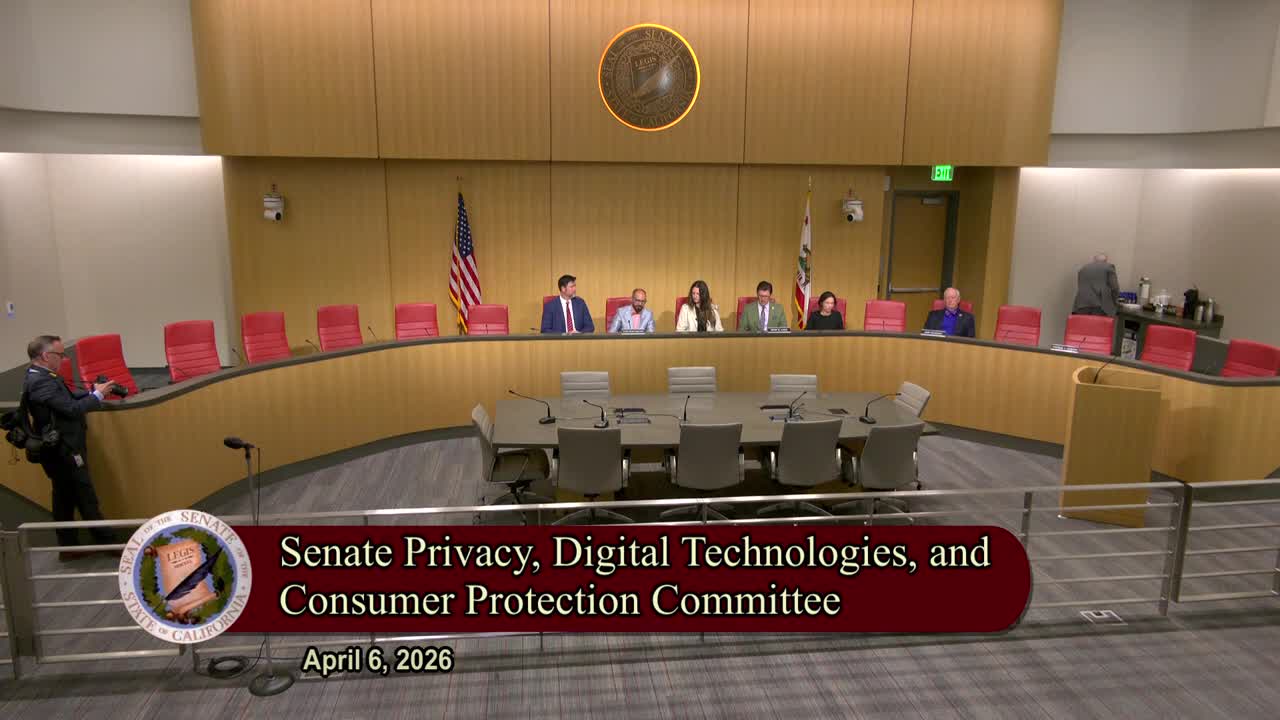 3MIN
Senate Standing Committee on Privacy, Digital Technologies, and Consumer Protection
Bill Author

Bill Co-Author(s):