SB 1137: Personal income tax: deduction: medical expenses.
- Session Year: 2025-2026
- House: Senate
- Latest Version Date: 2026-04-08
Current Status:
In Progress
(2026-05-14: May 14 hearing: Held in committee and under submission.)
Introduced
In Committee
Awaiting First Chamber Vote
Passed First Chamber
In Committee
Awaiting Second Chamber Vote
Passed Second Chamber
Enacted
The Personal Income Tax Law, in conformity or modified conformity with federal income tax laws, allows various deductions in computing the income that is subject to the taxes imposed by that law, including a deduction for the medical and dental expenses paid during the taxable year, not compensated for by insurance or otherwise, for the medical or dental care of the taxpayer, spouse, or a dependent, to the extent that such expenses exceed 7.5% of federal adjusted gross income.
This bill would, for taxable years beginning on or after January 1, 2026, instead allow that deduction to the extent that those medical and dental expenses exceed 4% of federal adjusted gross income. and before January 1, 2031, allow a deduction from adjusted gross income for the costs of medical care, as defined, of a qualified taxpayer to the extent the costs exceed 4% of the qualified taxpayers federal adjusted gross income. The bill would limit the deduction to $5,000. The bill would define qualified taxpayer for this purpose to mean an individual with adjusted gross income that does not exceed 300% of the federal poverty level and who does not take an itemized deduction for costs of medical care pursuant to the above-referenced provisions on their California income tax return.
Existing law requires any bill expanding an existing tax deduction to contain, among other things, specific goals, purposes, and objectives that the tax credit will achieve, detailed performance indicators, and data collection requirements. authorizing a new tax expenditure to contain, among other things, specific goals that the tax expenditure will achieve, detailed performance indicators, and data collection requirements.
The bill would provide findings and declarations relating to the goals of the expansion of the deduction for medical and dental expenses.This bill also would include additional information required for any bill authorizing a new tax expenditure.
This bill would take effect immediately as a tax levy.
The Personal Income Tax Law, in conformity or modified conformity with federal income tax laws, allows various deductions in computing the income that is subject to the taxes imposed by that law, including a deduction for the medical and dental expenses paid during the taxable year, not compensated for by insurance or otherwise, for the medical or dental care of the taxpayer, spouse, or a dependent, to the extent that such expenses exceed 7.5% of federal adjusted gross income.
This bill would, for taxable years beginning on or after January 1, 2026, instead allow that deduction to the extent that those medical and dental expenses exceed 4% of federal adjusted gross income.
Existing law requires any bill expanding an existing tax deduction to contain, among other things, specific goals, purposes, and objectives that the tax credit will achieve, detailed performance indicators, and data collection requirements.
The bill would provide findings and declarations relating to the goals of the expansion of the deduction for medical and dental expenses.
This bill would take effect immediately as a tax levy.
(a)Section 62 of the Internal Revenue Code, relating to adjusted gross income defined, shall apply, except as otherwise provided.
(b)Section 62(a)(2)(D) of the Internal Revenue Code, relating to certain expenses of elementary and secondary school teachers, shall not apply.
(c)Section 62(a)(21) of the Internal Revenue Code, relating to attorneys fees relating to awards to whistleblowers, shall not apply.
(d)For taxable years beginning on or after January 1, 2026, Section 62(a) of the Internal Revenue Code, relating to the general rule, is modified to provide that the deduction under Section 17242 shall be allowed in determining adjusted gross income.
SEC. 2.Section 17242 is added to the Revenue and Taxation Code, to read:17242.(a)(1)For taxable years beginning on or after January 1, 2026, and before January 1, 2031, there shall be allowed a deduction in determining the adjusted gross income of a qualified taxpayer an amount equal to the costs of medical care not compensated for by insurance or otherwise to the extent that such costs exceed 4 percent of the qualified taxpayers federal adjusted gross income.
(2)The deduction allowed by paragraph (1) shall not exceed five thousand dollars ($5,000).
(b)For purposes of this section, the following definitions apply:
(1)Medical care has the same meaning as that term is defined in Section 213(d) of the Internal Revenue Code.
(2)Qualified taxpayer means an individual that satisfies both of the following:
(A)Has adjusted gross income that does not exceed 300 percent of the federal poverty level, as determined by the United States Census Bureau.
(B)Does not take an itemized deduction for costs of medical care pursuant to Section 213 of the Internal Revenue Code, relating to medical, dental, etc., expenses, on their California income tax return.
(c)This section shall remain operative only until December 1, 2031, and as of that date is repealed.
SECTION 1.Section 17241 of the Revenue and Taxation Code is amended to read:17241.(a)Section 213(a) of the Internal Revenue Code, relating to allowance of deduction, is modified by substituting 7.5 percent for 10 percent for taxable years beginning before January 1, 2021.(b)For taxable years beginning on or after January 1, 2026, Section 213(a) of the Internal Revenue Code, relating to allowance of deduction, is modified by substituting 4 percent for 7.5 percent.SEC. 2.SEC. 3.(a)For purposes of complying with Section 41 of the Revenue and Taxation Code, as it relates to the deduction allowed by Section 17242 of the Revenue and Taxation Code, as added by this act, the Legislature finds and declares the following:
(1)The goals, purposes, and objectives goals of the amendments made by this bill deduction allowed are the following:
(A)To help Californians pay for their health care premiums, as premiums have increased 55 percent since 2010, which is at least twice as fast as wages or inflation over the same time period.
(B)To allow Californians to deduct more of their health care expenses and pay less in state tax.
(2)The performance indicators for the Legislature to use when measuring whether the tax exemption meets the goals, purposes, or objectives goals specified in paragraph (1) will be the following:
(A)The change in number of taxpayers receiving the deduction under Section 17241 17242 of the Revenue and Taxation Code for taxable years after enactment of the amendments made by this bill, compared to the number of taxpayers receiving that deduction the deduction under Section 213 of the Internal Revenue Code on their California income taxes for taxable years prior to the enactment of the amendments made by this bill. this act.
(B)The change in total deductions, in dollars, taken by taxpayers pursuant to Section 17241 of the Revenue and Taxation Code for taxable years after enactment of the amendments made by this bill, compared to the total deductions taken by taxpayers pursuant to that section for taxable years prior to the enactment of the amendments made by this bill. total dollar value of deductions taken pursuant to Section 17242 of the Revenue and Taxation Code.
(b)(1)On or before February 1, 2030, notwithstanding Section 19542 of the Revenue and Taxation Code, the Franchise Tax Board shall provide an anonymized report report, in compliance with Section 9795 of the Government Code, to the Assembly Committee on Revenue and Taxation and the Senate Committee on Governance and Finance Revenue and Taxation with the number of taxpayers that claimed the deduction, and the total amount, in dollars, of deductions claimed by year for each taxable year beginning on or after January 1, 2026. The report shall be provided in compliance with Section 9795 of the Government Code.
(2)The disclosure provisions of this paragraph shall be treated as an exception to Section 19542.
SEC. 3.SEC. 4.This act provides for a tax levy within the meaning of Article IV of the California Constitution and shall go into immediate effect.
(a)Section 213(a) of the Internal Revenue Code, relating to allowance of deduction, is modified by substituting 7.5 percent for 10 percent for taxable years beginning before January 1, 2021.
(b)For taxable years beginning on or after January 1, 2026, Section 213(a) of the Internal Revenue Code, relating to allowance of deduction, is modified by substituting 4 percent for 7.5 percent.
SEC. 2.(a)For purposes of complying with Section 41 of the Revenue and Taxation Code, the Legislature finds and declares the following:
(1)The goals, purposes, and objectives of the amendments made by this bill are the following:
(A)To help Californians pay for their health care premiums, as premiums have increased 55 percent since 2010, which is at least twice as fast as wages or inflation over the same time period.
(B)To allow Californians to deduct more of their health care expenses and pay less in state tax.
(2)The performance indicators for the Legislature to use when measuring whether the tax exemption meets the goals, purposes, or objectives specified in paragraph (1) will be the following:
(A)The change in number of taxpayers receiving the deduction under Section 17241 of the Revenue and Taxation Code for taxable years after enactment of the amendments made by this bill, compared to the number of taxpayers receiving that deduction for taxable years prior to the enactment of the amendments made by this bill.
(B)The change in total deductions, in dollars, taken by taxpayers pursuant to Section 17241 of the Revenue and Taxation Code for taxable years after enactment of the amendments made by this bill, compared to the total deductions taken by taxpayers pursuant to that section for taxable years prior to the enactment of the amendments made by this bill.
(b)On or before February 1, 2030, notwithstanding Section 19542 of the Revenue and Taxation Code, the Franchise Tax Board shall provide an anonymized report to the Assembly Committee on Revenue and Taxation and the Senate Committee on Governance and Finance with the number of taxpayers that claimed the deduction, and the total amount, in dollars, of deductions claimed by year for each taxable year beginning on or after January 1, 2026. The report shall be provided in compliance with Section 9795 of the Government Code.
SEC. 3.This act provides for a tax levy within the meaning of Article IV of the California Constitution and shall go into immediate effect.
|
Date
|
Status
|
|---|---|
| May 14, 2026 | May 14 hearing: Held in committee and under submission. |
| May 12, 2026 | Set for hearing May 14. |
| May 11, 2026 | May 11 hearing: Placed on APPR. suspense file. |
| May 7, 2026 | Set for hearing May 11. |
| May 6, 2026 | From committee: Do pass and re-refer to Com. on APPR. (Ayes 5. Noes 0. Page 4154.) (May 6). Re-referred to Com. on APPR. |
| May 6, 2026 | From committee: Do pass and re-refer to Com. on APPR. (Ayes 5. Noes 0.) (May 6). Re-referred to Com. on APPR. |
| Apr 9, 2026 | Set for hearing May 6. |
| Apr 8, 2026 | From committee with author's amendments. Read second time and amended. Re-referred to Com. on REV. & TAX. |
| Feb 26, 2026 | Referred to Com. on REV. & TAX. |
| Feb 19, 2026 | From printer. May be acted upon on or after March 21. |
| Feb 18, 2026 | Introduced. Read first time. To Com. on RLS. for assignment. To print. |
|
Date
|
Description
|
Location
|
Votes
|
|
|---|---|---|---|---|
| May 11, 2026 | Placed on suspense file | Senate Standing Committee on Appropriations |
Passed |
|
| May 6, 2026 | Do pass, but first be re-referred to the Committee on [Appropriations] | Senate Standing Committee on Revenue and Taxation |
Passed |
This list shows positions taken on this bill by organizations on the date displayed, which is linked to the original source.
Positions by individuals are not included.
|
Organization
|
Position
|
Date
|
|---|---|---|
| California Hispanic Legislative Caucus | ** Support | |
| California Podiatric Medical Association | ** Support | |
| California Society Of Pathologists | ** Support | |
| California Teachers Association | ** Against | |
| Golden State Opportunity | ** Support |
SENATE COMMITTEE ON
Senator Sabrina Cervantes, Chair
2025 - 2026 Regular Session
SB 1137 (Valladares) - Personal income tax: deduction: medical expenses
Version: | Policy Vote: |
Urgency: | Mandate: |
Hearing Date: | Consultant: |
Bill Summary:
SB 1137 would authorize an above-the-line deduction up to $5,000 for unreimbursed medical costs exceeding 4 percent of the qualified taxpayer’s federal adjusted gross income.
Fiscal Impact:
The Franchise Tax Board (FTB) estimates that this bill would result in General Fund revenue losses of $95 million in 2026-27, $60 million in 2027-28, and $65 million in 2028-29. FTB’s administrative costs have yet to be identified.
Background:
Tax expenditure programs (TEPs) are special tax provisions that reduce the amount of revenues the “basic” tax system would otherwise generate in order to provide (1) benefits to certain groups of taxpayers, and/or (2) incentives to encourage certain types of behavior and activities, such as charitable giving. Specifically, current law provides for, among other things, various income and corporation tax credits and deductions, as well as exemptions from the sales and use tax. The Department of Finance is required to publish a list of TEPs (currently totaling several hundred), which currently exceed $94 billion annually.
Current federal and state laws provide that gross income includes all income from any source, unless specifically excluded; examples include amounts received as a gift or inheritance, certain compensation for injuries and sickness, qualified scholarships, educational assistance programs, foster care payments, and interest received on certain state or federal obligations.
Existing federal and state laws allow for the deduction of certain expenses from gross income when calculating adjusted gross income (AGI). Some examples include moving expenses for members of the armed service, as well as certain ordinary and necessary trade and business expenses. These are known as “above the line” deductions. Unlike itemized deductions, such as charitable deductions and mortgage interest deductions, all taxpayers with these types of expenses may take the corresponding deduction. In other words, the taxpayer can take above-the-line deductions regardless of whether the taxpayer claims the standard or itemized deduction.
State law does not automatically conform to federal changes. Instead, the Legislature must conform to federal changes. Specifically, it can pass (1) an individual bill that conforms to a specific federal tax provision, or (2) an omnibus bill to conform state law to federal law as of a specified date. Current state law generally conforms to federal tax law as of January 1, 2025 (SB 711, McNerney).
Under current law, taxpayers choosing to itemize their deductions can deduct unreimbursed medical and dental expenses that exceed 7.5 percent of their federal AGI for (1) the diagnosis, cure, mitigation, treatment, or prevention of disease, or for the purpose of affecting any structure or function of the body, (2) transportation primarily for and essential to such medical care, (3) medical insurance that covers such medical care, including essential transportation and amounts paid as premiums for Medicare Part B supplemental medical insurance, and (4) long-term care services.
In July 2025, Congress enacted H.R. 1, which among other changes (1) is projected to reduce Medi-Cal enrollment by up to 2 million people, and (2) allowed the Affordable Care Act’s enhanced premium tax credits to expire at the end of 2025. The enhanced premium tax credits have helped nearly 1.7 million Californians afford health coverage, and according to Covered California, their loss represents approximately $2.5 billion in annual premium savings. Consequently, enrollees are expected to face premium increases. Additionally, H.R. 1 restricts access to advance premium tax credits for individuals who lose Medi-Cal coverage due to work requirements, among other policy changes. The California Department of Managed Health Care estimates that, taken together, these changes could leave as many as 660,000 Covered California enrollees uninsured.
Proposed Law:
This bill, among other things, would do the following:
- Authorize an above-the-line deduction for taxable years 2026 through 2030, up to $5,000 for taxpayers. The deduction would be available to taxpayers who have an AGI of less than 300 percent of the federal poverty level and have unreimbursed medical costs exceeding 4 percent of their federal AGI in the taxable year.
- Specify that taxpayers who take an itemized deduction for medical costs are not eligible for the deduction authorized by this measure.
Related Legislation: SB 1249 (Richardson) would authorize an above-the-line deduction for elderly seniors for tax years 2026 through 2030, equal to $6,000, subject to a phase-out above specified income levels. The bill is currently pending in this Committee.
-- END --
SENATE COMMITTEE ON REVENUE AND TAXATION
Senator Jerry McNerney, Chair
2025 - 2026 Regular
Bill No: | SB 1137 | Hearing Date: | 5/6/26 |
Author: | Valladares | Tax Levy: | Yes |
Version: | 4/8/26 Amended | Fiscal: | Yes |
Consultant: | Summers | ||
Personal income tax: deduction: medical expenses
Authorizes an above-the-line deduction up to $5,000 for unreimbursed medical costs exceeding 4% of the qualified taxpayer’s federal adjusted gross income in the taxable year.
Background
Tax expenditures. California law allows various income tax credits, deductions, exemptions, and exclusions. The Legislature enacts such tax incentives to compensate taxpayers for incurring certain expenses, such as child adoption, or to influence certain behavior, such as charitable giving. The Legislature uses tax incentives to encourage taxpayers to do something they would otherwise not do, but for the tax credit. The Department of Finance must publish an annual list of tax expenditures, currently totaling around $94.2 billion in forgone General Fund revenue.
Income. Existing federal and state laws provide that gross income includes all income from any source, including compensation for services, business income, gains from property, interest, dividends, rents, and royalties, unless specifically excluded. Existing federal and state laws exclude certain types of income from gross income, such as specified amounts received as gifts or by inheritance, certain compensation for injuries and sickness, qualified scholarships, educational assistance programs, foster care payments, and interest received on certain state or federal obligations, among other things.
Existing federal and state laws allow for the deduction of certain expenses from gross income when calculating adjusted gross income (AGI). Some examples include moving expenses for members of the armed service, as well as certain ordinary and necessary trade and business expenses. These are known as “above the line” deductions. Unlike itemized deductions, such as charitable deductions and mortgage interest deductions, all taxpayers with these types of expenses may take the corresponding deduction. In other words, the taxpayer can take above-the-line deductions regardless of whether the taxpayer claims the standard or itemized deduction.
Conformity. State law does not automatically conform to changes in federal tax law, except for specific retirement provisions. Instead, the Legislature must affirmatively conform to federal changes, which it can do in two different ways. First, the Legislature can pass an individual tax bill that conforms to a specific federal provision, such as the Regulated Investment Company Modernization Act (AB 1423, Perea, 2011). Second, the Legislature can enact one omnibus bill to provide that state law conforms to federal law as of a specified date. Currently, state law generally conforms to federal tax law as of January 1, 2025 (SB 711, McNerney, 2025).
Federal and state itemized deduction for unreimbursed medical expenses. For taxpayers who do not take the below-the-line standard deduction, federal and state law allow them to take below-the-line itemized deductions. One of those authorized itemized deductions is for unreimbursed medical and dental expenses that exceed 7.5% of the taxpayer's federal adjusted gross income (AGI). IRC 213 defines “medical care” to mean amounts paid for:
- The diagnosis, cure, mitigation, treatment, or prevention of disease, or for the purpose of affecting any structure or function of the body;
- Transportation primarily for and essential to such medical care;
- Medical insurance that covers such medical care, including essential transportation and amounts paid as premiums for Medicare Part B supplemental medical insurance; and,
- Long-term care services.
Impact of H.R. 1. In July of 2025, Congress enacted H.R. 1 (commonly known as the “One Big Beautiful Bill Act”), which weakened Medi-Cal in several ways: coverage restrictions, increased work requirements, administrative barriers, and reductions in financing.[1] Medi-Cal currently covers more than 14 million Californians, about one-third of the state, with an estimated 2025–26 spending of nearly $197 billion, including over $46 billion from the General Fund. The changes made by H.R. 1 could result in upwards of 2 million disenrollments.
Further, as part of H.R. 1, Congress did not extend the Affordable Care Act’s enhanced premium tax credits that expired on December 31, 2025.[2] These federal tax credits help ensure that nearly 1.7 million Californians can afford health coverage, including more than 1 in 3 enrollees who currently pay $10 or less per month in premiums. Covered California estimated the loss of enhanced credits equals about $2.5 billion in annual premium savings.[3] 88% of enrollees will see a premium increase, and more than 40% will see their premiums double or more. Further, H.R. 1 denies the advance premium tax credits to consumers who lose Medi-Cal coverage due to work requirements, among other changes. According to the California Department of Managed Health Care, the combined impact of these changes may result in as many as 660,000 Covered California enrollees going uninsured.[4]
Medical care cost burdens. A U.S. Census Bureau survey showed that 16.2% of fully insured households had medical debt, compared to 30.8% of those who were not fully insured. Households without full-year health insurance coverage had a median medical debt of $3,000, compared with $2,000 for households with full coverage.[5] According to the California Health Care Foundation’s (CHCF) 2026 California Health Policy Survey, half of Californians say their health care expenses have increased faster than their income.[6] Four in ten Californians have medical debt, including 55% of those with low incomes (< 200% of the Federal Poverty Limit (FPL)) and 37% with higher incomes (> 200% of FPL).
The author wants to authorize an above-the-line deduction and have unreimbursed medical costs to allow Californians to deduct more of their health care expenses and pay less in state tax.
Proposed Law
Senate Bill 1137 authorizes an above-the-line deduction for taxable years 2026 through 2030, up to $5,000 for taxpayers. The deduction is available to taxpayers who have an AGI of less than 300% of the federal poverty level and have unreimbursed medical costs exceeding 4% of their federal AGI in the taxable year. The measure also specifies that taxpayers who take an itemized deduction for medical costs are not eligible for the deduction authorized by this measure. The bill also contains legislative findings and declarations to comply with Section 41 of the Revenue and Taxation Code.
State Revenue Impact
According to the Franchise Tax Board (FTB), SB 1137 would result in revenue losses of $95 million in FY 2026-27, $60 million in FY 2027-28, and $65 million in 2028-29.
Comments
1. Purpose of the bill. According to the author, “SB 1137, the Medical Expense Deduction Act, addresses a gap in current law that leaves many Californians without tax relief for significant out-of-pocket medical expenses simply because they claim the standard deduction. While existing law provides relief for those who itemize, the majority of taxpayers receive no benefit, even when facing substantial health care costs. This bill creates a targeted, above-the-line deduction for qualifying taxpayers, expanding access to relief while maintaining clear thresholds, income limits, and caps to ensure fiscal responsibility. Specifically, the measure allows eligible taxpayers earning up to 300 percent of the federal poverty level to deduct qualified medical expenses exceeding 4 percent of adjusted gross income, capped at $5,000 annually.”
2. “Windfall” or “but for” tax benefit? Tax expenditures produce two different outcomes. The first outcome is a “windfall,” in which the tax expenditure rewards behavior that would have occurred even without the tax benefit. The second outcome is a “but for tax benefit,” where a particular activity would not have occurred without the incentive created by the tax expenditure. Here, SB 1137 is largely a “windfall” tax benefit, because taxpayers incur medical expenses due to necessity and would have borne these costs regardless of the deduction. Additionally, this provides a more generous benefit to taxpayers who would have otherwise itemized these deductions. However, the measure’s above-the-line structure, compared with existing itemized deduction rules, may improve the financial condition of some low- to moderate-income households and potentially encourage persons to seek care, adhere to treatment, or avoid deferring necessary medical services. On balance, this credit primarily serves as a windfall tax benefit, subsidizing unavoidable expenditures, although it may also serve as a “but for” incentive to encourage healthcare among cost-constrained taxpayers who would not otherwise be able to itemize these expenses under current law.
3. Revenue loss. Existing tax law provides various credits, deductions, exclusions, and exemptions for certain taxpayers. By authorizing a credit against personal income tax, SB 1137 will result in the State General Fund receiving less revenue. As a result, the state will have to reduce spending or increase taxes to offset the loss. Additionally, because Proposition 98 establishes a minimum funding guarantee for K-14 education in California, which generally represents roughly 40% of the state’s General Fund revenues, every dollar of General Fund loss results in approximately 40 cents less of funding for K-14 education.
4. Precedent. If the Legislature allows an above-the-line income tax deduction for unreimbursed medical expenses, why should it not allow other current below-the-line deductions to be taken above-the-line? This may lead to a slippery slope in which additional deductions are authorized to reduce gross income, thereby eroding the income tax base and reducing general fund revenues.
5. Equity. To afford health care, Californians report cutting back on savings, retirement contributions, entertainment, groceries, household essentials, and rent or mortgage payments. Six in ten Californians report skipping or delaying care due to cost, with four in ten saying skipping care made their condition worse. The situation is even worse for Californians with low incomes, Latino/x, or from rural communities, where 70% report they skipped or delayed health care in the past year due to cost.[7]
6. Who benefits? California’s progressive income tax system applies higher marginal rates as taxable income exceeds certain thresholds. An above-the-line deduction reduces the taxpayer's AGI before any standard or itemized deductions are applied. As a result, SB 1137’s deduction benefits every filer who qualifies, regardless of whether they itemize. Additionally, by lowering state AGI, it can move taxpayers into a lower marginal tax bracket, trimming the rate applied to the rest of their income and potentially unlocking other income-based credits or deductions such as the child tax credit or IRA contribution limits.
7. Conformity. California enacted general conformity to federal itemized deductions in 1993, including the medical expense deduction and its 7.5% AGI threshold. The Patient Protection and Affordable Care Act of 2010 increased this threshold to 10%, with a temporary 7.5% protection for seniors age 65+, for tax years 2013-2016. California decoupled from this change in 2015 to preserve the 7.5% threshold for all taxpayers. The Tax Cuts and Jobs Act restored the 7.5% threshold for all taxpayers for 2017 and 2018. In 2019, the Taxpayer Certainty and Disaster Tax Relief Act retroactively extended the 7.5% threshold for 2019 and 2020, and in 2020, the Consolidated Appropriations made it permanent. California did not conform to these subsequent changes in federal law. As a result, state law, through modified conformity, set the AGI threshold percentage to 7.5%, which is currently the same threshold under federal law.
8. Section 41. Section 41 of the Revenue and Taxation Code requires any bill enacting a new tax expenditure to contain, among other things, specific goals, purposes, and objectives that the tax expenditure will achieve and detailed performance indicators, along with data collection and reporting requirements (SB 1335, Leno, 2014). A bill that would authorize a new gross income exclusion is exempt from the requirement that the bill contain detailed performance indicators and data collection reporting if the Legislature determines there is no available data to collect and report (AB 3289, Committee on Revenue and Taxation, 2024). To satisfy these requirements, SB 1137 states that the specific goals of the deduction are to help Californians pay for their health care premiums and allow Californians to deduct more of their health care expenses to reduce their state tax. The specific performance indicators shall be:
- The change in the number of taxpayers receiving this deduction compared to the number of taxpayers receiving the deduction under Section 213 of the Internal Revenue Code on their California income taxes for taxable years prior to the enactment of this act.
- The total dollar value of deductions taken pursuant to Section 17242 of the Revenue and Taxation Code.
To aid the Legislature in determining whether this act meets the goals, purposes, and objectives, SB 1137 directs the FTB, on or before February 1, 2030, to provide an anonymized report to the Assembly Committee on Revenue and Taxation and the Senate Committee on Revenue and Taxation with the number of taxpayers that claimed the deduction, and the total dollars value, of deductions claimed by year for each taxable year beginning on or after January 1, 2026.
9. Related legislation. Before the committee today is also SB 1249 (Richardson), which would authorize an above-the-line deduction for elderly seniors for tax years 2026 through 2030, equal to $6,000, subject to a phase-out above specified income levels.
Support and Opposition
(5/1/26)
Support: California Hispanic Legislative Caucus
California Podiatric Medical Association
California Society of Pathologists
Golden State Opportunity
Opposition: California Teachers Association
-- END --
https://lao.ca.gov/handouts/health/2026/H.-R-1-Key-Impacts-021126.pdf ↑
https://hbex.coveredca.com/data-research/library/Brief%201%20IRA%20ACA%20Premium%20Impacts%202026.pdf ↑
https://www.coveredca.com/pdfs/congressional-fact-sheet922025.pdf ↑
https://dmhc.ca.gov/Portals/0/Docs/OFR/FSSB/Feb2026/CoveredCaliforniaUpdate.pdf ↑
https://www.census.gov/library/stories/2021/04/who-had-medical-debt-in-united-states.html ↑
https://www.chcf.org/wp-content/uploads/2026/02/CHCFHealthPolicySurvey2026.pdf ↑
https://www.chcf.org/wp-content/uploads/2026/02/CHCFHealthPolicySurvey2026.pdf ↑
Discussed in Hearing
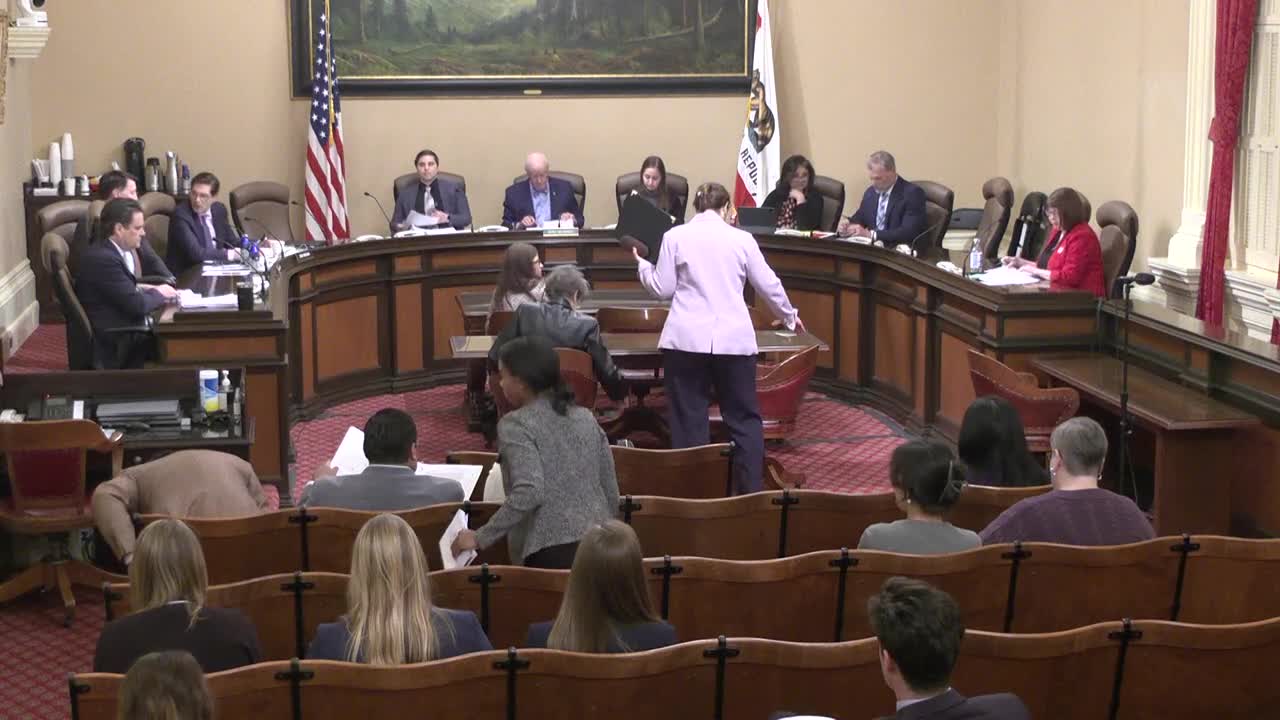 6MIN
Senate Standing Committee on Revenue and Taxation
Bill Author

Bill Co-Author(s):